

Page 1
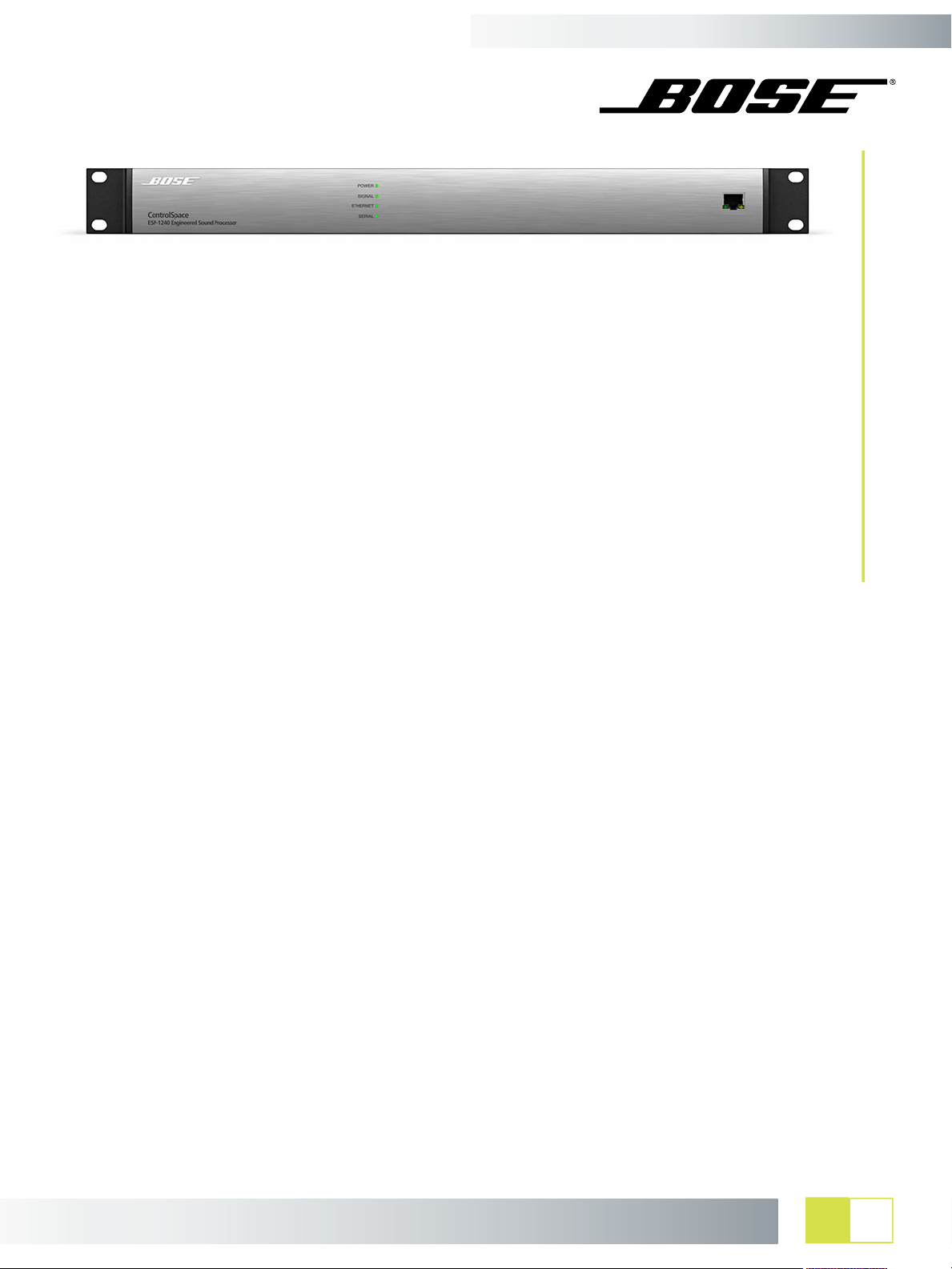
ControlSpace® ESP-1240
engineered sound processor
TECHNICAL DATA SHEET
Product Overview
The Bose® ControlSpace® ESP-1240 engineered sound
processor is an open-architecture DSP with 12x4 fixed
analog audio, built-in 8-channel ESPLink output and a rearpanel digital expansion slot offering IP-based network audio
and control card options. This model meets today’s strict
requirements for high-quality signal processing and control
in a cost-effective package. The ESP-1240 is designed for a
wide variety of applications ranging from small self-contained
projects to larger networked applications.
Product Information
The ESP-1240 accommodates a total of 56 audio channels
through analog audio connections (12 input, 4 output),
ESPLink (8 output), and when an optional Dante(tm) audio
network card is used, an additional 32 channels (16 input,
16 output) are available for signal processing, routing and
switching. Alternatively, a Network Control card is available
for clean rear-panel control network connections. For
standalone applications or convenient service access, a
front panel Ethernet connector allows for local configuration
and monitoring. Onboard connectivity includes Serial over
Ethernet, RS-232, 5 control inputs and 5 control outputs.
Any of the elegant Bose wall-mounted user interfaces—
including the programmable CC-64 and CC-16 controllers
and three simplified zone volume interfaces—can be used to
control all Bose networkable devices.
Open architecture configuration and control is enabled
using Bose ControlSpace Designer™ software where an
ever-expanding list of algorithms and improvements offers
a high level of functionality for audio installations. Bose
single-rack-space ESPs are designed for a wide variety of
applications ranging from small self-contained projects to
larger networked applications.
Key Features
• High-quality analog circuitry offers both mic and line-level I/
O, operates with ultra-low noise and 115 dB dynamic range
• Advanced digital signal processing supports audio at 48
kHz sample rate/24-bit, uses a floating-point open architecture
DSP and operates at low latencies for sound system precision
• Expansion card slot supports the use of accessory
networking cards, allowing digital audio to be sent and/or
received from other compatible products
• Optional Dante™ media networking card allows single rackspace ESP products to closely integrate with Bose or other
manufacturers’ products and systems
• Bose® ControlSpace® Designer™ software enables a
large set of signal processing modules, such as automatic
mic mixing, multiband graphic and parametric EQs, Bose
loudspeaker libraries, signal generators, routers, mixers,
AGCs, duckers, gates, compressors, source selectors and
delays
• Front panel RJ-45 Ethernet connection enables localized
configuration and monitoring, while enabling network
passthrough when using a rear-panel network option card
• Built-in Bose ESPLink output sends up to 8 channels
of uncompressed digital audio to ESPLink-equipped Bose
PowerMatch® amplifiers
• A variety of control options – ControlSpace ESP products
are compatible with the programmable Bose CC-64 and
CC-16 controllers and three simplified zone volume interfaces,
as well as potentiometers and switches built by other
manufacturers
• Integration with industry-standard control systems using
a comprehensive serial protocol through onboard RS-232 and
Ethernet ports
Applications
Designed for a wide range of applications, including:
Auditoriums
•
Houses of worship
•
Resorts and hospitality venues
•
Retail stores
•
Schools and universities
•
Multi-purpose spaces
•
Bose Professional Systems Division
OF 6
1
pro.Bose.com
Page 2

ControlSpace® ESP-1240
engineered sound processor
Technical Specifications
Integrated DSP
Signal Processor 32-bit fixed/floating-point DSP + ARM, 456 MHz
Maximum Calculation 3.6 GIPS / 2.7 GFLOPS
Delay 43 s
Audio Latency 860 μs (analog in to analog out)
A/D and D/A Converters 24-bit
Sample Rate 48 kHz
Audio Performance Specifications
Frequency Response 20 Hz - 20 kHz (+0.3 dB/-0.1 dB)
THD+N 0.002 % at +4 dBu (A-weighted/20 Hz – 20 kHz)
Channel Separation (Crosstalk) < -105 dB at +4 dBu input and output level, 1 kHz
Dynamic Range > 115 dB, A-weighted 20 Hz – 20 kHz, analog through
Audio Inputs
Input Channels 12 analog (balanced, mic/line level), 16 digital (via option card)
Connectors, Input 3.81 mm Phoenix Contact®, 6-pin
Input Impedance 12 kΩ @ 1 kHz (with or without phantom power active)
Maximum Input Level +24 dBu
Equivalent Input Noise <-119 dBu (22 - 20 kHz, 150 Ω input, 64 dB gain)
Phantom Power +48 VDC, 10 mA, selectable per input
Gain settings 0/14/24/32/44/54/64 dB
Audio Outputs
Output Channels 4 analog (balanced, line level), 8 ESPLink, 16 digital (via optional card)
Connectors, Output 3.81 mm Phoenix Contact®, 6-pin (analog), EIAJ optical (ESPLink)
Output Impedance 66 Ω
Maximum Output Level +24 dBu
Control Inputs
Inputs (Control) 5 analog or digital inputs, 2 kΩ internal pull-up resistor to 5 V, 3.81 mm Phoenix Contact®, 6-pin
Analog Input Voltage Range 0 V to 3.3 V (maximum 5 V)
Digital Input Voltage Range 0 V to 3.3 V (threshold voltage = 1.6 V)
Control Outputs
Outputs (Control) 5 digital outputs, 3.81 mm Phoenix Contact®, 6-pin
Output Voltage High: 8 V (open circuit), 2.5 V @ 10 mA;Low: < 1 V @ 100 mA, push-pull
Output Current 10 mA source, 100 mA sink (24 VDC max external supply voltage)
Indicators and Controls
LED Status Indicators Power/Status, Signal, Ethernet, Serial (RS-232 + CC-16)
Audio Signal Indication Green (-60 to -20 dBFS), Yellow (-20 to -2 dBFS), Red (-2 to 0 dBFS)
Electrical Specifications
Mains Voltage 85 VAC-264 VAC 50/60 Hz
AC Power Consumption < 37 VA typical, over all mains voltages
Mains Connector IEC 60320-C14 (Inlet)
Power Dissipation 22 W (75 BTU/hr, 19 kcal/hr)
Physical
Dimensions 1.7" H x 19.0" W x 8.5" D (44 mm x 483 mm x 215 mm)
Net Weight
Operating Temperature 32ºF - 104ºF (0ºC - 40ºC)
Cooling System Active, side venting
General
PC Configuration Software
Network Control Ethernet (RJ-45),100Mb
Communications Ports RS-232 (DB9M, DTE), Bose CC-16 (3.81 mm Phoenix Contact®, 3-pin)
Expansion Slots 1 control/audio network
Audio Channel Capacity 56 (12x4 analog, 8 ESPLink out, 16x16 digital with expansion card)
5.8 lb (2.6 kg)
ControlSpace® Designer™ software
TECHNICAL DATA SHEET
Bose Professional Systems Division
OF 6
2
pro.Bose.com
Page 3

ControlSpace® ESP-1240
engineered sound processor
1. LED indicators - Power, Signal, Ethernet and Serial indication
2. Ethernet connector - RJ-45 jack for front panel network connectivity
3. Front rack-mount ears - For use when securing into rack enclosures
TECHNICAL DATA SHEET
1. Analog audio connectors – Mic/line-level balanced input and line-level output connectors
2. ESPLink output connector – For use with ESPLink card-equipped PowerMatch® amplifiers
3. Chassis serial number – Location for unit serial number
4. RS-232 – 5-wire, RS-232-C (DTE) serial data interface connection
5. Digital expansion slot – Supports optional digital expansion cards
6. AC Mains receptacle – Power cord connection (IEC 60320-C14 inlet)
7. CC-16 connector – Allows Bose® CC-16 zone controller connections
8. Control Outputs connector – Five general-purpose control outputs
9. Control Inputs connector – Five general-purpose control inputs
Bose Professional Systems Division
OF 6
3
pro.Bose.com
Page 4

ControlSpace® ESP-1240
Back V
iew
Front View
Right View
1.7”
[44mm]
16.9”
[428mm]
1.3”
[32mm]
8.4”
[213mm]
8.2”
[208mm]
19.0”
[483mm]
18.5”
[469mm]
engineered sound processor
Mechanical Diagrams
TECHNICAL DATA SHEET
Bose Professional Systems Division
OF 6
4
pro.Bose.com
Page 5

ControlSpace® ESP-1240
engineered sound processor
Software Information
Bose® ControlSpace® Designer™ software is used for the design,
configuration, real-time operation and monitoring of a system
containing selected Bose system electronics and control centers.
Using a standard drag-and-drop user interface, ControlSpace
Designer software offers the flexibility to quickly and accurately
configure signal processing functions within processors, and to
develop complex control programming for system operation.
When actively connected to the system ControlSpace Designer
software can be used to either control and operate the system
in real time for system set-up and optimization, or may be used
as a system monitor. When configured for monitor mode device
parameters are protected and the system operator only has
access to virtual control panels and amplifier monitor functions.
Parameter sets provide the ability to program and recall system
settings ranging from an individual signal processing parameter
to a complete system setup; while Group controls provide master
volume control of multiple gains, or control of multiple instances of
the same signal processing function type. Both Parameter set and
Group programming functions are easily mapped to the physical
controls of a Bose control center, or may be invoked remotely
using a standard serial protocol or general purpose inputs.
Smart Simulation programming enables designers to test and
modify system control programming while off-line, eliminating
the need to connect to the actual system to configure and test
system control programming. Virtual control centers are included
to test system operation, and all parameter set, group and
general purpose input and outputs may be tested using the Smart
Simulation.
Integrated Dante routing, configuration and monitoring streamlines
setup and control of optional Dante networked audio components.
Minimum System Requirements
The following are the minimum system requirements for
ControlSpace® Designer™ 4.1
Operating System:
Microsoft Windows® 7 and 8, x86 and x86-64 bit versions
(Windows 8 requires installation of Microsoft .NET 3.5)
Processor:
1GHz processor (or better)
RAM:
512MB of RAM available (1GB recommended)
Disc Space:
512MB of disk space available (1GB recommended)
Ports Required:
1 USB, 1 network port (Wired LAN, Ethernet, 100 Mb minimum, or
wireless LAN 802.11g/n)
USB & Interfaces:
1 available USB port
A scroll-wheel mouse (highly recommended)
Network Port:
1 available network port (wired LAN, Ethernet, 100 MB minimum,
or wireless LAN 802.11g/n)
Important note: ControlSpace Designer software is not fully tested
for operation running on a virtual Windows machine using Apple®
Macintosh® computers. For critical set up and control operations a
standard Windows PC is recommended for use.
Expansion Cards
ControlSpace® ESP-880/1240/4120 network control card
Adds a rear-panel network connection to fixed-I/O ControlSpace
engineered sound processors.
Product Code: 359841-0010
ControlSpace® ESP-880/1240/4120 Dante™ network card
Provides 16 input and 16 output channels of low-latency digital
audio using the Dante audio networking solution from Audinate®.
Product Code: 359842-0020
Architects’ and Engineers’
Specifications
The engineered sound processor shall be an open-architecture
audio signal processor supporting 12 analog microphone/line
inputs, 4 analog line outputs, 8-channel Bose ESPLink output,
and optional 32-channel audio network connectivity through one
expansion card slot.
The digital signal processing shall be performed by a Texas
Instruments® brand OMAP-L137 DSP+ARM chip running at 456
MHz, supporting both fixed and floating-point calculations at
6.4 GIPS / 4.8 GFLOPS, and utilizing a total of 64MB of RAM
(42 seconds of buffer) for delay operations. All processing shall
be done at 32-bit resolution, and audio sampling shall be at 48
kHz/24-bit. System latency, from input to output, shall not exceed
860 microseconds.
The processor shall include a built-in ESPLink 8-channel optical
output and a user-upgradeable expansion slot accommodating
one optional rear-panel network card. Card offerings shall include
a basic ControlSpace network card and Dante™ audio networking
card. The rear panel network card shall support both streaming
audio and control over the same network connection. The total
channel capacity of the processor shall be 56 audio channels.
The front panel shall include LED indication for POWER, SIGNAL,
ETHERNET and SERIAL. The processor shall feature a frontpanel Ethernet connection for standalone access or maintenance
functions. The front panel connector shall have the capability to
bridge to any rear panel network connection and be disabled in
software.
Design, configuration and real-time control/monitoring shall be
provided through any active network port and Bose ControlSpace
Designer™ software. The PC-based ControlSpace Designer
software shall enable the following minimum set of processing
modules: Bose professional loudspeaker EQs, crossovers,
graphic and parametric EQs, routers, delays, matrix mixers,
automatic microphone mixer, signal generators, meters,
compressor/limiters, duckers, automatic gain controls, gate, room
combiner and source selectors. The software shall allow full
IP addressability of the processor with password protection of
system files.
The engineered sound processor shall include external control
capability through serial (RS-232 or Ethernet port), five generalpurpose control outputs, and five general-purpose inputs. The
engineered sound processor shall support up to 16 Ethernetbased control centers, up to 15 Bose CC-16 zone controllers, and
multiple volume and switch-based selector controllers using the
onboard GPI connections.
All signal-processing modules, parameter sets and groups shall
be directly controllable by Bose user interfaces, generic switches
All information subject to change without notice.
All trademarks are those of their respective owners.
® 2015 Bose Corporation
TECHNICAL DATA SHEET
Bose Professional Systems Division
OF 6
5
pro.Bose.com
Page 6

ControlSpace® ESP-1240
engineered sound processor
and 10k potentiometers, and third-party control systems (using a
published serial protocol). It shall also be possible to flag signal
processing modules in the design file for which asynchronous
serial communication feedback can be requested by external
control system devices. The processor shall provide a real-time
clock (RTC) by which automated events can be scheduled using
the configuration software.
The processor shall be constructed of painted steel with a black
durable chassis finish and brushed aluminum front panel. The
processor shall allow for 19-inch (483 mm) EIA-310 standard
rack mounting using the pre-installed rack ears. The processor
dimensions shall be 1.7 inches in height (44 mm, 1RU) and 8.5
inches (215 mm) in depth. The processor shall weigh 5.8 pounds
(2.6 kg).
The processor shall have a universal auto switching power supply
capable of accepting input voltages from 85 VAC to 264 VAC,
50 Hz to 60 Hz, and be able to operate in ambient temperatures
up to 104ºF (40ºC). Power consumption shall be less than 25
W. Certifications shall include cUL, C-Tick, PSE and IEC/EN
60065, and have a CB report including all country deviations. The
processor shall meet FCC Class A, Canadian ICES-003 Class A
and EN55103-1 and EN55103-2 EMC requirements.
The engineered sound processor shall be the Bose ControlSpace
ESP-1240 engineered sound processor.
Safety and Regulatory Compliance
The ControlSpace ESP-1240 engineered sound processor meets
cUL (UL 60065 7th edition), C-Tick, PSE and IEC/EN 60065 7th
edition, and has a CB report including all country deviations. It
meets FCC Class A, Canadian ICES-003 Class A and EN55103-1
and EN55103-2 EMC requirements.
TECHNICAL DATA SHEET
Product Codes
ESP-1240
ControlSpace ESP-1240 120V – US 359869-1110
ControlSpace ESP-1240 230V – EU 359869-2110
ControlSpace ESP-1240 100V – JPN 359869-3110
ControlSpace ESP-1240 230V – UK/
Sing
ControlSpace ESP-1240 240V – AU 359869-5110
359869-4110
Accessories
ControlSpace CC-64 control center 041760
ControlSpace CC-16 zone controller 041761
ControlSpace CC-4 room controller 042023
ControlSpace® CC-PS1 universal power
supply
Volume control with A/B switch user
interface
Volume control user interface 041966
371407-0010
041967
Bose Professional Systems Division
All information subject to change without notice.
All trademarks are those of their respective owners.
® 2015 Bose Corporation
OF 6
6
pro.Bose.com
 Loading...