

Page 1

Reference Manual
N26 ENGINE
Technical Training
The information contained in this manual is not to be resold, bartered, copied or transferred
without the express written consent of BMW of North America, LLC ("BMW NA").
Page 2

BMW
Technical Training
N26 Engine
Reference Manual
BMW of North America, LLC
Technical Training
ST1215
09/1/12
www.bmwcenternet.com
The Ultimate
Driving Machine
®
Page 3

Information Status: September 01, 2012
Course Code: ST1215 N26 Engine
The information contained in the training course materials is solely intended for participants in this training course conducted by BMW Group Technical Training Centers, or
BMW Group Contract Training Facilities.
This training manual or any attached publication is not intended to be a complete and all
inclusive source for repair and maintenance data. It is only part of a training information
system designed to assure that uniform procedures and information are presented to all
participants.
For changes/additions to the technical data, repair procedures, please refer to the current information issued by BMW of North America, LLC, Technical Service Department.
This information is available by accessing TIS at www.bmwcenternet.com.
© 2012 BMW of North America, LLC. The BMW name and logo are registered trademarks. All rights reserved.
Page 4

Table of Contents
N26 Engine
Subject Page
Introduction . . . . . . . . . . . . . . . . . . . . . . . . . . . . . . . . . . . . . . . . . . . . . . . . . .3
N26 Engine . . . . . . . . . . . . . . . . . . . . . . . . . . . . . . . . . . . . . . . . . . . . . . . . . . . .3
History . . . . . . . . . . . . . . . . . . . . . . . . . . . . . . . . . . . . . . . . . . . . . . . . . . . . . . . .4
N26 Engine Features . . . . . . . . . . . . . . . . . . . . . . . . . . . . . . . . . . . . . . . . . . .4
Technical Data . . . . . . . . . . . . . . . . . . . . . . . . . . . . . . . . . . . . . . . . . . . . . . . . .5
Horse Power and Torque Diagram . . . . . . . . . . . . . . . . . . . . . . . . . . . . . .6
Engine Components/Systems Overview . . . . . . . . . . . . . . . . . . . . . . . .7
Engine Identification . . . . . . . . . . . . . . . . . . . . . . . . . . . . . . . . . . . . . . . . . . . .8
Engine Designation . . . . . . . . . . . . . . . . . . . . . . . . . . . . . . . . . . . . . . . . . .8
Engine Identification and Number . . . . . . . . . . . . . . . . . . . . . . . . . . . . . .9
N26 Specific Components . . . . . . . . . . . . . . . . . . . . . . . . . . . . . . . . . . . .10
Cylinder Head Cover . . . . . . . . . . . . . . . . . . . . . . . . . . . . . . . . . . . . . . . . . . .10
High Pressure Fuel Pump . . . . . . . . . . . . . . . . . . . . . . . . . . . . . . . . . . . . . .11
Fuel Injectors . . . . . . . . . . . . . . . . . . . . . . . . . . . . . . . . . . . . . . . . . . . . . . . . .12
Fuel Line . . . . . . . . . . . . . . . . . . . . . . . . . . . . . . . . . . . . . . . . . . . . . . . . . . . . .13
Fuel System Overview . . . . . . . . . . . . . . . . . . . . . . . . . . . . . . . . . . . . . .14
Turbocharger . . . . . . . . . . . . . . . . . . . . . . . . . . . . . . . . . . . . . . . . . . . . . . . . .15
Exhaust Turbocharger . . . . . . . . . . . . . . . . . . . . . . . . . . . . . . . . . . . . . . .15
Exhaust System . . . . . . . . . . . . . . . . . . . . . . . . . . . . . . . . . . . . . . . . . . . . . . .16
Catalytic Converter . . . . . . . . . . . . . . . . . . . . . . . . . . . . . . . . . . . . . . . . . .16
Additional Emission Reduction Measures . . . . . . . . . . . . . . . . . . . . . . . .17
HC Fleece . . . . . . . . . . . . . . . . . . . . . . . . . . . . . . . . . . . . . . . . . . . . . . . . .17
Cooling System . . . . . . . . . . . . . . . . . . . . . . . . . . . . . . . . . . . . . . . . . . . . .17
System Overview . . . . . . . . . . . . . . . . . . . . . . . . . . . . . . . . . . . . . . . . . . . . . .18
Driving Performance and Fuel Consumption . . . . . . . . . . . . . . . . . . . . . .19
Initial Print Date: 09/12
Revision Date: 11/12
Page 5

N26 Engine
Model: F30
Production: From 03/2012
After completion of this module you will be able to:
• Describe the features of the N26B20O0 engine
• Describe the specifications of the N26B20O0 engine
2
N26 Engine
Page 6
Introduction
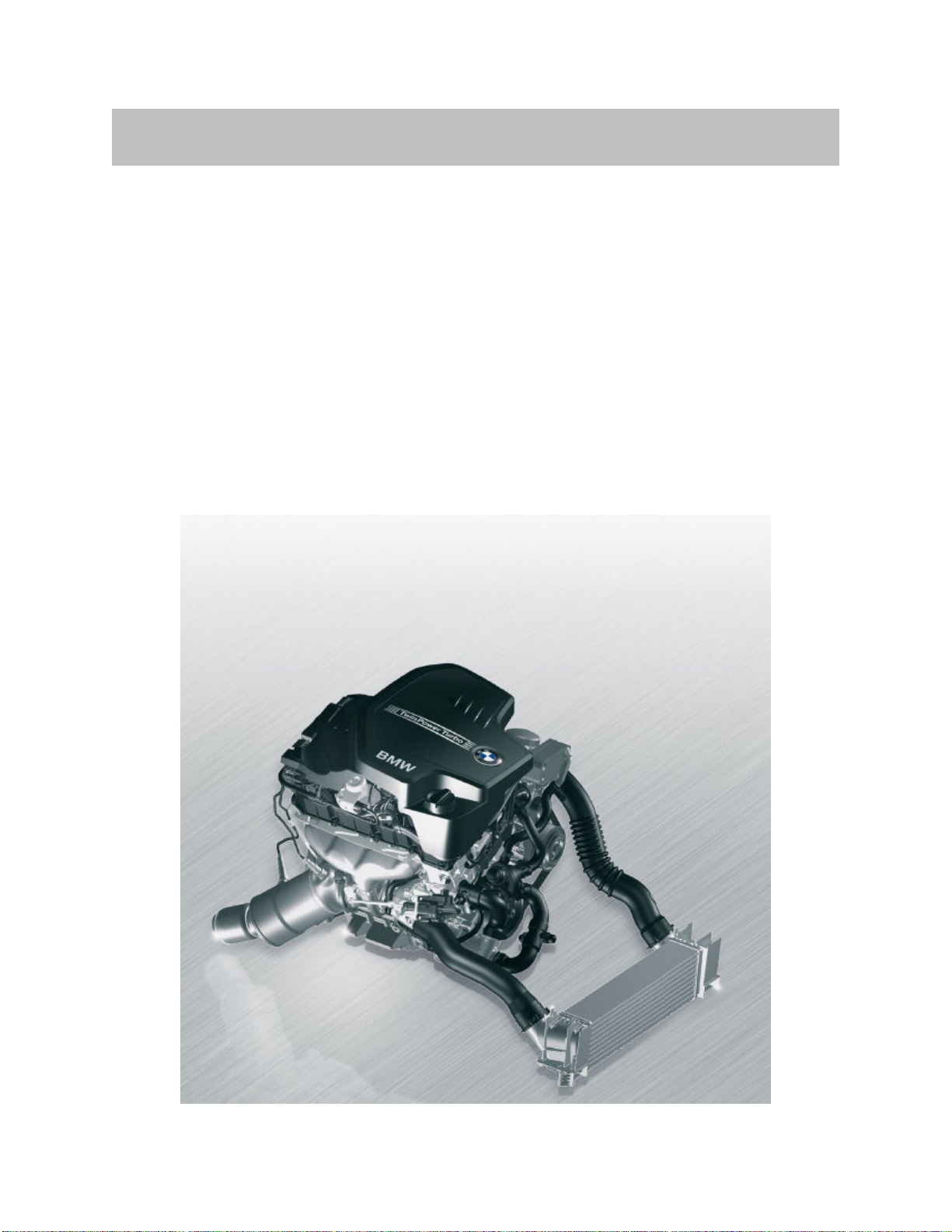
N26 Engine
The N26 engine is the third generation of the BMW SULEV engines used in the US
market. The N26 shares many technical features with the current N20 engine. This
engine is currently available in the F30 328i as of 3/2012. The new N26 engine is the
first turbocharged SULEV gasoline engine worldwide that requires no secondary air
system.
This not only means that the BMW Group is complying with the requirements of the
world’s most stringent exhaust emission legislation, but also underlines the fact that
the term “premium” is being defined by the many facets of substantiality to an ever
increasing extent. Twin Power Turbo technology enables dynamic performance and
achievement of low fuel consumption while adhering to the most stringent exhaust
emission limits.
N26B20O0 engine
N26 Engine
3
Page 7

Models with the N26 engine were launched to the US market in the March 2012.
Model Model series Engine Power output in kw/bhp Torque in Nm
328i F30 N26B20O0 180/240 350
Emission Label
History
The following chart list all previous BMW SULEV gasoline engines.
Engine Model
M56B25
N51B30
328iA
128i
128i
328i / 328ix
Model
series
E46
Coupe
Sedan
Sportwagon
E82
E88
E90/92/93
Displacement
in liters
2.5
3.0
Power out-
put in kW/
bhp
135kW
(184 hp)
170 kW
(230 hp)
Torque
in Nm
237 Nm MS 43 2003-2006
271 Nm MSV80.1
Engine
control
system
Introduced-
discontinued
MY 2008-2012
MY 2008-2012
MY 2006-2011
N26 Engine Features
The N26 engine also shares many features with the N20 engine, such as the cylinder
head, valvetrain, engine block, crankshaft, pistons. Over 95% of the N26 engine is carried
over from the N20.
By using the latest technology TVDI (Turbocharged Valvetronic Direct Injection) in
conjunction with a TwinScroll exhaust turbocharger, it is now possible to decrease
emissions substantially, while at the same time maintaining the same power output
as the N20.
4
N26 Engine
Page 8

Technical Data
N26B20O0 N20B20O0
Type
Firing order
Displacement
Bore / stroke
Power output at
engine speed
Torque at engine speed
Power output per liter
Cutoff speed
Compression ratio
Valves per cylinder
Diameter of intake valve
4 cyl. 4 cyl.
1- 3- 4- 2 1- 3- 4- 2
[cm³] 1997 1997
[mm] 84/90 84/90
[kW/bhp]
[rpm]
[Nm/lb-ft]
[rpm]
[kw/l] 90.14 90.14
[rpm] 7000 7000
[mm] 32 32
180/240
5000 - 6500
350/258
1250 - 4800
10.0 : 1 10.0 : 1
44
180/240
5000 - 6500
350/258
1250 - 4800
Diameter of
exhaust valve
Diameter of
connecting rod
bearing inside
diameter
Engine control
system
Exhaust emission
standard US
[mm] 28 28
[mm] 144.35 144.35
MEVD 17.2.4 up to 07/12
MEVD 17.2.9
MEVD 17.2.9 from 07/12
SULEV ULEV II
5
N26 Engine
Page 9

Horse Power and Torque Diagram
0 1000 2000 3000 4000 5000 6000 7000 8000
400
350
300
250
200
150
100
50
200
175
150
125
100
75
50
25
N52B30O1N26B20O0
[Nm]
[1/min]
[kW]
228 ft-lb/310 Nm
@ 2600-3000 1/min
240 hp/180 kW
@ 5000-6500 1/min
255 ft-lb/350 Nm
@ 1250-4800 1/min
254 hp/190 kW
@ 6600 1/min
TO10-1737_3
Full load diagram for the N26B20 engine, compared with the N55B30 engine
6
N26 Engine
Page 10

Engine Components/Systems Overview
The following provides an overview of the features of the N26 engine:
• Engine block
Same as N20
• Crankshaft
Same as N20
• Valve train
Same as N20
• Camshaft
Same as N20
• Belt drive
Same as N20
• Oil supply
Same as N20
• Crankcase ventilation
The N26 engine uses the same crankcase ventilation principle as N20 engine. The
main difference is that the pressure regulating valve is now welded to the cylinder
head cover. This is now considered hydrocarbon emissions tight.
• Cooling system
Same as N20
• Evaporative system
Same as N20
N26 Engine
7
Page 11

• Air intake and exhaust system
The air intake and exhaust systems differ slightly on the N26.engine.
There is an additional HC filter located in the air filter box to capture hydrocarbon
emissions. The exhaust turbocharger is identical to the N20 but now incorporates
an electric wastegate valve actuator.
Note: As of 07/2012 all N20 engines will have electric wastegates.
• Secondary air system
Not required
• Vacuum system
Vacuum reservoir no longer integrated into engine cover.
• Fuel system
Bosch HDEV5.2 solenoid valve injector is an inward-opening multi-hole valve.
These injectors are identical to the N55 and N20 from a technical point of view.
The N26 injectors are refered to as “sorted”, which means that they are less prone
to leakage. The leakage is <0.5mm³/min @20MPa. (200bar)
• Engine electrical system
Engine management MEVD17.2.9 is used with the N26 engine with new internal
programming.
Adaption algorithm for continuous injector individual measurement of the opening
and closing time. (flight phase of the injector needle) by characteristics of the current
signal.
Higher precision of the injected fuel quantity, especially required for ‘double”
injection for heating-up of catalytic converter.
Engine wire harness modification , due to electric wastegate.
Note: All N20 engines will receive MEVD17.2.9 starting with 07/12 production.
Engine Identification
Engine Designation
In the technical documentation, the engine designation is used to ensure the clear
identification of engines.
The N26 engine is available in the following version: N26B20O0
In the technical documentation, you will also find the short form of the engine designation
N26 which only permits identification of the engine type.
8
N26 Engine
Page 12

The following chart explains the meaning of each component of the engine designation.
Index Explanation
N
2
6
B
20
O
0
Engine with exhaust turbocharger, Valvetronic and direct fuel injection (TVDI)
BMW Group "New generation"
4-cylinder engine
Gasoline engine
2.0 liters displacement
Upper performance class
New development
Engine Identification and Number
To ensure clear identification and classification, the engines have an identification mark
on the crankcase. This engine identification is also necessary for approval by the
authorities.
Decisive here are the first seven positions. The N26 engine has an engine identification
that complies with the new standard, in which the first six positions are the same as the
engine designation. The seventh position is a consecutive letter that can be used for
various distinctions, e.g. power stage or exhaust emission standard. A general assignment
is not possible, but an "A" usually means the basic model.
The engine number is a consecutive number that permits unmistakable identification of
each individual engine. The engine designation and number are on the crankcase behind
the bracket for the air conditioning compressor.
N20 N26
N26 Engine
9
Page 13

N26 Specific Components
Cylinder Head Cover
The cylinder head covers are made of plastic. They accommodate the oil separation of
the crankcase ventilation. The oil separators are made of plastic and are very similar to
those in the N20 engine. The major change to the cylinder head cover is that the
crankcase pressure regulating valve is now welded to the cover and no longer to be
replaced separately.
N26
10
N26 Engine
N20
Page 14

High Pressure Fuel Pump
The maximum system pressure remains the same as the N20 at 200bar. The HP pump
has been slightly redesigned for the N26 engine. It has been modified by adding a groove
in the outlet valve of the high pressure pump. This allows the high fuel pressure to be
reduced in a short amount of time when the engine is shut off. This reduces the risk of
internal and external fuel leakage.
Outlet valve with
laser cut groove.
11
N26 Engine
Page 15

Fuel Injectors
The fuel injectors used in the N26 are identical to the N20 and N55 from a technical
point of view. The major difference is the N26 injectors are hand selected after they have
been tested to insure they have the minimum amount of leakage. These are referred to as
“Sorted” fuel injectors. They have a leakage rate of <0.5mm³/min @20MPa.
Index Explanation
1
2
3
4
5
6
7
8
Fuel line connection
Electrical connection
Stem
Compression spring
Solenoid valve
Armature
Nozzle pintle
6-hole nozzle
12
N26 Engine
Page 16

Fuel Line
The fuel lines have been modified to insure that no leakage occurs. The low pressure line
from the fuel tank to the engine compartment is made of plastic (polyamide). The line
from the engine compartment to the HP pump is corrugated pipe made of stainless steel,
this is designed to prevent hydrocarbon evaporation and leaks. The corrugated pipe is
protected by a layer of rubber that looks like a regular fuel hose.
N26
Quick connection on fuel line in
engine compartment. This line
connects to plastic fuel line to
the fuel tank.
Fuel line construction
N20
13
N26 Engine
Page 17

Fuel System Overview
The fuel tank and evaporative system are basically the same as the a non SULEV vehicle.
The only difference is the connections at the tank have been modified to reduce
leakage.
14
N26 Engine
Page 18

Turbocharger
Exhaust Turbocharger
The turbocharger on the N26 engine is identical to the N20. The only difference is
that N26 uses an electric wastegate actuator. This is required to assist in the rapid
heating of the catalytic converter to meet SULEV emission requirements.
All N26 from SOP and N20 from 7/2012 production
N20 up to 7/2012
15
N26 Engine
Page 19

Exhaust System
Catalytic Converter
Fitted in close proximity to the engine, the close-coupled catalytic converter has been
designed as a two-stage construction (first monolith: 900 cpsi, second monolith: 600
cpsi) “Cells Per Square Inch”. The catalytic converter used on the N20 uses 600 cpsi on
the first monolith and 400 cpsi on the second.
There is an additional catalytic converter located under the vehicle downstream of the
exhaust. This converter is not monitored and contains 400 cpsi.
16
N26 Engine
Page 20

Additional Emission Reduction Measures
HC Fleece
The air intake system is similar to the M56 and N51 SULEV engines. There is an additional HC fleece filter installed in the air box. This prevents hydrocarbons from escaping to
the atmosphere when the engine is at rest. The HC fleece is part of the upper portion of
the air box and needs to be replaced as a complete unit if damaged.
Cooling System
The radiator of the N26 SULEV looks similar to the standard F30 radiator. The surface of
the cooling fins are coated with a special “PremAir” coating. The coating consists of
multiple porous layers of a catalytic surface. The task of the catalyst coating is to convert
Ozone into Oxygen.
17
N26 Engine
Page 21

System Overview
The cold start and subsequent catalyst warm-up phase hold the key to meeting the
SULEV limits. The majority of all air contaminants are emitted during the first approximately 30 s of the exhaust emission test.
The purpose of the catalyst heating mode at the beginning of the exhaust emission test is
to use the exhaust gas to heat the catalytic converter up to light-off temperature as quickly as possible with a minimum of emissions and excellent smooth running. Turbocharged
engines constitute a particular challenge in this respect as the exhaust-gas turbocharger
acts as an additional heat sink en route to the catalytic converter, thereby delaying lightoff accordingly.
The direct injection system with its centrally positioned injector is capable of a much
more retarded ignition than can be achieved in an engine with a manifold injection system and it therefore accelerates the catalyst warm-up process considerably.
A lean catalyst heating mode is used with “double injection”. The first injection takes
place during the intake phase and contains the main injection volume. It serves to
generate a homogeneous, lean basic mixture. The second, lower-volume injection is
precipitated as the ignition injection is just after TDC and it accelerates or stabilizes the
combustion process by increasing the turbulence in the already ignited basic mixture,
enabling the application of a highly retarded ignition. This lean burn mode enables followup reactions with the excess oxygen in the exhaust gas, causing the temperature of the
exhaust gas to rise and reducing the CO and HC emissions.
Apart from combustion concept optimization, another important prerequisite for compliance with the SULEV values is the minimization of the heat loss by the exhaust gas en
route to the catalytic converter. As mentioned above, the turbocharger constitutes a special challenge in its capacity as an additional heat sink upstream of the catalytic converter
and causes considerable delay in light off.
The amount of heat loss by the exhaust gas during catalyst heating can be reduced if as
much exhaust gas as possible is routed via the wastegate directly, bypassing the turbine.
The exhaust gas should also flow through the wastegate ports into the catalytic converter
without any direct contact with the walls. The flow to and through the wastegate ports
was maximized. The maximum wastegate opening angle is increased from 25° to 45°,
using an electric wastegate actuator that also offers other functional advantages.
By implementing these measures, the proportion of exhaust gas routed through the
wastegate is considerably increased from 40 to 70%.
18
N26 Engine
Page 22

Driving Performance and Fuel Consumption
The SULEV version of BMW’s new 2.0-l four-cylinder gasoline engine also offers the
dynamic driving performance that is typical of BMW in conjunction with low fuel consumption. The engine delivers a maximum torque of 350 Nm and a maximum power of
180 kW/240 hp. These figures represent a 30% and 4% improvement over the respective values of the predecessor engine. At the same time, the useable engine torque range
is greatly enhanced. Compared with its predecessor the N51, the new 328i SULEV
boasts significant improvements in driving performance, as well as a substantial reduction
in fuel consumption.
19
N26 Engine
Page 23

NOTES
PAGE
20
N26 Engine
 Loading...