

Page 1

AR2300
Black-Box Receiver
HIGH PERFORMANCE BLACK-BOX RECEIVER
Radio monitoring from 40kHz to 3150MHz
AOR, LTD.
Page 2

The future of radio monitoring.
The AR2300 communications receiver from AOR is ideally suited
for radio and spectrum monitoring in various commercial and
government applications, as well as for use in radio investigation
services.
The AR2300 offers:
Signal detection
Signal search in frequency and memory scan mode
Spectrum occupancy and on-the-air monitoring
Coverage and field-strength check
Signal and spectrum analysis through optional I/Q software
Applications may include:
Monitoring and storage of up to 2000 frequencies, receiving
modes, antenna port, attenuator settings, constant monitoring of
one frequency or scanning of selected frequencies.
Searching a frequency range with freely selectable start and
stop frequencies and step widths of 0.01 kHz (10Hz) to 999.99
kHz.
Detection of undesired emissions including pulsed emissions.
Detection of unlicensed transmitters communicating illegally or
interfering with licensed transmission.
Protection against eavesdropping by detecting miniature
transmitters (bugs)
Monitoring of one's own radio transmissions in a service band
and monitoring of selected transmissions.
Remote-controlled operation via an optional LAN controller.
Technical Features:
Computer controlled Black-Box
All functions of the AR2300 can be used with a lap-top or desktop PC that runs under Windows XP or higher OS. The
AR2300 can be controlled remotely through an optional LAN
controller.
Lightweight net-book PC can be used as control head for the AR2300. (PC not included. )
Digital signal processing
45MHz of the 3rd intermediate frequency is directly digitized for
digital signal processing for demodulation and spectrum display
by a PC. No automatic gain control (AGC) is employed in the
analog circuitry to allow accurate level monitoring across the IF
bandwidth.
High performance analog front-end
The analog RF front-end is carefully designed and by CAD to
gain optimum performance across the entire receiving
frequency range of 40KHz to 3150MHz.
Direct digital sampling
The HF stage (40kHz to 25MHz) employs direct digital sampling
architecture that offers exceptional linearity across the band.
Direct digital synthesizer (DDS) local oscillator
Direct digital synthesizer is employed for the 1st local oscillator
that ensures fast frequency switching for memory channel
scanning and frequency band search operation.
Accurate reference frequency
The AR2300 is capable of using a GPS pulse signal for an
accurate time base for the local oscillator circuit. 0.01ppm
frequency accuracy for the 10MHz internal master oscillator is
obtained when synchronized to a GPS signal source. The
optional digital I/Q output board is capable of acquiring GPS
data for time-stamping digital I/Q data.
Page 3
Technical Features:
Wideband IF output
45MHz of intermediate frequency (IF) analog output with 15MHz
bandwidth is provided for external peripherals when using the
AR2300 receiver front-end. The optional digital I/Q output
board with USB2.0 interface is available to access AR2300’s I/Q
data for spectrum/playback/analysis by a PC.
Simulations reception and monitoring
Simultaneous reception on HF (below 25MHz) and VHF-UHF
(above 25MHz) frequencies is possible. For frequencies above
25MHz, absolute dual-channel reception within an IF bandwidth
is possible. Thus, up to three channels can be monitored simultaneously.
Analog VIDEO demodulation
Composite video output is provided to monitor FM modulated
analog type wireless security camera or frequency search operation for bug transmitters.
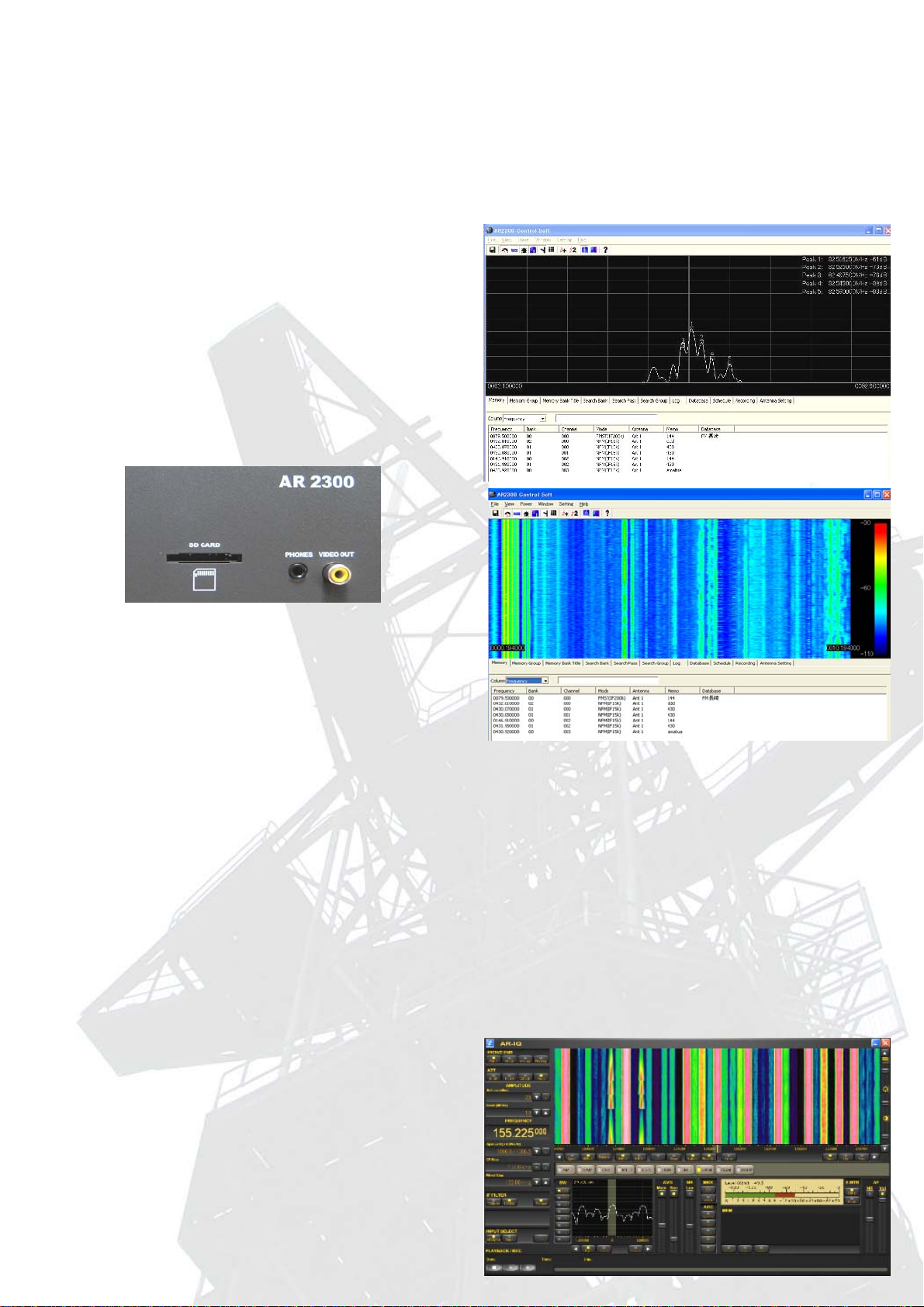
SD Audio recorder
The AR2300 is capable of recording demodulated audio directly
to a built-in SD media recorder. Compact and readily available,
SD memory cards are immune to vibrations and produce no
mechanical noise, unlike motor-driven media such as tape or
discs.
The AR2300 can accommodate up to 32GB SDHC card, allowing up to 240 hours of total recoding time using PC compatible
WAV format. The typical continuous recording time with a 1GB
SD card is about 8 hours. The recording time can be extended
when squelch operation is employed while recording two-way
voice communication.
AF-IQ Output
12kHz IF output is provided for a PC sound card based SDR
(software defined radio) for signal demodulation by the PC.
Typical application include the reception of DRM (Digital Radio
Mondiale) broadcasts on HF frequencies.
Optional APCO P-25 Digital Voice Decoder
APCO P-25 Digital Voice Decoder option is available for the
demodulation of project 25 (P25) digital voice communications
which are quite popular in North America for the government
and public safety communications.
Direct sampling architecture
The AR2300 utilizes outstanding direct sampling digital architecture for reception below 25MHz. It features a 14 bit 80MS/s
analog-to-digital converter, a high-performance FPGA-based
digital-down-converter and DSP-based demodulation circuitry.
The direct sampling architecture offers exceptionally high linearity against input signals.
AR2300 Control Software
The AR2300 control software is a strong companion to the
AR2300 black-box receiver. The software provides powerful
control functions running on an MS Windows PC connected to
the AR2300 via USB or an optional LAN. The software provides a signal overview using a high-speed spectrum or waterfall display.
Powerful memory channel management features are available
to manage and control up to 2,000 channels allowing direct entry of alphanumeric channel information. The channel hitcounter and last event (time and signal level) on each memory
channel is available to monitor the activity and channel coordination.
Optional AR-IQ software
When an optional I/Q interface is installed (factory option), up
to 1 MHz of digital I/Q output can be recorded to the hard drive
of almost any computer operating Windows environment for
later playback and analysis without the loss of quality. This
feature allows for unattended logging, signal classification and
signal analysis.
Page 4
AR2300 SPECIFICATIONS
GENERAL
Frequency range 40kHz to 3.15GHz
Frequency resolution 1Hz
Tuning steps - program 1Hz to 999.999kHz in 0.001kHz increments
Receiving mode USB/LSB (J3E), CW(A1A), AM(A3E),
Memory channel 2,000 channels (50 channels x 40 banks)
Memory channel Bank 40 banks (each bank can be customized between
Pass frequencies 1,200 frequencies or 1,200 frequency ranges
Priority channel 1 (one)
Selected memory channel 100 channels through memory banks
Typical scanning speed Approx.100 channels/steps per second.
Antenna impedance
Operating temperature range
Frequency stability Less than ± 1ppm after warm-up (5 minutes).
Power supply requirement DC 12 to 13.8V, Minimum 1.5A
Power consumption* Stand-by : 200mA
Ground system Negative ground
Dimensions* 285mm(D) x 220mm(W) x 70mm(H)
Weight* 3kg. (6.6 lb.)
Audio output
RECEIVER
Receiver system 40kHz - 25MHz Direct conversion
Intermediate frequencies 1st - 294.5MHz / 1.7045GHz
Third-order IMD > +20dBm at 14.1MHz
Spurious and image rejection > 70dB : 40kHz - 25MHz
Digital IF Filter bandwidth 200Hz, 500Hz, 1kHz, 3kHz, 6kHz, 15kHz, 30kHz
Selectivity CW - 500Hz -3dB: > 380Hz -80dB: > 500Hz
Sensitivity
MODE SSB, CW AM FM WFM
Test Method 10dB S/N 10dB S/N 12dB SIN AD 12dB SIN AD
Filter B/W 3kHz 6kHz 15kHz 200kHz
40kH z to 100kHz 2.0uV 8.0uV
100kHz to 1.8MHz
1.8MHz to 25MHz
25MHz to 1GHz
1GHz to 2.4GH z
APCO P-25 (D3E) Optional, FM (F3E),
WFM(F3E), FM-Stereo (F8E)
5 to 95 channels.)
(30 frequencies (ranges) x 40 banks)
50Ω
0°C to +50°C / 32°F to 122°F
Less than ± 0.01ppm with an optional GPS unit.
Max. Audio; 1.2A
11¼“(D) x 8½”(W) x 2¾”(H)
> 2W at 8Ω load
25MHz - 200MHz Double super-heterodyne
200MHz - 420MHz Triple super-heterodyne
2nd - 45.0MHz / 294.5MHz
3rd - 45.0MHz
> +12dBm at 50.0MHz
> +7dBm at 620.0MHz
> 50dB : 25MHz - 2.0GHz
> 40dB : 2.0GHz - 3.15GHz
100kHz, 300kHz - Receiving mode dependent
AM - 6kHz -3dB: > 5.5kHz -80dB: > 6.9kHz
SSB - 3kHz -3dB: > 2.7kHz -80dB: > 3.1kHz
NFM - 15kHz
WFM-200kHz -3dB: > 200kHz -80dB: > 250kHz
1.2uV 4.0uV
1.2uV 4.0uV
0.3uV 2.0uV 0.7uV 1.8uV
0.3uV 2.5uV 0.7uV 1.8uV
-3dB: >14.2kHz -80dB: > 15.6kHz
AUXILIARY FUNCTIONS
Simultaneous reception
Triplet reception
Squelch system CTCSS, DCS
Demodulation Aid APCO P-25 Digital voice demodulator (option)
AUDIO RECORDING
Type of recording
SD Card type SD or SDHC card per SD Card Association.
File Format
Recording Time
INPUT & OUTPUT
Antenna Input ANT 1: 25MHz - 3.15GHz, N-J connector
10MHz reference input SMA-J connector,
45MHz Analog IF output BNC-J connector, 45MHz±7.5MHz
Digital I/Q output (Option) USB2.0 compatible isochronous transfer
12KHz offset output
Line output 3.5mmΦ stereo-phone jack. (3-wire)
External speaker 3.5mmΦ miniature phone jack (2-wire)
Accessory 8-pin miniature DIN
DC Power Input
RS-232C
USB USB Type-A; USB 1.1/2.0 Jack for PC control.
VIDEO output (Front Panel)
Specifications subject to change without prior notice for product improvement or modification.
Power consumptions, Size and Dimensions are only approximate value. Dimensions does not include
projections. E. & O. E.
Two types of simultaneous reception (dualwatch) are possible.
2 Band reception - One HF (40kHz -
25MHz) frequency + One VHF/UHF (25MHz
and above) frequency.
Offset reception - Main frequency + subfrequency (within ±5MHz from main frequency.)
Offset reception is possible only for VHF/UHF
(25MHz and above) band.
Triplet (trio) reception is possible by combining
simultaneous reception mode. i.e. One HF
(40kHz - 25MHz) + Offset reception.
Auto Notch Filter (NOTCH)
De-Noiser (NR)
Record/Playback function through SD or SDHC
card.
More than 256MB is required. Use card
adapter for miniSD and microSD cards. FAT16
and 32 only.
Windows compatible WAV file format. RIFF
(little-endian) data, WAVE audio, Microsoft
PCM, 16bit, mono 17.578kHz.
Approximately 8 hours of continuous recording
by 1GB SD Card. Squelch synchronization is
possible to eliminate inactive time.
ANT 2: 40kHz - 3.15GHz, N-J connector
Typical input:: -2dBm±2dBm for 50Ω
Typical output: Antenna input +10dBm for 50Ω
Frequency range 25MHz - 3.15GHz only.
Digital I/Q output through USB Type-A Jack.
12kHz offset analog I/Q through 3.5mmΦ stereo
-phone jack.
EIAJ MP-121C (5.5 x 2.1mm) plug. Positive
9-pin D-subminiature type (Male) - Firmware
update and remote control by PC.
RCA Jack, 75Ω 1Vp-p
AOR, LTD.
2-6-4 Misuji, Taito-ku, Tokyo 111-0055, Japan
Tel: +81-3-3865-1695 Fax: +81-3-3865-1697
[email protected] www.aorja.com
AOR U.S.A., Inc.
20655 S. Western Ave., Suite 112, Torrance, CA 90501, USA
Tel: 310-787-8615 Fax: 310-787-8619
[email protected] www.aorusa.com
AOR(UK), LTD.
Unit 9, Dimple Rd. Business Center,
Matlock, Derbyshire DE4 3JX, England
Tel: +44 01629 581222 Fax: Intl: +44 1629 580070
[email protected] www.aoruk.com
AR2300-10J Printed in Japan
 Loading...