

Page 1
TC56
Touch Computer
User Guide
for Android ™ 8.1.0 Oreo
MN-003230-01
Page 2

Copyright
ZEBRA and the stylized Zebra head are trademarks of Zebra Technologies Corporation, registered in many
jurisdictions worldwide. Google, Android, Google Play and other marks are trademarks of Google LLC; Oreo is
a trademark of Mondelez International, Inc. group. All other trademarks are the property of their respective
owners. ©2019 Zebra Technologies Corporation and/or its affiliates. All rights reserved.
COPYRIGHTS & TRADEMARKS: For complete copyright and trademark information, go to
www.zebra.com/copyright
.
WARRANTY: For complete warranty information, go to www.zebra.com/warranty
END USER LICENSE AGREEMENT: For complete EULA information, go to www.zebra.com/eula
Terms of Use
• Proprietary Statement
This manual contains proprietary information of Zebra Technologies Corporation and its subsidiaries
(“Zebra Technologies”). It is intended solely for the information and use of parties operating and maintaining
the equipment described herein. Such proprietary information may not be used, reproduced, or disclosed to
any other parties for any other purpose without the express, written permission of Zebra Technologies.
• Product Improvements
Continuous improvement of products is a policy of Zebra Technologies. All specifications and designs are
subject to change without notice.
• Liability Disclaimer
Zebra Technologies takes steps to ensure that its published Engineering specifications and manuals are
correct; however, errors do occur. Zebra Technologies reserves the right to correct any such errors and
disclaims liability resulting therefrom.
• Limitation of Liability
In no event shall Zebra Technologies or anyone else involved in the creation, production, or delivery of the
accompanying product (including hardware and software) be liable for any damages whatsoever (including,
without limitation, consequential damages including loss of business profits, business interruption, or loss of
business information) arising out of the use of, the results of use of, or inability to use such product, even if
Zebra Technologies has been advised of the possibility of such damages. Some jurisdictions do not allow
the exclusion or limitation of incidental or consequential damages, so the above limitation or exclusion may
not apply to you.
.
.
Revision History
Changes to the original guide are listed below:
Change Date Description
-01 Rev A 4/2019 Initial release.
2
Page 3

Table of Contents
Copyright ......................................................................................................................... 2
Terms of Use ..................................................................................................................2
Revision History ..............................................................................................................2
Table of Contents.......................................................................................................... 3
About This Guide........................................................................................................ 12
Introduction ................................................................................................................... 12
Documentation Set ....................................................................................................... 12
Configurations ............................................................................................................... 12
Software Versions ......................................................................................................... 13
Chapter Descriptions .................................................................................................... 13
Notational Conventions ................................................................................................. 14
Related Documents ...................................................................................................... 14
Service Information ....................................................................................................... 14
Provide Documentation Feedback ................................................................................ 15
Getting Started............................................................................................................ 16
Introduction ................................................................................................................... 16
Unpacking .....................................................................................................................16
Features ........................................................................................................................ 17
Setup ............................................................................................................................. 18
Installing a microSD Card ...................................................................................... 19
Installing the SIM Card .......................................................................................... 20
Installing the Battery .............................................................................................. 23
Charging the Battery ............................................................................................. 23
Charging Indicators ............................................................................................... 24
Google Account Setup .......................................................................................... 24
Zebra Visibility Services ........................................................................................ 25
3
Page 4

Table of Contents
Replacing the Battery .................................................................................................... 25
Replacing the microSD Card ........................................................................................ 26
Replacing the SIM Card ................................................................................................ 27
Accessing Device Settings ............................................................................................ 30
Battery Management ..................................................................................................... 30
Monitoring Battery Usage ...................................................................................... 30
Low Battery Notification ......................................................................................... 31
Battery Optimization ...................................................................................................... 32
Turning Off the Radios .......................................................................................... 32
Setting the Date and Time ............................................................................................ 32
Display Settings ............................................................................................................ 33
Setting the Screen Brightness ............................................................................... 33
Setting Screen Rotation ........................................................................................ 33
Setting Home Screen Rotation .............................................................................. 33
Setting Screen Timeout ......................................................................................... 34
Setting Font Size ................................................................................................... 34
Ambient Display .................................................................................................... 35
Touch Panel Mode ................................................................................................ 35
Blink Light .............................................................................................................. 36
General Sound Setting .................................................................................................. 36
Wake-Up Sources ......................................................................................................... 38
Using the TC56............................................................................................................ 40
Introduction ................................................................................................................... 40
Google Mobile Services ................................................................................................ 40
Home Screen ................................................................................................................ 40
Status Bar .............................................................................................................. 42
Status Icons .................................................................................................... 42
Managing Notifications .......................................................................................... 43
Setting App Notifications ................................................................................. 44
Viewing Notification Settings for All Apps ....................................................... 45
Controlling Lock Screen Notifications ............................................................. 45
Quick Access Panel .............................................................................................. 45
Editing Icons on Quick Settings ...................................................................... 46
App Shortcuts and Widgets ................................................................................... 47
Adding an App Shortcut to the Home Screen ................................................. 47
Adding a Widget to the Home Screen ............................................................. 47
Moving Items on the Home Screen ................................................................. 48
Removing an App Shortcut or Widget from the Home Screen ....................... 48
Folders .................................................................................................................. 48
Creating a Folder ............................................................................................ 48
Naming Folders ............................................................................................... 48
4
Page 5

Table of Contents
Removing a Folder .......................................................................................... 49
Home Screen Wallpaper ....................................................................................... 49
Using the Touchscreen ................................................................................................. 49
Keyboards .....................................................................................................................50
Editing Text ........................................................................................................... 50
Entering Numbers, Symbols, and Special Characters .................................... 50
Keyboard Configuration ......................................................................................... 50
Enabling Keyboards ........................................................................................ 50
Switching Between Keyboards ....................................................................... 50
Do Not Disturb Feature ................................................................................................. 51
Limit Sounds and Vibrations .................................................................................. 51
Total Silence ................................................................................................... 51
Alarms Only .................................................................................................... 51
Automatically Block Sounds and Vibrations .................................................... 52
Silence Sounds During Certain Times .................................................................. 52
Silence Sounds During Events and Meetings ....................................................... 52
Turn Sounds Back On ........................................................................................... 53
Override Do Not Disturb for Specific Apps ............................................................ 53
Apps .............................................................................................................................. 53
Accessing Apps ............................................................................................................ 56
Un-Locking the Screen ................................................................................................. 57
Resetting the Device ..................................................................................................... 59
Performing a Soft Reset ........................................................................................ 59
Performing a Hard Reset ....................................................................................... 60
Suspend Mode .............................................................................................................. 60
Transferring Files with a Host Computer via USB ........................................................ 60
Transferring Files .................................................................................................. 60
Transferring Photos ............................................................................................... 61
Disconnect from the Host Computer ..................................................................... 61
Calls ............................................................................................................................. 62
Introduction ................................................................................................................... 62
Emergency Calling ........................................................................................................ 62
Audio Modes ................................................................................................................. 62
Using a Bluetooth Headset ........................................................................................... 62
Using a Wired Headset ................................................................................................. 62
Adjusting Audio Volume ................................................................................................ 63
Making a Call Using the Dialer ...................................................................................... 63
Dialer Dialing Options ............................................................................................ 65
Making a Call Using Contacts ....................................................................................... 65
Using the Dialer ..................................................................................................... 65
Using the Contacts App ......................................................................................... 66
5
Page 6

Table of Contents
Making a Conference Call on GSM .............................................................................. 68
Making a Call Using a Bluetooth Headset .................................................................... 70
Answering Calls ............................................................................................................ 70
Call Settings .................................................................................................................. 71
Applications ................................................................................................................ 74
Introduction ................................................................................................................... 74
ActiveEdge Touch Zone ................................................................................................ 74
Configuring ActiveEdge ......................................................................................... 74
Selecting Apps for a Drawer .................................................................................. 75
Using ActiveEdge .................................................................................................. 78
Battery Manager ........................................................................................................... 79
Camera ........................................................................................................................ 82
Taking Photos ....................................................................................................... 82
Taking a Panoramic Photo .................................................................................... 82
Recording Videos .................................................................................................. 83
Photo Settings ....................................................................................................... 84
Rear Camera .................................................................................................. 84
Video Settings ................................................................................................. 85
Rear Camera .................................................................................................. 85
Contacts ........................................................................................................................ 85
Adding a Contact ................................................................................................... 86
Editing Contacts .................................................................................................... 86
Deleting Contacts .................................................................................................. 86
Device Central ............................................................................................................. 87
Device Central Tabs .............................................................................................. 87
Paging an RS6000 Ring Scanner ......................................................................... 88
DataWedge Demonstration .......................................................................................... 90
Scanner Selection ................................................................................................. 92
Diagnostic Tool ............................................................................................................ 93
Settings ................................................................................................................. 96
Battery Test Information ........................................................................................ 96
GPS Test Information ............................................................................................ 97
System Test Information ....................................................................................... 97
WLAN Test Information ......................................................................................... 97
WWAN Test Information ........................................................................................ 97
Bluetooth Test Information .................................................................................... 98
Files ............................................................................................................................. 99
Gallery ........................................................................................................................ 100
Working with Albums ........................................................................................... 101
Sharing an Album ................................................................................................ 102
6
Page 7

Table of Contents
Getting Album Information ................................................................................... 102
Deleting an Album ......................................................................................... 102
Working with Photos ............................................................................................ 103
Viewing and Browsing Photos ...................................................................... 103
Cropping a Photo .......................................................................................... 104
Setting a Photo as a Contact Icon ................................................................ 104
Sharing a Photo ............................................................................................ 105
Deleting a Photo ........................................................................................... 105
Working with Videos ............................................................................................ 105
Watching Videos ........................................................................................... 105
Sharing a Video ............................................................................................ 105
Deleting a Video ............................................................................................ 105
Photos ........................................................................................................................ 107
Working with Albums ........................................................................................... 108
Sharing an Album ......................................................................................... 109
Deleting an Album ......................................................................................... 109
Working with Photos ............................................................................................ 110
Viewing and Browsing Photos ...................................................................... 110
Cropping a Photo .......................................................................................... 110
Setting a Photo as a Contact Icon ................................................................ 111
Sharing a Photo ............................................................................................ 111
Deleting a Photo ........................................................................................... 112
Working with Videos ............................................................................................ 112
Watching a Video .......................................................................................... 112
Sharing a Video ............................................................................................ 112
Deleting a Video ............................................................................................ 112
PTT Express Voice Client .......................................................................................... 113
PTT Audible Indicators ........................................................................................ 113
PTT Notification Icons ......................................................................................... 113
Enabling PTT Communication ............................................................................. 114
Selecting a Talk Group ........................................................................................ 114
PTT Communication ............................................................................................ 114
Creating a Group Call .......................................................................................... 115
Responding with a Private Response ................................................................. 115
Disabling PTT Communication ............................................................................ 115
RxLogger ................................................................................................................... 117
RxLogger Utility .......................................................................................................... 118
SimulScan Demo ....................................................................................................... 119
Printing the Sample Forms .................................................................................. 119
Using the Postal, Transportation and Logistics Example .................................... 120
Using the Manufacturing Example ...................................................................... 122
Settings ............................................................................................................... 123
Advanced Settings .............................................................................................. 124
Creating a Demo Customization ......................................................................... 124
7
Page 8

Table of Contents
Default Templates ............................................................................................... 126
Sound Recorder .......................................................................................................... 126
Data Capture.............................................................................................................. 128
Introduction ................................................................................................................. 128
Imaging .......................................................................................................................128
Digital Camera ............................................................................................................ 128
Linear Imager .............................................................................................................. 128
Operational Modes ...................................................................................................... 129
RS507/RS507x Hands-Free Imager ........................................................................... 130
RS6000 Bluetooth Ring Scanner ................................................................................ 130
DS3678 Digital Scanner .............................................................................................. 131
LI3678 Linear Imager Scanner ................................................................................... 131
Scanning Considerations ............................................................................................ 132
Scanning with Internal Imager .................................................................................... 132
Scanning with Internal Camera ................................................................................... 133
Scanning with RS6000 Bluetooth Ring Scanner ......................................................... 134
Scanning with RS507/RS507X Hands-Free Imager ................................................... 136
Scanning with the DS3608 USB Scanner or DS3678 Bluetooth Scanner .................. 137
Scanning with LI3678 Linear Imager .......................................................................... 138
Pairing the RS507/RS6000 Hands-Free Imager ......................................................... 139
Pairing in SSI Mode Using Near Field Communication ....................................... 139
Pairing in HID Mode Using Near Field Communication ...................................... 140
Pairing Using Simple Serial Interface .................................................................. 141
Pairing Using Bluetooth Human Interface Device ............................................... 142
Pairing a Bluetooth Scanner ....................................................................................... 143
Pairing Using Simple Serial Interface .................................................................. 143
Pairing Using Bluetooth Human Interface Device ............................................... 144
DataWedge ................................................................................................................ 146
Enabling DataWedge .......................................................................................... 146
Disabling DataWedge .......................................................................................... 146
Wireless ..................................................................................................................... 147
Introduction ................................................................................................................. 147
Wireless Wide Area Networks .................................................................................... 147
Sharing the Mobile Data Connection ................................................................... 147
Enabling USB Tethering ............................................................................... 147
Enabling Bluetooth Tethering ........................................................................ 148
Configuring the Wi-Fi Hotspot ....................................................................... 148
Enabling Wi-Fi Hotspot ........................................................................................ 149
Cellular Network Settings .................................................................................... 149
8
Page 9

Table of Contents
Disabling Data When Roaming ..................................................................... 149
Enhanced 4G LTE Mode .............................................................................. 150
Using Search for MicroCell ........................................................................... 150
Configuring the Access Point Name .................................................................... 150
Locking the SIM Card .......................................................................................... 150
Data Usage ......................................................................................................... 151
Setting Data Usage Warning ............................................................................... 152
Setting Data Limit .......................................................................................... 152
Wireless Local Area Networks .................................................................................... 153
Connecting to a Wi-Fi Network ............................................................................ 153
Removing a Wi-Fi Network .................................................................................. 154
Bluetooth .................................................................................................................... 155
Adaptive Frequency Hopping .............................................................................. 155
Security ............................................................................................................... 155
Bluetooth Profiles ................................................................................................ 156
Bluetooth Power States ....................................................................................... 156
Bluetooth Radio Power ........................................................................................ 157
Enabling Bluetooth ........................................................................................ 157
Disabling Bluetooth ....................................................................................... 157
Discovering Bluetooth Device(s) ......................................................................... 157
Changing the Bluetooth Name ............................................................................ 158
Connecting to a Bluetooth Device ....................................................................... 158
Unpairing a Bluetooth Device .............................................................................. 158
Near Field Communications ........................................................................................ 158
Reading NFC Cards ............................................................................................ 159
Sharing Information Using NFC .......................................................................... 159
Cast ............................................................................................................................. 160
Accessories............................................................................................................... 161
Introduction ................................................................................................................. 161
Accessories ................................................................................................................. 161
1-Slot USB Charge Cradle .......................................................................................... 164
Charging the Device ............................................................................................ 164
Inserting a Device with Rugged Boot into Cradle ................................................ 166
Battery Charging ................................................................................................. 166
Charging Temperature .................................................................................. 166
4-Slot Charge Only Cradle with Battery Charger ........................................................ 166
Charging the Device ............................................................................................ 167
Inserting a Device with Rugged Boot into Cradle ................................................ 169
Battery Charging ................................................................................................. 169
Main Battery Charging .................................................................................. 169
Spare Battery Charging ................................................................................ 169
9
Page 10

Table of Contents
Charging Temperature .................................................................................. 170
5-Slot Charge Only Cradle .......................................................................................... 170
Charging the Device ............................................................................................ 171
Inserting a Device with Rugged Boot into Cradle ................................................ 172
Battery Charging ................................................................................................. 173
Main Battery Charging .................................................................................. 173
Charging Temperature .................................................................................. 173
5-Slot Ethernet Cradle ............................................................................................... 174
Charging the Device ............................................................................................ 174
Inserting a Device with Rugged Boot into Cradle ................................................ 175
Battery Charging ................................................................................................. 176
Main Battery Charging .................................................................................. 176
Charging Temperature .................................................................................. 176
Establishing Ethernet Connection ................................................................. 176
LED Indicators ..................................................................................................... 176
4-Slot Battery Charger ............................................................................................... 177
Charging Spare Batteries .................................................................................... 177
Battery Charging ................................................................................................. 178
Spare Battery Charging ................................................................................ 178
Charging Temperature .................................................................................. 178
Rugged Boot .............................................................................................................. 179
Installation ........................................................................................................... 179
Installing Stylus ................................................................................................... 180
Charging with Cradles ......................................................................................... 181
2.5 mm Audio Adapter ............................................................................................... 183
3.5 mm Audio Adapter ............................................................................................... 184
Trigger Handle ........................................................................................................... 186
Installing the Rugged Boot .................................................................................. 186
Installing the Optional Lanyard ............................................................................ 188
Inserting the Device into the Trigger Handle ....................................................... 189
Removing the Device from the Trigger Handle ................................................... 190
Power Supply ............................................................................................................. 192
Maintenance and Troubleshooting ......................................................................... 193
Introduction ................................................................................................................. 193
Maintaining the Device ................................................................................................ 193
Display Best Practices ................................................................................................ 193
Image Retention .................................................................................................. 193
Battery Safety Guidelines .................................................................................... 194
Cleaning Instructions .................................................................................................. 194
Approved Cleanser Active Ingredients ................................................................ 195
Harmful Ingredients ............................................................................................. 195
10
Page 11

Table of Contents
Device Cleaning Instructions ............................................................................... 195
Special Cleaning Notes ....................................................................................... 195
Cleaning the Device .................................................................................................... 196
Housing ............................................................................................................... 196
Display ................................................................................................................. 196
Camera and Exit Window .................................................................................... 196
Connector Cleaning .................................................................................................... 196
Cleaning Cradle Connectors ....................................................................................... 196
Troubleshooting .......................................................................................................... 197
TC56 .................................................................................................................... 197
Technical Specifications.......................................................................................... 200
Introduction ................................................................................................................. 200
TC56 ........................................................................................................................... 200
Index........................................................................................................................... 204
11
Page 12

About This Guide
Introduction
This guide provides information about using the TC56 mobile computer and accessories.
NOTE: Screens and windows pictured in this guide are samples and can differ from actual screens.
Documentation Set
The documentation set for the TC56 provides information for specific user needs, and includes:
• TC56 Touch Computer Quick Start Guide - describes how to get the TC56 up and running.
• TC56 Touch Computer User Guide for Android 8.1.0 Oreo - describes how to use the TC56.
• TC56 Touch Computer Integrator Guide for Android 8.1.0 Oreo - describes how to set up the TC56 and
accessories.
Configurations
This guide covers the following configurations:
12
Page 13
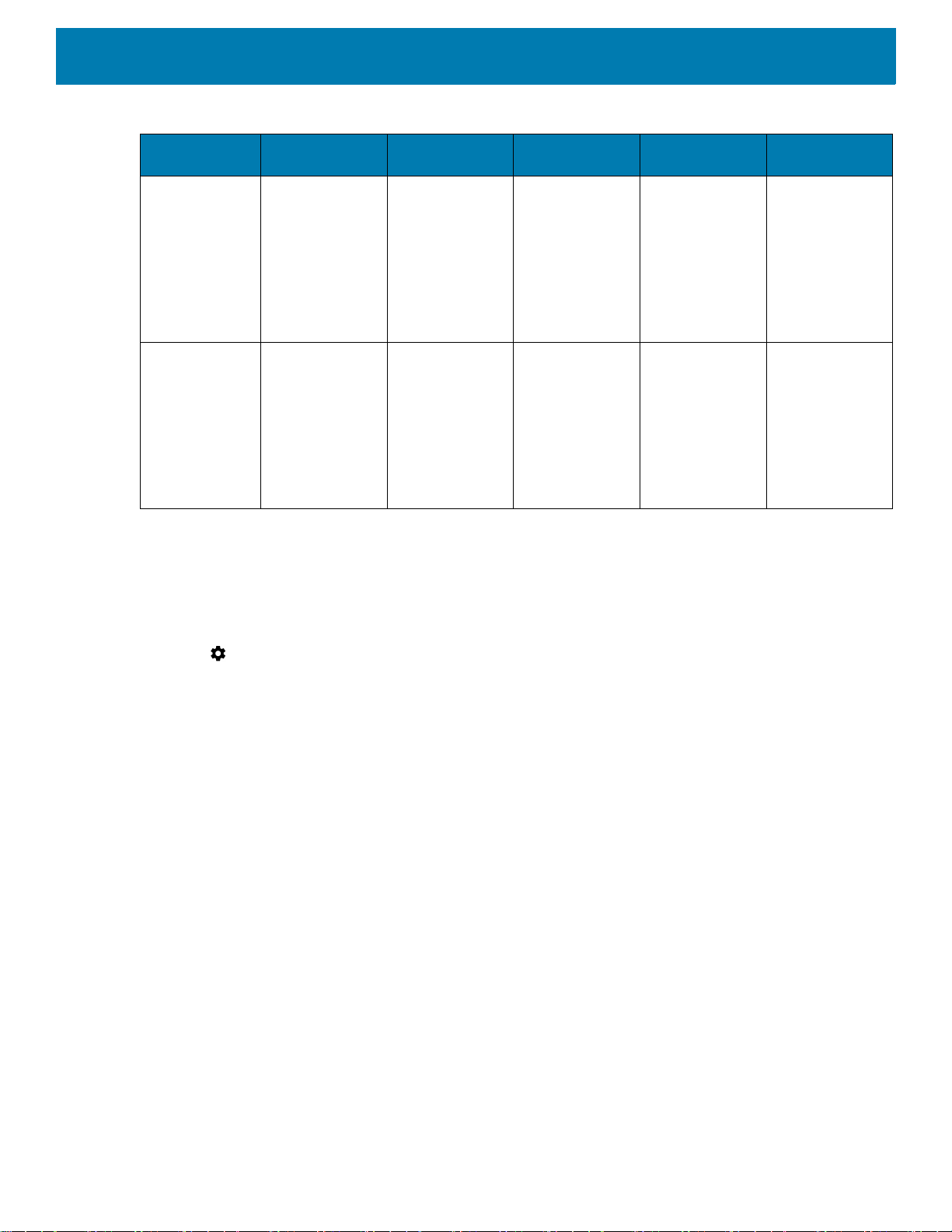
Configuration Radios Display Memory
TC56CJ WLAN: 802.11
TC56DJ WLAN: 802.11
Software Versions
To determine the current software versions:
a/b/g/n/d/h/i/k/r
WPAN:
Bluetooth v4.1
Low Energy
WWAN:
HSPA+/
LTE/CDMA
a/b/g/n/d/h/i/k/r
WPAN:
Bluetooth v4.1
Low Energy
WWAN:
HSPA+/
LTE
5.0” High
Definition (1280
x 720) LCD
5.0” High
Definition (1280
x 720) LCD
2 GB RAM / 16
GB Flash or 4
GB RAM / 32
GB Flash
2 GB RAM / 16
GB Flash or 4
GB RAM / 32
GB Flash
Data Capture
Options
2D imager
(SE-4710) and
integrated NFC
2D imager
(SE-4710) and
integrated NFC
Operating
System
Android Open
Source Project
(AOSP) 8.1.0 or
Google ™
Mobile Services
(GMS) 8.1.0.
Android Open
Source Project
(AOSP) 8.1.0 or
Google ™
Mobile Services
(GMS) 8.1.0.
1. Swipe down from the Status bar to open the Quick Settings bar.
2. Touch > System.
3. Touch About phone.
4. Scroll to view the following information:
•Model
• Android version
•Kernel version
• Build number.
To determine the device serial number, touch About phone > Status.
• Serial number
Chapter Descriptions
Topics covered in this guide are as follows:
• Getting Started provides information on getting the TC56 up and running for the first time.
• Using the TC56 provides information for operating the TC56.
• Calls provides instructions for making phone calls.
• Applications provides information on using applications installed on the TC56.
• Data Capture provides information for capturing bar code data using the imager.
• Wireless provides information on the various wireless options.
13
Page 14

• Accessories provides information for using the accessories for the TC56.
• Maintenance and Troubleshooting includes instructions on cleaning and provides troubleshooting solutions
for potential problems during TC56 operation.
Notational Conventions
The following conventions are used in this document:
• Bold text is used to highlight the following:
• Dialog box, window and screen names
• Drop-down list and list box names
• Check box and radio button names
• Icons on a screen
• Key names on a keypad
• Button names on a screen.
• Bullets (•) indicate:
• Action items
• Lists of alternatives
• Lists of required steps that are not necessarily sequential.
• Sequential lists (for example, those that describe step-by-step procedures) appear as numbered lists.
Related Documents
• TC56 Touch Computer Quick Start Guide, p/n MN-002859-xx.
• TC56 Touch Computer Regulatory Guide, p/n MN002860-xx.
• TC56 Touch Computer Integrator Guide for Android 8.1.0 Oreo, p/n MN003231-xx.
• RS507 Hands-free Imager Product Reference Guide, p/n 72E-12082-xx.
• DS36X8 Product Reference Guide, p/n MN-002689-xx.
• RS6000 User Guide, MN-002704-xx.
For the latest version of this guide and all guides, go to: www.zebra.com/support
Service Information
If you have a problem with your equipment, contact Customer Support for your region. Contact information is
available at: www.zebra.com/support
When contacting support, please have the following information available:
• Serial number of the unit (found on manufacturing label)
• Model number or product name (found on manufacturing label)
• Software type and version number
Customer Support responds to calls by email or telephone within the time limits set forth in support
agreements.
.
.
If the problem cannot be solved by Customer Support, you may need to return the equipment for servicing and
will be given specific directions. We are not responsible for any damages incurred during shipment if the
14
Page 15

approved shipping container is not used. Shipping the units improperly can possibly void the warranty.
Remove the microSD card from the device before shipping for service.
If the device was purchased from a business partner, contact that business partner for support.
Provide Documentation Feedback
If you have comments, questions, or suggestions about this guide, send an email to
EVM-Techdocs@zebra.com
.
15
Page 16

Getting Started
Introduction
This chapter provides information for getting the device up and running for the first time.
Unpacking
1. Carefully remove all protective material from the TC56 and save the shipping container for later storage and
shipping.
2. Verify that the following were received:
• TC56 touch computer
• 4,300 mAh PowerPercision+ Lithium-ion battery
• Regulatory Guide.
3. Inspect the equipment for damage. If any equipment is missing or damaged, contact the Global Customer
Support center immediately.
4. Prior to using the TC56 for the first time, remove the protective shipping film that covers the scan window,
display and camera window.
16
Page 17
Features
6
1
2
3
4
5
7
8
9
11
12
10
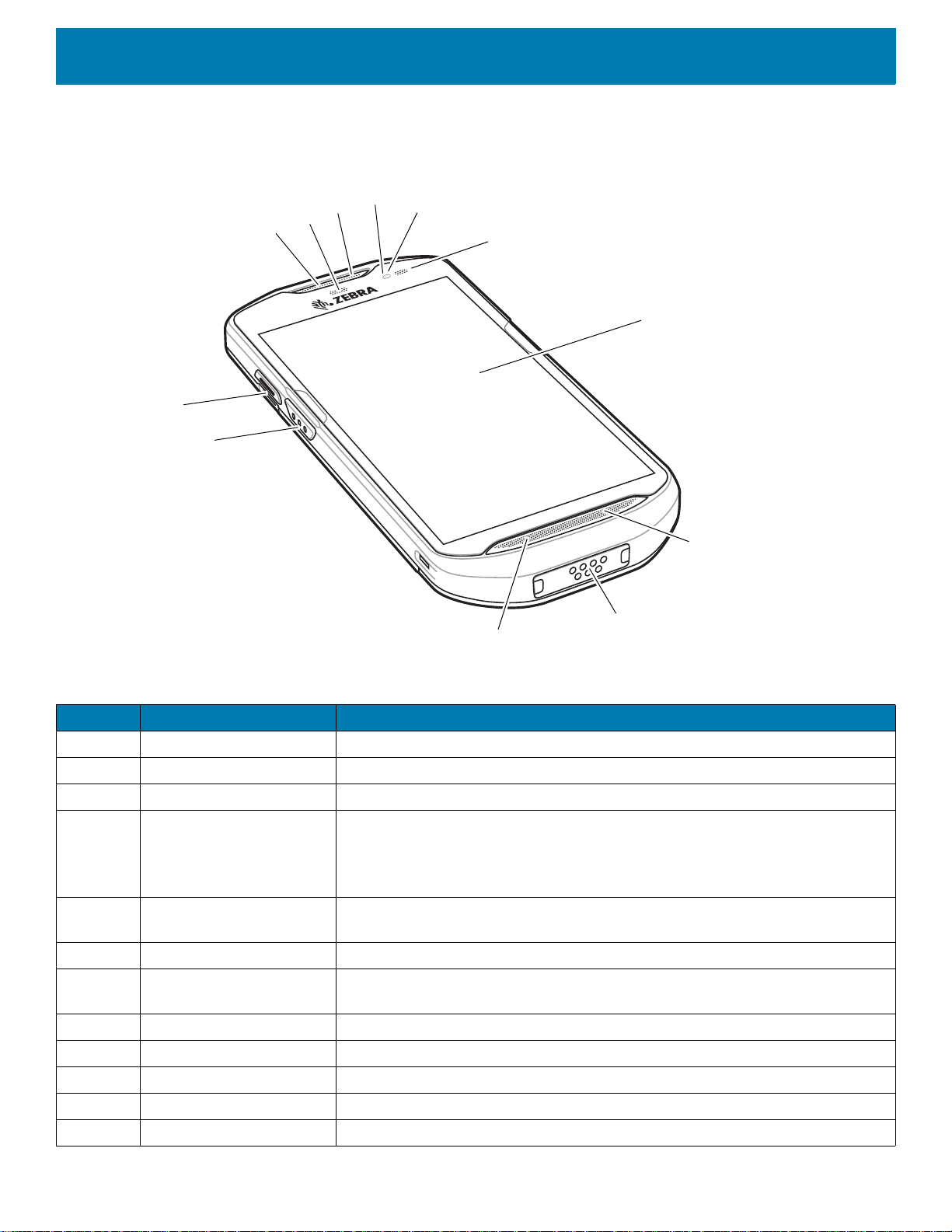
Figure 1 TC56 Front View
Getting Started
Table 1 Front View Features
Number Item Function
1 PTT Button Initiates push-to-talk communications (programmable).
2 Scan Button Initiates data capture (programmable).
3 Microphone Use for communications in Handset mode.
4 Interface Connector Provides USB host and client communications, audio and device charging via
cables and accessories.
CAUTION: Do not remove the interface connector to ensure proper device
sealing.
5 Speaker Provides audio output for video and music playback. Provides audio in
speakerphone mode.
6 Touch Screen Displays all information needed to operate the TC56.
7 Charging/Notification LED Indicates battery charging status while charging and application generated
8 Light Sensor Determines ambient light for controlling display backlight intensity.
notifications.
9 Proximity Sensor Determines proximity for turning off display when in handset mode.
10 Microphone Use for communications in Speakerphone mode.
11 Data Capture LED Indicates data capture status.
12 Receiver Use for audio playback in Handset mode.
17
Page 18
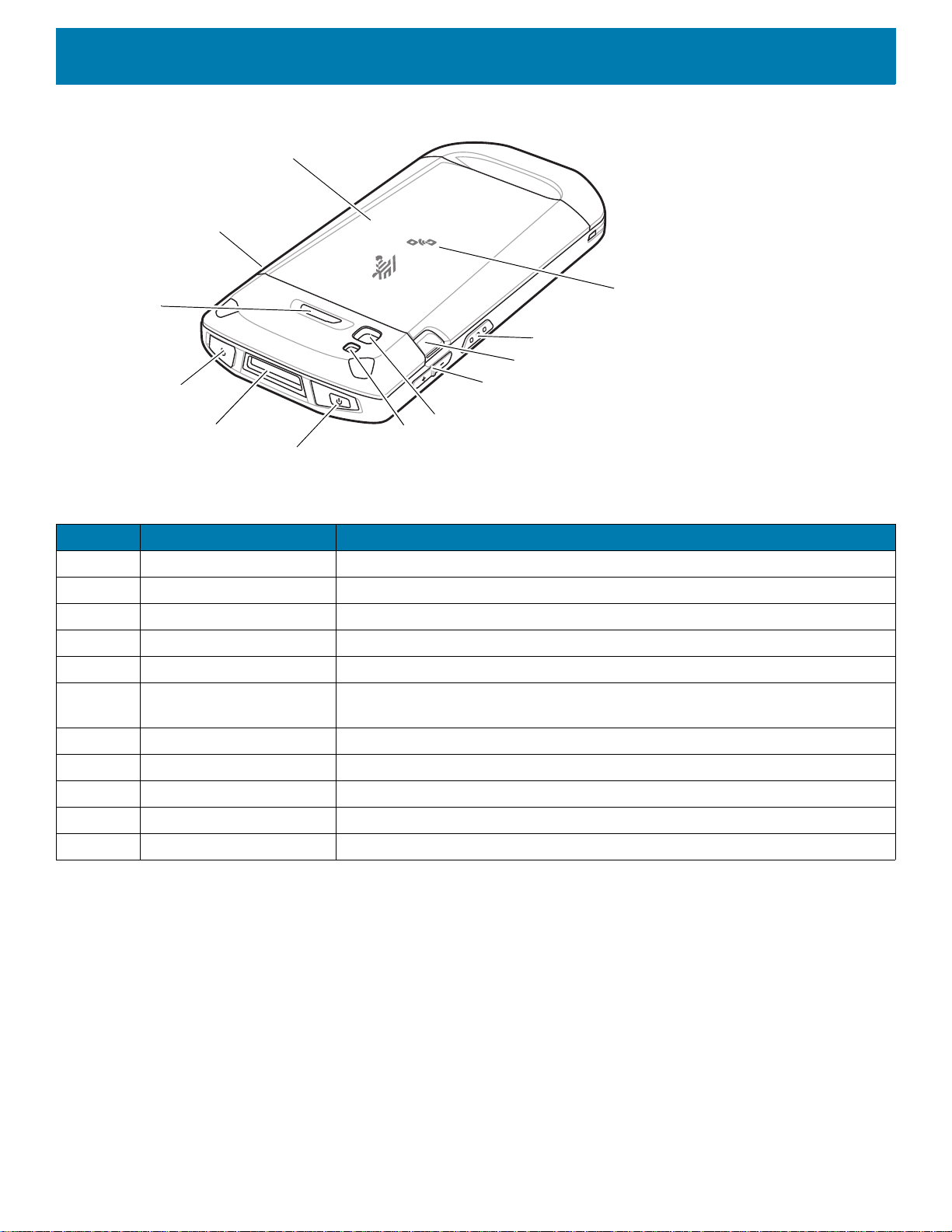
Figure 2 TC56 Rear View
15
22
21
20
17
13
18
16
14
14
19
23
Table 2 Back View Features
Getting Started
Number Item Function
13 Battery Provides power to the device.
14 Battery Release Latches Press to remove the battery.
15 Programmable Button Programmable.
16 Headset Jack For audio output to headset.
17 Exit Window Provides data capture using the imager.
18 Power Button Turns the display on and off. Press and hold to reset the device, power off or
swap battery.
19 Camera Flash Provides illumination for the camera.
20 Camera Takes photos and videos.
21 Volume Up/Down Button Increase and decrease audio volume (programmable).
22 Scan Button Initiates data capture (programmable).
23 NFC Antenna Provides communication with other NFC-enabled devices.
Setup
Perform this procedure to start using the TC56 for the first time.
1. Install a micro secure digital (SD) card (optional).
2. Installing a nano SIM card (optional)
3. Install hand strap (optional).
4. Install the battery.
5. Charge the TC56.
6. Power on the TC56.
18
Page 19
Installing a microSD Card
The microSD card slot provides secondary non-volatile storage. The slot is located under the battery pack.
Refer to the documentation provided with the card for more information, and follow the manufacturer’s
recommendations for use.
CAUTION: Follow proper electrostatic discharge (ESD) precautions to avoid damaging the microSD card. Proper ESD pre-
cautions include, but are not limited to, working on an ESD mat and ensuring that the operator is properly grounded.
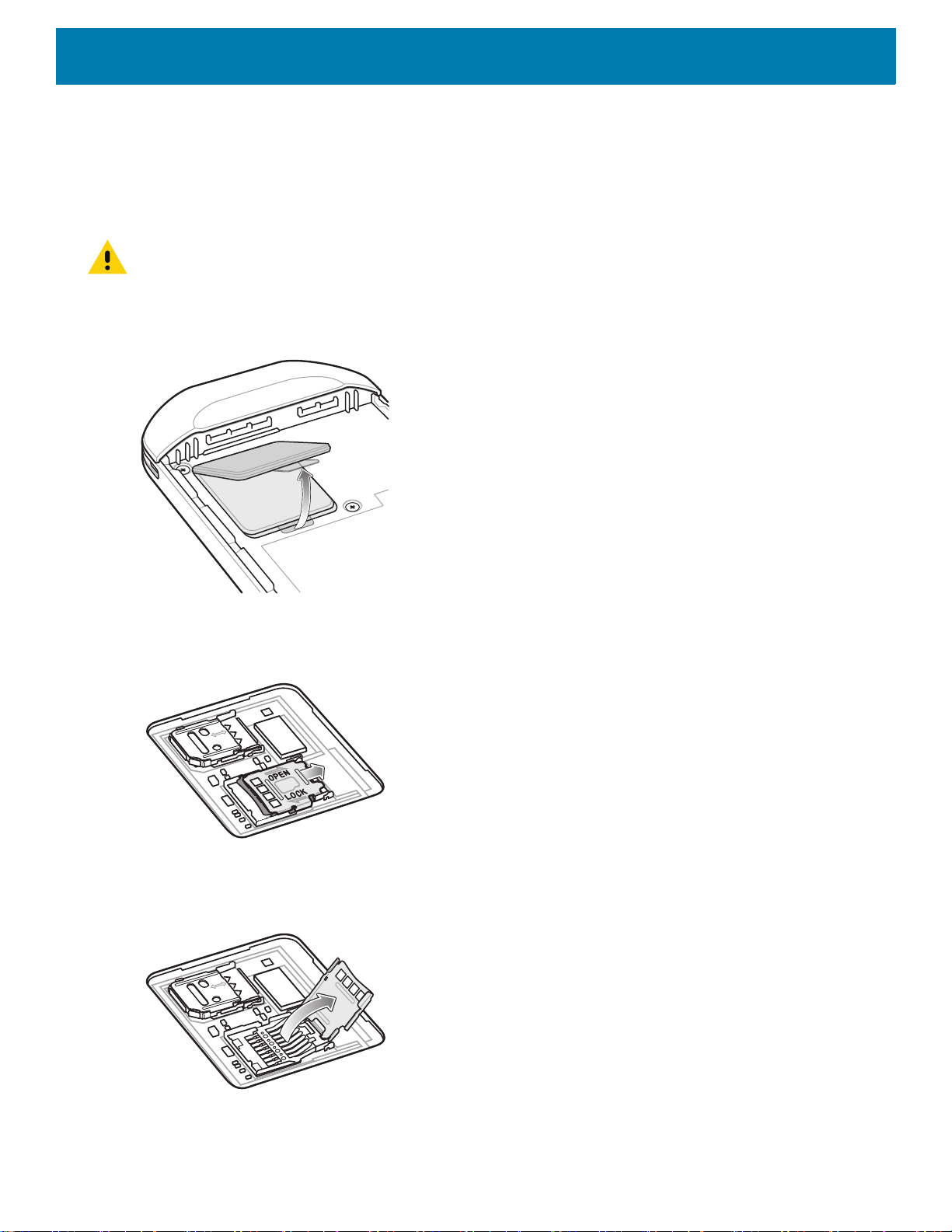
1. Lift the access door.
Figure 3 Lift Access Door
Getting Started
2. Slide the microSD card holder to the unlock position.
Figure 4 Unlock microSD Card Holder
3. Lift the microSD card holder.
Figure 5 Lift the microSD Card Holder
19
Page 20
Getting Started
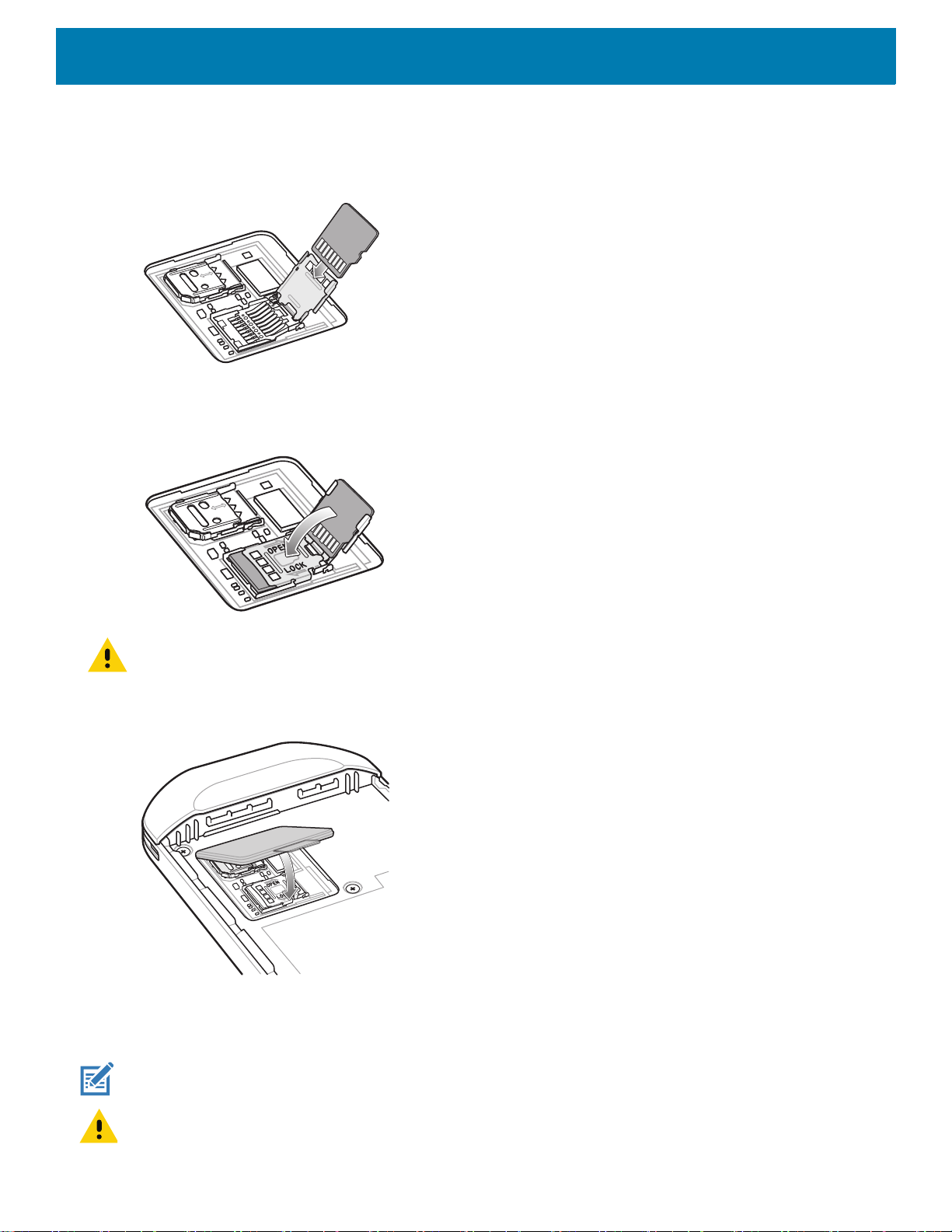
4. Insert the microSD card into the card holder door ensuring that the card slides into the holding tabs on each
side of the door.
Figure 6 Insert microSD Card in Holder
5. Close the microSD card holder and slide into the lock position.
Figure 7 Re-install Access Door
CAUTION: Access door must be replaced and securely seated to ensure proper device sealing.
6. Re-install the access door.
Figure 8 Replace Access Door
Installing the SIM Card
NOTE: Only use a nano SIM card.
CAUTION: For proper electrostatic discharge (ESD) precautions to avoid damaging the SIM card. Proper ESD precautions
include, but not limited to, working on an ESD mat and ensuring that the user is properly grounded.
20
Page 21
Getting Started
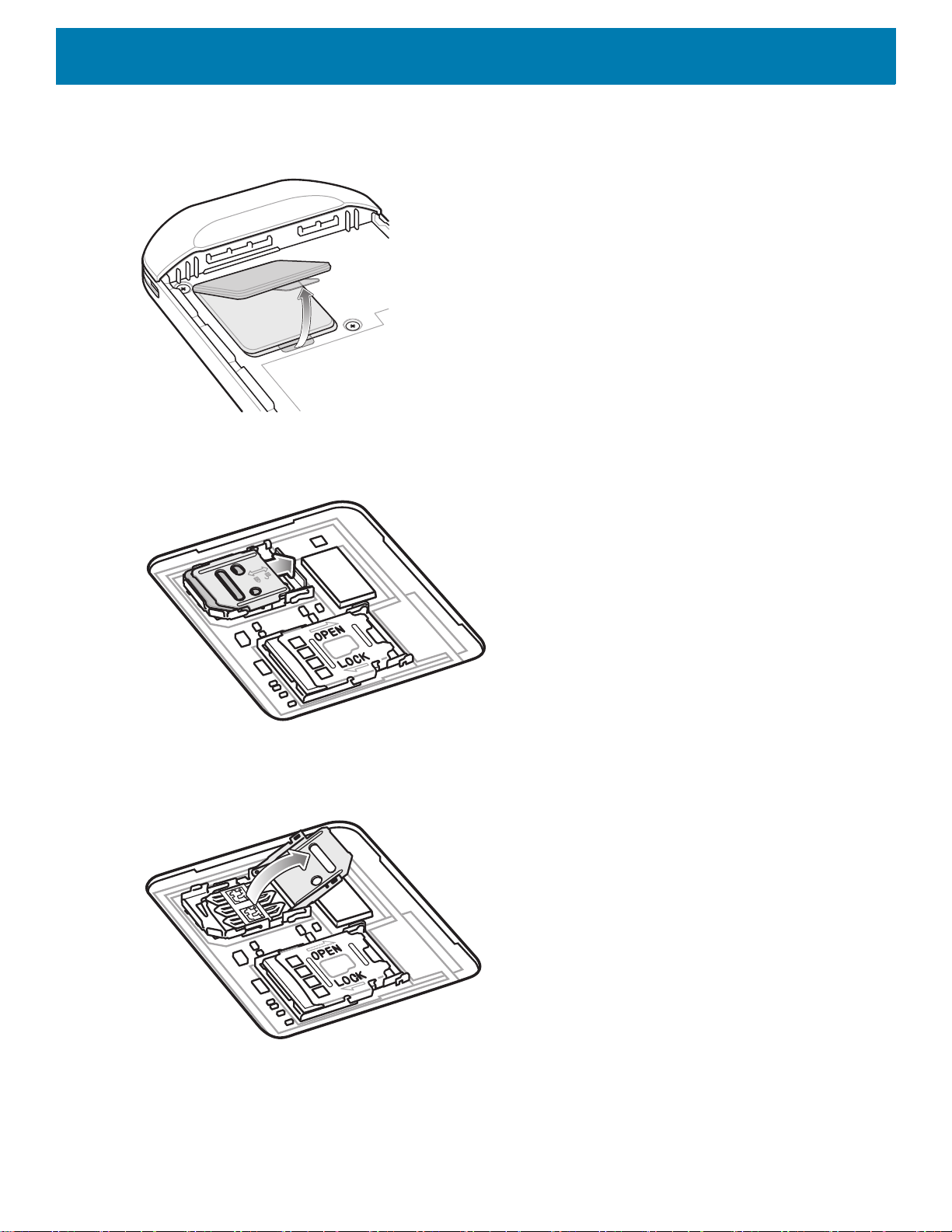
1. Remove access cover.
Figure 9 Remove Access Door
2. Slide the SIM card holder to the unlock position.
Figure 10 Unlock SIM Card Holder
3. Lift the SIM card holder door.
Figure 11 Lift the SIM Card Holder
21
Page 22
Getting Started
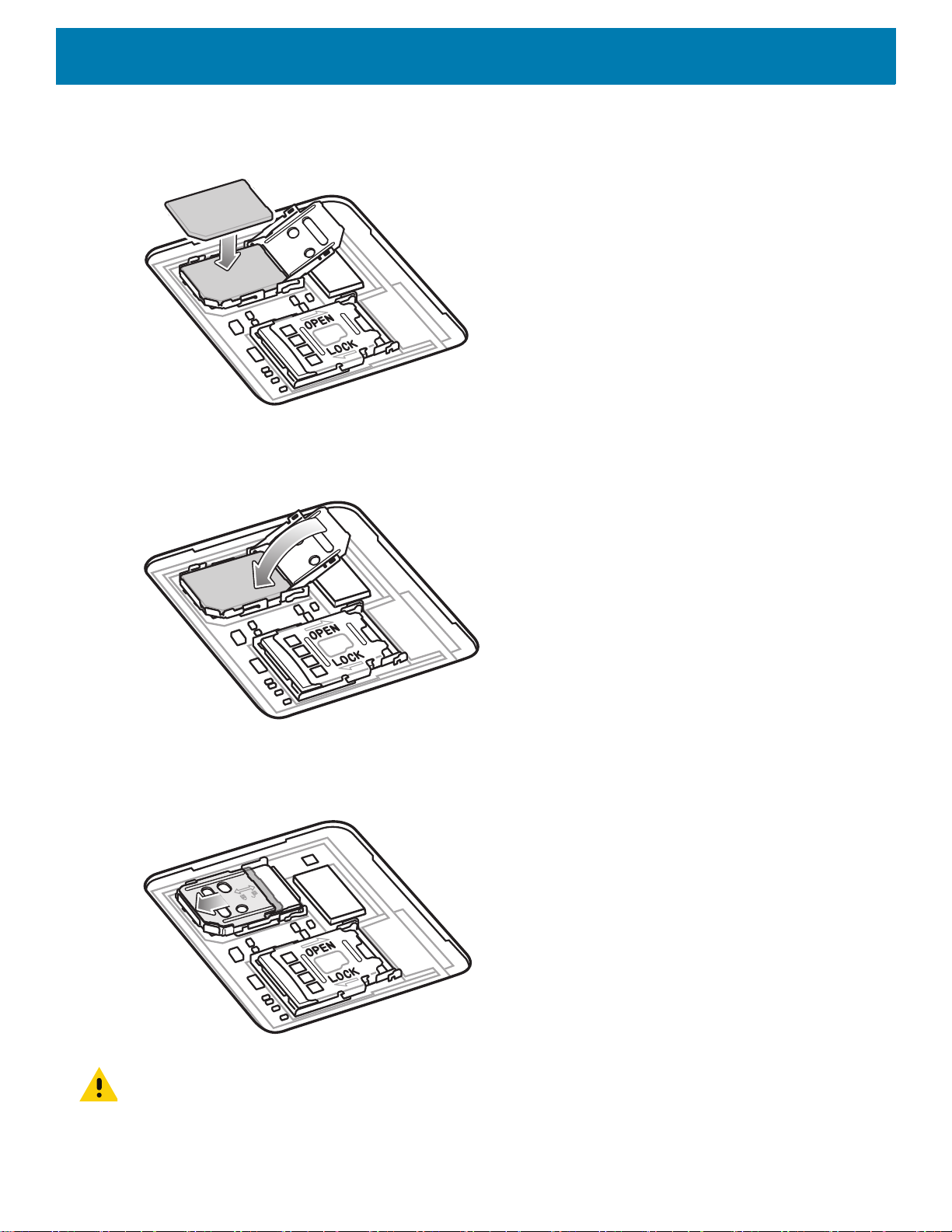
4. Place the nano SIM card into the card holder with contacts facing down.
Figure 12 Place SIM Card in Holder
5. Close the SIM card holder door.
Figure 13 Close SIM Card Holder Door
6. Slide to SIM card holder door to the lock position.
Figure 14 Lock SIM Card Holder Door
CAUTION: Access door must be replaced and securely seated to ensure proper device sealing.
22
Page 23
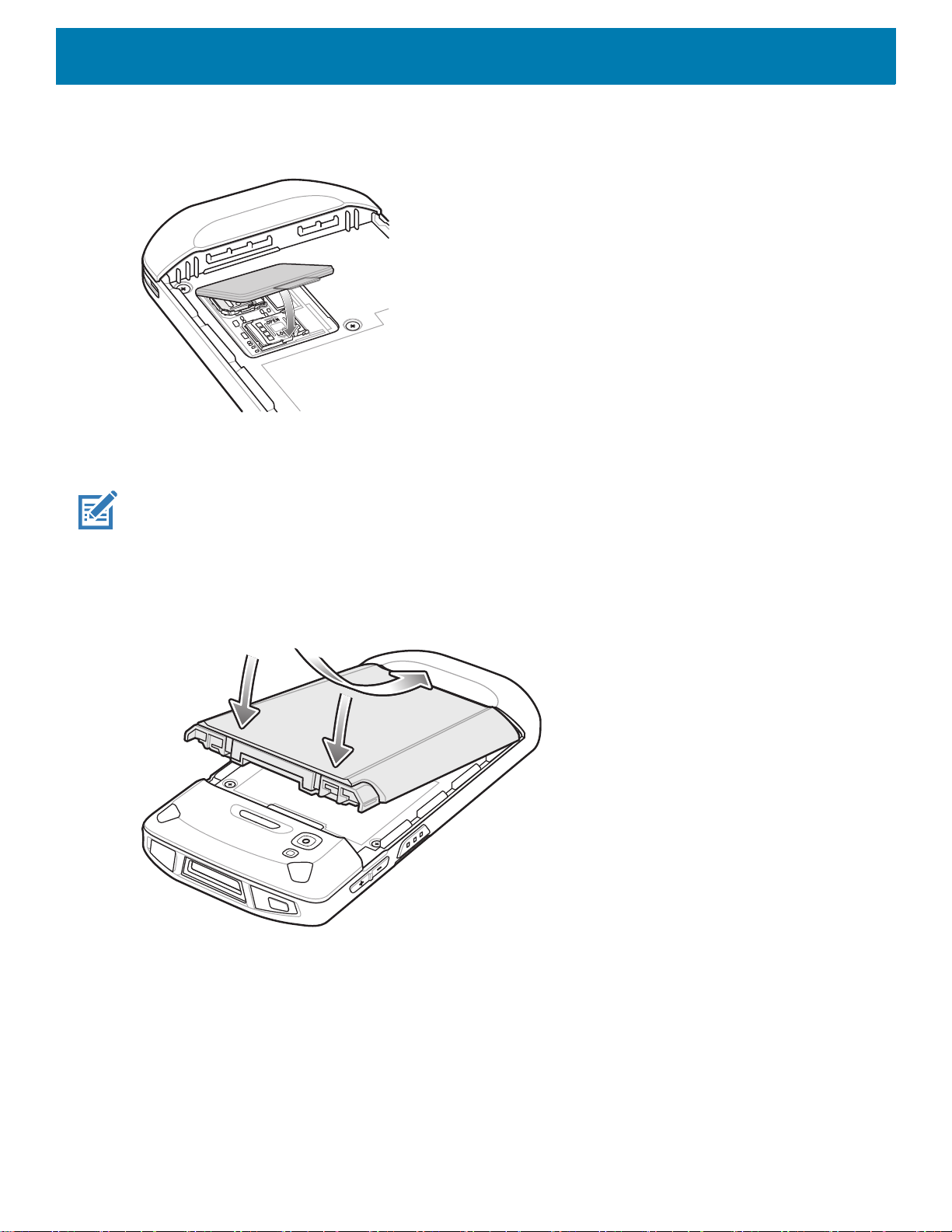
7. Re-install the access door.
Figure 15 Replace Access Door
Installing the Battery
NOTE: User modification of the device, particularly in the battery well, such as labels, asset tags, engravings, stickers, etc.,
may compromise the intended performance of the device or accessories. Performance levels such as sealing (Ingress
Protection (IP)), impact performance (drop and tumble), functionality, temperature resistance, etc. could be effected. DO
NOT put any labels, asset tags, engravings, stickers, etc. in the battery well. Insert the battery, bottom first, into the battery
compartment in the back of the device.
Getting Started
Figure 16 Insert Bottom of Battery into Battery Compartment
1. Press the battery down into the battery compartment until the battery release latches snap into place.
Charging the Battery
Before using the device for the first time, charge the main battery until the green Charging/Notification light
emitting diode (LED) remains lit. To charge the device use a cable or a cradle with the appropriate power
supply. For information about the accessories available for the device see Accessories for more information.
23
Page 24
The 4,300 mAh (typical) / 4,050 mAh (minimum) battery charges from fully depleted to 90% in approximately
2.5 hours and from fully depleted to 100% in approximately three hours.
NOTE: In many cases the 90% charge provides plenty of charge for daily use. A full 100% charge lasts for approximately
14 hours of use.
To achieve the best fast charging results use only Zebra charging accessories and batteries. Charge batteries at room
temperature with the device in sleep mode.
Charge batteries in temperatures from 0°C to 40°C (32°F to 104°F). The device or accessory always performs
battery charging in a safe and intelligent manner. At higher temperatures (e.g. approximately +37°C (+98°F))
the device or accessory may for small periods of time alternately enable and disable battery charging to keep
the battery at acceptable temperatures. The device or accessory indicates when charging is disabled due to
abnormal temperatures via its LED and a notification appears on the display.
To charge the main battery:
1. Connect the charging accessory to the appropriate power source.
2. Insert the device into a cradle or attach to a cable. The device turns on and begins charging. The
Charging/Notification LED blinks amber while charging, then turns solid green when fully charged.
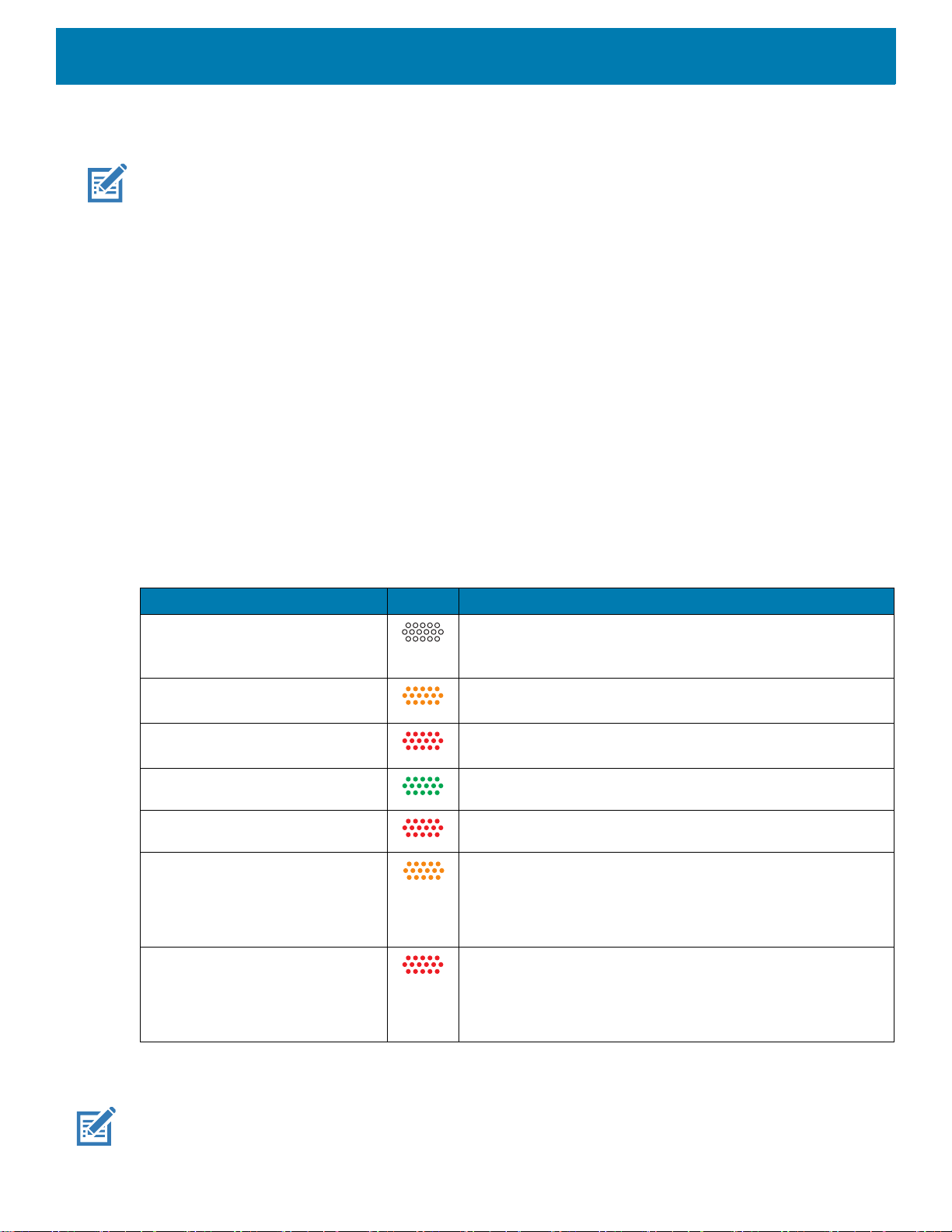
Charging Indicators
Getting Started
Table 3 Charging/Notification LED Charging Indicators
State LED Indication
Off Device is not charging. Device is not inserted correctly in the
cradle or connected to a power source. Charger/cradle is not
powered.
Slow Blinking Amber (1 blink
every 4 seconds)
Slow Blinking Red (1 blink every
4 seconds)
Solid Green Charging complete.
Solid Red Charging complete but the battery is at end of useful life.
Fast Blinking Amber (2
blinks/second)
Fast Blinking Red (2
blinks/second)
Device is charging.
Device is charging but the battery is at end of useful life.
Charging error, e.g.:
• Temperature is too low or too high.
• Charging has gone on too long without completion
(typically eight hours).
Charging error but the battery is at end of useful life., e.g.:
• Temperature is too low or too high.
• Charging has gone on too long without completion
(typically eight hours).
Google Account Setup
NOTE: The device has to be connected to the internet in order to set up a Google™ account.
24
Page 25
A Google account is only required on devices with GMS software.
The first time the device starts, the Setup Wizard displays. Follow the on-screen instructions to set up a Google
account, configure Google Pay
information, and enable backup/restore features.
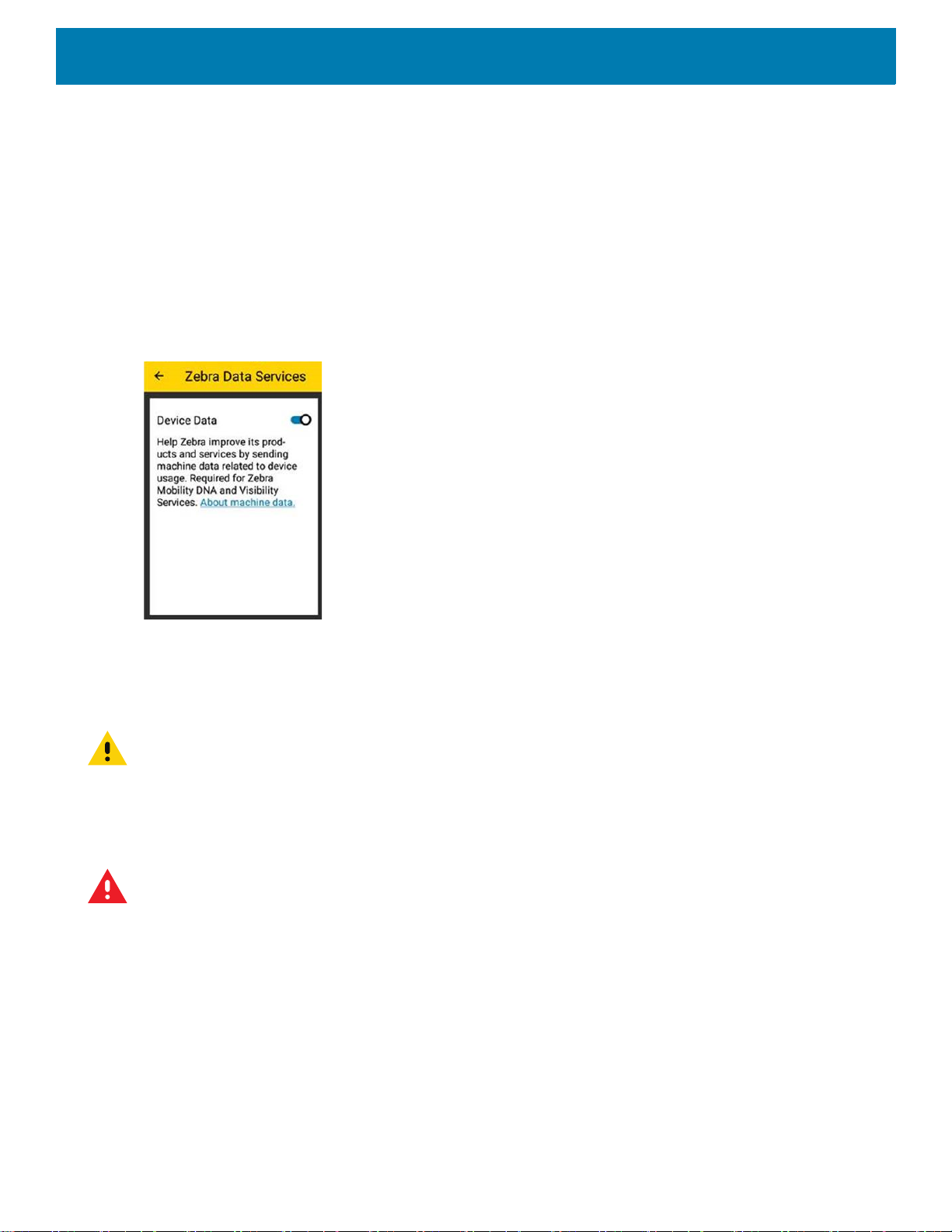
Zebra Visibility Services
The device captures and provides device analytics to a system administrator. The first time the device boots
(or after a Factory reset), the Zebra Services agreement screen displays.
Figure 17 Zebra Services
Getting Started
™ for purchasing items from the Google Play ™ store, to enter your personal
Touch the Device Data switch to disable the device from sending analytics data.
Replacing the Battery
CAUTION: Do not add or remove microSD card during battery replacement.
1. Press the Power button until the menu appears.
2. Touch Battery Swap.
3. Follow the on-screen instructions.
WARNING: Do not remove the battery until after the red LED completely turns off. Loss of data may result.
4. Wait for the red LED to completely turn off.
5. If hand strap is attached, remove hand strap.
25
Page 26
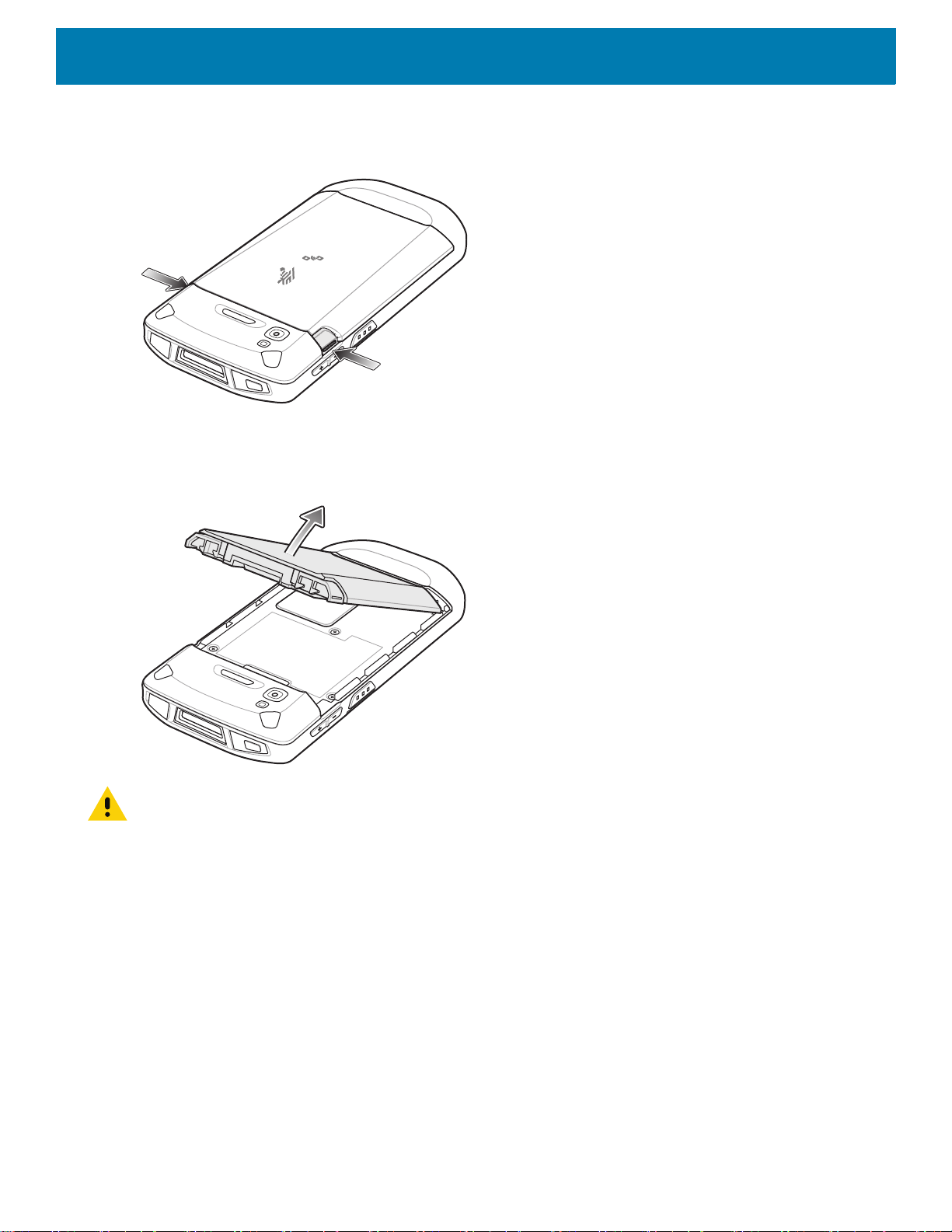
6. Press the two battery latches in.
Figure 18 Press Battery Latches
7. Lift the battery from the device.
Figure 19 Lift the Battery
Getting Started
CAUTION: Replace the battery within 90 seconds. After 90 seconds the device reboots and data may be lost.
8. Insert the replacement battery, bottom first, into the battery compartment in the back of the device.
9. Press the battery down until the battery release latches snap into place.
10.Replace the hand strap, if required.
11.Press the Power button to turn on the device.
Replacing the microSD Card
To replace the microSD card:
1. Press the Power button until the menu appears.
2. Touch Power off.
3. Touch OK.
4. If hand strap is attached, slide the hand strap clip up toward the top of the device and then lift.
26
Page 27
5. Press the two battery latches in.
6. Lift the battery from the device.
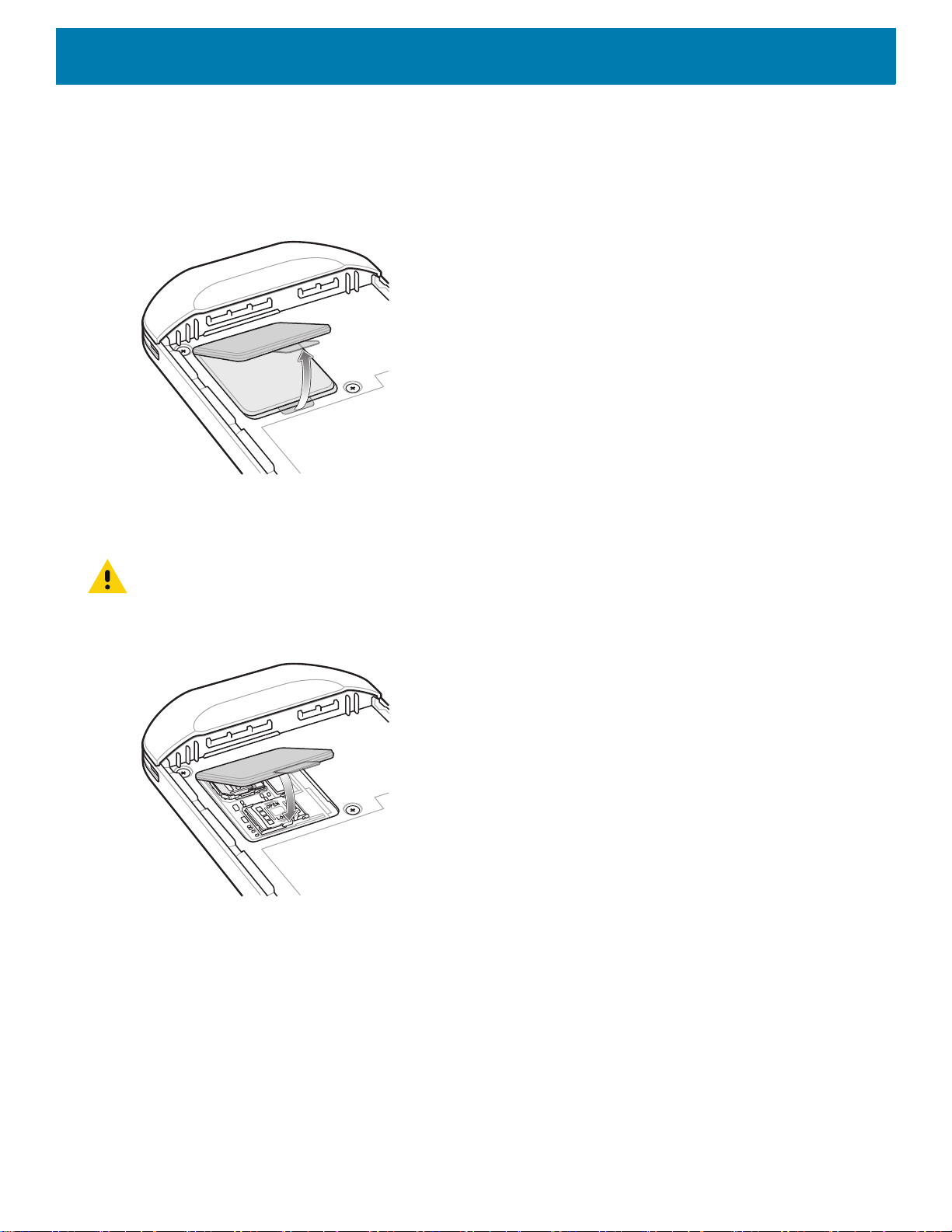
7. Lift the access door.
Figure 20 Remove Access Door
8. Remove microSD card from holder.
Getting Started
9. Insert the replacement microSD card.
CAUTION: Access door must be replaced and securely seated to ensure proper device sealing.
10.Replace the access door.
Figure 21 Replace Access Door
11.Insert the battery, bottom first, into the battery compartment in the back of the device.
12.Press the battery down until the battery release latches snap into place.
13.Replace the hand strap, if required.
14.Press and hold the Power button to turn on the device.
Replacing the SIM Card
To replace the SIM card:
1. Press the Power button until the menu appears.
27
Page 28
Getting Started
2. Touch Power off.
3. Touch OK.
4. If hand strap is attached, slide the hand strap clip up toward the top of the TC56 and then lift.
5. Press the two battery latches in.
6. Lift the battery from the TC56.
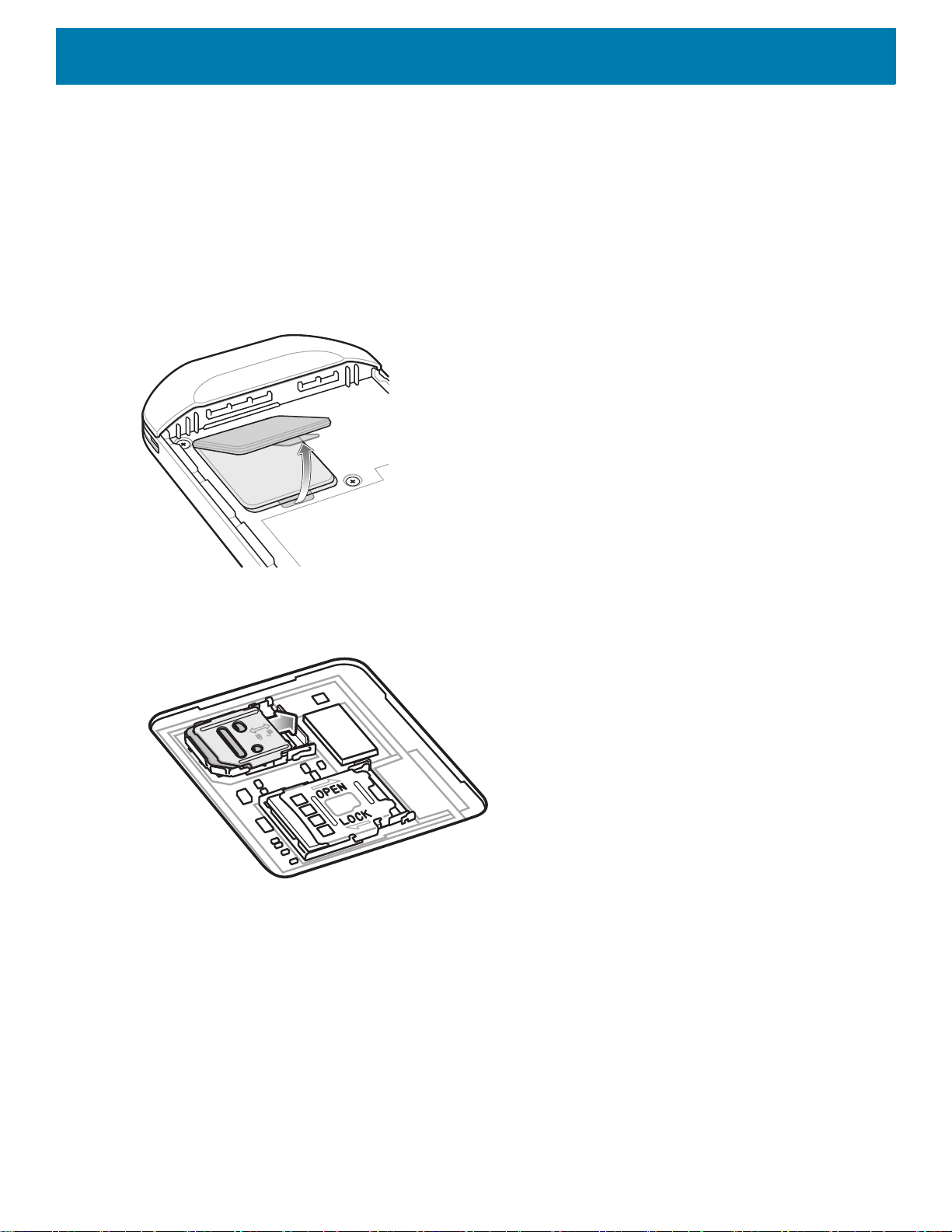
7. Lift the access door.
Figure 22 Remove Access Door
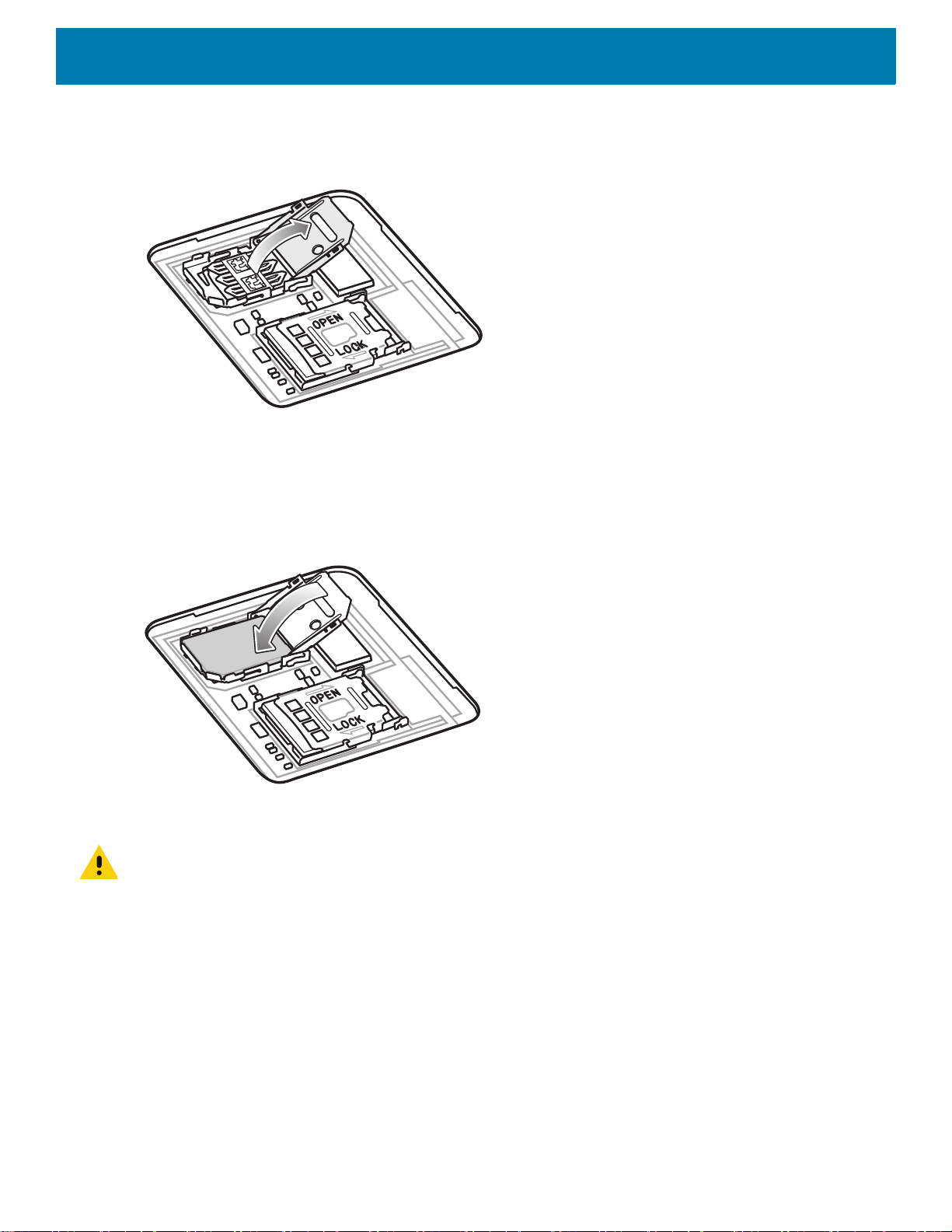
8. Slide the SIM card door to the unlock position.
Figure 23 Unlock SIM Card Door
28
Page 29
Getting Started
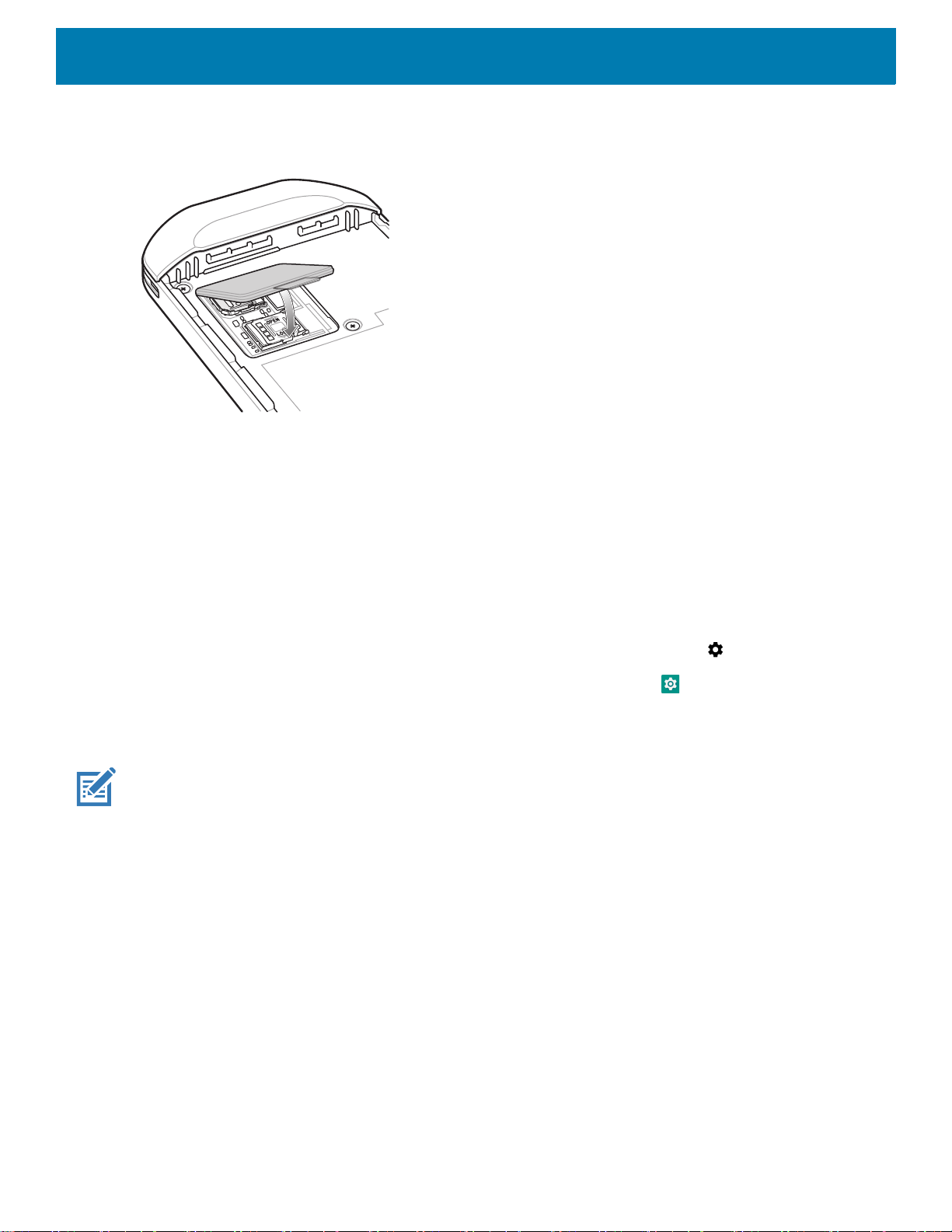
9. Lift the SIM card holder door.
Figure 24 Lift the SIM Card Door
10.Remove the SIM card.
11.Place the new SIM card into the card holder with contacts facing down.
12.Close the SIM card holder.
Figure 25 Close the SIM Card Door
13.Slide the SIM card holder door to the lock position.
CAUTION: Access door must be replaced and securely seated to ensure proper device sealing.
29
Page 30
Getting Started
14.Replace the access door.
Figure 26 Replace Access Door
15.Insert the battery, bottom first, into the battery compartment in the back of the TC56.
16.Press the battery down until the battery release latch snaps into place.
17.Replace the hand strap, if required.
18.Press and hold the Power button to turn on the TC56.
Accessing Device Settings
To access device settings:
1. Swipe down from the Status bar to open the Quick Settings bar and then touch .
2. On the Home screen, swipe up from the bottom of the screen and touch .
Battery Management
NOTE: Prior to checking the battery charge level, remove the device from any AC power source (cradle or cable).
To check the charge status of the main battery, open Settings and touch System > About phone > Battery
Information.
Battery present status indicates if the battery is present and Battery level lists the battery charge (as a
percentage of fully charged). The battery percentage can also be viewed next to the battery icon in the quick
access panel. Swipe down with two fingers from the status bar to open the quick access panel.
Monitoring Battery Usage
The Battery screen provides battery charge details, power management options, and a list of apps that
consume the most battery power.
Use the power management options to extend battery life, or touch an app to display details about its power
consumption. Different apps display different information. Some apps include buttons that open screens with
settings to adjust power use. Use the DISABLE or FORCE CLOSE buttons to turn off apps that consume too
much power.
30
Page 31

Getting Started
1. Swipe down from the Status bar to open the Quick Settings bar and then touch .
2. Touch Battery.
Figure 27 Battery Screen
Low Battery Notification
When the battery charge level drops below 18%, the device displays a notice to connect the device to power.
The user should charge the battery using one of the charging accessories.
When the battery charge drops below 10%, the device displays a notice to connect the device to power. The
user must charge the battery using one of the charging accessories.
When the battery charge drops below 4%, the device turns off. The user must charge the battery using one of
the charging accessories.
Figure 28 Low Battery Notification
31
Page 32

Battery Optimization
Observe the following battery saving tips:
• Set the screen to turn off after a short period of non-use.
• Reduce screen brightness.
• Turn off all wireless radios when not in use.
• Turn off automatic syncing for Email, Calendar, Contacts, and other apps.
• Minimize use of apps that keep the device from suspending, for example, music and video apps.
Turning Off the Radios
To turn off all the radios:
1. Swipe down from the Status bar to open the Quick Settings panel.
2. Swipe left.
3. Touch Airplane mode. The airplane icon appears in the Status bar indicating that all the radios are off.
Getting Started
Setting the Date and Time
The date and time is automatically synchronized using an NITZ server when the device is connected to a
cellular network. You are only required to set the time zone or set the date and time when not connected to a
cellular network or if the wireless LAN does not support Network Time Protocol (NTP).
To set the date and time:
1. Swipe down from the Status bar to open the Quick Settings bar and then touch .
2. Touch System > Date & time.
3. Touch Automatic date & time to disable automatic date and time synchronization.
4. Touch Automatic time zone to disable automatic time zone synchronization.
5. Touch Set date.
6. In the calendar, set today’s date.
7. Touch OK.
8. Touch Set time.
9. Touch the green circle, drag to the current hour and then release.
10.Touch the green circle, drag to the current minute and then release.
11.Touch AM or PM.
12.Touch OK.
13.Touch Select time zone.
14.Select the current time zone from the list.
15.If desired, touch Use 24-hour format to use 24 hour format for time.
32
Page 33

16.Touch .
Display Settings
Use Display settings to change the screen brightness, enable night light, change the background image,
enable screen rotation, set sleep time, and change font size.
Setting the Screen Brightness
To manually set the screen brightness using the touchscreen:
1. Swipe down with two fingers from the Status bar to open the Quick Access panel.
2. Slide the icon to adjust the screen brightness level.
Figure 29 Brightness Slider
Getting Started
To let the device automatically adjust the screen brightness using the built-in light sensor:
1. Swipe down from the status bar to open the quick settings bar and then touch .
2. Touch Display.
3. If disabled, touch Adaptive brightness to automatically adjust the brightness.
By default, Adaptive brightness is enabled. Toggle the switch to disable.
4. Touch .
Setting Screen Rotation
By default, screen rotation is enabled.
To disable screen rotation:
1. Swipe down from the Status bar to open the Quick Settings bar and then touch .
2. Touch Display > Advanced.
3. Touch Auto-rotate screen.
NOTE: To change the Home screen rotation, see Setting Home Screen Rotation.
4. Touch .
Setting Home Screen Rotation
By default the Home screen rotation is disabled. To enable Home screen rotation:
1. Touch and hold anywhere on the Home screen until the options appear.
2. Touch .
33
Page 34

3. Touch Allow Home rotation switch.
4. Touch .
5. Rotate the device.
Figure 30 Rotated Home Screen
Getting Started
Setting Screen Timeout
To set the screen sleep time:
1. Swipe down from the Status bar to open the Quick Settings bar and then touch .
2. Touch Display > Advanced > Sleep.
3. Select one of the sleep values.
• 15 seconds
• 30 seconds
• 1 minute (default)
• 2 minutes
• 5 minutes
•10 minutes
• 30 minutes.
4. Touch .
Setting Font Size
To set the size of the font in system apps:
1. Swipe down from the Status bar to open the Quick Settings panel and then touch .
2. Touch Display > Advanced.
34
Page 35

3. Touch Font size.
Figure 31 Font Settings
Getting Started
4. Select one of the font size values.
•Small
• Default
•Large
• Largest.
5. Touch .
Ambient Display
The Ambient display setting wakes the screen when notifications are received.
To disable ambient display:
1. Swipe down from the Status bar to open the Quick Settings bar and then touch .
2. Touch Display > Advanced.
3. Touch Ambient display.
4. In the When to show section, enable or disable an option using the switch.
5. Touch .
Touch Panel Mode
The device display is able to detect touches using a finger, a conductive-tip stylus, or gloved finger.
NOTE: A glove can be made of medical latex, leather, cotton, or wool.
35
Page 36

Getting Started
For optimal performance use a Zebra certified stylus.
1. Swipe down from the Status bar to open the Quick Settings bar and then touch .
2. Touch Display > Advanced.
3. Touch Touch panel mode.
Figure 32 Screen Protector Mode Dialog Box
4. Select:
a. Glove and Finger (Screen Protector off) to use a finger or a gloved finger on the screen without a
screen protector.
b. Stylus and Finger (Screen Protector off) to use a finger or a stylus on the screen without a screen
protector.
c. Glove and Finger (Screen Protector on) to use a finger or a gloved finger on the screen with a screen
protector.
d. Stylus and Finger (Screen Protector on) to use a finger or a stylus on the screen with a screen
protector.
5. Touch .
Blink Light
The Notification LED lights blue when an app, such as email and VoIP, generates a programmable notification
or to indicate when the device is connected to a Bluetooth device. By default, LED notifications are enabled.
To change the notification setting:
1. Swipe down from the Status bar to open the Quick Settings bar and then touch .
2. Touch Apps & notifications > Notifications.
3. Touch Blink light to toggle the notification on or off.
General Sound Setting
Use the Sound settings to configure media and alarm volumes.
To access sound settings:
1. Swipe down from the Status bar to open the Quick Settings bar and then touch .
2. Touch Sound.
36
Page 37

3. Touch an option to set sounds.
Figure 33 Sound Screen
Getting Started
• Zebra volume controls
• Ring volume - Controls the ringtone volume.
• Media volume - Controls the music, games, and media volume.
• Alarm volume - Controls the alarm clock volume.
• Notifications volume - Controls the notification volume.
• Scanner volume - Controls the scanner volume.
• Volume presets
• - Mutes the ring, notifications, and scanner so that the device does not make sounds or vibrate.
• - All sounds except media and alarms are silenced and vibrate mode is active.
• - Enables all sounds at the user defined levels.
• Also vibrate for calls - Switch on or off.
• Do Not Disturb preferences - Mutes some or all sounds and vibrations.
• Priority only allows - Use to set the priorities for the following:
• Reminders - Switch on or off.
• Events - Switch on or off.
• Alarms - This is always enabled.
• Messages - Choose to allow messages from anyone, starred contacts, any contact, or none. To star
contacts, use the Contacts app.
• Calls - Choose to allow calls from anyone, starred contacts, any contact, or none. To star contacts,
use the Contacts app.
• Repeat callers - Choose whether or not the phone rings if the same person calls again within 15
minutes.
• Block visual disturbances
37
Page 38

Getting Started
• Block when screen is on - This option prevents notifications from displaying over the screen
(peeking) while you are actively using the device.
• Block when screen is off - This option prevents notifications from turning on the screen or pulsing
the LED light when a new notification is received while you are not using the device.
• Automatic rules - Choose when to automatically silence the device. Touch a default rule, such as
Weekend or Weeknight, or create your own rule. To create your own rule, tap Add more and then Time
rule.
• Phone ringtone - Touch to select a sound to play when the phone rings.
• Advanced - Touch to display advanced sound options.
• Default notification sound - Touch to select a sound to play for all system notifications.
• Default alarm sound - Touch to select a sound to play for alarms.
• Other sounds and vibrations
• Dial pad tones - Play a sound when pressing keys on dial pad (default - disabled).
• Screen locking sounds - Play a sound when locking and unlocking the screen (default – enabled).
• Charging sounds - Not applicable.
• Touch sounds - Play a sound when making screen selections (default – enabled).
• Vibrate on tap - Vibrate the device when making screen selections (default – disabled).
• Emergency alerts - Touch to configure emergency broadcast settings and notifications.
Wake-Up Sources
By default the device wakes from suspend mode when the user presses the power button. The device can be
configured to wake when the user presses the PTT or Scan buttons on the left side of the device.
1. Swipe down with two fingers from the status bar to open the quick access panel and then touch .
2. Touch Wake-Up Sources.
3. Touch one or more of the options:
• Touch SCAN checkbox to enable the left scan button. A check appears in the checkbox.
• Touch RIGHT_TRIGGER_1 checkbox to enable the right scan button. A check appears in the checkbox.
• Touch LEFT_TRIGGER_2 checkbox to enable the PTT button. A check appears in the checkbox.
• Touch REAR_BUTTON checkbox rear programmable button. A check appears in the checkbox.
38
Page 39

Figure 34 Wake-Up Sources
Getting Started
4. Touch .
39
Page 40

Using the TC56
Introduction
This chapter explains the buttons, status icons, and controls on the device, and provides basic instructions for
using the device including resetting the device and entering data.
Google Mobile Services
NOTE: This section applies to Google Mobile Services (GMS) devices only.
Devices with GMS contain apps and services that provide additional functionality.
GMS includes:
• Apps - GMS adds a variety of Google apps and associated widgets including Chrome, Gmail, Drive, and
Maps.
• Services:
• Speech to Text - Allows for free format speech to text in many languages for both connected and
disconnected network. Launch by touching the microphone icon on the keyboard.
• TalkBack Service - Provides spoken feedback on various parts of the user interface. To enable, go to
Settings > Accessibility.
• Network Location Provider - Adds a location provider which uses mobile network tower information and
Wi-Fi access point information to provide a location without using GPS. To enable, go to Settings >
Security & location > Location.
• Widevine DRM - Enables Digital Rights Management (DRM) so that protected streaming video content
can be played. Enable DRM Info from the Google Play
• Google Cloud Messaging - Allows the device to receive data from the server and other devices on the
same connection.
• Backup and Restore - Allows the users settings and apps to be backed up to a Google server and
subsequently restored from that server after a factory reset.
• Google Accounts - Create and use a Google account to synchronize mail, files, music, photos, contacts and
calendar events.
™ store.
Home Screen
The Home screen displays when the device turns on. Depending upon the configuration, the Home screen
might appear different. Contact your system administrator for more information.
40
Page 41

After a suspend or screen time-out, the Home screen displays with the lock sliders. Touch the screen and slide
AOSP GMS
6
123
5
6
4
123
5
up to unlock. For screen locking information see Un-Locking the Screen on page 57.
Figure 35 Home Screen
Table 4 Home Screen Items
Item Description
1 — Recent Button Displays recently used applications.
2 — Home Displays the Home screen.
3 — Back Displays the previous screen.
4 — Shortcut Icons Opens applications installed on the device. See App Shortcuts and
Widgets on page 47 for more information.
5 — Widgets Launches stand-alone applications that run on the Home screen.
See App Shortcuts and Widgets on page 47 for more information.
6 — Status Bar Displays the time, status icons (right side), and notification icons
(left side). For more information see Status Bar on page 42 and
Managing Notifications on page 43.
The Home screen provides four additional screens for placement of widgets and shortcuts. Swipe the screen
left or right to view the additional screens.
41
Page 42

Status Bar
Notification Icons
Status Icons
The Status bar displays the time, notification icons (left side), and status icons (right side).
NOTE: Some Status icons may not appear in the Status bar if there are too many icons to display.
Figure 36 Notification and Status Icons
If there are more notifications than can fit in the Status bar, two dots display indicating that more notifications
exist. Swipe down from the Status bar to open the Notification panel and view all notifications and status.
Status Icons
Table 5 Status Icons
Icon Description
Alarm is active.
Main battery is fully charged.
Main battery is partially drained.
Main battery charge is low.
Main battery charge is very low.
Main battery is charging.
All sounds, except media and alarms, are silenced and vibrate mode is active.
Do Not Disturb mode active.
Airplane Mode is active. All radios are turned off.
Bluetooth is on.
The device is connected to a Bluetooth device.
Connected to a Wi-Fi network.
Not connected to a Wi-Fi network or no Wi-Fi signal.
1
Cellular network icon that appears is dependent upon the carrier/network.
Connected to an Ethernet network.
42
Page 43

Table 5 Status Icons (Continued)
Icon Description
Speakerphone enabled.
Portable Wi-Fi hotspot is active (WWAN only).
Connected to a 4G LTE/LTE-CA network (WWAN only)
1
.
Connected to a DC-HSPA, HSDPA, HSPA+, HSUPA, LTE/LTE-CA or WCMDMA network
1
(WWAN only)
.
Connected to a 1x-RTT (Sprint), EGDGE, EVDO, EVDV or WCDMA network (WWAN only)
Connected to a DC - HSPA, HSDPA, HSPA+ or HSUPA network (WWAN only)
1
Connected to an EDGE network (WWAN only)
Connected to a GPRS network (WWAN only)
Connected to a 1x-RTT (Verizon) network (WWAN only)
.
1
.
1
.
Roaming from a network (WWAN only).
No SIM card installed (WWAN only).
1
Cellular network icon that appears is dependent upon the carrier/network.
1
.
1
.
Managing Notifications
Notification icons report the arrival of new messages, calendar events, alarms, and ongoing events. When a
notification occurs, an icon appears in the Status bar with a brief description. See Notification Icons for a list of
possible notification icons and their description. Open the Notification panel to view a list of all the notifications.
To open the Notification panel, drag the Status bar down from the top of the screen.
43
Page 44

Figure 37 Notification Panel
To respond to a notification, open the Notification panel and then touch a notification. The Notification panel
closes and the corresponding app opens.
To clear all notifications, open the Notification panel and then touch CLEAR ALL. All event-based notifications
are removed. Ongoing notifications remain in the list.
To close the Notification panel, swipe the Notification panel up.
Setting App Notifications
To set notification settings for a specific app:
1. Swipe down from the Status bar to open the Quick Settings bar and then touch .
2. Touch Apps & notifications > Notifications > App notifications.
3. Select an app.
4. Select an available option (app dependent):
• On / Off - Select to turn all notifications from this app On (default) or Off.
• Allow notification dot - Do not allow this app to add a notification dot to the app icon.
• Allow interruptions - Do not allow notifications from this app to make sound, vibrate, or pop
notifications on the screen.
• Override Do Not Disturb - Allow these notifications to interrupt when Do Not Disturb is set to Priority
Only.
• Categories - Do not allow specific types of notifications from this app.
• Additional settings in the app - Open the app settings.
NOTE: To change the notification settings for an app, slide the notification slightly left or right and touch .
44
Page 45

Viewing Notification Settings for All Apps
To view the notification settings for all apps:
1. Swipe down from the Status bar to open the Quick Settings bar and then touch .
2. Touch Apps & Notifications.
3. Scroll down to Notifications to view how many apps have notifications turned off.
4. To set or view notifications settings for a specific app, see Setting App Notifications.
Controlling Lock Screen Notifications
To control whether notifications can be seen when the device is locked:
1. Swipe down from the Status bar to open the Quick Settings bar and then touch .
2. Touch Apps & notifications > Notifications.
3. Touch On the lock screen and select one of the following:
• Show all notification content (default)
• Don’t show notifications at all.
Quick Access Panel
Use the Quick Access panel to access frequently used settings (for example, Airplane mode).
Figure 38 Quick Settings Bar
To see the full Quick Access panel:
• If the device is locked, swipe down once.
• If the device is unlocked, swipe down once with two fingers, or twice with one finger.
• If the Quick Settings bar is open, touch the Down arrow.
45
Page 46

Figure 39 Quick Access Panel
NOTE: Not all icons are pictured. Icons may vary.
To change a setting, touch the icon:
• Display brightness - Use the slider to decrease or increase the brightness of the screen.
• Wi-Fi network - Turn Wi-Fi on or off. To open Wi-Fi settings, touch the Wi-Fi network name.
• Bluetooth settings - Turn Bluetooth on or off. To open Bluetooth settings, touch Bluetooth.
• Battery saver - Turn Battery saver mode on or off. When Battery saver mode is on the performance of the
device is reduced to preserve battery power.
• Invert colors - Invert the display colors.
• Do not disturb - Control how and when to receive notifications.
• Mobile data - Turns cellular radio on or off. To open Mobile data settings, touch and hold(WAN only).
• Airplane mode - Turn Airplane mode on or off. When Airplane mode is on the device does not connect to
Wi-Fi or Bluetooth.
• Auto-rotate - Lock the device’s orientation in portrait or landscape mode or set to automatically rotate.
• Flashlight - Turn flashlight on or off. Turn camera flash on or off.
• Location - Enable or disable locationing feature.
• Data Saver - Turn on to prevent some apps from sending or receiving data in the background.
• Night Light - Tint the screen amber to make it easier to look at the screen in dim light. Set Night Light to turn
on automatically from sunset to sunrise, or at other times.
• Nearby - Helps find and interact with services and devices close to the device.
• Cast - Share phone content on Chromecast or a television with Google Cast built-in. Touch cast screen to
display a list of devices, then touch a device to begin casting.
Editing Icons on Quick Settings
The first several setting tiles from the Quick Access panel become the Quick Settings bar.
To move a setting tile:
1. Open the Quick Access panel.
2. Touch .
46
Page 47

3. Touch and drag a setting tile to another location.
4. Release the tile.
5. Touch to save tiles and return to the Quick Access panel.
To add a setting tile:
1. Open the Quick Access panel.
2. Touch .
3. Slide the Quick Settings panel up to reveal additional tiles.
4. Touch and drag a setting tile from the Drag to add tiles area to the main area.
5. Release the tile.
6. Touch to save tiles and return to Quick Access panel.
To remove a setting tile:
1. Open the Quick Access panel.
2. Touch .
3. Touch and drag a setting tile to the Drag here to remove area.
4. Release the tile.
5. Touch to save tiles and return to Quick Access panel.
App Shortcuts and Widgets
App shortcuts placed on the Home screen allow quick and easy access to apps. Widgets are self-contained
apps placed on the Home screen to access frequently used features.
Adding an App Shortcut to the Home Screen
To add an app shortcut to the Home screen:
1. Go to the desired Home screen.
2. Swipe up from the bottom of the screen.
3. Scroll through the list to find the app icon.
4. Touch and hold the icon until the Home screen appears.
5. Position the icon on the screen and then release.
Adding a Widget to the Home Screen
To add a widget to the Home screen:
1. Go to the desired Home screen.
2. Touch and hold until the menu appears.
3. Touch WIDGETS.
4. Scroll through the list to find the widget.
47
Page 48

5. Touch and hold the widget until the Home screen appears.
6. Position the widget on the screen and then release.
Moving Items on the Home Screen
To move app shortcuts or widgets on the Home screen:
1. Touch and hold the item until it floats on the screen.
2. Drag the item to a new location. Pause at the edge of the screen to drag the item onto an adjacent Home
screen.
3. Lift finger to place the item on the Home screen.
Removing an App Shortcut or Widget from the Home Screen
To remove an app shortcut or widget from the Home screen:
1. Go to the desired Home screen.
2. Touch and hold the app shortcut or widget icon until it floats on the screen.
3. Drag the icon to X Remove at the top of the screen and then release.
Folders
Use Folders to organize similar applications together. Tap the folder to open and display items in the folder.
Creating a Folder
There must be at least two app icons on the Home screen.
To create a folder:
1. Go to the desired Home screen.
2. Touch and hold one app icon.
3. Drag the icon and stack on top of another icon.
4. Lift and release.
Naming Folders
To name a folder:
1. Touch the folder.
48
Page 49

Figure 40 Open Folder
Title Area
2. Touch the title area and enter a folder name using the keyboard.
3. Touch on the keyboard.
4. Touch anywhere on the Home screen to close the folder. The folder name appears under the folder.
Removing a Folder
To remove a folder:
1. Touch and hold the folder icon until it enlarges.
2. Drag the folder to
X
Remove and release.
Home Screen Wallpaper
To change the Home screen wallpaper:
1. Touch and hold the screen until the menu appears.
2. Touch WALLPAPERS.
3. Touch Photos or Gallery to select a photo or select one of the pre-installed wallpapers.
4. Touch Set wallpaper.
Using the Touchscreen
Use the multi-tap sensitive screen to operate the device.
• Tap - Tap to:
• Select items on the screen.
• Type letters and symbols using the on-screen keyboard.
• Press on-screen buttons.
• Tap and Hold - Tap and hold:
• An item on the Home screen to move it to a new location or to the trash.
• An item in Apps to create a shortcut on the Home screen.
• The Home screen to open a menu for customizing the Home screen.
• An empty area on the Home screen until the menu appears.
• Drag - Tap and hold an item for a moment and then move finger on the screen until reaching the new
position.
49
Page 50

• Swipe - Move finger up and down or left and right on the screen to:
• Unlock the screen.
• View additional Home screens.
• View additional app icons in the Launcher window.
• View more information on an app’s screen.
• Double-tap - Tap twice on a web page, map, or other screen to zoom in and out.
• Pinch - In some apps, zoom in and out by placing two fingers on the screen and pinching them together (to
zoom out) or spreading them apart (to zoom in).
Keyboards
Use the on-screen keyboard to enter text in a text field.
Editing Text
Edit entered text and use menu commands to cut, copy, and paste text within or across applications. Some
applications do not support editing some or all of the text they display; others may offer their own way to select
text.
Entering Numbers, Symbols, and Special Characters
To enter numbers and symbols:
• Touch and hold one of the top-row keys until a menu appears then select a number or special character.
• Touch the Shift key once for a single capital letter. Touch the Shift key twice to lock in uppercase. Touch the
Shift key a third time to unlock Capslock.
• Touch
• Touch the
To enter special characters, touch and hold a number or symbol key to open a menu of additional symbols. A
larger version of the key displays briefly over the keyboard.
?123 to switch to the numbers and symbols keyboard.
=\< key on the numbers and symbols keyboard to view additional symbols.
Keyboard Configuration
Enabling Keyboards
To enable keyboards:
1. Swipe down from the Status bar to open the Quick Settings bar and then touch .
2. Touch System > Languages & input > Virtual keyboard > Manage keyboards.
3. Touch a keyboard to enable.
Switching Between Keyboards
To switch between keyboards, touch in a text box to display the current keyboard.
• On the Android or Gboard keyboards, touch and hold .
• On the Enterprise keyboard, touch .
50
Page 51

Do Not Disturb Feature
This mode mutes the device so that it does not make sounds or vibrate.
For example, use Do Not Disturb to:
• Automatically limit sounds at night or during events
• Mute interruptions other than alarms
• Get alerted to messages only from favorite contacts.
Limit Sounds and Vibrations
Mute the device completely, or let through the important alarms or important calls.
Total Silence
To completely mute the device so that it does not make a sound or vibrate, choose Total silence.
In Total silence mode:
• Alarms do not make noise.
• Device does not vibrate or make sounds when receiving a message, or notification.
• Sounds from music, videos, games, and other media are muted.
NOTE: All alarms are silenced in Total silence mode.
1. Swipe down with two fingers from the Status bar to open the Quick Access panel.
2. Touch Do not disturb > Total silence.
3. Choose Until you turn it off or select a time period.
4. Touch Done.
When Total Silence is on, appears in the quick access panel and the Status bar.
To turn off Total Silence, open quick access panel and touch Total silence.
Alarms Only
To mute the device so that you hear alarms, choose Alarms only. This option does not mute sounds from
music, videos, games, or other media.
1. Swipe down with two fingers from the status bar to open the quick access panel.
2. Touch Do not disturb > Alarms only.
3. Choose Until you turn it off or select a time period.
4. Touch Done.
When Alarms Only is on, appears in the quick access panel and the Status Bar.
To turn off Alarms Only, open the Quick Access panel and touch Alarms only.
NOTE: To quickly turn on Alarms Only, with the screen on, press and hold the Volume Down button until the volume is all
the way down. Then, press Volume Down again to turn on Alarms Only.
51
Page 52

To turn off Alarms Only, press either the Volume Up or Volume Down button and the touch END NOW in the
alert message.
Automatically Block Sounds and Vibrations
Automatically silence the device during certain times or events, turn sounds back on, and override Do Not
Disturb mode.
Silence Sounds During Certain Times
To automatically silence the device during certain times, like at night or on weekends:
1. Swipe down from the Status bar to open the Quick Settings bar and then touch .
2. Touch Sound > Do Not Disturb preferences.
3. Touch a default Weekend or Weeknight. Or, to make a new rule, touch Add more > Time rule.
4. Enter a rule name.
5. Touch OK.
6. Edit the new rule:
• Rule name - Rename the rule.
• Days, Start time, and End time - Set the rule's schedule.
• Do Not Disturb preferences - Choose whether the rule uses Alarms only, Priority only, or Total
silence.
• Alarm can override end time - Allow the alarm to continue to make sound until the next alarm begins.
7. Touch the On/Off switch at the top to turn on the rule.
Silence Sounds During Events and Meetings
To automatically silence the device during events or meetings, set an event rules.
1. Swipe down from the Status bar to open the Quick Settings bar and then touch .
2. Touch Sound > Do Not Disturb preferences.
3. To edit the default rule, touch Event. Or, to create a new rule, touch Add rule > Event rule.
4. Edit the rule settings.
• Rule name - Rename the rule.
• During events for - Select which Google Calendar events the rule uses.
• Where reply is - Set to: Yes, Maybe, or Not replied, Yes or Maybe, or Yes.
• Do Not Disturb preferences - Choose whether the rule uses Priority only, Alarms only, or Total
silence.
5. Touch the On/Off switch at the top to turn on the rule.
52
Page 53

Turn Sounds Back On
When the device is in Do Not Disturb mode, Alarms only or Priority only display as , or Total silence displays
as .
To turn off Do Not Disturb, either:
• In the Quick Access panel, touch Alarms only, Priority only, or Total silence.
• Press the Volume Down button and touch End Now.
Override Do Not Disturb for Specific Apps
To let through notifications from specific apps:
1. Swipe down from the Status bar to open the Quick Settings bar and then touch .
2. Touch Apps & notifications > Notifications > App notifications.
3. Touch an app.
4. Touch Override Do Not Disturb.
Apps
The APPS screen displays icons for all installed apps. The table below lists the apps installed on the device.
Refer to the device Integrator Guide for Android Version 8.1 for information on installing and uninstalling apps.
Table 6 Apps
Icon Description
ActiveEdge Touch Zone - Provides quick and convenient on-touch access to key features or
applications while users are in the middle of other workflow applications or tasks.
Battery Manager - Displays battery information, including charge level, status, health and wear
level.
Battery Swap – Use to place device in Battery Swap mode when replacing the battery.
Bluetooth Pairing Utility – Use to pair the RS507 Hands-free Imager with the device by
scanning a barcode.
Calculator - Provides the basic and scientific arithmetic functions.
Calendar - Use to manage events and appointments. GMS devices only
53
Page 54

Table 6 Apps (Continued)
Icon Description
Calendar - Use to manage events and appointments. Non-GMS devices only.
Camera - Take photos or record videos. For more information see Camera.
Chrome - Use to access the Internet or intranet. GMS devices only
Chromium - Use to access the Internet or intranet. Non-GMS devices only.
Clock - Use to schedule alarms for appointments or as a wake-up.
Contacts - Use to manage contact information. See Contacts for more information.
DataWedge - Enables data capture using the imager.
Device Central - Use to display detailed information about the device and connected
peripherals. See Device Central for more information.
Diagnostic Tool - Use to diagnose the device.
Drive - Upload photos, videos, documents, and other files to personal storage site. GMS
devices only
Duo - A one-to-one video calling app (WWAN only).
DWDemo - Provides a way to demonstrate the data capture features using the imager. See
DataWedge Demonstration for more information.
Email - Use to send and receive email.
Files - Organize and manage files on the device. See Files for more information.
54
Page 55

Table 6 Apps (Continued)
Icon Description
Gallery - Use to view photos stored on the microSD card. For more information, see Gallery for
more information. Non-GMS devices only.
Gmail - Use to send and receive email using a Google email account. GMS devices only
Google - Launches Google ™ search app. GMS devices only
Keep- Use to create, edit, and share notes. GMS devices only
License Manager - Use to manage software licenses on the device.
Maps - Use to see your location on a map (with public transit, traffic, or satellite overlays).
Search for any business or place of interest. Provides turn-by-turn navigation with voice
guidance, traffic-avoidance, and alternate routes, for drivers, cyclists, walkers, and users of
public transportation. GMS devices only
Messaging - Send SMS and MMS messages. See Messaging for more information. WAN
devices only.
Music - Play music stored on the microSD card or internal storage. Non-GMS devices only.
Notes - Use to take and save notes.
Phone - Use to dial a phone number when used with some Voice over IP (VoIP) clients (VoIP
telephony ready only).
Photos - Use to sync photos with Google account. For more information, see Photo Settings.
GMS devices only
Play Movies & TV - View movies and video on your device. GMS devices only
Play Music - Use to listen to music. GMS devices only
Play Store - Download music, movies, books, and Android apps and games from the Google
Play Store. GMS devices only
55
Page 56

Table 6 Apps (Continued)
Icon Description
PTT Express - Use to launch PTT Express client for VoIP communication.
RxLogger - Use to diagnose device and app issues. See the device Integrator Guide for
Android Version 8.1 for more information.
RxLogger Utility - Use to view, backup, and archive RxLogger data.
Settings - Use to configure the device.
SimulScan Demo - Use to demonstrate the document capture feature of the device.
Sound Recorder - Use to record audio.
StageNow - Allows the device to stage a device for initial use by initiating the deployment of
settings, firmware, and software.
TC56 User Guide - Opens the on-device User Guide for the device.
Worry Free Wifi Analyzer - A diagnostic intelligent app. Use to diagnose surrounding area and
display network stats, such as coverage hole detection, or AP in vicinity. Refer to the Worry Free
Wi-Fi Analyzer Administrator Guide for Android.
YouTube - Use to view videos on the YouTube
Zebra Bluetooth - Use to configure Bluetooth logging.
Accessing Apps
All apps installed on the device are accessed using the APPS window.
1. On the Home screen, swipe up from the bottom of the screen.
™ web site. GMS devices only
56
Page 57

Figure 41 APPS Window Example
Slide the APPS window up or down to view more app icons. Touch an icon to open the app.
Un-Locking the Screen
Use the Lock screen to protect access to data on the device. Some email accounts require locking the screen.
Refer to the device Integrator Guide for information on setting up the locking feature.
When locked, a pattern, PIN, or password is required to unlock the device. Press the Power button to lock the
screen. The device also locks after a pre-defined time-out.
Press and release the Power button to wake the device. The Lock screen displays. Swipe the screen up to
unlock. If the Pattern screen unlock feature is enabled, the Pattern screen appears instead of the Lock screen.
If the PIN or Password screen unlock feature is enabled, enter the PIN or password after unlocking the screen.
57
Page 58

Figure 42 Lock Screen
Figure 43 PIN Screen
58
Page 59

Figure 44 Pattern Screen
Figure 45 Password Screen
Resetting the Device
There are two reset functions, soft reset and hard reset.
Performing a Soft Reset
Perform a soft reset if applications stop responding.
59
Page 60

1. Press and hold the Power button until the menu appears.
2. Touch Restart.
3. The device reboots.
Performing a Hard Reset
CAUTION: Performing a hard reset with a microSD card installed in the device may cause damage or data corruption to the
microSD card. All un-saved data is lost after performing a hard reset.
Perform a hard reset if the device stops responding.
1. Simultaneously press and hold the Power button, the PTT button, and the Volume Up button for at least
four seconds.
2. When the screen turns off, release the buttons.
The device reboots.
Suspend Mode
The device goes into suspend mode when you press the Power button or after a period of inactivity (set in the
Display settings window).
To wake the device from Suspend mode, press the Power button. The Lock screen displays. Swipe the screen
up to unlock. If the Pattern screen unlock feature is enabled, the Pattern screen appears instead of the Lock
screen. If the PIN or Password screen unlock feature is enabled, enter the PIN or password after unlocking the
screen. See Un-Locking the Screen.
NOTE: If you enter the PIN, password, or pattern incorrectly five times, you must wait 30 seconds before trying again.
If you forget the PIN, password, or pattern contact your system administrator.
Transferring Files with a Host Computer via USB
Connect the device to a host computer using a USB cable or a USB cradle to transfer files between the device
and the host computer.
When connecting the device to a host computer, follow the host computer’s instructions for connecting and
disconnecting USB devices, to avoid damaging or corrupting files.
Transferring Files
NOTE: Use Transfer files to copy files between the device (internal memory or microSD card) and the host computer.
1. Connect a USB cable to the device or place the device into a USB cradle.
2. Pull down the Notification panel and touch USB charging this device.
By default, Charge this device is selected.
60
Page 61

Figure 46 Use USB to Dialog Box
3. Touch Transfer files.
4. On the host computer, open a file explorer application.
5. Locate the device as a portable device.
6. Open the SD card or the Internal storage folder.
7. Copy files to and from the device or delete files as required.
Transferring Photos
To transfer photos using Photo Transfer Protocol:
NOTE: Use Photo Transfer Protocol (PTP) to copy photos from either the microSD card or internal memory to the host
computer.
1. Connect USB cable to the device or place the device into a USB cradle. See Accessories for setup
information.
2. Pull down the Notification panel and touch USB charging this device.
3. Touch Transfer photos (PTP).
4. On the host computer, open a file explorer application.
5. Open the SD card or the Internal storage folder.
6. Copy or delete photos as required.
Disconnect from the Host Computer
To disconnect the device from the host computer:
CAUTION: Carefully follow the host computer’s instructions to unmount the microSD card and disconnect USB devices cor-
rectly to avoid losing information.
1. On the host computer, unmount the device.
2. Remove the USB from the device or remove the device from the cradle.
61
Page 62

Calls
Introduction
Make a phone call from the Phone app, the Contacts app, or other apps or widgets that display contact
information. This section applies to WWAN devices only.
Emergency Calling
The service provider programs one or more emergency phone numbers, such as 911 or 999, that the user can
call under any circumstances, even when the phone is locked, a SIM card is not inserted or the phone is not
activated. The service provider can program additional emergency numbers into the SIM card. However, the
SIM card must be inserted in the device in order to use the numbers stored on it. See the service provider for
additional information.
NOTE: Emergency numbers vary by country. The phone’s pre-programmed emergency number(s) may not work in all loca-
tions, and sometimes an emergency call cannot be placed due to network, environmental, or interference issues.
Audio Modes
The device offers three audio modes for use during phone calls:
• Handset Mode - Switch audio to the receiver at the top front of the device to use the device as a handset.
This is the default mode.
• Speaker Mode - Use the device as a speakerphone.
• Headset Mode - Connect a Bluetooth or wired headset to automatically switch audio to the headset.
Using a Bluetooth Headset
Use a Bluetooth headset for audio communication when using an audio-enabled app. See Bluetooth on page
155 for information on connecting a Bluetooth headset to the device. Set the volume appropriately before
putting on the headset. When a Bluetooth headset is connected, the speakerphone is muted.
Using a Wired Headset
Use a wired headset and audio adapter for audio communication when using an audio-enabled app. Set the
volume appropriately before putting on the headset. When a wired headset is connected, the speakerphone is
muted.
62
Page 63

To end a call using the wired headset, press and hold the headset button until the call ends.
Figure 47 3.5 mm Headset Adapter
Adjusting Audio Volume
Use the volume buttons to adjust the phone volume in the following ways:
• Ring and notification volumes when not in a call
• Conversation volume during a call.
Making a Call Using the Dialer
Use the dialer tab to dial phone numbers.
1. On the Home screen touch .
2. Touch .
Figure 48 Dialer Screen
63
Page 64

3. Touch the keys to enter the phone number.
4. Touch below the dialer to initiate the call.
Figure 49 Call in Progress
• - Send audio to the speakerphone.
• - Mute the call.
• - Display the dial pad.
• - Place the call on hold (not available on all services).
• - Create a conference call.
• - Increase audio level.
5. Touch to end the call.
64
Page 65

If using a Bluetooth headset, additional audio options are available. Touch the audio icon to open the audio
menu.
Figure 50 Bluetooth Audio Options
• - Audio is routed to the Bluetooth headset.
• - Audio is routed to the speakerphone.
• - Audio is routed to the earpiece.
Dialer Dialing Options
The dialer provides options to save the dialed number to contacts, send an SMS, or insert pauses and wait into
the dial string.
Enter at least one digit to access these options. Touch to access the following.
• Add 2–sec pause - Pause the dialing of the next number for two seconds. Multiple pauses are added
sequentially.
• Add wait - Wait for confirmation to send the rest of the digits.
Making a Call Using Contacts
There are two ways to make a call using contacts:
• Using the Dialer
• Using the Contacts app.
Using the Dialer
1. On the Home screen touch .
65
Page 66

2. Touch the tab.
Figure 51 Dialer Contacts Tab
3. Touch the contact.
4. Touch to initiate the call.
5. Touch to end the call.
Using the Contacts App
To make a call from the Contacts app:
66
Page 67

1. Touch .
Figure 52 Contact app
2. Touch a contact name.
Figure 53 Contact Information
3. Touch to initiate a call.
67
Page 68

Making a Conference Call on GSM
To create a conference phone session with multiple people.
NOTE: Conference Calling and the number of conference calls allowed may not be available on all services. Please check
with the service provider for Conference Calling availability.
1. On the Home screen touch .
2. Touch .
3. Touch the keys to enter the phone number.
4. Touch below the dialer to initiate the call.
5. When the call connects, touch .
The first call is placed on hold.
6. Touch .
7. Touch the keys to enter the second phone number.
8. Touch below the dialer to initiate the call.
9. When the call connects, the first call is placed on hold and the second call is active.
Figure 54 Two Calls
68
Page 69

10.Touch icon to create a conference call with three people.
Figure 55 Merged Calls
11.Touch to add another call.
The conference is placed on hold.
12.Touch .
13.Touch the keys to enter another phone number.
14.Touch below the dialer to initiate the call.
15.Touch icon to add the third call to the conference.
69
Page 70

16.Touch Manage to view all callers.
Figure 56 Un-merge Calls
17.To remove a caller from the conference, touch next to the caller.
To speak privately with one party during a conference call, touch . To include all parties again, touch .
Making a Call Using a Bluetooth Headset
To make a call using a Bluetooth headset:
1. Pair the Bluetooth headset with the device.
2. Press the Call button on the Bluetooth headset.
3. Press the Call button on the Bluetooth headset to end the call.
Answering Calls
When receiving a phone call, the Incoming Call screen displays the caller ID and any additional information
about the caller that is in the Contacts app.
Figure 57 Incoming Call Screen
70
Page 71

Touch ANSWER to answer the call or DECLINE to send the caller to voice mail.
If the screen lock is enabled, the user can answer the call without unlocking the device.
Figure 58 Incoming Call Locked Screen
When a call arrives:
• Touch and slide up to answer the call.
• Touch and slide down to send the call to voice mail.
• Touch to open a list of quick text responses. Touch one to send it to the caller immediately.
When the calls ends, the device remains locked.
If using a Bluetooth headset when a call arrives, touch the Call button on the Bluetooth headset to answer the
call. To end the call press the headset Call button.
All incoming calls are recorded in the Phone app Call log tab. If you miss a call, you receive a notification. To
silence the ringer before answering the call, press the volume down button on the side of device.
Call Settings
NOTE: Not all options are available for all configurations
To modify phone call settings, on the Home screen touch > > Settings.
• Display options
• Sort by - Set to First name or Last name.
• Name format - Set to First name first or Last name first.
71
Page 72

• Sounds and vibrations
• Phone ringtone - Select a ringtone to sound when an incoming call is received.
• Also vibrate for calls - Check to make the device vibrate when a call is received (default - disabled).
• keypad tones - Check to play a sound when a phone key is touched (default - enabled).
• Quick responses - Touch to edit quick responses to use instead of answering a call.
• Speed dial settings - Set speed dial contact shortcuts.
• Calls
• Calling accounts
• Receive incoming calls - Enable to allow incoming calls (default - disabled).
• Fixed Dialing Numbers - Set to only allow the phone to dial the phone number(s) or area code(s)
specified in a Fixed Dialing list.
• Call forwarding - Set to forward incoming calls to a different phone number.
NOTE: Call Forwarding may not be available on all networks. Check with the service provider for availability.
• Additional settings
• Caller ID - Set caller ID to reveal the identity of the person making an outgoing call. Options:
Network default (default), Hide number, Show number.
• Call waiting - Set to be notified of an incoming call while on a call.
• Call barring - Use call barring to block certain types of incoming and/or outgoing calls. Select the type of
incoming and/or outgoing calls to block.
• Call blocking - Set to block calls and texts from certain phone numbers. Touch ADD A NUMBER to block
a phone number.
• Voicemail - Configure voicemail settings.
• Notifications
• Importance - Set the notification importance to Urgent, High (default), Medium, or Low.
• Sound - Select a sound to play when a voicemail is received.
• Vibrate - Set vibrate to On (default) or Off.
• Advanced - Use toggle switches to enable or disable Blink link, Show notification, or Override Do
Not Disturb. Available options vary depending on the Importance setting.
• Advanced Settings
• Service - Set the service provider or other provider for voicemail service.
• Setup - Select to update the phone number used to access voicemail.
• Accessibility
• TTY mode - Touch to set the TTY setting. Use an optional teletypewriter (TTY) with the device to send
and receive calls. Plug the TTY into the device headset jack and set the device to operate in one of the
TTY modes.
NOTE: Use a TSB-121 compliant cable (provided by the TTY manufacturer) to connect the TTY to the device.
Set the device volume to a middle level setting for proper operation. If you experience a high number of
incorrect characters, adjust the volume as needed to minimize the error rate.
For optimal performance, the device should be at least 30 cm (12 inches) from the TTY. Placing the
device too close to the TTY may cause high error rates.
• TTY off - TTY is off (default)
• TTY Full - Transmit and receive TTY characters
72
Page 73

• TTY HCO - Transmit TTY characters, but receive by listening to earpiece
• TTY VCO - Receive TTY characters, but transmit by speaking into microphone.
• About - Displays the Phone app build number and license and use information.
73
Page 74

Applications
Introduction
This section describes the applications installed on the device.
ActiveEdge Touch Zone
The ActiveEdge Touch Zone app provides configurable settings which enable quick and convenient
one-touch access to key features or apps while using other apps.
Configuring ActiveEdge
Figure 59 ActiveEdge App Settings
To configure ActiveEdge, swipe up from the bottom of the Home screen and touch .
• Start or Stop ActiveEdge Service - Touch to start/stop the ActiveEdge service to enable/disable
the ActiveEdge Zone.
74
Page 75

Applications
• Start ActiveEdge Service on Boot Up - Automatically start the ActiveEdge service when the device boots
up. The service is always running and available.
• Left ActiveEdge Zone - Configure the left ActiveEdge Zone to Scanner, Drawer, or None.
• Right ActiveEdge Zone - Configure the right ActiveEdge Zone to Scanner, Drawer, or None.
Figure 60 Left and Right ActiveEdge Zones
• Select Apps for Drawer - Select up to three apps to appear in the drawer. See Selecting Apps for a
Drawer on page 75.
• Restore - Restore the settings to the factory defaults.
• About ActiveEdge - Open the About ActiveEdge window to display the version number. Select >
About.
Selecting Apps for a Drawer
When the Left ActiveEdge Zone or the Right ActiveEdge Zone is set to Drawer, select up to three apps to
display in the drawer.
To select which apps display in the drawer:
1. Touch Select Apps for Drawer.
75
Page 76

Figure 61 Select Apps for Drawer
Applications
2. Touch > Select Apps.
Figure 62 Select Apps for Drawer
3. Choose up to three apps to appear in the Drawer.
NOTE: Configure the Left ActiveEdge Zone and the Right ActiveEdge Zone to any combination of Scanner,
Drawer, or None, except that both zones cannot be set to Drawer.
76
Page 77

Figure 63 Select Apps for Drawer
Applications
4. Touch .
77
Page 78

Using ActiveEdge
ActiveEdge Touch
Zone Soft Key
ActiveEdge Touch
Zone Soft Key
Once configured, soft keys near the perimeter of the display provide access to those frequently used apps or
tasks.
Figure 64 ActiveEdge Touch Zone Soft Key
Applications
When a soft key is set to Scanner, touch and hold the soft key to scan a barcode.
Figure 65 Left ActiveEdge Zone set to Scanner
When a soft key is set to Drawer, touch the soft key to open the drawer and then select an app.
78
Page 79

Applications
Figure 66 Right ActiveEdge Zone set to Drawer
When the app is selected, the drawer automatically closes.
Battery Manager
The Battery Manager provides detailed information about the battery.
To open Battery Manager, swipe up from the bottom of the Home screen and touch .
79
Page 80

Figure 67 Battery Manager Screen
Applications
Table 7 Battery Icon Description
Battery
Icon
Battery charge level.
Battery charging.
Battery charge level is below 20%.
• Battery level - The current battery charge level as a percentage. Displays -% when level is unknown.
• Time until full - The amount of time until the battery is fully charged.
• Time since charging - The amount of time since the device began charging.
• Time until empty - The amount of time until the battery is empty.
• Battery status
• Not charging - The device is not connected to AC power.
• Charging over AC - The device is connected to AC power and charging.
• Charging over USB - The device is connected to a host computer with a USB cable and charging.
• Discharging - That the battery is discharging.
• Full - That the battery is fully charged.
• Unknown - The battery status is unknown.
Description
80
Page 81

Applications
• Battery health - The health of the battery. If a critical error occurs, appears. Touch to view the error
description.
• Decommission - The battery is past its useful life and should be replaced. See system administrator.
• Good - The battery is good.
• Charge error - An error occurred while charging. See system administrator.
• Over Current - An over-current condition occurred. See system administrator.
• Dead - The battery has no charge. Replace the battery.
• Over Voltage - An over-voltage condition occurred. See system administrator.
• Below Temperature - The battery temperature is below the operating temperature. See system
administrator.
• Failure Detected - A failure has been detected in the battery. See system administrator.
• Unknown - See system administrator.
• Wear level - The health of the battery in graphical form. When the wear level exceeds 80%, the bar color
changes to red.
• Advanced info - Touch to view additional battery information.
• Battery present status - Indicates that the battery is present.
• Battery level - The battery charge level as a percentage of scale.
• Battery scale - The battery scale level used to determine battery level (100).
• Battery voltage - The current battery voltage in millivolts.
• Battery temperature - The current battery temperature in degrees Centigrade.
• Battery technology - The type of battery.
• Battery current - The average current into or out of the battery over the last second in mAh.
• Battery manufacture date - The date of manufacture.
• Battery serial number - The battery serial number. The number matches the serial number printed on
the battery label.
• Battery part number - The battery part number.
• Battery rated capacity - Lists the rated capacity of the backup battery in mAh.
• Battery decommission status - Indicates if the battery is past its life span.
• Battery Good - The battery is in good health.
• Decommissioned Battery - The battery is past its useful life and should be replaced.
• Base cumulative charge - Cumulative charge using Zebra charging equipment only.
• Battery present capacity - Maximum amount of charge that could be pulled from the battery under the
present discharge conditions if the battery were fully charged.
• Battery health percentage - With a range from 0 to 100, this is the ratio of “present_capacity” to
“design_capacity” at a discharge rate of “design_capacity”.
• % decommission threshold - The default % decommission threshold for a gifted battery as 80%.
• Battery present charge - Amount of usable charge remaining in the battery at present under the
current discharge conditions.
• Battery total cumulative charge - The total accumulated charge in all chargers.
• Battery time since first use - The time passed since the battery was placed in a Zebra terminal for the
first time.
• App version - The application version number.
81
Page 82

Camera
Camera Mode
Settings
Scene Mode
Shutter Button
Gallery
High Dynamic Range
This section provides information for taking photos and recording videos using the integrated digital cameras.
The device saves photos and videos on the microSD card, if installed and the storage path is changed manually. By
default, or if a microSD card is not installed, the device saves photos and videos on the internal storage.
Taking Photos
NOTE: See Photo Settings for camera setting descriptions.
1. Swipe up from the bottom of the Home screen and touch Camera.
Figure 68 Camera Mode
Applications
2. If necessary, touch the Camera Mode icon and touch .
3. Frame the subject on the screen.
4. To zoom in or out, press two fingers on the display and pinch or expand fingers. The zoom controls appear
on the screen.
5. Touch an area on the screen to focus. The focus circle appears. The two bars turn green when in focus.
6. Touch .
The camera takes a photo and a shutter sound plays.
The photo momentarily displays as a thumbnail in the lower left corner.
Taking a Panoramic Photo
Panorama mode creates a single wide image by panning slowly across a scene.
1. Swipe up from the bottom of the Home screen and touch Camera.
82
Page 83

Figure 69 Panoramic Mode
Applications
2. Touch the Camera Mode icon and touch .
3. Frame one side of the scene to capture.
4. Touch and slowly pan across the area to capture. A small white square appears inside the button
indicating the capture is in progress.
If you are panning too quickly, the message Too fast appears.
5. Touch to end the shot. The panorama appears immediately and a progress indicator displays while it
saves the image.
Recording Videos
1. Swipe up from the bottom of the Home screen and touch Camera.
2. Touch the camera mode menu and touch .
83
Page 84

Figure 70 Video Mode
Camera Mode
Settings
Shutter Button
Gallery
Audio
Applications
3. Point the camera and frame the scene.
4. To zoom in or out, press two fingers on the display and pinch or expand fingers. The zoom controls appear
on the screen.
5. Touch to start recording.
The video time remaining appears in the top left of the screen.
6. Touch to the end recording.
The video momentarily displays as a thumbnail in the lower left corner.
Photo Settings
In Photo mode, photo settings appear on screen. Touch to display the photo settings options.
Rear Camera
• Flash - Select whether the camera relies on its light meter to decide whether a flash is necessary, or to turn
it on or off for all shots.
• Off - Disable flash.
• Auto - Adjust flash automatically depending upon light meter (default).
• On - Enable flash upon taking a photo.
• Torch - Turn flash on continuously.
• GPS location - Turn On (default) or Off.
• Picture size - The size (in pixels) of the photo to: 13M pixels (default), 8M pixels, 5M pixels, 3M pixels,
HD 1080, 2M pixels, 1.3M pixels, HD720, 1M pixels, WVGA, VGA, or QVGA.
• Picture quality - Set the picture quality setting to: Low, Standard (default) or High.
• Countdown timer - Select Off (default), 2 seconds, 5 seconds or 10 seconds.
84
Page 85

Applications
• Storage – Set the location to store the photo to: Phone or SD Card.
• Face Detection - Select to turn face detection Off (default) or On.
• ISO - Set camera sensitivity to light to: Auto (default), ISO Auto (HJR), ISO100, ISO200, ISO400, ISO800
or ISO1600.
• Exposure - Set the exposure settings to: +2, +1, 0(default), -1 or -2.
• White balance - Select how the camera adjusts colors in different kinds of light, to achieve the most
natural-looking colors:
• Incandescent - Adjust the white balance for incandescent lighting.
• Fluorescent - Adjust the white balance for florescent lighting.
• Auto - Adjust the white balance automatically (default).
• Daylight - Adjust the white balance for daylight.
• Cloudy - Adjust the white balance for a cloudy environment.
• Focus mode - disabled.
• ZSL - Set the camera to immediately take a picture when the button is pressed (default – enabled).
Video Settings
In Video mode, video settings appear on screen. Touch to display the video settings options.
Rear Camera
• Flash - Select whether Rear-facing Camera relies on its light meter to decide whether a flash is necessary,
or to turn it on or off for all shots.
• Off - Disable flash (default).
• Torch - Turn flash on continuously.
• Video quality - Set video quality to: HD 1080p (default), HD 720p, SD 480p.
• Video duration - Set to: 30 seconds (MMS), or 30 minutes (default).
• Storage – Set the location to store the photo to: Phone (default) or SD Card.
• White balance - Select how the camera adjusts colors in different kinds of light, to achieve the most
natural-looking colors.
• Incandescent - Adjust the white balance for incandescent lighting.
• Fluorescent - Adjust the white balance for florescent lighting.
• Auto - Adjust the white balance automatically (default).
• Daylight - Adjust the white balance for daylight.
• Cloudy - Adjust the white balance for a cloudy environment.
Contacts
Use the Contacts app to manage contacts.
From a Home or Apps screen, touch Contacts to open to the main list of contacts. Contacts are listed in
alphabetical order. Swipe up or down to scroll through the list.
85
Page 86

Adding a Contact
1. In the Contacts app, touch .
2. If there is more than one account with contacts, touch the one you want to use.
3. Type the contact’s name and other information. Touch a field to start typing, and swipe down to view all
categories.
4. To open a menu with preset labels, such as Home or Work for an email address, touch the label to the right
of the item of contact information. Or, to create your own label, touch Custom in the menu.
5. Touch the check mark next to Add New Contact.
Editing Contacts
1. In the Contacts app, touch a contact name to edit.
2. Touch .
3. Edit the contact information.
Applications
4. Touch SAVE.
Deleting Contacts
1. In the Contacts app, touch a contact name to delete.
2. Touch .
3. Touch Delete.
4. Touch DELETE to confirm.
86
Page 87

Device Central
Device Central displays detailed information about the device and connected peripherals and supports the
following Zebra devices:
• RS507/RS507X Hands-free Imager
• RS5000 Corded Ring Scanner
• HS3100 Bluetooth Headset
• DS3678 Digital Scanner.
Device Central features include:
• Discovering and pairing with supported peripherals via Bluetooth or corded connection.
• Paging a connected RS6000 Ring Scanner.
• Updating the firmware of supported ring scanners. Refer to the RS5000 Quick Start Guide or RS6000 User
Guide for more information.
• Displaying the connection status of peripherals.
• Displaying information for a connected peripheral in the notification bar.
Figure 71 Device Central Screen
Applications
Device Central Tabs
• Peripherals Tab - displays all currently connected and previously connected peripherals. Connected
peripherals display the length of time (in minutes) that they have been connected. When an RS6000 is
connected the Page button displays. See Paging an RS6000 Ring Scanner.
Touch the peripheral information to display the Device Details screen.
• Device Details - displays detailed device information for the selected peripheral.
• My Device Tab - displays information about the device and the current version of Device Central.
• Device Details - displays the Phone status screen.
• Device Battery Details - displays the Battery screen.
87
Page 88

Figure 72 Peripherals Tab
Applications
Paging an RS6000 Ring Scanner
Use Page to easily locate the connected RS6000 Ring Scanner:
1. With the RS6000 Ring Scanner connected, swipe up from the bottom of the screen and touch .
NOTE: The RS6000 Ring Scanner must be within 10 m (32 ft) of the device.
2. Under the RS6000 peripheral information, touch Page to page the RS6000. The paged RS6000 beeps and
vibrates.
88
Page 89

Figure 73 Page RS6000
Applications
To stop paging, press the scan trigger of the RS6000. On a triggerless RS6000, reset the RS6000 to stop
paging. Refer to the RS6000 User Guide.
89
Page 90

DataWedge Demonstration
NOTE: DataWedge is disabled on the Home screen.To enable this feature, go to the DataWedge settings and enable Bar-
code input option.
Use DataWedge Demonstration to demonstrate data capture functionality.
Applications
90
Page 91

Applications
Figure 74 DataWedge Demonstration Window
Table 8 DataWedge Demonstration Icons
Icon Description
Illumination Imager illumination is on. Touch to turn illumination off.
Imager illumination is off. Touch to turn illumination on.
Data Capture The data capture function is through the internal imager.
AnRS507 or RS6000 Bluetooth imager is connected.
AnRS507 or RS6000 Bluetooth imager is not connected.
The data capture function is through the rear camera.
Scan Mode Imager is in picklist mode. Touch to change to normal scan mode.
Imager is in normal scan mode. Touch to change to picklist mode.
Opens a menu to view the application information or to set the
application DataWedge profile.
NOTE: See the device Integrator Guide for Android Version 8.1 for information on DataWedge configuration.
91
Page 92

Scanner Selection
To select a scanner, touch > Settings > Scanner selection.
See Data Capture for more information.
Either press the programmable button or touch the yellow scan button to capture data. The data appears in the
text field below the yellow button.
Applications
92
Page 93

Diagnostic Tool
The Diagnostic Tool is a utility that determines the health of the device. Use the Diagnostic Tool to
troubleshoot the device.
1. Swipe up from the bottom of the Home screen and touch .
Figure 75 Diagnostic Tool
Applications
2. Touch RUN TEST. The app tests all enabled subsystems (by default, only the Battery and System tests).
See Settings to enable subsystem tests.
93
Page 94

Figure 76 Test Passed Screen
Applications
Figure 77 Test Failed Screen
3. To view each subsystem test, touch Subsystem Tests.
94
Page 95

Figure 78 Subsystem Screen
Applications
4. Touch one of the subsystems to view details.
Table 9 Subsystem Test Result Indicators
Status Icon Description
Test passed.
Test failed.
Test not supported or not enabled.
95
Page 96

Figure 79 Battery Subsystem Details
Applications
Settings
By default only the Battery and System tests are enabled. To enable other tests:
1. Touch > Settings.
2. Touch to the left of the test name. A green box with a checkmark appears.
3. Touch SAVE.
4. Touch Yes to confirm.
5. Touch .
Battery Test Information
The Battery Test obtains the following information:
• Battery Level - Current battery charge level
• Battery Voltage - Current battery voltage
• Status - Whether the battery is charging (on AC power) or discharging (on battery power)
• Power Source - Whether the device is receiving power from the battery or from an external source
• Temperature - Current battery temperature
• Health Percentage - Indicates the ratio of present capacity to design capacity at a discharge rate of design
capacity.
• Backup Battery Voltage - Backup battery voltage.
• Manufacture Date - Manufacture date of the battery.
96
Page 97

GPS Test Information
The GPS Test obtains the following information (WWAN only):
• GPS Provider Enabled - Whether GPS is enabled (true) or disabled (false)
• Latitude - Current latitude position
• Longitude - Current longitude position
• Altitude - Current altitude in meters
• Bearing - Current bearing
• Speed - Speed in meters per second
• Accuracy - GPS accuracy in meters.
System Test Information
Use the System Test to determine if the CPU or memory loads are too high, there are too many processes
running on the device, or storage on the device is almost full.
The System Test obtains the following information:
Applications
• CPU Load - Amount of CPU being used
• Free Physical Memory - Amount of RAM available
• Free Storage - Amount of internal Flash memory available
• Process Count - Number of processes currently running.
WLAN Test Information
If the WiFi radio is not present or disabled, skip this test. This test determines if the device’s WLAN
configuration is correct or whether there is any connection with an access point or network.
The WLAN test obtains the following information:
• WLAN Enabled - WLAN radio is enabled or disabled
• WLAN Status - Current status of association with the access point
• ESSID - Name of the wireless network
• BSSID - MAC address of the connected access point
• MAC Address - Device’s MAC address
• Signal - Strength of the Wi-Fi signal (in dBm)
• IP Address - IP address of the device.
WWAN Test Information
The WWAN Test obtains the following information (WWAN only):
• SIM State - Current state of the SIM card
• WAN Type - Data connection type
• Signal Strength - Current cellular signal strength
• Phone Number - Phone number assigned to the device
97
Page 98

• Device ID - Device ID number.
Bluetooth Test Information
The Bluetooth Test obtains the following information:
• Enabled - Whether the Bluetooth radio is enabled or disabled
• Status - Whether the device is paired to another Bluetooth device
• Connectable/Discoverable - Whether the device is discoverable or able to connect
• Address - Bluetooth radio MAC address
• Name - Bluetooth name for the device.
Applications
98
Page 99

Files
Sort
Applications
Use the Files app to view and manage files on the device.
To open Files, swipe up from the bottom of the screen and touch .
Figure 80 Files Screen
• Touch and hold an item to open the File Operations menu. Select an option:
• - Share the file with other devices.
• - Delete the file.
• - View additional options.
• Open with - Select which app is used to open the file.
• Select all - Select all folders and files.
• Copy to... - Copy the file.
• Move to... - Move the file or folder to a new location.
• Compress - Compress the selected file(s) into a ZIP file.
• Rename - Rename the file.
• Touch the Sort drop-down to sort files by name, type, size, or date.
• - View all file locations.
• - Search for a specific file on the device.
• / - Change the folder to display items as a list / grid.
• - Open the options menu.
• New Window - Create a new Files window.
• New Folder - Create a new folder.
• Select all - Select all folders and files.
• Show/Hide internal storage - Show or hide internal storage.
99
Page 100

Gallery
Applications
NOTE: The device supports the following image formats: jpeg, gif, png and bmp.
The device supports the following video formats: H.263, H.264 and MPEG4 Simple Profile.
Available on device with AOSP only.
Use Gallery to:
• View photos
• Play videos
• Perform basic editing of photos
• Set photos as wallpaper
• Set photos as a contact photo
• Share photos and videos.
Gallery presents all photos and videos stored on the microSD card and internal memory.
To open Gallery, swipe up from the bottom of the Home screen and touch Gallery, or in the camera app touch
the thumbnail image at the bottom left.
By default, Gallery opens to the Timeline view.
Figure 81 Gallery - Timeline View
Touch > Albums to view photos sorted by albums or > Videos to view only videos.
100
 Loading...