

Page 1
TABLE OF CONTENTS
1
Before driving
2
When driving
3
Interior features
Maintenance and
4
care
When trouble
5
arises
Vehicle specifi-
6
cations
Adjusting and operating features such as door locks,
mirrors, and steering column.
Driving, stopping and safe-driving information.
Air conditioning and audio systems, as well as other interior features for a comfortable driving experience.
Cleaning and protecting your vehicle, performing do-ityourself maintenance, and maintenance information.
What to do if the vehicle needs to be towed, gets a flat
tire, or is involved in an accident.
Detailed vehicle information.
VERSO-S_EE
Index
Alphabetical listing of information contained in this manual.
1
Page 2

TABLE OF CONTENTS Index
1
Before driving
1-4. Opening and closing the
windows
Power windows .................... 90
1-1. Key information
Keys...................................... 30
1-2. Opening, closing and
locking the doors
Smart entry & start system ... 33
Wireless remote control ........ 53
Side doors............................. 58
Back door.............................. 64
1-3. Adjustable components
(seats, mirrors,
steering wheel)
Front seats............................ 69
Rear seats ............................ 70
Head restraints ..................... 75
Seat belts.............................. 77
Steering wheel ...................... 84
Anti-glare inside rear
view mirror .......................... 86
Outside rear view mirrors...... 88
1-5. Refueling
Opening the fuel tank cap .... 93
1-6. Theft deterrent system
Engine immobilizer
system................................ 97
Double locking system ....... 105
Alarm.................................. 107
1-7. Safety information
Correct driving posture....... 110
SRS airbags ....................... 112
Airbag manual on-off
system.............................. 123
Child restraint systems....... 126
Installing child restraints..... 135
2
VERSO-S_EE
Page 3
2
When driving
2-1. Driving procedures
Driving the vehicle .............. 148
Engine (ignition) switch
(vehicles with a smart
entry & start system)......... 164
Engine (ignition) switch
(vehicles without a smart
entry & start system)......... 174
Multidrive ............................ 178
Multi-mode Manual
Transmission .................... 184
Manual Transmission.......... 189
Turn signal lever ................. 192
Parking brake...................... 193
Horn .................................... 194
2-2. Instrument cluster
Gauges and meters ............ 195
Indicators and warning
lights ................................. 201
Multi-information display ..... 207
2-3. Operating the lights and
wipers
Headlight switch ................. 210
Fog light switch .................. 216
Windshield wiper and
washer ............................. 218
Rear window wiper and
washer ............................. 224
2-4. Using other driving
systems
Stop & Start system ........... 226
Cruise control ..................... 233
Driving assist systems........ 237
Diesel particulate filter
system.............................. 243
2-5. Driving information
Cargo and luggage............. 245
Winter driving tips............... 247
Trailer towing...................... 251
1
2
3
4
5
VERSO-S_EE
6
3
Page 4

TABLE OF CONTENTS Index
3
Interior features
3-1. Using the air conditioning
system and defogger
Manual air conditioning
system .............................. 262
Automatic air conditioning
system .............................. 268
Power heater ...................... 274
Rear window and
outside rear view
mirror defoggers ............... 276
3-2. Using the audio system
Audio system types............. 278
Using the radio.................... 282
Using the CD player............ 286
Playing back MP3 and
WMA discs........................ 291
Operating an iPod............... 298
Operating a USB
memory............................. 306
Optimal use of the audio
system .............................. 314
Using the AUX port ............. 316
Using the steering wheel
audio switches .................. 317
3-3. Using the interior lights
Interior lights list ................. 320
• Personal lights ................. 321
• Personal/interior lights ..... 321
• Interior light ...................... 322
3-4. Using the storage features
List of storage features....... 323
• Auxiliary box..................... 324
• Glove box......................... 324
• Bottle holders ................... 326
• Tray.................................. 327
• Cup holders...................... 328
3-5. Other interior features
Sun visors .......................... 329
Vanity mirrors ..................... 330
Clock .................................. 331
Outside temperature
display.............................. 332
Power outlets ..................... 333
Seat heaters....................... 335
Armrests............................. 337
Panoramic roof shade ........ 338
Assist grips......................... 341
Floor mat ............................ 342
Luggage compartment
features ............................ 344
4
VERSO-S_EE
Page 5

4
Maintenance and care
5
When trouble arises
4-1. Maintenance and care
Cleaning and protecting
the vehicle exterior ........... 352
Cleaning and protecting
the vehicle interior ............ 356
4-2. Maintenance
Maintenance
requirements..................... 359
4-3. Do-it-yourself
maintenance
Do-it-yourself service
precautions ....................... 362
Hood ................................... 365
Positioning a floor jack........ 366
Engine compartment........... 368
Tires.................................... 383
Tire inflation pressure ......... 386
Wheels................................ 388
Air conditioning filter ........... 390
Wireless remote control/
electronic key battery........ 393
Checking and replacing
fuses ................................. 397
Light bulbs .......................... 413
5-1. Essential information
Emergency flashers ........... 424
If your vehicle needs to
be towed .......................... 425
If you think something is
wrong ............................... 433
Fuel pump shut off
system.............................. 434
5-2. Steps to take in an
emergency
If a warning light turns
on or a warning buzzer
sounds... ......................... 435
If you have a flat tire
(vehicles with a
spare tire)......................... 448
If you have a flat tire
(vehicles with an
emergency tire
puncture repair kit) ........... 461
If the engine will not start ... 478
If the shift lever cannot be
shifted from P................... 481
1
2
3
4
5
6
VERSO-S_EE
5
Page 6

TABLE OF CONTENTS Index
If the shift lever cannot be
shifted ............................... 482
If you lose your keys ........... 483
If the electronic key does
not operate properly ......... 484
If the battery is
discharged ........................ 489
If your vehicle overheats..... 497
If you run out of fuel and
the engine stalls................ 502
If the vehicle becomes
stuck ................................. 504
If your vehicle has to
be stopped in an
emergency........................ 506
6
Vehicle specifications
6-1. Specifications
Maintenance data
(fuel, oil level, etc.) ........... 510
Fuel information ................. 525
6-2. Customization
Customizable features ....... 528
Index
Abbreviation list......................... 534
Alphabetical index ..................... 535
What to do if... ........................... 549
6
VERSO-S_EE
Page 7

1
2
3
4
5
6
VERSO-S_EE
7
Page 8

P. 210
Pictorial index
P. 216
P. 192
P. 88
P. 210
P. 192
P. 218
P. 365
Headlights
Turn signal lights
Exterior
Windshield wiper
Hood
Outside rear view
mirrors
Turn signal lights
Front position lights
Front fog lights
8
VERSO-S_EE
Page 9
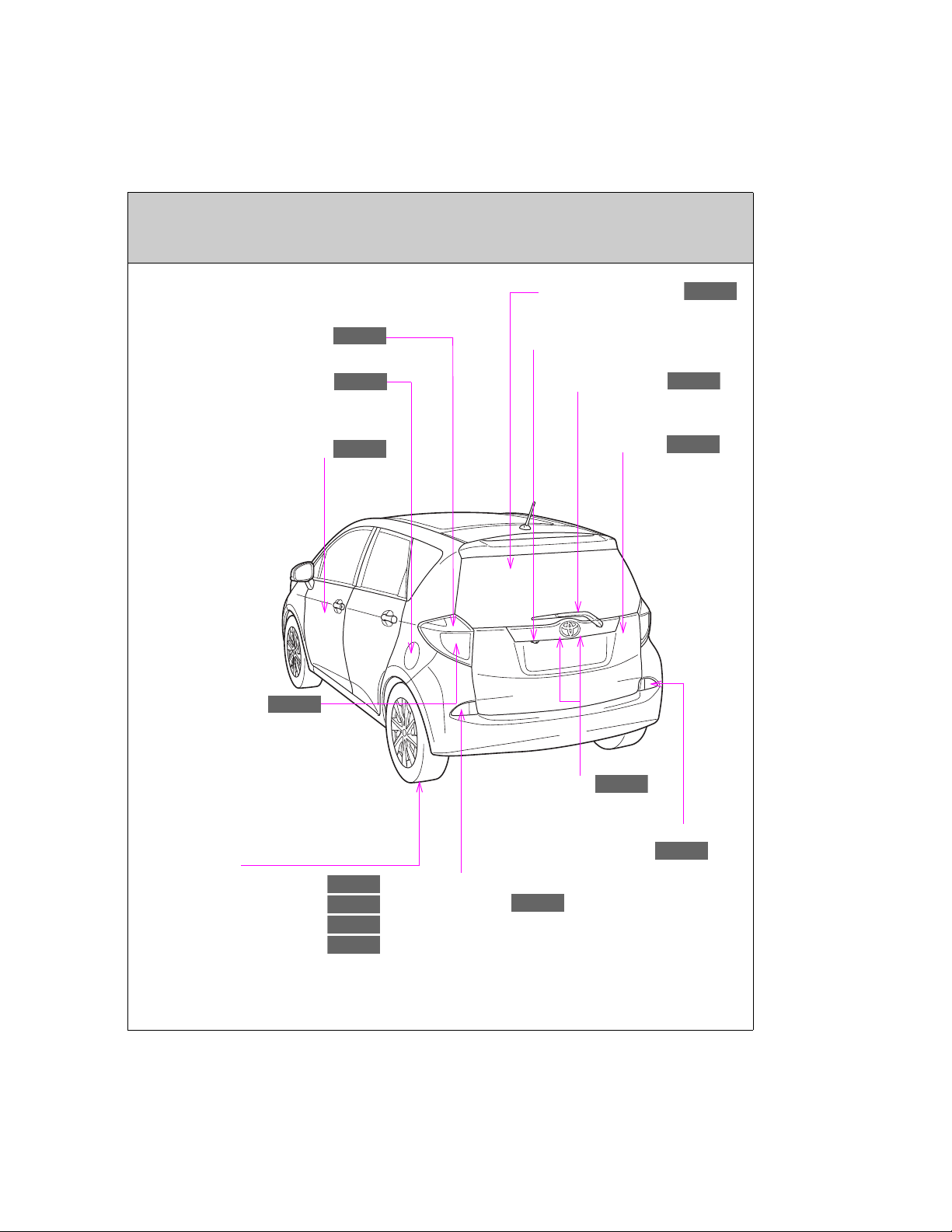
P. 224
P. 383
P. 448
P. 461
P. 523
P. 64
P. 58
Rear window defogger
P. 276
P. 210
P. 216
P. 93
P. 210
P. 192
P. 216
Turn signal lights
Fuel filler door
Side doors
Tail lights
Camera ,*
Rear window wiper
Back door
License plate lights
Tires
Rotation
Replacement
Temporary repair
Inflation pressure
VERSO-S_EE
Rear fog light (for lefthand traffic)
Rear fog light (for righthand traffic)
: If equipped
*: Refer to ““touch screen” Owner’s manual”.
9
Page 10
P. 90
Pictorial index
P. 112
P. 112
P. 194
P. 69
P. 112
P. 324
P. 324
P. 178, 184, 189
P. 335
P. 84
P. 337
P. 337
P. 193
P. 328
P. 75
P. 77
P. 298, 306, 316
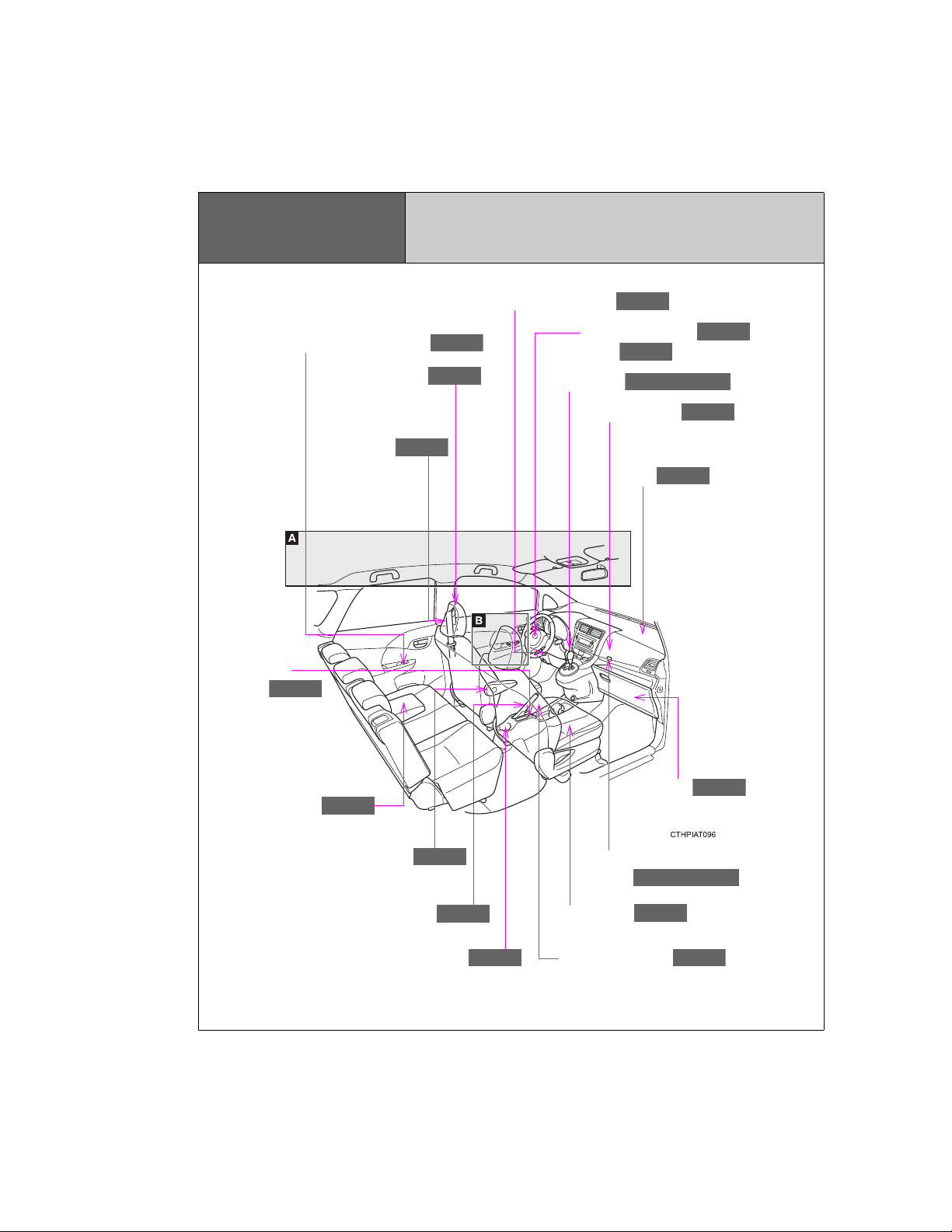
Interior
(Left-hand drive vehicles)
Tilt and telescopic steering lock release lever /
tilt steering lock release lever
Power window switches
Seat heater
switch
Head restraints
Seat belts
SRS driver airbag
Horn
Shift lever
Auxiliary box
SRS front passenger
airbag
Rear armrest
10
VERSO-S_EE
Front armrest
Parking brake lever
Cup holders
Glove box
AUX port/USB port ,*
Front seats
SRS side airbags
2
Page 11
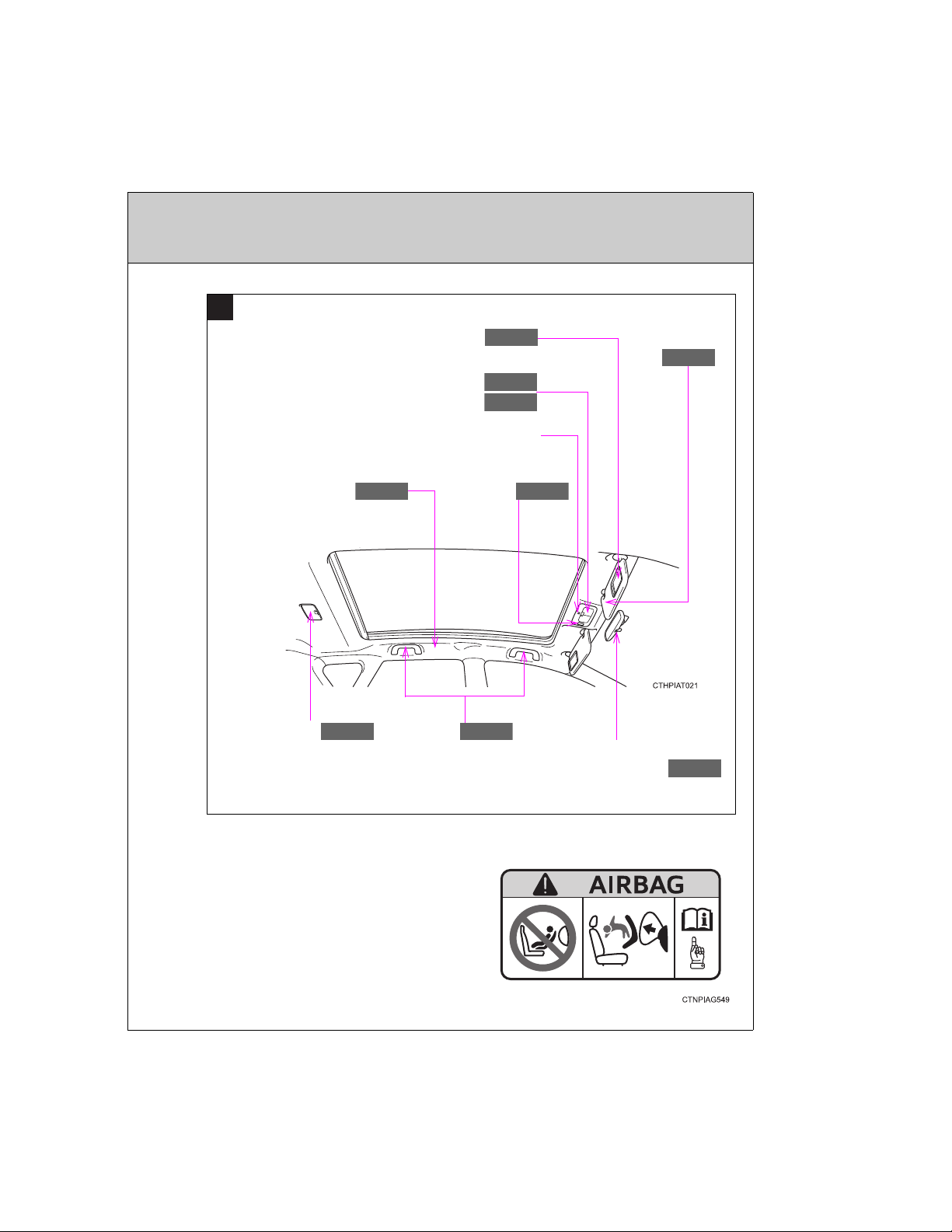
P. 86
P. 322
Vanity mirrors
P. 330
P. 321
P. 321
A
P. 338
P. 112
P. 341
P. 329
Personal/interior lights
Personal lights
Sun visors*
3
1
Anti-glare inside
rear view mirror
SRS curtain shield airbags
Interior light
Assist grips
Microphone ,*
Panoramic roof shade
switch
: If equipped
1
*
: Refer to ““touch screen” Owner’s manual”.
2
*
: For vehicles with a “touch screen”, refer to ““touch screen” Owner’s manual”.
3
*
: NEVER use a rearward facing child re-
straint on a seat protected by an
ACTIVE AIRBAG in front of it, DEATH
or SERIOUS INJURY to the CHILD can
occur. (P. 144)
11
VERSO-S_EE
Page 12
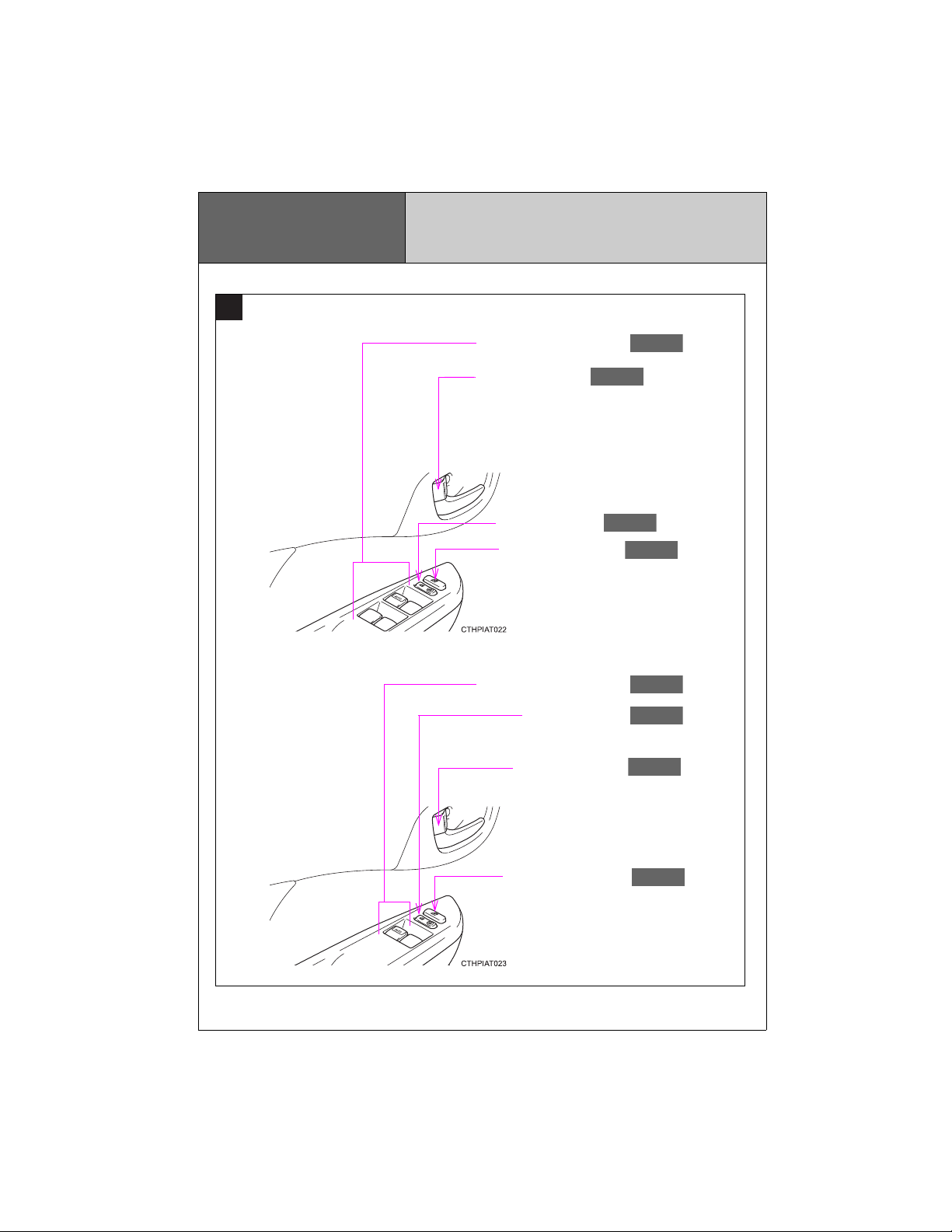
P. 90
P. 90
Pictorial index
P. 58
P. 90
P. 90
P. 58
P. 59
P. 59
B
Type A
Type B
Interior
(Left-hand drive vehicles)
Power window switches
Inside lock button
Door lock switch
Window lock switch
Power window switches
12
VERSO-S_EE
Door lock switch
Inside lock button
Window lock switch
Page 13
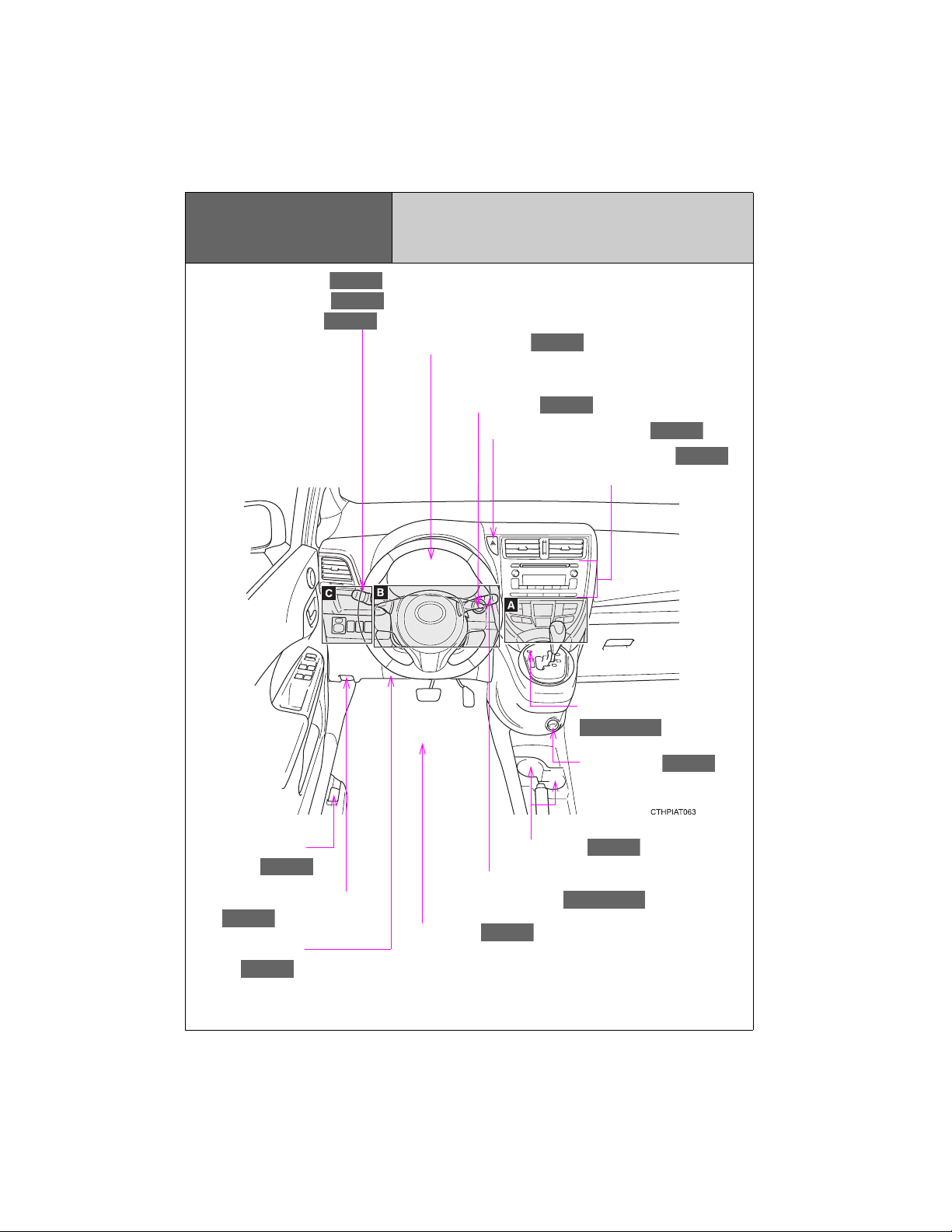
P. 424
P. 328
P. 218, 224
P. 365
P. 195
P. 278
P. 481, 482
P. 112
P. 93
P. 164
P. 342
P. 333
Pictorial index
P. 210
P. 192
P. 216
Headlight switch
Turn signal lever
Fog light switch
Instrument panel
(Left-hand drive vehicles)
Gauges and meters
Engine (ignition) switch
(vehicles with a smart entry &
start system)
Emergency flasher switch
Audio system
“touch screen”
,*
Fuel filler door
opener
Hood lock release lever
SRS driver knee
airbag
VERSO-S_EE
Shift lock override button
Power outlet
Cup holders
Windshield wiper and
washer switch
Floor mat
: If equipped
*: Refer to ““touch screen” Owner’s manual”.
13
Page 14
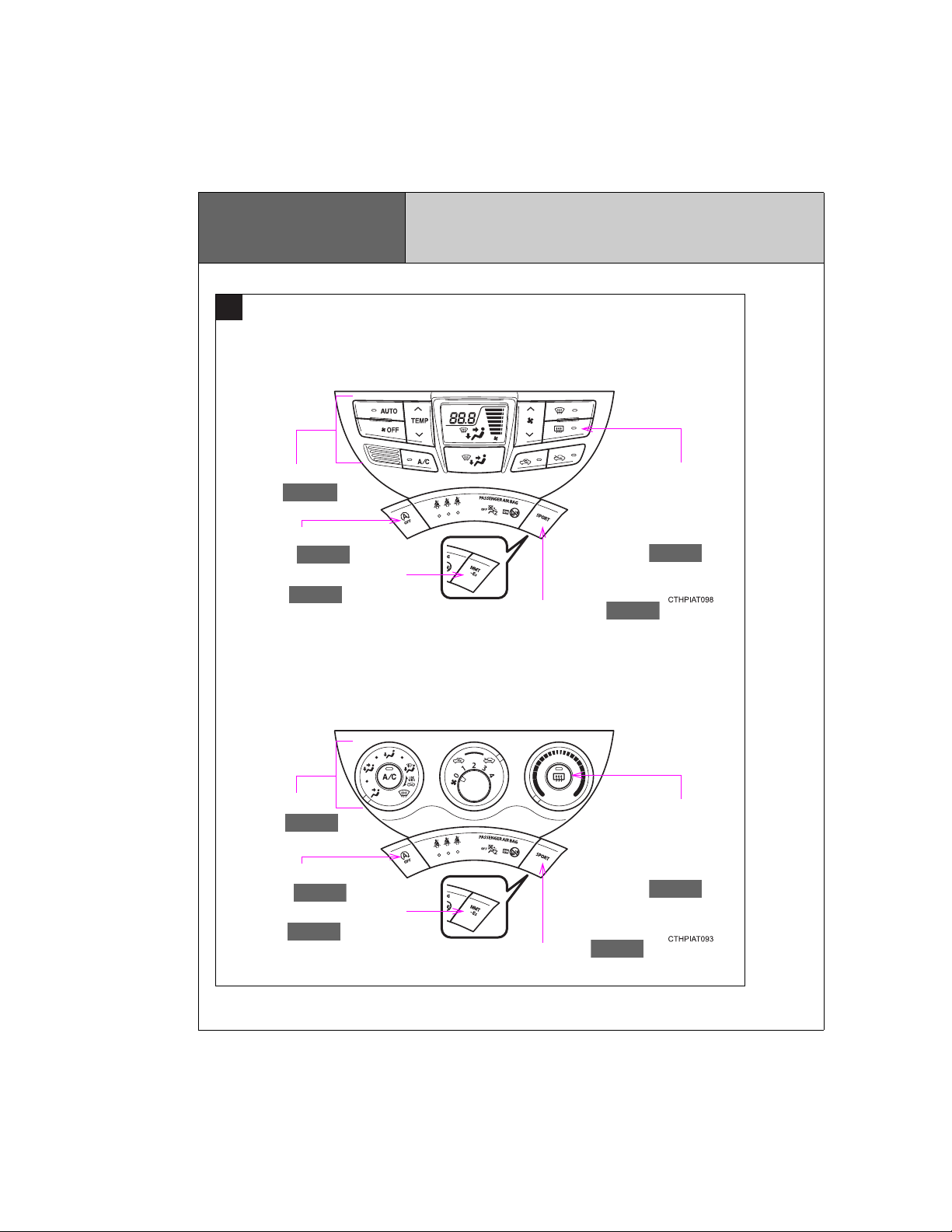
P. 276
P. 268
P. 262
Pictorial index
P. 185
P. 228
P. 179
P. 228
P. 179
P. 185
P. 276
Instrument panel
(Left-hand drive vehicles)
A
Vehicles with an automatic air conditioning system
Air conditioning
system
Stop & Start cancel
switch
“MMT-Es” switch
“SPORT” switch
Vehicles with a manual air conditioning system
Air conditioning
system
Stop & Start cancel
switch
“MMT-Es” switch
Rear window and outside rear view mirror
defoggers switch
rear window defogger
switch
Rear window and outside rear view mirror
defoggers switch
rear window defogger
switch
/
/
“SPORT” switch
14
VERSO-S_EE
Page 15
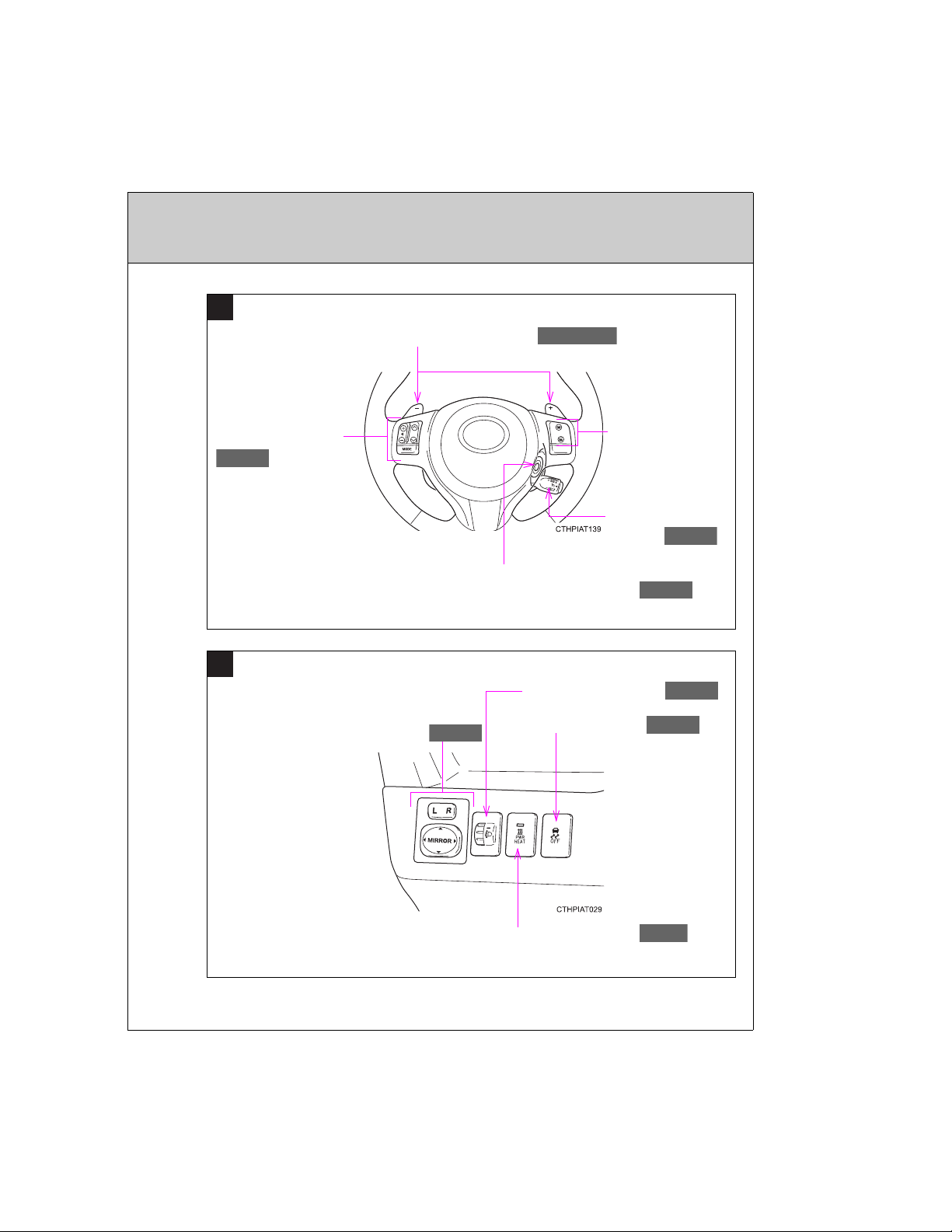
B
P. 174
Paddle shift switches
P. 180, 185
P. 317
C
P. 238
P. 211
P. 274
P. 88
P. 233
Audio switches ,*
Outside rear view mirror switches
2
Telephone
switch
Cruise control
switch
Engine (ignition) switch (vehicles without a
smart entry & start system)
Headlight leveling dial
VSC/TRC off switch
,*
1
VERSO-S_EE
Power heater switch
: If equipped
1
*
: Refer to ““touch screen” Owner’s manual”.
2
*
: For vehicles with a “touch screen”, refer to ““touch screen” Owner’s manual”.
15
Page 16
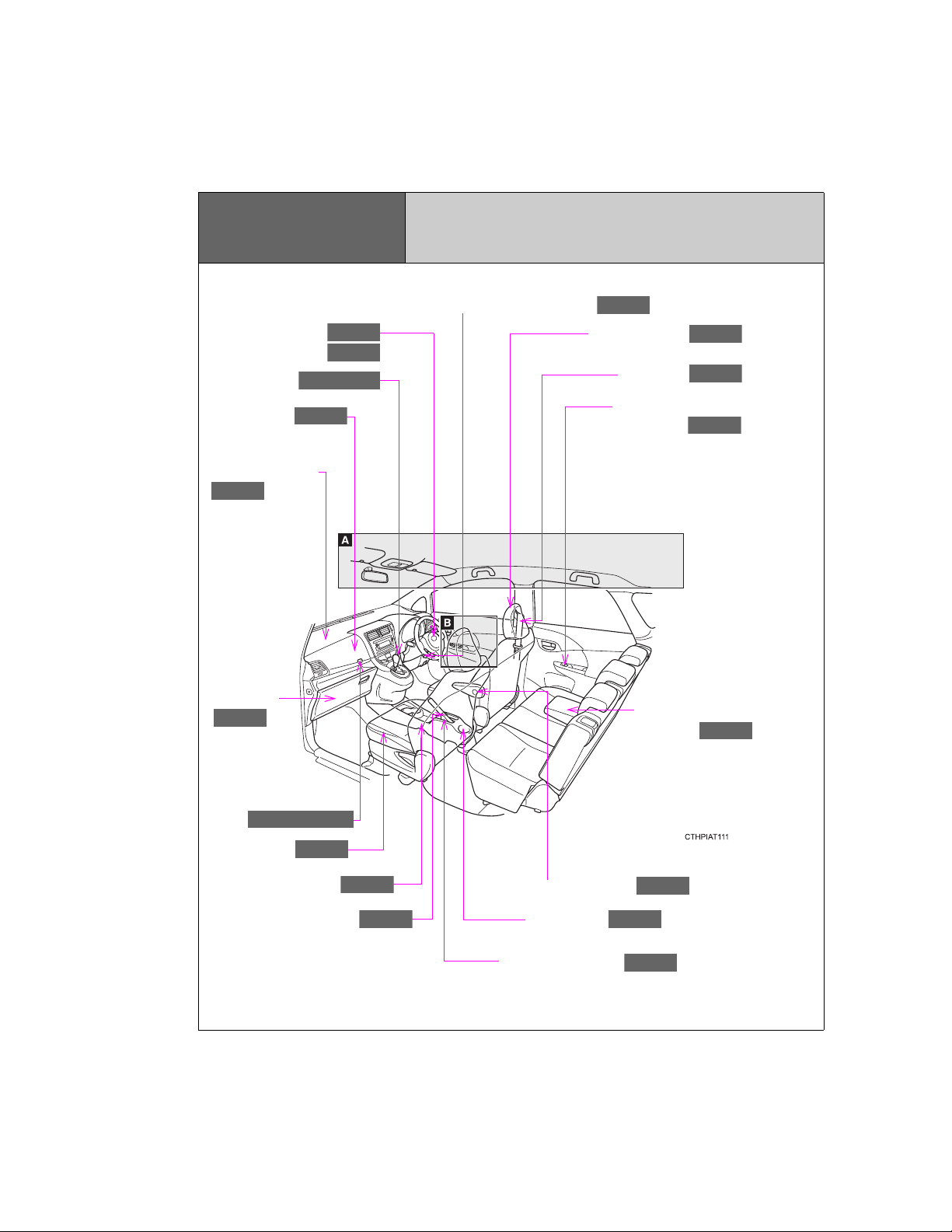
P. 84
P. 90
P. 77
P. 112
P. 75
P. 328
P. 337
P. 69
P. 324
P. 193
P. 337
Pictorial index
P. 112
P. 194
P. 178, 189
P. 324
P. 112
P. 335
P. 298, 306, 316
Tilt and telescopic steering lock release lever
Interior
(Right-hand drive vehicles)
SRS driver airbag
Horn
Shift lever
Auxiliary box
SRS front
passenger airbag
Glove box
Head restraints
Seat belts
Power window
switches
Rear
armrest
AUX port/USB port ,*
Front seats
SRS side airbags
Seat heater switch
16
VERSO-S_EE
2
Front armrest
Cup holders
Parking brake lever
Page 17
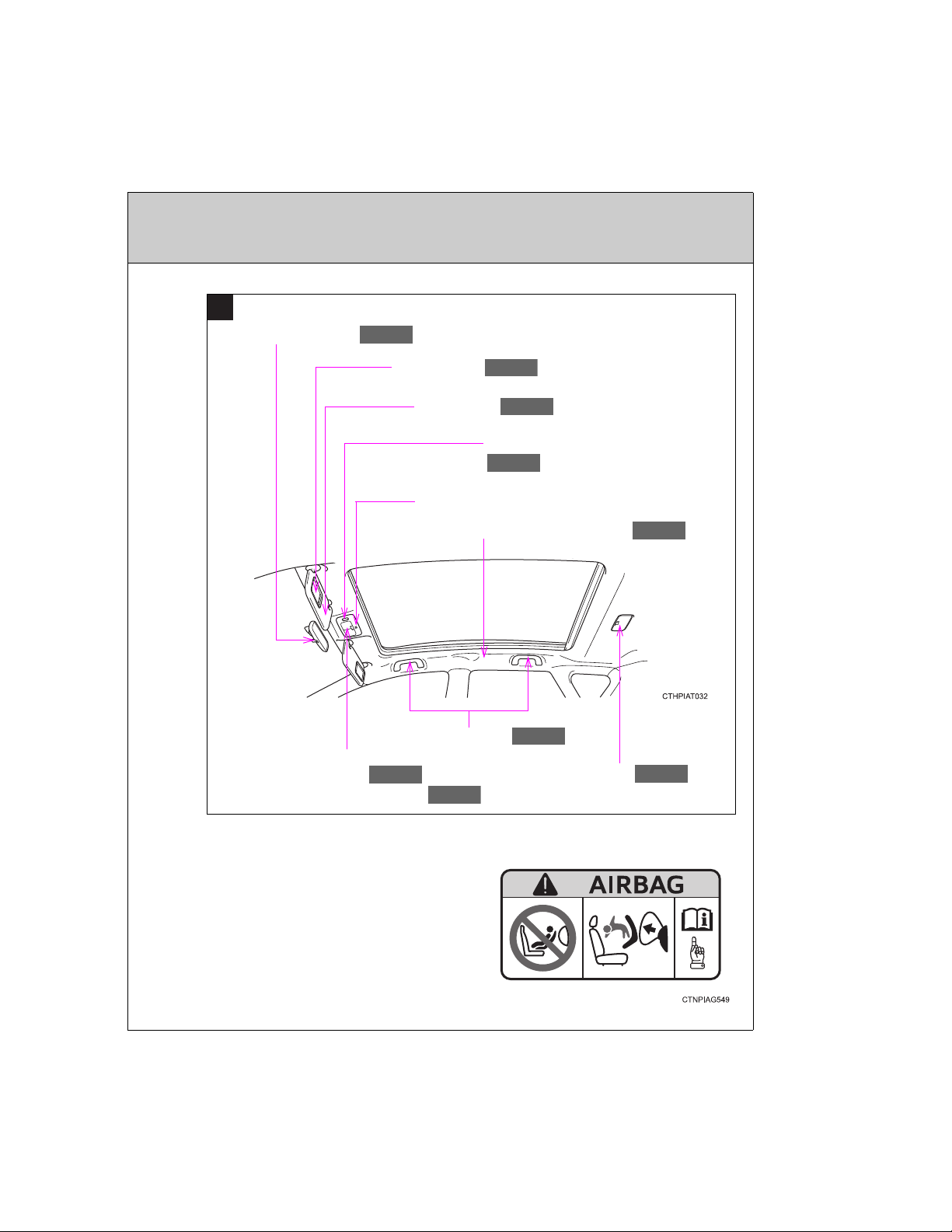
A
Anti-glare inside
P. 86
P. 338
P. 322
P. 330
P. 321
P. 321
P. 329
P. 112
P. 341
rear view mirror
Vanity mirrors
Sun visors*3
Panoramic roof shade switch
1
Interior light
Personal/interior
lights
Personal lights
Microphone ,*
SRS curtain shield airbags
Assist grips
: If equipped
1
*
: Refer to ““touch screen” Owner’s manual”.
2
*
: For vehicles with a “touch screen”, refer to ““touch screen” Owner’s manual”.
3
*
: NEVER use a rearward facing child re-
straint on a seat protected by an
ACTIVE AIRBAG in front of it, DEATH
or SERIOUS INJURY to the CHILD can
occur. (P. 144)
17
VERSO-S_EE
Page 18

P. 59
P. 59
P. 90
P. 90
P. 58
P. 90
P. 90
P. 58
Pictorial index
B
Type A
Power window switches
Window lock switch
Door lock switch
Type B
Power window switches
Interior
(Right-hand drive vehicles)
Inside lock button
18
VERSO-S_EE
Inside lock button
Window lock switch
Door lock switch
Page 19
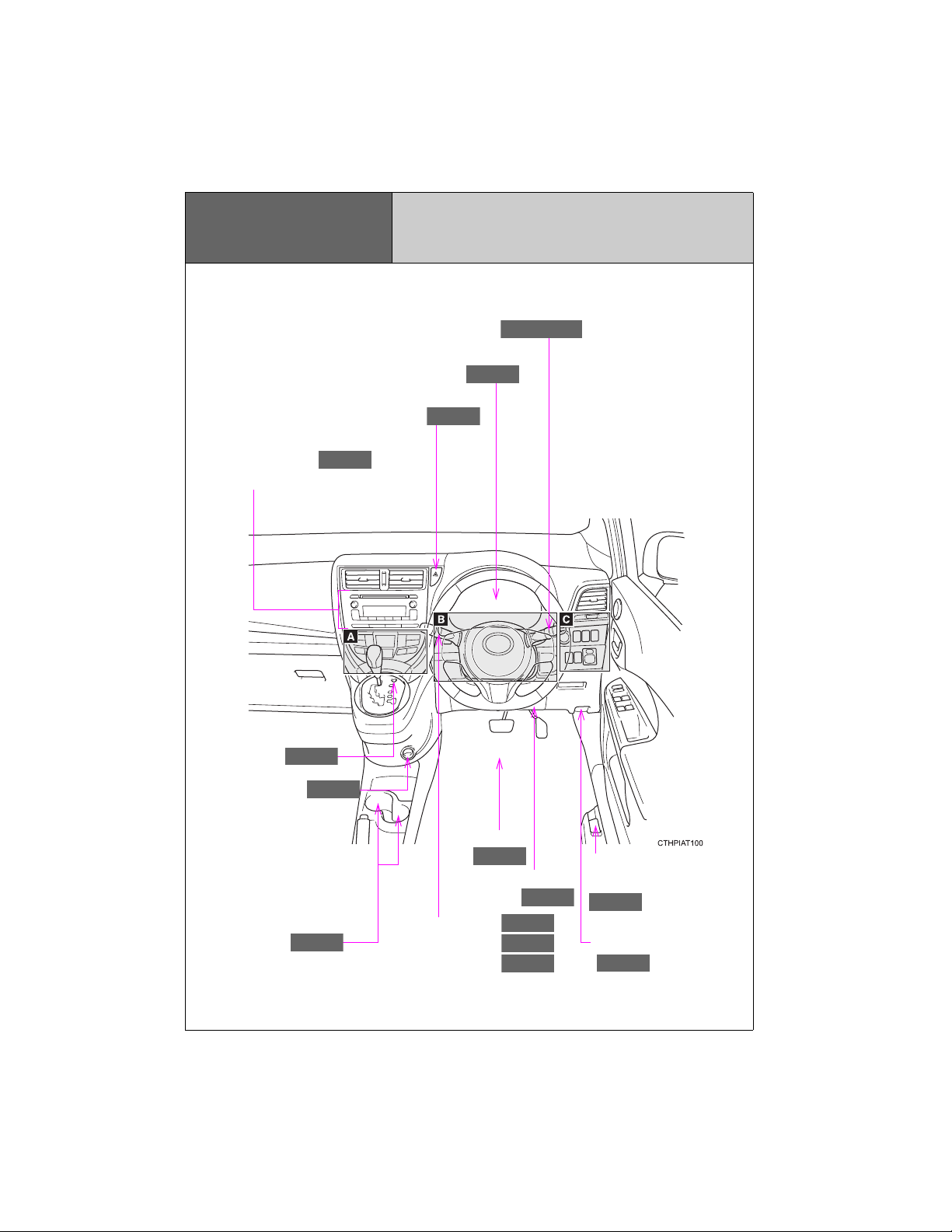
P. 210
P. 192
P. 216
P. 365
P. 112
P. 278
P. 93
P. 342
P. 424
P. 195
P. 218, 224
P. 481
P. 333
P. 328
Pictorial index
Gauges and meters
Emergency flasher switch
Audio system
“touch screen” ,*
Instrument panel
(Right-hand drive vehicles)
Windshield wiper and
washer switch
Shift lock override
button
Power outlet
Cup holders
VERSO-S_EE
Floor mat
SRS driver knee
airbag
Headlight switch
Turn signal lever
Fog light switch
: If equipped
*: Refer to ““touch screen” Owner’s manual”.
Fuel filler door
opener
Hood lock release lever
19
Page 20
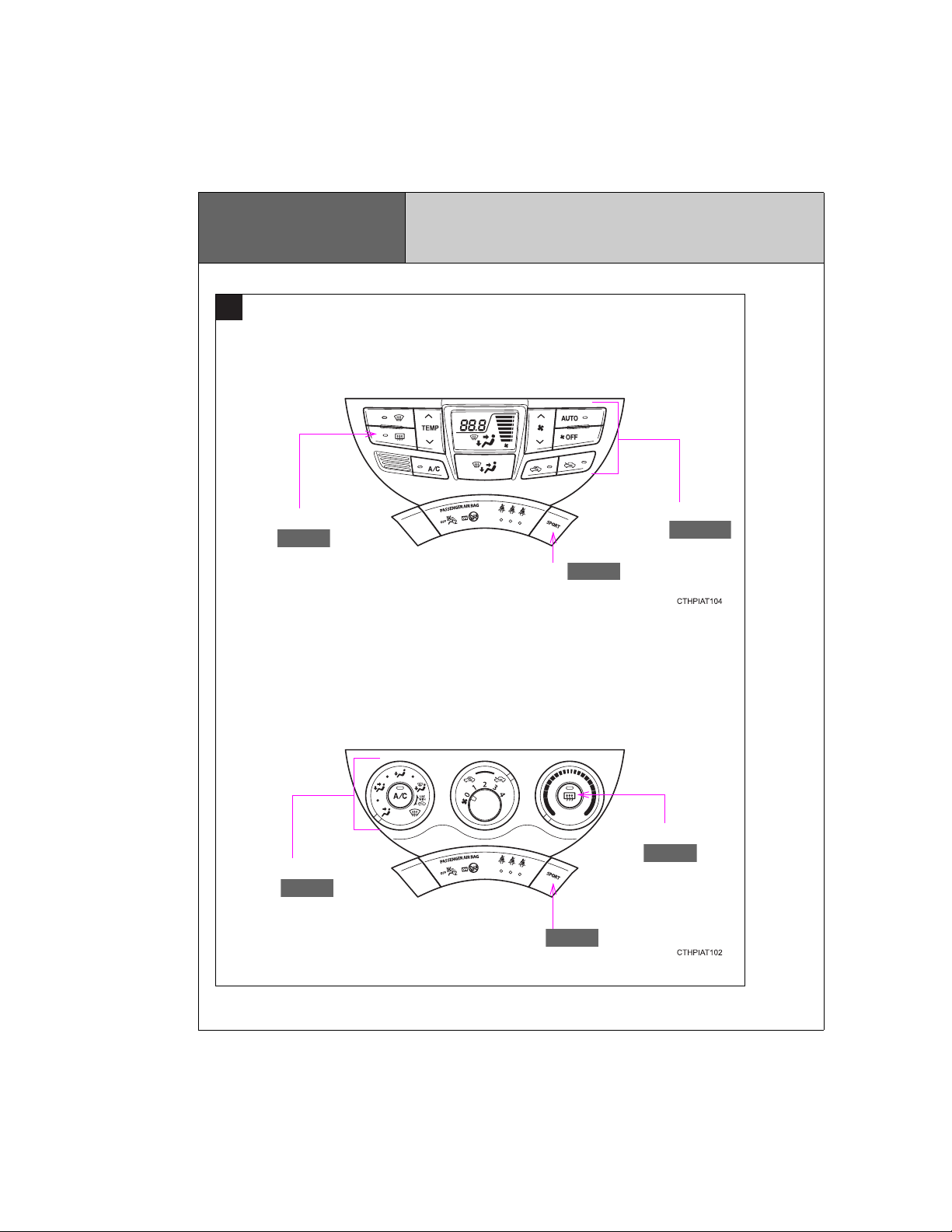
P. 276
P. 268
P. 262
P. 179
P. 276
P. 179
Pictorial index
Instrument panel
(Right-hand drive vehicles)
A
Vehicles with an automatic air conditioning system
Rear window defogger
switch
“SPORT” switch
Vehicles with a manual air conditioning system
Air conditioning
system
“SPORT” switch
Air conditioning
system
Rear window defogger
switch
20
VERSO-S_EE
Page 21
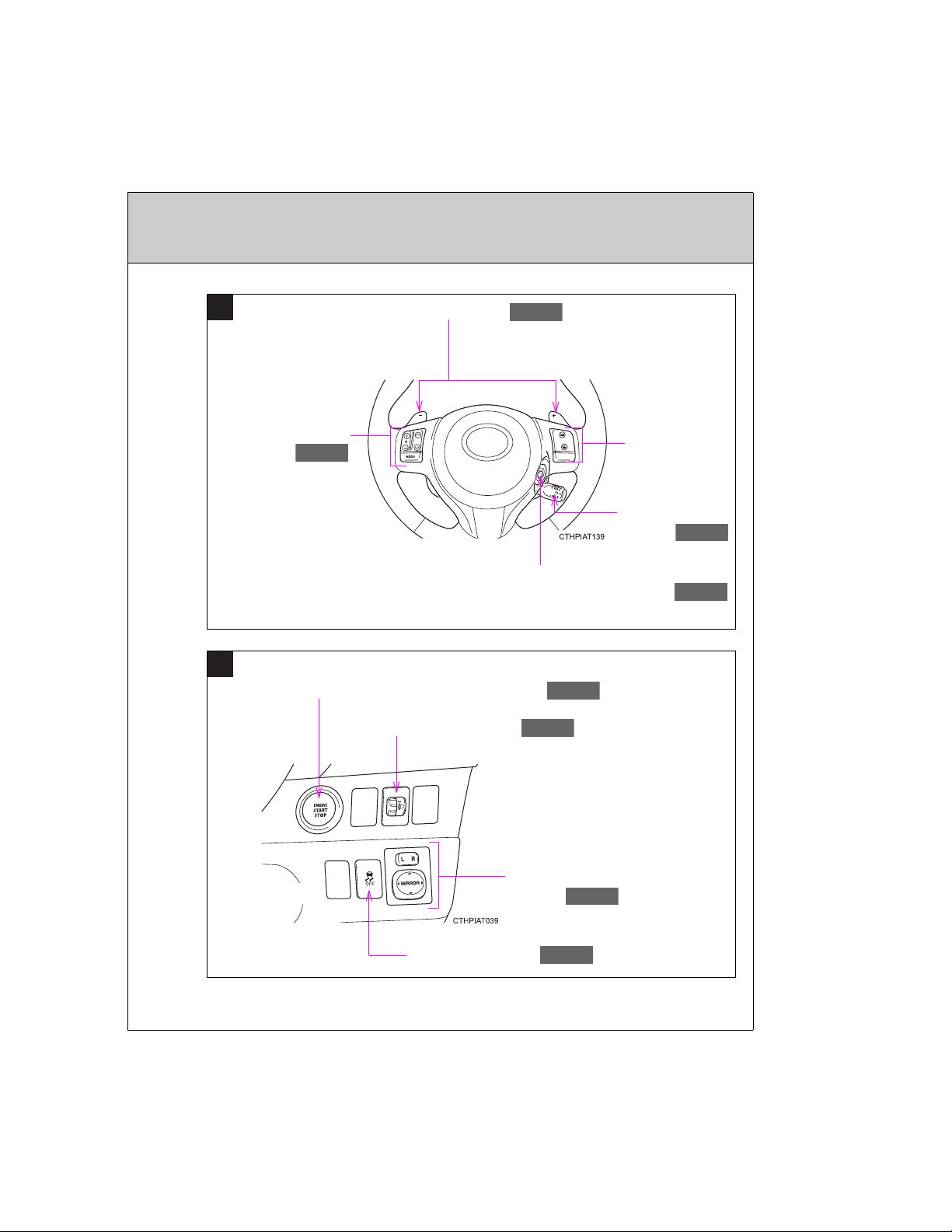
B
P. 174
Paddle shift switches
P. 180
P. 317
C
P. 211
P. 88
P. 238
P. 164
P. 233
Audio switches ,*
Engine (ignition) switch
(vehicles with a smart entry & start system)
2
Headlight leveling dial
Telephone
switch
Cruise control
switch
Engine (ignition) switch (vehicles without a
smart entry & start system)
Outside rear view mirror
switches
,*
1
VERSO-S_EE
VSC/TRC off switch
: If equipped
1
*
: Refer to ““touch screen” Owner’s manual”.
2
*
: For vehicles with a “touch screen”, refer to ““touch screen” Owner’s manual”.
21
Page 22
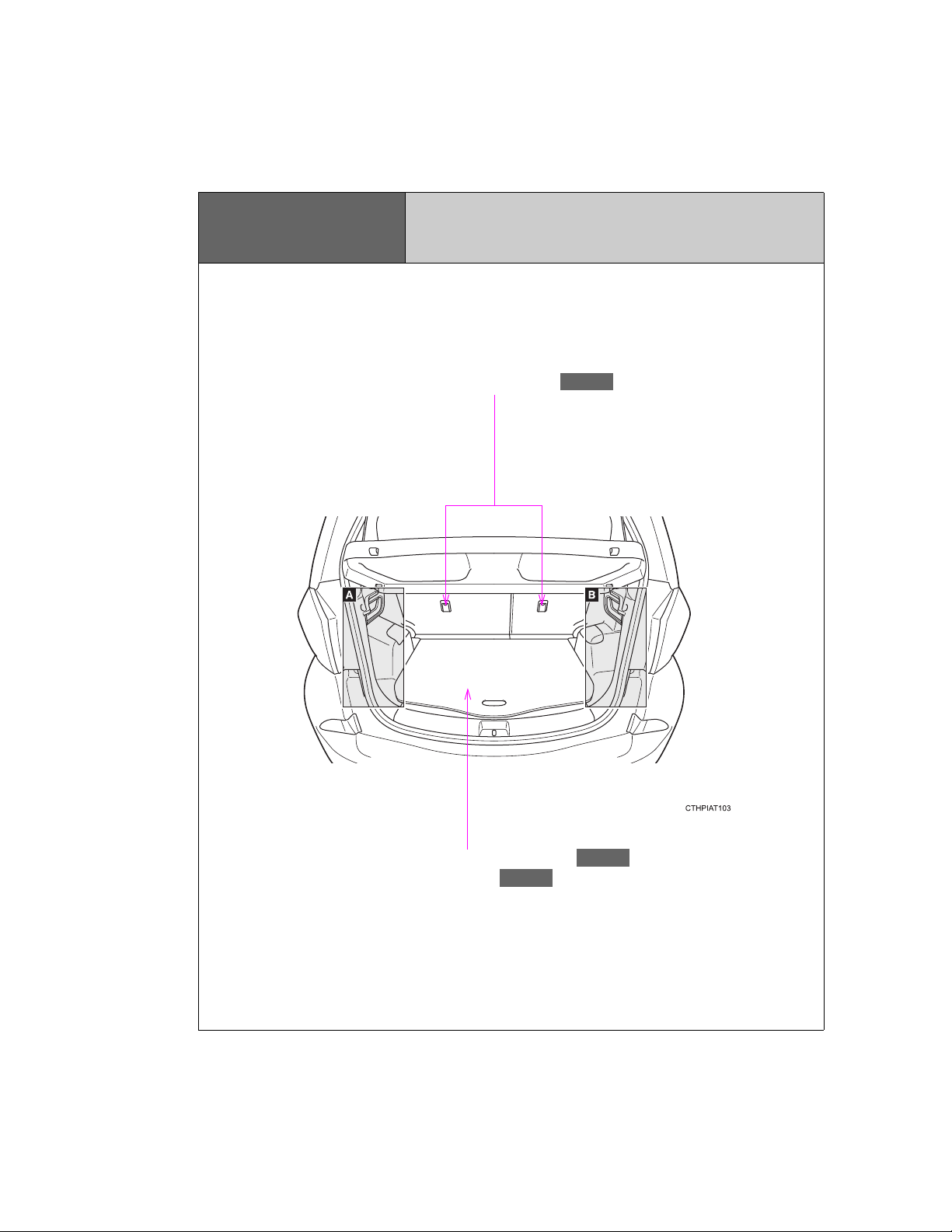
Pictorial index
P. 135
P. 344
P. 344
Child restraint anchor brackets
Luggage compartment
Dual-level deck board
Deck board
22
VERSO-S_EE
Page 23
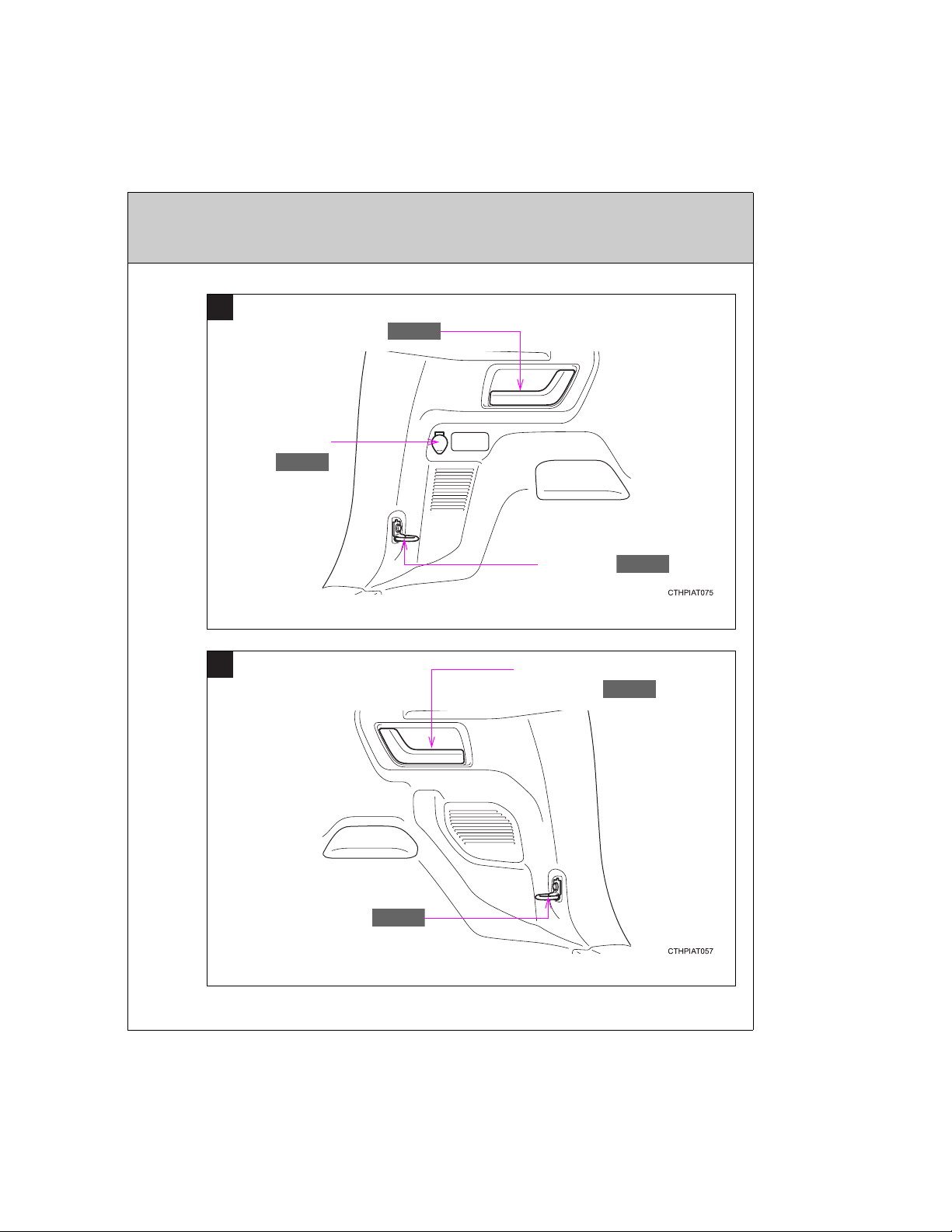
A
B
P. 344
P. 333
P. 344
Rear seatback lock
P. 72
P. 72
release lever
Power outlet
Cargo hook
Rear seatback lock
release lever
Cargo hook
: If equipped
23
VERSO-S_EE
Page 24

For your information
Main Owner’s Manual
Please note that this manual applies to all models and all equipment, including options. Therefore, you may find some explanations for equipment not
installed on your vehicle.
All specifications provided in this manual are current at the time of printing.
However, because of the Toyota policy of continual product improvement, we
reserve the right to make changes at any time without notice.
Depending on specifications, the vehicle shown in the illustrations may differ
from your vehicle in terms of equipment.
Accessories, spare parts and modification of your Toyota
Both genuine Toyota and a wide variety of other spare parts and accessories
for Toyota vehicles are currently available on the market. Should it be
determined that any of the genuine Toyota parts or accessories supplied with
the vehicle need to be replaced, Toyota recommends that genuine Toyota
parts or accessories, be used to replace them. Other parts or accessories of
matching quality can also be used. Toyota cannot accept any liability or
guarantee spare parts and accessories which are not genuine Toyota
products, nor for replacement or installation involving such parts. In addition,
damage or performance problems resulting from the use of non-genuine
Toyota spare parts or accessories may not be covered under warranty.
24
VERSO-S_EE
Page 25

Installation of an RF-transmitter system
As the installation of an RF-transmitter system in your vehicle could affect
electronic systems such as the multi-port fuel injection system/sequential
multi-port fuel injection system, anti-lock brake system, SRS airbag system
and seat belt pretensioner system, be sure to check with any authorized
Toyota dealer or repairer, or another duly qualified and equipped professional for precautionary measures or special instructions regarding installation.
Further information regarding frequency bands, power levels, antenna positions and installation provisions for the installation of RF-transmitters, is
available on request at any authorized Toyota dealer or repairer, or another
duly qualified and equipped professional.
Scrapping of your Toyota
The SRS airbag and seat belt pretensioner devices in your Toyota contain
explosive chemicals. If the vehicle is scrapped with the airbags and seat belt
pretensioners left as they are, this may cause an accident such as fire. Be
sure to have the systems of the SRS airbag and seat belt pretensioner
removed and disposed of by a qualified service shop or by any authorized
Toyota dealer or repairer, or another duly qualified and equipped professional, before you scrap your vehicle.
Your vehicle contains batteries and/or accumulators. Do not discard them into
the environment but cooperate with separate collection (Directive 2006/66/
EC).
VERSO-S_EE
25
Page 26

CAUTION
General precautions while driving
Driving under the influence: Never drive your vehicle when under the influence of alcohol or drugs that have impaired your ability to operate your vehicle. Alcohol and certain drugs delay reaction time, impair judgment and
reduce coordination, which could lead to an accident that could result in
death or serious injury.
Defensive driving: Always drive defensively. Anticipate mistakes that other
drivers or pedestrians might make and be ready to avoid accidents.
Driver distraction: Always give your full attention to driving. Anything that distracts the driver, such as adjusting controls, talking on a cellular phone or
reading can result in a collision with resulting death or serious injury to you,
your occupants or others.
General precaution regarding children’s safety
Never leave children unattended in the vehicle, and never allow children to
have or use the key.
Children may be able to start the vehicle or shift the vehicle into neutral.
There is also a danger that children may injure themselves by playing with
the windows, the panoramic roof shade, or other features of the vehicle. In
addition, heat build-up or extremely cold temperatures inside the vehicle can
be fatal to children.
26
VERSO-S_EE
Page 27
Symbols used throughout this manual
CAUTION
NOTICE
Cautions & Notices
This is a warning against something which, if ignored, may cause death or
serious injury to people. You are informed about what you must or must not do
in order to reduce the risk of death or serious injury to yourself and others.
This is a warning against something which, if ignored, may cause damage to
the vehicle or its equipment. You are informed about what you must or must
not do in order to avoid or reduce the risk of damage to your Toyota and its
equipment.
Symbols used in illustrations
Safety symbol
VERSO-S_EE
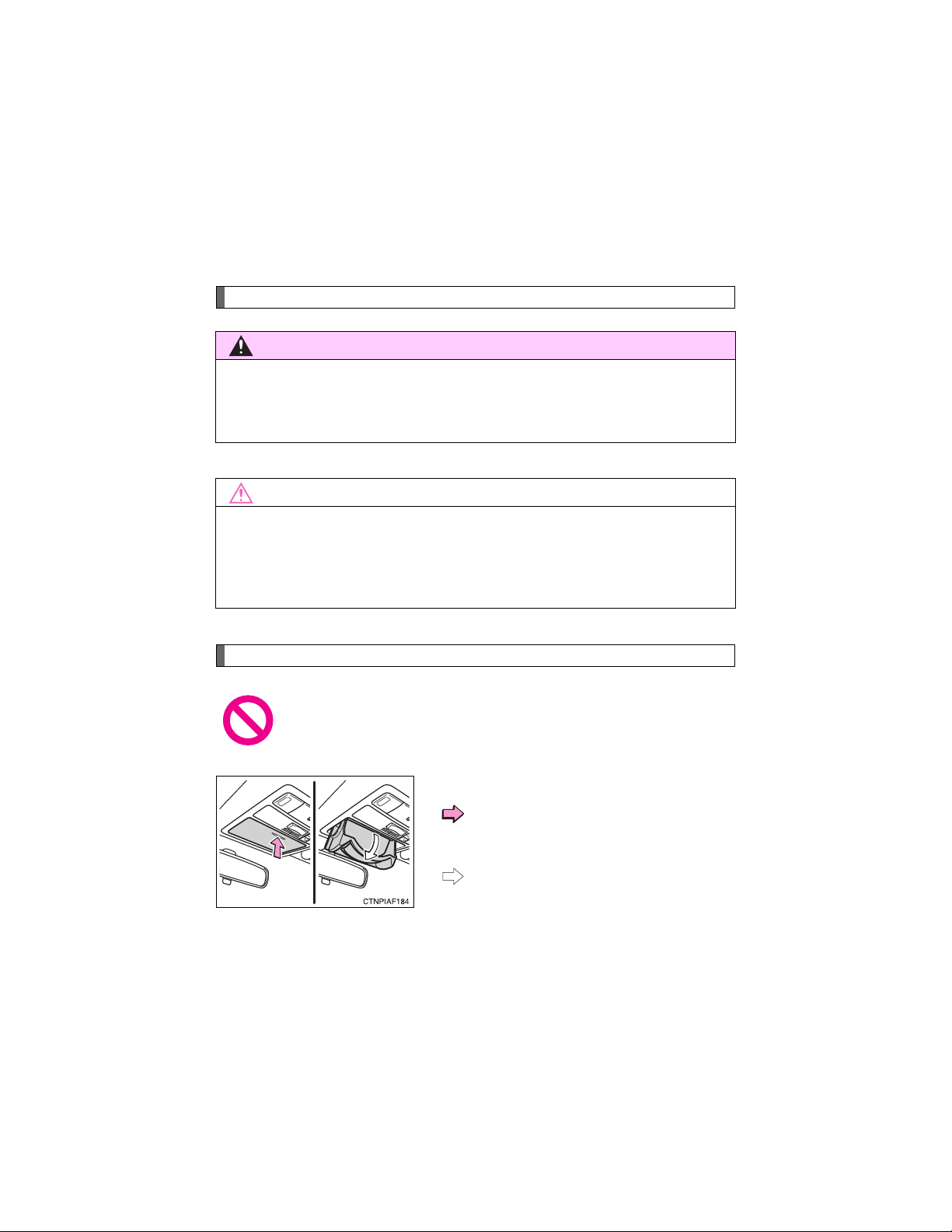
The symbol of a circle with a slash through it means “Do not”, “Do
not do this”, or “Do not let this happen”.
Arrows indicating operations
Indicates the action (pushing, turning,
etc.) used to operate switches and other
devices.
Indicates the outcome of an operation
(e.g. a lid opens).
27
Page 28

28
VERSO-S_EE
Page 29

1
Before driving
29
1-1. Key information
Keys.................................... 30
1-2. Opening, closing and
locking the doors
Smart entry & start
system .............................. 33
Wireless remote control...... 53
Side doors .......................... 58
Back door ........................... 64
1-3. Adjustable components
(seats, mirrors,
steering wheel)
Front seats.......................... 69
Rear seats .......................... 70
Head restraints ................... 75
Seat belts............................ 77
Steering wheel.................... 84
Anti-glare inside rear
view mirror ........................ 86
Outside rear view mirrors ... 88
1-5. Refueling
Opening the fuel tank
cap.................................... 93
1-6. Theft deterrent system
Engine immobilizer
system .............................. 97
Double locking system...... 105
Alarm ................................ 107
1-7. Safety information
Correct driving posture ..... 110
SRS airbags...................... 112
Airbag manual on-off
system ............................ 123
Child restraint systems ..... 126
Installing child
restraints......................... 135
1-4. Opening and closing the
VERSO-S_EE
windows
Power windows................... 90
Page 30
1-1. Key information
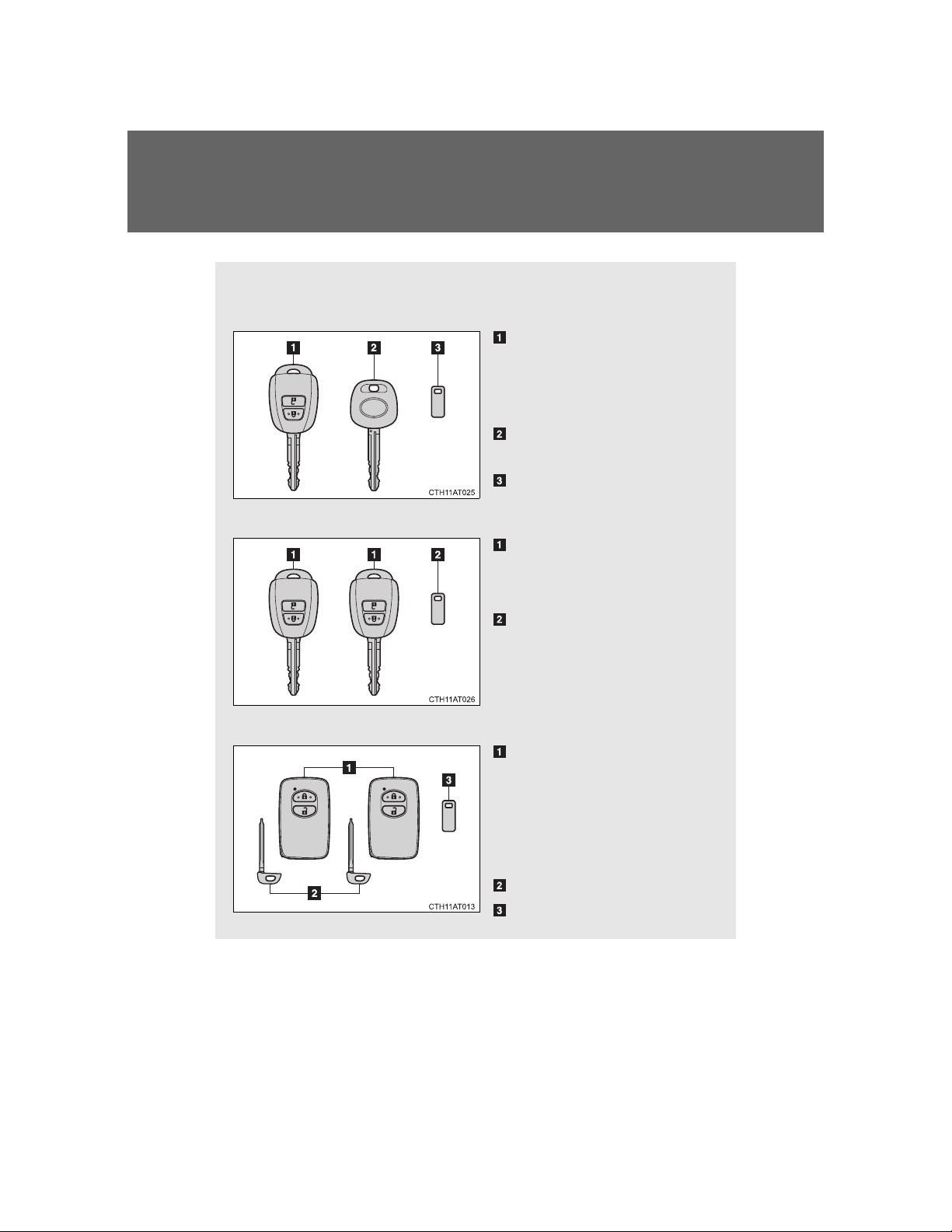
The following keys are provided with the vehicle.
Vehicles without a smart entry & start system (type A)
Key (with a wireless remote
control function)
Operating the wireless remote
control function (P. 53)
Key (without a wireless
remote control function)
Key number plate
Vehicles without a smart entry & start system (type B)
Keys
Operating the wireless remote
control function (P. 53)
Key number plate
Vehicles with a smart entry & start system
Electronic keys
• Operating the smart entry &
start system (P. 33)
• Operating the wireless
remote control function
(P. 53)
Mechanical keys
Key number plate
Keys
30
VERSO-S_EE
Page 31
1-1. Key information
Using the mechanical key (vehicles with a smart entry & start system)
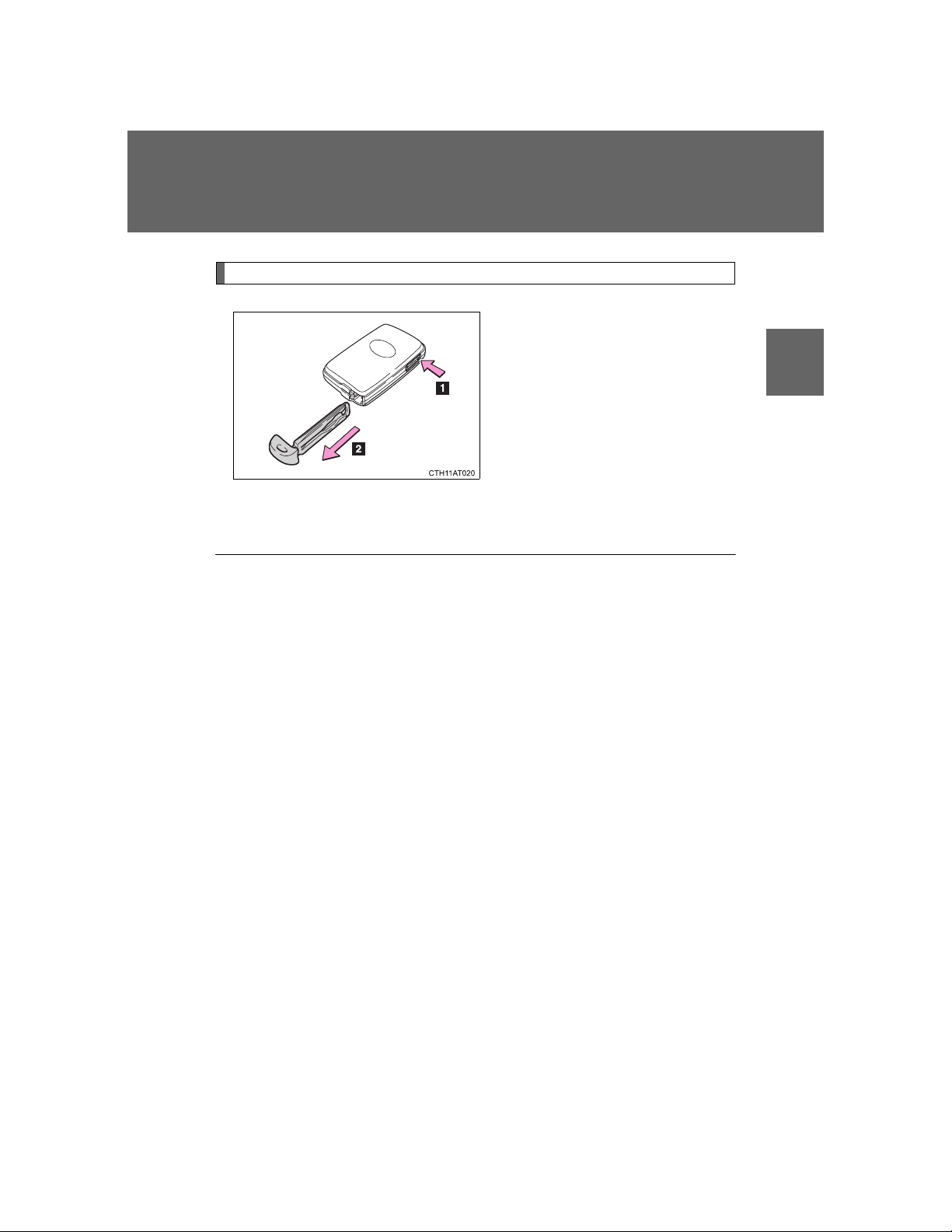
To take out the mechanical key,
push the release button and take
the key out.
1
After using the mechanical key,
store it in the electronic key. Carry
the mechanical key together with
the electronic key. If the electronic
key battery is depleted or the
entry function does not operate
properly, you will need the
mechanical key. (P. 484)
Key number plate
Keep the plate in a safe place such as your wallet, not in the vehicle. In the
event that a key (without a smart entry & start system) or mechanical key
(with a smart entry & start system) is lost, a new key can be made by any
authorized Toyota dealer or repairer, or another duly qualified and equipped
professional using the key number plate. (P. 483)
When riding in an aircraft
When bringing a key with wireless remote control function onto an aircraft,
make sure you do not press any buttons on the key while inside the aircraft
cabin. If you are carrying the key in your bag etc., ensure that the buttons
are not likely to be pressed accidentally. Pressing a button may cause the
key to emit radio waves that could interfere with the operation of the aircraft.
Before driving
VERSO-S_EE
31
Page 32

1-1. Key information
NOTICE
To prevent key damage
Observe the following:
Do not drop the keys, subject them to strong shocks or bend them.
Do not expose the keys to high temperatures for a long period of time.
Do not get the keys wet or wash them in an ultrasonic washer etc.
Vehicles with a smart entry & start system: Do not attach metallic or mag-
netic materials to the keys or place the keys close to such materials.
Do not disassemble the keys.
Do not attach a sticker or anything else to the surface of the key.
Vehicles with a smart entry & start system: Do not place the keys near
objects that produce magnetic fields, such as TVs, audio systems, induction cookers, or medical electrical equipment, such as low-frequency therapy equipment.
Carrying the electronic key on your person (vehicles with a smart entry
& start system)
Carry the electronic key 10 cm (3.9 in.) or more away from electric appliances that are turned on. Radio waves emitted from electric appliances
within 10 cm (3.9 in.) of the electronic key may interfere with the key, causing
the key to not function properly.
In case of a smart entry & start system malfunction or other key-related
problems (vehicles with a smart entry & start system)
Take your vehicle with all the electronic keys provided with your vehicle to
any authorized Toyota dealer or repairer, or another duly qualified and
equipped professional.
When a vehicle key is lost (vehicles with a smart entry & start system)
If the key remains lost, the risk of vehicle theft increases significantly. Visit
any authorized Toyota dealer or repairer, or another duly qualified and
equipped professional immediately with all remaining electronic keys that
was provided with your vehicle.
32
VERSO-S_EE
Page 33
1-2. Opening, closing and locking the doors
: If equipped
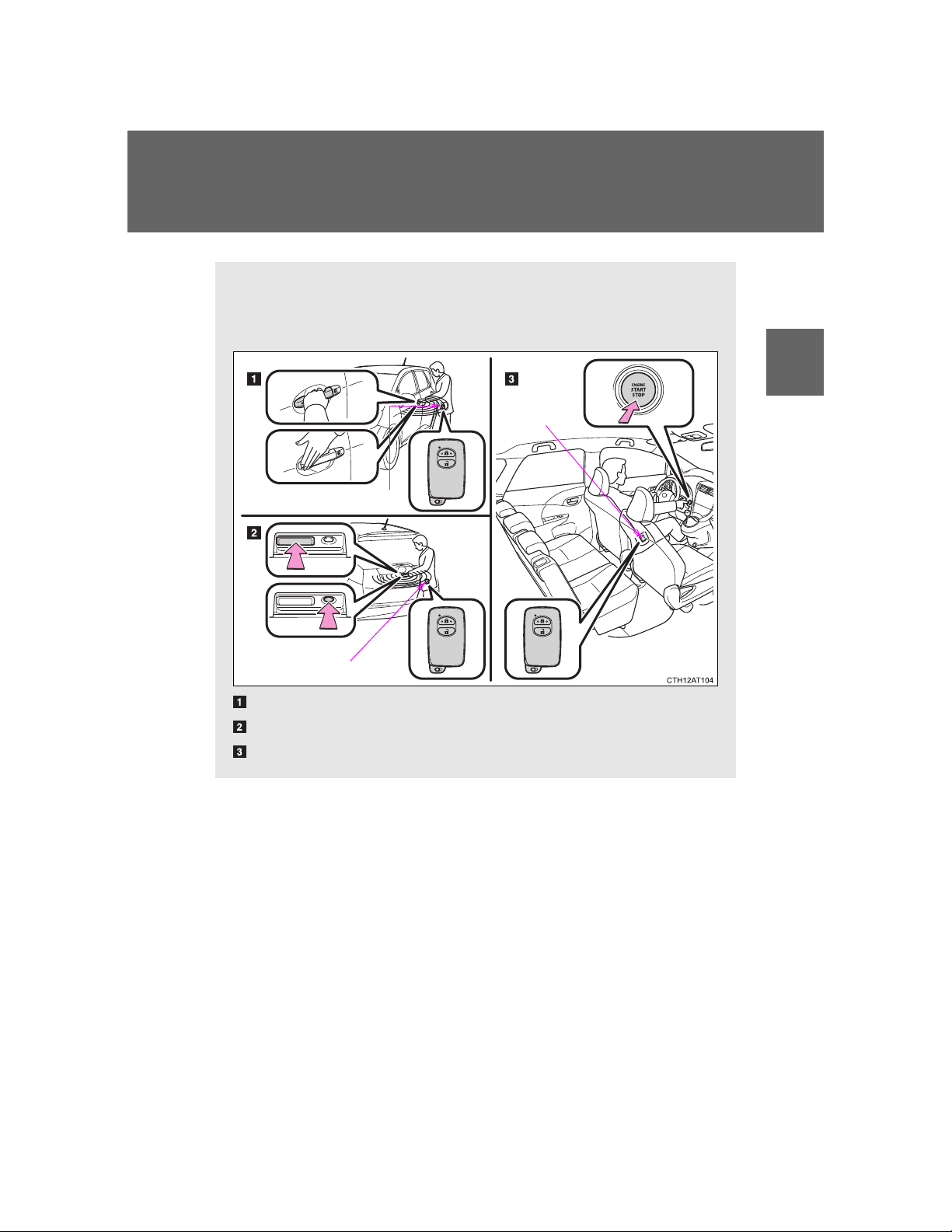
The following operations can be performed simply by carrying the
electronic key on your person, for example in your pocket.
(The driver should always carry the electronic key.)
Unlocks and locks the side doors (P. 3 4 )
Unlocks and locks the back door (P. 35)
Starts the engine (P. 164)
Electronic key
Electronic key
Electronic key
Smart entry & start system
1
Before driving
VERSO-S_EE
33
Page 34
1-2. Opening, closing and locking the doors
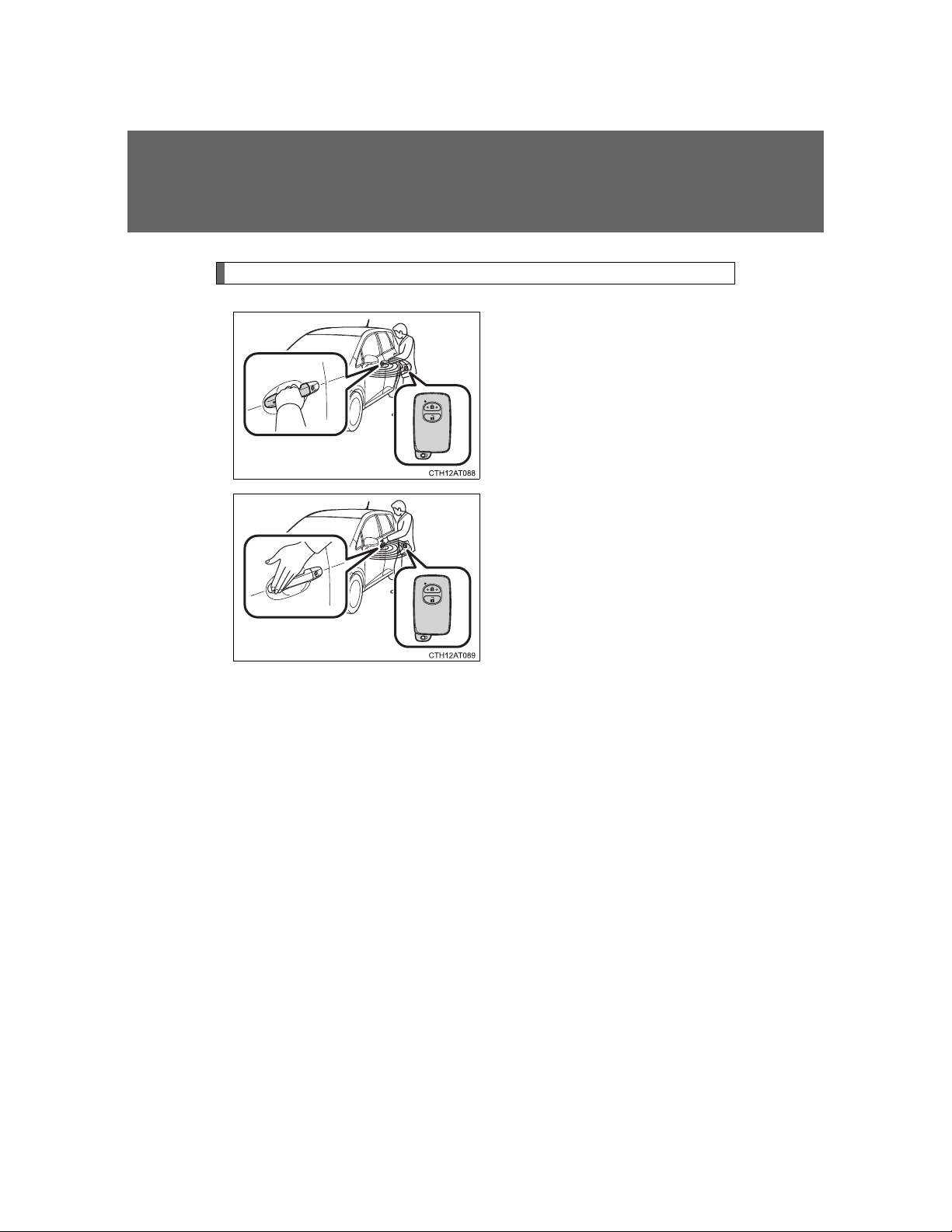
Unlocking and locking the side doors (front door handles only)
Grip the handle to unlock the
doors.
Make sure to touch the sensor on
the back of the handle.
The doors cannot be unlocked for
3 seconds after the doors are
locked.
Touch the lock sensor (the
indentation on the side of the
door handle) to lock the doors.
34
VERSO-S_EE
Page 35
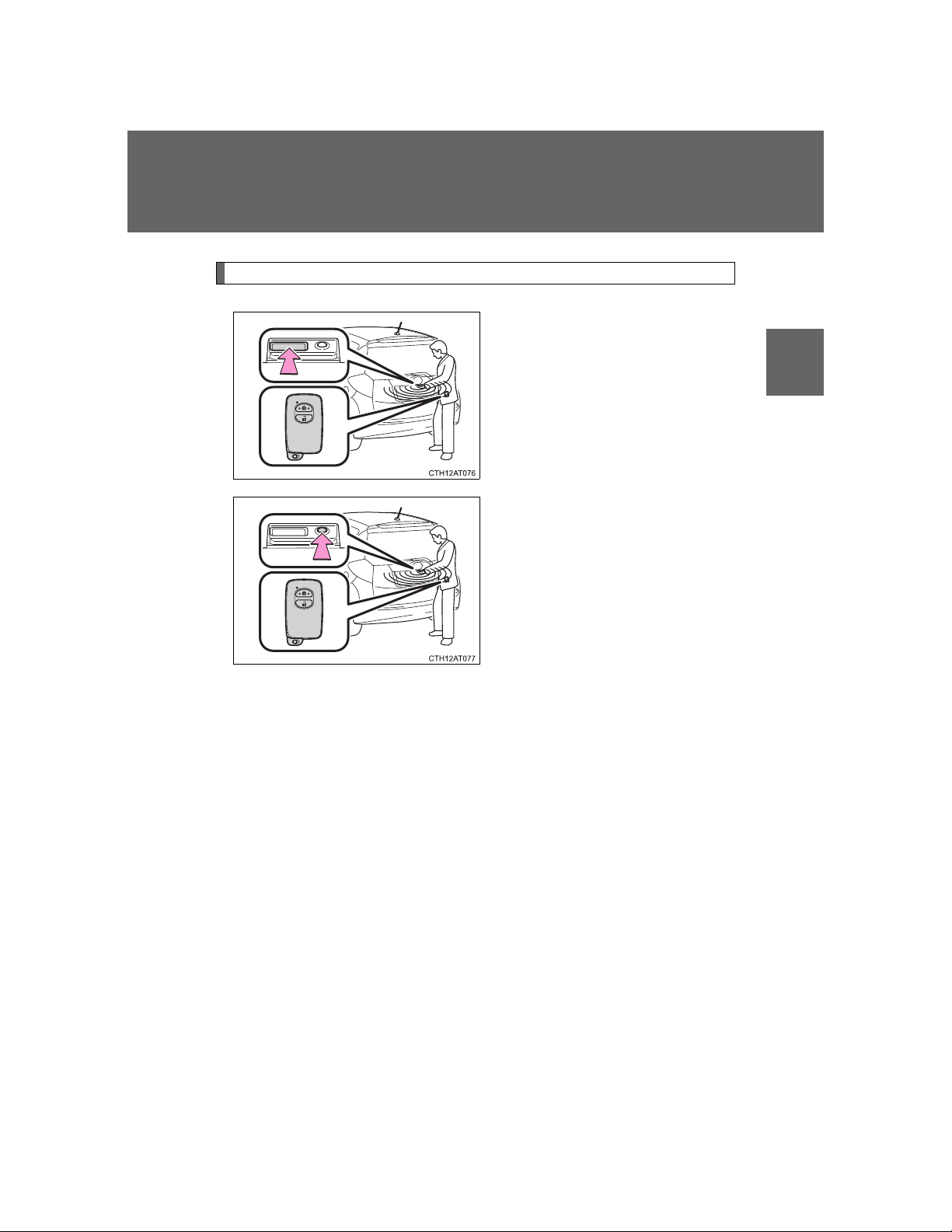
Unlocking and locking the back door
Press the button to unlock the
door.
Press the button to lock the door.
1-2. Opening, closing and locking the doors
The door cannot be unlocked for
3 seconds after the door is
locked.
1
Before driving
VERSO-S_EE
35
Page 36
1-2. Opening, closing and locking the doors
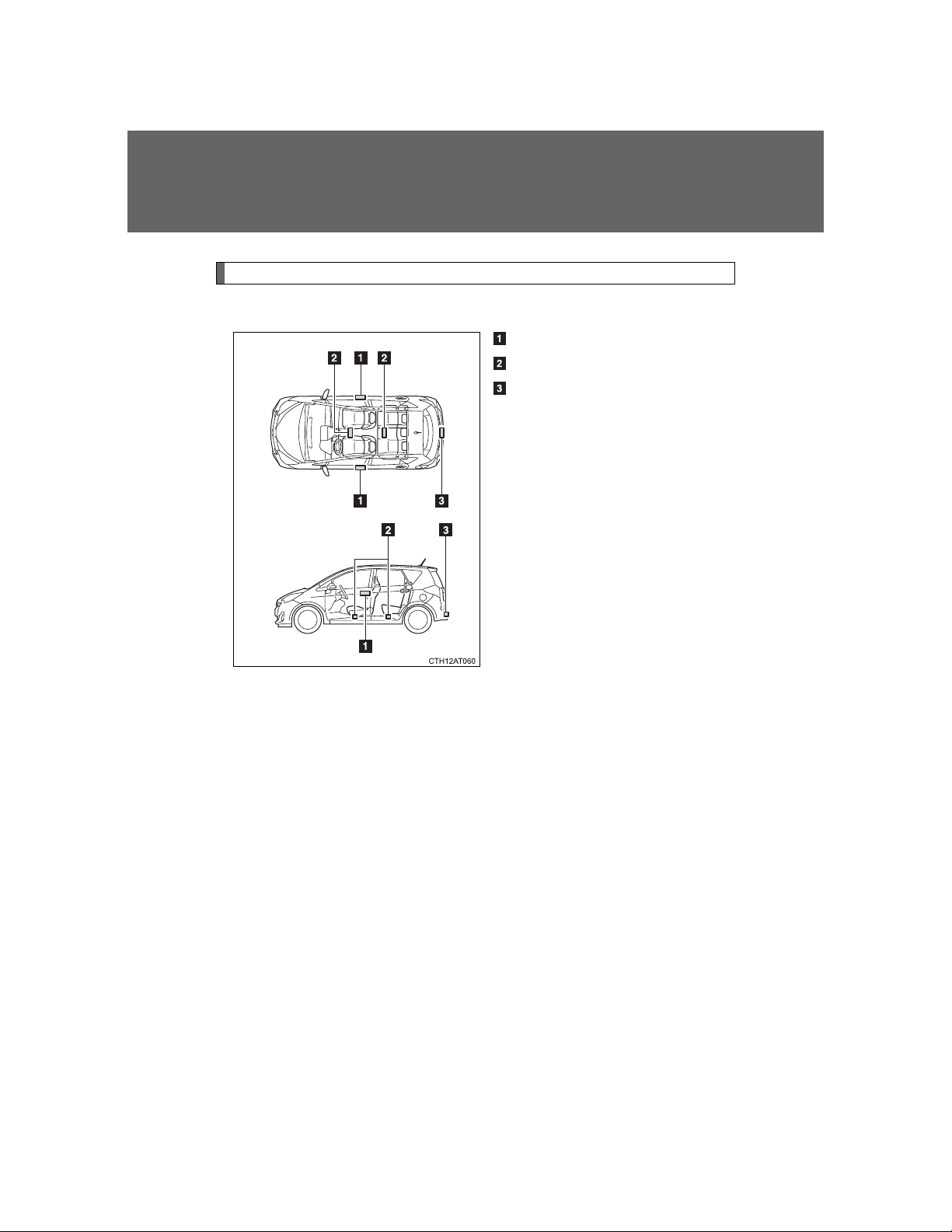
Antenna location and effective range
Antenna location
Antennas outside the cabin
Antennas inside the cabin
Antenna outside the luggage
compartment
36
VERSO-S_EE
Page 37
1-2. Opening, closing and locking the doors
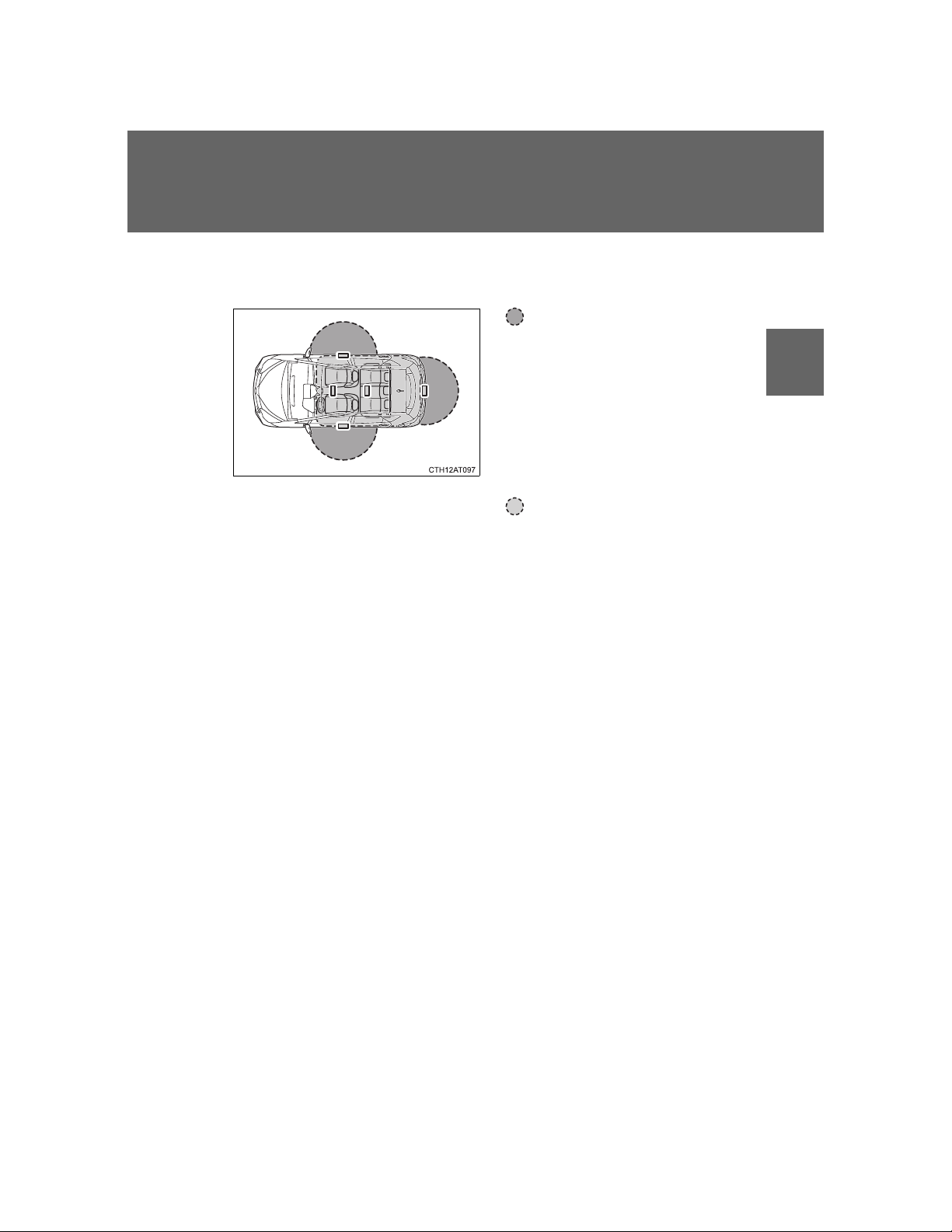
Effective range (areas within which the electronic key is
detected)
When locking or unlocking
the doors
The system can be operated
when the electronic key is
within about 0.7 m (2.3 ft.)
either of the outside front
door handles and back door.
(Only the doors detecting the
key can be operated.)
When starting the engine
or changing “ENGINE
START STOP” switch
modes
The system can be operated
when the electronic key is
inside the vehicle.
1
Before driving
VERSO-S_EE
37
Page 38
1-2. Opening, closing and locking the doors
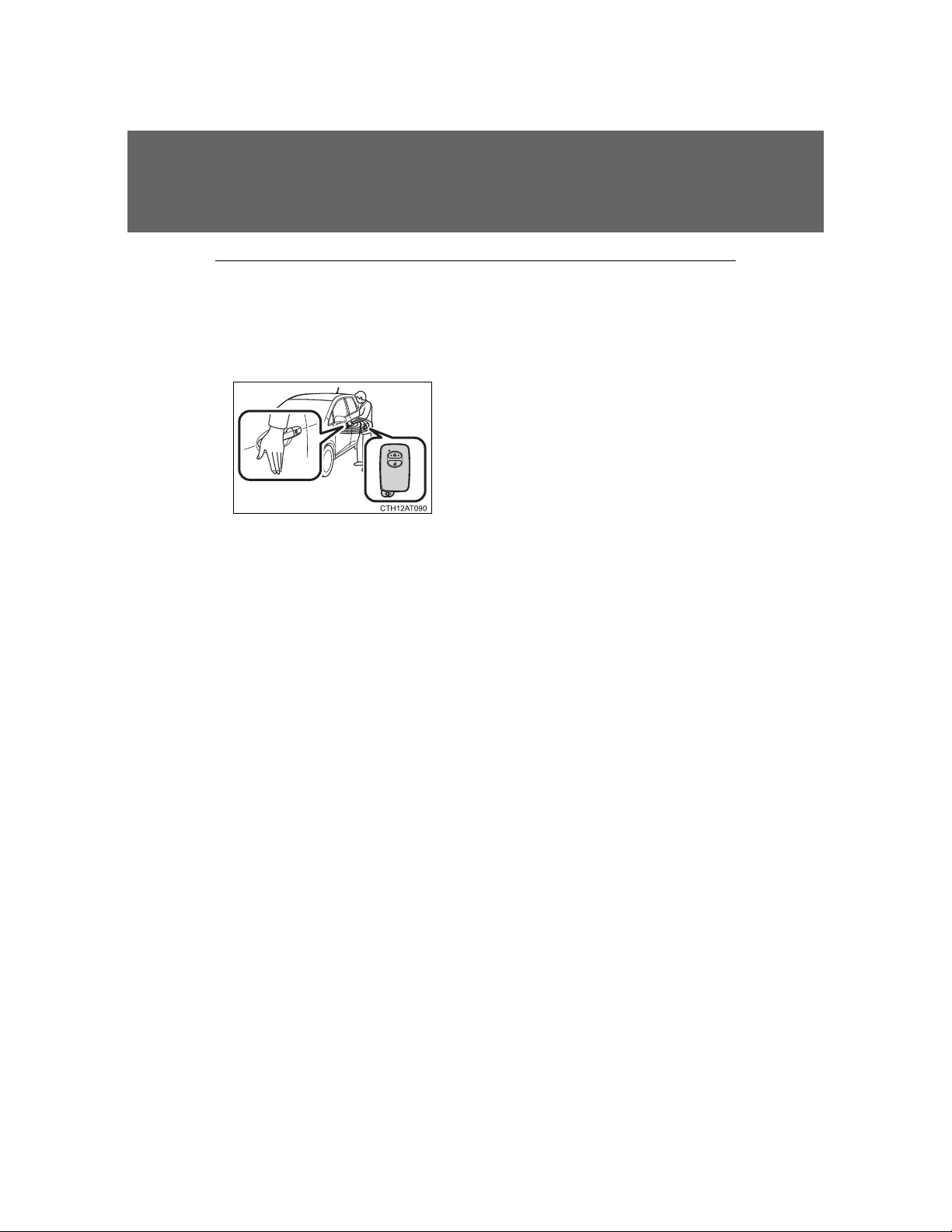
Use your palm to touch the lock sensor.
Operation signals
The emergency flashers flash to indicate that the doors have been locked/
unlocked. (Locked: once; Unlocked: twice)
When the door cannot be locked by the lock sensor
Alarms and warning indicators
A combination of exterior and interior alarms as well as warning lights are
used to prevent theft of the vehicle and unforeseeable accidents resulting
from erroneous operation. Take appropriate measures for the warning light
that comes on. (P. 443)
The following table describes circumstances and correction procedures
when only alarms are sounded.
38
VERSO-S_EE
Page 39

Alarm Situation Correction procedure
Exterior alarm
sounds once for
10 seconds
An attempt was made to
lock the doors using the
smart entry & start system
while the electronic key
was still inside the vehicle.
Retrieve the electronic key from the
vehicle and lock the
doors again.
An attempt was made to
lock the vehicle while a
door was open.
Close all of the doors
and lock the doors
again.
Interior alarm
pings once and
exterior alarm
sounds once for
10 seconds
An attempt was made to
lock either front door by
opening a door and putting
the inside lock button into
the lock position, then
closing the door by pulling
on the outside door handle
with the electronic key still
inside the vehicle.
Retrieve the electronic key from the
vehicle and lock the
doors again.
Interior alarm
pings once and
exterior alarm
sounds once for
10 seconds (on
some models)
An attempt was made to
lock the doors other than
using the smart entry &
start system while the electronic key was still inside
the vehicle.
Retrieve the electronic key from the
vehicle and lock the
doors again.
Interior alarm
sounds continuously
The “ENGINE START
STOP” switch was turned
to ACCESSORY mode
while the driver’s door was
open (or the driver’s door
was opened while the
“ENGINE START STOP”
switch was in ACCESSORY mode).
Turn the “ENGINE
START STOP” switch
off and close the
driver’s door.
1-2. Opening, closing and locking the doors
1
Before driving
VERSO-S_EE
39
Page 40

1-2. Opening, closing and locking the doors
Alarm Situation Correction procedure
Interior alarm
sounds continuously*
The driver’s door was
opened while any shift
position other than P was
selected without turning off
the “ENGINE START
STOP” switch.
Shift the shift lever to
P.
*: Vehicles with a Multidrive only
Security feature
If a door is not opened within approximately 30 seconds after the vehicle is
unlocked, the security feature automatically locks the vehicle again. (However, depending on the location of the electronic key, the key may be
detected as being in the vehicle. In this case, vehicle may be unlocked.)
Battery-saving function
The battery-saving function will be activated in order to prevent the electronic key battery and the vehicle battery from being discharged while the
vehicle is not in operation for a long time.
In the following situations, the smart entry & start system may take some
time to unlock the doors.
• The electronic key has been left in an area of approximately 2 m (6 ft.)
of the outside of the vehicle for 10 minutes or longer.
• The smart entry & start system has not been used for 5 days or longer.
If the smart entry & start system has not been used for 14 days or longer,
the doors cannot be unlocked at any doors except the driver’s door.
In this case, take hold of the driver’s door handle, or use the wireless
remote control or the mechanical key, to unlock the doors.
40
VERSO-S_EE
Page 41

1-2. Opening, closing and locking the doors
Conditions affecting operation
The smart entry & start system uses weak radio waves. In the following situations, the communication between the electronic key and the vehicle may
be affected, preventing the smart entry & start system, wireless remote control and engine immobilizer system from operating properly.
(Way of coping P. 484)
When the electronic key battery is depleted
Near a TV tower, electric power plant, gas station, radio station, large dis-
play, airport or other facility that generates strong radio waves or electrical noise
When the electronic key is in contact with, or is covered by the following
metallic objects
• Cards to which aluminum foil is attached
• Cigarette boxes that have aluminum foil inside
• Metallic wallets or bags
• Coins
• Hand warmers made of metal
• Media such as CDs and DVDs
When other wireless key (that emit radio waves) is being used nearby
When carrying the electronic key together with the following devices that
emit radio waves
• A portable radio, cellular phone, cordless phone or other wireless communication device
• Another vehicle's electronic key or a wireless key that emits radio
waves
• Personal computers or personal digital assistants (PDAs)
• Digital audio players
• Portable game systems
If window tint with a metallic content or metallic objects are attached to
the rear window
When the electronic key is placed near a battery charger or electronic
devices
1
Before driving
VERSO-S_EE
41
Page 42

1-2. Opening, closing and locking the doors
Notes for the entry function
Even when the electronic key is within the effective range (detection
areas), the system may not operate properly in the following cases:
• The electronic key is too close to the window or outside door handle,
near the ground, or in a high place when the doors are locked or
unlocked.
• The electronic key is on the instrument panel, luggage cover (if
equipped) or floor, or in the door pockets or glove box when the engine
is started or “ENGINE START STOP” switch modes are changed.
Do not leave the electronic key on top of the instrument panel or near the
door pockets when exiting the vehicle. Depending on the radio wave
reception conditions, it may be detected by the antenna outside the cabin
and the door will become lockable from the outside, possibly trapping the
electronic key inside the vehicle.
As long as the electronic key is within the effective range, the doors may
be locked or unlocked by anyone.
Even if the electronic key is not inside the vehicle, it may be possible to
start the engine if the electronic key is near the window.
The doors may unlock if a large amount of water splashes on the door
handle, such as in the rain or in a car wash when the electronic key is
within the effective range. (The door will automatically be locked after
approximately 30 seconds if the doors are not opened and closed.)
Gripping the door handle when wearing a glove may not unlock the door.
If the wireless remote control is used to lock the doors when the elec-
tronic key is near the vehicle, there is a possibility that the door may not
be unlocked by the entry function. (Use the wireless remote control to
unlock the doors.)
A sudden approach to the effective range or door handle may prevent the
doors from being unlocked. In this case, return the door handle to the
original position and check that the doors unlock before pulling the door
handle again.
42
VERSO-S_EE
Page 43

1-2. Opening, closing and locking the doors
Notes for locking the doors
Touching the door lock sensor while wearing gloves may delay or prevent
lock operation. Remove the gloves and touch the lock sensor again.
When the lock operation is performed using the lock sensor, recognition
signals will be shown up to two consecutive times. After this, no recognition signals will be given.
If the door handle becomes wet while the electronic key is within the
effective range, the door may lock and unlock repeatedly. Place the key
in a position 2 m (6 ft.) or more separate from the vehicle while the vehicle is being washed. (Take care to ensure that the key is not stolen.)
If the electronic key is inside the vehicle and a door handle becomes wet
during a car wash, a buzzer will sound outside the vehicle. To turn off the
alarm, lock all the doors.
The lock sensor may not work properly if it comes into contact with ice,
snow, mud, etc. Clean the lock sensor and attempt to operate it again.
Notes for the unlocking function
A sudden approach to the effective range or door handle may prevent the
doors from being unlocked. In this case, return the door handle to the
original position and check that the doors unlock before pulling the door
handle again.
Gripping the door handle when wearing a glove may not unlock the door.
Remove the gloves and touch the sensor on the back of the handle
again.
If the door handle becomes wet while the electronic key is within the
effective range, the door may lock and unlock repeatedly. Place the key
in a position 2 m (6 ft.) or more separate from the vehicle while the vehicle is being washed. (Take care to ensure that the key is not stolen.)
If there is another electronic key in the detection area, it may take slightly
longer to unlock the doors after the door handle is gripped.
When the vehicle is not driven for extended periods
To prevent theft of the vehicle, do not leave the electronic key within 2 m
(6 ft.) of the vehicle.
The smart entry & start system can be deactivated in advance. (P. 528)
1
Before driving
VERSO-S_EE
43
Page 44

1-2. Opening, closing and locking the doors
Alarm (vehicles with an alarm)
Using the smart entry & start system to lock the doors will set the alarm system. (P. 107)
To operate the system properly
Make sure to carry the electronic key when operating the system. Do not get
the electronic key too close to the vehicle when operating the system from
the outside of the vehicle.
Depending on the position and holding condition of the electronic key, the
key may not be detected correctly and the system may not operate properly.
(The alarm may go off accidentally, or the door lock prevention function may
not operate.)
If the smart entry & start system does not operate properly
Locking and unlocking the doors: Use the mechanical key. (P. 484)
Starting the engine: P. 485
Electronic key battery depletion
The standard battery life is 1 to 2 years.
If the battery becomes low, an alarm will sound in the cabin each time the
engine starts or stops. (P. 443)
As the electronic key always receives radio waves, the battery will
become depleted even if the electronic key is not used. The following
symptoms indicate that the electronic key battery may be depleted.
Replace the battery when necessary. (P. 393)
• The smart entry & start system or the wireless remote control does not
operate.
• The detection area becomes smaller.
• The LED indicator on the key surface does not turn on.
To avoid serious deterioration, do not leave the electronic key within 1 m
(3 ft.) of the following electrical appliances that produce a magnetic field:
•TVs
• Personal computers
• Cellular phones, cordless phones and battery chargers
• Recharging cellular phones or cordless phones
• Glass top ranges
• Table lamps
44
VERSO-S_EE
Page 45

1-2. Opening, closing and locking the doors
When the electronic key battery is fully depleted
P. 393
If the smart entry & start system has been deactivated in a customized
setting
Locking and unlocking the doors: Use the wireless remote control or
mechanical key. (P. 53, 484)
Starting the engine and changing “ENGINE START STOP” switch
modes: P. 485
Stopping the engine: P. 167
Customization that can be configured at any authorized Toyota dealer
or repairer, or another duly qualified and equipped professional
Settings (e. g. smart entry & start system) can be changed.
(Customizable features: P. 528)
1
Before driving
VERSO-S_EE
45
Page 46
1-2. Opening, closing and locking the doors
Certification for the smart entry & start system
46
VERSO-S_EE
Page 47
Hereby, Toyota Motor Corporation, declares that this TMLF10-1 is in
compliance with the essential requirements and other relevant provisions
of Directive 1999/5/EC.㩷
Toyota Motor Corporation vakuuttaa täten että TMLF10-1 tyyppinen laite
on direktiivin 1999/5/EY oleellisten vaatimusten ja sitä koskevien
direktiivin muiden ehtojen mukainen.㩷
Hierbij verklaart Toyota Motor Corporation dat het toestel TMLF10-1 in
overeenstemming is met de essentiële eisen en de andere relevante
bepalingen van richtlijn 1999/5/EG.㩷
Par la présente Toyota Motor Corporation déclare que l'appareil
TMLF10-1 est conforme aux exigences essentielles et aux autres
dispositions pertinentes de la directive 1999/5/CE.㩷
Härmed intygar Toyota Motor Corporation att denna TMLF10-1 står I
överensstämmelse med de väsentliga egenskapskrav och övriga
relevanta bestämmelser som framgår av direktiv 1999/5/EG.
Undertegnede Toyota Motor Corporation erklærer herved, at følgende
udstyr TMLF10-1 overholder de væsentlige krav og øvrige relevante krav
i direktiv 1999/5/EF.
Hiermit erklärt Toyota Motor Corporation, dass sich das Gerät TMLF10-1
in Übereinstimmung mit den grundlegenden Anforderungen und den
übrigen einschlägigen Bestimmungen der Richtlinie 1999/5/EG befindet.㩷
ȂǼ ȉǾȃ ȆǹȇȅȊȈǹ Toyota Motor Corporation ǻǾȁȍȃǼǿ ȅȉǿ TMLF10-1
ȈȊȂȂȅȇĭȍȃǼȉǹǿ ȆȇȅȈ ȉǿȈ ȅȊȈǿȍǻǼǿȈ ǹȆǹǿȉǾȈǼǿȈ Ȁǹǿ ȉǿȈ
ȁȅǿȆǼȈ ȈȋǼȉǿȀǼȈ ǻǿǹȉǹȄǼǿȈ ȉǾȈ ȅǻǾīǿǹȈ 1999/5/EK.
VERSO-S_EE
1-2. Opening, closing and locking the doors
1
Before driving
47
Page 48
1-2. Opening, closing and locking the doors
Con la presente Toyota Motor Corporation dichiara che questo TMLF10-1
è conforme ai requisiti essenziali ed alle altre disposizioni pertinenti
stabilite dalla direttiva 1999/5/CE.
Por medio de la presente Toyota Motor Corporation declara que el
TMLF10-1 cumple con los requisitos esenciales y cualesquiera otras
disposiciones aplicables o exigibles de la Directiva 1999/5/CE.
Toyota Motor Corporation declara que este TMLF10-1 está conforme com
os requisitos essenciais e outras disposições da Directiva 1999/5/CE.㩷
Hawnhekk, Toyota Motor Corporation, jiddikjara li dan TMLF10-1
jikkonforma mal-ƫtiƥijiet essenzjali u ma provvedimenti oƫrajn relevanti li
hemm fid-Dirrettiva 1999/5/EC.
Käesolevaga kinnitab Toyota Motor Corporation seadme TMLF10-1
vastavust direktiivi 1999/5/EÜ põhinõuetele ja nimetatud direktiivist
tulenevatele teistele asjakohastele sätetele.
Alulírott, Toyota Motor Corporation nyilatkozom, hogy a TMLF10-1
megfelel a vonatkozó alapvetõ követelményeknek és az 1999/5/EC
irányelv egyéb elõírásainak.
Toyota Motor Corporation týmto vyhlasuje, že TMLF10-1 spĎĖa základné
požiadavky a všetky príslušné ustanovenia Smernice 1999/5/ES.
Toyota Motor Corporation tímto prohlašuje, že tento TMLF10-1 je ve
shodČ se základními požadavky a dalšími pĜíslušnými ustanoveními
smČrnice 1999/5/ES.
Toyota Motor Corporation izjavlja, da je ta TMLF10-1 v skladu z
bistvenimi zahtevami in ostalimi relevantnimi doloþili direktive 1999/5/ES.
48
VERSO-S_EE
Page 49
Šiuo Toyota Motor Corporation deklaruoja, kad šis TMLF10-1 atitinka
esminius reikalavimus ir kitas 1999/5/EB Direktyvos nuostatas.
Ar šo Toyota Motor Corporation deklarƝ, ka TMLF10-1 atbilst DirektƯvas
1999/5/EK bnjtiskajƗm prasƯbƗm un citiem ar to saistƯtajiem noteikumiem.
Niniejszym Toyota Motor Corporation oĞwiadcza, Īe TMLF10-1 jest zgodny
z zasadniczymi wymogami oraz pozostaáymi stosownymi postanowieniami
Dyrektywy 1999/5/EC.
Hér með lýsir Toyota Motor Corporation yfir því að TMLF10-1 er í
samræmi við grunnkröfur og aðrar kröfur, sem gerðar eru í tilskipun
1999/5/EC.
Toyota Motor Corporation erklærer herved at utstyret TMLF10-1 er i
samsvar med de grunnleggende krav og øvrige relevante krav i direktiv
1999/5/EF.
1-2. Opening, closing and locking the doors
1
Before driving
VERSO-S_EE
49
Page 50
1-2. Opening, closing and locking the doors
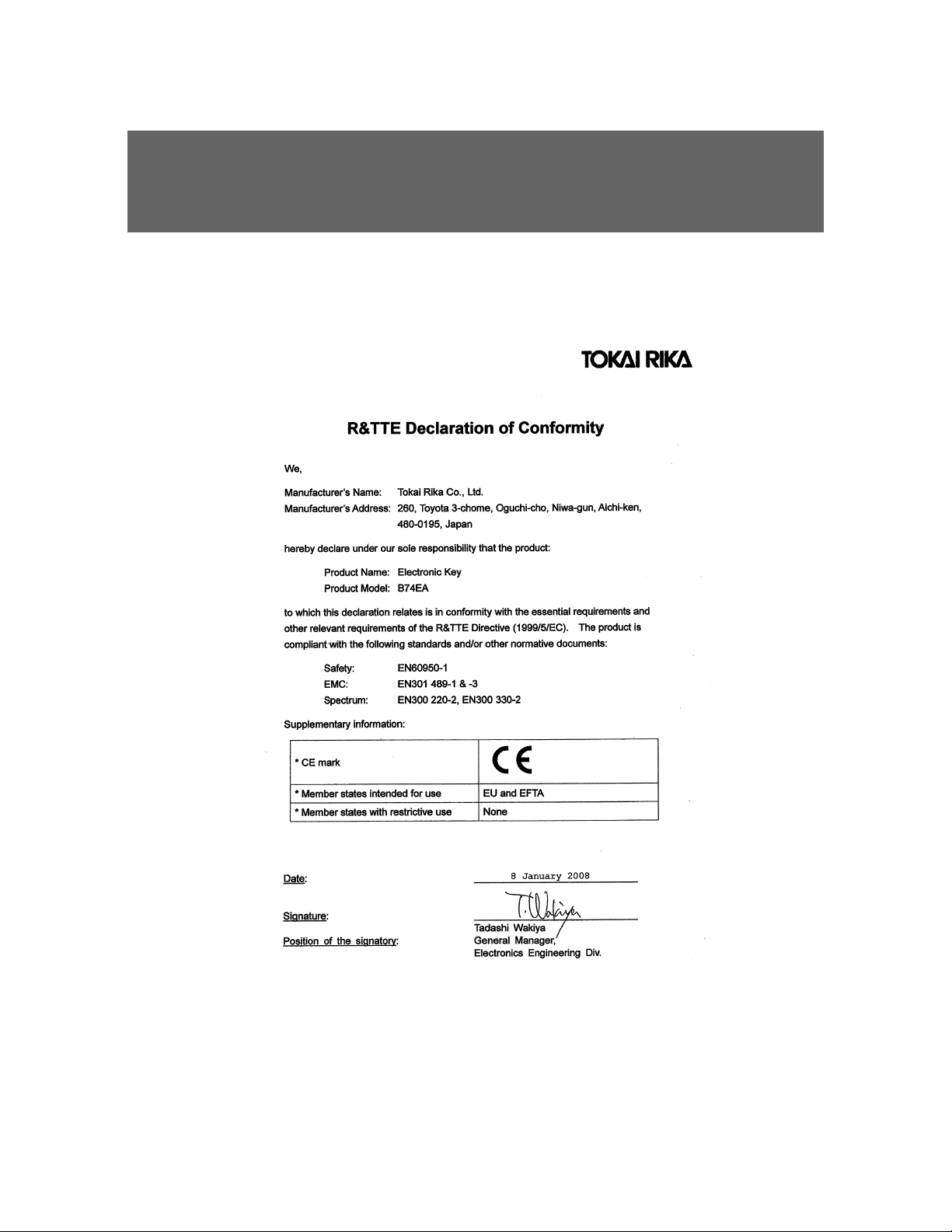
Hereby, Tokai Rika Co., Ltd., declares that this B74EA is in compliance with the essential requirements and other relevant provisions of
Directive 1999/5/EC.
50
VERSO-S_EE
Page 51
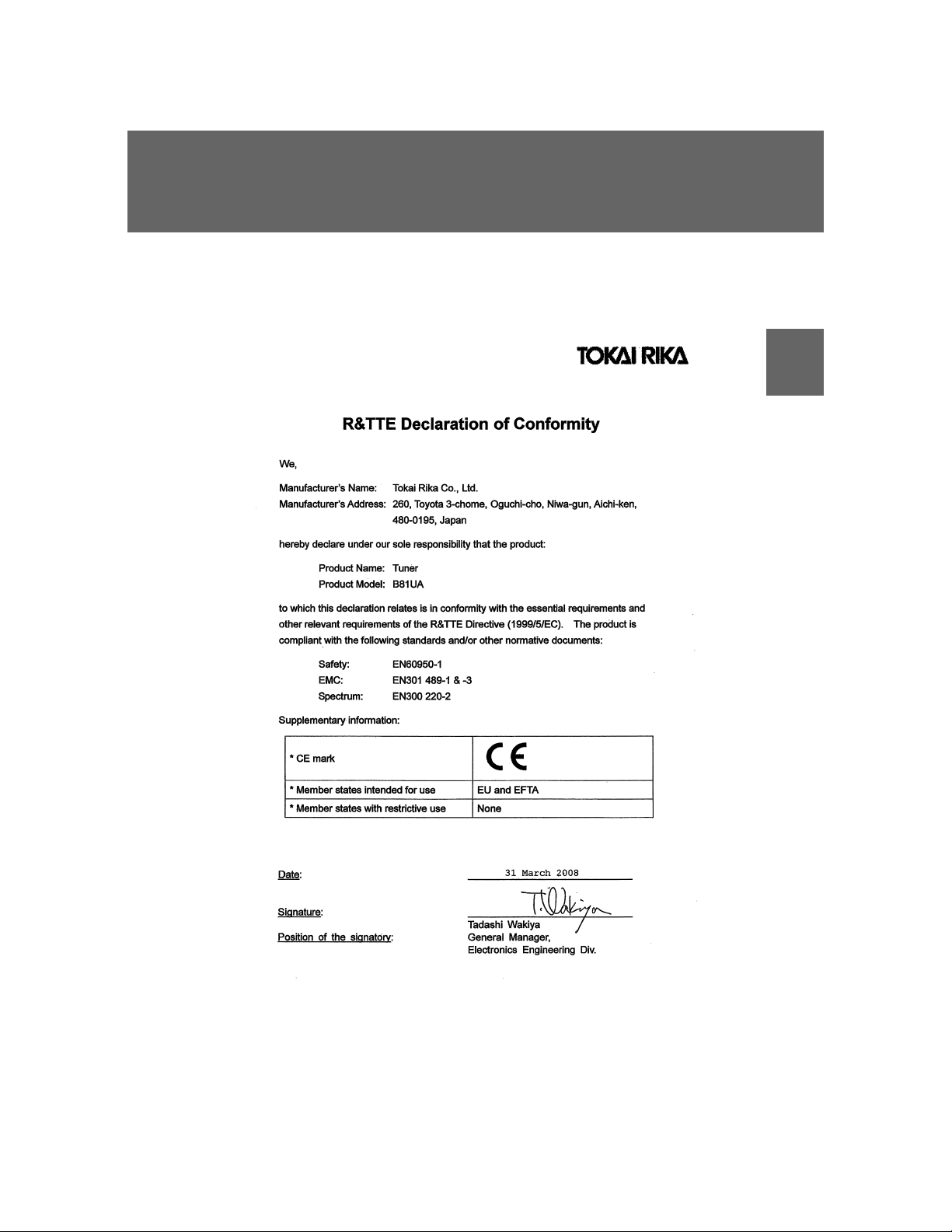
Hereby, Tokai Rika Co., Ltd., declares that this B81UA is in compliance with the essential requirements and other relevant provisions
of Directive 1999/5/EC.
1-2. Opening, closing and locking the doors
1
Before driving
VERSO-S_EE
51
Page 52

1-2. Opening, closing and locking the doors
CAUTION
Caution regarding interference with electronic devices
People with implanted pacemakers or cardiac defibrillators should main-
tain a reasonable distance between themselves and the smart entry &
start system antennas. (P. 36)
The radio waves may affect the operation of such devices. If necessary,
the entry function can be disabled. Ask any authorized Toyota dealer or
repairer, or another duly qualified and equipped professional for details,
such as the frequency of radio waves and timing of emitting the radio
waves. Then, consult your doctor to see if you should disable the entry
function.
Users of any electrical medical device other than implanted pacemakers
and implanted cardiac defibrillators should consult the manufacturer of the
device for information about its operation under the influence of radio
waves.
Radio waves could have unexpected effects on the operation of such
medical devices.
Ask any authorized Toyota dealer or repairer, or another duly qualified and
equipped professional for details on disabling the entry function.
52
VERSO-S_EE
Page 53
1-2. Opening, closing and locking the doors
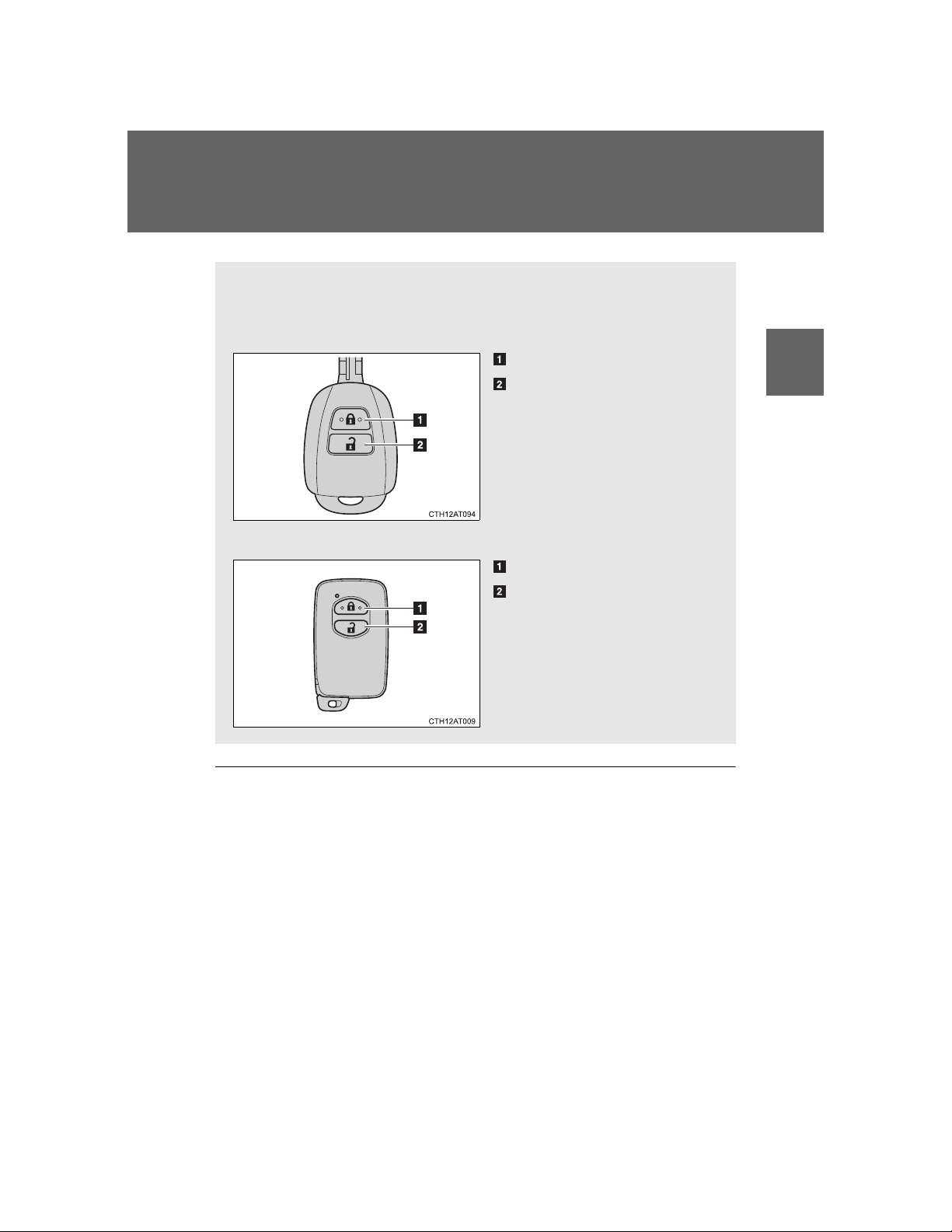
The wireless remote control can be used to lock and unlock the vehi-
cle.
Vehicles without a smart entry & start system
Locks all the doors
Unlocks all the doors
Vehicles with a smart entry & start system
Locks all the doors
Unlocks all the doors
Wireless remote control
1
Before driving
Operation signals
The emergency flashers flash to indicate that the doors have been locked/
unlocked. (Locked: once; Unlocked: twice)
Door lock buzzer (vehicles with a smart entry & start system)
If an attempt to lock the doors is made when a door is not fully closed, a
buzzer sounds continuously. Fully close the door to stop the buzzer, and lock
the vehicle once more.
VERSO-S_EE
53
Page 54

1-2. Opening, closing and locking the doors
Security feature
If a door is not opened within approximately 30 seconds after the vehicle is
unlocked, the security feature automatically locks the vehicle again.
Alarm (vehicles with an alarm)
Using the wireless remote control to lock the doors will set the alarm system.
(P. 107)
Conditions affecting operation
Vehicles without a smart entry & start system
The wireless remote control function may not operate normally in the following situations:
When the wireless key battery is depleted
Near a TV tower, electric power plant, gas station, radio station, large dis-
play, airport or other facility that generates strong radio waves or electrical noise
When carrying a portable radio, cellular phone or other wireless commu-
nication devices
When the wireless key is in contact with, or is covered by a metallic
object
When other wireless key (that emit radio waves) is being used nearby
If window tint with a metallic content or metallic objects are attached to
the rear window
Vehicles with a smart entry & start system
P. 4 1
If the wireless remote control does not operate properly (vehicles with
a smart entry & start system)
Locking and unlocking the doors: Use the mechanical key. (P. 484)
Key battery depletion
Vehicles without a smart entry & start system
If the wireless remote control function does not operate, the battery may be
depleted. Replace the battery when necessary. (P. 393)
Vehicles with a smart entry & start system
P. 4 4
54
VERSO-S_EE
Page 55

1-2. Opening, closing and locking the doors
When the key battery is fully depleted
P. 393
Confirmation of the registered key number (vehicles with a smart entry
and start system)
The number of keys already registered to the vehicle can be confirmed. Ask
any authorized Toyota dealer or repairer, or another duly qualified and
equipped professional for details.
Customization that can be configured at any authorized Toyota dealer
or repairer, or another duly qualified and equipped professional
Settings (e.g. wireless remote control system) can be changed.
(Customizable features P. 528)
1
Before driving
VERSO-S_EE
55
Page 56
1-2. Opening, closing and locking the doors
Hereby, Tokai Rika Co., Ltd., declares that this B41RA is in compliance with the essential requirements and other relevant provisions
of Directive 1999/5/EC.
Certification for wireless remote control
56
VERSO-S_EE
Page 57
Hereby, Tokai Rika Co., Ltd., declares that this B51TA is in compliance with the essential requirements and other relevant provisions
of Directive 1999/5/EC.
1-2. Opening, closing and locking the doors
1
Before driving
VERSO-S_EE
57
Page 58
1-2. Opening, closing and locking the doors
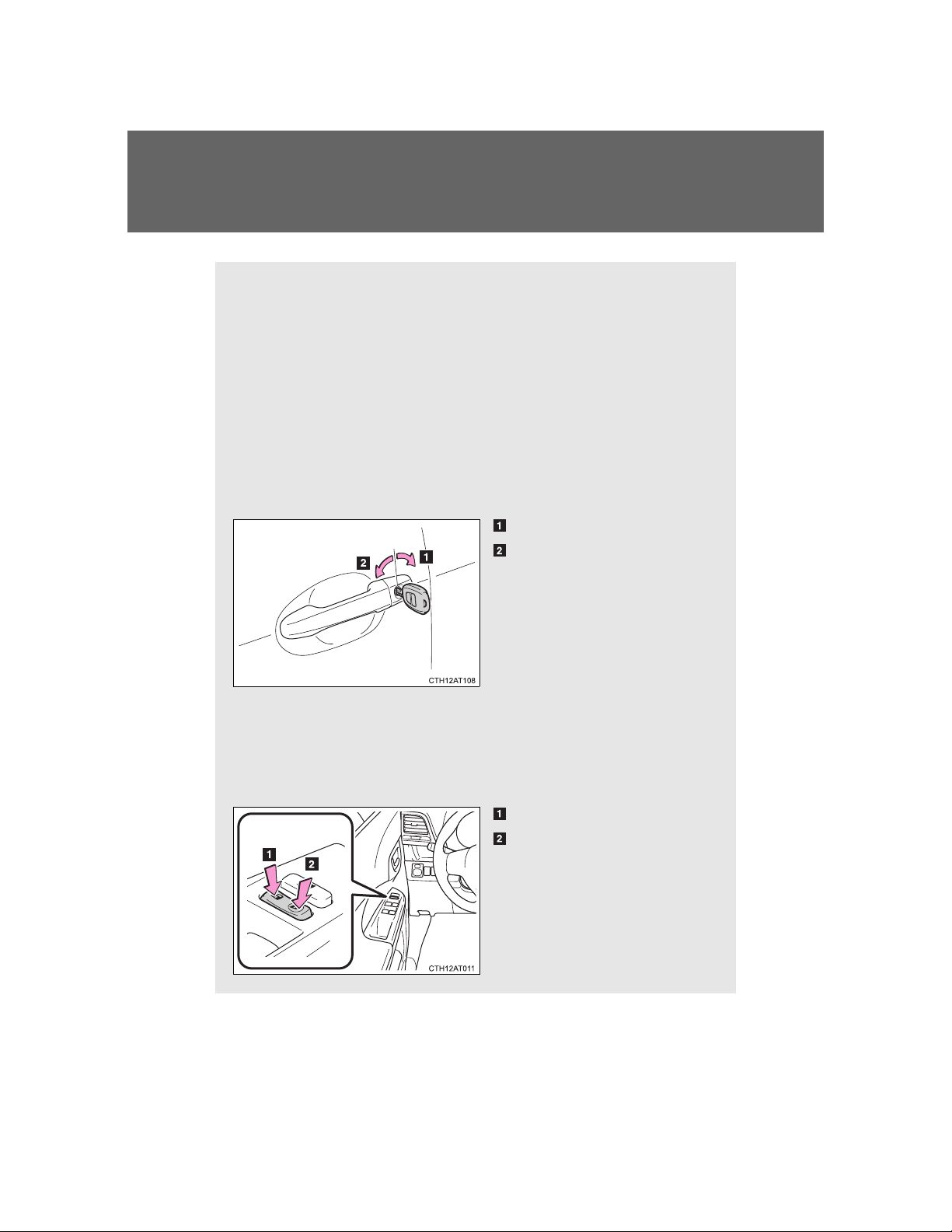
The vehicle can be locked and unlocked using the entry function,
wireless remote control, key or door lock switch.
Entry function (vehicles with a smart entry & start system)
P. 3 4
Wireless remote control
P. 5 3
Keys
Turning the key operates the doors as follows:
Vehicles without a smart entry & start system
Unlocks all the doors
Locks all the doors
Vehicles with a smart entry & start system
The doors can also be locked and unlocked with the mechanical
key. (P. 484)
Door lock switch
Unlocks all the doors
Locks all the doors
Side doors
58
VERSO-S_EE
Page 59
1-2. Opening, closing and locking the doors
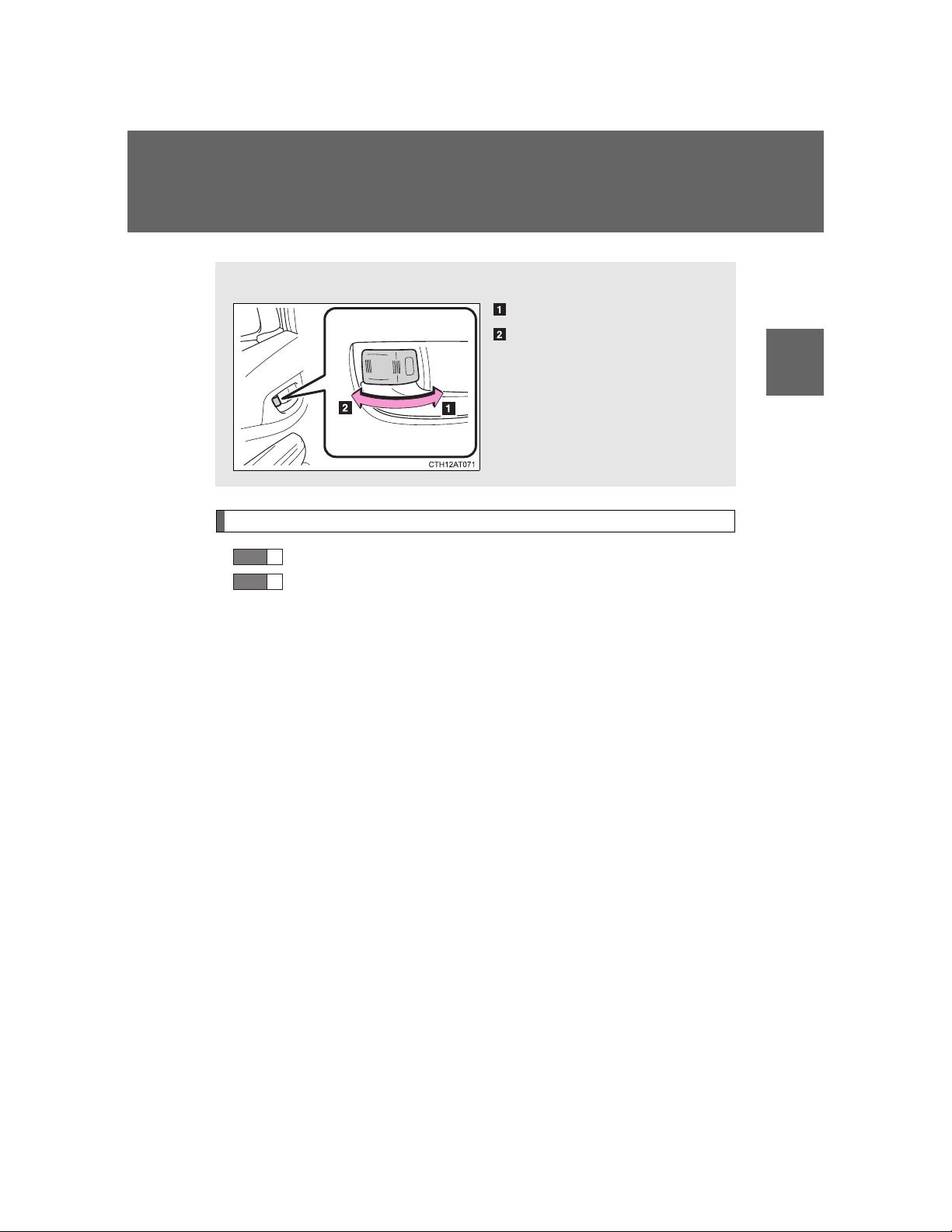
Inside lock buttons
Locks the door
Unlocks the door
The front doors can be opened
by pulling the inside handle
even if the lock button is in the
lock position.
STEP
1
STEP
2
Locking the front doors from the outside without a key
Move the inside lock button to the lock position.
Close the door while pulling the door handle.
Vehicles without a smart entry & start system
The door cannot be locked if the key is in the engine switch.
1
Before driving
Vehicles with a smart entry & start system
The door cannot be locked if the “ENGINE START STOP” switch is in
ACCESSORY or IGNITION ON mode, or the electronic key is left
inside the vehicle.
The key may not be detected correctly and the door may be locked.
59
VERSO-S_EE
Page 60
1-2. Opening, closing and locking the doors
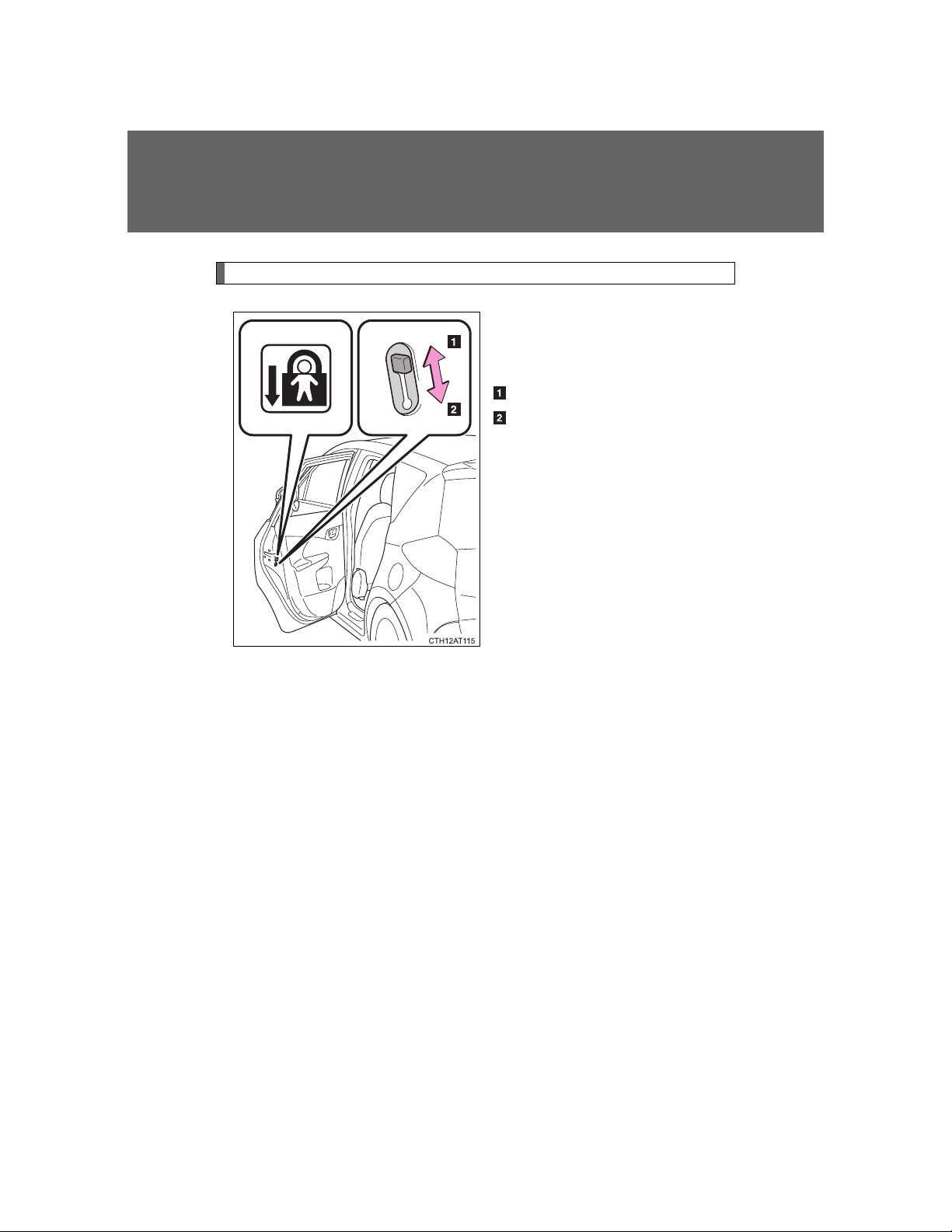
Rear door child-protector lock
The door cannot be opened from
inside the vehicle when the lock
is set.
Unlock
Lock
These locks can be set to prevent
children from opening the rear
doors. Push down on each rear
door switch to lock both rear
doors.
60
VERSO-S_EE
Page 61
1-2. Opening, closing and locking the doors
STEP
1
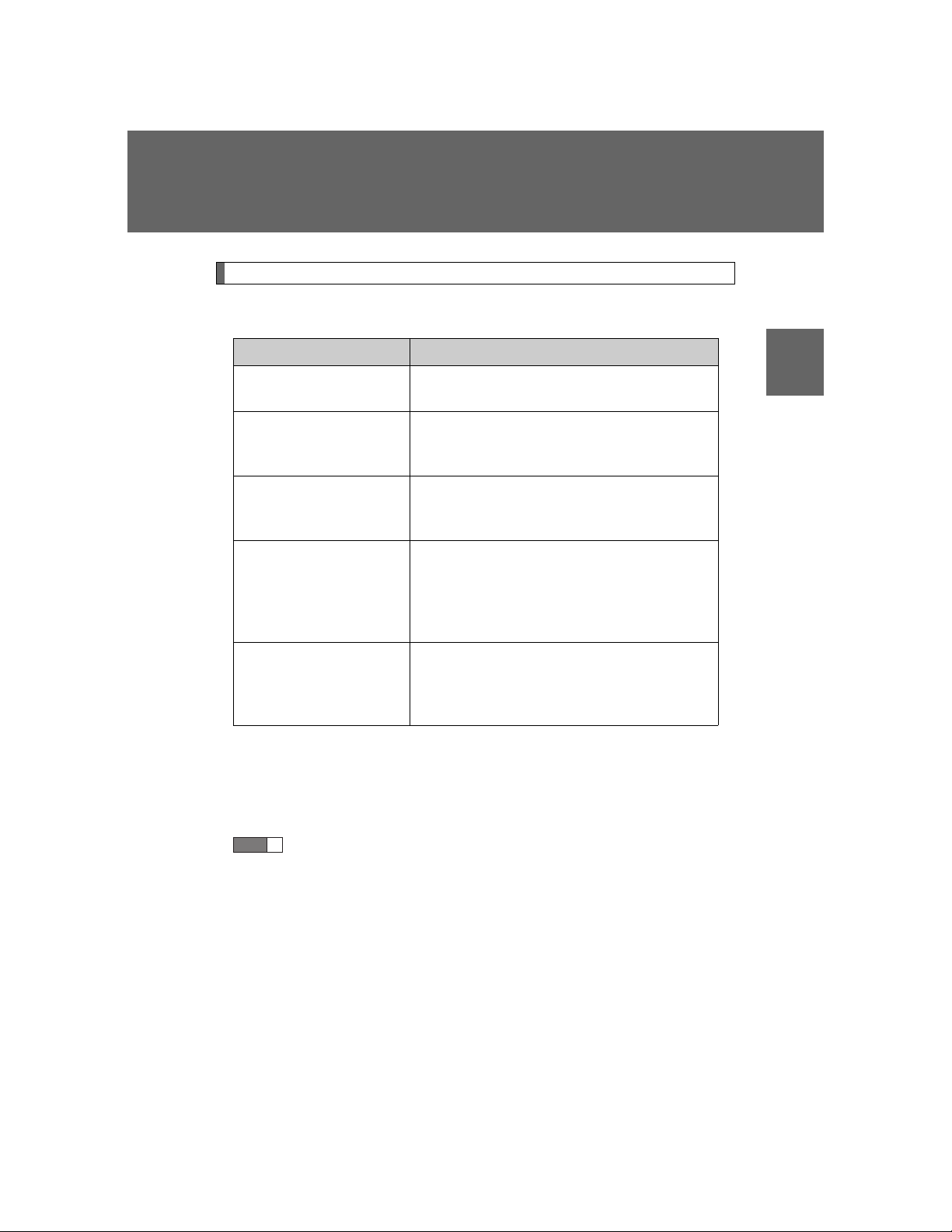
Automatic door locking and unlocking systems
The following functions can be set or canceled:
Function Operation
Shift position linked
door locking function*
Shift position linked
door unlocking function*
Speed linked door locking function
Driver's door linked door
unlocking function
(
vehicles without a
smart entry & start system
)
Driver's door linked door
unlocking function
(
vehicles with a smart
entry & start system
Shifting the shift lever out of P locks all the
doors.
Shifting the shift lever to P unlocks all the
doors.
the
doors are locked when the vehicle
All
speed is approximately 20 km/h (12 mph) or
higher.
All
the
doors are unlocked when the driver's
door is opened within 10 seconds after turning
the engine switch to “ACC” or “LOCK”.
All
the
doors are unlocked when the driver's
door is opened within 10 seconds after turning
the “ENGINE START STOP” switch off.
)
*: Vehicles with a Multidrive only
Setting and canceling the functions
To switch between setting and canceling, follow the procedure
below.
1
Before driving
Vehicles without a smart entry & start system
Close all the doors and turn the engine switch to the “ON”
position. (Perform step 2 within 20 seconds.)
Vehicles with a smart entry & start system
Close all the doors and turn the “ENGINE START STOP”
switch to IGNITION ON mode. (Perform step 2 within 20 seconds.)
61
VERSO-S_EE
Page 62
1-2. Opening, closing and locking the doors
STEP
2
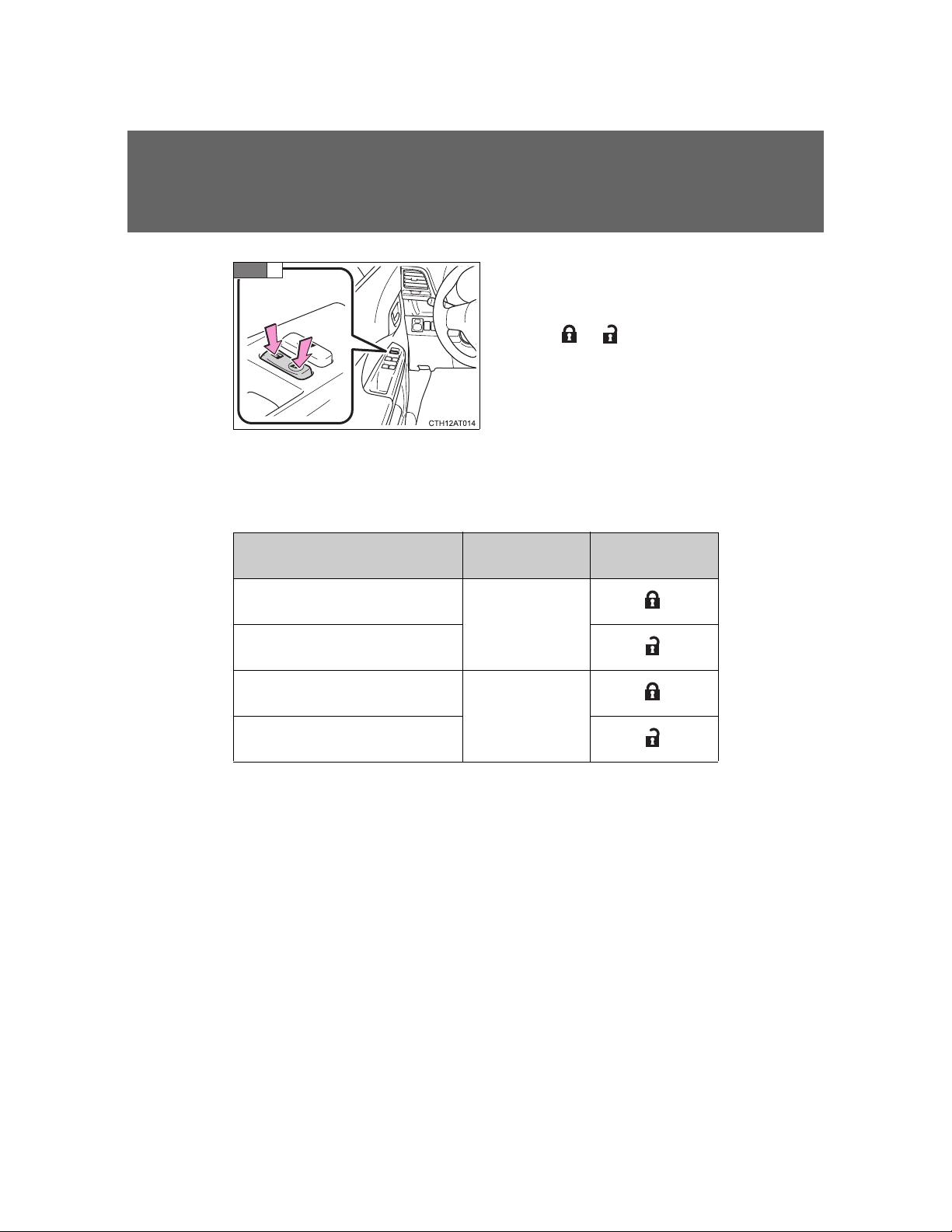
Shift the shift lever to P (vehicles
with a Multidrive only) or N, and
press and hold the door lock
switch (or) for approximately 5 seconds and then
release.
The shift lever and switch positions corresponding to the
desired function to be set are
shown in the following table.
Use the same procedure to cancel the function.
Function
Shift position linked door locking function*
Shift position linked door
unlocking function*
Speed linked door locking function
Driver's door linked door unlocking function
Shift lever
position
P
N
Door lock switch
position
*: Vehicles with a Multidrive only
When the setting or canceling operation is complete, all doors are
locked and then unlocked.
62
VERSO-S_EE
Page 63

1-2. Opening, closing and locking the doors
CAUTION
Impact detection door lock release system
In the event that the vehicle is subject to a strong impact, all the doors are
unlocked. Depending on the force of the impact or the type of accident, however, the system may not operate.
Using the mechanical key (vehicles with a smart entry & start system)
The doors can also be locked and unlocked with the mechanical key.
(P. 484)
If a wrong key is used (left-hand drive vehicles with smart entry & start
system and right-hand drive vehicles)
The key cylinder rotates freely to isolate inside mechanism.
If the smart entry & start system has been deactivated in a customized
setting (vehicles with a smart entry & start system)
Use the wireless remote control or mechanical key. (P. 53, 484)
Customization that can be configured at any authorized Toyota dealer
or repair, or another duly qualified and equipped professional
Settings (e.g. speed linked door locking function) can be changed.
(Customizable features: P. 528)
1
Before driving
To prevent an accident
Observe the following precautions while driving the vehicle.
Failing to do so may result in a door opening and an occupant falling out,
resulting in death or serious injury.
Always use a seat belt.
Ensure that all the doors are properly closed.
Do not pull the inside handle of the doors while driving.
Set the rear door child-protector locks when children are seated in the rear
VERSO-S_EE
The doors may be opened and the passengers are thrown out of the vehicle and it may result in serious injury or death.
Be especially careful for the front doors, as the doors may be opened even
if the inside lock buttons are in locked position.
seats.
63
Page 64
1-2. Opening, closing and locking the doors
The back door can be locked/unlocked and opened by the following
procedures.
Locking and unlocking the back door
Keys
P. 5 8
Wireless remote control
P. 5 3
Door lock switch
P. 5 8
Entry function (vehicles with a smart entry & start system)
P. 3 3
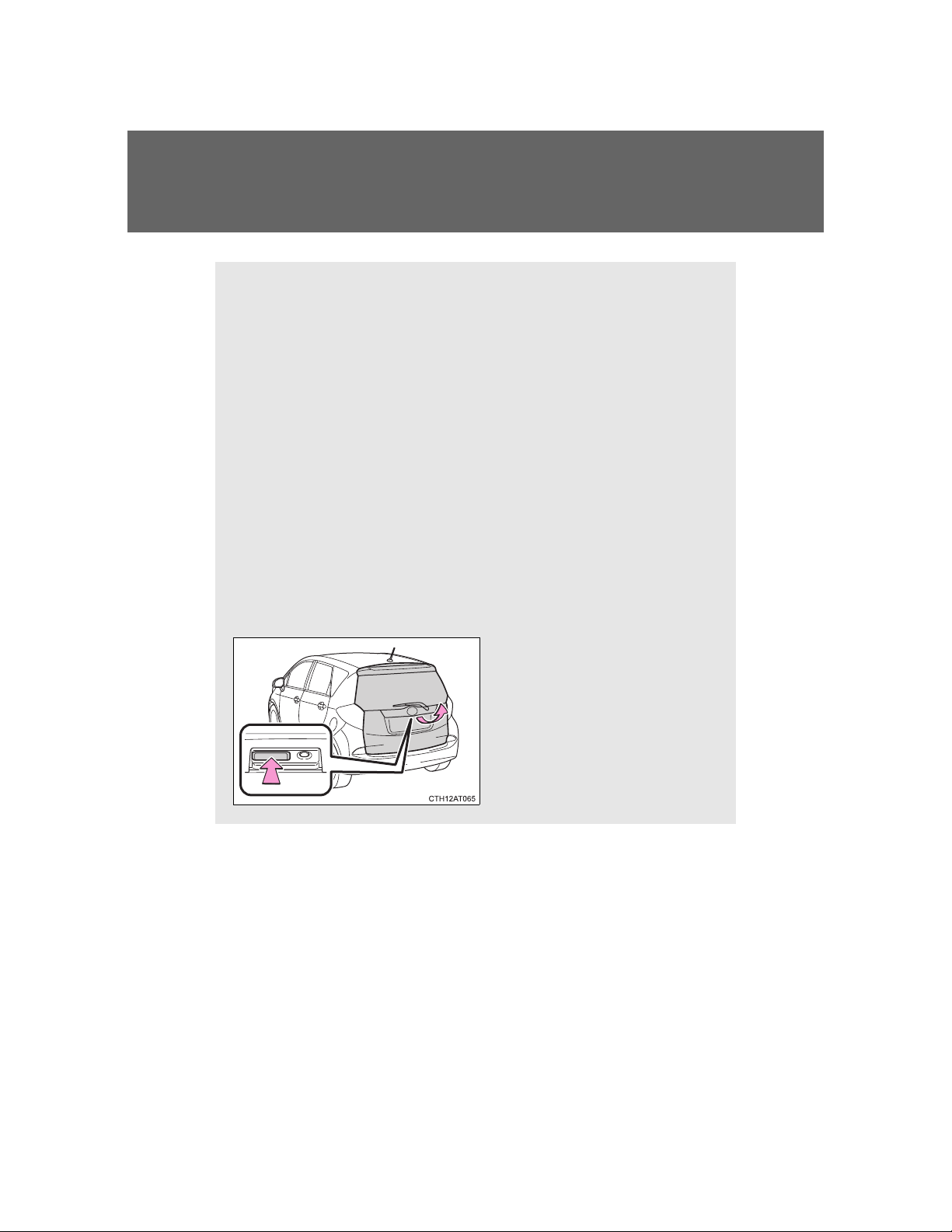
Opening the back door from outside the vehicle
Back door opener
Raise the back door while
pushing up the back door
opener switch.
The back door cannot be
closed immediately after the
back door opener switch is
pushed.
Back door
64
VERSO-S_EE
Page 65
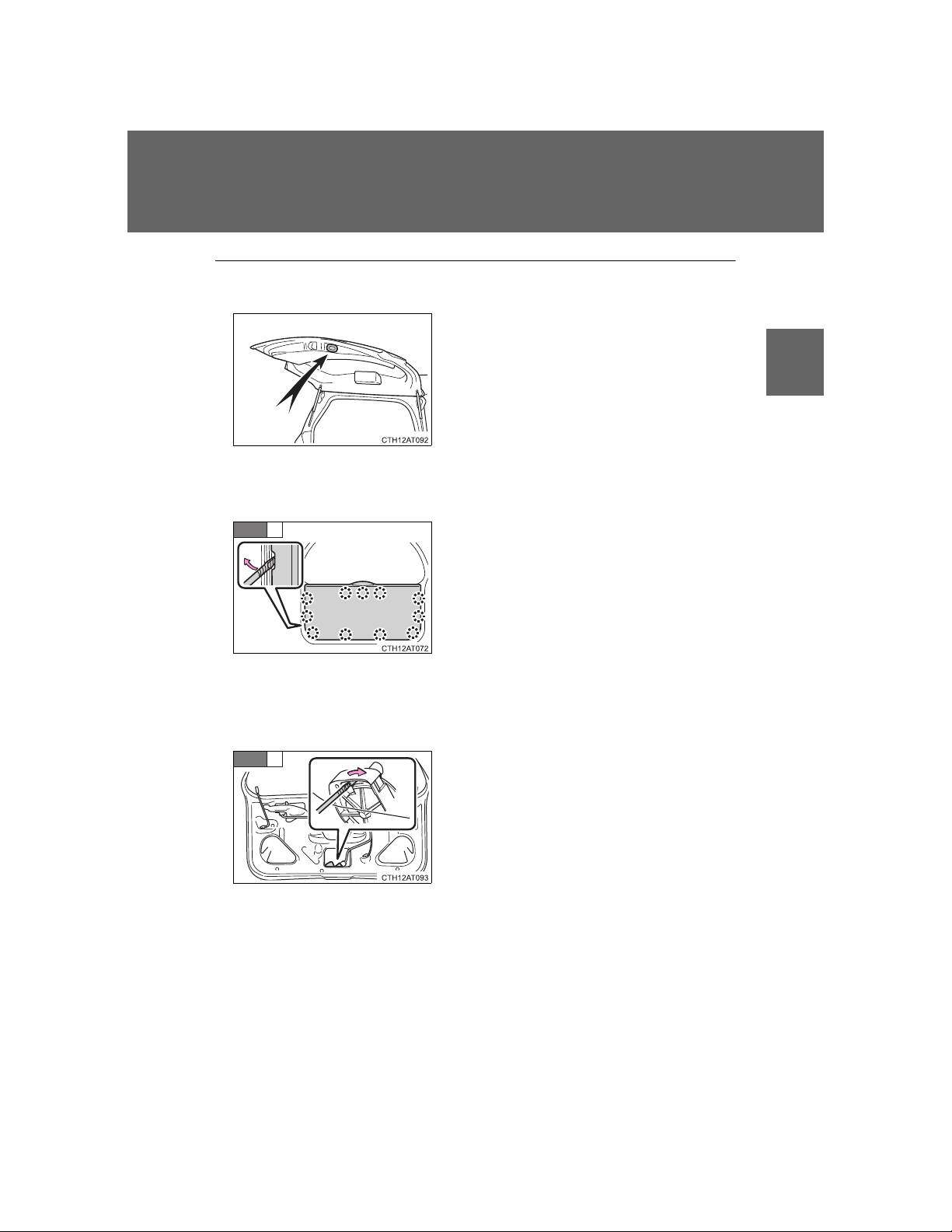
When closing the back door
Lower the back door using the back door
handle, and make sure to push the back
door down from the outside to close it.
Insert a flathead screwdriver under the
edge of the trim and then carefully pull
the trim upward to remove it.
There are 11 clips attaching the trim.
To protect the trim, wrap the flathead
screwdriver in tape and insert it into the
trim cutout as shown in the illustration.
Move the flathead screwdriver in the
direction indicated by the arrow.
Carefully remove the clips one at a
time.
Move the lever.
STEP
1
STEP
2
If the back door opener is inoperative
The back door can be operated from the inside.
1-2. Opening, closing and locking the doors
1
Before driving
65
VERSO-S_EE
Page 66

1-2. Opening, closing and locking the doors
CAUTION
If the smart entry & start system has been deactivated in a customized
setting (vehicles with a smart entry & start system)
Use the wireless remote control or mechanical key. (P. 53, 484)
Caution while driving
Keep the back door closed while driving.
If the back door is left open, it may hit near-by objects while driving or luggage may be unexpectedly thrown out, causing an accident.
In addition, exhaust gases may enter the vehicle, causing death or a serious health hazard. Make sure to close the back door before driving.
Before driving the vehicle, make sure that the back door is fully closed. If
the back door is not fully closed, it may open unexpectedly while driving,
causing an accident.
Never let anyone sit in the luggage compartment. In the event of sudden
braking or a collision, they are susceptible to death or serious injury.
When children are in the vehicle
Observe the following precautions.
Failure to do so may result in death or serious injury.
Do not allow children to play in the luggage compartment.
If a child is accidentally locked in the luggage compartment, they could
have heat exhaustion or other injures.
Do not allow a child to open or close the back door.
Doing so may cause the back door to operate unexpectedly, or cause the
child’s hands, head, or neck to be caught by the closing back door.
66
VERSO-S_EE
Page 67
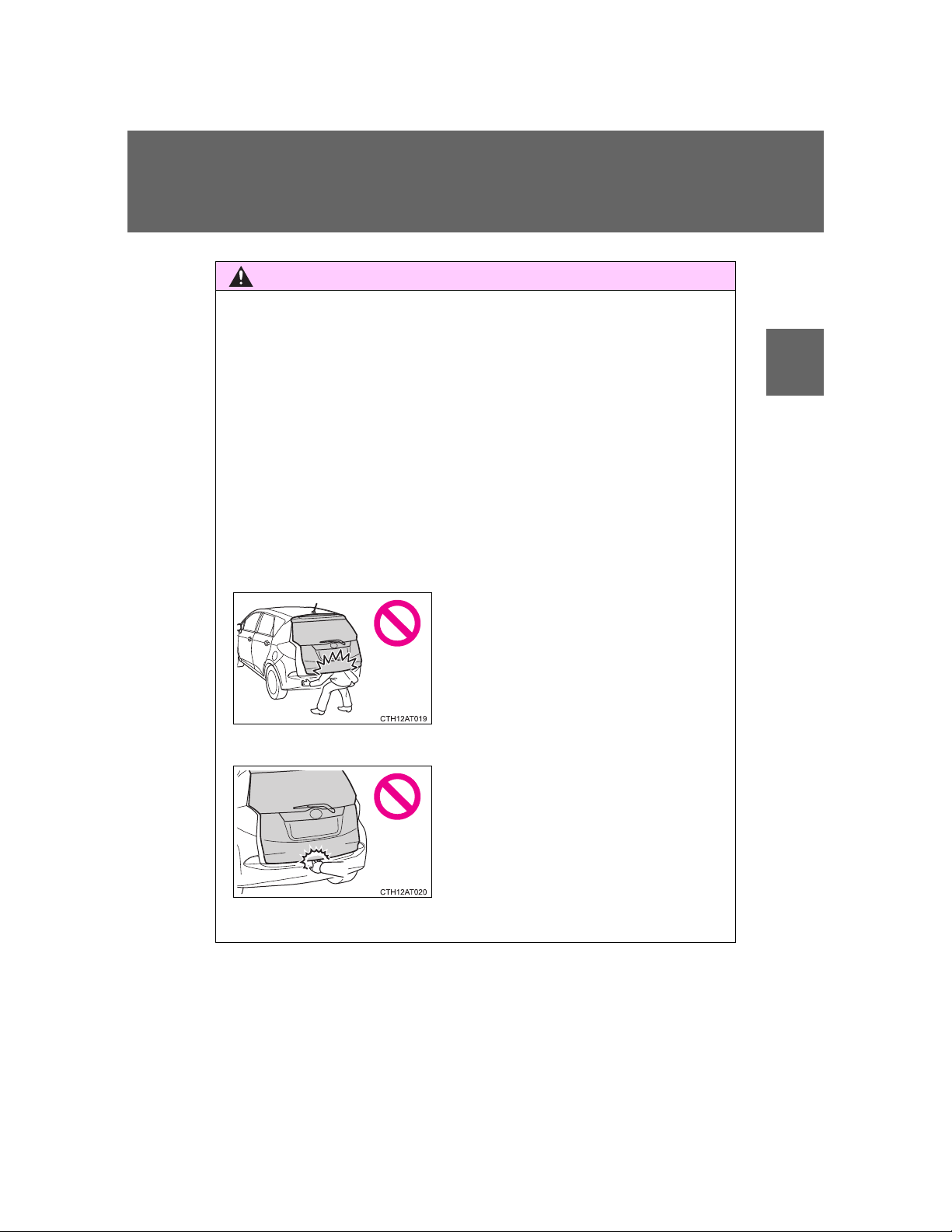
1-2. Opening, closing and locking the doors
CAUTION
The back door may suddenly shut if it is
not opened fully. It is more difficult to
open or close the back door on an
incline than on a level surface, so
beware of the back door unexpectedly
opening or closing by itself. Make sure
that the back door is fully open and
secure before using the luggage compartment.
When closing the back door, take extra
care to prevent your fingers etc. from
being caught.
When closing the back door, make sure
to press it lightly on its outer surface. If
the back door handle is used to fully
close the back door, it may result in
hands or arms being caught.
Operating the back door
Observe the following precautions.
Failure to do so may cause parts of the body to be caught, resulting in serious injury.
Remove any heavy loads, such as snow and ice, from the back door
before opening it. Failure to do so may cause the back door to suddenly
shut again after it is opened.
When opening or closing the back door, thoroughly check to make sure
the surrounding area is safe.
If anyone is in the vicinity, make sure they are safe and let them know that
the back door is about to open or close.
Use caution when opening or closing the back door in windy weather as it
may move abruptly in strong wind.
1
Before driving
VERSO-S_EE
67
Page 68
1-2. Opening, closing and locking the doors
CAUTION
NOTICE
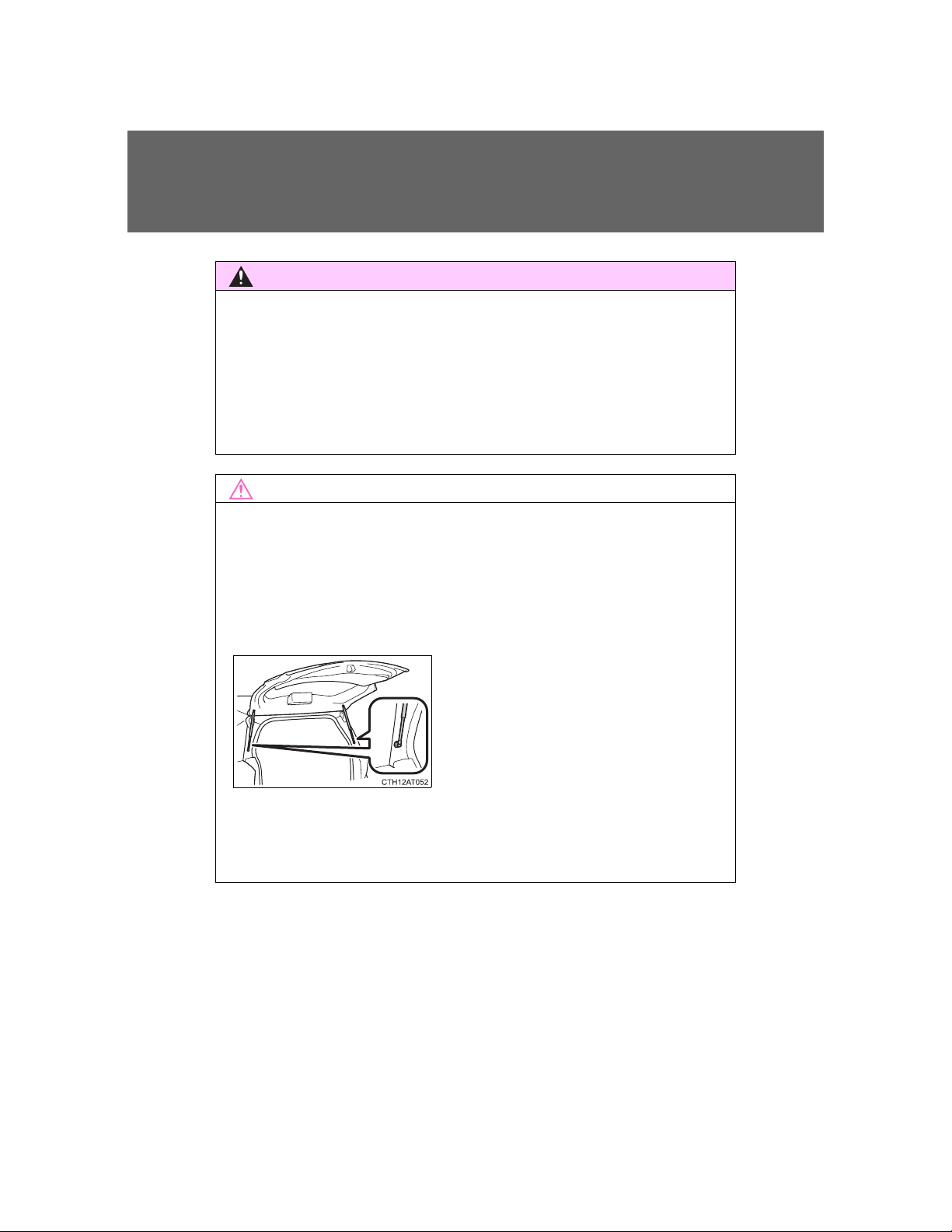
Do not attach any foreign objects, such
as stickers, plastic sheets, or adhesives
to the damper stay rod.
Do not touch the damper stay rod with
gloves or other fabric items.
Do not attach any accessories other
than genuine Toyota parts to the back
door.
Do not place your hand on the damper
stay or apply lateral forces to it.
Do not pull on the back door damper stay to close the back door, and do
not hang on the back door damper stay.
Doing so may cause hands to be caught or the back door damper stay to
break, causing an accident.
Do not attach any accessories other than genuine Toyota parts to the back
door. Such additional weight on the back door may cause the back door to
suddenly shut again after it is opened.
Back door damper stays
The back door is equipped with damper stays that hold the back door in
place.
Observe the following precautions.
Failure to do so may cause damage to the back door damper stay, resulting
in malfunction.
68
VERSO-S_EE
Page 69
1-3. Adjustable components (seats, mirrors, steering wheel)
CAUTION
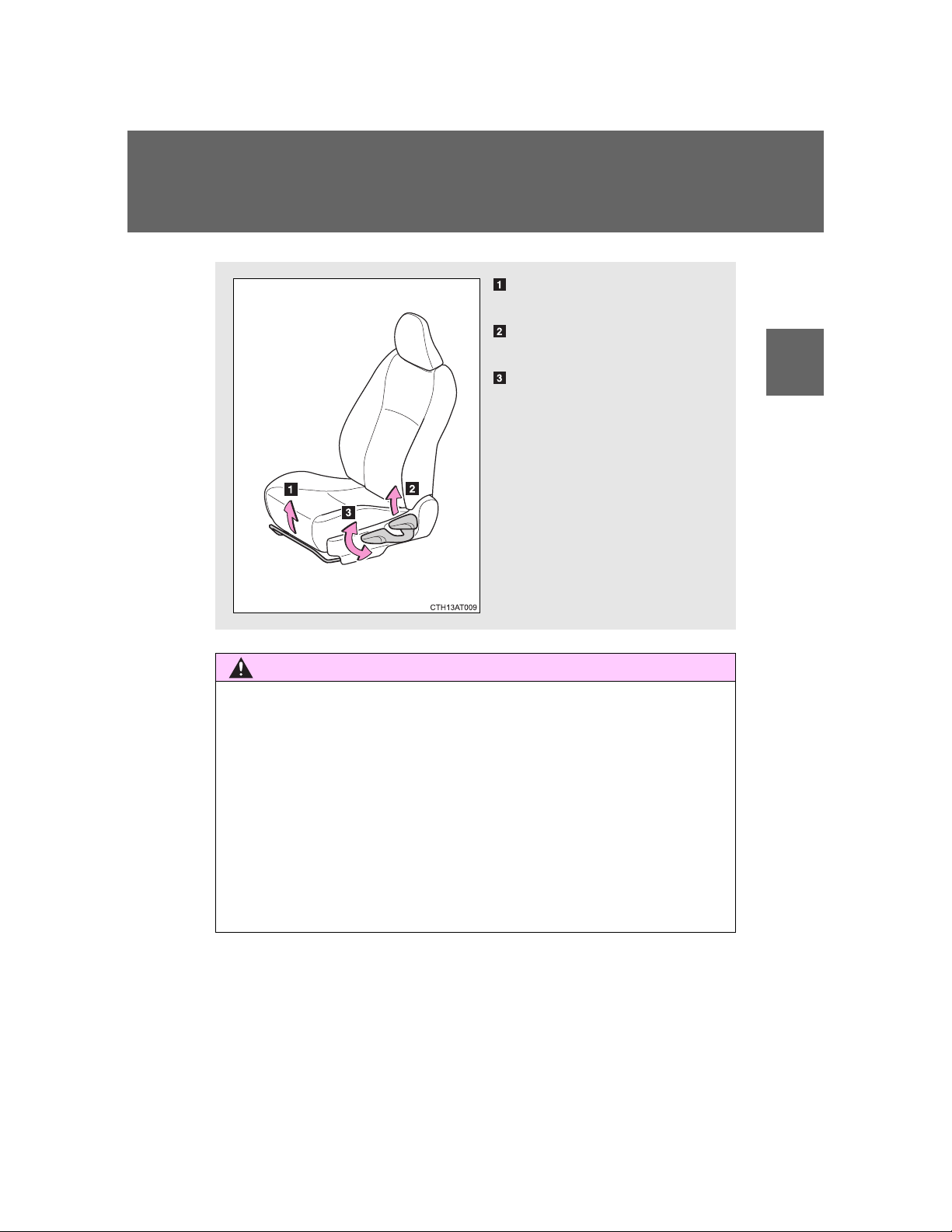
Seat position adjustment
lever
Seatback angle adjustment
lever
Vertical height adjustment
lever (driver’s side only)
Front seats
1
Before driving
Seat adjustment
Be careful that the seat does not hit passengers or luggage.
To reduce the risk of sliding under the lap belt during a collision, do not
recline the seat more than necessary.
If the seat is too reclined, the lap belt may slide past the hips and apply
restraint forces directly to the abdomen, or your neck may contact the
shoulder belt, increasing the risk of death or serious injury in the event of
an accident.
Adjustments should not be made while driving as the seat may unexpectedly move and cause the driver to lose control of the vehicle.
After adjusting the seat, make sure that the seat is locked in position.
69
VERSO-S_EE
Page 70
1-3. Adjustable components (seats, mirrors, steering wheel)
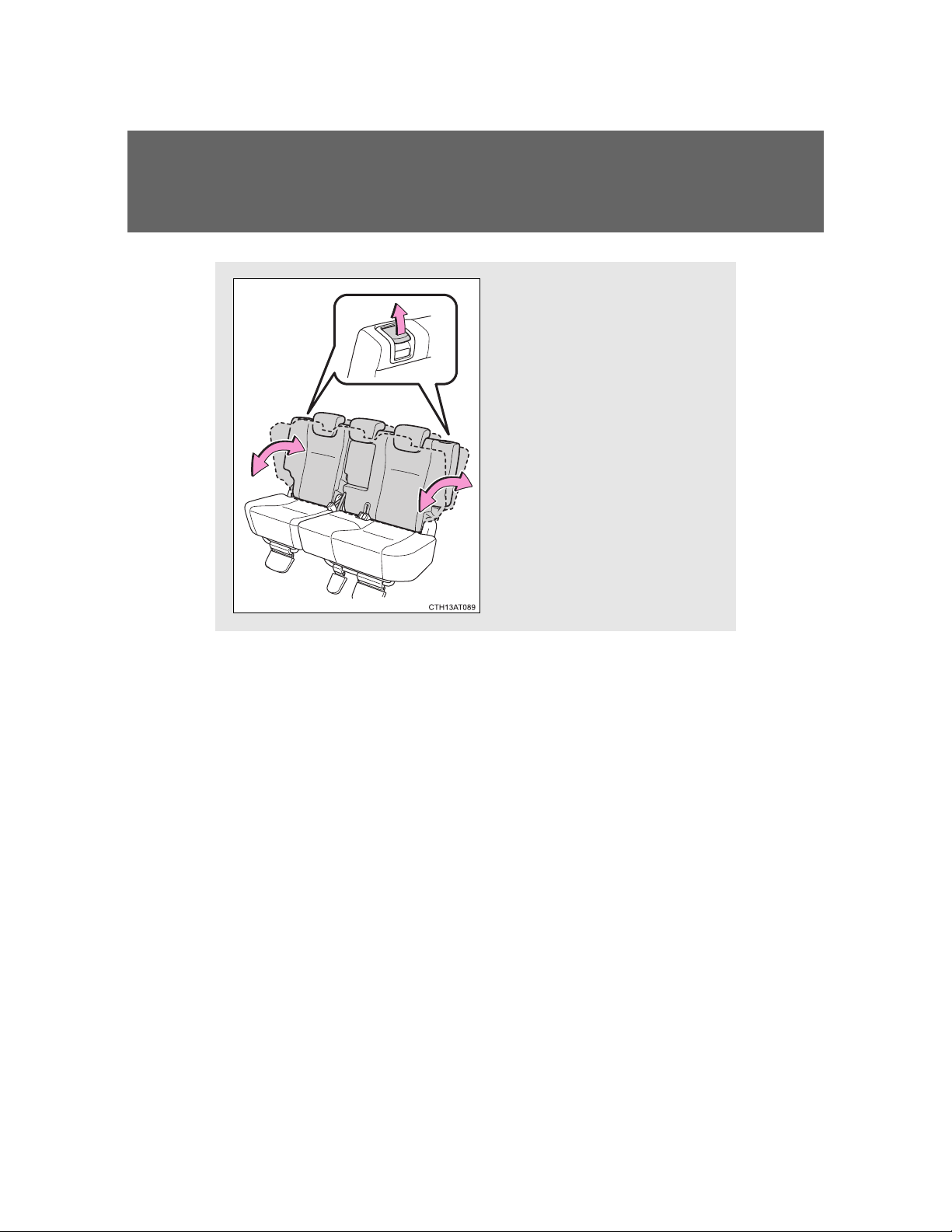
Pull up the seatback angle
adjustment lever until the lock
is released.
Rear seats
70
VERSO-S_EE
Page 71
1-3. Adjustable components (seats, mirrors, steering wheel)
STEP
1
STEP
2
STEP
3
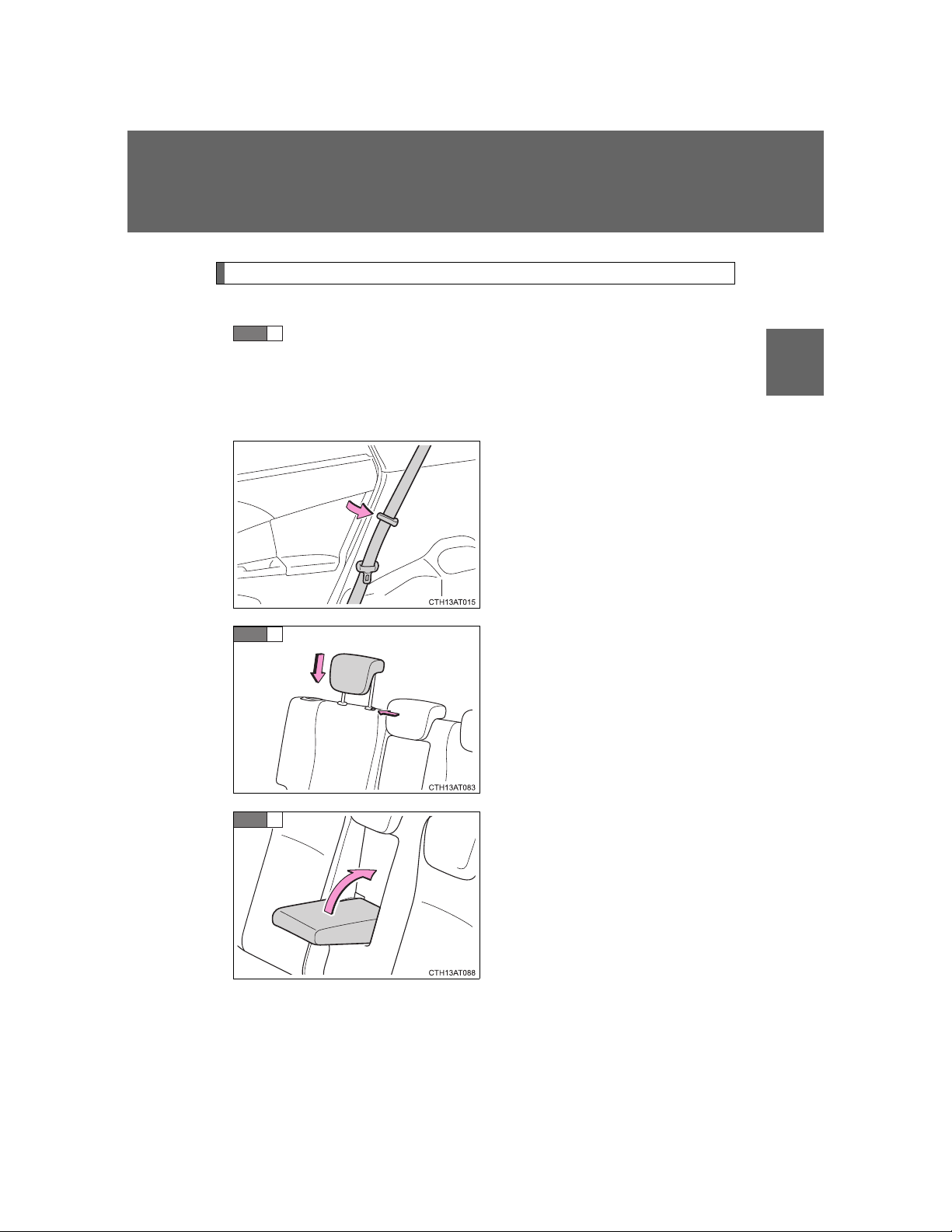
Folding down the rear seatbacks
Before folding down the rear seatbacks
Stow the seat belts.
Center
P. 7 8
Outside
Use the seat belt hangers to prevent the belts from being tangled.
Adjust the head restraints to the
downmost position.
1
Before driving
Vehicles with a rear armrest:
Raise the armrest.
71
VERSO-S_EE
Page 72
1-3. Adjustable components (seats, mirrors, steering wheel)
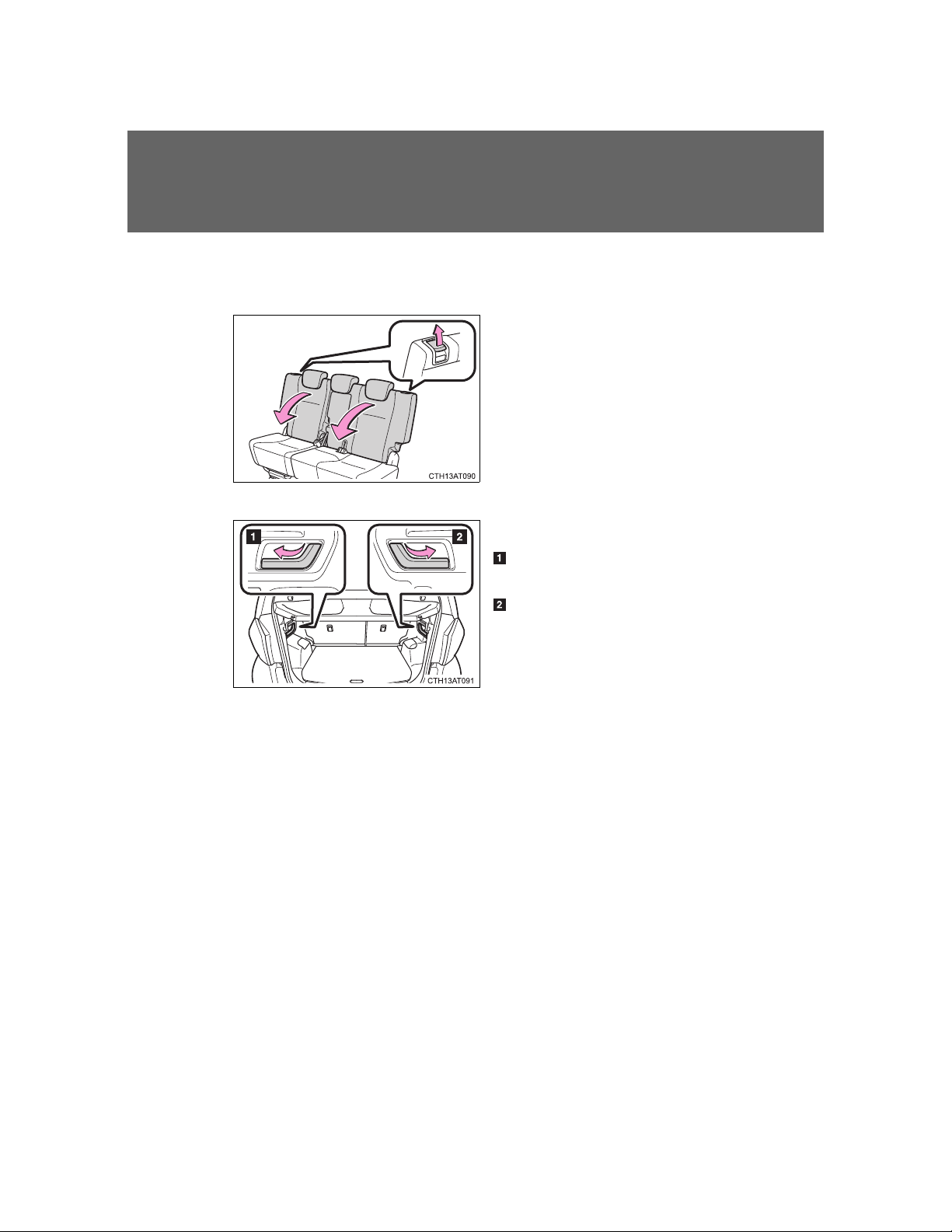
Folding down rear seatbacks
From inside
Fold the seatback down while
pulling the seatback angle
adjustment lever.
Pull the lever until the lock is
released.
From outside
Pull the lever.
Folds down the left side and
center seats
Folds down the right side seat
72
VERSO-S_EE
Page 73

1-3. Adjustable components (seats, mirrors, steering wheel)
CAUTION
When folding the rear seatbacks down
Observe the following precautions. Failure to do so may result in death or
serious injury.
Do not fold the rear seatback when rear passengers sit on the rear seats
or luggage is placed on the seat. Make sure that no passengers or luggage are on the rear seat. Be especially careful when operating the rear
seat from the luggage compartment.
Do not fold the seatbacks down while driving.
Stop the vehicle on level ground, set the parking brake and shift the shift
lever to P (vehicles with a Multidrive), E, M or R (vehicles with a multimode manual transmission) or N (vehicles with a manual transmission).
Do not allow anyone to sit on a folded seatback or in the luggage compart-
ment while driving.
Do not allow children to enter the luggage compartment.
Do not allow anyone sit on the rear center seat if the rear right seat is
folded down, as the seat belt buckle for the rear center seat belt is then
concealed under the folded seat and cannot be used.
Be careful not to catch your hand when folding the rear seatbacks.
Seat adjustment
To reduce the risk of sliding under the lap belt during a collision, do not
recline the seat more than necessary.
If the seat is too reclined, the lap belt may slide past the hips and apply
restraint forces directly to the abdomen, or your neck may contact the
shoulder belt, increasing the risk of death or serious injury in the event of
an accident.
Adjustments should not be made while driving as the seat may unexpectedly move and cause the driver to lose control of the vehicle.
Be careful not to catch your hand when adjusting the rear seats.
1
Before driving
73
VERSO-S_EE
Page 74
1-3. Adjustable components (seats, mirrors, steering wheel)
CAUTION
NOTICE
After returning the rear seatback to the upright position
Observe the following precautions. Failure to do so may result in death or
serious injury.
Make sure the seatback is securely locked by pushing it forward and rear-
ward on the top.
Check that the seat belts are not twisted or caught in the seatback.
Stowing the seat belts
The seat belts must be stowed before you fold down the rear seatbacks.
74
VERSO-S_EE
Page 75
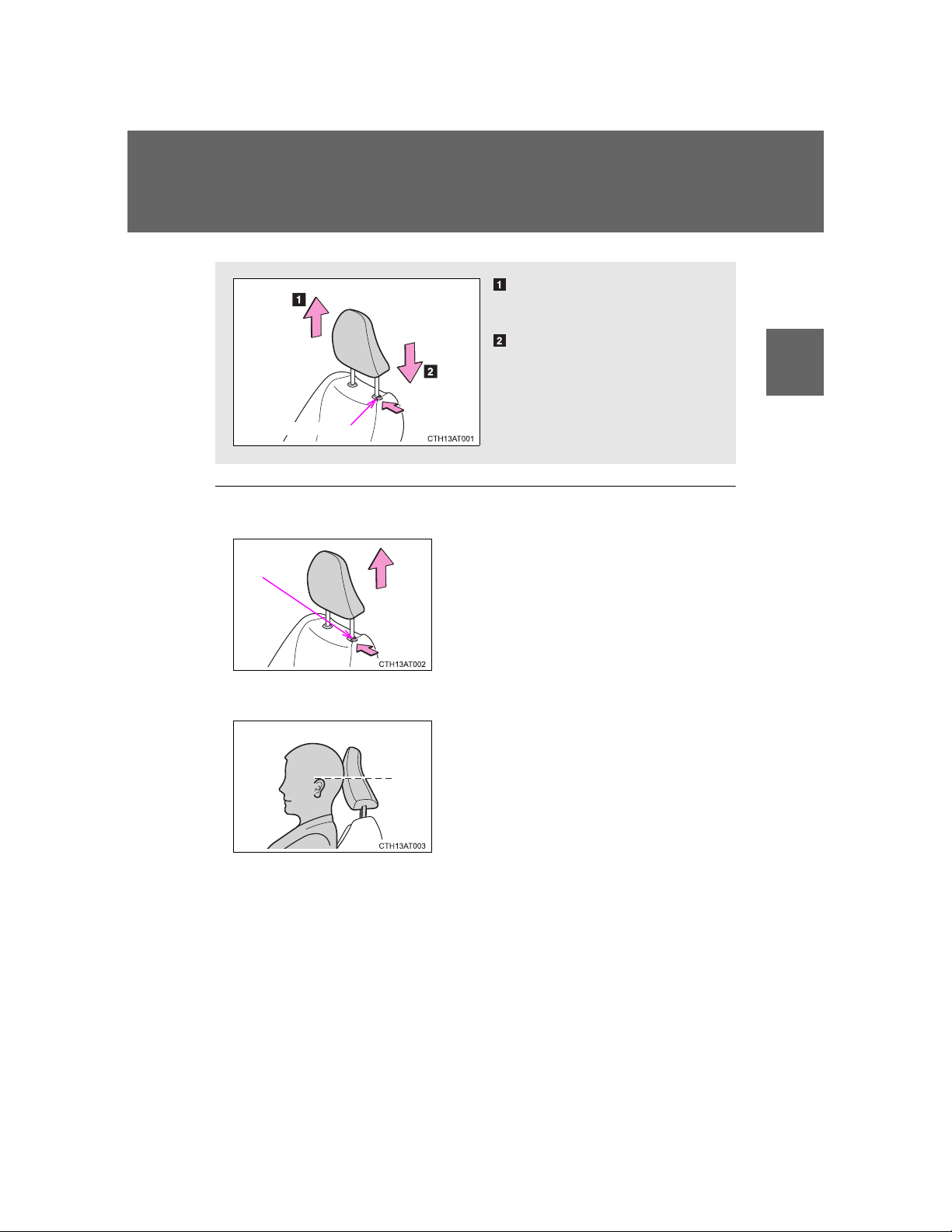
1-3. Adjustable components (seats, mirrors, steering wheel)
Up
Pull the head restraints up.
Down
Push the head restraint down
while pushing the lock release
button.
Lock release button
Pull the head restraint up while pressing
the lock release button.
Lock release
button
Make sure that the head restraints are
adjusted so that the center of the head
restraint is closest to the top of your ears.
Head restraints
Removing the head restraints
1
Before driving
Adjusting the height of the head restraints
Adjusting the rear seat head restraints
Always raise the head restraint one level from the stowed position when
using.
VERSO-S_EE
75
Page 76

1-3. Adjustable components (seats, mirrors, steering wheel)
CAUTION
Head restraint precautions
Observe the following precautions regarding the head restraints. Failure to
do so may result in death or serious injury.
Use the head restraints designed for each respective seat.
Adjust the head restraints to the correct position at all times.
After adjusting the head restraints, push down on them and make sure
they are locked in position.
Do not drive with the head restraints removed.
76
VERSO-S_EE
Page 77
1-3. Adjustable components (seats, mirrors, steering wheel)
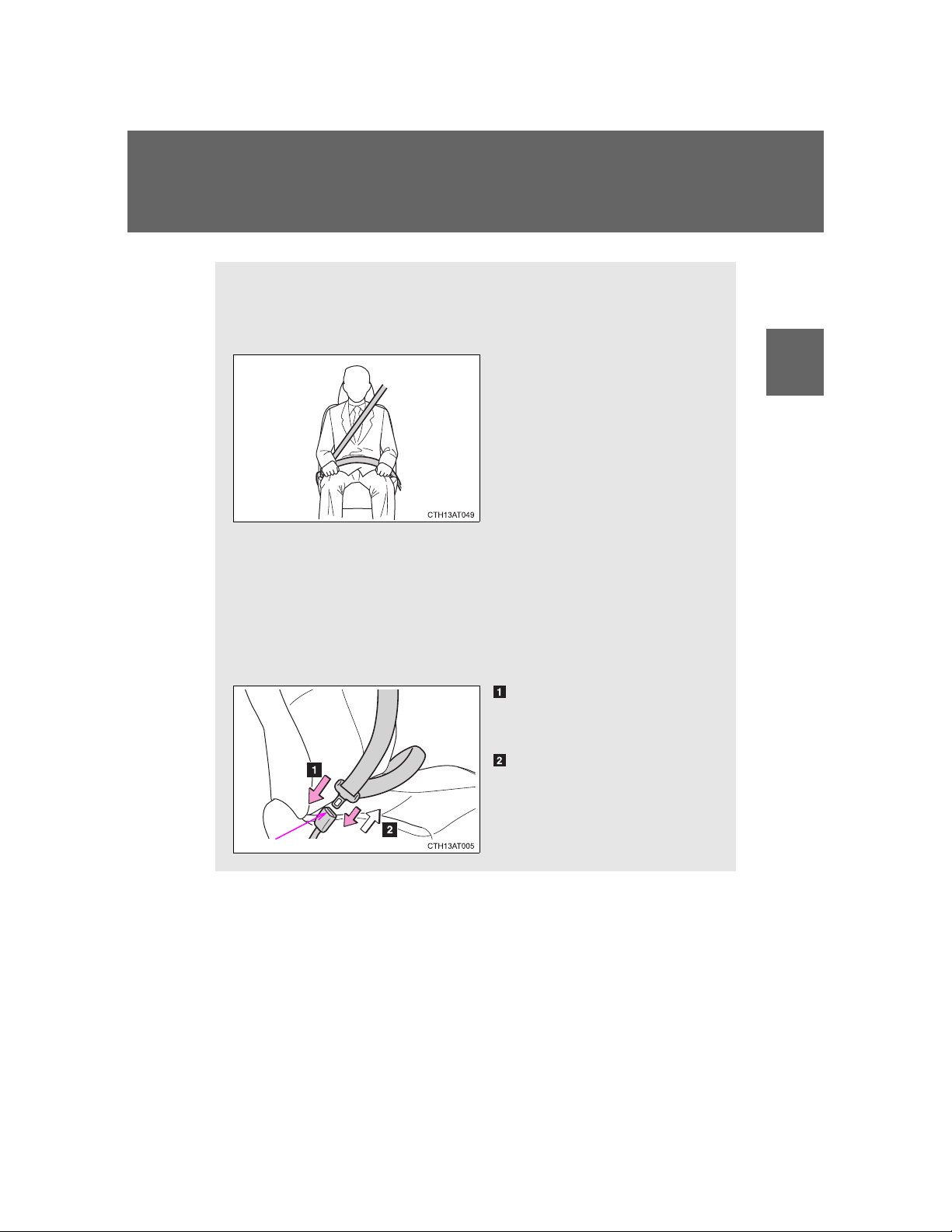
Make sure that all occupants are wearing their seat belts before driv-
ing the vehicle.
Correct use of the seat belts
Extend the shoulder belt so
that it comes fully over the
shoulder, but does not
come into contact with the
neck or slide off the shoulder.
Position the lap belt as low
as possible over the hips.
Adjust the position of the
seatback. Sit up straight
and well back in the seat.
Do not twist the seat belt.
Fastening and releasing the seat belt
To fasten the seat belt, push
the plate into the buckle
until a click sound is heard.
To release the seat belt,
press the release button.
Release button
Seat belts
1
Before driving
VERSO-S_EE
77
Page 78
1-3. Adjustable components (seats, mirrors, steering wheel)
STEP
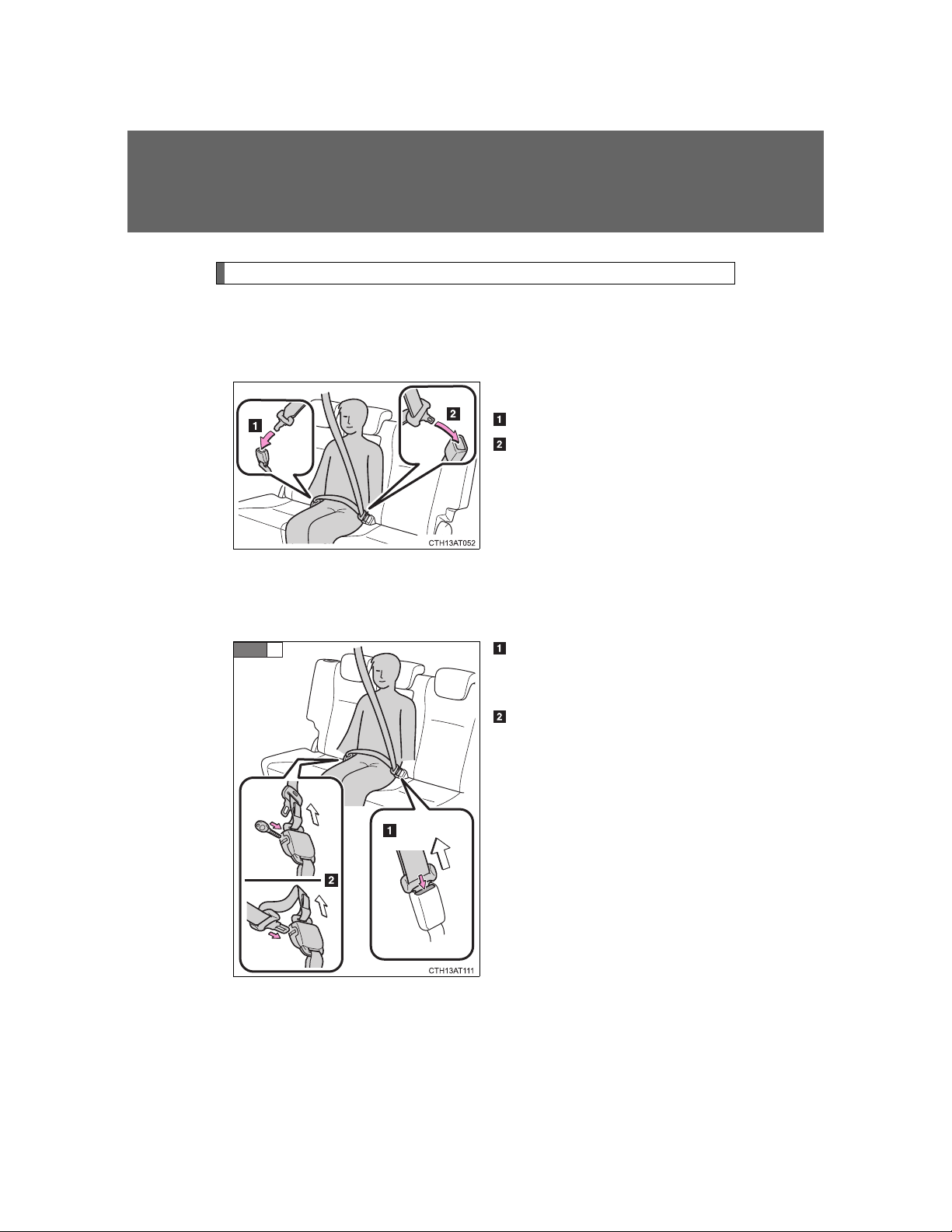
1
Rear center seat belt
The rear center seat belt is a 3-point type restraint with 2 buckles.
Both seat belt buckles must be correctly located and securely latched
for proper operation.
Push the tab into the buckle.
T
ab “A”
Tab “B ”
Push the tab into the buckle until
a clicking sound is heard.
Release method
The rear center seat belt can be completely released only when necessary such as when folding down the rear seat.
78
To release the hooked tab “B”,
push the buckle release button.
To release the hooked tab “A”,
insert the key (vehicles without a smart entry & start system) or mechanical key
(vehicles with a smart entry &
start system) (P. 3 0 ) o r t a b
“B” into the hole on the buckle.
Retract the belt slowly when
releasing and stowing the seat
belt.
VERSO-S_EE
Page 79
1-3. Adjustable components (seats, mirrors, steering wheel)
STEP
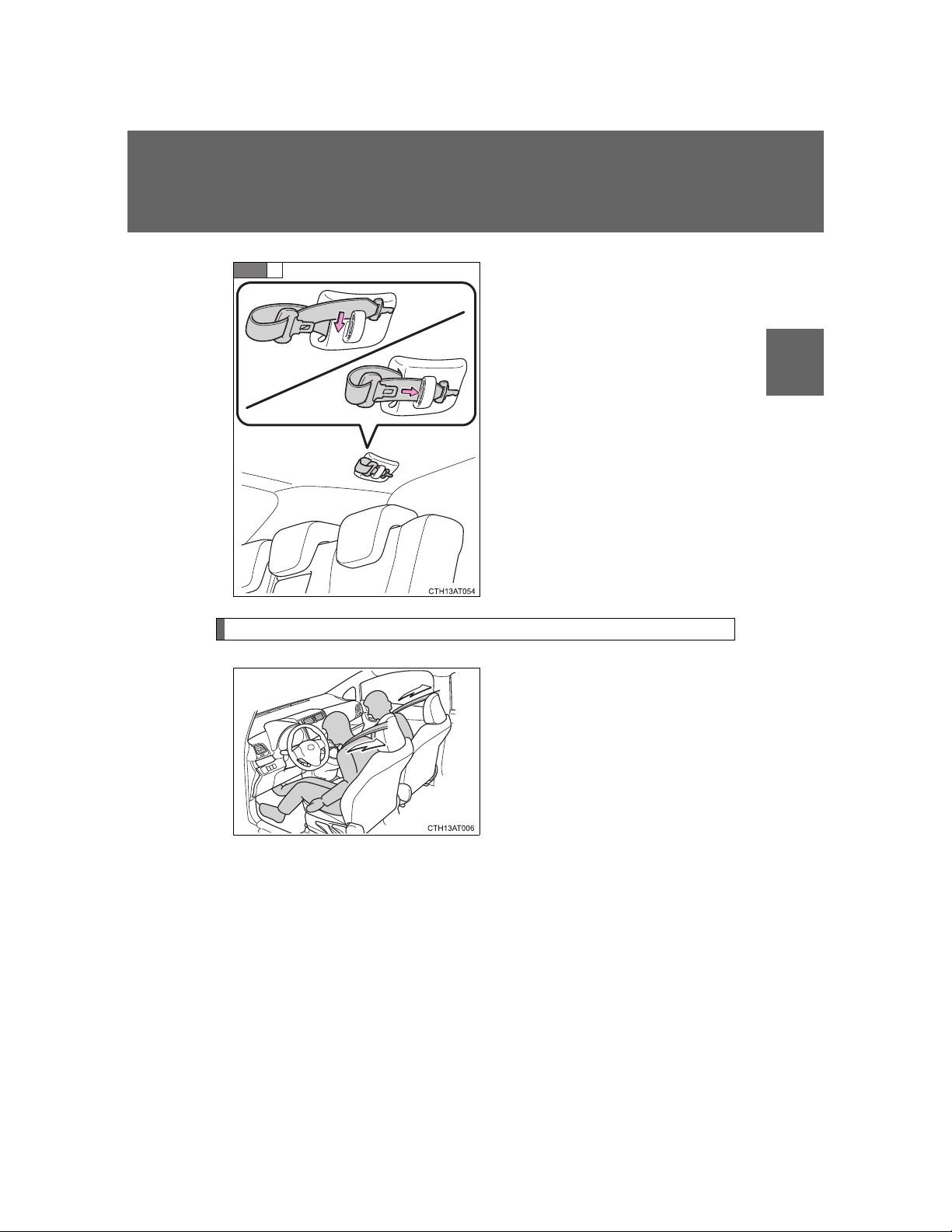
2
Stow the seat belt tabs using the
clip located on the roof as
shown.
Seat belt pretensioners (front seats)
1
Before driving
The pretensioner helps the seat
belt to quickly restrain the occupant by retracting the seat belt
when the vehicle is subjected to
certain types of severe frontal or
side collision.
The pretensioner does not activate in the event of a minor frontal
impact, a minor side impact, a
rear impact or a vehicle rollover.
79
VERSO-S_EE
Page 80
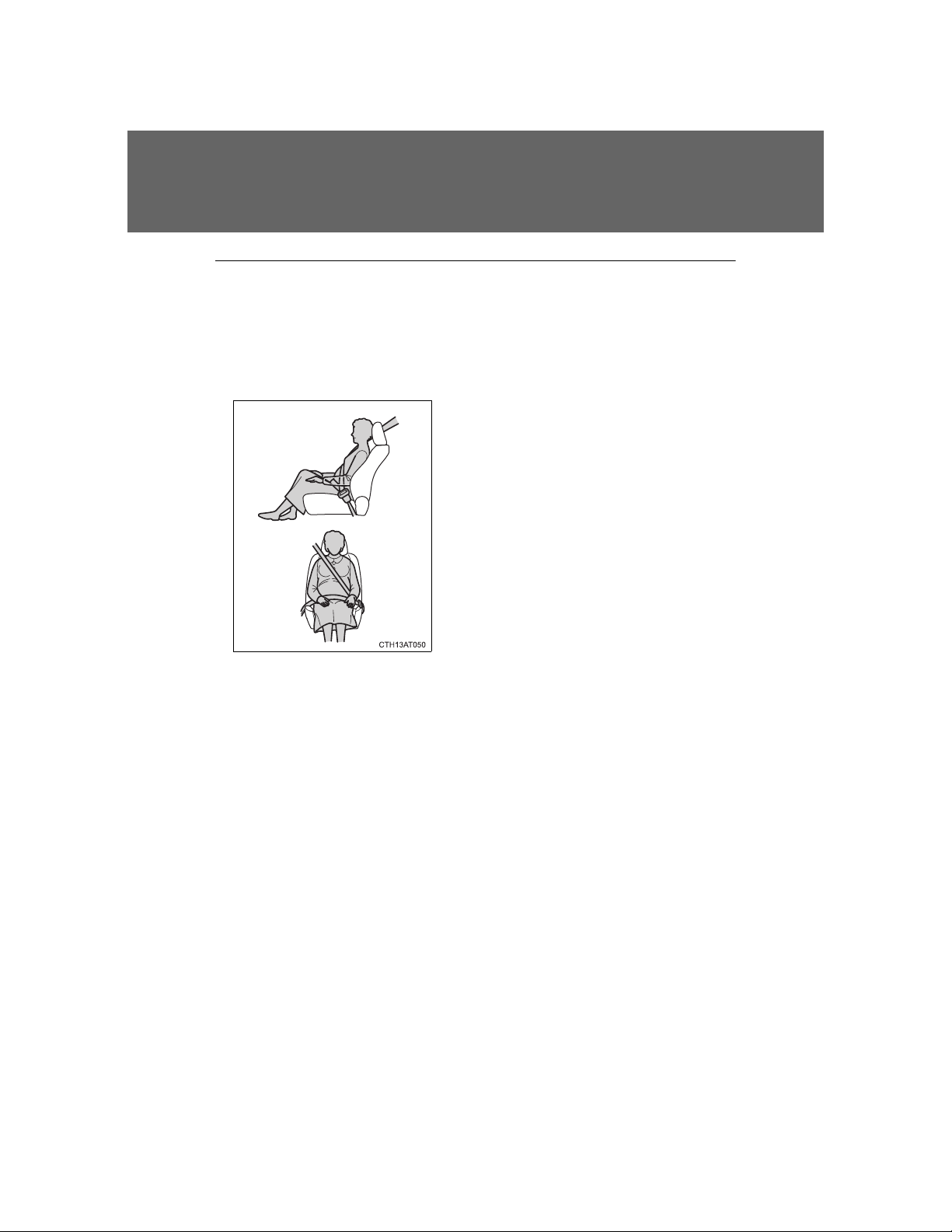
1-3. Adjustable components (seats, mirrors, steering wheel)
Obtain medical advice and wear the seat
belt in the proper way. (P. 77)
Women who are pregnant should position
the lap belt as low as possible over the
hips in the same manner as other occupants. Extend the shoulder belt completely over the shoulder and position the
belt across the chest. Avoid belt contact
over the rounding of the abdominal area.
If the seat belt is not worn properly, not
only the pregnant woman, but also the
fetus could suffer death or serious injury
as a result of sudden braking or a collision.
Emergency locking retractor (ELR)
The retractor will lock the belt during a sudden stop or on impact. It may also
lock if you lean forward too quickly. A slow, easy motion will allow the belt to
extend so that you can move around fully.
Pregnant women
People suffering illness
Obtain medical advice and wear the seat belt in the proper way. (P. 77)
80
VERSO-S_EE
Page 81

1-3. Adjustable components (seats, mirrors, steering wheel)
Child seat belt usage
The seat belts of your vehicle were principally designed for persons of adult
size.
Use a child restraint system appropriate for the child, until the child
becomes large enough to properly wear the vehicle's seat belt. (P. 126)
When the child becomes large enough to properly wear the vehicle's seat
belt, follow the instructions on P. 77 regarding seat belt usage.
Replacing the belt after the pretensioner has been activated
If the vehicle is involved in multiple collisions, the pretensioner will activate
for the first collision, but will not activate for the second or subsequent collisions.
Seat belt regulations
If seat belt regulations exist in the country where you reside, please contact
any authorized Toyota dealer or repairer, or another duly qualified and
equipped professional for seat belt replacement or installation.
1
Before driving
VERSO-S_EE
81
Page 82

1-3. Adjustable components (seats, mirrors, steering wheel)
CAUTION
Observe the following precautions to reduce the risk of injury in the event of
sudden braking, sudden swerving or an accident.
Failure to do so may cause death or serious injury.
Wearing a seat belt
Ensure that all passengers wear a seat belt.
Always wear a seat belt properly.
Each seat belt should be used by one person only. Do not use a seat belt
for more than one person at once, including children.
Toyota recommends that children be seated in the rear seat and always
use a seat belt and/or an appropriate child restraint system.
To achieve a proper seating position, do not recline the seat more than
necessary. The seat belt is most effective when the occupants are sitting
up straight and well back in the seats.
Do not wear the shoulder belt under your arm.
Always wear your seat belt low and snug across your hips.
When children are in the vehicle
Do not allow children to play with the seat belt. If the seat belt becomes
twisted around a child’s neck, choking or other serious injuries may result in
death.
If this occurs and the buckle cannot be unfastened, scissors should be used
to cut the belt.
Seat belt pretensioners
If the pretensioner has activated, the SRS warning light will come on. In that
case, the seat belt cannot be used again and must be replaced at any authorized Toyota dealer or repairer, or another duly qualified and equipped professional.
82
VERSO-S_EE
Page 83
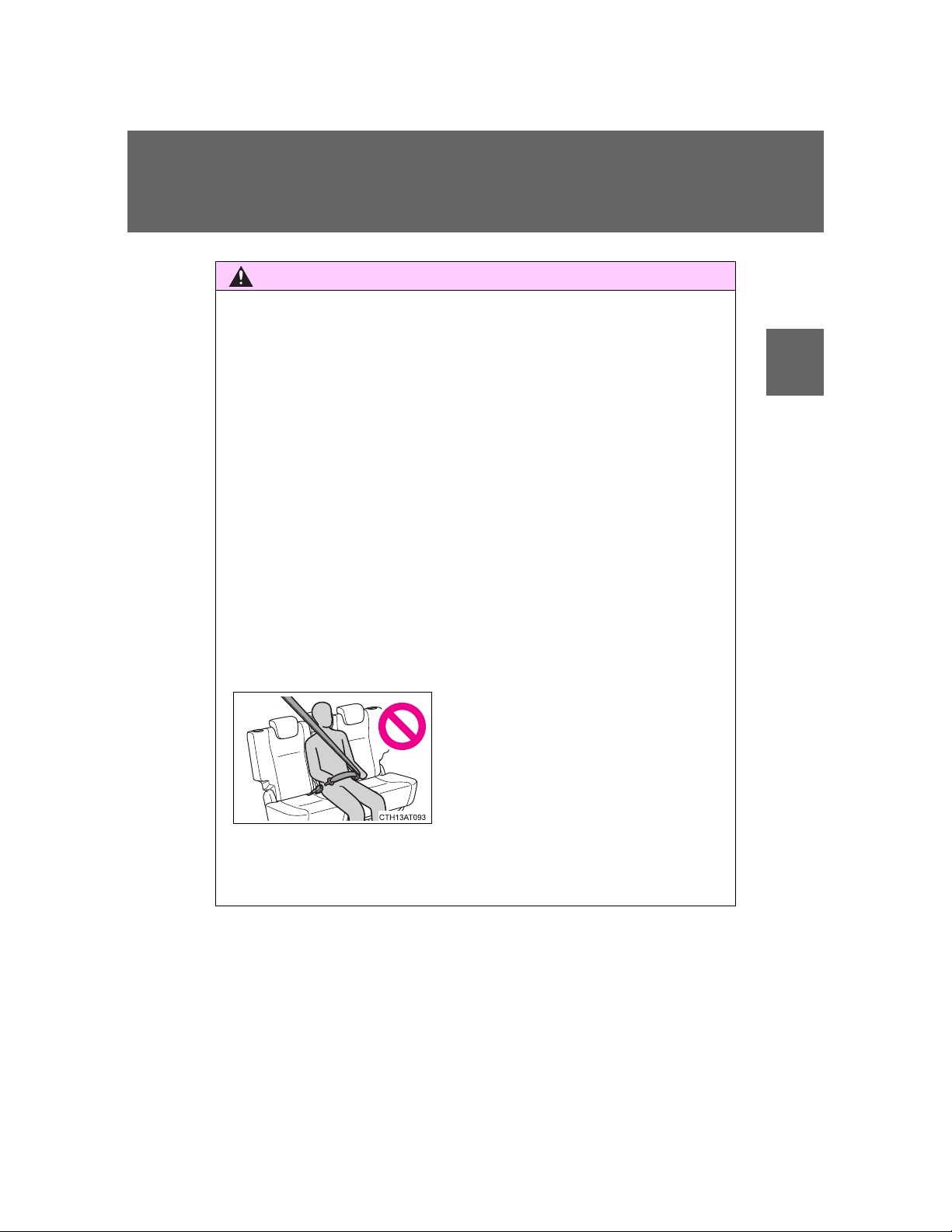
1-3. Adjustable components (seats, mirrors, steering wheel)
CAUTION
Do not use the rear center seat belt
with either buckle released.
Fastening only one of the buckles may
result in death or serious injury in case
of sudden braking or a collision.
Seat belt damage and wear
Do not damage the seat belts by allowing the belt, plate, or buckle to be
jammed in the door.
Inspect the seat belt system periodically. Check for cuts, fraying, and loose
parts. Do not use a damaged seat belt until it is replaced. Damaged seat
belt cannot protect an occupant from death or serious injury.
Ensure that the belt and plate are locked and the belt is not twisted.
If the seat belt does not function correctly, immediately contact any authorized Toyota dealer or repairer, or another duly qualified and equipped professional.
Replace the seat assembly, including the belts, if your vehicle has been
involved in a serious accident, even if there is no obvious damage.
Do not attempt to install, remove, modify, disassemble or dispose of the
seat belts. Have any necessary repairs carried out by any authorized
Toyota dealer or repairer, or another duly qualified and equipped professional. Inappropriate handling of the pretensioner may prevent it from
operating properly, resulting in death or serious injury.
When using the rear center seat belt
1
Before driving
Do not allow anyone sit on the rear center seat if the rear right seat is
VERSO-S_EE
folded down, as the seat belt buckle for the rear center seat belt is then
concealed under the folded seat and cannot be used.
83
Page 84
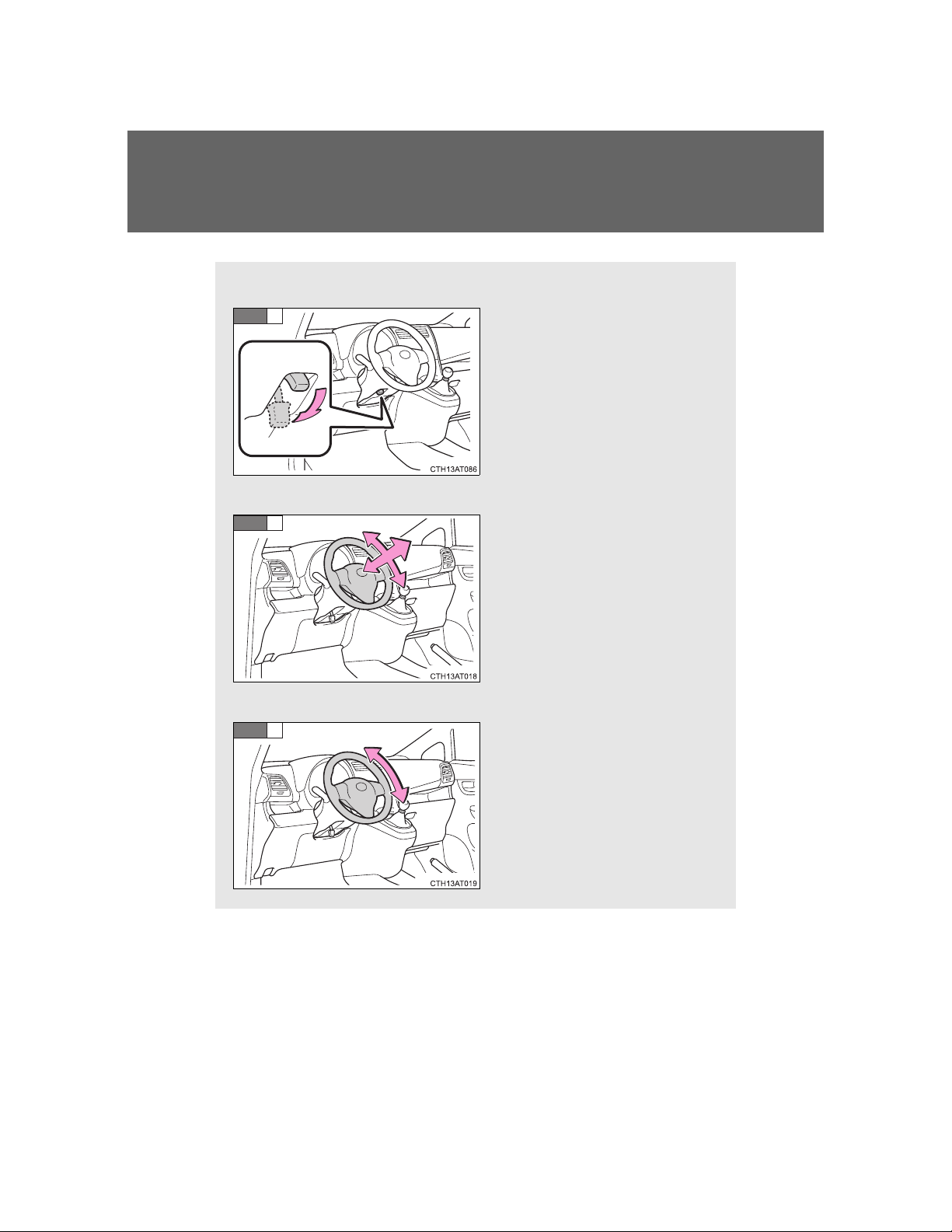
1-3. Adjustable components (seats, mirrors, steering wheel)
The steering wheel can be adjusted to a comfortable position.
Hold the steering wheel and
push the lever down.
Type A
Adjust to the ideal position by
moving the steering wheel
horizontally and vertically.
After adjustment, pull the lever
up to secure the steering
wheel.
Type B
Adjust to the ideal position by
moving the steering wheel.
After adjustment, pull the lever
up to secure the steering
wheel.
STEP
1
STEP
2
STEP
2
Steering wheel
84
VERSO-S_EE
Page 85

1-3. Adjustable components (seats, mirrors, steering wheel)
CAUTION
Caution while driving
Do not adjust the steering wheel while driving.
Doing so may cause the driver to mishandle the vehicle and cause an accident, resulting in death or serious injury.
After adjusting the steering wheel
Make sure that the steering wheel is securely locked.
Otherwise, the steering wheel may move suddenly, possibly causing an
accident, and resulting in death or serious injury.
1
Before driving
85
VERSO-S_EE
Page 86
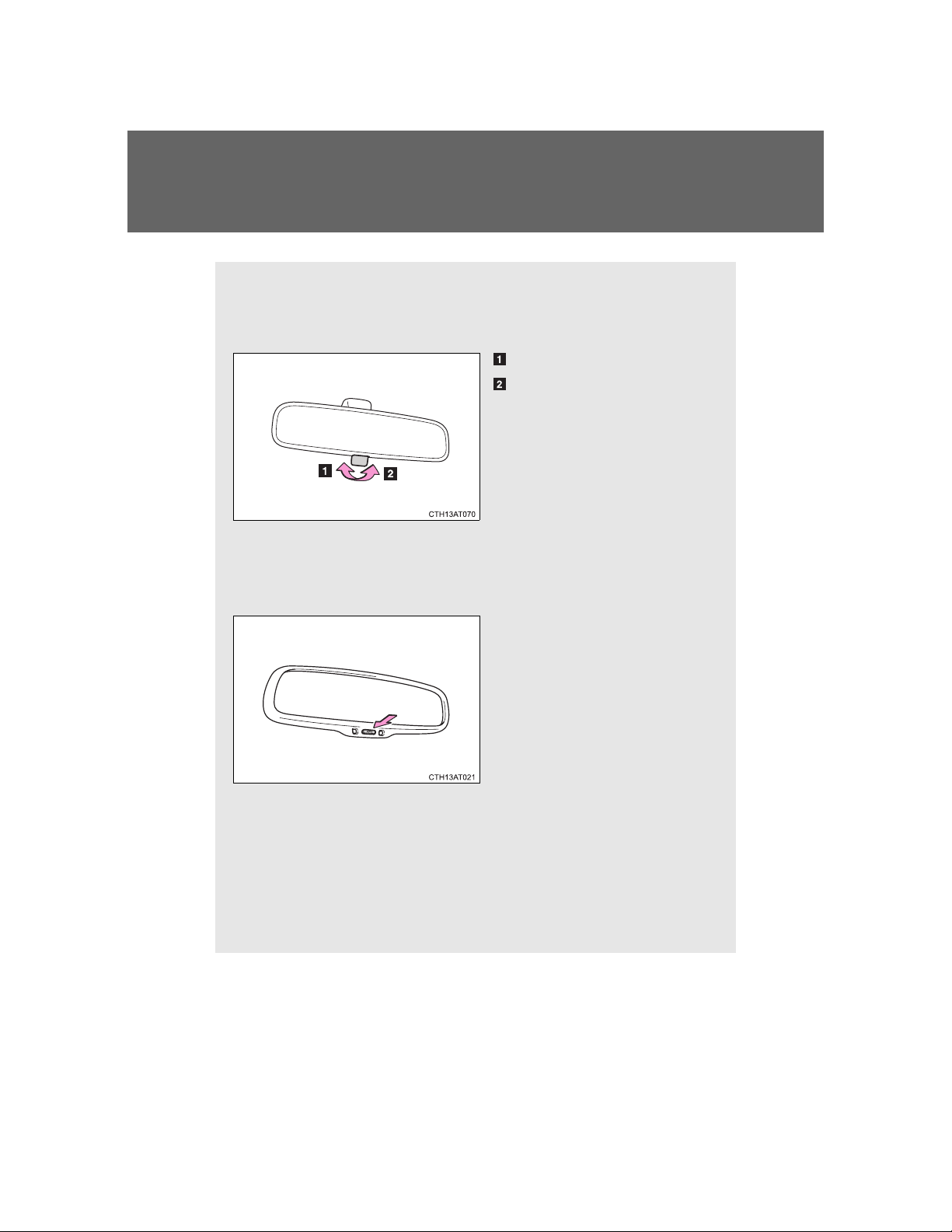
1-3. Adjustable components (seats, mirrors, steering wheel)
Glare from the headlights of vehicles behind can be reduced by
using the following functions:
Manual anti-glare inside rear view mirror
Normal position
Anti-glare position
Auto anti-glare inside rear view mirror
In automatic mode, sensors are used to detect the headlights of
vehicles behind and the reflected light is automatically reduced.
Turns automatic mode on/off
The indicator comes on when
automatic mode is turned on.
Vehicles without a smart
entry & start system
The mirror will revert to the
automatic mode each time the
engine switch is turned to the
“ON” position.
Vehicles with a smart entry &
start system
The mirror will revert to the
automatic mode each time the
“ENGINE START STOP”
switch is turned to IGNITION
ON mode.
Anti-glare inside rear view mirror
86
VERSO-S_EE
Page 87
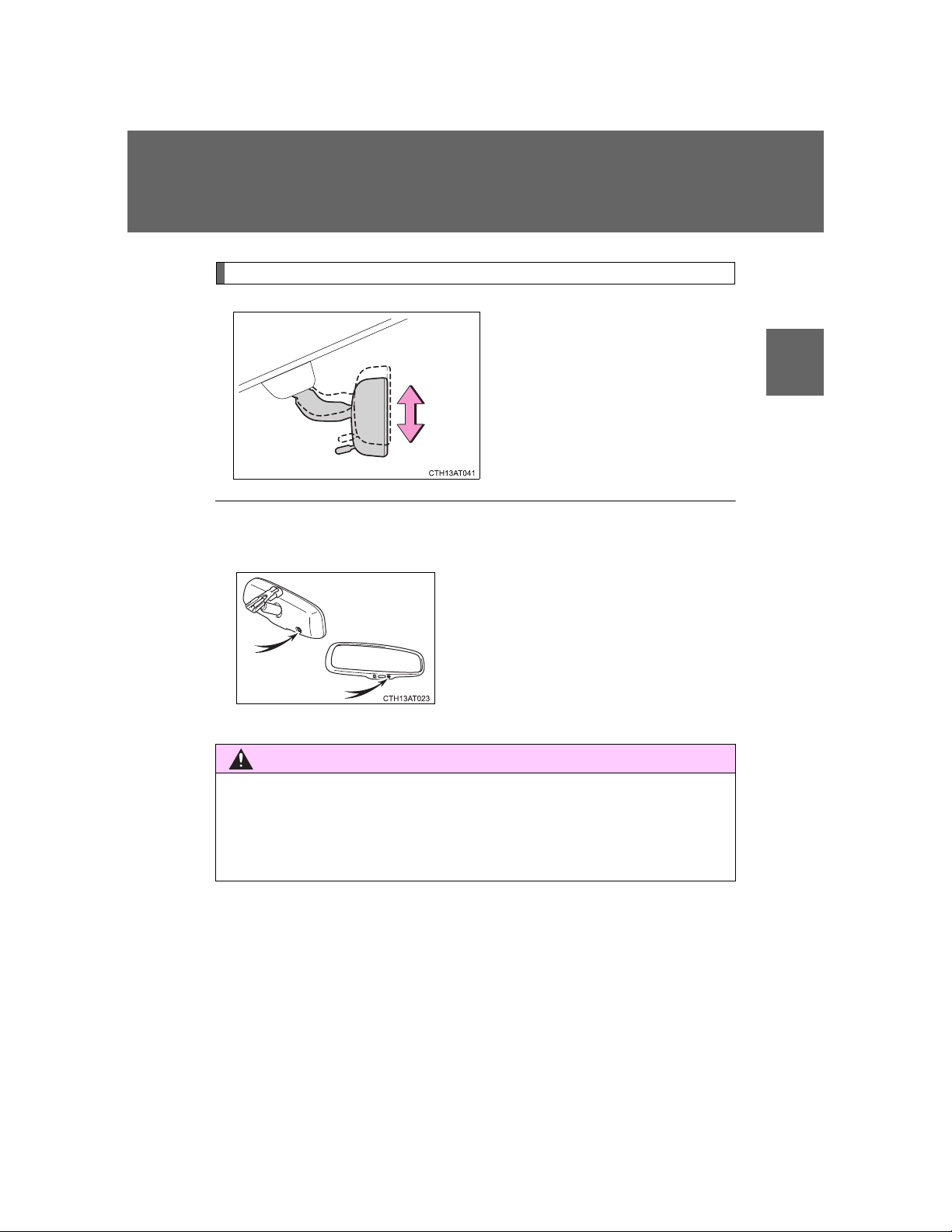
1-3. Adjustable components (seats, mirrors, steering wheel)
CAUTION
To ensure that the sensors operate properly, do not touch or cover them.
Adjusting the height of rear view mirror
Adjust the height of the rear view
mirror by moving it up and down.
To prevent sensor error (vehicles with an auto anti-glare inside rear
view mirror)
1
Before driving
Caution while driving
Do not adjust the position of the mirror while driving.
Doing so may lead to mishandling of the vehicle and cause an accident,
resulting in death or serious injury.
87
VERSO-S_EE
Page 88
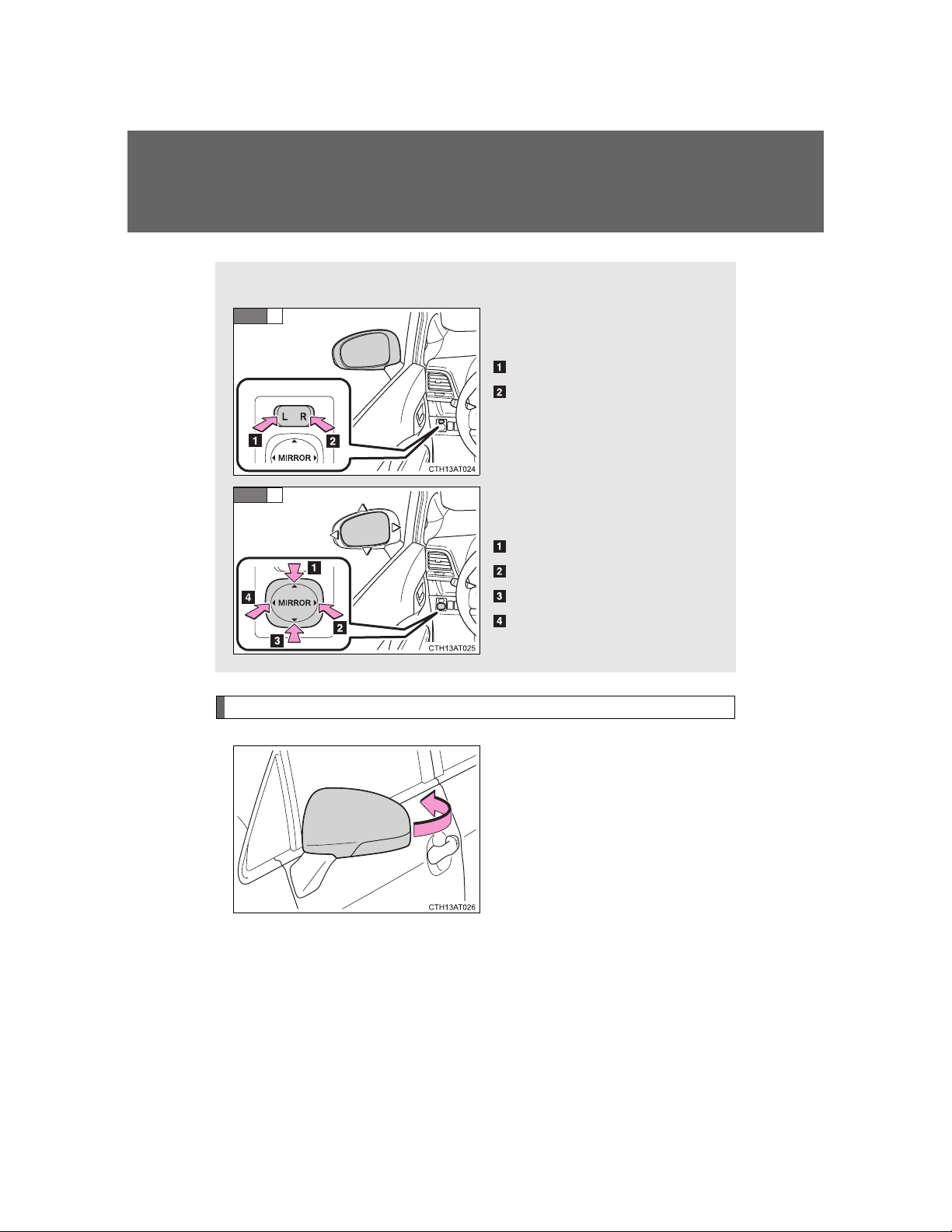
1-3. Adjustable components (seats, mirrors, steering wheel)
Mirror angle can be adjusted using the switch.
To select a mirror to adjust,
press the switch.
Left
Right
To adjust the mirror, press the
switch.
Up
Right
Down
Left
STEP
1
STEP
2
Outside rear view mirrors
Folding the mirrors
88
VERSO-S_EE
Push the mirror back in the direction of the vehicle's rear.
Page 89

1-3. Adjustable components (seats, mirrors, steering wheel)
CAUTION
Mirror angle can be adjusted when
Vehicles without a smart entry & start system
The engine switch is in the “ACC” or “ON” position.
Vehicles with a smart entry & start system
The “ENGINE START STOP” switch is in ACCESSORY or IGNITION ON
mode.
When the mirrors are fogged up (vehicles with outside rear view mirror
defoggers)
Turn on the mirror defoggers to defog the mirrors. (P. 276)
When driving the vehicle
Observe the following precautions while driving.
Failure to do so may result in loss of control of the vehicle and cause an
accident, resulting in death or serious injury.
Do not adjust the mirrors while driving.
Do not drive with the mirrors folded.
Both the driver and passenger side mirrors must be extended and properly
adjusted before driving.
When a mirror is moving
To avoid personal injury and mirror malfunction, be careful not to get your
hand caught by the moving mirror.
When the mirror defoggers are operating (vehicles with outside rear
view mirror defoggers)
Do not touch the rear view mirror surfaces, as they can become very hot and
burn you.
1
Before driving
89
VERSO-S_EE
Page 90
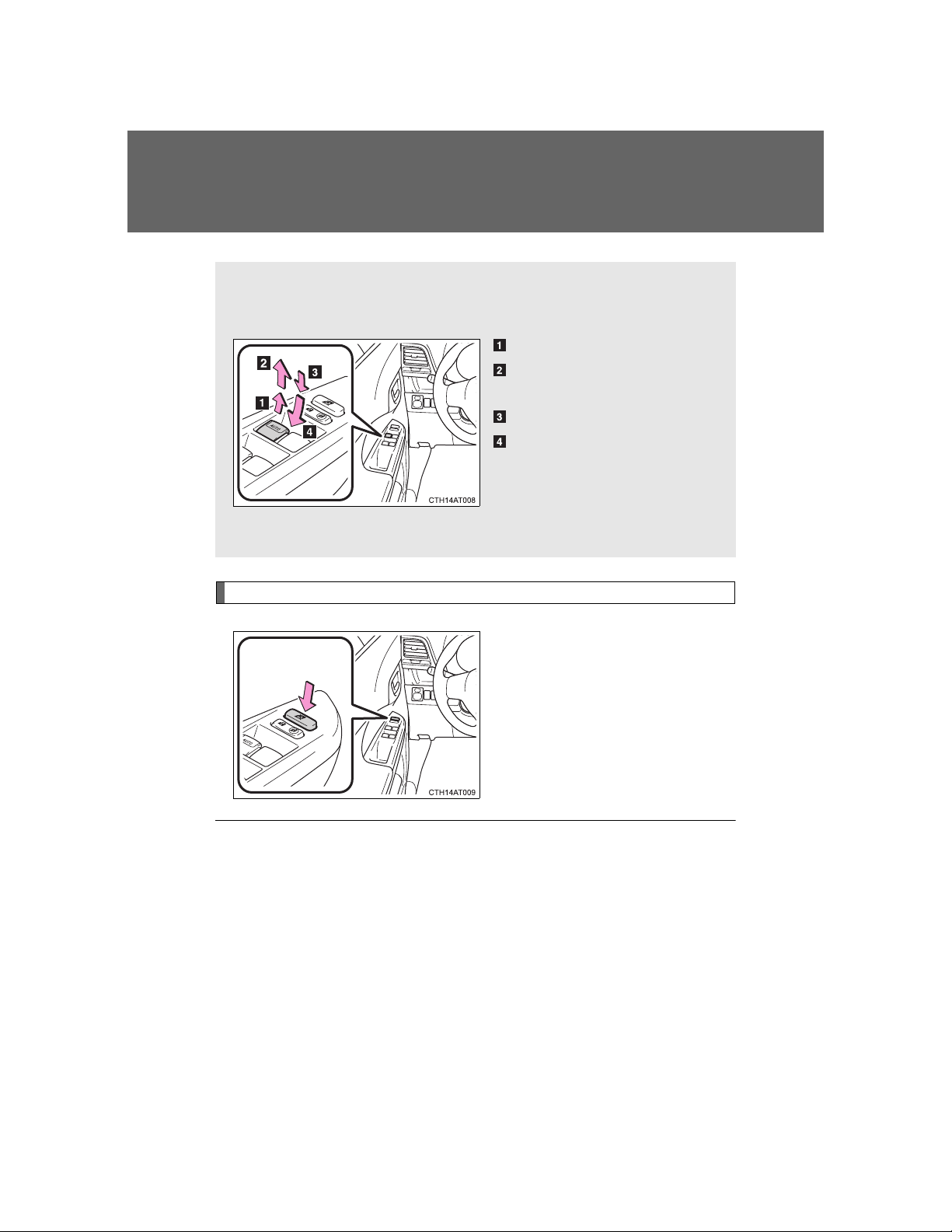
1-4. Opening and closing the windows
The power windows can be opened and closed using the switches.
Operating the switch moves the windows as follows:
Closing
One-touch closing (driver’s
side only)
*
Opening
One-touch opening (driver’s
side only)
*
*: To stop the window partway,
operate the switch in the
opposite direction.
Power windows
Window lock switch
Press the switch down to lock
the passenger window switches.
The power windows can be operated when
Vehicles without a smart entry & start system
The engine switch is in the “ON” position.
Vehicles with a smart entry & start system
The “ENGINE START STOP” switch is in IGNITION ON mode.
90
VERSO-S_EE
Use this switch to prevent children from accidentally opening or
closing a passenger window.
Page 91

1-4. Opening and closing the windows
STEP
1
STEP
2
Operating the power windows after turning the engine off
Vehicles without a smart entry & start system
The power windows can be operated for approximately 45 seconds even
after the engine switch is turned to the “ACC” or “LOCK” position. They cannot, however, be operated once either front door is opened.
Vehicles with a smart entry & start system
The power windows can be operated for approximately 45 seconds even
after the “ENGINE START STOP” switch is turned to ACCESSORY mode or
turned off. They cannot, however, be operated once either front door is
opened.
Jam protection function (driver’s side only)
If an object becomes caught between the window and the window frame,
window travel is stopped and the window is opened slightly.
When the power window does not close normally
If the jam protection function is operating abnormally and a window cannot
be closed, perform the following operations using the power window switch
on the driver’s door.
Vehicles without a smart entry & start system: After stopping the vehicle,
the window can be closed by holding the power window switch in the
one-touch closing position while the engine switch is turned to the “ON”
position.
Vehicles with a smart entry & start system: After stopping the vehicle, the
window can be closed by holding the power window switch in the onetouch closing position while the “ENGINE START STOP” switch is turned
to IGNITION ON mode.
If the window still cannot be closed even by carrying out the operation
explained above, initialize the function by performing the following procedure.
Hold the power window switch in the one-touch closing position.
Continue holding the switch for a further 6 seconds after the window has closed.
Hold the power window switch in the one-touch opening position.
Continue holding the switch for a further 2 seconds after the window has opened completely.
1
Before driving
91
VERSO-S_EE
Page 92

1-4. Opening and closing the windows
CAUTION
STEP
3
Hold the power window switch in the one-touch closing position
once again. Continue holding the switch for a further 2 seconds
after the window has closed.
If you release the switch while the window is moving, start again from the
beginning.
If the window continues to close but then re-open slightly even after performing the above procedure correctly, have the vehicle inspected by any authorized Toyota dealer or repairer, or another duly qualified and equipped
professional.
Closing the windows
Observe the following precautions.
Failure to do so may result in death or serious injury.
Check to make sure that all passengers do not have any part of their body
in a position where it could be caught when a window is being operated.
Do not allow children to operate the power windows.
Closing a power window on someone can cause serious injury, and in
some instances, even death.
Jam protection function (driver’s side only)
Never use any part of your body to intentionally activate the jam protection
function.
The jam protection function may not work if something gets caught just
before the window fully closes.
92
VERSO-S_EE
Page 93
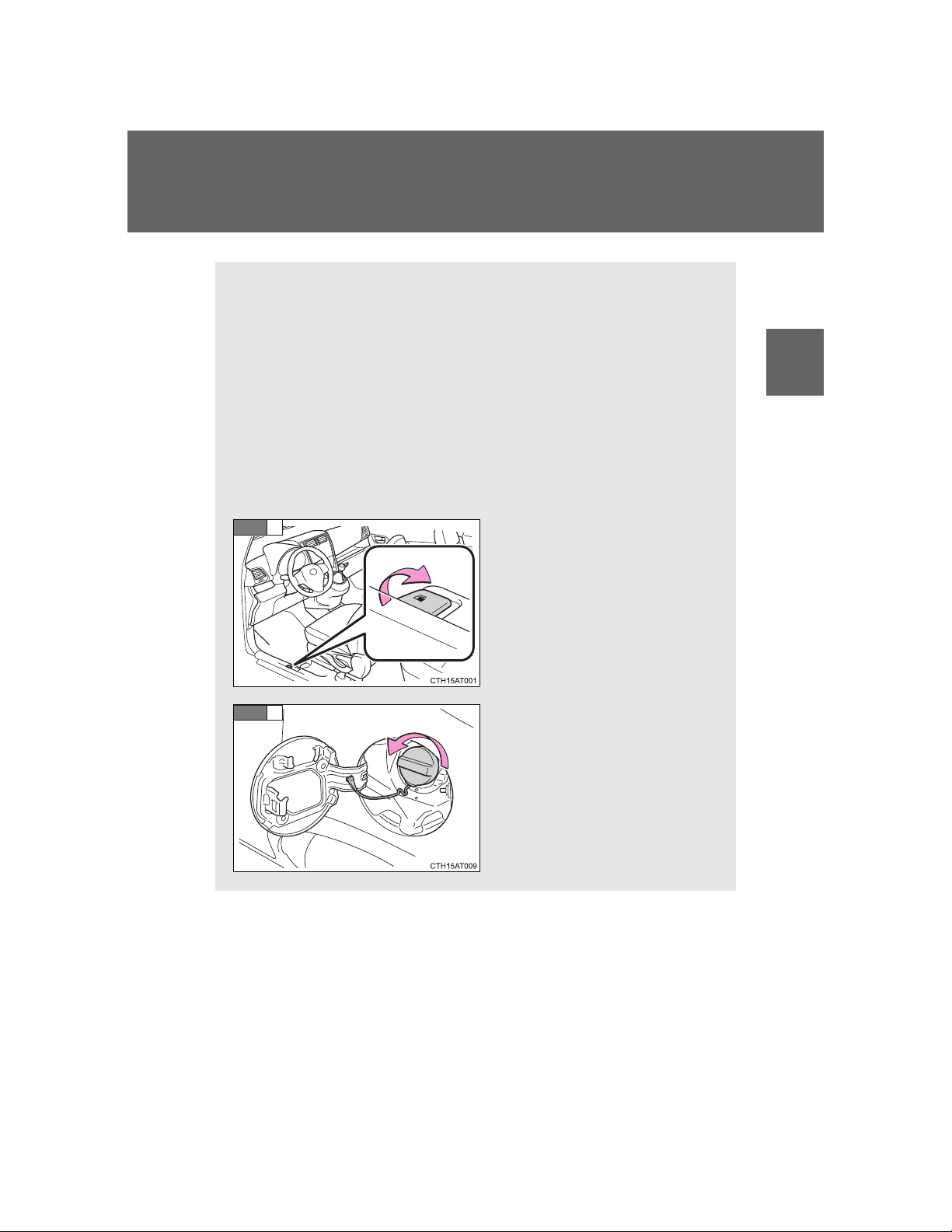
1-5. Refueling
Perform the following steps to open the fuel tank cap:
Before refueling the vehicle
Vehicles without a smart entry & start system
Turn the engine switch off and ensure that all the doors and windows are closed.
Vehicles with a smart entry & start system
Turn the “ENGINE START STOP” switch off and ensure that all
the doors and windows are closed.
Opening the fuel tank cap
Pull up the opener to open the
fuel filler door.
Turn the fuel tank cap slowly
to open.
STEP
1
STEP
2
Opening the fuel tank cap
1
Before driving
93
VERSO-S_EE
Page 94
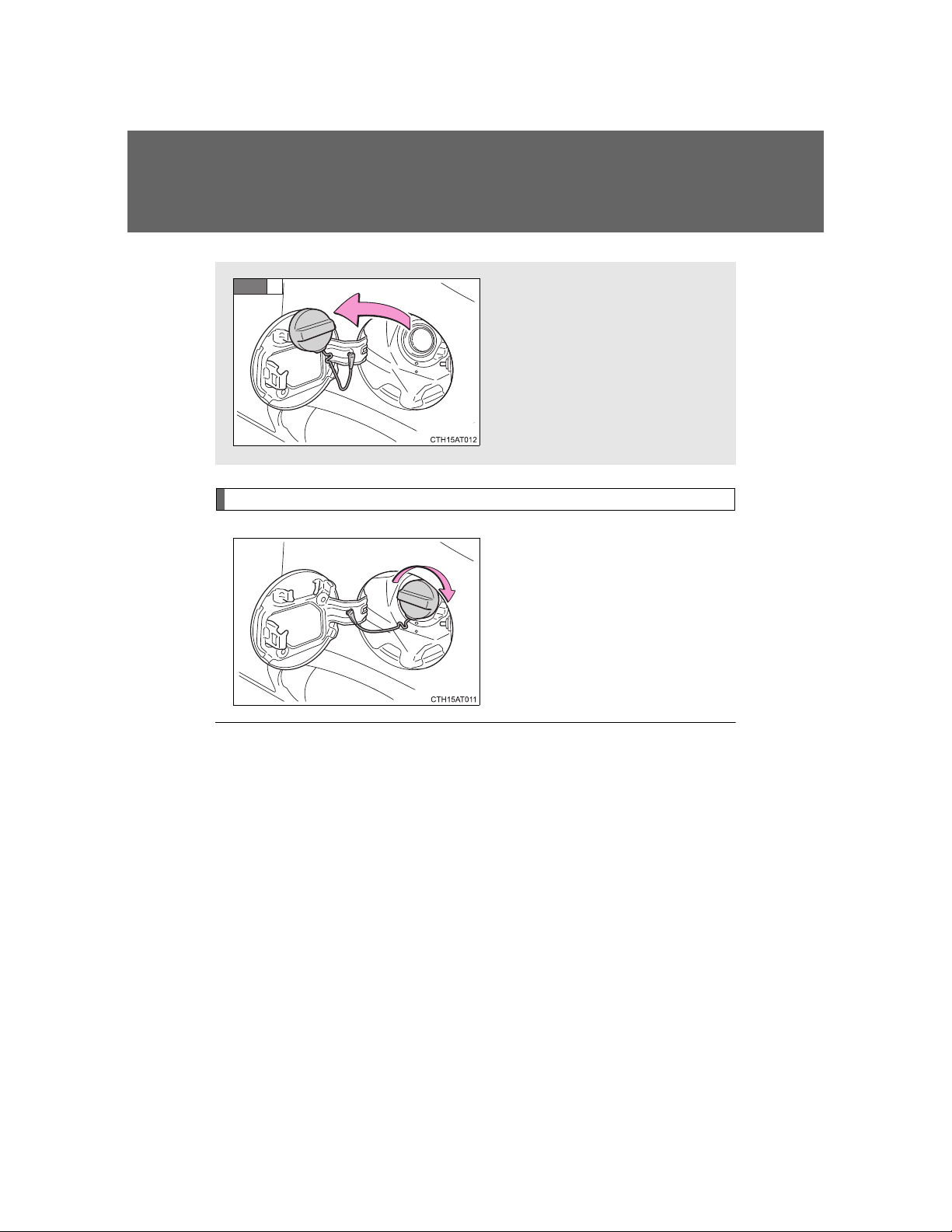
1-5. Refueling
Hang the fuel tank cap on the
back of the fuel filler door.
STEP
3
Closing the fuel tank cap
After refueling, turn the fuel tank
cap until you hear a click. Once
the cap is released, it will turn
slightly in the opposite direction.
Use of ethanol blended gasoline in a gasoline engine
Toyota allows the use of ethanol blended gasoline where the ethanol content
is up to 10%. Make sure that the ethanol blended gasoline to be used has a
suitable Research Octane Number (P. 525).
94
VERSO-S_EE
Page 95

CAUTION
When refueling the vehicle
Observe the following precautions while refueling the vehicle. Failure to do
so may result in death or serious injury.
After exiting the vehicle and before opening the fuel door, touch an
unpainted metal surface to discharge any static electricity. It is important to
discharge static electricity before refueling because sparks resulting from
static electricity can cause fuel vapors to ignite while refueling.
Always hold the grips on the fuel tank cap and turn it slowly to remove it.
A whooshing sound may be heard when the fuel tank cap is loosened.
Wait until the sound cannot be heard before fully removing the cap. In hot
weather, pressurized fuel may spray out the filler neck and cause injury.
Do not allow anyone that has not discharged static electricity from their
body to come close to an open fuel tank.
Do not inhale vaporized fuel.
Fuel contains substances that are harmful if inhaled.
Do not smoke while refueling the vehicle.
Doing so may cause the fuel to ignite and cause a fire.
Do not return to the vehicle or touch any person or object that is statically
charged.
This may cause static electricity to build up, resulting in a possible ignition
hazard.
When refueling
Securely insert the fuel nozzle into the fuel filler neck. If fuel is added with
the nozzle slightly lifted away from the fuel filler neck, the automatic shut off
function may not operate, resulting in fuel overflowing from the tank.
When replacing the fuel cap
Do not use anything but a genuine Toyota fuel tank cap designed for your
vehicle. Doing so may cause a fire or other incident which may result in
death or serious injury.
1-5. Refueling
1
Before driving
95
VERSO-S_EE
Page 96

1-5. Refueling
NOTICE
Refueling
Do not spill fuel during refueling.
Doing so may damage the vehicle, such as causing the emission control
system to operate abnormally or damaging fuel system components or the
vehicle's painted surface.
96
VERSO-S_EE
Page 97
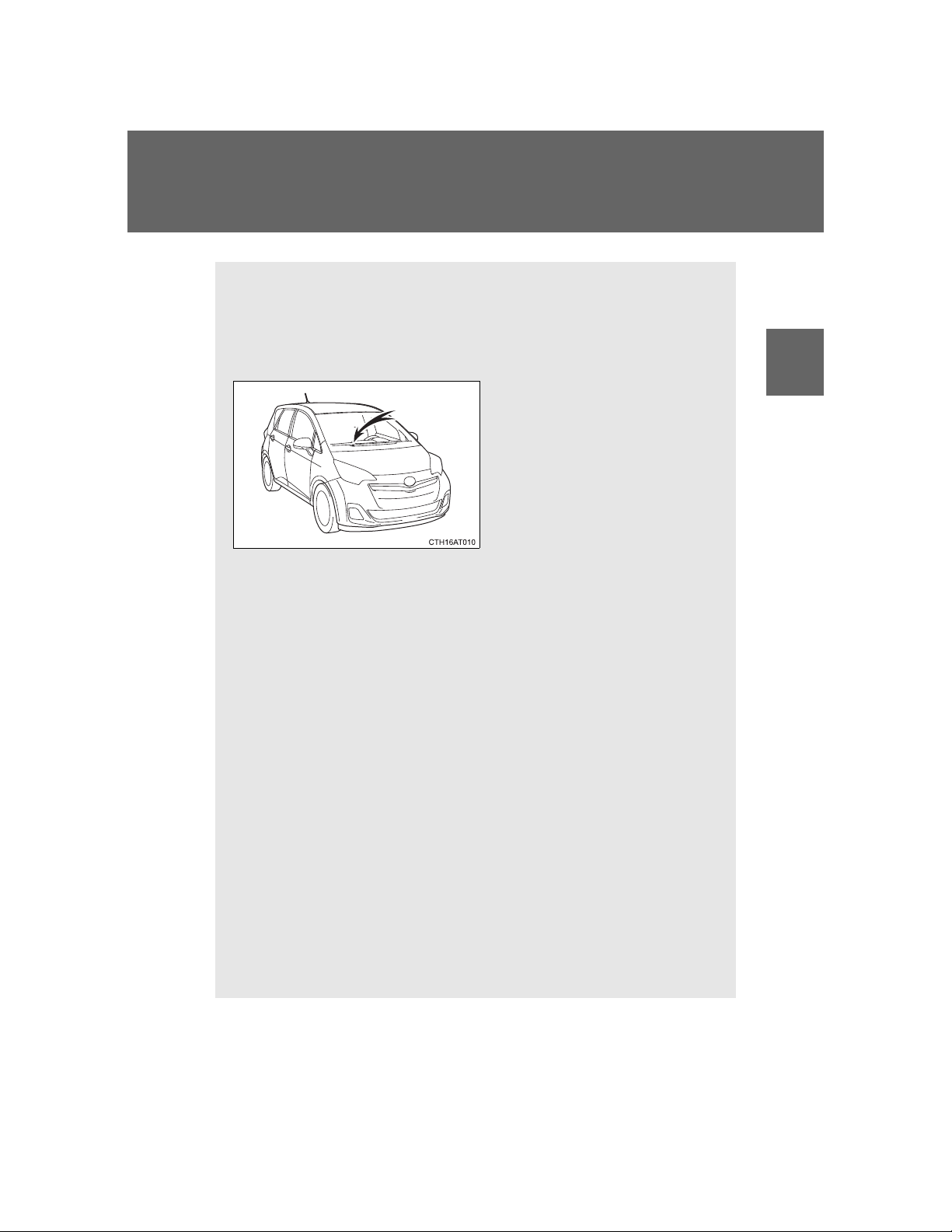
1-6. Theft deterrent system
The vehicle's keys have built-in transponder chips that prevent the
engine from starting if a key has not been previously registered in
the vehicle's on-board computer.
Never leave the keys inside the vehicle when you leave the vehicle.
Vehicles without a smart
entry & start system
The indicator light flashes after
the key has been removed
from the engine switch to indicate that the system is operating.
The indicator light stops flashing after the registered key
has been inserted into the
engine switch to indicate that
the system has been canceled.
Vehicles with a smart entry
& start system
The indicator light flashes after
the “ENGINE START STOP”
switch has been turned off to
indicate that the system is
operating.
The indicator light stops flashing after the “ENGINE START
STOP” switch has been turned
to ACCESSORY or IGNITION
ON mode to indicate that the
system has been canceled.
Engine immobilizer system
1
Before driving
VERSO-S_EE
97
Page 98

1-6. Theft deterrent system
System maintenance
The vehicle has a maintenance-free type engine immobilizer system.
Conditions that may cause the system to malfunction
If the grip portion of the key is in contact with a metallic object
If the key is in close proximity to or touching a key to the security system
(key with a built-in transponder chip) of another vehicle
98
VERSO-S_EE
Page 99
Certifications for the engine immobilizer system
1-6. Theft deterrent system
1
Before driving
VERSO-S_EE
99
Page 100
1-6. Theft deterrent system
Hereby, Toyota Motor Corporation, declares that this TMIMB-3 is in
compliance with the essential requirements and other relevant provisions
of Directive 1999/5/EC.㩷
Toyota Motor Corporation vakuuttaa täten että TMIMB-3 tyyppinen laite
on direktiivin 1999/5/EY oleellisten vaatimusten ja sitä koskevien
direktiivin muiden ehtojen mukainen.㩷
Hierbij verklaart Toyota Motor Corporation dat het toestel TMIMB-3 in
overeenstemming is met de essentiële eisen en de andere relevante
bepalingen van richtlijn 1999/5/EG.㩷
Par la présente Toyota Motor Corporation déclare que l'appareil TMIMB-3
est conforme aux exigences essentielles et aux autres dispositions
pertinentes de la directive 1999/5/CE.㩷
Härmed intygar Toyota Motor Corporation att denna TMIMB-3 står I
överensstämmelse med de väsentliga egenskapskrav och övriga
relevanta bestämmelser som framgår av direktiv 1999/5/EG.
Undertegnede Toyota Motor Corporation erklærer herved, at følgende
udstyr TMIMB-3 overholder de væsentlige krav og øvrige relevante krav i
direktiv 1999/5/EF.
Hiermit erklärt Toyota Motor Corporation, dass sich das Gerät TMIMB-3 in
Übereinstimmung mit den grundlegenden Anforderungen und den
übrigen einschlägigen Bestimmungen der Richtlinie 1999/5/EG befindet.㩷
ȂǼ ȉǾȃ ȆǹȇȅȊȈǹ Toyota Motor Corporation ǻǾȁȍȃǼǿ ȅȉǿ TMIMB-3
ȈȊȂȂȅȇĭȍȃǼȉǹǿ ȆȇȅȈ ȉǿȈ ȅȊȈǿȍǻǼǿȈ ǹȆǹǿȉǾȈǼǿȈ Ȁǹǿ ȉǿȈ
ȁȅǿȆǼȈ ȈȋǼȉǿȀǼȈ ǻǿǹȉǹȄǼǿȈ ȉǾȈ ȅǻǾīǿǹȈ 1999/5/EK.
100
VERSO-S_EE
 Loading...