

Page 1
THIE L
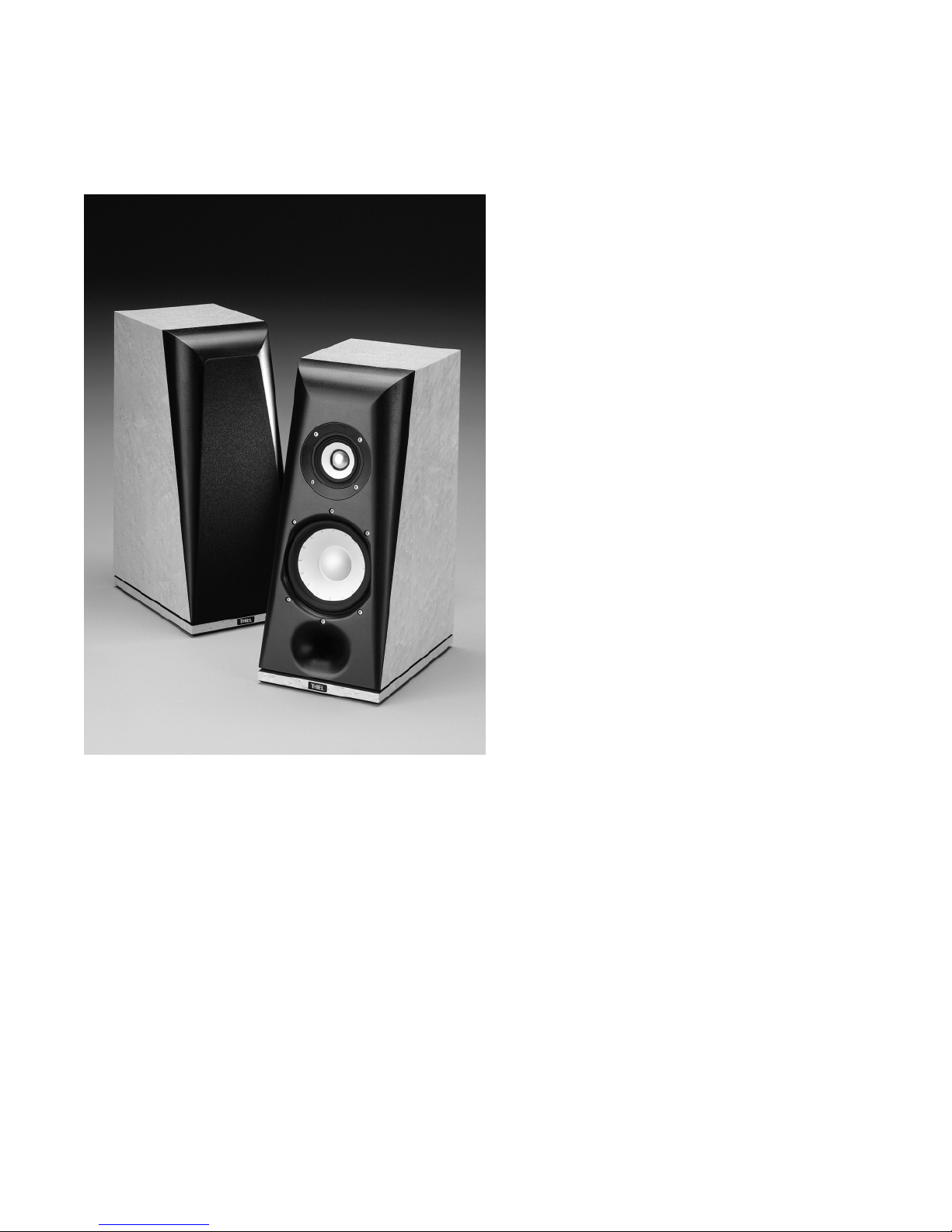
Model PCS
Coherent
®
Source
loudspeaker
system
OWNER INFORMA TION
Page 2
ongratulations on your purchase of the THIEL model PCS loudspeaker system. This fine product
C
is the result of a dedicated effort to provide very accurate sound reproduction. We have used very
high quality components and taken great care in the PCS’s construction. Properly set up and used with
good associated equipment, the PCS will provide you with a great deal of musical enjoyment for many
years.
SPEAKER PLACEMENT
Because the PCSs are designed to be placed in a variety of locations and are relatively noncritical to room placement, they
will provide good results from almost anywhere. However, here are some guidelines to help you achieve the best sound from
your speakers. Speaker placement will affect the accuracy of timbre, spatial performance, and bass performance.
Orientation: The PCS is designed to be placed vertically.
Spacing: Because of their very wide, even dispersion of energy, THIEL speakers should usually be placed farther apart
than most. Optimum imaging is usually achieved when the speakers and the listener form an equilateral triangle, although
this will depend on the width of the room—a narrow room will require closer placement. If the speakers are too far apart for a
given environment, there will tend to be a “hole” in the middle of the sound stage; if they are too close together, the image
will be compressed and will not achieve optimum width.
Aiming: We usually prefer the imaging obtained when the speakers are pointed straight ahead rather than pointing toward
the listener. This placement produces the largest, most natural soundstage. However, toeing the speakers in somewhat may
produce more specific placements of instruments. Also, if it is not possible to get the speakers far enough away from the side
walls, a toed-in position can be helpful to reduce the strength of wall reflections.
Bass: Bass response is also affected by speaker placement. In
general, when a speaker is close to a wall the bass response is stronger
and placing a speaker in a corner will make it even more so.
Height/Listener position: The PCSs provide broad dispersion of
energy at all frequencies and therefore provide good results throughout
a large listening area. Best imaging is provided for a listener centered
in front of the speakers at a height 18 to 32 inches from the floor to the
bottom of the speaker. Optimum phase and time alignment is provided
for a seated listener who is eight or more feet away from the speakers.
The PCS is magnetically shielded so it can be placed near televisions
without causing picture distortion.
All aspects of speaker placement are dependent on the particular
room. Since every room is different, no hard rules can be given, and
experimentation is necessary to achieve the best results.
USING WITH STANDS
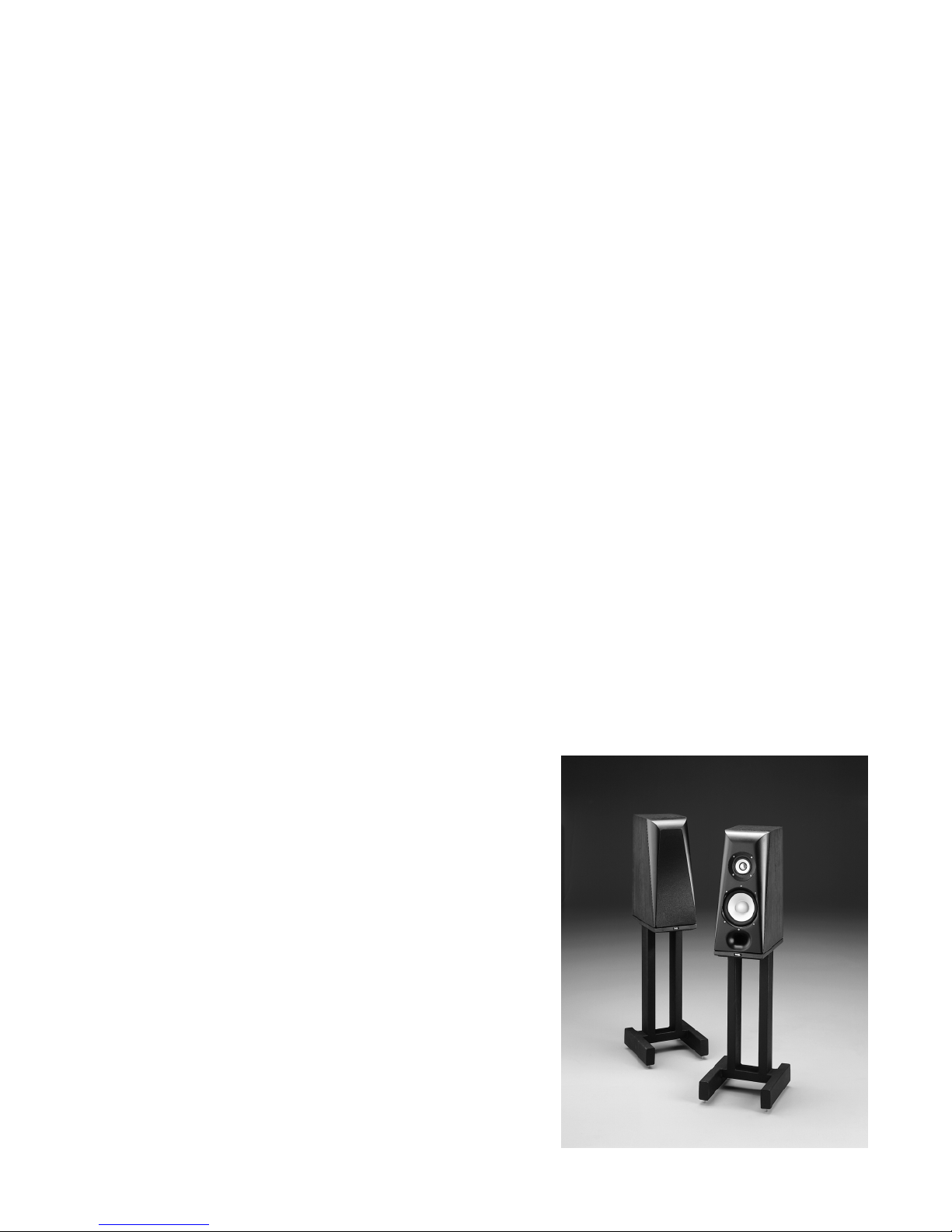
THIEL offers optional stands for use with the PCS (shown at right).
PCS shown with optional stands
Page 3

CONNECTING THE SPEAKERS
The PCS’s input terminals are located on the back of the speaker. The PCS uses a 5-way binding post which accepts several
types of speaker cable termination. Make sure that all connections are tight.
It is essential for proper performance that both speakers in a stereo system be wired in the same polarity. The speaker’s input
terminals are color coded to facilitate this. The wire connected to the red ringed input terminal of each speaker should connect
to the respective positive (+) output terminals of the amplifier; the wire connected to the black ringed input terminals should be
connected to the respective negative (–) output terminals of the amplifier.
The speakers should be connected to the amplifier with high quality cable to ensure minimal loss of power and proper control
by the amplifier. If the speakers are being connected to a vacuum tube amplifier with various impedance taps, the 4 ohm tap will
usually give the best results.
Due to European CE regulations that do not permit banana plug type loudspeaker connections, we ship THIEL speakers with
removable plugs installed in the ends of the binding posts. If you wish to use banana plug type connections, you may remove the
black plastic plug inserted into the end of each metal binding post cap. To remove the plug, use your fingernail to pry along the
bottom edge of the plastic insert and lift out.
BREAK-IN
The PCSs, like most speakers, require a period of playing before they perform optimally. The time depends on how loudly
the speakers are played; more time is required if played softly, less if played loudly. At least 50 hours at moderately loud
levels are required before the speaker is performing near optimum. You should notice even more improvement after 100
hours of playing.
ASSOCIATED EQUIPMENT
The PCS is a very high quality sound reproducer and will benefit from use with the best associated equipment. Since it is
extremely accurate, it will reveal sources of distortion generated elsewhere in the system. For example, distortion resulting
from poor recordings or inferior electronics will be reproduced accurately. Also, the quality of the interconnect cables and
speaker cables will significantly effect the performance of the system.
POWER REQUIREMENTS
It is important to have enough power to play at the level you desire without distortion. If high sound levels are desired, the
PCS’s are designed to be used with amplifiers rated up to 300 watts per channel (into 4 ohms). If you play the speakers more
loudly than the volume the amplifier can cleanly produce, the amplifier will produce overload (clipping) distortion. The
sound will become compressed, strained, and in extreme cases, obviously distorted. This distortion is actually non-musical
additional energy and since it is concentrated in the high frequency region where the speaker is least able to handle it,
tweeters can be damaged in extreme cases.
Keep in mind that sound quality is usually much more important than sound quantity. There can be large differences in the
sonic performance of two amplifiers of equal power, and this is more important than large differences in power. Most
everyone will be happier with a 100 watt amplifier of high sonic quality than a 200 watt amplifier of mediocre sonic quality.
For this reason, we feel there is no substitute for listening in making your amplifier decision.
The question “how much power do I need?” does not have the simple answer most people expect because it is not
determined only by the loudspeaker’s efficiency, but also by the volume desired and the size of the room. If all three factors
are average, about 100 watts per channel is required. Each factor can raise or lower this amount by about three times.
1) Usually, people who “don’t like music loud” can decrease their power to about one-half. Also, people who like music
loud should increase their power by 2 times or more. Most people fall within a normal range.
2) A speaker with a low efficiency of 84dB/W-m will require twice the power of an average 87dB/W-m speaker and one
with a high rating of 90dB/W-m will require only half the power of an average speaker. Usually, high efficiency can be
obtained only by trading off sonic quality—there are very few speakers that provide a very high level of both. The PCS is of
Page 4

average efficiency (87dB) and therefore requires a normal amount of power.
3) A small room will need less power for a given loudness level than a large room. A very small room of 1000 cu ft (11' x
11' with an 8' ceiling) will require about half the power of an average size room. A large room of 6000 cu ft (20' x 30' with a
10' ceiling) will require twice the average power. If the listening room is connected to another room by a large open area, the
required power will increase, but not by the amount of the combined room volume. If the room has a “dropped” ceiling with
light panels, the ceiling will be almost transparent acoustically and the space above the ceiling should be added. If the panels
are heavy they will act as a more normal ceiling.
With all this in mind, a person who doesn’t like to play music very loudly and has a small room can get quality sound with
as little as 50 watts whereas a person who sometimes likes to play loudly and has a large room may need 300 watts or more.
CABINET FINISH CARE
THIEL wood cabinets possess a high quality lacquer finish that is both beautiful and durable. However, any wood finish can
be damaged by excessive moisture, dryness, or direct sunlight. When cleaning your speakers, avoid using oils, waxes, or
polishes that contain silicone, such as Pledge or Johnson’s. We recommend using Endust. Non-wood laminate cabinets may
be cleaned with a glass-type cleaner and a soft cloth.
GRILLE
The PCS grille is is attached magnetically to the front of the speaker. The grille is designed to not produce diffraction so there
is no sonic reason to remove it. If you do need to remove the grille, pull the the grille frame away from the front of the
speaker. When replacing the grille, line up the grille’s top two magnetic discs with the top two tweeter/midrange driver screw
holes and the grille’s bottom two magnetic discs with the bottom two woofer screw holes.
The grilles can be cleaned of dust by using an upholstery attachment of a vacuum cleaner. To prevent damage to the
tweeter, take care not to push the cloth in toward the top of the grille.
SERVICE
If your system requires service, contact your authorized THIEL dealer. If you need to contact THIEL, service information
and technical support is available at (606) 254-9427, Monday-Friday, 8:30 a.m. - 5:00 p.m. Eastern Time, or via e-mail at
[email protected].
PCS SPECIFICATIONS
Bandwidth (–3dB) 55 Hz-23 kHz
Amplitude Response 57Hz-18 kHz ±2 dB
Phase Response Minimum ±10°
Sensitivity 87 [email protected] V-1m
Impedance 4 ohms (3.3 ohms minimum)
Recommended Power 50-300 watts
Size 7.25" W x 11.5" D x 19" H
Weight 30 pounds
Page 5

LIMITED WARRANTY
THIEL warrants every THIEL model PCS system against defects in materials and workmanship to the original owner for
a period of ten years from the date of purchase. THIEL will, at no charge, replace any defective part and make any repairs
necessary to ensure its proper performance when the defective unit is returned to us postpaid.
This warranty does not cover damage due to accident or abuse and is void if the unit has been tampered with.
This warranty is automatic and no registration is required. This warranty gives you specific legal rights. You may also
have other rights which are particular to your state.
The following information is for your records.
Serial Numbers______________________________
Purchase Date_______________________________
Purchased From_____________________________
WE WANT YOU LISTENING FOR A LIFETIME
Used wisely, your new sound equipment will provide a lifetime of enjoyment. Since hearing damage from loud noise is often
undetectable until it is too late, THIEL and the Electronics Industries Association’s Consumer Electronics Group recommend
you avoid prolonged exposure to excessive noise. Depending on room size and amplifier power, some home audio systems
can reach sound pressure levels in excess of 95 decibels with peaks of over a 105 decibels. For your protection, the list below
identifies sound levels for various noises.
Decibel
Level Example
30 Quiet library, soft whispers
40 Living room, refrigerator, bedroom away from traffic
50 Light traffic, normal conversation, quiet office
60 Air conditioner at 20 feet, sewing machine
70 Vacuum cleaner, hair dryer, noisy restaurant
80 Average city traffic, garbage disposals, alarm clock at
two feet
The Following Noises Can Be Dangerous Under
Constant Exposure
90 Subway, motorcycle, truck traffic, lawn mower
100 Garbage truck, chain saw, pneumatic drill
120 Rock concert in front of speakers, thunderclap
140 Gunshot blast, jet plane
150 Rocket launching pad
We
Information courtesy of the Deafness
Research Foundation and the EIA.
Want You
LISTENING
For A Lifetime
Page 6

CONTRIBUTOR
Telephone: 859-254-9427 • E-mail: [email protected] • Web: www.thielaudio.com
HARDWOOD
FORESTRY FUND
THI EL
1026 Nandino Boulevard
Lexington, Kentucky 40511-1207
7/00
 Loading...