

Page 1
Owner’s Manual and Installation Manual
For model N260.3X - a 2.4 cu. ft., 3-way refrigerator.
The letter “X”, in the model number above, stands for a letter or a numeral which means a
refrigerator option.
WARNING: Improper installation, adjustment, alteration, service or maintenance
can cause personal injury or property damage. Refer to this manual.
For assistance or additional information, contact a qualified installer,
service agency, or the gas supplier.
FOR YOUR SAFETY
Do not store or use gasoline or other flammable vapors and liquid in
the vicinity of this or any other appliance.
FOR YOUR SAFETY
If you smell gas:
1. Open windows.
2. Don’t touch electrical switches.
3. Extinguish any open flame.
4. Immediately call your gas supplier.
WARNING: DO NOT install this refrigerator in below deck
marine applications. Do not install this refrigerator in fixed
indoor cabin or other dwelling applications. This refrigerator
must use only NORCOLD designed and approved outside air
intake and exhaust ventilation for correct and safe operation.
Any other ventilation could cause lethal combustion exhaust
fumes and/or explosive propane gas fumes to be in the living
area and/or to be below deck.
NORCOLD, Inc.
P.O. Box 4248
Sidney, OH 45365-4248
English
French
Norcold Customer Support Dept.
Telephone: 800-543-1219
Fax: 937-497-3183
Web Site: www.norcold.com
Part No. 620292M (3-07)
Page 2
Table of Contents
NORCOLD - Gas Absorption 3 Year Limited
Warranty Policy
Owner‘s Manual ........................................................................ 2
Gas Absorption 3 Year Limited Warranty Policy......................... 2
Gas Absorption Warranty Information ........................................ 3
Gas Absorption Warranty Questions .......................................... 3
Safety Awareness ....................................................................... 4
Safety Instructions ...................................................................... 4
About Your Refrigerator .............................................................. 4
Storage volume ................................................................... 4
Leveling ............................................................................... 4
Operation during travel ........................................................ 4
Food compartment .............................................................. 4
Travel latch .......................................................................... 5
Storage latch ........................................................................ 5
Ignition and Start Up ................................................................... 5
Controls............................................................................... 5
Ignition - propane gas operation ........................................ 6
Do a test of the gas safety valve.......................................... 6
Start Up - AC operation ........................................................ 6
Start Up - DC operation (3-way models only) ..................... 6
DC operation precautions ................................................... 6
DC operation guidelines ..................................................... 6
Shut down ........................................................................... 6
Effects of High Altitude on Propane Gas Operation................... 7
Refrigerator Care Checklist ....................................................... 7
Defrosting ................................................................................... 7
Cleaning ..................................................................................... 7
Door Sealing .............................................................................. 8
Refrigerator Maintenance Checklist .......................................... 8
Refrigerator Storage ................................................................... 8
Refrigerator Maintenance ........................................................... 8
Gas flame appearance ....................................................... 8
Remove and clean the burner orifice ................................. 9
Remove the Refrigerator ............................................................ 9
Reinstall the Refrigerator ........................................................... 9
Wiring Pictorial ......................................................................... 10
Wiring Diagram ........................................................................ 10
Replacement Parts .................................................................. 10
Installation Manual .................................................................. 10
Safety Awareness ..................................................................... 10
Safety Instructions .................................................................... 1 0
Certification and Code Requirements ......................................11
Ventilation Requirements ..........................................................11
Assemble the Enclosure .......................................................... 12
Install the Lower and Upper Vents ........................................... 1 2
Reverse the Door Swing (optional) .......................................... 12
Install the Refrigerator .............................................................. 13
Connect the Electrical Components ........................................ 13
Connect the 120 volts AC supply ...................................... 13
Connect the 12 volts DC supply (3-way models only)...... 13
Connect the Propane Gas Components ................................. 14
Connect the propane gas supply system ......................... 1 4
Examine the propane gas supply system for leaks ......... 14
Norcold • P.O. Box 4248 • Sidney , OH • USA • 45365-4248
Provided it is properly installed, properly maintained and placed
under normal service and use, Norcold, Inc. warrants its
refrigeration equipment to be free from defects in material and
workmanship for three years with respect to the equipment’s
component parts, and for two years with respect to the labor to
repair or replace such parts, commencing from the original date
of purchase.
Limitations of warranty
1. This Warranty applies only to Norcold gas absorption
refrigerator operating equipment. This Warranty does not
extend to glassware, electric light bulbs, and replaceable
fuses.
2. This warranty does not apply to parts and assemblies that
have been subjected to misuse, improper installation,
improper or abnormal service, transit damage, recharging of
the cooling system, accident, fire, improper repair, tampering
or abuse.
3. Irrespective of the nature of the warranty protection offered or
claimed, the period of warranty shall in no case extend
beyond three years for component parts and two years for the
labor to repair or replace such parts, commencing from the
original date of purchase of the new equipment.
4. In order to obtain the remedy of repair and replacement, the
refrigerator must be brought to any Norcold Service Center for
warranty service. The end consumer is responsible for all
expenses resulting from any remote service call if the
refrigerator cannot be brought into the Norcold service center.
5. It is the responsibility of the end consumer to have maintenance performed upon the warranted equipment one time
during the second year or before the beginning of the third
year after original purchase. Such maintenance is required to
maintain this warranty in effect and failure to perform such
maintenance will void the remainder of the warranty. Required maintenance during the second year or before the
third year after purchase is cleaning and checking of the
following: Burner , Flue, Spiral Baffle, Roof Cap Screen, and
Control Board Sequence.
LIMIT ATION OF REMEDY
1. THE RESPONSIBILITY OF NORCOLD UNDER THIS OR ANY
WARRANTY IS LIMITED T O THE REPAIR OR REPLACEMENT
(AT NORCOLD’S OPTION) OF THE DEFECTIVE P ART OR
ASSEMBLY.
Installation and Owner’s Manual 2
Page 3
2. IN NO EVENT AND UNDER NO CIRCUMST ANCES SHALL
NORCOLD BE RESPONSIBLE UNDER THIS LIMITED WARRANTY FOR ANY OTHER CHARGE WHA TSOEVER, INCLUDING
BUT NOT LIMITED TO CHARGES OR CLAIMS FOR LABOR,
LOST BUSINESS, LOST TIME, LOST PROFITS, LOSS OF USE,
OR ANY KIND OF INCIDENT AL OR CONSEQUENTIAL DAMAGES, HOWEVER DENOMINATED OR DESCRIBED. THE
REMEDY UNDER THIS WARRANTY IS LIMITED TO REPLACEMENT OR REPAIR.
3. SOME STA TES DO NOT ALLOW THE EXCLUSION OR
LIMIT ATION OF INCIDENT AL OR CONSEQUENTIAL DAMAGES,
SO THE ABOVE EXCLUSION MA Y NOT APPL Y TO YOU.
DISCLAIMER OF OTHER WARRANTIES
THIS WARRANTY IS EXPRESSL Y IN LIEU OF ALL OTHER
WARRANTIES EITHER EXPRESSED OR IMPLIED. ALL OTHER
WARRANTIES, EXPRESSED OR IMPLIED, INCLUDING ANY
WARRANTY OF MERCHANT ABILITY OR FITNESS FOR A P ARTICULAR PURPOSE, ARE HEREBY DISCLAIMED AND EXCLUDED.
Legal rights
This warranty gives you specific legal rights, and you may have
other legal rights, which vary from state to state.
Gas Absorption Warranty Information
Your refrigerator is made to provide the ultimate in cooling
satisfaction and will serve you reliably in the years to come.
Norcold refrigerators are the only RV refrigerators made in the
United States and offer a standard limited three-year warranty.
Norcold also offers an additional warranty coverage plan which
extends the standard limited three-year warranty. To activate
your three-year limited warranty and to receive an invitation to
participate in the extended warranty plan, complete and mail the
warranty registration supplied.
Help us to help you.
Write the model number and serial number below for future
reference. These numbers are on the serial plate in the
refrigerator. The serial plate is located in the fresh food
compartment on the top right hand side. Use these numbers
when receiving service or in any correspondence concerning
your refrigerator.
Model number ___________ Serial number ___________
If a problem occurs with your refrigerator, contact any of the
service centers throughout the United States and Canada. To
find an authorized Norcold Service Center near you, please
telephone the Norcold Customer Support Dept. at 800-5431219 (option-1) or visit our web site at www.norcold.com.
Norcold is committed to providing products that are in harmony
with the environment. Your Norcold refrigerator meets all
environmental safety standards.
Gas Absorption Warranty Questions
About your warranty
This warranty coverage begins on the original date of purchase by the
consumer purchaser and is the only warranty for the Norcold refrigerator. In no case will the Limited Warranty extend beyond two (2) years
for labor and three (3) years for parts and freight. Norcold reserves
the right to change design or specifications of a refrigerator without
obligation to modify previously produced refrigerators. There are no
other warranties, either expressed or implied.
What is coverd by this warranty?
- Defects in material and workmanship.
- Parts and labor for two (2) years
- Parts only for the third year if the required maintenance is performed.
- Freight (ground service only) for shipment of a replacement part
and for return of the defective part.
What is not covered by this warranty?
- Shipping methods other than ground service.
- Defects in glassware, electric light bulbs, and replacement fuses.
- Adjustment of the burner electrode.
- Cleaning of the burner.
- Fees for mobile repair service.
- Mileage or travel expenses to obtain warranty service.
- Expenses for required maintenance as specified in the Limited
Warranty and in the Owner’s Manual.
- Incidental or consequential loss or damage including but not limited to
charges or claims for labor (including labor when no parts are used
for a repair), lost business, lost time, lost profits, lost food, and lost
use.
- Replacement parts that are not manufactured or supplied by Norcold.
- Defect of a part or assembly when the defect originates from misuse,
improper installation, improper or abnormal service, transit damage,
recharging of the cooling system, accident, fire, improper repair,
tampering, or abuse.
What will Norcold do?
For a refrigerator that is properly installed, maintained, and used as
specified in the Installation/Owner’s Manuals, Norcold responsibilities
are:
- Limited to the repair and replacement of parts.
- To provide no charge parts and labor for two (2) years.
- To provide no charge parts only for year 3 if the required maintenance is performed.
- To provide freight (ground service only) for shipment of a replacement part and for return of a defective part for three (3) years.
What will the refrigerator owner do?
T o obtain warranty service, the refrigerator owner responsibilities are:
- T o use, service, and maint ain the refrigerator as specified in the
Installation/Owner’s Manuals.
- T o deliver the warranted product to an authorized Norcold Service
Center for warranty repair.
- To show proof that the refrigerator is within warranty coverage.
- T o have the required maintenance performed by an authorized
Norcold Service Center one time during year 2 of the Limited
Warranty.
- T o pay to have the required maintenance performed.
- T o mail paid receipt to Norcold showing required performed before
expiration of year 2 of the Limited Warranty.
- T o show proof of the required maintenance before requesting
warranty service in year 3 of the Limited Warranty.
What rights do you have?
The warranty gives you specific legal rights. You may also have other
rights which vary from state to state.
Installation and Owner’s Manual 3
Page 4
Safety Awareness
Read this manual carefully and understand the contents before
you use the refrigerator.
Be aware of possible safety hazards when you see the safety
alert symbol on the refrigerator and in this manual. A signal
word follows the safety alert symbol and identifies the danger of
the hazard. Carefully read the descriptions of these signal
words to fully know their meanings. They are for your safety.
WARNING: This signal word means a hazard, which if
ignored, can cause dangerous personal injury, death, or
much property damage.
CAUTION: This signal word means a hazard, which if
ignored, can cause small personal injury or much
property damage.
Safety Instructions
- The refrigerator cooling system is under pressure. Do
not try to repair or to recharge a defective cooling
system. The cooling system contains sodium chromate. The breathing of certain chromium compounds
can cause cancer. The cooling system contents can
cause severe skin and eye burns, and can ignite and
burn with an intense flame. Do not bend, drop, weld,
move, drill, puncture, or hit the cooling system.
- At regular intervals, make sure that the refrigerator flue
the burner, the vent areas, and the ventilation air
pathway between the vents are completely free from
any flammable material or blockage. After a period of
storage, it is especially important to check these areas
for any flammable material or blockage caused by
animals.
CAUTION:
- The rear of the refrigerator has sharp edges and
corners. To prevent cuts or abrasions when working
on the refrigerator, be careful and wear cut resistant
gloves.
WARNING:
- The storage of flammable materials behind or around
the refrigerator creates a fire hazard. Do not use the
area behind the refrigerator to store anything, especially flammable materials (gasoline, cleaning
supplies, etc.)
- Do not remove the round ground prong from the
refrigerator AC power cord. Do not use a two prong
adapter or extension cord on the AC power cord.
- A circuit overload can result in an electrical fire if the
wires and/or fuses are not the correct size. Either use
the wire and fuse sizes as writtten in this manual or
refer to your local codes or the applicable RVIA
Standards for the correct wire and fuse sizes.
- Incorrect installation, adjustment, change to, or
maintenance of this refrigerator can cause personal
injury, property damage, or both. Have service and
maintenance work done by your dealer or by an
Norcold authorized service center.
- Disconnect both the AC and DC power sources before
doing any maintenance work on the refrigerator. All
service work on this refrigerator must be done by a
qualified service technician.
- Do not bypass or change the refrigerator’s electrical
components or features.
- When you discard an appliance, remove all doors to
prevent accidental entrapment and suffocation.
- Do not spray liquids near electrical outlets, connections, or the refrigerator components. Many liquids are
electrically conductive and can cause a shock hazard,
electrical shorts, and in some cases fire.
About Y our Refrigerator
Storage volume:
This refrigerator is made for food storage.
Total capacity........................................................ 2.4 cubic feet
Leveling:
CAUTION:
off level side-to-side and 6° off level front-to-back (as
looking at the front of the refrigerator). Operating it at
more than these limits can cause damage to the cooling
system and create a risk of personal injury or property
damage. Make sure the vehicle is level before you
operate the refrigerator.
Operation during travel:
While the refrigerator should be level when the vehicle is
stopped, performance during travel is not usually effected.
Food compartment:
Start up the refrigerator and let it cool for eight hours before
loading with food. If the refrigerator does not start to cool down
after about two hours, contact your dealer or a Norcold authorized service center.
For the best cooling performance:
- Let air move freely inside the entire food compartment.
- Do not cover the shelves with plastic, paper, etc.
The refrigerator is made to operate within 3°
Installation and Owner’s Manual 4
Page 5
To decrease the amount of ice that forms on the cooling fins:
- Cover all liquids and moist foods.
- Let hot foods cool before putting them in the refrigerator.
2. Turn the travel / storage latch [2] into the slot of the metal
refrigerator frame [3]:
- Make sure the groove [6] in the travel / storage latch en-
gages the edge [7] of the metal refrigerator frame.
- Do not open the door any longer than necessary.
Travel latch:
NOTE: During daily use, turn the travel / storage latch so that is
parallel with the edge of the door (See Art01101).
Use the travel latch feature to lock the refrigerator door in the
closed position. When you engage the travel latch, the door
cannot accidentally open during travel.
To engage the travel latch:
1. Open the door [1] of the refrigerator (See Art01102).
2. Turn the travel / storage latch [2] so it is parallel with the edge
of the door.
3. Close the door of the refrigerator.
4. Push the door closed to compress the gasket and turn the
travel / storage latch into the slot of the metal refrigerator
frame [3].
5. Continue to turn the travel / storage latch until the ball
shaped stop [4] engages the ball shape [5] of the metal
refrigerator frame.
To disengage the travel latch:
1. Push the door closed to compress the gasket and turn the
travel / storage latch until the ball shaped stop disengages
the ball shape of the metal refrigerator frame.
2. Continue to turn the travel / storage latch so it comes out of
the slot in the metal frame and is parallel with the edge of the
door.
3. Open the door of the refrigerator.
Storage latch:
Use the storage latch feature to prevent the build up of odors
when the refrigerator is shut down for a long period of time.
When you engage the storage latch, the refrigerator door will not
be fully closed.
To engage the storage latch:
1. Open the door [1] of the refrigerator enough to break the seal
of the gasket (Art01103).
To disengage the storage latch:
1. Turn the travel / storage latch out of the slot of the metal
refrigerator frame:
2. Close the door of the refrigerator.
Ignition and Start Up
Controls:
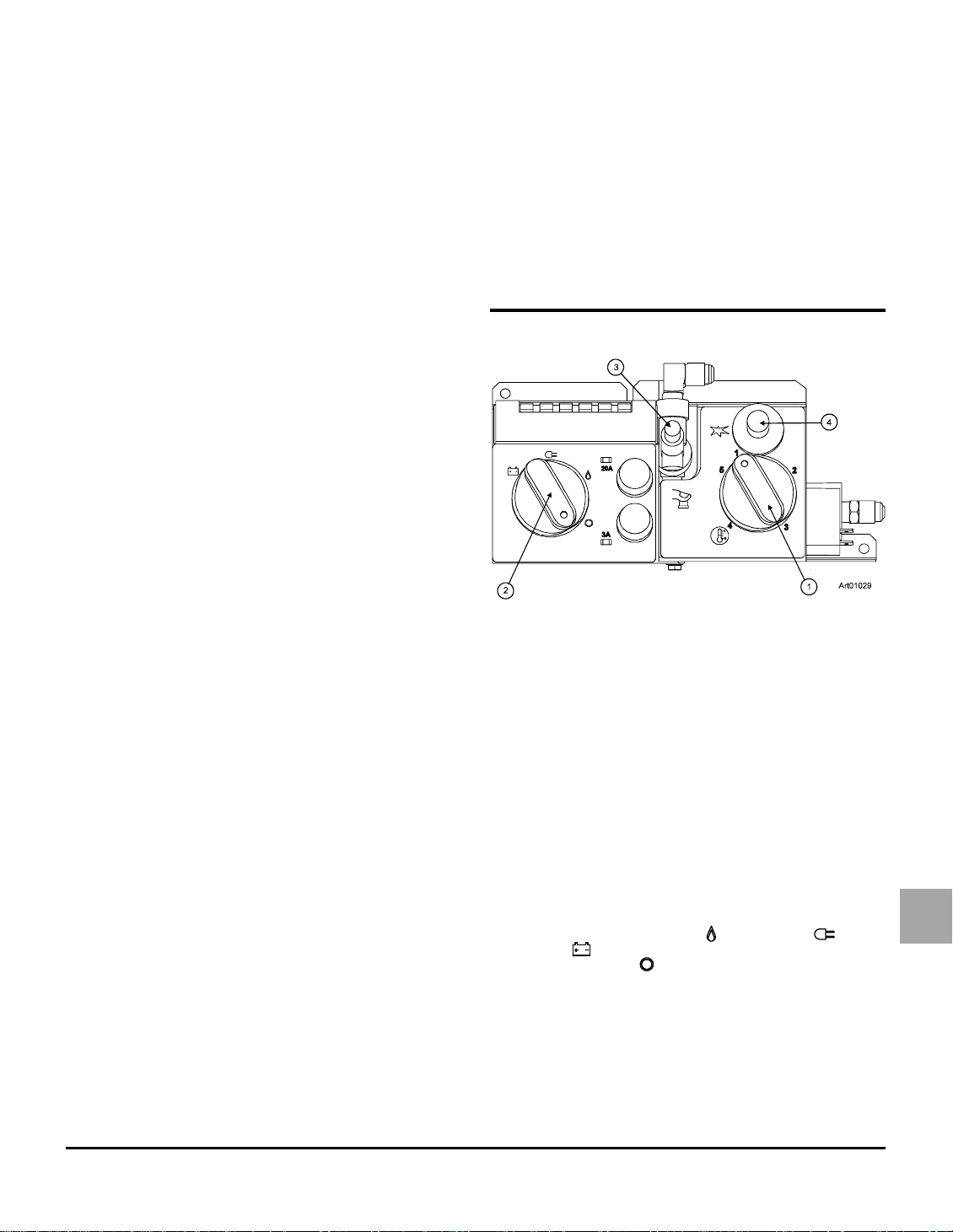
Thermostat........................................................................... 1
Selector switch .....................................................................2
Gas safety valve ...................................................................3
Piezo lighter ......................................................................... 4
The thermostat [1] changes the amount of propane gas that
goes to the burner (See Art01029). This acts as the temperature control of the refrigerator. Number 5 is the coldest temperature setting.
When the outside air temperature is less than 50° F, the
refrigerator may have a tendency to freeze food at the colder
temperature settings. To reduce the tendency to freeze food:
- Turn the thermostat to a warmer temperature setting.
- Keep the refrigerator full.
- Put foods that are more likely to freeze on the lower shelf.
The selector switch [2] changes the energy source of the
refrigerator between propane gas (
DC electric (
refrigerator at the OFF (
) (3-way models only) and shuts down the
) position.
), AC electric ( ), and
Installation and Owner’s Manual 5
Page 6
The gas safety valve [3] is built into the control panel. As long as
a flame is present, the valve is open and allows propane gas to
flow into the burner. Any loss of flame (empty gas tank, blow
out, etc.) closes and stops the flow of propane gas.
The igniter [4] makes a spark which ignites the flame in the
burner.
Ignition - propane gas operation:
1. Open the valve at the propane gas storage tank.
2. Turn the thermostat to the coldest temperature setting.
3. Turn the selector switch to the propane gas position (
4. Push and hold in the safety valve and in rapid succession,
push in the igniter several times for about five seconds.
).
WARNING: Do not hold in the safety valve for more than
30 seconds. If there is no flame in this time, wait at least
five minutes before you try ignition again. If you continue
to hold in the safety valve, gas will collect in the burner
area. This could cause a fire or explosion and result in
dangerous personal injury or death.
Start up - DC operation (3-way models only):
- Make sure that 12 volts DC is available.
- Turn the selector switch to the DC position (
).
DC operation precautions:
This refrigerator is made to operate on DC power while your
vehicle is “in transit” and AC power or propane gas sources
are not available. Operate the refrigerator on DC power only
when the vehicle engine is running.
For the refrigerator to operate correctly on DC power, the battery
must be maintained in a fully charged condition.
For the battery to be fully charged at all times during refrigerator
operation on DC, the vehicle engine
battery charging system must be in good operating condition.
Keep in mind the following electrical precautions for DC
operation of the refrigerator:
- Good battery condition is necessary for correct DC operation.
must be running and the
- Open the burner box door and look for the flame.
- When the flame ignites, release the safety valve.
- If the flame does not ignite, wait about five minutes and do
this step again.
5. Turn the thermostat to the temperature setting that you wish.
Do a test of the gas safety valve:
With an established flame in GAS mode:
1. Close the manual gas shutoff valve [2] of the refrigerator
(See Art01035].
2. After the flame is extinguished, you should hear a sharp
“click” sound within three minutes.
NOTE: The gas safety valve should close with a sharp “click“
3. Open the manual gas shutoff valve of the refrigerator.
4. Without pushing in the gas control, push the igniter several
sound.
times rapidly in succession. The burner flame should not
ignite. This means that the gas safety valve is working
correctly.
Start up - AC operation:
- Make sure that 120 volts AC is available.
- Turn the selector switch to the AC position (
).
- The capacity of the battery charging system must be more
than what is necessary for the refrigerator and other DC
appliances.
- While the vehicle engine is running, have a qualified service
technician make sure the voltage of the DC power supply
leads at the refrigerator is more than 11.5 VDC.
DC operation guidelines:
DC operation is intended only to maintain the temperature of
the refrigerator and its contents when they are already cool.
The DC operation is not intended for the initial start up and
cooling of the refrigerator. Always use either the AC operation or
propane gas operation to initially start up and cool the refrigerator. The refrigerator must be cooled and the temperature must
be steady before you operate the refrigerator on DC.
Keep in mind the following guidelines for DC operation of the
refrigerator:
- Use DC operation of the refrigerator only while the vehicle is
in transit.
- Do not use DC operation until the refrigerator and its
contents are completely cooled.
- Only use DC operation if the vehicle battery and battery
charging system are in good operating condition.
Shut down:
- Turn the selector switch to the OFF position ( ).
- Turn the thermostat to the temperature setting that you
wish.
Installation and Owner’s Manual 6
Page 7

Effects of High Altitude on Prop ane Gas Operation
- with the storage of non-sealed fresh foods or warm foods.
- with the amount of time that the door(s) are open.
When you operate the refrigerator on propane gas at altitudes
higher than 5500 feet above sea level:
- You may experience reduced cooling performance of the
refrigerator.
- You may experience burner outages.
To avoid these possible problems, Norcold recommends that
you operate the refrigerator on AC when at altitudes higher than
5500 feet above sea level.
Refrigerator Care Checklist
Your refrigerator will give you years of trouble free service if you
do these simple checks every three to six months:
- Keep the food compartment and the freezer clean. See
“Cleaning”.
- Defrost the refrigerator as necessary. See “Defrosting”.
- Make sure the door seals correctly. See “Door Sealing“.
- Be aware of any cooling changes that are not because of
weather, loading, or thermostat changes. If changes occur,
contact your dealer or service center.
- Make sure the gas supply is propane gas only and is not
butane or a butane mixture.
- When in propane gas operation, examine the appearance
of the flame. See “Gas Flame Inspection”.
- Make sure the air flow in the lower intake vent, through the
refrigerator coils and condenser, and out the upper exhaust
vent is not blocked or decreased.
- Make sure the area behind the refrigerator is clear. Do not
use the area behind the refrigerator for storage of anything,
especially gasoline and other flammable vapors and
liquids.
Defrosting
The cooling fins of the refrigerator operate at below freezing
temperature and will naturally form frost from humidity, which is
always present in the air. The humidity inside the refrigerator
increases:
- with higher outside temperature and humidity.
- with any air leakage into the refrigerator.
It is normal for frost to collect inside the refrigerator. Excess
frost decreases the cooling performance of the refrigerator.
Defrost the refrigerator as necessary:
- Remove all food from the refrigerator.
- Turn the refrigerator OFF.
NOTE: Defrosting the refrigerator makes excess water inside
the refrigerator.
- Put dry towels (etc.) inside the refrigerator to absorb melted
frost.
CAUTION: High temperatures can cause the inside
surfaces of the refrigerator to warp or melt. Do not use
pans of HOT water, a hair dryer, or any other high
temperature devices to defrost the refrigerator. Do not
use any hard or sharp objects to remove frost. Damage
to the interior of the refrigerator can occur.
- To increase the speed of defrosting, put pans of WARM
water in the refrigerator.
- Remove the wet towels (etc.) and dry the interior.
- Start up the refrigerator.
- Allow the refrigerator to cool down.
- Return all food to the refrigerator.
Cleaning
A good time to clean the refrigerator is just after you defrost it.
To avoid food odors, clean the inside of the refrigerator as often
as necessary:
- Remove all food from the refrigerator.
NOTE: Do not use abrasive cleaners, chemicals, or
scouring pads because they can damage the
interior of the refrigerator.
- Wash the interior with a solution of dish detergent and
warm water.
- Rinse with a solution of baking soda and clean water.
- Dry with clean cloth.
- Put all food in the refrigerator.
Installation and Owner’s Manual 7
Page 8

Door Sealing
If the door does not seal correctly, excess frost will collect inside
the refrigerator. Make sure the door seals correctly:
- Close the door on a piece of paper that is about the size
and thickness of a dollar bill (See Art00980).
- Gently pull the paper.
- You should feel a slight drag between the door gasket
and the cabinet.
- Do this on all four sides of the door.
- If you do not feel drag on the paper, the door gasket is not
sealing correctly.
- Contact your dealer or Norcold authorized service center.
Refrigerator Maintenance Checklist
- Make sure the thermocouple tip is clean and secure.
- Make sure the area at the rear of the refrigerator is free from
any combustible materials, especially gasoline and other
flammable vapors and liquids.
Refrigerator Storage
Before the refrigerator is stored for an extended (seasonal)
period of time:
- Defrost and clean the interior of the refrigerator.
- Close the doors with the storage latch.
If the refrigerator is stored for an extended period of time, before
start up:
- Make sure there are no obstructions in the vents, the
ventilation air pathway, the burner, the orifice, or the flue
area.
Read and understand the following maintenance sections of
this manual.
NOTE: Norcold is not responsible for installation, adjustment,
alteration, service, or maintenance performed by
anyone other than a qualified RV dealer or a Norcold
authorized service center.
Have a qualified RV dealer or a Norcold authorized service
center do these annual safety and maintenance checks:
- Examine the gas supply lines for leaks.
- Replace or repair if necessary.
- Make sure the propane gas pressure is 11 inches of water
column.
- Adjust if necessary.
- Make sure the combustion seal is complete and intact.
- Replace or repair it if necessary.
- Make sure the burner and the burner orifice are clean.
- Clean if necessary.
- Make sure the electrode spark gap [3] is 1/8 - 3/16 inch
(See Art00955).
- Adjust if necessary.
- Make sure the AC voltage is 108 - 132 volts and the DC
voltage is 10.5 - 15.4 volts.
Refrigerator Maintenance
Gas flame appearance:
While in propane gas operation, examine the gas flame:
- Turn the thermostat to the 5 position.
- Open the lower intake vent.
CAUTION: The burner box cover can be hot. Wear
gloves to avoid burns.
- Open the burner box door [3] and look at the gas flame [1]
(See Art01035 and Art00955).
- The flame should be:
- a darker blue color on the inside of the flame and
a lighter blue color on the outside of the flame.
- a constant shape without flickering.
- Contact your dealer or Norcold authorized service
center if the flame is:
- yellow
- flickering or changing shape.
- Make sure the flame does not touch the inside of the
flue tube [2].
- If the flame touches the inside of the flue tube, contact
your dealer or Norcold authorized service center.
Installation and Owner’s Manual 8
- Close the burner box door.
Page 9

Remove and clean the burner orifice:
NOTE: A dealer or Norcold authorized service center must do
To remove and clean the burner orifice:
this procedure.
- Close the valve at the propane gas tank(s).
- Open the lower intake vent.
- Close the manual shut off valve of the refrigerator.
- Turn the thermostat to the 1 position and the energy
selector to the OFF positon (
) .
CAUTION: The burner box cover can be hot. Wear
gloves to avoid burns.
- Remove the burner box cover by removing one screw.
WARNING: To avoid possible propane gas leaks,
always use two wrenches to loosen and tighten the
gas supply line at the refrigerator’s manual shut off
valve.
- Remove the flare nut from the orifice assembly [1] (See
Art00956).
- Remove the orifice assembly from the burner [2]
WARNING: When cleaning, do not try to remove the
orifice [3] from the orifice adapter [4]. Removal will
damage the orifice and seal of the orifice and can
cause a propane gas leak. Leaking propane gas can
ignite or explode and result in dangerous personal
injury or death. Do not clean the orifice with a pin or
other objects.
- Clean the orifice assembly with air pressure and alcohol
only.
- Using a wrench, assemble the orifice assembly to the
burner.
- Assemble the flare nut to the orifice assembly.
- Tighten the flare nut by hand.
- Hold the orifice assembly securely and, using a
wrench, tighten the flare nut 1/4 revolution only.
- Examine all of the gas connections for leaks.
Remove the Refrigerator
CAUTION: The rear of the refrigerator has sharp edges
and corners. To prevent cuts or abrasions when working
on the refrigerator, be careful and wear cut resistant
gloves.
1. Close the valve at the propane gas tank(s).
WARNING: To avoid possible gas leaks, always use
two wrenches to tighten or loosen the gas supply line at
the manual shutoff valve of the refrigerator.
2. Open the lower intake vent and remove the gas supply line
from the manual shut off valve of the refrigerator.
3. Remove the AC power cord from the receptacle.
- On 3-way models only, remove the DC fuse or remove the
DC wiring from the battery or the converter of the vehicle.
- Mark the DC wires so you can put them back in the correct
location.
- Remove the DC wires from the refrigerator.
4. Remove the screws which fasten the rear of the refrigerator
to the floor.
5. Remove the screws which fasten the refrigerator to the wall.
6. Remove the refrigerator.
Reinstall the Refrigerator
NOTE: A dealer or Norcold authorized service center must do
this procedure.
WARNING: Make sure the seal strips are not broken,
are completely around the refrigerator mounting flanges,
and are between the refrigerator mounting flanges and
the wall of the enclosure. If the seal is not complete,
exhaust fumes can be present in the living area of the
vehicle. The breathing of exhaust fumes can cause
dizziness, nausea, or in extreme cases, death.
1. Push the refrigerator completely into the enclosure.
2. Put the screws though the mounting flanges and into the
wall.
CAUTION: The rear of the refrigerator has sharp edges
and corners. To prevent cuts or abrasions when working
on the refrigerator, be careful and wear cut resistant
gloves.
NOTE: A dealer or Norcold authorized service center must do
this procedure.
3. Open the lower intake vent and put the screws through
refrigerator and into the floor.
Installation and Owner’s Manual 9
Page 10

WARNING: To avoid possible gas leaks, always use
two wrenches to tighten or loosen the propane gas
supply line at the refrigerator’s manual shut off valve
4. Attach the gas supply line to the manual shut off valve of the
refrigerator.
5. Open the valve at the propane gas tank(s).
WARNING: Do not allow the leak detecting solution to
touch the electrical components. Many liquids are
electrically conductive and can cause a shock hazard,
electrical shorts, and in some cases fire.
Installation Manual
Safety Awareness
Read this manual carefully and understand the contents before
Read this manual carefully and understand the contents before
you use the refrigerator.
you install and operate the refrigerator.
Be aware of possible safety hazards when you see the safety
Be aware of possible safety hazards when you see the safety
alert symbol on the refrigerator and in this manual. A signal
alert symbol on the refrigerator and in this manual. A signal
word follows the safety alert symbol and identifies the danger of
word follows the safety alert symbol and identifies the danger of
the hazard. Carefully read the descriptions of these signal
the hazard. Carefully read the descriptions of these signal
words to fully know their meanings. They are for your safety.
words to fully know their meanings. They are for your safety.
6. Examine the gas supply line for leaks.
7. Connect the DC wiring to the refrigerator:
- Install the DC fuse and connect the DC wiring to the battery
or the converter.
- Connect the DC wires from the refrigerator.
8. Connect the AC power cord to the receptacle.
Wiring Pictorial
The parts or the wiring pictorial are (See Art01022):
1. .......................................................... 120 VAC Power cord
2 ....................................................................Chassis ground
3 ............................................................................ Interrupter
4 .......................................................................... 3 Amp fuse
5 ............................................................................ AC heater
6 .................................................................................Jumper
7 ..................................................................... Terminal block
8 ............................................. Thermostat / gas safety valve
9 .................................................................... Selector switch
10 .....................................20 Amp fuse (3-way models only)
11 ......................12 VDC Power supply (3-way models only)
12 .........................................DC heater (3-way models only)
Wiring Diagram
The parts of the wiring diagram are (See Art01023):
1. ............................................................................. 120 VAC
2 .......................................................................... 3 Amp fuse
3 .......................................................................... Thermostat
4 ............................................................................ AC heater
5 .............................................................................. 120 VAC
6 ............................................................................ AC ground
7 ............................................................................ Spark gap
8 ......................................................................... Piezo lighter
9 ..................................................................Gas safety valve
10 ....................................................................Thermocouple
11 .................................................. Thermocouple interrupter
12 .......................................... +12 VDC (3-way models only)
13 .....................................20 Amp fuse (3-way models only)
14 ........................................ DC heater (3-way models only)
15 ........................................... -12 VDC (3-way models only)
Replacement Parts
WARNING: This signal word means a hazard, which if
WARNING: This signal word identifies a hazard, which
ignored, can cause dangerous personal injury, death, or
if ignored, can cause dangerous personal injury, death,
much property damage.
or much property damage.
CAUTION: This signal word means a hazard, which if
CAUTION: This signal word identifies a hazard, which if
ignored, can cause small personal injury or much
ignored, can cause small personal injury or much
property damage.
property damage.
Safety Instructions
WARNING:
- This refrigerator is not approved for use as a free
standing refrigerator. It is equipped for the use of
propane gas only and can not be changed to use any
other fuels (natural gas, butane, etc.).
- Incorrect installation, adjustment, changes to, or maintenance of this refrigerator can cause personal injury,
property damage, or both.
- Obey the instructions in this manual to install the intake
and exhaust vents.
- Do not install the refrigerator directly on carpet. Put the
refrigerator on a metal or wood panel that extends the
full width and depth of the refrigerator.
- Do not allow anything to touch the refrigerator cooling
system.
- Propane gas can ignite and cause an explosion that can
result in property damage, personal injury, or death. Do
not smoke or create sparks. Do not use an open flame
to examine the propane gas supply line for leaks. Always
use two wrenches to tighten or loosen the propane gas
supply line connections.
- Make sure the electrical installation obeys all applicable
codes. See the “Certification and Code Requirements”
section of this manual.
- Do not bypass or change the refrigerator’s electrical
components or features.
- Do not spray liquids near electrical outlets, connections,
or the refrigerator components. Many liquids are
electrically conductive and can cause a shock hazard,
electrical shorts, and in some cases fire.
You may purchase replacement parts through your local RV
dealer or authorized Norcold Service Center.
Installation and Owner’s Manual 10
Page 11

- The refrigerator cooling system is under pressure. Do
not try to repair or to recharge a defective cooling system.
- The cooling system contains sodium chromate. The
breathing of certain chromium compounds can cause
cancer. The cooling system contents can cause severe
skin and eye burns, and can ignite and burn with an
intense flame. Do not bend, drop, weld, move, drill,
puncture, or hit the cooling system.
All propane gas supply piping and fittings must obey local,
state, and national codes about type and size. These
components must also obey the current NFPA 501C section 24, and in Canada with the current CAN 1-6.10 Standard.
Ventilation Requirement s
CAUTION:
- The rear of the refrigerator has sharp edges and corners.
To prevent cuts or abrasions when working on the
refrigerator, be careful and wear cut resistant gloves.
Certification and Code Requirements
This refrigerator is certified by CSA International as meeting the
latest edition of ANSI Z21.19 / CAN 1.4 standards for installation
in mobile homes or recreational vehicles.
The installation must obey these standards and this
“Installation Manual” for the NORCOLD limited warranty to be in
effect. Installation must conform with the following as
applicable:
In the United States and Canada:
- Local codes, or in the absence of local codes, the National
Fuel Gas Code, ANSI Z223.1/NFPA 54, the Natural Gas and
Propane installation Code, CSA B149.1, ANSI A119.2
Recreational Vehicles Code, and CSA Z240 RV Series,
Recreational Vehicles.
WARNING: The completed installation must:
- Make sure there is sufficient intake of fresh air for
combustion.
- Make sure the living space is completely isolated from
the combustion system of the refrigerator.
- Make sure there is complete and unrestricted ventilation of the flue exhaust which, in gas mode, can
produce carbon monoxide. The breathing of carbon
monoxide fumes can cause dizziness, nausea, or in
extreme cases, death.
- Make sure the refrigerator is completely isolated from
its heat generating components through the correct
use of baffles and panel construction.
Certified installation needs one lower intake vent and one upper
exhaust vent. Install the vents through the side wall of the
vehicle exactly as instructed in this manual. Any other installation method voids both the certification and the factory warranty
of the refrigerator.
The bottom of the opening for the lower intake vent, which is
also the service access door, must be even with or immediately
below the floor level. This allows any leaking propane gas to
escape to the outside and not to collect at floor level.
CSA International certification allows the refrigerator to have
zero (0) inch minimum clearance at the sides, rear, top, and
bottom. While there are no maximum clearances specified for
certification, the following maximum clearances are necessary
for correct refrigerator performance:
Bottom 0 inch min. 0 inch max.
Each Side 0 inch min 1/2 inch max.
- A manufactured home (mobile home) installation must
conform with the Manufactured Home Construction and
Safety Standard, Title 24 CFR, Part 3280 [formerly the
Federal Standard for Mobile Home Construction and Safety,
Title 24 (part 280), and the current CSA Z240.4, Gasequipped Recreational Vehicles and Mobile Housing.
- If an external power source is utilized, the appliance, when
installed, must be electrically grounded in accordance with
local codes or, in the absence of local codes, the National
Electrical code, and ANSI/NFPA 70, or the Canadian
Electrical Code, CSA C22.2. Parts 1 and 2.
Top 0 inch min. 1/4 inch max.
Rear 0 inch min. 1 inch max.
Installation and Owner’s Manual 11
Page 12

These clearances plus the lower and upper vents cause the
natural air draft that is necessary for good refrigeration. Cooler
air goes in through the lower intake vent, goes around the
refrigerator coils where it removes the excess heat from the
refrigerator components, and goes out through the upper
exhaust vent. If this air flow is blocked or decreased, the
refrigerator may not cool correctly.
WARNING: Make sure the bottom of the opening for the
lower intake vent is even with or immediately below the
floor level. This allows any leaking propane gas to
escape to the outside and not to collect at floor level.
- Make sure the bottom of the opening of the lower intake vent
[1] is even with or immediately below the floor level.
Each NORCOLD model is certified by CSA International for
correct ventilation. Install only the certified vents that are listed
in this manual.
Assemble the Enclosure
1. Make sure the enclosure is 20.81 - 20.87 inches high x 19.38
- 19.44 inches wide x 24.38 inches deep.
2. Make sure the floor is solid and level.
- The floor must be metal or a wood panel and extend the full
width and depth of the enclosure.
- The floor must be able to support the weight of the refrigerator and its contents.
3. Make sure there are no adjacent heat sources such as a
furnace vent, a hot water heater vent, etc.
4. If there is more than 1/2 inch between either side of the
refrigerator and the inside of the enclosure:
- Fill the space with fiberglass (batt-type) insulation or add a
baffle to eliminate the clearance.
- The rear of the batt-type insulation must be between 18
-19 inches from the face of the enclosure.
- Securely attach the batt-type insulation to the enclosure, so that it remains in this position during refrigerator installation, if it becomes wet, and in windy conditions.
- Align the lower intake vent vertically below the coils [2] and
the condenser [3] of the refrigerator.
3. Install the upper exhaust vent (See Art01635):
- Make sure the distance [4] from the floor level to the top of
the rough opening for the upper exhaust vent is at least 20
5/8 inches or poor cooling performance can occur.
- Align the upper exhaust vent [5] horizontally above the
lower intake vent [1] of the refrigerator.
- For the best cooling performance and if the construction of
the vehicle allows, the distance [4] from the floor level to the
top of the rough opening of the upper exhaust vent [5]
should be as near 30 1/2 inches as possible.
- Align the upper exhaust vent [5] horizontally above the
lower intake vent [1] of the refrigerator.
- Install a baffle [6] to prevent stagnant hot air in the area
[7] above the refrigerator.
- Make sure there is less than 1/4 inch clearance [8]
between the baffle and the top of the refrigerator.
- Make sure the baffle is the full width of the inside of
the enclosure.
- If the distance from the back of the refrigerator to the wall of
the vehicle is more than one inch, install a baffle [9] at the
top of the intake vent between the back of the refrigerator
and the wall of the vehicle.
Reverse the Door Swing (optional)
Install the Lower and Upper Vents
1. Determine the rough opening (RO) size for each vent.
Certified Vent Part No. RO Height RO Width
Upper Side 617485 7 1/4 in. 18 in.
Exhaust Vent
Lower Side 617484 9 3/4 in. 19 3/8 in.
Intake Vent
2. Install the lower intake vent (See Art01634):
NOTE: The lower intake vent is also the service access
opening for the components on the rear of the refrigerator.
Installation and Owner’s Manual 12
This refrigerator has door hinges that allow you to change the
direction that the door opens by moving the hinges on a
diagonal to the opposite side. (See Art01031)
1. Remove the door:
- Remove the storage bins from the door.
- Turn out and save the upper hinge pin [1].
- Open the door a small amount and pull the top of the door
away from the upper hinge of the refrigerator.
- Lift the door off [2] of the lower hinge pin [3].
- Turn out and save the lower hinge pin.
Page 13

2. Change the position of the hinges:
- Remove the screws from the front of the breaker [4].
This refrigerator operates on these electrical sources. Operation out of these limits may damage the refrigerator’s electrical
circuit parts and will void the warranty.
- Remove the breaker.
- Remove the screws [5] from the upper hinge [6].- Put this
hinge on the other side as the lower hinge.
- Attach the hinge with the screws.
- Turn the lower hinge pin down into this hinge.
- Remove the screws [5] from the lower hinge [7].
- Put this hinge on the other side as the upper hinge.
- Attach the hinge with the screws.
- Turn the breaker over and assemble it to the front of the
refrigerator.
3. Install the door:
- Turn the door over.
- Put the door down onto the lower hinge pin.
- Align the holes in the upper hinge and the hinge bushing
and hold in ths position.
- Screw the upper hinge pin down into the upper hinge and
into the door.
- Put the storage bins in the door.
Install the Refrigerator
WARNING: Make sure the seal strips are not broken,
are completely around the refrigerator mounting flanges,
and are between the refrigerator mounting flanges and
the wall of the enclosure. If the seal is not complete,
exhaust fumes can be present in the living area of the
vehicle. The breathing of exhaust fumes can cause
dizziness, nausea, or in extreme cases, death.
- Put screws through the refrigerator mounting flanges and
into the wall of the enclosure.
- Put screws through the braces at the lower rear corners of
the refrigerator and into the floor.
WARNING: The rear of the refrigerator cooling system
has hot surfaces and sharp surfaces that can damage
electrical wiring. Make sure that there is a good clearance between all electrical wiring and the cooling system
of the refrigerator. Position any electrical wiring within the
refrigerator enclosure opposite the burner side of the
refrigerator. Do not put any electrical wiring through the
roof exhaust vent. Failure to correctly position electrical
wiring can result in electrical shock or fire.
Connect the 120 volts AC supply:
WARNING:
grounded three-prong receptacle. Do not remove the
round ground prong from the power cord. Do not use a
two-prong adapter or an extension cord. Operation of the
refrigerator without a correct ground could cause
dangerous electrical shock or death if you are touching
the metal parts of the refrigerator or the vehicle.
Put the AC power cord into a grounded three-prong receptacle:
- Make sure the receptacle is within easy reach of the lower
intake vent.
- Make sure the power cord does not touch the burner cover,
the flue pipe, or any hot component that could damage the
insulation of the power cord.
Connect the AC power cord only to a
Connect the 12 volts DC supply (3-way models only):
As the distance from the vehicle battery to the refrigerator
increases, the correct AWG wire size and fuse size also
increase. If the wire size is too small for the distance, a voltage
drop occurs. The voltage drop decreases the output of the
system heater and causes decreased cooling performance.
1. Determine the min. wire size and the max. fuse size to use:
WARNING: If you use an incorrect wire size and/or fuse
size, electrical fire can result.
- Measure the distance from the vehicle battery to the
refrigerator:
- If the distance is 0 - 20 feet, use a minimum of 12 AWG
wire and a maximum 20 amp fuse.
- If the distance is more than 20 feet, use a minimum 10
AWG wire and a maximum 30 amp fuse.
Connect the Electrical Components
AC Operation 120 volts AC voltage
( 108 volts min. - 132 volts max.)
Current Draw: 1.3 Amps at 110 volts AC
1.4 Amps at 120 volts AC
DC Operation 12 volts DC voltage
(3-way models only) (11.5 volts min. - 15.4 volts max.)
Current Draw: 11.7 Amps at 12 volts DC
13.6 Amps at 14 volts DC
- If the wire size is larger than the min. size, use the correct
fuse per RVIA A119.2 standard or local codes.
The wire connections must be clean, tight and free of corrosion.
If any of these items are not correct:
- A voltage drop to the refrigerator will occur.
Installation and Owner’s Manual 13
Page 14

- The voltage drop will reduce the cooling performance of the
refrigerator.
The terminals for connecting the DC power supply are marked
positive (+) and negative (-) on the terminal block of the refrigerator. Make sure that:
- Make sure that the materials used for the gas supply line
obey both the current ANSI A 1 19.2 (NFPA 1192) and CSA
Z240 Standards on Recreational Vehicles. Norcold
recommends the use of 3/8 inch copper tubing as the gas
supply line and requires a 3/8 inch SAE (UNF 5/8-18) male
flare fitting as the connection to the refrigerator.
- Each DC power supply wire is attached to the correct
polarity wire.
- The chassis or the vehicle frame is not used as one of the
conductors.
- The DC power supply wires including the fuses are routed
directly from the battery to the refrigerator.
2. Connect the D.C. power supply wires:
- Attach a 1/4 inch female Quick Connect terminal to each DC
power supply wire.
- Push each power wire onto the terminal block [1] at the rear
of the refrigerator (See Art01035).
- Make sure each DC power supply wire is on the correct
polarity terminal.
Connect the Propane Gas Components
This refrigerator operates on propane gas at a pressure of 11
inches Water Column Propane.
Connect the propane gas supply system:
WARNING:
propane gas supply system.
- Do not smoke, or use an open flame near the propane
gas system.
- Do not use an open flame to examine for leaks.
- Do not connect the refrigerator to the gas tank without
a pressure regulator between them.
- To avoid possible propane gas leaks, always use two
wrenches to tighten or loosen the gas supply line
connections.
Be very careful when working on or near the
- Put the propane gas supply line up through the floor of the
enclosure.
- Make sure the hole through the floor is large enough to
allow clearance for the gas supply line.
- Put a weather resistant seal (grommets, sealant, etc.)
around the gas supply line where it goes through the floor
to prevent vibration and abrasion.
- To prevent vibration and abrasion, make sure that the gas
supply line is not against anything in the enclosure.
- Attach the gas supply line to the bulkhead fitting [2] of the
refrigerator (See Art01035).
Examine the gas supply system for leaks:
WARNING: Do not allow the leak detecting solution to
touch the electrical components. Many liquids are
electrically conductive and can cause a shock hazard,
electrical shorts, and in some cases fire.
Use a leak detecting solution to examine the gas supply line
and all propane gas connections for leaks.
If you use compressed air for the test:
- The pressure of the compressed air at the manual shutoff
valve of the refrigerator must not be more than 1/2 psig (14
inches Water Column).
- If the pressure of the compressed air is more than 1/2 psig
(14 inches Water Column), remove the gas supply line
from the manual shutoff valve of the refrigerator before the
test.
- If the pressure of the compressed air is equal to or less
than 1/2 psig (14 inches Water Column), close the manual
shutoff valve of the refrigerator before the test.
- Leaking propane gas can ignite or explode and result
in dangerous personal injury or death.
Connect the gas supply line to the refrigerator:
- Make sure all tubing and fittings obey all local, state, and
national codes about size and type.
- Make sure that all flexible metal connectors obey the current
CAN 1-6.10 Standard.
Installation and Owner’s Manual 14
Page 15

Page 16

Page 17

Page 18

 Loading...