

Page 1
Vegas™ Pro 9
User Manual
Page 2

Page 3
What’s new in version 9?
Video
Support for frame sizes up to 4096x4096. For more information, see Modifying project video properties on page 264.
Revised April 17, 2009
Support for capturing directly to XDCAM-compatible MXF files from supported SDI sources. For more information, see Capturing from an SDI
Card on page 64.
Vegas can now automatically adjust the video preview size and quality to optimize frame rate during preview.
Right-click the Video Preview window and select Adjust Size and Quality for Optimal Playback if you want to emphasize frame rate during
preview. When the command is not selected, video quality is emphasized, and the frame rate will be reduced if necessary. For more
information, see Optimizing the Video Preview window on page 318.
Select the Adjust source media to better match project or render settings check box on the Video tab of the Project Properties window if
you want Vegas to be able to make minor changes to your source media properties—including cropping/padding frame size or adjusting
interlacing—to allow media files to work better with your project. For more information, see Modifying project video properties on page 264.
Improved 32-bit floating point (video levels) processing mode ensures color level and contrast compatibility with 8-bit mode. For more
information, see Modifying project video properties on page 264.
New Gradient Wipe transition. For more information, see the online help. To access the online help, choose Contents and Index from the Help
menu.
New Glint, Rays, Defocus, Starburst, Soft Contrast, and Fill Light video effects. For more information, see the online help. To access the online
help, choose Contents and Index from the Help menu.
Audio
Audio-only edits (such as event moves, trims, and ASR times) are no longer quantized to frame boundaries by default when Quantize to
Frames is enabled. For more information, see Quantizing to frames on page 129.
If you want to quantize audio-only edits, clear the Do not quantize to frames for audio-only edits check box on the Editing tab of the
Preferences window. For more information, see Editing tab on page 376.
Audio-waveform drawing during recording has been improved:
• Recorded waveforms are now updated at a faster rate.
• 16-bit peak files are used for increased resolution.
• The entire waveform is now visible during recording.
• Peaks no longer need to be built when recording is completed.
For more information, see Recording Audio on page 227.
A Use All Streams and Channels command has been added to the Trimmer window shortcut menu to allow you to choose how streams
and channels are handled when adding media to the timeline. For more information, see Choosing multichannel/multistream options on page
136.
Workflow
The Vegas interface uses a new, darker color palette that is easier on your eyes when working in a darkened editing booth. For more
information, see Changing the Vegas Pro color scheme on page 357.
Vegas includes new default window layouts. For more information, see Loading default window layouts on page 363.
The Device Explorer window allows you to import video from AVCHD and XDCAM EX cameras. For more information, see Using the Device
Explorer on page 68.
In the Save As dialog, the Copy media with project radio button now copies only media files that are saved outside of the project folder.
Media files in folders below the project folder are no longer copied. For more information, see Renaming or creating a copy of a project (using
Save As) on page 333.
In the Video Media Generators dialog, you can now click the Match Event Length button ( ) to set the length of the generated media to
match the length of the event. For more information, see Editing a generated media event on page 276.
Hold Alt+Shift while dragging inside an event to slip-trim the right edge of an event. For more information, see Slip-trimming an event on
page 111.
Hold Ctrl+Alt+Shift while clicking an event to split it. You can then drag from that point to trim the event in the direction you drag (eraser
mode). For more information, see Splitting and trimming events on page 111.
You can now slip all of an event’s takes when slipping an event (choose Slip All Takes from the Options menu). For more information, see
Slipping and sliding events on page 111.
You can hold Ctrl or the right mouse button for fine control while adjusting the sustain portion of event envelopes. For more information,
see Using video event envelopes on page 188.
Page 4
Time selection envelope editing feature adjusts multiple envelope points within a time selection for quick audio ducking. For more
information, see Applying envelope fades within a time selection on page 178.
Muted events on muted tracks are now darkened on the timeline to indicate their muted state. For more information, see Mute on page 183.
You can now set default fade and keyframe types on the External Control & Automation tab in the Preferences window. For more
information, see External Control & Automation tab on page 379.
You can now choose to automatically crop still images to match your project’s output aspect ratio. For more information, see Automatically
cropping still images added to the timeline on page 253.
In the Render As dialog, templates that match your project settings (frame size, pixel aspect ratio, and frame rate) are displayed with an
equal sign (=) in the Tem p la te drop-down list. For more information, see Rendering a project on page 335.
Holding the Shift key while dragging now enables snapping if Enable Snapping is turned off. For more information, see Snapping events on
page 127.
Pressing the grave accent key (`) no longer restores track height for tracks that were previously minimized. For more information, see
Changing track height on page 160.
When you drag a group of selected events, the first and last event now snap to other snap points on the timeline. For more information, see
Turning snapping on and off on page 128.
Formats
Native XDCAM EX reading and import. For more information, see XDCAM EX workflow on page 147.
Improved support for still-image formats:
• Added support for gigapixel-resolution images.
• Improved performance when working with high-resolution still formats.
• You can now create still-image sequences from the Render As dialog. For more information, see Rendering still-image sequences on page
337.
• Added support for the reading and saving of DPX, OpenEXR, and MS HD Photo formats.
Support for opening and editing RED ONE™ (.r3d) files on the timeline. For more information, see Wo rking wi th RED ONE cam era files on page
263.
Updated Sony AVC rendering templates for Internet distribution.
Page 5

Welcome
After Vegas® Pro software is installed and you start it for the first time, the registration wizard appears. This wizard offers easy steps that
allow you to register the software online with Sony Creative Software Inc. Alternatively, you may register online at http://
www.sonycreativesoftware.com at any time.
Registration assistance
Registration assistance is available online at http://www.sonycreativesoftware.com/chat or by fax at 1-608-250-1745.
Customer service/sales
For a detailed list of customer service options, we encourage you to visit
http://www.sonycreativesoftware.com/support/custserv.asp. Use the following numbers for telephone support during normal weekday
business hours:
Telephone/Fax Countr y
1-800-577-6642 (toll-free) US, Canada, and Virgin Islands
+608-204-7703 for all other countries
1-608-250-1745 (Fax) All countries
Technical support
For a detailed list of technical support options, we encourage you to visit
http://www.sonycreativesoftware.com/support/default.asp. To listen to your support options by telephone, please call 608-256-5555.
About your rights in Vegas Pro software
Vegas Pro software is licensed to you under the terms of the End User License Agreement you entered into with Sony Creative Software
Inc.
About your privacy
Sony Creative Software Inc. respects your privacy and is committed to protecting personal information. Your use of the software is
governed by the Software Privacy Policy. Please review its contents carefully as its terms and conditions affect your rights with respect to
the information that is collected by the software. For your reference, a copy of the Software Privacy Policy is located at http://
www.sonycreativesoftware.com/corporate/privacy.asp.
Proper use of software
Vegas Pro software is not intended and should not be used for illegal or infringing purposes, such as the illegal copying or sharing of
copyrighted materials. Using Vegas Pro software for such purposes is, among other things, against United States and international
copyright laws and contrary to the terms and conditions of the End User License Agreement. Such activity may be punishable by law
and may also subject you to the breach remedies set forth in the End User License Agreement.
Page 6

Legal notices
ACID, ACIDized, ACIDplanet.com, ACIDplanet, the ACIDplanet logo, ACID XMC, Artist Integrated, the Artist Integrated logo, Beatmapper, Cinescore, CD
Architect, DVD Architect, Jam Trax, Perfect Clarity Audio, Photo Go, Sound Forge, Super Duper Music Looper, Vegas, Vision Series, and Visual Creation
Studio are the trademarks or registered trademarks of Sony Creative Software, Inc. in the United States and other countries.
“PlayStation” is a registered trademark and “PSP” is a trademark of Sony Corporation Entertainment Inc.
HDV and HDV logo are trademarks of Sony Corporation and Victor Company of Japan, Limited (JVC).
All other trademarks or registered trademarks are the property of their respective owners in the United States and other countries.
Apple QuickTime
Apple® QuickTime® application is a trademark of Apple, Inc. in the United States and other countries.
Apple Macintosh Audio Interchange File Format (AIFF) file format.
Apple® Macintosh® Audio Interchange™ File Format (AIFF) is a trademark of Apple, Inc. in the United States and other countries.
AT RA C
“ATRAC,” “ATRAC3,” “ATRAC3plus,” “ATRAC Advanced Lossless,” and the ATRAC logo are trademarks of Sony Corporation.
http://www.sony.net/Products/ATRAC3/
AVC HD
AVCHD and AVCHD logo are trademarks of Matsushita Electric Industrial Co., Ltd and Sony Corporation.
Boost Software License - Version 1.0 - August 17th, 2003
Permission is hereby granted, free of charge, to any person or organization obtaining a copy of the software and accompanying documentation covered
by this license (the “Software”) to use, reproduce, display, distribute, execute, and transmit the Software, and to prepare derivative works of the Software,
and to permit third-parties to whom the Software is furnished to do so, all subject to the following:
The copyright notices in the Software and this entire statement, including the above license grant, this restriction and the following disclaimer, must be
included in all copies of the Software, in whole or in part, and all derivative works of the Software, unless such copies or derivative works are solely in the
form of machine-executable object code generated by a source language processor.
THE SOFTWARE IS PROVIDED “AS IS”, WITHOUT WARRANTY OF ANY KIND, EXPRESS OR IMPLIED, INCLUDING BUT NOT LIMITED TO THE WARRANTIES OF
MERCHANTABILITY, FITNESS FOR A PARTICULAR PURPOSE, TITLE AND NON-INFRINGEMENT. IN NO EVENT SHALL THE COPYRIGHT HOLDERS OR ANYONE
DISTRIBUTING THE SOFTWARE BE LIABLE FOR ANY DAMAGES OR OTHER LIABILITY, WHETHER IN CONTRACT, TORT OR OTHERWISE, ARISING FROM, OUT
OF OR IN CONNECTION WITH THE SOFTWARE OR THE USE OR OTHER DEALINGS IN THE SOFTWARE.
Dolby, Dolby Digital AC-3, and AAC encoding
This product contains one or more programs protected under international and U.S. copyright laws as unpublished works. They are confidential and
proprietary to Dolby Laboratories. Their reproduction or disclosure, in whole or in part, or the production of derivative works therefrom without the
express permission of Dolby Laboratories is prohibited. Copyright 1992 - 2008 Dolby Laboratories. All rights reserved.
Dolby Digital 5.1 Creator technology is not intended for use in content creation for commercial or broadcast distribution, or content that displays Dolby
trademarks and logos. Only Approved Dolby Digital Professional Encoders may be used for content that is commercially distributed or carries the Dolby
Digital trademark and logo.
Dolby®, the double-D symbol, AC-3®, and Dolby Digital® are registered trademarks of Dolby Laboratories. AAC™ is a trademark of Dolby Laboratories.
FLAC/Ogg File Formats
©2008, Xiph.org Foundation
Neither the name of the Xiph.org Foundation nor the names of its contributors may be used to endorse or promote products derived from this software
without specific prior written permission.
Gracenote
CD and music-related data from Gracenote, Inc., copyright © 2000-2008 Gracenote. Gracenote Software, copyright 2000-2008 Gracenote. This product
and service may practice one or more of the following U.S. Patents: #5,987,525; #6,061,680; #6,154,773, #6,161,132, #6,230,192, #6,230,207, #6,240,459,
#6,330,593, and other patents issued or pending. Services supplied and/or device manufactured under license for following Open Globe, Inc. United
States Patent 6,304,523.
Gracenote and CDDB are registered trademarks of Gracenote. The Gracenote logo and logotype, MusicID, and the “Powered by Gracenote” logo are trademarks of Gracenote.
i.Link
i.LINK® is a registered trademark of Sony Electronics, used only to designate that a product contains an IEEE 1394 connector. All products with an IEEE
1394 connector may not communicate with each other.
Macromedia Flash
Macromedia and Flash are trademarks or registered trademarks of Macromedia, Inc. in the United States and/or other countries.
Main Concept encoder
Main Concept® plug-in is a trademark of registered trademark of Main Concept, Inc. in the United States or other countries. All rights reserved.
Microsoft DirectX programming interface
Portions utilize Microsoft® DirectX® technologies. Copyright © 1999 – 2008 Microsoft Corporation. All rights reserved.
Page 7

Microsoft Windows Media Technologies
Portions utilize Microsoft Windows Media Technologies. Copyright ©2008 Microsoft Corporation. All rights reserved.
MPEGLA and MPEG 2
USE OF THIS PRODUCT IN ANY MANNER THAT COMPLIES WITH THE MPEG-2 STANDARD IS EXPRESSLY PROHIBITED WITHOUT A LICENSE UNDER
APPLICABLE PATENTS IN THE MPEG-2 PATENT PORTFOLIO, WHICH LICENSE IS AVAILABLE FROM MPEG-LA, LLC, 250 STEELE STREET, SUITE 300, DENVER,
COLORADO 80206.
Manufactured under license from MPEG-LA.
OpenEXR
Copyright (c) 2006, Industrial Light & Magic, a division of Lucasfilm Entertainment Company Ltd. Portions contributed and copyright held by
others as indicated. All rights reserved.
Redistribution and use in source and binary forms, with or without modification, are permitted provided that the following conditions are
met:
• Redistributions of source code must retain the above copyright notice, this list of conditions and the following disclaimer.
• Redistributions in binary form must reproduce the above copyright notice, this list of conditions and the following disclaimer in the
documentation and/or other materials provided with the distribution.
• Neither the name of Industrial Light & Magic nor the names of any other contributors to this software may be used to endorse or promote
products derived from this software without specific prior written permission.
THIS SOFTWARE IS PROVIDED BY THE COPYRIGHT HOLDERS AND CONTRIBUTORS "AS IS" AND ANY EXPRESS OR IMPLIED WARRANTIES, INCLUDING, BUT
NOT LIMITED TO, THE IMPLIED WARRANTIES OF MERCHANTABILITY AND FITNESS FOR A PARTICULAR PURPOSE ARE DISCLAIMED. IN NO EVENT SHALL
THE COPYRIGHT OWNER OR CONTRIBUTORS BE LIABLE FOR ANY DIRECT, INDIRECT, INCIDENTAL, SPECIAL, EXEMPLARY, OR CONSEQUENTIAL DAMAGES
(INCLUDING, BUT NOT LIMITED TO, PROCUREMENT OF SUBSTITUTE GOODS OR SERVICES; LOSS OF USE, DATA, OR PROFITS; OR BUSINESS INTERRUPTION)
HOWEVER CAUSED AND ON ANY THEORY OF LIABILITY, WHETHER IN CONTRACT, STRICT LIABILITY, OR TORT (INCLUDING NEGLIGENCE OR OTHERWISE)
ARISING IN ANY WAY OUT OF THE USE OF THIS SOFTWARE, EVEN IF ADVISED OF THE POSSIBILITY OF SUCH DAMAGE.
PNG file format
Copyright © 2008. World Wide Web Consortium (Massachusetts Institute of Technology, European Research Consortium for Informatics and
Mathematics, Keio University). All rights reserved. This work is distributed under the W3C Software License in the hope that it will be useful, but WITHOUT
ANY WARRANTY; without even the implied warranty of MERCHANTIBILITY or FITNESS FOR A PARTICULAR PURPOSE. http://www.w3.org/Consortium/
Legal/2002/copyright-software-20021231.
Real, RealMedia, RealAudio, and RealVideo applications
2008 RealNetworks, Inc. Patents Pending. All rights reserved. Real®, Real Media®, RealAudio®, RealVideo®, and the Real logo are trademarks or registered
trademarks of RealNetworks, Inc. in the United States and other countries.
Sony AVC
THIS PRODUCT IS LICENSED UNDER THE AVC PATENT PORTFOLIO LICENSE FOR THE PERSONAL AND NON-COMMERCIAL USE OF A CONSUMER TO
(i)ENCODE VIDEO IN COMPLIANCE WITH THE AVC STANDARD (“AVC VIDEO”) AND/OR (ii)DECODE AVC VIDEO THAT WAS ENCODED BY A CONSUMER
ENGAGED IN A PERSONAL AND NON-COMMERCIAL ACTIVITY AND/OR WAS OBTAINED FROM A VIDEO PROVIDER LICENSED TO PROVIDE AVC VIDEO. NO
LICENSE IS GRANTED OR SHALL BE IMPLIED FOR ANY OTHER USE. ADDITIONAL INFORMATION MAY BE OBTAINED FROM MPEG LA, L.L.C. SEE HTTP://
MPEGLA.COM.
Steinberg Media Technologies
VST® is a registered trademarks of Steinberg Media Technologies GmbH.
ASIO™ is a trademark of Steinberg Media Technologies GmbH.
Tagged Image File Format (TIFF)
Adobe Tagged Image™ File Format is a registered trademark of Adobe Systems Incorporated in the United States and other countries. All rights reserved.
Targa file format
The Targa™ file format is a trademark of Pinnacle Systems, Inc.
Thomson Fraunhofer MP3
MPEG Layer-3 audio coding technology licensed from Fraunhofer IIS and Thomson.
Supply of this product does not convey a license nor imply any right to distribute content created with this product in revenue generating broadcast
systems (terrestrial, satellite, cable and/or other distribution channels), streaming applications (via internet, intranets and/or other networks), other
content distribution systems (pay-audio or audio on demand applications and the like) or on physical media (compact discs, digital versatile discs,
semiconductor chips, hard drives, memory cards and the like).
An independent license for such use is required. For details, please visit: http://mp3licensing.com.
Page 8

Sony Creative Software Inc.
1617 Sherman Avenue
Madison, WI 53704
USA
The information contained in this manual is subject to change without notice and does not represent a guarantee or commitment on
behalf of Sony Creative Software Inc. in any way. All updates or additional information relating to the contents of this manual will be
posted on the Sony Creative Software Inc. Web site, located at http://www.sonycreativesoftware.com. The software is provided to you
under the terms of the End User License Agreement and Software Privacy Policy, and must be used and/or copied in accordance
therewith. Copying or distributing the software except as expressly described in the End User License Agreement is strictly prohibited.
No part of this manual may be reproduced or transmitted in any form or for any purpose without the express written consent of Sony
Creative Software Inc.
Copyright © 2009. Sony Creative Software Inc.
Program Copyright © 2009. Sony Creative Software Inc. All rights reserved.
Page 9

Table of
Contents
Introduction . . . . . . . . . . . . . . . . . . . . . . . . . . . . . . . . . . . . . . . . . . . . . . . . . . . . . . . . . . . . . . . . . . . . . . .19
Welcome. . . . . . . . . . . . . . . . . . . . . . . . . . . . . . . . . . . . . . . . . . . . . . . . . . . . . . . . . . . . . . . . . . . . . . . . . . . . .19
System requirements. . . . . . . . . . . . . . . . . . . . . . . . . . . . . . . . . . . . . . . . . . . . . . . . . . . . . . . . . . . . . . . . . 19
Technical support . . . . . . . . . . . . . . . . . . . . . . . . . . . . . . . . . . . . . . . . . . . . . . . . . . . . . . . . . . . . . . . . . . . .19
Installing Vegas Pro software . . . . . . . . . . . . . . . . . . . . . . . . . . . . . . . . . . . . . . . . . . . . . . . . . . . . . . . . .19
Getting help . . . . . . . . . . . . . . . . . . . . . . . . . . . . . . . . . . . . . . . . . . . . . . . . . . . . . . . . . . . . . . . . . . . . . . . . .20
Online help . . . . . . . . . . . . . . . . . . . . . . . . . . . . . . . . . . . . . . . . . . . . . . . . . . . . . . . . . . . . . . . . . . . . . . . . . . . . . . . . 20
Overview . . . . . . . . . . . . . . . . . . . . . . . . . . . . . . . . . . . . . . . . . . . . . . . . . . . . . . . . . . . . . . . . . . . . . . . . . . . . 21
Main window . . . . . . . . . . . . . . . . . . . . . . . . . . . . . . . . . . . . . . . . . . . . . . . . . . . . . . . . . . . . . . . . . . . . . . . . . . . . . . 21
Toolbar . . . . . . . . . . . . . . . . . . . . . . . . . . . . . . . . . . . . . . . . . . . . . . . . . . . . . . . . . . . . . . . . . . . . . . . . . . . . . . . . . . . . 22
Time display . . . . . . . . . . . . . . . . . . . . . . . . . . . . . . . . . . . . . . . . . . . . . . . . . . . . . . . . . . . . . . . . . . . . . . . . . . . . . . . 22
Ruler . . . . . . . . . . . . . . . . . . . . . . . . . . . . . . . . . . . . . . . . . . . . . . . . . . . . . . . . . . . . . . . . . . . . . . . . . . . . . . . . . . . . . .22
Marker bar . . . . . . . . . . . . . . . . . . . . . . . . . . . . . . . . . . . . . . . . . . . . . . . . . . . . . . . . . . . . . . . . . . . . . . . . . . . . . . . . . 22
Command bar . . . . . . . . . . . . . . . . . . . . . . . . . . . . . . . . . . . . . . . . . . . . . . . . . . . . . . . . . . . . . . . . . . . . . . . . . . . . . 23
CD layout bar . . . . . . . . . . . . . . . . . . . . . . . . . . . . . . . . . . . . . . . . . . . . . . . . . . . . . . . . . . . . . . . . . . . . . . . . . . . . . . 23
Track list . . . . . . . . . . . . . . . . . . . . . . . . . . . . . . . . . . . . . . . . . . . . . . . . . . . . . . . . . . . . . . . . . . . . . . . . . . . . . . . . . . . 23
Timeline (track view) . . . . . . . . . . . . . . . . . . . . . . . . . . . . . . . . . . . . . . . . . . . . . . . . . . . . . . . . . . . . . . . . . . . . . . . 23
Transport bar controls . . . . . . . . . . . . . . . . . . . . . . . . . . . . . . . . . . . . . . . . . . . . . . . . . . . . . . . . . . . . . . . . . . . . . 24
Status bar . . . . . . . . . . . . . . . . . . . . . . . . . . . . . . . . . . . . . . . . . . . . . . . . . . . . . . . . . . . . . . . . . . . . . . . . . . . . . . . . . 24
Scrub control . . . . . . . . . . . . . . . . . . . . . . . . . . . . . . . . . . . . . . . . . . . . . . . . . . . . . . . . . . . . . . . . . . . . . . . . . . . . . . 24
Window docking area and floating window docks . . . . . . . . . . . . . . . . . . . . . . . . . . . . . . . . . . . . . . . . . . 24
Saving and recalling window layouts - Ctrl+Alt+D or Alt+D . . . . . . . . . . . . . . . . . . . . . . . . . . . . . . . . . 31
Keyboard shortcut reference . . . . . . . . . . . . . . . . . . . . . . . . . . . . . . . . . . . . . . . . . . . . . . . . . . . . . . . . . . . . . . . 32
Cursor indications . . . . . . . . . . . . . . . . . . . . . . . . . . . . . . . . . . . . . . . . . . . . . . . . . . . . . . . . . . . . . . . . . . . . . . . . . 43
Using a control surface . . . . . . . . . . . . . . . . . . . . . . . . . . . . . . . . . . . . . . . . . . . . . . . . . . . . . . . . . . . . . . . . . . . . . 43
Audio signal flow. . . . . . . . . . . . . . . . . . . . . . . . . . . . . . . . . . . . . . . . . . . . . . . . . . . . . . . . . . . . . . . . . . . . .44
Video signal flow . . . . . . . . . . . . . . . . . . . . . . . . . . . . . . . . . . . . . . . . . . . . . . . . . . . . . . . . . . . . . . . . . . . . . 45
Getting Started . . . . . . . . . . . . . . . . . . . . . . . . . . . . . . . . . . . . . . . . . . . . . . . . . . . . . . . . . . . . . . . . . . . .47
Creating projects . . . . . . . . . . . . . . . . . . . . . . . . . . . . . . . . . . . . . . . . . . . . . . . . . . . . . . . . . . . . . . . . . . . . .47
Starting a new project . . . . . . . . . . . . . . . . . . . . . . . . . . . . . . . . . . . . . . . . . . . . . . . . . . . . . . . . . . . . . . . . . . . . . 47
Setting video properties based on a media file . . . . . . . . . . . . . . . . . . . . . . . . . . . . . . . . . . . . . . . . . . . . . . 48
Working with rotated projects . . . . . . . . . . . . . . . . . . . . . . . . . . . . . . . . . . . . . . . . . . . . . . . . . . . . . . . . . . . . . 48
Saving a project . . . . . . . . . . . . . . . . . . . . . . . . . . . . . . . . . . . . . . . . . . . . . . . . . . . . . . . . . . . . . . . . . . . . . . . . . . . 49
Renaming a project (using Save As) . . . . . . . . . . . . . . . . . . . . . . . . . . . . . . . . . . . . . . . . . . . . . . . . . . . . . . . . 49
Getting media files . . . . . . . . . . . . . . . . . . . . . . . . . . . . . . . . . . . . . . . . . . . . . . . . . . . . . . . . . . . . . . . . . . . 50
Previewing a media file . . . . . . . . . . . . . . . . . . . . . . . . . . . . . . . . . . . . . . . . . . . . . . . . . . . . . . . . . . . . . . . . . . . . 50
Using the Project Media window . . . . . . . . . . . . . . . . . . . . . . . . . . . . . . . . . . . . . . . . . . . . . . . . . . . . . . . . . . 51
Importing media . . . . . . . . . . . . . . . . . . . . . . . . . . . . . . . . . . . . . . . . . . . . . . . . . . . . . . . . . . . . . . . . . . . . . . . . . . 55
Working with AVCHD video . . . . . . . . . . . . . . . . . . . . . . . . . . . . . . . . . . . . . . . . . . . . . . . . . . . . . . . . . . . . . . . . 59
Generating music with Cinescore . . . . . . . . . . . . . . . . . . . . . . . . . . . . . . . . . . . . . . . . . . . . . . . . . . . . . . . . . . 60
Adding media to the timeline . . . . . . . . . . . . . . . . . . . . . . . . . . . . . . . . . . . . . . . . . . . . . . . . . . . . . . . . . . . . . . 61
Project references in rendered media files . . . . . . . . . . . . . . . . . . . . . . . . . . . . . . . . . . . . . . . . . . . . . . . . . . 62
TABLE OF CONTENTS | 1
Page 10

Capturing video . . . . . . . . . . . . . . . . . . . . . . . . . . . . . . . . . . . . . . . . . . . . . . . . . . . . . . . . . . . . . . . . . . . . . 63
Capturing from an SDI Card . . . . . . . . . . . . . . . . . . . . . . . . . . . . . . . . . . . . . . . . . . . . . . . . . . . . . . . . . . . . . . . . 64
Capture Preferences . . . . . . . . . . . . . . . . . . . . . . . . . . . . . . . . . . . . . . . . . . . . . . . . . . . . . . . . . . . . . . . . . . . . . . . 66
Using the Device Explorer . . . . . . . . . . . . . . . . . . . . . . . . . . . . . . . . . . . . . . . . . . . . . . . . . . . . . . . . . . . . 68
Previewing clips . . . . . . . . . . . . . . . . . . . . . . . . . . . . . . . . . . . . . . . . . . . . . . . . . . . . . . . . . . . . . . . . . . . . . . . . . . . 68
Choosing the folder where you want to import clips . . . . . . . . . . . . . . . . . . . . . . . . . . . . . . . . . . . . . . . . 68
Importing clips . . . . . . . . . . . . . . . . . . . . . . . . . . . . . . . . . . . . . . . . . . . . . . . . . . . . . . . . . . . . . . . . . . . . . . . . . . . . 69
Working with events . . . . . . . . . . . . . . . . . . . . . . . . . . . . . . . . . . . . . . . . . . . . . . . . . . . . . . . . . . . . . . . . . 69
Understanding files and events . . . . . . . . . . . . . . . . . . . . . . . . . . . . . . . . . . . . . . . . . . . . . . . . . . . . . . . . . . . . 69
Moving events along the timeline . . . . . . . . . . . . . . . . . . . . . . . . . . . . . . . . . . . . . . . . . . . . . . . . . . . . . . . . . 70
Working with tracks. . . . . . . . . . . . . . . . . . . . . . . . . . . . . . . . . . . . . . . . . . . . . . . . . . . . . . . . . . . . . . . . . . 71
Using the timeline (track view) . . . . . . . . . . . . . . . . . . . . . . . . . . . . . . . . . . . . . . . . . . . . . . . . . . . . . . . . . . . . . 71
Using the track list . . . . . . . . . . . . . . . . . . . . . . . . . . . . . . . . . . . . . . . . . . . . . . . . . . . . . . . . . . . . . . . . . . . . . . . . . 72
Nesting projects . . . . . . . . . . . . . . . . . . . . . . . . . . . . . . . . . . . . . . . . . . . . . . . . . . . . . . . . . . . . . . . . . . . . . 73
Adding a project to the Vegas Pro timeline . . . . . . . . . . . . . . . . . . . . . . . . . . . . . . . . . . . . . . . . . . . . . . . . . 74
Playing back and previewing . . . . . . . . . . . . . . . . . . . . . . . . . . . . . . . . . . . . . . . . . . . . . . . . . . . . . . . . . 74
Playing your project . . . . . . . . . . . . . . . . . . . . . . . . . . . . . . . . . . . . . . . . . . . . . . . . . . . . . . . . . . . . . . . . . . . . . . . 74
Scrubbing . . . . . . . . . . . . . . . . . . . . . . . . . . . . . . . . . . . . . . . . . . . . . . . . . . . . . . . . . . . . . . . . . . . . . . . . . . . . . . . . . 75
Previewing to media player . . . . . . . . . . . . . . . . . . . . . . . . . . . . . . . . . . . . . . . . . . . . . . . . . . . . . . . . . . . . . . . . 78
Prerendering video previews . . . . . . . . . . . . . . . . . . . . . . . . . . . . . . . . . . . . . . . . . . . . . . . . . . . . . . . . . . . . . . 78
Rendering a project . . . . . . . . . . . . . . . . . . . . . . . . . . . . . . . . . . . . . . . . . . . . . . . . . . . . . . . . . . . . . . . . . . 78
Creating a movie . . . . . . . . . . . . . . . . . . . . . . . . . . . . . . . . . . . . . . . . . . . . . . . . . . . . . . . . . . . . . . . . . . . . . . . . . . 78
Publishing a project. . . . . . . . . . . . . . . . . . . . . . . . . . . . . . . . . . . . . . . . . . . . . . . . . . . . . . . . . . . . . . . . . . 78
Using the Media Manager. . . . . . . . . . . . . . . . . . . . . . . . . . . . . . . . . . . . . . . . . . . . . . . . . . . . . . . . . .79
Creating a new media library . . . . . . . . . . . . . . . . . . . . . . . . . . . . . . . . . . . . . . . . . . . . . . . . . . . . . . . . . 79
Opening a media library. . . . . . . . . . . . . . . . . . . . . . . . . . . . . . . . . . . . . . . . . . . . . . . . . . . . . . . . . . . . . . 79
Adding media files to a library. . . . . . . . . . . . . . . . . . . . . . . . . . . . . . . . . . . . . . . . . . . . . . . . . . . . . . . . 80
Removing media files from a library . . . . . . . . . . . . . . . . . . . . . . . . . . . . . . . . . . . . . . . . . . . . . . . . . . 81
Tagging media files . . . . . . . . . . . . . . . . . . . . . . . . . . . . . . . . . . . . . . . . . . . . . . . . . . . . . . . . . . . . . . . . . . 81
Creating a tag . . . . . . . . . . . . . . . . . . . . . . . . . . . . . . . . . . . . . . . . . . . . . . . . . . . . . . . . . . . . . . . . . . . . . . . . . . . . . 81
Applying a tag to a media file . . . . . . . . . . . . . . . . . . . . . . . . . . . . . . . . . . . . . . . . . . . . . . . . . . . . . . . . . . . . . . 82
Removing a tag from a media file . . . . . . . . . . . . . . . . . . . . . . . . . . . . . . . . . . . . . . . . . . . . . . . . . . . . . . . . . . 83
Deleting a tag from a library . . . . . . . . . . . . . . . . . . . . . . . . . . . . . . . . . . . . . . . . . . . . . . . . . . . . . . . . . . . . . . . 83
Merging subtags . . . . . . . . . . . . . . . . . . . . . . . . . . . . . . . . . . . . . . . . . . . . . . . . . . . . . . . . . . . . . . . . . . . . . . . . . . 83
Arranging tags in the tag tree . . . . . . . . . . . . . . . . . . . . . . . . . . . . . . . . . . . . . . . . . . . . . . . . . . . . . . . . . . . . . . 83
Editing tag names or images . . . . . . . . . . . . . . . . . . . . . . . . . . . . . . . . . . . . . . . . . . . . . . . . . . . . . . . . . . . . . . . 83
Viewing or creating palettes . . . . . . . . . . . . . . . . . . . . . . . . . . . . . . . . . . . . . . . . . . . . . . . . . . . . . . . . . . . . . . . 84
Saving tags and properties to media files . . . . . . . . . . . . . . . . . . . . . . . . . . . . . . . . . . . . . . . . . . . . . . . . . . 85
Tagging for loop developers . . . . . . . . . . . . . . . . . . . . . . . . . . . . . . . . . . . . . . . . . . . . . . . . . . . . . . . . . . . . . . . 85
Backing up your media libraries . . . . . . . . . . . . . . . . . . . . . . . . . . . . . . . . . . . . . . . . . . . . . . . . . . . . . . 86
2 | TABLE OF CONTENTS
Page 11

Opening a reference library. . . . . . . . . . . . . . . . . . . . . . . . . . . . . . . . . . . . . . . . . . . . . . . . . . . . . . . . . . . 86
Using the Sound Series Loops & Samples reference library . . . . . . . . . . . . . . . . . . . . . . . . . . . . . . . . . . 87
Searching for media files . . . . . . . . . . . . . . . . . . . . . . . . . . . . . . . . . . . . . . . . . . . . . . . . . . . . . . . . . . . . .87
Searching using a keyword . . . . . . . . . . . . . . . . . . . . . . . . . . . . . . . . . . . . . . . . . . . . . . . . . . . . . . . . . . . . . . . . . 87
Searching using tags . . . . . . . . . . . . . . . . . . . . . . . . . . . . . . . . . . . . . . . . . . . . . . . . . . . . . . . . . . . . . . . . . . . . . . . 88
Sorting search results . . . . . . . . . . . . . . . . . . . . . . . . . . . . . . . . . . . . . . . . . . . . . . . . . . . . . . . . . . . . . . . . . . . . . . 88
Viewing previous searches . . . . . . . . . . . . . . . . . . . . . . . . . . . . . . . . . . . . . . . . . . . . . . . . . . . . . . . . . . . . . . . . . 88
Using advanced search options . . . . . . . . . . . . . . . . . . . . . . . . . . . . . . . . . . . . . . . . . . . . . . . . . . . . . . . . . . . . 89
Previewing media . . . . . . . . . . . . . . . . . . . . . . . . . . . . . . . . . . . . . . . . . . . . . . . . . . . . . . . . . . . . . . . . . . . .90
Media relationships . . . . . . . . . . . . . . . . . . . . . . . . . . . . . . . . . . . . . . . . . . . . . . . . . . . . . . . . . . . . . . . . . .90
Adding media to your project. . . . . . . . . . . . . . . . . . . . . . . . . . . . . . . . . . . . . . . . . . . . . . . . . . . . . . . . . 91
Resolving offline media files . . . . . . . . . . . . . . . . . . . . . . . . . . . . . . . . . . . . . . . . . . . . . . . . . . . . . . . . . .91
Customizing the Media Manager window . . . . . . . . . . . . . . . . . . . . . . . . . . . . . . . . . . . . . . . . . . . . .92
Automatically hiding the Search pane . . . . . . . . . . . . . . . . . . . . . . . . . . . . . . . . . . . . . . . . . . . . . . . . . . . . . . 92
Docking and undocking the Search pane . . . . . . . . . . . . . . . . . . . . . . . . . . . . . . . . . . . . . . . . . . . . . . . . . . . 92
Resizing columns . . . . . . . . . . . . . . . . . . . . . . . . . . . . . . . . . . . . . . . . . . . . . . . . . . . . . . . . . . . . . . . . . . . . . . . . . . 92
Moving columns . . . . . . . . . . . . . . . . . . . . . . . . . . . . . . . . . . . . . . . . . . . . . . . . . . . . . . . . . . . . . . . . . . . . . . . . . . . 92
Showing or hiding columns . . . . . . . . . . . . . . . . . . . . . . . . . . . . . . . . . . . . . . . . . . . . . . . . . . . . . . . . . . . . . . . . 92
Adding custom columns . . . . . . . . . . . . . . . . . . . . . . . . . . . . . . . . . . . . . . . . . . . . . . . . . . . . . . . . . . . . . . . . . . . 92
Editing a column’s contents . . . . . . . . . . . . . . . . . . . . . . . . . . . . . . . . . . . . . . . . . . . . . . . . . . . . . . . . . . . . . . . . 93
Showing thumbnails . . . . . . . . . . . . . . . . . . . . . . . . . . . . . . . . . . . . . . . . . . . . . . . . . . . . . . . . . . . . . . . . . . . . . . . 93
Using the Properties pane . . . . . . . . . . . . . . . . . . . . . . . . . . . . . . . . . . . . . . . . . . . . . . . . . . . . . . . . . . . . . . . . . 93
Setting Media Manager options. . . . . . . . . . . . . . . . . . . . . . . . . . . . . . . . . . . . . . . . . . . . . . . . . . . . . . . 94
General tab . . . . . . . . . . . . . . . . . . . . . . . . . . . . . . . . . . . . . . . . . . . . . . . . . . . . . . . . . . . . . . . . . . . . . . . . . . . . . . . . 94
Media Library tab . . . . . . . . . . . . . . . . . . . . . . . . . . . . . . . . . . . . . . . . . . . . . . . . . . . . . . . . . . . . . . . . . . . . . . . . . . 94
Thumbnails tab . . . . . . . . . . . . . . . . . . . . . . . . . . . . . . . . . . . . . . . . . . . . . . . . . . . . . . . . . . . . . . . . . . . . . . . . . . . . 95
About tab . . . . . . . . . . . . . . . . . . . . . . . . . . . . . . . . . . . . . . . . . . . . . . . . . . . . . . . . . . . . . . . . . . . . . . . . . . . . . . . . . 95
Using the Media Manager with multiple computers . . . . . . . . . . . . . . . . . . . . . . . . . . . . . . . . . . .95
Basic Editing Techniques. . . . . . . . . . . . . . . . . . . . . . . . . . . . . . . . . . . . . . . . . . . . . . . . . . . . . . . . . . .97
Getting around. . . . . . . . . . . . . . . . . . . . . . . . . . . . . . . . . . . . . . . . . . . . . . . . . . . . . . . . . . . . . . . . . . . . . . . 97
Moving the cursor . . . . . . . . . . . . . . . . . . . . . . . . . . . . . . . . . . . . . . . . . . . . . . . . . . . . . . . . . . . . . . . . . . . . . . . . . 97
Changing focus . . . . . . . . . . . . . . . . . . . . . . . . . . . . . . . . . . . . . . . . . . . . . . . . . . . . . . . . . . . . . . . . . . . . . . . . . . . . 97
Making selections . . . . . . . . . . . . . . . . . . . . . . . . . . . . . . . . . . . . . . . . . . . . . . . . . . . . . . . . . . . . . . . . . . . . 97
Selecting multiple events . . . . . . . . . . . . . . . . . . . . . . . . . . . . . . . . . . . . . . . . . . . . . . . . . . . . . . . . . . . . . . . . . . 98
Selecting a time range . . . . . . . . . . . . . . . . . . . . . . . . . . . . . . . . . . . . . . . . . . . . . . . . . . . . . . . . . . . . . . . . . . . . . 99
Looping playback . . . . . . . . . . . . . . . . . . . . . . . . . . . . . . . . . . . . . . . . . . . . . . . . . . . . . . . . . . . . . . . . . . . . . . . . .100
Selecting events and a time range . . . . . . . . . . . . . . . . . . . . . . . . . . . . . . . . . . . . . . . . . . . . . . . . . . . . . . . . .100
Selecting tracks . . . . . . . . . . . . . . . . . . . . . . . . . . . . . . . . . . . . . . . . . . . . . . . . . . . . . . . . . . . . . . . . . . . . . . . . . . .100
Selecting groups of composited tracks . . . . . . . . . . . . . . . . . . . . . . . . . . . . . . . . . . . . . . . . . . . . . . . . . . . .101
TABLE OF CONTENTS | 3
Page 12

Editing events . . . . . . . . . . . . . . . . . . . . . . . . . . . . . . . . . . . . . . . . . . . . . . . . . . . . . . . . . . . . . . . . . . . . . . 102
Copying events . . . . . . . . . . . . . . . . . . . . . . . . . . . . . . . . . . . . . . . . . . . . . . . . . . . . . . . . . . . . . . . . . . . . . . . . . . 102
Cutting events . . . . . . . . . . . . . . . . . . . . . . . . . . . . . . . . . . . . . . . . . . . . . . . . . . . . . . . . . . . . . . . . . . . . . . . . . . . 103
Pasting events . . . . . . . . . . . . . . . . . . . . . . . . . . . . . . . . . . . . . . . . . . . . . . . . . . . . . . . . . . . . . . . . . . . . . . . . . . . 104
Duplicating events . . . . . . . . . . . . . . . . . . . . . . . . . . . . . . . . . . . . . . . . . . . . . . . . . . . . . . . . . . . . . . . . . . . . . . . 106
Inserting empty events and time . . . . . . . . . . . . . . . . . . . . . . . . . . . . . . . . . . . . . . . . . . . . . . . . . . . . . . . . . . 106
Trimming events . . . . . . . . . . . . . . . . . . . . . . . . . . . . . . . . . . . . . . . . . . . . . . . . . . . . . . . . . . . . . . . . . . . . . . . . . 107
Splitting events . . . . . . . . . . . . . . . . . . . . . . . . . . . . . . . . . . . . . . . . . . . . . . . . . . . . . . . . . . . . . . . . . . . . . . . . . . 109
Slipping and sliding events . . . . . . . . . . . . . . . . . . . . . . . . . . . . . . . . . . . . . . . . . . . . . . . . . . . . . . . . . . . . . . . 111
Detecting and repairing audio and video synchronization problems . . . . . . . . . . . . . . . . . . . . . . . 112
Deleting events . . . . . . . . . . . . . . . . . . . . . . . . . . . . . . . . . . . . . . . . . . . . . . . . . . . . . . . . . . . . . . . . . . . . . . . . . . 113
Applying post-edit ripples. . . . . . . . . . . . . . . . . . . . . . . . . . . . . . . . . . . . . . . . . . . . . . . . . . . . . . . . . . . 113
Applying a post-edit ripple manually . . . . . . . . . . . . . . . . . . . . . . . . . . . . . . . . . . . . . . . . . . . . . . . . . . . . . . 113
Applying a post-edit ripple automatically . . . . . . . . . . . . . . . . . . . . . . . . . . . . . . . . . . . . . . . . . . . . . . . . . 114
Shuffling events . . . . . . . . . . . . . . . . . . . . . . . . . . . . . . . . . . . . . . . . . . . . . . . . . . . . . . . . . . . . . . . . . . . . . . . . . . 114
Crossfading events. . . . . . . . . . . . . . . . . . . . . . . . . . . . . . . . . . . . . . . . . . . . . . . . . . . . . . . . . . . . . . . . . . 115
Using automatic crossfades . . . . . . . . . . . . . . . . . . . . . . . . . . . . . . . . . . . . . . . . . . . . . . . . . . . . . . . . . . . . . . . 115
Manually setting a crossfade . . . . . . . . . . . . . . . . . . . . . . . . . . . . . . . . . . . . . . . . . . . . . . . . . . . . . . . . . . . . . . 115
Changing crossfade curves . . . . . . . . . . . . . . . . . . . . . . . . . . . . . . . . . . . . . . . . . . . . . . . . . . . . . . . . . . . . . . . 116
Sliding a crossfade . . . . . . . . . . . . . . . . . . . . . . . . . . . . . . . . . . . . . . . . . . . . . . . . . . . . . . . . . . . . . . . . . . . . . . . 116
Using undo and redo . . . . . . . . . . . . . . . . . . . . . . . . . . . . . . . . . . . . . . . . . . . . . . . . . . . . . . . . . . . . . . . 116
Using undo . . . . . . . . . . . . . . . . . . . . . . . . . . . . . . . . . . . . . . . . . . . . . . . . . . . . . . . . . . . . . . . . . . . . . . . . . . . . . . 116
Using redo . . . . . . . . . . . . . . . . . . . . . . . . . . . . . . . . . . . . . . . . . . . . . . . . . . . . . . . . . . . . . . . . . . . . . . . . . . . . . . . 117
Clearing the edit history . . . . . . . . . . . . . . . . . . . . . . . . . . . . . . . . . . . . . . . . . . . . . . . . . . . . . . . . . . . . . . . . . . 117
Adding project markers and regions. . . . . . . . . . . . . . . . . . . . . . . . . . . . . . . . . . . . . . . . . . . . . . . . . 118
Working with markers . . . . . . . . . . . . . . . . . . . . . . . . . . . . . . . . . . . . . . . . . . . . . . . . . . . . . . . . . . . . . . . . . . . . 118
Working with regions . . . . . . . . . . . . . . . . . . . . . . . . . . . . . . . . . . . . . . . . . . . . . . . . . . . . . . . . . . . . . . . . . . . . 119
Working with command markers . . . . . . . . . . . . . . . . . . . . . . . . . . . . . . . . . . . . . . . . . . . . . . . . . . . . . . . . . 121
Working with CD layout markers . . . . . . . . . . . . . . . . . . . . . . . . . . . . . . . . . . . . . . . . . . . . . . . . . . . . . . . . . . 124
Working with the marker tool . . . . . . . . . . . . . . . . . . . . . . . . . . . . . . . . . . . . . . . . . . . . . . . . . . . . . . . . . . . . . 124
Using an external audio editing program . . . . . . . . . . . . . . . . . . . . . . . . . . . . . . . . . . . . . . . . . . . . 125
Setting up an audio editing program . . . . . . . . . . . . . . . . . . . . . . . . . . . . . . . . . . . . . . . . . . . . . . . . . . . . . 125
Opening an audio editor from Vegas Pro software . . . . . . . . . . . . . . . . . . . . . . . . . . . . . . . . . . . . . . . . . 125
Advanced Editing Techniques. . . . . . . . . . . . . . . . . . . . . . . . . . . . . . . . . . . . . . . . . . . . . . . . . . . . 127
Snapping events. . . . . . . . . . . . . . . . . . . . . . . . . . . . . . . . . . . . . . . . . . . . . . . . . . . . . . . . . . . . . . . . . . . . 127
Turning snapping on and off . . . . . . . . . . . . . . . . . . . . . . . . . . . . . . . . . . . . . . . . . . . . . . . . . . . . . . . . . . . . . 128
Snapping to the grid . . . . . . . . . . . . . . . . . . . . . . . . . . . . . . . . . . . . . . . . . . . . . . . . . . . . . . . . . . . . . . . . . . . . . 128
Snapping to markers . . . . . . . . . . . . . . . . . . . . . . . . . . . . . . . . . . . . . . . . . . . . . . . . . . . . . . . . . . . . . . . . . . . . . 128
Snapping to events on other tracks . . . . . . . . . . . . . . . . . . . . . . . . . . . . . . . . . . . . . . . . . . . . . . . . . . . . . . . 129
Quantizing to frames . . . . . . . . . . . . . . . . . . . . . . . . . . . . . . . . . . . . . . . . . . . . . . . . . . . . . . . . . . . . . . . . . . . . . 129
Using the event snap offset . . . . . . . . . . . . . . . . . . . . . . . . . . . . . . . . . . . . . . . . . . . . . . . . . . . . . . . . . . . . . . . 129
4 | TABLE OF CONTENTS
Page 13

Pitch shifting audio events. . . . . . . . . . . . . . . . . . . . . . . . . . . . . . . . . . . . . . . . . . . . . . . . . . . . . . . . . . .130
Editing from the timeline . . . . . . . . . . . . . . . . . . . . . . . . . . . . . . . . . . . . . . . . . . . . . . . . . . . . . . . . . . . . . . . . .130
Editing in the Event Properties dialog . . . . . . . . . . . . . . . . . . . . . . . . . . . . . . . . . . . . . . . . . . . . . . . . . . . . .131
Time compressing/stretching events. . . . . . . . . . . . . . . . . . . . . . . . . . . . . . . . . . . . . . . . . . . . . . . . .131
Time compressing/stretching video . . . . . . . . . . . . . . . . . . . . . . . . . . . . . . . . . . . . . . . . . . . . . . . . . . . . . . .132
Working with takes. . . . . . . . . . . . . . . . . . . . . . . . . . . . . . . . . . . . . . . . . . . . . . . . . . . . . . . . . . . . . . . . . .132
Adding takes . . . . . . . . . . . . . . . . . . . . . . . . . . . . . . . . . . . . . . . . . . . . . . . . . . . . . . . . . . . . . . . . . . . . . . . . . . . . .132
Selecting takes . . . . . . . . . . . . . . . . . . . . . . . . . . . . . . . . . . . . . . . . . . . . . . . . . . . . . . . . . . . . . . . . . . . . . . . . . . .133
Previewing and selecting takes . . . . . . . . . . . . . . . . . . . . . . . . . . . . . . . . . . . . . . . . . . . . . . . . . . . . . . . . . . . .133
Deleting takes . . . . . . . . . . . . . . . . . . . . . . . . . . . . . . . . . . . . . . . . . . . . . . . . . . . . . . . . . . . . . . . . . . . . . . . . . . . .133
Working with take names . . . . . . . . . . . . . . . . . . . . . . . . . . . . . . . . . . . . . . . . . . . . . . . . . . . . . . . . . . . . . . . . .133
Using the Trimmer window. . . . . . . . . . . . . . . . . . . . . . . . . . . . . . . . . . . . . . . . . . . . . . . . . . . . . . . . . .134
Opening a file in the Trimmer . . . . . . . . . . . . . . . . . . . . . . . . . . . . . . . . . . . . . . . . . . . . . . . . . . . . . . . . . . . . .134
Choosing Trimmer preview options . . . . . . . . . . . . . . . . . . . . . . . . . . . . . . . . . . . . . . . . . . . . . . . . . . . . . . .135
Choosing multichannel/multistream options . . . . . . . . . . . . . . . . . . . . . . . . . . . . . . . . . . . . . . . . . . . . . .136
Moving frame-by-frame in the Trimmer window . . . . . . . . . . . . . . . . . . . . . . . . . . . . . . . . . . . . . . . . . . .136
Making selections in the Trimmer . . . . . . . . . . . . . . . . . . . . . . . . . . . . . . . . . . . . . . . . . . . . . . . . . . . . . . . . .136
Adding selections to the timeline . . . . . . . . . . . . . . . . . . . . . . . . . . . . . . . . . . . . . . . . . . . . . . . . . . . . . . . . .136
Using the Trimmer History list . . . . . . . . . . . . . . . . . . . . . . . . . . . . . . . . . . . . . . . . . . . . . . . . . . . . . . . . . . . . .137
Adding and saving regions and markers to a media file . . . . . . . . . . . . . . . . . . . . . . . . . . . . . . . . . . . .138
Opening a file in an external audio editor from the Trimmer . . . . . . . . . . . . . . . . . . . . . . . . . . . . . . . .139
Creating a subclip . . . . . . . . . . . . . . . . . . . . . . . . . . . . . . . . . . . . . . . . . . . . . . . . . . . . . . . . . . . . . . . . . . . . . . . .139
Selecting a subclip in its parent media . . . . . . . . . . . . . . . . . . . . . . . . . . . . . . . . . . . . . . . . . . . . . . . . . . . . .139
Opening files in the Trimmer by default . . . . . . . . . . . . . . . . . . . . . . . . . . . . . . . . . . . . . . . . . . . . . . . . . . .139
Removing red eye from still images . . . . . . . . . . . . . . . . . . . . . . . . . . . . . . . . . . . . . . . . . . . . . . . . . .139
Using the Edit Details window . . . . . . . . . . . . . . . . . . . . . . . . . . . . . . . . . . . . . . . . . . . . . . . . . . . . . . .140
Viewing the Edit Details window . . . . . . . . . . . . . . . . . . . . . . . . . . . . . . . . . . . . . . . . . . . . . . . . . . . . . . . . . .140
Customizing the Edit Details window . . . . . . . . . . . . . . . . . . . . . . . . . . . . . . . . . . . . . . . . . . . . . . . . . . . . . .142
Working with Multicamera Video. . . . . . . . . . . . . . . . . . . . . . . . . . . . . . . . . . . . . . . . . . . . . . . . . 143
Shooting multicamera video. . . . . . . . . . . . . . . . . . . . . . . . . . . . . . . . . . . . . . . . . . . . . . . . . . . . . . . . .143
Capturing multicamera video. . . . . . . . . . . . . . . . . . . . . . . . . . . . . . . . . . . . . . . . . . . . . . . . . . . . . . . .143
Synchronizing multicamera video clips . . . . . . . . . . . . . . . . . . . . . . . . . . . . . . . . . . . . . . . . . . . . . .144
Adjusting alignment using audio waveforms . . . . . . . . . . . . . . . . . . . . . . . . . . . . . . . . . . . . . . . . . . . . . .144
Adjusting alignment using video . . . . . . . . . . . . . . . . . . . . . . . . . . . . . . . . . . . . . . . . . . . . . . . . . . . . . . . . . .144
Creating multicamera events . . . . . . . . . . . . . . . . . . . . . . . . . . . . . . . . . . . . . . . . . . . . . . . . . . . . . . . .145
Editing multicamera video. . . . . . . . . . . . . . . . . . . . . . . . . . . . . . . . . . . . . . . . . . . . . . . . . . . . . . . . . . .145
Enabling multicamera editing mode . . . . . . . . . . . . . . . . . . . . . . . . . . . . . . . . . . . . . . . . . . . . . . . . . . . . . .145
Previewing multiple takes . . . . . . . . . . . . . . . . . . . . . . . . . . . . . . . . . . . . . . . . . . . . . . . . . . . . . . . . . . . . . . . . .145
Choosing takes . . . . . . . . . . . . . . . . . . . . . . . . . . . . . . . . . . . . . . . . . . . . . . . . . . . . . . . . . . . . . . . . . . . . . . . . . . .146
Turning off multicamera editing mode . . . . . . . . . . . . . . . . . . . . . . . . . . . . . . . . . . . . . . . . . . . . . . . . . . . .146
Working with XDCAM video. . . . . . . . . . . . . . . . . . . . . . . . . . . . . . . . . . . . . . . . . . . . . . . . . . . . . . 147
XDCAM EX workflow . . . . . . . . . . . . . . . . . . . . . . . . . . . . . . . . . . . . . . . . . . . . . . . . . . . . . . . . . . . . . . . .147
TABLE OF CONTENTS | 5
Page 14

XDCAM and XDCAM HD workflow. . . . . . . . . . . . . . . . . . . . . . . . . . . . . . . . . . . . . . . . . . . . . . . . . . . 148
Setting up an XDCAM device . . . . . . . . . . . . . . . . . . . . . . . . . . . . . . . . . . . . . . . . . . . . . . . . . . . . . . . . . . . . . 149
Using the XDCAM Explorer window . . . . . . . . . . . . . . . . . . . . . . . . . . . . . . . . . . . . . . . . . . . . . . . . . . . . . . . 150
Importing XDCAM discs . . . . . . . . . . . . . . . . . . . . . . . . . . . . . . . . . . . . . . . . . . . . . . . . . . . . . . . . . . . . . 152
Editing XDCAM clips on the timeline. . . . . . . . . . . . . . . . . . . . . . . . . . . . . . . . . . . . . . . . . . . . . . . . . 153
Creating and editing a project . . . . . . . . . . . . . . . . . . . . . . . . . . . . . . . . . . . . . . . . . . . . . . . . . . . . . . . . . . . . 153
Setting up your project for multichannel audio . . . . . . . . . . . . . . . . . . . . . . . . . . . . . . . . . . . . . . . . . . . . 155
Replacing proxy-resolution clips with full-resolution media (conforming media) . . . . . . . . . . . 155
Exporting video to an XDCAM disc . . . . . . . . . . . . . . . . . . . . . . . . . . . . . . . . . . . . . . . . . . . . . . . . . . 156
Exporting video from the timeline . . . . . . . . . . . . . . . . . . . . . . . . . . . . . . . . . . . . . . . . . . . . . . . . . . . . . . . . 156
Exporting a rendered file . . . . . . . . . . . . . . . . . . . . . . . . . . . . . . . . . . . . . . . . . . . . . . . . . . . . . . . . . . . . . . . . . 158
Working with Tracks . . . . . . . . . . . . . . . . . . . . . . . . . . . . . . . . . . . . . . . . . . . . . . . . . . . . . . . . . . . . . 159
Managing tracks . . . . . . . . . . . . . . . . . . . . . . . . . . . . . . . . . . . . . . . . . . . . . . . . . . . . . . . . . . . . . . . . . . . . 159
Inserting an empty track . . . . . . . . . . . . . . . . . . . . . . . . . . . . . . . . . . . . . . . . . . . . . . . . . . . . . . . . . . . . . . . . . . 159
Duplicating a track . . . . . . . . . . . . . . . . . . . . . . . . . . . . . . . . . . . . . . . . . . . . . . . . . . . . . . . . . . . . . . . . . . . . . . . 159
Deleting a track . . . . . . . . . . . . . . . . . . . . . . . . . . . . . . . . . . . . . . . . . . . . . . . . . . . . . . . . . . . . . . . . . . . . . . . . . . 159
Naming or renaming a track . . . . . . . . . . . . . . . . . . . . . . . . . . . . . . . . . . . . . . . . . . . . . . . . . . . . . . . . . . . . . . 159
Organizing tracks . . . . . . . . . . . . . . . . . . . . . . . . . . . . . . . . . . . . . . . . . . . . . . . . . . . . . . . . . . . . . . . . . . . 160
Reordering tracks . . . . . . . . . . . . . . . . . . . . . . . . . . . . . . . . . . . . . . . . . . . . . . . . . . . . . . . . . . . . . . . . . . . . . . . . 160
Changing track color . . . . . . . . . . . . . . . . . . . . . . . . . . . . . . . . . . . . . . . . . . . . . . . . . . . . . . . . . . . . . . . . . . . . . 160
Changing track height . . . . . . . . . . . . . . . . . . . . . . . . . . . . . . . . . . . . . . . . . . . . . . . . . . . . . . . . . . . . . . . . . . . . 160
Using the track list . . . . . . . . . . . . . . . . . . . . . . . . . . . . . . . . . . . . . . . . . . . . . . . . . . . . . . . . . . . . . . . . . . 161
Using the volume fader (audio only) . . . . . . . . . . . . . . . . . . . . . . . . . . . . . . . . . . . . . . . . . . . . . . . . . . . . . . 161
Using the multipurpose slider (audio only) . . . . . . . . . . . . . . . . . . . . . . . . . . . . . . . . . . . . . . . . . . . . . . . . 162
Assigning audio tracks to assignable effects chains . . . . . . . . . . . . . . . . . . . . . . . . . . . . . . . . . . . . . . . . 163
Assigning audio tracks to busses . . . . . . . . . . . . . . . . . . . . . . . . . . . . . . . . . . . . . . . . . . . . . . . . . . . . . . . . . . 163
Adjusting the composite level (video only) . . . . . . . . . . . . . . . . . . . . . . . . . . . . . . . . . . . . . . . . . . . . . . . . 164
Selecting the compositing mode . . . . . . . . . . . . . . . . . . . . . . . . . . . . . . . . . . . . . . . . . . . . . . . . . . . . . . . . . 164
Bypassing motion blur envelopes (video only) . . . . . . . . . . . . . . . . . . . . . . . . . . . . . . . . . . . . . . . . . . . . 164
Using track motion (video only) . . . . . . . . . . . . . . . . . . . . . . . . . . . . . . . . . . . . . . . . . . . . . . . . . . . . . . . . . . . 164
Phase inverting a track (audio only) . . . . . . . . . . . . . . . . . . . . . . . . . . . . . . . . . . . . . . . . . . . . . . . . . . . . . . . 165
Muting a track . . . . . . . . . . . . . . . . . . . . . . . . . . . . . . . . . . . . . . . . . . . . . . . . . . . . . . . . . . . . . . . . . . . . . . . . . . . 165
Muting all audio or video tracks . . . . . . . . . . . . . . . . . . . . . . . . . . . . . . . . . . . . . . . . . . . . . . . . . . . . . . . . . . . 165
Soloing a track . . . . . . . . . . . . . . . . . . . . . . . . . . . . . . . . . . . . . . . . . . . . . . . . . . . . . . . . . . . . . . . . . . . . . . . . . . . 166
Setting default track properties. . . . . . . . . . . . . . . . . . . . . . . . . . . . . . . . . . . . . . . . . . . . . . . . . . . . . . 166
Track automation envelopes . . . . . . . . . . . . . . . . . . . . . . . . . . . . . . . . . . . . . . . . . . . . . . . . . . . . . . . . 166
Using audio bus tracks . . . . . . . . . . . . . . . . . . . . . . . . . . . . . . . . . . . . . . . . . . . . . . . . . . . . . . . . . . . . . . 166
Adding envelopes to an audio bus track . . . . . . . . . . . . . . . . . . . . . . . . . . . . . . . . . . . . . . . . . . . . . . . . . . 166
Adding effects to audio bus tracks . . . . . . . . . . . . . . . . . . . . . . . . . . . . . . . . . . . . . . . . . . . . . . . . . . . . . . . . 167
Muting or soloing an audio bus track . . . . . . . . . . . . . . . . . . . . . . . . . . . . . . . . . . . . . . . . . . . . . . . . . . . . . 167
Resizing audio bus tracks . . . . . . . . . . . . . . . . . . . . . . . . . . . . . . . . . . . . . . . . . . . . . . . . . . . . . . . . . . . . . . . . . 167
6 | TABLE OF CONTENTS
Page 15

Using video bus tracks. . . . . . . . . . . . . . . . . . . . . . . . . . . . . . . . . . . . . . . . . . . . . . . . . . . . . . . . . . . . . . .167
Adding keyframes to the video bus track . . . . . . . . . . . . . . . . . . . . . . . . . . . . . . . . . . . . . . . . . . . . . . . . . .167
Adding envelopes to the video bus track . . . . . . . . . . . . . . . . . . . . . . . . . . . . . . . . . . . . . . . . . . . . . . . . . .167
Adding effects to video bus tracks . . . . . . . . . . . . . . . . . . . . . . . . . . . . . . . . . . . . . . . . . . . . . . . . . . . . . . . . .167
Muting the video output . . . . . . . . . . . . . . . . . . . . . . . . . . . . . . . . . . . . . . . . . . . . . . . . . . . . . . . . . . . . . . . . . .167
Bypassing video effects and envelopes . . . . . . . . . . . . . . . . . . . . . . . . . . . . . . . . . . . . . . . . . . . . . . . . . . . .167
Resizing video bus tracks . . . . . . . . . . . . . . . . . . . . . . . . . . . . . . . . . . . . . . . . . . . . . . . . . . . . . . . . . . . . . . . . .168
Rendering to a new track . . . . . . . . . . . . . . . . . . . . . . . . . . . . . . . . . . . . . . . . . . . . . . . . . . . . . . . . . . . .168
Using Automation . . . . . . . . . . . . . . . . . . . . . . . . . . . . . . . . . . . . . . . . . . . . . . . . . . . . . . . . . . . . . . . 169
Showing or hiding automation controls. . . . . . . . . . . . . . . . . . . . . . . . . . . . . . . . . . . . . . . . . . . . . .169
Track automation . . . . . . . . . . . . . . . . . . . . . . . . . . . . . . . . . . . . . . . . . . . . . . . . . . . . . . . . . . . . . . . . . . .169
Mute automation (audio and video) . . . . . . . . . . . . . . . . . . . . . . . . . . . . . . . . . . . . . . . . . . . . . . . . . . . . . . .169
Volume or pan automation (audio only) . . . . . . . . . . . . . . . . . . . . . . . . . . . . . . . . . . . . . . . . . . . . . . . . . . .170
Assignable effects automation (audio only) . . . . . . . . . . . . . . . . . . . . . . . . . . . . . . . . . . . . . . . . . . . . . . . .171
Bus automation (audio only) . . . . . . . . . . . . . . . . . . . . . . . . . . . . . . . . . . . . . . . . . . . . . . . . . . . . . . . . . . . . . .172
Adding or removing track effect automation . . . . . . . . . . . . . . . . . . . . . . . . . . . . . . . . . . . . . . . . . . . . . .173
Composite level automation (video only) . . . . . . . . . . . . . . . . . . . . . . . . . . . . . . . . . . . . . . . . . . . . . . . . . .174
Fade-to-color automation (video only) . . . . . . . . . . . . . . . . . . . . . . . . . . . . . . . . . . . . . . . . . . . . . . . . . . . .174
Adding a motion blur envelope . . . . . . . . . . . . . . . . . . . . . . . . . . . . . . . . . . . . . . . . . . . . . . . . . . . . . . . . . . .175
Adding a video supersampling envelope . . . . . . . . . . . . . . . . . . . . . . . . . . . . . . . . . . . . . . . . . . . . . . . . . .176
Working with track envelopes . . . . . . . . . . . . . . . . . . . . . . . . . . . . . . . . . . . . . . . . . . . . . . . . . . . . . . .176
Hiding track envelopes . . . . . . . . . . . . . . . . . . . . . . . . . . . . . . . . . . . . . . . . . . . . . . . . . . . . . . . . . . . . . . . . . . .179
Removing track envelopes . . . . . . . . . . . . . . . . . . . . . . . . . . . . . . . . . . . . . . . . . . . . . . . . . . . . . . . . . . . . . . . .179
Using the Envelope Edit tool . . . . . . . . . . . . . . . . . . . . . . . . . . . . . . . . . . . . . . . . . . . . . . . . . . . . . . . . . . . . . .179
Locking envelopes to events . . . . . . . . . . . . . . . . . . . . . . . . . . . . . . . . . . . . . . . . . . . . . . . . . . . . . . . . . . . . . .180
Automating 5.1 surround projects . . . . . . . . . . . . . . . . . . . . . . . . . . . . . . . . . . . . . . . . . . . . . . . . . . .180
Automation recording modes . . . . . . . . . . . . . . . . . . . . . . . . . . . . . . . . . . . . . . . . . . . . . . . . . . . . . . .180
Recording automation settings . . . . . . . . . . . . . . . . . . . . . . . . . . . . . . . . . . . . . . . . . . . . . . . . . . . . . . . . . . .181
Editing sections of your recorded settings in Touch mode . . . . . . . . . . . . . . . . . . . . . . . . . . . . . . . . . .181
Overwriting recorded settings in Latch mode . . . . . . . . . . . . . . . . . . . . . . . . . . . . . . . . . . . . . . . . . . . . . .181
Editing individual envelope points or keyframes . . . . . . . . . . . . . . . . . . . . . . . . . . . . . . . . . . . . . . . . . . .182
Setting the automation recording mode for a track . . . . . . . . . . . . . . . . . . . . . . . . . . . . . . . . . . . . . . . .182
Working with Events . . . . . . . . . . . . . . . . . . . . . . . . . . . . . . . . . . . . . . . . . . . . . . . . . . . . . . . . . . . . . 183
Setting event switches . . . . . . . . . . . . . . . . . . . . . . . . . . . . . . . . . . . . . . . . . . . . . . . . . . . . . . . . . . . . . .183
Mute . . . . . . . . . . . . . . . . . . . . . . . . . . . . . . . . . . . . . . . . . . . . . . . . . . . . . . . . . . . . . . . . . . . . . . . . . . . . . . . . . . . . .183
Lock . . . . . . . . . . . . . . . . . . . . . . . . . . . . . . . . . . . . . . . . . . . . . . . . . . . . . . . . . . . . . . . . . . . . . . . . . . . . . . . . . . . . . .183
Loop . . . . . . . . . . . . . . . . . . . . . . . . . . . . . . . . . . . . . . . . . . . . . . . . . . . . . . . . . . . . . . . . . . . . . . . . . . . . . . . . . . . . .183
Invert phase (audio only) . . . . . . . . . . . . . . . . . . . . . . . . . . . . . . . . . . . . . . . . . . . . . . . . . . . . . . . . . . . . . . . . . .184
Normalize (audio only) . . . . . . . . . . . . . . . . . . . . . . . . . . . . . . . . . . . . . . . . . . . . . . . . . . . . . . . . . . . . . . . . . . . .184
Maintain aspect ratio (video only) . . . . . . . . . . . . . . . . . . . . . . . . . . . . . . . . . . . . . . . . . . . . . . . . . . . . . . . . .185
Reduce interlace flicker (video only) . . . . . . . . . . . . . . . . . . . . . . . . . . . . . . . . . . . . . . . . . . . . . . . . . . . . . . .185
Resample (video only) . . . . . . . . . . . . . . . . . . . . . . . . . . . . . . . . . . . . . . . . . . . . . . . . . . . . . . . . . . . . . . . . . . . .185
TABLE OF CONTENTS | 7
Page 16

Accessing event properties. . . . . . . . . . . . . . . . . . . . . . . . . . . . . . . . . . . . . . . . . . . . . . . . . . . . . . . . . . 185
Adjusting audio channels . . . . . . . . . . . . . . . . . . . . . . . . . . . . . . . . . . . . . . . . . . . . . . . . . . . . . . . . . . . 186
Setting audio streams . . . . . . . . . . . . . . . . . . . . . . . . . . . . . . . . . . . . . . . . . . . . . . . . . . . . . . . . . . . . . . . 186
Copying and pasting event attributes . . . . . . . . . . . . . . . . . . . . . . . . . . . . . . . . . . . . . . . . . . . . . . . 186
Using audio event envelopes (ASR) . . . . . . . . . . . . . . . . . . . . . . . . . . . . . . . . . . . . . . . . . . . . . . . . . . 187
Setting an audio event’s volume . . . . . . . . . . . . . . . . . . . . . . . . . . . . . . . . . . . . . . . . . . . . . . . . . . . . . . . . . . 187
Setting an event’s fade in and out . . . . . . . . . . . . . . . . . . . . . . . . . . . . . . . . . . . . . . . . . . . . . . . . . . . . . . . . . 187
Using video event envelopes. . . . . . . . . . . . . . . . . . . . . . . . . . . . . . . . . . . . . . . . . . . . . . . . . . . . . . . . 188
Using opacity envelopes . . . . . . . . . . . . . . . . . . . . . . . . . . . . . . . . . . . . . . . . . . . . . . . . . . . . . . . . . . . . . . . . . 188
Using velocity envelopes . . . . . . . . . . . . . . . . . . . . . . . . . . . . . . . . . . . . . . . . . . . . . . . . . . . . . . . . . . . . . . . . . 189
Grouping events . . . . . . . . . . . . . . . . . . . . . . . . . . . . . . . . . . . . . . . . . . . . . . . . . . . . . . . . . . . . . . . . . . . . 190
Creating a new group . . . . . . . . . . . . . . . . . . . . . . . . . . . . . . . . . . . . . . . . . . . . . . . . . . . . . . . . . . . . . . . . . . . . 191
Adding an event to an existing group . . . . . . . . . . . . . . . . . . . . . . . . . . . . . . . . . . . . . . . . . . . . . . . . . . . . . 191
Removing events from a group . . . . . . . . . . . . . . . . . . . . . . . . . . . . . . . . . . . . . . . . . . . . . . . . . . . . . . . . . . . 191
Clearing a group . . . . . . . . . . . . . . . . . . . . . . . . . . . . . . . . . . . . . . . . . . . . . . . . . . . . . . . . . . . . . . . . . . . . . . . . . 191
Selecting all members of a group . . . . . . . . . . . . . . . . . . . . . . . . . . . . . . . . . . . . . . . . . . . . . . . . . . . . . . . . . 191
Suspending grouping temporarily . . . . . . . . . . . . . . . . . . . . . . . . . . . . . . . . . . . . . . . . . . . . . . . . . . . . . . . . 191
Cutting, copying, or deleting grouped events . . . . . . . . . . . . . . . . . . . . . . . . . . . . . . . . . . . . . . . . . . . . . 192
Using the Mixer. . . . . . . . . . . . . . . . . . . . . . . . . . . . . . . . . . . . . . . . . . . . . . . . . . . . . . . . . . . . . . . . . . 193
Using the Mixer window . . . . . . . . . . . . . . . . . . . . . . . . . . . . . . . . . . . . . . . . . . . . . . . . . . . . . . . . . . . . 193
Viewing the Mixer window . . . . . . . . . . . . . . . . . . . . . . . . . . . . . . . . . . . . . . . . . . . . . . . . . . . . . . . . . . . . . . . 193
Using the Mixer toolbar . . . . . . . . . . . . . . . . . . . . . . . . . . . . . . . . . . . . . . . . . . . . . . . . . . . . . . . . . . . . . . . . . . 193
Using the Mixer Preview fader . . . . . . . . . . . . . . . . . . . . . . . . . . . . . . . . . . . . . . . . . . . . . . . . . . . . . . . . . . . . 194
Using busses. . . . . . . . . . . . . . . . . . . . . . . . . . . . . . . . . . . . . . . . . . . . . . . . . . . . . . . . . . . . . . . . . . . . . . . . 195
Adding busses to a project . . . . . . . . . . . . . . . . . . . . . . . . . . . . . . . . . . . . . . . . . . . . . . . . . . . . . . . . . . . . . . . 196
Deleting busses from a project . . . . . . . . . . . . . . . . . . . . . . . . . . . . . . . . . . . . . . . . . . . . . . . . . . . . . . . . . . . . 196
Routing a bus to another bus . . . . . . . . . . . . . . . . . . . . . . . . . . . . . . . . . . . . . . . . . . . . . . . . . . . . . . . . . . . . . 196
Routing busses to hardware . . . . . . . . . . . . . . . . . . . . . . . . . . . . . . . . . . . . . . . . . . . . . . . . . . . . . . . . . . . . . . 197
Working with busses . . . . . . . . . . . . . . . . . . . . . . . . . . . . . . . . . . . . . . . . . . . . . . . . . . . . . . . . . . . . . . . . . . . . . 197
Assigning audio tracks to busses . . . . . . . . . . . . . . . . . . . . . . . . . . . . . . . . . . . . . . . . . . . . . . . . . . . . . . . . . . 198
Using assignable effects chains. . . . . . . . . . . . . . . . . . . . . . . . . . . . . . . . . . . . . . . . . . . . . . . . . . . . . . 199
Assigning audio tracks to assignable effects chains . . . . . . . . . . . . . . . . . . . . . . . . . . . . . . . . . . . . . . . . 200
Routing assignable effects chains to busses . . . . . . . . . . . . . . . . . . . . . . . . . . . . . . . . . . . . . . . . . . . . . . . 200
Automating busses and assignable effects . . . . . . . . . . . . . . . . . . . . . . . . . . . . . . . . . . . . . . . . . . . 200
Viewing bus tracks . . . . . . . . . . . . . . . . . . . . . . . . . . . . . . . . . . . . . . . . . . . . . . . . . . . . . . . . . . . . . . . . . . . . . . . 200
Adding track envelopes . . . . . . . . . . . . . . . . . . . . . . . . . . . . . . . . . . . . . . . . . . . . . . . . . . . . . . . . . . . . . . . . . . 200
Modifying track envelopes . . . . . . . . . . . . . . . . . . . . . . . . . . . . . . . . . . . . . . . . . . . . . . . . . . . . . . . . . . . . . . . 200
8 | TABLE OF CONTENTS
Page 17

Using the Mixing Console . . . . . . . . . . . . . . . . . . . . . . . . . . . . . . . . . . . . . . . . . . . . . . . . . . . . . . . . 201
Understanding the Mixing Console window. . . . . . . . . . . . . . . . . . . . . . . . . . . . . . . . . . . . . . . . . .201
The Mixing Console toolbar . . . . . . . . . . . . . . . . . . . . . . . . . . . . . . . . . . . . . . . . . . . . . . . . . . . . . . . . . . . . . . .202
The Channel List pane . . . . . . . . . . . . . . . . . . . . . . . . . . . . . . . . . . . . . . . . . . . . . . . . . . . . . . . . . . . . . . . . . . . .203
The View pane . . . . . . . . . . . . . . . . . . . . . . . . . . . . . . . . . . . . . . . . . . . . . . . . . . . . . . . . . . . . . . . . . . . . . . . . . . . .203
Channel strips . . . . . . . . . . . . . . . . . . . . . . . . . . . . . . . . . . . . . . . . . . . . . . . . . . . . . . . . . . . . . . . . . . . . . . . . . . . .204
Adding track, assignable FX, and bus channels . . . . . . . . . . . . . . . . . . . . . . . . . . . . . . . . . . . . . . .205
Using audio track channel strips . . . . . . . . . . . . . . . . . . . . . . . . . . . . . . . . . . . . . . . . . . . . . . . . . . . . .205
Changing a track’s name . . . . . . . . . . . . . . . . . . . . . . . . . . . . . . . . . . . . . . . . . . . . . . . . . . . . . . . . . . . . . . . . . .205
Adding or editing track (insert) effects . . . . . . . . . . . . . . . . . . . . . . . . . . . . . . . . . . . . . . . . . . . . . . . . . . . . .205
Adjusting bus or assignable effects send levels . . . . . . . . . . . . . . . . . . . . . . . . . . . . . . . . . . . . . . . . . . . .206
Change a track’s input or output device . . . . . . . . . . . . . . . . . . . . . . . . . . . . . . . . . . . . . . . . . . . . . . . . . . .207
Changing a track’s automation mode . . . . . . . . . . . . . . . . . . . . . . . . . . . . . . . . . . . . . . . . . . . . . . . . . . . . .207
Muting or soloing a track . . . . . . . . . . . . . . . . . . . . . . . . . . . . . . . . . . . . . . . . . . . . . . . . . . . . . . . . . . . . . . . . .208
Inverting a track’s phase . . . . . . . . . . . . . . . . . . . . . . . . . . . . . . . . . . . . . . . . . . . . . . . . . . . . . . . . . . . . . . . . . .208
Arming a track for recording or toggle input monitoring . . . . . . . . . . . . . . . . . . . . . . . . . . . . . . . . . . .209
Adjusting track panning or volume . . . . . . . . . . . . . . . . . . . . . . . . . . . . . . . . . . . . . . . . . . . . . . . . . . . . . . . .209
Using bus channel strips. . . . . . . . . . . . . . . . . . . . . . . . . . . . . . . . . . . . . . . . . . . . . . . . . . . . . . . . . . . . .210
Changing a bus’s name . . . . . . . . . . . . . . . . . . . . . . . . . . . . . . . . . . . . . . . . . . . . . . . . . . . . . . . . . . . . . . . . . . .210
Adding or editing bus (insert) effects . . . . . . . . . . . . . . . . . . . . . . . . . . . . . . . . . . . . . . . . . . . . . . . . . . . . . .211
Adjusting bus send levels . . . . . . . . . . . . . . . . . . . . . . . . . . . . . . . . . . . . . . . . . . . . . . . . . . . . . . . . . . . . . . . . .211
Changing a bus’s output device . . . . . . . . . . . . . . . . . . . . . . . . . . . . . . . . . . . . . . . . . . . . . . . . . . . . . . . . . . .211
Monitoring bus levels . . . . . . . . . . . . . . . . . . . . . . . . . . . . . . . . . . . . . . . . . . . . . . . . . . . . . . . . . . . . . . . . . . . . .212
Muting or soloing a bus . . . . . . . . . . . . . . . . . . . . . . . . . . . . . . . . . . . . . . . . . . . . . . . . . . . . . . . . . . . . . . . . . . .212
Adjusting bus panning or volume . . . . . . . . . . . . . . . . . . . . . . . . . . . . . . . . . . . . . . . . . . . . . . . . . . . . . . . . .212
Changing pre/post routing . . . . . . . . . . . . . . . . . . . . . . . . . . . . . . . . . . . . . . . . . . . . . . . . . . . . . . . . . . . . . . . .213
Using FX send (assignable effects) channel strips . . . . . . . . . . . . . . . . . . . . . . . . . . . . . . . . . . . . .213
Changing an assignable effect chain’s name . . . . . . . . . . . . . . . . . . . . . . . . . . . . . . . . . . . . . . . . . . . . . . .213
Adding or editing effects . . . . . . . . . . . . . . . . . . . . . . . . . . . . . . . . . . . . . . . . . . . . . . . . . . . . . . . . . . . . . . . . . .214
Adjusting assignable effects input levels . . . . . . . . . . . . . . . . . . . . . . . . . . . . . . . . . . . . . . . . . . . . . . . . . .214
Changing an effects chain’s output device . . . . . . . . . . . . . . . . . . . . . . . . . . . . . . . . . . . . . . . . . . . . . . . . .214
Monitoring output levels . . . . . . . . . . . . . . . . . . . . . . . . . . . . . . . . . . . . . . . . . . . . . . . . . . . . . . . . . . . . . . . . . .214
Muting or soloing an assignable effects chain . . . . . . . . . . . . . . . . . . . . . . . . . . . . . . . . . . . . . . . . . . . . . .215
Adjusting assignable effects panning or volume . . . . . . . . . . . . . . . . . . . . . . . . . . . . . . . . . . . . . . . . . . .215
Creating a Cue (Headphone) Mix with the Mixing Console . . . . . . . . . . . . . . . . . . . . . . . . . . . .216
Adding Audio Effects . . . . . . . . . . . . . . . . . . . . . . . . . . . . . . . . . . . . . . . . . . . . . . . . . . . . . . . . . . . . 219
Using audio effects . . . . . . . . . . . . . . . . . . . . . . . . . . . . . . . . . . . . . . . . . . . . . . . . . . . . . . . . . . . . . . . . . .219
TABLE OF CONTENTS | 9
Page 18

Using plug-in chains . . . . . . . . . . . . . . . . . . . . . . . . . . . . . . . . . . . . . . . . . . . . . . . . . . . . . . . . . . . . . . . . 219
Creating a plug-in chain . . . . . . . . . . . . . . . . . . . . . . . . . . . . . . . . . . . . . . . . . . . . . . . . . . . . . . . . . . . . . . . . . . 220
Adding plug-ins to a plug-in chain . . . . . . . . . . . . . . . . . . . . . . . . . . . . . . . . . . . . . . . . . . . . . . . . . . . . . . . . 220
Saving customized plug-in presets . . . . . . . . . . . . . . . . . . . . . . . . . . . . . . . . . . . . . . . . . . . . . . . . . . . . . . . . 222
Arranging the order of plug-ins . . . . . . . . . . . . . . . . . . . . . . . . . . . . . . . . . . . . . . . . . . . . . . . . . . . . . . . . . . . 222
Bypassing plug-ins on the chain . . . . . . . . . . . . . . . . . . . . . . . . . . . . . . . . . . . . . . . . . . . . . . . . . . . . . . . . . . 223
Removing plug-ins from a chain . . . . . . . . . . . . . . . . . . . . . . . . . . . . . . . . . . . . . . . . . . . . . . . . . . . . . . . . . . 223
Saving plug-in chains . . . . . . . . . . . . . . . . . . . . . . . . . . . . . . . . . . . . . . . . . . . . . . . . . . . . . . . . . . . . . . . . . . . . . 223
Editing saved plug-in chains . . . . . . . . . . . . . . . . . . . . . . . . . . . . . . . . . . . . . . . . . . . . . . . . . . . . . . . . . . . . . . 224
Organizing your plug-ins . . . . . . . . . . . . . . . . . . . . . . . . . . . . . . . . . . . . . . . . . . . . . . . . . . . . . . . . . . . . . . . . . 224
Automating effects parameters. . . . . . . . . . . . . . . . . . . . . . . . . . . . . . . . . . . . . . . . . . . . . . . . . . . . . . 225
Applying non-real-time event effects . . . . . . . . . . . . . . . . . . . . . . . . . . . . . . . . . . . . . . . . . . . . . . . . 225
Bypassing all audio effects . . . . . . . . . . . . . . . . . . . . . . . . . . . . . . . . . . . . . . . . . . . . . . . . . . . . . . . . . . 225
Recording Audio. . . . . . . . . . . . . . . . . . . . . . . . . . . . . . . . . . . . . . . . . . . . . . . . . . . . . . . . . . . . . . . . . 227
Setting up your equipment. . . . . . . . . . . . . . . . . . . . . . . . . . . . . . . . . . . . . . . . . . . . . . . . . . . . . . . . . . 227
Basic setup . . . . . . . . . . . . . . . . . . . . . . . . . . . . . . . . . . . . . . . . . . . . . . . . . . . . . . . . . . . . . . . . . . . . . . . . . . . . . . . 227
Setup with mixer . . . . . . . . . . . . . . . . . . . . . . . . . . . . . . . . . . . . . . . . . . . . . . . . . . . . . . . . . . . . . . . . . . . . . . . . . 227
Setup with digital multitrack . . . . . . . . . . . . . . . . . . . . . . . . . . . . . . . . . . . . . . . . . . . . . . . . . . . . . . . . . . . . . . 228
Preparing to record . . . . . . . . . . . . . . . . . . . . . . . . . . . . . . . . . . . . . . . . . . . . . . . . . . . . . . . . . . . . . . . . . 228
Arming the track for recording . . . . . . . . . . . . . . . . . . . . . . . . . . . . . . . . . . . . . . . . . . . . . . . . . . . . . . . . . . . . 229
Selecting recording settings . . . . . . . . . . . . . . . . . . . . . . . . . . . . . . . . . . . . . . . . . . . . . . . . . . . . . . . . . . . . . . 229
Using the metronome . . . . . . . . . . . . . . . . . . . . . . . . . . . . . . . . . . . . . . . . . . . . . . . . . . . . . . . . . . . . . . . . . . . . 230
Recording . . . . . . . . . . . . . . . . . . . . . . . . . . . . . . . . . . . . . . . . . . . . . . . . . . . . . . . . . . . . . . . . . . . . . . . . . . 230
Recording into an empty track . . . . . . . . . . . . . . . . . . . . . . . . . . . . . . . . . . . . . . . . . . . . . . . . . . . . . . . . . . . . 230
Recording into a time selection . . . . . . . . . . . . . . . . . . . . . . . . . . . . . . . . . . . . . . . . . . . . . . . . . . . . . . . . . . . 231
Recording into an event . . . . . . . . . . . . . . . . . . . . . . . . . . . . . . . . . . . . . . . . . . . . . . . . . . . . . . . . . . . . . . . . . . 231
Recording into an event with a time selection . . . . . . . . . . . . . . . . . . . . . . . . . . . . . . . . . . . . . . . . . . . . . 232
Triggering from MIDI timecode . . . . . . . . . . . . . . . . . . . . . . . . . . . . . . . . . . . . . . . . . . . . . . . . . . . . . . . . . . . 232
Working with multiple recorded takes . . . . . . . . . . . . . . . . . . . . . . . . . . . . . . . . . . . . . . . . . . . . . . . 233
Specifying where recordings are stored. . . . . . . . . . . . . . . . . . . . . . . . . . . . . . . . . . . . . . . . . . . . . . 233
Changing where recorded files are stored when arming a track . . . . . . . . . . . . . . . . . . . . . . . . . . . . 233
Changing where recorded files are stored when starting to record . . . . . . . . . . . . . . . . . . . . . . . . . 233
Changing where recorded files are stored in the Project Properties dialog . . . . . . . . . . . . . . . . . . 233
Monitoring audio levels . . . . . . . . . . . . . . . . . . . . . . . . . . . . . . . . . . . . . . . . . . . . . . . . . . . . . . . . . . . . . . . . . . 234
Using record input monitoring . . . . . . . . . . . . . . . . . . . . . . . . . . . . . . . . . . . . . . . . . . . . . . . . . . . . . . . . . . . 234
Working with 5.1 Surround. . . . . . . . . . . . . . . . . . . . . . . . . . . . . . . . . . . . . . . . . . . . . . . . . . . . . . . 235
What is 5.1 surround? . . . . . . . . . . . . . . . . . . . . . . . . . . . . . . . . . . . . . . . . . . . . . . . . . . . . . . . . . . . . . . . 235
Setting up surround hardware. . . . . . . . . . . . . . . . . . . . . . . . . . . . . . . . . . . . . . . . . . . . . . . . . . . . . . . 235
Setting up surround projects . . . . . . . . . . . . . . . . . . . . . . . . . . . . . . . . . . . . . . . . . . . . . . . . . . . . . . . . 236
Routing to hardware in the mixer . . . . . . . . . . . . . . . . . . . . . . . . . . . . . . . . . . . . . . . . . . . . . . . . . . . . . . . . . 237
Assigning audio to the LFE channel. . . . . . . . . . . . . . . . . . . . . . . . . . . . . . . . . . . . . . . . . . . . . . . . . . 237
10 | TABLE OF CONTENTS
Page 19

Adjusting volume . . . . . . . . . . . . . . . . . . . . . . . . . . . . . . . . . . . . . . . . . . . . . . . . . . . . . . . . . . . . . . . . . . .238
Adjusting track volume . . . . . . . . . . . . . . . . . . . . . . . . . . . . . . . . . . . . . . . . . . . . . . . . . . . . . . . . . . . . . . . . . . .238
Adjusting assignable effects send or bus send levels . . . . . . . . . . . . . . . . . . . . . . . . . . . . . . . . . . . . . . .238
Adjusting channel levels . . . . . . . . . . . . . . . . . . . . . . . . . . . . . . . . . . . . . . . . . . . . . . . . . . . . . . . . . . . . . . . . . .238
Panning audio . . . . . . . . . . . . . . . . . . . . . . . . . . . . . . . . . . . . . . . . . . . . . . . . . . . . . . . . . . . . . . . . . . . . . .239
Panning tracks . . . . . . . . . . . . . . . . . . . . . . . . . . . . . . . . . . . . . . . . . . . . . . . . . . . . . . . . . . . . . . . . . . . . . . . . . . . .239
Panning mixer controls . . . . . . . . . . . . . . . . . . . . . . . . . . . . . . . . . . . . . . . . . . . . . . . . . . . . . . . . . . . . . . . . . . .240
Using the Surround Panner window . . . . . . . . . . . . . . . . . . . . . . . . . . . . . . . . . . . . . . . . . . . . . . . . . . . . . . .241
Automating panning . . . . . . . . . . . . . . . . . . . . . . . . . . . . . . . . . . . . . . . . . . . . . . . . . . . . . . . . . . . . . . . .244
Turning on panning keyframes . . . . . . . . . . . . . . . . . . . . . . . . . . . . . . . . . . . . . . . . . . . . . . . . . . . . . . . . . . . .244
Adding panning keyframes . . . . . . . . . . . . . . . . . . . . . . . . . . . . . . . . . . . . . . . . . . . . . . . . . . . . . . . . . . . . . . .244
Working with keyframes . . . . . . . . . . . . . . . . . . . . . . . . . . . . . . . . . . . . . . . . . . . . . . . . . . . . . . . . . . . . . . . . . .245
Rendering surround projects . . . . . . . . . . . . . . . . . . . . . . . . . . . . . . . . . . . . . . . . . . . . . . . . . . . . . . . .247
Creating a DVD with DVD Architect Pro Software . . . . . . . . . . . . . . . . . . . . . . . . . . . . . . . . . . . . .248
Using Advanced Video Features . . . . . . . . . . . . . . . . . . . . . . . . . . . . . . . . . . . . . . . . . . . . . . . . . . 249
Cropping video . . . . . . . . . . . . . . . . . . . . . . . . . . . . . . . . . . . . . . . . . . . . . . . . . . . . . . . . . . . . . . . . . . . . .249
Cropping . . . . . . . . . . . . . . . . . . . . . . . . . . . . . . . . . . . . . . . . . . . . . . . . . . . . . . . . . . . . . . . . . . . . . . . . . . . . . . . . .251
Bézier masks . . . . . . . . . . . . . . . . . . . . . . . . . . . . . . . . . . . . . . . . . . . . . . . . . . . . . . . . . . . . . . . . . . . . . . . . . . . . . .251
Rotating . . . . . . . . . . . . . . . . . . . . . . . . . . . . . . . . . . . . . . . . . . . . . . . . . . . . . . . . . . . . . . . . . . . . . . . . . . . . . . . . . .252
Adding animation . . . . . . . . . . . . . . . . . . . . . . . . . . . . . . . . . . . . . . . . . . . . . . . . . . . . . . . . . . . . . . . . . . . . . . . .252
Working with still images . . . . . . . . . . . . . . . . . . . . . . . . . . . . . . . . . . . . . . . . . . . . . . . . . . . . . . . . . . . .253
Creating still images for use in Vegas Pro software . . . . . . . . . . . . . . . . . . . . . . . . . . . . . . . . . . . . . . . . .253
Capturing a timeline snapshot . . . . . . . . . . . . . . . . . . . . . . . . . . . . . . . . . . . . . . . . . . . . . . . . . . . . . . . . . . . .254
Creating a slide show . . . . . . . . . . . . . . . . . . . . . . . . . . . . . . . . . . . . . . . . . . . . . . . . . . . . . . . . . . . . . . . . . . . . .254
Creating titles . . . . . . . . . . . . . . . . . . . . . . . . . . . . . . . . . . . . . . . . . . . . . . . . . . . . . . . . . . . . . . . . . . . . . . .255
Creating titles from images . . . . . . . . . . . . . . . . . . . . . . . . . . . . . . . . . . . . . . . . . . . . . . . . . . . . . . . . . . . . . . .255
Fading titles . . . . . . . . . . . . . . . . . . . . . . . . . . . . . . . . . . . . . . . . . . . . . . . . . . . . . . . . . . . . . . . . . . . . . . . . . . . . . .256
Adding closed captioning to Windows Media Video (WMV) files . . . . . . . . . . . . . . . . . . . . . .256
Adding closed captioning line-by-line . . . . . . . . . . . . . . . . . . . . . . . . . . . . . . . . . . . . . . . . . . . . . . . . . . . . .256
Adding closed captioning from a script . . . . . . . . . . . . . . . . . . . . . . . . . . . . . . . . . . . . . . . . . . . . . . . . . . . .256
Displaying closed captioning . . . . . . . . . . . . . . . . . . . . . . . . . . . . . . . . . . . . . . . . . . . . . . . . . . . . . . . . . . . . . .258
Resampling video . . . . . . . . . . . . . . . . . . . . . . . . . . . . . . . . . . . . . . . . . . . . . . . . . . . . . . . . . . . . . . . . . . .258
Using Edit Decision Lists (EDL) . . . . . . . . . . . . . . . . . . . . . . . . . . . . . . . . . . . . . . . . . . . . . . . . . . . . . . .259
Creating an EDL . . . . . . . . . . . . . . . . . . . . . . . . . . . . . . . . . . . . . . . . . . . . . . . . . . . . . . . . . . . . . . . . . . . . . . . . . .259
Opening an EDL . . . . . . . . . . . . . . . . . . . . . . . . . . . . . . . . . . . . . . . . . . . . . . . . . . . . . . . . . . . . . . . . . . . . . . . . . .259
Working in DV format . . . . . . . . . . . . . . . . . . . . . . . . . . . . . . . . . . . . . . . . . . . . . . . . . . . . . . . . . . . . . . .260
Selecting source media . . . . . . . . . . . . . . . . . . . . . . . . . . . . . . . . . . . . . . . . . . . . . . . . . . . . . . . . . . . . . . . . . . .260
Setting project properties . . . . . . . . . . . . . . . . . . . . . . . . . . . . . . . . . . . . . . . . . . . . . . . . . . . . . . . . . . . . . . . . .260
Selecting templates . . . . . . . . . . . . . . . . . . . . . . . . . . . . . . . . . . . . . . . . . . . . . . . . . . . . . . . . . . . . . . . . . . . . . . .260
Eliminating out-of-range colors . . . . . . . . . . . . . . . . . . . . . . . . . . . . . . . . . . . . . . . . . . . . . . . . . . . . . . . . . . .260
TABLE OF CONTENTS | 11
Page 20

Working in HDV format . . . . . . . . . . . . . . . . . . . . . . . . . . . . . . . . . . . . . . . . . . . . . . . . . . . . . . . . . . . . . 261
Capturing HDV clips . . . . . . . . . . . . . . . . . . . . . . . . . . . . . . . . . . . . . . . . . . . . . . . . . . . . . . . . . . . . . . . . . . . . . . 261
Creating Proxy Files for High-Definition Editing . . . . . . . . . . . . . . . . . . . . . . . . . . . . . . . . . . . . . . . . . . . 261
Editing HDV video on the timeline . . . . . . . . . . . . . . . . . . . . . . . . . . . . . . . . . . . . . . . . . . . . . . . . . . . . . . . . 262
Working with RED ONE camera files . . . . . . . . . . . . . . . . . . . . . . . . . . . . . . . . . . . . . . . . . . . . . . . . . 263
Modifying R3D decode properties . . . . . . . . . . . . . . . . . . . . . . . . . . . . . . . . . . . . . . . . . . . . . . . . . . . . . . . . 263
Modifying project video properties . . . . . . . . . . . . . . . . . . . . . . . . . . . . . . . . . . . . . . . . . . . . . . . . . . 264
Modifying media file properties . . . . . . . . . . . . . . . . . . . . . . . . . . . . . . . . . . . . . . . . . . . . . . . . . . . . . 266
Editing properties for an audio file . . . . . . . . . . . . . . . . . . . . . . . . . . . . . . . . . . . . . . . . . . . . . . . . . . . . . . . . 266
Editing properties for a video file . . . . . . . . . . . . . . . . . . . . . . . . . . . . . . . . . . . . . . . . . . . . . . . . . . . . . . . . . 267
Setting timecode media properties . . . . . . . . . . . . . . . . . . . . . . . . . . . . . . . . . . . . . . . . . . . . . . . . . . . . . . . 268
Setting custom stream properties . . . . . . . . . . . . . . . . . . . . . . . . . . . . . . . . . . . . . . . . . . . . . . . . . . . . . . . . . 268
Using Video FX, Compositing, and Masks . . . . . . . . . . . . . . . . . . . . . . . . . . . . . . . . . . . . . . . . . 269
Using video effects. . . . . . . . . . . . . . . . . . . . . . . . . . . . . . . . . . . . . . . . . . . . . . . . . . . . . . . . . . . . . . . . . . 269
Adding a video effects plug-in . . . . . . . . . . . . . . . . . . . . . . . . . . . . . . . . . . . . . . . . . . . . . . . . . . . . . . . . . . . . 270
Working with video effects plug-in chains . . . . . . . . . . . . . . . . . . . . . . . . . . . . . . . . . . . . . . . . . . . . . . . . . 271
Modifying a video effects plug-in . . . . . . . . . . . . . . . . . . . . . . . . . . . . . . . . . . . . . . . . . . . . . . . . . . . . . . . . . 274
Saving custom plug-in settings as a preset . . . . . . . . . . . . . . . . . . . . . . . . . . . . . . . . . . . . . . . . . . . . . . . . 274
Using keyframe animation with plug-ins . . . . . . . . . . . . . . . . . . . . . . . . . . . . . . . . . . . . . . . . . . . . . . . . . . 274
Using generated media . . . . . . . . . . . . . . . . . . . . . . . . . . . . . . . . . . . . . . . . . . . . . . . . . . . . . . . . . . . . . 275
Adding a generated media event . . . . . . . . . . . . . . . . . . . . . . . . . . . . . . . . . . . . . . . . . . . . . . . . . . . . . . . . . 276
Editing a generated media event . . . . . . . . . . . . . . . . . . . . . . . . . . . . . . . . . . . . . . . . . . . . . . . . . . . . . . . . . 276
Duplicating a generated media event . . . . . . . . . . . . . . . . . . . . . . . . . . . . . . . . . . . . . . . . . . . . . . . . . . . . . 276
Compositing. . . . . . . . . . . . . . . . . . . . . . . . . . . . . . . . . . . . . . . . . . . . . . . . . . . . . . . . . . . . . . . . . . . . . . . . 277
Understanding the parent/child track relationship . . . . . . . . . . . . . . . . . . . . . . . . . . . . . . . . . . . . . . . . 277
Selecting compositing modes . . . . . . . . . . . . . . . . . . . . . . . . . . . . . . . . . . . . . . . . . . . . . . . . . . . . . . . . . . . . 278
Using a 2-to-1 transform plug-in to customize compositing . . . . . . . . . . . . . . . . . . . . . . . . . . . . . . . . 280
3D compositing. . . . . . . . . . . . . . . . . . . . . . . . . . . . . . . . . . . . . . . . . . . . . . . . . . . . . . . . . . . . . . . . . . . . . 281
Single-track 3D motion . . . . . . . . . . . . . . . . . . . . . . . . . . . . . . . . . . . . . . . . . . . . . . . . . . . . . . . . . . . . . . . . . . . 282
Composited group 3D motion . . . . . . . . . . . . . . . . . . . . . . . . . . . . . . . . . . . . . . . . . . . . . . . . . . . . . . . . . . . . 283
Changing editing options . . . . . . . . . . . . . . . . . . . . . . . . . . . . . . . . . . . . . . . . . . . . . . . . . . . . . . . . . . . . . . . . 284
Examples of various 3D compositing scenarios . . . . . . . . . . . . . . . . . . . . . . . . . . . . . . . . . . . . . . . . . . . . 284
Creating masks . . . . . . . . . . . . . . . . . . . . . . . . . . . . . . . . . . . . . . . . . . . . . . . . . . . . . . . . . . . . . . . . . . . . . 286
Creating image masks . . . . . . . . . . . . . . . . . . . . . . . . . . . . . . . . . . . . . . . . . . . . . . . . . . . . . . . . . . . . . . . . . . . . 286
Creating video masks . . . . . . . . . . . . . . . . . . . . . . . . . . . . . . . . . . . . . . . . . . . . . . . . . . . . . . . . . . . . . . . . . . . . . 287
Bézier masks . . . . . . . . . . . . . . . . . . . . . . . . . . . . . . . . . . . . . . . . . . . . . . . . . . . . . . . . . . . . . . . . . . . . . . . . . . . . . 288
Fine-tuning masks . . . . . . . . . . . . . . . . . . . . . . . . . . . . . . . . . . . . . . . . . . . . . . . . . . . . . . . . . . . . . . . . . . . . . . . . 290
Using the Mask Generator . . . . . . . . . . . . . . . . . . . . . . . . . . . . . . . . . . . . . . . . . . . . . . . . . . . . . . . . . . . . . . . . 291
Chroma keying . . . . . . . . . . . . . . . . . . . . . . . . . . . . . . . . . . . . . . . . . . . . . . . . . . . . . . . . . . . . . . . . . . . . . . . . . . . 292
12 | TABLE OF CONTENTS
Page 21

Adding Video Transitions and Motion . . . . . . . . . . . . . . . . . . . . . . . . . . . . . . . . . . . . . . . . . . . . 295
Understanding basic transitions . . . . . . . . . . . . . . . . . . . . . . . . . . . . . . . . . . . . . . . . . . . . . . . . . . . . .295
Cuts . . . . . . . . . . . . . . . . . . . . . . . . . . . . . . . . . . . . . . . . . . . . . . . . . . . . . . . . . . . . . . . . . . . . . . . . . . . . . . . . . . . . . .295
Crossfades . . . . . . . . . . . . . . . . . . . . . . . . . . . . . . . . . . . . . . . . . . . . . . . . . . . . . . . . . . . . . . . . . . . . . . . . . . . . . . . .295
Using transition effects . . . . . . . . . . . . . . . . . . . . . . . . . . . . . . . . . . . . . . . . . . . . . . . . . . . . . . . . . . . . . .296
Adding a transition . . . . . . . . . . . . . . . . . . . . . . . . . . . . . . . . . . . . . . . . . . . . . . . . . . . . . . . . . . . . . . . . . . . . . . .296
Adding a transition to the end of an event . . . . . . . . . . . . . . . . . . . . . . . . . . . . . . . . . . . . . . . . . . . . . . . . .296
Adding a transition to all selected events . . . . . . . . . . . . . . . . . . . . . . . . . . . . . . . . . . . . . . . . . . . . . . . . . .297
Adding a transition progress envelope . . . . . . . . . . . . . . . . . . . . . . . . . . . . . . . . . . . . . . . . . . . . . . . . . . . .298
Understanding track layers . . . . . . . . . . . . . . . . . . . . . . . . . . . . . . . . . . . . . . . . . . . . . . . . . . . . . . . . . . . . . . . .298
Converting a cut to a transition . . . . . . . . . . . . . . . . . . . . . . . . . . . . . . . . . . . . . . . . . . . . . . . . . . . . . . . . . . .299
Converting a crossfade or transition to a cut . . . . . . . . . . . . . . . . . . . . . . . . . . . . . . . . . . . . . . . . . . . . . . .299
Previewing a transition . . . . . . . . . . . . . . . . . . . . . . . . . . . . . . . . . . . . . . . . . . . . . . . . . . . . . . . . . . . . . . . . . . .300
Modifying a transition . . . . . . . . . . . . . . . . . . . . . . . . . . . . . . . . . . . . . . . . . . . . . . . . . . . . . . . . . . . . . . . . . . . .300
Saving custom settings as a preset . . . . . . . . . . . . . . . . . . . . . . . . . . . . . . . . . . . . . . . . . . . . . . . . . . . . . . . .301
Using keyframe animation. . . . . . . . . . . . . . . . . . . . . . . . . . . . . . . . . . . . . . . . . . . . . . . . . . . . . . . . . . .302
Understanding the keyframe controller . . . . . . . . . . . . . . . . . . . . . . . . . . . . . . . . . . . . . . . . . . . . . . . . . . . .302
Adding keyframes . . . . . . . . . . . . . . . . . . . . . . . . . . . . . . . . . . . . . . . . . . . . . . . . . . . . . . . . . . . . . . . . . . . . . . . .303
Deleting keyframes . . . . . . . . . . . . . . . . . . . . . . . . . . . . . . . . . . . . . . . . . . . . . . . . . . . . . . . . . . . . . . . . . . . . . . .303
Navigating in the keyframe controller . . . . . . . . . . . . . . . . . . . . . . . . . . . . . . . . . . . . . . . . . . . . . . . . . . . . .303
Modifying keyframes . . . . . . . . . . . . . . . . . . . . . . . . . . . . . . . . . . . . . . . . . . . . . . . . . . . . . . . . . . . . . . . . . . . . .303
Creating keyframe presets . . . . . . . . . . . . . . . . . . . . . . . . . . . . . . . . . . . . . . . . . . . . . . . . . . . . . . . . . . . . . . . .304
Working with keyframes in the timeline . . . . . . . . . . . . . . . . . . . . . . . . . . . . . . . . . . . . . . . . . . . . . . . . . . .305
Sample uses for keyframe animation. . . . . . . . . . . . . . . . . . . . . . . . . . . . . . . . . . . . . . . . . . . . . . . . .307
Animating event panning and cropping . . . . . . . . . . . . . . . . . . . . . . . . . . . . . . . . . . . . . . . . . . . . . . . . . . .307
Animating video effects plug-ins . . . . . . . . . . . . . . . . . . . . . . . . . . . . . . . . . . . . . . . . . . . . . . . . . . . . . . . . . .308
Animating generated text . . . . . . . . . . . . . . . . . . . . . . . . . . . . . . . . . . . . . . . . . . . . . . . . . . . . . . . . . . . . . . . .309
Adding track motion . . . . . . . . . . . . . . . . . . . . . . . . . . . . . . . . . . . . . . . . . . . . . . . . . . . . . . . . . . . . . . . .310
Controlling track motion . . . . . . . . . . . . . . . . . . . . . . . . . . . . . . . . . . . . . . . . . . . . . . . . . . . . . . . . . . . . . . . . . .310
Using the track motion shortcut menu . . . . . . . . . . . . . . . . . . . . . . . . . . . . . . . . . . . . . . . . . . . . . . . . . . . .311
Changing editing options . . . . . . . . . . . . . . . . . . . . . . . . . . . . . . . . . . . . . . . . . . . . . . . . . . . . . . . . . . . . . . . . .311
Using keyframes in track motion . . . . . . . . . . . . . . . . . . . . . . . . . . . . . . . . . . . . . . . . . . . . . . . . . . . . . . . . . .312
Creating a picture-in-picture effect . . . . . . . . . . . . . . . . . . . . . . . . . . . . . . . . . . . . . . . . . . . . . . . . . . . . . . . .314
Animating the overlay . . . . . . . . . . . . . . . . . . . . . . . . . . . . . . . . . . . . . . . . . . . . . . . . . . . . . . . . . . . . . . . . . . . .315
Previewing and Analyzing Video . . . . . . . . . . . . . . . . . . . . . . . . . . . . . . . . . . . . . . . . . . . . . . . . . 317
Understanding the Video Preview window . . . . . . . . . . . . . . . . . . . . . . . . . . . . . . . . . . . . . . . . . . .317
Using the Video Preview window shortcut menu . . . . . . . . . . . . . . . . . . . . . . . . . . . . . . . . . . . . . . . . . .318
Optimizing the Video Preview window. . . . . . . . . . . . . . . . . . . . . . . . . . . . . . . . . . . . . . . . . . . . . . .318
Adjusting preview quality and resolution . . . . . . . . . . . . . . . . . . . . . . . . . . . . . . . . . . . . . . . . . . . . . . . . . .318
Prerendering video . . . . . . . . . . . . . . . . . . . . . . . . . . . . . . . . . . . . . . . . . . . . . . . . . . . . . . . . . . . . . . . . . . . . . . .319
Building dynamic RAM previews . . . . . . . . . . . . . . . . . . . . . . . . . . . . . . . . . . . . . . . . . . . . . . . . . . . . . . . . . .320
TABLE OF CONTENTS | 13
Page 22

Using split-screen previewing . . . . . . . . . . . . . . . . . . . . . . . . . . . . . . . . . . . . . . . . . . . . . . . . . . . . . . . 320
Previewing affected and unprocessed video . . . . . . . . . . . . . . . . . . . . . . . . . . . . . . . . . . . . . . . . . . . . . . 320
Showing the video at the cursor position and the contents of the clipboard . . . . . . . . . . . . . . . . 321
Changing the selection for displaying split-screen views . . . . . . . . . . . . . . . . . . . . . . . . . . . . . . . . . . . 321
Identifying safe areas . . . . . . . . . . . . . . . . . . . . . . . . . . . . . . . . . . . . . . . . . . . . . . . . . . . . . . . . . . . . . . . 321
Viewing the grid . . . . . . . . . . . . . . . . . . . . . . . . . . . . . . . . . . . . . . . . . . . . . . . . . . . . . . . . . . . . . . . . . . . . 322
Isolating color channels . . . . . . . . . . . . . . . . . . . . . . . . . . . . . . . . . . . . . . . . . . . . . . . . . . . . . . . . . . . . . 322
Monitoring video with scopes . . . . . . . . . . . . . . . . . . . . . . . . . . . . . . . . . . . . . . . . . . . . . . . . . . . . . . . 322
Displaying chrominance using the vectorscope monitor . . . . . . . . . . . . . . . . . . . . . . . . . . . . . . . . . . . 322
Displaying luminance using the waveform monitor . . . . . . . . . . . . . . . . . . . . . . . . . . . . . . . . . . . . . . . 324
Displaying color levels and contrast using the histogram monitor . . . . . . . . . . . . . . . . . . . . . . . . . . 325
Displaying RGB components with RGB parade monitor . . . . . . . . . . . . . . . . . . . . . . . . . . . . . . . . . . . . 326
Adjusting video scope settings . . . . . . . . . . . . . . . . . . . . . . . . . . . . . . . . . . . . . . . . . . . . . . . . . . . . . . . . . . . 326
Previewing in a player. . . . . . . . . . . . . . . . . . . . . . . . . . . . . . . . . . . . . . . . . . . . . . . . . . . . . . . . . . . . . . . 328
Using an external monitor. . . . . . . . . . . . . . . . . . . . . . . . . . . . . . . . . . . . . . . . . . . . . . . . . . . . . . . . . . . 328
Configuring an external monitor . . . . . . . . . . . . . . . . . . . . . . . . . . . . . . . . . . . . . . . . . . . . . . . . . . . . . . . . . . 328
Previewing video on a secondary Windows display . . . . . . . . . . . . . . . . . . . . . . . . . . . . . . . . . . . . . . . . 328
Viewing on an external monitor via IEEE-1394 . . . . . . . . . . . . . . . . . . . . . . . . . . . . . . . . . . . . . . . . . . . . . 329
Viewing on an external monitor via SDI . . . . . . . . . . . . . . . . . . . . . . . . . . . . . . . . . . . . . . . . . . . . . . . . . . . 331
Saving, Rendering, and Printing Projects. . . . . . . . . . . . . . . . . . . . . . . . . . . . . . . . . . . . . . . . . . 333
Saving a project. . . . . . . . . . . . . . . . . . . . . . . . . . . . . . . . . . . . . . . . . . . . . . . . . . . . . . . . . . . . . . . . . . . . . 333
Renaming or creating a copy of a project (using Save As) . . . . . . . . . . . . . . . . . . . . . . . . . . . . . . . . . . 333
Autosaving a project . . . . . . . . . . . . . . . . . . . . . . . . . . . . . . . . . . . . . . . . . . . . . . . . . . . . . . . . . . . . . . . . . . . . . 334
Rendering a project . . . . . . . . . . . . . . . . . . . . . . . . . . . . . . . . . . . . . . . . . . . . . . . . . . . . . . . . . . . . . . . . . 335
Rendering still-image sequences . . . . . . . . . . . . . . . . . . . . . . . . . . . . . . . . . . . . . . . . . . . . . . . . . . . . 337
Rendering multichannel audio files. . . . . . . . . . . . . . . . . . . . . . . . . . . . . . . . . . . . . . . . . . . . . . . . . . 337
Rendering surround projects . . . . . . . . . . . . . . . . . . . . . . . . . . . . . . . . . . . . . . . . . . . . . . . . . . . . . . . . 339
Rendering MPEG format . . . . . . . . . . . . . . . . . . . . . . . . . . . . . . . . . . . . . . . . . . . . . . . . . . . . . . . . . . . . 339
Using default MPEG templates . . . . . . . . . . . . . . . . . . . . . . . . . . . . . . . . . . . . . . . . . . . . . . . . . . . . . . . . . . . . 340
Creating custom MPEG templates . . . . . . . . . . . . . . . . . . . . . . . . . . . . . . . . . . . . . . . . . . . . . . . . . . . . . . . . 341
Viewing MPEG-2 files on a computer . . . . . . . . . . . . . . . . . . . . . . . . . . . . . . . . . . . . . . . . . . . . . . . . . . . . . . 341
Customizing the rendering process. . . . . . . . . . . . . . . . . . . . . . . . . . . . . . . . . . . . . . . . . . . . . . . . . . 342
Customizing the Render As settings . . . . . . . . . . . . . . . . . . . . . . . . . . . . . . . . . . . . . . . . . . . . . . . . . . . . . . . 342
Saving custom settings as a template . . . . . . . . . . . . . . . . . . . . . . . . . . . . . . . . . . . . . . . . . . . . . . . . . . . . . 342
Deleting a template . . . . . . . . . . . . . . . . . . . . . . . . . . . . . . . . . . . . . . . . . . . . . . . . . . . . . . . . . . . . . . . . . . . . . . 343
Copying rendering templates between computers or user accounts . . . . . . . . . . . . . . . . . . . . . . . 343
Exporting a movie to a PSP™ . . . . . . . . . . . . . . . . . . . . . . . . . . . . . . . . . . . . . . . . . . . . . . . . . . . . . . . . 344
14 | TABLE OF CONTENTS
Page 23

Rendering with networked computers . . . . . . . . . . . . . . . . . . . . . . . . . . . . . . . . . . . . . . . . . . . . . . .345
Setting up your computers for network rendering . . . . . . . . . . . . . . . . . . . . . . . . . . . . . . . . . . . . . . . . .345
Troubleshooting initiation problems . . . . . . . . . . . . . . . . . . . . . . . . . . . . . . . . . . . . . . . . . . . . . . . . . . . . . .346
Using nondistributed network rendering . . . . . . . . . . . . . . . . . . . . . . . . . . . . . . . . . . . . . . . . . . . . . . . . . .347
Using distributed network rendering . . . . . . . . . . . . . . . . . . . . . . . . . . . . . . . . . . . . . . . . . . . . . . . . . . . . . .347
Monitoring rendering progress . . . . . . . . . . . . . . . . . . . . . . . . . . . . . . . . . . . . . . . . . . . . . . . . . . . . . . . . . . . .348
Setting file mappings . . . . . . . . . . . . . . . . . . . . . . . . . . . . . . . . . . . . . . . . . . . . . . . . . . . . . . . . . . . . . . . . . . . . .348
Setting render service options . . . . . . . . . . . . . . . . . . . . . . . . . . . . . . . . . . . . . . . . . . . . . . . . . . . . . . . . . . . .349
Printing video to tape . . . . . . . . . . . . . . . . . . . . . . . . . . . . . . . . . . . . . . . . . . . . . . . . . . . . . . . . . . . . . . .350
Printing video to tape from the timeline . . . . . . . . . . . . . . . . . . . . . . . . . . . . . . . . . . . . . . . . . . . . . . . . . . .350
Printing HDV video to tape . . . . . . . . . . . . . . . . . . . . . . . . . . . . . . . . . . . . . . . . . . . . . . . . . . . . . . . . . . . . . . . .353
Printing a rendered file to HDV tape . . . . . . . . . . . . . . . . . . . . . . . . . . . . . . . . . . . . . . . . . . . . . . . . . . . . . . .354
Printing to tape using Video Capture . . . . . . . . . . . . . . . . . . . . . . . . . . . . . . . . . . . . . . . . . . . . . . . . . . . . . .355
Customizing Vegas Pro Software . . . . . . . . . . . . . . . . . . . . . . . . . . . . . . . . . . . . . . . . . . . . . . . . . 357
Changing the Vegas Pro color scheme . . . . . . . . . . . . . . . . . . . . . . . . . . . . . . . . . . . . . . . . . . . . . . .357
Displaying frame numbers. . . . . . . . . . . . . . . . . . . . . . . . . . . . . . . . . . . . . . . . . . . . . . . . . . . . . . . . . . .357
Changing the ruler format . . . . . . . . . . . . . . . . . . . . . . . . . . . . . . . . . . . . . . . . . . . . . . . . . . . . . . . . . . .358
Editing the ruler offset . . . . . . . . . . . . . . . . . . . . . . . . . . . . . . . . . . . . . . . . . . . . . . . . . . . . . . . . . . . . . . . . . . . .358
Changing grid spacing . . . . . . . . . . . . . . . . . . . . . . . . . . . . . . . . . . . . . . . . . . . . . . . . . . . . . . . . . . . . . .359
Using the Time Display window. . . . . . . . . . . . . . . . . . . . . . . . . . . . . . . . . . . . . . . . . . . . . . . . . . . . . .359
Changing the time display settings . . . . . . . . . . . . . . . . . . . . . . . . . . . . . . . . . . . . . . . . . . . . . . . . . . . . . . . .359
Changing the time display colors . . . . . . . . . . . . . . . . . . . . . . . . . . . . . . . . . . . . . . . . . . . . . . . . . . . . . . . . . .359
Setting the time display to monitor MIDI timecode . . . . . . . . . . . . . . . . . . . . . . . . . . . . . . . . . . . . . . . .360
Working with project properties . . . . . . . . . . . . . . . . . . . . . . . . . . . . . . . . . . . . . . . . . . . . . . . . . . . . .360
Video tab . . . . . . . . . . . . . . . . . . . . . . . . . . . . . . . . . . . . . . . . . . . . . . . . . . . . . . . . . . . . . . . . . . . . . . . . . . . . . . . . .360
Audio tab . . . . . . . . . . . . . . . . . . . . . . . . . . . . . . . . . . . . . . . . . . . . . . . . . . . . . . . . . . . . . . . . . . . . . . . . . . . . . . . .360
Ruler tab . . . . . . . . . . . . . . . . . . . . . . . . . . . . . . . . . . . . . . . . . . . . . . . . . . . . . . . . . . . . . . . . . . . . . . . . . . . . . . . . .361
Summary tab . . . . . . . . . . . . . . . . . . . . . . . . . . . . . . . . . . . . . . . . . . . . . . . . . . . . . . . . . . . . . . . . . . . . . . . . . . . . .361
Audio CD tab . . . . . . . . . . . . . . . . . . . . . . . . . . . . . . . . . . . . . . . . . . . . . . . . . . . . . . . . . . . . . . . . . . . . . . . . . . . . .361
Using the toolbar. . . . . . . . . . . . . . . . . . . . . . . . . . . . . . . . . . . . . . . . . . . . . . . . . . . . . . . . . . . . . . . . . . . .362
Hiding and displaying the toolbar . . . . . . . . . . . . . . . . . . . . . . . . . . . . . . . . . . . . . . . . . . . . . . . . . . . . . . . . .362
Reordering toolbar buttons . . . . . . . . . . . . . . . . . . . . . . . . . . . . . . . . . . . . . . . . . . . . . . . . . . . . . . . . . . . . . . .362
Adding buttons to the toolbar . . . . . . . . . . . . . . . . . . . . . . . . . . . . . . . . . . . . . . . . . . . . . . . . . . . . . . . . . . . .362
Removing buttons from the toolbar . . . . . . . . . . . . . . . . . . . . . . . . . . . . . . . . . . . . . . . . . . . . . . . . . . . . . . .362
Saving and recalling window layouts. . . . . . . . . . . . . . . . . . . . . . . . . . . . . . . . . . . . . . . . . . . . . . . . .363
Loading default window layouts . . . . . . . . . . . . . . . . . . . . . . . . . . . . . . . . . . . . . . . . . . . . . . . . . . . . . . . . . .363
Saving a window layout . . . . . . . . . . . . . . . . . . . . . . . . . . . . . . . . . . . . . . . . . . . . . . . . . . . . . . . . . . . . . . . . . . .363
Loading a saved layout . . . . . . . . . . . . . . . . . . . . . . . . . . . . . . . . . . . . . . . . . . . . . . . . . . . . . . . . . . . . . . . . . . .364
Adding a layout to the View > Window Layouts submenu . . . . . . . . . . . . . . . . . . . . . . . . . . . . . . . . . .364
Removing a layout from the View > Window Layouts submenu . . . . . . . . . . . . . . . . . . . . . . . . . . . .364
Deleting a layout from your computer . . . . . . . . . . . . . . . . . . . . . . . . . . . . . . . . . . . . . . . . . . . . . . . . . . . . .364
TABLE OF CONTENTS | 15
Page 24

Customizing keyboard shortcuts . . . . . . . . . . . . . . . . . . . . . . . . . . . . . . . . . . . . . . . . . . . . . . . . . . . . 365
Editing or creating new shortcuts . . . . . . . . . . . . . . . . . . . . . . . . . . . . . . . . . . . . . . . . . . . . . . . . . . . . . . . . . 365
Saving a keyboard mapping . . . . . . . . . . . . . . . . . . . . . . . . . . . . . . . . . . . . . . . . . . . . . . . . . . . . . . . . . . . . . . 365
Deleting a keyboard mapping . . . . . . . . . . . . . . . . . . . . . . . . . . . . . . . . . . . . . . . . . . . . . . . . . . . . . . . . . . . . 365
Importing or renaming a keyboard mapping . . . . . . . . . . . . . . . . . . . . . . . . . . . . . . . . . . . . . . . . . . . . . . 365
Resetting the default keyboard mapping . . . . . . . . . . . . . . . . . . . . . . . . . . . . . . . . . . . . . . . . . . . . . . . . . . 366
Setting preferences . . . . . . . . . . . . . . . . . . . . . . . . . . . . . . . . . . . . . . . . . . . . . . . . . . . . . . . . . . . . . . . . . 366
General tab . . . . . . . . . . . . . . . . . . . . . . . . . . . . . . . . . . . . . . . . . . . . . . . . . . . . . . . . . . . . . . . . . . . . . . . . . . . . . . 366
Video tab . . . . . . . . . . . . . . . . . . . . . . . . . . . . . . . . . . . . . . . . . . . . . . . . . . . . . . . . . . . . . . . . . . . . . . . . . . . . . . . . 368
Preview Device tab . . . . . . . . . . . . . . . . . . . . . . . . . . . . . . . . . . . . . . . . . . . . . . . . . . . . . . . . . . . . . . . . . . . . . . . 369
Audio tab . . . . . . . . . . . . . . . . . . . . . . . . . . . . . . . . . . . . . . . . . . . . . . . . . . . . . . . . . . . . . . . . . . . . . . . . . . . . . . . . 372
Audio Device tab . . . . . . . . . . . . . . . . . . . . . . . . . . . . . . . . . . . . . . . . . . . . . . . . . . . . . . . . . . . . . . . . . . . . . . . . . 373
MIDI tab . . . . . . . . . . . . . . . . . . . . . . . . . . . . . . . . . . . . . . . . . . . . . . . . . . . . . . . . . . . . . . . . . . . . . . . . . . . . . . . . . 375
VST Effects tab . . . . . . . . . . . . . . . . . . . . . . . . . . . . . . . . . . . . . . . . . . . . . . . . . . . . . . . . . . . . . . . . . . . . . . . . . . . 376
Editing tab . . . . . . . . . . . . . . . . . . . . . . . . . . . . . . . . . . . . . . . . . . . . . . . . . . . . . . . . . . . . . . . . . . . . . . . . . . . . . . . 376
Display tab . . . . . . . . . . . . . . . . . . . . . . . . . . . . . . . . . . . . . . . . . . . . . . . . . . . . . . . . . . . . . . . . . . . . . . . . . . . . . . . 377
CD Settings tab . . . . . . . . . . . . . . . . . . . . . . . . . . . . . . . . . . . . . . . . . . . . . . . . . . . . . . . . . . . . . . . . . . . . . . . . . . 378
Sync tab . . . . . . . . . . . . . . . . . . . . . . . . . . . . . . . . . . . . . . . . . . . . . . . . . . . . . . . . . . . . . . . . . . . . . . . . . . . . . . . . . 378
External Control & Automation tab . . . . . . . . . . . . . . . . . . . . . . . . . . . . . . . . . . . . . . . . . . . . . . . . . . . . . . . 379
Burning Discs. . . . . . . . . . . . . . . . . . . . . . . . . . . . . . . . . . . . . . . . . . . . . . . . . . . . . . . . . . . . . . . . . . . . 381
Understanding track-at-once and disc-at-once CD burning. . . . . . . . . . . . . . . . . . . . . . . . . . . 381
Track-at-once . . . . . . . . . . . . . . . . . . . . . . . . . . . . . . . . . . . . . . . . . . . . . . . . . . . . . . . . . . . . . . . . . . . . . . . . . . . . 381
Disc-at-once (Single Session or Red Book) . . . . . . . . . . . . . . . . . . . . . . . . . . . . . . . . . . . . . . . . . . . . . . . . . 381
Understanding tracks and indices . . . . . . . . . . . . . . . . . . . . . . . . . . . . . . . . . . . . . . . . . . . . . . . . . . . 381
Setting up to burn audio CDs. . . . . . . . . . . . . . . . . . . . . . . . . . . . . . . . . . . . . . . . . . . . . . . . . . . . . . . . 381
Viewing the ruler and time display . . . . . . . . . . . . . . . . . . . . . . . . . . . . . . . . . . . . . . . . . . . . . . . . . . . . . . . . 382
Setting project properties . . . . . . . . . . . . . . . . . . . . . . . . . . . . . . . . . . . . . . . . . . . . . . . . . . . . . . . . . . . . . . . . 382
Setting preferences . . . . . . . . . . . . . . . . . . . . . . . . . . . . . . . . . . . . . . . . . . . . . . . . . . . . . . . . . . . . . . . . . . . . . . 382
Importing CD Architect files . . . . . . . . . . . . . . . . . . . . . . . . . . . . . . . . . . . . . . . . . . . . . . . . . . . . . . . . . 382
Creating audio CD layout projects . . . . . . . . . . . . . . . . . . . . . . . . . . . . . . . . . . . . . . . . . . . . . . . . . . . 382
Adding media as CD tracks to a new project . . . . . . . . . . . . . . . . . . . . . . . . . . . . . . . . . . . . . . . . . . . . . . . 382
Marking tracks in an existing project . . . . . . . . . . . . . . . . . . . . . . . . . . . . . . . . . . . . . . . . . . . . . . . . . . . . . . 383
Working with tracks and indices . . . . . . . . . . . . . . . . . . . . . . . . . . . . . . . . . . . . . . . . . . . . . . . . . . . . . 385
Navigating to and selecting tracks and indices . . . . . . . . . . . . . . . . . . . . . . . . . . . . . . . . . . . . . . . . . . . . 385
Moving track and index markers . . . . . . . . . . . . . . . . . . . . . . . . . . . . . . . . . . . . . . . . . . . . . . . . . . . . . . . . . . 385
Renaming track and index markers . . . . . . . . . . . . . . . . . . . . . . . . . . . . . . . . . . . . . . . . . . . . . . . . . . . . . . . 385
Deleting track and index markers . . . . . . . . . . . . . . . . . . . . . . . . . . . . . . . . . . . . . . . . . . . . . . . . . . . . . . . . . 385
Editing markers using the Edit Details window . . . . . . . . . . . . . . . . . . . . . . . . . . . . . . . . . . . . . . . . . . . . 385
Copying a track list from the Edit Details window . . . . . . . . . . . . . . . . . . . . . . . . . . . . . . . . . . . . . . . . . . 386
Burning audio CDs . . . . . . . . . . . . . . . . . . . . . . . . . . . . . . . . . . . . . . . . . . . . . . . . . . . . . . . . . . . . . . . . . . 386
Burning single tracks (track-at-once) . . . . . . . . . . . . . . . . . . . . . . . . . . . . . . . . . . . . . . . . . . . . . . . . . . . . . . 386
Burning a disc (disc-at-once) . . . . . . . . . . . . . . . . . . . . . . . . . . . . . . . . . . . . . . . . . . . . . . . . . . . . . . . . . . . . . . 387
16 | TABLE OF CONTENTS
Page 25

Burning video CDs . . . . . . . . . . . . . . . . . . . . . . . . . . . . . . . . . . . . . . . . . . . . . . . . . . . . . . . . . . . . . . . . . .388
Creating a multimedia CD . . . . . . . . . . . . . . . . . . . . . . . . . . . . . . . . . . . . . . . . . . . . . . . . . . . . . . . . . . .389
Creating a Blu-ray Disc. . . . . . . . . . . . . . . . . . . . . . . . . . . . . . . . . . . . . . . . . . . . . . . . . . . . . . . . . . . . . . .391
Using Scripting . . . . . . . . . . . . . . . . . . . . . . . . . . . . . . . . . . . . . . . . . . . . . . . . . . . . . . . . . . . . . . . . . . 393
Running a script. . . . . . . . . . . . . . . . . . . . . . . . . . . . . . . . . . . . . . . . . . . . . . . . . . . . . . . . . . . . . . . . . . . . .393
Adding scripts to the Scripting menu . . . . . . . . . . . . . . . . . . . . . . . . . . . . . . . . . . . . . . . . . . . . . . . .393
Using Vegas extensions . . . . . . . . . . . . . . . . . . . . . . . . . . . . . . . . . . . . . . . . . . . . . . . . . . . . . . . . . . . . .394
Creating a script. . . . . . . . . . . . . . . . . . . . . . . . . . . . . . . . . . . . . . . . . . . . . . . . . . . . . . . . . . . . . . . . . . . . .394
Editing an existing script . . . . . . . . . . . . . . . . . . . . . . . . . . . . . . . . . . . . . . . . . . . . . . . . . . . . . . . . . . . .394
Create custom button images for scripts . . . . . . . . . . . . . . . . . . . . . . . . . . . . . . . . . . . . . . . . . . . . .395
Vegas command-line options. . . . . . . . . . . . . . . . . . . . . . . . . . . . . . . . . . . . . . . . . . . . . . . . . . . . . . . .395
Using Hardware Controllers . . . . . . . . . . . . . . . . . . . . . . . . . . . . . . . . . . . . . . . . . . . . . . . . . . . . . . . . . . . . . . . .397
Using a Control Surface. . . . . . . . . . . . . . . . . . . . . . . . . . . . . . . . . . . . . . . . . . . . . . . . . . . . . . . . . . . . . .397
Connecting your control surface . . . . . . . . . . . . . . . . . . . . . . . . . . . . . . . . . . . . . . . . . . . . . . . . . . . . . . . . . .397
Configuring Vegas Pro software to use your control surface . . . . . . . . . . . . . . . . . . . . . . . . . . . . . . . .397
Configuring or customizing your control surface . . . . . . . . . . . . . . . . . . . . . . . . . . . . . . . . . . . . . . . . . . .397
Using your control surface . . . . . . . . . . . . . . . . . . . . . . . . . . . . . . . . . . . . . . . . . . . . . . . . . . . . . . . . . . . . . . . .398
Using a Mackie Control Universal with Vegas Pro . . . . . . . . . . . . . . . . . . . . . . . . . . . . . . . . . . . . .398
Hardware setup . . . . . . . . . . . . . . . . . . . . . . . . . . . . . . . . . . . . . . . . . . . . . . . . . . . . . . . . . . . . . . . . . . . . . . . . . .399
Using the Mackie Control Universal . . . . . . . . . . . . . . . . . . . . . . . . . . . . . . . . . . . . . . . . . . . . . . . . . . . . . . . .401
Using a Frontier TranzPort . . . . . . . . . . . . . . . . . . . . . . . . . . . . . . . . . . . . . . . . . . . . . . . . . . . . . . . . . . .414
Viewing the control mappings . . . . . . . . . . . . . . . . . . . . . . . . . . . . . . . . . . . . . . . . . . . . . . . . . . . . . . . . . . . .414
Adjusting track or bus volume . . . . . . . . . . . . . . . . . . . . . . . . . . . . . . . . . . . . . . . . . . . . . . . . . . . . . . . . . . . .414
Adjusting track or bus panning . . . . . . . . . . . . . . . . . . . . . . . . . . . . . . . . . . . . . . . . . . . . . . . . . . . . . . . . . . . .414
Editing a track’s input device . . . . . . . . . . . . . . . . . . . . . . . . . . . . . . . . . . . . . . . . . . . . . . . . . . . . . . . . . . . . . .415
Editing a track or mixer control’s output device . . . . . . . . . . . . . . . . . . . . . . . . . . . . . . . . . . . . . . . . . . . .415
Using a generic control surface . . . . . . . . . . . . . . . . . . . . . . . . . . . . . . . . . . . . . . . . . . . . . . . . . . . . . .415
Customizing your control mappings . . . . . . . . . . . . . . . . . . . . . . . . . . . . . . . . . . . . . . . . . . . . . . . . . . . . . .415
Loading a control mapping file . . . . . . . . . . . . . . . . . . . . . . . . . . . . . . . . . . . . . . . . . . . . . . . . . . . . . . . . . . . .416
Configuring a generic control surface . . . . . . . . . . . . . . . . . . . . . . . . . . . . . . . . . . . . . . . . . . . . . . . .416
Using a joystick . . . . . . . . . . . . . . . . . . . . . . . . . . . . . . . . . . . . . . . . . . . . . . . . . . . . . . . . . . . . . . . . . . . . .417
Using the Microsoft SideWinder Force Feedback 2 joystick . . . . . . . . . . . . . . . . . . . . . . . . . . . . . . . . .418
Using the Logitech Wingman joystick . . . . . . . . . . . . . . . . . . . . . . . . . . . . . . . . . . . . . . . . . . . . . . . . . . . . .418
Using the Gravis Eliminator Precision Pro joystick . . . . . . . . . . . . . . . . . . . . . . . . . . . . . . . . . . . . . . . . . .418
Using a Multimedia Controller . . . . . . . . . . . . . . . . . . . . . . . . . . . . . . . . . . . . . . . . . . . . . . . . . . . . . . .420
Contour ShuttlePro default settings . . . . . . . . . . . . . . . . . . . . . . . . . . . . . . . . . . . . . . . . . . . . . . . . . . . . . . .420
Contour ShuttleXpress default settings . . . . . . . . . . . . . . . . . . . . . . . . . . . . . . . . . . . . . . . . . . . . . . . . . . . .421
Navigating the timeline with a ShuttlePro or ShuttleXpress . . . . . . . . . . . . . . . . . . . . . . . . . . . . . . . .421
Navigating the timeline with a PowerMate or other controller . . . . . . . . . . . . . . . . . . . . . . . . . . . . . .421
Editing events with a ShuttlePro or ShuttleXpress . . . . . . . . . . . . . . . . . . . . . . . . . . . . . . . . . . . . . . . . . .421
TABLE OF CONTENTS | 17
Page 26

Troubleshooting . . . . . . . . . . . . . . . . . . . . . . . . . . . . . . . . . . . . . . . . . . . . . . . . . . . . . . . . . . . . . . . . . . . . . . . . . . . . 423
Troubleshooting resources . . . . . . . . . . . . . . . . . . . . . . . . . . . . . . . . . . . . . . . . . . . . . . . . . . . . . . . . . . 423
Common questions . . . . . . . . . . . . . . . . . . . . . . . . . . . . . . . . . . . . . . . . . . . . . . . . . . . . . . . . . . . . . . . . . 423
Why are some of my DirectX plug-ins not working correctly? . . . . . . . . . . . . . . . . . . . . . . . . . . . . . . 423
Why do I hear gaps in my audio playback? . . . . . . . . . . . . . . . . . . . . . . . . . . . . . . . . . . . . . . . . . . . . . . . . 423
Why do mono events increase 6 dB when panning a track hard? . . . . . . . . . . . . . . . . . . . . . . . . . . . 424
Why do buffer underruns occur during a test or real write to a CD? . . . . . . . . . . . . . . . . . . . . . . . . . 424
Why can’t I work with footage captured using an MJPEG card? . . . . . . . . . . . . . . . . . . . . . . . . . . . . . 424
Trouble-free video: software solutions . . . . . . . . . . . . . . . . . . . . . . . . . . . . . . . . . . . . . . . . . . . . . . . 425
Trouble-free video: hardware solutions . . . . . . . . . . . . . . . . . . . . . . . . . . . . . . . . . . . . . . . . . . . . . . 425
Video subsystem . . . . . . . . . . . . . . . . . . . . . . . . . . . . . . . . . . . . . . . . . . . . . . . . . . . . . . . . . . . . . . . . . . . . . . . . . 425
Hard disk . . . . . . . . . . . . . . . . . . . . . . . . . . . . . . . . . . . . . . . . . . . . . . . . . . . . . . . . . . . . . . . . . . . . . . . . . . . . . . . . 425
CPU and RAM (memory) . . . . . . . . . . . . . . . . . . . . . . . . . . . . . . . . . . . . . . . . . . . . . . . . . . . . . . . . . . . . . . . . . . 426
Audio proxy files (.sfap0) . . . . . . . . . . . . . . . . . . . . . . . . . . . . . . . . . . . . . . . . . . . . . . . . . . . . . . . . . . . . 426
Timecode. . . . . . . . . . . . . . . . . . . . . . . . . . . . . . . . . . . . . . . . . . . . . . . . . . . . . . . . . . . . . . . . . . . . . . . . . . . 427
SMPTE timecode types . . . . . . . . . . . . . . . . . . . . . . . . . . . . . . . . . . . . . . . . . . . . . . . . . . . . . . . . . . . . . . . . . . . 427
Timecode in Vegas Pro software . . . . . . . . . . . . . . . . . . . . . . . . . . . . . . . . . . . . . . . . . . . . . . . . . . . . . . . . . . 427
Troubleshooting DV hardware issues . . . . . . . . . . . . . . . . . . . . . . . . . . . . . . . . . . . . . . . . . . . . . . . . 428
Glossary. . . . . . . . . . . . . . . . . . . . . . . . . . . . . . . . . . . . . . . . . . . . . . . . . . . . . . . . . . . . . . . . . . . . . . . . . . . . . . . . . . . . . . 429
Index . . . . . . . . . . . . . . . . . . . . . . . . . . . . . . . . . . . . . . . . . . . . . . . . . . . . . . . . . . . . . . . . . . . . . . . . . . . . . . . .i
18 | TABLE OF CONTENTS
Page 27

Chapter
1
Introduction
Welcome
Vegas® Pro software is an innovative and advanced multitrack media-editing system. Vegas Pro software was designed to
create an efficient audio/video production environment without sacrificing the quality and processing power that you
expect from Sony Creative Software Inc. Whether it’s the standard and familiar Microsoft® Windows® navigation
commands or the clean and uncluttered interface, you’ll find Vegas Pro software to be a tool that will be mastered in
minutes. Beneath the unique and customizable interface, you’ll find a product that is both powerful and flexible.
System requirements
In order to use Vegas Pro software, your computer must satisfy the following minimum specifications:
• Microsoft® Windows® XP 32-bit SP2 (SP3 recommended) or Windows Vista™ 32-bit or 64-bit (SP1 recommended)
• 1 GHz processor (multicore or multiprocessor CPU recommended for HD)
• 200 MB hard-disk space for program installation
• 1 GB RAM (2 GB recommended)
• OHCI compatible i.LINK® connector*/IEEE-1394DV card (for DV and HDV capture and print-to-tape)
• USB 2.0 connection (for importing from AVCHD, XDCAM EX, or DVD camcorders)
• Microsoft Windows-compatible sound card
• DVD-ROM drive (for installation from a DVD only)
• Supported CD-recordable drive (for CD burning only)
• Supported Blu-ray-recordable drive (for Blu-ray Disc burning only)
• Microsoft .NET Framework 3.0 (included on application disc)**
• Apple® QuickTime 7.1.6 or later
You must provide your registration information to Sony Creative Software Inc., a US company, in order to activate the
software. Product requires online registration within 30 days.
*i.LINK is a registered trademark of Sony Electronics, used only to designate that a product contains an IEEE 1394
connector. All products with an IEEE 1394 connector may not communicate with each other.
**.NET 3.0 adds functionality to .NET 2.0. After installing the .NET Framework 3.0, versions 2.0 and 3.0 will be displayed in
the Windows Add or Remove Programs listing. Do not attempt to uninstall version 2.0; it is required by version 3.0.
Technical support
The Web site at http://www.sonycreativesoftware.com/support/default.asp has technical support, reference information,
program updates, tips and tricks, user forums, and a knowledge base.
Installing Vegas Pro software
1.
Place the Vegas Pro application disc in the drive. The setup screen appears (if AutoPlay is enabled for your DVD
drive).
If DVD AutoPlay is not enabled, click the Start button and choose Run. In the Run dialog that appears, type the DVD
drive’s letter and add :\setup.exe. Click OK to start the installation.
2.
Click Install, and follow the on-screen prompts to install the appropriate version of Vegas Pro for your computer.
INTRODUCTION | 19
Page 28
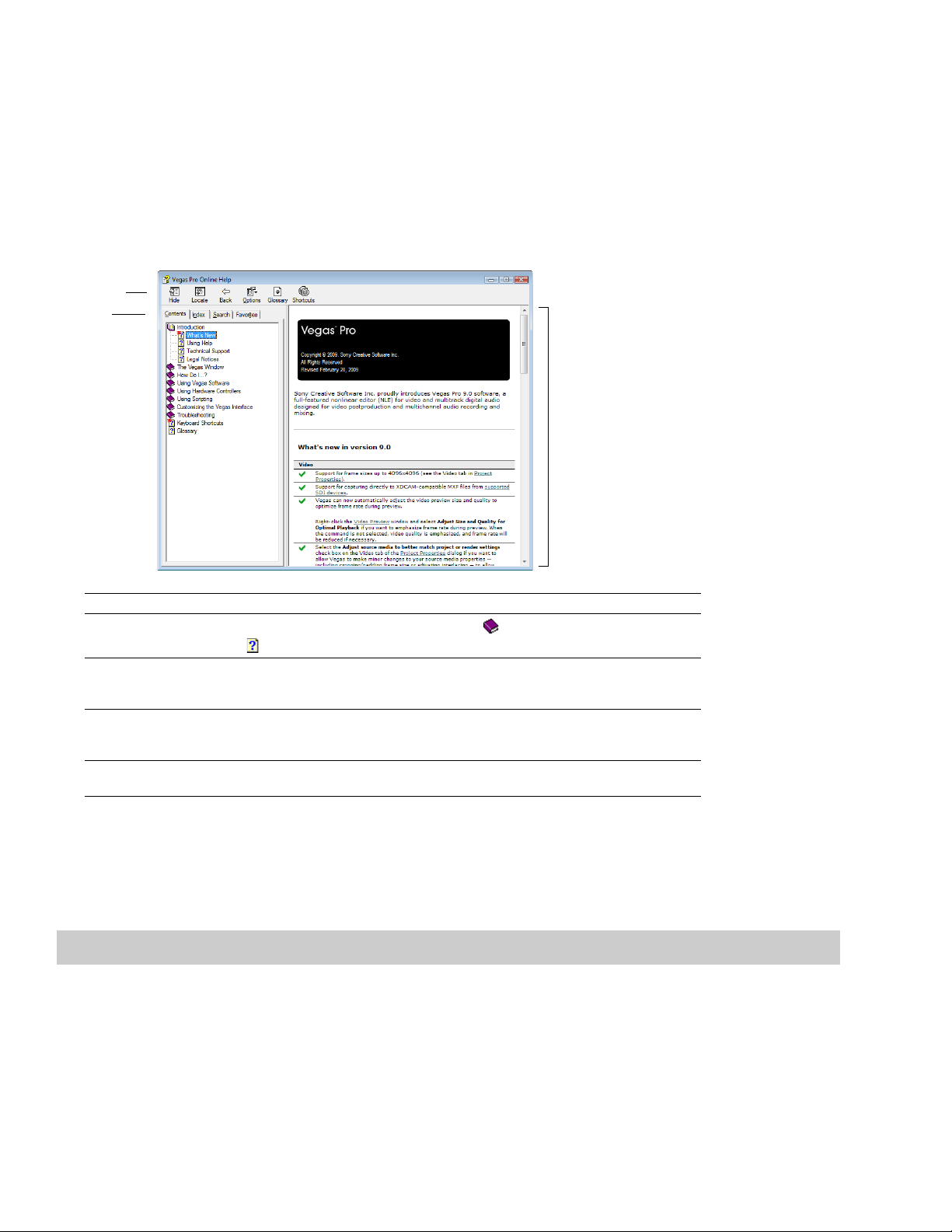
Getting help
Toolbar
Information
pane
Tab s
You can access two varieties of help within Vegas Pro:
• Online help
• Interactive tutorials
Online help
To access online help, choose Contents and Index from the Help menu or press F1.
The online help window has four tabs that you can use to find the information that you need.
Tab D es cr ipt io n
Contents
Index Provides a complete listing of the help topics available. Scroll through the list of available topics or
Search Allows you to enter a keyword and display all of the topics in the online help that contain the
Favorites Allows you to keep topics that you revisit often in a separate folder. To add a topic to your favorites,
Provides a list of available help topics. Click a closed book to open the pages, and then click on a
topic page .
type a word in the Type in the keyword to find box to quickly locate topics related to that word.
Select the topic and click the Display button.
keyword you have entered. Type a keyword in the Type in the word(s) to search for box and click
the List Topics button. Select the topic from the list and click the Display button.
click the Add button on the Fa vori tes tab.
Interactive tutorials
You can learn more about many of the features in Vegas Pro by using the interactive tutorials installed with the software.
By default, the tutorials display upon startup of the application. However, you can access them at any time from the Help menu by
choosing Interactive Tutorials.
Tip:
To turn off automatic display of the tutorials, clear the Show at Startup check box at the bottom of the tutorial window.
Help on the Web
Additional help and information is available on the Sony Creative Software Inc. Web site. From the Help menu, choose Sony on the Web
to view a listing of Web pages pertaining to Vegas Pro software and Sony Creative Software Inc. The software starts your system’s We b
browser and attempts to connect to the appropriate page on the Sony Creative Software Inc. site.
| CHAPTER 1
20
Page 29
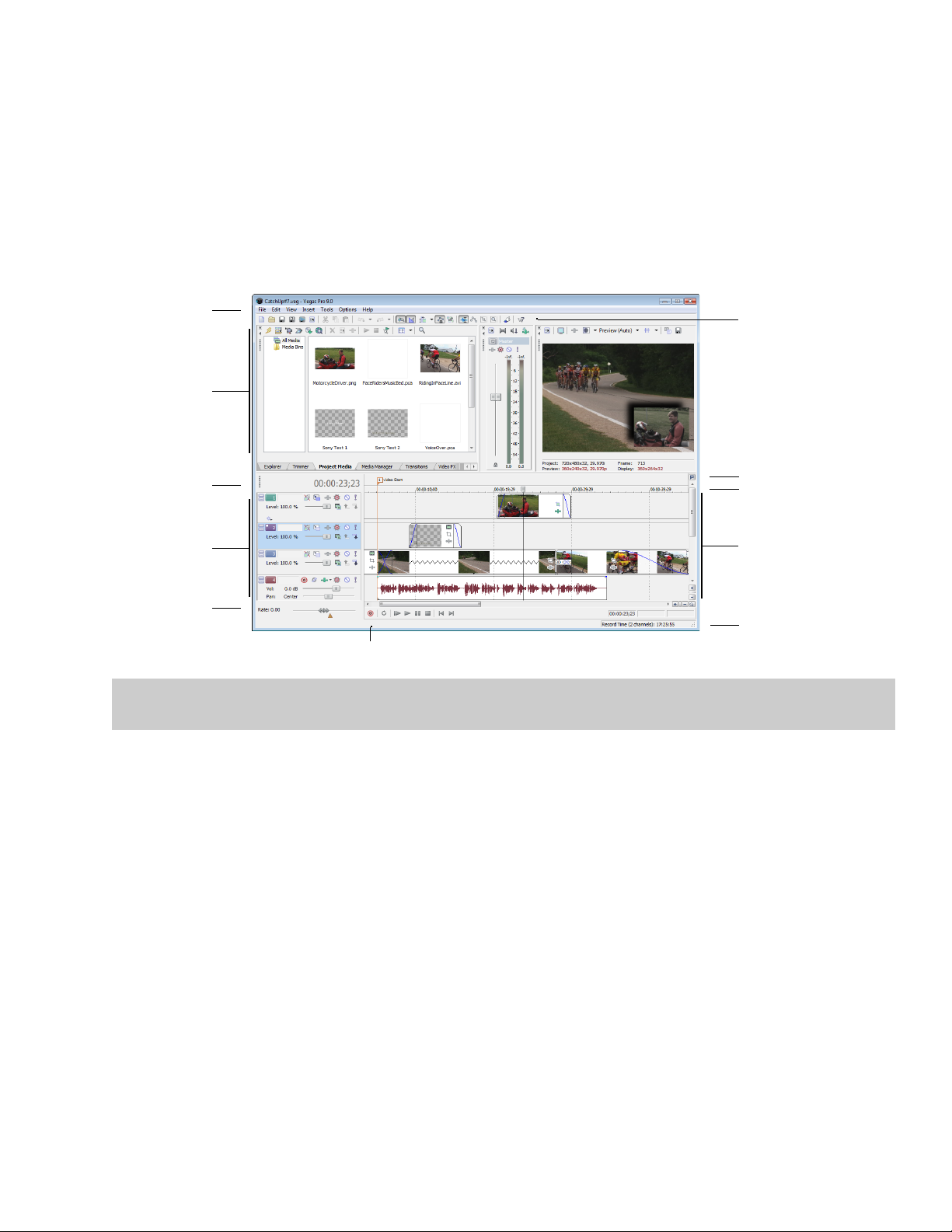
Overview
Track list
Scrub control
Transport bar
Status bar
Timeline (track view)
Ruler
Marker bar
Menu bar
Time display
Window
docking area
Toolbar
Vegas Pro software is designed to be an easy-to-use program with many tools that provide power and flexibility when creating and
working with multimedia files. Many operations, menu items, and shortcut keys are consistent with other popular Microsoft Windows
software applications.
The following sections provide a graphical tour of the Vegas Pro workspace.
Main window
This is the window that appears when the software is opened. The work area is subdivided into three primary areas: the track list, the
timeline (track view), and the window docking area.You can resize the track list, timeline, and window docking area by dragging the
dividers between them.
Tip:
If you prefer to work with the timeline at the top of the window and the docking area at the bottom of the window, clear the Display
timeline at bottom of main window check box on the Display tab of the Preferences dialog.
INTRODUCTION | 21
Page 30
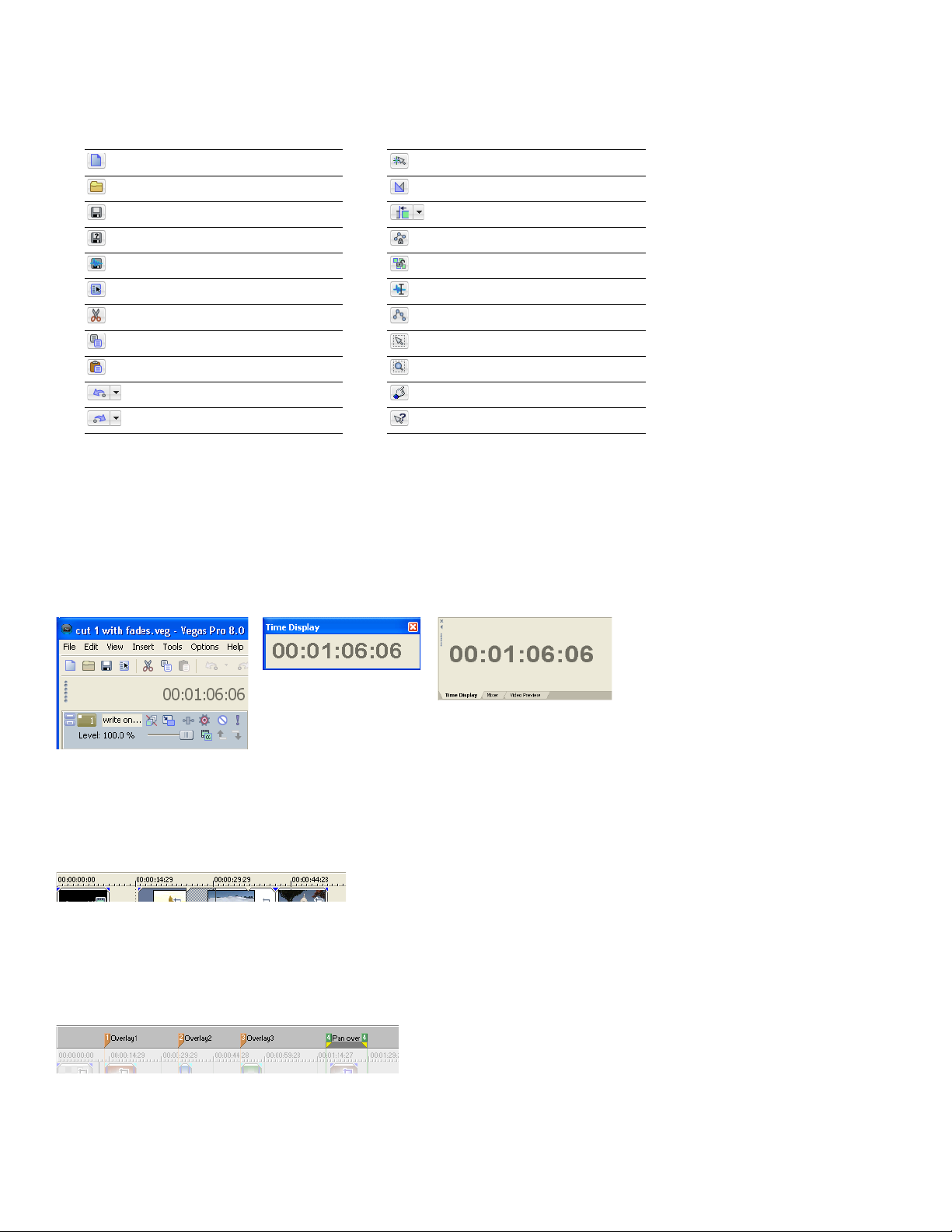
Toolbar
Docked position Floating window Docked in window docking area
The toolbar allows you to quickly access the most commonly used functions and features. From the Options menu, choose Customize
To ol ba r to specify which buttons are displayed.
Create new project Enable snapping
Open existing project Enable automatic crossfades
Save project Enable automatic ripple editing
Save project with different settings Lock envelopes to events
Render project Ignore event grouping
Open project properties Normal edit tool
Cut selected events or time range Envelope edit tool
Copy selected events or time range Selection edit tool
Paste items from clipboard into project Zoom edit tool
Undo Interactive tutorials
Redo Context-sensitive help
Time display
The Time Display window reflects the cursor’s position on the timeline, MTC input, MTC output, or MIDI clock output time. You can
customize time display settings, including what time the window displays and which colors are used in the display. For more
information, see Using the Time Display window on page 359.
You can move the Time Display window from its docked position above the track list to float on the workspace or dock in the window
docking area.
Ruler
The ruler is the timeline for your project. You can specify how the ruler measures time: seconds, measures and beats, frames, etc. For
more information, see Changing the ruler format on page 358.
Marker bar
The marker bar is the area where you can place, name, and position markers and regions along the project’s timeline. These
informational tags can serve as cues or reminders highlighting important events in your project. For more information, see Adding project
markers and regions on page 118.
22 | CHAPTER 1
Page 31

Command bar
Selected track
Track minimize and
maximize
Parent/child
Video tracks
compositing controls
Track number
Audio track
The command bar displays when you add a command to your project. Commands add metadata to media files to create effects such as
closed captioning. For more information, see Adding project markers and regions on page 118.
CD layout bar
The CD layout bar displays tracks and indices in an audio CD layout project for disc-at-once (DAO) CD burning. For more information, see
Burning Discs on page 381.
Track list
This area identifies the track order in your project and contains controls used to determine track compositing and mixing. For more
information, see Using the track list on page 72.
Timeline (track view)
All arranging and editing is done in the timeline (track view). This area contains all of a project’s events. For more information, see Using
the timeline (track view) on page 71.
INTRODUCTION | 23
Page 32

Transport bar controls
Drag either forward or
backward for playback
Set playback speed
Close window
Drag the handle away from the
Expand window
docking area to float the window.
The transport bar contains the playback and cursor positioning buttons frequently used while working on and previewing your project.
Record into track Pause project playback
Loop playback Stop playback
Play from beginning of project Move cursor to start of project
Play project from cursor position Move cursor to end of project
Status bar
The status bar is located at the bottom of the main program window and displays information about
roughly how much space is left on your computer to record audio (Record Time). During the rendering
processes, the left side of the status bar also contains information about the progress of the render.
The Video Preview window also has its own status bar that displays project specific information. For more information, see Understanding
the Video Preview window on page 317.
Scrub control
The scrub control is used to play your project forward or backward for editing
purposes. You may adjust playback speed by setting the speed control
marker located beneath the scrub control. For more information, see
Scrubbing on page 75.
Window docking area and floating window docks
By default, the window docking area is located in the upper half of the Vegas Pro workspace. This area allows you to keep frequently
used windows available but out of the way while you are working with a project. Windows can be docked next to each other,
subdividing the docking area, or they can be docked in a stack in the window docking area or in a separate floating docking window.
When stacked, each window has a tab at the bottom with its name on it. Click the window’s tab to bring it to the top.
• To dock a window, drag it to the docking area.
• Drag the handle on the left side of a docked window to remove a window from the docking area and float it.
• To prevent a window from docking when you drag it, hold the Ctrl key.
• To expand a docked window so it fills the docking area, click the Maximize button (
). Click again to restore the window to its
previous size.
• To remove a window from the docking area or a floating dock, click the Close button ( ).
24
| CHAPTER 1
Page 33

Display tips:
Preview selected media files before
Select drive
or folder
placing them in the project.
Select media to place in the project
by dragging and dropping or
double-clicking.
Add media to the Project Media
window by right-clicking a file and
choosing Add to Project Media list
from the shortcut menu.
• To display the window docking area in the bottom half of the Vegas Pro workspace, clear the Display timeline at bottom
of main window check box on the Display tab of the Preferences window.
• To display the tabs at the top of the window docking area rather than the bottom, select the Position tabs at top of
docked windows check box on the Display tab of the Preferences window.
• To hide the window docking area, select the Automatically hide docking area check box on the Display tab of the
Preferences window.
• For more information, see Display tab on page 377.
Explorer window - Alt+1
The Explorer window is similar to the Microsoft Windows Explorer. Use the Explorer window to select media files to drag to the project
timeline or add to the Project Media window. You can also use the Explorer to perform common file management tasks such as creating
folders, renaming files and folders, and deleting files and folders. Use the Start Preview (
) and Auto Preview ( ) buttons to preview
files before adding them to the project.
Move up the folder list to the next Stop preview
highest folder
Refresh the current view Enable automatic preview
Create a new folder Use Gracenote MusicID service to
Delete selected file(s) Edit and submit CD information to
Add selected file to My Favorites list Get media from the Web for use in
in address bar project
Start preview Change the display view
locate matching CD information
Gracenote
INTRODUCTION | 25
Page 34

Trimmer window - Alt+2
Video appears during
Right-click to
project playback or as
change Video
the cursor is moved
Preview settings.
during editing.
The Trimmer window is a good place to edit any media file. When a media file is placed in the Trimmer window, you can place portions
of the file on separate tracks by dragging and dropping. For more information, see Using the Trimmer window on page 134.
Mixer window - Alt+3
The Mixer window gives you access to your project’s audio properties, bus assignments, output levels, and plug-in chains. For more
information, see Using the Mixer window on page 193.
Video Preview window - Alt+4
This window displays a project’s video during project editing and playback. For more information, see Previewing and Analyzing Video on
page 317.
26 | CHAPTER 1
Page 35

Project Media window - Alt+5
The Project Media window helps you organize the media files you’re using in a project. The information about these files is displayed in
a highly flexible database that can be instantly sorted. You can also use the Project Media window to apply effects and plug-ins to media
files and set the specific properties of these files. For more information, see Using the Project Media window on page 51.
Edit Details window - Alt+6
This window serves as a highly detailed and customizable database of all of the events in a project. The database can be organized and
sorted according to a large number of attributes. For more information, see Using the Edit Details window on page 140.
Transitions window - Alt+7
The Transitions window contains all of the transitions available. The thumbnails display animated examples of each transition. You c an
drag transitions from this window to replace the crossfade between two video events or to replace the fade-in or fade-out region of a
video event. For more information, see Understanding basic transitions on page 295.
INTRODUCTION | 27
Page 36

Video FX window - Alt+8
The Video FX window contains the video effects available. The thumbnails display animated examples of each plug-in preset. You can
drag plug-ins from this window to an event, track, or to the Video Preview window (video output effects). For more information, see
Using video effects on page 269.
Media Generators window - Alt+9
The Media Generators window contains the different media generators provided. Media generators make it easy to create events
containing text, credit rolls, test patterns, color gradients, and solid color backgrounds. You can drag a media generator to the timeline
to create a new generated media event. For more information, see Using generated media on page 275.
Plug-In Manager window - Ctrl+Alt+1
This window organizes all of the plug-ins available, including video and audio effects, media generators, and transitions. The plug-ins,
which are organized in a folder structure, can be dragged into the project. For more information, see Using audio effects on page 219 or
Using video effects on page 269.
28 | CHAPTER 1
Page 37

Video Scopes window - Ctrl+Alt+2
This window allows you to monitor your broadcast video for image problems.
Use the scopes to analyze the your video and adjust accordingly with the Brightness and Contrast, Broadcast Colors, Color Corrector,
Color Corrector (Secondary), and Levels plug-ins before rendering.
For more information, see Monitoring video with scopes on page 322.
Surround Panner window - Ctrl+Alt+3
This window allows you to control panning in a 5.1 surround project. You can also display the Surround Panner window by doubleclicking the surround panner on a track or mixer control. For more information, see Working with 5.1 Surround on page 235.
Media Manager window - Ctrl+Alt+4
This window displays the Media Manager™, which you can use to search for, manage, and tag your media files. For more information, see
Using the Media Manager on page 79.
INTRODUCTION | 29
Page 38

XDCAM Explorer window - Ctrl+Alt+5
This window displays the XDCAM Explorer window, which you can use to locate, import, and export XDCAM clips. For more information,
see Working with XDCAM video on page 147.
Mixing Console window - Ctrl+Alt+6
This window displays the Mixing Console, which provides an integrated view of all tracks and busses in your project using the
appearance of a traditional hardware-based mixer. For more information, see Using the Mixing Console on page 201.
30 | CHAPTER 1
Page 39

Device Explorer window (Ctrl+Alt+7)
The Device Explorer window allows you to browse and import clips from AVCHD and XDCAM EX camcorders. For more information, see
Using the Device Explorer on page 68.
Saving and recalling window layouts - Ctrl+Alt+D or Alt+D
A window layout stores the sizes and positions of all windows and floating window docks in the Vegas Pro workspace. You can store up
to ten window layouts so you can quickly recall customized layouts for specific editing tasks. For more information, see Saving and
recalling window layouts on page 363.
INTRODUCTION | 31
Page 40

Keyboard shortcut reference
Project file shortcuts
Command Keyboard Shortcut
Create new project Ctrl+N
Create new project and bypass Project Properties Ctrl+Shift+N
dialog
Open existing project or media file Ctrl+O
Save project Ctrl+S
Open project’s properties Alt+Enter
Close current project Ctrl+F4
Exit Vegas Pro software Alt+F4
Magnification and view shortcuts
Command Keyboard Shortcut
Set focus to track view Alt+0
Show Explorer window (show/hide window if not Alt+1
docked)
Show Trimmer window (show/hide window if not Alt+2
docked)
Show Mixer window (show/hide window if not Alt+3
docked)
Show Video Preview window (show/hide window if Alt+4
not docked)
Show Project Media window (show/hide window if Alt+5
not docked)
Show Edit Details window (show/hide window if not Alt+6
docked)
Show Transitions window (show/hide window if not Alt+7
docked)
Show Video FX window (show/hide window if not Alt+8
docked)
Show Media Generators window (show/hide window Alt+9
if not docked)
Show Plug-In Manager window (show/hide window Ctrl+Alt+1
if not docked)
Show Video Scopes window (show/hide window if Ctrl+Alt+2
not docked)
Show Surround Panner window (show/hide window Ctrl+Alt+3
if not docked)
Show Media Manager window (show/hide window if Ctrl+Alt+4
not docked)
Show XDCAM Explorer window (show/hide window Ctrl+Alt+5
if not docked)
Show Mixing Console window (show/hide window if Ctrl+Alt+6
not docked)
Show Device Explorer window (show/hide window if Ctrl+Alt+7
not docked)
Show/hide audio bus tracks B
Show/hide video bus track Ctrl+Shift+B
Show/hide event media markers Ctrl+Shift+K
32 | CHAPTER 1
Page 41

Command Keyboard Shortcut
Show/hide active take information
When this command is selected, the current take
information will be displayed on events in the
timeline.
Pitch shifted audio events will display the amount of
pitch shift in the bottom-left corner of the event. If
the media has a known root note, the new root is
displayed in parentheses:
Stretched audio events will display a percentage in
the lower-right corner of the event to indicate the
stretched playback rate. If the media has a known
tempo, the effective playback tempo (after
stretching) is listed in parentheses after the stretch
amount.
Audio and video events that are not synchronized
will be highlighted in the timeline, and the amount
of offset will be displayed. Very small offsets that are
below the resolution of the timeline may be
displayed as 0.00. Set the project time format to
samples to see the offset amount.
Show/hide waveforms and frame images on events Ctrl+Shift+W
in the timeline
Show/hide event buttons (Generated Media, Event Ctrl+Shift+C
Pan/Crop, Video FX, and Recreate Generated Music)
Show/hide event fade lengths between selected and Ctrl+Shift+T
nonselected events:
Toggles the display of the frame under the cursor Ctrl+Shift+O
when you perform edge trimming. For example,
when you drag the edge of a video event with this
command selected, the Video Preview window will
update to draw the last frame in the event as you
drag.
When the command is not selected, a static frame is
displayed.
Show/hide envelopes Ctrl+Shift+E
Show next window F6 or Ctrl+Tab
Show previous window Shift+F6 or Ctrl+Shift+Tab
Recall window layout Alt+D, then press 0-9
Save window layout Ctrl+Alt+D, then press 0-9
Load default window layout Alt+D, then press D
Load audio mixing window layout Alt+D, then press A
Load color correction window layout Alt+D, then press C
Toggle focus between track list and timeline (and Ta b
bus track list and timeline if bus tracks are visible)
Switch focus to previous/next track or bus track Alt+Shift+Up/Down Arrow
Decrease height of all tracks or bus tracks Ctrl+Shift+Down Arrow
(depending which has focus)
Increase height of all tracks or bus tracks (depending Ctrl+Shift+Up Arrow
which has focus)
Minimize/restore track height Grave Accent (`)
When restoring track height, tracks that you
previously minimized are not restored. You can
restore these tracks by clicking the Restore Track
Height button (
Set track heights to default height Ctrl+Grave Accent (`)
Minimize/restore the window docking area F11 or Alt+Grave Accent (`)
) on the track header.
Ctrl+Shift+I
INTRODUCTION |
33
Page 42

Command Keyboard Shortcut
Maximize/restore the timeline vertically and Ctrl+F11 or Ctrl+Alt+Grave Accent (`)
horizontally (window docking area and track list will
be hidden)
Minimize/restore the track list Shift+F11 or Shift+Alt+Grave Accent (`)
Zoom in/out horizontally in small increments (if Up/Down Arrow
timeline has focus)
Zoom in/out horizontally in large increments or Ctrl+Up/Down Arrow
zoom to selection (if one exists)
Zoom in time until each video thumbnail represents Alt + Up Arrow
one frame
Zoom waveforms in/out vertically (audio only) Shift+Up/Down Arrow
Cursor placement, loop region, and time selection commands
Most of the cursor placement commands, when combined with the Shift key, also perform selection.
Command Keyboard Shortcut
Center view around cursor \
Go to Ctrl+G
Set end of time selection Ctrl+Shift+G
Go to beginning of time selection or viewable area (if Home
no time selection)
Go to end of time selection or viewable area (if no End
time selection)
Go to beginning of project Ctrl+Home or W
Go to end of project Ctrl+End
Select loop region Shift+Q
Restore previous five time selections Backspace
Move left by grid marks Page Up
Move right by grid marks Page Down
Move left/right one pixel (when Quantize to Frames Left or Right Arrow
is turned off )
Move to previous/next marker Ctrl+Left/Right Arrow
Move one frame left/right Alt+Left or Right Arrow
Move left/right to event edit points (including fade Ctrl+Alt+Left/Right Arrow
edges)
Jog left/right (when not in edge-trimming mode or F3/F9
during playback)
Move cursor to corresponding marker or select 0-9 keys (not numeric keypad)
corresponding region
Move to previous CD track Ctrl+Comma
Move to next CD track Ctrl+Period
Move to previous CD index or region Comma
Move to next CD index or region Period
Set in and out points I (in) and O (out)
Create time selection while dragging on an event Ctrl+Shift+drag with mouse
34 | CHAPTER 1
Page 43

General editing commands
Command Keyboard Shortcut
Cut selection Ctrl+X or Shift+Delete
Copy selection Ctrl+C or Ctrl+Insert
Paste from clipboard Ctrl+V or Shift+Insert
Paste insert Ctrl+Shift+V
Paste repeat Ctrl+B
Delete selection Delete
Trim event to selection Ctrl+T
Render to new track Ctrl+M
Undo Ctrl+Z or Alt+Backspace
Redo Ctrl+Shift+Z or Ctrl+Y
Rebuild audio peaks Shift+F5
Switch to normal editing tool Ctrl+D
Switch to next editing tool D
Switch to previous editing tool Shift+D
Enable multicamera editing Ctrl+Shift+D
Event selection and editing commands
Command Keyboard Shortcut
Range select Shift+click events
Multiple select Ctrl+click individual events
Select all Ctrl+A
Unselect all Ctrl+Shift+A
Cut selection Ctrl+X or Shift+Delete
Copy selection Ctrl+C or Ctrl+Insert
Paste from clipboard Ctrl+V or Shift+Insert
Paste insert Ctrl+Shift+V
Paste repeat Ctrl+B
Delete selection Delete
Split events at cursor S
Trim/crop selected events Ctrl+T
Enter edge-trimming mode and select event start; Numeric Keypad 7 or [
move to previous event edge
In this mode, 1, 3, 4, and 6 on the numeric keypad
trim the selected event edge. Hold Ctrl while
pressing 1, 3, 4, or 6 to time compress/stretch, or
hold Alt while pressing 1, 3, 4, or 6 to slip trim, or hold
Ctrl+Alt while pressing 1, 3, 4, or 6 to slide a transition
or crossfade.
Enter edge-trimming mode and select event end; Numeric Keypad 9 or ]
move to next event edge
In this mode, 1, 3, 4, and 6 on the numeric keypad
trim the selected event edge
Trim left/right (when in edge-trimming mode) F3/F9
Exit edge-trimming mode Numeric Keypad 5
Move or trim selected events one frame left/right Numeric Keypad 1/3
Move or trim selected events one pixel left/right Numeric Keypad 4/6
Move selected events up/down one track Numeric Keypad 8/2
Slip: move media within event without moving the Alt+drag inside the event
event
INTRODUCTION |
35
Page 44

Command Keyboard Shortcut
Slip trim: moves the media with the edge as it is Alt+drag edge of event
trimmed
Trim adjacent: trims selected event and adjacent Ctrl+Alt+drag edge of event
event simultaneously
Slip-trim right edge of event Alt+Shift+drag event
Event split or split/trim Ctrl+Alt+Shift+click or drag event
Slide: trims both ends of event simultaneously Ctrl+Alt+drag middle of event
Slide crossfade: moves crossfade Ctrl+Alt+drag over a crossfade
Stretch (compress) the media in the event while Ctrl+drag edge of event
trimming
Raise pitch one semitone = (not numeric keypad)
Raise pitch one cent Ctrl+=
Raise pitch one octave Shift+=
Lower pitch one semitone - (not numeric keypad)
Lower pitch one cent Ctrl+-
Lower pitch one octave Shift+-
Reset pitch Ctrl+Shift+= or Ctrl+Shift+-
Select next take T
Select previous take Shift+T
Convert cut to transition Numeric Keypad /
Convert transition to cut Ctrl+Numeric Keypad /
Open in audio editor Ctrl+E
Numeric Keypad *
Numeric Keypad -
Red eye reduction commands
Command Keyboard shortcut
Scroll Left/Right Right/Left Arrow
Press Shift to scroll quickly
Scroll Up/Down Up/Down Arrow
Press Shift to scroll quickly
Jump to top/bottom of image Page Up/Down
Shift+Home/End
Jump to left/right edge of image Home/End
Shift+Page Up/Down
Jump to horizontal center of image \
Numeric Keypad *
Jump to vertical center of image \
Numeric Keypad *
Jump to horizontal and vertical center of image C
Playback, recording, and preview commands
Command Keyboard shortcut
Arm track for record Ctrl+Alt+R
Arm for record and set recording path Ctrl+Alt+Shift+R
Record Ctrl+R
Looped playback Q or Ctrl+Shift+L
Play from start Shift+Spacebar or Shift+F12
Start playback Spacebar
36 | CHAPTER 1
Page 45

Command Keyboard shortcut
Play from any window Ctrl+Spacebar or F12
Play/pause Enter or Ctrl+F12
Stop playback Spacebar or Esc
Go to start of project Ctrl+Home
Go to end of project Ctrl+End
Dim (attenuate) mixer output Ctrl+Shift+F12
Preview cursor position Numeric Keypad 0
You can specify the length of the time that is
previewed using the Cursor preview duration box
on the Editing tab of the Preferences dialog.
Scrub playback J, K, or L
Selectively prerender video Shift+M
Preview in player Ctrl+Shift+M
Build dynamic RAM preview Shift+B
Toggle external monitor preview Alt+Shift+4
Generate MIDI timecode F7
Generate MIDI clock Shift+F7
Trigger from MIDI timecode Ctrl+F7
Enable multicamera editing Ctrl+Shift+D
Choose multicamera take 1 - 9
Choose multicamera take with crossfade Ctrl+1 - 9
INTRODUCTION |
37
Page 46

Timeline and track list commands
Command Keyboard shortcut
Insert new audio track
Insert new video track
Change audio track volume or video track Ctrl+Left/Right Arrow
compositing level (when focus is on track list)
Change audio track panning or video track fade-to- Ctrl+Shift+Left/Right Arrow
color setting (when focus is on track list and
automation controls are visible)
Note:
(
adjust the track fade-to-color setting.
Mute selected tracks Z
Mute selected track and remove other tracks from Shift+Z
mute group
Solo selected tracks X
Solo selected track and remove other tracks from Shift+X
solo group
Override snapping (if snapping is on) or enable Shift+drag
snapping (if snapping is off )
Quantize to frames Alt+F8
Enable/disable snapping F8
Snap to grid Ctrl+F8
Snap to markers Shift+F8
Post-edit ripple affected tracks F
Post-edit ripple affected tracks, bus tracks, markers, Ctrl+F
and regions
Post-edit ripple all tracks, markers, and regions Ctrl+Shift+F
Auto ripple mode Ctrl+L
Automatic crossfades Ctrl+Shift+X
Render to new track Ctrl+M
Group selected events G
Ungroup selected events U
Ignore event grouping Ctrl+Shift+U
Clear group without deleting events Ctrl+U
Select all events in group Shift+G
Insert/show/hide track volume envelope V
Remove track volume envelope Shift+V
Insert/show/hide track panning envelope P
Remove track panning envelope Shift+P
Cycle through effect automation envelopes E and Shift+E
Show/hide envelopes Ctrl+Shift+E
Adjust envelope point up/down by one pixel Select envelope point and hold the mouse button, then press 8 or 2 on the
Adjust envelope point left /right by one pixel Select envelope point and hold the mouse button, then press 4 or 6 on the
Adjust envelope point value in fine increments
without changing the point’s timeline position
Adjust envelope point value in normal increments Ctrl+Alt+ drag envelope point or segment
without changing the point’s timeline position
Adjust envelope point’s timeline position without Alt+ drag
changing its value
Insert command marker C
Click the Automation Settings button
) and choose Show Automation Controls to
Ctrl+Q
Ctrl+Shift+Q
numeric keypad
numeric keypad
Ctrl+ drag envelope point or segment
38 | CHAPTER 1
Page 47

Command Keyboard shortcut
Insert marker M
Insert region R
Insert CD track region N
Insert CD track index Shift+N
Trimmer window commands
The following commands apply to the Trimmer window. Many of the shortcuts that apply to the timeline also work in the Trimmer. The
following list highlights commands unique to the Trimmer.
Command Keyboard shortcut
Add media from cursor A
Add media to cursor Shift+A
Transfer time selection from timeline to Trimmer T
after cursor
Transfer time selection from timeline to Trimmer Shift+T
before cursor
Toggle selected stream: audio/video/both Tab
Toggle audio/video stream height Ctrl+Shift+Up/Down Arrow
Sort Trimmer history H
Clear Trimmer history Ctrl+Shift+H
Remove current media from Trimmer history Ctrl+H
Save markers/regions S
Toggle automatic marker/region saving Shift+S
Open in audio editor Ctrl+E
Show video in Video Preview window Ctrl+P
Track Motion window shortcuts
The following commands apply to the Track Motion and 3D Track Motion windows.
Command Keyboard shortcut
Change 3D layout 1-6 (not numeric keypad)
Lock aspect ratio A
Scale about center C
Edit in object space O
Prevent movement X, Y, and Z
Prevent scaling Shift+X, Shift+Y, and Shift+Z
Enable snapping F8
Enable rotation Shift+F8
Surround Panner commands
Add Ctrl to the following shortcuts if you want to move the pan point in fine increments.
Description Keyboard shortcut
Constrain motion to a line through the center of the
surround panner
Constrain motion to a constant radius from the
center
Constrain motion to the maximum circle that will fit
in the Surround Panner
Shift+drag the pan point (only when Move Freely
Alt+drag the pan point (only when Move Freely
Alt+mouse wheel
Alt+Shift+drag the pan point (only when Move Freely
Alt+Shift+mouse wheel
is selected)
is selected)
is selected)
INTRODUCTION |
39
Page 48

Description Keyboard shortcut
Move the pan point forward/back (when the pan Up/down arrow
point is selected)
Move the pan point left/right (when the pan point is Left/Right Arrow
selected)
Move the pan point to a corner, edge, or center of Numeric Keypad
the Surround Panner (when the pan point is
selected)
Move the pan point to a corner on the largest circle Ctrl+Numeric Keypad 1,3,7,9
that will fit in the Surround Panner (when the pan
point is selected)
Page Up/Page Down
Mouse wheel
Shift+Page Up/Page Down
Shift + mouse wheel forward/back
40 | CHAPTER 1
Page 49

Mixing Console commands
Command Keyboard shortcut
Rename selected channel F2
Insert new audio track Ctrl+Q
Cycle default/narrow/wide channel strips D/N/W
Hide the selected channel strip Shift+H
Show the Channel List pane Shift+C
Show/hide all channel strips Q
Show/hide audio bus channel strips U
Show/hide audio track channel strips A
Show/hide assignable effects channel strips E
Show/hide master bus channel strip T
Show/hide preview channel strip P
Show/hide fader ticks Shift+T
Show/hide control region labels Shift+L
Show/hide Faders control region F
Show/hide Insert FX control region I
Show/hide I/O control region H
Show/hide Meters control region M
Show/hide Sends control region S
Miscellaneous commands
Command Keyboard shortcut
Online help F1
Context-sensitive help (What’s This Help) Shift+F1
Shortcut menu Shift+F10
Make fine fader/slider adjustments Ctrl+drag
Change relative keyframe spacing Alt+drag keyframes
Move region without changing length Alt+drag region tag
Rebuild audio peaks F5
Multimedia keyboard shortcuts
Command Keyboard shortcut
Play/Pause Play/Pause
Play from start Shift+Play/Pause
Stop Stop
Mute track Mute
Mute track and remove other tracks from mute Shift+Mute
group
Solo track Ctrl+Mute
Solo track and remove other tracks from solo group Ctrl+Shift+Mute
Change audio track volume or video track Ctrl+Volume Up/Down
compositing level (when focus is on track list)
Change audio track panning or video track fade-to- Shift+Volume Up/Down
color setting (when focus is on track list)
Change track focus Next/Prev Track
INTRODUCTION |
41
Page 50

Mouse wheel shortcuts
Command Shortcut
Zoom in/out Wheel
Scroll vertically Ctrl+wheel
Scroll horizontally Shift+wheel
Move the cursor in small increments Ctrl+Shift+wheel
Trim the selected event edge one pixel (if you’re
in edge-trimming mode)
Adjust scrub rate during playback
Move cursor one frame at a time Ctrl+Shift+Alt+wheel
Trim the selected event edge one frame (if
you’re in edge-trimming mode)
Adjust scrub rate during playback
Move fader/slider Hover over fader and use wheel
In plug-in windows, click the control first to give
it focus.
Move fader/slider in fine increments Ctrl+hover over fader and use wheel
42 | CHAPTER 1
Page 51

Cursor indications
The cursor changes depending on which functions are available.
Cursor Indicates Modifier Description
Standard none This is the standard arrow cursor that means events can be
Trim none Position the cursor over the edge of an event and drag to trim the
Slip Trim Alt Position the cursor over the edge of an event, press Alt, and drag
Stretch Ctrl Position the cursor over the edge of an event, press Ctrl, and drag
Slip Alt Press Alt and drag on the middle of a clip to move the media
Tri m
Adjacent
Slide Ctrl+Alt Position the cursor over the middle of an event, press Ctrl+Alt, and
Slide
Crossfade
Ctrl+Alt Position the cursor over the boundary between two adjacent
Ctrl+Alt Position cursor over a crossfade, press Ctrl+Alt, and drag on a
dragged.
event shorter or longer.
to trim. The media within the event moves with the edge. This is
useful to preserve the beginning or end of an event while
trimming.
the edge to stretch or compress it. This makes the media in the
event play slower or faster.
within the event without moving the event itself.
events, press Ctrl+Alt, and drag. Both events are edge trimmed
simultaneously.
drag to simultaneously trim both ends.
crossfade to move it.
Using a control surface
A control surface is a hardware device that uses knobs, faders, and buttons to control user interface elements that are normally
controlled with a mouse. Using a control surface lends a tactile feel to your editing sessions.
Unlike keyboard shortcuts—which determine the shortcut’s behavior based on the portion of the Vegas Pro window that has focus—a
control surface’s mapped functions work no matter what part of the application has focus.
You can use one Mackie® Control Universal or up to five generic control surfaces with Vegas Pro software. For more information about
setting up a control surface, see External Control & Automation tab on page 379.
INTRODUCTION | 43
Page 52

Audio signal flow
44 | CHAPTER 1
Page 53

Video signal flow
Track signal flow
Composited track signal flow
INTRODUCTION | 45
Page 54

46 | CHAPTER 1
Page 55

Chapter
2
Getting Started
Vegas® Pro software is a new way of creating multimedia productions. Whether you are an experienced multimedia
author or a budding novice, the powerful features and capabilities of Vegas Pro software are organized to increase your
creativity and productivity. The following chapter summarizes the software’s basic functions and operations.
Creating projects
The process of creating a multimedia production can be a complicated undertaking, involving hundreds of shots, takes,
voiceovers, music beds, audio tracks, and special effects. Organization is a critical issue in this process. In the software,
organization is handled by a small project file (.veg) that saves information about source file locations, edits, cuts,
insertion points, transitions, and special effects. This project file is not a multimedia file, but is instead used to create
(render) the final file when editing is finished.
Because Vegas Pro software edits a project file and not the original source files, you can edit without worrying about
corrupting your source files. This not only gives you a strong sense of security, but it also gives you the freedom to
experiment.
Starting a new project
1.
2.
From the File menu, choose New.
Note:
Enter your project settings on the various tabs. For more
information, see Working with project properties on page
360.
• The Video tab allows you to select the video format
• The Audio tab allows you to set up the basic audio
• The Ruler tab allows you to choose the way the ruler
• The Summary tab allows you to enter any relevant
• The Audio CD tab allows you to enter information for
The first time you run the software, a new project will automatically be started for you.
and other video parameters.
settings.
is delineated (beats, seconds, etc.).
information and reminders about your project.
burning audio CDs.
Tip:
The easiest way to set the often-complex properties on
the Video tab is to select a template that matches your
media (for example, NTSC DV (720x480, 29.970 fps)).
3.
Click OK.
4.
From the File menu, choose Save. Enter a name, browse
for a location, and click Save to save your project (.veg file).
You can change project settings at any time while working on a project. From the File menu, choose Properties to
change any of these settings.
GETTING STARTED | 47
Page 56

Setting video properties based on a media file
You can automatically set your project video properties to match an existing video file.
1.
From the File menu, choose Properties.
2.
On the Video tab of the Project Properties dialog, click the Match Media Settings button (
3.
Browse for a media file that has the settings you wish you use for the project.
4.
Click Open.
The frame size, frame rate, pixel aspect ratio, and field order of this file are automatically detected and the project properties are set
to match.
Tip:
typically use these settings, select the Start all new projects with these settings check box.
5.
Click OK to save the new project properties.
To save this information for future use, enter a name in the Te mp l at e box and click the Save Template button ( ). If your projects
).
Working with rotated projects
The use of rotated displays—monitors that display vertical media—has become increasingly popular: you can see them in kiosks,
presentations, and even on the nightly news. If you have a project that you’d like to display in a rotated format, Vegas Pro makes it easy.
1.
Create a new project. For more information, see Starting a new project on page 47.
2.
Set your project properties as needed, and then choose a setting from the Output rotation drop-down list to indicate the
orientation of your destination display device. If you want to display your project in portrait (tall) mode, choose 90° clockwise or
90° counterclockwise.
3.
Add your media files to your project. For more information, see Getting media files on page 50.
4.
Edit the properties for each of your media files to set its rotation as needed:
a.
b.
In the example to the left, the video was shot with the camera tripod rotated 90 degrees. However,
because neither the project or the media has been rotated, the video is displayed sideways within
the standard landscape frame.
After choosing 90° clockwise from the Output rotation drop-down list, the Video Preview window
is rotated (see example to the left). Because the media hasn’t been rotated yet, it doesn’t match the
project orientation and is letterboxed within the frame.
Right-click a media file in the Project Media window and choose Properties from the shortcut menu. The Media Properties
dialog is displayed.
Choose a setting from the Rotation drop-down list to indicate the direction you want to rotate your media.
c.
48
| CHAPTER 2
After choosing 90° clockwise from the Rotation drop-down list, the media is rotated, and the video
fills the frame.
Click OK to close the Media Properties dialog and save your changes.
Page 57

Tip:
To rotate multiple files quickly, select them in the Project Media window, right-click a selected file, and then choose Rotate 90°
Clockwise or Rotate 90° Counterclockwise from the shortcut menu.
5.
Drag your clips from the Project Media window to the timeline to create events.
6.
Edit your project as needed.
7.
Render your project to any supported rendering format. For more information, see Rendering a project on page 335.
In the Render As dialog, select the Use project output rotation setting check box if you want to use the Output rotation setting
from the Project Properties dialog for your rendered file. When the check box is cleared, the media is rotated according to its Media
Properties setting, but the project itself is unrotated—you can use this setting to proof your project on an unrotated display.
Tip:
your project:
a.
b.
c.
d.
e.
f.
To render a portrait-oriented file for viewing on a computer, you can create a rendering template that matches the proportions of
Right-click the Video Preview window and ensure Simulate Device Aspect Ratio is selected.
Next, adjust the size of the Video Preview window to a comfortable preview frame size and note the Display dimensions in the lowerright corner of the Video Preview window.
From the File menu, choose Render As, choose the desired rendering format from the Save as type drop-down list, and then
choose a rendering template that's close to the frame size you noted in step b.
Click the Custom button, and then use the Video tab in the Custom Template dialog to adjust the frame size to match the
dimensions you noted in step b.
Save your template for later use
Clear the Use project output rotation setting check box and render your file.
Saving a project
When you save your work, it is saved in a project file. Project files are not rendered media files.
1.
From the File menu, choose Save.
The first time you save a project, the Save As dialog appears. In subsequent saves, the dialog is bypassed, your existing file name is
retained, and your project is updated to include any implemented changes.
2.
Select the drive and folder where you want to store the project.
3.
Type the project name in the File Name box.
4.
Click Save.
Tip:
Select the Copy and trim media with project check box to save the project file and copies of the media files to a common location.
For more information, see Renaming or creating a copy of a project (using Save As) on page 333.
Renaming a project (using Save As)
After you have been working with your project, you can use the Save As command in the File menu to save a copy of a project with a
new name. This is useful for backing up different versions of a project. For more information, see Renaming or creating a copy of a project
(using Save As) on page 333.
GETTING STARTED | 49
Page 58

Getting media files
You can add media from a variety of sources to your project. You can add audio and video files, record audio into a track, capture video
from a video camera, or extract music from your own CD. You can also create media such as text overlays, backgrounds, and credit rolls
from within the software. For more information, see Using generated media on page 275.
Vegas Pro software supports a wide range of media file types. There are multiple ways to locate and add files to your Vegas Pro project,
as discussed in the following sections.
Notes:
• To have pulldown fields automatically removed when opening 24 fps progressive-scan DV video files, select the Allow pulldown
• When you add an ACID loop to the timeline, it is automatically stretched to match the project tempo as specified on the Ruler tab of the
• When you add a multichannel audio file (.wav/.wav64, .avi, .mxf, ATRAC, and BWF) to your project, the audio is added across tracks. For
• When you add a multistream audio file to your project, you can choose which stream you want to use by right-clicking the event,
• 5.1-channel audio from DVD camcorders will be downmixed to stereo when importing into a stereo project. When importing into a 5.1
removal when opening 24p DV check box on the General tab of the Preferences dialog. To open your 24p DV video files as 29.97 fps
interlaced video (60i), clear this check box.
Project Properties dialog. If you want to ignore tempo information, clear the Import audio at project tempo check box on the Audio tab
of the Preferences dialog. For more information on project properties, see Working with project properties on page 360. For more
information on preferences, see Setting preferences on page 366.
example, if you import a four-channel WAV file, the audio will be added to four adjacent tracks. For control over which channels are used
by each event, right-click a multichannel audio event, choose Channels from the shortcut menu, and choose a command from the
submenu. For more information, see Adjusting audio channels on page 186.
choosing Stream from the shortcut menu, and then choosing a stream from the submenu.
surround project, audio will be added to separate tracks for the center, front, rear, and LFE channels.
Previewing a media file
You may preview files before placing them in your project. The Explorer window has a mini-transport bar with Play, Stop, and Auto
Preview buttons (
Video Preview window (for video files).
Tip:
You can use the same mini-transport bar buttons in the Project Media window to preview files in the Project Media list.
). When you preview a file, its stream is sent to the Mixer window’s preview bus (for audio files) or to the
1.
Select a file in the Explorer window.
2.
Click the Play button ( ) to listen to the file.
3.
Click the Stop button ( ) or select a different file to stop previewing the file.
Tip:
To automatically preview selected files, click the Auto Preview button ( ) on the Explorer window’s transport bar.
Note:
Video is previewed in the Trimmer window. If you want to preview video in the Video Preview window, deselect the Show Video
Monitor button ( ) on the Trimmer window.
50
| CHAPTER 2
Page 59

Using the Project Media window
Media files, both video and audio, tend to be the largest files on your hard
drive. It is therefore not always easy to move them around and impractical
to store multiple copies of these files. You can add media files to the
Project Media window to organize them before any editing begins. Once
you begin working on a project, all files you add to the timeline are
automatically included in the Project Media list. From the View menu,
choose Project Media to open this window if it is not already visible.
Using Project Media views
You can control the information that is displayed in the Project Media
window by clicking the Views button (
) and selecting a view. The
purpose of each view is explained below.
View Description
List Displays a simple listing of the file name of each file in the Project Media window.
Detailed Displays all the properties for each file. The information is presented in a table format. You can
Thumbnail Displays the first frame of a video file.
customize the information displayed:
Reorder columns (fields) by dragging the column label to a new position.
Hide a column by dragging the column label off of the Project Media window. To display a
hidden column, right-click the Project Media window, choose View from the shortcut menu,
and choose the column name from the submenu.
Sort the files in the Project Media list according to a category by clicking the column label for
that category.
Use the Comments field to add your own annotations to a file’s entry in the Project Media list.
Double-click the field to enter text. This information is saved with the project and is not saved
with the media file itself.
Adding media to the Project Media list
You can add media to the Project Media list without adding it to the timeline by importing the file. For more information, see Importing
media on page 55.
Adding media to the Project Media list from the Explorer window
1.
Navigate to and select a file to add to the Project Media list. You can use Ctrl or Shift to select multiple media files.
2.
Right-click the file and choose Add to Project Media list from the shortcut menu. The selected file is added to the Project Media
window.
Replacing media in the Project Media window
You may replace a file in the Project Media window with a different file. When changing the media file that an event contains, every
occurrence of the event on the timeline is updated with the new media file contents.
1.
Right-click a file in the Project Media window.
2.
Choose Replace from the shortcut menu.
3.
In the Replace Media File dialog, browse for and select the file that you want to replace the current file.
4.
Click Open. The selected file replaces the old file in the Project Media list, and any events in the timeline containing the old file are
updated to contain the new media file.
GETTING STARTED | 51
Page 60

Getting images
You can bring images directly into the software from your scanner. The images are added to the Project Media list as JPEG image files.
Note:
In order to get pictures from a scanner, you may need to install a driver for your device. Refer to the software that was included
with your device or the manufacturer’s Web site.
1.
Make sure your device is on and connected to your computer.
2.
In the Project Media window, click the Get Photo button ( ). The software is started for the device.
3.
Use the device software to get an image and send it to Vegas Pro software. Once the image has been sent, the Scanned Files dialog
appears.
• Click Rename to give the new image a more meaningful name.
• Click Delete to cancel the process of adding the image.
4.
Click Done. The new JPEG file is added to the Project Media window.
Extracting audio from a CD
You can extract tracks from a CD and add them to the Project Media window as .wav files.
Important:
or sharing of copyrighted materials. Using Vegas Pro software for such purposes is, among other things, against United States and
international copyright laws and contrary to the terms and conditions of the End User License Agreement. Such activity may be
punishable by law and may also subject you to the breach remedies set forth in the End User License Agreement.
1.
Insert the audio CD.
2.
In the Project Media window, click the Extract Audio from CD
button ( ). The Extract Audio from CD dialog appears.
3.
From the Action drop-down list, choose the method you want to
use for extracting the CD audio:
• Read by track Use this option to choose the tracks you want to
• Read entire disc Use this option to automatically extract all
• Read by range Use this option to extract audio from a specified
4.
If you chose either the Read by track or Read by range option,
specify the tracks or range to extract:
• For Read by track, click the tracks you want to extract in the
• For Read by range, enter a time in the Range start field and either the Range end or Range length fields. The range of audio is
Vegas Pro software is not intended for, and should not be used for, illegal or infringing purposes, such as the illegal copying
extract from the CD.
tracks on the disc. The entire CD is extracted into one new file in
the Project Media window.
range of time.
Tracks to read list. Use the Ctrl or Shift keys to select more than
one track. Each track is extracted into a separate file in the Project Media window.
extracted into one new file in the Project Media window.
Note:
If you want to extract multiple tracks to a single file, choose Read by track from the Action drop-down list to select your tracks,
and then choose Read by range from the Action drop-down list. The appropriate time range for the tracks you selected will
automatically be inserted and the time range will be extracted to a single file.
5.
From the Drive drop-down list, choose the drive containing the audio CD from which you want to extract.
6.
Click the MusicID button if you want to obtain CD information using Gracenote® MusicID.
If CD information is not available, you can click the CD Info button to display a dialog box where you can edit the CD information
and submit it for inclusion in the Gracenote Media Database.
52 | CHAPTER 2
Page 61

7.
From the Speed drop-down list, choose the speed at which you want to extract the audio. If you experience any problems
extracting audio, you can try decreasing the selected speed, or you can click Configure to adjust the Audio extract optimization
setting.
Note:
8.
Click OK. The Save As dialog appears.
9.
Select a name and location for the new .wav file.
10.
Click Save to begin extracting the audio.
The track is extracted and a progress meter is displayed to indicate the percent complete. When extraction is complete, the new
.wav file appears in the Project Media window.
Adding a still-image sequence
If you’ve exported a video clip as a still-image sequence using another application (a 3D-rendering application, for example), the
sequence can be added to the Project Media window and treated as a single media file. Each image in the sequence will be displayed for
one frame in the event.
1.
Click the Import Media button ( ) in the Project Media window. The Import Media dialog appears.
2.
Choose the folder where the sequence you want to open is stored.
3.
Select the first image in the sequence (or the image you want to start the event).
4.
Select the Open still-image sequence check box.
5.
In the Range field, enter the number of the last image you want to open. For example, if you’d selected AnimationOne_00001.tga
in step 3, you could enter 120 in this box to create a new image sequence using AnimationOne_00001.tga to
AnimationOne_00120.tga.
6.
Click Open. The still-image sequence is added to the Project Media window.
To eject the CD at any time prior to beginning the extraction process, click the Eject button.
Sorting media with bins
The detailed view of the Project Media window helps you sort your media files using their attributes, but for more control, you can
create bins. Bins are folders within projects that you can use to organize your media files.
Media bins are virtual folders that are saved with your project. They do not affect the way media is saved on your computer.
Creating bins
Right-click the parent bin where you want to create a new bin and choose Create New Bin from the shortcut menu.
Adding media to a bin
1.
2.
Searching media bins
1.
2.
3.
Browse your existing bins to find the media file you want to move. The All Media Folder contains all media files in your project.
Drag a file from the right-hand pane to a bin.
Right-click in the Project Media window and choose Search Media Bins from the shortcut menu. The Search Media Bins dialog is
displayed.
Use the drop-down lists in the Search Media Bins dialog to set your search conditions and click the Search button. The selected bin
and all sub-bins will be searched.
Click the Search Results icon to view the matching files.
Tip:
Right-click the Search Results icon and choose Save as Bin from the shortcut menu to save the results of your search as a new
media bin.
GETTING STARTED | 53
Page 62

Automatically adding recorded files to a media bin
Select a media bin if you want to automatically add your recorded audio to a media bin.
Deleting media from a bin
1.
Select a media file.
2.
Press Delete on your keyboard.
3.
4.
Configuring 24p pulldown removal
If the All Media Folder is selected, the file will be removed from your project.
If a media bin is selected, the file is removed from the bin, but remains part of your project. The file is still available in the All Media
Folder.
Right-click a DV AVI file in the Project Media window and choose File Format Properties from the shortcut menu to edit file settings
from the file format plug-in associated with the media file type.
For 24p NTSC DV AVI files with 2-3 pulldown, you can use this dialog to configure removal of pulldown fields.
In most cases, you will not need to edit pulldown removal settings. However, if the settings were not properly set in the DV header when
your video was captured, you can fine-tune pulldown removal without recapturing your video.
1.
Right-click an AVI file in the Project Media window and choose File Format Properties from the shortcut menu. The AVI/DV Media
Properties dialog appears.
This command is not available for non-24p NTSC video or for 24p NTSC video using 2-3-3-2 pulldown.
2.
Select the Enable 2-3 pulldown removal check box.
Note:
when opening 24p DV check box is selected on the General tab of the Preferences dialog.
3.
Choose a setting from the Starting frame timecode offset drop-down list to indicate what timecode numbers represent which
frame in the video sequence.
For example, if you have an NTSC DV file with 2-3 pulldown created on a Sony JH3 HDCAM deck, the default settings for timecode
offset use 0 for the Starting frame timecode offset.
If you have changed the timecode offsets on the deck (or if you have material with pulldown from another source) you will have to
experiment with the settings to determine the correct offset.
4.
Check for interlacing:
a.
b.
c.
d.
e.
You can clear this check box if you want to override pulldown removal for individual files when the Enable pulldown removal
In the Project Properties dialog, choose a NTSC DV 24p template from the Tem p la te drop-down list.
Choose the Best (Full) setting in the Video Preview window to show full frames.
Step though the clip and look for interlace lines in moving objects or backgrounds.
If you see interlace lines, repeat from step 3 and choose a different offset value.
When no interlace lines appear, the offset is set correctly.
| CHAPTER 2
54
Page 63

Importing media
Importing media allows you to add media to the Project Media list for use in your project without adding it to the timeline. Vegas Pro
supports the importing of a wide variety of file formats, including AAF and broadcast wave, which are discussed separately below.
1.
2.
From the File menu, choose Import, and then choose Media from the submenu. The Import dialog appears.
Tip:
Navigate to and select a media file to add to the Project Media list. You can use Ctrl or Shift to select multiple files.
You can also click the Import Media button ( ) in the Project Media window.
Tips:
• To limit the files displayed in the dialog, choose a file type from the Files of Type drop-down list or enter *. and an extension in the File
name box. For example, enter *.wav to display all wave files in the current folder, or enter *guitar*.wav to display all wave files that have
the word guitar in the file name.
• If you select an image from a still-image sequence, you can select the Open still-image sequence check box to import all images in the
sequence as a single entry in the Project Media window. In the Range box, enter the number of the last image you want to open. For
example, if you'd selected AnimationOne_00001.tga in step 2, you could enter 120 in this box to create a new Project Media entry using
AnimationOne_00001.tga to AnimationOne_00120.tga.
3.
Click Open. The media file is added to the Project Media list.
Importing and exporting AAF files
You can use AAF (Advanced Authoring Format) files to exchange projects between applications. For example, if your postproduction
facility uses a tool other than Vegas Pro software, you could provide your project as an AAF file.
Creating an AAF file
If you intend to export your project as an AAF file, note the following usage guidelines and plan your project accordingly:
• Audio and video cuts are preserved.
• Track-based audio gain and panning are preserved when saving or importing AAF files.
Select the AAF Export - Use clip-based audio envelope check box on the General tab of the Preferences dialog if you want to
combine track and event gain envelopes and save them as clip-based gain envelopes in the AAF file. When the check box is cleared,
track envelopes are saved as track envelopes, and event envelopes are saved as clip envelopes.
When exchanging AAF with another application, refer to its documentation to determine whether audio gain and panning
changes are supported.
• Muted audio tracks are not included in the AAF file.
• When you import an AAF file, the track- and clip-based gain envelopes are combined and imported as track envelopes.
• Audio and video effects are ignored.
• All video transitions are exported as AAF Video Dissolve transitions.
• All audio crossfades are exported as AAF Mono Audio Dissolve transitions.
• Time-stretched video is exported using the AAF “Video Speed Control” effect.
• Time-stretched audio is not supported: audio events that are time stretched will play at their original speed, and time is added to
the track to represent the stretched duration; audio events that are time compressed will play at the original speed, but the event is
trimmed to match the compressed event length.
• Any track that has mono and stereo audio will be ignored; the AAF format does not allow mono and stereo audio on a single track.
• Still images will be exported as 1,080,000 frames (the AAF specification does not allow media with a length and frame rate of 0).
• Track order in your exported AAF will not match your Vegas Pro project: in the Vegas Pro track model, the first track represents the
foreground; in the AAF specification, the first track represents the background.
• Audio is exported using frame units when the AAF Export - Use frame unit for audio check box is selected on the General tab of
the Preferences dialog. Clear the check box if you want to use sample units for exported audio (use this setting only if your project
GETTING STARTED | 55
Page 64

contains audio only or if you know the application that will import your AAF supports frame units for video and sample units for
audio).
1.
From the File menu, choose Save As. The Save As dialog appears.
2.
Select the drive and folder where you want to store the project.
3.
Type a name in the File Name box.
4.
From the Save as type drop-down list, choose Edit Protocol Compliant AAF File (*.aaf) or Avid Legacy AAF File (*.aaf ).
5.
Select the Embed WAVE/AIFC Media check box if you want to embed audio that uses the wave or AIFC codec with your AAF file.
This check box is available only if Edit Protocol Compliant AAF File is selected from the Save as Type drop-down list.
Note:
not use the wave or AIFC codec will not be embedded.
6.
Type a name for the file and browse for a destination.
7.
Click Save.
Importing an AAF file into the current project
If you intend to import an AAF file into your current Vegas Pro project, note the following usage guidelines and plan your project
accordingly:
• Audio and video cuts are preserved.
• Track-based audio gain and panning are preserved when saving or importing AAF files.
When you import an AAF file, the track- and clip-based gain envelopes are combined and imported as track envelopes.
When exchanging AAF with another application, refer to its documentation to determine whether audio gain and panning
changes are supported.
• All video transitions are imported as crossfades.
• Audio and video effects are ignored.
• The AAF Video Speed Control effect is preserved and mapped to the Playback rate setting in the imported event’s properties. For
more information, see Editing in the Event Properties dialog on page 131.
• If you import an AAF file that has embedded wave or AIFC audio, the files will be extracted to the same folder as the AAF file when
you import the project.
Only individual audio files that use the wave or AIFC codec will be embedded. Audio streams from video files of audio that does
1.
From the File menu, choose Import, and then choose AAF from the submenu. The Import dialog is displayed.
2.
Choose the folder where the project you want to open is stored:
Choose a drive and folder from the Look in drop-down list.
—or—
Choose a folder from the Recent drop-down list to quickly select a folder from which you have previously opened files.
3.
Select a file in the browse window or type a name in the File name box.
4.
Click Open. The AAF file is imported into the current project.
Importing an AAF file into a new Vegas Pro project
If you intend to import an AAF file into a Vegas Pro project, note the following usage guidelines and plan your project accordingly:
• Audio and video cuts are preserved.
• Track-based audio gain and panning are preserved when saving or importing AAF files.
When you import an AAF file, the track- and clip-based gain envelopes are combined and imported as track envelopes.
When exchanging AAF with another application, refer to its documentation to determine whether audio gain and panning
changes are supported.
• All video transitions are imported as crossfades.
• Audio and video effects are ignored.
56
| CHAPTER 2
Page 65

• The AAF Video Speed Control effect is preserved and mapped to the Playback rate setting in the imported event's properties.
• If you import an AAF file that has embedded wave or AIFC audio, the files will be extracted to the same folder as the AAF file when
you import the project.
1.
2.
From the File menu, choose Open. The Open dialog is displayed.
Choose the folder where the project you want to open is stored:
• Choose a drive and folder from the Look in drop-down list.
—or—
• Choose a folder from the Recent drop-down list to quickly select a folder from which you have previously opened files.
3.
Select a file in the browse window or type a name in the File name box.
4.
Click Open. If you have not saved the current project, you will be prompted to save your changes.
Importing broadcast wave files
You can use Broadcast Wave Format (.bwf) files to exchange audio between audio editors or broadcasting platforms.
Broadcast Wave Format files are similar to standard .wav files, but they contain additional metadata including timestamps that tell the
software where to add audio on the Vegas Pro timeline.
Tip:
You can also add Broadcast Wave Format files to your project by dragging them from the Explorer window to the timeline. However,
if you drag a .bwf file to the timeline, events are created where you drop the file. Using the Import Broadcast Wave dialog ensures that
events are arranged according to the timestamps in the file.
1.
From the File menu, choose Import, and then choose Broadcast Wave from the submenu. The Import Broadcast Wave dialog is
displayed.
2.
Choose the folder where the project you want to open is stored:
• Choose a drive and folder from the Look in drop-down list.
—or—
• Choose a folder from the Recent drop-down list to quickly select a folder from which you have previously opened files.
3.
Select the files you want to open in the browse window.
Information about the selected files is displayed at the bottom of the Import Broadcast Wave dialog.
4.
From the Arrange drop-down list, choose a setting to indicate how you want to arrange audio events on the timeline:
Setting Description
Add across tracks A separate track is created for each .bwf file you import.
Add across time All selected .bwf files are added to a single track.
Note:
Audio from multichannel .bwf files is always added across tracks, regardless of the Arrange setting. For example, if you import a
four-channel .bwf file, the audio will be added to four adjacent tracks. For control over which channels are used by each event, right-click
a multichannel audio event, choose Channels from the shortcut menu, and choose a command from the submenu. For more
information, see Adjusting audio channels on page 186.
5.
If you chose Add across tracks in step 4, choose a setting from the Order tracks drop-down list to indicate how you want to
arrange the tracks in the track list:
Setting Description
By timestamp Sorts tracks chronologically using the timestamp in each file.
You can display a file’s timestamp at the bottom of the Import Broadcast Wave
dialog by selecting a file.
Alphabetically by Sorts tracks alphabetically using the names of the files you import.
filename
GETTING STARTED |
57
Page 66

6.
Choose a setting from the Positioning drop-down list to indicate where imported audio will be added to the timeline.
Setting Description
Use ruler time Adds each imported file to the Ve gas Pro timeline at the exact position indicated
Relative to cursor Adds each imported file to the Vegas Pro timeline and offsets the timestamp value
7.
Click Open. The selected files are imported and added to the timeline of the current project.
by its timestamp. For example, if you import a BWF file with a timestamp of
00:00:30;00, the media would be added to the timeline at the thirty-second mark
on the ruler.
by the cursor position. For example, if you position the cursor at 00:00:10;00 before
importing a BWF file with a timestamp of 00:00:30;00, the media would be added
to the timeline at the forty-second mark on the ruler.
Importing video from a DVD camcorder
You can use Vegas Pro software to import video from a finalized Sony® DVD Handycam® camcorder disc.
Important:
• Before importing video, you’ll need to finalize the disc. For information about finalizing a disc, refer to your camcorder’s documentation.
• 5.1-channel audio will be downmixed to stereo when importing into a stereo project. When importing into a 5.1 surround project, audio
will be added to separate tracks for the center, front, rear, and LFE channels.
1.
Place the DVD you want to import in your computer’s DVD drive or connect your camcorder to your computer via USB.
Important:
The Sony Handycam USB driver that is included with DVD-based camcorders can prevent Vegas Pro from recognizing a
USB-connected camera. If you use the Add/Remove Programs Control Panel to uninstall the “Sony DVD Handycam USB driver”
component, Vegas Pro will be able to connect to the camera and import video.
2.
From the File menu, choose Import, and then choose DVD Camcorder Disc from the submenu. The Import DVD Camcorder Disc
dialog is displayed.
3.
From the Source drop-down list, choose the disc that contains the video you want to import.
4.
The Destination box displays the folder where the video will be imported. Click the Browse button if you want to choose a different
folder.
5.
Click the OK button to start importing video.
After importing is complete, the video from the disc is added to the Project Media window. Each chapter is imported as a separate file.
You can then add the imported video to your project just like any other media file.
Importing video from a Hard Disk Recording Unit
From the File menu, choose Import, and then choose Hard Disk Recording Unit from the submenu to import video from a hard disk
based recording unit such as the HVR-DR60.
1.
Connect your hard disk recording unit to your computer via iLINK®.
2.
From the File menu, choose Import, and then choose Hard Disk Recording Unit from the submenu. The Import from Hard Disk
Recording Unit dialog is displayed.
3.
From the Source drop-down list, choose the hard disk unit that contains the video you want to import.
4.
The Destination box displays the folder where the video will be imported. Click the Browse button if you want to choose a different
folder.
5.
Click the OK button to start importing video.
If you’re importing to a FAT32 drive, files from the hard disk unit are copied directly to the destination folder.
If you’re importing to an NTFS drive, files from the hard disk unit are copied as follows:
• If your hard disk unit is configured to record .dv (raw DV) files, the files are copied to the destination folder.
| CHAPTER 2
58
Page 67

• If your hard disk unit is configured to record .avi files, the files from each folder will be assembled into a single type-2 AVI file.
The new file is named to match the source folder on the hard disk unit. For example, video from the 101DVF folder would be
imported as DVS101.avi.
• If you’re importing HDV clips, the files from each folder will be assembled into a single HDV file. The new file is named to match
the source folder on the hard disk unit. For example, video from the 101HDVF folder would be imported as HDV101.m2t.
After importing is complete, the video is added to the Project Media window.
You can then add the imported video to your project just like any other media file.
Note:
Vegas Pro uses the index (.idx) file on your hard disk recorder to ensure that files that have already been imported aren’t
unnecessarily reimported.
Importing video from a Memory Recording Unit
From the File menu, choose Import, and then choose Memory Recording Unit from the submenu to import video from a
CompactFlash-based memory recording unit such as the HVR-MRC1.
1.
2.
3.
4.
5.
Connect your memory recording unit to your computer via iLINK®.
From the File menu, choose Import, and then choose Memory Recording Unit from the submenu. The Import from Memory
Recording Unit dialog is displayed.
From the Source drop-down list, choose the memory recording unit that contains the video you want to import.
The Destination box displays the folder where the video will be imported. Click the Browse button if you want to choose a different
folder.
Click the OK button to start importing video.
If you’re importing to a FAT32 drive, files from the memory recording unit are copied directly to the destination folder.
If you’re importing to an NTFS drive, files from the memory recording unit are copied as follows:
• If your memory recording unit is configured to record .dv (raw DV) files, the files are copied to the destination folder.
• If your memory recording unit is configured to record .avi files, clips that have the same camera number and clip number will
• If you’re importing HDV clips, clips that have the same camera number and clip number will be assembled into a single HDV
After importing is complete, the video is added to the Project Media window.
You can then add the imported video to your project just like any other media file.
Note:
unnecessarily reimported.
be assembled into a single type-2 AVI file. The new file is named to XX_CCCC.avi, where XX represents the camera number, and
CCCC represents the clip number.
file. The new file is named to XX_CCCC.m2t, where XX represents the camera number, and CCCC represents the clip number.
Vegas uses the index (.idx) file on your memory recording unit to ensure that files that have already been imported aren't
Working with AVCHD video
You can edit files recorded with AVCHD camcorders just like any other supported media type on the timeline.
This section will guide you through the process of using AVCHD video in your Vegas Pro project.
1.
2.
3.
Note:
5.1-channel audio will be downmixed to stereo when importing into a stereo project. When importing into a 5.1 surround project,
audio will be added to separate tracks for the center, front, rear, and LFE channels.
Shoot your video with a Sony AVCHD camcorder.
Using the software that was supplied with your camcorder (Picture Motion Browser if you’re using a Sony AVCHD camcorder), copy
the AVCHD video (.m2ts files) from your camera to your local hard drive.
Start a new Vegas Pro project, and set your project properties to the format that most closely matches your desired output format.
For more information, see Modifying project video properties on page 264.
For example, if you intend to burn the video to an NTSC DVD, choose NTSC DV (720x480, 29.970 fps) from the Te m pl at e drop-
GETTING STARTED | 59
Page 68

down list on the Video tab of the Project Properties dialog. If you want to create a 4.8 Mbps high-definition Windows Media Video
file, choose HDV 720-24p (1280x720, 23.976 fps).
4.
Add the AVCHD files that you copied in step 2 to your project. For more information, see Getting media files on page 50.
5.
Drag your clips from the Project Media window to the timeline to create events.
6.
Edit your project as needed. For more information, see Editing events on page 102.
7.
Render your project to any supported rendering format. For more information, see Rendering a project on page 335.
Note:
If you want to render to AVCHD format and export the rendered file to an AVCHD camera, use the following steps:
a.
Verify that your Vegas project is set to 5.1 surround mode.
b.
In the Render As dialog, choose Sony AVC from the Save as type drop-down list.
c.
Use the AVCHD NTSC 5.1 Surround or AVCHD PAL 5.1 Surround rendering template.
d.
If you choose to use the Custom Template dialog to customize your rendering template, leave all settings at their default values
except for the Bit rate control. The default Bit rate setting should work for most applications.
e.
To save the rendered file to your camera, you'll need to use the software that was supplied with your camera.
Generating music with Cinescore
If you purchased the Cinescore™ plug-in from Sony Creative Software Inc., you can automatically generate a soundtrack for use in your
project.
When you generate music, the Cinescore plug-in will use the sample rate and bit depth from the Audio tab in the Project Properties
window.
Note:
For more information on purchasing Cinescore, see the Cinescore page on our Web site at
http://www.sonycreativesoftware.com/cinescore. For detailed information about using the Cinescore plug-in, see the Cinescore online
help (which is installed only with the Cinescore plug-in).
Adding generated music to your project
1.
Select the audio track where you want to add a generated-music event.
2.
Position the cursor or create a time selection to indicate where you want to add your composition.
• To create a composition that fills a portion of your project, click and drag in a blank area of the timeline to create a time
selection.
• To create a composition that matches the length of a video event on the timeline, double-click the video event to select it.
• To create a composition of a specific length, click to position the cursor where you want the music to begin. By default, the
composition will fill the space from the cursor to the end of the project, but you can choose the length of the composition in
step 4.
3.
From the Insert menu, choose Generated Music.
4.
Use the controls in the Cinescore plug-in to choose the settings for your generated music. For detailed information about using the
Cinescore plug-in, see the Cinescore online help (to access online help installed with Cinescore, click the Help button (
upper-right corner of the Cinescore window).
5.
Click OK to close the Cinescore plug-in and add the generated music to the selected track in your Vegas Pro project.
Editing generated music
1.
Select a generated-music event on the timeline.
2.
From the Edit menu, choose Generated Music, and then choose a command from the submenu to recreate or edit a composition:
• If you want to recreate an existing composition, choose Recreate from the submenu (or click the Recreate Generated Music
button (
length.
) on an event). The music is regenerated, and the event in the timeline is updated to match the new composition
) in the
| CHAPTER 2
60
Page 69

• If you want to edit an existing composition, choose Edit from the submenu. The music is regenerated, but the events that refer
to the composition are unaffected. Editing a composition is useful if you’ve split or trimmed generated music events on the
timeline and want to modify the underlying composition without losing your timeline edits.
3.
Use the controls in the Cinescore plug-in to edit the settings for your generated music. For detailed information about using the
Cinescore plug-in, see the Cinescore online help (to access online help installed with Cinescore, click the Help button ( )in the
upper-right corner of the Cinescore window).
4.
Click OK to close the Cinescore plug-in and update the generated music in your Vegas Pro project. The new composition is added
as a take in the event and set as the active take.
Adding media to the timeline
Media files may be added to your project from the Explorer or Project Media windows by double-clicking them or by dragging them.
Either method places the media file in an event in its entirety in the timeline.
Dragging a media file to the timeline
You can create a new track by dragging a media file to a blank area on the timeline and dropping it in place. Tracks can contain multiple
events, so you can place different events next to each other on a track.
Note:
1.
Locate a media file in the Explorer or Project Media window.
2.
Drag the media file to the timeline.
An event for the media file appears where you released the mouse.
Dragging multiple media files to the timeline
1.
Select multiple media files in the Explorer or Project Media window. Select a range of adjacent media files by pressing Shift and
clicking the first and last files in the range or select files that are not adjacent by pressing Ctrl and clicking individual files.
2.
Right-click and drag the files to the timeline.
3.
When you release the mouse, a shortcut menu appears. Select a placement option from the menu.
• Add Across Time
Video and audio events cannot be placed on the same track.
• Add Across Tracks
• Add As Takes
You will see one event on the track. The other events are listed as takes “beneath” the topmost event.
For more information, see Working with takes on page 132.
GETTING STARTED | 61
Page 70

• Video Only and Audio Only allow you to isolate either the video or audio, and add that stream from a multimedia file either
Two events that contain the video
(top) and audio (bottom) streams from
a single multimedia video file. Each
event is inserted on a separate track.
across tracks, across time, or as takes.
Tip:
A left-click drag-and-drop automatically inserts files across time. However, you can cycle through placement modes by right-
clicking (without releasing the left mouse button) while performing the drag-and-drop operation.
Double-clicking a media file
This method places the event at the cursor’s position in the selected track. If the selected track is a video track, and you double-click an
audio event (or vice versa), a new track is created for the event. Once an event is placed, you can move it from one track to another or
change its position on the timeline.
Inserting a video file with associated audio
Media files with video frequently include associated audio. When you insert a media file into the timeline, the associated audio is
automatically inserted into a separate audio track below the video track. The two associated events are grouped together and behave as
a single unit when moved or otherwise edited. You can ungroup the events to move them independently. For more information, see
Clearing a group on page 191.
Automatically crossfading inserted events
When inserting multiple events across time, the events (both video and audio) may be set to automatically crossfade. Two options must
be enabled in order to create crossfades automatically when adding multiple events. First, verify that a check mark appears next to
Automatic Crossfades in the Options menu. Second, from the Options menu, choose Preferences, and on the Editing tab, select
Automatically overlap multiple selected media when added. For more information, see Using automatic crossfades on page 115.
Project references in rendered media files
When your project uses media that was rendered with an embedded project path reference, you can easily open the source project in
the associated application if you need to edit the media later. Recent versions of ACID, Sound Forge, and Vegas Pro software allow you to
save the project path reference when you render files.
For example, imagine that you have an audio file on the Vegas Pro timeline that was rendered from an ACID project. In previewing your
Vegas Pro project, you discover that you’d accidentally rendered your ACID project with a critical track muted. You could simply rightclick the event on the Vegas Pro timeline and choose Edit Source Project from the shortcut menu to reopen your ACID project, unmute
the track, and then rerender it.
The project information in the rendered file is a reference to a project file only. If you modify the project file after rendering, the project
data will no longer match the rendered file. To edit a project using a path reference, the project file and all media must be available on
your computer.
Tip:
For more information on saving project path references in rendered files, see Rendering a project on page 335.
62
| CHAPTER 2
Page 71

Editing a referenced project
1.
Perform one of the following actions:
• Right-click a media file in the Explorer window.
—or—
• Right-click a media file in the Project Media window.
—or—
• Right-click an event on the timeline.
2.
From the shortcut menu, choose Edit Source Project. An ACID, Vegas Pro, or Sound Forge window will open with the source
project.
To edit a source project using a computer other than the computer where the project was created, the editing computer must meet
the following requirements:
• The software that was used to create the project must be installed and the project file extension (.acd, .acd-zip, .veg, or .frg)
must be registered on the editing computer.
• The editing computer must have the same version (or later) of the software that was used to create the project.
• The project file must exist on the editing computer using the same file path as on the computer where the project was
created.
• The project’s source media must exist on the editing computer. If the media files do not use the same file path as on the
computer where the project was created, you will be prompted to choose a new folder or replacement files.
3.
Edit the project as necessary.
4.
Render the edited project using the same name as the original media file and close the editing application.
If you’re editing an existing track, your project will automatically be updated to use the latest rendered media file.
Capturing video
All that footage on your video camera isn’t going to do you any good until you can get it onto your computer. With Vegas software, it’s
easy to capture video from your camera and add it to your project.
Tip:
Capturing video can be demanding on your computer’s resources. To avoid potential problems, we offer the following suggestions:
• Defragment your hard drive. Click the Start button in the task bar and choose Programs. From the Programs submenu, choose
Accessories, followed by System Tools and then Disk Defragmenter.
• Don’t use other software applications or screen savers while capturing video.
Notes:
• If you are using a DVD-based video camera, you can use the Import DVD Camcorder Disc dialog to import your video into your Vegas
project. For more information, see Importing video from a DVD camcorder on page 58.
• If you are using an XDCAM camera, you can use the XDCAM Explorer window to import XDCAM clips from a camera or deck. For more
information, see Working with XDCAM video on page 147.
1.
From the File menu, choose Capture Video or click the Capture Video button ( ) in the Project Media window. The Capture Video
dialog appears.
2.
Choose the option you want to use for capturing video:
• Select the DV radio button if you want to capture DV or Video for Windows clips using the video capture application specified
on the Video tab of the Preferences dialog.
• Select the HDV or SDI radio button if you want to capture SDI/HDV clips using the internal Vegas video capture application.
Tip:
If you always capture from the same device, select the Always use the selected method check box, and you won’t be prompted to
choose a capture method again. You can change the method later using the Video tab of the Preferences dialog.
GETTING STARTED | 63
Page 72

3.
Click OK. The specified video capture application starts.
4.
Capture your video.
• For more information on capturing DV clips with Sony Video capture, see the Vegas Pro online help. To access help, choose Contents
and Index from the Help menu.
• For more information on capturing HDV clips, see Capturing HDV clips on page 261.
• For more information on capturing clips from a tape deck via an SDI (Serial Digital Interface) card, see Capturing from an SDI Card
on page 64.
5.
When you’re finished capturing, your video is added to the Project Media window.
After you have captured your video, Video Capture adds the files to the Project Media window. If any captured clips go offline, you
can recapture the clips using your video capture application. Right-click an offline file in the Project Media window and choose
Recapture from the shortcut menu.
Capturing from an SDI Card
If you have an AJA SDI card, you can use the card to capture video and print to tape from the timeline.
The following procedure will guide you through the process of capturing clips from the an SDI card.
Before you begin capturing video, use the Capture Preferences dialog to configure your SDI card.
Important:
Capturing a single clip or entire tape
Tip:
Connect your deck and power it on before starting Vegas.
1.
Use the transport controls below the Video Preview window to cue your tape.
2.
If you want to encode your video during capture, you can choose a setting from the Encoding drop-down list. Depending on your
input format, the available encoding formats are as follows:
Input
HDV MPEG-2 Transport Stream
SD SDI 8-bit YUV AVI
HD SDI 8-bit YUV AVI
10-bit SDI 10-bit YUV AVI
3.
The Capture folder box displays the path to the folder where your video will be saved. You can click the Browse button to choose a
different folder.
4.
Click the Start Capture button ( ) to start capturing.
5.
Click the Stop button ( ) or press Esc to end the capture procedure.
Your clip is saved to the folder specified in the Capture Folder box and is also added to the Project Media list, from which you can
add it to the timeline.
If you’ve configured your capture device to capture multiple channels of audio, the audio will be added across tracks when you add
the clip to the timeline. You can open the clips in the Trimmer window to choose which channels you want to use.
AJA Xena LH, LHe, LS, and LSe cards are supported.
Encoding
IMX MXF
HD 422 MXF
| CHAPTER 2
64
Page 73

Logging multiple clips and performing a batch capture
Tip:
Connect your deck and power it on before starting Vegas.
1.
Use the transport controls below the Video Preview window to cue your tape.
2.
Click the Clip Edit tab on the right side of Video Capture window and log your clips:
a.
b.
c.
d.
Tip:
and calculate its value based on the other two timecode values.
e.
f.
3.
If you want to encode your video during capture, you can choose a setting from the Encoding drop-down list. Depending on your
input format, the available encoding formats are as follows:
Input Encoding
HDV MPEG-2 Transport Stream
SD SDI 8-bit YUV AVI
HD SDI 8-bit YUV AVI
10-bit SDI 10-bit YUV AVI
4.
The Capture folder box displays the path to the folder where your video will be saved. You can click the Browse button to choose a
different folder.
5.
Click the Clip Log tab on the right side of Video Capture window.
6.
Click the Capture Clips button ( ) and choose a command from the drop-down list to start capturing clips to the folder specified
on the Disk Management tab of the Capture Preferences dialog.
In the Clip Name box, type the file name you want to use to save the clip.
In the Tape Name box, type the name of the tape that contains the clip.
In the Timecode In box, type the timecode value that corresponds to the beginning of the clip, or click the Mark Timecode In
button ( ) to use the current frame if you’re cueing with the controls on your deck.
In the Timecode Out box, type the timecode value that corresponds to the end of the clip, or click the Mark Timecode Out
button (
Select the Calculate Length button ( ) next to the Timecode in, Timecode out, or Length box to prevent editing of that setting
Click the Add Clip to Log button ( ) to add the clip to the Clip Log.
Repeat steps 2a through 2f for each clip you want to capture.
) to use the current frame.
IMX MXF
HD 422 MXF
Command Description
Capture all clips Captures all clips in the log. If a clip has already been captured, it
Capture selected clips Captures all selected clips in the log. Hold Shift or Ctrl to select
Capture offline clips Captures all clips with a status of Offline in the log.
The captured clips are also added to the Project Media list, and you can add them to the timeline.
If you’ve configured your capture device to capture multiple channels of audio, the audio will be added across tracks when you add
the clip to the timeline. You can open the clips in the Trimmer window to choose which channels you want to use.
will be recaptured.
multiple clips.
Tips:
• Click the Save Clip Log button ( ) to save the current clip log as an XML file if you want to save your clip log for capture or recapture at
a later time.
• Click the Open Clip Log button ( ) and browse to a saved clip log to load a previously saved clip log.
GETTING STARTED | 65
Page 74

Capture Preferences
You can use the Capture Preferences dialog to set options for capturing video from an SDI or HDV device.
1.
Enable the Sony Video Capture application:
a.
From the Options menu, choose Preferences.
b.
Click the Video tab.
c.
Clear the Use external video capture application check box.
d.
Click the OK button.
2.
From the File menu, choose Capture Video or click the Capture Video button ( ) in the Project Media window to start the Sony
Video Capture application.
3.
Click the Capture Preferences button ( ) in the Capture window to open the Capture Preferences dialog.
General tab
Item Description
Stop device on loss of focus Stops the selected capture device when focus is switched away from the capture application.
Show video when device is stopped Displays the current frame when the selected capture device is stopped.
Show video when device is fast- Displays video in the capture preview window when you fast-forward or rewind the device.
forwarding and rewinding
Add new clips to project media Select this check box if you want to add captured clips to the Project Media window when
capturing is complete.
Simulate device pixel aspect ratio Displays square pixels in the Video Preview window even if the Pixel aspect ratio setting in the
Fail on dropped frames Select this check box if you want to stop capturing if a dropped frame is detected.
When capture fails, stop batch capture Select this check box if you want to stop an SDI batch capture if a dropped frame is detected.
Enable HDV scene detection Select this check box if you want to create multiple files if scene changes are detected. When the
Preroll Type a value in the box to specify the number of seconds of preroll Video Capture should use for
Maximum RAM buffer size Drag the slider to allocate a portion of your system memory as a buffer. During capture, this
Project Properties dialog is using nonsquare pixels.
check box is cleared, HDV clips will be captured to a single file.
SDI batch capture.
When you click the Capture Clips button ( ) on the Clip Log tab, Video Capture will seek to a
point prior to your Timecode In setting determined by the number of seconds you enter in the
Preroll box. Video Capture will begin playback at the preroll location, and switch to capture
when it reaches the timecode you specified in the Timecode In box.
buffer is used to prevent dropped frames if your hard disk is unable to write a frame.
Device tab (for IEEE 1394 HDV devices)
Item Description
Device type Choose IEEE 1394/MPEG2-TS Device.
Device Choose your HDV camera.
Video Choose a setting from the drop-down list to specify the desired video format.
Details Displays information regarding the capture device specified in the Device drop-down list.
Device tab (for AJA Xena LH, LHe, LS, or LSe SDI cards)
Item Description
Device type Choose AJA Video Device.
Device Not used.
Video format Choose a setting from the drop-down list to specify the desired video format.
66 | CHAPTER 2
Page 75

Item Description
Audio format Choose a setting from the drop-down list to specify the desired number of channels for
capturing SDI-embedded audio.
Important:
deck.
Timecode Offset If video capture is not frame accurate, drag the slider to adjust timecode.
Use progressive segmented frame (psf)
video formats
Use 10-bit encoding Select this check box if you want to capture 10-bit source material for increased color resolution.
Select this check box if your project properties are set to a progressive-scan format and you want
to capture from a device that stores and transfers progressive-scan frames by dividing fields.
Source material with gradients in the background can benefit from 10-bit encoding.
When you use 10-bit video in your project, choose 32-bit floating point (video levels) from the
Pixel format setting on the Video tab of the Project Properties tab.
When the check box is not selected, the captured video will use 8-bit encoding.
Multichannel audio capture is available only if supported by your camera or
GETTING STARTED |
67
Page 76

Using the Device Explorer
The Device Explorer allows you to browse and import clips from AVCHD and XDCAM EX camcorders.
For more information about AVCHD and XDCAM EX workflows, see Working with AVCHD video on page 59 and XDCAM EX workflow on page
147.
1.
From the View menu, choose Device Explorer to display the Device Explorer window.
2.
Connect your camera to a USB 2.0 port on your computer. The camera is displayed on the left side of the Device Explorer window.
Tip:
from the shortcut menu..
If you want to use clips from a folder on your computer, right-click the left pane of the Device Explorer window and choose Browse
Previewing clips
Select your camera on the left side of the Device Explorer window. The camera’s clips are displayed on the right side of the window, and
clips that have not yet been imported are indicated with a new clip icon (
If the Auto Preview button (
can stop the preview by clicking the Stop Preview button ( ), or you can turn off the preview feature by deselecting the Auto Preview
button.
When the Auto Preview button is not selected, click the Start Preview button (
Choosing the folder where you want to import clips
1.
2.
Note:
Video is previewed in the Trimmer window. If you want to preview video in the Video Preview window, deselect the Show Video
Monitor button (
) on the Trimmer window.
) is selected, you can click a clip in the Device Explorer to audition it in the Video Preview window. You
Right-click your camera on the left side of the Device Explorer window and choose Properties from the shortcut menu. The Device
Properties dialog is displayed, and the Capture Folder box shows the path to the folder where imported clips will be saved.
Click the Browse button to display the Capture Folders dialog. This dialog displays the available folders for saving your imported
video:
• Select a folder’s check box to save your imported video in that folder.
• Click the Add Folder button (
• Select a folder in the list and click the Delete button ( ) to remove it from the list.
) and browse to a folder to add a new folder.
).
) to start preview.
| CHAPTER 2
68
Page 77

Importing clips
The original media file.
An event trimmed from the original media file.
The event as it appears in the Vegas Pro timeline.
1.
Select your camera on the left side of the Device Explorer window. The camera’s clips are displayed on the right side of the window,
and clips that have not yet been imported are indicated with a new clip icon ( ).
2.
Click the Import button ( ) to import clips to the Project Media window:
• If clips are selected in the Device Explorer window, only the selected clips are imported (you can hold Ctrl while clicking to
select multiple clips).
• If no clips are selected in the Device Explorer window, all new clips are imported.
3.
You can then use the Project Media window to organize your clips and add the imported video to your project just like any other
media file. For more information, see Using the Project Media window on page 51.
For more information about AVCHD and XDCAM EX workflows, see Working with AVCHD video on page 59 and XDCAM EX workflow on
page 147.
Note:
5.1-channel audio will be downmixed to stereo when importing into a stereo project. When importing into a 5.1 surround project,
audio will be added to separate tracks for the center, front, rear, and LFE channels.
Tip:
You can also drag a clip from the Device Explorer directly to the timeline. Vegas begins importing the clip when you release the
mouse, and an event is created on the timeline when importing is finished.
Working with events
Events are the most basic objects in a project. An event is something that happens in time, has a specific duration, and can be video or
audio.
Understanding files and events
The objects you work with are referred to as media files and events.
• Files are objects that are stored on your hard disk. In Vegas Pro software, you will work with media files, such as music and video
• Events are periods of time on the timeline that act as windows into media files, either whole or in part. When you drag a media file
files. These files are neither operated on nor changed. You can access files from the Vegas Pro Explorer window.
onto the timeline, you automatically create an event that contains that file’s contents. An event can contain video, audio, still
images, or generated media. The event window may contain only a small portion of a much larger media file. A single media file
can be used repeatedly to create any number of different events, since each event can be trimmed independently.
Audio events are created from audio files on your computer (for example, .wav and .mp3) or can be a part of a video file (for
example, .avi). You can change many characteristics of an audio event, such as speed, volume, and equalization. Audio events can
be mixed with other audio events.
Video events are created from video files captured to your computer (typically AVI, MOV, QT) or images (BMP, JPEG, PNG, or TGA).
You can change many characteristics of a video event, such as speed, color, and size. Video events can overlay other video events
and are visual elements that appear on top of a background video, image, or color.
GETTING STARTED | 69
Page 78

Moving events along the timeline
Original track position
New track and position
You can move events along the timeline individually or as a group. Events may overlap each other or be placed on top of each other.
You can crossfade overlapping events automatically or with envelopes.
Moving an event
You can move an event along the timeline within a track or move it to a different track.
1.
Drag the event along the timeline.
If you move the event along the original track’s timeline, the event’s appearance (color) remains the same.
However, you may move the event to a different track. When you do, the event appears as a simple outline and you will see its
original track and position on the timeline. Once you release the mouse, the event assumes the new timeline position and track
color.
2.
Release the mouse to place the event.
Moving multiple events
You can move multiple events along the timeline within a track or move them to a different track. Selected events do not need to be
within the same track. Use the Ctrl key, the Shift key, or the Selection Edit Tool (
all events on the track after a given event, right-click the event and choose Select Events to End. For more information, see Selecting
multiple events on page 98.
) to select multiple events and drag them. To select
Moving events by small increments
To move an event more precisely, click the event and press 4 or 6 on the numeric keypad to nudge it by small increments. The amount
of movement caused by each nudge is determined by how far the timeline is zoomed in or out. You can also click the event and press 1
or 3 on the numeric keypad to nudge the event by frames.
Moving grouped events
Groups allow you to move multiple events within their tracks as a single unit. While you can create your own groups as needed, groups
are automatically created for you when video files with associated audio (for example, .avi) are added to a project. When you add these
video files, the audio portion of the video file is inserted into the timeline as a separate audio event. The video and audio events are
grouped and can be moved as a single unit within their respective tracks.
To move grouped events, drag any event in the group to a new position. For more information, see Grouping events on page 190.
70
| CHAPTER 2
Page 79

Working with tracks
Scroll box
tools
Zoom
A project consists of multiple audio and video tracks. The timeline (track view) is the view in which all events appear. The track list
provides information about the track and contains controls that affect all events in the track.
Using the timeline (track view)
Numerous options are provided for viewing and navigating in the timeline.
Scrolling and zooming
There are several ways to scroll and zoom in the timeline.
• Click the scroll bar arrows or drag the scroll bars to move up and down the tracks or to move forward and back along the timeline.
• Click the Zoom buttons (
• Drag the edge of the scroll box, found on the scroll bar, to zoom.
• Press the Up Arrow and Down Arrow keys to zoom in and out along the timeline.
• Click the Zoom Edit Tool (
then choose Zoom. In this mode, drag on the timeline to draw a rectangle that defines
the zoom region.
Tip:
Mouse wheel control is also supported. The default behavior of the wheel is to zoom horizontally.
• Shift+wheel scrolls horizontally (through time).
• Ctrl+wheel scrolls vertically.
• Ctrl+Shift+wheel moves the cursor in small increments.
• Ctrl+Shift+Alt+wheel moves the cursor in one-frame increments.
• Clicking the mouse wheel turns auto-panning on and off.
Zooming directly controls the accuracy of your editing. Each video event has thumbnail representations of the frames within the event.
Depending on how far you have zoomed in on a video event, a thumbnail can represent the entire event or a single frame in the event.
You can also access the Zoom Edit Tool from the lower-right corner of the timeline ( ).
) to reveal more or less of the timeline.
) button or, from the Edit menu, choose Editing Tool and
Tip:
You can choose to display frame numbers, time, or timecode on video event thumbnails. For more information, see Displaying
frame numbers on page 357.
Changing track height
You can change the height of individual tracks by dragging their borders in the track list. In the example below, the main video track is
fairly large to show the details of the scene while the two tracks above it, which are overlays, have been resized to a shorter height. For
more information, see Changing track height on page 160.
GETTING STARTED | 71
Page 80

Using the track list
This section describes the different controls in the track header of each track. Some controls are specific to either video or audio tracks.
Video track header
Button or Control Name Description
Make
compositing
child
Track number Track numbers and colors help organize a multitrack project. For more information, see
and color Managing tracks on page 159.
Minimize track Minimizes track height. For more information, see Changing track height on page 160.
height
Maximize track Maximizes track height. For more information, see Changing track height on page 160.
height
Expand track Displays track keyframes on the timeline. For more information, see Wor king with
keyframes keyframes in the timeline on page 305.
Bypass motion Bypasses motion blur envelope for a track. For more information, see Using video bus
blur tracks on page 167.
Track motion Track motion is used to move a video track across a background. Picture-in-picture
Track FX Adds track effects plug-ins. For more information, see Using video effects on page 269.
Mute Temporarily suspends playback of the track so that you can focus on other tracks. For
Solo Isolates a track for playback by muting the other tracks. For more information, see
Track name
(scribble strip)
Composite Determines the opacity/transparency of the video track. Drag the slider to control the
level slider transparency or blending of the track. Left is 100% transparent and right is 100%
Compositing Determines how the transparency in a video track is generated. For more information,
mode see Selecting compositing modes on page 278.
Creates a parent/child compositing relationship with the track above. Used when
creating masks. For more information, see Understanding the parent/child track
relationship on page 277.
effects and scrolling title sequences are two simple cases where this tool is important.
For more information, see Adding track motion on page 310.
more information, see Muting a track on page 165.
Soloing a track on page 166.
Allows you name a track. To name a track, double-click the scribble strip and type the
track’s name. For more information, see Naming or renaming a track on page 159.
opaque. You can also double-click the label to enter a specific numeric percentage.
72 | CHAPTER 2
Page 81

Audio track header
Button or Control Name Description
Track number Track numbers and colors help organize a multitrack project. For more information, see
and color Managing tracks on page 159.
Minimize track Minimizes track height. For more information, see Changing track height on page 160.
height
Maximize track Maximizes track height. For more information, see Changing track height on page 160.
height
Track name Allows you name a track. To name a track, double-click the scribble strip and type the
(scribble strip) track’s name. For more information, see Naming or renaming a track on page 159.
Arm for record Prepares a track for recording. You may record directly into audio tracks. A track is
Bus assignment Assigns an audio track to a specific output bus. This option is available for projects
Invert Track Inverts the audio track at its baseline, in effect reversing its polarity. For more
Phase information, see Phase inverting a track (audio only) on page 165.
Track FX Adds track effects plug-ins. For more information, see Using audio effects on page 219.
Mute Temporarily mutes playback of the track so that you can focus on other tracks. For mor e
Solo Isolates a track for playback by muting the other tracks. For more information, see
Volume fader Controls the audio track volume relative to the other tracks. Drag the fader left or right
Multipurpose Controls several features, including track panning, bus send levels, and assignable
slider effects send levels. Select what the slider controls by clicking the label. Each item’s
ready when you see the recording meter appear on it. For more information, see Arming
the track for recording on page 229.
being mixed for multiple stereo busses. For more information, see Assigning audio tracks
to busses on page 198.
information, see Muting a track on page 165.
Soloing a track on page 166.
to adjust the volume. For more information, see Using the volume fader (audio only) on
page 161.
slider position is independent from the others. For more information, see Using the
multipurpose slider (audio only) on page 162.
Nesting projects
With Vegas Pro software, you can simplify and organize complex projects by adding multiple projects to the timeline of a single Vegas
Pro project. Using project nesting, you can:
• Create a single element that can be used in multiple locations or projects. If you update the project, it is updated everywhere.
• Create a complex composited element that can be used as a single media event in multiple locations or projects.
• Create a transition across multiple events by placing the events in a nested project and applying the transition to the nested events
• Create a musical composition with its own tempo and bus structure that can be used in another project.
• Create an individual project for each scene in a video and place those projects in a master project. You can apply color correction to
• Use master projects to deliver a single project in multiple formats without time- and disk-consuming intermediate renders: for
Note:
require remapping. Before nesting your Vegas Pro project, update the project so that all media in the project is added from a network
folder or a local, shared folder that is mapped to the same drive letter on all renderers and the render host.
project.
each project individually, and then apply color correction to the master project as well.
example, you could add your 24p, 16:9 HD (high-definition) project to a master project to reformat the project as widescreen SD
(standard definition) for DVD, letterboxed SD for VHS, 4:3 pan-and-scan SD, or 25p.
In order to use network rendering with nested projects, the nested project must contain only media from folders that do not
GETTING STARTED | 73
Page 82

Adding a project to the Vegas Pro timeline
Use one of the following methods to nest an existing project in your current timeline:
• From the Explorer window, drag a Vegas Pro project file (.veg) to the timeline. The project is added to the timeline where you drop
it.
Tip:
You can also drag files from the Windows® Explorer and drop them on the Vegas Pro timeline.
• From the File menu, choose Import and then choose Media to browse to the .veg file you want to nest.
Using any of the methods above, the Vegas Pro project file is also added to the Project Media window. Once a nested project is in the
timeline, you can then edit the its events just as you would any other event in your project.
Notes:
• The output from the nested project’s master bus is used to create the audio event. If you nest a 5.1 surround project, the audio event will be
a stereo downmix of the surround master bus.
• Audio events from nested projects cannot be edited in a sound editor.
• The audio from a nested project will require that a proxy file be built. To avoid building proxy files, delete audio from nested projects and
use the master project to create your audio.
• Markers and regions in the nested project are displayed in the timeline as media markers in the event.
• Prerendered video from a project will be used when that project is nested in another project’s timeline.
• You can edit a nested project by right-clicking the event in the timeline and choosing Edit Source Project from the shortcut menu. A new
Vegas Pro window will open to allow you to edit the project.
Playing back and previewing
You can play back your project in two ways: directly from the timeline from within the software or by mixing the entire project to a
preview file.
Playing your project
The transport bar allows you to play back your entire project or portions of your project based on a time selection or the current cursor
position.
If your project includes video, make sure the Video Preview window is displayed for playback: from the View menu, choose Video
Preview or press Alt+6.
Playing an entire project
1.
Click the Play From Start button ( ) to begin playback at the beginning of the project.
2.
Click the Stop button ( ) to stop playback.
Most of the time, you will only want to preview a small portion of the project to perfect a section. You can do this by creating a time
selection.
| CHAPTER 2
74
Page 83

Playing a time selection
Loop bar
1.
Place the mouse pointer above the ruler on the marker bar. The mouse pointer changes to include
a left/right arrow cursor ( ).
2.
Drag to select the time region. To increase or decrease the time selection, drag its start and end
points. The time selection is highlighted and the loop bar appears above the ruler on the timeline.
3.
Click the Play button ( ) to begin playback. Only the non-muted tracks and events within the
time selection play back.
4.
Click the Loop Playback button ( ) to continually play back the events within the time selection.
Click the button again to toggle this feature off.
5.
Click the Stop button ( ) to stop playback.
By looping the playback, you can repeatedly watch the same section of the project over and over as you make changes to filters and
effects in real time. You can define selection areas automatically, depending on what you would like to preview. For more information,
see Selecting a time range on page 99 and Cursor placement, loop region, and time selection commands on page 34.
Playback reference
The following table describes all the transport bar buttons and their keyboard equivalents. You may use these playback functions at any
time while working in your project.
Note:
The use of many multimedia keyboards is also supported for controlling playback.
Button Keyboard Function
Ctrl+R Begin recording into record-enabled tracks
Q Turn on/off loop playback during time selection playback
Shift+Space Begin playback from the start of the project
Space Begin playback from cursor position
Enter Pause playback, cursor stops and holds at pause position
Space or Esc Stop playback, cursor stops and returns to prior cursor position
Ctrl+Home Place cursor at the beginning of project
Ctrl+End Place cursor at the end of the project
Tip:
You can use the spacebar to stop or pause playback, depending on your preference. From the Options menu, choose Preferences,
and on the General tab, select Make spacebar and F12 Play/Pause instead of Play/Stop to change the setting.
Scrubbing
Scrubbing is a type of timeline playback that gives you precise control over the speed and direction of playback. Both linear and
logarithmic scale scrubbing are allowed. For more information, see General tab on page 366.
The use of multimedia controllers is supported for scrubbing. For more information on using the software with multimedia controllers,
see the online help. To access help, choose Contents and Index from the Help menu.
Tip:
and range when using the keyboard or multimedia controllers.
Four methods of scrubbing are provided.
Choose a setting from the JKL / shuttle speed drop-down list on the Editing tab of the Preferences dialog to control the scrub speed
GETTING STARTED | 75
Page 84

Scrubbing with the playhead
Drag playhead to scrub
Scrub control slider
Press Ctrl over Left-click and
timeline cursor drag to scrub
Keyboard scrub letters
J K
L
Reverse Pause Forward
The playhead ( ) above the timeline can be dragged back and forth to shuttle forward or backward from the cursor position to locate
an edit point.
Tips:
• Set in and out points while dragging the playhead by pressing the I and O keys.
• The playhead is also available in the Trimmer window.
Scrubbing with the scrub control slider
The scrub control slider can be dragged back and forth. The farther from the center that the slider is dragged, the faster the playback,
both forward and in reverse. Below the slider is a small yellow marker that can be used to set the normal rate playback speed. This is the
speed at which the project plays when you click the Play button on the transport bar.
Scrubbing on the timeline
The second way that a project can be scrubbed is by positioning the mouse pointer over the timeline cursor at a location that is not over
any events and pressing Ctrl. The cursor changes to a speaker icon. Now, when you left-click, the cursor icon changes again to a pan/
scrub icon. Drag the mouse left or right to scrub the timeline.
Tip:
You can also choose to enable timeline scrubbing when the mouse is positioned over events. From the Options menu, choose
Preferences, and select Allow Ctrl+drag cursor style scrub over events on the General tab.
Scrubbing with the keyboard
Three letters (JKL) are used as a keyboard scrub control.
Note:
Choose a setting from the JKL / shuttle speed drop-down list on the Editing tab of the Preferences dialog to control the scrub
speed and range.
76
| CHAPTER 2
Page 85

Press J for reverse and L for forward playback. Press K to pause playback.
There are several ways to adjust playback speed:
• Adjust the JKL / shuttle speed selection on the Editing tab of the Preferences dialog.
• Hold K while pressing J or L to emulate a shuttle knob mode. Press K+J to turn the knob to the left or K+L to turn the knob to the
right. Press K again or Space to return to normal mode.
GETTING STARTED | 77
Page 86

Previewing to media player
A project can be previewed in a media player by mixing and rendering the project according to the project’s properties and playing
back using the media player associated with the file type you select.
1.
From the To ol s menu, choose Preview in Player. The Preview dialog appears.
2.
Select the file type from the drop-down list.
3.
Click OK to begin the mixing and rendering process. A progress dialog appears indicating the percent complete of the new file.
Note:
When mixing is completed, the associated media player opens and begins playback.
You may cancel the preview by clicking the Cancel button on the status bar.
Prerendering video previews
Playing a project using the transport controls can instantly show how a project is progressing, but it does not actually render your
project in its final form. The preview you see in the Video Preview window may be different from your final project in a number of ways:
frame size, frame rate, and quality. In most cases, the Video Preview is all you need for checking the timing of events in your project.
Eventually, however, you may need to output a full-quality preview of a section of your project. To do this, from the Too l s menu, choose
Selectively Prerender Video. For more information, see Prerendering video on page 319.
Rendering a project
Rendering refers to the process of creating a new media file from a Vegas Pro project. The project file is not affected (overwritten,
deleted, or altered) during the rendering process. You may return to the original project to make edits or adjustments and render it
again.
More detailed instructions for rendering to a specific format appear later in this manual. For more information, see Saving, Rendering, and
Printing Projects on page 333.
Creating a movie
To create a movie, you render the project into an appropriate media file output. The final output format depends on the destination of
the new media file. Some examples are AVI, MOV, and WMV.
1.
From the File menu, choose Render As.
2.
In the Render As dialog box, choose the appropriate option from the Save as type drop-down list.
3.
Click Custom to select custom compression settings. The default compression options are set automatically according to your
project’s properties. For more information, see Customizing the rendering process on page 342.
4.
Enter a name and browse for a destination for your file.
5.
Click OK.
Publishing a project
From the File menu, choose Publish and then follow the on-screen instructions to choose a publishing provider and save your the
current project to the Web so you can share it with others.
78
| CHAPTER 2
Page 87

Chapter
3
Using the Media Manager
This chapter covers the management and tagging of your media files in Vegas Pro software using the Media Manager™
feature.
Creating a new media library
You can create multiple media libraries as necessary to organize your media. Each media library is maintained by the
Media Manager software as a separate database that stores information about the media contained within it. You might
want to use separate libraries, for example, to distinguish media from different computers or to create separate libraries
for multiple users of a single computer.
Tip:
For very large media collections, using multiple media libraries can improve performance.
1.
If the Media Manager window isn’t already visible, choose Media Manager from the View menu.
2.
In the Media Manager window, click the Media Library Actions button ( ) and choose New Media Library from
the menu. The New Media Library dialog appears.
3.
In the Name box, type the name you want to use to identify the library.
4.
The Folder box displays the path to the folder where the library will be created. Click Browse to choose a different
location.
5.
Click the Create button to create the new library.
Opening a media library
The Media Manager window displays the contents of the current media library. You can open a different library at any
time.
Important:
the same folder as the .medialib file and uses the same base name as the .medialib file. For example, the transaction log
file for default.medialib would be default_log.ldf.
Do not delete these log files. Doing so will prevent you from opening the associated library. When the Media Manager tool
closes, it automatically removes the log file. If the application terminates inappropriately, close all running Vegas Pro
windows, restart the Vegas Pro software, and close the application to clear the log file.
1.
In the Media Manager window, click the Media Library Actions button ( ) and choose Open Media Library from
the menu. The Open Media Library dialog appears.
2.
Choose the folder where the library you want to open is stored:
• Choose a drive and folder from the Look in drop-down list.
• Use the bar on the left side of the window to browse to a folder.
3.
Select a library from the list.
4.
Click the Open button to open the selected library. The name of the current library is displayed in the upper-right
corner of the Search Results pane:
When you open a media library, the Media Manager tool creates a transaction log file. This file is created in
—or—
USING THE MEDIA MANAGER | 79
Page 88

Adding media files to a library
Before you can search or organize your media files, you’ll need to add them to a media library.
If you have the Sound Series Loops & Samples™ reference library loaded when you search your computer for media, media from existing
Sony Loops and Samples or Loops for ACID™ collections will inherit tags and custom properties from the reference library. Use the
Reference Library drop-down list in the Media Manager Options dialog to determine which library is opened when you click the Switch
to Reference Library button (
Notes:
). For more information on Media Manager options, see Setting Media Manager options on page 94.
• The Sound Series Loops & Samples reference library is not installed by default, but you can install it from the Vegas Pro application disc or
download it from the Sony Creative Software Inc. Web site
(http://www.sonycreativesoftware.com/utilities).
• If the Save media-usage relationships in active media library check box is selected on the General tab of the Vegas Pro Preferences
dialog, you can add individual files to a library by previewing the files in the Vegas Pro Explorer window.
1.
Click the Add Files to Media Library button ( ). The Add Files to Media Library dialog appears.
2.
Choose the folders that will be searched for media:
a.
b.
c.
If it isn’t displayed automatically, click the Add Folder button ( ) to display the Browse for Folder dialog.
Select the folder you want to search.
Click OK.
Tips:
• If you want to change an item in the folder list, select it and click the Browse button ( ) in the Folders column.
• If you want to remove a folder from the list, select it and click the Remove Folder button (
3.
Repeat step 2 for each folder you want to search.
4.
Select the Include subfolders check box if you want to search folders within the selected folders.
5.
Select the Audio, Video, Images, or MIDI check boxes to indicate the types of media you want to add. Clear a check box to exclude
that type of media file.
Files that contain audio and video streams will be added if either or both of the Audio or Video check boxes are selected.
6.
Specify whether you want to search for new files or all files:
• Select the New files only radio button if you want to search only for new media files. Files that already exist in the media
• Select the All files radio button if you want to search for all media files in the specified folder. New media files will be added,
7.
Select the Add tags and custom properties from files check box if you want to add tags and custom columns saved in the media
files to your library. For more information about tagging media, see Tagging media files on page 81. For information about adding
custom columns to the Search Results pane, see Adding custom columns on page 92.
8.
Select the Use file and folder names to apply tags automatically check box if you want to automatically tag files based on the file
path.
For example, when this check box is selected, a loop saved in the d:\loops\drums\hi-hats\ folder would have the tags Drums and
Hi-Hats applied when it is added to the library. Some synonyms (and variant spellings) will be resolved using a tag thesaurus. If you
need to modify the thesaurus, you can edit the TagThesaurus.xml file, which is created in your My Documents\Sony Media Libraries
folder the first time the application starts.
library will be skipped.
—or—
and files that already exist in the media library will be searched to determine whether their properties have changed.
).
Note:
Changing the selection of the Add tags and custom properties from files and Use file and folder names to apply tags
automatically check boxes also changes the settings in the Media Manager Options dialog.
9.
Click the Search button to start adding files to the library.
80 | CHAPTER 3
Page 89

10.
Click the Close button when you’re finished.
A tag is automatically added to the Tag tree when you search. The tag name will include the date and time of the search, and all
files that were added or updated in the library are marked with this tag.
Removing media files from a library
You can remove a reference to a media file from a library without affecting the media file itself.
1.
Select files in the Search Results pane to choose the files you want to delete:
• To select a single file, click the file.
—or—
• To select multiple consecutive files, click the first file, hold the Shift key, and then click the last item.
—or—
• To select multiple files that are not consecutive, hold the Ctrl key and click each file.
2.
Right-click a selected file and choose Remove from Library from the shortcut menu (or press the Delete key on your keyboard). A
confirmation dialog is displayed.
3.
Click OK to remove the selected files from the library.
Tagging media files
Tagging helps you classify your media files. For example, if you wanted to keep track of loops played by a specific instrument, you could
create a tag with the name of the instrument and apply it to the appropriate loops. Similarly, you could create tags for genres, moods,
seasons, client names, locations, scenes, performer names, and so on.
When you create a new library, a default tag tree is displayed in the Tags pane. You can create your own tags to customize the tags for
your needs. Tags are the fastest way to search a media library, and they require very little disk space.
Tags are saved in your media library. If a media file exists in multiple libraries, tagging the media file in one library has no effect on the
other libraries unless you save the tags to the files and use the Add Files to Media Library dialog to update tags and custom properties
for all files.
Tip:
If you want to see which tags are associated with a file as you’re adding or removing tags, drag the Tags column in the Search
Results pane to the left so you can see the Name and Tags columns at the same time.
Creating a tag
Adding tags creates new tags in the current library only.
1.
Click the New Tag button ( ) to add a new tag to the tree.
If a tag is selected, the new tag will be added below the selected tag. If no tag is selected, the new tag will be added to the bottom
of the tag tree.
2.
Type a name for the tag.
3.
Press Enter.
4.
If you want to change the icon used to display the tag, right-click it and choose Edit from the shortcut menu to display the Tag
Editor dialog.
5.
If you want to change the tag’s location, drag it to a new location in the tag tree.
USING THE MEDIA MANAGER | 81
Page 90

Applying a tag to a media file
You tag media by dragging a tag from the tag tree to a media file in the Search Results pane (or by dragging a media file to a tag) when
the Apply Tag Mode button (
) is selected.
Notes:
• If you want to see which tags are associated with a file as you’re adding or removing tags, use the Properties pane in the Search Results
pane (or drag the Tags column in the Search Results pane to the left so you can see the Name and Tags columns at the same time). For
more information, see Using the Properties pane on page 93.
• Tags are saved in your media library. If a media file exists in multiple libraries, tagging the media file in one library has no effect on the
other libraries unless you save the tags to the files and use the Add Files to Media Library dialog to update tags and custom properties for
all files.
1.
Select media files to tag in the Search Results pane:
• To select a single file, click the file.
—or—
• To select multiple consecutive files, click the first file, hold the Shift key, and then click the last item.
—or—
• To select multiple files that are not consecutive, hold the Ctrl key and click each file.
2.
Click the Apply Tag Mode button ( ) in the Search pane.
3.
Drag a tag from the tag tree to the selected file(s).
Tip:
You can also right-click a selection in the Search Results pane and choose Apply Tag from the shortcut menu to add a tag to all
selected media. The Tag Chooser dialog will be displayed. Select the tag you want to add, and then click the OK button.
When you add a subtag to a media file, the tag’s hierarchical position in the tag tree is applied implicitly.
In this example, adding the “Snare” tag to a media file would mean that a search for “Audio,” “Drum OneShots,” or “Snare” would find your tagged media. If the user rearranged the tag tree so that the “Snare”
tag did not appear below the “Audio” and “Drum One-Shots” tags, searching for “Audio” or “Drum OneShots” would not find your tagged media.
If you add all three tags to your media file, a search for “Audio,” “Drum One-Shots,” or “Snare” would find
your tagged media even if the tag tree had been rearranged, though this behavior is not always
desirable.
82 | CHAPTER 3
Page 91

Removing a tag from a media file
You remove tags from media by dragging a tag from the tag list to a media file in the Search Results pane (or by dragging a media file to
a tag) when the Remove Tag Mode button (
Tip:
Results pane (or drag the Tags column in the Search Results pane to the left so you can see the Name and Tags columns at the same time).
1.
2.
3.
Deleting a tag from a library
Deleting the selected tag(s) affects the current library only.
1.
2.
3.
) is selected.
If you want to see which tags are associated with a file as you're adding or removing tags, use the Properties pane in the Search
Select media files in the Search Results pane:
• To select a single file, click the file.
—or—
• To select multiple consecutive files, click the first file, hold the Shift key, and then click the last item.
—or—
• To select multiple files that are not consecutive, hold the Ctrl key and click each file.
Click the Remove Tag Mode button ( ) in the Search pane.
Drag a tag from the tag tree to the selected file(s). The tag is removed from the file(s).
In the Search pane, select the tag(s) to be removed:
• To select a single tag, click the tag.
—or—
• To select multiple consecutive tags, click the first tag, hold the Shift key, and then click the last tag.
—or—
• To select multiple tags that are not consecutive, hold the Ctrl key and click each tag.
Click the Delete Selected Tag button ( ) to delete the tag from the current library. A confirmation dialog is displayed.
Click OK to remove the selected tags from the library.
The tag is removed from the library and from all media files in the library. However, if the tag had been saved to the media file, it
will be added to the library again the next time the file is added to the library if the Add tags and custom properties from files
check box is selected in the Add Files to Media Library dialog.
Merging subtags
Merging tags combines a selected tag with its subtags and removes the subtags from your library permanently.
To merge a tag with its subtags, right-click the tag and choose Merge Subtags into Selected Tag from the shortcut menu.
All subtags are combined with the main tag, and the subtags are removed from the library. All media formerly associated with the
subtags is associated with the main tag.
Arranging tags in the tag tree
Tags are displayed in a tree view in the Media Manager window. You can organize tags hierarchically: click the Expand button ( ) in the
Search pane to expand a list, or click the Collapse button (
You can drag, copy, and paste tags within the list to arrange them and create parent and child tags.
You can also display tags in a palette view by clicking the Change Tags View button (
) in the Search pane to hide an expanded list.
).
Editing tag names or images
1.
Double-click a tag (or right-click a tag and choose Edit from the shortcut menu) to display the Tag Editor dialog.
2.
In the Tag name box, type the name you want to display for the tag.
USING THE MEDIA MANAGER | 83
Page 92

3.
Select a thumbnail image to choose the icon that will be displayed for the tag in the Search pane and in the Search Results pane
when the tag is added to a media file.
4.
Click the OK button to apply your changes and close the Tag Editor dialog.
Viewing or creating palettes
The palette view provides another way of working with tags that can be useful for more focused searching. You can use a palette to
concentrate on a portion of the current tag tree.
In the palette view, tags are displayed as a grid of buttons instead of the standard hierarchical tag tree.
1.
Click the Change Tags View button ( ) to toggle the display of the tag tree and palette view.
2.
Click the down arrow next to the button to choose a saved palette or create a new palette.
Creating a palette
1.
Click the down arrow next to the Change Tags View button ( ) and choose New Palette from the menu. The New Palette
dialog is displayed.
2.
3.
4.
5.
Assigning palette buttons
1.
2.
3.
In the Name box, type the name you want to use to identify the palette.
In the Rows box, specify the number of rows of buttons you want to display in the palette.
In the Columns box, specify the number of columns of buttons you want to display in the palette.
Click OK to create the palette. The palette is displayed as a grid with empty buttons.
Perform either of the following actions to display the Tag Chooser dialog:
• Click an empty palette button.
• Click an existing button and choose Choose Tag from the shortcut menu.
Select the tag you want to assign to the button.
Click the OK button.
—or—
Clearing a button
Right-click a palette button and choose Clear from the shortcut menu.
Deleting a saved palette
1.
Right-click a palette button and choose Delete Current Palette from the shortcut menu.
2.
Click the OK button when prompted to delete the palette from your library.
| CHAPTER 3
84
Page 93

Saving tags and properties to media files
Saving tags and properties to files makes all your tagging work portable: if tags are saved to files, those tags will be preserved in the files
and can be added to the library by selecting the Add tags and custom properties from files check box in the Add Files to Media Library
dialog.
Saving tags to files affects only the current media library and libraries that you create after saving the tags. If you have multiple libraries,
you can add embedded tags and custom columns to existing libraries by opening the desired library and rescanning your media folders
with the Add tags and custom properties from files check box selected in the Add Files to Media Library dialog. Embedded file
properties are also updated when you preview or add media to a project.
Follow these steps to save tag information in your media file(s):
1.
Perform a search to find the files you want to tag.
2.
In the Search Results pane, select media files for which you want to save tags and properties:
• To select a single file, click the file.
—or—
• To select multiple consecutive files, click the first file, hold the Shift key, and then click the last item.
—or—
• To select multiple files that are not consecutive, hold the Ctrl key and click each file.
3.
Click the Save Tags and Properties to File(s) button ( ) in the top right corner of the Search Results pane. Information about tags
associated with the file or information that you edited in the Search Results pane is saved to the selected files.
Tagging for loop developers
If you develop collections of loops and samples, you want to make sure you tag your media so users can find your loops easily and so
your tagging is consistent with other existing collections.
1.
Make a copy of the media library named Sony Tag Tree for Library Development.medialib. This file is saved in your My
Documents\Sony Media Libraries folder by default.
2.
Open the copy of the library.
3.
Add the loop collection you want to tag to the library.
4.
Apply the appropriate tags from the tag tree to your media files.
• Use existing tags whenever possible to ensure your collection is consistent with other collections in the Sound Series Loops &
Samples family.
• When adding new tags, try to add them within the existing tag tree. For example, if you wanted to create a tag for a bowed
upright bass, consider adding it below the existing Basses tag:
• When adding tags, consider how the user will search for media. In the previous example, adding the tag Bowed to a media file
means that the user will find that file whether searching for Basses or Bowed. If a user’s tag tree is rearranged so that Bowed is
not a subtag of Basses, a search for the Basses tag will not find the file.
• If you add both tags, a search for Basses or Bowed will find the file regardless of whether Bowed is a subtag of Basses. This
could result in inaccurate search results.
• Each tag contains a globally unique identifier (GUID) that preserves information about the tag and its location within the tag
tree. For example, if you saved the Bowed tag to a media file, the file Bowed tag would be added to a user’s media library
when the file is added. If the Basses tag did not exist in the user’s library, it would also be created.
• Because tags have unique identifiers, tag information and location is preserved. In the previous example, the Bowed tag
would be added to the correct location in the user’s media library even if the user had translated all the tag names to a
different language or otherwise renamed the Basses tag. In this case, the new tag would be added, but higher-level tags that
were renamed by the user would be unaffected.
USING THE MEDIA MANAGER | 85
Page 94

5.
Save the tags to your media files:
a.
Delete the Scan [date / time] tags from the tag tree.
b.
If you’ve searched the collection, click Clear to remove all search criteria and ensure all media files are displayed in the Search
Results pane.
c.
Select all files in the Search Results pane.
d.
Click the Save Tags and Properties to Files button (
).
Tip:
You can also right-click a selected file and choose Save Tags and Properties to Files from the shortcut menu.
6.
Distribute your media files. You can optionally include the .medialib file.
Backing up your media libraries
Media Manager software automatically saves your library as you make changes, so you don’t need to tell the application explicitly to
save your library as you’re working.
However, you can create a backup of the current library as a restore point or as a template to create new libraries.
Note:
When you back up your library, the Media Manager automatically performs database management that can reclaim free space
and improve performance.
1.
Click the Media Library Actions button ( ) and choose Back Up Media Library from the menu. The Back Up Media Library
dialog is displayed.
2.
Choose a drive and folder from the Save in drop-down list, or use the browse window to locate the folder where you want to save
your backup.
3.
In the File name box, type the name you want to use to identify the library.
4.
Click the Save button.
To restore the backup at a later time, open the backup file.
Opening a reference library
A reference library contains information about media from an outside source or vendor.
If you have the Sony Loops and Samples reference library loaded when you search your computer for media, media from existing Sony
Loops and Samples or Loops for ACID collections will inherit tags and custom properties from the reference library.
You can also use a reference library to search media files that you aren’t part of your collection. For example, if you’re unable to find the
perfect loop for a Vegas Pro project in your own collection, you could use the Sound Series Loops & Samples reference library to search
the entire Sound Series Loops & Samples catalog and purchase a new loop library.
You can use the Media Reference Library drop-down list in the Media Manager Options dialog to determine which library is opened
when you click the Switch to Reference Library button (
1.
Click the Switch to Reference Library button ( ). The reference library specified in the Media Manager Options dialog is opened.
Media in a reference library is displayed in gray text to indicate that the files are not available on your computer.
Tip:
To view the Media Manager Options dialog, click the Media Library Actions button ( ) and choose Options from the menu.
2.
Find the media you’re looking for with a standard or advanced search.
86
| CHAPTER 3
).
Page 95

3.
Keyword
Search terms
Search results
Tag media from the reference library as needed. For more information on tagging, see Tagging media files on page 81.
4.
When you select a file in a reference library, the Product Information pane displays information about the selected file and a link
you can use to purchase the media.
Using the Sound Series Loops & Samples reference library
If you have the Sound Series Loops & Samples reference library loaded when you search your computer for media, media from existing
Sony Loops and Samples or Loops for ACID collections will inherit tags and custom properties from the reference library.
The Sound Series Loops & Samples reference library is not installed by default, but you can install it from the Vegas Pro application disc
or download it from the Sony Creative Software Inc. Web site (http://www.sonycreativesoftware.com/utilities). After installing the library,
go to the Media Manager Options dialog (click the Media Library Actions button
the reference library from the Reference library drop-down list.
and choose Options from the menu) and choose
Searching for media files
You can use the Media Manager tool to search the current media library for media files using keywords or tags.
Tips:
• You can use the Search results limit box in the Media Manager Options dialog to determine the maximum number of media files you’d
like to have returned in the results of your searches. Increasing the Search results limit setting increases the amount of time required to
search a library and can significantly decrease performance if set excessively high.
• When performing complex searches, consider creating temporary tags to classify the results. If you apply a tag to the files found by a
complex search, you can return to those files easily by searching on the tag. The Media Manager tool can search for tags more quickly
than it can perform keyword or advanced searches.
Searching using a keyword
1.
Select the Quick text search check box in the Search pane and type a keyword (or keywords) in the edit box.
Tip:
You can separate search terms using quotation marks and other operators. If quotes or wildcard characters are not applied, an * is
automatically added before and after each search term.
2.
Press Enter.
The Media Manager tool searches your media files and displays the results in the Search Results pane on the right side of the
window. Any file that contains your keywords in the file name or attributes is displayed (tags are not searched as keywords).
Your search terms are displayed in the yellow bar below the Search Results toolbar.
USING THE MEDIA MANAGER | 87
Page 96

3.
You can refine the search results using any of the following methods:
• Select tag check boxes.
• Use the Advanced search controls. For more information, see Using advanced search options on page 89.
• Choose Match Any from the Match Any/Match All drop-down list to display all media that matches any of your keyword, tag,
• Choose Match All from the Match Any/Match All drop-down list to display only media that matches all of your keyword, tag,
or advanced search criteria. Using this option in the search displayed in step 2, the Search Results pane would display all files
that contain the keyword “EBow” OR the “Guitar” tag.
and advanced search criteria. Using this option in the search displayed in step 2, the Search Results pane would display all files
that contain the keyword “EBow” AND the “Guitar” tag.
• Click the View items not matching search criteria button (
advanced search criteria.
) to display only items that do not match your keyword, tag, and
Searching using tags
In the Search pane, select the check box for each tag you want to find. The Media Library searches your
media files and displays the results in the Search Results pane on the right side of the window.
Choose Match Any from the Match Any/Match All drop-down list if you want to display all media that
contains any keyword, tag, or advanced search criteria. In the example to the right, the Search Results pane
would display all files that contain the tag “High Tom” OR the tag “Floor Tom.”
Choose Match All from the Match Any/Match All drop-down list if you want to display only media that
includes all keyword, tag, and advanced search criteria. In the preceding example, the Search Results pane
would display only files with tags “High Tom” AND “Floor Tom.”
Note:
treated as an OR relationship regardless of whether Match Any or Match All is
selected.
Click the View items not matching search criteria button ( ) to display only items that do not match
your keyword, tag, and advanced search criteria.
If you have check boxes selected for parent and child tags, those tags will be
Sorting search results
Click a column heading to sort the results in ascending or descending order based on that column.
Viewing previous searches
Click the Previous Search button ( ) in the top left corner of the Search Results pane to navigate through your recent searches and
update the contents of the Search Results pane.
After viewing previous searches, click the Next Search button (
your current search.
| CHAPTER 3
88
) in the top left corner of the Search Results pane to navigate back to
Page 97

Using advanced search options
If your media library contains many files and you’re searching for a very specific media file, the Advanced section of the Search pane can
help you zero in on exactly the file you want.
If you want to perform an advanced search to refine the results of a previous search, start by creating a quick search or tag-based search
and then perform the following steps.
Tips:
• You can use the Search Results Limit box in the Media Manager Options dialog to determine the maximum number of media files you’d
like to have returned in the results of your searches. Increasing the Search Results Limit setting increases the amount of time required to
search a library and can significantly decrease performance if set excessively high.
• When performing complex searches, consider creating temporary tags to classify the results. If you apply a tag to the files found by a
complex search, you can return to those files easily by searching on the tag. The Media Manager tool can search for tags more quickly
than it can perform keyword or advanced searches.
1.
Add your search criteria:
a.
Click the Add New Search Criteria button ( ) in the Search pane. The Search Criteria Chooser is displayed.
b.
Double-click an item in the Search Criteria Chooser or drag it to the Advanced section of the Search pane.
Tips:
• If an item in the Search Results pane displays a button, you can click it to find related media. For example, clicking the button in the
following example adds an item to the Advanced section to help you find other media with a beat count of 16.
• You can also drag a column heading from the Search Results pane to the Advanced section of the Search pane.
2.
Set parameters for each of your search criteria. If the item displays an edit box, type the parameter you want to search for. If the
item is displayed as a hyperlink, click the value to display a control you can use to set the value.
3.
Choose whether you want to display files that match any or all of your search criteria:
• Choose Match Any from the Match Any/Match All drop-down list if you want to display all media that matches any of your
keyword, tag, or advanced search criteria.
—or—
• Choose Match All from the Match Any/Match All drop-down list if you want to display only media that matches all of your
search criteria.
4.
Select the check boxes for the advanced search criteria you want to include in your search, or clear a check box to exclude that
item.
USING THE MEDIA MANAGER | 89
Page 98

Previewing media
You can use the transport controls in the Media Manager window to preview media files.
1.
Select files in the Search Results pane to choose the files you want to preview:
• To select a single file, click the file.
—or—
• To select multiple consecutive files, click the first file, hold the Shift key, and then click the last item.
—or—
• To select multiple files that are not consecutive, hold the Ctrl key and click each file.
2.
Start playback:
• If the Auto Preview button (
• If the Auto Preview button is not selected, click the Start Preview button ( ) to begin playback.
) is selected, playback will begin automatically.
If you have multiple files selected, they will be played back sequentially. Each file’s icon will change to a play icon (
) during
playback.
3.
Click the Stop Preview button ( ) to stop the preview, or turn off the preview feature by deselecting the Auto Preview button.
If the file is offline, you’ll be prompted to locate the file or choose a replacement.
Tip:
To preview a media file in its associated media player, right-click the file and choose Open with <Application Name> from the
shortcut menu.
Media relationships
When you’re searching or browsing the contents of your media library, you may be overwhelmed by the amount of media you’ve
amassed. How can you possibly remember how and where you’ve used your media? No problem. The Media Manager tool takes care of
the details.
Media relationships are maintained only when the Save media-usage relationships in active media library check box is selected on the
General tab of the Vegas Pro Preferences dialog.
1.
Right-click a media file in the Search Results pane.
2.
Choose Find Related Items from the shortcut menu, and then choose a command from the submenu:
Command Description
Used with Displays all media files that use the selected media.
Previewed with Displays all media that has been previewed in a project containing the selected media.
Rendered to Displays all media files that were created from the selected media file using the Render As command.
Rendered from Displays the original media files that were used to create the selected media file if the file was created
Chopped to Displays all media files that were created from the selected file using the Chop to New Track
Chopped from Displays the original media file that was used to create the selected media file if the file was created
Rendered track to Displays all media files that were created from the selected file using the Render to New Track
Rendered track from Displays the original media files that were used to create the selected media file if the file was created
using the Render As command.
command in ACID software.
using the Chop to New Track command in ACID software.
command.
using the Render to New Track command.
Media files matching the selected command are displayed in the Search Results pane.
3.
Click the Previous Search button ( ) to return to the previous contents of the Search Results pane.
90
| CHAPTER 3
Page 99

Adding media to your project
After you’ve added media to your library, tagged it, and searched for specific files or related media, you’ve probably found just the right
piece of media for your current project.
You can add media to your project from the Search Results pane by performing any of the following actions:
• Dragging a file from the Search Results pane to the project timeline. The file is added wherever you drop it.
Tip:
You can also drag files from the Search Results pane to the Windows desktop, a folder, or to another application that is an OLE
(object linking and embedding) drop target.
• Double-clicking a media file in the Search Results pane (if the Double-click in Search Results pane adds media to project check
box is selected in the Media Manager Options dialog). The file is added to the track list.
• Right-clicking a media file in the Search Results pane and choose Add to Project from the shortcut menu. The file is added to the
track list.
If the file is offline, you’ll be prompted to locate the file or choose a replacement. For more information, see Resolving offline media files on
page 91.
Resolving offline media files
An offline media file is a file that is no longer available to the Media Manager. Media may be classified as offline if you eject removable
storage after adding a file to your library or change a file’s name or location.
1.
Add media to your project or preview media files. If any of the files are not accessible, the Resolve Offline Media dialog appears
with a listing of offline files and their status:
Icon Status Description
Offline The file listed in the Offline File column cannot be found. The status will be Offline if you did
not search or browse for a replacement file.
Probable
Match
Found The file listed in the Offline File column will be replaced by the file listed in the Replacement
2.
Select the files you want to resolve:
The file listed in the Offline File column will be replaced by the file listed in the Replacement
File column. A status of Probable Match indicates that the Media Manager tool found a
likely replacement file when you clicked Smart Search.
File column. A status of Found indicates that you chose the file you want to use after
clicking the Browse button.
• To select a single file, click the file.
—or—
• To select multiple consecutive files, click the first file, hold the Shift key, and then click the last item.
—or—
• To select multiple files that are not consecutive, hold the Ctrl key and click each file.
3.
Specify how you want to resolve the selected files:
• Click the Smart Search button to search quickly and allow the Media Manager tool to suggest the replacement file.
• Click the Browse button to choose a specific replacement file.
• Click the Leave Offline button to leave the file offline. The file will not be added to your project.
• Click the Remove button to remove the file from the media library. The file will not be added to your project. The original
media file is not deleted.
4.
Repeat step 3 for each file in the list.
5.
Click the OK button to preview the files or add the files to your project and update the media library with the replacement files.
USING THE MEDIA MANAGER | 91
Page 100

Customizing the Media Manager window
Much of what you see in the Media Manager window can be customized to suit your preferences.
Automatically hiding the Search pane
Click the push pin button ( ) in the title bar of the Search pane if you want to save space in the Media Manager window by
automatically hiding the search pane:
• The push pin is displayed as a
• The push pin is displayed as a when the Search pane is set to hide automatically.
when the Search pane is anchored in the Media Manager window.
When the Search pane is set to hide automatically, you can hover over the Search tab on the left edge of the Media Manager window to
show the pane. When you move your mouse away from the Search pane, it hides automatically.
Docking and undocking the Search pane
You can undock the Search pane from its location in the Media Manager window to float it over the Vegas Pro window, or you can
change the docking position of the pane within the Media Manager window. To undock and move the Search pane, drag its title bar to
the desired location.
Resizing columns
You can resize the columns in the Search Results pane by dragging the splitter between columns to the desired size. To resize a column
automatically, double-click a splitter.
Moving columns
To move a column in the Search Results pane to a different location, drag the column header to the desired location. A red indicator
shows where the column will be dropped.
Showing or hiding columns
1.
Right-click the column headings and choose Column Chooser from the shortcut menu.
2.
Drag the columns you want to see from the Column Chooser dialog to the Search Results pane.
3.
To hide a column, right-click a column heading and choose Remove this Column from the shortcut menu.
Adding custom columns
You can add custom columns to the Search Results pane to store additional information about media files. When you add custom
columns, they are added to the current library only.
For example, if you wanted to keep track of which removable hard drive contained a media file, you could create a custom Drive
Number column to assign any numeric rating to a media file. You could then use the Advanced section of the Search pane to search
using the Drive Number value.
When adding media to a library, you can choose to add this information by selecting the Add tags and custom columns from files
check box in the Add Files to Media Library dialog.
1.
Right-click the column headings and choose Custom Columns from the shortcut menu. The Custom Columns dialog appears.
2.
Click the Add New Column button ( ) to add a custom column. A new entry is added to the list.
3.
In the Name box, type the name you’d like to display as a column heading.
92
| CHAPTER 3
 Loading...