

Page 1
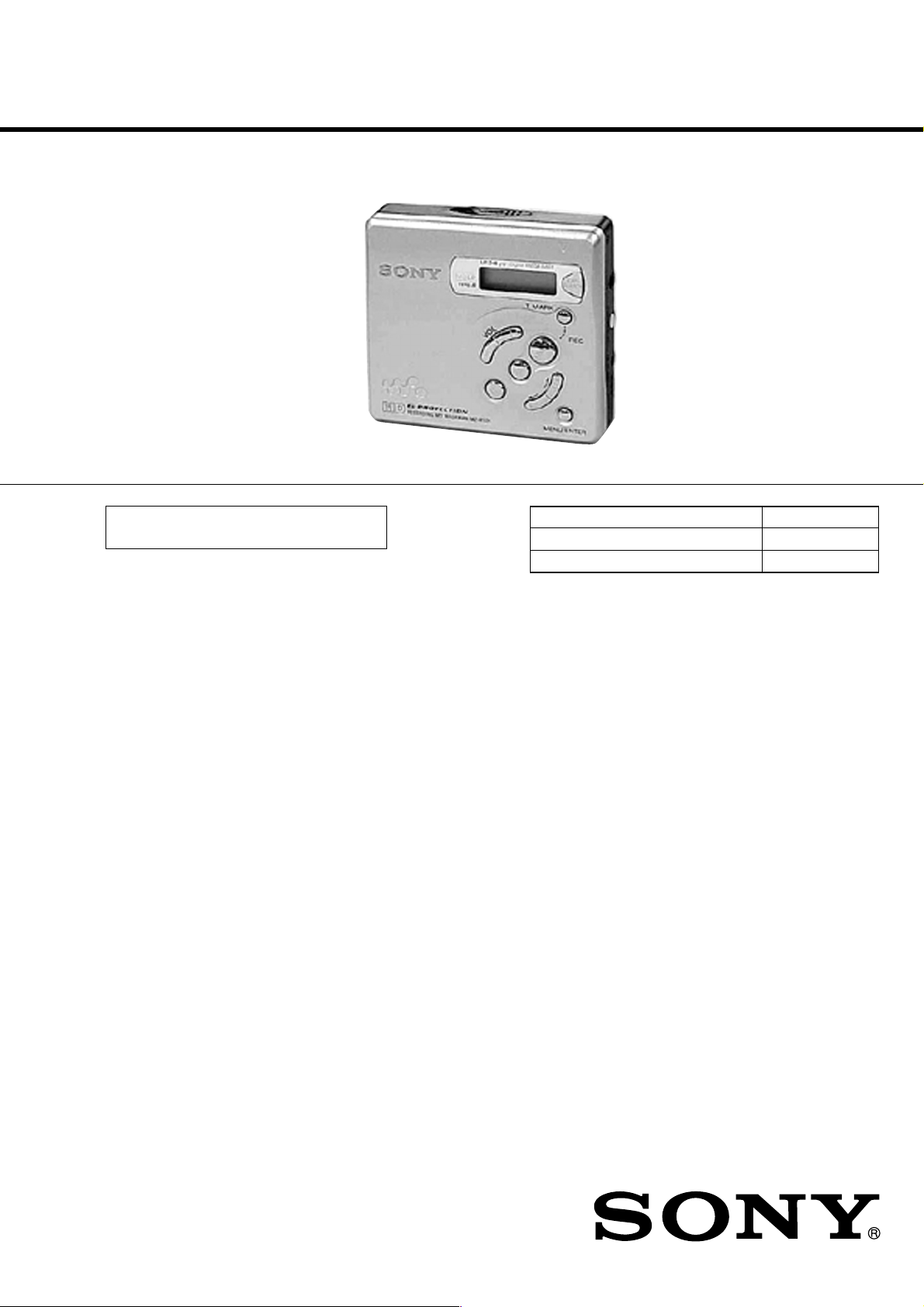
MZ-R501/R501PC
SERVICE MANUAL
Ver 1.0 2001. 01
Ver 1.0 2001. 11
Photo: Silver
US and foreign patents licensed from Dolby
Laboratories.
SPECIFICATIONS
System
Audio playing system
MiniDisc digital audio system
Laser diode properties
Material: GaAlAs
Wavelength: λ = 790 nm
Emission duration: continuous
Laser output: less than 44.6 µW
(This output is the value measured at a
distance of 200 mm from the lens surface
on the optical pick-up block with 7 mm
aperture.)
Recording and playback time
When using MDW-80
Maximum 160 min. in monaural
Maximum 320 min. in stereo
Revolutions
350 rpm to 2,800 rpm (CLV)
Error correction
ACIRC (Advanced Cross Interleave Reed
Solomon Code)
Sampling frequency
44.1 kHz
Sampling rate converter
Input: 32 kHz/44.1 kHz/48 kHz
Coding
ATRAC (Adaptive TRansform Acoustic
Coding)
ATRAC3-LP2
ATRAC3-LP4
Modulation system
EFM (Eight to Fourteen Modulation)
Number of channels
2 stereo channels
1 monaural channel
Frequency response
20 to 20,000 Hz ± 3 dB
Wow and Flutter
Below measurable limit
Inputs
Line in: stereo mini-jack, minimum input
level 49 mV
Optical (Digital) in: optical (digital) minijack
Outputs
i: stereo mini-jack, maximum output level
5 mW + 5 mW, load impedance 16 ohm
US Model
AEP Model
UK Model
E Model
MZ-R501
East European Model
MZ-R501/R501PC
Model Name Using Similar Mechanism MZ-R500
Mechanism Type MT-MZR500-172
Optical Pick-up Name LCX-4R
General
Power requirements
Sony AC Power adaptor connected at the
DC IN 3 V jack
120 V AC, 60 Hz (US model)
230 V AC, 50/60 Hz (AEP model)
230 – 240 V AC, 50 Hz (UK model)
100 – 240 V AC, 50/60 Hz (E model)
One LR6 (size AA) alkaline dry battery (not
supplied)
– Continued on next page –
9-873-408-01
2001K0400-1
© 2001. 11
PORTABLE MINIDISC RECORDER
Sony Corporation
Personal Audio Company
Published by Sony Engineering Corporation
1
Page 2

MZ-R501/R501PC
Battery operation time
Battery life
LR6 (SG) alkaline dry battery3)Normal LP2 LP4
Recording
Playback 36 42 48
1)
2)
3)
4)
Dimensions
Approx. 83.0 × 27.8 × 75.8 mm (w/h/d)
(3 3/8 × 1 1/8 × 3 in.) without projections.
Mass
Approx. 113 g (4.0 oz) the recorder only
Supplied accessories
AC power adaptor (except R501: US, E model) (1)
Headphones/earphones (1)
Optical cable (except R501: US, E model) (1)
Design and specifications are subject to change
without notice.
1)
4)
The battery life may be shorter due to operating conditions, the
temperature of the location, and varieties of batteries.
Measured value by the standard of JEITA (Japan Electronics and
Information Technology Industries Association).
When using a Sony LR6 (SG) “STAMINA” alkaline dry battery
(produced in Japan).
To prevent interrupted recording due to drained battery, use new
battery for recording operations.
(Unit: approx.hours) (JEITA2))
7.5 10 13.5
Flexible Circuit Board Repairing
• Keep the temperature of the soldering iron around 270°C
during repairing.
• Do not touch the soldering iron on the same conductor of the
circuit board (within 3 times).
• Be careful not to apply force on the conductor when soldering
or unsoldering.
Notes on chip component replacement
• Never reuse a disconnected chip component.
• Notice that the minus side of a tantalum capacitor may be
damaged by heat.
CAUTION
Use of controls or adjustments or performance of procedures
other than those specified herein may result in hazardous
radiation exposure.
SAFETY-RELATED COMPONENT WARNING!!
COMPONENTS IDENTIFIED BY MARK 0 OR DOTTED LINE
WITH MARK 0 ON THE SCHEMATIC DIAGRAMS AND IN
THE PARTS LIST ARE CRITICAL TO SAFE OPERATION.
REPLACE THESE COMPONENTS WITH SONY P ARTS WHOSE
PART NUMBERS APPEAR AS SHOWN IN THIS MANUAL
OR IN SUPPLEMENTS PUBLISHED BY SONY.
2
Page 3

TABLE OF CONTENTS
MZ-R501/R501PC
1. SERVICING NOTE......................................................... 4
2. GENERAL
Looking at the Controls ...................................................... 5
3. DISASSEMBLY
3-1. Case (Lower) Assy .............................................................. 6
3-2. Case (Upper) Assy .............................................................. 6
3-3. LCD Module ....................................................................... 7
3-4. Main Board .........................................................................7
3-5. MD Mechanism Deck ......................................................... 8
3-6. Service Assy, OP................................................................. 8
3-7. Holder Assy......................................................................... 9
3-8. Motor Flexible Board .......................................................... 9
3-9. DC Motor (M602) ............................................................. 10
3-10. DC Motor (M601), DC Motor (M603) ............................. 10
4. TEST MODE
4-1. Outline............................................................................... 11
4-2. Setting Method of Test Mode............................................ 11
4-3. Operation in Setting the Test Mode................................... 11
4-4. Releasing the Test Mode ...................................................11
4-5. Configuration of Test Mode .............................................. 12
4-6. Manual Mode ....................................................................12
4-7. Overall Adjustment Mode ................................................. 13
4-8. Self-Diagnosis Result Display Mode ................................ 13
4-9. Reset the Error Display Code............................................ 14
4-10. Sound Skip Check Result Display Mode .......................... 15
4-11. Key Check Mode............................................................... 15
5. ELECTRICAL ADJUSTMENTS
5-1. Outline............................................................................... 17
5-2. Precautions for Adjustment...............................................17
5-3. Adjustment Sequence........................................................ 17
5-4. NV Reset ........................................................................... 17
5-5. Power Supply Manual Adjustment.................................... 18
5-6. Temperature Correction..................................................... 19
5-7. Laser Power Check ........................................................... 19
5-8. Overall Adjustment Mode................................................. 20
5-9. Mode Settings ................................................................... 22
5-10. Resume Clear ....................................................................23
6. DIAGRAMS
6-1. IC Pin Function Description ............................................ 24
6-2. Block Diagram – Servo Section – ..................................... 30
6-3. Block Diagram – Audio Section – ....................................31
6-4. Block Diagram – System Control/Power Section – .......... 32
6-5. Printed Wiring Board – Main Section – ............................ 34
6-6. Schematic Diagram – Main Section (1/3) – ...................... 36
6-7. Schematic Diagram – Main Section (2/3) – ...................... 37
6-8. Schematic Diagram – Main Section (3/3) – ...................... 38
7. EXPLODED VIEWS
7-1. Panel Section..................................................................... 43
7-2. Chassis Section .................................................................44
7-3. MD Mechanism Deck Section .......................................... 45
8. ELECTRICAL PARTS LIST...................................... 46
3
Page 4
MZ-R501/R501PC
SECTION 1
SERVICING NOTE
NOTES ON HANDLING THE OPTICAL PICK-UP
BLOCK OR BASE UNIT
The laser diode in the optical pick-up block may suffer electrostatic break-down because of the potential difference generated
by the charged electrostatic load, etc. on clothing and the human
body.
During repair, pay attention to electrostatic break-down and also
use the procedure in the printed matter which is included in the
repair parts.
The flexible board is easily damaged and should be handled with
care.
NOTES ON LASER DIODE EMISSION CHECK
Never look into the laser diode emission from right above when
checking it for adjustment. It is feared that you will lose your sight.
NOTES ON HANDLING THE OPTICAL PICK-UP BLOCK
(LCX-4R)
The laser diode in the optical pick-up block may suffer electrostatic break-down easily. When handling it, perform soldering
bridge to the laser-tap on the flexible board. Also perform measures against electrostatic break-down sufficiently before the operation. The flexible board is easily damaged and should be handled
with care.
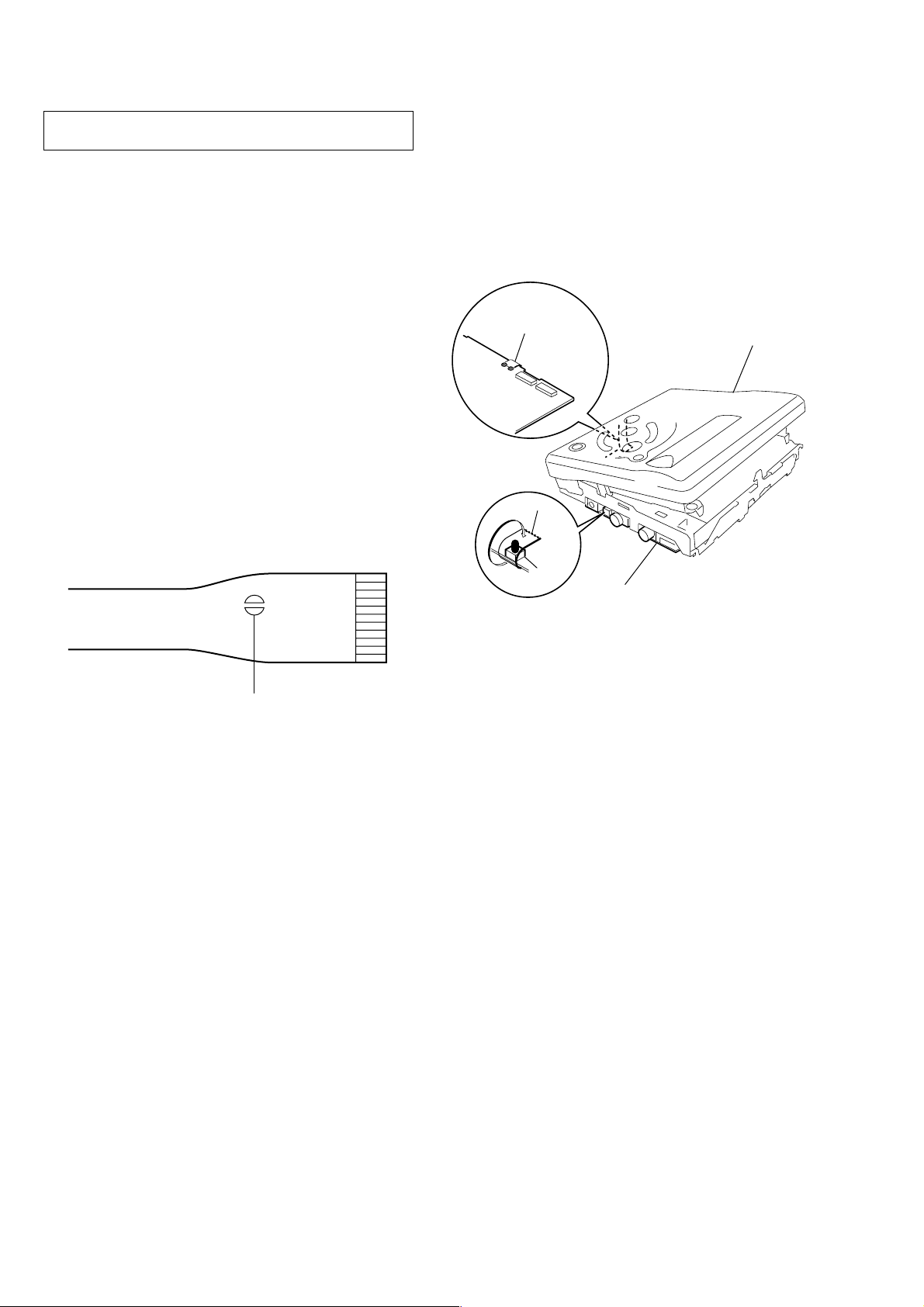
• In performing the repair with the power supplied to the set,
removing the MAIN board causes the set to be disabled.
In such a case, fix a convex part of the open/close detect switch
(S806 on MAIN board) with a tape in advance.
Handle the FLEXIBLE board (overwrite head) with care, as it
has been soldered directly to the MAIN board.
In repairing the component side of MAIN board, connect the
FLEXIBLE board (overwrite head) and the MAIN board with
the lead wires in advance. (See page 7)
FLEXIBLE board
(Over write head)
panel assy, upper
Tape
laser-tap
OPTICAL PICK-UP FLEXIBLE BOARD
S806
MAIN board
• Replacement of CDX2671-204GA (IC801) used in this set
requires a special tool.
• On the set having the microcomputer version 1.000, some
adjusted values were set in the manual mode at the shipment,
but these data will be cleared when the NV is reset. Therefore,
on the set having the microcomputer version 1.000, change the
adjusted values following the Change of Adjusted Values
immediately after the NV was reset. (See page 17)
4
Page 5
Looking at the controls
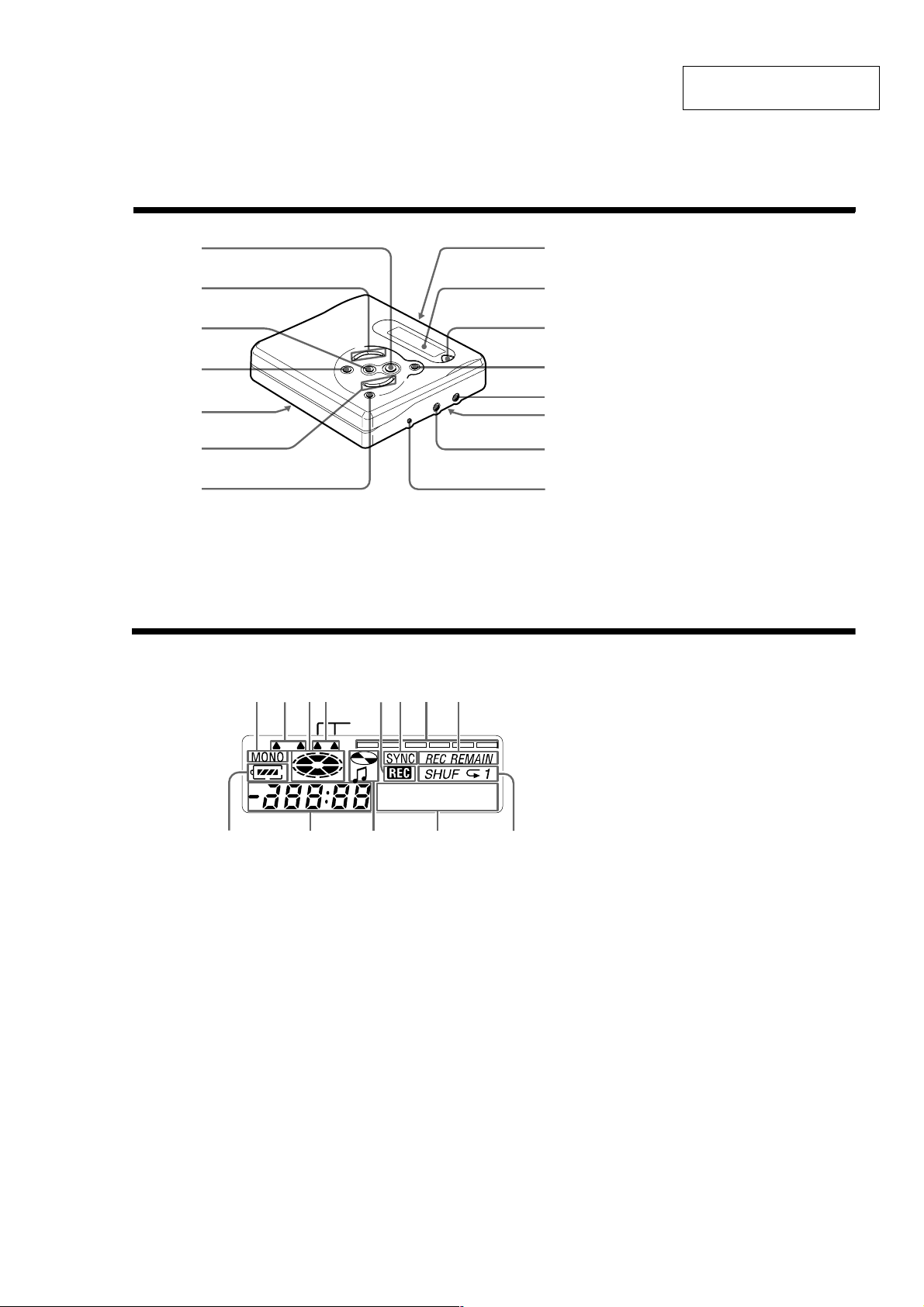
See pages in ( ) for more details.
The recorder
A
B
C
D
E
F
G
SECTION 2
GENERAL
H
I
J
K
L
M
N
O
MZ-R501/R501PC
This section is extracted from
instruction manual.
A N button (11) (13) (17) (25)
B VOL +/ – buttons (13) (26)
C x button (11) (13) (27)
D X button (11) (13) (20) (26) (29)
E HOLD switch (at the rear) (9) (25)
F SELECT >/. buttons (16)
(23) (26)
./> (sea rch /AMS) buttons
(11) (13) (26) (29)
G MENU/ENTER button (16) (23) (26)
H OPEN switch (9)
I Display window (18) (23)
J END S EARCH button (11) (26)
K T MARK button (28)
REC (record) bu tton (11) (17)
L i (
headp hones) jack (9) (25)
M Battery compa rtment (at the rear) (8)
N LI NE IN (OPTICAL) jack (10) (16)
O DC IN 3V jack (10) (3
1)
The display window
LP2.4
CAB D
JI
E
Digital
K
FG
MEGA BASS
H
LM
A MONO (monaural) indication
B LP mode indication (17)
C Disc indica tion
Shows that
recording, playing or editing an MD
D Mega ba ss indication (24).
E REC indication
Lights up while rec ording. When
flashing, the re corder is in record
stan dby mo de.
F SYN C (synchro-recordi ng) indication
(18)
G Level meter (21)
Shows the volume of the MD being
played or reco rded .
H REC REMAIN/REMAIN(rema ining
time/tracks) indication (21) (24)
Lights up along with the remaining
time of the track, the remaining time
of the MD, or the re maining number
of tracks.
I Battery indication (9)
Shows approximate battery condition.
J Time display
K Disc name/track name indication
Lights up when labeling a disc or a
track.
L Chara c ter information display (21)
(25)
Displays the disc and track names,
error messages, track numbers, etc.
M Pla y mode indication (23)
Shows the play mode o f the MD.
th
e d isc is rotating for
5
Page 6
MZ-R501/R501PC
I
SECTION 3
DISASSEMBLY
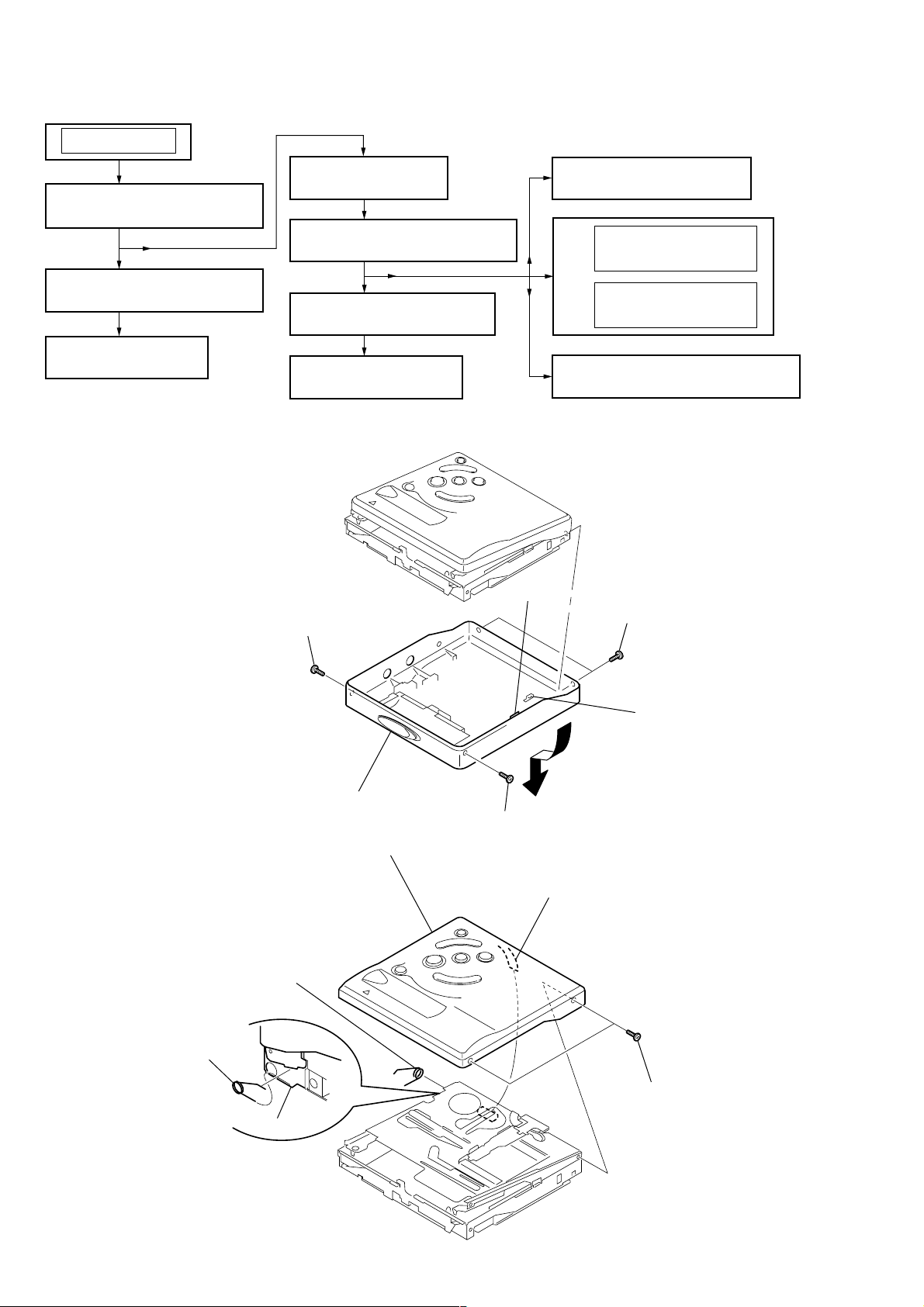
Note : This set can be disassemble according to the following sequence.
SET
3-4. MAIN BOARD
3-1. CASE (LOWER) ASSY
(Page 7)
(Page 6)
3-5. MD MECHANISM DECK
(Page 8)
3-2. CASE (UPPER) ASSY
(Page 6)
3-6. SERVICE ASSY, OP
(Page 8)
3-3. LCD MODULE
(Page 7)
3-7. HOLDER ASSY
(Page 9)
Note : Follow the disassembly procedure in the numerical order given.
3-1. CASE (LOWER) ASSY
1
screw (1.7), MI
3-9. DC MOTOR (M602)
(Page 10)
3-10. DC MOTOR (M601)
(Page 10)
DC MOTOR (M603)
(Page 10)
3-8. MOTOR FLEXIBLE BOARD
(Page 9)
4
claw
3
screws (1.7), MI
3-2. CASE (UPPER) ASSY
4
spring (POP-L), torsion
spring (POP-L), torsion
chassis assy
6
case(lower) assy
3
case (upper) assy
2
screw (1.7), MI
2
5
CN801
knob (hold)
1
screws (1.7), M
6
Page 7
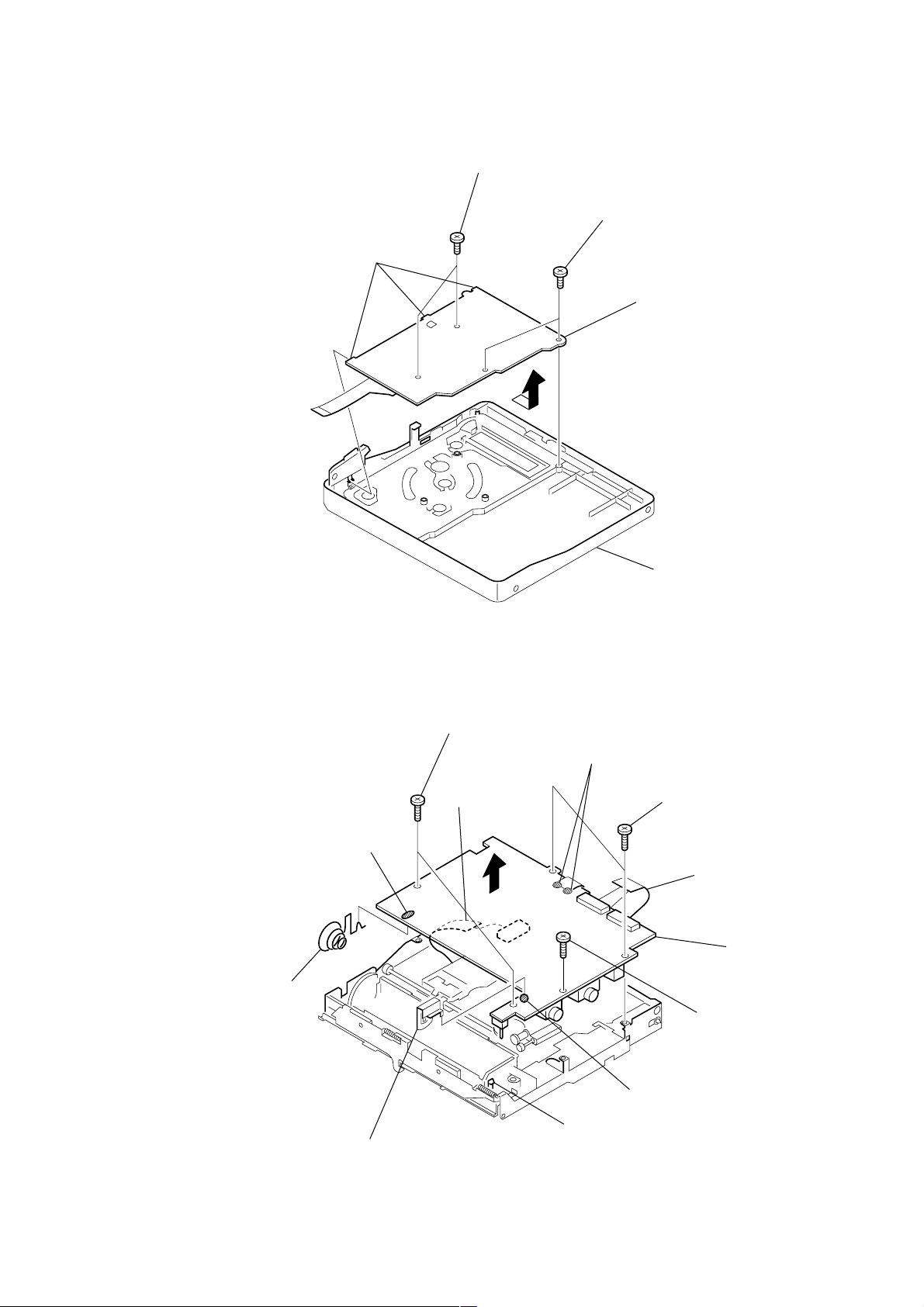
3-3. LCD MODULE
y
d
claws
2
screws (1.7x3), tapping
3
1
screws (1.7x3), tapping
4
LCD module
MZ-R501/R501PC
3-4. MAIN BOARD
qd
terminal (-), battery
qs
Remove the solder
4
screws (M1.4x2),
toothed lock
8
CN501
7
case (upper) ass
2
Remove the solders
3
toothed lock
screws (M1.4x2),
1
CN701
9
MAIN boar
5
screw (M1.4x2),
toothed lock
qa
terminal (+), battery
6
claw
0
Remove the solder
7
Page 8
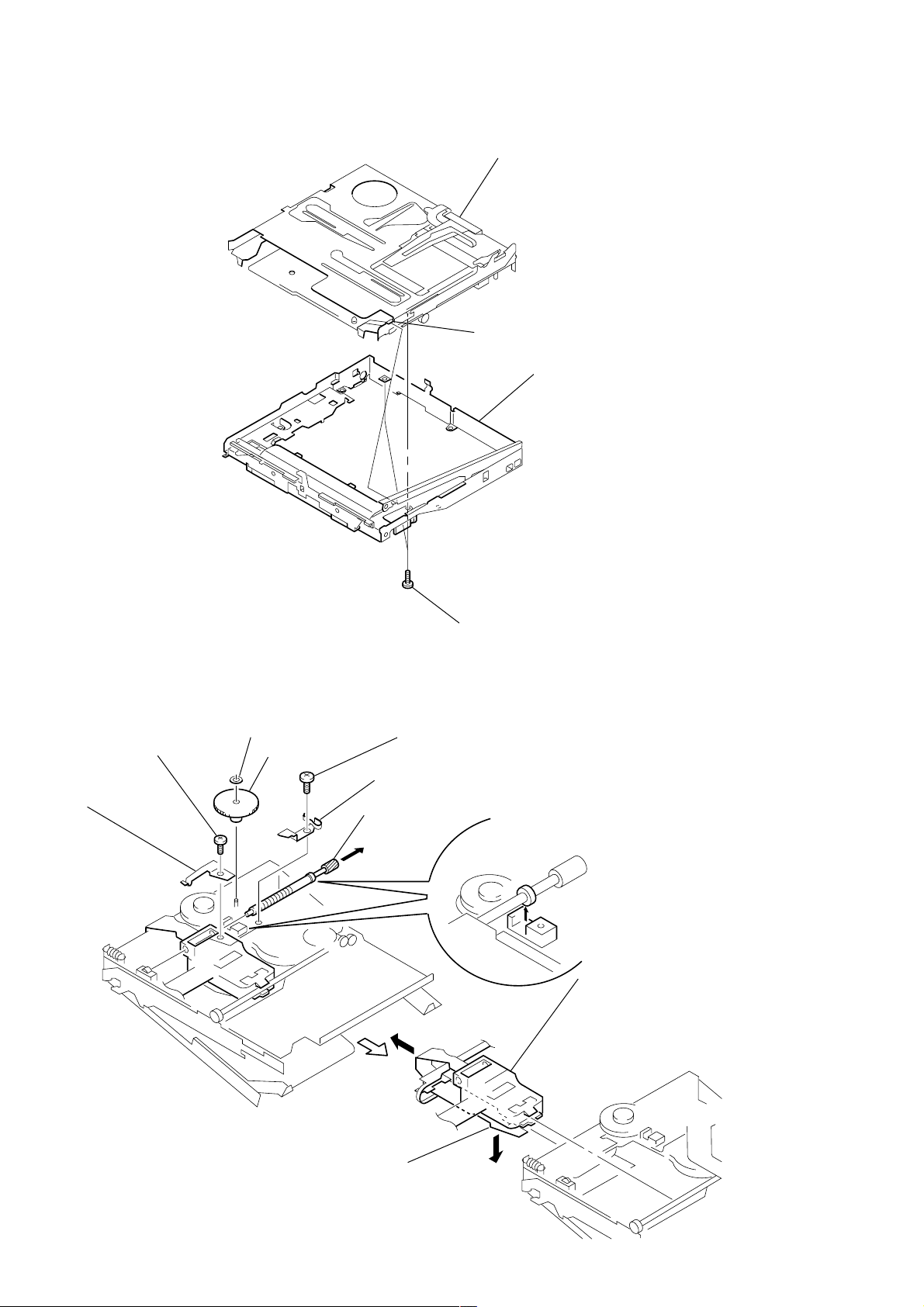
MZ-R501/R501PC
t
e
3-5. MD MECHANISM DECK
3 MD mechanism deck
boss
2 chassis assy, se
3-6. SERVICE ASSY, OP
3
precision pan screw
(M1.4)
4
spring (S), rack
1
washer (0.8 - 2.5)
2
gear (SA)
5
precision pan screw
(M1.4)
6
spring, thrust detent
8
Pull off the lead screw.
B
1 screws (1.7), MI
7
Opening the over write head
9
toward the direction
OP Service assy toward
the direction
Note: Do not open the entire assy
forcibly, when opening
the over write head.
B
.
A
, remove th
over write head section
A
8
Page 9
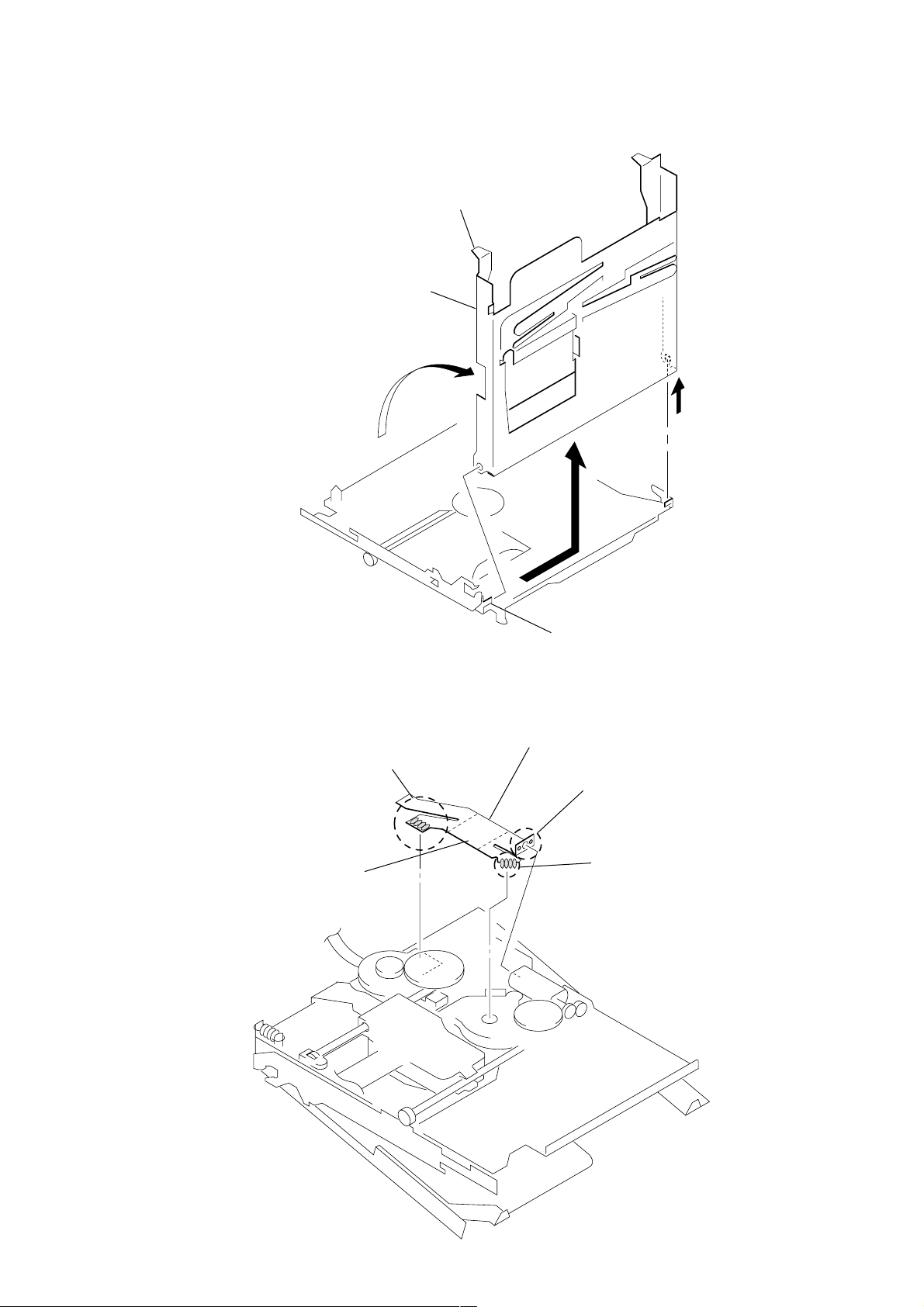
3-7. HOLDER ASSY
MZ-R501/R501PC
4 Remove the holder assy to
direction of the arrow B.
1 Open the holder assy.
A
2
3-8. MOTOR FLEXIBLE BOARD
1 Remove four solders of
DC motor (sled) (M602).
4 adhesive sheet
Note: Align a circular hole in the stripping paper
with a circular hole in the DC motor (sled),
when mounting the motor
flexible board.
B
3 boss
5 motor flexible board
2 Remove two solders of
DC motor (over write head up/down) (M603).
3 Remove four solders of
DC motor (spindle) (M601).
9
Page 10
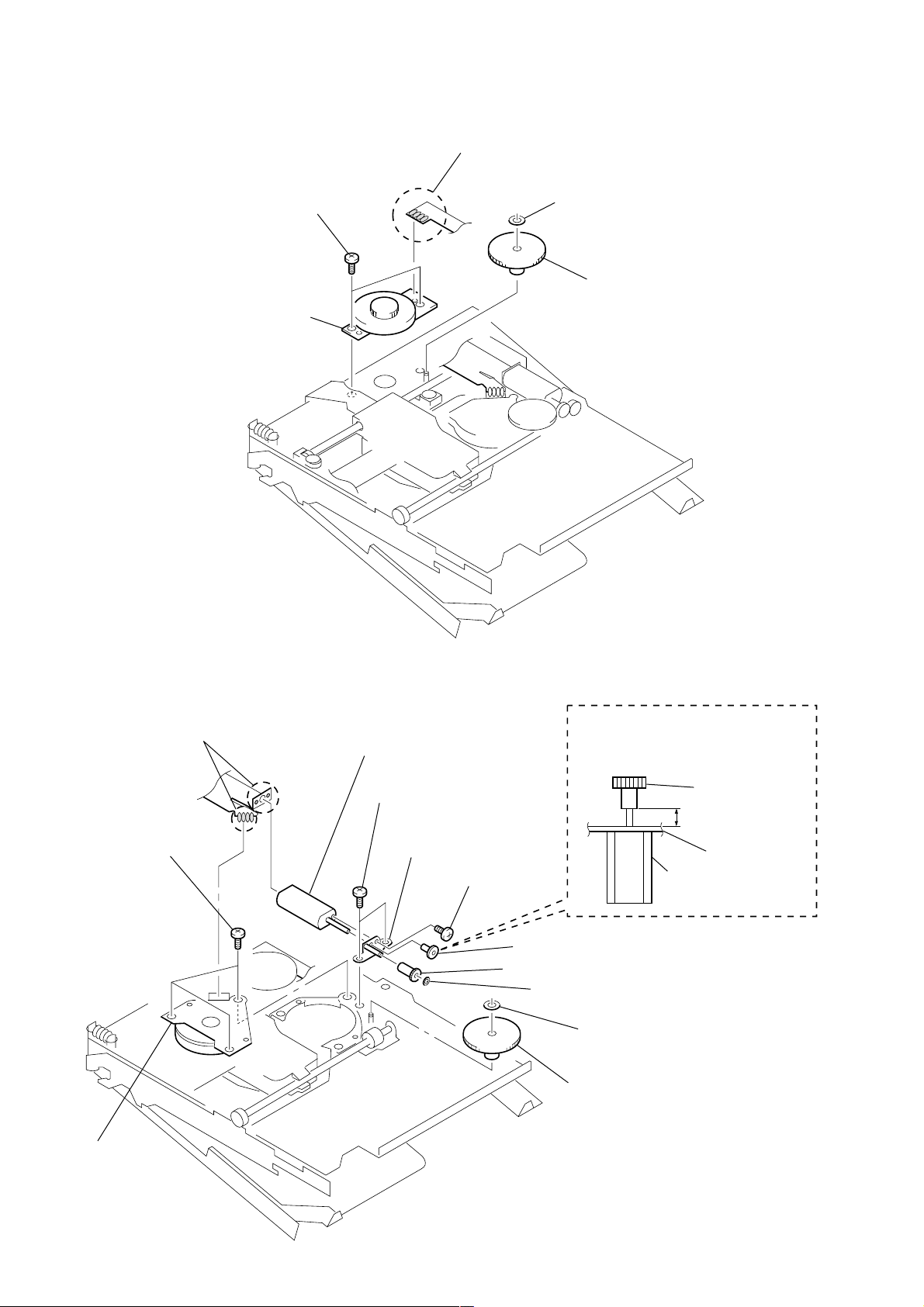
MZ-R501/R501PC
3-9. DC MOTOR (M602)
1 Remove four solders of
motor flexible board.
4 two precision pan screws
(M1.4)
5 DC motor (sled) (M602)
2 washer (0.8 - 2.5)
3 gear (SA)
3-10. DC MOTOR (M601), DC MOTOR (M603)
1 Remove six solders of
motor flexible board.
4 three precision pan screws
(M1.4)
qs DC motor (over write head up/down)
(M603)
6 two precision pan screws
(M1.4)
qa chassis assy, gear
0 screw
(M1.2 × 1.5)
9 gear (HA)
8 gear (HB)
Note: Press-fit the gear (HA) up to the
position of the DC motor (over write
head up/down) (M603) as shown
below.
gear (HA)
2.65 mm
gear chassis assy
DC motor
(over write head up/down)
(M603)
7 washer (0.8 - 2.5)
2 washer (0.8 - 2.5)
3 gear (HC)
10
5 DC motor
(spindle)
(M601)
Page 11

SECTION 4
All lit
This set LCD display
All off
Microcomputer
version
display
SYNCMONO REC REMAIN
SHUFREC
u
1F
-a 8 8 : 8 8
00 6
V1.300
TEST MODE
MZ-R501/R501PC
4-1. Outline
• This set provides the Overall adjustment mode that allows CD
and MO discs to be automatically adjusted when in the test mode.
In this overall adjustment mode, the disc is discriminate between
CD and MO, and each adjustment is automatically executed in
order. If a fault is found, the system displays its location. Also,
the manual mode allows each individual adjustment to be automatically adjusted.
4-2. Setting Method of T est Mode
There are two different methods to set the test mode:
1 Short TAP801 (TEST) on the MAIN board with a solder bridge
(connect pin 3 of IC801 to the ground). Then, turn on the
power.
MAIN BOARD (SIDE B)
4-3. Operation in Setting the Test Mode
• When the test mode becomes active, first the display check mode
is selected.
• Other mode can be selected from the display check mode.
• When the test mode is set, the LCD repeats the following dis-
play.
• When the
time is held so that display can be checked.
X key is pressed and hold down, the display at that
2 In the normal mode, turn on the [HOLD] switch. While press-
ing the [VOL --] key press the following order:
> t > t . t . t > t
. t > t . t X t X
AP526
AP529
AP530
R811
AP528
C521
C815
AP531
R805
TAP801
(TEST)
AP856
FB801
C830
C807
AP802
R806
AP803
C808
R810
R830
4-4. Releasing the Test Mode
For test mode set with the method 1:
Turn off the power and open the solder bridge on TAP801 (TEST)
on the MAIN board.
Note: Remove the solders completely. Remaining could be shorted
with the chassis, etc.
For test mode set with the method 2:
Turn off the power.
Note: If electrical adjustment (see page 17) has not been finished
completely, always start in the test mode. (The set cannot
start in normal mode)
R807
11
Page 12
MZ-R501/R501PC
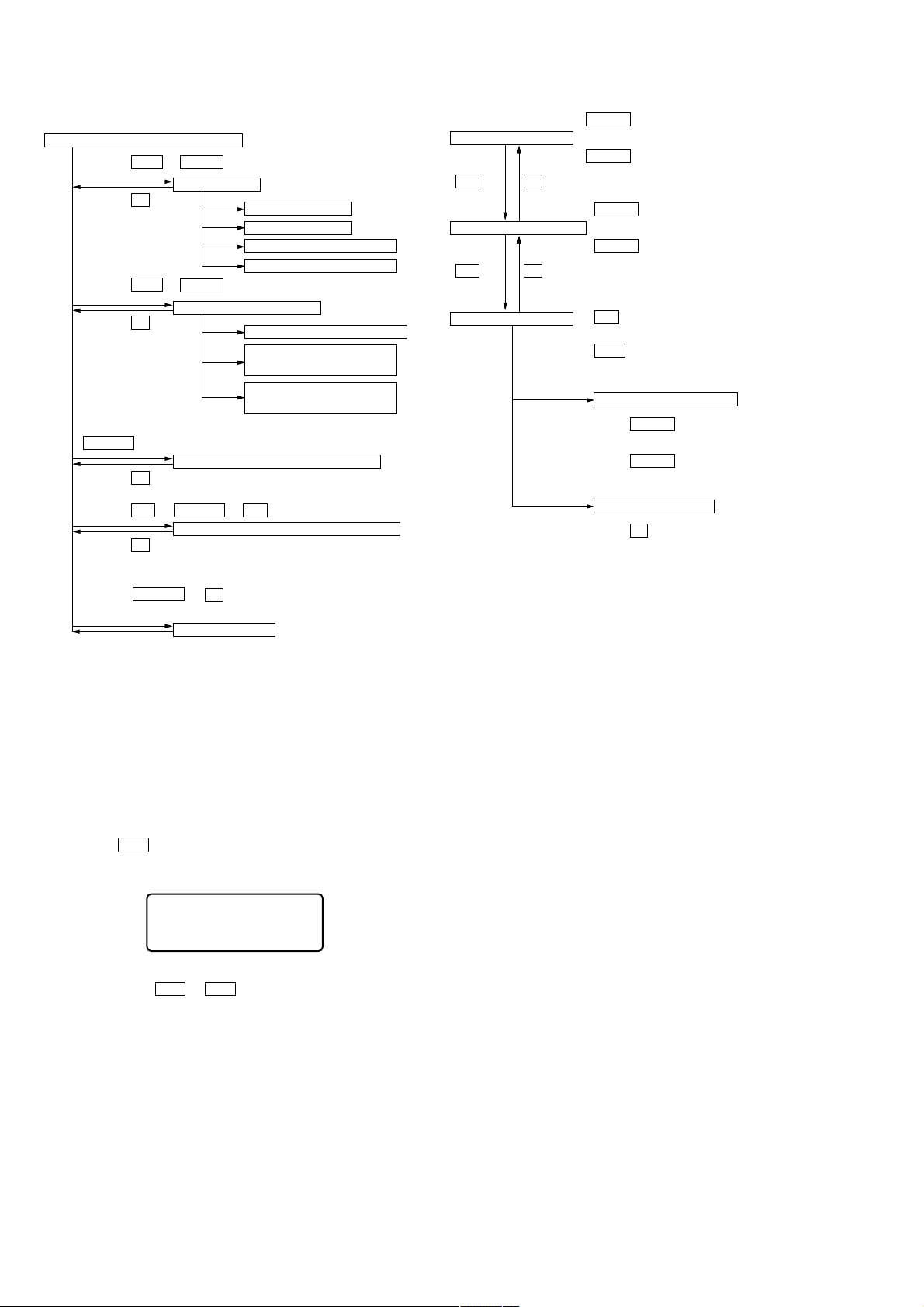
4-5. Configuration of T est Mode
Test mode (Display Check Mode)
Press the > or VOL+ key
Manual Mode
Press the x key
Press the . or VOL– key
Overall Adjustment Mode
Press the x key
ENTER key
Self-Diagnosis Result Display Mode
Press the x key
Press the N or T.MARK + N keys.
Sound Skip Check Result Display Mode
Press the x key
Press the T.MARK + X keys.
Key Check Mode
The key check quits,or open the upper panel
Servo Adjustment
Audio Adjustment
Power Supply Adjustment
OP Alignment Adjustment
Electrical Offset Adjustment
Power Supply Adjustment
Auto item Feed
CD Overall Adjustment/
MO Overall Adjustment
Major item switching
x key N key
Medium item switching
x key N key
Minor item switching
VOL + key: 100th Place of item number
increase.
VOL – key: 100th Place of item number
decrease.
VOL + key: 10th Place of item number
increase.
VOL – key: 10th Place of item number
decrease.
N key: Unit Place of item number
increase.
. key: Unit Place of item number
decrease.
Adjusted value variation
VOL + key: Increases the
adjusted value
VOL – key: Decreases the
adjusted value
Adjusted value write
X key: When adjusted value is
chaged:
Adjusted value is written.
When adjusted value is
not changed:
That item is adjusted
automatically.
4-6. Manual Mode
Mode to adjust or check the operation of the set by function.
Normally, the adjustment in this mode is not executed.
However, the Manual mode is used to clear the memory, power
supply adjustment, and laser power check before performing
automatic adjustments in the Overall Adjustment mode.
• Transition method in Manual Mode
1. Setting the test mode (see page 11).
2. Press the > or[VOL +] key activates the manual mode where
the LCD display as shown below.
This set LCD display
0 0 0
3. During each test, the optical pick-up moves outward or inward while the > or . key is pressed for several seconds respectively.
4. Each test item is assigned with a 3-digit item number;
100th place is a major item, 10th place is a medium item, and
unit place is a minor item.
The values adjusted in the test mode are written to the
nonvolatile memory (for the items where adjustment was
made).
Manual
12
Page 13
MZ-R501/R501PC
e
e
e
e
0 XX1
0 XXN
0 XXN1
0 XXN2
0 XXR_
XX
:Error code
:Total recording time
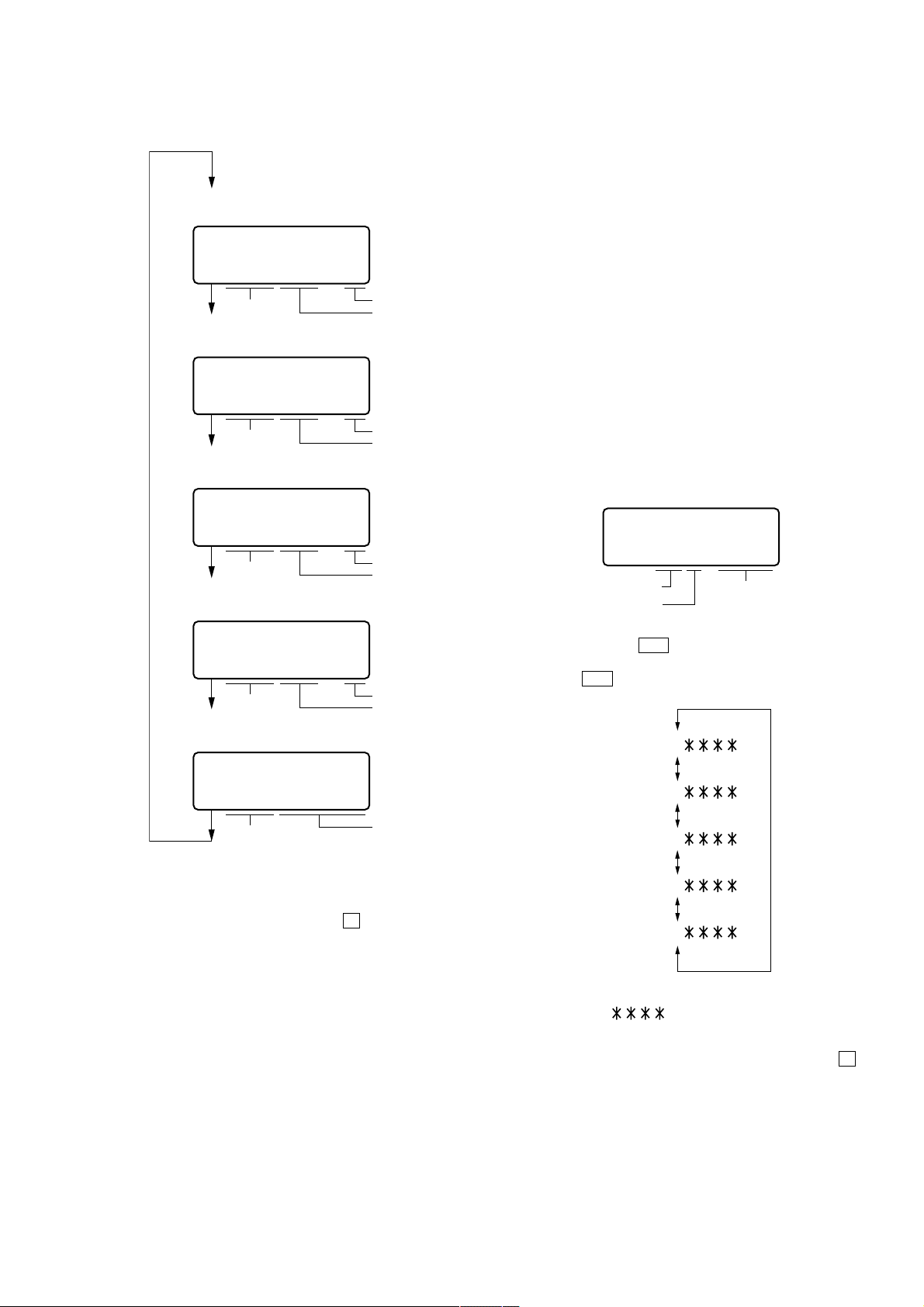
5. The display changes a shown below each time the
[ENTER] key on the set is pressed.
• Address & Adjusted V alue Display
This set LCD display
0 11
item number
• Jitter Value & Adjusted Value Display
This set LCD display
0 11
item number
• Block Error Value & Adjusted Value Display
This set LCD display
0 11
item number
• ADIP Error Value & Adjusted Value Display
This set LCD display
3A4S1D
adjustment valu
address
OFEJ1D
adjustment valu
jitter value
063B1D
adjustment valu
block error value
4-8. Self-Diagnosis Result Display Mode
This set uses the self-diagnostic function system in which if an
error occurred during the recording or playing, the mechanism
control block and the power supply control block in the
microcomputer detect it and record its cause as history in the
nonvolatile memory.
By checking this history in the test mode, you can analyze a fault
and determine its location.
Total recording time is recorded as a guideline of how long the
optical pickup has been used, and by comparing it with the total
recording time at the time when an error occurred in the selfdiagnosis result display mode, you can determine when the error
occurred.
Clear both self-diagnosis history data and total recording time, if
the optical pickup was replaced.
• Self-Diagnosis Result Display Mode Setting Method
1. Setting the test mode (see page 11).
2. In the display check mode, press the [ENTER] key activates the
self-diagnosis result display mode where the LCD display as
shown below.
This set LCD display
0 XX 1 0000
error
display code
history code
Total recording time
when error occurred
0 11
item number
• Item Title Display
This set LCD display
0 11
item number
However in the power mode (item number 700’s), only the
item is displayed.
6. Quit the manual mode, and press the
test mode (display check mode).
072A1D
adjustment valu
ADIP error value
LrefPw
item title
x key to return to the
4-7. Overall Adjustment Mode
Mode to adjust the servo automatically in all items.
Normally, automatic adjustment is executed in this mode at the
repair.
For further information, refer to “Section 5 Electrical Adjustments”
(see page 17).
3. Then, each time the
by one as shown below. Also, the LCD display ascends by one
when the
4. Quit the self-diagnosis result display mode, and press the x key
to return to the test mode (display check mode).
. key is pressed.
> key is pressed, LCD display descends
13
Page 14
MZ-R501/R501PC
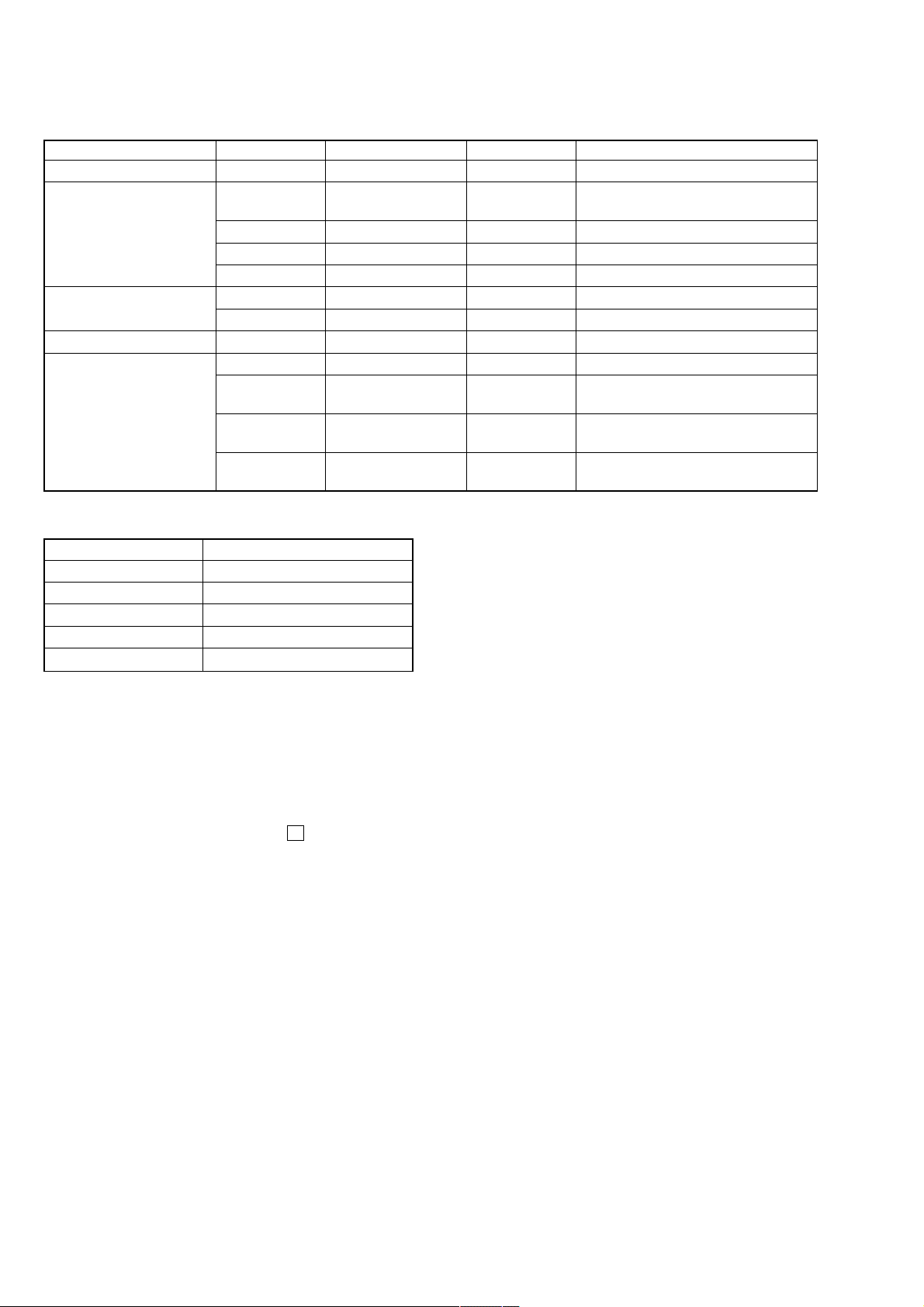
• Description of Error Indication Codes
Problem Indication code Meaning of code Simple display Description
No error 00 No error --- No error
01
Servo system error 02 High temperature Temp High temperature
03 Focus error Fcus Disordered focus
04 Spindle error Spdl Abnormal rotation of disc
TOC error
Power supply system error 22 Low battery LBat Momentary interruption detected
Offset system error
11 TOC error TOC Faulty TOC contents
12 Data reading error Data Data could not be read at SYNC
31 Offset error Ofst Offset error
32
33
34
Illegal access target
address was specified
Focus error ABCD
offset error
Tracking error
Offset error
X1 tracking error
Offset error
Adrs Attempt to access an abnormal address
ABCD Focus error ABCD offset error
TE Tracking error Offset error
X1TE X1 tracking error Offset error
• Description of Indication History
History code number Description
1 The first error
N The last error
N1 One error before the last.
N2 Two errors before the last.
R_ Total recording time
4-9. Reset the error display code
After servicing, reset the error display code.
• Setting method of Reset the Error Display Code
1. Setting the test mode (see page 11).
2. Press [ENTER] key activates the self-diagnosis result display
mode.
3. To reset the error display code, press the X key (2 times) when
the code is displayed (except “R_****”).
(All the data on the 1, N, N1, and N2 will be reset)
14
Page 15
MZ-R501/R501PC
g
)
This set LCD display
8 8 8
RMC OK
This set LCD display
8 8 8 FF
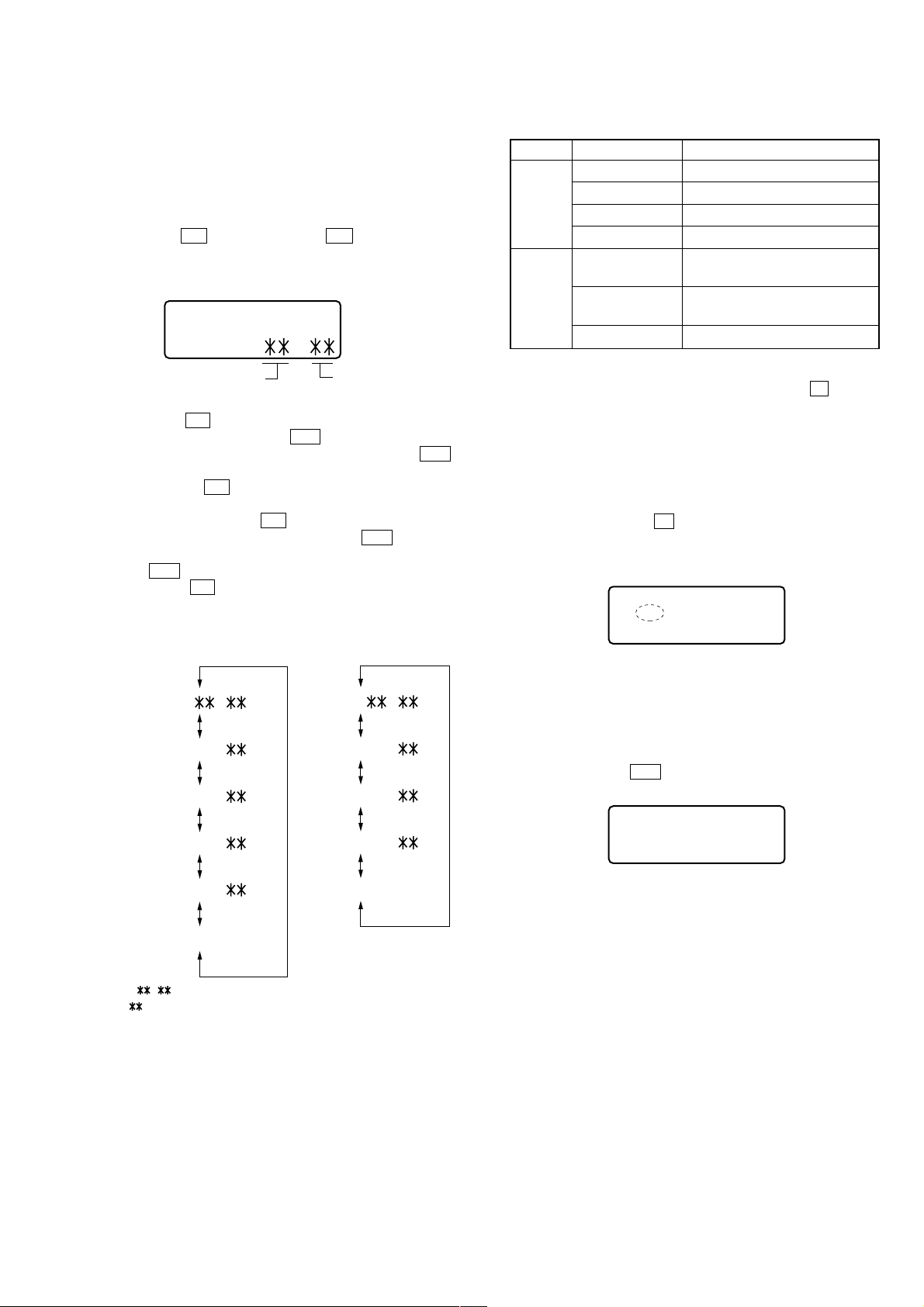
4-10. Sound Skip Check Result Display Mode
This set can display the count of errors that occurred during the
recording/playing for checking.
• Setting method of sound skip check result display
mode
1. Set the test mode (see page 11).
2. Press the N key or [T.MARK] + N k e ys, and the playing
or recording sound skip result display mode becomes
active respectively where the LCD displays the following.
This set LCD display
0 00
Total count of play
system errors(hex.)
3. When the N key is pressed, total error count is displayed on
the LCD, and each time the > key is pressed, the display
item moves down by one as sho wn below . Also, if the . key
is pressed, the display item moves up by one, then if the
P R
Total count record
system errors(hex.)
[T.MARK] + N keys is pressed, the display in the record
mode appears.
When the [T.MARK] + N keys is pressed, total error count
is displayed on the LCD, and each time the > key is pressed ,
the display item moves down by one as sho wn below. Also, if
the . key is pressed, the display item moves up by one,
then if the N key is pressed, the display in the play mode
appears.
• Cause of Sound Skip Error
Cause of error Description of error
EIB Sound error correction error
Play
Record
4. To quit the sound skip check result display mode and to return
to the test mode (display check mode), press the
Stat Decoder status error
Adrs Address access error
BEmp Buffer is empty
BOvr
Bful
Rtry Retry times over
Buffer is full, and sounds were
dumped
Buffer capacity becomes less,
and forcible writing occurred
x key.
4-11. Key Check Mode
This set can check if the set function normally.
• Setting Method of Key Check Mode
1. Setting the test mode (see page 11).
2. Press the [T.MARK] + X keys activates the key check mode.
(At the last two digits, AD value of remote commander key
line is displayed in hexadecimal)
Playing sound skip
result display
0 00 P R
0 00 EIB
0 00 Stat
0 00 Adrs
0 00 BEmp
0 00 ######
P R
:Total play/record errors(hex.)
:Counter of sound skip check each item(hex.)
:6-di
######
it address where sound was skipped last(hex.
Recording sound skip
result display
0 00 P R
0 00 BOvr
0 00 Bful
0 00 Rtry
0 00 ######
3. When each key on the set and on remote commander is pressed,
its name is displayed on the LCD. (The operated position is
displayed for 4 seconds after the slide switch is operated. If
any other key is pressed during this display, the remote commander LCD switches to its name display)
Example1: When > key on the set is pressed:
15
Page 16

MZ-R501/R501PC
4. When all the keys on the set and on the remote commander are
considered as OK, the following displays are shown for 4 seconds.
Example1: When the keys on the set are considered as OK:
This set LCD display
8 8 8
5. When all keys were checked or if the upper panel is opened,
the key check mode quits and the test mode (display check
mode) comes back.
RMC OK
16
Page 17

SECTION 5
This set LCD display
0 2 1 ResNV
This set LCD display
0 2 1 ResOK?
This set LCD display
NV reset(after several seconds)
0 2 1
Res
0 2 1
Reset!
: Address
E4: Adjusted value
This set LCD display
8 3 2
SE4
This set LCD display
8 6 2
V1dat
ELECTRICAL ADJUSTMENTS
MZ-R501/R501PC
5-1. Outline
• In this set, automatic adjustment of CD and MO can be performed by entering the test mode (see page 11).
However, before starting automatic adjustment, the memory
clear, power supply adjustment, and laser power check must be
performed in the manual mode.
• A key having no particular description in the text, indicates a
set key.
• For the LCD display, the LCD display on the set is shown.
5-2. Precautions for Adjustment
1. Adjustment must be done in the test mode only.
After adjusting, release the test mode.
2. Use the following tools and measuring instruments.
• Test CD disc TDYS-1
(Part No. : 4-963-646-01)
• SONY MO disc available on the market
• Digital voltmeter
• Laser power meter LPM-8001
(Part No. : J-2501-046-A)
• Thermometer (using the Temperature Correction)
3. Unless specified otherwise, supply DC 3V from the DC IN
3V jack (J601).
4. Switch position
HOLD switch ............................................... OFF
5-3. Adjustment Sequence
• Setting method of NV reset
1. Select the manual mode of the test mode, and set item number
021NV Reset (see page 12).
2. Press the X key.
3. Press the X key once more.
1. NV Reset(Memory clear)
2. Power Supply Manual Adjustment
3. Temperature Correction(item number:014)
4. Laser Power Check
5. Electrical offset Adjustment
Caution: This adjustment must be made with
no disc loaded.
6. CD Overall Adjustment
7. MO Overall Adjustment
8. Mode Settings
9. RESUME Clear
Manual Mode
Overall Mode
Manual Mode
Overall Mode
Manual Mode
5-4. NV Reset
Caution: In this set, certain adjustment values are set in the manual
mode at the factory. NV Reset will cause these data to
be cleared. So, the adjustment values should be set again
just after NV Reset is made.
4. Press the x key to quit the manual mode, and activate the
test mode (display check mode).
• Change of Adjusted Values
1. Item numbers in which the adjusted values are to be modified
Item number 832
Item number 862
Item number 871
Item number 872
2. Adjusted values modifying procedure
1) Select the manual mode of the test mode, and set item number
832 (see page 12).
This set LCD display
8 3 2 Pw-T W
2) Adjust with the
key (adjusted value down) so that the adjusted value becomes
E4.
3) Press the X key to write the adjusted value.
4) Select the manual mode of the test mode, and set item number
862 (see page 12).
[VOL+] key (adjusted value up) or [VOL--]
17
Page 18

MZ-R501/R501PC
5) Adjust with the [VOL+] key (adjusted value up) or [VOL--]
key (adjusted value down) so that the adjusted value becomes
01.
6) Press the X key to write the adjusted value.
7) Select the manual mode of the test mode, and set item number
871 (see page 12).
8) Adjust with the [VOL+] key (adjusted value up) or [VOL--]
key (adjusted value down) so that the adjusted value becomes
20.
9) Press the X key to write the adjusted value.
10) Select the manual mode of the test mode, and set item number
872 (see page 12).
11) Adjust with the
key (adjusted value down) so that the adjusted value becomes
39.
This set LCD display
8 6 2
: Address
01: Adjusted value
This set LCD display
8 7 1
This set LCD display
8 7 1
: Address
20: Adjusted value
This set LCD display
8 7 2
[VOL+] key (adjusted value up) or [VOL--]
This set LCD display
S01
V5num
S20
V5dat
• Setting method of power supply manual adjustment
1. Make sure that the power supply voltage is 3V.
2. Set the test mode (see page 11).
3. Press the
mode.
4. Press the
the item number to be switched to 762.)
• Adjustment method of Vc PWM Duty (L)
(item number: 762)
1. Press the [ENTER] key and set the address & adjusted value
display (see page 13).
2. Connect a digital voltmeter to the TP902 (VC) on the MAIN
board, and adjust [VOL +] key (voltage up) or [VOL --] key
(voltage down) so that the voltage becomes 2.40 ± 0.01 V.
3. Press the X key to write the adjusted value.
(The item number changes to 763 when X key is pressed)
. or [VOL--] key to activate the overall adjustment
This set LCD display
0 0 0
[END SEARCH] key. (the [END SEARCH] key causes
This set LCD display
7 6 2
This set LCD display
7 6 2
: Adjusted value
MAIN board
TP902(VC)
TP910(GND)
Assy11
Vc1PWM
AD
digital
voltmeter
8 7 2 S39
: Address
39: Adjusted value
12) Press the X key to write the adjusted value.
5-5. Power Supply Manual Adjustment
• Adjustment sequence
Adjustment must be done with the following steps.
1. Vc PWM Duty (L) adjustment (item number 762)
2. Vc PWM Duty (H) adjustment (item number 763)
3. Vl PWM Duty adjustment (item number 764)
18
Adjustment and Connection Location:MAIN board
(see page 20)
• Adjustment method of Vc PWM Duty (H)
(item number: 763)
This set LCD display
VchPWM
AD
1. Press the
7 6 3
[ENTER] key and change the LCD display.
This set LCD display
7 6 3
: Adjusted value
Page 19

MZ-R501/R501PC
: Address
14: Adjusted value
This set LCD display
0 1 4 S14
r
This set LCD display
0 1 0
Laser
This set LCD display
0 1 1
LrefPw
2. Connect a digital voltmeter to the TP902 (VC) on the MAIN
board, and adjust [VOL +] key (voltage up) or [VOL --] key
(voltage down) so that the voltage becomes 2.75 ± 0.01 V.
digital
voltmeter
MAIN board
TP902(VC)
TP910(GND)
3. Press the X key to write the adjusted value.
(The item number changes to 764 when X key is pressed)
Adjustment and Connection Location:MAIN board
(see page 20)
• Adjustment method of Vl PWM Duty
(item number: 764)
This set LCD display
7 6 4
1. Press the [ENTER] key and change the LCD display.
This set LCD display
V1 PWM
3. Adjust with [VOL +], [VOL --] key so that the adjusted value
(hexadecimal value) becomes the ambient temperature.
(Initial value: 14h = 20 °C, Adjusting range: 80h to 7fh (–128
°C to +127 °C)
4. Press the X key to write the adjusted value.
5-7. Laser Power Check
Connection :
Optical pick-up
objective lens
MAIN board
TP(+)
TP(–)
laser
power meter
digital voltmete
7 6 4
: Adjusted value
2. Connect a digital voltmeter to the TP901 (VL) on the MAIN
board, and adjust [VOL +] key (voltage up) or [VOL --] key
(voltage down) so that the voltage becomes 2.30 ± 0.01 V.
MAIN board
TP901(VL)
TP910(GND)
3. When press the X key to write the adjusted value, LCD displays as follows and power supply manual adjustment has completed.
This set LCD display
0 0 0
Adjustment and Connection Location:MAIN board
AD
digital
voltmeter
ADJ OK
5-6. T emperature Correction
• Adjustment Method of temperature correction
1. Select the manual mode of test mode, and set the mode number 014 (see page 12).
This set LCD display
Checking Method :
1. Select the manual mode of test mode (see page 12), and set the
laser power adjusting mode (item number 010).
2. Press the
moves to the most inward track.
3. Open the cover and set the laser power meter on the objective
lens of the optical pick-up.
4. Press the N key , and set the laser MO read adjustment mode
(item number 011).
5. Press the [ENTER] key and set the address & adjusted value
display (See page 13).
. key continuously until the optical pick-up
This set LCD display
0 1 1 ###S
###: Address
: Adjusted value
2. Measure the ambient temperature.
0 1 4
SetTmp
6. Check that the laser power meter reading is 0.81 ± 0.08 mW.
7. Check that the voltage both ends (TP (+) and TP (–)) of resistor R501 at this time is below 44 mV.
19
Page 20

MZ-R501/R501PC
8. Press the N key, and set the laser CD read adjustment
mode (item number 012).
This set LCD display
0 1 2
HrefPw
9. Press the [ENTER] key and set the address & adjusted value
display (see page 13).
This set LCD display
0 1 2 ###S
###: Address
: Adjusted value
10. Check that the laser power meter reading is 0.97 ± 0.10 mW.
11. Check that the voltage both ends (TP (+) and TP (–)) of resistor R501 at this time is below 44 mV.
12. Press the N key , and set the laser MO write adjustment mode
(item number 013).
This set LCD display
0 1 3
WritPw
5-8. Overall Adjustment Mode
• Configuration of overall adjustment
Overall adjustment mode
(Title display)
N key
Protect switch
ON
x key
x key
Protect switch
OFF
> key
. key
CD overall
adjusting
All item
OK
CD overall
adjustment
OK
N key
MO overall
adjusting
NG item exists
or x key
CD overall
adjustment
NG
NG item exists
or x key
13. Press the [ENTER] key and set the address & adjusted value
display (See page 13).
This set LCD display
0 1 3 ###S
###: Address
: Adjusted value
14. Check that the laser power meter reading is 4.95 ± 0.50 mW.
15. Check that the voltage both ends (TP (+) and TP (–)) of resistor R501 at this time is below 80 mV.
16. Press the
test mode (display check mode).
Checking and Connection Location: MAIN board
Adjustment/checking and Connection Location:
x key to quit the manual mode, and activate the
MAIN BOARD (SIDE B)
MO overall
adjustment
x key
x key
ENTER key
x key
END SEARCH key
x key
Test mode (display check mode)
MO overall
adjustment
OK
NG
Electrical
offset
adjustment
Power supply
adjustment
auto item feed
Note: Adjust the CD first, when performing adjustment.
20
TP901
(VL)
TP910(GND)
TP902(VC)
TP(–
)
R501
(+)
TP
Page 21

MZ-R501/R501PC
This set LCD display
0 0 0 Assy
This set LCD display
0 0 0
CD OK
This set LCD display
0 0 0
MO OK
• Overall Adjustment Mode (Title Display)
This set LCD display
0 0 0
: (Disc mark) At end power supply adjustment:Outside lit
At end of electrical offset adj.:inside lit
Note:On the set having microcomputer version 1.000,the disc
mark is displayed on the set LCD only.
: Left side = MO overall adjustment information
F : MO overall adjustment completed
1 : Manual adjustment exists(overall adj.not completed)
0 : Not adjusted
Right side = CD overall adjustment information
F : CD overall adjustment completed
1 : Manual adjustment exists(overall adj.not completed)
0 : Not adjusted
• Electrical Offset Adjusting Method
Caution: The electrical offset adjustment must be made with no
disc loaded.
1. Make sure that the power supply voltage is 3V.
2. Set the test mode (see page 11).
3. Press the
mode.
Assy
. or [VOL--] key to activate the overall adjustment
This set LCD display
• Adjustment Method of Overall CD and MO Adjustment
Mode
1. Setting the test mode (see page 11).
2. Press the
ment mode.
3. Insert CD disc in the set, and press the
Overall CD Adjustment mode. Automatic adjustments are made.
4. In case of CD overall adjustment NG, reset the NV (see page
17), then readjust from the temperature correction (see page
19).
. or [VOL --] key activates the overall adjust-
. key to set the
This set LCD display
X X X
XXX: Item number for which on
adjustment is being executed.
This set LCD display
CD RUN
0 0 0 Assy11
4. Press the [ENTER] key.
This set LCD display
0 3 5 Ofst
: Adjusted value
5. Electrical offset adjustment is over, if the following display
appears.
This set LCD display
0 0 0
OfstOK
0 0 0
: NG item number
5. If OK through the overall CD adjustments, then perform overall MO adjustments.
6. Insert MO disc in the set, and press the > key to set the
Overall MO Adjustment mode. Automatic adjustments are
made.
This set LCD display
X X X
XXX: Item number for which on
adjustment is being executed.
7. In case of MO overall adjustment NG, reset the NV (see page
17), then readjust from the temperature correction (see page
19).
This set LCD display
NG
MO RUN
0 0 0
: NG item number
8. If OK through the overall MO adjustments, press the x key
to return to the test mode and terminate the Overall Adjustment
mode.
NG
21
Page 22

MZ-R501/R501PC
This set LCD display
0 6 2 ***S20
This set LCD display
0 6 2 ***S30
This set LCD display
8 6 7 ***S00
• Overall CD and MO adjustment items
1. Overall CD adjustment items
Item No. Description
312
313 CD electrical offset adjustment
314
321 CD tracking error gain adjustment
328 CD TWPP gain adjustment
324
332
336 CD ABCD gain adjustment
344 CD focus gain adjustment
345 CD tracking gain adjustment
521
522
CD tracking error offset adjustment
CD two-axis sensitivity adjustment
2. Overall MO adjustment items
Item No. Description
112
113
114
118
221 Low reflective CD tracking error gain adjustment
224
232
236 Low reflective CD ABCD level adjustment
244 Low reflective CD focus gain adjustment
245 Low reflective CD tracking gain adjustment
121 MO tracking error gain adjustment
122 MO TON offset adjustment
134 MO TWPP gain adjustment
131
132
136 MO ABCD gain adjustment
144 MO focus gain adjustment
145 MO tracking gain adjustment
434 MO write TWPP gain adjustment
431 MO write TWPP offset adjustment
432 MO tracking error offset adjustment
436 MO write ABCD gain adjustment
445 MO write tracking gain adjustment
411 MO normal speed read TWPP offset adjustment
412 MO tracking error offset adjustment
448 20 sec full recording
MO electrical offset adjustment
Low reflective CD tracking error offset adjustment
MO double speed read TWPP offset adjustment
5-9. Mode Settings
After CD overall and MO overall adjustments are made, the following two modes should be set in the manual mode:
• Setting the auto time stamp mode
This mode is provided so that the auto time stamp (function that
delimits tracks at given intervals) can be turned on/off in the menu
mode.
1. Select the manual mode of the test mode, and set item number
062 (see page 12).
2. Adjust with the [VOL+] key (adjusted value up) or [VOL--]
key (adjusted value down) so that the adjusted value becomes
S30.
3. Press the X key.
• Check method of auto time stamp mode
1. Turn the power off and then on.
2. Insert a disc and press the X key and [REC] key at the same
time. Verify that “REC” is flashing on the LCD display and
then push the [MENU/ENTER] key.
This set LCD display
u
REC
00: 0 0 EDIT
3. Press the
> key five times.
This set LCD display
u
REC
00: 0 0 TimeMK
4. Press the [MENU/ENTER] key.
5. Verify that each time the > key is pressed, the LCD display changes as follows:
5min t 10min t 15min t off.
6. Verify that “OFF” is flashing on the LCD display and then
press the [MENU/ENTER] key.
7. Push the x key and remove the disc.
• Setting the ATRAC mode
This mode is provided to set the mode of ATRAC to TYPE-R (high
tone quality mode).
1. Select the manual mode of the test mode, and set item number
867 (see page 12).
22
Page 23

2. Adjust with the [VOL+] key (adjusted value up) or [VOL--]
key (adjusted value down) so that the adjusted value becomes
S67.
This set LCD display
8 6 7 ***S67
3. Press the X key.
4. Set item number 868 (see page 12).
This set LCD display
8 6 8 ***S20
5. Adjust with the [VOL+] key (adjusted value up) or [VOL--]
key (adjusted value down) so that the adjusted value becomes
S01.
This set LCD display
MZ-R501/R501PC
8 6 8 ***S01
6. Press the X key.
5-10. Resume Clear
Perform the Resume clear when all adjustments completed.
• Resume Clear Setting Method
1. Select the manual mode of the test mode, and set item number
043 (see page 12).
This set LCD display
2. Press the
0 4 3
X key.
This set LCD display
Resume
0 4 3 Res
Resume clear complete
0 4 3 ResClr
3. Press the x key to return to the test mode (display check
mode).
23
Page 24

MZ-R501/R501PC
SECTION 6
DIAGRAMS
6-1. IC PIN FUNCTION DESCRIPTION
• IC501 SN761057DBT (RF AMP, FOCUS/TRACKING ERROR AMP)
Pin No. Pin Name I/O Description
1 TE O Tracking error signal output to the system controller (IC801)
2 REXT — Connect terminal to the external resistor for ADIP amp control
3 WPPLPF — Connect terminal to the external capacitor for TPP/WPP low-pass filter
4 VREF O Reference voltage output terminal (+1 V)
5 C I Signal (C) input from the optical pickup detector
6 D I Signal (D) input from the optical pickup detector
7 D-C I Signal (D) input from the optical pickup detector (AC input)
8 IY I I-V converted RF signal (IY) input from the optical pickup detector
9 IX I I-V converted RF signal (IX) input from the optical pickup detector
10 JX I I-V converted RF signal (JX) input from the optical pickup detector
11 JY I I-V converted RF signal (JY) input from the optical pickup detector
12 A I Signal (A) input from the optical pickup detector
13 A-C I Signal (A) input from the optical pickup detector (AC input)
14 B I Signal (B) input from the optical pickup detector
15 TON-C — Connect terminal to the external capacitor for TON hold
16 CIG —
17 CDN —
18 PD-I I Light amount monitor input terminal (invert input)
19 PD-NI I Light amount monitor input terminal (non-invert input)
20 PD-O O Light amount monitor output terminal
21 ADIP O ADIP duplex FM signal (22.05 kHz ± 1 kHz) output to the system controller (IC801)
22 DVDD — Power supply terminal (+2.3 V) (digital system)
23 SBUS I/O SSB serial data input/output with the system controller (IC801)
24 SCK I SSB serial clock signal input from the system controller (IC801)
25 XRST I Reset signal input from the system controller (IC801) “L”: reset
26 OFTRK I Off track signal input from the system controller (IC801)
27 DGND — Ground terminal (digital system)
28 BOTM O
29 PEAK O
30 VREF075 — Connect terminal to the external capacitor for the internal reference voltage
31 VC O Middle point voltage (+1.2 V) generation output terminal
32 CCSL2 — Connect terminal to the external capacitor for TPP/WPP low-pass filter
33 RF OUT O Playback EFM RF signal output to the system controller (IC801)
34 AGND — Ground terminal (analog system)
35 – 37 EQ, LP, PS — Connect terminal to the external capacitor for the RF equalizer
38 AVCC — Power supply terminal (analog system) (+2.3 V)
39, 40 OFC-2, OFC-1 — Connect terminal to the external capacitor for RF AC coupling
41 ABCD O Light amount signal (ABCD) output to the system controller (IC801)
42 FE O Focus error signal output to the system controller (IC801)
43 S-MON O Servo signal monitor output to the system controller (IC801)
44 ADIP-IN I ADIP duplex FM signal (22.05 kHz ± 1 kHz) input terminal
Connect terminal to the external capacitor for the low-pass filter of NPP divider
denominator
Connect terminal to the external capacitor for the low-pass filter of CSL divider
denominator
Bottom hold signal output of the light amount signal (RF/ABCD) to the system
controller (IC801)
Peak hold signal output of the light amount signal (RF/ABCD) to the system
controller (IC801)
24
Page 25

MZ-R501/R501PC
• IC801 CXD2671-204GA (SYSTEM CONTROLLER, DIGITAL SIGNAL PROCESSOR, 16M BIT D-RAM)
Pin No. Pin Name I/O Description
1 PAUSE KEY I Set key input terminal (X key input)
2 (MIC SENSE) O
3 XTEST I Input terminal for the test mode set up “L”: test mode (normally fixed at “H”)
4, 5 NC O Not used (open)
6 MCUVDD0 — Power supply terminal (for microcomputer block) (+1.5 V)
7 MIFVSS3 — Ground terminal (for microcomputer I/F)
8 XRST I System reset signal input terminal from the power control (IC901) “L”: reset
9 S MON I Servo signal monitor input terminal (A/D input) from RF amp (IC501)
10 VB MON I Voltage monitor input terminal of UNREG power supply (A/D input)
11 CHG MON I Charge voltage monitor input terminal (A/D input) Not used (open)
12 VREF MON I Clear reference voltage input terminal (A/D input) from RF amp (IC501)
13, 14
15 VL MON I VL voltage monitor input terminal (A/D input)
16 HIDC MON I HIGH DC voltage monitor input terminal (A/D input)
17 WK DET I Set key start switching detection signal input terminal (A/D input)
18 REC KEY I REC key input terminal (A/D input)
19 HALF LOCK SW I
20 RMC KEY I Key input terminal (A/D input) of the remote commander attached headphone
21 AVDD — Power supply terminal (for the analog circuit block) (+2.8 V)
22 AVSS — Ground terminal (for the analog circuit block)
23 VDIOSC — Power supply terminal (for OSC cell) (+2.4 V)
24 OSCI I System clock (45.1584 MHz) input terminal
25 OSCO O System clock (45.1584 MHz) output terminal
26 VSIOSC — Ground terminal (for OSC cell)
27 DAVDD — Power supply terminal (for the built-in D/A converter) (+2.4 V)
28 VREFL I Reference voltage input terminal (for the internal D/A converter L-CH)
29 AOUTL O Built-in D/A converter (L-CH) output terminal
30 AOUTR O Built-in D/A converter (R-CH) output terminal
31 VREFR I Reference voltage input terminal (for the built-in D/A converter R-CH)
32 DAVSS — Ground terminal (for the built-in D/A converter)
33 ASYO O Playback EFM duplex signal output terminal
34 ASYI I Playback EFM comparison slice level input terminal
35 AVD1 — Ground terminal (for the analog) (+2.4 V)
36 BIAS I Bias input for the playback EFM comparison
37 RFI I Playback EFM RF signal input from RF amp (IC501)
38 AVS1 — Ground terminal (for the analog)
39 PCO O Phase comparison output for the master clock of playback EFM system master PLL
40 PDO O Phase comparison output for the analog PLL Not used (open)
41 FILI I Filter input for the master clock of the playback EFM system master PLL
42 FILO O Filter output for the master clock of the playback EFM system master PLL
43 CLTV I Internal VCO control voltage input for the playback EFM system master PLL
44 PEAK I Peak hold signal input of the light amount signal (RF/ABCD) from RF amp (IC501)
45 BOTM I Bottom hold signal input of the light amount signal (RF/ABCD) from RF amp (IC501)
46 ABCD I Light amount signal (ABCD) input from RF amp (IC501)
47 FE I Focus error signal input from RF amp (IC501)
48 AUX1 I Support signal (I3 signal/temperature signal) input terminal (A/D input)
49 VC I Middle point voltage (+1.2 V) input terminal
50 ADIO O Monitor output of A/D converter input signal Not used (open)
51 ADRT I A/D converter the upper limit voltage input (fixed at “H” in this set)
SET KEY 1,
SET KEY 2
Control signal output to the microphone amp
“H”: HIGH, “L”: LOW, normally: “H” Not used (open)
I Set key input terminal (A/D input)
Open button detection switch (S805) input terminal (A/D input)
“L”: when normal position, “H”: when locked
25
Page 26

MZ-R501/R501PC
Pin No. Pin Name I/O Description
52 AVD2 — Power supply terminal (for the analog) (+2.4 V)
53 AVS2 — Ground terminal (for the analog)
54 ADRB I A/D converter the lower limit voltage input (fixed at “L” in this set)
55 SE I Sled error signal input terminal Not used (fixed at “L”)
56 TE I Tracking error signal input from RF amp (IC501)
57 DCHG — Connecting analog power supply of the low impedance (fixed at “H” in this set)
58 APC I Error signal input for the laser automatic power control Not used (fixed at “H”)
59 DSPVDD0 — Power supply terminal (for DSP block) (+1.5 V)
60 DSPVSS0 — Ground terminal (for DSP block)
61 XTSL I
62 DIN1 I Input terminal of the record system digital audio signal
63 (DOUT) O Output terminal of the playback system digital audio signal Not used (open)
64 (DAPWMLP) O D/A converter PWM output (L-CH right phase) Not used (open)
65 (DAPWMLN) O D/A converter PWM output (L-CH reverse phase) Not used (open)
66 (DAPWMRP) O D/A converter PWM output (R-CH right phase) Not used (open)
67 DADT O Audio data output Not used (open)
68 ADDT I Data signal input from the external A/D converter (IC301)
69 LRCK O L/R sampling block signal (44.1 kHz) output to the external A/D converter (IC301)
70 XBCK O Bit clock signal (2.8224 MHz) output to the external A/D converter (IC301)
71 FS256 O 11.2896 MHz clock signal output to the external A/D converter (IC301)
72 (MVCI) I Vibrate input for the digital in PLL from the external VCO Not used (fixed at “L”)
73 DSPVDD1 — Power supply terminal (for DSP block) (+1.5 V)
74 ADFG I ADIP duplex FM signal (20.05 ± 1 kHz) input from RF amp (IC501)
75 (F0CNT) O Filter cut off control signal output Not used (open)
76 DIFVDD0 — Power supply terminal (for DSP I/F) (+2.3 V)
77 DIFVSS0 — Ground terminal (for DSP I/F)
78 APCREF O
79 (LDDR) O PWM signal output for the laser automatic power control Not used (open)
80 TRDR O Tracking servo drive PWM signal output (–) to the motor driver (IC701)
81 TFDR O Tracking servo drive PWM signal output (+) to the motor driver (IC701)
82 FFDR O Focus servo drive PWM signal output (+) to the motor driver (IC701)
83 FRDR O Focus servo drive PWM signal output (–) to the motor driver (IC701)
84 MCUVDD1 — Power supply terminal (for the microcomputer block) (+1.5 V)
85 (FGIN) I FG signal input terminal for the spindle servo Not used (open)
86 FS4 O 176.4 MHz clock signal output to the power control (IC601, IC901)
87 SPRD/SPDU/RTG0 O Spindle servo drive PWM signal output terminal (–) to the motor driver (IC701)
88 SPFD/SPVS/PWM3 O Spindle servo drive PWM signal output (+)
89 SPDV/RTG1 O
90 SPDW/RTG2 O
91 DSPVDD2 — Power supply terminal (for DSP block) (+1.5 V)
92 DSPVSS1 — Ground terminal (for DSP block)
93 SPCU I Spindle motor drive comparison signal input (U) from the motor driver (IC701)
94 SPCV I Spindle motor drive comparison signal input (V) from the motor driver (IC701)
95 SPCW I Spindle motor drive comparison signal input (W) from the motor driver (IC701)
96 SRDR O Sled servo drive PWM signal output (–) to the motor driver (IC701)
97 SFDR O Sled servo drive PWM signal output (+) to the motor driver (IC701)
98 SLDV O
Input terminal for the frequency set up of the system clock
“L”: 45.1584 MHz, “H”: 22.5792 MHz (fixed at “L” in this set)
Control signal output to the reference voltage generation circuit for the laser
automatic power control
Spindle motor drive control signal output (V)/RTG output 1 to the motor
driver (IC701)
Spindle motor drive control signal output (W)/RTG output 2 to the motor
driver (IC701)
Sled motor drive signal output (V) to the motor driver (IC701)/drive control signal
output (1–)
26
Page 27

MZ-R501/R501PC
Pin No. Pin Name I/O Description
99 SLDW O
100 SLCU I Spindle motor drive comparison signal input (U) from the motor driver (IC701)
101 SLCV I Spindle motor drive comparison signal input (V) from the motor driver (IC701)
102 SLCW I Spindle motor drive comparison signal input (W) from the motor driver (IC701)
103 DIFVDD1 — Power supply terminal (for DSP I/F) (+2.3 V)
104 DIFVSS1 — Ground terminal (for DSP I/F)
105 EFMO O EFM encode data output for the record to the over write head drive (IC601)
106 (MNT0) O Internal DSP monitor output (0) terminal Not used (open)
107 (MNT1) O Internal DSP monitor output (1) terminal Not used (open)
108 MNT2 O Internal DSP monitor output (2) terminal Not used (open)
109 (MNT3) O Internal DSP monitor output (3) terminal Not used (open)
110 (SENSE) O Internal DSP (SENS) monitor output terminal Not used (open)
111 (TX) O
112 (RECP) O Laser power changeover signal output monitor terminal Not used (open)
113 DAPVDD3 — Power supply terminal (for DSP block) (+1.5 V)
114 – 117 NC O Output terminal for the external D-RAM Not used (open)
118 DRAMVSS0 — Ground terminal (for the external D-RAM)
119 DRAMVDD0 — Power supply terminal (for the external D-RAM) (+2.4 V)
120 – 138 NC O Output terminal for the external D-RAM Not used (open)
139 DRAMVDD1 — Power supply terminal (for the external D-RAM) (+2.4 V)
140 DRAMVSS1 — Ground terminal (for the external D-RAM)
141 TSB MST VDD — Power supply terminal (for TSB master communication) (+2.8 V)
142 RMC DTCK I/O TSB serial data input/output with the remote commander attached headphone
143 TSB SLV VDD — Power supply terminal (for I/F to TSB slave communication) (+2.3 V)
144 (TSB SLVI) I TSB slave signal input from the remote commander attached headphone (fixed at “L”)
145 (TSB SLVO) O
146 TDI I Data input terminal for JTAG Not used (open)
147 TMS I Test mode control input terminal for JTAG Not used (open)
148 TCK I Clock input terminal for JTAG Not used (open)
149 XTRST I Reset input terminal for JTAG Not used (open)
150 TDO O Data output terminal for JTAG Not used (open)
151 JTAGVDD — Power supply terminal (for JTAG) (+2.4 V)
152 JTAGVSS — Ground terminal (for JTAG)
153 MCUVDD2 — Power supply terminal (for the microcomputer block) (+1.5 V)
154 MIFVDD0 — Power supply terminal (for the microcomputer I/F block) (+2.3 V)
155 MIFVSS0 — Ground terminal (for the microcomputer I/F block)
156, 157 TEST1, TEST0 I Input terminal for the main test (normally fixed at “L”)
158 EVA I EVA/FLASH chip discrimination terminal “L”: FLASH chip, “H”: EVA chip
159 OPR LED O Not used (open)
160 SSB DATA I/O Input/output of SSB serial data with RF amp (IC501)
161 SSB CLK O SSB serial clock output to RF amp (IC501)
162 MCUVSS0 — Ground terminal (for the microcomputer block)
163 (VREC PWM) O Over write head control spare terminal Not used (open)
164 VL PWM O
165 VC PWM O
166 SPDL AUX PWM O PWM signal output for the spindle support to the motor driver (IC701)
167 XPD ADAAUX O Not used (open)
168 NC O Not used (open)
Sled motor drive signal output (W) to the motor driver (IC701)/drive control signal
output (2+)
Record data output enable signal output monitor terminal of the internal DSP
Not used (open)
TSB slave signal output from the remote commander attached headphone
Not used (open)
PWM for the laser automatic power supply voltage control signal output to the power
control (IC901)
PWM signal output for the system power supply voltage control to the power control
(IC901)
27
Page 28

MZ-R501/R501PC
Pin No. Pin Name I/O Description
169 CLK SEL O System clock select signal output to the power control (IC901)
170 OPEN CLOSE SW I
171 GND SW O Control signal output to the ground (GND) changeover switch
172 SET CODE0 O Input terminal for the set (fixed at “L” in this set)
173, 174 SET CODE1, 2 O Input terminal for the set (open in this set)
175 SET CODE3 O Input terminal for the set (fixed at “L” in this set)
176 MIFVDD1 — Power supply terminal (for the microcomputer I/F block) (+2.3 V)
177 MIFVSS1 — Ground terminal (for the microcomputer I/F block)
178 (AOUT SEL) O HP/LINE changeover signal output Not used (open)
179 SI0 I
180 SO0 O
181 SCK0 O
182 (XGUM ON) I
183 BEEP O Beep sound control signal output Not used (open)
184 NC O Not used (open)
185 VD SEL O VD power supply changeover signal output terminal Not used (open)
186 (XMUTE) O Analog muting control signal output terminal “L”: muting ON Not used (open)
187 LCD RST AUX O Reset control signal output terminal to the liquid crystal display element “L”: reset
188, 189 NC O Not used (open)
190 XPATCH I Patch function detection input terminal “L”: patch function Fixed at “L” in this set
191 OPT DET I DIN plug detection signal input terminal
192 XJACK DET I LINE IN plug detection signal input terminal
193 (XMIC DET) I Microphone plug detection signal input terminal Not used (open)
194, 195 PD S0, PD S1 O PD IC mode changeover signal output to the optical pick up
196 MIFVDD2 — Power supply terminal (for the microcomputer I/F block) (+2.3 V)
197 – 199 MODE1 – 3O
200, 201 HD CON 1, 2 O Over write head control signal output to the over write head drive (IC601)
202 REC WBL SW O LPF changeover switch input terminal when REC/PB control Not used (open)
203 XCS ADA O Chip select signal output to A/D converter (IC301)
204 XPD ADA O Power supply control signal output for the drive to A/D converter (IC301)
205 XCS LCD O Chip select signal output to the liquid crystal display element
206 LCD STB O Strobe signal output to the the liquid crystal display element
207 LCD RST O Reset control signal output to the liquid crystal display element Not used (open)
208 (REC LED) O LED ON/OFF control signal output for REC display Not used (open)
209 (LD ON) O ON/OFF control signal output terminal of the laser diode Not used (open)
210 (TSB SLV CHK) I TSB slave detection signal input terminal
211, 212 (K-TAI-MON), (K-TAI-SW) I Not used (open)
213 MCUVSS1 — Ground terminal (for the microcomputer block)
214 CAV CL V SW O CAV/CLV changeover control signal output Not used (open)
215 XOPT CTL O Power supply ON/OFF control signal output for DIN PD drive
216 (CS RTC) O Chip select signal output to the clock IC Not used (open)
217 OFTRK I Off track signal input from RF amp (IC501)
218 MUTE O Analog muting control signal output “H”: muting ON
219 XCS NV O Chip select signal output to EEPROM (IC804)
220 XRST MTR DRV O Reset control signal output to the motor driver (IC701)
221 XRF RST O Reset control signal output to RF amp (IC501)
222 MCUVDD3 — Power supply terminal (for the microcomputer block) (+1.5 V)
Open/close detection switch (S806) of the upper panel input terminal (A/D input)
“L”: when upper panel close
Serial data input from the nonvolatile memory (IC804) and liquid crystal display
element module
Serial data output to the nonvolatile memory (IC804), A/D converter (IC301) and
liquid crystal display element module
Serial clock signal output to the nonvolatile memory (IC804), A/D converter (IC301)
and liquid crystal display element module
Battery pack detection switch input terminal for the charge
“L”: there is battery pack for the charge Not used (open)
Power supply control signal output (for the over write head drive) to the over write
head drive (IC601)
28
Page 29

Pin No. Pin Name I/O Description
223 SPDL MON I Spindle servo monitor signal input
224 – 226 (XAVLS), (SOUND 1, 2) I Not used (open)
227 XHOLD SW I HOLD switch (SW801) input terminal “L”: hold ON, “H”: hold OFF
228 (SYCN REC) I SYNCHRO REC switch input terminal “L”: OFF, “H”: ON Not used (open)
229 (SYNC LEVEL) O Not used (open)
230 PROTECT I
231 FLASHVDD — Power supply terminal (for the internal FLASH ROM) (+2.4 V)
232 FLASHVSS — Ground terminal (for the internal FLASH ROM)
233 SLD 1 MON I Sled servo monitor signal input
234 VLON O
235 SLEEP O System sleep control signal coutput to the power control (IC901) “H”: sleep ON
236 FFCLR O Input latch output for the start switching to the power control (IC901)
237 (CHG GAIN) O Charge gain control signal output Not used (open)
238 (CHG) O Charge ON/OFF control signal output “H”: charge ON Not used (open)
239 (TUN REG ON) O Not used (open)
240 XHP STBY O Headphone standby signal output to the headphone amp (IC302)
241 MIFVDD3 — Power supply terminal (for the microcomputer I/F block) (+2.3 V)
242 MIFVSS2 — Ground terminal (for the microcomputer I/F block)
243 (TEST2) O Input terminal for the main test (normally open)
244 NC — Not used (open)
Detection input terminal of the record check claw from the protect detection switch
(S803) “L”: recording possible condition, “H”: protect
Power supply control signal output for the laser diode drive to the power
control (IC901)
MZ-R501/R501PC
29 29
Page 30

MZ-R501/R501PC
6-2. BLOCK DIAGRAM — SERVO SECTION —
MECHANISM
M602
(SLED)
M601
(SPINDLE)
MD
MECHANISM
(1/2)
M603
OVER WRITE
HEAD
UP/DOWN
MD
(2/2)
MOTOR FLEXIBLE
BOARD
OPTICAL PICK-UP BLOCK
(LCX-4R)
Iy
Ix
JX JY JX
IX IY
AFBC D
Jx
Jy
IX
A
B
C
D
PD
LD
2-AXIS
DEVICE
(FOCUS) (TRACKING)
HR601
OVER
WRITE
HEAD
S0
S1
(1/2)
LD-A
TRK+
TRK—
FCS+
FCS—
MAIN BOARD
HD DRV+
1
HD DRV—
2
CN701(1/2)
CN501
6
9
10
14
15
16
17
7
8
18
5
AUTOMATIC
POWER
12
CONTROL
Q501
11
19
2
1
4
3
TRK+
TRK—
FCS+
FCS—
MOTOR FLEXIBLE
BOARD
U
VW
(2/2)
CN701(2/2)
14
¥
15
10
¥
11
12
¥
13
8
¥
9
5
6
3
¥
4
7
SLED1+
SLED1-
SLED2+
SLED2-
CLVU
CLVV
CLVN
CLVW
(1/3)
SERVO SECTION
OVER WRITE
HEAD DRIVE
Q601,602
RF AMP,FOCUS/TRACKING ERROR AMP
VREF
4
IY
8
IX
9
JX
10
JY
11
A
12
B
14
C
5
D
6
A-C
13
D-C
7
PD-I
18
PD-O
20
RF AMP,
FOCUS
ERROR,
TRACKING
ERROR
TPP/WPP
APC
IC501
PEAK
/BOTM
SERIAL
INTERFACE
S-MONITOR
RF OUT
PEAK
BOTM
ABCD
ADIP IN
ADIP
PD-NI
OFTRK
XRST
SBUS
SCK
S MON
OVER WRITE HEAD DRIVE
IC601(1/2)
HB
35
HA
33
HD DRV+
HD DRV—
33
29
28
41
FE
42
TE
1
44
21
19
31
VC
26
25
23
24
43
37
44
45
46
47
56
74
78
49
12
217
221
160
161
9
194
195
RFI
PEAK
BOTM
ABCD
FE
TE
ADFG
APCREF
VC
VREF MON
OFTRK
XRF RST
SSB DATA
SSB CLK
S MON
PD S0
PD S1
OUTA
41
OUTB
38
25
VREF
TRK+
TRK—
FCS+
FCS—
SLD 1 MON
SLD 2 MON
EFM
PRE DRIVER
HI-BRIDGE
PRE DRIVER
SYSTEM CONTROL (1/2)
SW
RECONOERI
1 2 3 5 6
199 198 197 201 200
MODE3
MODE2
MODE1
SLED1+
SLED1—
SLED2+
SLED2—
CPAO
CPBO
CLVU
CLVV
CLVW
CLVN
EFM
7
CLK
4
VRECIN2
37
VRECIN1
42
C1H
CHARGE
PUMP1
CHARGE
FI
HD CON2
HD CON1
33 24
35 25 80
10 19 82
8 18 83
14 17
42
12
41
29 26 99
40
31
39
38
37
48 4 87
53
46
52
44 2 90
51
54
PUMP2
SYSTEM CONTROLLER,
DIGITAL SIGNAL PROCESSOR,
16M BIT D-RAM
IC801(1/3)
COIL DRIVE,SPINDLE/SLED
FO3
RO3
FO1
R01
FO2
CPAIP
RO2
CPAIM
FO4
CPBIP
R04
CPBIM
SLED VOLTAGE
MONITER
UO
CPUI
VO
CPVI
WO
CPWI
COM
SPINDLE
VOLTAGE MONITOR
CPWO
CPVO
55 56 1
CLV MON W
CLV MON V
28
C1L
27
C2H
31
C2L
30
FOCUS/TRACKING
MOTOR DRIVE
IC701
TRACKING
COIL DRIVE
FOCUS
COIL DRIVE
SLED
MOTOR
DRIVE
SPINDLE
MOTOR
DRIVE
BIAS
CPUO
CLV MON U
VRECO
B+
FI3
RI3
FI1
RI1
FI2
FI2
16
PWM24
20 97
FI4
RI4
27 102
PWM
5
UI
VI
3
WI
OE
6
SPINDLE
SERVO
DRIVE
SWITCH
IC805
105
EFMO
TFDR
81
TRDR
FFDR
FRDR
SLD 1 MON
233
96
SLDR
98
SLDV
SFDR
SLDW
SLCW
166
SPDL AUX PWM
SPFD/SPVS/PWM3
88
SPDL MON
223
SPRD/SPDU/RTG0
89
SPDV/RTG1
SPDW/RTG2
220
XRST MTR DRV
DIN1
ADDT
SLCU
SLCV
SPCU
SPCV
SPCW
62
68
SLD1 MON
100
SLD2 MON
101
CLV MON U
93
CLV MON V
94
CLV MON W
95
Signal path
: PLAYBACK
: REC(ANALOG IN)
: REC(DIGITAL IN)
DIN1
1
ADDT
CLK
VREF
SECTION
(Page 31)
CONTROL
2
(Page 32)
AUDIO
SYSTEM
/POWER
SECTION
3030
Page 31

6-3. BLOCK DIAGRAM — AUDIO SECTION —
MZ-R501/R501PC
MAIN BOARD
DIN1
SERVO
1
SECTION
(Page 30)
ADDT
SYSTEM
CONTROL
/POWER
SECTION
(Page 32)
SDO0
3
SCK0
(2/3)AUDIO SECTION
SDO0
SCK0
OPTICAL
RECEIVER
VIF B+
LIN2
3
SDTO
9
AUDIO
I/F
CONTROLLER
BCLK
10
LRCK
12
CDTI
13
CCLK
14
CSN
15
16
PDN
AUDIO
I/F
CONTROLLER
A/D
CONVERTER
&
HPF
A/D CONVERTER
11
IC301
MCLK
CLOCK
DIVIDER
IP
GAIN
AMP
LIN1
RIN2
RIN1
1
4
2
OPT CONTROL
SWITCH
Q302
J301
LINE IN
(OPTICAL)
(LINE IN JACK)
HEADPHONE AMP
IC302
IN L
22
IN R
21
BEEP
15
MUTING
MUTE
17 18
STBY
BEEP
STANDBY
OUT L
OUTA BEEP
OUT R
OUTB BEEP
VREF IN
2
24
4
23
REFERENCE
VOLTAGE
13
SWITCHING
Q301
J302
i
SDI0
SDO0
SCK0
203 204
69
70
LRCK
XBCK
179
SI0
180
SO0
181
SCK0
XCS ADA
XPD ADA
XCS NV
219 24 25
SDI0
SDO0
SCK0
234 1
DI
SK
DO
XCS
EEPROM
IC804
71
FS256
OSCI
X801
45.1584MHz
OSCO
SYSTEM CONTROLLER,
DIGITAL SIGNAL PROCESSOR
16M BIT D-RAM
IC801(2/3)
29 30 215 192 191 218 240
AOUTL
AOUTR
XJAC DET
XOPT CTL
OPT DET
MUTE
XHP STBY
RMC DTCK
SYSTEM
CONTROL
/POWER
SECTION
(Page 32)
4
142
VC B+
RMC KEY
Signal path
: PLAYBACK
: REC(ANALOG IN)
: REC(DIGITAL IN)
AP302(RVCC)
AP303(DTCK)
AP304(KEY-R)
AP305(RGND)
31 31
Page 32

MZ-R501/R501PC
6-4. BLOCK DIAGRAM — SYSTEM CONTROL / POWER SECTION —
SWITCH
&
LCD MODULE
UNIT
MAIN BOARD
AUDIO
4
SECTION
(Page 31)
AUDIO
3
SECTION
(Page 31)
(Page 30)
SERVO
2
SECTION
CN801
SDO0
12
SCK0
13
RST
14
STB
10
CS
11
XWK1
4
REC
5
DVDD
8
7
6
3
1
2
9
VIF B+
PAUSE
SET KEY1
SET KEY2
RMC KEY
SDO0
SCK0
CLK
VREF
OPEN/CLOSE
(3/3) SYSTEM CONTROL/POWER SECTION
20
RMC KEY
FS4
86
169
CLK SEL
236
FFCLR
SLEEP
235
234
VLON
17
WK DET
18
REC KEY
VL MON
AVDD
VL PWM
VC PWM
XRST
CHG MON
CHG GAIN
CHG
HIDC MON
GND SW
19
15
21
141
164
165
8
11
237
238
16
171
RESET
SWITCH
S801
HOLD
S806
DETECT
S803
PROTECT
DETECT
TAP801
(TEST)
Q851
VIF B+
VB B+
VIF B+
VB B+
SYSTEM CONTROLLER
187
LCD RST AUX
206
LCD STB
XCS LCD
205
1
PAUSE KEY
13
SET KEY1
14
SET KEY2
227
XHOLD SW
OPEN CLOSE SW
170
230
PROTECT
3
XTEST
48
AUXI
10
VB MON
158
EVA
HALF LOCK SW
IC801(3/3)
TSB MST VDD
S805
(HALF LOCK)
VL B+
VC B+
L801
VIF
A/D CONVERTER(IC301),
RF AMP(IC501),
POWER CONTROL(IC601),
MOTOR DRIVE(IC701)
SYSTEM CONTROLLER(IC801),
EEPROM(IC804),
SPINDLE SERVO DRIVE SWITCH(IC805)
B+
VL
RF AMP(IC501),
LASER APC CIRCUIT
B+
SYSTEM CONTROLLER(IC801)
SYSTEM CCONTROLLER(IC801)
SYSTEM CONTROLLER(IC801)
VD
B+
VA
A/D CONVERTER(IC301),
HEADPHONE AMP(IC302),
B+
VC
POWER CONTROL(IC601),
B+
NOISE
FILTER
NOISE
FILTER
VRECO
OVER WRITE
HEAD DRIVE
CIRCUIT
B+
NOISE
FILTER
VG B+
VIF B+
VC B+
VRMC
7
XWK3
4
CLK
56
CLK SEL
52
FFCLR
54
SLEEP
55
VLON
1
XWK1
2
XWK2
3
XWK4
5
VAIFON
53
VSTB
6
L902
L602
VLO
10
VREF
49
DTC2
24
25
DTC1
VDFB
39
VD
44
VIFFB
38
VIF
42
VA
41
D908
VCO
35
INM2
22
RF2
23
INM1
26
RFI
27
XRST
46
CRST
47
VRECO1
10 11
VRECO2
15 14
VREC
16
INM1
19
RF1
20
36
VG
CONTROL
IC601(2/2)
8
VI0
26
VC2
9
VC
CHGMON
51
GAIN
54
CHG
55
BANDGAP
REFERENCE
SERIES
PASS
REGULATOR
RESET SIGNAL
GENELATOR
SWITCH
POWER
SYSTEM
CONTROL
RF2
DTC1
REGULATOR
STEP-UP DOWN
REGULATOR
VB
VC
STEP-UP
PRE DRIVER
PWM
PRE DRIVER
SWITCHING
PRE DRIVER
&
PWM
BATTERY
CHARGER
&
CHARGE
CONTROL
CHARGE
MONITOR
SYSTEM
CONTROL
(2/2)
&
STEP-UP
&
PWM
CHG SW
POWER CONTROL
REGULATOR
SWITCHING
REGULATOR
STEP-UP
DC/DC
CONVERTER
SWITCH
L1 1
L1 2
DW BT
22
DW TP
21
RF2
49
INM2
48
INP2
47
RS
46
45
VB
43
BATM
44
DREG
56
DCIN
50
IC901
REGULATOR
SWITCHING
REGULATOR
L601
VIF B+
D603
VL
VL
L2
L2
LG
VG
VC2
VC
VC
VOUT
L1
L1
VB
B+ SWITCH
9
11
12
16
18
19
45
36
34
33
32
28
50
Q603
CONTROL
LINE
FILTER
T901
CHARGE
HEADPHONE AMP(IC302),
MOTOR/COIL DRIVE(IC701),
SYSTEM CONTROLLER(IC801)
D902
L905
L904
D903
VG
MOTOR/COIL
DRIVER(IC551)
POWER CONTROL
(IC601)
B+
L901
L903
D901
CHARGE
D904
Q903
TH901
GROUND LINE
SWITCHING
Q902
VB
B+
DRY BATTERY
SIZE " AA "
(IEC DESIGNATION)
1PC,1.5V
J901
DC IN 3V
!
3232
Page 33

MZ-R501/R501PC
Common note on Printed Wiring Board:
• Y : parts extracted from the conductor side.
• : Pattern from the side which enables seeing.
(The other layer’s patterns are not indicated.)
Caution:
Pattern face side: Parts on the pattern face side seen from the
(Side B) pattern face are indicated.
Parts face side: Parts on the parts face side seen from the
(Side A) parts face are indicated.
• Main board is four-layer printed board.
However, the patterns of layers 2 and 3 have not been included in this diagrams.
Replacement of IC801 on main board
*
requires a special tool.
• Lead Layouts
Lead layout of conventional IC CSP (chip size package)
surface
Common note on Schematic Diagram:
• All capacitors are in µF unless otherwise noted. pF: µµF
50 WV or less are not indicated except for electrolytics
and tantalums.
• All resistors are in Ω and 1/
specified.
• % : indicates tolerance.
• C : panel designation.
Note: The components identified by mark 0 or dotted line
with mark 0 are critical for safety.
Replace only with part number specified.
• A : B+ Line.
• Total current is measured with Minidisc installed.
• Power voltage is dc 3V and fed with regulated dc power
supply from external power voltage jack.
• Voltage and waveforms are dc with respect to ground
under no-signal conditions.
no mark : PB
( ) : REC
• Voltages are taken with a VOM (Input impedance 10 MΩ).
Voltage variations may be noted due to normal production tolerances.
• Waveforms are taken with a oscilloscope.
Voltage variations may be noted due to normal production tolerances.
• Circled numbers refer to waveforms.
• Signal path.
E : PB
k : REC (ANALOG)
l : REC (DIGITAL)
: Impossible to measure
∗
4
W or less unless otherwise
• Waveforms
100mV/DIV, 1µs/DIV
1
IC5018 (IY) (PB mode)
100V/DIV, 1µs/DIV
2
IC5019 (IX) (PB mode)
100mV/DIV, 1µs/DIV
3
IC501 q; (JX) (PB mode)
100mV/DIV, 1µs/DIV
4
IC501 qa (JY) (PB mode)
20mV/DIV, 500ns/DIV
5
Approx.
220mVp-p
Approx.
220mVp-p
Approx.
220mVp-p
Approx.
220mVp-p
Approx.
35mVp-p
IC501 1 (TE) (PB mode)
500mV/DIV, 500ns/DIV
6
Approx.
1.3Vp-p
IC501 ed (RF OUT) (PB mode)
10mV/DIV, 500ns/DIV
7
Approx.
20mVp-p
IC501 rs (FE) (PB mode)
1V/DIV, 2µs/DIV
8
2.4Vp-p
5.8µs
IC601 4 (CLK)
1V/DIV, 2µs/DIV
9
2.4Vp-p
33 33
5.8µs
IC901 th (CLK)
Page 34

MZ-R501/R501PC
6-5. PRINTED WIRING BOARD — MAIN SECTION — • Refer to page 33 for Note.
A
B
C
D
E
F
G
H
J
1
2 3 4 5 6 7 8 9 10 11 12 13 14
• Semiconductor
Location (SIDE A)
Ref. No. Location
D601 I-5
D802 E-2
D901 H-10
D902 H-9
D904 H-11
D905 D-7
D908 I-9
IC804 D-2
IC805 H-3
Q302 D-11
MAIN BOARD
(SIDE A)
S805
(HALF LOCK)
Q601 I-5
Q602 I-5
Q851 I-3
Q902 D-7
Q903 H-11
TP913
T901
C206
R208
C205
R308R309
R209
J901
J302
TP311
(XJ DET)
TP320
(OPT DET)
11
S806
S806
(OPEN/CLOSE DETECT)
J301(1/2)
LINE IN
(OPTICAL)
C319
C318
FB303
FB304
X801
OPTICAL
PICK-UP
BLOCK
(LCX-4R)
R808
C804
R827
C803
D802
AP915
C823
IC804
R834
R804
C805
3
C826
58
41
AP825
AP832
C824
AP828
R809
1
54
AP863
AP827
R825
R826
C819
C820
AP826
FB804
R832
FB802
R829
C822
R840
R823
AP801
C816
R843
R818
R819R820
C817
R821
R842
C801
C818
IC805
R852
1
5
2
3
4
RB851
C851
82
R616
R603
451
D601
451
Q851
I
71
C711
Q602Q601
R602
TP601
8
8
TP519
C603
FB302
FB301
AP901
TP603
R313
C712
C335
C924
R815
Q902
GS
R929
CN501
C713
C715
D
1
5
10
15
20
TP602
AP726
AP503
AP506
TP518
TP520
D905
C501
C714
AP504
TP505
TP511
AP521
AP708
AP707
AP712
TP512
L501
AP907
AP310
AP309
AP308
AP306
AP314
AP313
AP312
AP311
AP710
AP711
C702
AP916
AP713
AP709
28
RB701
17
C701
AP706
C202
R202
AP909
C703
AP703
AP705
L601
R909
AP704
R925
D908
R102
C102
C201
R908
R936
(EXCEPT R501:US MODEL)
C101
R112
R107
R103
R207
R212
R203
R304
C301
R315
R317
C922
C907
R906
C908
R907
L905
AP908
L901
C905
C910
C316
D902
C912
C317
(DGND)
(DVCC)
D901
C855
L303
C914
C919
C917
C306
C856
C918
C825
C853
R307
C310
C915
C854
R312
FB806
R922
R920
L903
R314
TP310
L301
Q302
C323
TP309
C
GDS
TP308
C106
R108
C105
D904
Q903
C324
R109
C928
E
B
1-680-275- (11)
3434
Page 35

MZ-R501/R501PC
• Semiconductor
Location (SIDE B)
Ref. No. Location
D101 B-11
D201 D-11
D301 D-11
D602 J-5
D603 I-3
D604 H-5
D903 H-11
D906 H-11
IC301 F-9
IC302 E-9
IC501 G-7
IC601 I-4
IC701 H-7
IC801 F-3
IC901 H-10
Q301 E-10
Q501 G-8
Q603 I-3
J302
i
J301(2/2)
(OPTICAL)
MD
MECHANISM
LINE IN
J901
DC IN 3V
!
LCD MODULE UNIT
SWITCH
&
TP803
TP805
(XJ DET)
(OPT DET)
TAP901
TP806
(HP GND)
(DC IN GND)
TP916
(DC IN)
TH901
AP920
D101
TP319
C326
(LINE R)
TP917
D906
(PROTECT DETECT)
TP914
C107
C207
C325
TP314
C307
C930
C929
C920
R927
C931
C923
R928
AP855
AP913
TP910
(GND)
S803
TP201
(HP R)
D201
TP312
(AGND)
TP313
(LINE L)
C308
L904
TP101
(HP L)
R111 R110
R211
R210
R205
123
54
D301
Q301
C320
C334
C304
L902
C932
R921
R916
15
20
AP911
25
AP914 AP912
D903
28
R918
R917
C916
15 1014
CN801
C204
R206 R106
C203
C312
7
CBE
12
R306
1
IC301
8
TP901(VL)
C909
C911
R915
C933
R914
IC901
42403529
R913
R912
R939
C103
61
24
IC302
19
13 18
16
9
C913
AP906
AP905
R931
AP904
C902
C903
R905
R839
151014
56
50
45
43
DRY BATTERY
SIZE " AA "
(IEC DESIGNATION R6)
1PC,1.5V
R105
C104
R301
AP301
C311
C314
R303
C315
R316
AP502
AP522
C504
Q501
C
E
B
R501
R505
L502
R933
TP902
(VC)
C906
AP701
15 10 15
C709
L704
L703
C904
C707
AP702
CN701
C925
AP501
C507
C526
C525
C511
C502
29
35
40
42
C506
C509C510
AP533
AP505
C523
IC701
1
5
10
15
20
22
C705
TAP501
C513
C505
R502
IC501
C710
AP730
AP534
R510
AP532
15202528
565043 45
L701
C926
AP526
TAP502
AP527
14
10
5
1
AP529
44
40
35
30
23
AP724
AP720
C521
AP530
R811
AP523
R506
R504
28
RB703
17
AP737
AP719
L702
AP528
C517
C522
C518
C529
C515
C519
C516
AP734
AP302 AP304
AP303 AP305
C927
R805
C815
TAP801
(TEST)
FB801
AP531
AP524
C514
28
RB702
17
AP717
C809
AP525
R508
AP731
AP718
C706
C708
TP535
AP736
AP733
C830
L801
AP903
AP735
AP721
AP723
AP856
C807
AP802
C829
C811
AP722
C601
AP803
C808
C806
C810
C814
R814
R838
AP725
C622
C602
D602
R806
R810
R830
C802
L602
AP807
R807
AP729
AP804
C621
R608
C620
C619
AP865
C813
R813
C812
R812
AP847
AP848
AP849
FB803
R831
AP732
AP805
D604
C610
14 10 5 1
15
20
25
C617
28
29
C614
C613
C612
AP846
AP815
AP738
L802
IC601
35 40 42
C611
R605
R604
C606
AP843
AP838
AP862
IC801
*
CSP
CHIP SIZE PACKAGE
AP813
AP727
AP850
C609
C608
56
50
43
C821
AP601
AP811
AP810
AP609
AP605
AP602
AP728
AP839
AP808
AP604
R610
R611
R601
C607
AP812
AP814
AP809
C624
R618
AP842
AP864
MAIN BOARD
(SIDE B)
TP915
R837
AP835
AP845
AP840
AP844
D603
Q603
C604
R801
AP829
AP830
AP860
AP824
S801
14
85
HOLD
TAP951
234567891011121314
TAP802
R833
AP841
AP833
AP831
AP836
AP853
AP818
AP823
C618
AP952AP951
1-680-275-
C828
AP834
AP817
AP819
AP820
AP821
AP822
TP828
11
(11)
1
HR601
OVER
WRITE
HEAD
A
B
C
D
E
F
G
H
I
J
35 35
Page 36

MZ-R501/R501PC
6-6. SCHEMATIC DIAGRAM — MAIN SECTION (1/3) — • Refer to page 33 for Waveforms. Refer to page 39 for IC Block Diagrams. Refer to page 33 for Note.
J901
TP603
TP602
CN501
TP914
TP915
TP916
AP501
AP502
AP503
AP504
TP505
AP506
TP511
TP512
TP518
TP519
TP520
TP917
L501
Q501
C926C927
D905
C930
IC B/D
L502
R501
C504
TH901
D906
TPTP
AP521
C501
C502
R505
R510
R502
C506
Q902
T901
C509
C510
C507
C526
C525
C511
R504 R506
R508
R929
C928
C505
AP505
AP532
R927
R928
C523
D904
Q903
C923
IC501
AP522
C529
AP529
C513
AP523
AP527
AP528
AP524
C517
C522
C518
C516
AP525
AP530
AP531
AP526
TP535
C514
TAP501
TAP502
C515
C519
AP534
R611D603
C521
R616
AP533
R618
C601
C624
D601
C602
TP601
C618
C603
Q601 D602
Q602
AP601
AP602
R601 C607C604
AP605
AP604
R610
R605
C608
R604
C611 C613
C612
IC601
Q603
IC B/D
R602
C614
C621
R608
C606
D604
L602
C620
C617
C619
C622
L601
(Page 37)
CN701
AP701
AP702
AP703
AP704
AP705
AP706
AP707
AP708
AP709
AP710
AP920
RB701
C929
AP711
AP712
AP713
C701
C702
C703
C714
AP723
AP722
AP721
AP717
AP718
AP719
AP720
AP737
IC701
L701
L702
C706
C713
AP726
L704
L703
C709
AP727
AP728
AP732
AP729
AP730
AP731
AP725
AP724
IC B/D
C707
AP738
R603C609
C715
C710
C708
C610
C711
AP609
AP733
AP736
AP735
C712
AP734
RB702
RB703
C705
3636
Page 37

6-7. SCHEMATIC DIAGRAM — MAIN SECTION (2/3) — • Refer to page 33 for Waveforms. Refer to page 41 for IC Block Diagrams. Refer to page 33 for Note.
MZ-R501/R501PC
(Page
36)
C826
C801
AP952
TAP951
AP841
S803
R837
S801
R840
AP838
AP865
TP803
AP862
AP863
AP835
AP836
AP853
AP839
AP840
AP842
AP843
AP844
AP845
AP846
AP847
AP848
AP849
AP850
S805
IC805
AP834
AP864
S806
C803
AP860
AP801
AP802
TAP801
AP803
C802
AP833
R804
R801
R807
R806
R805
TP806
AP830
R808
AP832
C804
AP831
AP804
AP805
L801
AP829
TP805
AP828
AP807
R809
C805
C806
AP827
AP824
AP826
C830
X801
C807 C808
AP825
R811
R810
R830
TAP802
R833
C810
FB801
C809
IC801
R812
C812
AP823
C811
C813
R813
AP822
AP821
C814
AP820
R815
AP819
R814
AP818
AP817
C815
R818
C816
R819
C824
R820
R834
C817
R821
D802
R823
C829
C818
R838
R825
AP813
AP812
AP811
AP810
AP814
AP809
AP808
FB802 R829
FB803
AP815
R843
R842
R831
R832FB804
R826
C821
R827
IC804
L802
C822
C823
(Page 38)
R936
AP908
D908
R925
TP902
R905
C820C819
C906
AP903
C902 C903
AP904
AP905
AP906
C922
IC B/D
TP828
C828
AP901
TP901
C905
C904
R912
R908
AP907
C909
C911
C908
C907
R906 R907
AP916
AP909
R933
R931
R909
R939
R914
R913
C910 C912
L901
IC901
C933
L902
R915
C914
C913
D902
TP910
D901
AP911
AP912
L905 C924
C915
C920
L903 R921 R922
R916
R918
C916
R917
C917
C918
R920
D903
L904
C919
C932
AP914
C931
C925
AP915AP913
(Page 38)
AP951
FB801
FB801
37 37
Page 38

MZ-R501/R501PC
6-8. SCHEMATIC DIAGRAM — MAIN SECTION (3/3) — • Refer to page 42 for IC Block Diagrams. Refer to page 33 for Note.
R313
J301
TP309
TP308
TP311
TP310
TP312
C324 C325
TP313
TP314
TP913
TP320
C323 R314
R308
R309
C206
Q302
R307
C106
R109
R209
R208
C105
C205
R108
R312
C307
C310
C304
C334
C308
C306
L301
IC301
IC B/D
R317
AP312
R316
R315
AP310
AP309
AP308
AP306
C301
AP311
R202
L303
R102
C317
C318
C319
R303
C202
C201
C101
C102
C315
C314
R203
R103
R212
R207
R301
AP301
IC B/D
RB851
R112
R107
C311
AP314
AP313
C103
R106
C104
R105 R205
Q851
R304
IC302
C204
C851
D201
R111R110
R211R210
C320
C203
R206
D101
R306
Q301
C316
C335
C312
C326
C107C207
FB304
FB303
FB302
D301
FB301
AP302
AP303
AP304
TP305
TP319
TP101
TP201
J302
(Page 37)
R839
FB806
C825
TAP901
C853
C854
C855
CN801
AP855
AP856
R852
C856
3838
Page 39

• IC BLOCK DIAGRAMS
TE
REXT
Wpp LPF
VREF
C
D
IC501 SN761057DBT
1
2
3
4
5
6
MZ-R501/R501PC
ADIP-IN
44
43
A+B+C+D
I+J
NPP
TON
CSL
Aw+Dw
TON Peak
TON Botm
ADIP
TE
TEMP
S-MONITOR
TE
TWpp
PK/BTM
Aw
CSLO
VREF075
A-C
D-C
Malfa
Mij
AwBPF
Dw
DwBPF
S-MON
D-C
A-C
TON-C
CIG
CDN
PD-I
PD-NI
PD-O
ADIP
DVDD
7
Tpp/Wpp
8
Iy
Ix
9
Jx
10
11
Jy
A
12
13
B
14
15
16
17
18
19
20
21
22
FE
ABCD
T-ON
APC
SERIAL
ADIP
RF
PEAK/BOTM
OF TRK
I/F
42
41
40
39
38
37
36
35
34
33
32
31
30
29
28
27
26
25
24
23
FE
ABCD
OFC-1
OFC-2
AVCC
PS
LP
EQ
AGND
RF OUT
CCSL2
VC
VREF075
PEAK
BOTM
DGND
OFTRK
XRST
SCK
SBUS
39
Page 40

MZ-R501/R501PC
IC701 SC111257FCR2
43
PGNDW
44
WO
45
VMVW
46
VO
47
PGNDUV
48
UO
49
VMU
50
GND2
–
51
CPWI
CPVI
CPUI
COM
CPWO
CPVO
+
–
52
+
–
53
+
54
55
56
CPAIP
42 41 39 373840
VG
VC
PRE DRIVER
CPAIM
VC
CPBIP
CPBIM
–
+
–
+
3PHASE
CONTROL
CPAO
CPBO
VC
VC
VC
RO3
VM3
35 34 3336 31 30 2932
PRE DRIVER
H-BRIDGE
CONTROL
VC
BIAS
H-BRIDGE
CONTROL
PRE DRIVER PRE DRIVER
PGND3
FO3
VG
VC VC
VG
VM34
RO4
PRE DRIVER
H-BRIDGE
CONTROL
H-BRIDGE
CONTROL
PGND4
FO4
VC VG
VG
VC
VC
VC VG
28
27
26
25
24
23
22
21
20
19
18
17
16
15
VM4
RI4
FI4
RI3
FI3
VG
VC
GND1
PWM24
FI1
RI1
FI2
RI2
VM2
1 2 3 4 5
VI
CPUO
WI
6
UI
PWM
OE
8 9 107 12 13 14
VM1
RO1
FO1
PGND1
11
VM12
RO2
FO2
PGND2
40
Page 41

2
IC601 XPC18A22FCR2
MZ-R501/R501PC
VC VG DC IN
43
BATM
CHGSW
INP2
INM2
RF2
DCIN
CHGMON
SVREF
GND
GAIN
CHG
DREG
VB
44
45
46
RS
47
48
49
50
51
52
54
55
56
CHARGE
MONITOR
CHARGE
CONTROL
BATTERY
CHARGER
REGULATOR
DC IN
DC IN
BANDGAP
X2/X4
DC IN
DC IN
IC901 XPC18A32FCR2
VGC
2930313233343536373839404142
CHARGE
PUMP 1
VC
VREF
BUFFER
VC AMP
VG2
SW
VC2
28
27
26
25
24
23
22
21
20
19
18
17
16
15
C1H
C1L
VC2
VREF
CVREF
GND
DW BT
DW TP
RF1
INM1
INP1
DTC
VREC
VRECO2
C2L
C2H
VG3VG2
VG
VC
VG3
VC
RECO1
VG3
CHARGE
PUMP 2
VC
PWM
SET-UP DOWN
PRE DRIVER
OUTPUT SW
LI 1
PGND1
VC2 VG
PGND1
LI 2
HA
PGND3
HB
VG
VRECIN
OUTB
PGND2
PGND2
OUTA
VRECIN1
VG
OUTPUT SW
HI-BRIDGE
PRE DRIVER
CONTROL
&
DC IN
DC IN
DETECT
VC
VG3
OUTPUT SW
EFM
PRE DRIVER
CONTROL
VG2
VC
SYSTEM
VIO
LEVEL
SHIFT
VIO VC
1532 3 4 5 6 7 8 9 10 11 12 13 14
SW
RECON
FI
RI
OE
CLK
EFM
VIO
VC2
XRST
CRST
RSTREF
VREF
GND
CLKSEL
VAIFON
FFCLR
SLEEP
CLK
VIF
VA
42 41 40 39 38 36 35 34 33 32 31 30 2937
NC
43
VD
44
OUTPUT SW
45
46
OUTPUT SW
47
48
49
VB
VB
50
VC
51
VSTB
52
53
54
55
56
VLON
SERIES PASS
REGULATOR VA
VC VC VC
VC
SYSTEM
CONTROL
XWK2
XWK1
VAFB
XWK3
VB
XWK4
VSTB
VDFB
SERIES PASS
REGULATOR VD
VSTB
SERIES PASS
REGULATOR VIF
VRMC
VC
VIFFB
GND
BANDGAP
REFERENCE
VG
POWER
SWITCH 2
OUTPUT SW
VL
VLO
VC
GND
VG
STEP-UP
PRE DRIVER
L2
VL
VC
OUTPUT
SW
POWER
SWITCH 1
PWM
GND2
VCO
1413121110987654321
VC
GND2
VC OUTL1NC
OUTPUT SW
VG
VB VB VC VG
START-UP
PGND1
PGND1
PRE DRIVER
VC
STEP-UP
STEP-UP
DC/DC
CONVERTER
+
–
PWM
+
–
OUTPUT
SW
28
L1
RF1
27
INM1
26
DTC1
25
DTC2
24
RF2
23
INM2
22
VG
PWM1
21
VG
PWM2
20
VG
19
LG
18
17
PGND2
16
L2
NC
15
41
Page 42

MZ-R501/R501PC
IC301 AK5354VT
1
LIN1
2
RIN1
LIN2
3
4
RIN2
VCON
5
VCON
6
AGND
VA
7
VA
VD
VD
8
IPGA
ADC
CLOCK DIVIDER
HPF
CONTROL
REGISTER
I/F
AUDIO I/F
CONTROLLER
PDN
16
15
CSN
14
CCLK
13
CDTI
LRCK
12
11
MCLK
BCLK
10
9
SDTO
IC302 TA2131FL
STB
18 17 16 15 14 13
PW
SW
19
TCMT
20
VCC
IN R
21
IN L
22
OUTB
BEEP
OUTA
BEEP
PW
23
A
24
+B
MTSWBST
OUT L
MUTE
PW GND
PW
SW
B
OUT R
BST SW
ADD
BEEP
BEEP
BST2
GND
DET
V REF
BST1
BST
AGC
VREF IN
654321
AGC IN
VREF
12
LPF1
11
NF1
10
9
LPF2
NF2
8
7
BST
42
Page 43

NOTE:
• The mechanical parts with no reference
number in the exploded views are not supplied.
• Items marked “*” are not stocked since
they are seldom required for routine service.
Some delay should be anticipated
when ordering these items.
• Abbreviation
EE : East European model
TW : Taiwan model
7-1. PANEL SECTION
SECTION 7
EXPLODED VIEWS
• -XX and -X mean standardized parts, so
they may have some difference from the
original one.
• Color Indication of Appearance Parts
Example :
KNOB, BALANCE (WHITE) ... (RED)
R
Parts Color Cabinet’s Color
• Accessories are given in the last of this
parts list.
2
3
MZ-R501/R501PC
The components identified by
mark 0 or dotted line with mark
0 are critical for safety.
Replace only with part number
specified.
R
1
12
13
15
14
4
5
16
4
11
4
6
10
9
4
7
7
8
Ref. No. Part No. Description Remark
1 3-234-079-01 CASE (UPPER) (SILVER)
1 3-234-079-11 CASE (UPPER) (BLUE)
1 3-234-079-21 CASE (UPPER) (BLACK)
2 3-234-081-01 WINDOW (LCD)
3 3-235-829-01 SHEET (LCD WINDOW), ADHESIVE
4 4-218-233-25 SCREW (1.7), MI (SILVER)...(SILVER,BLUE)
4 4-218-233-27 SCREW (1.7), MI (BLACK)...(BLACK)
5 3-234-080-01 BUTTON (CONTROL)
6 1-804-218-12 LCD MODULE
7 3-318-382-21 SCREW (1.7X3), TAPPING
Ref. No. Part No. Description Remark
8 3-225-636-11 LID, BATTERY CASE
9 3-225-635-01 KNOB (OPEN)
10 4-225-572-13 KNOB (HOLD)
11 3-225-634-41 CASE (LOWER) (R501:US,E,TW)
11 3-225-634-51 CASE (LOWER) (R501:AEP,UK,EE/R501PC)
12 3-225-629-01 SPRING (POP-L), TORSION
13 3-225-621-01 LOCKER, OPEN
14 3-228-930-01 PLATE (BOTTOM), SHIELD
15 3-375-114-71 SCREW
16 3-236-816-01 SHEET (A), INSULATING
43
Page 44

MZ-R501/R501PC
7-2. CHASSIS SECTION
MT-MZR500-172
60
59
61
58
52
53
51
64
63
62
54
56
55
57
55
Ref. No. Part No. Description Remark Ref. No. Part No. Description Remark
51 X-3379-969-1 CHASSIS ASSY
52 3-318-382-01 SCREW (1.7X3), TAPPING
53 4-218-233-11 SCREW (1.7), MI
* 54 A-3021-481-A MAIN BOARD, COMPLETE (R501:US)
* 54 A-3323-653-A MAIN BOARD, COMPLETE (EXCEPT R501:US)
55 3-335-797-01 SCREW (M1.4X2), TOOTHED LOCK
56 3-225-630-01 TERMINAL (+), BATTERY
57 3-225-631-01 TERMINAL (–), BATTERY
58 3-225-632-01 SPRING (LIMITER), COMPRESSION
59 3-225-633-01 SPRING (OPEN), TENSION
60 3-225-627-01 SLIDER, OPEN
61 3-225-626-01 CASE, BATTERY
62 3-228-493-01 SPACER (SIDE A)
63 3-228-494-01 SPACER (SIDE B)
64 3-228-495-01 SPACER (REAR)
44
Page 45

7-3. MD MECHANISM DECK SECTION
(MT-MZR500-172)
101
102
103
105
118
106
MZ-R501/R501PC
117
119
120
118
112
111
104
110
109
122
103
M603
113
M601
109
115
114
109
A
B
103
116
108
109
B
A
107
115
121
M602
The components identified by
mark 0 or dotted line with mark
0 are critical for safety.
Replace only with part number
specified.
Ref. No. Part No. Description Remark Ref. No. Part No. Description Remark
101 X-3379-515-2 HOLDER ASSY
102 3-224-779-02 SPRING, THRUST DETENT
103 4-963-883-42 SCREW (M1.4), PRECISION PAN
104 X-3379-514-1 CHASSIS ASSY
105 4-222-218-02 GEAR (HD)
106 4-222-223-01 SHAFT, SUB
107 4-222-226-01 SPRING (EJECT), TENSION
108 4-222-222-01 GEAR (RACK)
109 3-338-645-31 WASHER (0.8-2.5)
110 X-3380-408-1 CHASSIS ASSY, GEAR
111 3-222-545-01 GEAR (HB)
112 4-224-885-01 SCREW (M1.2X1.5)
113 4-222-215-01 GEAR (HC)
114 1-679-762-11 MOTOR FLEXIBLE BOARD
115 4-963-883-31 SCREW (M1.4), PRECISION PAN
116 4-222-216-01 GEAR (SA)
117 4-222-208-01 GEAR (SB)
118 3-043-237-02 BEARING (N)
119 4-222-203-02 SCREW, LEAD
0 120 X-3379-508-1 SERVICE ASSY, OP (LCX-4R)
121 3-049-336-03 SPRING (S), RACK
122 3-222-544-01 GEAR (HA)
M601 8-835-706-01 MOTOR, DC SSM18A/C-SP (SPINDLE)
(with TURNTABLE)
M602 1-763-399-11 MOTOR, DC (SLED) (with GEAR)
M603 1-763-400-21 MOTOR, DC (OVER WRITE HEAD UP/DOWN)
45
Page 46

MZ-R501/R501PC
SECTION 8
MAIN
NOTE:
• Due to standardization, replacements in
the parts list may be different from the
parts specified in the diagrams or the
components used on the set.
• -XX and -X mean standardized parts, so
they may have some difference from the
original one.
• RESISTORS
All resistors are in ohms.
METAL:Metal-film resistor.
METAL OXIDE: Metal oxide-film resistor.
F:nonflammable
• CAPACITORS
uF : µF
• COILS
uH : µH
Ref. No. Part No. Description Remark Ref. No. Part No. Description Remark
* A-3021-481-A MAIN BOARD, COMPLETE (R501:US)
* A-3323-653-A MAIN BOARD, COMPLETE (EXCEPT R501:US)
*********************
< CAPACITOR >
ELECTRICAL PARTS LIST
• Items marked “*” are not stocked since
they are seldom required for routine service.
Some delay should be anticipated
when ordering these items.
• SEMICONDUCTORS
In each case, u : µ, for example:
uA.. : µA.. uPA.. : µPA..
uPB.. : µPB.. uPC.. : µPC.. uPD.. : µPD..
• Abbreviation
EE : East European model
TW : T aiwan model
C335 1-164-933-11 CERAMIC CHIP 220PF 10% 50V
C501 1-127-760-11 CERAMIC CHIP 4.7uF 10% 6.3V
C502 1-135-259-11 TANTAL. CHIP 10uF 20% 6.3V
C504 1-115-169-11 TANTALUM 10uF 20% 6.3V
C505 1-164-874-11 CERAMIC CHIP 100PF 5% 50V
The components identified by
mark 0 or dotted line with mark
0 are critical for safety.
Replace only with part number
specified.
When indicating parts by reference
number, please include the board.
C101 1-107-823-11 CERAMIC CHIP 0.47uF 10% 16V
(R501:US)
C101 1-125-889-11 CERAMIC CHIP 2.2uF 10% 10V
(EXCEPT R501:US)
C102 1-164-942-11 CERAMIC CHIP 0.0068uF 10% 16V
C103 1-115-467-11 CERAMIC CHIP 0.22uF 10% 10V
C104 1-126-246-11 ELECT CHIP 220uF 20% 4V
C105 1-125-837-11 CERAMIC CHIP 1uF 10% 6.3V
C106 1-164-874-11 CERAMIC CHIP 100PF 5% 50V
C107 1-164-937-11 CERAMIC CHIP 0.001uF 10% 50V
C201 1-107-823-11 CERAMIC CHIP 0.47uF 10% 16V
(R501:US)
C201 1-125-889-11 CERAMIC CHIP 2.2uF 10% 10V
(EXCEPT R501:US)
C202 1-164-942-11 CERAMIC CHIP 0.0068uF 10% 16V
C203 1-115-467-11 CERAMIC CHIP 0.22uF 10% 10V
C204 1-126-246-11 ELECT CHIP 220uF 20% 4V
C205 1-125-837-11 CERAMIC CHIP 1uF 10% 6.3V
C206 1-164-874-11 CERAMIC CHIP 100PF 5% 50V
C207 1-164-937-11 CERAMIC CHIP 0.001uF 10% 50V
C301 1-107-820-11 CERAMIC CHIP 0.1uF 16V
C304 1-125-777-11 CERAMIC CHIP 0.1uF 10% 10V
C306 1-107-820-11 CERAMIC CHIP 0.1uF 16V
C307 1-135-149-21 TANTAL. CHIP 2.2uF 20% 10V
C308 1-107-820-11 CERAMIC CHIP 0.1uF 16V
C310 1-131-862-11 TANTAL. CHIP 47uF 20% 4V
C311 1-125-777-11 CERAMIC CHIP 0.1uF 10% 10V
C312 1-125-889-11 CERAMIC CHIP 2.2uF 10% 10V
C314 1-135-259-11 TANTAL. CHIP 10uF 20% 6.3V
C315 1-125-837-11 CERAMIC CHIP 1uF 10% 6.3V
C316 1-135-201-11 TANTAL. CHIP 10uF 20% 4V
C317 1-104-847-11 TANTAL. CHIP 22uF 20% 4V
C318 1-131-862-11 TANTAL. CHIP 47uF 20% 4V
C319 1-164-943-11 CERAMIC CHIP 0.01uF 10% 16V
C320 1-135-151-21 TANTAL. CHIP 4.7uF 20% 4V
C323 1-107-820-11 CERAMIC CHIP 0.1uF 16V
C324 1-125-777-11 CERAMIC CHIP 0.1uF 10% 10V
C325 1-125-777-11 CERAMIC CHIP 0.1uF 10% 10V
C326 1-125-777-11 CERAMIC CHIP 0.1uF 10% 10V
C334 1-135-259-11 TANTAL. CHIP 10uF 20% 6.3V
C506 1-127-772-11 CERAMIC CHIP 0.033uF 10% 10V
C507 1-164-943-11 CERAMIC CHIP 0.01uF 10% 16V
C509 1-164-940-11 CERAMIC CHIP 0.0033uF 10% 16V
C510 1-164-940-11 CERAMIC CHIP 0.0033uF 10% 16V
C511 1-164-939-11 CERAMIC CHIP 0.0022uF 10% 50V
C513 1-164-938-11 CERAMIC CHIP 0.0015uF 10% 50V
C514 1-164-940-11 CERAMIC CHIP 0.0033uF 10% 16V
C515 1-107-819-11 CERAMIC CHIP 0.022uF 10% 16V
C516 1-125-777-11 CERAMIC CHIP 0.1uF 10% 10V
C517 1-164-850-11 CERAMIC CHIP 10PF 0.5PF 50V
C518 1-164-850-11 CERAMIC CHIP 10PF 0.5PF 50V
C519 1-125-777-11 CERAMIC CHIP 0.1uF 10% 10V
C521 1-164-940-11 CERAMIC CHIP 0.0033uF 10% 16V
C522 1-164-850-11 CERAMIC CHIP 10PF 0.5PF 50V
C523 1-125-837-11 CERAMIC CHIP 1uF 10% 6.3V
C525 1-127-772-11 CERAMIC CHIP 0.033uF 10% 10V
C526 1-127-772-11 CERAMIC CHIP 0.033uF 10% 10V
C529 1-119-923-11 CERAMIC CHIP 0.047uF 10% 10V
C601 1-125-777-11 CERAMIC CHIP 0.1uF 10% 10V
C602 1-131-862-11 TANTAL. CHIP 47uF 20% 4V
C603 1-137-760-11 MICA CHIP 100PF 5% 100V
C604 1-164-874-11 CERAMIC CHIP 100PF 5% 50V
C606 1-126-205-11 ELECT CHIP 47uF 20% 6.3V
C607 1-164-874-11 CERAMIC CHIP 100PF 5% 50V
C608 1-104-851-11 TANTAL. CHIP 10uF 20% 10V
C609 1-135-259-11 TANTAL. CHIP 10uF 20% 6.3V
C610 1-135-259-11 TANTAL. CHIP 10uF 20% 6.3V
C611 1-125-777-11 CERAMIC CHIP 0.1uF 10% 10V
C612 1-125-777-11 CERAMIC CHIP 0.1uF 10% 10V
C613 1-125-777-11 CERAMIC CHIP 0.1uF 10% 10V
C614 1-125-777-11 CERAMIC CHIP 0.1uF 10% 10V
C617 1-125-777-11 CERAMIC CHIP 0.1uF 10% 10V
C618 1-135-259-11 TANTAL. CHIP 10uF 20% 6.3V
C619 1-164-943-11 CERAMIC CHIP 0.01uF 10% 16V
C620 1-164-874-11 CERAMIC CHIP 100PF 5% 50V
C621 1-164-943-11 CERAMIC CHIP 0.01uF 10% 16V
C622 1-115-169-11 TANTALUM 10uF 20% 6.3V
C624 1-125-777-11 CERAMIC CHIP 0.1uF 10% 10V
C701 1-127-772-11 CERAMIC CHIP 0.033uF 10% 10V
C702 1-127-772-11 CERAMIC CHIP 0.033uF 10% 10V
46
Page 47

MZ-R501/R501PC
MAIN
Ref. No. Part No. Description Remark Ref. No. Part No. Description Remark
C703 1-127-772-11 CERAMIC CHIP 0.033uF 10% 10V
C705 1-135-211-11 TANTAL. CHIP 6.8uF 20% 6.3V
C706 1-135-211-11 TANTAL. CHIP 6.8uF 20% 6.3V
C707 1-104-912-11 TANTAL. CHIP 3.3uF 20% 6.3V
C708 1-119-749-11 TANTAL. CHIP 33uF 20% 4V
C909 1-164-937-11 CERAMIC CHIP 0.001uF 10% 50V
C910 1-115-169-11 TANTALUM 10uF 20% 6.3V
C911 1-164-941-11 CERAMIC CHIP 0.0047uF 10% 16V
C912 1-115-169-11 TANTALUM 10uF 20% 6.3V
C913 1-119-749-11 TANTAL. CHIP 33uF 20% 4V
C709 1-104-912-11 TANTAL. CHIP 3.3uF 20% 6.3V
C710 1-125-777-11 CERAMIC CHIP 0.1uF 10% 10V
C711 1-125-837-11 CERAMIC CHIP 1uF 10% 6.3V
C712 1-125-837-11 CERAMIC CHIP 1uF 10% 6.3V
C713 1-125-777-11 CERAMIC CHIP 0.1uF 10% 10V
C714 1-125-777-11 CERAMIC CHIP 0.1uF 10% 10V
C715 1-125-777-11 CERAMIC CHIP 0.1uF 10% 10V
C801 1-125-777-11 CERAMIC CHIP 0.1uF 10% 10V
C802 1-164-943-11 CERAMIC CHIP 0.01uF 10% 16V
C803 1-164-943-11 CERAMIC CHIP 0.01uF 10% 16V
C804 1-119-923-11 CERAMIC CHIP 0.047uF 10% 10V
C805 1-119-923-11 CERAMIC CHIP 0.047uF 10% 10V
C806 1-125-777-11 CERAMIC CHIP 0.1uF 10% 10V
C807 1-164-849-11 CERAMIC CHIP 9PF 0.5PF 50V
C808 1-164-849-11 CERAMIC CHIP 9PF 0.5PF 50V
C809 1-135-259-11 TANTAL. CHIP 10uF 20% 6.3V
C810 1-125-837-11 CERAMIC CHIP 1uF 10% 6.3V
C811 1-125-837-11 CERAMIC CHIP 1uF 10% 6.3V
C812 1-164-943-11 CERAMIC CHIP 0.01uF 10% 16V
C813 1-125-891-11 CERAMIC CHIP 0.47uF 10% 10V
C814 1-164-935-11 CERAMIC CHIP 470PF 10% 50V
C815 1-131-862-11 TANTAL. CHIP 47uF 20% 4V
C816 1-125-889-11 CERAMIC CHIP 2.2uF 10% 10V
C817 1-125-777-11 CERAMIC CHIP 0.1uF 10% 10V
C818 1-125-777-11 CERAMIC CHIP 0.1uF 10% 10V
C819 1-127-772-11 CERAMIC CHIP 0.033uF 10% 10V
C820 1-127-772-11 CERAMIC CHIP 0.033uF 10% 10V
C821 1-131-862-11 TANTAL. CHIP 47uF 20% 4V
C822 1-125-777-11 CERAMIC CHIP 0.1uF 10% 10V
C823 1-107-820-11 CERAMIC CHIP 0.1uF 16V
C824 1-164-874-11 CERAMIC CHIP 100PF 5% 50V
C825 1-164-937-11 CERAMIC CHIP 0.001uF 10% 50V
C826 1-107-820-11 CERAMIC CHIP 0.1uF 16V
C828 1-125-777-11 CERAMIC CHIP 0.1uF 10% 10V
C829 1-125-777-11 CERAMIC CHIP 0.1uF 10% 10V
C830 1-135-259-11 TANTAL. CHIP 10uF 20% 6.3V
C851 1-125-777-11 CERAMIC CHIP 0.1uF 10% 10V
C853 1-164-874-11 CERAMIC CHIP 100PF 5% 50V
C854 1-164-874-11 CERAMIC CHIP 100PF 5% 50V
C855 1-164-874-11 CERAMIC CHIP 100PF 5% 50V
C856 1-164-874-11 CERAMIC CHIP 100PF 5% 50V
C902 1-125-777-11 CERAMIC CHIP 0.1uF 10% 10V
C903 1-125-777-11 CERAMIC CHIP 0.1uF 10% 10V
C904 1-135-259-11 TANTAL. CHIP 10uF 20% 6.3V
C905 1-135-259-11 TANTAL. CHIP 10uF 20% 6.3V
C906 1-135-259-11 TANTAL. CHIP 10uF 20% 6.3V
C907 1-164-937-11 CERAMIC CHIP 0.001uF 10% 50V
C908 1-164-937-11 CERAMIC CHIP 0.001uF 10% 50V
C914 1-128-964-11 TANTAL. CHIP 100uF 20% 6.3V
C915 1-164-943-11 CERAMIC CHIP 0.01uF 10% 16V
C916 1-125-777-11 CERAMIC CHIP 0.1uF 10% 10V
C917 1-125-777-11 CERAMIC CHIP 0.1uF 10% 10V
C918 1-125-777-11 CERAMIC CHIP 0.1uF 10% 10V
C919 1-164-937-11 CERAMIC CHIP 0.001uF 10% 50V
C920 1-125-889-11 CERAMIC CHIP 2.2uF 10% 10V
C922 1-164-937-11 CERAMIC CHIP 0.001uF 10% 50V
C923 1-164-937-11 CERAMIC CHIP 0.001uF 10% 50V
C924 1-164-943-11 CERAMIC CHIP 0.01uF 10% 16V
C925 1-126-246-11 ELECT CHIP 220uF 20% 4V
C926 1-126-246-11 ELECT CHIP 220uF 20% 4V
C927 1-126-246-11 ELECT CHIP 220uF 20% 4V
C928 1-125-777-11 CERAMIC CHIP 0.1uF 10% 10V
C929 1-125-777-11 CERAMIC CHIP 0.1uF 10% 10V
C930 1-164-943-11 CERAMIC CHIP 0.01uF 10% 16V
C931 1-125-889-11 CERAMIC CHIP 2.2uF 10% 10V
C932 1-128-964-11 TANTAL. CHIP 100uF 20% 6.3V
C933 1-125-777-11 CERAMIC CHIP 0.1uF 10% 10V
< CONNECTOR >
CN501 1-573-360-21 CONNECTOR, FFC/FPC 20P
CN701 1-573-355-11 CONNECTOR, FFC/FPC 15P
CN801 1-573-354-11 CONNECTOR, FFC/FPC 14P
< DIODE >
D101 8-719-056-72 DIODE UDZ-TE-17-2.4B
D201 8-719-056-72 DIODE UDZ-TE-17-2.4B
D301 8-719-066-17 DIODE FTZ6.8E-T148
D601 8-719-081-35 DIODE MA2YD1700LS0
D602 8-719-081-35 DIODE MA2YD1700LS0
D603 8-719-081-33 DIODE MA2YD1500LS0
D604 8-719-081-33 DIODE MA2YD1500LS0
D802 8-719-017-58 DIODE MA8068
D901 8-719-081-33 DIODE MA2YD1500LS0
D902 8-719-081-33 DIODE MA2YD1500LS0
D903 8-719-420-51 DIODE MA729
D904 8-719-081-33 DIODE MA2YD1500LS0
D905 8-719-081-33 DIODE MA2YD1500LS0
D906 8-719-081-33 DIODE MA2YD1500LS0
D908 8-719-404-50 DIODE MA111-TX
< JUMPER RESISTOR >
FB301 1-216-864-11 METAL CHIP 0 5% 1/16W
FB302 1-216-864-11 METAL CHIP 0 5% 1/16W
FB303 1-216-864-11 METAL CHIP 0 5% 1/16W
FB304 1-216-864-11 METAL CHIP 0 5% 1/16W
FB801 1-216-864-11 METAL CHIP 0 5% 1/16W
(EXCEPT R501:US)
47
Page 48

MZ-R501/R501PC
MAIN
Ref. No. Part No. Description Remark Ref. No. Part No. Description Remark
FB801 1-414-226-21 INDUCTOR, FERRITE BEAD (R501:US)
FB802 1-216-864-11 METAL CHIP 0 5% 1/16W
FB803 1-216-864-11 METAL CHIP 0 5% 1/16W
FB804 1-216-864-11 METAL CHIP 0 5% 1/16W
FB806 1-216-864-11 METAL CHIP 0 5% 1/16W
< IC >
R102 1-218-990-11 SHORT 0
R103 1-218-967-11 RES-CHIP 15K 5% 1/16W
R105 1-218-961-11 RES-CHIP 4.7K 5% 1/16W
R106 1-208-635-11 RES-CHIP 10 5% 1/16W
R107 1-218-963-11 RES-CHIP 6.8K 5% 1/16W
< RESISTOR >
IC301 8-759-694-88 IC AK5354VT-E2
IC302 8-759-598-15 IC TA2131FL(EL)
IC501 8-759-689-67 IC SN761057DBT
IC601 8-759-698-60 IC XPC18A22FCR2
IC701 8-759-698-62 IC SC111257FCR2
@ IC801 8-752-410-50 IC CXD2671-204GA
IC804 8-759-445-94 IC AK6480AM-E2
IC805 8-759-196-97 IC TC7SH32FU-TE85R
IC901 8-759-698-61 IC XPC18A32FCR2
< JACK >
J301 1-793-619-21 JACK (LINE IN (OPTICAL))
J302 1-794-084-31 JACK (i)
J901 1-785-383-11 JACK, DC (POLARITY UNIFIED TYPE)
< COIL >
L301 1-414-398-11 INDUCTOR 10uH
L303 1-414-398-11 INDUCTOR 10uH
L501 1-414-398-11 INDUCTOR 10uH
L502 1-414-398-11 INDUCTOR 10uH
L601 1-419-959-21 COIL, CHOKE 6.8uH
L602 1-414-398-11 INDUCTOR 10uH
L701 1-414-400-41 INDUCTOR 22uH
L702 1-414-400-41 INDUCTOR 22uH
L703 1-410-389-31 INDUCTOR CHIP 47uH
L704 1-410-389-31 INDUCTOR CHIP 47uH
(DC IN 3V)
R108 1-208-715-11 METAL CHIP 22K 0.5% 1/16W
R109 1-208-927-11 METAL CHIP 47K 0.5% 1/16W
R110 1-218-990-11 SHORT 0
R111 1-218-990-11 SHORT 0
R112 1-218-969-11 RES-CHIP 22K 5% 1/16W
(EXCEPT R501:US)
R202 1-218-990-11 SHORT 0
R203 1-218-967-11 RES-CHIP 15K 5% 1/16W
R205 1-218-961-11 RES-CHIP 4.7K 5% 1/16W
R206 1-208-635-11 RES-CHIP 10 5% 1/16W
R207 1-218-963-11 RES-CHIP 6.8K 5% 1/16W
R208 1-208-715-11 METAL CHIP 22K 0.5% 1/16W
R209 1-208-927-11 METAL CHIP 47K 0.5% 1/16W
R210 1-218-990-11 SHORT 0
R211 1-218-990-11 SHORT 0
R212 1-218-969-11 RES-CHIP 22K 5% 1/16W
(EXCEPT R501:US)
R301 1-218-990-11 SHORT 0
R303 1-218-935-11 RES-CHIP 33 5% 1/16W
R304 1-218-990-11 SHORT 0
R306 1-218-963-11 RES-CHIP 6.8K 5% 1/16W
R307 1-218-941-11 RES-CHIP 100 5% 1/16W
R308 1-218-941-11 RES-CHIP 100 5% 1/16W
R309 1-218-941-11 RES-CHIP 100 5% 1/16W
R312 1-218-990-11 SHORT 0
R313 1-218-989-11 RES-CHIP 1M 5% 1/16W
R314 1-218-953-11 RES-CHIP 1K 5% 1/16W
L801 1-414-398-11 INDUCTOR 10uH
L802 1-414-398-11 INDUCTOR 10uH
L901 1-469-367-21 INDUCTOR 10uH
L902 1-414-398-11 INDUCTOR 10uH
L903 1-419-952-21 COIL, CHOKE 68uH
L904 1-469-426-21 INDUCTOR 100uH
L905 1-419-949-21 COIL, CHOKE 22uH
< TRANSISTOR >
Q301 8-729-037-52 TRANSISTOR 2SD2216J-QR(TX)
Q302 8-729-046-49 FET FDV304P
Q501 8-729-922-10 TRANSISTOR 2SA1577-QR
Q601 8-729-046-43 FET HAT2051T-EL
Q602 8-729-046-42 FET HAT2050T-EL
Q603 8-729-053-71 FET TS8K1TB
Q851 8-729-429-44 TRANSISTOR XP1501
Q902 8-729-046-45 FET SI2302DS-T1
Q903 8-729-042-81 FET FZT788BTC
R315 1-218-953-11 RES-CHIP 1K 5% 1/16W
R316 1-218-953-11 RES-CHIP 1K 5% 1/16W
R317 1-218-990-11 SHORT 0
R501 1-218-446-11 METAL CHIP 1 5% 1/16W
R502 1-218-971-11 RES-CHIP 33K 5% 1/16W
R504 1-208-703-11 METAL CHIP 6.8K 0.5% 1/16W
R505 1-218-977-11 RES-CHIP 100K 5% 1/16W
R506 1-208-691-11 METAL CHIP 2.2K 0.5% 1/16W
R508 1-218-990-11 SHORT 0
R510 1-218-953-11 RES-CHIP 1K 5% 1/16W
R601 1-218-983-11 RES-CHIP 330K 5% 1/16W
R602 1-219-724-11 METAL CHIP 1 1% 1/4W
R603 1-218-965-11 RES-CHIP 10K 5% 1/16W
R604 1-218-990-11 SHORT 0
R605 1-218-990-11 SHORT 0
R608 1-218-957-11 RES-CHIP 2.2K 5% 1/16W
R610 1-218-965-11 RES-CHIP 10K 5% 1/16W
R611 1-216-797-11 METAL CHIP 10 5% 1/16W
R616 1-218-945-11 RES-CHIP 220 5% 1/16W
R618 1-218-990-11 SHORT 0
@Replacement of CXD2671-204GA (IC801) used in
this set requires a special tool.
Therefore, it cannot be replaced.
48
Page 49

MZ-R501/R501PC
MAIN
Ref. No. Part No. Description Remark Ref. No. Part No. Description Remark
R801 1-218-990-11 SHORT 0
R804 1-218-990-11 SHORT 0
R805 1-218-981-11 RES-CHIP 220K 5% 1/16W
R806 1-208-927-11 METAL CHIP 47K 0.5% 1/16W
R807 1-208-927-11 METAL CHIP 47K 0.5% 1/16W
R808 1-218-959-11 RES-CHIP 3.3K 5% 1/16W
R809 1-218-959-11 RES-CHIP 3.3K 5% 1/16W
R810 1-218-949-11 RES-CHIP 470 5% 1/16W
R811 1-208-635-11 RES-CHIP 10 5% 1/16W
R812 1-218-965-11 RES-CHIP 10K 5% 1/16W
R931 1-218-990-11 SHORT 0
R933 1-218-990-11 SHORT 0
R936 1-218-990-11 SHORT 0
R939 1-208-699-11 METAL CHIP 4.7K 0.5% 1/16W
< NETWORK RESISTOR >
RB701 1-233-967-11 RES, NETWORK (CHIP TYPE) 10K
RB702 1-233-959-21 RES, NETWORK (CHIP TYPE) 470
RB703 1-233-973-11 RES, NETWORK (CHIP TYPE) 100K
RB851 1-233-973-11 RES, NETWORK (CHIP TYPE) 100K
R813 1-218-977-11 RES-CHIP 100K 5% 1/16W
R814 1-218-977-11 RES-CHIP 100K 5% 1/16W
R815 1-208-635-11 RES-CHIP 10 5% 1/16W
R818 1-218-981-11 RES-CHIP 220K 5% 1/16W
R819 1-218-953-11 RES-CHIP 1K 5% 1/16W
R820 1-218-959-11 RES-CHIP 3.3K 5% 1/16W
R821 1-218-945-11 RES-CHIP 220 5% 1/16W
R823 1-202-974-11 RES-CHIP 3.3M 5% 1/16W
R825 1-208-691-11 METAL CHIP 2.2K 0.5% 1/16W
R826 1-208-691-11 METAL CHIP 2.2K 0.5% 1/16W
R827 1-218-989-11 RES-CHIP 1M 5% 1/16W
R829 1-218-990-11 SHORT 0
R830 1-218-957-11 RES-CHIP 2.2K 5% 1/16W
R831 1-218-990-11 SHORT 0
R832 1-218-990-11 SHORT 0
R833 1-218-990-11 SHORT 0
R834 1-216-809-11 METAL CHIP 100 5% 1/16W
R837 1-218-983-11 RES-CHIP 330K 5% 1/16W
R838 1-218-990-11 SHORT 0
R839 1-218-990-11 SHORT 0
R840 1-218-990-11 SHORT 0
R842 1-208-715-11 METAL CHIP 22K 0.5% 1/16W
R843 1-208-939-11 METAL CHIP 150K 0.5% 1/16W
R852 1-218-990-11 SHORT 0
R905 1-218-949-11 RES-CHIP 470 5% 1/16W
< SWITCH >
S801 1-762-078-11 SWITCH, SLIDE (HOLD)
S803 1-771-867-11 SWITCH, PUSH (1 KEY) (PROTECT DETECT)
S805 1-786-079-21 SWITCH, PUSH (1 KEY) (HALF LOCK)
S806 1-762-805-21 SWITCH, PUSH (1 KEY) (OPEN/CLOSE DETECT)
< FILTER >
T901 1-416-405-21 FILTER, CHIP EMI (COMMON MODE)
< THERMISTOR >
TH901 1-533-817-21 THERMISTOR
< VIBRATOR >
X801 1-795-024-21 VIBRATOR, CRYSTAL (45.1584MHz)
*************************************************************
MISCELLANEOUS
***************
6 1-804-218-12 LCD MODULE
114 1-679-762-11 MOTOR FLEXIBLE BOARD
0 120 X-3379-508-1 SERVICE ASSY, OP (LCX-4R)
M601 8-835-706-01 MOTOR, DC SSM18A/C-SP (SPINDLE)
(with TURNTABLE)
M602 1-763-399-11 MOTOR, DC (SLED) (with GEAR)
R906 1-218-985-11 RES-CHIP 470K 5% 1/16W
R907 1-218-977-11 RES-CHIP 100K 5% 1/16W
R908 1-208-715-11 METAL CHIP 22K 0.5% 1/16W
R909 1-208-695-11 METAL CHIP 3.3K 0.5% 1/16W
R912 1-208-939-11 METAL CHIP 150K 0.5% 1/16W
R913 1-208-715-11 METAL CHIP 22K 0.5% 1/16W
R914 1-218-979-11 RES-CHIP 150K 5% 1/16W
R915 1-208-707-11 METAL CHIP 10K 0.5% 1/16W
R916 1-218-969-11 RES-CHIP 22K 5% 1/16W
R917 1-218-957-11 RES-CHIP 2.2K 5% 1/16W
R918 1-218-985-11 RES-CHIP 470K 5% 1/16W
R920 1-218-957-11 RES-CHIP 2.2K 5% 1/16W
R921 1-218-965-11 RES-CHIP 10K 5% 1/16W
R922 1-218-965-11 RES-CHIP 10K 5% 1/16W
R925 1-218-941-11 RES-CHIP 100 5% 1/16W
R927 1-218-981-11 RES-CHIP 220K 5% 1/16W
R928 1-218-977-11 RES-CHIP 100K 5% 1/16W
R929 1-218-989-11 RES-CHIP 1M 5% 1/16W
M603 1-763-400-21 MOTOR, DC (OVER WRITE HEAD UP/DOWN)
*************************************************************
The components identified by
mark 0 or dotted line with mark
0 are critical for safety.
Replace only with part number
specified.
49
Page 50

MZ-R501/R501PC
Ref. No. Part No. Description Remark
ACCESSORIES
************
0 1-476-857-11 ADAPTOR, AC (AC-ES305)
0 1-476-858-11 ADAPTOR, AC (AC-ES305) (R501:UK)
1-779-504-11 CONNECTOR, OPTICAL (EXCEPT R501:US,E)
1-796-016-21 MD-PORT, AN-1 (R501PC)
3-232-310-31 MANUAL, INSTRUCTION (for PC link kit)
(ENGLISH,RUSSIAN,HUNGARIAN,
(R501:AEP,EE/R501PC)
POLISH,CZECH,SLOVAKIAN)
(R501PC)
3-234-036-12 MANUAL, INSTRUCTION (ENGLISH)
3-234-036-22 MANUAL, INSTRUCTION (FRENCH) (R501:AEP)
3-234-036-32 MANUAL, INSTRUCTION (GERMAN,DUTCH,
3-234-036-42 MANUAL, INSTRUCTION (SPANISH,
3-234-036-52 MANUAL, INSTRUCTION (SWEDISH,FINNISH)
3-234-036-61 MANUAL, INSTRUCTION (RUSSIAN,
HUNGARIAN,POLISH,CZECH,SLOVAKIAN)
3-234-036-71 MANUAL, INSTRUCTION (ENGLISH,
8-954-007-93 RECEIVER, EAR MDR-027LP/1 (US)
8-954-008-92 RECEIVER, EAR MDR-E808LP
(R501:US,AEP,UK,EE/R501PC)
ITALIAN) (R501:AEP)
PORTUGUESE,FINNISH) (R501:AEP,E)
(R501:AEP)
(R501:EE/R501PC)
TRADITIONAL CHINESE,KOREAN)
(R501:E,TW)
(EXCEPT R501:US)
50
The components identified by
mark 0 or dotted line with mark
0 are critical for safety.
Replace only with part number
specified.
Page 51

MEMO
MZ-R501/R501PC
51
Page 52

MZ-R501/R501PC
REVISION HISTORY
Clicking the version allows you to jump to the revised page.
Also, clicking the version at the upper right on the revised page allows you to jump to the next revised
page.
V er. Date Description of Revision
1.0 2001. 11 New
52
 Loading...