

Page 1
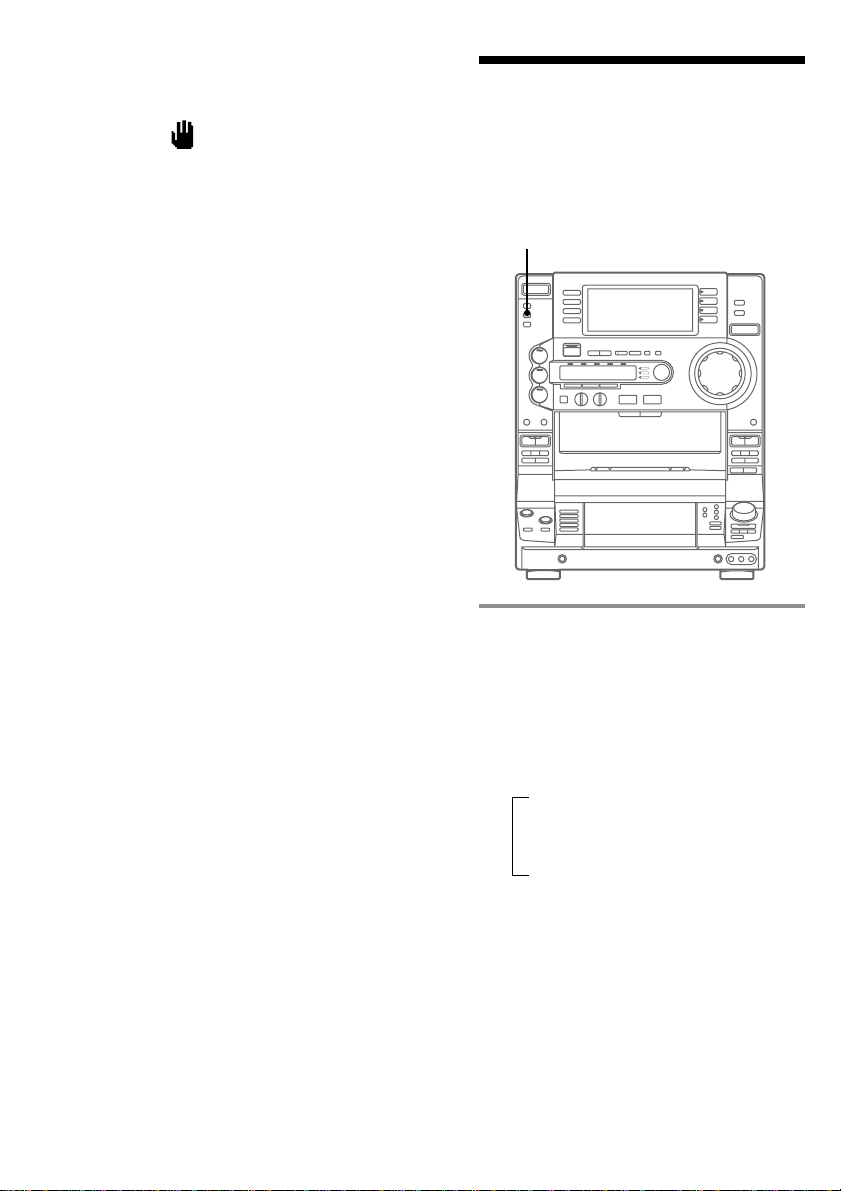
Compact Hi-Fi
Stereo System
Operating Instructions
4-231-882-11(1)
LBT-LV100AV
©2000 Sony Corporation
Page 2
WARNING
To prevent fire or shock hazard, do not
expose the unit to rain or moisture.
To avoid electrical shock, do not open the cabinet.
Refer servicing to qualified personnel only.
Do not install the appliance in a confined space,
such as a bookcase or built-in cabinet.
This appliance is classified as
a CLASS 1 LASER product.
The CLASS 1 LASER
PRODUCT MARKING is
located on the rear exterior.
This stereo system is equipped with the Dolby* Btype noise reduction system.
* Dolby noise reduction manufactured under license
from Dolby Laboratories Licensing Corporation.
“DOLBY” and the double-D symbol ; and “PRO
LOGIC” are trademarks of the Dolby Laboratories
Licensing Corporation.
This system can play
the following discs
VIDEO CDs Audio CDs
Disc logo
Contents Audio + Video Audio
(moving pictures)
Disc size 12 cm/8 cm 12 cm/8 cm
Play time 74 min./20 min. 74 min./20 min.
Note on VIDEO CDs
This system conforms to VIDEO CDs without the
PBC functions (Ver. 1.1) and VIDEO CDs with the
PBC functions (Ver. 2.0) of VIDEO CD standards.
You can enjoy two kinds of playback according to
the disc type.
Disc type
VIDEO CDs without
the PBC functions
(Ver. 1.1 discs)
VIDEO CDs with
the PBC functions
(Ver. 2.0 discs)
* PBC = Play Back Control
You can
Enjoy video playback
(moving pictures) as
well as audio CDs.
Play interactive
software using menu
screens displayed on
the TV screen (menu
playback), in addition
to the video playback
function of VIDEO
CDs without the PBC
functions.
Moreover, you can
play high or standard
quality still picture.
2
Page 3
Table of Contents
Getting Started
Step 1: Hooking up the system............ 4
Step 2: Setting up the speakers ............ 8
Step 3: Setting the time ....................... 10
Step 4: Presetting radio stations ........ 11
Basic Operations
Playing a VIDEO CD ........................... 13
Playing a CD ......................................... 15
Recording a VIDEO CD/CD .............. 16
Listening to the radio ........................... 17
Recording from the radio .................... 19
Playing a tape........................................ 20
Recording from a tape ......................... 22
The VIDEO CD/CD Player
Playing a VIDEO CD with the PBC
functions (Ver.2.0) ......................... 23
Using the CD display........................... 24
Using the on-screen display ............... 25
Locating a specific part of a disc ........ 27
Resuming playback from the point you
stopped a VIDEO CD .................... 31
Setting the sharpness ........................... 32
Playing CD tracks repeatedly ............. 32
Playing CD tracks in random order .. 33
Programming CD tracks ..................... 34
Playing CDs without interruption ..... 35
The Tape Deck
Recording on a tape manually ........... 36
Recording CDs by specifying the track
order ................................................ 37
DJ Effects
Looping part of a CD ........................... 39
Flashing part of a CD ........................... 39
Sound Adjustment
Adjusting the sound ............................ 40
Selecting the audio emphasis ............. 41
Adjusting the audio emphasis............ 42
Making a personal audio emphasis
file .................................................... 44
Enjoying Dolby Pro Logic Surround
sound ............................................... 45
Other Features
Singing along: Karaoke ...................... 46
Falling asleep to music ........................ 48
Waking up to music ............................. 49
Timer-recording radio programs ....... 50
Optional AV Components
Connecting audio components .......... 52
Connecting video components ........... 53
Connecting outdoor antennas ............ 55
Additional Information
Precautions ............................................ 56
Troubleshooting ................................... 57
Specifications ........................................ 59
Glossary ................................................. 62
Index....................................................... 63
3
Page 4
Getting Started
Step 1: Hooking up the system
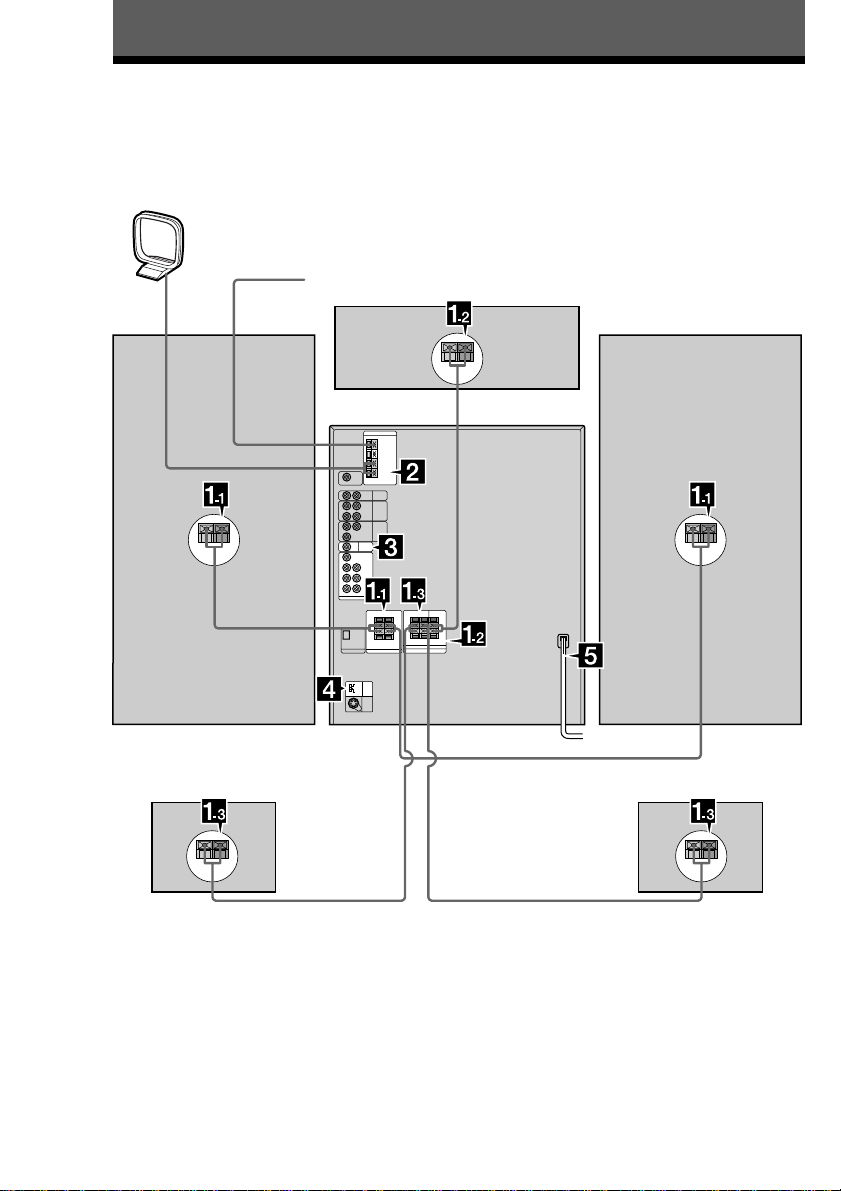
Follow steps 1 through 5 to hook up your system using the supplied cords and accessories.
AM loop antenna
FM antenna
Right front
speaker
Right rear speaker Left rear speaker
Center speaker
Left front
speaker
4
Page 5
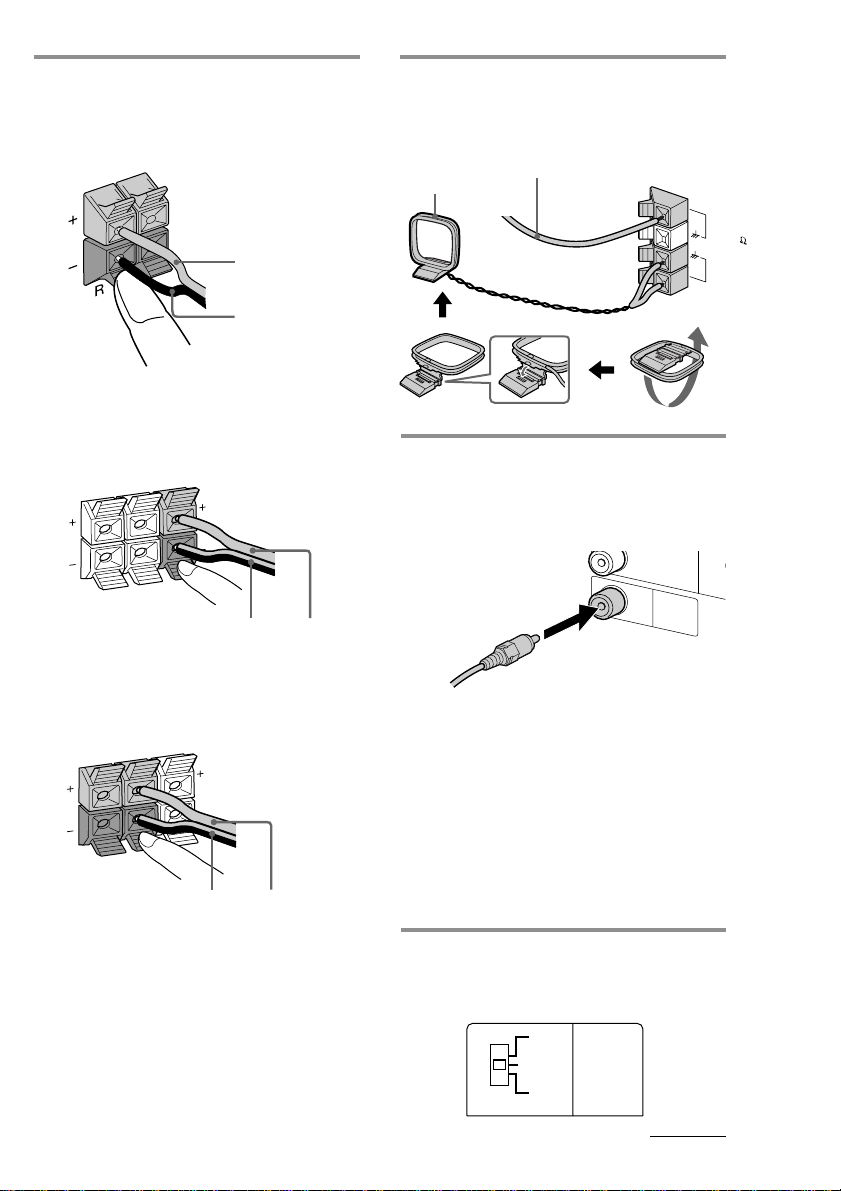
1 Connect the speakers.
O
1 Connecting the front speakers
Connect the speaker cords to the
FRONT SPEAKER jacks.
2 Connecting the center speaker
Connect the speaker cords to the
SURROUND SPEAKER CENTER
jacks.
L
R
REAR
CENTER
Black/Stripe
(#)
Red (3)
Black (#)
Red/Solid
(3)
2 Connect the FM/AM antennas.
Set up the AM loop antenna, then
connect it.
Extend the FM wire
antenna horizontally.
AM loop antenna
3 Connect the video input jack of
your TV to the VIDEO OUT jack of
this system using the supplied
video connecting cable.
V
ID
E
O
IN
O
U
T
VIDEO
FM
AM
VIDE
75
3 Connecting the rear speakers
Connect the speaker cords to the
SURROUND SPEAKER REAR jacks.
L
R
REAR
CENTER
Black/Stripe
(#)
Red/Solid
(3)
Notes
• Keep the speaker cords away from the antennas to
prevent noise.
• Insert only the stripped portion of the cord.
Inserting the vinyl portion will interfere with the
speaker connection and no sound will come from
the speaker.
When using a TV
Turn on the TV and select the video input to view
pictures from this system.
Tip
When your TV has an S VIDEO jack, for the best
picture quality, you can use an optional S VIDEO
cable to connect it to the S VIDEO OUT jack on the
rear panel of this system. Note that the input signal
from the VIDEO1 and VIDEO2 INPUT jacks do not
output via the S VIDEO OUT jack.
4 Set SYSTEM SELECT (color system)
to the appropriate position (PAL or
NTSC), according to your TV.
PAL
NTSC
SYSTEM
SELECT
continued
AUTO
5
Page 6
Step 1: Hooking up the system
(continued)
If your TV automatically changes the
color system according to the input
signal:
The factory setting (AUTO) automatically
changes the color system of the video output
according to the color system of the current
VIDEO CD.
If the color system of your TV is NTSC:
Set SYSTEM SELECT to NTSC.
Pictures recorded in the PAL color system will be
stretched vertically and will be displayed with the
upper and lower parts of the picture cut off.
If the color system of your TV is PAL:
Set SYSTEM SELECT to PAL.
Pictures recorded in the NTSC color system will be
stretched horizontally and will be displayed with
the upper and lower parts of the screen masked in
black.
Notes
• Be sure to turn off the system before changing the
SYSTEM SELECT setting.
• Even if you change the color system using the
SYSTEM SELECT, the color system of the signal
input from the VIDEO1 and VIDEO2 INPUT jacks
does not change.
5 Connect the power cord to a wall
outlet.
The demonstration appears in the
display. When you press ?/1, the system
turns on and the demonstration
automatically stops.
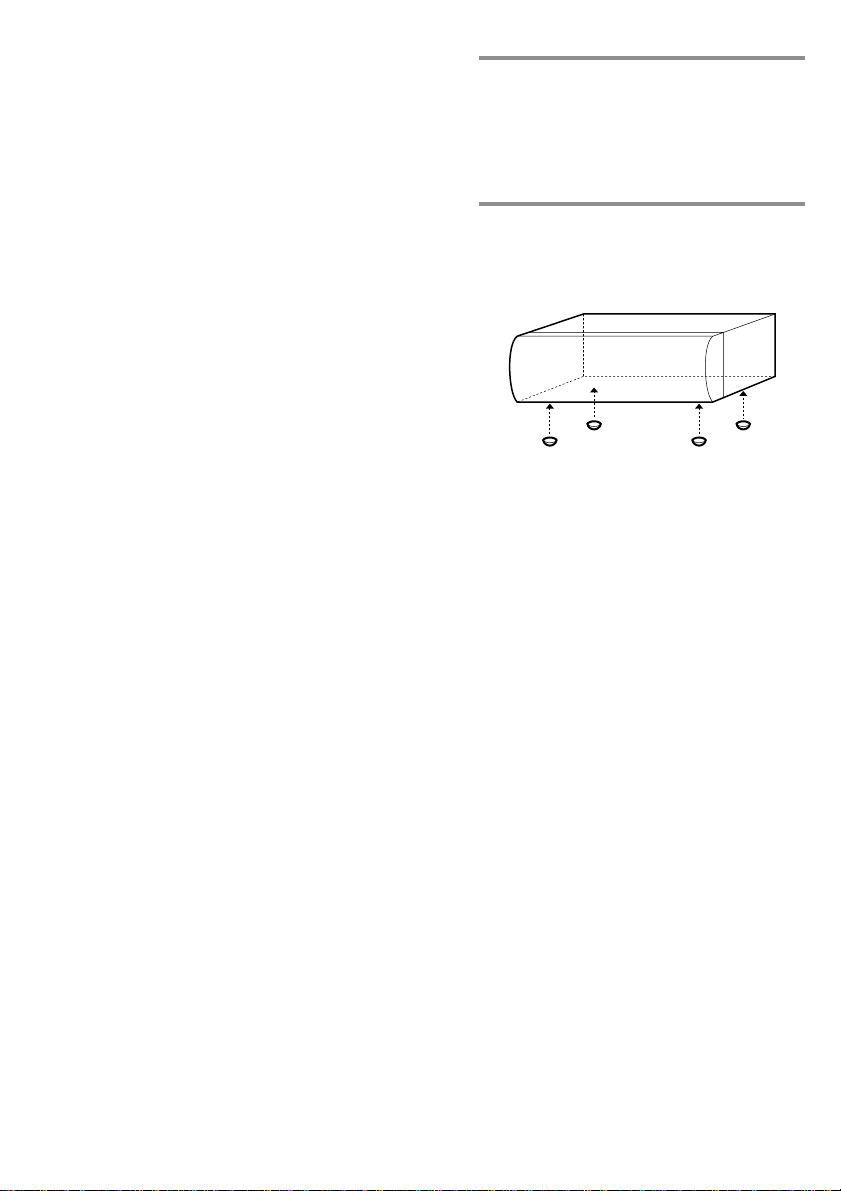
To attach the center speaker feet
Attach the four center speaker feet (supplied)
to the bottom corners of the center speaker.
To connect optional AV
components
See page 52.
To deactivate the demonstration
When you set the time (See “Step 3 Setting
the time”), the demonstration is deactivated.
To activate/deactivate the demonstration
again, press DEMO (STAND BY) when the
system is off.
6
Page 7
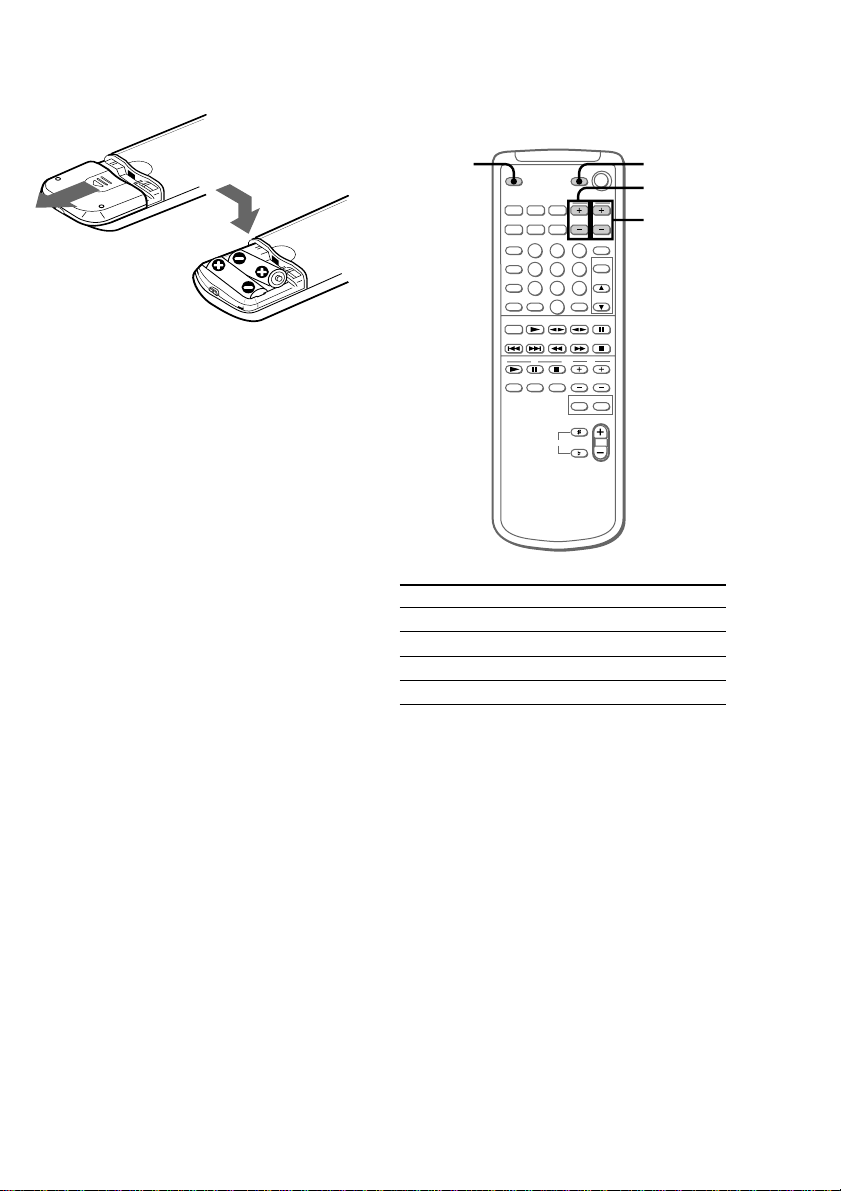
Inserting two R6 (size AA)
batteries into the remote
Using the remote
You can control Sony TVs using the buttons
below.
Tip
With normal use, the batteries should last for about
six months. When the remote no longer operates the
system, replace both batteries with new ones.
Note
If you do not use the remote for a long period of
time, remove the batteries to avoid possible damage
from battery leakage.
TV/
VIDEO
By pressing
TV ?/1
TV/VIDEO
TV VOL
TV CH
TV ?/1
TV VOL
TV CH
You can
Turn on or off the TV
Select the input source for the TV
Adjust the volume of the TV
Change the channel of the TV
Note
Depending on the TV, you may not be able to
control your TV or to use some of the buttons above.
When carrying this system
Do the following to protect the CD
mechanism.
Make sure that all discs are removed from the
unit.
1 Press FUNCTION repeatedly until “CD”
appears in the display.
2 Hold down CD LOOP and press ?/1 to
turn off the system.
“LOCK” appears in the display. It is now
safe for transportation.
7
Page 8
Step 2: Setting up
the speakers
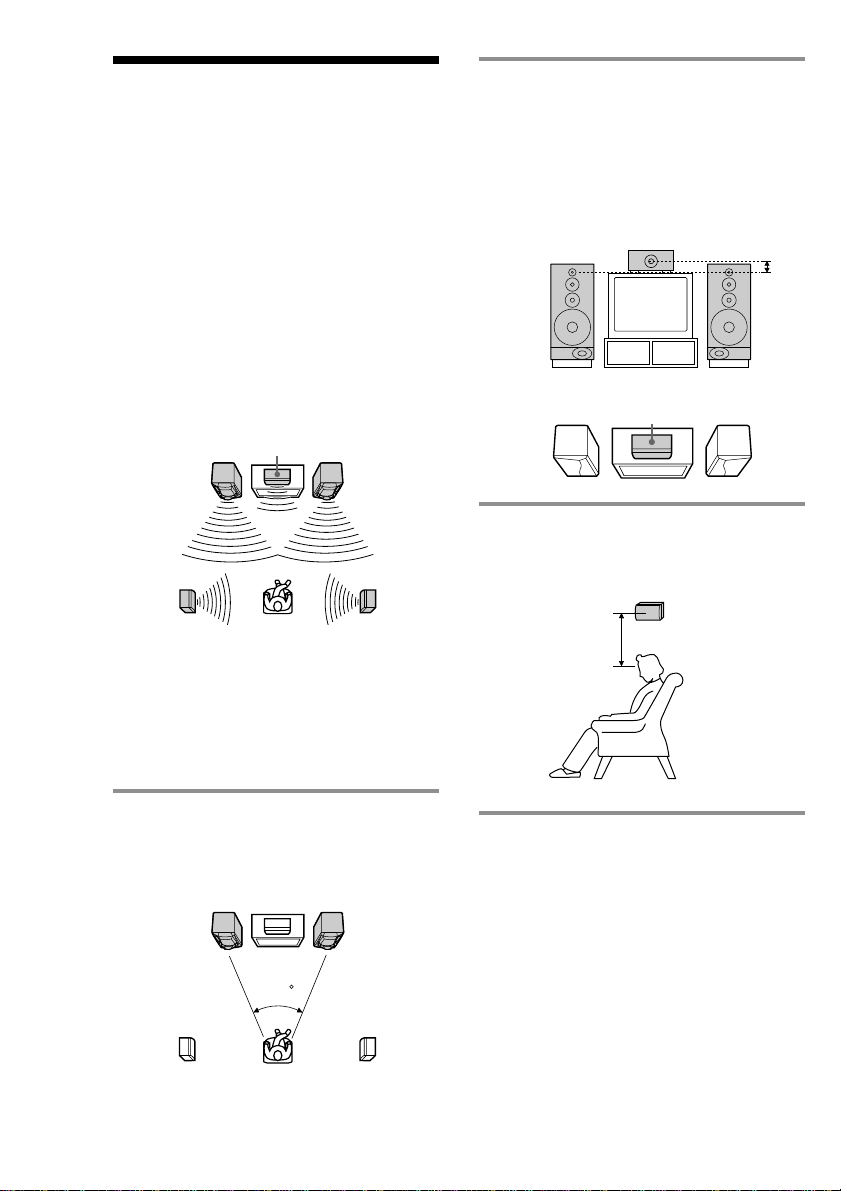
By connecting the supplied speakers, you can
enjoy Dolby Pro Logic Surround sound.
Dolby Pro Logic Surround is a decoding
system standardized in TV programs and
movies. Dolby Pro Logic Surround improves
the sound image by using four separate
channels. These channels manipulate the
sound to enhance the action as it happens on
the screen.
Since the center speaker cannot produce
enough bass, the bass sound of the center
channel is output from the front speakers.
Front
speaker (L)
Rear
speaker
(L)
Center speaker
Front
speaker (R)
Rear
speaker
(R)
2 Place the center speaker so it is
placed at about the same height as
the front speakers (A). Align the
center speaker with the front
speakers or place it a little behind
the front speakers’ position (B).
A
B
Center speaker
3 Place the rear speakers facing each
other at about 60 to 90 cm above
your listening position.
Rear speaker
60 to 90 cm
Positioning the center
and rear speakers
Before you connect them, determine the best
location for your speakers.
1 Place the front speakers at an angle
of 45 degrees from your listening
position.
Front
speaker
(L)
Rear
speaker
(L)
8
Center speaker
45
Front
speaker
(R)
Rear
speaker
(R)
Page 9
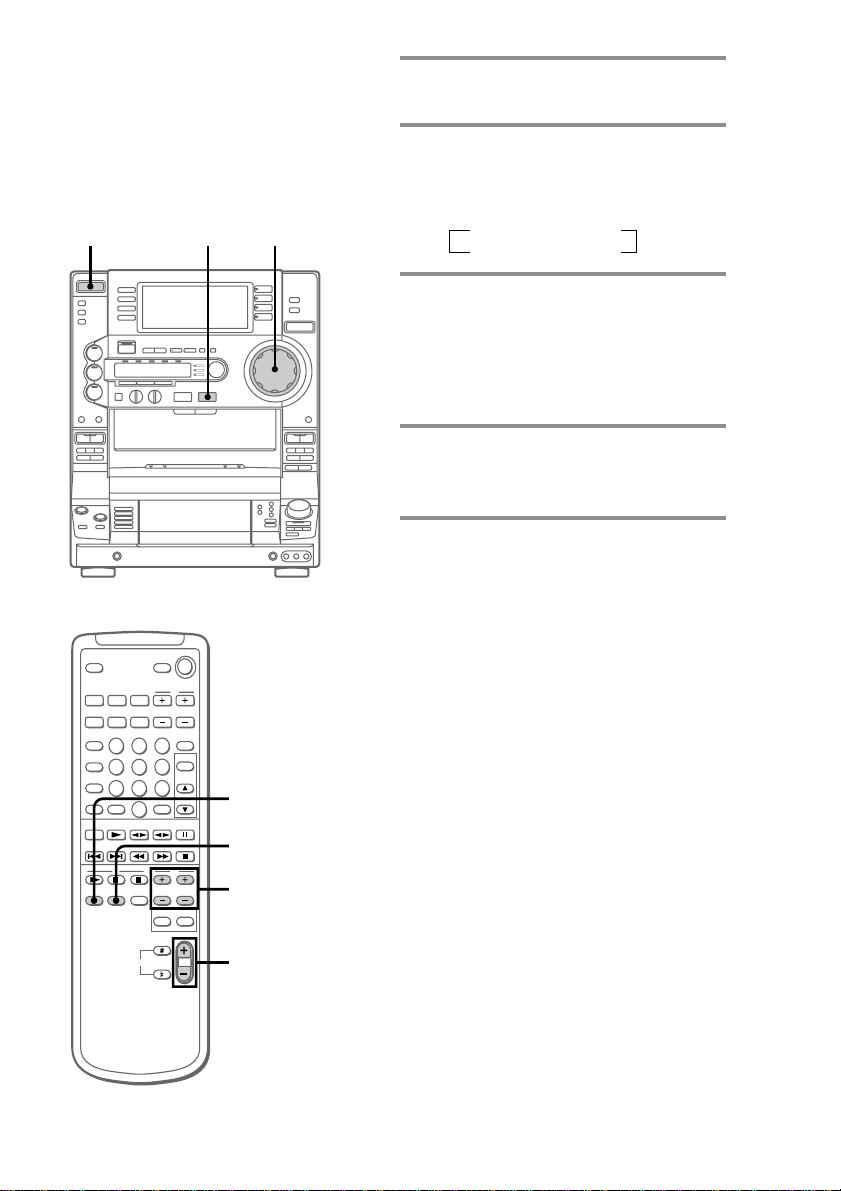
Adjusting the speaker
volume
To enjoy Dolby Pro Logic Surround sound,
adjust the volume of each speaker using the
test tone that the system provides.
?/1
(Power)
1
VOLUME
1 Press PRO LOGIC.
The button lights up.
2 Press T. TONE on the remote.
The test tone is heard from the speakers
in the following order. Adjust the
volume of the test tone.
t
LEFT t CENTER
REAR T RIGHT
T
3 From your listening position, press
CENTER LEVEL +/– and REAR
LEVEL +/– on the remote to adjust
the volume levels.
The volume levels from each speaker
should be the same.
4 Press T. TONE when you are done
adjusting.
The test tone is turned off.
Tip
If you turn VOLUME (or press VOL +/– on the
remote), all the speaker volumes change.
Note
The test tone feature works only for Dolby Pro Logic
Surround sound.
1
2,4
3
VOL +/–
9
Page 10
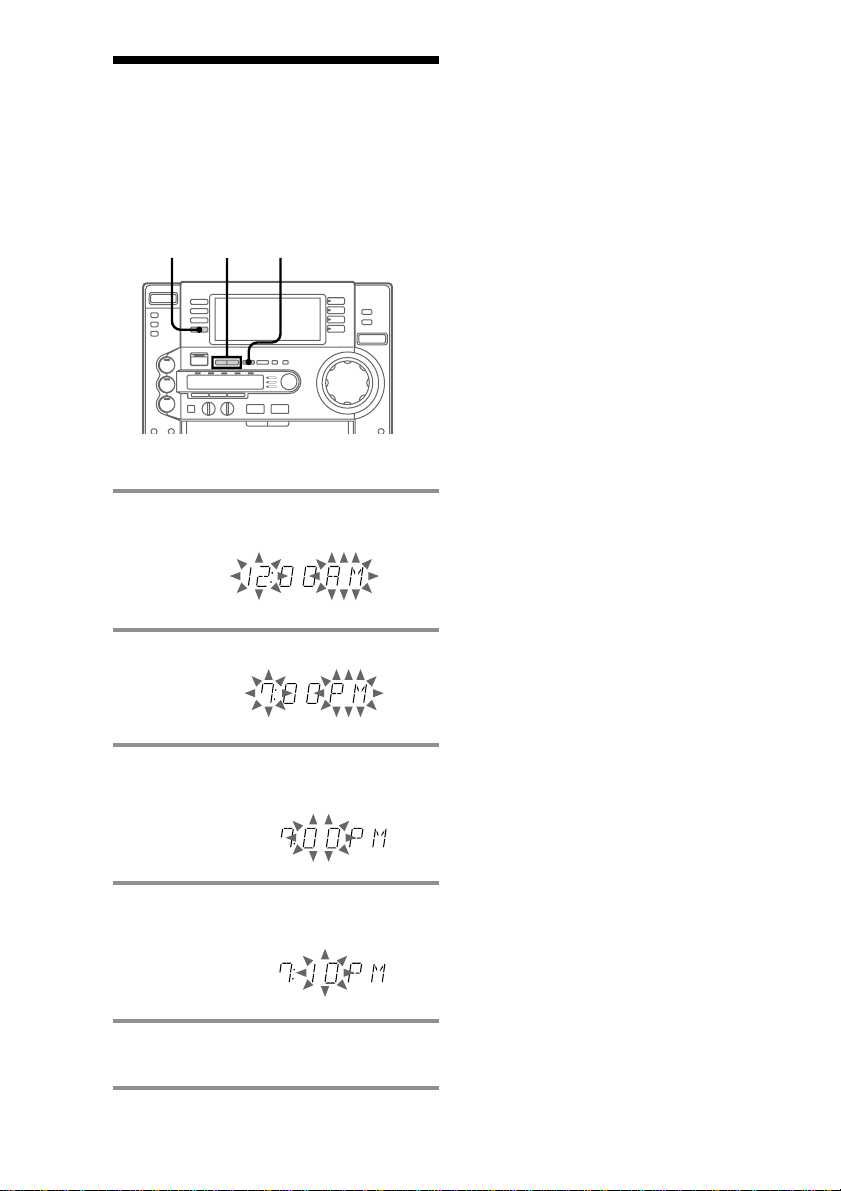
Step 3: Setting the
time
You must set the time before using the timer
functions.
3,51 2,4
1 Press c/CLOCK SET.
The hour indication flashes.
Tip
If you make a mistake, start over from step 1.
To change the time
The previous explanation shows you how to
set the time while the power is off. To change
the time while the power is on, do the
following:
1 Press c/CLOCK SET.
2 Press TUNING +/– to select SET CLOCK.
3 Press ENTER/NEXT.
4 Perform steps 2 through 5 in the previous
explanation.
Note
The clock setting is canceled when you disconnect
the power cord or if a power failure occurs.
2 Press TUNING +/– to set the hour.
3 Press ENTER/NEXT.
The minutes indication flashes.
4 Press TUNING +/– to set the
minutes.
5 Press ENTER/NEXT.
The clock starts.
10
Page 11
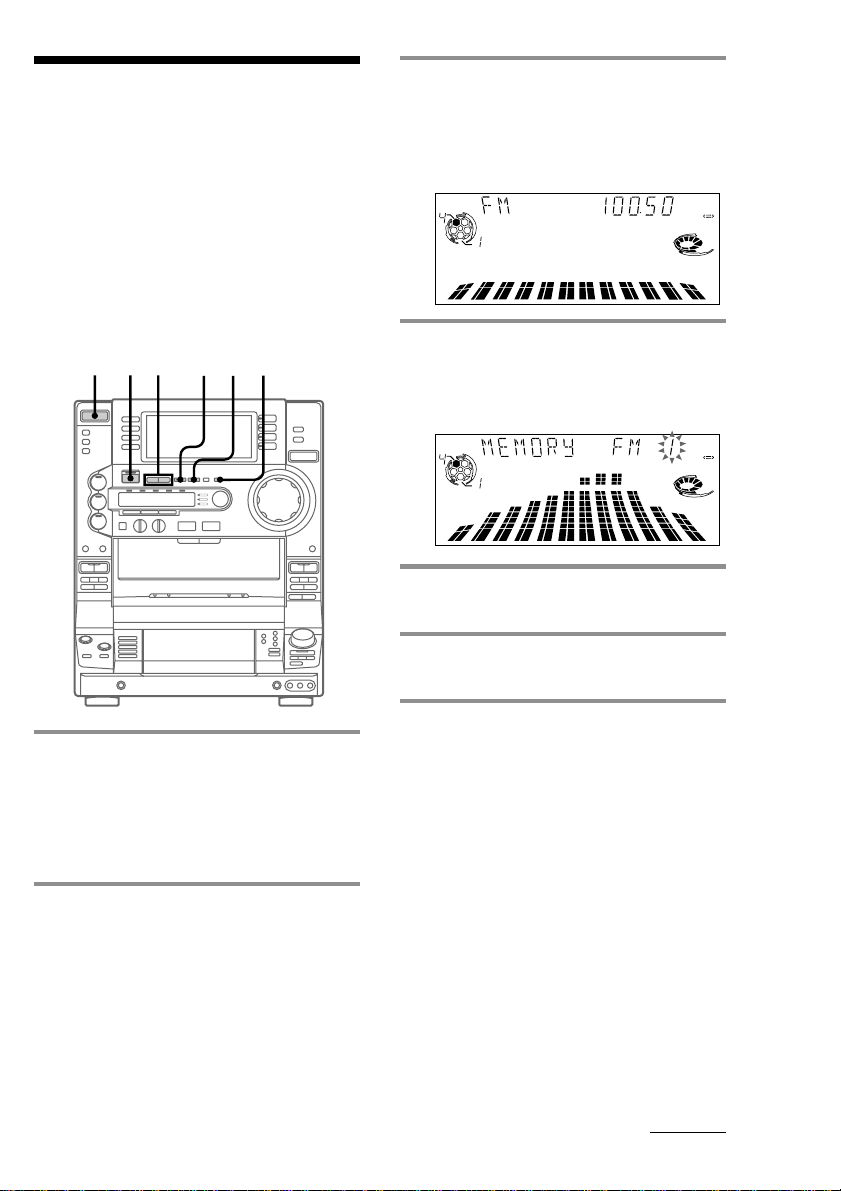
Step 4: Presetting
radio stations
You can preset the following number of
stations:
— 20 for FM and 10 for AM
The bands you can select depend on the kind
of tuner built into your system. Confirm the
bands by pressing TUNER/BAND
repeatedly.
3 Press TUNING +/–.
The frequency indication changes and
scanning stops when the system tunes in
a station. “TUNED” and “STEREO” (for
a stereo program) appear.
ALL DISC S
MHz
TUNED
DOLBY NR
VOLUME
AUTO
STEREO
OFF
?/1
(Power)
3
5124
1 Press TUNER/BAND repeatedly
until the desired band appears in
the display.
Each time you press this button, the
band changes as follows:
FM y AM
2 Press TUNING MODE repeatedly
until “AUTO” appears in the
display.
4 Press TUNER MEMORY.
The next available preset number flashes
in the display. The stations are stored
from preset number 1.
ALL DISC S
TUNED
5 Press ENTER/NEXT.
The station is stored.
6 Repeat steps 1 through 5 to store
other stations.
To tune in a station with a weak
signal
Press TUNING MODE repeatedly until
“MANUAL” appears in step 2, then press
TUNING +/– to tune in a station.
To store another station on an
existing preset number
Start over from step 1. After step 4, press
TUNING +/– to select the preset number on
which you want to store the station.
You can add a new preset number after the
last preset number.
DOLBY NR
VOLUME
AUTO
STEREO
OFF
continued
11
Page 12

Presetting radio stations
(continued)
To erase a preset number
1 Press and hold TUNER MEMORY until a
preset number flashes in the display.
2 Press TUNING +/– to select the preset
number you want to erase. Select “ALL
ERASE” to erase all preset numbers.
3 Press ENTER/NEXT.
When you erase a preset number, all the
following preset numbers shift up and reduce
by one.
To change the AM tuning interval
The AM tuning interval is factory-preset to 9 kHz
(10 kHz in some areas). To change the AM tuning
interval to 10 kHz (or 9 kHz), press TUNER/BAND
repeatedly until “AM” appears, then turn off the
system. While holding down ENTER, turn the
system back on. When you change the interval, the
AM preset stations will be erased. To reset the
interval, repeat the same procedure.
Note
The preset stations are canceled when you
disconnect the power cord or if a power failure
occurs for more than half a day.
12
Page 13
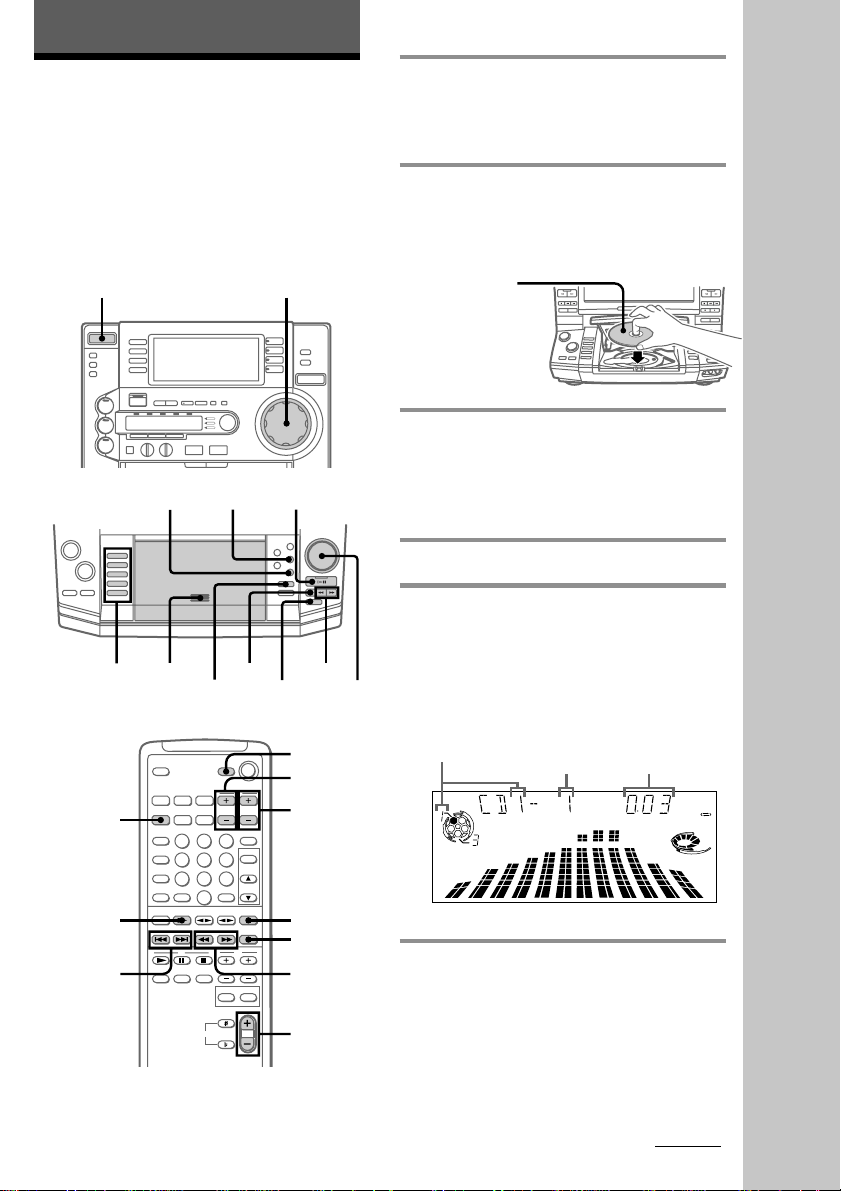
Basic Operations
Playing a VIDEO CD
You can play both VIDEO CDs without PBC
functions (Ver. 1.1) and VIDEO CDs with
PBC functions (Ver. 2.0).
You can enjoy two kinds of playback
according to the disc type.
?/1
(Power)
NEXT PREV
532,4
PLAY
MODE
VOLUME
HX
x
m/M
Jog dial
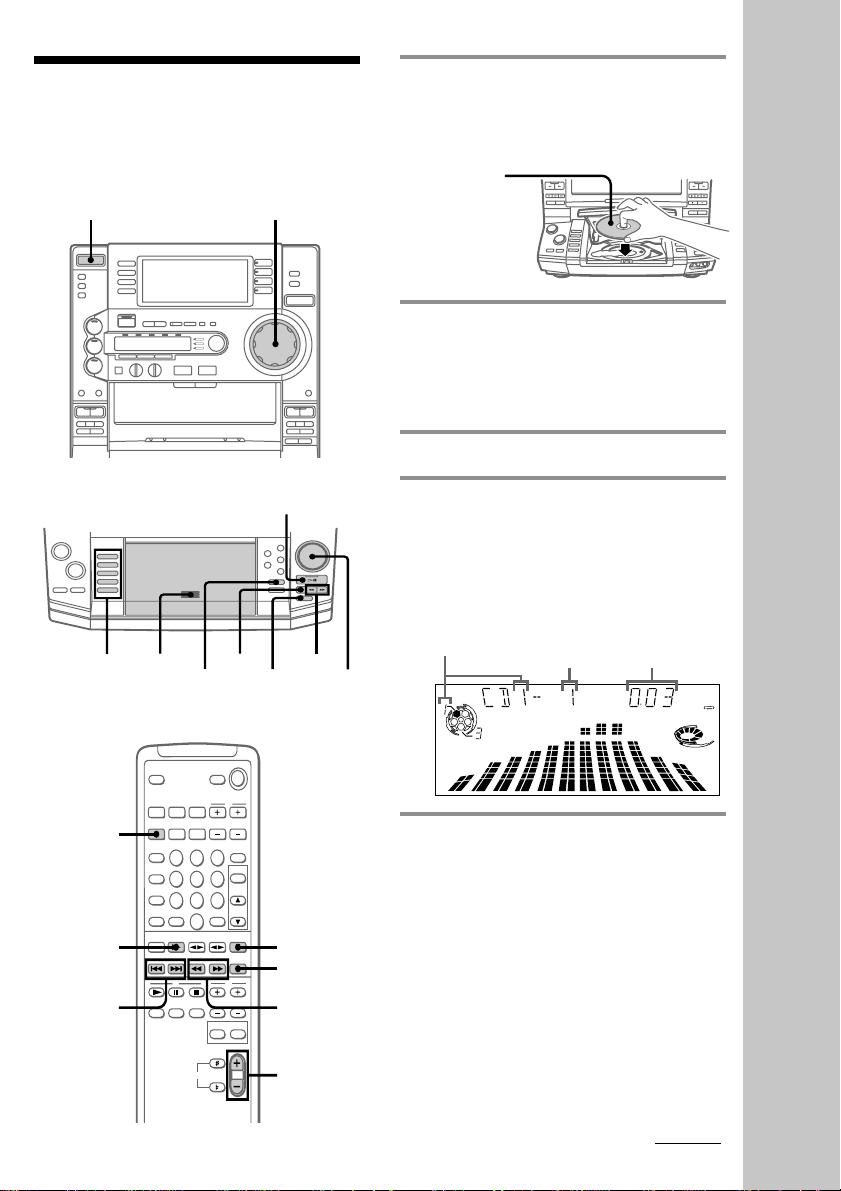
1 Turn on your TV and select the
video input.
Refer to the instructions included with
your TV for details.
2 Press PUSH OPEN and place a
VIDEO CD on the disc tray.
If the disc is not placed properly, it will
not be recognized.
With the label
side up.
When you play
a VIDEO CD
single, place it
on the inner
circle of the
tray.
3 Press DISC SKIP (or D.SKIP on the
remote) to place up to four more
VIDEO CDs on the tray.
The disc tray rotates so you can insert
other VIDEO CDs.
4 Close the front cover.
5 Press one of the DISC 1 - DISC 5
buttons.
Playback starts.
If you press HX (or CD N on the
remote), playback starts from the CD in
the playing position.
Basic Operations
D.SKIP
CD N
./>
TV ?/1
TV VOL +/–
TV CH +/–
X
x
m/M
VOL +/–
Disc number in the playing position
ALL DISC S
Track number
Elapsed time
continued
DOLBY NR
VOLUME
OFF
13
Page 14

Playing a VIDEO CD (continued)
To
Stop playback
Pause
Select a track
Find a point
in a track or
scene
(Lock Search
function)
Select a
VIDEO CD in
stop mode
Play only the
VIDEO CD
you have
selected
Play all
VIDEO CDs*
Remove or
change the
VIDEO CDs
Adjust the
volume
Do this
Press x.
Press HX (or X on the
remote)*1. Press HX again to
resume playback (or CD N on
the remote).
Press NEXT to go forward, PREV
to go back.
Or, during play or pause, turn the
jog dial clockwise (to go forward)
or counterclockwise (to go
backward) and release it when
you reach the desired track. (Or
press > (to go forward) or .
(to go backward) on the
remote.)*
2
Press M or m during
playback.
1 Press once to start searching.
2 Press again to increase the
search speed. Each time you
press the button, the speed
changes as follows:
1(slow) t 2 (normal) t
3 (high) t 1(slow)...
3 Press HX at the desired
point to stop searching.
Press one of the DISC 1 - DISC 5
buttons (or DISC SKIP).
Press PLAY MODE repeatedly
until “1 DISC” appears.
Press PLAY MODE repeatedly
3
until “ALL DISCS” appears.
Press PUSH OPEN.
Turn VOLUME (or press
VOL +/– on the remote).
Tips
• Pressing HX while the system power is off
automatically turns on the system and starts
VIDEO CD playback if there is a VIDEO CD on
the tray (One Touch Play).
• You can switch from another source and begin
playing a VIDEO CD just by pressing HX, one of
the DISC 1 - DISC 5 buttons, or CD N on the
remote (Automatic Source Selection).
• If there is no VIDEO CD in the player, “NO DISC”
appears in the display.
• You can change the VIDEO CD which is in the
loading position during playback of the VIDEO
CD which is in the playing position.
*1There may be some disturbance in the paused
video image.
2
*
Only for VIDEO CDs without PBC functions (Ver.
1.1).
3
*
This function cannot be used during playback of a
VIDEO CD with the PBC functions (Ver. 2.0).
14
Page 15
Playing a CD
— Normal Play
You can play up to five CDs in a row.
?/1
(Power)
VOLUME
1 Press PUSH OPEN and place a CD
on the disc tray.
If the disc is not placed properly, it will
not be recognized.
With the label
side up.
When you play
a CD single,
place it on the
inner circle of
the tray.
2 Press DISC SKIP (or D.SKIP on the
remote) to place up to four more
CDs on the tray.
The disc tray rotates so that you can
insert other CDs.
3 Close the front cover.
D.SKIP
CD N
./>
HX
m/M
PLAY
MODE
x
2
Jog dial
X
x
m/M
VOL +/–
1,34
4 Press one of the DISC 1 - DISC 5
buttons.
Playback starts.
If you press HX (or CD N on the
remote), playback starts from the CD in
the playing position.
Disc number in the playing position
ALL DISC S
Track number
Elapsed time
DOLBY NR
VOLUME
Basic Operations
OFF
continued
15
Page 16
Playing a CD (continued)
Recording a VIDEO
To
Stop playback
Pause
Select a track
Find a point
in a track
(Lock serch
function)
Select a CD
Play only the
CD you have
selected
Play all CDs
Remove or
change the
CDs
Adjust the
volume
* AMS: Automatic Music Sensor
Tips
• Pressing HX while the system power is off
automatically turns on the system and starts CD
playback if there is a CD on the tray (One Touch
Play).
• You can switch from another source and begin
playing a CD just by pressing HX, one of the
DISC 1 - DISC 5 buttons, or CD N on the remote
(Automatic Source Selection).
• If there is no CD in the player, “NO DISC”
appears in the display.
• You can change the CD which is in the loading
position during playback of the CD which is in the
playing position.
Do this
Press x.
Press HX (or X on the remote).
Press HX again to resume
playback (or CD N on the
remote).
During playback or pause, turn
the jog dial clockwise (to go
forward) or counterclockwise (to
go backward) and release it when
you reach the desired track.
Or press AMS* > (to go
forward) or AMS . (to go
backward) on the remote.
Press M or m during
playback. Press HX at the
desired point to stop searching.
Press one of the DISC 1 - DISC 5
buttons (or DISC SKIP).
Press PLAY MODE repeatedly
until “1 DISC” appears.
Press PLAY MODE repeatedly
until “ALL DISCS” appears.
Press PUSH OPEN.
Turn VOLUME (or press
VOL +/– on the remote).
CD/CD
— CD Synchro Recording
This function lets you easily record from a
CD to a tape. You can use TYPE I (normal) or
TYPE II (CrO2) tapes. The recording level is
automatically adjusted.
?/1
(Power)
1
DOLBY NR
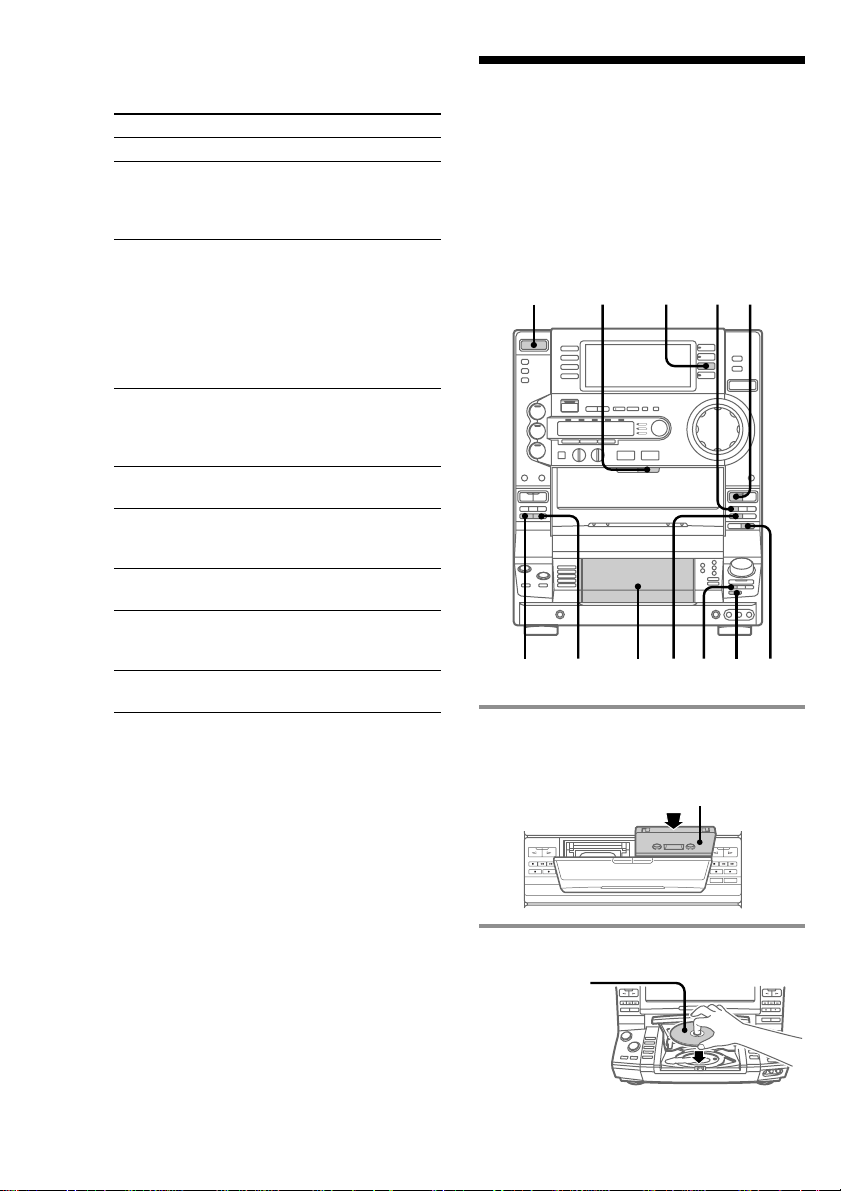
1 Press Z B EJECT and insert a
recordable tape into deck B.
2 Press PUSH OPEN and place a CD.
With the label
side up.
When you play
a CD single,
place it on the
inner circle of
the tray.
DSP
2,3 567
With the side you want to
record on facing forward
h
x
x
4
16
Page 17
3 Close the front cover.
Listening to the
4 Press DISC SKIP repeatedly until
the number of the disc you want to
record from appears in the playing
position indicator.
5 Press CD SYNC.
Deck B stands by for recording, the CD
player stands by for playback, and the
indicator on the H button (for the front
side) lights up green.
6 Press DIRECTION repeatedly until
g appears to record on one side or
j (or RELAY) to record on both
sides.
7 Press X.
Recording starts.
To stop recording
Press x on deck B or on the CD player.
Tips
• When you want to record on the reverse side,
press h after pressing CD SYNC in step 5 so that
the indicator on the h button (for the reverse
side) lights up green.
• When you record on both sides, be sure to start
from the front side. If you start from the reverse
side, recording stops at the end of the reverse side.
• When you want to reduce the hiss noise in lowlevel, high-frequency signals, press DOLBY NR
before step 7 so that “DOLBY NR B” appears in
the display.
• To record with the surround effect, press DSP so
that “SUR
The equalizer settings will not be recorded.
Note
You cannot listen to other sources while recording.
” appears in the display.
radio
— Preset Tuning
Before using this function, preset radio
stations in the tuner’s memory (see “Step
4: Presetting radio stations” on page 11).
?/1
(Power)
TUNER BAND
PRESET +/–
STEREO/
MONO VOLUME
123
Basic Operations
VOL +/–
continued
17
Page 18
Listening to the radio
(continued)
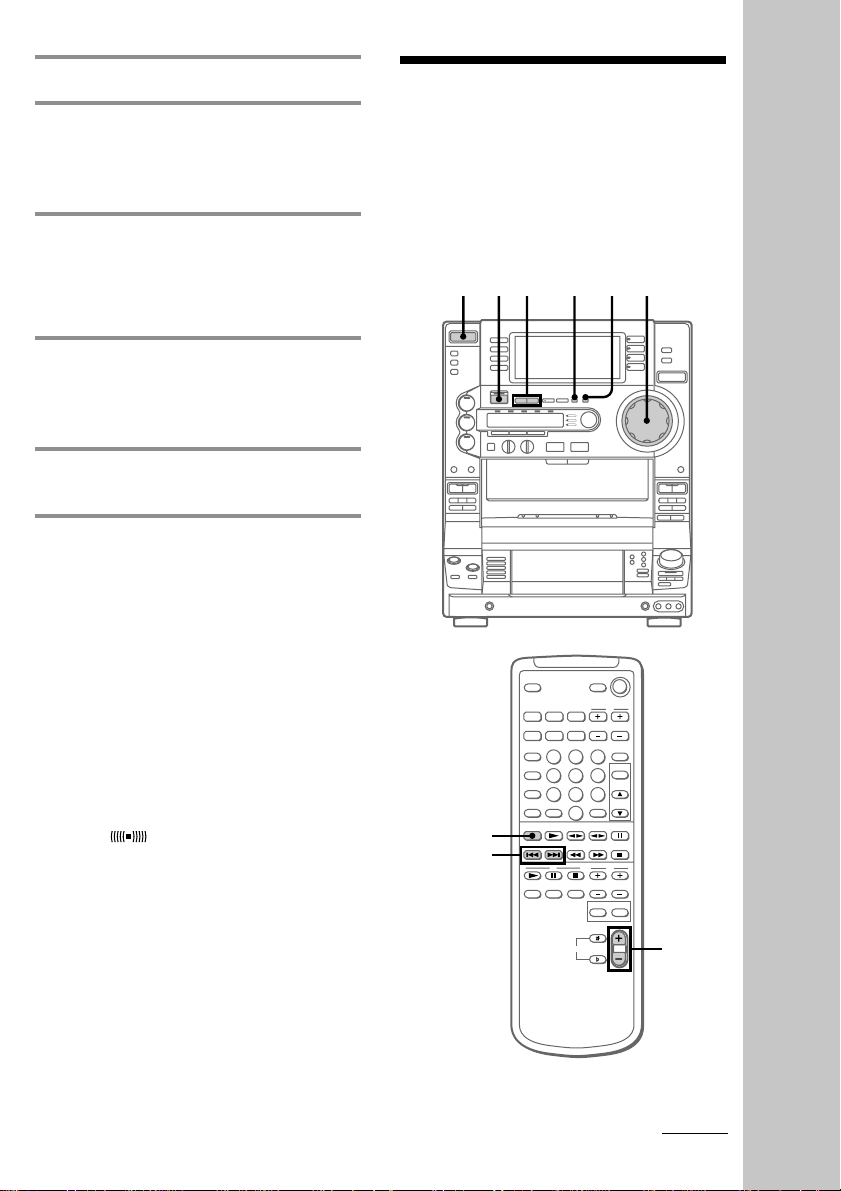
1 Press TUNER/BAND repeatedly
until the desired band appears in
the display.
Each time you press this button, the
band changes as follows:
FM y AM
2 Press TUNING MODE repeatedly
until “PRESET” appears in the
display.
MANUAL t AUTO t PRESET
t
3 Press TUNING +/– (or PRESET +/–
on the remote) to tune in the desired
preset station.
Tips
• Pressing TUNER/BAND while the system power
is off automatically turns on the system and tunes
in the last received station (One Touch Play).
• You can switch from another source to the radio
by pressing TUNER/BAND (Automatic Source
Selection).
• If an FM program is noisy, press STEREO/
MONO so that “MONO” appears in the display.
There will be no stereo effect, but the reception
will improve. Press this button again to restore the
stereo effect.
• To improve broadcast reception, move the
supplied antennas.
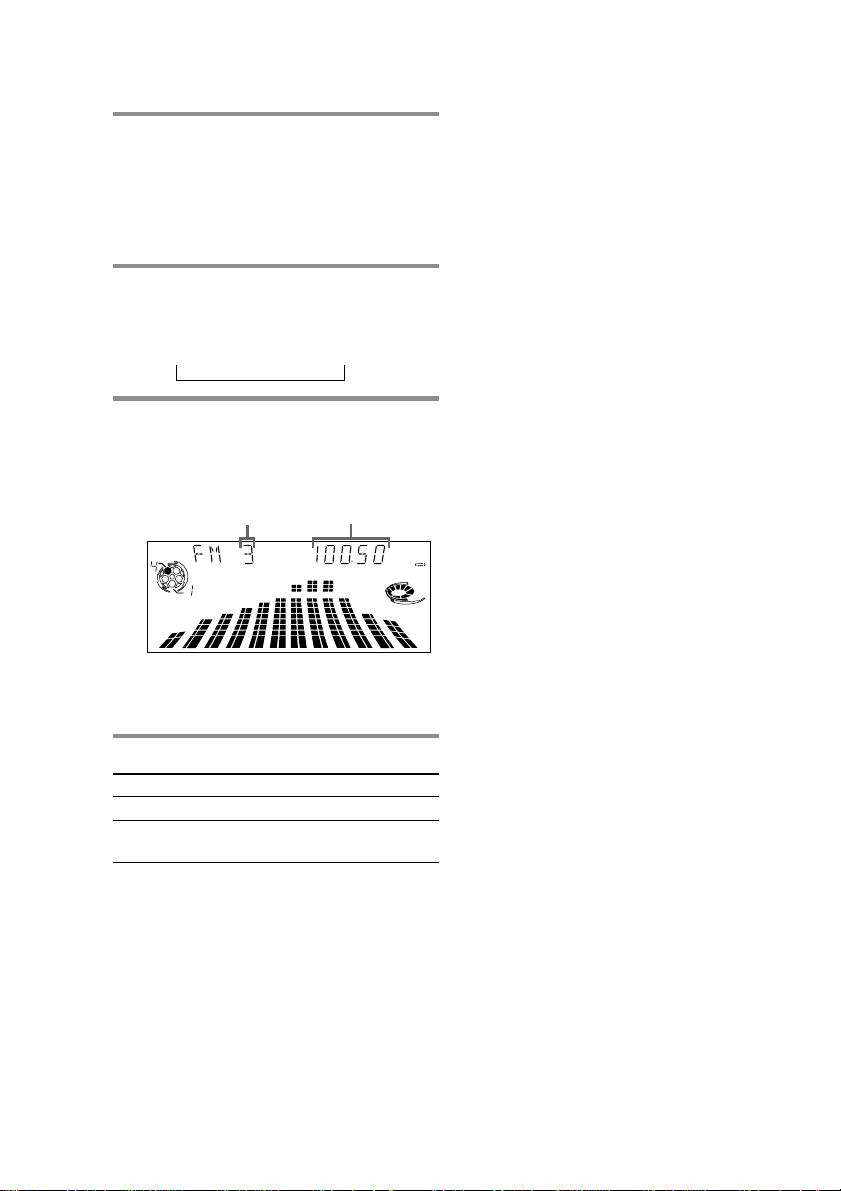
Preset number*
ALL DISC S
Frequency
MHz
* When only one station is preset,
“ONE PRESET” appears in the display.
To Do this
Turn off the radio Press ?/1.
Adjust the volume Turn VOLUME (or press
VOL +/– on the remote).
To listen to non-preset radio
stations
Press TUNING MODE repeatedly in step 2
until “MANUAL” appears, then press
TUNING +/– to tune in the desired station.
DOLBY NR
OFF
VOLUME
PRESET
18
Page 19
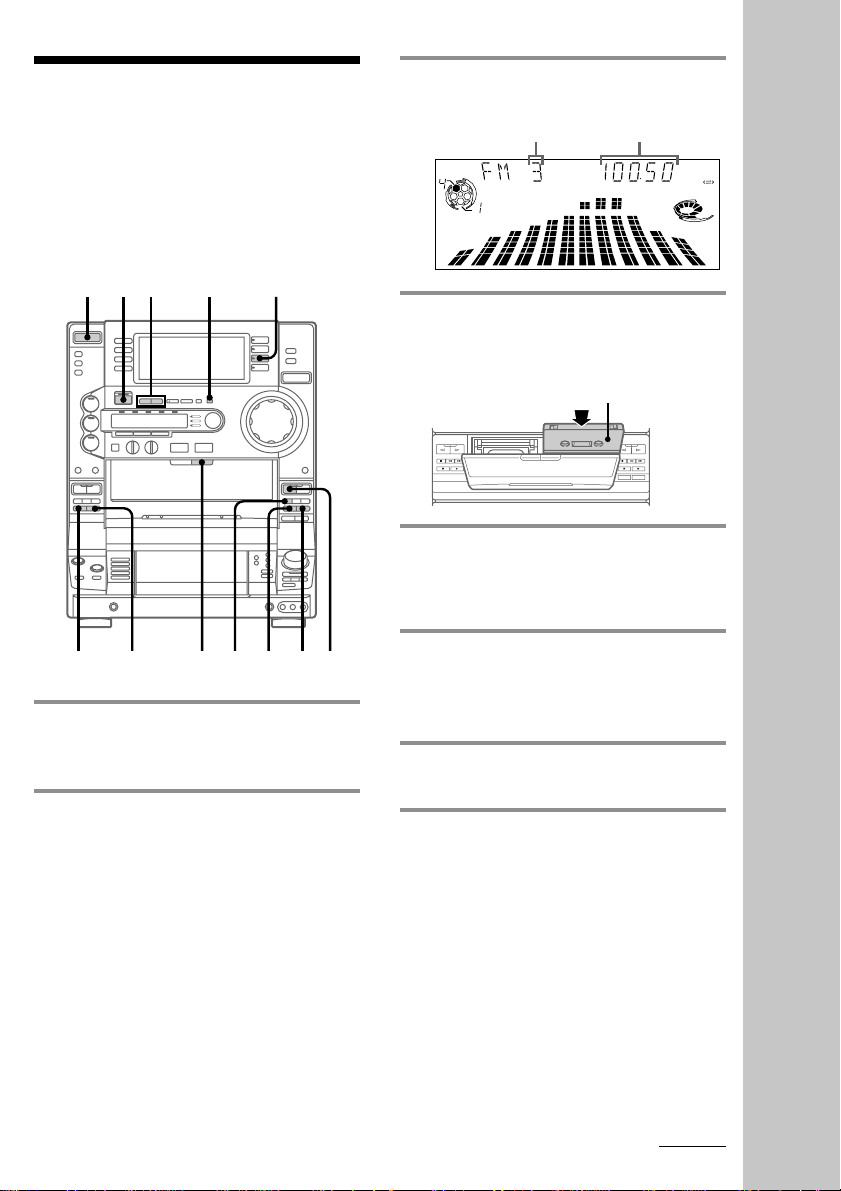
Recording from the
radio
3 Press TUNING +/– to tune in the
desired preset station.
Preset number
Frequency
You can record a radio program onto a tape
by tuning in a preset station. You can use
TYPE I (normal) or TYPE II (CrO2) tapes. The
recording level is automatically adjusted.
?/1
(Power)
3
1
DOLBY NR
2
DSP
x
4576
h
1 Press TUNER/BAND repeatedly
until the desired band appears in
the display.
2 Press TUNING MODE repeatedly
until “PRESET” appears in the
display.
MHz
ALL DISC S
4 Press Z B EJECT and insert a
recordable tape into deck B.
With the side you want to
record on facing forward
5 Press z REC.
Deck B stands by for recording, and the
indicator on the H button (for the front
side) lights up green.
6 Press DIRECTION repeatedly until
g appears to record on one side or
j (or RELAY) to record on both
sides.
7 Press X.
Recording starts.
To stop recording
Press x on deck B.
DOLBY NR
VOLUME
PRESET
OFF
Basic Operations
continued
19
Page 20

Recording from the radio
(continued)
Tips
• When you want to record on the reverse side,
press h after pressing z REC in step 5 so that the
indicator on the h button (for the reverse side)
lights up green .
• When you record on both sides, be sure to start
from the front side. If you start from the reverse
side, recording stops at the end of the reverse side.
• To record non-preset stations, select “MANUAL”
in step 2, then press TUNING +/– to tune in the
desired station.
• When you want to reduce the hiss noise in lowlevel, high-frequency signals, press DOLBY NR
before step 7 so that “DOLBY NR B” appears in
the display.
• To record with the surround effect, press DSP
so that “SUR
The equalizer settings will not be recorded.
• To improve broadcast reception, move the
supplied antennas.
” appears in the display.
Playing a tape
You can play any type of tape, TYPE I
(normal), TYPE II (CrO2), or TYPE IV (metal).
The deck automatically detects the tape type.
You can also use the AMS* functions to
quickly locate the desired songs.
To select either deck A or B, press DECK A
nN or DECK B nN on the remote.
* AMS: Automatic Music Sensor
?/1
(Power)
3
1
VOLUME
20
x
2
./>
DOLBY
NR
m/
M
x
X
m/
3
M
DECK A
nN
DECK B
nN
X
x
m/M
VOL +/–
Page 21
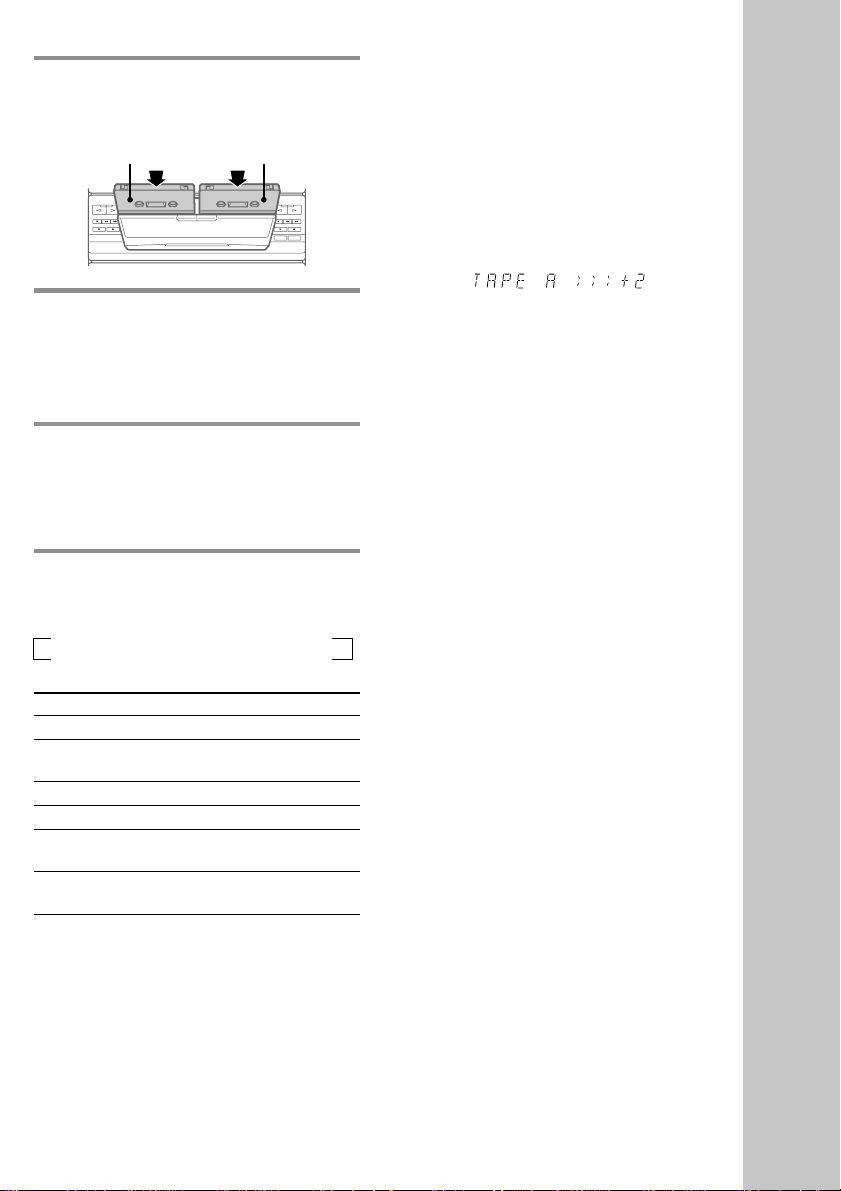
1 Press A EJECT Z (or Z B EJECT)
and insert a recorded tape.
With the side you want
to play facing forward
To search for the beginning of a
track (AMS)
Press M to search forward or m to search
backward when playing the front side (or
vice-versa when playing the reverse side).
When you use the remote, . or >.
The search direction, + (forward) or –
(backward), and number of songs being
skipped (1 - 9) appear in the display.
Example: searching forward 2 songs
2 Press DIRECTION repeatedly to
select g to play one side, j
to play both sides, or RELAY
(Relay Play)* to play both decks in
succession.
3 Press H (or DECK A nN, DECK
B nN on the remote).
Press h (or DECK A nN, DECK B
nN on the remote) to play the reverse
side. The tape starts playing.
* Relay Play always plays according to the
following sequence:
t
Deck A (front side) t Deck A (reverse side)
Deck B (reverse side) T Deck B (front side)
To Do this
Stop play Press x.
Pause (Deck B only) Press X. Press again to
resume playback.
Fast-forward Press M or m.
Rewind Press m or M.
Remove the cassette Press A EJECT Z
(or Z B EJECT).
Adjust the volume Turn VOLUME (or press
VOL +/– on the remote).
T
Tips
• Pressing H or h while the system power is off
automatically turns on the system and starts tape
playback if there is a tape in the deck (One Touch
Play).
• You can switch from another source to the tape
deck by pressing H or h (Automatic Source
Selection).
• You can fast-forward or rewind the tape,
regardless of the selected source.
• When you want to reduce the hiss noise in
low-level, high-frequency signals, press DOLBY
NR so that “DOLBY NR B” appears in the display.
Notes
•The deck stops automatically after playing both
sides five times.
•The AMS function may not operate correctly under
the following circumstances:
– When the unrecorded space between songs is
less than 4 seconds long.
– If completely different information is recorded
on the left and right channels.
– When there are continuous sections of extremely
low level or low frequency sound (like those of a
baritone sax).
– When the system is placed near a TV. (In this
case, we recommend moving the system farther
away from the TV or turning off the TV.)
Basic Operations
21
Page 22
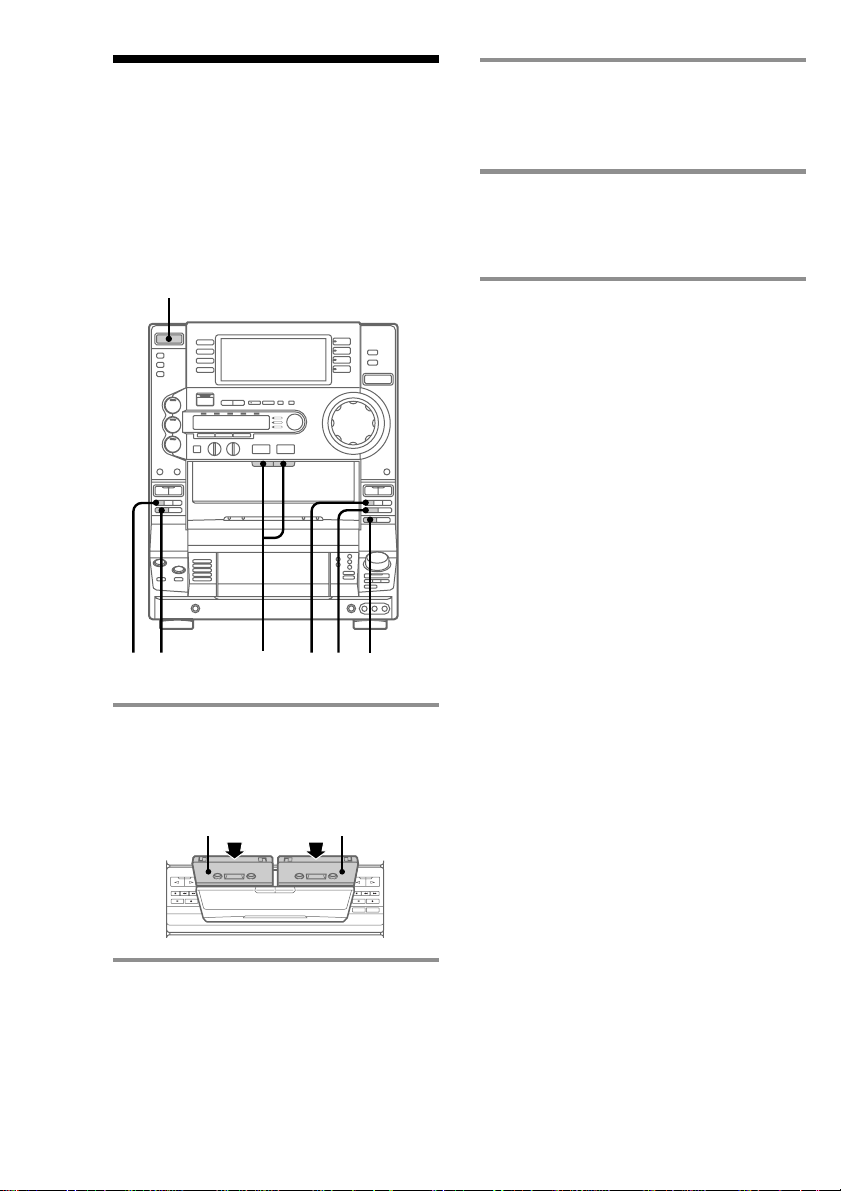
Recording from a
tape
— High-speed Dubbing
3 Press DIRECTION repeatedly until
g appears to record on one side or
j (or RELAY) to record on both
sides.
You can use TYPE I (normal) or TYPE II
(CrO2) tapes. The recording level is
automatically adjusted.
?/1
(Power)
x
x
1234
1 Press A EJECT Z and Z B EJECT
and insert a recorded tape in deck A
and a recordable tape in deck B.
With the side you want to
play/record on facing forward
4 Press X.
Dubbing starts.
When dubbing ends, decks A and B
automatically stop.
To stop dubbing
Press x on deck A or B.
Tips
• When you record on both sides, be sure to start
from the front side. If you start from the reverse
side, recording stops at the end of the reverse side.
• You don’t have to set DOLBY NR, since the tape in
deck B is automatically recorded in the same state
as the tape in deck A.
Notes
• If you set DIRECTION to j, when the tapes you
use have different lengths, the tape in each deck
reverses independently. If you select RELAY, the
tapes in both decks reverse together.
• You cannot record the surround effect.
2 Press H SPEED DUB.
Deck B stands by for recording.
22
Page 23
The VIDEO CD/CD Player
Playing a VIDEO CD
with the PBC
functions (Ver. 2.0)
–– PBC Play
The PBC (Play Back Control) function
displays menus on your TV screen to let you
enjoy interactive software.
Be sure to read the instructions supplied with
each disc for details regarding its use, since
different discs have different menu formats
and structures.
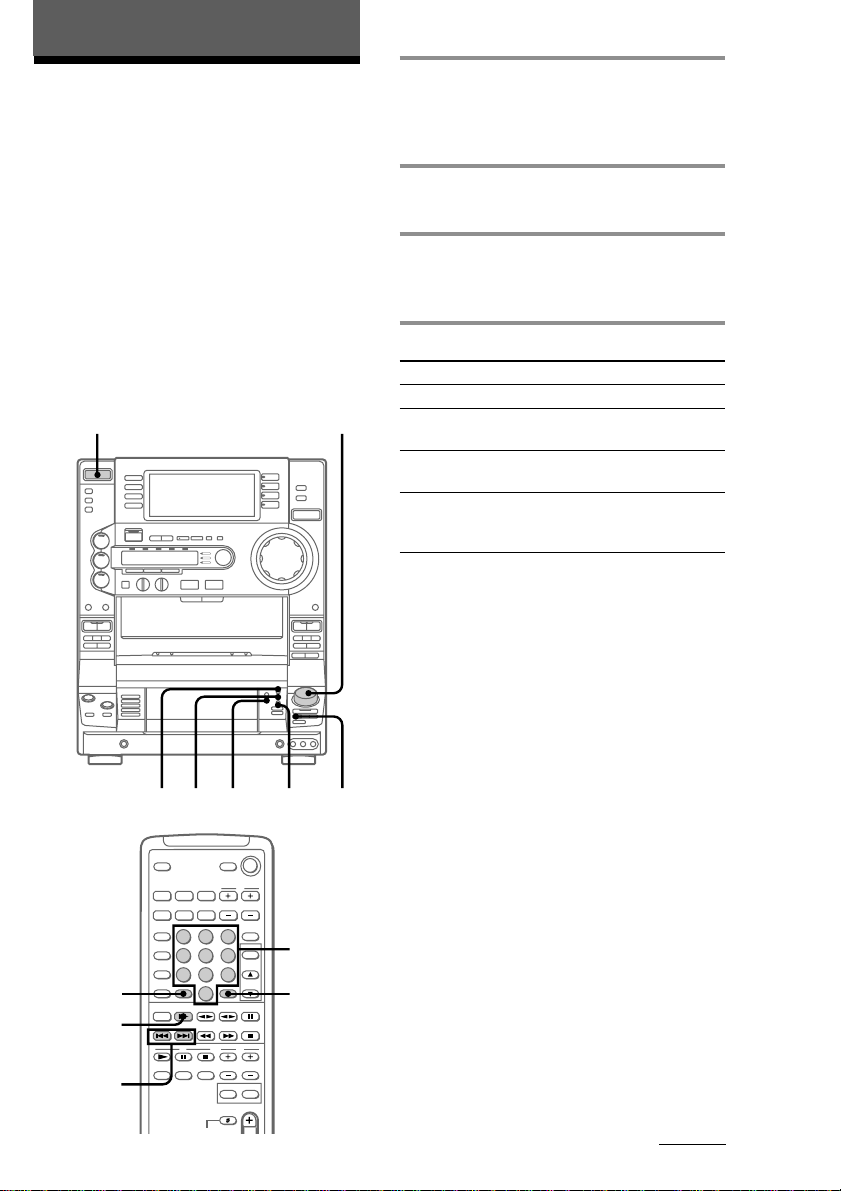
?/1
(Power)
>10
SELECT
RETURN
PREV
2
NEXT
2
x
Number
buttons
RETURNO
1 Start playing a VIDEO CD with the
PBC functions (Ver. 2.0).
A PBC menu appears on your TV and
“PBC” appears in the display.
2 Turn the jog dial to select a number
from the menu, then press SELECT.
3 Continue according to the
instructions on the menus to enjoy
interactive playback.
To
Stop playback
Go to the next scene or
track
Go back to the preceding
scene or track
Go back to the previous
menu
To disable the PBC functions (Ver.
2.0) of VIDEO CDs
There are two ways to disable the PBC
functions.
• Before you start playing, select the desired
track using the jog dial, then press SELECT
(or press ./>, then press SELECT on
the remote).
• Before you start playing, select the track
number using the number buttons on the
remote.
“PBC OFF” appears in the display and
playback begins from the selected track. Still
images, such as the menu screens, will not be
shown.
To select a menu number using
the remote
Press the number buttons in the desired order
in step 2. To enter track numbers 10 or over,
first press >10, then press the number
buttons. To enter 0, use the 10/0 button.
Do this
Press x.
Press NEXT.
Press PREV.
Press RETURN (or
O RETURN on the
remote).
./>
continued
23
Page 24
Playing a VIDEO CD with the PBC
functions (Ver. 2.0) (continued)
Tips
• When appears on the TV screen, you have
pressed an invalid button. Press a button
indicated by the instructions on the menu screen.
• When you press NEXT during playback or while
playing moving pictures, the next scene on the
disc appears. Also refer to the instructions
supplied with the disc.
•“PBC” appears for the disc with the PBC
functions, and “PBC OFF” appears when its
function is canceled.
Note
During playback, you cannot go to the next disc,
even if you’ve selected “ALL DISCS.”
Press DISC SKIP (or D. SKIP on the remote) to go to
the next disc.
Using the CD
display
You can check the remaining time of the
current track or that of the CD.
DISPLAY
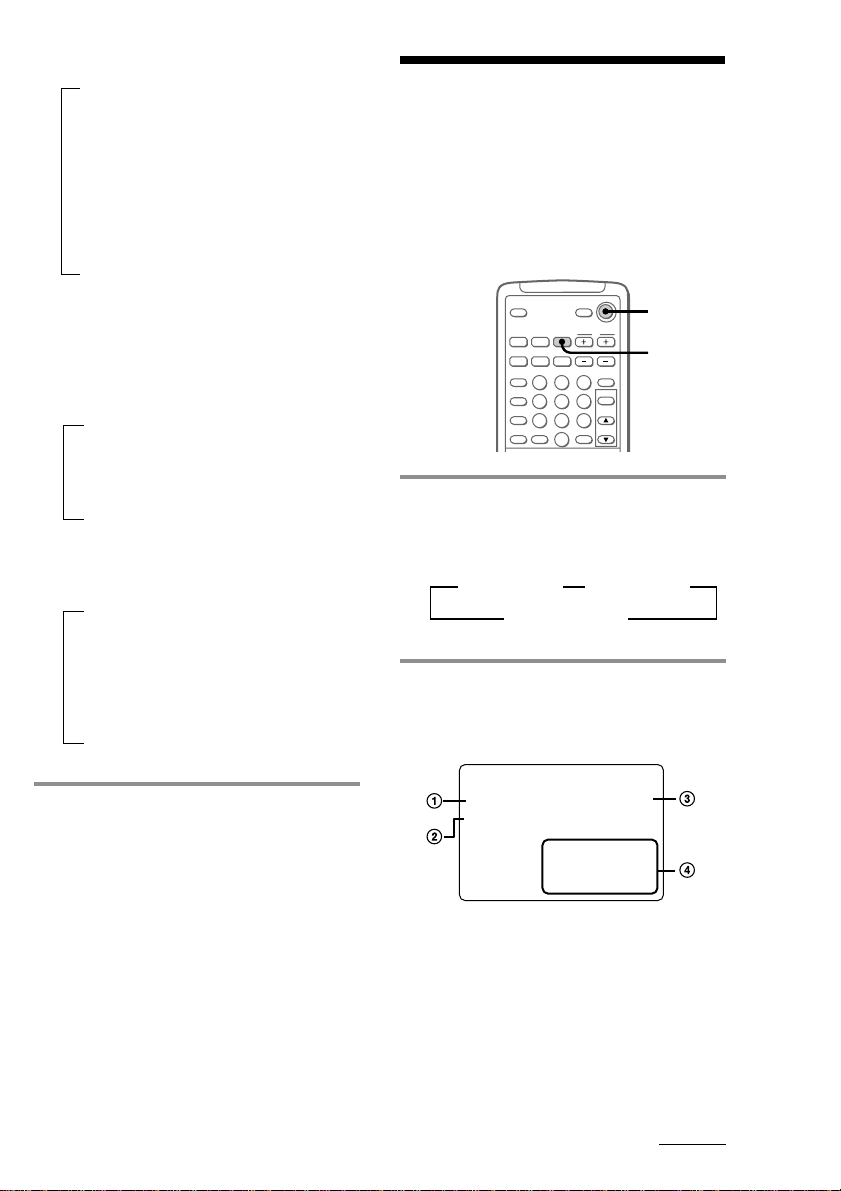
, Press DISPLAY.
Each time you press this button during
Normal Play or in stop mode, the
display changes as follows:
During Normal Play of a VIDEO
CD with the PBC functions
(Ver. 2.0)
tPlaying time on the current track*
r
Clock display (for eight seconds)
r
Effect (P FILE) name or “EFFECT ON
(OFF)”
24
* May not appear with still images, etc.
Page 25
During Normal Play
tElapsed time on the current track
Remaining time on the current track
tt t
Using the onscreen display
Remaining time on the current CD
(1 DISC mode) or “--.--” (ALL DISCS
mode)
Clock display (for a few seconds)
Effect (P FILE) name or “EFFECT ON/
OFF”
t
In stop mode
In the program mode when there is a
program
tThe last track number of the program
and the total playing time
Clock display (for a few seconds)
Effect (P FILE) name or “EFFECT ON/
OFF”
t
t
In other conditions
tThe current disc number
Total number of tracks and total playing
time (for a few seconds)
Clock display (for a few seconds)
Effect (P FILE) name or “EFFECT ON/
OFF”
Tip
While playing a VIDEO CD without the PBC
functions (Ver. 1.1) or audio CD, the current track
number and playing time of the current track
appear in the display.
t
t
t
You can check the current operating status
and disc information of VIDEO CDs or audio
CDs during playback or in stop mode,
superimposing a display on top of the video
images on your TV screen.
?/1
ON
SCREEN
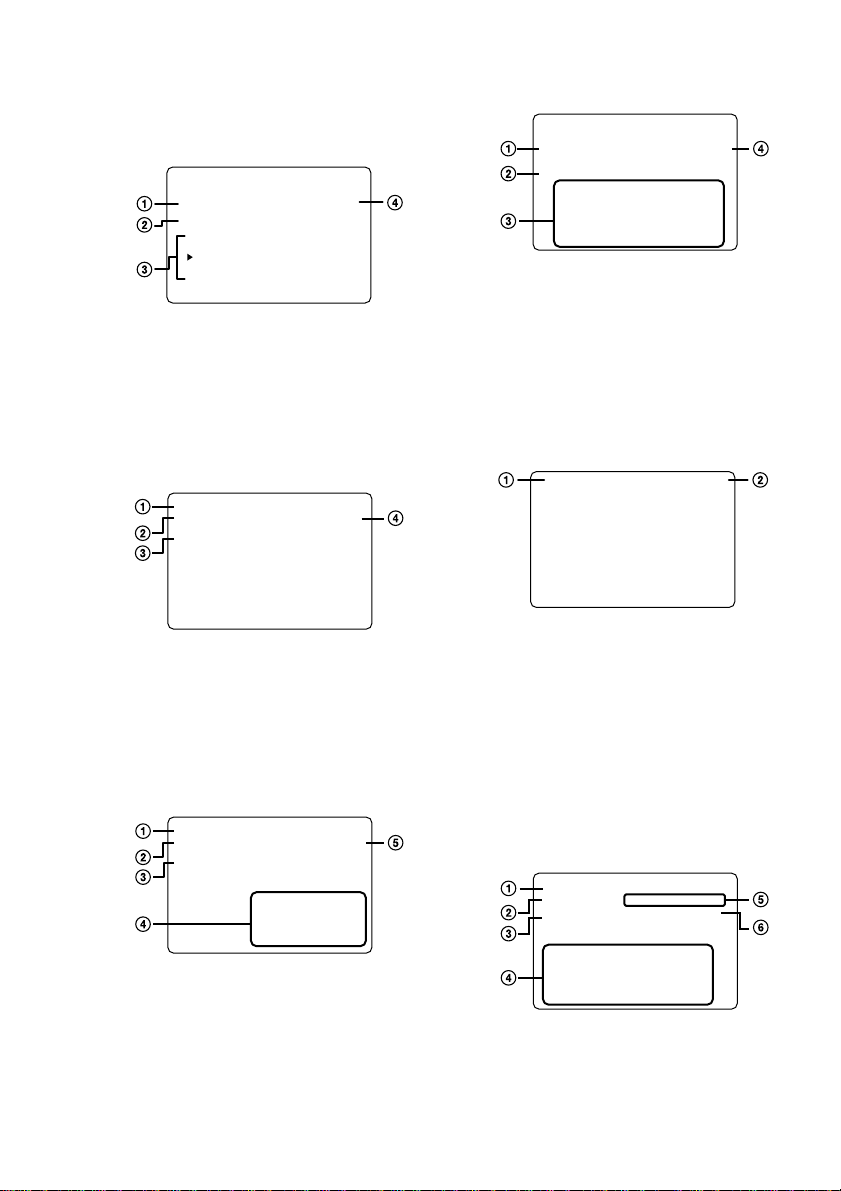
, Press ON SCREEN.
Each time you press this button, the onscreen display changes as follows:
t ON SCREEN 1 t ON SCREEN 2
ON SCREEN OFF T
ON SCREEN 1 display
• During playback of an audio CD (except
Program Play mode)
PLAYCD
DISC 1 - 3
CONTINUE
* * 3 4 5
6 7 8 9 10
11 12 13 14 15
16 17 18 19 20
0 : 20
1 Current disc and track number
2 Play mode
3 Elapsed time of current track
4 Music calendar*
* The track numbers in the numerical calendar
disappear after they are played.
continued
25
Page 26
Using the on-screen display
(continued)
• During stop mode of a VIDEO CD or
audio CD in Program Play mode
• During playback of an audio CD in
Program Play mode
CD
PLAY
DISC 2-10
PROGRAM
1. D 1 - 3
2. D 2 - 10
3. D 1 - 4
0 : 20
1 Current disc and track number
2 “PROGRAM”
3 Programmed disc and track numbers
4 Elapsed time of current track
• During stop mode of a VIDEO CD with
the PBC functions
RESUME
ACTIVE
AUTO PBC
STOPVCD
40 : 00DISC 1
1 “RESUME” or no display
2 “ACTIVE” or no display
3 “AUTO PBC”
4 Total playing time of current disc
STOPVCD
ACTIVE
PROGRAM
1. D 1 - 3 6. D 3 - 20
2. D 2 - 10
3. D 1 - 4
4. D 3 - 2
5. D 1 - 12
40 : 00TOTAL
1 “ACTIVE”* or no display
2 “PROGRAM”
3 Programed disc and track numbers
4 Total playing time of program
* For VIDEO CD only
ON SCREEN 2 display
• During playback of a VIDEO CD
DISC 1 - 7 0 : 55
1 Current disc and track number*
2 Elapsed time of current track
* “SCENE” and number appear during
playback of a VIDEO CD with the PBC
functions.
• During stop mode of a VIDEO CD or
audio CD (except Program Play mode)
RESUME
ACTIVE
CONTINUE
1 2 3 4 5
6 7 8 9 10
11 12 13 14 15
16 17 18 19 20
1 “RESUME” or no display
2 “ACTIVE”* or no display
3 Play mode
4 Music calendar
5 Total playing time of current CD
* For VIDEO CD only
26
• During playback of an audio CD
Display is the same as ON SCREEN 1.
STOPVCD
40 : 00DISC 1
• During stop mode of a VIDEO CD (except
Program Play mode)
RESUME
ACTIVE
CONTINUE
DISC 1
DISC 2
DISC 3
DISC 4
DISC 5
VCD STOP
CD
VCD
........
........
........
40 : 00DISC. 2
REPEAT 1
1-99TRTR
1-10
Page 27
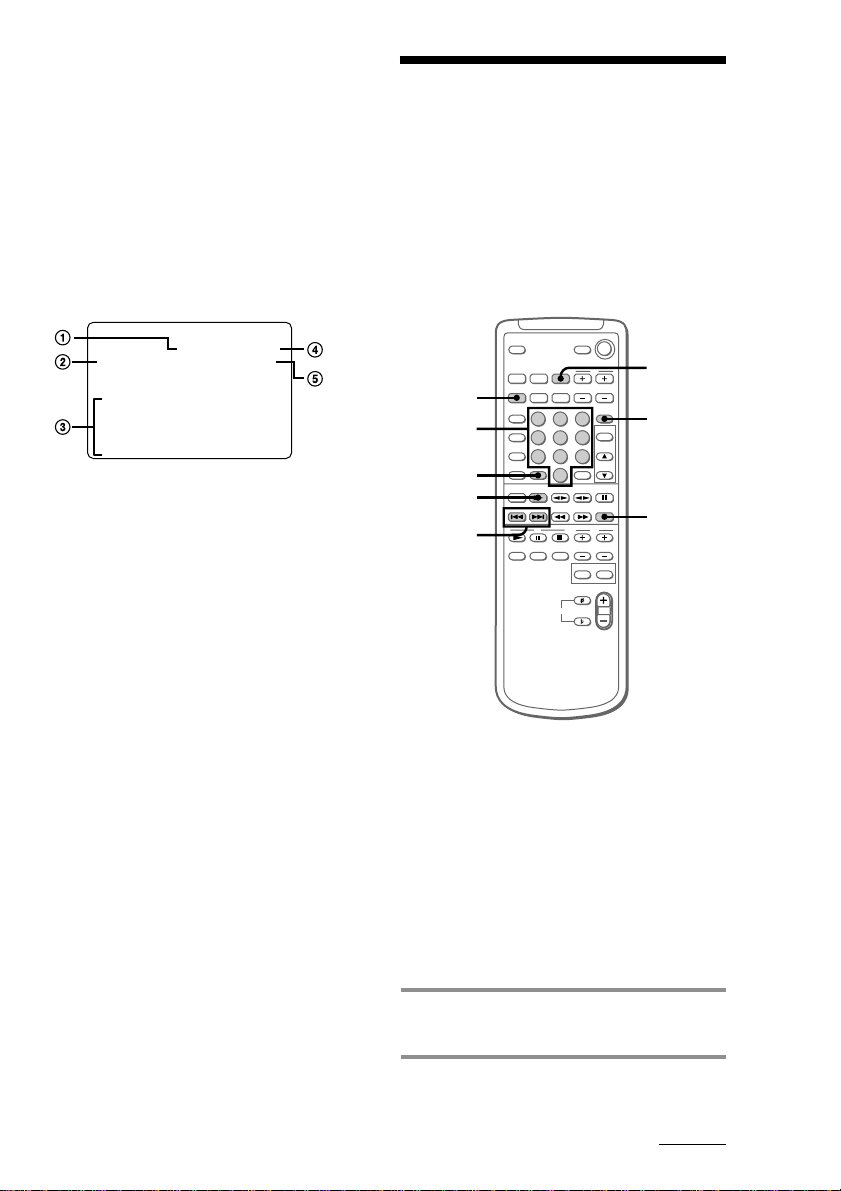
1 “RESUME” or no display
2 “ACTIVE” or no display
3 Play mode*
4 Total track numbers of each disc
5 Current disc number and total playing
time of current disc
6 “REPEAT,” “REPEAT 1,” or no display
* “AUTO PBC” appears for a VIDEO CD with
the PBC functions.
• During stop mode of an audio CD
(except Program Play mode)
CD STOP
CONTINUE
DISC 1
DISC 2
DISC 3
DISC 4
DISC 5
CD
VCD
........
........
........
DISC 1
40 : 00
REPEAT 1
1-99TRTR
1-10
1 Current disc number
2 Play mode
3 Total track numbers of each disc*
4 Total playing time of current disc
5 “REPEAT,” “REPEAT 1,” or no display
* Music calendar appears when SHUFFLE
mode is selected.
Locating a specific
part of a disc
–– Special Menu
This player has 4 different search features.
Select the desired search feature from the
SPECIAL MENU.
The TV screen must be ON to use these
functions.
ON
D.SKIP
Number
buttons
>10
CD N
PREV/
NEXT
SCREEN
SPECIAL
MENU
x
• During stop mode of a VIDEO CD or
audio CD in Program Play mode
Display is the same as ON SCREEN 1.
ON SCREEN OFF
No display (except for special menus).
Notes
• Normally, leave the display mode set to either
ON SCREEN 1 or 2. When you select ON
SCREEN OFF, you cannot check the operating
status while operating the CD player. In this case,
check the information on the front panel display.
• When you record video signals played back from
this system onto a video tape (etc.), be sure to
select ON SCREEN OFF. Otherwise, the display
information will also be recorded on the video
tape.
Locating by Scene
Number
–– Scene Search
On VIDEO CDs with the PBC functions (Ver.
2.0), the menu screens, moving pictures, and
still pictures are divided into “scenes” and
each scene has an assigned scene number.
This function lets you start playback from a
specific scene.
1 Start playing a VIDEO CD with the
PBC functions (Ver. 2.0).
2 Press SPECIAL MENU.
continued
27
Page 28
Locating a specific part of a disc
(continued)
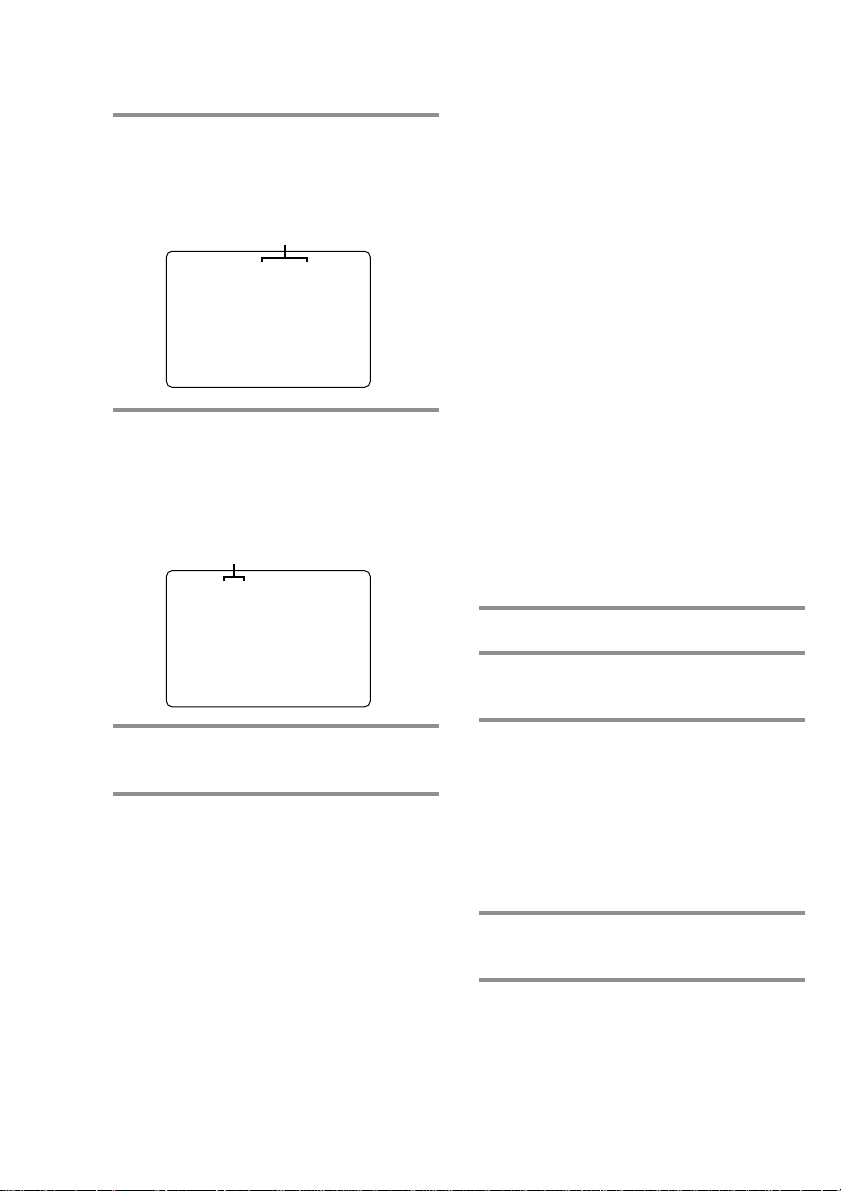
3 Press 1 to select “1) SCENE
SEARCH.”
“SCENE –” and the total number of
scenes appear on the TV screen.
Total number of scenes
SCENE- (1-312)
4 Press the number buttons (1 - 10/0)
to select the desired scene.
To enter scene number 103:
Press 1 t 10/0 t 3. The selected scene
number appears on the TV screen.
Selected scene number
SCENE 103 (1-312)
Notes
• On some CDs, you may not be able to start
playing from the scene you select because
starting playback from certain scenes is
prohibited.
In this case, play either starts from scene 1
(during stop mode) or continues from the current
scene (during playback).
• Some CDs may not display the scene you select
on the TV screen.
• When you select the ON SCREEN OFF display
mode, no information is shown on the TV screen.
Locating by elapsed time
–– Time Search
This function lets you use elapsed time as a
guide in finding certain parts of a VIDEO CD
without the PBC functions (Ver. 1.1).
“Elapsed time” means the time from the
beginning of the disc. It is not the playing
time of the current track as shown in the
display.
It is especially useful when playing discs that
have only a few track divisions.
This function cannot be used during playback
of VIDEO CDs with the PBC functions (Ver.
2.0).
1 Press SPECIAL MENU.
5 Press CD N.
Playback starts from the selected scene.
To stop playback
Press x.
To check the scene number during
playback
Press ON SCREEN repeatedly to select the
ON SCREEN 2 display mode. The scene
number appears on the TV screen (see “Using
the on-screen display” on page 25 for details).
28
2 Press 2 to select “2) TIME
SEARCH.”
3 Press the number buttons (1 - 10/0)
to enter the time (in minutes) for the
desired section.
To enter 10 minutes: Press 1 t 10/0.
The selected elapsed time appears on the
TV screen.
To reenter the time: Press CLEAR, and
then press the number buttons again.
4 Press CD N.
Playback starts from the selected time.
Page 29
To stop playback
Press x.
To use time search with VIDEO
CDs with the PBC functions (Ver.
2.0)
Select “2) TIME SEARCH” before you start
playing the VIDEO CD to disable the PBC
functions.
Locating the desired track
–– Disc Digest
You can select the desired track by viewing
the first frame of each track. Either 9 or 12
different tracks can be displayed on the TV
screen at one time.
This function cannot be used during playback
of VIDEO CDs with the PBC functions (Ver.
2.0).
1 Press SPECIAL MENU.
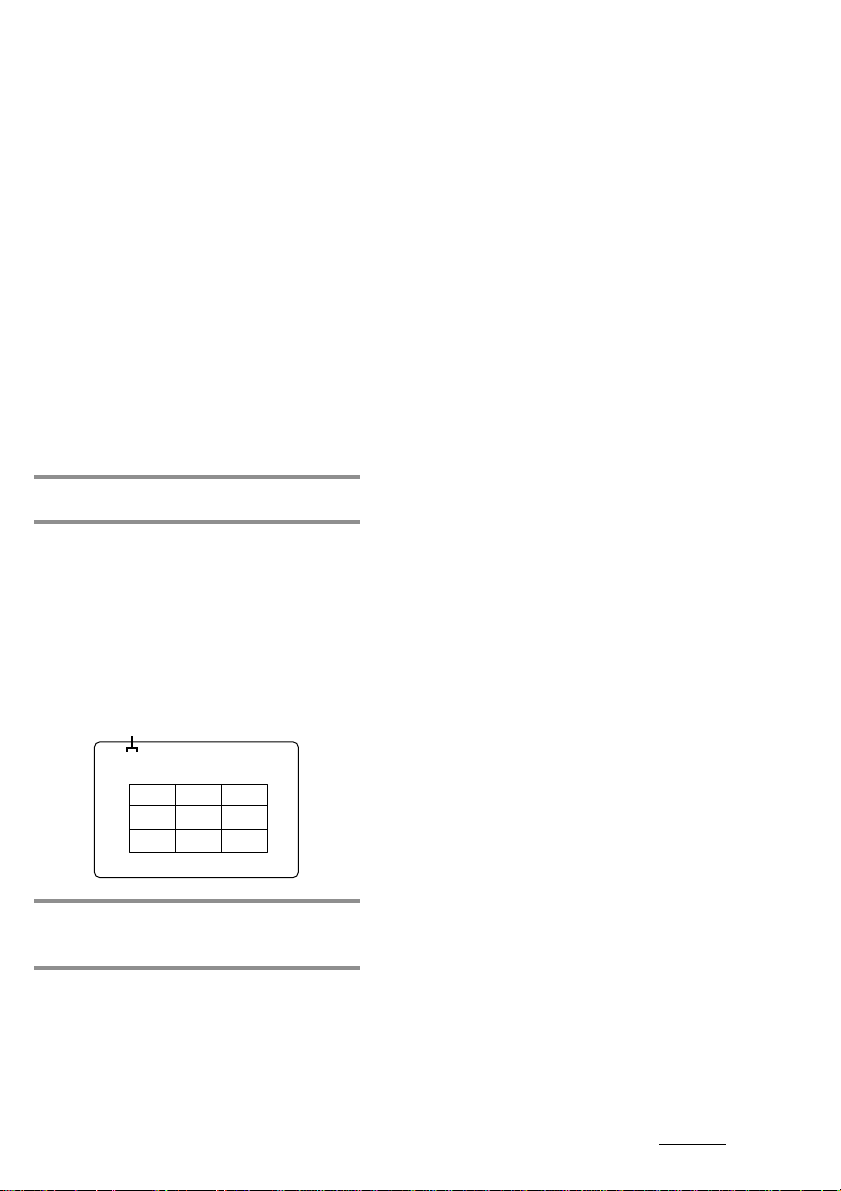
2 Press 3 to select “3) DISC DIGEST.”
The first frame of tracks 1 through 9 (in
default setting) on the current disc
appear.
The sound of the first three seconds of
each track on an audio CD plays, but
there is no sound when using a VIDEO
CD.
Current disc number
D 1 DIGEST
1
4
7
3
2
5
6
9
8
To switch to a 12 frame display
You can switch the digest display from 9 to 12
frames.
1 Press SPECIAL MENU.
2 Press 5.
3 Proceed with steps 1 and 2 of “Locating the
desired track.” The first frame of tracks 1
through 12 appear.
To switch back to the 9 frame display, repeat
this operation.
To display the next 9 or 12 tracks
Press NEXT. The first frame of tracks 10
through 18 (or 13 through 24) appear.
When there are more tracks in the disc,
“>” appears in the upper right corner of
the TV screen.
To display previous tracks, press PREV.
To switch to the digest of another
disc during disc digest
Press D. SKIP during disc digest.
To use disc digest with VIDEO CDs
with the PBC functions (Ver. 2.0)
Select “3) DISC DIGEST” before you start
playing the VIDEO CD to disable the PBC
functions.
Tip
In step 2, you can select tracks even if they have not
been displayed yet. Use the number buttons to
select the desired track.
Notes
• Video images will not be shown for audio CDs.
• The play mode automatically switches to normal
mode if you start disc digest during Shuffle or
Program Play.
3 Press the number buttons (1 - 10/0)
to select the desired track.
To stop playback
Press x.
continued
29
Page 30
Locating a specific part of a disc
(continued)
Locating a section within
a track
–– Track Digest
You can have the CD player divide a VIDEO
CD track into either 9 or 12 different sections
and display the first scene of each section on
the TV screen. This might be useful when
playing discs with few track divisions, such
as movies.
This function cannot be used during playback
of VIDEO CDs with the PBC functions (Ver.
2.0).
1 Start playing the desired VIDEO CD
track.
2 Press SPECIAL MENU.
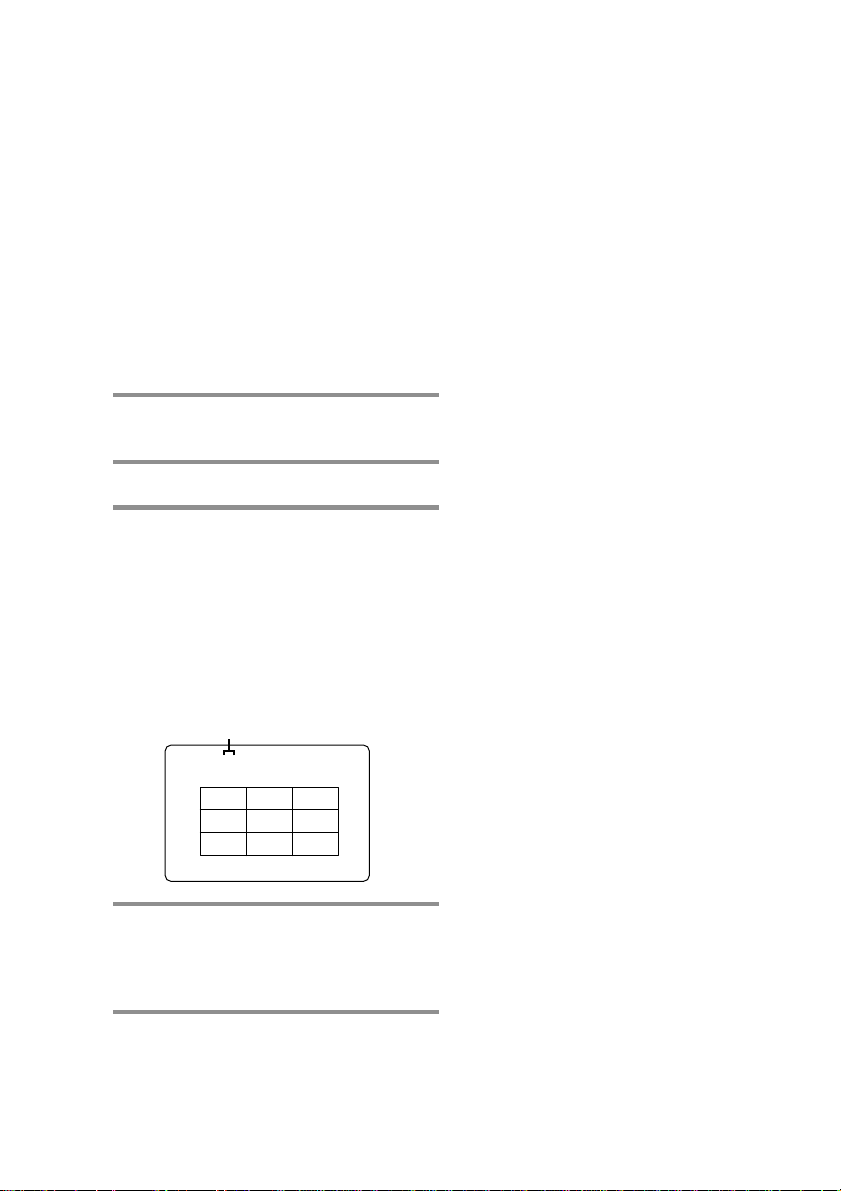
3 Press 4 to select “4) TRACK
DIGEST.”
The current track is divided into 9
sections (in default setting) and the first
frame of each section appears.
The sound of the first three seconds of
each track on an audio CD plays, but
there is no sound when using a VIDEO
CD.
Current disc number
To switch to a 12 frame display
You can switch the digest display from 9 to 12
frames.
1 Press SPECIAL MENU.
2 Press 5.
3 Proceed with steps 2 and 3 of “Locating a
section within a track.” The track is divided
into 12 sections and the first frame of each
section appears.
To switch back to the 9 frame display, repeat
this operation.
To switch to the digest of another
track during track digest
Press PREV or NEXT during track digest;
however, this does not work during Shuffle
Play or Program Play.
To use track digest with VIDEO
CDs with the PBC functions (Ver.
2.0)
Select “4) TRACK DIGEST” before you start
playing the VIDEO CD to disable the PBC
functions.
Tip
In step 3, you can select sections even if they have
not been displayed yet.
Use the number buttons to select the desired track.
Note
Tracks less than 40 seconds long may be divided
into fewer than 12 sections.
TRACK 1 DIGEST
1
2
5
4
7
8
4 Press the number buttons to select
the desired section.
Playback starts from a point near the
selected frame.
To stop playback
Press x.
30
3
6
9
Page 31
Resuming playback
from the point you
stopped a VIDEO
1 While playing a VIDEO CD, press x
to stop playback.
“RESUME” appears on your TV screen.
If “RESUME” does not appear, Resume
Play is not available.
CD
–– Resume Play
The system memorizes the point where you
stopped the VIDEO CD so you can resume
from that point. Resume play is not canceled
when you turn off the system.
Note that resume play is not available when
playing an audio CD.
?/1
(Power)
12
2 Press HX (or CD N on the
remote).
The player starts playback from the
point you stopped the VIDEO CD in
step 1.
To view from the beginning of the
VIDEO CD
When “RESUME” appears in the display,
press x, then press HX (or CD N).
Notes
• Resume Play is not available in the Digest,
Shuffle, or Program Play modes.
• Depending on where you stopped the VIDEO
CD, the player may resume playback from a
different point.
• The point at which you stopped playback is
cleared when:
– you press number buttons, PLAY MODE, or x.
– you press DISC SKIP (or D.SKIP on the remote).
– you press SPECIAL MENU.
– you turn the jog dial.
– you remove the VIDEO CD.
– you unplug the system’s AC power cord.
CD N
x
31
Page 32
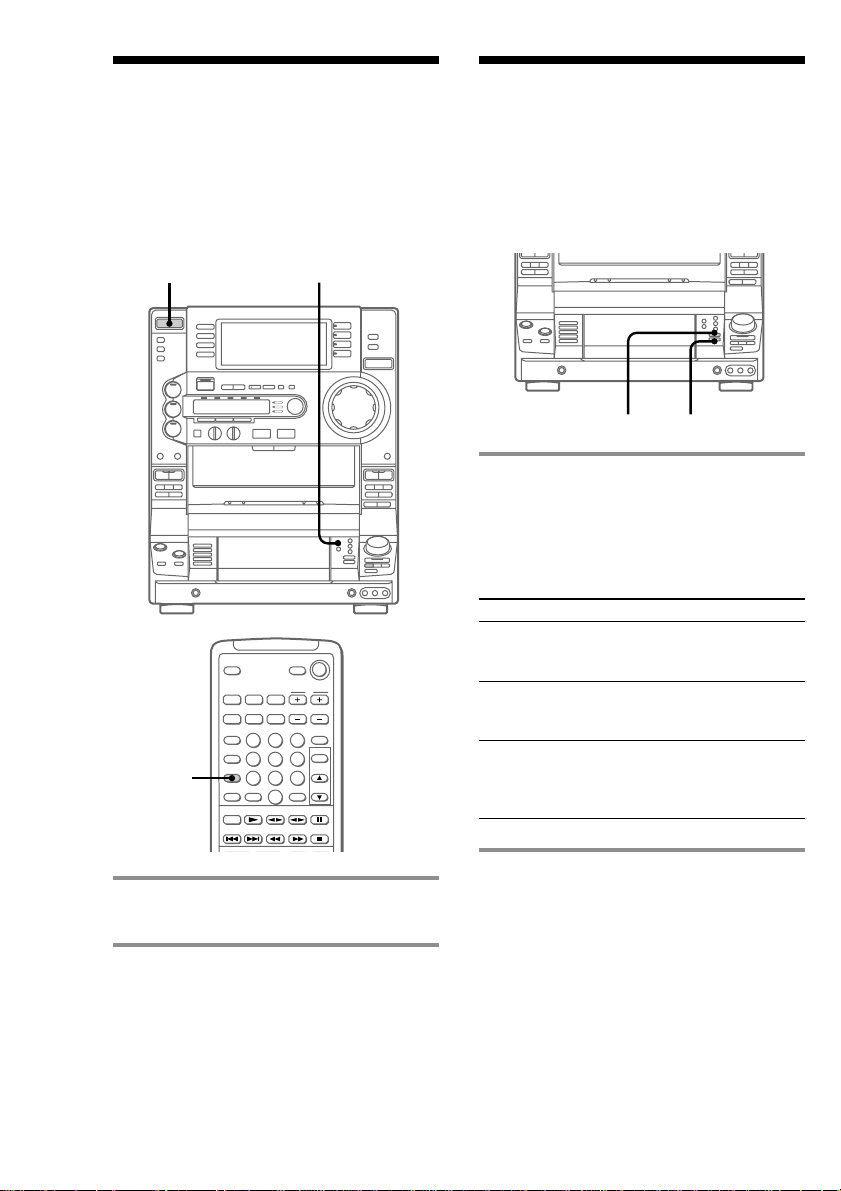
Setting the
Playing CD tracks
sharpness
–– Active Picture
This function emphasizes the outline of the
picture to create a sharper image.
?/1
(Power)
ACTIVE
ACTIVE
repeatedly
— Repeat Play
This function lets you repeat a single CD or
all CDs in Normal Play, Shuffle Play, and
Program Play.
REPEATPLAY MODE
, Press REPEAT repeatedly during
playback until “REPEAT” appears
in the display.
Repeat Play starts. The following table
describes the various repeat modes.
To repeat
All the tracks on
the current CD
All the tracks on
all CDs
Only one track
Press
PLAY MODE repeatedly
until “1 DISC” appears in the
display.
PLAY MODE repeatedly
until “ALL DISCS” appears
in the display.
REPEAT repeatedly while
playing the track you want to
repeat until “REPEAT 1”
appears in the display.
, Press ACTIVE so “ACTIVE
PICTURE” appears in the display.
To cancel
Press ACTIVE again to display “ACTIVE
OFF.”
Notes
• The active picture function is not available when
playing audio CDs.
•“ACTIVE OFF” is selected automatically when
32
you turn the system off.
To cancel Repeat Play
Press REPEAT repeatedly until “REPEAT” or
“REPEAT 1” disappears from the display.
Page 33
Playing CD tracks
in random order
— Shuffle Play
You can play all the tracks on one or all CDs
in random order.
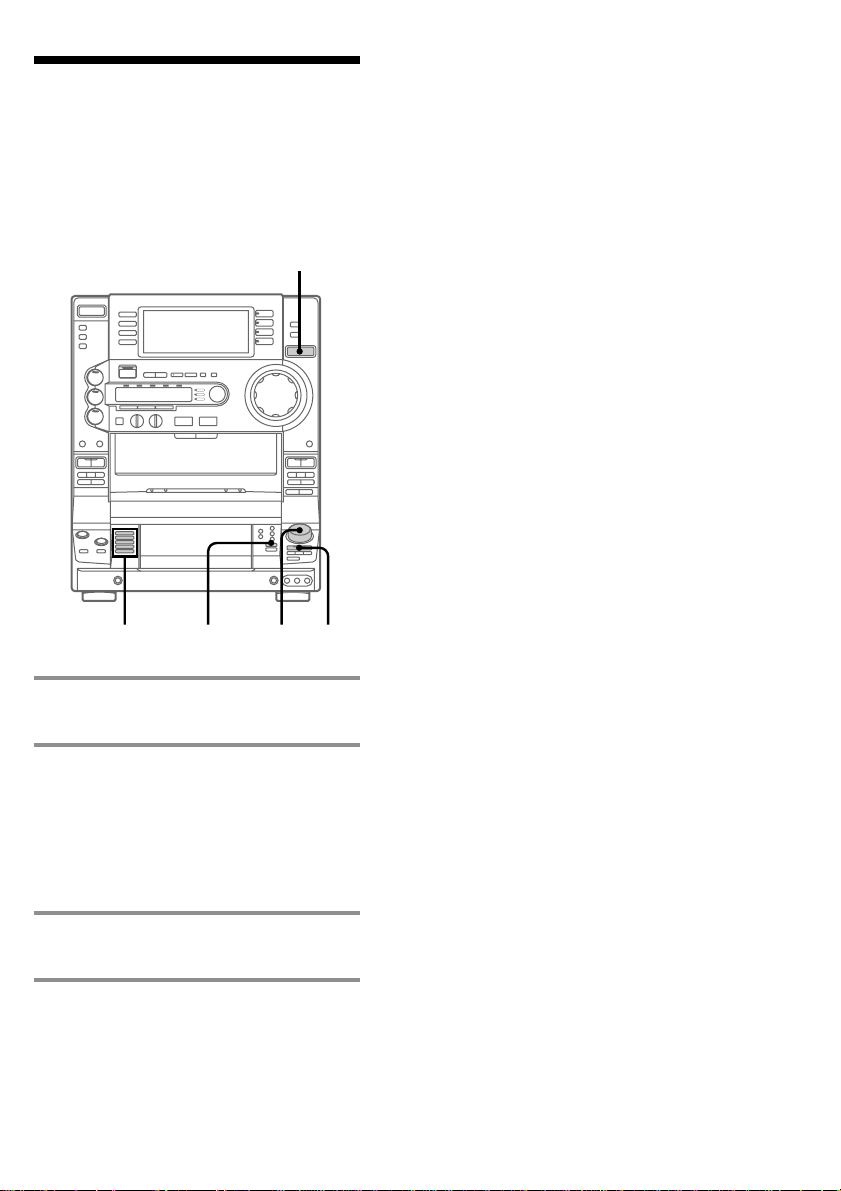
1
To cancel Shuffle Play
Press PLAY MODE repeatedly until “ALL
DISCS SHUFFLE,” “1 DISC SHUFFLE,” or
“PROGRAM” disappears from the display.
The tracks continue playing in their original
order.
To select the desired CD
Press one of the DISC 1 - DISC 5 buttons
during 1 Disc Shuffle Play.
Tips
• You can start Shuffle Play during Normal Play by
pressing PLAY MODE repeatedly until “ALL
DISCS SHUFFLE” or “1 DISC SHUFFLE” appears
in the display.
• To skip a track, turn the jog dial clockwise (or
press > on the remote).
DISC 1 - DISC 5 Jog dial
23
1 Press FUNCTION repeatedly until
“CD” appears in the display.
2 Press PLAY MODE repeatedly until
“ALL DISCS SHUFFLE” or “1 DISC
SHUFFLE” appears in the display.
“ALL DISCS SHUFFLE” shuffles the
tracks on all the CDs in the player.
“1 DISC SHUFFLE” shuffles the tracks
on the CD in the playing position.
3 Press HX.
All the tracks play in random order.
33
Page 34
Programming CD
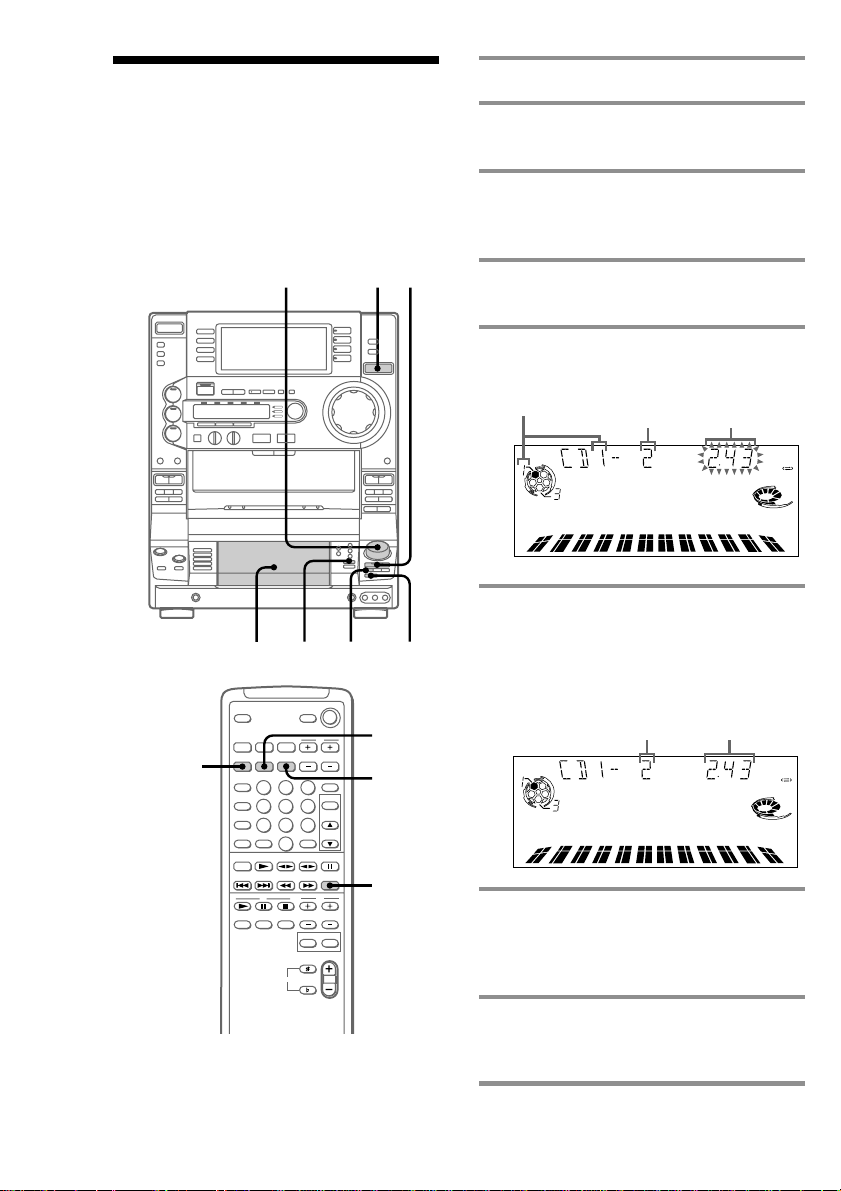
1 Place CDs and close the front cover.
tracks
–– Program Play
You can create a program of up to 32 tracks
from all the CDs in the order you want them
to be played.
x
2
CHECK
CLEAR
8
D.SKIP
5
14
3,6
2 Press FUNCTION repeatedly until
“CD” appears in the display.
3 Press PLAY MODE repeatedly until
“PROGRAM” appears in the
display.
4 Press DISC SKIP (or D.SKIP on the
remote) to select a CD.
5 Turn the jog dial until the desired
track appears in the display.
Disc number
PROGRAM
Total playing timeTrack number
DOLBY NR
VOLUME
6 Press PLAY MODE once.
The track is programmed. First “STEP”
and the programmed playing order
appear, then the total playing time
appears.
The last
programmed track
Total playing time
DOLBY NR
VOLUME
OFF
OFF
34
PROGRAM
x
7 Repeat steps 4 through 6 to program
additional tracks.
Skip step 4 to select tracks from the same
disc.
8 Press HX.
All the tracks play in the order you
selected.
Page 35
To cancel Program Play
Press PLAY MODE repeatedly until
“PROGRAM,” “ALL DISCS SHUFFLE,” or
“1 DISC SHUFFLE” disappears from the
display.
To
Check the program
Clear the last selected
track
Clear a specific track
Add a track to the
program
Clear the entire
program
Tips
• The program you created remains in the CD
player’s memory even after it has been played.
Press HX to play the same program again.
• If “--.--” appears instead of the total playing time
while programming, this means:
– you have programmed a track numbered over
20, or
– the total playing time has exceeded 100 minutes.
Press
CHECK on the remote
repeatedly. After the
last track, “CHECK
END” appears.
CLEAR on the remote
in stop mode.
CHECK on the remote
repeatedly until the
number of the track to
be cleared lights up,
then press CLEAR.
1 Press DISC SKIP (or
D.SKIP) to select a
CD.
2 Turn the jog dial to
select a track.
3 Press PLAY MODE.
x once in stop mode or
twice while playing.
Playing CDs
without
interruption
–– Non-Stop Play
You can play CDs without pausing between
tracks.
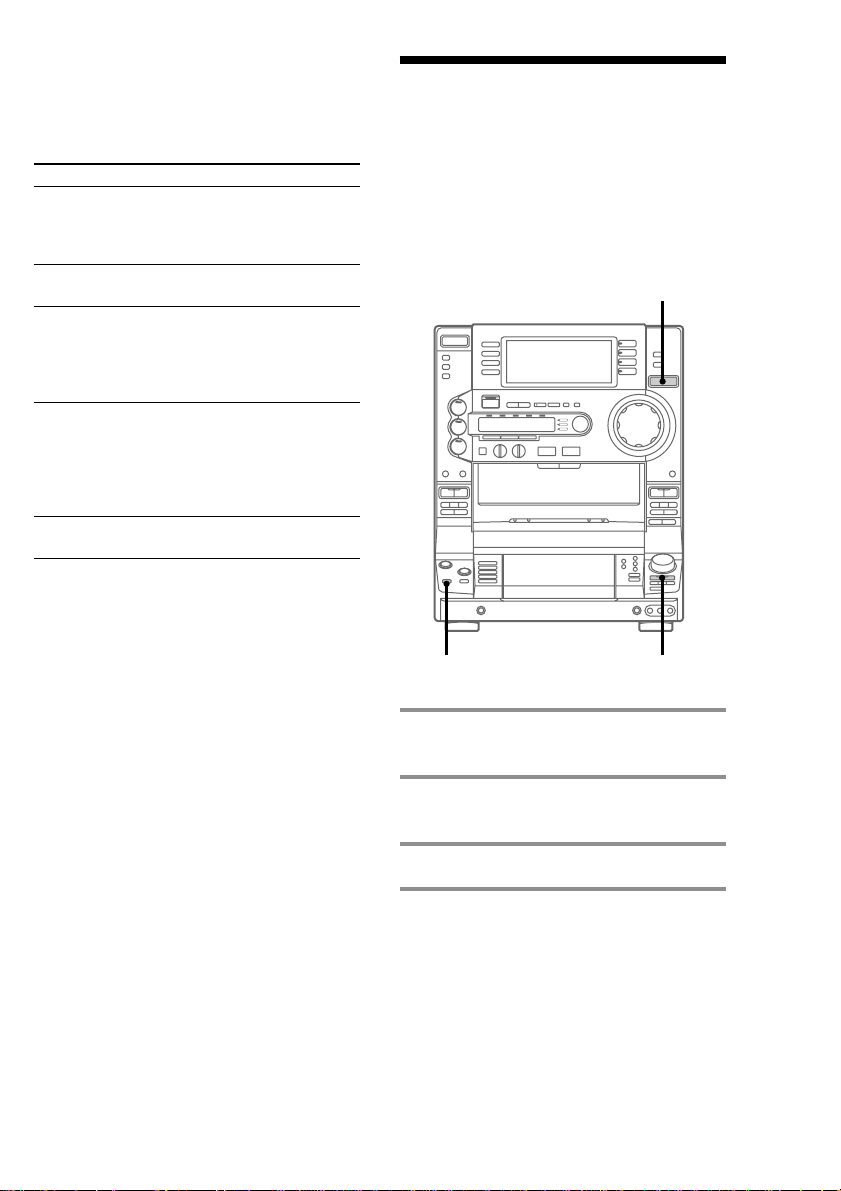
1
32
1 Press FUNCTION repeatedly until
“CD” appears in the display.
2 Press NON-STOP so the indicator
lights up.
3 Press HX.
To cancel Non-Stop Play
Press NON-STOP so that the indicator goes
off.
35
Page 36
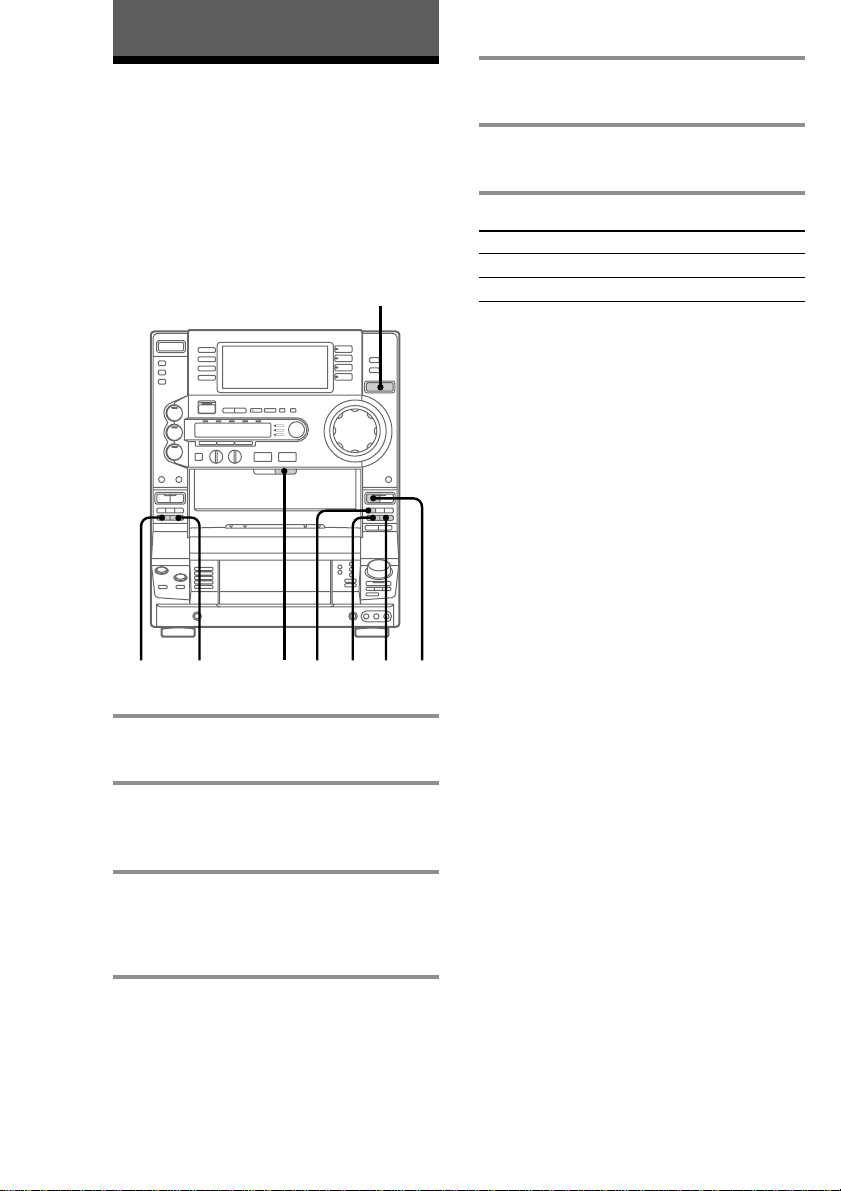
The Tape Deck
Recording on a
tape manually
You can record from CDs, tapes, or the radio.
For example, you can record just the desired
songs or begin recording from the middle of a
tape. The recording level is automatically
adjusted.
2
5 Press X.
Recording starts.
6 Start playing the source to be
recorded.
To Press
Stop recording x on deck B
Pause recording X
Tips
• When you want to record on the reverse side,
press h after pressing z REC in step 3 so the
indicator on the h button (for the reverse side)
lights up green.
• When you want to reduce the hiss noise in lowlevel, high-frequency signals, press DOLBY NR
before step 5 so “DOLBY NR B” appears in the
display.
xDOLBY NR
1345
1 Press Z B EJECT and insert a
recordable tape into deck B.
2 Press FUNCTION repeatedly until
the source you want to record (e.g.,
CD) appears in the display.
3 Press z REC.
Deck B stands by for recording, and the
indicator on the H button (for the front
side) lights up green.
4 Press DIRECTION repeatedly until
g appears to record on one side or
j (or RELAY) to record on both
sides.
36
h
Page 37
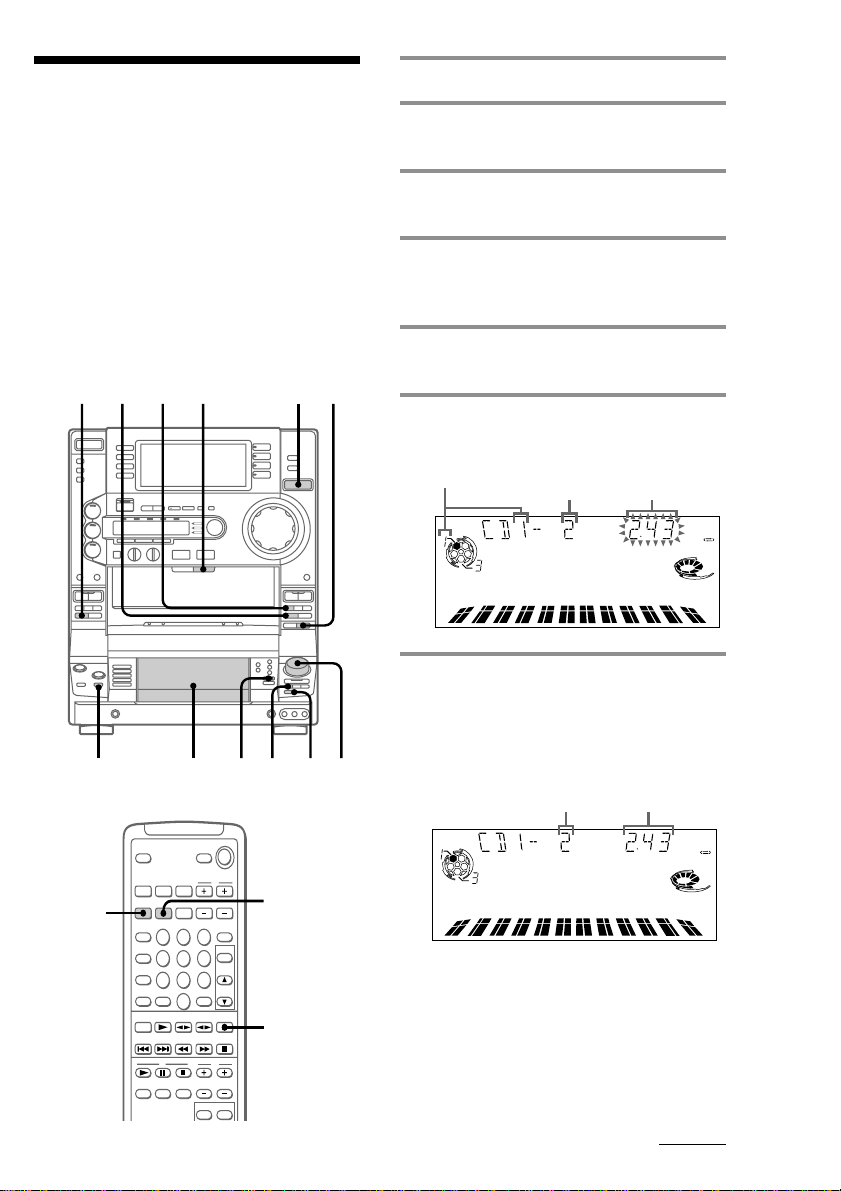
Recording CDs by
1 Place CDs and close the front cover.
specifying the
track order
— Program Edit
You can record tracks from all the CDs in the
order you want. When programming, make
sure the playing times for each side do not
exceed the length of one side of the tape.
This function cannot be used during playback
of VIDEO CDs with the PBC functions (Ver.
2.0).
12 2 1113
EDIT
x
4,7
1
3
x
5
6
2 Press Z B EJECT and insert a
recordable tape into deck B.
3 Press FUNCTION repeatedly until
“CD” appears in the display.
4 Press PLAY MODE repeatedly until
“PROGRAM” appears in the
display.
5 Press DISC SKIP (or D.SKIP on the
remote) to select a CD.
6 Turn the jog dial until the desired
track appears in the display.
Disc number
PROGRAM
Total playing timeTrack number
DOLBY NR
VOLUME
7 Press PLAY MODE once.
The track is programmed. First “STEP”
and the programmed playing order
appear, then the total playing time
appears.
The last
programmed track
Total playing time
OFF
D.SKIP
CHECK
9
PROGRAM
DOLBY NR
OFF
VOLUME
continued
37
Page 38
Recording CDs by specifying the
track order (continued)
Selecting the tape length
automatically
8 Repeat steps 5 through 7 to program
additional tracks to be recorded on
side A.
Skip step 5 to select tracks from the same
disc.
9 Press X on the remote to insert a
pause at the end of side A.
“P” appears in the display and the total
playing time resets to “0.00” in the
display.
10
Repeat steps 5 through 7 to program
the tracks to be recorded on side B.
Skip step 5 to select tracks from the same
disc.
11
Press CD SYNC.
Deck B stands by for recording, the CD
player stands by for playback, and the
indicator on the H button (for the front
side) lights up green.
12
Press DIRECTION repeatedly until
g appears to record on one side,
or j (or RELAY) to record on
both sides.
— Tape Select Edit
You can check the most suitable tape length
for recording a CD. Note that you cannot use
Tape Select Edit for discs containing more
than 20 tracks.
, After inserting a CD, press EDIT
once so that “EDIT” flashes.
First the required tape length for the CD
in the playing position appears, then the
total playing time for sides A and B
appears.
Note
You cannot use this function when Program Play
mode has been set. After clearing the entire
program, follow the above procedure (see “Clear the
entire program” in the table on page 35).
13
Press X.
Recording starts.
To stop recording
Press x on deck B or on the CD player.
To check the order
Press CHECK on the remote repeatedly. After
the last track, “CHECK END” appears.
To cancel Program Edit
Press PLAY MODE repeatedly until
“PROGRAM,” “ALL DISCS SHUFFLE,” or
“1 DISC SHUFFLE” disappears from the
display.
38
Page 39
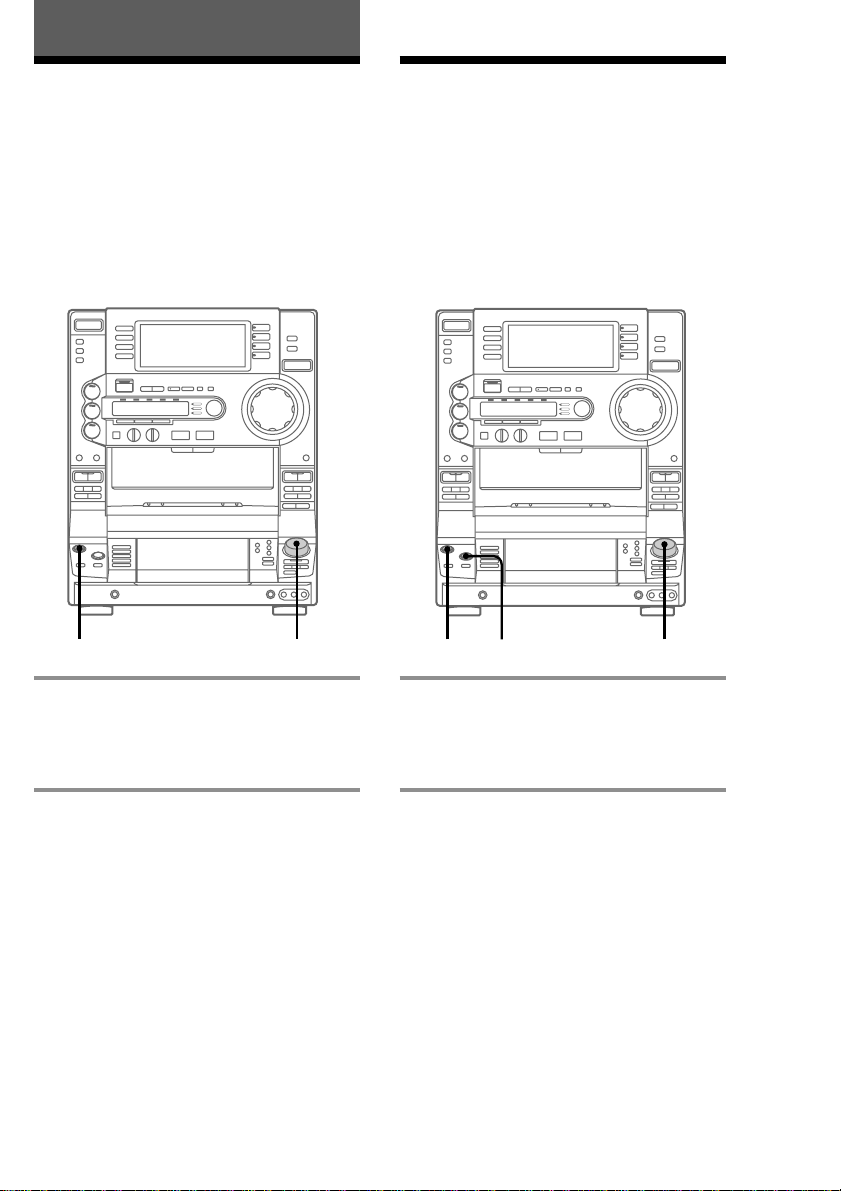
DJ Effects
Looping part of a
CD
— CD Loop
With the Loop function, you can repeat part
of a CD during playback. This lets you create
original recordings.
You cannot use this function with VIDEO
CDs.
CD LOOP
Jog dial
Flashing part of a
CD
— CD Flash
With the Flash function, you can “flash” the
CD sound during playback. This lets you
create original recordings.
You cannot use this function with VIDEO
CDs.
CD FLASH Jog dialCD LOOP
, Press and hold CD LOOP during
playback at the point you want to
start the Loop function, and release
to resume normal playback.
To adjust the loop length
Turn the jog dial while holding CD LOOP (or
press FILE SELECT v/Vwhile holding LOOP
on the remote) to select different loop lengths.
, Press and hold CD FLASH during
playback at the point you want to
start the Flash function, and release
to resume normal playback.
To adjust the flash length
Turn the jog dial while holding CD FLASH
(or press FILE SELECT v/V while holding
FLASH on the remote) to select different flash
lengths.
To use CD LOOP and CD FLASH
together
Press and hold both CD LOOP and CD
FLASH (or LOOP and FLASH on the remote)
at the same time.
Note
The loop and flash length cannot be adjusted in stop
mode. Adjust the loop and flash lengths during
playback.
39
Page 40
Sound Adjustment
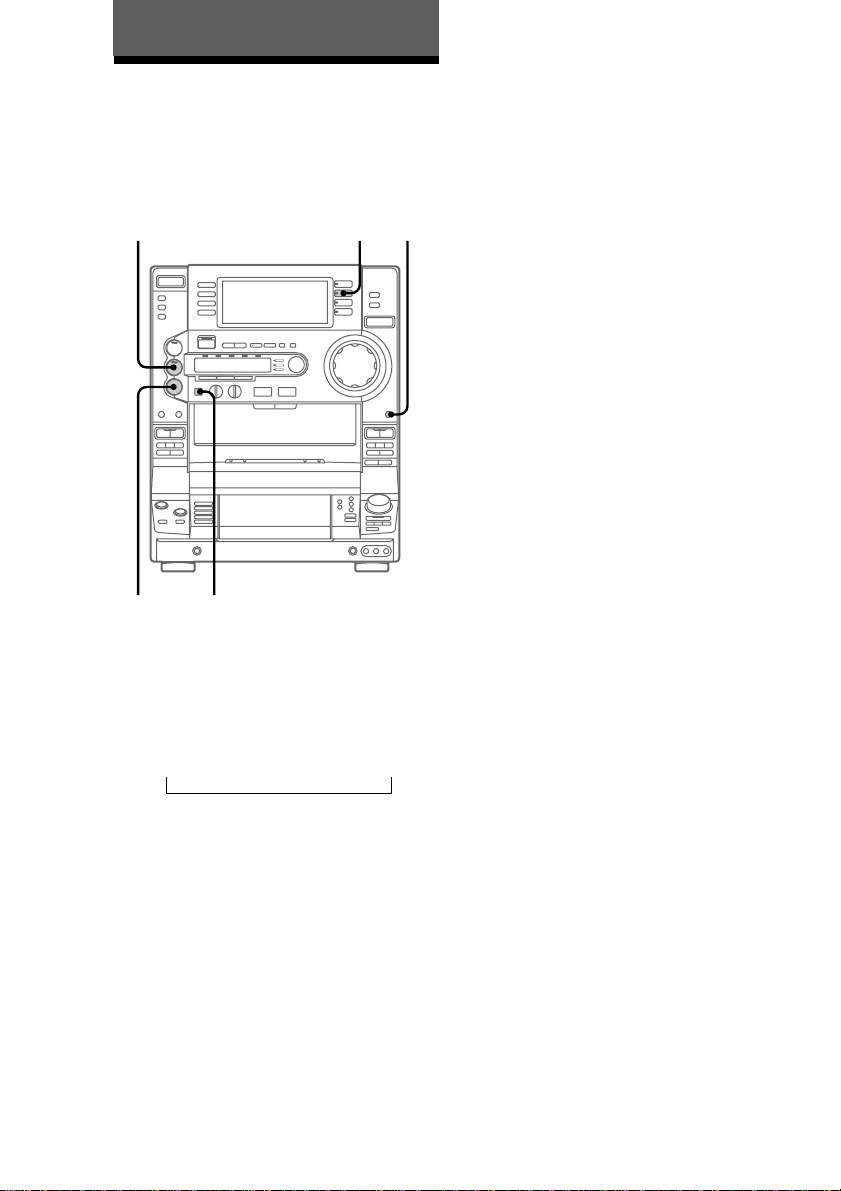
Adjusting the
sound
You can create a more powerful sound and
listen with headphones.
GROOVE
SUPER
WOOFER
SUPER WOOFER MODE
To reinforce the bass from the
super woofer (SUPER WOOFER)
Press SUPER WOOFER.
Each time you press this button, the super
woofer level display changes as follows:
SUPER WOOFER FLAT t LOWt HIGH
t
To select the super woofer mode
Press SUPER WOOFER MODE while the
super woofer is on.
Each time you press this button, the super
woofer mode display changes as follows:
MODE MOVIE y MODE MUSIC
PHONESSYNC BASS
For a powerful sound (GROOVE)
Press GROOVE.
The volume switches to power mode, the
sound effect changes, the super woofer level
changes to “HIGH,” and the indicator on the
GROOVE button lights up. Press GROOVE
again to return to the previous volume.
Note
Canceling the Groove mode cancels the equalizer
curve and super woofer level.
For the most suitable bass sound
(SYNC BASS)
Press SYNC BASS.
The bass frequencies of the music you are
listening to are measured and those areas
with heavy bass tones are effectively
reinforced. The indicator on the SYNC BASS
button flashes while measuring. Once
measured, the indicator stops flashing and
remains lit. Press SYNC BASS again to return
to the previous level.
Notes
• The super woofer mode changes to MODE MUSIC
in the SYNC BASS (Synchronized Bass) mode.
• If you press SUPER WOOFER MODE in the SYNC
BASS mode, this mode is canceled and the super
woofer mode changes to MODE MOVIE.
• You can change the super woofer level to LOW or
HIGH in the SYNC BASS mode. However, if you
change the level to SUPER WOOFER FLAT, the
SYNC BASS mode is canceled.
To listen through the headphones
Connect the headphones to the PHONES jack.
No sound will come from the speakers.
40
Page 41
Selecting the audio
emphasis
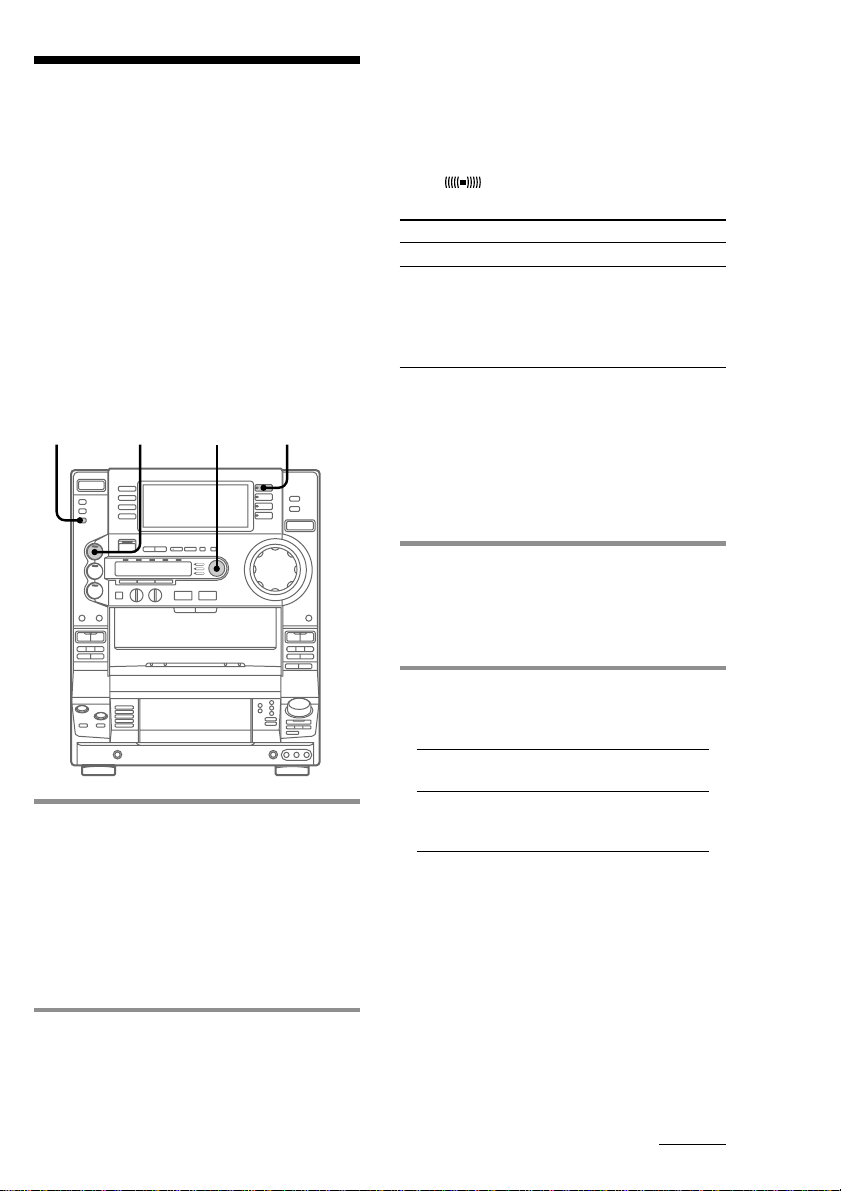
The audio emphasis menu lets you select the
sound characteristics according to the music
you are listening to.
You can also enjoy the audio emphasis using
the Synchronized Equalizer function. When
using this function, the system automatically
switches the equalizer according to the genre
of the music.
The Personal File function (see “Making a
personal audio emphasis file (Personal File)”
on page 44) lets you store your own effects.
To cancel the audio emphasis
Press EFFECT (or FILE SELECT ON/OFF on
the remote) repeatedly so the indicator on the
EFFECT button goes off.
Music menu options
“SUR ” appears if you select an audio
emphasis with a surround effect.
Press To select
v/V MENU 1 MENU 2
b/B ROCK MOVIE
POP GAME
JAZZ NIGHT
DANCE PARTY
SALSA RELAX
SPECTRUM
ANALYZER
EFFECT
v/V/b/B
SYNC EQ
, Press v/V to select MENU 1 or
MENU 2, then press b/B to select
the desired audio emphasis.
See the chart “Music menu options” on
this page. The audio emphasis name
appears in the display.
When using the remote, press FILE
SELECT v/V repeatedly until the
desired audio emphasis name appears.
Using the Synchronized
Equalizer function
You can set the audio emphasis to change
automatically according to the beat and
tempo of the music.
, Press SYNC EQ.
The indicator on the SYNC EQ button
flashes while measuring the beat and
tempo of the source. Once measured, the
indicator stops flashing and remains lit.
SYNC EQ classifies the music source as
follows:
Beat Density
Beat Strength
LO (Low)
HI (High)
SMOOTH
MEDIUM
STRONG
continued
41
Page 42
Selecting the audio emphasis
(continued)
To cancel the Synchronized
Equalizer function
Press SYNC EQ again so that the indicator
goes off.
The Synchronized Equalizer function is
canceled also when:
– you cancel the audio emphasis.
– you reselect the audio emphasis from the
music menu.
– you activate the surround effect.
– you adjust the graphic equalizer.
– you sing along (KARAOKE).
Notes
• The Synchronized Equalizer function does not
work in KARAOKE mode.
• P FILE MEMORY does not work in this mode.
• The classification is not related to the genre of the
music source.
Changing the equalizer
display
You can change the equalizer display
according to the music you are listening to.
Adjusting the
audio emphasis
You can adjust the audio emphasis using the
graphic equalizer and surround effect.
Adjusting the graphic
equalizer
You can adjust the sound by raising or
lowering the levels of specific frequency
ranges.
2 3,46
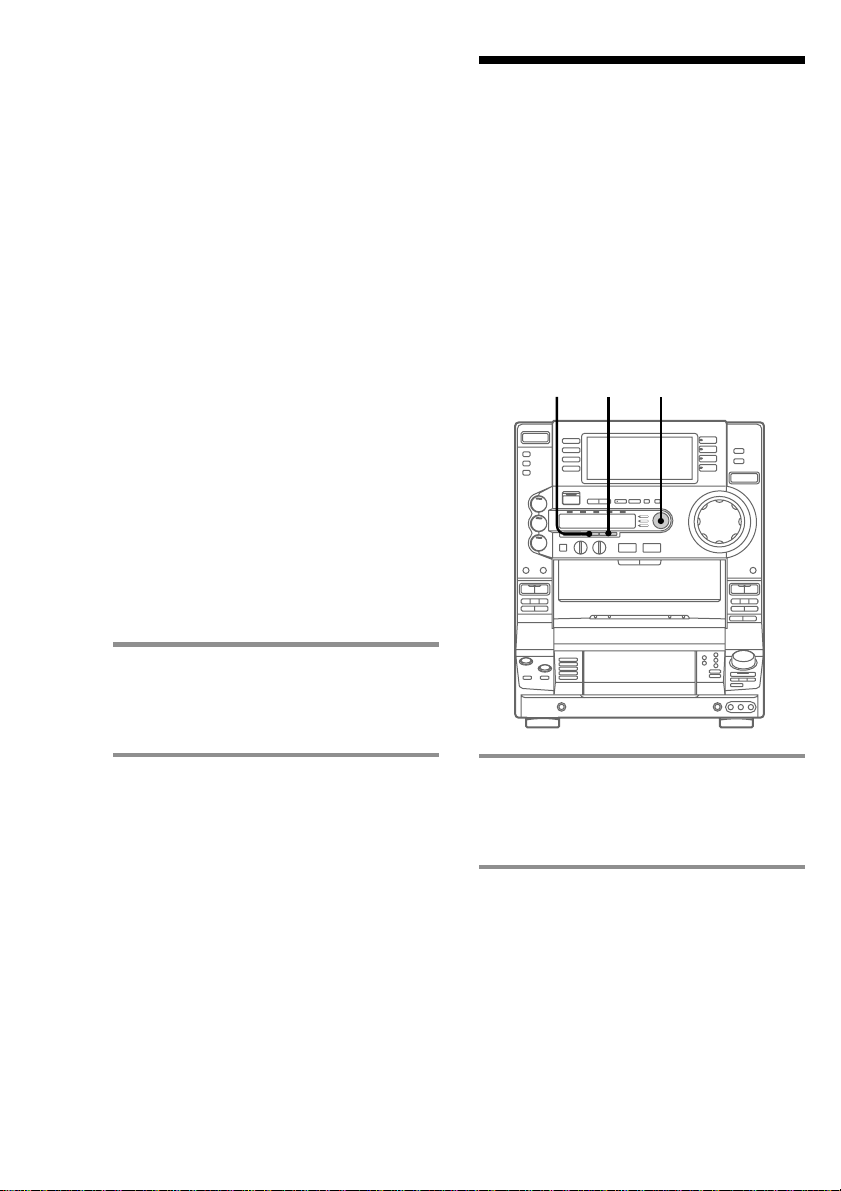
, Press SPECTRUM ANALYZER.
Each time you press this button, the
display changes as follows:
IMAGE PATTERN y NORMAL PATTERN
To cancel the display pattern
Press SPECTRUM ANALYZER again. The
display changes to show the equalizer curve.
42
1 Select the desired basic audio
emphasis for your sound (see
“Selecting the audio emphasis” on
page 41).
2 Press GEQ CTRL.
The frequency range appears and the
level value flashes in the display.
Page 43
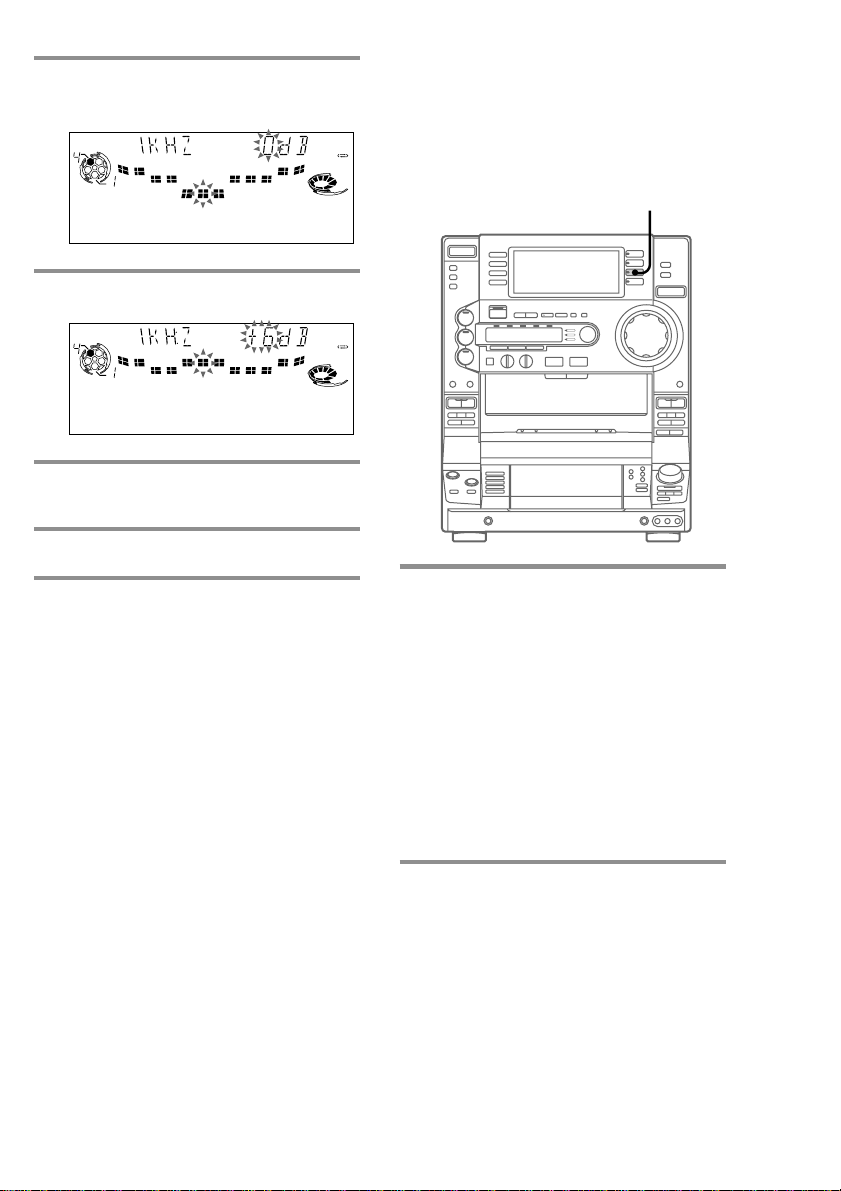
3 Press b/B repeatedly to select a
frequency band.
DOLBY NR
OFF
VOLUME
ALL DISC S
4 Press v/V to adjust the level.
DOLBY NR
OFF
VOLUME
ALL DISC S
5 Repeat steps 3 and 4 to adjust the
other frequency bands.
6 Press ENTER when finished.
Note
If you choose another audio emphasis (other than
“EFFECT OFF”), the adjusted sound effect is lost. To
retain the adjusted sound effect for future use, store
it in a personal file (see “Making a personal audio
emphasis file” on page 44).
Activating the surround
effect
The Surround Menu lets you select the sound
characteristics according to the sound you are
listening to.
DSP
, Press DSP until the desired DSP
mode appears in the display.
Each time you press this button, the
menu changes as follows:
DSP OFF: Deactivates the DSP mode.
SURROUND ON: Reproduces stereo
sources in surround sound.
HALL: Reproduces the acoustics of a
concert hall.
THEATER: Reproduces the acoustics of a
movie theater.
ENHANCED THEATER: Reproduces the
acoustics of a large movie theater.
Note
If you choose other sound effects, the surround
effect will be canceled. To retain the effect, store it in
a personal file (see “Making a personal audio
emphasis file” on page 44).
43
Page 44
Making a personal
audio emphasis file
— Personal File
You can create personal files of audio
patterns (surround effect and graphic
equalizer) and store them in the system’s
memory. Later, you can call up an audio
pattern when playing a favorite tape, CD, or
radio program. You can create up to five
audio files. Before operation, first select the
basic audio emphasis you want for your
sound.
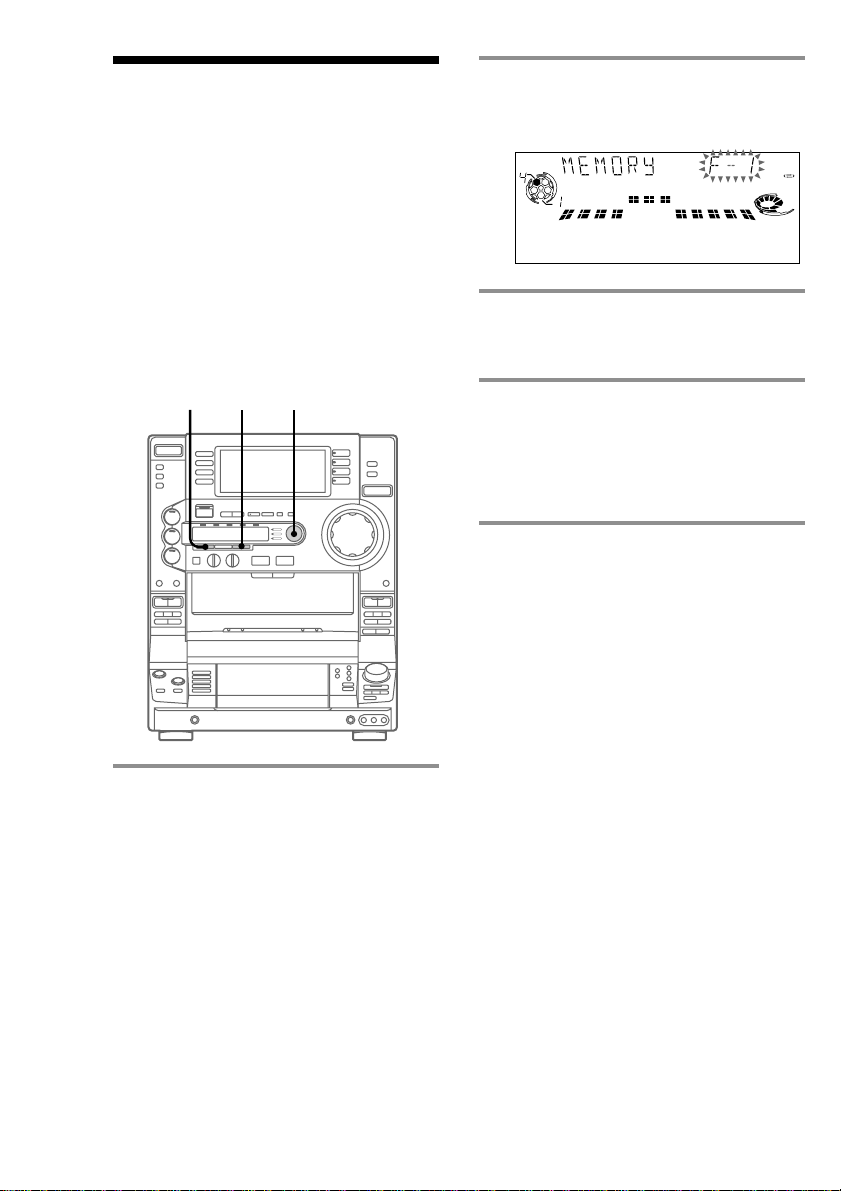
2 Press P FILE MEMORY.
A personal file number appears in the
display.
ALL DISC S
3 Press b/B to select the file number
(P FILE) where you want to store
the sound effect.
DOLBY NR
VOLUME
OFF
243
1 Create the desired sound effect by
using the graphic equalizer and/or
surround effect (see “Adjusting the
audio emphasis” on page 42).
4 Press ENTER.
The adjusted sound effects are stored
under the selected file number. Any
settings previously stored at this
memory location are erased and
replaced by the new settings.
To call up the personal file
Press v/V repeatedly to display the last
selected personal file, then press b/B
repeatedly to select the desired personal file.
When using the remote, press FILE SELECT
v/V repeatedly.
44
Page 45
Enjoying Dolby Pro
Logic Surround
sound
You can enjoy the Dolby Pro Logic Surround
sound of Dolby Surround-encoded
( ) videos and TV programs.
Complete the setup and speaker adjustments
first (see “Step 2: Setting up the speakers” on
page 8).
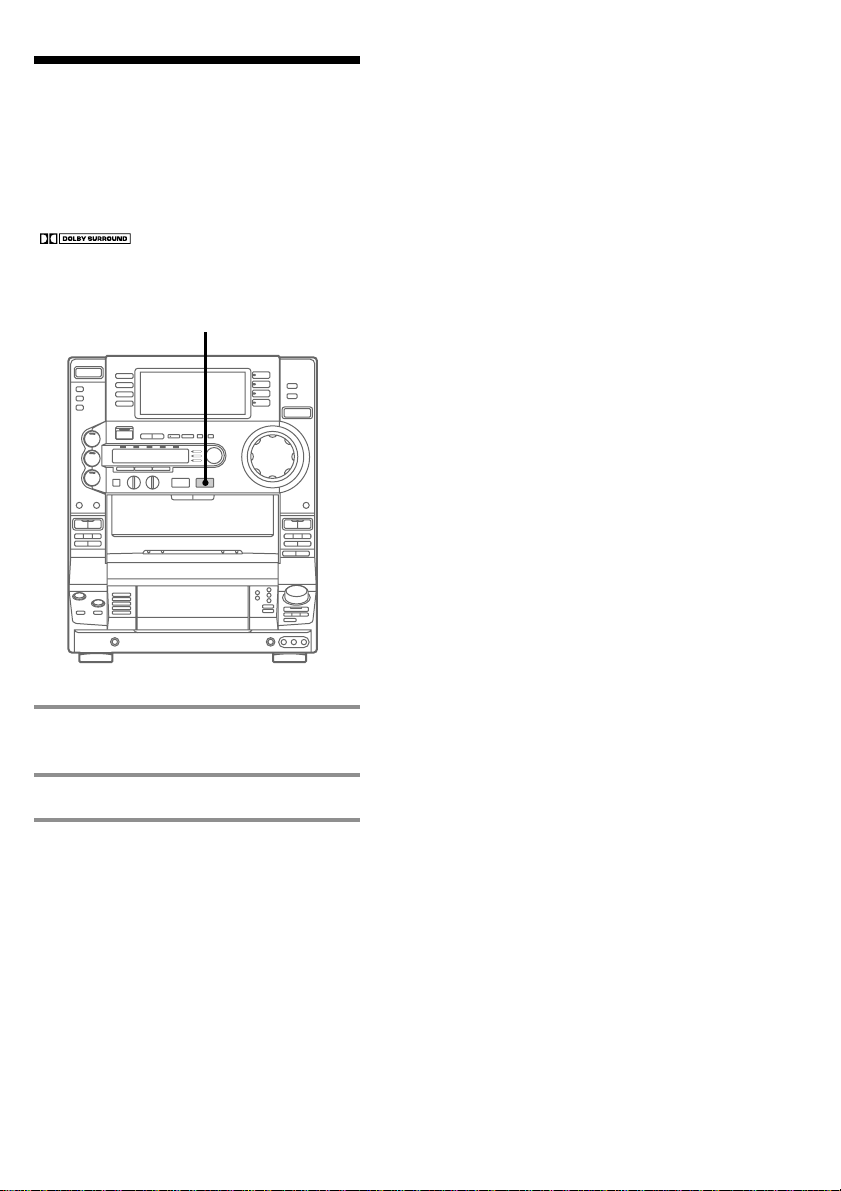
1
1 Press PRO LOGIC so the indicator
lights up.
2 Play a program source.
To turn off the Dolby Pro Logic
Surround sound
Press PRO LOGIC so the indicator goes off.
Notes
• You cannot use the Dolby Pro Logic Surround
sound and Surround Menu functions at the same
time.
• When you record the sound, turn off the Dolby
Pro Logic Surround sound.
• The audio emphasis setting will be canceled when
you turn on the Dolby Pro Logic Surround sound.
45
Page 46
Other Features
Singing
along: Karaoke
You can sing along with any stereo CD or
tape by turning down the singer’s voice. You
need to connect an optional microphone.
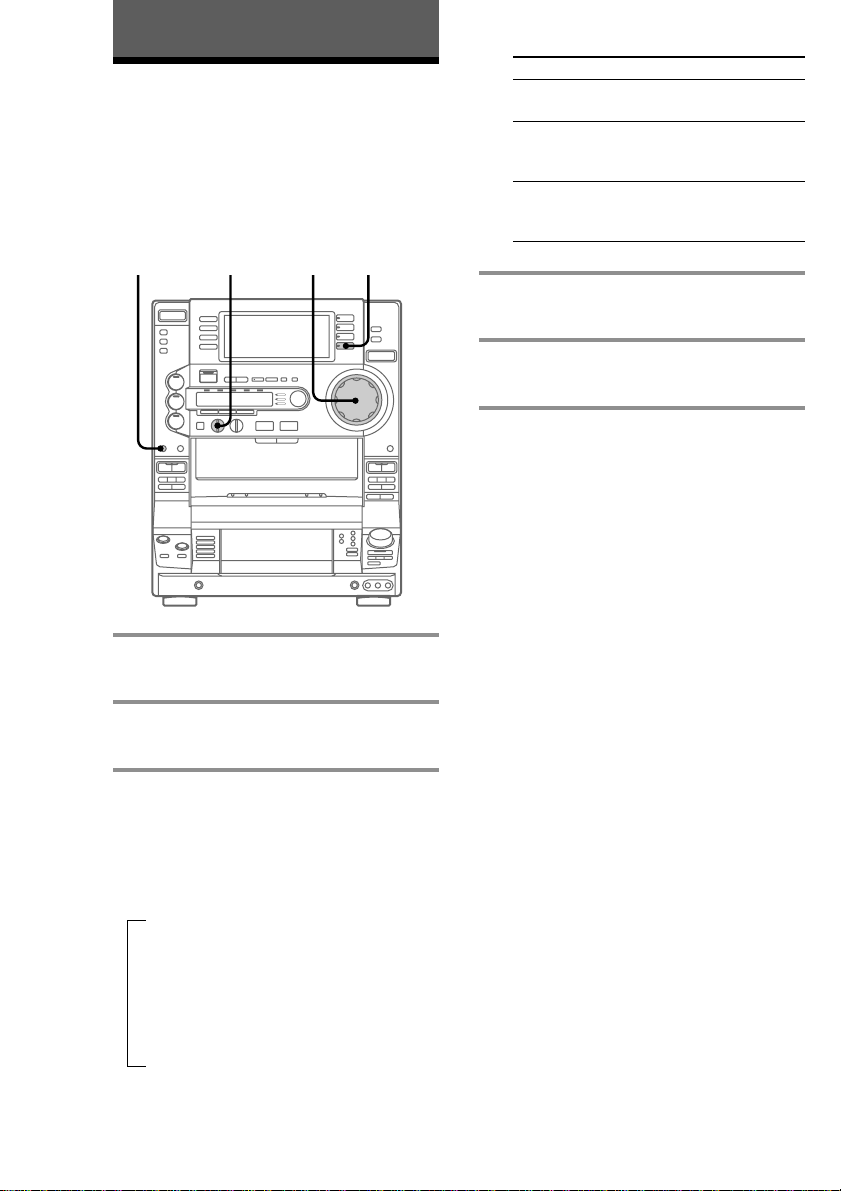
1,5 32
1 Turn MIC LEVEL to MIN to turn
down the microphone level.
2 Connect an optional microphone to
the MIC1 or MIC2.
3 Press KARAOKE PON/MPX
repeatedly to obtain the karaoke
effect.
Each time you press this button, the
display changes as follows:
4
To
Reduce the singer’s
voice on a CD or tape
Reduce the left channel
on a multiplex CD or
tape
Reduce the right
channel on a multiplex
CD or tape
Select
KARAOKE PON
MPX R
MPX L
4 Start playing the music and adjust
the volume.
5 Turn MIC LEVEL to adjust the
microphone volume.
When you use VIDEO CDs
Turn on your TV and switch it to the
appropriate video input.
Refer to the operating instructions supplied
with your TV for details.
When you are done
Turn MIC LEVEL to MIN and disconnect the
microphone from MIC 1 or MIC 2, then press
KARAOKE PON/MPX repeatedly until “m”
disappears from the display.
Tip
You can use two microphones by connecting to
MIC 1 and MIC 2 at the same time.
Note
With some songs, vocals may not be canceled when
you select KARAOKE PON.
46
t
KARAOKE PON
t
MPX R
t
MPX L
t
OFF or audio emphasis name
“m” appears in the display when the
karaoke mode is activated.
Page 47
Adjusting the
microphone echo
ECHO LEVEL
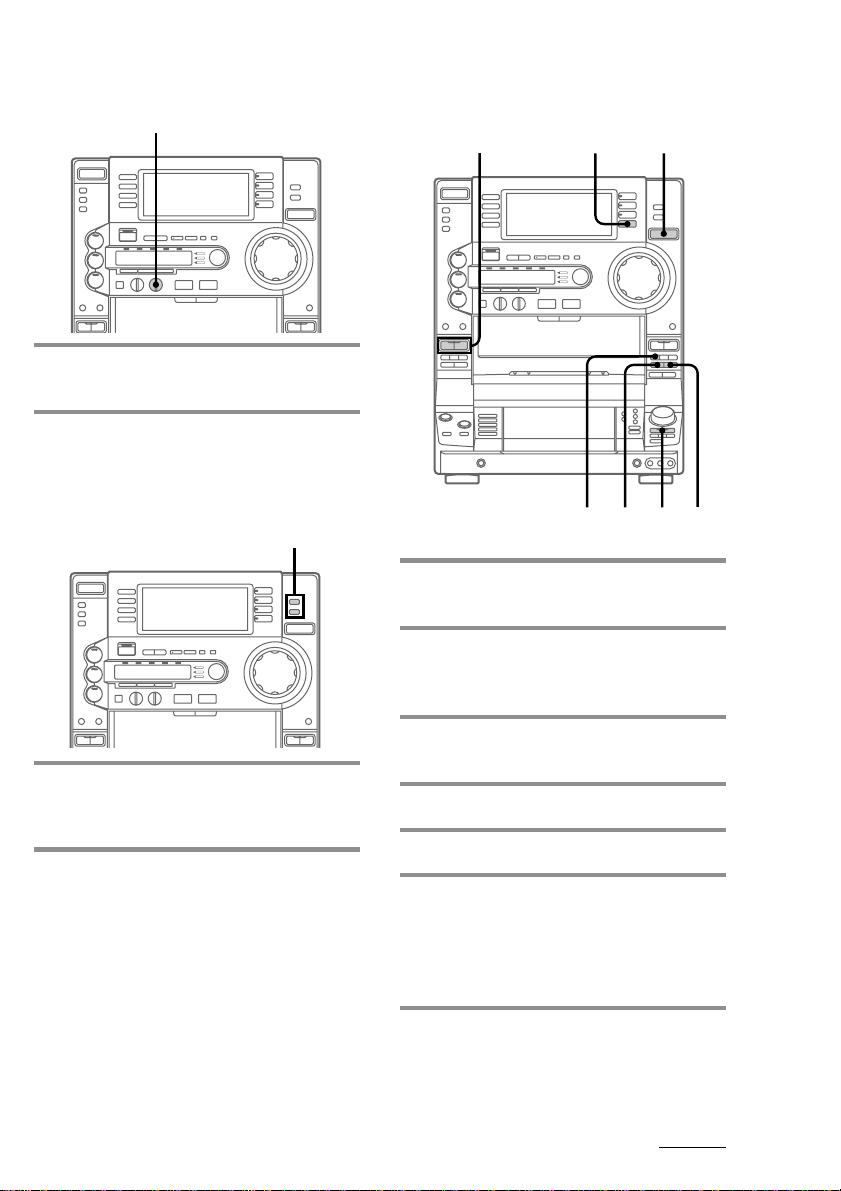
, Turn ECHO LEVEL to adjust the
echo effect.
To cancel the echoing
Turn ECHO LEVEL to MIN.
Mixing and recording
sounds
6
23
Adjusting the key
#/2
, Press 2 or #.
You can adjust the key higher or lower
in 13 halftone steps (26 to #6).
To return to the original key
Press 2 and # at the same time.
Note
This function can be used with the CD player only.
x
56
4
1 Prepare the microphone. Then,
insert a recordable tape in deck B.
2 Press FUNCTION repeatedly to
select the source you desire and set
it to pause mode.
3 Press KARAOKE PON/MPX to
activate the karaoke mode.
4 Press z REC.
5 Press X.
6 Press HX to start playing the CD
(or H on deck A to start playing
the tape).
Playback starts.
Start singing along with the music.
To stop recording
Press x on deck B.
continued
47
Page 48
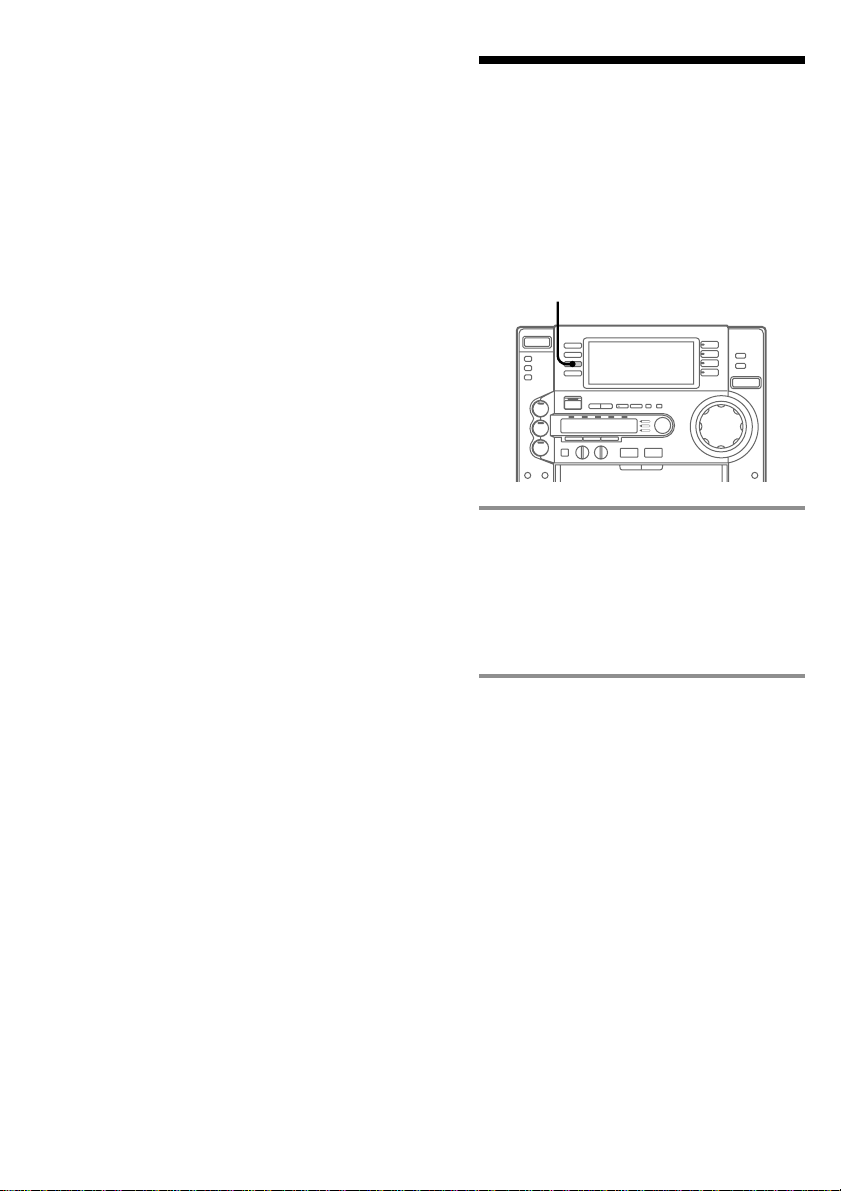
Singing along: Karaoke
(continued)
Tips
• If acoustic feedback (howling) occurs, move the
microphone away from the speakers or change the
direction of the microphone.
• If you want to record your voice through the
microphone only, you can do so by selecting CD
as the source but not playing a CD.
• When high level sound signals are input, the
system automatically adjusts the recording level to
prevent distortion of the recorded sound signal
(Auto Level Control function).
Notes
• If you press EFFECT or select a sound effect, the
karaoke mode is canceled.
• The instrumental sound may be reduced as well as
the singer’s voice when the source sound was
recorded monaurally.
• The singer’s voice may not be reduced when:
— only a few instruments are playing.
— a duet is being sung.
— the source has strong echoes or chorus.
— the singer’s voice deviates from the center.
— the voice on the source is singing high soprano
or tenor notes.
Falling asleep to
music
— Sleep Timer
You can set the system to turn off at a preset
time, so you can fall asleep listening to music.
You can preset the time in 10 minute
increments.
SLEEP
, Press SLEEP.
Each time you press this button, the
minutes display (the remaining time)
changes as follows:
AUTO t 90MIN t 80MIN t 70MIN
T
t
48
OFF T 10MIN ....... 50MIN T 60MIN
When you choose AUTO
The system turns off when the current CD or
tape finishes playback (up to 100 minutes).
The system turns off if you manually stop
playing a CD or tape.
To check the remaining time
Press SLEEP once.
To change the remaining time
Press SLEEP repeatedly to select the desired
time.
To cancel the Sleep Timer function
Press SLEEP repeatedly until “SLEEP OFF”
appears in the display.
Page 49
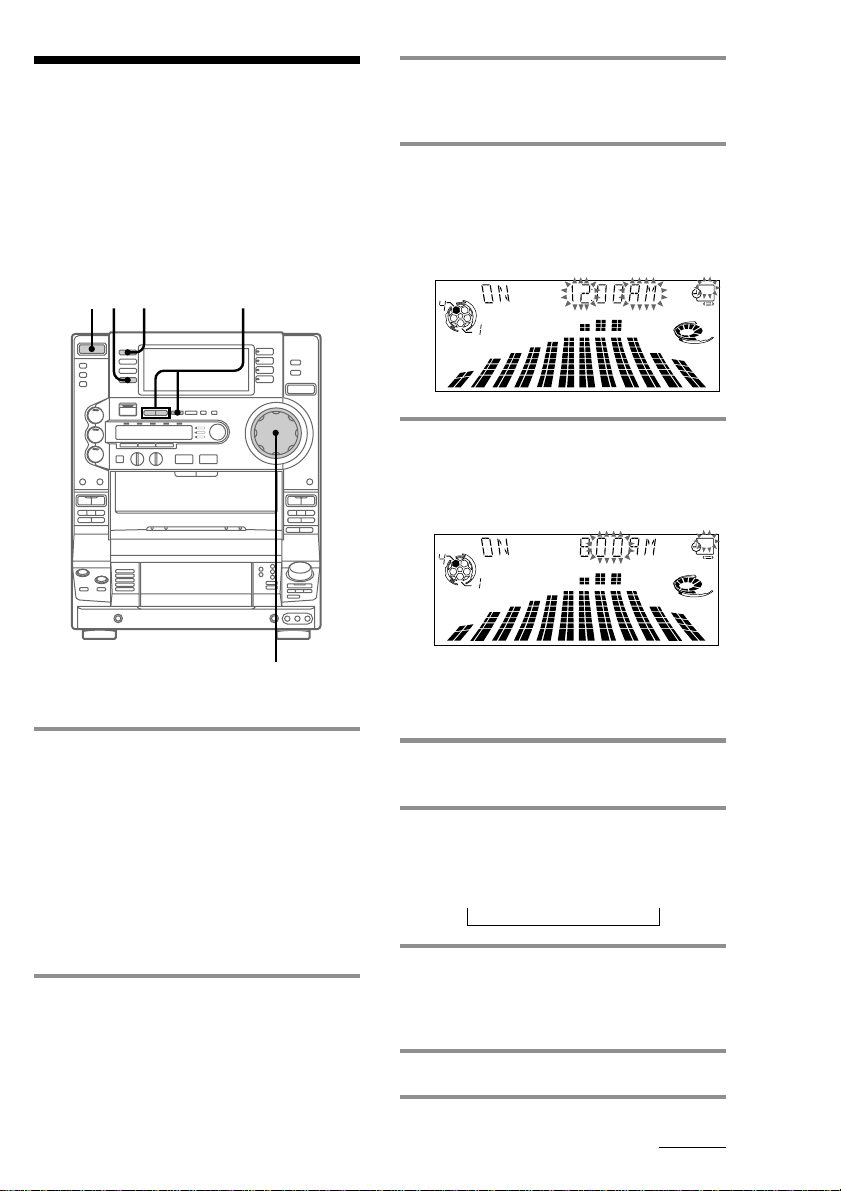
Waking up to
music
— Daily Timer
You can wake up to music at a preset time
every day. Make sure you have set the clock
(see “Step 3: Setting the time” on page 10).
9
DAILY
3 4,5,6,7,8
3 Press c/CLOCK SET.
“SET” appears and “DAILY” flashes in
the display.
4 Press TUNING +/– to select
“DAILY,” then press ENTER/
NEXT.
“ON” appears and the hour indication
flashes in the display.
ALL DISC S
5 Set the time to start playback.
Press TUNING +/– to set the hour, then
press ENTER/NEXT.
The minute indication flashes.
ALL DISC S
DAILY
DOLBY NR
OFF
VOLUME
DAILY
DOLBY NR
OFF
VOLUME
2
1 Prepare the music source you want
to play.
• CD: Insert a CD. To start from a
specific track, create a program (see
“Programming CD tracks” on page
34).
• Tape: Insert a tape with the side you
want to play facing forward.
• Radio: Tune in a preset station (see
“Step 4: Presetting radio stations” on
page 11).
2 Turn VOLUME to adjust the
volume.
Press TUNING +/– to set the minutes,
then press ENTER/NEXT.
The hour indication flashes again.
6 Set the time to stop playback
following the above procedure.
7 Press TUNING +/– until the desired
music source appears.
The indication changes as follows:
TUNER t CD PLAY t TAPE PLAY
t
8 Press ENTER/NEXT.
The start time, the stop time, and the
music source appear in turn before the
original display returns.
9 Turn off the system.
continued
49
Page 50
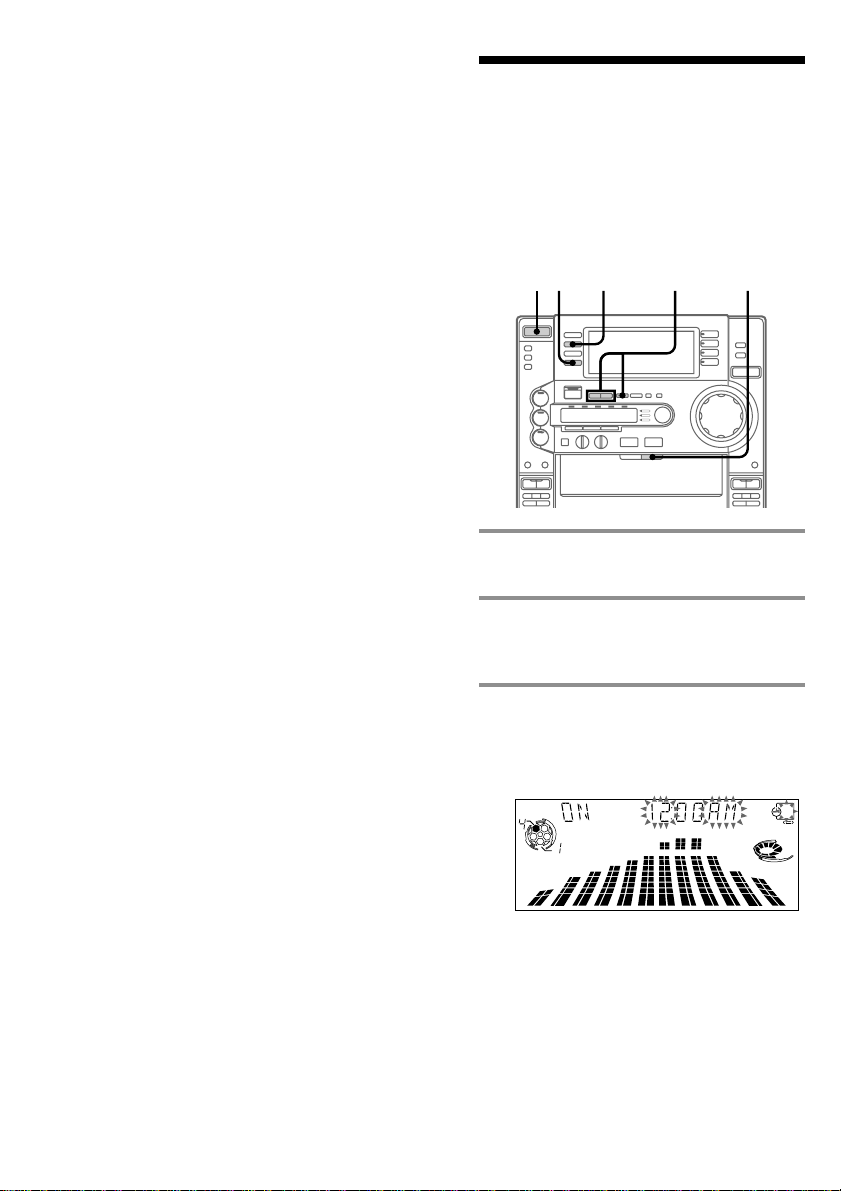
Waking up to music (continued)
To check the setting
1 Press DAILY.
“TIMER OFF” appears in the display.
2 Press DAILY again.
To change the setting, start over from step 1
on the previous page.
Timer-recording
radio programs
To timer-record, you must preset the radio
station (see “Step 4: Presetting radio stations”
on page 11) and set the clock (see “Step 3:
Setting the time” on page 10) beforehand.
To cancel the timer operation
Press DAILY.
“TIMER OFF” appears in the display.
Notes
• The system turns on 15 seconds before the preset
time.
• You cannot set the timer if the timer on and off
times are the same.
• When you set the Sleep Timer, the Daily Timer
will not turn on the system until the Sleep Timer
turns it off.
• You cannot set the Daily Timer and Timerrecording to be activated at the same time.
2
3,4,576
REC
1 Tune in the preset radio station (see
“Listening to the radio” on page 17).
2 Press c/CLOCK SET.
“SET” appears and “DAILY” flashes in
the display.
3 Press TUNING +/– to select “REC,”
then press ENTER/NEXT.
“ON” appears and the hour indication
flashes in the display.
REC
DOLBY NR
OFF
VOLUME
ALL DISC S
50
Page 51
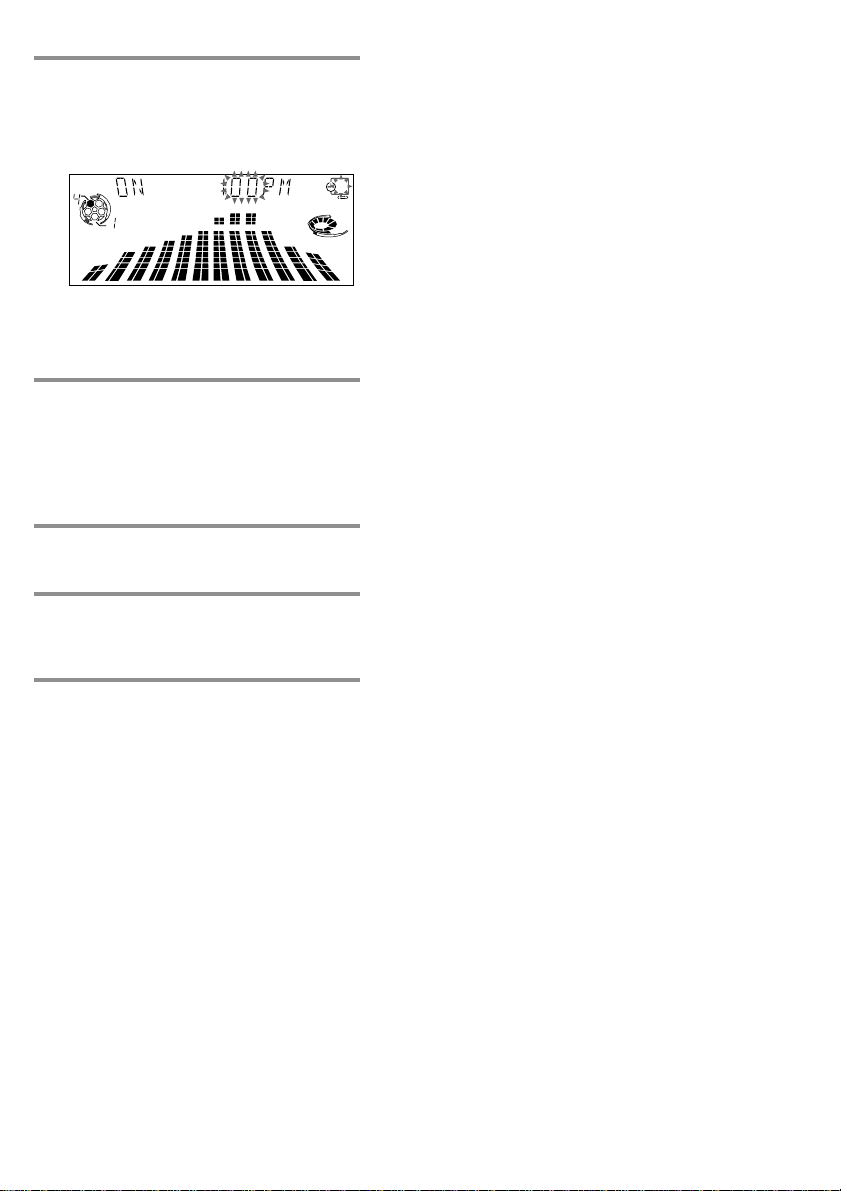
4 Set the time to start recording.
Press TUNING +/– to set the hour, then
press ENTER/NEXT.
The minutes indication flashes.
ALL DISC S
Press TUNING +/– to set the minutes,
then press ENTER/NEXT.
The hour indication flashes again.
5 Set the time to stop recording
following the above procedure.
The start time, the stop time, the
recording source, and the preset station
appear in turn before the original display
returns.
6 Press Z B EJECT and insert a
recordable tape in deck B.
7 Turn off the system.
When recording starts, the volume level
is set to minimum.
REC
DOLBY NR
VOLUME
Notes
• The system turns on 15 seconds before the preset
time.
• If the system is on at the preset time, the Timer
recording will not be made.
• You cannot set the timer if the timer on and off
times are the same.
OFF
• When you set the Sleep Timer, the Timerrecording will not start until the Sleep Timer turns
off the system.
• You cannot set the Daily Timer and Timerrecording to be activated at the same time.
• Recording starts from the front side.
To check the setting
1 Press REC.
“TIMER OFF” appears in the display.
2 Press REC again.
To change the setting, start over from step 1
on the previous page.
To cancel the timer operation
Press REC.
“TIMER OFF” appears in the display.
51
Page 52
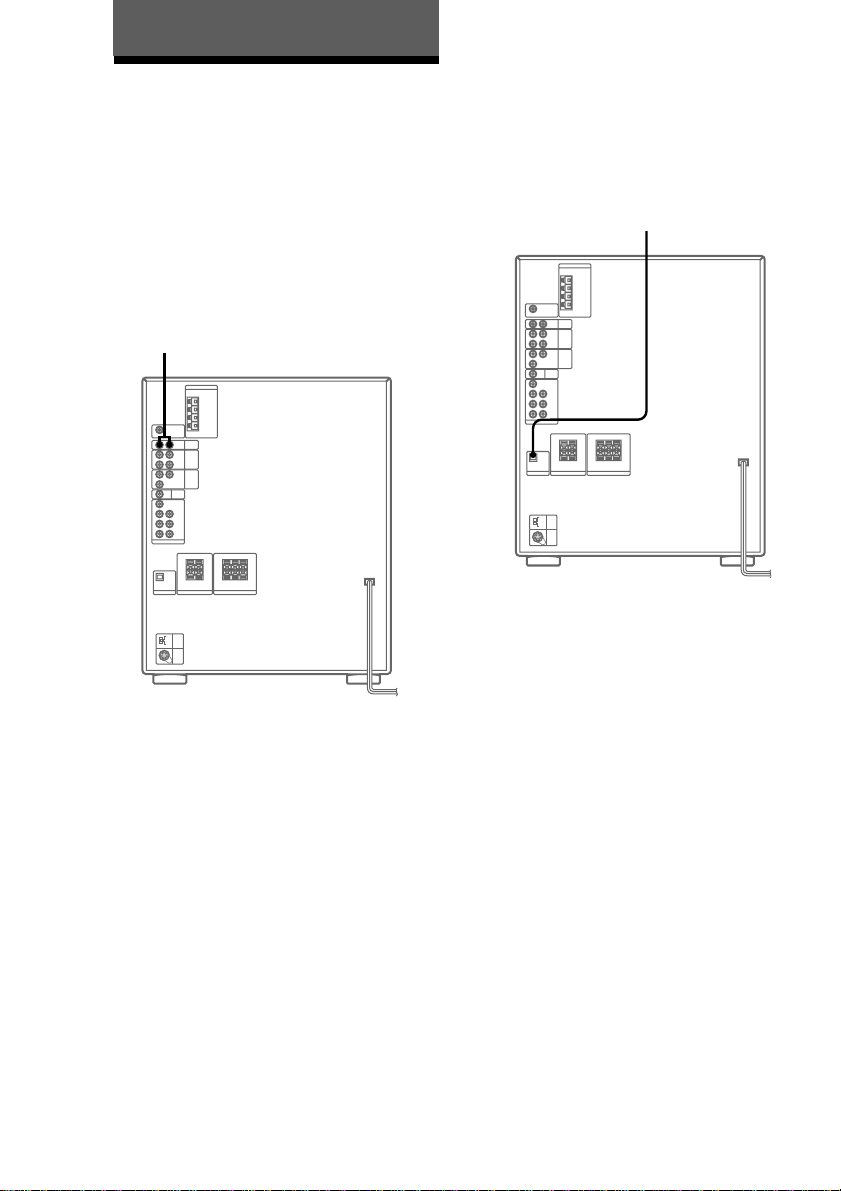
Optional AV Components
Connecting audio
components
Connecting a turntable
Be sure to match the color of the plugs and
the connectors. To listen to the sound from
the connected turntable, press FUNCTION
repeatedly until “PHONO” appears. Refer to
the instructions included with your turntable
for details.
To the audio outputs of the turntable
Connecting an MD deck
for digital recording
You can record a CD to an MD digitally by
connecting your MD deck using an optical
cable. Refer to the instructions included with
your MD deck for details.
To the digital input of the MD deck
Note
Using the turntable at high volume may cause
distortion or howling. This is often caused by the
bass sound from the speakers. The bass sound may
be picked up by the needle of the turntable, and
produce the distortion or howling. To avoid this, do
the following:
1 Keep some distance between the speakers and the
turntable.
2 Stop using the surround effect.
3 Install the speakers or the turntable on a firm and
stable surface.
4 Press SUPER WOOFER repeatedly until the
indicator on this button goes off.
52
Note
You cannot record from a VIDEO CD to an MD
deck digitally. When you record from a VIDEO CD
to an MD deck, connect an optional audio cable to
the audio output (see “Connecting an MD deck for
analog recording” on page 53).
Page 53
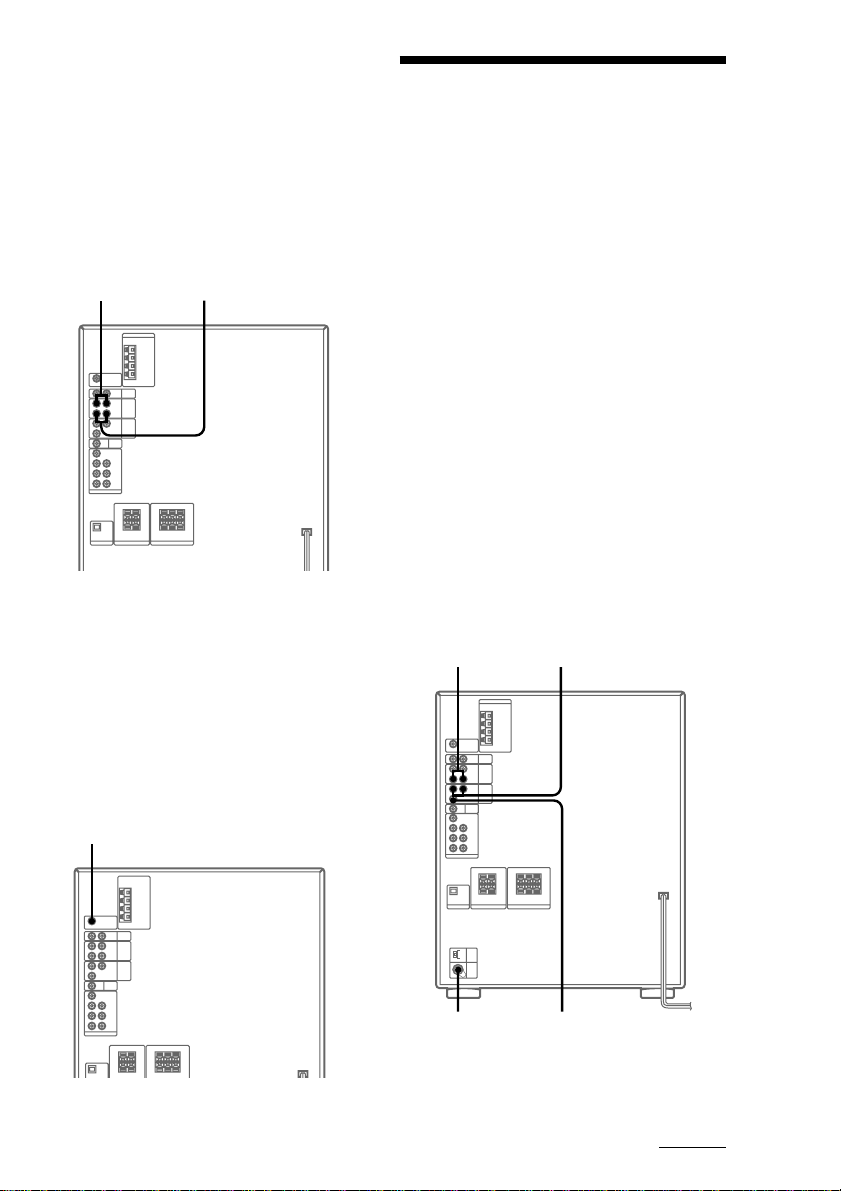
Connecting an MD deck
for analog recording
Be sure to match the color of the plugs and
the connectors. To listen to the sound of the
connected MD deck, press FUNCTION
repeatedly until “MD” appears. Refer to the
instructions included with your MD deck for
details.
Connecting video
components
You can connect a VCR, camcorder, or video
game to the VIDEO 1 jack on the rear panel
and/or the VIDEO2 INPUT jack on the front
panel.
To the audio outputs
of the MD deck
Tip
When you connect a Sony MD deck, you can use the
MD N, X and x buttons on this system's remote to
perform play, pause and stop operation.
To the audio inputs of
the MD deck
Connecting a subwoofer
You can connect an optional subwoofer. Refer
to the instructions included with your
subwoofer for details.
To the input of the subwoofer
Connecting a VCR
Be sure to match the color of the plugs and the
connectors. To listen to the sound from the
connected VCR, press FUNCTION repeatedly
until “VIDEO 1” appears.
By connecting the audio output jacks of your
VCR to the AUDIO IN jacks using an optional
audio cable, you can enjoy video playback in
powerful stereo sound. Moreover, if you
connect the video input on the VCR to the MD
OUT jacks and VIDEO OUT (or S VIDEO
OUT) jack using the supplied video connecting
cable (or an optional S VIDEO connecting
cable), you can record the audio and video
signals from a VIDEO CD onto video tape.
Refer to the instructions included with your
VCR for details.
To the audio inputs
of the VCR
To the audio outputs
of the VCR
To the S VIDEO
input of the VCR
Note
The input signal from the VIDEO 1 and VIDEO 2
INPUT jacks do not output via the S VIDEO OUT
jack.
To the video output of
the VCR
continued
53
Page 54
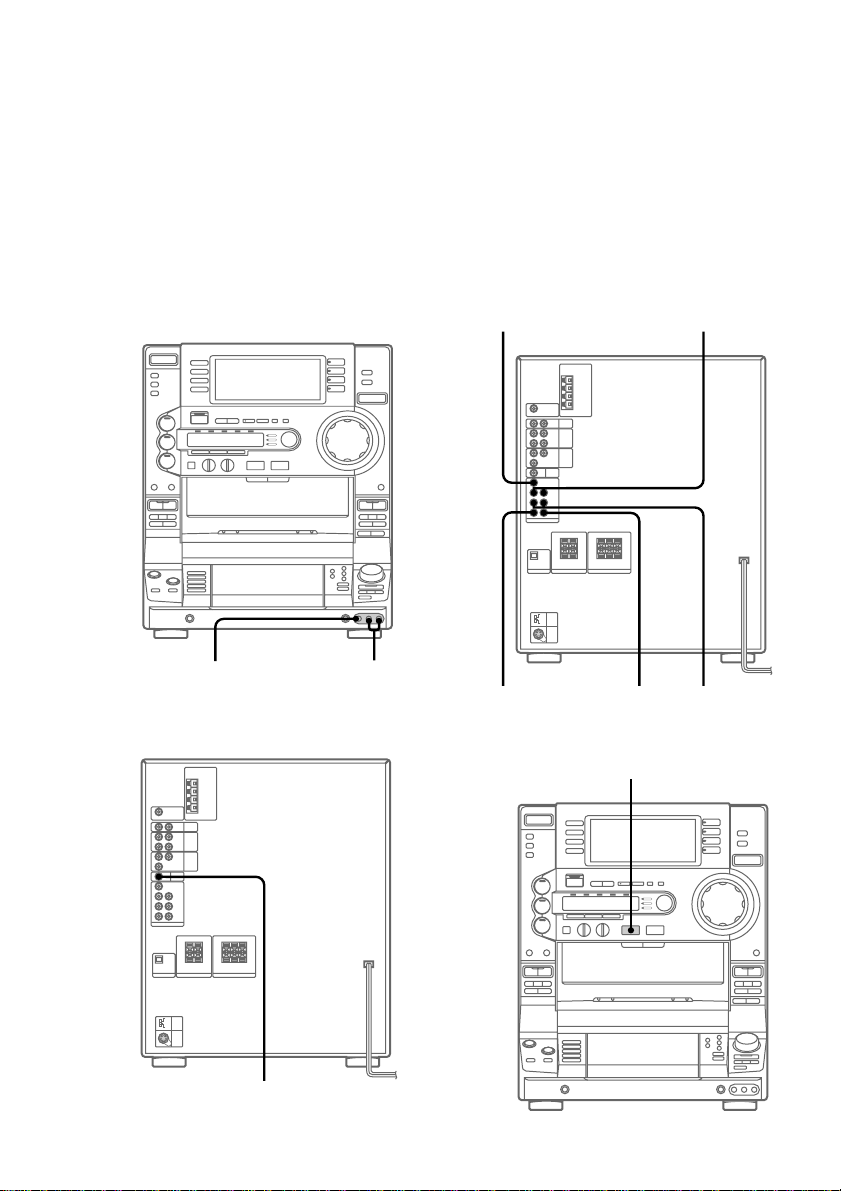
Connecting video components
(continued)
Connecting a camcorder
or video game
Be sure to match the color of the plugs and
the connectors. To listen to the sound from
the connected camcorder or video game,
press FUNCTION repeatedly until
“VIDEO 2” appears.
Refer to the instructions included with each
component for details.
Connecting a DVD player
When your DVD player has 5.1
channel analog outputs
Be sure to match the color of the plugs and
the connectors. To listen to the sound from
the connected DVD player, press DVD 5.1CH
so the indicator above the button lights up.
When you listen to a stereo sound track from
the DVD player, press DVD 5.1CH repeatedly
so the indicator above the button goes off.
To the video output of
the DVD player
To the front outputs
of the DVD player
54
To the video
output of the
component
To the video input of the TV
To the audio
outputs of the
component
To the center
output of the
DVD player
To the woofer
output of the
DVD player
DVD 5.1CH
To the rear
outputs of the
DVD player
Page 55
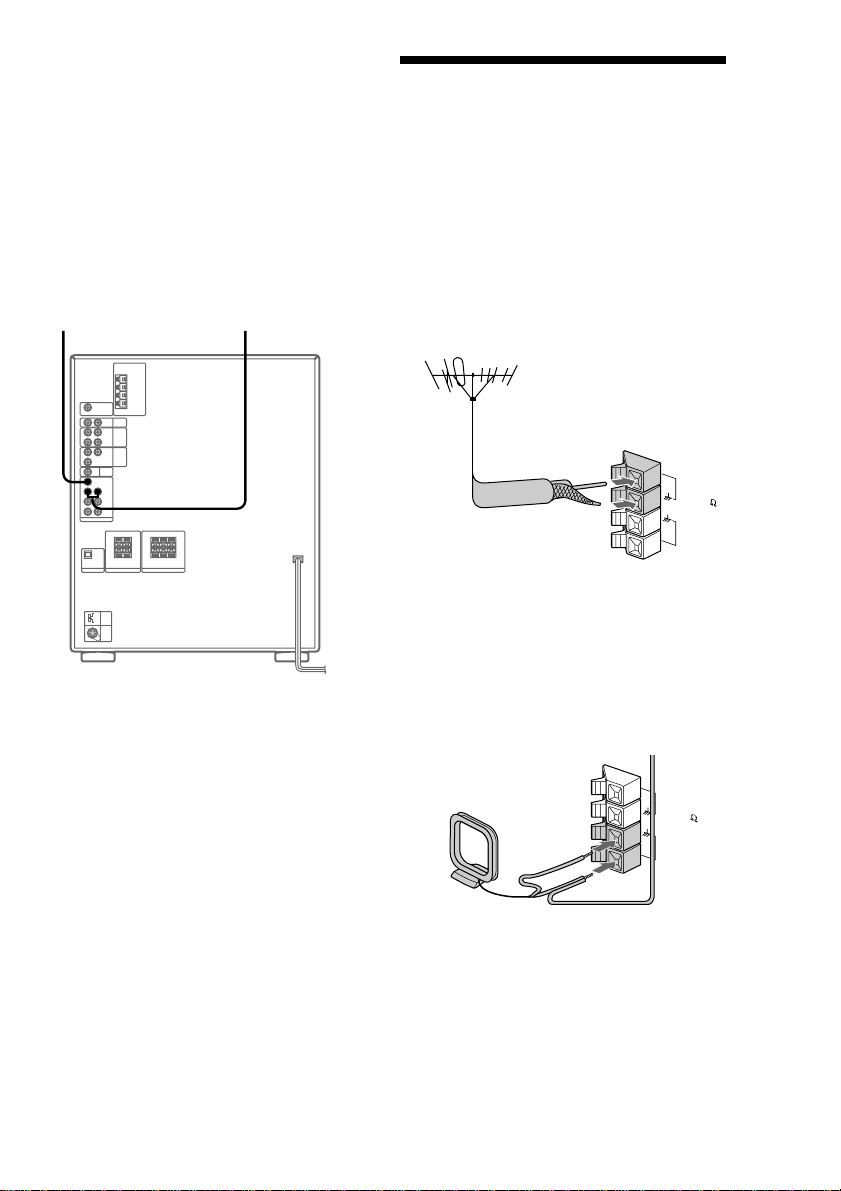
When your DVD player has stereo
analog outputs
Be sure to match the color of the plugs and
the connectors. Connect the LINE OUT
(audio) output jack of your DVD player to the
FRONT jacks of DVD INPUT with the audio
connecting cable. To listen to the sound from
the connected DVD player, press DVD 5.1CH
repeatedly so the indicator above the button
goes off. At this moment, the DVD (for 2
channel) function is selected.
To the video output of
the DVD player
To the front outputs
of the DVD player
Connecting
outdoor antennas
Connect an outdoor antenna to improve the
reception. Refer to the instructions of each
component.
FM antenna
Connect an optional FM outdoor antenna.
You can also use the TV antenna instead.
75-ohm coaxial cable
(not supplied)
FM 75
AM
AM antenna
Connect a 6 to 15 meter (20 to 50 feet)
insulated wire to the AM antenna terminal.
Leave the supplied AM loop antenna
connected.
Notes
• Each time you press DVD 5.1CH, the function
changes as follows:
DVD 5.1CH y DVD (2 channel)
(indicator on) (indicator off)
• You cannot enjoy the 5.1 channel surround sound
if you connect a DVD player which does not have
the 5.1 channel analog outputs.
Insulated wire (not supplied)
F
M
7
5
A
M
Important
If you connect an outdoor antenna, connect a
ground wire to the U terminal with the screw
clamp. To prevent a gas explosion, do not
connect the ground wire to a gas pipe.
55
Page 56
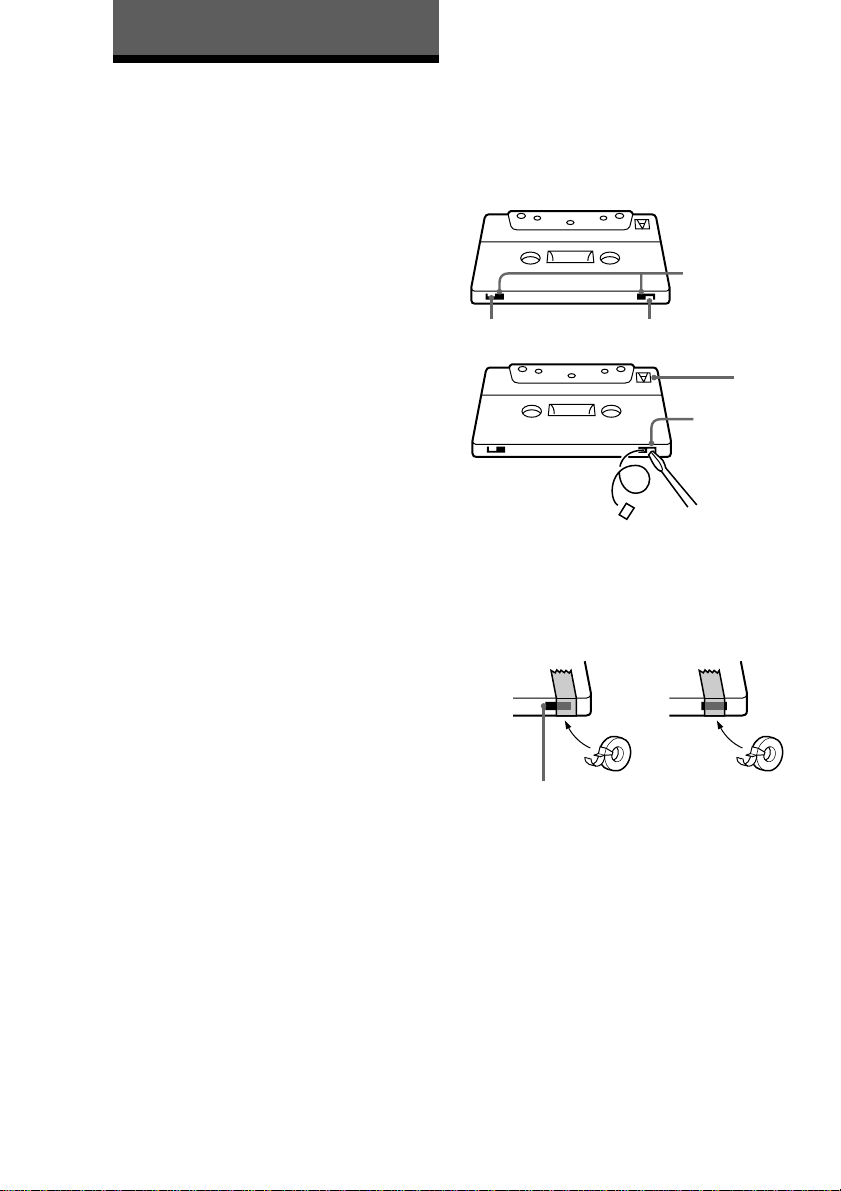
Additional Information
Precautions
On operating voltage
Before operating the system, check that the
operating voltage of your system is identical with
the voltage of your local power supply.
On safety
• The unit is not disconnected from the AC power
source (mains) as long as it is connected to the
wall outlet, even if the unit itself has been turned
off.
• Unplug the system from the wall outlet (mains) if
it is not to be used for an extended period of time.
To disconnect the cord (mains lead), pull it out by
the plug. Never pull the cord itself.
• Should any solid object or liquid fall into the
component, unplug the stereo system and have
the component checked by qualified personnel
before operating it any further.
• The AC power cord must be changed only at a
qualified service shop.
On placement
• Place the stereo system in a location with adequate
ventilation to prevent heat build-up in the stereo
system.
• Do not place the system in an inclined position.
• Do not place the system in locations where it is;
— Extremely hot or cold
— Dusty or dirty
— Very humid
— Subject to vibrations
— Subject to direct sunlight
On operation
• If the stereo system is brought directly from a cold
to a warm location, or is placed in a very damp
room, moisture may condense on the lens inside
the CD player. Should this occur, the system will
not operate properly. Remove the CD and leave
the system turned on for about an hour until the
moisture evaporates.
• When you move the system, take out any discs.
Cleaning the cabinet
Use a soft cloth slightly moistened with mild
detergent solution.
To save a tape permanently
To prevent a tape from being accidentally recorded
over, break off the cassette tab from side A or B as
illustrated.
Detector slots
Tab of side B
If you later want to reuse the tape for recording,
cover the broken tab with adhesive tape. However,
be careful not to cover the detector slots which allow
the tape player to automatically detect the type of
tape.
Tape type: CrO2/Metal Normal
Detector slots
Tab of side A
Side A
Break off the
cassette tab of
side A
If you have any questions or problems concerning
your stereo system, please consult your nearest
Sony dealer.
Notes on CDs
• Before playing, clean the CD with a cleaning cloth.
Wipe the CD from the center out.
• Do not use solvents such as benzine, thinner,
commercially available cleaners, or anti-static
spray intended for vinyl LPs.
• Do not expose the CD to direct sunlight or heat
sources such as hot air ducts, nor leave it in a car
56
parked in direct sunlight.
Page 57

Before placing a cassette in the
tape deck
Take up any slack in the tape. Otherwise the tape
may get entangled inside the tape deck and become
damaged.
When using a tape longer than 90
minutes
The tape is very elastic. Do not frequently change
the tape operations such as play, stop, and fastforwarding, etc. The tape may get entangled in the
tape deck.
Cleaning the tape heads
Clean the tape heads after every 10 hours of use.
When the tape heads become dirty
— the sound is distorted
— there is a decrease in sound level
— the sound drops out
— the tape does not erase completely
— the tape does not record
Make sure to clean the tape heads before you start
an important recording or after playing an old tape.
Use a separately sold dry-type or wet-type cleaning
cassette. For details, refer to the instructions of the
cleaning cassette.
Demagnetizing the tape heads
Demagnetize the tape heads and the metal parts that
have contact with the tape every 20 to 30 hours of
use with a separately sold demagnetizing cassette.
For details, refer to the instructions of the
demagnetizing cassette.
In case color irregularity is
observed on nearby a TV screen
With the magnetically shielded type of speaker
system, the speakers can be installed near a TV set.
However, color irregularity may still be observed on
the TV screen depending on the type of your TV set.
If color irregularity is observed...
Turn off the TV set once, then turn it on after 15 to
30 minutes.
If color irregularity is observed
again...
Place the speakers farther away from the TV set.
Troubleshooting
If you run into any problem using this stereo
system, use the following checklist.
First, check that the power cord is connected
firmly and the speakers are connected
correctly and firmly.
Should any problem persist, consult your
nearest Sony dealer.
General
The display starts flashing as soon as you
plug in the power cord even though you
haven’t turned on the system
(demonstration mode).
•Press DEMO (STAND BY) while the
system is off.
The demonstration appears automatically
the first time you plug in the power cord,
or if there is a power outage lasting
longer than half a day.
The clock setting/radio presetting is canceled.
•The power cord is disconnected or a power
failure occurs for more than half a day.
Redo the following procedures:
–“Step 3: Setting the time” on page 10.
–“Step 4: Presetting radio stations” on
page 11.
To set the timer function again, also redo
“Waking up to music” on page 49 and
“Timer-recording radio programs” on
page 50.
There is no sound.
•Turn VOLUME clockwise.
•The headphones are connected.
•Insert only the stripped portion of the
speaker cord into the SPEAKER jack.
Inserting the vinyl portion of the speaker
cord will interfere with the speaker
connection.
•The volume level is automatically set to
the minimum during the Timer-recording.
There is no microphone sound.
•Turn VOLUME or MIC LEVEL to adjust
the microphone volume.
•Make sure the microphone is connected
to the MIC1/ MIC 2 jack correctly.
continued
57
Page 58
Troubleshooting (continued)
There is severe hum or noise.
•A TV or VCR is placed too close to the
stereo system. Move the stereo system
away from the TV or VCR.
“12:00AM” flashes in the display.
•A power interruption occurred. Reset the
clock and timer settings.
The timer does not function.
•Set the clock correctly.
DAILY and REC do not appear when you
press c/CLOCK SET.
•Set the timer correctly.
•Set the clock.
The remote does not function.
•There is an obstacle between the remote
and the system.
•The remote is not pointing in the
direction of the system’s sensor.
•The batteries have run down. Replace the
batteries.
There is acoustic feedback.
•Decrease the volume level.
•Move the microphone away from the
speakers or change the direction of the
microphone.
The color irregularity on a TV screen
persists.
•Turn off the TV set once, then turn it on
after 15 to 30 minutes. If the color
irregularity still persists, place the
speakers farther away from the TV set.
Speakers
There is no sound and “PUSH POWER” and
“PROTECT“ appear in the display
alternately.
•Press ?/1 to turn off the system and
check the speaker connections and
placement.
Sound comes from only one channel or the
left and right volumes are unbalanced.
•Check the speaker connections and
placement.
There is no sound from the speakers
except the center speaker.
•The source being played back is
monaural. Press PRO LOGIC to turn off
58
the Pro Logic mode.
There is no sound from the center speaker.
•Set the CENTER LEVEL to the
appropriate level.
There is no sound from the rear speakers.
•Set the REAR LEVEL to the appropriate
level.
•The software being played back has
limited sound effects. Check the volume
with the test tone.
VIDEO CD/CD Player
There is no picture.
•Check that the player is connected
correctly and securely.
•Make sure you operate the TV correctly.
•Make sure you set the SYSTEM SELECT
correctly, according to your TV (color)
system.
•Press FUNCTION repeatedly until “CD”
appears in the display.
An after image of the last picture remains
on the screen, or the picture is unclear.
•Press ACTIVE repeatedly until “ACTIVE
OFF” appears in the display.
The CD tray does not rotate.
•A CD is not placed properly.
A CD will not play.
•The CD is not lying flat in the disc tray.
•The CD is dirty.
•The CD is inserted label side down.
•Moisture condensation has built up.
Remove the CD and leave the system
turned on for about an hour until the
moisture evaporates.
Play does not start from the first track.
•The player is in Program or Shuffle Play
mode. Press PLAY MODE repeatedly
until “PROGRAM,” “ALL DISCS
SHUFFLE,” or “1 DISC SHUFFLE”
disappears from the display.
Tape Deck
The tape does not record.
•No tape is in the cassette holder.
Page 59
•The tab has been removed from the
cassette (see page 56).
•The tape has reeled to the end.
The tape does not record nor play, or there
is a decrease in sound level.
•The heads are dirty. Clean them (see page
57).
•The record/playback heads are
magnetized. Demagnetize them (see page
57).
The tape does not erase completely.
•The record/playback heads are
magnetized. Demagnetize them (see page
57).
There is excessive wow or flutter, or the
sound drops out.
•The capstans or pinch rollers are dirty.
Clean them (see page 57).
Noise increases or the high frequencies are
missing.
•The record/playback heads are
magnetized. Demagnetize them (see page
57).
Tuner
Severe hum or noise (“TUNED” or
“STEREO” flashes in the display).
•Adjust the antenna.
•The signal strength is too weak. Connect
an external antenna.
A stereo FM program cannot be received in
stereo.
•Press STEREO/MONO so that “STEREO”
appears in the display.
If other problems not described
above occur, reset the system as
follows:
1 Unplug the power cord.
2 Plug the power cord back in.
3 Press c/CLOCK SET, ENTER, and
?/1 at the same time.
The system is reset to the factory settings. All
the settings you made, such as the preset
stations, clock, and timer are cleared. You
should set them again.
Specifications
Amplifier section
Front Speaker:
The following measured at AC 220 V, 50Hz
DIN power output (Rated)
Continuous RMS power output (Reference)
Center Speaker:
DIN power output (Rated)
Continuous RMS power output (Reference)
Rear Speaker:
DIN power output (Rated)
Continuous RMS power output (Reference)
Inputs
PHONO IN (phono jacks):sensitivity 3 mV,
MIC 1/2 (phone jack): sensitivity 1 mV,
VIDEO1 IN (phono jacks): sensitivity 250 mV,
VIDEO2 IN (phono jacks): sensitivity 250 mV,
MD IN (phono jacks): sensitivity 450 mV,
DVD INPUT
FRONT, REAR, CENTER, WOOFER (phono jacks):
150 + 150 watts
(6 ohms at 1 kHz, DIN)
200 + 200 watts
(6 ohms at 1 kHz, 10%
THD)
35 watts
(8 ohms at 1 kHz, DIN)
50 watts
(8 ohms at 1 kHz, 10%
THD)
35 + 35 watts
(8 ohms at 1 kHz, DIN)
50 + 50 watts
(8 ohms at 1 kHz, 10%
THD)
impedance 47 kilohms
impedance 10 kilohms
impedance 47 kilohms
impedance 47 kilohms
impedance 47 kilohms
sensitivity 450 mV,
impedance 47 kilohms
continued
59
Page 60

Specifications (continued)
Outputs
PHONES (stereo phone jack):
VIDEO OUT (phono jack):
MD OUT (phono jacks): voltage 250 mV,
WOOFER OUT (phono jack):
FRONT SPEAKER: accepts impedance of 6 to
CENTER SPEAKER: accepts impedance of 8 to
REAR SPEAKER: accepts impedance of 8 to
Video section
Inputs
VIDEO1 IN (phono jacks): 1 V p-p, 75 ohms
VIDEO2 IN (phono jacks): 1 V p-p, 75 ohms
Outputs
VIDEO OUT (phono jack):1 V p-p, 75 ohms
S-VIDEO OUT (4-pin/mini-DIN jack):
VIDEO CD/CD player section
System Compact disc and digital
Laser Semiconductor laser
Laser output Max. 44.6
Wavelength 780 – 790 nm
Frequency response 2 Hz – 20 kHz (±0.5 dB)
Signal-to-noise ratio More than 90 dB
Dynamic range More than 90 dB
Video color system format
CD DIGITAL OUT
(square optical connector jack, rear panel)
Wave length: 660 nm
Output level: –18 dBm
accepts headphones of 8
ohms or more
voltage 250 mV,
impedance 1 kilohm
impedance 1 kilohm
voltage 1 V, impedance
1 kilohm
16 ohms
16 ohms
16 ohms
Y: 1V p-p, unbalanced,
Sync negative,
C: 0.286 V p-p,
load impedance 75 ohms
audio system
(λ = 780 nm)
Emission
duration: continuous
* This output is the value
measured at a distance of
200 mm from the
objective lens surface on
the Optical Pick-up Block
with 7 mm aperture.
NTSC, PAL
µ
W*
Tape player section
Recording system 4-track 2-channel stereo
Frequency response (DOLBY NR OFF)
Wow and flutter ±0.15% W. Peak (IEC)
40 – 13,000 Hz (±3 dB),
using a Sony TYPE I
cassette
40 – 14,000 Hz (±3 dB),
using a Sony TYPE II
cassette
0.1% W. RMS (NAB)
±0.2% W. Peak (DIN)
Tuner section
FM stereo, FM/AM superheterodyne tuner
FM tuner section
Tuning range 87.5 – 108.0 MHz (50 kHz
Antenna FM wire antenna
Antenna terminals 75 ohm unbalanced
Intermediate frequency 10.7 MHz
AM tuner section
Tuning range 531 – 1,602 kHz
Antenna AM loop antenna,
Intermediate frequency 450 kHz
step)
(with the tuning interval
set at 9 kHz)
530 – 1,710 kHz
(with the tuning interval
set at 10 kHz)
External antenna
terminals
Speakers
Front speaker:
SS-LV60R
Speaker system 3-way, 4-unit, bass reflex
Speaker units
Woofer: 30 cm dia., cone type
Mid range: 10 cm dia., cone type × 2
Tweeter: 5 cm dia., cone type
Rated impedance: 6 ohms
Dimensions (w/h/d) Approx. 350 × 855 × 350
Mass Approx. 15 kg net per
Center speaker:
Speaker system Full-range, bass-reflex
Speaker units
Full range 10 cm dia., cone type (2)
Rated impedance 8 ohms
Dimensions (w/h/d) Approx. 360 × 130 × 170
Mass Approx. 2.5 kg
type
mm
speaker
type, magnetically
shielded type
mm
60
Page 61

Rear speaker:
Speaker system Full-range, bass-reflex
Speaker units
Full range 10 cm dia., cone type
Rated impedance 8 ohms
Dimensions (w/h/d) Approx. 180 × 130 × 170
Mass Approx. 1.5 net per
type
mm
speaker
General
Power requirements 220 V AC, 50/60 Hz
Power consumption 230 watts
Dimensions (w/h/d) Approx. 356 × 423 × 446
Mass Approx. 15.7 kg
Supplied accessories AM loop antenna (1)
Design and specifications are subject to change
without notice.
Adjustable with voltage
selector
mm incl. projecting parts
and controls
FM wire antenna (1)
Speaker cords (5)
Remote (1)
R6 (size AA) batteries (2)
Front speaker feet (8)
Center speaker feet (4)
61
Page 62

Glossary
Auto Pause
An automatic pause function which is
activated according to the signal encoded on
the disc while playing a VIDEO CD. If the CD
player does not resume play for a long time,
press HX to resume play manually.
Menu Playback
Playback using the menu screens recorded on
VIDEO CDs with PBC functions. You can
enjoy simple interactive software using the
menu playback function.
Playback Control (PBC)
Signals encoded on VIDEO CDs (Version 2.0)
to control playback.
By using menu screens recorded on VIDEO
CDs with PBC functions, you can enjoy
playing simple interactive software, software
with search functions, and so on.
Track
Sections of a picture or a music piece on disc.
Each track is assigned a track number to help
you locate the desired track.
VIDEO CD
A compact disc which contains moving
pictures.
VIDEO CDs contain compact picture
information using the MPEG 1 format, one of
the world wide standards of digital compact
technology. The picture information is
compressed about 120 times. Consequently, a
12 cm VIDEO CD can contain up to 74
minutes of moving pictures.
VIDEO CDs also contain compact audio
information. Sounds outside the range of
human hearing are compressed while the
sounds we can hear are not compressed.
VIDEO CDs can hold six times the audio
information of conventional audio CDs.
There are two versions for VIDEO CDs;
Version 1.1 (VIDEO CDs without PBC
functions):
You can play only moving pictures and
sounds.
Version 2.0 (VIDEO CDs with PBC functions):
You can play still pictures and enjoy PBC
functions.
This player can play to both versions.
62
Page 63
Index
A
Active picture 32
Adjusting
the audio emphasis 42
the on-screen display 25
the sound 40
the volume 14, 16, 18,
21
AMS 20, 21
Antennas 5, 55
Audio emphasis 41, 42
Automatic Source Selection
14, 16, 18, 21
B, C
Batteries 7
CD Flash 39
CD Loop 39
CD player 15, 23
CD Synchro Recording 16
Clock setting 10
Connecting 4~6, 52~55
D, E, F, G
Daily timer 49
Digest
disc 29
track 30
Display 24, 42
Dolby Pro Logic
Surround 45
DSP 43
Dubbing 22
DVD 54
H, I, J
Hooking up
optional components 52
speakers 5
the antennas 5, 55
the power 6
the system 4
K, L
Karaoke 46
adjusting the key 47
adjusting the
microphone echo 47
to reduce the vocals
(KARAOKE PON ) 46
to sing along with a
multiplex CD or tape
(MPX R/MPX L) 46
M, N, O
Microphone
mixing 47
Mixing sound 47
Normal Play 15
Non-Stop Play 35
One Touch Play 14, 16, 18,
21
P , Q
Personal File 44
Playing
a CD 15
a preset radio station 17
a tape 20
a VIDEO CD 13
tracks in random order
(Shuffle Play) 33
tracks in the desired
order (Program Play) 34
tracks repeatedly
(Repeat Play) 32
without interruption 35
Presetting radio stations 11
Preset tuning 17
Program Edit 37
Program Play 34
Protecting recordings 56
R
Radio stations
presetting 11
tuning in 17
Recording
a radio program 19
a VIDEO CD/CD 16
another tape (High-
speed Dubbing) 22
CDs by specifying the
track order 37
on a tape manually 36
selecting tape length
automatically 38
timer-recording 50
Repeat Play 32
Resetting the system 59
S
Saving recordings 56
Selecting
the audio emphasis 41
the color system 6
Setting the time 10
Shuffle Play 33
Sleep Timer 48
Sound adjustment 40
Speakers 5, 8
Surround effect 43
Surround menu 43
SYNC BASS 40
SYNC EQ 41
T, U, V, W, X, Y, Z
Tape Select Edit 38
Test tone 9
Timer
falling asleep to
music 48
timer-recording 50
waking up to music 49
Troubleshooting 57
Tuner 11, 17
Tuning interval 12
Turntable 52
VIDEO CD/CD player
13, 15, 16, 23
63
Page 64

Sony Corporation Printed in Thailand
64
 Loading...