

Page 1
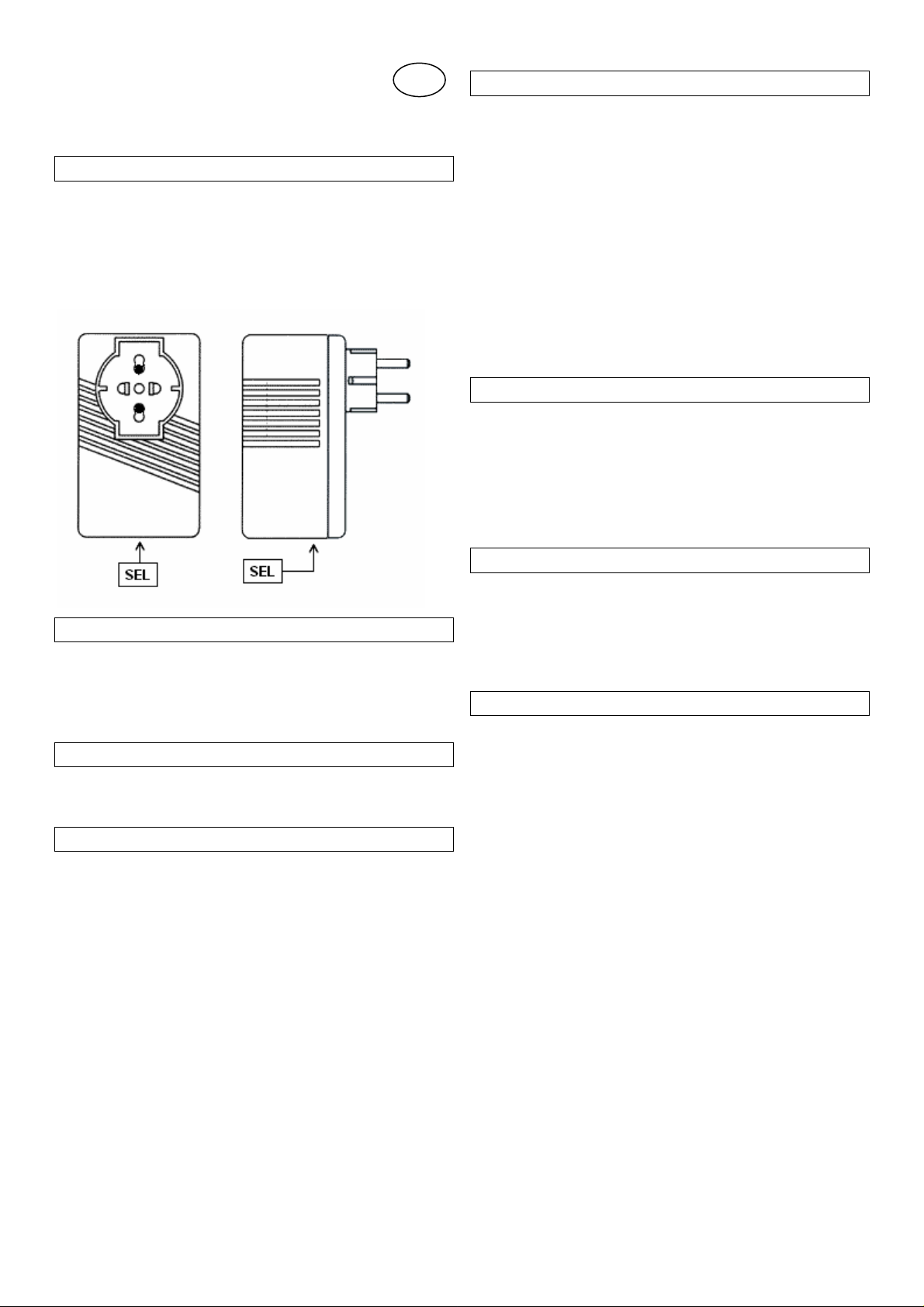
TXS 2229 Charge sensor
Electronic device with 433.92 Mhz transmitter and Current
sensor of the charge applied to the integrated 230Vac socket.
T
ECHNICAL DATA
- Power supply: 230V~ 50/60Hz 510W max.
- User output: 230V~ 100-500W Max.
- Working temperature: -10÷55°C
- Radio transmitter: 433.92 MHz
- Transmitter type coding: 18 bit Random Code
- Dimensions: 100 x 55 x 90 mm.
- Container: ABS UL94V-0 (IP40)
D
EVICE INSTALLATION
For excellent functioning, it is very important to choose the
place of installation carefully. Capacity is not only conditioned
by the technical features of the device, but also varies depending on the radio-electric conditions of the site.
The transmitter has an incorporated antenna.
GB
I
NITIAL FUNCTIONING CONDITION
The device can only work coupled with one or more control
units, upon first ignition the device contains a property code in
the memory that cannot be amended, of Rolling code type.
F
UNCTIONING MODE
The device constantly controls the charge applied to the 230V
current socket. According to the variation of the applied load
absorptions, two distinct transmission codes will be sent at
433.92 Mhz (Descent code if the charge is at maximum, Ascent code if the charge is in Stand-By or disconnected).
The device is ready for functioning with pre-defined charge settings. In case of anomalous functioning compared to wanted
ones, it will be necessary to program the device.
P
ROGRAMMING METHOD OF THE DEVICE
The programming of the device current threshold is the Selflearning type and is performed in the following way: connect
the charge to be checked
and bring it in the condition of maximum current absorption,
press the SEL key, three sounds will be heard confirming programming entry. After approx. 3 seconds, the device will emit
a confirmation sound to signal the occurred programming of
the new current threshold, subsequently four confirmation
sounds will be heard to signal the end of the programming
mode.
Whereas if, after having pressed the SEL key the device cannot memorise any current threshold within 15 seconds the device will emit four confirmation sounds, signalling the end of the
programming phase.
It is possible to repeat the above described programming operation for the acquisition of new parameters of the applied
charge.
M
ANUAL TRANSMISSION METHOD OF THE DEVICE
The transmission of the device can be forced, for example, to
facilitate programming on the control unit to be coupled as follows: connect the device to the electric network keeping the
SEL key constantly pressed for 5 seconds, six sounds will be
heard confirming the sending of only the Descent code of the
device at 433.92 Mhz.
It is possible to repeat the above described transmission operation for a new sending of the transmission code.
S
OUND SIGNALS
1 BIP = Memorised current threshold.
3 BIP = Programming phase start
4 BIP = Programming phase end
5 BIP = Deletion of memorised current threshold.
6 BIP = Sending of transmission code
R
ESET
Should it be necessary to restore the control unit to default setting (without memorised current threshold), press the SEL key
continuously for 5 seconds, the control unit will emit five confirmation sounds and the operation will be complete.
1 Rev. 1.1 21/07/11
Page 2
I
MPORTANT FOR THE INSTALLER
- The device must never be used by children or persons with
reduced physical-psychological abilities, unless supervised or
trained on the functioning and the use modalities.
- Do not allow children to play with the device and keep the radio-controls away from their reach.
- ATTENTION: keep this instruction manual and respect the
important safety prescriptions contained herein. The non compliance with the prescriptions may cause damages and serious
accidents.
- Frequently examine the plant to detect any signs of damaging. Do not use the device if a repair intervention is necessary.
NOTE: Install the product in such a way that it can be easily
accessed, in order to prevent problems in the event the plug
must be disconnected.
Attention
All operations which require the opening of the casing (cables
connection, programming, etc.) must be carried out by expert
personnel during installation. For any further operation which
requires the casing to be re-opened (re-programming, repair or
installation amendments) contact the after-sales assistance.
SEAV S.r.l. declares that the product:
TXS 2229
is in compliance with the specifications of R&TTE Directives
99/5/EC, EMC 2004/108/EC, LVD 2006/95/EC Directives.
2 Rev. 1.1 21/07/11
 Loading...