

Page 1
Home
Visit us at:
http://www.samsungprinter.com
P/N. JC68-00482A Rev.2.00
Page 2

This manual is provided for information purposes only. All information included herein is
subject to change without notice. Samsung Electronics is not responsible for any damages, direct
or indirect, arising from or related to use of this manual.
© 2000 Samsung Electronics Co., Ltd. All rights reserved.
• ML-6060, ML-6060N, ML-6060S and Samsung logo are trademarks of Samsung Electronics
Co., Ltd.
• Centronics is a trademark of Centronics Data Computer Corporation.
• PCL and PCL6 are trademarks of Hewlett-Packard Company.
• IBM and IBM PC are trademarks of International Business Machines Corporation.
• Apple, AppleTalk, TrueType, Laser Writer and Macintosh are trademarks of Apple Computer,
Inc.
• Microsoft, Windows, Windows 9x, Windows 2000, Windows NT and MS-DOS are registered
trademarks of Microsoft Corporation.
• PostScript is a trademark of Adobe Systems Inc.
• All other brand or product names are trademarks of their respective companies or
organizations.
Page 3

Contents
Introduction
1
Special Features
Printer Components
Setting Up Your Printer
2
: Unpack Your Printer –––––––––––––––––––––––––––––––––––– 2.1
STEP 1
Install the Toner Cartridge
:
STEP 2
: Load Paper –––––––––––––––––––––––––––––––––––––––––––– 2.4
STEP 3
: Connect to the Computer with a Parallel Cable ––––––––– 2.7
STEP 4
Turn on the Printer
:
STEP 5
: Print a Demo Page! –––––––––––––––––––––––––––––––––––– 2.8
STEP 6
: Install the Printer Software –––––––––––––––––––––––––––– 2.9
STEP 7
Using the Control Panel
3
Control Panel Buttons ––––––––––––––––––––––––––––––––––––––– 3.1
Control Panel Lights
––––––––––––––––––––––––––––––––––––––––––––
–––––––––––––––––––––––––––––––––––––––––
––––––––––––––––––––––––––––––––––––––––– 3.4
1.1
1.3
––––––––––––––––––––––––––––– 2.2
–––––––––––––––––––––––––––––––––––– 2.8
Print Media
4
Choosing Paper and Other Media
Selecting the Output Tray
Loading Paper
Using Tray 1 or the Optional Tray 2 –––––––––––––––––––––––––––– 4.6
Using the Multi-Purpose Tray ––––––––––––––––––––––––––––––––– 4.7
Using the Manual Feed –––––––––––––––––––––––––––––––––––––– 4.10
Printing on Envelopes –––––––––––––––––––––––––––––––––––––– 4.12
Printing on Labels
Printing on Transparencies
Printing on Preprinted Paper
1
Printing on Card Stock or Custom-sized Media
––––––––––––––––––––––––––––––––––––––––––––––– 4.6
–––––––––––––––––––––––––––––––––––––––––– 4.14
––––––––––––––––––––––––––––––––––– 4.4
–––––––––––––––––––––––––––– 4.1
–––––––––––––––––––––––––––––––––– 4.15
–––––––––––––––––––––––––––––––– 4.16
–––––––––––––– 4.17
Page 4
Printing Tasks
5
Printing a Document ––––––––––––––––––––––––––––––––––––––– 5.1
Using Toner Save Mode
Printing on Both Sides of the Paper
Printing Multiple Pages on One Sheet of Paper
Printing Booklets
Printing on Different Paper for the First Page
Fitting Your Document To a Selected Paper Size
Printing Posters
Setting Graphic Properties
Printing Watermarks
Using Page Overlay
Maintaining Your Printer
6
Maintaining Toner Cartridge ––––––––––––––––––––––––––––––– 6.1
Cleaning the Printer
––––––––––––––––––––––––––––––––––––––––– 5.11
–––––––––––––––––––––––––––––––––––––––––– 5.16
–––––––––––––––––––––––––––––––––––– 5.6
(Manual Duplexing) –––––––––– 5.7
(N-Up Printing)
––––––––––––– 5.14
–––––––––– 5.15
––––––––––––––––––––––––––––––– 5.18
––––––––––––––––––––––––––––––––––––– 5.21
–––––––––––––––––––––––––––––––––––––– 5.24
––––––––––––––––––––––––––––––––––––––– 6.4
– 5.10
Problem Solving
7
Troubleshooting Checklist –––––––––––––––––––––––––––––––––– 7.1
Solving General Printing Problems
Printing Special Pages
Clearing Paper Jams
Solving Print Quality Problems
Troubleshooting Error Messages
Common Windows Problems
Common Macintosh Problems
Troubleshooting PS Errors
––––––––––––––––––––––––– 7.2
––––––––––––––––––––––––––––––––––––– 7.6
––––––––––––––––––––––––––––––––––––––– 7.7
–––––––––––––––––––––––––––– 7.16
––––––––––––––––––––––––––– 7.22
–––––––––––––––––––––––––––––– 7.24
––––––––––––––––––––––––––––– 7.25
–––––––––––––––––––––––––––––––– 7.27
2
Page 5

Contents (continued)
A
B
C
Specifications
Printer Specifications –––––––––––––––––––––––––––––––– A.1
Paper Specifications
––––––––––––––––––––––––––––––––– A.2
Using Your Printer with a USB Cable
Installing the Printer Software ––––––––––––––––––––––– B.1
Frequently Asked Questions About USB
–––––––––––––– B.4
Using Your Printer with Macintosh
Macintosh Installation
Using PCL Driver
Using PS Driver
––––––––––––––––––––––––––––––– C.1
–––––––––––––––––––––––––––––––––––– C.5
–––––––––––––––––––––––––––––––––––– C.10
Printing from DOS Applications
D
About Remote Control Panel for DOS
Installing the Remote Control Panel
for DOS Users
Selecting Print Settings
Using Windows PostScript Driver
E
Setting Your Printer with the PS Option
Installing PPD Files
Accessing the PS Printer Driver Features
3
––––––––––––––––––––––––––––––––––––––– D.2
–––––––––––––––––––––––––––––– D.2
–––––––––––––––––––––––––––––––––– E.1
–––––––––––––––– D.1
–––––––––––––– E.1
––––––––––––– E.3
Page 6
Using Your Printer on Network
F
About Sharing the Printer on a Network
Setting Up a Locally Shared Printer
Setting Up a Network-Connected Printer –––––––––––––– F.3
Installing Software from Diskettes
G
Making Installation Diskettes –––––––––––––––––––––––– G.1
Installing Software from Diskette
Printer Options
H
Precautions –––––––––––––––––––––––––––––––––––––––––– H.1
Memory and PostScript SIMMs
Network Interface Card
Paper Tray 2
––––––––––––––––––––––––––––––––––––––––– H.7
–––––––––––––––––––––––––––––– H.5
–––––––––––––––––––
–––––––––––––––––––– G.3
––––––––––––––––––––––– H.2
–––––––––––––– F. 1
F.2
Using Your Printer in Linux
I
Linux Driver Installation
–––––––––––––––––––––––––––––– I.1
INDEX
4
Page 7

Environmental and Safety Consideration
Laser Safety Statement
The printer is certified in the U.S. to conform to the requirements of DHHS 21 CFR, chapter 1
Subchapter J for Class I(1) laser products, and elsewhere, is certified as a Class I laser
product conforming to the requirements of IEC 825.
Class I laser products are not considered to be hazardous. The laser system and printer are
designed so there is never any human access to laser radiation above a Class I level during
normal operation, user maintenance, or prescribed service condition.
WARNING
Never operate or service the printer with the protective cover removed from Laser/Scanner
assembly. The reflected beam, although invisible, can damage your eyes.
CAUTION - INVISIBLE LASER RADIATION WHEN THIS COVER OPEN. DO
NOT OPEN THIS COVER.
VORSICHT - UNSICHTBARE LASERSTRAHLUNG, WENN ABDECKUNG
GEÖFFNET. NICHT DEM STRAHL AUSSETZEN.
ATTENTION - RAYONNEMENT LASER INVISIBLE EN CAS D’OUVERTURE.EXPOSITION DAN
GEREUSE AU FAISCEAU.
ATTENZIONE -RADIAZIONE LASER INVISIBILE IN CASO DI APERTURA.
EVITARE L’ESPOSIZIONE AL FASCIO.
PRECAUCION -RADIACION LASER IVISIBLE CUANDO SE ABRE. EVITAR EXPONERSE AL
RAYO.
ADVARSEL. - USYNLIG LASERSTRÅLNING VED ÅBNING NÅR SIKKERHEDSBRYDERE ER
UDE AF FUNKTION. UNDGÅ UDSAETTELSE FOR STRÅLNING.
ADVARSEL. - USYNLIG LASERSTRÅLNING NÅR DEKSEL ÅPNES. STIRR IKKE INN I
STRÅLEN. UNNGÅ EKSPONERING FOR STRÅLEN.
VARNING - OSYNLIG LASERSTRÅLNING NÄR DENNA DEL ÄR ÖPPAND OCH SPÄRREN ÄR
URKOPPLAD. BETRAKTA EJ STRÅLEN. STRÅLEN ÄR FARLIG.
VARO! - AVATTAESSA JA SUOJALUKITUS OHITETTAESSA OLET ALTTIINA
NÄKYMÄTTÖMÄLLE LASERSÄTEILYLLE ÄLÄ KATSO SÄTEESEEN.
5
Page 8

Ozone Safety
OZONE
Power Saver
Environmental and Safety Consideration
During normal operation, the ML-6060 Series printer produces
ozone. the ozone produced does not present a hazard to the
operator. However, it is advisable that the machine be operated in
a well ventilated area.
If you need additional information about ozone, please request
your nearest Samsung dealer.
This printer contains advanced energy conservation technology
that reduces power consumption when it is not in active use.
When the printer does not receive data for an extended period of
time, power consumption is automatically lowered.
The energy star emblem does not represent EPA endorsement of
any product or service.
Radio Frequency Emissions
FCC Declaration of Conformity
1. Product Name : Laser Printer
2. Model Number : Samsung ML-6060, ML-6060N, ML-6060S
3. FCC Rules : TESTED TO COMPLY WITH FCC PART 15 CLASS B
4. Operating Environment : FOR HOME OR OFFICE USE
5. FCC Compliance Statement
This device complies with Part 15 FCC rules. Operating is subject to the following two
conditions : (1)This device may not cause harmful interference, and
(2)This device must accept any interference received, including interference
that can any cause undesired operation.
6
Page 9

Environmental and Safety Consideration
6. Information to User
This device has been tested and found to comply with the limits for a Class B digital
device, pursuant to Part 15 of the FCC rules. These limits are designed to provide
reasonable protection against harmful interference in a residential installation. This
equipment generates, uses and can radiate radio frequency energy and, if not installed and
used in accordance with the instructions, may cause harmful interference to radio
communications. However, there is no guarantee that interference will not occur in a
particular installation. If this equipment does cause harmful interference to radio or
television reception, which can be determined by turning the equipment off and on, the
user is encouraged to try to correct the interference by one or more of the following
measures:
(1) Reorient or relocate the receiving antenna.
(2) Increase the separation between the equipment and receiver.
(3) Connect the equipment into an outlet on a circuit different from that to which the
receiver is connected.
(4) Consult the dealer or an experienced radio/TV technician for help.
CAUTION: Changes or modifications not expressly approved by the manufacturer responsible
for compliance could void the user’s authority to operate the equipment.
Party Responsible for Product Compliance
Samsung Electronics America
American QA Lab
85 West Tasman Dr.
San Jose, CA 95134
Canadian Radio Interference Regulations
This digital apparatus does not exceed the Class B limits for radio noise emissions from digital
apparatus as set out in the interference-causing equipment standard entitled “Digital
Apparatus”, ICES-003 of the Industry and Science Canada.
Cet appareil numérique respecte les limites de bruits radioélectriques applicables aux appareils
numériques de Classe B prescrites dans la norme sur le matériel brouilleur: “Appareils
Numériques”, ICES-003 édictée par l’Industrie et Sciences Canada.
7
Page 10

Environmental and Safety Consideration
EC Declaration of Conformity
We,
SAMSUNG ELECTRONICS CO., LTD.
#259, Gong Dan-Dong, Gumi-City, Kyung Buk, Korea
declares sole responsibility that the
ML-6060, ML-6060N, ML-6060S Laser printer
meets the intent of Directive 89/336/EEC for Electromagnetic Compatibility and Low Voltage
Directive 73/23/EEC.
Compliance was demonstrated to the following specifications as listed in the official journal of
the European Communities:
EN 50081-Emissions:
EN 55022 Radiated, Class B
EN 55022 Conducted, Class B
EN 61000-3-2 Power Harmonics
EN 61000-3-3 Voltage Fluctuations and Flicker
EN 55024-EMS:
EN 6100-4-2 Electrostatic Discharge
EN 6100-4-3 RF EM Field
EN 6100-4-4 Fast transients
EN 6100-4-5 Surges
EN 6100-4-6 RF Common mode
EN 6100-4-8 Power Frequency Magnetic Field
EN 6100-4-11 Voltage Dips and Interruptions
EN 60950-Safety
8
Page 11

chapter
1
1
Congratulations on the purchase of your ML-6060 series
printer! This chapter provides information on the following
topics:
◆ Special Features
◆ Printer Components
Page 12

Special Features
9
8
Your new Samsung ML-6060 series printer is equipped with
special features that improve print quality, giving you a
competitive edge. You can:
Print with excellent quality and high speed
• Prints at 1200 dots per inch (dpi). See page 5.19.
• Prints 12 pages-per-minute.
• The PCL 6 printer language enables fast printing performance.
Flexible paper handling
• A 100-sheet Multi-Purpose Tray supports letterheads,
envelopes, labels, transparencies, custom-sized media,
postcards, and heavy paper.
• Standard 550-sheet input tray (Tray 1) and optional 550-
sheet input tray (Tray 2) supports all standard sizes of paper.
• Two output tray: Select either the top face-down output or
the rear face-up output tray for the most convenient
access.
• Straight-through paper path capability from the
Multi-Purpose Tray to the rear output tray.
Create professional documents
• Customizes your documents by using Watermarks such as
“Confidential.”
• Prints Booklets. This feature enables you to easily print the
pages required to create books. Once printed, all you have to
do is fold and staple the pages.
• Prints Posters. The text and pictures of each page of your
document are magnified and printed across the selected
sheet of paper. After the document has printed, trim off the
white edges of each sheet. Tape the sheets together to form
a poster.
NTRODUCTION
I
1.1
Page 13
Special Features
Save time and money
• Allows you to use the Toner Save mode to save toner. See
page 5.6.
• Allows you to print on both sides of the paper to save paper
(Manual duplexing). See page 5.7.
• Allows you to print multiple pages on one single sheet of paper
to save paper (N-up printing). See page 5.10.
• Preprinted forms and letterheads can be printed on plain
paper. See ‘Using Page Overlay’ on page 5.24.
• One-touch last page printing is allowed in the ready mode.
• This printer automatically conserves electricity by
substantially reducing power consumption when not printing.
• This printer meets Energy Star guidelines for energy
efficiency.
Expand the printer capacity
• The ML-6060 printer has 4 MB of memory (16 MB on ML-6060N
and ML-6060S) which can be expanded to 68 MB (80 MB
on ML-6060N and ML-6060S).
• PostScript Level 3 Emulation* (PS) SIMM adds PS printing.
(ML-6060S comes with a built-in PostScript SIMM.)
• Optional network interface enables network printing.
(ML-6060N and ML-6060S come with a built-in network interface.)
Print in various environment
• Prints in Windows, DOS, and Macintosh.
• Supports Linux.
• ML-6060 printer comes with Parallel and USB interface. You
can install an optional network interface (ML-6060N and
ML-6060S have a built-in network interface).
*PostScript 3 Emulation
IPS-PRINT_Printer language Emulation© Copyright 1995-2000,
Oak Technology, Inc., All rights reserved
1.2
NTRODUCTION
I
Page 14
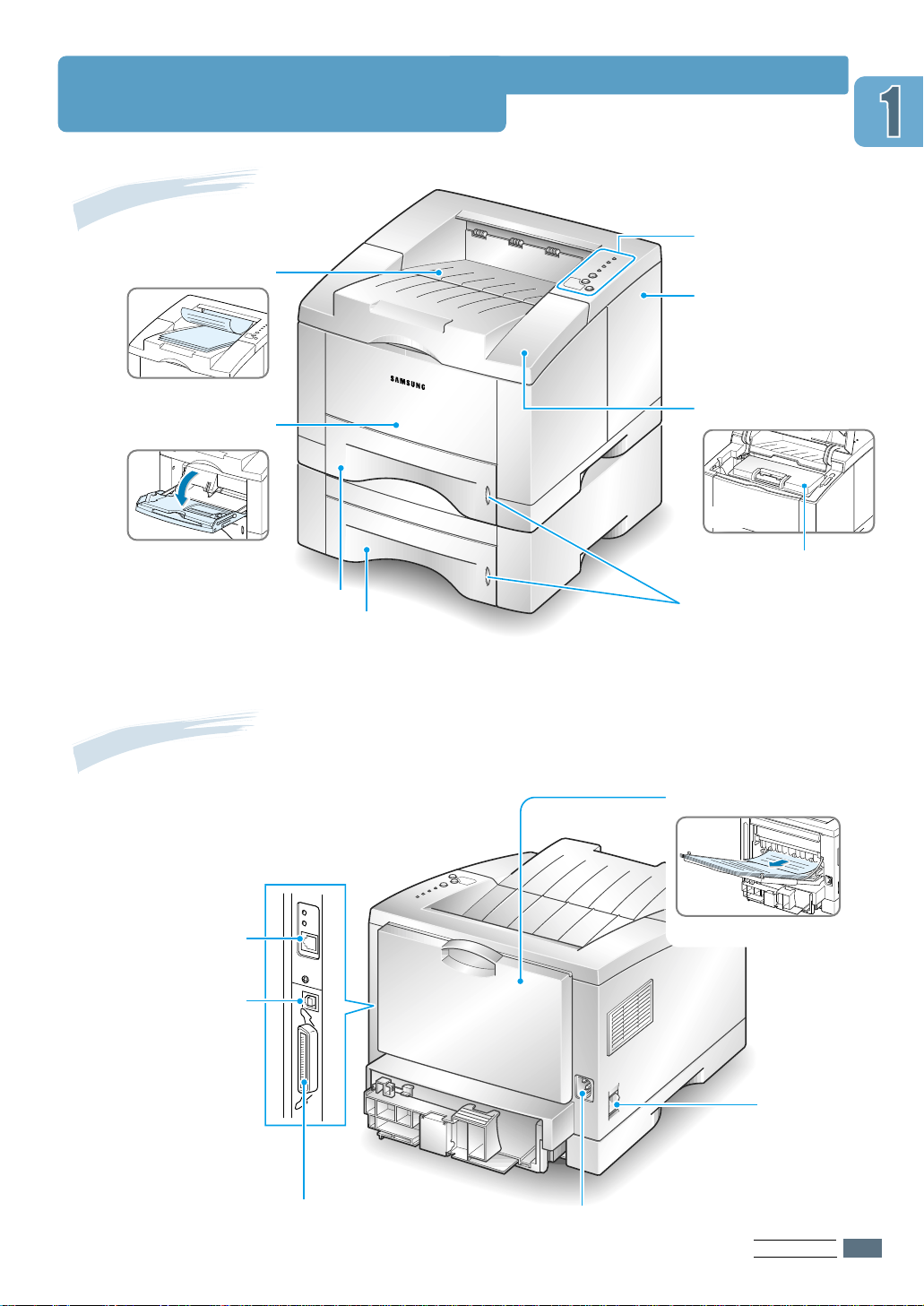
Printer Components
Front View
Top output tray
(Face down output )
Multi-Purpose Tray
Control panel
Control board cover
(needed to access the
control board to install
printer options)
Top cover
(Inside)
Toner cartridge
(550-sheet paper feeder)
Rear View
Network port
(ML-6060N and
ML-6060S: Standard
ML-6060: Option)
USB port
Tray 1
Tray 2
(Optional 550-sheet paper feeder)
Paper level
indicators
Rear output tray door
(Face up output)
Power switch
Parallel port
Power receptacle
NTRODUCTION
I
1.3
Page 15

chapter
2
2
This chapter provides step by step information on setting up
your printer. Topics included in this chapter are:
◆
◆
◆
◆
◆
◆
◆
Unpack Your Printer
:
STEP 1
: Install the Toner Cartridge
STEP 2
: Load Paper
STEP 3
: Connect to the Computer with a Parallel Cable
STEP 4
: Turn on the Printer
STEP 5
: Print a Demo Page!
STEP 6
: Install the Printer Software
STEP 7
Page 16
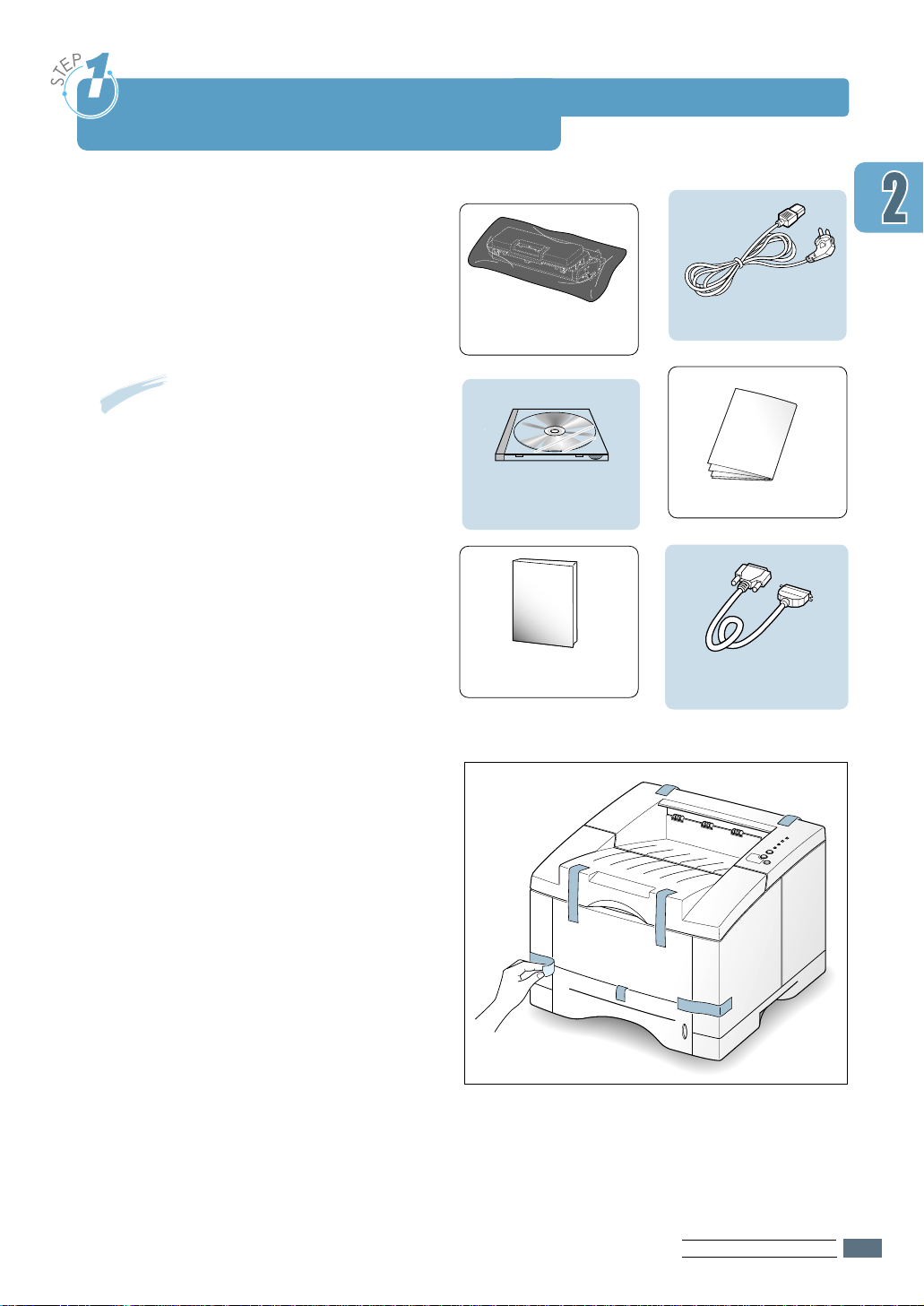
Unpack Your Printer
1
Remove the printer and all accessories
from the packing carton. Make sure that
your printer has been packed with the
following items:
Notes:
• If any items are missing or damaged,
notify your dealer immediately.
• Components may differ from one
country to another.
Toner cartridge
CD-ROM
Power cord
Quick Guide
2
Carefully remove all packing tapes from
the printer.
This manual
IEEE 1284-compliant
printer cable
ETTING U P YOUR PRINTER
S
2.1
Page 17
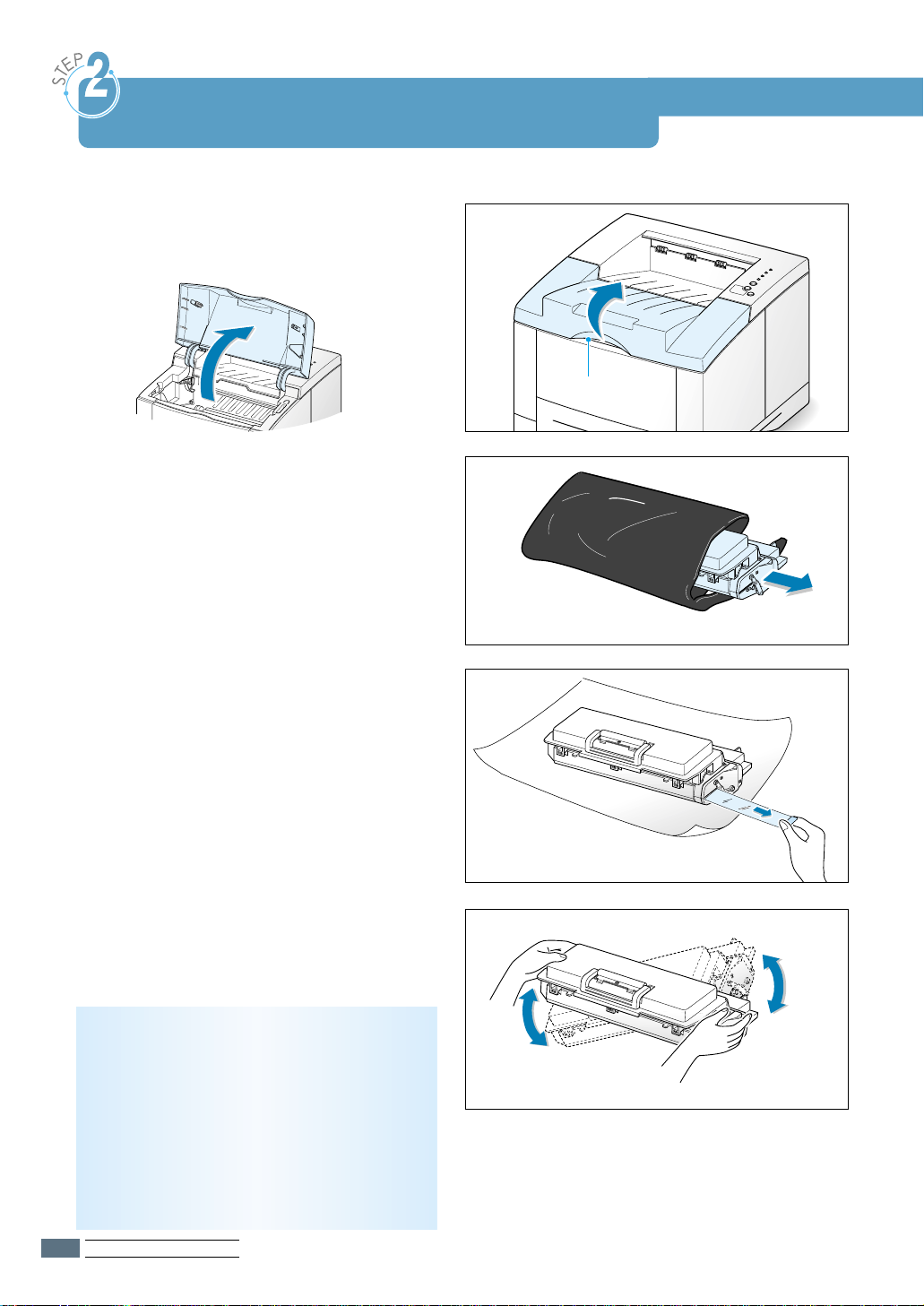
Install the Toner Cartridge
1
Open the top cover door. Pull up on the
handle to open the door.
2
Carefully tear one end of the plastic bag.
Don’t use a knife or other sharp objects
as it might scratch the drum of the
cartridge.
Handle
3
Locate the sealing tape at the end of the
toner cartridge. Carefully pull the tape
completely out of the cartridge. Discard
the tape.
4
Gently shake the cartridge from side to
side to distribute the toner evenly inside
the cartridge.
CAUTION:
To prevent damage, do not expose the
toner cartridge to light for more than a few
minutes. Cover it with a piece of paper if
left exposed for more than a few minutes.
If toner gets on your clothing, wipe it off
with a dry cloth and wash clothing in cold
water. Hot water sets toner into fabric.
ETTING U P YOUR PRINTER
S
2.2
Page 18
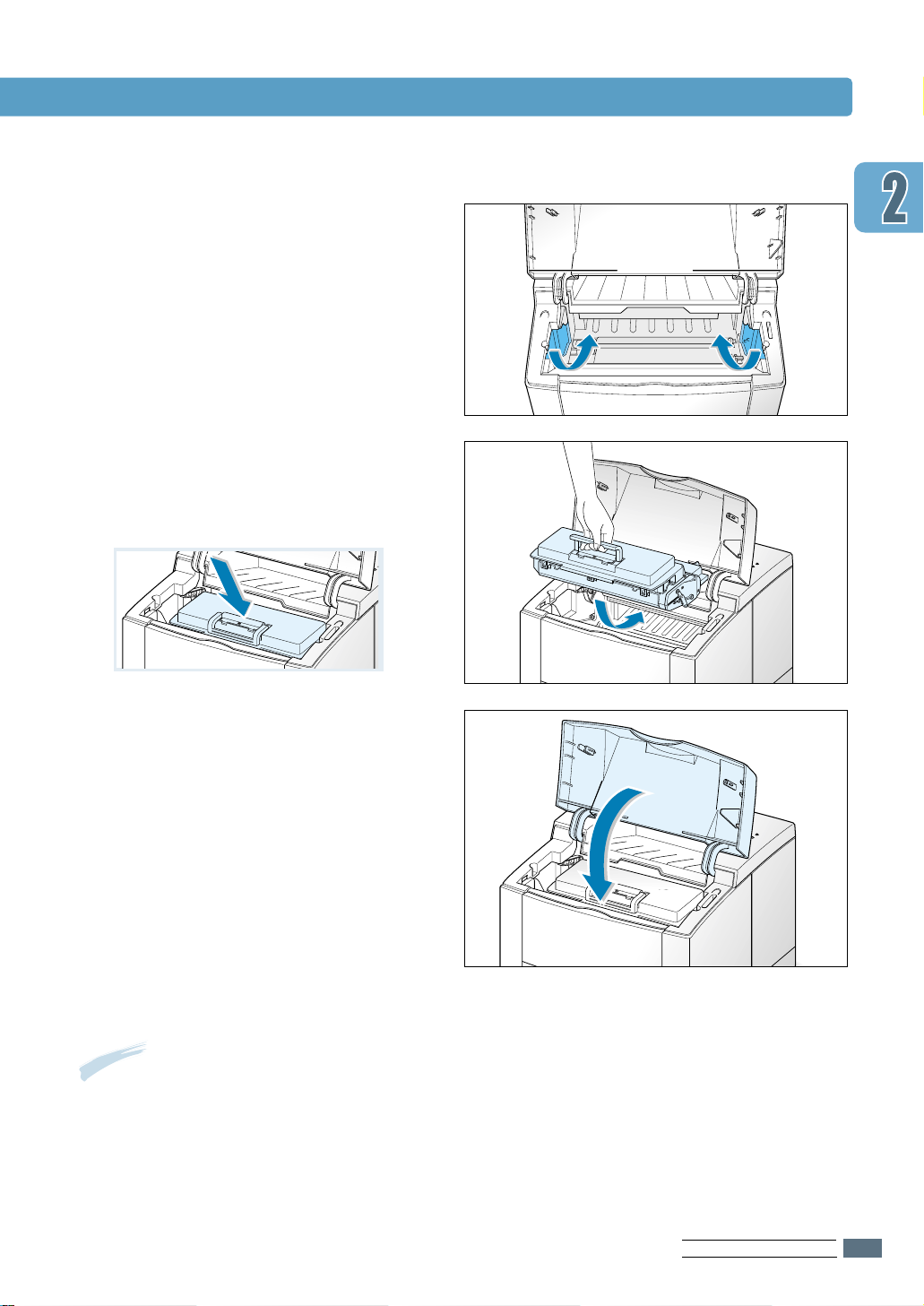
5
Locate the cartridge slots inside the
printer, one on each side.
6
Grasp the handle and insert the
cartridge in the printer until it drops into
place.
Install the Toner Cartridge
7
Close the top cover. Make sure that the
cover is securely closed.
Note: When printing text at 5% coverage, you can expect a toner cartridge life of
approximately 6,000 pages (3,000 pages for the toner cartridge that is shipped with the
printer).
ETTING U P YOUR PRINTER
S
2.3
Page 19
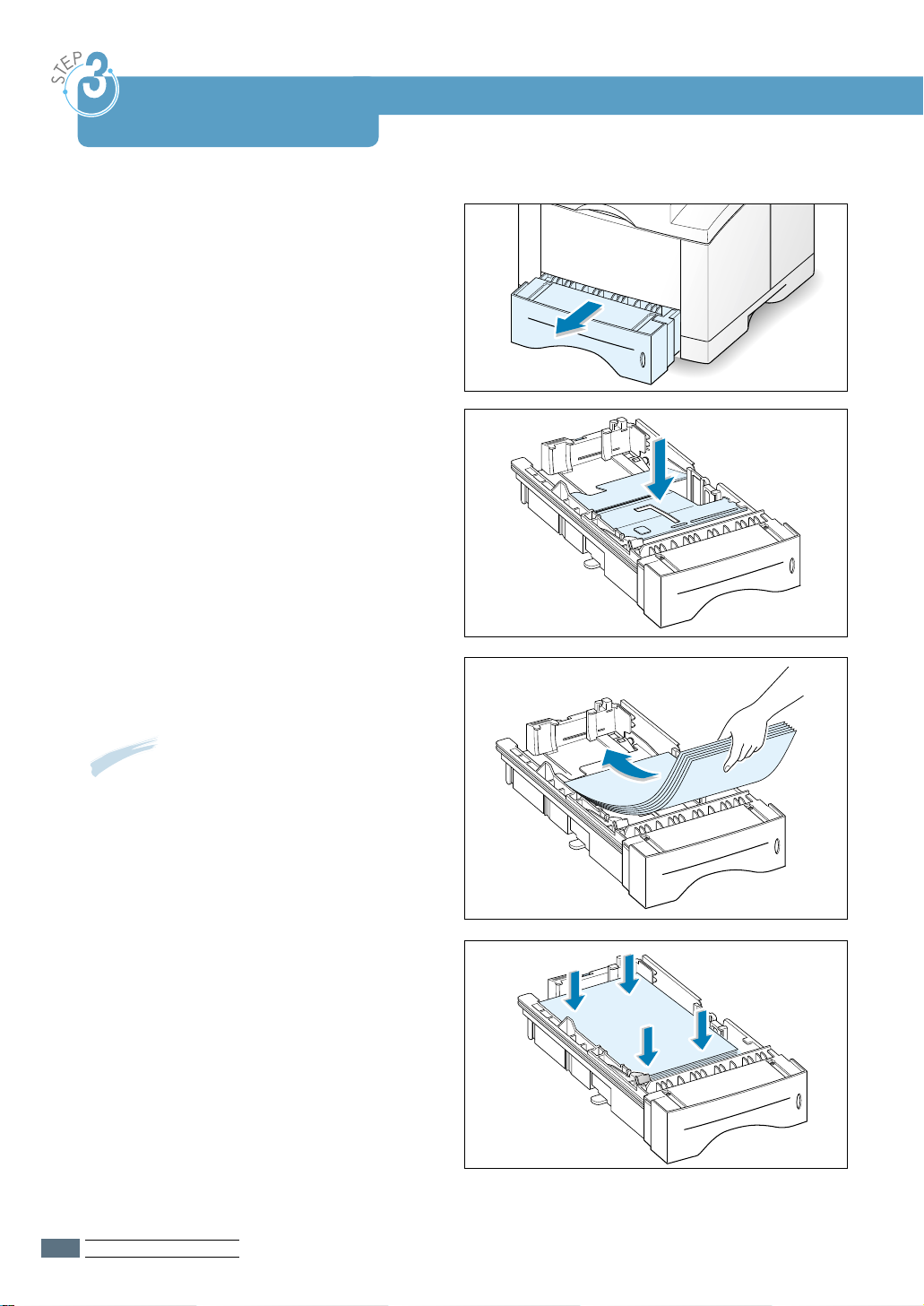
Load Paper
1
Pull the paper tray out of the printer.
2
Push down on the metal paper lift plate to
lock it in place.
3
Load paper with the print side facing
down.
NNoottee::
You can load transparencies,
letterheads, or other print media using the
same method.
Make sure it is flat in the tray at all four
corners.
ETTING U P YOUR PRINTER
S
2.4
Page 20
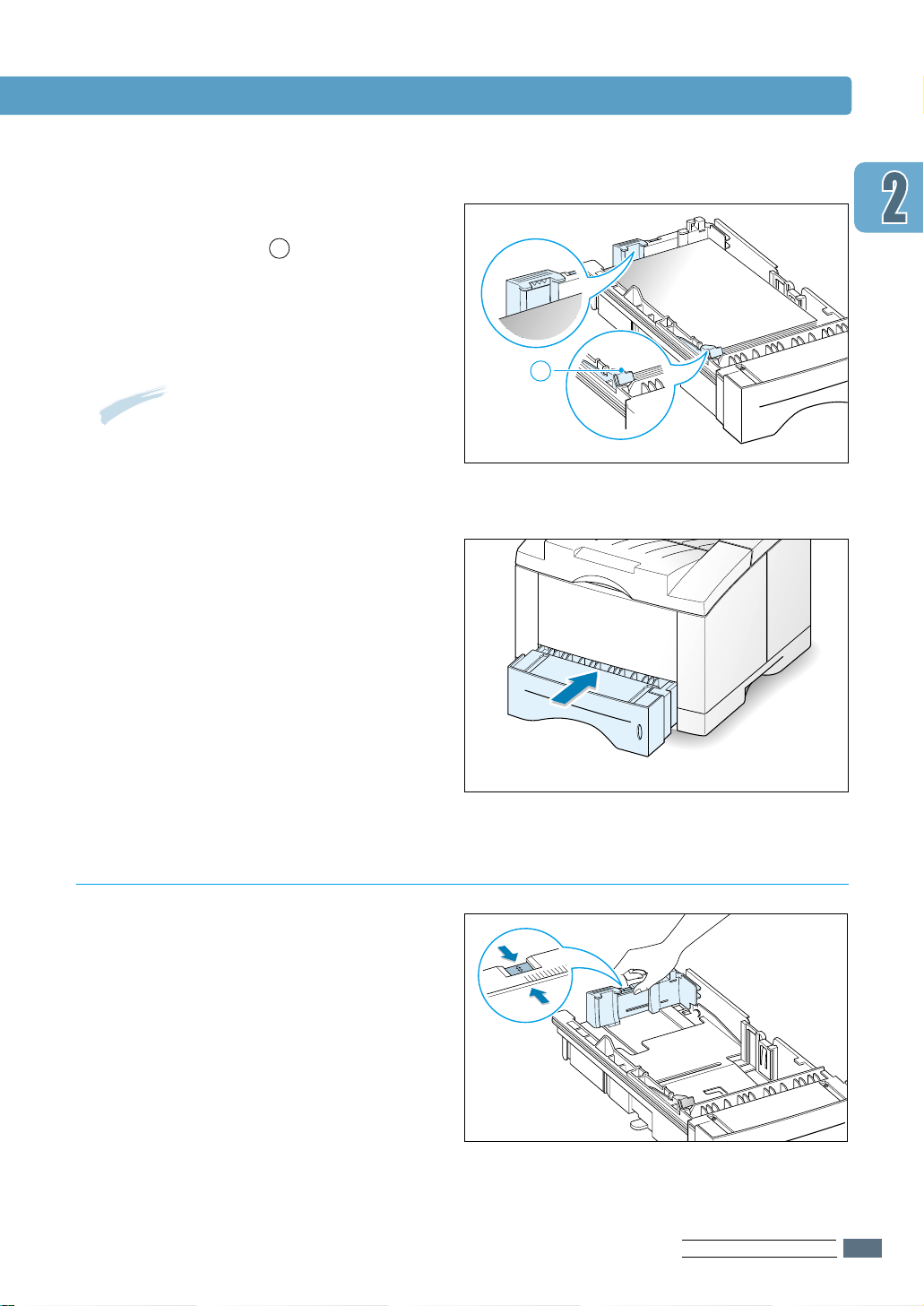
4
Make sure that the stack goes under the
metal retaining clip and the plastic
tabs on the end guides.
Paper overloading may cause paper
jams.
NNoottee::
If you want to change paper size in
tray, see below: “To Change Paper Size
in Tray.”
5
Slide the tray back into the printer.
A
Load Paper
A
To Change Paper Size in Tray
1
Squeeze the metal tab on the rear
paper guide to adjust for the paper
length.
ETTING U P YOUR PRINTER
S
2.5
Page 21
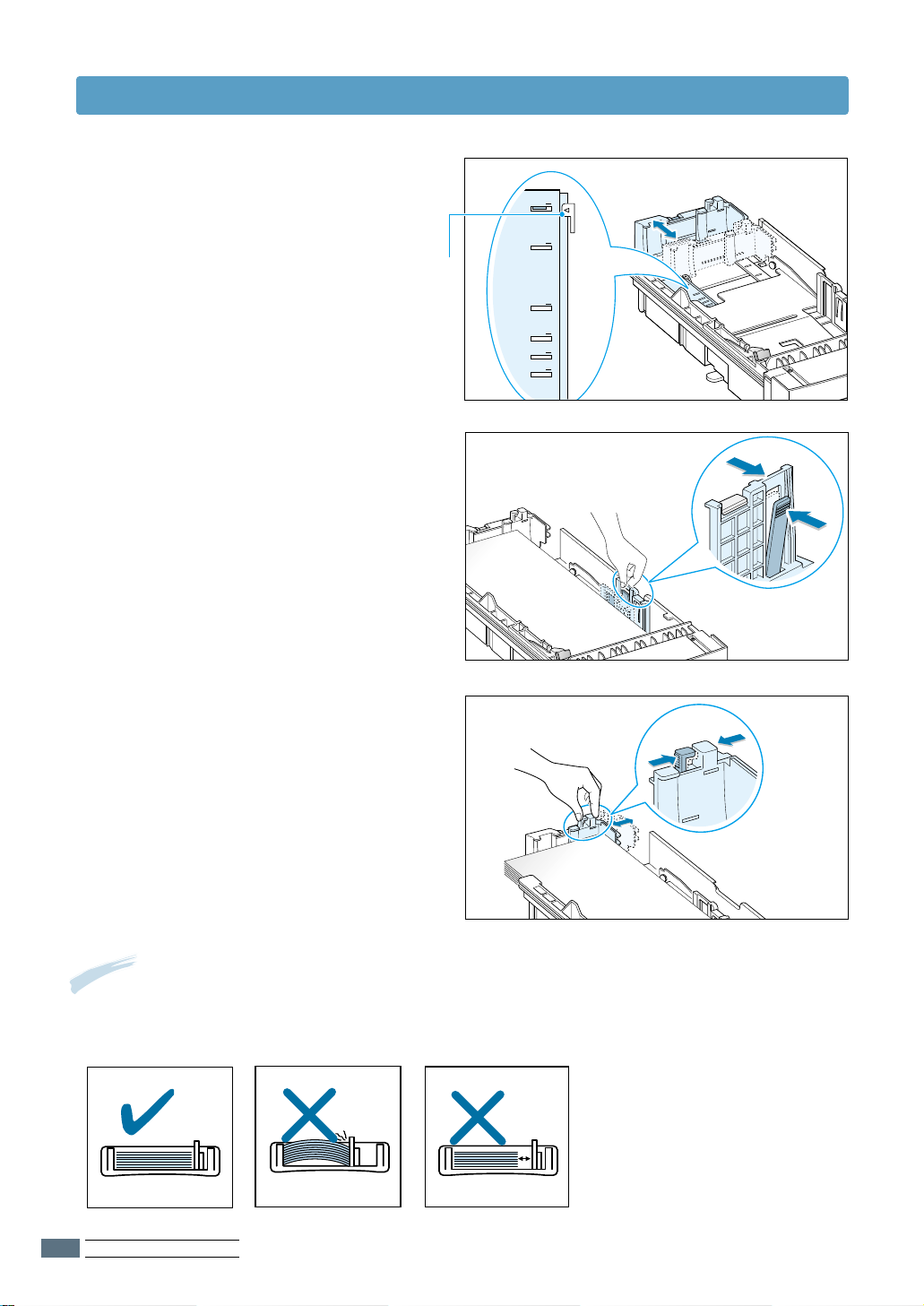
Load Paper
LGL
FOLIO
A4
LTR
EXEC
JIS B5
2
Adjust the paper length guide so the
pointer matches the desired paper size.
3
After loading paper, squeeze the side
guide as shown and slide it to the left
flush against the paper.
Pointer
4
If necessary, use the rear width guide.
Squeeze the rear width guide as shown
and slide it to the left.
Notes:
• Do not push the width guide far enough to cause the media to warp.
• If you do not adjust the width guide, it may cause paper jam.
ETTING U P YOUR PRINTER
S
2.6
Page 22
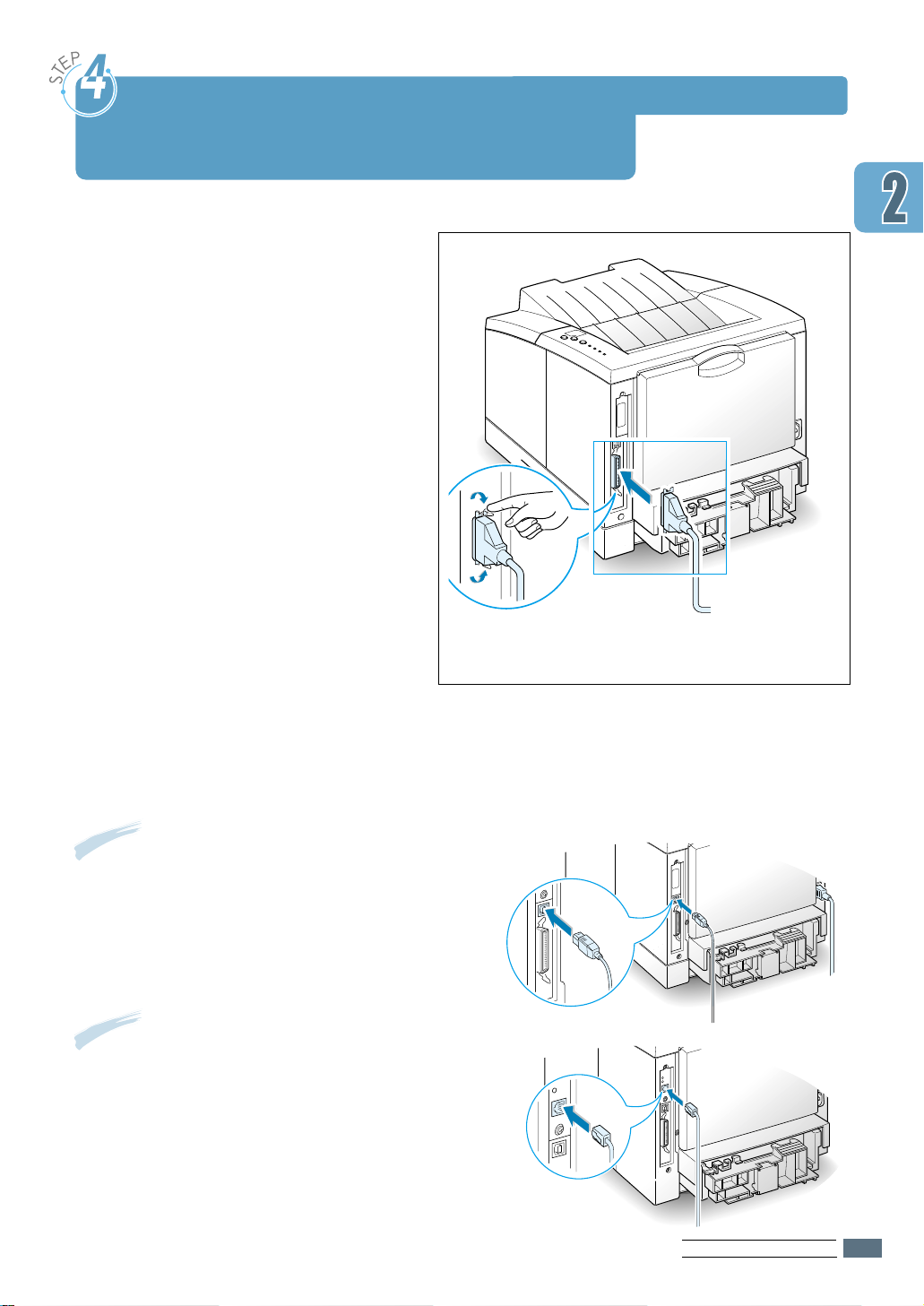
Connect to the Computer
with a Parallel Cable
1
Make sure both the printer and the
computer are turned off.
2
Plug the parallel printer cable into the
connector on the back of the printer.
Push the metal clips down to fit inside
the notches on the cable plug.
3
Connect the other end of the cable to
the parallel interface port on your
computer, and tighten the screws.
See your computer documentation if
you need help.
➞ To the parallel
port on PC
If you are using a USB interface
Go to Appendix B, “Using Your Printer with a USB
Cable.”
If you are using an optional network interface
Go to Appendix F, “Using Your Printer on Network.”
Note: ML-6060N and ML-6060S come with a built-in
network interface.
ETTING U P YOUR PRINTER
S
2.7
Page 23
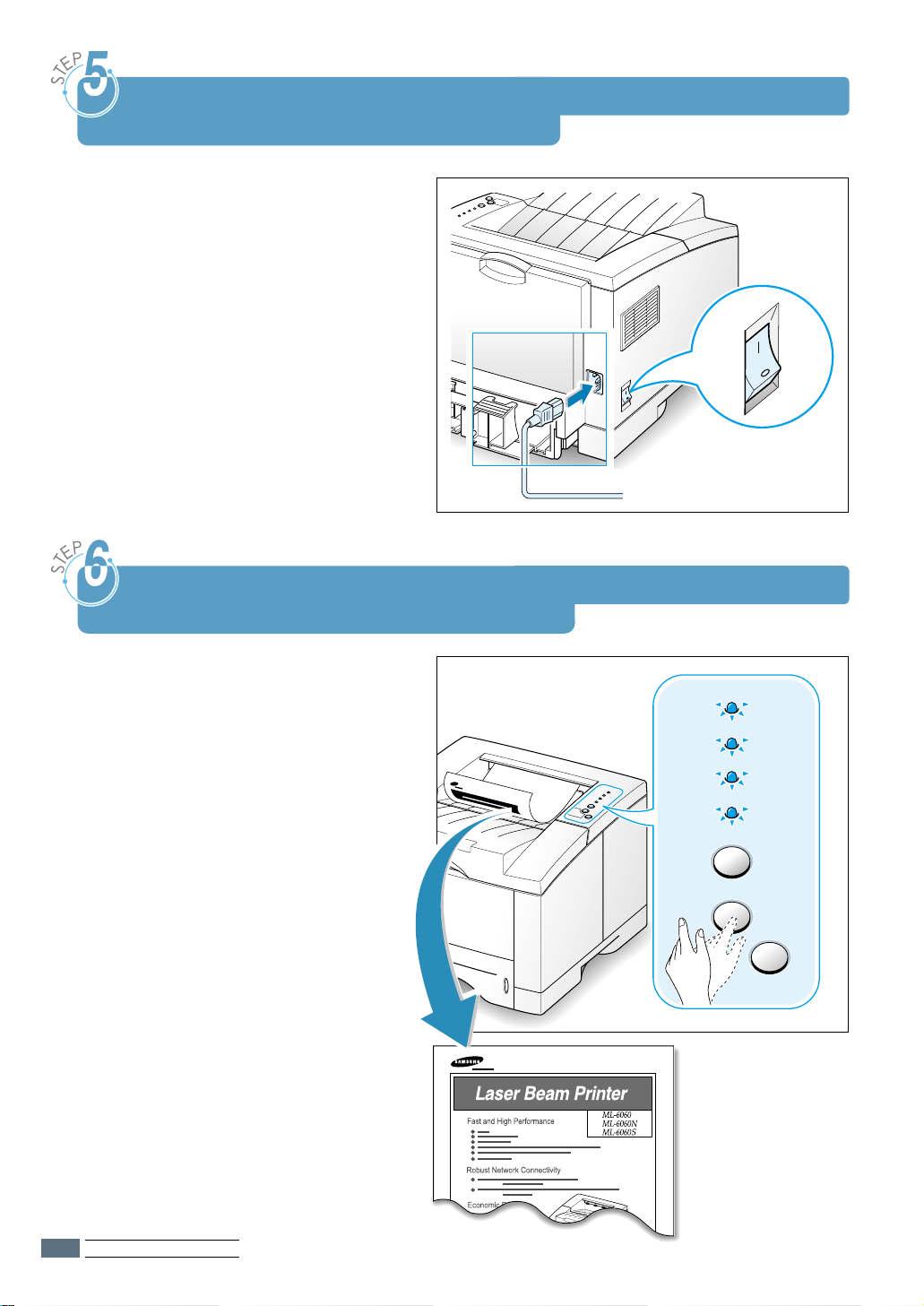
Turn on the Printer
Error
Manual
Paper
Data
Cancel/Reprint
Demo
Toner Save
1
Plug the power cord into the power
receptacle on the back of the printer.
2
Plug the other end into a properly
grounded AC outlet.
3
Turn on the power.
Print a Demo Page!
➞ To AC outlet
As the printer powers up, all the printer
control panel lights turn on briefly. When
only the Data light remains on, press and
hold the Demo button.
Hold down the button for about 2 seconds
until all lights blink slowly, then release,
the demo page will print.
The demo page provides a sample of the
print quality and help you verify the
printer is printing correctly.
ETTING U P YOUR PRINTER
S
2.8
Page 24

Install the Printer Software
Included with your printer is a CD-ROM containing the printer
drivers for some of the most popular Windows software
applications. To operate your printer, you must install a printer
driver, which translates data from your application into data
that the printer understands.
The CD-ROM shipped with your printer contains the following:
• PCL 6 printer driver for Windows. Use this driver to take full
advantage of your printer’s features.
• PostScript Printer Description (PPD) file for Windows and
Macintosh to allow installation of the PostScript driver.
If you are printing from a computer with a parallel cable
Go to page 2.10 for information on installing the printing
software on a computer that is attached directly to the printer
with a parallel cable.
If you are printing with a USB
Go to Appendix B, “Using Your Printer with a USB Cable”, for
information on installing the print software on a USB-enabled
computer.
If you are printing from a Macintosh
Go to Appendix C, “Using Your Printer with Macintosh”, for
information on installing the PostScript option for Macintosh.
If you are printing from DOS
Go to Appendix D, “Printing from DOS Applications”, for
information on installing the DOS print software and printing
from DOS application.
If you are printing with PostScript driver
Go to Appendix E, “Using Windows PostScript Driver”, for
information on installing the PPD file.
If you are using Linux
Go to Appendix I, “Using Your Printer in Linux”, for information
on installing the Linux driver.
ETTING U P YOUR PRINTER
S
2.9
Page 25
Install the Printer Software
S
A
M
S
U
N
G
M
L
-
6
0
6
0
Before Installing the Printer Software
Verify the following:
• At least 16 MB or more of RAM is installed on your PC.
• There is at least 30 MB of free disk space on your PC.
• All applications are closed on your PC before beginning
installation.
• Windows 95, Windows 98, Windows NT 4.0 or Windows 2000.
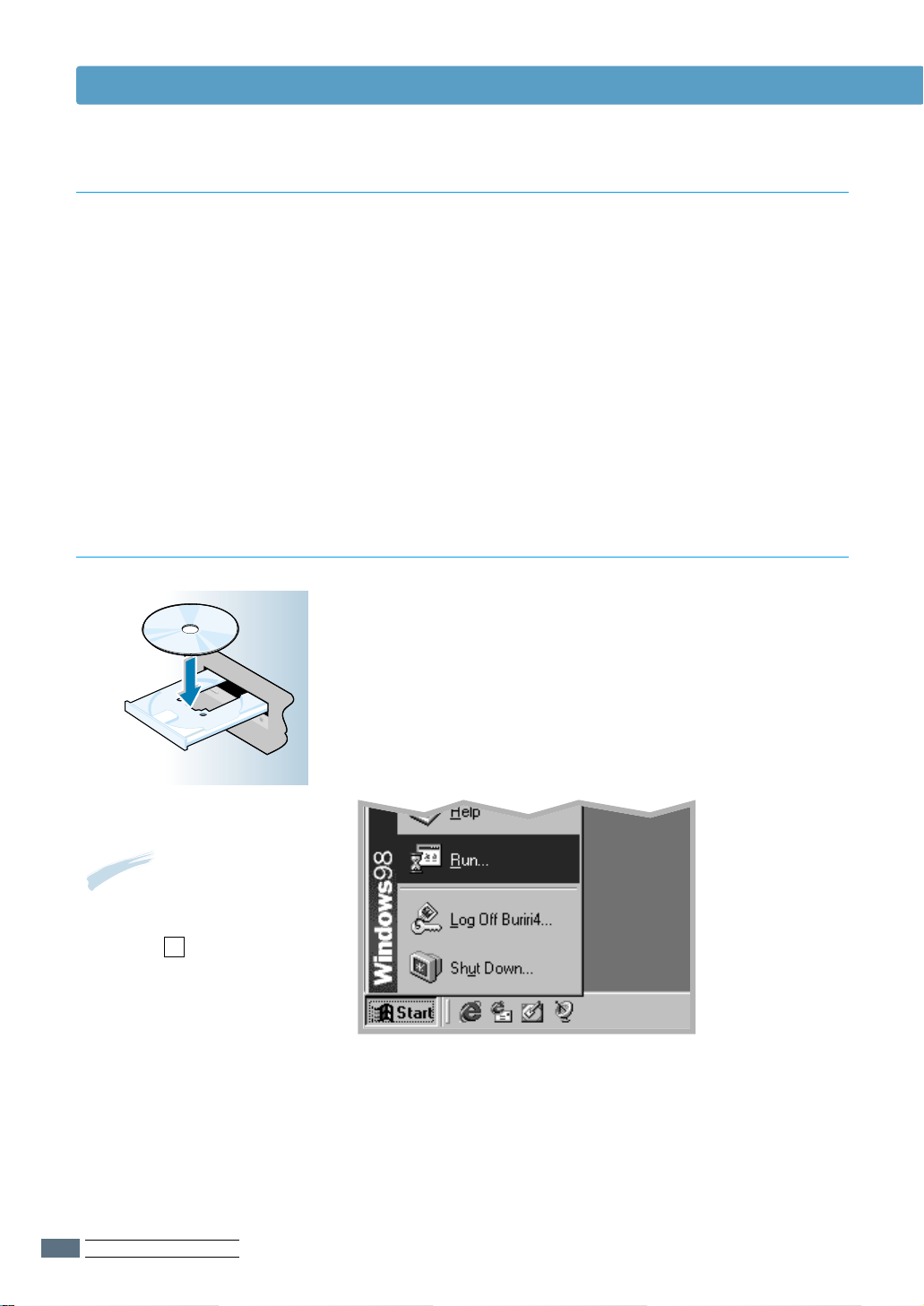
Installing the Printer Software from the CD-ROM
Place the CD-ROM in the CD-ROM drive. Installation will
1
start automatically.
Note: If the New Hardware
Found box appears during
the installation procedure,
click the x in the upper
right corner of the box,
or click Cancel.
If the CD-ROM drive does not automatically run:
Select Run from the Start menu, and type x:\cdsetup.exe
in the Open box (where x is the drive letter for the CD-ROM
drive), then click OK.
When the opening screen appears, select the appropriate
2
language.
ETTING U P YOUR PRINTER
S
2.10
Page 26

Install the Printer Software
Click Install the Samsung Software-I on your PC
3
(PCL/USB).
The Welcome window opens. Click Next.
4
Follow the instructions on the screen to complete the
5
installation.
ETTING U P YOUR PRINTER
S
2.11
Page 27
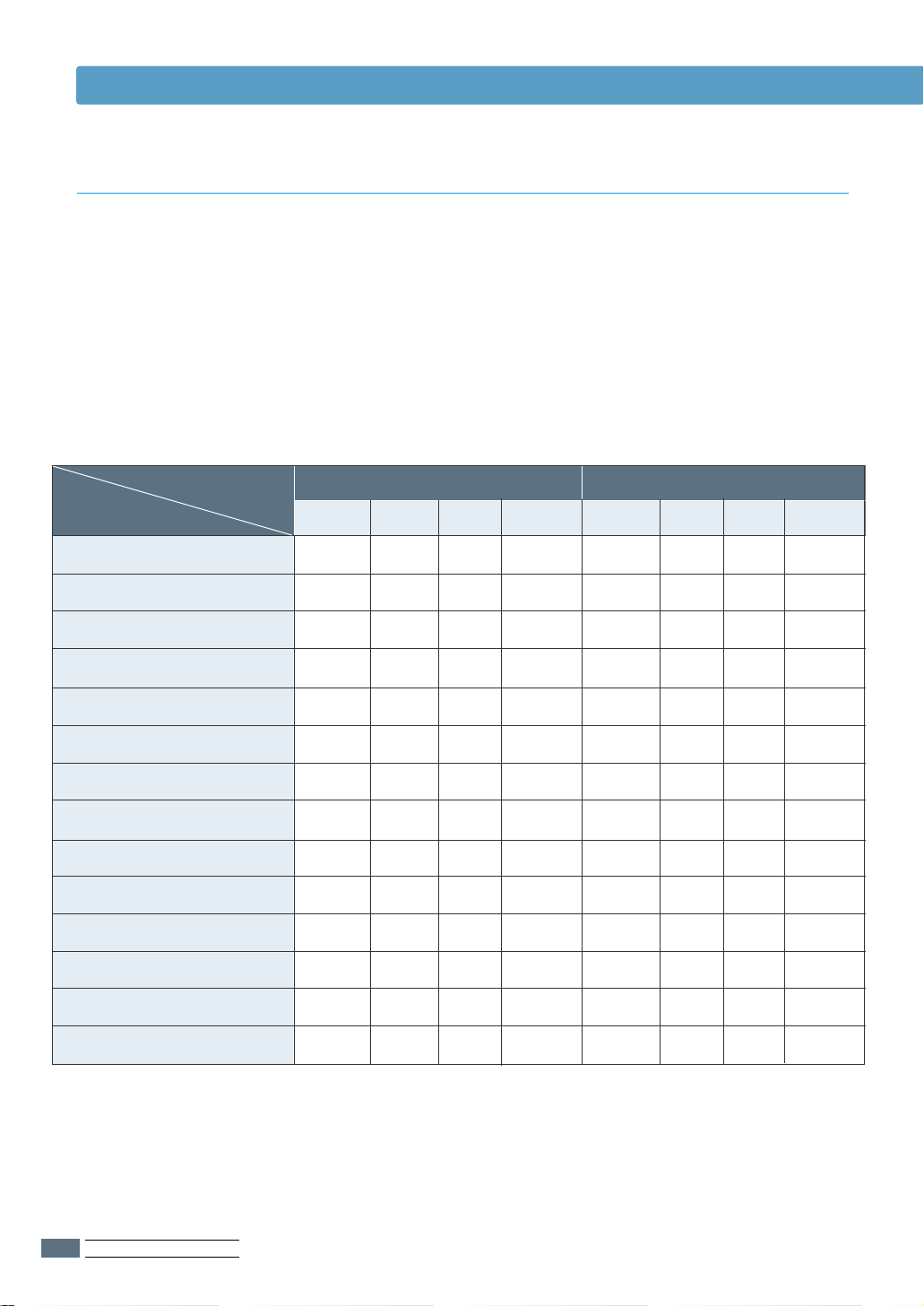
Install the Printer Software
Printer Driver Features
ML-6060 series printer drivers will support the following
standard features:
• Input tray selection
•
paper size, orientation and media type
•
number of copies
Table below lists a general overview of features supported by
the ML-6060 series printer drivers.
Driver
Features
Toner save
Print quality option
Graphic mode
Halftoning
Manual duplex
Booklet printing
Poster printing
Multiple pages per sheet (N-up)
Fit to page printing
Different source for first page
Watermark
Overlay
Win2000 Macintosh Win2000
PCL
Win9x NT4.0 Win9x NT4.0 Macintosh
YYYN
YYYY
YYYN
YYYN
YYYN
YYYN
YYYN
YYYY
YYYY
YYYN
YYYY
YYYN
Y
YYY Y
NNN N
NYY N
NNN N
NNN N
NNN N
YYN Y
NNN N
NNN Y
NNN N
NNN N
PostScript
YY N
TrueType fonts option
Error reporting
ETTING U P YOUR PRINTER
S
2.12
YYYN
YYYN
NNN N
YYY Y
Page 28

Software Installation Tips
Install the Printer Software
I do not have a
CD-ROM drive
How do I remove the
printing software ?
If you have access to another computer with a CD-ROM drive,
you can use Make diskette utility in Windows to create the
disks you need for the installation. Go to Appendix G,
“Installing Software from Diskettes”.
In Windows, after installation, the Uninstall icon in the ML-6060
series program group allows you to select and remove any or
all of the Windows ML-6060 printing system components.
Starting the Uninstaller:
1. In the Samsung ML-6060 Series Program group, select
Samsung ML-6060 Driver Uninstall.
2. Click Next.
3. Select the ML-6060 printing system components you want to
uninstall.
4. Click OK.
5. Follow the on-screen instructions.
How do I access
printer features ?
If you have
problems installing
Some printer features, such as paper size and page
orientation, may be available through your application settings.
Use application settings, if available, because they override
printer driver settings.
Access advanced printer features through your printer driver.
See the Chapter 5, “Printing Tasks” for instructions on using
your printer driver features.
• Exit your software programs. Then turn off the computer and
the printer. Turn on the printer, then turn on the computer.
• Close any virus protection programs that are running on your
computer.
• Uninstall the printer software using the instruction above,
then repeat the installation procedure.
ETTING U P YOUR PRINTER
S
2.13
Page 29

chapter
3
3
This chapter describes how to use the printer’s control
panel. It provides information on the following topics:
◆ Control Panel Buttons
◆ Control Panel Lights
Page 30
Error
Manual
Paper
Data
Cancel/Reprint
Demo
Toner Save
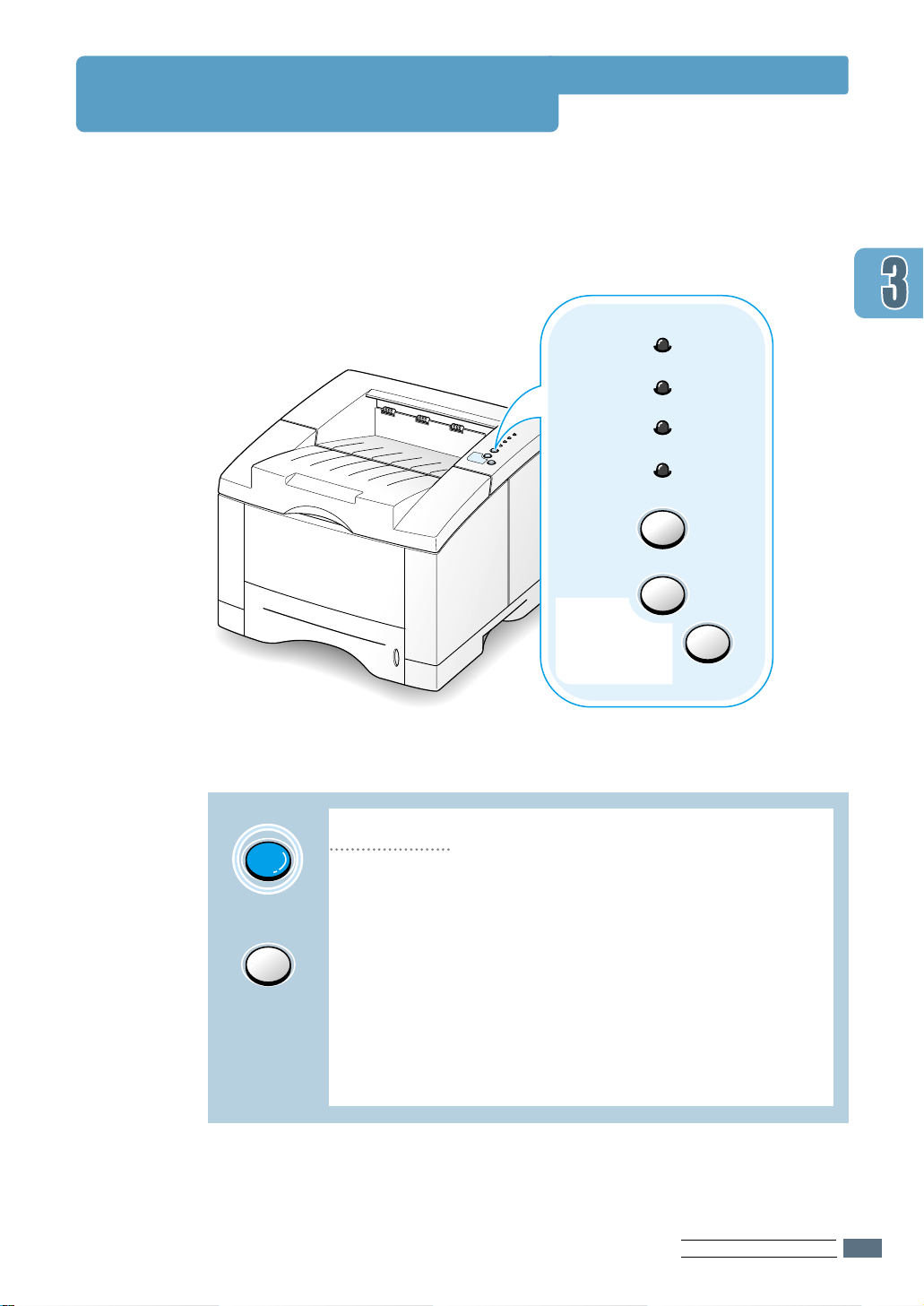
Control Panel Buttons
The printer has three buttons: Cancel/Reprint, Demo and Toner Save.
Toner Save
(on)
Toner Save
(off)
Toner Save
Press Toner Save to turn the toner save mode on or
off. The printer must be in the ready mode.
• If the button backlight is on, toner save mode
activates and the printer uses less toner to print a
document.
• If the button backlight is off, toner save mode is
disabled and you will print in normal quality. For
further information on Toner Save mode, see page
5.6.
SING THE CONTROL PANEL
U
3.1
Page 31

Control Panel Buttons
Cancel/Reprint
Cancel job
Press Cancel/Reprint and hold until the control panel
lights blink to cancel a job the printer is currently
printing. The Error light will blink while the print job
is cleared from both the printer and the computer, and
then return to the ready mode. This may take some
time, depending on the size of the print job.
Note: If the Cancel/Reprint button is accidentally
pushed, the job must be reprinted. There is no undo
function.
Reprint last page of the job
If you press Cancel/Reprint in the ready mode, the
printer prints the last page of the last print job.
Note: If you want to prevent somebody from reprinting
your document, you can turn the Reprinting feature off in
the printer’s properties dialog box. When you turn the
feature off in the printer’s properties, the
CCaanncceell//RReepprriinntt
button on the control panel does not perform the reprinting
operation.
SING THE CONTROL PANEL
U
3.2
TToo ddiissaabbllee tthhiiss ffeeaattuurree::
1. From the
SSttaarrtt
menu, select
2. Click the right mouse button on the
SSaammssuunngg MMLL--66006600 SSeerriieess PPCCLL 66
icon and select
properties window.
3. From the
empty the checkbox.
With the box empty, you cannot reprint
the last page from the control panel.
When you want to reprint the last page
on the control panel, you must put a
check mark on this check box.
4. Click
OOKK
PPrriinntteerr
.
SSeettttiinnggss
PPrrooppeerrttiieess
tab, click
then
PPrriinntteerrss
.
printer
to open the
RReepprriinntt
to
Page 32

Control Panel Buttons
Demo
Print demo page and configuration sheet
Press and hold Demo for about 2 seconds until the
control panel lights blink slowly to print a demo page.
The printer must be in the ready mode.
Press and hold Demo for about 6 seconds until the
control panel lights blink rapidly to print a configuration
sheet. The printer must be in the ready mode. For
further information, see page 7.6.
Start manual feeding
When you select Manual Feed for Paper Source
from your software application, you should press
Demo each time you feed a sheet of paper manually.
For further information, see page 4.10.
Cleaning the inside of the printer
Press and hold Demo for about 10 seconds until the
control panel lights remain illuminated to automatically
clean the printer inside. After cleaning the printer, one
cleaning sheet prints. For further information, see page
7.6.
SING THE CONTROL PANEL
U
3.3
Page 33

Error
Manual
Paper
Data
Error
Manual
Paper
Data
Control Panel Lights
The control panel lights indicate the status of your printer. If the Error light is
on, the printer is experiencing an error. See “Troubleshooting Error Messages”
on page 7.22.
Control Panel Light Message
Ready Mode
The Data light is on and the printer is ready to print.
No action is needed. If you press and hold the Demo
button for about 2 seconds, a demo page will print. If
you press and hold the button for about 6 seconds, a
configuration sheet will print.
Light status legend
symbol for “light off”
symbol for “light on”
symbol for “light blinking”
SING THE CONTROL PANEL
U
3.4
Processing
The printer is receiving or processing data. Wait for the
job to print.
Pressing the Cancel/Reprint button cancels the
current job. One or two pages may print as the printer
clears the print job. The printer will return to the ready
mode after the job has been canceled.
Data
The Data light blinks rapidly. Data is in the printer
memory waiting to be printed.
Pressing the Cancel/Reprint button cancels the
current job and the printer returns to the ready mode.
Page 34

Control Panel Lights
Error
Manual
Paper
Data
Error
Manual
Paper
Data
Error
Manual
Paper
Data
Error
Manual
Paper
Data
Paper out
The printer is out of paper. The Paper light blinks until
paper is added.
Load paper into the printer. There is no need to press
any button to reset.
Manual feed mode
The printer is set to Manual Feed mode. You have to
feed paper manually through the Multi-Purpose Tray. If
you do not want to be in the Manual Feed mode,
change the setting from your printer properties. For
details on the Manual Feed mode, see page 4.10.
Paper out in the manual feed mode
In the Manual Feed mode, the printer picks up paper
from the Multi-Purpose Tray, one sheet at a time.
Feed the correct paper in the Multi-Purpose Tray, and
press the Demo button to start printing.
Printing in the manual feed mode
The printer is processing data in the Manual Feed mode.
Wait for the job to print.
SING THE CONTROL PANEL
U
3.5
Page 35

chapter
4
4
This chapter will help you understand what kind of paper
you can use with the ML-6060 series printer and how to
properly load paper in the different paper trays for the best
print quality.
Topics included in this chapter are:
◆ Choosing Paper and Other Media
◆ Selecting Output Tray
◆ Loading Paper
◆ Printing on Envelopes
◆ Printing on Labels
◆ Printing on Transparencies
◆ Printing on Preprinted Paper
◆ Printing on Card Stock or Custom-sized Media
Page 36

Choosing Paper and Other Media
You can print on a variety of print media, such as plain paper,
envelopes, labels, transparencies, card stocks and so on. See
“Paper Specifications” on page A.2. To get the best possible
print quality, use only high-quality copier-grade paper.
When you choose print media, consider the followings:
• Desired outcome: The paper you choose should be
appropriate for the project.
• Size: You can use any size paper that fits easily within the
paper adjusters of the paper tray.
• Weight : Your printer supports paper weight as follows:
• 16~28 lbs bond for Tray 1 or optional Tray 2
• 16~53 lbs bond for Multi-Purpose Tray
• Brightness: Some papers are whiter than others and
produce sharper, more vibrant images.
• Surface smoothness: The smoothness of the paper affects
how crisp the printing looks on the paper.
• Opacity: Opacity refers to the degree to which printing on
one side of the paper shows through the other side. Use
paper high in opacity (or thicker paper) for two-sided
(duplex) printing.
Always test a sample of paper before purchasing large
quantities.
CAUTION: Using media that does not conform to the
specification listed in the paper specification can cause
problems that may require service. This service is not covered
by the warranty or service agreements.
RINT M EDIA
P
4.1
Page 37

Choosing Paper and Other Media
Media Sizes and Capacities
Media Size
Plain Paper
Letter
(8.5 x 11 in.)
Legal (8.5 x 14 in.)
Executive (7.25 x 10.5 in.)
Folio (8.5 x 13 in.)
A4 (210 x 297 mm)
B5 (182 x 257 mm)
A5 (148 x 210 mm)
Envelopes
No. 10
(4.12 x 9.5 in.)
Monarch (3.87 x 7.5 in.)
C5 (162 x 229 mm)
DL (110 x 220 mm)
B5 (176 x 250 mm)
Labels*
2
Letter (8.5 x 11 in.)
A4 (210 x 297 mm)
Input Source/Capacity*
Tray 1 or Optional Tray 2
Multi-Purpose Tray
550
550
550
550
550
550
–
–
–
–
–
–
–
–
100
100
100
100
100
100
100
10
10
10
10
10
25
25
1
Manual Feed
1
1
1
1
1
1
1
1
1
1
1
1
1
1
Transparency films*
(8.5 x 11 in.)
Letter
(210 x 297 mm)
A4
Card stocks*
RINT M EDIA
P
2
Bond*
4.2
2
2
–
–
–
20
20
10
1
1
1
1
1
*
Depending on paper thickness, maximum capacity may be reduced.
2
*
If you are experiencing excessive jamming, feed one sheet at a time
through the Multi-Purpose Tray.
Page 38

Paper Guidelines
Choosing Paper and Other Media
When selecting or loading paper, envelopes, or other special
media, keep these guidelines in mind:
• Attempting to print on damp, curled, wrinkled, or torn paper
can cause paper jams and poor print quality.
• Use cut-sheet paper only. You cannot use multi-part paper.
• Use only high-quality, copier grade paper.
• Do not use paper that has been already printed on or that
has been fed through a photocopier.
• Do not use paper with irregularities, such as tabs or
staples.
• Do not attempt to load any tray during printing and never
overfill the tray. This could cause a paper jam.
• Avoid paper with embossed lettering, perforations, or
texture that is too smooth or too rough.
• Colored paper should be of the same high quality as white
photocopy paper. The pigments must withstand the printer’s
fusing temperature of 400°F (205°C) for 0.1 second without
deterioration. Do not use paper with a colored coating that
was added after the paper was produced.
• Preprinted forms must be printed with nonflammable, heatresistant ink that do not melt, vaporize, or release
hazardous emissions when subject to the printer’s
approximately 400°F (205°C) fusing temperature for 0.1
second.
• Store paper in its ream wrapper until ready to use. Place
cartons on pallets or shelves, not on the floor.
• Do not place heavy objects on top of the paper, whether it
is packaged or unpackaged.
• Keep paper away from moisture, direct sunlight or other
conditions that can cause it to wrinkle or curl.
RINT M EDIA
P
4.3
Page 39

Selecting the Output Tray
S
a
m
sung
P
rin
te
r
LASER PRINTER
ML-6060
The printer has two output locations: the rear output tray and the top output tray.
To use the top output tray, be sure the rear output tray is closed. To use the rear output tray,
open it.
• If paper coming out of the top output tray has problems, such as excessive curl, try
printing to the rear output tray.
• To avoid paper jams, do not open or close the rear output tray while the printer is
printing.
Printing to the Top Output Tray
The top output tray collects paper face-down, in
correct order. The top output tray should be used
for most print jobs and is recommended for printing
the following:
• over 250 sheets of paper, continuously
""
Top output tray
""
Printing to the Rear Output Tray
The printer always prints to the rear output tray if it
is open. Paper comes out of the printer face-up,
with the last page on top.
Printing from the Multi-Purpose Tray to the rear
output tray provides the straight paper path.
Opening the rear output tray might improve output
quality with the following:
(Face down)
(Face up)
4.4
""
Rear output tray
""
RINT M EDIA
P
• over 100 sheets of paper, continuously
• envelopes
• labels
• small custom-size paper
• postcards
• paper lighter than 16 lb (60 g/m
heavier than 28 lb (105 g/m
• transparencies:
Note: Some special transparencies may have
2
) or
2
)
stacking problem by curl. In that case, please use the
face down tray.
Page 40

To open the rear output tray:
1
Open the rear door
The cover functions as the output tray.
2
Pull the extender to extend the output
tray to its full-length position to hold
longer paper.
by pulling it down
Selecting the Output Tray
.
3
If you do not want to stack the printed
pages on the rear output tray, slide the
extender to its place and close the tray.
The pages will then stack on the top
output tray.
Note: The capacity of the rear output tray
is the same as that of the Multi-Purpose
Tray. If the tray is overloaded with printed
pages, it may fall from the printer. Remove
the pages so that the tray is not overloaded.
RINT M EDIA
P
4.5
Page 41

Loading Paper
Proper paper loading helps prevent paper jams and ensure
trouble-free printing. Do not remove paper tray(s) while a job
is printing. Doing so may cause a paper jam.
The paper level indicator on the front of the paper tray(s)
shows the amount of paper currently left in the tray. When the
tray is empty, the indicator turns red.
Paper full
""!!!!
Paper empty
""
""
""!!!!
Using Tray 1 or the Optional Tray 2
Tray 1 holds 550 sheets of paper. See “Media Sizes and
Capacities” on page 4.2 for acceptable paper size and
capacities of each trays.
Load a stack of paper into the Tray 1 or optional Tray 2 and
print. For details on loading paper in the Tray 1 or optional Tray
2, see “Load Paper” on page 2.4.
Tra y 1
Optional Tray 2
RINT M EDIA
P
4.6
Page 42

Using the Multi-Purpose Tray
The Multi-Purpose Tray is located in the front of your printer.
It can be closed when you are not using it, making the printer
more compact. The Multi-Purpose Tray can hold several sizes
and types of paper, such as transparencies, cards, and
envelopes. You may also want to use the Multi-Purpose Tray
for single page print jobs on letterheads, colored paper for use
as separator sheets, or other special paper that you do not
normally keep in the paper tray.
You can load approximately 100 sheets of paper, 10 envelopes,
20 transparencies, 10 card stocks or 25 labels at a time.
When you print from the Multi-Purpose Tray, you must select
Multi-Purpose Tray for Paper Source from your software
application, and then select the paper size and type from the
software application for the paper you have loaded. See page
5.3.
Loading Paper
• Load only one size of print media at a time in the MultiPurpose Tray.
• To prevent paper jams, do not add paper when there is still
paper in the Multi-Purpose Tray. This also applies to other
types of print materials.
• Print media should be loaded face up with the top of the
print media going into the Multi-Purpose Tray first and
be
placed against the left edge of the tray.
• Do not place objects on the Multi-Purpose Tray. Also avoid
pressing down or applying excessive force on it.
""
Multi-Purpose Tray
""
RINT M EDIA
P
4.7
Page 43

Loading Paper
To load paper in the Multi-Purpose Tray:
1
Pull the Multi-Purpose Tray down toward
you.
2
Slide the extender to extend the tray to
its full-length position to hold longer
paper.
4.8
3
Prepare a stack of paper for loading by
flexing or fanning them back and forth.
Straighten the edges on a level surface.
RINT M EDIA
P
Page 44

4
Place paper with the print side face
up, and against the left edge of the
tray.
Note: Make sure that you have not
loaded too much print media. The
stack should be under the stack height
limit mark. The print media buckles if
you load a stack that is too deep, or
push it in too far.
Stack height limit mark
Loading Paper
5
Slide the paper width guide to the left
flush against the stack of print material
without bending.
6
After printing, push the extender back
to its place and close the Multi-Purpose
Tray.
RINT M EDIA
P
4.9
Page 45

Loading Paper
Using the Manual Feed
When you change the print settigs, if you select Manual Feed in the Paper Source option,
you can manually load paper in the Multi-Purpose Tray. Manually loading paper can be helpful
when you want to check the print quality after each page is printed.
This loading procedure is almost the same as the procedure for loading in the Multi-Purpose
Tray except you load paper sheet-by-sheet in the Multi-Purpose Tray, send print data to print
the first page, and press the Demo button to print each following page.
1
Load the print media in the MultiPurpose Tray with the print side up.
4.10
2
Slide the paper width guide to the left
flush against the stack of print media
without bending.
RINT M EDIA
P
Page 46

Demo
Cancel/Reprint
Demo
Toner Save
Error
Manual
Paper
Data
3
When you print a document, you must
select Manual Feed for Paper Source
from the software application, and then
select the correct paper size and type.
For details, see page 5.3.
4
Print the document.
5
The Manual light on the control panel
blinks. Press the Demo button on the
control panel.
Loading Paper
The sheet of paper is loaded and
printed.
6
After one page is printed, the Manual
light on the control panel blinks again.
Feed the next sheet into the MultiPurpose Tray and press Demo.
Repeat this step for every page to be
printed.
RINT M EDIA
P
4.11
Page 47

Printing on Envelopes
Guidelines
• Only use envelopes recommended for laser printers. Before you load envelopes in the
Multi-Purpose Tray, make sure that they are undamaged and are not stuck together.
• Do not load more than 10 envelopes into the Multi-Purpose Tray.
• Do not feed stamped envelopes.
• Never use envelopes with clasps, snaps, windows, coated lining, or self-stick adhesives.
These envelopes may severely damage the printer.
1
Open the Multi-Purpose Tray and slide
the extender to its full-length position.
4.12
2
Open the rear output tray and pull the
extender.
RINT M EDIA
P
Page 48

3
Flex or fan
through them for loading.
4
Load the envelopes with the flap side
down, and against the left edge of the tray.
The stamp area is on the left side and the
end of the envelope with the stamp area
enters the Multi-Purpose Tray first.
the envelopes to supply air
Printing on Envelopes
5
Adjust the guide to the left edge of the
envelope stack.
6
When you print on envelopes, configure
the paper source, type and size properly
in the software application. For details,
see page 5.3.
7
After printing, close the Multi-Purpose
Tray and the rear output tray.
RINT M EDIA
P
4.13
Page 49

Printing on Labels
Guidelines
• Only use labels recommended for laser printers.
• Do not load more than 25 labels into the Multi-Purpose Tray at a time.
• Verify that the labels’ adhesive material can tolerate fusing temperature of 200°C
(392°F) for 0.1 second.
• Make sure that there is no exposed adhesive material between the labels. Exposed areas
can cause labels to peel off during printing, which can cause paper jams. Exposed
adhesive can also cause damage to printer components.
• Do not feed a sheet of labels through the printer more than once. The adhesive backing
is designed for one pass through the printer.
• Do not use labels that are seperating from the backing sheet or are wrinkled, bubbled, or
otherwise damaged.
1
Open the Multi-Purpose Tray and the
rear output tray.
4.14
2
Load labels with print side up, and
against the left edge of the tray. Adjust
the guide to fit the width of the labels.
3
When you print on labels, configure the
paper source, type and size in the
software application. For details, see
page 5.3.
Note: To prevent them from sticking
together, remove label sheet from the
output tray as they are printed out.
RINT M EDIA
P
Page 50

Printing on Transparencies
Guidelines
• Only use transparencies recommended for use in laser printers.
• Do not load more than 20 transparencies into the Multi-Purpose Tray at a time.
• Make sure that the transparencies are not wrinkled or curled, and that they do not have
any torn edge.
• Hold the transparencies by the edges and avoid touching the print side. Oils from your
fingers that are deposited on the transparency can cause print quality problems.
• Be careful not to scratch or leave fingerprints on the print side.
1
Open the Multi-Purpose Tray and pull
the extender out ot its full-length
position.
2
Load transparencies with print side
up, and the top with the adhesive
strip going first. Adjust the guide to fit
the width of the transparencies.
3
When you print on transparencies,
configure the paper source, type and
size in the software application. For
details, see page 5.3.
Notes:
• To prevent transparencies from
sticking together, remove them from
the output tray as they are printed.
• Place transparencies on a flat
surface after removing them from the
printer.
RINT M EDIA
P
4.15
Page 51

Printing on Preprinted Paper
XXXXXXXXXX
Preprinted paper is a form with some type of printing on them before they are sent through
the printer, such as a letterhead having a preprinted logo or text located at the top of the
page.
Guidelines
• Letterheads must be printed with heat-resistant ink that will not melt, vaporize, or
release hazardous emissions when subjected to the printer’s fusing temperature of 400°F
(205°C) for 0.1 second.
• Ink on letterheads must be non-flammable and should not adversely affect any printer
rollers.
• Forms and letterheads should be sealed in a moisture-proof wrapping to prevent changes
during storage.
• Before you load preprinted paper as forms and letterheads, verify that the ink on the
paper is dry. During the fusing process, wet ink can come off preprinted paper.
1
Load letterheads into the tray you want
to use as shown in the figures. Adjust
the guide to fit the width of the paper
stack.
2
When you print a document on the
paper, configure the paper source, type
and size in the software application. For
details, see page 5.3.
Load with the
design face down,
bottom edge
toward the printer.
Load with the design face up,
top edge toward the printer.
4.16
RINT M EDIA
P
Page 52

Printing on Card Stock or Custom-sized Media
Postcards, 3 by 5 in.(index) cards and other custom-sized media can be printed with the ML6060 series printer. The minimum size is 98 by 148 mm (3.9 by 5.83 in.) and the maximum
size is 216 by 356 mm (8.5 by 14 in.).
Guidelines
• Always insert the short-edge first into the Multi-Purpose Tray. If you want to print in
landscape mode, make this selection through your software. Inserting paper long-edge
first may cause a paper jam.
• Do not load more than 10 cards into the Multi-Purpose Tray at a time.
• Do not print on media smaller than 98 mm (3.9 in.) wide or 148 mm(5.83 in.) long.
• Set margins at least 6.4 mm (0.25 in.) away from the edges of the media in the software
application.
1
Open the Multi-Purpose Tray and the
rear output tray and pull the extenders
on them to its full-length position.
2
Load print media with print side up,
short edge first and against the left
edge of the tray.
Adjust the guide to fit the width of the
media.
3
Configure the paper source, type and
size in the printer driver’s properties
(see page 5.3) and print.
Note: If the size of your print media is
not listed in the
Paper tab of the printer driver
properties, select Custom Size and set
the paper size manually.
Paper Size box in the
RINT M EDIA
P
4.17
Page 53

chapter
5
5
This chapter explains your printing options and give common
printing tasks.
Topics included in this chapter are:
◆
Printing a Document
◆
Using Toner Save Mode
◆
Printing on Both Sides of the Paper (Manual Duplexing)
◆
Printing Multiple Pages on One Sheet of Paper (N-Up Printing)
◆
Printing Booklets
◆
Printing on Different Paper for the First Page
◆
Fitting Your Document To a Selected Paper Size
◆
Printing Posters
◆
Setting Graphic Properties
◆
Printing Watermarks
◆
Using Page Overlay
Page 54

Printing a Document
The following procedure describes general steps required for
printing from various Windows applications. The exact steps
for printing a document may vary depending on the
application program you are using. Refer to your software
application’s documentation for the exact printing procedure.
Open the document you want to print.
1
Select Print from the File menu. The Print dialog box for
2
your application will be displayed (the Print dialog box for
your application may look slightly different).
The basic print settings you will need are usually selected
within this Print dialog box. These settings include the
number of copies, paper size, and page orientation.
a Properties button, click it.
If you see Setup, Printer, or
Options, click that button instead;
If you see
then click Properties
in the next screen.
Make sure your
printer is selected
here.
RINTING TASKS
P
5.1
Page 55

Printing a Document
To take full advantage of the printer features provided by
3
your ML-6060 series printer, click Properties in the
application’s Print dialog box and go to step 4.
If you see Setup, Printer, or Options, click that button
instead. Then click Properties in the next screen.
Now you see the Samsung ML-6060 Series printer’s
4
Properties dialog box. The Properties dialog box allows you
to access all the information you will need when using your
printer.
If necessary, click the Paper tab to display the settings
shown below. The Paper tab contains the options for
setting the basic paper handling.
5.2
RINTING TASKS
P
Page 56

Printing a Document
Make sure the Paper Source is set to Tray 1. If you use
4
paper in the Multi-Purpose Tray or optional Tray 2, select
the corresponding paper source.
Manual Feed source is used when printing to special
media. You have to feed one sheet at a time into the
printer. See page 4.10.
If the paper source is set to Auto Select, the printer
automatically selects the print media according to the
following order: Multi-Purpose Tray, Tray 1, Tray 2 (option).
Make sure the Paper Type is set to Plain Paper. If you
4
load a different type of print media, select the
corresponding paper type. For further information on print
media, refer to chapter 4 ‘Print Media’.
Also, select the paper size you have loaded in your printer.
printable
arrow
The Paper Orientation option allows you to select the
4
direction in which information is printed on a page.
Portrait prints across the width of the page, letter style.
Landscape prints across the length of the page,
spreadsheet style.
"
"
Landscape
You can also see the printable area.
4
"
"
Portrait
P
RINTING TASKS
5.3
Page 57

Printing a Document
Click other tabs on the top of the Properties dialog box to
5
access other features, if needed.
When you complete the print settings, click OK until the
6
Print dialog box is displayed.
Click OK to start printing.
7
Notes:
• Most Windows applications will override settings you specify
in the printer driver. Change all print settings available in the
software application first, and any remaining settings with the
printer driver.
• The settings you change remain in effect only while you are
using the current program. To make your changes permanent,
make them in the Printers folder. Do as follows:
1. Click the Windows Start button.
2. Select Settings, then Printers to open the Printers window.
3. Select the Samsung ML-6060 Series PCL 6.
4. Click the right mouse button and select Properties to open
the properties window.
5.4
RINTING TASKS
P
Page 58

Cancel/Reprint
Canceling a Print Job
There are two ways to stop a print job.
To stop a print job from the ML-6060 series printer
Press the Cancel/Reprint button on the control panel.
The printer will finish printing the page that is moving through
the printer and delete the rest of the print job. Pressing
Cancel/Reprint cancels only the current job in the printer. If
more than one print job is in printer memory, Cancel/Reprint
must be pressed once for each job.
Printing a Document
Printing Help
To stop a print job from the Printers folder
1. From the Start menu, select Settings.
2. Select Printers to open the Printers window, then doubleclick the Samsung ML-6060 Series PCL 6.
3. From the Document menu, select Cancel Printing
(Windows 9x) or Cancel (Windows NT 4.0).
Samsung ML-6060 series printer has a help screen that can be
activated by the Help button in the printer Properties dialog
box. These help screens give detailed information about the
printer features provided by the ML-6060 series printer driver.
From the upper right hand corner, click ? then click on a
setting for more information.
If you want to restore the default printer properties settings
when you change the print settings, click Defaults in the
Properties dialog box.
RINTING TASKS
P
5.5
Page 59

Toner Save
Using Toner Save Mode
Toner Save mode allows the printer to use less toner on each
page. Selecting this option will extend the life of your toner
cartridge and reduce your cost per page, but will reduce print
quality. This setting is not available with 1200 dpi settings.
There are two ways to enable the Toner Save mode.
To enable this feature from the ML-6060 series printer
Press the Toner Save button on the control panel. The printer
must be in the ready mode (Data light is on).
• If the button backlight is on, toner save mode activates and
the printer uses less toner to print a page.
• If the button backlight is off, toner save mode is disabled
and the printer prints in the normal mode.
To enable this feature from the software application
1. When you change the print settings from your software
application, access the printer properties. See page 5.2 to
access the printer properties.
2. Click the Graphic tab, and select the Toner Save Mode
option. You can select from:
• Printer Setting: If you select this option, this feature is
determined by the setting you’ve made on the control
panel of the printer.
• Standard: If you don’t need to save toner to print a
document, select this option.
• Save: Select this option to allow the printer to use less
toner on each page.
3. Click OK.
5.6
RINTING TASKS
P
Page 60

Printing on Both Sides of the Paper
To print on both sides of the paper (manual duplexing), you
must run the paper through the printer twice. You can print
using the top output tray (face down tray) or the rear output
tray (face up tray). Samsung recommends using the top
output tray for light-weight paper. Use the rear output tray for
any heavy media or media that tends to curl when printed,
such as envelopes and card stock.
Note: To print on both sides of the paper, you must use the
(Manual Duplexing)
Multi-Purpose Tray for the paper input source. Load paper in
the Multi-Purpose Tray.
When you change the print settings from your software
1
application, access the printer properties. See page 5.2 to
access the printer properties.
From the Paper tab, select the paper orientation, source,
size and type.
Note: If you can not see
Long Edge in the Type dropdown list, set the Type box in
the Output Mode section to
Multiple Pages per Side or Fit
to Page.
Click the Output tab, then choose Long Edge or Short
2
Edge from the Type drop-down list in the Manual 2 Sided
Printing section.
RINTING TASKS
P
5.7
Page 61

Printing on Both Sides of the Paper (Manual Duplexing)
25
3
2
5
3
2
5
3
2
5
3
Choosing Long Edge lets you have the binding orientation
along the long edge of the paper as in a magazine.
Choosing Short Edge lets you have the binding orientation
along the short edge of the paper as in a calendar.
"
"
Long Edge in the
Portrait orientation
"
"
Long Edge in the
Landscape orientation
➛!!
Short Edge in
➛!!
the Portrait
orientation
"
"
Short Edge in the
Landscape orientation
Select Face Down tray (top output tray) or Face Up tray
3
(rear output tray) in which the printed media is stacked.
According to this option, the printer will determine the print
page order when the second sides are printed.
If you want the instruction page which tells you how to load
4
the paper, click Printing Instruction Page. If the box is
checked, the printer prints the instruction page before the
duplexing job is printed. If the box is empty, this feature is
disabled.
Start printing. The printer automatically prints only the
5
odd-numbered pages.
RINTING TASKS
P
5.8
Page 62

Remove the printed
paper, and reload them
into the Multi-Purpose
Tray with printed side
face down.
Printing on Both Sides of the Paper (Manual Duplexing)
After the first side has been printed, remove the remaining
6
paper from the Multi-Purpose Tray and set it aside until
after you finish your manual duplexing job.
Gather up the printed pages, flip the stack, and then
7
straighten the stack before placing it back in the MultiPurpose Tray.
Note: If you have selected the Face Up tray option at Step
3, the last page is placed on the top of the stack. Do not
rearrange the pages before reloading the pages to print the
second side. Your printer knows the stacked page order and
will print the corresponding second side for each page.
The following illustrations show how to put the paper back
into the printer.
Note: Manual duplexing
can cause the printer to
become dirty more quickly
and reduce print quality.
See “Cleaning the Printer”
on page 6.4 if the printer
becomes dirty.
(left edge toward
the printer)
Long Edge in the
Landscape orientation
(top edge toward
the printer)
Long Edge in the
Portrait orientation
You are prompted to reinsert the paper into the Multi-
8
Short Edge in the
Landscape orientation
Short Edge in the
Portrait orientation
(right edge toward
the printer)
(bottom edge
toward the printer)
Purpose Tray. Click OK on screen to start printing the
second side. The printer automatically prints only the evennumbered pages.
RINTING TASKS
P
5.9
Page 63

1 2
4
3
65
rinting Multiple Pages on
P
One Sheet of Paper
1 2
3 4
"!4 pages per sheet
"!
"!6 pages per sheet
"!
You can select the number of pages you want to print on a
single sheet of paper. If you choose to print more than one
page per sheet, the pages will appear decreased in size and
arranged on the sheet. You can specify up to 16 pages.
When you change the print settings from your software
1
application, access the printer properties. See page 5.2 to
access the printer properties.
From the Paper tab, select the paper orientation, source,
size and type.
Click the Output tab, and choose Multiple Pages per
2
Side in the Type drop-down list. Then select the number of
pages you want to print per sheet (1, 2, 4, 6, 9 or 16) in
the Pages per Sheet drop-down list.
Click Print Page Borders if you want to print a border
3
around each page on the sheet. Print Page Borders is
enabled only if Pages per Sheet is 2, 4, 6, 9, or 16.
(N-Up Printing)
5.10
RINTING TASKS
P
Click OK, then start printing.
4
Page 64

Printing Booklets
8
9
7
1
9
Booklet printing feature allows you to print your document as
a 2-sided (duplex) job and arrange the pages so that the
paper can be folded in half after printing to produce a booklet.
"
Portrait orientation
Landscape orientation
"
"
"
Note: To print booklet, you must use the Multi-Purpose Tray for
the paper input source. Load paper in the Multi-Purpose Tray.
When you change the print settings from your software
1
application, access the printer properties. See page 5.2 to
access the printer properties.
From the Paper tab, select the paper orientation, source,
size and type.
Note: For booklet printing, only four paper sizes are
supported: Letter, A4, Legal, and Executive.
Click the Output tab, then choose Booklet Printing from
2
the Type drop-down list.
When you select Booklet Printing, the Manual 2 Sided
Printing option automatically changes to Short Edge. This
setting is required to format the printed pages correctly.
RINTING TASKS
P
5.11
Page 65

Printing Booklets
63
Select Face Down tray (top output tray) or Face Up tray
3
(rear output tray) in which the printed media will be stacked.
According to this option, the printer will determine the print
page order when the second sides are printed.
If you want the instruction page which tells you how to load
4
the paper, click Printing Instruction Page. If the box is
checked, the printer prints the instruction page before the
duplexing job is printed. If the box is empty, this feature is
disabled.
Print the document.
5
After side one has been printed, remove the remaining
6
paper from the Multi-Purpose Tray and set it aside until
your booklet job is complete.
The printer prints side one as shown below for an 8-page
document.
81
"!
8 page document
"!
RINTING TASKS
P
5.12
Page 66

8
9
Remove the printed paper,
and reload them into the
Multi-Purpose Tray with
printed side face down.
Printing Booklets
Gather up the printed pages, flip the stack, and then
7
straighten the stack before placing it back in the multipurpose tray. The following illustrations show how to put
the paper back into the printer.
In Portrait orientation,
insert the pages with
left edge
toward the printer.
"!
Face Down tray output
"
Face Up tray output
"
"!
Note: If you have
selected the Face Up tray
option at Step 3, the last
page is placed on the top
of the stack. Do not
rearrange the pages
before reloading the
pages. Your printer knows
the stacked page order
and will print the
corresponding second side
for each page.
In Landscape orientation,
insert the pages with
bottom edge
toward the printer.
"
Face Up tray output
"
You are prompted to reinsert the paper into the Multi-Purpose
8
"
Face Down tray output
"
Tray. Click OK on screen. The printer will finish printing.
Fold and staple the pages.
9
RINTING TASKS
P
5.13
Page 67

Printing on Different Paper for the First Page
When you change the print settings from your software
1
application, access the printer properties. See page 5.2 to
access the printer properties.
Click the Paper tab, and click Different Source for First
2
Page.
If the box is checked, this feature is enabled and the dialog
box allows you to select the desired paper source for the
First Page and Other Pages independently. If the box is
empty, this feature is disabled.
5.14
RINTING TASKS
P
Click OK, then start printing.
3
Note: The paper size for all pages of the print job must be
the same.
Page 68

Fitting Your Document To a Selected Paper Size
A
This printer feature allows you to scale your print job to any
selected paper size regardless of the digital document size.
This can be useful when you want to check fine details on a
small document.
When you change the print settings from your software
1
application, access the printer properties. See page 5.2 to
access the printer properties.
Click the Output tab, and select Fit to Page in the Type
2
drop-down list.
You’ll see the Application page size and be prompted to
3
select the Fit to Paper Size. Select the correct size from
the drop-down list.
Click OK, then start printing.
4
RINTING TASKS
P
5.15
Page 69

Printing Posters
This feature allows you to print a single-page document onto
4, 9, or 16 sheets of paper, which can be pasted together to
form one poster-size document.
When you change the print settings from your software
1
application, access the printer properties. See page 5.2 to
access the printer properties.
From the Paper tab, select the paper orientation, source,
size and type.
"
"
Poster printing
with 2x2 style
Click the Output tab, and select Poster in the Type drop-
2
down list.
5.16
RINTING TASKS
P
Page 70

Printing Poster
To determine the scaling factor, select the Style; 2x2, 3x3,
3
4x4 or Custom.
For example, if you select 2x2, the output will be
automatically stretched to cover 4 physical pages.
If you select Custom, you can adjust the scaling factor
manually. For example, if you specify 150%, the image will
be printed across 4 pages with 150% scaled.
➛!!
2 x 2
➛!!
You may specify an overlap in pixel to make it easier to
4
➛!!
Custom (150%)
➛!!
reconstruct the resulting poster.
25 pixels
"!!
Overlap=0
"!!
Click OK, then start printing.
5
"!!
Overlap=25
"!!
25 pixels
RINTING TASKS
P
5.17
Page 71

Setting Graphic Properties
Use the following options to adjust the print quality for your
specific printing needs when you access the printer properties.
See page 5.2 to access the printer properties.
If necessary, click the Graphic tab to display the settings shown
below.
5.18
RINTING TASKS
P
Page 72

Setting Graphic Properties
Resolution
SRT Mode
You can select the printing resolution; 1200 dpi, 600 dpi,
300 dpi. The higher the setting, the sharper the clarity of
printed characters and graphics. Higher settings may increase
the time it takes to print a document.
Some printed characters or images can appear to have jagged
or uneven edges. Set this Samsung Resolution enhancement
Technology (SRT) option to improve the print quality of your
text and image and make the characters and images appear
smoother.
Note: SRT Mode is disabled when 1200 dpi settings are
selected.
• Printer Default – Choose this setting to use SRT that your
printer provides.
• Normal – SRT mode is disabled. Choose this setting if
graphics, particularly scanned images, are not
printing clearly.
• Text Enhance – This setting refines the print quality of
characters by smoothing out jagged edges
that can occur on the angles and curves of
each character.
• Image Enhance – This setting refines the print quality of
photo image using SRT.
RINTING TASKS
P
5.19
Page 73

Setting Graphic Properties
Graphic Mode
This option can be used for configuring the printer to process
graphics as raster or vector images. Setting this option tells
Windows how to send graphic images to the printer. All
graphics can be printed as raster images, however some
geometric shapes or patterns print faster if they are printed as
vector graphics.
• Vector – If you select the Vector setting, Windows will send
graphics to the printer as a mixture of vector and
raster images.
• Raster – When you select the Raster setting, Windows will
send all graphics to the printer as bit map raster
images.
Note: Not all graphic images can print using the Vector
setting. If you are using the Vector setting, and your graphic
images do not print as they appear on your computer screen,
select the Raster setting and reprint your graphic.
5.20
RINTING TASKS
P
Halftoning
This option can be used for configuring the halftone of the
printed illustration. The best way to choose a Halftoning setting
for your graphic image is to experiment. Print a graphic image
at each setting and choose the one you like best.
• Device – Choose this setting for printed graphic image that
printer provides.
• Fine – Choose this setting for printed images that you want
to have a smooth, realistic and photographic
appearance. This setting provides soft contrasts
between various shades of gray. This setting also
works well for images originally designed with color.
• Coarse – Choose this setting if your graphic images were
originally scanned in through a scanner.
• Line art – Choose this setting for graphic images with
intricate lines and fine detail, like clip art graphics.
This setting provides solid lines and sharp
contrasts between shaded areas.
Page 74

Printing Watermarks
The Watermark option allows you to print text over an existing
document. For example, you may want to have large gray
letters reading “Draft” or “Confidential” printed diagonally
across the first page or all pages of a document.
There are several predefined watermarks that come with the
ML-6060 series printer, and they can be modified or you can
add new ones to the list.
When you change the print settings from your software
To use an existing
watermark
1
application, access the printer properties. See page 5.2
to access the printer properties.
Click the Watermark tab, and select the desired
2
watermark in the Message drop-down list. You will see
the selected watermark in the preview window.
Click OK, then start printing.
3
preview
window
RINTING TASKS
P
5.21
Page 75

Printing Watermarks
To create or edit a
watermark
When you change the print settings from your software
1
application, access the printer properties. See page 5.2 to
access the printer properties.
Click the Watermark tab, and enter the desired text
2
message in the Text field. This will be displayed in the
preview window. The preview window is provided so that you
can see how the watermark will appear on the printed page.
Select the desired watermark options. You can select the
3
font type and size, color and angle. There are three
checkboxes at the bottom of the dialog box:
• Transparent Text – Allows the document to show
through the watermark.
• As Outline Only – Prints the text outline of the
watermark. This setting globally effects
all watermarks in the list.
• On First Page Only – Prints the watermark only on the
first page.
5.22
RINTING TASKS
P
Use these scroll
bars to adjust
the position.
Page 76

Printing Watermarks
If you have created a new or edited an existing watermark,
4
the Add and Update button is enabled.
To add a new watermark to the list, click Add.
If you want to edit, select the desired watermark from the
5
list, edit, then click Update.
When you complete the edit, click OK, then start printing.
6
To stop printing the watermark, select None in the Message
drop-down list.
To delete a watermark
When you change the print settings from your software
1
application, access the printer properties. See page 5.2 to
access the printer properties.
From the Watermark tab, select the watermark you want
2
to delete in the Messages drop-down list.
Click Delete.
3
Click OK.
4
RINTING TASKS
P
5.23
Page 77

Using Page Overlay
WORLD BEST
Dear ABC
Regards
What is an Overlay?
Creating a New Page
Overlay
An overlay is text and/or images stored in the computer HDD
as a special file format that can be printed on any document
you choose. Overlays are often used to take the place of
preprinted forms and letterhead paper. Rather than using
preprinted letterhead, for example, you can create an overlay
containing the exact same information as is currently on your
letterhead. Then when you want to print a letter with your
company’s letterhead, you do not need to load preprinted
letterhead paper in the printer. You need only to tell the
printer to print the letterhead overlay on your document.
To use a page overlay, you must create a new page overlay
containing your logo or image.
Create or open a document containing a text or image you
1
want to use for page overlay. Position the items exactly as
you wish them to appear when printed as an overlay. If
needed, save the file for later use.
5.24
RINTING TASKS
P
WORLD BEST
Select Print from the File menu. Then click Properties in
2
the application’s Print dialog box to access the printer
properties. For details, see page 5.2.
Click the Overlays tab, and click Create Overlay.
3
Page 78

Using Page Overlay
In the Create Overlay dialog box, type a name of up to
4
eight characters in the File name box. Select the
destination path if necessary. (The default is
C:\FORMOVER).
Using Page Overlay
Click OK. You will see the name in the Overlay List box.
5
Click OK or Yes until you complete the creation.
6
The file is not printed out. Instead it will be stored on your
computer HDD disk.
NNoottee::
The overlay document size must be the same as
documents you will print with the overlay.
After an overlay has been created, it is ready to be printed
with your document. To print an overlay with a document:
Create or open the document you want to print.
1
When you change the print settings from your software
2
application, access the printer properties. See page 5.2 to
access the printer properties.
Click the Overlays tab, and select the desired overlay from
3
the Overlay List box.
RINTING TASKS
P
5.25
Page 79

Using Page Overlay
If the desired overlay file does not appear in the Overlay
4
List box, click Load Overlay, and select the overlay file.
If you have stored the overlay file you want to use into an
external source, you can also load the file when you access
this Load Overlay window.
After you select the file, click OK. The file is now shown in
the Overlay List box and is available for printing. Select
the overlay from the Overlay List box.
5.26
RINTING TASKS
P
Page 80

Using Page Overlay
If necessary, click the Query Page Overlay. If this box is
5
checked, a message box will appear each time you submit a
document for printing, asking you to confirm your wish to
print an overlay on your document.
Answering Yes to the message box means that the selected
overlay will be printed with your document.
Answering No to the message box cancels overlay printing.
If this box is empty, and an overlay has been selected, the
overlay will be automatically printed with your document.
Click OK or Yes until the printing starts.
6
The selected overlay will be downloaded with your print job
and printed on your document.
Deleting a Page Overlay
You can delete page overlays that are no longer used.
In the printer properties dialog box, click the Overlays tab.
1
Select the overlay you want to delete from the Overlay
2
List box.
Click Delete Overlay.
3
Click OK until you exit the Print dialog box.
4
RINTING TASKS
P
5.27
Page 81

chapter
6
6
This chapter provides suggestions for high-quality and
economical printing and information for maintaining the toner
cartridge and the printer.
Topics included in this chapter are:
◆ Maintaining Toner Cartridge
◆ Cleaning the Printer
Page 82

Maintaining Toner Cartridge
Toner cartridge storage
Toner cartridge life
expectancy
To get the most from the toner cartridge, keep the following
guidelines in your mind.
• Do not remove the toner cartridge from its package until you
are ready to use. The shelf life of a cartridge in an unopened
package is approximately 2 years. The shelf life of a cartridge
in an opened package is approximately 6 months.
• Do not refill toner cartridges. The printer warranty does not
cover damage caused by using a refilled cartridge.
• Store toner cartridges in the same environment as the printer.
• Do not remove a toner cartridge from the printer except to
replace it, clean it or clear a paper jam. Replace the cartridge
immediately.
• To prevent damage to the toner cartridge, do not expose it to
light for more than a few minutes.
The life of the toner cartridge depends on the amount of the
toner that print jobs require. When printing text at 5 %
coverage, a new toner cartridge lasts an average of 6,000 pages.
(But, the toner cartridge supplied with the printer lasts an
average of 3,000 pages.)
Recycling toner
cartridge
Saving toner
After you install a new toner cartridge (see page 2.2), follow the
instructions included in the toner cartridge box to recycle the old
cartridge.
To save toner, press the Toner Save button on the printer
control panel. The button will be lit. You can also enable the
Toner Save Mode in your printer properties. Refer to “Using
Toner Save Mode” on page 5.6. Selecting this option will expand
the life of the toner cartridge and reduce your cost per page, but
will reduce print quality.
AINTAINING YOUR P RINTER
M
6.1
Page 83

Toner Cartridge
Redistributing Toner
When toner is low, faded or light areas may appear on a printed page. You may be able to
temporarily improve print quality by redistributing the toner. The following procedures may
allow you to finish the current print job before replacing the toner cartridge.
1
Open the top cover.
2
Remove the toner cartridge from the
printer.
CAUTIONS:
• Avoid reaching too far into the
printer. The fusing area may be hot.
• To prevent damage to the toner
cartridge, do not expose it to light
for more than a few minutes.
3
Gently shake the toner cartridge from
side to side 5 or 6 times to redistribute
the toner.
Note: If the toner gets on your
clothing, wipe it off with a dry cloth
and wash clothing in cold water. Hot
water sets toner into fabric.
AINTAINING YOUR P RINTER
M
6.2
Page 84

4
Reinsert the toner cartridge into the
printer. Be sure that the toner cartridge
is firmly in its place.
Toner Cartridge
5
Firmly
close the cover.
If the print remains light
Remove the old cartridge and install a
new toner cartridge. See “Install the
Toner Cartridge” on page 2.2.
AINTAINING YOUR P RINTER
M
6.3
Page 85

Cleaning the Printer
To maintain print quality, follow the cleaning procedures below every time the toner cartridge
is replaced or whenever print quality problems occur. As much as possible, keep the printer
free from dust and debris.
Notes:
• Do not use ammonia-based cleaners or volatile solvents such as thinner, on or around the
printer. These can damage the printer.
• While cleaning the inside of the printer, be careful not to touch the transfer roller (located
underneath the toner cartridge ). The oil from your hands on the roller can cause print quality
problems.
Cleaning the Outside
Wipe the outside surface of the printer with a soft, clean, lintfree cloth. You can dampen the cloth slightly with water, but be
careful not to be let any water drip onto the printer or inside of
it.
Cleaning the Inside
Cleaning inside the printer
Note: To prevent damage
to the toner cartridge, do
not expose it to light for
more than a few minute.
Cover it with a piece of
paper, if necessary. Also,
do not touch the black
transfer roller inside the
printer. By doing so, you
can damage the printer.
During the printing process, paper, toner, and dust particles
can accumulate inside the printer. Over time, this buildup can
cause print quality problems such as toner specks or smearing.
Cleaning inside the printer will eliminate or reduce these
problems.
Turn the printer off and unplug the power cord, then wait for
1
the printer to cool.
Open the top cover and remove the toner cartridge.
2
With a dry, lint-free cloth, wipe away any dust and spilled toner
3
from the toner cartridge area and the toner cartridge cavity.
AINTAINING YOUR P RINTER
M
6.4
Page 86

Cleaning the Printer
Error
Manual
Paper
Data
Cancel/Reprint
Demo
Toner Save
Locate the long strip of glass (LSU) inside the top of the
4
cartridge compartment, and touch the glass to see if there is
dirt and debris on the glass. If dirty, gently clean it with a dry
cotton swab.
Reinsert the toner cartridge and close the top cover. Then,
5
turn the printer on.
Printing a cleaning sheet
Printing a cleaning sheet cleans the drum inside the toner
cartridge. Use this process if you are experiencing blurred,
faded or smeared printouts. This process will produce a page
with toner debris, which should be discarded.
Make sure the printer is turned on and in the ready state and
1
there is paper loaded in the paper tray.
Press and hold Demo on the control panel for about 10
2
seconds until all control panel lights remain steadily lit, then
release.
Your printer automatically picks up a sheet of paper from the
3
paper tray and prints out a cleaning sheet with the dust or
toner particles on it.
AINTAINING YOUR P RINTER
M
6.5
Page 87

chapter
7
7
This chapter gives helpful information for what to do if you
encounter a printer error. It provides information on the
following topics:
◆ Troubleshooting Checklist
◆ Solving General Printing Problems
◆ Printing Special Pages
◆ Clearing Paper Jams
◆ Solving Print Quality Problems
◆ Troubleshooting Error Messages
◆ Common Windows Problems
◆ Common Macintosh Problems
◆ Troubleshooting PS Errors
Page 88

Troubleshooting Checklist
If the printer is not working properly, complete the following checklist in order. If the printer
does not pass a step, follow the corresponding troubleshooting suggestions.
Check
Make sure that the Data light on
the control panel is on.
Press the Demo button to print
a demo page to verify that the
printer is feeding paper correctly.
See page 7.6.
Check the demo page to see if it
is printed correctly.
Print a short document from a
software application to verify the
computer and printer are
connected and are
communicating correctly.
Solution
• If no lights are on, check the power cord
connection. Check the power switch. Check the
power source by plugging into another outlet.
• If other lights are on, go to “Troubleshooting Error
Messages” on page 7.22.
• If a demo page does not print, check the paper
supply in the paper tray.
• If the paper jams in the printer, go to “ Clearing
Paper Jams” on page 7.7.
• If the Error indicator light is illuminated on the
control panel, go to “Troubleshooting Error
Messages” on page 7.22.
If there is a print quality problem, go to “Solving
Print Quality Problems” on page 7.16.
• If the page does not print, check the cable
connection between the printer and computer.
• Check the print queue or print spooler (print
monitor in Mac) to see if the printer has been
paused.
• Check the software application to make sure you
are using the proper printer driver and
communication port. If the page is interrupted
during printing, go to “Solving General Printing
Problems” on page 7.2.
If completing the checklist did
not diagnose the problem with
the printer, check the following
troubleshooting sections.
• “Solving General Printing Problems” on page 7.2.
• “Troubleshooting Error Messages” on page 7.22.
• “Common Windows Problems” on page 7.24.
• “Common Macintosh Problems” on page 7.25.
• “Troubleshooting PS Errors” on page 7.27.
ROBLEM S OLVING
P
7.1
Page 89

Solving General Printing Problems
If you have any problems with the operation of your ML-6060 series printer, refer to the table
for suggested solutions.
Problem
The printer does not
print.
Possible Cause
The printer is not
receiving power.
Your printer is not
selected as the default
printer.
Check the printer for
the following:
The printer may be in
manual feed mode and
out of paper. (The
Manual and the Data
lights are blinking.)
Solution
If no lights are on, check the power
cord connections. Check the power
switch and the power source.
Select Samsung ML-6060 Series
PCL 6 or Samsung ML-6060
Series PS as your default printer.
• The printer cover is not closed.
• Paper is jammed.
• No paper is loaded.
• Toner cartridge is not installed.
• Printer system error occurs.
Contact a service representative.
Add paper to the Multi-Purpose tray,
and press the Demo button on the
printer’s control panel.
7.2
ROBLEM S OLVING
P
The connection cable
between the computer
and the printer is not
connected properly.
The connection cable
between the computer
and the printer is
defective.
The port setting is
incorrect.
Disconnect the printer cable and
reconnect it.
If possible, attach the cable to
another computer that is working
properly and print a job. You may
also try using a different printer
cable.
Check the Windows printer setting to
make sure that the print job is sent
to the correct port (for example,
LPT1). If the computer has more
than one port, make sure the printer
is attached to the correct one.
Page 90

Solving General Printing Problems
Problem
The printer does not
print. (continued)
Printer selects media
from the wrong
paper source.
Paper does not feed
into the printer.
Possible Cause
The printer may be
configured incorrectly.
The printer driver may
be incorrectly installed.
The printer is
malfunctioning.
The paper source
selection in the printer
properties may be
incorrect.
Paper has not been
loaded correctly.
There is too much paper
in the paper tray.
Solution
Check the printer properties to make
sure that all print settings are correct.
Uninstall the printer driver, then
reinstall the printer driver. Try printing
a demo page.
Check the lights on the control panel to
determine if the printer is indicating a
system error.
For many software applications the
paper source selection is found under
the Paper tab within the printer
properties. Select the correct paper
source.
Remove paper from the paper tray and
reload it correctly.
Remove excess paper from the tray .
Print job is extremely
slow.
The paper is too thick.
Use only paper that meets the
specifications required by the printer.
The job may be very
complex.
Reduce the complexity of the page or
try adjusting the print quality settings.
If this problem occurs frequently, add
The maximum speed of
memory to the printer.
12 pages per minute
cannot be exceeded even
when more memory is
added.
If using Windows 95, the
Spooling Setting may be
set incorrectly.
From the Start menu, choose Settings
and Printers. Right-click the Samsung
ML-6060 series printer icon, choose
Properties, click the Details tab, and
then choose the Spool Settings
button. Select the desired spool setting
from the available choices.
ROBLEM S OLVING
P
7.3
Page 91

Solving General Printing Problems
Problem
Print job is extremely
slow. (continued)
Half of the page is
blank.
The paper keeps
jamming.
Possible Cause
The computer may have
insufficient randomaccess memory (RAM).
The page layout is too
complex.
The page orientation
setting may be
incorrect.
The paper size and the
paper size settings do
not match.
There is too much
paper in the paper tray.
Solution
Install more random-access memory
(RAM) in your computer. See “Memory
and PostScript SIMMs” on page H.2.
Simplify the page layout and remove
any unnecessary graphics from the
document, if possible. Install more
memory. See “Memory and PostScript
SIMMs” on page H.2.
Change the page orientation in your
application.
Make sure that the paper size in the
print settings matches the paper in
the paper tray.
Remove excess paper from the tray.
If printing special media, use the
Multi-Purpose Tray.
7.4
ROBLEM S OLVING
P
An incorrect type of
paper is being used.
An incorrect output
method is being used.
There may be debris
inside the machine.
Use only paper that meets the
specifications required by the printer.
Media such as thick paper should not
be printed using the standard facedown stacker. Use the rear face-up
output tray instead.
Open the top cover and remove the
debris.
Page 92

Solving General Printing Problems
Problem
The printer prints, but
the text is wrong,
The printer cable is
loose or defective.
garbled, or incomplete.
The wrong printer driver
was selected.
The software application
is malfunctioning.
The operating system is
malfunctioning.
Possible Cause
Solution
Disconnect the printer cable and
reconnect it. Try a print job that you
know works. If possible, attach the
cable and printer to another computer
and try a print job that you know
works. Finally, try a new printer cable.
Check the application’s printer
selection menu to make sure that your
printer is selected.
Try printing a job from another
application.
If printing from Windows (any
version), exit to a Dos prompt and
verify functionality with the following
command: At a C:\ prompt, type Dir
LPT1, then press Enter. (This
assumes you are connected to LPT1.)
Exit Windows and reboot the
computer. Turn the printer off and then
back on again.
Pages print, but are
totally blank.
The toner cartridge is
defective or out of toner.
The sealing tape may
still be in the toner
cartridge.
The file may have blank
pages.
Some parts, such as the
controller, the board,
may be defective.
Replace the toner cartridge.
Remove the toner cartridge and pull
out the sealing tape. Reinstall the
toner cartridge, and check by printing
a demo page.
Check the file to make sure that it
does not contain blank pages.
Contact a service representative.
ROBLEM S OLVING
P
7.5
Page 93

Printing Special Pages
Demo
OZONE
There are special pages within the memory of the printer that
will help you to diagnose and learn about problems with your
printer.
Use the Demo button on the printer control panel to print
these special pages. The printer must be in the ready mode.
Demo Page
Printing the demo page will help you check if the printer is
properly working.
Press and hold Demo for about 2 seconds until the control
panel lights blink slowly.
Configuration Sheet
Cleaning Sheet
ROBLEM S OLVING
P
7.6
The configuration sheet lists many of the current settings and
properties of the printer.
To print the configuration sheet, press and hold Demo for
about 6 seconds until the control panel lights blink rapidly.
This printing cleans the drum of the toner cartridge. Use this
process if you are experiencing blurred, faded or smeared
printouts.
Press and hold Demo for about 10 seconds until the control
panel lights remain illuminated. Discard the blank page
produced from the cleaning process.
Note: The cartridge cleaning process takes some time. To stop
the printing, turn the power off.
Page 94

Clearing Paper Jams
Occasionally, paper can become jammed during a print job. Some of the causes include:
• The paper tray is loaded improperly or overfilled.
• The paper tray has been pulled out during a print job.
• The top cover has been opened during a print job.
• Paper that does not meet paper specifications has been used. See “Paper Specifications” on
page A.2.
• Paper that is outside of the supported size range has been used. See “Paper Specifications”.
If a paper jam occurs, the Paper and the Error lights remains lit on the control panel. Find
and remove the jammed paper. If the location of the paper jam is not obvious, look inside the
printer.
Output Area
Note: Paper jams in this area may result in loose toner on the page. If you get any toner on your
clothes, wash them in cold water because hot water will set the toner into the fabric.
1
If the paper is almost completely visible
from the top output tray, pull the
remaining paper carefully out of the
printer.
ROBLEM S OLVING
P
7.7
Page 95

Clearing Paper Jams
1
2
2
If the jammed paper is not visible or
there is resistance when you pull the
paper, open the rear output tray.
3
Remove the stopper fastening the rear
output tray, and push the tray down so
that it is widely open at 90 degrees
angle.
7.8
4
If there is resistance when you pull the
paper, squeeze the handle on the right
end of the exit roller , then pull the
roller in the direction of arrow .
5
Remove the jammed paper.
ROBLEM S OLVING
P
1
2
2
Exit roller
1
Page 96

1
2
6
Replace the exit roller.
Make sure to click the right end of
the roller back in place. If you fail to
do so, the printer system recognizes it
as the printer cover is open or system
fuser error occurs, and turn on the
Error light on the control panel.
7
Replace the stopper and close the rear
output tray.
Clearing Paper Jams
8
To resume printing, open the top cover,
and then close it back.
Note: If the Paper and the Error lights
do not turn off, there is still jammed
paper inside the printer. Check the input
area and the inside of the printer.
ROBLEM S OLVING
P
7.9
Page 97

Clearing Paper Jams
Input Area
Note: If paper has entered the toner cartridge area, follow the instructions on page 7.12. It is
easier to remove such jams from the inside of the printer than the paper input area.
1
Slide out Tray 1 to expose the jammed
paper.
2
Remove any misfed paper by pulling it
out by the visible edge from the tray.
Make sure that all of the paper is
properly aligned in the tray.
Note: If the paper is jammed in the
paper feed area and cannot be
accessed inside the printer, remove
Tray 1 from the printer and carefully
pull the jammed paper free from the
printer.
7.10
ROBLEM S OLVING
P
Page 98

3
Slide the tray back into the printer.
Clearing Paper Jams
4
To resume printing, open the top cover,
and then close.
Note: If the Paper and the Error lights
do not turn off, there is still jammed
paper inside the printer. Check the
inside of the printer.
ROBLEM S OLVING
P
7.11
Page 99

Clearing Paper Jams
Inside the Printer
Note: Paper jams in this area may result in loose toner on the page. If you get any toner on
your clothes, wash them in cold water because hot water will set the toner into the fabric.
1
Open the top cover and remove the
toner cartridge.
CAUTION: To prevent damage to
the toner cartridge, do not expose it
to light for more than a few minutes.
Place a piece of paper over the top of
the toner cartridge to shield it while it
is out of the printer.
2
Carefully lift up the guide feed.
3
Gently pull the paper toward you to
remove it from the printer.
Guide feed
7.12
ROBLEM S OLVING
P
Page 100

4
Flip down the guide feed, and reinstall
the toner cartridge.
Clearing Paper Jams
Note:
difficult to reinstall, make sure the
guide feed has been flipped back
down into position.
5
Close the top cover. Printing can be
resumed.
If the toner cartridge is
Note: If you have the optional Tray 2 installed, and cannot find the jammed paper in the
output or input area, or inside the printer, the paper jam may have occurred in the optional
Tray 2. See the next page to clear the jammed paper in the optional tray.
ROBLEM S OLVING
P
7.13
 Loading...