

Page 1
Gebrauchsanweisung
SYBR® Green DNA-Farbstoff
für die Elektrophorese, 11x konz., ready-to-use
I. Einleitung
SYBR
®
* Green DNA-Farbstoff ist ein DNA-
Färbereagenz, das den gängigen Farbstoff
Ethidiumbromid ersetzt. SYBR® Green DNA-Farbstoff
ist weniger mutagen als Ethidiumbromid1. Er detektiert
bis zu 0,01 ng pro Bande und ist damit 20x so sensitiv
wie Ethidiumbromid.
SYBR® Green DNA-Farbstoff dient zum Nachweis
von doppelsträngiger Nukleinsäure in Agarose- und
Polyacrylamidgelen. Das Reagenz wird direkt zum
Gelladepuffer gegeben und färbt die Nukleinsäure
während des Gellaufs.
II. Zusammensetzung
11x SYBR® Green DNA-Farbstoff setzt sich wie
folgt zusammen:
SYBR® Green I 0,11 mM
TRIS/HCl pH 8,5 20 mM
EDTA 0,1 mM
weitere Zusatzstoffe ≤ 0,01 %
Die Farbstofflösung ist orangefarben.
III. Mechanismus
Das Reagenz enthält den Fluoreszenzfarbstoff
SYBR® Green I. Er wurde speziell für die schonende
DNA-Analyse entwickelt. Die DNA-Integrität wird
durch SYBR® Green I nicht beeinträchtigt, so dass
geleluierte DNA ohne störende Effekte in üblichen
down-stream Applikationen wie Ligationen, PCR,
Transformation, Transfektion etc. eingesetzt werden
kann.
SYBR® Green I bindet an die minor groove der DNA
und interkaliert in die DNA
2,3
. Durch die spezifische
Bindung bleiben die Gelmatrix ungefärbt und die
Hintergrundsignale niedrig.
SYBR® Green I kann durch UV-Licht und Blaulicht
angeregt werden, und ist somit vollständig kompatibel
mit gängigen UV-Transilluminatoren und moderner
Blaulicht-Illumination. Ebenso ist es bestens geeignet
für die real-time Elektrophorese (s. auch
ROTIPHORESE®PROfessional runVIEW, Best.-Nr.
4849.1).
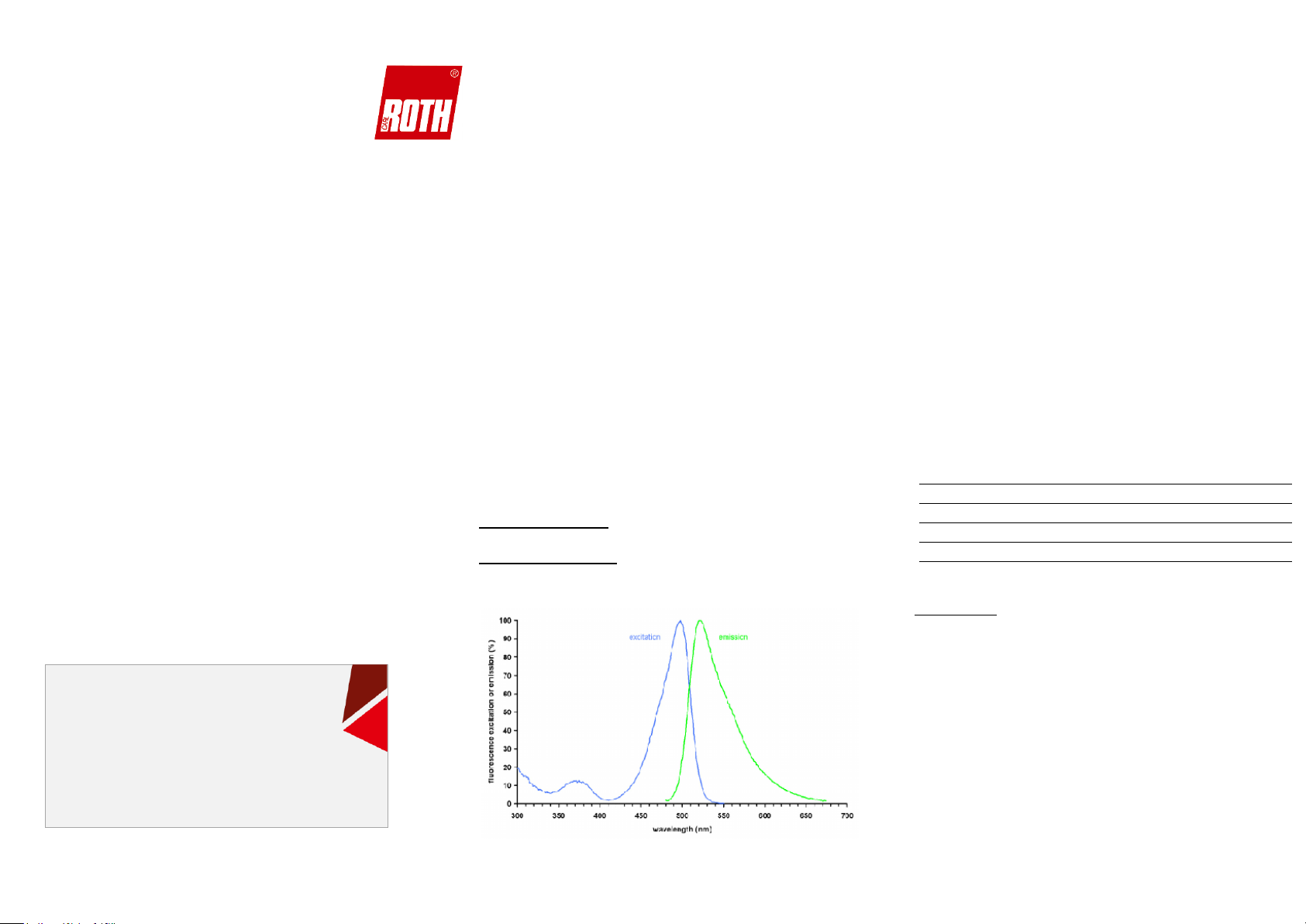
Anregungsmaxima (DNA-gebunden, blaue Kurve):
ca. 254 nm (UV-Licht) und 495 nm (Blaulicht)
Emissionsmaximum (DNA-gebunden, grüne
Kurve): 521 nm
Nukleinsäure-gebundenes SYBR® Green I emittiert
nach Anregung eine strahlend grüne Fluoreszenz, die
mittels der üblichen Ethidiumbromid-Breitbandfilter
oder SYBR® Green-Fotofilter dokumentiert werden
kann.
IV. Anwendung
• Lösen Sie Ihre DNA-Probe wie üblich in einem
Gelladepuffer, z.B. ROTI®Load DNA 1x (Best.Nr. 0100.1).
• Mischen Sie SYBR® Green DNA-Farbstoff
durch kurzes Vortexen und geben Sie das
Reagenz entsprechend der Tabelle unten zur
DNA-Probe.
• Beladen Sie Ihr Gel und starten Sie die
Elektrophorese wie üblich.
OPTIONAL:
Um Laufartefakte zu vermeiden, kann es in
manchen Fällen (z.B. bei EcoR I/Hind III-verdauter
Lambda-DNA) angeraten sein, die Probe vor dem
Lauf zu denaturieren. Inkubieren Sie sie 5 min bei
65 °C und kühlen Sie sie auf Eis ab.
V. Lagerung
SYBR® Green DNA-Farbstoff sollte bei -20 °C
gelagert werden. Bei Bedarf empfehlen wir, die
Lösung zu aliquotieren. Lichtgeschützt lagern.
Volumen
DNA-Lösung
Volumen
Färbereagenz
Gesamtvolumen
5 µl
+
0,5 µl
=
5,5 µl
10 µl
+
1,0 µl
=
11,0 µl
15 µl
+
1,5 µl
=
16,5 µl
20 µl
+
2,0 µl
=
22,0 µl
25 µl
+
2,5 µl
=
27,5 µl
Carl Roth GmbH + Co. KG
Schoemperlenstraße 3-5 • 76185 Karlsruhe
Postfach 100121 • 76231 Karlsruhe
Telefon: +49 (0) 721/ 5606-0
Fax: +49 (0) 721/ 5606-149
[email protected] • www.carlroth.de ed 06.2021
Die Firm a ist ein e Kommanditgesellsc haft mit S itz in Karlsruhe, Reg. Gericht Mannheim
HRA 1000 55. Persönlich haft ende Gesellschafterin ist die Roth Chemie GmbH mit Sitz in
Karlsruhe, Reg. G ericht M annheim HRB 100428.
Geschäftsführer: A ndré Houdelet
Page 2

VI. Sicherheit
SYBR® Green DNA-Farbstoff ist als nicht
gefährlich und nicht umweltschädlich eingestuft.
Trotzdem ist es gute Laborpraxis, bei der Arbeit
mit dem Produkt immer Handschuhe zu tragen
und die Farbstofflösung nicht über den Abfluss zu
entsorgen (s. Sicherheitsdatenblatt).
VII. Qualitätssicherung
Der Farbstoff ist frei von DNAsen und RNAsen.
Die Produktion erfolgt unter sterilen Bedingungen.
VIII. Frequently Asked Questions
F: Sind Proben von SYBR® Green DNA-Farbstoff
erhältlich?
A: Nein, leider nicht. Durch Evaporation im
Behältnis sinkt die Qualität von Proben mit einem
Inhalt von weniger als 50 µl sehr rasch. Allerdings
sind interessante Testrabatte verfügbar.
F: Wie sollten die Gele nach dem Färben mit SYBR
®
Green DNA-Farbstoff visualisiert werden?
A: Die Gele können auf einem UV- oder BlaulichtTransilluminator visualisiert werden.
F: Auf dem UV-Tisch sind die mit SYBR® Green DNAFarbstoff gefärbten Banden sehr hell, aber auf Fotos
ist praktisch keine Bande sichtbar. Woran liegt das?
A: Manche Ethidiumbromid-Fotofilter sind sehr
schmalbandig, so dass sie andere Wellenlängen,
wie beispielsweise den in diesem Fall
erforderlichen Grünbereich, praktisch
ausschließen. Verwenden Sie Breitband-Fotofilter
oder Filter für SYBR® Green.
F: Ist SYBR® Green DNA-Farbstoff für Färbung nach
dem Lauf einsetzbar?
A: Prinzipiell ist es möglich. Sie benötigen
allerdings sehr große Mengen an Farbstoff,
weshalb wir diese Methode nicht empfehlen.
F: Wie lange ist SYBR® Green DNA-Farbstoff haltbar?
A: Er ist gekühlt mindestens ein Jahr lang haltbar.
F: Wie ist SYBR® Green DNA-Farbstoff zu entsorgen?
A: Befolgen Sie bestehende abteilungs- oder
unternehmensspezifische Richtlinien bezüglich der
Entsorgung von Reagenzien, wie im
Sicherheitsdatenblatt zu SYBR® Green DNA-Farbstoff
angegeben. SYBR® Green DNA-Farbstoff darf nicht
über den Abfluss entsorgt werden.
F: Interkaliert SYBR® Green DNA-Farbstoff zwischen
die Basenpaarstapel?
A: Ja, der enthaltene Farbstoff SYBR® Green I
interkaliert zwischen die Basenpaarstapel
2,3
.
F: Ist SYBR® Green DNA-Farbstoff mutagen?
A: Der enthaltene Farbstoff SYBR® Green I hat das
Potential mutagen zu sein, wenn er in hoher
Konzentration vorliegt. SYBR® Green DNA-Farbstoff
enthält jedoch nur eine sehr geringe Menge an
SYBR® Green I und ist daher unbedenklich und
sicher.
F: Ist SYBR® Green DNA-Farbstoff membrangängig?
A: Der enthaltene Farbstoff SYBR® Green I kann die
Zellmembran durchdringen
4,5
. Diese Eigenschaft ist
besonders ausgeprägt in Gegenwart von DMSO, da
DMSO die Permeabilität des Gewebes erhöht6. Beim
SYBR® Green DNA-Farbstoff handelt es sich jedoch
um eine wässrige Lösung ohne DMSO, so dass es
nicht zu einem Verstärkungseffekt durch DMSO
kommt.
F: Kann ich SYBR® Green DNA-Farbstoff auch zum
Färben von PAGE-Gelen verwenden?
A: Ja, die Färbung ist nach demselben Protokoll
möglich wie die Färbung der DNA in Agarosegelen.
F: Kann ich mit SYBR® Green DNA-Farbstoff auch
supercoiled Plasmide effizient färben?
A: Ja, die Färbeeffizienz für supercoiled Plasmide ist
so gut wie diejenige von Ethidiumbromid.
F: Was ist zu tun, wenn die Banden auf dem Gel
zu schwach sind?
A: Erhöhen Sie das zugefügte Volumen SYBR® Green
DNA-Farbstoff auf bis zur 2fachen Menge.
F: Kann man mit SYBR® Green DNA-Farbstoff
auch effizient RNA färben?
A: Der Farbstoff bindet am besten an doppelsträngige
Nukleinsäure. RNA mit langen Haarnadel- oder
anderen doppelsträngigen Strukturen wird gefärbt,
RNA mit langen Einzelstrang-Strukturen wird weniger
effizient gefärbt.
F: Können Gele, die mittels SYBR® Green DNAFarbstoff gefärbt wurden, für Southern-Blotting
und Detektionen verwendet werden?
A: Ja, ohne Einschränkung. Während Blotten und
Denaturierung diffundiert der Farbstoff von der
DNA ab.
*SYBR
®
ist ein eingetragenes Warenzeichen der Molecular
Probes, Inc., jetzt Invitrogen Corporation, Carlsbad, California,
USA
Nur für Laborzwecke. Nicht freigegeben für human- oder
veterinärmedizinische Zwecke, für die Anwendung an Mensch
oder Tier, oder für die Anwendung in klinischer oder in vitroDiagnostik.
Publikationen:
1. Mutat Res, Singer et al., 439, 37 (1999)
2. Nucleic Acids Research, Zipper et al. 32, 12 (2004).
3. J. Fluorescence, Dragan et al. 22, 1189 (2012).
4. Acta Histochemica, Briggs & Jones, 107, 301 (2005)
5. J. Micro. Methods, Kirchhoff & Cypionka, 142, 79 (2017)
6. Molecular Probes, Useful Tips (2003)
SYBR® Green DNA-Farbstoff
1CN2.1 1,8 ml
1CN2.2 5 x 1,8 ml
Page 3
SYBR® Green DNA Dye
for electrophoresis, 11x conc., ready-to-use
l. Introduction
SYBR
®
* Green DNA dye is a DNA staining
reagent that replaces the common dye ethidium
bromide. SYBR® Green DNA dye is less
mutagenic then ethidium bromide1.It detects up to
0.01 ng per band and is thus 20x as sensitive as
ethidium bromide.
SYBR® Green DNA dye is used for the detection
of double-stranded nucleic acid in agarose and
polyacrylamide gels. The reagent is added directly
to the gel loading buffer and stains the nucleic
acid during the gel run.
ll. Composition
11x SYBR® Green DNA dye is composed as
follows:
SYBR® Green I 0.11 mM
TRIS/HCl pH 8.5 20 mM
EDTA 0.1 mM
Further additives ≤ 0.01 %
The dye solution is orange.
III. Mechanism
This reagent contains the dye SYBR® Green I,
which has been developed specifically for DNA
analysis. DNA integrity is not influenced by SYBR
®
Green I; hence, gel eluted DNA may directly be
applied to standard down-stream applications,
like, e.g., ligations, PCR, transformation,
transfection etc. without interfering effects.
SYBR® Green I binds to the minor groove of the
DNA and intercalates into the DNA
2,3
. The specific
binding keeps the gel matrix uncoloured and the
background signals low.
SYBR® Green I can be excited by UV- and blue
light, making it fully compatible with standard UVtransilluminators and modern blue-light
illumination. It is also ideally suited for real-time
electrophoresis (see also ROTIPHORESE®PROfessional runVIEW, Art. No. 4849.1).
When excited, nucleic acid-bound SYBR® Green I
emits a brightly coloured fluorescence that may be
documented by standard ethidium bromide- or
SYBR® Green photo filters.
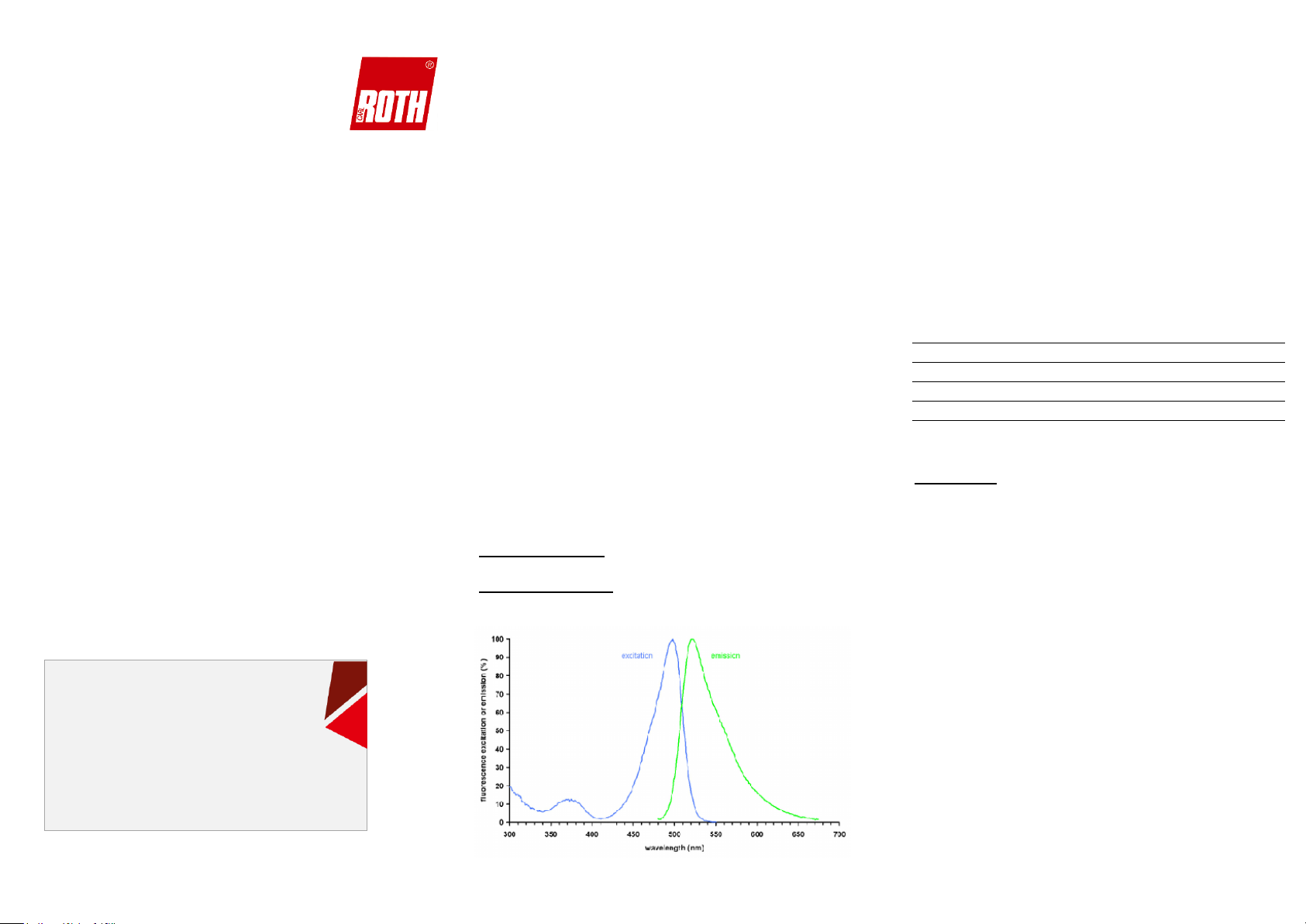
Excitation maxima (bound to DNA, blue curve):
ca. 254 nm (UV-light) and 495 nm (blue light)
Emission maximum (bound to DNA, green curve):
521 nm
IV. Application
• Dissolve the DNA sample as usual in a gel
loading buffer, e.g. ROTI®Load DNA 1x (Art.
No. 0100.1).
• Mix SYBR® Green DNA dye by vortexing
briefly and add the reagent to the DNA sample
according to the table below.
• Load the sample onto the gel and run the
electrophoresis as usual.
OPTIONAL:
In order to avoid run artefacts, in some cases (e.g.
EcoR l/Hind lll-digested Lambda-DNA) denaturing
the sample prior to the run may be recommended.
Incubate for 5 mins. at 65 °C and then cool on ice.
V. Storage
SYBR® Green DNA dye should be stored at 20 °C. If necessary, store in aliquots. Keep
protected from light.
IV. Safety
SYBR® Green DNA dye is classified as nonhazardous and not harmful to the environment.
Nevertheless, it is good laboratory practice to
always wear gloves when working with the
product and not to dispose of the dye solution
down the sink (s. security data sheet).
Volume
DNA solution
Volume
DNA dye
Total
volume
5 µl
+
0,5 µl
=
5,5 µl
10 µl
+
1,0 µl
=
11,0 µl
15 µl
+
1,5 µl
=
16,5 µl
20 µl
+
2,0 µl
=
22,0 µl
25 µl
+
2,5 µl
=
27,5 µl
Instructions for use
Carl Roth GmbH + Co. KG
Schoemperlenstraße 3-5 • 76185 Karlsruhe
P.O. Box 100121 • 76231 Karlsruhe
Phone: +49 (0) 721/ 5606-0
Fax: +49 (0) 721/ 5606-149
[email protected] • www.carlroth.com ed 06.2021
The comp any is a limited partnershi p with headquarters in Karlsruhe, reg. court
Mannheim HRA 100055. Roth C hemie GmbH, with headquarters in Kar lsruhe, reg.
court Mannheim HRB 100428, is the personall y liable partner. Managi ng Director:
André Houdelet. Sales tax identific ation number: DE 143621073.
Page 4

VII. Quality assurance
The dye is free of DNAses and RNAses. The
production is carried out under sterile conditions.
VIII. Frequently Asked Questions
Q: Are there any samples of SYBR® Green DNA
dye?
A: No, sorry. By tube-internal evaporation, the
quality of samples of less than 50 µl decreases
rapidly. You may get some interesting test
discount, however.
Q: How should I visualise the gels after staining
with SYBR® Green DNA dye?
A: Gels can be visualised under UV-light or on a
blue-light transilluminator.
Q: On UV-table, the SYBR® Green DNA dye
stained bands are very bright, but on photos, there
is virtually no band visible. What is wrong?
A: Some ethidium bromide photo filters are very
narrow banded, efficiently excluding other
wavelengths as the green range needed here.
Use broadband photo-filters or filters for SYBR®
Green.
Q: Can SYBR® Green DNA dye be used for postrun staining?
A: In principle, it is possible. However, for you
need a large amount of dye, we do not
recommend this application.
Q: What is the shelf life of SYBR® Green DNA
dye?
A: SYBR® Green DNA dye can be kept for 1 year
minimum under cooling.
Q: How should I dispose of SYBR® Green DNA
dye?
A: You should follow any existing departmental or
company guidance on the disposal of reagents as
indicated in the MSDS of SYBR® Green DNA dye.
SYBR® Green DNA dye should not be disposed of
down the sink.
Q: Does SYBR® Green DNA dye intercalate
between base pair stacks?
A: Yes, the contained dye SYBR® Green I
intercalates between base pair stacks
2,3
.
Q: Is SYBR® Green DNA dye mutagenic?
A: The contained dye SYBR® Green I has the potential
to be mutagenic when present in high concentrations.
However, SYBR® Green DNA dye contains only a
very small amount of SYBR® Green I and is therefore
harmless and safe.
Q: Is SYBR® Green DNA dye membrane permeable?
A: The contained dye SYBR® Green I can
penetrate the cell membrane
4,5
. In the presence of
DMSO, this property is particularly pronounced, as
DMSO increases the permeability of tissue6.
However, SYBR® Green DNA dye is an aqueous
solution without DMSO, so there is no
amplification effect from DMSO.
Q: May I also use SYBR® Green DNA dye for
staining of PAGE gels?
A: Yes, the staining can be carried out according
to the same protocol as used for staining of DNA
in agarose gels.
Q: Does SYBR® Green DNA dye also efficiently
stain supercoiled plasmids?
A: Yes, the staining efficiency for supercoiled
plasmids is as good as that of ethidium bromide.
Q: What to do if the bands on the gel are too
faint?
A: Increase the added volume of SYBR® Green
DNA dye up to 2times.
Q: Does SYBR® Green DNA dye also efficiently
stain RNA?
A: You need double strands of nucleic acid for
binding of the dye. RNA with long hairpins or other
double strands is stained; RNA with long single
stranded structure may be stained less efficiently.
Q: May gels stained with SYBR® Green DNA dye
be used for Southern blotting and detection?
A: Yes, without reservation. During blotting and
denaturation, the dye simply diffuses from the
DNA.
*SYBR
®
is a registered trademark of Molecular Probes, Inc.,
now Invitrogen Corporation, Carlsbad, California, USA
For research use only. Not approved for human or veterinary
use, for application to humans or animals, or for use in clinical
or in vitro diagnostics.
Literature:
1. Mutat Res, Singer et al., 439, 37 (1999)
2. Nucleic Acids Research, Zipper et al. 32, 12 (2004).
3. J. Fluorescence, Dragan et al. 22, 1189 (2012).
4. Acta Histochemica, Briggs & Jones, 107, 301 (2005)
5. J. Micro. Methods, Kirchhoff & Cypionka, 142, 79 (2017)
6. Molecular Probes, Useful Tips (2003)
SYBR® Green DNA Dye
1CN2.1 1.8 ml
1CN2.2 5x1.8 ml
 Loading...