

Page 1
CETRIMID AGAR (BASIS)
Agarmedium N und empfohlen nach der Harmonisierten Methode (Ph. Eur. 6.0),
sowie Ph. Eur. 6.3 und 7.0
Zur Isolierung und Identifizierung von Pseudomonas aeruginosa Ph. Eur.
X918
Zusammensetzung in g/l:
Pankreashydrolysat aus Gelatine ...................... 20,0
Magnesiumchlorid .............................................. 1,4
Kaliumsulfat ...................................................... 10,0
Cetrimid ............................................................... 0,3
Agar................................................................... 13,6
pH-Wert ..................................................... 7,2 ± 0,2
HERSTELLUNG
45,3 g des Mediums werden in einem Liter destillierten Wassers suspendiert. Man gebe 10 ml Glycerin zu. Man erhitze
unter häufigem Rühren/Schütteln und lasse eine Minute lang kochen. Man gebe die Lösung in geeignete Behälter und
sterilisiere 15 Minuten lang bei 118 - 121°C. Nicht überhitzen!
Bei Überhitzung fällt Cetrimid aus (Trübung oder Körnung im Agar) und Bromide können freigesetzt werden.
EINSATZGEBIET
Cetrimid-Agar wird empfohlen von der Pharmacopeia Europaea zur Subkultur von Proben beim spezifischen Nachweis
von Pseudomonas aeruginosa. Cetrimid-Agar (Basis) fördert die Produktion von Pyocyanin sowie die Fluoreszenz von
P. aeruginosa unter Licht, was eine mutmaßliche Identifizierung darstellt. Typische P. aeruginosa Kolonien sind grünlich
oder gelblich-grün. Das Medium fördert die Bildung des fluoreszenten, wasserlöslichen Pyoverdins, das durch das
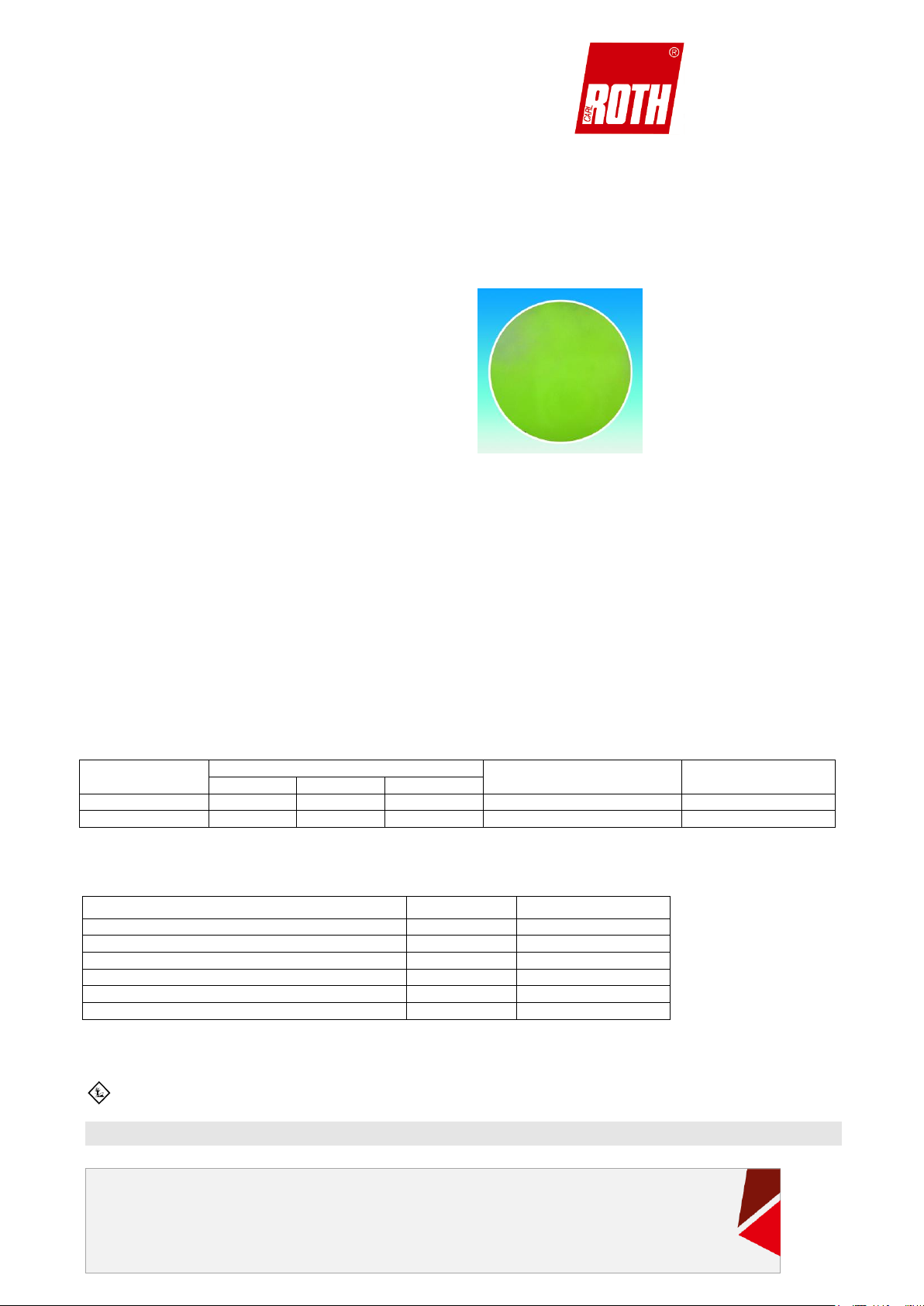
Medium diffundiert und den Agar grünlich-gelb anfärbt (s. Abbildung). Pyorubin produzierende Stämme formen rötliche
Kolonien. Die Identifizierung wird mit der Durchführung des Oxidasetests abgeschlossen(z.B. mit ROTITEST®Oxidasestreifen, Best.-Nr. 8469.1). Nach Bebrütung werden die Kolonien einzeln auf den ROTITEST®Oxidasestreifen oder auf
Filterpapier mit frisch angesetztem Oxidase-Testreagenz (Tetramethyl-p-phenylendiamindihydrochlorid) verrieben.
Eine tiefblaue bis purpurne Farbe zeigt die Anwesenheit von Oxidase und damit die Art Pseudomonas aeruginosa an.
Der Nähragar kann auch zur Darstellung von P. fluoreszenz verwendet werden. Zur Differenzierung von P. aeruginosa
und P. fluoreszenz verwendet man die unterschiedlichen Temperaturoptima1:
Organismus
Wachstum
Empfohlene Inkubations-
Inokulation
bei 4 °C
Optimum
bei 42 °C
temp. zur Differenzierung
von
P. aeruginosa
null
35-37 °C
gut
42 °C
warmem Medium
P. fluoreszenz
gut
25-30 °C
null
4 °C
kühlem Medium
MIKROBIOLOGISCHE TESTS
Die folgenden Ergebnisse wurden erzielt nach Inkubation von Referenzstämmen im angegebenen Medium / Agar mit
10 ml hinzugefügtem Glycerin bei einer Temperatur von 30 - 35 °C für 18 - 72 Stunden.
Mikroorganismen
Wachstum
Kolonienfarbe
Pseudomonas aeruginosa ATCC 27853
Gut
Gelbgrün bis blau
Psedomonas aeruginosa ATCC 9027
Gut
Gelbgrün bis blau
Escherichia coli ATCC 25922
Gehemmt
-
Escherichia coli ATCC 8739
Gehemmt
-
Staphylococcus aureus ATCC 25923
Gehemmt
-
Staphylococcus aureus ATCC 6538
Gehemmt
-
1
Naglitsch, F (1996) Pseudomonas aeruginosa: In: Schulze, E (Hrsg.): Hygienisch-mikrobiologische
Wasseruntersuchungen, Jena, 65-71.
Achtung H400 P273-P391
CETRIMID AGAR (BASIS) 500 g X918.1
Agarplatte mit Pseudomonas
aeruginosa ATCC 27853.
Pyoverdinfärbung, Kolonien
sind ebenfalls grünlich-gelb
fluoreszierend.
Produkt-Datenblatt
Carl Roth GmbH + Co. KG
Schoemperlenstraße 3-5 • 76185 Karlsruhe • Postfach 100121 • 76231 Karlsruhe
Telefon: +49 (0) 721/ 5606-0 • Fax: +49 (0) 721/ 5606-149 • [email protected] • www.carlroth.de
Die Firma ist eine Kommanditgesellschaft mit Sitz in Karlsruhe, Reg. Gericht Mannheim HRA 100055. Persönlich haftende Gesellschafterin ist die Roth Chemie GmbH
mit Sitz in Karlsruhe, Reg. Gericht Mannheim HRB 100428. Geschäftsführer: André Houdelet sse 07/2021
Page 2
CETRIMIDE AGAR (BASE)
Agar Medium N and recomm. by the Harmonized Method (Ph. Eur. 6.0), Ph. Eur. 6.3, and 7.0
For the isolation and identification of Pseudomonas aeruginosa Ph. Eur.
X918
Formulation in g/l:
Pancreatic digest of gelatin ..................................... 20.0
Magnesium chloride ..................................................... 1.4
Potassium sulfate .......................................................10.0
Cetrimide ...................................................................... 0.3
Agar ............................................................................13.6
Final pH ............................................................ 7.2 ± 0.2
PREPARATION
Suspend 45.3 g of the medium in one liter of deionized or distilled water. Add 10 ml of glycerol. Heat with frequent agitation
and boil for 1 minute. Dispense and sterilize at 118 - 121 C for 15 minutes.
Do not overheat. Overheating results in precipitation of cetrimide (clouding or granules in the agar),
and may lead to release of bromide.
USES
Cetrimid-Agar is recommended by the Pharmacopeia Europaea for subculturing of samples during specific detection of
Pseudomonas aeruginosa.
Cetrimide Agar (Base) promotes the production of pyocyanin as well as fluorescence under ultraviolet light of P.aeruginosa,
which constitutes a presumptive identification. Typical P. aeruginosa colonies are greenish or yellowish green in color. This
medium promotes the production of fluorescent, water soluble pyoverdin that diffuses through the medium, staining the agar
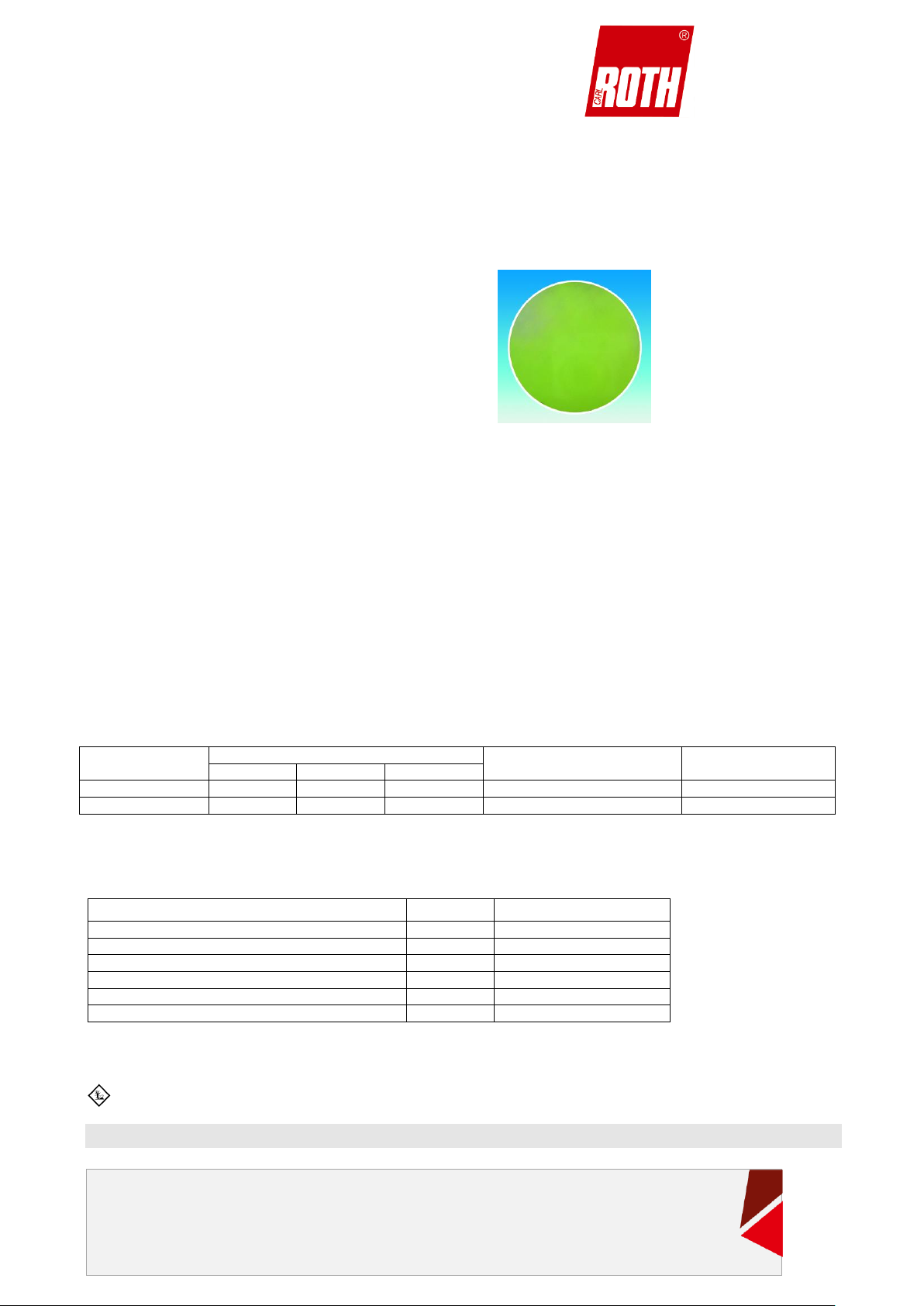
greenish-yellow (see figure). Pyorubin-producing strains form reddish colonies. The identification is completed by performing
the oxidase test (e.g using ROTITEST®Oxidase strips (Art. No. 8469.1)). After incubation is completed, the colonies are
then individually spread thinly onto the ROTITEST®Oxidase strips or filter paper with a freshly prepared oxidase test
reagent (tetra-methyl-p-phenylenediamine dihydrochloride). A deep blue to purple colour indicates the presence of
oxidase and subsequently which type of Pseudomonas aeruginosa.
This nutrient agar may also be used for isolation of P. fluorescence. For differentiation of P. aeruginosa and
P. fluorescence use the differential temperature optima as follows1:
Organism
Growth
Recommended Incubation
Inoculation
at 4 °C
Optimum
at 42 °C
temp. for differentiation
of
P. aeruginosa
nil
35-37 °C
good
42 °C
warm medium
P. fluorescence
good
25-30 °C
nil
4 °C
cool medium
MICROBIOLOGICAL TEST
The following results were obtained in the performance of the given medium, with added 10 ml of glycerol, from type
cultures after incubation at a temperature of 30 - 35 °C and observed after 18 - 72 hours.
Microorganisms
Growth
Colony colour
Pseudomonas aeruginosa ATCC 27853
Good
Yellow-green to blue
Psedomonas aeruginosa ATCC 9027
Good
Yellow-green to blue
Escherichia coli ATCC 25922
Inhibited
-
Escherichia coli ATCC 8739
Inhibited
-
Staphylococcus aureus ATCC 25923
Inhibited
-
Staphylococcus aureus ATCC 6538
Inhibited
-
1
Naglitsch, F (1996) Pseudomonas aeruginosa: In: Schulze, E (editor): Hygienisch-mikrobiologische
Wasseruntersuchungen, Jena, 65-71.
Warning H400 P273-P391
CETRIMIDE AGAR (BASE) 500 g X918.1
Agar plate with
Pseudomonas aeruginosa
ATCC 27853.
Pyoverdin staining. Colonies
also are fluorescent and
greenish-yellow.
Product Data Sheet
Carl Roth GmbH + Co. KG
Schoemperlenstraße 3-5 • 76185 Karlsruhe • P.O. Box 100121 • 76231 Karlsruhe
Phone: +49 (0) 721/ 5606-0 • Fax: +49 (0) 721/ 5606-149 • [email protected] • www.carlroth.com
The company is a limited partnership with headquarters in Karlsruhe, reg. court Mannheim HRA 100055. Roth Chemie GmbH, with headquar ters in Karlsruhe,
reg. court Mannheim HRB 100428, is the personally liable partner. Managing Director: André Houdelet. Sales tax identification number: DE 143621073. sse 06/2021
 Loading...