

Page 1
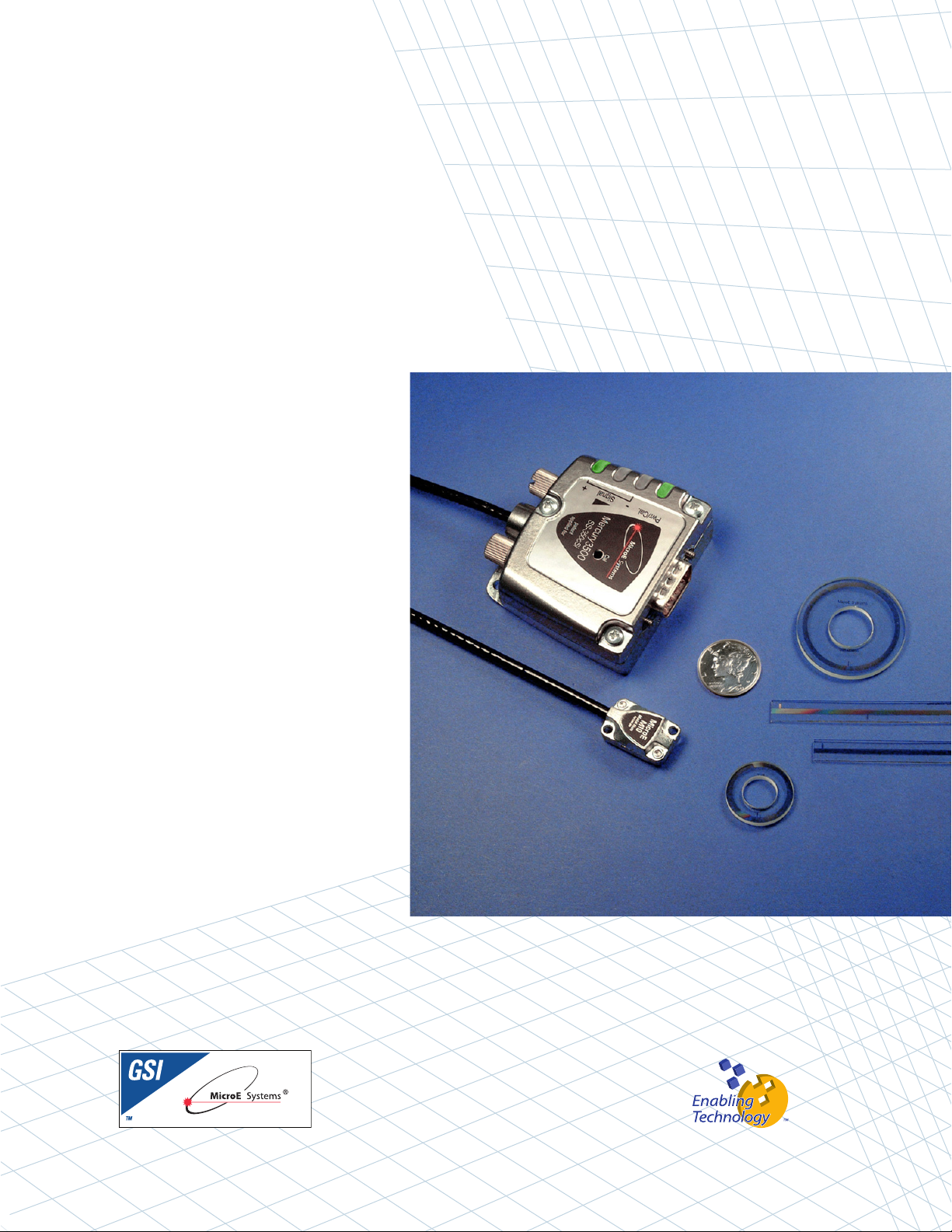
Mercury
™
3500Si
SSmmaarrtt PPrrooggrraammmmaabbllee EEnnccooddeerr SSyysstteemmss
wwiitthh HHiigghh SSppeeeedd SSeerriiaall WWoorrdd OOuuttppuutt
IInnssttaallllaattiioonn MMaannuuaall
aanndd RReeffeerreennccee GGuuiiddee
Manual No. IM-M3500Si Rev D
Page 2
IInnttrroodduuccttiioonn
MicroE Systems was founded to advance encoder technology to
a level never before achieved. Our objective was to design encoder
systems that would be small enough to fit into densely packed OEM
equipment designs, affordable enough for cost-sensitive applications
and easy enough to enable installation, setup and alignment by
assemblers with little training. We are pleased to say that all of
these goals have been realized with the introduction of the Mercury
family of encoders.
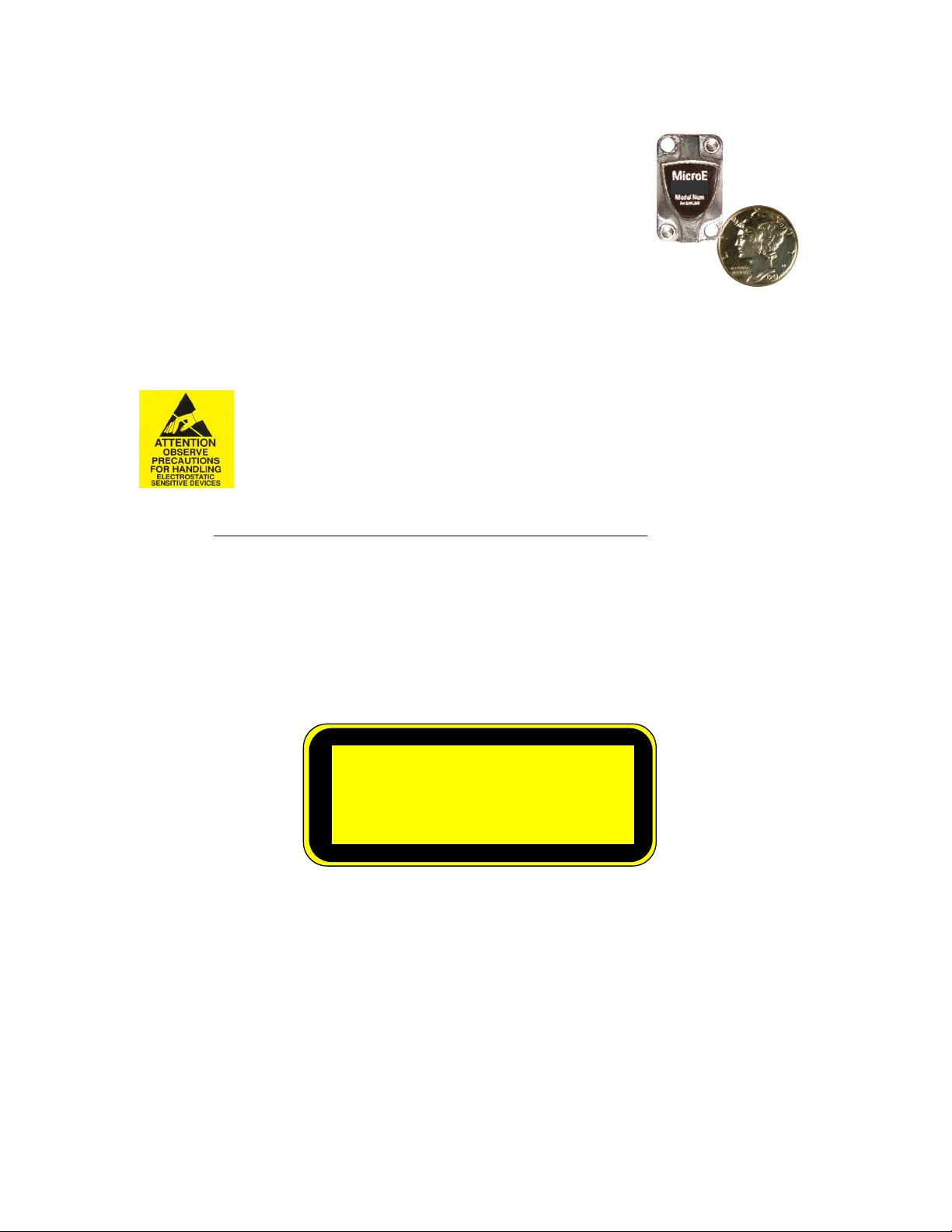
Sensor shown
actual size
M10
PPaatteennttss
Covered by the following patents: US 5,991,249; EP 895,239; JP 3,025,237; US
6,897,435; and EP 1,451,933. Additional patents and patents pending may apply.
PPrreeccaauuttiioonnss
Follow standard ESD precautions. Turn power off before connecting the sensor.
Do not touch the electrical pins without static protection such as a grounded
wrist strap.
Do not touch the glass scale unless you are wearing talc-free gloves or finger
cots. Please read this installation manual for full instructions.
LLAASSEERR SSAAFFEETTYY IINNFFOORRMMAATTIIOONN:: MMeerrccuurryy && CChhiippEEnnccooddeerr
1
2
This product is sold solely for use as a component (or replacement) in an electronic product; therefore it is not
required to, and does not comply with, 21 CFR 1040.10 and 1040.11 which pertain to complete laser
products. The manufacturer of the complete system-level electronic product is responsible for complying with 21
CFR 1040.10 and 1040.11 and for providing the user with all necessary safety warnings and information.
MicroE encoders contain an infrared laser diode or diodes. Emitted invisible laser radiation levels have been
measured to be within the CDRH Class 1 range, which is not considered hazardous; however, to minimize
exposure to the diverging beam, the encoder sensor should be installed in its operational configuration in close
proximity to the encoder scale before power is applied.
• Invisible laser radiation; wavelength: 850 nm
• Max power 2.4 mW CW (4.8 mW CW for Mercury II™)
• CAUTION – The use of optical instruments with this product will increase eye hazard. DO NOT VIEW
DIRECTLY WITH OPTICAL INSTRUMENTS (MICROSCOPES, EYE LOUPES OR MAGNIFIERS).
• All maintenance procedures such as cleaning must be performed with the MicroE encoder turned off.
• Do not insert any reflective surface into the beam path when the encoder is powered.
• Do not attempt to service the MicroE encoder.
INVISIBLE LASER RADIATION
DO NOT VIEW DIRECTLY WITH OPTICAL
INSTRUMENTS
(MICROSCOPES, EYE LOUPES OR
MAGNIFIERS)
Page 3

Page 1
TTaabbllee OOff CCoonntteennttss
SYSTEM ILLUSTRATION PAGE
Encoder with Linear scale 2
Encoder with Rotary scale 3
INSTALLATION INSTRUCTIONS
Encoder System Mounting - Linear 4
Encoder System Alignment - Linear 5
Centering the Index & Calibration - Linear 5
Encoder System Mounting - Rotary 6
Encoder System Alignment - Rotary 7
Centering the Index & Calibration - Rotary 7
REFERENCE SECTION
Installation of Linear Scales 8
Grounding Instructions 9
Recommendations for Power 9
Customer Interface Cable Requirements 10
SmartPrecision™ Module Mounting Options 11
SERIAL OUTPUT SPECIFICATION 12-17
ENCODER TROUBLESHOOTING
Selected Topics 18
Cleaning Scales 18
Contact MicroE Systems Back Cover
Page 4

Mercury 3500Si Encoder System
with Linear scale
Page 2
EExxppaannddeedd VViieeww
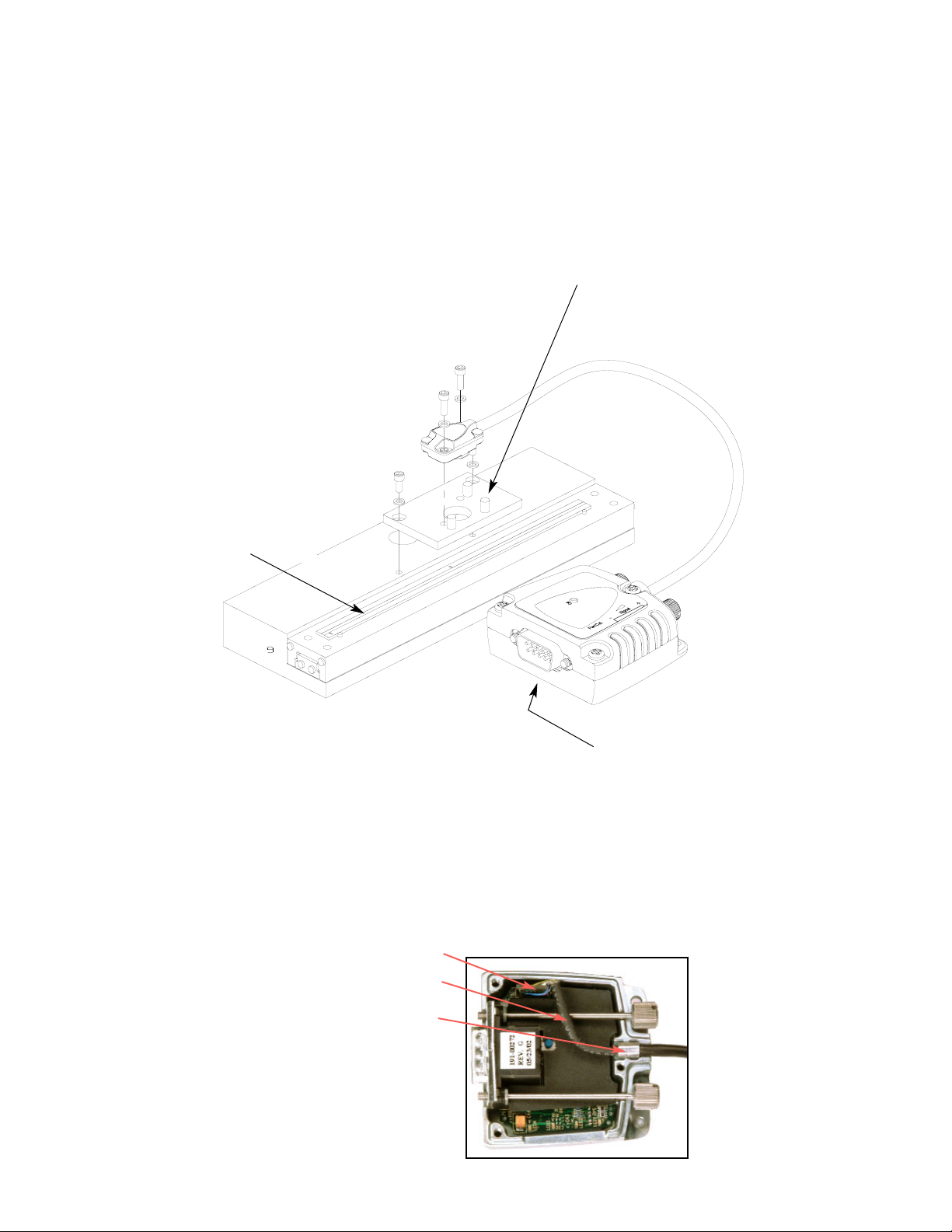
Scale benching edge
End locator pin
End index mark
Sensor mounting holes (2)
Bracket mounting holes (2)
Optional sensor benching pins (3)
Double
shielded cable
Center index mark
Typical user-supplied
sensor mounting bracket
Top reflective linear scale
Detail A
15 pin High Density
D-sub connector
Thumb screw
Index /
Calibration
button
Power/Calibration Indicator
SSyysstteemm VViieeww
Shown with linear scale
Glass scale
(shown mounted on a linear slide)
Sensor
(shown attached on a linear slide base with
mounting bracket)
SmartPrecision electronics module (interpolator)
Scale reference datum;
example shown with benching pins
Cover: Sensor cable
and connector
Signal & alignment
indicators
Mounting screws & flat
washers (2 needed per screw)
Page 5

Mercury 3500Si Encoder System
with Rotary scale
Page 3
Double
shielded cable
Thumb screw
SSyysstteemm VViieeww
Shown with Rotary scale
Sensor
(shown attached to a customer-supplied
mounting bracket)
Rotary scale
SmartPrecision electronics module (interpolator)
EExxppaannddeedd VViieeww
Rotary scale
Mounting hole (2)
Top reflective
rotary scale
15 pin High Density
D-sub connector
Index / Calibration button
Cover: Sensor cable and connector
Typical user-supplied
sensor mounting bracket
would be located here
Power/Calibration Indicators
Signal & alignment
indicators
Mounting screws & flat
washers (2 needed per screw)
Page 6
Installation Instructions
Linear Encoders - Using Alignment Tool - Mounting
Page 4
1
2
Install the sensor on your mounting surface
referencing the appropriate datum surface as
shown on the interface drawing. Use 2 washers
per mounting screw.
Benching pins may be used to locate the sensor
if the system mechanical tolerances are adequate.
See data sheet for alignment tolerances, or keep
mounting screws loose for sensor alignment if
benching pins are not used.
Attach the scale to the base
slide. Reference the preferred
datum on the interface drawing
for either end or center index
orientation.
Depending on the mounting
method, attach the scale to the
slide with adhesive. Refer to pg.
8 for details.
Be sure the grating surface of
the scale faces the sensor.
Insure that there is no contact
between these surfaces or
damage may result.
Be sure the source power is off before
connecting the SmartPrecision plug.
Connect the SmartPrecision electronics to
the controller using the pinout diagram
described on the interface drawing.
Insure proper system grounding. Refer to the
procedure on pg 9.
Tighten the thumb screws.
Power up the system. The Power/Calibration
indicator will illuminate.
4
3
CAUTION: observe precautions for handling
electrostatic sensitive devices.
Route the sensor cable through your equipment
to the SmartPrecision electronics.
A) Remove the three cover screws and the top
half of the connector housing. Do not pull on
the 15-pin D-sub connector or the circuit
board under the insulation layer.
B) Attach the sensor's 5 X 2 connector to the
mating 5 X 2 connector on the circuit board.
C) Route the sensor cable through its channel
in the center of the connector body and place
the cable's hex sleeve in the matching recess.
Attach the top half of the connector housing
to the bottom half using the three cover screws.
Page 7
Installation Instructions
Linear Encoders - Using Alignment Tool - Alignment
Page 5
5
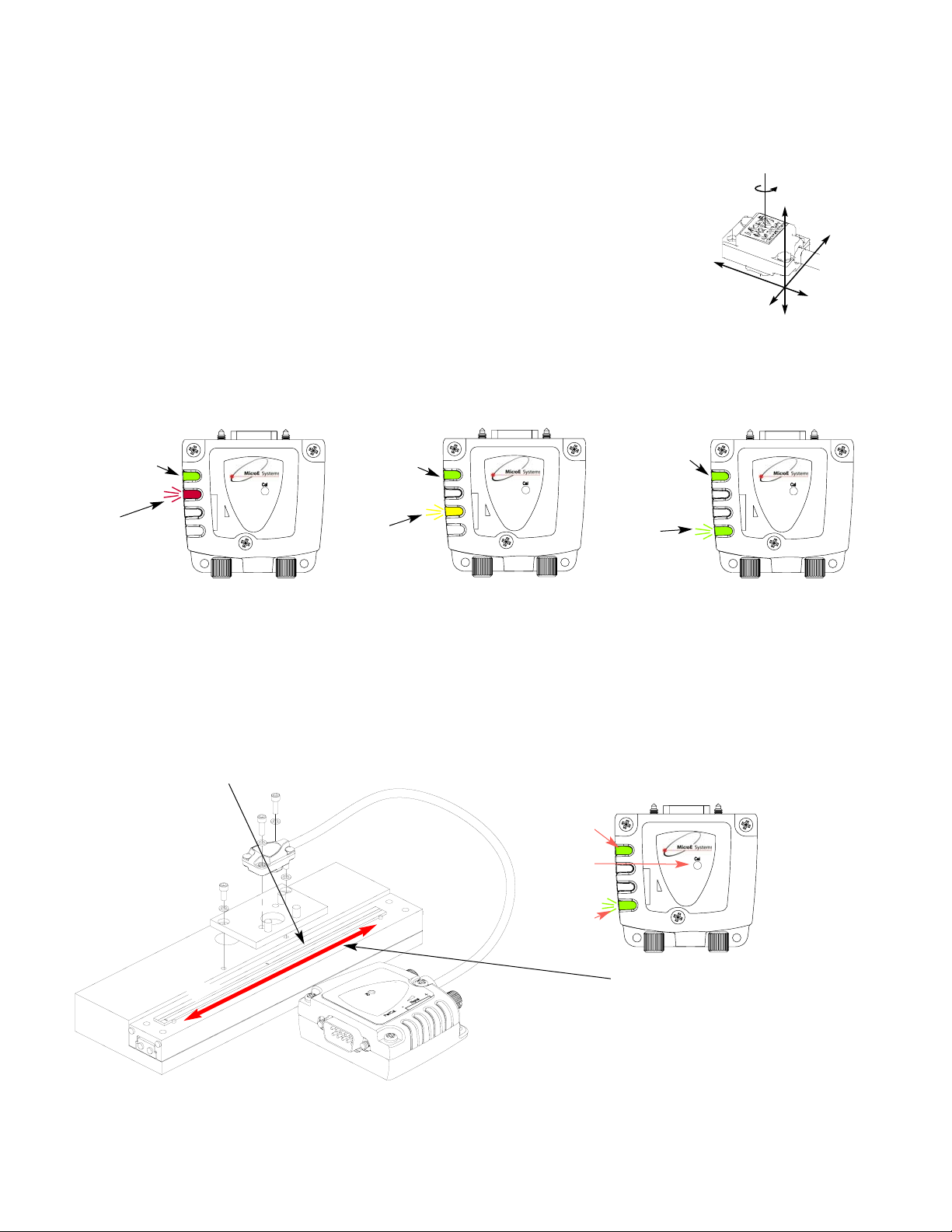
If benching dimensions cannot be provided, proper sensor alignment may require minor
adjustments to the sensor position with respect to the scale. This can be performed easily
using the LED alignment indicators, as illustrated below.
The red, yellow, or green LED will light depending on sensor alignment. Slowly move the sensor
by allowing it to slide on the mounting surface until the green or Proper Alignment LED, is
illuminated. Optimal alignment will be displayed as a “Bright Green” LED.
IIMMPPOORRTTAANNTT
: Confirm that the Proper Alignment LED blinks when passing over the index.
If not, readjust the sensor in the Y direction and repeat the above procedure. When alignment is
completed, tighten the sensor mounting screws (0.37Nm [3.3 inch-lbs.] maximum torque).
6
Confirm proper alignment over
the full range of motion.
The “Proper Alignment” LED
must remain on over the entire
range. If not aligned over the
entire range of motion, loosen
the sensor mounting screws
and repeat step 5.
x
Y
Z
θ
z
To align the sensor, move
it in the Y or θ
z
direc-
tions.
IIMMPPOORRTTAANNTT
OOUUTTPPUUTT CCAALLIIBBRRAATTIIOONN PPRROOCCEEDDUURREE
This procedure must be completed for
proper system operation each time the
sensor is aligned or if the SmartPrecision
electronics module is replaced
Position the sensor at
least 7mm (1/4”)
away from the index
mark on the scale.
Next, push the
Index/Calibration
button inside the
module with a small
diameter shaft, such
as a bare cotton swab.
The Power/ Calibration indicator will flash continuously. Move the scale past the sensor in both
directions so that the index mark passes under
the sensor. When the calibration procedure is
complete, the Power/Calibration indicator stops
flashing.
7
Power/
Calibration
indicator
Calibration /
Index Set
Up button
Proper
Alignment
indicator
Improper
Alignment LED
Red
Power/
Calibration
Power/
Calibration
Power/
Calibration
Improved
Alignment LED
Yellow
Proper
Alignment LED
Green
Optimal
Alignment LED
Bright Green
PWR/Cal. - Signal +
Mercury 3500Si
SS-350cSi
patent
applied for
PWR/Cal. - Signal +
Mercury 3500Si
SS-350cSi
patent
applied for
PWR/Cal. - Signal +
Mercury 3500Si
SS-350cSi
patent
applied for
PWR/Cal. - Signal +
Mercury 3500Si
SS-350cSi
patent
applied for
Page 8

Installation Instructions
Rotary Encoders - Using Alignment Tool - Mounting
Page 6
Attach your hub/scale
assembly to the rotary
device. Refer to the
interface drawing. The
reflective surface of the
scale must face the sensor.
1
4
Be sure the source power is off before
connecting the SmartPrecision plug.
Connect the SmartPrecision electronics to
the controller using pinout diagram
described on the interface drawing.
Insure proper system grounding. Refer to the
procedure on pg 9.
Tighten the thumb screws.
Power up the system. The Power/Calibration
indicator will illuminate.
2
3
CAUTION: observe precautions for handling
electrostatic sensitive devices.
Route the sensor cable through your equipment
to the SmartPrecision electronics.
A) Remove the three cover screws and the top
half of the connector housing. Do not pull on
the 15-pin D-sub connector or the circuit
board under the insulation layer.
B) Attach the sensor's 5 X 2 connector to the
mating 5 X 2 connector on the circuit board.
C) Route the sensor cable through its channel
in the center of the connector body and place
the cable's hex sleeve in the matching recess.
Attach the top half of the connector housing
to the bottom half using the three cover screws.
Install the sensor on your mounting surface
referencing the appropriate datum surface as
shown on the interface drawing. Use 2 washers
per mounting screw.
Benching pins may be used to locate the sensor
if the system mechanical tolerances are adequate.
See data sheet for alignment tolerances, or keep
mounting screws loose for sensor alignment if
benching pins are not used.
Page 9

Installation Instructions
Rotary Encoders - Using Alignment Tool - Alignment
Page 7
6
Confirm proper alignment
over the full range of motion.
The “Proper Alignment” LED
must remain on over the
entire range. If not aligned
over the entire range of
motion, loosen the sensor
mounting screws and repeat
step 5.
5
If benching dimensions cannot be provided, proper sensor alignment may require minor adjustments
to the sensor position with respect to the scale. This can be performed easily using the LED alignment
indicators, as illustrated below.
The red, yellow, or green LED will light depending on sensor alignment. Slowly move the sensor by
allowing it to slide on the mounting surface until the green or Proper Alignment LED, is illuminated.
Optimal alignment will be displayed as a “Bright Green” LED.
IIMMPPOORRTTAANNTT
: Confirm that the Proper Alignment LED blinks when passing over the index. If not,
readjust the sensor in the Y direction and repeat the above procedure. When alignment is completed,
tighten the sensor mounting screws (0.37Nm [3.3 inch-lbs.] maximum torque).
x
Y
Z
θ
z
To align the sensor, move
it in the Y or θ
z
direc-
tions.
IIMMPPOORRTTAANNTT
OOUUTTPPUUTT CCAALLIIBBRRAATTIIOONN PPRROOCCEEDDUURREE
This procedure must be completed for
proper system operation each time the
sensor is aligned or if the SmartPrecision
electronics module is replaced.
Position the sensor at
least 7mm (1/4”)
away from the index
mark on the scale.
Next, push the
Index/Calibration
button inside the
module with a small
diameter shaft, such
as a bare cotton swab.
The Power/Calibration indicator will flash continuously. Move the scale past the sensor in both
directions so that the index mark passes under
the sensor. Do not run off the end of the scale
when using a segment scale. When the calibration procedure is complete, the
Power/Calibration indicator stops flashing.
7
Power/
Calibration
indicator
Calibration /
Index Set
Up button
Proper
Alignment
indicator
Improper
Alignment LED
Red
Power/
Calibration
Power/
Calibration
Power/
Calibration
Improved
Alignment LED
Yellow
Proper
Alignment LED
Green
Optimal
Alignment LED
Bright Green
PWR/Cal. - Signal +
Mercury 3500Si
SS-350cSi
patent
applied for
PWR/Cal. - Signal +
Mercury 3500Si
SS-350cSi
patent
applied for
PWR/Cal. - Signal +
PWR/Cal. - Signal +
Mercury 3500Si
SS-350cSi
patent
applied for
Mercury 3500Si
SS-350cSi
patent
applied for
Page 10

Reference Section
Installation of Linear Scales
Page 8
MicroE Systems
L
0.2L
0.6L
0.2L
Benching pins
Positioning the Scale
Note: Before beginning mounting procedure, use talc-free gloves or finger cots to handle the scales.
"Benching" the scale to the system means aligning the scale by means of benching pins. Pin locations are described on the appropriate interface drawing.
Two benching pins are recommended on the long side of the scale and one at the end as shown . This is marked datum A on the interface drawing.
Position the benching pins in from either end. 20% of the overall
scale length is the recommended location from the edge.
Be sure the benching pins do not extend too high in the Z direction to
prevent mechanical interference with the sensor or sensor mount.
2
1
End
Benching
Pin
Mounting the Scale
MicroE Systems' linear scales should be affixed to the mounting surface. Two different approaches are described below:
RTV around entire
outside edge of scale.
End Benching
Pin
Hard epoxy
at one corner,
this end only.
Epoxy and RTV Mounting (Recommended for best accuracy)
1
Make sure the mounting surface is
clean and dry.
Optionally, scale clamps may be used to secure the
scale while the adhesive cures. Avoid damage to
the top surface.
Side view showing
optional scale clamps
and scale. Space
clamps every 75mm
on scales over 150
mm in length.
4
Apply a hard epoxy, such as Tra-Con’s Tra-Bond 2116, to the end of the scale at the end benching pin. Apply 100% Silicone RTV adhesive
around the edges of the scale. This method allows thermal expansion from the benched end of the scale. After adhesive curing, remove
the scale mounting clamps or, if permanently installing clamps, make sure they do not interfere with the sensor or sensor mount.
3
MicroE Systems
L
2
Align the scale by placing the edges against the benching pins.
Benching pins
Scale clamp
with adhesive
Mounting clamp
Mounting clamp
Mounting clamp
Benching pins
MicroE Systems
L
2
3
1
Two Sided Adhesive Tape Mounting
Make sure the mounting surface is clean and dry. Peel the
cover paper off and place the scale above the final location.
Align the scale by placing the edges against the benching pins.
Gently place the scale on the mounting surface. Positioning adjustments
can be made until the scale is firmly pressed down. After final positioning,
push down on the top of the scale to secure it.
End Benching
Pin
Hard epoxy at
one corner,
this end only.
Page 11

Page 9
Reference Section
Sensor mounted with good electrical contact to a well-grounded surface (preferred)
1. 15-pin D-sub connector grounding: The encoder's connector shell must be in intimate, electrically conductive contact with the customersupplied mating connector, which must be isolated from the controller's ground. If a customer-supplied shielded cable connects the encoder
to the controller, then the shielding on the customer-supplied cable must be isolated from the controller's ground.
2. The sensor mounting surface must have a low impedance (DC/AC) connection to ground. The encoder sensor mounting surface may have to
be masked during painting or anodizing to insure good electrical contact with the sensor.
For Mercury 2000 and 3000 encoder systems to operate reliably, it is essential that the sensor and cable shield are grounded properly
according to the following instructions. The diagrams below show how to make the connections when the encoder's connector is
plugged into the customer's controller chassis. If a customer-supplied extension cable is used, it should be a double shielded cable with
conductive connector shells and must provide complete shielding over the conductors contained within it over its entire length.
Furthermore, the shields should be grounded at the connection to the controller chassis the same way as the encoder connectors in the
diagrams below.
Note: For best performance, isolate encoder shield from motor cable shields and separate encoder cable as far possible from motor cables.
Sensor mounted to a surface that is grounded through bearings or a poorly-grounded surface, or a non-conducting surface
1. 15-pin D-sub connector grounding: The encoder's connector shell must be in intimate, electrically conductive contact with the customer-supplied mating
connector, which must be connected to the controller's ground. If a customer-supplied shielded cable connects the encoder to the controller, then the
shielding on the customer-supplied cable must be connected to the controller's ground. The controller must be grounded to earth at the point of installation.
2. The encoder sensor must be mounted so that it is electrically isolated from ground.
Mercury encoders require a minimum of 4.75V DC continuously. When designing circuits and extension cables to use Mercury encoders, be sure to
account for voltage loss over distance and tolerances from the nominal supply voltage so that at least 4.75V DC is available to the Mercury encoder
under all operating conditions. The input voltage should not exceed 5.25V DC.
Outer Shield: Connected to Sensor
and Connector housing
5 Volts
0 Volts
Power
Supply
Grounding Instructions for Mercury 3500Si Encoder Systems
Recommendations for Power
Outer Shield: Connected to Sensor
and Connector housing
Inner shield: Insulated from outer shield,
sensor, and connector housing. Connected
to circuit common internally (pin 4).
5 Volts
0 Volts
Power
Supply
Electrically conductive
mechanical connection
(as supplied by MicroE
Systems).
Do not ground shroud.
Page 12

Page 10
Customer Interface Cable Requirements
Customer cables that interface to Mercury series encoders must have the following characteristics:
• Twisted pair signal wiring.
• Characteristic impedance of 100-120 ohms.
• Sufficient wire gauge to meet the minimum voltage requirement at the encoder, for example 24AWG gauge wire for a 2m length cable.
Examples of acceptable cables with 24 AWG gauge wire and 5 twisted pairs are Belden 9832, 8105 or other
manufacturer’s equivalents.
• Single shield cable with a minimum of 90% coverage. Note that a double shielded cable may be required in high-noise applications.
Signal Wiring:
Each differential signal should be connected to a corresponding twisted pair as follows:
Shield Termination:
The customer's cable shield should be in 360° contact with the connector shroud and the connector shell to provide complete shielding. The
connector shell should be metal with conductive surfaces. Suggested metal connector shells for use with Mercury 3500, 3000, 3500Si,
and 2000 encoders: AMP 748676-1 or equivalent; for Mercury 1000 and 1500S encoders: AMP 745172-3, -2, or -1 where the dash number is
dependent on the customer's outside cable diameter. The shield should be terminated as illustrated in the following diagram.
Fold braided shield back over jacket. Example shows double-shielded cable. Dimensions shown
are for illustration only.
Mercury 3500Si
Signal Twisted Pair
SD0+ Pair 1
SD0SCF+ Pair 2*
SCFSCK+ Pair 3
SCKN_CS+ Pair 4
N_CS-
+5V Pair 5
GND
* Optional
Page 13

Page 11
SmartPrecision Module Mounting Options
The SmartPrecision electronics module may be mounted directly to a
bulkhead connector using the integral thumb screws shown in figure A.
A
B
Reference Section
Alternatively, the module may be used with an extension cable and
mounted to a base plate using the mounting tabs as shown in figure B.
Page 14

Serial Output Specification
Page 12
Introduction
Historically, the method of choice for many optical position feedback systems has been A quad B (Quadrature) output. The limitation of this method
is output speed, especially when the interpolation level is large. When the optical sensor speed is fast and/or the interpolation multiplier is large,
the Quadrature output frequencies will be extremely high and out of the range of the Quadrature counters of most standard motion controllers.
This limitation can be avoided by sending the position information in parallel format or in a serial word format.
The parallel formats are cumbersome to cable (especially wide word lengths) and are more susceptible to noise interference.
Therefore, a serial data word format is the data communication method of choice.
The SS350SI Interpolator has the ability to output a position word in a serialized format. This allows very fast communication between an interpolator and customer application. The speed limitation of the Quadrature format is thus eliminated.
Signal Description
The interface to the SS350SI Interpolator uses the following signals to implement serial communication, n_spiEnable (n_CS), spiDataOut (SDO),
spiClockIn (SCK), and optionally spiClockOut (SCF).
Each signal is differential and RS-422 compatible. See table for interpolator signal names, pin names, and pin locations:
Signal Name
Pin Name
Function
I/O
Interpolator
referenced
15 Pin HD
Connector
Pin Number
n_spiEnable n_CS+ Chip Select+ Input 7
n_CS- Chip Select- Input 8
spiClockIn SCK+ Serial Clock+ Input 14
SCK- Serial Clock- Input 15
spiDataOut SDO+
Serial Data Output+
Output 5
SDO- Serial Data Output- Output 4
spiClockOut SCF+ Serial Clock
Feedback+
Output 10
SCF- Serial Clock
Feedback-
Output 9
Page 15

Serial Output Specification
SmartPrecision 3500Si Interpolator Operation
Page 13
Standard Communication Mode
Asserting the n_spiEnable signal freezes the current position word buffer and status information within the interpolator. The serial data is valid
50ns after the assertion of n_spiEnable signal. The n_spiEnable signal is kept asserted while spiClock signal toggles out the data.
Each serial data bit is valid on the falling edge of the clock signal. A high to low transition of the n_spiEnable signal must be accomplished
between acquisitions to allow the internal serial data buffer to update with new information.
tV
tCSD
tspiH
tspiL
tCCS
tCS
tDNA
n_spiEnable
spiClocK
spiDataOut
Communication Mode Timing
Symbol Parameter Minimum Maximum Units
tspiH spiClockIn High Time 25 * ns
tspiL spiClockIn Low Time 25 * ns
tCSD n_spiEnable to DataValid 50 ns
tV
↓spiClockIn to Data Valid
25 ns
tCCS spiClockIn to n_spiEnable 0 ns
tCS n_spiEnable High 50 ns
tDNA n_spiEnable to HiZ 50 ns
*Assuming no propagation delay from user’s electronics and cabling. Please refer to page 16 for details.
Page 16

Trigger Communication Approach:
The Trigger Approach can be used in applications where synchronization of the position data to an event is required. Often, this mode is used
when a fixed latency between a clock signal and the sampled position data is required. The customer can choose this mode of operation by using
the optional SmartPrecision Software. In this mode, triggering is controlled by the n_spiEnable signal.
The n_spiEnable signal starts the process by immediately resetting the internal calculators and acquiring the latest AD converter information. Old
data in the calculation chain is discarded and the initiation of a new position calculation is started.
The new data is ready in 1180ns. The n_spiEnable signal for retrieving the data must be asserted within 340ns after the new data is ready or the
triggered acquisition will be over written by new data.
Shifting the data out of the interpolator's serial port is accomplished exactly as in the Standard Communication mode of operation. In order to
sample the next position, n_spiEnable must be brought high and then reasserted. See the Trigger Approach timing diagram below.
n_spiEnable
spiClock
spiDataOut
tTDR
tW
Symbol Parameter Minimum Maximum Units
tspiH SCK High Time 25 ns
tspiL SCK Low Time 25 ns
tTDR n_spiEndable to DataReady 1180 1520 ns
tW n_spiEnable width 50 ns
tCSD n_spiEnable to DataValid 50 ns
tV
↓SCK to Data Valid
25 ns
tCCS SCK to n_CS 0 ns
tCS n_CS High 50 ns
tDNA n_CS to HiZ (no HiZ) 50 ns
Trigger Approch Timming Diagram
Page 14
Page 17

Serial Output Specification
Page 15
Important Notes:
The user must wait 1180ns after a trigger for the data acquisition to make its way through the position calculator. After the 1180ns calculation
latency the position number is available at the serial output buffer.
This position number is valid for 340ns before the calculator pipeline overwrites the value in the serial output buffer. Asserting the n_spiEnable
within 340ns of data being valid will freeze the serial output buffer for data transfer.
n_spiEnable is sampled by an internal clock when in the Trigger Approach mode. The uncertainty of this measurement is 80ns.
When not in the trigger mode, n_spiEnable is not sampled by an internal clock and there is no synchronization of the interpolator calculation to an
external event. The uncertainty of this measurement is 340ns.
Data Format:
The data word, which is made up from the position and status words, are transferred with the most significant bit (MSB) first. The data word
length is 38 bits wide .
Status Word:
The status word is 8 bits wide. The status word may be placed either before or after the position word within the data word. The Status word
placement can be set using the optional SmartPrecision Software.
Bit Name Description
0 redAlarm asserted low if signal level is out of range
1 yellowAlarm asserted low if signal level is near out of range
2 indexMode asserted high indicates index angle in acquire mode
3 indexWindow asserted high when encoder is within physical window
4 to 7 reserved
Status Byte Definition:
Example: 0000_0011 (Normal Operation)
Position Word:
The position word is 30 bits in length. The position word is made up of an 18 bits of fringe data and 12 bits of interpolation data.
Fringe Data: (Programmable up to 18bits)
The fringe counter keeps track of the number of electrical cycles encountered caused by a grating moving past a sensor. The size of the fringe
counter is programmable from 3 bits wide to 18 bits wide (factory default). The width is selectable through the optional SmartPrecision Software.
Reducing the size of the fringe counter will increase the overall sample rate of the system. At 18 bits, the counter is large enough to keep track of
a grating length of 5.24 meters.
Note: The fringe counter size should be larger than the anticipated range of motion to guarantee that the counter will not "roll over".
In normal operation, the fringe counter can "roll over" to a negative number with a small amount of movement upon power up.
Interpolation Data: (Lower 12bits)
The interpolation depth of the SS350SI is always 4096. If the user prefers smaller interpolation depths then fewer spiClock signal clocks can be
sent to the interpolator and fewer bits will be shifted out. This will also increase the maximum sample rate for the system.
31302928272625242322212019181716151413121110987654321034333
2
8bit status
format 0
3210546
7
30bit Position Word
format 0
35373
6
8bit status
format 1
3210546
7
30bit Position Word
format 1
38 bit word
Page 18

Page 16
Serial Clock Feedback
The Serial Clock Feedback (SCF) signal may be used to compensate for propagation delays caused by line receivers/drivers and the interface
cabling between the SS350cSi and the customer electronics. The spiClockIn (SCK) signal is "looped" back as an output to create the Serial Clock
Feedback signal. Please see Delay Diagram below:
Note: The timing diagram information lists the timing delays between a request for data at point A and the receipt of data at point B. It does not
include the interface cable, line drivers/receivers or any other electronics needed at the customer interface for signal acquisition.
Maximum Propagation Delay. (Serial Clock Feedback - not used)
FPGA
40 nsec
receiver 35 nsec
d ri ver 10 n se c
MicroE SS-350cSi
A
B
Interface
Cable
Customer’s
electronics
Customer’s interface timing
d1
d7
d2d3
d4 d5 d6
There is a propagation delay due to the clock being sampled at position A and the Data being sampled at position B.
Propagation Delay = d1+d2+d3+d4+d5+d6+d7
Maximum Propagation Delay. (Serial Clock Feedback signal implemented)
Propagation delay is eliminated because both data and clock are sampled at position B
System Latency=d1+d2+d3+d4+d5+d6+d7
FPGA
40 nsec
receiver 35 nsec
driver 10 nsec
MicroE SS-350cSi
A
B
Interface
Cable
Customer’s
electronics
Customer’s interface timing
d1
d7
d2d3
d4 d5 d6
Page 19

Index Processing
A unique physical position is referenced on all gratings and is called an index position. The value of this position is determined
during an index capture routine initiated by a button press or the SmartPrecision Software and is permanently stored for use
after power cycling. The index value has the same resolution as the interpolated position.
The SS-350cSi has four modes of operation that use the index position to generate a physical reference position. The position
word calculated by the SS-350cSi electronics is a 30-bit number, which includes 18 fringe counter bits and 12 sub-fringe
interpolation bits. The fringe counter keeps track of the number of electrical cycles encountered caused by a grating moving
past a sensor and can be reset. The sub-fringe position is absolute because the voltage relationship between sine and cosine
are fixed electrically and therefore cannot be reset or cleared.
A physical mark on the grating called an index window is used to generate an accurate index position. The index window
is approximately one fringe wide. By monitoring the edges of the window with respect to the absolute sub-fringe position
during the index capture mode, an accurate index position is calculated and stored.
At power up the encoder is in an undefined position relative to the outside world. By traveling past the index mark on the scale
and knowing where the index is relative to the outside world the encoder position becomes defined. The M3500Si supports the
following index processing modes:
No Index: No changes are made to the position word at the index mark.
Mode 1: Zeros the fringe counter at the first encounter with index mark after power up.
Mode 2: Zeros the fringe counter at every encounter with index mark.
Mode 3: Zeros the fringe counter at the first encounter with index mark after power up and
subtracts the index position from the calculated position making the index mark the
zero position of the encoder.
Mode 4: Zeros the fringe counter at every encounter with index mark after power up and
subtracts the index position from the calculated position making the index mark the
zero position of the encoder.
The Index mode can be factory set or selected by the customer using the optional SmartPrecision software.
Serial Output Specification
Page 17
Page 20

Troubleshooting
Problem
The Power/Calibration indicator will not come on.
Solution
• Make sure that the SmartPrecision electronics’ 15-pin HD connector is fully seated and connected.
• Confirm that +5 Volts DC is being applied to pin 12 on the SmartPrecision electronics’ 15-pin HD connector and that pin 13 is connected to ground.
Problem
None of the SmartPrecision electronics’ LEDs turn on.
Solution
• Refer to the Grounding Reference Guide on pg. 9.
Problem
Can't get the SmartPrecision electronics’ "Signal" LEDs better than red or yellow; or the green, “ Proper Alignment” indicator
doesn't stay illuminated over the full length of the scale.
Solution
• Verify that the sensor head has been aligned to the scale and that the mounting screws are tight. Check the dimensions for the mechanical
mounting holes (and clamps if any) to make sure that the sensor is correctly located over the scale. Refer to appropriate the interface drawing.
• Check that the scale is firmly mounted and can't jiggle or move in other than the intended direction.
• Make sure that the scale is clean over its entire length or circumference.
Problem
The green Power/Calibration indicator is flashing unexpectedly.
Solution
• Part of the normal setup procedure is to activate the SmartPrecision electronics’ index capture process by pressing the recessed button on the
SmartPrecision electronics’ connector body. The On/Index LED will begin to flash until the index mark on the scale passes under the sensor at
least one time in each direction.
Problem
Can't complete the Capture Index process - the green Power/Calibration indicator doesn't stop flashing.
Solution
• Verify that the sensor is mounted in the correct orientation to the scale for the desired index mark. Refer to the interface drawing.
• Refer to step 5 of the installation procedure to insure proper operation.
Cleaning scales
General Particle Removal
Blow off the contamination with nitrogen, clean air,
or a similar gas.
Page 18
Contamination Removal
Use a lint-free cleanroom wipe
or cotton swab dampened with
isopropyl alcohol or acetone only.
Handle the scale by the edges.
Do not scrub the scale.
Page 21

Contact MicroE Systems
Thank you for purchasing a MicroE Systems product. You should expect
the highest level of quality and support from MicroE. If you want to
download the Mercury Encoder Installation Manual, Data Sheet or
Interface Drawing, browse www.microesys.com and click on the
Mercury Encoders button.
World Headquarters: 125 Middlesex Turnpike • Bedford • MA 01730 USA
www.microesys.com • info@microesys.com • T. [781] 266-5700 • F. [781] 266-5112
© 2008 MicroE Systems
 Loading...