

Page 1
GE
Sensing & Inspection Technologies
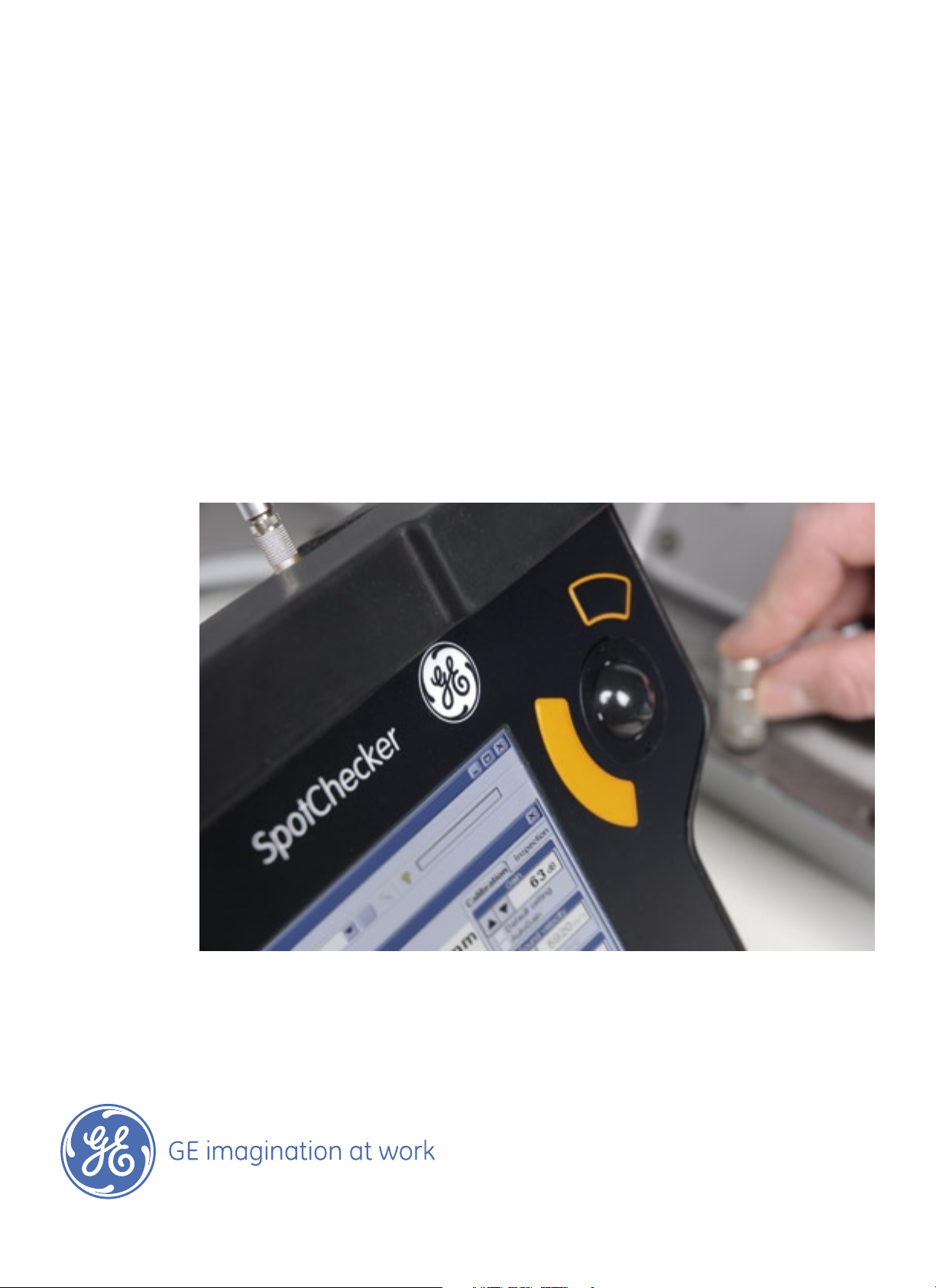
SpotChecker
A Truly Mobile Solution for Spot Weld Testing
Offering Significant Gains in Productivity
SpotChecker combines the power of a computerized expert system with easy-to-use portability.
Page 2
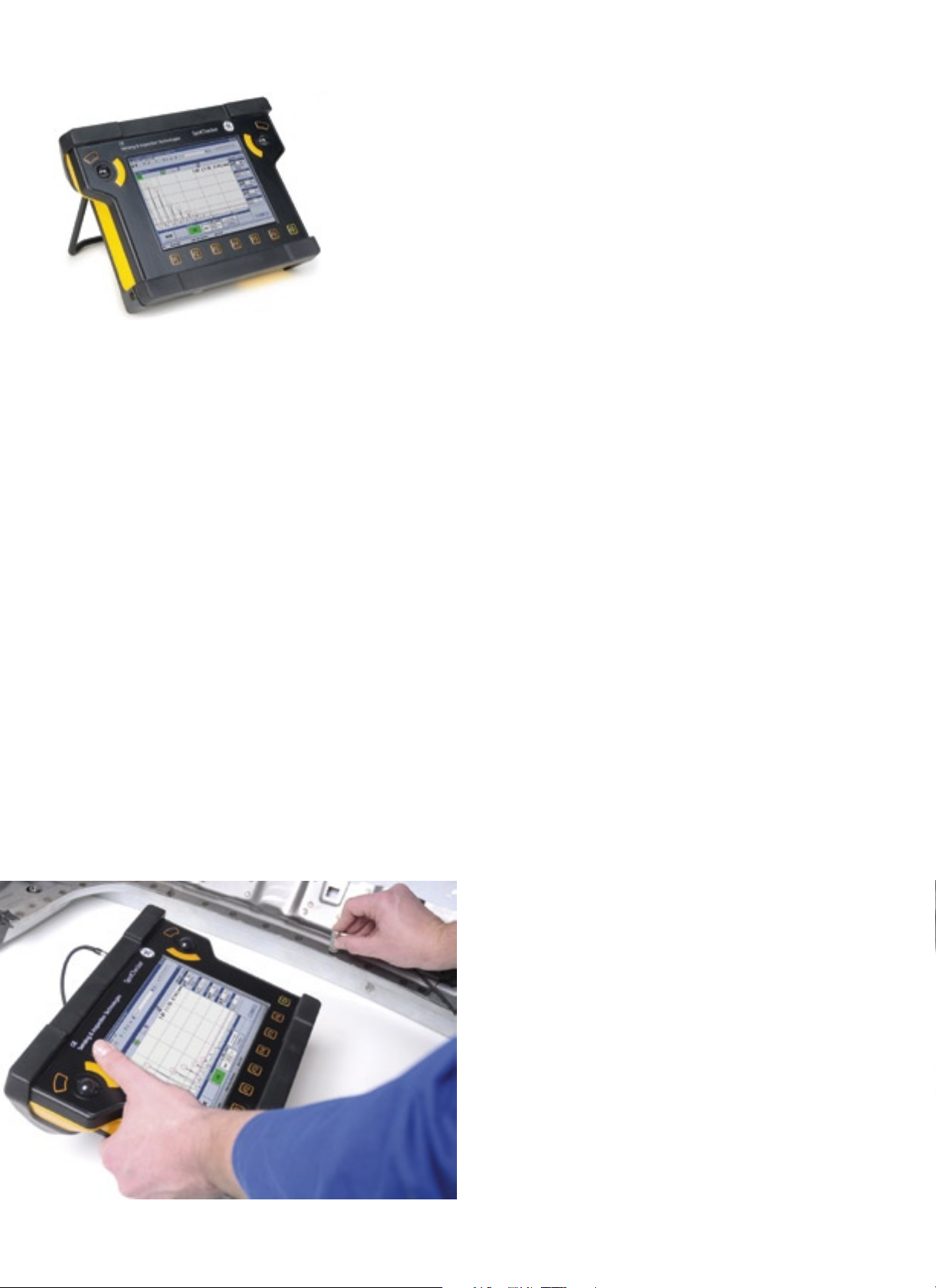
The SpotChecker :
A Hand-Held Flaw Detector
for Testing Spot Welds in
Situ on the Production Line
The range of joining methods used in automotive body
assembly lines has significantly increased in the last few
years. While formerly, resistance-welding and MIG/MAG
welds were the preferred joining methods, techniques such
as laser welding/soldering, bonding, etc, are also in common
use today. Since all of these processes can be used singly
and sometimes all together, this complexity places new
demands on test engineering. In addition to destructive
testing of spot welds, i.e. with a hammer and chisel, nondestructive testing with ultrasound has become routinely
applied in recent years. The increased acceptance of this
procedure is due in no small part to the decisive
advancements contributed by GE Sensing & Inspection
Technologies, working in close cooperation with the
automotive sector. Today ultrasonic spot weld checking is
a technique employed by major car manufacturers.
The SpotChecker allows to take spot weld checking right
onto the production line, saving time – and money.
Portable and Robust
SpotChecker weighs just 3.2 kg (7.05 lb), is battery operated and is
sealed to IP65. It features hot swap battery exchange to ensure
continuous operation. Battery charging can be done with batteries
inside or outside of the instrument, using an external charger.
Portability allows inspection to be carried out at the place of
welding or on the production line, with no need to transport
components to designated inspection stations. As a result, more
inspections can be carried out within the same time frame, which
means increased productivity.
Easy-to-Use
SpotChecker does not require intensive training but offers the
advantage of an “expert” system for people less qualified in weld
inspection. Its ergonomically designed operator interface features
an 8.4” LCD touch screen, six programmable function keys and twin
track balls, so that it can be operated simply and efficiently in the
most restricted of testing locations.
Connectivity
The flaw detector can be connected to external periphery devices
such as mouse, keyboard and printer by USB. The instrument can
also be connected to a PC wirelessly by WLAN or Bluetooth for data
up-and down-load.
A non-directional, user-friendly remote control, equipped with
programmable functions, provides extended flexibility. Intelligent
dialog probes, whose data is automatically recognized and loaded,
ensure 100-percent documentation accuracy and increased test
reliability in spot weld inspection.
Can be Integrated within
Quality Control Loops
By transmitting test results immediately and wirelessly to a suitable
database, it is possible to achieve accurate and reliable feedback to
adjust welding parameters and correct welding faults and eliminate
spotweld defects.
Page 3

Application Specific Software
By combining ultrasonic expertise with high power computer
specifications and application specific electronic data processing,
SpotChecker provides a package solution for performing inspection,
evaluation and documentation of test results, meeting strict quality
management requirements. It uses field-proven UltraLOG software,
which been developed specifically for the evaluation and
documentation of spotweld inspections. It can help to analyse
A-scan echo displays and can provide detailed flaw classification,
such as sound spot weld, loose or burnt spot weld, inadequate
weld nugget diameter, etc. The software’s extensive database also
allows the management of specific inspection plans, tailored to suit
particular manufacturing processes. It can specify the number of
welds to be inspected, and describe the test location, material data,
test diagrams and ultrasonic settings, allowing SpotChecker to be
used by relatively unskilled personnel.
Compatible with Existing GE Spotweld
Testing Instruments
The SpotChecker continues and complements GE Sensing &
Inspection Technologies’ comprehensive range of USLT spot weld
testing solutions. It employs the same software so that data can be
shared if required between various products in the range. Inspectors
who are familiar with the USLT operating platform soon become
proficient in SpotChecker operation.
Recommended accessories
(not included in the price of the instrument)
Spot-BAT
Spot-Chrg Battery charger for external charging of the Li-Ion
battery Spot-BAT
Spot-BT Bluetooth Adapter (external via USB)
Spot-WLAN WLAN module (internal)
Spot-RC
Optical mouse for USB connection
External keyboard for USB connection (German layout)
External keyboard for USB connection
(US-American layout)
3.5” floppy disk drive for USB connection
CD-RW drive for USB connection
Spot-NS Neck / Shoulder strap
Lithium-ion battery for Hot Swap (add. battery/spare part)
Remote Control incl. tansmitter box and internal receiver
(price on request)
Supported Globally by the Tradition,
Service and Expertise
SpotChecker is a product which enjoys the global support of one
of the world’s leading manufacturers of NDT solutions. We offer
after-sales service, maintenance, calibration and training on a
worldwide basis and are proud of a heritage extending back more
than 50 years.
Page 4

Technical Specifications - SpotChecker
SpotChecker
Enclosure
Connections
Power Supply
Ultrasound
Settings and Evaluation
Storage Temperature -20 to +60 °C (-4 to +140°F)
Operating Temperature 0 to +45 °C (32 to 113°F)
Dimensions W 225 × H 314 × D 94 mm (W 8.85 x H 12.36 x D 3.7”)
Weight Approx. 3.2 kg (7.05 lb) (Incl. Batteries)
Protection Rating IP 65
Shock Resistance According to EN 600 68-2-27
Vibration Resistance According to IEC 600 68-2-6 Fc
Display 8.4” TFT, SVGA, Touchscreen
Control Devices 2 × Trackball with 2 Buttons Each, 6 Function Keys, Touchscreen
Probes 2 × LEMO 00 Triax
Power Supply Unit 1 × LEMO 0S, 4-pin Socket
Network 1 × RJ45
USB 4 × USB Type A Socket, 1 × USB Type B Socket
Optional WLAN, Bluetooth
Operating Voltage 15 V DC
Power Consumption Approx. 22 W
Batteries 2 × Lithium-Ion 10.8 V, 4.8 Ah
Operating Time Approx. 4.0 h with 2 Batteries
Power Supply Unit External Power Supply Unit 100 ... 230 V AC, Max. 70 W
Pulser Type Spike Pulse
Pulse Repetition
Frequency (PRF)
Voltage Max. 400 V
Initial Pulse Rise Time < 15 ns
Damping 50 Ohm
Calibration Ranges Min. 0 to 2.5 mm (0 to 0.1”) (steel); max. 0 to 9,700 mm (0 to 381”) (steel)
Sound Velocity Range 500 ... 15,000 m/s (0.02 ... 0.59 “/μs) Integrated, Editable Material Table
Pulse Shift -10 to 1,500 mm (-0.39 to 50”) (steel)
Probe Delay 0 to 100 μs
Frequency Range 2 to 20 MHz (–3 dB)
Gain 110 dB, Adjustable in Steps of 0.5/1/2/6 dB
Rectification Full-Wave
Monitor Gates 2 Independent Monitor Gates, Adjustable over the Entire Maximum Calibration Range;
Distance Measurement - Initial Pulse and Measurement Point in Gate A or B
Measurement Resolution Sound Path/Time of Flight: up to 12.6 mm: 0.01 mm; Otherwise 0.2 % of Display Width
Amplitude 0.5 % Screen Height or 0.2 dB
A-scan Digitization 1,024 × 1,024 Pixels
Display Freeze Static A-scan Freeze, Dynamic A-scan Freeze (Freeze Box)
Echo Comparison Simultaneous Display of the Currently Active Signal and a Stored A-scan
Dialog Languages German, English, French, Spanish, Italian, Chinese, Japanese
Units mm
Max. 1,000 Hz, No Continuous Pulse Sequence
Evaluation on the Basis of A-scan at Display Refresh Rate
- Measuring Points: Gate B – Gate A (Differential Measurement)
Note: We reserve the right to technical modifications without prior notice.
www.gesensinginspection.com
© 2009 General Electric Company. All Rights Reserved. Specifications are subject to change without notice. GE is a registered trademark of General Electric Company. Other company or product names
mentioned in this document may be trademarks or registered trademarks of their respective companies, which are not affiliated with GE.
GEIT-20059
 Loading...