

Page 1
XECOM (1) XE014J
XE014J
7/99
Low Cost Slim-Link R PLCC DAA for Voice, Data Fax
Description
The XE014J supplies a complete DAA in a modified 68pin PLCC package. It is a low cost alternative to discrete
DAA’s for voice, fax, and data communications. The
XE014J replaces 25 to 30 discrete components with a
single, low cost unit. The XE014J leads to savings in
purchasing and assembly while insuring quality.
The XE014J is a complete DAA. It includes the line
transformer, loop current holding circuit, hookswitch,
metallic surge protection and ring indicator. Its PLCC
package permits automated, high-volume assembly . By
using the XE014J rather than a multitude of discrete
components, assembly and purchasing costs are reduced.
Xecom delivers the XE014J as a fully integrated, fully
tested assembly versus an assemblage of untested discrete components. Test and rework time can be reduced
by selecting the XE014J as the integrated solution.
Features
* Low Total Cost Solution for Adding Voice, fax, or
data Communications
* PLCC package for high-volume assembly
* FCC Part 68 Compliant
* Meets requirements for Canada and Japan
* Integrated Telephone Line Transformer
* Embedded Ring Detect Circuit
* Solid-State Hookswitch included
* Internal Metallic surge protection
* Operates on +5 Volt or +3 Volt Power
* Standard Operating Temperature Range 0 to 70 C
* Extended Temperature Ranges available
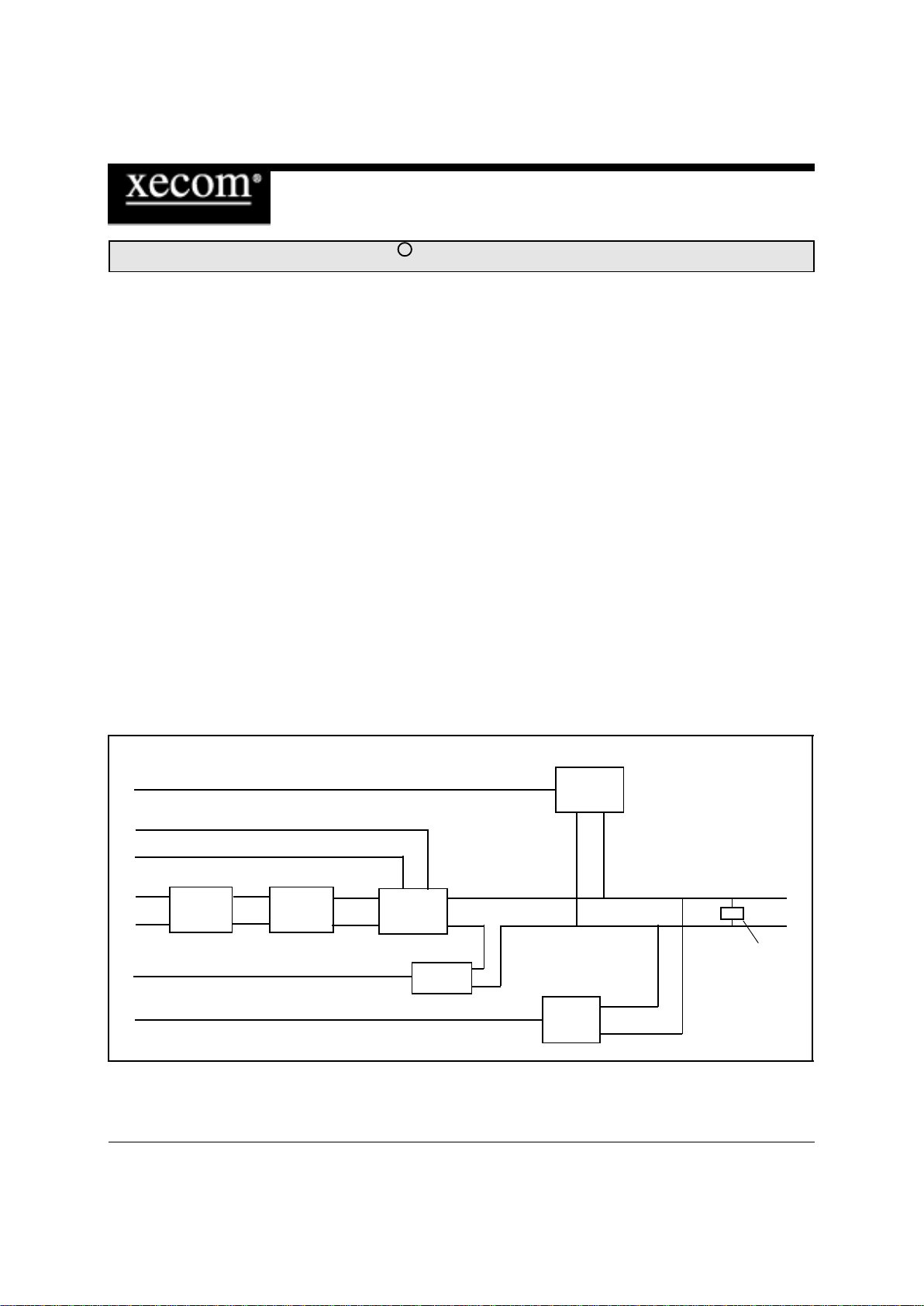
XE014J Block Diagram
Line Trans-
former
Line Current
Holding Cir-
cuit
Hookswitch
Ring De-
tector
T1
T2
OH
RI
Tip
Ring
Low Imped-
ance Dialing
/MUTE
L1
L2
Billing Tone
Filter
(Optional)
Metallic Surge
Suppression
Page 2
XECOM (2) XE014J
The standard version of the XE014J is the XE014JLHGU. The L indicates that the off-hook control is an active
low; the H indicates that the Ring Indicate output is an active high; the G indicates General Purpose feature set,
and the U indicates the North American country configuration.
There are a number of variations of the XE014J which can be provided on special order. We offer a choice in the
polarity of the Ring Indicate and Off-Hook signals plus variations for many different countries. We also anticipate
adding many new features and options in future versions of this product. Please contact your Xecom sales representative for the correct model number when ordering any of these special versions of the XE014J.
XE014J Ordering Information
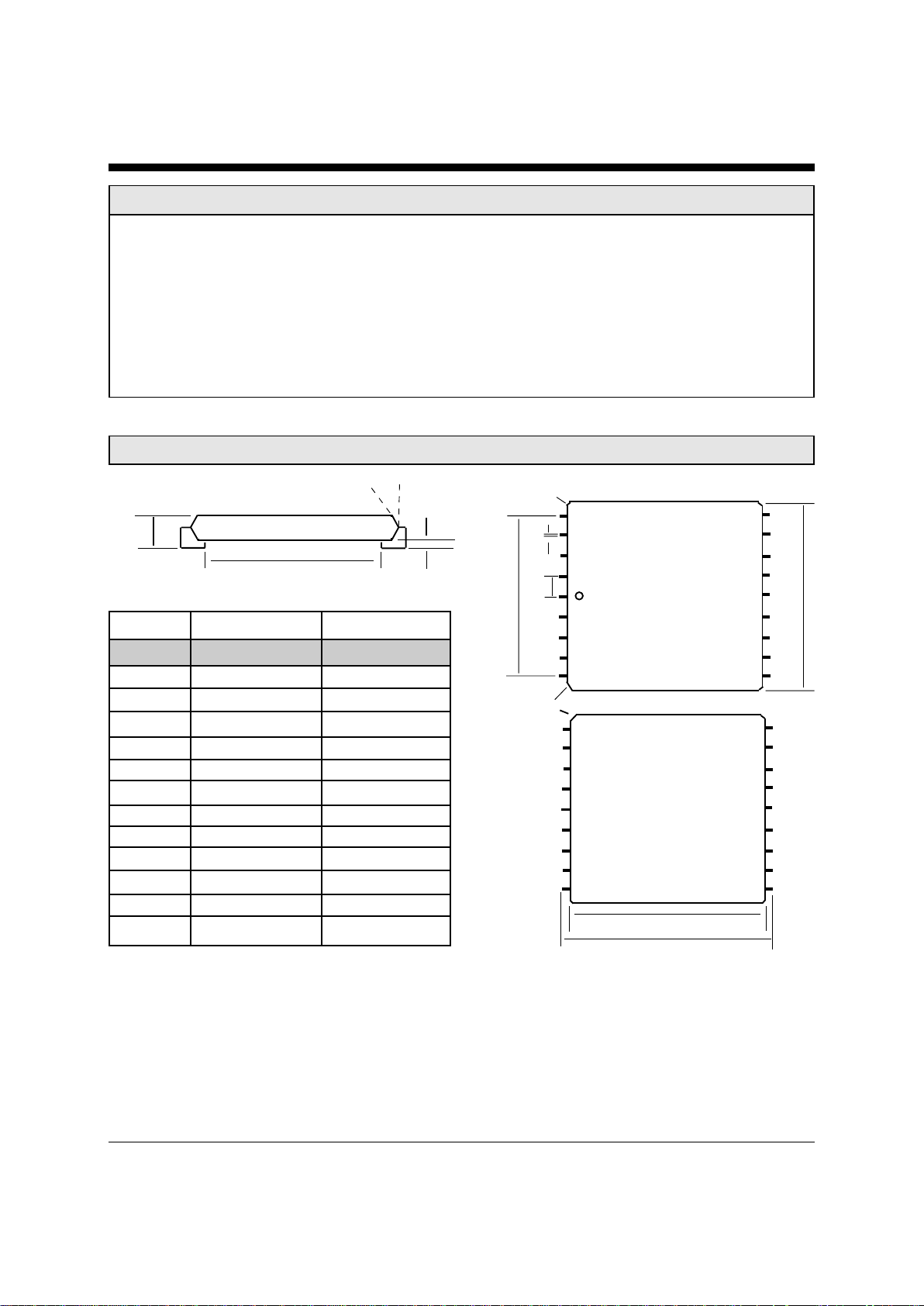
XE014J Mechanical Specifications
h x 45 degrees
(3 Places)
D2
b
e
D1
(top)
10
1
9
Index Corner
J x 45 degrees
D1
(bottom)
A
A1
D3
a
D
A 0.280 0.300 7.11 7.62
A1 0.020 REF 0.508 REF
b 0.017 0.021 0.432 0.533
D 0.985 0.995 25.02 25.27
D1 0.952 REF 24.18 REF
D2 0.800 REF 20.32 REF
D3 0.910 0.930 23.11 23.62
e 0.100 BSC 2.54 BSC
h 0.010 TYP 0.254 TYP
J 0.045 Typ 1.15 TYP
a45
o
TYP 45o TYP
Coplanarity 0.004 Max 0.10 Max
Inches Millimeters
Dim Min Max Min Max
Page 3
XECOM (3) XE014J
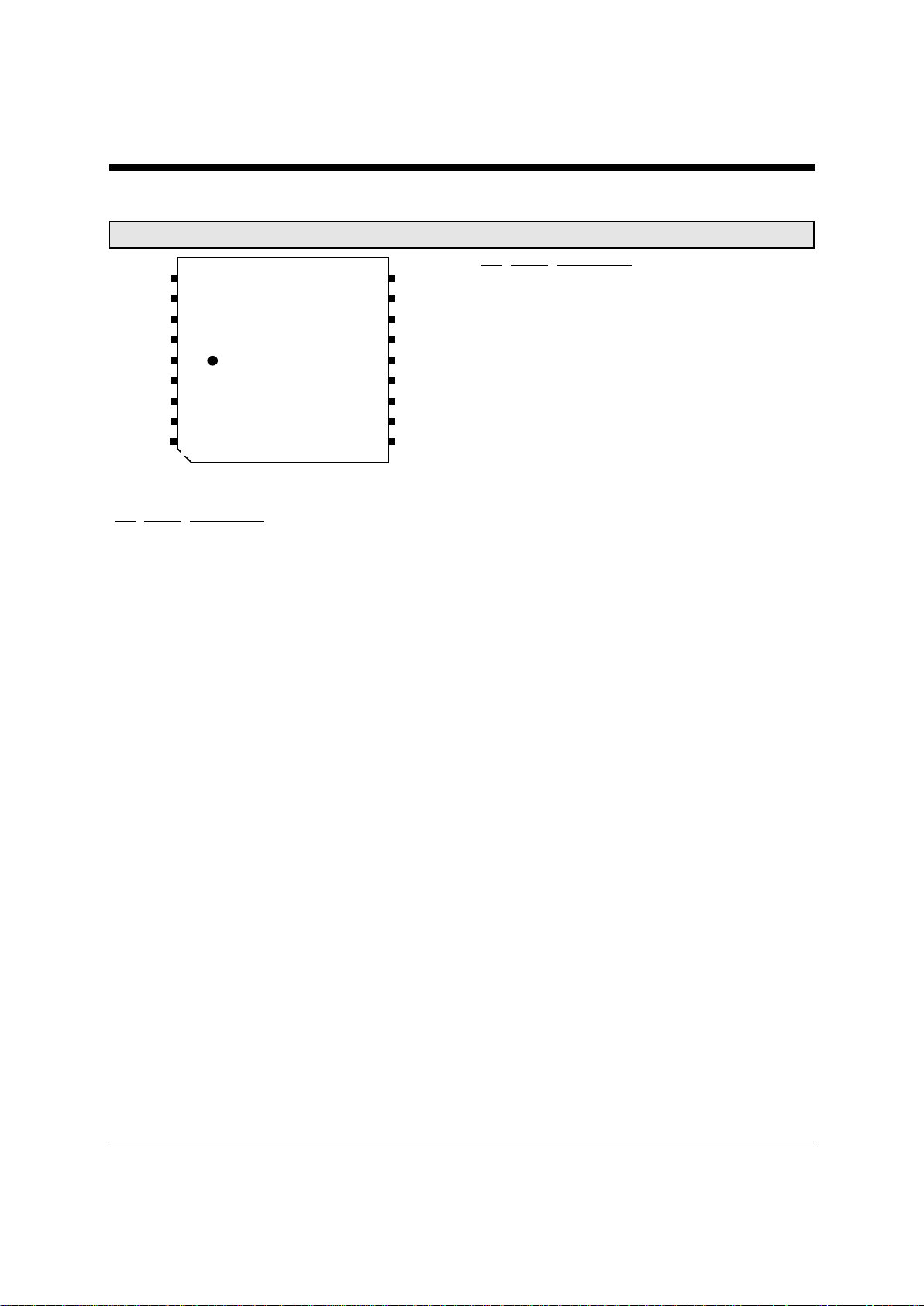
PIN NAME DESCRIPTION
XE014J Pin Descriptions
18
17
16
15
14
13
12
11
10
RI
N/C
N/C
T1
T2
Mute
OH
VCC
Gnd
N/C
Ring
Tip
N/C
L1 (Opt)
L2 (Opt)
N/C
N/C
N/C
XE014J
(top)
1
2
3
4
5
6
7
8
9
XE014J Pin Configuration
Pin Name Description
1 N/C No Connection
2 Ring Ring is one wire of the two-wire telephone line
connection (RJ11 Pin 4). FCC Part 68 Rules
require a 1500 volt isolation barrier between
the telephone line and all other circuits. This
isolation must be preserved throughout the
system. Xecom recommends 0.100 inch
spacing between traces connected to Ring and
all other conductors to preserve this isolation.
3 Tip Tip is one wire of the two-wire telephone line
connection (RJ11 Pin 3). The telephone
company places a DC "Battery" voltage across
Tip and Ring on all public switched telephone
lines. The XE014J accept this line battery
voltage without regard to its polarity.
4 N/C No Connection
5, 6 L2 L1 and L2 provide the points to connect a five
millihenry inductor. This inductor completes
the 16 KHz German billing tone filter.
7-9 N/C No Connection
10 GND Ground connection to the XE014J. This signal
provides the reference for the OH output and RI
input. This pin should be connected to the
systems digital ground.
11 VCC +5 or +3 Volt power source for the XE014J.
VCC powers the RI and OH control lines.
Pin Name Description
12 OH Switch-hook control to the modem. OH is
normally an active low input. OH is available
as an active high input by special order.
Activating OH closes the switch-hook causing
the XE014J to seize the local telephone line.
The telephone line connection is dropped when
OH is deactivated.
The host can pulse OH to simulate rotary
dialing. The pulse rate in the US is ten pulses
per second. Each digit is dialed as a series of
pulses created by closure of the hook-switch.
(one pulse for the digit one to ten pulses for the
digit zero) The pulses must be asymmetrical so
that the hook-switch is closed for thirty-one
milliseconds and open for sixty-nine
milliseconds. An inter-digit delay of at least
one hundred milliseconds is required.
13 Mute Mute is an optional signal on the XE014J.
Countries which require low impedance
dialing, such as Italy, use the Mute signal
rather than the OH signal to pulse dial.
14 T2 T2 in conjunction with T1 provides the
differential input/output for the analog signal.
T2 connects directly to the secondary side of
the line transformer embedded into the
XE014J. To match the impedance of the DAA
to the 600 ohm telephone line, a 340 ohm
resistor is required on T1 or T2.
15 T1 T1 in conjunction with T2 provides the
differential input/output for the analog signal.
T1 connects directly to the secondary side of
the line transformer embedded into the
XE014J. To match the impedance of the DAA
to the 600 ohm telephone line, a 340 ohm
resistor is required on T1 or T2.
16-17 N/C No Connection
18 RI Ring Indicate output from the modem. RI is
normally active high. RI is available as an active low output by special order. RI provides
a square wave representation of the Ring signal present across Tip and Ring. This permits
intelligent monitoring of the incoming ring.
The XE014J recognizes ring voltages of thirtyeight to one hundred fifty volts RMS in the
frequency range of sixteen to sixty-eight
Hertz.
Page 4

XECOM (4) XE014J
Typical Connections Diagram for North America and Japan
Recommended Parts
Designation Description
C1, C2 47 picofarad, 3000 Volts (Sprague Part Number 30GA-T47)
FB1, FB2 Ferrite Beads (TDK Part Number CB30-453215B)
Conexant
RC144ACF
RINGD
TXA1
RIN
VC
TXA2
-OH
18 RI 1
17 Ring 2
16 Tip 3
15 T1 4
14 T2 L2 5
13 Mute L1 6
12 \OH 7
11 VCC 8
10 GND 9
XECOM
XE014JLHGU
RJ11
340 ohms
2 K
10 K
27 K
FB1
FB2
C1 C2
4
3
+5 Volts
XE014J ABSOLUTE MAXIMUM RATINGS
Storage T emperature -25O C to +85O C
Operating T emperature Range * 0O C to +70O C
Maximum Solder T emperature 220O C
Maximum Time Above Eutectic (183O C) 90 seconds
Preheat Dwell Time 120 to 180 seconds
* The XE014J can be ordered with an Operating Temperature of -40O C to +85O C at extra cost.
Page 5

XECOM (5) XE014J
XE014J Applications Notes (continued)
Dialing:
The public switched telephone network permits tone and
rotary dialing. The XE014J supports both types. Tone
dialing requires an external signal source to provide the
dialing tones to the XE014J. Rotary dialing is accomplished by pulsing the OH line on the XE014J.
Tone Dialing: When tone dialing, the XE014J seizes
the line, OH active. The DTMF, Dual Tone Multiple
Frequency, dialing tones are placed across T1 and T2.
Each digit uses a unique tone pair. The higher frequency
tone is always larger than the lower frequency one.
Transmit the tones for a minimum of 70 milliseconds,
and leave a minimum of 70 milliseconds between digits.
The chart below shows the correct frequencies for each
digit.
Digit Lower Tone Upper Tone
1 697 1209
2 697 1336
3 697 1477
4 770 1209
5 770 1336
6 770 1477
7 852 1209
8 852 1336
9 852 1477
0 941 1336
* 941 1209
# 941 1477
Pulse Dialing: The XE014J generates dialing pulses
through momentary closures of the switch-hook. Each
digit is dialed as a series of pulses, one pulse for the digit
one, ten pulses for a zero. The pulse rate is ten pulses
per second. The dialing pulses are asymmetrical. The
correct duty cycle varies from country to country. An
interdigit delay of at least one hundred milliseconds is
required to separate the digits.
Some countries, notably Italy, require low impedance
values during pulse dialing. For these countries, the
XE014J provides a Mute switch to generate the dialing
pulses rather than OH. .
Signal Levels:
FCC Part 68 Rules set the allowable level of all signals
placed on the telephone line other than live voice. For
the most common certification type, a "Permissive"
connection, data, fax, synthesized voice and other information signals are limited to -9 dBm. Zero dBm is 1
milliwatt through a 600 ohm load. The rules provide
for a different limit for DTMF, Dual Tone Multiple
Frequency, tones. The combined power of the two tones
may be as high as 0 dBm with the higher frequency tone
at least 2 dBm larger than the lower tone.
Insertion Loss: There is some loss of signal power as
the information signal passes through the XE014J. This
"insertion" loss should be taken into account when
placing signals across T1 and T2 for transmission. The
typical insertion loss of the XE014J is 3 dB.
2/4 Wire Conversion:
Full Duplex communications over a two-wire telephone
line requires that transmit and receive signal share the
available bandwidth. The two-to-four wire convertor
separates these signals at the host interface. Many
modem analog front end chips incorporate an internal 2/
4 wire convertor making it unnecessary to provide one in
the DAA.
If you are using the XE014J for an application other than
a modem, such as voice processing, or your modem
analog front end does not provide the 2/4 wire convertor,
you will need to provide a discrete 2/4 wire convertor.
Figure 6 shows a simple 2/4 wire convertor circuit.
Page 6

XECOM (6) XE014J
2/4 Wire convertor
The performance of the 2/4 wire convertor is measured
by its Transhybrid Loss. The Transhybrid Loss shows
how much the 2/4 wire convertor attenuates the transmit
signal on the received data line. The circuit above
provides a typical Transhybrid Loss of 20 dB.
The Transhybrid Loss will vary with the quality of the
impedance match to the telephone line. Even when the
recommended value for the impedance matching resistor, R6, is used variations from line to line alter the
impedance match. The value of R3 can be changed to
improve the Transhybrid Loss.
XE014J Applications Notes (continued)
Transmit
Receive
T1
T2
4558
4558
R1
R2
R3
R4
R5
R6
20K
20K
10K
280 ohms
40K
11.5K
XE056J
XE014J
The 2/4 wire convertor also amplifies the transmit and
receive signals to compensate for the insertion loss of the
DAA. This circuit provides 6 dB gain of both the
transmit and receive signals. The values of R1 and R2
set the transmit gain. The values of R4 and R5 set the
receive gain.
340 ohms
Page 7

XECOM (7) XE014J
Electrical Specification
(Vcc=+5v ±10%, Ta=0 to 70 deg C)
Power Supply Current Off-hook 10 mA
On-hook 0.5 mA
Transmit Insertion loss 600 Ohm Impedance, 1800 Hz 3 dB
Receive Insertion loss 600 Ohm Impedance, 1800 Hz 3 d B
Line Matching Impedance Input to T1 and T2 (600 ohm line) 340 ohms
Line Impedance RM equal to 340 ohms 540 600 660 ohms
Total Harmonic Distortion 600 Ohm Impedance, 500 to 4000 Hz -76 dB
Ring Detect Sensitivity Min. AC voltage between Tip & 38 150 Vrms
Ring Type B ringer
Ring Frequencies Detected 16 68 Hz
RI Output Voltage Ring signal present, Active low 0.2 0.5 Volts
Ring signal present, Active High 2.0 5.0 Volts
Hookswitch Control ON: (off-hook) 0.2 0.5 Volts
Voltage (active low) OFF: (on-hook) 2.0 3.0 Volts
Hookswitch Control ON: (off-hook) 2.0 3.0 Volts
Voltage (active high) OFF: (on-hook) 0.2 0.5 Volts
Hookswitch Control ON: (off-hook) 5 10 milliamps
Current OFF: (on-hook) 5 microamps
Loop Current Off-Hook current draw from 20 100 mA
Telephone Line
DC On-Hook Impedance Hookswitch Open 10 M Ohms
Parameter Conditions Min Typ Max Units
Page 8

XECOM (8) XE014J
FCC Part 68 Instructions
When developing a product to be connected to the telephone line, it is necessary to use a circuit known as a Data
Access Arrangement (DAA) approved by the appropriate governmental agency. In the US this agency is the Federal
Communications Commission (FCC), while in Canada it is Industry Canada (IC). These agencies test and approve the
product to ensure that it meets their specifications, thereby protecting the telephone system from damage and
protecting the user from high voltage transients (such as lightning strikes) which may come down the telephone line.
The XE014J has been designed to meet all FCC Part 68 requirements for hazardous voltage, line impedance and
leakage current. If the system transmits data, synthesized voice, or DTMF tones on the telephone line, the user must
certify that the signals transmitted meet basic FCC requirements for maximum transmission levels, out of band energy
and billing delay. Full details may be obtained from the FCC under Part 68 of the FCC Rules and Regulations, or in
Title 47 of the Code of Federal Regulations, however the basic requirements are as follows:
1. Maximum Transmit Level
For the normal “permissive” (standard) telephone line, equipment which transmits data (such as a modem) must not
exceed a transmission level of -9 dBm.
2. Out of Band Energy
Data equipment must not transmit “out of band” energy on the telephone line which exceeds the following limits:
Frequency Range Max. Power
3995 Hz to 4005 Hz -27 dBm
4005 Hz to 12 kHz -20 dBm
12 kHz to 90 kHz -55 dBm
90 kHz to 270 kHz -55 dBm
270 kHz to 6 MHz -15 dBm
3. DTMF Transmission Level
If the system is capable of DTMF dialing, the maximum DTMF transmission level must be less than 0 dBm averaged
over a 3 second interval.
4. Billing Delay
A delay of 2 seconds or greater is required after the time the XE014J is taken “off hook” and before any information
is transmitted. This is required to ensure that billing information may be exchanged between telephone company
central offices without interference.
The user of the XE014J must certify to the FCC that the final system meets the requirements of Part 68 which include
the criteria above as well as the high voltage protection provided by the XE014J. This is generally accomplished
through an independent testing lab which tests the System and submits the proper paperwork to the FCC for approval.
Since the XE014J already complies with FCC Part 68 rules, this is a relatively simple process.
Page 9

XECOM (9) XE014J
Copyright, Xecom © 1999
While Xecom, Inc. has made every effort to ensure that the information presented here is accurate, Xecom will not
be liable for any damages arising from errors or omission of fact. Xecom reserves the right to modify specifications
and/or prices without notice. Product mentioned herein are used for identification purposes only and may be trademarks and/or registered trademarks of their respective companies.
Xecom
Incorporated
374 Turquoise Street, Milpitas, CA 95035
Ph:408-945 -6640 Fax:408 -942-1346
Email: info@xecom.com
Terms of Sale
Devices sold by XECOM are covered by the warranty provisions appearing in its Terms of Sale only. XECOM
makes no warranty, express, statutory, implied, or by description regarding the information set forth herein, or
regarding the freedom of the described devices from patent infringement. XECOM makes no warranty of
merchantability or fitness for any purposes. XECOM reserves the right to discontinue production and change
specifications and prices at any time and without notice. This product is intended for use in normal commercial
applications. Applications requiring extended temperature range, unusual environmental requirements, or high
reliability applications, such as military, medical life-support or life-sustaining equipment, are specifically not
recommended without additional processing and authorization by XECOM for such application.
Xecom assumes no responsibility for the use of any circuitry other than circuitry embodied in a Xecom product.
No other circuits, patents, or licenses are implied.
Life Support Policy
Xecom's products are not authorized for use as Critical Components in Life Support Devices or Systems.
Life Support Devices or Systems are devices or systems which, (a) are intended for surgical implant into the body,
or (b) support or sustain life, and whose failure to perform, when properly used in accordance with instructions provided in the labeling, can be reasonably expected to result in significant injury to the user.
A Critical Component is any component of a life support device or system whose failure to perform can be reasonably expected to cause failure of the life support device or system, or to affect its safety or effectiveness.
 Loading...