

Page 1

DATA SH EET
Preliminary specification
Supersedes data of 1997 Jul 17
File under Integrated Circuits, IC02
1997 Aug 27
INTEGRATED CIRCUITS
TDA6120Q
Video output amplifier
Page 2

1997 Aug 27 2
Philips Semiconductors Preliminary specification
Video output amplifier TDA6120Q
FEATURES
• High large signal bandwidth of 32 MHz (typ.) at
125 V (p-p)
• High small signal bandwidth of 47 MHz (typ.) at
60 V (p-p)
• Rise/fall time of 12.5 ns for 125 V (p-p)
• High slew rate of 10 V/ns
• Low static power dissipation of 2.5 W at 200 V supply
voltage
• High maximum output voltage
• Bandwidth independent of voltage gain
• Maximum overall voltage gain over 46 dB
• High Power Supply Rejection Ratio (PSRR)
• Fast cathode current measurement output for dark
current control loop
• Differential voltage input.
GENERAL DESCRIPTION
The TDA6120Q is a single 30 MHz, 125 V (p-p) video
output amplifier contained in a plastic DIL-bent-SIL power
package.The device uses high-voltage DMOS technology
and is intended to drive the cathodes of a CRT in High
Definition TVs (HDTVs) or monitors.
ORDERING INFORMATION
TYPE
NUMBER
PACKAGE
NAME DESCRIPTION VERSION
TDA6120Q DBS13P plastic DIL-bent-SIL power package; 13 leads (lead length 7.7 mm) SOT141-8
Page 3
1997 Aug 27 3
Philips Semiconductors Preliminary specification
Video output amplifier TDA6120Q
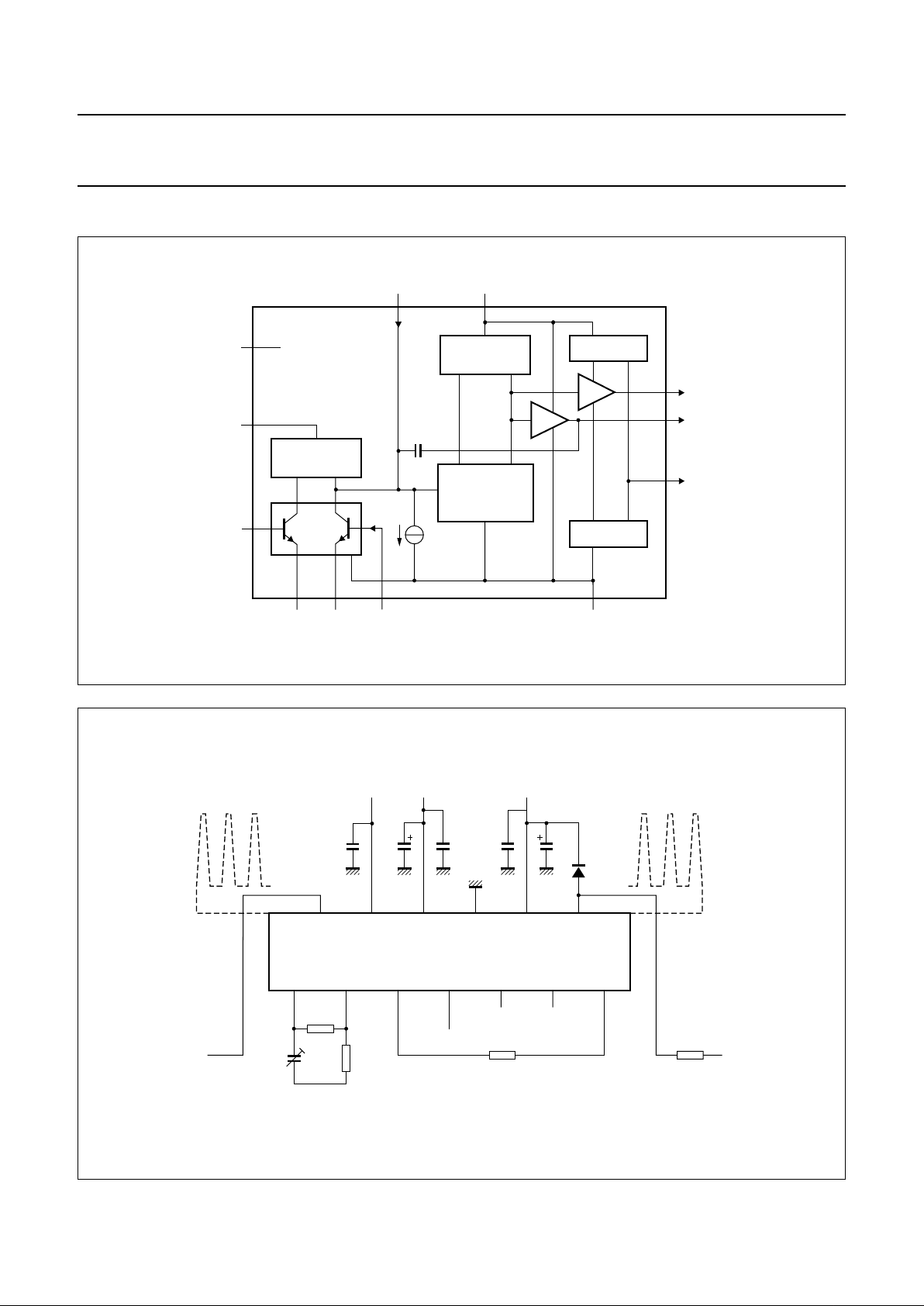
BLOCK DIAGRAM
Fig.1 Block diagram.
handbook, full pagewidth
MGK440
1×
1×
CURRENT
INPUT
out 1×
in
out 4×
MIRROR
1×
in out
CASCODE
MIRROR
4×
in out
CASCODE
+
J
5 mA
0.7 pF
TDA6120Q
9, 11
6
2
n.c.
V
CC
VIN−
1
3
4
RC−
RC+
VIN+
8
GND
12
13
7
OUTC
OUT
OUTM
IIN
V
DD
10
5
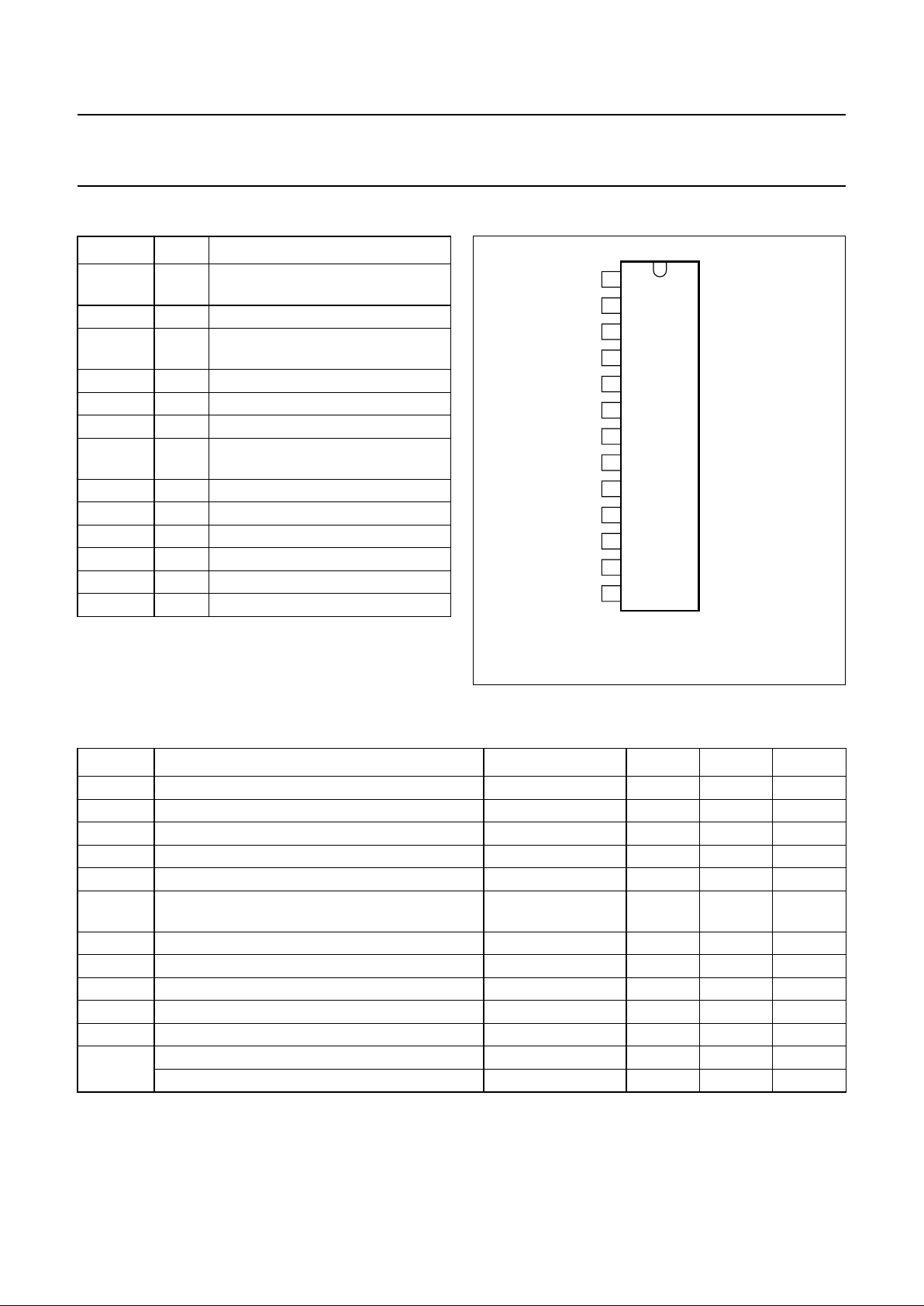
Fig.2 Top view.
handbook, full pagewidth
MGK441
442 Ω
68 pF
C1
RC−
RC+
1
35791113
2
4 6 8 10 12
22 Ω
VIN− VIN+
C
r
10 nF
C
CC
10
µF
C
DD
3.3
µF
C
C
22
nF
C
D
22
nF
TDA6120Q
22 kΩ
R
f
IIN OUTM n.c. n.c.
OUT
CRTVIN
147 Ω
R
flash
V
CC
V
DD
D
flash
OUTCGND
+12 V
+200 V
V
ref
R
ia
R
i
Page 4
1997 Aug 27 4
Philips Semiconductors Preliminary specification
Video output amplifier TDA6120Q
PINNING
SYMBOL PIN DESCRIPTION
RC− 1 inverting input pre-emphasis
network
VIN− 2 inverting voltage input
RC+ 3 non-inverting input pre-emphasis
network
VIN+ 4 non-inverting voltage input
IIN 5 feedback current input
V
CC
6 low supply voltage (12 V)
OUTM 7 cathode current measurement
output
GND 8 power ground and heatsink
n.c. 9 not connected
V
DD
10 high supply voltage (200 V)
n.c. 11 not connected
OUTC 12 cathode output
OUT 13 feedback output
Fig.3 Pin configuration.
handbook, halfpage
RC−
VIN−
RC+
VIN+
IIN
V
CC
OUTM
GND
n.c.
V
DD
n.c.
OUTC
OUT
1
2
3
4
5
6
7
8
9
10
11
12
13
TDA6120Q
MGK438
LIMITING VALUES
In accordance with the Absolute Maximum Rating System (IEC 134).
Note
1. 1250 V for IIN (pin 5).
SYMBOL PARAMETER CONDITIONS MIN. MAX. UNIT
V
DD
high supply voltage 0 280 V
V
CC
low supply voltage 0 20 V
V
i
input voltage (pins 2 and 4) 0 V
CC
V
V
i(dif)
differential mode input voltage (pins 2 and 4) −V
CC
V
CC
V
V
i(pe)
pre-emphasis input voltage (pins 1 and 3) 0 V
CC
V
V
i(dif)(pe)
differential mode pre-emphasis input voltage
(pins 1 and 3)
−V
CC
V
CC
V
V
IIN
input voltage (pin 5) 0 2V
BE
V
V
OUTM
measurement output voltage 0 20 V
V
o
output voltage (pins 12 and 13) 0 V
DD
V
T
stg
storage temperature −55 +150 °C
T
j
junction temperature −20 +150 °C
V
ESD
voltage peak human body model note 1 − 2000 V
voltage peak machine model − 300 V
Page 5
1997 Aug 27 5
Philips Semiconductors Preliminary specification
Video output amplifier TDA6120Q
QUALITY SPECIFICATION
Quality specification in accordance with
“SNW-FQ-611 part E”
.
THERMAL CHARACTERISTICS
SYMBOL PARAMETER VALUE UNIT
R
th j-c
thermal resistance from junction to case 3.0 K/W
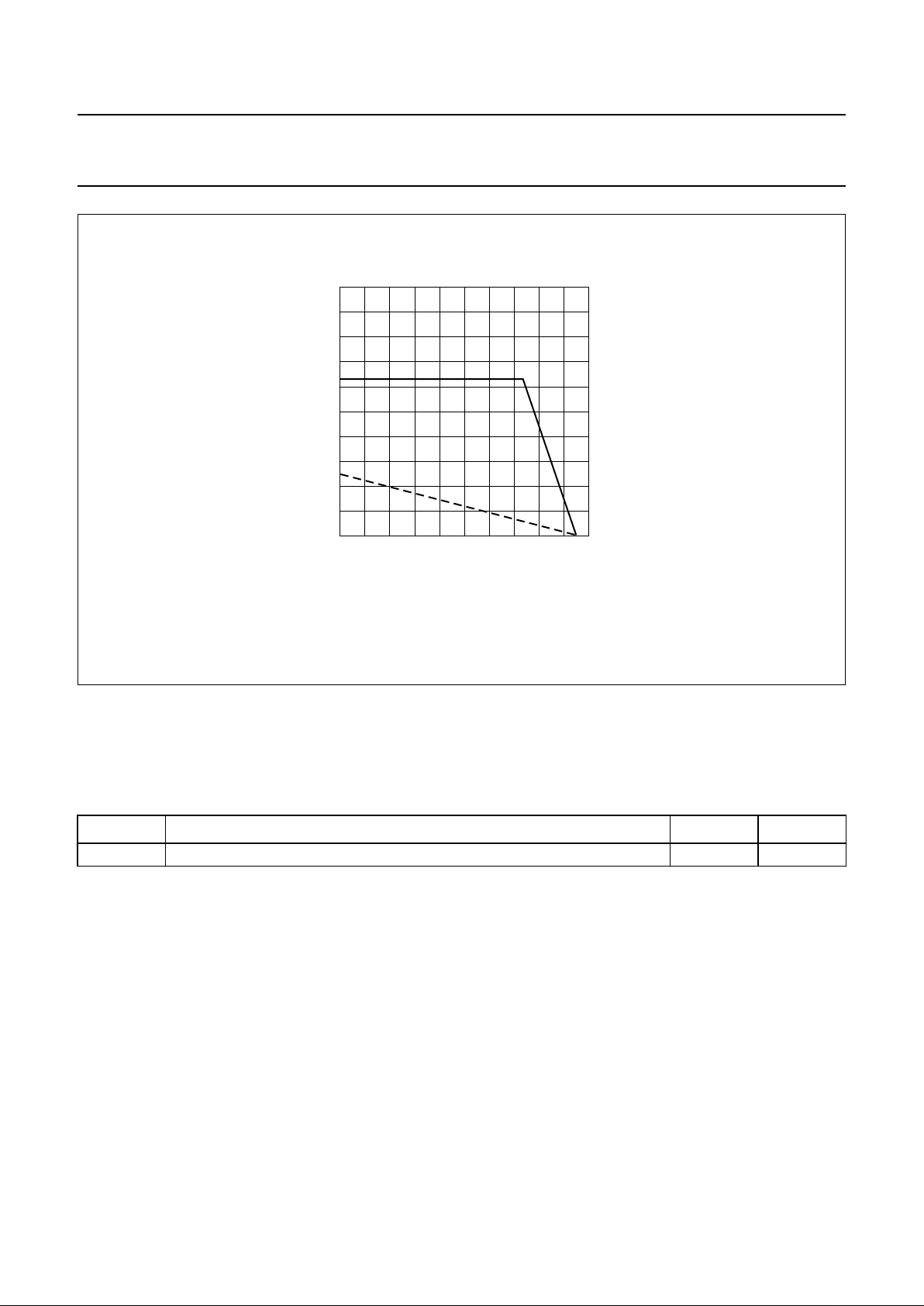
Fig.4 Power derating curve.
(1) Infinite heatsink.
(2) No heatsink.
handbook, halfpage
−20 160
20
0
(1)
(2)
4
MGK442
8
12
16
04020 80 120
T
amb
(°C)
P
tot
(W)
Page 6

1997 Aug 27 6
Philips Semiconductors Preliminary specification
Video output amplifier TDA6120Q
CHARACTERISTICS
Operating range: T
j
= −20 to +150 °C; VDD= 180 to 210 V; VCC= 10.8 to 13.2 V; V
OUTM
= 4 to 20 V; V
VIN−
= 1.5 to 5 V;
V
VIN+
= 1.5 to 5 V.
Test conditions: T
amb
=25°C; VDD= 200 V; VCC= 12 V; V
VIN+
=3V; V
OUTM
=6V; CL= 10 pF (CL consists of parasitic
and cathode capacitance); R
th h
= 4 K/W; test circuit of Fig.5; unless otherwise specified.
SYMBOL PARAMETER CONDITIONS MIN. TYP. MAX. UNIT
I
DD(q)
quiescent high voltage supply
current
V
OUTC
= 100 V 8 10 12 mA
I
CC(q)
quiescent low voltage supply
current
V
VIN−=VVIN+
25 31 39 mA
I
bias
input bias current
(pins 2 and 4)
V
OUTC
= 100 V − 30 −µA
V
OUTC
DC output voltage
(pins 12 and 13)
V
VIN−=VVIN+
70 100 130 V
∆V
OUTC(T)
DC output voltage
temperature drift
(pins 12 and 13)
V
VIN−=VVIN+
−−5V
I
(offset)OUTM
offset current of measurement
output
note 1 −40 +20 +120 µA
∆I
OUTM
/∆I
OUTC
linearity of current transfer −50 µA<I
OUTC
< +50 µA;
note 1
− 1.0 −
C
i
input capacitance
(pins 2 and 4)
V
OUTC=VOUTC(max)
− 3 − pF
I
OUTC(max)
maximum dynamic peak
output current (pin 12)
20V<V
OUTC<VDD
− 20 V − 100 − mA
V
OUTC(min)
minimum output voltage
(pin 12)
− 410V
V
OUTC(max)
maximum output voltage
(pin 12)
VDD− 10 VDD− 6 − V
G
int
internal gain 1.68 1.87 2.08
B
s
small signal bandwidth
(pin 12)
V
OUTC(AC)
= 60 V (p-p);
V
OUTC(DC)
= 100 V
40 47 − MHz
B
l
large signal bandwidth
(pin 12)
V
OUTC(AC)
= 125 V (p-p);
V
OUTC(DC)
= 100 V
28 32 − MHz
t
pd
cathode output propagation
time 50% input to 50% output
(pin 12)
V
OUTC(AC)
= 125 V (p-p);
V
OUTC(DC)
= 100 V;
square wave; f < 1 MHz;
t
f(VIN−)
= 10 ns;
t
r(VIN−)
= 10 ns;
see Figs 6 and 7
10 − 15 ns
t
o(r)
cathode output rise time
10% output to 90% output
(pin 12)
V
OUTC(AC)
= 125 V (p-p);
V
OUTC(DC)
= 100 V;
square wave; f < 1 MHz;
t
f(VIN−)
= 10 ns;
t
r(VIN−)
= 10 ns;
see Fig.6
10 14 18 ns
Page 7

1997 Aug 27 7
Philips Semiconductors Preliminary specification
Video output amplifier TDA6120Q
Notes
1. The operating range of the measurement output OUTM is 4 to 20 V. Below 4 V, OUTM acts as a voltage source with
an output resistance such that the maximum current input from OUTM is 2 mA.
a) The linearity of the current transfer is guaranteed until a junction temperature of 125 °C.
2. The ratio of the change in supply voltage to the change in input voltage when there is no change in output voltage.
t
o(f)
cathode output fall time
90% output to 10% output
(pin 12)
V
OUTC(AC)
= 125 V (p-p);
V
OUTC(DC)
= 100 V;
square wave; f < 1 MHz;
t
f(VIN−)
= 10 ns;
t
r(VIN−)
= 10 ns;
see Fig.7
10 12.5 15 ns
t
st
settling time 50% input to
(99% < output < 101%)
(pin 12)
V
OUTC(AC)
= 125 V (p-p);
V
OUTC(DC)
= 100 V;
square wave f < 1 MHz;
t
f(VIN−)
= 10 ns;
t
r(VIN−)
= 10 ns;
see Figs 6 and 7
−−250 ns
SR
r
slew rate rise between
30Vto(VDD− 30 V) (pin 12)
V
VIN−
= 2 V (p-p) square
wave; f < 1 MHz;
t
f(VIN−)
= 10 ns;
t
r(VIN−)
=10ns
− 8 − V/ns
SR
f
slew rate fall between
(VDD− 30 V) to 30 V (pin 12)
V
VIN−
= 2 V (p-p) square
wave; f < 1 MHz;
t
f(VIN−)
= 10 ns;
t
r(VIN−)
= 10 ns;
− 10 − V/ns
O
Vr
cathode output voltage
overshoot rise (pin 12)
V
OUTC(AC)
= 125 V (p-p);
V
OUTC(DC)
= 100 V;
square wave; f < 1 MHz;
t
f(VIN−)
= 10 ns;
t
r(VIN−)
= 10 ns;
see Figs 6 and 7
− 5 − %
O
Vf
cathode output voltage
overshoot fall (pin 12)
V
OUTC(AC)
= 125 V (p-p);
V
OUTC(DC)
= 100 V;
square wave; f < 1 MHz;
t
f(VIN−)
= 10 ns;
t
r(VIN−)
= 10 ns;
see Figs 6 and 7
− 20 − %
PSRRh high voltage power supply
rejection ratio
f < 50 kHz; note 2 − 44 − dB
PSRRl low voltage power supply
rejection ratio
f < 50 kHz; note 2 − 48 − dB
SYMBOL PARAMETER CONDITIONS MIN. TYP. MAX. UNIT
Page 8

1997 Aug 27 8
Philips Semiconductors Preliminary specification
Video output amplifier TDA6120Q
Fig.5 Test circuit with gain of 40 dB.
handbook, full pagewidth
MGK443
442 Ω
22 Ω
R
ia
R
i
47 Ω
R
CC
47 Ω
R
DD
147 Ω
R
flash
68 pF
22 kΩ
R
f
C1
2 MΩ
1 kΩ
R3
100 kΩ
R2
C
CCC
50 Ω
R
a
R
ba
1 kΩ
R
bb
RC−
VIN−
VIN
+12 V
+200 V
V
ref
RC+
VIN+
IIN
V
CC
OUTM
GND
I
m
V
DD
OUTC
OUT
VOUT
1
2
C11 10 µF
C10 22 nF
C13 10 µF
47 µF
C
CC
10 nF
C8
6.8 pF
C7
3.3 pF
C9
136 pF
C
DDD
10 µF
C
DD
10 nF
C12 22 nF
3
4
5
6
7
8
10
12
13
TDA6120Q
Overall gain G
int
R
f
R
i
-----
×=
Page 9

1997 Aug 27 9
Philips Semiconductors Preliminary specification
Video output amplifier TDA6120Q
162.5
150
100
50
37.5
163.75
161.25
t
st
overshoot (in %)
t
t
0
x
x
t
o(r)
V
oc
V
i
MGK444
t
pd
Fig.6 Output (pins 12 and 13; rising edge) as a function of input signal.
Page 10

1997 Aug 27 10
Philips Semiconductors Preliminary specification
Video output amplifier TDA6120Q
Fig.7 Output (pins 12 and 13; falling edge) as a function of input signal.
162.5
150
100
50
37.5
38.75
36.25
overshoot (in %)
t
t
0
x
x
MGK445
V
oc
V
i
t
pd
t
st
t
o(r)
FLASHOVER PROTECTION
The TDA6120Q does NOT include protection diodes that
clamp the cathode output pin to the high voltage supply pin
during a CRT flashover discharge. Therefore an external
high voltage reverse biased diode has to be connected
between the OUTC pin and the VDD pin. An external 147 Ω
carbon high-voltage resistor in combination with a 2 kV
spark gap between the cathode and ground will limit the
maximum clamp current (for this resistor value, the CRT
has to be connected to the main printed-circuit board).
This external network causes an increase in the rise and
fall times and a decrease in the overshoot.
Pin 10 must be decoupled to pin 8:
• By a capacitor >22 nF with good HF behaviour (e.g. foil).
This capacitor must be placed as close as possible to
pin 10 and pin 8; definitely within 5 mm.
• By a capacitor >3.3 µF on the picture tube base printed
circuit board (common for three output stages).
Page 11

1997 Aug 27 11
Philips Semiconductors Preliminary specification
Video output amplifier TDA6120Q
TEST AND APPLICATION INFORMATION
Dissipation
Regarding dissipation, distinction must be made between
static dissipation (independent of frequency) and dynamic
dissipation (proportional to frequency). The static
dissipation of the TDA6120Q is due to supply currents, and
currents in the feedback network and CRT.
The static dissipation is given by the following equation:
Where:
R
f
= feedback resistance
I
OUTC
= DC cathode current.
The dynamic dissipation is given by the following equation:
P
stat
V
CCICCVDDIDDVOUTC
V
OUTC
RfI
OUTC
–
---------------------------
×–×+×=
P
dyn
V
DD
CLC
int
+()f×V
OUTC p p–()
× b××=
Where:
C
L
= load capacitance
C
int
= effective internal load capacitance
(approximately 7 pF)
f = frequency
V
OUTC(p-p)
= output voltage (peak-to-peak value)
b = non-blanking duty cycle (0.8).
The IC must be mounted on the picture tube base
printed-circuit board to minimize the load capacitance CL.
Switch-off
The voltage at output pins OUT and OUTC will be pulled
to ground when the low voltage supply voltage (V
CC
) is
switched off.
Page 12

1997 Aug 27 12
Philips Semiconductors Preliminary specification
Video output amplifier TDA6120Q
INTERNAL PIN CONFIGURATION
Fig.8 Internal pin diagram.
andbook, full pagewidth
MGK439
ESD
ESD
ESD
ESD
TDA6120Q
7
8
12
10
6
ESD
ESD
13
2
1
ESD
ESD
ESD
4
3
ESD
5
RC+
VIN+
RC−
OUTC
V
DD
V
CC
OUT
OUTM
GND
VIN−
IIN
Page 13

1997 Aug 27 13
Philips Semiconductors Preliminary specification
Video output amplifier TDA6120Q
PACKAGE OUTLINE
UNIT A e
1
A2bpcD
(1)
E
(1)
Z
(1)
deD
h
LL3m
REFERENCES
OUTLINE
VERSION
EUROPEAN
PROJECTION
ISSUE DATE
IEC JEDEC EIAJ
mm
17.0
15.5
4.6
4.2
0.75
0.60
0.48
0.38
24.0
23.6
20.0
19.6
10 3.4
12.2
11.8
1.7
e
2
5.08
2.4
1.6
E
h
6
2.00
1.45
2.1
1.8
3.4
3.1
4.3
DIMENSIONS (mm are the original dimensions)
Note
1. Plastic or metal protrusions of 0.25 mm maximum per side are not included.
8.4
7.0
SOT141-8
0 5 10 mm
scale
Qj
0.25
w
0.6
v
0.03
x
D
L
E
A
c
A
2
m
L
3
Q
w M
b
p
1
d
Z
e
2
e
e
113
j
92-11-17
95-03-11
DBS13P: plastic DIL-bent-SIL power package; 13 leads (lead length 7.7 mm)
SOT141-8
v M
D
x
h
E
h
non-concave
view B: mounting base side
B
Page 14

1997 Aug 27 14
Philips Semiconductors Preliminary specification
Video output amplifier TDA6120Q
SOLDERING
Introduction
There is no soldering method that is ideal for all IC
packages. Wave soldering is often preferred when
through-hole and surface mounted components are mixed
on one printed-circuit board. However, wave soldering is
not always suitable for surface mounted ICs, or for
printed-circuits with high population densities. In these
situations reflow soldering is often used.
This text gives a very brief insight to a complex technology.
A more in-depth account of soldering ICs can be found in
our
“IC Package Databook”
(order code 9398 652 90011).
Soldering by dipping or by wave
The maximum permissible temperature of the solder is
260 °C; solder at this temperature must not be in contact
with the joint for more than 5 seconds. The total contact
time of successive solder waves must not exceed
5 seconds.
The device may be mounted up to the seating plane, but
the temperature of the plastic body must not exceed the
specified maximum storage temperature (T
stg max
). If the
printed-circuit board has been pre-heated, forced cooling
may be necessary immediately after soldering to keep the
temperature within the permissible limit.
Repairing soldered joints
Apply a low voltage soldering iron (less than 24 V) to the
lead(s) of the package, below the seating plane or not
more than 2 mm above it. If the temperature of the
soldering iron bit is less than 300 °C it may remain in
contact for up to 10 seconds. If the bit temperature is
between 300 and 400 °C, contact may be up to 5 seconds.
DEFINITIONS
LIFE SUPPORT APPLICATIONS
These products are not designed for use in life support appliances, devices, or systems where malfunction of these
products can reasonably be expected to result in personal injury. Philips customers using or selling these products for
use in such applications do so at their own risk and agree to fully indemnify Philips for any damages resulting from such
improper use or sale.
Data sheet status
Objective specification This data sheet contains target or goal specifications for product development.
Preliminary specification This data sheet contains preliminary data; supplementary data may be published later.
Product specification This data sheet contains final product specifications.
Limiting values
Limiting values given are in accordance with the Absolute Maximum Rating System (IEC 134). Stress above one or
more of the limiting values may cause permanent damage to the device. These are stress ratings only and operation
of the device at these or at any other conditions above those given in the Characteristics sections of the specification
is not implied. Exposure to limiting values for extended periods may affect device reliability.
Application information
Where application information is given, it is advisory and does not form part of the specification.
Page 15

1997 Aug 27 15
Philips Semiconductors Preliminary specification
Video output amplifier TDA6120Q
NOTES
Page 16

Internet: http://www.semiconductors.philips.com
Philips Semiconductors – a worldwide company
© Philips Electronics N.V. 1997 SCA55
All rights are reserved. Reproduction in whole or in part is prohibited without the prior written consent of the copyright owner.
The information presented in this document does not form part of any quotation or contract, is believed to be accurate and reliable and may be changed
without notice. No liability will be accepted by the publisher for any consequence of its use. Publication thereof does not convey nor imply any license
under patent- or other industrial or intellectual property rights.
Netherlands: Postbus 90050, 5600 PB EINDHOVEN, Bldg. VB,
Tel. +31 40 27 82785, Fax. +31 40 27 88399
New Zealand: 2 Wagener Place, C.P.O. Box 1041, AUCKLAND,
Tel. +64 9 849 4160, Fax. +64 9 849 7811
Norway: Box 1, Manglerud 0612, OSLO,
Tel. +47 22 74 8000, Fax. +47 22 74 8341
Philippines: Philips Semiconductors Philippines Inc.,
106 Valero St. Salcedo Village, P.O. Box 2108 MCC, MAKATI,
Metro MANILA, Tel. +63 2 816 6380, Fax. +63 2 817 3474
Poland: Ul. Lukiska 10, PL 04-123 WARSZAWA,
Tel. +48 22 612 2831, Fax. +48 22 612 2327
Portugal: see Spain
Romania: see Italy
Russia: Philips Russia, Ul. Usatcheva 35A, 119048 MOSCOW,
Tel. +7 095 755 6918, Fax. +7 095 755 6919
Singapore: Lorong 1, Toa Payoh, SINGAPORE 1231,
Tel. +65 350 2538, Fax. +65 251 6500
Slovakia: see Austria
Slovenia: see Italy
South Africa: S.A. PHILIPS Pty Ltd., 195-215 Main Road Martindale,
2092 JOHANNESBURG, P.O. Box 7430 Johannesburg 2000,
Tel. +27 11 470 5911, Fax. +27 11 470 5494
South America: Rua do Rocio 220, 5th floor, Suite 51,
04552-903 São Paulo, SÃO PAULO - SP, Brazil,
Tel. +55 11 821 2333, Fax. +55 11 829 1849
Spain: Balmes 22, 08007 BARCELONA,
Tel. +34 3 301 6312, Fax. +34 3 301 4107
Sweden: Kottbygatan 7, Akalla, S-16485 STOCKHOLM,
Tel. +46 8 632 2000, Fax. +46 8 632 2745
Switzerland: Allmendstrasse 140, CH-8027 ZÜRICH,
Tel. +41 1 488 2686, Fax. +41 1 481 7730
Taiwan: Philips Semiconductors, 6F, No. 96, Chien Kuo N. Rd., Sec. 1,
TAIPEI, Taiwan Tel. +886 2 2134 2865, Fax. +886 2 2134 2874
Thailand: PHILIPS ELECTRONICS (THAILAND) Ltd.,
209/2 Sanpavuth-Bangna Road Prakanong, BANGKOK 10260,
Tel. +66 2 745 4090, Fax. +66 2 398 0793
Turkey: Talatpasa Cad. No. 5, 80640 GÜLTEPE/ISTANBUL,
Tel. +90 212 279 2770, Fax. +90 212 282 6707
Ukraine: PHILIPS UKRAINE, 4 Patrice Lumumba str., Building B, Floor 7,
252042 KIEV, Tel. +380 44 264 2776, Fax. +380 44 268 0461
United Kingdom: Philips Semiconductors Ltd., 276 Bath Road, Hayes,
MIDDLESEX UB3 5BX, Tel. +44 181 730 5000, Fax. +44 181 754 8421
United States: 811 East Arques Avenue, SUNNYVALE, CA 94088-3409,
Tel. +1 800 234 7381
Uruguay: see South America
Vietnam: see Singapore
Yugoslavia: PHILIPS, Trg N. Pasica 5/v, 11000 BEOGRAD,
Tel. +381 11 625 344, Fax.+381 11 635 777
For all other countries apply to: Philips Semiconductors, Marketing & Sales Communications,
Building BE-p, P.O. Box 218, 5600 MD EINDHOVEN, The Netherlands, Fax. +31 40 27 24825
Argentina: see South America
Australia: 34 Waterloo Road, NORTH RYDE, NSW 2113,
Tel. +61 2 9805 4455, Fax. +61 2 9805 4466
Austria: Computerstr. 6, A-1101 WIEN, P.O. Box 213, Tel. +43 160 1010,
Fax. +43 160 101 1210
Belarus: Hotel Minsk Business Center, Bld. 3, r. 1211, Volodarski Str. 6,
220050 MINSK, Tel. +375 172 200 733, Fax. +375 172 200 773
Belgium: see The Netherlands
Brazil: seeSouth America
Bulgaria: Philips Bulgaria Ltd., Energoproject, 15thfloor,
51 James Bourchier Blvd., 1407 SOFIA,
Tel. +359 2 689 211, Fax. +359 2 689 102
Canada: PHILIPS SEMICONDUCTORS/COMPONENTS,
Tel. +1 800 234 7381
China/Hong Kong: 501 Hong Kong Industrial Technology Centre,
72 Tat Chee Avenue, Kowloon Tong, HONG KONG,
Tel. +852 2319 7888, Fax. +852 2319 7700
Colombia: see South America
Czech Republic: see Austria
Denmark: Prags Boulevard 80, PB 1919, DK-2300 COPENHAGEN S,
Tel. +45 32 88 2636, Fax. +45 31 57 0044
Finland: Sinikalliontie 3, FIN-02630 ESPOO,
Tel. +358 9 615800, Fax. +358 9 61580920
France: 4 Rue du Port-aux-Vins, BP317, 92156 SURESNES Cedex,
Tel. +33 1 40 99 6161, Fax. +33 1 40 99 6427
Germany: Hammerbrookstraße 69, D-20097 HAMBURG,
Tel. +49 40 23 53 60, Fax. +49 40 23 536 300
Greece: No. 15, 25th March Street, GR 17778 TAVROS/ATHENS,
Tel. +30 1 4894 339/239, Fax. +30 1 4814 240
Hungary: seeAustria
India: Philips INDIA Ltd, Band Box Building, 2nd floor,
254-D, Dr. Annie Besant Road, Worli, MUMBAI 400 025,
Tel. +91 22 493 8541, Fax. +91 22 493 0966
Indonesia: see Singapore
Ireland: Newstead, Clonskeagh, DUBLIN 14,
Tel. +353 1 7640 000, Fax. +353 1 7640 200
Israel: RAPAC Electronics, 7 Kehilat Saloniki St, PO Box 18053,
TEL AVIV 61180, Tel. +972 3 645 0444, Fax. +972 3 649 1007
Italy: PHILIPS SEMICONDUCTORS, Piazza IV Novembre 3,
20124 MILANO, Tel. +39 2 6752 2531, Fax. +39 2 6752 2557
Japan: Philips Bldg 13-37, Kohnan 2-chome, Minato-ku, TOKYO 108,
Tel. +81 3 3740 5130, Fax. +81 3 3740 5077
Korea: Philips House, 260-199 Itaewon-dong, Yongsan-ku, SEOUL,
Tel. +82 2 709 1412, Fax. +82 2 709 1415
Malaysia: No. 76 Jalan Universiti, 46200 PETALING JAYA, SELANGOR,
Tel. +60 3 750 5214, Fax. +60 3 757 4880
Mexico: 5900 Gateway East, Suite 200, EL PASO, TEXAS 79905,
Tel. +9-5 800 234 7381
Middle East: see Italy
Printed in The Netherlands 547047/1200/02/pp16 Date of release: 1997 Aug 27 Document order number: 9397 750 02701
 Loading...