

Page 1

INTEGRATED CIRCUITS
FBL22041
3.3V BTL 7-bit Futurebus + transceiver
(standard A-port)
Product specification
Supersedes data of 1998 Feb 02
IC23 Data Handbook
1998 Aug 12
Page 2
Philips Semiconductors Product specification
ns
ns
ICCSupply Current
mA
FBL220413.3V BTL 7-bit Futurebus+ transceiver (standard A-port)
FEA TURES
•7-bit BTL transceiver
•Separate I/O on TTL A-port
•Inverting
•Three separate pairs of driver enables in a 1 bit, 3 bit, 3 bit
arrangement
•Drives heavily loaded backplanes with equivalent load
impedances down to 10Ω.
•High drive 100mA BTL open collector drivers on B-port
•Allows incident wave switching in heavily loaded backplane buses
•Reduced BTL voltage swing produces less noise and reduces
power consumption
•Built-in precision band-gap reference provides accurate receiver
thresholds and improved noise immunity
•Compatible with IEEE Futurebus+ or proprietary BTL backplanes
•Controlled output ramp and multiple GND pins minimize ground
bounce
•Each BTL driver has a dedicated Bus GND for a signal return
•Glitch-free power up/power down operation
•Low I
current
CC
•Tight output skew
•Supports live insertion
•Pins for the optional JTAG boundary scan function are provided
•High density packaging in plastic Quad Flatpack
•5V compatible I/O on A-port
•The A port includes a series resistor of 30Ω making external
terminating resistors unnecessary
DESCRIPTION
The FBL22041 is a 7-bit bidirectional BTL transceiver and is
intended to provide the electrical interface to a high performance
wired-OR bus. The FBL22041 is an inverting transceiver.
The B-port drivers are Low-capacitance open collectors with
controlled ramp and are designed to sink 100mA. Precision band
gap references on the B-port insure very good noise margins by
limiting the switching threshold to a narrow region centered at 1.55V .
The FBL22041 is designed with a 30Ω series resistance in both the
HIGH and LOW states of the output.
The FBL22041 is pin and function compatible with FB2041 but
operates at a 3.3V supply voltage, greatly reducing power
consumption.
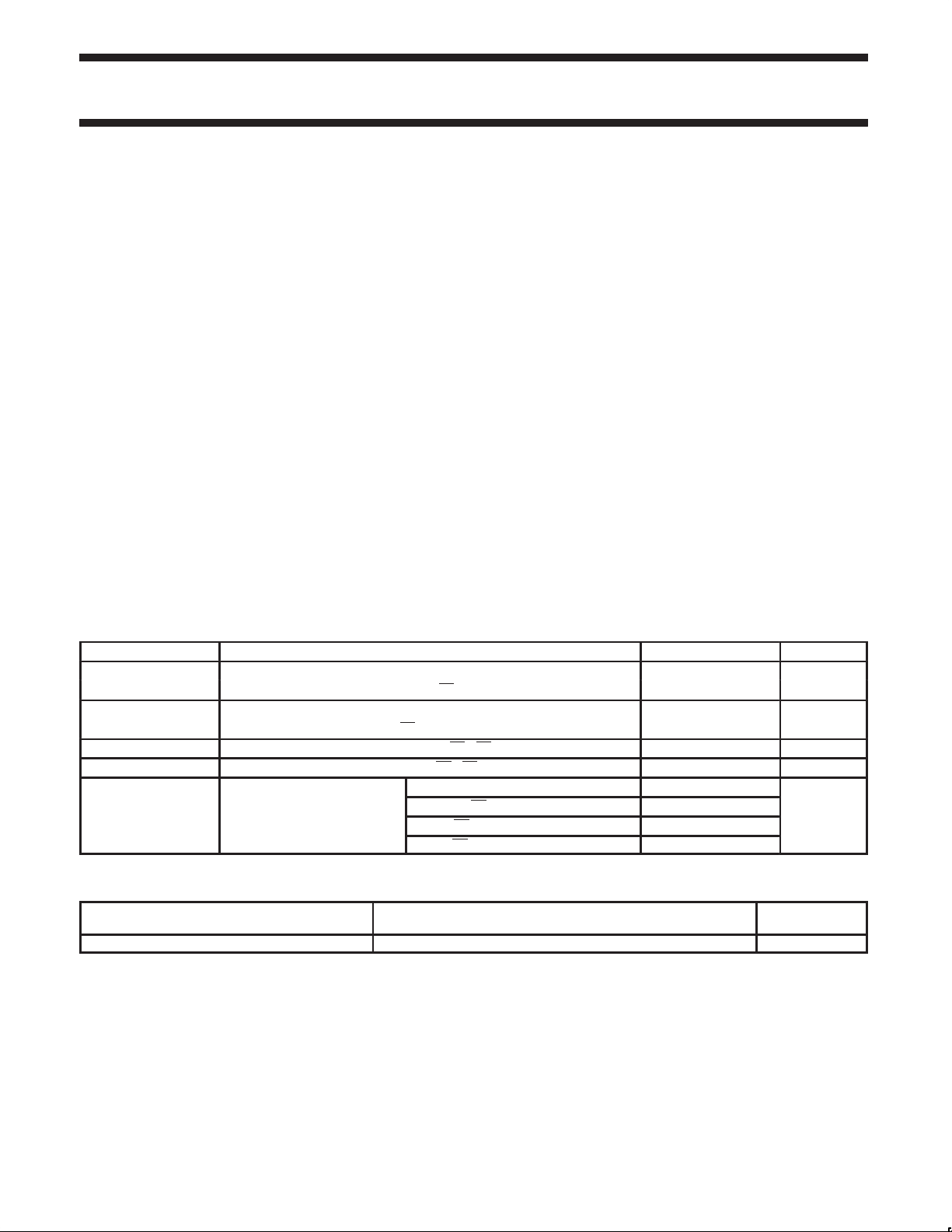
QUICK REFERENCE DATA
SYMBOL PARAMETER TYPICAL UNIT
t
PLH
t
PHL
t
PLH
t
PHL
C
I
OB
OL
pp
Propagation delay 4.1
AIn to Bn 3.6
Propagation delay 5.2
Bn to AOn 5.1
Output capacitance (B0 - B6 only) 6 pF
Output current (B0 - B6 only) 100 mA
Standby 6.0
AIn to Bn (outputs Low or High) 5.1
Bn to AOn (outputs Low) 13.4
Bn to AOn (outputs High) 10.6
ORDERING INFORMATION
PACKAGE
52-pin Plastic Quad Flatpack FBL22041BB SOT379-1
COMMERCIAL RANGE
VCC = 3.3V±10%; T
= 0 to +70°C
amb
DWG
No.
1998 Aug 12 853-2039 19863
2
Page 3

Philips Semiconductors Product specification
FBL220413.3V BTL 7-bit Futurebus+ transceiver (standard A-port)
CC
V
AI0
AO1
AO0
52 51 50 49 48 47 46 45 44 43 42 41 40
LOGIC GND
LOGIC GND
LOGIC GND
LOGIC GND
LOGIC GND
AI1
AI2
AO2
AO3
AI3
AI4
AO4
AO5
1
2
3
4
5
6
7
8
9
10
11
12
13
14 15 16 17 18 19 20 21 22 23 24 25 26
AI5
7-Bit Transceiver
52-lead PQFP
CC
AO6
BG V
LOGIC GND
The B-port interfaces to “Backplane Transceiver Logic” (See the
IEEE 1194.1 BTL standard). BTL features low power consumption
by reducing voltage swing (1Vp-p, between 1V and 2V) and reduced
capacitive loading by placing an internal series diode on the drivers.
BTL also provides incident wave switching, a necessity for high
performance backplanes.
There are three separate pairs of driver enables in a 1 bit, 3 bit, 3 bit
arrangement. The TTL/BTL output drivers for bit 0 are enabled with
OEA1/OEB1
OEA2/OEB2
OEA3/OEB3
, output drivers for bits 1–2–3 are enabled with
and output drivers for bits 4–5–6 are enabled with
.
CC
BIAS V
OEA1
AI6
BG GND
OEB0
OEA2
V
OEB1
TCK (option)
CC
V
TDI (option)
TDO (option)
TMS (option)
BUS GND
B0
OEB2
OEA3
OEB3
39
38
37
36
35
34
33
32
31
30
29
28
27
BUS GND
B1
BUS GND
B2
BUS GND
B3
BUS GND
B4
BUS GND
B5
BUS GND
B6
N/C
SG00084
The A-port operates at TTL levels with separate I/O. The 3-state
A-port drivers are enabled when OEAn goes High after an extra 6ns
delay which is built in to provide a break-before-make function.
When OEAn goes Low, A-port drivers become High impedance
without any extra delay. During power on/of f cycles, the A-port
drivers are held in a High impedance state when V
CC
The B-port has an output enable, OEB0, which affects all seven
drivers. When OEB0 is High and OEBn
be enabled. When OEB0 is Low or if OEBn
is Low the output driver will
is High, the B-port
drivers will be inactive and at the level of the backplane signal.
is below 1.3V.
1998 Aug 12
3
Page 4

Philips Semiconductors Product specification
FBL220413.3V BTL 7-bit Futurebus+ transceiver (standard A-port)
PIN DESCRIPTION
SYMBOL PIN NUMBER TYPE NAME AND FUNCTION
ai0 – ai6 51, 2, 3, 8, 9, 14, 18 Input Data inputs (TTL)
aO0 – aO6 50, 52, 4, 6, 10, 12, 16 Output 3-state outputs (TTL)
b0 – b6 40, 38, 36, 34, 32, 30, 28 i/o Data inputs/Open Collector outputs, High current drive (BTL)
OEB0 46 Input Enables the Bn outputs when High
OEB1 45 Input Enables the B0 output when Low
OEB2 25 Input Enables the B1 – B3 outputs when Low
OEB3 26 Input Enables the B4 – B6 outputs when Low
OEA1 47 Input Enables the A0 outputs when High
OEA2 20 Input Enables the A1 – A3 outputs when High
OEA3 24 Input Enables the A4 – A6 outputs when High
bus gnd 41, 39, 37, 35, 33, 31, 29 GND Bus ground (0V)
LOGIC gnd 1, 5, 7, 11, 13, 15 GND Logic ground (0V)
LOGIC/bus V
BG V
BIAS V 48 Power Positive supply voltage
BG GND 19 GND BAND GAP GROUND (0V)
CC
CC
TMS 42 Input Test Mode Select (no-connect)
Tck 44 Input Test Clock (no-connect)
Tdi 22 Input T est Data In (shorted to TDO)
Tdo 21 Output Test Data Out (TDI)
23, 43, 49 Power Positive supply voltage
17 Power Positive supply voltage BAND GAP
1998 Aug 12
4
Page 5

Philips Semiconductors Product specification
MODE
FBL220413.3V BTL 7-bit Futurebus+ transceiver (standard A-port)
FUNCTION TABLE
INPUTS OUTPUTS
AIn Bn* OEB0 OEB1 OEB2 OEB3 OEA1 OEA2 OEA3 AOn Bn*
L — H L L L L L L Z H**
AIn to Bn H — H L L L L L L Z L
L — H L L L H H H L H**
H — H L L L H H H H L
L — H L X X L L L Z H**
AI0 to B0 H — H L X X L L L Z L
L — H L X X H H H L H**
H — H L X X H H H H L
L — H X L X L L L Z H**
AI1 – AI3 to B1 – B3 H — H X L X L L L Z L
L — H X L X H H H L H**
H — H X L X H H H H L
L — H X X L L L L Z H**
AI4 – AI6 to B4 – B6 H — H X X L L L L Z L
L — H X X L H H H L H**
H — H X X L H H H H L
Disable Bn outputs X X L X X X X X X X H**
X X X H H H X X X X H**
Disable B0 outputs X X H H X X X X X X H**
Disable B1 – B3 outputs X X H X H X X X X X H**
Disable B4 – B6 outputs X X H X X H X X X X H**
X L L X X X H H H H Input
Bn to AOn X H L X X X H H H L Input
X L X H H H H H H H Input
X H X H H H H H H L Input
X L L X X X H X X H Input
B0 to AO0 X H L X X X H X X L Input
X L X H H H H X X H Input
X H X H H H H X X L Input
X L L X X X X H X H Input
B1 – B3 to AO1 – AO3 X H L X X X X H X L Input
X L X H H H X H X H Input
X H X H H H X H X L Input
X L L X X X X X H H Input
B4 – B6 to AO4 – AO6 X H L X X X X X H L Input
X L X H H H X X H H Input
X H X H H H X X H L Input
Disable AOn outputs X X X X X X L L L Z X
Disable AO0 outputs X X X X X X L X X Z X
Disable AO1 – AO3 outputs X X X X X X X L X Z X
Disable AO4 – AO6 outputs X X X X X X X X L Z X
NOTES:
H = High voltage level
L = Low voltage level
X = Don’t care
Z = High-impedance (OFF) state
— = Input not externally driven
H** = Goes to level of pull-up voltage
B* = Precaution should be taken to ensure B inputs do not float.
If they do, they are equal to Low state.
Z = High-impedance (OFF) state
— = Input not externally driven
H** = Goes to level of pull-up voltage
B* = Precaution should be taken to ensure B inputs do not float.
If they do, they are equal to Low state.
1998 Aug 12
5
Page 6

Philips Semiconductors Product specification
FBL220413.3V BTL 7-bit Futurebus+ transceiver (standard A-port)
LOGIC DIAGRAM
46
OEB0
45
OEB1
47
OEA1
AO0
OEB2
OEA2
AO1
AI0
AI1
51
50
25
20
2
52
40
B0
38
B1
TTL
Levels
AO2
AO3
OEB3
OEA3
AO4
AO5
AO6
AI2
AI3
AI4
AI5
AI6
36
3
4
8
6
26
24
9
10
14
12
18
16
B2
34
32
30
28
BTL
Levels
B3
B4
B5
B6
TMS
TCK
TDI
TDO
LOGIC V
LOGIC GND = 1, 5, 7, 11, 13, 15, 19
BUS V
BUS GND = 27, 29, 31, 33, 35, 37, 39, 41
BIAS V = 48
= 17, 49
CC
= 23, 43
CC
1998 Aug 12
42
44
(Future JTAG Boundary Scan option)
22
21
SG00071
6
Page 7

Philips Semiconductors Product specification
V
In ut voltage
I
V
High-level in ut voltage
V
Low-level in ut voltage
I
Low-level out ut current
FBL220413.3V BTL 7-bit Futurebus+ transceiver (standard A-port)
ABSOLUTE MAXIMUM RATINGS
Operation beyond the limits set forth in this table may impair the useful life of the device. Unless otherwise noted these limits are over the
operating free-air temperature range.
SYMBOL
V
V
T
CC
I
IN
OUT
OUT
STG
IN
Supply voltage -0.5 to +4.6 V
p
Input current VIN 0 -50
Voltage applied to output in High output state -0.5 to +7.0 V
Current applied to output in AO0 – AO6 48, –24 mA
Low output state/High output state B0 – B6 200
Storage temperature -65 to +150 °C
RECOMMENDED OPERATING CONDITIONS
SYMBOL
V
CC
IH
IL
I
IK
I
OH
OL
C
OB
T
amb
Supply voltage 3.0 3.3 3.6 V
p
p
Input clamp current -18 mA
High-level output current AO0 – AO6 -12 mA
p
Output capacitance on B port 6 7 pF
Operating free-air temperature range 0 +70 °C
PARAMETER
PARAMETER RATING UNIT
AI0 – AI6, OEB0, OEBn, OEAn -0.5 to +7.0 V
B0 – B6 -0.5 to +3.5
COMMERCIAL LIMITS
V
= 3.3V±10%;
CC
T
= 0 to +70°C
amb
UNIT
MIN TYP MAX
Except B0–B6 2.0 V
B0 – B6 1.62 1.55
Except B0–B6 0.8 V
B0 – B6 1.47
AO0 – AO6 12 mA
B0 – B6 100
1998 Aug 12
7
Page 8

Philips Semiconductors Product specification
SYMBOL
PARAMETER
UNIT
I
(
BIASV
)
IOLOFF
Power up current
A
SYMBOL
PARAMETER
TEST CONDITIONS
1
UNIT
High level out ut
3
AO0
AO6
3
V
µ
I
g
µ
IILLow-level input current
B0
B6
V
MAX, V
75V
100µA
ICCSupply current (total)
mA
FBL220413.3V BTL 7-bit Futurebus+ transceiver (standard A-port)
LIVE INSERTION SPECIFICA TIONS
LIMITS
MIN TYP MAX
V
BIASV
BIASV
V
Bn
I
LM
I
HM
IBnPEAK
t
GR
Bias pin voltage
Bias pin (I
DC current
BIASV
) input
Bus voltage during prebias B0 – B8 = 0V, Bias V = 3.3V 1.62 2.1 V
Fall current during prebias B0 – B8 = 2V, Bias V = 1.3 to 2.5V 1 µA
Rise current during prebias B0 – B8 = 1V, Bias V = 3 to 3.6V -1 µA
Peak bus current during
insertion
p
Input glitch rejection VCC = 3.3V 1.0 1.35 ns
Voltage dif ference between the Bias voltage
and VCC after the PCB is plugged in.
– – 0.5 V
VCC = 0 V, Bias V = 3.6V 1.2 mA
VCC = 3.3V, Bias V = 3.6V 10 µA
VCC = 0 to 3.3V, B0 – B8 = 0 to 2.0V,
Bias V = 2.7 to 3.6V, OEB0 = 0.8V, tr = 2ns
V
= 0 to 3.3V, OEB0 = 0.8V 100
CC
V
= 0 to 1.2V, OEB0 = 0 to 5V 100
CC
10 mA
µ
DC ELECTRICAL CHARACTERISTICS
Over recommended operating free-air temperature range unless otherwise noted.
LIMITS
MIN TYP2MAX
I
I
OFF
V
V
V
I
OZH
I
OZL
NOTES:
1. For conditions shown as MIN or MAX, use the appropriate value specified under recommended operation conditions for the applicable type.
2. All typical values are at V
3. Due to test equipment limitations, actual test conditions are V
4. Unused pins are at V
5. For B port input voltage between 3 and 5 volt; I
is active).
High level output current B0 – B6 VCC = MAX, VIL = MAX, VOH = 1.9V 100 µA
OH
Power-off output current B0 – B6 VCC = 0V, VIL = MAX, VOH = 1.9V 100 µA
V
CC
–0.2
OH
-
voltage
p
AO0 – AO6
VCC = MIN; IOH = -4mA 2.4 V
VCC = MIN to MAX; IOH = -100µA
VCC = MIN; IOH = -12mA 2.0 V
VCC = MIN; IOL = 4mA 0.4 V
VCC = MIN; IOL = 12mA 0.8 V
Low-level output voltage
OL
–
B0 – B6 VCC = MIN, IOL = 4mA 0.5
VCC = MIN, IOL = 100mA 0.75 1.0 1.20
Input clamp voltage VCC = MIN, II = I
IK
= –18mA –0.85 -1.2 V
IK
Control pins VCC = 3.6V; VI = VCC or GND ±1.0
I
Input leakage current
I
Control/
AI0 – AI6
AI0 – AI6 VCC = 3.6V; VI = V
VCC = 0V or 3.6V; VI = 5.5V 10
CC
Note 4 VCC = 3.6V; VI = 0V –5
VCC = MAX, VI = 1.9V 100 µA
I
High-level input current B0 – B6 VCC = MAX, VI = 3.5V , note 5 100 mA
IH
VCC = MAX, VI = 3.75V @ –40°C 100 mA
p
–
CC
=
= 0.
I
Off-state output current AO0 – AO6 VCC = MAX, VO =3V 5 µA
Off-state output current AO0 – AO6 VCC = MAX, VO = 0.5V -5 µA
I
(standby) VCC = MAX 6.0 13.0
CCZ
I
AIn to Bn VCC = MAX, outputs Low or High 5.1 10.0
pp
= 3.3V, TA = 25°C.
CC
or GND.
CC
CCB,
I
Bn to AOn VCC = MAX, outputs Low 13.4 19.5
CCA,
I
Bn to AOn VCC = MAX, outputs High 10.6 16.0
CCA,
= 1.8V and VIL = 1.3V for the B side.
IH
will be greater than 100mA but the part will continue to function normally (clamping circuit
IH
V
A
1
-
1998 Aug 12
8
Page 9

Philips Semiconductors Product specification
FBL220413.3V BTL 7-bit Futurebus+ transceiver (standard A-port)
AC ELECTRICAL CHARACTERISTICS (Commercial)
A PORT LIMITS
T
= 0 to 70°C,
SYMBOL PARAMETER
TEST
CONDITION
T
= +25°C, VCC = 3.3V,
amb
CL = 50pF, RL = 500Ω
MIN TYP MAX MIN MAX
t
PLH
t
PHL
t
PZH
t
PZL
t
PHZ
t
PLZ
t
TLH
t
THL
tSK(o)
Propagation delay,
Bn
to AOn
Output enable time,
OEA to AOn
Output disable time,
OEA to AOn
Transition time, AOn Port
(10% to 90% or 90% to 10%)
Output skew between receivers
in same package
1
Waveform 1, 2
Waveform 4, 5
Waveform 4, 5
Test Circuit and
Waveforms
4.2
4.1
5.8
2.7
3.9
3.7
0.8
0.6
5.2
5.1
7.1
4.5
5.2
4.8
1.6
1.1
6.2
6.1
8.5
8.0
6.5
6.0
2.8
1.7
Waveform 3 0.4 1.5 1.5 ns
B PORT LIMITS
SYMBOL
t
PLH
t
PHL
t
PLH
t
PHL
t
PLH
t
PHL
t
TLH
t
THL
tSK(o)
PARAMETER TEST CONDITION
Propagation delay,
AIn to Bn
Enable/disable time,
OEB0 to Bn
Enable/disable time,
OEB1 to Bn
Transition time, Bn Port
(1.3V to 1.8V)
Output skew between drivers in
same package
1
Waveform 1, 2
Waveform 2
Waveform 1
Test Circuit and
Waveforms
Waveform 3 0.3 1.4 1.4 ns
T
= +25°C, VCC = 3.3V,
amb
CD = 30pF, RU = 9Ω
3.2
2.9
3.9
3.5
4.1
3.0
1.3
0.4
4.1
3.6
4.7
4.4
5.0
3.9
1.9
0.8
5.0
4.4
5.5
5.4
5.9
4.8
2.8
1.4
SYMBOL PARAMETER TEST CONDITION RU = 16.5Ω RU = 16.5Ω UNIT
t
PLH
t
PHL
t
PLH
t
PHL
t
PLH
t
PHL
t
TLH
t
THL
tSK(o)
Propagation delay,
AIn to Bn
Enable/disable time,
OEB0 to Bn
Enable/disable time,
OEB1 to Bn
Transition time, Bn Port
(1.3V to 1.8V)
Output skew between drivers in
same package
1
Waveform 1, 2
Waveform 2
Waveform 1
Test Circuit and
Waveforms
3.2
2.9
3.9
3.5
4.1
3.0
1.3
0.4
4.1
3.6
4.7
4.4
5.0
3.9
1.9
0.8
5.0
4.9
5.5
5.4
5.9
4.8
2.8
1.4
Waveform 3 0.3 1.4 1.4 ns
NOTES:
1. t
actual – tPMactual for any data input to output path compared to any other data input to output path where N and M are either LH or
PN
HL. Skew times are valid only under same test conditions (temperature, V
, loading, etc.).
CC
amb
VCC = 3.3V±10%,
CL = 50pF, RL = 500Ω
3.9
3.9
5.4
2.5
3.6
3.3
0.7
0.5
T
= 0 to 70°C,
amb
VCC = 3.3V±10%,
7.0
6.8
9.4
8.5
7.0
7.3
3.0
2.0
CD = 30pF, RU = 9Ω
2.9
2.7
3.5
3.2
3.8
2.6
1.2
0.4
2.9
2.6
3.5
3.2
3.8
2.6
1.2
0.4
5.8
4.9
6.4
5.9
6.6
5.5
3.0
1.5
5.8
4.9
6.4
5.9
6.6
5.5
3.0
1.5
UNIT
ns
ns
ns
ns
UNIT
ns
ns
ns
ns
ns
ns
ns
ns
1998 Aug 12
9
Page 10

Philips Semiconductors Product specification
FBL220413.3V BTL 7-bit Futurebus+ transceiver (standard A-port)
AC WAVEFORMS
AIn, Bn or Bn
OEBn
AOn or Bn
V
M
t
PLH
V
M
t
PHL
V
M
V
M
Waveform 1. Propagation Delay for Data
or Output Enable to Output
AIn, Bn
AOn, Bn
OEA
AOn
V
M
t
PZH
V
M
t
PHZ
V
M
Waveform 3. Output Skews
VOH -0.3V
OV
Waveform 4. 3-State Output Enable Time to High Level
and Output Disable Time from High Level
NOTE: V
= 1.55V for Bn, V
M
V
M
tSK(o)
V
M
Waveform 5. 3-State Output Enable Time to Low Level
= 1.5V for all others.
M
AIn, Bn
OEB0
AOn, Bn
V
M
t
PHL
V
M
t
PLH
V
M
V
M
Waveform 2. Propagation Delay for Data
or Output Enable to Output
OEA
AOn
V
M
t
PZL
V
M
t
PLZ
V
M
VOL +0.3V
and Output Disable Time from Low Level
SG00086
1998 Aug 12
10
Page 11

Philips Semiconductors Product specification
FBL220413.3V BTL 7-bit Futurebus+ transceiver (standard A-port)
TEST CIRCUIT AND WAVEFORMS
V
CC
BIAS
V
PULSE
GENERATOR
V
IN
R
T
D.U.T.
V
OUT
Test Circuit for 3-State Outputs on A Port
SWITCH POSITION FOR ALL A-PORTS
TEST SWITCH
t
t
t
PULSE
GENERATOR
PLH,
PLZ,
PHZ,
t
t
PHL
PZL
t
PZH
V
IN
BIAS
V
R
T
OPEN
CLOSED
GND
V
CC
D.U.T.
2.0V (for RU = 9 Ω)
2.1V (for RU = 16.5 Ω)
V
OUT
Test Circuit for Outputs on B Port
R
R
C
L
R
U
C
D
6.0V
L
L
NEGATIVE
PULSE
POSITIVE
PULSE
90%
10%
V
M
10%
t
THL
t
TLH
90%
V
M
VM = 1.55V for Bn, VM = 1.5V for all others.
(tf)
(tr)
t
W
V
M
10%
90%
V
M
t
W
90%
10%
t
TLH
t
THL
V
LOW V
(tr)
(tf)
V
LOW V
IN
IN
Input Pulse Definitions
Family
FB+
A Port
INPUT PULSE REQUIREMENTS
Low V
0.0V
1.0VB Port
Rep. RateAmplitude t
1MHz3.0V
1MHz2.0V
t
W
500ns
TLHtTHL
2.5ns
2.5ns500ns
2.5ns
2.5ns
DEFINITIONS:
RL= Load Resistor; see AC CHARACTERISTICS for value.
CL= Load capacitance includes jig and probe capacitance; see AC
CHARACTERISTICS for value.
R
= Termination resistance should be equal to Z
T
CD= Load capacitance includes jig and probe capacitance; see AC
of pulse generators.
OUT
CHARACTERISTICS for value.
RU= Pull up resistor; see AC CHARACTERISTICS for value.
SG00090
1998 Aug 12
11
Page 12

Philips Semiconductors Product specification
FBL220413.3V BTL 7-bit Futurebus + transceiver (standard A-port)
QFP52: plastic quad flat package; 52 leads (lead length 1.6 mm); body 10 x 10 x 2.0 mm SOT379-1
1998 Aug 12
12
Page 13

Philips Semiconductors Product specification
FBL220413.3V BTL 7-bit Futurebus + transceiver (standard A-port)
NOTES
1998 Aug 12
13
Page 14

Philips Semiconductors Product specification
74FBL220413.3V BTL 7-bit Futurebus + transceiver (standard A–Port)
Data sheet status
Data sheet
status
Objective
specification
Preliminary
specification
Product
specification
Product
status
Development
Qualification
Production
Definition
This data sheet contains the design target or goal specifications for product development.
Specification may change in any manner without notice.
This data sheet contains preliminary data, and supplementary data will be published at a later date.
Philips Semiconductors reserves the right to make chages at any time without notice in order to
improve design and supply the best possible product.
This data sheet contains final specifications. Philips Semiconductors reserves the right to make
changes at any time without notice in order to improve design and supply the best possible product.
[1]
[1] Please consult the most recently issued datasheet before initiating or completing a design.
Definitions
Short-form specification — The data in a short-form specification is extracted from a full data sheet with the same type number and title. For
detailed information see the relevant data sheet or data handbook.
Limiting values definition — Limiting values given are in accordance with the Absolute Maximum Rating System (IEC 134). Stress above one
or more of the limiting values may cause permanent damage to the device. These are stress ratings only and operation of the device at these or
at any other conditions above those given in the Characteristics sections of the specification is not implied. Exposure to limiting values for extended
periods may affect device reliability.
Application information — Applications that are described herein for any of these products are for illustrative purposes only. Philips
Semiconductors make no representation or warranty that such applications will be suitable for the specified use without further testing or
modification.
Disclaimers
Life support — These products are not designed for use in life support appliances, devices or systems where malfunction of these products can
reasonably be expected to result in personal injury . Philips Semiconductors customers using or selling these products for use in such applications
do so at their own risk and agree to fully indemnify Philips Semiconductors for any damages resulting from such application.
Right to make changes — Philips Semiconductors reserves the right to make changes, without notice, in the products, including circuits, standard
cells, and/or software, described or contained herein in order to improve design and/or performance. Philips Semiconductors assumes no
responsibility or liability for the use of any of these products, conveys no license or title under any patent, copyright, or mask work right to these
products, and makes no representations or warranties that these products are free from patent, copyright, or mask work right infringement, unless
otherwise specified.
Philips Semiconductors
811 East Arques Avenue
P.O. Box 3409
Sunnyvale, California 94088–3409
Telephone 800-234-7381
Copyright Philips Electronics North America Corporation 1998
All rights reserved. Printed in U.S.A.
print code Date of release: 05-96
Document order number: 9397-750-04279
yyyy mmm dd
14
 Loading...