

Page 1
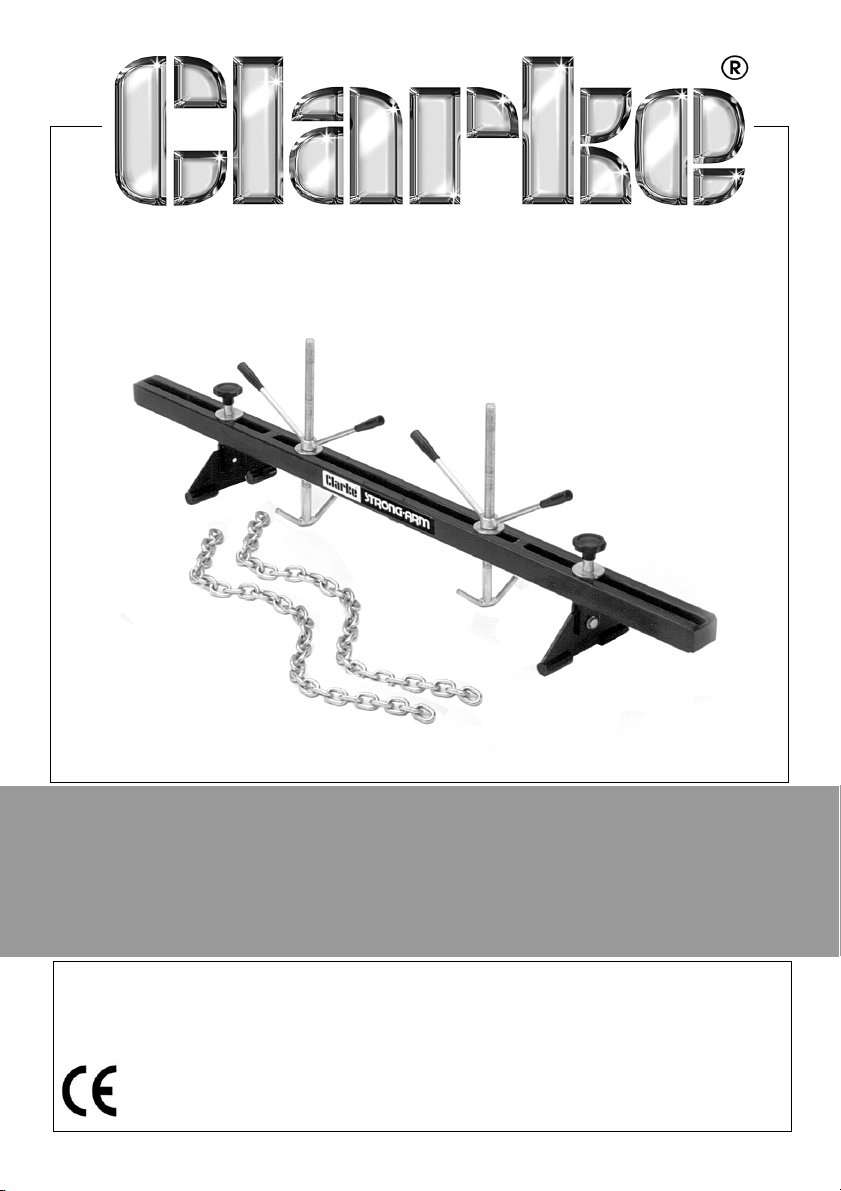
ENGINE SUPPORT
MODEL NO: CEC500DS
PART NO: 7612912
USER & MAINTENANCE
INSTRUCTIONS
GC0813
Page 2
INTRODUCTION
Thank you for purchasing this CLARKE Engine Support, designed to support
and position engines during maintenance operations such as replacing antivibration mountings and as an aid to removing transmissions.
Before attempting to use this product, please read this manual thoroughly and
follow the instructions carefully. In doing so you will ensure the safety of yourself
and that of others around you, and you can look forward to your purchase
giving you long and satisfactory service.
IMPORTANT: Please read all of the safety and operating instructions
carefully before using this product. Please pay particular attention to all
sections of these instructions that display warning symbols and notices.
WARNING: THIS SYMBOL IS USED THROUGHOUT THE USER GUIDE
WHENEVER THERE IS A RISK OF PERSONAL INJURY. ENSURE THAT
THESE WARNINGS ARE READ AND UNDERSTOOD AT ALL TIMES.
SPECIFICATION
Rated Load 500 kg
Lifting Hook Width Adjustment 80-620 mm
Dimensions (D x W x H) 85 x 1500 x 270 mm
Product Weight 18.75 kg
Chain Length 930 mm
Adjustable Foot Width 750 - 1450 mm
GUARANTEE
This product is guaranteed against faulty manufacture for a period of 12
months from the date of purchase. Please keep your receipt which will be
required as proof of purchase.
This guarantee is invalid if the product is found to have been abused or
tampered with in any way, or not used for the purpose for which it was
intended. Faulty goods should be returned to their place of purchase, no
product can be returned to us without prior permission. This guarantee does
not effect your statutory rights.
2
Parts & Service: 020 8988 7400 / E-mail: [email protected] or [email protected]
Page 3

GENERAL SAFETY RULES
Before using your engine support, it is in your own interest to read and comply
with the following safety rules.
1. Keep the work area clean. Cluttered areas invite injuries. Keep the work
area well lit.
2. Keep children away. Children must never be allowed in the work area.
3. Store idle equipment. When not in use, tools must be locked up in a dry
location to inhibit rust. Always lock up tools and keep out of reach of
children.
4. Dress properly. Do not wear loose clothing or jewelry which could be
caught in moving parts.
5. Use eye and hand protection. Always wear approved impact safety
goggles.
6. Watch what you are doing and use common sense. Do not use any tool
when you are tired.
7. Check for damaged parts. Before using any tool, any part that appears
damaged should be carefully checked to determine that it will operate
properly and perform its intended function.
8. Do not use this equipment if under the influence of alcohol or drugs. If there
is any doubt, do not operate the tool.
9. Always keep bystanders well clear.
10. Never exceed the safe working load of 500 kg.
11. Use only slings or chains with a capacity equal to, or greater than that of
the engine support.
12. Ensure the operator is familiar with both operational and safety aspects.
13. Before supporting a load, ensure all bolts and lock knobs are fully
tightened.
14. Always check to ensure that any sling or chain used is properly secured
and that it cannot cause damage to engine components as the weight is
taken by the engine support.
15. Inspect the engine support before use to ensure it is in good condition.
Replace any damaged or worn parts.
16. If replacing parts, only use those supplied by Clarke International.
3
Parts & Service: 020 8988 7400 / E-mail: [email protected] or [email protected]
Page 4
PRODUCT OVERVIEW
1
3
2
6
5
4
7
8
9
10
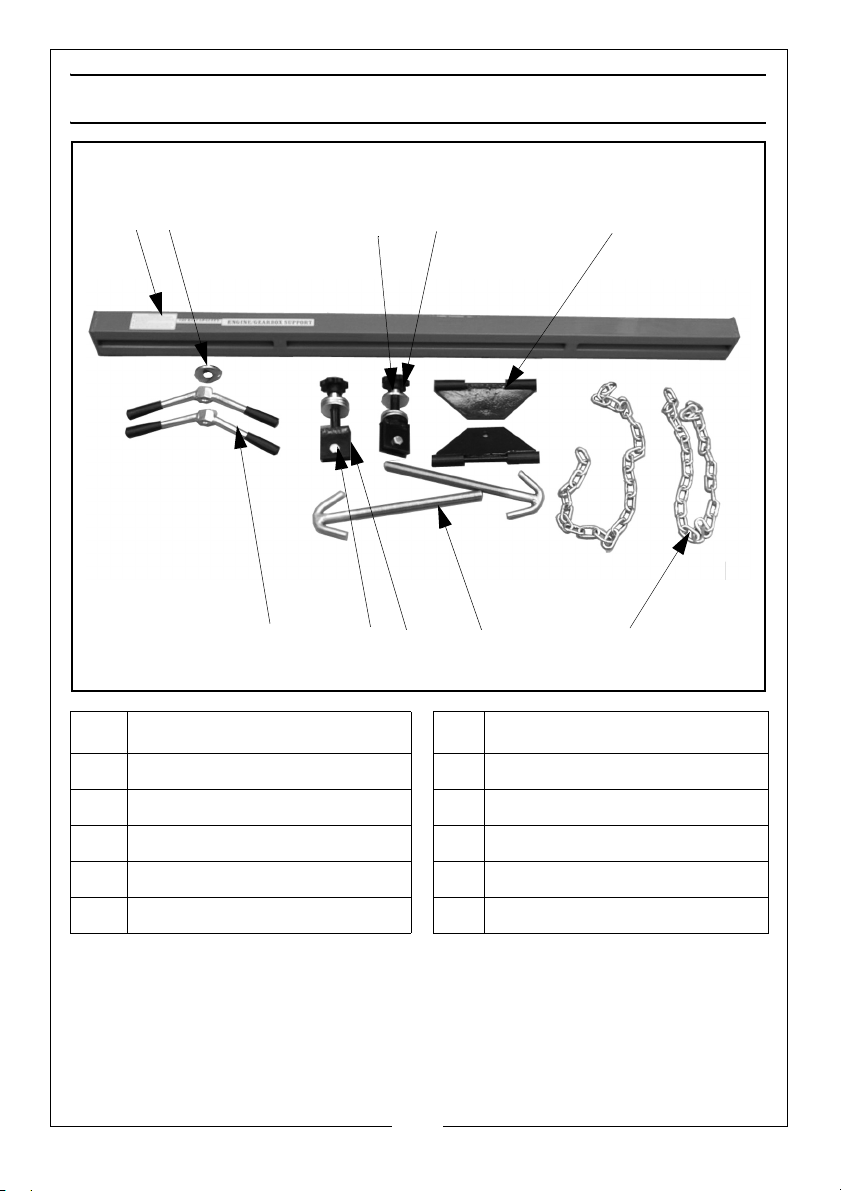
NO DESCRIPTION NO DESCRIPTION
1 Support Beam 6 Chain
2 Washer (large hole) 7 Lifting Hook
3 Washer (small hole) 8 Support Block
4 Knob 9 Bolt (M12 x 25)
5 End Plate 10 Handle
Parts & Service: 020 8988 7400 / E-mail: [email protected] or [email protected]
4
Page 5
ASSEMBLY
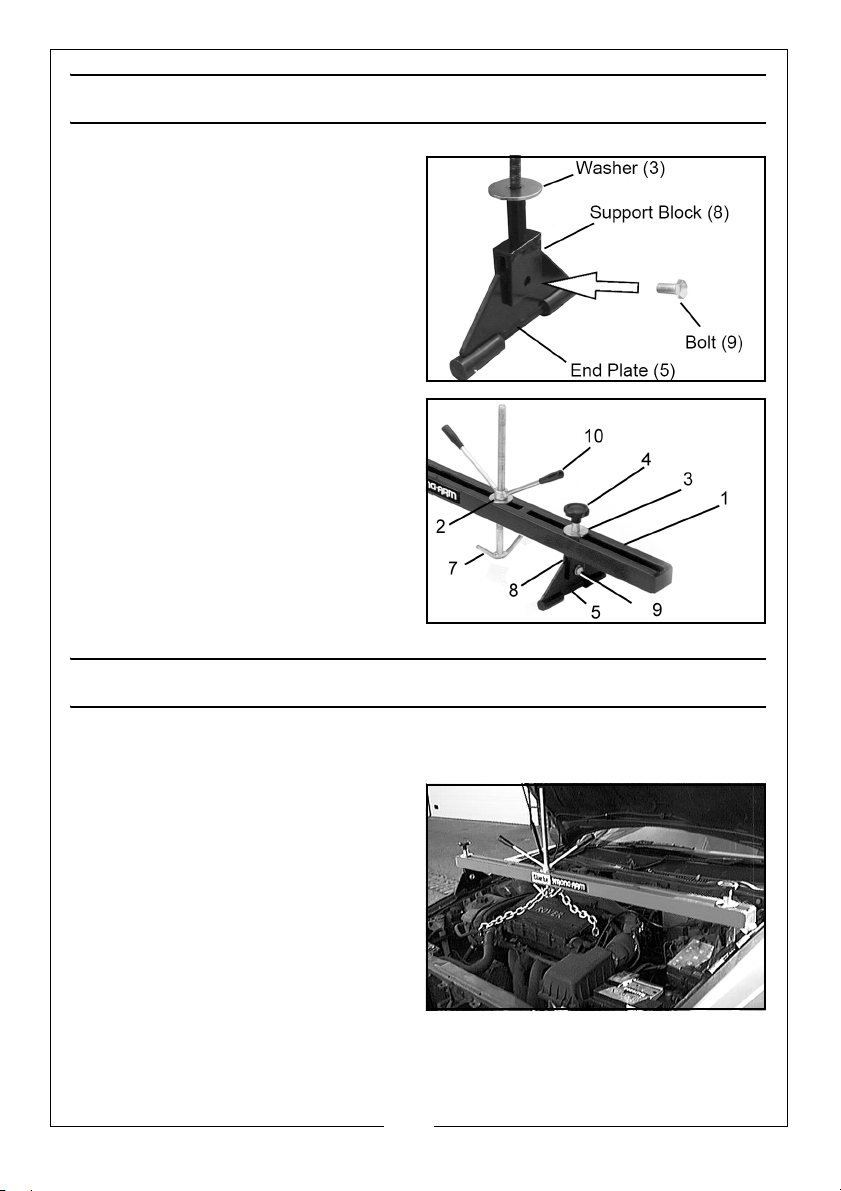
1. Attach the support blocks (8) to
the end plates (5) with the bolts
(9).
2. Slide the threaded end of the
support blocks through the
channel inthe support beam (1).
As it emerges, place a washer (3)
onto the thread and screw on the
knob (4), but do not tighten
down.
3. Pass the threaded section of the
lifting hooks through the channel
in the support beam.
4. Place the washers (2) on to the
threads of the lifting hooks (7) and
screw on the handles (10).
5. Your engine support is now ready
for use.
OPERATION
Before use, check to ensure that the engine weight, or engine plus gearbox
weight, does not exceed the rated capacity of the engine support.
Make sure that the front panel gutters
of the vehicle are in good condition
and are capable of supporting the
engine load.
1. Place the support beam across
the engine bay with the end
plates securely located in the
gutters of the front wing panel.
(Slide the end plates in the beam
channel, until they align with the
gutters. Ensure all the weight is
taken by the gutters, not on any surface of the wings).
2. Lower the lifting hooks down through the slot in the beam.
5
Parts & Service: 020 8988 7400 / E-mail: [email protected] or [email protected]
Page 6

3. If possible, attach the chains provided, directly onto the engine lifting
points. Refer to the manufacturers handbook to identify the attachment
points.
4. Otherwise, attach an appropriate sling or chain to the engine lifting points,
and then attach these to the chain provided. Wrap the chain around the
lifting hooks.
5. Manoeuvre the chain/sling so that the lift will be even, in order for the
engine to be held level and square once the engine mountings have been
removed.
6. Once satisfied that the arrangement is secure, tighten the knobs, then turn
the handles to raise the lifting hooks, which will take the weight of the
engine. Do not to continue if the engine or engine/gearbox assembly is not
free to move.
NOTE: Tensioning is usually carried out immediately prior to the final
release of the engine mountings. To judge if the weight has been
taken sufficiently, slacken off the engine mounting bolts before
tensioning the engine support. Then, as you continue to unscrew
the engine mounting bolts, turn the handle until you find the spot
where they are easiest to turn. This indicates that full weight is
taken by the engine support. You may have to turn the handles to
and fro a few times until the correct position is found.
IMPORTANT: When turning the handle to take the load, pay particular
attention to the chain/sling arrangement to ensure that no damage occurs
to engine components as the chain/sling tightens.
7. Do not leave the engine support unattended whilst it is supporting the
weight of the engine.
8. Wherever possible, use both slings in order to help spread the weight of the
engine.
MAINTENANCE
Always inspect the equipment before use for visible signs of damage, worn or
missing parts.
Check the beam for cracks and distortion.
Inspect the chains and hooks for damage or distortion. If any is apparent have
them replaced.
6
Parts & Service: 020 8988 7400 / E-mail: [email protected] or [email protected]
Page 7
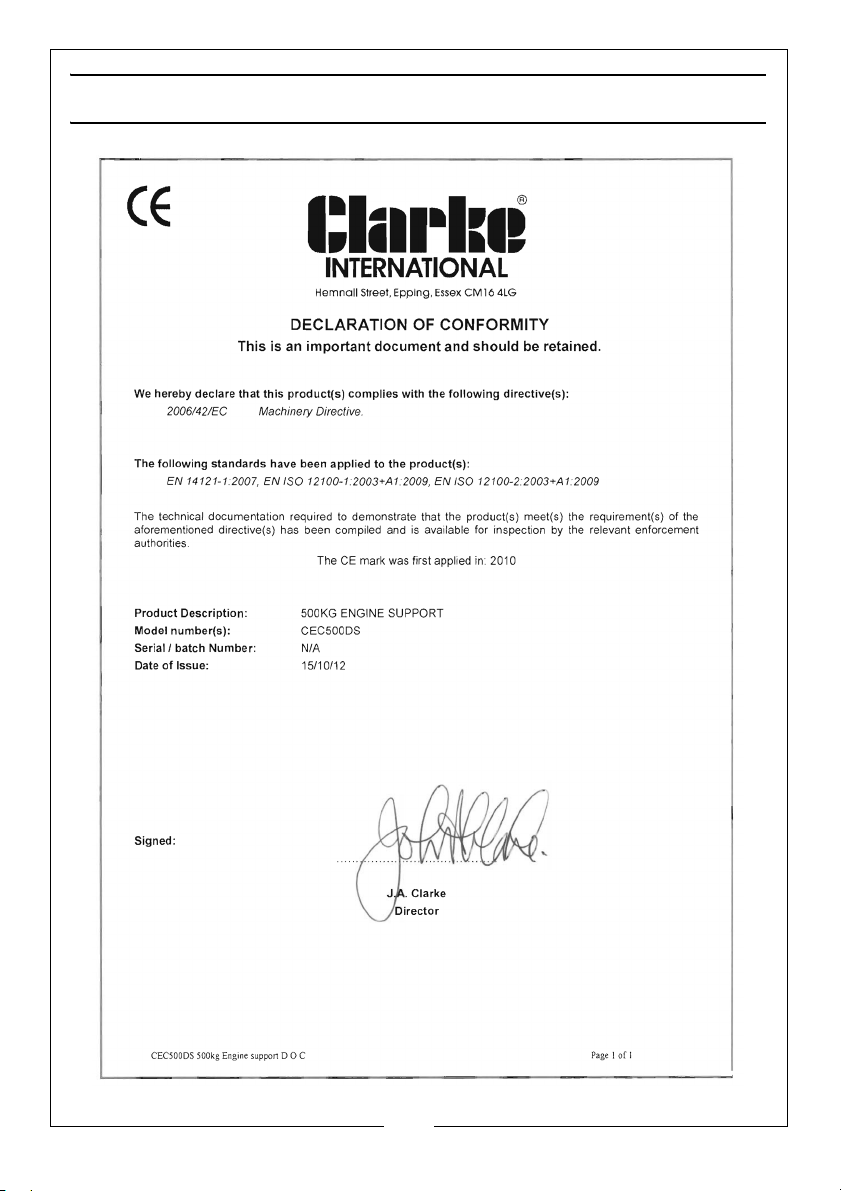
DECLARATION OF CONFORMITY
7
Parts & Service: 020 8988 7400 / E-mail: [email protected] or [email protected]
Page 8

 Loading...