

Page 1
Introduction
COPY
RAW Image Processing, Viewing and Editing Software
Digital Photo Professional
Ver. 3.11
Instruction Manual
Content of this Instruction Manual
DPP is used for Digital Photo Professional.
In this manual, the screens used in the basic
operation instructions are from Windows 7, with
some portions using screens from other
versions of Windows.
indicates the selection procedure of the menu.
Example: [File] menu [Exit].
Square brackets are used to indicate items such
as menu names, button names and window
names that appear on the computer screen.
Text inside < > indicates a key on the keyboard.
** indicates a reference page.
Click to move to the relevant page.
: Marks helpful information when a problem
: Marks tips for using the software skillfully.
: Marks information that should be read
: Marks additional information you may find
arises.
before use.
helpful.
Switching Between Pages
Click on arrows on the bottom right of the screen.
: next page
: previous page
: return to a page you had previously
displayed
Click on the chapter headings on the right side
of the screen to switch to the contents page of
that chapter. Also, click the item you want to
read about on the table of contents to move to
the relevant page.
Help and Shortcut Keys
For information about using DPP, refer to Help
from the [Help] menu.
Refer to the [Troubleshooting] [Shortcut Key
List] in the Help for a list of shortcut keys which
are helpful for quick operation.
Contents at
a Glance
Basic
Operation
1
Advanced
Operation
2
Advanced
Image Editing
3
and Printing
Processing
Large Numbers
4
of Images
Editing
JPEG/TIFF
5
Images
Reference
Index
© CANON INC. 2012 CCS-M034DPPWE-000
Page 2

READ CAREFULLY BEFORE USING!
COPY
CANON SOFTWARE LICENSE AGREEMENT
IMPORTANT - READ THIS AGREEMENT BEFORE USING THE SOFTWARE ON THE CD-ROM
IN THIS BOX. BY USING THE SOFTWARE, YOU AGREE TO BE BOUND BY THE TERMS OF
THIS AGREEMENT.
This is a license agreement (the [Agreement]) between you and Canon Inc. ([Canon]).
IF YOU DO NOT AGREE TO THE TERMS AND CONDITIONS OF THIS AGREEMENT, DO NOT
USE THE SOFTWARE PROGRAM ON THE CD-ROM AND THE USER MANUAL IN THIS BOX
(COLLECTIVELY, THE [SOFTWARE]) AND RETURN THE SOFTWARE WITHIN 30 DAYS FROM
THE DATE OF PURCHASE TO YOUR POINT OF PURCHASE FOR A REFUND.
In consideration of the right to use the SOFTWARE, you agree to abide by the terms and conditions
of this Agreement.
1. LICENSE: Canon grants you the non-exclusive right to use the SOFTWARE only on a single
computer. You may physically transfer the SOFTWARE from one computer to another provided
that the SOFTWARE is used on only one computer at a time. You shall not install or use the
SOFTWARE on a network, multiple CPU, multiple site arrangement, or any other hardware
configuration where the SOFTWARE is accessible to more than one CPU or to more than one
user.
YOU SHALL NOT ASSIGN, SUBLICENSE, RENT, LEASE, LOAN, CONVEY OR OTHERWISE USE,
TRANSFER, COPY, TRANSLATE, CONVERT TO ANOTHER PROGRAMMING LANGUAGE,
ALTER, MODIFY, DECOMPILE OR DISASSEMBLE THE SOFTWARE, IN WHOLE OR IN PART,
EXCEPT AS EXPRESSLY PROVIDED IN THIS AGREEMENT.
2. BACK-UP COPY: You may make one copy of the SOFTWARE solely for back-up purposes, or
copy the SOFTWARE onto the permanent storage device (e.g. a hard disk) of your computer
and retain the original for back-up purposes. Any other copying of the SOFTWARE is a violation
of this Agreement. You must reproduce and include the copyright notice on the back-up copy.
3. SUPPORT AND UPDATES: Canon is not responsible for providing maintenance or support for
use of the SOFTWARE. No updates, fixes or support will be made available for the
SOFTWARE.
4. LIMITED WARRANTY AND LIMITATION OF LIABILITY: It is your responsibility to choose,
maintain and match the hardware and software components of your computer system. Thus
Canon does not guarantee uninterrupted service or correction of errors or that the functions or
performance of the SOFTWARE will meet your requirements. THE SOFTWARE IS LICENSED
ON AN [AS IS] BASIS AND WITHOUT WARRANTY OF ANY KIND. The CD-ROM storing the
SOFTWARE is warranted only against defective material under normal use for a period of ninety
(90) days after purchase from an authorized Canon dealer as evidenced by your sales receipt.
Your sole remedy for a defective CD-ROM shall be replacement of the same without charge
when returned by you at your expense to your point of purchase and proven to be defective
upon inspection. The replacement CD-ROM will be warranted for the remainder of the original
ninety (90) day warranty period of the defective CD-ROM. The limited warranty does not apply if
the failure of the CD-ROM resulted from accident, abuse or misapplication of the SOFTWARE
and shall not extend to anyone other than the original user of the SOFTWARE.
EXCEPT AS SPECIFICALLY SET FORTH IN THIS PARAGRAPH 4, CANON, CANON’S
SUBSIDIARIES, DISTRIBUTORS AND DEALERS DISCLAIM ALL WARRANTIES, EXPRESS OR
IMPLIED, INCLUDING ANY WARRANTY OF MERCHANTABILITY OR FITNESS FOR A
PARTICULAR PURPOSE, WITH RESPECT TO THE SOFTWARE.
NEITHER CANON NOR ANY OF CANON’S SUBSIDIARIES, DISTRIBUTORS OR DEALERS IS
LIABLE FOR ANY DAMAGES HOWSOEVER CAUSED, INCLUDING WITHOUT LIMITATION,
DIRECT, CONSEQUENTIAL OR INCIDENTAL LOSS OR DAMAGE INCLUDING LOSS OF
PROFITS, EXPENSE OR INCONVENIENCE HOWSOEVER CAUSED OR ARISING OUT OF THE
SOFTWARE OR THE USE THEREOF.
NEITHER CANON, NOR ANY OF CANON’S SUBSIDIARIES, DISTRIBUTORS OR DEALERS
SHALL HAVE ANY OBLIGATION TO INDEMNIFY YOU AGAINST ANY CLAIM OR SUIT
BROUGHT BY A THIRD PARTY ALLEGING THAT THE SOFTWARE OR THE USE THEREOF
INFRINGES ANY INTELLECTUAL PROPERTY OF SUCH THIRD PARTY.
5. TERM: This Agreement is effective upon your using the SOFTWARE and remains in effect until
expiration of all copyright interests in the SOFTWARE unless earlier terminated. You may
terminate this Agreement by destroying the SOFTWARE. This Agreement will also terminate
without notice to you if you fail to comply with any of the terms of this Agreement and you must
then promptly return the SOFTWARE. In addition, Canon may enforce its other legal rights.
6. U.S. GOVERNMENT RESTRICTED RIGHTS NOTICE: The SOFTWARE is provided with
restricted rights. Use, duplication or disclosure is subject to restrictions as set forth in either
subparagraph (c) (1) (ii) of the Rights in Technical Data and Computer software clause at
DFARs 252.227-7013 or subparagraph (c) (1) and (2) of the Commercial Computer Software
Restricted Rights Clause at FAR 52.227-19, as applicable.
7. SEVERABILITY: In the event that any provision of this Agreement is declared or found to be
illegal by any court or tribunal of competent jurisdiction, such provision shall be null and void
with respect to the jurisdiction of that court or tribunal and all the remaining provisions of this
Agreement shall remain in full force and effect.
8. CONTROLLING LAW: The terms of this Agreement as it relates to purchases of the Software in
the United States of America shall be governed and construed in all respects in accordance with
the laws and regulations of the State of New York, without reference to choice of law principles.
The terms of this Agreement as it relates to purchases of the Software in Canada shall be
governed by the laws of the province of Ontario.
9. OWNERSHIP: All rights, including but not limited to copyrights and trade secret rights, to the
SOFTWARE belong to Canon, its affiliated corporations and third party licensors. Your use of
the SOFTWARE is subject to the United States, Canada and other applicable copyright and
trademark laws and nothing in this Agreement constitutes a waiver of the rights of Canon, its
affiliated corporations and third party licensors under such laws.
Nothing contained in Paragraph 1 shall be construed to give Canon any ownership rights in any
images, graphics or textual material that you save in connection with the Software.
10.ACKNOWLEDGEMENT: BY USING THE SOFTWARE, YOU ACKNOWLEDGE THAT YOU
HAVE READ THIS AGREEMENT, UNDERSTOOD IT, AND AGREE TO BE BOUND BY ITS
TERMS AND CONDITIONS. YOU ALSO AGREE THAT THIS AGREEMENT IS THE
COMPLETE AND EXCLUSIVE STATEMENT OF AGREEMENT BETWEEN YOU AND CANON
CONCERNING THE SUBJECT MATTER HEREOF AND SUPERSEDES ALL PROPOSALS
OR PRIOR AGREEMENTS, VERBAL OR WRITTEN, AND
BETWEEN THE PARTIES RELATING TO THE SUBJECT MATTER HEREOF. NO
AMENDMENT TO THIS AGREEMENT SHALL BE EFFECTIVE UNLESS SIGNED BY A DULY
AUTHORIZED OFFICER OF CANON.
ANY OT
HER COMMUNICATIONS
Introduction
Contents at
a Glance
Basic
Operation
1
Advanced
Operation
2
Advanced
Image Editing
3
and Printing
Processing
Large Numbers
4
of Images
Editing
JPEG/TIFF
5
Images
Reference
Index
1
Page 3
Introduction
What is a RAW Image?
What is RAW Development?
When is RAW Development done?
What Advantages Does a RAW Image Have?
RAW image data
Image processing conditions information
COPY
Digital Photo Professional (hereinafter, “DPP”) is a high-performance
RAW image processing, viewing and editing software for EOS DIGITAL
cameras. It is often thought that RAW images are difficult to handle
compared with ordinary JPEG images, but using DPP, you can perform
advanced edits and print RAW images with ease.
RAW Images and Their Features
A RAW image is image data that has recorded output data of imaging
sensor. Because image processing does not occur inside the camera
when a photo is taken and the photo has been recorded in the special
form of “RAW image data + Image processing conditions information at
the time of shooting”, special software is needed to view or edit the
image.
* “RAW” means “in a natural condition” or “not processed or refined”.
RAW images are recorded in the format “RAW image data + Image
processing conditions information at the time of shooting”. When you
open a RAW image in DPP, the image is automatically developed and
you can view the image as an image to which image processing
conditions at the time of shooting have been applied.
Even if you perform various adjustments to the image you have opened
(it undergoes automatic development processing each time), only the
image processing conditions (development conditions) change and the
“original image data itself” remains unaffected. Consequently, image
deterioration is not a problem and it is the perfect image data for users
who want to get creative with their images after they have been shot.
In DPP, the “Image processing conditions information” that can be
adjusted is called a “Recipe”.
Introduction
Contents at
a Glance
Basic
Operation
1
Advanced
Operation
2
Advanced
Image Editing
3
and Printing
Processing
Large Numbers
4
of Images
If described in terms of film, the concept of a RAW image is a shot
image not yet developed (latent image).
With film, the image appears for the first time when it is developed. In
the same way, for RAW images too, you cannot view them as images on
your computer unless you perform subsequent image signal processing.
Therefore, even though it is digital, this processing is called
“development”.
DPP automatically carries out this “development” processing when
RAW images are displayed in DPP.
As a result, RAW images displayed in DPP are images whose
development processing has been completed.
With DPP, you can view, edit and print RAW images without having to be
particularly conscious of the development processing.
Editing
JPEG/TIFF
5
Images
Reference
Index
2
Page 4
Main Features of DPP
COPY
Following are the main tasks you can perform with images you have
downloaded to your computer.
View and organize RAW images
Real-time adjustment of a RAW image
Various image adjustments while maintaining the original image
Freely apply a Picture Style
View your image before and after adjustment in the same window
Trimming and adjusting the angle of an
image
Change image size
Correction of lens aberration
Automatic/manual dust erasure processing
Convert from a RAW image to a JPEG or
TIFF image and save
Process large numbers of RAW images in batches
Transfer the image to image editing software
Print a RAW image
View and organize JPEG and TIFF images
Real-time adjustment of JPEG and TIFF
images
Various image adjustments while maintaining the original image
Print JPEG and TIFF images
Color management compatibility
CMYK simulation for commercial printing
System Requirements
1
OS
Computer
CPU 1.3GHz Pentium or higher*
RAM Minimum 1GB*
Display
*1Compatible with 32-bit/64-bit systems for all versions except Starter Edition
*2Compatible with 32-bit/64-bit systems for Service Pack 1 and Service
Pack 2 except Starter Edition
3
*
Compatible with Service Pack 3
4
Core2 Duo or higher is recommended
*
5
For Windows 7 64-bit systems, minimum 2GB
*
Check the Canon website for the latest system requirements, including
supported OS versions.
Windows 7*
Windows XP Professional/Home Edition*
PC with one of the above OS preinstalled
* Upgraded machines not supported
Screen resolution: 1024 × 768 pixels or more
Color quality : Medium (16 bit) or more
, Windows Vista*
5
2
3
4
Supported Images
This software supports the following image types.
Image type Extension
RAW images*1 shot with EOS DIGITAL cameras,
RAW images
JPEG images
TIFF images Exif-compatible TIFF images .TIF, .TIFF
1
Compatible with RAW images shot with EOS D6000 or EOS D2000
*
that have been converted to RAW images using the CR2 Converter
and have the “.CR2” extension.
For information on CR2 Converter, refer to Canon’s web site.
2
•
Only models where Digital Photo Professional is listed in the “Data Type”
*
item in the “Specifications” section near the end of the Camera User Guide.
• Use the dedicated CameraWindow application to download images from a
PowerShot camera to a computer. See the Software Starter Guide for details.
• Lens aberration correction can only be used with some camera and lens models.
• Automatic dust erasure processing and other EOS DIGITAL specific
functions cannot be used.
•
RAW images shot with the PowerShot Pro1 are also supported, but
they cannot be edited with the DPP RAW image adjustment function.
excluding EOS DCS1 and EOS DCS3
RAW images*
Exif 2.2, 2.21 or 2.3-compatible JPEG
images
2
shot with PowerShot cameras
.CR2
.TIF
.CRW
.JPG, .JPEG
Introduction
Contents at
a Glance
Basic
Operation
1
Advanced
Operation
2
Advanced
Image Editing
3
and Printing
Processing
Large Numbers
4
of Images
Editing
JPEG/TIFF
5
Images
Reference
Index
3
Page 5
Contents at a Glance
COPY
Downloading Images to Your Computer
Download images by connecting your camera and
computer
Download images using a card reader p.9
Viewing and Checking RAW Images
Quickly enlarge parts of an image p.11
Sort images (check marks, rating) p.18, p.19
Display an image shot simultaneously as a RAW
image and JPEG image as a single image
Display the images in the thumbnail list display at high
resolution
Check shooting information such as the shooting date p.10, p.23
Editing RAW Images (Adjusting)
Adjust brightness/darkness
Use automatic adjustment
Change the Picture Style
Sharpen the modulation and contrast of colors (contrast)
Make skin tone look healthier (color tone) p.29
Make the image colors more vivid (color saturation) p.29
Make an image sharp (sharpness) p.31
Adjust an image to make color tone more natural
(white balance)
Change an image to black-and-white or sepia tones
(monochrome)
Trim an image and adjust the angle of an image p.38
Specify an aspect ratio that matches the size of the
paper on which an image is to be printed
Erase dust shot with the image p.73, p.75
Erase unwanted parts of an image p.77
p.7
p.22
p.23
p.12, p.26
p.33
p.26
p.29
p.27
p.30
p.38
Auto correct RAW images with the Auto Lighting Optimizer
Adjust brightness of shadows/highlights
Reduce image noise p.62
Correct lens aberration p.63
Use the Digital Lens Optimizer p.69
Use a Picture Style file p.59
Edit efficiently p.34
Edit an image while comparing the image before and
after adjustment
Synchronize multiple images p.54
Display an area beyond the set range as a warning
indicator (Highlight/Shadow warning)
Restore an adjusted image to its condition at the time
of shooting
Composite images p.78
Create HDR (High Dynamic Range) images p.81
p.61
p.57
p.53
p.55
p.43
Printing
Print well on a Canon printer p.43, p.87, p.88
Faithfully reproduce the color of the subject
when printing
Print with the shooting information p.85
Print a thumbnail list of images p.86
Approximate the color seen on screen with your
printing results
p.43, p.87, p.88
p.93
Conversion of Images
Convert a RAW image to a JPEG image p.42, p.99
Edit in Photoshop p.77, p.100
Perform batch processing p.99
Edit (adjust) a JPEG image p.103
Introduction
Contents at
a Glance
Basic
Operation
1
Advanced
Operation
2
Advanced
Image Editing
3
and Printing
Processing
Large Numbers
4
of Images
Editing
JPEG/TIFF
5
Images
Reference
Index
4
Page 6
1
COPY
Basic Operation
The basic operational flow – from how to download to your computer
images shot with a camera to checking, editing, saving and printing a
downloaded RAW image – is explained here.
Introduction
Contents at
a Glance
Starting up DPP......................................................... 6
Main Window Display ................................................... 6
Downloading an Image to Your Computer ................ 7
Downloading Images Using Your Card Reader............ 9
Viewing an Image .................................................... 10
View Images as Thumbnails in the Main Window ...... 10
Changing the Size of Thumbnail Images................ 10
Enlarge and View an Image in the Edit Window......... 11
Enlarging and Viewing a Specific Area................... 11
Adjusting an Image.................................................. 12
About the Tool Palette................................................ 12
About Recipes ............................................................ 12
Saving an Image...................................................... 13
Saving......................................................................... 13
Printing an Image .................................................... 14
Basic
Operation
1
Advanced
Operation
2
Advanced
Image Editing
3
and Printing
Processing
Large Numbers
4
of Images
Editing
JPEG/TIFF
5
Images
Reference
Printing ....................................................................... 14
Exiting DPP ............................................................. 14
Index
5
Page 7
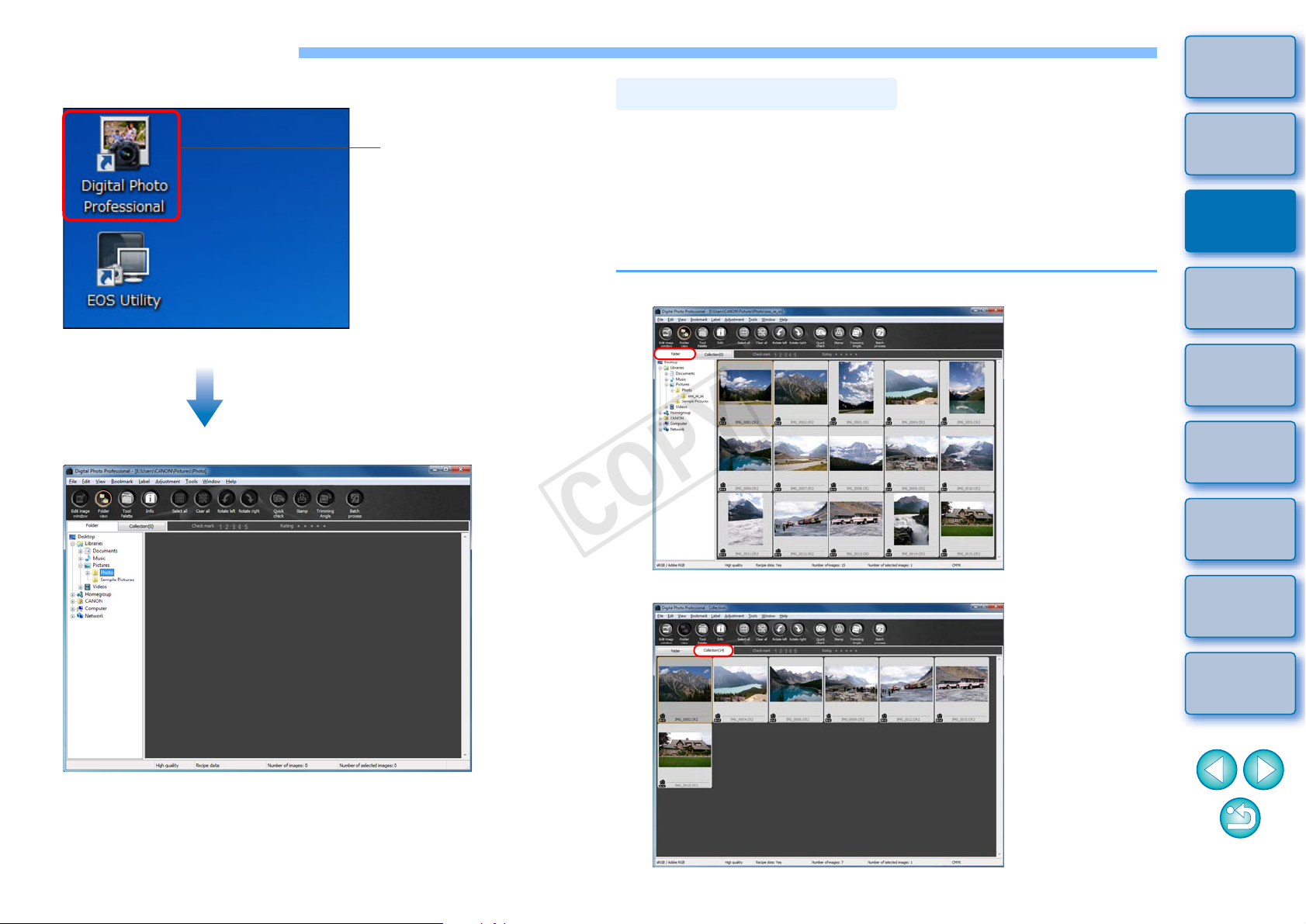
Starting up DPP
Double-click
Main window ([Folder] window)
Main Window Display
[Folder] window
[Collection] window
COPY
Double-click the desktop icon.
Introduction
DPP starts up and the main window ([Folder] window) appears.
In the main window, you can use tabs to select either the [Folder]
window or the [Collection] window. The [Folder] window displays the
images in folders on your computer, while the [Collection] window (p.36)
displays images selected randomly by the user from one or more folders
and gathered together.
Unless noted otherwise, the [Folder] window will be described as the
main window from this point on.
Contents at
a Glance
Basic
Operation
1
Advanced
Operation
2
Advanced
Image Editing
3
and Printing
Processing
Large Numbers
4
of Images
Editing
JPEG/TIFF
5
Images
Reference
Index
6
Page 8
Downloading an Image to Your Computer
EOS Utility
COPY
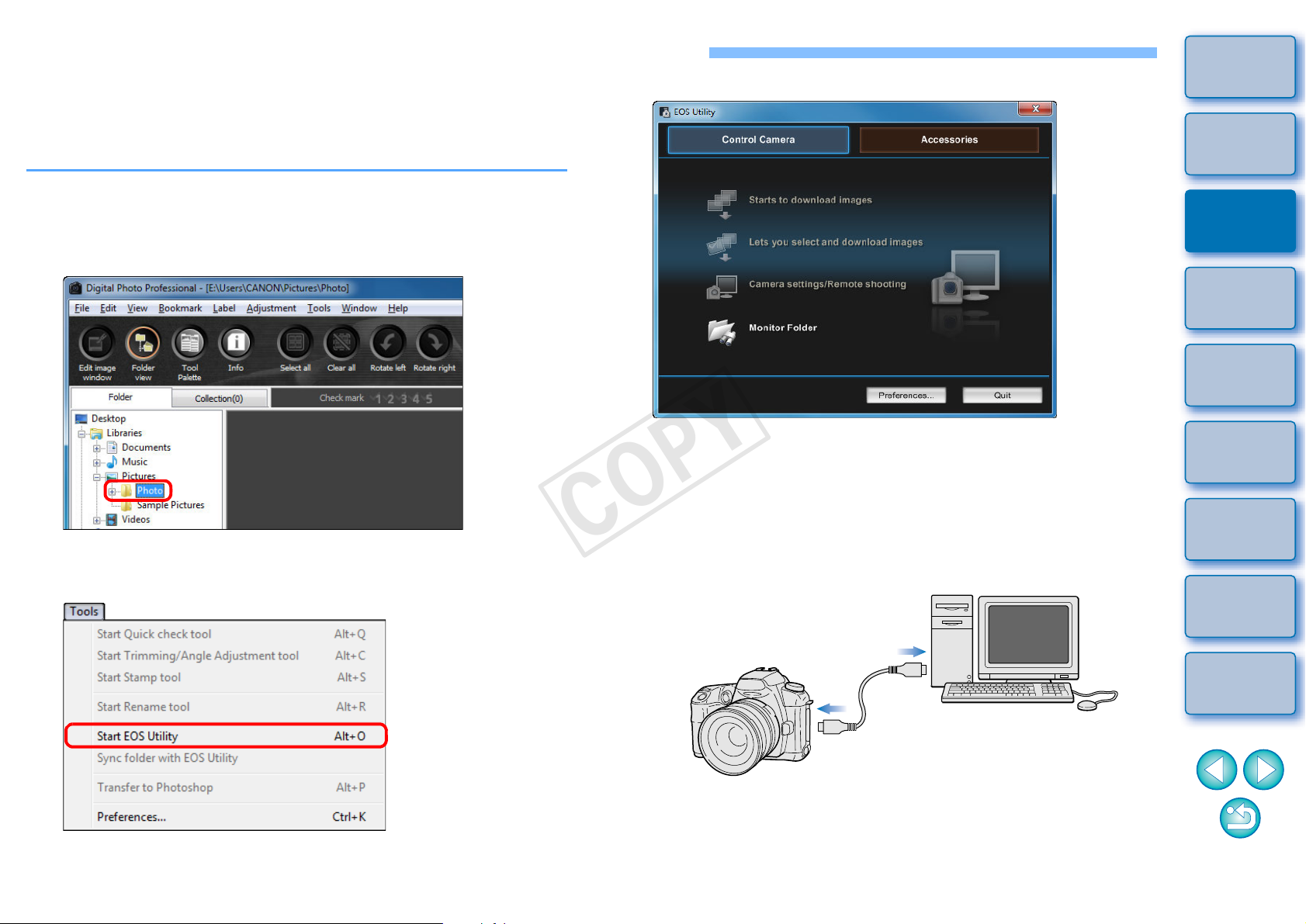
Connect the camera and computer with the cable provided and
download the images saved on the memory card inserted in the camera.
For downloading images, start up the camera software “EOS Utility”
from DPP and use.
Select the save destination for the images.
1
Select the save destination in the folder area on the left of the
main window.
When creating a folder, see p.50.
Introduction
Contents at
a Glance
Basic
Operation
1
Advanced
Operation
2
Advanced
Image Editing
3
and Printing
Start up EOS Utility.
2
Select the [Tools] menu [Start EOS Utility].
EOS Utility starts up.
Connect your camera and computer and turn the
3
camera on.
Connect the camera and your computer with the interface cable
provided with the camera and turn the camera on.
For detailed instructions on connecting your camera and
computer, refer to the “EOS Utility Instruction Manual” (PDF
electronic manual).
The capture window for EOS Utility appears.
Processing
Large Numbers
4
of Images
Editing
JPEG/TIFF
5
Images
Reference
Index
7
Page 9
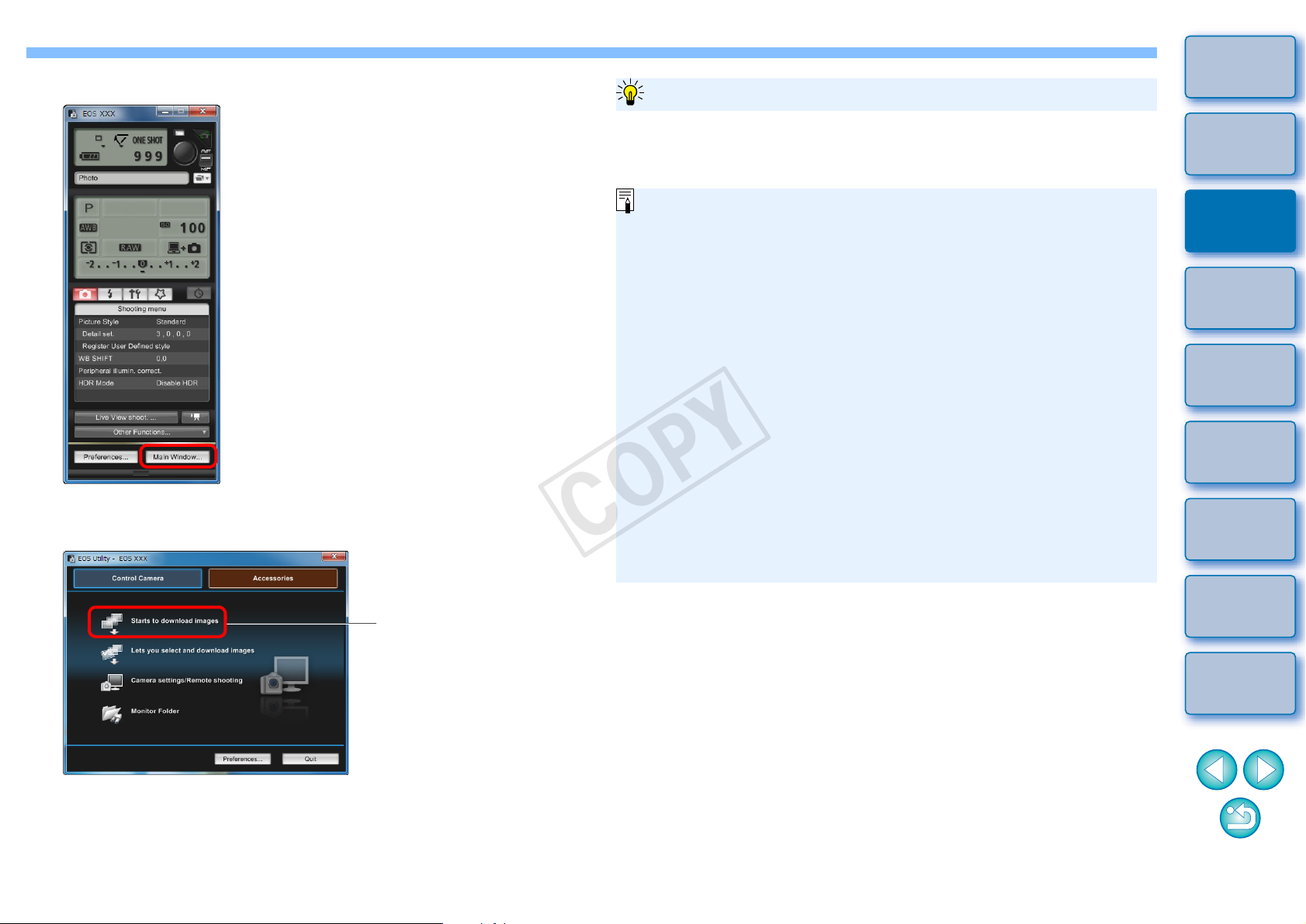
Click the [Main Window] button.
Click
COPY
4
Advantages of using EOS Utility to download images
Using EOS Utility to download images makes it easier to organize your
images as they are downloaded, sorted and saved into folders by date.
Introduction
Contents at
a Glance
The main window for EOS Utility appears.
Download images.
5
You cannot start up EOS Utility in the [Collection] window
(p.6, p.36).
When EOS Utility has been started up from DPP, you cannot use
the following functions.
• Quick check window view (p.16)
• Trimming and adjusting the angle of an image (p.38, p.111)
• Digital Lens Optimizer (p.69)
• Compositing images (p.78)
• Creating HDR (High Dynamic Range) images (p.81)
• Dust erasure processing (copy stamp function)
(p.73 to p.77, p.114 to p.118)
• Batch change file names (rename function) (p.101)
• Printing with shooting information (p.85)
• Printing a thumbnail list (contact sheet printing) (p.86)
• Printing using Easy-PhotoPrint EX or Easy-PhotoPrint
(Plug-in printing) (p.43, p.46)
• Transferring images to Photoshop (p.77)
• Batch saving images (batch processing) (p.99)
Basic
Operation
1
Advanced
Operation
2
Advanced
Image Editing
3
and Printing
Processing
Large Numbers
4
of Images
Editing
JPEG/TIFF
5
Images
Reference
Downloading of images begins.
The downloaded images are saved in the folder selected in step
1 and are displayed in the main window of DPP.
The downloaded images are sorted by date into folders and
saved.
Index
8
Page 10
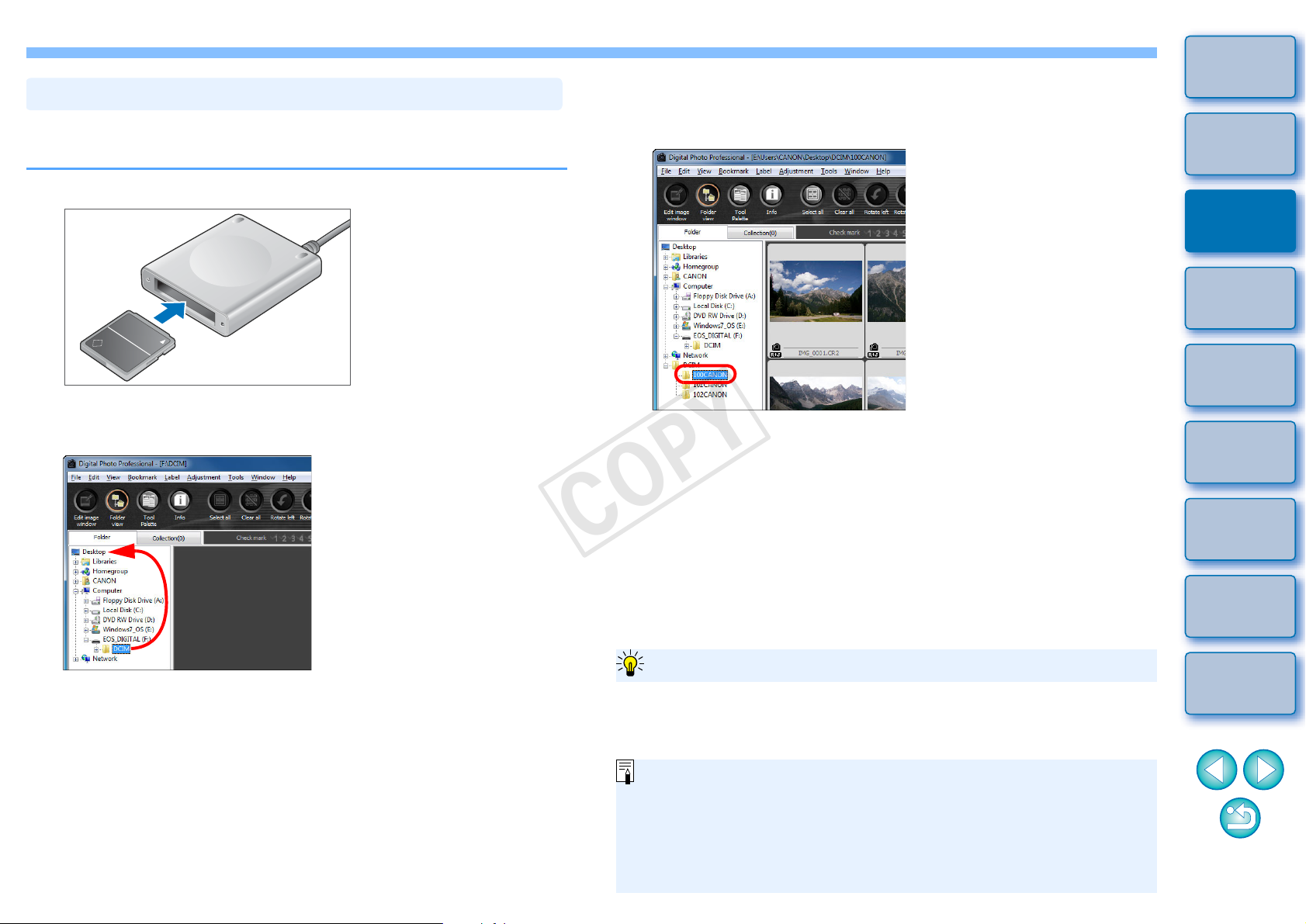
You can also download images to the computer using a third-party card
Downloading Images Using Your Card Reader
By selecting the memory card folder directly in DPP, the images in the
folder are displayed in DPP and you can check the shot images.
Checking before downloading images
Copying to your computer may take time when there is a large
number of shot images saved in the memory card.
For details on the [DCIM] folder structure and the file names of
shot images, refer to “Folder Structure and File Names in the
Memory Card” in the “EOS Utility Instruction Manual” (PDF
electronic manual).
COPY
reader.
Load the memory card into the card reader.
1
Open [My Computer] [EOS_DIGITAL] and drag the
2
[DCIM] folder to the [Desktop].
Display the images downloaded to your computer.
3
In the [DCIM] folder copied to your desktop, select the folder
where the shot images are saved.
Images in the folder are displayed in the main window of DPP.
Introduction
Contents at
a Glance
Basic
Operation
1
Advanced
Operation
2
Advanced
Image Editing
3
and Printing
Processing
Large Numbers
4
of Images
Editing
JPEG/TIFF
5
Images
The [DCIM] folder is downloaded to your computer.
All images are saved in folder units inside the [DCIM] folder.
Reference
Index
9
Page 11
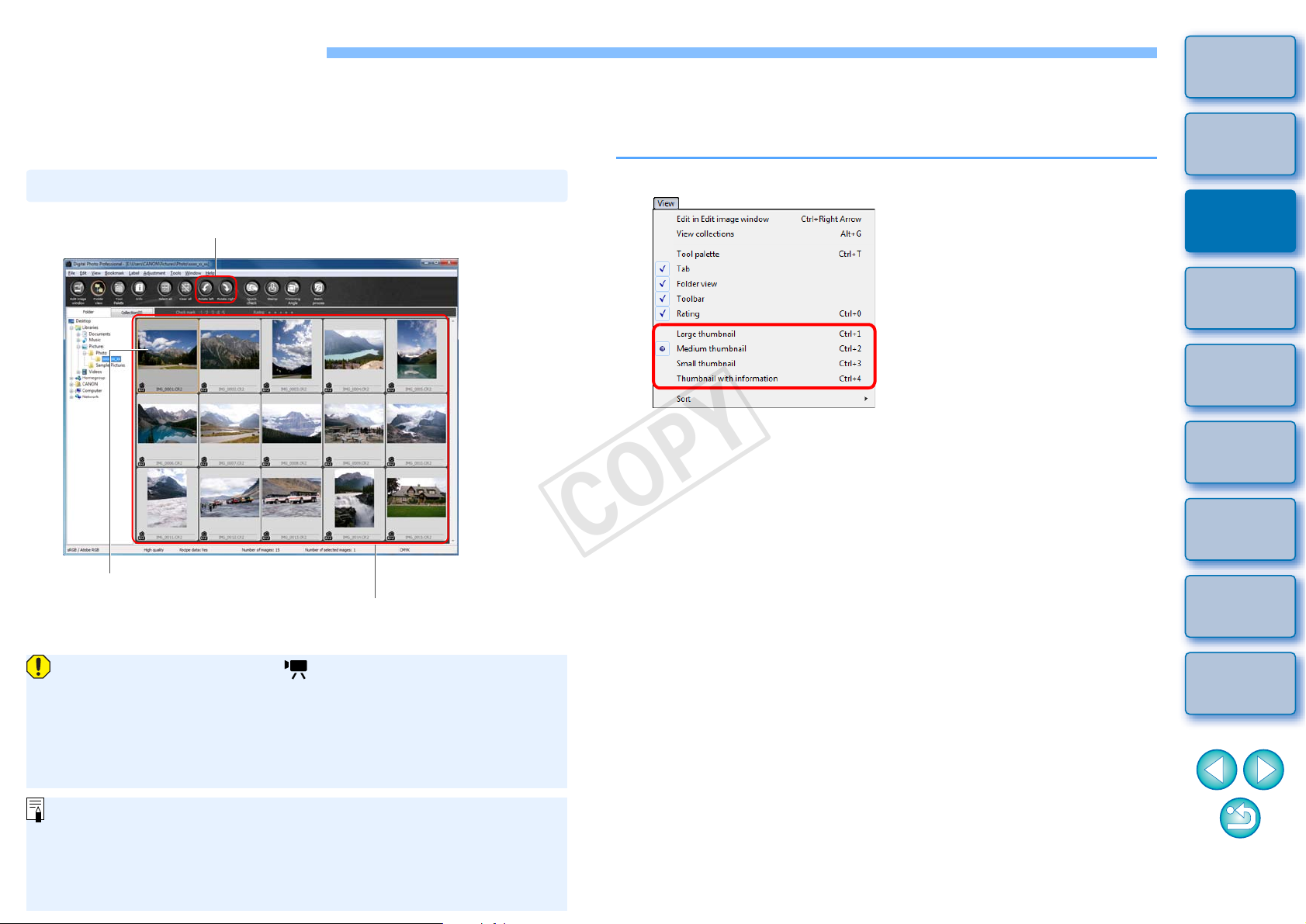
View Images as Thumbnails in the Main Window
Main window
Rotate selected image
Click to select the image
Display thumbnails of all the images inside the
folder selected in the folder area on the left
Images displayed with the [ ] icon are movie files and cannot
be played back in DPP. Please use “ImageBrowser EX”, which is
compatible with EOS DIGITAL movie files.
If the message [Insufficient memory.] appears, there are too many
images in one folder. Decrease the number of images in one
folder such as by dividing them into smaller folders.
When aspect ratio information is attached to the shot image with the
EOS-1D X, EOS-1D Mark IV, EOS-1Ds Mark III, EOS-1D Mark III, EOS
5D Mark III, EOS 7D, EOS 60D, EOS REBEL T4i/650D or EOS REBEL
T3i/600D, the image is displayed as a trimmed image (p.38, p.111).
For a list of main window functions, see p.124.
Viewing an Image
COPY
Images downloaded to your computer are displayed as a thumbnails list
in the main window. You can double-click an image to open the edit
window and display the image at large size.
Changing the Size of Thumbnail Images
You can change the size of the thumbnail images displayed in the main
window and display them with shooting information attached.
Select the [View] menu desired item.
Introduction
Contents at
a Glance
Basic
Operation
1
Advanced
Operation
2
Advanced
Image Editing
3
and Printing
The display changes to the selected item.
Processing
Large Numbers
4
of Images
Editing
JPEG/TIFF
5
Images
Reference
Index
10
Page 12
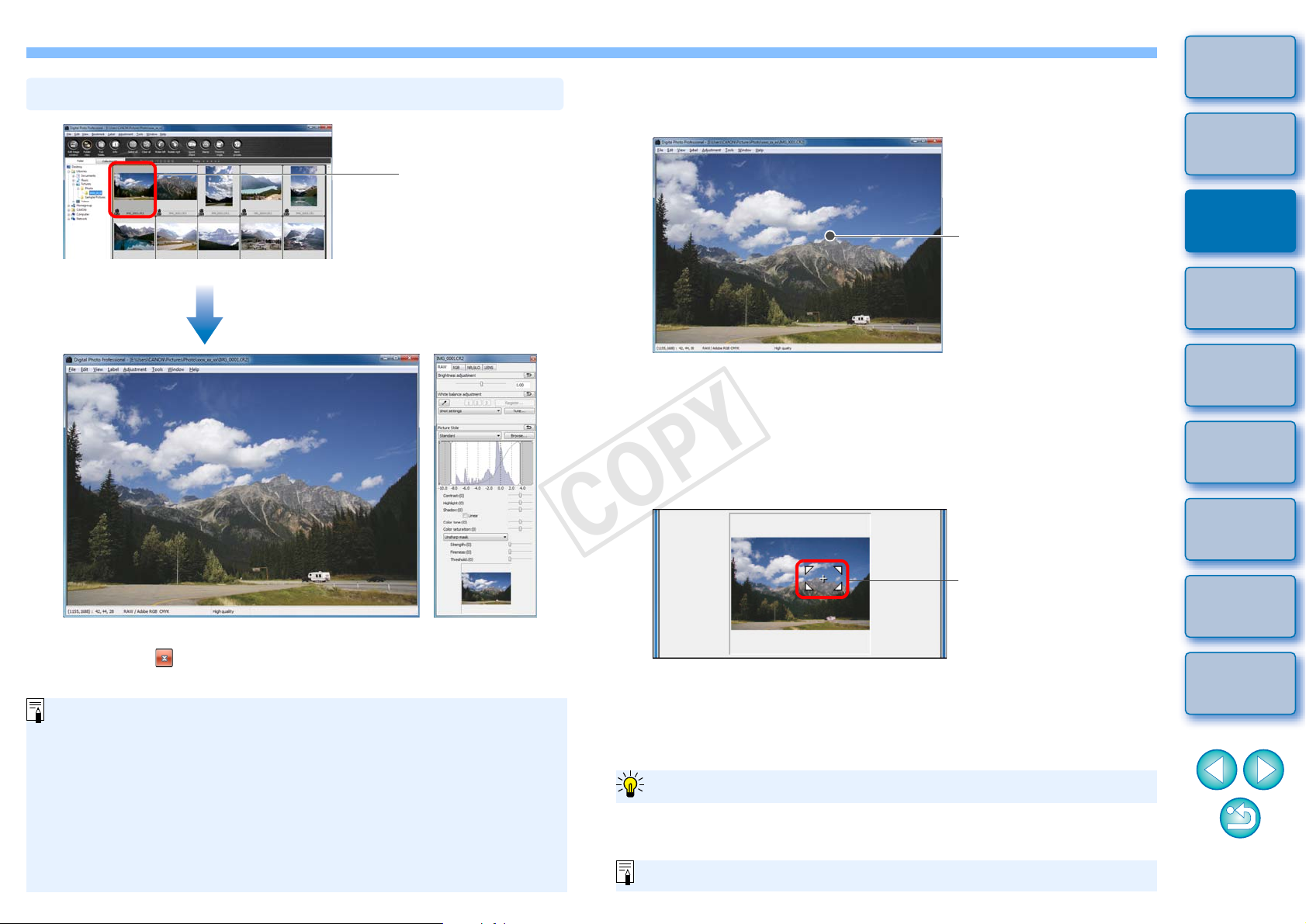
The edit window appears.
Enlarge and View an Image in the Edit Window
Double-click
Edit window Tool palette
By selecting the [View] menu [AF Point] in the edit window, you can
display the AF points selected in the camera at the time of shooting.
However, AF points are not displayed for images whose image size
has been changed and then been converted and saved
(
p.42, p.134),
images for which you selected an effect other than [Shot settings] as
correction of fisheye lens distortion aberration, or images which have
had settings specified during RAW processing on the camera for
distortion correction and chromatic aberration correction.
For a list of edit window functions, see p.127.
Double-click
Tool palette enlargement display position
Change the enlargement
display position by
dragging
Select the [View] menu [200% view] or [50% view].
To display an image in an enlargement ratio other than 100%
You can change the enlargement ratio when you double-click (p.91).
COPY
Enlarging and Viewing a Specific Area
Double-click the area you want to enlarge.
Introduction
Contents at
a Glance
Basic
Operation
1
Advanced
Operation
2
It may take time for the image to redraw itself.
Click the [ ] in the upper right of the edit window to close the
edit window.
The area you double-clicked is enlarged to 100% (actual pixel
size). If you wait for a while, it changes to a clearer display.
Double-click again to revert to the full view.
To change the display position, drag on the image or drag the
enlargement display position of the tool palette.
Advanced
Image Editing
3
and Printing
Processing
Large Numbers
4
of Images
Editing
JPEG/TIFF
5
Images
Reference
Index
11
Page 13
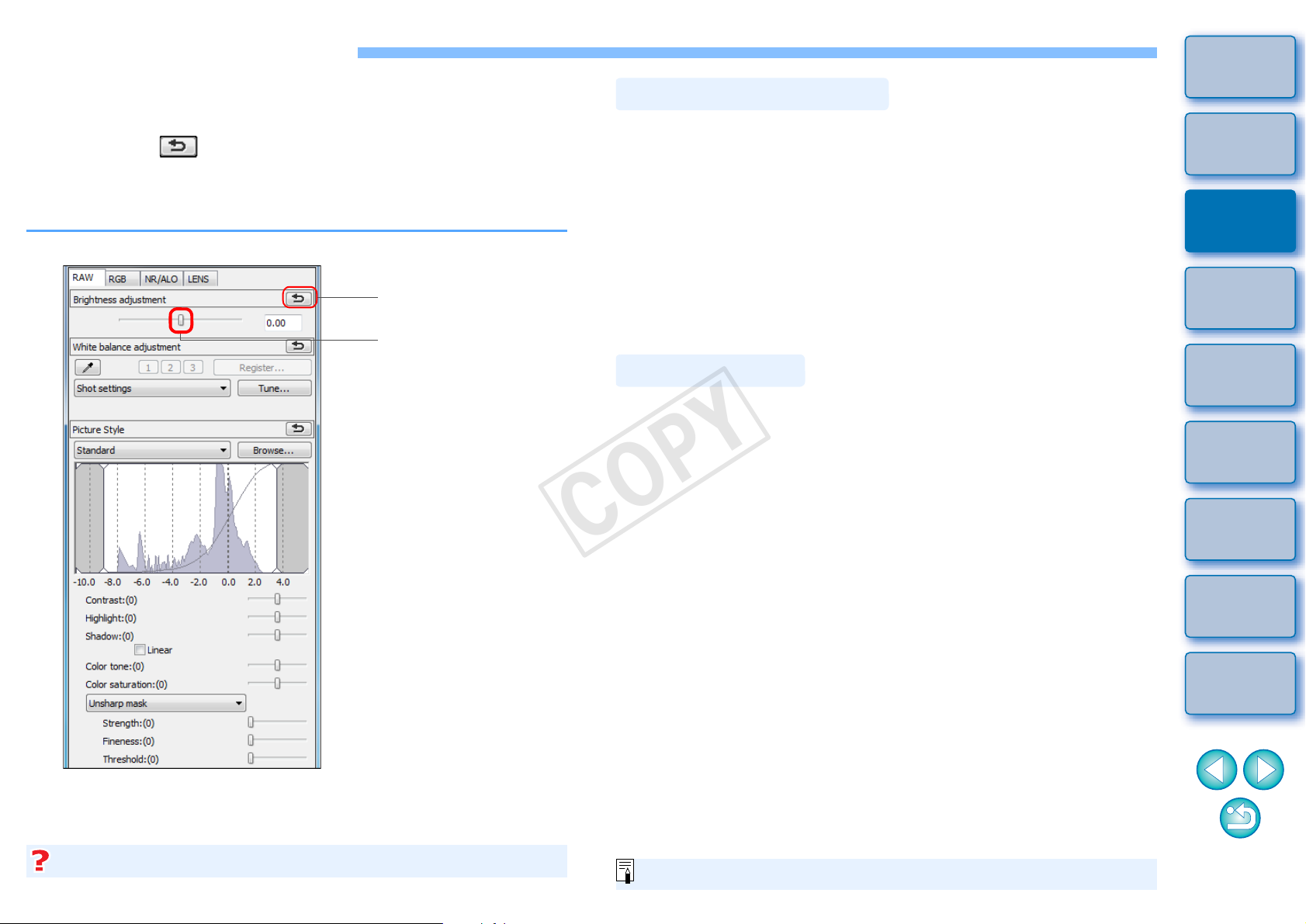
Adjusting an Image
Reverts the image to
the original settings
Drag the slider left or
right
Tool palette
Select the [View] menu [Tool palette].
The tool palette does not display
About the Tool Palette
About Recipes
For a list of tool palette functions, see p.128.
COPY
You can perform a variety of image adjustments, such as adjusting the
brightness or changing the Picture Style of an image using the tool
palette of the edit window. You can easily restore an image to its original
settings with the [ ] button even if you have made the wrong
adjustment. Try out the various adjustments.
As an example, the procedure to adjust the brightness of an image is
explained here.
You can adjust images with the tool palette by switching between the
[RAW], [RGB], [NR/ALO] and [LENS] tab sheets according to your
editing requirements.
Because adjustment made with the tool palette (it undergoes automatic
development processing each time) only changes the image processing
conditions, the “original image data itself” remains unaffected.
Therefore, there are no problems with image deterioration that arise with
editing and you can readjust your images any number of times.
See Chapter 2 onwards for more detailed information on the various
functions of the tool palette.
In DPP, all the adjustment contents (image processing conditions
information) made with the tool palette is saved to an image as data
called a “Recipe” (p.96).
Introduction
Contents at
a Glance
Basic
Operation
1
Advanced
Operation
2
Advanced
Image Editing
3
and Printing
Processing
Large Numbers
4
of Images
Editing
JPEG/TIFF
5
Images
The image brightness changes in real time according to the
amount of adjustments.
Reference
Index
12
Page 14
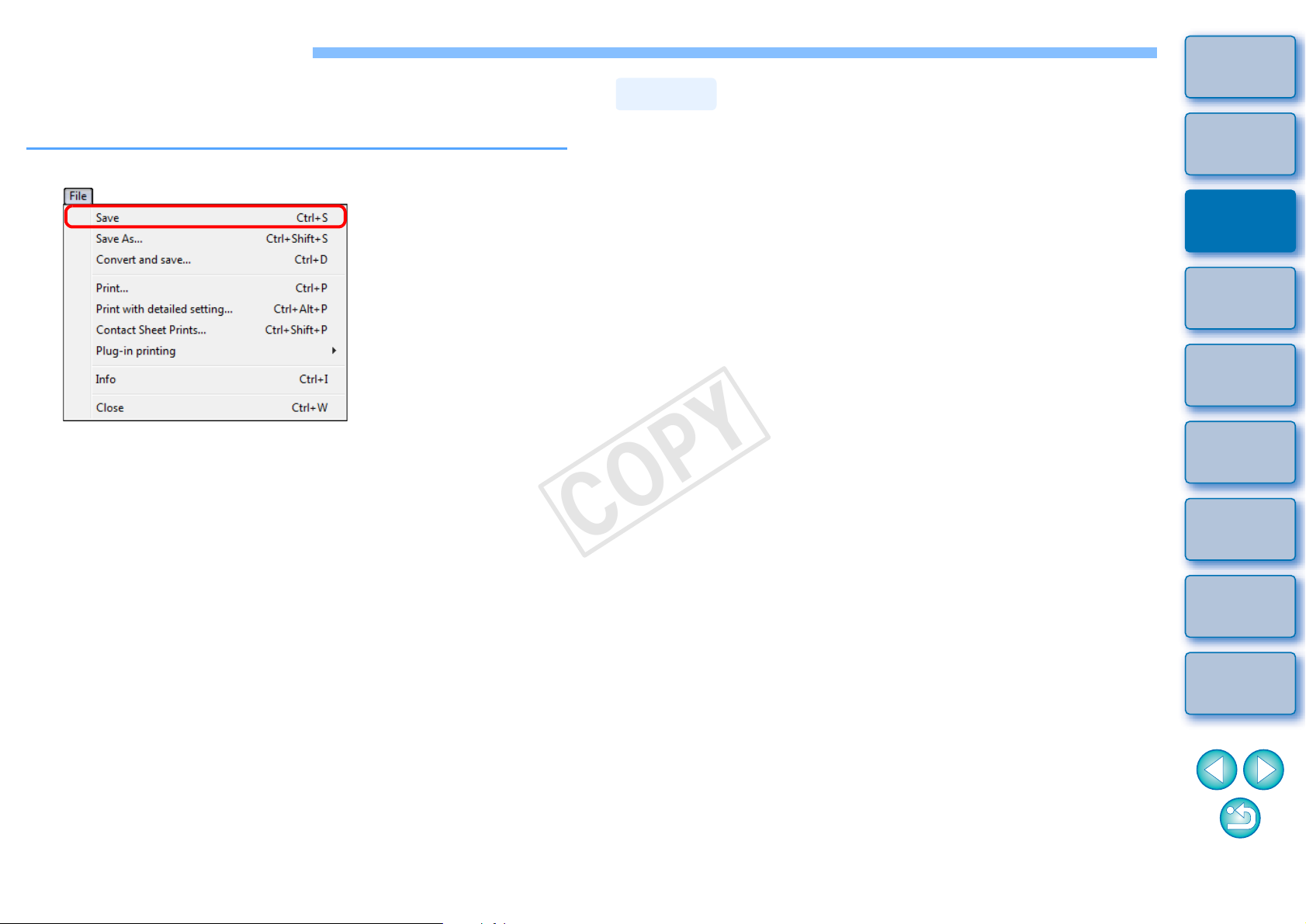
Saving an Image
Saving
COPY
If you perform the save operation described here, you can save all the
adjustment contents (recipe) made with the tool palette to the RAW
image.
Select the [File] menu [Save].
Your adjustment contents (recipe) are saved to the image.
With DPP, you can perform the following types of saving according to
your requirements. For detailed information on each saving method, see
Chapter 2 onwards.
Save (p.41)
Add adjustment contents (recipe) made with the tool palette to a RAW
image and save.
Save as (p.41)
Add adjustment contents (recipe) made with the tool palette to a RAW
image and save as a separate RAW image. The original RAW image
remains unaffected.
Add thumbnail to image and save* (p.23)
Create a new thumbnail image for the main window and save to each
image.
The quality of images in the main window improves and images
redraw themselves more quickly.
Convert and save (p.42)
Convert adjusted RAW image to a JPEG or TIFF image and save.
The original RAW image remains unaffected.
Batch process (p.99)
Convert in batches adjusted multiple RAW images to JPEG or TIFF
images and save.
The original RAW images remain unaffected.
Introduction
Contents at
a Glance
Basic
Operation
1
Advanced
Operation
2
Advanced
Image Editing
3
and Printing
Processing
Large Numbers
4
of Images
Editing
JPEG/TIFF
5
Images
* Option available in the main window.
Reference
Index
13
Page 15
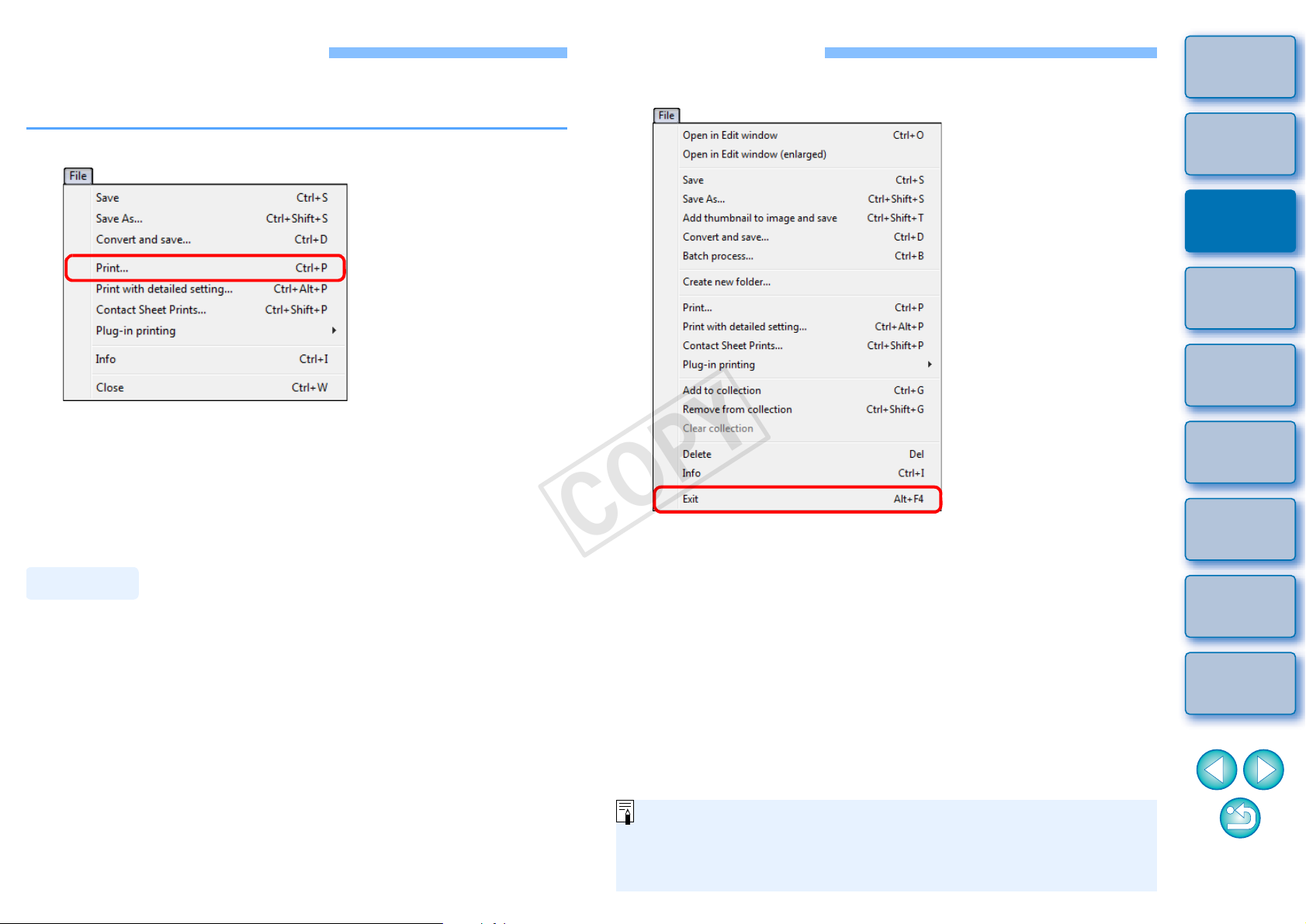
Printing an Image
Printing
A confirmation dialog box for saving the images appears when you
try to exit DPP without saving the adjusted image. Click the [Yes to
all] button to save the adjustment contents (recipe) to all the images
adjusted.
COPY
You can print images with a printer. As an example, the procedure to
print one image on one sheet of paper is described here.
Exiting DPP
In the main window, select the [File] menu [Exit].
Introduction
Select the [File] menu [Print].
1
The printer’s print settings dialog box appears.
Print.
2
Specify the optimum settings for photograph printing in the
printer’s print settings dialog box and click the [OK] button.
Printing begins.
DPP exits.
Contents at
a Glance
Basic
Operation
1
Advanced
Operation
2
Advanced
Image Editing
3
and Printing
Processing
Large Numbers
4
of Images
Editing
JPEG/TIFF
5
Images
With DPP, you can perform the following types of printing according to
your requirements. For detailed information on each printing method,
see Chapter 2 onwards.
Print one image (p.49)
Print using a Canon inkjet printer (p.43, p.46)
Print with a high-end Canon printer (p.87)
Print with shooting information (p.85)
Printing a thumbnail list (contact sheet printing) (p.86)
Reference
Index
14
Page 16
2
COPY
Advanced Operation
Introduction
A more advanced operation – from efficiently checking images, to
various ways of editing an image, printing a RAW image using a Canon
printer and sorting images – is explained here.
Efficiently Checking/Sorting Images......................... 16
Sorting Images........................................................... 18
Attaching Check Marks.......................................... 18
Setting Ratings ...................................................... 18
Sorting Images in the Main Window .......................... 19
Attaching Check Marks in the Main Window ......... 19
Setting Ratings in the Main Window ...................... 19
Arranging Images in the Main Window ...................... 20
Arranging by Type ................................................. 20
Arranging Freely .................................................... 21
Displaying a RAW Image and JPEG Image as a Single
Image.........................................................................
Improving the Quality of an Image in the Main Window ...
Checking Image Information...................................... 23
Editing an Image ...................................................... 25
About the RAW Tool Palette...................................... 25
Editing with the Tool Palette in the Main Window .. 25
Adjusting Brightness .................................................. 26
Changing a Picture Style ........................................... 26
Picture Style File.................................................... 27
22
23
Detailed Setting of Image Sharpness ..................... 32
Automatically Adjusting Brightness and Color (Tone
Curve Assist) ..............................................................
Editing Efficiently ..................................................... 34
Editing in the Edit Image Window............................... 34
Changing the Thumbnail Display Position to a Horizontal
Position.......................................................................
Gathering and Editing Images in the Collection Window ...
Trimming and Adjusting the Angle of an Image....... 38
Applying Adjustment Contents to Other Images...... 41
Saving Editing Results............................................. 41
Saving Editing Contents to a RAW Image.................. 41
Saving as a JPEG or TIFF Image............................... 42
Re-Editing an Image................................................ 43
Printing an Image .................................................... 43
Printing Photographs with Canon Inkjet Printers
Compatible with Easy-PhotoPrint EX .........................
Printing Photographs with Canon Inkjet Printers
Compatible with Easy-PhotoPrint...............................
Printing Photographs with a Printer other than Canon
Inkjet Printers..............................................................
Organizing Images .................................................. 49
Deleting an Unwanted Image ..................................... 49
33
36
36
43
46
49
Contents at
a Glance
Basic
Operation
1
Advanced
Operation
2
Advanced
Image Editing
3
and Printing
Processing
Large Numbers
4
of Images
Editing
JPEG/TIFF
5
Images
Reference
Index
Adjusting Color Tone by Changing White Balance.... 27
Adjusting Color Tone Using Click White Balance ...... 28
Adjusting Contrast ..................................................... 29
Changing Color Tone and Color Saturation............... 29
Adjusting Monochrome .......................................... 30
Adjusting Image Sharpness....................................... 31
Creating a Folder for Saving Images.......................... 50
Moving Images ........................................................... 50
Moving Images in Folders .......................................... 51
Registering Frequent-Use Folders (Bookmark
Registration) ...............................................................
Organizing Bookmarks ........................................... 51
51
15
Page 17
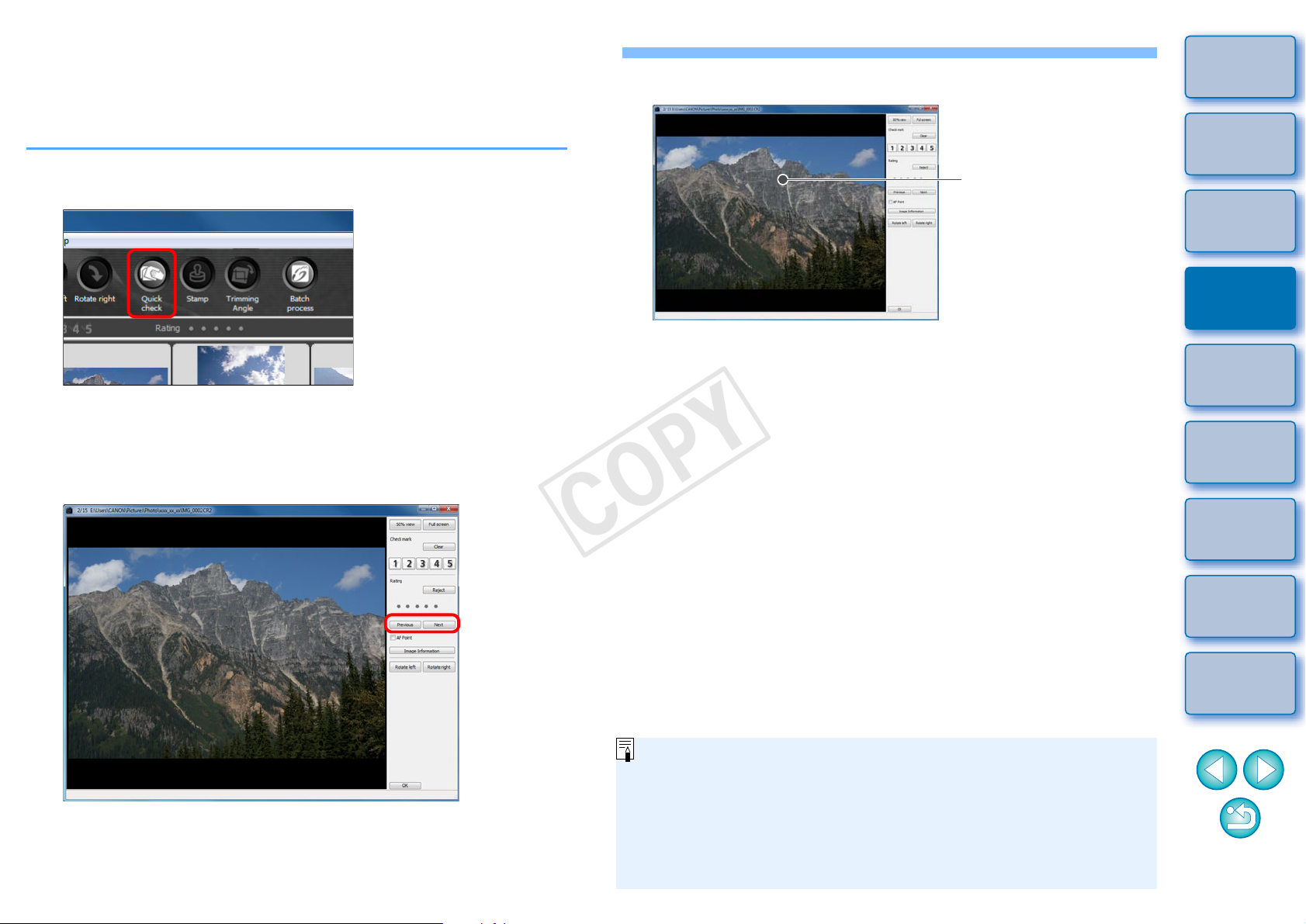
Efficiently Checking/Sorting Images
Quick check window
Double-click
When [AF Point] is checkmarked, you can display the AF points
selected in the camera at the time of shooting.
However, AF points
are not displayed for images which have had their image size changed
and then been converted and saved (p.42, p.134), which have had
settings specified during RAW processing on the camera for distortion
correction and chromatic aberration correction, which are composited, or
which are created as HDR (High Dynamic Range) images.
COPY
You can enlarge images displayed as thumbnails in the main window
and efficiently check each image. You can attach check marks and sort
images into five groups.
Display the quick check window.
1
Click the [Quick check] button.
The quick check window appears.
Click the [Next] or [Previous] button to switch
2
between images to be checked.
Double-click the area you want to enlarge.
3
The area you double-clicked is enlarged to 50% view.
To change the display position, drag on the image.
Double-click again to revert to the full view.
To exit, click the [OK] button.
Introduction
Contents at
a Glance
Basic
Operation
1
Advanced
Operation
2
Advanced
Image Editing
3
and Printing
Processing
Large Numbers
4
of Images
All the images displayed in the main window can be checked in
the quick check window.
Editing
JPEG/TIFF
5
Images
Reference
Index
16
Page 18
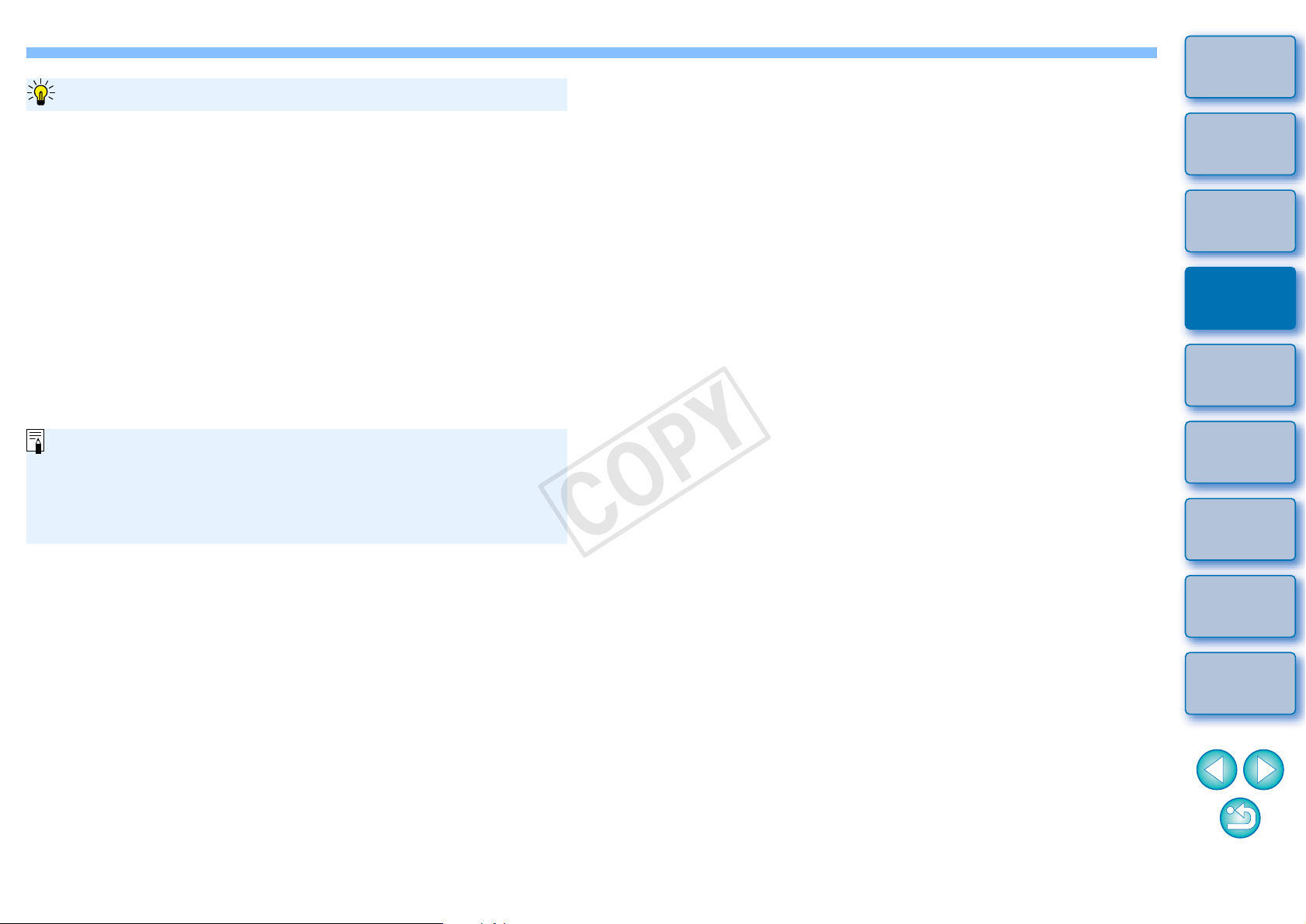
Convenient functions of the quick check window
COPY
Introduction
To check only selected images
You can use the quick check window to check only selected images
by selecting the desired images from those displayed in the main
window and then performing step 1.
Switch between images using the keyboard
You can also switch between images by pressing the <
key.
Switch between screens using the keyboard
You can also switch between full screen display/normal screen
display by pressing the <Alt> + <Enter> keys.
Operate using the menu
Each operation can also be performed with the menu which appears
when you right-click with the mouse on an image.
The enlargement ratio when an image is enlarged is half (50%) of
the 100% (actual pixel size).
You can change the enlargement ratio to 100%, when an image is
enlarged (p.91).
For a list of quick check window functions, see p.132.
> or <>
Contents at
a Glance
Basic
Operation
1
Advanced
Operation
2
Advanced
Image Editing
3
and Printing
Processing
Large Numbers
4
of Images
Editing
JPEG/TIFF
5
Images
Reference
Index
17
Page 19
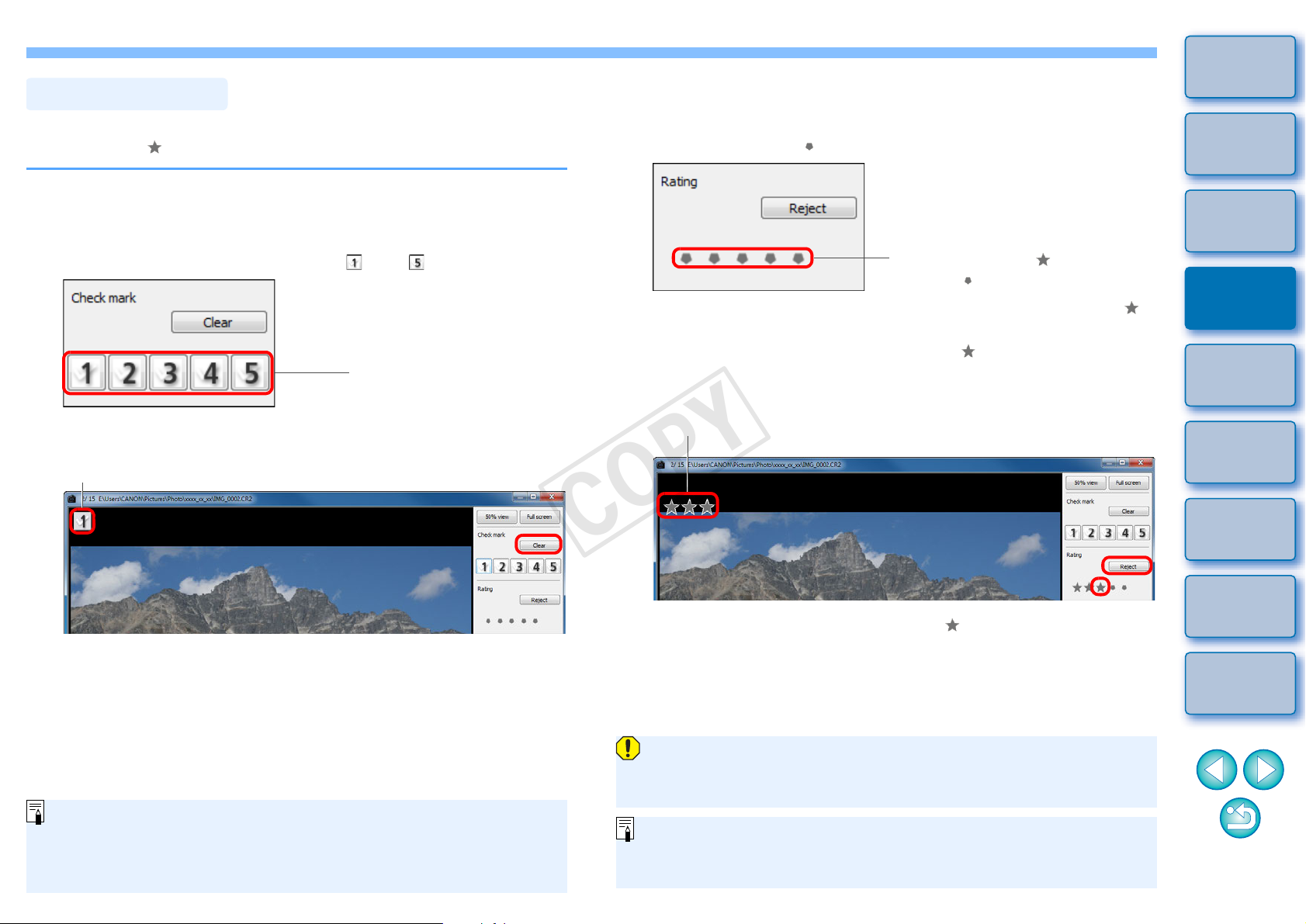
Sorting Images
Click
The selected check mark appears in the upper left of the window.
Check mark
Click the [Clear] button to remove the check mark.
The values of check marks attached to images in DPP version 3.8
or earlier are maintained as they are.
You can also attach check marks from the menu that appears by
right-clicking with the mouse on an image in the main window.
Setting Ratings
Click (changes to [ ] after
clicking [ ])
The rating is set and an icon corresponding to the selected [ ]
appears in the upper left of the window.
(Window shown with a rating of three [ ])
To set [Reject], click the [Reject] button. Click the [Reject] button
again to cancel.
Rating icon
To cancel the rating, click the same [ ] as when the setting was
made on the right of the window.
As the file structure of the image data is changed when a rating is
set to an image, it may not be possible to check the image
information in third-party software.
You can also set ratings (including [Reject] setting) from the menu
that appears by right-clicking with the mouse on an image in the
main window.
COPY
Introduction
You can sort images by attaching check marks or setting ratings
(indicated with [ ] marks) for each subject or theme.
Attaching Check Marks
Display the image you want to attach a check mark
to, and then click any one of [ ] to [ ].
Display the image you want to rate, and then click
any one of the [ ].
Contents at
a Glance
Basic
Operation
1
Advanced
Operation
2
Advanced
Image Editing
3
and Printing
Processing
Large Numbers
4
of Images
Editing
JPEG/TIFF
5
Images
Reference
Index
18
Page 20
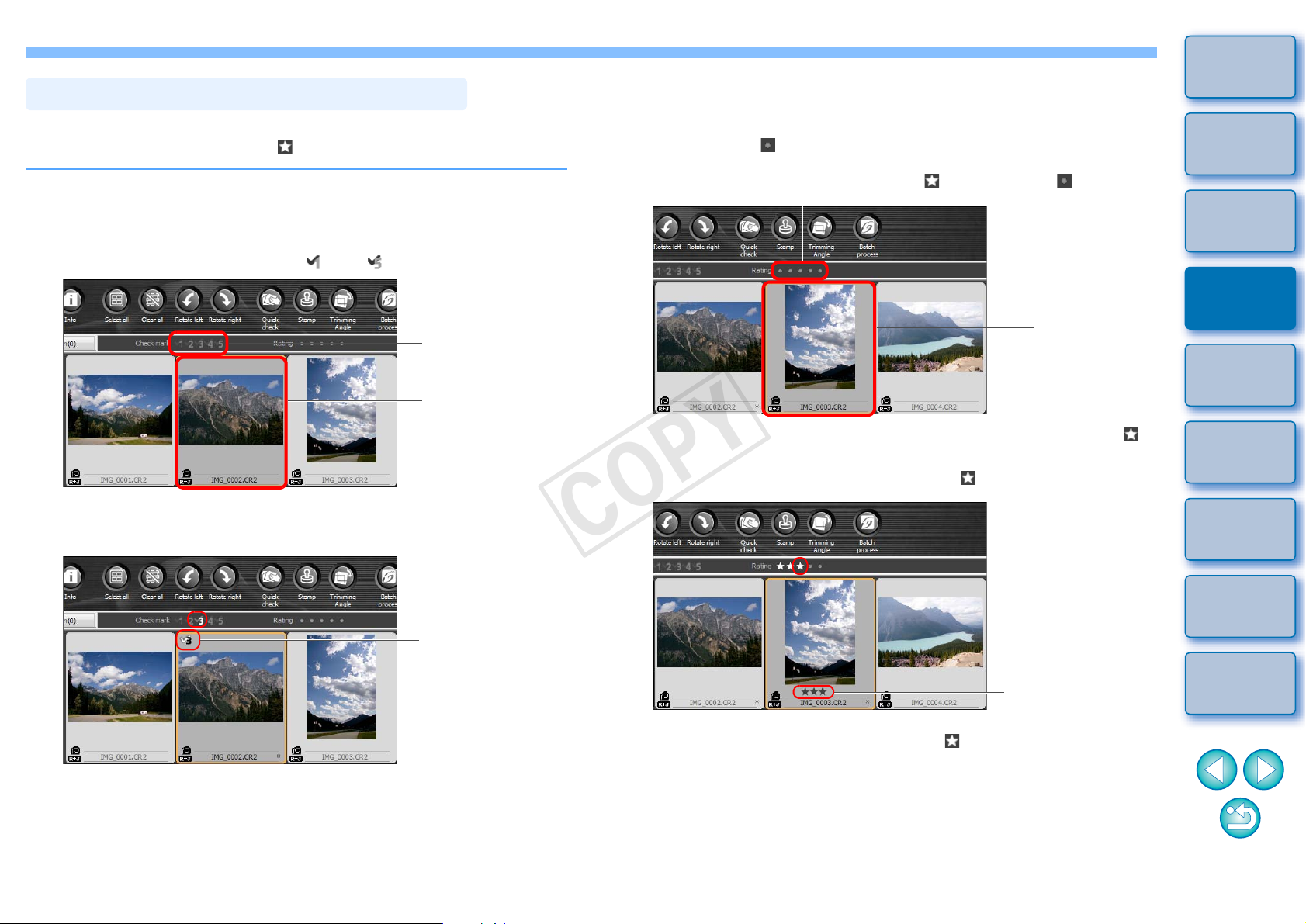
Sorting Images in the Main Window
Select
Click
The selected check mark appears in the upper left of the image
frame.
Check mark
Setting Ratings in the Main Window
Select
Click (changes to [ ] after clicking [ ])
The rating is set and an icon corresponding to the selected [ ]
appears in the image frame.
(Window shown with a rating of three [ ] as an example)
Rating icon
COPY
Introduction
You can also sort images in the main window by attaching check marks
or setting ratings (indicated with [ ] marks) for each subject or theme.
Attaching Check Marks in the Main Window
Select the images you want to attach a check mark
to, and then click any of [ ] to [ ] in the toolbar.
Select the images you want to rate, and then click
any of the [ ] in the toolbar.
Contents at
a Glance
Basic
Operation
1
Advanced
Operation
2
Advanced
Image Editing
3
and Printing
Processing
Large Numbers
4
of Images
Editing
JPEG/TIFF
5
Images
Click the check mark in the toolbar again to remove the check
marks.
Reference
Index
To cancel the rating, click the same [ ] as when the setting was
made in the toolbar.
[Reject] cannot be set with the toolbar. Set [Reject] with the
[Label] menu or the quick check window (p.18).
19
Page 21
Introduction
Click on desired images while holding down the <Ctrl> key. To select
multiple consecutive images, click on the first image, and then click on
the last image while holding down the <Shift> key.
You can display a large number of images by setting the size of
thumbnail images to small (p.10). Then, by selecting the [View] menu
[Rating] and removing check marks so that ratings no longer appear in
the image frame, you can display still more thumbnail images in the main
window.
To select multiple images in the main window
To display more thumbnails in the main window
The [Label] menu can also be used to attach check marks and set
ratings.
By selecting the [Edit] menu [Check mark] or [Rating] image
selection criteria, you can refine criteria for selecting
checkmarked or rated images.
You can display and change the rating settings set in DPP with
other bundled software and on an EOS-1D X, EOS 5D Mark III,
EOS 7D (firmware version 2.0.0 or later), EOS 60D, EOS REBEL
T4i/650D, EOS REBEL T3i/600D, or EOS REBEL T3/1100D
camera.
• EOS Utility version 2.9 or later:
Ratings set in DPP are displayed. However, [Reject] is not
displayed and you cannot change rating settings.
• On an EOS-1D X, EOS 5D Mark III, EOS 7D (firmware version
2.0.0 or later), EOS 60D, EOS REBEL T4i/650D, EOS REBEL
T3i/600D, or EOS REBEL T3/1100D camera:
Ratings set in DPP are displayed in the playback screen. You
can also change rating settings. However, you cannot display or
change settings for [Reject].
Reversely, you can also display and change with DPP the rating
settings set for still images on an EOS-1D X, EOS 5D Mark III,
EOS 7D (firmware version 2.0.0 or later), EOS 60D, EOS REBEL
T4i/650D, EOS REBEL T3i/600D, or EOS REBEL T3/1100D
camera.
Arranging Images in the Main Window
COPY
You can arrange images in the order of the types of check marks you
have attached to images, or in the order of date and time at which the
images were shot. You can also freely arrange images by moving them
individually.
Arranging by Type
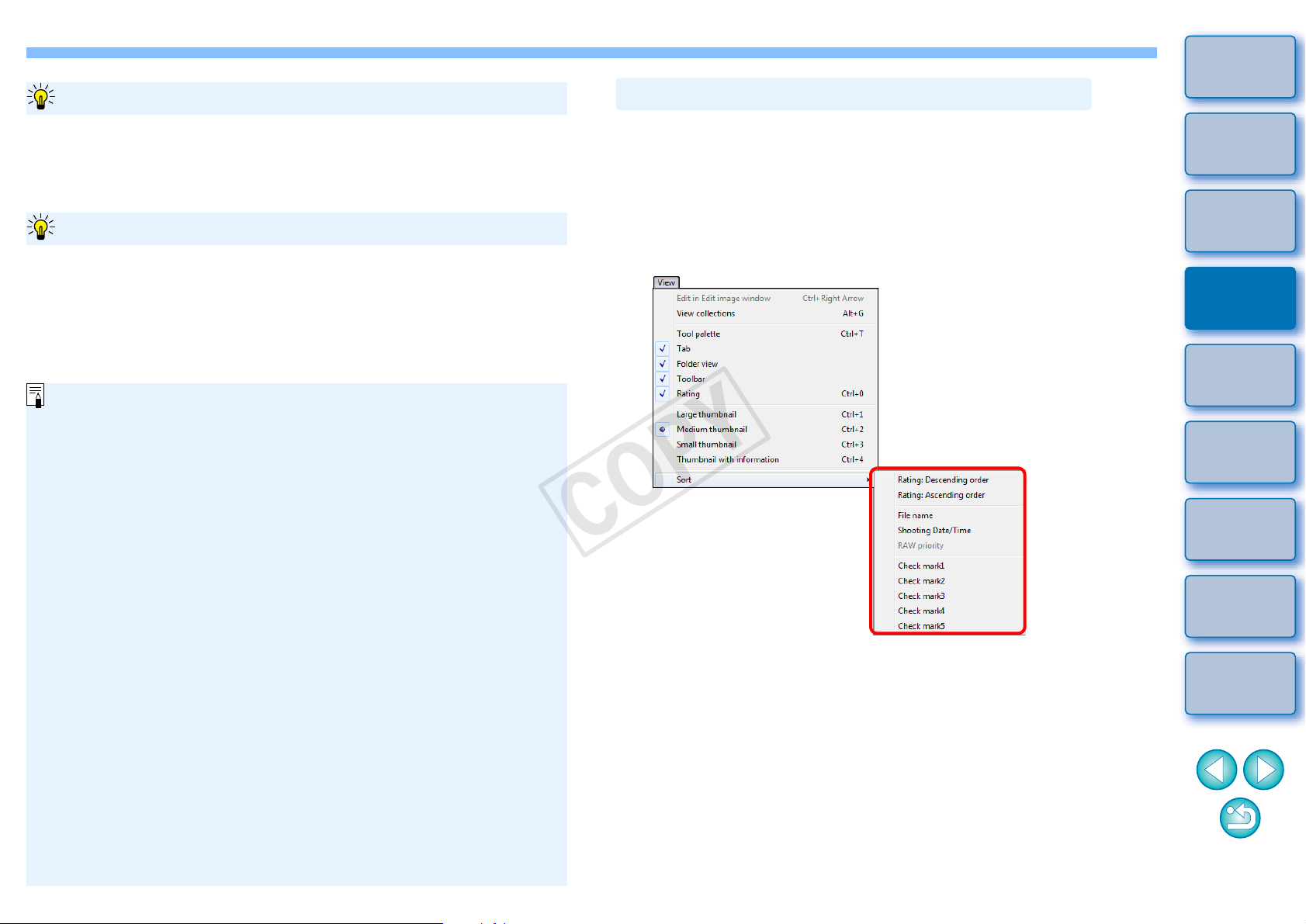
Select the [View] menu [Sort] desired item.
The images are arranged in the order according to the selected
item.
Contents at
a Glance
Basic
Operation
1
Advanced
Operation
2
Advanced
Image Editing
3
and Printing
Processing
Large Numbers
4
of Images
Editing
JPEG/TIFF
5
Images
Reference
Index
20
Page 22
Sort item Description
When check marks from 1 to 5 have been set, the images are sorted as
follows:
Check mark1 selected: 12345
Check mark2 selected: 23451
Check mark3 selected: 34512
Check mark4 selected: 45123
Check mark5 selected: 51234
Check mark sorting order
You can maintain the order of rearranged images even if you exit DPP
or select another folder in the folder area.
Maintain order without changing image file names
You can use the [View settings] tab sheet in the [Preferences] to
maintain the order of images without changing the image file names
(p.91).
Maintain order and change image file names
You can use the rename function to maintain the order of images and
change the image file names all at once in the order they were
rearranged (p.101).
Maintaining the order of rearranged images
COPY
Rating: ascending
order
Rating: descending
order
File name Images are sorted by file name in alphanumeric
Sorted in order of fewest [ ].
Sorted in order of most [ ].
order (0 to 9 A to Z).
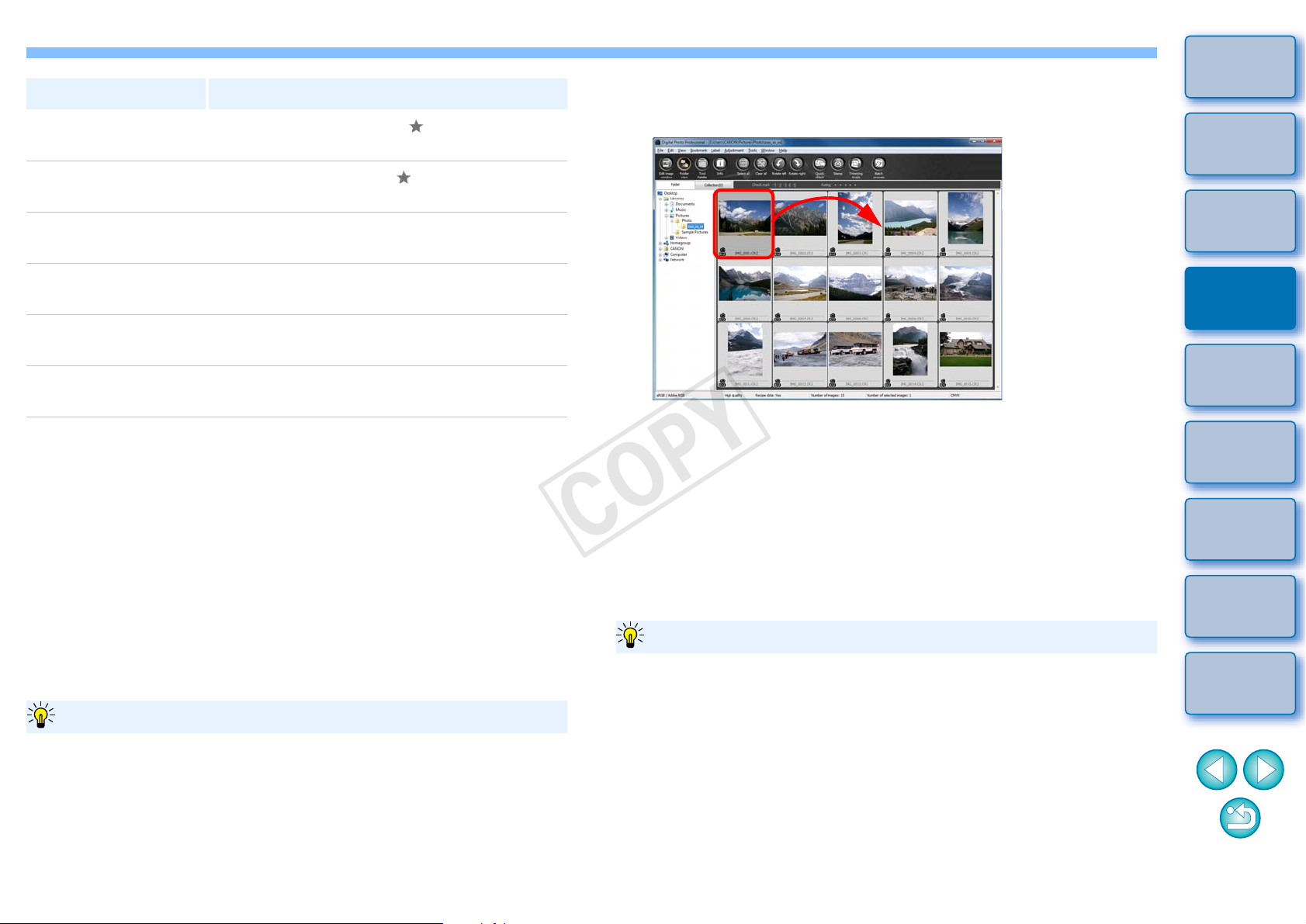
Arranging Freely
Drag and drop the image to the desired location.
Introduction
Contents at
a Glance
Basic
Operation
1
Shooting Date/Time Images are sorted by shooting date and time
from the earliest.
RAW priority Images are sorted in the following order: RAW
images JPEG images TIFF images.
Check mark1 Check mark5
Images with check marks take priority and are
sorted in number order.
The image moves to the desired location.
You can also select multiple images (p.20) and move them.
The order of rearranged images is maintained until you exit DPP
or select another folder in the folder area.
Select the [View] menu [Sort] [File name] to revert to the
order before the images were rearranged.
Advanced
Operation
2
Advanced
Image Editing
3
and Printing
Processing
Large Numbers
4
of Images
Editing
JPEG/TIFF
5
Images
Reference
Index
21
Page 23
You can display and handle a RAW image and JPEG image shot
Displaying a RAW Image and JPEG Image as a Single Image
COPY
simultaneously as a single image. In particular, you can halve the
number of images displayed in the main window and you can streamline
the checking of a large number of images shot simultaneously.
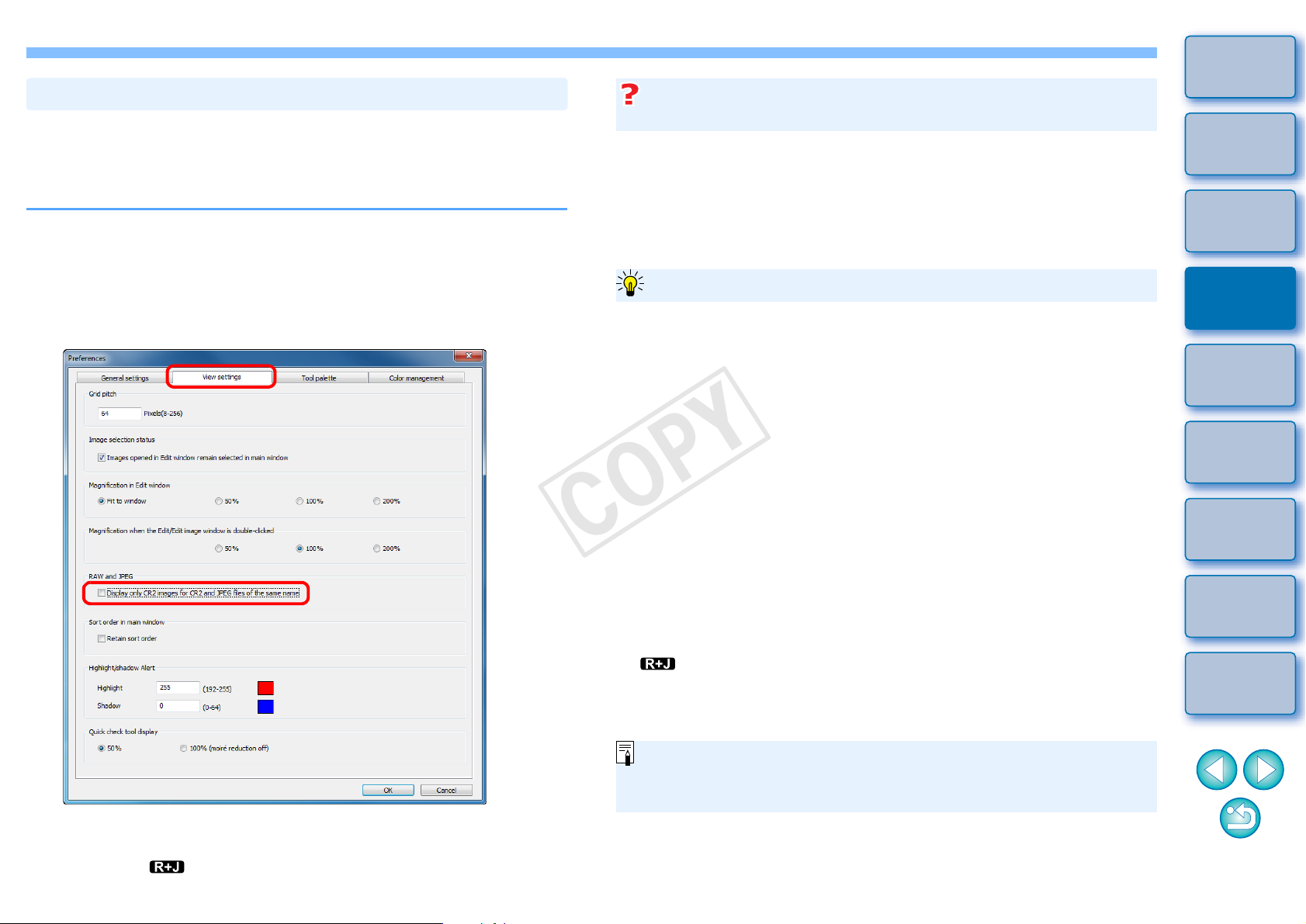
Select the [Tools] menu [Preferences].
1
RAW images with the extension “.CR2” can be displayed as a
single image
Images that can be displayed as a single image are images shot with a
camera that shoots RAW images with the extension “.CR2” and JPEG
images simultaneously. Images that have been simultaneously shot with
a camera that shoots RAW images with the extension “.CRW” or “.TIF”
cannot be displayed as a single image.
Introduction
Contents at
a Glance
Basic
Operation
1
Select the [View settings] tab sheet and checkmark
2
[Display only CR2 images for CR2 and JPEG files of
the same name].
When a single image is displayed
Image displayed
The RAW image is displayed in all windows.
Edited image
The content which has been adjusted with any of DPP’s functions (the
tool palette etc.) will be applied to the RAW image only.
However, if you have used the following functions, the adjustments
will be applied to both the RAW image and the JPEG image.
• Deleting an image (p.49)
• Moving or copying an image (p.50)
• Checkmarks (p.18, p.19)
• Rating (p.18, p.19)
• Rotating an image (p.124, p.132, p.133)
• Attaching a thumbnail to an image and saving (p.23)
Images added to the [Collection] window
When you add a RAW image and JPEG image displayed as a single
image to the [Collection] window, the single image is marked with the
[ ] mark. However, because the RAW and JPEG images are
actually added individually, the number of images shown on the
[Collection] tab sheet increases by 2 (p.125).
Advanced
Operation
2
Advanced
Image Editing
3
and Printing
Processing
Large Numbers
4
of Images
Editing
JPEG/TIFF
5
Images
Reference
Index
The main window display updates and the simultaneously shot
RAW image and JPEG image are displayed as a single image
with the [ ] mark (p.126).
In step 2, if you uncheck [Display only CR2 images for CR2 and
JPEG files of the same name], the RAW image and JPEG image
are displayed as separate images.
22
Page 24
Introduction
Improving the Quality of an Image in the Main Window
The quality is improved for any JPEG or TIFF image. While the image
quality improves regardless of the thumbnail size (p.10), selecting [Large
thumbnail], with its larger display size, shows the improvement more
clearly than [Medium thumbnail] and [Small thumbnail].
The extent of the improvement in quality
A large number of images may take some time to add.
Checking Image Information
COPY
Create a new thumbnail image for the main window and save to each
image.
The quality of images in the main window improves and images redraw
themselves more quickly.
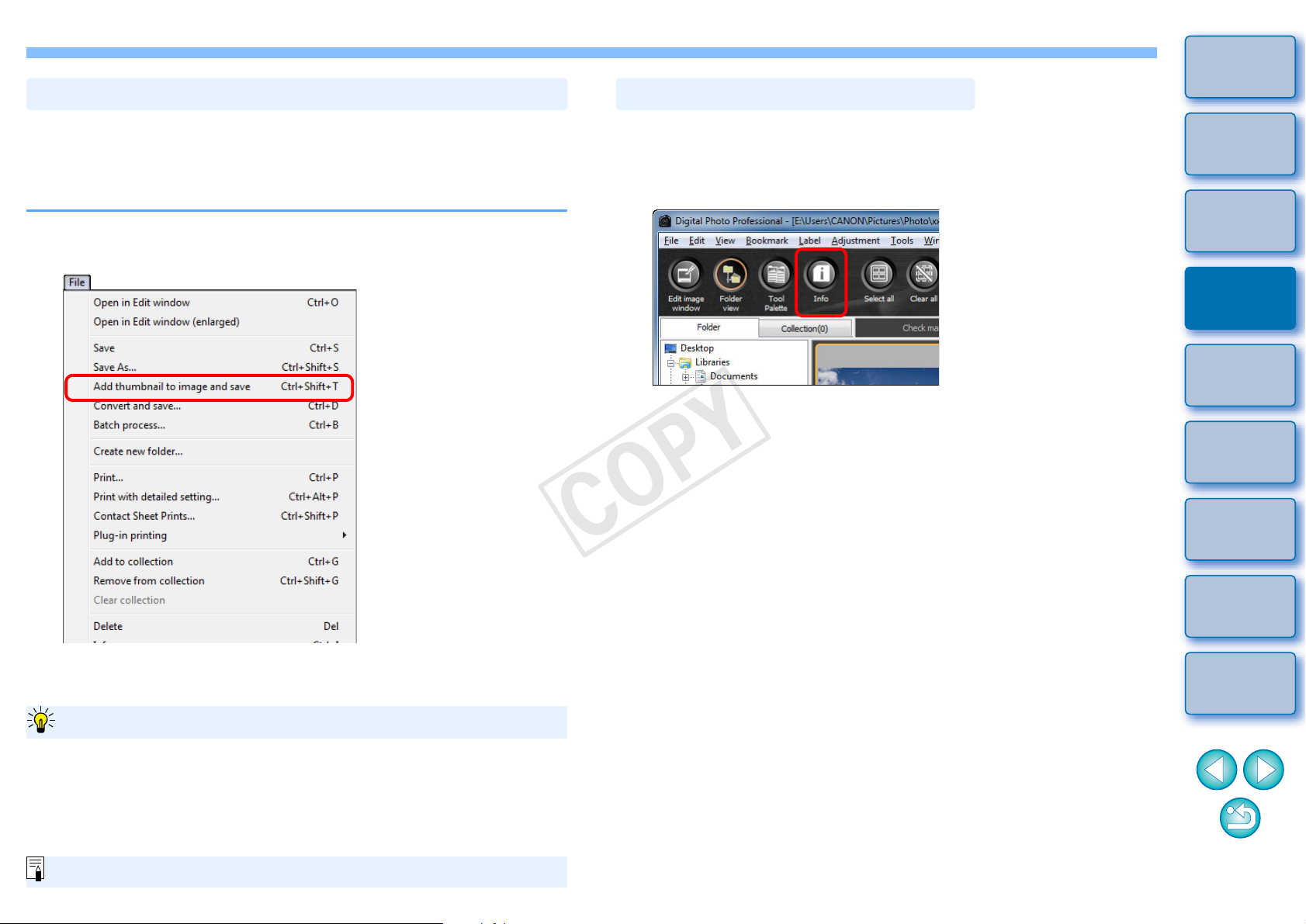
With all the images selected, select the [File] menu
[Add thumbnail to image and save].
Select the image for which you want to check the
1
image information.
Click the [Info] button.
2
The image information window appears (p.24).
Contents at
a Glance
Basic
Operation
1
Advanced
Operation
2
Advanced
Image Editing
3
and Printing
Processing
Large Numbers
4
of Images
Editing
JPEG/TIFF
5
Images
Reference
Index
23
Page 25
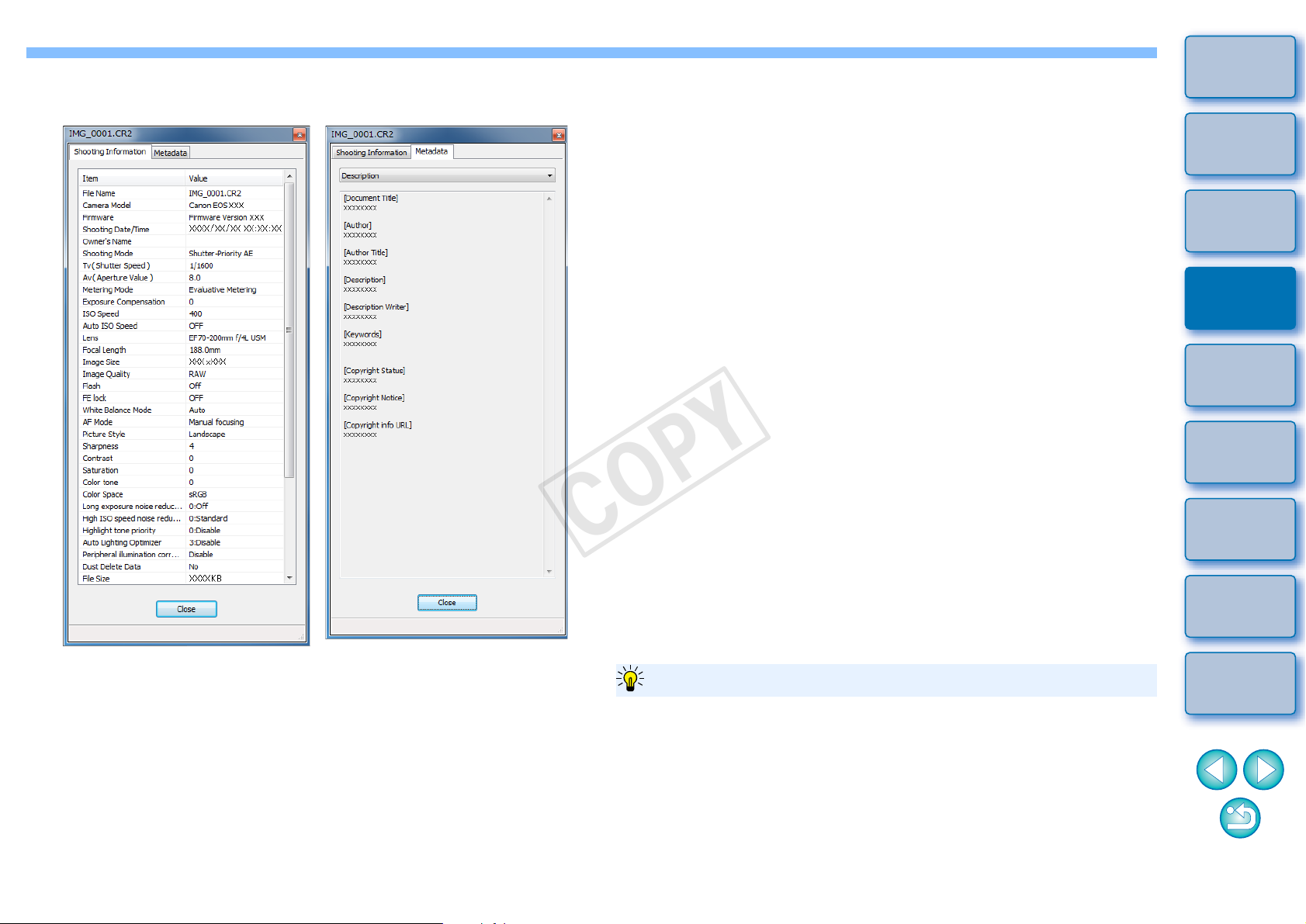
Select a tab sheet and check information.
[Shooting Information] tab sheet
[Metadata] tab sheet
Switching displays
If a different image is selected in the main window when the image
information window is displayed, the image information for that image
will be displayed.
Difference with the [Thumbnail with information]
Detailed shooting information for each image is displayed in the
image information window. However, if you want to only check the
main shooting information, you can check it for each image in [View]
menu [Thumbnail with information] (p.10).
Convenient uses in the main window
COPY
3
Shooting information is displayed in the [Shooting Information]
tab sheet, while IPTC* information appended to the image after
shooting is displayed in the [Metadata] tab sheet.
IPTC* information provides additional comments on images,
such as captions, credits and the shooting location. The
information is sorted into 5 different categories and can be
viewed by selecting [Description], [IPTC Contact], [IPTC Image],
[IPTC Content] or [IPTC Status] from the list box in the [Metadata]
tab sheet.
IPTC* information can only be appended to JPEG/TIFF images
using Photoshop (CS3 or later).
* International Press Telecommunications Council (IPTC)
The contents of the [Shooting Information] tab sheet will vary
depending on the camera model.
Introduction
Contents at
a Glance
Basic
Operation
1
Advanced
Operation
2
Advanced
Image Editing
3
and Printing
Processing
Large Numbers
4
of Images
Editing
JPEG/TIFF
5
Images
Reference
Index
24
Page 26
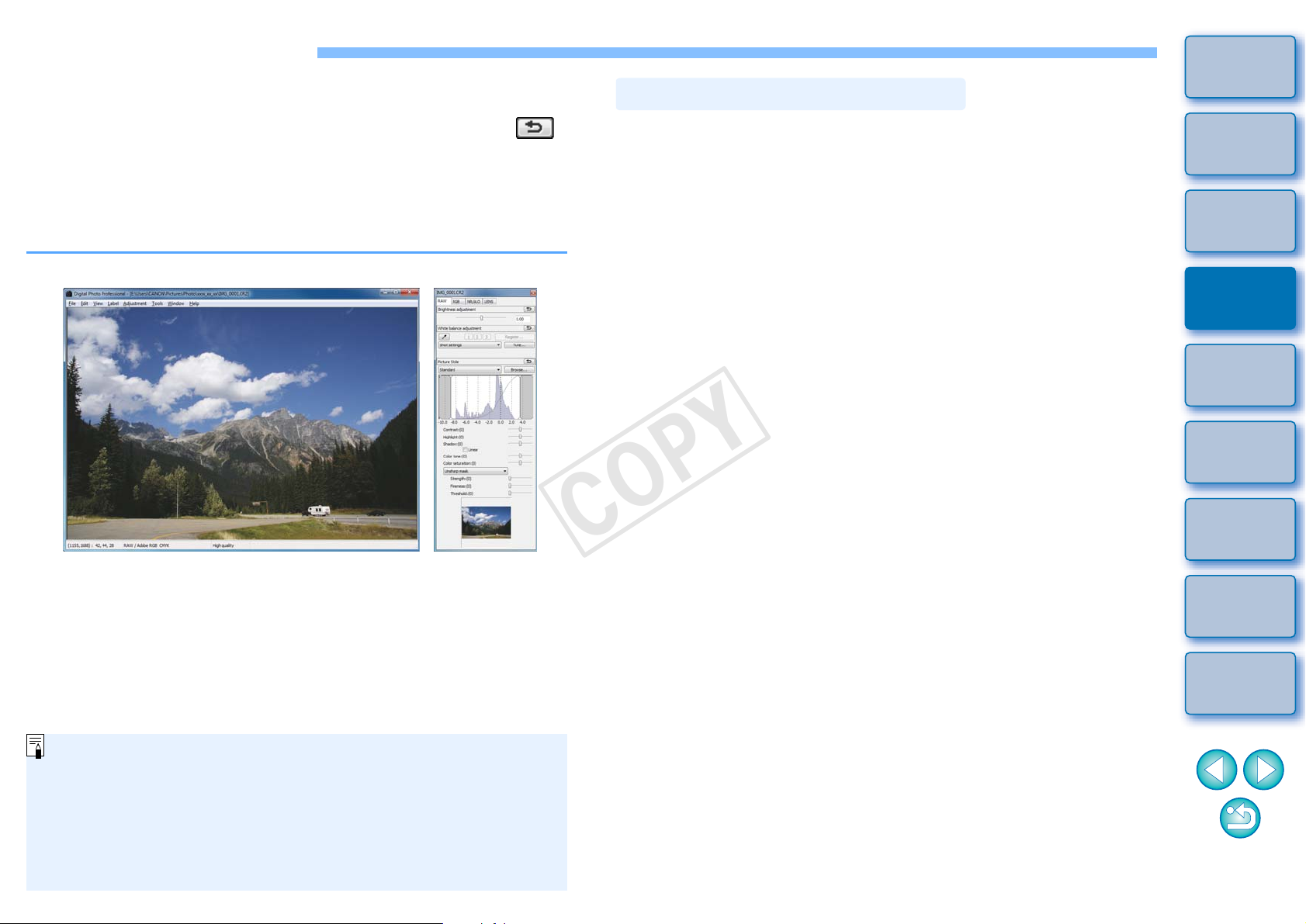
Editing an Image
Edit window Tool palette
You can rotate an image in the [Adjustment] menu.
You can adjust an image while comparing the image before and
after adjustment (p.53).
You can synchronize multiple images and edit while comparing
them (p.54).
See p.127 for a list of edit window functions, and p.128 for a list of
tool palette functions.
About the RAW Tool Palette
COPY
This section explains how to adjust an image using the tool palette in the
edit window.
You can easily restore an image to its original condition with the [ ]
button even if you have made the wrong adjustment. Try out the various
adjustments.
How to make adjustments using the [RAW] tool palette functions, and
how to adjust automatically with the [RGB] tool palette are explained in
this section.
You can adjust images with the tool palette by switching between the
[RAW], [RGB], [NR/ALO] and [LENS] tab sheets according to your
editing requirements.
Adjustments similar to those that can be performed with the functions of
your camera can be performed using the functions of the [RAW] tool
palette. When the camera settings were incorrect during shooting, or
when the shooting result is not what you visualized, you can get closer
to what you envisaged with the [RAW] tool palette which is similar to the
camera.
All functions other than [RGB] tool palette automatic adjustment, and
each function of the [NR/ALO] and [LENS] tool palette are explained in
Chapter 3.
Editing with the Tool Palette in the Main Window
By clicking the [Tool Palette] button (p.124) in the toolbar on the main
window, the same tool palette that appears in the edit window is
displayed and you can edit images.
Introduction
Contents at
a Glance
Basic
Operation
1
Advanced
Operation
2
Advanced
Image Editing
3
and Printing
Processing
Large Numbers
4
of Images
The image changes in real time according to adjustments
performed with the tool palette.
To revert to the condition before the last operation performed on
the tool palette, select [Undo] in the [Edit] menu or press <Ctrl> +
<Z> keys.
Editing
JPEG/TIFF
5
Images
Reference
Index
25
Page 27
Introduction
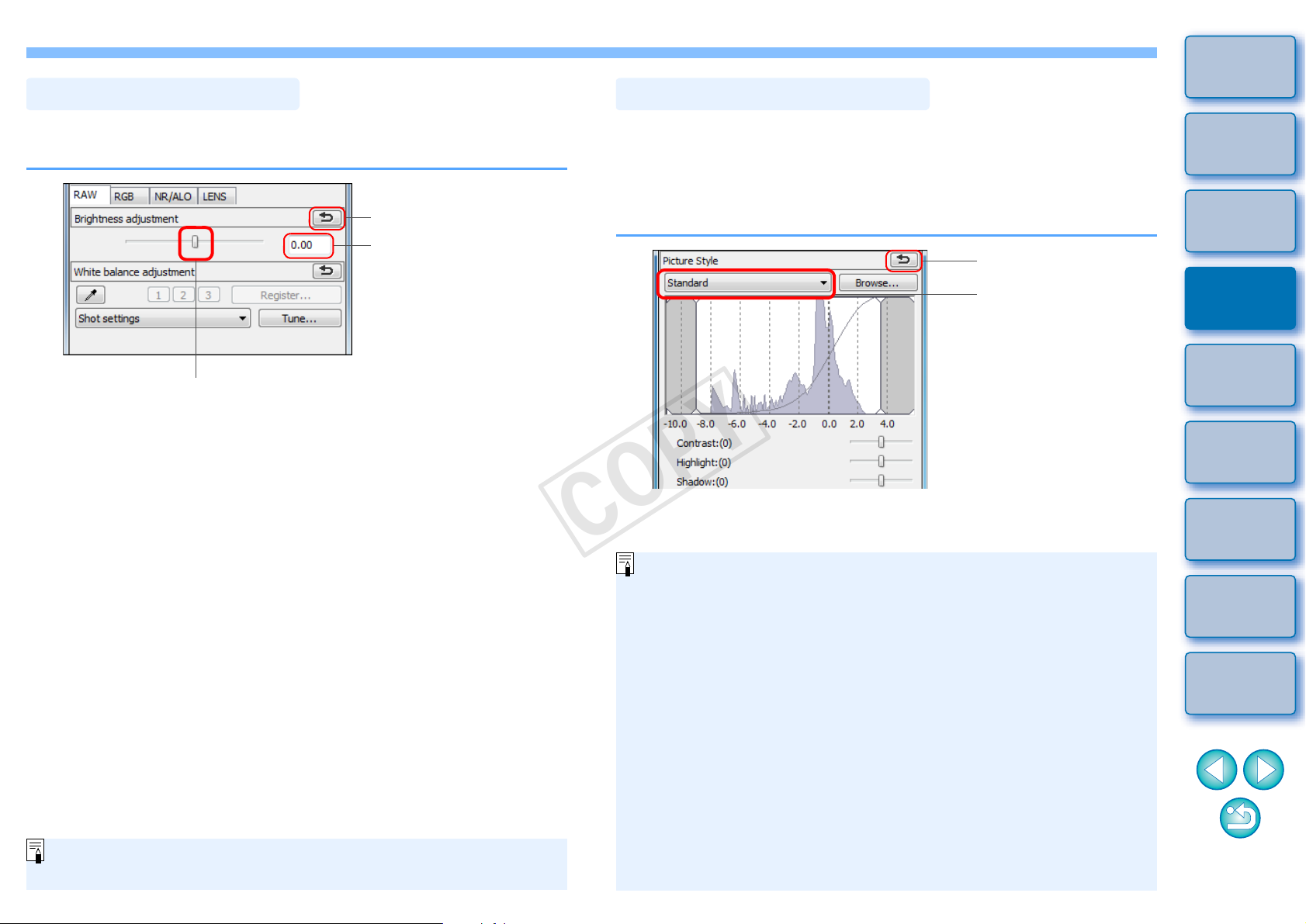
Adjusting Brightness
Reverts the image to
the original settings
Enter a numerical value
Drag the slider left or right
The adjustment range is –2.0 to +2.0 (in 0.01-stop increments when
entering a value).
Changing a Picture Style
Reverts the image to
the original settings
Select
Even if the RAW image is from a camera that does not have
Picture Style settings, you can still set a Picture Style as long as
the RAW image is compatible with DPP (p.3).
You can retain the [Color tone], [Color saturation], [Contrast],
[Unsharp mask] and [Sharpness] settings, even if you change the
Picture Style (p.92).
[Auto] is only applied to images shot with the EOS-1D X, EOS 5D
Mark III, EOS REBEL T4i/650D or EOS REBEL T3i/600D.
When changing a Picture Style with several images selected, you
can select [Auto] if images shot with the EOS-1D X, EOS 5D
Mark III, EOS REBEL T4i/650D or EOS REBEL T3i/600D are
included. However, [Auto] is actually applied only to images shot
with the EOS-1D X, EOS 5D Mark III, EOS REBEL T4i/650D or
EOS REBEL T3i/600D.
You cannot select [Auto] with multiple-exposure RAW images
created on the camera.
COPY
The brightness of an image can be adjusted. Move the slider to the right
to make the image brighter and to the left to make the image darker.
If the image you shot is different to what you visualized, you can change
the Picture Style to get closer to what you envisaged.
Even if you have saved the image (p.41) with [Monochrome] (p.30)
selected, you can still change to another Picture Style at any point by
simply selecting a Picture Style other than [Monochrome].
Contents at
a Glance
Basic
Operation
1
Advanced
Operation
2
Advanced
Image Editing
3
and Printing
Processing
Large Numbers
4
of Images
Editing
JPEG/TIFF
5
Images
Reference
Index
26
Page 28
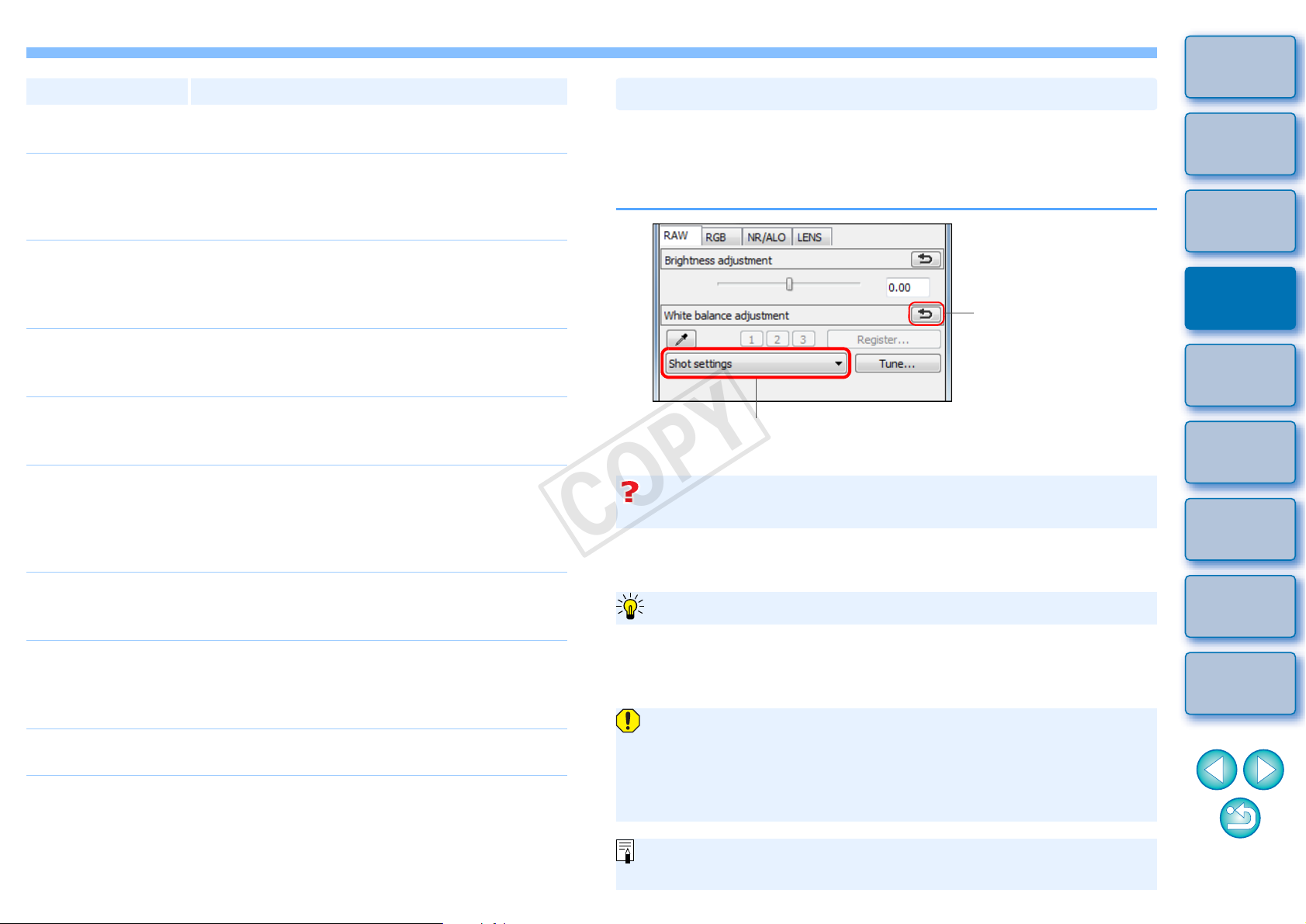
Picture Style Description
Adjusting Color Tone by Changing White Balance
Reverts the image to
the original settings
Select
If the color tone of the image does not appear natural after changing the
white balance, adjust the white balance using click white balance (p.28).
To make further fine adjustments to color tone after adjusting the white
balance, you can use [Color tone] (p.29) to get closer to your
requirements.
The color tone does not become more natural even when the
white balance is changed
Tune with color tone
You cannot register the adjustment results as personal white
balance (p.98) when you have selected [Shot settings] from the
list box.
You cannot change or adjust white balance with multiple-
exposure RAW images created on the camera.
Refer to your camera’s Instruction Manual for details on each white
balance setting.
COPY
Introduction
Standard
Auto
Portrait
Landscape
Neutral
Faithful
Monochrome
(Picture Style file
registered in the
camera)
[Picture Style file
applied in DPP]
Picture Style File
A Picture Style file is an extended function file of Picture Style. See p.59
for how to use Picture Style files.
The image looks vivid.
Ordinarily, this setting is suitable for most images.
The color tone will be adjusted to suit the scene.
The colors will look vivid, especially for blue skies,
greenery, and sunsets in nature, outdoor, and
sunset scenes.
For nice skin tones.
Effective for close-ups of women and children. By
changing the [Color tone], you can adjust the skin
tone (p.29).
For vivid blues and greens.
Effective for making images of landscapes
impressive.
For natural colors and subdued images.
Effective for base images which are to undergo
adjustment.
When the subject is photographed under a color
temperature of 5200K, the color is adjusted
colorimetrically to match the subject’s color.
Effective for base images which are to undergo
adjustment.
For black and white images.
You can also adjust with [Filter effect] or [Toning
effect] (p.30).
Displayed when selecting an image shot with the
Picture Style file registered in the camera.
In the list, the name of the Picture Style file is
displayed in ( ).
The name of the Picture Style file applied in DPP
is displayed in [ ].
If the color tone of the photographed image does not appear natural,
change the white balance to make it appear natural. You can make the
color tone natural by setting the light source at the time of shooting an
image of, for example, pale-colored flowers.
Contents at
a Glance
Basic
Operation
1
Advanced
Operation
2
Advanced
Image Editing
3
and Printing
Processing
Large Numbers
4
of Images
Editing
JPEG/TIFF
5
Images
Reference
Index
27
Page 29
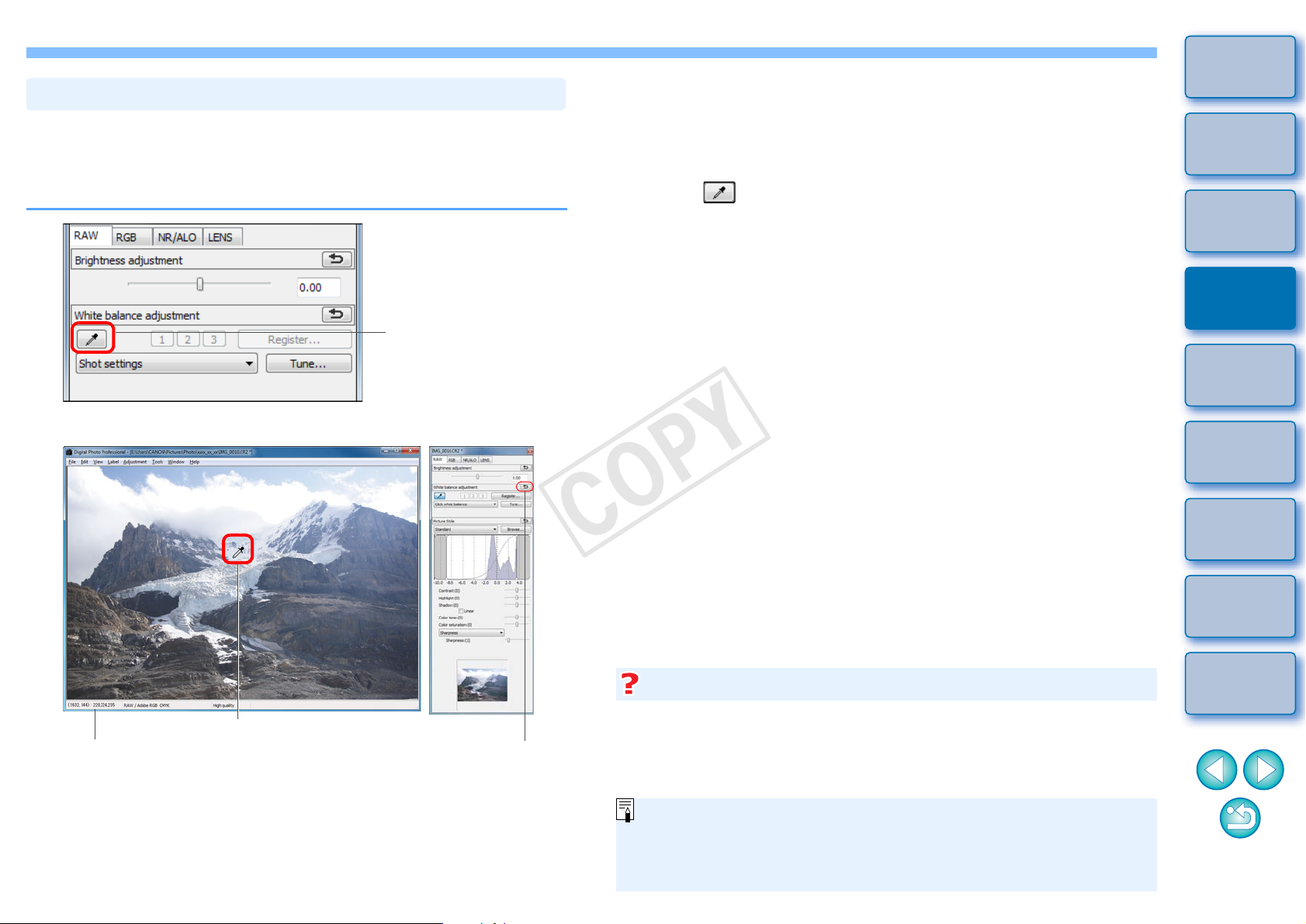
You can adjust white balance using a selected part of an image as the
Adjusting Color Tone Using Click White Balance
Click
The coordinates of the cursor position and
the RGB values (8-bit conversion)
Click
Reverts the
image to the
original settings
When there are no white areas in your image, you can adjust the white
balance by clicking on a grey point of the image in step 2. This has the
same adjustment result as selecting a white point.
When there are no white areas in your image
The image is adjusted based on the average value of 5 × 5 pixel
range from the clicked point.
You cannot change or adjust white balance with multiple-
exposure RAW images created on the camera.
COPY
standard for white to make the image appear natural. Using click white
balance is effective when using it in parts of an image where white color
tone has changed under the influence of a light source.
1
The color of the image is adjusted with the point you selected as
the standard for white.
If you click on another point in the image, the white balance is
adjusted again.
To finish click white balance, right-click with the mouse or click
the [ ] button again.
Introduction
Contents at
a Glance
Basic
Operation
1
Advanced
Operation
2
Advanced
Image Editing
3
and Printing
Click on a point that is to be the standard for white.
2
Processing
Large Numbers
4
of Images
Editing
JPEG/TIFF
5
Images
Reference
Index
28
Page 30
Introduction
Adjusting Contrast
Reverts the image to
the original settings
Drag the slider left or
right (9 steps)
Displays the value of the setting
Use [Linear] when you will be adjusting separately using image editing
software that has advanced editing functions. Note that when [Linear] is
checkmarked, the image will become dim.
[Linear] - A function for advanced adjustment
The Auto Lighting Optimizer (p.61) will not function when [Linear] is
checkmarked.
Changing Color Tone and Color Saturation
Drag the sliders left or
right
Displays the values of the settings
Reverts the image to
the original settings
The adjustment range is –4 to +4 (in 1-stop increments).
COPY
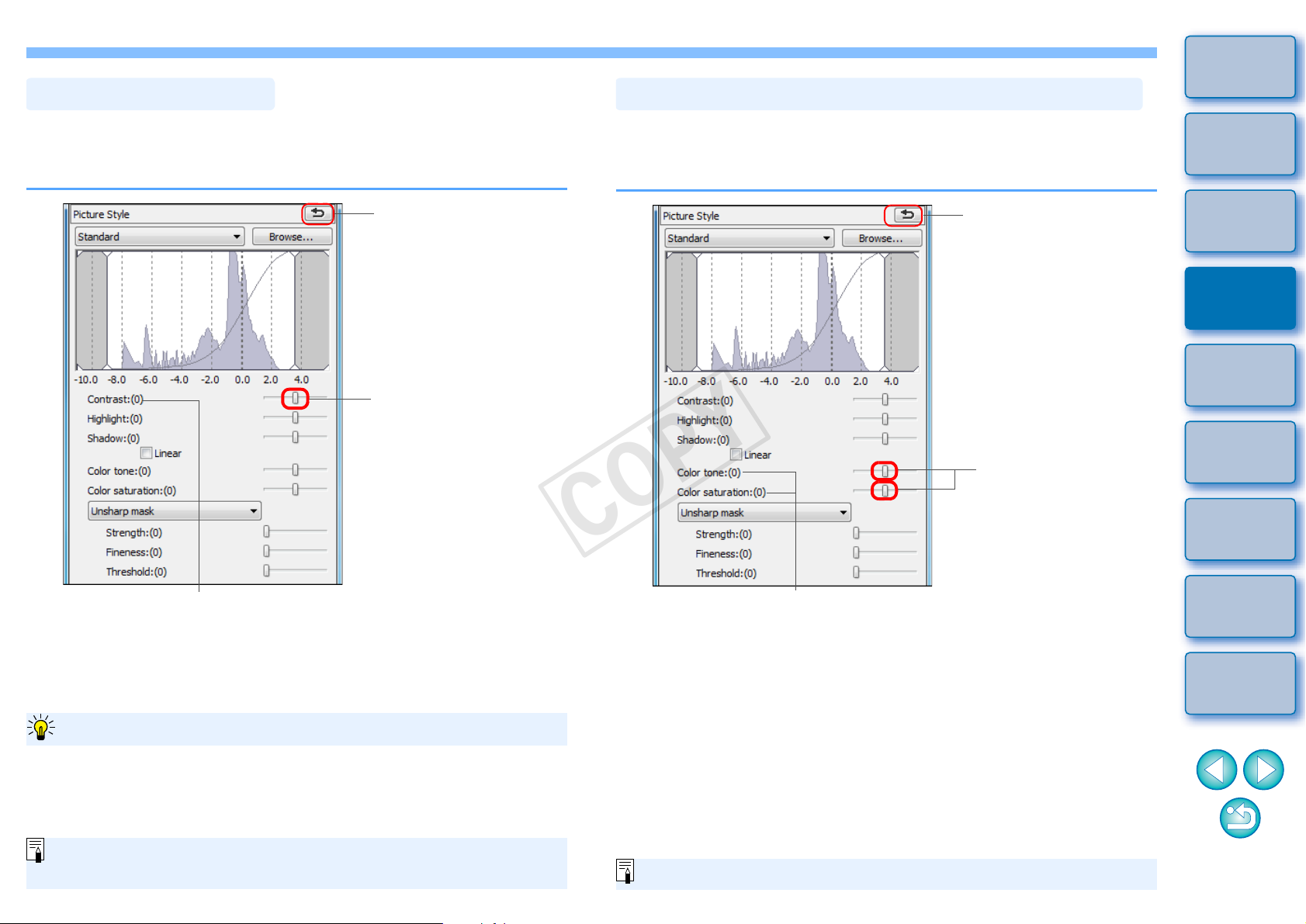
Modulation and degree of contrast can be adjusted. Move the slider to
the right to make contrast stronger and to the left to make contrast
weaker.
Skin tone and overall color saturation can be adjusted.
If Picture Style (p.26) is set to [Monochrome], [Color tone] and [Color
saturation] switch to [Filter effect] and [Toning effect] (p.30).
Contents at
a Glance
Basic
Operation
1
Advanced
Operation
2
Advanced
Image Editing
3
and Printing
Processing
Large Numbers
4
of Images
Editing
JPEG/TIFF
5
Images
Color tone: Mainly used for adjusting skin tones. Move the
slider to the right to make skin tones more
yellow, and to the left to make skin tones
redder.
Color saturation: The overall color depth of the image is
adjusted with color saturation. Move the slider
to the right to make the color deeper, and to
the left to make the color weaker.
Reference
Index
29
Page 31

When the Picture Style (p.26) is set to [Monochrome], you can create
Adjusting Monochrome
Reverts the image to
the original settings
Drag the sliders left or
right
Displays the values of the settings
To emphasize the filter effect, set the [Contrast] slider closer to the right.
Increase the [Contrast] to emphasize the filter effect
COPY
monochrome photographs with effects similar to filtering and with the
look of a single-color photograph.
Select [Monochrome] in the [Picture Style] list box.
1
Filter effect: Creates an image where the white of clouds and the
green of trees are emphasized in the same
monochrome photograph.
Filter Example of effect
None Ordinary monochrome image without filter effect.
Yello w
Blue sky is reproduced more naturally and white
clouds emerge clearly.
Introduction
Contents at
a Glance
Basic
Operation
1
2
Orange
Red
Green
Toning effect: You can create a monochrome photograph to which a
Blue sky becomes somewhat darker. The
brightness of the setting sun increases further.
Blue sky becomes quite dark. Autumn leaves
become clear and bright.
Human skin tones and lips become softer. The
green leaves of trees become clear and bright.
single color has been added.
You can choose from [None], [Sepia], [Blue], [Purple]
and [Green].
Advanced
Operation
2
Advanced
Image Editing
3
and Printing
Processing
Large Numbers
4
of Images
Editing
JPEG/TIFF
5
Images
Reference
Index
30
Page 32

You can make the overall atmosphere of an image harder or softer.
Adjusting Image Sharpness
Reverts the image to
the original settings
Drag the slider left or right
Displays the value of the setting
Select [Sharpness]
The adjustment range is 0 to 10 (in 1-stop increments).
COPY
Adjustment can be made by selecting from two modes, [Sharpness] and
[Unsharp mask].
Introduction
Select [Sharpness] from the list box and make the
setting.
Contents at
a Glance
[Sharpness]: Controls the sharpness of an image by adjusting the
level of emphasis for the outline of the image. The
further to the right the [Sharpness] slider is moved (the
larger the setting), the more the edges are
emphasized for a sharper image.
[Unsharp mask]: Adjusts the image’s sharpness more finely.
[Strength]: Shows the level of emphasis for the outline of the
image. The further to the right the slider is moved (the
larger the setting), the more the image’s edges are
emphasized for a sharper image.
[Fineness]: Shows the fineness of the emphasized outline. The
further to the left the slider is moved (the smaller the
setting), the more fine detail can be emphasized.
[Threshold]: Sets “how much contrast difference there should be
compared to surroundings before emphasizing
edges”.
Basic
Operation
1
Advanced
Operation
2
Advanced
Image Editing
3
and Printing
Processing
Large Numbers
4
of Images
Editing
JPEG/TIFF
5
Images
Reference
Index
31
Page 33

Detailed Setting of Image Sharpness
Drag the slider left or right
Displays the values of the settings
Select [Unsharp mask]
Adjust image sharpness with the window view set to [200% view],
[100% view] or [50% view]. If the view is set to [Fit to window] (full view),
the effects of adjustment may seem unnatural.
The effects of sharpness adjustment appear unnatural
COPY
Select [Unsharp mask] from the list box and make
the setting.
Introduction
Contents at
a Glance
Basic
Operation
1
Advanced
Operation
2
Advanced
Image Editing
3
and Printing
Processing
Large Numbers
4
of Images
Editing
JPEG/TIFF
5
Images
Reference
Index
32
Page 34

In order to make the image a desirable standard image, automatically
Automatically Adjusting Brightness and Color (Tone Curve Assist)
Reverts the tone curve
to the original settings
High
Standard
COPY
adjust the image tone curve (p.143). You can select the degree of
automatic adjustment from “Standard” and “High”.
Click on the [RGB] tab sheet and click the desired
automatic adjustment button.
Standard: Standard automatic adjustment. Suitable for most
images.
High: Use when the effect achieved in standard automatic
adjustment is not strong enough.
Images not suitable for automatic adjustment (tone curve
assist)
The result of automatic adjustment (tone curve assist) may not be as
expected with the following images:
• Images which have been shot with the proper exposure
• Images where the brightness is unbalanced
• Images which are too dark
• Images which have extreme backlighting
If you click the [ ] button, the tone curve as well as the [Hue] and
[Saturation] revert to the default settings. Take care when adjusting
the [Hue] and [Saturation] individually (p.107).
Introduction
Contents at
a Glance
Basic
Operation
1
Advanced
Operation
2
Advanced
Image Editing
3
and Printing
Processing
Large Numbers
4
of Images
Editing
JPEG/TIFF
5
Images
Reference
Index
The tone curve changes as adjusted.
33
Page 35

Editing Efficiently
Editing in the Edit Image Window
Click
Change the size
Edit image window
Select the image to be edited
The selected image is displayed as an enlargement
in the middle of the window
By selecting the [View] menu [AF Point] in the edit window or edit
image window, you can display the AF points selected in the camera
at the time of shooting. However, AF points are not displayed for
images whose image size has been changed and then been
converted and saved (
p.42, p.134
), images for which you selected
an effect other than [Shot settings] as correction of fisheye lens
distortion aberration, or images which have had settings specified
during RAW processing on the camera for distortion correction and
chromatic aberration correction.
COPY
The thumbnail display and the edit window are combined and images can
be edited efficiently while quickly switching between images to be edited.
Images to be edited are selected beforehand in the main window.
Introduction
Edit the image.
3
Contents at
a Glance
In the main window, select the images you want to edit.
1
Switch to the edit image window.
2
The main window switches to the edit image window.
It may take time for the image to redraw itself.
The same tool palette as in the edit window is displayed and you
can edit the image.
To revert to the condition before the last operation performed on
the tool palette, select [Undo] in the [Edit] menu or press <Ctrl> +
<Z> keys.
Basic
Operation
1
Advanced
Operation
2
Advanced
Image Editing
3
and Printing
Processing
Large Numbers
4
of Images
Editing
JPEG/TIFF
5
Images
Reference
Index
34
Page 36

Double-click the area you want to enlarge.
Doubleclick
COPY
4
To display an image in an enlargement ratio other than 100%
Click the [50% view] or [200% view] on the toolbar.
You can change the way the tool palette is displayed (p.92).
You can change the enlargement ratio when you double-click
(p.91).
With the edit image window, you can only select images from one
folder. To gather images from several folders for editing, see
“Gathering and Editing Images in the Collection Window” (p.36).
For a list of edit image window functions, see p.133.
Introduction
Contents at
a Glance
Basic
Operation
1
Advanced
Operation
2
Advanced
Image Editing
3
and Printing
The area you double-clicked is enlarged to 100% (actual pixel
size).
To change the display position, drag on the image or drag the
enlargement display position (p.128) of the tool palette.
Double-click again to revert to the full view ([Fit to window]).
To return to the main window, click the [Main window] button on
the toolbar.
Processing
Large Numbers
4
of Images
Editing
JPEG/TIFF
5
Images
Reference
Index
35
Page 37

Introduction
Changing the Thumbnail Display Position to a Horizontal Position
Gathering and Editing Images in the Collection Window
COPY
Select the [View] menu [Change thumbnail
position].
If you select [Change thumbnail position] again, the thumbnail
display reverts to the vertical position.
You can gather any randomly selected images together in the
[Collection] window for viewing, comparison and editing. You can gather
images from several folders as well as from only one folder, allowing you
to work with them efficiently.
Select images from the [Folder] window in the main
1
window, and select the [File] menu
[Add to collection].
Contents at
a Glance
Basic
Operation
1
Advanced
Operation
2
Advanced
Image Editing
3
and Printing
Processing
Large Numbers
4
of Images
Editing
JPEG/TIFF
5
Images
The selected images are added to the [Collection] window and the
number of selected images is shown on the [Collection] tab sheet.
When you add RAW and JPEG images displayed as a single
image (p.22), the number of images shown on the [Collection]
tab sheet increases by 2.
You can select several images and add them to the [Collection]
window.
You can also add images to the [Collection] window by selecting
images, right-clicking with your mouse, and selecting [Add to
collection] from the menu that appears.
You can add up to 1,000 images to the [Collection] window.
Reference
Index
36
Page 38

Select the [Collection] tab sheet.
COPY
2
The selected images are displayed in the [Collection] window.
Check displayed images in the [Collection] window.
3
To remove images from the [Collection] window
Removing randomly selected images
Select the images to be removed in the [Collection] window and then
select [Remove from collection] in the [File] menu. (You can also remove
images from the [Collection] window by selecting the images, rightclicking with the mouse, and selecting [Remove from collection] from the
menu that appears.)
Note that even if you remove an image from the [Collection] window, the
original image remains unaffected.
Removing all images
Select [Clear collection] in the [File] menu. (You can also remove all
images from the [Collection] window by selecting one image, rightclicking with the mouse, and selecting [Clear collection] from the menu
that appears.)
Note that even if you remove all images from the [Collection] window,
the original images remain unaffected.
Modifications to the image are applied to the original image
Modifications made to images added to the [Collection] window are
all applied to the original image.
Introduction
Contents at
a Glance
Basic
Operation
1
Advanced
Operation
2
Advanced
Image Editing
3
and Printing
Processing
Large Numbers
4
of Images
Editing
JPEG/TIFF
5
Images
Edit the images.
4
You can now edit the images displayed in the [Collection]
window.
Images displayed in the [Collection] window are retained in the
[Collection] window even after exiting DPP.
You can arrange images displayed in the [Collection] window the
same way as in the [Folder] window (p.20, p.21). You can
maintain the order of rearranged images even after exiting DPP
by checkmarking [Retain sort order] on the [View settings] tab
sheet in the [Preferences] (p.91).
You cannot use the following functions in the [Collection] window.
• Starting of EOS Utility (p.7), or synchronizing of folders with
EOS Utility
• Batch change the file name of images (p.101)
Reference
Index
37
Page 39

Trimming and Adjusting the Angle of an Image
Trimming/angle adjustment window
Use the mouse (click /) to adjust the angle or
directly enter the adjustment angle* (0.01-degree
increments; adjustable range: -45 to +45 degrees)
Click (rotate
image left
or right in
90-degree
increments)
Drag* (0.01-degree increments;
adjustment range: -45 to +45 degrees)
Largest
possible
trimming
range
* You cannot adjust the angle of images that exceed 9999 x 6666
pixels in size.
COPY
You can trim only the part of an image you need, or change the
composition of an image where an image shot horizontally becomes
vertical. You can also adjust the angle of an image before trimming. If
you select [Circle] for [Aspect ratio], the area outside the specified range
is only masked in black and the image will not be cropped.
Adjust the angle of the image as needed.
3
Introduction
Contents at
a Glance
Select the image to be trimmed.
1
Open the trimming/angle adjustment window.
2
Click the [Trimming Angle] button.
The trimming/angle adjustment window appears.
Editing can be done once the image is displayed clearly in the
trimming/angle adjustment window.
If you click [Center on Screen], you can display the trimming
range in the center of the window.
When correcting lens aberrations, it is recommended to perform
lens aberration correction before adjusting the angle of the
image.
If you click the [OK] button after adjusting only the angle of the
image, the image will be trimmed at the largest possible trimming
range.
When aspect ratio information is attached to an image shot with the
EOS-1D X, EOS-1D Mark IV, EOS-1Ds Mark III, EOS-1D Mark III,
EOS 5D Mark III, EOS 7D, EOS 60D, EOS REBEL T4i/650D or
EOS REBEL T3i/600D, the trimming range based on the aspect
ratio information is displayed.
Basic
Operation
1
Advanced
Operation
2
Advanced
Image Editing
3
and Printing
Processing
Large Numbers
4
of Images
Editing
JPEG/TIFF
5
Images
Reference
Index
38
Page 40

Select a ratio and drag the trimming range.
Cancel
Select a
trimming
ratio
Drag the
trimming
range
[Free]: You can trim an image to any size, regardless of the
selectable ratio.
[Custom]: You can trim an image at the specified ratio.
[Circle]: The area outside the specified range is masked in
black. The image is not trimmed.
COPY
4
The trimming range can be moved by dragging.
You can enlarge or reduce the size of the trimming range by
dragging the four corners of the trimming range. (Not available
when [Circle] is selected.)
List of aspect ratios (width : height)
Click the [OK] button to return to the main window.
5
The trimming range frame is displayed in the trimmed image
(p.126).
When the trimmed image is displayed in an edit window or the
edit image window, it is displayed in its trimmed form.
Introduction
Contents at
a Glance
Basic
Operation
1
Advanced
Operation
2
Advanced
Image Editing
3
and Printing
Processing
Large Numbers
4
of Images
Editing
JPEG/TIFF
5
Images
Reference
Index
39
Page 41

About trimmed images
For a list of the trimming/angle adjustment window functions, see
p.135.
For images shot with ISO speed range expansion set, noticeable
noise may make it difficult to view image details in the trimming/
angle adjustment window, so using this function is not
recommended.
COPY
The trimmed range can be reverted to its original condition at
any time
A trimmed image is displayed or printed as a trimmed image.
However, since the image is not actually trimmed, you can always
revert to the original image by clicking the [Reset] button in the
trimming/angle adjustment window or performing the “Re-Editing an
Image” procedure (p.43).
Display of the trimmed image in each window
• Main window: The frame showing the trimming range is
displayed on the image (p.126).
• Edit window: The image is displayed in its trimmed condition.
• Edit image window: The thumbnail image is the same as the main
window display, and the enlarged image is the
same as the edit window display.
Printing a trimmed image
You can print as a trimmed image by printing it in DPP.
The image becomes a trimmed image when converted and saved
The trimmed RAW image actually becomes a trimmed image when
converted to a JPEG or TIFF image and saved (p.42).
Images that have aspect ratio set will be displayed as trimmed
images
When aspect ratio information is attached to a RAW image shot with
EOS-1D X, EOS-1D Mark IV, EOS-1Ds Mark III, EOS-1D Mark III,
EOS 5D Mark III, EOS 7D, EOS 60D, EOS REBEL T4i/650D or EOS
REBEL T3i/600D, the set trimming range based on the aspect ratio
information is displayed. Since the image is not actually trimmed, you
can change the trimming range or revert to the condition before
trimming.
However, when a JPEG image is shot in a [4:3], [16:9] or [1:1] aspect
ratio set with the EOS 5D Mark III, EOS 60D, EOS REBEL T4i/650D
or EOS REBEL T3i/600D, its trimming range cannot be changed nor
reverted to the condition before trimming, since the image is actually
trimmed and saved in the set trimming ratio.*
When reverting to the condition before trimming is performed based
on the aspect ratio information at the time of shooting, click the
[Reset] button. Also, if you want to cancel all the trimming range, click
the [Clear] button (p.135).
* When shooting with EOS 5D Mark III and [Add cropping information]
is set in Custom Functions, aspect ratio information is only set and
the image is not actually trimmed, even for JPEG images.
Convenient functions of the trimming/angle adjustment
window
Switch between screens using the keyboard
You can also switch between full screen display/normal screen
display by pressing the <Alt> + <Enter> keys or the <F11> key.
Operate using the menu
Each operation can also be performed with the menu which appears
when you right-click with the mouse on the image.
Apply the trimmed range to another image
You can apply the trimmed range to another image by clicking the
[Copy] button to copy the trimmed range, displaying another image
and then clicking the [Paste] button.
To batch apply a copied trimming range to multiple images, select the
trimmed image and the multiple images to which you want to apply
the trimmed range in the main window, and display the trimming/angle
adjustment window. With the trimmed image displayed, click the
[Copy] button and then click the [Apply All] button. This will apply the
trimming range to all the images selected when the trimming/angle
adjustment window is displayed.
To select multiple images in the main window, click the images while
holding down the <Ctrl> key. To select multiple consecutive images,
click on the first image, and then click on the last image while holding
down the <Shift> key.
Introduction
Contents at
a Glance
Basic
Operation
1
Advanced
Operation
2
Advanced
Image Editing
3
and Printing
Processing
Large Numbers
4
of Images
Editing
JPEG/TIFF
5
Images
Reference
Index
40
Page 42

Applying Adjustment Contents to Other Images
The recipe (p.96) can be saved as a separate file from the image
and loaded and applied to another image (p.97).
Saving Editing Contents to a RAW Image
COPY
You can copy the image adjustment contents (recipe) adjusted with the
tool palette and apply it to other images.
You can efficiently adjust multiple images by adjusting one image and
applying the results of this to multiple images shot in similar shooting
environment.
Select the adjusted image and then select the [Edit]
1
menu [Copy recipe to clipboard].
The recipe is copied.
Select the image to which the recipe is to be applied
2
and then select the [Edit] menu [Paste recipe].
The recipe is applied to the image.
Saving Editing Results
All the contents (recipe) adjusted with the tool palette as well as the
trimmed (p.38) range information can be saved to a RAW image or to a
separate RAW image.
The adjustments made with the tool palette (p.56 to p.68) and the dust
erase processing explained in Chapter 3 (p.73 to p.77) can also be
saved in a RAW image.
Select the [File] menu desired item.
Introduction
Contents at
a Glance
Basic
Operation
1
Advanced
Operation
2
Advanced
Image Editing
3
and Printing
Processing
Large Numbers
4
of Images
Your adjustments are saved to the image.
Editing
JPEG/TIFF
5
Images
Reference
Index
41
Page 43

Introduction
Saving as a JPEG or TIFF Image
Click and save
Select the save
destination
Enter a file name and
select an image type
DPP’s RAW image development processing technology is continually
being improved upon so that you can perform the latest image
processing more appropriately.
Meaning that, between two differing versions of DPP, processing results may
differ very slightly even if with the same RAW image data, or the results of
significant editing of RAW image data with an attached recipe may be different.
When you want to save the developing or editing results of the version
you are currently using as it is, it is recommended that you convert and
save images as JPEG image or TIFF images.
To save the developing/editing results for the version you are
currently using
By saving as explained on this page, a trimmed image (p.38) or
dust-erased image explained in Chapter 3 (p.73 to p.77) actually
becomes a trimmed image or dust-erased image.
You can reduce the noise characteristic of JPEG images which
occurs when you convert and save an image as a JPEG (p.89, p.90).
You can batch convert and save multiple images (p.99).
For a list of [Convert and save] window functions, see p.134.
COPY
To view, edit and print a RAW image with software other than DPP,
convert to a more versatile JPEG or TIFF image and save.
The image is saved as a separate image, so the RAW image remains
unaffected.
Select the image to be converted.
1
Select the [File] menu [Convert and save].
2
The RAW image is converted to a JPEG or TIFF image which is
then saved as a new image in the specified save destination.
Contents at
a Glance
Basic
Operation
1
Advanced
Operation
2
Advanced
Image Editing
3
and Printing
Processing
Large Numbers
4
of Images
Editing
JPEG/TIFF
5
Images
The [Convert and save] window appears.
Specify the necessary settings, and then click the
3
[Save] button.
By default, the image is converted and saved to a JPEG image
with the highest image quality, without changing the image size.
Change the settings according to your requirements.
Reference
Index
42
Page 44

Re-Editing an Image
Printing Photographs with Canon Inkjet
Printers Compatible with Easy-PhotoPrint EX
COPY
Only the image processing conditions are changed in images adjusted
with the tool palette (p.25 to p.33), so the “original image data itself”
remains unaffected.
Also, the trimming range information of a trimmed image (p.38) is simply
saved to the image.
For this reason, you can undo any adjustments saved (p.41) to the
image, trimming information, and revert to the condition when last
saved, or when the image was shot.
Select the image that is to be re-edited.
1
Select the [Adjustment] menu desired item.
2
Printing an Image
This section explains how to print high-resolution photographs easily
with Canon inkjet printers compatible with the Canon printing software,
Easy-PhotoPrint EX or Easy-PhotoPrint. It also explains how to print
photographs using other printers.
Proceed to the page for the printer you are using.
Printing Photographs with Canon Inkjet Printers Compatible with
Easy-PhotoPrint EX (Same page)
Printing Photographs with Canon Inkjet Printers Compatible with
Easy-PhotoPrint (p.46)
Printing Photographs with a Printer other than Canon Inkjet Printers
(p.49)
Introduction
Contents at
a Glance
Basic
Operation
1
Advanced
Operation
2
Advanced
Image Editing
3
and Printing
The image reverts to the conditions of the selected item.
You can perform the following types of photograph printing with Canon
inkjet printers compatible with Easy-PhotoPrint EX (hereinafter, “EPP
EX”) :
Simple printing of RAW images
Printing with faithful colors
To perform this printing, it is necessary to first install EPP EX version 1.1
or later on your computer.
Processing
Large Numbers
4
of Images
Editing
JPEG/TIFF
5
Images
Reference
Index
43
Page 45

Select the image to be printed.
Select
Quality
Priority
Click and checkmark [Print with the best quality
when you select [Quality Priority]]
COPY
1
In the EPP EX window, select the [File] menu
3
[Preferences].
Introduction
Start up EPP EX.
2
Select the [File] menu [Plug-in printing] [Print with Easy-
PhotoPrint EX].
The [Preferences] window appears.
In [Print Quality], select [Quality Priority], click the
4
[Option] button, and then in the dialog box that
appears, checkmark [Print with the best quality when
you select [Quality Priority]].
Contents at
a Glance
Basic
Operation
1
Advanced
Operation
2
Advanced
Image Editing
3
and Printing
Processing
Large Numbers
4
of Images
Editing
JPEG/TIFF
5
Images
EPP EX starts up.
Reference
Index
44
Page 46

5
Click to
increase the
number of
sheets to be
printed
EPP EX
Click
Select the
paper size
and type
Click
Click to print
Select the
layout
COPY
6
Select the [Advanced] tab, checkmark [Enable ICC
profile], and then click the [OK] button.
The [Preferences] window closes.
Specify the number of sheets to be printed, and then
click [Select Paper].
Select the paper type, and then click the [Layout/
7
Print] button.
Specify the layout, and then click the [Print] button.
8
Introduction
Contents at
a Glance
Basic
Operation
1
Advanced
Operation
2
Advanced
Image Editing
3
and Printing
Processing
Large Numbers
4
of Images
Editing
JPEG/TIFF
5
Images
Reference
Index
Printing begins.
45
Page 47

Additional information
Printing Photographs with Canon Inkjet
Printers Compatible with Easy-PhotoPrint
COPY
Introduction
Print up to 1000 images at a time
You can print up to 1000 images selected in DPP at a time. When
printing more than 1000 images, divide the printing into several jobs.
The printed image’s color is not what you expected
In the EPP EX window, select [Preferences] in the [File] menu and
then click the [Advanced] tab in the [Preferences] window to display
the [Advanced] tab sheet.
In the [Advanced] tab sheet, select [Enable ICC profile] in [Color
correction for printing] and try printing using the [Perceptual] setting
(p.144).
Advantages of printing with EPP EX
Printing with faithful colors
When the color space (p.144) is set to sRGB or Adobe RGB (p.77,
p.93), this color space is automatically transmitted from DPP to EPP
EX, allowing you to print with faithful colors.
When the color space is set to Apple RGB or ColorMatch RGB, the
image is printed with an sRGB color space, and when set to Wide
Gamut RGB, with an Adobe RGB color space.
Printing with a wide color reproduction
When the color space setting (p.77, p.93) is set to Adobe RGB and
the image is printed with a Canon inkjet printer, the color reproduction
range is wider, and green and blue in particular are reproduced
vividly.
You can perform the following types of photograph printing with Canon
inkjet printers compatible with Easy-PhotoPrint (hereinafter, “EPP”):
Simple printing of RAW images
High quality printing using the color reproduction range of Adobe RGB
and a Canon inkjet printer
To perform this printing, it is necessary to first install EPP version 3.5 or
later on your computer. When using an Easy-PhotoPrint EX-compatible
inkjet printer, it is recommended that you print using Easy-PhotoPrint EX
(p.43).
Select the image to be printed.
1
Start up EPP.
2
Select the [File] menu [Plug-in printing] [Print with Easy-
PhotoPrint].
Contents at
a Glance
Basic
Operation
1
Advanced
Operation
2
Advanced
Image Editing
3
and Printing
Processing
Large Numbers
4
of Images
Editing
JPEG/TIFF
5
Images
Reference
DPP is also compatible for printing with Easy-PhotoPrint Pro (p.87).
Index
EPP starts up.
46
Page 48

In the EPP window, select the [File] menu
Select
Quality
Priority
If checked,
click to
remove the
check mark
Click to
close the
window
Click
Click to
increase the
number of
sheets to be
printed
COPY
3
[Preferences].
Select the [Advanced] tab sheet and check that the
5
EPP image compensation function is disabled.
If not disabled, the operation of the EPP image compensation
function may prevent images being printed with faithful color
reproduction.
Introduction
Contents at
a Glance
The [Preferences] window appears.
In [Print Quality], select [Quality Priority].
4
Specify the number of sheets to be printed, and then
6
click [Next].
Basic
Operation
1
Advanced
Operation
2
Advanced
Image Editing
3
and Printing
Processing
Large Numbers
4
of Images
Editing
JPEG/TIFF
5
Images
Reference
Index
47
Page 49

Check that the image compensation function is
If checked, click to remove the check marks
Select the
paper type
Click
Click to print
Select the layout
COPY
7
disabled, select the paper type and then click [Next].
Additional information
Print up to 1000 images at a time
You can print up to 1000 images selected in DPP at a time. When
printing more than 1000 images, divide the printing into several jobs.
The printed image’s color is not what you expected
Change the [Rendering intents when using Easy-PhotoPrint] (p.93) to
[Perceptual] (p.144) and print.
Introduction
Contents at
a Glance
Basic
Operation
1
Specify the layout, and then click [Print].
8
Printing with a wide color reproduction
When the color space (p.77, p.93) is set to Adobe RGB and the image is
printed with Canon inkjet printer, the color reproduction area widens,
and green and blue in particular are reproduced vividly.
When the color space is set to Apple RGB or ColorMatch RGB, the
image is printed with an sRGB color space, and when set to Wide
Gamut RGB, with an Adobe RGB color space.
DPP is also compatible for printing with Easy-PhotoPrint Pro (p.87).
Advanced
Operation
2
Advanced
Image Editing
3
and Printing
Processing
Large Numbers
4
of Images
Editing
JPEG/TIFF
5
Images
Reference
Index
Printing begins.
48
Page 50

You can print one image on one sheet of paper.
Printing Photographs with a Printer other than Canon Inkjet Printers
Deleting an Unwanted Image
COPY
Select the image to be printed.
1
Select the [File] menu [Print].
2
Organizing Images
This section explains how to delete unwanted images, create folders for
saving images, move or copy images, etc., and organize your images.
Be aware that you cannot recover deleted images.
Select an unwanted image in the main window.
1
Introduction
Contents at
a Glance
Basic
Operation
1
The [Print] dialog box appears.
Set to photograph printing and print.
3
Specify the optimum settings for photograph printing in the
printer’s print settings dialog box and click the [OK] button.
Printing begins.
Select the [File] menu [Delete].
2
The [Confirm File Delete] dialog box appears.
Click the [Yes] button.
3
The image is moved to the [Recycle Bin] and is deleted from DPP.
The images are deleted completely from your computer when the
[Empty Recycle Bin] operation is performed on the [Recycle Bin]
on the desktop.
Advanced
Operation
2
Advanced
Image Editing
3
and Printing
Processing
Large Numbers
4
of Images
Editing
JPEG/TIFF
5
Images
Reference
Index
49
Page 51

Introduction
Creating a Folder for Saving Images
Moving Images
COPY
You can create a folder for sorting images.
In the folder area, select the location where the new
1
folder is to be created.
Select the [File] menu [Create new folder].
2
You can move or copy images to a separate folder and sort by shooting
date or themes.
Drag the image to be moved or copied.
To move: Drag the image and release when the image is in the
destination folder.
To copy: Drag the image while holding down the <Ctrl> key and
release when the image is in the destination folder.
Contents at
a Glance
Basic
Operation
1
Advanced
Operation
2
Advanced
Image Editing
3
and Printing
Processing
Large Numbers
4
of Images
Editing
JPEG/TIFF
5
Images
The [Create new folder] dialog box appears.
Enter a folder name and click the [OK] button.
3
The new folder is created in the folder selected in step 1.
The images are moved or copied to the destination folder.
Reference
Index
50
Page 52

Introduction
Moving Images in Folders
Registering Frequent-Use Folders (Bookmark Registration)
Select
COPY
You can move or copy folders that contain images, and sort the images
by folders.
Drag the folder to be moved or copied.
To move: Drag the folder and release when the folder is in the
destination folder.
To copy: Drag the folder while holding down the <Ctrl> key and
release when the folder is in the destination folder.
The folders are moved or copied to the destination folder.
You can register frequently used folders in bookmarks.
Registered folders appear by clicking the [Bookmark] menu.
Select the folder for which a bookmark is to be
1
registered.
Select the [Bookmark] menu [Add].
2
The folder selected in step 1 is registered in the [Bookmark]
menu.
Select a registered folder from the [Bookmark] menu to display
images in the selected folder in the main window.
Contents at
a Glance
Basic
Operation
1
Advanced
Operation
2
Advanced
Image Editing
3
and Printing
Processing
Large Numbers
4
of Images
Editing
JPEG/TIFF
5
Images
Reference
Organizing Bookmarks
You can change a folder name or delete a folder registered in
[Bookmark].
Select the [Bookmark] menu [Organize].
The [Sort bookmarks] window appears and you can change
folder names or delete folders.
Index
51
Page 53

3
COPY
Advanced Image Editing and Printing
Introduction
Various preferences including advanced image adjustment, automatic
dust erasure processing, various printing functions for printing out work,
and color management are explained here, geared to the user who is
competent in the handling of third-party image editing software.
Adjusting While Comparing with the Original Image...
Changing How the Window is Split............................ 53
Adjusting by Comparing Multiple Images................. 54
Displaying an Area Beyond the Set Range as a
Warning Indicator (Highlight/Shadow Warning) ....... 55
Performing Advanced Editing................................... 56
Adjusting White Balance with Color Temperature ..... 56
Tuning White Balance with Color Wheel ................... 56
Adjusting Dynamic Range ......................................... 57
Adjusting Brightness of Shadows/Highlights ............. 57
Tone Curve Adjustment ............................................. 58
Example of a Tone Curve Operation ..................... 59
Using a Picture Style File........................................... 59
About the RGB Tool Palette ...................................... 60
Using the Auto Lighting Optimizer............................ 61
Reducing Noise........................................................ 62
Correcting Lens Aberration ...................................... 63
Compatible Cameras ................................................. 63
Compatible Lenses .................................................... 63
Making Corrections.................................................... 65
Effects of Distortion Aberration Correction for Fisheye
Lenses.....................................................................
About Shooting Distance Information Slider .............. 68
53
66
Using the Digital Lens Optimizer ............................. 69
Compatible Cameras.................................................. 69
Compatible Lenses..................................................... 69
Using the Digital Lens Optimizer ................................ 70
Performing Automatic Dust Erasure Processing ..... 73
Compatible Cameras.................................................. 73
Automatic Dust Erasure Processing in the Main Window...
Manually Erasing Dust (Repair Function)................ 75
Erasing Unwanted Parts of an Image (Copy Stamp
Function).....................................................................
Transferring a RAW Image to Photoshop................ 77
Setting Work Color Space ....................................... 77
Compositing Images................................................ 78
Compositing Methods................................................. 81
Creating HDR (High Dynamic Range) Images ........ 81
Starting Up Map Utility............................................. 84
Printing with Shooting Information........................... 85
Printing a Thumbnail List (Contact Sheet Printing).. 86
Printing RAW Images on a High-End Canon Printer..
Printing with a High-End Canon Inkjet Printer ............ 87
Printing with a Large-Format Canon Printer............... 88
Specifying Preferences............................................ 89
General Settings......................................................... 89
View Settings.............................................................. 91
Tool Palette ................................................................ 92
Color Management..................................................... 93
74
77
87
Contents at
a Glance
Basic
Operation
1
Advanced
Operation
2
Advanced
Image Editing
3
and Printing
Processing
Large Numbers
4
of Images
Editing
JPEG/TIFF
5
Images
Reference
Index
Correcting Multiple Images at a Time ........................ 68
52
Page 54

Adjusting While Comparing with the Original Image
Images can also be displayed in the edit image window by the same
operation.
Changing How the Window is Split
COPY
You can display before and after versions of an adjusted image in the
same window and adjust while checking the adjustment results.
You can change the display of the image to a single image split in two.
In the edit window, select the [View] menu [Before/
1
after comparison].
The image divides into a left and right window.
The window on the right shows the image after editing.
Change the image display.
2
Select the [View] menu [Change up/down/left/right] [Up/
down].
In the edit window, select the [View] menu [Display
mode] [Split single image].
One image is divided and displayed on the left and right or top
and bottom.
To switch between top and bottom, and left and right, perform the
same operation as step 2 on the left page.
Introduction
Contents at
a Glance
Basic
Operation
1
Advanced
Operation
2
Advanced
Image Editing
3
and Printing
Processing
Large Numbers
4
of Images
Editing
JPEG/TIFF
5
Images
The layout of the two images changes to top and bottom.
The bottom window shows the image after editing.
Reference
Index
53
Page 55

Adjusting by Comparing Multiple Images
Synchronization only applies to the enlargement display position
and the enlargement ratio. Adjustments to the images are not
synchronized.
COPY
You can synchronize the display position of multiple edit windows and
adjust images while comparing them with each other.
In the edit window, display the multiple images to be
1
compared.
Align the images.
2
Select the [Window] menu [Arrange vertically] or [Arrange
horizontally].
The edit windows are aligned.
Select the [Window] menu [Synchronize].
Move the display position.
5
If you move the enlargement display position in one of the edit
windows, the enlargement display position will also change in the
other edit windows.
To cancel synchronization, select the [Window] menu
[Synchronize] again.
3
Introduction
Contents at
a Glance
Basic
Operation
1
Advanced
Operation
2
Enlarge the image.
4
Enlarge and display any of the edit windows.
The other edit windows will also be displayed in the same
position/enlargement ratio.
Advanced
Image Editing
3
and Printing
Processing
Large Numbers
4
of Images
Editing
JPEG/TIFF
5
Images
Reference
Index
54
Page 56

Displaying an Area Beyond the Set Range as a Warning Indicator (Highlight/Shadow Warning)
You can also display the warning with the same operation in the edit
image window.
COPY
You can set up a warning indicator in both the highlighted part and the
shaded part, which is effective for checking the light and dark areas and
preventing excessive adjustment of an image. Where the area on the
image has exceeded that set range, you can display the highlighted part
in red and the shaded part in blue.
Select the [Tools] menu [Preferences].
1
Select the [View settings] tab sheet.
Display the edit window.
5
Select the [View] menu [Highlight]. Similarly, select
6
[Shadow].
On the opened image, if there is an area that exceeds the value
entered in step 3, the highlighted part of that area is displayed in
red and the shaded part is displayed in blue.
2
Enter the warning value for [Highlight] and [Shadow].
3
Introduction
Contents at
a Glance
Basic
Operation
1
Advanced
Operation
2
Advanced
Image Editing
3
and Printing
Processing
Large Numbers
4
of Images
Click the [OK] button to close the window.
4
Editing
JPEG/TIFF
5
Images
Reference
Index
55
Page 57

Performing Advanced Editing
Adjusting White Balance with Color Temperature
Displays the value of the
setting
Drag the slider left or right
The adjustment range is 2500 to 10000K (in 100K units).
Tuning White Balance with Color Wheel
Enter the values to set
Drag
To register adjustment results as personal white balance (p.98),
select a setting other than [Shot settings] from the [White balance
adjustment] list box, and then tune with the color wheel. You
cannot register the adjustment results as personal white balance
when you have selected [Shot settings] from the list box and have
done any tuning.
You cannot change or adjust white balance with multiple-
exposure RAW images created on the camera.
The adjustment range of color tone is 0 to 359 (1 unit in numerical
value input), and the adjustment range of color saturation is 0 to 255
(1 unit in numerical value input).
COPY
This section explains how to use the advanced adjustment function on
the tool palette in the edit window.
Adjustments made using the high-level functions of the [RAW] and
[RGB] tool palettes, as well as the functions of the [NR/ALO] and [LENS]
tool palette are explained in this section.
White balance can be adjusted by setting a numerical value for color
temperature.
Select [Color temperature] from the [White balance
1
adjustment] list box.
Set the color temperature.
2
White balance can be tuned by moving a cursor in the color direction
shown in the color wheel.
In the [RAW] tool palette, click the [Tune] button.
1
Tune by dragging a point.
2
You can also fine-tune your adjustment by directly entering the
adjustment values.
Introduction
Contents at
a Glance
Basic
Operation
1
Advanced
Operation
2
Advanced
Image Editing
3
and Printing
Processing
Large Numbers
4
of Images
Editing
JPEG/TIFF
5
Images
Reference
Index
56
Page 58

Introduction
Adjusting Dynamic Range
Move to the left or rignt
Input highlight points
Move to the left or right
Input shadow points
Move downwards
Output highlight points
Move upwards
Output shadow points
Adjusting Brightness of Shadows/Highlights
Drag the sliders left or
right
COPY
Dynamic range (width of gradation expression) from dark points to bright
points in an image can be adjusted.
You can adjust the brightness of shadows and highlights in an image.
By adjusting shadows and highlights in an image with a restricted
brightness, you can reduce the effects of clipping in shadows and
highlights.
Contents at
a Glance
Basic
Operation
1
Advanced
Operation
2
Advanced
Image Editing
3
and Printing
Processing
Large Numbers
4
of Images
Editing
JPEG/TIFF
5
Images
Reference
The horizontal axis shows the input level and the vertical axis
shows the output level.
Index
57
Page 59

You can adjust the brightness, contrast and color of a specific area by
Tone Curve Adjustment
Right-click with the
mouse inside the graph
to display the menu
Click to add a [ ] (point)
Adjust by dragging [ ]
Adjusts each channel
Batch adjusts RGB
The histogram display changes according to adjustment. You can
also fix the histogram display to the display before any
adjustments (p.92).
The tone curve mode and interpolation method for a tone curve
can also be changed in [Preferences] (p.92).
COPY
changing the tone curve (p.143).
In the tool palette, select the [RGB] tab sheet.
1
Select the tone curve mode and interpolation
2
method.
Make adjustments.
3
Introduction
Contents at
a Glance
Basic
Operation
1
Advanced
Operation
2
Advanced
Image Editing
3
and Printing
Processing
Large Numbers
4
of Images
The horizontal axis shows the input level and the vertical axis
shows the output level.
The maximum number of [ ] is 8.
To delete a [ ], either press the <Del> key or double-click on the [ ].
Editing
JPEG/TIFF
5
Images
Reference
Index
58
Page 60

Example of a Tone Curve Operation
Makes medium tones brighter Makes medium tones darker
Makes tones harder Makes tones softer
Using a Picture Style File
The Picture Style files that you can apply to the camera are files with
the “.PF2” extension only. Furthermore, you cannot apply Picture
Style files with the extension “.PSE” to an image; however if such a
file is registered in the camera and the image is shot, the image will
display correctly.
COPY
Introduction
A Picture Style file is an extended function file of a Picture Style.
With DPP, you can apply to RAW images Picture Style files that you
have downloaded from Canon’s web site effective for various scenes or
Picture Style files created with “Picture Style Editor”. When using a
Picture Style file, save it to your computer beforehand.
Display the image to which the Picture Style file is to
1
be applied in the edit window
Select the [RAW] tab sheet in the tool palette, and
2
click the [Browse] button.
The [Open] dialog box appears.
(p.11).
Contents at
a Glance
Basic
Operation
1
Advanced
Operation
2
Advanced
Image Editing
3
and Printing
Processing
Large Numbers
4
of Images
Editing
JPEG/TIFF
5
Images
Select a Picture Style file saved on your computer,
3
and click the [Open] button.
The Picture Style file you selected is applied to an image.
To apply a different Picture Style file, follow the procedure from
step 2 again.
Reference
Index
59
Page 61

Introduction
About the RGB Tool Palette
We recommend that as a general principle you edit RAW images using
the [RAW] tool palette. However, where the adjustment width with the
[RAW] tool palette is not wide enough and you wish to use the special
functions in the [RGB] tool palette, we recommend that you adjust your
images at the necessary lowest limit with the [RGB] tool palette after
having completed basic adjustment with the [RAW] tool palette.
Use the adjustment function of the [NR/ALO] and [LENS] tool palette
(p.129) when applying the Auto Lighting Optimizer (p.61), reducing
noise (p.62) or correcting aberration (p.63) after you have made any
required adjustments with the [RAW] and [RGB] tool palettes.
Using the tool palette
COPY
You can adjust images with the tool palette by switching between the
[RAW], [RGB], [NR/ALO] and [LENS] tab sheets according to your
editing requirements.
The [RGB] tool palette functions are the same as ordinary image editing
software, such as tone curve adjustment that is explained here, with
which you can adjust RAW images.
However, because the adjustment width of the functions in the [RGB]
tool palette is wider than the [RAW] tool palette, the image color may be
saturated, or the image quality may deteriorate if you adjust too much.
Therefore we recommend for functions other than tone curve
adjustment (p.58) and automatic adjustment (p.33), that you adjust
images using the same functions available in the [RAW] tool palette.
See Chapter 5 for explanations on functions of the [RGB] tool palette
other than tone curve adjustment.
Contents at
a Glance
Basic
Operation
1
Advanced
Operation
2
Advanced
Image Editing
3
and Printing
Processing
Large Numbers
4
of Images
Editing
JPEG/TIFF
5
Images
Reference
Index
60
Page 62

Checkmark
Select from three levels:
Low/Standard/Strong
When [Highlight tone priority] is set to [Enable] in EOS-1D X, EOS
5D Mark III, EOS 7D, EOS 60D, EOS REBEL T4i/650D, EOS
REBEL T3i/600D, EOS REBEL T2i/550D and EOS REBEL T3/
1100D, the Auto Lighting Optimizer function cannot be set.
You cannot use the Auto Lighting Optimizer with multiple-
exposure RAW images created on the camera.
Using the Auto Lighting Optimizer
COPY
If the shooting result is dark or the contrast is low, you can use the Auto
Lighting Optimizer function to auto-correct the brightness and contrast,
and obtain a more pleasant image.
You can also change the settings of the image shot with the camera’s
Auto Lighting Optimizer function.
This function is compatible only with RAW images shot with EOS-1D X,
EOS-1D Mark IV, EOS 5D Mark III, EOS 5D Mark II, EOS 7D, EOS 60D,
EOS 50D, EOS REBEL T4i/650D, EOS REBEL T3i/600D, EOS REBEL
T2i/550D, EOS REBEL T1i/500D and EOS REBEL T3/1100D.
* ALO stands for Auto Lighting Optimizer.
Select the [NR/ALO] tab sheet from the tool palette in
1
the edit window or edit image window.
Checkmark the checkbox.
2
For images shot with the camera’s Auto Lighting Optimizer
function, the checkbox is already checked.
Change the settings according to your preferences.
3
Introduction
Contents at
a Glance
Basic
Operation
1
Advanced
Operation
2
Advanced
Image Editing
3
and Printing
Auto correction is applied to the image to match the settings.
For images shot with the camera’s Auto Lighting Optimizer
function, the settings at the time of shooting are applied as the
default values.
To cancel the Auto Lighting Optimizer, remove the check mark
from the checkbox.
Processing
Large Numbers
4
of Images
Editing
JPEG/TIFF
5
Images
Reference
Index
61
Page 63

Navigator
window
Enlargement
display
position
NR check window
Drag the
sliders
Noise reduction cannot be applied when [Viewing and saving RAW
images] (p.89) is set to [High speed] in the [Preferences] window.
Select [High quality] to reduce noise.
After selecting multiple images in the main window, you can set the
same noise reduction level for the images without displaying the [NR
Preview] window, by adjusting the noise reduction level in the [NR/ALO]
tool palette (p.129) using the [Luminance noise reduction] and
[Chrominance noise reduction] sliders, and then clicking the [Apply]
button.
The noise reduction function does not work
To set the same noise reduction level for several images
You can set the default noise reduction beforehand, using
[Default noise reduction settings] in the [Tool palette] tab sheet in
the [Preferences] (p.92).
• When [Apply camera settings] is selected, you can pre-set a
noise reduction level that suits the camera settings beforehand
as the default.
• When [Set as defaults] is selected, you can pre-set a preferred
default setting for the noise reduction level beforehand. This is
particularly useful for applying noise reduction to all the images
in a folder at once, such as batch noise reduction for images
with high ISO speeds.
However, for images with recipes attached, the noise level
recorded in the recipe will be applied.
If [Luminance noise reduction] has been set, resolution may be
reduced along with reduction of noise.
If [Chrominance noise reduction] has been set, color bleeding
may occur along with reduction of noise.
For a list of [NR Preview] window functions, see p.131.
Reducing Noise
COPY
You can reduce noise that arises in RAW images shot at night or with a
high ISO speed.
NR is an abbreviation for “noise reduction”.
Select the [NR/ALO] tab sheet from the tool palette in
1
the edit window or edit image window.
Click the [NR Preview] button.
2
Click the [Apply] button.
4
Noise reduction is applied to the image and the image is
redisplayed.
Introduction
Contents at
a Glance
Basic
Operation
1
The [NR Preview] window appears.
Adjust an image.
3
You can set a noise reduction level from within a range of 0 to 20.
The larger the setting, the larger the noise reduction effect.
The noise reduction effect can be checked when an image is
displayed at 100% in the NR check window.
You can change the display position of the NR check window by
dragging the enlargement display position in the navigator
window.
Advanced
Operation
2
Advanced
Image Editing
3
and Printing
Processing
Large Numbers
4
of Images
Editing
JPEG/TIFF
5
Images
Reference
Index
62
Page 64

Correcting Lens Aberration
Compatible Cameras
Compatible Lenses
COPY
You can easily make corrections to drops in peripheral illumination,
distortions in the subject, and color blur which occur by the physical
characteristics of the lens or slightly remaining aberration.
Please note that you can only correct RAW images which have been
taken with the compatible cameras and lenses listed below. JPEG or
TIFF images cannot be corrected.
EOS-1D X EOS-1D Mark IV EOS-1Ds Mark III
EOS-1D Mark III EOS-1D Mark II N EOS-1Ds Mark II
EOS-1D Mark II EOS-1Ds EOS-1D
EOS 5D Mark III EOS 5D Mark II EOS 5D*
EOS 7D EOS 60D EOS 50D
EOS 40D EOS 30D*
EOS REBEL
T3i/600D
EOS DIGITAL REBEL
XSi/450D
EOS DIGITAL REBEL
XS/1000D
1
Requires firmware version 1.1.1
*
2
*
Requires firmware version 1.0.6
EOS REBEL
T2i/550D
EOS DIGITAL REBEL
XTi/400D DIGITAL
2
EOS REBEL
T4i/650D
EOS REBEL
T1i/500D
__
EOS REBEL
T3/1100D
1
Fisheye, ultra wide, and wide angle lenses
EF 14mm f/2.8L USM EF 14mm f/2.8L II USM*
EF 8-15mm f/4L USM Fisheye*3 EF 15mm f/2.8 Fisheye*3
EF 20mm f/2.8 USM EF 24mm f/1.4L USM
EF 24mm f/1.4L II USM*
EF 24mm f/2.8 IS USM*
EF 28mm f/2.8 EF 28mm f/2.8 IS USM*
EF 35mm f/1.4L USM EF 35mm f/2
Standard and medium telephoto lenses
EF 50mm f/1.2L USM*
EF 50mm f/1.8 EF 50mm f/1.8 II
EF 85mm f/1.2L USM EF 85mm f/1.2L II USM*
EF 85mm f/1.8 USM EF 100mm f/2 USM
EF 135mm f/2L USM
EF 200mm f/2L IS USM*
EF 200mm f/2.8L II USM EF 300mm f/2.8L IS II USM*
EF 300mm f/2.8L IS USM EF 300mm f/4L IS USM
EF 400mm f/2.8L IS USM EF 400mm f/2.8L IS II USM*
3
3
4
Telephoto lenses
3
EF 24mm f/2.8
EF 28mm f/1.8 USM
EF 50mm f/1.4 USM
EF 135mm f/2.8
(with Softfocus mechanism)
EF 200mm f/2.8L USM
3
3
5
Introduction
Contents at
a Glance
Basic
Operation
1
Advanced
Operation
2
Advanced
Image Editing
3
and Printing
Processing
Large Numbers
4
of Images
Editing
JPEG/TIFF
5
Images
Reference
3
Index
3
EF 400mm f/5.6L USM EF 400mm f/4 DO IS USM
EF 500mm f/4L IS USM EF 500mm f/4L IS II USM*
EF 600mm f/4L IS USM EF 600mm f/4L IS II USM*
EF 800mm f/5.6L IS USM*
3
_
3
3
63
Page 65

Zoom lenses
You can also correct RAW images taken with the compatible lens
even when the extender is attached.
You can also correct RAW images shot with EF 50mm f/2.5
Compact Macro fitted with Life Size Converter EF.
The aberration correction function is not available for images shot
with combinations of camera/lens other than those given under
“Compatible Cameras” and “Compatible Lenses”. They are
therefore not displayed and cannot be used.
The chromatic aberration correction function is not available for
multiple-exposure RAW images created on the camera.
COPY
EF 16-35mm f/2.8L USM EF 16-35mm f/2.8L II USM*
EF 17-35mm f/2.8L USM EF 17-40mm f/4L USM
EF 20-35mm f/3.5-4.5 USM EF 24-70mm f/2.8L USM
EF 24-70mm f/2.8L II USM*
EF 24-105mm f/4L IS USM EF 28-70mm f/2.8L USM
EF 28-90mm f/4-5.6 USM EF 28-90mm f/4-5.6 II USM
EF 28-90mm f/4-5.6 EF 28-90mm f/4-5.6 II
EF 28-90mm f/4-5.6 III EF 28-105mm f/3.5-4.5 USM
EF 28-105mm f/3.5-4.5 II USM EF 28-105mm f/4-5.6 USM
EF 28-105mm f/4-5.6 EF 28-135mm f/3.5-5.6 IS USM
EF 28-200mm f/3.5-5.6 EF 28-200mm f/3.5-5.6 USM
EF 28-300mm f/3.5-5.6L IS USM EF 55-200mm f/4.5-5.6 II USM
EF 55-200mm f/4-5.6 USM EF 70-200mm f/2.8L USM
EF 70-200mm f/2.8L IS USM EF 70-200mm f/2.8L IS II USM*
EF 70-200mm f/4L USM EF 70-200mm f/4L IS USM*
EF 70-300mm f/4-5.6L IS USM*3 EF 70-300mm f/4-5.6 IS USM
EF 70-300mm f/4.5-5.6 DO IS USM
EF 75-300mm f/4-5.6 III*
EF 75-300mm f/4-5.6 II USM EF 75-300mm f/4-5.6 III USM
3
EF 24-85mm f/3.5-4.5 USM
EF 75-300mm f/4-5.6 II*
3
EF 75-300mm f/4-5.6 USM
3
4
3
Introduction
EF-S lenses
EF-S 60mm f/2.8 Macro USM EF-S 10-22mm f/3.5-4.5 USM
EF-S 15-85mm f/3.5-5.6 IS USM
EF-S 17-85mm f/4-5.6 IS USM EF-S 18-55mm f/3.5-5.6
EF-S 18-55mm f/3.5-5.6 II EF-S 18-55mm f/3.5-5.6 III*
EF-S 18-55mm f/3.5-5.6 USM EF-S 18-55mm f/3.5-5.6 II USM
EF-S 18-55mm f/3.5-5.6 IS*
EF-S 18-135mm f/3.5-5.6 IS*
EF-S 18-200mm f/3.5-5.6 IS*
EF-S 55-250mm f/4-5.6 IS II*
Aberration correction will not apply to images shot with a combination
of lenses *
below.
* You cannot attach an EF-S lens to EOS 5D.
3
EOS 5D with firmware version 1.1.0 or earlier, EOS 30D with
3
*
firmware version 1.0.5 or earlier
4
*
EOS 5D with firmware version 1.1.0 or earlier, EOS 30D with
firmware version 1.0.4 or earlier
5
*
EOS 5D with firmware version 1.0.5 or earlier, EOS 30D with
firmware version 1.0.4 or earlier
3 *4 *5
and EOS 5D or EOS 30D with the firmware versions
*3EF-S 17-55mm f/2.8 IS USM
3
EF-S 18-55mm f/3.5-5.6 IS II*3
3
EF-S 18-135mm f/3.5-5.6 IS STM
3
EF-S 55-250mm f/4-5.6 IS*
3
_
3
3
*
3
Contents at
a Glance
Basic
Operation
1
Advanced
Operation
2
Advanced
Image Editing
3
and Printing
Processing
Large Numbers
4
of Images
Editing
JPEG/TIFF
5
Images
Reference
EF 90-300mm f/4.5-5.6 EF 90-300mm f/4.5-5.6 USM
EF 100-300mm f/4.5-5.6 USM
EF 50mm f/2.5 Compact Macro*
EF 100mm f/2.8L Macro IS USM
MP-E 65mm f/2.8 1-5x Macro
Photo*
3
Macro lenses
EF 100-400mm f/4.5-5.6L IS USM
3
EF 100mm f/2.8 Macro USM
*3EF 180mm f/3.5L Macro USM
_
Index
64
Page 66

You can make corrections to any of the four aberrations as below, either
Making Corrections
COPY
one at a time or simultaneously.
Peripheral illumination
Chromatic aberration (color fringing which occurs in the periphery of
an image)
Color blur (blue or red color blur which sometimes occurs at the edge
of the highlighted area of an image)
Distortions
In the tool palette, select the [LENS] tab sheet.
1
Click the [Tune] button.
2
Checkmark the items to be corrected.
3
Introduction
Contents at
a Glance
Basic
Operation
1
Advanced
Operation
2
Advanced
Image Editing
3
and Printing
The [Lens aberration correction] window appears.
The image is corrected and redisplayed.
Check the results of corrections to peripheral illumination or
distortions in the full view.
Check the results of corrections to chromatic aberration and color
blur by clicking the area on the image you want to check. In the
top right of the window, the area is displayed at 200% in the
enlargement display section (p.136).
You can lessen the degree of correction by moving the slider to
the left for the item you want to correct.
You can respectively correct red chromatic aberration with the [R]
slider of the [Chromatic aberration] or blue chromatic aberration
with the [B] slider.
To correct distortion aberration of images shot with a fisheye lens
(EF 8
–15mm f/4L USM Fisheye or EF 15mm f/2.8 Fisheye), four
effects can be selected from the [Effect] list box in addition to
[Shot settings] normally used for distortion correction.
The level of an effect can be adjusted with the adjustment slider
located below [Distortion].
For detailed information on each effect, see “Effects of Distortion
Aberration Correction for Fisheye Lenses” (p.66).
Processing
Large Numbers
4
of Images
Editing
JPEG/TIFF
5
Images
Reference
Index
65
Page 67

For images shot with EF 8–15mm f/4L USM Fisheye, a fine-tune
COPY
slider is also displayed when you select [Emphasize Linearity]
from the [Effect] list box.
Adjust the amount of correction for distortion aberration with the
adjustment slider, and then adjust with the fine-tune slider if more
adjustment is required.
When the list box for selecting an extender is displayed, select
the extender attached at the time of shooting from the list box.
Click the [OK] button.
4
The [Lens aberration correction] window closes and the result of
the corrections is applied to the image in the edit window and the
image is redisplayed.
The result of the settings of the [Lens aberration correction]
window is also displayed in the tool palette.
In the main window, the [ ] mark is displayed on the image to
indicate the lens aberration corrections (p.126).
Effects of Distortion Aberration Correction for
Fisheye Lenses
Shot settings
By selecting this option, only distortion aberration correction for
correcting optical distortion is performed.
Emphasize Linearity
This converts the image to a “central projection” style image. This
projection method is used with general lenses.
Differing from fisheye lenses, central projection displays straight lines
as straight lines.
By selecting this option, a wide-view panoramic image can be
obtained. However, the periphery is stretched, resulting in decreased
resolution.
Introduction
Contents at
a Glance
Basic
Operation
1
Advanced
Operation
2
Advanced
Image Editing
3
and Printing
Processing
Large Numbers
4
of Images
Editing
JPEG/TIFF
5
Images
Reference
Index
66
Page 68

Emphasize Distance
While selecting any of the options [Emphasize Linearity],
[Emphasize Distance], [Emphasize Periphery], or [Emphasize
Center] will yield results similar to each of the projection methods,
the conversion does not exactly apply each projection method in
their precise sense.
Accordingly, care should be taken since they are not suited to
scientific or other such purposes.
COPY
This converts the image to an “equidistant projection" style image.
This projection method preserves distance relationships.
Equidistant projection displays the same distances from the center to
the periphery as the same distances.
In particular, when shooting a celestial body such as the celestial
sphere, any height above the horizon (declination) is captured at an
equal interval. This method is therefore used in such photography as
celestial photography (star maps, solar path diagrams, etc.).
Emphasize Center
This converts the image to an “orthogonal projection” style image.
With this projection method, the center is more emphasized.
Since an orthogonal projection allows a subject of the same
brightness to be displayed as occupying the same area in the image,
this method has typical uses in photography for celestial luminance
distributions and center-emphasized animal photography.
By selecting this option, the center is stretched and may result in
decreased resolution.
Introduction
Contents at
a Glance
Basic
Operation
1
Advanced
Operation
2
Advanced
Image Editing
3
and Printing
Processing
Large Numbers
4
of Images
Emphasize Periphery
This converts the image to a “stereographic projection” style image.
This projection method emphasizes the periphery.
Stereographic projection allows position relationships on a spherical
surface, such as N, S, E, W on a map, to be displayed correctly. It is
therefore used for world maps and monitoring cameras.
By selecting this option, the periphery is stretched and may result in
decreased resolution.
Editing
JPEG/TIFF
5
Images
Reference
Index
67
Page 69

Introduction
About Shooting Distance Information Slider
Correcting Multiple Images at a Time
The periphery of the image may be truncated when [Distortion]
correction is made.
For a list of the [Lens aberration correction] window functions, see
p.136.
COPY
When correcting RAW images shot with the cameras in the table below,
if shooting distance information has been saved to the image, the slider
is set automatically according to this shooting distance information.
However, if no shooting distance information is saved to the image, the
slider is set automatically to the right end at infinity position and a [<!>]
appears above the slider.
If the image’s shooting distance is not infinite, you can minutely adjust
the distance by operating the slider while looking at the screen.
EOS-1D X EOS-1D Mark IV EOS-1Ds Mark III
EOS-1D Mark III EOS 5D Mark III EOS 5D Mark II
EOS 7D EOS 60D EOS 50D
EOS 40D EOS REBEL
T4i/650D
EOS REBEL
T2i/550D
EOS REBEL
T3/1100D
When correcting RAW images shot with the cameras in the table
below, it is set automatically to the right end at infinity position. You
can then minutely adjust the distance by operating the slider while
looking at the screen if the shooting distance is not infinite.
EOS-1D Mark II N EOS-1Ds Mark II EOS-1D Mark II
EOS-1Ds EOS-1D EOS 5D
EOS 30D EOS DIGITAL REBEL
EOS REBEL
T1i/500D
EOS DIGITAL REBEL
XS/1000D
XTi/400D DIGITAL
EOS REBEL
T3i/600D
EOS DIGITAL REBEL
XSi/450D
_
_
Select multiple images to correct in the main window. Display tool
palette by clicking the [Tool Palette] button (p.124) in the toolbar. If you
perform correction procedures (p.65) when tool palette is displayed, you
can apply the same corrections to all the images selected in the main
window.
Also, you can apply same corrections by copying the recipe of the
corrected image and pasting it onto the multiple images (p.41).
Additional information
Some noise appeared in the periphery of an image after
correcting [Peripheral illumination]
You can reduce the noise by using luminance and/or chromatic noise
reduction of the noise reduction function (p.62). However, if you had
applied high amount of [Peripheral illumination] correction to the
images that have been shot at night or with a high ISO speed, the
noise might not be reduced.
The image appears with less resolution after correcting
[Distortion]
You can make the image similar to the one before correction by
applying more sharpness with the sharpness adjusting function
(p.31).
The colors of the image became weaker after correcting [Color
blur]
You can make the image similar to the one before correction by
adjusting the color tone (p.29) and/or the color saturation (p.107) to
make the color deeper.
The result of [Color blur] correction cannot be detected
[Color blur] correction is effective for correcting blue or red color blur
which occurs at the edge of the highlighted area of an image. If
conditions do not match, correction cannot be made.
Contents at
a Glance
Basic
Operation
1
Advanced
Operation
2
Advanced
Image Editing
3
and Printing
Processing
Large Numbers
4
of Images
Editing
JPEG/TIFF
5
Images
Reference
Index
For RAW images shot with MP-E 65mm f/2.8 1-5x Macro Photo or EF
50mm f/2.5 Compact Macro with Life Size Converter EF, the slider
indicator changes to [Magnification factor].
[Shooting distance information] slider is applied to all the correction
items with check marks.
68
Page 70

Using the Digital Lens Optimizer
Compatible Cameras
Compatible Lenses
The Digital Lens Optimizer is not available for images shot with
an extender mounted on a compatible lens.
You cannot use the Digital Lens Optimizer with multiple-exposure
RAW images created on the camera.
COPY
This function enables the resolution of images to be increased by
removing any remaining aberration related to image-forming capability
or any deterioration of resolution resulting from diffraction phenomena
that are unavoidable as long as light must pass through the lens. These
optical phenomena cannot be corrected under [Lens aberration
correction] (p.63). Correction is achieved using the designed value of
each lens. The images that can be corrected are RAW images shot
using any of the following “compatible cameras” and “compatible
lenses”. JPEG, TIFF, S-RAW, and M-RAW images cannot be corrected.
To use this function, [Lens data] for the lens used to shoot images first
needs to be downloaded to your computer.
Before using the Digital Lens Optimizer, it is recommended that you set
[Sharpness] or [Strength] for [Unsharp mask] for images to 0.
Wide angle lenses
EF 14mm f/2.8L II USM EF 24mm f/1.4L II USM
EF 35mm f/1.4L USM
Standard and medium telephoto lenses
EF 50mm f/1.4 USM EF 50mm f/1.2L USM
EF 85mm f/1.2L II USM
Telephoto lenses
_
_
Introduction
Contents at
a Glance
Basic
Operation
1
Advanced
Operation
2
EOS-1D X EOS-1D Mark IV EOS-1Ds Mark III
EOS-1D Mark III EOS-1D Mark II N EOS-1Ds Mark II
EOS-1D Mark II EOS-1Ds EOS-1D
EOS 5D Mark III EOS 5D Mark II EOS 5D*
EOS 7D EOS 60D EOS 50D
EOS 40D EOS 30D*
EOS REBEL
T3i/600D
EOS DIGITAL REBEL
XSi/450D
EOS DIGITAL REBEL
XS/1000D
1
Requires firmware version 1.1.1
*
2
Requires firmware version 1.0.6
*
2
EOS REBEL
EOS REBEL
T2i/550D
EOS DIGITAL REBEL
XTi/400D DIGITAL
_
T4i/650D
EOS REBEL
T1i/500D
EOS REBEL
T3/1100D
1
_
EF 300mm f/2.8L IS II USM EF 400mm f/2.8L IS II USM
EF 500mm f/4L IS II USM EF 600mm f/4L IS II USM
Zoom lenses
EF 16-35mm f/2.8L USM EF 16-35mm f/2.8L II USM
EF 17-40mm f/4L USM EF 24-70mm f/2.8L USM
EF 24-70mm f/2.8L II USM EF 24-105mm f/4L IS USM
EF 28-300mm f/3.5-5.6L IS USM EF 70-200mm f/2.8L IS USM
EF 70-200mm f/2.8L IS II USM EF 70-200mm f/4L USM
EF 70-200mm f/4L IS USM EF 70-300mm f/4-5.6L IS USM
EF 100-400mm f/4.5-5.6L IS USM
EF-S lenses
EF-S 10-22mm f/3.5-4.5 USM EF-S 15-85mm f/3.5-5.6 IS USM
EF-S 17-55mm f/2.8 IS USM EF-S 17-85mm f/4-5.6 IS USM
EF-S 18-135mm f/3.5-5.6 IS EF-S 18-135mm f/3.5-5.6 IS STM
EF-S 18-200mm f/3.5-5.6 IS
_
_
Advanced
Image Editing
3
and Printing
Processing
Large Numbers
4
of Images
Editing
JPEG/TIFF
5
Images
Reference
Index
69
Page 71

Using the Digital Lens Optimizer
Click the [Update] button.
To use this function, an environment with Internet access
(subscription to a provider, browser software installed and an inplace line connection) is required.
An administrator-level privilege is required for this operation.
COPY
2
Introduction
In the tool palette, select the [LENS] tab sheet, and
1
check the status of [Lens data] for [Digital Lens
Optimizer].
[Not Available] is displayed for an image shot with a non-
compatible camera or lens, or for a non-compatible image such
as a JPEG, TIFF, S-RAW, or M-RAW image. The function cannot
be used for these images.
If [No] is displayed, proceed to step 2. To use the function, you
need to download [Lens data] for the lens used when shooting
the image. It is recommended that you check the lens used when
shooting the image beforehand. The lens used can be checked
using the [Info] button in the toolbar on the main window (p.23).
You can also check it with the menu that appears when you rightclick with the mouse on an image.
If [Yes] is displayed, proceed to step 4.
The [Add or Remove lens data] window appears.
Contents at
a Glance
Basic
Operation
1
Advanced
Operation
2
Advanced
Image Editing
3
and Printing
Processing
Large Numbers
4
of Images
Editing
JPEG/TIFF
5
Images
Reference
Before you click the [Update] button in step 2, Lens data [No] may
be displayed instead of [Not Available] for non-compatible images.
Index
70
Page 72

Checkmark the checkbox for the lens used to shoot
Depending on the type, current state, etc. of software running on
your computer, the download of the lens data may fail. If it occurs,
wait for a while then try downloading the data again.
COPY
3
the image, and click the [Start] button.
Click the [Tune] button.
4
The [Digital Lens Optimizer] window appears.
Introduction
Contents at
a Glance
Basic
Operation
1
Advanced
Operation
2
Advanced
Image Editing
3
and Printing
Processing
Large Numbers
4
of Images
The lens data is downloaded to your computer.
When the downloading of the lens data ends, the indication for
[Lens data] changes to [Yes].
You can download the data for several lenses at the same time.
If you remove the check mark from the checkbox for already-
downloaded lens names and click the [Start] button, the lens data
will be deleted from your computer.
Editing
JPEG/TIFF
5
Images
Reference
Index
71
Page 73

Checkmark the [Setting] checkbox and adjust the
The [Setting] checkbox will be checkmarked if the image has the
Digital Lens Optimizer already applied. Remove the checkmark
and click the [Save] button to cancel the Digital Lens Optimizer.
In the [Digital Lens Optimizer] window, images are displayed with
[Sharpness] and [Unsharp mask] effects applied.
When applying the Digital Lens Optimizer, the effect of
[Sharpness] or [Unsharp mask] may become excessive. It is
recommended that you set [Sharpness] or [Strength] for [Unsharp
mask] for images to 0 before using the Digital Lens Optimizer.
Adjust [Sharpness] or [Unsharp mask] again after applying the
Digital Lens Optimizer to images.
COPY
5
image.
Use the slider to adjust the Digital Lens Optimizer effect.
When [MAX] is displayed for the Digital Lens Optimizer level, the
effect will remain the same even if you move the slider further to
the right.
You can change the display position of the check window by
dragging the enlargement display position in the navigator
window.
Even if you set shooting distance for a lens in this window, the
value indicated for shooting distance in the [Lens aberration
correction] window will not change.
If no shooting distance information is saved to the image, the
shooting distance slider is set automatically to the right end at
infinity position and a [<!>] appears above the shooting distance
slider.
Images cannot be corrected for [Chromatic aberration] in [Lens
aberration correction] if the Digital Lens Optimizer has been
applied.
Click the [Save] button.
6
Introduction
Contents at
a Glance
Basic
Operation
1
Advanced
Operation
2
Advanced
Image Editing
3
and Printing
Processing
Large Numbers
4
of Images
Editing
JPEG/TIFF
5
Images
The [Digital Lens Optimizer] window closes and correction
results are applied to the image in the edit window.
Corrections made in the [Digital Lens Optimizer] window are also
displayed in the tool palette.
In the main window, the [ ] mark is displayed on the image to
indicate that the Digital Lens Optimizer is applied (p.126).
After clicking the [Save] button, the application of the corrections
to the image may take some time.
The size of the image file will be larger after applying the Digital
Lens Optimizer.
Reference
Index
72
Page 74

Performing Automatic Dust Erasure Processing
Compatible Cameras
COPY
The Dust Delete Data that is appended to images shot with the camera
that can attach this data, can be used to automatically erase dust spots.
When the image has redrawn itself, click the [Apply
3
Dust Delete Data] button.
Introduction
Contents at
a Glance
EOS-1D X EOS-1D Mark IV EOS-1Ds Mark III
EOS-1D Mark III EOS 5D Mark III EOS 5D Mark II
EOS 7D EOS 60D EOS 50D
EOS 40D EOS REBEL
T4i/650D
EOS REBEL
T2i/550D
EOS DIGITAL REBEL
XTi/400D DIGITAL
In the main window, select an image appended with
1
Dust Delete Data.
Click the [Stamp] button.
EOS REBEL
T1i/500D
EOS REBEL
T3/1100D
EOS REBEL
T3i/600D
EOS DIGITAL REBEL
XSi/450D
EOS DIGITAL REBEL
XS/1000D
2
Dust spots are erased in a single operation.
Click the [OK] button to return to the main window.
4
The [ ] mark (p.126) is displayed on an image from which dust
spots have been erased.
Basic
Operation
1
Advanced
Operation
2
Advanced
Image Editing
3
and Printing
Processing
Large Numbers
4
of Images
Editing
JPEG/TIFF
5
Images
Reference
The copy stamp window appears.
Index
73
Page 75

The dust-erased image can be reverted to its original condition
at any time
A dust-erased image is displayed or printed as a dust-erased image.
However, since the dust on the image is not actually erased, you can
always revert to the original image by clicking the [Undo] button in the
copy stamp window or performing the “Re-Editing an Image”
procedure (p.43).
Check dust erasure in the copy stamp window
Check dust erasure in the copy stamp window. Images before dust
erasure are displayed in other windows and you will be unable to
check them.
Printing dust-erased images
You can print as a dust-erased image by printing it in DPP.
The [Apply Dust Delete Data] button cannot be clicked
Even with an image that has Dust Delete Data attached to it in the
camera, if there is no dust to remove by DPP from the image, the
[Apply Dust Delete Data] button will be disabled.
To erase dust spots that cannot be erased with the automatic
dust erasure processing
In automatic dust erasure processing, dust spots are erased based on
information relating to dust saved in the Dust Delete Data. However,
there may be cases where you will not be able to erase dust spots
depending on the type of dust. If this occurs, erase those dust spots
using the repair function (p.75) or the copy stamp function (p.77).
The image becomes a dust-erased image when converted and
saved
The dust-erased RAW image actually becomes a dust-erased image
when converted to a JPEG or TIFF image and saved (p.42).
Additional information
Useful functions of the copy stamp window
Automatic Dust Erasure Processing in the Main Window
COPY
Introduction
Checking the dust erased spots
After step 3, you can display and check in detail the erased dust spots
one by one by pressing the <Shift> + <F> keys. (Press the <Shift> +
<B> keys to return to the previous dust spot.)
Canceling a specified erased dust spot only
After step 3, you can press the <Shift> + <F> keys or the <Shift> +
<B> keys to display the erased dust spot, and then press the <Shift>
+ <Del> keys to cancel only the erased dust spot displayed.
Switch between full screen display/normal screen display using
shortcut keys
You can also switch between full screen display/normal screen
display by pressing the <Alt> + <Enter> keys.
Applying the dust erasure result to another image
You can apply dust erasure to the same place in another image by
clicking the [Copy] button to copy the dust erasure results and then
displaying the other image to which you want to apply the results and
clicking the [Paste] button.
For a list of the copy stamp window functions, see p.140.
In the main window, you can also automatically erase dust spots in
multiple images appended with Dust Delete Data.
Select multiple images appended with Dust Delete
Data, and then select the [Adjustment] menu
[Apply Dust Delete Data].
Dust spots in all the selected images are erased in a single
operation.
Contents at
a Glance
Basic
Operation
1
Advanced
Operation
2
Advanced
Image Editing
3
and Printing
Processing
Large Numbers
4
of Images
Editing
JPEG/TIFF
5
Images
Reference
Index
74
Page 76

Manually Erasing Dust (Repair Function)
Doubleclick
Click
COPY
You can erase dust spots in an image by selecting them one by one.
In the main window, select the image you want to
1
erase dust spots.
Click the [Stamp] button.
2
The copy stamp window appears.
Click the button that matches the dust spot to be
4
erased.
If the dust spot is dark in color, click the [ ] button, and if
the dust spot is light in color, click the [ ] button.
When you move the cursor over the image, the dust erasure
range appears as [ ].
Place the dust spot to be erased within the [ ] and
5
click.
Introduction
Contents at
a Glance
Basic
Operation
1
Advanced
Operation
2
Advanced
Image Editing
3
and Printing
When the image has redrawn itself, double-click the
3
point from where dust is to be erased.
The display changes to 100% view.
The display position can be changed by dragging.
The dust spot within the [ ] is erased.
Click on another part of the image to continue erasing dust spots
in the image.
To erase dust in another part of the image, either right-click with
the mouse, or click the button clicked in step 4 again to cancel dust
erasure processing and perform the operation again from step 3.
When the dust spot cannot be erased, [ ] is displayed.
Click the [OK] button to return to the main window.
6
The [ ] mark (p.126) is displayed on an image from which dust
spots have been erased.
Processing
Large Numbers
4
of Images
Editing
JPEG/TIFF
5
Images
Reference
Index
75
Page 77

Introduction
For a list of the copy stamp window functions, see p.140.
For images shot with ISO speed range expansion set, noticeable
noise may make it difficult to view dust spots in the copy stamp
window, so using this function is not recommended.
COPY
Additional information
Click several times when dust spots are not erased completely
Where unwanted dust spots are not erased even after performing
step 5 once, they may be erased completely when you click several
times.
Mainly spots of dust can be erased with the repair function
Spots of dust can be erased with the repair function. You may be
unable to erase lines of dust. In this case, use the copy stamp
function (p.77).
The dust-erased image can be reverted to its original condition
at any time
A dust-erased image is displayed or printed as a dust-erased image.
However, since the dust on the image is not actually erased, you can
always revert to the original image by clicking the [Undo] button in the
copy stamp window or performing the “Re-Editing an Image”
procedure (p.43).
Check dust erasure in the copy stamp window
Check dust erasure in the copy stamp window. Images before dust
erasure are displayed in other windows and you will be unable to
check them.
Printing dust-erased images
You can print as a dust-erased image by printing it in DPP.
The image becomes a dust-erased image when converted and
saved
The dust-erased RAW image actually becomes a dust-erased image
when converted to a JPEG or TIFF image and saved (p.42).
Useful functions of the copy stamp window
Checking the dust erased spots
After step 5, you can display and check in detail the erased dust spots
one by one by pressing the <Shift> + <F> keys. (Press the <Shift> +
<B> keys to return to the previous dust spot.)
Canceling a specified erased dust spot only
After step 5, you can press the <Shift> + <F> keys or the <Shift> +
<B> keys to display the erased dust spot, and then press the <Shift>
+ <Del> keys to cancel only the erased dust spot displayed.
Switch between full screen display/normal screen display using
shortcut keys
You can also switch between full screen display/normal screen
display by pressing the <Alt> + <Enter> keys.
Applying the dust erasure result to another image
You can apply dust erasure to the same place in another image by
clicking the [Copy] button to copy the dust erasure results and then
displaying the other image to which you want to apply the results and
clicking the [Paste] button.
To apply dust erasure to the same place in several other images, you
can efficiently erase dust spots by clicking the images while holding
down the <Ctrl> key in the main window, or, by selecting multiple
images by clicking the first image and then clicking the last image
while holding down the <Shift> key, and then displaying the copy
stamp window.
Contents at
a Glance
Basic
Operation
1
Advanced
Operation
2
Advanced
Image Editing
3
and Printing
Processing
Large Numbers
4
of Images
Editing
JPEG/TIFF
5
Images
Reference
Index
76
Page 78

You can correct an image by pasting a section copied from another part
Erasing Unwanted Parts of an Image (Copy Stamp Function)
COPY
of the image to an unwanted part of the image.
Follow steps 1 to 3 in “Manually Erasing Dust (Repair
1
Function)”
Specify the section to be copied.
2
Click on the section that is to be the copy source while holding
down the <Alt> key.
To change the section that is to be the copy source, perform the
operation above again.
To fix the position of the copy source, checkmark [Fix Copy
Source position].
Correct the image.
3
Click or drag on the section you want to correct on the image. [+]
in the window indicates the copy source and [ ] indicates the
copy destination.
The copied image is pasted in the position to which it was
dragged.
For [Pen type], you can select from [Brush] (the pasted image’s
borders simulate a brush) and [Pencil] (the pasted image’s
borders are sharp).
Click the [OK] button to return to the main window.
4
The [ ] mark (p.126) is displayed on a corrected image.
(p.75).
Transferring a RAW Image to Photoshop
A RAW image can be converted to a TIFF image (16bit) and transferred
to Photoshop.
Select the [Tools] menu [Transfer to Photoshop].
Photoshop starts up and the transferred image is displayed.
A single image can be transferred at a time
Only one image can be transferred at a time. To send multiple images at
a time, see p.100.
Compatible versions of Photoshop are 7.0 or later.
Transferred images are automatically converted to TIFF images
(16bit) to which an ICC profile (p.143) is added. The ICC profile
contains information about [Preferences] (p.93) or work color
space set for each image as described below and the appropriate
color information is relayed to Photoshop.
When you exit Photoshop, only the original RAW image remains,
and the transferred image will disappear. Saving the transferred
image as a separate image in Photoshop is highly recommended.
For CS4 or later versions of Photoshop, this function is not
available if a 32-bit version is not installed.
Setting Work Color Space
A different work color space (p.144) from the default settings (p.93) can
be set for each image.
Select the [Adjustment] menu [Work color space]
color space to be set.
A color space set individually does not change even when the
default setting is changed
Introduction
Contents at
a Glance
Basic
Operation
1
Advanced
Operation
2
Advanced
Image Editing
3
and Printing
Processing
Large Numbers
4
of Images
Editing
JPEG/TIFF
5
Images
Reference
Index
If you set an image with a color space different to the default setting and
then subsequently change the default color space setting (p.93), this default
setting will not be applied and the individually set color space will remain.
The color space of a RAW image can be changed freely as
many times as required
Since only the image processing conditions information changes, the
color space of a RAW image can be changed at any time.
77
Page 79

Compositing Images
COPY
You can combine two images into a single image. You can further
combine images by adding another image to the composited image.
Since the composited image is saved as a separate image, the original
images remain as they are.
Select the [Tools] menu [Start Compositing tool].
2
Introduction
Contents at
a Glance
This function can be used with all image types (p.3) supported by
DPP. However, images with more than 6666 × 4444 pixels are not
supported.
The color space of a composited image will be the color space of
the background image.
Image information is not appended to a composited image.
Select a background image in the main window.
1
The compositing tool window appears.
Basic
Operation
1
Advanced
Operation
2
Advanced
Image Editing
3
and Printing
Processing
Large Numbers
4
of Images
Editing
JPEG/TIFF
5
Images
Reference
You can also select a background image from the edit window,
edit image window, or [Collection] window.
Index
78
Page 80

Select the image to combine.
COPY
3
Select the image to combine from the [Foreground Image] list
box.
The selected image is displayed in the [Foreground Image]
thumbnail display.
A preview of the combined background image and foreground
image is displayed in the composite preview.
The following images can be combined.
• When a background image is selected in the main window
([Folder] window) or edit window: image in same folder as
background image
• When a background image is selected in the [Collection]
window: image in the [Collection] window
• When a background image is selected in the edit image
window: image displayed in the thumbnail display area
You can combine images of differing sizes.
Select a compositing method
4
Select a compositing method from the [Composite Method] list
box.
The compositing method selected in the composite preview is
applied.
The compositing method can be selected from five types: Add,
Average, Weighted, Lighten, and Darken. For details on each
compositing method, see “Compositing Methods” (p.81).
If you select [Weighted], you can set the proportion of brightness
of the image to be combined. Use the [Weight] slider at the
bottom of the [Composite Method] list box or directly enter a
value to set the brightness proportionally.
By clicking the [100% view] button, the image is displayed at
100% magnification (actual pixel size).
Introduction
Contents at
a Glance
Basic
Operation
1
Advanced
Operation
2
Advanced
Image Editing
3
and Printing
Processing
Large Numbers
4
of Images
Editing
JPEG/TIFF
5
Images
Reference
Index
79
Page 81

Position the images.
You can also directly enter the position
coordinates of the [Foreground Image]
to align it.
Shift large amount (50 pixels)
Shift small amount (1 pixel)
Align image centers
By default, the background image and the [Foreground Image] are
displayed with their centers aligned.
[Compose in RAW Format]
Checkmark the [Compose in RAW Format] checkbox as necessary.
You can set [Compose in RAW Format] under the following
conditions.
Both the background image and [Foreground Image] are RAW
images, and, all the following conditions are met.
• The cameras used to shoot were of the same model
• The ISO speed setting at time of shooting was the same
• The highlight tone priority setting at time of shooting was the same
• The image sizes (original size) are the same
The following functions are not available for images composited
with [Compose in RAW Format].
• Auto Lighting Optimizer (p.61)
• Picture Style Auto (automatically set to Standard) (p.59)
• Selecting [Circle] for the aspect ratio when trimming (p.39)
COPY
5
Introduction
Contents at
a Glance
Basic
Operation
1
Advanced
Operation
2
Advanced
Image Editing
3
and Printing
Processing
Large Numbers
4
of Images
Editing
JPEG/TIFF
5
Images
Reference
Index
80
Page 82

Click the [Save As] button.
Compositing Methods
COPY
6
By clicking the [Save As] button, the [Convert and save] window
(p.42) appears. Specify the required settings, and then click the
[Save] button.
By clicking the [Continue] button, images are combined to create
a new background image, and you can continue by combining
another image.
To finish, click the [Close] button.
Creating HDR (High Dynamic Range) Images
You can create images with a wide dynamic range where clipping in
highlights and shadows has been reduced, and images that appear like
paintings. This is suited for scenes such as still-lifes and landscapes.
This function is most effective when using three images with different
exposures of the same scene (negative exposure, standard exposure,
positive exposure) to create an HDR image. However, you can also
create an HDR image from two images, or even only one.
Since an HDR image is saved as a separate image, the original images
remain as they are.
* HDR stands for High Dynamic Range.
This function can be used with all image types (p.3) supported by
DPP. However, images with more than 6666 × 4444 pixels are not
supported.
Image information is not appended to an HDR image.
Select an image in the main window.
1
Introduction
Contents at
a Glance
Basic
Operation
1
Advanced
Operation
2
Advanced
Image Editing
3
and Printing
Processing
Large Numbers
4
of Images
Add
The brightnesses of the background image and [Foreground Image]
are added and images are overlaid.
Average
Images are overlaid with negative exposure compensation being
applied automatically. If you want to change the amount of exposure
for individual images, select [Weighted].
Weighted
Compositing method where brightness is set proportionally for the
[Foreground Image].
Lighten
The background image and the [Foreground Image] are compared,
with only brighter portions being combined.
Darken
The background image and the [Foreground Image] are compared,
with only darker portions being combined.
Editing
JPEG/TIFF
5
Images
Reference
Index
81
Page 83

Select the [Tools] menu [Start HDR tool].
After using auto image alignment, the periphery of the images is
partially deleted.
COPY
2
The [Select Images] window appears.
You can also display the [Select Images] window from the edit
window and edit image window.
Specify the required settings, then click the [Start
3
HDR tool] button.
To change the selected image, or add another image, click the
[Browse] button and in the [Open] dialog box that appears, select
the image file and click the [Open] button.
If you select two images of the same size, you can checkmark
the [Auto Align] checkbox for auto image alignment. However,
auto image alignment may not work properly with repetitive
patterns (lattice, stripes, etc.) or flat, single-tone images.
By clicking the [Start HDR] button, the [Adjust Image] window
appears.
Introduction
Contents at
a Glance
Basic
Operation
1
Advanced
Operation
2
Advanced
Image Editing
3
and Printing
Processing
Large Numbers
4
of Images
Editing
JPEG/TIFF
5
Images
Reference
Index
82
Page 84

Make required selections to adjust the image.
COPY
4
Sliders in [Adjust Image]
[Tone/Color]
[Brightness]: Adjusts the overall brightness of the image. Move
the slider to the right to brighten the image, and to
the left to darken the image.
[Saturation]: Adjusts the overall color saturation of the image.
Move the slider to the right to make the color
deeper, and to the left to make the color weaker.
[Contrast]: Adjusts the overall contrast of the image. Move
the slider to the right to make contrast stronger
and to the left to make contrast weaker.
[Detail Enhancement]
[Strength]: Adjusts the overall contrast and contrast of
details together. Move the slider to the right for a
stronger effect.
[Smoothness]:Adjusts the overall smoothness of the image.
Move the slider to the right for a smooth and
natural impression.
[Fineness]: Adjusts the clearness of details. Move the slider
to the right for a sharper outline.
[Presets] and finishing effects
With [Presets], you can select from the five preset finishing
effects below from a pulldown menu ([Natural] is selected by
default), instead of operating the sliders individually. By selecting
a finishing effect, each slider moves according to the setting. You
can also operate and adjust the sliders after selecting an effect.
[Natural]: In high-contrast scenes, rendering in areas
where highlights or shadows are usually clipped
is corrected, for a finish with reduced highlight
and shadow clipping.
[Art standard]: Gives a finish with painting-like tonality for an
impressive image.
[Art vivid] For a more vivid look than with [Art standard].
[Art bold]: For a more vivid look than with [Art standard],
that makes the subject pop out.
[Art embossed]: Tones down sharpness more than [Art standard],
for an old-fashioned feel.
Introduction
Contents at
a Glance
Basic
Operation
1
Advanced
Operation
2
Advanced
Image Editing
3
and Printing
Processing
Large Numbers
4
of Images
Editing
JPEG/TIFF
5
Images
Reference
Index
83
Page 85

Click the [Save As] button.
Do not edit images with DPP and use Map Utility at the same time.
Editing results may not be saved properly.
Version 1.1.0 or later versions of Map Utility are compatible.
Map Utility is not included on the EOS DIGITAL Solution Disk.
[Start Map Utility] will not appear in the [Tools] menu if Map Utility
is not installed to your computer.
COPY
5
Starting Up Map Utility
Map Utility is a software that allows you to view images shot on a GPS
function-compatible Canon camera, including the shooting location and
route travelled. After installing Map Utility to your computer, you can
start it up from DPP.
Select the [Tools] menu [Start Map Utility].
Map Utility starts up.
For information about Map Utility, refer to the Map Utility
instructions, or to the Help for Map Utility.
Introduction
Contents at
a Glance
Basic
Operation
1
Advanced
Operation
2
Advanced
Image Editing
3
and Printing
By clicking the [Save As] button, the [Convert and save] (p.42)
window appears. Specify the required settings and click the
[Save] button.
Processing
Large Numbers
4
of Images
Editing
JPEG/TIFF
5
Images
Reference
Index
84
Page 86

Printing with Shooting Information
Print preview
Switches the settings tab sheet
COPY
You can freely lay out one image on one sheet of paper and print
together with titles and shooting information, etc.
Select one image to be printed.
1
To maintain the settings
The settings of each tab sheet in step 3 are memorized when the [Apply]
button is clicked (excluding the contents of the [Text] tab sheet). The
settings can be applied to another image when printing.
Introduction
Contents at
a Glance
Select the [File] menu [Print with detailed setting].
2
Specify the required settings for printing, and then
3
click the [Print] button.
You can set printer profiles (p.93).
If CMYK simulation has been set, the image is printed in the set
colors (p.93).
Basic
Operation
1
Advanced
Operation
2
Advanced
Image Editing
3
and Printing
Processing
Large Numbers
4
of Images
Editing
JPEG/TIFF
5
Images
Reference
The image can be moved by dragging.
Drag the four corners of the image to change the size.
For the shooting information, click [ ] on the [Text] tab sheet
and select the necessary items in the window that is displayed.
Index
85
Page 87

Printing a Thumbnail List (Contact Sheet Printing)
Print preview
Switches the settings tab sheet
COPY
You can print rows of multiple images on one sheet of paper.
To maintain the settings
Introduction
Select images to be printed in a thumbnail list.
1
Select the [File] menu [Contact Sheet Prints].
2
Specify the required settings for printing, and then
3
click the [Print] button.
The settings of each tab sheet in step 3 are memorized when the [Apply]
button is clicked (excluding the contents of the [Text] tab sheet). The
settings can be applied to another image when printing.
You can set printer profiles (p.93).
If CMYK simulation has been set, the image is printed in the set
colors (p.93).
Contents at
a Glance
Basic
Operation
1
Advanced
Operation
2
Advanced
Image Editing
3
and Printing
Processing
Large Numbers
4
of Images
Editing
JPEG/TIFF
5
Images
Reference
Index
86
Page 88

Printing RAW Images on a High-End Canon Printer
Printing with a High-End Canon Inkjet Printer
COPY
Additional information
Introduction
For high-end Canon inkjet printers that are compatible with the printing
software Easy-PhotoPrint Pro, you can print with DPP by a simple
operation that has the following features:
Simple printing of RAW images
Printing in faithful colors
High quality printing using a wide color space of Adobe RGB, etc. and
the wide color reproduction range of a high-end Canon inkjet printer
To print with DPP, first install Easy-PhotoPrint Pro version 1.3 or later on
your computer.
Select the [File] menu [Plug-in printing] [Print
1
with Easy-PhotoPrint Pro].
Easy-PhotoPrint Pro starts up.
Match on-screen image colors and printing result
2
colors.
Select [Custom] in [Print Quality], click the [Set] button, and in the
window that appears, drag the slider to [1] at the right end, and
then click the [OK] button to close the window.
Next, click the [Color Adjustment] button to display the [Color
Adjustment] window and display the [Color Management] tab
sheet. Set [Color Mode] to [Enable ICC Profile] and [Printer
Profile] to [Auto], and then click the [OK] button to close the
[Color Adjustment] window.
Specify any other required settings for printing, and
3
then print.
Print up to 1000 images at a time
You can print up to 1000 images selected in DPP at a time. When
printing more than 1000 images, divide the printing into several jobs.
Function set in DPP that is not applied to printing
Specified CMYK simulation (p.93) is not applied.
The printed image’s color is not what you expected
In the Easy-PhotoPrint Pro window, click the [Color Adjustment]
button to display the [Color Management] tab sheet, set [Rendering
Intent] to [Perceptual] (p.144), and try printing.
Advantages of printing with Easy-PhotoPrint Pro
Printing with faithful colors
When a color space is set (p.77, p.93), it is automatically transmitted
from DPP to Easy-PhotoPrint Pro, allowing you to print with faithful
colors.
Printing with a wide color reproduction
When the color space setting (p.77, p.93) is set to a color space wider
than sRGB (such as Adobe RGB), the image is printed with a wider
color gamut than an image that has an sRGB color space, with green
and blue in particular being reproduced vividly.
Contents at
a Glance
Basic
Operation
1
Advanced
Operation
2
Advanced
Image Editing
3
and Printing
Processing
Large Numbers
4
of Images
Editing
JPEG/TIFF
5
Images
Reference
Index
87
Page 89

Printing with a Large-Format Canon Printer
Advantages of printing with imagePROGRAF Print Plug-In
COPY
Introduction
You can use DPP to print with the DPP-compatible Canon large-format
imagePROGRAF printer. To print with DPP, first install imagePROGRAF
Print Plug-In for Digital Photo Professional on your computer.
Select the [File] menu [Plug-in printing] Plug-In
1
for the printer you use.
The Plug-In starts up.
Specify the required settings for photograph
2
printing, and then print.
Additional information
A single image can be printed at a time
You can print a single image selected in DPP at a time. When printing
multiple images, perform printing for each image individually.
Functions set in DPP that are not applied to printing
Specified output resolution (p.89) and CMYK simulation (p.93) are not
applied.
Printing with faithful colors
When a color space is set (p.77, p.93), it is automatically transmitted
from DPP to the Plug-In, allowing you to print with faithful colors.
Printing with a wide color reproduction
When the color space setting (p.77, p.93) is set to a color space wider
than sRGB (such as Adobe RGB), the color reproduction range of the
imagePROGRAF printer is fully utilized and the image is printed with
a wider color gamut than an image that has an sRGB color space,
with green and blue in particular being reproduced vividly.
Contents at
a Glance
Basic
Operation
1
Advanced
Operation
2
Advanced
Image Editing
3
and Printing
Processing
Large Numbers
4
of Images
Editing
JPEG/TIFF
5
Images
Reference
Index
88
Page 90

Specifying Preferences
General Settings
COPY
You can change the various functions of DPP in the [Preferences]
window. Check the contents of each window and set.
Also, depending on the item, a detailed explanation may be available,
so refer to each window.
Select the [Tools] menu [Preferences].
1
The [Preferences] window appears.
Select the tab sheet, specify the settings, and then
2
click the [OK] button.
You can specify the folder that opens when DPP is started up, image
quality of displayed and saved RAW images, etc.
Introduction
Contents at
a Glance
Basic
Operation
1
Advanced
Operation
2
Advanced
Image Editing
3
and Printing
Processing
Large Numbers
4
of Images
Editing
JPEG/TIFF
5
Images
Reference
Index
89
Page 91

Viewing and saving RAW images
For images shot with ISO speed range expansion set, the difference
in image quality between [High quality] and [High speed] becomes
remarkable. To check the image quality of images shot with ISO
speed range expansion, make sure to set [High quality] and check
the images in the edit window or edit image window.
COPY
You can select from two types of image quality for displaying/saving
RAW images: high image quality with false color reduction processing
and noise reduction function (p.62) used, or high speed without false
color processing and noise reduction function used.
[High quality]
False color reduction processing is automatically applied, and the
image can be displayed/saved as a false color reduced-high quality
image. Furthermore, you can use the noise reduction function (p.62)
to reduce the luminance noise and chrominance noise.
Because the effects of the false color reduction processing and noise
reduction function are difficult to see in the [50% view] or [Fit to
window] display of the edit window and edit image window, use
[100% view] or [200% view] to check.
We recommend that you normally set [High quality] for a balance
between image quality and display speed.
[View images at high speed (moiré reduction off)] of [High quality]
If you checkmark [View images at high speed (moiré reduction off)],
when the image is displayed in the edit window or the edit image
window, false color reduction processing is not applied. However, you
can use the noise reduction function.
As the setting is the same as [High quality] other than for image
display, the image undergoes false color reduction processing when it
is saved.
[High speed]
Since false color reduction processing is not applied, the display speed
of a RAW image in the edit window or the edit image window, and the
time it takes to save a RAW image is shorter than with [High quality].
You cannot use the noise reduction function (p.62).
Depending on the image, it may be displayed/saved with false color
or noise being noticeable.
JPEG image quality
[Remove block noise and mosquito noise]
You can improve the quality of a JPEG image by reducing the noise
particular to JPEG images.
This setting is also effective when RAW images are converted to
JPEG images and saved (p.42, p.99) and for JPEG images that have
been saved with a different name.
The extent of the improvement in noise reduction
The higher the JPEG image’s compression rate, the more noise is
reduced. When the compression rate is low, the effect of noise reduction
is negligible.
Default value of output resolution
You can set the resolution for RAW images converted and saved as
JPEG or TIFF images (p.42, p.99).
Introduction
Contents at
a Glance
Basic
Operation
1
Advanced
Operation
2
Advanced
Image Editing
3
and Printing
Processing
Large Numbers
4
of Images
Editing
JPEG/TIFF
5
Images
Reference
Index
90
Page 92

You can specify settings relating to the display.
View Settings
COPY
Sort order in main window
You can set the order of images which have been rearranged in the
main window to be maintained or not maintained (p.21).
If you checkmark the checkbox, the order of the rearranged images is
maintained even if you exit DPP or select another folder in the folder
area.
If you remove the check mark, the order of the rearranged images is not
maintained and reverts to the previous order when you exit DPP or
select another folder in the folder area.
Highlight/shadow warning
Highlighted/shaded areas that exceed the set range can be displayed
on the image as warning indicators (p.55).
Introduction
Contents at
a Glance
Basic
Operation
1
Advanced
Operation
2
Advanced
Image Editing
3
and Printing
Processing
Large Numbers
4
of Images
Editing
JPEG/TIFF
5
Images
Reference
Index
91
Page 93

You can specify settings for the tool palette.
Tool Palette
COPY
Default settings of RGB tool palette
You cannot apply changes to the settings until you re-open the folder.
Modified Picture Style settings
You can select whether the [Color tone], [Color saturation], [Contrast],
[Unsharp mask] and [Sharpness] settings will be changed or retained,
when you change the Picture Style.
If you checkmark the checkbox, the [Color tone], [Color saturation],
[Contrast] and [Sharpness] settings will be changed to match the
camera’s preset settings, when you change the Picture Style.
If you remove the check mark, the [Color tone], [Color saturation],
[Contrast] and [Sharpness] settings will be retained, even if you
change the Picture Style.
Default noise reduction settings
You can set a default beforehand for the noise reduction level.
RAW Images
• When [Apply camera settings] is selected, you can pre-set a noise
reduction level that suits the camera settings beforehand as the
default.
• When [Set as defaults] is selected, you can pre-set a preferred
default setting for the noise reduction level beforehand.
JPEG/TIFF Images
• You can set a desired default noise reduction level beforehand.
For images not having a recipe attached, the default set here for noise
reduction level is applied. However, if you want to apply settings to
images in the opened folder, you need to re-open the folder after making
settings here. For images with a recipe attached, the noise level
recorded in the recipe remains as it is and the default for noise reduction
level set here is not applied.
Advantages of setting a noise reduction default
Introduction
Contents at
a Glance
Basic
Operation
1
Advanced
Operation
2
Advanced
Image Editing
3
and Printing
Processing
Large Numbers
4
of Images
Editing
JPEG/TIFF
5
Images
Reference
Index
Changes are not applied to the edited image
Even if the default setting is changed, the new default setting is not
applied to edited (i.e., adjusted using the tool palette, trimmed, dusterased) images. Change each one individually.
In instances where the same level of noise occurs in several images,
such as images shot with high ISO speed, setting an appropriate default
noise reduction setting enables you to apply a batch noise reduction
default to all the images displayed in DPP (excluding images with a
recipe attached). This eliminates the need to apply noise reduction to
each individual image. And, since you always shoot with the same
conditions, it is also useful when you want to set the same noise
reduction level for all shot images.
92
Page 94

You can specify settings relating to color management, such as settings
Color Management
COPY
for work color space, conditions for color matching, etc.
Default settings of Work color space
You can select from five types of color space (p.144) that is applied as a
default setting in RAW images. Color space that has been set is applied
as the color space when a RAW image is converted and saved (p.42,
p.99) or printed (p.43, p.46, p.49, p.85 to p.88).
If you have changed the setting, and you restart DPP, the new setting
is applied as the default setting color space.
You can check color space that has been set in an image in the main
window (p.124, p.125), the edit window (p.127), and the edit image
window (p.133).
Changes are not applied to the edited image
Even if the default setting is changed, the new default setting is not
applied to edited (i.e., adjusted using the tool palette, trimmed, dusterased) images. Change each one individually.
You can set a color space that is different from the default settings
for each image (p.77).
Display setting (color setting of the monitor)
Where a profile (p.143) is attached to the monitor you are using, you can
display an image in more faithful colors by setting the profile.
If you select [Use the OS settings], the color profile set in Windows
will also be applied in DPP.
If you are using multiple monitors, only the profile of the primary
monitor is applied to DPP.
Select the [Monitor profile], click the [Browse] button and in the dialog
box that appears, select a profile for your monitor.
Introduction
Contents at
a Glance
Basic
Operation
1
Advanced
Operation
2
Advanced
Image Editing
3
and Printing
Processing
Large Numbers
4
of Images
Editing
JPEG/TIFF
5
Images
Reference
Index
Precise coloring with a third-party monitor color reader
If you use a profile created using a third-party monitor color reader,
images can be displayed in even more precise colors.
93
Page 95

Setting of printing profile (color setting of the printer)
COPY
Where a profile (p.143) is attached to the printer you are using to print
images, you can print an image and simulate the colors displayed on
screen by setting the profile. The profile that has been set is applied to
all printing (p.49, p.85, p.86) except for printing using a Canon inkjet
printer (p.43, p.46) or linked printing (p.87, p.88).
The adjustment function of the printer driver should not be
used
Even if you set a printer profile, if you use the color adjustment function
of the printer driver, the image may print in colors different from those
displayed on screen.
Automatic settings for printing using EPP EX, EPP, and
linked printing
If you are printing using a Canon inkjet printer (p.43, p.46) or using
linked printing (p.87, p.88), a profile is set automatically even when the
[Printing profile] setting is not performed. This allows you to print faithful
colors easily.
Setting of CMYK simulation profile
You can select the color when printing in the CMYK environment of a
printing machine, etc. from four types of profiles (p.144) and perform
simulation on screen.
When CMYK simulation has been set, [CMYK] appears (p.124, p.125,
p.127, p.133) in the bottom of the main window, edit window and edit
image window, and colors can be checked.
To temporarily cancel CMYK simulation, press the <Ctrl> + <Y> keys.
Rendering intents when using Easy-PhotoPrint
You can set a rendering intent (matching method) (p.144) for printing
using Easy-PhotoPrint (p.46).
The rendering intent is ordinarily set to [Relative Colorimetric].
When colors with [Relative Colorimetric] are not satisfactory, set to
[Perceptual].
Introduction
Contents at
a Glance
Basic
Operation
1
Advanced
Operation
2
Advanced
Image Editing
3
and Printing
Processing
Large Numbers
4
of Images
Editing
JPEG/TIFF
5
Images
Reference
Index
94
Page 96

4
COPY
Useful Functions for Processing Large Numbers of RAW Images
Introduction
Introduction
For users shooting a large amount of RAW images, the convenient
function of batch processing large amounts of RAW images is explained
here.
Contents at
Contents at
a Glance
a Glance
Utilizing Adjustment Contents (Recipe) ................... 96
Saving Recipes as a File ............................................ 97
Loading and Pasting Recipes..................................... 97
Copying a Recipe and Applying to Another Image..... 97
Batch Apply White Balance to Images (Personal White
Balance) .................................................................. 98
Registering Personal White Balance .......................... 98
Applying Personal White Balance .............................. 98
Batch Save as JPEG or TIFF Images (Batch
Processing).............................................................. 99
Batch Transfer Images to Image Editing Software.. 100
Batch Change the File Name of Images................ 101
Changing the File Name of Images in the Order in the
Main Window ............................................................
101
Basic
Basic
Operation
Operation
1
1
Advanced
Advanced
Operation
Operation
2
2
Advanced
Advanced
Image Editing
Image Editing
3
3
and Printing
and Printing
Processing
Processing
Large Numbers
Large Numbers
4
4
of Images
of Images
Editing
Editing
JPEG/TIFF
JPEG/TIFF
5
5
Images
Images
Reference
Reference
Index
Index
95
Page 97

Utilizing Adjustment Contents (Recipe)
Contents adjusted using the tool
palette can be handled
individually as a recipe file
(extension “.vrd”).
RAW image data
Image processing conditions information
The adjustment contents of JPEG or TIFF images (p.103) can be
saved as a recipe file (extension “.vrd”) and loaded and applied to
another image in the same way as with RAW images.
COPY
All the adjustment contents (recipe) made using the tool palette can be
saved as an individual recipe file (extension “.vrd”) and loaded and
applied to another image.
You can edit images efficiently by selecting and adjusting one image
from images shot with the same shooting environment and batch
applying the adjustment results to a large number of images.
Recipe data includes tool palette contents
Recipe data includes adjustments made with the tool palette ([RAW],
[RGB], [NR/ALO] and [LENS]). For this reason, other editing content
such as trimming or dust-erasure (copy stamp) is not included in the
recipe data.
Recipes adjusted with the [RAW] tool palette can only be applied
to RAW images
Adjustments in the [RAW] tool palette, which can only be made for
RAW images, are not applied to a JPEG or TIFF image even if they
are pasted.
Additional information
Introduction
Contents at
a Glance
Basic
Operation
1
Advanced
Operation
2
Advanced
Image Editing
3
and Printing
Processing
Large Numbers
4
of Images
Editing
JPEG/TIFF
5
Images
Reference
Index
96
Page 98

Introduction
Saving Recipes as a File
Loading and Pasting Recipes
Copying a Recipe and Applying to Another Image
COPY
Select an edited image, and then select the [Edit]
1
menu [Save recipe in file].
The [Save recipe in file] dialog box appears.
Select the destination folder, enter a file name, and
2
then click the [Save] button.
Check the contents of a recipe file by pasting to an image
When you do not know the contents of a recipe file, paste it to an image
and check the settings in the tool palette. When only a few settings are
adjusted, we recommend you use a file name that describes the
contents or that you separately record the adjustments as text
information.
Select the image to which a recipe is to be applied,
1
and then select the [Edit] menu [Read and paste
recipe from file].
The [Open] dialog box appears.
You can copy a recipe of an edited image and then apply it to another
image.
Select the image from which a recipe is to be copied
1
and then select the [Edit] menu [Copy recipe to
clipboard].
The recipe is copied.
Select the image to which the recipe is to be applied
2
and then select the [Edit] menu [Paste recipe to
selected image].
The recipe is applied to the image.
Contents at
a Glance
Basic
Operation
1
Advanced
Operation
2
Advanced
Image Editing
3
and Printing
Processing
Large Numbers
4
of Images
Editing
JPEG/TIFF
5
Images
Reference
Select a recipe and click the [Open] button.
2
The recipe is applied to the image.
Index
97
Page 99

Batch Apply White Balance to Images (Personal White Balance)
Registering Personal White Balance
1 In step 3, click the [Export] button to write as a file.
2 Copy the file to another computer.
3 In DPP on the other computer, display the window of step 3.
4 Click the [Import] button and in the window that appears, select the
copied file.
To use the registered personal white balance on another
computer
You cannot change or adjust white balance with multiple-exposure
RAW images created on the camera.
Applying Personal White Balance
COPY
The white balance adjustments made to a RAW image shot in a specific
shooting environment can be registered as personal white balance. You
can then perform efficient white balance adjustment by applying this
personal white balance to a large number of RAW images shot in the
same shooting environment.
Adjust the white balance (p.27, p.28, p.56).
1
To adjust white balance, select a setting other than [Shot settings]
from the [White balance adjustment] list box (p.27). You will be
unable to register the adjustments if you select [Shot settings].
In the [RAW] tool palette, click the [Register] button.
2
The [Register personal white balance] dialog box appears.
Select the button number to be registered from the
3
list and click the [OK] button.
In the main window, select the image to which white
1
balance is to be applied.
Click the [Tool Palette] button on the toolbar.
2
The tool palette appears.
Click the personal white balance number button that
3
is to be applied.
Introduction
Contents at
a Glance
Basic
Operation
1
Advanced
Operation
2
Advanced
Image Editing
3
and Printing
Processing
Large Numbers
4
of Images
Personal white balance is applied to all the selected images.
Editing
JPEG/TIFF
5
Images
Reference
Index
98
Page 100

Batch Save as JPEG or TIFF Images (Batch Processing)
In the [Batch settings] window, you cannot perform [Save] or [Save As]
(p.41, p.119) to edited RAW images.
DPP’s RAW image development processing technology is continually
being improved upon so that you can perform the latest image
processing more appropriately.
Meaning that, between two differing versions of DPP, processing results
may differ very slightly even if with the same RAW image data, or the
results of significant editing of RAW image data with an attached recipe
may be different.
When you want to save the developing or editing results of the version
you are currently using as it is, it is recommended that you convert and
save images as JPEG image or TIFF images.
While saving is being performed, you can continue working in
another window
Since the saving function operates independently in the background,
you can continue with an operation in another window such as the
main window or the edit window during the saving process.
To convert all images and save, do not select an image in the
main window
If you do not perform step 1 and perform step 2 with no image
selected in the main window, all the images displayed in the main
window will be converted and saved.
Saving images with recipe is not possible
To save the developing/editing results for the version you are currently using
Skillful batch saving
If the message [Insufficient memory.] appears, too many images are
selected at the same time. Decrease the number of selected images.
If you have selected [New file name] in [File name], [Sequence
number] has to be set.
By saving as explained on this page, a trimmed image (p.38,
p.111) or dust-erased image (p.73 to p.77, p.114 to p.118)
actually becomes a trimmed image or dust-erased image.
For a list of [Batch settings] window functions, see p.141.
COPY
You can batch convert and save edited RAW images to highly versatile
JPEG or TIFF images.
The images are saved as separate images, so the RAW images remain
unaffected.
In the main window, select multiple images to be
1
converted.
Click the [Batch process] button on the toolbar
2
The [Batch settings] window appears.
Specify the required settings, and then click the
3
[Execute] button.
(p.124).
Introduction
Contents at
a Glance
Basic
Operation
1
Advanced
Operation
2
Advanced
Image Editing
3
and Printing
Processing
Large Numbers
4
of Images
The batch processing dialog box appears and saving begins.
When all the images are saved, the [Exit] button appears in the
4
batch processing dialog box.
In the processing dialog box, click the [Exit] button.
Editing
JPEG/TIFF
5
Images
Reference
Index
99
 Loading...