

Page 1

TM
Model BLS1
Page 2

"IMPORTANT SAFETY INSTRUCTIONS"
When using overlock machine, basic safety precautions should always be followed,
including the following.
Read all instructions before using this overlock machine.
DANGER- To reduce the risk of electric shock.
1. The overlock machine should never be left unattended when plugged in. Always unplug this overlock
machine from the electrical outlet immediately after using and before cleaning.
2. Always unplug before replacing light bulb. Replace bulb with same type rated 15 watts/110 volts in
110V/120V area. For LED bulbs, replace with rated 2 watts or less.
WARNING- To reduce the risk of burns, fire, electric shock, or injury to persons.
1. Use this overlock machine only for its intended use as described in this manual. Use only attachments
recommended by the manufacturer as contained in this manual.
2. Never operate this overlock machine if it has a damaged cord or plug, if it is not working properly, if it
has been dropped or damaged, or dropped into water. Return the overlock machine to the nearest
authorized dealer or service center for examination, repair, electrical or mechanical adjustment.
3. Never operate the overlock machine with any air openings blocked. Keep ventilation openings of the
overlock machine and foot controller free from the accumulation of lint, dust, and loose cloth.
4. Never drop or insert any object into any opening.
5. Do not use outdoors.
6. Do not operate where aerosol (spray) products are being used or where oxygen is being administered.
7. To disconnect, turn the main switch to the symbol "O" position which represents off, then remove plug
from outlet.
8. Do not unplug by pulling on cord. To unplug, grasp the plug, not the cord.
9. Keep fingers away from all moving parts. Special care is required around the overlock machine
needle.
10. Always use the proper needle plate. The wrong needle plate can cause the needle to break.
11. Do not use bent needles.
12. Do not pull or push fabric while stitching. It may deflect the needle(s) causing it to break.
13. Switch the overlock machine to the symbol "O" position when making any adjustments in the needle
area, such as threading needle, changing needle, threading looper, or changing presser foot, and the
like.
14. Always unplug the overlock machine from the electrical outlet when removing covers, lubricating, or
when making any of the user servicing adjustments mentioned in the instruction manual.
15. Keep fingers away from moving parts, especially the area near the blades.
16. Please note that on disposal, this product must be safely recycled in accordance with relevant
National legislation relating to electrical / electronic products. If in doubt please contact your retailer
for guidance.
This appliance can be used by children aged from 8 years and above and persons with
17.
reduced physical, sensory or mental capabilities or lack of experience and
knowledge if they have been given supervision or instruction concerning use of
the appliance in a safe way and understand the hazards involved.
18. Children shall not play with the appliance.
19. Cleaning and user maintenance shall not be made by children without
supervision.
20. - Moving Parts- To reduce risk of injury, switch off before servicing.
CLOSE COVER BEFORE OPERATING MACHINE
21. Do not allow the power cable and controller cable to be scarred, damaged, modified, excessively bent,
pulled, twisted, or bundled. If heavy objects are placed on the power cable or it is subjected to heat,
it may be damaged, possibly causing fire or electrical shock.
"SAVE THESE INSTRUCTIONS"
"This overlock machine is intended for household use."
Page 3

INFORMATIONS IMPORTANTES DE SÉCURITÉ
Quand vous utilisez la machine à coudre, les précautions de base doivent toujours
être suivies, incluant ce qui suit.
“Lire toutes les instructions avant usage.”
DANGER- Pour réduire tout risque de choc.
1. La machine ne doit jamais être utilisée sans surveillance lorsque branchée. Toujours débrancher la
machine à coudre de la prise de courant dès la fin de l’utilisation ou avant nettoyage.
2. Toujours débrancher avant de changer l’ampoule. Remplacer l’ampoule par la même sorte
marquée 15 watts/110 volts où nécessaire. Pour les ampoules LED, remplacez avec une ampoule
2 Watts nominale ou inférieure.
AVERTISSEMENT- Pour réduire les risques de brûlures, feu, choc électrique ou blessure
aux personnes
1. Ne pas permettre d’être utiliser comme un jouet. Une surveillance continuelle est nécessaire quand
la machine est utilisée par ou près des enfants.
2. Utilisez seulement la machine tel que décrit dans ce manuel. Utilisez seulement les accessoires
recommandés par le fabricant.
3. Ne jamais utiliser la machine si le cordon ou la prise électrique sont endommagés, en cas de
dysfonctionnement, de bris ou de dégâts d’eaux, vous devez la retourner chez votre revendeur
BABY LOCK ou au centre de service le plus proche pour vérification, réparation, ajustement
mécanique ou électrique.
4. Ne jamais utiliser la machine si la circulation d’air est bloquée. Toujours garder les ouvertures de
ventilation de la machine et du rhéostat libre de poussières, peluches ou tissus.
5. Ne jamas insérer ou laisser tomber tout objet dans toute ouverture.
6. Ne pas utiliser à l’extérieur.
7. Ne pas utiliser dans les endroits où des produits aérosols ou d’oxygène sont employés.
8. Pour déconnecter, mettre l’interrupteur principal au symbole “O” qui représente “OFF” puis enlever
la prise de la prise de courant.
9. Ne pas déconnecter en tirant sur la cordon. Pour déconnecter, tirer sur la prise et non pas sur la
cordon.
10. Gardez vos doigts au loin de toutes parties fonctionnelles. Des soins spéciaux sont demandés
autour de l’aiguille.
11. Toujours utiliser la bonne plaque d’aiguille. La mauvaise plaque peut occasionner la cassure de
l’aiguille.
12. Ne jamais utiliser des aiguilles crochues.
13. Ne pas tirer ou pousser le tissu pendant que vous cousez. Cela peut détourner l’aiguille et la
briser.
14. Mettre la machine dans la position “O” quand vous faites des ajustements dans la région de
l’aiguille, comme l’enfilage, le changement d’aiguille, le changement de pied, et ainsi de suite.
15. Toujours débrancher la machine à coudre quand vous enlevez les couvercles, faites la lubrification
ou tout autre ajustement d’entretien selon le livre d’instructions.
16. Gardez vos doigts loin des parties amovibles, spécialement la région près des lames.
17. Veuillez noter, pour disposer de ce produit il doit être recyclé en conformité avec le registre de la
législation Nationale applicable aux produits électriques et électroniques. Si dans le doute, contactez
votre revendeur pour obtenir des conseils.
18. L'appareil n'est pas conçu pour être utilisé par de jeunes enfants ou des personnes
à mobilité réduite sans surveillance.
19. Les jeunes enfants doivent être surveillés afin de s'assurer qu'ils ne jouent pas avec l'appareil.
20. Cet appareil n'est pas destiné à être utilisé par des personnes (notamment des en-fants) dont les
capacités physiques, sensorielles ou mentales sont réduites ou le manque d'expérience et de
connaissances, à moins qu'elles n'aient été formées et encadrées pour l'utilisation de cet appareil par une personne responsable de leur sécurité.
21.-Pièces en mouvement- Fermez le couvercle avant de faire fonctionner la
machine.
“CONSERVEZ CES INSTRUCTIONS”
“Cette machine à coudre est conçue pour usage domestique.”
Page 4

C
O
Congratulations on Choosing Baby Lock Celebrate
N
G
R
A
T
U
L
A
T
I
O
N
You are now entering an exciting new era in sewing. As a Baby Lock Celebrate owner, you are
opening the door to more creative sewing adventures and a new ease in serger sewing.
You'll be able to duplicate professional seaming and finishing as seen in even the most
expensive ready-to-wear. Because of the serger's high-speed capability - up to 1,500 stitches
per minute - and its ability to seam, overcast and trim, all in one operation, you will be
completing more projects in less time. Fabrics and handling techniques you previously avoided
will no longer pose a challenge--the Baby Lock Celebrate handles all types of fabrics with equal
ease. And, because of the way it forms stitches, your serger can accommodate a larger variety
of threads than conventional machines, inspiring endless decorative options, too. And those
threads will be easier than ever to thread, thanks to the Celebrate's revolutionary new "Instant
Jet-Air Threading System"!
Your Baby Lock Celebrate is a high-quality, dependable performance machine. With proper care
and maintenance, it will give you many years of sewing pleasure. We suggest you follow your
instruction manual as a step-by-step guide to become familiar with serger sewing. Later, as you
become more confident, the manual will become a handy reference for expanding your abilities.
Happy Sewing!
S
1
Page 5

Notes:
N
O
T
E
S
2
Page 6

T
A
Table of Contents
B
L
E
O
F
C
O
N
T
E
N
T
S
OVERVIEW................................................................................................................ 5
How Your Serger Operates............................................................................... 6
verview of the Celebrate ............................................................................... 6
O
Accessories ...................................................................................................... 7
Needles............................................................................................................. 8
Thread .............................................................................................................. 8
Optional Accessories.........................................................................................8
Setting Up Your Celebrate ................................................................................ 9
Cutting Blade Locking Dial ............................................................................. 10
Presser Foot Pressure Adjustment................................................................. 10
Snap-On Presser Foot.................................................................................... 10
Stitch Length / Rolled Hem ............................................................................. 11
Stitch Width ..................................................................................................... 11
Differential Feed ............................................................................................. 12
2-Thread Subsidiary Looper ........................................................................... 13
THREADING............................................................................................................ 14
Threading Preparation.................................................................................... 14
Threading Your Celebrate............................................................................... 15
Threading Position for Threading Loopers ..................................................... 15
Lower Looper.................................................................................................. 15
Upper Looper.................................................................................................. 16
Right Needle................................................................................................... 17
Left Needle ..................................................................................................... 18
How to use Needle Threader.......................................................................... 18
Tension Adjustment ........................................................................................ 19
Serging with Fabric......................................................................................... 20
Clearing the Stitch Width Fingers ................................................................... 20
Re-threading Loopers..................................................................................... 21
Re-threading Needles..................................................................................... 21
4-THREAD OVERLOCK ......................................................................................... 22
4-Thread Overedging ..................................................................................... 22
Overlock Seam ............................................................................................... 22
4-Thread Overlock.......................................................................................... 23
3
3-THREAD OVERLOCK ......................................................................................... 24
3-Thread Overlock ......................................................................................... 24
ROLLED EDGING................................................................................................... 25
Rolled Edging ................................................................................................ 25
3-Thread Rolled Edge ................................................................................... 25
Seaming Sheers ............................................................................................. 26
Lettuce Edge .................................................................................................. 26
Belt Loops and Button Loops.......................................................................... 26
Returning to Standard Serging ....................................................................... 26
Page 7

Table of Contents (Cont.)
T
A
2-THREAD OVERLOCK ......................................................................................... 27
2-Thread Overlock ......................................................................................... 27
onverting from 3-Thread Overlock to 2-Thread Overlock ............................ 27
C
Flatlock Seams ............................................................................................... 28
Flatlock "Topstitching"..................................................................................... 29
Blind Hemming ............................................................................................... 30
2-Thread Rolled Edge .................................................................................... 31
Returning to 3 or 4-Thread Overlock .............................................................. 32
BASIC SERGING TECHNIQUES ........................................................................... 33
Securing Ends ........................................................................................... 33/34
Turning Outside Corners ................................................................................ 35
Turning Inside Corners ................................................................................... 35
Serging Curves............................................................................................... 36
Inserting Tapes ............................................................................................... 36
Cutting Blade Cover Seam Guide .................................................................. 36
USING SPECIALTY THREADS .............................................................................. 37
Using Specialty Threads ................................................................................. 37
Threading Lightweight Thread........................................................................ 37
Changing Threads .......................................................................................... 37
Threading Medium Weight Thread ................................................................. 37
Thread Cradle for Loopers ............................................................................. 38
Looper Threading Tool.................................................................................... 39
Bypassing the Threading Port ....................................................................... 40
Specialty Thread Guide Chart.................................................................... 41/42
MAINTENANCE ...................................................................................................... 43
Replacing Needles ......................................................................................... 43
Replacing Cutting Blades ............................................................................... 43
Cleaning.......................................................................................................... 44
Replacing LED Bulb ....................................................................................... 44
B
L
E
O
F
C
O
N
T
E
N
T
TROUBLESHOOTING ............................................................................................ 45
Troubleshooting......................................................................................... 45/46
Dos and Don'ts ............................................................................................... 46
TECHNICAL DATA.................................................................................................. 47
CHART FOR STITCH SELECTION SETTINGS..................................................... 48
S
4
Page 8

O
V
How Your Serger Operates
E
R
V
I
E
W
Sometimes called an overlock machine or overlocker, the serger is different from any conventional
sewing machine you have used. Awareness of its simple operation will enable you to become
ore proficient in its use. Please read all instructions before using your new machine.
m
Serging is kind of a knitting process that loops two, three or four threads together to create a
stitch. Your Baby Lock Celebrate operates with one or two needles and one or two "loopers,"
each carrying a thread to form the overlock stitch.
When fabric is placed into the machine, it reaches the feed dogs first. The feed dogs move the
fabric along as the cutting blades trim the edge, creating a clean edge to be finished. Then the
loopers and needle(s) form the stitch on the fabric edge, supported by one or more parallel "stitch
fingers" --metal prongs that keep the fabric flat. The threads become "locked" over the fabric and
the resulting stitches encase the raw edge with thread to prevent fabric raveling.
After setting up your machine for the first time, take a few moments to learn how it sews. Before
your serger is threaded, turn the handwheel - toward you - and watch the movement and
operation of the various parts. Don't bother with fabric at first. It doesn't hurt your serger to stitch
without fabric under the presser foot.
5
Page 9

Overview of the Celebrate
19
17
15
14
16
18
20
22
24
29
33
25
26
1
2
3
4
5
6
7
8
9
10
11
12
13
32
27
23
21
31
30
28
O
V
1. Presser foot lifter/ thread release lever*
2. Thread cutter
3. Needle threader lever
4. Needle height viewing area
5. Needle clamp screw
6. Snap-on presser foot
7. Needle plate
8. Stitch width adjusting dial
9. Cutting blade lock switch
10. Blade cover
11. Stitch length/rolled hem adjusting dial
12. Needle drop drawer
13. Subsidiary looper
14. Front cover
15. Machine lock button release lever
16. Machine lock button
17. Looper threading lever
18. Differential feed adjusting lever
19. Handwheel
20. Green marks
21. Lower looper threading port
22. Power switch
23. Looper threader selector
24. Accessory compartment & spool stand
25. Upper looper threading port
26. Lower looper thread tension adjuster
27. Upper looper thread tension adjuster
28. Carrying handle
29. Telescopic thread guide and antenna
30. Right needle thread tension adjuster
31. Left needle thread tension adjuster
32. Needle threader selector
33. Presser foot pressure adjusting screw
E
R
V
I
E
W
* Raising the presser foot releases all threads.
6
Page 10

O
1
5
11
12
14
16
6
7
8
9
15
13
17
2
3
4
10
V
Accessories
E
R
V
I
E
W
Your Baby Lock Celebrate serger has a built-in accessory compartment. To open, swing the "lid"
on the thread spool stand to the right to reveal the tray holding some of the accessories listed
below. Others may be found in the machine packing materials.
Accessory Number included Located in
1. Instruction manual 1 Packing box
2. Foot control 1 Packing box
3. Lint brush/needle insert tool 1 Accessory compartment
4. Needle clamp screw 2 Accessory compartment
5. Package of assorted sized needles 1 Accessory compartment
6. Medium screwdriver 1 Accessory compartment
7. Tweezers 1 Accessory compartment
8. Upper cutting blade for replacement 1 Accessory compartment
9. Looper threading tool 1 Accessory packet
10. Screwdriver 1 Accessory packet
11. Thread nets 4 Accessory packet
12. Spool caps 4 Accessory packet
13. Sponge disks 4 Accessory packet
14. Allen wrench 1 Accessory packet
15. Cone holders 4 On machine
16. Machine cover 1 Accessory packet
17. Standard presser foot 1 On machine
“Please visit http://sewathomeclasses.com/serger to watch the complimentary Celebrate Getting to Know Your Baby Lock Serger Instructional Video.”
7
Page 11

Needles
O
V
Your Baby Lock Celebrate serger is set up with 75/11 machine needles, which are suitable for most
medium and lightweight fabrics. For heavyweight fabrics, change to a size 90/14 needle. The
needle's semi-ball point design is suitable for knits and wovens. Some manufacturers' needles
may produce better quality stitches with your Baby Lock than others. For best results, use Organ
or Schmetz brand needles - system HAx1SP/CR, and replace them approximately every third
project. (see page 43)
Thread
All types of thread may be used on your Baby Lock, but 100% long-staple polyester thread,
crosswound on a cone, consistently provides the best stitch performance. Because the threads
must pass through several thread guides at high speeds, they must be of uniform thickness and
high strength with a minimum amount of linting.
Good-quality cotton or cotton-covered polyester threads sew well, though they produce more lint,
creating the need to clean the machine more frequently. They work well for overedging and
seaming, but they may be too weak or too fuzzy for the rolled edge. Poor grades of these threads
can result in frequent fraying, breaking and unbalanced stitches.
E
R
V
I
E
W
Threads of other fiber contents and weights may be used, depending on their strength and
thickness. Testing will help you determine how easily they can pass through the thread guides,
thread slots, needles and loopers. For more information. (see page 41-42)
Important Note: For maximum performance of the Baby Lock Celebrate, it is recommended to
use 100% polyester, long-fiber thread. Recommended brands are Maxi-Lock and Metrosene.
This thread also performs best when used with various decorative threads for serging specialty
techniques.
Optional Accessories
There are optional snap-on specialty feet available for the Celebrate. The optional accessories
are available at your Baby Lock retailer.
・Beading Foot B5002-01A-C (BLE-BF)
・Blindhem Foot B5002S02A (BLE-BLHFS)
・Clear Foot B5002K02A (BLE3ATW-CLF)
・Cording / Piping Foot (3mm) B5002-02A-C (BLE-CF3)
・Cording / Piping Foot (5mm) B5002-03A-C (BLE-CF5)
・Elastic Applicator Foot B5002S01A (BLE-EF)
・Lace Applicator Foot B5002S05A (BLE-LF)
・Ruffling Foot B5002S03A (BLE-RF)
・Flat Sole Foot B5001K02A (BLE3ATW-FSF)
・Teflon Foot B5002T22A (BLE3ATW-TF)
・Trim Bin 900N (BLTBIN)
・Size 90 Top Stitch Needle (T-90B)
8
Page 12

O
V
Setting Up Your Celebrate
E
R
V
I
E
W
After removing the packing materials from the box, gently lift your Baby Lock serger by grasping
the handle provided on the top of the machine. Place the machine on a serger sewing table or
any level surface that provides ample work area to the left of the machine. Place the foot control
in a pedal stay, if desired, and place it under the sewing table. Plug the power cord into the
machine first, then into a wall outlet.
The power switch is located toward the back on the right side of the machine. Always make sure
the power is OFF when the machine is not in use. (fig. A)
Available foot control for U.S.A and CANADA. : Model YC-482.
This appliance has a polarized plug (one blade wider than the other). To reduce the risk of
electric shock, this plug is intended to fit in a polarized outlet only one way. If the plug does not
fit fully in the outlet, reverse the plug. If it still does not fit, contact a qualified electrician to install
the proper outlet. Do not modify the plug in any way.
The sewing speed of the machine is determined by the amount of pressure applied to the foot
control. When not in use, do not place anything on the foot control, or the machine could start
inadvertently and the foot control or motor could burn out. (fig. A)
Raise the telescopic thread guide to its highest position of 14". Rotate the shaft to the left and
right until each section "clicks" into a locked position. (fig.B) The front cover may be opened
simply by placing your fingers behind the tab at the right side and pulling toward you. (fig.C)
To open the cutting blade cover, place your thumb against the tab, and slide the cover to the right.
A slight pull forward will allow the cover to swing down, providing access to the loopers, blades,
and thread guides. (fig. D)
9
A
C
B
D
Page 13

Cutting Blade Locking Dial
O
V
When no trimming is desired, as when stitching on a fold,
flip the cutting blade lock switch clockwise to the LOCK
position. The cutting blade no longer moves up and
down, but remains in its lowered position. To re-engage
the cutting blade, turn the cutting blade lock switch half of
a turn counter-clockwise. The blade will start moving
automatically when you start sewing.
Presser Foot Pressure Adjustment
The presser foot pressure has been preset at the factory
and rarely needs adjustment. You may find it necessary,
however, to decrease the pressure for thick fabrics or
increase pressure for thin fabrics to feed more smoothly
under the foot. Use a coin to turn the screw on top of the
machine.
To increase pressure, turn the pressure adjusting screw
clockwise.
To decrease pressure, turn the screw counterclockwise.
E
R
V
I
E
W
Snap-On Presser Foot
The Celebrate has the convenience of a snap-on presser
foot.
To Release:
1. Raise the presser foot lever.
2. Lock the cutting blade.
3. Raise the needles to the highest position.
4. Push the presser foot release lever located at the back of
the presser foot holder.
5. Carefully turn the presser foot clockwise 90 degrees.
6. Slide the presser foot to the rear to remove.
To Replace:
1. Raise the presser foot lever.
Presser Foot
Release Button
Seam Line
Guides
2. Lock the cutting blade.
3. Raise the needles to the highest position.
4. Slide the foot from the left to right.
5. Align the bar of the foot with the groove in the holder.
6. Lower the presser foot lever to snap into place.
The presser foot that comes with the Celebrate has a tape
sewing slot. Insert the tape or ribbon into the slot in the front
of the foot, then under the sole of the foot. (see page 36 for
more instruction)
The raised markings on the toe of the foot are seam line
guides. They indicate the needle positions to help guide
your fabric for accurate seaming.
10
Page 14
O
0
0
V
Stitch Length/Rolled Hem
E
R
V
I
E
W
A
B
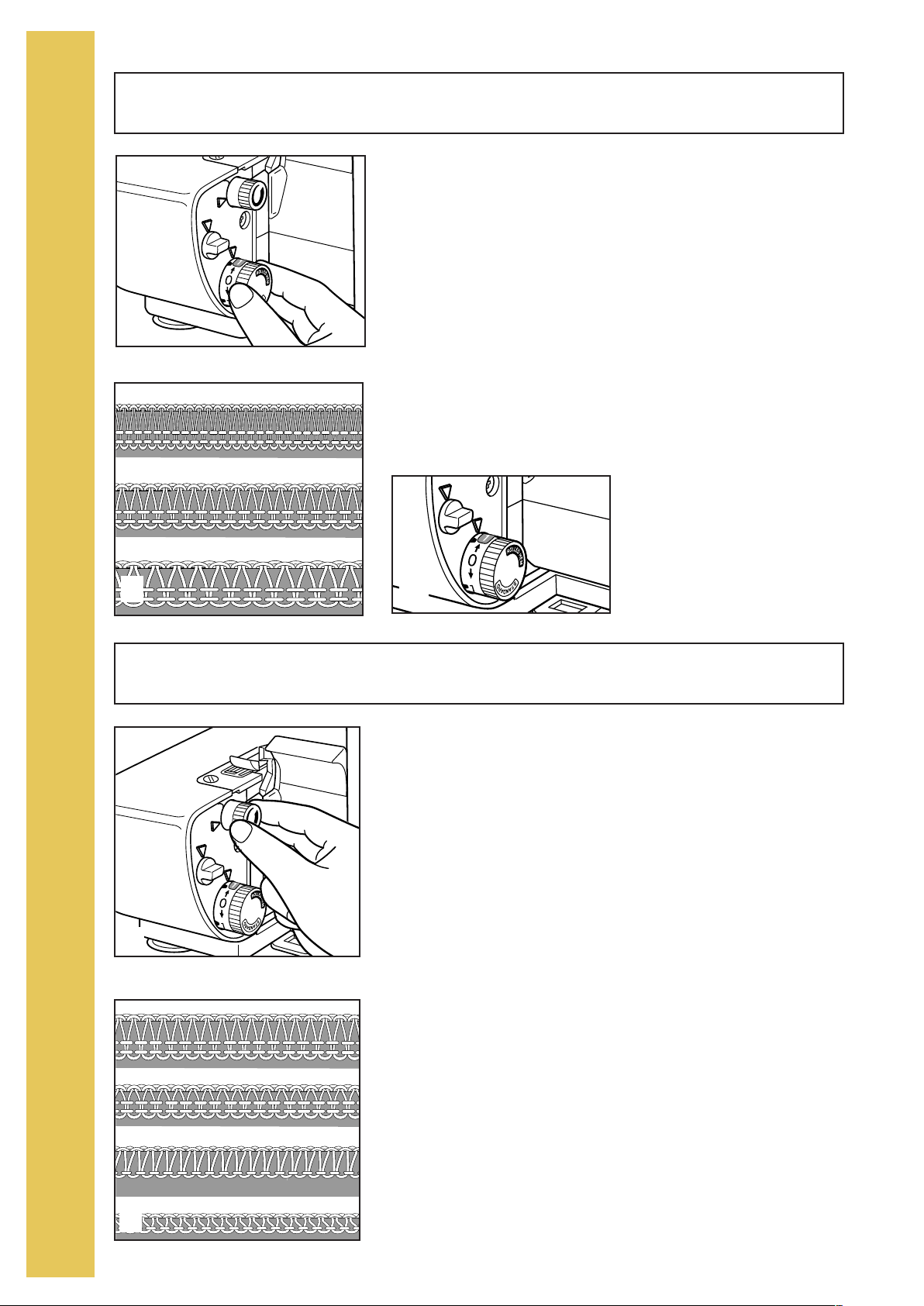
The stitch length / rolled hem adjusting dial is conveniently
located just to the left of the front cover, near the base plate.
(fig. A) The dial shows two stitch-length ranges, from 0.75,
for the shortest stitch, to 4 for the longest. (fig.C) As the dial
indicates, one range is for standard sewing and one is for
rolled edging or narrow seaming.
Simply turn the dial, aligning the desired setting with the
indicator on the machine. A stitch length of 3mm, or about 10
stitches per inch is ideal for seaming and overedging most
fabrics. For overedging or seaming very lightweight fabrics,
you may prefer a shorter stitch length. When sewing
heavier fabrics, you may choose to lengthen the stitch. (fig.
B)
Note: 0.75mm is located between the 0 and 1 on both
standard and rolled settings.
C
Stitch Width
A
The stitch width adjusting dial is located above the stitch
length dial. (fig. A) The stitch width dial displays two sets of
numbers, indicating two width ranges. The larger size
numbers on the dial, 5.5 through 7.5mm, denote the stitch
width dial when the left needle is in use. The smaller size
numbers, 3.0 through 5.0mm, apply when the right needle
is in use. The "M" setting (3.5) is for the rolled edge.
Adjusting the stitch width moves the upper cutting blade. It
also moves the stitch fingers further apart or closer together
for complete fabric support with any stitch width.
The stitch width is variable by the placement of Right and
Left needles and the stitch width dial positions. (Fig. B)
Use a wider stitch on loosely woven fabrics. You may prefer
a narrower stitch on knitted, tightly woven or sheer fabric.
11
B
Page 15

Differential Feed
O
V
Your Baby Lock serger is equipped with differential feed.
The sets of feed dogs work independently in order to ensure
smooth sewing on all fabrics. (fig. A)
When the differential feed adjusting lever, located at the
machine's right, front edge is set on "N" for normal feeding,
the feed dogs move the same distance. This is the setting to
use for most fabrics and applications. (fig. B)
When the differential feed lever is set above "N", the front feed
dog will feed more fabric than the back. This is because the
front feed dog moves a greater distance than the back feed
dog. As a result, the fabric becomes compressed or eased,
as the diagram on the front cover indicates. This action can
eliminate wavy seams in stretchy fabrics or those cut on the
bias grain.
At the maximum setting of 2.0 (fig. C), the differential feed
can gather a lightweight fabric to nearly double fullness.
(fig. D) The front feed dog is actually feeding in twice as
much fabric as the back feed dog is feeding out.
A
B
E
R
V
I
E
W
To maximize the gathering effects, use the longest stitch
length setting. Fabric weight will affect the gathering. Test
stitch for desired results.
When the differential feed lever is set below "N" (fig. E), the
front feed dog moves less distance than the back feed dog.
This adjustment stretches the fabric slightly as it is sewn,
pulling it taut as it enters the needle. The lower settings
prevent puckers on lightweight fabric (fig. F), add more
stretch to swim wear and active wear, and can be used to
create a lettuce edge. (see page 26).
D
F
C
E
12
Page 16

O
1
2
1
2
V
2-Thread Subsidiary Looper
E
R
V
I
E
W
C
B
D
A
Either needle thread may be engaged for 2-thread overlock
sewing.
To engage the subsidiary looper
1. Open the front cover and the blade cover, cut the upper
looper thread just above the threading port. (fig. A) Raise
the presser foot and pull out the clipped thread from
under the foot.
Remove the upper looper thread from the machine.
2. Rotate the handwheel to bring the needle clamp to its
highest position.
3. Slide the subsidiary looper to the right direction and
swing it counterclockwise to the left. (fig. B)
4. Make sure the hooked tip of the subsidiary looper enters
into the upper looper eye. (fig. C)
5. Close the blade cover and the front cover.
To disengage the subsidiary looper
1. Open the front cover and the blade cover.
2. Rotate the handwheel to bring the needle clamp to its
highest position.
3. Slide the subsidiary looper to the left direction and swing
it clockwise to the right. (fig. D)
4. Make sure the subsidiary looper is resting at the right
side of the upper looper. (fig. E)
5. Close the blade cover and the front cover.
13
E
Page 17

Threading Preparation
T
H
A
B
When using threads on cones or king spools, place the cone
or spool securely over the cone holders furnished on your
machine. To avoid bending the thread stand, you may need
to place one hand under the stand while positioning the cone.
The cone holders prevent the cone or spool from spinning,
enabling the thread to feed evenly. (fig. A)
Because threads for the serger feed from the top, standard
spool threads can snag on the rough edges of many of these
spools. That's why spool caps are furnished with your
Celebrate, to provide a smooth surface that enables the
thread to reel off freely. With the spool notch side down, insert
a spool cap into the top of the spool. (fig. B)
When using standard spool threads on your serger, replace
the cone holders with the sponge disks furnished with your
machine. These disks hold smaller spools securely and help
the thread to reel off properly. With the sponge disk in place,
put the capped spool on the spindle. (fig. C)
Thread nets may be placed over threads that tend to slip off
the bottom of the spool during sewing. Most threads do not
require their use, but nets often are necessary with nylon,
rayon or silk threads. (fig. D) Once it's on the spool, fold the
net back on itself, if necessary, to enable the thread to feed
smoothly without snagging on the net. (fig. E)
R
E
A
D
I
N
G
C
D
E
14
Page 18

T
UL
UL
H
Threading Your Celebrate
R
E
A
D
I
N
G
Your Baby Lock Celebrate is equipped with an exclusive "Instant Jet-Air Threading System" for
fast, easy threading of the upper and lower loopers. One push of the "Jet-Air" threading lever will
automatically thread the loopers. It is no longer necessary to use tweezers for threading the
thread guides.
If a thread breaks or runs out, just re-thread it. There is no need to follow any threading sequence.
Threading Position for Threading Loopers
1. Open the front cover.
2. Raise the presser foot to release all threads.
3. Depress the machine lock button firmly. (fig. A)
4. Rotate the machine handwheel slowly toward you until the looper tubes move to their
connecting position. (fig. B)
Note: The Celebrate must be in the locked position when threading the loopers unless otherwise
indicated.
Lower Looper
1. With the presser foot up and machine lock button in the locked position (fig. B), set the
looper threader selector lever to "L" for lower looper threading. (fig. B)
2. Place the thread cone or spool on the far right front spool pin on the thread stand (fig.C page
16). Slip the thread into the telescopic antenna thread guide "1" directly above the spool, snap
into the thread guide "2" at the top of the machine, then through the slot on the front of the
machine. (fig. C page 16)
3. Pull 18 inches (45cm) of thread through guide "3". Insert the end of the thread into the
threading port "L" about 1 inch (2,5cm). Use tweezers if necessary, to insert the thread end
more easily.
4. Depress the looper threading lever. (fig. D page 16) If the thread does not go through the
lower looper eye with one push, depress the threading lever again until it does. *(see page 16)
5. Clip the thread 4 inches (10cm) from the lower looper eye and leave it hanging loose.
6. Move the lock button release lever to the right.
A
B
15
Lock Button
Release Lever
Machine Lock
Button
Looper Threader
Selector
Page 19

Upper Looper
UL
UL
T
H
1. With the presser foot up and machine lock button in the locked position (see fig. A-B, page 15),
set the looper threader selector lever to "U" for upper looper threading. (See fig. B, page 15.)
2. Place the thread cone or spool on the second spool pin from the front on the right side of the
thread stand. (fig. C) Slip the thread into the telescopic antenna thread guide "A" directly above
the spool, snap into the thread guide "B" at the top of the front of the machine, then through the
slot on the front cover. (See fig. C, below)
3. Pull 18 inches (45cm) of thread through guide "C". Insert the end of the thread into the
threading port "U", about 1 inch (2.5cm). Use tweezers, if necessary, to insert the thread end
more easily. (See fig. D below)
4. Depress the looper threader lever. (fig. D below) If the thread does not go through the upper
looper eye with one push, depress the looper threader lever again until it does, and leave thread
hanging loose.
5. Move the lock button release lever to the right, to unlock the machine.
A
1
R
E
A
D
I
N
G
B
2
2
B
C
3
m)
c
(45
18"
Looper Threader Lever
C
*Be sure at least 1" of thread is inserted into the threading port.
D
16
Page 20

T
H
Right Needle
R
E
A
D
I
N
G
1. Turn the handwheel and line up the green marks on the machine and the handwheel.
Set the needle threader selector on "R" for right needle. (fig. A page 18)
2. Place the thread on the second from left spool pin on the thread stand. (fig. A) Thread needle
thread guides 1 and 2, through the groove on the face plate and through guides 3, 4, 5, 6 and
7. Pull a 6-inch (15 cm) length of thread through guide 7.
3. Lower the presser foot to engage the tensions.
4. Using the Needle Threader, thread the right needle. (illustration below; position 7) (refer to
page 18)
A
17
Handwheel
Page 21

Left Needle
L
R
T
H
1. Turn the handwheel to line up the green marks on the machine and handwheel. Set the
needle threader selector on "L" for left needle.
. Place the thread on the far-left spool pin on the thread stand. (fig. A page 17) Thread needle
2
thread guides A and B, through the groove on the face plate and through guides C, D, E, and
F.
3. Lower the presser foot to engage the tensions.
4. Using the Needle Threader, thread the left needle.
(see page 17; position G) (fig. A-B)
How to Use Needle Threader
1. Turn the handwheel to line up the green marks on the machine. (fig. A page 17)
2. Set the needle threader selector on "R" (right needle) or "L" (left needle). (fig. A)
3. Press the needle threader lever down (fig. B) so that the hook goes into the eye of the
needle.
4. Hold the needle thread horizontally with both hands and position the thread into the threader
hook guides on top of thread hook. (fig. B)
5. Release the needle threader lever, The hook will pull the thread through the eye of the needle
as it is released. (fig. B)
6. Carefully remove the loop of thread from the needle threader hook and place the thread under
the presser foot and to the left.
R
E
A
D
I
N
G
Needle Threader
lever
Needle Threader
selector
A
B
18
Page 22

T
H
Tension Adjustment
R
E
A
D
I
N
G
Your Baby Lock's thread tension is preset at the factory for standard thread and fabric. But the
tensions will require adjustment at times, depending on the thread and fabric being used and the
stitch to be formed. Refer to the tension chart on the inside back cover. Also, study the
diagrams that accompany the explanation of each stitch type. For best results, always sew a test
sample before beginning to serge on the actual project.
19
Page 23

Serging with Fabric
T
H
A
B
With the needle and upper looper threads under the foot and
to the back, lower the presser foot. While holding the threads
in your left hand, press down on the foot controller gently to
begin a thread chain before serging fabric. (fig. A)
You can leave the presser foot down for most serging
applications. Just place the fabric at the toe of the presser
foot. As you step on the foot controller, the feed dogs will
begin moving the fabric toward the needle. (fig. B) You need
to raise and lower the foot only when working with thick,
spongy or lofty fabrics, or when precise positioning is
required.
Be careful not to push or pull the fabric. The Celebrate will
feed it evenly without help. At the end of a seam, just sew off
the fabric edge and continue serging to create a 5" - 6" thread
chain. Cut the thread chain with the thread cutter on the left
side cover. (fig. C)
R
E
A
D
I
N
G
C
Clearing the Stitch Width Fingers
As you sew, you will discover that maneuvering the fabric is
different from conventional sewing, because the threads form
around the stitch width fingers. (fig. A)
To clear the stitch fingers, simply raise the presser foot, which
releases all threads. Raise the needle(s). Then pull the
threads gently from behind the foot. (fig. B) The stitches are
now released from the fingers. (fig. C)
A
B
C
20
Page 24

T
H
Re-threading Loopers
R
E
A
D
I
N
G
If a thread breaks, raise the presser foot and pull the broken thread out from under the foot. Open
the front cover, depress the machine lock button, rotate the machine hand wheel slowly toward
you until the tubes move to their connecting position, and set the looper threader selector to U or
L for the looper being threaded. Re-thread the machine above the threading port, leaving an
18-inch (45cm) thread tail. Thread the looper as usual and move the lock button release lever to
the right. Close the front cover and sew a test sample. Refer to page 15-16 for further
information.
Note: When re-threading your Baby Lock Celebrate using the "Jet-Air Threading" feature, make
sure that the previous thread that was in the looper (tube) is completely removed. This will
eliminate any chance of the previous thread obstructing the flow of the air when re-threading the
machine.
Re-threading Needles
If a needle thread breaks, raise the presser foot, remove the broken thread and rethread the
needle thread guides. Turn the handwheel and line up the green marks on the handwheel and
machine. Select the "R" or "L" for the needle being rethreaded. Use the needle threader for
exact and easier threading. Refer to pages 17-18 for further information.
21
Page 25

4-Thread Overedging
4
Overedging to finish facings, hems and seams before construction, is one of the most basic uses
of a serger, such as making a garment or project with 5/8-inch (16mm) pressed-open seams.
(fig. A)
To overedge, place the single layer of fabric in front of the presser foot, aligning the cut edge with
upper cutting blade. Begin serging, continuing to guide the fabric along the blade. The edge of
the fabric should be trimmed, but not cut away. Then sew the seams on your conventional sewing
machine and press them open as usual. (fig. B)
Because notches would be cut away in this process, mark them before serging with "V" snips just
inside the seam allowance or with a water-soluble fabric marker. (fig. C)
Note: A 2-thread overlock or 3-thread overlock can also be used with this technique.
A
B
C
T
H
R
E
A
D
O
V
E
R
Overlock Seaming
For garments or projects that do not require conventional
pressed-open seams, you can stitch and finish the seam in one
operation and then press the seams to one side. (fig. A) A 4 or
3-thread seam is strong, yet it provides "give" or flexibility
according to the needs of the fabric.
Place two layers of fabric right sides together. Use the marks
on your serger's front cover to align the fabric for the desired
seam width. Keep your eye on the fabric edge to guide it to the
appropriate mark. (fig. B)
Do not watch the needle. If you guide the fabric accurately, the
needle will seam in the correct place automatically.
Note: For most seaming, pins are unnecessary because the
serger feeds the fabric evenly. If you need pins, place the pins
parallel to the seam line outside the seam allowance to avoid
damaging the blades.
A
B
L
O
C
K
22
Page 26

4
UL
LL
LN
RN
UL
LL
LN
RN
UL
LL
LN
RN
UL
LL
LN
RN
UL
LL
LN
RN
UL
LL
LN
RN
4-Thread Overlock
T
H
R
E
A
D
O
V
E
R
L
Your Baby Lock Celebrate comes to you set for 4-thread serging, which provides a very durable,
yet fully stretchable, seam or edge finish on all kinds of fabrics. With tensions properly set, the
upper and lower looper threads lock together evenly over the cut fabric edge(s) to form a flat,
non-rolling pattern of overlocking stitches on both sides of the fabric.
The left needle thread interlocks with both looper threads at the stitching line to create the seam.
The right needle thread, visible on the top side of the stitch, interlocks with both looper threads
to add durability. The upper looper thread, that resembles a zig zag, on the upper side of the
fabric, is from the upper looper that moves up above the throat plate and down. The lower
looper thread, that resembles a zig zag on the lower side of the fabric, is from the lower looper
that only moves lower than the throat plate.
The tension on each thread is controlled by its own tension dial. Turn the dial to a higher
number to tighten or increase the tension; turn it to a lower number to loosen or decrease
tension. The chart on the inside back cover indicates the suggested number ranges for 4-thread
stitching. On this chart, record specific settings for your own machine.
Various threads and individual preferences may require slight adjustment to the needle thread
tension as well. Always sew a test sample to determine if the desired result is achieved.
Refer to the diagrams for tension guidlines.
O
C
K
Wrong side
Right Needle Thread
Perfect seam
Left Needle Thread
Right Needle Thread
Upper Looper Thread
Lower Looper Thread
Upper and Lower Looper
Thread
Left Needle Thread
Tighten
Upper and Lower Looper
Thread
23
Tighten
Tighten TightenLoosen Loosen
Page 27

UL
LL
LN
LN
RN
UL
LL
RN
3-Thread Overlock
UL
LL
LN
RN
UL
LL
LN
RN
UL
LL
LN
RN
3
3-thread serging works well - and conserves thread - for
edge-finishing most wovens and for seaming knits that don't
require the extra durability that a fourth thread provides.
It's easy to convert your Celebrate to serge with 3 threads by
simply eliminating either needle.
To convert your serger to wide 3-thread stitching (5.5-7.5
mm), snip the right-hand needle thread just above the needle
eye. To convert to narrow 3-thread stitching (3.0-5.0mm), snip
the left-hand needle thread. (fig. A) Remove the needle not
being used completely from the machine.
Re-tighten the needle clamp screw slightly to prevent the
screw from vibrating out. (Fig. B)
The tension on each thread is controlled by its own tension
dial. Turn the dial to a larger number to tighten or increase
tension, to a lower number to loosen or decrease tension. The
chart on the inside back cover suggests tension ranges for
3-thread stitching. On this chart, record specific settings for
your own machine.
Refer to the diagram to see what a balanced 3-thread stitch
should look like. The other diagrams show unbalanced
stitches and the tension adjustments necessary to correct
them.
Perfect seam
A
B
T
H
R
E
A
D
O
V
E
R
L
O
C
Left or Right Needle Thread
K
Left or Right Needle
Thread
Upper Looper Thread
Lower Looper Thread
Upper and Lower Looper Thread
Tighten
Tighten
Loosen
Loosen
24
Tighten
Page 28

R
0
0
UL
LL
RN
UL
LL
LN
RN
UL
LL
LN
RN
O
Rolled Edging
L
L
E
D
E
D
G
I
N
G
The rolled edge setting is used to achieve the narrowest stitch possible (1.5mm) on your Baby
Lock serger. The stitch is suitable for seaming sheer and lightweight fabrics and for edging and
hemming lightweight fabrics.
3-Thread Rolled Edge
1. Remove the left needle and corresponding thread.
2. Clear the stitch fingers.
3. Turn the stitch length adjusting dial counter-clockwise into
the rolled hem range. Set the desired stitch length within
this range. (fig. A)
4. Turn the stitch width dial until the "M" lines up with the
indicator. (fig. B)
5. Increase the lower looper tension. (fig. C)
The tension adjustment tightens the lower looper thread,
causing the fabric edge to roll around the stitch finger.
The upper looper thread then wraps the fabric edge. The
lower looper thread will be nearly invisible on the back side of
the stitch formation. Sew a test sample first to determine if
the fabric edge is sufficiently rolled. If not, increasing lower
looper tension and decreasing upper looper tension both may
help to create the desired effect.
Record tension settings on the chart on the inside back cover.
A
B
25
Note: If a narrow unrolled edge is desired, follow step 1
through 4 above, leaving tensions set as for standard
3-thread serging with the right needle.
Right Needle Thread
Upper Looper Thread Lower Looper Thread
Perfect seam
Wrong
side
Tighten
Loosen
Loosen
C
Tighten
Page 29

Seaming Sheers
R
O
Use the 3-thread rolled hem setting when sewing sheer fabrics that otherwise would require
French seams. Set the stitch length at 2.5. Then simply sew the seams, aligning the fabric edges
with the serger seam guide, trimming away the excess seam allowance.
Lettuce Edge
A
B
C
A frilly or "lettuce" edge can be created on most light and
medium weight stretch fabrics and on bias edges of soft,
woven fabrics. It makes a pretty decorative edging for
activewear, lingerie, accessories and children's wear.
Set the machine for the 2-thread or the 3-thread rolled
edge. (refer to page 25, 31)
Set differential feed at 0.6. (fig. B) Serge the fabric in the
direction of greatest stretch - the crossgrain on knits, bias
grain on wovens. For a "leafier" effect, try using a shorter
stitch length and gently stretch the fabric (fig. A), as it is
being sewn. Sew a test sample. (fig. C)
L
L
E
D
E
D
G
I
N
G
Belt Loops and Button Loops
Use the rolled edge thread chain, stitched without
fabric, to make professional belt loops and button loops.
Using a heavy decorative thread in the upper looper
forms a stronger loop.
Returning to Standard Serging
Clear the stitch fingers and return the stitch length dial to the standard range. Set stitch width
and length at the desired settings. Readjust tensions. Replace the left needle and its
corresponding thread, if desired.
26
Page 30

2
LL
LN
LN
RN
LL
RN
1
2
UL
LL
LN
RN
UL
LL
LN
RN
2-Thread Overlock
T
H
R
E
A
D
O
V
E
R
L
O
C
K
The 2-thread function provides an economical and less bulky means of overedging all fabrics.
hen joining two fabrics together with 2-threads, the seam it forms is not a standard overlock
W
seam but a flatlock seam. 2-thread rolled edge creates a delicate finish on fine wovens and
smooth silkies. When sewn with specialty threads, 2-thread serging makes decorative seams
and edges for activewear, children's clothing, ruffles and hemlines.
Converting from 3-Thread to 2-Thread
Overlock
Either needle thread may be engaged for 2-thread
serging.
1. Open the front cover and the blade cutter, and cut
the upper looper thread just above the threading
port. (fig.A) Raise the presser foot and pull out
the clipped thread from under the foot. Remove
the upper looper thread from the machine.
A
B
2. Rotate the handwheel to bring the upper looper
into position to attach the subsidiary looper.
3. Slide the subsidiary looper to the right and swing
it counterclockwise. (fig.B)
4. Close the blade cover and the front cover,
decrease the needle tension for 2-thread serging.
(see chart on the inside back cover)
The needle and lower looper threads should
overcast evenly on the cut edge of the fabric.
Sew a test sample. Make adjustments if needed.
Refer to diagrams.
27
Wrong
side
Perfect seam
Left or Right Needle Thread
Lower Looper Thread
C
*The cutting blade cover has been removed in
photos B and C for a clear view. You do not
to remove the cutting blade cover.
Unbalanced Thread Tension
Tighten Loosen
Loosen
Tighten
need
Page 31

Flatlock Seams
2
FIatlock seams are most suited to fabrics which do not
ravel - interlock knits, tricot, sweatshirt fleece and
synthetic suede. The serged edges pull open and flatten
within the stitch for a non-bulky join. (fig. A) Be sure to sew
a test sample first to determine whether the stitch will have
the strength to hold the seam without the fabric pulling
away.
Sew flatlock seams in the same way as 3-thread seams,
but then pull the two fabric layers apart until the seam lies
flat. Because the threads show on the outside as well as
the inside of the garment or project (except fake furs), the
flatlock seam is often considered a decorative application.
(fig. B)
Before sewing, decide which stitch pattern you want to
have on the outside of the garment. For "loops" (lower
looper thread) to show, place fabric wrong sides together
for sewing the seam. (fig. C)
To produce the "ladder" (needle thread) on the outside,
place the fabric right sides together. (fig. D)
A
B
T
H
R
E
A
D
O
V
E
R
L
Wrong Side
Needle
Thread
Right
Side
Loop
Right
Side
Looper
Thread
Wrong Side
C
Right
Side
Wrong
Side
Ladder
Right
Side
Wrong Side
O
C
K
D
28
Page 32

2
Flatlock "Topstitching"
T
H
R
E
A
D
O
V
E
R
L
O
C
A
B
C
The flatlock stitch need not be limited at seamlines.
When sewn on a fold, flatlocking can create attractive
ecorative effects within the body of a garment or
d
project. Either follow placement lines on your pattern
or design your own special effects by stitching the
fabric before laying out pattern pieces.
1. Set the machine for 2-thread flatlock - wide.
2. Turn the cutting blade lock switch clockwise to
disengage the upper cutting blade.
3. Set the stitch length to desired setting.
4. Fold the fabric (right side or wrong side out,
depending on the loop or ladder stitch you want to
show) along stitch placement lines.
5. Position the fabric under the presser foot, aligning
the fold of the fabric 1/8 inch (3.5mm) to the left of
the upper cutting blade. (fig. A)
6. Stitch to the desired ending point.
7. Clear the stitch fingers and chain off the fabric. (fig
B)
8. Clip threads, leaving a 3-4 inch (7.5-10cm) chain.
9. Gently pull the fabric to flatten the stitches. (fig. C)
10. Separate the chain threads and thread them
through a needle and pull them to the fabric back
side. If necessary, tie a knot to secure the threads.
(fig. D)
K
Note: If the fabric does not pull completely flat under
the stitches, guide the fabric fold to the left so that the
loops hang slightly off the fold as they are being
stitched.
D
29
Page 33

Blind Hemming
2
You Baby Lock Celebrate can create a sturdy, nearly
invisible blindhem.
1. Set the machine for 2-Thread Overlock with the right
needle threaded. Set the stitch width at 5.0 and the stitch
length at 4.0 in the standard range.
2. Fold up the hemline and press it in place. Then fold the
hem allowance back against the fabric right side to
create a fold about 1/4 " from the top edge of the hem as
shown. (fig. A)
3. Align the fold under the presser foot and stitch, allowing
the needle to catch only a thread or two of the soft fold:
the blade will trim the top edge of the hem and the
loopers will overcast the edge for a clean finish. (fig. B)
4. Open the fold and press flat. (fig. C)
Note: An optional blindhem foot for consistent guiding is
available through your Baby Lock retailer. (fig. D)
(See page 8 Optional Accessories listing for part number.)
A
T
H
R
E
A
D
O
V
E
R
B
C
L
O
C
K
D
30
Page 34

2
UL
LL
LN
RN
UL
LL
LN
RN
LL
RN
RN
LL
2-Thread Rolled Edge
T
H
R
E
A
D
O
V
E
R
Wrong
side
erfect seam
P
Tighten
Right Needle
Thread
Lower Looper
Thread
Loosen
The 2-thread version of the rolled edge is often
preferred for hemming very soft fabrics which might
become too stiff if sewn with three threads.
1. Clear the stitch fingers and adjust the stitch width
and length as for 3-thread rolled edge.
2. Set the machine for 2-thread serging (page 27),
using the right-hand needle.
3. Adjust tension as shown in the chart on the inside
back cover.
The tension adjustment causes the lower looper
thread to roll around the stitch finger, wrapping the
fabric edge. Sew a test sample. If the fabric edge is
not sufficiently rolled, increase the needle tension
and/or decrease the looper tension to help create the
desired effect.
Record your tension settings on the chart.
L
O
C
K
Tighten
31
Page 35

Returning to 3 or 4-Thread Overlock
1
2
2
1. Open the front cover and rotate the handwheel
counterclockwise to bring the needle clamp to its
highest position.
2. Slide the subsidiary looper to the left direction and
swing it clockwise to the right.
3. Engage the machine to the looper threading position.
(fig. A-B page 15)
4. Rethread the upper looper (page 16). For 4-thread
serging, replace the second needle. (page 17-18)
5. Move the lock button release lever to the right, to
unlock the machine.
6. Turn the handwheel and line up the green marks on
the machine and the handwheel.
7. Rethread the needles. (pages 17-18)
8. Close the blade cover and front cover.
9. Lower the foot and sew a test stitch.
T
H
R
E
A
D
O
V
E
R
L
O
C
K
32
Page 36

B
A
Securing Ends
S
I
C
S
E
R
G
I
N
G
T
E
C
H
A
B
The serger stitch will not unravel readily, and in most cases
serged seams are secured by an intersecting seam.
If that's not the case, these are several options for securing
seam. (fig. A)
1. Leave a 3-inch (7.5cm) chain, separate the threads and tie
a knot.
2. Apply a dot of seam sealant on the thread chain at the
fabric edge. Allow to dry and cut off the excess thread
chain.
3. Leave a 3 to 4-inch (7.5-10cm) thread chain and use a
large-eye tapestry needle or double-eye needle to weave
the chain back into the stitching.
4. Lock the beginning or end of a seam by serging over the
previous stitches. (Directions listed below)
To lock the beginning of the seam:
1. Manually turn the handwheel toward you taking 2-3
stitches into the fabric. Leave the needle(s) in the lowest
position to anchor the fabric.
2. Raise the presser foot.
3. Smooth out the thread chain with your fingers. (fig. B)
Then bring the chain around and under the foot, so that it
aligns with the edge of the fabric. (fig. C)
4. Lower the foot and continue sewing, catching the thread
chain in the stitches for about 1inch (2.5cm). Let the
blades cut off any remaining thread chain. (fig. D-E)
N
I
Q
U
E
S
C
D
33
E
Page 37

Securing Ends (Cont.)
B
A
To lock the end of the seam:
1. Take one stitch off the end of the fabric. (fig. F)
2. Raise the presser foot and bring the needle(s) to the
highest position. Pull back gently on the fabric to clear
the stitch fingers.
3. Turn the fabric over with the wrong side of the stitch
facing up (fig. G), and reposition it under the presser foot
with the needle at the seam edge, aligned with the
previous needle line. (fig. H)
4. Lower presser foot and sew 5-6 stitches over the
previous stitches, being careful not to cut them. You may
want to flip the cutting blade lock switch clockwise to the
lock position. Pivot the fabric and chain off. (fig. I-J)
F
G
S
I
C
S
E
R
G
I
N
G
T
H
I
E
C
H
N
I
Q
U
E
S
J
34
Page 38

B
A
Turning Outside Corners
S
I
C
S
E
R
G
I
N
G
T
A
B
C
1. Stitch along one edge until you reach the corner.
Take one stitch off the edge of the fabric. (fig. A)
(As you approach the edge, you may want to stop
and manually turn the handwheel towards you.)
2. Raise the needle(s) to the highest position.
3. Clear the stitch fingers, and rotate the fabric to
reposition the needle at the previous row of stitching.
(fig. B) Gently pull up on all threads to remove slack
and resume stitching. (fig. C)
Note: A loose thread loop at the corner is caused by too
much slack in the needle thread when clearing the
stitch fingers. Try again, turning corners takes a little
practice!
E
C
H
N
I
Q
U
E
S
Turning Inside Corners
1. Reinforce loosely woven fabrics at the corner with
staystitching on the conventional sewing machine.
Clip to the corner. (fig. A)
2. Align the fabric edge with the blade, and stitch until
the blade reaches the corner, not the needles. Don't
cut into the corner. (fig. B)
A
B
3. Lower the needle(s) to anchor the fabric.
4. Raise the presser foot and straighten out the fabric,
forming a pleat at the corner. (fig. C)
5. Be sure the marked stitching line is straight, then
continue serging the remaining edge. When done
correctly, the pleat will disappear after stitching.
(fig. D)
35
C
D
Page 39

Serging Curves
B
A
To serge around inside or outside curves, guide the fabric into the cutting blade, not the needle(s).
Remember, cutting takes place before the fabric reaches the needle. Because the long serger
resser foot holds the fabric more securely, you may need to raise and lower the presser foot
p
several times to maneuver around very tight curves.
Inserting Tapes
The slot in the standard presser foot is designed to guide stabilizing tape, narrow elastic or
decorative ribbon into the stitching. Insert tape or elastic into the slot and under the back of the
foot. (fig. A) Adjust the stitch width to match the tape width. Place the fabric under the foot and
stitch. (fig. B)
S
I
C
S
E
R
G
I
N
G
T
A
Cutting Blade Cover Seam Guide
Use the marks on your serger's front cover and set the width
dial at "M" to align the fabric for accurate seam allowances.
When using the left needle, the second mark "L" from the
needle indicates 5/8 inch (16mm) from the cutting edge to the
needle.
Using the right needle, the third mark "R" from the needle to
indicates 5/8 inch (16mm) from the cutting edge to the needle.
B
E
C
H
N
I
Q
U
E
S
Note: Be sure to set the width dial at the "M" setting for
accurate seam allowances.
36
Page 40

U
S
Using Specialty Threads
I
N
G
S
P
E
C
I
A
L
T
Y
T
Beautiful stitches can be formed by serging with specialty threads, cords and ribbons. These
heavier or shinier threads can be used to enhance appearance, add strength or elasticity, or
create special effects, depending on the thread you choose.
Some specialty threads work well through the needle and loopers. There are some that are too
heavy for the needle and should only be used in the loopers.
Use the Specialty Thread Chart on pages 41 and 42 as a guide, keeping in mind that the threads
can vary from one manufacturer to another. Take time to test sew for best results.
Threading Lightweight Thread
Specialty thread used in the needle can be threaded in the usual way. The ease with which they
can be threaded in the loopers, however, depends on thread thickness.
Changing Threads
1. Clip the existing thread at the cone and remove the
cone from the spindle. (fig. A)
2. Place the new cone on the spindle. With the two
threads together, tie an overhand knot, or square knot.
(fig. B)
3. Raise the presser foot, and pull the old thread from
A
under the foot until the new thread comes through the
machine.
H
R
E
A
D
S
37
Note: When changing a needle thread, pull the thread
through until it reaches the needle eye. Then clip off the
knot (fig. C) and rethread the needle eye manually or with
the needle threader.
B
C
Threading Medium Weight Thread
Medium weight threads, including topstitching thread, Decor rayon and stretch nylon thread, are
too bulky to form a knot that would fit through the threading port, but they can slip through the
hole with the aid of a thread "cradle" made from regular serger thread.
Page 41

UL
UL
UL
UL
UL
UL
UL
Thread Cradle for Loopers
U
S
1. Open the front cover and raise the presser foot.
. At the threading port, clip the looper thread that is to be
2
replaced. (fig. A) Remove thread from under the foot and
the upper thread guides. Replace cone of thread with
specialty thread.
3. With machine in locked position (fig. B-C), set the looper
threading port to U or L, according to the looper that is being
threaded.
4. Thread specialty thread into the upper thread guides,
leaving an 18-inch (40cm) tail above the threading port.
(fig. D)
5. Cut a 24-inch (55cm) strand of serger thread and fold in half
to form a thread cradle. Insert the loose ends of the thread
cradle into the port about 1 inch (2.5cm).
6. Holding the cradle loop with left hand, depress the
threading lever with your right hand (fig. E) until the thread
ends come out the looper eye.
7. Insert the specialty thread tail into the cradle loop (fig. F),
pull the serger thread ends until the specialty thread comes
through the looper eye. (fig. G) Discard or set aside the
thread cradle.
8. Run upper looper thread under the foot and to the left, cut
lower looper thread to 4 inch (10cm) and leave it hanging
loose.
I
N
G
A
S
P
E
C
B
I
A
L
T
Y
C
D
E
T
H
R
E
A
D
S
G
38
F
Page 42

U
S
Looper Threading Tool
I
N
G
S
P
E
C
I
A
L
A
B
1. Open the front cover and raise the presser foot.
2. At the threading port, cut the looper thread that is to be
replaced. Remove thread from under the foot and the
upper thread guides. Replace cone of thread with
specialty thread.
3. With machine in locked position, set the looper threading
port to U or L, according to the looper that is being
threaded.
4. Thread specialty thread into the upper thread guides,
leaving an 18-inch (40cm) tail above the threading port.
5. Place the straight end of the looper threading tool into the
threading port. Push the looper threading tool until the
end comes out of the looper eye.
6. Insert the specialty thread tail into the looper threading
tool eye. (fig. A) Pull the straight end of the looper
threading tool through the looper eye bringing the
specialty thread with it. (fig. B)
T
Y
T
H
R
E
A
D
S
39
Page 43

Bypassing the Threading Port
U
L
UL
UL
U
S
Heavy weight threads can be used through your regular
looper thread paths. Specific techniques may require that
the thread bypass the thread port for the thread pull to be
loosened. Start with the machine threaded with regular
serger thread.
1. Open front cover and raise the presser foot.
2. Just above the threading port, clip the looper thread to
be replaced. Pull the thread out of the upper guides
and remove the cone.
3. Place the specialty thread on the spool pin. Thread it
into the upper guides and clip it a couple of inches
beyond the base plate. (fig. A)
4. With machine lock button released, use the tweezers
to pull the existing looper thread out of tube extending
from the threading mechanism. (fig. B) Leave the
thread in the looper arm.
5. Tie the specialty thread onto the regular thread with an
overhand knot. (fig. C) Pull on the regular thread from
the looper eye until the specialty thread comes through
the looper eye.
6. Place upper looper thread under the foot and to the
left. Clip lower looper thread at the base plate.
If the thread is heavy and the overhand knot (step #5)
is too large for the looper tube, follow directions #1 thru
#6 on page 38 to make a thread cradle. Then:
1. Release machine lock button.
2. While holding the loose ends of the thread cradle with
one hand, use the tweezers to pull the cradle loop out
of the tube extending from the threading mechanism
with the other hand.
3. Insert 2 inch (5cm) of your decorative thread into the
cradle loop. Pull on the loose ends of the thread
cradle from the looper eye until the specialty thread
comes through the looper eye. (fig.D)
A
B
C
D
I
N
G
S
P
E
C
I
A
L
T
Y
T
H
R
E
A
D
S
E
40
Page 44

U
S
I
N
G
Specialty Thread Guide Chart
Topstitching
Buttonhole Twist
Woolly Nylon
Thread
achine
M
Embroidery
Metallic Threads
S
P
E
C
I
A
L
T
Y
APPLICATION
4-Thread Seaming
3-Thread Seaming
2-Thread Flatlock
4-Thread Edging
3-Thread Edging
Edging or flatlock
seaming for sportswear
and home décor items.
Yes
Yes
Yes
Yes
Yes
Soft stretchy seams on
lingerie, swimwear,
active wear, and for
rolled edge stitch.
Yes
Yes
Yes
Yes
Yes
Decorative edges for
clothing, gift items,
home décor, etc.
Yes
For exposed edges
only
Yes
For exposed edges
only
Yes
Yes
Yes
T
H
R
E
A
D
S
2-Thread Edging
3-Thread
Rolled Edge
2-Thread
Rolled Edge
COMMENTS
Yes
Use in upper looper
only
Use in lower looper
only
When using decorative
thread in the needle use
a size 90 Top Stitch
needle for best results.
Yes
Yes
Yes
Can be used in the
needle.
Tensions may require
adjustment.
Yes
Use in upper looper
only
Use in lower looper
only
Varies greatly with
manufacturer. Avoid
thread with coarse
metal fibers. Sew test
before sewing on
project.
41
Page 45

Specialty Thread Guide Chart (Cont.)
Clear Nylon
Monofilament
Machine Embroidery
Threads: Rayon and
Polyester, 30, 40, 50
weight.
Lingerie Thread
Designer 6
Pearl Crown Rayon
Candlelight
Jeans Stitch
Ribbon Thread
U
S
I
N
G
APPLICATION
4-Thread Seaming
3-Thread Seaming
2-Thread Flatlock
4-Thread Edging
3-Thread Edging
2-Thread Edging
Techniques
requiring the thread
to be invisible such as
blind hemming
Yes Yes
Yes
Use in needle only
Yes
Yes
Yes
Lingerie and lightweight
fabrics, edging of fine
fabrics, delicate rolled
hems.
Yes
Yes
Yes
Yes
Yes
Decorative edging,
flatlocking, rolled
hem, etc.
Not recommended
for seaming
Not recommended
for seaming
Use in the lower
looper
Use in the upper and
lower loopers.
Use in the upper
and lower loopers.
Use in the lower looper
only
(Excluding Ribbon Thread)
S
P
E
C
I
A
L
T
Y
T
H
3-Thread
Rolled Edge
2-Thread
Rolled Edge
COMMENTS
Yes, soft, lightweight
monofilaments only
Yes, soft, lightweight
monofilaments only
Make sure to use a
soft pliable monofilament thread
Sew at a slower
speed.
Use in the upper
looper
Use in the lower
looper
Use thread nets to
prevent the thread
from falling off the
spool and getting
tangled.
Not recommended
for seaming
Not recommended
for seaming
Be sure to check the
recommendations above
for best results.
Sew test before applying
to the project.
R
E
A
D
S
42
Page 46

M
A
Replacing Needles
I
N
T
E
N
A
N
C
E
1. Raise the needle to the highest position by turning the
handwheel toward you.
2. Using the screwdriver from the accessory pouch,
loosen the needle screw for the needle to be changed.
"L" screw for the left needle and "R" screw for the right
needle as show in illustration A.
Note: To prevent the needle from falling into the needle
Needle insert tool
Needle-drop drawer
A
B
plate, hold it with the needle insert tool as you loosen the
needle screw. (fig. A)
3. Use the needle insert tool or tweezers to insert the new
needle with the flat side to the back. Insert the needle
as far as it will go. Check the needle viewing window.
(fig. A)
4. Tighten the needle screw.
Note: If you do drop a needle down into the machine just
pull out the needle-drop drawer at the bottom of the
serger. The needle will be on the drawer. (fig. B)
Replacing Cutting Blades
43
A
B
1mm
The lower fixed blade is made of a special long-lasting steel and
does not require frequent replacement. If necessary, contact
your nearest Baby Lock retailer for replacement of this blade.
The upper moving blade is made of a softer steel material and
will require replacement. A spare blade is provided with the
machine for replacement, if necessary. The spare blade is
located in the thread spool stand accessory compartment.
If for some reason your machine does not cut or perform as it
should, please take your machine to your nearest Baby Lock
retailer. It is possible that the result of poor cutting may indicate
other problems.
To replace the upper moving blade, follow below instructions.
1. For safety reasons, unplug main power cord.
2. Open front cover and cutting blade cover. (fig. A)
Remove presser foot.
3. Turn handwheel so upper moving blade is in its highest
position.
4. Remove screw and upper blade. (fig. B)
5. Insert new blade into blade slot.
6. Insert screw and hold moving blade in its highest position
while tightening the screw.
7. To finalize position of upper blade, turn handwheel so that the
moving blade is in its lowest position. Loosen the screw so
that the moving blade can be lowered to 1mm overlap of the
top of the fixed blade. (fig. C) Tighten the screw.
8. Close cutting blade cover and front cover. Replace the
presser foot.
9. Rotate the handwheel one turn to ensure smooth operation of
the machine.
Page 47

Cleaning
UL
M
A
Your Baby Lock will operate at best performance if it is kept clean at all times. The serger's
cutting action creates much more lint than you will find on conventional sewing machines. This
lint impedes the machine's efficiency and acts as a sponge to draw oil from it.
Your serger will not need oiling for many years because the major moving parts are made from
oil-impregnated metal.
However, we recommend using the cleaning brush often during garment construction in order to
keep lint off the blades, the needle bar, the feed dog mechanism and loopers. Remove the blade
cover and throat plate periodically to clean more thoroughly.
TO REMOVE NEEDLE PLATE, PROCEED AS FOLLOW:
1. For safety reasons, unplug main power cord.
2. Raise and remove presser foot.
3. Select stitch length dial to rolled hem setting.
4. Remove needles from needle clamp.
5. Turn your handwheel until the upper looper is in the far right position.
6. Remove the needle plate. Remove front screw with screwdriver and back screw with allen
wrench. (fig. A)
7. With your right hand, first raise the needle plate in front of the blade. Pull slightly to the right,
then remove to the left.
8. Replace in reverse procedure.
9. Finally, position the needle plate so that the needles lower in the center of each hole on the
needle plate. (fig. B)
I
T
E
N
A
N
C
E
Needles
A
B
Replacing LED Light Bulb
Your Baby Lock Celebrate is equipped with a long-life LED lighting system, which is not necesary
to change bulbs.
If the LED unit needs replacement, please contact your authorized Baby Lock retailer.
*Remove LED light bulb and replace LED light bulb with the same type, rated (2 watts or less).
*Remove light bulb and replace bulb with the same type, rated (15 watts/110 volts).
44
Page 48

T
R
Troubleshooting
O
U
B
L
E
S
H
O
O
T
I
N
G
Before taking your machine in for service, check the following:
Machine fails to start:
1. Are electrical plugs properly connected?
2. Is the power switch on?
3. Check household circuit breaker or fuse.
4. Is the lock button release lever in the unlocked position?
Thread breaks:
1. Is the machine threaded correctly? Check each thread guide, all tension discs.
2. Is the needle inserted correctly?
3. Is the needle bent and worn?
4. Is tension adjusted too tightly?
5. Is tension adjusted to accommodate thickness of thread being used?
6. Are you using good quality thread?
7. Is the thread feeding off the cone/spool freely?
8. Is the needle size correct for the type of fabric being used?
9. Are the needles being used the correct Organ or Schmetz HAx1SP/CR system?
Skipped Stitches:
1. Is the needle bent or worn?
2. Is the needle inserted correctly?
3. Is the serger threaded correctly?
4. Is the presser foot pressure right for the fabric?
5. Is the correct needle being used for the particular stitch?
6. Is the correct needle being used for the type of fabric being sewn?
7. Is the fabric being pulled from the rear of the machine while sewing?
Fabric will not feed in machine:
1. Is the machine lock button released?
2. Is the presser foot down?
3. Are the cutting blades sharp?
4. Are the cutting blades, presser foot, and feed dogs free of lint?
5. Are the cutting blades properly set and is the upper blade against the lower blade?
6. Is the presser foot pressure right for the fabric?
7. Is the stitch length set properly?
8. Is the needle plate secure on the machine?
Stitch is Unbalanced:
1. Is the serger threaded correctly?
2. Is the needle tension too loose for the fabric being used?
3. Are the looper tensions properly adjusted?
4. Is the thread well seated in the thread slots?
5. Have you changed to specialty threads and not adjusted tension to accommodate a different
thread thickness?
45
Page 49

Troubleshooting (Cont.)
T
R
Needle threading difficulties:
1. Is the needle threader selector at the appropriate setting? ("R" for right needle, "L" for left
needle.)
2. Is the green mark on the handwheel lined up on the machine?
Looper threading difficulties:
1. Is the looper threader selector at the appropriate setting? (Left threading port for "U" upper
looper, right threading port for "L" lower looper.)
2. Is the thread end in the proper threading port?
3. Is at least 1 inch (2.5cm) of the thread end in the threading port?
4. Is there at least 18 inches (45cm) of loose thread beyond the thread guide above the
threading port?
5. Is there a kink or twist in the 18 inches (45cm) of thread to restrict the flow into the threading
port?
6. Is the thread caught to prevent going through the loopers?
Poor Cutting:
1. Are the cutting blade(s) dull?
2. Have you sewn over a straight pin?
3. Is the cutting blade in the locked position?
4. Have the cutting blades been improperly replaced?
5. Is the fabric being pulled from the rear of the machine while sewing?
O
U
B
L
E
S
H
O
O
T
I
N
Dos and Don'ts
1. Always be aware of the needle's up-and-down movement, and do not turn your attention from
the machine while it is running.
2. When changing the needle, the presser foot or any other parts, always disconnect the machine
by turning the power switch to OFF.
3. Do not place anything on the foot controller, or the machine will start inadvertently and the
controller or motor can burn out.
4. When using your serger for the first time, place a fabric scrap under the presser foot and run
the machine without thread for a few minutes. Wipe away any oil that appears.
5. Do not pull fabric from the rear of the machine. Such action can damage the looper
mechanism.
6. To prevent possible injury, always avoid body contact with any moving parts and the machine
mechanism.
7. NEVER sew over pins.
Special Caution: Unplug the power cord from the electrical outlet when the machine is not in
use.
G
46
Page 50

T
E
Technical Data
C
H
N
I
C
A
L
D
A
T
A
Stitch Types:
Stitch Width:
2 needles, 2 loopers:
4-Thread Overlock
1 needle (left or right), 2 loopers
3-Thread Overlock (wide, narrow, and narrow hem)
3-Thread Flatlock (wide and narrow) right needle only
3-Thread Rolled Edge
1 needle (left or right), 1 looper
2-Thread Flatlock (wide and narrow)
2-Thread Blanket Stitch
2-Thread Ladder Stitch
Standard 2/3/4 - thread with left needle:
5.5 - 7.5mm
Standard 2/3 - thread with right needle
3-Thread Stitch with right needle
3.0 - 5.0mm
Stitch Length:
Differential Feed:
Presser Foot:
Handwheel:
Needle System:
Sewing Speed:
3-Thread Rolled Edge
1.5mm
2/3/4 Thread Overlock Stitch: 0.75-4mm
3-Thread Rolled Edge: 0.75-4Rmm
Gathering effect: N-2
Stretching effect: N-0.6
Snap-on feet
Rotates forward
Organ or Schmetz HA x 1SP/CR
Up to 1,500 s.p.m
47
Machine Weight:
Light System:
7.5 kg
1 LED Light Bulb
Page 51

Chart for Stitch Selection Settings
C
H
A
titch Type
S
4-Thread
Overlock
4-Thread
Gathering
3-Thread
Overlock
Wide and Narrow
3-Thread
Rolled
edge
2-Thread
Flatlock
Stitch
Length
2-3
2.5-3.5
3-4
2-3
2-3
2.5-3.5
2.5-7.5
0.75
1.5
2-3
2-3
Stitch
Width
5.5-7.5
5.5-7.5
5.5-7.5
5.5-7.5
3.0 N/A
7.5
3.0
7.5
3.0 N/A
3.0 N/A
3.5 N/A
7.5 0
Tension
Left
Needle
4 4 4 4
3.75
3.5
4 4 4 44
4
Right
Needle
Tension
3.75
3.5
4
N/A
3.75N/A
N/A3.75
3.5
4
1
N/A
Upper
Looper
Tension
4
4
3.5 3.5
4 4
3 7
2.5 6.5
N/A 5
N/A 3.5
Lower
Looper
Tension
4
4
3.53.5
44
R
T
F
O
R
S
T
I
T
C
H
S
E
L
E
C
2-Thread
Rolled
edge
This chart indicates the suggested range of tension numbers for each stitch category.
As you determine special settings for your machine, record them on the chart in the
blank spases.
0.75
1.5
3.0 N/A
3.0 N/A
4.5
4
N/A 3.5
N/A 3.0
T
I
O
N
S
E
T
T
I
N
G
S
48
Page 52

BLS1-TA
EI-47-TA
Printed in Japan
 Loading...