

Page 1
DIVA system
User Manual
Version 1.0.0
© 2012 ATEÏS
www.ateis-europe.com
ATEÏS Europe BV - Sydneystraat 42 - 3047BP ROTTERDAM - NETHERLANDS
Phone +31 (0)10 2088690 - Fax +31 (0)10 2088699
P.O. box 12172, 3004 GD, ROTTERDAM - Chamber of commerce: 24465391 Rotterdam
Page 2

Time Version
2012/09/03 The First Version.1.0.0
Revision History
Page 3

3Contents
Table of Contents
Introduction 7
................................................................................................................................... 71.1
Welcome
................................................................................................................................... 71.2
Ateis Presentation
................................................................................................................................... 91.3
EC Declaration of Conformity
Safety Declartion 10
Quick Start 11
Product Features 34
................................................................................................................................... 344.1
DIVA Series Audio Processor
4.1.1
4.1.2
DIVA8M
4.1.1.1
4.1.1.2
4.1.1.3
4.1.1.4
4.1.1.5
4.1.1.6
4.1.1.7
4.1.1.8
4.1.1.9
DIVA8S
4.1.2.1
4.1.2.2
Overview
What's inside the Box
Installation
Front Panel
Rear Panel
Peripherals
Characteristics
3rd Party Control
LCD Menu
Overview
What's inside the Box
.......................................................................................................................................................... 34
......................................................................................................................................................... 34
......................................................................................................................................................... 40
......................................................................................................................................................... 40
......................................................................................................................................................... 42
......................................................................................................................................... 43Fireman Microphone4.1.1.4
......................................................................................................................................................... 44
......................................................................................................................................... 46A) Control Inputs4.1.1.5
......................................................................................................................................... 46B) Evacuation Inputs4.1.1.5
......................................................................................................................................... 47C) RS232 Connector4.1.1.5
......................................................................................................................................... 48F) Control Outputs4.1.1.5
......................................................................................................................................... 49H) Amplifiers I/O4.1.1.5
......................................................................................................................................... 50I) 100V Signal Links4.1.1.5
......................................................................................................................................... 51J) Speaker Zone Outputs4.1.1.5
......................................................................................................................................... 51K) PSS/PSM (RJ45) Connector4.1.1.5
......................................................................................................................................... 54L) Ethernet (RJ45) Connector4.1.1.5
......................................................................................................................................... 56N) Mic/Line Input (XLR)4.1.1.5
......................................................................................................................................... 57O) Music Inputs (RCA)4.1.1.5
......................................................................................................................................... 57Q) Backup Pow er Input4.1.1.5
......................................................................................................................................................... 58
......................................................................................................................................................... 58
......................................................................................................................................................... 60
......................................................................................................................................................... 61
......................................................................................................................................... 63Evacuation List4.1.1.9
......................................................................................................................................... 64EVAC Zone List4.1.1.9
......................................................................................................................................... 64Fault List4.1.1.9
......................................................................................................................................... 64Events List4.1.1.9
......................................................................................................................................... 64Scheduler List4.1.1.9
......................................................................................................................................... 64Setting Menu4.1.1.9
......................................................................................................................................... 71Managing Music Sources4.1.1.9
......................................................................................................................................... 71Messages and Microphone Calls4.1.1.9
.......................................................................................................................................................... 75
......................................................................................................................................................... 75
......................................................................................................................................................... 78
0
© 2012 ATEÏS
3
Page 4

DIVA system4
4.1.2.3
4.1.2.4
4.1.2.5
4.1.2.6
Consoles and Accessories
4.2.1
4.2.1.1
4.2.1.2
4.2.2
4.2.2.1
4.2.2.2
4.2.2.3
4.2.2.4
4.2.2.5
4.2.3
4.2.3.1
4.2.3.2
4.2.3.3
4.2.3.4
4.2.3.5
4.2.4
4.2.4.1
4.2.4.2
4.2.4.3
4.2.4.4
4.2.5
4.2.5.1
4.2.5.2
4.2.5.3
4.2.5.4
4.2.5.5
4.2.5.6
Amplifier
4.3.1
4.3.1.1
4.3.1.2
4.3.1.3
4.3.1.4
4.3.1.5
Installation
Front Panel
Rear Panel
Characteristics
................................................................................................................................... 814.2
Fireman Microphone
Characteristics
Configuration
PSM
Overview
Control Panel
LED Indicators
Characteristics
Configuration
PSSG2
Overview
Control Panel
Rear Panel
Configuration
Touch Screen
PSSG2-E
Overview
Control Panel
Rear/Side Panel
Configuration
CD16
Overview
Front/Rear Panel
Characteristics
LED Indicators
Troubleshooting Guide
Configuration
................................................................................................................................... 1244.3
SPA
Overview
Front Panel
Rear panel
Characteristics
Parallel Output
......................................................................................................................................................... 78
......................................................................................................................................................... 79
......................................................................................................................................................... 79
......................................................................................................................................................... 80
.......................................................................................................................................................... 81
......................................................................................................................................................... 82
......................................................................................................................................................... 82
.......................................................................................................................................................... 85
......................................................................................................................................................... 85
......................................................................................................................................................... 86
......................................................................................................................................................... 87
......................................................................................................................................................... 88
......................................................................................................................................................... 88
.......................................................................................................................................................... 94
......................................................................................................................................................... 94
......................................................................................................................................................... 95
......................................................................................................................................................... 96
......................................................................................................................................................... 96
......................................................................................................................................................... 102
......................................................................................................................................... 103Configuration4.2.3.5
......................................................................................................................................... 104General Options4.2.3.5
......................................................................................................................................... 105Audio Input and Output settings4.2.3.5
......................................................................................................................................... 108Screen Calibration4.2.3.5
......................................................................................................................................... 109Mechanical Buttons4.2.3.5
......................................................................................................................................... 109Working w ith the VACIE System4.2.3.5
.......................................................................................................................................................... 113
......................................................................................................................................................... 113
......................................................................................................................................................... 114
......................................................................................................................................................... 115
......................................................................................................................................................... 116
.......................................................................................................................................................... 118
......................................................................................................................................................... 118
......................................................................................................................................................... 120
......................................................................................................................................................... 122
......................................................................................................................................................... 122
......................................................................................................................................................... 123
......................................................................................................................................................... 124
.......................................................................................................................................................... 124
......................................................................................................................................................... 124
......................................................................................................................................................... 127
......................................................................................................................................................... 128
......................................................................................................................................................... 129
......................................................................................................................................................... 130
System Functionality 130
................................................................................................................................... 1315.1
DIVA Software
5.1.1
Overview
5.1.2
System Requirement
5.1.3
Install DIVA Software
5.1.4
Windows Layout
5.1.5
File
.......................................................................................................................................................... 131
.......................................................................................................................................................... 131
.......................................................................................................................................................... 131
.......................................................................................................................................................... 135
.......................................................................................................................................................... 137
© 2012 ATEÏS
Page 5

5Contents
5.1.6
Edit
5.1.7
View
5.1.8
User
5.1.9
5.1.10
5.1.11
5.1.12
5.1.13
5.1.14
5.1.15
5.1.16
5.1.17
5.1.18
5.1.19
5.1.20
5.2.10
5.2.11
5.2.12
5.2.13
5.2.14
5.2.15
5.2.16
Operation
Tools
Lock
Window
Help
Toolbars
Tab Bar
Status Bar
Design Component Section
Design View Area
Property Control
Color Scheme
................................................................................................................................... 1485.2
How To
5.2.1
Save/Open
5.2.2
Project
5.2.3
Perform A DIVA Master Network
5.2.4
Add DIVA8S slave
5.2.5
Set Speaker Parameters Setting
5.2.6
Set Power Monitor Setting
5.2.7
Add Messages Into DIVA
5.2.8
Set up Front Panel Message
5.2.9
Create a Monitorable Button
Use Scheduler
Use Logic Inputs
5.2.11.1
5.2.11.2
5.2.11.3
Normal Logic Inputs
Evacuation Inputs
External Fault Inputs
Do Phase Evacuation
Use Output Relay
Use Monitoring
5.2.14.1
Explanation About Monitoring Process
Use Presets
Manage Log File
................................................................................................................................... 1905.3
Operation
................................................................................................................................... 1925.4
User Management
5.4.1
Enter Password
................................................................................................................................... 1965.5
Device Management
5.5.1
Search and Settings
5.5.1.1
5.5.1.2
5.5.1.3
5.5.1.4
5.5.2
5.5.3
5.5.3.1
5.5.3.2
5.5.3.3
5.5.3.4
5.5.3.5
Set Computer Network Parameters
Configure Network Options
Search Device
IP Address
Verify Diva Versions
Update
Update Master Unit
Update Slave Unit
Update PSSG2
Update PSM/CD16
Update PSSG2E
.......................................................................................................................................................... 138
.......................................................................................................................................................... 138
.......................................................................................................................................................... 139
.......................................................................................................................................................... 140
.......................................................................................................................................................... 141
.......................................................................................................................................................... 141
.......................................................................................................................................................... 142
.......................................................................................................................................................... 142
.......................................................................................................................................................... 142
.......................................................................................................................................................... 144
.......................................................................................................................................................... 144
.......................................................................................................................................................... 144
.......................................................................................................................................................... 146
.......................................................................................................................................................... 146
.......................................................................................................................................................... 147
.......................................................................................................................................................... 148
.......................................................................................................................................................... 149
.......................................................................................................................................................... 151
.......................................................................................................................................................... 152
.......................................................................................................................................................... 154
.......................................................................................................................................................... 155
.......................................................................................................................................................... 156
.......................................................................................................................................................... 160
.......................................................................................................................................................... 163
.......................................................................................................................................................... 165
.......................................................................................................................................................... 168
......................................................................................................................................................... 170
......................................................................................................................................................... 171
......................................................................................................................................................... 172
.......................................................................................................................................................... 172
.......................................................................................................................................................... 177
.......................................................................................................................................................... 180
......................................................................................................................................................... 184
.......................................................................................................................................................... 186
.......................................................................................................................................................... 188
.......................................................................................................................................................... 195
.......................................................................................................................................................... 196
......................................................................................................................................................... 196
......................................................................................................................................................... 199
......................................................................................................................................................... 200
......................................................................................................................................................... 203
.......................................................................................................................................................... 205
.......................................................................................................................................................... 206
......................................................................................................................................................... 208
......................................................................................................................................................... 209
......................................................................................................................................................... 210
......................................................................................................................................................... 211
......................................................................................................................................................... 212
© 2012 ATEÏS
5
Page 6

DIVA system6
................................................................................................................................... 2125.6
Event Management
5.6.1
Common Options
5.6.2
Event Sequence
5.6.3
Event Type
................................................................................................................................... 2375.7
Audio Sources
5.7.1
Music Source
5.7.1.1
5.7.1.2
5.7.1.3
5.7.1.4
5.7.1.5
5.7.2
5.7.2.1
5.7.2.2
5.7.2.3
DSP Components
5.8.1
5.8.1.1
5.8.1.2
5.8.2
3rd Party Control
5.9.1
5.9.1.1
5.9.1.2
5.9.1.3
5.9.2
5.9.2.1
5.9.2.2
5.9.2.3
5.9.3
Use Music Source From Front Panel
With Modulation Detection
Use Music Source From PSS
Use Music Source From Logic Input
Software Control
MIC/LINE Input
With Modulation Detection
From Logic Input
From Software
................................................................................................................................... 2545.8
Filter
Hi/Lo Pass
PEQ
Limiter
................................................................................................................................... 2685.9
Communication Protocols
Notifier
Modbus
Vox@net
Use RS232 Ports
Notifier
Modbus
Vox@net
Put DIVA in Vox@net
.......................................................................................................................................................... 214
.......................................................................................................................................................... 215
.......................................................................................................................................................... 217
.......................................................................................................................................................... 237
......................................................................................................................................................... 240
......................................................................................................................................................... 240
......................................................................................................................................................... 241
......................................................................................................................................................... 244
......................................................................................................................................................... 246
.......................................................................................................................................................... 247
......................................................................................................................................................... 250
......................................................................................................................................................... 251
......................................................................................................................................................... 253
.......................................................................................................................................................... 256
......................................................................................................................................................... 256
......................................................................................................................................................... 260
.......................................................................................................................................................... 264
.......................................................................................................................................................... 268
......................................................................................................................................................... 268
......................................................................................................................................................... 271
......................................................................................................................................................... 272
.......................................................................................................................................................... 273
......................................................................................................................................................... 273
......................................................................................................................................................... 274
......................................................................................................................................................... 275
.......................................................................................................................................................... 275
Contact Infomation 277
Index
© 2012 ATEÏS
0
Page 7
1 Introduction
The company offers a full range of audio equipment: microphones, preamplifiers, digital processors,
digital audio matrixes, loud-speaker monitoring systems, amplifiers, etc. ATEÏS designs and
manufactures leading products in the voice alarm systems market which have been certified EN60849
compliant by the TÜV and UL listed.
Thanks to a development team of over forty engineers and a close connection to our customer base,
we are able to respond rapidly to the demands of our various vertical markets with specific solutions
and cutting edge technology. You can rest assured that our technology is always cutting edge with a
view to the future.
Transportation (Railways, Subways, Airports)
High rise buildings
1.1 Welcome
Thank you for choosing ATEÏS DIVA. We here at ATEÏS hope you will enjoy our technology as much as
we enjoyed developing and building it.
This files has been written for the ATEÏS DIVA software version: v3.0.1.50 and higher.
This manual is intended to provide the user with the necessary understanding of our system architecture
as well as guide users through the configuration process.
Introduction 7
This manual can be updated at any time without prior notice in order to keep it up to date.
If you find errors in this manual or would like to improve on the presentation, feel free to submit mistakes,
suggestions or questions by sending an email.
We hope that this Help File Manual will provide you all the information you need. However if you have
any questions, feel free to contact us.
1.2 Ateis Presentation
ATEÏS has been in the professional audio market for close to thirty years and is viewed as a leading
competitor in the Public Address, Voice Alarm, and Professional Audio Market in Europe, Asia, and the
Middle East.
Products
Development
ATEÏS Vertical Markets
© 2012 ATEÏS
Page 8
DIVA system8
Hotels
Restaurants
Shopping malls
Theme parks
Places of worship
Stadia
Museums
Industrial
University and campus applications
© 2012 ATEÏS
Page 9
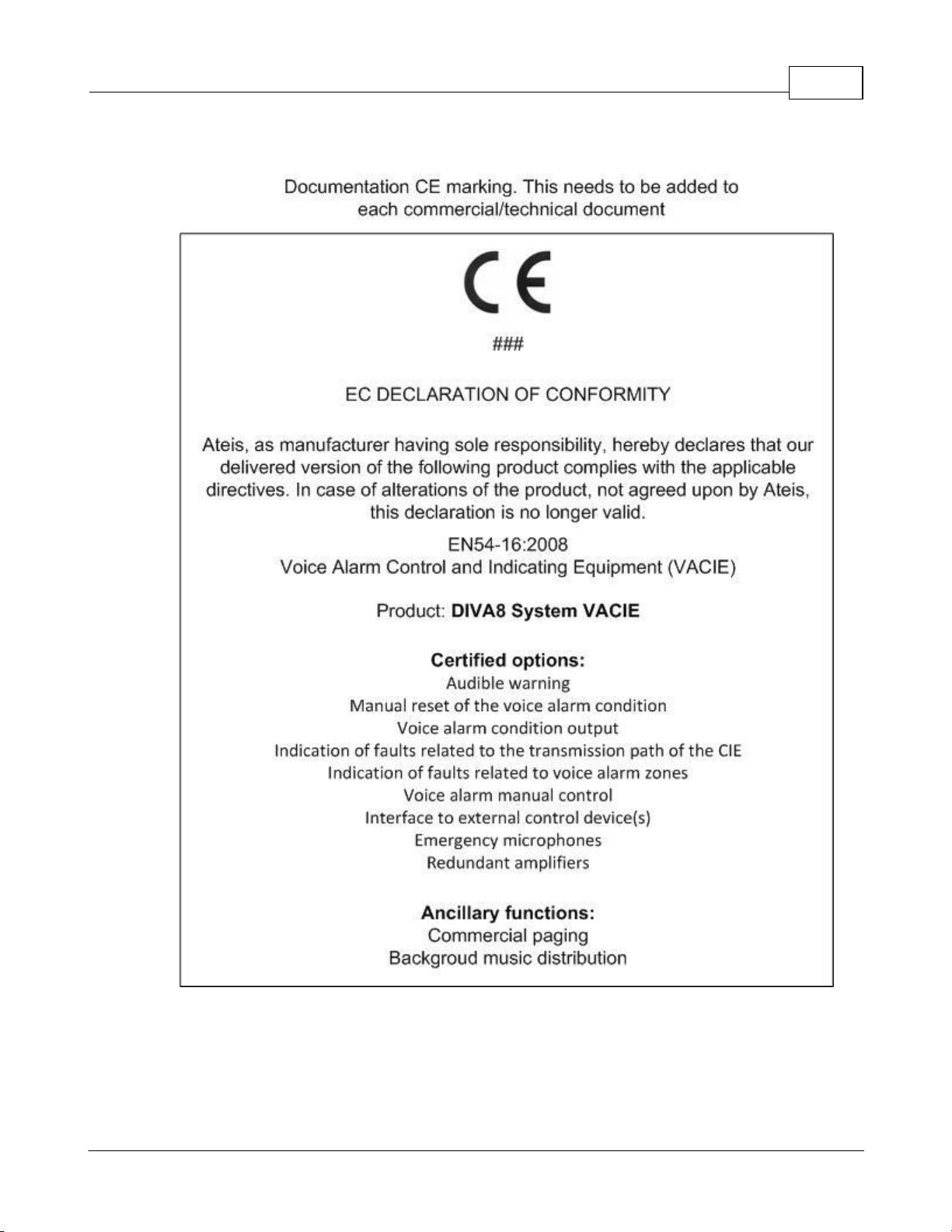
1.3 EC Declaration of Conformity
Introduction 9
© 2012 ATEÏS
Page 10
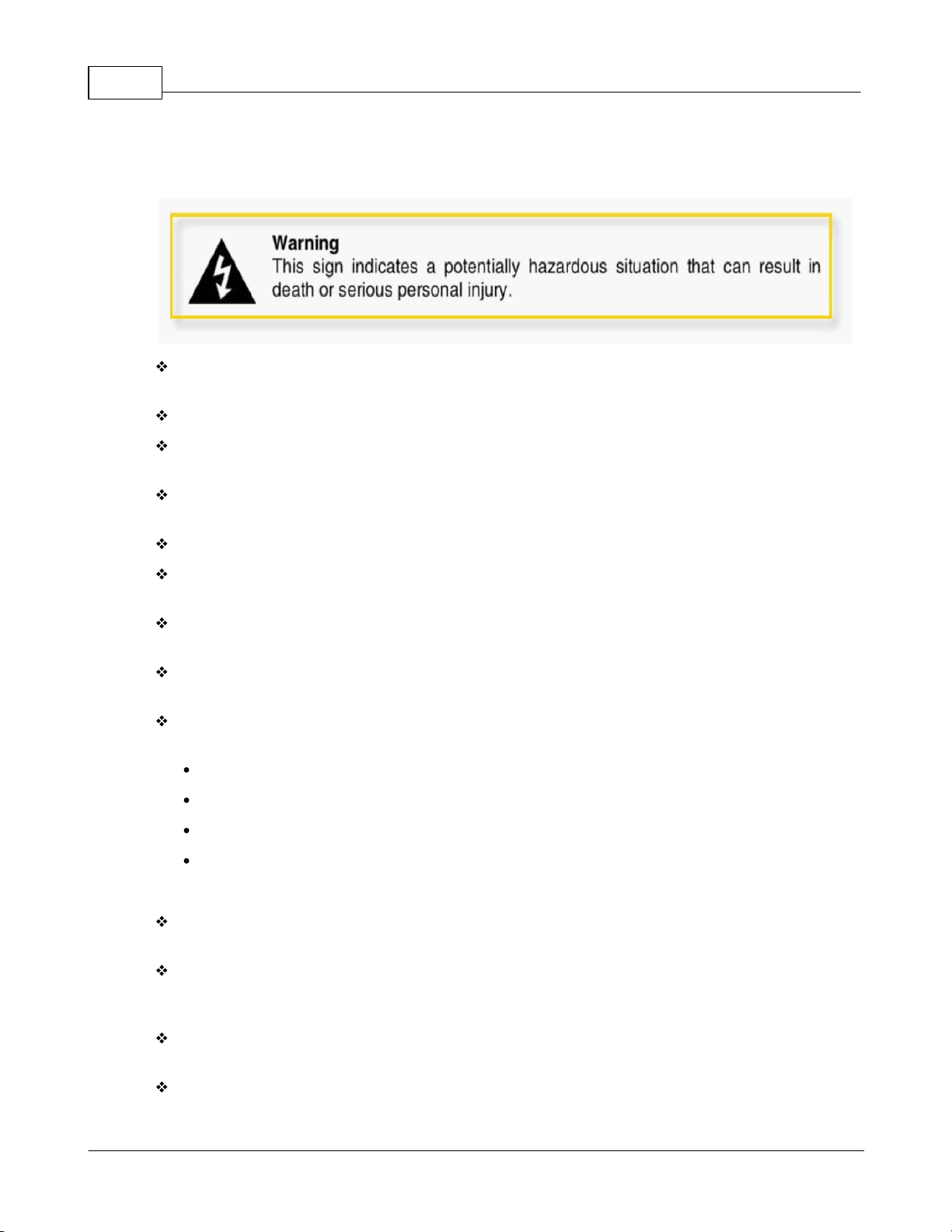
DIVA system10
2 Safety Declartion
Do not expose the device to extreme temperatures, direct sunlight, humidity, or dust, which could
cause fire or electrical shock hazard.
Keep away water or other liquids from the device. Otherwise fire or electrical shock may result.
Connect the power cord only to an AC outlet of the type stated in this Owner's Manual or as marked
on the unit. Otherwise fire and electrical shock hazard results.
When disconnecting the power cord from an AC outlet always grab the plug. Never pull the cord. A
damaged power cord is a potential risk of fire and electrical shock hazard.
Avoid touching power plugs with wet hands. Doing so is a potential electrical shock hazard.
Take care for correct polarity when operating the device from a DC power source. Reversed polarity
may cause damage to the unit or the batteries.
Avoid placing heavy objects on power cords. A damaged power cord is a fire and electrical shock
hazard.
Do not cut, scratch, bend, twist, pull, or heat the power cord. A damaged power cord is a fire and
electrical shock hazard. Ask your ATEÏS dealer for replacement.
Turn off immediately the unit, remove the power cord from the AC outlet and consult your ATEÏS dealer
in any of the following circumstances:
Smoke, odor, or noise getting out of the unit.
Foreign objects or liquids get inside the device.
The unit has been dropped or the shell is damaged.
The power cord is damaged.
If you continue using the device, fire and electrical shock may result.
Do not drop or insert metallic objects or flammable materials into the unit as this may result in fire and
electrical shock.
Do not remove the device's cover, as there are exposed parts inside carrying high voltages that may
cause an electrical shock. Contact your ATEÏS dealer if internal inspection, maintenance, or repair is
necessary.
Do not try to make any modifications to the device. This is a potential fire and electrical shock hazard.
Avoid the device's ventilation slots to be blocked. Blocking the ventilation slots is a potential fire
hazard.
© 2012 ATEÏS
Page 11
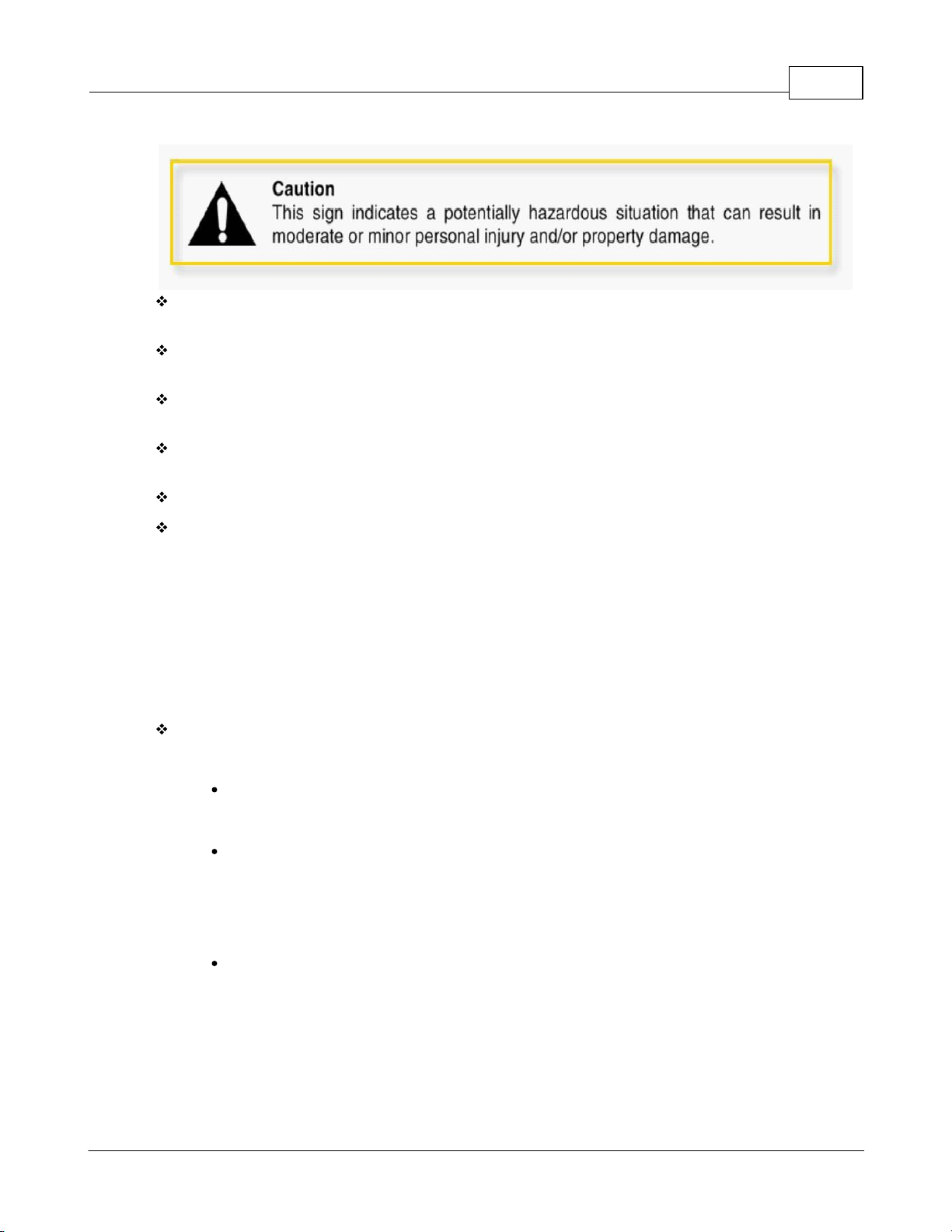
Safety Declartion 11
To prevent the unit from falling down and causing personal injury and/or property damage, avoid
installing or mounting the unit in unstable locations.
Leave enough space above and below the unit to provide good ventilation of the device. If the airflow is
not adequate, the device will heat up inside and may cause a fire.
Operate the device in an environment with a free-air temperature of between 0 °C and 40 °C (32 °F and
104 °F).
Turn off all audio equipment when making any connections to the device, and make sure to use
adequate cables.
Do not use benzene, thinner, or chemicals to clean the device. Use only a soft, dry cloth.
If the device is moved from a cold place (e.g., overnight in a car) to a warmer environment,
condensation may form inside the unit, which may affect performance. Allow the device to acclimatize
for about one hour before use.
3 Quick Start
This topic is designed for "Quick Stat" and is only intent to give a rapid overview of how to start with
DIVA. To obtain more precise details on "how to" and for further information about more complex
configuration possibilities, please read all topics in this manual.
Basic Setup
Connections and Power Up
Fireman Microphone
o Connect the fireman microphone to the connector on the DIVA's front panel.
Music Sources:
o Connect a tuner on the Cinch connector labeled 1 under "Music Input" on the rear of
DIVA.
o Connect a CD player on the Cinch connector labeled 2 "Music Input"
Speaker Lines
o Connect one speaker line to the "Zone 1" connector. The speaker positive cable should
be connected to "LINEA+" and the negative cable to "LINEA-"
o Connect a second speaker line to the "Zone 1" connector. The speaker positive cable
should be connected to "LINEB+ and the negative cable to "LINEB-"
© 2012 ATEÏS
o If more zones have to be used, please redo the same connection for ZONE2, ZONE3,
etc...
Page 12

DIVA system12
Voice Amplifier
o Connect the "AIN+", "AIN-" and " from the "VOICE AMP" connect to "Channel 1"
amplifier's input.
Note: respect polarity to avoid inversion phase problem.
o Connect the "Channel 1" amplifier"output to the "VOICE AMP" "AOUT and "AOUT-"
connectors
Note: respect polarity to avoid inversion phase problem.
Music Amplifier
o Connect the "AIN+", "AIN-" and " from the "MUSIC AMP" connect to "Channel 1"
amplifier's input.
Note: respect polarity to avoid inversion phase problem.
o Connect the "Channel 2" amplifier"output to the "MUSIC AMP" "AOUT and "AOUT-"
connectors.
Power Supply
o To ensure the surveillance role, the power supply have to be secured.
Evacuation Button:
o Connect a button between EVAC1+ and EVAC1-.
Slave add and set up
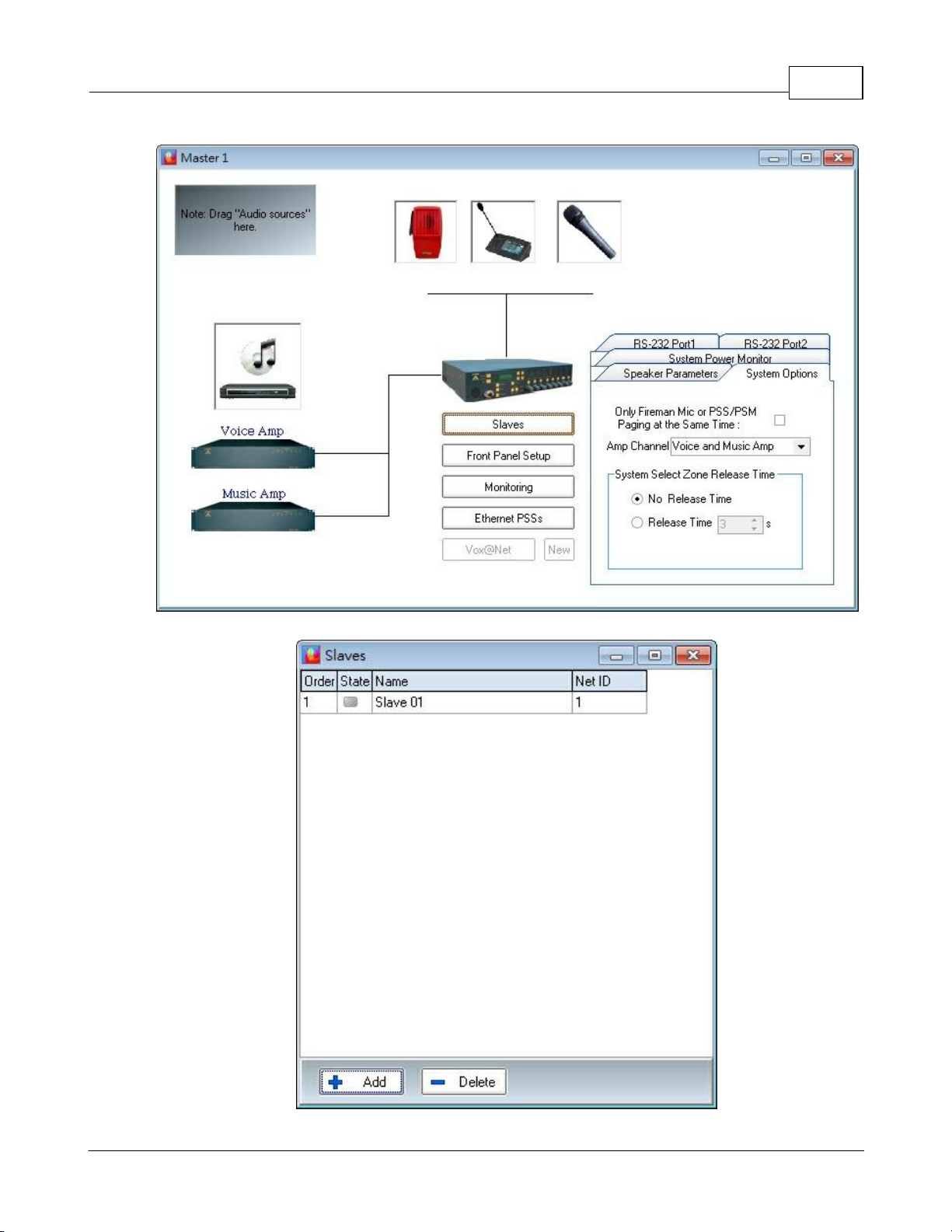
The Slave unit is for adding zones, one DIVA master unit can connect with 15 slave units. The
maximum is 128 zones per system. The Fig3-1 shows the slave button in DIVA software, press it
and you can see the pop-up window as Fig 3.2. Net ID in this table is the same with Slave's knobs
on rear panel, the monitor detects the slave units through the ID numbers.
© 2012 ATEÏS
Page 13
Quick Start 13
Figure 3-1: Slave add button
Figure 3-2: Slave list window
© 2012 ATEÏS
Page 14
DIVA system14
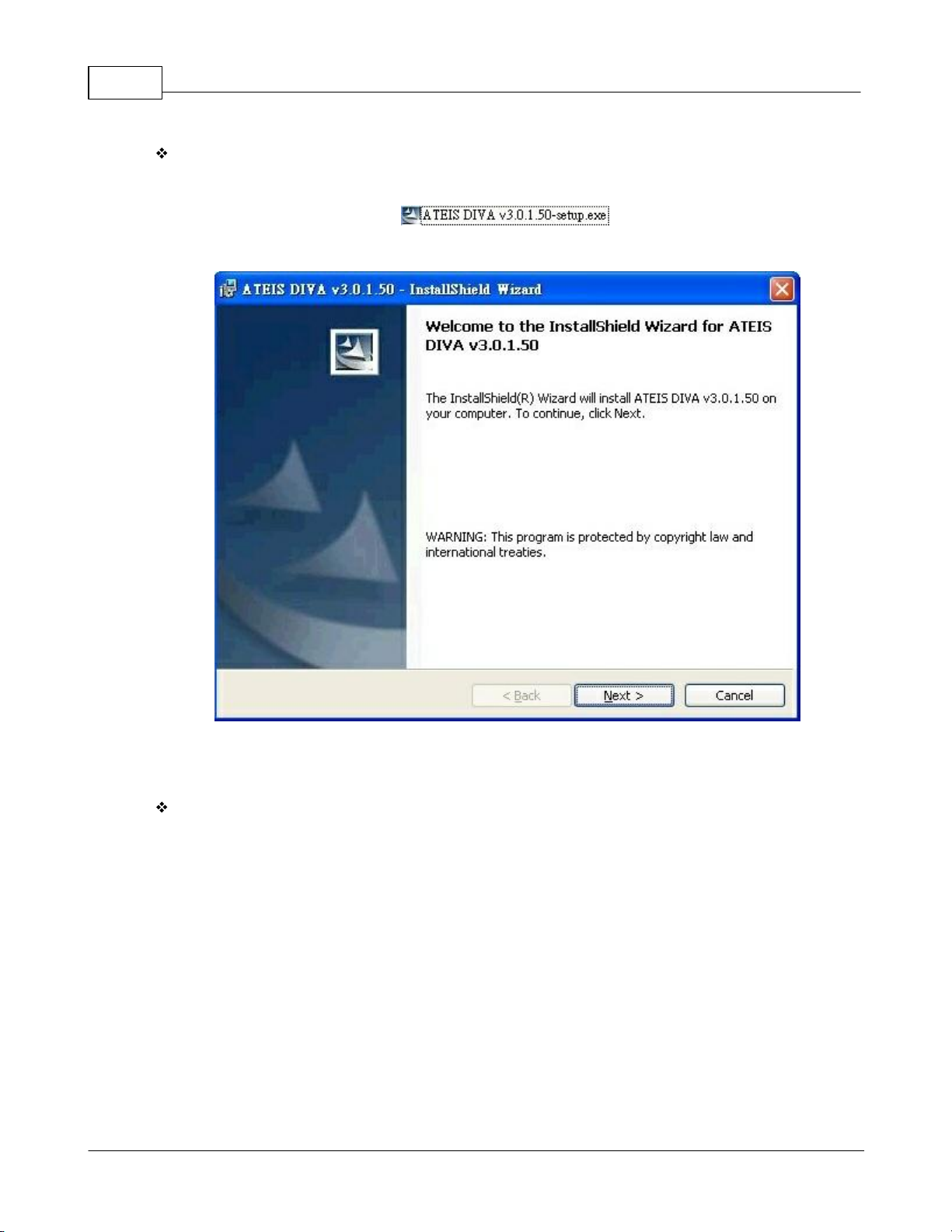
Figure 4: DIVA InstallShield Wizard start page
Software Start Up
First of all, please install the DIVA which could be found on the Ateis-International website.
After double-clicking the DIVA Setup , please follow the next few step to complete the installation.
After the installation process complete, launch DIVA software from the Start menu or the desktop
shortcut automatically installed.
DIVA Configuration
The first steps to DIVA's configuration, is to set up network parameters and to test communication.
© 2012 ATEÏS
Page 15
Quick Start 15
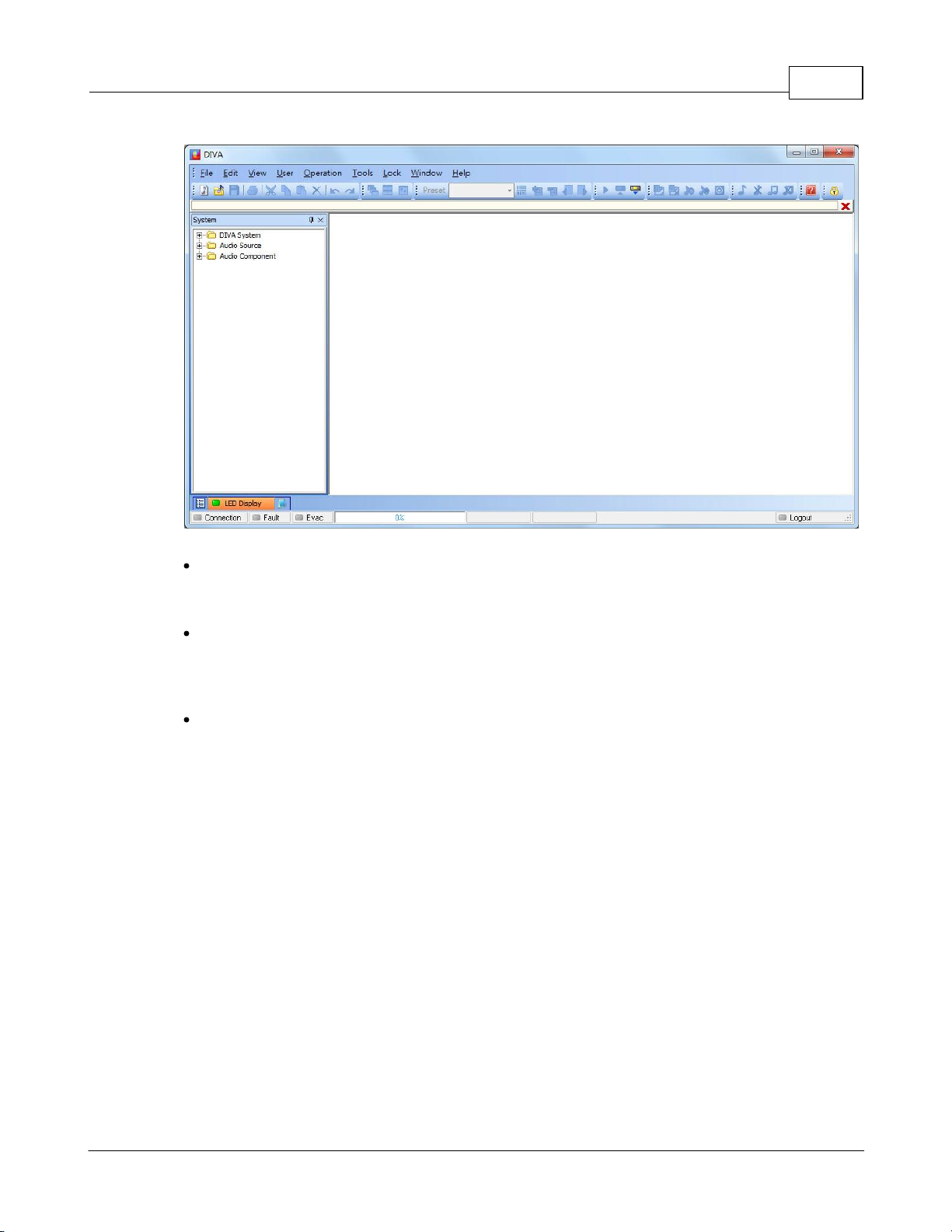
Figure 5: DIVA Softw are front page
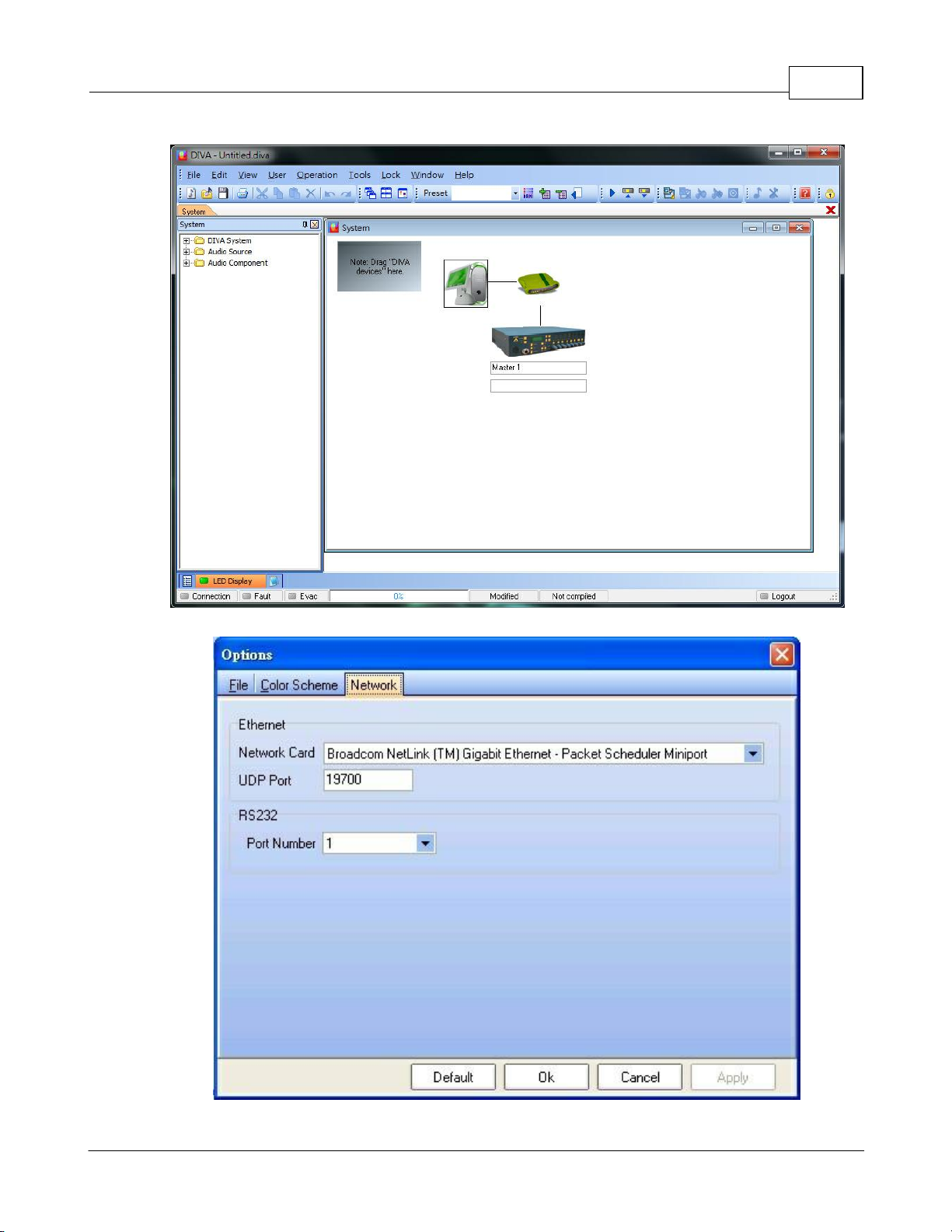
The start page is represented on Figure 5. A first thing to do is to start a new project by clicking
on or by going trough the menu file. This will launch a new window named "System" displayed on
Figure 7.
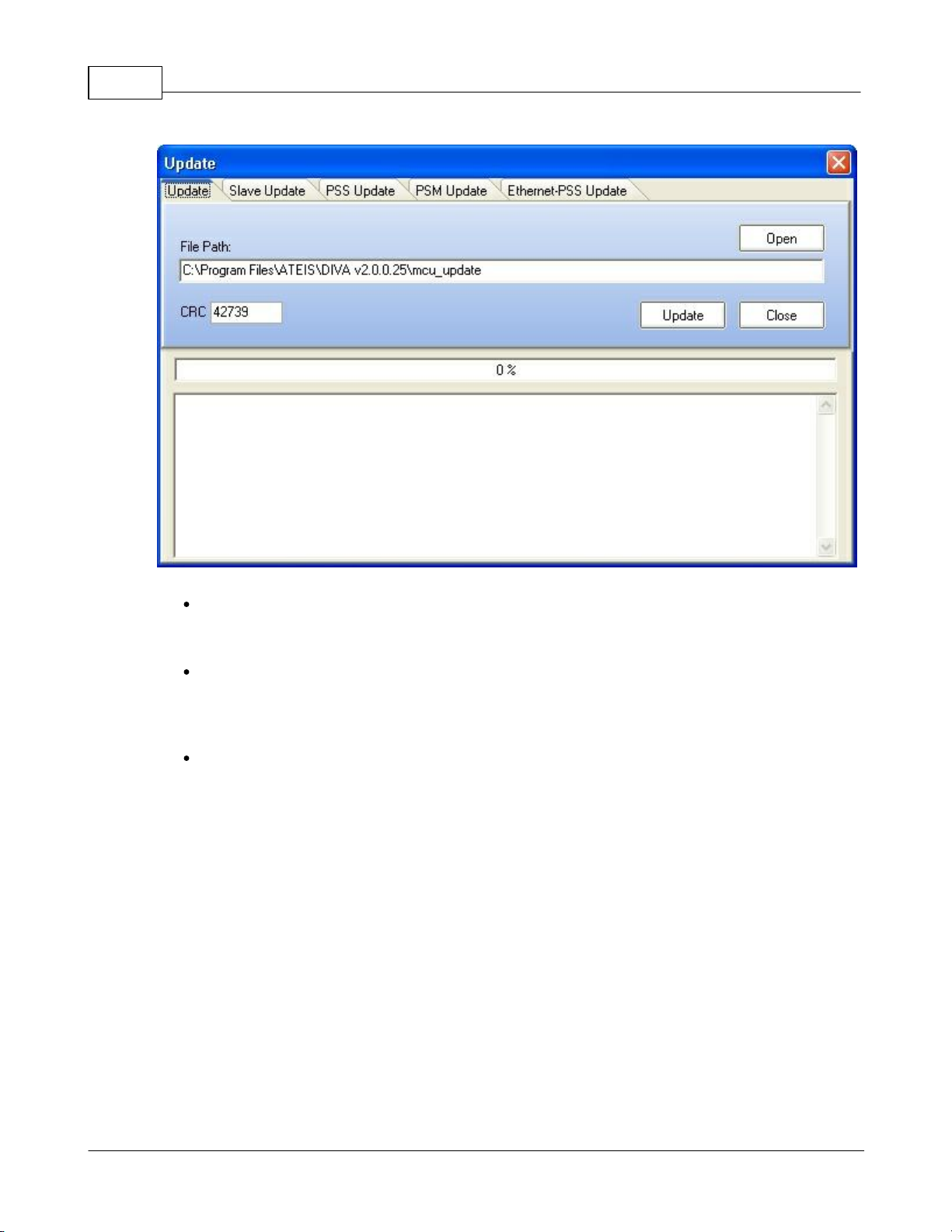
If this is the first installation, please update the DIVA software to the latest version available on
our website. In the DIVA software click on the menu "tools-> update". In the update window
(Figure 6), verify that the path specified is the one corresponding to the last version software, if not
click open and choose the right one. Then click on the update button.
DIVA software will ask for password. For default users have been set into DIVA:
o User1: ATEIS1 Password: ATEIS1 User level: 1
o User2: ATEIS2 Password: ATEIS2 User level: 3
o User3: ATEIS3 Password: ATEIS3 User level: 3
o User4: ATEIS4 Password: ATEIS4 User level: 4
© 2012 ATEÏS
Page 16
DIVA system16
Figure 6: Update window
Next step is to set the network option. Simply click F12 or menu "Tools->Options". new pop
window will appear directly on the network options page (Figure 8). Please check that the network
card is one to be used.
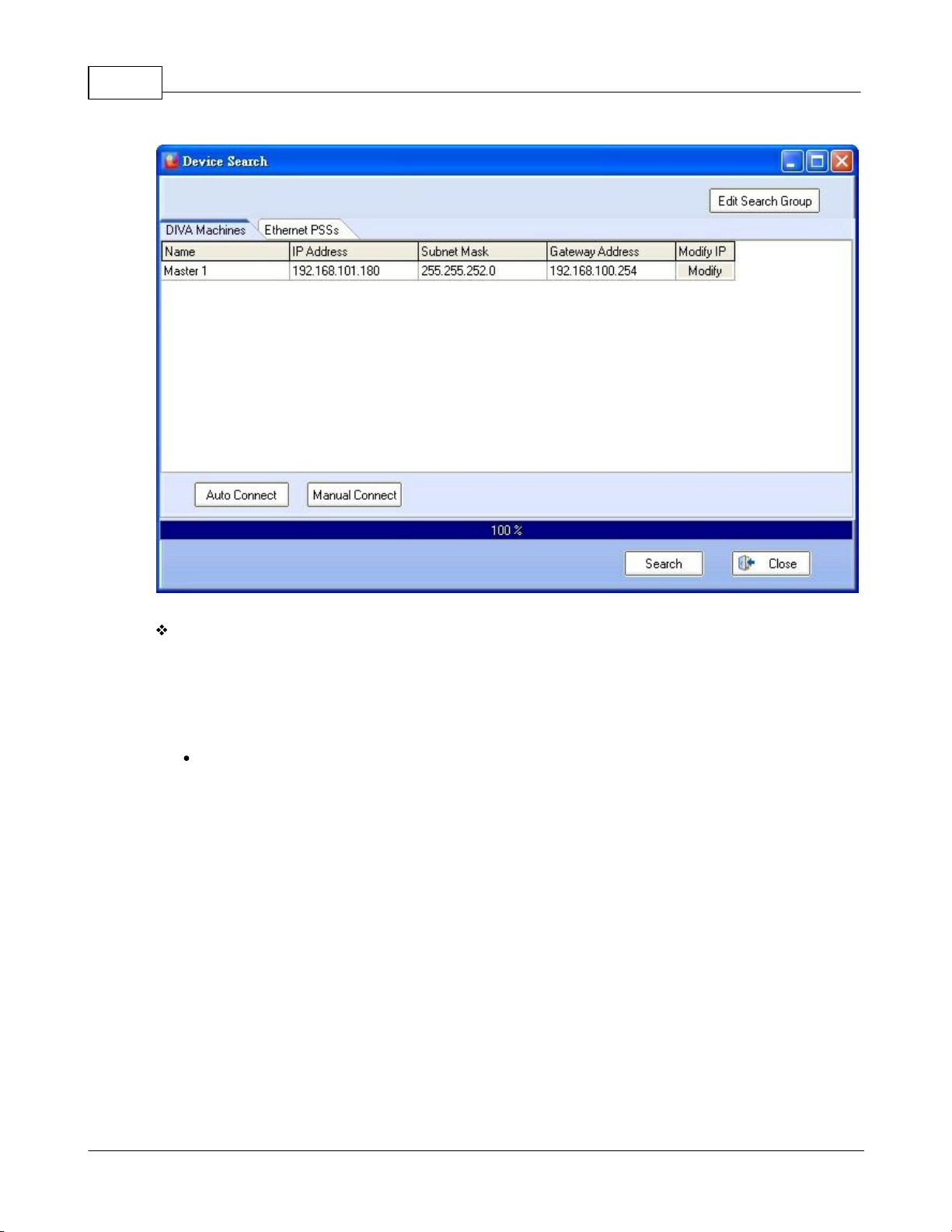
The devices connected to the TCP/IP network have to be detected. Click on the menu "Tools>Device Search". In the new window, click on device "Start Search" button to check if the Network
is correctly set up. A list of all networked devices is displayed. If your Master DIVA is not
detected, please check cables and verify the IP address assignment.
Select the Master DIVA you want to work on and then click "Auto Connect". After connection, you
will be able to see the IP address of the master on the system window.
© 2012 ATEÏS
Page 17
Quick Start 17
Figure 7: New System
Figure 8: Netw ork options page
© 2012 ATEÏS
Page 18
DIVA system18
Figure 9: Device Search page
Event Philosophy
For a better understanding of how the DIVA works, a quick "Events" explanation is needed.
Event can be compare to an action. Each action or event can be started by a multiple of different
ways: external trigger, modulation detection, etc. Those events are hierarchically organized by
priority levels set for each one of them. You also can set permanent event like playing music.
Music
Now the DIVA connections are configured. The following step is how to set the system for using
audio external sources, like tuner, cd player, computer, etc., and assigned them to zone. In the
main system page (Figure 7), double click the DIVA Icon after having rename DIVA apparel
according to your wishes, here DIVA1 (default is "master1"). A "DIVA1" pop window is displayed
(Figure 10).
© 2012 ATEÏS
Page 19
Quick Start 19
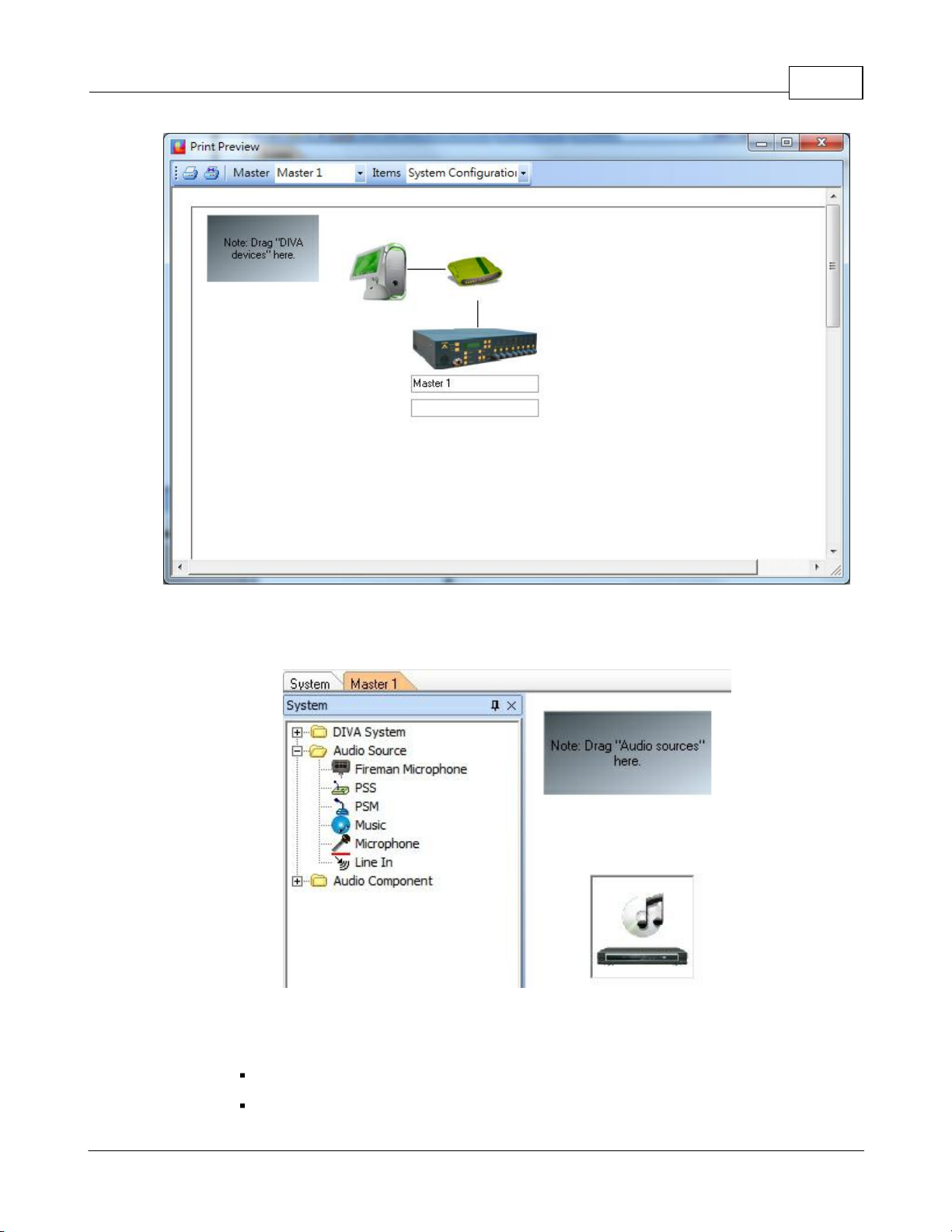
Figure 10: Master page
Figure 11: Adding music source
In the tree folder, click on audio. It will display all the audio sources available for DIVA. Simply
drag and drop the music icon on the corresponding drawing in the DIVA1 window (Figure 11).
The connection picturing will automatically show that the connection exists.
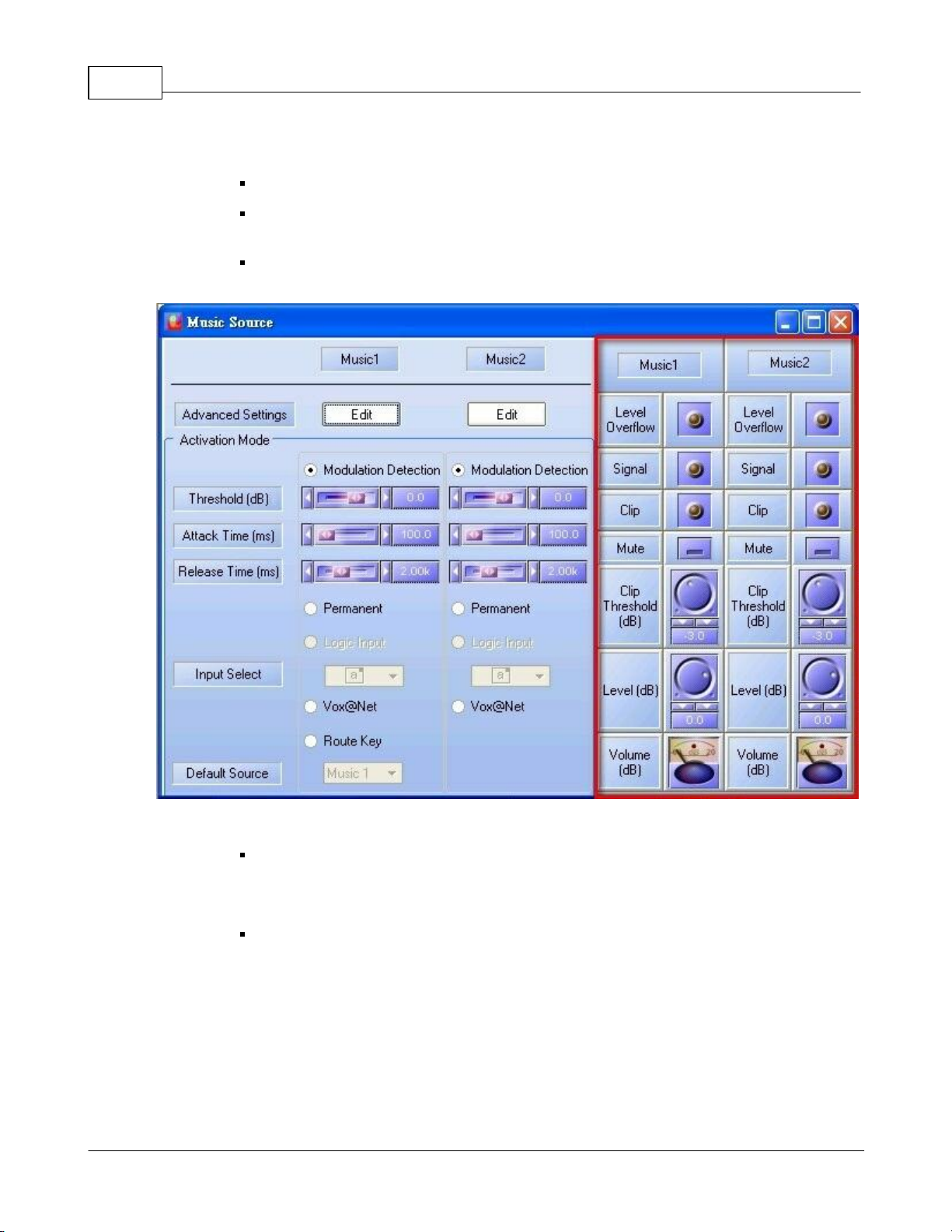
o Double Click on the music source icon to open the "Music Source" window(Figure 12). On the
figure, the part that is red framed is for the real time control.
© 2012 ATEÏS
In order to achieve your aim, you need to specify some parameters:
Select the Route Key mode under Music 1. The music sources will be controllable from
Page 20
DIVA system20
Figure 12: Music Source w indow
the front panel.
Click on Edit, for Music1 and Music2, in order to set event's parameters
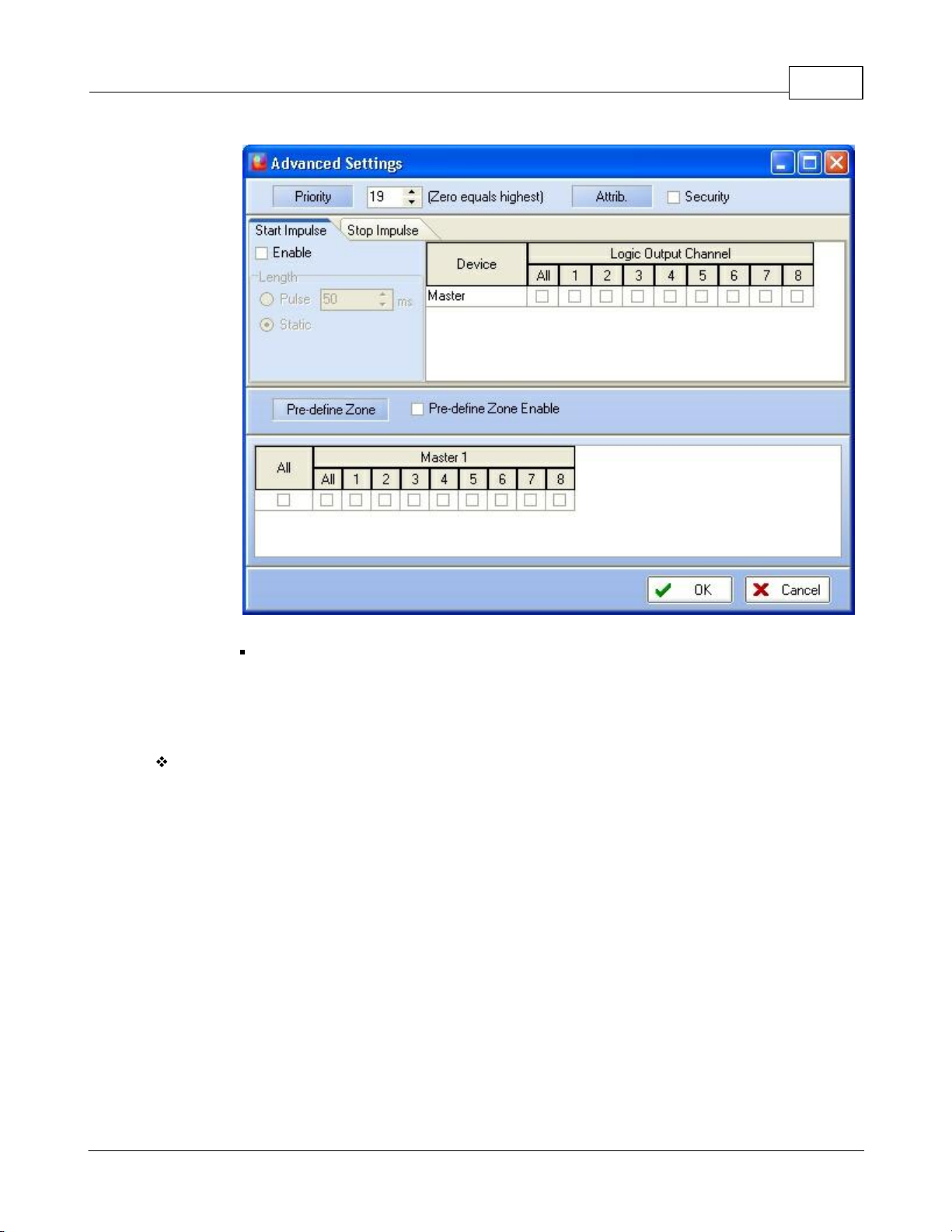
Define the priority from 0 to 20, default is 20. Note: 0 is the highest priority. Here music
has been set to 13.
The event "Play Music" is created automatically as soon as you configure you music
source.
In the "Advance Setting" page, tick the "Pre-define Zone Enable". Then are able to define
the zone where music will be played, here zone 1, 2, 3.
Note: you cannot define different zone for the two music sources.
Click the OK button.
© 2012 ATEÏS
Page 21
Quick Start 21
Figure 13: Play Music Event window
Configure your default source. Choice is between music source 1 and 2 (here 1).
Your system is now configured to play music from the music source 1 and 2. Please save your
project before going to next step and close the "Music Source" window.
Note: At this time, you won't be able to hear music before compiling your file and store it into DIVA.
Messages
This section will explain how to set up messages (like alarm, evacuation, test, etc.) and how to use
them.
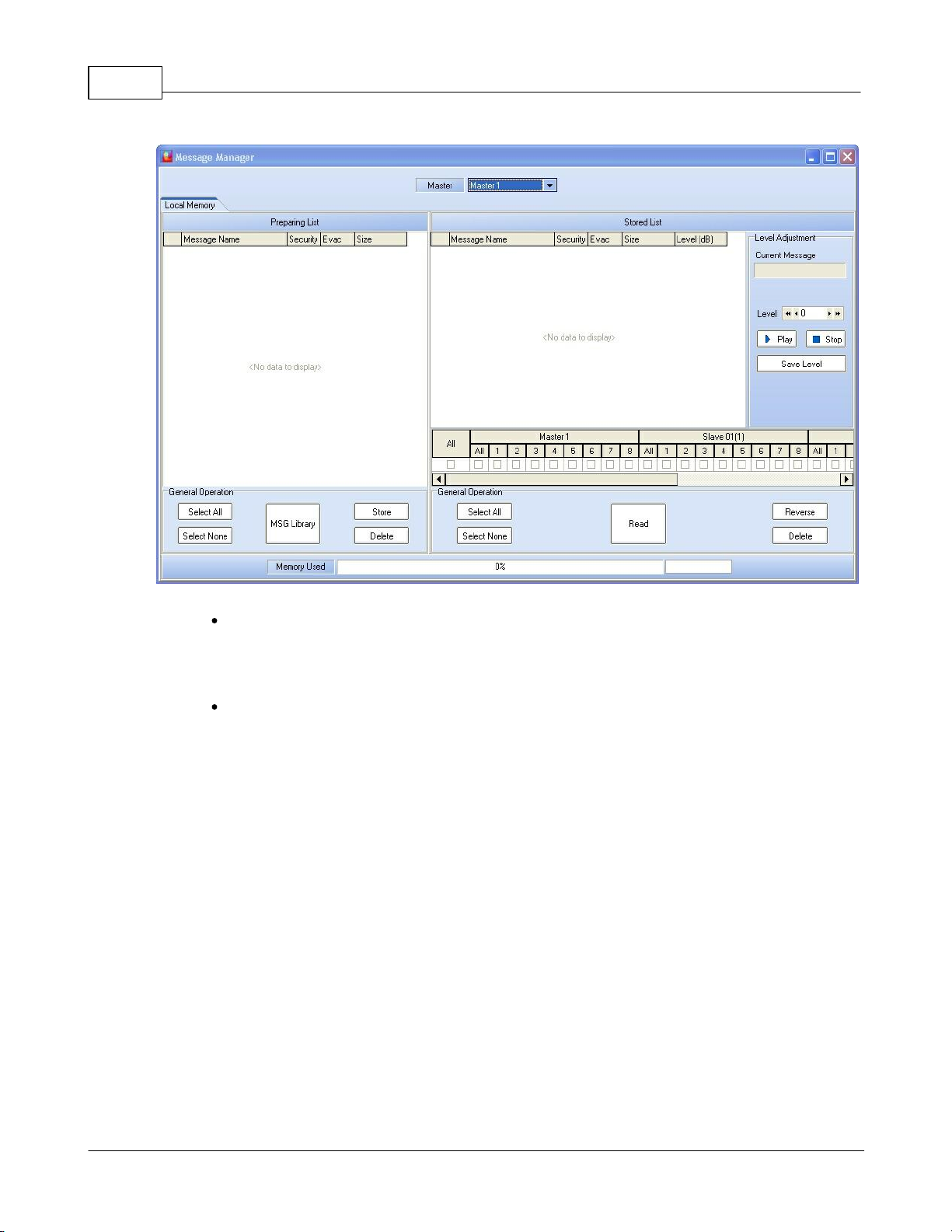
The messages are administered with the so-called "Messages Manager". To add messages to
message library, just save your messages in .wav format (16bit, 16kHz) into the "message lib" folder
under the "Programe Files ->Ateis ->ATEIS DIVA folder.
To access the messages manager, please follow the next steps.
Click on the menu "view" -> "Message". The message page will display(Figure 14).
© 2012 ATEÏS
Page 22
DIVA system22
Figure 14: Message Window
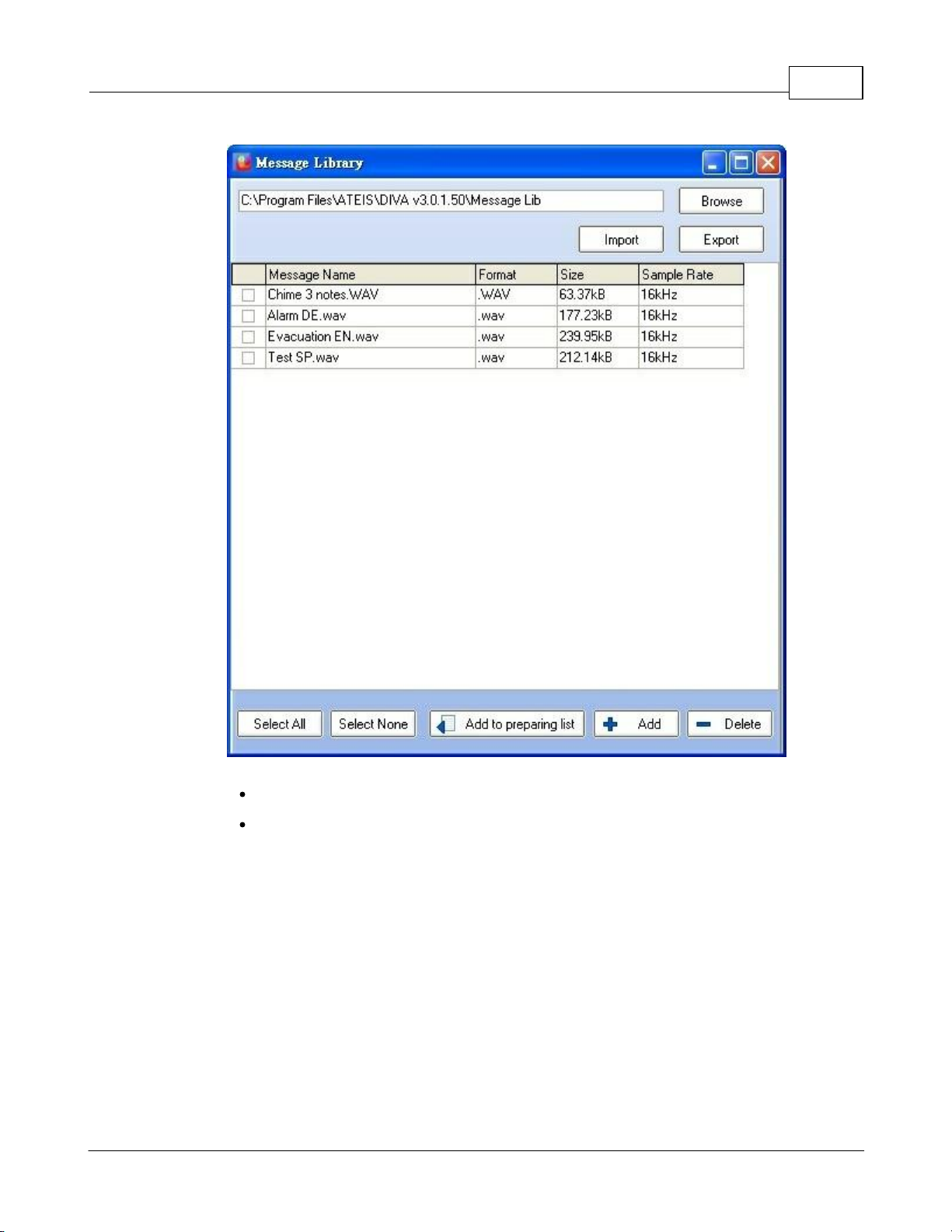
Click on the "MSG Manager" button. A new "Message Library" window appears. In the
Library (Figure 15), all the messages in the library files are display. Simply tick the one you
want, here all, to import into DIVA and click the "Add to DIVA" button. You will automatically
return to Message page.
Once you are back in the message window, you can select the messages to store in DIVA
and specify if there are security messages or not. Simply tick the right cases, and then push
the "Store" button. For this example, all of them are selected and security has been desired
for "Alarm DE" and "Evacuation EN".
© 2012 ATEÏS
Page 23
Quick Start 23
Figure 15: Message Manager Library page
© 2012 ATEÏS
Close the message page and go back on the "DIVA1" page
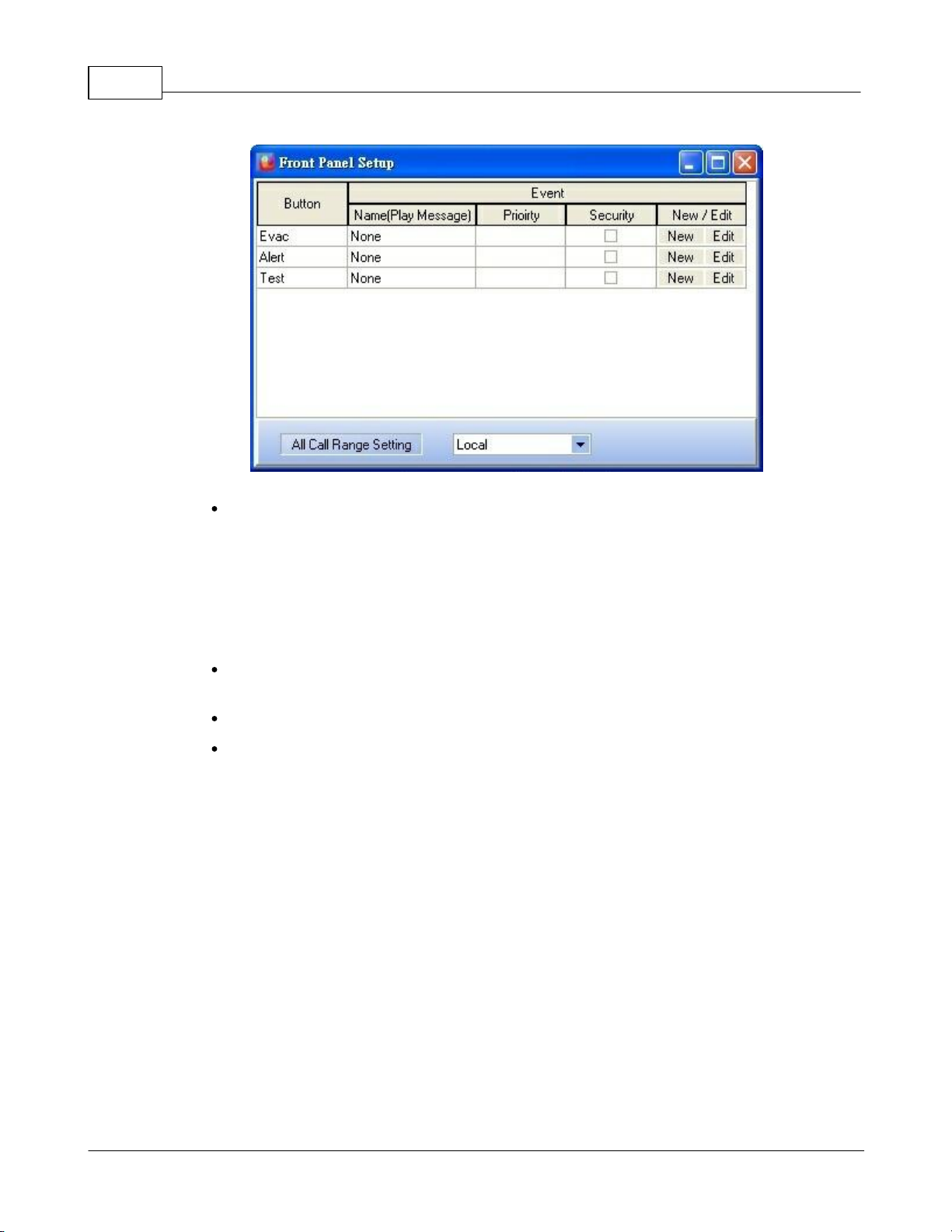
Click, under DIVA icon, the "Front Panel Setup"(Figure 16). You need to assign an event
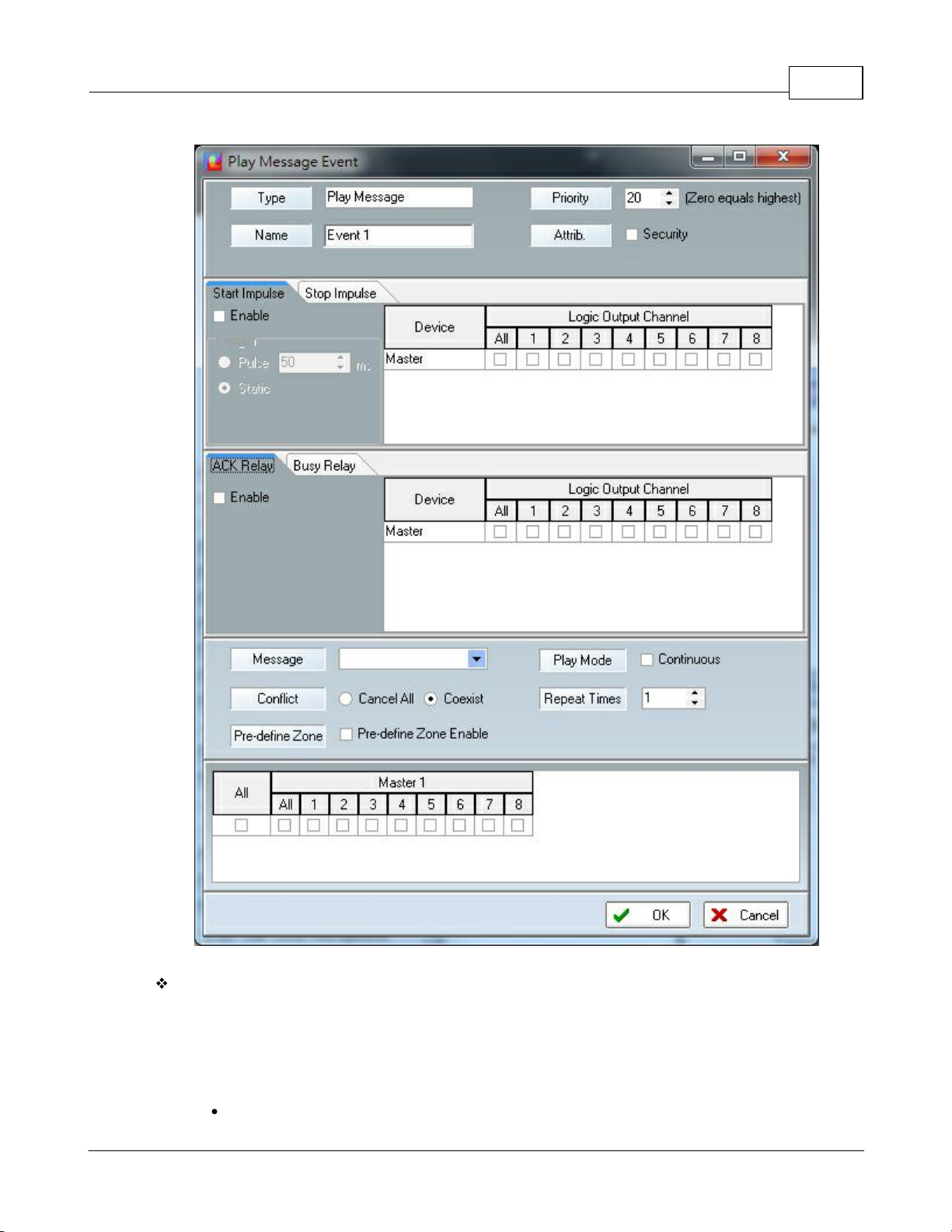
to the message buttons of the front panel (Evac, Alert and Test). For each button, make a
new event and then edit the events (example on Figure 17).
Page 24
DIVA system24
Figure 16:"Front Panel Setup" window
In dedicated area of "Play Message Event window (Figure 17), change the name, choose a
priority and tick if it's a security message or not. Under "Message" emplacement, choose with
the drop-down menu the right message for the event. You can also define the "Play Mode"
option: peat for ever or repeat for a definable number of time. Please choose between the
"cancel all" or "Coexist" option. "Cancel All" consist of cancellation all the messages or
events, with a lower priority, that are currently playing in the selected zone. "Coexist" permit
to momentarily disable the current message or event and to retrieve it as soon as the one with
a higher priority has finished.
Last thing to do is to define the zone where this message will be played. Here for the
evacuation message, every zone are selected.
Repeat this section for the two more buttons (Alert and Test).
Close the "Front Panel Setup" window
© 2012 ATEÏS
Page 25
Quick Start 25
Figure 17: "Message Event" edit page
© 2012 ATEÏS
Fireman Microphone
The Fireman microphone is a special monitored microphone. It means that at any time, the
connection and the status of the microphone are measured and analyze. If any faults are detected,
the front panel "Faults" led will illuminate.
In order to set up the use of the fireman microphone, please do as follow.
In the DIVA1 window, drag and drop the fireman microphone icon from the tree folder.
Page 26
DIVA system26
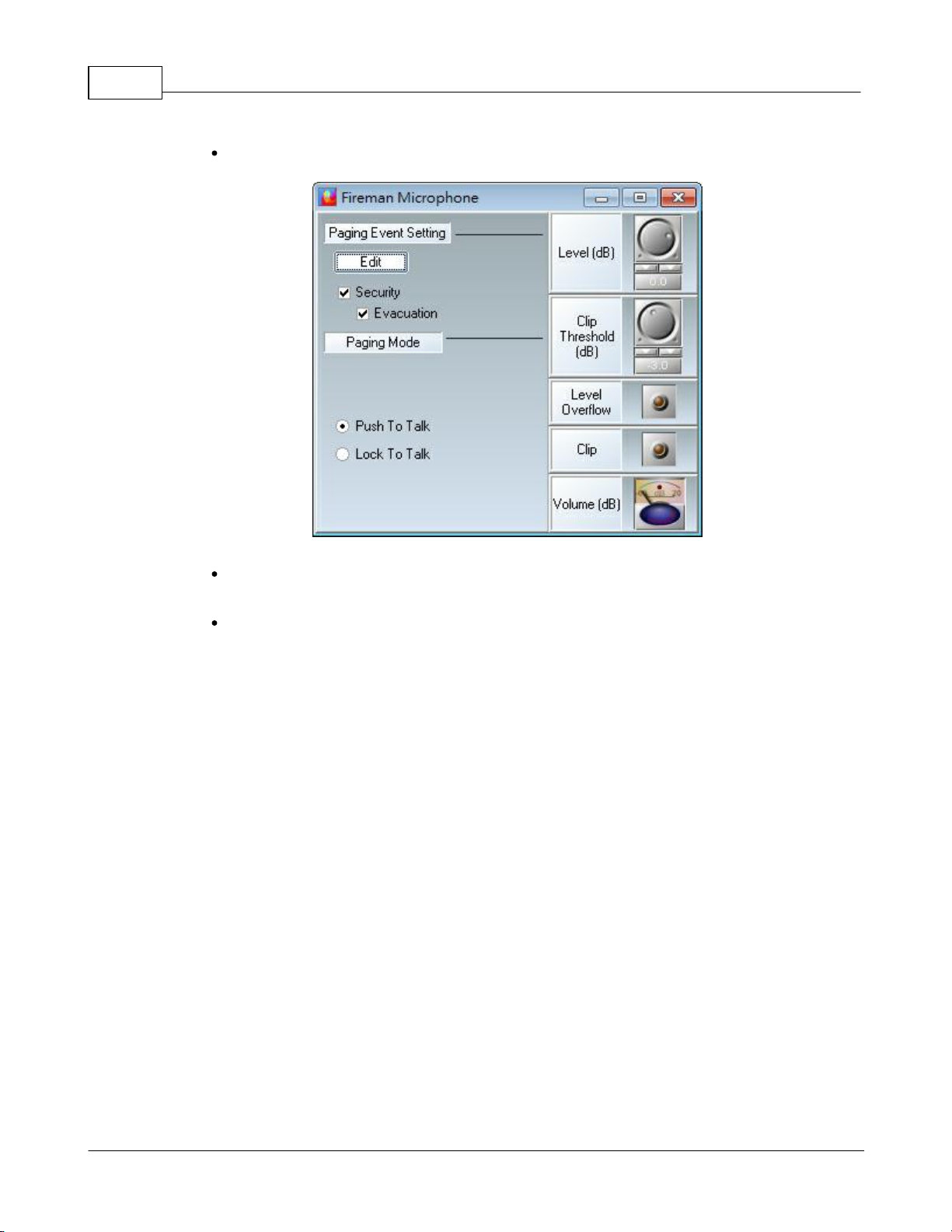
Figure 18: Fireman Microphone window
Double click the Fireman Microphone Icon. The "Fireman Microphone" window will open
(Figure 18).
As for music, the event corresponding to the fireman microphone is automatically created.
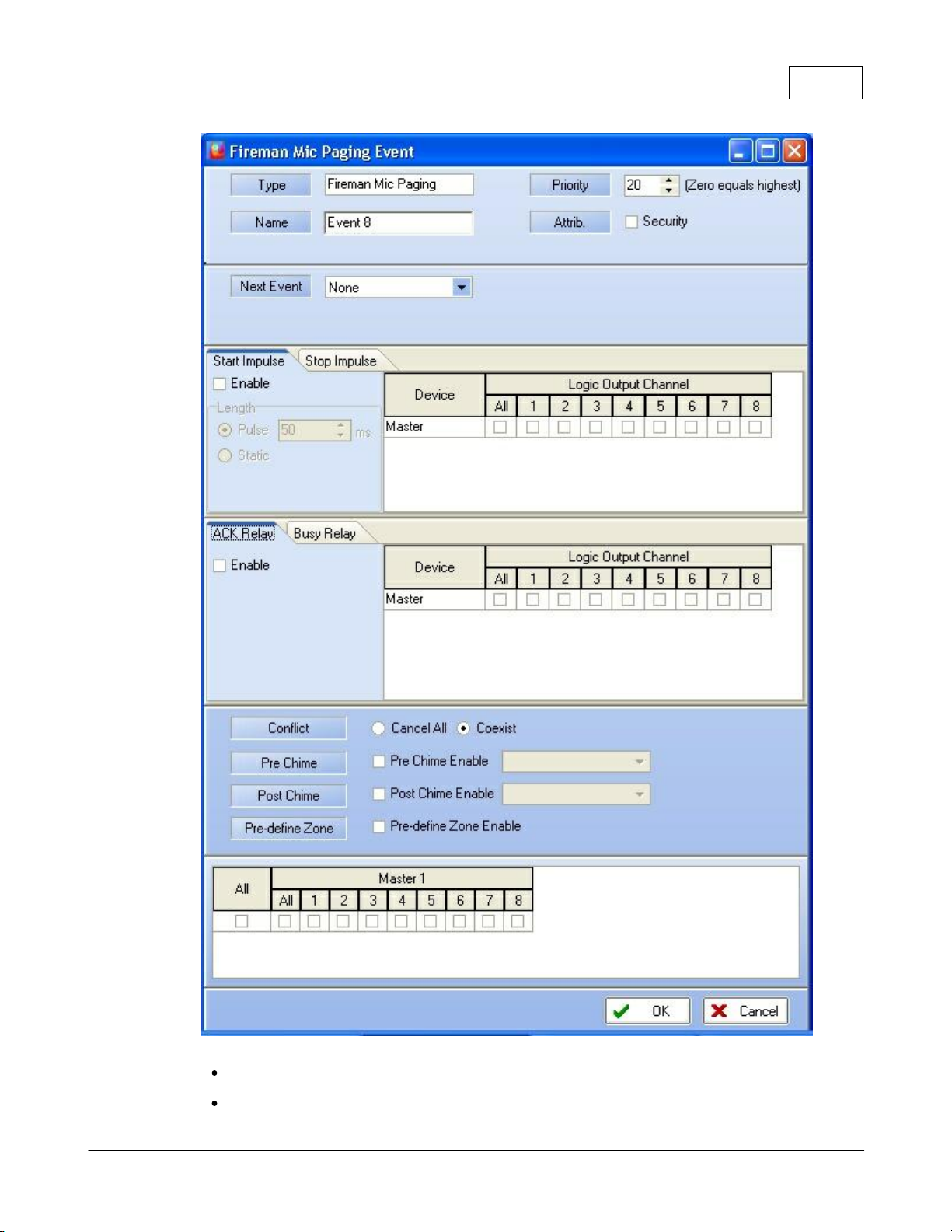
Click "Edit". A new pop-up window opens(Figure 19).
You need now to set the priority of the fireman microphone, by default it is set to 0, and tick
security (as his main purpose is to deliver security warning).
© 2012 ATEÏS
Page 27
Quick Start 27
Figure 19: Paging Event w indow
© 2012 ATEÏS
Then, under "Conflict", choose "Cancel All" "Coexist according to your needs.
Tick "Pre-define Zone Enable" in order to define where the fireman microphone will play.
Page 28
DIVA system28
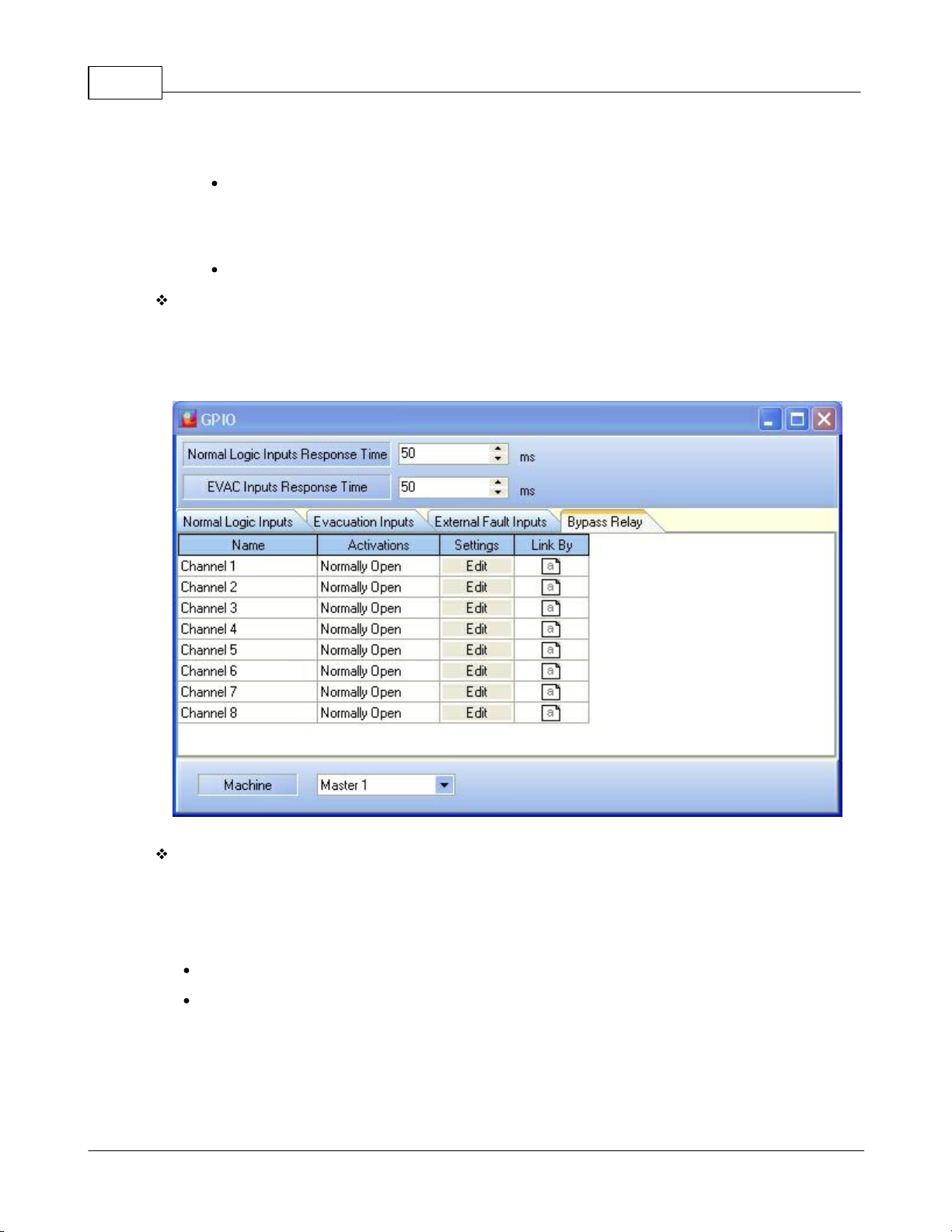
Figure 20: GPIO window
Choose zone according to your needs. Then click "OK".
In the Fireman Microphone window, select the behavior of the microphone under "Paging
Mode". You can choose between "Push To Talk" or "Lock To Talk", respectively means that
you can talk only while pushing the microphone button or talk after pushing once the
microphone button (stop talking by pushing a second time the microphone button).
Close the "Fireman Microphone" window.
GPIOs
The two next paragraphs EXFLT and INPUT discuss about, respectively, how to use GPIOs to have
the SONaes default contact working and to add a external contactor to trigger an evacuation action.
To access the GPIOs page, click under menu "View -> GPIO"
EXFLT
Before going any further, the principle of security in the event have to be discussed. In case of power
shutdown, the all DIVA system is designed to run under 24V battery. The DIVA is made for energy
saving and will only keep security event alive. All the non-security event will be disable. The activation of
an external fault input will force DIVA into security mode.
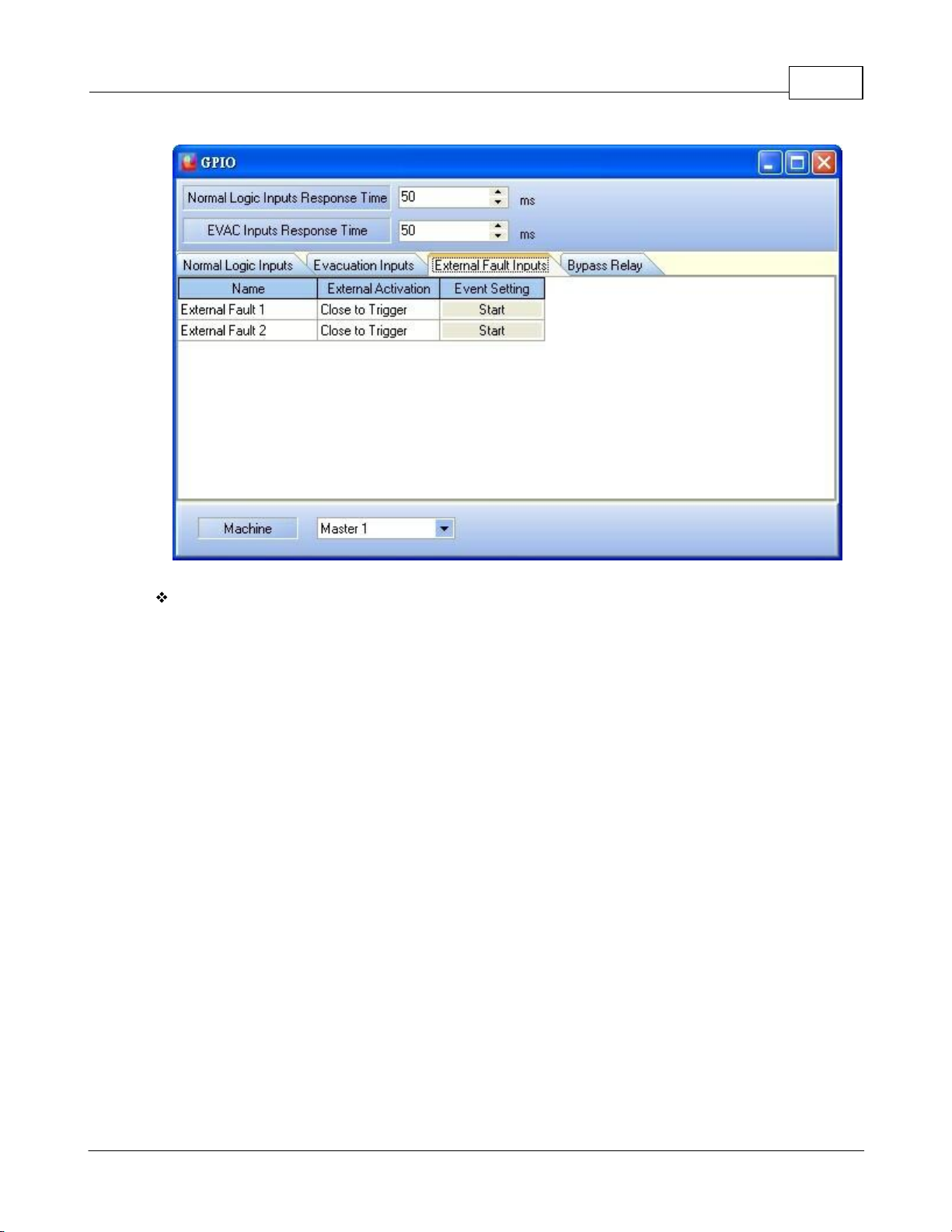
In the GPIO window (Figure 20), click the External Faults Inputs tab (Figure 21).
Tick the security square.
Note: You don't have to define an event in order to activate the external fault inputs. Ticking
Security will induce DIVA to know in case this contact is activated that there is a major issue
and will automatically go in power safe mode. So that only security event could be activated.
© 2012 ATEÏS
Page 29
Quick Start 29
Figure 21: External Fault Inputs page
EVAC:
Evacuation inputs can be monitored input. It means that the line is under surveillance. In this
example, we will activate the evacuation message by calling the "Evac" event.
Note: see annexe to know how to perform a monitored evacuation button/line.
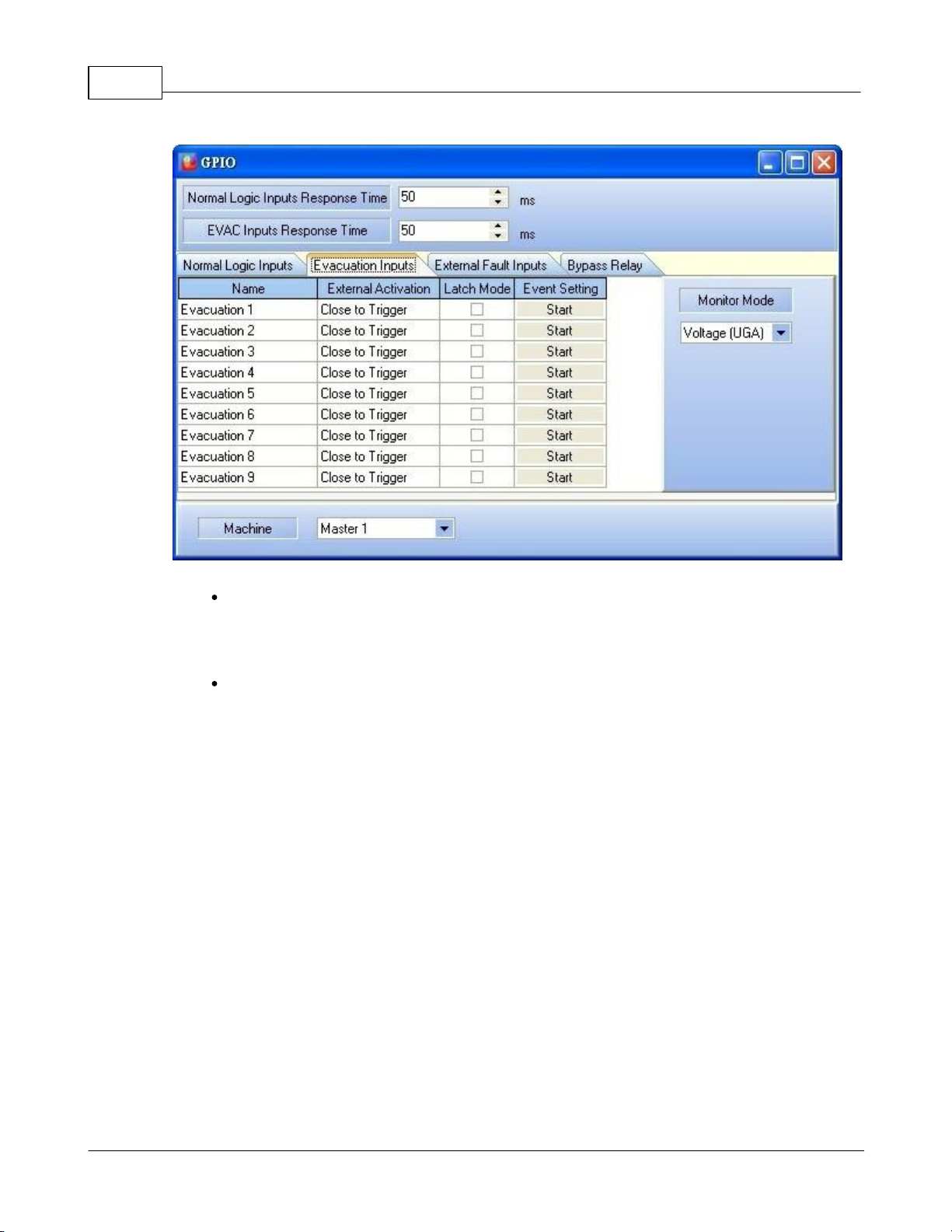
In the GPIO window, please click on the "Evacuation Inputs" tab, see Figure 22.
© 2012 ATEÏS
Page 30
DIVA system30
Figure 22:GPIO's Evacuation Inputs tab
Under Channel 1, tick the "Latch Mode" square selector. "Latch mode" defines way the
contact or button will work. In "Lach Mode", you will have to close/open the contact once for
launching the event, and reclose/reopen it to stop the event. In "Non Latch Mode" the contact
need to be close/opened all the time the event has to be activated.
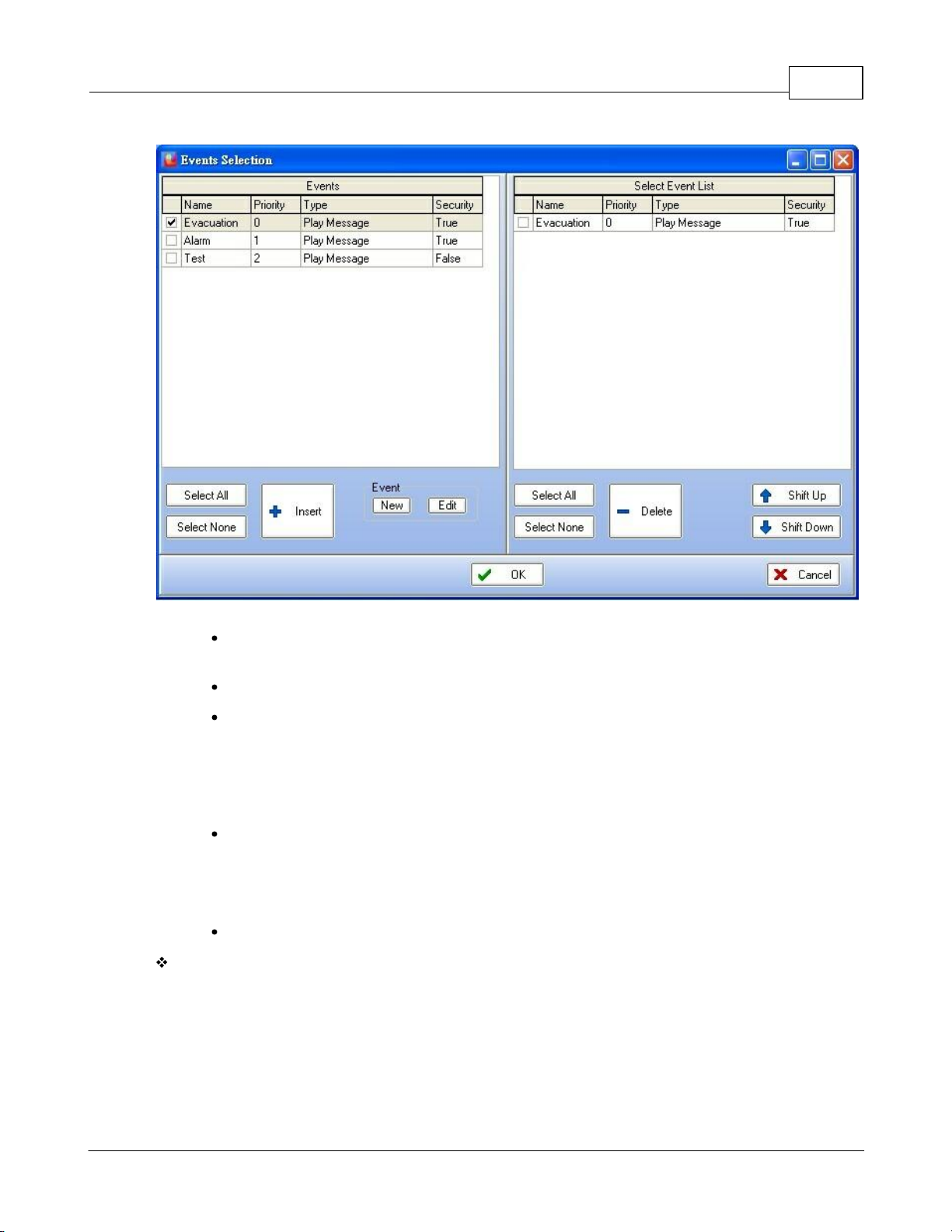
Click on the "Start" under "Event Setting" for channel 1. You will enter in the "Events
Selection" page, see Figure 23.
© 2012 ATEÏS
Page 31
Quick Start 31
Figure 23: Evacuation Inputs Event Selection page
At the left of the page, you will see all the existing event. Select the "Evac" event an click on
insert.
Click "OK"
On the GPIO page, "Evacuation Inputs" tab, you will find under "Monitor Mode" drop-down
menu which allow you to choose between 2 modes: Voltage UGA and Contact.
Note: "Voltage UGA" mode means th the contact is activated by an external voltage
source. "Contact" mode used internal voltage source that is forced to 0 V when the input is
shorten (closed contact).
Tick the "Monitored" square selector to apply a full surveillance to your contact.
Note: "Monitored" have to be used with additional 47k resistors at the end of the line. The
monitored input permit to determine if there is a short-circuit, an open line, a closed contact
or an open contact.
Close the GPIO window.
Surveillance Monitoring
As said before, DIVA is EN 60849 and EN54-1 compliant. It means that the monitoring of event,
message and speakers line are totally secure.
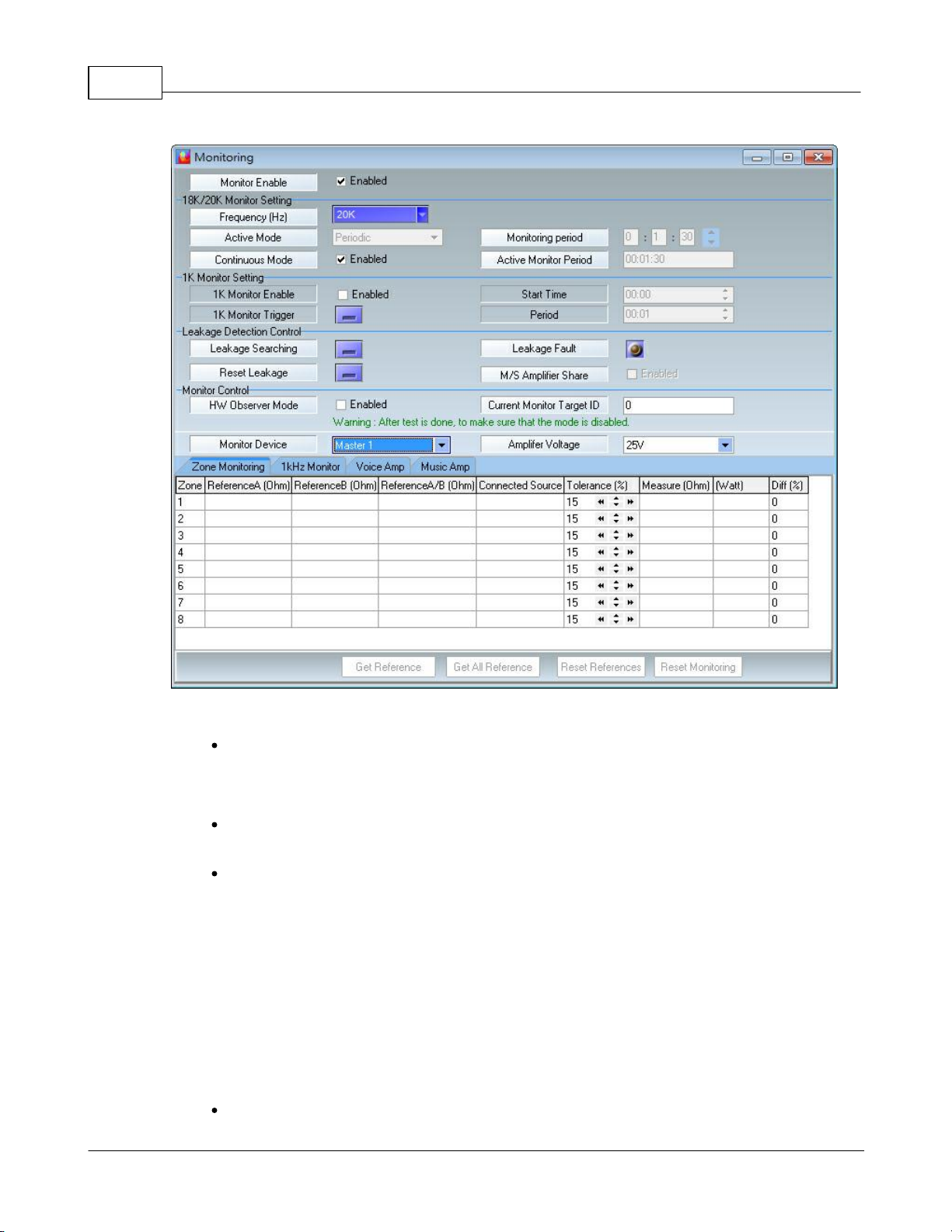
To access the monitoring window, go on the DIVA1 window and click the "Monitoring" button under
the DIVA icon.
© 2012 ATEÏS
Page 32
DIVA system32
Figure 24: Monitoring Window
In the "Monitoring" window(Figure 24), you can see the machine display. It informs which
DIVA you are currently monitoring.
Note: all DIVA in your Network are real time surveillance monitored.
The "Monitoring" window is divided into four distinct parts: "Zone Monitoring", "1kHz Monitor",
"Voice Amp", "Music Amp" (corresponding to the four tabs) .
Zone Monitoring
o As mentioned before, one speaker zone is separated in two, A and B. On for security
(Voice) and one for Music (Music). The Voice channel has the priority regarding Music
channel in case of power supply defect. In case of default on the Voice Channel, the voice
source is automatically routed on the Music channel.
o Click on the "Get All Reference" button. It will start storing the actual measurement for
each zone.
o In the "Zone Monitoring" page, you can specify the tolerance of the faults detection. It
means that as long as the real time measurement is within the reference +/- the
tolerance, the monitored speaker lines are considered as non faulty.
1kHz Monitor
© 2012 ATEÏS
Page 33
Quick Start 33
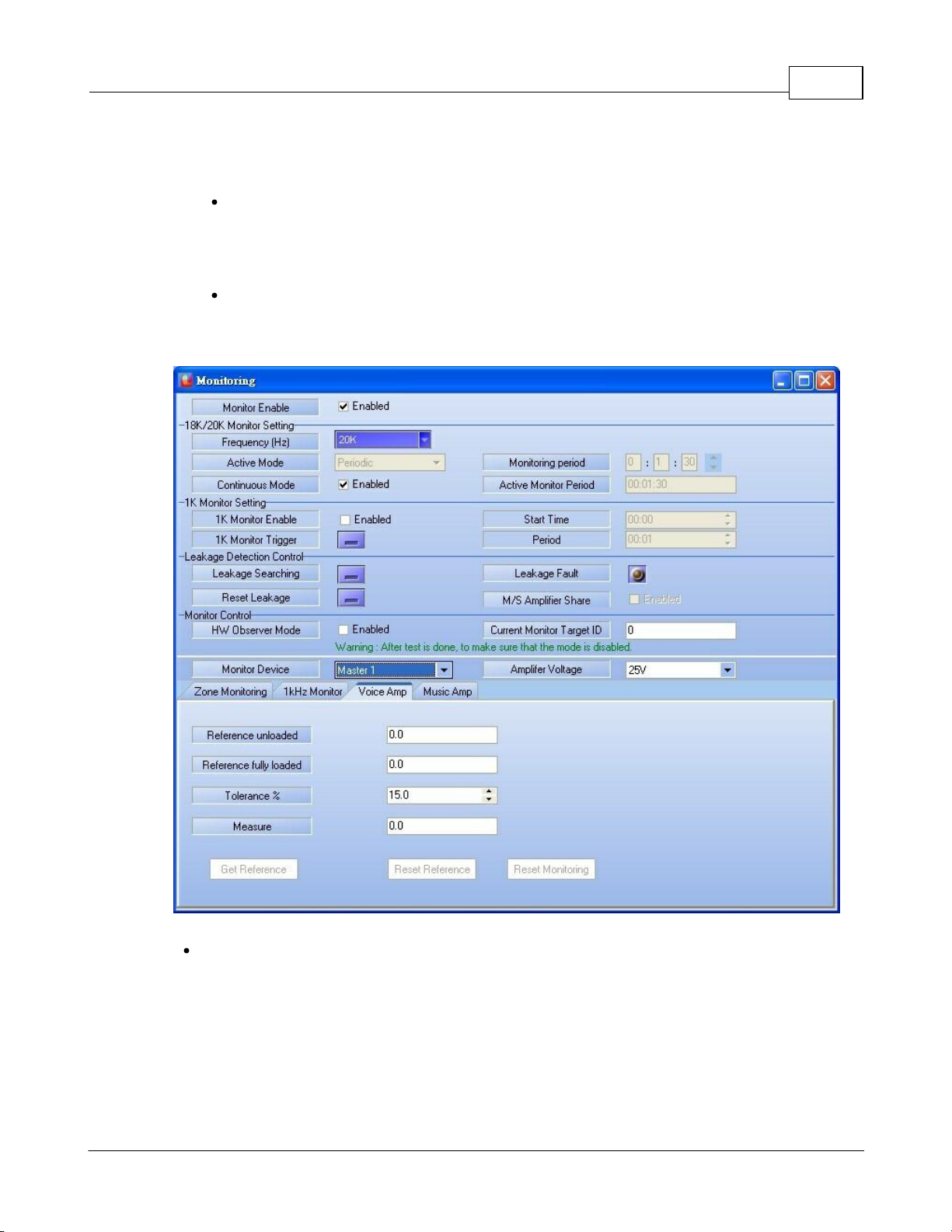
Figure 25: Voice Amp Monitoring Window
To add the scheduler for detecting the 1kHz monitor. Set the scheduler to trigger the detect
for every speakers' 1k tone outputs.
Voice Amp
o The voice amp tab is illustrated on Figure 25.
o Simply click on get the reference and choose a tolerance.
Music Amp
To get the reference impedance measurement and to start monitoring this amp channel,
simply reproduce the "Voice Amp" procedure Close the monitoring window.
© 2012 ATEÏS
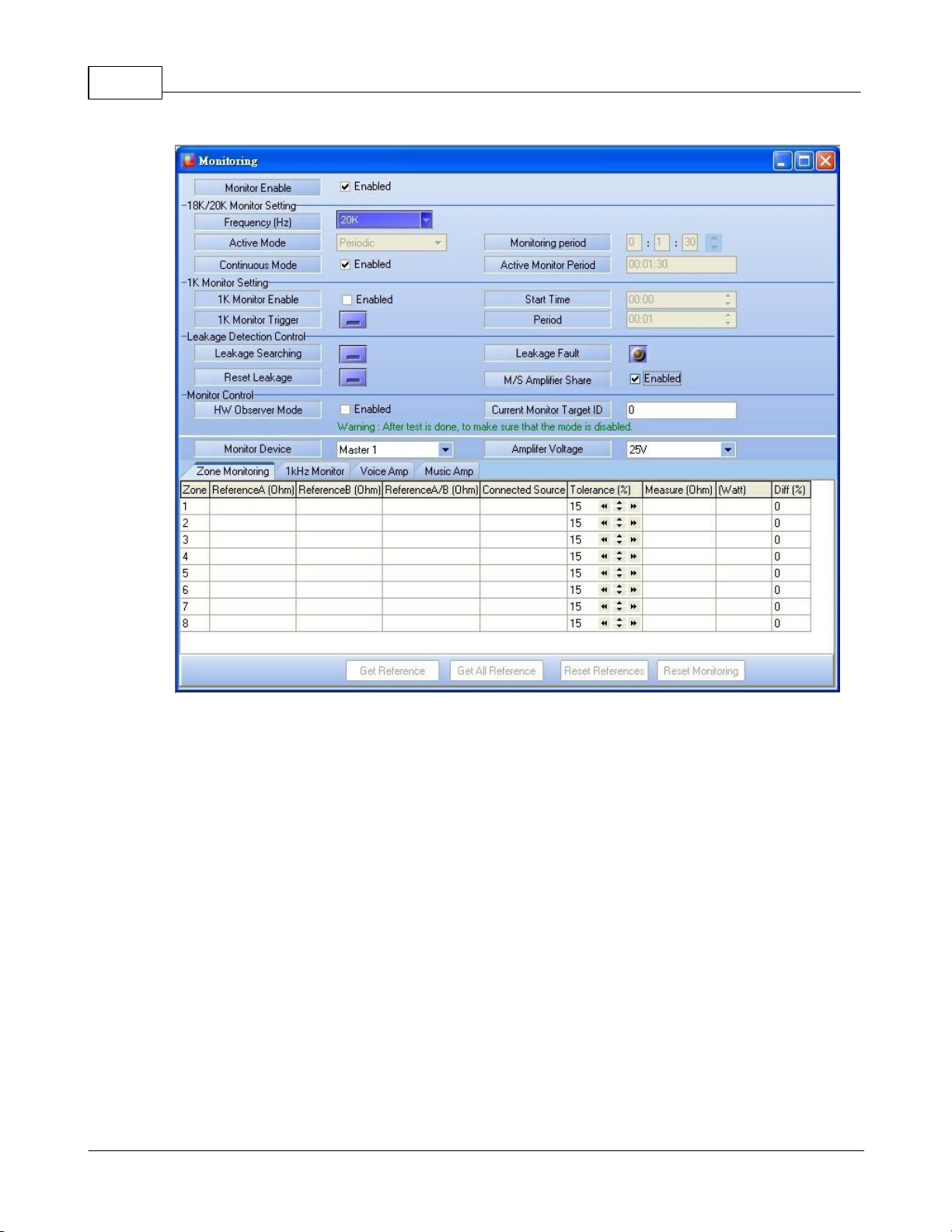
Leakage Detection Control
o You need to tick the “M/S Amplifier Share” box if there are more than one unit in this system.
o The Leakage Fault appears, the light on Fig25-2 will light up, through the searching button,
you can find which slave or which zone has leakage problem.
o You can press the “reset leakage” or set the TFT menu to off the current leakage fault, but it
will display leakage fault again if the monitor detects the leakage later.
Page 34
DIVA system34
Figure 25-2: Leakage detection control Window
4 Product Features
4.1 DIVA Series Audio Processor
4.1.1 DIVA8M
4.1.1.1 Overview
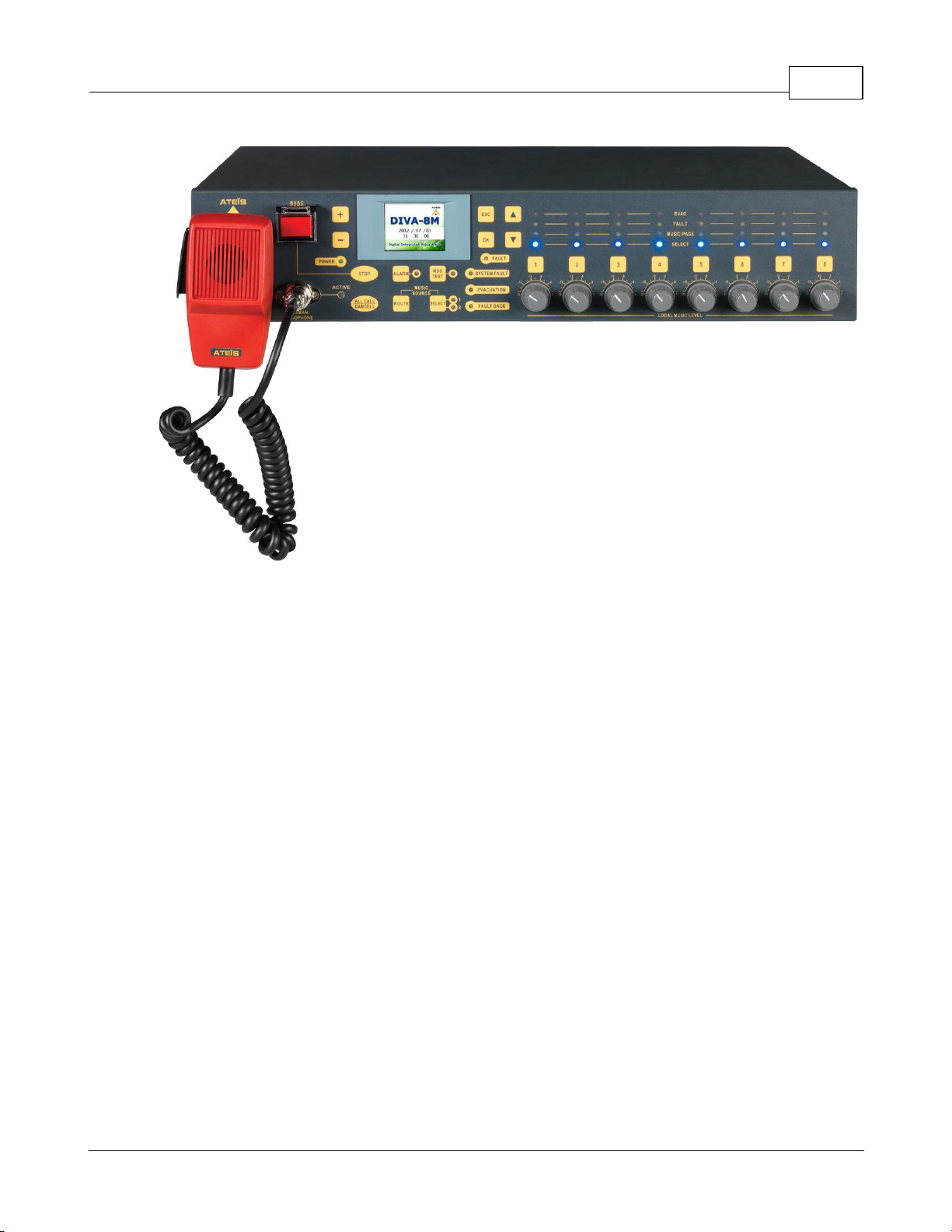
DIVA8MG2 responds to public address requirements and Voice Alarm EN 54-16 compliance for
small to medium installations.
© 2012 ATEÏS
Page 35
Product Features 35
The DIVA8MG2 module unit houses : audio digital signal processing (DSP), a matrix, a digital message
player, a fully monitored fireman microphone, amplifiers monitoring with switchover to backup amplifier
and loudspeaker lines monitoring.
It can process and route one PSSxxDT security microphone console or up to eight cascaded PSM
paging microphones and two 0 dB audio inputs, plus one Mic/Line input, into 2 different channels (Music
+ Voice).
Each input is fitted with volume controls and equalizers. All audio inputs feature contact and VOX
activation (ideal when using the cordless microphone, for example).
Up to 45 minutes of digital messages can be downloaded and recorded as WAV files directly from a
computer into DIVA8M. Two messages can be played simultaneously in different zones. One of the
messages can be used as a chime for the PSS microphone. Nine monitored alarm inputs making it
possible to obtain the pre-programmed routings.
Each DIVA module has eight output zones with a+b wiring. Each zone can be routed manually or
automatically to one of the system’s audio channels (Music and Voice). The number of zones can be
extended up to 128 zones with DIVA8MS (Slave-module).
The two Music channels can be switched ON/OFF in each zone separately. In case of Evacuation, the
Music channel can be used as a second alarm channel.
A DIVA system requires only one 2 channel amplifier (one for Music, one for Voice). The Music amplifier
will act as a backup amplifier in case of a Voice amplifier failure. Each channel can handle up to 500 W
of audio power (100 V).
From the front panels, the user can manually route the fireman microphone signal and three digital
messages into the selected zones, adjust the audio level and switch (ON/OFF) the music in each zone
separately. In case of evacuation, the zones attenuators are automatically bypassed. One output
contact per zone (eight per unit) can be activated each time the zone is occupied with a source having a
higher priority than the music (Alarm or microphone paging…).
© 2012 ATEÏS
Page 36
DIVA system36
As an EN 54-16 security system, all DIVA components and peripherals are constantly monitored
(without music interruption). All incidents are recorded into a data file which can be consulted on the
DIVA display or on a PC.
Also any detected faults and alarm status are signalled by general fault and alarm output contacts. A
local loudspeaker enables selective listening to all the sources and the system’s output signals.
The setup of DIVA is realized through a PC computer and the PCDIVA configuration software (Windows
compatible). Access can be password-protected.
The routing and the level of the music sources can be controlled directly from the PSS microphone.
All these features make DIVA the ideal system for shopping malls, hotels, restaurants, museums and
many other public places.
DIVA8M is made of:
5 audio inputs (2 x line, 1x MIC/ line, 1 x PSS or PSM, 1 Fire Mic.).
Integrated and monitored Fireman microphone.
8 logic input contacts.
1000 W max power on each channel amplifier.
RS-232 serial interfacing for third party control (Modbus, Notifier, Vox@net network).
Ethernet port (RJ-45) TCP/IP based for computer management, for software configuration and/or to
enable IP paging.
9 alarm evacuation input contacts(with surveillance).
Eight speaker zone connectors split in A and B line.
PSS/PSM connector, RJ-45 connector to link PSS or PSM call-stations.
Master-Slave link, RJ-45 connector to create a master-slave DIVA system.
Backup power input for 24VDC power supply.
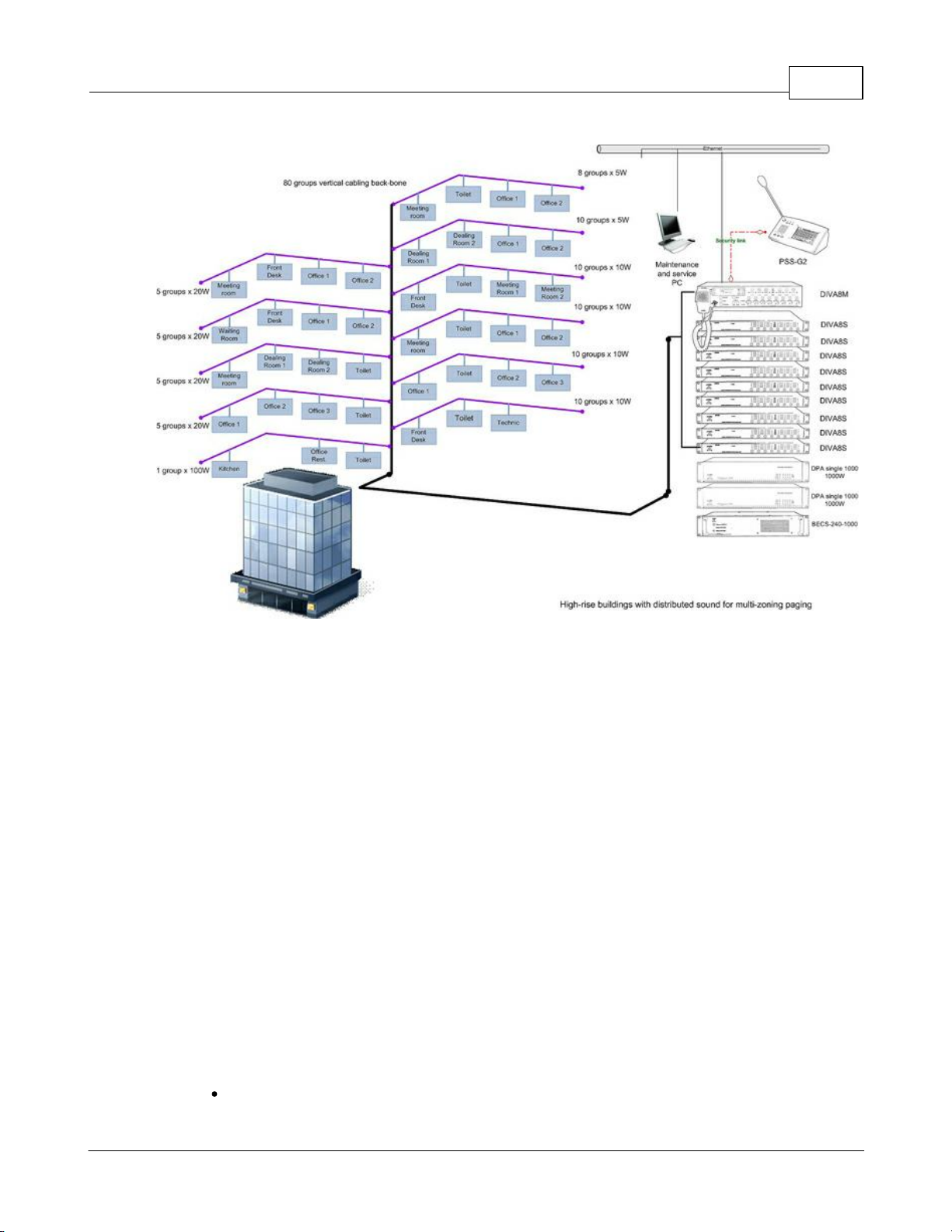
Application Example 1
High rise building with distributed sound for multi-zone paging:
© 2012 ATEÏS
Page 37
Product Features 37
This tutorial describes a PAVA system, VACIE, which is used for voice evacuation with an
automatic link to a firepanel system, FACIE, for high rise building applications with multizone paging
requirements. The DIVA concept represents a reliable and affordable system solution.
The system consists of a central rack that contains all equipment including: DIVA8M - Master unit
and 9 pcs. of DIVA8S - Slave units, covering an 80 zones background music and selective paging
and voice evacuation system.
From the central rack, a multi-pair cable transports the audio to the multiple zones with variable
loads. The DIVA8M - Master unit provides the fireman’s operating section on the central paging
facility rack and a touchscreen multi-zone paging and control console. This part of the system is
also linked to the FACIE.
The DIVA8M - Master unit is linked with the DIVA8S - Slave units using a secured link over RJ45.
Two powerful 1000 Watt amplifiers provide signals for paging and background music. The
background music amplifier is also used as back-up amplifier in case of an amplifier failure. This
unique concept guarantees savings on rack assembly and amplifier power.
The paging console is connected via a secured dedicated link with the central equipment racks. A
TCP/IP link from the main system to the SERVICE area is meant for maintenance use and remote
access.
The paging desk can do ‘all-call’ and zoned call announcements and has a monitor loudspeaker in
the unit for system monitoring.
Central equipment rack:
© 2012 ATEÏS
1x DIVA8M, for 8 zone paging
Page 38
DIVA system38
9x DIVA8S, for 9 x 8 zone paging
1x DPAsingle1000, Paging amplifier
1x DPAsingle1000, Music & Backup amplifier
1x BECS150, Power & Battery back-up device
1x PSS-G2 Paging console
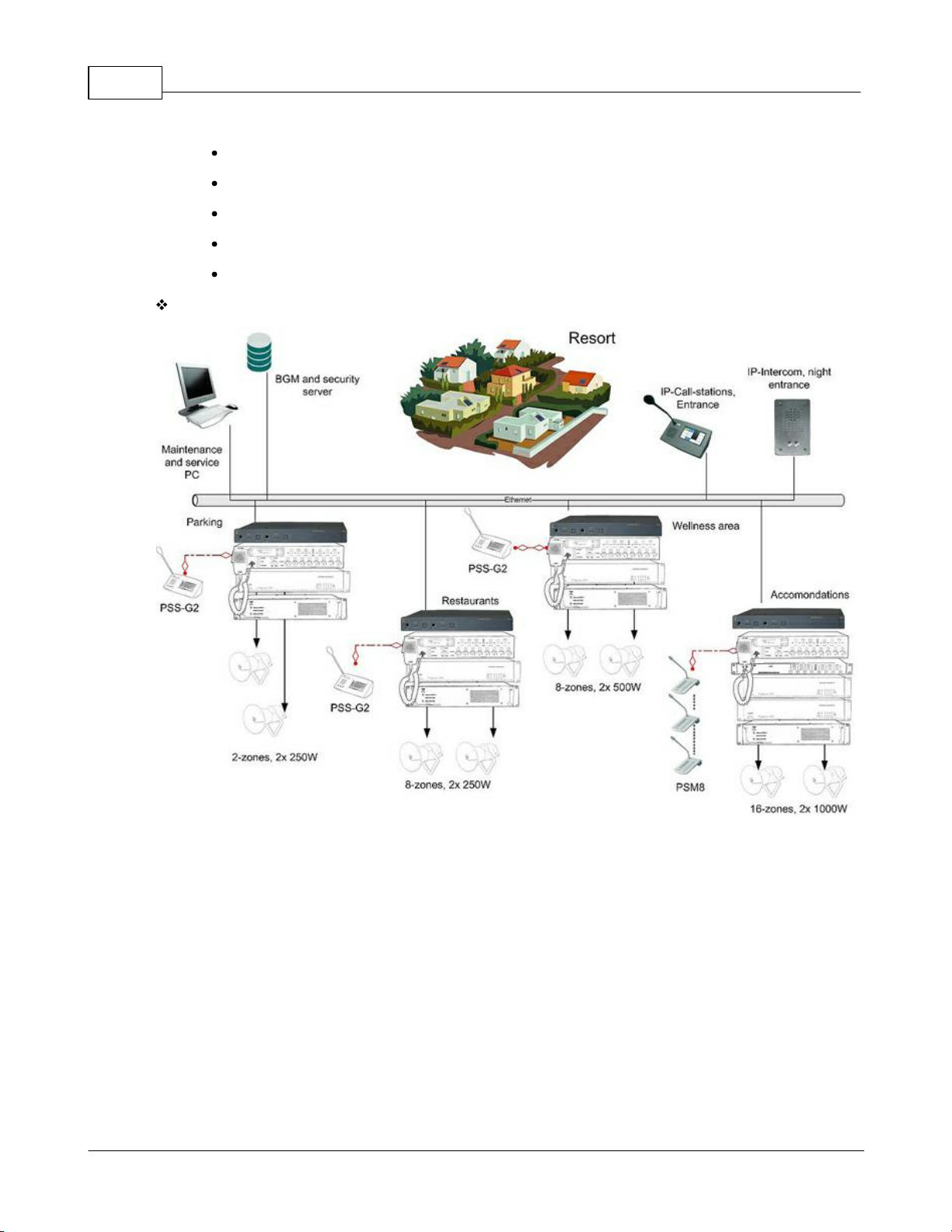
Application Example 2
This tutorial describes a PAVA system, VACIE, which is used for voice evacuation with an
automatic link to a firepanel system, FACIE, for a resort with several buildings linked over IP. The
DIVA System concept stands for a reliable and affordable system solution where each building has
its own FACIE linked to the VACIE consisting of a DIVA8M - Master unit with amplifiers and battery
backup facilities.
The system consists of 4 individual PAVA equipment sets that are linked over IP. A server with
special software, Vox- Net, surveys the audio/data connections between the 4 sub systems and the
IP-paging facilities. Vox-Net - IP media software also provides surveyed intercom stations to be
included into the system and provides multichannels BGM. The standalone DIVA8M provides the
fireman’s operating section on the central paging facility rack and a touchscreen multi-zone paging
and control console. This part of the system is also linked to the FACIE.
Depending on the situation, digital power amplifiers are used; 4 x 125 W, 4 x 250 Watt or 1 x 1000
W. DIVA8M and DIVA8S only need 2 amplifiers. One for Paging and one for BGM/Back-up. The
background music amplifier is also used as back-up amplifier in case of an amplifier failure. This
© 2012 ATEÏS
Page 39

Product Features 39
unique concept warrantees savings on rack assembly and amplifier power.
The paging consoles, PSS-G2 and PSM8 are connected via a secured dedicated link with the
central equipment racks. When multiple PSM8’s are used into one DIVA8M, only the first one,
master, can be used for security purposes. The remaining ones, slaves, are not surveyed.
A TCP/IP link from the main system to the SERVICE area is meant for maintenance use and remote
access. The paging console can do all calls and zone-calls and has a feedback loudspeaker in the
unit for system monitoring.
Central equipment:
1x Server PC with Vox-Net-Server, IP-media software
1x IP call station, PMIP-D
1x Intercom doorstation, UCIP-1
2x Vox-Net-In, IP media licence Parking Area:
1x DIVA8M, master unit
1x DPAfour125, digital power amplifier
1x BECS150, battery backup unit
1x PSS-G2, paging console
1x Vox-Net OUTPUT Node license
Restaurants:
1x DIVA8M, master unit
1x DPAfour125, digital power amplifier
1x BECS150, battery backup unit
1x PSS-G2, paging console
1x Vox-Net OUTPUT Node license
Wellness area:
1x DIVA8M, master unit
1x DPAfour250, digital power amplifier
1x BECS150, battery backup unit
1x PSS-G2, paging console
1x Vox-Net OUTPUT Node license
Accomodations:
© 2012 ATEÏS
1x DIVA8M, master controller
1x DIVA8S, Slave unit
2x DPAfour250, digital power amplifier
1x BECS150, battery backup unit
Page 40
DIVA system40
3x PSM-V2, paging console
1x Vox-Net OUTPUT Node license
4.1.1.2 What's inside the Box
Opening the box you should find the following items:
DIVA Master Unit
Rack rounting brackets, 2 pcs
Metal screws Philips M3x6, 6 pcs
12-way euroblock connectors, 1 pcs
10-way euroblock connectors, 3 pcs
5-way euroblock connectors, 2 pcs
4-way euroblock connector, 11 pcs
230V/24 VDC power supply
CD-ROM
Fireman Microphone
If you realize anything missing, please contact your distributor.
4.1.1.3 Installation
In the Box of the DIVA there is containing a letter with a point by point instruction that need to be
followed for safety reasons.
Rack mounting:
If needed, fit the rack mounting brackets to each side of the DIVA by using the 6 pcs Phillips M3x6
screws supplied with the package.
Sitting:
The DIVA unit takes a 2U 19’’ rack space and generates little heat itself. Consider leaving enough
ventilation space above and below the unit. Do not mount the DIVA directly above heat generating
devices like power supplies or power amplifiers.
Power connection:
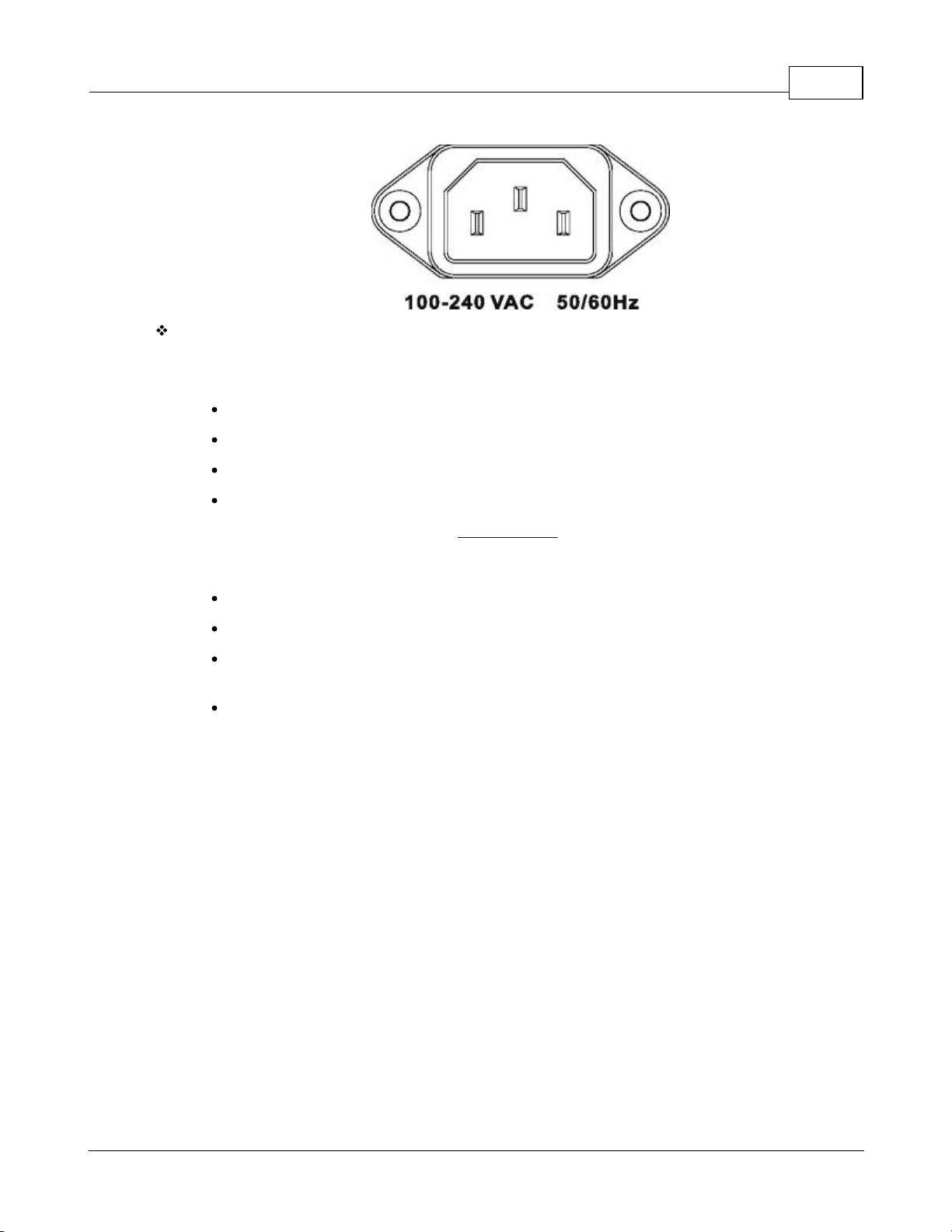
DIVA accepts 24 VDC power supply as well as 230 VAC power supply. In order to be EN54
compliant, use a BECs battery charger and power supply and connect it on a 4-way euroblock
connector respecting the polarity.
© 2012 ATEÏS
Page 41
Product Features 41
EN-54 Installation Requirements
In order to comply with the EN-54 standard installation requirements, please carefully read the
followings manuals:
BCS 150 user manual “BECS150-10UMS01-V01R01”
DPA amplifiers series user manual “DPA-10UMS01-V01R01”
PSSG2 user manual “PSSG2-10UMS01-V01R01”
ID16 user manual “CD16-10UMS01-V01R01”
Those manuals can be downloaded from ATEÏS website or could be required from any branch office.
In order to fully understand all the DIVA system requirements regarding standards, please read also
the following guides:
DIVA8 service manual “DIVA8MG2-M/S-10SMS01-V01R01”
DIVA8 VACIE reference “DIVA8MG2-M/S-10VRS03-V01R01”
DIVA8 VACIE documents “DIVA8MG2-M/S-10VDS01-V01R01” and “DIVA8MG2-M/S-
10VDS02-V01R01”
DIVA8 system VACIE EN54-16 tesing guide “DIVA8 System VACIE EN54-16 testing guide”
© 2012 ATEÏS
Page 42
DIVA system42
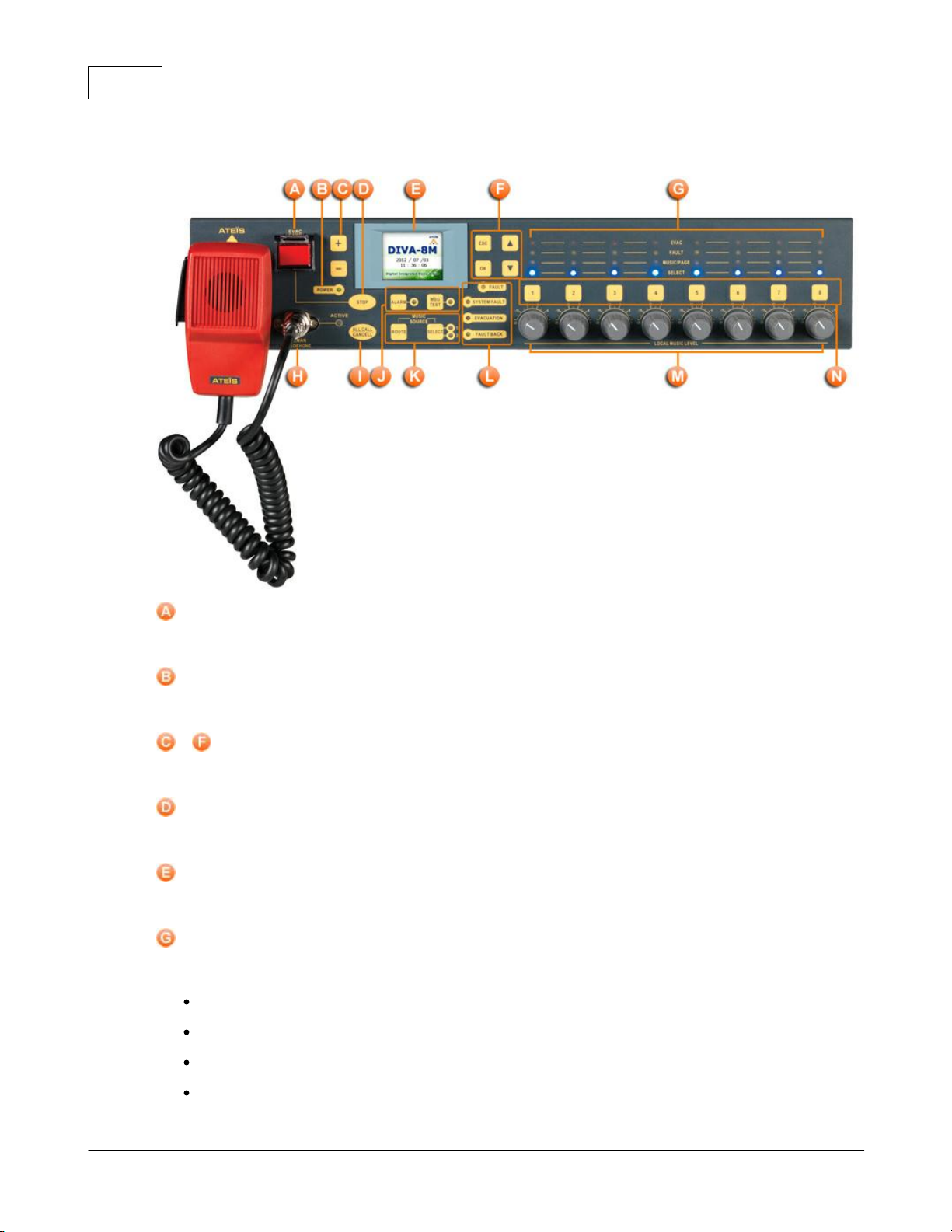
4.1.1.4 Front Panel
Evacuation button:
Initiates the evacuation process in manually selected or pre-defined zones.
Power indicator LED:
Indicates the power status of the DIVA.
& Navigation buttons:
Plus, minus, ESC, OK, up arrow and down arrow buttons allows the navigation inside menus.
Reset button:
Generates a global software reset (machine reboot).
Color screen:
The screen displays all status information, menus and date/time.
VACIE (Voice alarm control and indicating equipment) indicators:
There are eight rows of 4 LEDs that show in real-time mode the zones' status:
EVAC
FAULT
ALERT/PAGE
SELECTED
© 2012 ATEÏS
Page 43
Product Features 43
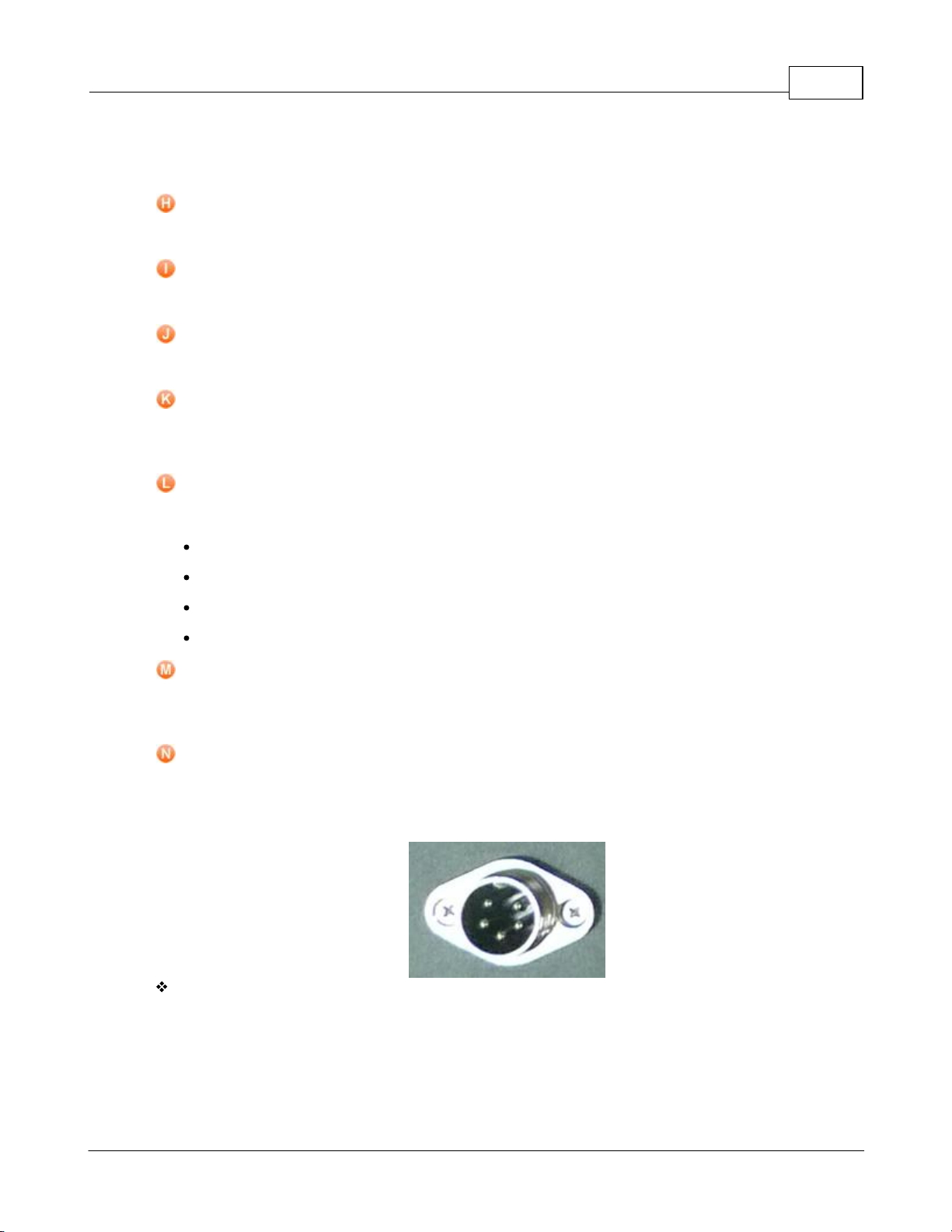
Integrated monitoring speaker: The DIVA integrates a front panel monitoring speaker that can
monitor different audio sources (software configuration).
Fireman Mic input:
Monitored fireman microphone input.
All Call/Cancel button:
Selects all zone in the system or reset the current zone selection.
Alert and Test message buttons:
Starts messages in manually selected zones or in pre-defined set of zones.
Music control buttons:
The "ROUTE" button validate the zone selection. "SELECT" button permit to toggle between music
source 1, 2 or none. The two music source indicators light when the corresponding source is used.
Faults and status indicators:
There are four mains status LED on the DIVA front panel:
G.Fault
System Fault
Evacuation
By-Pass Mode
Zone attenuator knobs:
Eight zone signal attenuators are available on the master DIVA8. Independent zone music level can
be set for the eight master zones.
Zone selection buttons:
Select or deselect zone for manual routing.
4.1.1.4.1 Fireman Microphone
Wiring
© 2012 ATEÏS
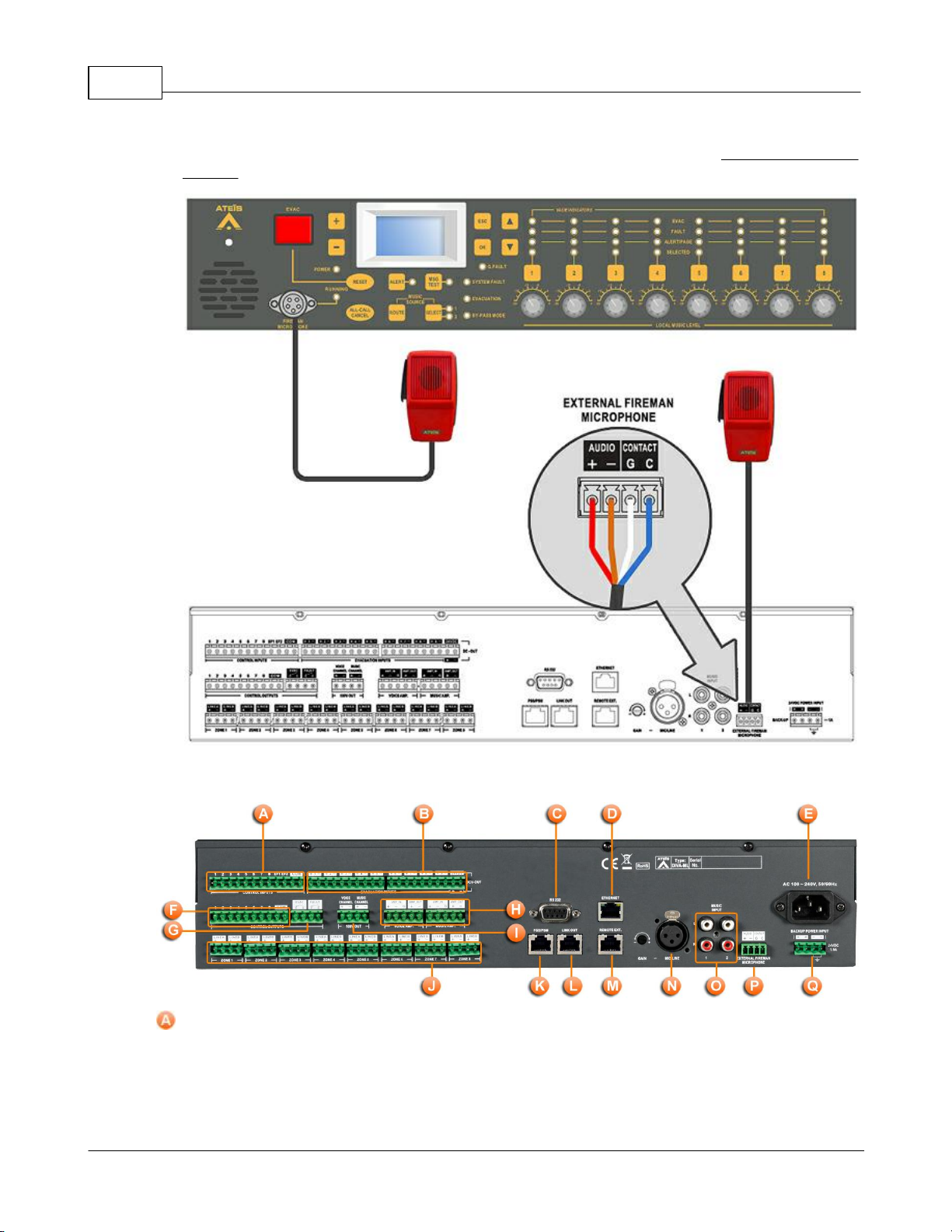
To connect the SHM1 fireman microphone, simply connect the SHM1 connector with the front panel
fireman microphone connector.
In case of using another microphone, use the back connector to connect the microphone, see the
picture below. Be aware that only the connection on the front panel is certified with the EN 54-16
standard and the monitor works on both of these two connections.
Page 44
DIVA system44
Note: The front panel connector and the back connector are parallel connected, please only use one
of them.
4.1.1.5 Rear Panel
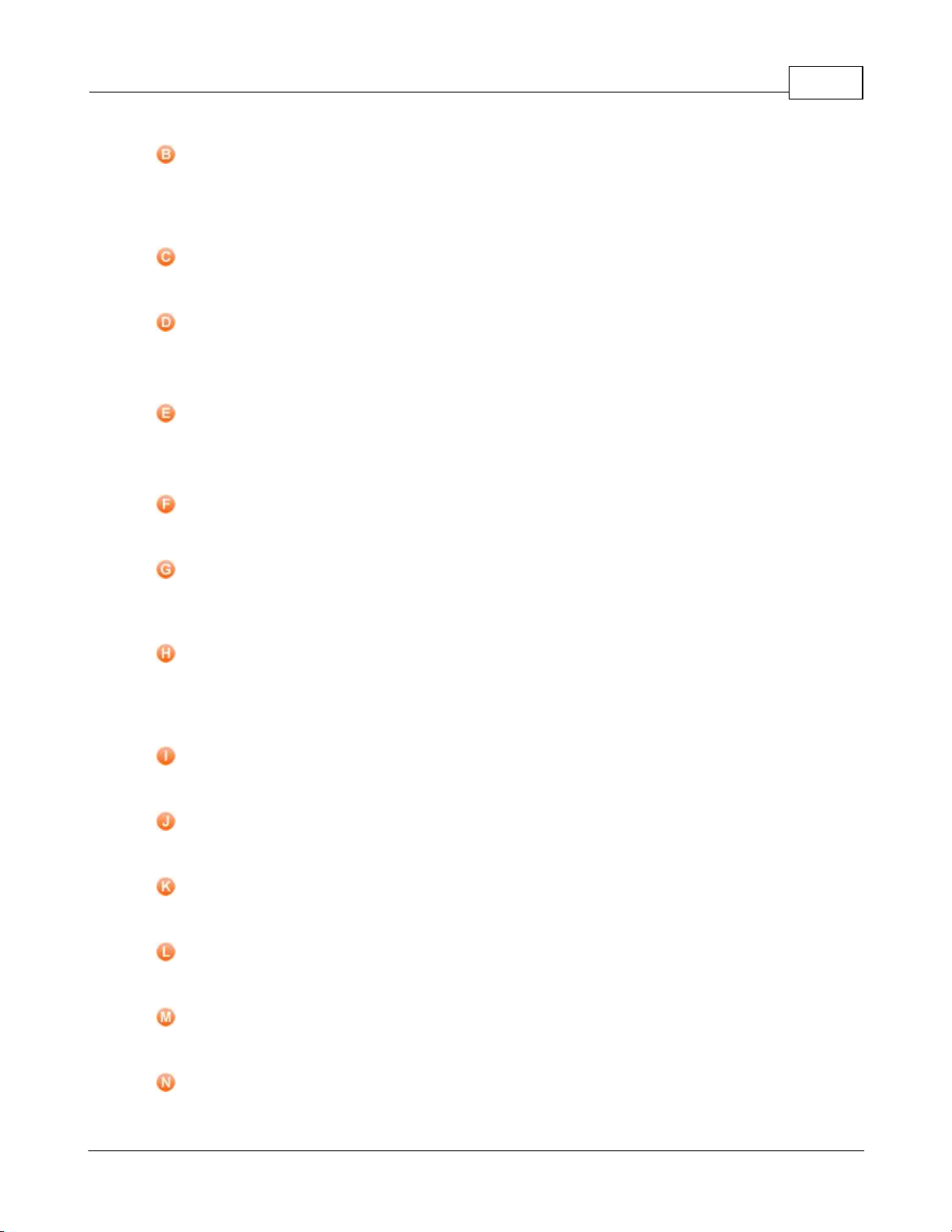
Control inputs:
There is eight logic inputs that are two states input (open contact, close contact). External faults
input are normally reserved to connect security devices like monitored power supply. Those two
inputs can be used to put DIVA into a security mode, security mode will be discussed in the event
chapter.
© 2012 ATEÏS
Page 45
Product Features 45
Evacuation inputs:
Evacuation inputs are contact inputs that allows the monitoring of external contact. They also can
be used in UGA mode, trigger by a voltage polarization change. This connector supplies a 24VDC
source.
RS232 Connector:
SUBD-9 connector that includes two RS232 ports.
Ethernet Connector:
RJ-45 Connector to link the DIVA master to the ethernet network for software configuration and/or to
enable IP paging.
Power Section:
Insert provided power cable first into DIVA8M then in the wall power connector. 110~240 V 1.2A,
47~63Hz AC power input with fuse.
Fuse rating: 1.6 A
Logic output:
Eight Logic outputs to send a pulse or a static closing/opening to an external device.
Evac & Fault contacts:
Evac and fault output contact reflect the evacuation status and the general fault status of the DIVA
system.
Amplifiers I/O:
Voice Amp connector include the 0dB channel to power amplifier and the 100V audio channel from
power amplifier. Same for Music Amp. Music amplifier channel will be used, in case of defect on the
Voice amplifier channel, as a backup amplifier channel.
100V Signal links:
100V output to send 100V signal to others DIVA(M or S) unit.
Speaker zone outputs:
Eight speaker zone connectors split into A and B line.
PSS/PSM connector:
RJ-45 connector to link PSS or PSM call-stations.
Master-Slave link:
RJ-45 connector to create a master-slave DIVA system.
© 2012 ATEÏS
Remote Ext. connector:
not used.
Mic/line input:
XLR connector to plug a microphone or a third line level audio source.
Page 46
DIVA system46
Music inputs:
Cinch connectors to plug two different 0dB audio sources.
External Fireman Mic Input:
A replica of the front Fireman Microphone connector.
Backup power input:
24VDC power supply for battery operation.
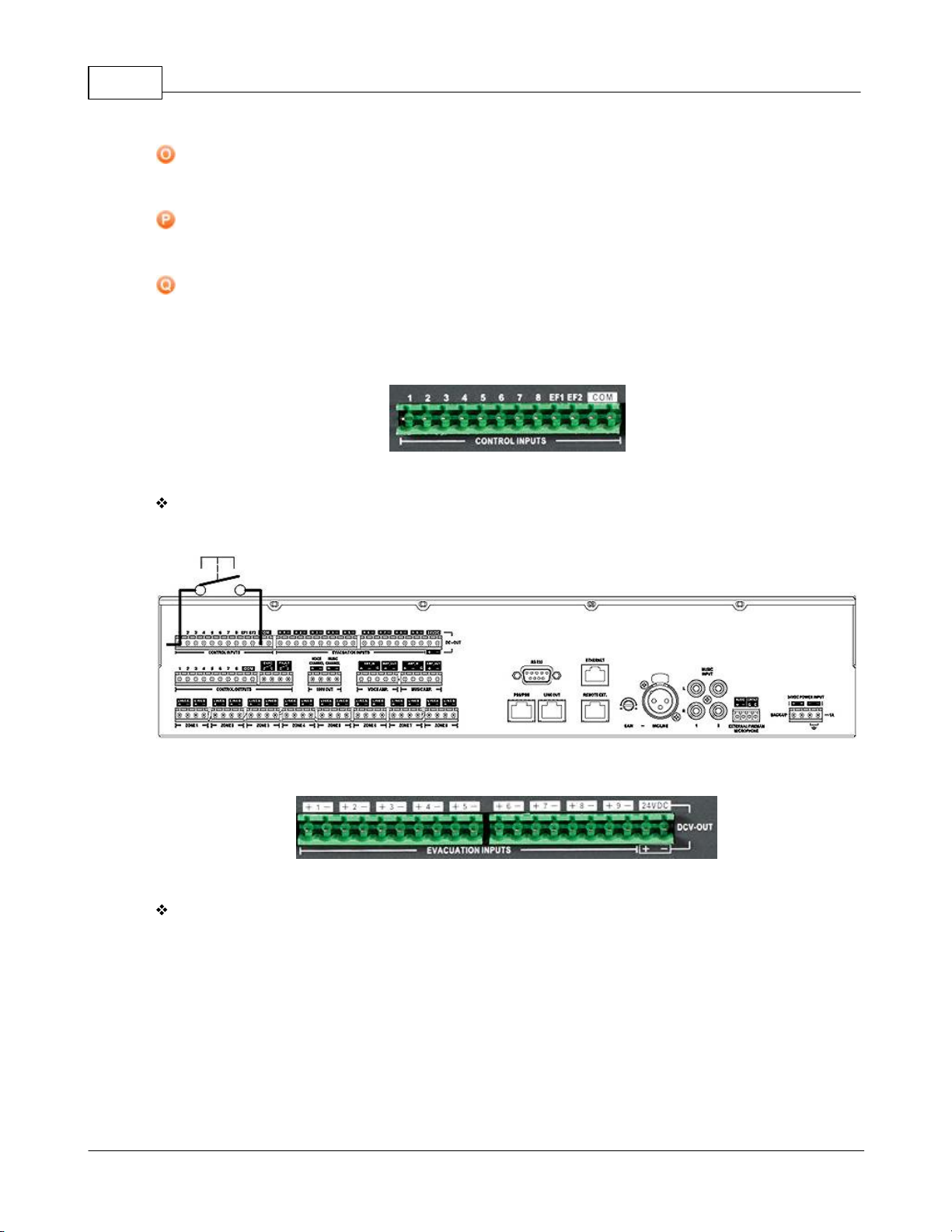
4.1.1.5.1 A) Control Inputs
Control Inputs (Normal logic inputs) have been designed to work with simple contact or button.
Wiring
Follow the next schematic to connect a contact to a normal logic input.
4.1.1.5.2 B) Evacuation Inputs
The evacuation input can be used in three different modes: contact, monitored contact and UGA.
Wiring
The three uses are represented on the schematic below.
© 2012 ATEÏS
Page 47
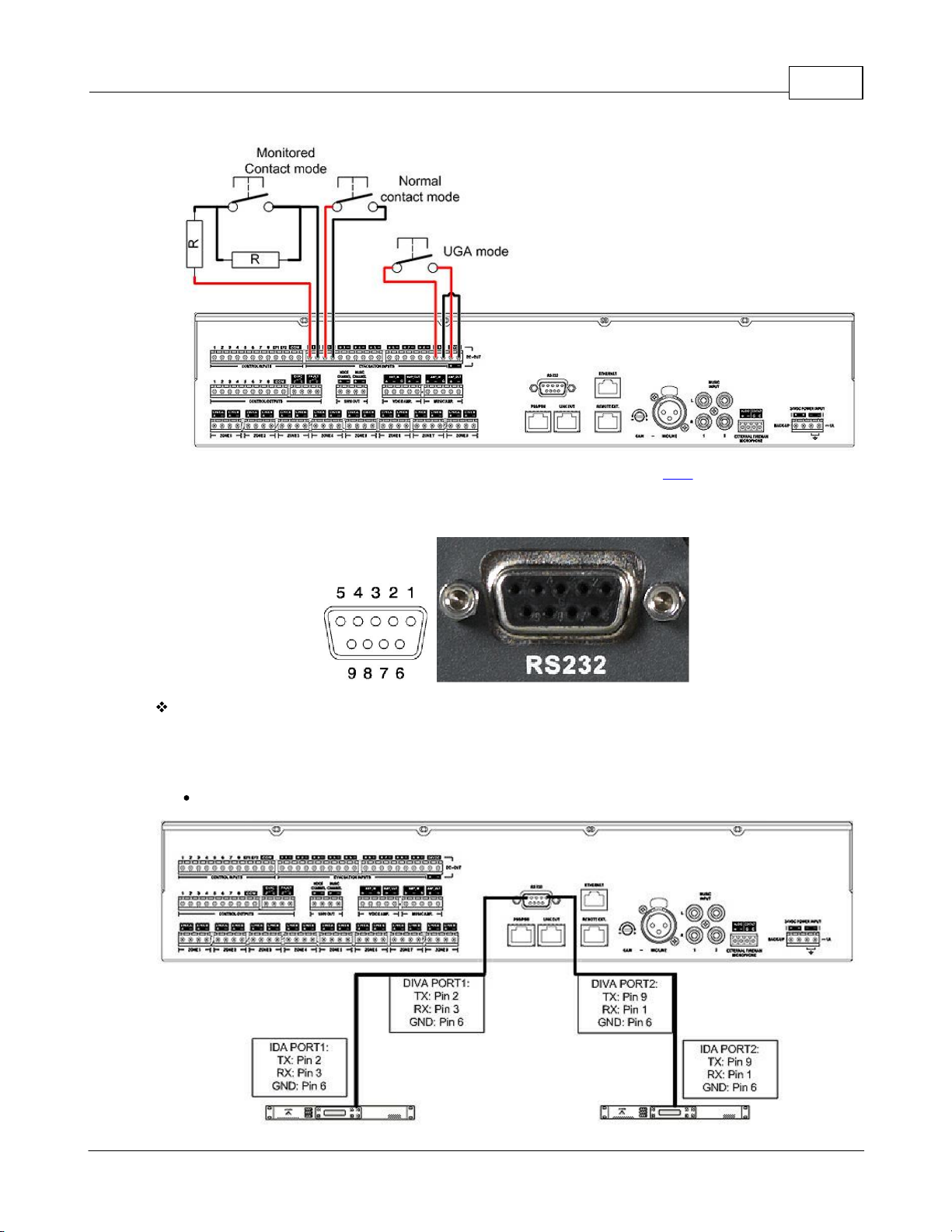
To learn more about how to perform a monitorable contact, please read this.
4.1.1.5.3 C) RS232 Connector
Product Features 47
Wiring
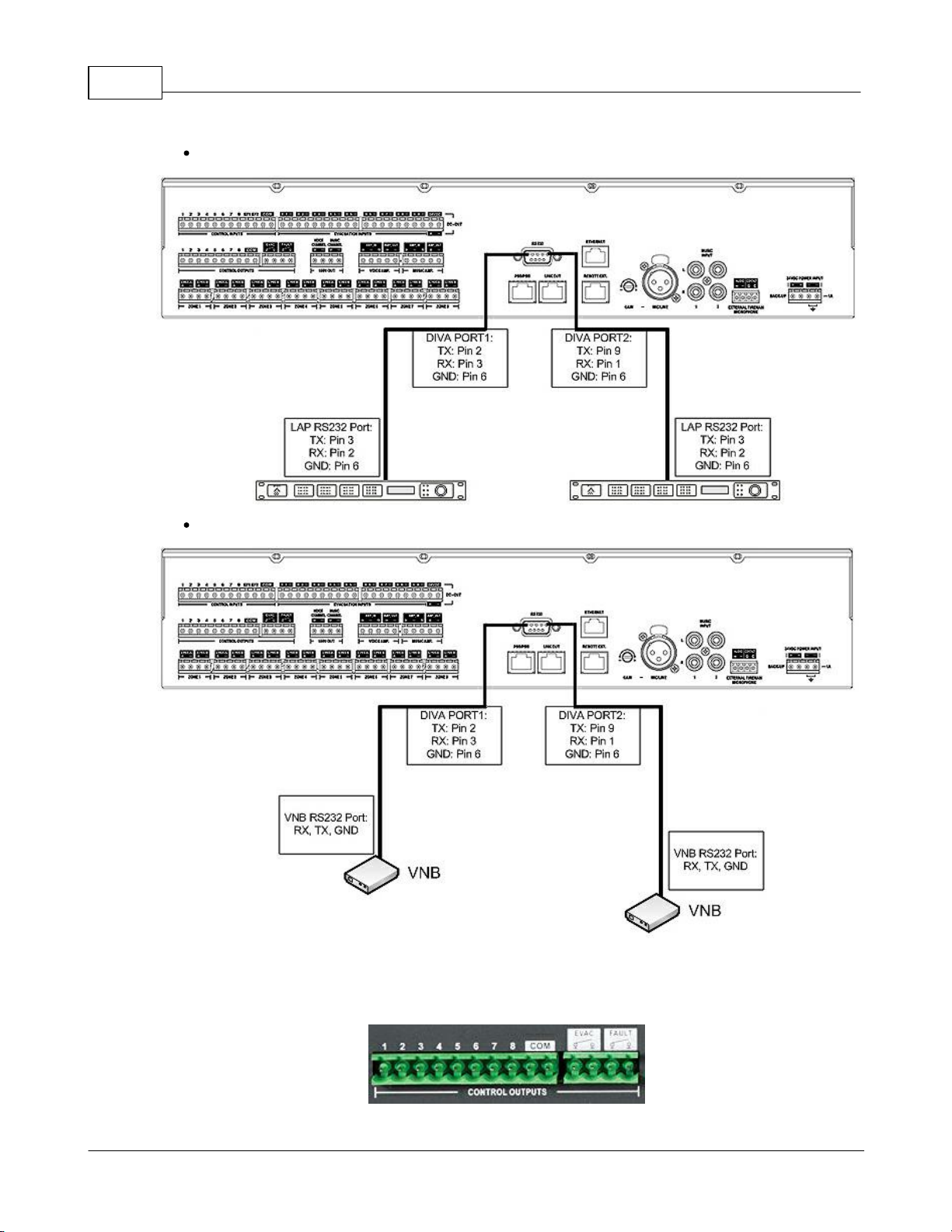
There are several ways of using DIVA serial port. Here are a few examples.
Remember to always cross Tx and Rx, means that Tx from DIVA goes to Rx from a master.
With IDA4M(XM,SW):
© 2012 ATEÏS
Page 48
DIVA system48
With LAP as RS232 carrier:
With VNB for Vox@Net application or as RS232 carrier:
4.1.1.5.4 F) Control Outputs
© 2012 ATEÏS
Page 49
Product Features 49
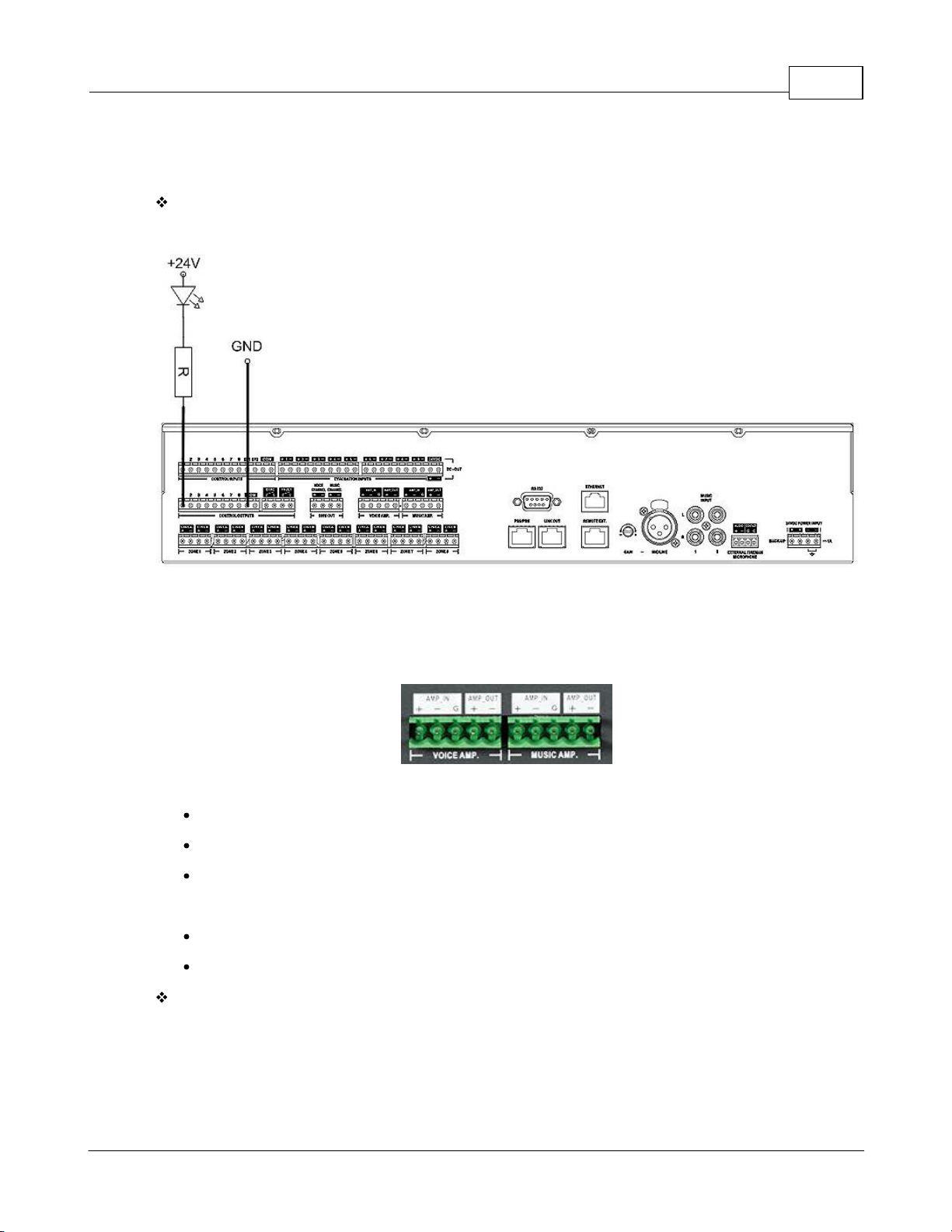
Control Outputs (Logic outputs) are simple contact that when closing link the OUTPUT connector to the
COM connector.
Wiring
The following schematic show a way to create an indicator LED.
4.1.1.5.5 H) Amplifiers I/O
The connection to amplifier can slightly change according to the amplifier model used.
The 0dB output of DIVA are named as follow:
AIN+: for positive 0dB output
AIN-: for negative 0dB output
GND: for 0dB ground output
The 100V input are named as follow:
AOUT+: for positive 100V input
AOUT-: for negative 100V input
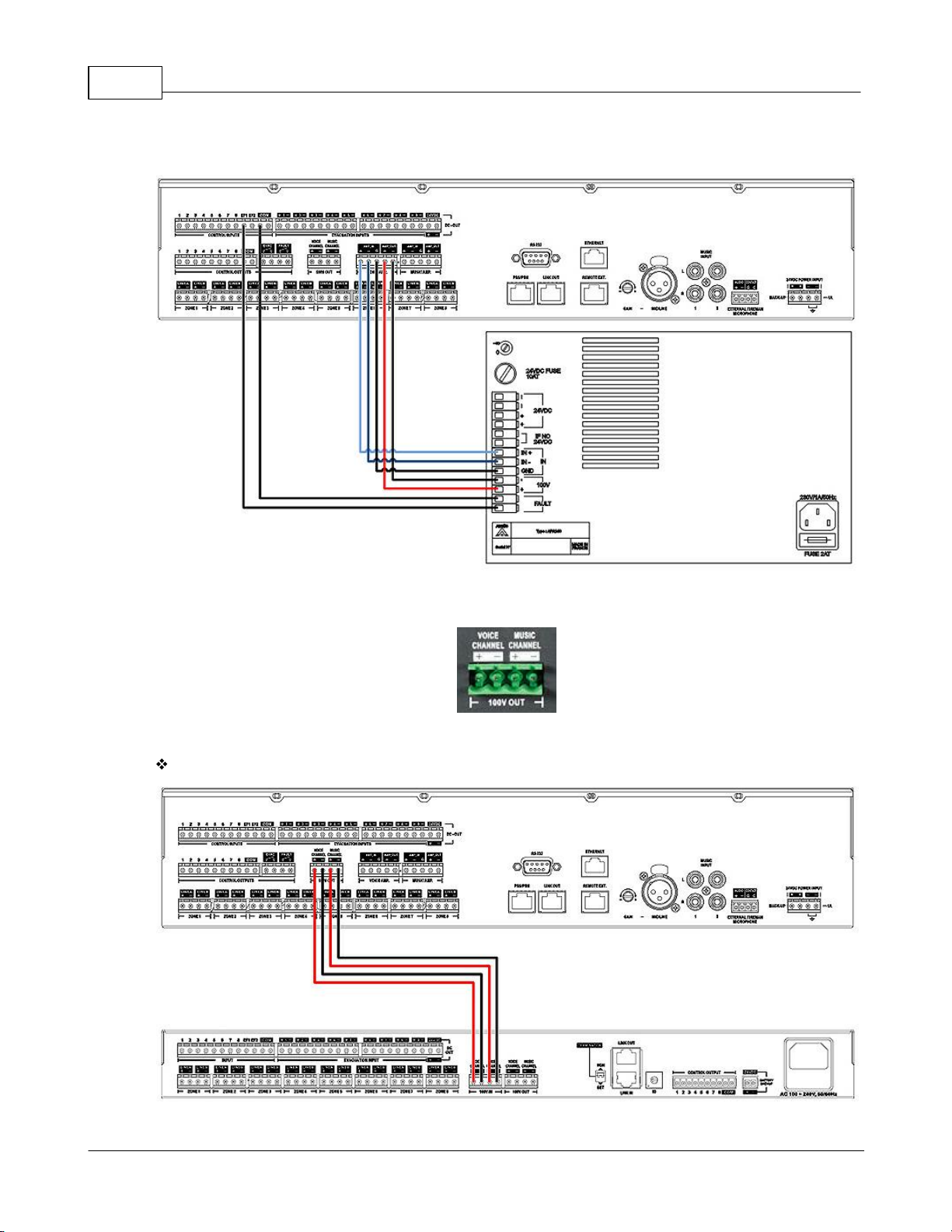
Wiring
According to the schematic below, the DIVA 0dB output are linked to the amplifier 0dB input and the
DIVA 100V input are linked to the amplifier 100V output.
© 2012 ATEÏS
Depending on the configuration needed, you can use the amplifier fault output to force DIVA to enter
security mode in case of amplifier failure.
Page 50
DIVA system50
To achieve this aim, simply connect the DIVA EXFLT connector to the amplifier’s FAULT connector.
4.1.1.5.6 I) 100V Signal Links
The 100V outputs have been made to link the 100V line from a master DIVA to a slave DIVA.
Wiring
© 2012 ATEÏS
Page 51
To learn more on how to do the connection between master and slave, please see (DIVA8S / Linking
)
4.1.1.5.7 J) Speaker Zone Outputs
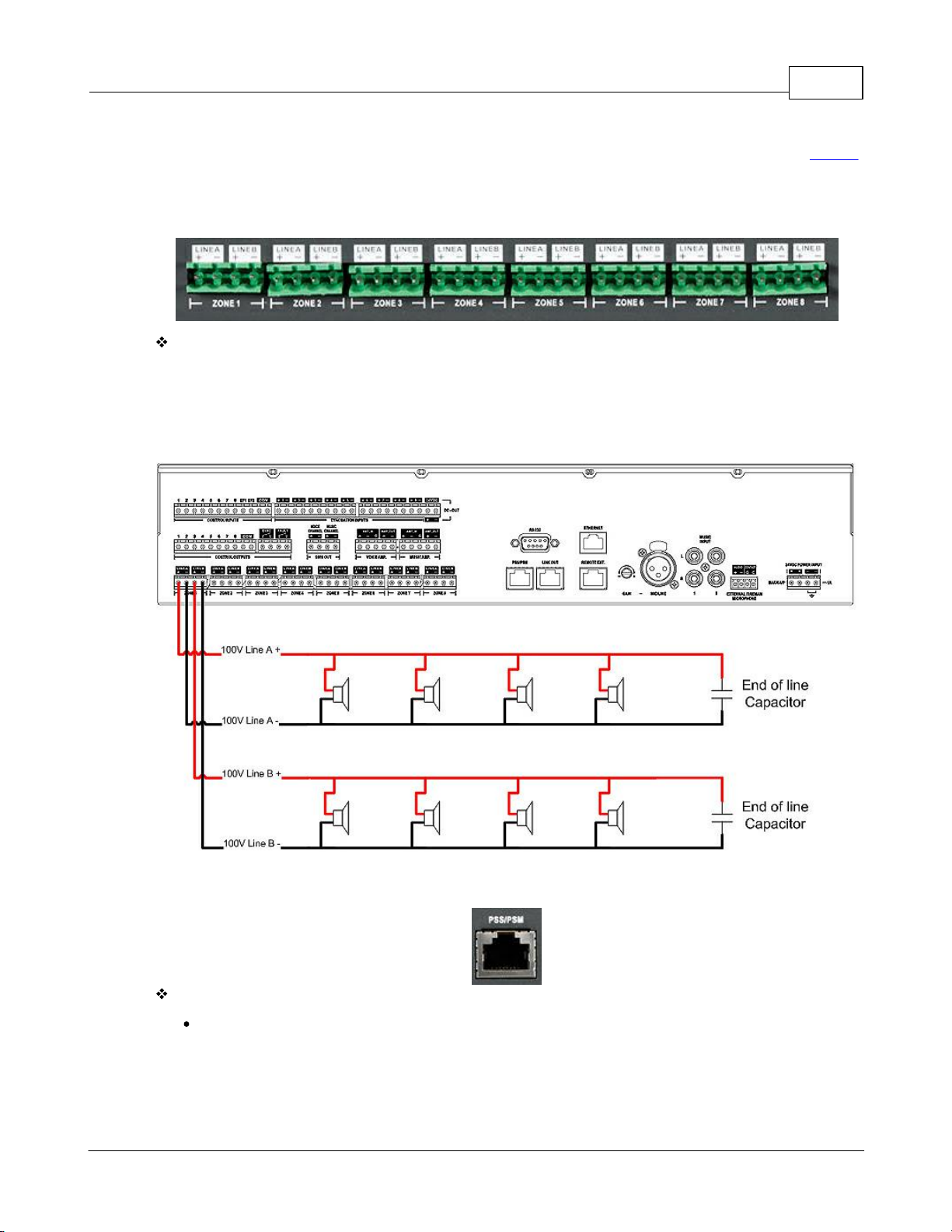
Wiring
In order to have a high accuracy on impedance measurement, you should add an end of line
capacitor on each speaker line. If help is needed to know the value of those capacitors, please take
contact with Ateis.
When connecting speakers, take care of the polarity.
Product Features 51
4.1.1.5.8 K) PSS/PSM (RJ45) Connector
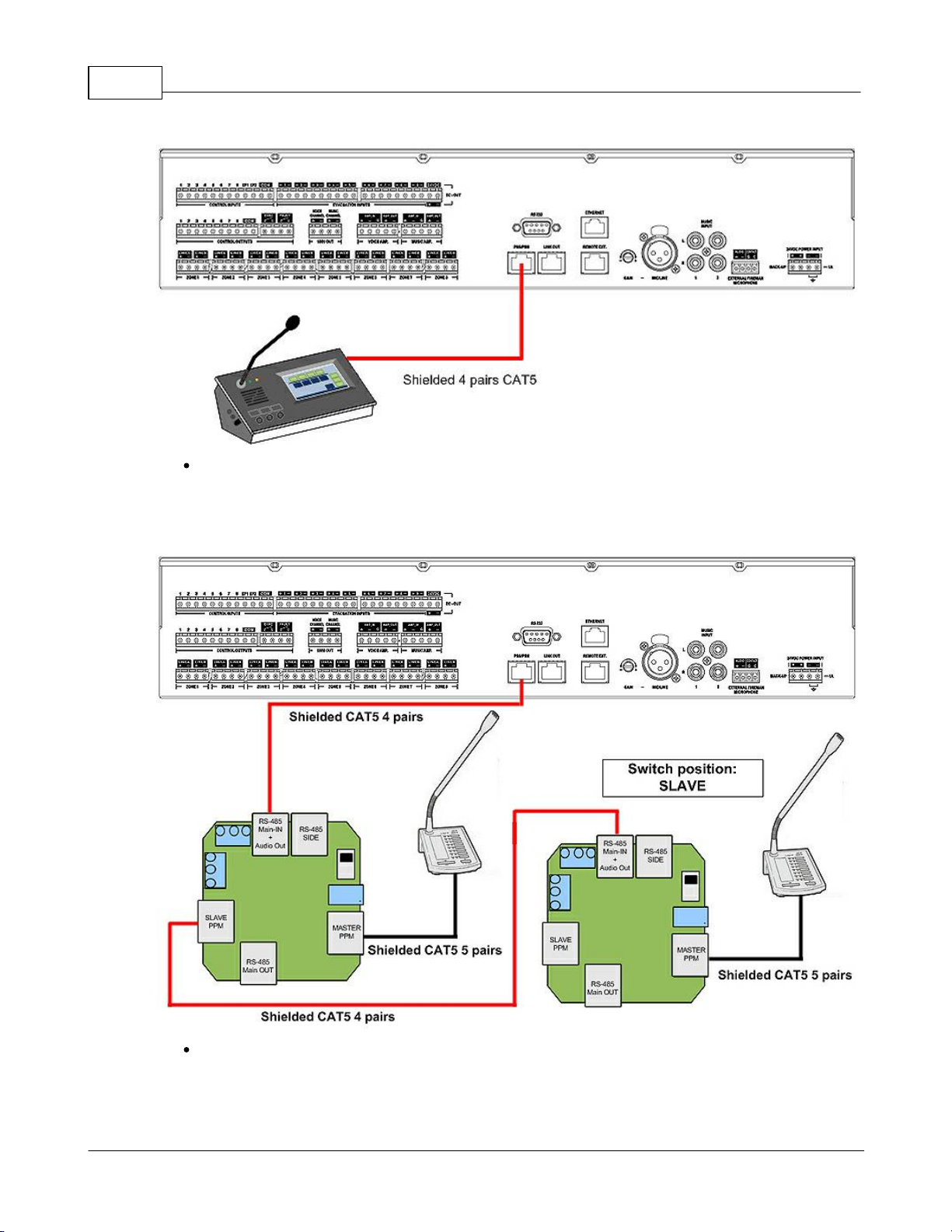
Wiring
PSSG2 Microphone
In order to connect the PSS or PSSg2 microphone to DIVA, simply use a shielded 4 pairs CAT5
cable to link the PSS/PSM DIVA RJ45 connector to the RJ45 of the PSS. Maximum cable
length 200m, if more distance is needed please use a local 24V power supply.
© 2012 ATEÏS
Page 52
DIVA system52
PSMG2 Microphone
In order to achieve a PSM cascade, Junction boxes have to be used. The following schematic
shows how to cascade two PSM microphones. In order to increase the number of PSM, simply
continue the cascading as described.
CD16 Microphone
The CD16 wall panel microphone console is considered as a PSM for the DIVA system.
© 2012 ATEÏS
Page 53
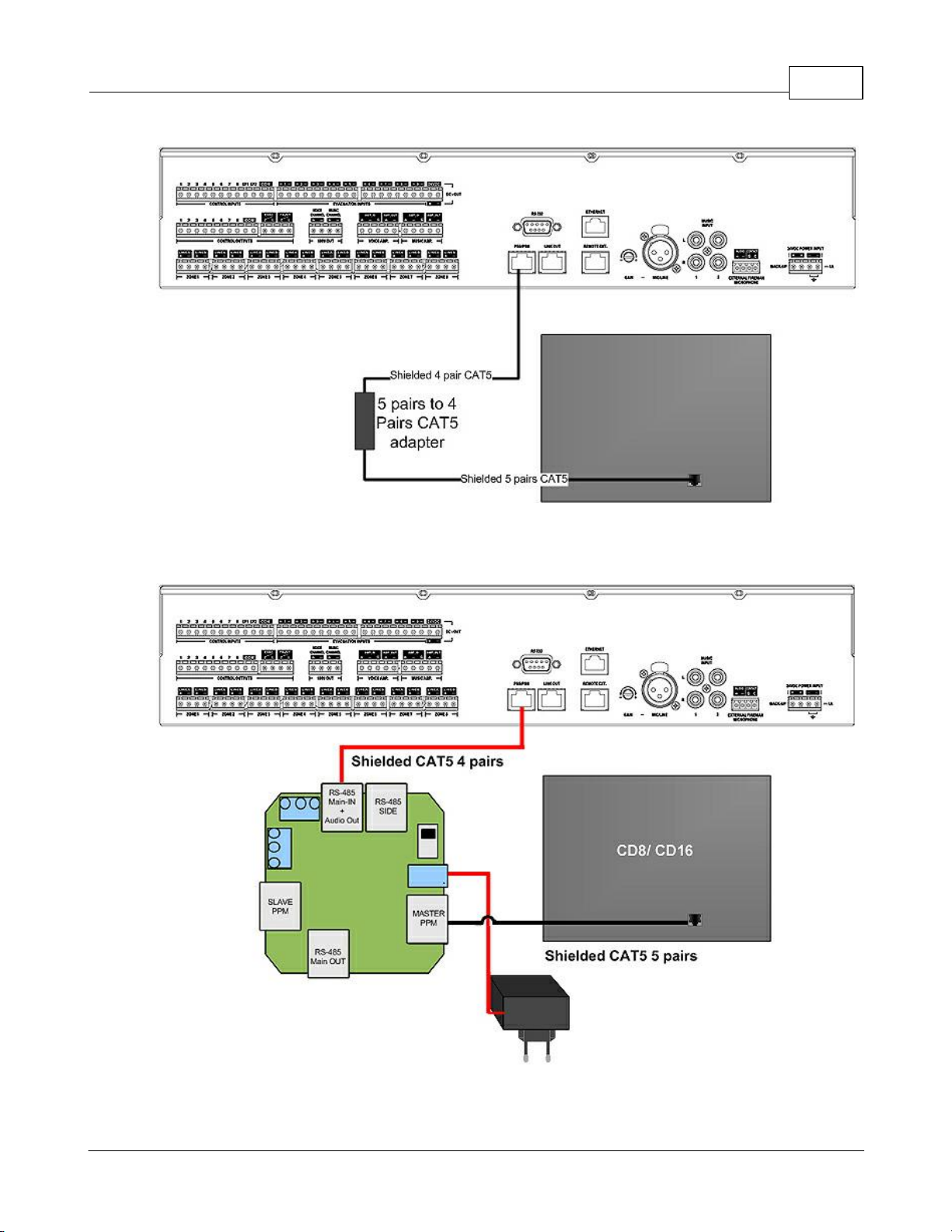
Product Features 53
With external power supply due to distance limitation, the use of a junction box is required. The
Junction Box should be placed within 80 meters from the CD16 microphone and the junction box
power supply switch should be set to EXT.PWR, see picture below.
© 2012 ATEÏS
Page 54
DIVA system54
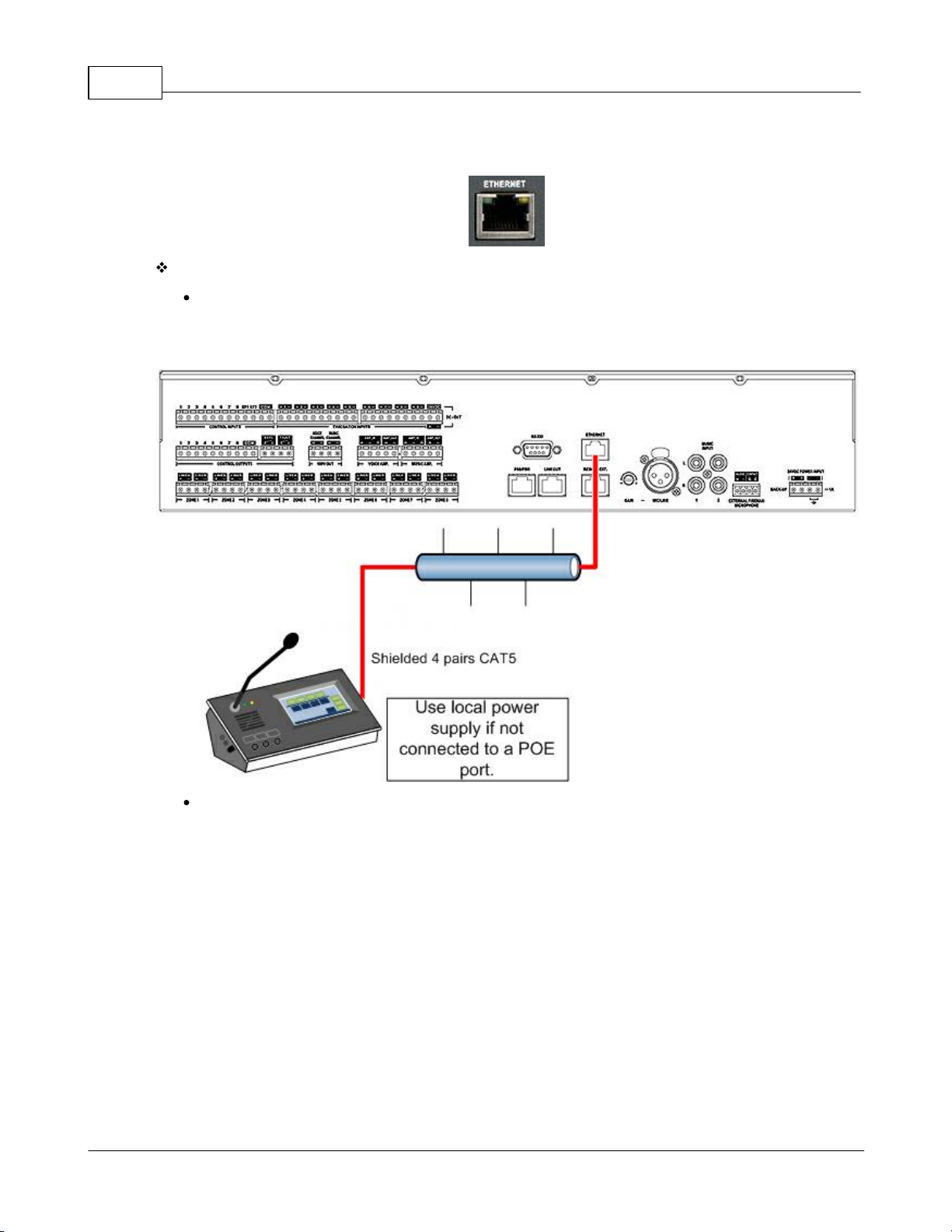
4.1.1.5.9 L) Ethernet (RJ45) Connector
Wiring
PSSG2-E Microphone
The PSSG2-E can be connected to any TCP/IP port in a network. The PSSG2-E can be
powered through POE.
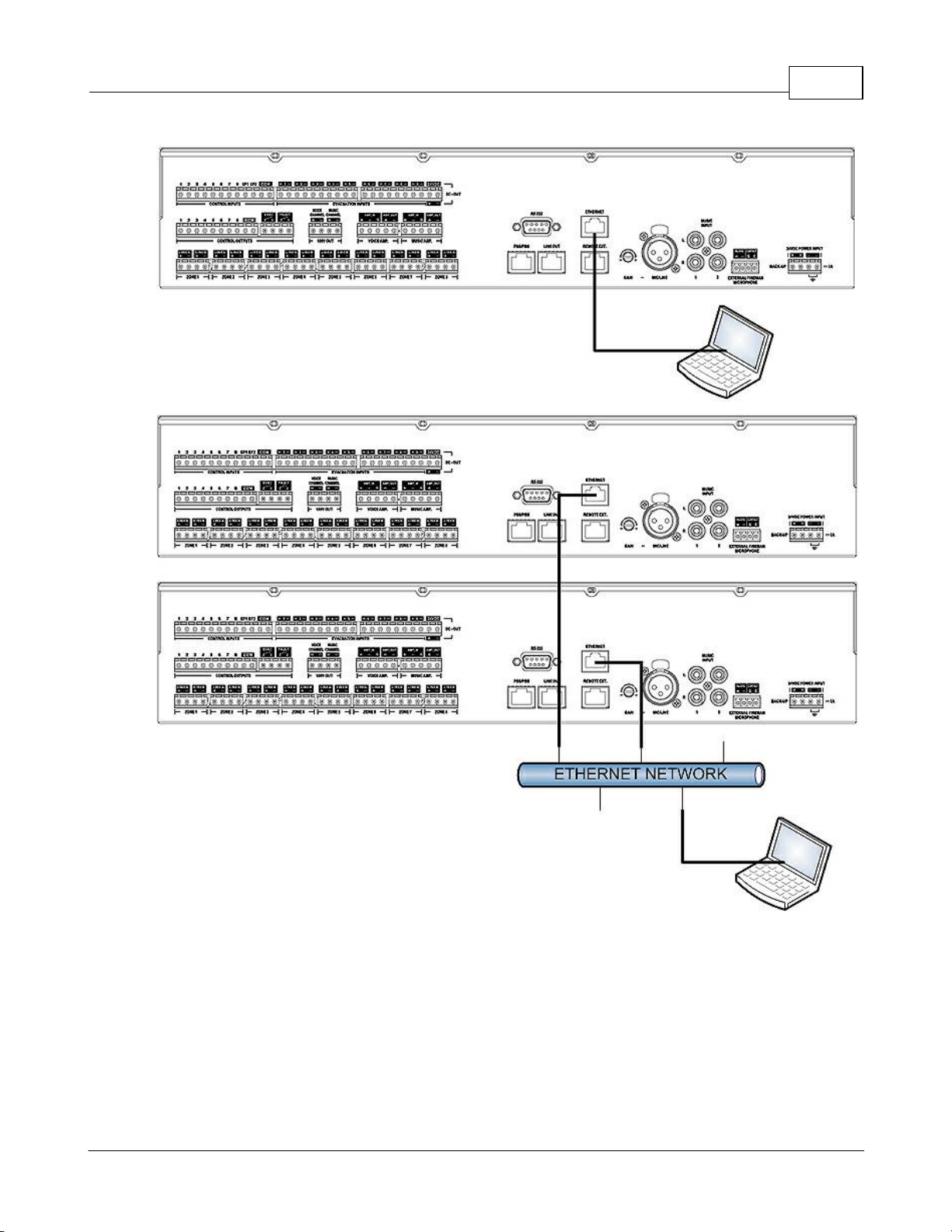
Computer
The computer can be directly connected to a master DIVA by using a CAT5 cable or can be
connected to a ethernet network using the same type of cable.
The next two schematics are example on how to connect masters DIVA to a computer.
© 2012 ATEÏS
Page 55
Product Features 55
© 2012 ATEÏS
Page 56
DIVA system56
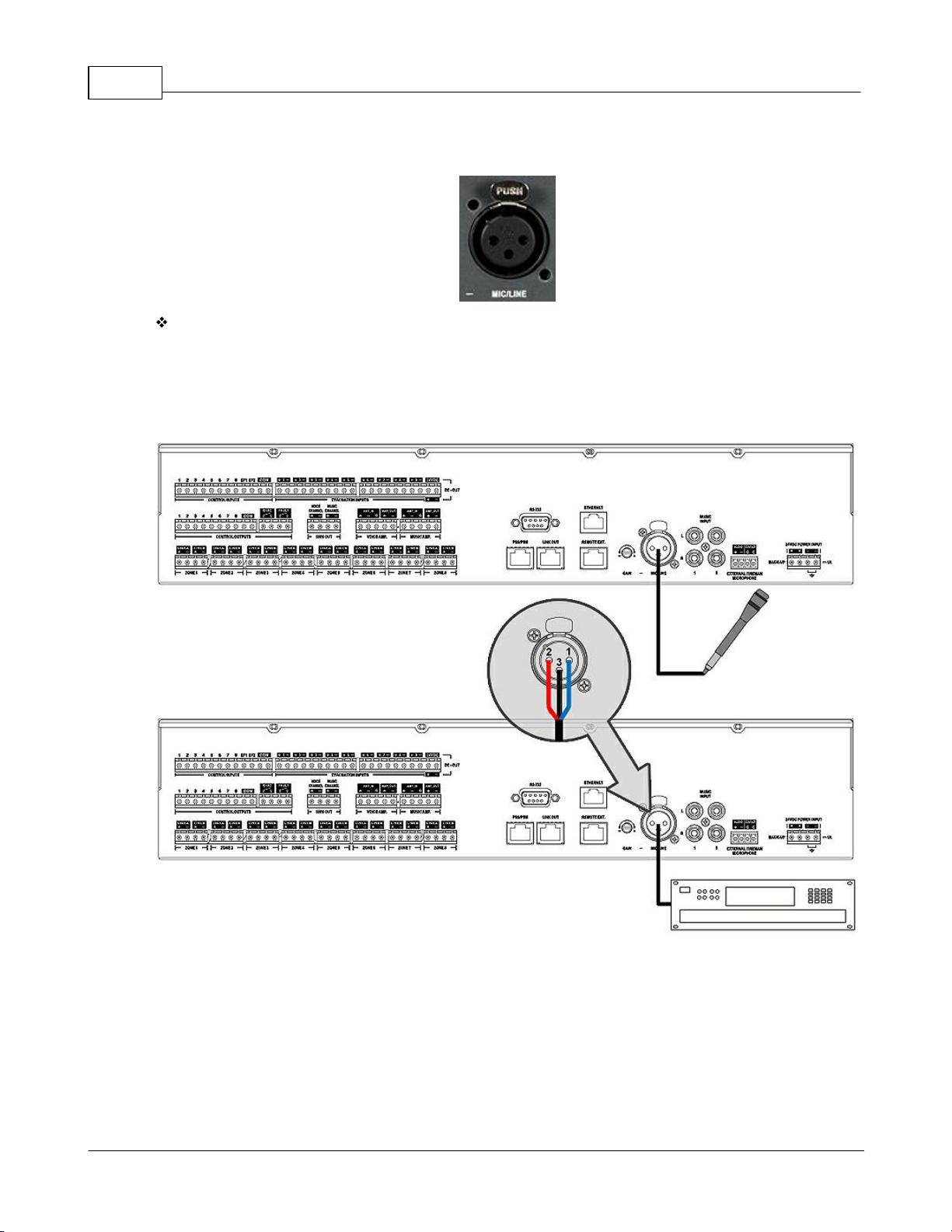
4.1.1.5.10 N) Mic/Line Input (XLR)
Wiring
The MIC/Line input can be used as a microphone input or as a third music input. According to the
schematics below, use an standard XLR cable to link the microphone to DIVA or connect the Left/
Right channel of a music source to XLR connector of DIVA.
Note: gain must be adjusted in case of using microphone or a music source.
© 2012 ATEÏS
Page 57
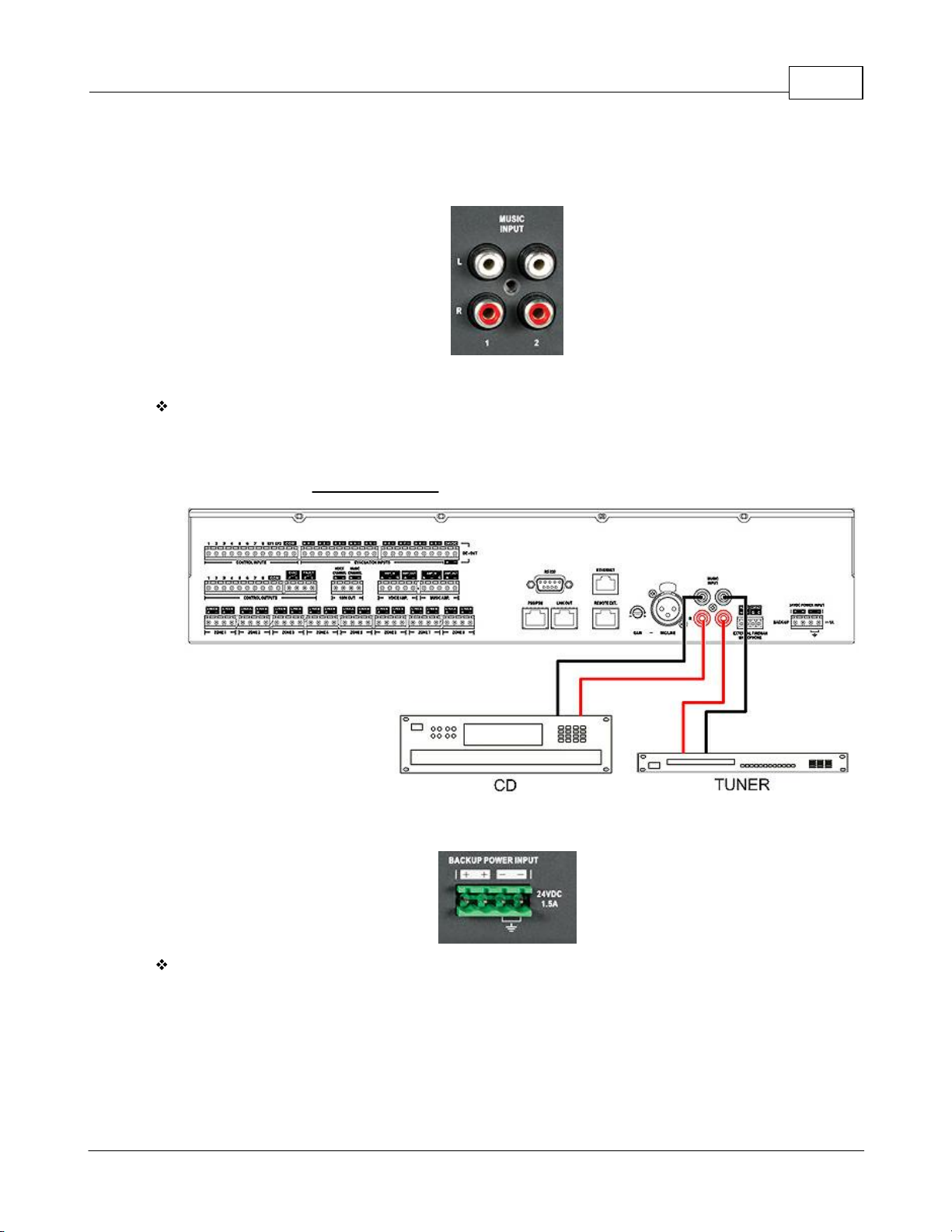
4.1.1.5.11 O) Music Inputs (RCA)
Two pairs of RCA connectors for audio input.
Wiring
Connecting music sources to DIVA is easy thanks to the RCA connections. You have a left and
right connection for both music sources.
Note: that DIVA is not a stereo player, all music sources are processed in mono.
Product Features 57
4.1.1.5.12 Q) Backup Power Input
Wiring
The DIVA operating voltage supply is 24VDC. Pleas use only the provided power block or something
equivalent.
To connect DIVA to a 24VDC power supply, use an euroblock connector in order to link the power
supply to the 24VDC and 0V DIVA inputs.
© 2012 ATEÏS
Page 58
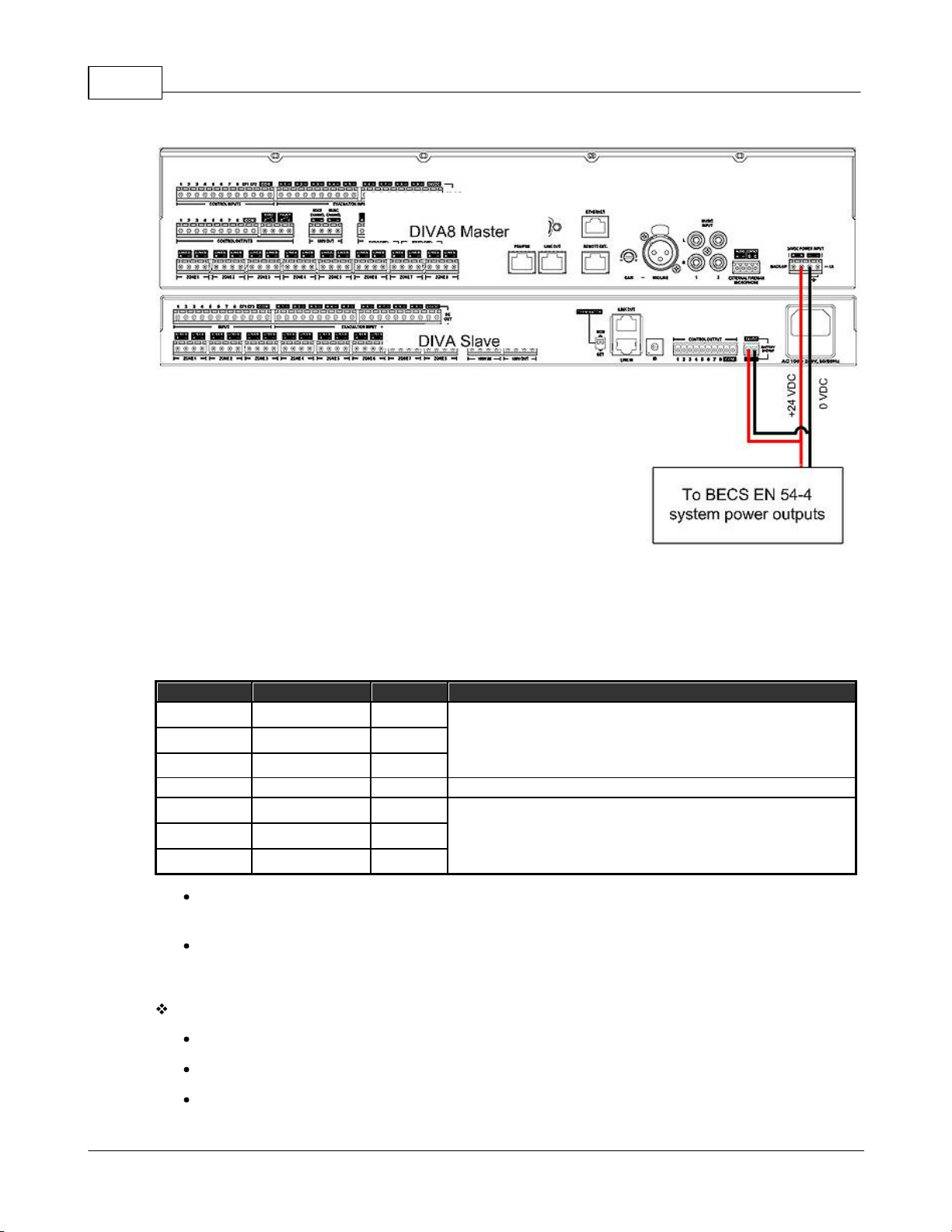
DIVA system58
Device
Connection
Max. Num
Function
PSMG2
PSS/PSM(RJ45)
10
Remote console for paging.
Zone/Music select.
Event Triggering
Preset Control.
PSSG2
PSS/PSM(RJ45)
1
PSSG2E
Eth. Limit
8
VNB
RS232
2 (port1&2)
Level Control and Mic/Line-in select
CD8
PSS/PSM(RJ45)
1
Remote console for paging.
Zone/Music select.
Event Triggering.
Preset Control.
CD16
PSS/PSM(RJ45)
1
CD Touch
PSS/PSM(RJ45)
1
In order to fulfill European standard, DIVA8 system should be connected to a battery charger and a
security power supply (like Ateis BECS series).
4.1.1.6 Peripherals
Following table is the peripherals supported by DIVA8MG2:
Max. Num means you can connect one or more peripheral units through the connector by using
Junction Box. For example: On the RJ45, you can connect 10 PSM G2 through junction boxes.
Eth. Limit: The maximum numbers of IP that can be assigned over the network.
4.1.1.7 Characteristics
Case
Dimension = 436mm (W) x 338mm(D) x 88mm(H)
Weight = 7.5 Kg.
Color = RAL7016.
© 2012 ATEÏS
Page 59
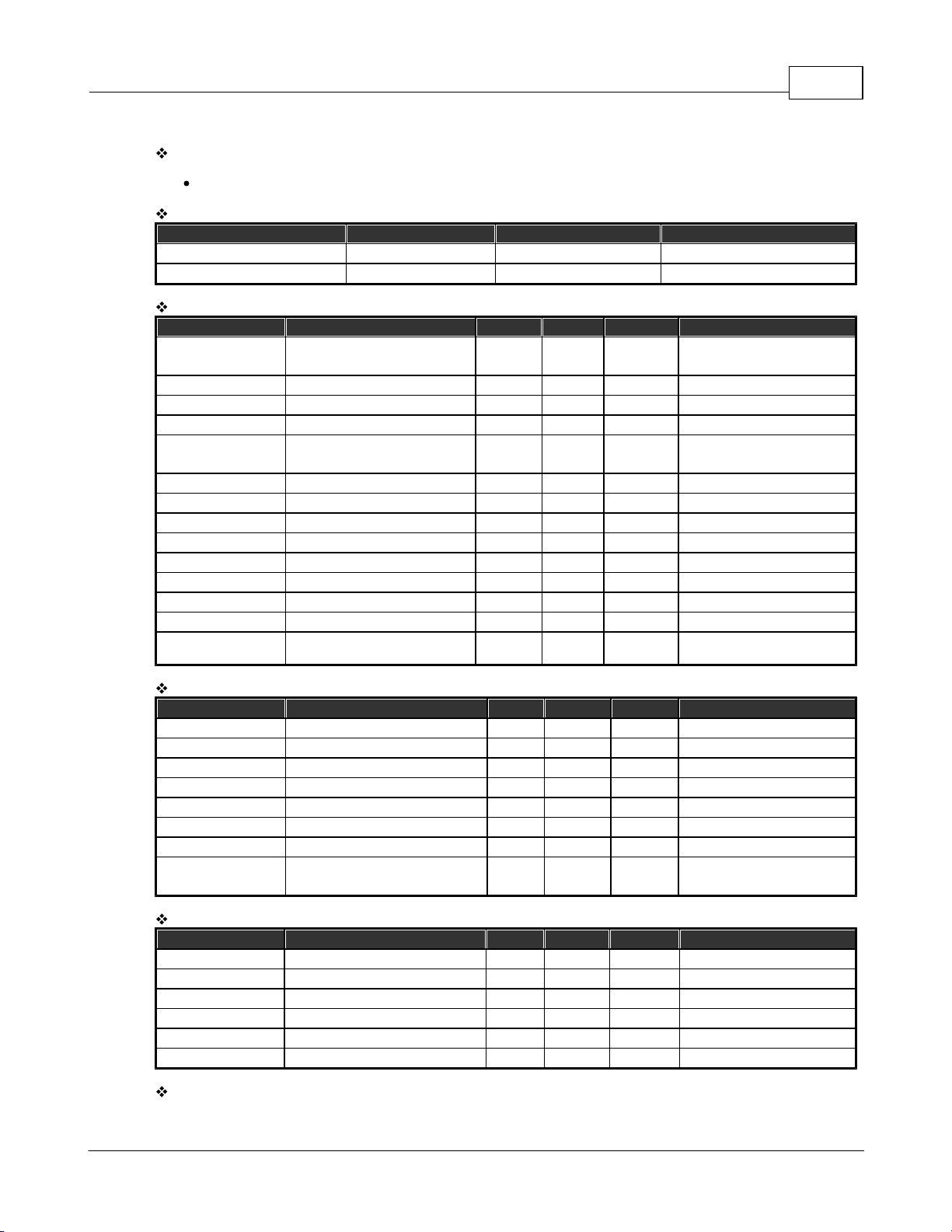
Screen
Item
Voltage
Current Consumption
Comment
AC Input
100V~240V
1.2A
Frequency:47Hz~63Hz
DC Output
20~28V, Typical: 24V
1A
Item
Condition
Min.
Typ.
Max.
Comment
Input Level (RCA)
20HZ ~ 22kHz
--16dBu
Electrically
Non-Balanced
Input Level (XLR3)
20HZ ~ 22kHz
--16dBu
Electrically Balanced
Input Level (RJ45)
20HZ ~ 22kHz
-
16dBu
Electrically Balanced
Output Level
20HZ ~ 22kHz
--16dBu
Electrically Balanced
Input Impedance
20Hz ~ 22kHz
9k Ohm
10k
Ohm
11k Ohm
Electrically Balanced
Output Impedance
20Hz ~ 22kHz
40 Ohm
50 Ohm
60 Ohm
Electrically Balanced
Resolution
24bit
Sensitivity (XLR3)
-60dBu
0dBu
hand adjust for XLR3
Sensitivity (other)
0dBu
Sampling Rate
48kHz S/N(Line)
20Hz ~ 22kHz
>76dBu
S/N(Mic)
20Hz ~ 22kHz
>78dBu
T.H.D (XLR3)
20Hz~20kHz,@ gain 0dBu
<0.02%
T.H.D (other)
20Hz~20kHz,@ gain 24dBu
<0.02%
Item
Condition
Min.
Typ.
Max.
Comment
Input Level (DIN5)
200HZ ~ 10kHz
--16dBu
Electrically Balanced
Output Level
200HZ ~ 10kHz
--16dBu
Electrically Balanced
Input Impedance
200Hz ~ 10kHz
9k Ohm
10k Ohm
11k Ohm
Electrically Balanced
Resolution
16Bit
Sensitivity
-40dBu
-35dBu
-30dBu
Sampling Rate
48kHz S/N
200Hz ~ 10kHz
>70dBu
T.H.D
200Hz~10kHz, @ gain
35dBu
<0.8%
Item
Condition
Min.
Typ.
Max.
Comment
Input Level
200HZ ~ 10kHz
--16dBu
Electrically Balanced
Output Level
200HZ ~ 10kHz
--16dBu
Electrically Balanced
Resolution
16Bit
Sampling Rate
48kHz S/N
200Hz ~ 10kHz
>70dBu
T.H.D
200Hz~10kHz, @ gain 0dBu
<5%
(8 ohm) Load
2" Color TFT panel.
Power
Audio micro/line Specification
Product Features 59
Audio Fireman MIC Specification
Audio Speaker Specification
Audio monitor Specification
© 2012 ATEÏS
Page 60
DIVA system60
Item
Condition
Min.
Typ.
Max.
Comment
Input Level
20HZ ~ 22kHz
--16dBu
Electrically Non-Balanced
Output Level
20HZ ~ 22kHz
--16dBu
Electrically Balanced
S/N
20Hz ~ 22kHz
-80dBu
T.H.D
20Hz~20kHz,@ gain 24dBu
<0.03%
Item
Condition
Min.
Typ.
Max.
Comment
Input Level
50HZ ~ 18KHz
-
100V-Electrically Balanced
Output Level (0dB)
50HZ ~ 18KHz
95V
100V
105V
Electrically Balanced
Output Level (-4dB)
50HZ ~ 18KHz
60V
63.1V
66.3V
Electrically Balanced
Output Level (-8dB)
50HZ ~ 18KHz
37.8V
39.8V
41.8V
Electrically Balanced
Output Level (-12dB)
50HZ ~ 18KHz
23.7V
25V
26.3V
Electrically Balanced
Output Level (-16dB)
50HZ ~ 18KHz
15.05V
15.85V
16.64V
Electrically Balanced
Output Level (-20dB)
50HZ ~ 18KHz
9.5V
10V
10.5V
Electrically Balanced
S/N(Line)
50Hz ~ 18KHz
>84dBu
T.H.D + N ratio(Half
power)
50Hz ~ 18kHz
<1%
Input Max. Power
500W
Protocol
Interface
Function
Connection
Settings
Vox@net/
Modan
RS232
Baud Rate = 9600
Data bit = 8
Stop bit = 1
Parity = No Parity
Music Zone select
Mic/Line-in Zone select
Modbus
RS232
Baud Rate = 9600
Data bit = 8
Stop bit = 1
Parity = No Parity
See Modbus application protocol
specification
Notifier
RS232
Baud Rate: same on fire
panel
Data bit = 8
Stop bit = 1
Parity = No Parity
Based on which Notifier Control Panels you
choose.
Audio AMP. Specification
GPIO Protection
GPIO input Voltage limiting = 4.7VDC
Evacuation input voltage limiting = 5.6VDC
RS-485 Protection
Transceiver signal voltage limiting = 10VDC
Working Temperature.
0°C ~ 40°C
4.1.1.8 3rd Party Control
The following table list 3rd Party Control protocols DIVA8M Supported.
© 2012 ATEÏS
Page 61
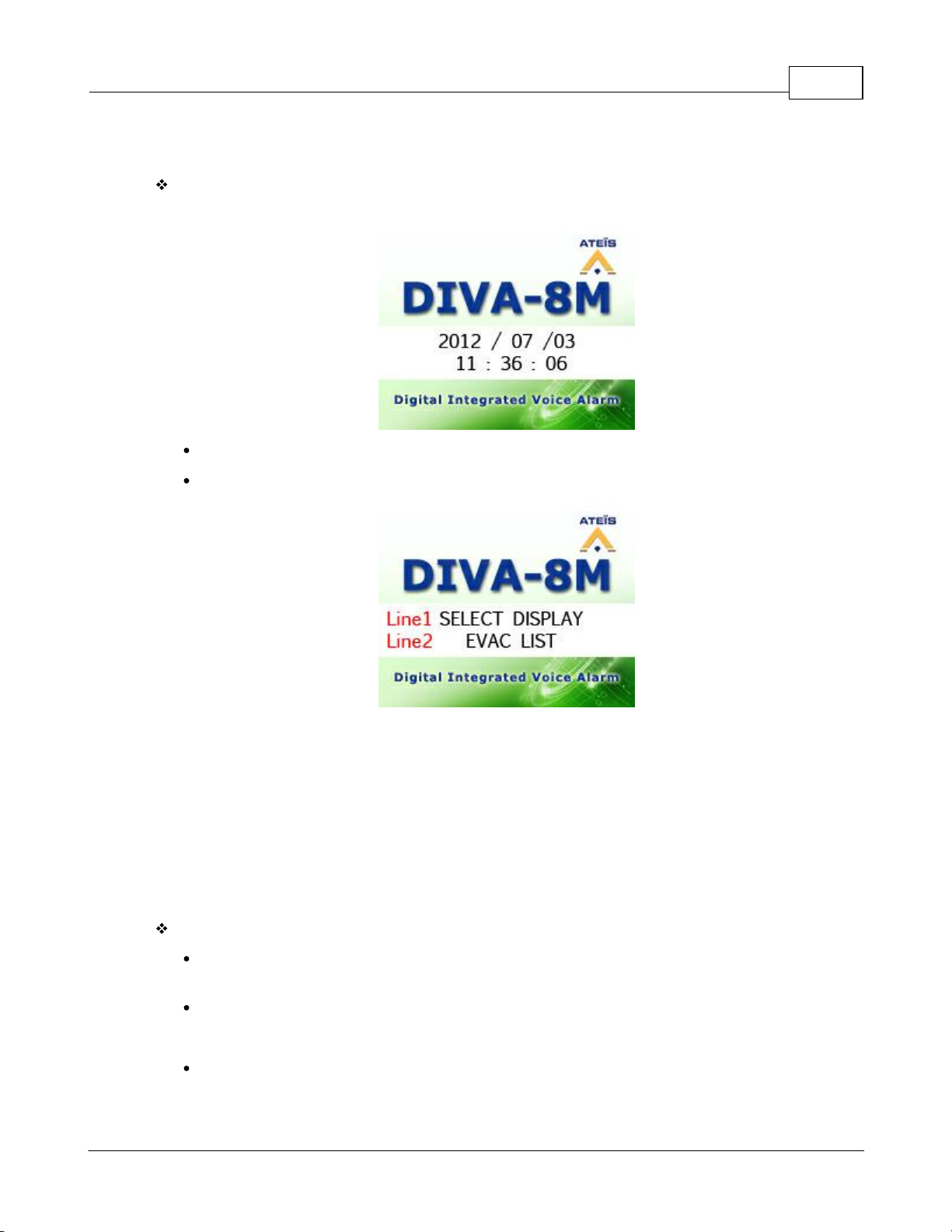
4.1.1.9 LCD Menu
The menu display offers the possibility to access different controls and system information. When in
idle, it auto displays current time and date, see below.
Press OK to enter in the menu.
All selections and contents display like the picture below.
Product Features 61
© 2012 ATEÏS
1st line: SELECT DISPLAY
2nd line: depends on what topic you choose now.
If it display the state below
1st line: HIGHER LEVEL
2nd line: REQUIRED.
Please log in the user account create in DIVA software. Note: the account data need to be
stored in DIVA8M.
Here are the list of menu topic you will be able to access:
EVAC LIST:
In this menu, all evacuation occurrences will be listed from the youngest to the oldest.
EVAC ZONE LIST:
In this menu, all evacuation zone occurrences will be listed from the youngest to the oldest.
FAULTS LIST:
In this menu, all fault occurrences will be listed from the youngest to the oldest.
Page 62

DIVA system62
EVENTS LIST:
In this menu, all operation occurrences will be listed from the youngest to the oldest.
SCHEDULER LIST:
In this menu, it displays the scheduler setting in DIVA software.
READ MAC ADDRESS:
Read Mac Address.
READ IP ADDRESS:
Read IP Address.
READ SUBNET MASK:
Read Subnet Address.
READ GATEWAY ADDRESS:
Read Gateway Address.
READ PORT:
Read Port, for DIVA it's 19900.
READ FIREMAN VERSION:
Read Fireman version.
READ FPGA VERSION:
Read FPGA version.
READ FIREWARE CRC:
Read Cyclic redundancy check to confirm the update info exchanged correctly between fireware
and DIVA8M.
READ CONFIG CRC:
Read Cyclic redundancy check to confirm the data exchanged correctly between DIVA software
and DIVA8M.
READ LOG RECORD:
In the menu section of DIVA, you can read the Log File as well as clear it if needed.
For a complete list of Log File entry, please read the Log File Messages List chapter.
SETTING MENU:
In this menu, you will be able to manage and set different configuration parameters.
Note: the The front panel buttons are described in the hardware description -> Front View.
o User Login
o User Logout
o Stop All Events
© 2012 ATEÏS
Page 63

o Fireman Level
o Mic Line Level
o Music 1 Level
o Music 2 Level
o Speaker Level
o System Time
o Mac Address
o IP Address
o Subnet Mask
o Gateway Address
o Port
o Reset Monitor
o Leakage Search
Product Features 63
o Reset Leakage
o Logout Timer
o Menu Timer
o TFT Reset Timer
o System Fault Reset
o English Language
o Chinese Language
o Evac/Alarm Key Mode
o Leds/Logic Test
4.1.1.9.1 Evacuation List
In the event of an evacuation state in the DIVA system, the Evac Info List will be automatically display
as a priority display. With the up and down arrow keys, you can go through the different evacuation
process occurring in the system.
The youngest evacuation state/occurrence is displayed first. The evacuation status is displayed as
follow:
1st line: EVAC LIST
© 2012 ATEÏS
2nd line: XXXXXXXX
Note: the XXXXXX depends on the name of the evacuation event used.
Page 64

DIVA system64
4.1.1.9.2 EVAC Zone List
In the event of an evacuation state in the DIVA system, the Evac zone Info List will be automatically
display as a priority display. With the up and down arrow keys, you can go through the different
evacuation process occurring in the system.
The youngest evacuation state/occurrence is displayed first. The evacuation status is displayed as
follow:
1st line: EVAC ZONE LIST
2nd line: XXXXXXXX
Note: the XXXXXX depends on the name of the evacuation event used.
4.1.1.9.3 Fault List
In the event of a fault state in the DIVA system, the Fail Info List will be automatically displayed. With
the up and down arrow keys, you can go through the different live fault occurrences in the system.
The youngest fault state/occurrence is displayed first. The fault state is displayed as follow:
1st line: FAULT LIST
2nd line: The fault message shows here
4.1.1.9.4 Events List
In the event of any non-evacuation audio routing in the DIVA system, the Normal Info List will be
automatically displayed. With the up and down arrow keys, you can go through the different evacuation
process occurring in the system.
The youngest evacuation state/occurrence is displayed first. The normal paging/audio routing status is
displayed as follow:
1st line: EVENTS LIST
2nd line: The event status shows here
4.1.1.9.5 Scheduler List
In the event of all scheduler lists in the DIVA system, the Task List will be automatically display as a
priority display. With the up and down arrow keys, you can go through the different task name in the
system.
The youngest task name is displayed first. The ON/OFF is displayed as follow:
1st line: 001/001 SCHEDULER LIST
2nd line: Task1 OFF
4.1.1.9.6 Setting Menu
The function menu allows to set and read system configuration parameters. All the following menus and
setting are available from front panel:
© 2012 ATEÏS
Page 65
User Login
The Login menu allows to log into a user account to avoid entering it at each secured menu.
From the SETTING MENU:
Use arrow keys to access the USER LOGIN menu.
Press OK.
It display the current user account Level, default is Level 1.
Press OK.
Enter an Username and a Password.
o Once the Username/Password has been entered correctly, choose APL (right after numbers
and alphabet) to apply.
It displays the current user account level.
Press ESC to go out of the menu.
In case of multi-user levelling, you can logout from the current user session in order to login in an other
one.
From the SETTING MENU:
Use arrow keys to access the USER LOGOUT menu.
Press OK, it will display "Sure? OK/ESC".
Press OK.
o You will be prompt to login.
o Enter your user name.
o Enter your password.
o You will be log in your user account.
Press ESC to go out of the menu.
From the front panel of DIVA, you are able to stop all the running events (events are discussed in How to
use events).
From the SETTING MENU:
Use arrow keys to access the STOP ALL EVENTS menu.
Press OK.
You will be asked for validation: "SURE? OK/ESC".
If yes, Press OK.
User Logout
Product Features 65
Stop All Events
© 2012 ATEÏS
Page 66
DIVA system66
o It displays "EXECUTE SUCCESS".
If no, press ESC.
The following level you can set with Up/Down arrow buttons and Plus, Minus buttons.
From the SETTING MENU:
Use arrow keys to choose topics
o FIREMAN LEVEL (User level 4 required)
o MIC LINE LEVEL
o MUSIC 1 LEVEL
o MUSIC 2 LEVEL
Press OK.
On DIVA front panel, you can set the current location time format as well as the current date and time.
(User level 2 required)
From the SETTING MENU:
Use arrow keys to access the SET SYSTEM TIME menu.
Press OK.
The program displays SET YEAR.
Use + or - keys to adjust the year value.
Press down arrow to go to the next step (SET MONTH).
Use + or - keys to adjust the month value.
Press down arrow to go to the next step (SET DATE).
Use + or - keys to adjust the date value.
Press down arrow to go to the next step (SET HOUR).
Use + or - keys to adjust the hour value.
Press down arrow to go to the next step (SET MINUTE).
Use + or - keys to adjust the minute value.
Press down arrow to go to the next step (SET SECOND).
Use + or - keys to adjust the second value.
Press OK to validate your entries.
At anytime, pressing ESC will ends the date and time setting process.
Set Levels
Set System Time
© 2012 ATEÏS
Page 67
Set Address & Port
From the SETTING MENU:
Use arrow keys to choose topics
o MAC ADDRESS (User level 4 required)
In the world of computer networking, there is one common way to set an quasi-unique identifier
to a network device.
This is the MAC address (Media Access Control Address). This number act like a name for one
particular network device. Note: If it's changed, DIVA can't connect to network.
To see the MAC address just follow these steps:
From the main MENU:
Choose READ MAC ADDRESS.
press OK, the MAC Address number is displayed.
Press ESC to go out of the menu.
To change the MAC address just following these steps:
From the SETTING MENU:
Press OK.
Enter the address value using arrow keys and +/- keys, it displays 12 numbers.
Press OK.
o IP ADDRESS (User level 3 required)
The following steps show how to change IP Address:
Press OK.
Enter the IP address value using arrow keys and +/- keys. Default address is
192.168.100.100.
Press OK.
You will be asked for validation "REBOOT VALIDATE". Note: after each change in the
Ethernet settings, the DIVA system need to reboot.
If yes, press OK.
If no, press ESC.
o SUBNET ADDRESS (User level 3 required)
Press OK.
Enter the subnet mask value using arrow keys and +/- keys. Default mask is
255.255.255.000.
Press OK.
Product Features 67
© 2012 ATEÏS
Page 68
DIVA system68
You will be asked for validation "REBOOT VALIDATE". Note: after each change in the
Ethernet settings, the DIVA system need to reboot.
If yes, press OK.
If no, press ESC.
o GATEWAY ADDRESS (User level 3 required)
Press OK.
Enter the gateway address value using arrow keys and +/- keys. Default address is
192.168.100.001.
Press OK.
You will be asked for validation "REBOOT VALIDATE". Note: after each change in the
Ethernet settings, the DIVA system need to reboot.
If yes, press OK.
If no, press ESC.
o PORT (User level 3 required)
Press OK.
Enter the UDP port value using arrow keys and +/- keys. Default UDP port value is 19900.
Press OK.
You will be asked for validation "REBOOT VALIDATE". Note: after each change in the
Ethernet settings, the DIVA system need to reboot.
If yes, press OK.
If no, press ESC.
From the SETTING MENU:
Use arrow keys to access the RESET MONITOR menu.
Press OK.
You will be asked for validation: "SURE? OK/ESC".
If yes, Press OK.
o It displays "EXECUTE SUCCESS"
If no, press ESC.
From the SETTING MENU:
Use arrow keys to access the LEAKAGE SEARCH menu.
Reset Monitor
Leakage Search
© 2012 ATEÏS
Page 69
Press OK.
You will be asked for validation: "SURE? OK/ESC".
If yes, Press OK.
o It costs few minutes on searching, about 16 seconds per Slave unit.
o The LCD screen will displays "LEAK SEARCH STOP" while searching.
o if you want to stop the searching, Press OK. Otherwise, Press ESC, it will add the searching
into event.
If no, press ESC.
Reset Leakage
From the SETTING MENU:
Use arrow keys to access the RESET LEAKAGE menu.
Press OK.
You will be asked for validation: "SURE? OK/ESC".
If yes, Press OK.
o It displays "EXECUTE SUCCESS"
If no, press ESC.
From the SETTING MENU:
Use arrow keys to access the SYSTEM FAULT RESET menu.
Press OK.
You will be asked for validation: "SURE? OK/ESC".
If yes, Press OK.
o It displays "EXECUTE SUCCESS".
If no, press ESC.
From the SETTING MENU:
Use arrow keys to choose topics
o LOGOUT TIMER
It will automatically log out users if they're idle over the logout time.
o MENU TIMER
It will automatically display current time and date. if they're idle over the Menu time.
Product Features 69
System Fault Reset
Set Timer
© 2012 ATEÏS
Page 70
DIVA system70
o TFT RESET TIMER
To adjust the image position and colors of TFT screen in period.
Press OK.
Use + or - keys to set the time (Numbers 0~9).
Press OK.
Change front panel language.
From the SETTING MENU:
Use arrow keys to choose topics.
o ENGLISH LANGUAGE
o CHINESE LANGUAGE
Press OK.
You will be asked for validation: "SURE? OK/ESC".
If yes, Press OK.
If no, press ESC.
From the SETTING MENU:
Use arrow keys to access the EVAC/ALARM KEY MODE menu.
Press OK.
You will be asked for validation: "SURE? OK/ESC".
If yes, Press OK.
If no, press ESC.
From the SETTING MENU:
Use arrow keys to access the LEDS/LOGICS TEST menu. (User level 4 required)
Use arrow keys to choose topics.
o LED TEST
o LOGIC OUT TEST
o TFT DISPLAY TEST
Press OK, it will start to test.
Press ESC, it will stop testing.
Language
Evac/Alarm Key Mode
LEDs/Logic Test
© 2012 ATEÏS
Page 71

4.1.1.9.7 Managing Music Sources
On DIVA front panel, you have the possibility to assigned music sources to a zone (or multiple), set up
attenuation for each speaker zone (only on music).
To manage music source, the music sources should be set in "Route Key" mode, see How To Use
Music Source.
The procedure to assign a music source to a zone is the following:
Select the music source:
o Press the SELECT button to go from Source 1 to Source 2.
o Press SELECT button to go from Source 2 to no selection.
o Press SELECT button to re-select Source 1.
Select the zone(s):
o Press the zone button(s) you want to activate on Master and/or Slaves. The corresponding
white selection LED(s) should light(s) up.
Validate the routing by pressing the ROUTE button.
Product Features 71
Zone attenuators:
In each master zone, the music level can be attenuated depending your needs. The attenuators offer 6
attenuation positions: 0, -4, -8, -12, -16, -20 dB.
Adjust the corresponding zone(s) ATTENUATOR KNOBS to the desired attenuation level.
Note: Zones that are monitored cannot be attenuated to -20dB without causing monitoring
problems. At -20dB attenuation, the accuracy of the impedance circuitry reach its limit.
Note: If two music sources are used, keep in mind that attenuator will only have effect on only
one of them (music 1). Because the Voice amplifier will be used for music 2, the attenuators
won't have any effect on the sound level.
Note: Music attenuator are only available on Master DIVA unit.
4.1.1.9.8 Messages and Microphone Calls
From the front panel, you have the choice two start three different messages or do a zone call with the
fireman microphone. Read the following two chapters for more information about how to set up
messages and configure the Fireman Microphone.
There are three front panel message buttons plus one reset button:
EVAC: initiates a evacuation message broadcasting process.
ALERT: initiates a evacuation message broadcasting process.
© 2012 ATEÏS
MSG TEST: initiates a evacuation message broadcasting process.
RESET: initiate a software reset process.
Messages
Page 72

DIVA system72
From EVAC button
o Lift the EVAC button cover.
o Press the EVAC button.
o DIVA displays "EVAC KEY PROCESS".
o Press OK.
o DIVA displays "EVAC CONFIRM 1 SURE? OK/ESC".
o Press OK.
o DIVA displays "EVAC CONFIRM 2 SURE? OK/ESC".
o Press OK.
o The message is played in the pre-defined zone(s).
From ALERT button
o Press the ALERT button.
o DIVA displays "ALERT KEY PROCESS".
o Press OK.
o DIVA displays "ALERT COMFIRM 1 SURE? OK/ESC".
o Press OK.
o DIVA displays "ALERT CONFIRM 2 SURE? OK/ESC".
o Press OK.
o The message is played in the pre-defined zone(s).
From MSG TEST button
o Press the MSG TEST button.
o DIVA displays "TEST KEY PROCESS".
o Press OK.
o DIVA displays "TEST CONFIRM 1 SURE? OK/ESC".
o Press OK.
o DIVA displays "TEST CONFIRM SURE? OK/ESC".
o Press OK.
Depending on the software configuration created, there is two distinct way of starting a message:
with manual zone selection or with pre-defined zone.
To learn more about how to set pre-defined zone on message, please read the "How to set up front
panel messages" chapter.
Starting message with Pre-define zone(s)
© 2012 ATEÏS
Page 73

o The message is played in the pre-defined zone(s).
Starting message with a manual zone(s) selection
Press the zone button(s) where you want the message to be played. The corresponding white
selection LED(s) should light(s) up.
From EVAC button
o Lift the EVAC button cover.
o Press the EVAC button.
o DIVA displays "EVAC KEY PROCESS".
o Press OK.
o DIVA displays "EVAC ENABLE 1 SURE? OK/ESC".
o Press OK.
o DIVA displays "EVAC ENABLE 2 SURE? OK/ESC".
o Press OK.
o The message is played in the manually selected zone(s).
Press the zone button(s) where you want the message to be played. The corresponding white
selection LED(s) should light(s) up.
From ALERT button
o Press the ALERT button.
o DIVA displays "ALERT KEY PROCESS".
o Press OK.
o DIVA displays "ALERT ENABLE 1 SURE? OK/ESC".
o Press OK.
o DIVA displays "ALERT ENABLE 2 SURE? OK/ESC".
o Press OK.
o The message is played in the pre-defined zone(s).
Press the zone button(s) where you want the message to be played. The corresponding white
selection LED(s) should light(s) up.
From MSG TEST button
o Press the MSG TEST button.
o DIVA displays "TEST KEY PROCESS".
o Press OK.
o DIVA displays "TEST ENABLE 1 SURE? OK/ESC".
Product Features 73
© 2012 ATEÏS
Page 74

DIVA system74
o Press OK.
o DIVA displays "TEST ENABLE 2 SURE? OK/ESC".
o Press OK.
o The message is played in the pre-defined zone(s).
Reset the evacuation process.
o Press the RESET button.
o DIVA displays "RESET KEY PROCESS".
o Press OK.
o DIVA displays "RESET ENABLE 1 SURE? OK/ESC".
o Press OK.
o DIVA displays "RESET ENABLE 2 SURE? OK/ESC".
o Press OK.
o A software reset is applied. Any active trigger (fault, contact, etc) are restarted after the
software reset.
Stop ALERT or MSG TEST broadcasting.
o Press the ALERT or MSG TEST button.
o DIVA displays "ALERT or MSG TEST KEY PROCESS".
o Press OK.
o DIVA displays "ALERT or MSG TEST DISABLE 1 SURE? OK/ESC".
o Press OK.
o DIVA displays "ALERT or MSG TEST DISABLE 2 SURE? OK/ESC".
o Press OK.
o The message broadcasting is stopped.
Press the fireman microphone contact to start speaking in the pre-defined zone(s), the
corresponding zone EVAC LED(s) are lit.
Stopping message broadcasting
Fireman Microphone
Depending on the software configuration created, there is two distinct way of starting a Fireman
microphone call:
with a manual zone selection or with pre-define zone(s) selection. To learn more on how to configure predefine zone selection fro the fireman microphone, please read the "how to use a fireman microphone"
chapter.
Starting a call with pre-define zone(s)
© 2012 ATEÏS
Page 75
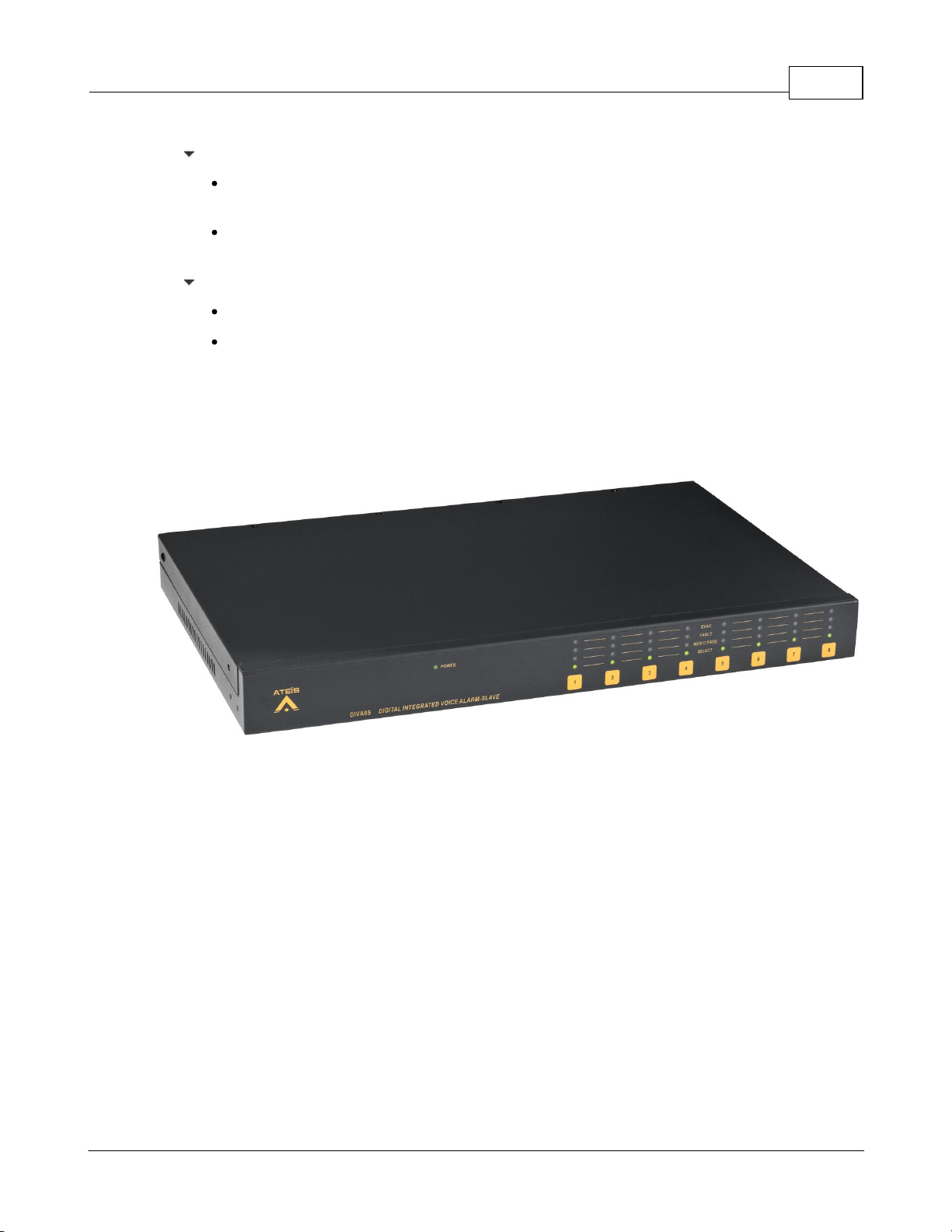
Starting a call with manual zone(s) selection
Press the zone button(s) where you want the call to be played. The corresponding white
selection LED(s) are lit.
Press the fireman microphone contact to start speaking in the selected zone(s), the
corresponding zone EVAC LED(s) are lit.
Release the fireman microphone contact if used in "push to talk" mode.
Press the fireman microphone contact a second time if used in "Lock to talk" mode. Note: if
the fireman microphone is using a pre and/or post chime message, the "RUNNING" LED will
blink during the chime broadcasting.
Stopping a fireman microphone call
4.1.2 DIVA8S
4.1.2.1 Overview
Product Features 75
DIVA8SG2 is a Slave unit for the DIVA8MG2 master unit. It increases the number of paging zones by 8
zones for each Slave unit added in the system. The maximum number of Slave units is 15, which means
a complete system (master plus slaves) of up to 128 zones.
The DIVA8S Slave Unit also extends the amount of input and output contacts. It includes 9 alarm inputs
triggered either by dry contact or voltage (software setting), 8 logic input contacts, 2 external fault input
contacts and 8 output contacts.
The DIVA8S Slave Unit offers the same power capacity as the master unit being 1000 W of audio power
(100 V) on each amplifier channel (voice and music).
For maximum flexibility, the master unit amplifiers can share their power with all the slaves, or additional
amplifier channels can be added to the system where more output power is needed. The 100 V amplifier
signal is simply linked to slaves to create a 100 V signal bus. See figure 1 and 2 for wiring examples.
All the zones and amplifier channels in the DIVA8 System can be constantly monitored (software
setting).
Like DIVA8M Master unit and DIVA8S Slave unit can be directly supplied with 110 V-230 V or powered
by 24 VDC as a battery backup. The DIVA8M Master unit and the DIVA8S Slave unit are linked using
shielded CAT5 cable.
© 2012 ATEÏS
Page 76
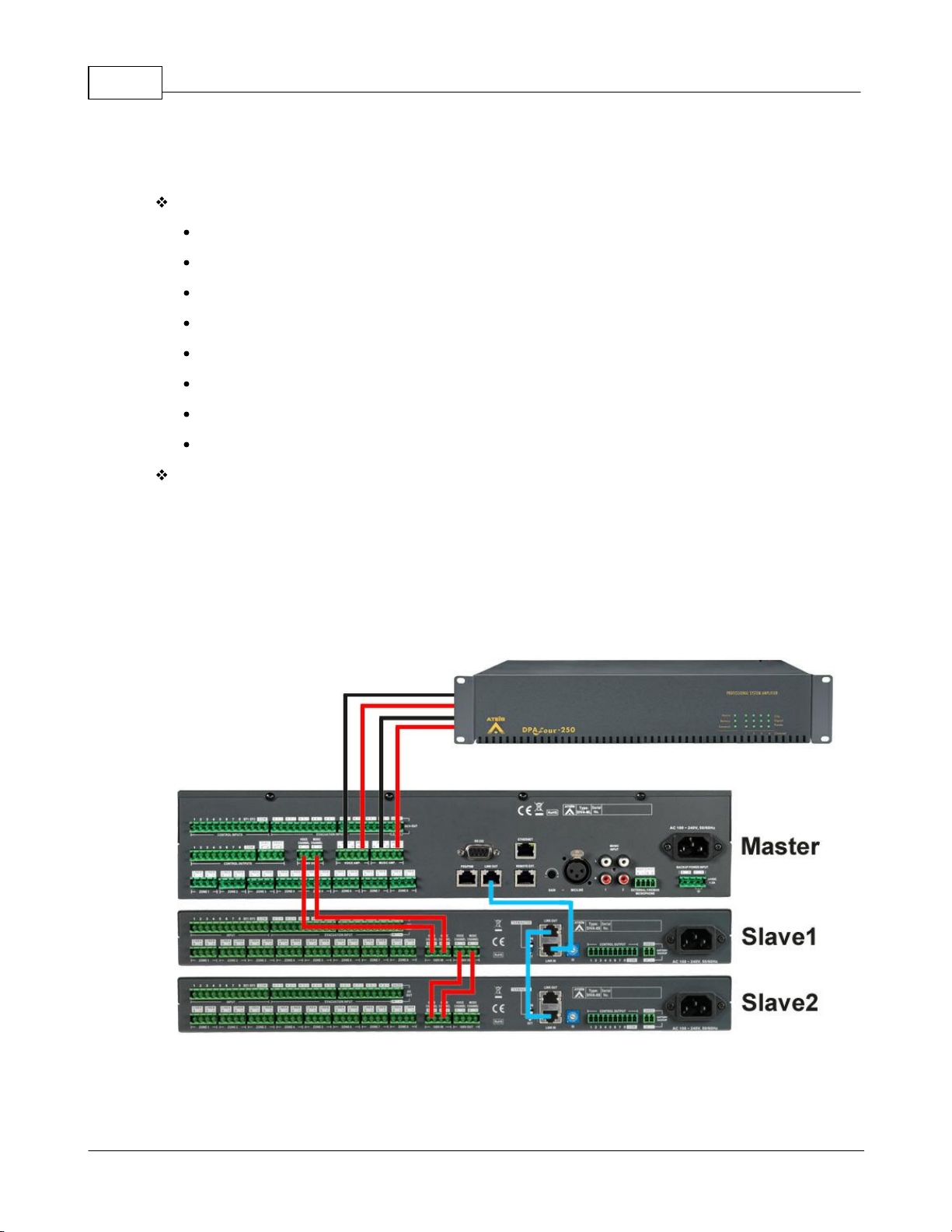
DIVA system76
Figure1: DIVA8M Master unit and DIVA8S Slave unit
As a part of the DIVA8 system, The DIVA8S Slave unit complies with current standards.
DIVA8S is made of:
8 loudspeaker zones extension (A + B).
1000 W max power on each channel.
9 evacuation input contacts (with surveillance).
8 logic input contacts.
2 fault input contacts.
8 output contacts.
Front panel zone selection buttons.
1U 19”.
Linking
To connect one slave DIVA to a master simply connect the "Link Out" connector of the Master to
the "Link In" of the slave with a RJ-45 CAT5 cable and so on for the next slave unit. To pass the
audio to the slave unit, simply connect the Master "100V Link" connector to the slave "100V In"
connectors. If more than 500W of power is needed, you can add two amplifier channels per slave
unit. To synchronize the audio, simply link the 0dB output of the master to the additional amplifiers
0dB input and additional amplifier 100V output to the corresponding 100V slave input.
The schematic below shows how to perform a DIVA system with 1 master and 2 slave units using
the same amplifier.
The schematic below shows how to perform a DIVA system with two additional amplifiers.
© 2012 ATEÏS
Page 77
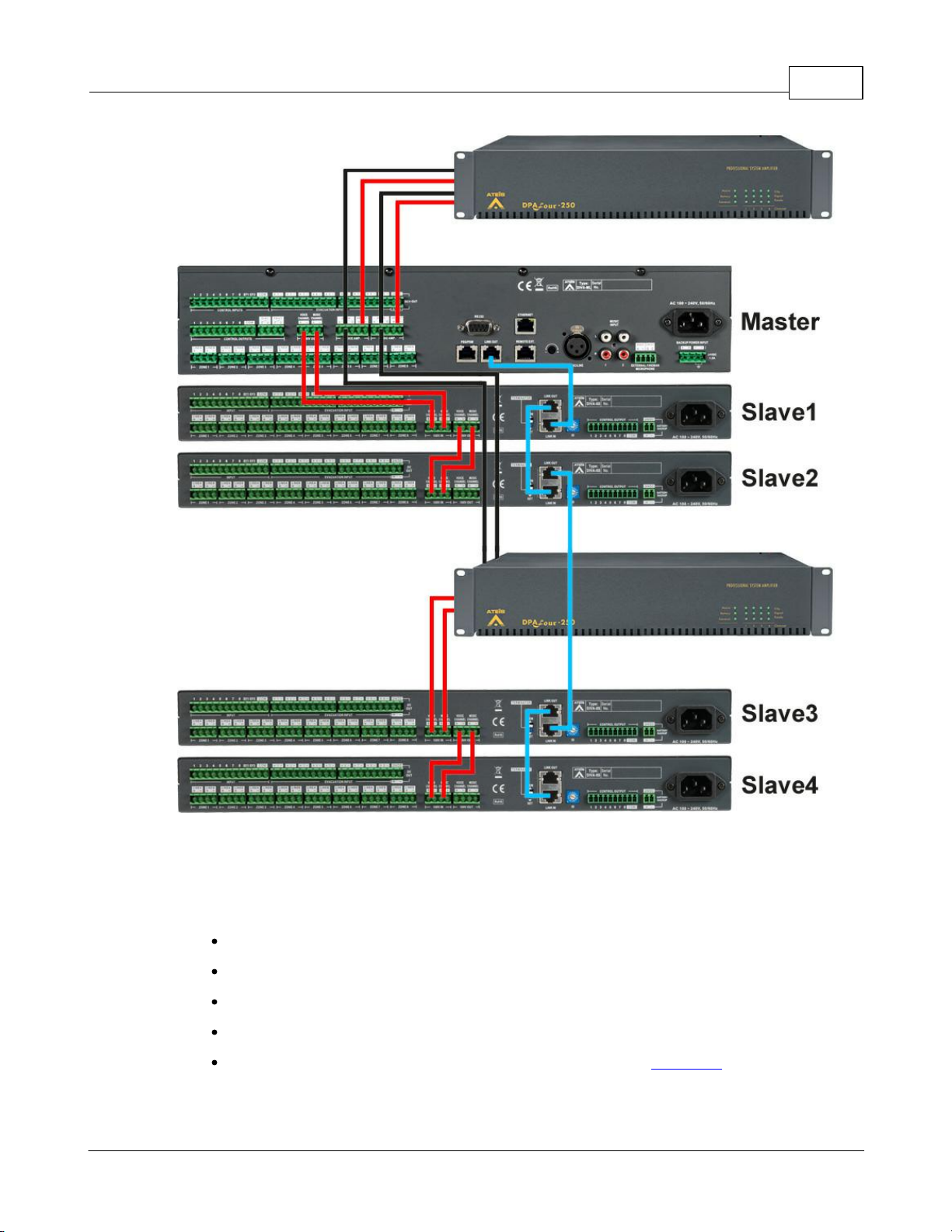
Product Features 77
Figure2: DIVA8M Master unit and DIVA8S Slave unit w ith 4 amplifier channels
On both schematics, the 0dB lines are displayed in black and 100V lines in red.
Note: connections are not fully described (example: 0dB line is described as one wire instead of 3).
Characteristics (COMBINED with DIVA8M Master unit)
Up to 128 zones switching system.
5 audio inputs (2x Music, 1x Mic/line, 1x PSS or PSM, 1x Fireman microphone).
45 min of message memory.
Full amplifiers and zones monitoring.
Single and Dual channel switching. (See DIVA8M Application / example 2)
© 2012 ATEÏS
Page 78
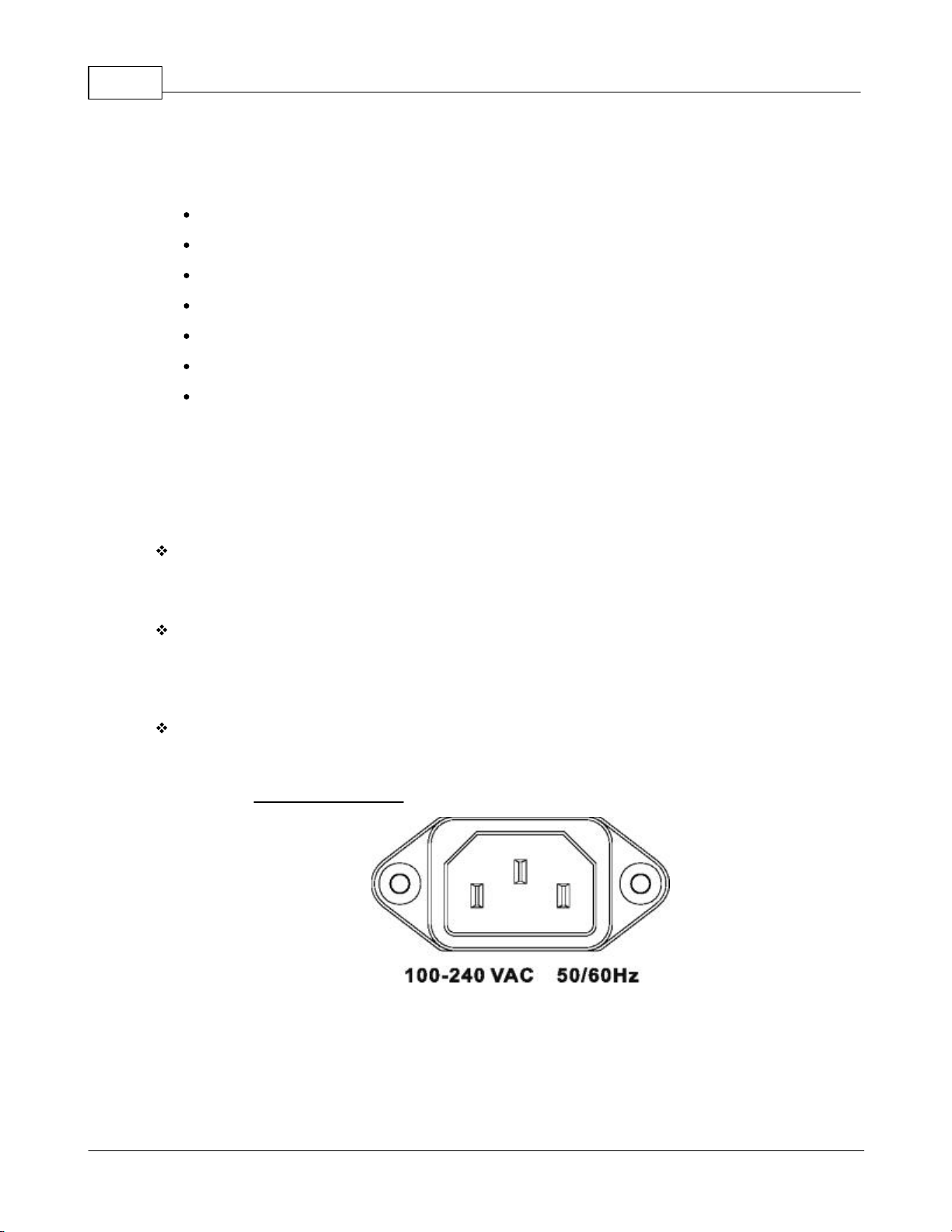
DIVA system78
4.1.2.2 What's inside the Box
Opening the box you should find the following items:
DIVA slave Unit Rack rounting brackets, 2 pcs.
Metal screws Philips M3x6, 6 pcs. 12-way euroblock connectors, 1 pcs.
10-way euroblock connectors, 3 pcs.
4-way euroblock connector, 10 pcs.
10-way mini euroblock connectors, 1 pcs.
2-ways mini euroblock connector, 1 pcs.
230 VAC power cable.
If you realize anything missing, please contact your distributor.
4.1.2.3 Installation
In the Box of the DIVA there is containing a letter with a point by point instruction that need to be
followed for safety reasons.
Rack mounting:
If needed, fit the rack mounting brackets to each side of the DIVA by using the 6 pcs Phillips M3x6
screws supplied with the package.
Sitting:
The DIVA unit takes a 2U 19’’ rack space and generates little heat itself. Consider leaving enough
ventilation space above and below the unit. Do not mount the DIVA directly above heat generating
devices like power supplies or power amplifiers.
Power connection:
DIVA accepts 24 VDC power supply as well as 230 VAC power supply. In order to be EN54
compliant, use a BECs battery charger and power supply and connect it on a 4-way euroblock
connector respecting the polarity.
© 2012 ATEÏS
Page 79
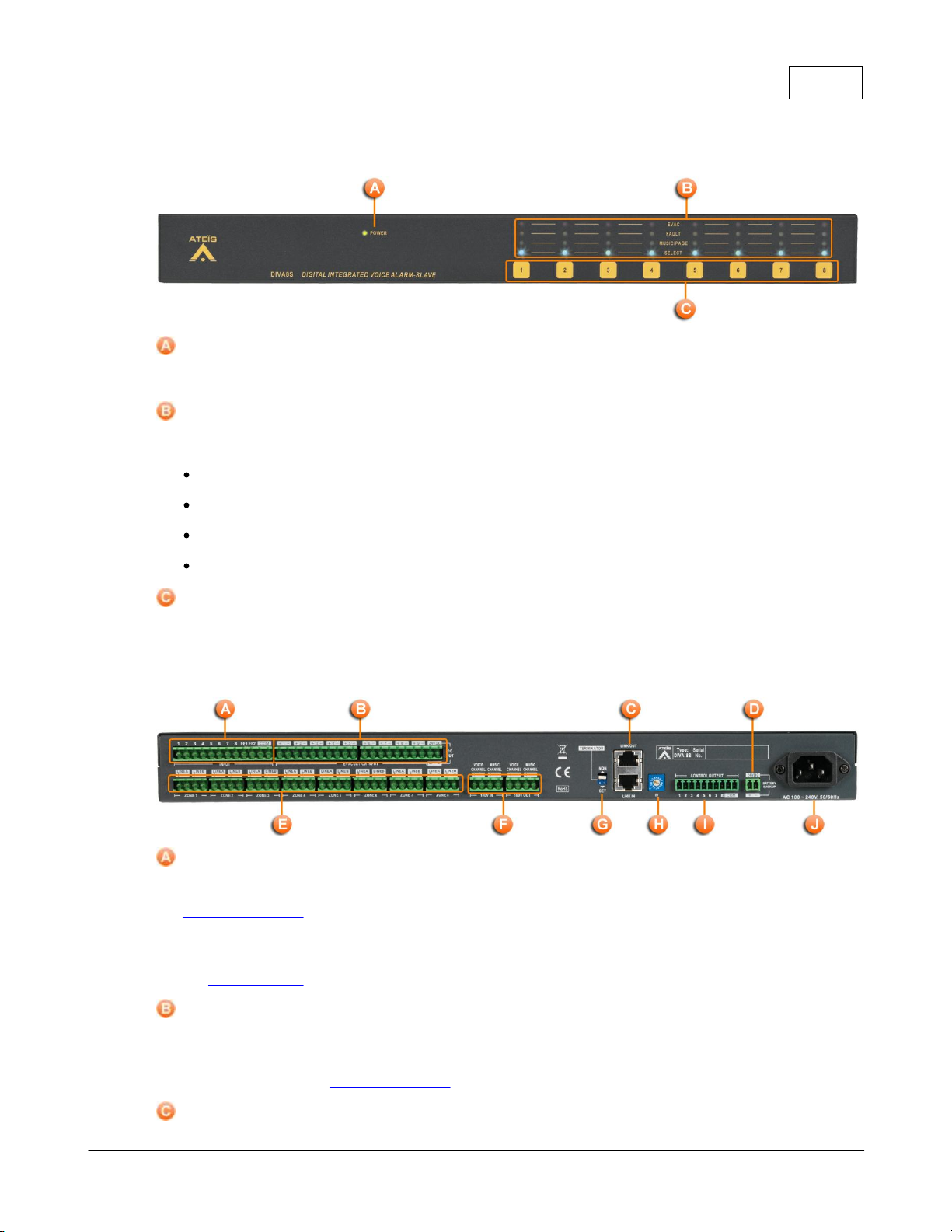
4.1.2.4 Front Panel
Power indicator LED:
Indicates the power status of the DIVA.
Voice alarm control and indicating equipment indicators:
There are eight rows of 4 LEDs that show in real-time mode the zones' status:
EVAC
FAULT
Product Features 79
ALERT/PAGE
SELECTED
Zone selection buttons:
Select or deselect zone for manual routing.
4.1.2.5 Rear Panel
Logic and external fault inputs:
There is eight logic inputs that are two states input (open contact, close contact). The same as
DIVA Master unit.
External faults input are normally reserved to connect security devices like monitored power supply.
Those two inputs can be used to put DIVA into a security mode, security mode will be discussed in
the event chapter.
© 2012 ATEÏS
Evacuation inputs:
Evacuation inputs are contact inputs that allows the monitoring of external contact. They also can
be used in UGA mode, trigger by a voltage polarization change. This connector supplies a 24VDC
source. The same as DIVA Master unit.
Master-Slave link:
Page 80
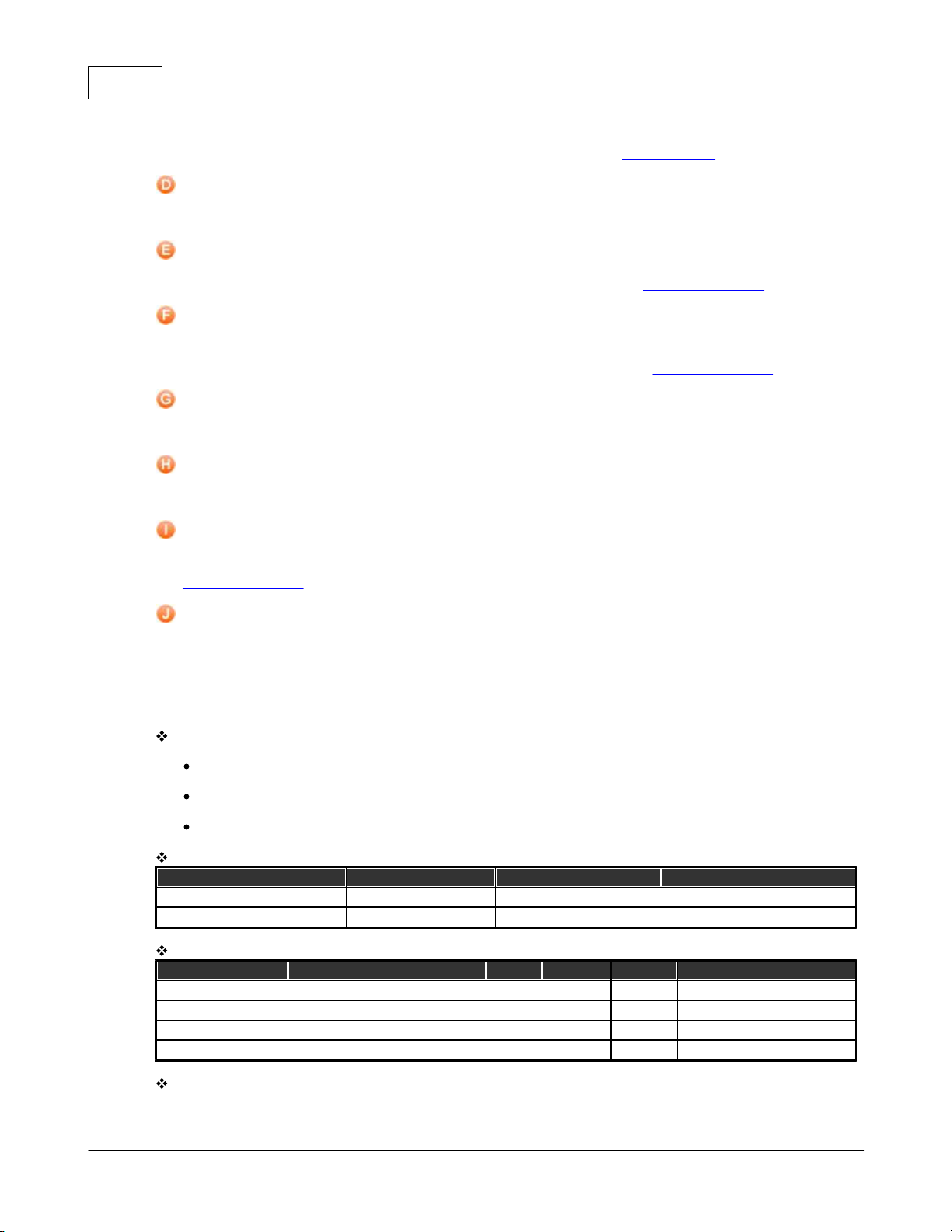
DIVA system80
Item
Voltage
Current Consumption
Comment
AC Input
100V~240V
1.2A
Frequency:47Hz~63Hz
DC Output
20~28V, Typical: 24V
1A
Item
Condition
Min.
Typ.
Max.
Comment
Input Level
20HZ ~ 22kHz
--16dBu
Electrically Non-Balanced
Output Level
20HZ ~ 22kHz
--16dBu
Electrically Balanced
S/N
20Hz ~ 22kHz
-80dBu--
T.H.D
20Hz~20kHz,@ gain 24dBu
--0.02%
-
Connectors to create a master-slave DIVA system. About wiring, see Overview.
24VDC input:
24VDC power supply for battery operation. The same as DIVA Master unit.
Speaker Zone Outputs:
Eight speaker zone connectors split into A and B line. The same as DIVA Master unit.
100V Signal Links:
100V input to receive 100V signal from an amplifier connected to another DIVA(M or S) unit. 100V
output to send 100V signal to others DIVA(M or S) unit. The same as DIVA Master unit.
Terminator:
This switch define the end of the Master-Slave system.
Slave ID:
This rotary switch is used to set an ID to each Slave in the system.
Logic output:
Eight Logic outputs to send a pulse or a static closing/opening to an external device. the same as
DIVA Master unit.
Power Section:
Insert provided power cable first into DIVA8S then in the wall power connector.110~240 V 1.2A,
47~63Hz AC power input with fuse.
Fuse rating: 1.6A.
4.1.2.6 Characteristics
Case
Dimension = 431mm (W) x 277(D) x 44mm(H)
Weight = 3.9 Kg.
Color = RAL7016.
Power
Audio monitor Specification
Audio AMP. Specification
© 2012 ATEÏS
Page 81
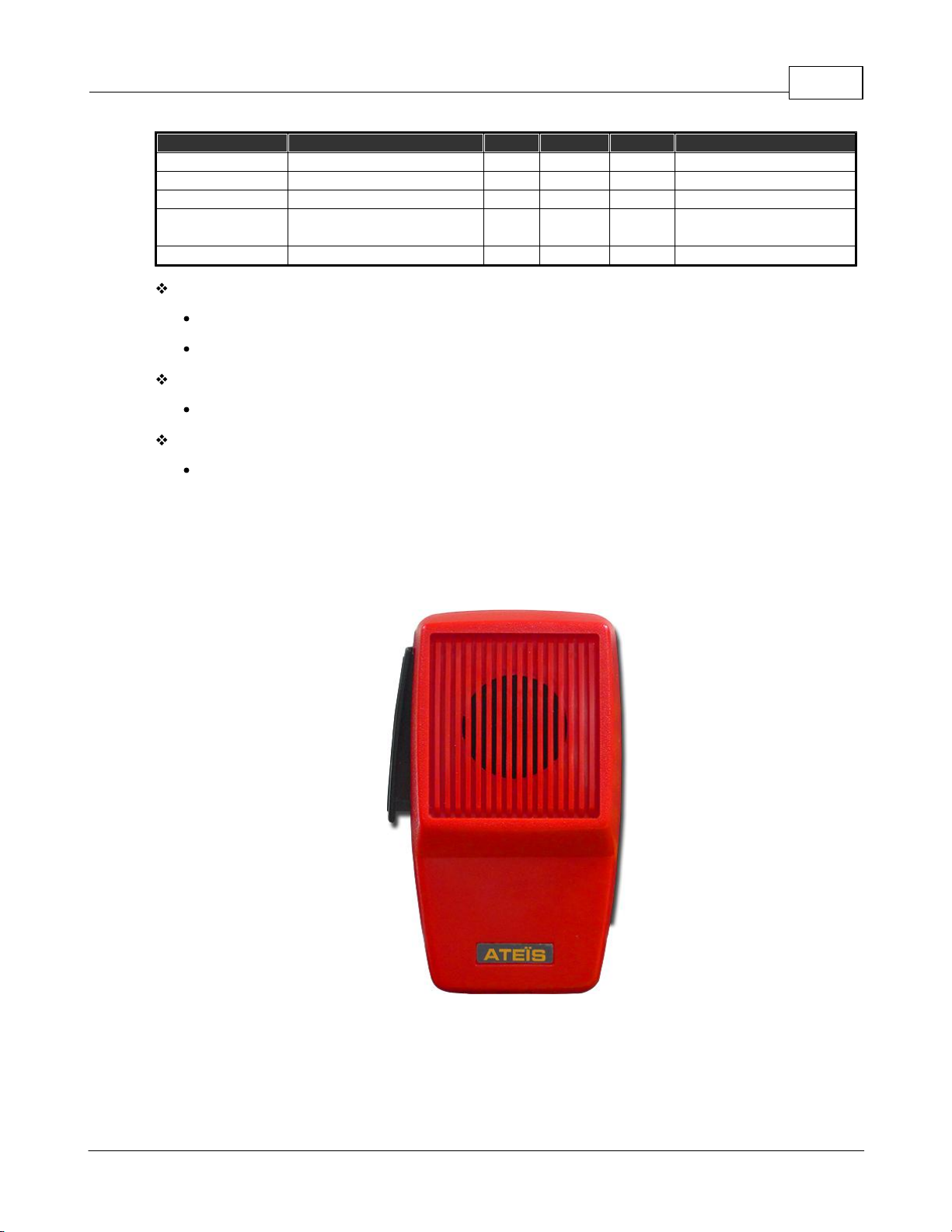
Item
Condition
Min.
Typ.
Max.
Comment
Input Level
50HZ ~ 18KHz
-
100V
-
Electrically Balanced
Output Level (0dB)
50HZ ~ 18KHz
95V
100V
105V
Electrically Balanced
S/N(Line)
50Hz ~ 18KHz
-
>84dBu--
T.H.D + N ratio
(Half power)
50Hz ~ 18kHz
--
<1%
-
-
Input Max. Power
-
--500W
-
GPIO Protection
GPIO input Voltage limiting = 4.7VDC
Evacuation input voltage limiting = 5.6VDC
RS-485 Protection
Transceiver signal voltage limiting = 10VDC
Working Temperature.
0°C ~ 40°C
4.2 Consoles and Accessories
Product Features 81
4.2.1 Fireman Microphone
The Fireman Microphone SHM 1 is a small compact microphone dedicated to security calling.
© 2012 ATEÏS
It is a totally monitored microphone with internal resistor network to detect four different states (Shortcut,
Closed Contact, Open Contact, Absent).
Firemen Microphone SHM 1 for All call, group or zone calls. The EN-54 surveillance is realized thanks to
the DIVA internal circuitry.
Page 82
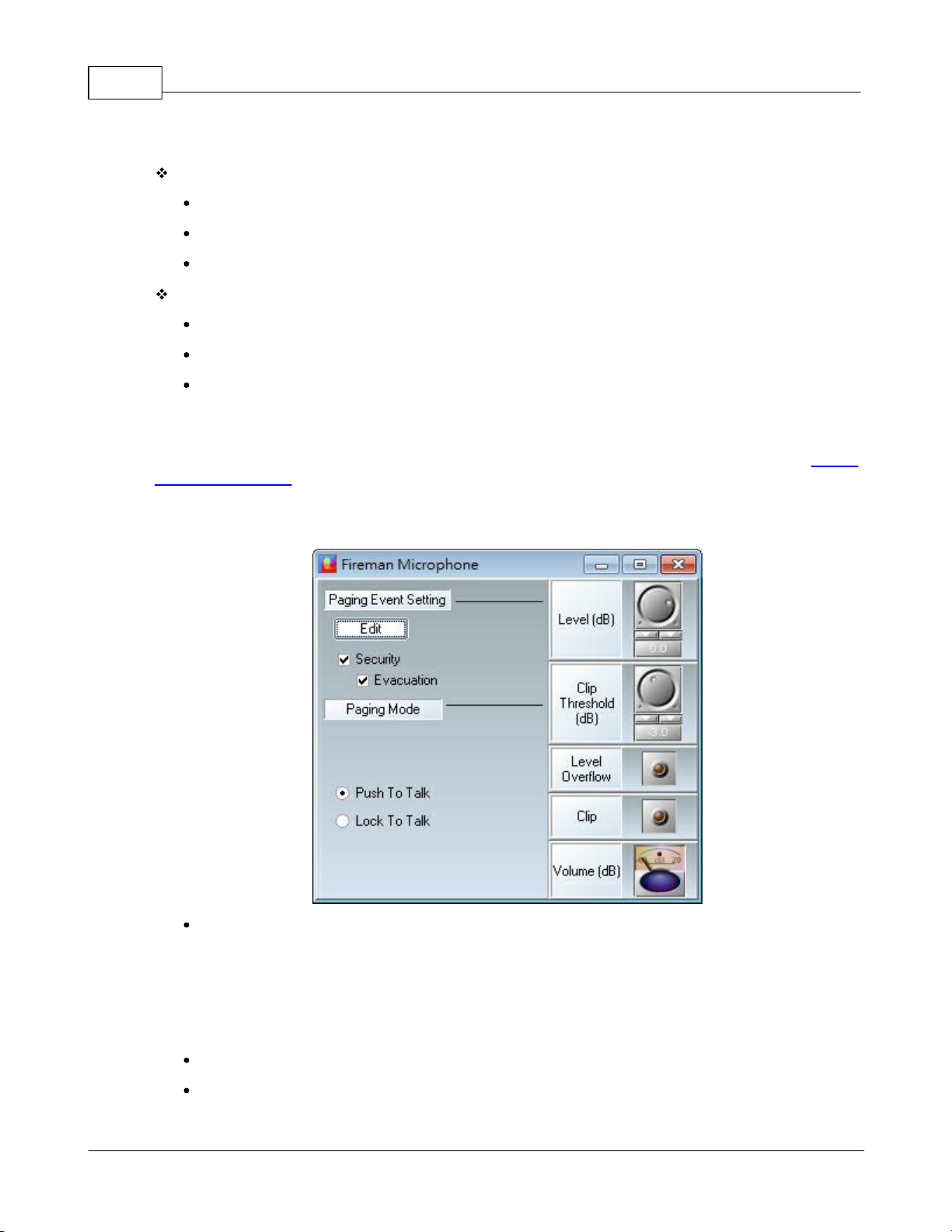
DIVA system82
4.2.1.1 Characteristics
Case
Dimension = 62mm (W) x 45mm (L) x 102mm (H).
Weight = 0.15KG
Cable = 1.8M(spring cord)
Microphone
Bandwidth @ -3dB = 300Hz ~ 6kHz.
Impedance = 500ohm.
Sensitivity = -72dB
4.2.1.2 Configuration
In order to use the fireman microphone, first drag and drop the fireman microphone from the Design
Component Section to the Master window. Double click the fireman microphone icon to enter the
Fireman Microphone window (see below).
Here is a list of controls and indicator in the fireman microphone window:
Advance Setting: by clicking the Edit button you will enter the fireman microphone event setting
window. Please see below.
Note: the fireman microphone default paging mode is always push to talk. By default, the
priority of the fireman microphone is set to zero, the highest priority available, and the security
and evacuation options are ticked. The fireman microphone have been designed to be an
emergency paging element, so be careful when changing priority and security settings.
Security: by ticking security, you will allow user to make a call when DIVA is in security mode
Evacuation: ticking this option will make the fireman microphone an evacuation source
© 2012 ATEÏS
Page 83
Product Features 83
Level (dB): when connected to DIVA, you can adjust, real time mode, the level of the fireman
microphone
Volume (dB): indicates the current output level of the fireman microphone
Clip Threshold (dB): allows to set the threshold point for the Clip indicator
Level Overflow: this is a LED indicators that light up when a too high level is detected on the
fireman microphone
Clip: indicates when the signal is clipping
Push to talk: with this option ticked, you will need to keep the microphone button pressed in order
to be able to talk
Lock To Talk: with this option ticked, one pressure on the microphone button will start the call and
one more pressure will stop the call. For safe operations, you can set a time after which the call is
automatically stopped
Enable Release Time: ticking this option will stop the fireman microphone call after the amount of
time defined. This is used in order to avoid deactivation issue.
© 2012 ATEÏS
Page 84
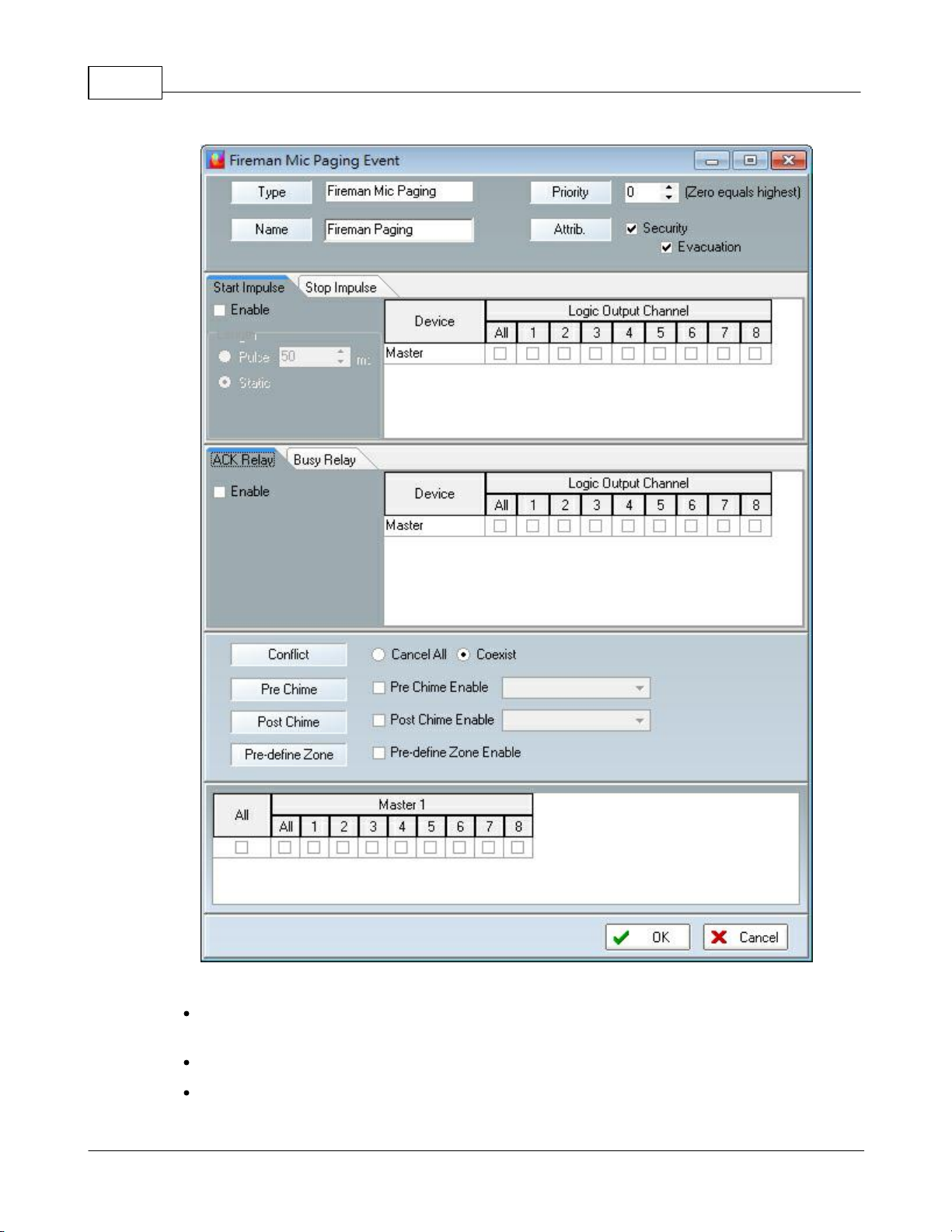
DIVA system84
The Fireman Microphone Paging Event window (see above) is divided in several section where can set:
Priority: you can specify a priority level between 20 and zero. The highest priority level is 0 when
20 is the lowest
Security: by ticking security, you will allow user to make a call when DIVA is in security mode
Evacuation: ticking this option will make the fireman microphone an evacuation source
© 2012 ATEÏS
Page 85
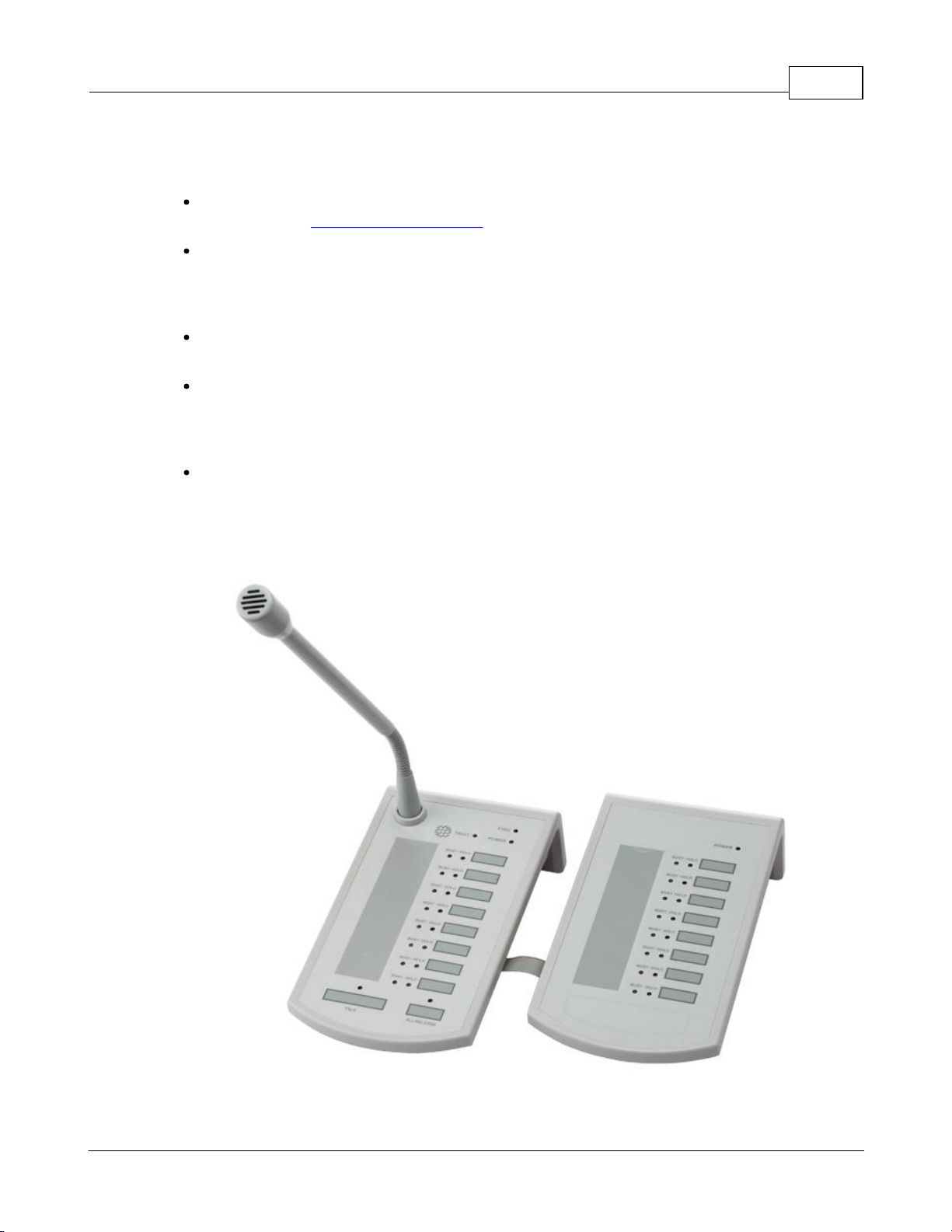
4.2.2 PSM
Product Features 85
Note: the security and evacuation options are automatically passed to the event accessible in
the Advance Setting
The next portion of the window is dedicated to the output relay management. In order to find out to
use please see "How to Use Output Relay".
Conflict: here you can choose how to manage priority conflict. “Cancel All” consists of cancelling
all the messages or events, with a lower priority, that are currently playing in the selected zone.
“Coexist” permit to momentarily disable the current message or event and to retrieve it as soon as
the one with a higher priority has finished.
Pre-Chime: the pre-chime option allows to play a chime message before each call. You can
choose the chime message using the drop-down menu.
Pre-define Zone: by ticking this option you will be able to select pre-define zone in which the call
will be made. Pre-defining zones don't disable the front-panel zones selector. As soon as a call in
non pre-defined zone is finished, the next call will be automatically rerouted in the pre-defined
zone after the amount of time set in the fireman microphone main window.
By clicking Ok you will validate your settings, Cancel will annulled the current settings.
4.2.2.1 Overview
Unidirectional Condenser Addressable Microphone, compatible with all system units, PSM uses an
© 2012 ATEÏS
Page 86
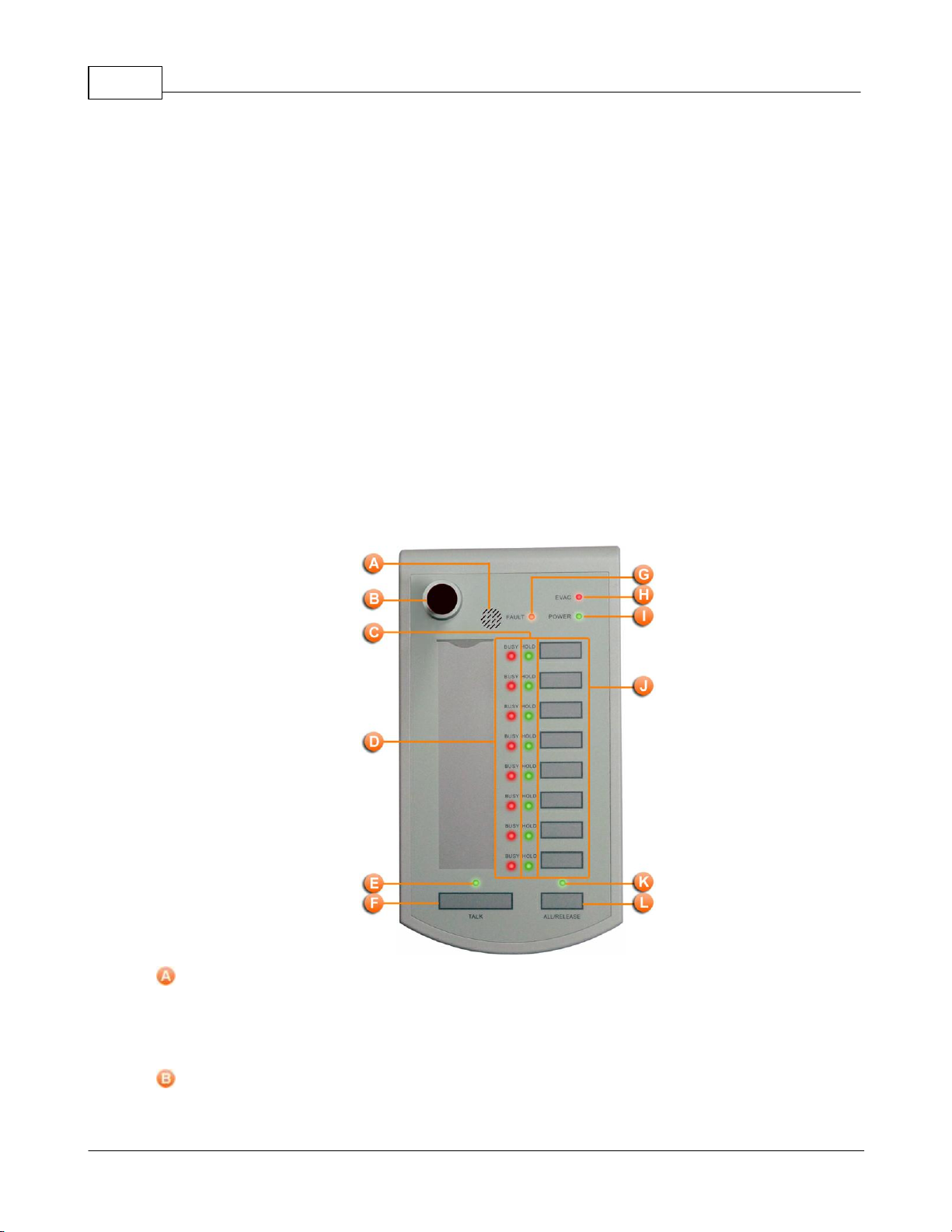
DIVA system86
RS485 protocol over a single CAT5 cable connection, to transport both Audio and Power from the PSM
to the system units. The PSM comprises of 8 zones / 8 buttons with sleek condenser gooseneck
microphone, and spring metal protection, providing durability and excellent aesthetics as well as allowing
up to 256 zones expansion via the additional Keypad easy extension station. The buttons can represent
a single zone or a group of zones and are easily defined via the GUI of the system units using a simple
Matrix selection.
The unit offers “Hold” and “Busy” LED signals in addition to the zone LED’s, and these allow the easy
identification of selection / Busy signals for the user.
All buttons can be programmed with drag & drop features from the System unit GUI software and each
button can be programmed for Push To Talk or Latch functionality. The unidirectional condenser
microphone warrants high quality directive signal pick up from the user and hence less interference from
the surroundings thanks to the cardioid polar pick-up pattern.
The RS485 communication protocol offers daisy chaining of up to 100 m on a CAT5 cable, and yet
makes outlets easy to connect via a standard RJ45 connectors. (The microphone compatibility listing
shows the maximum number of units per System).
4.2.2.2 Control Panel
Monitoring Speaker:
This embedded speaker to play chime when paging or monitor signal from audio processor, it needs
to work with rs485 output component to get audio signal from other DSP components in audio
processor.
Microphone:
The sleek condenser gooseneck microphone. This unidirectional condenser microphone warrants
© 2012 ATEÏS
Page 87
Product Features 87
Status
POWER
EVAC
FAULT
BUSY
HOLD
Inserting power supply
Continuous
Continuous
Continuous
Scrolling once
Scrolling once
Display firmware's version
(EX: v4.7)
Continuous
Continuous
Continuous
4 LEDs blink
once
7 LEDs blink
once
Lost communication with Audio
Processor
---
Slowly
scrolling
Slowly
scrolling
Communicate with Audio
Processor successfully
Continuous
Goes off after
seconds
Goes off after
seconds
-
Stored in software
Continuous
Continuous
Continuous
Scrolling once
Scrolling once
high quality directive signal pick up from the user and hence less interference from the surroundings.
Hold LED:
These LEDs Indicate which keys are selected.
Busy LED:
Show the status of zone.
Talk Indicator:
This LED light up if it is allowed to paging, on the other word, the paging request has been
acknowledged. Sometime after paging request is granted, zones under paging still can be occupied
by other sources. In such a case, the talk led still light up, but you can check busy LED to know
the situation.
Talk Key:
Push this key to request paging.
Fault LED:
To display fault status of system.
EVAC LED:
"Plug-in" make audio processor to recognize the peripheral devices.
Power LED:
This LED light up when the PPM AS is powered on.
Event Select Key:
These buttons are used to select keys, each key may link to an event for triggering actions like
paging or adjust the value of parameters.
All/Release LED:
This indicator lights up if all keys are selected.
All/Release Button:
This button is used to select or deselect all keys.
4.2.2.3 LED Indicators
© 2012 ATEÏS
Page 88
DIVA system88
Status
POWER
EVAC
FAULT
BUSY
HOLD
Press Event Select Key
---
-
Continuous
Using selected zones
---
Continuous
Continuous
Status
TALK
Press talk button
The LED blinks when the pre-chime is playing.
When the microphone's used, the LED continuously lights.
Item
Voltage
Current Consumption
Comment
DC Input
18V~26V, Typical 24V
120mA
-
4.2.2.4 Characteristics
Case
Dimension = 105mm (W) x 190mm (L) x 50mm (H).
Weight = 0.7Kg.
Color = RAL7035.
Goose-neck length with microphone = 300 mm
Power
Microphone Output
Maximum level = 6dBu.
Output Impedance = 100Ohm.
THD @ 1kHz < 1%.
Bandwidth @ -3dB = 100Hz ~ 18kHz.
Front Panel Speaker
Impedance = 4Ohm.
Maximum Power @ 1kHz = 1W.
THD @ 1kHz < 1%.
Bandwidth @ -3dB = 200Hz ~ 8kHz.
Cable length
100m(control and power on the same cable)
900m(when power line connects to junction box).
Comes standard with Junction box (JB) and CAT5 cable (1.5)
4.2.2.5 Configuration
As described briefly in the External Device - PSM chapter, The PSM8 is a 10 keys call station on which
8 are programmable with microphone, integrated loudspeaker and buzzer. It can be used with either
IDA4(X)(M)(s) or DIVA8M. It is possible to add up to 11 extensions to the PSM8 increasing
programmable keys number to 96. In order to use a PSM microphone with DIVA, simply drag and drop
the PSM microphone from the Design Component Section to the master window.
© 2012 ATEÏS
Page 89
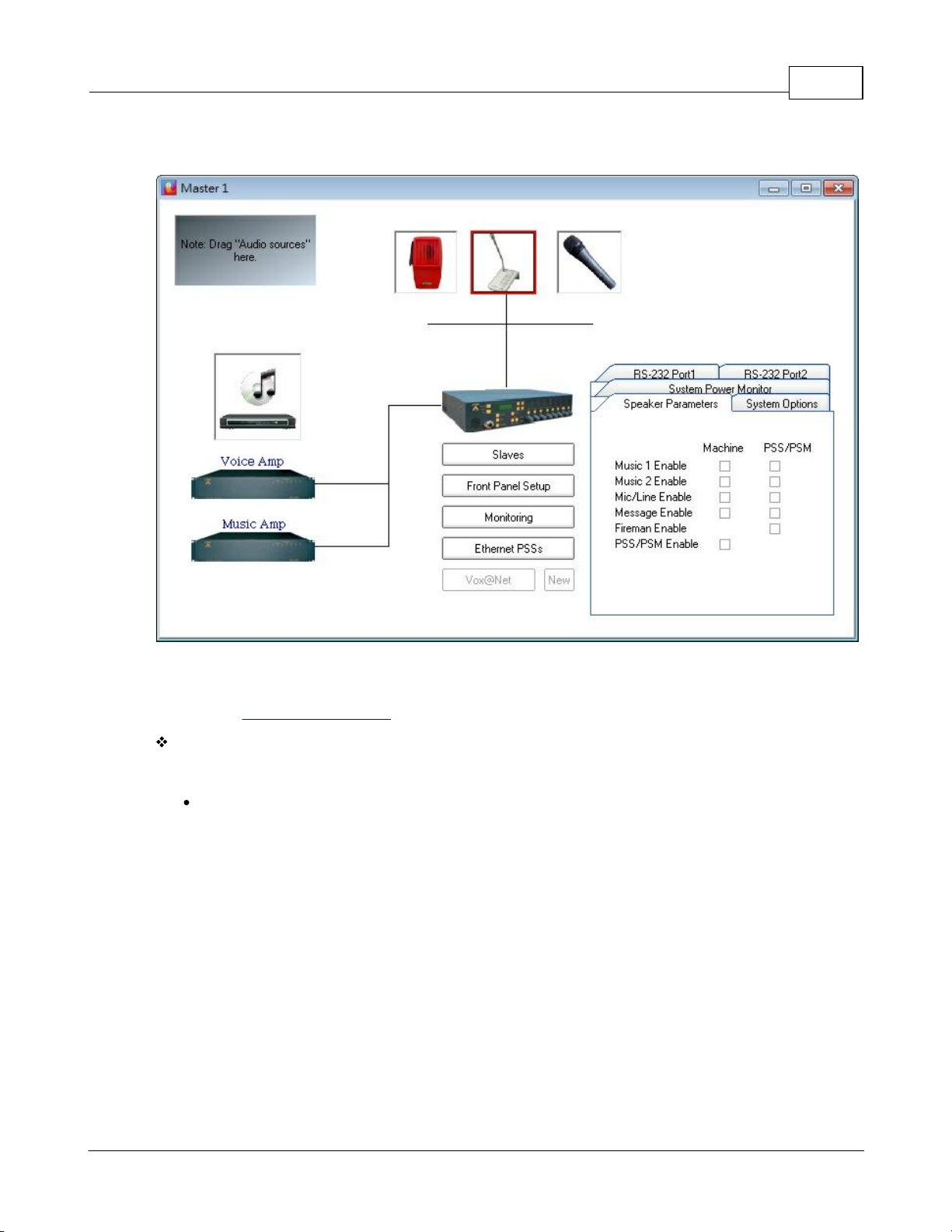
Product Features 89
The PSM microphone can also be cascaded, and you can slave up to 10 PSMs.
To access the PSM programming window, simply double-click on the PSM icon.
For more information about PSM microphone and its use, please read the PSM user manual that can be
found on the Ateis-Europe website.
General Page
Here is a list of parameters that can be adjusted in the General tab:
Properties Section:
o Name: here you can set a name for your PSM
o Priority: here you can set the PSM priority. Take care when choosing a priority as the PSM
could be a security microphone as well as a evacuation source.
© 2012 ATEÏS
Page 90
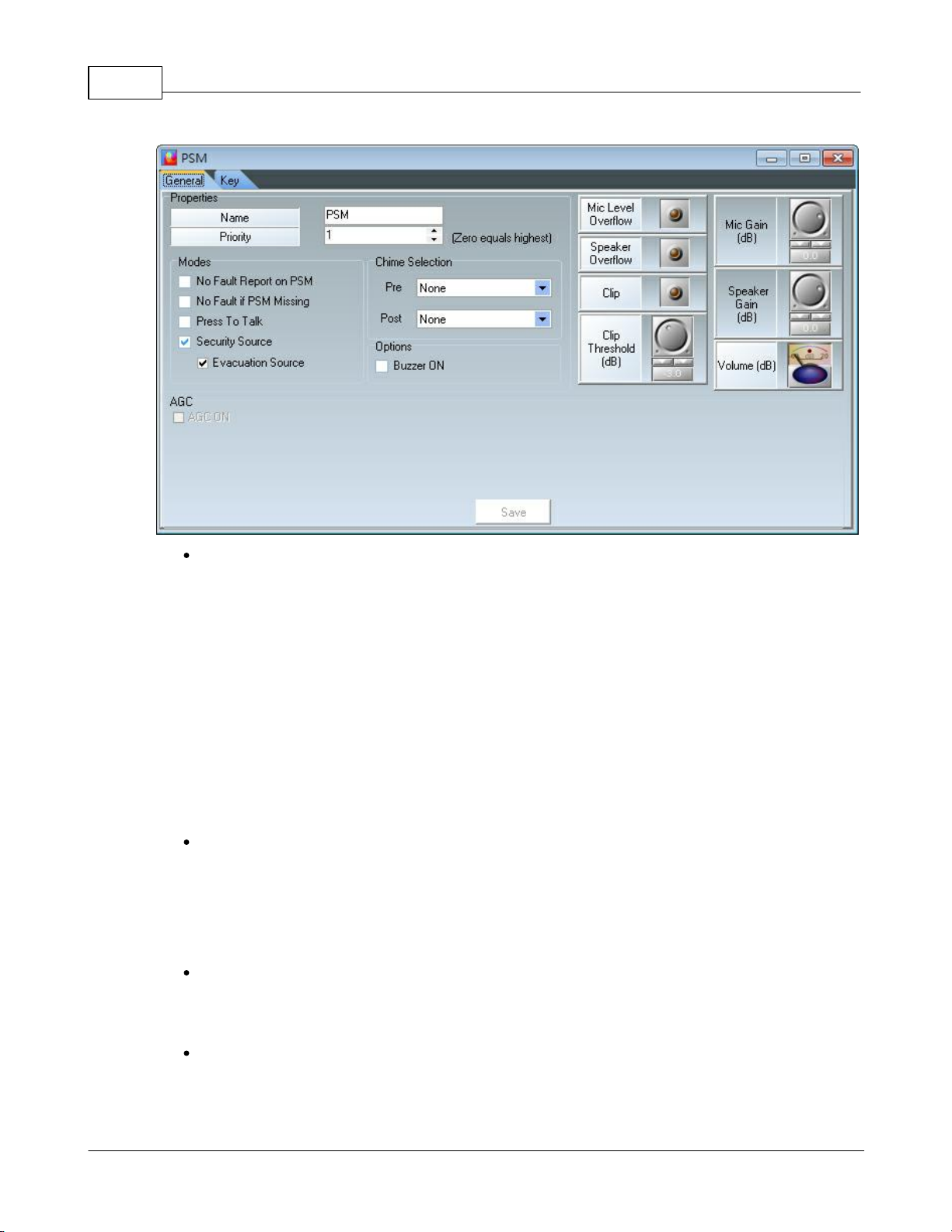
DIVA system90
Mode:
o No Fault Report on PSM: If ticked, no DIVA fault status will be shown on the PSM fault
LED.
o No Fault If Missing: If ticked, DIVA won't display a fault if the PSM is not physically
connected.
o Press To Talk: This option change the behaviour of the Mic key on the PSM screen from
"Lock to Talk" to "Push to Talk". For calling in "Push to Talk" mode, you have to keep the
PSM Mic key press as long as you want to talk.
o Security source/Evacuation source: If ticked, you will be able to use the PSM microphone
when DIVA has entered into the security mode. When ticked, it adds the option Evacuation
Source. If evacuation source is selected, the paging from the PSM will act like an evacuation
event. So the front panel EVAC LED ill light up.
Chime selection:
o Pre: Allows the addition of a chime message at the beginning of a microphone call. Simply
choose the prechime message from the drop down menu.
o Post: Allows the addition of a chime message at the end of a microphone call. Simply
choose the post-chime message from the drop down menu.
Options:
o Buzzer ON: This option allows user to enable the PSM buzzer. It will beep for any DIVA fault
status and for PSM internal fault.
Monitoring:
o Pre Amp: Virtual LED that will light up in case of PSM microphone pre amplifier failure.
o SPK Cable: Virtual LED that will light up in case of PSM integrated loudspeaker connection
© 2012 ATEÏS
Page 91

Product Features 91
failure.
o MIC: Virtual LED that will light up in case of microphone capsule issue.
o MIC Out: Virtual LED that check the state of the microphone output.
o Keyboard: Virtual LED that light up in case of touchpad issue.
o MIC Cable: Virtual LED that will light up in case of microphone cable issue.
o Missing: Virtual LED that light up if the PSM is not plug into DIVA.
Controls and Indicators:
o Mic gain (dB): When connected to DIVA, you can adjust, real time mode, the gain of the
PSM microphone.
o Speaker gain (dB): When connected to DIVA, you can adjust, real time mode, the gain of
the PSM internal speaker.
o Volume (dB): Indicates the current output level of the music source.
o Clip Threshold (dB): Allows the setting of the threshold point for the Clip indicator.
o Mic Overflow: This is a LED indicator that light up when a too high level is detected on the
PSM microphone.
o Speaker Overflow: This is a LED indicator that light up when a too high level is detected on
the PSM speaker.
o Clip: Indicates when the signal is clipping.
Keys Page
The key tab offers the possibility to program the eight first keys of the PSM (Host) and the keys of
several PSM extension/keypad (keypad 1 to 11). In order to go through the different extension, use the
main drop-down menu.
© 2012 ATEÏS
Page 92
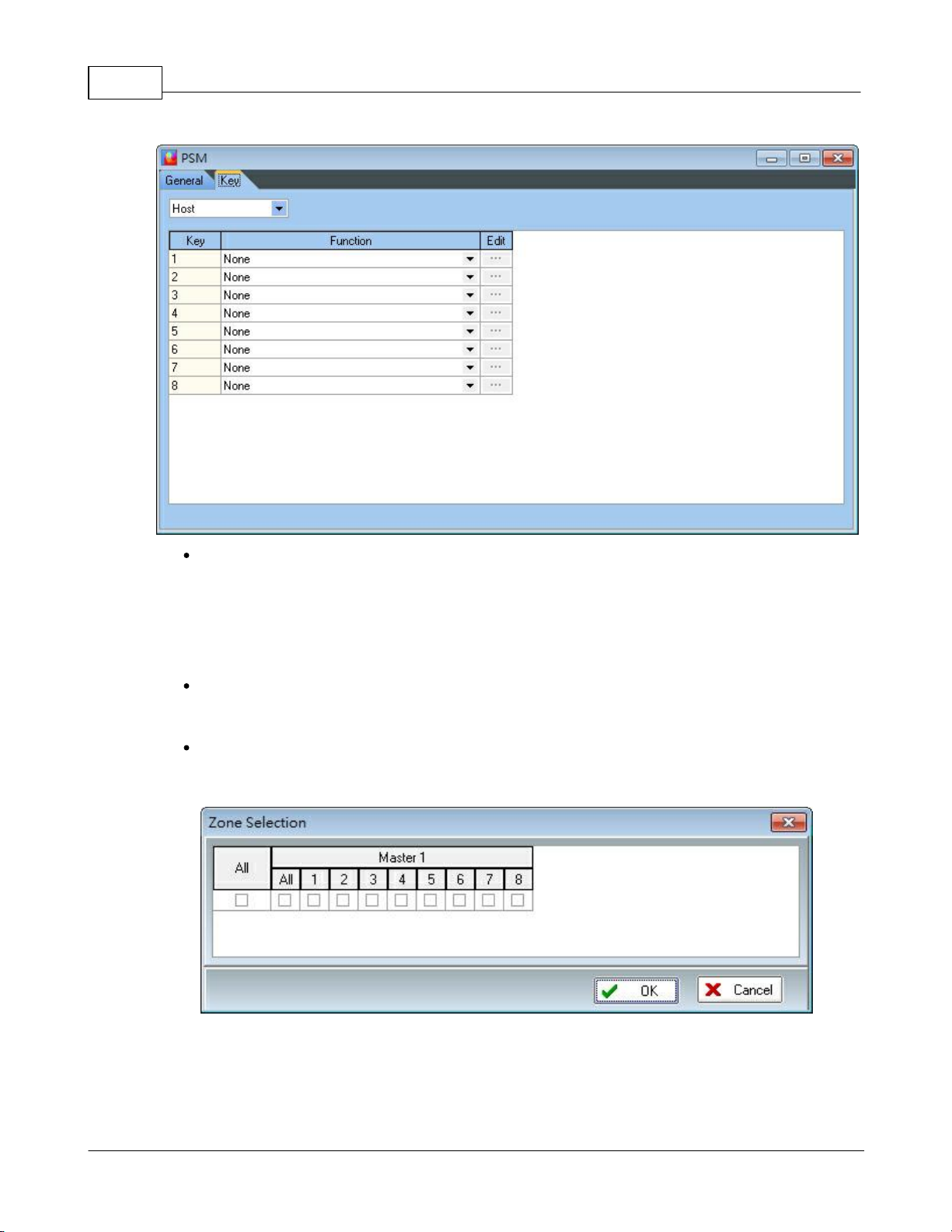
DIVA system92
In order to create a key, follow the next few steps:
o With the drop-down menu corresponding to the key you want to set, select a key type (some
keys type will automatically open a popup window for parameters setting). see below for the
complete list ok key functions
o Edit your key settings by clicking on the Edit button.
Here is a list of the key functions that can be used with the PSM:
o Zone Selection:
The zone selection key allows user to arrange to his will the selection of the zone. As soon as the
zone selection type has been selected, the zone selection window will appear. Simply tick the
zone corresponding to your needs and click OK.
o Route:
The Route key act like the one on the front panel, it has to be used to validate the routing of
a music source in some zones.
o Music Source Selection:
© 2012 ATEÏS
Page 93
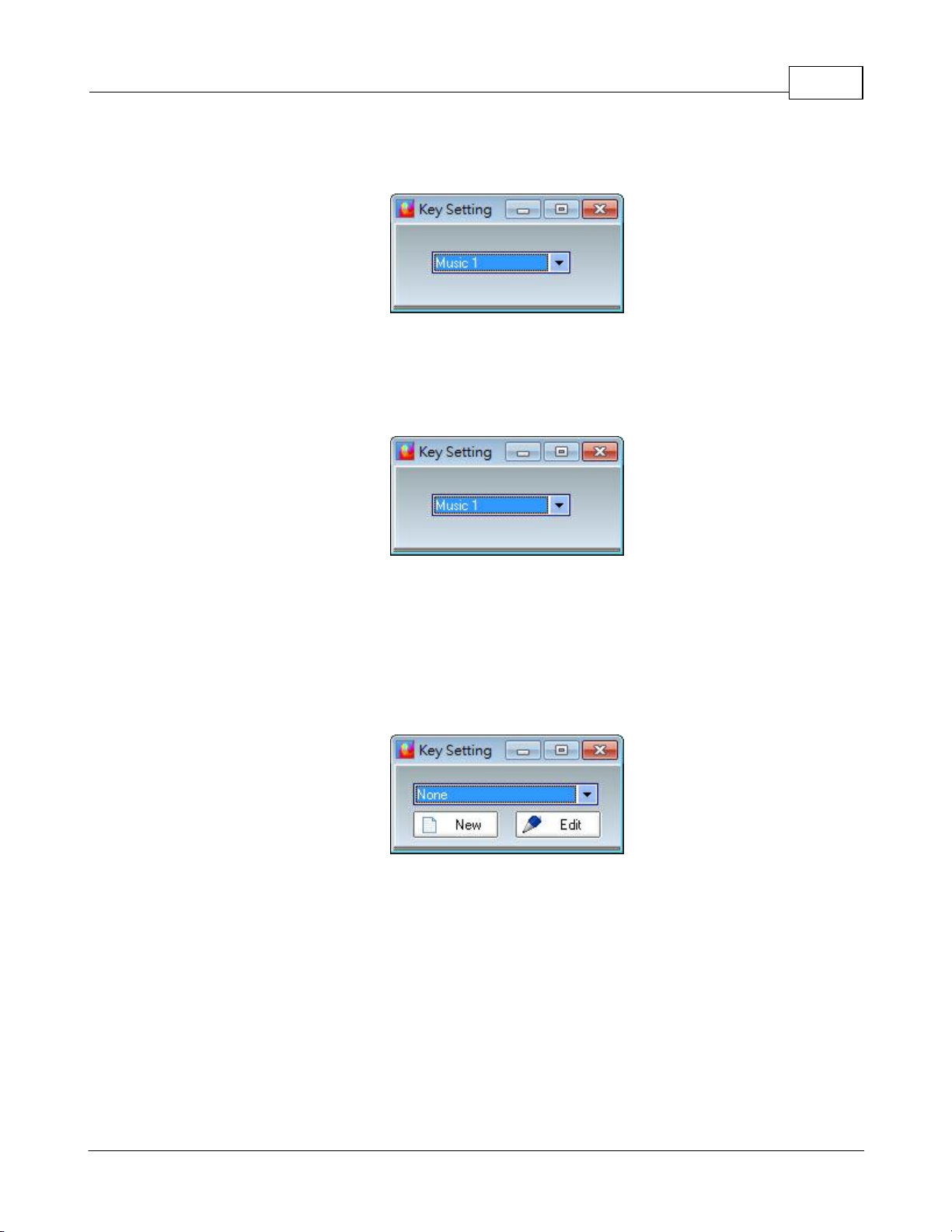
Product Features 93
When creating a music source selection key, you will have to specify the corresponding
music source with the help of the music source selection window.
o Music Level + / Music Level -:
The Music Level + and - need to be associated with a music source. The selection of the
music source is made with the music source selection window.
Note: Music Level + and Music Level - are two distinct keys.
o Event Start / Event Stop
Those two keys are an additional way of starting and stoping events that are not selected in
the message section. You can start and stop any kind of event. Please be careful to the
fact that you will need a stop event key for each start event key for play message type of
event.
When creating an Event Start/Stop key, you will have to select in the existing event list the
one to associate to the key.
o Push-To-Talk Microphone Call
The Push-To-Talk Microphone Call key allows to change the behaviour of the microphone
call. The default behaviour for the microphone (Mic Key) is the locked to talk. In order to
make a microphone call, you will have to keep the key pressed during the entire speaking
process.
o Push-To-Talk Chime Call
The Push-To-Talk Chime Call key has to be used like the Push-To-Talk Microphone Call.
The difference is that for each call, a pre-chime message will be played.
© 2012 ATEÏS
Page 94
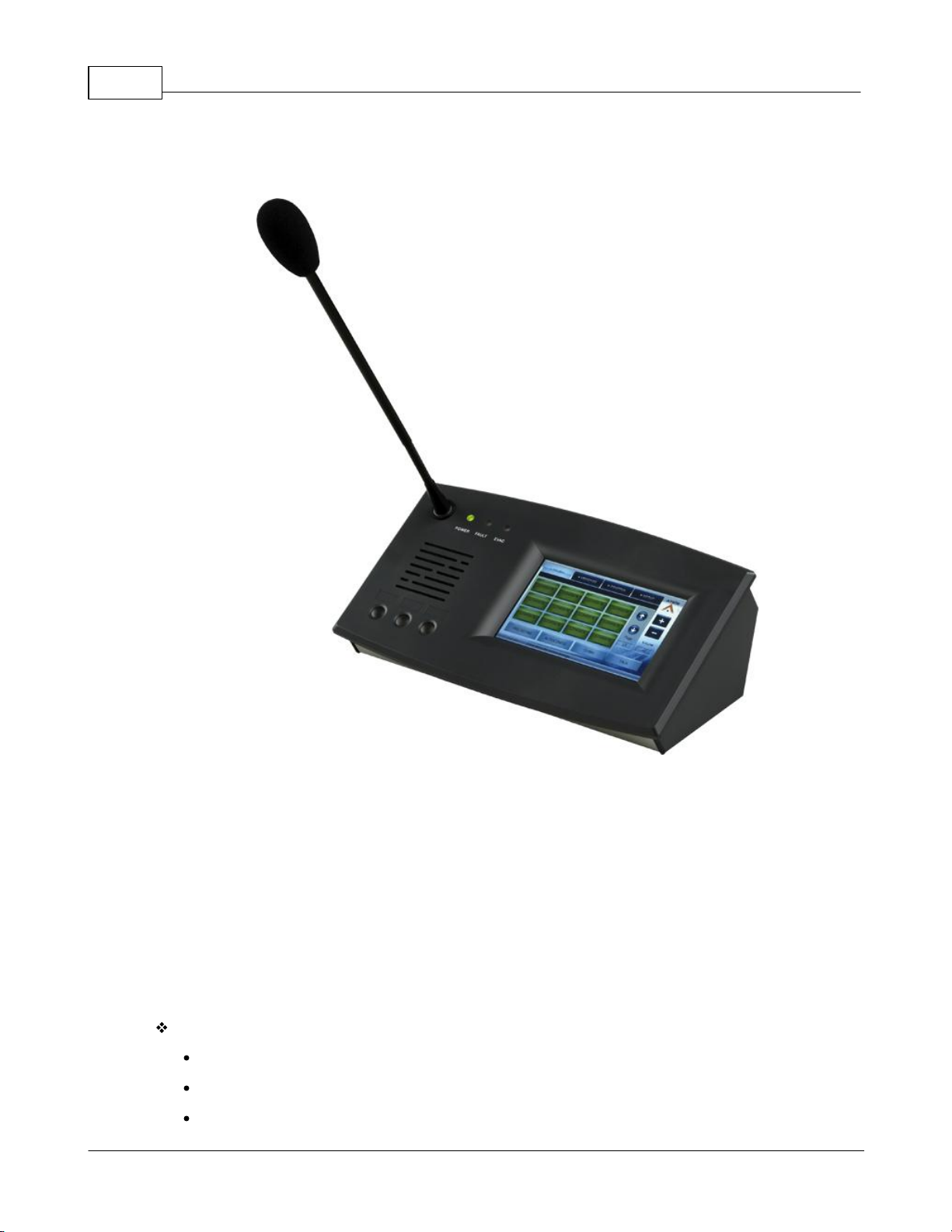
DIVA system94
4.2.3 PSSG2
4.2.3.1 Overview
The PSSG2, CD-TOUCH paging microphone console is a man-machine interface which allows paging
call, messages broadcasting and DSP matrix parameter control. DIVA8G2T can handle one PSSG2,
CD-TOUCH unit connected to a secured bus. Its back-lit touch screen is designed for simple and userfriendly operating.
Various operating levels with password protection make the PSSG2, CD-TOUCH a versatile device that
fits well in a commercial shopping center as for an industrial high security environment.
All paging parameters needed for site operating can be programmed: zones assigned to the different
buttons, name of zones, group of zones, messages triggering, levels adjustments and pre-call chime but
also for fader control, button control or event control.
A total of twelve keys on fourteen pages allow zone or group of zones selections. Each key contains a
color changing field indicating that the zone is occupied by a different process.
The PSSG2-E is made of:
5” TFT full color touch-screen.
3 LED indicators: Power/General Fault/Evacuation active.
3 key-buttons: User definable using Ateis Studio GUI.
© 2012 ATEÏS
Page 95
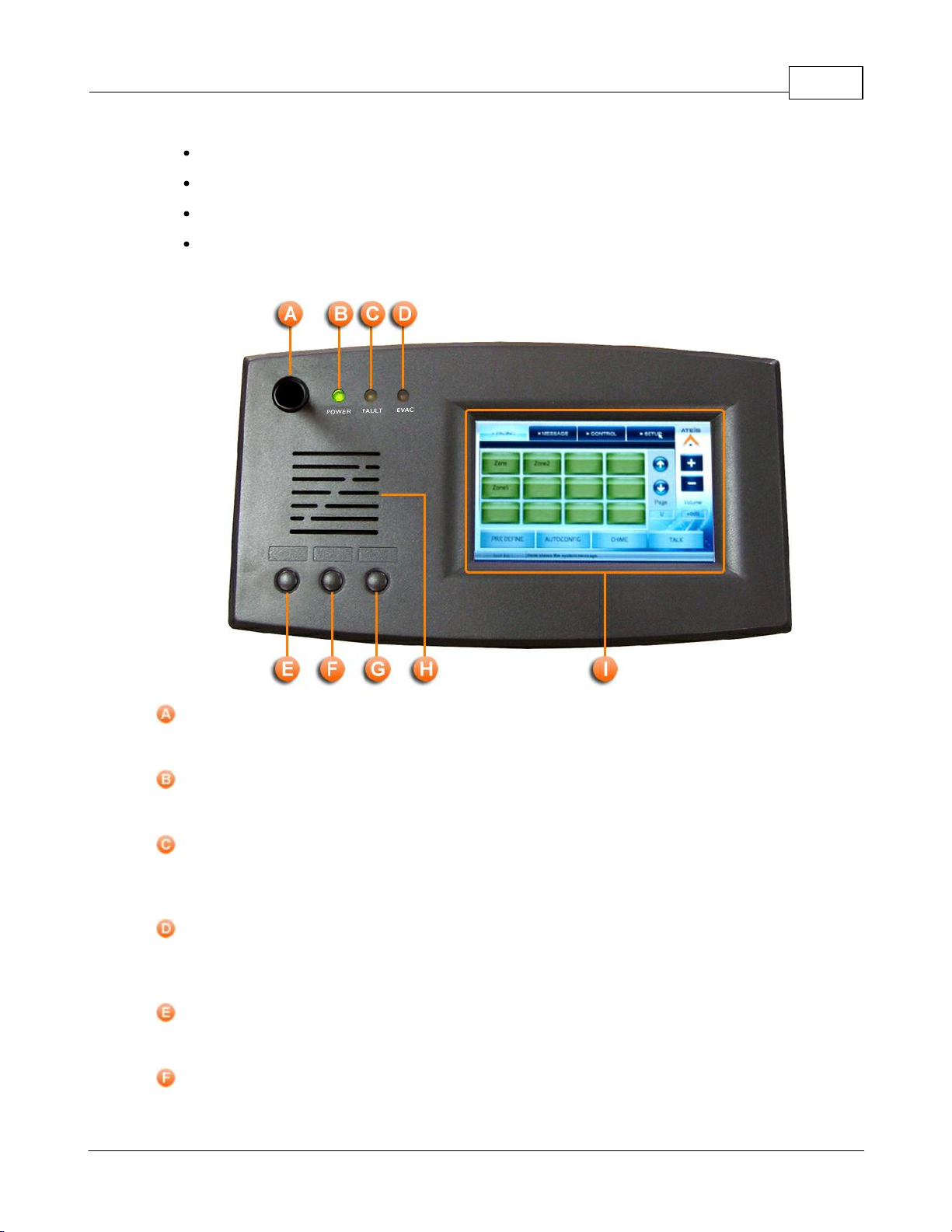
168 Touch fields: 14 pages with 12 keys , for PSSG2, PSSG2-E.
16 Touch fields for PSSG2, PSSG2-E.
Jack audio input/Output.
Telephone input.
4.2.3.2 Control Panel
Product Features 95
© 2012 ATEÏS
Microphone:
A 280mm flex microphone.
Power LED:
This LED light up when the PSSG2 is powered on.
Fault LED:
To display fault status of system, permanently lit if a fault state in the VACIE system has been
engaged.
EVAC LED:
Light up when system is under evacuation paging, permanently lit if a evacuation state in the VACIE
system has been engaged.
Left Button:
No function for the moment.
Middle Button:
No function for the moment.
Page 96
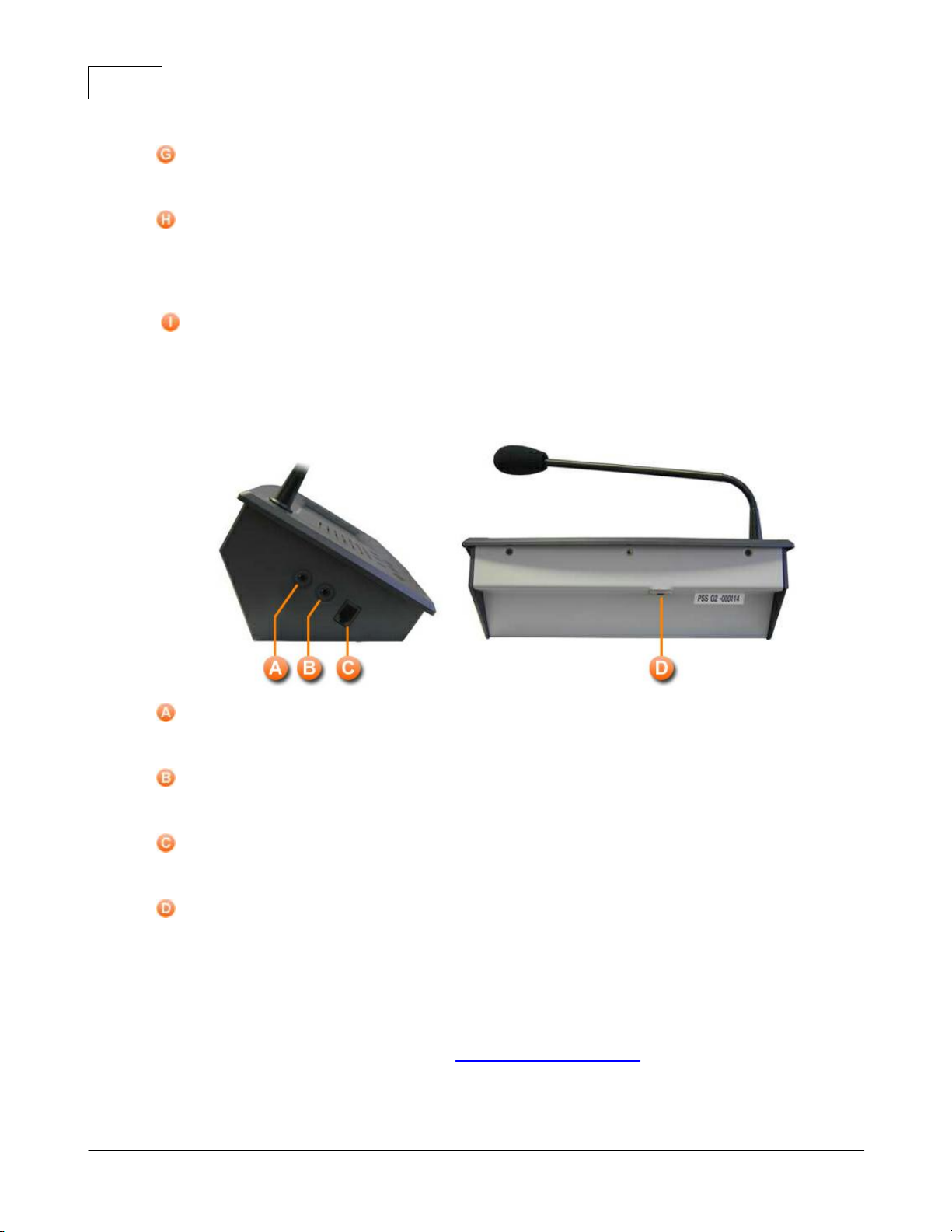
DIVA system96
Right Button:
Press and hold it for a while to calibrate touch screen.
Monitoring Speaker:
This embedded speaker to play chime when paging or monitor signal from audio processor, it needs
to work with rs485 output component to get audio signal from other DSP components in audio
processor.
Touch Screen:
A back-lit touch screen with 5" diagonal and 800 x 480 resolution contains 14 pages, 12 keys for
each pages can freely config to paging or adjustment parameters in audio processor.
4.2.3.3 Rear Panel
Jack Audio Input:
External microphone 1/8 inch jack output.
Jack Audio Output:
External loudspeaker 1/8 inch jack input.
Telephone Input:
Allows the connection of a telephone type microphone.
Power Input:
24VDC power supply.
4.2.3.4 Configuration
PSSG2 microphone is an advance touchscreen paging microphone. The PSS keys can be set by the
user using the PSS window in DIVA software. In order to use a PSSG2 microphone with DIVA, simply
drag and drop the PSS microphone from the Design Component Section to the master window.
© 2012 ATEÏS
Page 97
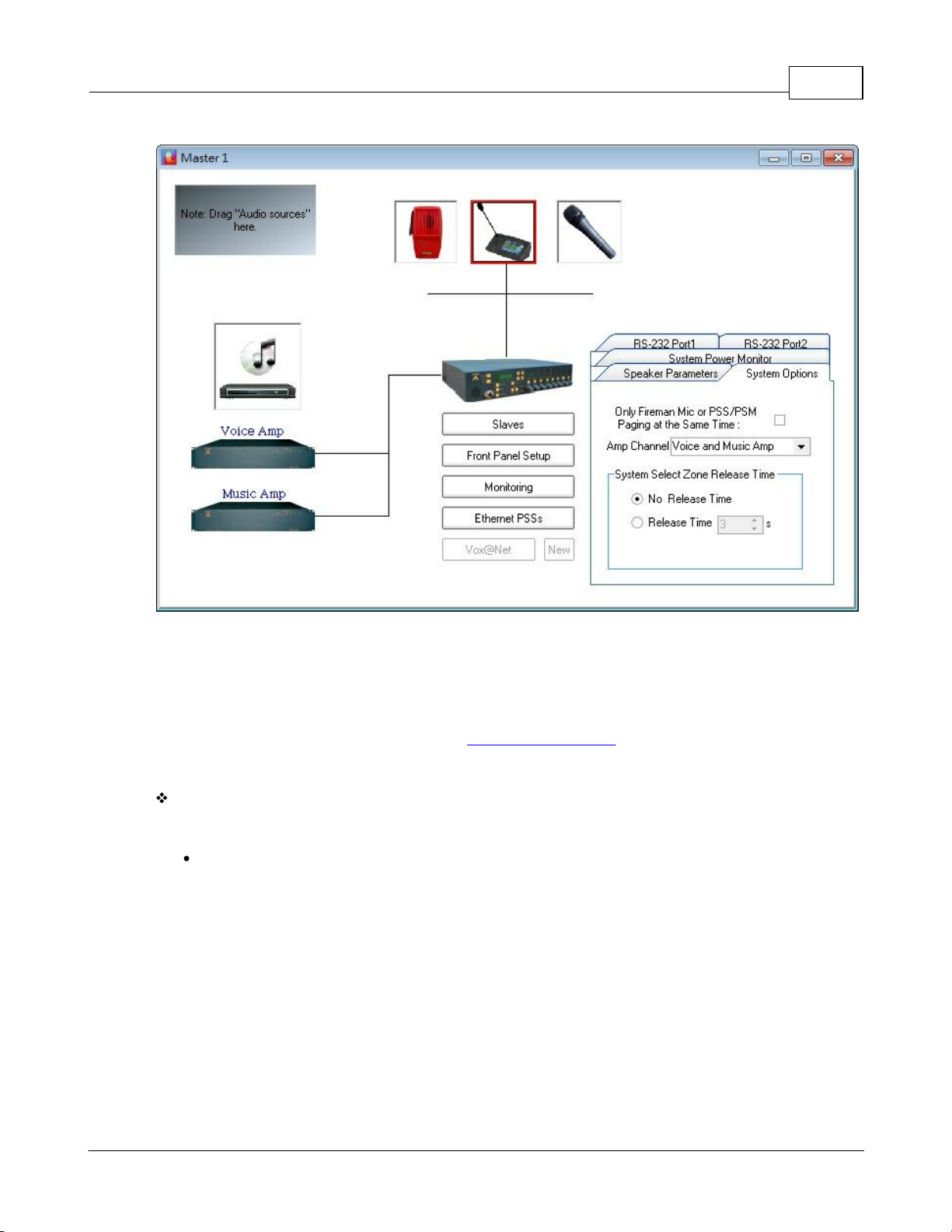
Product Features 97
To access the PSS window simply double click on the PSS icon on the master page. In the PSS
window, you will find two different tabs, one for property settings (General) and one for Keys configuration
(Key).
Note: PSSg1 and PSSg2 offer the same setting possibilites, in the next chapters, PSS name will be
used for both microphone. For further information on how to use PSS microphones, please read the PSS
microphone manuals that can be found on the Ateis Europe website.
General Page
Here is a list of what are the accessible parameters in the General tab:
Properties Section:
o Name: Here you can set a name for your PSS.
o Priority: Here you can set the PSS priority. Take care when choosing a priority as the PSS
could be a security microphone as well as a evacuation source.
o Access Code: You can specify an access code, only number, in order to be able to use the
PSS screen.
o Language: Alows user to set the PSS screen language between French, English, Russian,
Romanian, Polish and German.
© 2012 ATEÏS
Page 98
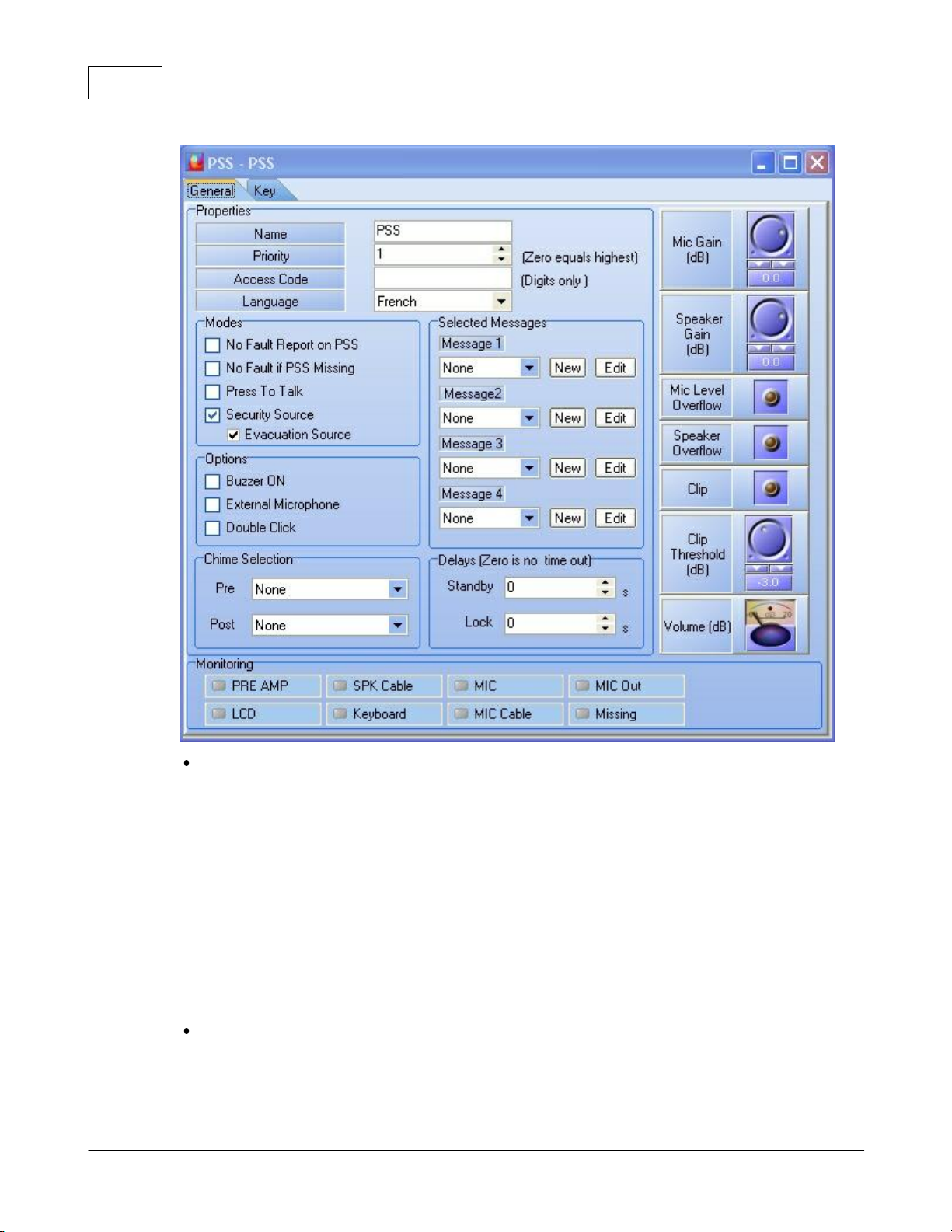
DIVA system98
Mode:
o No Fault Report on PSS: If ticked, the PSS won't display faults of the DIVA system.
o No Fault If Missing: If ticked, DIVA won't display a fault if the PSS is not physically
connected.
o Press To Talk: This option change the behaviour of the Mic key on the PSS screen from
"Lock to Talk" to "Push to Talk". For calling in "Push to Talk" mode, you have to keep the
PSS Mic key press as long as you want to talk.
o Security source/Evacuation source: If ticked, you will be able to use the PSS microphone
when DIVA has entered the security mode. When ticked, it adds the option Evacuation
Source. If evacuation source is selected, the paging from the PSS will act like an evacuation
event. So the front panel EVAC LED will light up.
Options:
o Buzzer On: This options allows user to enable the PSS buzzer. It will beep for any DIVA
fault status and for PSS internal fault.
o External Microphone: In case of using an other microphone that the gooseneck you will
© 2012 ATEÏS
Page 99

Product Features 99
have to tick this option.
o Double Click: If ticked, to activate a PSS key you will need to press it twice.
Chime selection:
o Pre: Allows to add a chime message at the beginning of a microphone call. Simply choose
the pre-chime message from the drop down menu.
o Post: Allows to add a chime message at the end of a microphone call. Simply choose the
post-chime message from the drop down menu.
Selected Messages:
o Message 1 to Message 4: With the use of the drop down menu you can add to the PSS up
to 4 event buttons that will launch the corresponding selected events. This option is restricted
for message type event. The play message event can be reached using the MSGs key on the
PSS.
Monitoring:
o Pre Amp: Virtual LED that will light up in case of PSS microphone pre amplifier failure.
o SPK Cable: Virtual LED that will light up in case of PSS integrated loudspeaker connection
failure.
o MIC: Virtual LED that will light up in case of microphone capsule issue.
o MIC Out: Virtual LED that check the state of the microphone output.
o LCD: Virtual LED that indicates any LCD screen fault.
o Keyboard: Virtual LED that light up in case of touchpad issue.
o MIC Cable: Virtual LED that will light up in case of microphone cable issue.
o Missing: Virtual LED that light up if the PSS is not plug into DIVA.
Controls and Indicators:
o Mic gain (dB): When connected to DIVA, you can adjust, real time mode, the gain of the
PSS microphone.
o Speaker gain (dB): When connected to DIVA, you can adjust, real time mode, the gain of
the PSS internal speaker.
o Volume (dB): Indicates the current output level of the music source.
o Clip Threshold (dB): Allows to set the threshold point for the Clip indicator.
o Mic Overflow: This is a LED indicators that light up when a too high level is detected on the
PSS microphone.
o Speaker Overflow: This is a LED indicators that light up when a too high level is detected
on the PSS speaker.
© 2012 ATEÏS
o Clip: Indicates when the signal is clipping.
Keys Page
Page 100
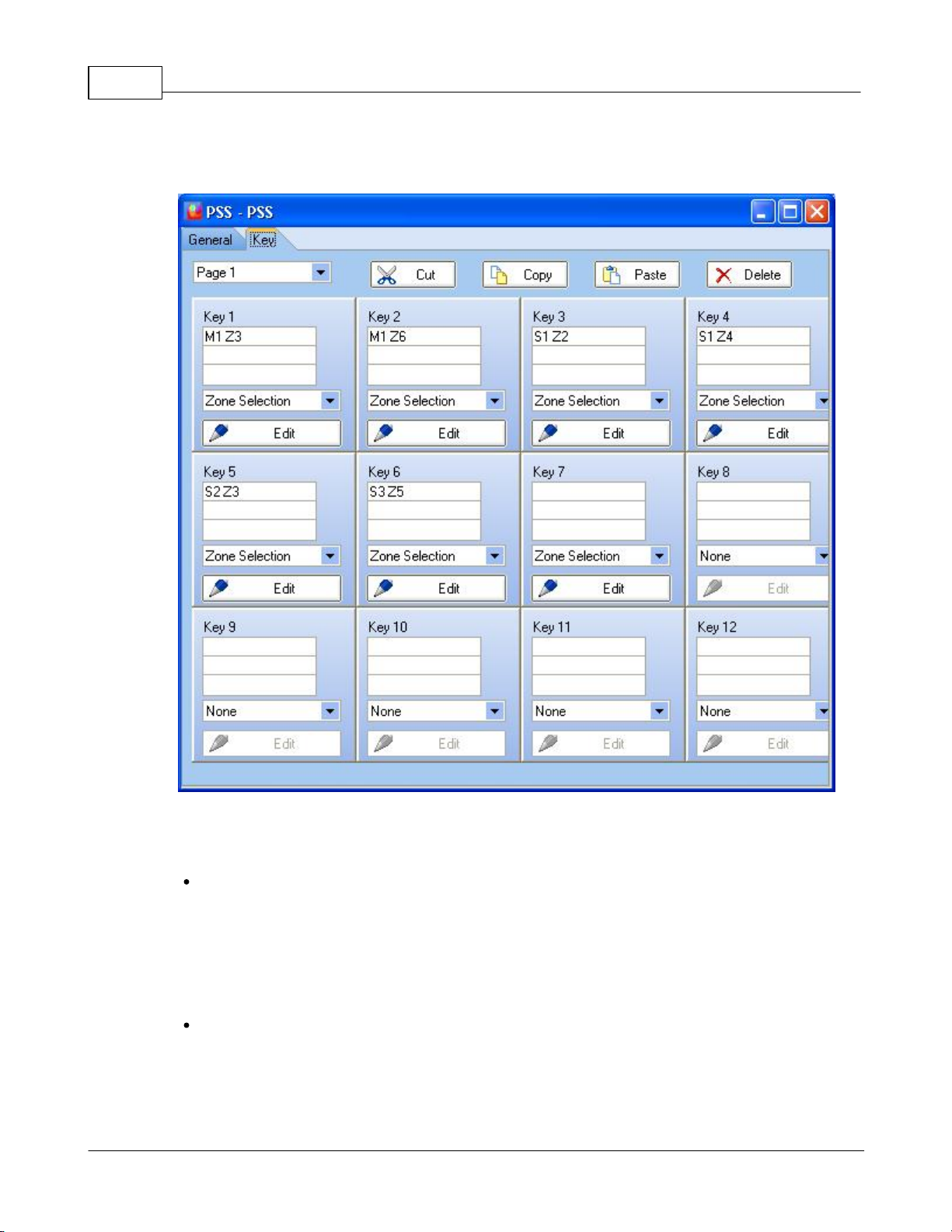
DIVA system100
The Key page is where you will define keys for the PSS and their associated action. Depending on the
PSS model, you can specify up to 96 keys so 96 actions.
It's important to notice that you can only visualize 12 key at the same time. To see up to 96 keys, you
have to jump to pages with the drop-down menu at the upper left corner. You also can cut, copy, paste
and delete keys with the upper corresponding button.
In order to create a key, follow the next few steps:
o In the three square, enter a key label (3x 6 digits).
o With the drop-down menu, select a key type (some keys type will automatically open a popup
window for parameters setting), see below for the complete list ok key functions.
o Edit your key settings by clicking on the Edit button.
Key functions:
o Zone Selection:
The zone selection key allows user to arrange to his will the selection of the zone. As soon
as the zone selection type has been selected, the zone selection window will appear.
© 2012 ATEÏS
 Loading...