

Page 1

TC52ax/TC52ax-HC
Touch Computer
Product Reference
Guide
for Android™ 11
MN-004162-03EN Rev. A
Page 2

ZEBRA and the stylized Zebra head are trademarks of Zebra Technologies Corporation, registered in many
jurisdictions worldwide. Google, Android, Google Play and other marks are trademarks of Google LLC. All
other trademarks are the property of their respective owners. ©2021 Zebra Technologies Corporation and/or
its affiliates. All rights reserved.
COPYRIGHTS & TRADEMARKS: For complete copyright and trademark information, go to
zebra.com/copyright
.
WARRANTY: For complete warranty information, go to zebra.com/warranty
END USER LICENSE AGREEMENT: For complete EULA information, go to zebra.com/eula
Terms of Use
• Proprietary Statement
This manual contains proprietary information of Zebra Technologies Corporation and its subsidiaries
(“Zebra Technologies”). It is intended solely for the information and use of parties operating and maintaining
the equipment described herein. Such proprietary information may not be used, reproduced, or disclosed to
any other parties for any other purpose without the express, written permission of Zebra Technologies.
• Product Improvements
Continuous improvement of products is a policy of Zebra Technologies. All specifications and designs are
subject to change without notice.
• Liability Disclaimer
Zebra Technologies takes steps to ensure that its published Engineering specifications and manuals are
correct; however, errors do occur. Zebra Technologies reserves the right to correct any such errors and
disclaims liability resulting therefrom.
• Limitation of Liability
In no event shall Zebra Technologies or anyone else involved in the creation, production, or delivery of the
accompanying product (including hardware and software) be liable for any damages whatsoever (including,
without limitation, consequential damages including loss of business profits, business interruption, or loss of
business information) arising out of the use of, the results of use of, or inability to use such product, even if
Zebra Technologies has been advised of the possibility of such damages. Some jurisdictions do not allow
the exclusion or limitation of incidental or consequential damages, so the above limitation or exclusion may
not apply to you.
.
.
2
Page 3

Table of Contents
Terms of Use................................................................................................................... 2
About This Guide.............................................................................................................................. 12
Configurations............................................................................................................... 12
Notational Conventions................................................................................................. 12
Icon Conventions .......................................................................................................... 13
Service Information ....................................................................................................... 13
Determining Software Versions..................................................................................... 14
Determining the Serial Number..................................................................................... 14
Getting Started.................................................................................................................................. 15
Introduction ................................................................................................................... 15
Unpacking ..................................................................................................................... 15
TC52ax Standard Features........................................................................................... 16
TC52ax Advanced Range Features.............................................................................. 18
Setting Up the Device ................................................................................................... 20
Installing a microSD Card....................................................................................... 20
Installing the Battery ............................................................................................... 21
Charging the Battery............................................................................................... 22
Charging Indicators ................................................................................................ 23
Replacing the TC52ax Battery ...................................................................................... 23
Replacing the microSD Card......................................................................................... 24
Using the Device............................................................................................................................... 26
Home Screen ................................................................................................................ 26
Setting Home Screen Rotation ............................................................................... 27
Status Bar............................................................................................................... 27
Notification Icons.............................................................................................. 27
Status Icons ..................................................................................................... 28
3
Page 4

Table of Contents
Managing Notifications ........................................................................................... 29
Opening the Quick Access Panel ........................................................................... 30
Quick Access Panel Icons................................................................................ 31
Editing Icons on the Quick Settings Bar ................................................................. 32
Battery Management..................................................................................................... 32
Checking Battery Status ......................................................................................... 32
Monitoring Battery Usage ....................................................................................... 32
Low Battery Notification.......................................................................................... 33
Using the Rechargeable Li-Ion Battery with BLE Beacon............................................. 33
Waking the Device ........................................................................................................ 33
USB Communication..................................................................................................... 33
Transferring Files.................................................................................................... 34
Transferring Photos ................................................................................................ 34
Disconnect from the Host Computer ...................................................................... 34
Settings.............................................................................................................................................. 35
Accessing Settings........................................................................................................ 35
Display Settings ............................................................................................................ 35
Setting the Screen Brightness Manually................................................................. 35
Setting the Screen Brightness Automatically.......................................................... 35
Setting Night Light .................................................................................................. 35
Setting Screen Rotation.......................................................................................... 36
Setting Screen Timeout .......................................................................................... 36
Lock Screen............................................................................................................ 36
Setting Font Size .................................................................................................... 37
Notification LED Brightness Level .......................................................................... 37
Touch Panel Mode ................................................................................................. 37
Setting the Date and Time ............................................................................................ 38
General Sound Setting.................................................................................................. 38
Sound Options........................................................................................................ 38
Setting Wake-Up Sources ...................................................................................... 39
Remapping a Button ..................................................................................................... 39
Remappable Keys......................................................................................................... 40
Keyboards..................................................................................................................... 40
Keyboard Configuration.......................................................................................... 40
Enabling Keyboards ......................................................................................... 40
Switching Between Keyboards......................................................................... 40
Using the Android and Gboard Keyboards............................................................. 41
Edit Text ........................................................................................................... 41
Entering Numbers, Symbols, and Special Characters ..................................... 41
Using the Enterprise Keyboard............................................................................... 41
4
Page 5

Table of Contents
Numeric Tab..................................................................................................... 41
Alpha Tab......................................................................................................... 41
Additional Character Tab ................................................................................. 41
Scan Tab.......................................................................................................... 41
Language Usage........................................................................................................... 42
Changing the Language Setting ............................................................................. 42
Adding Words to the Dictionary .............................................................................. 42
Notifications................................................................................................................... 42
Setting App Notifications ........................................................................................ 42
Viewing Notification Settings for All Apps ........................................................ 43
Controlling Lock Screen Notifications .............................................................. 43
Blink Light......................................................................................................... 44
Applications ...................................................................................................................................... 45
Accessing Apps............................................................................................................. 46
Switching Between Recent Apps............................................................................ 46
Battery Manager............................................................................................................ 47
Opening Battery Manager ...................................................................................... 47
Battery Manager Information Tab........................................................................... 47
Battery Manager Swap Tab.................................................................................... 48
Camera ......................................................................................................................... 49
Taking Photos......................................................................................................... 49
Recording Videos ................................................................................................... 50
Camera Settings..................................................................................................... 51
DataWedge Demonstration........................................................................................... 52
Scanner Selection .................................................................................................. 52
PTT Express Voice Client ............................................................................................. 53
PTT Express User Interface ................................................................................... 53
PTT Audible Indicator ............................................................................................. 54
PTT Notification Icons ............................................................................................ 54
Enabling PTT Communication................................................................................ 55
Selecting a Talk Group ........................................................................................... 55
PTT Communication............................................................................................... 55
Responding with a Private Response .............................................................. 56
Disabling PTT Communication ............................................................................... 56
RxLogger....................................................................................................................... 57
RxLogger Configuration.......................................................................................... 57
Configuration File ................................................................................................... 57
Enabling Logging.................................................................................................... 57
Disabling Logging ................................................................................................... 57
Extracting Log Files ................................................................................................ 57
Backing Up ............................................................................................................. 57
5
Page 6

Table of Contents
RxLogger Utility ...................................................................................................... 58
Initiating the Main Chat Head........................................................................... 58
Removing the Main Chat Head ........................................................................ 58
Viewing Logs.................................................................................................... 58
Removing a Sub Chat Head Icon..................................................................... 58
Backing Up In Overlay View............................................................................. 58
Wireless............................................................................................................................................. 59
Wireless Local Area Networks ...................................................................................... 59
Connecting to a Wi-Fi Network............................................................................... 60
Wi-Fi Version.................................................................................................... 60
Removing a Wi-Fi Network..................................................................................... 60
WLAN Configuration ..................................................................................................... 60
Configuring a Secure Wi-Fi Network ...................................................................... 60
Manually Adding a Wi-Fi Network .......................................................................... 61
Configuring for a Proxy Server ............................................................................... 63
Configuring the Device to Use a Static IP Address ................................................ 63
Wi-Fi Preferences................................................................................................... 64
Additional Wi-Fi Settings ........................................................................................ 64
Wi-Fi Direct............................................................................................................. 64
Bluetooth....................................................................................................................... 65
Adaptive Frequency Hopping ................................................................................. 65
Security................................................................................................................... 66
Bluetooth Profiles ................................................................................................... 66
Bluetooth Power States .......................................................................................... 67
Bluetooth Radio Power........................................................................................... 67
Enabling Bluetooth ........................................................................................... 67
Disabling Bluetooth .......................................................................................... 67
Discovering Bluetooth Device(s) ............................................................................ 68
Changing the Bluetooth Name ............................................................................... 68
Connecting to a Bluetooth Device .......................................................................... 68
Selecting Profiles on the Bluetooth Device............................................................. 68
Unpairing a Bluetooth Device ................................................................................. 69
Cast............................................................................................................................... 69
Near Field Communications.......................................................................................... 69
Reading NFC Cards ............................................................................................... 70
Enterprise NFC Settings......................................................................................... 70
Accessories....................................................................................................................................... 72
Battery Charging ........................................................................................................... 75
Main Battery Charging............................................................................................ 75
6
Page 7

Table of Contents
Spare Battery Charging .......................................................................................... 76
Charging Temperature ........................................................................................... 76
1-Slot USB Charge Cradle............................................................................................ 77
Setup ...................................................................................................................... 78
Charging the Device ............................................................................................... 78
Inserting a Device with the Rugged Boot into Cradle ............................................. 79
Zebra Workstation Cradle ............................................................................................. 80
Setup ...................................................................................................................... 82
Ethernet Setup........................................................................................................ 83
Scanner Setup........................................................................................................ 83
Security................................................................................................................... 83
Using the Workstation Cradle................................................................................. 84
Changing Monitor Resolution ................................................................................. 84
Charging the Device ............................................................................................... 84
Inserting a TC52ax with the Rugged Boot into the Cradle............................................ 84
2-Slot USB/Ethernet Cradle .......................................................................................... 86
Setup ...................................................................................................................... 87
Ethernet Settings.............................................................................................. 87
Configuring Ethernet Proxy Settings ................................................................ 87
Configuring Ethernet Static IP Address............................................................ 88
4-Slot Charge Only Cradle with Battery Charger .......................................................... 92
Setup ...................................................................................................................... 93
Charging the Device ............................................................................................... 93
Inserting a TC52ax with the Rugged Boot into the Cradle ..................................... 94
Charging the Spare Battery .................................................................................... 94
5-Slot Charge Only Cradle............................................................................................ 96
Setup ...................................................................................................................... 97
Charging the Device ............................................................................................... 97
Inserting a Device with the Rugged Boot into the Cradle ....................................... 98
5-Slot Ethernet Cradle................................................................................................... 99
Setup .................................................................................................................... 100
Daisy-chaining Ethernet Cradles .......................................................................... 100
Ethernet Settings .................................................................................................. 101
Configuring Ethernet Proxy Settings .............................................................. 101
Configuring Ethernet Static IP Address.......................................................... 102
Charging the Device ............................................................................................. 102
Inserting a TC52ax with the Rugged Boot into Cradle ......................................... 103
Establishing Ethernet Connection .................................................................. 103
LED Indicators ...................................................................................................... 103
4-Slot Battery Charger ................................................................................................ 104
Setup .................................................................................................................... 104
Single Charger Setup..................................................................................... 104
7
Page 8

Table of Contents
Two Charger Setup ........................................................................................ 105
Charging Spare Batteries ..................................................................................... 106
Rugged Boot ............................................................................................................... 108
Installation ............................................................................................................ 108
Installing Plastic Stylus ......................................................................................... 109
Charging with Cradles .......................................................................................... 110
Basic Hand Strap Kit................................................................................................... 112
Installation ............................................................................................................ 112
Removal ............................................................................................................... 113
2.5 mm Audio Adapter ................................................................................................ 115
3.5 mm Audio Adapter ................................................................................................ 116
Rugged Charge/USB Cable........................................................................................ 117
Connecting Rugged Charge/USB Cable to Device .............................................. 117
Connecting to TC5ax with Rugged Boot .............................................................. 118
USB Communication ............................................................................................ 119
Charging the Device ............................................................................................. 119
Disconnecting the Rugged Charge/USB Cable.................................................... 120
Trigger Handle ............................................................................................................ 121
Installing the Rugged Boot ................................................................................... 121
Installing the Optional Lanyard ............................................................................. 123
Inserting the Device into the Trigger Handle ........................................................ 124
Removing the Device from the Trigger Handle .................................................... 124
Installing the Extended Rugged Boot.......................................................................... 126
Removal ............................................................................................................... 127
Power Supply.............................................................................................................. 128
5-Slot Cradle Rack Installation.................................................................................... 129
4-Slot Battery Chargers Rack Installation ................................................................... 132
Rack Mount Installation............................................................................................... 135
Wall Installation........................................................................................................... 138
Bottom Tray Assembly ......................................................................................... 138
Bracket Wall Mounting.......................................................................................... 138
Data Capture ................................................................................................................................... 140
Imaging ....................................................................................................................... 140
Digital Camera ............................................................................................................ 140
Linear Imager.............................................................................................................. 141
Operational Modes ............................................................................................... 141
RS507/RS507X Hands-Free Imager........................................................................... 142
RS5100 Ring Scanner ................................................................................................ 142
RS6000 Bluetooth Ring Scanner ................................................................................ 142
DS3678 Digital Scanner.............................................................................................. 143
8
Page 9

Table of Contents
LI3678 Linear Scanner................................................................................................ 143
DS2278 Digital Scanner.............................................................................................. 144
DS8178 Scanner......................................................................................................... 144
Scanning Considerations ............................................................................................ 144
Scanning with Internal Imager..................................................................................... 145
Scanning with Internal Camera................................................................................... 146
Scanning with RS507/RS507X Hands-Free Imager ................................................... 148
Scanning with RS6000 Bluetooth Ring Scanner......................................................... 149
Scanning with RS5100 Ring Scanner......................................................................... 150
Scanning with the DS3678 Bluetooth Scanner ........................................................... 151
Scanning with LI3678 Linear Imager........................................................................... 152
Scanning with DS2278 Digital Scanner ...................................................................... 153
Scanning with DS8178 Digital Scanner ...................................................................... 154
Pairing the Bluetooth Ring Scanner............................................................................ 155
Pairing Using Near Field Communication ................................................................... 155
Pairing in HID Mode Using Near Field Communication........................................ 156
Pairing Using Simple Serial Interface ................................................................... 157
Pairing Using Bluetooth Human Interface Device ................................................ 158
Pairing a Bluetooth Scanner ....................................................................................... 159
Pairing Using Simple Serial Interface ................................................................... 159
Pairing Using Bluetooth Human Interface Device ................................................ 159
DataWedge ................................................................................................................. 160
Enabling DataWedge............................................................................................ 160
Disabling DataWedge........................................................................................... 160
Supported Decoders............................................................................................. 161
Application Deployment................................................................................................................. 164
Security ....................................................................................................................... 164
Secure Certificates...................................................................................................... 164
Installing a Secure Certificate ..................................................................................... 164
Configuring Credential Storage Settings .............................................................. 165
Development Tools ..................................................................................................... 165
Android Application Development ........................................................................ 165
Development Workstation .............................................................................. 165
Enabling Developer Options .......................................................................... 165
EMDK for Android................................................................................................. 166
StageNow ............................................................................................................. 166
GMS Restricted........................................................................................................... 166
ADB USB Setup.......................................................................................................... 166
Enabling USB Debugging..................................................................................... 166
Entering Android Recovery Manually ................................................................... 167
9
Page 10

Table of Contents
Application Installation ................................................................................................ 167
Installing Applications Using the USB Connection ............................................... 168
Installing Applications Using the Android Debug Bridge ...................................... 168
Installing Applications Using the Wireless Android Debug Bridge........................ 169
Installing Applications Using a microSD Card ...................................................... 170
Uninstalling an Application ................................................................................... 170
Performing a System Update...................................................................................... 170
Downloading the System Update Package .......................................................... 171
Performing a System Update Using microSD Card.............................................. 171
Performing a System Update Using ADB............................................................. 171
Performing a System Update Using Wireless ADB .............................................. 172
Verifying System Update Installation.................................................................... 173
Enterprise Reset ......................................................................................................... 173
Performing an Enterprise Reset From Device Settings........................................ 174
Downloading the Enterprise Reset Package ........................................................ 174
Performing an Enterprise Reset Using microSD Card ......................................... 174
Performing an Enterprise Reset Using ADB......................................................... 174
Performing an Enterprise Reset Using Wireless ADB.......................................... 175
Performing a Factory Reset ........................................................................................ 176
Downloading the Factory Reset Package ............................................................ 176
Performing a Factory Reset Using microSD Card................................................ 177
Performing a Factory Reset Using ADB ............................................................... 177
Performing a Factory Reset Using Wireless ADB ................................................ 178
Storage........................................................................................................................ 179
Random Access Memory ..................................................................................... 179
Viewing Memory............................................................................................. 180
Internal Storage .................................................................................................... 180
Viewing Internal Storage ................................................................................ 180
External Storage................................................................................................... 180
Viewing External Storage............................................................................... 180
Formatting a microSD Card ........................................................................... 180
Formatting a microSD Card as Internal Memory............................................ 181
Enterprise Folder .................................................................................................. 181
Managing Apps ........................................................................................................... 181
App Details ........................................................................................................... 181
Managing Downloads.................................................................................................. 182
Maintenance and Troubleshooting ............................................................................................... 183
Maintaining the Device................................................................................................ 183
Display Best Practices ................................................................................................ 183
Image Retention ................................................................................................... 183
10
Page 11

Table of Contents
Best Practices for Enterprise Mobile Computing Devices Operating in Hot Environments
and Direct Sunlight...................................................................................................... 184
Battery Safety Guidelines ..................................................................................... 184
Cleaning Instructions................................................................................................... 185
Cleaning and Disinfecting Guidelines................................................................... 185
Approved Cleaning and Disinfectant Agents ........................................................ 185
Battery Connector and Locating Magnet Cleaning............................................... 185
Cleaning Cradle Connectors....................................................................................... 186
Troubleshooting .......................................................................................................... 188
Resetting the Device ............................................................................................ 188
Performing a Soft Reset................................................................................. 188
Performing a Hard Reset ............................................................................... 188
TC52ax ................................................................................................................. 188
1-Slot Charge Only Cradle ................................................................................... 191
Workstation Docking Cradle ................................................................................. 191
2-Slot USB/Ethernet Cradle.................................................................................. 192
4-Slot Charge Only Cradle with Battery Charger Troubleshooting....................... 193
5-Slot Charge Only Cradle Troubleshooting......................................................... 193
5-Slot Ethernet Cradle Troubleshooting ............................................................... 194
4-Slot Battery Charger Troubleshooting ............................................................... 194
Technical Specifications................................................................................................................ 196
TC52ax Standard (SE4720) Decode Distances ................................................... 196
TC52ax Advanced Range (SE5500) Decode Distances ...................................... 198
Interface Connector Pin-Outs ............................................................................... 199
1-Slot Charge Only Cradle Technical Specifications............................................ 199
Workstation Docking Cradle Technical Specifications ......................................... 200
2-Slot USB/Ethernet Cradle Technical Specifications .......................................... 200
4-Slot Charge Only Cradle with Battery Charger Technical Specifications .......... 201
5-Slot Charge Only Cradle Technical Specifications............................................ 201
5-Slot Ethernet Cradle Technical Specifications .................................................. 202
4-Slot Battery Charger Technical Specifications .................................................. 202
Trigger Handle Technical Specifications .............................................................. 203
Rugged Charge/USB Cable Technical Specifications.......................................... 203
11
Page 12

About This Guide
This guide provides information about setting up and using the TC52ax touch computer. Some screens shown
in this guide may differ from the actual screens shown on the device.
Configurations
This guide covers the following configurations:
Table 1 Configurations
Configuration Description Display Memory
TC52ax Standard
(with
PowerPrecision+
Standard Battery)
TC52ax Standard
(with Rechargeable
Li-Ion Battery with
BLE Beacon)
TC52ax Advanced
Range (with SE55
Imager and
PowerPrecision+
Standard Battery)
TC52ax Advanced
Range (with SE55
Imager and
Rechargeable
Li-Ion Battery with
BLE Beacon)
Wi-Fi 6, Standard 7 pin I/O
Bottom Comm. I/O Rear,
PowerPrecision+ Standard
Battery
Wi-Fi 6, Standard 7 pin I/O
Bottom, Comm. I/O Rear,
Rechargeable Li-Ion Battery
with BLE Beacon
Wi-Fi 6, Standard 7 pin I/O
Bottom Comm. I/O Rear,
PowerPrecision+ Standard
Battery
Wi-Fi 6, Standard 7 pin I/O
Bottom, Comm. I/O Rear,
Rechargeable Li-Ion Battery
with BLE Beacon
5.0” Full
High
Definition
(1080 x
1920) LCD
5.0” Full
High
Definition
(1080 x
1920) LCD
5.0” Full
High
Definition
(1080 x
1920) LCD
5.0” Full
High
Definition
(1080 x
1920) LCD
4 GB RAM /
64 GB UFS Flash
4 GB RAM /
64 GB UFS Flash
4 GB RAM /
64 GB UFS Flash
4 GB RAM /
64 GB UFS Flash
Data Capture
Options
2D imager
(SE4720) and
integrated NFC
2D imager
(SE-4720) and
integrated NFC
2D imager (SE55)
and integrated
NFC
2D imager (SE55)
and integrated
NFC
Operating System
Android-based,
Google ™ Mobile
Services (GMS) 11
Android-based,
Google ™ Mobile
Services (GMS) 11
Android-based,
Google ™ Mobile
Services (GMS) 11
Android-based,
Google ™ Mobile
Services (GMS) 11
12
Page 13
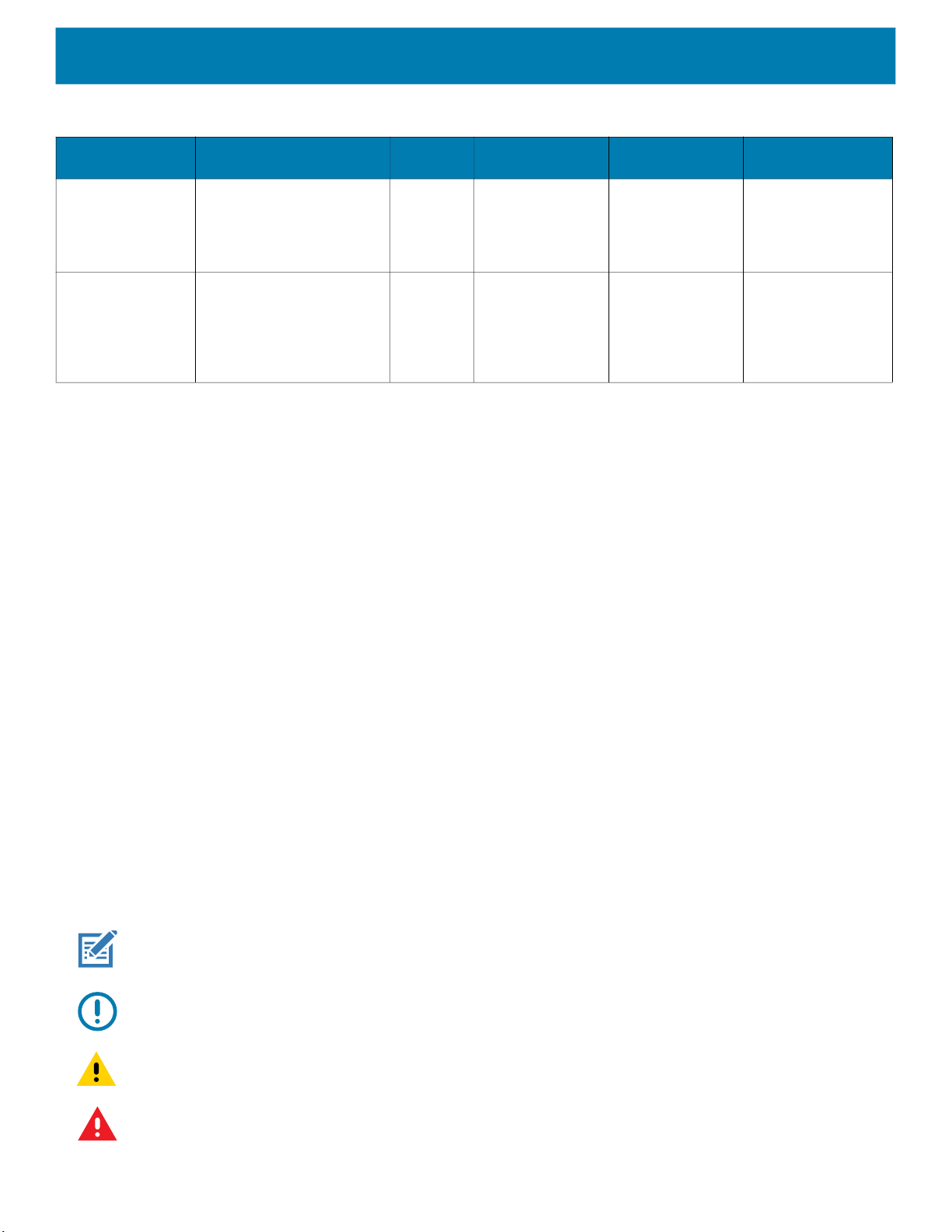
Table 1 Configurations (Continued)
About This Guide
Configuration Description Display Memory
TC52ax Healthcare
with SE4720
Imager and
PowerPrecision+
Standard Battery)
TC52ax Healthcare
with SE4720
Imager and
Rechargeable
Li-Ion Battery with
BLE Beacon)
Wi-Fi 6, Standard 7 pin I/O
Bottom, Rear Red
Mechanical Button,
PowerPrecision+ Standard
Battery
Wi-Fi 6, Standard 7 pin I/O
Bottom, Rear Red
Mechanical Button,
Rechargeable Li-Ion Battery
with BLE Beacon
5.0” Full
High
Definition
(1080 x
1920) LCD
5.0” Full
High
Definition
(1080 x
1920) LCD
4 GB RAM /
64 GB UFS Flash
4 GB RAM /
64 GB UFS Flash
Notational Conventions
Notational conventions are used to highlight important information.
• Bold text is used to highlight the following:
• Dialog box, window and screen names
• Drop-down list and list box names
• Check box and radio button names
• Icons on a screen
Data Capture
Options
2D imager
(SE-4720) and
integrated NFC
2D imager
(SE-4720) and
integrated NFC
Operating System
Android-based,
Google ™ Mobile
Services (GMS) 11
Android-based,
Google ™ Mobile
Services (GMS) 11
• Key names on a keypad
• Button names on a screen.
• Bullets (•) indicate:
• Action items
• Lists of alternatives
• Lists of required steps that are not necessarily sequential.
• Sequential lists (for example, those that describe step-by-step procedures) appear as numbered lists.
Icon Conventions
The following icons are used throughout the document. The icons and their associated meanings are
described below.
NOTE: The text here indicates information that is supplemental for the user to know and that is not required to
complete a task.
IMPORTANT: The text here indicates information that is important for the user to know.
CAUTION: If the precaution is not heeded, the user could receive minor or moderate injury.
WARNING: If danger is not avoided, the user CAN be seriously injured or killed.
13
Page 14

DANGER: If danger is not avoided, the user WILL be seriously injured or killed.
Service Information
If you have a problem with your equipment, contact Customer Support for your region. Contact information is
available at: zebra.com/support
When contacting support, please have the following information available:
• Serial number of the unit (found on manufacturing label)
• Model number or product name (found on manufacturing label)
• Software type and version number
• IMEI number
Customer Support responds to calls by email or telephone within the time limits set forth in support
agreements.
If the problem cannot be solved by Customer Support, the user may need to return the equipment for servicing
and will be given specific directions. We are not responsible for any damages incurred during shipment if the
approved shipping container is not used. Shipping the units improperly can possibly void the warranty.
Remove the SIM card and/or microSD card from the device before shipping for service.
About This Guide
.
If the device was purchased from a business partner, contact that business partner for support.
Determining Software Versions
Before contacting Customer Support, determine the current software version on your device.
1. Swipe down from the Status bar with two fingers to open the Quick Access panel, and then touch .
2. Touch Aboutphone.
3. Scroll to view the following information:
• Battery information
• SW components
• Legal information
• Model & hardware
• Android version
• Android security patch level
• Kernel version
• Build number
Determining the Serial Number
Before contacting Customer Support, determine the serial number of your device.
Touch About phone > Model & hardware > Serial number.
14
Page 15

Getting Started
Introduction
This section provides information for getting the device up and running for the first time.
Unpacking
1. Carefully remove all protective material from the device and save the shipping container for later
storage and shipping.
2. Verify that the following were received:
• Touch computer
• >
15.48 Watt hours (typical) / > 4,150 mAh PowerPrecision+ Lithium-ion battery or
Rechargeable Li-Ion Battery with BLE Beacon
• Regulatory Guide.
3. Inspect the equipment for damage. If any equipment is missing or damaged, contact the Global
Customer Support center immediately.
4. Before using the device for the first time, remove the protective shipping film that covers the scan
window, display and camera window.
15
Page 16

TC52ax Standard Features
CAUTION: The 7-pin interface connector at the bottom of the device is not removable. Trying to remove the
connector will cause damage to the device and can void warranty.
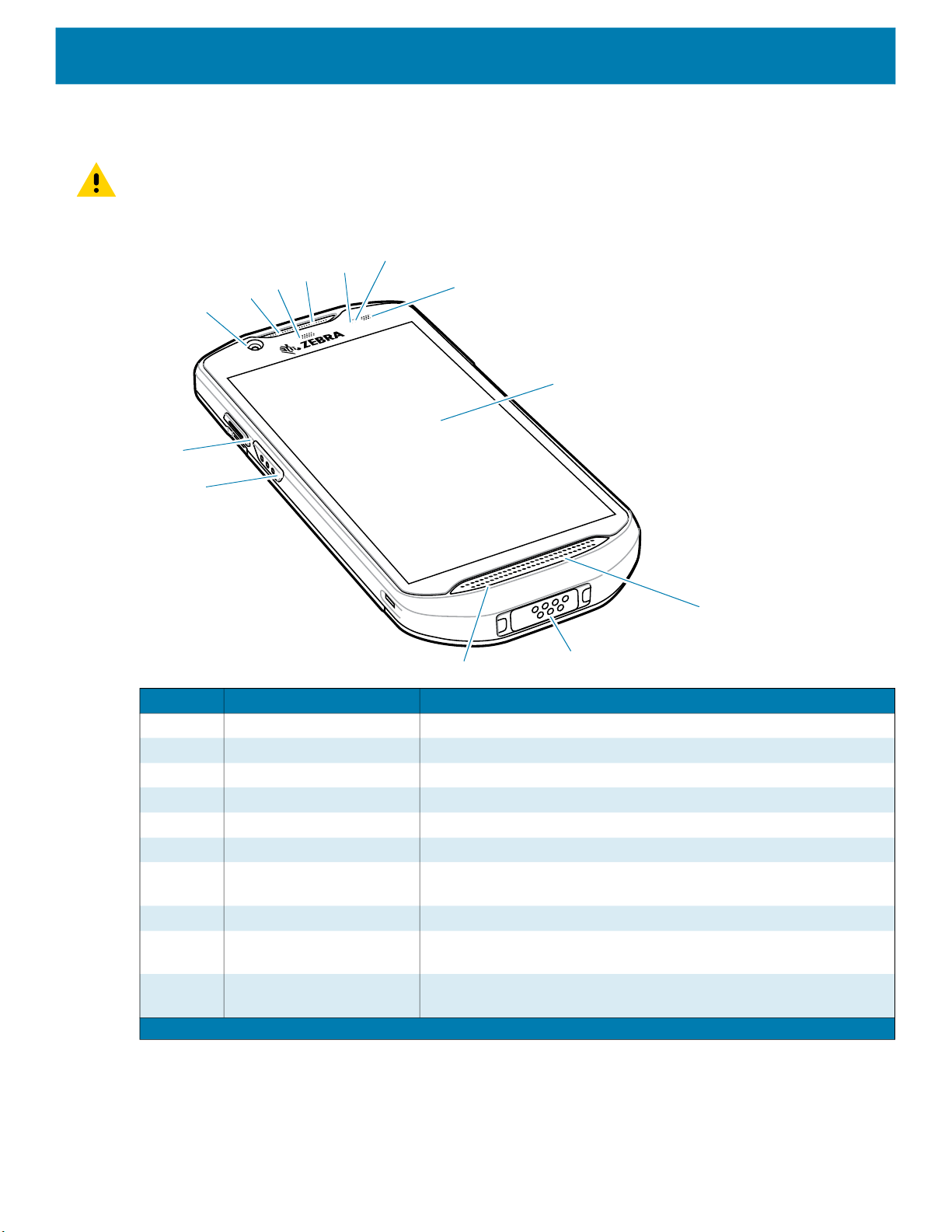
Figure 1 TC52ax Standard Front View
Getting Started
6
7
8
9
11
10
13
12
5
4
3
2
1
Number Item Function
1 5 MP Front camera Takes photos and videos.
2 Receiver Use for audio playback in Handset mode.
3 Data capture LED Indicates data capture status.
4 Microphone Use for communications in Speakerphone mode.
5 Proximity sensor Determines proximity for turning off display when in handset mode.
6 Light sensor Determines ambient light for controlling display backlight intensity.
7 Charging/Notification LED Indicates battery charging status while charging and application
generated notifications.
8 Touch screen Displays all information needed to operate the device.
9 Speaker Provides audio output for video and music playback. Provides
audio in speakerphone mode.
10 Interface connector Provides USB host and client communications, audio and device
charging via cables and accessories.
Note 1: Pakistan, Qatar
16
Page 17

Getting Started
Number Item Function
11 Microphone Use for communications in Handset mode.
12 Scan button Initiates data capture (programmable).
13 Programmable button Typically used for PTT communications. Where regulatory
1
restrictions exist
applications.
Note 1: Pakistan, Qatar
Figure 2 TC52ax Standard Rear View
1
, button is configurable for use with other
2
13
14
3
4
11
12
10
8
9
6
7
5
Number Item Function
1 Battery Re-Chargeable Li-Ion Battery with BLE Beacon.
2 Basic hand strap mount Provides mounting point for Basic Hand Strap accessory.
3 Scan button Initiates data capture (programmable).
4 Battery release latches Press to remove the battery.
5 Volume up/down button Increase and decrease audio volume (programmable).
6 13 MP rear camera Takes photos and videos.
7 Camera flash Provides illumination for the camera.
8 Power button Turns the display on and off. Press and hold to reset the device,
power off or swap battery.
9 Microphone Use for noise cancellation.
10 Exit window Provides data capture using the imager.
11 NFC antenna Provides communication with other NFC-enabled devices.
12 Headset jack For audio output to headset.
13 Trigger Handle Mount Provides electrical contacts and mounting for the Trigger Handle.
14 Wi-Fi 6 Logo Certifies that the TC52ax supports Wi-Fi 6.
17
Page 18
Getting Started
TC52ax Advanced Range Features
CAUTION: The 7-pin interface connector at the bottom of the device is not removable. Trying to remove the
connector will cause damage to the device and can void warranty.
Figure 3 TC52ax Advanced Range Front View
6
7
8
9
11
10
13
12
5
4
3
2
1
Number Item Function
1 5 MP Front camera Takes photos and videos.
2 Receiver Use for audio playback in Handset mode.
3 Data capture LED Indicates data capture status.
4 Microphone Use for communications in Speakerphone mode.
5 Proximity sensor Determines proximity for turning off display when in handset mode.
6 Light sensor Determines ambient light for controlling display backlight intensity.
7 Charging/Notification LED Indicates battery charging status while charging and application
generated notifications.
8 Touch screen Displays all information needed to operate the device.
9 Speaker Provides audio output for video and music playback. Provides
audio in speakerphone mode.
10 Interface connector Provides USB host and client communications, audio and device
charging via cables and accessories.
Note 1: Pakistan, Qatar
18
Page 19

Getting Started
Number Item Function
11 Microphone Use for communications in Handset mode.
12 Scan button Initiates data capture (programmable).
13 Programmable button Typically used for PTT communications. Where regulatory
1
restrictions exist
applications.
Note 1: Pakistan, Qatar
Figure 4 TC52ax Advanced Range Rear View
1
, button is configurable for use with other
2
14
13
3
4
12
11
10
6
9
8
7
5
Number Item Function
1 Battery Re-Chargeable Li-Ion Battery with BLE Beacon
2 Basic hand strap mount Provides mounting point for Basic Hand Strap accessory.
3 Scan button Initiates data capture (programmable).
4 Battery release latches Press to remove the battery.
5 Volume up/down button Increase and decrease audio volume (programmable).
6 13 MP rear camera Takes photos and videos.
7 Camera flash Provides illumination for the camera.
8 Power button Turns the display on and off. Press and hold to reset the device,
power off or swap battery.
9 Microphone Use for noise cancellation.
10 Exit window Provides data capture using the imager.
11 NFC antenna Provides communication with other NFC-enabled devices.
12 Headset jack For audio output to headset.
13 Trigger Handle Mount Provides electrical contacts and mounting for the Trigger Handle.
14 Wi-Fi 6 Logo Certifies that the TC52ax supports Wi-Fi 6.
19
Page 20

TC52ax-HC Features
CAUTION: The 7-pin interface connector at the bottom of the device is not removable. Trying to remove the
connector will cause damage to the device and can void warranty.
Figure 5 TC52ax-HC Front View
Getting Started
6
7
8
9
11
10
13
12
5
4
3
2
1
Number Item Function
1 5 MP Front camera Takes photos and videos.
2 Receiver Use for audio playback in Handset mode.
3 Data capture LED Indicates data capture status.
4 Microphone Use for communications in Speakerphone mode.
5 Proximity sensor Determines proximity for turning off display when in handset mode.
6 Light sensor Determines ambient light for controlling display backlight intensity.
7 Charging/Notification LED Indicates battery charging status while charging and application
generated notifications.
8 Touch screen Displays all information needed to operate the device.
9 Speaker Provides audio output for video and music playback. Provides
audio in speakerphone mode.
10 Interface connector Provides USB host and client communications, audio and device
charging via cables and accessories.
Note 1: Pakistan, Qatar
20
Page 21

Getting Started
Number Item Function
11 Microphone Use for communications in Handset mode.
12 Scan button Initiates data capture (programmable).
13 Programmable button Typically used for PTT communications. Where regulatory
1
restrictions exist
applications.
Note 1: Pakistan, Qatar
Figure 6 TC52ax-HC Rear View
2
1
, button is configurable for use with other
12
3
4
11
10
6
9
8
7
5
Number Item Function
1 Battery Re-Chargeable Li-Ion Battery with BLE Beacon.
2 NFC Antenna Provides communication with other NFC-enabled devices.
3 Scan button Initiates data capture (programmable).
4 Battery release latches Press to remove the battery.
5 Volume up/down button Increase and decrease audio volume (programmable).
6 13 MP rear camera Takes photos and videos.
7 Camera flash Provides illumination for the camera.
8 Power button Turns the display on and off. Press and hold to reset the device,
power off or swap battery.
9 Microphone Use for noise cancellation.
10 Exit window Provides data capture using the imager.
11 Wi-Fi 6 Logo Certifies that the TC52ax-HC supports Wi-Fi 6.
12 Red Alert Button Programmable button for use with applications.
21
Page 22

Setting Up the Device
To start using the device for the first time:
1. Install a micro secure digital (SD) card (optional).
2. Install hand strap (optional).
3. Install the battery.
4. Charge the device.
Installing a microSD Card
The microSD card slot provides secondary non-volatile storage. The slot is located under the battery pack.
Refer to the documentation provided with the card for more information, and follow the manufacturer’s
recommendations for use.
CAUTION: Follow proper electrostatic discharge (ESD) precautions to avoid damaging the microSD card.
Proper ESD precautions include, but are not limited to, working on an ESD mat and ensuring that the operator
is properly grounded.
Getting Started
1. Lift the access door.
2. Slide the microSD card holder to the unlock position.
3. Lift the microSD card holder.
22
Page 23

Getting Started
Insert the microSD card into the card holder door ensuring that the card slides into the holding tabs on each
4.
side of the door.
5. Close the microSD card holder and slide into the lock position.
CAUTION: Access door must be replaced and securely seated to ensure proper device sealing.
6. Re-install the access door.
Installing the Battery
NOTE: User modification of the device, particularly in the battery well, such as labels, asset tags, engravings,
stickers, etc., may compromise the intended performance of the device or accessories. Performance levels
such as sealing (Ingress Protection (IP)), impact performance (drop and tumble), functionality, temperature
resistance, etc. could be effected. DO NOT put any labels, asset tags, engravings, stickers, etc. in the battery
well.
1. Insert the battery, bottom first, into the battery compartment in the back of the device.
23
Page 24

2.
Press the battery down into the battery compartment until the battery release latches snap into place.
Charging the Battery
Before using the device for the first time, charge the main battery until the green Charging/Notification light
emitting diode (LED) remains lit. To charge the device use a cable or a cradle with the appropriate power
supply. For information about the accessories available for the device, see Accessories for more information.
Getting Started
The battery charges from fully depleted to 90% in approximately 2.5 hours, and from fully depleted to 100% in
approximately three hours.
NOTE: In many cases the 90% charge provides plenty of charge for daily use. A full 100% charge lasts for
approximately 14 hours of use.
To achieve the best fast charging results use only Zebra charging accessories and batteries. Charge batteries
at room temperature with the device in sleep mode.
Charge batteries in temperatures from 5°C to 40°C (41°F to 104°F). The device or accessory always performs
battery charging in a safe and intelligent manner. At higher temperatures (for example: approximately +37°C
(+98°F)) the device or accessory may for small periods of time alternately enable and disable battery charging
to keep the battery at acceptable temperatures. The device or accessory indicates when charging is disabled
due to abnormal temperatures via its LED and a notification appears on the display.
To charge the main battery:
1. Connect the charging accessory to the appropriate power source.
2. Insert the device into a cradle or attach to a cable. The device turns on and begins charging. The
Charging/Notification LED blinks amber while charging, then turns solid green when fully charged.
24
Page 25
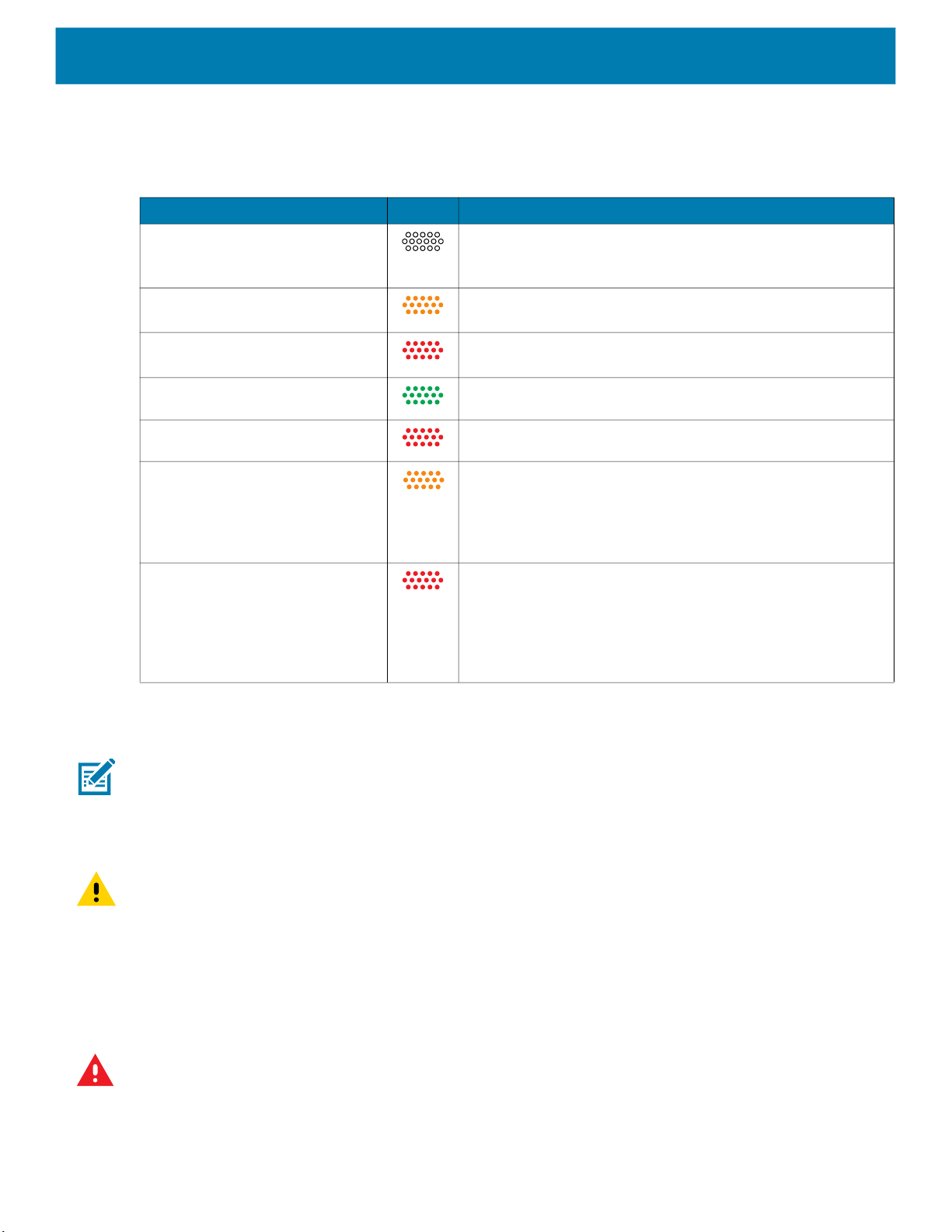
Charging Indicators
Table 2 Charging/Notification LED Charging Indicators
State LED Indication
Off Device is not charging. Device is not inserted correctly in the
Slow Blinking Amber (1 blink
every 4 seconds)
Slow Blinking Red (1 blink every
4 seconds)
Solid Green Charging complete.
Solid Red Charging complete but the battery is at end of useful life.
Getting Started
cradle or connected to a power source. Charger/cradle is not
powered.
Device is charging.
Device is charging but the battery is at end of useful life.
Fast Blinking Amber (2
blinks/second)
Fast Blinking Red (2
blinks/second)
Replacing the TC52ax Battery
NOTE: User modification of the device, particularly in the battery well, such as labels, asset tags, engravings,
stickers, etc., may compromise the intended performance of the device or accessories. Performance levels
such as sealing (Ingress Protection (IP)), impact performance (drop and tumble), functionality, temperature
resistance, etc. could be effected. DO NOT put any labels, asset tags, engravings, stickers, etc. in the battery
well.
CAUTION: Do not add or remove microSD card during battery replacement.
Charging error, for example:
• Temperature is too low or too high.
• Charging has gone on too long without completion
(typically eight hours).
Charging error but the battery is at end of useful life, for
example:
• Temperature is too low or too high.
• Charging has gone on too long without completion
(typically eight hours).
To replace the battery:
1. Press the Power button until the menu appears.
2. Touch Battery Swap.
3. Follow the on-screen instructions.
WARNING: Do not remove the battery until after the red LED completely turns off. Loss of data may result.
4. Wait for the red LED to completely turn off.
5. If hand strap is attached, remove hand strap.
25
Page 26

Press the two battery latches in.
6.
7. Lift the battery from the device.
Getting Started
CAUTION: Replace the battery within 75 seconds. After 75 seconds the device reboots and data may be lost.
8. Insert the replacement battery, bottom first, into the battery compartment in the back of the device.
9. Press the battery down until the battery release latches snap into place.
10. Replace the hand strap, if required.
11. Press the Power button to turn on the device.
Replacing the microSD Card
NOTE: User modification of the device, particularly in the battery well, such as labels, asset tags, engravings,
stickers, etc., may compromise the intended performance of the device or accessories. Performance levels
such as sealing (Ingress Protection (IP)), impact performance (drop and tumble), functionality, temperature
resistance, etc. could be effected. DO NOT put any labels, asset tags, engravings, stickers, etc. in the battery
well.
To replace the microSD card:
1. Press the Power button until the menu appears.
2. Touch Power off.
3. Touch OK.
4. If hand strap is attached, slide the hand strap clip up toward the top of the device and then lift.
26
Page 27

Getting Started
Press the two battery latches in.
5.
6. Lift the battery from the device.
7. Lift the access door.
8. Remove microSD card from holder.
9. Insert the replacement microSD card.
CAUTION: Access door must be replaced and securely seated to ensure proper device sealing.
10. Replace the access door.
11. Insert the battery, bottom first, into the battery compartment in the back of the device.
12. Press the battery down until the battery release latches snap into place.
13. Replace the hand strap, if required.
14. Press and hold the Power button to turn on the device.
27
Page 28
Using the Device
Home Screen
Turn on the device to display the Home screen. Depending on how your system administrator configured
your device, your Home screen may appear differently than the graphics in this section.
After a suspend or screen time-out, the Home screen displays with the lock slider. Touch the screen and
slide up to unlock.
The Home screen provides four additional screens to place widgets and shortcuts. Swipe the screen left or
right to view the additional screens.
NOTE: By default, AOSP devices do not have the same icons on the Home screen as GMS devices. Icons
are shown below for example only.
Home screen icons can be configured by the user and may look different than shown.
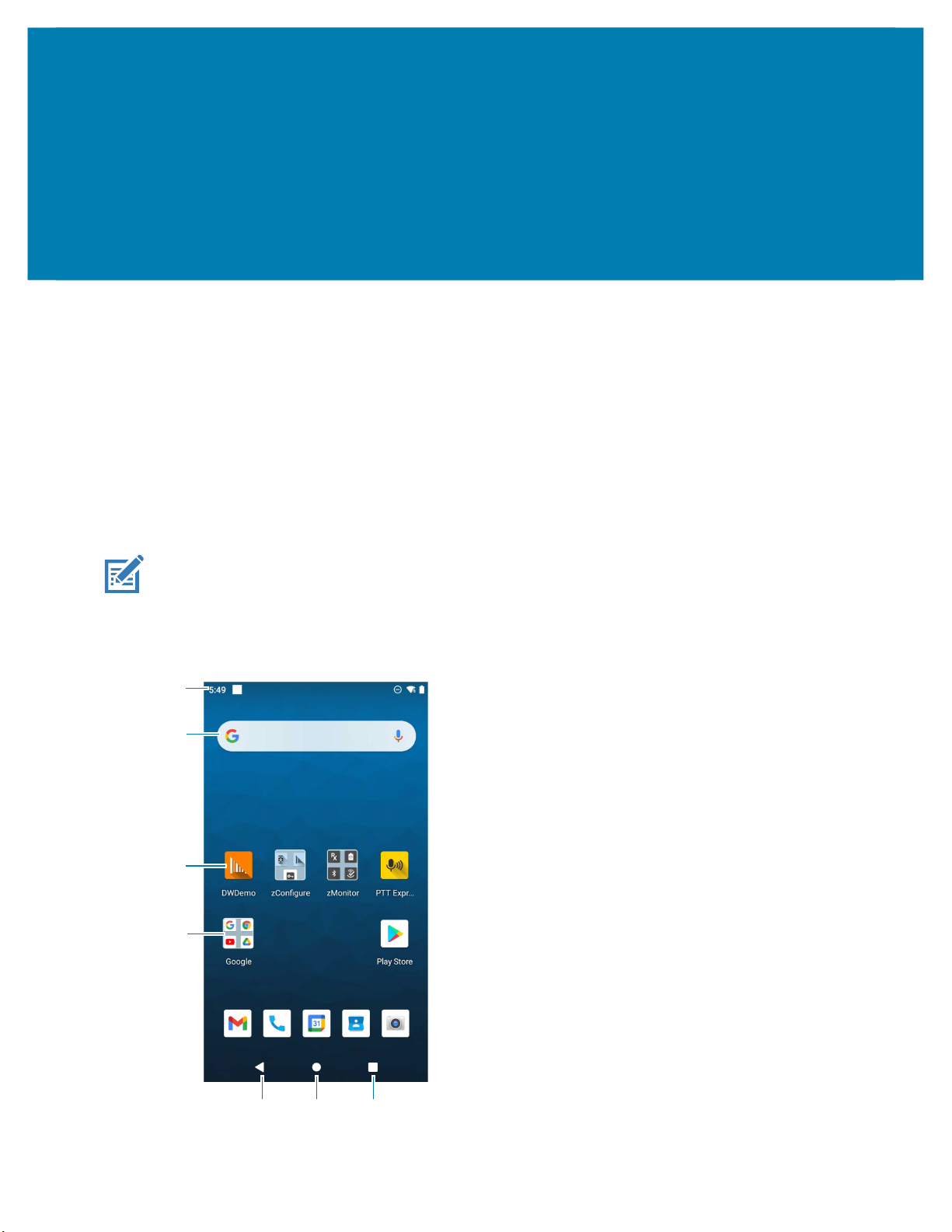
Figure 5 Home Screen
26
Page 29
1 Status Bar Displays the time, status icons (right side), and notification icons (left side).
For more information see Notification Icons on page 27 and Managing
Notifications on page 29.
2 Widgets Launches stand-alone apps that run on the Home screen.
3 Shortcut Icons Opens apps installed on the device.
4 Folder Contains apps.
5 Back Displays the previous screen.
6 Home Displays the Home screen.
7 Recent Displays recently used applications.
Setting Home Screen Rotation
By default, the Home screen rotation is disabled.
1. Touch and hold anywhere on the Home screen until the options appear.
2. Touch Home settings.
3. Touch the Allow Home screen rotation switch.
Using the Device
4. Touch the Home button.
5. Rotate the device.
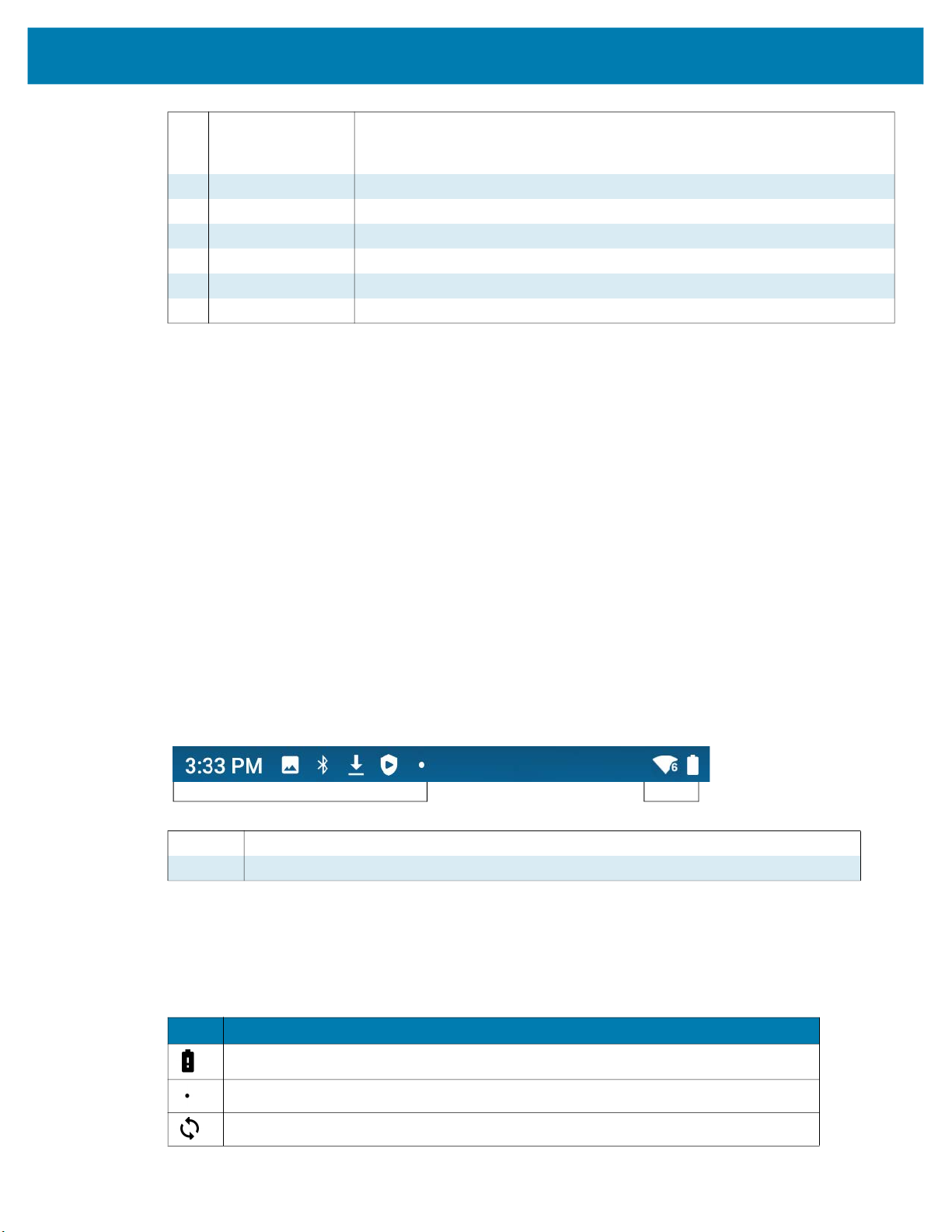
Status Bar
The Status bar displays the time, notification icons (left side), and status icons (right side).
If there are more notifications than can fit in the Status bar, a dot displays indicating that more notifications
exist. Swipe down from the Status bar to open the Notification panel and view all notifications and status.
Figure 6 Notification and Status Icons
1 Notification Icons. See Notification Icons on page 27.
2 Status Icons. See Status Icons on page 28.
Notification Icons
Notification icons indicate app events and messages.
1
2
Table 3 Notification Icons
Icon Description
Main battery is low.
More notifications are available for viewing.
Data is syncing.
27
Page 30
Using the Device
Table 3 Notification Icons (Continued)
Icon Description
Indicates an upcoming event. AOSP devices only.
Indicates an upcoming event. GMS devices only.
Open Wi-Fi network is available.
Audio is playing.
Problem with sign-in or sync has occurred.
Device is uploading data.
Animated: the device is downloading data. Static: the download is complete.
Device is connected to or disconnected from a virtual private network (VPN).
Preparing internal storage by checking it for errors.
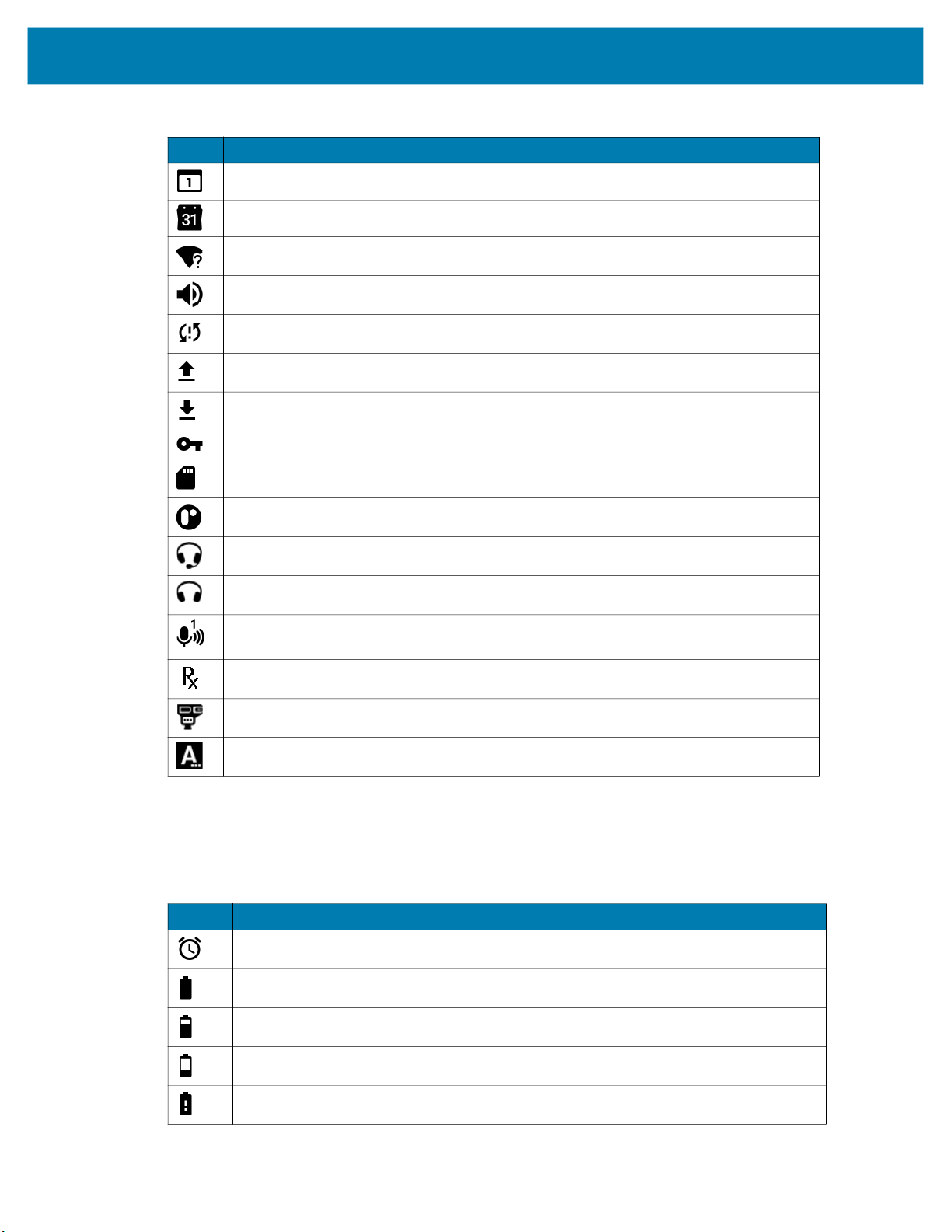
Status Icons
Status icons display system information for the device.
Table 4 Status Icons
Icon Description
USB debugging is enabled on the device.
Wired headset with a boom module is connected to the device.
Wired headset without a boom module is connected to the device.
PTT Express Voice client status. See the PTT Express PTT Notification Icons for a
complete list.
Indicates the RxLogger app is running.
Indicates the Bluetooth scanner is connected to the device.
Indicates the ring scanner is connected to the device in HID mode.
Alarm is active.
Main battery is fully charged.
Main battery is partially drained.
Main battery charge is low.
Main battery charge is very low.
28
Page 31

Using the Device
Table 4 Status Icons (Continued)
Icon Description
Main battery is charging.
All sounds, except media and alarms, are muted. Vibrate mode is active.
Do Not Disturb mode active.
Airplane Mode is active. All radios are turned off.
Bluetooth is on.
The device is connected to a Bluetooth device.
Connected to a Wi-Fi network. Indicates the Wi-Fi version number.
Not connected to a Wi-Fi network or no Wi-Fi signal.
Connected to an Ethernet network.
Speakerphone enabled.
Managing Notifications
Notification icons report the arrival of new messages, calendar events, alarms, and ongoing events. When
a notification occurs, an icon appears in the Status bar with a brief description. See Notification Icons on
page 27 for a list of possible notification icons and their description.
• To view a list of all notifications, open the Notification panel by dragging the Status bar down from the
top of the screen.
29
Page 32

Figure 7 Notification Panel
Using the Device
Quick Settings Bar
• To respond to a notification, open the Notification panel and then touch a notification. The Notification
panel closes and the corresponding app opens.
• To manage recent or frequently used notifications, open the Notification panel and then touch Manage
notifications. Touch the toggle switch next to an app to turn off all notifications, or touch an app for
more notification options.
• To clear all notifications, open the Notification panel and then touch CLEAR ALL. All event-based
notifications are removed. Ongoing notifications remain in the list.
• To close the Notification panel, swipe the Notification panel up.
Opening the Quick Access Panel
Use the Quick Access panel to access frequently used settings (for example, Airplane mode). To get to the
Quick Access Panel:
• If the device is locked, swipe down once.
• If the device is unlocked, swipe down once with two fingers, or twice with one finger.
• If the Notification panel is open, swipe down from the Quick Settings bar.
30
Page 33

Figure 8 Quick Access Panel
Using the Device
NOTE: Not all icons are pictured. Icons may vary.
Quick Access Panel Icons
• Display brightness - Use the slider to decrease or increase the brightness of the screen.
• Wi-Fi network - Turn Wi-Fi on or off. To open Wi-Fi settings, touch the Wi-Fi network name.
• Bluetooth settings - Turn Bluetooth on or off. To open Bluetooth settings, touch Bluetooth.
• Battery saver - Turn Battery saver mode on or off. When Battery saver mode is on the performance of
the device is reduced to preserve battery power.
• Invert colors - Invert the display colors.
• Do not disturb - Control how and when to receive notifications.
• Airplane mode - Turn Airplane mode on or off. When Airplane mode is on the device does not connect
to Wi-Fi or Bluetooth.
• Auto-rotate - Lock the device’s orientation in portrait or landscape mode or set to automatically rotate.
• Flashlight - Turn flashlight on or off. Turn camera flash on or off.
• Night Light - Tint the screen amber to make it easier to look at the screen in dim light. Set Night Light to
turn on automatically from sunset to sunrise, or at other times.
• Screen Cast - Share phone content on Chromecast or a television with Chromecast built-in. Touch cast
screen to display a list of devices, then touch a device to begin casting.
• Dark Theme - Toggles dark theme on and off. Dark themes reduce the luminance emitted by the
screen, while meeting minimum color contrast ratios. It helps improve visual ergonomics by reducing
eye strain, adjusting brightness to current lighting conditions, and facilitating screen use in dark
environments, while conserving battery power.
• Focus mode - Turn on to pause distracting apps. To open Focus mode settings, touch and hold.
31
Page 34

Using the Device
• Bedtime mode - Turn grayscale on and off. Grayscale turns the screen black and white, reducing phone
distractions and improving battery life.
• Nearby Share - Helps find and interact with services and devices close to the device. To open Nearby
Share settings, touch and hold.
• Screen Record - Turn on to record your phone screen. Tap the toggle switches to record audio or show
touches on the screen.
Editing Icons on the Quick Settings Bar
The first several setting tiles from the Quick Access panel become the Quick Settings bar.
Open the Quick Access panel and touch to edit, add, or remove settings tiles.
Battery Management
Observe the recommended battery optimization tips for your device.
• Set the screen to turn off after a short period of non-use.
• Reduce screen brightness.
• Turn off all wireless radios when not in use.
• Turn off automatic syncing for Email, Calendar, Contacts, and other apps.
• Minimize use of apps that keep the device from suspending, for example, music and video apps.
NOTE: Before checking the battery charge level, remove the device from any AC power source (cradle or
cable).
Checking Battery Status
• Open Settings and touch About phone > Battery Information.
Or, swipe up from the bottom of the screen and touch to open the Battery Manager app. See
Battery Manager on page 47.
• Battery present status indicates if the battery is present.
• Battery level lists the battery charge (as a percentage of fully charged).
• Swipe down with two fingers from the status bar to open the quick access panel.
• Battery percentage is displayed next to the battery icon.
Monitoring Battery Usage
The Battery screen provides battery charge details and power management options to extend battery life.
1. Go to Settings.
2. Touch Battery.
Display battery information and power management options for a specific app.
1. Go to Settings.
2. Touch Apps & notifications.
3. Touch an app.
32
Page 35

Using the Device
Touch Advanced > Battery.
4.
Different apps display different information. Some apps include buttons that open screens with settings to
adjust power use. Use the DISABLE or FORCE STOP buttons to turn off apps that consume too much
power.
Low Battery Notification
When the battery charge level drops below 18%, the device displays a notice to connect the device to
power. The user should charge the battery using one of the charging accessories.
When the battery charge drops below 10%, the device displays a notice to connect the device to power.
The user must charge the battery using one of the charging accessories.
When the battery charge drops below 4%, the device turns off. The user must charge the battery using one
of the charging accessories.
Using the Rechargeable Li-Ion Battery with BLE Beacon
The TC52ax utilizes a rechargeable Li-Ion battery to facilitate BLE Beacon. Once enabled, the battery
transmits a BLE signal for up to seven days while the device is powered off due to battery depletion.
NOTE: The device transmits a Bluetooth beacon only when the device is powered off.
For additional information on configuring the secondary BLE Settings, see
techdocs.zebra.com/mx/beaconmgr.
Waking the Device
The device goes into Suspend mode when you press the Power button or after a period of inactivity (set in
the Display settings window).
1. To wake the device from Suspend mode, press the Power button.
The Lock screen displays.
2. Swipe the screen up to unlock.
• If the Pattern screen unlock feature is enabled, the Pattern screen appears instead of the Lock
screen.
• If the PIN or Password screen unlock feature is enabled, enter the PIN or password after unlocking
the screen.
NOTE: If you enter the PIN, password, or pattern incorrectly five times, you must wait 30 seconds before
trying again.
If you forget the PIN, password, or pattern contact your system administrator.
USB Communication
Connect the device to a host computer to transfer files between the device and the host computer.
When connecting the device to a host computer, follow the host computer’s instructions for connecting and
disconnecting USB devices, to avoid damaging or corrupting files.
33
Page 36

Transferring Files
Use Transfer files to copy files between the device and the host computer.
1. Connect the device to a host computer using a USB accessory.
2. On the device, pull down the Notification panel and touch Charging this device via USB.
By default, No data transfer is selected.
3. Touch File Transfer.
4. On the host computer, open a file explorer application.
5. Locate the device as a portable device.
6. Copy files to and from the device or delete files as required.
Transferring Photos
Use PTP to copy photos from the device to the host computer.
1. Connect the device to a host computer using a USB accessory.
2. On the device, pull down the Notification panel and touch Charging this device via USB.
Using the Device
3. Touch PTP.
4. On the host computer, open a file explorer application.
5. Copy or delete photos as required.
Disconnect from the Host Computer
CAUTION: Carefully follow the host computer’s instructions to unmount the microSD card and disconnect
USB devices correctly to avoid losing information.
To disconnect the device from the host computer:
1. On the host computer, unmount the device.
2. Remove the device from the USB accessory.
34
Page 37

Settings
Accessing Settings
There are multiple ways to access settings on a device.
• Swipe down with two fingers from the top of the Home screen to open the Quick Access panel and
touch .
• Double-swipe down from the top of the Home screen to open the Quick Access panel and touch .
• Swipe up from the bottom of the Home screen to open APPS and touch Settings.
Display Settings
Use Display settings to change the screen brightness, enable night light, change the background
image, enable screen rotation, set sleep time, and change font size.
Setting the Screen Brightness Manually
Manually set the screen brightness using the touchscreen.
1. Swipe down with two fingers from the Status bar to open the Quick Access panel.
2. Slide the icon to adjust the screen brightness level.
Setting the Screen Brightness Automatically
Automatically adjust the screen brightness using the built-in light sensor.
1. Go to Settings.
2. Touch Display.
3. If disabled, touch Adaptive brightness to automatically adjust the brightness.
By default, Adaptive brightness is enabled. Toggle the switch to disable.
4. Touch the Home button.
Setting Night Light
The Night Light setting tints the screen amber, making the screen easier to look at in low light.
1. Go to Settings.
2. Touch Display.
35
Page 38

Touch Night Light.
3.
4. Touch Schedule.
5. Select one of the schedule values:
• None (default)
• Turns on at custom time
• Turns on from sunset to sunrise.
6. By default, Night Light is disabled. Touch TURN ON NOW to enable.
7. Adjust the tint using the Intensity slider.
8. Touch the Home button.
Setting Screen Rotation
By default, screen rotation is enabled.
1. Go to Settings.
2. Touch Display > Advanced.
Settings
3. Touch Auto-rotate screen.
NOTE: To change the Home screen rotation, see Setting Home Screen Rotation on page 27.
4. Touch the Home button.
Setting Screen Timeout
Set the screen sleep time.
1. Go to Settings.
2. Touch Display > Advanced > Screen timeout.
3. Select one of the sleep values.
• 15 seconds
• 30 seconds
• 1 minute (default)
• 2 minutes
• 5 minutes
• 10 minutes
• 30 minutes
4. Touch the Home button.
Lock Screen
The lock screen setting wakes the screen when notifications are received.
1. Go to Settings.
2. Touch Display > Advanced.
36
Page 39

Touch Lock screen.
3.
4. In the When to show section, enable or disable an option using the switch.
5. Touch the Home button.
Setting Font Size
Set the size of the font in system apps.
1. Go to Settings.
2. Touch Display > Advanced.
3. Touch Font size.
4. Select one of the font size values.
• Small
• Default
• Large
• Largest.
Settings
5. Touch the Home button.
Notification LED Brightness Level
Set the brightness of the Notification LED.
1. Go to Settings.
2. Touch Display > Advanced.
3. Touch Notification LED Brightness Level.
4. Use the slider to set the brightness value (default: 15).
5. Touch the Home button.
Touch Panel Mode
The device display is able to detect touches using a finger, a conductive-tip stylus, or gloved finger.
NOTE: A glove can be made of medical latex, leather, cotton, or wool.
For optimal performance use a Zebra certified stylus.
1. Go to Settings.
2. Touch Display > Advanced.
3. Touch TouchPanelUI.
4. Select:
• Stylus and Finger (Screen Protector OFF) to use a finger or a stylus on the screen without a screen
protector.
• Glove and Finger (Screen Protector OFF) to use a finger or a gloved finger on the screen without a
screen protector.
• Finger Only to use a finger on the screen.
37
Page 40

• Glove and Finger (Screen Protector ON) to use a finger or a gloved finger on the screen with a screen
protector.
• Stylus and Finger (Screen Protector ON) to use a finger or a stylus on the screen with a screen
protector.
• Finger and Stylus to use a finger or a stylus on the screen.
• Finger and Glove to use a finger or a gloved finger on the screen.
5. Touch the Home button.
Setting the Date and Time
You are only required to set the time zone or set the date and time if the wireless LAN does not support
Network Time Protocol (NTP)
1. Go to Settings.
2. Touch System > Date & time.
3. Touch Use network-provided time to disable automatic date and time synchronization.
4. Touch Date.
Settings
5. In the calendar, set today’s date.
6. Touch OK.
7. Touch Time.
8. Touch the green circle, drag to the current hour and then release.
9. Touch the green circle, drag to the current minute and then release.
10. Touch AM or PM.
11. Touch OK.
12. Touch Time zone > Time zone and select the current time zone from the list. This option may not be
available in some locations.
13. Touch Time zone > Region and select the current region from the list.
14. Touch Update Interval to select interval to synchronize the system time from the network.
15. In TIME FORMAT, choose either Use local default or Use 24-hour format.
16. Touch the Home button.
General Sound Setting
Use the Sound settings to configure media and alarm volumes.
1. Go to Settings.
2. Touch Sound.
3. Touch an option to set sounds.
Sound Options
• Media volume - Controls the music, games, and media volume.
• Alarm volume - Controls the alarm clock volume.
38
Page 41

• Notification volume - Controls the notification volume (WLAN only).
• Do Not Disturb - Mutes some or all sounds and vibrations.
• Media - Enable or disable to show media controls in Quick Access Panel.
• Shortcut to prevent ringing - Select how the shortcut method prevents ringing.
• Default notification sound - Select a sound to play for all system notifications.
• Default alarm sound - Select a sound to play for alarms.
• Other sounds and vibrations
• Screen locking sounds - Play a sound when locking and unlocking the screen (default – enabled).
• Charging sounds and vibration - Plays a sound and vibrates when power is applied to the device
(default - enabled).
• Touch sounds - Play a sound when making screen selections (default – enabled).
Setting Wake-Up Sources
By default the device wakes from suspend mode when the user presses the Power button. The device can be
configured to wake when the user presses the PTT or Scan buttons on the left side of the device.
Settings
1. Go to Settings.
2. Touch Wake-Up Sources.
• LEFT_TRIGGER_2 - PTT button.
• GUN_TRIGGER - Optional Trigger Handle scan button.
• RIGHT_TRIGGER_1 - Right scan button.
• SCAN - Left scan button.
3. Touch a checkbox. A check appears in the checkbox.
4. Touch the Home button.
Remapping a Button
Buttons on the device can be programmed to perform different functions or as shortcuts to installed apps. For
a list of key names and descriptions, refer to: techdocs.zebra.com
NOTE: It is not recommended to remap the scan button.
1. Go to Settings.
2. Touch Key Programmer. A list of programmable buttons displays.
3. Select the button to remap.
.
4. Touch the Keys and Buttons tab or the Shortcut tab that lists the available functions and applications.
5. Touch a function or application shortcut to map to the button.
NOTE: If you select an application shortcut, the application icon appears next to the button on the Key
Programmer screen.
6. Touch the Home button.
39
Page 42

Remappable Keys
Figure 9 Key Positions
• BUTTON_L2 - PTT button.
BUTTON_L2
SCAN
• BUTTON_L1 - Optional Trigger Handle scan button.
• BUTTON_R1 - Right scan button.
• SCAN - Left scan button.
Settings
• VOLUME_DOWN - Volume down button.
• VOLUME_UP - Volume up button.
Keyboards
The device provides multiple keyboard options.
• Android Keyboard - AOSP devices only
• Gboard - GMS devices only
• Enterprise Keyboard
NOTE: By default the Enterprise and Virtual Keyboards are disabled.
Keyboard Configuration
Enabling Keyboards
1. Go to Settings.
2. Touch System > Languages & input > Virtual keyboard > Manage keyboards.
3. Touch a keyboard to enable.
Switching Between Keyboards
• To switch between keyboards, touch in a text box to display the current keyboard.
• On the Gboard keyboard, touch and hold (GMS devices only).
• On the Android keyboard, touch and hold (AOSP devices only).
• On the Enterprise keyboard, touch . Only available with Mobility DNA Enterprise License. Not
pre-installed on the device. Contact Zebra Support for more information.
40
Page 43

Settings
Using the Android and Gboard Keyboards
Use the Android or Gboard keyboards to enter text in a text field.
To configure the keyboard settings, touch and hold
the comma and then slide your finger to .
Edit Text
Edit entered text and use menu commands to cut, copy, and paste text within or across apps. Some apps do
not support editing some or all of the text they display; others may offer their own way to select text.
Entering Numbers, Symbols, and Special Characters
1. Enter numbers and symbols.
• Touch and hold one of the top-row keys until a menu appears then select a number or special character.
• Touch the Shift key once for a single capital letter. Touch the Shift key twice to lock in uppercase. Touch
the Shift key a third time to unlock Capslock.
• Touch
• Touch the
2. Enter special characters.
• Touch and hold a number or symbol key to open a menu of additional symbols. A larger version of the
key displays briefly over the keyboard.
?123 to switch to the numbers and symbols keyboard.
=\< key on the numbers and symbols keyboard to view additional symbols.
Using the Enterprise Keyboard
The Enterprise Keyboard contains multiple keyboard types.
• Numeric
• Alpha
• Special characters
• Data capture.
Numeric Tab
The numeric keyboard is labeled 123. The keys displayed vary on the app being used. For example, an arrow
displays in Contacts, however Done displays in Email account setup.
Alpha Tab
The alpha keyboard is labeled using the language code. For English, the alpha keyboard is labeled EN.
Additional Character Tab
The additional characters keyboard is labeled #*/.
Touch to enter emoji icons in a text message.
Touch ABC to return to the Symbols keyboard.
Scan Tab
The Scan tab provides an easy data capture feature for scanning barcodes.
41
Page 44

Language Usage
Use the Language & input settings to change the device’s language, including words added to the dictionary.
Changing the Language Setting
1. Go to Settings.
2. Touch System > Languages & input.
3. Touch Languages. A list of available languages displays.
4. If the desired language is not listed, touch Add a language and select a language from the list.
5. Touch and hold to the right of the desired language, then drag it to the top of the list.
6. The operating system text changes to the selected language.
Adding Words to the Dictionary
1. Go to Settings.
2. Touch System > Languages & input > Advanced > Personal dictionary.
Settings
3. If prompted, select the language where this word or phase is stored.
4. Touch + to add a new word or phrase to the dictionary.
5. Enter the word or phrase.
6. In the Shortcut text box, enter a shortcut for the word or phrase.
7. Touch the Home button.
Notifications
Setting App Notifications
To set notification settings for a specific app:
1. Go to Settings.
2. Touch Apps & notifications.
3. Under Recently opened apps, touch SEE ALL XX APPS. The App info screen displays.
If there are no recently opened apps, touch App info to open the App Info screen.
4. Select an app. Options vary depending on the app selected.
5. Select an available option:
• Open - Opens the app.
• Disable - Turn the app off and hide it. The app no longer appears in the All Apps list. You must re-enable
the app to use it.
• Force Stop - Turn off the app.
• Notifications
• All app notifications - Select to turn all notifications from this app on (default) or off.
Touch a specific notification category to display additional options.
42
Page 45

Settings
• Default - Allow notifications from this app to make sound or vibrate the device.
• Silent - Do not allow notifications from this app to make sound or vibrate.
• Minimize - In the Notification panel, collapse notifications to one line.
• Advanced - Touch for additional options.
• Allow notification dot - Do not allow this app to add a notification dot to the app icon.
• Additional settings in the app - Open the app settings.
• Permissions - Configure which permissions are allowed or denied for this app.
• Storage & cache - View the amount of storage and cache space used for this app. You can choose to
Clear Storage and Clear Cache for the app to free up storage space on the device.
• Mobile data & Wi-Fi - View the data usage for this app. You can choose to enable Background data
usage or allow Unrestricted data usage by this app.
• Advanced - Touch for additional options.
• Screen time - Touch for options to set an App timer that limits the amount of time you can use this app
and to Manage notifications.
• Battery - Set Background restriction and Battery optimization for this app.
• Open by default - Modify which links or files the app opens by default.
• Advanced
• Picture-in-picture - Allow this app to create a picture-in-picture window when the app is running in the
background.
• Install unknown apps - Allow this app to install unknown apps.
• Display over other apps - Allow this app to display over other apps.
• Modify system settings - Allow this app to modify system settings.
• Store
• App details - Opens Google Play to display information about the app.
Viewing Notification Settings for All Apps
To view the notification settings for all apps:
1. Go to Settings.
2. Touch Apps & Notifications.
3. Scroll down to Notifications to view how many apps have notifications turned off.
4. To set or view notifications settings for a specific app, see Setting App Notifications on page 42.
Controlling Lock Screen Notifications
To control whether notifications can be seen when the device is locked:
1. Go to Settings.
2. Touch Apps & notifications > Notifications.
3. Touch Notifications on lockscreen and select one of the following:
• Show conversations, default, and silent (default)
• Hide silent conversations and notifications
43
Page 46

Settings
• Don't show any notifications.
Blink Light
The Notification LED lights blue when an app, such as email and VoIP, generates a programmable notification
or to indicate when the device is connected to a Bluetooth device. By default, LED notifications are enabled.
To change the notification setting:
1. Go to Settings.
2. Touch Apps & notifications > Notifications > Advanced.
3. Touch Blink light to toggle the notification on or off.
44
Page 47

Applications
The APPS screen displays icons for all installed apps. See Application Deployment for information on
installing and uninstalling apps. For information on standard Android apps, go to Google Play
The following table describes the apps installed on the device.
NOTE: Not all apps are available on all devices.
Table 5 Apps
Icon Description
Battery Manager - Displays battery information, including charge level, status, health and
wear level, and use to place device in Battery Swap mode when replacing the battery.
Bluetooth Pairing Utility – Use to pair a Zebra Bluetooth scanner with the device by
scanning a barcode.
Camera - Take photos or record videos. For more information, see Camera on page 49.
.
DataWedge - Enables data capture using the imager. For more information, see DataWedge
Demonstration on page 52.
DisplayLink Presenter - Use to present the device screen onto a connected monitor.
DWDemo - Provides a way to demonstrate the data capture features using the imager. For
more information, see DataWedge Demonstration on page 52.
License Manager - Use to manage software licenses on the device.
Music - Play music stored on the microSD card or internal storage. AOSP only.
Phone - Use to dial a phone number when used with some Voice over IP (VoIP) clients
(VoIP telephony ready only).
45
Page 48

Applications
Table 5 Apps (Continued)
Icon Description
PTT Express - Use to launch PTT Express client for VoIP communication.
RxLogger - Use to diagnose device and app issues. For more information, see RxLogger on
page 57.
Settings - Use to configure the device.
StageNow - Allows the device to stage a device for initial use by initiating the deployment of
settings, firmware, and software.
VoD - The Video on Device basic app provides a how-to video for proper device cleaning.
For Video on Device licensing information, go to learning.zebra.com
.
Worry Free Wifi Analyzer - A diagnostic intelligent app. Use to diagnose surrounding area
and display network stats, such as coverage hole detection, or AP in vicinity. Refer to the
Worry Free Wi-Fi Analyzer Administrator Guide for Android.
Zebra Bluetooth Settings - Use to configure Bluetooth logging.
Zebra Data Services - Use to enable or disable Zebra Data Services. Some options are set
by the system administrator.
Accessing Apps
All apps installed on the device are accessed using the APPS window.
1. On the Home screen, swipe up from the bottom of the screen.
2. Slide the APPS window up or down to view more app icons.
3. Touch an icon to open the app.
Switching Between Recent Apps
Use the Recent button to switch between recently used apps.
1. Touch Recent button.
A window appears on the screen with icons of recently used apps.
2. Slide the apps displayed up and down to view all recently used apps.
3. Swipe left or right to remove app from the list and force close the app.
4. Touch an icon to open an app or touch Back button to return to the current screen.
46
Page 49

Battery Manager
The Battery Manager provides detailed information about the battery and battery swap procedures on
supported devices.
Opening Battery Manager
To open the Battery Manager app, swipe up from the bottom of the Home screen, and then touch .
Battery Manager Information Tab
The Battery Manager displays detailed information about battery charging, health, and status.
Table 6 Battery Icon Description
Battery Icon Description
Applications
Battery charge level is between 85% and 100%.
Battery charge level is between 19% and 84%.
Battery charge level is between 0% and 18%.
• Level - The current battery charge level as a percentage. Displays -% when level is unknown.
• Wear - The health of the battery in graphical form. When the wear level exceeds 80%, the bar color
changes to red.
• Health - The health of the battery. If a critical error occurs, appears. Touch to view the error
description.
• Decommission - The battery is past its useful life and should be replaced. See system
administrator.
• Good - The battery is good.
• Charge error - An error occurred while charging. See system administrator.
• Over Current - An over-current condition occurred. See system administrator.
• Dead - The battery has no charge. Replace the battery.
• Over Voltage - An over-voltage condition occurred. See system administrator.
• Below Temperature - The battery temperature is below the operating temperature. See system
administrator.
• Failure Detected - A failure has been detected in the battery. See system administrator.
• Unknown - See system administrator.
• Charge Status
• Not charging - The device is not connected to AC power.
• Charging-AC - The device is connected to AC power and charging.
47
Page 50

Applications
• Charging-USB - The device is connected to a host computer with a USB cable and charging.
• Discharging - The battery is discharging.
• Full - That the battery is fully charged.
• Unknown - The battery status is unknown.
• Time until Full - The amount of time until the battery is fully charged.
• Time since charging - The amount of time since the device began charging.
• Time until empty - The amount of time until the battery is empty.
• Advanced info - Touch to view additional battery information.
• Battery present status - Indicates that the battery is present.
• Battery level - The battery charge level as a percentage of scale.
• Battery scale - The battery scale level used to determine battery level (100).
• Battery voltage - The current battery voltage in millivolts.
• Battery temperature - The current battery temperature in degrees Centigrade.
• Battery technology - The type of battery.
• Battery current - The average current into or out of the battery over the last second in mAh.
• Battery manufacture date - The date of manufacture.
• Battery serial number - The battery serial number. The number matches the serial number printed
on the battery label.
• Battery part number - The battery part number.
• Battery decommission status - Indicates if the battery is past its life span.
• Battery Good - The battery is in good health.
• Decommissioned Battery - The battery is past its useful life and should be replaced.
• Base cumulative charge - Cumulative charge using Zebra charging equipment only.
• Battery present capacity - Maximum amount of charge that could be pulled from the battery under
the present discharge conditions if the battery were fully charged.
• Battery health percentage - With a range from 0 to 100, this is the ratio of “present_capacity” to
“design_capacity” at a discharge rate of “design_capacity”.
• % decommission threshold - The default % decommission threshold for a gifted battery as 80%.
• Battery present charge - Amount of usable charge remaining in the battery at present under the
current discharge conditions.
• Battery total cumulative charge - The total accumulated charge in all chargers.
• Battery time since first use - The time passed since the battery was placed in a Zebra terminal for
the first time.
• Battery error status - The error status of the battery.
• App version - The application version number.
Battery Manager Swap Tab
NOTE: The Swap tab also appears when the user presses the Power button and selects Battery Swap.
48
Page 51

Camera
Taking Photos
Applications
Use to place the device in Battery Swap mode when replacing the battery. Follow the instructions on the
screen. Touch Proceed with battery swap button.
NOTE: The device saves photos and videos on the microSD card, if installed and the storage path is
changed manually. By default, or if a microSD card is not installed, the device saves photos and videos on
the internal storage.
This section provides information for taking photos and recording videos using the integrated digital
cameras.
NOTE: See Camera Settings on page 51 for camera setting descriptions.
Camera Switch (Available on devices
Filters
with a rear camera and front camera)
Flash
Scene Mode
and Settings
Gallery
Video Recording
Button
Camera Shutter Button
1. Swipe up from the bottom of the Home screen and touch Camera.
2. If necessary, touch the Camera Mode icon and touch .
3. To switch between the rear camera and front camera (if available), touch .
4. Frame the subject on the screen.
49
Page 52

To zoom in or out, press two fingers on the display and pinch or expand fingers. The zoom controls
5.
appear on the screen.
6. Touch an area on the screen to focus. The focus circle appears. The two bars turn green when in focus.
7. Touch .
The camera takes a photo and a shutter sound plays.
The photo momentarily displays as a thumbnail in the lower left corner.
Recording Videos
1. Swipe up from the bottom of the Home screen and touch Camera.
2. Touch the camera mode menu and touch .
Applications
Audio
Flash
Take Photo
Gallery
Shutter Button
3. To switch between the rear camera and front camera (if available), touch .
4. Point the camera and frame the scene.
5. To zoom in or out, press two fingers on the display and pinch or expand fingers. The zoom controls
Stop Recording
Pause
Recording
appear on the screen.
6. Touch to start recording.
The video time remaining appears in the top left of the screen.
7. Touch to end the recording.
The video momentarily displays as a thumbnail in the lower left corner.
50
Page 53

Camera Settings
In Photo mode, photo settings appear on screen. Touch ••• > to display the photo settings options.
• General - These settings apply to both the still camera and video camera.
• GPS location - Turn On or Off (default).
• Storage – Set the location to store the photo to: Phone or SD Card.
• Still Camera - These settings apply only to the still camera.
• Countdown timer - Select Off (default), 2 seconds, 5 seconds or 10 seconds.
• Continuous Shot - Select to take a series of photos quickly while holding the capture button. Off
(default) or On.
• Picture size - The size (in pixels) of the photo to: 13M pixels (default), 8M pixels, 5M pixels, 3M
pixels, HD1080, 2M pixels, HD720, 1M pixels, WVGA, VGA, or QVGA.
• Picture quality - Set the picture quality setting to: Low, Standard, or High (default).
• Redeye reduction - Helps eliminate redeye effect. Options: Disabled (default), or Enable.
• Exposure - Set the exposure settings to: -2, -1.5, -1, -0.5, 0 (default), +0.5, +1, +1.5, +2.
Applications
• White balance - Select how the camera adjusts colors in different kinds of light, to achieve the most
natural-looking colors:
• Incandescent - Adjust the white balance for incandescent lighting.
• Fluorescent - Adjust the white balance for florescent lighting.
• Auto - Adjust the white balance automatically (default).
• Daylight - Adjust the white balance for daylight.
• Cloudy - Adjust the white balance for a cloudy environment.
• Shutter Sound - Select to play a shutter sound when taking a photo. Options: Disable or Enable
(default).
• Picture Format - All still images are saved in JPEG format.
• Video Camera - These settings apply only to the video camera.
• Video quality - Set video quality to: 4k UHD, HD 1080p (default), HD 720p, SD 480p, VGA, CIF, or
QVGA.
• Video duration - Set to: 30 seconds (MMS), 10 minutes, 30 minutes (default), or no limit.
• Image Stabilization - Set to reduce blurry videos due to device movement. Options: On or Off
(default).
• Noise Reduction - Off (default), Fast, High Quality
• Video Encoder - Set the video encoder to: MPEG4, H264 (default), H265.
• Audio Encoder - Set the audio encoder to: AMRNB, or AAC (default).
• Video Rotation - Set the rotation of the video to: 0 (default), 90, 180, or 270.
• Time Lapse - Set the time lapse interval to: Off (default), or a time between 0.5 seconds and 24
hours.
• System
• Restore default - Select to restore all settings to the default values.
• Version Info - Displays the software version of the camera app.
51
Page 54

DataWedge Demonstration
Use DataWedge Demonstration (DWDemo) to demonstrate data capture functionality. To configure
DataWedge, refer to techdocs.zebra.com/datawedge/
NOTE: DataWedge is disabled on the Home screen. To enable this feature, go to the DataWedge settings
and enable Barcode input option.
Table 7 DataWedge Demonstration Icons
Icon Description
Illumination Imager illumination is on. Touch to turn illumination off.
Data Capture The data capture function is through the internal imager.
Applications
.
Imager illumination is off. Touch to turn illumination on.
A Bluetooth scanner is connected.
Scan Mode Imager is in picklist mode. Touch to change to normal scan mode.
Menu Opens a menu to view the application information or to set the
Scanner Selection
To select a scanner, touch > Settings > Scanner selection.
See the Data Capture section for more information.
Press the programmable button or touch the yellow scan button to capture data. The data appears in the
text field below the yellow button.
A Bluetooth scanner is not connected.
The data capture function is through the rear camera.
Imager is in normal scan mode. Touch to change to picklist mode.
application DataWedge profile.
52
Page 55

PTT Express Voice Client
NOTE: Requires a PTT Express License.Not available in all countries.
PTT Express Voice Client enables Push-To-Talk (PTT) communication between disparate enterprise
devices. Leveraging existing Wireless Local Area Network (WLAN) infrastructure, PTT Express delivers
simple PTT communication without requiring a voice communication server.
• Group Call: Press and hold the PTT (Talk) button to start communicating with other voice client users.
• Private Response: Double-press the PTT button to respond to the originator of the last broadcast or to
make a Private Response.
PTT Express User Interface
Figure 10 PTT Express Default User Interface
Notification Icon
Applications
Settings
Service Indication
Talk Group
Enable/Disable Switch
53
Page 56

PTT Audible Indicator
Table 8 PTT Express Default User Interface Descriptions
Item Description
Notification Icon Indicates the current state of the PTT Express client.
Service Indication Indicates the status of the PTT Express client. Options: Service
Talk Groups Lists all 32 Talk Groups available for PTT communication.
Settings Opens the PTT Express Settings screen.
Enable/Disable
Switch
The following tones provide helpful cues when using the voice client.
• Talk Tone: Double chirp. Plays when the Talk button is depressed. This is a prompt for you to start
talking.
• Access Tone: Single beep. Plays when another user just finished a broadcast or response. You can
now initiate a Group Broadcast or Private Response.
Applications
Enabled, Service Disabled or Service Unavailable.
Turns the PTT service on and off.
• Busy Tone: Continuous tone. Plays when the Talk button is depressed and another user is already
communicating on the same talkgroup. Plays after the maximum allowed talk time is reached (60
seconds).
• Network Tone:
• Three increasing pitch beeps. Plays when PTT Express acquires the WLAN connection and the
service is enabled.
• Three decreasing pitch beeps. Plays when PTT Express loses the WLAN connection or the service
is disabled.
PTT Notification Icons
Notification icons indicate the current state of the PTT Express Voice client.
Table 9 PTT Express Icon Descriptions
Status Icon Description
The PTT Express Voice client is disabled.
The PTT Express Voice client is enabled but not connected to a WLAN.
The PTT Express Voice client is enabled, connected to a WLAN, and listening on the
Talk Group indicated by the number next to the icon.
The PTT Express Voice client is enabled, connected to a WLAN, and communicating on
the Talk Group indicated by the number next to the icon.
54
Page 57

Table 9 PTT Express Icon Descriptions (Continued)
Status Icon Description
The PTT Express Voice client is enabled, connected to a WLAN, and in a private
response.
The PTT Express Voice client is enabled and muted.
The PTT Express Voice client is enabled but it is not able to communicate due to a VoIP
telephony call in progress.
Enabling PTT Communication
1. Swipe up from the bottom of the Home screen and touch .
2. Slide the Enable/Disable Switch to the ON position. The button changes to ON.
Selecting a Talk Group
Applications
One of 32 Talk Groups can be selected by PTT Express users. However, only one talk group may be
enabled at a time on the device. Touch one of the 32 Talk Groups. The selected Talk Group is highlighted.
PTT Communication
NOTE: This section describes the default PTT Express client configuration. Refer to the PTT Express V1.2
User Guide for detailed information on using the client.
PTT communication may be established as a Group Call. When PTT Express is enabled, the PTT button
on the left side of the device is assigned for PTT communication. When the Wired Headset is used, Group
Calls can also be initiated using the headset Talk button.
NOTE: When using a wired headset, use only Zebra wired headsets with a PTT button.
55
Page 58

Figure 11 PTT Button
1
Applications
1 PTT button
1. Press and hold the PTT button (or the Talk button on the headset) and listen for the talk tone.
If you hear a busy tone, release the button and wait a moment before making another attempt. Ensure
that PTT Express and the WLAN are enabled.
2. Start talking after hearing the talk tone.
NOTE: Holding the button for more than 60 seconds (default) drops the call, allowing others to make
Group calls. Release the button when finished talking to allow others to make calls.
Responding with a Private Response
The Private Response can only be initiated once a Group Call has been established. The initial Private
Response is made to the originator of the Group Call.
1. Wait for an access tone.
2. Within 10 seconds, double-press the PTT button, and listen for the talk tone.
3. If you hear a busy tone, release the button and wait a moment before making another attempt. Ensure
that PTT Express and the WLAN are enabled.
4. Start talking after the talk tone plays.
5. Release the button when finished talking.
Disabling PTT Communication
1. Swipe up from the bottom of the Home screen and touch .
2. Slide the Enable/Disable Switch to the OFF position. The button changes to OFF.
3. Touch the Home button.
56
Page 59

RxLogger
RxLogger is a comprehensive diagnostic tool that provides application and system metrics, and diagnoses
device and application issues. RxLogger logs the following information: CPU load, memory load, memory
snapshots, battery consumption, power states, wireless logging, cellular logging, TCP dumps, Bluetooth
logging, GPS logging, logcat, FTP push/pull, ANR dumps, etc. All generated logs and files are saved onto
flash storage on the device (internal or external).
RxLogger Configuration
RxLogger is built with an extensible plug-in architecture and comes packaged with a number of plug-ins
already built-in. For information on configuring RxLogger, refer to techdocs.zebra.com/rxlogger/
To open the configuration screen, from the RxLogger home screen touch Settings.
Configuration File
RxLogger configuration can be set using an XML file. The config.xml configuration file is located on the
microSD card in the
connection. Edit the configuration file and then replace the XML file on the device. There is no need to stop
and restart the RxLogger service since the file change is automatically detected.
Applications
.
RxLogger\config folder. Copy the file from the device to a host computer using a USB
Enabling Logging
To enable logging:
1. Swipe the screen up and select .
2. Touch Start.
3. Touch the Home button.
Disabling Logging
To disable logging:
1. Swipe the screen up and select .
2. Touch Stop.
3. Touch the Home button.
Extracting Log Files
1. Connect the device to a host computer using an USB connection.
2. Using a file explorer, navigate to the RxLogger folder.
3. Copy the file from the device to the host computer.
4. Disconnect the device from the host computer.
Backing Up
RxLogger Utility allows the user to make a zip file of the RxLogger folder in the device, which by default
contains all the RxLogger logs stored in the device.
57
Page 60

To save the backup data, touch > BackupNow.
RxLogger Utility
RxLogger Utility is a data monitoring application for viewing logs in the device while RxLogger is running.
Logs and RxLogger Utility features are accessed using Main Chat Head.
Initiating the Main Chat Head
To initiate the Main Chat Head:
1. Open RxLogger.
2. Touch > Toggle Chat Head. The Main Chat Head icon appears on the screen.
3. Touch and drag the Main Chat head icon to move it around the screen.
Removing the Main Chat Head
To remove the Main Chat Head icon:
1. Touch and drag the icon. A circle with an X appears.
Applications
2. Move the icon over the circle and then release.
Viewing Logs
To view logs:
1. Touch the Main Chat Head icon. The RxLogger Utility screen appears.
2. Touch a log to open it. The user can open many logs with each displaying a new sub Chat Head.
3. If necessary, scroll left or right to view additional Sub Chat Head icons.
4. Touch a Sub Chat Head to display the log contents.
Removing a Sub Chat Head Icon
To remove a sub chat Head icon, press and hold the icon until it disappears.
Backing Up In Overlay View
RxLogger Utility allows the user to make a zip file of the RxLogger folder in the device, which by default
contains all the RxLogger logs stored in the device.
The Backup icon is always available in Overlay View.
1. Touch . The Backup dialog box appears.
2. Touch Yes to create the back up.
58
Page 61

Wireless
This section provides information on the following wireless features:
• Wireless Local Area Network (WLAN)
• Bluetooth
• Cast
• Near Field Communications (NFC)
Wireless Local Area Networks
Wireless local area networks (WLANs) allow the device to communicate wirelessly inside a building.
Before using the device on a WLAN, the facility must be set up with the required hardware to run the
WLAN (sometimes known as infrastructure). The infrastructure and the device must both be properly
configured to enable this communication.
Refer to the documentation provided with the infrastructure (access points (APs), access ports,
switches, Radius servers, etc.) for instructions on how to set up the infrastructure.
Once the infrastructure is set up to enforce the chosen WLAN security scheme, use the Wireless &
networks settings configure the device to match the security scheme.
The device supports the following WLAN security options:
• Open
• Wireless Equivalent Privacy (WEP)
• Wi-Fi Protected Access (WPA)/WPA2 Personal (PSK)
• WPA3-Personal
• WPA/WPA2/WPA3 Enterprise (EAP)
• Protected Extensible Authentication Protocol (PEAP) - with MSCHAPV2 and GTC
authentication.
• Transport Layer Security (TLS)
• Tunneled Transport Layer Security (TTLS) - with Password Authentication Protocol (PAP),
MSCHAP and MSCHAPv2 authentication
• Password (PWD)
• Lightweight Extensible Authentication Protocol (LEAP).
• WPA3-Enterprise 192-bit
The Status bar displays icons that indicate Wi-Fi network availability and Wi-Fi status.
59
Page 62

NOTE: To extend the life of the battery, turn off Wi-Fi when not in use.
Connecting to a Wi-Fi Network
To connect to a Wi-Fi network:
1. Go to Settings.
2. Touch Wi-Fi to open the Wi-Fi screen. The device searches for WLANs in the area and lists them.
3. Scroll through the list and select the desired WLAN network.
4. For open networks, touch profile once or press and hold and then select Connect or for secure networks
enter the required password or other credentials then touch Connect. See the system administrator for
more information.
The device obtains a network address and other required information from the network using the dynamic
host configuration protocol (DHCP) protocol. To configure the device with a fixed internet protocol (IP)
address, see Configuring the Device to Use a Static IP Address on page 63.
5. In the Wi-Fi setting field, Connected appears indicating that the device is connected to the WLAN.
Wi-Fi Version
Wireless
When the device is connected to a Wi-Fi network, the Wi-Fi icon on the Status bar indicates the Wi-Fi network
version.
Table 10 Wi-Fi Version Icons
Icon Description
Connected to Wi-Fi 6, the 802.11ax standard.
Removing a Wi-Fi Network
To remove a remembered or connected network:
1. Go to Settings.
2. Touch Network & Internet > W-Fi.
3. Scroll down to the bottom of the list and touch Saved networks.
4. Touch the name of the network.
5. Touch FORGET.
6. Touch the Home button.
WLAN Configuration
This section provides information on configuring Wi-Fi settings.
Configuring a Secure Wi-Fi Network
1. Go to Settings.
2. Touch Network & Internet > Wi-Fi.
3. Slide the switch to the ON position.
60
Page 63

Wireless
4. The device searches for WLANs in the area and lists them on the screen.
5. Scroll through the list and select the desired WLAN network.
6. Touch the desired network. If the network security is Open, the device automatically connects to the
network. For all other network security a dialog box appears.
7. If the network security is WPA/WPA2-Personal, WPA3-Personal, or WEP, enter the required password and
then touch Connect.
8. If the network security is WPA/WPA2/WPA3 Enterprise:
• Touch the EAP method drop-down list and select one of the following:
• PEAP
• TLS
• TTLS
• PWD
• LEAP.
• Touch the Phase 2 authentication drop-down list and select an authentication method.
• If required, touch CA certificate and select a Certification Authority (CA) certificate. Note: Certificates
are installed using the Security settings.
• If required, touch User certificate and select a user certificate. Note: User certificates are installed
using the Security settings.
• If required, in the Identity text box, enter the username credentials.
• If desired, in the Anonymous identity text box, enter an anonymous identity username.
• If required, in the Password text box, enter the password for then given identity.
9. If the network security is WPA3-Enterprise 192-bit:
• Touch CA certificate and select a Certification Authority (CA) certificate. Note: Certificates are installed
using the Security settings.
• Touch User certificate and select a user certificate. Note: User certificates are installed using the
Security settings.
• In the Identity text box, enter the username credentials.
NOTE: By default, the network Proxy is set to None and the IP settings is set to DHCP. See Configuring for a
Proxy Server for setting connection to a proxy server and see Configuring the Device to Use a Static IP
Address for setting the device to use a static IP address.
10.Touch Connect.
11.Touch the Home button.
Manually Adding a Wi-Fi Network
Manually add a Wi-Fi network if the network does not broadcast its name (SSID) or to add a Wi-Fi network
when out of range.
1. Go to Settings.
2. Touch Network & Internet > Wi-Fi.
3. Slide the Wi-Fi switch to the On position.
4. Scroll to the bottom of the list and select Add network.
61
Page 64

Wireless
5. In the Network name text box, enter the name of the Wi-Fi network.
6. In the Security drop-down list, set the type of security to:
• None
• Enhanced Open
• WEP
• WPA/WPA2-Personal
• WPA3-Personal
• WPA/WPA2/WPA3-Enterprise
• WPA3-Enterprise 192-bit
7. If the network security is None , touch Save.
8. If the network security is WEP, WPA3-Personal, or WPA/WPA2-Personal, enter the required password
and then touch Save.
9. If the network security is WPA/WPA2/WPA3-Enterprise:
• Touch the EAP method drop-down list and select one of the following:
• PEAP
• TLS
• TTLS
• PWD
• LEAP.
• Touch the Phase 2 authentication drop-down list and select an authentication method.
• If required, touch CA certificate and select a Certification Authority (CA) certificate. Note: Certificates
are installed using the Security settings.
• If required, touch User certificate and select a user certificate. Note: User certificates are installed
using the Security settings.
• If required, in the Identity text box, enter the username credentials.
• If desired, in the Anonymous identity text box, enter an anonymous identity username.
• If required, in the Password text box, enter the password for the given identity.
10.If the network security is WPA3-Enterprise 192-bit:
• Touch CA certificate and select a Certification Authority (CA) certificate. Note: Certificates are installed
using the Security settings.
• Touch User certificate and select a user certificate. Note: User certificates are installed using the
Security settings.
• In the Identity text box, enter the username credentials.
NOTE: By default, the network Proxy is set to None and the IP settings is set to DHCP. See Configuring for a
Proxy Server on page 63 for setting connection to a proxy server and see Configuring the Device to Use a
Static IP Address on page 63 for setting the device to use a static IP address.
11.Touch Save. To connect to the saved network, touch and hold on the saved network and select Connect to
network.
12.Touch the Home button.
62
Page 65

Configuring for a Proxy Server
A proxy server is a server that acts as an intermediary for requests from clients seeking resources from other
servers. A client connects to the proxy server and requests some service, such as a file, connection, web
page, or other resource, available from a different server. The proxy server evaluates the request according to
its filtering rules. For example, it may filter traffic by IP address or protocol. If the request is validated by the
filter, the proxy provides the resource by connecting to the relevant server and requesting the service on behalf
of the client.
It is important for enterprise customers to be able to set up secure computing environments within their
companies, making proxy configuration essential. Proxy configuration acts as a security barrier ensuring that
the proxy server monitors all traffic between the Internet and the intranet. This is normally an integral part of
security enforcement in corporate firewalls within intranets.
1. Go to Settings.
2. Touch Network & Internet > Wi-Fi.
3. Slide the Wi-Fi switch to the On position.
4. In the network dialog box, select and touch a network.
5. Touch Advanced options.
6. Touch Proxy and select Manual.
Wireless
7. In the Proxy hostname text box, enter the address of the proxy server.
8. In the Proxy port text box, enter the port number for the proxy server.
9. In the Bypass proxy for text box, enter addresses for web sites that are not required to go through the
proxy server. Use a comma “,” between addresses. Do not use spaces or carriage returns between
addresses.
10.Touch Connect.
11.Touch the Home button.
Configuring the Device to Use a Static IP Address
By default, the device is configured to use Dynamic Host Configuration Protocol (DHCP) to assign an Internet
protocol (IP) address when connecting to a wireless network.
1. Go to Settings.
2. Touch Network & Internet > Wi-Fi.
3. Slide the Wi-Fi switch to the On position.
4. In the network dialog box, select and touch a network.
5. Touch Advanced options.
6. Touch IP settings and select Static.
7. In the IP address text box, enter an IP address for the device.
8. If required, in the Gateway text box, enter a gateway address for the device.
9. If required, in the Network prefix length text box, enter the prefix length.
10.If required, in the DNS 1 text box, enter a Domain Name System (DNS) address.
11.If required, in the DNS 2 text box, enter a DNS address.
12.Touch Connect.
63
Page 66

13.Touch the Home button.
Wi-Fi Preferences
Use the Wi-Fi preferences to configure advanced Wi-Fi settings. From the Wi-Fi screen scroll down to the
bottom of the screen and touch Wi-Fi preferences.
• Turn on Wi-Fi automatically - When enabled, Wi-Fi automatically turns back on when near high quality
saved networks.
• Open network notification - When enabled, notifies the user when an open network is available.
• Advanced - Touch to expand options.
• Additional settings - See Additional Settings.
• Install Certificates – Touch to install certificates.
• Network rating provider - Disabled (AOSP devices). To help determine what constitutes a good Wi-Fi
network, Android supports external Network rating providers that provide information about the quality of
open Wi-Fi networks. Select one of the providers listed or None. If none are available or selected, the
Connect to open networks feature is disabled.
• MAC address - Displays the Media Access Control (MAC) address of the device when connecting to
Wi-Fi networks.
Wireless
• IP address - Displays the IP address of the device when connecting to Wi-Fi networks.
Additional Wi-Fi Settings
NOTE: Additional Wi-Fi settings are for the device, not for a specific wireless network.
Use the Additional Settings to configure additional Wi-Fi settings. To view the additional Wi-Fi settings, scroll
to the bottom of the Wi-Fi screen and touch Wi-Fi Preferences > Advanced > Additional settings.
• Regulatory
• Country Selection - Displays the acquired country code if 802.11d is enabled, else it displays the
currently selected country code.
• Region code - Displays the current region code.
• Band and Channel Selection
• Wi-Fi frequency band - Set the frequency band to: Auto (default), 5 GHz only or 2.4 GHz only.
• Logging
• Advanced Logging – Touch to enable advanced logging or change the log directory.
• About
• Version - Displays the current Fusion information.
Wi-Fi Direct
Wi-Fi Direct devices can connect to each other without having to go through an access point. Wi-Fi Direct
devices establish their own ad-hoc network when required, letting you see which devices are available and
choose which one you want to connect to.
1. Go to Settings.
64
Page 67

2. Touch Wi-Fi > Wi-Fi preferences > Advanced > Wi-Fi Direct. The device begins searching for another
3. Under Peer devices, touch the other device name.
4. On the other device, select Accept.
Connected appears on the device. On both devices, in their respective Wi-Fi Direct screens, the other device
name appears in the list.
Bluetooth
Bluetooth devices can communicate without wires, using frequency-hopping spread spectrum (FHSS) radio
frequency (RF) to transmit and receive data in the 2.4 GHz Industry Scientific and Medical (ISM) band
(802.15.1). Bluetooth wireless technology is specifically designed for short-range (10 m (32.8 ft))
communication and low power consumption.
Devices with Bluetooth capabilities can exchange information (for example, files, appointments, and tasks)
with other Bluetooth enabled devices such as printers, access points, and other mobile devices.
The device supports Bluetooth Low Energy. Bluetooth Low Energy is targeted at applications in the healthcare,
fitness, security, and home entertainment industries. It provides reduced power consumption and cost while
maintaining standard Bluetooth range.
Wireless
Wi-Fi Direct device.
Adaptive Frequency Hopping
Adaptive Frequency Hopping (AFH) is a method of avoiding fixed frequency interferers, and can be used with
Bluetooth voice. All devices in the piconet (Bluetooth network) must be AFH-capable in order for AFH to work.
There is no AFH when connecting and discovering devices. Avoid making Bluetooth connections and
discoveries during critical 802.11b communications. AFH for Bluetooth consists of four main sections:
• Channel Classification - A method of detecting an interference on a channel-by-channel basis, or
pre-defined channel mask.
• Link Management - Coordinates and distributes the AFH information to the rest of the Bluetooth network.
• Hop Sequence Modification - Avoids interference by selectively reducing the number of hopping channels.
• Channel Maintenance - A method for periodically re-evaluating the channels.
When AFH is enabled, the Bluetooth radio “hops around” (instead of through) the 802.11b high-rate channels.
AFH coexistence allows enterprise devices to operate in any infrastructure.
The Bluetooth radio in this device operates as a Class 2 device power class. The maximum output power is 2.5
mW and the expected range is 10 m (32.8 ft). A definition of ranges based on power class is difficult to obtain
due to power and device differences, and whether in open space or closed office space.
NOTE: It is not recommended to perform Bluetooth wireless technology inquiry when high rate 802.11b
operation is required.
65
Page 68

Security
The current Bluetooth specification defines security at the link level. Application-level security is not specified.
This allows application developers to define security mechanisms tailored to their specific need. Link-level
security occurs between devices, not users, while application-level security can be implemented on a per-user
basis. The Bluetooth specification defines security algorithms and procedures required to authenticate
devices, and if needed, encrypt the data flowing on the link between the devices. Device authentication is a
mandatory feature of Bluetooth while link encryption is optional.
Pairing of Bluetooth devices is accomplished by creating an initialization key used to authenticate the devices
and create a link key for them. Entering a common personal identification number (PIN) in the devices being
paired generates the initialization key. The PIN is never sent over the air. By default, the Bluetooth stack
responds with no key when a key is requested (it is up to user to respond to the key request event).
Authentication of Bluetooth devices is based-upon a challenge-response transaction. Bluetooth allows for a
PIN or passkey used to create other 128-bit keys used for security and encryption. The encryption key is
derived from the link key used to authenticate the pairing devices. Also worthy of note is the limited range and
fast frequency hopping of the Bluetooth radios that makes long-distance eavesdropping difficult.
Recommendations are:
• Perform pairing in a secure environment
• Keep PIN codes private and do not store the PIN codes in the device
Wireless
• Implement application-level security.
Bluetooth Profiles
The device supports the Bluetooth services listed.
Table 11 Bluetooth Profiles
Profile Description
Service Discovery Protocol
(SDP)
Serial Port Profile (SPP) Allows use of RFCOMM protocol to emulate serial cable
Object Push Profile (OPP) Allows the device to push and pull objects to and from a push
Advanced Audio Distribution
Profile (A2DP)
Audio/Video Remote Control
Profile (AVRCP)
Personal Area Network (PAN) Allows the use of Bluetooth Network Encapsulation Protocol to
Human Interface Device Profile
(HID)
Headset Profile (HSP) Allows a hands-free device, such as a Bluetooth headset, to place
Hands-Free Profile (HFP) Allows car hands-free kits to communicate with the device in the
Handles the search for known and specific services as well as
general services.
connection between two Bluetooth peer devices. For example,
connecting the device to a printer.
server.
Allows the device to stream stereo-quality audio to a wireless
headset or wireless stereo speakers.
Allows the device to control A/V equipment to which a user has
access. It may be used in concert with A2DP.
provide L3 networking capabilities over a Bluetooth link. Only
PANU role is supported.
Allows Bluetooth keyboards, pointing devices, gaming devices and
remote monitoring devices to connect to the device.
and receive calls on the device.
car.
66
Page 69

Wireless
Table 11 Bluetooth Profiles (Continued)
Profile Description
Phone Book Access Profile
(PBAP)
Out of Band (OOB) Allows exchange of information used in the pairing process. Pairing
Symbol Serial Interface (SSI) Allows for communication with Bluetooth Imager.
Generic Attribute Profile (GATT) Provides profile discovery and description services for Bluetooth
Dial Up Networking (DUN) Provides a standard to access the Internet and other dial-up
Generic Access Profile (GAP) Use for device discovery and authentication.
OBject EXchange (OBEX) Facilitates the exchange of binary objects between devices.
Allows exchange of Phone Book Objects between a car kit and a
mobile device to allow the car kit to display the name of the
incoming caller; allow the car kit to download the phone book so
you can initiate a call from the car display.
is completed using the Bluetooth radio, but requires information
from the OOB mechanism. Using OOB with NFC enables pairing
when devices simply get close, rather than requiring a lengthy
discovery process.
Low Energy protocol. It defines how attributes are grouped
together into sets to form services.
services over Bluetooth.
Bluetooth Power States
The Bluetooth radio is off by default.
• Suspend - When the device goes into suspend mode, the Bluetooth radio stays on.
• Airplane Mode - When the device is placed in Airplane Mode, the Bluetooth radio turns off. When Airplane
mode is disabled, the Bluetooth radio returns to the prior state. When in Airplane Mode, the Bluetooth radio
can be turned back on if desired.
Bluetooth Radio Power
Turn off the Bluetooth radio to save power or if entering an area with radio restrictions (for example, an
airplane). When the radio is off, other Bluetooth devices cannot see or connect to the device. Turn on the
Bluetooth radio to exchange information with other Bluetooth devices (within range). Communicate only with
Bluetooth radios in close proximity.
NOTE: To achieve the best battery life, turn off radios when not in use.
Enabling Bluetooth
1. Swipe down from the Status bar to open the Notification panel.
2. Touch to turn Bluetooth on.
3. Touch the Home button.
Disabling Bluetooth
1. Swipe down from the Status bar to open the Notification panel.
2. Touch to turn Bluetooth off.
67
Page 70

3. Touch the Home button.
Discovering Bluetooth Device(s)
The device can receive information from discovered devices without pairing. However, once paired, the device
and a paired device exchange information automatically when the Bluetooth radio is on.
1. Ensure that Bluetooth is enabled on both devices.
2. Ensure that the Bluetooth device to discover is in discoverable mode.
3. Ensure that the two devices are within 10 meters (32.8 feet) of one another.
4. Swipe down from the Status bar to open the Quick Access panel.
5. Touch and hold Bluetooth.
6. Touch Pair new device. The device begins searching for discoverable Bluetooth devices in the area and
displays them under Available devices.
7. Scroll through the list and select a device. The Bluetooth pairing request dialog box appears.
8. Touch Pair on both devices.
9. The Bluetooth device is added to the Paired devices list and a trusted (“paired”) connection is established.
Wireless
Changing the Bluetooth Name
By default, the device has a generic Bluetooth name that is visible to other devices when connected.
1. Go to Settings.
2. Touch Connected devices > Connection preferences > Bluetooth.
3. If Bluetooth is not on, move the switch to turn Bluetooth on.
4. Touch Device name.
5. Enter a name and touch RENAME.
6. Touch the Home button.
Connecting to a Bluetooth Device
Once paired, connect to a Bluetooth device.
1. Go to Settings.
2. Touch Connected devices > Connection preferences > Bluetooth.
3. In the list, touch the unconnected Bluetooth device.
When connected, Connected appears below the device name.
Selecting Profiles on the Bluetooth Device
Some Bluetooth devices have multiple profiles.
1. Go to Settings.
2. Touch Connected devices > Connection preferences > Bluetooth.
3. In the Paired Devices list, touch next to the device name.
4. Turn on or off a profile to allow the device to use that profile.
68
Page 71

5. Touch the Home button.
Unpairing a Bluetooth Device
Unpairing a Bluetooth device erases all pairing information.
1. Go to Settings.
2. Touch Connected devices > Connection preferences > Bluetooth.
3. In the Paired Devices list, touch next to the device name.
4. Touch FORGET.
5. Touch the Home button.
Cast
Use Cast to mirror the device screen on a Miracast enabled wireless display.
1. Go to Settings.
2. Touch Connected devices > Connection preferences > Cast.
Wireless
3. Touch > Enable wireless display.
The device searches for nearby Miracast devices and lists them.
4. Touch a device to begin casting.
5. Touch the Home button.
Near Field Communications
NFC/HF RFID is a short-range wireless connectivity technology standard that enables secure transaction
between a reader and a contactless smartcard. The technology is based on ISO/IEC 14443 type A and B
(proximity), and ISO/IEC 15693 (vicinity), and FeliCa standards, using the HF 13.56 MHz unlicensed band.
The device supports the following operating modes:
• Reader mode
• Peer-to-Peer communication
• Card Emulation mode.
Using NFC, the device can:
• Read contactless cards such as contactless tickets, ID cards and ePassport.
• Read and write information to contactless cards such as SmartPosters and tickets, as well as devices with
NFC interface such as vending machines.
• Read information from supported medical sensors.
• Pair with supported Bluetooth devices such as printers , ring scanners (ex. RS6000), and headsets (ex.
HS3100).
• Exchange data with another NFC device.
• Emulate contactless card such as or ticket.
The device NFC antenna is positioned to read NFC cards from the top of the device while the device is being
held.
69
Page 72

Reading NFC Cards
Read contactless cards using NFC.
Figure 12 Reading Cards
Wireless
1. Launch an NFC enabled application.
2. Hold device as shown.
3. Move the device close to the NFC card until it detects the card.
4. Hold the card steadily until the transaction is complete (usually indicated by the application).
Enterprise NFC Settings
Improve NFC performance or increase battery life by selecting which NFC features to use on the device.
• Card Detection Mode - Select a card detection mode.
• Low - Increases battery life by lowering the NFC detection speed.
• Hybrid - Provides a balance between NFC detection speed and battery life (default).
70
Page 73

Wireless
• Standard - Provides the best NFC detection speed, but reduces battery life.
• Supported Card Technology - Select an option to detect only one NFC tag type, increasing battery life,
but reducing detection speed.
• All (Default) - Detects all NFC tag types. This provides the best detection speed, but reduces battery
life.
• ISO 14443 Type A/B
• FeliCa
• ISO15693
• Other NFC settings available with Zebra administrator tools (CSP) - Allows configuration of additional
Enterprise NFC Settings through staging tools and Mobile Device Management (MDM) solutions with an
MX version that supports the Enterprise NFC Settings Configuration Service Provider (CSP). For more
information on using the Enterprise NFC Settings CSP, refer to: techdocs.zebra.com
.
71
Page 74

Accessories
This section provides information for using the accessories for the device.
Table 12 Accessories
Accessory Part Number Description
Cradles
1-Slot USB/Charge Only
Cradle Kit
Healthcare 1-Slot
USB/Charge Only Cradle
Kit
Workstation Docking
Cradle
2-Slot USB/Ethernet
Cradle Kit
4-Slot Charge Only Cradle
with Battery Charger Kit
5-Slot Charge Only Cradle
Kit
Healthcare 5-Slot Charge
Only Cradle Kit
Healthcare 20 Slot Battery
Toaster
CRD-TC51-1SCU-01 Provides device charging and communication.
CRD-TC51-HC1SC-01 Provides device charging and communication.
CRD-TC5X-1SWS-01 Provides device charging and contains
CRD-TC5X-2SETH-02 Provides device and spare battery charging,
CRD-TC51-5SC4B-01 Charges up to four devices and four spare
CRD-TC51-5SCHG-01 Charges up to five devices. Includes, cradle,
CRD-TC51-HC5SC-01 Charges up to five devices. Includes, cradle,
CRD-TC5X-20S4BHC-01 White Power Supply 100-240 VAC, 12VDC,
Includes cradle, power supply
(PWR-BGA12V50W0WW) and DC line cord.
Includes cradle, power supply
(PWR-BGA12V50W0WW) and DC line cord.
additional ports for HDMI, Ethernet, and USB
ports that enable device to be used as a
workstation computer when connected to a
HDMI monitor, keyboard and mouse. Includes
(PWR-BGA12V50W0WW) and DC line cord.
and USB and Ethernet communication.
Includes cradle, power supply
(PWR-BGA12V50W0WW) and DC line cord.
batteries. Includes cradle, power supply
(PWR-BGA12V108W0WW) and DC line cord
power supply (PWR-BGA12V108W0WW)
and DC line cord.
power supply (PWR-BGA12V108W0WW)
and DC line cord.
9A. PWR-BGA12V108WOWW, DC Cable,
CBL-DC-381A1-01, Country-Specific AC
Grounded Line Cord (Sold Separately)
72
Page 75

Accessories
Table 12 Accessories (Continued)
Accessory Part Number Description
5-Slot Ethernet Cradle Kit CRD-TC51-5SETH-01 Provides device charging and provides
Ethernet communication for up to five
devices. Includes cradle, power supply
(PWR-BGA12V108W0WW) and DC line cord.
Cradle Mount BRKT-SCRD-SMRK-01 Mounts the 5-Slot Charge Only Cradle, 5-Slot
Ethernet Cradle, and 4-Slot Battery Charger
to a wall or rack.
USB-Ethernet Adapter KT-TC51-ETH1-01 Provides USB and Ethernet communication
with the 1-Slot USB/Charge Only Cradle Kit.
Batteries and Chargers
PowerPrecisionPlus
Battery
Rechargeable Li-Ion
Battery with BLE Beacon
Healthcare
PowerPrecisionPlus
Battery
4-Slot Battery Charger Kit SAC-TC51-4SCHG-01 Charges up to four battery packs. Includes
Healthcare 4-Slot Battery
Charger Kit
Charge and Communication Cables
Rugged Charge/USB
Cable
USB Communication
Cable
Audio Accessories
2.5 mm Audio Adapter CBL-TC51-HDST25-01 Plugs into the device and provides audio to a
2.5 mm Headset HDST-25MM-PTVP-01 Use for PTT and VoIP calls.
3.5 mm Audio Adapter CBL-TC51-HDST35-01 Plugs into the device and provides audio to a
3.5 mm Headset HDST-35MM-PTVP-01 Use for PTT and VoIP calls.
Miscellaneous
Rugged Boot with
Handstrap
Rugged Boot SG-TC5X-EXONHS-01 Provides additional protection for the device.
BTRY-TC51-43MA1-01
BTRY-TC51-43MA1-10
BTRY-TC5x-BTBCN4MA-01 Battery with BLE Beacon
BTRY-TC51-43HC1-01
BTRY-TC51-43HC1-10
SAC-TC51-HC4SC-01 Charges up to four battery packs. Includes
CBL-TC51-USB1-01 Provides communication and power to the
25-124330-01R Provides micro USB to USB communication
SG-TC5X-EXO1-01 Provides additional protection for the device
Replacement battery (single pack).
Replacement battery (10–pack).
Replacement battery (single pack).
Replacement battery (10–pack).
cradle, power supply
(PWR-BGA12V50W0WW) and DC line cord.
cradle, power supply
(PWR-BGA12V50W0WW) and DC line cord.
device. Requires power supply
PWR-WUA5V12W0xx.
for use with 1-Slot USB/Charge Only Cradle
Kit.
wired headset with 2.5 mm plug.
wired headset with collared 3.5 mm plug.
and hand strap.
73
Page 76

Accessories
Table 12 Accessories (Continued)
Accessory Part Number Description
Trigger Handle TRG-TC5X-ELEC1-02 Adds gun-style handle with a scanner trigger
for comfortable and productive scanning.
Requires Rugged Boot.
Expanded Rugged Boot
with Handstrap
Screen Protector KT-TC51-SCRNP1-01 Add additional screen protection.
DEX Solution DEX30 Provides wireless DEX communications to the
Wrist Lanyard SG-PD40-WLD1-01 Use to hold the device on wrist. For use with
Carrying Solutions
Soft Holster SG-TC51-HLSTR1-01 Use to hold the device on hip. Accepts device
Hand Strap SG-TC51-EHDSTP1-03 Replacement hand strap with hand strap
Basic Hand Strap SG-TC51-BHDSTP1-03 Provide a hand strap to assist in holding the
Healthcare Hand Strap SG-TC5X-HSTRAPHC1-01 Hand Strap for the TC52ax-HC.
Healthcare Carrying Clip SG-TC5X-CLIPHC1-01 Snaps onto the device and allows the user to
Plastic Stylus and Coiled
Tether
Metal Stylus SG-STYLUS-TCX-MTL-03 Stainless steel and brass stylus with
Power Supplies
Power Supply PWR-BGA12V50W0WW Provides power to the 1-Slot USB Charge
Power Supply PWR-BGA12V108W0WW Provides power to the 4-Slot Charge Only
Power Supply PWR-WUA5V12W0US Provides 12 VDC, 2.5 A power to the Rugged
Power Supply PWR-WUA5V12W0GB Provides 12 VDC, 2.5 A power to the Rugged
Power Supply PWR-WUA5V12W0EU Provides 12 VDC, 2.5 A power to the Rugged
SG-TC5AX-EXOLOL-01 Expanded boot for the all-range imager.
device.
Trigger Handle or Rugged Boot.
with Rugged Boot and Trigger Handle.
mounting clip (3–pack).
device without a Rugged Boot.
attached to belt.
SG-TC7X-STYLUS-03 Plastic stylus with coiled tether (3-pack).
micro-knit hybrid mesh fiber tip, especially for
use in rain or snow (3-pack).
cradle and 4-Slot Spare Battery Charger.
Requires AC line cord.
Cradle with battery Charger, 5-Slot Charge
Only cradle and the 5-Slot Ethernet Cradle.
Requires DC Line Cord, p/n 50–16002–029R
and country specific three wire grounded AC
line cord sold separately.
Charge/USB cable. Includes plug adapter for
use in the United States.
Charge/USB cable. Includes plug adapter for
use in the European Union.
Charge/USB cable. Includes plug adapter for
use in the United Kingdom.
74
Page 77

Accessories
Table 12 Accessories (Continued)
Accessory Part Number Description
Power Supply PWR-WUA5V12W0AU Provides 12 VDC, 2.5 A power to the Rugged
Charge/USB cable. Includes plug adapter for
use in Australia.
Power Supply PWR-WUA5V12W0CN Provides 12 VDC, 2.5 A power to the Rugged
Charge/USB cable. Includes plug adapter for
use in China.
Power Supply PWR-WUA5V12W0IN Provides 12 VDC, 2.5 A power to the Rugged
Charge/USB cable. Includes plug adapter for
use in India.
Power Supply PWR-WUA5V12W0KR Provides 12 VDC, 2.5 A power to the Rugged
Charge/USB cable. Includes plug adapter for
use in Korea.
Power Supply PWR-WUA5V12W0BR Provides 12 VDC, 2.5 A power to the Rugged
Charge/USB cable. Includes plug adapter for
use in Brazil.
DC Line Cord CBL-DC-381A1-01 Provides power from the power supply
(PWR-BGA12V108W0WW) to the 4-Slot
Charge Only Cradle with Battery Charger,
5-Slot Charge Only Cradle and 5-Slot
Ethernet Cradle.
DC Line Cord CBL-DC-388A1-01 Provides power from the power supply
(PWR-BGA12V50W0WW) to the 1-Slot
USB/Charge Only Cradle and 4-Slot Battery
Charger.
2-way DC Cable CBL-DC-523A1-01 Connects one power supply
(PWR-BGA12V108W0WW) to two 4-Slot
Battery Chargers.
US AC Line Cord 23844-00-00R Provide power to power supplies.
Battery Charging
Main Battery Charging
The device’s Charging/Notification LED indicates the status of the battery charging in the device. See Table 2
on page 25 for device charging status. The battery charges from fully depleted to 90% in approximately 2.5
hours, and from fully depleted to 100% in approximately three hours.
NOTE: In many cases the 90% charge provides plenty of charge for daily use. A full 100% charge lasts for
approximately 14 hours of use.
To achieve the best fast charging results use only Zebra charging accessories and batteries. Charge batteries
at room temperature with the device in sleep mode.
75
Page 78

Spare Battery Charging
The Spare Battery Charging LED on the cup indicates the status of the spare battery charging. The battery
charges from fully depleted to 90% in approximately 2.3 hours, and from fully depleted to 100% in
approximately three hours.
NOTE: In many cases the 90% charge provides plenty of charge for daily use. A full 100% charge lasts for
approximately 14 hours of use.
To achieve the best fast charging results use only Zebra charging accessories and batteries.
Table 13 Spare Battery LED Charging Indicators
LED LED Indication
Solid amber
Accessories
Spare battery is charging.
Solid amber with alternate bright
amber
Solid Green
Solid Green with alternate bright
green
Solid Red
Fast Blinking Red (2 blinks/second)
Off
Charging Temperature
Charge batteries in temperatures from 5°C to 40°C (41°F to 104°F). The device or cradle always performs
battery charging in a safe and intelligent manner. At higher temperatures (for example: approximately +37°C
(+98°F)) the device or cradle may for small periods of time alternately enable and disable battery charging to
keep the battery at acceptable temperatures. The device and cradle indicates when charging is disabled due to
abnormal temperatures via its LED.
Best spare battery is charging. Not available on 2-Slot
USB/Ethernet Cradle.
Spare battery charging is complete.
Best spare battery charging is complete. Not available on
2-Slot USB/Ethernet Cradle.
Spare battery is charging and battery is at the end of
useful life.
Charging complete and battery is at the end of useful life.
Error in charging; check placement of spare battery and
battery is at the end of useful life.
No spare battery in slot. Spare battery not placed in slot
correctly. Cradle is not powered.
76
Page 79

1-Slot USB Charge Cradle
CAUTION: Ensure that you follow the guidelines for battery safety described in Battery Safety Guidelines on
page 184.
The 1-Slot USB Charge Cradle:
• Provides 5 VDC power for operating the device.
• Charges the device’s battery.
• Provides USB communication with host computer.
Figure 13 1–Slot USB Charge Cradle
Accessories
1 Cup insert
2 Power LED
1
2
77
Page 80

Setup
1
2
3
Accessories
Figure 14 1–Slot USB Charge Cradle Setup
1 AC line cord
2 Power supply
3 USB cable
Charging the Device
To charge a device:
NOTE: If the device has a Rugged Boot, remove the cup insert before inserting the device.
1. Insert the device into the slot to begin charging.
78
Page 81

Accessories
2. Ensure the device is seated properly.
Inserting a Device with the Rugged Boot into Cradle
Each cradle cup has an insert that must be removed prior to inserting the device with Rugged Boot. Remove
the insert and then insert the device into the cup.
Figure 15 Remove Insert from Cup
79
Page 82

Zebra Workstation Cradle
The Zebra Workstation Cradle is an enhanced single-slot charging cradle with additional ports for HDMI,
Ethernet, and four USB ports that enable a device to be used as a workstation computer when connected to a
HDMI monitor, keyboard and mouse.
The workstation cradle provide:
• 5 VDC power for operating the device.
• Three 0.5 A USB ports for USB devices (keyboard, mouse, USB scanner, etc.).
• One 1.5 A USB port for a USB device.
• One HDMI port for connection to a monitor.
For additional information on using the Zebra Workstation Cradle with the TC52ax device, refer to the Zebra
Workstation Connect Developer’s Guide.
Figure 16 Workstation Cradle
Accessories
NOTE: If the user also wants audio support, they need to use a monitor that has speakers (audio through the
HDMI connection).
If the user also wants to support a touch monitor, they need to use a monitor that supports touch inputs and
connect the feature to one of the USB ports of the cradle.
• One Ethernet port for connection to a wired Ethernet network.
80
Page 83

Figure 17 Left Side View
23
1 Power LED
2 1.5 A USB port
3 0.5 A USB port
Accessories
1
Figure 18 Rear/Right Side View
9
8
7
4 Ethernet port
5 HDMI port
6 Power port
7 USB Type A port
8 USB Type A port
9 Kensington slot
4
5
6
81
Page 84

Setup
Accessories
Figure 19 Workstation Cradle Setup
1 2
3
4
7
1 Monitor
2 Power supply
3 AC line cord
4 Cradle
5 Ethernet switch
6 Ethernet cable
7 HDMI cable
5
6
82
Page 85

Accessories
1
2
4
1 USB scanner
2 USB cable
3 USB mouse
4 USB keyboard
Ethernet Setup
See Ethernet Settings on page 101.
Scanner Setup
The workstation cradle only supports a USB scanner in Human Interface Device (HID) mode. Refer to the
scanner Product Reference Guide for information on configuring the scanner to HID mode.
Security
The cradle provides a Kensington Slot to secure the cradle using a Kensington locking cable.
3
Figure 20 Securing Cradle with Kensington Lock
83
Page 86

Using the Workstation Cradle
Turn on the device.
1. Insert the device into the cradle.
The device screen automatically rotates and mirrors on the connected monitor.
Changing Monitor Resolution
Screen resolution is automatically detected by the device when placed in the cradle. To manually change the
external monitor screen resolution:
1. Go to Settings > Display > External screen resolution.
2. Select the a resolution for the attached monitor.
3. Insert the device into the cradle.
Charging the Device
To charge a device:
Accessories
NOTE: If the device has a Rugged Boot, remove the cup insert before inserting the device.
1. Insert the device into the slot to begin charging.
2. Ensure the device is seated properly.
Inserting a TC52ax with the Rugged Boot into the Cradle
Each cradle cup has an insert that must be removed prior to inserting the device with Rugged Boot. Remove
the insert and then insert the device into the cup.
84
Page 87

Figure 21 Remove Insert from Cup
Accessories
85
Page 88

2-Slot USB/Ethernet Cradle
CAUTION: Ensure that you follow the guidelines for battery safety described in Battery Safety Guidelines on page 184.
The 2-Slot USB/Ethernet Cradle:
• Provides 5 VDC power for operating the device.
• Charges the device’s battery.
• Charges a spare battery.
• Connects the device to an Ethernet network.
• Provides USB communication with host computer.
Figure 22 2-Slot USB/Ethernet Cradle
Accessories
1 Cup insert
2 Spare battery charging LED
1
2
86
Page 89

Setup
Accessories
1
2
3
4
5
6
1 Host computer
2 Power supply
3 DC line cord
4 Ethernet switch
5 Ethernet cable
6 USB cable
Ethernet Settings
The following settings can be configured when using Ethernet communication:
• Proxy Settings
• Static IP.
Configuring Ethernet Proxy Settings
The device includes Ethernet cradle drivers. After inserting the device, configure the Ethernet connection:
1. Swipe down from the Status bar to open the Quick Settings bar and then touch .
2. Touch Ethernet.
3. Slide the switch to the ON position.
4. Place the device into the Ethernet cradle slot.
87
Page 90

Accessories
5. Touch and hold eth0 until the menu appears.
6. Touch Modify Proxy.
7. Touch the Proxy drop-down list and select Manual.
8. In the Proxy hostname field, enter the proxy server address.
9. In the Proxy port field, enter the proxy server port number.
NOTE: When entering proxy addresses in the Bypass proxy for field, do not use spaces or carriage returns
between addresses.
10.In the Bypass proxy for text box, enter addresses for web sites that do not require to go through the proxy
11.server. Use the separator “|” between addresses.
12.Touch MODIFY.
13.Touch the Home button.
Configuring Ethernet Static IP Address
The device includes Ethernet cradle drivers. After inserting the device, configure the Ethernet connection:
1. Swipe down from the Status bar to open the Quick Settings bar and then touch .
2. Touch Ethernet.
3. Slide the switch to the ON position.
4. Place the device into the Ethernet cradle slot.
5. Touch eth0.
6. Touch Disconnect.
7. Touch eth0.
8. Touch the IP settings drop-down list and select Static.
9. In the IP address field, enter the proxy server address.
10.If required, in the Gateway field, enter a gateway address for the device.
11.If required, in the Netmask field, enter the network mask address
12.If required, in the DNS address fields, enter a Domain Name System (DNS) addresses.
13.Touch CONNECT.
14.Touch the Home button.
Charging the Device
To charge a device:
NOTE:
1. Insert the device into the slot to begin charging.
If the device has a Rugged Boot, remove the cup insert before inserting the device.
88
Page 91

2. Ensure the device is seated properly.
Accessories
Inserting a Device with the Rugged Boot into the Cradle
Each cradle cup has an insert that must be removed prior to inserting the device with Rugged Boot. Remove
the insert and then insert the device into the cup.
Figure 23 Remove Insert from Cup
Battery Charging
1. Insert the battery into the right slot to begin charging.
89
Page 92

Accessories
1
1 Spare battery charging LED
2. Ensure that the battery is seated properly.
See Spare Battery Charging on page 76 for spare battery charging LED indicators.
USB/Ethernet Communication
The 2–Slot USB/Ethernet Cradle provides both Ethernet communication with a network and USB
communication with a host computer. Prior to using the cradle for Ethernet or USB communication. Ensure that
the switch on the USB/Ethernet module is set properly.
Turn the cradle over to view the switch.
Figure 24 2-Slot USB/Ethernet Cradle Switch
For Ethernet communication, slide the switch to the position.
For USB communication, slide the switch to the position.
Place the switch in the center position to disable communications.
90
Page 93

Ethernet LED Indicators
There are two LEDs on the Ethernet RJ-45 connector. The green LED lights to indicate that the transfer rate is
100 Mbps. When the LED is not lit the transfer rate is 10 Mbps. The yellow LED blinks to indicate activity, or
stays lit to indicate that a link is established. When it is not lit it indicates that there is no link.
Figure 25 LED Indicators
Accessories
21
1 Yellow LED
2 Green LED
Table 14 USB/Ethernet LED Data Rate Indicators
Data Rate Yellow LED Green LED
100 Mbps On/Blink On
10 Mbps On/Blink Off
Establishing Ethernet Connection
1. Swipe down with two fingers from the status bar to open the quick access panel and then touch .
2. Touch Ethernet.
3. Slide the Ethernet switch to the ON position.
4. Insert the device into a slot.
The icon appears in the Status bar.
5. Touch Eth0 to view Ethernet connection details.
91
Page 94

Accessories
4-Slot Charge Only Cradle with Battery Charger
CAUTION: Ensure that you follow the guidelines for battery safety described in Battery Safety Guidelines on
page 184.
The 4-Slot Charge Only Cradle with Battery Charger:
• Provides 5 VDC power for operating the device.
• Simultaneously charges up to four devices and up to four spare batteries using the Battery Charger
Adapter.
Figure 26 4-Slot Charge Only Cradle with Battery Charger
4
1 Charging slot
2 Spare battery slot
3 Power LED
4 Spare battery charging LED
1
2
3
92
Page 95

Setup
Accessories
Figure 27 4-Slot Charge Only Cradle with Battery Charger Setup
2
1
3
1 Power supply
2 AC line cord
3 DC line cord
Charging the Device
To charge a device:
NOTE: If the device has a Rugged Boot, remove the cup insert before inserting the device.
1. Insert the device into a slot to begin charging.
93
Page 96

Accessories
Inserting a TC52ax with the Rugged Boot into the Cradle
Each cradle cup has an insert that must be removed prior to inserting the device with Rugged Boot. Remove
the insert and then insert the device into the cup.
Figure 28 Remove Insert from Cup
Charging the Spare Battery
To charge a battery:
1. Insert the battery into a slot to begin charging.
94
Page 97

Accessories
2. Ensure the battery is seated properly.
95
Page 98

5-Slot Charge Only Cradle
CAUTION: Ensure that you follow the guidelines for battery safety described in Battery Safety Guidelines on
page 184.
The 5-Slot Charge Only Cradle:
• Provides 5 VDC power for operating the device.
• Simultaneously charges up to five devices.
Figure 29 5-Slot Charge Only Cradle
Accessories
2
1 Charging slot
2 Power LED
1
96
Page 99

Setup
Accessories
Figure 30 5-Slot Charge Only Cradle Setup
2
1
3
1 Power supply
2 AC line cord
3 DC line cord
Charging the Device
To charge a device:
NOTE: If the device has a Rugged Boot, remove the cup insert before inserting the device.
1. Insert the device into a slot to begin charging.
97
Page 100

Accessories
2. Ensure the device is seated properly.
Inserting a Device with the Rugged Boot into the Cradle
Each cradle cup has an insert that must be removed prior to inserting the device with Rugged Boot. Remove
the insert and then insert the device into the cup.
Figure 31 Remove Insert from Cup
98
 Loading...