

Page 1

TC51
MN-002869-07
Touch Computer
Integrator Guide
for Android™ Version 6.0.1
Page 2

Page 3

TC51 INTEGRATOR GUIDE
FOR ANDROID VERSION 6.0.1
MN-002869-07
Rev A
December 2019
Page 4

ii TC51 Touch Computer Integrator Guide for Android Version 6.0.1
No part of this publication may be reproduced or used in any form, or by any electrical or mechanical means,
without permission in writing from Zebra. This includes electronic or mechanical means, such as photocopying,
recording, or information storage and retrieval systems. The material in this manual is subject to change
without notice.
The software is provided strictly on an “as is” basis. All software, including firmware, furnished to the user is on
a licensed basis. Zebra grants to the user a non-transferable and non-exclusive license to use each software
or firmware program delivered hereunder (licensed program). Except as noted below, such license may not be
assigned, sublicensed, or otherwise transferred by the user without prior written consent of Zebra. No right to
copy a licensed program in whole or in part is granted, except as permitted under copyright law. The user shall
not modify, merge, or incorporate any form or portion of a licensed program with other program material, create
a derivative work from a licensed program, or use a licensed program in a network without written permission
from Zebra. The user agrees to maintain Zebra’s copyright notice on the licensed programs delivered
hereunder, and to include the same on any authorized copies it makes, in whole or in part. The user agrees not
to decompile, disassemble, decode, or reverse engineer any licensed program delivered to the user or any
portion thereof.
Zebra reserves the right to make changes to any software or product to improve reliability, function, or design.
Zebra does not assume any product liability arising out of, or in connection with, the application or use of any
product, circuit, or application described herein.
No license is granted, either expressly or by implication, estoppel, or otherwise under any Zebra Technologies
Corporation, intellectual property rights. An implied license only exists for equipment, circuits, and subsystems
contained in Zebra products.
Page 5

Revision History
Changes to the original manual are listed below:
Change Date Description
-01 Rev. A 11/2016 Initial release.
-02 Rev. A 12/2016 Update Ethernet setup information.
iii
-03 Rev. A 05/2017
-04 Rev. A 07/2017
-05 Rev. A 12/2017
-06 Rev. A 8/2018
-07 Rev. A 12/2019
Add TC51-HC (Healthcare) configuration.
Add software update for BSP 19-01.4.
Update Accessories.
Update cleaning procedures.
Updated battery details in Charging the Battery section.
Page 6

iv TC51 Touch Computer Integrator Guide for Android Version 6.0.1
Page 7

TABLE OF CONTENTS
Revision History ................................................................................................................................. iii
Table of Contents
About This Guide
Introduction ..................................................................................................................................... xvii
Documentation Set ......................................................................................................................... xvii
Configurations................................................................................................................................. xvii
Software Versions.......................................................................................................................... xviii
Chapter Descriptions ..................................................................................................................... xviii
Notational Conventions.................................................................................................................. xviii
Icon Conventions ............................................................................................................................. xix
Related Documents ......................................................................................................................... xix
Service Information .......................................................................................................................... xix
Provide Documentation Feedback................................................................................................... xx
Chapter 1: Getting Started
Introduction .................................................................................................................................... 1-1
Setup .............................................................................................................................................. 1-1
Installing a microSD Card ........................................................................................................ 1-1
Installing the Battery ................................................................................................................. 1-4
Charging the Battery ................................................................................................................ 1-4
Charging Indicators .................................................................................................................. 1-5
Replacing the Battery ..................................................................................................................... 1-5
Replacing the microSD Card ......................................................................................................... 1-7
Resetting the TC51 ........................................................................................................................ 1-8
Performing a Soft Reset ........................................................................................................... 1-8
Performing a Hard Reset ......................................................................................................... 1-8
Page 8

vi TC51 Touch Computer Integrator Guide for Android Version 6.0.1
Chapter 2: Accessories
Introduction .................................................................................................................................... 2-1
Accessories .................................................................................................................................... 2-1
1-Slot USB Charge Cradle ............................................................................................................. 2-4
Charging the Device ................................................................................................................. 2-4
Inserting a TC51 with Rugged Boot into Cradle ....................................................................... 2-5
Battery Charging ...................................................................................................................... 2-6
Charging Temperature ....................................................................................................... 2-6
4-Slot Charge Only Cradle with Battery Charger ........................................................................... 2-7
Charging the TC51 ................................................................................................................... 2-7
Inserting a TC51 with Rugged Boot into Cradle ....................................................................... 2-9
Battery Charging ...................................................................................................................... 2-9
Main Battery Charging ....................................................................................................... 2-9
Spare Battery Charging ...................................................................................................... 2-9
Charging Temperature ..................................................................................................... 2-10
5-Slot Charge Only Cradle ........................................................................................................... 2-11
Charging the TC51 ................................................................................................................. 2-11
Inserting a TC51 with Rugged Boot into Cradle ..................................................................... 2-12
Battery Charging .................................................................................................................... 2-13
Charging Temperature ..................................................................................................... 2-13
5-Slot Ethernet Cradle ................................................................................................................. 2-14
Daisy-chaining Ethernet Cradles ............................................................................................ 2-14
Ethernet Settings .............................................................................................................. 2-15
Configuring Ethernet Proxy Settings ................................................................................ 2-15
Configuring Ethernet Static IP Address ............................................................................ 2-16
Charging the TC51 ................................................................................................................. 2-17
Inserting a TC51 with Rugged Boot into Cradle ..................................................................... 2-18
Battery Charging .................................................................................................................... 2-19
Charging Temperature ..................................................................................................... 2-19
Establishing Ethernet Connection .......................................................................................... 2-19
LED Indicators ........................................................................................................................ 2-19
4-Slot Battery Charger ................................................................................................................. 2-20
Charging Spare Batteries ....................................................................................................... 2-20
Single Charger Setup ............................................................................................................. 2-20
Spare Battery Charging .................................................................................................... 2-21
Charging Temperature ..................................................................................................... 2-21
Two Charger Setup ................................................................................................................ 2-22
Spare Battery Charging .................................................................................................... 2-23
Charging Temperature ..................................................................................................... 2-23
Rugged Charge/USB Cable ......................................................................................................... 2-24
Connecting to TC51 ............................................................................................................... 2-24
Connecting to TC51 with Rugged Boot .................................................................................. 2-25
USB Communication .............................................................................................................. 2-26
Charging the Device ............................................................................................................... 2-26
Disconnecting the Rugged Charge/USB Cable ..................................................................... 2-27
Battery Charging .................................................................................................................... 2-28
Main Battery Charging ..................................................................................................... 2-28
Charging Temperature ..................................................................................................... 2-28
5-Slot Cradle Rack Installation ..................................................................................................... 2-29
4-Slot Battery Chargers Rack Installation .................................................................................... 2-32
Page 9

Table of Contents vii
Rack Mount Installation ................................................................................................................ 2-35
Wall Installation ............................................................................................................................ 2-38
Bottom Tray Assembly ........................................................................................................... 2-38
Bracket Wall Mounting ........................................................................................................... 2-38
Chapter 3: DataWedge
Introduction .................................................................................................................................... 3-1
Basic Scanning .............................................................................................................................. 3-1
Profiles ........................................................................................................................................... 3-2
Profile0 ..................................................................................................................................... 3-2
Plug-ins .......................................................................................................................................... 3-2
Input Plug-ins ........................................................................................................................... 3-3
Process Plug-ins ...................................................................................................................... 3-3
Output Plug-ins ........................................................................................................................ 3-3
Profiles Screen ............................................................................................................................... 3-4
Profile Context Menu ................................................................................................................ 3-4
Options Menu ........................................................................................................................... 3-5
Disabling DataWedge .............................................................................................................. 3-5
Creating a New Profile ................................................................................................................... 3-5
Profile Configuration ...................................................................................................................... 3-6
Associating Applications .......................................................................................................... 3-7
Data Capture Plus .................................................................................................................... 3-9
Bar Code Input ....................................................................................................................... 3-12
Enabled ............................................................................................................................ 3-12
Scanner Selection ............................................................................................................ 3-12
Decoders ................................................................................................................................ 3-13
Decoder Params .................................................................................................................... 3-14
Codabar ........................................................................................................................... 3-15
Code 11 ............................................................................................................................................................ 3-15
Code128 ........................................................................................................................... 3-15
Code39 ............................................................................................................................. 3-16
Code93 ............................................................................................................................. 3-17
Composite AB .................................................................................................................. 3-17
Discrete 2 of 5 .................................................................................................................. 3-17
GS1 DataBar Limited ....................................................................................................... 3-17
HAN XIN ........................................................................................................................... 3-18
Interleaved 2 of 5 ............................................................................................................. 3-18
Matrix 2 of 5 ..................................................................................................................... 3-18
MSI ................................................................................................................................... 3-18
Trioptic 39 ........................................................................................................................ 3-19
UK Postal ......................................................................................................................... 3-19
UPCA ............................................................................................................................... 3-19
UPCE0 ............................................................................................................................. 3-19
UPCE1 ............................................................................................................................. 3-20
US Planet ......................................................................................................................... 3-20
UPC EAN Params .................................................................................................................. 3-20
Reader Params ...................................................................................................................... 3-22
Scan Params .......................................................................................................................... 3-24
Keep enabled on suspend ..................................................................................................... 3-25
Page 10

viii TC51 Touch Computer Integrator Guide for Android Version 6.0.1
Simulscan Input ...................................................................................................................... 3-25
Keystroke Output ................................................................................................................... 3-26
Intent Output .......................................................................................................................... 3-27
Intent Overview ...................................................................................................................... 3-28
IP Output ................................................................................................................................ 3-29
Usage ..................................................................................................................................... 3-30
Using IP Output with IPWedge ............................................................................................... 3-31
Using IP Output without IPWedge .......................................................................................... 3-32
Generating Advanced Data Formatting Rules ............................................................................. 3-33
Configuring ADF Plug-in ........................................................................................................ 3-33
Creating a Rule ................................................................................................................ 3-34
Defining a Rule ................................................................................................................. 3-34
Defining Criteria ............................................................................................................... 3-35
Defining an Action .................................................................................................................. 3-36
Deleting a Rule ....................................................................................................................... 3-37
Order Rules List ..................................................................................................................... 3-37
Deleting an Action .................................................................................................................. 3-38
ADF Example ......................................................................................................................... 3-39
DataWedge Settings .............................................................................................................. 3-41
Importing a Configuration File ................................................................................................ 3-42
Exporting a Configuration File ................................................................................................ 3-43
Importing a Profile File ........................................................................................................... 3-43
Exporting a Profile .................................................................................................................. 3-43
Restoring DataWedge ............................................................................................................ 3-43
Configuration and Profile File Management ................................................................................. 3-44
Enterprise Folder .................................................................................................................... 3-44
Auto Import ............................................................................................................................. 3-44
Programming Notes ..................................................................................................................... 3-44
Overriding Trigger Key in an Application ................................................................................ 3-44
Capture Data and Taking a Photo in the Same Application ................................................... 3-45
Disable DataWedge on Device and Mass Deploy ................................................................. 3-45
Soft Scan Feature .................................................................................................................. 3-45
Sample ................................................................................................................................... 3-45
Scanner Input Plugin .............................................................................................................. 3-46
Function Prototype ........................................................................................................... 3-46
Parameters ....................................................................................................................... 3-46
Return Values .................................................................................................................. 3-46
Example ........................................................................................................................... 3-47
Comments ........................................................................................................................ 3-47
Enumerate Scanners ............................................................................................................. 3-47
Function Prototype ........................................................................................................... 3-47
Parameters ....................................................................................................................... 3-48
Return Values .................................................................................................................. 3-48
Example ........................................................................................................................... 3-49
Comments ........................................................................................................................ 3-49
Set Default Profile .................................................................................................................. 3-49
Default Profile Recap ....................................................................................................... 3-49
Usage Scenario ................................................................................................................ 3-50
Function Prototype ........................................................................................................... 3-50
Parameters ....................................................................................................................... 3-50
Page 11

Table of Contents ix
Return Values .................................................................................................................. 3-50
Example ........................................................................................................................... 3-51
Comments ........................................................................................................................ 3-51
Reset Default Profile .............................................................................................................. 3-52
Function Prototype ........................................................................................................... 3-52
Parameters ....................................................................................................................... 3-52
Return Values .................................................................................................................. 3-52
Example ........................................................................................................................... 3-52
Comments ........................................................................................................................ 3-52
Switch To Profile .................................................................................................................... 3-53
Profiles Recap .................................................................................................................. 3-53
Usage Scenario ................................................................................................................ 3-53
Function Prototype ........................................................................................................... 3-53
Parameters ....................................................................................................................... 3-53
Return Values .................................................................................................................. 3-54
Example ........................................................................................................................... 3-54
Comments ........................................................................................................................ 3-54
Notes ................................................................................................................................ 3-55
Chapter 4: USB Communication
Introduction .................................................................................................................................... 4-1
Transferring Files using Media Transfer Protocol .................................................................... 4-1
Transferring Files using Photo Transfer Protocol ..................................................................... 4-2
Disconnect from the Host Computer ........................................................................................ 4-2
Chapter 5: Settings
Introduction .................................................................................................................................... 5-1
WLAN Configuration ...................................................................................................................... 5-1
Configuring a Wi-Fi Network .................................................................................................... 5-1
Manually Adding a Wi-Fi Network ............................................................................................ 5-2
Configuring for a Proxy Server ................................................................................................. 5-3
Configuring the Device to Use a Static IP Address .................................................................. 5-4
Advanced Wi-Fi Settings .......................................................................................................... 5-5
Screen Unlock Settings .................................................................................................................. 5-7
Set Screen Unlock Using PIN ............................................................................................ 5-8
Set Screen Unlock Using Password .................................................................................. 5-9
Set Screen Unlock Using Pattern ..................................................................................... 5-10
Passwords ................................................................................................................................... 5-11
Button Remapping ....................................................................................................................... 5-12
Remapping a Button .............................................................................................................. 5-12
Accounts ...................................................................................................................................... 5-13
Language Usage .......................................................................................................................... 5-13
Changing the Language Setting ............................................................................................. 5-14
Adding Words to the Dictionary .............................................................................................. 5-14
Keyboard Settings ........................................................................................................................ 5-14
PTT Express Configuration .......................................................................................................... 5-14
RxLogger ..................................................................................................................................... 5-14
RxLogger Configuration ......................................................................................................... 5-15
Page 12

x TC51 Touch Computer Integrator Guide for Android Version 6.0.1
Main Log Plug-in .............................................................................................................. 5-16
Snapshot Plug-in .............................................................................................................. 5-17
Logcat Plug-in .................................................................................................................. 5-17
PushPullClient Plug-in ...................................................................................................... 5-19
TCPDump Plug-in ............................................................................................................ 5-19
ANR Plugin ....................................................................................................................... 5-20
Kernal Plug-in ................................................................................................................... 5-20
Configuration File ................................................................................................................... 5-20
Enabling Logging ................................................................................................................... 5-20
Disabling Logging ................................................................................................................... 5-20
Extracting Log Files ................................................................................................................ 5-21
About Phone ................................................................................................................................ 5-21
Chapter 6: Application Deployment
Introduction .................................................................................................................................... 6-1
Security .......................................................................................................................................... 6-1
Secure Certificates ......................................................................................................................... 6-1
Installing a Secure Certificate ........................................................................................................ 6-1
Configuring Credential Storage Settings .................................................................................. 6-2
Development Tools ........................................................................................................................ 6-2
Android ..................................................................................................................................... 6-2
EMDK for Android .................................................................................................................... 6-4
StageNow ................................................................................................................................. 6-4
ADB USB Setup ............................................................................................................................. 6-4
Enabling USB Debugging ........................................................................................................ 6-4
Application Installation ................................................................................................................... 6-5
Installing Applications Using the USB Connection ................................................................... 6-5
Installing Applications Using the Android Debug Bridge .......................................................... 6-7
Installing Applications Using a microSD Card .......................................................................... 6-8
Uninstalling an Application ....................................................................................................... 6-8
Performing a System Update ......................................................................................................... 6-9
Download the System Update Package ................................................................................... 6-9
Using microSD Card .............................................................................................................. 6-10
Using ADB .............................................................................................................................. 6-11
Verify System Update Installation .......................................................................................... 6-11
Performing an Enterprise Reset ................................................................................................... 6-12
Download the Enterprise Reset Package .............................................................................. 6-12
Using microSD Card .............................................................................................................. 6-12
Using ADB .............................................................................................................................. 6-12
Performing a Factory Reset ......................................................................................................... 6-13
Download the Factory Reset Package ................................................................................... 6-13
Using microSD Card .............................................................................................................. 6-13
Using ADB .............................................................................................................................. 6-14
Storage ........................................................................................................................................ 6-15
Random Access Memory ....................................................................................................... 6-15
Internal Storage ...................................................................................................................... 6-16
External Storage .................................................................................................................... 6-18
Formatting a microSD Card ............................................................................................. 6-20
Format as Internal Memory .............................................................................................. 6-22
Page 13

Table of Contents xi
Enterprise Folder .................................................................................................................... 6-24
Application Management ............................................................................................................. 6-24
Viewing Application Details .................................................................................................... 6-25
Managing Downloads .................................................................................................................. 6-26
Chapter 7: Maintenance and Troubleshooting
Introduction .................................................................................................................................... 7-1
Maintaining the TC51 ..................................................................................................................... 7-1
Display Best Practices ................................................................................................................... 7-2
Image Retention ....................................................................................................................... 7-2
Battery Safety Guidelines .............................................................................................................. 7-2
Cleaning Instructions ..................................................................................................................... 7-3
Approved Cleanser Active Ingredients ..................................................................................... 7-3
Approved Disinfectant Cleaners for TC51-Healthcare ............................................................. 7-4
Harmful Ingredients .................................................................................................................. 7-4
Cleaning Instructions ................................................................................................................ 7-4
Special Cleaning Notes ............................................................................................................ 7-4
Recommended Cleaning Materials .......................................................................................... 7-5
TC51-Standard and Healthcare ......................................................................................... 7-5
TC51-Healthcare Only ....................................................................................................... 7-5
Cleaning Frequency ................................................................................................................. 7-5
Cleaning the TC51 ......................................................................................................................... 7-5
Housing .................................................................................................................................... 7-5
Display ..................................................................................................................................... 7-5
Camera and Exit Window ......................................................................................................... 7-5
Battery Guide Slots .................................................................................................................. 7-6
Battery Connector and Locating Magnet Cleaning ........................................................................ 7-6
Cleaning Cradle Connectors .......................................................................................................... 7-7
Troubleshooting ............................................................................................................................. 7-8
Device Diagnostic Tool ............................................................................................................ 7-8
Settings ............................................................................................................................ 7-11
Battery Test Information ................................................................................................... 7-11
GPS Test Information ....................................................................................................... 7-12
System Test Information .................................................................................................. 7-12
WLAN Test Information .................................................................................................... 7-12
WWAN Test Information .................................................................................................. 7-12
Bluetooth Test Information ............................................................................................... 7-12
TC51 ...................................................................................................................................... 7-13
1-Slot Charge Only Cradle ..................................................................................................... 7-15
4-Slot Charge Only Cradle with Battery Charger Troubleshooting ........................................ 7-16
5-Slot Charge Only Cradle Troubleshooting .......................................................................... 7-17
5-Slot Ethernet Cradle Troubleshooting ................................................................................. 7-18
4-Slot Battery Charger Troubleshooting ................................................................................. 7-18
Appendix A: Technical Specifications
TC51 ............................................................................................................................................. A-1
Decode Distances ................................................................................................................... A-4
I/O Connector Pin-Outs ........................................................................................................... A-5
Page 14

xii TC51 Touch Computer Integrator Guide for Android Version 6.0.1
1-Slot Charge Only Cradle Technical Specifications .............................................................. A-5
4-Slot Charge Only Cradle with Battery Charger Technical Specifications ............................. A-6
5-Slot Charge Only Cradle Technical Specifications .............................................................. A-7
5-Slot Ethernet Cradle Technical Specifications ..................................................................... A-7
4-Slot Battery Charger Technical Specifications ..................................................................... A-8
Trigger Handle Technical Specifications ................................................................................. A-9
Rugged Charge/USB Cable Technical Specifications ............................................................ A-9
Page 15

ABOUT THIS GUIDE
Introduction
This guide provides information about using the TC51 touch computer and accessories. The TC51 refers to both
the TC51 (Standard) and TC51-HC (Healthcare) configurations, except where noted.
NOTE Screens and windows pictured in this guide are samples and can differ from actual screens.
Documentation Set
The documentation set for the TC51 provides information for specific user needs, and includes:
•
TC51 Touch Computer Quick Start Guide - describes how to get the TC51 up and running.
•
TC51 Touch Computer User Guide for Android Version 6.0.1 - describes how to use the TC51.
•
TC51 Touch Computer Integrator Guide for Android Version 6.0.1 - describes how to set up the TC51 and
accessories.
Configurations
This guide covers the following configurations:
Page 16

xviii TC51 Touch Computer Integrator Guide for Android Version 6.0.1
Configuration Radios Display Memory
TC510K-1 WLAN: 802.11
a/b/g/n/d/h/i/k/r
WPAN: Bluetooth
v4.1 Low Energy
TC510K-2 WLAN: 802.11
a/b/g/n/d/h/i/k/r
WPAN: Bluetooth
v4.1 Low Energy
Software Versions
To determine the current software versions touch > About phone.
•
Model number- Displays the model number.
•
Android version - Displays the operating system version.
•
Kernel version - Displays the kernel version number.
•
Build number - Displays the software build number.
To determine the device serial number touch > About phone > Status.
5.0” High
Definition (1280 x
720) LCD
5.0” High
Definition (1280 x
720) LCD
2 GB RAM / 16
GB Flash or 4 GB
RAM / 32 GB
Flash
2 GB RAM / 16
GB Flash or 4 GB
RAM / 32 GB
Flash
Data Capture
Options
2D imager
(SE-4710) and
integrated NFC
2D imager
(SE-4710) and
integrated NFC
Operating
System
Android-based,
Google™ Mobile
Services (GMS)
6.0.1.
Android-based,
Android
Open-Source
Project 6.0.1
•
Serial number - Displays the serial number.
Chapter Descriptions
Topics covered in this guide are as follows:
•
Chapter 1, Getting Started provides information on getting the TC51 up and running for the first time.
•
Chapter 2, Accessories describes the available accessories and how to use them with the TC51.
•
Chapter 3, DataWedge describes how to use and configure the DataWedge application.
•
Chapter 5, Settings provides the settings for configuring the TC51.
•
Chapter 6, Application Deployment provides information for developing and managing applications.
•
Chapter 7, Maintenance and Troubleshooting includes instructions on cleaning and storing the TC51, and
provides troubleshooting solutions for potential problems during TC51 operation.
•
Appendix A, Technical Specifications provides the technical specifications for the TC51.
Notational Conventions
The following conventions are used in this document:
Page 17

About This Guide xix
•
Italics are used to highlight the following:
• Chapters and sections in this and related documents
• Icons on a screen.
•
Bold text is used to highlight the following:
• Dialog box, window, and screen names
• Drop-down list and list box names
• Check box and radio button names
• Button names on a screen.
•
Bullets (•) indicate:
• Action items
• Lists of alternatives
• Lists of required steps that are not necessarily sequential
•
Sequential lists (for example, lists that describe step-by-step procedures) appear as numbered lists.
Icon Conventions
The documentation set is designed to give the reader more visual clues. The following graphic icons are used
throughout the documentation set. These icons and their associated meanings are described below.
NOTE NOTE contains information more important than the surrounding text, such as exceptions or
preconditions. They also refer the reader elsewhere for additional information, remind the reader how to
complete an action (when it is not part of the current procedure, for instance), or tell the reader where
something is located on the screen. There is no warning level associated with a note.
CAUTION The word CAUTION with the associated safety icon implies information that, if disregarded, may result
in minor or moderate injury, or serious product damage.
WARNING! The word WARNING with the associated safety icon implies information that, if disregarded,
could result in death or serious injury, or serious product damage.
Related Documents
•
TC51 Touch Computer Quick Start Guide, p/n MN-002879-xx.
•
TC51 Touch Computer Regulatory Guide, p/n MN-002880-xx.
•
TC51 Touch Computer User Guide for Android Version 6.0.1, p/n MN-002868-xx.
For the latest version of this guide and all guides, go to: http://www.zebra.com/support.
Service Information
If you have a problem with the equipment, contact Customer Support in the region. Contact information is available
at: http://www.zebra.com/support
.
Page 18

xx TC51 Touch Computer Integrator Guide for Android Version 6.0.1
When contacting support, please have the following information available:
•
Serial number of the unit (found on manufacturing label)
•
Model number or product name (found on manufacturing label)
•
Software type and version number
Customer Support responds to calls by email or telephone within the time limits set forth in support agreements.
If the problem cannot be solved by Customer Support, the user may need to return the equipment for servicing and
will be given specific directions. We are not responsible for any damages incurred during shipment if the approved
shipping container is not used. Shipping the units improperly can possibly void the warranty. Remove the microSD
card from the device before shipping for service.
If the device was purchased from a business partner, contact that business partner for support.
Provide Documentation Feedback
If you have comments, questions, or suggestions about this guide, send an email to EVM-Techdocs@zebra.com.
Page 19

CHAPTER 1 GETTING STARTED
Introduction
This chapter provides information for getting the device up and running for the first time.
Setup
Perform this procedure to start using the TC51 for the first time.
1. Install a micro secure digital (SD) card (optional).
2. Install the battery.
3. Charge the TC51.
4. Power on the TC51.
Installing a microSD Card
The microSD card slot provides secondary non-volatile storage. The slot is located under the battery pack. Refer to
the documentation provided with the card for more information, and follow the manufacturer’s recommendations for
use.
CAUTION Follow proper electrostatic discharge (ESD) precautions to avoid damaging the microSD card. Proper
ESD precautions include, but are not limited to, working on an ESD mat and ensuring that the operator
is properly grounded.
1. Lift the access door.
Page 20

1 - 2 TC51 Touch Computer Integrator Guide for Android Version 6.0.1
Figure 1-1 Lift Access Door
2. Slide the microSD card holder to the unlock position.
Figure 1-2 Unlock microSD Card Holder
3. Lift the microSD card holder.
Figure 1-3 Lift the microSD Card Holder
4. Insert the microSD card into the card holder door ensuring that the card slides into the holding tabs on each
side of the door.
Page 21

Figure 1-4 Insert microSD Card in Holder
5. Close the microSD card holder and slide into the lock position.
Getting Started 1 - 3
Figure 1-5 Re-install Access Door
CAUTION Access door must be replaced and securely seated to ensure proper device sealing.
6. Re-install the access door.
Figure 1-6 Replace Access Door
Page 22

1 - 4 TC51 Touch Computer Integrator Guide for Android Version 6.0.1
Installing the Battery
1. Insert the battery, bottom first, into the battery compartment in the back of the TC51.
Figure 1-7 Insert Bottom of Battery into Battery Compartment
2. Press the battery down into the battery compartment until the battery release latches snap into place.
Charging the Battery
Before using the TC51 for the first time, charge the main battery until the green Charging/Notification light emitting
diode (LED) remains lit. To charge the TC51 use a cable or a cradle with the appropriate power supply. For
information about the accessories available for the TC51 see Chapter 2, Accessories for more information.
15.48 Watt hours (typical) / > 4,150 mAh battery charges from fully depleted to 90% in approximately 2.5
The >
hours and from fully depleted to 100% in approximately three hours.
NOTE In many cases the 90% charge provides plenty of charge for daily use. A full 100% charge lasts for
approximately 14 hours of use.
To achieve the best fast charging results use only Zebra charging accessories and batteries. Charge
batteries at room temperature with the TC51 in sleep mode.
Charge batteries in temperatures from 0°C to 40°C (32°F to 104°F). The TC51 or accessory always performs
battery charging in a safe and intelligent manner. At higher temperatures (e.g. approximately +37°C (+98°F)) the
TC51 or accessory may for small periods of time alternately enable and disable battery charging to keep the
battery at acceptable temperatures. The TC51 or accessory indicates when charging is disabled due to abnormal
temperatures via its LED and a notification appears on the display.
1. To charge the main battery, connect the charging accessory to the appropriate power source.
2. Insert the TC51 into a cradle or attach to a cable. The TC51 turns on and begins charging. The
Charging/Notification LED blinks amber while charging, then turns solid green when fully charged.
Page 23

Getting Started 1 - 5
Charging Indicators
Table 1-1 Charging/Notification LED Charging Indicators
State LED Indication
Off TC51 is not charging. TC51 is not inserted correctly in the
cradle or connected to a power source. Charger/cradle is
not powered.
Slow Blinking Amber (1 blink every 4
seconds)
Slow Blinking Red (1 blink every 4
seconds)
Solid Green Charging complete.
Solid Red Charging complete but the battery is at end of useful life.
Fast Blinking Amber (2 blinks/second) Charging error, e.g.:
Fast Blinking Red (2 blinks/second) Charging error but the battery is at end of useful life., e.g.:
Replacing the Battery
TC51 is charging.
TC51 is charging but the battery is at end of useful life.
• Temperature is too low or too high.
• Charging has gone on too long without completion
(typically eight hours).
• Temperature is too low or too high.
• Charging has gone on too long without completion
(typically eight hours).
CAUTION Do not add or remove microSD card during battery replacement.
1. Press the Power button until the menu appears.
2. Touch Battery Swap.
3. Follow the on-screen instructions.
4. Wait for the LED to turn off.
5. If hand strap is attached, remove hand strap.
6. Press the two battery latches in.
Page 24

1 - 6 TC51 Touch Computer Integrator Guide for Android Version 6.0.1
Figure 1-8 Press Battery Latches
7. Lift the battery from the TC51.
Figure 1-9 Lift the Battery
CAUTION Replace the battery within two minutes. After two minutes the device reboots and data may be lost.
8. Insert the replacement battery, bottom first, into the battery compartment in the back of the TC51.
9. Press the battery down until the battery release latches snap into place.
10. Replace the hand strap, if required.
11. Press the Power button to turn on the TC51.
Page 25

Replacing the microSD Card
To replace the microSD card:
1. Press the Power button until the menu appears.
2. Touch Power off.
3. Touch OK.
4. If hand strap is attached, slide the hand strap clip up toward the top of the TC51 and then lift.
5. Press the two battery latches in.
6. Lift the battery from the TC51.
7. Lift the access door.
Getting Started 1 - 7
Figure 1-10 Remove Access Door
8. Remove microSD card from holder.
9. Insert the replacement microSD card.
CAUTION Access door must be replaced and securely seated to ensure proper device sealing.
10. Replace the access door.
Figure 1-11 Replace Access Door
11. Insert the battery, bottom first, into the battery compartment in the back of the TC51.
Page 26

1 - 8 TC51 Touch Computer Integrator Guide for Android Version 6.0.1
12. Press the battery down until the battery release latches snap into place.
13. Replace the hand strap, if required.
14. Press and hold the Power button to turn on the TC51.
Resetting the TC51
There are four reset functions:
• Soft reset
• Hard reset
• Enterprise reset. See Performing an Enterprise Reset on page 6-12.
• Factory reset See Performing a Factory Reset on page 6-13.
Performing a Soft Reset
Perform a soft reset if applications stop responding.
1. Press and hold the Power button until the menu appears.
2. Touch Reboot and then select OK.
3. The device reboots.
Performing a Hard Reset
CAUTION Performing a hard reset with a SD card installed in the TC51 may cause damage or data corruption to
the SD card.
Perform a hard reset if the TC51 stops responding.
1. Simultaneously press the Power, PTT button and Volume Up buttons for at least four seconds.
2. When the screen turns off, release the buttons.
3. The device reboots.
Page 27

CHAPTER 2 ACCESSORIES
Introduction
This chapter provides information for using the accessories for the device.
Accessories
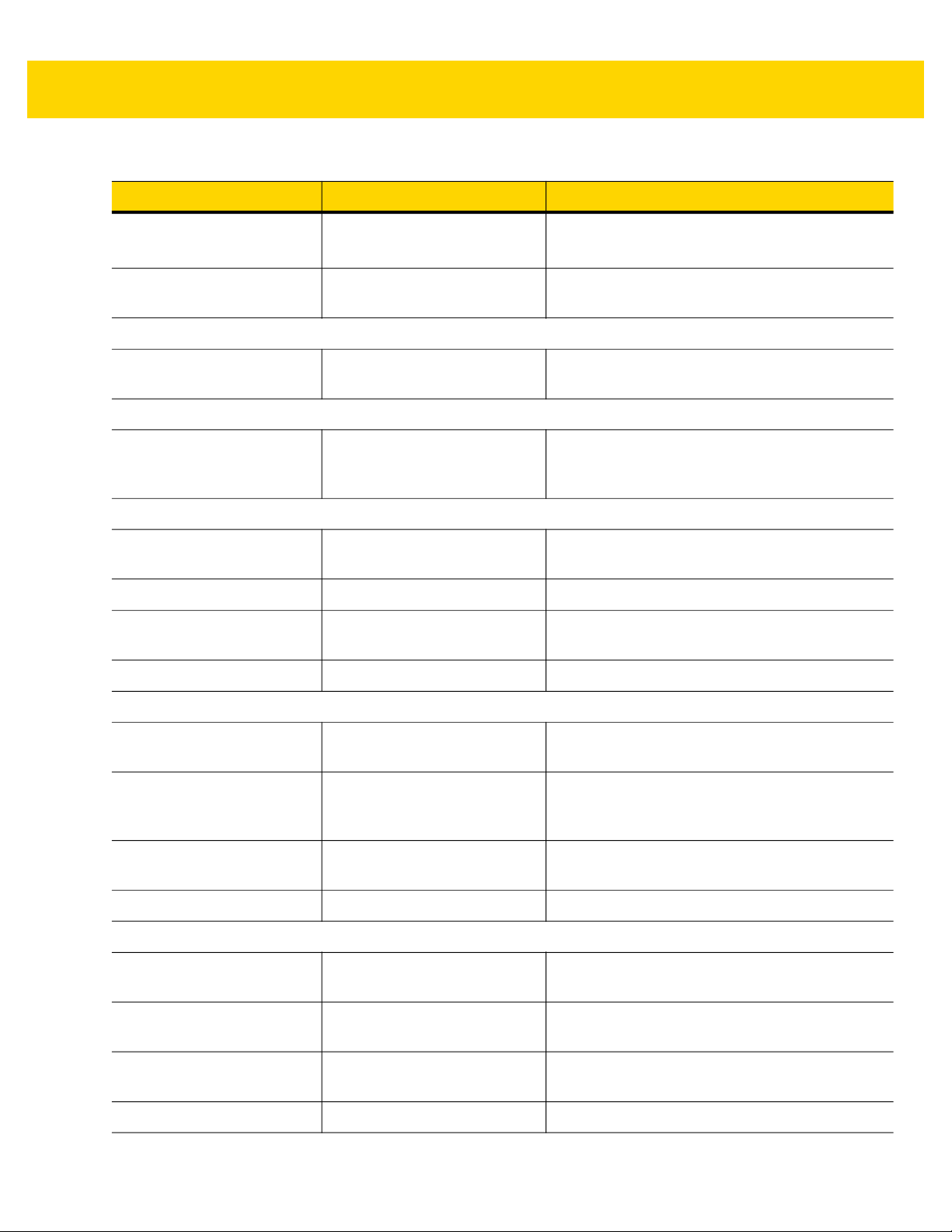
This table lists the accessories available for the TC51.
Table 2-1 TC51 Accessories
Accessory Part Number Description
Cradles
1-Slot USB/Charge Only
Cradle Kit
4-Slot Charge Only Cradle
with Battery Charger Kit
5-Slot Charge Only Cradle
Kit
5-Slot Ethernet Cradle Kit CRD-TC51-5SETH-01 Provides device charging and provides Ethernet
Cradle Mount BRKT-SCRD-SMRK-01 Mounts the 5-Slot Charge Only Cradle, 5-Slot
Batteries and Chargers
CRD-TC51-1SCU-01 Provides device charging and communication.
Includes cradle, power supply,
(PWR-BGA12V50W0WW) and DC line cord.
CRD-TC51-5SC4B-01 Charges up to four devices and four spare
batteries. Includes, cradle, power supply,
(PWR-BGA12V108W0WW) and DC line cord.
CRD-TC51-5SCHG-01 Charges up to five devices. Includes, cradle,
power supply, (PWR-BGA12V108W0WW) and
DC line cord.
communication for up to five devices. Includes
cradle, power supply, and DC line cord.
Ethernet Cradle, and 4-Slot Battery Charger to a
wall or rack.
Page 28
2 - 2 TC51 Touch Computer Integrator Guide for Android Version 6.0.1
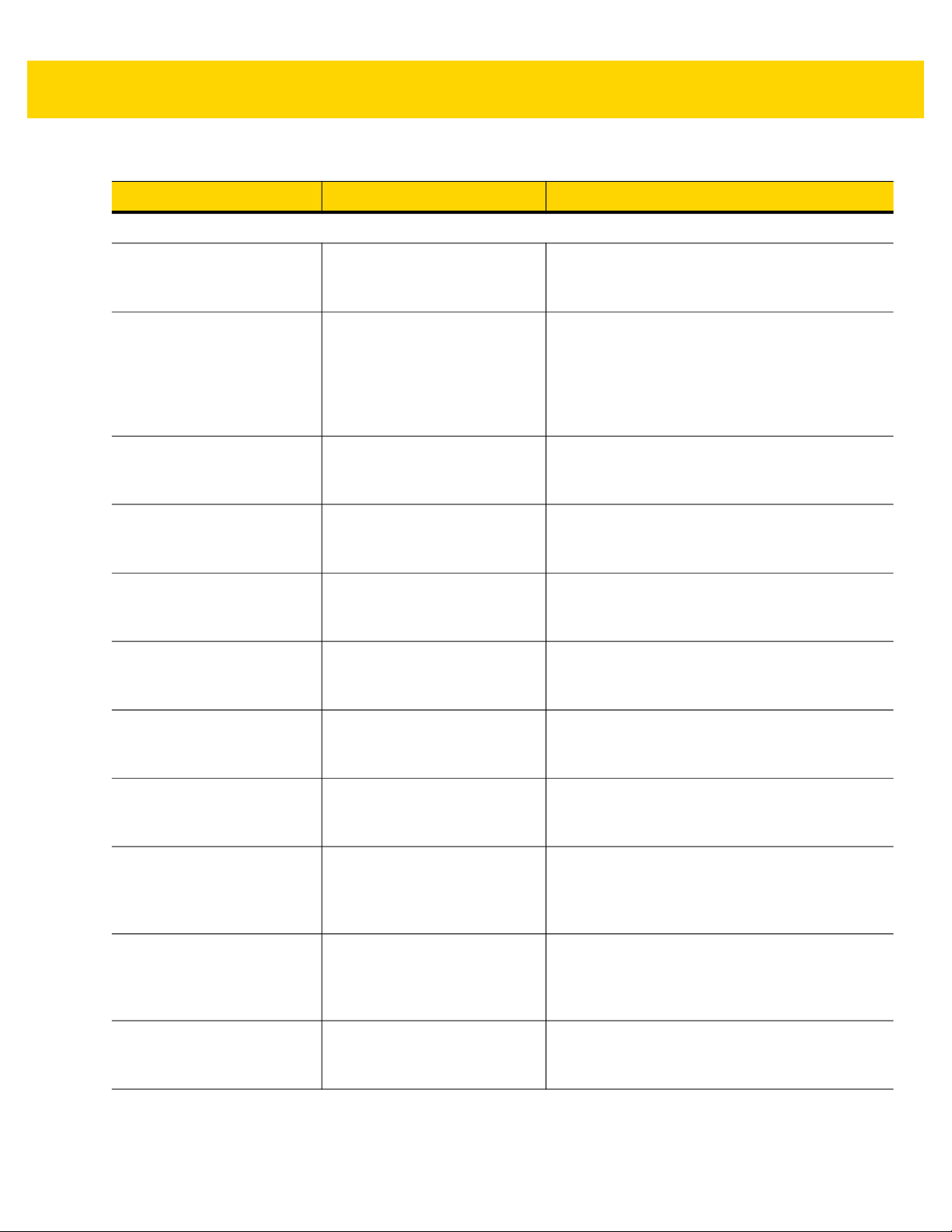
Table 2-1 TC51 Accessories (Continued)
Accessory Part Number Description
PowerPrecisionPlus battery BTRY-TC51-43MA1-01
BTRY-TC51-43MA1-10
4-Slot Battery Charger Kit SAC-TC51-4SCHG-01 Charges up to four battery packs. Includes
Vehicle Solutions
Cigarette Light Adapter
Auto Charge Cable
Charge and Communication Cables
Rugged Charge/USB Cable CBL-TC51-USB1-01 Provides communication and power to the
Audio Accessories
2.5 mm Audio Adapter CBL-TC51-HDST25-01 Plugs into the device and provides audio to a
2.5 mm Headset HDST-25MM-PTVP-01 Use for PTT and VoIP calls
3.5 mm Audio Adapter CBL-TC51-HDST35-01 Plugs into the device and provides audio to a
3.5 mm Headset HDST-35MM-PTVP-01 Use for PTT and VoIP calls.
CHG-AUTO-USB1-01 Provides power to the device from a cigarette
Replacement battery (single pack).
Replacement battery (10–pack).
cradle, power supply and DC line cord
lighter socket.
device. Use with power supply, p/n
PWRS-14000-249R, sold separately.
wired headset with 2.5 mm plug.
wired headset with collared 3.5 mm plug.
Miscellaneous
Rugged Boot SG-TC51-EXO1-01 Provides additional protection for the device.
Requires power supply PWR-WUA5V12W0xx.
Trigger Handle TRG-TC51-SNP1-01 Adds gun-style handle with a scanner trigger for
comfortable and productive scanning. Requires
Rugged Boot.
Trigger Handle Kit (with
Rugged Boot)
Screen Protector KT-TC51-SCRNP1-01 Add additional screen protection.
Carrying Solutions
Soft Holster SG-TC51-HLSTR1-01 Use to hold the device on hip. Accepts device
Hand Strap SG-TC51-EHDSTP1-03 Replacement hand strap with hand strap
Basic Hand Strap SG-TC51-BHDSTP1-03 Provide a hand strap to assist in holding the
Stylus and Coiled Tether SG-TC7X-STYLUS-03 Stylus with coiled tether (3-pack).
TRG-TC51-TRG1-01 Adds gun-style handle with a scanner trigger for
comfortable and productive scanning.
with Rugged Boot and Trigger Handle
mounting clip (3–pack).
TC51 without a Rugged Boot.
Page 29
Accessories 2 - 3
Table 2-1 TC51 Accessories (Continued)
Accessory Part Number Description
Power Supplies
Power Supply PWR-BGA12V50W0WW Provides power to the 1-Slot USB Charge cradle
and 4-Slot Spare Battery Charger. Requires AC
line cord.
Power Supply PWR-BGA12V108W0WW Provides power to the 4-Slot Charge Only
Cradle with battery Charger, 5-Slot Charge Only
cradle and the 5-Slot Ethernet Cradle. Requires
DC Line Cord, p/n 50–16002–029R and country
specific three wire grounded AC line cord sold
separately.
Power Supply PWR-WUA5V12W0US Provides 12 VDC, 2.5 A power to the Rugged
Charge/USB cable. Includes plug adapter for
use in United States.
Power Supply PWR-WUA5V12W0GB Provides 12 VDC, 2.5 A power to the Rugged
Charge/USB cable. Includes plug adapter for
use in the European Union.
Power Supply PWR-WUA5V12W0EU Provides 12 VDC, 2.5 A power to the Rugged
Charge/USB cable. Includes plug adapter for
use in United Kingdom.
Power Supply PWR-WUA5V12W0AU Provides 12 VDC, 2.5 A power to the Rugged
Charge/USB cable. Includes plug adapter for
use in Australia.
Power Supply PWR-WUA5V12W0CN Provides 12 VDC, 2.5 A power to the Rugged
Charge/USB cable. Includes plug adapter for
use in China.
Power Supply PWR-WUA5V12W0IN Provides 12 VDC, 2.5 A power to the Rugged
Charge/USB cable. Includes plug adapter for
use in India.
DC Line Cord CBL-DC-382A1-01 Provides power from the power supply
(PWR-BGA12V108W0WW) to the 4-Slot
Charge Only Cradle with Battery Charger, 5-Slot
Charge Only Cradle and 5-Slot Ethernet Cradle.
DC Line Cord CBL-DC-388A1-01 Provides power from the power supply
(PWR-BGA12V50W0WW) to the 1-Slot
USB/Charge Only Cradle and 4-Slot Battery
Charger.
2-way DC Cable CBL-DC-523A1-01 Connects one power supply
(PWR-BGA12V108W0WW) to two 4-Slot
Battery Chargers.
Page 30
2 - 4 TC51 Touch Computer Integrator Guide for Android Version 6.0.1
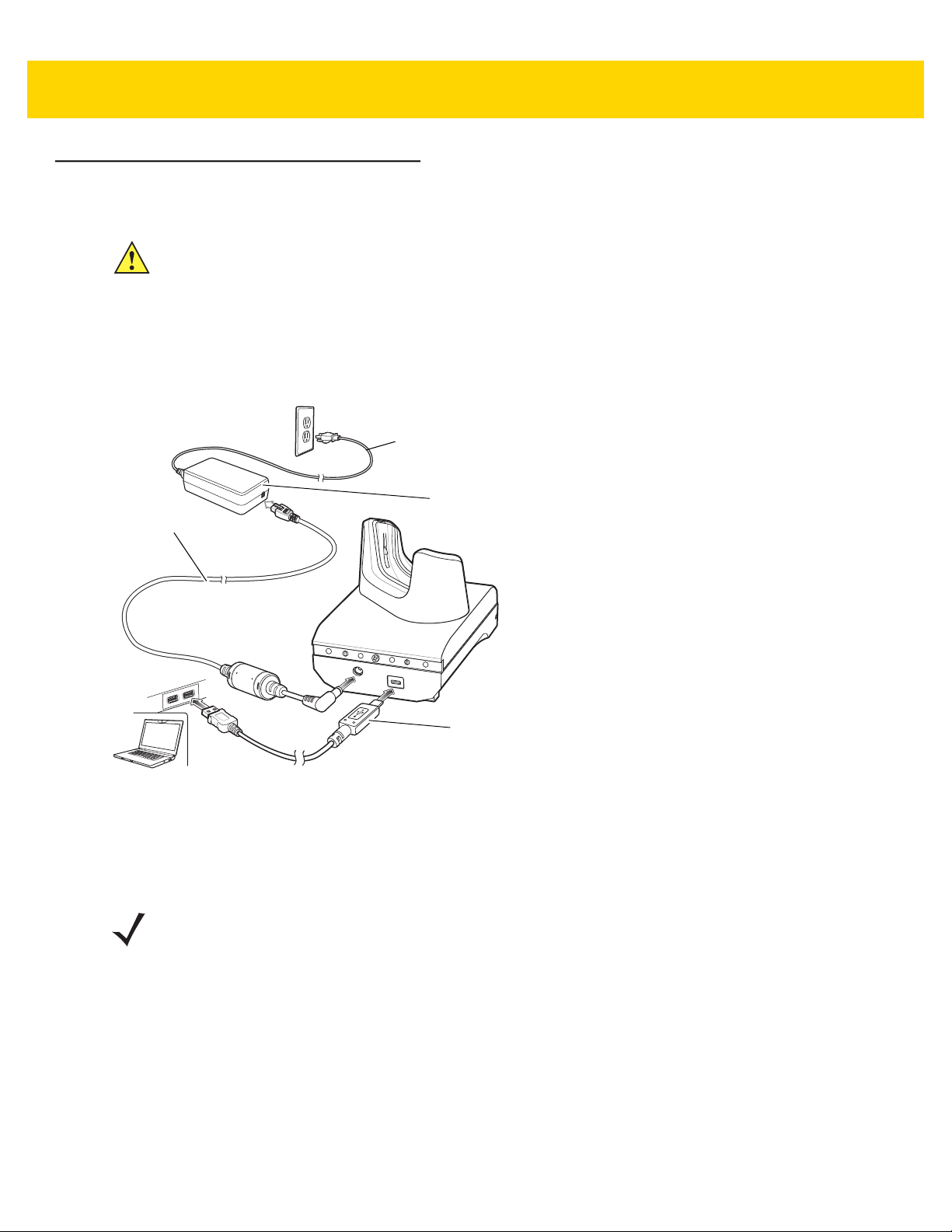
1-Slot USB Charge Cradle
CAUTION Ensure that you follow the guidelines for battery safety described in Battery Safety Guidelines on page
7-2.
The 1-Slot USB Charge Cradle:
• Provides 5 VDC power for operating the device.
• Charges the device’s battery.
• Provides USB communication with host computer.
AC Line Cord
Power Supply
DC Line Cord
Figure 2-1 1–Slot USB Charge Cradle Setup
Charging the Device
To charge a device:
NOTE If the device has a Rugged Boot, remove the cup insert before inserting the device. See TC51 Touch
Computer Integrator Guide for Android Version 6.0.1 for details.
USB Cable
Page 31

1. Insert the device into the slot to begin charging.
Accessories 2 - 5
Power LED
Figure 2-2 Battery Charging
2. Ensure the device is seated properly.
Inserting a TC51 with Rugged Boot into Cradle
Each cradle cup has an insert that must be removed prior to inserting the TC51 with Rugged Boot. Remove the
insert and then insert the TC51 into the cup.
Figure 2-3 Remove Insert from Cup
Page 32

2 - 6 TC51 Touch Computer Integrator Guide for Android Version 6.0.1
Battery Charging
The device’s Charging/Notification LED indicates the status of the battery charging in the device. See Table 1-1 on
page 1-5 for device charging status. The
depleted to 90% in approximately 2.5 hours and from fully depleted to 100% in approximately three hours.
NOTE In many cases the 90% charge provides plenty of charge for daily use. A full 100% charge lasts for
approximately 14 hours of use.
To achieve the best fast charging results use only Zebra charging accessories and batteries. Charge
batteries at room temperature with the TC51 in sleep mode.
Charging Temperature
Charge batteries in temperatures from 0°C to 40°C (32°F to 104°F). The device or cradle always performs battery
charging in a safe and intelligent manner. At higher temperatures (e.g. approximately +37°C (+98°F)) the device or
cradle may for small periods of time alternately enable and disable battery charging to keep the battery at
acceptable temperatures. The device and cradle indicates when charging is disabled due to abnormal
temperatures via its LED.
> 15.48 Watt hours (typical) / > 4,150 mAh
battery charges from fully
Page 33

4-Slot Charge Only Cradle with Battery Charger
CAUTION Ensure that you follow the guidelines for battery safety described in Battery Safety Guidelines on page
7-2.
The 4-Slot Charge Only Cradle with Battery Charger:
• Provides 5 VDC power for operating the TC51.
• Simultaneously charges up to four TC51s and up to four spare batteries using the Battery Charger Adapter.
Power Supply
Accessories 2 - 7
AC Line Cord
Figure 2-4 4-Slot Charge Only Cradle with Battery Charger Setup
Charging the TC51
To charge a device:
NOTE If the device has a Rugged Boot, remove the cup insert before inserting the device. See TC51 Touch
Computer Integrator Guide for Android Version 6.0.1 for details.
DC Line Cord
Page 34

2 - 8 TC51 Touch Computer Integrator Guide for Android Version 6.0.1
1. Insert the TC51 into a slot to begin charging.
Figure 2-5 TC51 Battery Charging
Figure 2-6 Spare Battery Charging
Power LED
Page 35

2. Ensure the TC51 is seated properly.
Accessories 2 - 9
See the TC51 Touch Computer Integrator Guide
installing the 4-Slot Battery Charger onto the cradle.
for Android Version 6.0.1 for information on
Inserting a TC51 with Rugged Boot into Cradle
Each cradle cup has an insert that must be removed prior to inserting the TC51 with Rugged Boot. Remove the
insert and then insert the TC51 into the cup.
Figure 2-7 Remove Insert from Cup
Battery Charging
Main Battery Charging
The device’s Charging/Notification LED indicates the status of the battery charging in the device. See Table 1-1 on
page 1-5 for device charging status. The
depleted to 90% in approximately 2.5 hours and from fully depleted to 100% in approximately three hours.
NOTE In many cases the 90% charge provides plenty of charge for daily use. A full 100% charge lasts for
approximately 14 hours of use.
To achieve the best fast charging results use only Zebra charging accessories and batteries. Charge
batteries at room temperature with the TC51 in sleep mode.
15.48 Watt hours (typical) / > 4,150 mAh
>
Spare Battery Charging
The Spare battery Charging LED on the cup indicates the status of the spare battery charging. The
hours (typical) / > 4,150 mAh
depleted to 100% in approximately three hours.
NOTE In many cases the 90% charge provides plenty of charge for daily use. A full 100% charge lasts for
approximately 14 hours of use.
To achieve the best fast charging results use only Zebra charging accessories and batteries.
battery charges from fully depleted to 90% in approximately 2.3 hours and from fully
battery charges from fully
> 15.48 Watt
Page 36

2 - 10 TC51 Touch Computer Integrator Guide for Android Version 6.0.1
Charging Temperature
Table 2-2 Spare Battery LED Charging Indicators
LED LED Indication
Solid amber Spare battery is charging.
Solid amber with alternate bright
amber
Solid Green Spare battery charging is complete.
Solid Green with alternate bright green Best spare battery charging is complete.
Solid Red Spare battery is charging and battery is at the end of useful
Fast Blinking Red (2 blinks/second) Error in charging; check placement of spare battery and
Off No spare battery in slot; spare battery not placed correctly;
Charge batteries in temperatures from 0°C to 40°C (32°F to 104°F). The device or cradle always performs battery
charging in a safe and intelligent manner. At higher temperatures (e.g. approximately +37°C (+98°F)) the device or
cradle may for small periods of time alternately enable and disable battery charging to keep the battery at
acceptable temperatures. The device and cradle indicates when charging is disabled due to abnormal
temperatures via its LED.
Best spare battery is charging.
life.
Charging complete and battery is at the end of useful life.
battery is at the end of useful life.
cradle is not powered.
Page 37

5-Slot Charge Only Cradle
CAUTION Ensure that you follow the guidelines for battery safety described in Battery Safety Guidelines on page
7-2.
The 5-Slot Charge Only Cradle:
• Provides 5 VDC power for operating the TC51.
• Simultaneously charges up to five TC51s.
Power Supply
Accessories 2 - 11
AC Line Cord
Figure 2-8 5-Slot Charge Only Cradle Setup
Charging the TC51
To charge a device:
NOTE If the device has a Rugged Boot, remove the cup insert before inserting the device. See TC51 Touch
Computer Integrator Guide for Android Version 6.0.1 for details.
DC Line Cord
Page 38

2 - 12 TC51 Touch Computer Integrator Guide for Android Version 6.0.1
1. Insert the TC51 into a slot to begin charging.
Figure 2-9 TC51 Battery Charging
2. Ensure the TC51 is seated properly.
See the TC51 Touch Computer Integrator Guide for Android Version 6.0.1 for information on
installing the 4-Slot Battery Charger onto the cradle.
Inserting a TC51 with Rugged Boot into Cradle
Each cradle cup has an insert that must be removed prior to inserting the TC51 with Rugged Boot. Remove the
insert and then insert the TC51 into the cup.
Figure 2-10 Remove Insert from Cup
Page 39

Accessories 2 - 13
Battery Charging
The device’s Charging/Notification LED indicates the status of the battery charging in the device. See Table 1-1 on
page 1-5 for device charging status. The
depleted to 90% in approximately 2.5 hours and from fully depleted to 100% in approximately three hours.
NOTE In many cases the 90% charge provides plenty of charge for daily use. A full 100% charge lasts for
approximately 14 hours of use.
To achieve the best fast charging results use only Zebra charging accessories and batteries. Charge
batteries at room temperature with the TC51 in sleep mode.
Charging Temperature
Charge batteries in temperatures from 0°C to 40°C (32°F to 104°F). The device or cradle always performs battery
charging in a safe and intelligent manner. At higher temperatures (e.g. approximately +37°C (+98°F)) the device or
cradle may for small periods of time alternately enable and disable battery charging to keep the battery at
acceptable temperatures. The device and cradle indicates when charging is disabled due to abnormal
temperatures via its LED.
> 15.48 Watt hours (typical) / > 4,150 mAh
battery charges from fully
Page 40

2 - 14 TC51 Touch Computer Integrator Guide for Android Version 6.0.1
5-Slot Ethernet Cradle
CAUTION Ensure that you follow the guidelines for battery safety described in Battery Safety Guidelines on page
7-2.
The 5-Slot Ethernet Cradle:
• Provides 5 VDC power for operating the device.
• Connects the device (up to five) to an Ethernet network.
• Simultaneously charges up to five TC51s.
Connect the 5-Slot Ethernet cradle to a power source.
TC51 Charging Slot
1000 LED
100/100 LED
Figure 2-11 5-Slot Ethernet Cradle Setup
Daisy-chaining Ethernet Cradles
Daisy-chain up to ten 5-Slot Ethernet cradles to connect several cradles to an Ethernet network. Use either a
straight or crossover cable. Daisy-chaining should not be attempted when the main Ethernet connection to the first
cradle is 10 Mbps as throughput issues will almost certainly result.
To daisy-chain 5-Slot Ethernet cradles:
1. Connect power to each 5-Slot Ethernet cradle.
2. Connect an Ethernet cable to one of the ports on the switch and the other end to the to Primary Port of the first
cradle.
Page 41

Accessories 2 - 15
3. Connect an Ethernet cable to the Secondary port of the first cradle.
4. Connect the other end of the Ethernet cable to the Primary port of the next 5-Slot Ethernet cradle.
Primary Port
To Switch
To Next
Cradle
Secondary Port
To Power Supply
To Power Supply
Figure 2-12 Daisy-chaining 5-Slot Ethernet Cradles
5. Connect additional cradles as described in step 3 and 4.
Ethernet Settings
The following settings can be configured when using Ethernet communication:
• Proxy Settings
• Static IP.
Configuring Ethernet Proxy Settings
The TC51 includes Ethernet cradle drivers. After inserting the TC51, configure the Ethernet connection:
1. Swipe down with two fingers from the status bar to open the quick access panel and then touch .
2. Touch Ethernet.
3. Slide the switch to the ON position.
4. Place the TC51 into the Ethernet cradle slot.
5. Touch and hold eth0 until the menu appears.
6. Touch Modify Proxy.
7. Touch the Proxy drop-down list and select Manual.
Page 42

2 - 16 TC51 Touch Computer Integrator Guide for Android Version 6.0.1
Figure 2-13 Ethernet Proxy Settings
8. In the Proxy hostname field, enter the proxy server address.
9. In the Proxy port field, enter the proxy server port number.
NOTE When entering proxy addresses in the Bypass proxy for field, do not use spaces or carriage returns
between addresses.
10. In the Bypass proxy for text box, enter addresses for web sites that do not require to go through the proxy
server. Use the separator “|” between addresses.
11. Touch MODIFY.
12. Touch .
Configuring Ethernet Static IP Address
The TC51 includes Ethernet cradle drivers. After inserting the TC51, configure the Ethernet connection:
1. Swipe down with two fingers from the status bar to open the quick access panel and then touch .
2. Touch Ethernet.
3. Slide the switch to the ON position.
4. Place the TC51 into the Ethernet cradle slot.
5. Touch Eth0.
6. Touch Disconnect.
7. Touch eth0.
8. Touch and hold the IP settings drop-down list and select Static.
Page 43

Accessories 2 - 17
Figure 2-14 Static IP Settings
9. In the IP address field, enter the proxy server address.
10. If required, in the Gateway field, enter a gateway address for the device.
11. If required, in the Netmask field, enter the network mask address
12. If required, in the DNS address fields, enter a Domain Name System (DNS) addresses.
13. Touch CONNECT.
14. Touch .
Charging the TC51
To charge a device:
NOTE If the device has a Rugged Boot, remove the cup insert before inserting the device. See TC51 Touch
Computer Integrator Guide for Android Version 6.0.1 for details.
Page 44

2 - 18 TC51 Touch Computer Integrator Guide for Android Version 6.0.1
1. Insert the TC51 into a slot to begin charging.
Figure 2-15 TC51 Battery Charging
2. Ensure the TC51 is seated properly.
Inserting a TC51 with Rugged Boot into Cradle
Each cradle cup has an insert that must be removed prior to inserting the TC51 with Rugged Boot. Remove the
insert and then insert the TC51 into the cup.
Figure 2-16 Remove Insert from Cup
Page 45

Accessories 2 - 19
Battery Charging
The device’s Charging/Notification LED indicates the status of the battery charging in the device. See Table 1-1 on
page 1-5 for device charging status. The
depleted to 90% in approximately 2.5 hours and from fully depleted to 100% in approximately three hours.
NOTE In many cases the 90% charge provides plenty of charge for daily use. A full 100% charge lasts for
approximately 14 hours of use.
To achieve the best fast charging results use only Zebra charging accessories and batteries. Charge
batteries at room temperature with the TC51 in sleep mode.
Charging Temperature
Charge batteries in temperatures from 0°C to 40°C (32°F to 104°F). The device or cradle always performs battery
charging in a safe and intelligent manner. At higher temperatures (e.g. approximately +37°C (+98°F)) the device or
cradle may for small periods of time alternately enable and disable battery charging to keep the battery at
acceptable temperatures. The device and cradle indicates when charging is disabled due to abnormal
temperatures via its LED.
> 15.48 Watt hours (typical) / > 4,150 mAh
battery charges from fully
Establishing Ethernet Connection
1. Swipe down with two fingers from the status bar to open the quick access panel and then touch .
2. Touch Ethernet.
3. Slide the Ethernet switch to the ON position.
4. Insert the device into a slot.
The icon appears in the Status bar.
5. Touch Eth0 to view Ethernet connection details.
LED Indicators
There are two green LEDs on the side of the cradle. These green LEDs light and blink to indicate the data transfer
rate.
Table 2-3 LED Data Rate Indicators
Data Rate 1000 LED 100/10 LED
1 Gbps On/Blink Off
100 Mbps Off On/Blink
10 Mbps Off On/Blink
Page 46

2 - 20 TC51 Touch Computer Integrator Guide for Android Version 6.0.1
4-Slot Battery Charger
CAUTION Ensure that you follow the guidelines for battery safety described in Battery Safety Guidelines on page 7-2.
This section describes how to use the 4-Slot Battery Charger to charge up to four TC51 batteries.
Charging Spare Batteries
1. Connect the charger to a power source.
2. Insert the battery into a battery charging well and gently press down on the battery to ensure proper contact.
Single Charger Setup
1. Plug the DC line cord plug into the power port on the back of the charger.
2. Plug the DC line cord connector into the power supply.
3. Plug the AC line cord into the power supply.
4. Plug the AC line cord into an AC outlet.
Power Supply
DC Line Cord
Figure 2-17 4-Slot Battery Charger Power Setup
AC Line Cord
Page 47

Spare Battery Charging
Figure 2-18 Insert Battery into Charger
Accessories 2 - 21
Each Battery Charging LED indicates the status of the battery charging in each slot. See Table 2-2 on page 2-10
for spare battery charging indicator descriptions.
15.48 Watt hours (typical) / > 4,150 mAh
The
>
hours and from fully depleted to 100% in approximately three hours.
NOTE In many cases the 90% charge provides plenty of charge for daily use. A full 100% charge lasts for
approximately 14 hours of use.
To achieve the best fast charging results use only Zebra charging accessories and batteries.
battery charges from fully depleted to 90% in approximately 2.3
Charging Temperature
Charge batteries in temperatures from 0°C to 40°C (32°F to 104°F). The battery charger always performs battery
charging in a safe and intelligent manner. At higher temperatures (e.g. approximately +37°C (+98°F)) the battery
charger may for small periods of time alternately enable and disable battery charging to keep the battery at
acceptable temperatures. The battery charger indicates when charging is disabled due to abnormal temperatures
via its LED.
Page 48

2 - 22 TC51 Touch Computer Integrator Guide for Android Version 6.0.1
Two Charger Setup
1. Plug the 2-way DC Cable plugs into the power port on the back of each charger.
2. Plug the 2-way DC Cable connector into the power output of the power supply (PWR-BGA12V108W0WW).
3. Plug the AC line cord into the power supply.
4. Plug the AC line cord into an AC outlet.
AC Line Cord
power supply
2-way DC Cable
Figure 2-19 Setup with 2-Way DC Cable
Page 49

Spare Battery Charging
Figure 2-20 Insert Battery into Charger
Accessories 2 - 23
Each Battery Charging LED indicates the status of the battery charging in each slot. See Table 2-2 on page 2-10
for spare battery charging indicator descriptions.
15.48 Watt hours (typical) / > 4,150 mAh
The
>
hours and from fully depleted to 100% in approximately four hours.
NOTE In many cases the 90% charge provides plenty of charge for daily use. A full 100% charge lasts for
approximately 14 hours of use.
To achieve the best fast charging results use only Zebra charging accessories and batteries.
battery charges from fully depleted to 90% in approximately 2.5
Charging Temperature
Charge batteries in temperatures from 0°C to 40°C (32°F to 104°F). The battery charger always performs battery
charging in a safe and intelligent manner. At higher temperatures (e.g. approximately +37°C (+98°F)) the battery
charger may for small periods of time alternately enable and disable battery charging to keep the battery at
acceptable temperatures. The battery charger indicates when charging is disabled due to abnormal temperatures
via its LED.
Page 50

2 - 24 TC51 Touch Computer Integrator Guide for Android Version 6.0.1
Rugged Charge/USB Cable
The Rugged Charge/USB Cable snaps onto the bottom of the TC51 and removes easily when not in use. When
attached to the TC51 allows charging and allows the TC51 to transfer data to a host computer.
Figure 2-21 Rugged Charge/USB Cable
Connecting to TC51
1. Insert the device at an angle into the cable cup until the device touches the bottom of the cup.
Figure 2-22 Device Into Cable Cup
2. Rotate the device into the cup.
Page 51

Accessories 2 - 25
Figure 2-23 Rotate Device into Cable Cup
Connecting to TC51 with Rugged Boot
To connect the Rugged Charge/USB Cable to a TC51 with a Rugged Boot:
1. Using thumb and index finger, squeeze the sides of the cup in.
Figure 2-24 Remove Cable Cup Insert
2. Lift inert out of cup.
Page 52

2 - 26 TC51 Touch Computer Integrator Guide for Android Version 6.0.1
Figure 2-25 Cable Installation
3. Align the cable cup with the bottom of the device.
4. Press the device into the cable cup until it securely in place.
USB Communication
To connect the device to a host computer:
1. Connect the Rugged Charge/USB Cable to the TC51.
2. Connect the USB connector of the cable to a host computer.
Figure 2-26 Rugged Charge/USB Cable to Host Computer
Charging the Device
To charge the device using the Rugged Charge/USB Cable:
1. Connect the Rugged Charge/USB Cable to the TC51.
2. Connect the USB connector of the power supply.
3. Plug to power supply into an power outlet.
Page 53

Figure 2-27 Charging Using the Rugged Charge/USB Cable
Accessories 2 - 27
Disconnecting the Rugged Charge/USB Cable
To disconnect the Rugged Charge/USB Cable from the TC51:
1. Rotate the device to one side.
Figure 2-28 Remove Device from Rugged Charge/USB Cable
2. Push the Rugged Charge/USB Cable to the other side.
3. Remove the device from the Rugged Charge/USB Cable.
Page 54

2 - 28 TC51 Touch Computer Integrator Guide for Android Version 6.0.1
Battery Charging
Main Battery Charging
The device’s Charging/Notification LED indicates the status of the battery charging in the device.
NOTE Charging using a host computer USB port or a power supply other than the Zebra PWR-WUA5V12W0xx
could take longer. See Table 2-2 on page 2-10.
Non-Zebra power supply must provide 5 VDC @ 2.5 A.
15.48 Watt hours (typical) / > 4,150 mAh
The
>
battery charges from fully depleted to 90% in approximately 2.5
hours and from fully depleted to 100% in approximately three hours.
NOTE In many cases the 90% charge provides plenty of charge for daily use. A full 100% charge lasts for
approximately 14 hours of use.
To achieve the best fast charging results use only Zebra charging accessories and batteries. Charge batteries
at room temperature with the TC51 in sleep mode.
Charging Temperature
Charge batteries in temperatures from 0°C to 40°C (32°F to 104°F). The device always performs battery charging
in a safe and intelligent manner. At higher temperatures (e.g. approximately +37°C (+98°F)) the device may for
small periods of time alternately enable and disable battery charging to keep the battery at acceptable
temperatures. The device indicates when charging is disabled due to abnormal temperatures via its LED.
Page 55

5-Slot Cradle Rack Installation
Use the Rack/Wall Mount Bracket to mount a 5-slot cradle on a rack. When installing on a rack, first assemble the
bracket and cradles/chargers and then install the assembly on the rack.
1. Place the power supply in bottom tray.
2. Connect AC line cord to power supply.
3. Connect DC line cord to power supply.
4. Secure power supply and cables to bottom tray with tie wraps.
NOTE Ensure tie wrap buckle is on side of power supply. Tie wrap buckle on top of power supply interferes with
top tray.
5. Route cables through cable slots.
DC line Cord AC line CordPower Supply
Accessories 2 - 29
Figure 2-29 Power Supply in Bottom Tray
6. Secure four M2.5 studs to top tray as shown.
Figure 2-30 Install Studs
7. Align and install 5-Slot cradle onto studs of top tray.
Studs (4)
Page 56

2 - 30 TC51 Touch Computer Integrator Guide for Android Version 6.0.1
Figure 2-31 Align Cradle on Studs
8. Secure cradle to top tray with two M2.5 safety screws.
Safety Screws(2)
Figure 2-32 Secure Cradle
9. Slide top tray onto bottom tray.
Figure 2-33 Slide Top Tray onto Bottom Tray
Page 57

10. Connect cables to cradle.
Figure 2-34 Connect Cables
11. Secure top tray to bottom tray with 4 M5 screws (two on each side).
Accessories 2 - 31
Figure 2-35 Secure Top and Bottom Tray
See Rack Mount Installation on page 2-35 for installing the bracket assembly onto a rack.
Page 58

2 - 32 TC51 Touch Computer Integrator Guide for Android Version 6.0.1
4-Slot Battery Chargers Rack Installation
Use the Rack/Wall Mount Bracket to mount four 4-Slot Battery Chargers on a rack. When installing on a rack, first
assemble the bracket and chargers and then install the assembly on the rack.
1. Place one power supply horizontally in bottom tray.
2. Place one power supply vertically in bottom tray.
3. Connect AC line cords to power supplies.
4. Connect DC line cords to power supplies.
5. Secure power supplies and cables to bottom tray with tie wraps.
6. Route cables through cable slots.
DC Y Cable 1
AC line Cord 1
Figure 2-36 Power Supplies in Bottom Tray
7. Slide top tray onto bottom tray until top tray touches vertical power supply.
DC Y Cable 2
Power Supply 1
Power Supply 2
AC line Cord 2
Page 59

Figure 2-37 Slide top Tray onto Bottom Tray
8. Install 16 M2.5 studs onto top tray as shown below.
Accessories 2 - 33
Figure 2-38 Install Studs
9. Align and install 4-Slot Battery Charger onto four studs.
Studs (16)
Figure 2-39 Align Chargers on Studs
Page 60

2 - 34 TC51 Touch Computer Integrator Guide for Android Version 6.0.1
10. Connect DC Y cables to four 4-Slot Battery Chargers.
Figure 2-40 Connect Cables
11. Secure top tray to bottom tray with four M5 screws (two on each side).
Figure 2-41 Secure Top Tray to Bottom Tray
See Rack Mount Installation on page 2-35 for installing the bracket onto a rack.
Page 61

Rack Mount Installation
NOTE Use screws provided with rack system. Refer to rack user documentation for instructions.
1. Secure mounting brackets to both sides of top tray with four M5 screws (two on each side). For 5-Slot cradles,
position the flange for horizontal installation. For 4-Slot Battery Chargers, position the flange for 25°
installation.
Accessories 2 - 35
Flange
Fifth Screw Hole
Figure 2-42 Flange Horizontal Position (5-Slot Cradles)
Top Screw Hole
Flange
Figure 2-43 Flange 25° Position (4-Slot Battery Chargers)
CAUTION Install mounting bracket with 5-Slot cradle at a maximum height of four feet from ground.
Install mounting bracket with 4-Slot Battery Charger at a maximum height of three feet from ground.
NOTE Distance between two horizontal mounted brackets should be at least 14” apart (from top of one flange to the
top of the next flange).
Distance between a horizontal mounted bracket and a 25° mounted bracket should be at least 16.25” apart
(from top of one flange to the top of the next flange).
There should be enough clearance (2.75”) between the top of the device and the bottom of the mounting
bracket above.
Page 62

2 - 36 TC51 Touch Computer Integrator Guide for Android Version 6.0.1
1. Install two rack system screws for top of mounting brackets. The screw heads should protrude half way from
the rail.
Rack Screws
Figure 2-44 Install Rack System Screws
2. Align the mounting bracket’s top mounting key holes with the screws.
3. Place the brackets on the screws.
Page 63

Accessories 2 - 37
14 “
Figure 2-45 Secure Bracket to Rack (Horizontal Position Shown)
4. Secure the top screws.
5. Install bottom screws and tighten screws.
6. Route cables and connect to power source.
CAUTION Installer should ensure that all building codes are followed when connecting the power supplies to an
AC power source.
While installing the brackets, power supplies and cables:
• Use tie wraps to secure cables to the bracket and rails.
• Coil cables wherever possible.
• Route power cables along the rails.
• Route inter-cradle cables to the side rails and then from the rails to the bracket.
Page 64

2 - 38 TC51 Touch Computer Integrator Guide for Android Version 6.0.1
22.85 mm
398 mm
Wall Installation
Use the Rack/Wall Mount Bracket to mount four 4-Slot Battery Chargers or a cradle on a wall. When installing on a
wall, first assemble the bottom tray, install the bottom tray on the wall and then assemble the top tray.
Use mounting hardware (screws and/or anchors) appropriate for the type of wall mounting the bracket onto. The
Mount Bracket mounting slots dimensions are 5 mm (0.2 in.). Fasteners must be able to hold a minimum of 20 Kg
(44 lbs.)
For proper installation consult a professional installer. Failure to install the bracket properly can possibly result in
damage to the hardware.
CAUTION Install mounting bracket with 5-Slot cradle at a maximum height of four feet from ground.
Install mounting bracket with 4-Slot Battery Charger at a maximum height of three feet from ground.
Bottom Tray Assembly
See steps 1 through 5 on page 32 for instructions.
Bracket Wall Mounting
1. Drill holes and install anchors according to the template supplied with the bracket.
2. Install two screws for bottom of bracket. The screw heads should protrude 2.5 mm (0.01”) from the wall.
Figure 2-46 Horizontal Mounting Template
3. Align the mounting bracket’s bottom mounting key holes with the screws.
4. Hang the bracket on the screws.
Page 65

Figure 2-47 Horizontal Installation
5. Install two top screws.
6. Tighten all screws.
Accessories 2 - 39
Figure 2-48 Horizontal Installation - Tighten Screws
7. Assembly the four 4-Slot Battery Chargers or cradle onto the bracket. See steps 7 through 11 on page 32.
8. Route cables and connect to power source.
CAUTION Installer should ensure that all building codes are followed when connecting the power supplies to an
AC power source.
While installing the brackets, power supplies and cables:
• Use tie wraps to secure cables to the bracket and rails.
• Coil cables wherever possible.
• Route power cables along the rails.
• Route inter-cradle cables to the side rails and then from the rails to the bracket.
Page 66

2 - 40 TC51 Touch Computer Integrator Guide for Android Version 6.0.1
Page 67

CHAPTER 3 DATAWEDGE
Introduction
This chapter applies to DataWedge on Android devices. DataWedge is an application that reads data, processes
the data and sends the data to an application.
Basic Scanning
To capture bar code data:
1. Ensure that an application that is to receive the data is open on the device and a text field is in focus (text
cursor in text field).
2. Aim the exit window at a bar code.
3. Press and hold the Scan button. The red laser aiming pattern turns on to assist in aiming. Ensure that the bar
code is within the area formed by the aiming pattern. The Data Capture LED lights red to indicate that data
capture is in process.
Figure 3-1 TC51 Data Capture
Page 68

3 - 2 TC51 Touch Computer Integrator Guide for Android Version 6.0.1
4. The Data Capture LED lights green and a beep sounds, by default, to indicate the bar code was decoded
successfully. The captured data appears in the text field.
Profiles
DataWedge is based on profiles and plug-ins. A profile contains information on how DataWedge should behave
with different applications.
Profile information consists of:
• Associated application
• Input plug-in configurations
• Output plug-in configurations
• Process plug-in configurations.
Using profiles, each application can have a specific DataWedge configuration. For example, each user application
can have a profile which outputs scanned data in the required format when that application comes to the
foreground. DataWedge can be configured to process the same set of captured data differently based on the
requirements of each application.
DataWedge includes the following pre-configured profiles which support specific built-in applications:
• Visible profiles:
• Profile0 - created automatically the first time DataWedge runs. Generic profile used when there are no
user created profiles associated with an application.
• Launcher - enables scanning when the Launcher is in foreground. Note: to save battery power, disable
this profile when not required.
• DWDemo - provides support for the DWDemo application.
Some Zebra applications are capable of capturing data by scanning. DataWedge is pre-loaded with private and
hidden profiles for this purpose. There is no option to modify these private profiles.
Profile0
Profile0 can be edited but cannot be associated with an application. That is, DataWedge allows manipulation of
plug-in settings for Profile0 but it does not allow assignment of a foreground application. This configuration allows
DataWedge to send output data to any foreground application other than applications associated with user-defined
profiles when Profile0 is enabled.
Profile0 can be disabled to allow DataWedge to only send output data to those applications which are associated
in user-defined profiles. For example, create a profile associating a specific application, disable Profile0 and then
scan. DataWedge only sends data to the application specified in the user-created profile. This adds additional
security to DataWedge enabling the sending of data only to specified applications.
Plug-ins
A plug-in is a software module utilized in DataWedge to extend its functionality to encompass technologies such as
bar code scanning. The plug-ins can be categorized into three types based on their operations:
• Input Plug-ins
• Output Plug-ins
Page 69

DataWedge 3 - 3
• Process Plug-ins.
Input Plug-ins
An Input Plug-in supports an input device, such as a bar code scanner contained in, or attached to the device.
DataWedge contains base plug-ins for these input devices.
• Bar Code Scanner Input Plug-in – The Bar Code Scanner Input Plug-in is responsible for reading data from
the integrated bar code scanner and supports different types of bar code readers including laser, imager and
internal camera. Raw data read from the bar code scanner can be processed or formatted using Process
Plug-ins as required. DataWedge has built-in feedback functionality for the bar code scanner to issue user
alerts. The feedback settings can be configured according to user requirement.
Process Plug-ins
Process Plug-ins are used in DataWedge to manipulate the received data according to the requirement, before
sending to the foreground application via the Output Plug-in.
• Basic Data Formatting Process Plug-in – The Basic Data Formatting Plug-in allows DataWedge to add a
prefix and/or a suffix to the captured data before passing it to an Output Plug-in.
• Advanced Data Formatting Process Plug-in – The Advanced Data Formatting Plug-in allows DataWedge
to apply rules (actions to be performed based on defined criteria) to the data received via an input plug-in
before passing it to an Output Plug-in.
Output Plug-ins
Output Plug-ins are responsible for sending the data from Input Plug-ins to a foreground application on the device.
• Keystroke Output Plug-in – The Keystroke Output Plug-in collects and sends data received from the Input
Plug-in to the foreground applications by emulating keystrokes.
• Intent Output Plug-in – The Intent Output Plug-in collects and sends data received from the Input Plug-ins
to foreground applications using the Android Intent mechanism.
• IP Output Plug-in – The IP Output Plug-in collects and sends data received from the Input Plug-ins to a host
computer via a network connection. Captured data can be sent over an IP network to a specified IP address
and port using either TCP or UDP transport protocols.
Page 70

3 - 4 TC51 Touch Computer Integrator Guide for Android Version 6.0.1
Profiles Screen
To launch DataWedge, touch > . By default, three profiles appear:
• Profile0
• Launcher
• DWDemo.
Profile0 is the default profile and is used when no other profile can be applied.
Figure 3-2 DataWedge Profiles Screen
Profile names are color coded. Enabled profiles are white and disabled profiles are gray.
To configure a profile touch the profile name.
Profile Context Menu
Touch and hold a profile to open a context menu that allows additional actions to be performed on the selected
profile.
Page 71

DataWedge 3 - 5
Figure 3-3 Profile Context Menu
The profile context menu allows the profile to be edited (same as just tapping on a profile), renamed or deleted.
Options Menu
Figure 3-4 DataWedge Options Menu
The menu provides options to create a new profiles, access to general DataWedge settings and DataWedge
version information.
Disabling DataWedge
1. Touch > .
2. Touch .
3. Touch Settings.
4. Touch DataWedge enabled.
The blue check disappears from the checkbox indicating that DataWedge is disabled.
Creating a New Profile
5. Touch > .
6. Touch .
7. Touch New profile.
8. In the New profile dialog box, enter a name for the new profile. It is recommended that profile names be
unique and made up of only alpha-numeric characters (A-Z, a-z, 0-9).
Page 72

3 - 6 TC51 Touch Computer Integrator Guide for Android Version 6.0.1
Figure 3-5 New Profile Name Dialog Box
9. Touch OK.
The new profile name appears in the DataWedge profile screen.
Profile Configuration
To configure the Profile0 or a user-created profile, touch the profile name.
Figure 3-6 Profile Configuration Screen
The configuration screen lists the following sections:
• Profile enabled
• Applications
• Data Capture Plus (DCP)
• Barcode Input
Page 73

DataWedge 3 - 7
• SimulScan Input (Available on builds BSP 19-01.4 and above)
• Keystroke output
• Intent Output
• IP Output.
Associating Applications
Use Applications option to associate applications with this profile. User created profiles should be associated with
one or more applications and its activities.
1. Touch Associated apps. A list of applications/activities associated with the profile displays. Initially the list
does not contain any applications/activities.
Figure 3-7 Associated Apps Screen
2. Touch .
3. Touch New app/activity.
Page 74

3 - 8 TC51 Touch Computer Integrator Guide for Android Version 6.0.1
Figure 3-8 Select Application Menu
4. In the Select application screen, select the desired application from the list.
5. In the Select activity menu, selecting the activity adds that application/activity combination to the associated
application list for that profile. Selecting * as the activity results in all activities within that application being
associated to the profile. During operation, DataWedge tries to match the specific application/activity
combinations with the foreground application/activity before trying to match the general application/*
combinations.
6. Touch .
Page 75

DataWedge 3 - 9
Figure 3-9 Selected Application/Activity
Data Capture Plus
Data Capture Plus (DCP) is a DataWedge feature that enables the user to initiate data capture by touching a
designated part of the screen. A variable screen overlay acts like a scan button.
Page 76

3 - 10 TC51 Touch Computer Integrator Guide for Android Version 6.0.1
DCP Button
Figure 3-10 Minimized Data Capture Panel
The DataWedge profile configuration screen allows the user to configure how the DCP appears on the screen once
the particular profile is enabled. The DCP is hidden by default. Enabling DCP option displays seven additional
configuration parameters.
Page 77

DataWedge 3 - 11
Figure 3-11 Data Capture Panel Settings
• Enable - Select to enable Data Capture Plus (default - disabled).
• Dock button on - Select position of the button.
• Left or right - Allows user to place the button on either the right or left edge of the screen.
• Left only - Places the button on left edge of the screen.
• Right only - Places the button on the right edge of the screen.
• Start in - Select the initial DCP state.
• Fullscreen mode - DCP covers the whole screen.
• Button mode - DCP displays as a circular button on the screen and can be switched to fullscreen mode.
• Button only mode - DCP displays as a circular button on the screen and cannot be switched to fullscreen
mode.
• Button highest position - Select the top of the range the user is allowed to move the DCP, given as a
percent of the screen height (default - 0).
• Button lowest position - Select the bottom of the range the user is allowed to move the DCP, given as a
percent of the screen height (default - 100).
• Drag detect time - Select the time in milliseconds that the scanner waits before activating scanner. This
allows the user to drag the button without initiating scanner (default - 100 ms, maximum 1000 ms).
NOTE The DCP does not appear if the scanner is disabled in the profile even though the Enabled option is set.
In Button mode, the user can place DCP in full screen mode by dragging the button over Fullscreen mode. The
overlay covers the screen.
Page 78

3 - 12 TC51 Touch Computer Integrator Guide for Android Version 6.0.1
Figure 3-12 Maximized DCP
Swipe down to return to button mode.
Bar Code Input
Use the Bar Code Input options to configure the Bar Code Scanner Input Plug-in for the profile.
Enabled
Enables or disables this plug-in. A check in the checkbox indicates that the plug-in is enabled.
Scanner Selection
Configures which scanning device to use for bar code data capture when the profile is active.
• Auto (2D Barcode Imager)- The software automatically determines the best scanning device.
• 2D Barcode Imager - Scanning is performed using the 2D Imager.
• Bluetooth Scanner - Scanning is performed using the option Bluetooth scanner.
• RS6000 Bluetooth Scanner - Scanning is performed using the RS6000 Bluetooth scanner.
• DS3678 Bluetooth Scanner - Scanning is performed using the DS3678 Bluetooth scanner.
The RS6000 Ring Scanner and DS3678 Digital Scanner is available on builds BSP 16-04 and above.
Page 79

DataWedge 3 - 13
Decoders
Configures which bar code decoders are enabled or disabled. For best performance disable all unnecessary
decoders.
Touch Decoders. The Barcode input screen appears. A check in the checkbox indicates that the decoder is
enabled. By default the most commonly used decoders are enabled (shown below with an asterisk). The supported
decoders are:
NOTE DataWedge supports the decoders listed below but not all are validated on this device.
Table 3-1 Supported Decoders
Decoders Internal Imager RS507 RS6000 DS3678
Australian Postal Disabled Disabled Disabled Disabled
Aztec Enabled Enabled Enabled Enabled
Canadian Postal Disabled Not supported Disabled Not Supported
Chinese 2 of 5 Disabled Disabled Disabled Disabled
Codabar Enabled Enabled Enabled Enabled
Code 11 Disabled Disabled Disabled Disabled
Code 128 Enabled Enabled Enabled Enabled
Code 39 Enabled Enabled Enabled Enabled
Code 93 Disabled Disabled Disabled Disabled
Composite AB Disabled Disabled Disabled Disabled
Composite C Disabled Disabled Disabled Disabled
Discrete 2 of 5 Disabled Disabled Disabled Disabled
Datamatrix Enabled Enabled Enabled Enabled
Dutch Postal Disabled Disabled Disabled Disabled
EAN-13 Enabled Enabled Enabled Enabled
EAN-8 Enabled Enabled Enabled Enabled
GS1 DataBar Enabled Enabled Enabled Enabled
GS1 DataBar
Expanded
Enabled Enabled Enabled Enabled
GS1 DataBar Limited Disabled Disabled Disabled Disabled
HAN XIN Disabled Not supported Disabled Disabled
Interleaved 2 of 5 Disabled Disabled Disabled Disabled
Japanese Postal Disabled Disabled Disabled Disabled
Page 80

3 - 14 TC51 Touch Computer Integrator Guide for Android Version 6.0.1
Table 3-1 Supported Decoders (Continued)
Decoders Internal Imager RS507 RS6000 DS3678
Korean 3 of 5 Disabled Disabled Disabled Disabled
MAIL MARK Enabled Not supported Enabled Enabled
Matrix 2 of 5 Disabled Disabled Disabled Disabled
Maxicode Enabled Enabled Enabled Enabled
MicroPDF Disabled Disabled Disabled Disabled
MicroQR Disabled Disabled Disabled Disabled
MSI Disabled Disabled Disabled Disabled
PDF417 Enabled Enabled Enabled Enabled
QR Code Enabled Enabled Enabled Enabled
Decoder Signature Disabled Disabled Disabled Not Supported
TLC 39 Disabled Disabled Disabled Disabled
Trioptic 39 Disabled Disabled Disabled Disabled
UK Postal Disabled Disabled Disabled Disabled
UPC-A Enabled Enabled Enabled Enabled
UPC-E0 Enabled Enabled Enabled Enabled
UPC-E1 Disabled Disabled Disabled Disabled
US4state Disabled Disabled Disabled Disabled
US4state FICS Disabled Disabled Disabled Disabled
US Planet Disabled Disabled Disabled Disabled
US Postnet Disabled Disabled Disabled Disabled
Touch to return to the previous screen.
Decoder Params
Use Decode Params to configure individual decoder parameters.
Page 81

DataWedge 3 - 15
Codabar
• CLSI Editing - Enable this parameter to strip the start and stop characters and insert a space after the
first, fifth, and tenth characters of a 14-character Codabar symbol. Enable this feature if the host system
requires this data format (default - disabled).
• Length1 - Use to set decode lengths (default - 6). See UPC EAN Params on page 3-20 for more
information.
• Length2 - Use to set decode lengths (default - 55). See UPC EAN Params on page 3-20 for more
information.
• NOTIS Editing - Enable this parameter to strip the start and stop characters from a decoded Codabar
symbol. Enable this feature if the host system requires this data format (default - disabled).
• Redundancy - Sets the reader to read the bar code twice before accepting data. A check in the checkbox
indicates that redundancy is enabled (default - enabled).
Code 11
• Length1 - Use to set decode lengths (default - 4). See UPC EAN Params on page 3-20 for more information.
• Length2 - Use to set decode lengths (default - 55). See UPC EAN Params on page 3-20 for more
information.
• Redundancy - Sets the reader to read the bar code twice before accepting data. A check in the checkbox
indicates that redundancy is enabled (default - enabled).
• Report Check Digit - Transmit Code 11 data with or without the check digit. A check in the checkbox
indicates to send Code 11 data with check digit (default - disabled).
• Verify Check Digit - Check the integrity of all Code 11 symbols to verify that the data complies with the
specified check digit algorithm. This selects the check digit mechanism for the decoded Code 11 bar code.
• No Check Digit - Do not verify check digit.
• 1 Check Digit - Bar code contains one check digit (default).
• 2 Check Digits - Bar code contains two check digits.
Code128
• Code128 Reduced Quiet Zone - Enables decoding of margin-less Code 128 bar codes (Imager RS6000
and DS3678 only).
• Ignore Code128 FCN4 - When enabled, and a Code 128 bar code has an embedded FNC4 character, it will
be removed from the data and the following characters will not be changed. When the feature is disabled, the
FNC4 character will not be transmitted but the following character will have 128 added to it (Imager, RS6000,
and DS3678 only).
• Check ISBT Table - The ISBT specification includes a table that lists several types of ISBT bar codes that
are commonly used in pairs. If ISBT128 Concat Mode is set, enable Check ISBT Table to concatenate only
those pairs found in this table. Other types of ISBT codes are not concatenated. A check in the checkbox
indicates that redundancy is enabled (default - disabled).
• Enable GS1-128 - Set the GS1 128 subtype. A check in the checkbox indicates that the option is enabled
(default - enabled).
• Enable ISBT128 - Set the ISBT128 subtype. A check in the checkbox indicates that the option is enabled
(default - enabled).
• Enable Plain Code 128 - RS6000 and DS3678 only. Enables other (non-EAN or ISBT) Code 128 subtypes.
(default-enabled).
Page 82

3 - 16 TC51 Touch Computer Integrator Guide for Android Version 6.0.1
• ISBT128 Concatenation Mode - Select an option for concatenating pairs of ISBT code types:
• Concat Mode Never - Do not concatenate pairs of ISBT codes encountered (default).
• Concat Mode Always - There must be two ISBT codes in order to decode and perform concatenation.
Does not decode single ISBT symbols.
• Concat Mode Auto - Decodes and concatenates pairs of ISBT codes immediately. If only a single ISBT
symbol is present, the device must decode the symbol the number of times set via DataWedge
Configuration 4 - 11 Redundancy - Code128 before transmitting its data to confirm that there is no
additional ISBT symbol.
• Length1 - Use to set decode lengths (default - 0). See UPC EAN Params on page 3-20 for more information.
• Length2- Use to set decode lengths (default - 55). See UPC EAN Params on page 3-20 for more
information.
• Redundancy - Sets the reader to read the bar code twice before accepting data. A check in the checkbox
indicates that redundancy is enabled (default - disabled).
• Security Level - The scanner offers four levels of decode security for Code 128 bar codes. Select increasing
levels of security for decreasing levels of bar code quality. There is an inverse relationship between security
and scanner aggressiveness, so choose only that level of security necessary for any given application.
• Security Level 0 - This setting allows the scanner to operate in its most aggressive state, while providing
sufficient security in decoding most “in-spec” bar codes.
• Security Level 1 - This setting eliminates most misdecodes (default).
• Security Level 2 - Select this option if Security level 1 fails to eliminate misdecodes.
• Security Level 3 - If Security Level 2 is selected and misdecodes still occur, select this security level. Be
advised, selecting this option is an extreme measure against mis-decoding severely out of spec bar
codes. Selecting this level of security significantly impairs the decoding ability of the scanner. If this level
of security is needed, try to improve the quality of the bar codes.
Code39
• Code39 Reduced Quiet Zone - Enables decoding of margin-less Code 39 bar codes (imager, RS6000, and
DS3678 only).
• Convert Code39 To Code32 - Code 32 is a variant of Code 39 used by the Italian pharmaceutical industry.
Scan the appropriate bar code below to enable or disable converting Code 39 to Code 32 (default - disabled).
• Full ASCII- Code 39 Full ASCII is a variant of Code 39 that pairs characters to encode the full ASCII
character set. To enable or disable Code 39 Full ASCII (default - disabled),
• Length1 - Use to set decode lengths (default - 0). See UPC EAN Params on page 3-20 for more information.
• Length2 - Use to set decode lengths 4 (default - 55). See UPC EAN Params on page 3-20 for more
information.
• Redundancy - Sets the reader to read the bar code twice before accepting data. A check in the checkbox
indicates that redundancy is enabled (default - disabled).
• Report Check Digit - Transmit Code 39 data with or without the check digit. A check in the checkbox
indicates to send Code 39 data with check digit (default - disabled).
• Report Code32 Prefix - Scan the appropriate bar code to enable or disable adding the prefix character “A”
to all Code 32 bar codes (default - disabled).
Page 83

DataWedge 3 - 17
• Security Level - Options: Security level 0, Security Level 1, Security Level 2 and Security Level 3
(default - Security level 1).
• Security Level 0 - This setting allows the scanner to operate in its most aggressive state, while providing
sufficient security in decoding most “in-spec” bar codes.
• Security Level 1 - This setting eliminates most misdecodes (default).
• Security Level 2 - Select this option if Security level 1 fails to eliminate misdecodes.
• Security Level 3 - If Security Level 2 is selected and misdecodes still occur, select this security level. Be
advised, selecting this option is an extreme measure against mis-decoding severely out of spec bar
codes. Selecting this level of security significantly impairs the decoding ability of the scanner. If this level
of security is needed, try to improve the quality of the bar codes.
• Verify Check Digit - Enable this feature to check the integrity of all Code 39 symbols to verify that the data
complies with a specified check digit algorithm. The digital scanner decodes only those Code 39 symbols
that include a modulo 43 check digit. Enable this feature only if the Code 39 symbols contain a modulo 43
check digit (default - disabled).
Code93
• Length1 - Use to set decode lengths (default - 0). See UPC EAN Params on page 3-20 for more information.
• Length2 - Use to set decode lengths (default - 55). See UPC EAN Params on page 3-20 for more
information.
• Redundancy - Sets the reader to read the bar code twice before accepting data. A check in the checkbox
indicates that redundancy is enabled (default - disabled).
Composite AB
• UCC Link Mode
• Link Flag ignored - 1D component is transmitted regardless of whether a 2D component is detected.
• Always Linked - 1D and the 2D components are transmitted. If 2D is not present, the 1D component is
not transmitted.
• Auto Discriminate - the digital scanner determines if there is a 2D portion, then transmits the 1D
component, as well as the 2D portion if present. (default).
Discrete 2 of 5
• Length1 - Use to set decode lengths (default - 0). See UPC EAN Params on page 3-20 for more information.
• Length2 - Use to set decode lengths (default - 14). See UPC EAN Params on page 3-20 for more
information.
• Redundancy - Sets the reader to read the bar code twice before accepting data. A check in the checkbox
indicates that redundancy is enabled (default - enabled).
GS1 DataBar Limited
• GS1 Limited Security Level
• GS1 Security Level 1 - This setting allows the scanner to operate in its most aggressive state, while
providing sufficient security in decoding most “in-spec” bar codes.
• GS1 Security Level 2 - This setting eliminates most misdecodes (default).
• GS1 Security Level 3 - Select this option if Security level 2 fails to eliminate misdecodes.
• GS1 Security Level 4 - If Security Level 3 is selected and misdecodes still occur, select this security level.
Be advised, selecting this option is an extreme measure against mis-decoding severely out of spec bar
codes. Selecting this level of security significantly impairs the decoding ability of the scanner. If this level
of security is needed, try to improve the quality of the bar codes.
Page 84

3 - 18 TC51 Touch Computer Integrator Guide for Android Version 6.0.1
HAN XIN
• HAN XIN Inverse (Imager, RS6000, and DS4678 only)
• Disable - Disables decoding of HAN XIN inverse bar codes (default).
• Enable - Enables decoding of HAN XIN inverse bar codes.
• Auto - Decodes both HAN XIN regular and inverse bar codes.
Interleaved 2 of 5
• Check Digit
• No Check Digit - A check digit is not used. (default)
• USS Check Digit - Select to check the integrity of all Interleaved 2 of 5 symbols to verify the data
complies with either the Uniform Symbology Specification (USS) check digit algorithm.
• OPCC Check Digit - Select to check the integrity of all Interleaved 2 of 5 symbols to verify the data
complies with either the Optical Product Code Council (OPCC) check digit algorithm.
• Length1 - Use to set decode lengths (default - 14). See UPC EAN Params on page 3-20 for more
information.
• Length2 - Use to set decode lengths (default - 10). See UPC EAN Params on page 3-20 for more
information.
• Redundancy - Sets the reader to read the bar code twice before accepting data. A check in the checkbox
indicates that redundancy is enabled (default - enabled).
• Report Check Digit - Transmit Interleaved 2 of 5 data with or without the check digit. A check in the
checkbox indicates to send Interleaved 2 of 5 data with check digit (default - disabled).
• I2of5 Security Level - Options: I2of5 Security level 0, I2of5 Security Level 1, I2of5 Security Level 2 and
I2of5 Security Level 3 (default - I2of5 Security level 1).
• Convert ITF-14 To EAN13 - Convert 14-character Interleaved 2 of 5 bar codes to EAN-13, and transmit as
EAN-13. The Interleaved 2 of 5 bar code must be enabled and must have a leading zero and a valid EAN-13
check digit. A check in the checkbox indicates that the option is enabled (default - disabled).
• I2of5 Reduced Quiet Zone - Enables decoding of margin-less I2of5 bar codes (imager only).
Matrix 2 of 5
• Length1 - Use to set decode lengths (default - 10). See UPC EAN Params on page 3-20 for more
information.
• Length2 - Use to set decode lengths (default - 0). See UPC EAN Params on page 3-20 for more information.
• Redundancy - Sets the reader to read the bar code twice before accepting data. A check in the checkbox
indicates that redundancy is enabled (default - disabled).
• Report Check Digit - Transmit Matrix 2 of 5 data with or without the check digit. A check in the checkbox
indicates to send Matrix 2 of 5 data with check digit (default - enabled).
• Verify Check Digit - Enable this feature to check the integrity of all Matrix 2 of 5 symbols to verify that the
data complies with a specified check digit algorithm (default - enabled).
MSI
• Check Digit - With MSI symbols, one check digit is mandatory and always verified by the reader. The second
check digit is optional.
• One Check Digit - Verify one check digit (default).
• Two Check Digits - Verify two check digits.
Page 85

DataWedge 3 - 19
• Check Digit Scheme - Two algorithms are possible for the verification of the second MSI check digit. Select
the algorithm used to encode the check digit.
• Mod-11-10 - First check digit is MOD 11 and second check digit is MOD 10 (default).
• Mod-10-10 - Both check digits are MOD 10.
• Length 1 - Use to set decode lengths (default - 4). See UPC EAN Params on page 3-20 for more
information.
• Length 2 - Use to set decode lengths (default - 55). See UPC EAN Params on page 3-20 for more
information.
• Redundancy - Sets the reader to read the bar code twice before accepting data. A check in the checkbox
indicates that redundancy is enabled (default - enabled).
• Report Check Digit - Transmit MSI data with or without the check digit. A check in the checkbox indicates to
send MSI data with check digit (default - disabled).
Trioptic 39
• Redundancy - Sets the reader to read the bar code twice before accepting data. A check in the checkbox
indicates that redundancy is enabled (default - disabled).
UK Postal
• Report Check Digit - Transmit UK Postal data with or without the check digit. A check in the checkbox
indicates to send UK Postal data with check digit (default - disabled).
UPCA
• Preamble - Preamble characters are part of the UPC symbol consisting of Country Code and System
Character. Select the appropriate option to match the host system.
There are three options for transmitting a UPCA preamble:
• Preamble None - Transmit no preamble.
• Preamble Sys Char - Transmit System Character only (default).
• Preamble Country and Sys Char - Transmit System Character and Country Code (“0” for USA). Select
the appropriate option to match the host system.
• Report Check Digit - The check digit is the last character of the symbol used to verify the integrity of the
data. Enables or disables this option. A check in the checkbox indicates that the option is enabled (default enabled).
UPCE0
• Convert UPCE0 To UPCA - Enable to convert UPCE0 (zero suppressed) decoded data to UPC-A format
before transmission. After conversion, the data follows UPC-A format and is affected by UPC-A programming
selections. Disable to transmit UPCE0 decoded data as UPCE0 data, without conversion (default - disabled).
• Preamble - Preamble characters are part of the UPC symbol consisting of Country Code and System
Character. Select the appropriate option to match the host system.
There are three options for transmitting a UPCE0 preamble:
• Preamble Sys Char - Transmit System Character only.
• Preamble Country and Sys Char - Transmit System Character and Country Code (“0” for USA).
• Preamble None - Transmit no preamble (default).
• Report Check Digit - The check digit is the last character of the symbol used to verify the integrity of the
data. Enables or disables this option. A check in the checkbox indicates that the option is enabled (default disabled).
Page 86

3 - 20 TC51 Touch Computer Integrator Guide for Android Version 6.0.1
UPCE1
• Convert UPCE1 To UPCA - Enable this to convert UPCE1 decoded data to UPC-A format before
transmission. After conversion, the data follows UPC-A format and is affected by UPC-A programming
selections. Disable this to transmit UPCE1 decoded data as UPCE1 data, without conversion (default disabled).
• Preamble - Preamble characters are part of the UPC symbol consisting of Country Code and System
Character. Select the appropriate option to match the host system.
There are three options for transmitting a UPCE1 preamble:
• Preamble Sys Char - Transmit System Character only.
• Preamble Country and Sys Char - Transmit System Character and Country Code (“0” for USA).
• Preamble None - Transmit no preamble (default).
• Report Check Digit - The check digit is the last character of the symbol used to verify the integrity of the
data. Enables or disables this option. A check in the checkbox indicates that the option is enabled (default disabled).
US Planet
• Report Check Digit - The check digit is the last character of the symbol used to verify the integrity of the
data. Enables or disables this option. A check in the checkbox indicates that the option is enabled (default disabled).
UPC EAN Params
Allows the configuration of the parameters that apply to more than one UPC or EAN decoder.
• Convert DataBar To UPC EAN - If this is set it converts DataBar bar codes to UPC/EAN format. For this
setting to work UPC/EAN symbologies must be enabled. A check in the checkbox indicates that the option is
enabled (default - disabled).
• UPC Reduced Quiet Zone - Enables decoding of margin-less UPC bar codes (default - disabled) (Imager
and RS6000 only).
• Bookland - Enable Bookland decoding. A check in the checkbox indicates that the option is enabled (default
- disabled).
• Bookland Format - If Bookland EAN is enabled, select one of the following formats for Bookland data:
• Format ISBN-10 - The decoder reports Bookland data starting with 978 in traditional 10-digit format with
the special Bookland check digit for backward-compatibility. Data starting with 979 is not considered
Bookland in this mode. (default)
• Format ISBN-13 - The decoder reports Bookland data (starting with either 978 or 979) as EAN-13 in
13-digit format to meet the 2007 ISBN-13 protocol.
• Coupon - Enables Coupon code decoding. Note that in order to successfully decode Coupon codes, all of
the correct decoders must be enabled. A check in the checkbox indicates that the option is enabled (default disabled).
• Coupon Report Mode - Traditional coupon symbols are composed of two bar code: UPC/EAN and Code
128. A new coupon symbol is composed of a single Data Expanded bar code. The new format offers more
options for purchase values (up to $999.999) and supports complex discount offers as a second purchase
requirement. An interim coupon symbol also exists that contain both types of bar codes: UPC/EAN and
Page 87

DataWedge 3 - 21
Databar Expanded. This format accommodates both retailers that do not recognize or use the additional
information included in the new coupon symbol, as well as those who can process new coupon symbols.
• Old Coupon Report Mode - Scanning an old coupon symbol reports both UPC and Code 128, scanning
is interim coupon symbol reports UPC, and scanning a new coupon symbol reports nothing (no decode).
• New Coupon Report Mode - Scanning an old coupon symbol reports either UPC or Code 128, and
scanning an interim coupon symbol or a new coupon symbol reports Databar Expanded.
• Both Coupon Report Modes - Scanning an old coupon symbol reports both UPC and Code 128, and
scanning an interim coupon symbol or a new coupon symbol reports Databar Expanded (default).
• Ean Zero Extended – Enable this parameter to add five leading zeros to decoded EAN-8 symbols to make
them compatible in format to EAN-13 symbols. Disable this to transmit EAN-8 symbols as is. Default –
disabled.
• Linear Decode - This option applies to code types containing two adjacent blocks (e.g., UPC-A, EAN-8,
EAN-13). Enable this parameter to transmit a bar code only when both the left and right blocks are
successfully decoded within one laser scan. Enable this option when bar codes are in proximity to each other
(default - disabled) (RS507 and RS6000 only).
• Retry Count - Retry count for auto-discriminating for supplementals. Possible values are 2 to 20 inclusive.
Note that this flag is only considered if Supplemental Mode - UPC EAN is set to one of the following values:
Supplementals Auto, Supplementals Smart, Supplementals 378-379, Supplementals 978-979,
Supplementals 977 or Supplementals 414-419-434-439 (2 to 20, default 10).
• Security Level - The scanner offers four levels of decode security for UPC/EAN bar codes. Select higher
security levels for lower quality bar codes. There is an inverse relationship between security and decode
speed, so be sure to choose only that level of security necessary for the application.
• Level 0 - This default setting allows the scanner to operate fastest, while providing sufficient security in
decoding “in-spec” UPC/EAN bar codes.
• Level 1 - As bar code quality levels diminish, certain characters become prone to misdecodes before
others (i.e., 1, 2, 7, 8). If the scanner is misdecoding poorly printed bar codes, and the misdecodes are
limited to these characters, select this security level (default).
• Level 2 - If the scanner is misdecoding poorly printed bar codes, and the misdecodes are not limited to
characters 1, 2, 7, and 8, select this security level.
• Level 3 - If the scanner is still misdecoding, select this security level. Be advised, selecting this option is
an extreme measure against misdecoding severely out of spec bar codes. Selecting this level of security
can significantly impair the decoding ability of the scanner. If this level of security is necessary, try to
improve the quality of the bar codes.
• Supplemental2 - Enables or disables this option. A check in the checkbox indicates that the option is
enabled.
• Supplemental5 - Enables or disables this option. A check in the checkbox indicates that the option is
enabled.
• Supplemental Mode
• No Supplementals - the scanner is presented with a UPC/EAN plus supplemental symbol, the scanner
decodes UPC/EAN and ignores the supplemental characters (default).
• Supplemental Always - the scanner only decodes UPC/EAN symbols with supplemental characters, and
ignores symbols without supplementals.
• Supplements Auto - the scanner decodes UPC/EAN symbols with supplemental characters immediately.
If the symbol does not have a supplemental, the scanner must decode the bar code the number of times
set via UPC/EAN Supplemental Redundancy before transmitting its data to confirm that there is no
supplemental.
• Supplemental Smart - Enables smart supplementals. In this mode the decoder returns the decoded
value of the main block right away if it does not belong to one of the following supplemental types: 378,
Page 88

3 - 22 TC51 Touch Computer Integrator Guide for Android Version 6.0.1
379, 977, 978, 979, 414, 419, 434 or 439. If the bar code starts with one of the prefixes it searches the
image more aggressively for a supplemental. Tries to scan the supplemental if it is present. If the
supplemental scanning failed, then the main bar code is returned.
• Supplemental 378-379 - Enables (auto-discriminate) supplemental for UPC/EAN codes starting with 378
or 379. Disables reading of supplementals for any other UPC/EAN bar code not starting with 378 or 379.
Tries to scan the supplemental if it is present. If the supplemental scanning failed, then the main bar code
is returned.
• Supplemental 978-979 - Enables (auto-discriminate) supplemental for UPC/EAN codes starting with 978
or 979. Disables reading of supplementals for another UPC/EAN bar code not starting with 978 or 979.
Tries to scan the supplemental if it is present. If the supplemental scanning failed, then the main bar code
is returned.
• Supplemental 414-419-434-439 - Enables (auto-discriminate) supplemental for UPC/EAN codes starting
with 414, 419, 434 or 439. Disables reading of supplementals for another UPC/EAN bar code 4 - 16 not
starting with 414, 419, 434 or 439. Tries to scan the supplemental if it is present. If the supplemental
scanning failed, then the main bar code is returned.
• Supplemental 977 - Enables (auto-discriminate) supplemental for UPC/EAN codes starting with 977.
Disables reading of supplementals for another UPC/EAN bar code not starting with 977. Tries to scan the
supplemental if it is present. If the supplemental scanning failed, then the main bar code is returned.
Reader Params
Allows the configuration of parameters specific to the selected bar code reader.
• 1D Quiet Zone Level - Sets the level of aggressiveness in decoding bar codes with a reduced quiet zone
(the area in front of and at the end of a bar code), and applies to symbologies enabled by a Reduced Quiet
Zone parameter. Because higher levels increase the decoding time and risk of misdecodes, Zebra strongly
recommends enabling only the symbologies which require higher quiet zone levels, and leaving Reduced
Quiet Zone disabled for all other symbologies (Imager only).
Options are:
• 0 - The scanner performs normally in terms of quiet zone.
• 1 - The scanner performs more aggressively in terms of quiet zone (default).
• 2 - The scanner only requires one side EB (end of bar code) for decoding.
• 3 - The scanner decodes anything in terms of quiet zone or end of bar code.
• Aim mode - Turns the scanner cross-hairs on or off.
• On - Cross-hair is on (default).
• Off - Cross-hair is off.
• Character Set Selection
• ISO-88959-1 - part of the ISO/IEC 8859 series of ASCII-based standard character encodings. It is
generally intended for Western European languages.
• Shift_JIS - Shift Japanese Industrial Standards (JIS) is a character encoding for the Japanese language.
• UTF-8 - A character encoding capable of encoding all possible characters, or code points, defined by
Unicode (default).
• Time Delay to Low Power - Sets the time the decoder remains active after decoding. After a scan session,
the decoder waits this amount of time before entering Low Power Mode. Options: 1 Second (default), 30
Seconds, 1 Minute or 5 Minutes (RS507 and RS6000 only).
• Illumination Brightness - Sets the brightness of the illumination by altering LED power. The default is 10,
which is maximum LED brightness. For values from 1 to 10, LED brightness varies from lowest to highest
level of brightness (RS507 and RS6000 only).
Page 89

DataWedge 3 - 23
• Illumination mode - Turns imager illumination on and off. This option is only available when Bluetooth
Scanner is selected in the Barcode input, Scanner selection option.
• On - Illumination is on (default).
• Off - Illumination is off.
• Inverse 1D Mode - This parameter allows the user to select decoding on inverse 1D bar codes (RS507 and
RS6000 only).
• Disable - Disables decoding of inverse 1D bar codes (default).
• Enable - Enables decoding of only inverse 1D bar codes.
• Auto - Allows decoding of both twice positive and inverse 1D bar codes.
• Keep Pairing Info After Reboot - DS3678 only.
• Disable - Disables the ability to keep pairing info after reboot.
• Enable - Enables the ability to keep pairing info after reboot. (default).
• LCD Mode - Enables or disables LCD mode. LCD mode enhances the ability of the imager to read bar codes
from LCD displays such as cellphones (Imager only).
• Disable - Disables the LCD mode (default).
• Enable - Enables LCD mode.
• Picklist - Allows the imager to decode only the bar code that is directly under the cross-hair/reticle (+) part of
the pattern. This feature is useful in applications where multiple bar codes may appear in the field of view
during a decode session and only one of them is targeted for decode.
• Disabled – Disables Picklist mode. Any bar code within the field of view can be decoded (default).
• Enabled – Enables Picklist mode so that only the bar code under the projected reticle can be decoded.
• Poor Quality Decode Effort - Enable poor quality bar code decoding enhancement feature (Imager only).
• Aim Timer - Sets the maximum amount of time that aiming remains on (0 - 60,000 ms in increments of 100
ms). A value of 0 sets the aim to stay on indefinitely (default - 500).
• Aim Type - Set the aiming usage.
• Trigger - A trigger event activates decode processing, which continues until the trigger event ends or a
valid decode occurs.
• Timed Hold - A trigger pull and hold activates the laser for aiming, which continues until the trigger is
released, a valid decode, or the decode session time-out is expired.
• Timed Release - A trigger pull activates the laser for aiming, which continues until a valid decode or the
remaining decode session time has expired.
• Press and Release - A trigger pull and release activates the laser for aiming, which continues until a
trigger is pressed again, a valid decode, or the decode session time-out is expired.
• Continuous Read - When the imager detects an object in its field of view, it triggers and attempt to
decode.
• Beam Timer - Sets the maximum amount of time that the reader remains on (0 - 60,000 ms in increments of
100 ms). A value of 0 sets the reader to stay on indefinitely (default -500).
• Different Symbol Timeout - Controls the time the scanner is inactive between decoding different symbols.
Programmable in 500 msec increments from 0 to 5 seconds. The default is 500 msec.
• Same Symbol Timeout - Controls the time the scanner is inactive between decoding same symbols.
Programmable in 500 msec increments from 0 to 5 seconds. The default is 500 msec.
• Scanning Modes - Scanning options available on the device. Available on builds BSP 19-01.4 and above.
• Single - Set to scan general barcodes.
• UDI - Set to scan healthcare specific barcodes.
Page 90

3 - 24 TC51 Touch Computer Integrator Guide for Android Version 6.0.1
Scan Params
Allows the configuration of Code ID and decode feedback options.
• Code ID Type - A Code ID character identifies the code type of a scanned bar code. This is useful when the
reader is decoding more than one code type. Select a code ID character to insert between the prefix and the
decoded symbol.
• Code ID Type None - No prefix (default)
• Code ID Type AIM - Insert AIM Character prefix.
• Code ID Type Symbol - Insert Symbol character prefix.
• Engine Decode LED - Use to turn on scanner red LED when the scan beam is emitting either by scanner
trigger or using soft scan button (RS507 only).
• BT Disconnect On Exit - Bluetooth connection is disconnected when data capture application is closed
(RS507, RS6000 and DS3678 only).
• Connection Idle Time - Set connection idle time. The Bluetooth connection disconnects after being idle for
set time (RS507, RS6000 and DS3678 only).
• Decode Haptic Feedback - Enable the device to vibrate upon a good decode (default - disabled).
• Display BT Address Barcode - Enable or disable displaying Bluetooth Address bar code if there is no
Bluetooth scanner being paired when application tries to enable the Bluetooth scanner (RS507 and RS6000
only).
• Establish Connection Time - The timeout which the device will try to enable or reconnect to the Bluetooth
scanner when the Bluetooth scanner is not in the vicinity or not paired (RS507 and RS6000 only).
• Audio Feedback Mode - Select good decode audio indication (RS507 and RS6000 only).
• Local Audio Feedback - Good decode audio indication on TC51 only.
• Remote Audio Feedback - Good decode audio indication on RS507 and RS6000 only.
• Both - Good decode audio indication on TC51 and RS507 and RS6000 (default).
• Disable - No good decode audio indication on either TC51 or RS507 and RS6000).
• LED Feedback Mode - Select good decode LED indication (RS507 and RS6000 only).
• Local LED Feedback - Good decode LED indication on TC51 only.
• Remote LED Feedback - Good decode LED indication on RS507 and RS6000 only.
• Both - Good decode LED indication on TC51 and RS507 and RS6000 (default).
• Disable - No good decode LED indication on either TC51 or RS507 and RS6000.
• Decode Audio Feedback - Select an audio tone to sound upon a good decode.
• Decoding LED Notification - Enable the device to light the red Data Capture LED when data capture is in
progress. (default - disabled).
• Decode Feedback LED Timer - Set the amount of time (in milliseconds) that the green Data Capture LED
stays lit after a good decode. (default - 75 msec.)
• Beep Volume Channel - Set the good decode beep to a system or other sound. This allows for independent
control of the good beep volume.
NOTE Not all ringtones are fully supported as decode tones and those of longer length may be truncated when
used as a decode tone. The recommendation is to test the selected tone for operation before deployment
to a customer site.
Page 91

DataWedge 3 - 25
• Media - Set the good decode beep to the media sound.
• Ringer - Set the good decode beep to the ringer sound.
• Notifications - Set the good decode beep to the notification sound (default).
• Alarms - Set the good decode beep to the alarm sound.
Keep enabled on suspend
Keep Bluetooth scanner enabled after suspend (default-disabled).
Simulscan Input
Use the SimulScan Input to configure the SimulScan Input Plug-in. Simulscan is available on builds BSP 19-01.4
and above.
NOTE Simulscan supports devices with an SE4710 or SE4750 imager only.
• Enabled - Enables or disables this plug-in. A check in the checkbox indicates that the plug-in is enabled.
• Device Selection - Configures which scanning device to use for data capture when the profile is active.
• Camera - Scanning is performed with the rear-facing camera.
• Imager - Scanning is performed using the integrated 2D Imager.
• Default - Scanning is performed with the default selected scanning device (default).
• Template Selection - Select template to use.
• Default - BankCheck.xml – Use this template to read the MICR E-13B font (length between 19 and 40
characters) on bank checks.
• Default - Barcode 1.xml – Use this template to read a single supported bar code.
• Default - Barcode 10.xml – Use this template to read up to 10 supported bar codes.
• Default - Barcode 2.xml – Use this template to read two supported bar codes.
• Default - Barcode 4.xml – Use this template to read up to supported four bar codes.
• Default - Barcode 5.xml – Use this template to read up to supported five bar codes.
• Default - BookNumber.xml – Use this template to read the OCR-B ISBN 10 or 13 digit book numbers.
• Default - DocCap + Optional Barcode.xml – Use this template to capture a full page image and decode
any supported bar codes that are in the form. The captured area is the largest rectangular region in the
field of view defined by the solid border or contrast of background. Any OCR or OMR content will not be
decoded in this mode. The captured area is further processed to correct, de-skew and sharpen and
returned as a picture(default).
• Default - DocCap + Required Barcode.xml – Use this template to capture a full page image and decode
of any supported bar codes that are present in the form. The captured area is the largest rectangular
region in the field of view defined by the solid border or contrast of background. Any OCR or OMR content
will not be decoded in this mode. The captured area is further processed to correct, de-skew and sharpen
and returned as a picture.
• Default - TravelDoc.xml – Use this template to read passport and Visa travel documents with OCR-B
types A and B fonts.
• Default - Unstructured Multi-Line.xml – Use this template to read up to seven lines of text.
• Default - Unstructured Single Line.xml – Use this template to read a single line of text.
Page 92

3 - 26 TC51 Touch Computer Integrator Guide for Android Version 6.0.1
• Region separator - Use to configure a separator character for SimulScan region data. When there are
multiple text regions the region separator will be inserted between two data strings. By default no separator
will be set. Possible values for region separator are None, Tab, Line feed and Carriage return. Region
separator can be used with the Keystrokes plug-in Action key character setting to dispatch SimulScan region
data to separate text fields.
• Log directory - Select a folder for storing log files to help debug a template. The folders are named based on
the timestamp of the session and the debug data saved includes logs, templates, frame data, etc.
• Timestamp - Enable to capture the time when the data was captured and processed in case of a successful
SimulScan session.
Keystroke Output
Use to configure the Keystroke Output Plug-in for the profile.
• Enabled — Enables or disables this plug-in. A check in the checkbox indicates that the plug-in is enabled
(default - enabled).
• Action key character - Enables decoding of a special character embedded within a bar code data for use in
native Android applications. This feature is helpful when populating or executing a form.
• None - Action key character feature is disabled (default).
• Tab - Tab character code in a bar code is processed. When DataWedge detects this character code in a
bar code, move the focus to the next field.
• Line feed - Line feed character code in a bar code is processed. When DataWedge detects this character
code in a bar code, move the focus to the next field.
• Carriage return - Carriage return character code in a bar code is processed. When DataWedge detects
this character code in a bar code, move the focus to the next field.
• Multi byte character display - Set the amount of time (in milliseconds) of the inter character delay for multi
byte characters. (default - 0.)
• Key event delay - Set the amount of time (in milliseconds) a delay for dispatching control characters as
keystrokes to the foreground application.
• Advanced data formatting - is a way to customizing data before transmission. Use advanced data
formatting (ADF) to edit scan data to suit requirements.
• Enable - Enables or disables ADF. A check in the checkbox indicates that ADF is enabled (default -
disabled).
• Rules - ADF uses rules to customize data. These rules perform detailed actions when the data meets
certain criteria. One rule may consist of single or multiple criteria applied to single or multiple actions. See
Generating Advanced Data Formatting Rules on page 3-33 for more information.
Page 93

• Basic data formatting - Allows the configuration of any data formatting for the related Output Plug-in. When
the plug-in is disabled, any data is passed on without modification.
• Enabled - Enables or disables Basic Data Formatting. A check in the checkbox indicates that it is enabled
(default - enabled).
• Prefix to data - Add characters to the beginning of the data when sent.
• Suffix to data - Add characters to the end of the data when sent.
• Send data - Set to transfer the captured data to the foreground application. Disabling this option prevents
the actual data from being transmitted. However, the prefix and suffix strings, if present, are still
transmitted even when this option is disabled (default - enabled).
• Send as hex - Set to send the data in hexadecimal format. A check in the checkbox indicates that the
plug-in is enabled (default - disabled).
• Send TAB key - Set to append a tab character to the end of the processed data. A check in the checkbox
indicates that the plug-in is enabled (default - disabled).
• Send ENTER key - Set to append an Enter character to the end of the processed data. A check in the
checkbox indicates that the plug-in is enabled (default - disabled).
Intent Output
DataWedge 3 - 27
Allows configuration of the Intent Output Plug-in for the profile. The Intent Output Plug-in allows the captured data
to be sent to an application in the form of an implicit Intent. Refer to the Android Developer web site for more
information, http://developer.android.com
• Enabled - Enables or disables this plug-in. A check in the checkbox indicates that the plug-in is enabled
(default - disabled).
• Intent action - Enter the Intent Action name (required).
• Intent category - Enter the Intent Category name (required).
• Intent delivery - Select the method by which the intent is delivered:
• Send via StartActivity
• Send via startService (default)
• Broadcast intent
• Receiver foreground flag - Set Broadcast intent flag in Intent delivery. (DS3678 only).
• Advanced data formatting - is a way to customizing data before transmission. Use advanced data
formatting (ADF) to edit scan data to suit requirements.
• Enable - Enables or disables ADF. A check in the checkbox indicates that ADF is enabled (default -
disabled).
• Rules - ADF uses rules to customize data. These rules perform detailed actions when the data meets
certain criteria. One rule may consist of single or multiple criteria applied to single or multiple actions. See
Generating Advanced Data Formatting Rules on page 3-33 for more information.
.
Page 94

3 - 28 TC51 Touch Computer Integrator Guide for Android Version 6.0.1
• Basic data formatting - Allows configuration of any data formatting for the related Output Plug-in. When the
plug-in is disabled any data is passed on without modification.
• Enabled - Enables or disables Basic Data Formatting. A check in the checkbox indicates that it is enabled
(default - enabled).
• Prefix to data - Add characters to the beginning of the data when sent.
• Suffix to data - Add characters to the end of the data when sent.
• Send data - Set to transfer the captured data to the foreground application. Disabling this option prevents
the actual data from being transmitted. However, the prefix and suffix strings, if present, are still
transmitted even when this option is disabled (default - enabled).
• Send as hex - Set to send the data in hexadecimal format. A check in the checkbox indicates that the
plug-in is enabled (default - disabled).
• Send TAB key - Set to append a tab character to the end of the processed data. A check in the checkbox
indicates that the plug-in is enabled (default - disabled).
• Send ENTER key - Set to append an Enter character to the end of the processed data. A check in the
checkbox indicates that the plug-in is enabled (default - disabled).
Intent Overview
The core components of an Android application (its activities, services, and broadcast receivers) are activated by
intents. An intent is a bundle of information (an Intent object) describing a desired action - including the data to be
acted upon, the category of component that should perform the action, and other pertinent instructions. Android
locates an appropriate component to respond to the intent, launches a new instance of the component if one is
needed, and passes it the Intent object.
Components advertise their capabilities, the kinds of intents they can respond to, through intent filters. Since the
system must learn which intents a component can handle before it launches the component, intent filters are
specified in the manifest as <intent-filter> elements. A component may have any number of filters, each one
describing a different capability. For example, if the manifest contains the following:
<intent-filter . . . >
<action android:name=”android.intent.action.DEFAULT” />
<category android:name=”android.intent.category.MAIN” />
</intent-filter>
In the Intent output plug-in configuration, the Intent action would be:
android.intent.category.DEFAULT
and the Intent category would be:
android.intent.category.MAIN.
The Intent delivery option allows the method by which the intent is delivered to be specified. The delivery
mechanisms are Send via startActivity, Send via startService or Broadcast intent.
The decode related data added to the Intent’s bundle can be retrieved using the
Intent.getSerializableExtra() calls, using the following String tags:
• String LABEL_TYPE_TAG = “com.symbol.emdk.datawedge.label_type”;
• String contains the label type of the bar code.
Intent.getStringExtra() and
Page 95

DataWedge 3 - 29
• String DATA_STRING_TAG = “com.symbol.emdk.datawedge.data_string”;
• String contains the output data as a String. In the case of concatenated bar codes, the decode data is
concatenated and sent out as a single string.
• String DECODE_DATA_TAG = “com.symbol.emdk.datawedge.decode_data”;
• Decode data is returned as a list of byte arrays. In most cases there will be one byte array per decode. For
bar code symbologies that support concatenation e.g. Codabar, Code128, MicroPDF, etc., the decoded
data is stored in multiple byte arrays (one byte array per bar code). Clients can get data in each byte array
by passing an index.
Most scanning applications might want the user to be able to decode data and for that decode data to be sent to
the *current* activity but not necessarily displayed. If this is the case, then the activity needs to be marked as
‘singleTop’ in its AndroidManifest.xml file. If your activity is not defined as singleTop, then on every decode, the
system will create another copy of your Activity and send the decode data to this second copy.
Finally there will be a configuration option for each process plug-in so that the process plug-in can be configured
specifically for the intent output, which in this case is the basic data formatting process plug-in.
IP Output
NOTE IPWedge application is required on a host computer. Download the IPWedge application from the Support
Central web site: http://www.zebra.com/support.
IP Output allows DataWedge to send captured data to a host computer via a network connection. Captured data
can be sent over an IP network to a specified IP address and port using either TCP or UDP transport protocols.
• Enabled - Enables or disables this plug-in. A check in the checkbox indicates that the plug-in is enabled
(default - disabled).
• Remote Wedge - Enable or disable the Remote Wedge option (default - enabled). Remote Wedge is used
with the IPWedge application.
• Protocol - Select the protocol used by the remote application. Options: TCP (default) or UDP.
• IP address - Enter the IP address used by the remote application (default - 0.0.0.0).
• Port - Enter the port number used by the remote application (default - 58627).
• Advanced data formatting - is a way of customizing data before transmission. Use advanced data
formatting (ADF) to edit scan data to suit requirements.
• Enable - Enables or disables ADF. A check in the checkbox indicates that ADF is enabled (default -
disabled).
• Rules - ADF uses rules to customize data. These rules perform detailed actions when the data meets
certain criteria. One rule may consist of single or multiple criteria applied to single or multiple actions. See
Generating Advanced Data Formatting Rules on page 3-33 for more information.
Page 96

3 - 30 TC51 Touch Computer Integrator Guide for Android Version 6.0.1
• Basic data formatting - Allows configuration of any data formatting for the related Output Plug-in. When the
plug-in is disabled any data is passed on without modification.
• Enabled - Enables or disables Basic Data Formatting. A check in the checkbox indicates that it is enabled
(default - enabled).
• Prefix to data - Add characters to the beginning of the data when sent.
• Suffix to data - Add characters to the end of the data when sent.
• Send data - Set to transfer the captured data to the foreground application. Disabling this option prevents
the actual data from being transmitted. However, the prefix and suffix strings, if present, are still
transmitted even when this option is disabled (default - enabled).
• Send as hex - Set to send the data in hexadecimal format. A check in the checkbox indicates that the
plug-in is enabled (default - disabled).
• Send TAB key - Set to append a tab character to the end of the processed data. A check in the checkbox
indicates that the plug-in is enabled (default - disabled).
• Send ENTER key - Set to append an Enter character to the end of the processed data. A check in the
checkbox indicates that the plug-in is enabled (default - disabled).
Usage
This section provides information on how to configure IP Output using the DataWedge configuration user interface.
To use IP Output in a particular DataWedge profile (for example: Profile0), scroll downward on IP Output.
Figure 3-13 IP Output Screen
Page 97

DataWedge 3 - 31
Using IP Output with IPWedge
IPWedge is a computer application that can be easily configured to retrieve data sent over network by DataWedge
IP Output. Refer to the IPWedge User Manual on how to install and configure in a host computer. To enable IP
Output to send captured data to a remote computer that is installed with IPWedge:
1. In IP Output, touch Enabled.
A check appears in the checkbox.
2. Ensure Remote Wedge option is enabled.
3. Touch Protocol.
4. In the Choose protocol dialog box, touch the same protocol selected for the IPWedge computer application.
(TCP is the default).
Figure 3-14 Protocol Selection
5. Touch IP Address.
6. In the Enter IP Address dialog box, enter the IP address of host computer to send data to.
Figure 3-15 IP Address Entry
7. Touch Port.
8. In the Enter port number dialog box, enter same port number selected for IPWedge computer application.
Figure 3-16 Port Number Entry
9. Configure Advanced data formatting and Basic data formatting Plug-in if any required modification to be
done to captured data before sending to remote computer.
Page 98

3 - 32 TC51 Touch Computer Integrator Guide for Android Version 6.0.1
Using IP Output without IPWedge
IP Output Plug-in can be used to send captured data from DataWedge to a remote device or host computer without
using IPWedge. At the data receiving end, the host computer or mobile device should have an application, that
listens to TCP or UDP data coming from a configured port and IP address in the IP Output plug-in. To enable IP
Output to send captured data to a remote computer:
1. In IP Output, touch Enabled.
A check appears in the checkbox.
2. Ensure Remote Wedge option is disabled.
3. Touch Protocol.
4. In the Choose protocol dialog box, touch the same protocol selected in the client application. (TCP is the
default).
Figure 3-17 Protocol Selection
5. Touch IP Address.
6. In the Enter IP address dialog box, enter the IP address of host computer to send data to.
Figure 3-18 IP Address Entry
7. Touch Port.
8. In the Enter port number dialog box, enter the port number that the host computer application is listening on.
Figure 3-19 Port Number Entry
9. Configure Advanced Data Formatting and Basic Data Formatting Plug-in if any required modification to be
done to captured data before sending to remote computer.
Page 99

Generating Advanced Data Formatting Rules
The ADF plug-in applies rules (actions to be performed based on defined criteria) to the data received via an input
plug-in before sending it to the output plug-in.
• Rules - The ADF process plug-in consists of one or more rules. DataWedge formats the output data
according to the first matching rule. A rule is a combination of criteria and a set of actions to be performed,
upon fulfillment of the criteria set in the rule.
• Criteria - Criteria can be set according to Input plug-in, symbology, matching string within the data (at the
specified position) and/or data length. Received data must match the defined criteria in order for the data to
be processed.
• Actions - A set of procedures defined to format data. There are four types of actions which are for formatting
cursor movement, data modification, data sending and delay specifications. An action can be defined to send
the first number of characters to the Output plug-in, pad the output data with spaces or zeros, remove spaces
in data, etc.
Configuring ADF Plug-in
Configuring the ADF plug-in consists of creating a rule, defining the criteria and defining the actions.
DataWedge 3 - 33
1. Touch > .
2. Touch a DataWedge profile.
3. In Keystroke Output, touch Advanced data formatting.
Figure 3-20 Advanced Data Formatting Screen
Page 100

3 - 34 TC51 Touch Computer Integrator Guide for Android Version 6.0.1
4. Touch the Enable checkbox to enable ADF.
Creating a Rule
NOTE By default, Rule0, is the only rule in the Rules list.
1. Touch .
2. Touch New rule.
3. Touch the Enter rule name text box.
4. In the text box, enter a name for the new rule.
5. Touch OK.
Defining a Rule
1. Touch the newly created rule in the Rules list.
Figure 3-21 Rule List Screen
2. Touch the Rule enabled checkbox to enable the current rule.
 Loading...