

Page 1

MODELS TEDX640E TEDS680E
3406074A
Electric and
Gas Dryers
A Note to You..................2
Dryer Safety ....................3
Parts and Features.........5
Checking Your Vent.........6
Using Your Dryer.............8
Starting your dryer .......8
Loading........................9
Selecting a cycle
and temperature
setting ..........................9
Cycle descriptions.....10
No Heat Fluff cycle....12
Using the drying
rack............................13
Caring for Your Dryer....14
Troubleshooting............17
Assistance or Service...19
Warranty........................20
1-800-253-1301
Call us with questions or comments.
Page 2
2
A NOTE TO YOU
Thank you for buying an ESTATE®appliance.
Your ESTATE dryer gives you all the functionality of name brand appliances at a value price. To ensure
that you enjoy years of trouble-free operation, we developed this Use and Care Guide. It is full of valuable
information about how to operate and maintain your appliance properly and safely. Please read it carefully.
Also, complete and mail the Product Registration Card provided with your appliance. The card helps
us notify you about any new information on your appliance.
Please record your model’s information.
Whenever you call to request service for your
appliance, you need to know your complete model
number and serial number. You can find this
information on the model and serial number label
(see the diagram on the “Parts and Features” page).
Please also record the purchase date of your
appliance and your dealer's name, address, and
telephone number.
Keep this book and the sales slip together in a safe place for future reference.
Our Consumer Assistance Center number is toll-free.
1-800-253-1301
Model Number __________________________________
Serial Number __________________________________
Purchase Date __________________________________
Dealer Name ____________________________________
Dealer Address __________________________________
Dealer Phone____________________________________
Page 3
3
DRYER SAFETY
You will be killed or seriously injured if you don’t
follow instructions.
You can be killed or seriously injured if you don’t
follow instructions.
Your safety and the safety of others is very important.
We have provided many important safety messages in this manual and on your appliance. Always read and
obey all safety messages.
This is the safety alert symbol.
This symbol alerts you to hazards that can kill or hurt you and others.
All safety messages will be preceded by the safety alert symbol and the word “DANGER” or
“WARNING”. These words mean:
wDANGER
wWARNING
All safety messages will identify the hazard, tell you how to reduce the chance of injury, and tell you what can
happen if the instructions are not followed.
WARNING: For your safety the information in this manual must be followed to
minimize the risk of fire or explosion or to prevent property damage, personal
injury or death.
– Do not store or use gasoline or other flammable vapors and liquids in the vicinity
of this or any other appliance.
– WHAT TO DO IF YOU SMELL GAS
•
Do not try to light any appliance.
•
Do not touch any electrical switch; do not use any phone in your building.
•
Clear the room, building or area of all occupants.
•
Immediately call your gas supplier from a neighbor’s phone.
Follow the gas supplier’s instructions.
•
If you cannot reach your gas supplier, call the fire department.
– Installation and service must be performed by a qualified installer, service agency
or the gas supplier.
continued on next page
Page 4
4
WARNING: To reduce the risk of fire, electric shock, or injury to persons when using the
dryer, follow basic precautions, including the following:
•
Read all instructions before using
the dryer.
•
Do not place items exposed to cooking
oils in your dryer. Items contaminated
with cooking oils may contribute to a
chemical reaction that could cause a
load to catch fire.
•
Do not dry articles that have been
previously cleaned in, washed in, soaked
in, or spotted with gasoline, dry-cleaning
solvents, other flammable, or explosive
substances as they give off vapors that
could ignite or explode.
•
Do not allow children to play on or in
the dryer. Close supervision of children
is necessary when the dryer is used
near children.
•
Before the dryer is removed from service
or discarded, remove the door to the
drying compartment.
•
Do not reach into the dryer if the drum
is moving.
•
Do not install or store the dryer where
it will be exposed to the weather.
•
Do not tamper with controls.
SAVE THESE INSTRUCTIONS
IMPORTANT SAFETY INSTRUCTIONS
•
Do not repair or replace any part of the
dryer or attempt any servicing unless
specifically recommended in this Use and
Care Guide or in published user-repair
instructions that you understand and
have the skills to carry out.
•
Do not use fabric softeners or products
to eliminate static unless recommended
by the manufacturer of the fabric softener
or product.
•
Do not use heat to dry articles containing
foam rubber or similarly textured rubberlike materials.
•
Clean lint screen before or after each
load.
•
Keep area around the exhaust opening
and adjacent surrounding areas free from
the accumulation of lint, dust, and dirt.
•
The interior of the dryer and exhaust vent
should be cleaned periodically by
qualified service personnel.
•
See Installation Instructions for grounding
requirements.
DRYER SAFETY
Page 5
5
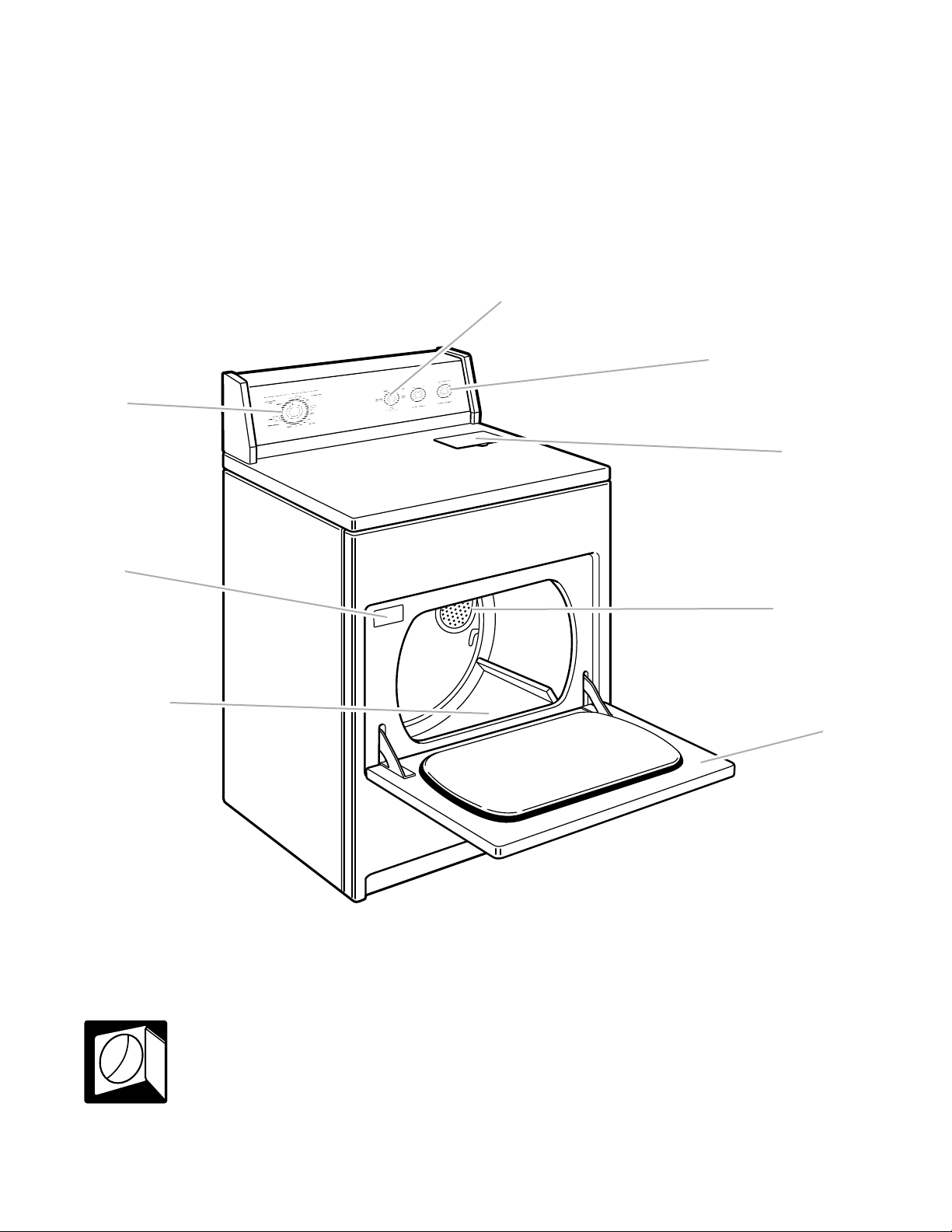
Fabric/Temperature
selector*
(p. 8)
Start button/End of
cycle signal selector*
(p. 9)
Lint screen
(p. 14)
PARTS AND FEATURES
The drawings in this book may vary from your dryer model. They are designed to show the
different features of all models covered by this book. Your model may not include all features.
Cycle control
knob
(pp. 8-11)
Model and
serial number
label
(p. 2)
Dryer drum
(p. 15)
Other doors:
Large side-swing door*
*On some models
Wide-opening
door*
Exhaust grill
(p. 17)
Page 6
6
CHECKING YOUR VENT
If the dryer is not properly installed and vented, it will
not be covered under the warranty.
NOTE: Service calls caused by improper venting will
be paid for by the customer, whether it was a paid
installation or self-installed. For paid installation, call
the company that installed the vent for adjustment.
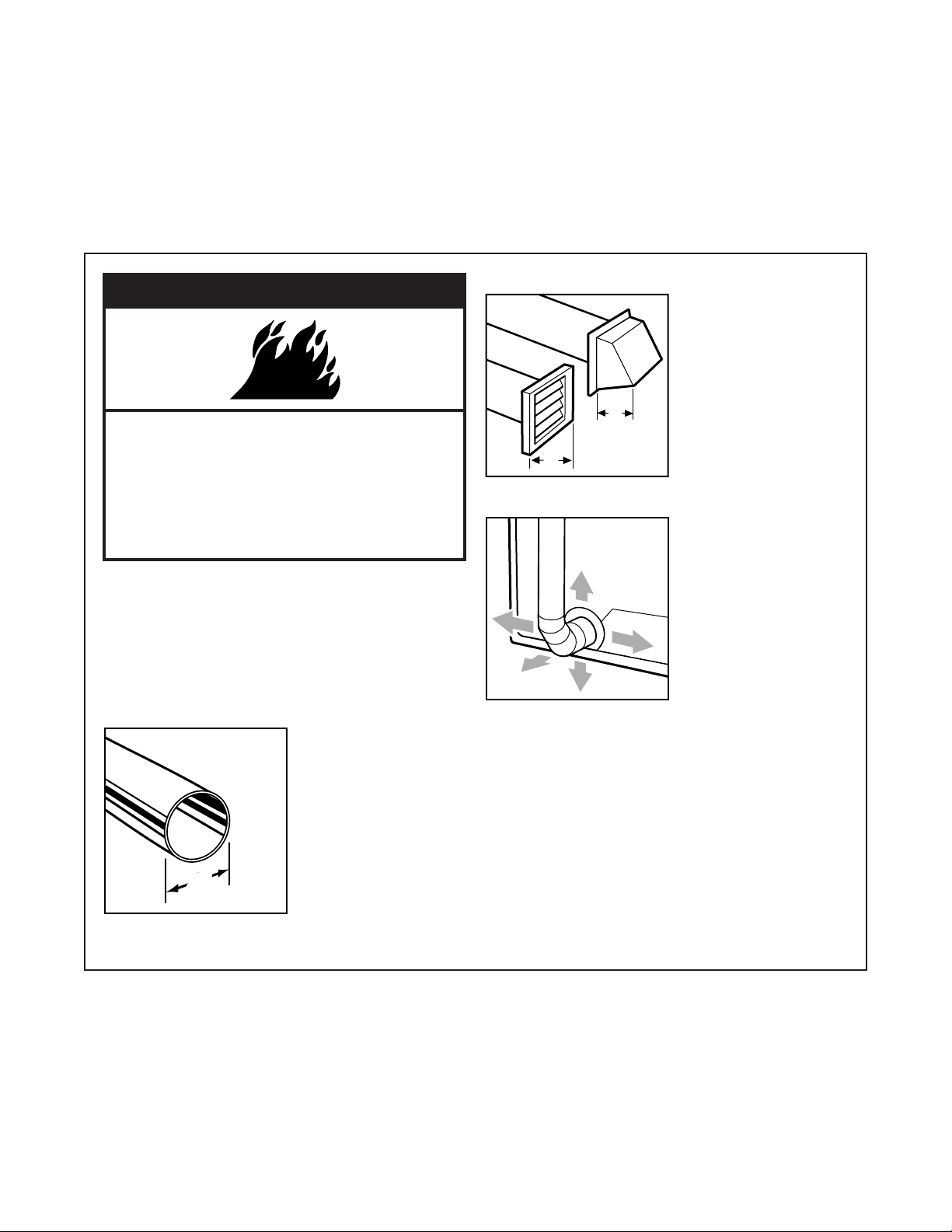
1. Do not use plastic vent or flexible metal foil vent.
Use 4-inch heavy metal
or flexible metal vent.
Do not kink or crush
flexible metal vent. It
must be completely
extended to allow
adequate exhaust air to
flow. Check vent after
installation. Refer to
your Installation
Instructions for proper
length requirements of vent.
3. The exhaust vent can be routed up, down, left,
right, or straight out the
back of the dryer. Space
requirements are listed
in your Installation
Instructions.
2. Use a 4-inch exhaust hood. Smaller hoods
increase drying times.
4
"
in
wWARNING
Fire Hazard
Use a heavy metal vent.
Do not use a plastic vent.
Do not use a metal foil vent.
Failure to follow these instructions can
result in death or fire.
Your dryer must be properly installed and vented to achieve maximum drying efficiency and
shorten drying times. Use the minimum recommended installation clearances (found in your
Installation Instructions) to avoid blocking the flow of combustion and ventilation air. Install
your dryer in a well-ventilated room where the temperature is always above 45ºF. Also make
sure that your dryer is leveled. Refer to your installation Instructions for more
information.
4"
4"
4 in
4 in
4 in
Page 7

7
CHECKING YOUR VENT
6. Clean exhaust vent periodically, depending on
use, but at least every 2
years, or when installing
your dryer in a new
location.
•
Disconnect vent from
the dryer and clean one
section at a time until
you reach the exhaust
hood.
•
Use the hose attachment on your vacuum,
or a pole or wire with a feather duster or rag
attached, to clean out lint.
•
Be sure the flapper on the outside end of vent
moves freely.
•
When cleaning is complete, be sure to follow the
Installation Instructions supplied with your dryer
for final product check.
4. Use the straightest path possible when routing
the exhaust vent. Use
the fewest number of
elbows and turns. Allow
room when using
elbows or making turns.
Bend vent gradually to
avoid kinking.
5. Use duct tape to seal all joints. Do not use
screws to secure vent.
Lint may catch on
screws.
Page 8

8
Before using your dryer, wipe the dryer drum with a
damp cloth to remove dust from storing and shipping.
1. Load clothes loosely into the dryer and close the
door. Do not pack the
dryer; allow space for
clothes to tumble freely.
2. Turn the Cycle Control knob to the
recommended cycle for
the type of load being
dried, as described on
pages 10-12.
•
Use the Energy
Preferred Automatic
Setting (*) to dry most
heavyweight and
mediumweight loads.
•
On some models,
the Temperature
selector is part of the Cycle Control knob.
3. On models with a separate Fabric/Temp selector,
choose the recommended setting for the type
of fabric being dried.
The cycle descriptions
on pages 10-12 include
temperature setting
suggestions.
USING YOUR DRYER
wWARNING
Explosion Hazard
Keep flammable materials and vapors,
such as gasoline, away from dryer.
Do not dry anything that has ever had
anything flammable on it (even after
washing).
Failure to follow these instructions can
result in death, explosion, or fire.
wWARNING
Fire Hazard
No washer can completely remove oil.
Do not dry anything that has ever had any
type of oil on it (including cooking oils).
Items containing foam, rubber, or plastic
must be dried on a clothesline or by using an
Air Cycle.
Failure to follow these instructions can result
in death or fire.
STARTING YOUR DRYER
4. (OPTIONAL STEP) On some models, the End of
Cycle Signal selector is
part of the Start button.
Set the End of Cycle
Signal selector to On if
you want the dryer to
sound a signal when a
cycle is finished. The
signal is helpful when
you are drying
permanent press,
synthetics, and other
items that should be removed from the dryer as
soon as it stops.
Page 9

9
STARTING YOUR DRYER (CONT.)
USING YOUR DRYER
Stopping and restarting your dryer
You can stop your dryer anytime during a cycle.
To stop your dryer:
Open the dryer door or turn the Cycle Control
knob to Off.
NOTE: The Cycle Control knob should point to an
Off area when the dryer is not in use.
To restart your dryer:
Close the door, select a new cycle and temperature (if desired), and push the Start button.
SELECTING A CYCLE AND TEMPERATURE SETTING
The following pages describe the drying cycles
on your dryer. The descriptions include suggested
temperature settings and drying times for various
loads.
Cycle and temperature tips
•
Use the No Heat Fluff cycle, or line dry rubber,
plastic, delicate, and heat-sensitive fabrics
(see page 12).
•
If some types of loads in the cycle descriptions
have more than one suggested temperature setting, choose the lowest setting available
on your dryer.
•
The last few minutes of all cycles are without
heat to make the load cooler to handle.
Drying tips
•
Make sure you have selected the correct cycle
and temperature for your load.
•
Always follow care label directions when they are
available.
•
Always use fabric softener sheets labeled as dryer
safe and follow package instructions carefully.
•
Remove the load from the dryer as soon as
tumbling stops to reduce wrinkling. This is
especially important for permanent press, knits,
and synthetic fabrics.
5. Push the Start button.
NOTE: Your dryer stops automatically when a
cycle ends.
Loading suggestions
The chart below provides some guidelines on various types of drying loads. Load clothes loosely into the
dryer. Do not pack the dryer; allow space for clothes to tumble freely.
LOADING
Heavy Work Clothes
3 pair pants
3 shirts
4 pair jeans
1 coverall
1 overall
Towels
10 bath towels
10 hand towels
14 wash cloths
1 bath mat
Mixed Load
3 double sheets
4 pillowcases
8 T-shirts
6 pair shorts
2 shirts
2 blouses
8 handkerchiefs
Delicates
3 camisoles
1 quilted robe
4 slips
4 panties
2 bras
2 nighties
1 baby’s dress
Page 10

10
USING YOUR DRYER
CYCLE DESCRIPTIONS
The following pages describe the cycles on your
dryer. Refer to these pages for help in selecting
drying cycles and temperatures.
The Cycle Control knob does not move until the
load is almost dry. After the cool-down, the knob
automatically turns to an Off area and tumbling
stops.
•
Dry most loads using the Energy Preferred
Automatic Setting (*).
•
If the load is drier than you like, select a setting
closer to Less Dry the next time you dry a
similar load.
•
If the load is not as dry as you like, complete
drying using the Timed Dry cycle. Select a setting
closer to Very Dry the next time you dry a similar
load.
MODEL TEDX640E
20
20
20
10
10
10
TIMED DRY
TIMED DRY
AUTO SENSE
DRYING
NO HEAT
FLUFF
OFF
OFF
OFF
OFF
COOL DOWN
COOL DOWN
30
LESS DRY
(LOW HEAT)
(HIGH HEAT)
(HIGH HEAT)
VERY DRY
COOL
DOWN
*
Energy Preferred
Automatic Setting
*
Auto Sense Drying
(Automatic cycle)
The Auto Sense Drying cycle uses the Energy
Preferred Automatic Setting (*). Use this high heat
cycle for drying heavyweight and mediumweight:
•
Cotton items, such as towels, linens, bedspreads,
work clothes, blue jeans, and corduroys.
•
Permanent Press, synthetics, and blends, such
as jackets, shirts, slacks, and play clothes.
•
Knits, such as cottons, rayons, blends, T-shirts,
slacks, and shirts.
Timed Dry cycles
Use one of the Timed Dry cycles to complete drying if some items are damp after Auto Sense
Drying. The high heat and low heat Timed Dry
cycles are also useful for:
•
Heavyweight and bulky items, such as bedspreads and work clothes, and large loads that
require a long drying time. Set your Cycle
Control knob to High heat for 50-70 minutes.
(Reset knob as necessary for the time required.)
•
Lightweight items, such as lingerie, blouses, and
knits that require a short drying time. Set your
Cycle Control knob to Low heat for 20-30
minutes.
No Heat Fluff
Use the unheated No Heat Fluff cycle for items that
require drying without heat. The chart on page 12
includes examples of items that require drying
without heat.
Page 11

11
MODEL TEDS680E
Auto Sense Drying
(Automatic cycle)
The Auto Sense Drying cycle uses the Energy
Preferred Automatic Setting (*). Use this cycle for
drying heavyweight and mediumweight:
•
Cotton items, such as towels, linens, bedspreads, work clothes, blue jeans, and
corduroys. Set your Fabric/Temp selector to
Cotton/Perm Press, High.
•
Permanent Press, synthetics, and blends, such as
jackets, shirts, slacks, and play clothes. Set your
Fabric/Temp selector to Cotton/Perm Press,
High.
•
Knits, such as cottons, rayons, blends, T-shirts,
slacks, and shirts. Set your your Fabric/Temp
selector to Knits, Low.
•
This cycle also includes the Wrinkle Prevent
feature, which protects your clothing from
wrinkles if you are unable to unload the dryer
within 5 minutes after tumbling stops. The
Wrinkle Prevent feature tumbles the load
every few minutes up to 40 minutes after the
cycle ends.
USING YOUR DRYER
Timed Dry cycle
Use the Timed Dry cycle to complete drying if some
items are damp after automatic drying. The Timed
Dry cycle is also useful for:
•
Heavyweight and bulky items, such as bedspreads
and work clothes, and large loads that require a
long drying time. Set your Fabric/Temp selector
to Cotton/Perm Press, High, and your Cycle
Control Knob to Heavy Dry.
•
Lightweight items, such as lingerie, blouses, and
knits that require a short drying time. Set your
Fabric/Temp selector to Knits, Low, and your
Cycle Control Knob for 20-30 minutes.
•
The Timed Dry cycle also includes a Damp Dry
feature, to dry items to damp level or to dry
items that do not require an entire drying cycle.
Examples are heavy cottons, such as jeans, which
you do not want to become stiff, or cotton clothes
that are easier to press when damp. Set your
Fabric/Temp selector to Cotton/Perm Press, High.
No Heat Fluff
Use the unheated No Heat Fluff cycle for items that
require drying without heat. The chart on page 12
includes examples of items that require drying
without heat.
TIMED DRY
AUTO SENSE
DRYING
NO HEAT
FLUFF
OFF
OFF
OFF
COOL DOWN
Energy Preferred
Automatic Setting
DAMP DRY
LESS DRY
HEAVY
DRY
WRINKLE PREVENT
VERY DRY
COOL DOWN
70
60
50
40
20
20
30
10
*
*
KNITS
LOW HIGH
COTTON/
PERM PRESS
TEMPERATURE
FABRIC
TEMP
Page 12

12
NO HEAT FLUFF CYCLE
USING YOUR DRYER
The chart below includes examples of items that
require drying without heat. Use the No Heat Fluff
cycle, or place the items on a line or rack to air
dry.
RUBBER, PLASTIC, HEAT-SENSITIVE FABRICS
Foam Rubber – Pillows, padded bras, stuffed toys
•
Make sure coverings are securely stitched.
•
Shake and fluff pillows by hand several times during the
No Heat Fluff cycle.
•
Make sure pillows are completely dry. Foam rubber pillows
take a long time to dry.
Plastic – Shower curtains, tablecloths
Rubber-backed rugs
Olefin, Polypropylene, Sheer nylon
20-30
20-30
40-50
10-20
NO HEAT FLUFF CYCLE*
(minutes)
TYPE OF LOAD
*Reset cycle as needed to complete drying.
•
Line dry bonded or laminated fabrics.
•
Always follow care label directions when they are
available.
Page 13

13
USING THE DRYING RACK
USING YOUR DRYER
Your dryer may include a drying rack. If your model
doesn’t include one, you can order a drying rack
by calling 1-800-253-1301, from anywhere in the
U.S.A. You will hear a recording. Follow the
instructions to place an order.
The drying rack lets you dry items without tumbling
them. The rack does not move, but the drum turns.
1. Fit rear legs of the rack into spaces in the back
wall of the dryer. Lower
the front so the legs
rest on the dryer
opening.
5. Push the Start button.
NOTE: The rack must be removed for normal
tumbling. Auto Sense Drying cycles do not work
with the drying rack.
TIME*
(minutes)
60
60
90
30-40
RACK DRY
Wool sweaters
(Block to shape and lay flat on the rack)
Stuffed toys or pillows
(Cotton or polyester fiber filled)
Stuffed toys or pillows
(Foam rubber filled)
Sneakers or canvas shoes
CYCLE
Timed Dry
Timed Dry
No Heat Fluff
No Heat Fluff
TEMPERATURE
Low
Low
None; cycle is unheated.
None; cycle is unheated.
2. Put wet items on top of the rack. Leave space
between the items
so air can reach all surfaces.
•
See chart below for
suggested cycles and
settings for items that
might best be rack
dried. Drying time will
depend on amount of
moisture items hold.
NOTE: Make sure nothing hangs over the edge of
the rack.
3. Close the door.
*Reset cycle as needed to complete drying.
4. Select the Timed Dry cycle and temperature, or
the No Heat Fluff cycle.
Page 14

14
CLEANING THE LINT SCREEN
CARING FOR YOUR DRYER
Every load cleaning
The lint screen is located under a lid on top of the
dryer. Clean it before starting each load. A
screen blocked by lint can increase drying time.
To clean:
1. Open the lid and pull the lint screen towards
you.
As needed cleaning
Laundry detergents and fabric softeners can cause
a residue buildup on the lint screen. This buildup
can cause longer drying times for your clothes, or
cause the dryer to stop before your load is completely dry. You may be able to see this buildup, or
the lint may be falling off the screen because it is
clogged.
Clean the lint screen with a nylon brush every six
months or more frequently if it becomes clogged
due to a residue buildup.
Use the following method:
1. Wet both sides of lint screen with hot water.
2. Wet a nylon brush with hot water and liquid
detergent; scrub lint
screen with the brush
to remove residue
buildup.
2. Roll lint off the screen with your fingers. Do not
rinse or wash screen to
remove lint. Wet lint is
hard to remove.
3. Push the lint screen firmly back into place and
close the lid.
IMPORTANT:
•
Do not run the dryer with the lint screen loose,
damaged, blocked, or missing. Doing so can
cause overheating and damage to both the dryer
and fabrics.
•
Some towels made of synthetic fibers and natural fibers (polyester and cotton blends) may shed
more lint than other towels, causing your dryer’s
lint screen to fill up faster. Be sure to remove
lint from the lint screen before and after drying
new towels.
•
If lint falls off the screen during removal and ito
the dryer, check the exhaust hood and remove
the lint (see “Checking Your Vent”).
3. Rinse screen with hot water.
4. Thoroughly dry lint screen with a clean towel;
replace in dryer.
Page 15

15
CARING FOR YOUR DRYER
LINT SIGNAL
On some models, there may be a lint signal
(a whistle tone) which indicates excessive lint is present on your lint screen
or it has a residue buildup.
See page 14. A full lint screen restricts
airflow and reduces drying efficiency.
When you hear the signal, stop the dryer and
clean the lint screen.
NOTE: Clean your lint screen before each load. Do
not wait for the lint signal.
CLEANING THE DRYER INTERIOR
Garments which contain unstable dyes, such as
denim blue jeans or brightly colored cotton items,
may discolor the dryer interior. These stains are not
harmful to your dryer and will not stain future loads of
clothes. It is helpful to dry unstable dye items inside
out to prevent dye transfer.
To clean dryer drum:
1. Make a paste with powdered laundry detergent
and very warm water.
2. Apply paste to a soft cloth.
OR
Apply a liquid, non-flammable household cleaner
to the stained area and rub with a
soft cloth until all excess dye is
removed.
3. Wipe drum thoroughly with a damp cloth.
4. Tumble a load of clean cloths or towels to dry
drum.
wWARNING
Explosion Hazard
Use nonflammable cleaner.
Failure to do so can result in death,
explosion, or fire.
REMOVING ACCUMULATED LINT FROM INSIDE THE DRYER CABINET
Lint can gather inside the dryer and be a fuel
for fire. Lint should be removed every 2 years, or
more often, depending on dryer usage. Cleaning
should be done by a qualified person.
Page 16

16
CHANGING THE DRUM LIGHT
CARING FOR YOUR DRYER
The dryer light automatically turns on inside
the dryer drum when you open the door. See
instructions below to change your drum light.
To change drum light:
1. Unplug the dryer or disconnect the electricity
leading to the dryer at the main power supply.
2. Open the dryer door. Remove the light bulb
cover from the back
wall of the dryer by
removing the screw
located in the lower
right corner of the
cover.
3. Remove the light bulb by turning it
counterclockwise.
4. Replace the bulb with a 10-watt appliance
bulb only.
5. Replace the light bulb cover.
6. Reconnect power supply.
Page 17

17
TROUBLESHOOTING
COMMON DRYING PROBLEMS
PROBLEM
Not drying
satisfactorily
Dryer will
not run
CAUSE
• Lint screen is clogged with lint.
• Restricted air movement.
Exhaust vent or outside
exhaust hood is clogged with
lint.
• Exhaust vent is crushed or
kinked.
• One fuse is blown or circuit
breaker is tripped. The dryer
will appear to operate, but you
will not get any heat.
• Cycle Control knob or temperature selector is set on air dry.
• Fabric softener sheets blocking
exhaust grill.
• Dryer located in room with
temperature below 45ºF.
• Large amount of moisture in
the load.
• Cold rinse water used.
• Load too large and bulky to
dry quickly.
• Power cord not firmly plugged
into a live circuit with proper
voltage.
• Fuses blown or circuit
breakers tripped.
• Using a regular fuse.
• Dryer door not firmly closed.
• Start button not firmly pressed.
• Cycle Control knob set to Off.
SOLUTION
• Clean lint screen.
• Run dryer for 5-10 minutes. Hold hand under
outside exhaust hood to check air movement. If you
do not feel air moving, clean exhaust system of lint
or replace exhaust vent with heavy metal or flexible
metal vent (see your Installation Instructions).
• Replace with heavy metal or flexible metal vent
(see your Installation Instructions).
• Replace fuse or reset breaker.
• Select the right cycle and temperature for the types
of garments being dried (see “Using your Dryer”).
• Use only one softener sheet per load and only use
it once.
• Move dryer to a location with temperatures above
45ºF.
• Expect longer dry times with items that hold more
moisture (cottons).
• Expect longer dry times.
• Separate load to tumble freely.
• Plug power cord into a live circuit.
• Replace fuses or reset breakers.
• Replace with a time-delay fuse.
• Close dryer door tightly.
• Press Start button again.
• Set knob to a cycle or time.
Page 18

18
TROUBLESHOOTING
COMMON DRYING PROBLEMS (CONT.)
PROBLEM
Lint in load
Stains on
load
Items
shrinking
Loads are
wrinkled
Odors
Unusual
sounds
CAUSE
• Lint screen is clogged.
• Improper sorting.
• Load is too big or heavy.
• Load is overdried.
• Paper or tissue in pockets.
• Pilling being mistaken for lint.
• Improper use of fabric softener
in washer.
• Drying soiled items.
• Overdrying
• Poor garment quality.
• Manufacturer’s care label
instructions not followed.
• Overloading.
• Overdrying.
• Load left in dryer at the end of
cycle.
• Household chemicals, paint, or
varnish being drawn into dryer.
• First use of dryer element.
• Thumping of rollers when dryer
has not been used for a while.
SOLUTION
• Clean lint screen. Check for air movement.
• Sort lint givers from lint takers and sort by color.
• Dry smaller loads so lint can be carried to the lint
screen.
• Use correct dryer settings for fabric. Overdrying
can cause lint-attracting static (see “Using Your
Dryer”).
• Clean out pockets before drying.
• Pilling (surface fuzz) is caused by normal wear and
laundering.
• Use fabric softener sheets in dryer. Add at beginning of cycle when load is cold.
• Items need to be clean before being dried.
• Match dryer settings to fabric type (see “Using
Your Dryer”).
• Check quality of garment before purchasing.
• Follow fabric care label instructions carefully.
• Dry smaller loads that can tumble freely.
• Match dryer settings to fabric type (see “Using
Your Dryer”).
• Remove load as soon as tumbling stops.
• Do not use dryer while these chemical fumes are in
the air.
• Odor will be gone after the first cycle.
• Thump will go away after 5 minutes of drying.
Page 19

19
ASSISTANCE OR SERVICE
IF YOU NEED ASSISTANCE OR SERVICE
Call the Whirlpool Consumer Assistance Center
toll free at 1-800-253-1301. Our consultants are available to
assist you.
When calling:
Please know the purchase date, and
the complete model and serial number of your
appliance (see “A Note To You”). This information
will help us better respond to your request.
Our consultants provide assistance with:
•
Features and specifications on our full line
of appliances
•
Installation information
•
Use and maintenance procedures
•
Accessory and repair parts sales
•
Specialized customer assistance (Spanish
speaking, hearing impaired, limited vision, etc.)
•
Referrals to local dealers, service companies, and
repair parts distributors
Whirlpool designated service technicians are
trained to fulfill the product warranty and provide
after-warranty service, anywhere in the United States.
To locate the Whirlpool designated service company
in your area, you can also look in your telephone
directory Yellow Pages.
IF YOU NEED REPLACEMENT PARTS
If you need to order replacement parts, we recommend that you only use FSP®factory specified
parts. These parts will fit right and work right,
because they are made to the same exacting
specifications used to build every new
ESTATE®appliance.
To locate FSP replacement parts in your area, call
our Consumer Assistance Center or your nearest
designated service center.
FOR FURTHER ASSISTANCE
If you need further assistance, you can write to
Whirlpool with any questions or concerns at:
Whirlpool Brand Home Appliances
Consumer Assistance Center
c/o Correspondence Dept.
2000 North M-63
Benton Harbor, MI 49022-2692
Please include a daytime phone number in your
correspondence.
Page 20

WHIRLPOOL WILL PAY FOR
FSP®replacement parts and repair labor to correct defects in materials
or workmanship. Service must be provided by a Whirlpool designated
service company.
LENGTH OF WARRANTY
FULL ONE-YEAR WARRANTY
FROM DATE OF PURCHASE
ESTATE®DRYERWARRANTY
WHIRLPOOL CORPORATION SHALL NOT BE LIABLE FOR INCIDENTAL OR CONSEQUENTIAL
DAMAGES. Some states do not allow the exclusion or limitation of incidental or consequential damages, so
this exclusion or limitation may not apply to you. This warranty gives you specific legal rights, and you may
also have other rights which vary from state to state.
Outside the United States, a different warranty may also apply. For details, please contact your
authorized Whirlpool dealer.
If you need service, first see the “Troubleshooting” section of this book. After checking “Troubleshooting,”
additional help is available by checking the “Assistance or Service” section, or by calling our
Consumer Assistance Center at, 1-800-253-1301, from anywhere in the U.S.A.
3406074A
© 1999 Whirlpool Corporation ® Registered Trademark/TM Trademark of Whirlpool, U.S.A.
3/99
Printed in U.S.A.
WHIRLPOOL CORPORATION WILL NOT PAY FOR
A. Service calls to:
1. Correct the installation of your dryer, including venting. Heavy 4-inch metal exhaust vent must be
used. Refer to the venting section of this manual and your Installation Instructions.
2. Instruct you how to use your dryer, to replace house fuses or reset circuit breakers, or to replace
owner accessible light bulbs.
B. Repairs when your dryer is used in other than single-family household use.
C. Damage to your dryer caused by accident, alteration, misuse, abuse, fire, flood, acts of God, improper
installation (including, but not limited to, venting with plastic or flexible foil), or installation not in
accordance with local electrical and plumbing codes.
D. Replacement parts or repair labor costs for units operated outside the United States.
E. Pick-up and delivery. This product is designed to be repaired in the home.
F. Repairs to parts or systems resulting from unauthorized modifications made to the appliance.
3/99
 Loading...