

Page 1
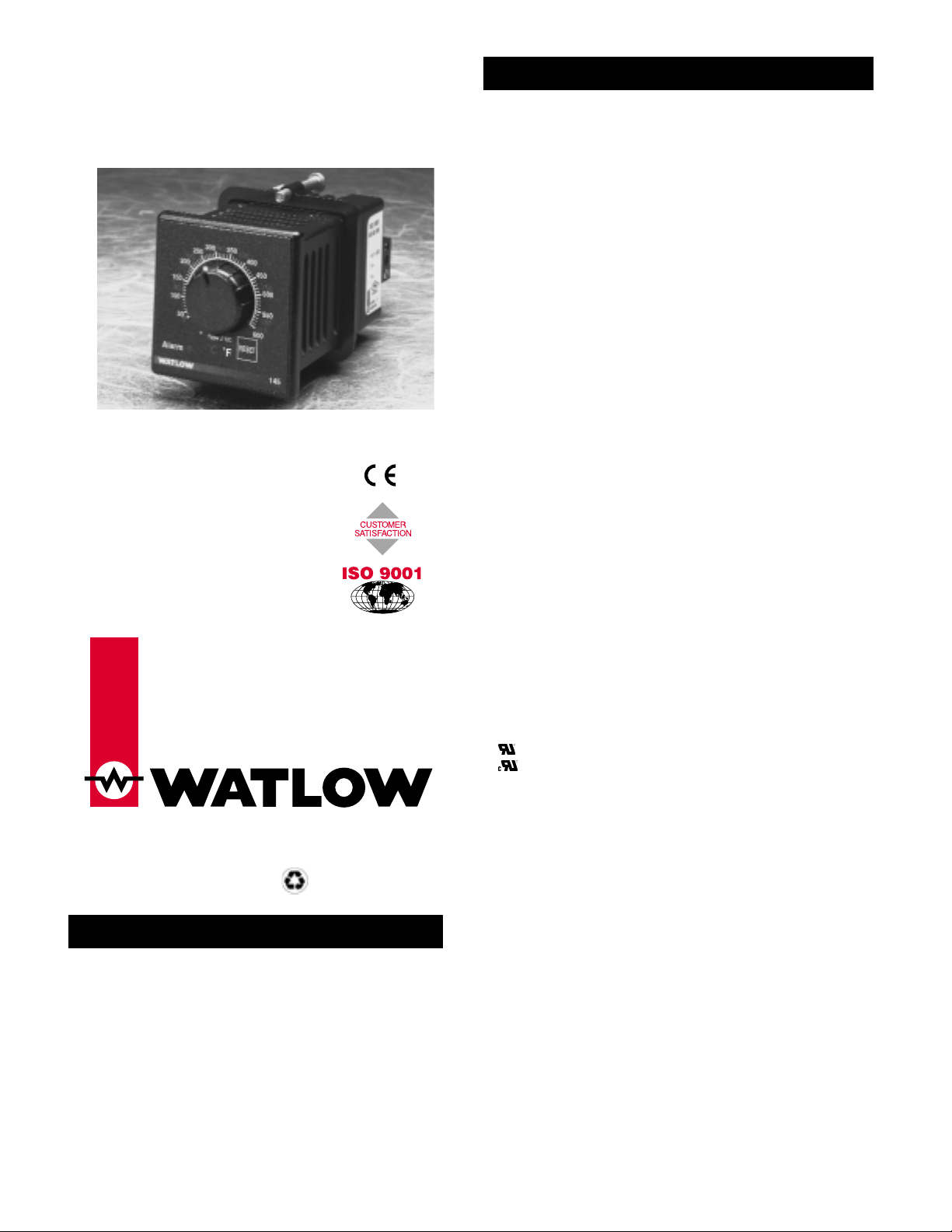
Series 145
User ’s Manual
Temperature Limit
1241 Bundy Boulevard, P.O. Box 5580, Winona, Minnesota USA 55987-5580
Phone: 507/454-5300, Fax: 507/452-4507, Internet: http://www.watlow.com
The Watlow Series 145 is a 1/16 DIN temperature limit
controller with a thermocouple or RTD sensor input. The
1/16 DIN case features a front panel that provides the
Series 145 with water and corrosion resistance.
The Series 145 is designed to meet the needs of a wide
range of safety applications. It is available with a wide
variety of thermocouple and RTD ranges.
The compact size of the limit allows more flexibility in
applications where space is a problem. The Series 145 has a
standard integral setpot and a front panel LED output
status indicator.
(1927)
Control Mode
• High or low limit, factory selectable
• Manual or automatic reset on power loss, factory selectable
• Latching alarm with manual reset on over or under temperature
Operator Interface
• Sealed membrane front panel
• Integral set point
• Dual temperature scale (°F and °C)
• LED indication of output status
• Dial scale calibrated to compensate for sensor
non-linearities
• Integral reset switch
Input
• Thermocouple or RTD available
• Thermocouple with automatic cold junction compensation
• Thermocouple may be isolated or grounded
• 2- or 3-wire RTD input, platinum 100Ω, 500Ω, or 1000Ω @ 0°C
calibrated for DIN 0.003850Ω/Ω °C curve
• Sensor break protection de-energizes output
Output
• Electromechanical relay, 3A, Form C, SPDT: 3A @ 240V~, 3A@
28VÎ (dc), resistive, 275VApilot duty rated
Accuracy
Adjustable Set Point
• Calibration accuracy: ±1% of span, at 77°F ±5°F (25°C ± 3°C)
ambient and rated line voltage ± 1%
• Set point accuracy: ±3% of dial scale
• Accuracy span: 1000°F (540°C) minimum
Fixed Set Point
• Calibration accuracy: ±10°F/±6°C of setting, at 77°F ±5°F (25°C
±3°C) ambient and rated line voltage ±1%
Temperature Stability
• Thermocouple: Typically 5µV/°F ambient (9µV/°C ambient) input
referenced
• RTD: Typically 0.2°F/°F ambient (0.2°C/°C ambient)
Voltage Stability
• ±0.01% of span (min span of 1000°F or 540°C) per % of rated line
voltage
Agency Approvals
• CE: EN61010 - Safety
EN61326 - Industrial Immunity, Class B Emissions
Installation Category 2, Pollution Degree 2
• 873, File #E43684
• to C22.2 No. 24, File #E43684
• Approved for use in commercial cooking applications
• FM Class 3545, File #J.I.3008516
Terminals
• Screw clamp terminal: 12-26 gauge wire
Power
• 120V~, +10%/-15%, 50/60 Hz
• 230V~ to 240~, +10%/-15%, 50/60 Hz
• 10VAmaximum power
Operating Environment
• 32 to 131°F (0 to 55°C)
• 0 to 90% RH, non-condensing
• Storage temperature: -4 to 185°F (-20 to 85°C)
Dimensions
• Height: 2.1 in (55 mm)
• Width: 2.1 in (55 mm)
• Depth: 4.0 in (102 mm)
• Behind panel: 3.50 in (89 mm)
• Front panel: 0.5 in (13 mm)
Weight
• 0.7 lb (0.3 kg)
UL®is a registered trademark of Underwriter’s Laboratories, Inc.
Note: Specifications subject to change without notice.
Specifications
General Description
$5.00 Made in the U.S.A.
Printed on Recycled Paper
10% Postconsumer Waste
0600-0004-0009 Rev C
August 2000
Supersedes: 0600-0004-0009 Rev B
TOT AL
3 Y ear Warranty
Registered Company
Winona, Minnesota USA
Page 2
2 ■ Watlow Series 145 User’s Manual
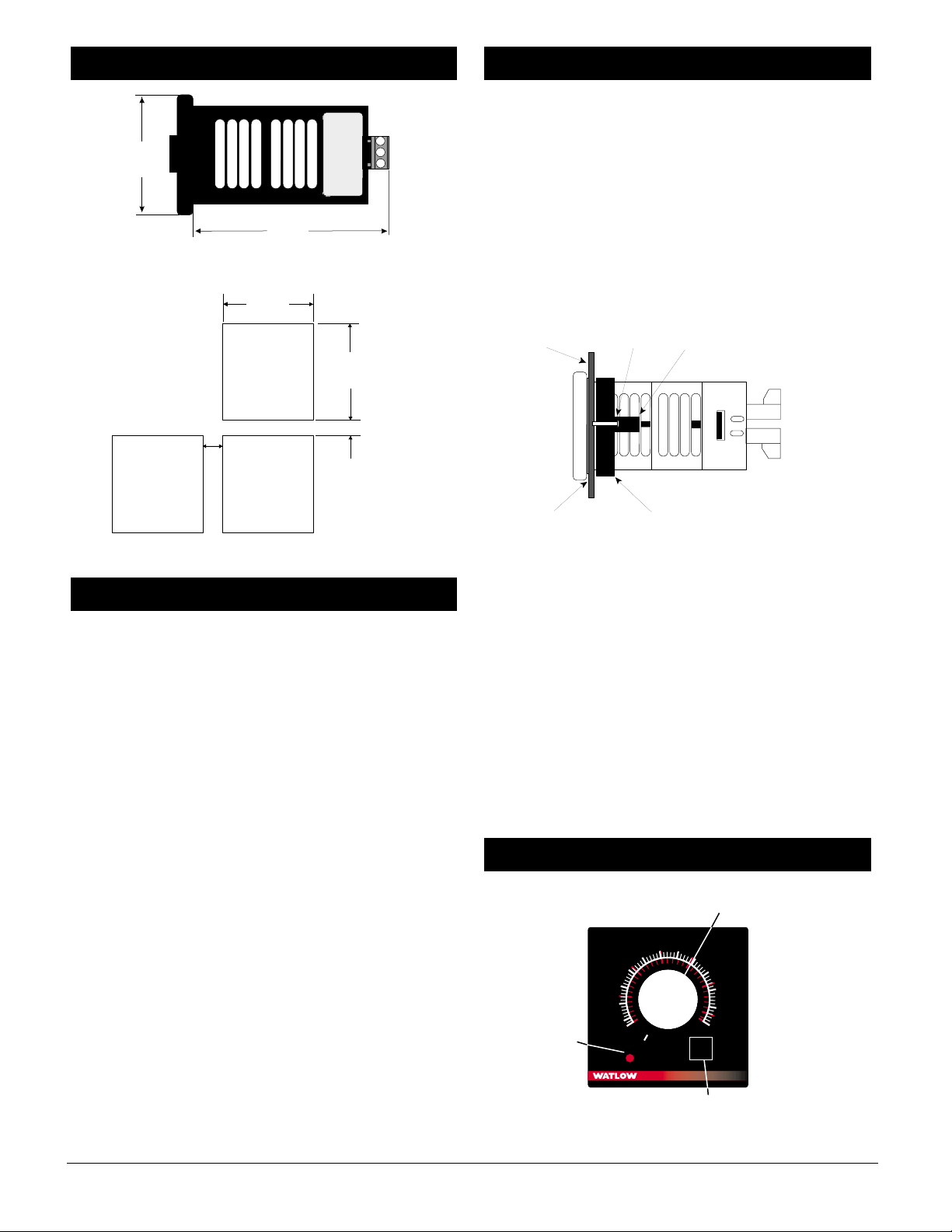
Figure 2a — Series 145 dimensions.
Figure 2b — Series 145 panel cutout.
• Use the correct sensor type per the model number on the
unit sticker.
• Use the proper thermocouple or RTD polarity.
• Insulate the thermocouple mounting from the mounting
surface to prevent heat migration input errors.
• Thermocouple leads should be twisted pair wire and
routed separately from any other lines.
• In electrically noisy environments (heavy switching of
contactor, motors, solenoids, etc.) use shielded thermocouple lead wire with the shield connected at the sensor end
only.
• All wiring and fusing must conform to the National
Electric Code (NEC) NFPA70 and any other locally applicable codes.
• Fuse the independent load voltage on the L1 (hot) side
and connect it to the common (COM) side of the relay.
ç
CAUTION: A power disconnect switch located near the controller
is recommended to shut down power in case of controller
failure.
• Long lead lengths create electrical resistance. When using
a two-wire RTD, there will be an additional error for
every 1Ω of lead length resistance. That resistance when
added to the resistance of the RTD element, can result in
erroneous input to the temperature controller. To overcome this problem, use a three-wire RTD sensor, which
compensates for lead length resistance. When extension
wire is used for a three-wire RTD, all three extension
wires must have the same electrical resistance (i.e. same
gauge, copper stranded).
To Mount the Series 145
1. Make a panel cutout, using the dimensions in Figure 2b.
2. Check to see that the external case gasket of the Series
145 is facing the panel surface. Insure that the gasket is
not twisted and is seated within the case bezel flush with
the bezel. Insert the Series 145 into the cutout.
3. Slide the mounting collar over the back of the controller.
The two tabs of the mounting collar will fit into one of the
vent openings of the case.
4. While pressing the front of the case firmly against the
panel, tighten the two #8-32 screws until tight. Make sure
you cannot move the case within the cutout.
Figure 2c — Series 145 mounting.
NOTE: FM Approval requires limit switches to be suitably enclosed
to minimize casual readjustment of set temperature.
To Remove the Series 145
1. Remove the Series 145 by loosening the mounting screws
located on the mounting collar.
2. Using the screws, gently pry them away from the case.
This will lift the mounting tabs, allowing the collar to
slide backwards.
NOTE: To guarantee a proper seal, make sure the gasket between
the panel and the rim of the case is not twisted and is seated properly. Press firmly.
NOTE: Make sure the rounded side of the D-shaped external case
gasket faces the panel surface and the gasket is fully seated.
Figure 2d — Series 145 interface.
User Interface
Installation
Wiring Guidelines
Dimensions
2.1 in
(55 mm)
square
4.0 in
(102 mm)
1.77 to 1.79 in
(45.0 to
2.10"
45.5 mm)
Panel Cutout
1.77 to 1.79 in
(45.0 to
1.75"
45.5 mm)
0.38 in
(9.7 mm)
Minimum
0.85 in
(20 mm)
Your Panel
Thickness
0.06 to 0.38 in
(1.5 to 9.7 mm)
Panel
External Gasket
Screw
Mounting Tab
Mounting Collar
Temperature Adjustment
150
350
300
Alarm
Indicator
150
50
100
Alarm
250
100
200
50
0
Type J T/C
˚C
200
RESET
˚F
400
450
250
500
550
300
315
600
Reset
Setpot
145
Page 3

3 ■ Watlow Series 145 User’s Manual
Power Wiring
Thermocouple
Figure 3b — Thermocouple wiring.
NOTE: When an external device with a non-isolated circuit common
is connected to the dc output, you must use an isolated or ungrounded thermocouple.
2- and 3-Wire RTD
Figure 3c — 2- and 3-wire RTD wiring.
NOTE: Using 2- or 3-wire RTD input, platinum 100Ω, 500Ω, or
1000Ω at 0°C calibrated for DIN 0.003850Ω/Ω °C curve.
Electromechanical Relay, 3A, Form C with suppression
145D - _ _ _ _ - 0000
Figure 3d — Electromechanical relay wiring.
NOTE: No external reset wiring is available.
Note, caution and warning symbols appear throughout this
book to draw your attention to important operational and
safety information.
A “NOTE” marks a short message to alert you to an
important detail.
A “CAUTION” safety alert appears with information that is
important for protecting your equipment and performance.
A “WARNING” safety alert appears with information that is
important for protecting you, others and equipment from
damage. Pay very close attention to all warnings that apply
to your application.
The ç symbol (an exclamation point in a triangle) precedes
a general CAUTION or WARNING statement.
The Ó symbol (a lightning bolt in a lightning bolt in a
triangle) precedes an electric shock hazard CAUTION or
WARNING safety statement.
Safety Information
çNOTE: Switching inductive loads (relay coils, solenoids, etc.)
with the mechanical relay, switched dc or solid-state relay output
options requires use of an R.C. Suppressor. Watlow carries the
R.C. suppressor Quencharc brand name, which is a trademark of
ITW Paktron. Watlow Part No. 0804-0147-0000.
Output Wiring
Input Wiring
120VÅ 145 _ - 1 _ _ _ - 0000
230 to 240 VÅ 145 _ - 2 _ _ _ - 0000
NOTE: The line voltage is specified by your model number.
Figure 3a — Power wiring.
Ó
CAUTION Applying incorrect voltage may result in irreversible
damage to the controller.
Ó
WARNING: To avoid potential electric shock, use National Electrical
Code (NEC) safety practices when wiring and connecting this unit to
a power source and to electrical sensors or peripheral devices.
Failure to do so could result in injury and death.
All wiring and fusing must conform to the National Electric
Code and to any locally applicable codes.
ç
WARNING: The Series 145 Temperature Limit Switch should be
mounted in an inconspicuous location to discourage unauthorized
changes to the set point. Only approved personnel should have the
authority to change the set point on the limit switch. Failure to
comply with these recommendations could result in damage to
equipment and property, and injury to personnel.
Fuse
1
S
e
n
s
o
r
2
3
4
5
L1
L2
Recommended fuse size: 1A
S
e
n
TC+
s
o
TC-
r
2-Wire RTD
S
e
S3
n
S1
s
S2
o
r
1
2
3
4
5
1
2
3
4
5
3-Wire RTD
S
e
S3
n
S1
s
S2
o
r
1
2
3
4
5
1
S
e
n
s
o
r
2
3
4
5
C
NC
NO
Fuse
External
Device
L1
L2
Customer
Supplied
Quencharc
Page 4

4 ■ Watlow Series 145 User’s Manual
Figure 4 — System wiring examples.
System Example
L1
L2
120V~
DC DC
L1
L2
-+
Series 104
Temperature Controller
104C-1601-1100
120V~
L1
Customer
Supplied
Quencharc
High Limit
+
In
-
Coil
Mechanical
Contactor
SSR-240-10A-DC1
Out
Solid-State
Relay
Heater
Limit Sensor
TC+
TC-
Fuse
Fuse
1
S
e
n
s
o
r
2
3
4
5
Temperature Limit
145D-1601-1000
250
300
200
350
150
100
50
00
400
450
500
-
+
Process Sensor
High-
Temperature
Light
C
NC
NO
Series 145
L2
10
11
1
1
2
3
4 (+)
5 (-)
Series 104
Temperature
Controller
104C-1601-1100
2
3
4
(+)
6
3 to 32
VÎ in
7
SSR-240-10A-DC1
Solid-State Relay
(-)
1 CR-1
5
1
6
1
89
1
11
48 to 260
V~ out
Series 145
10
2
Heater
2
2
145D-1601-1000
16
Customer
Supplied
Quencharc
14
R
1 CR
2
2
Temperature Limit
7
8
9
1
15
12
13
TC+
TC-
3
Com
5
NO
4
NC
High-Temperature Light
Page 5

5 ■ Watlow Series 145 User’s Manual
Declaration of Conformity
Series 145
WATLOW WINONA
1241 Bundy Boulevard
Winona, Minnesota 55987 USA
Declares that the following product:
Designation: Series 145
Model Number(s): 145D - (1 or 2) (100-999) - (1, 2,3, or 4) (0 or 2) (any 2 letters
Classification: Installation Category II, Polution Degree II
Rated Voltage: 120 or 240VÅ
Rated Frequency: 50/60 Hz
Rated Power Consumption: 10VA maximum
Meets the essential requirements of the following European Union Directive(s) using the relevant
section(s) of the normalized standards and related documents shown:
or numbers)
89/336/EEC Electromagnetic Compatibility Directive
EN 61326: 1997 Electrical equipment for measurement, control and laboratory use -
EN 61000-3-2: 1995 Limits for harmonic current
EN 61000-3-3: 1995 Limitations of voltage fluctuatuions and flicker
EN 61000-4-2: 1995 Electrostatic discharge
EN 61000-4-3: 1997 Radiated immunity
EN 61000-4-4: 1995 Electrical fast transients
EN 61000-4-5: 1995 Surge immunity
EN 61000-4-6: 1994 Conducted immunity
EN 61000-4-11: 1994 Voltage dips, short interruptions and
ENV 50204: 1995 Cellular phone
EMC requirements (Emissions Class B)
voltage variations immunity
73/23/EEC Low-Voltage Directive
EN 61010-1: 1993 Safety requirements for electrical equipment for measurement,
Déclare que le produit suivant :
Désignation : Série 145
Numéro(s) de modèle(s) : 145D - (1 ou 2) (100-999) - (1, 2, 3 ou 4) (0 ou 2) (deux lettres
Classification : Installation catégorie II, degré de pollution II
Tension nominale : 120 ou 240VÅ
Fréquence nominale : 50/60 Hz
Consommation
d’alimentation nominale : 10 volt-ampères maximum
Conforme aux exigences de la (ou des) directive(s) suivante(s) de l’Union Européenne figurant
aux sections correspondantes des normes et documents associés ci-dessous :
EN 61326: 1995 Appareillage électrique pour la mesure, la commande et l’usage de
EN 61000-3-2 : 1995 Limites d’émission de courant harmonique
EN 61000-3-3 : 1995 Limites de fluctuation de tension
EN 61000-4-2 : 1995 Décharge électrostatique
EN 61000-4-3: 1997 Insensibilité à l’énergie rayonnée
EN 61000-4-4 : 1995 Courants électriques transitoires rapides
EN 61000-4-5 : 1995 Insensibilité aux surtensions
EN 61000-4-6: 1996 Insensibilité à l’énergie par conduction
EN 61000-4-11 : 1994 Insensibilité aux chutes subites, aux courtes interruptions et aux
ENV 50204 : 1995 Téléphone cellulaire
EN 61010-1 : 1993 Exigences de sécurité pour le matériel électrique de mesure, de
89/336/EEC Directive de compatibilité électromagnétique
control, and laboratory use,
Part 1: General requirements
ou chiffres quelconques)
laboratoire –— Prescriptions relatives à la Compatilité Electro
Magnétique (Émissions classe B)
variations de tension
73/23/EEC Directive liée aux basses tensions
commande et de laboratoire,
Partie 1 : Exigences générales
English
Français
Erklärt, daß das folgende Produkt:
Beschreibung: Serie 145
Modellnummer(n): 145D - (1 oder 2) (100-999) - (1, 2, 3 oder 4) (0 oder 2) (2
Klassifikation: Installationskategorie II, Emissionsgrad II
Nennspannung: 120 oder 240VÅ
Nennfrequenz: 50/60 Hz
Nominaler Stromverbrauch: Maximaler 10VA
Erfüllt die wichtigsten Normen der folgenden Anweisung(en) der Europäischen Union unter
Verwendung des wichtigsten Abschnitts bzw. der wichtigsten Abschnitte der normalisierten
Spezifikationen und der untenstehenden einschlägigen Dokumente:
beliebige Buchstaben oder Ziffern)
Deutsch
89/336/EEC Elektromagnetische Übereinstimmungsanweisung
EN 61326: 1997 Electrical equipment for measurement, control and laboratory use -
EN 61000-3-2: 1995 Grenzen der Oberwellenstromemissionen
EN 61000-3-3: 1995 Grenzen der Spannungsschwankungen
EN 61000-4-2: 1995 Elektrostatische Entladung
EN 61000-4-3: 1997 Strahlungsimmunität
EN 61000-4-4: 1995 Elektrische schnelle Stöße
EN 61000-4-5: 1995 Spannungsstoßimmunität
EN 61000-4-6: 1994 Störimmunität
EN 61000-4-11: 1994 Immunität gegen Spannungsgefälle, kurze Unterbrechungen und
ENV 50204: 1995 Mobiltelefon
EMC requirements (Emissions Class B)
Spannungsabweichungen
73/23/EEC Niederspannungsrichtlinie zu entsprechen
EN 61010-1: 1993 Sicherheitsrichtlinien für Elektrogeräte zur Messung, zur
Declara que el producto siguiente:
Designación: Serie 145
Números de modelo: 145D - (1 ó 2) (100-999) - (1, 2, 3 ó 4) (0 ó 2) (Cualquier
Clasificación: Categoría de instalación II, grado de contaminación ambiental
Tensión nominal: 120 ó 240VÅ
Frecuencia nominal: 50/60 Hz
Consumo nominal de energía: 10 VA máximo
Cumple con los requisitos esenciales de las siguientes Directivas de la Unión Europea, usando
las secciones pertinentes de las reglas normalizadas y los documentos relacionados que se
muestran:
Steuerung und im Labor,
Teil 1: Allgemeine Richtlinien
combinación de dos letras)
II
Español
89/336/EEC - Directiva de Compatibilidad Electromagnética
EN 61326: 1997 Equipo elétrico para medición control y uso en laboratorios -
EN 61000-3-2 1995 Límites para emisiones de corriente armónica
EN 61000-3-3 1995 Limitaciones de fluctuaciones del voltaje
EN 61000-4-2: 1995 Descarga electrostática
EN 61000-4-3: 1997 Inmunidad radiada
EN 61000-4-4: 1995 Perturbaciones transitorias eléctricas rápidas
EN 61000-4-5: 1995 Sobretensión
EN 61000-4-6: 1994 Inmunidad conducida
EN 61000-4-11: 1994 Caídas de tensión, interrupciones breves y variaciones de tensión
ENV 50204: 1995 Teléfono portátil
Requisitos de compatibilidad electromagnética (Emisiones Clase B)
73/23/EEC Directiva de Baja Tensión
EN 61010-1: 1993 Requerimientos de seguridad para equipos eléctricos de medición,
William R. Blaisdell Winona, Minnesota, USA
Name of Authorized Representative Place of Issue
Plant Manager August 18, 2000
Title of Authorized Representative Date of Issue
________________________________________
Signature of Authorized Representative
control y uso en laboratorios,
Parte 1: Requerimientos generales
(1929)
Page 6

Connect according to input wiring instructions.
Remove power to the controller and the controller
from the system. Apply power to the system with
the controller removed. If the load turns off, return
the controller to the factory. If the load remains on,
there are other problems in the system that must
be resolved. Consult the factory.
The polarity is reversed on the
thermocouple.
A faulty unit.
The load will not turn off.
Repair or replace.
Check the fuses, circuit breakers, load and wiring.
Check the the ac input connections. If not present,
connect according to power wiring instructions.
An open sensor.
The load circuit is open.
The ac input is not connected or
is connected improperly.
The load will not turn on.
ActionProbable CauseProblem
Troubleshooting
(1928) 145 _ - _ _ _ _ - _ 000
Series 145
Closed loop temperature limit
controller, integral setpot
Output Type
D = Electromechanical relay,
3A, Form C
Line Voltage
1 = 120VÅ
2 = 230 to 240VÅ
Input and Range
Type J
601 = 32 to 600°F (0 to 315°C)
602 = 32 to 1382°F (0 to 750°C)
609 = 50 to 150°F (10 to 66°C)
Type K
603 = 32 to 2282°F (0 to 1250°C)
611 = 32 to 1112°F (0 to 600°C)
612 = 32 to 482°F (0 to 250°C)
Type R
608 = 32 to 2732°F (0 to 1500°C)
Type S
607 = 32 to 2732°F (0 to 1500°C)
Type T
604 = 150 to 662°F (66 to 350°C)
605 = -328 to 150°F (-200 to 66°C)
610 = -125 to 425°F (-87 to 218°C)
RTD (100Ω)
101 = -100 to 1112°F (-73 to 600°C)
103 = 32 to 482°F (0 to 250°C)
Limit Mode
1 = High limit with manual reset on power loss
2 = Low limit with manual reset on power loss
3 = High limit with automatic reset on power loss
4 = Low limit with automatic reset on power loss
NOTE: Electromechanical relays are warranted for 100,000
closures only. Solid state switching devices recommended for applications
requiring extended service life.
NOTE: Conformal coated product is available; consult factory.
NOTE: This output should be used with inductive loads.
NOTE: User documentation may be available in French, German, Spanish,
Italian, and Dutch, as well as English. Check Watlow’s website
(www.watlow.com/) for availability. Specify language at time of order.
The Series 145 is warranted to be free of defects in
material and workmanship for 36 months after delivery to
the first purchaser for use, providing that the unit has not
been misapplied. Since Watlow has no control over its use or
misuse, we cannot guarantee against failure. Watlow’s
obligations hereunder, at Watlow’s option, are limited to
replacement or refund of purchase price of a unit which
upon examination proves to be defective within the
warranty period. This warranty does not apply to damage
resulting from transportation, alteration, misuse or abuse.
• Call or fax Customer Service for a Return Material
Authorization (RMA) number before returning a product.
• Put the RMA number on the shipping label, and also a
description of the problem.
• A 20% of net price restocking charge applies to all
standard units returned to stock.
Contact:
• Phone: +1 (507) 454-5300
• Fax: +1 (507) 452-4507
If you encounter a problem with your Watlow controller,
verify that your wiring is correct for your specific model
number. If the problem persists, an Application Engineer
can discuss your application with you.
Before calling, please have the complete model number
and user’s manual available. You can get technical support
by dialing +1 (507) 494-5656, 7 a.m. to 7 p.m. Central
Standard Time.
The Series 145 User’s Manual is copyrighted by Watlow
Winona, Inc., © August 2000, with all rights reserved.
(1926)
Technical Support
Returns
WarrantyOrdering Information
6 ■ Watlow Series 145 User’s Manual
 Loading...