

Page 1
Service Training
Self-study Programme 474
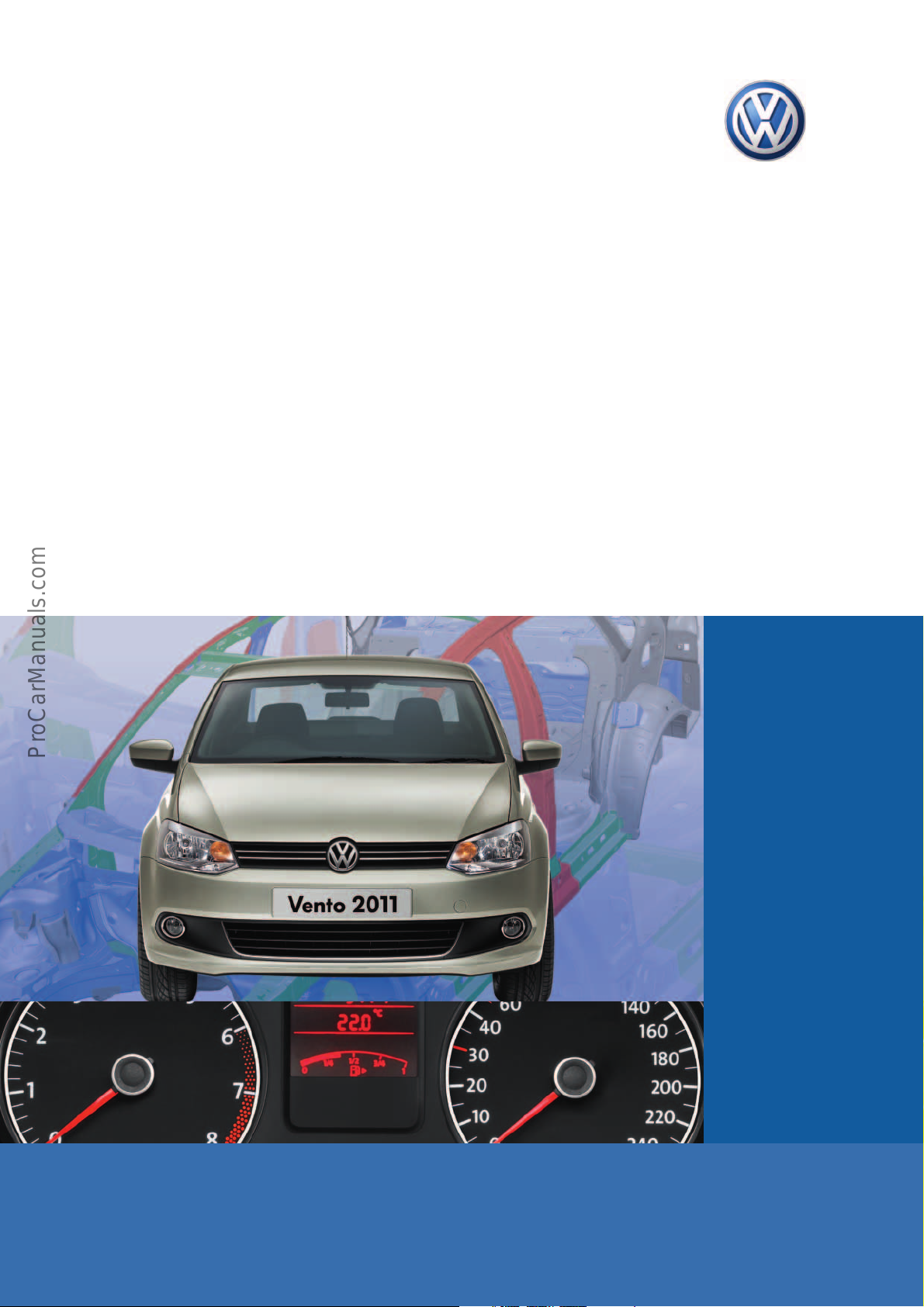
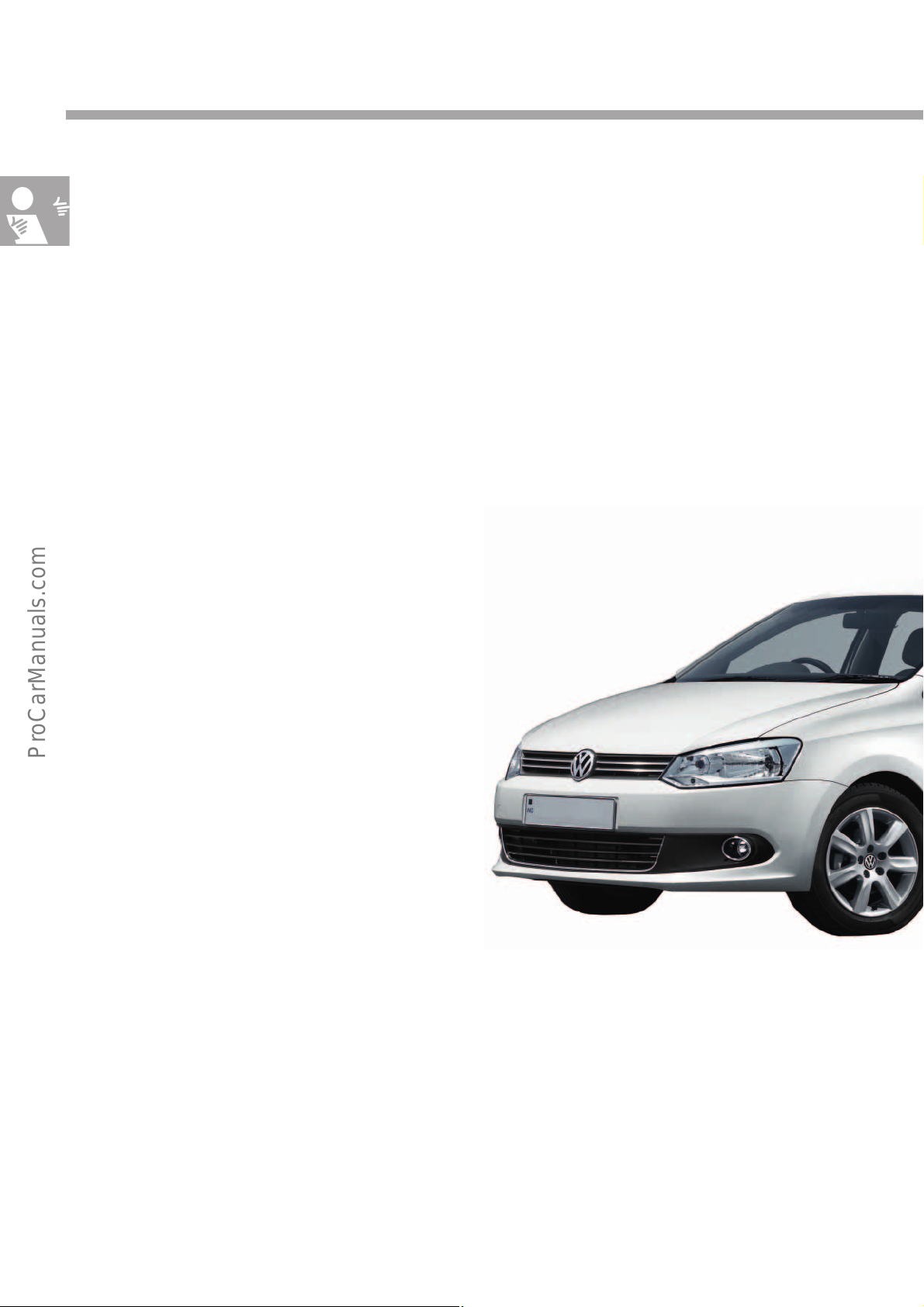
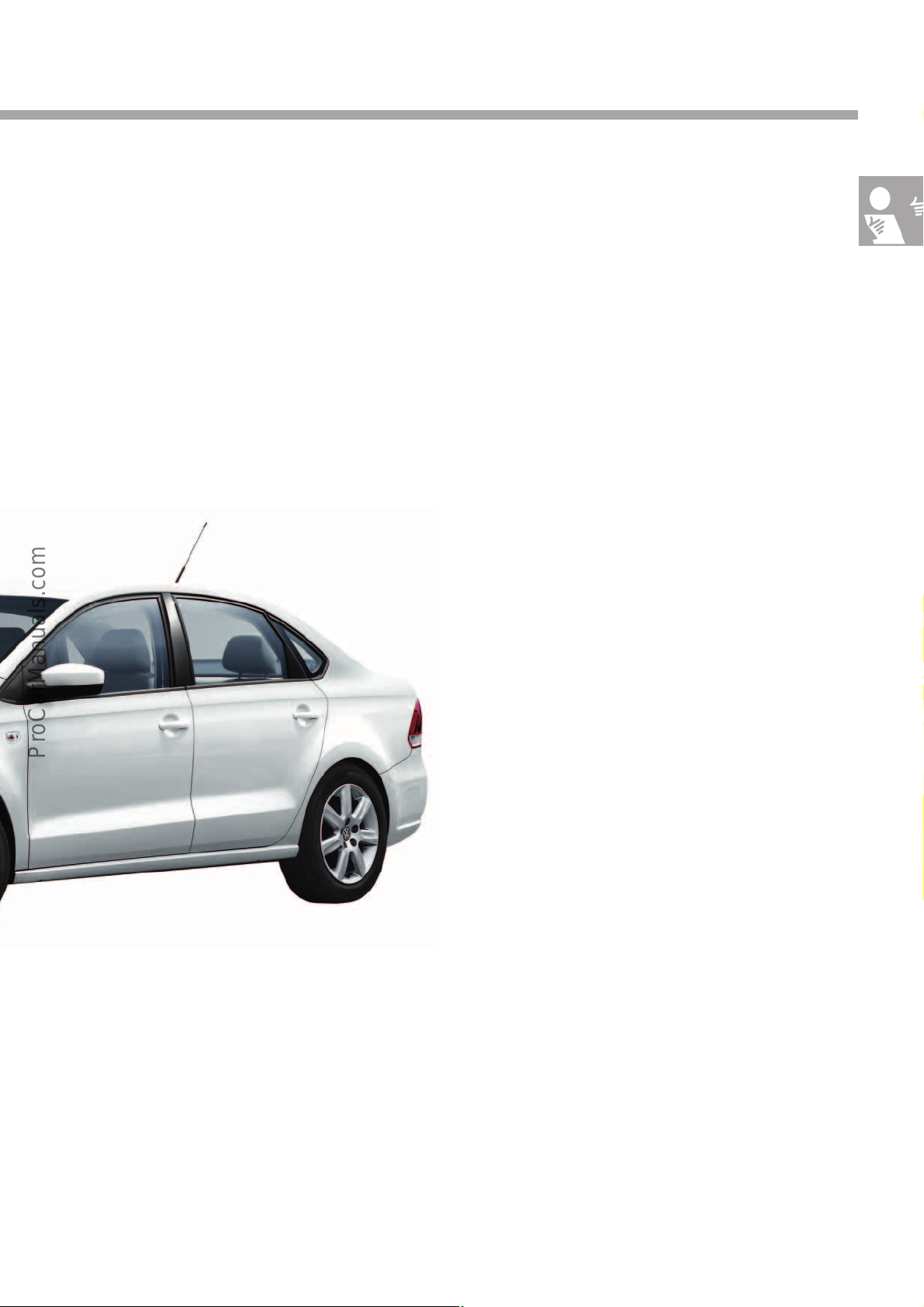
The Vento 2011 (India)
Page 2
This self-study programme provides you with an overview of the design and function of the new Vento, which is
destined mainly for the Asian market.
Self-study programmes support you in your daily work routine. They help you to understand technical correlations
better. Armed with this knowledge, you will be able to provide customers and colleagues with clear information.
In some of the chapters, you will find references to self-study programmes that deal in greater detail with with
design of individual vehicle components. These and other references are highlighted with a red exclamation mark.
Useful information about individual assembly groups can also be found in previous self-study programmes:
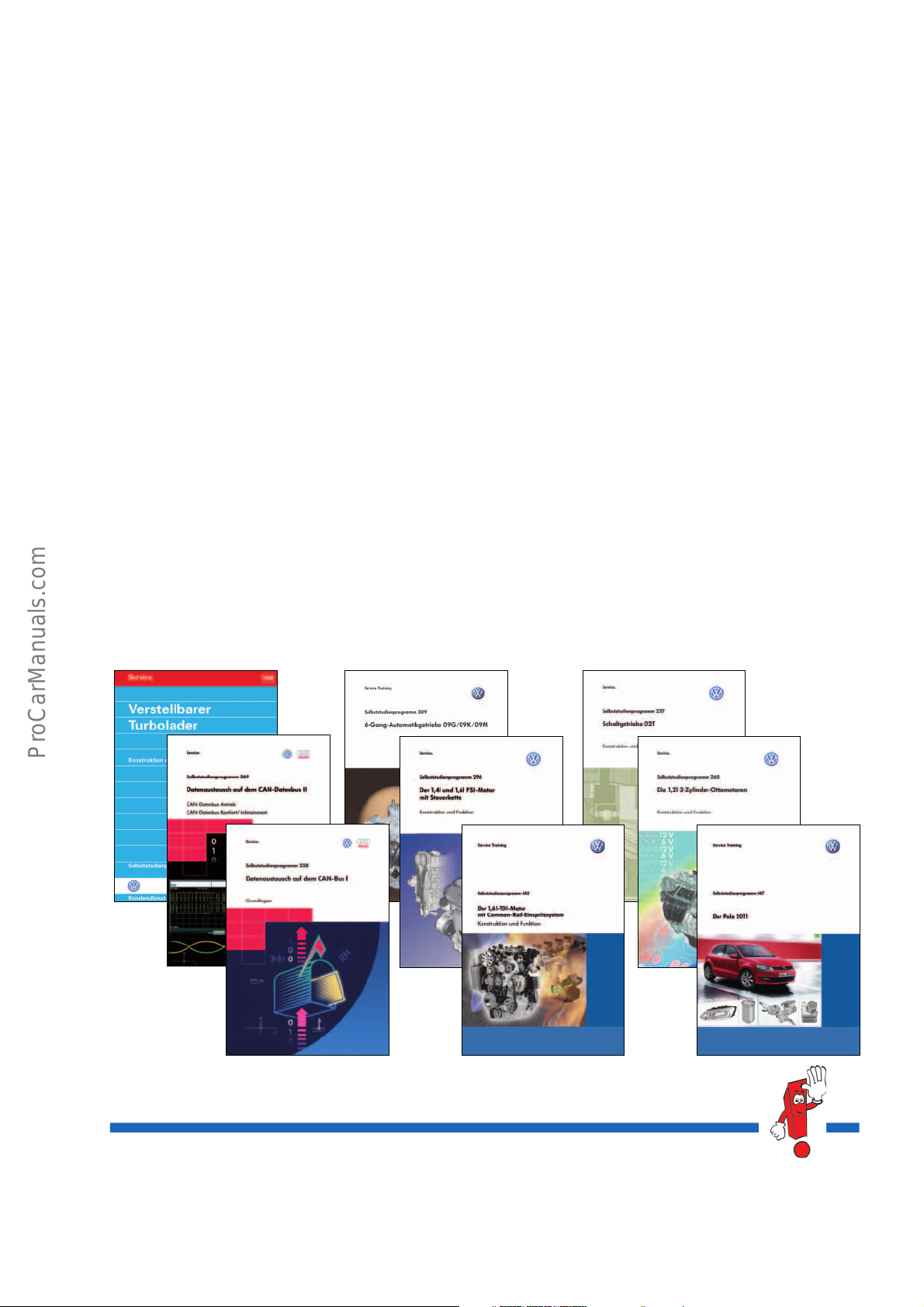
no. 447 "The Polo 2011", no. 190 "Adjustable turbocharger", no. 237 "Manual gearbox 02T", no. 238 "Data
exchange on the CAN bus I", no. 260 "The 1.2 ltr. 3-cylinder engines", no. 269 "Data exchange on the CAN
databus II", no. 296 "The 1.4 ltr. and 1.6 ltr. FSI engine with timing chain", no. 309 "6-speed automatic gearbox
09G/09K/09M" and no. 442 "The 1.6 ltr. TDI engine with common rail injection system".
S474_003h S474_003g
S474_003i
S474_003c
S474_003a
S474_003bS474_003j
S474_003fS474_003e
The self-study programme portrays the
design and function of new
developments.
The contents will not be updated.
For current testing, adjustment and repair
instructions, refer to the relevant service literature.
Attention
Note
2
Page 3

Contents
Introduction . . . . . . . . . . . . . . . . . . . . . . . . . . . . . . . . . . . . . . . . . . . . . . . . . . . . . 4
Body . . . . . . . . . . . . . . . . . . . . . . . . . . . . . . . . . . . . . . . . . . . . . . . . . . . . . . . . . 10
Occupant safety . . . . . . . . . . . . . . . . . . . . . . . . . . . . . . . . . . . . . . . . . . . . . . . . 22
Engines . . . . . . . . . . . . . . . . . . . . . . . . . . . . . . . . . . . . . . . . . . . . . . . . . . . . . . . 23
Power transmission . . . . . . . . . . . . . . . . . . . . . . . . . . . . . . . . . . . . . . . . . . . . . 30
Running gear . . . . . . . . . . . . . . . . . . . . . . . . . . . . . . . . . . . . . . . . . . . . . . . . . . 32
Electrical system . . . . . . . . . . . . . . . . . . . . . . . . . . . . . . . . . . . . . . . . . . . . . . . . 38
Convenience electronics . . . . . . . . . . . . . . . . . . . . . . . . . . . . . . . . . . . . . . . . . . 44
Radio . . . . . . . . . . . . . . . . . . . . . . . . . . . . . . . . . . . . . . . . . . . . . . . . . . . . . . . . . 46
Heating and air conditioning . . . . . . . . . . . . . . . . . . . . . . . . . . . . . . . . . . . . . 48
3
Page 4
Introduction
The Vento 2011
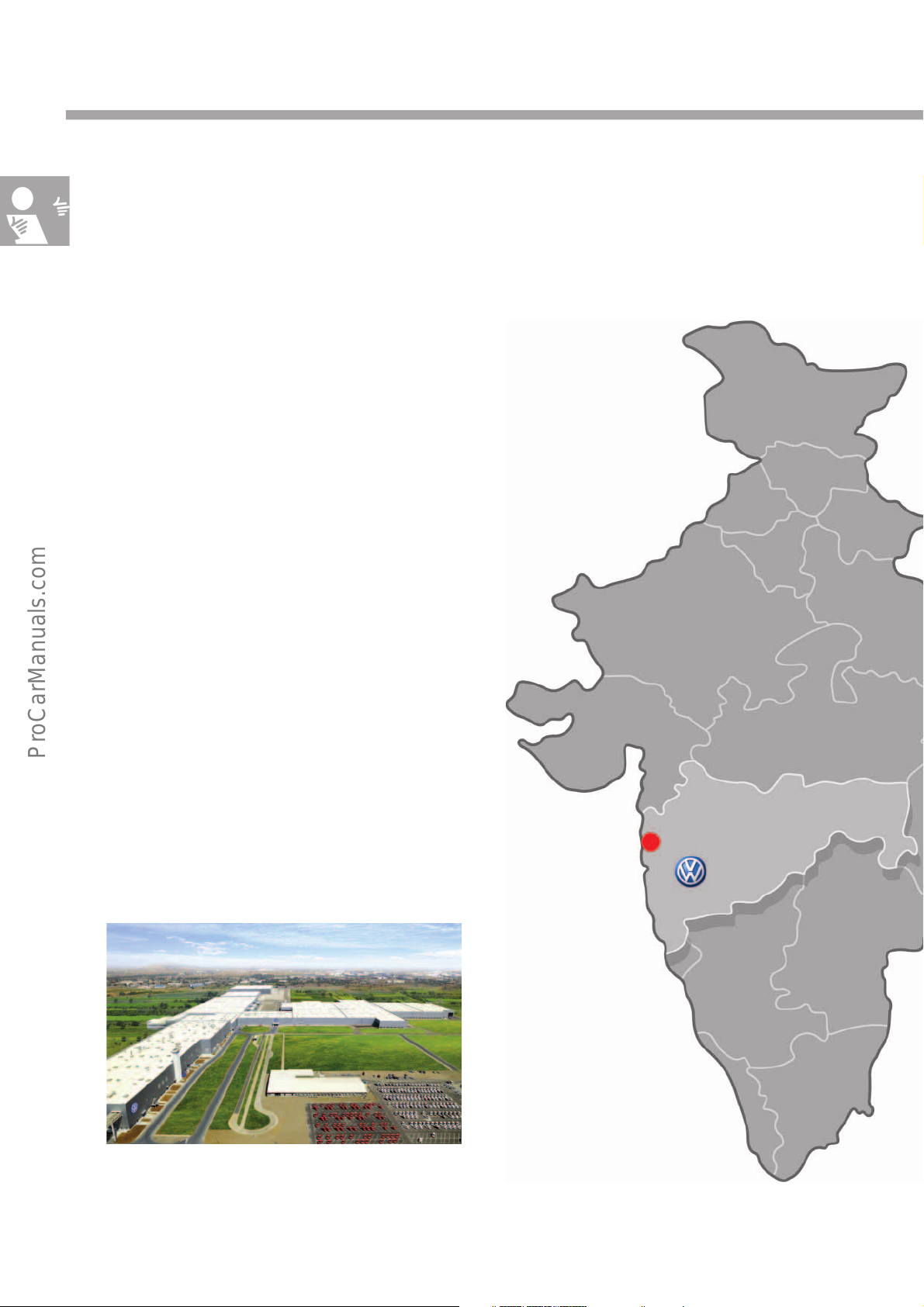
The new Vento is based on the Polo 2011 and is built at the Volkswagen Pune factory in India. The Pune factory is
one of Volkswagen Group's most modern production lines in the world.
Pune, India
The whole production programme comprises
complete manufacture from forming the panels to
constructing the body and final assembly.
The maximum annual capacity is designed to
accommodate up to 110,000 vehicles. Currently,
approx. 2,000 people are employed in Pune and they
also produce the Skoda Fabia among other things.
Since April 2009, the Polo is built here and since
August 2010 the new Vento is built here for the Indian
market.
Maharastra
Mumbai
Pune
S474_015
4
Page 5
S474_001
Among the biggest single investments were the
construction of a new paintshop, a new bodyshop
and a new assembly line for the Polo and the Vento.
A fully fledged automobile factory took shape with its
own logistics, quality assurance, Volkswagen
Academy and all of the associated areas.
S474_998
5
Page 6
Introduction
The Vento 2011
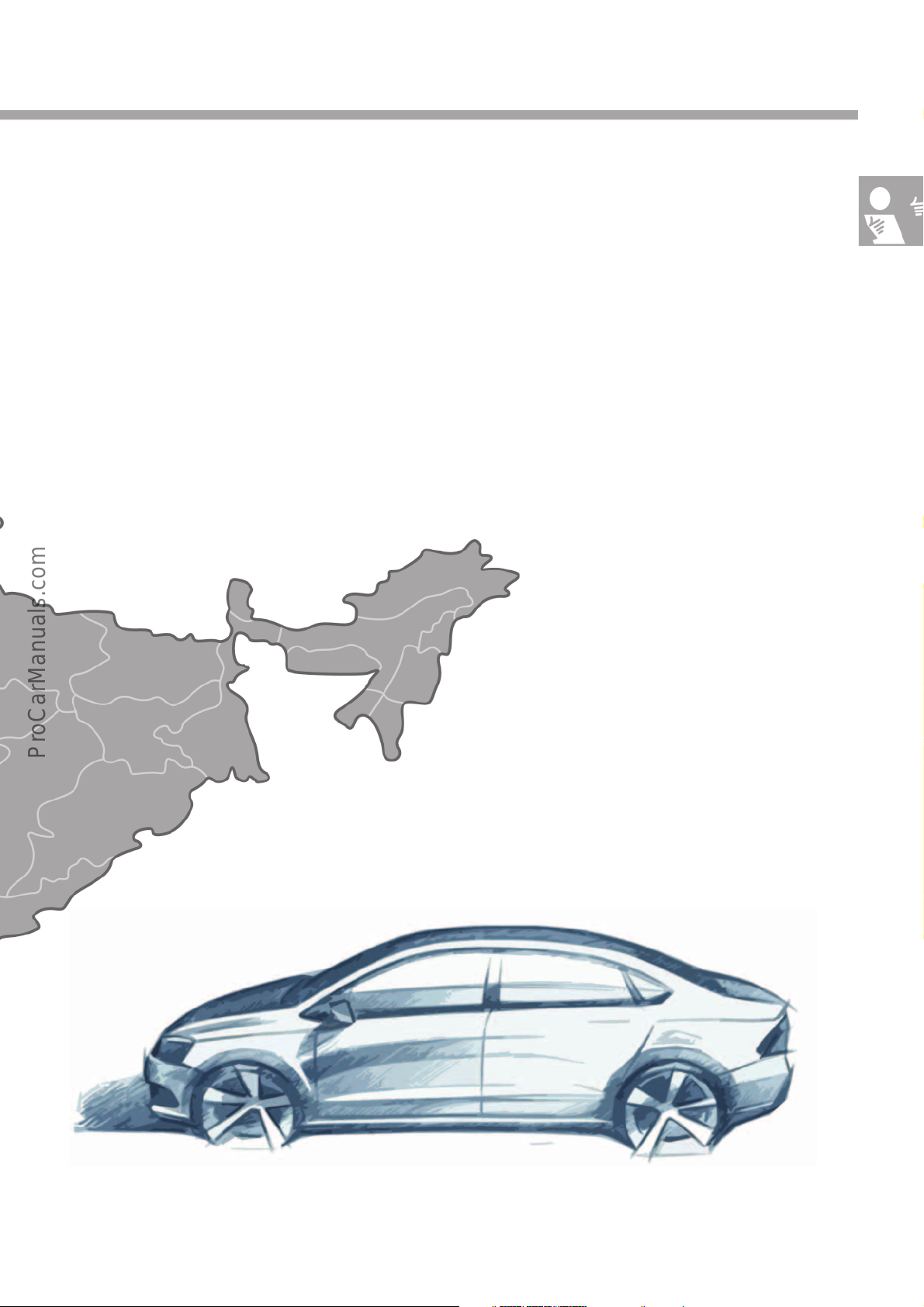
The Vento is the benchmark in the compact segment of the Indian car market. It is offered exclusively as a 4-door
version for model year 2011 and is based on the Polo 2011. The product properties of this new Volkswagen model
are as follows:
● Halogen H4 headlights with chrome-
plated bezel
● Dash panel insert
with 7" display
● Electro-mechanical power steering
(C-EPS)
● Braking system with ABS Bosch 8.2
(Highline equipment)
V
e
n
t
o
● Crash-optimised pedals and
crash-optimised steering column
6
Page 7
● Galvanised body elements
(6 year guarantee against rust perforation)
● 6-speed automatic gearbox 09G
(optional)
● Rear axle with
torsion beam design
S474_067
● Manual air conditioning as standard,
Climatronic (optional) at Highline equipment level
● Rear lid opening via remote release inside vehicle (switch in driver's door)
and mechanical release outside vehicle via lock cylinder
● Front disc brakes
7
Page 8
Introduction
Technical data
Exterior dimensions and weights
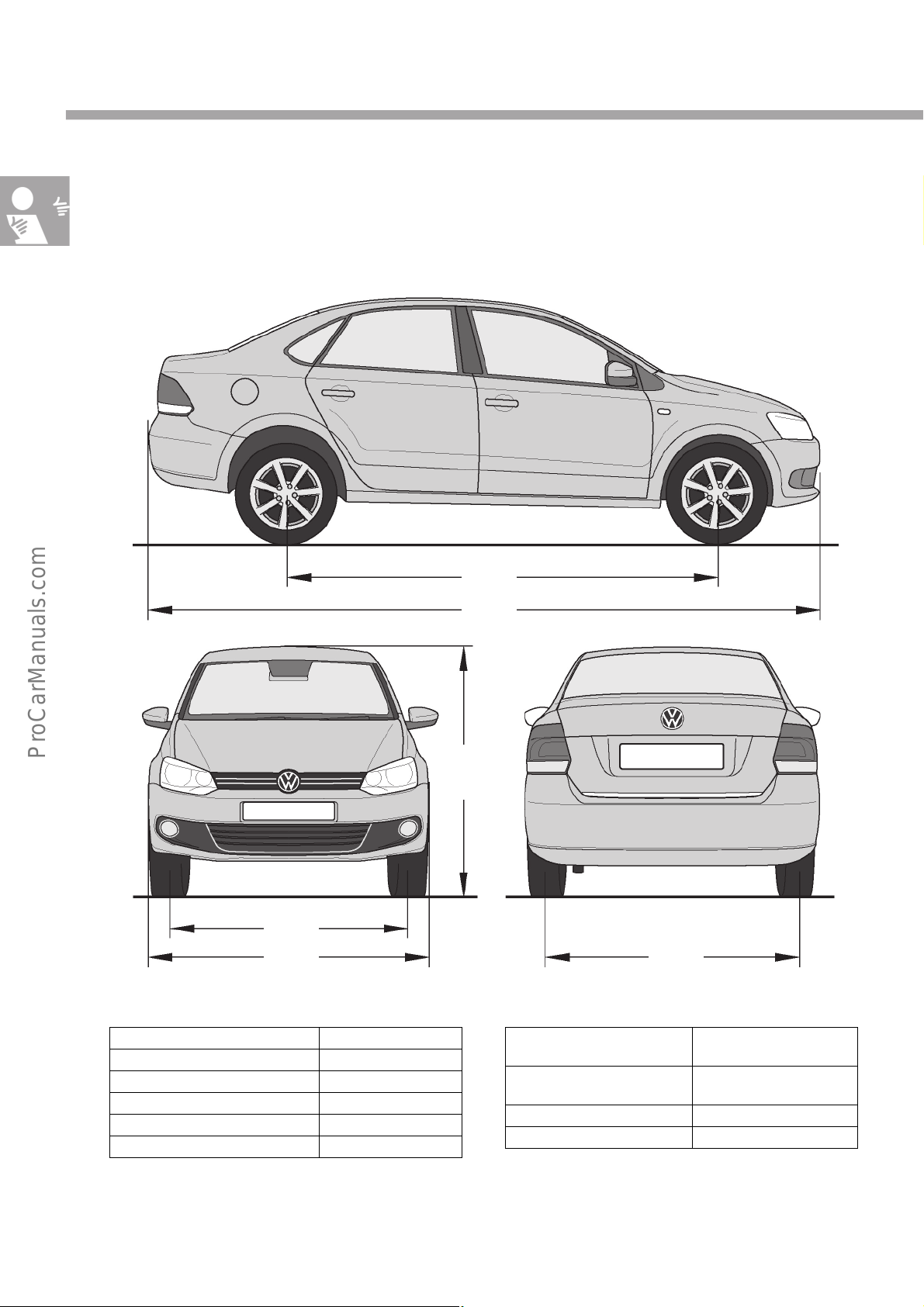
The diagram shows the exterior dimensions of the new Vento.
Exterior dimensions
Ven to
1460mm
1699mm
2552mm
4384mm
Ven to
1465mm
S474_306
1498mm
Weights and other data
Length 4384mm
Width 1699 mm
Height 1465mm
Wheelbase 2552mm
Front track width 1460mm
Rear track width 1498mm
8
Max. perm.
weight
Curb weight 1159kg/
Tank capacity 55litre
Drag coefficient 0,319c
1660kg/
1700kg (automatic)
1217kg (automatic)
w
Page 9
Interior dimensions
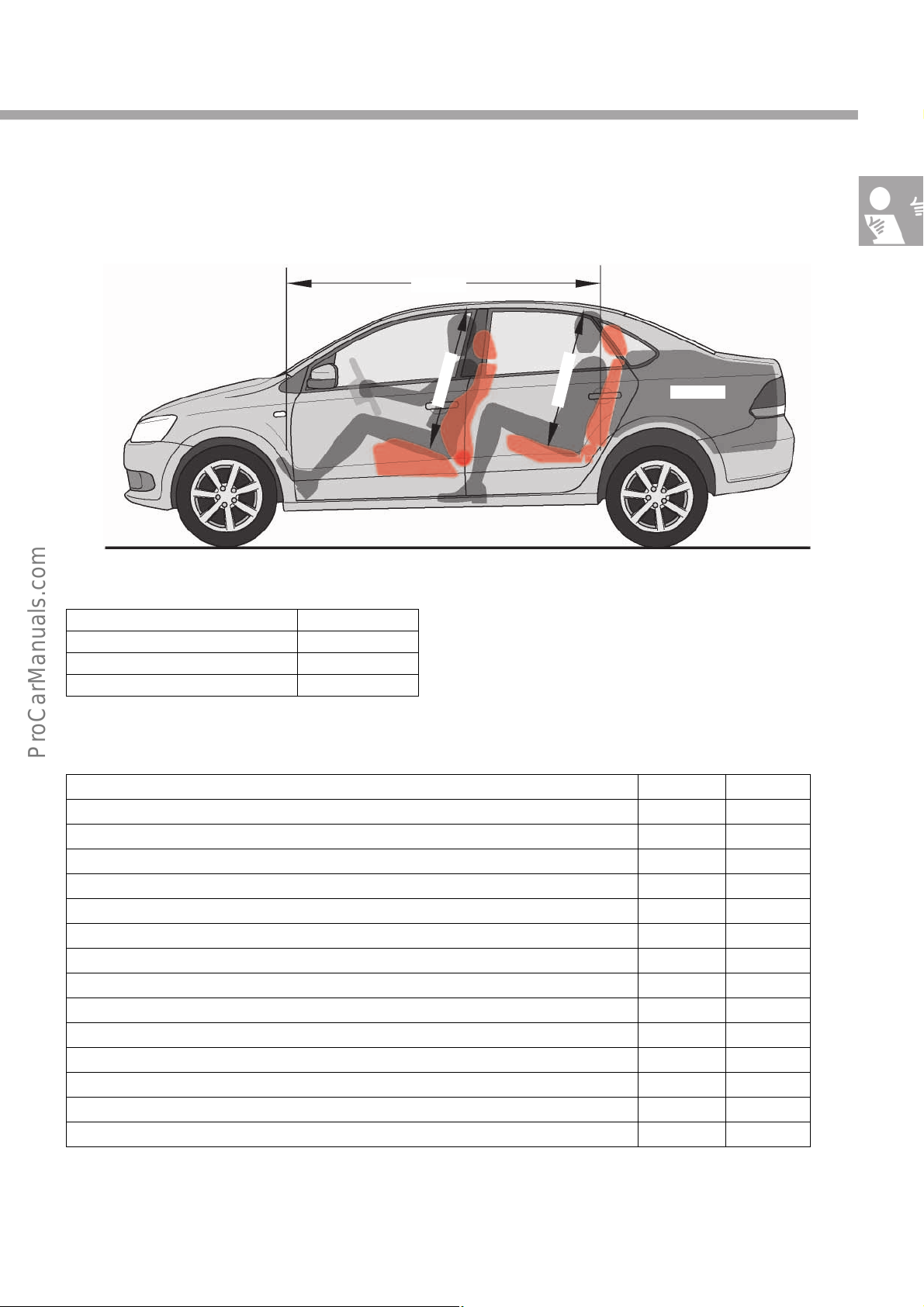
The diagram shows the interior dimensions, the seating positions and the boot of the new Vento.
1744mm
m
m
5
7
9
m
m
1
4
9
454 litres
Interior dimensions and volumes
Interior length 1744mm
Front headroom 975mm
Rear headroom 941mm
Boot volume 454 litre
The equipment lines
Equipment features* Trendline Highline
Manual air conditioning x
Radio preparation inc. 4 loudspeakers x
Electric window regulators at front and rear xx
Height adjustable driver's seat xx
Central locking, remote release of boot xx
Power steering (C-EPS) xx
Anti-lock braking system (ABS) x
Driver and front passenger airbag x
"India Top Power" radio x
Radio remote control x
Electric window regulators with rollback function x
Climatronic x
Anti-theft alarm system with interior monitoring x
Park distance control x
(*Excerpt)
S474_304
9
Page 10
Body
The body structure
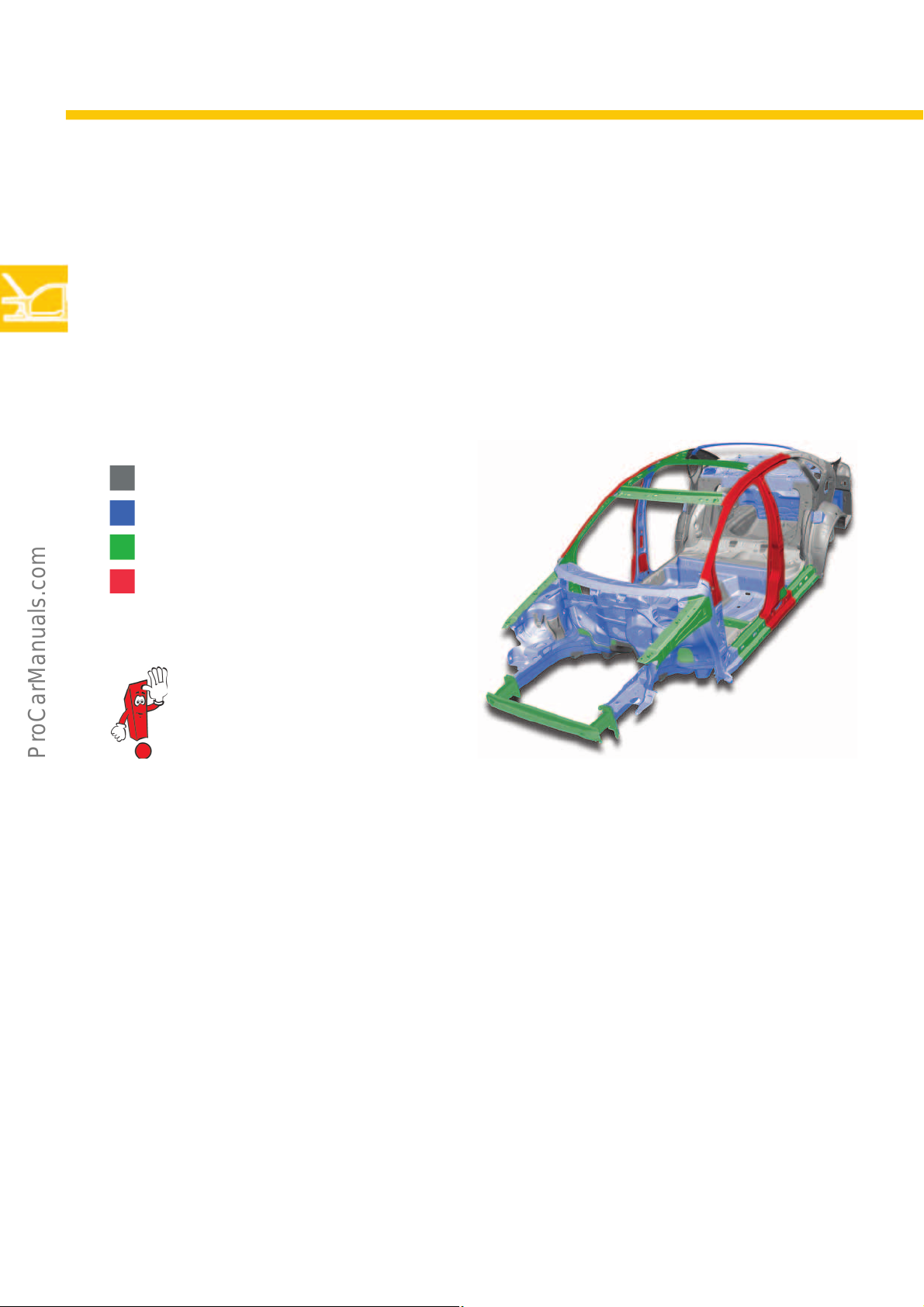
Up to the B-pillar, the new Vento is largely identical to the Polo 2011. All of the components have been designed
with function and load in mind in order to achieve an optimum level of strength and rigidity in the body.
Strength of steel panels
up to 140MPa
140-300MPa
300-1000MPa
over 1000MPa (thermally reshaped)
No roof load is permissible due to the roof
structure of the Vento.
Panel qualities
The body is galvanised in all corrosion-relevant areas
and comprises, for the main part, high tensile and
highest tensile steel panels. This means, for example,
that the front and rear side members, the B-pillars
and the floorpan plates on the front left and right are
made of this high tensile sheet metal.
S474_039
Thermally reshaped panels
Thermally reshaped steel panels are used for the Bpillar and in the body area bordering the A-pillar.
The strength of these components is achieved before
and after the thermal reshaping process by targeted
heat treatment in the manufacturing tool. Thermally
reshaped steel panels offer a higher tensile strength
at a lower weight than normal steel panels.
10
Page 11
Joining process
In addition to classic resistance spot welding, the following joining processes are employed on the bodyshell of the
Ven to :
● Spot welding
● Adhesive bonding
● MIG brazing
● Laser brazing
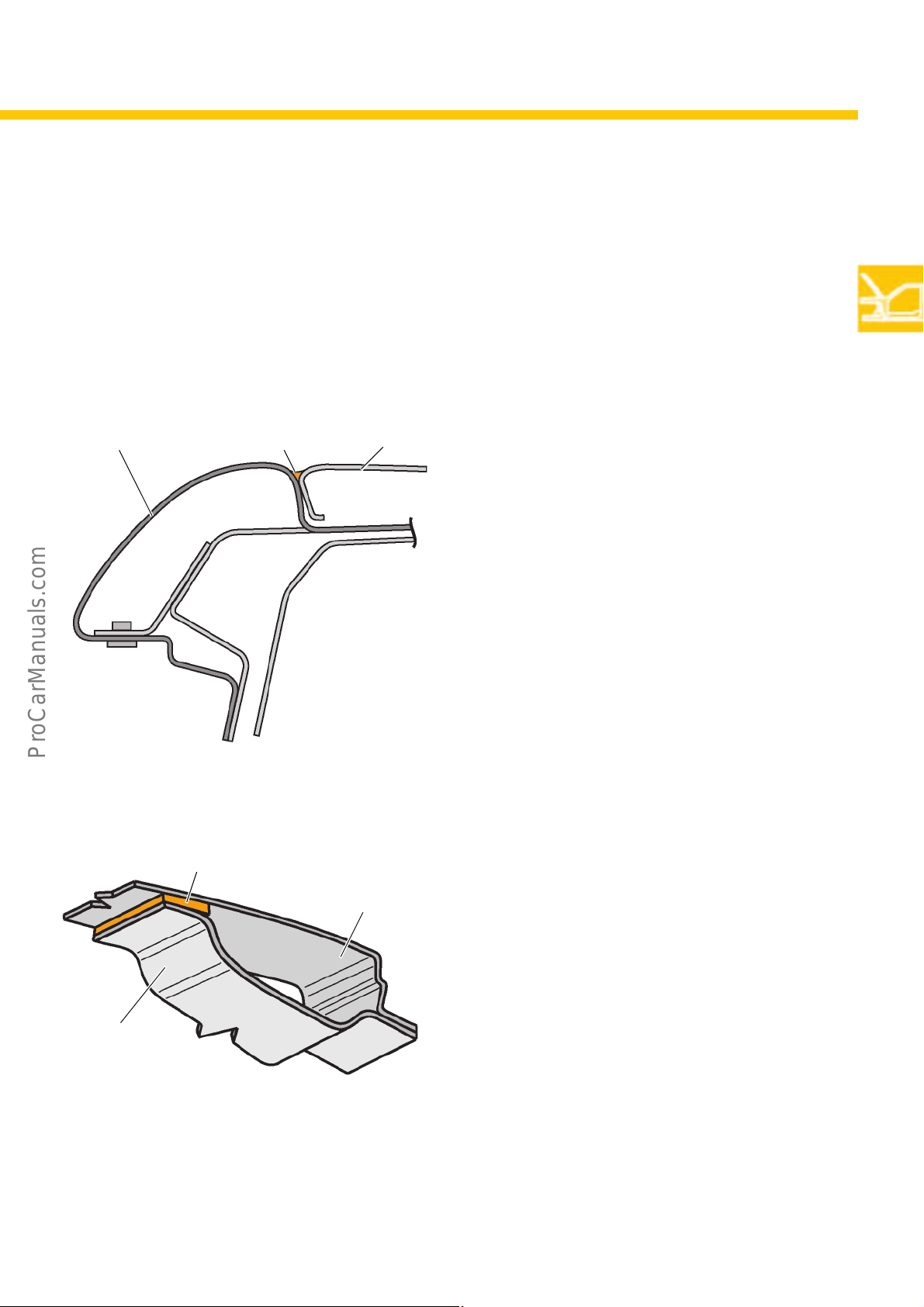
Laser brazing
Side panel
Laser brazed seam
Roof
The Pune factory is a keen proponent of laser brazing
technology for the production of bodyshells for the
new Vento. In the roof and side panel area and also
in the rear lid area, the body components are joined
by a laser brazed bond.
Laser brazing technology increases the quality of
manufacturing and the body by reducing the
welding surface, thereby reducing inherent panel
deformation.
This improves body stability considerably.
Adhesive bonding
Inner skin
S474_020
Outer skin
S474_140
Adhesive bonding
A new bonding process is employed on the bonnet
and rear lid of the Vento. The panels (outer skin and
inner skin) are joined using an adhesive bond.
Advantages:
● Consistent appearance
● Low cost procedure
11
Page 12
Body
Bumpers
The bumpers of the Vento are completely colour coded to the vehicle. They are airflow-optimised body elements in
an area of the vehicle close to the ground. Thanks to this, air flows along the underside with little swirl, dispensing
with the need for a PVC underbody shell. In this way, the weight of the vehicle was further reduced.
Together with the airflow-optimised body upper structure, the Vento thereby has a coefficient drag factor (cd value)
of just 0.319, which can be considered good for its class.
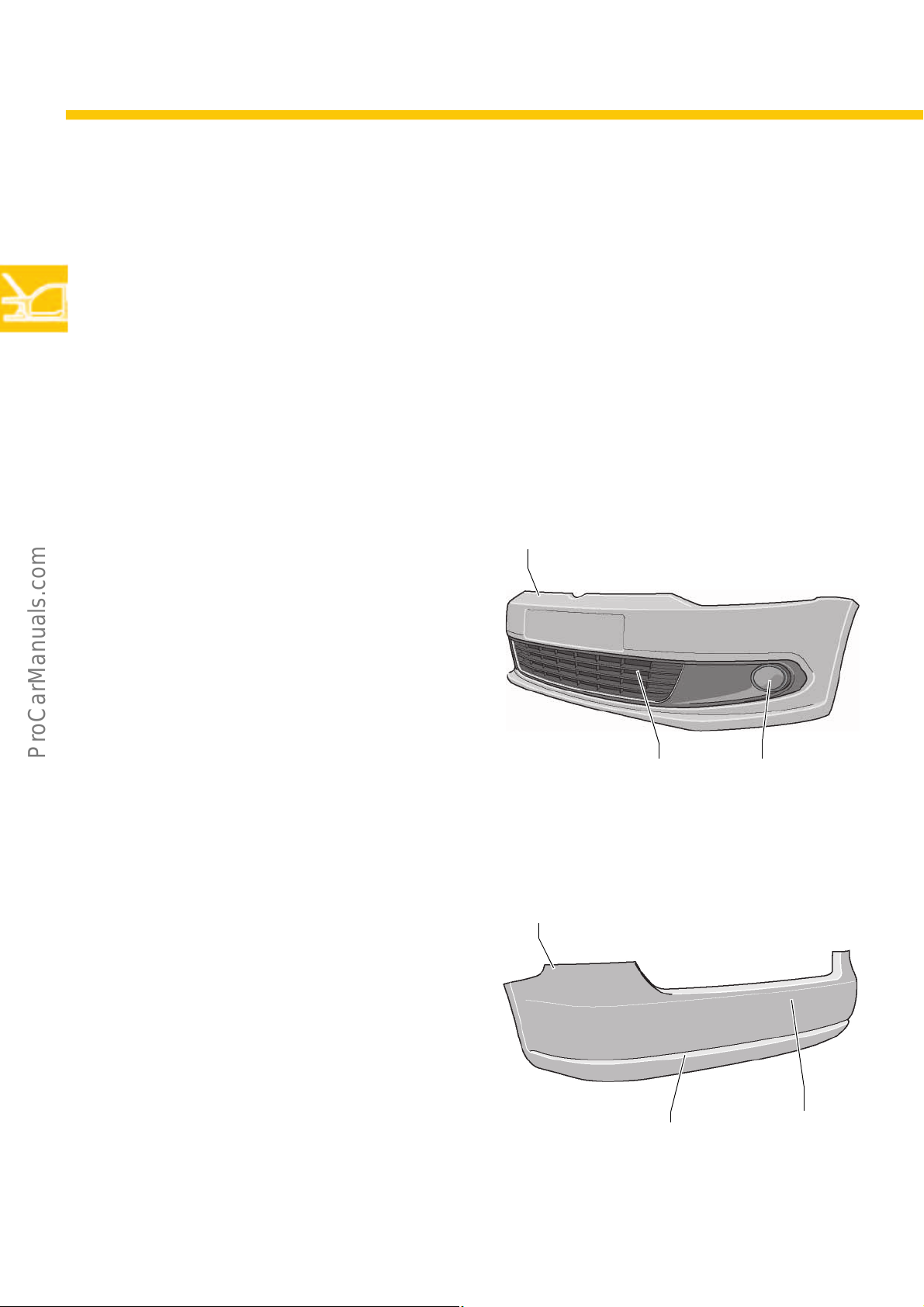
Front
The front bumper is made up of the following
components:
● Bumper cover
● Towing eye cap
● Blanking plate (fog lamps)
● Radiator grille
● Vent grille
● Bumper carrier (inner)
Rear
The rear bumper comprises the following
components:
Bumper cover
S474_118
Vent grille Blanking plate
(fog lamp)
Bumper cover
12
● Bumper cover (one-piece)
● Lower spoiler, integrated in bumper cover
● Bumper carrier (inner) moulded foam design
S474_116
Integrated spoiler
Moulded foam
(inner)
Page 13
Crash safety
The following deals with design measures pertaining to crash safety. These measures affect, among other things:
● the steering
● the pedals
● the side impact protection
Steering
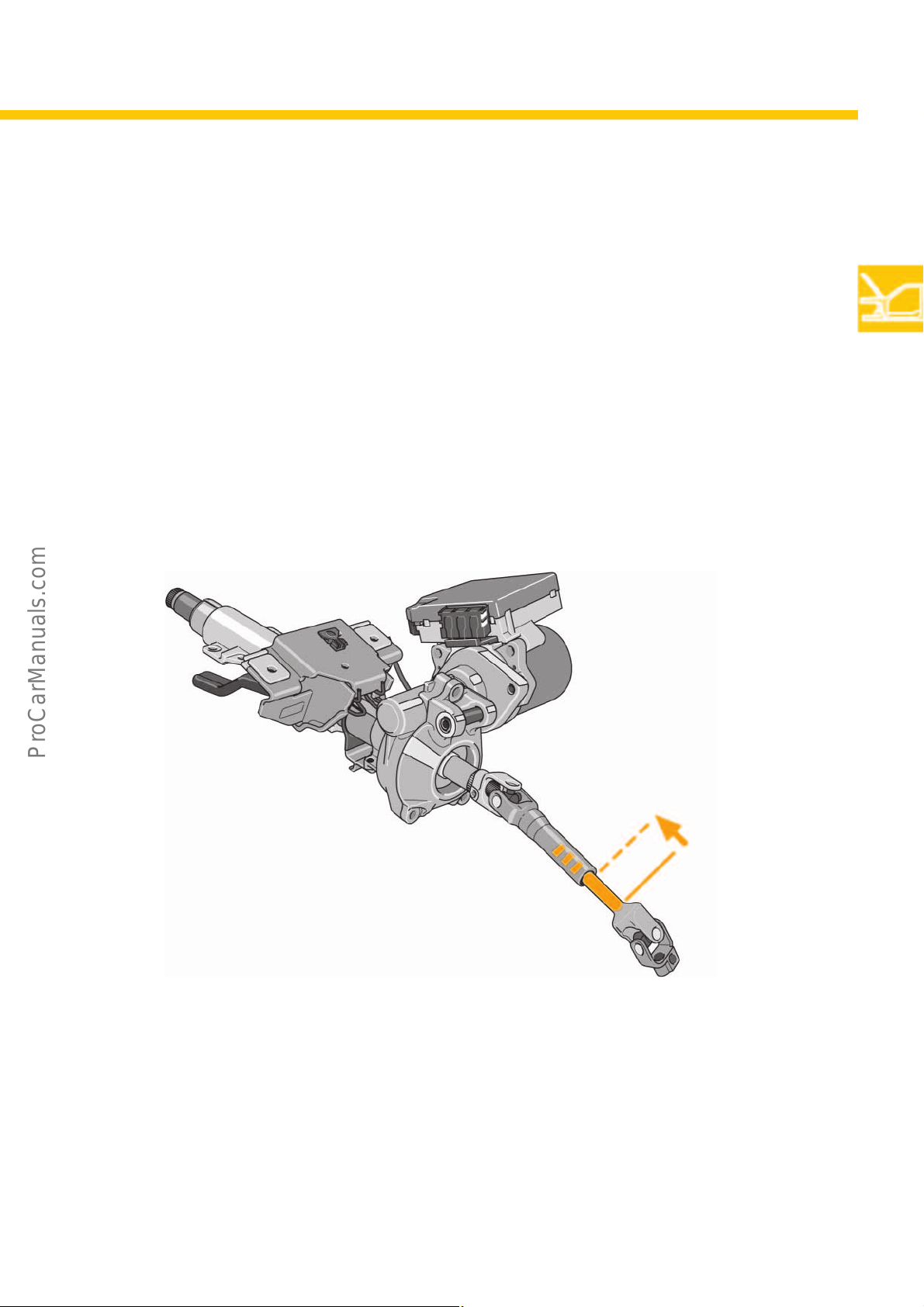
The steering column has a telescopic rod design in the bottom section. This area represents the collapsible part
shown in the diagram. In the event of a severe frontal collision, the steering column collapses and does not
penetrate further into the passenger compartment.
S474_090
Collapsible part of steering column
13
Page 14
Body
Foot pedal cluster
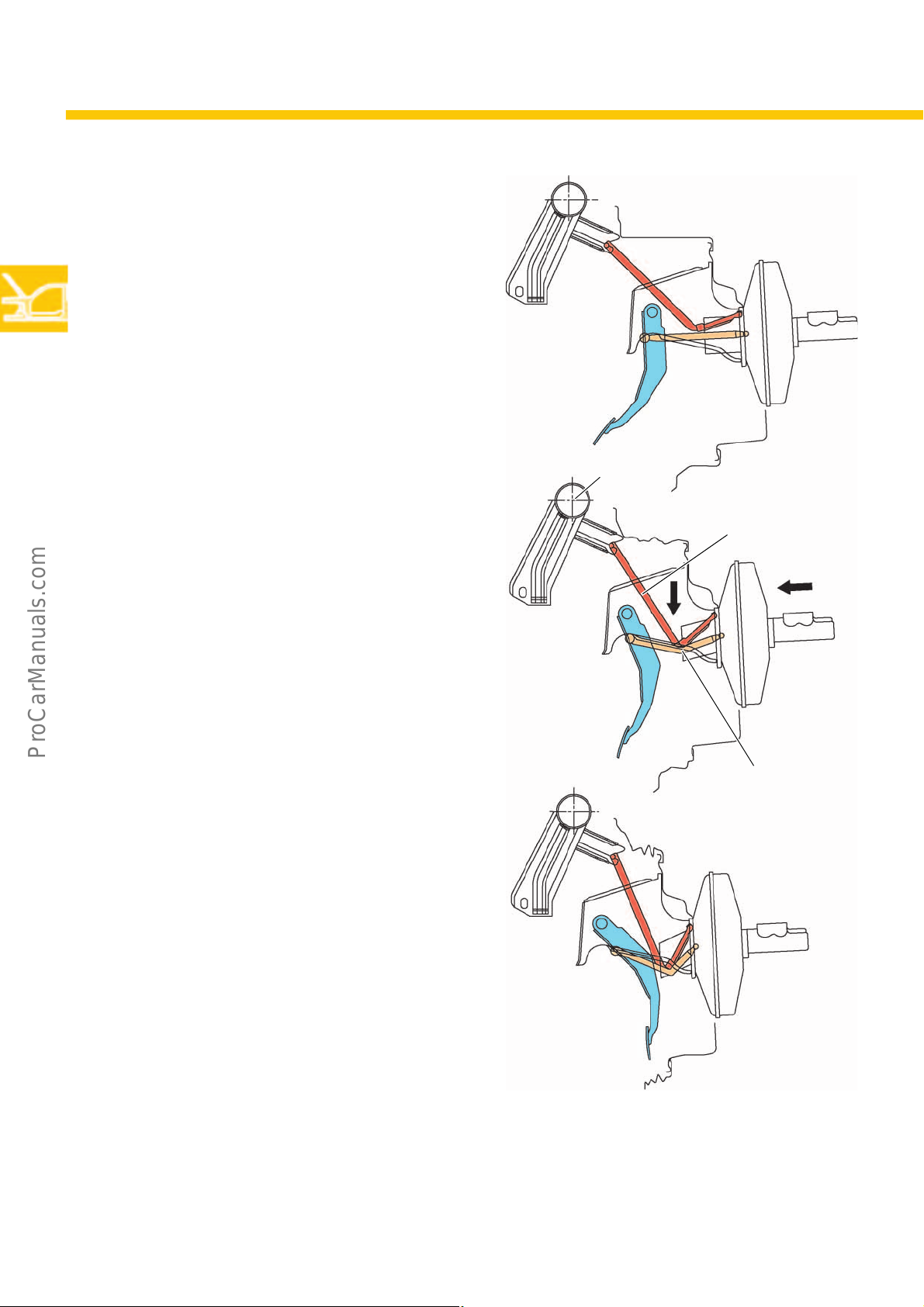
In severe frontal collisions with major deformation of
the vehicle structure, the brake pedal is pivoted out of
the foot area by a bending strut.
This function is determined by deformation of the
bulkhead. The actuation position of the brake pedal is
irrelevant.
In a front collision, the foot pedal cluster is pushed
towards the central pipe. This results in deflection of
the bending strut, which in turn causes the piston rod
to bend.
Central pipe
Bending strut
The pedal foot plate is pushed away up to max.
170mm. The bending of the piston rod and
consequent altering of the shape means that the risk
of feet becoming trapped by the pedal in an accident
is reduced.
Piston rod
S474_006
14
Page 15
Side impact protection
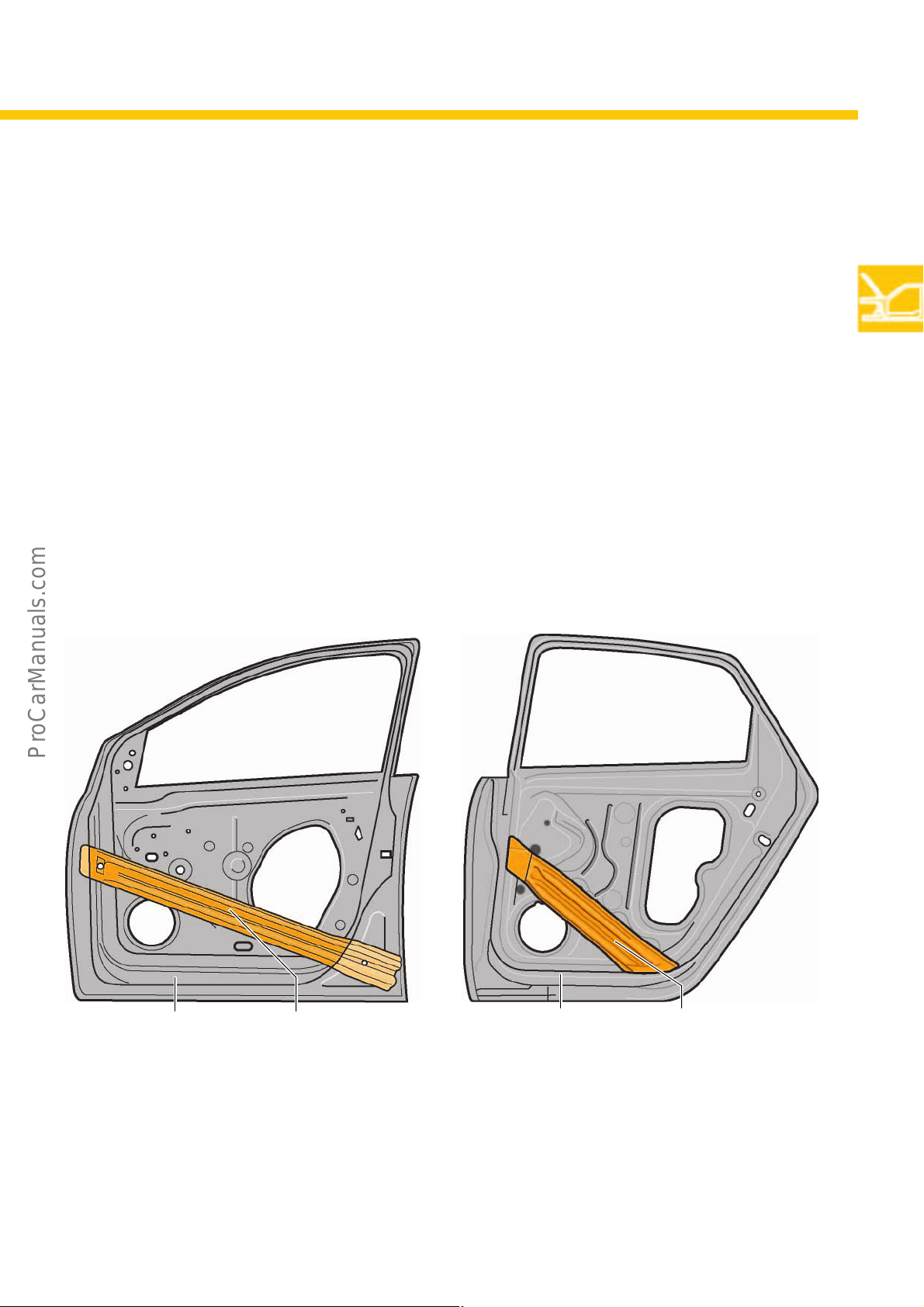
The side impact protection carriers are made of high tensile steel and are fitted diagonally in the doors.
These bend upwards or downwards in the event of frontal or rear-end collision and do not intrude into the A,
B and C-pillar. This eases access for rescue and recovery teams as the doors are not blocked by the side impact
protection.
The diagonal layout of the side impact protection increases the coverage. This means that in the event of an
accident with side impact, the side impact protection is hit even at different crash heights. This absorbs the energy
of the impact and transmits it to the side of the body.
Rear doorFront door
S474_130
Door frame
Side impact protection
cross member
Door frame
Side impact protection
S474_318
cross member
15
Page 16
Body
The headlight modules
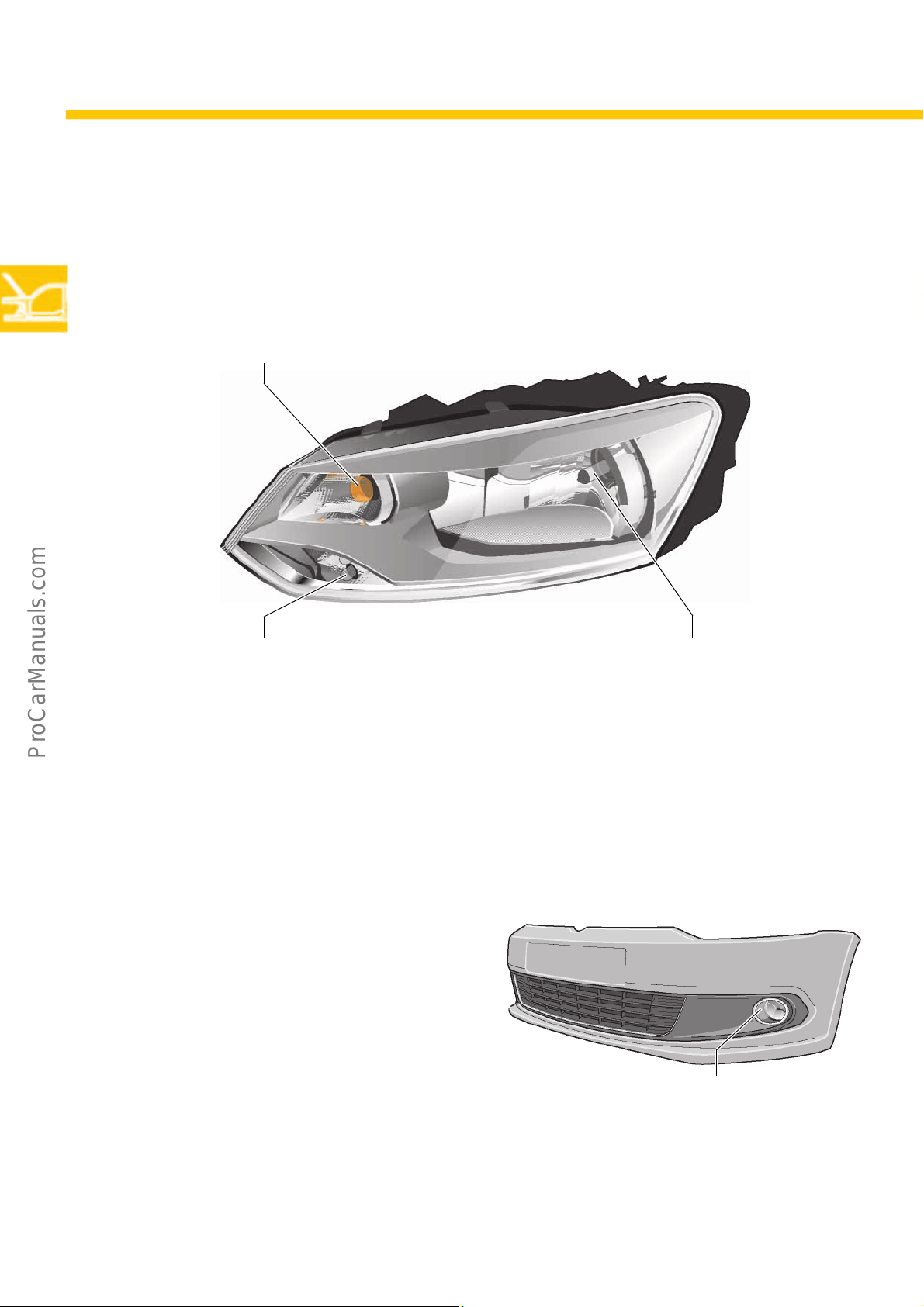
A H4 headlight is fitted as standard. This headlight is distinguished by good exploitation of the light source and a
sturdy design. The headlight modules feature a turn signal, side light, dipped beam and main beam. An additional
turn signal (or side repeater) is located in the wing on each side.
Turn signa l (21 W)
Side light (5W)
For the Vento, the headlight modules are installed with chrome-plated bezels. The headlight design features
clear-lens technology. The bulbs are connected to the reflector via a metal bar attachment.
The fog lights
The Vento can be equipped as an option with front
fog lights. These are located on the left and right in
the bumper cover.
S474_042
Dipped beam (55W)
Main beam (60W)
16
Front fog light (51W)
S474_118
Page 17
The tail lights with shutter
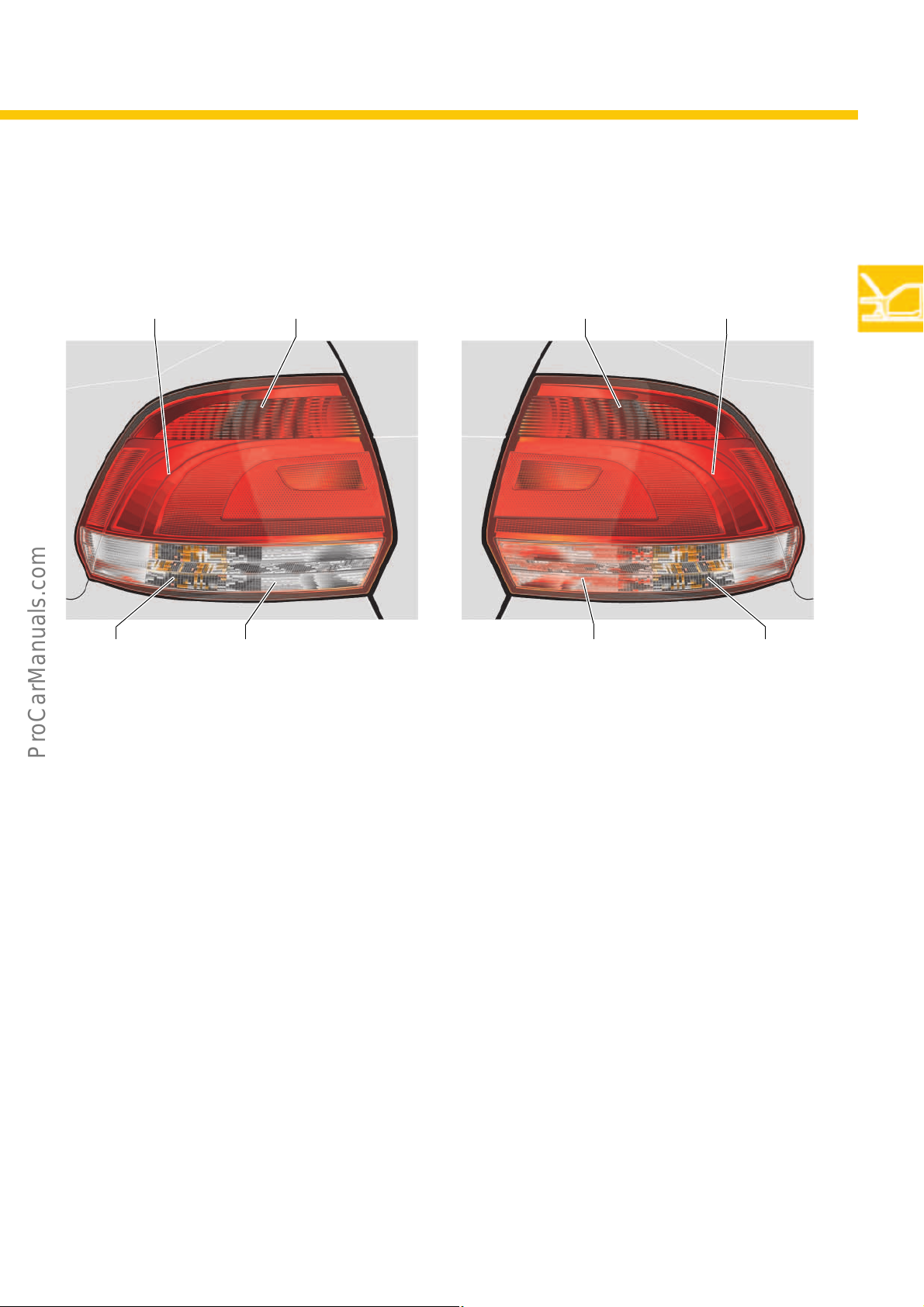
Left tail light Right tail light
Turn signa l
(21W)
Reversing light (21W)
The tail lights have a one-piece design.
The light incorporates:
● Tail light
● Brake light
● Turn sig nal
● Rear fog light (right)
● Reversing light (left)
● Reflector
Brake light (21W)Tail light (5W)
S474_038
S474_040
Brake light (21W) Tail light (5W)
Rear fog lamp (21W)
Turn s i gnal
(21W)
Replacing bulbs
To access the bulbs, the light must be removed. This is
done by removing a central screw behind the luggage
compartment trim and subsequently disconnecting the
bulb carrier.
17
Page 18
Body
The anti-theft protection
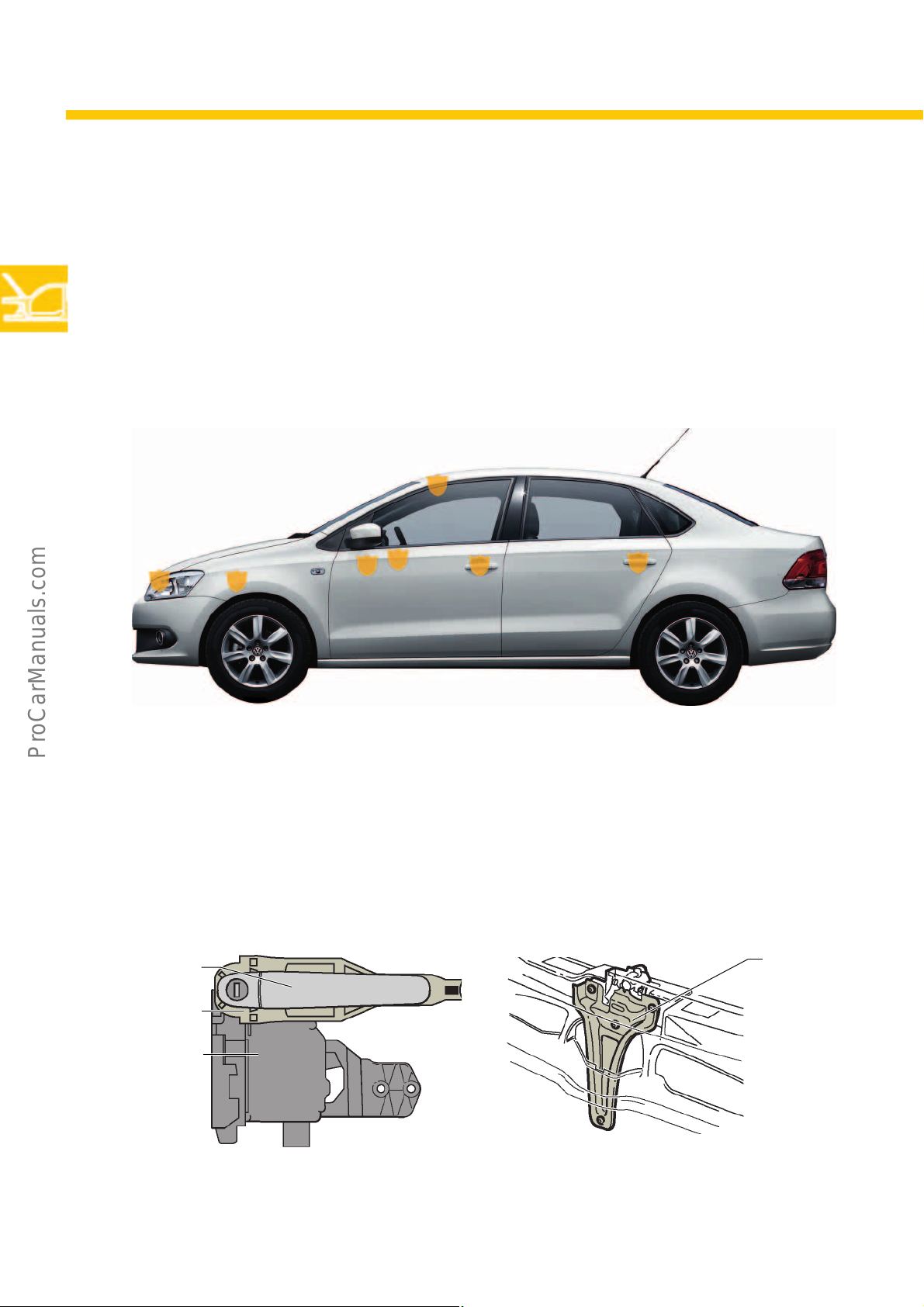
The following deals with design measures pertaining to anti-theft protection.
Among these measures are:
1 - Cover for bonnet catch
2 - 4th generation electronic immobilizer
3 - Slip coupling on steering column
4 - Lock cylinder freewheel for steering column
lock
4
1
2
3
5 - Anti-theft alarm system with interior monitoring
6 - Lock cylinder freewheel for exterior door
handles
7 - Encapsulated interior door locks with inner
profile key
5
6
7
S474_069
The door lock
The door lock is encapsulated and behind the door
handle is a metal plate. These measures prevent
penetration and levering up of the door handle in this
area.
Door handle
Metal plate
Lock
S474_012
The front cover
A cover for the bonnet catch inhibits unauthorised
access to the engine compartment.
Cover
S474_013
18
Page 19
The interior equipment
Stowage compartments
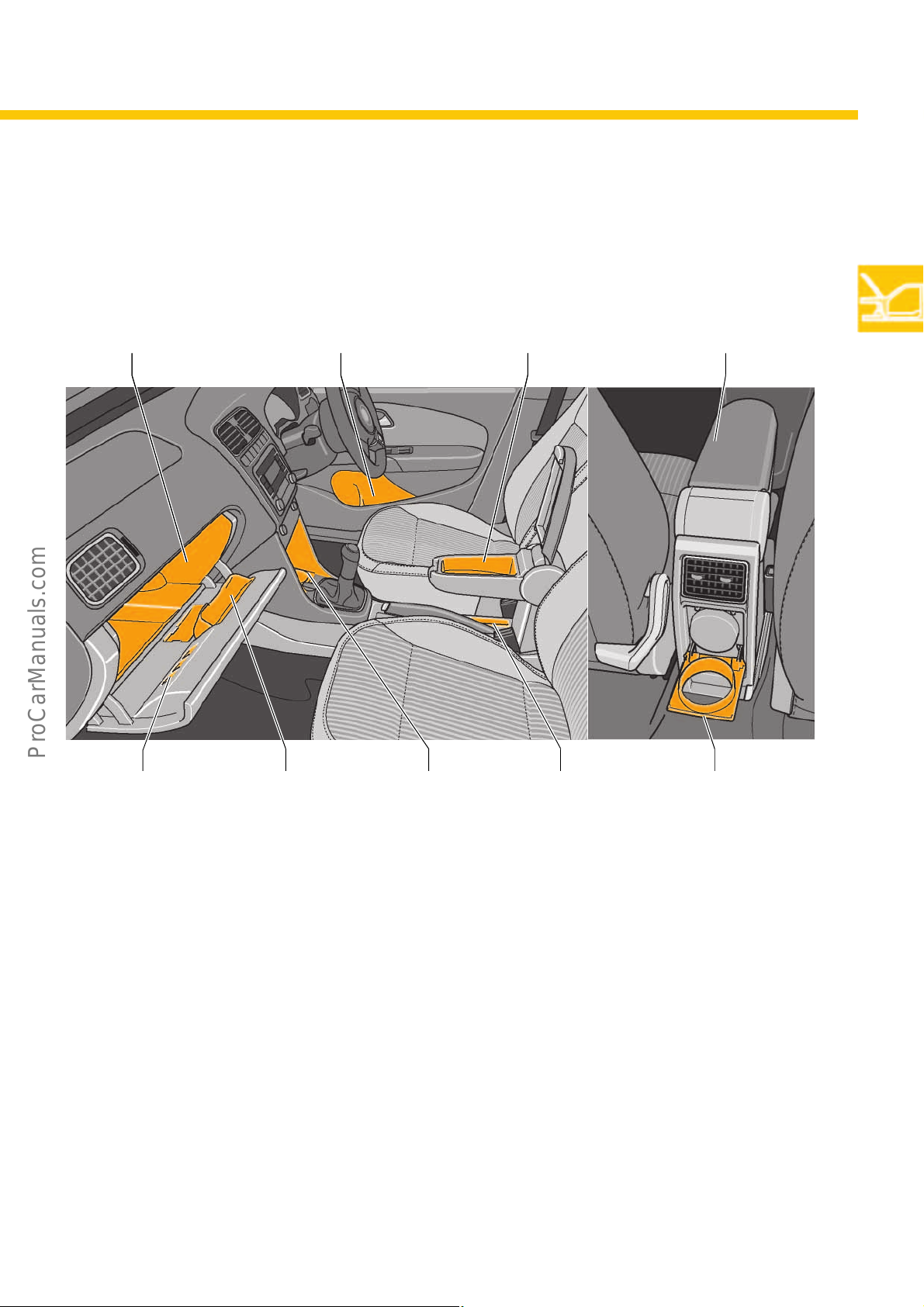
There are many multifunctional stowage compartments inside the Vento:
Glove compartment
S474_310
Side compartment
with bottle holder
Compartment
in centre armrest
Folding
padding
S474_312
Glasses trayCompartment for coins
and card-holder
Compartment
with ashtray
Front and in doors
Located in the centre console are two compartments
as standard with round openings for cans/bottles. On
the smoker's version, there is also a removable round
ashtray included. In the lid of the glove compartment
are separate compartments for sunglasses, coins and
a cardholder. Moulded into the door trim panels are
stowage compartments and bottle holders with 1 L
capacity in- the front and 0.5 L in the rear.
Pen holder
Drinks holder
for rear area
In the centre armrest
The Vento features a centre armrest for the driver asstandard. In the centre armrest, beneath the hinged
padded top, there is an additional stowage
compartment. Under this rest are compartments for
pens/pencils. On the rear of the rest there is a drinks
holder for the rear area. This drinks holder can be
folded out from top to bottom.
19
Page 20
Body
Luggage compartment
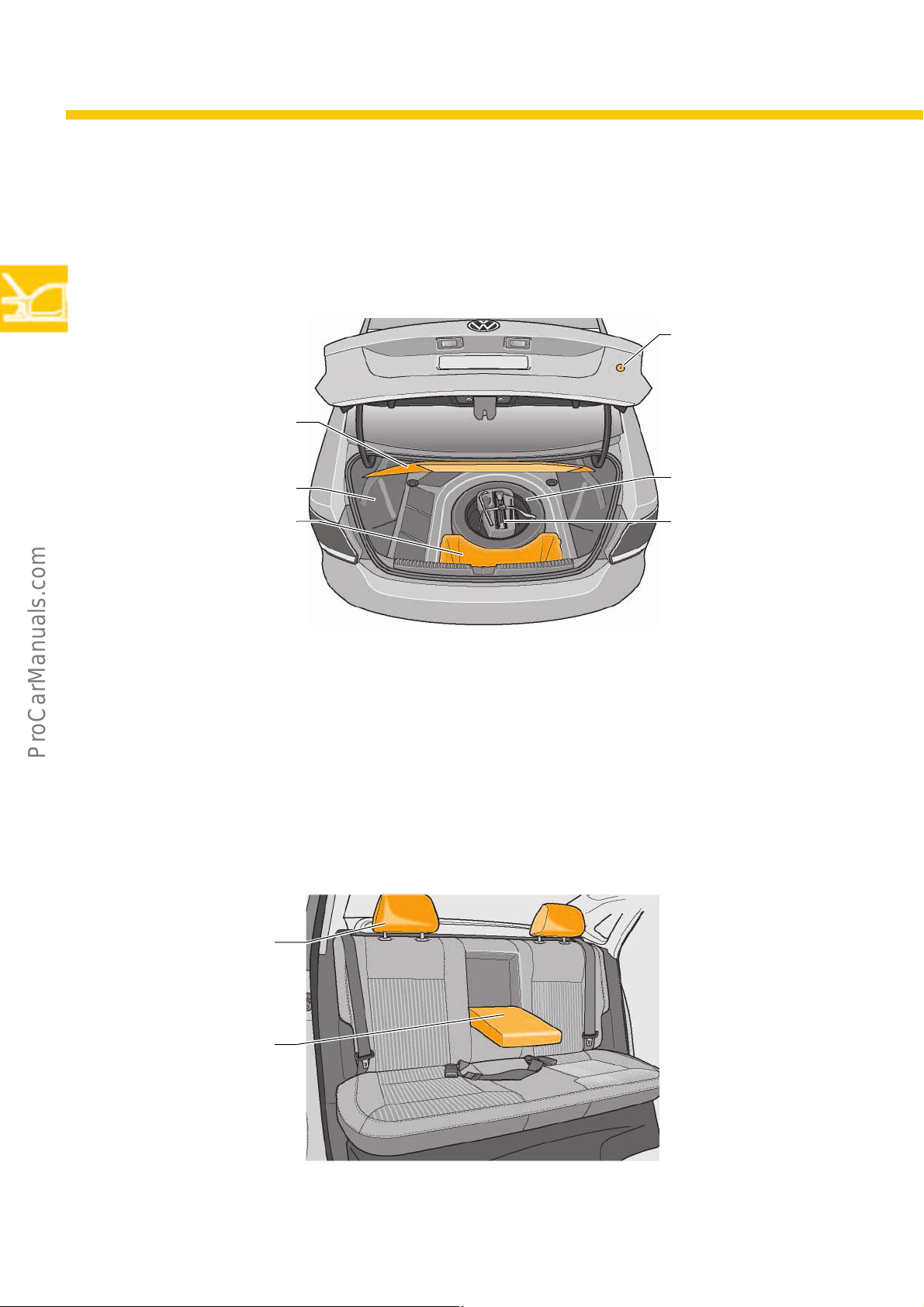
The volume of the boot space is 454 litres. Under the floor covering of the boot space is the spare wheel well. In the
spare wheel well is a removable box, vehicle tools, warning triangle, first aid box, replacement bulbs and a normal
spare wheel.
Lock cylinder
Boot floor cover
Spare wheel
Luggage compartment
Spare wheel
Removable box
(bottom part of boot floor)
The seating concept
Rear seats
The rear seats of the Vento form one complete and fixed system that cannot be folded. The head restraints on the
left and right are height adjustable. A centre armrest is available as an option on the Trendline equipment version
and is standard on the Highline version.
Head restraints
Vehicle tools
S474_300
20
Folding armrest
(optional)
S474_065
Page 21
Front seats
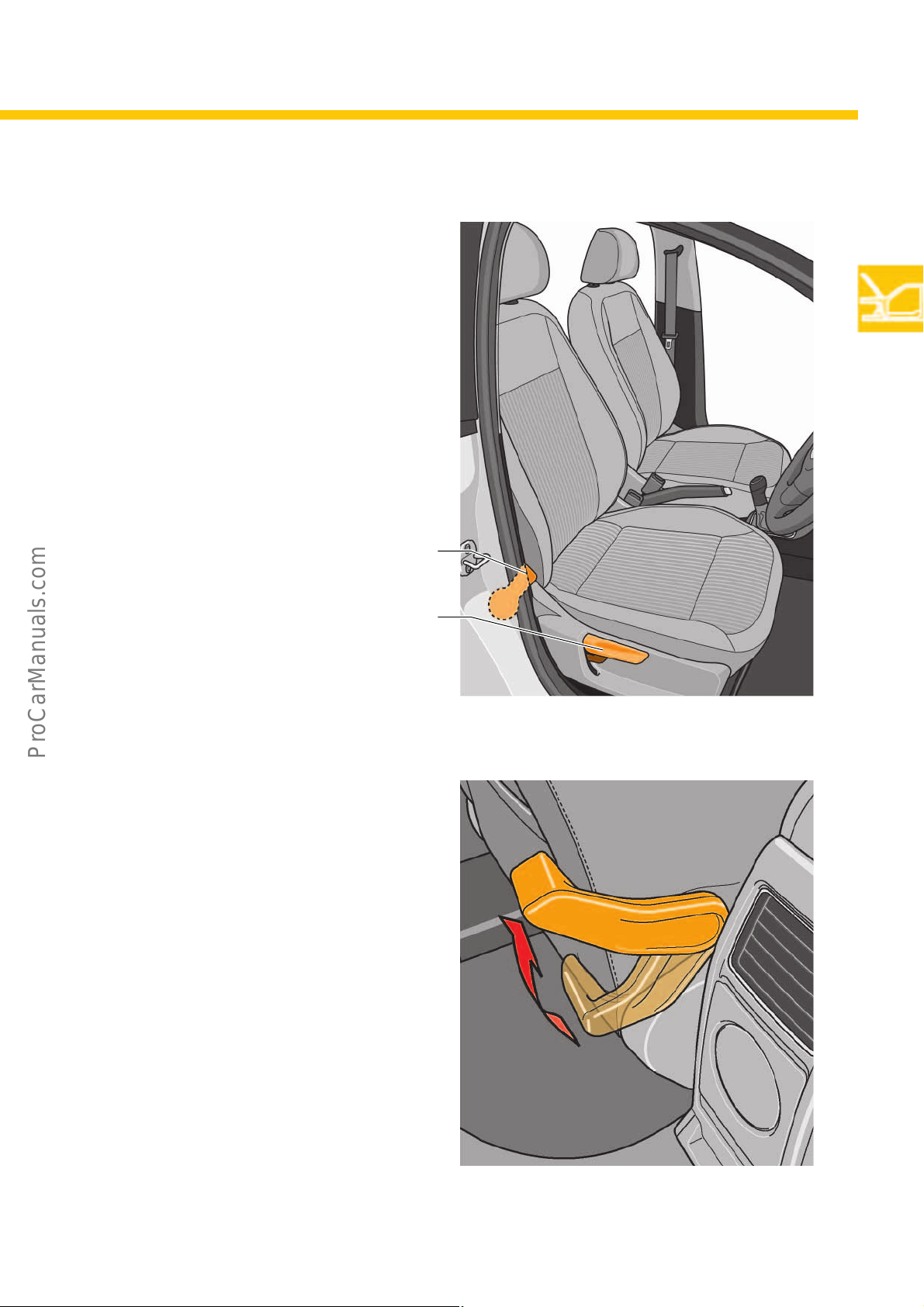
The front seats are padded and formed to match the
body contour. The height adjustment is optional on the
Trendline version and included for the driver seat on
the Highline version. The tilt angle of the backrest is
adjusted via a lever (detent). On the Highline version,
the front seats also have a storage pocket on the rear.
Lever for backrest tilt adjustment
Lever for seat height adjustment
(optional)
Chauffeur function
The front passenger seat in the Vento can be released
from the rear on the Highline version (also known as
chauffeur function). This function allows passengers in
the rear to push the seat forwards for more space.
S474_126
S474_136
21
Page 22
Occupant safety
The safety equipment
Airbags
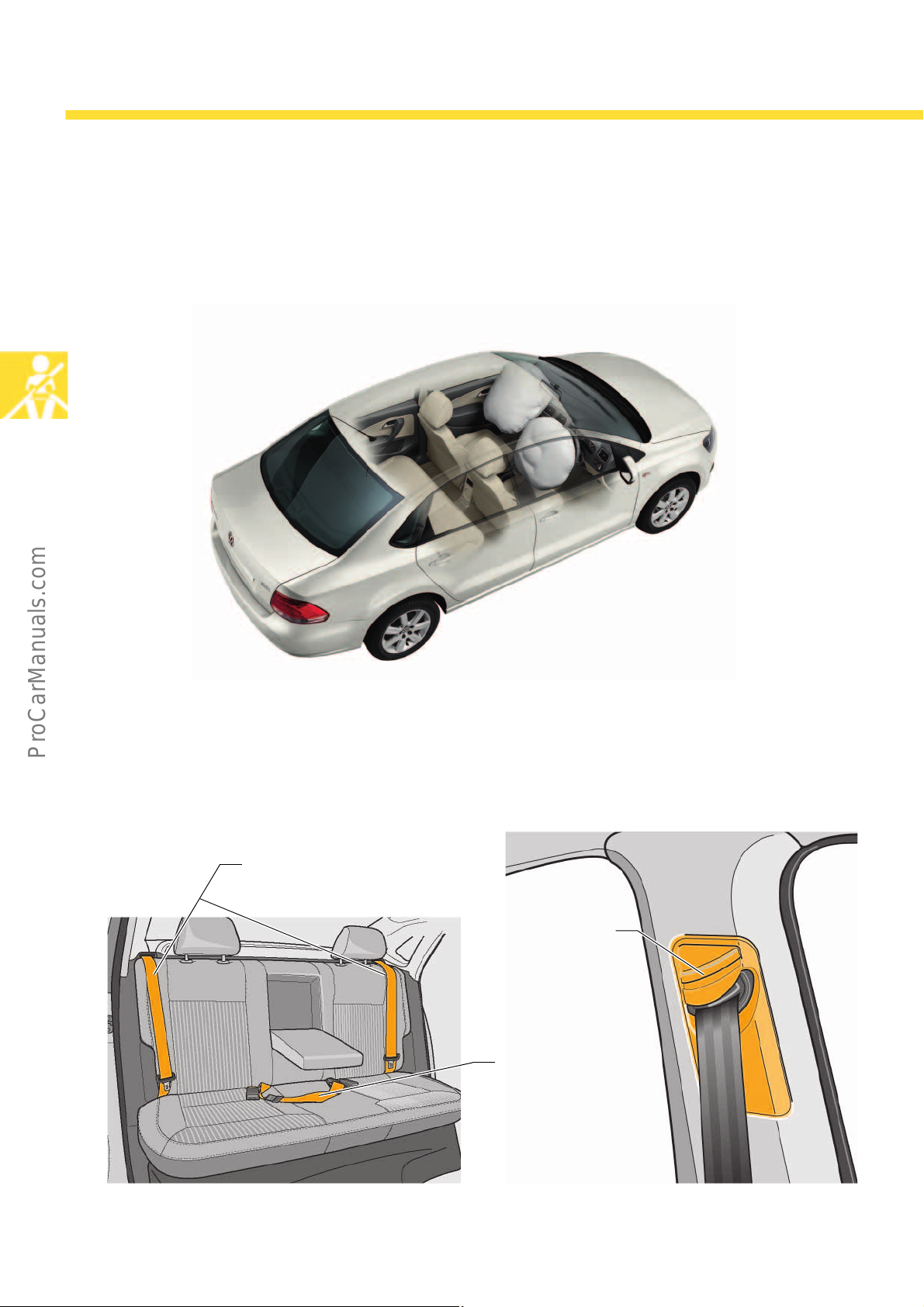
The Highline equipment version includes driver and front passenger airbags. The driver airbag has a volume of
60litres and the front passenger airbag has a volume of 80litres.
Seat belts
The front seat belts in the Vento are height adjustable as standard. The rear bench seat features three-point lap
belts on the left and right seats. The middle seat has a two-point lap belt.
S474_055
3-point
lap belts
Adjustable front
belt tensioner
22
2-point
lap belt
S474_122S474_144
Page 23
The engine/gearbox combinations
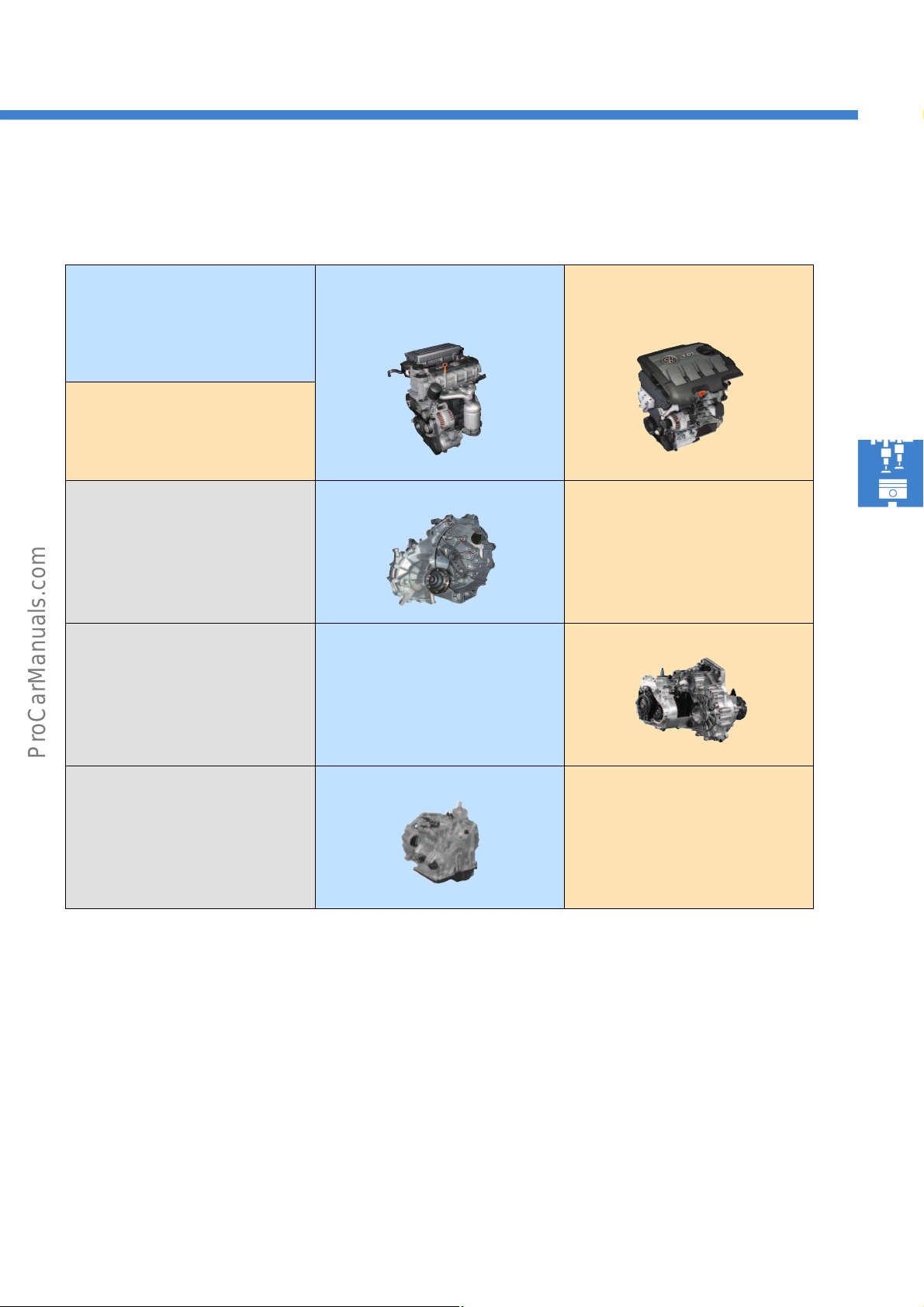
Engines
Petrol engine
Diesel engine
5-speed manual gearbox
MQ200-5F
02T
5-speed manual gearbox
MQ250-5F
02R
1.6l 77 kW
4-cylinder MPI
1.6l 77 kW
4-cylinder TDI
6-speed automatic gearbox
AQ250-6F
09G
23
Page 24
Engines
The 1.6l 77kW CR TDI engine
Technical features
- Grey cast iron cylinder block
- Common rail injection system with piezo injectors
and an injection pressure of max. 1600bar
- Adjustable turbocharger
- Exhaust gas recirculation module, comprising
exhaust gas recirculation valve and cooler for
exhaust gas recirculation
- Oxidising catalytic converter
- Plastic intake manifold
- Software adapted for 77kW
S474_049
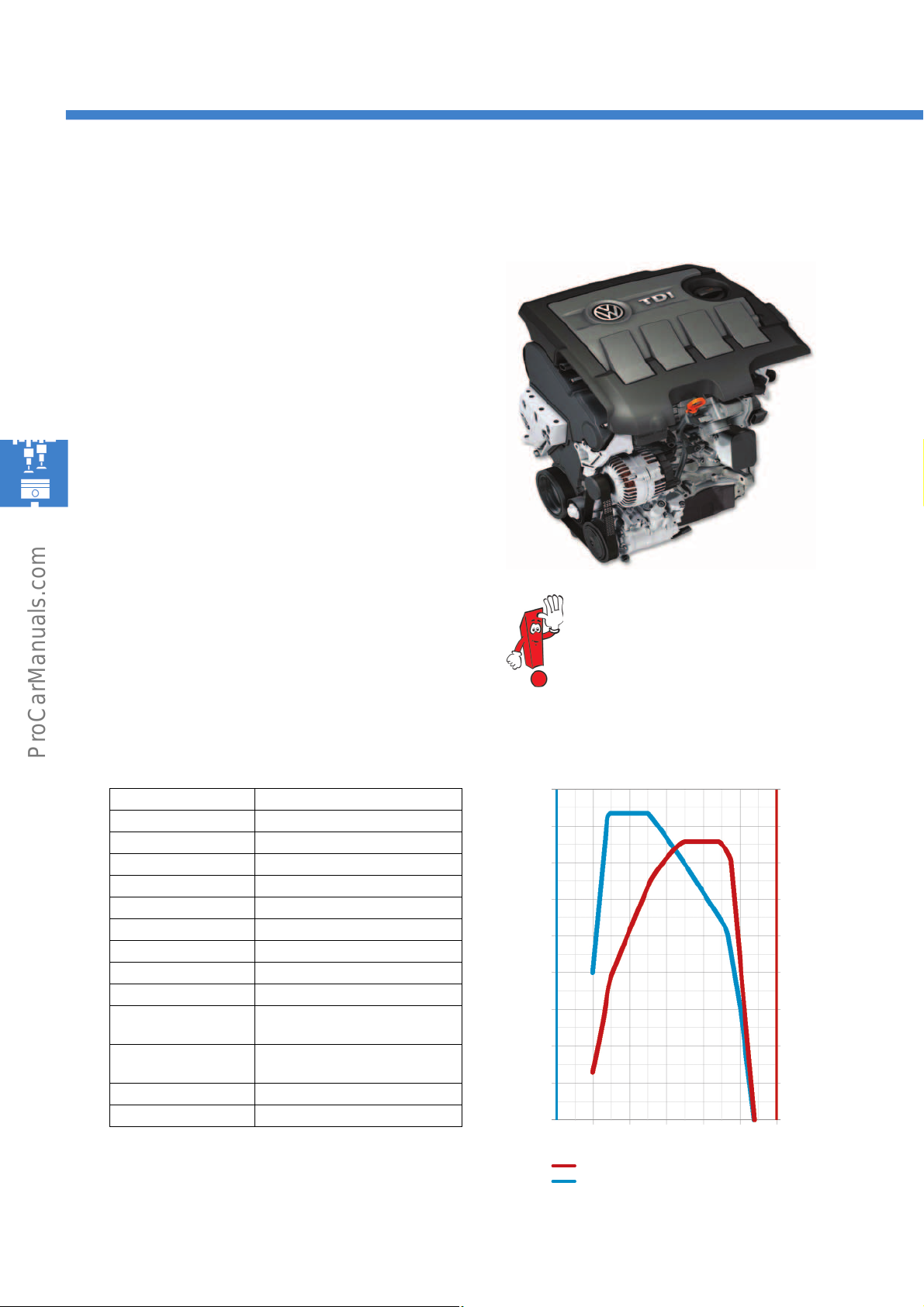
Technical data Output and torque curve
Engine code CLNA
Type 4-cylinder inline engine
Displacement 1598cm
Bore 79.5mm
Stroke 80.5mm
Valves per cylinder 4
Compression ratio 16.5:1
Maximum output 77kW at 4400 rpm
Maximum torque 250Nm at 1500-2500 rpm
Engine management Continental PCR2
Fuel Diesel compliant with DIN
Exhaust gas
treatment
Emissions standard Bharat stage 4*/EU4
CO
emissions 129g/km
2
3
EN590
Exhaust gas recirculation,
oxidising catalytic converter
[Nm]
240
210
180
150
120
90
60
30
Further information about this engine can
be found in self-study programme no. 442
"The 1.6l TDI engine with common rail
injection system".
[kW]
80
70
60
50
40
30
20
10
1000 3000 5000
[rpm]
24
* Legally prescribed emissions level in India
Output [kW]
Torqu e [ Nm]
S474_088
Page 25
Ceramic glow plugs
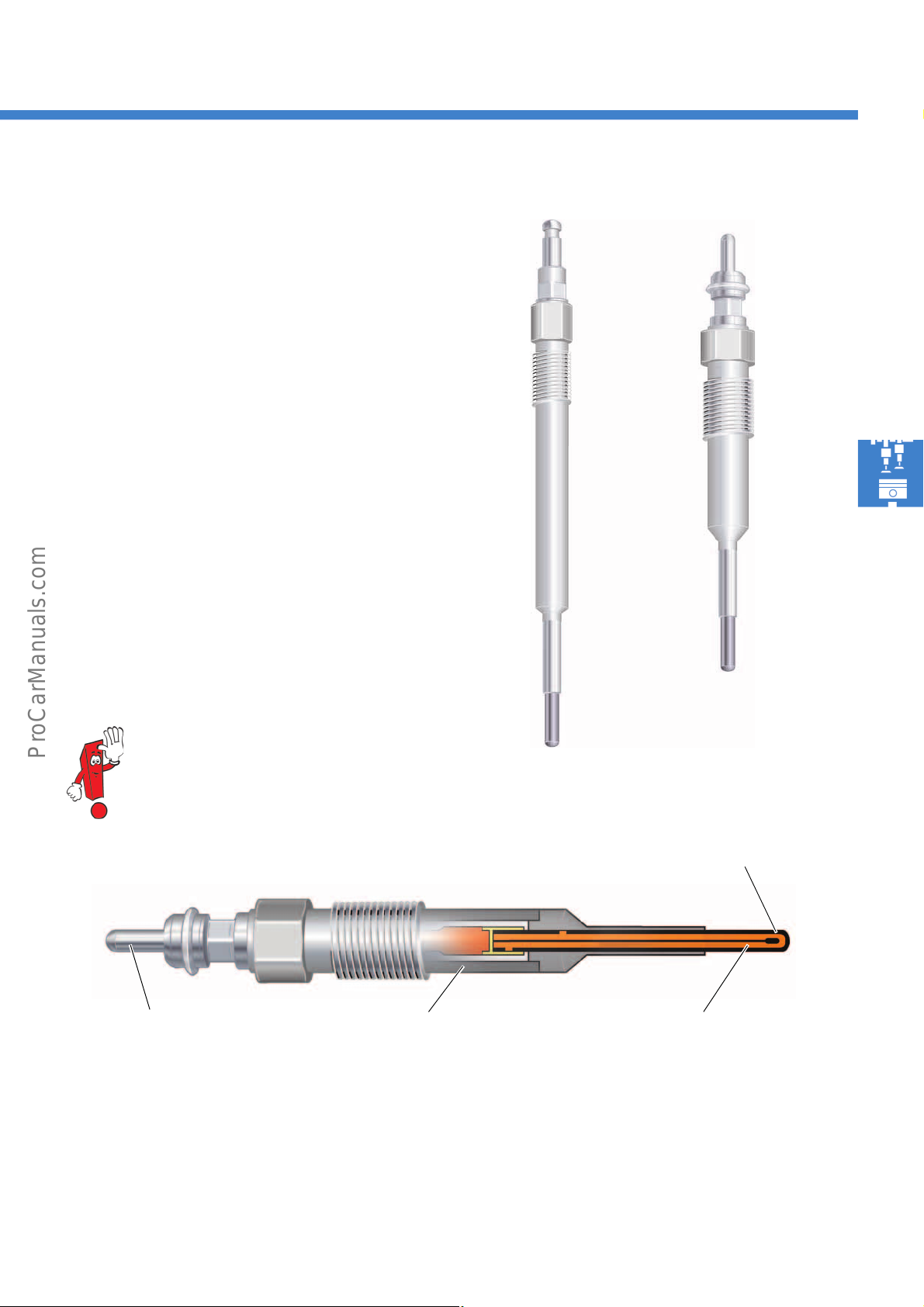
New glow plugs with ceramic heater elements are
used on diesel engines with oxidising catalytic
converters. Two different sizes are used for the
different diesel engine types. There is a narrow version
with M8 thread for the 4-valve diesel engine and a
short version with M10 thread for the 2-valve diesel
engine.
Advantages of ceramic glow plugs:
- Better cold starting thanks to higher pre and post
glow temperatures
- Improved emissions due to overall higher glow
temperatures
- Reduced ageing
S474_025
2-valve diesel engines
The ceramic glow plugs are made up of connecting pin, plug casing and heating element. The heating element is
made of an insulating protective ceramic casing and an inner conductive heating element that substitutes the tasks
performed by regulating and heating coils in metal glow plugs. The ceramic glow plug has a nominal voltage of 7
volts.
Either Bosch, NGK or Beru glow plugs are
installed in the engine.
S354_024
Connecting pin Plug body
4-valve diesel engines
Protective ceramic casing
Ceramic heating element
25
Page 26
Engines
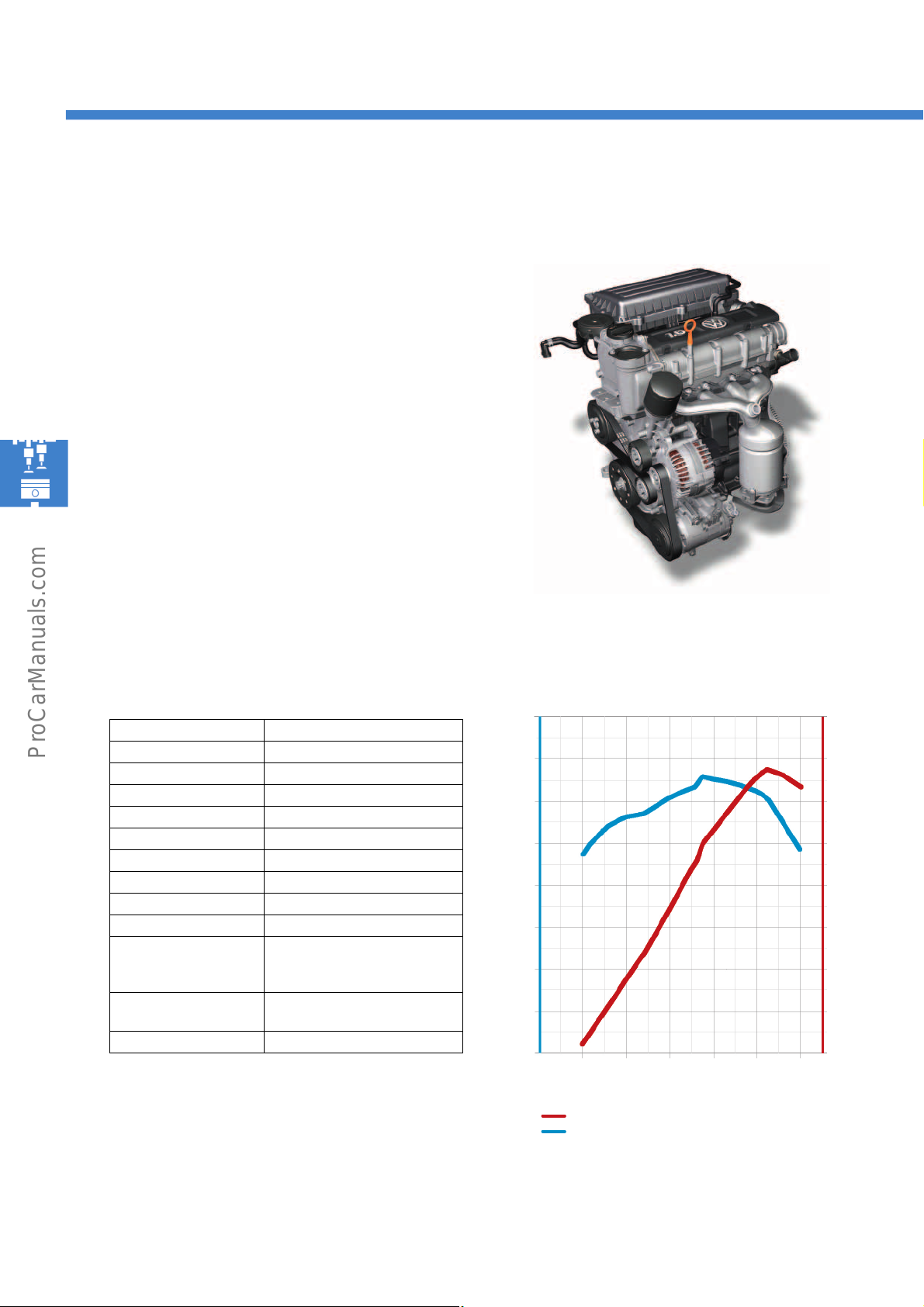
The 1.6ltr. 77kW MPI engine with intake manifold injection
Technical features
● Grey cast iron cylinder block
● Intake manifold injection
● Camshaft driven via chain
● Reduced main bearing diameter
● Sheet metal oil sump
● Pre-heating for crankcase breather system
integrated in cooling system
● Non-return fuel system
● Exhaust manifold and three-way catalytic
converter joined to form one module
Technical data
Engine code CLSA
Type 4-cylinder inline engine
Displacement 1598cm
Bore 76.5mm
Stroke 86.9mm
Valves per cylinder 4
Compression ratio 10.5 : 1
Maximum output 77kW at 5250 rpm
Maximum torque 153Nm at 3750 rpm
Engine management Magneti Marelli 7GV
Fuel Premium petrol RON 95/93
Exhaust gas treatment Main catalytic converter
Emissions standard Bharat stage 4*/EU4
3
(at least RON 87, but with
reduced output)
with lambda control
Output and torque curve
[Nm]
160
140
120
100
80
60
40
20
1000 2000 3000 4000 5000
S474_009
[rpm]
6000
[kW]
80
70
60
50
40
30
20
10
26
* Legally prescribed emissions level in India
Output [kW] - 77kW
Torque [Nm] - 77kW
S474_022
Page 27
Cylinder head and cylinder head cover
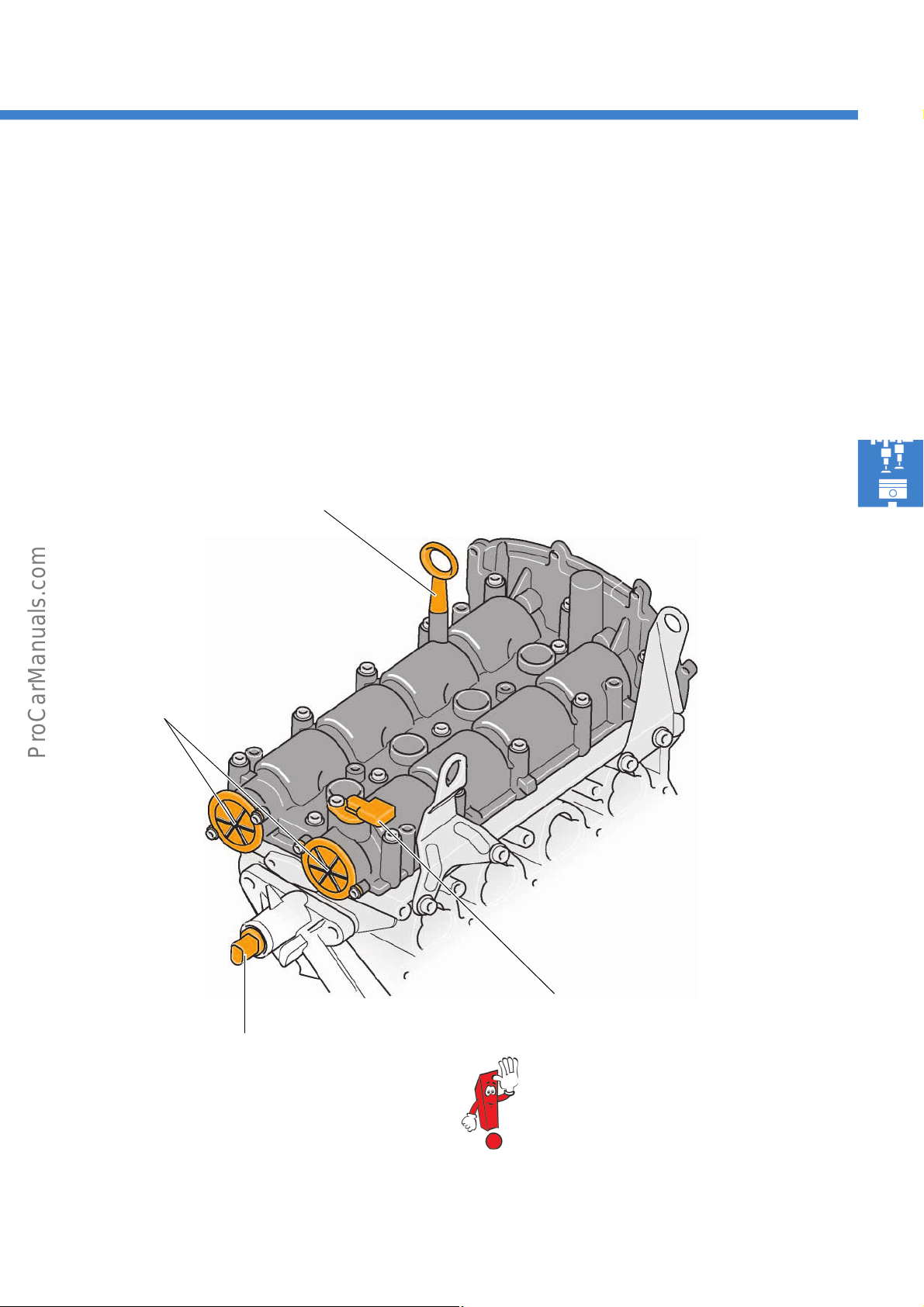
The cylinder head is the same as that fitted to the 1.4l/66kW FSI engine bar a few modifications. Several changes
have been made to the valve train due to the greater loads and exhaust gas temperatures. The exhaust valves are
chrome-plated and the valve guides have a higher strength rating.
When installing and removing the cylinder head cover, it is essential that the prescribed steps are performed in
order. These can be found in ELSA. The diagram of the cylinder head cover shows the parts relevant for adjustment
of the camshaft.
Oil dipstick
Tool mounting for
adjustment of camshaft
Temperature sensor G62
S474_320
Hall sensor G40
Further information about this engine can
be found in self-study programme no. 296
"The 1.4 ltr. and 1.6 ltr. FSI engine with
timing chain".
27
Page 28
Engines
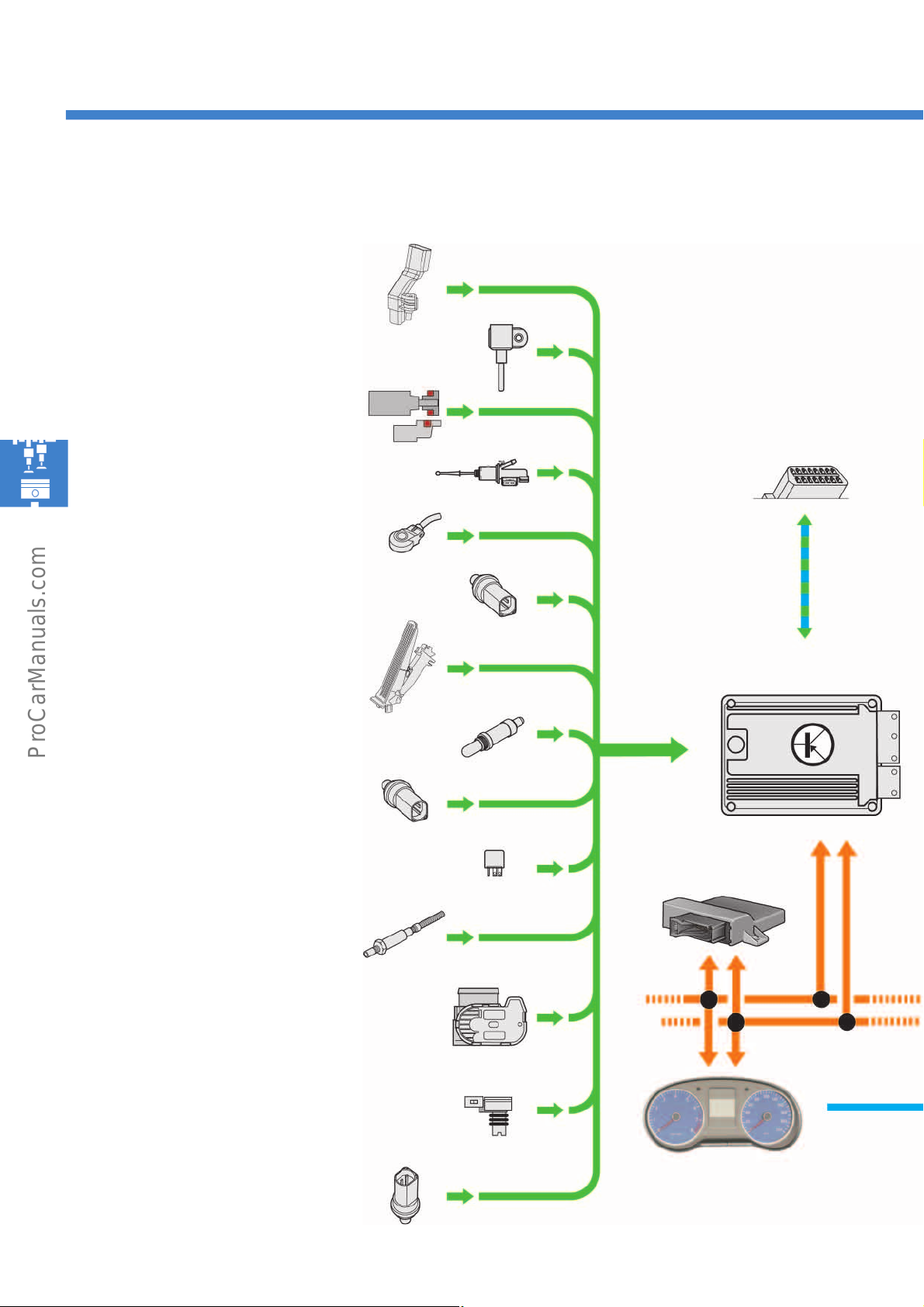
System overview of Magneti Marelli 7GV engine management
G28 Engine speed sender
G40 Hall sender
F Brake light switch
F47 Brake pedal switch
F36 Clutch pedal switch
G61 Knock sensor 1
T16
Diagnostic connection
G62 Coolant temperature sender
G79 Accelerator position sender
G185 Accelerator position sender 2
G130 Lambda probe after
catalytic converter
G83 Coolant temperature sender
at radiator outlet
J104 ABS control unit
G39 Lambda probe
G187, G188
Angle sender 1 and 2 for throttle valve drive
on drive-by-wire system
J623 Engine control unit
J519
Onboard supply
control unit
28
G42 Intake air temperature sender
G71 Intake manifold pressure sender
G65 High-pressure sender
K Dash panel insert
J285 Control unit in dash panel insert
Page 29
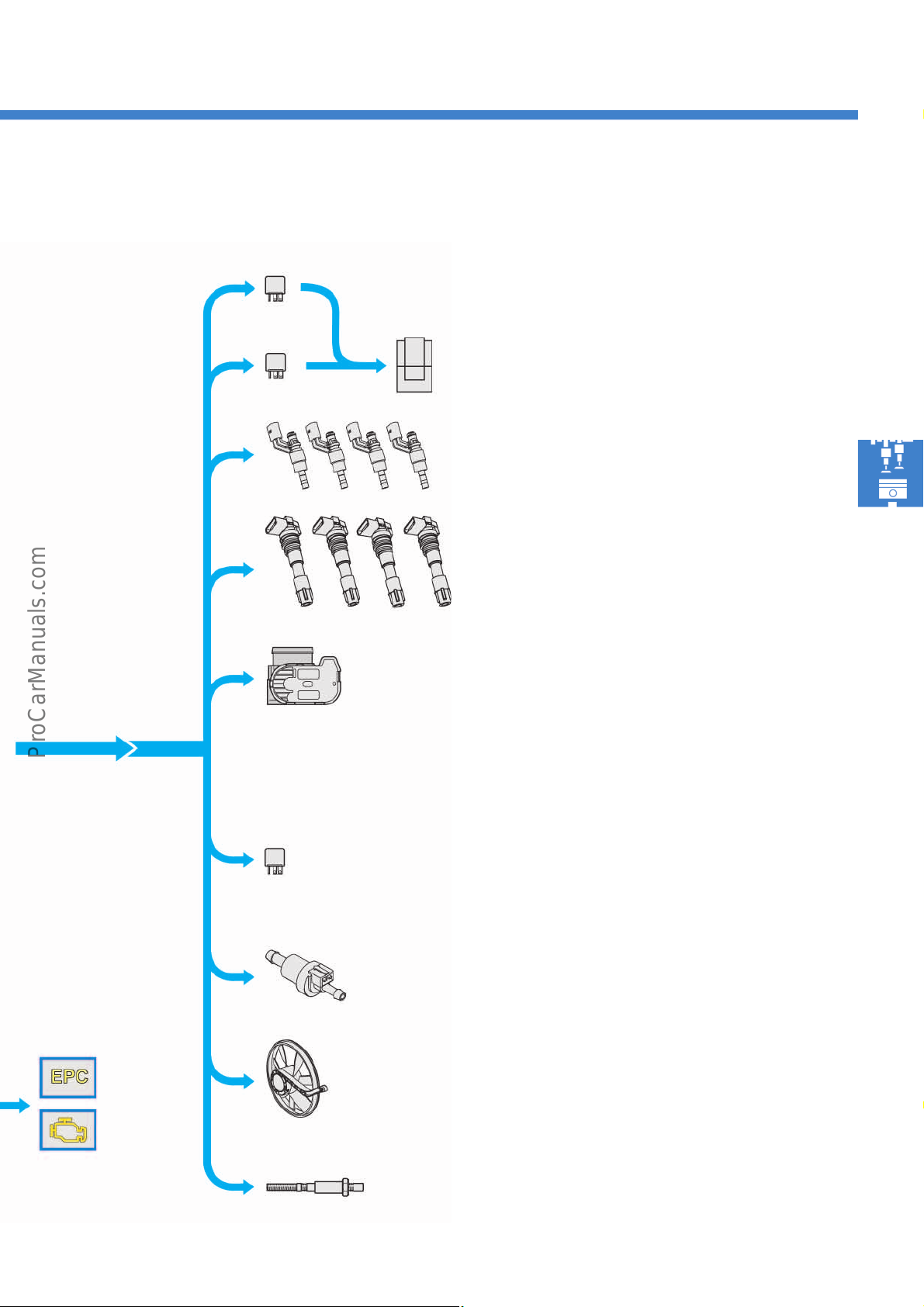
J643 Fuel supply relay
J17 Fuel pump relay and
G6 Fuel system pressurisation pump
N30-N33 Injectors for cylinders 1-4
N70, N127, N291, N292
Ignition coils 1-4 with output stage
J338 Throttle valve module
K132 Fault lamp
for electric
throttle
K83 Exhaust gas
warning lamp
J317 Terminal 30 voltage supply relay
N80 Activated charcoal filter solenoid valve 1
J293 Radiator fan control unit
Z19 Lambda probe heater
S474_138
29
Page 30
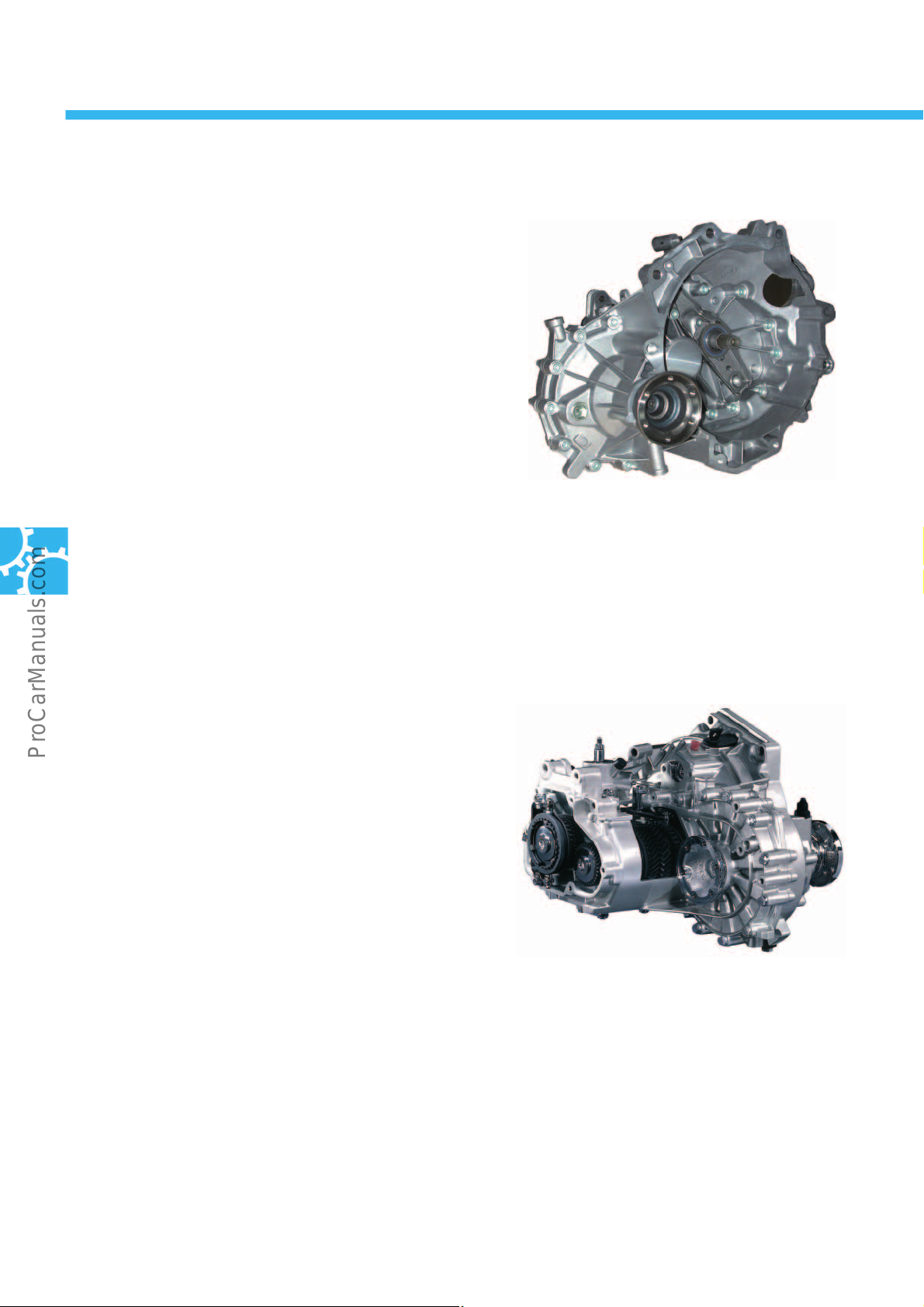
Power transmission
The 5-speed manual gearbox 02T
This gearbox offers the following features:
● Only installed with petrol engine in Vento
● Low weight
● CO
● Torque capacity up to 170Nm
-optimised gear ratios
2
S474_301
The 5-speed manual gearbox 02R
This gearbox offers the following features:
● Due to higher torque capacity,
only for diesel engines
● Further development of 02J gearbox
● CO
● Torque capacity up to 250Nm
-optimised gear ratios
2
S474_027
30
Page 31
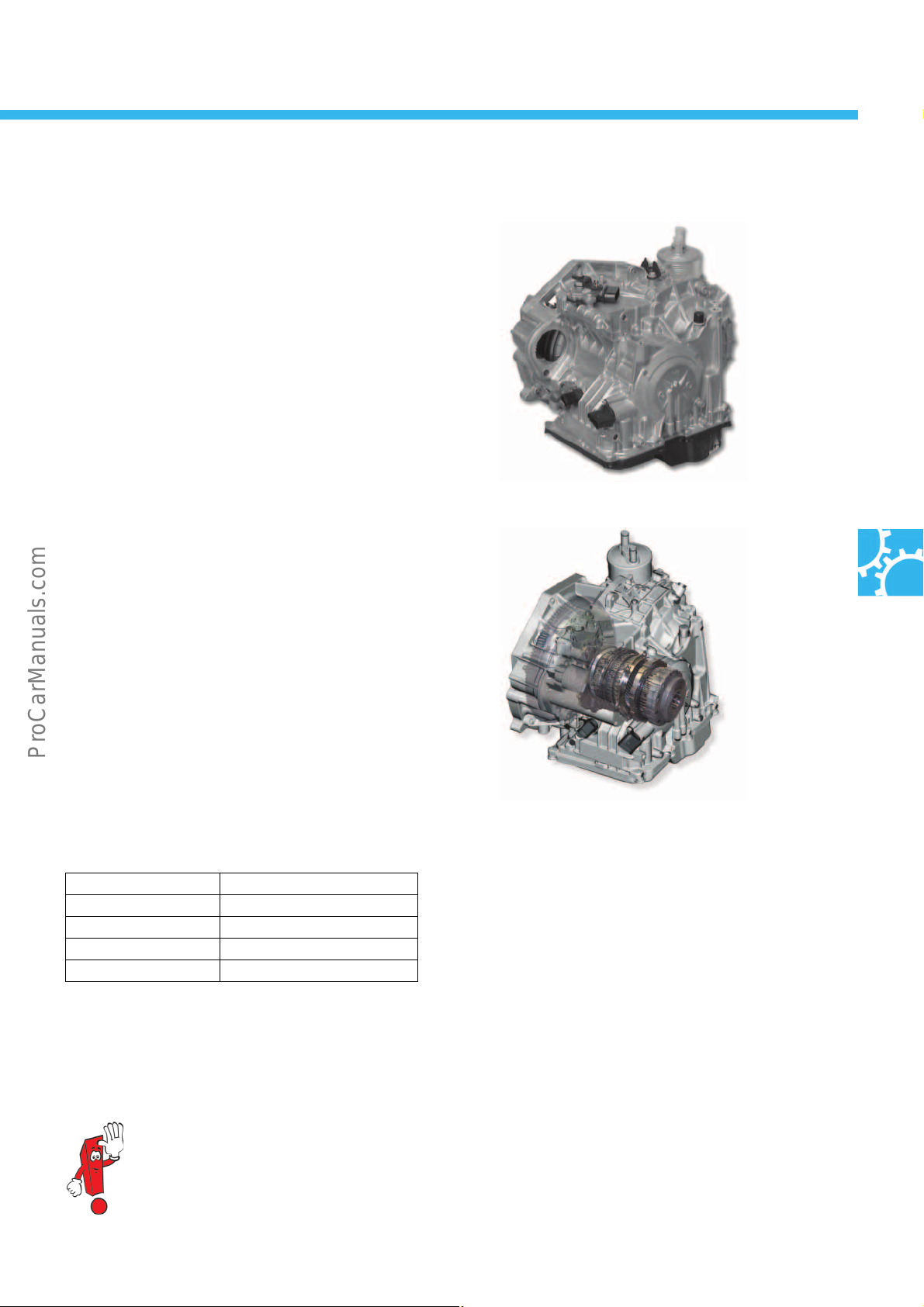
The 6-speed automatic gearbox 09G
The 6-speed automatic gearbox 09G is a compact,
light, electronically controlled gearbox for transverse
mounting. This gearbox offers the following features:
● Only installed with petrol engine in Vento
● Max. torque 280Nm
● Weig hs 82 kg
● Measures approx. 350mm
● Torque converter with torque
converter lock-up clutch
● Automatic and Tiptronic modes
The six forwards gears and reverse are implemented
via the arrangement of a simple planetary gear set
with a downstream double planetary gear set.
S474_028
Technical data
Weight approx. 82kg FWD
Torque max. 280Nm
Clutch Torque converter
Operating mode Automatic and Tiptronic
Oil volumes 7.0 litres G052025 A2 Lifetime
For more detailed information on the 6-speed automatic gearbox, please refer to self-study programme
no. 309 "6-speed automatic gearbox 09G/09K/09M".
S474_033
31
Page 32
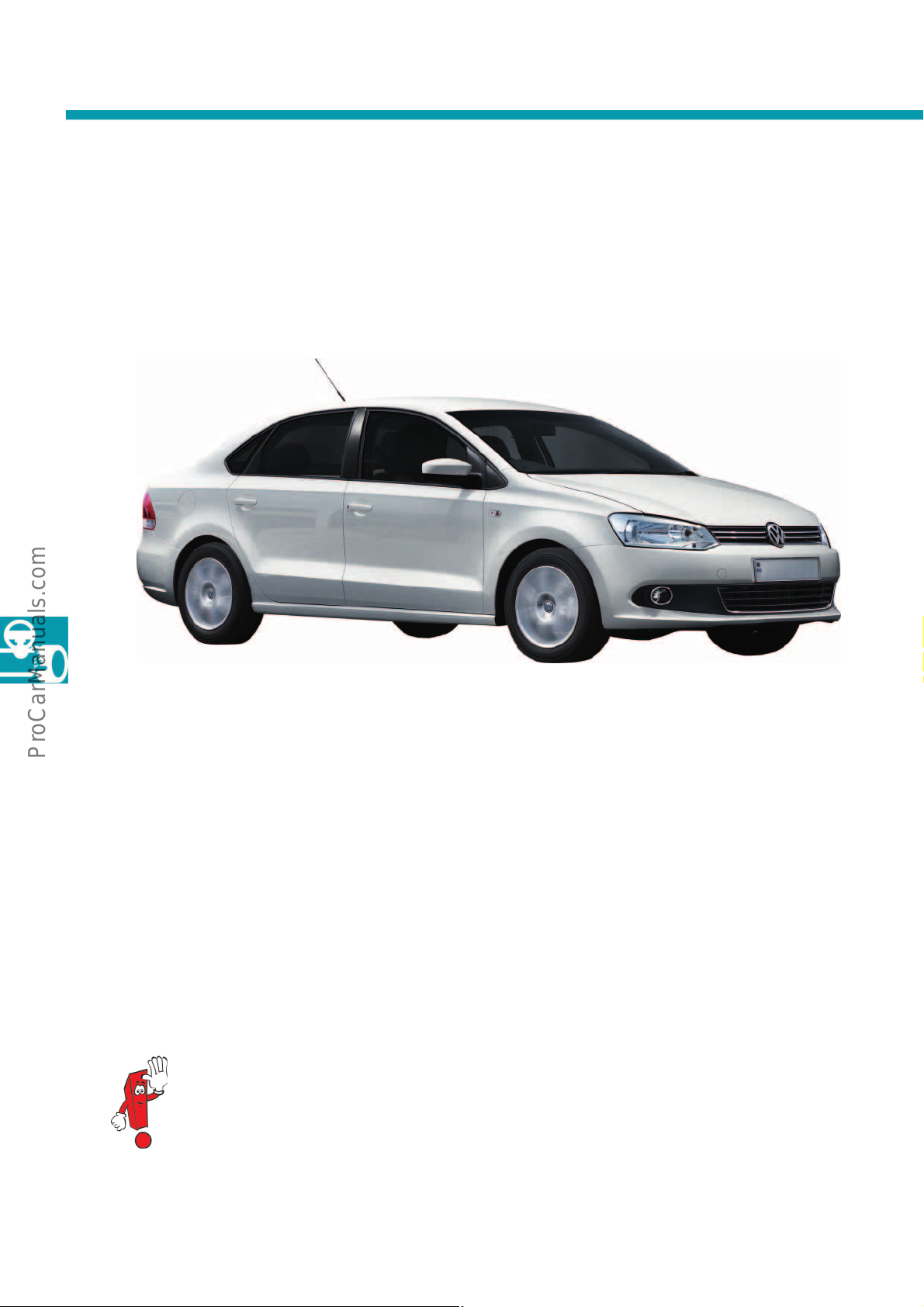
Running gear
Overview
The chassis of the new Vento is the same as that of the Polo 2011. It has McPherson struts on the front axle and a
torsion beam on the rear axle. The vehicle sits 15mm higher.
The running gear is characterised by the following features:
● Toe and camber angle engineered (no setting necessary)
● Front floating caliper brake Ø256mm with fully bolted caliper
● 14" steel rims (as standard), 15" alloys (optional)
● Electro-mechanical power steering (C-EPS)
● Self-adjusting rear Simplex drum brakes Ø 228mm
● ABS, from Highline equipment version
n
e
V
S474_071
o
t
32
Further information about the running gear can be found
in self-study programme no. 447 "The Polo 2011"
Page 33
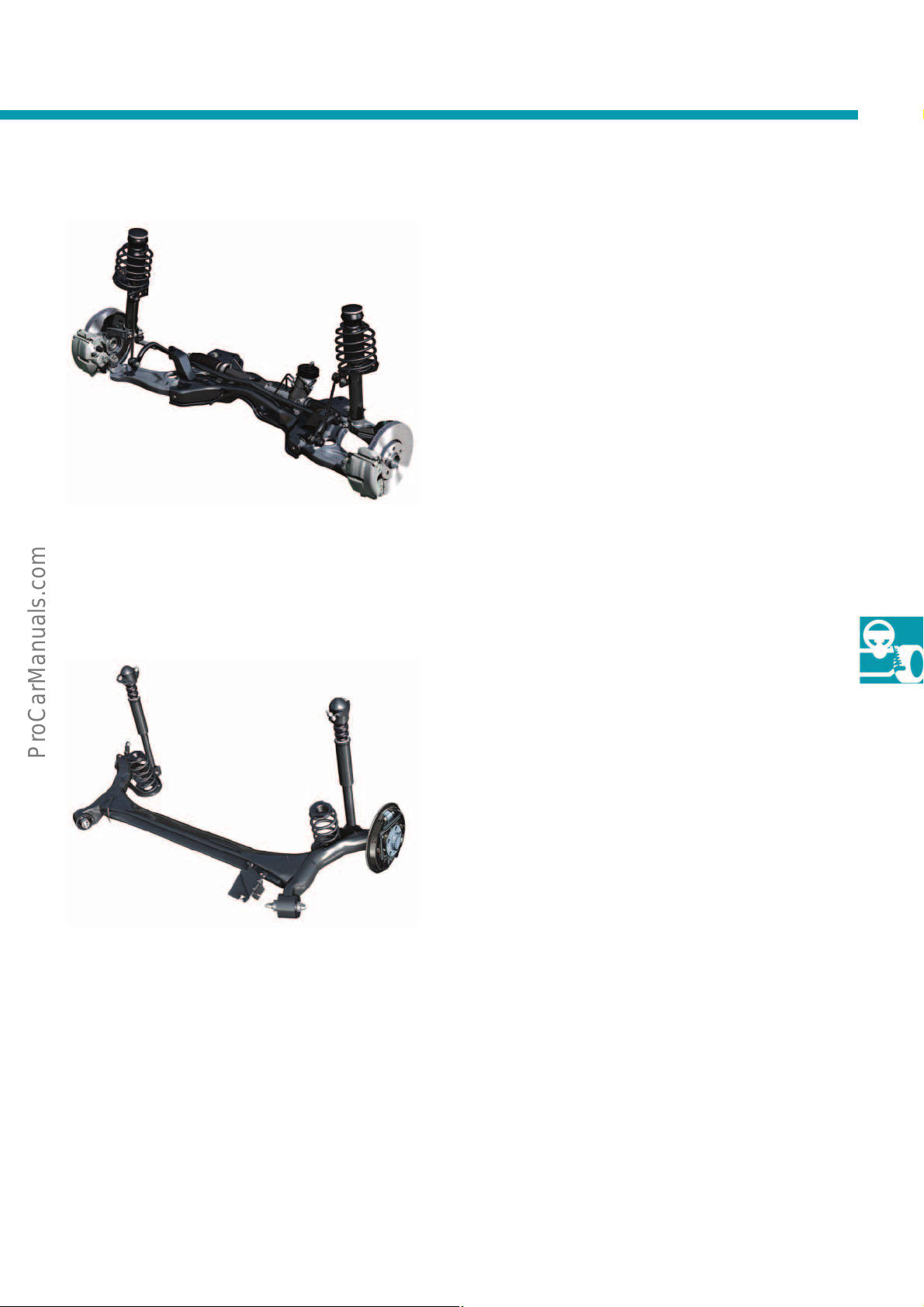
The front axle
The rear axle
The front axle is a McPherson strut axle. The ride
height has been increased by 15mm as on the Polo
2011. The front axle has a large castor angle-which
provides a strong true running character.
S474_063
The rear axle is a torsion beam axle with V-profile.
The ride height, as with the front axle, has been
increased by 15mm. Grooved ball bearings are fitted
as wheel bearings.
S474_061
33
Page 34
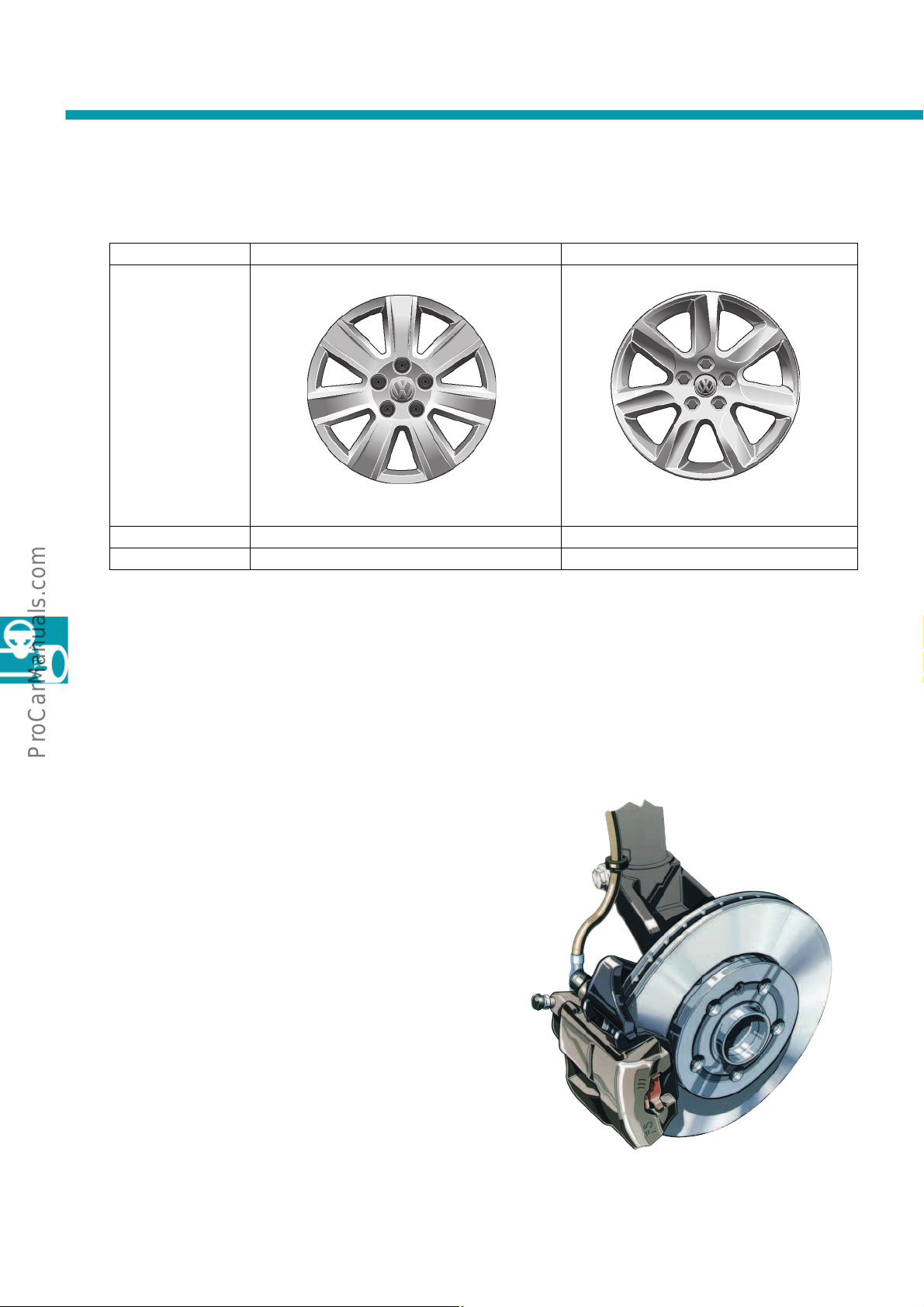
Running gear
The wheels and tyres
14" steel rim with wheel trim 15" alloy wheel
Illustration
Description 5Jx14 ET35 6Jx15 ET40
Tyre dimension 175/70 R14 185/60 R15, 195/55 R15
S474_080 S474_082
The braking system
The braking system is a hydraulic dual circuit system. Vehicles without ABS are equipped with a pressure limiter,
which adapts the braking force to the rear axle. The brake light sensor is integrated in the brake master cylinder.
Front wheel brakes
The front axle of the Vento is fitted with vented disc
brakes with a brake disc size of Ø256x22mm.
The front brakes are 3rd generation single-piston
floating caliper brakes. The brakes also feature an
integrated swivel bearing.
34
S474_051
Page 35
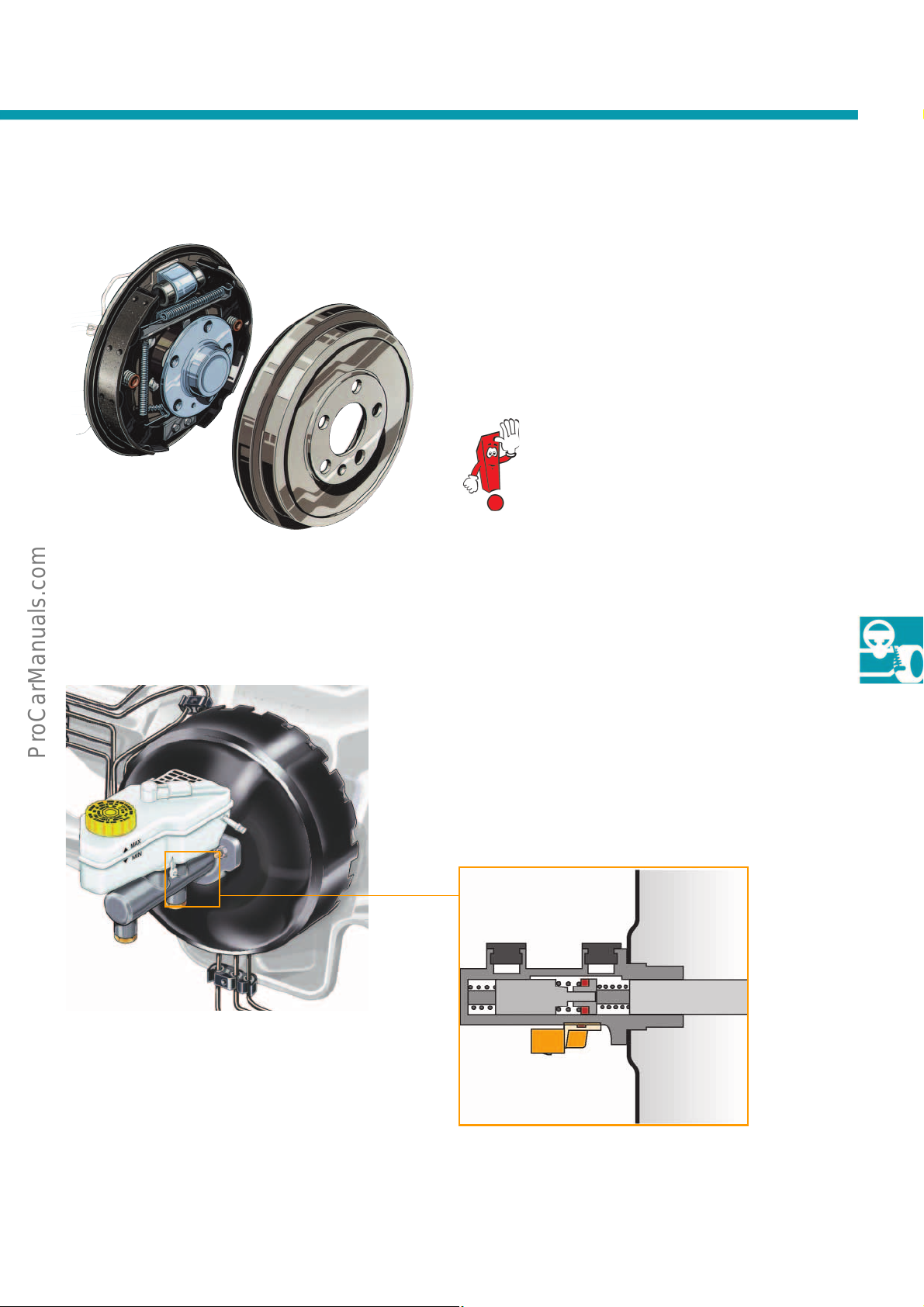
Rear wheel brakes
S474_053
On the rear axle, the Vento has self-adjusting Simplex
drum brakes. Dimension: Ø200x40mm. The wheel
brake cylinders have a piston diameter of 17.46mm.
Before removing the drum brakes, they
have to be reset. This is carried out in
accordance with ElsaPro via the wheel stud
opening through the brake drum.
8.5" brake servo
S474_078
The Vento is fitted with an 8.5" brake servo.
It has a brake master cylinder with integrated brake
light sensor that works on the Hall principle.
Brake light sensor
S474_134
35
Page 36
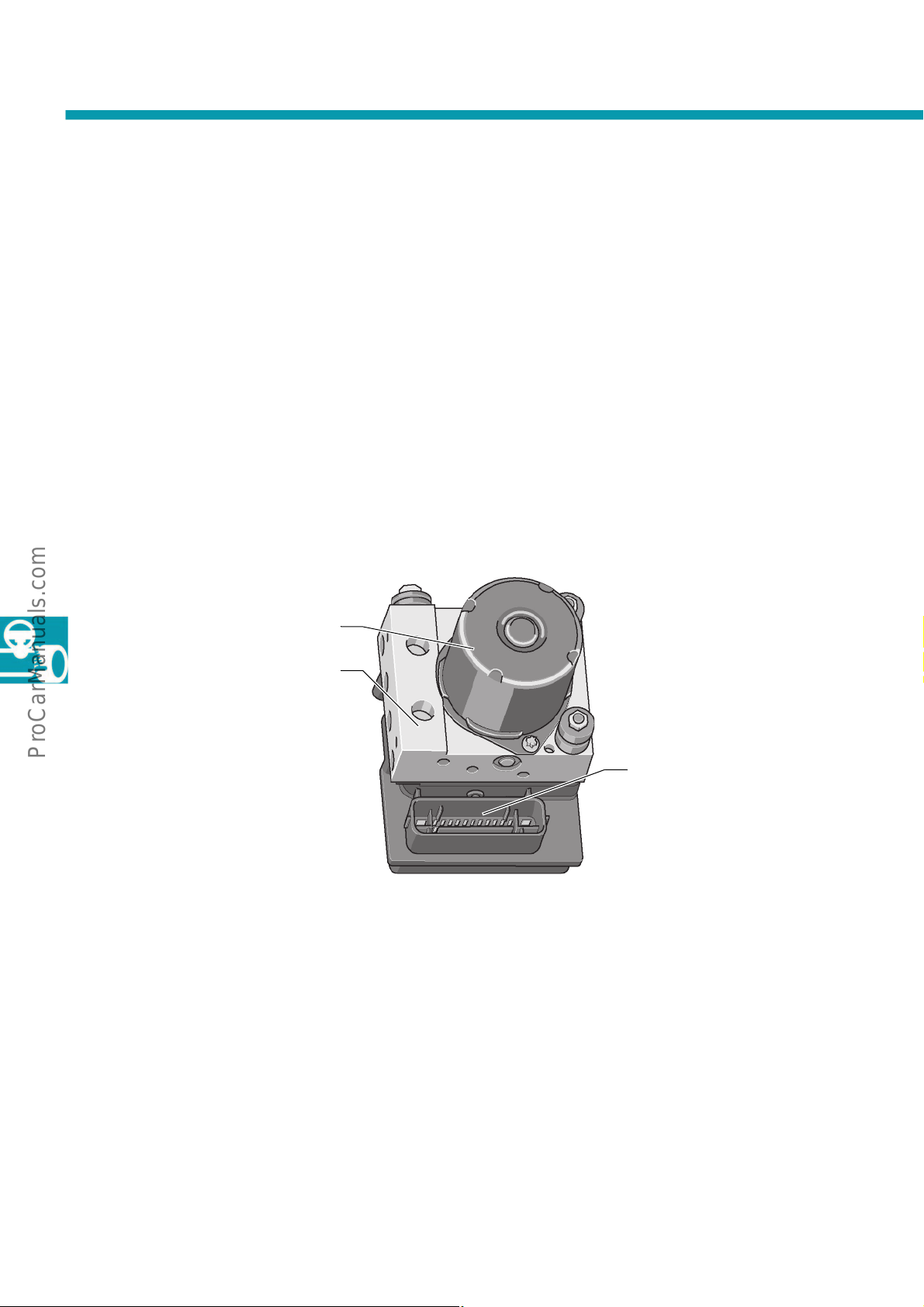
Running gear
Bosch 8.2 brake system with ABS
Installed in the new Vento on the Highline version is a Bosch 8.2 generation traction control system. The brake servo
with brake master cylinder is installed in a separate place from the ABS hydraulic unit.
The essential features of this system are:
● Smaller component dimensions
● Reduced weight
● Emergency hazard warning flashing on braking
force greater than 7m/s²
● ABS on Highline equipment version
● Pressure limiter not included
Return flow pump
Hydraulic unit
ABS control unit with data
bus connector
S474_124
36
Page 37
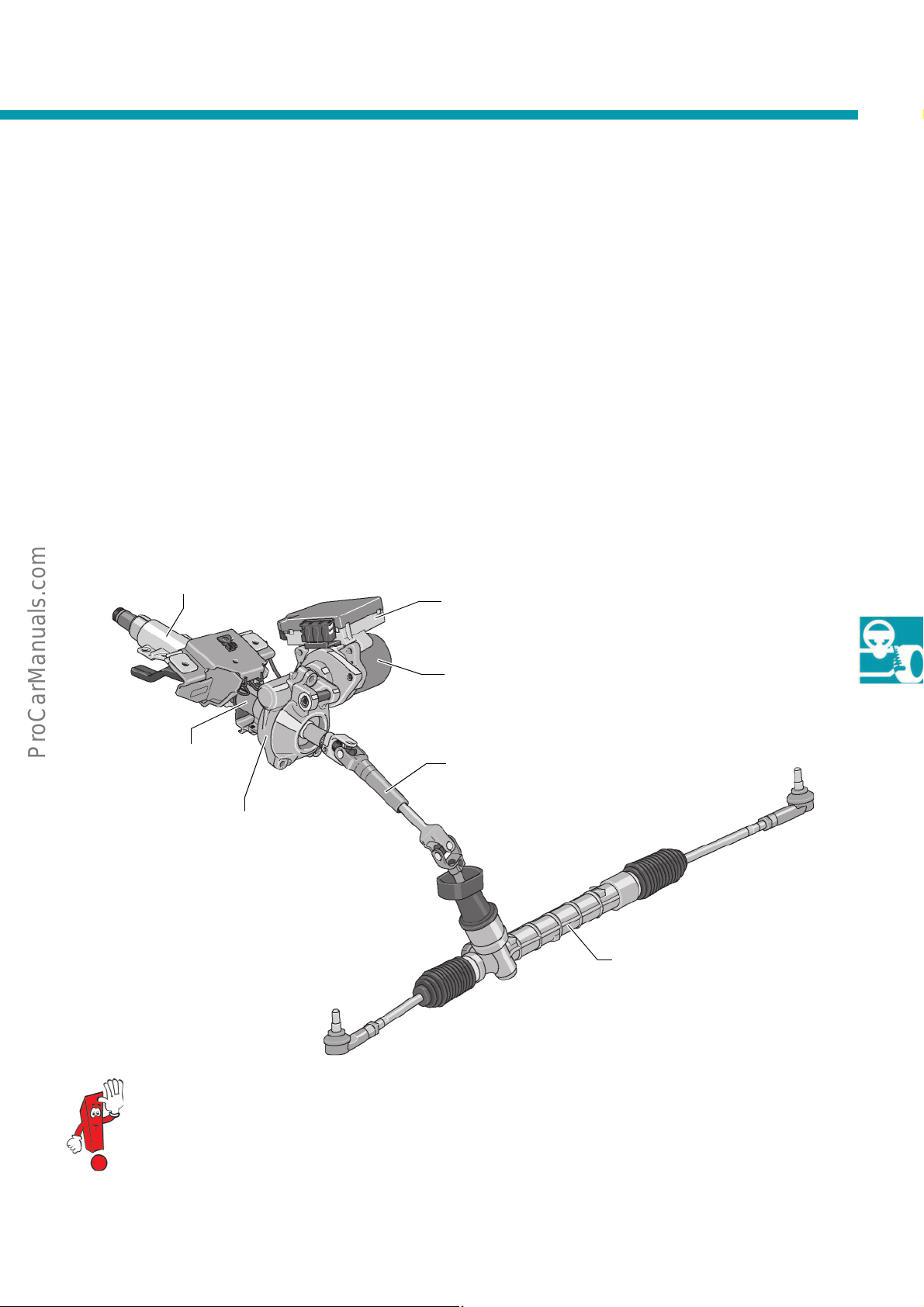
The electromechanical power steering system
The servo-assistance of the electromechanical power steering comes from an electric motor on the steering column.
The electromechanical power steering system is compatible with each engine/gearbox combination.
The steering comprises the following components:
- Steering wheel
- Steering column switch
- Steering column
- Steering moment sender G269
-Worm gear
Steering column with height
and rake adjustment
Steering moment sender
G269
- Electromechanical power steering motor V187
- Power steering control unit J500
- Universal joint shaft
- Mechanical steering box
Power steering
control unit J500
Electromechanical power
steering motor V187
Universal joint shaft
Worm gear
Mechanical
steering box
● C-EPS = Column Electric Power Steering;
Servo-unit positioned in steering chain, gear type (worm gear/shaft).
● Further information on the electromechanical power steering system can be found
in self-study programme no. 447 "The Polo 2011".
S474_076
37
Page 38
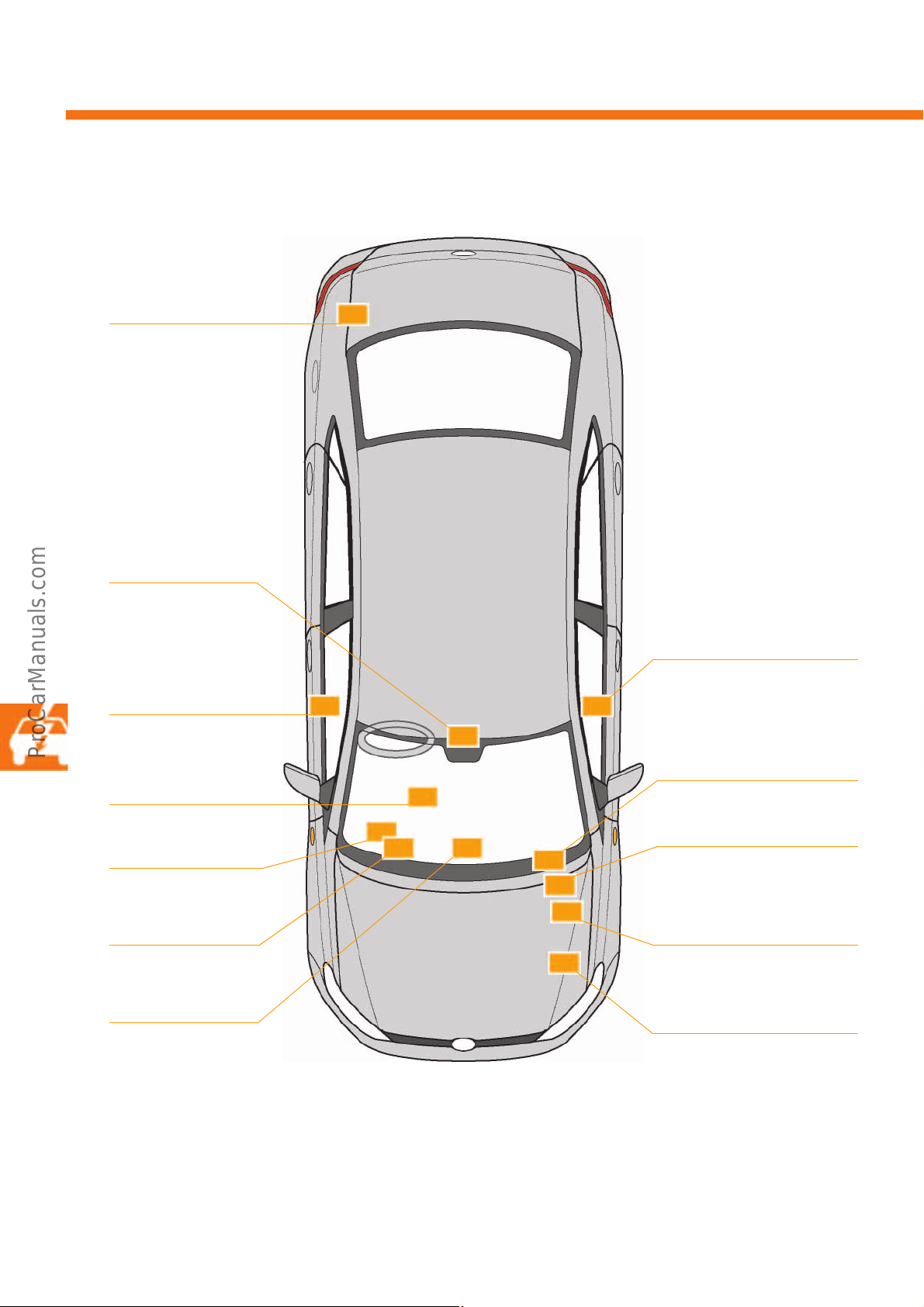
Electrical system
Control unit locations
J446 Parking aid
control unit
12
J255 Climatronic
control unit
J387 Door control unit
on driver side
SB Fuse box
Inside vehicle on right
under steering column
J525 Power steering
control unit
J519 Onboard supply
control unit
J234 Airbag control
unit
11
J387 Door control unit
on front passenger
10
side
9
8
J104 ABS control unit
7
6
5
4
J623 Engine control unit
3
2
1
S474_132
J217 Automatic
gearbox
control unit
SA Fuse box
Right of engine bay
on battery
38
Page 39
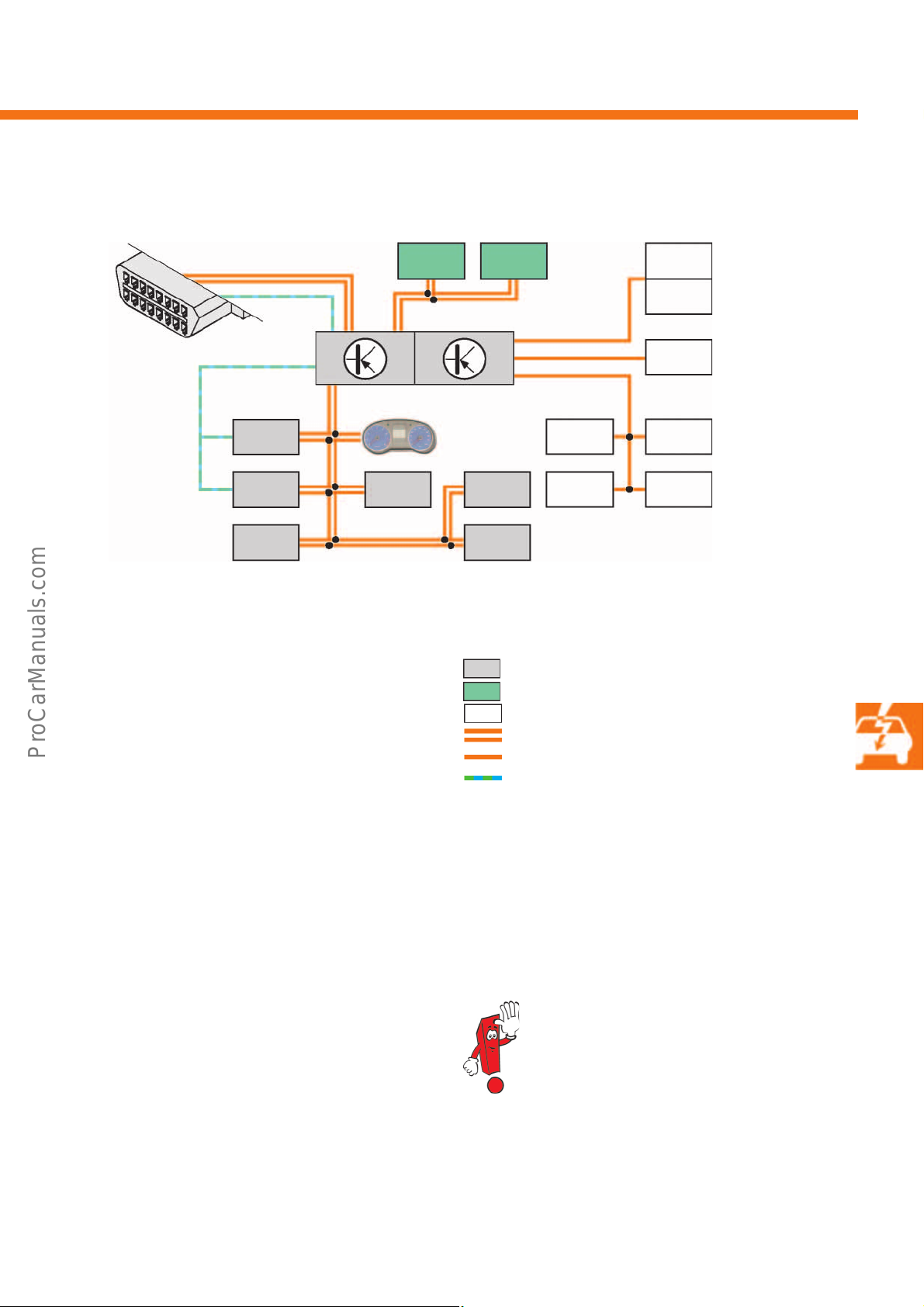
The networking concept
T16
J623
J217*
J234
Meaning of the codes
G273* Interior monitoring sensor
G384* Vehicle inclination sender
H8* Anti-theft alarm system horn
J104* ABS control unit
J217* Automatic gearbox control unit
J234* Airbag control unit
J255* Climatronic control unit
J285 Control unit for display in
dash panel insert
J362 Immobilizer control unit
J386 Driver door control unit
J387 Front passenger door control unit
J388 Rear left door control unit
J389 Rear right door control unit
J446* Parking aid control unit
J500 Power steering control unit
J519 Onboard supply control unit
J533 Data bus diagnostic interface
J623 Engine control unit
R* Radio
T16 Diagnosis connector
a
J533
J255* R* G384*
J519
J500
J362
J285
J104*
J446*
J386
Key
Powertrain CAN data bus (500kBit/s)
Convenience CAN data bus (100kBit/s)
LIN data bus (19.2kBit/s)
CAN data bus line
LIN data bus line
K-wire
a Diagnosis CAN data bus (500kBit/s)
* Optional depending on equipment
The data bus diagnostic interface J533
(Gateway) is integrated in the onboard supply control unit J519 and forms the interface
for communication of the data bus systems.
G273*
H8*
J387
J389J388
S474_054
39
Page 40
Electrical system
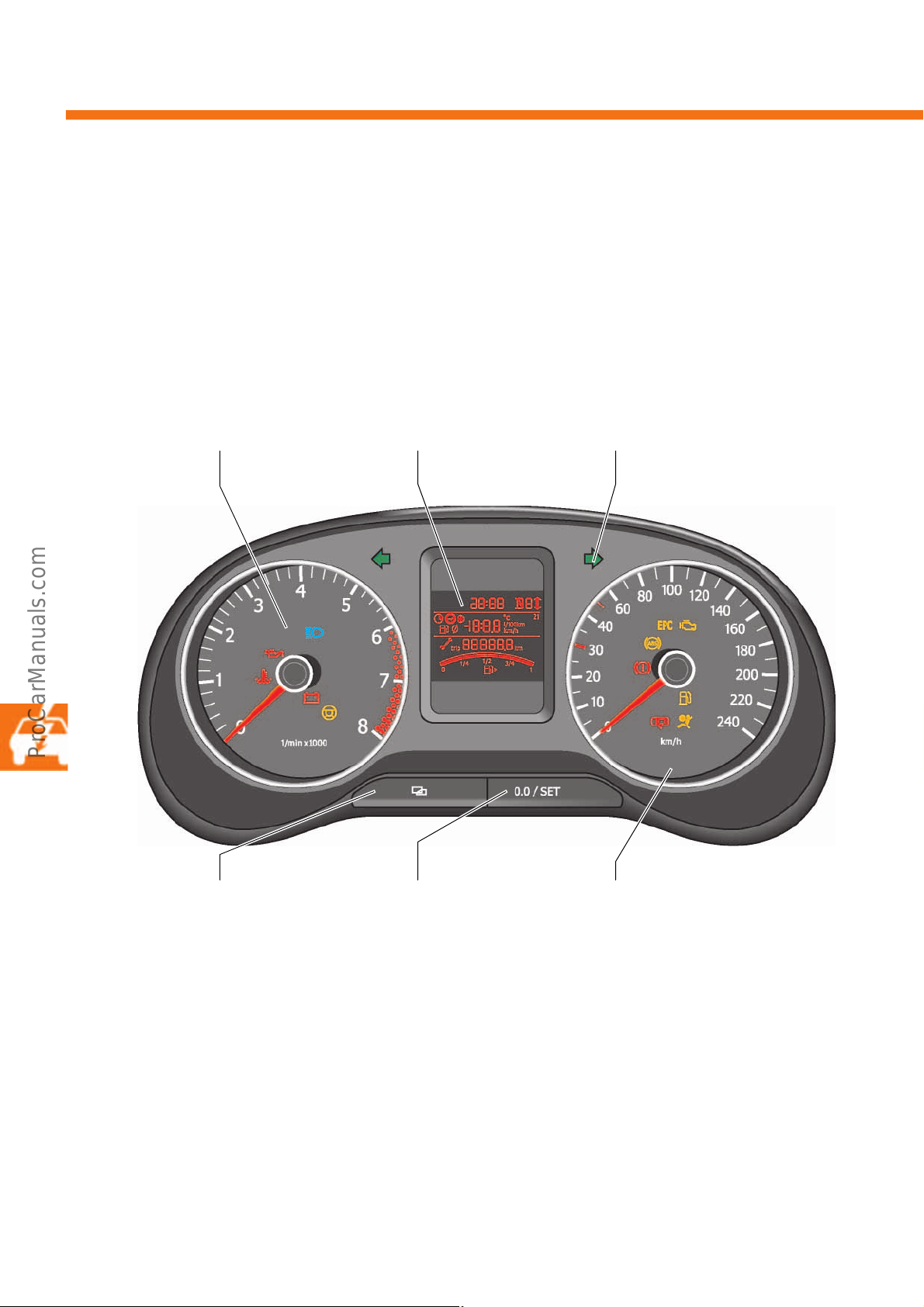
The dash panel insert
The dash panel insert installed in the Vento is the same as that installed in the Polo 2011.
The instrument level has one continual glass surface. This leads to a greater viewing angle. The central display in
the dash panel insert is monochrome black and red. For the display, it features exclusively predetermined
segments. The dial faces of the speedometer and rev counter are white illuminated.
Rev counter with
integrated symbol displays
Central display
(multifunction display)
Turn signal indicator
S474_036
40
Setting button for clock Reset button for trip counter Speedometer with integrated
symbol display
Page 41
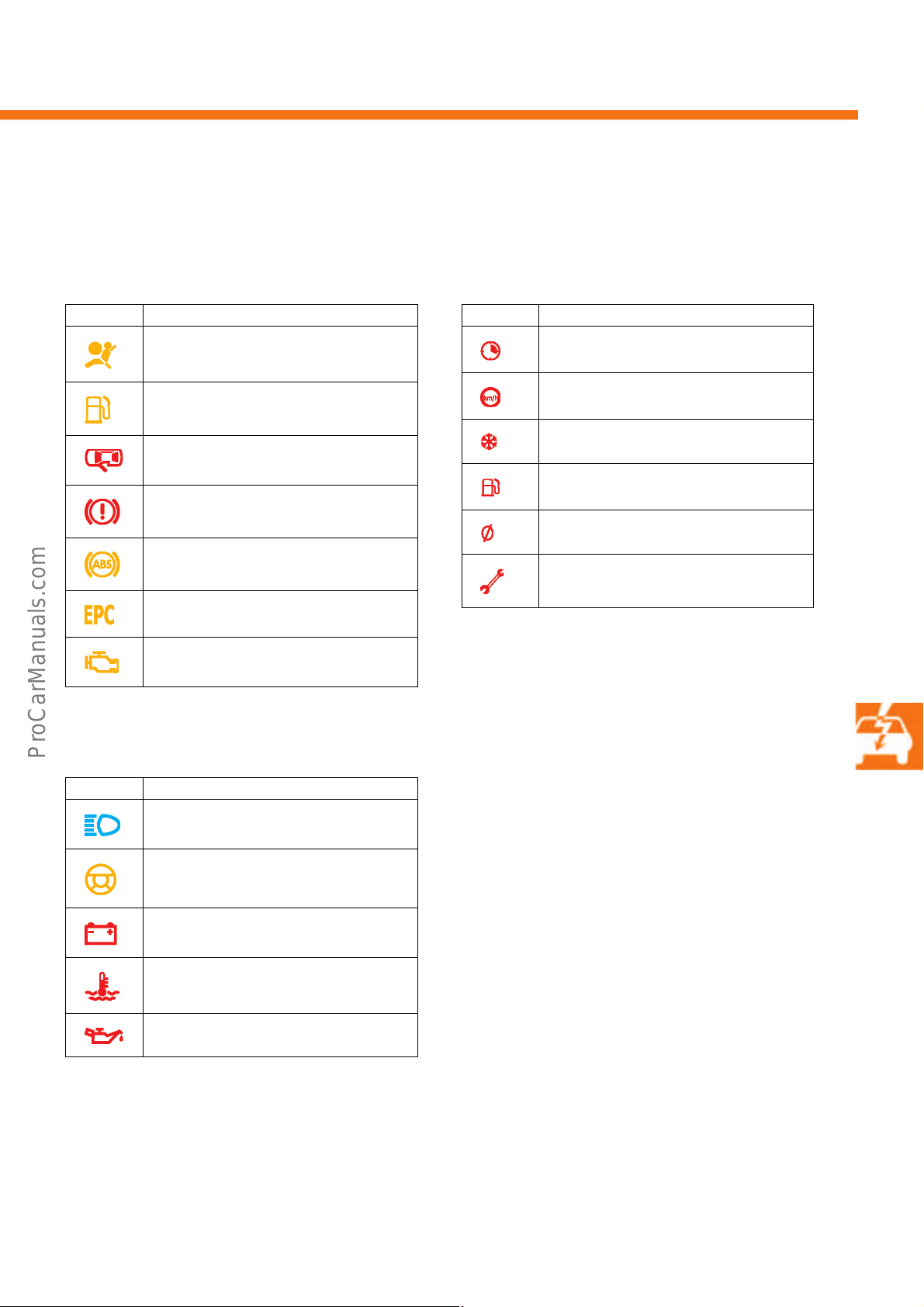
Overview of symbols in dash panel insert
Symbols in speedometer
Symbol Brief explanation
Fault in airbag and belt tensioner system
Fuel tank almost empty
At least one door is open or not properly
closed
Handbrake applied, brake fluid too low or
malfunction in braking system
ABS malfunction or failure
Fault in electronic accelerator pedal unit
Engine management malfunction
Symbols in central display
Symbol Brief explanation
Driving time
Warning if stored speed is exceeded
by more than 30km/h
Icy road warning at below +4°C (+39 °F)
Fuel tank almost empty
Average consumption
Service interval display
S474_106a-r
Symbols in rev counter display
Symbol Brief explanation
Main beam on or
headlight flasher pressed
Steering wheel or power steering fault
Alternator fault
Engine cooling system fault
Engine oil pressure too low
41
Page 42
Electrical system
The electronic immobilizer
The Vento is equipped with an immobilizer of the fourth generation. This is active when the ignition is switched on
and prevents unauthorised operation of the vehicle by intervention in the engine control unit.
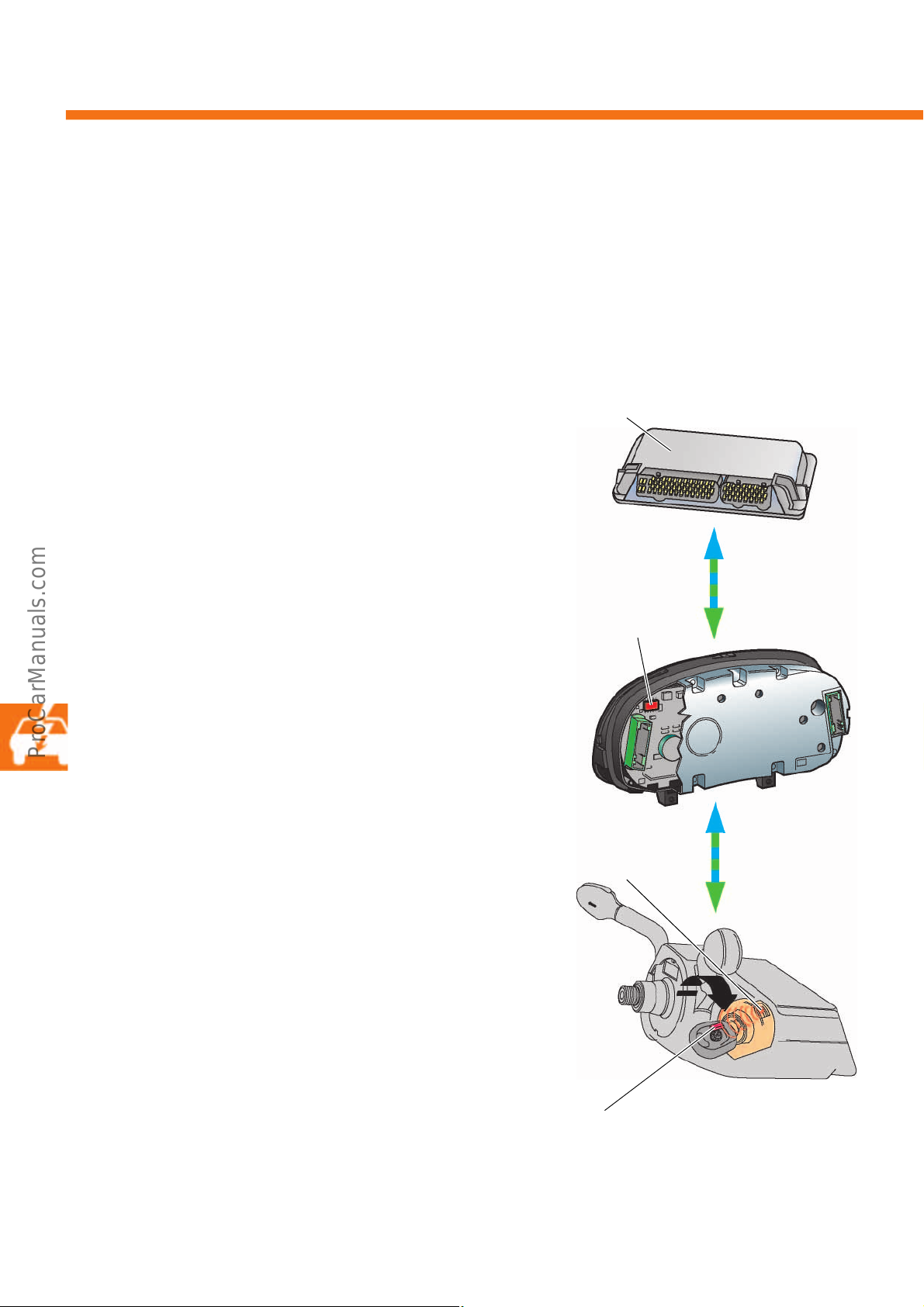
The components of the
immobilizer
The immobilizer control unit is integrated in the dashpanel insert. Other components are:
- Control lamp in dash panel insert
- Reader coil in ignition lock
- Programmed ignition key with transponder
- Engine control unit
Engine control unit
Immobilizer control unit
in dash panel insert
42
Reader coil in ignition lock
S474_010
Key with transponder
Page 43
Features of 4th generation unit
● Rolling code generated and evaluated in engine control unit
and immobilizer control unit respectively
● Online adaption (internet connection) via VAS tester
Function
When the ignition is switched on, a permanently
stored code is sent to the immobilizer control unit from
the transponder. If this code is recognised as valid, a
rolling code is generated randomly in the immobilizer
control unit. This rolling code is transmitted to the
transponder in the vehicle key. An inaccessible
computer process now starts in the transponder and
the immobilizer control unit.
If the result matches, the correct vehicle key is
recognised. A rolling code is then checked between
the immobilizer control unit and engine control unit. If
the process also determines a match, the vehicle is
ready for operation.
This calculated rolling code cannot be decoded due
to the classified computing process. It is therefore
generally not possible to duplicate the vehicle key.
Instead, a new key has to be programmed in the
event of loss or replacement.
Programming transponder
The key transponder is programmed just once,
whereafter the key is paired with the immobilizer.
This is carried out via a corresponding test program
with the aid of the VAS tester. The key cannot be
programmed to any other immobilizer once this has
been done.
43
Page 44
Convenience electronics
Central locking
A remote central locking system is available for the
Vento from the Highline version. This represents
enhanced user-friendliness.
The central locking with remote control is equipped
with two folding key remote fobs.
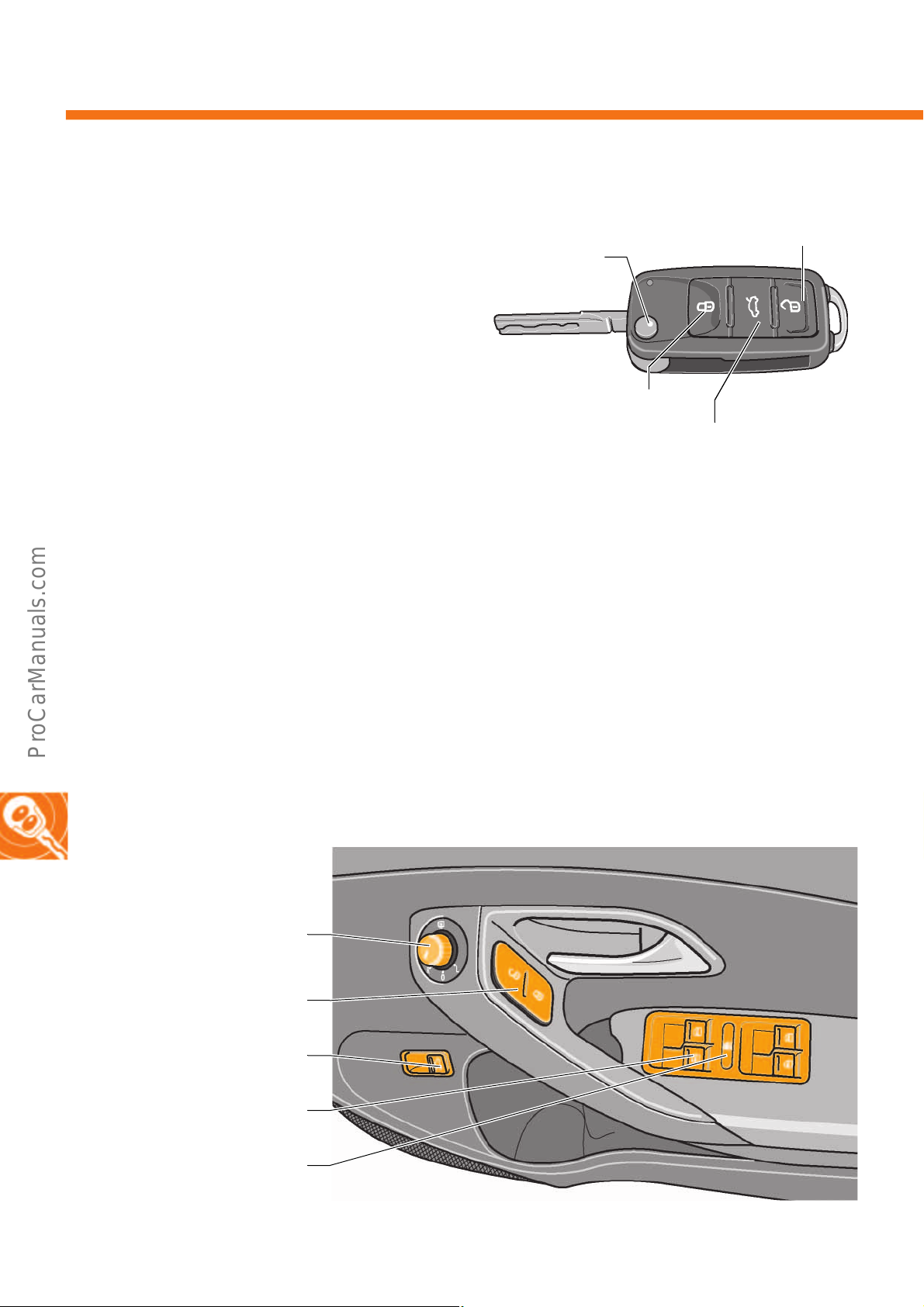
Using the three buttons on the folding key remote fob,
the driver can conveniently lock and unlock the car
conveniently without the mechanical key. In addition,
the boot lid can also be released.
Door control elements
Electric window regulators
Release
Folding key
Unlock
S474_308
Lock
Open boot lid
Electric window regulators are installed as standard on all doors. The Vento features the Auto-Down function as
standard from the Trendline version. From the Highline version, all window regulators also feature the rollback
function and the windows in the rear doors have a child lock. On the Highline version, electric exterior mirrors are
also installed.
Electric adjustable
exterior mirror
Central locking
Boot lid release
Window regulator switch
44
Child safety lock for
windows of 2nd seat row
S474_098
Page 45
Park Distance Control (PDC)
Rear parking aid
An optional parking aid is available for the Vento.
This parking aid makes reverse parking easier.
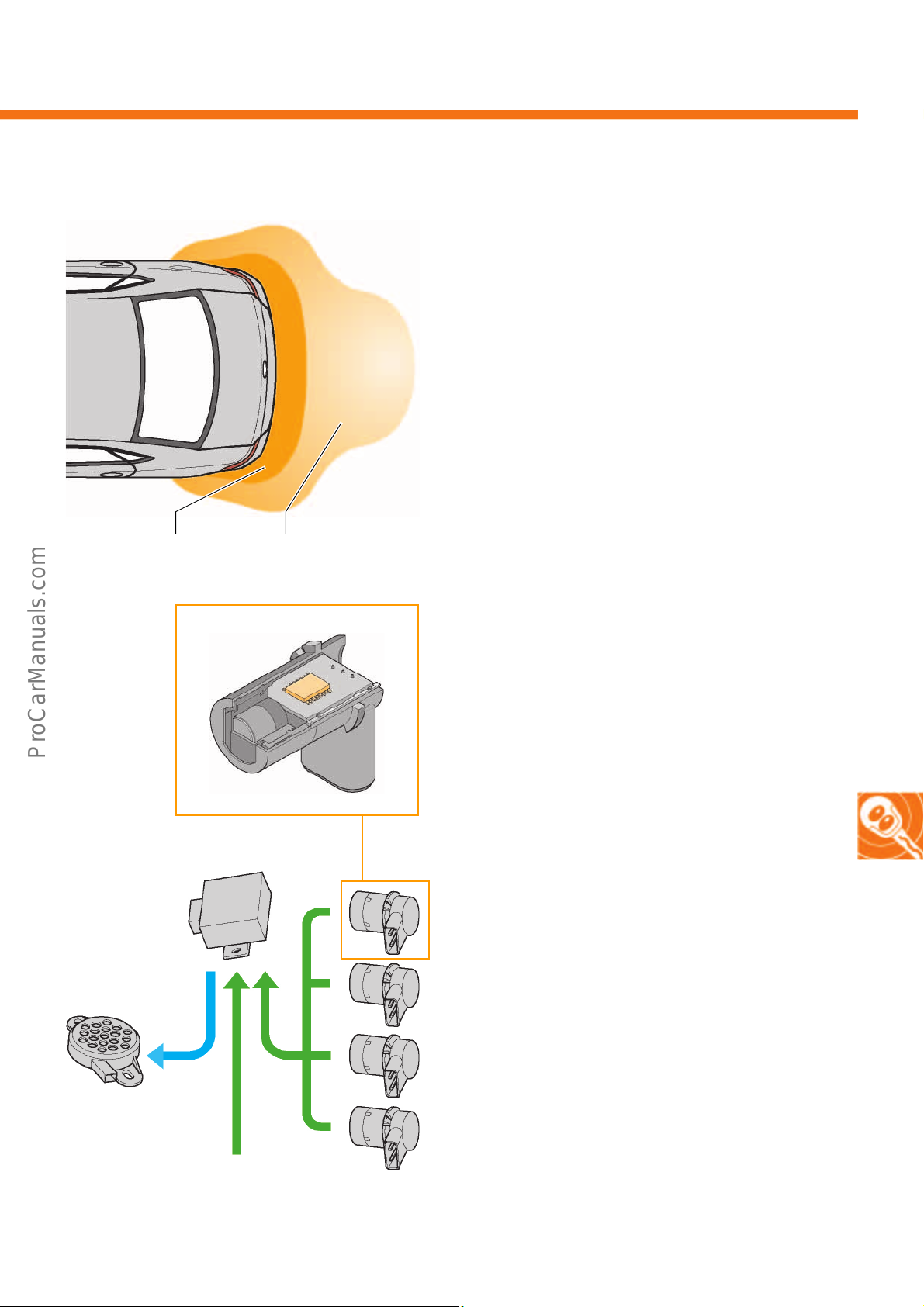
Four ultrasound sensors are installed in the bumper
area to achieve this. The control unit can be found on
the rear left in the boot. The acoustic signaling device
is installed in the left C-pillar.
The system is active as soon as the ignition is switched
on and reverse gear is engaged.
S474_066
Steady tone Intermittent tone
Ultrasound sensor
Control unit
The distance warning system starts with an acoustic
signal from a distance of 1.60m from an obstacle. The
frequency of the acoustic signal changes as the
distance to the obstacle diminishes. From a distance
of 20cm the acoustic warning is steady.
S474_070
Acoustic device
Reverse
gear switch
S474_068
45
Page 46
Radio
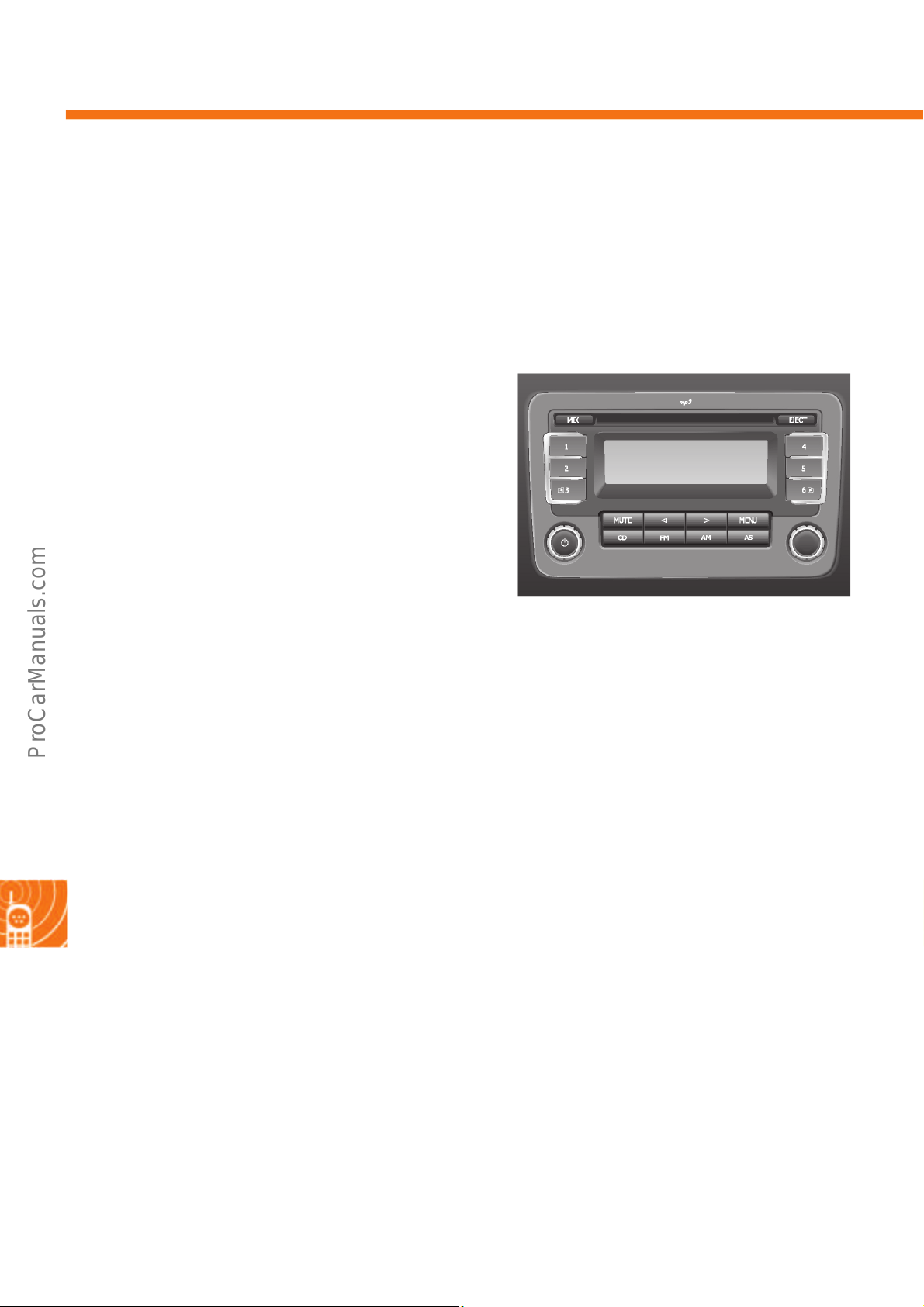
The radio system
Initially, one radio version is available for the Vento.
Indian Top Power (RCD 030) radio
Technical features
● UHV LOW support
● AM/FM reception
● CD/MP3/WMA
● 4 X 20 Watt
● Self-diagnosis via radio display
● Monochrome display 112mm x 30mm
● Display via segments
● 24 memory slots for AM and FM stations on two
memory levels respectively with 6 slots each
Diagnosis
Diagnosis is only possible via the self-diagnosis feature of the radio. This is started by pressing station-memory
buttons 1 and 6. For the automatic testing process, station memory button 4 then has to be pressed.
Self-diagnosis options
- Aerial diagnosis: possible displays "OK" or "Fault"
- USB port connection diagnosis: possible displays "OK" or "Fault"
- Radio hardware and software version diagnosis
- Speaker final control test:
via the relevant selection, various frequencies are actuated in succession on the different speakers and are
visualised accordingly on the display. The mechanic decides whether the speaker is OK by means of an acoustic
test.
S474_114
46
Page 47
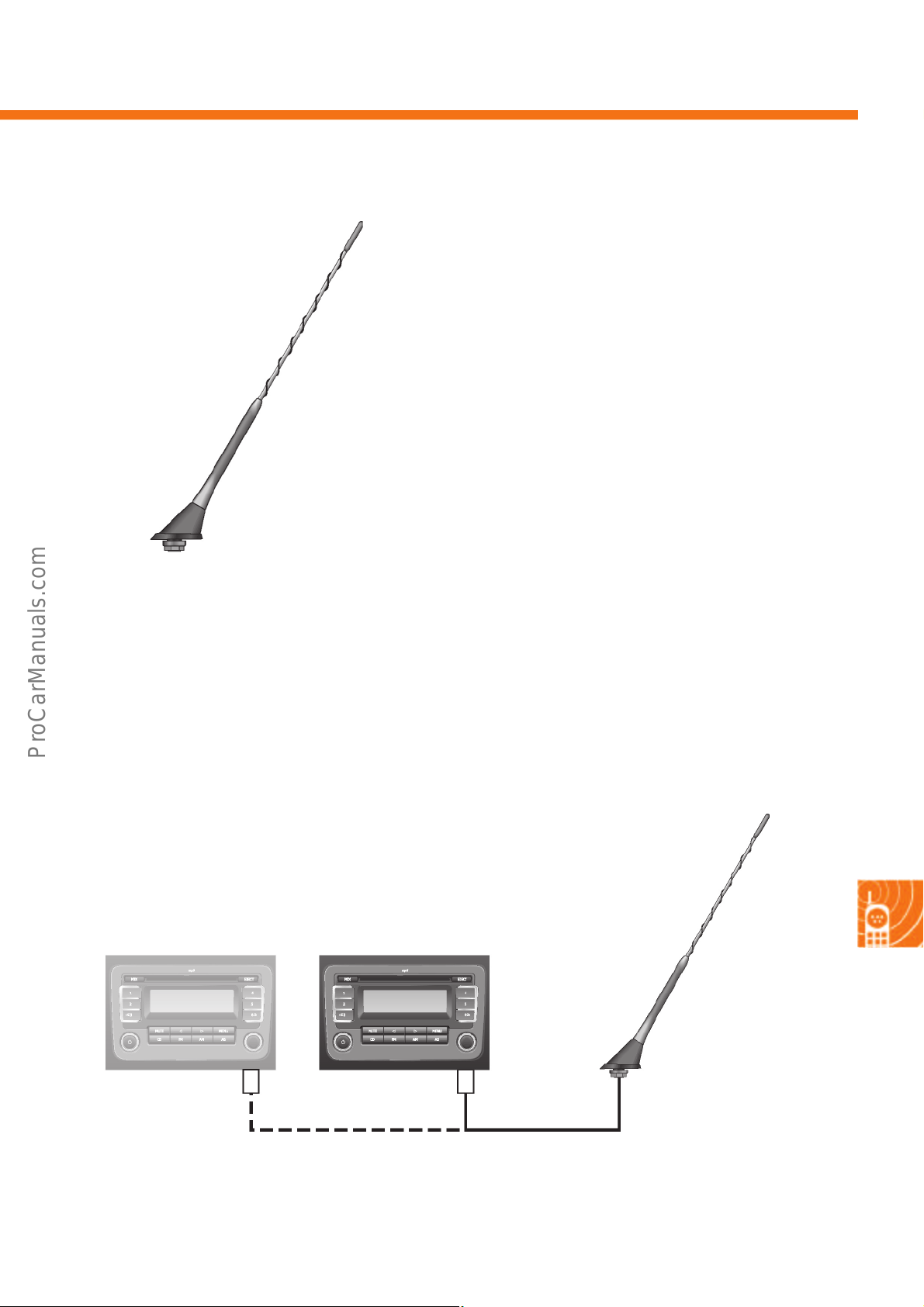
The aerial of the Vento
S474_102
Radio preparation for radio with single tuner
In the Vento 2011, an active rod-type aerial is installed
on the roof for radio reception. The amplifier
electronics are installed in the base of this aerial.
In the basic version from Trendline, there is at least one radio preparation installed in the Vento. This comprises:
● Power supply wires up to
radio installation slot
● Loudspeakers up to
A pillars
● Aerial wire up to roof aperture
● One active roof aerial with preamplifier
Radio preparation RCD 030
BB
S474_104
AM/FM
47
Page 48
Heating and air conditioning
There are two different air conditioning systems available for the Vento
● Manual air conditioning in Trendline version
● Fully automatic Climatronic air conditioning in Highline version
Each version has its own control panel. All temperature and ventilation-relevant controls and the air conditioner
control unit are comprised to form one operating unit. The Vento is installed as standard with the manual air
conditioning system.
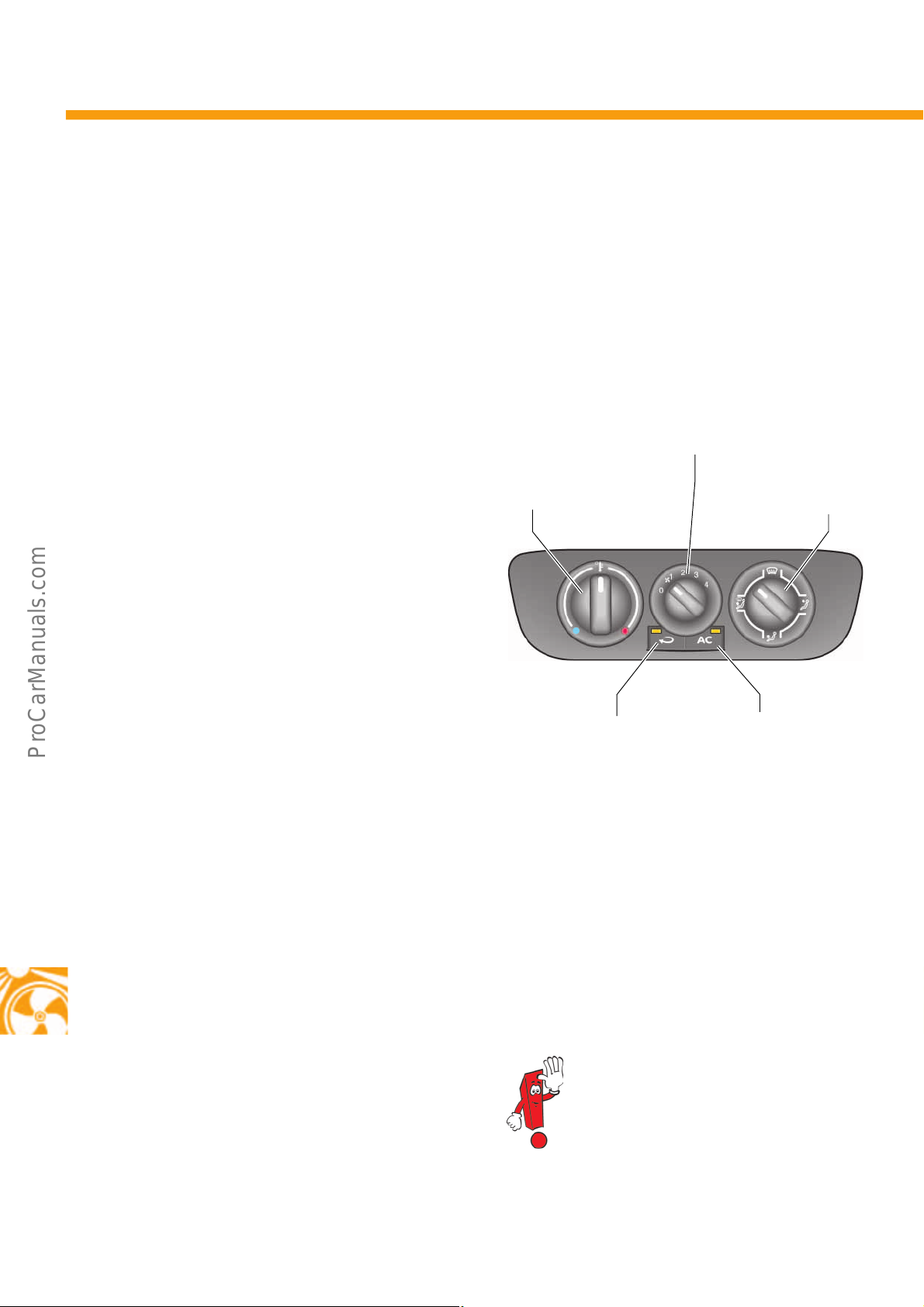
The manual air conditioning system
The manual air conditioner has an internally
regulated A/C compressor with a magnetic coupling.
The air conditioner is switched on via the air
conditioner "AC" button, which is located on the right
beneath the four-stage blower switch.
The AC button is locked against the blower switch in
stage "0".
The temperature is adjusted using the left-hand rotary
temperature selection knob. The adjustment is
transmitted to the heater flap mechanism in the
air-conditioner unit via a flexible shaft.
A potentiometer is additionally installed on the
operating unit to electronically detect the set
temperature.
The central flap, the footwell and the defroster flap
are adjusted via the right-hand rotary air distribution
knob by means of a flexible shaft.
Rotary knob for
temperature selection
Button for
recirculated air mode
with feedback LED
Blower switch
Rotary knob for
air distribution
S474_048
Button for
air conditioner
with feedback LED
48
The fresh and recirculated air flap is actuated via the
recirculated air mode button. The flap is adjusted via
an electric actuator. The "recirculated air" position is
indicated by the feedback LED in the button.
Further information about the manual
air-conditioner can be found
in self-study programme no. 447
"The Polo 2011".
Page 49
The fully automatic "Climatronic" air conditioner
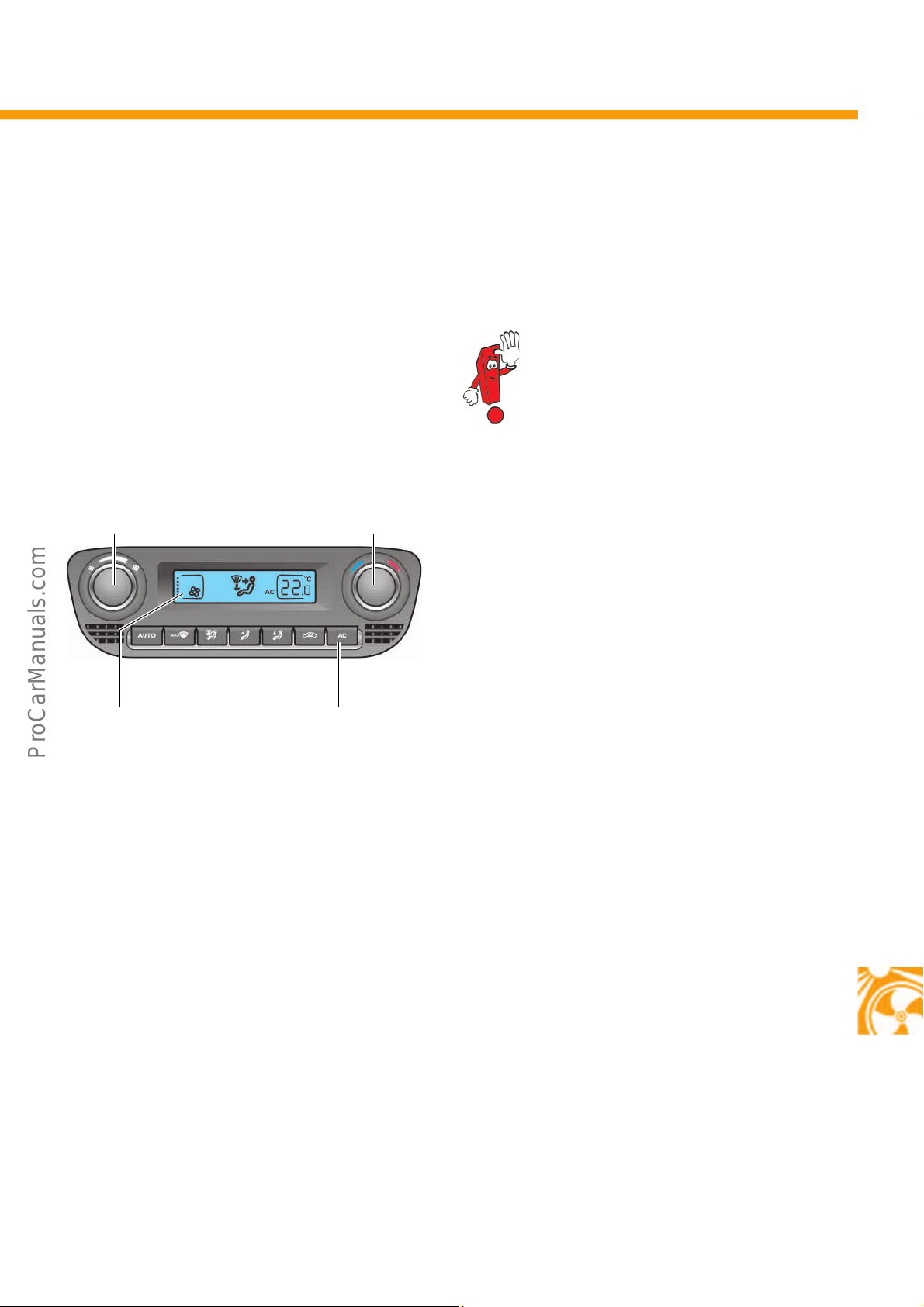
On the "Climatronic" air conditioner, all of the functions are controlled fully automatically. In addition to the front
vents, the Climatronic features a centre vent for the rear passenger area. The Climatronic has a self-diagnosis
function and an internally controlled magnetic coupling.
Further information about the heating and
air conditioning can be found in
self-study programme no. 263
"The Polo 2002".
Rotary knob for ON/OFF
and fan speed
Display for Climatronic status AC button
Rotary knob for adjusting
interior temperature
S474_046
Fresh air and recirculated air flaps
On the manual air conditioning system, the vehicle's interior is treated as one single climatic zone. The climate
control device has a combined fresh air/recirculated air flap that is actuated by a servomotor. The air distribution
flaps are actuated by a flexible shaft on the manual air conditioning system. The temperature is adjusted using the
rotary knob by adding hot or cold air.
On the Climatronic air conditioner, the vehicle's interior is also treated as one single climatic zone. Unlike the
manual system, however, the temperature and air distribution flaps are actuated individually by a servomotor. The
temperature is adjusted using the rotary knob by adding hot or cold air.
49
Page 50
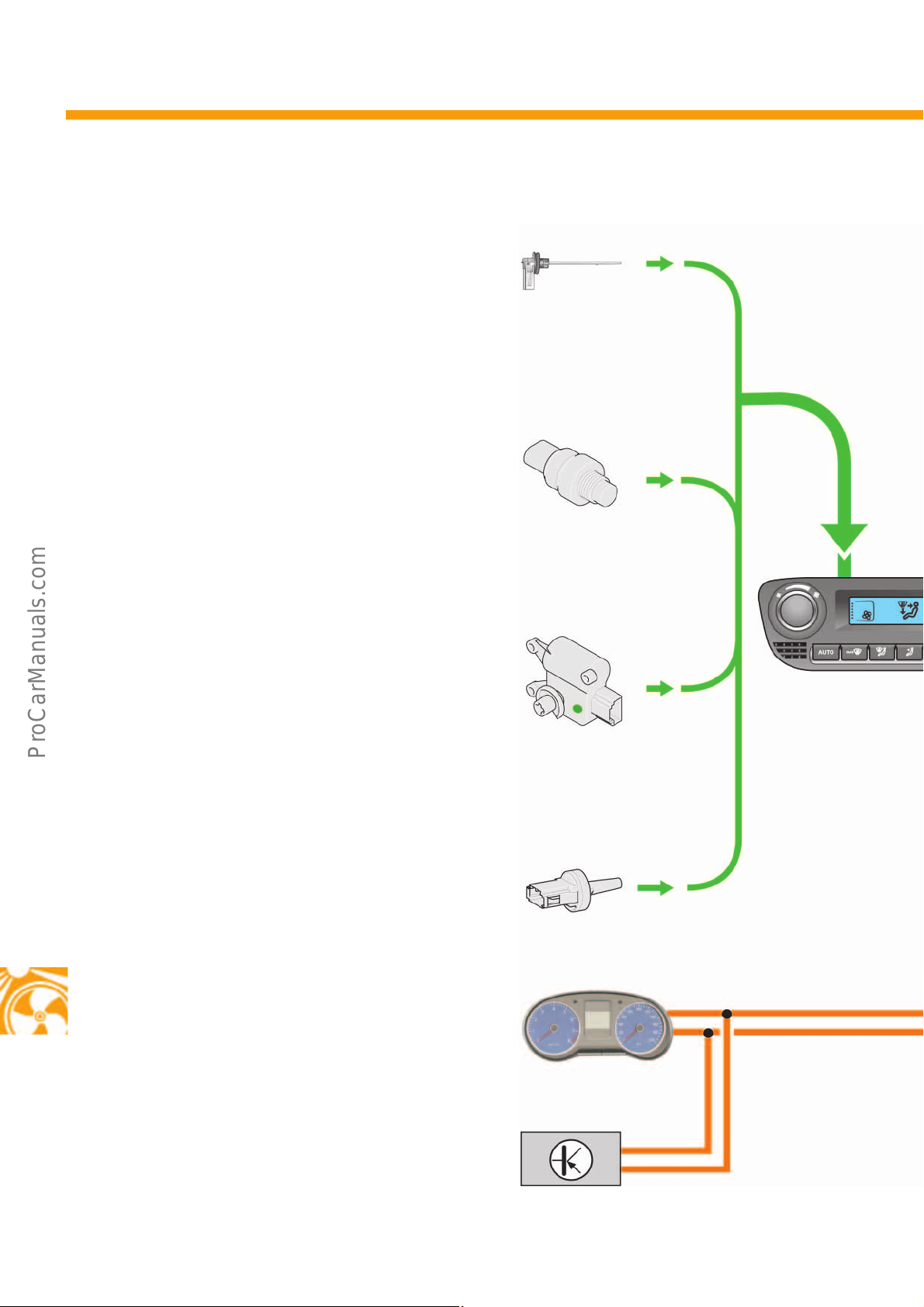
Heating and air conditioning
System overview Climatronic
G89 Temperature sensor - fresh air intake duct
G261 Outlet temperature sender, left footwell
G262 Outlet temperature sender, right footwell
G150 Outlet temperature sender, left
G151 Outlet temperature sender, right
G65 High-pressure sender
G220Servomotor potentiometer for
left temperature flap
G221
Servomotor potentiometer for
right temperature flap
G135 Servomotor potentiometer for defroster flap
G143 Servomotor potentiometer for recirculated
air flap
G112 Servomotor potentiometer for central flap
G113 Servomotor potentiometer for
backpressure flap
G263 Outlet temperature sender, evaporator
J285 Control unit with display in
dash panel insert
J255 Operating
unit with
Climatronic
control unit
Powertrain CAN
50
J220 Motronic control unit
Page 51
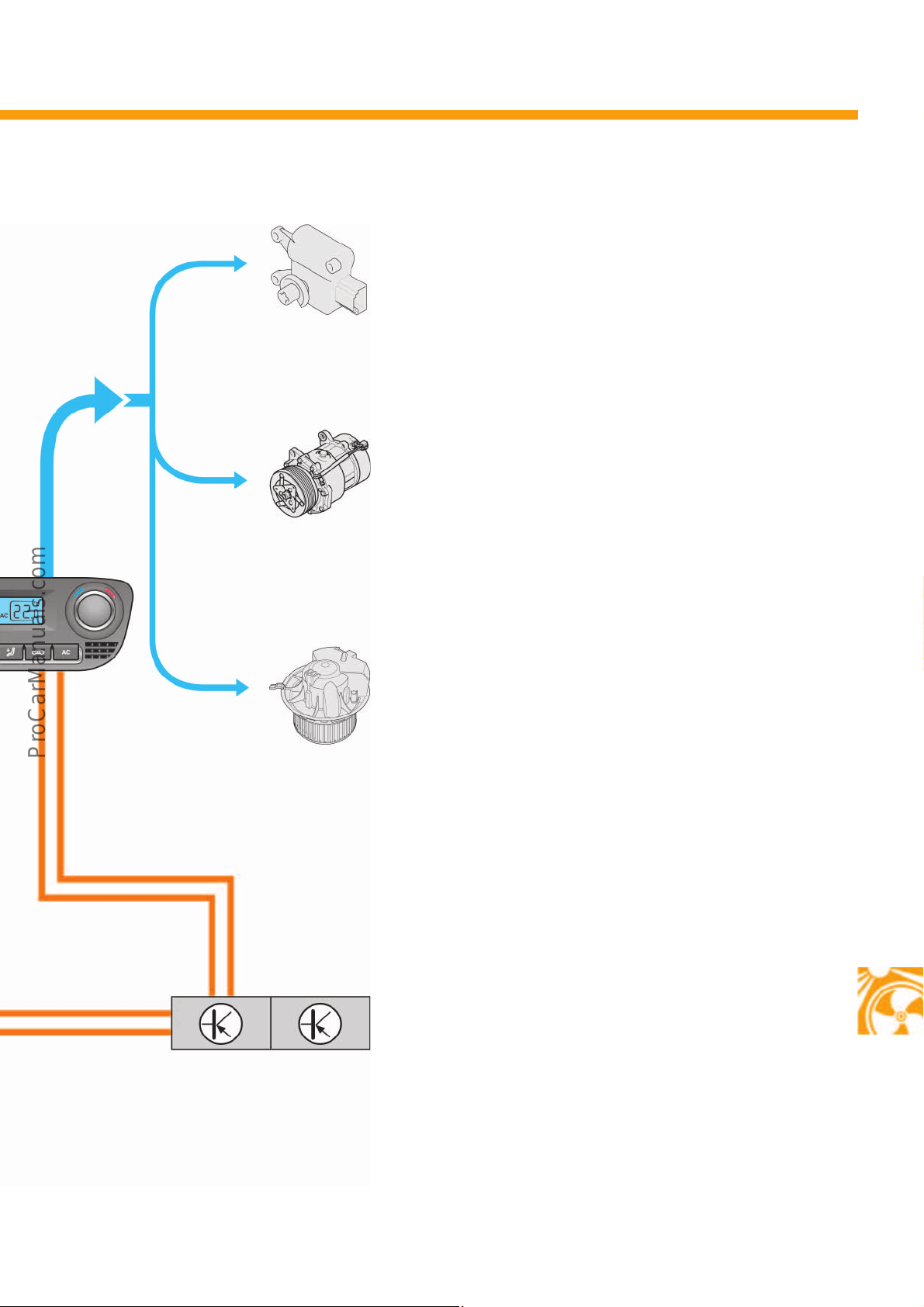
S474_052
V107 Defroster flap servomotor
N25 Magnetic coupling for
air-conditioning compressor
V2 Fresh air blower with integrated
blower regulator (on manual air conditioner
control system is not electronic but works using
series resistors instead).
Convenience CAN
J533 Data bus diagnostic interface
J519 Onboard supply control unit
51
Page 52
474
© VOLKSWAGEN AG, Wolfsburg
All rights and rights to make technical alterations reserved.
000.2812.46.20 Technical status 08.2010
Volkswagen AG
After Sales Qualifizierung
Service Training VSQ-1
Brieffach 1995
D-38436 Wolfsburg
❀ This paper was manufactured from pulp that was bleached without the use of chlorine.
 Loading...