

Page 1

Description, Installation, Operation, Maintenance Reference: Vol. 1 Code 955 900 031C
GROUND BEACON
DME 415/435
Technical Manual
VOLUME 1
Equipment description, Installation, Operation, Maintenance and PC user
SECTION 1
GENERAL INFORMATION
Vers. D, September 2005
THALES Italia S.p.A.- Air Systems Division
Page 2

955 900 031C
DME 415/435 -Technical Manual
Vol. 1-Section 1-General Information
1-II
THALES Italia S.p.A.- A. S. D.
Vers. D, September 2005
Page 3

DME 415/435 -Technical Manual
Vol. 1-Section 1-General Information
955 900 031C
Table of CONTENTS
Paragraph Page
SECTION 1............................................................................................................................................1-1
GENERAL INFORMATION....................................................................................................1-1
1.1 INTRODUCTION ..............................................................................................................1-1
1.2 DME PRINCIPLE ..............................................................................................................1-1
1.2.1 Coverage ..........................................................................................................................1-2
1.2.2 Traffic Capacity .................................................................................................................1-2
1.2.3 Accuracy ...........................................................................................................................1-2
1.2.4 Nominal Reply Delay – Pair Pulse Code - Channeling.....................................................1-2
1.3 GENERAL FEATURES OF THE EQUIPMENT................................................................1-13
1.3.1 Equipment Versions..........................................................................................................1-13
1.3.2 Main Feature of the Equipment ........................................................................................1-13
1.3.2.1 Engineering.......................................................................................................................1-14
1.3.2.2 Safety................................................................................................................................1-14
1.3.2.3 Installation.........................................................................................................................1-14
1.3.2.4 Operation ..........................................................................................................................1-14
1.4 BEACON COMPOSITION AND IDENTIFICATION..........................................................1-16
1.5 PHYSICAL AND MECHANICAL general Description.......................................................1-19
1.6 EQUIPMENT FUNCTIONAL DESCRIPTION...................................................................1-26
1.6.1 General Overview .............................................................................................................1-26
1.6.2 DME 415/435 System Functional Description ..................................................................1-27
1.6.3 I/O SYSTEM - Functional description ...............................................................................1-31
1.6.3.1 I/O Local site .....................................................................................................................1-31
1.6.3.2 LOCAL CONTROL & STATUS UNIT (LCSU) ..................................................................1-34
1.6.3.2.1 CONTROL AND STATUS BOARD - CSB module – Functional description....................1-36
1.6.3.2.1.1 CPU and Memories...........................................................................................................1-37
1.6.3.2.1.2 Serial Lines .......................................................................................................................1-40
1.6.3.2.1.3 Parallel ports .....................................................................................................................1-41
1.6.3.2.2 LOCAL FRONT CONTROL PANEL .................................................................................1-44
1.6.3.2.2.1 INDICATION AND CONTROLS - INC Module - functional description............................1-45
1.6.3.3 REMOTE CONTROL SYSTEM ........................................................................................1-48
1.6.3.3.1 Remote Control & Status Indicator (RCSI 446) ................................................................1-50
1.6.3.3.2 Remote Control and Status Equipment (RCSE)...............................................................1-51
1.6.3.3.3 MCS ..................................................................................................................................1-52
1.6.3.4 Status Indicator SI 446......................................................................................................1-53
1.6.3.5 Personal Computer - PC...................................................................................................1-54
1.6.4 TRANSPONDER – Functional description .......................................................................1-55
1.6.4.1 General Overviews ...........................................................................................................1-55
1.6.4.1.1 Pilot Pulse .........................................................................................................................1-55
1.6.4.1.2 Transponder Main Delay Measurement ...........................................................................1-55
1.6.4.2 RECEIVER - RX module...................................................................................................1-60
1.6.4.2.1 UHF coupler (pilot pulse mixer) and 63 MHz Oscillator....................................................1-61
1.6.4.2.2 UHF Front End & 63 MHz linear amplification..................................................................1-61
1.6.4.2.3 Synthesizer .......................................................................................................................1-62
1.6.4.2.4 Programmable attenuators ...............................................................................................1-62
1.6.4.2.5 Logarithmic Amplifier ........................................................................................................1-63
1.6.4.2.6 On channel validation (OCV) ............................................................................................1-63
1.6.4.2.7 RX reference power supply ..............................................................................................1-63
1.6.4.2.8 Digital circuitry and data bus,............................................................................................1-64
Vers. D, September 2005
THALES Italia S.p.A.- A. S. D.
1-a
Page 4

955 900 031C
Paragraph Page
DME 415/435 -Technical Manual
Vol. 1-Section 1-General Information
1.6.4.3 SIGNAL PROCESSOR - DPR module ............................................................................1-66
1.6.4.3.1 Analog Input, TOA & Delay Compare ............................................................................. 1-68
1.6.4.3.2 On-channel validate .........................................................................................................1-69
1.6.4.3.3 Decoder and Dead Time .................................................................................................. 1-69
1.6.4.3.4 Echo suppression............................................................................................................. 1-70
1.6.4.3.5 Main Delay & Priority Circuit............................................................................................. 1-71
1.6.4.3.6 Keyer and 1350 Hz Generator .........................................................................................1-71
1.6.4.3.7 Squitter Generator........................................................................................................... 1-72
1.6.4.3.8 DPR reference power supply ...........................................................................................1-72
1.6.4.3.9 Digital Input circuitry and Data bus .................................................................................. 1-72
1.6.4.4 MODULATOR – DMD module .........................................................................................1-73
1.6.4.4.1 Microprocessor and Peripherals ...................................................................................... 1-75
1.6.4.4.1.1 Watchdog and Power-On Reset ...................................................................................... 1-75
1.6.4.4.1.2 Serial Communication Controller ..................................................................................... 1-75
1.6.4.4.1.3 Internal Timers .................................................................................................................1-75
1.6.4.4.2 Coded Gaussian former & Pedestal Modulation Generators........................................... 1-75
1.6.4.4.3 Coded Square Gates Modulation..................................................................................... 1-76
1.6.4.4.4 Scan & Calibration Counters and reply delay Fine compensation.................................. 1-76
1.6.4.4.4.1 Overload Protection.......................................................................................................... 1-77
1.6.4.4.5 Acquisition Process .......................................................................................................... 1-77
1.6.4.4.6 Modulation signals measurements................................................................................... 1-77
1.6.4.4.7 DMD reference power supply........................................................................................... 1-77
1.6.4.4.8 Digital Input and Data bus ................................................................................................ 1-78
1.6.4.5 TRANSMITTER -TX 100 module ..................................................................................... 1-79
1.6.4.5.1 RF amplifiers chain circuits ..............................................................................................1-79
1.6.4.5.2 Video Modulation amplifiers ............................................................................................. 1-79
1.6.4.5.3 Detectors circuits.............................................................................................................. 1-81
1.6.4.5.4 Pulse Duration Protection circuits ....................................................................................1-81
1.6.4.5.5 Dedicated Power supply for RF amplifiers and TX100 ref. voltage power supply........... 1-82
1.6.4.5.6 Circuits for measurement and diagnostic purpose........................................................... 1-83
1.6.4.5.7 Digital signals and Data bus............................................................................................. 1-83
1.6.4.6 1kWp RF POWER AMPLIFIER – TKW module (only DME 435)..................................... 1-84
1.6.4.6.1 RF amplifiers .................................................................................................................... 1-84
1.6.4.6.2 Detectors circuits.............................................................................................................. 1-87
1.6.4.6.3 Pulse Duration Protection circuits ....................................................................................1-87
1.6.4.6.4 Dedicated 50V Power supply for RF amplif. and TKW ref. voltage power supply........... 1-87
1.6.4.6.5 Circuits for measurement and diagnostic purpose........................................................... 1-88
1.6.4.6.6 Digital signals and Data bus............................................................................................. 1-88
1.6.4.7 TRANSPONDER POWER SUPPLY (+5V & ±15V) – PWS module............................... 1-90
1.6.5 RF PATH AND DUPLEXER – DPX module – Functional description .............................1-91
1.6.5.1.1 RF electronic switch circuitry............................................................................................ 1-92
1.6.5.1.2 Coupler detecting the pilot pulse and the coupler of the monitor-interrogator................. 1-92
1.6.5.1.3 Video driver of RF switches commands........................................................................... 1-92
1.6.5.1.4 DPX reference power supply............................................................................................ 1-93
1.6.5.1.5 Patch Panel ...................................................................................................................... 1-94
1.6.6 MONITOR SYSTEM......................................................................................................... 1-96
1.6.6.1 Monitor Reply Delay measurement.................................................................................. 1-97
1.6.6.2 MONITOR - MON module – Functional description......................................................... 1-99
1.6.6.3 RF Analog Group .............................................................................................................1-99
1.6.6.3.1 Frequency synthesizer ..................................................................................................... 1-101
1-b
THALES Italia S.p.A.- A. S. D.
Vers. D, September 2005
Page 5

DME 415/435 -Technical Manual
Vol. 1-Section 1-General Information
Paragraph Page
955 900 031C
1.6.6.3.2 59MHz oscillator & Linear modulator................................................................................1-102
1.6.6.3.3 Digital Attenuator ..............................................................................................................1-102
1.6.6.3.4 Mixer FRX - Filter & UHF Amplifier.....................................................................................1-103
1.6.6.3.5 Input-Output selector ........................................................................................................1-103
1.6.6.3.6 Linear 63 MHz Detector ....................................................................................................1-106
1.6.6.4 Analog/digital video section ..............................................................................................1-107
1.6.6.4.1 Acquisition ad Generation.................................................................................................1-107
1.6.6.5 Parallel line and serial line interface .................................................................................1-110
1.6.6.5.1 Status signals from Transponders ....................................................................................1-111
1.6.6.5.2 Commands to Transponders ............................................................................................1-111
1.6.6.5.3 Status signals from the Antenna - Dummy Load Switch (Duplexer) ................................1-111
1.6.6.5.4 Commands to the Antenna - Dummy Load Switch (Duplexer).........................................1-111
1.6.6.5.5 Signals Exchanging with the other Monitor.......................................................................1-111
1.6.6.5.6 Other signals from/to Transponders .................................................................................1-112
1.6.6.6 CPU and Digital processor ...............................................................................................1-112
1.6.6.6.1 Serial connection with LCSU unit .....................................................................................1-113
1.6.6.6.2 Automatic cycle.................................................................................................................1-113
1.6.6.6.3 Monitor Reply Delay measurement ..................................................................................1-114
1.6.6.7 Morse code (MORCO) decoder........................................................................................1-114
1.6.6.7.1 Identification code .............................................................................................................1-114
1.6.6.7.2 Morse code detector .........................................................................................................1-115
1.6.6.8 MON reference power supply ...........................................................................................1-115
1.6.6.9 MONITOR SOFTWARE PROGRAM................................................................................1-115
1.6.6.9.1 Automatic Monitoring Operation .......................................................................................1-115
1.6.6.9.2 Automatic & Semi-Automatic Testing ...............................................................................1-116
1.6.7 INTERFACE SYSTEM – Functional description ..............................................................1-117
1.6.7.1 Associated Facility Interface - AFI module .......................................................................1-117
1.6.7.2 Modem (MDM) ..................................................................................................................1-118
1.6.7.2.1 Modem Level Adapter interface........................................................................................1-118
1.6.7.2.2 Switched and dedicated line Modem - LGM28,8..............................................................1-118
1.6.7.2.3 Dedicated Line Modem LGM1200MD – Party line ...........................................................1-120
1.6.8 COAXIAL RELAY – KCX module .....................................................................................1-121
1.6.8.1 TAI dummy – Interface module.........................................................................................1-121
1.6.9 POWER SUPPLY SYSTEM – Functional description ......................................................1-121
1.6.9.1 BCPS unit .........................................................................................................................1-123
1.6.9.2 Power supply with BCPS subrack Frako type (optional) .................................................1-125
1.6.9.2.1 AC/DC module – AC-DC converter (type Frako optional) ................................................1-127
1.6.9.2.2 Battery Supervisor module ...............................................................................................1-128
1.6.10 DME ANTENNA................................................................................................................1-129
Vers. D, September 2005
THALES Italia S.p.A.- A. S. D.
1-c
Page 6

955 900 031C
DME 415/435 -Technical Manual
Vol. 1-Section 1-General Information
List of FIGURES
Figure Page
Figure 1.1. DME - Principle of the RF signals path .............................................................................1-1
Figure 1.2. DME - Theory of operation, simplified block diagram ....................................................... 1-2
Figure 1.3. DME Channels Reply and Interrogation Frequencies....................................................... 1-3
Figure 1.4. DME 415 (same as DME 435) – Cabinet and PC, example of arrangement.................... 1-15
Figure 1.5. DME 435 – Front view with anterior door opened – Full Dual version ............................. 1-21
Figure 1.6. DME 415 – Front view with anterior door opened – Full Dual version.............................. 1-22
Figure 1.7. DME 435 Single version – Front view with anterior door opened ..................................... 1-23
Figure 1.8. DME 435 – Rear side view of the cabinet ......................................................................... 1-24
Figure 1.9. DME 415/435 – Top view .................................................................................................. 1-25
Figure 1.10. DME 415/435 – Simplified general block diagram ..........................................................1-28
Figure 1.11. DME 415/435 – Main RF path signals - General simplified block diagram..................... 1-29
Figure 1.12. DME 415/435 – Local I/O system general block diagram ............................................... 1-30
Figure 1.13. DME 415/435 – AC/DC Power Supply system & Battery Charge - Block diagram......... 1-30
Figure 1.14. I/O Panel.......................................................................................................................... 1-32
Figure 1.15. Local site set up – Typical configuration .........................................................................1-33
Figure 1.16. LCSU - Simplified Block Diagram.................................................................................... 1-34
Figure 1.17. CSB module – Simplified Block Diagram ........................................................................ 1-35
Figure 1.18. CSB module – General Block Diagram ........................................................................... 1-37
Figure 1.19. CSB module – CPU and Memories: Block Diagram ....................................................... 1-39
Figure 1.20. CSB module – Serial lines: Block Diagram ..................................................................... 1-41
Figure 1.21. CSB module – I/O Parallel Ports: Block Diagram............................................................ 1-43
Figure 1.22. Local Front Panel ............................................................................................................1-45
Figure 1.23. INC module - simplified block diagram............................................................................ 1-46
Figure 1.24. INC Module - Indication and Control: General Block Diagram........................................ 1-46
Figure 1.25. INC Module - Indication and Control: Block Diagram...................................................... 1-47
Figure 1.26. Possible connection between Remote RCSI/RCSE and Local site ................................ 1-48
Figure 1.27. Example of single site connection with RCSI .................................................................. 1-49
Figure 1.28. Example of multi site connection with RCSI.................................................................... 1-49
Figure 1.29. Example of multi site connection with RCSE ..................................................................1-50
Figure 1.30. RCSI-8 – Remote control ................................................................................................1-51
Figure 1.31. RCSE 443 – Remote control ........................................................................................... 1-51
Figure 1.32. RCSE 443 – Remote control CTU & RunWay select...................................................... 1-52
Figure 1.33. MCS – Remote control .................................................................................................... 1-52
Figure 1.34. SI446-2 and SI 446-8 - Front panel view......................................................................... 1-53
Figure 1.35. Example of connections between beacon and PC with RCSI/RCSE.............................. 1-54
Figure 1.36. DME 415/435 TRANSPONDER– General block diagram of the main signals ............... 1-56
Figure 1.37. DME 415/435 TRANSPONDER– Main Delay Measurement and compensation ........... 1-57
Figure 1.38. DME 415/435 TRANSPONDER– General block diagram .............................................. 1-58
Figure 1.39. RX module – General block diagram ..............................................................................1-59
Figure 1.40. RX - Layout location in the extrusion of the Analog RF .................................................. 1-60
Figure 1.41. RX - Receiver Coupler and 63 MHz oscillator block diagram ......................................... 1-61
Figure 1.42. RX – Front End and 63 MHz linear amplif. - Block diagram............................................ 1-61
Figure 1.43. RX – Frequency Synthesizer & RF Amplifier - Block diagram ........................................ 1-62
Figure 1.44. RX – IF programmable digital Attenuator - Block diagram.............................................. 1-63
Figure 1.45. RX – 63 MHz logarithmic amplifiers - Block diagram ...................................................... 1-64
Figure 1.46. RX – Digital circuitry and data bus block diagram........................................................... 1-65
Figure 1.47. DPR module – General block diagram............................................................................ 1-67
Figure 1.48. DPR – TOA & Delay-Compare – Block diagram............................................................. 1-68
1-d
THALES Italia S.p.A.- A. S. D.
Vers. D, September 2005
Page 7

DME 415/435 -Technical Manual
Vol. 1-Section 1-General Information
Figure Page
955 900 031C
Figure 1.49. DPR – Decoder & Dead Time – Simplified Block diagram ..............................................1-70
Figure 1.50. DPR – Main Delay, keyer & Priority Circuit – Simplified Block diagram ..........................1-71
Figure 1.51. DPR – Squitter generator – Simplified Block diagram .....................................................1-72
Figure 1.52. DPR – Digital circuitry and data bus - Block diagram......................................................1-72
Figure 1.53. DMD module – General Block diagram ...........................................................................1-74
Figure 1.54. DMD – Bus system - Block diagram ................................................................................1-78
Figure 1.55. TX100 module – General block diagram .........................................................................1-80
Figure 1.56. TX100 – Layout location of main functional blocks..........................................................1-81
Figure 1.57. TX100 – Pulse duration protection circuits ......................................................................1-82
Figure 1.58. TX100 – Dedicated power supply ....................................................................................1-82
Figure 1.59. TX100 – Digital circuits – Block Diagram.........................................................................1-83
Figure 1.60. TKW – RF stages Matching Network – Block Diagram ...................................................1-84
Figure 1.61. TKW module – General block diagram ............................................................................1-85
Figure 1.62. TKW – Main Components Location .................................................................................1-86
Figure 1.63. TKW – Pulse Duration Protection circuits ........................................................................1-87
Figure 1.64. TKW – Dedicated power supply.......................................................................................1-88
Figure 1.65. TKW – Digital circuits – Block Diagram ...........................................................................1-89
Figure 1.66. PWS module – General Block Diagram...........................................................................1-90
Figure 1.67. DPX module – Simplified Block Diagram.........................................................................1-91
Figure 1.68. DPX – RF circuits Block Diagram ....................................................................................1-92
Figure 1.69. DPX– Video circuits – Simplified Block diagram..............................................................1-93
Figure 1.70. DPX– Video circuits – Example of PIN diodes commands..............................................1-93
Figure 1.71. DPX Ref. Power Supply – Simplified Block diagram .......................................................1-94
Figure 1.72. DPX & Patch panel – Frontal view...................................................................................1-94
Figure 1.73. DPX & Patch Panel – Simplified Block diagram ..............................................................1-95
Figure 1.74. DME 415/435 - MONITOR system – Simplified block diagram .......................................1-97
Figure 1.75. DME 415/435 - MONITOR – Reply Delay Measurement ................................................1-98
Figure 1.76. MONITOR – Location of the RF stages on the casting ...................................................1-99
Figure 1.77. MONITOR – Analog RF group - Block diagram...............................................................1-100
Figure 1.78. MONITOR – Synthesizer – Simplified block schematic diagram.....................................1-101
Figure 1.79. MONITOR – Synthesizer – Block diagram ......................................................................1-101
Figure 1.80. MONITOR – 59 MHz oscillator & Linear modulator – Block diagram..............................1-102
Figure 1.81. MONITOR – Digital Attenuator – Block diagram .............................................................1-102
Figure 1.82. MONITOR – Mixer F
- Filter & UHF Amplifier – Block diagram....................................1-103
RX
Figure 1.83. MONITOR – Input-Output RF selector – General Block diagram....................................1-104
Figure 1.84. MONITOR – Input-Output RF selector – Detailed Block diagrams .................................1-105
Figure 1.85. MONITOR – Linear Detector - Block diagram .................................................................1-106
Figure 1.86. MONITOR – Acquisition and Generation - General Block diagram.................................1-107
Figure 1.87. MONITOR – Parallel line and serial line interface - General Block diagram ..................1-110
Figure 1.88. MONITOR – CPU and Digital processor - Block diagram ...............................................1-112
Figure 1.89. MONITOR – Morse code decoder - Block diagram .........................................................1-114
Figure 1.90. AFI module - Association Facility Interface – Simplified Block Diagram .........................1-118
Figure 1.91. Modem Level adapter - Block diagram ............................................................................1-118
Figure 1.92. LGM 28,8 MODEM – Simplified Block Diagram ..............................................................1-119
Figure 1.93. LGM1200MD Modem, block diagram ..............................................................................1-120
Figure 1.94. Transfer relay, block diagram ..........................................................................................1-121
Figure 1.95. EQUIPMENT POWER SUPPLY SYSTEM – General Block Diagram ............................1-122
Figure 1.96. BCPS unit – Simplified Block Diagram ...........................................................................1-123
Figure 1.97. BCPS unit – AC/DC module - Schematic block diagram................................................1-124
Figure 1.98. BCPS unit – AC/DC module - Auxiliary voltage - Schematic block diagram ..................1-124
Vers. D, September 2005
THALES Italia S.p.A.- A. S. D.
1-e
Page 8

955 900 031C
Figure Page
DME 415/435 -Technical Manual
Vol. 1-Section 1-General Information
Figure 1.99. BCPS unit – AC/DC module - Sharing current circuitry - Schematic block diagram...... 1-125
Figure 1.100. Power Supply with BCPS Frako type – Simplified Block Diagram................................ 1-125
Figure 1.101. Power Supply with BCPS Frako type – Front and Rear view .......................................1-126
Figure 1.102. BCPS Frako type AC/DC module – General block diagram ......................................... 1-127
Figure 1.103. Battery Supervisor: Protection Circuit - Block Diagram................................................. 1-128
Figure 1.104. DME ANTENNA ............................................................................................................1-130
List of TABLES
Table Page
Table 1-1. Frequencies for DME Channels .......................................................................................... 1-3
Table 1-2. Frequencies and Code Pulses for DME Channels (1 to 17) ............................................... 1-4
Table 1-2. Frequencies and Code Pulses for DME Channels (18 to 28) ............................................. 1-5
Table 1-2. Frequencies and Code Pulses for DME Channels (29 to 40) ............................................. 1-6
Table 1-2. Frequencies and Code Pulses for DME Channels (41 to 52) ............................................. 1-7
Table 1-2. Frequencies and Code Pulses for DME Channels (53 to 68) ............................................. 1-8
Table 1-2. Frequencies and Code Pulses for DME Channels (69 to 85) ............................................. 1-9
Table 1-2. Frequencies and Code Pulses for DME Channels (86 to 99) ............................................. 1-10
Table 1-2. Frequencies and Code Pulses for DME Channels (100 to 113) ......................................... 1-11
Table 1-2. Frequencies and Code Pulses for DME Channels (114 to 126) ......................................... 1-12
Table 1-3. Composition of the Equipment ............................................................................................1-16
Table 1-4. User Interface Composition (option).................................................................................... 1-17
Table 1-5. Material Supplied................................................................................................................. 1-18
Table 1-6. RF Interrogation levels by monitors to Rx ...........................................................................1-106
1-f
THALES Italia S.p.A.- A. S. D.
Vers. D, September 2005
Page 9
DME 415/435 -Technical Manual
Vol. 1-Section 1-General Information
955 900 031C
SECTION 1
GENERAL INFORMATION
1.1 INTRODUCTION
DME (Distance Measuring Equipment) has been standardized by the ICAO as a radio aid for short and
medium-distance navigation. It is a secondary type of radar, which allows several aircraft to simultaneously
measure their distance from a ground reference (DME transponder). The distance is determined by
measuring the propagation delay of a RF pulse, which is emitted by the aircraft transmitter and returned at a
different frequency by the ground station after reception.
In conjunction with a VOR, the DME, which should preferably be installed at the same location as a
VOR/DME, enables to determine the direction and the distance (rho-theta method).
Since the DME operates in the same frequency range (960 to 1215 MHz) and according to the same
principle as the distance measuring section of the TACAN, combined VOR/TACAN systems (VORTAC) are
installed in many countries, as well as VOR/DME systems.
1.2 DME PRINCIPLE
Aircraft's equipped with DME transmit encoded interrogating RF pulse pairs on the beacon's receiving
channel. The beacon, in turn, emits encoded reply pulse pairs on the receiving channel of the air-borne
equipment, which is 63 MHz apart from the transmitter frequency former.
The time interval between interrogation emission and reply reception provides the aircraft with the real
distance information from the ground station; this information may be read by the pilot or the navigator
directly on the airborne indicator.
The ground transponder is able to answer up to about 200 interrogators at a time (i.e. 4800 pulse pairs/s).
Generates random pulse pairs ("squitter") to maintain a minimum PRF of 800 to 2700 pulse pairs per
second (programmable) whenever the number of decoded interrogations is lower than that.
This reply is received and decoded by the airborne receiver, where special timing circuits automatically
measure the lapse between interrogation and reply and convert this measurement into electrical output
signals. The beacon introduces a fixed delay, called reply delay, between the reception of each encoded
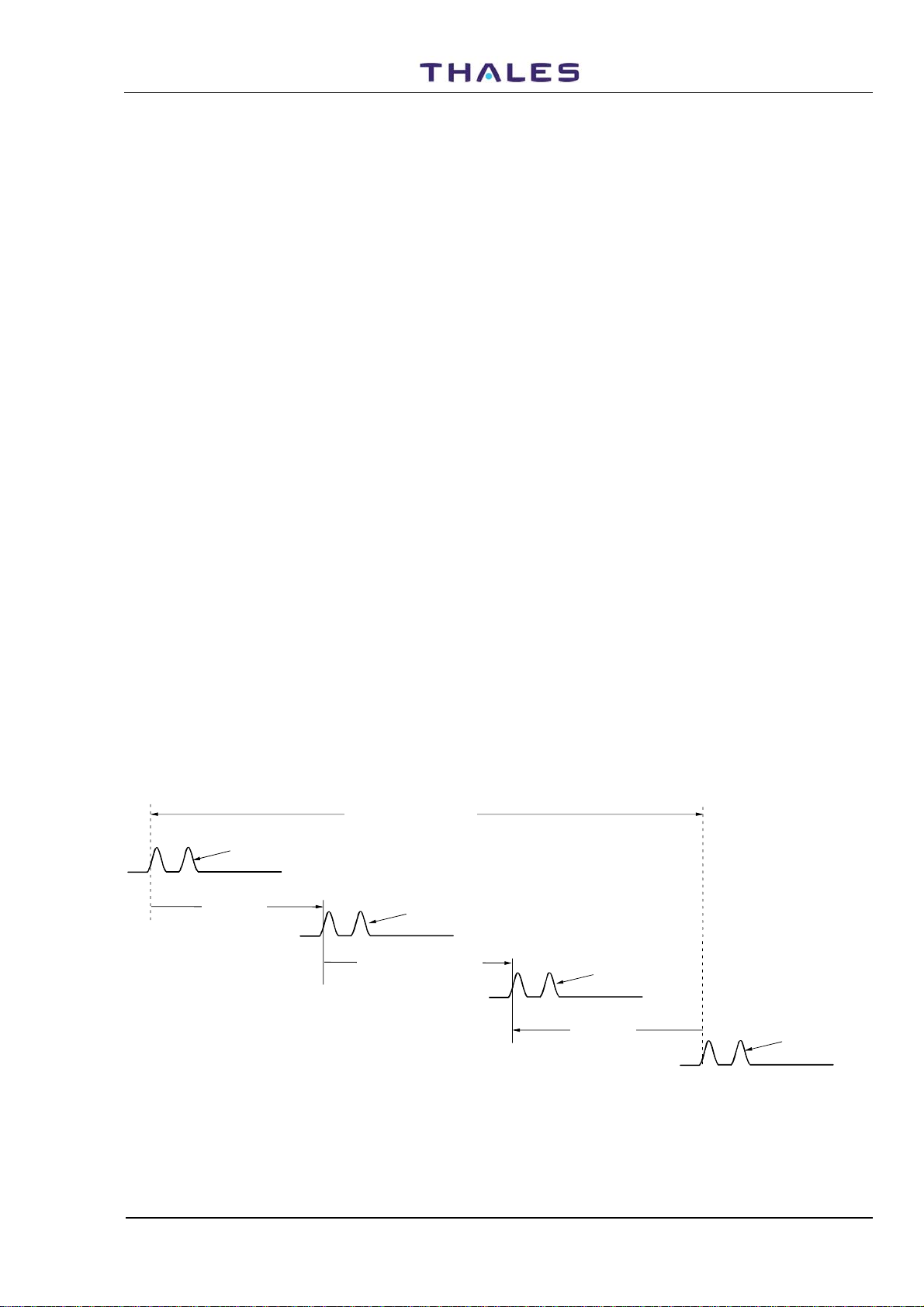
interrogating pulse pair and the transmission of the corresponding reply ( see Figure
Travel time (50µs+1µs/150m)
Interrogation Paire pulses
transmitted by aircraft
One way time
1µs/30 0m
Replay Delay of the beacon
Interrogation Paire pulses
received by transponder
(50µs)
Replay delay Pai re pulses
transmitted by transpond er
1.1).
One way time
1µs/30 0m
Replay Paire pulses
received by aircraft
Figure 1.1. DME - Principle of the RF signals path
The transponder periodically transmits special identification pulse groups, interleaved with the reply and
squitter pulses that can be decoded by the aircraft as a Morse tone, keyed with the beacon code name.
Vers. D, September 2005
THALES Italia S.p.A.- A. S. D.
1-1
Page 10
955 900 031C
DME 415/435 -Technical Manual
Vol. 1-Section 1-General Information
The airborne receiver is able to recognize the replies to its own interrogations, among the many other pulses
transmitted by the beacon, by means of a stroboscopic procedure.
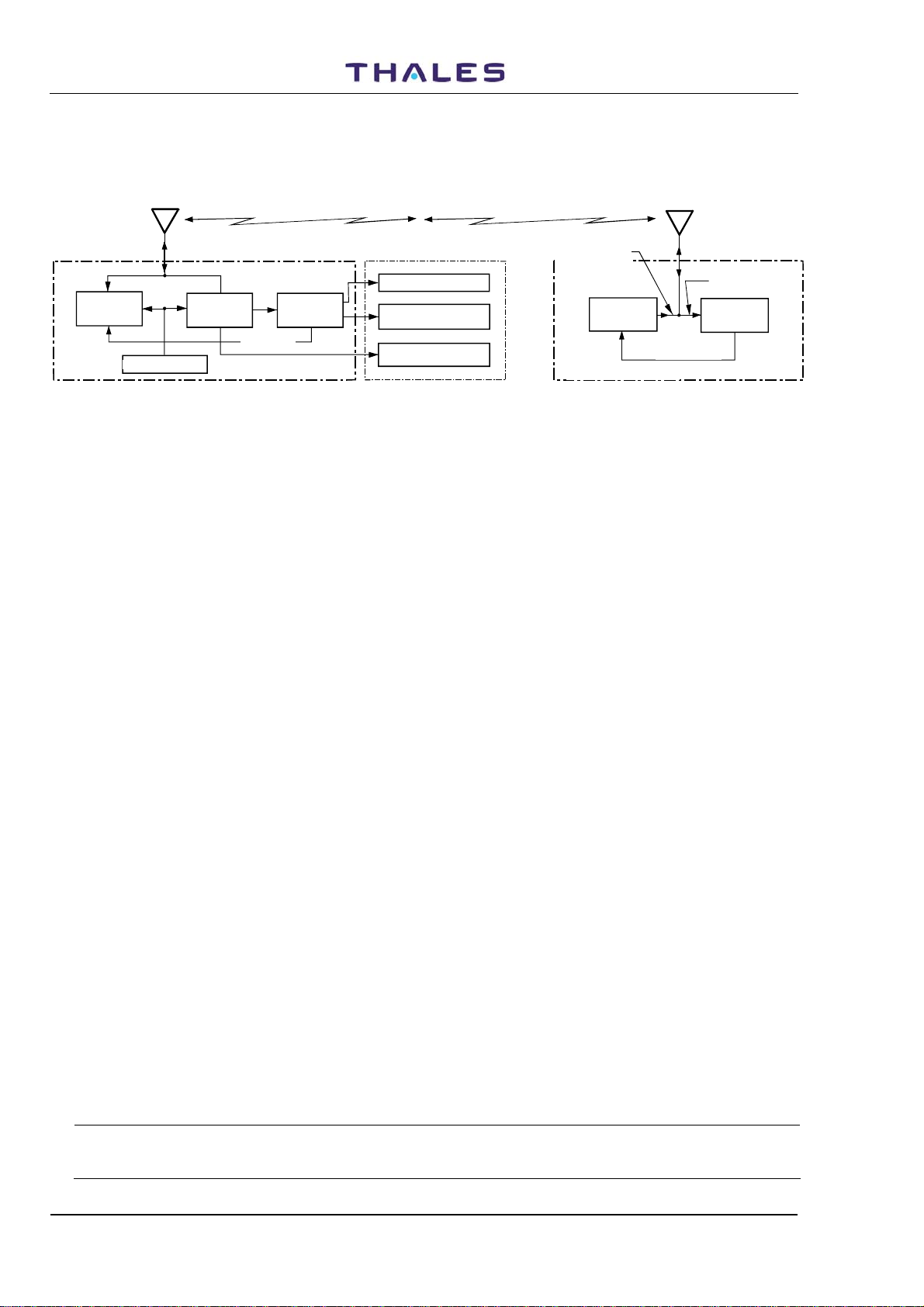
The DME theory of operation is summarized in a block diagram in Figure
AIRCRAFT'S
ANTENNA
AUTOPILOT
TRIGGERS
DISTANCE
CIRCUITS
DISTANCE INFORMATION
TO BOARD INDICATOR
BEACON
IDENTIFICATION TONE
TRANSMITTE R
DME
AIRBORNE
RECEIVER
INTERROGAT ION
CHANNEL SELECTOR
1.2.
TRANSMITS DISTANCE
INFORMATION
and IDENTIFICATION
SIGNAL
TRANSMITTE R
DME GROUND BEACON
BEACON'S
ANTENNA
REPLY TRIGGER TO
INTERROGATI ONS
RECEIVED
INTERROGATIONS
RECEIVER
Figure 1.2. DME - Theory of operation, simplified block diagram
1.2.1 Coverage
According to the frequency band used, the DME system coverage is limited to the optical range and
depends on the aircraft flight altitude and on the type of ground.
The high frequency used and the use of special techniques have made the system much less sensitive to
site errors than other types of omni-directional beacons now in use.
1.2.2 Traffic Capacity
The aircraft handling capacity is adequate for a traffic peak of 200 aircrafts. When the traffic peak exceeds
200 aircrafts the transponder should be capable of handling that peak.
1.2.3 Accuracy
As a result of the development and the applications of modern electronic technologies, the accuracy of the
distance information provided by the DME system is improving all the time.
At present, the accuracy of a DME system can be considered within the maximum values specified below:
±0.12 NM +0.05% of the distance, from 0 to 65 nautical miles, and ± 0.17 NM +0.05% of the distance, above
65 nautical miles.
1.2.4 Nominal Reply Delay – Pair Pulse Code - Channeling
Each beacon is identified by means of its channel frequency, its pulse coding and its identity signal.
The ground beacon introduces a fixed delay between the reception of interrogating pulses and the
transmission of the corresponding reply pulses.
This fixed delay, called main delay or fundamental delay, is introduced. So that an aircraft which is flying
very close to the beacon can complete transmission of the encoded interrogating pulse pair, and then
deactivate its own transmitter, before its receiver begins receiving the corresponding beacon reply pulses.
To render the system as immune as possible to errors caused by interfering signals, the DME system
transmits pulse pairs instead of single pulses; each pair includes two 3.5 µs pulses whose spacing depends
on the channel mode selected.
The channel code, pulse code, reply delay and operating mode are shown on the following table (standard
ICAO).
Channel
Interrogation Pulse Code
Code
X 12
Y 36
Nominal
[µs]
Transponder
Reply Pulse Code
[µs]
12.0 ± 0.1
30.0 ± 0.1
Transponder
Nominal Reply Delay
[µs]
50
56
1-2
THALES Italia S.p.A.- A. S. D.
Vers. D, September 2005
Page 11
DME 415/435 -Technical Manual
Vol. 1-Section 1-General Information
955 900 031C
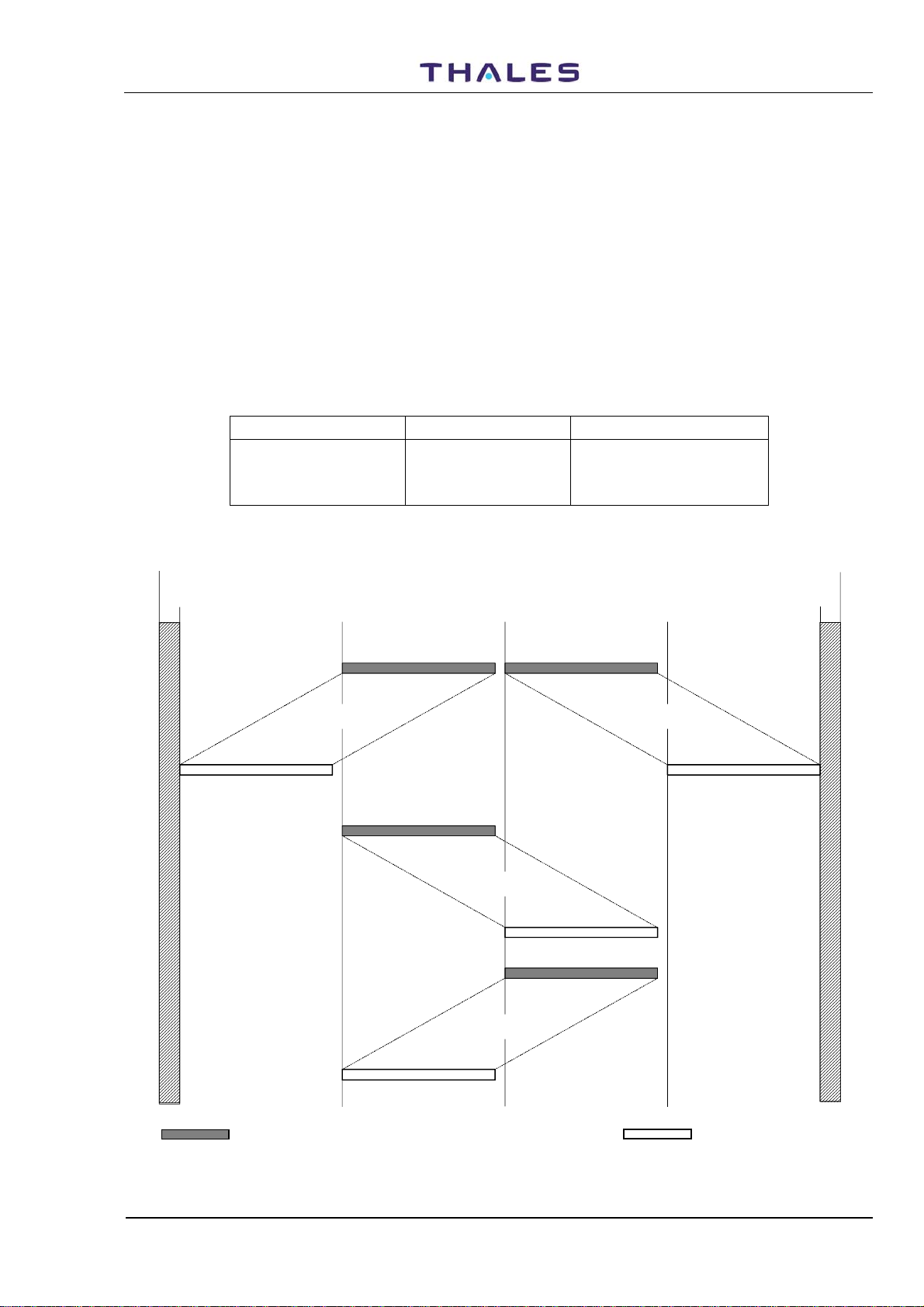
Each operational channel in the DME system is defined by two frequencies (interrogation and reply
frequencies), spaced 63 MHz apart, and by the pulse code for the assigned channel (X or Y channel).
The DME system transmits on a pre-selected channel among the 252 available ones. These channels are
divided into 126 X channels and 126 Y channels providing a frequency ranging from 1025 to 1150 MHz for
aircraft transmission (interrogation). Moreover, a 962 to 1213 MHz frequency for signal reception by the
aircraft (ground beacon reply transmission). Interrogation and reply frequencies are assigned with one MHz
spacing between channels.
The diagram shown in figure
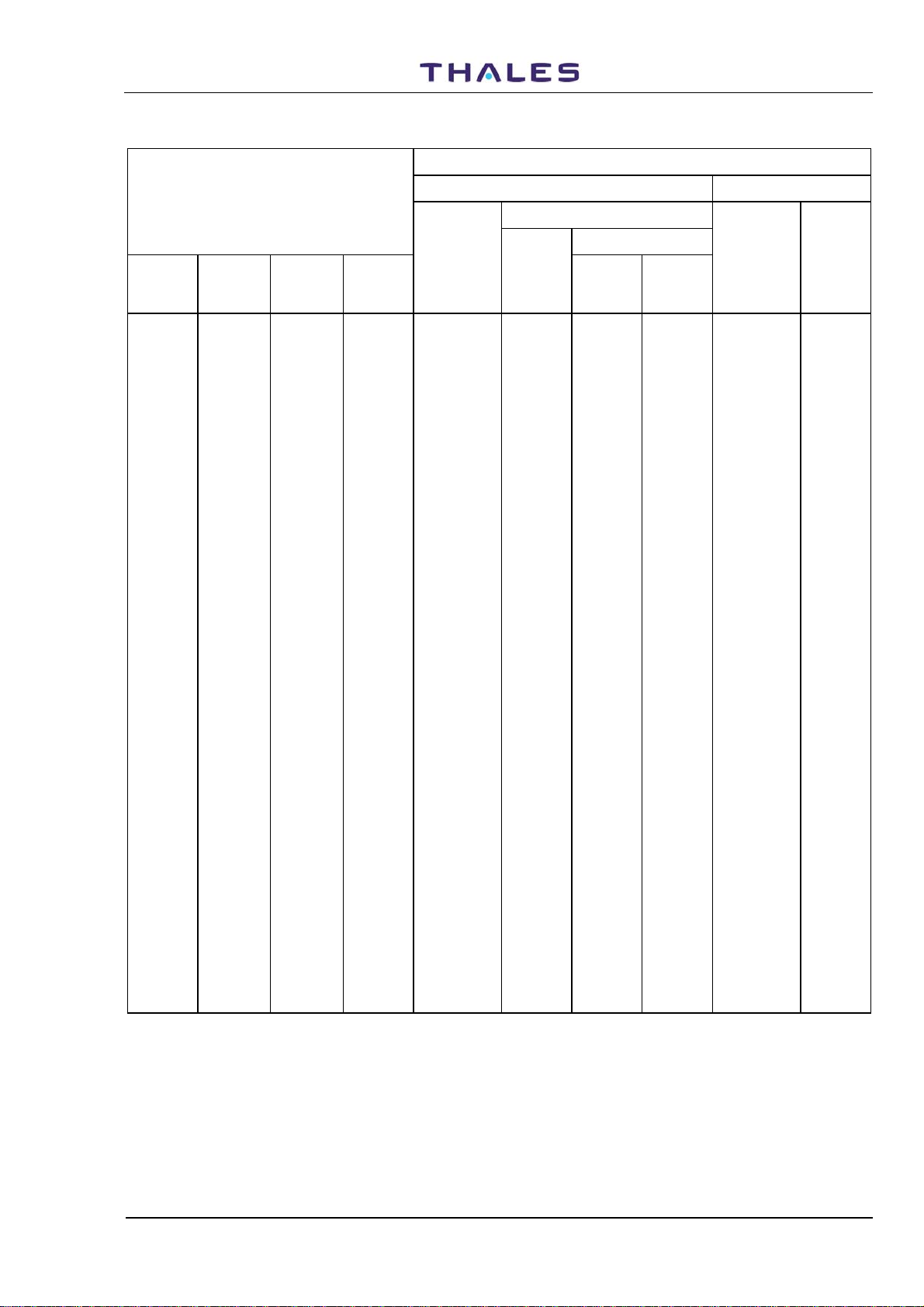
frequency for both channel types X, Y. The same information is also given in table
1.3 gives the aircraft interrogation frequency associated to the beacon reply
1-1 and table 1-2 for X
and Y channels respectively, as per ICAO ANNEX 10.
Each beacon emits a Morse identity code signal that can be heard in the pilot headset; this code consists of
pulse pairs transmitted at a frequency of 1350 Hz.
Each beacon is therefore identified by means of its channel frequency, its pulse coding and its identity
signal.
Table 1-1. Frequencies for DME Channels
960 MHz
962 MHz
X Channels (n° 126)
Channel
Y Channels (n° 126)
I = 1025 + (CH-1) I = 1025 + (CH-1)
R = I - 63
R = I + 63
I = INTERROGATION FREQUENCY (MHz) CH = CHANNEL NUMBER
R = REPLY FREQUENCY (MHz)
1025 MHz
1-63X
1 ≤ CH ≤ 63
64 ≤ CH ≤ 126
1088 MHz 1151 MHz
1-63Y
R = I + 63
R = I - 63
64-126X
1215 MHz
1213 MHz
INTERROGATION FREQUENCIES REPLY FREQUENCIES
Vers. D, September 2005
64-126Y
Figure 1.3. DME Channels Reply and Interrogation Frequencies
THALES Italia S.p.A.- A. S. D.
1-3
Page 12

955 900 031C
DME 415/435 -Technical Manual
Vol. 1-Section 1-General Information
Table 1-2. Frequencies and Code Pulses for DME Channels (1 to 17)
DME PARAMETERS
CHANNEL PAIRING INTERROGATION REPLY
Pulse Codes
DME/P
DME
Channel
1X
1Y
2X
2Y
3X
3Y
4X
4Y
5X
5Y
6X
6Y
7X
7Y
8X
8Y
9X
9Y
10X
10Y
11X
11Y
12X
12Y
13X
13Y
14X
14Y
15X
15Y
16X
16Y
17X
17Y
17Z
VHF
FREQ.
MHz
−
−
−
−
−
−
−
−
−
−
−
−
−
−
−
−
−
−
−
−
−
−
−
−
−
−
−
−
−
−
−
−
108.00
108.05
−
MLS
FREQ.
MHz
−
−
−
−
−
−
−
−
−
−
−
−
−
−
−
−
−
−
−
−
−
−
−
−
−
−
−
−
−
−
−
−
−
5043.0
5043.3
MLS
Channel
−
−
−
−
−
−
−
−
−
−
−
−
−
−
−
−
−
−
−
−
−
−
−
−
−
−
−
−
−
−
−
−
−
540
541
Frequency
MHz
1025
1025
1026
1026
1027
1027
1028
1028
1029
1029
1030
1030
1031
1031
1032
1032
1033
1033
1034
1034
1035
1035
1036
1036
1037
1037
1038
1038
1039
1039
1040
1040
1041
1041
1041
DME/N
µs
12
36
12
36
12
36
12
36
12
36
12
36
12
36
12
36
12
36
12
36
12
36
12
36
12
36
12
36
12
36
12
36
12
36
−
IAM
µs
−
−
−
−
−
−
−
−
−
−
−
−
−
−
−
−
−
−
−
−
−
−
−
−
−
−
−
−
−
−
−
−
−
36
21
FAM
µs
−
−
−
−
−
−
−
−
−
−
−
−
−
−
−
−
−
−
−
−
−
−
−
−
−
−
−
−
−
−
−
−
−
42
27
Frequency
MHz
962
1088
963
1089
964
1090
965
1091
966
1092
967
1093
968
1094
969
1095
970
1096
971
1097
972
1098
973
1099
974
1100
975
1101
976
1102
977
1103
978
1104
1104
Pulse
Codes
µs
12
30
12
30
12
30
12
30
12
30
12
30
12
30
12
30
12
30
12
30
12
30
12
30
12
30
12
30
12
30
12
30
12
30
15
1-4
THALES Italia S.p.A.- A. S. D.
Vers. D, September 2005
Page 13
DME 415/435 -Technical Manual
Vol. 1-Section 1-General Information
955 900 031C
Table 1-2. Frequencies and Code Pulses for DME Channels (18 to 28)
DME PARAMETERS
CHANNEL PAIRING INTERROGATION REPLY
Pulse Codes
DME/P
DME
Channel
18X
18W
18Y
18Z
19X
19Y
19Z
20X
20W
20Y
20Z
21X
21Y
21Z
22X
22W
22Y
22Z
23X
23Y
23Z
24X
24W
24Y
24Z
25X
25Y
25Z
26X
26W
26Y
26Z
27X
27Y
27Z
28X
28W
28Y
28Z
VHF
FREQ.
MHz
108.10
−
108.15
−
108.20
108.25
−
108.30
−
108.35
−
108.40
108.45
−
108.50
−
108.55
−
108.60
108.65
−
108.70
−
108.75
−
108.80
108.85
−
108.90
−
108.95
−
109.00
109.05
−
109.10
−
109.15
−
MLS
FREQ.
MHz
5031.0
5031.3
5043.6
5043.9
−
5044.2
5044.5
5031.6
5031.9
5044.8
5045.1
−
5045.4
5045.7
5032.2
5032.5
5046.0
5046.3
−
5046.6
5046.9
5032.8
5033.1
5047.2
5047.5
−
5047.8
5048.1
5033.4
5033.7
5048.4
5048.7
−
5049.0
5049.3
5034.0
5034.3
5049.6
5049.9
MLS
Channel
500
501
542
543
−
544
545
502
503
546
547
−
548
549
504
505
550
551
−
552
553
506
507
554
555
−
556
557
508
509
558
559
−
560
561
510
511
562
563
Frequency
MHz
1042
1042
1042
1042
1043
1043
1043
1044
1044
1044
1044
1045
1045
1045
1046
1046
1046
1046
1047
1047
1047
1048
1048
1048
1048
1049
1049
1049
1050
1050
1050
1050
1051
1051
1051
1052
1052
1052
1052
DME/N
µs
12
−
36
−
12
36
−
12
−
36
−
12
36
−
12
−
36
−
12
36
−
12
−
36
−
12
36
−
12
−
36
−
12
36
−
12
−
36
−
IAM
µs
12
24
36
21
−
36
21
12
24
36
21
−
36
21
12
24
36
21
−
36
21
12
24
36
21
−
36
21
12
24
36
21
−
36
21
12
24
36
21
FAM
µs
18
30
42
27
−
42
27
18
30
42
27
−
42
27
18
30
42
27
−
42
27
18
30
42
27
−
42
27
18
30
42
27
−
42
27
18
30
42
27
Frequency
MHz
979
979
1105
1105
980
1106
1106
981
981
1107
1107
982
1108
1108
983
983
1109
1109
984
1110
1110
985
985
1111
1111
986
1112
1112
987
987
1113
1113
988
1114
1114
989
989
1115
1115
Pulse
Codes
µs
12
24
30
15
12
30
15
12
24
30
15
12
30
15
12
24
30
15
12
30
15
12
24
30
15
12
30
15
12
24
30
15
12
30
15
12
24
30
15
Vers. D, September 2005
THALES Italia S.p.A.- A. S. D.
1-5
Page 14
955 900 031C
DME 415/435 -Technical Manual
Vol. 1-Section 1-General Information
Table 1-2. Frequencies and Code Pulses for DME Channels (29 to 40)
DME PARAMETERS
CHANNEL PAIRING INTERROGATION REPLY
Pulse Codes
DME/P
DME
Channel
29X
29Y
29Z
30X
30W
30Y
30Z
31X
31Y
31Z
32X
32W
32Y
32Z
33X
33Y
33Z
34X
34W
34Y
34Z
35X
35Y
35Z
36X
36W
36Y
36Z
37X
37Y
37Z
38X
38W
38Y
38Z
39X
39Y
39Z
40X
40W
40Y
40Z
VHF
FREQ.
MHz
109.20
109.25
−
109.30
−
109.35
−
109.40
109.45
−
109.50
−
109.55
−
109.60
109.65
−
109.70
−
109.75
−
109.80
109.85
−
109.90
−
109.95
−
110.00
110.05
−
110.10
−
110.15
−
110.20
110.25
−
110.30
−
110.35
−
MLS
FREQ.
MHz
−
5050.2
5050.5
5034.6
5034.9
5050.8
5051.1
−
5051.4
5051.7
5035.2
5035.5
5052.0
5052.3
−
5052.6
5052.9
5035.8
5036.1
5053.2
5053.5
−
5053.8
5054.1
5036.4
5036.7
5054.4
5054.7
−
5055.0
5055.3
5037.0
5037.3
5055.6
5055.9
−
5056.2
5056.5
5037.6
5037.9
5056.8
5057.1
MLS
Channel
−
564
565
512
513
566
567
−
568
569
514
515
570
571
−
572
573
516
517
574
575
−
576
577
518
519
578
579
−
580
581
520
521
582
583
−
584
585
522
523
586
587
Frequency
MHz
1053
1053
1053
1054
1054
1054
1054
1055
1055
1055
1056
1056
1056
1056
1057
1057
1057
1058
1058
1058
1058
1059
1059
1059
1060
1060
1060
1060
1061
1061
1061
1062
1062
1062
1062
1063
1063
1063
1064
1064
1064
1064
DME/N
µs
12
36
−
12
−
36
−
12
36
−
12
−
36
−
12
36
−
12
−
36
−
12
36
−
12
−
36
−
12
36
−
12
−
36
−
12
36
−
12
−
36
−
IAM
µs
−
36
21
12
24
36
21
−
36
21
12
24
36
21
−
36
21
12
24
36
21
−
36
21
12
24
36
21
−
36
21
12
24
36
21
−
36
21
12
24
36
21
FAM
µs
−
42
27
18
30
42
27
−
42
27
18
30
42
27
−
42
27
18
30
42
27
−
42
27
18
30
42
27
−
42
27
18
30
42
27
−
42
27
18
30
42
27
Frequency
MHz
990
1116
1116
991
991
1117
1117
992
1118
1118
993
993
1119
1119
994
1120
1120
995
995
1121
1121
996
1122
1122
997
997
1123
1123
998
1124
1124
999
999
1125
1125
1000
1126
1126
1001
1001
1127
1127
Pulse
Codes
µs
12
30
15
12
24
30
15
12
30
15
12
24
30
15
12
30
15
12
24
30
15
12
30
15
12
24
30
15
12
30
15
12
24
30
15
12
30
15
12
24
30
15
1-6
THALES Italia S.p.A.- A. S. D.
Vers. D, September 2005
Page 15
DME 415/435 -Technical Manual
Vol. 1-Section 1-General Information
955 900 031C
Table 1-2. Frequencies and Code Pulses for DME Channels (41 to 52)
DME PARAMETERS
CHANNEL PAIRING INTERROGATION REPLY
Pulse Codes
DME/P
DME
Channel
41X
41Y
41Z
42X
42W
42Y
42Z
43X
43Y
43Z
44X
44W
44Y
44Z
45X
45Y
45Z
46X
46W
46Y
46Z
47X
47Y
47Z
48X
48W
48Y
48Z
49X
49Y
49Z
50X
50W
50Y
50Z
51X
51Y
51Z
52X
52W
52Y
52Z
VHF
FREQ.
MHz
110.40
110.45
−
110.50
−
110.55
−
110.60
110.65
−
110.70
−
110.75
−
110.80
110.85
−
110.90
−
110.95
−
111.00
111.05
−
111.10
−
111.15
−
111.20
111.25
−
111.30
−
111.35
−
111.40
111.45
−
111.50
−
111.55
−
MLS
FREQ.
MHz
−
5057.4
5057.7
5038.2
5038.5
5058.0
5058.3
−
5058.6
5058.9
5038.8
5039.1
5059.2
5059.5
−
5059.8
5060.1
5039.4
5039.7
5060.4
5060.7
−
5061.0
5061.3
5040.0
5040.3
5061.6
5061.9
−
5062.2
5062.5
5040.6
5040.9
5062.8
5063.1
−
5063.4
5063.7
5041.2
5041.5
5064.0
5064.3
MLS
Channel
−
588
589
524
525
590
591
−
592
593
526
527
594
595
−
596
597
528
529
598
599
−
600
601
530
531
602
603
−
604
605
532
533
606
607
−
608
609
534
535
610
611
Frequency
MHz
1065
1065
1065
1066
1066
1066
1066
1067
1067
1067
1068
1068
1068
1068
1069
1069
1069
1070
1070
1070
1070
1071
1071
1071
1072
1072
1072
1072
1073
1073
1073
1074
1074
1074
1074
1075
1075
1075
1076
1076
1076
1076
DME/N
µs
12
36
−
12
−
36
−
12
36
−
12
−
36
−
12
36
−
12
−
36
−
12
36
−
12
−
36
−
12
36
−
12
−
36
−
12
36
−
12
−
36
−
IAM
µs
−
36
21
12
24
36
21
−
36
21
12
24
36
21
−
36
21
12
24
36
21
−
36
21
12
24
36
21
−
36
21
12
24
36
21
−
36
21
12
24
36
21
FAM
µs
−
42
27
18
30
42
27
−
42
27
18
30
42
27
−
42
27
18
30
42
27
−
42
27
18
30
42
27
−
42
27
18
30
42
27
−
42
27
18
30
42
27
Frequency
MHz
1002
1128
1128
1003
1003
1129
1129
1004
1130
1130
1005
1005
1131
1131
1006
1132
1132
1007
1007
1133
1133
1008
1134
1134
1009
1009
1135
1135
1010
1136
1136
1011
1011
1137
1137
1012
1138
1138
1013
1013
1139
1139
Pulse
Codes
µs
12
30
15
12
24
30
15
12
30
15
12
24
30
15
12
30
15
12
24
30
15
12
30
15
12
24
30
15
12
30
15
12
24
30
15
12
30
15
12
24
30
15
Vers. D, September 2005
THALES Italia S.p.A.- A. S. D.
1-7
Page 16
955 900 031C
DME 415/435 -Technical Manual
Vol. 1-Section 1-General Information
Table 1-2. Frequencies and Code Pulses for DME Channels (53 to 68)
DME PARAMETERS
CHANNEL PAIRING INTERROGATION REPLY
Pulse Codes
DME/P
DME
Channel
53X
53Y
53Z
54X
54W
54Y
54Z
55X
55Y
55Z
56X
56W
56Y
56Z
57X
57Y
58X
58Y
59X
59Y
60X
60Y
61X
61Y
62X
62Y
63X
63Y
64X
64Y
65X
65Y
66X
66Y
67X
67Y
68X
68Y
VHF
FREQ.
MHz
111.60
111.65
−
111.70
−
111.75
−
111.80
111.85
−
111.90
−
111.95
−
112.00
112.05
112.10
112.15
112.20
112.25
−
−
−
−
−
−
−
−
−
−
−
−
−
−
−
−
−
−
MLS
FREQ.
MHz
−
5064.5
5064.9
5041.8
5042.1
5065.2
5065.5
−
5065.8
5066.1
5042.4
5042.7
5066.4
5066.7
−
−
−
−
−
−
−
−
−
−
−
−
−
−
−
−
−
−
−
−
−
−
−
−
MLS
Channel
−
612
613
536
537
614
615
−
616
617
538
539
618
619
−
−
−
−
−
−
−
−
−
−
−
−
−
−
−
−
−
−
−
−
−
−
−
−
Frequency
MHz
1077
1077
1077
1078
1078
1078
1078
1079
1079
1079
1080
1080
1080
1080
1081
1081
1082
1082
1083
1083
1084
1084
1085
1085
1086
1086
1087
1087
1088
1088
1089
1089
1090
1090
1091
1091
1092
1092
DME/N
µs
12
36
−
12
−
36
−
12
36
−
12
−
36
−
12
36
12
36
12
36
12
36
12
36
12
36
12
36
12
36
12
36
12
36
12
36
12
36
IAM
µs
−
36
21
12
24
36
21
−
36
21
12
24
36
21
−
−
−
−
−
−
−
−
−
−
−
−
−
−
−
−
−
−
−
−
−
−
−
−
FAM
µs
−
42
27
18
30
42
27
−
42
27
18
30
42
27
−
−
−
−
−
−
−
−
−
−
−
−
−
−
−
−
−
−
−
−
−
−
−
−
Frequency
MHz
1014
1140
1140
1015
1015
1141
1141
1016
1142
1142
1017
1017
1143
1143
1018
1144
1019
1145
1020
1146
1021
1147
1022
1148
1023
1149
1024
1150
1151
1025
1152
1026
1153
1027
1154
1028
1155
1029
Pulse
Codes
µs
12
30
15
12
24
30
15
12
30
15
12
24
30
15
12
30
12
30
12
30
12
30
12
30
12
30
12
30
12
30
12
30
12
30
12
30
12
30
1-8
THALES Italia S.p.A.- A. S. D.
Vers. D, September 2005
Page 17
DME 415/435 -Technical Manual
Vol. 1-Section 1-General Information
955 900 031C
Table 1-2. Frequencies and Code Pulses for DME Channels (69 to 85)
DME PARAMETERS
CHANNEL PAIRING INTERROGATION REPLY
Pulse Codes
DME/P
DME
Channel
69X
69Y
70X
70Y
71X
71Y
72X
72Y
73X
73Y
74X
74Y
75X
75Y
76X
76Y
77X
77Y
78Y
78Y
79X
79Y
80X
80Y
80Z
81X
81Y
81Z
82X
82Y
82Z
83X
83Y
83Z
84X
84Y
84Z
85X
85Y
85Z
VHF
FREQ.
MHz
−
−
112.30
112.35
112.40
112.45
112.50
112.55
112.60
112.65
112.70
112.75
112.80
112.85
112.90
112.95
113.00
113.05
113.10
113.15
113.20
113.25
113.30
113.35
−
113.40
113.45
−
113.50
113.55
−
113.60
113.65
−
113.70
113.75
−
113,80
113,85
-
MLS
FREQ.
MHz
−
−
−
−
−
−
−
−
−
−
−
−
−
−
−
−
−
−
−
−
−
−
−
5067.0
5067.3
−
5067.6
5067.9
−
5068.2
5068.5
−
5068.8
5069.1
−
5069.4
5069.7
5070.0
5071.3
MLS
Channel
−
−
−
−
−
−
−
−
−
−
−
−
−
−
−
−
−
−
−
−
−
−
−
620
621
−
622
623
−
624
625
−
626
627
−
628
629
1109
Frequency
MHz
1093
1093
1094
1094
1095
1095
1096
1096
1097
1097
1098
1098
1099
1099
1100
1100
1101
1101
1102
1102
1103
1103
1104
1104
1104
1105
1105
1105
1106
1106
1106
1107
1107
1107
1108
1108
1108
1109
1109
DME/N
µs
12
36
12
36
12
36
12
36
12
36
12
36
12
36
12
36
12
36
12
36
12
36
12
36
−
12
36
−
12
36
−
12
36
−
12
36
−
12
36
-
IAM
µs
−
−
−
−
−
−
−
−
−
−
−
−
−
−
−
−
−
−
−
−
−
−
−
36
21
−
36
21
−
36
21
−
36
21
−
36
21
36
21
FAM
µs
−
−
−
−
−
−
−
−
−
−
−
−
−
−
−
−
−
−
−
−
−
−
−
42
27
−
42
27
−
42
27
−
42
27
−
42
27
42
27
Frequency
MHz
1156
1030
1157
1031
1158
1032
1159
1033
1160
1034
1161
1035
1162
1036
1163
1037
1164
1038
1165
1039
1166
1040
1167
1041
1041
1168
1042
1042
1169
1043
1043
1170
1044
1044
1171
1045
1045
1172
1046
1046
Pulse
Codes
µs
12
30
12
30
12
30
12
30
12
30
12
30
12
30
12
30
12
30
12
30
12
30
12
30
15
12
30
15
12
30
15
12
30
15
12
30
15
12
30
15
Vers. D, September 2005
THALES Italia S.p.A.- A. S. D.
1-9
Page 18

955 900 031C
DME 415/435 -Technical Manual
Vol. 1-Section 1-General Information
Table 1-2. Frequencies and Code Pulses for DME Channels (86 to 99)
DME PARAMETERS
CHANNEL PAIRING INTERROGATION REPLY
Pulse Codes
DME/P
DME
Channel
86X
86Y
86Z
87X
87Y
87Z
88X
88Y
88Z
89X
89Y
89Z
90X
90Y
90Z
91X
91Y
91Z
92X
92Y
92Z
93X
93Y
93Z
94X
94Y
94Z
95X
95Y
95Z
96X
96Y
96Z
97X
97Y
97Z
98X
98Y
98Z
99X
99Y
99Z
VHF
FREQ.
MHz
113.90
113.95
−
114.00
114.05
−
114.10
114.15
−
114.20
114.25
−
114.30
114.35
−
114.40
114.45
−
114.50
114.55
−
114.60
114.65
−
114.70
114.75
−
114.80
114.85
−
114.90
114.95
−
115.00
115.05
−
115.10
115.15
−
115.20
115.25
−
MLS
FREQ.
MHz
−
5070.6
5070.9
−
5071.2
5071.5
−
5071.8
5072.1
−
5072.4
5072.7
−
5073.0
5073.3
−
5073.6
5073.9
−
5074.2
5074.5
−
5074.8
5075.1
−
5075.4
5075.7
−
5076.0
5076.3
−
5076.6
5076.9
−
5077.2
5077.5
−
5077.8
5078.1
−
5078.4
5078.7
MLS
Channel
−
632
633
−
634
635
−
636
637
−
638
639
−
640
641
−
642
643
−
644
645
−
646
647
−
648
649
−
650
651
−
652
653
−
654
655
−
656
657
−
658
659
Frequency
MHz
1110
1110
1110
1111
1111
1111
1112
1112
1112
1113
1113
1113
1114
1114
1114
1115
1115
1115
1116
1116
1116
1117
1117
1117
1118
1118
1118
1119
1119
1119
1120
1120
1120
1121
1121
1121
1122
1122
1122
1123
1123
1123
DME/N
µs
12
36
−
12
36
−
12
36
−
12
36
−
12
36
−
12
36
−
12
36
−
12
36
−
12
36
−
12
36
−
12
36
−
12
36
−
12
36
−
12
36
−
IAM
µs
−
36
21
−
36
21
−
36
21
−
36
21
−
36
21
−
36
21
−
36
21
−
36
21
−
36
21
−
36
21
−
36
21
−
36
21
−
36
21
−
36
21
FAM
µs
−
42
27
−
42
27
−
42
27
−
42
27
−
42
27
−
42
27
−
42
27
−
42
27
−
42
27
−
42
27
−
42
27
−
42
27
−
42
27
−
42
27
Frequency
MHz
1173
1047
1047
1174
1048
1048
1175
1049
1049
1176
1050
1050
1177
1051
1051
1178
1052
1052
1179
1053
1053
1180
1054
1054
1181
1055
1055
1182
1056
1056
1183
1057
1057
1184
1058
1058
1185
1059
1059
1186
1060
1060
Pulse
Codes
µs
12
30
15
12
30
15
12
30
15
12
30
15
12
30
15
12
30
15
12
30
15
12
30
15
12
30
15
12
30
15
12
30
15
12
30
15
12
30
15
12
30
15
1-10
THALES Italia S.p.A.- A. S. D.
Vers. D, September 2005
Page 19
DME 415/435 -Technical Manual
Vol. 1-Section 1-General Information
955 900 031C
Table 1-2. Frequencies and Code Pulses for DME Channels (100 to 113)
DME PARAMETERS
CHANNEL PAIRING INTERROGATION REPLY
Pulse Codes
DME/P
DME
Channel
100X
100Y
100Z
101X
101Y
101Z
102X
102Y
102Z
103X
103Y
103Z
104X
104Y
104Z
105X
105Y
105Z
106X
106Y
106Z
107X
107Y
107Z
108X
108Y
108Z
109X
109Y
109Z
110X
110Y
110Z
111X
111Y
111Z
112X
112Y
112Z
113X
113Y
113Z
VHF
FREQ.
MHz
115.30
115.35
−
115.40
115.45
−
115.50
115.55
−
115.60
115.65
−
115.70
115.75
−
115.80
115.85
−
115.90
115.95
−
116.00
116.05
−
116.10
116.15
−
116.20
116.25
−
116.30
116.35
−
116.40
116.45
−
116.50
116.55
−
116.60
116.65
−
MLS
FREQ.
MHz
−
5079.0
5079.3
−
5079.6
5079.9
−
5080.2
5080.5
−
5080.8
5081.1
−
5081.4
5081.7
−
5082.0
5082.3
−
5082.6
5082.9
−
5083.2
5083.5
−
5083.8
5084.1
−
5084.4
5084.7
−
5085.0
5085.3
−
5085.6
5085.9
−
5086.2
5086.5
−
5086.8
5087.1
MLS
Channel
−
660
661
−
662
663
−
664
665
−
666
667
−
668
669
−
670
671
−
672
673
−
674
675
−
676
677
−
678
679
−
680
681
−
682
683
−
684
685
−
686
687
Frequency
MHz
1124
1124
1124
1125
1125
1125
1126
1126
1126
1127
1127
1127
1128
1128
1128
1129
1129
1129
1130
1130
1130
1131
1131
1131
1132
1132
1132
1133
1133
1133
1134
1134
1134
1135
1135
1135
1136
1136
1136
1137
1137
1137
DME/N
µs
12
36
−
12
36
−
12
36
−
12
36
−
12
36
−
12
36
−
12
36
−
12
36
−
12
36
−
12
36
−
12
36
−
12
36
−
12
36
−
12
36
−
IAM
µs
−
36
21
−
36
21
−
36
21
−
36
21
−
36
21
−
36
21
−
36
21
−
36
21
−
36
21
−
36
21
−
36
21
−
36
21
−
36
21
−
36
21
FAM
µs
−
42
27
−
42
27
−
42
27
−
42
27
−
42
27
−
42
27
−
42
27
−
42
27
−
42
27
−
42
27
−
42
27
−
42
27
−
42
27
−
42
27
Frequency
MHz
1187
1061
1061
1188
1062
1062
1189
1063
1063
1190
1064
1064
1191
1065
1065
1192
1066
1066
1193
1067
1067
1194
1068
1068
1195
1069
1069
1196
1070
1070
1197
1071
1071
1198
1072
1072
1199
1073
1073
1200
1074
1074
Pulse
Codes
µs
12
30
15
12
30
15
12
30
15
12
30
15
12
30
15
12
30
15
12
30
15
12
30
15
12
30
15
12
30
15
12
30
15
12
30
15
12
30
15
12
30
15
Vers. D, September 2005
THALES Italia S.p.A.- A. S. D.
1-11
Page 20

955 900 031C
DME 415/435 -Technical Manual
Vol. 1-Section 1-General Information
Table 1-2. Frequencies and Code Pulses for DME Channels (114 to 126)
DME PARAMETERS
CHANNEL PAIRING INTERROGATION REPLY
Pulse Codes
DME/P
DME
Channel
114X
114Y
114Z
115X
115Y
115Z
116X
116Y
116Z
117X
117Y
117Z
118X
118Y
118Z
119X
119Y
119Z
120X
120Y
121X
121Y
122X
122Y
123X
123Y
124X
124Y
125X
125Y
126X
126Y
VHF
FREQ.
MHz
116.70
116.75
−
116.80
116.85
−
116.90
116.95
−
117.00
117.05
−
117.10
117.15
−
117.20
117.25
−
117.30
117.35
117.40
117.45
117.50
117.55
117.60
117.65
117.70
117.75
117.80
117.85
117.90
117.95
MLS
FREQ.
MHz
−
5087.4
5087.7
−
5088.0
5088.3
−
5088.6
5088.9
−
5089.2
5089.5
−
5089.8
5090.1
−
5090.4
5090.7
−
−
−
−
−
−
−
−
−
−
−
−
−
−
MLS
Channel
−
688
689
−
690
691
−
692
693
−
694
695
−
696
697
−
698
699
−
−
−
−
−
−
−
−
−
−
−
−
−
−
Frequency
MHz
1138
1138
1138
1139
1139
1139
1140
1140
1140
1141
1141
1141
1142
1142
1142
1143
1143
1143
1144
1144
1145
1145
1146
1146
1147
1147
1148
1148
1149
1149
1150
1150
DME/N
µs
12
36
−
12
36
−
12
36
−
12
36
−
12
36
−
12
36
−
12
36
12
36
12
36
12
36
12
36
12
36
12
36
IAM
µs
−
36
21
−
36
21
−
36
21
−
36
21
−
36
21
−
36
21
−
−
−
−
−
−
−
−
−
−
−
−
−
−
FAM
µs
−
42
27
−
42
27
−
42
27
−
42
27
−
42
27
−
42
27
−
−
−
−
−
−
−
−
−
−
−
−
−
−
Frequency
MHz
1201
1075
1075
1202
1076
1076
1203
1077
1077
1204
1078
1078
1205
1079
1079
1206
1080
1080
1207
1081
1208
1082
1209
1083
1210
1084
1211
1085
1212
1086
1213
1087
Pulse
Codes
µs
12
30
15
12
30
15
12
30
15
12
30
15
12
30
15
12
30
15
12
30
12
30
12
30
12
30
12
30
12
30
12
30
1-12
THALES Italia S.p.A.- A. S. D.
Vers. D, September 2005
Page 21

DME 415/435 -Technical Manual
Vol. 1-Section 1-General Information
955 900 031C
1.3 GENERAL FEATURES OF THE EQUIPMENT
1.3.1 Equipment Versions
The DME 415 and 435 are respectively the lower power and the higher power versions of a complete
family of latest-generation equipment composed by:
- Approach DME 415: a 100 W solid-state DME can be installed also in co-location with ILS
- En-route DME 435: a 1 kW solid-state DME can be installed also in co-location with VOR or DVOR.
The two versions all feature a high commonality of modules and of principles of operation.
1.3.2 Main Feature of the Equipment
The main features of the equipment are:
• Compliant with the ICAO specifications in Annex 10, 5th ed. and Eurocae MPS Ed. 57, standard 1 as
applicable.
• Compliant with EEC Directives for CE Marking (EMC and Safety)
• Housed in a single 19" cabinet
• Powerable both from mains and standard 48 V batteries, with a built-in battery charger as an option
• Fully dualized, (being composed of two transponders and two monitoring systems ) but configurable
also in the following versions:
1) single TRX and single Monitor
2) single TRX and dual Monitor
• Completely modular
• Accurate distance information: up to ±15 m
• Digitally controlled output pulse shape
• Microprocessor-controlled monitors and transponders
• Monitor-independent reply delay self-adjustment
• Automatically performed self-check and measurements, the results of which can be continuously
displayed
• Automatically provided ICAO performance checks at programmable intervals and results
storing/displaying/printing
• Capable of executing a resident diagnostic program to help the operator in fault location.
• Operable as a stand-alone unit, but conceived to be co-located with other navaids like ILS,VOR or
DVOR
• Control by a Personal Computer (PC) at beacon site, which can be duplicated at remote site; the PC
can also be a portable unit to be connected only when required for maintenance reasons
• Remote control is fully compatible with all the system 400 equipment and with previous versions of
DME’s (FSD-40/45)
• Able to be connected to both an RCSU-2040 (part of Thales: Remote Maintenance and Monitoring
Configuration - RMMC) and the FRCM/NS Remote Control and Monitoring Network System, or new
remote control MCS (Monitoring and Control System): highly versatile systems for interfacing and
controlling different navaids facilities.
Vers. D, September 2005
THALES Italia S.p.A.- A. S. D.
1-13
Page 22

955 900 031C
DME 415/435 -Technical Manual
Vol. 1-Section 1-General Information
1.3.2.1 Engineering
• Accessibility: front door access is only required. Equipment can be wall-mounted.
• Modularity: all circuits are divided into functional modules.
• Interconnections: extensive use is made of printed board back panels, flat ribbon cables and semi-rigid
coaxial cables.
• Identifications: all modules are easily recognizable by P/N and a two/three/four-letter code (e.g.: RX,
TX, DPR, BCPS) permanently marked on easily readable surfaces. All modules, cables and connectors
are marked and keyed to prevent incorrect connection.
• Cooling: no blowers are required to remove heat from the equipment. Use is made of extruded
aluminum heat sinks.
• Printed boards: two - or multilayer printed boards with plated-through holes are used throughout the
equipment. High frequency circuits are implemented in microstrip technique.
• RF shielding: all RF circuits are accurately shielded in casting boxes.
• Components: only high-quality components are used, in order to meet the reliability requirements.
• Corrosion: protection against corrosion and fungus is obtained by means of suitable materials, finishes
and coatings.
1.3.2.2 Safety
• The equipment is designed to be intrinsically safe for the user. No dangerous voltages except mains are
used.
• All modules or places, where a dangerous voltage may be accessible, are firmly protected by covers not
removable without using tools and are clearly marked with warning readouts.
• Special protective circuits are built-in in order to ensure that any failure in the equipment does not cause
further damage to other parts or components.
1.3.2.3 Installation
• Installation of DME 415-435 requires preparation of the site (i.e. shelter or equipment room, antenna
support mast, cable layout, power and ground connections etc.- (see section 2 "INSTALLATION" and
ANNEX A "DME ANTENNA SITING CRITERIA" in this manual).
• Installation of the equipment is simple and can be accomplished in few hours even by unskilled personnel
with a minimum of tools. The equipment only requires a minimum of shelter room.
• Ground and flight tests may be performed with the assistance of Thales technicians if requested.
1.3.2.4 Operation
• The Operator's interface consists of a PC terminal connected to the equipment. The basic control of the
equipment (on/off or changeover) is possible with local I/O front panel, however, even when the PC is not
available,
1-14
THALES Italia S.p.A.- A. S. D.
Vers. D, September 2005
Page 23
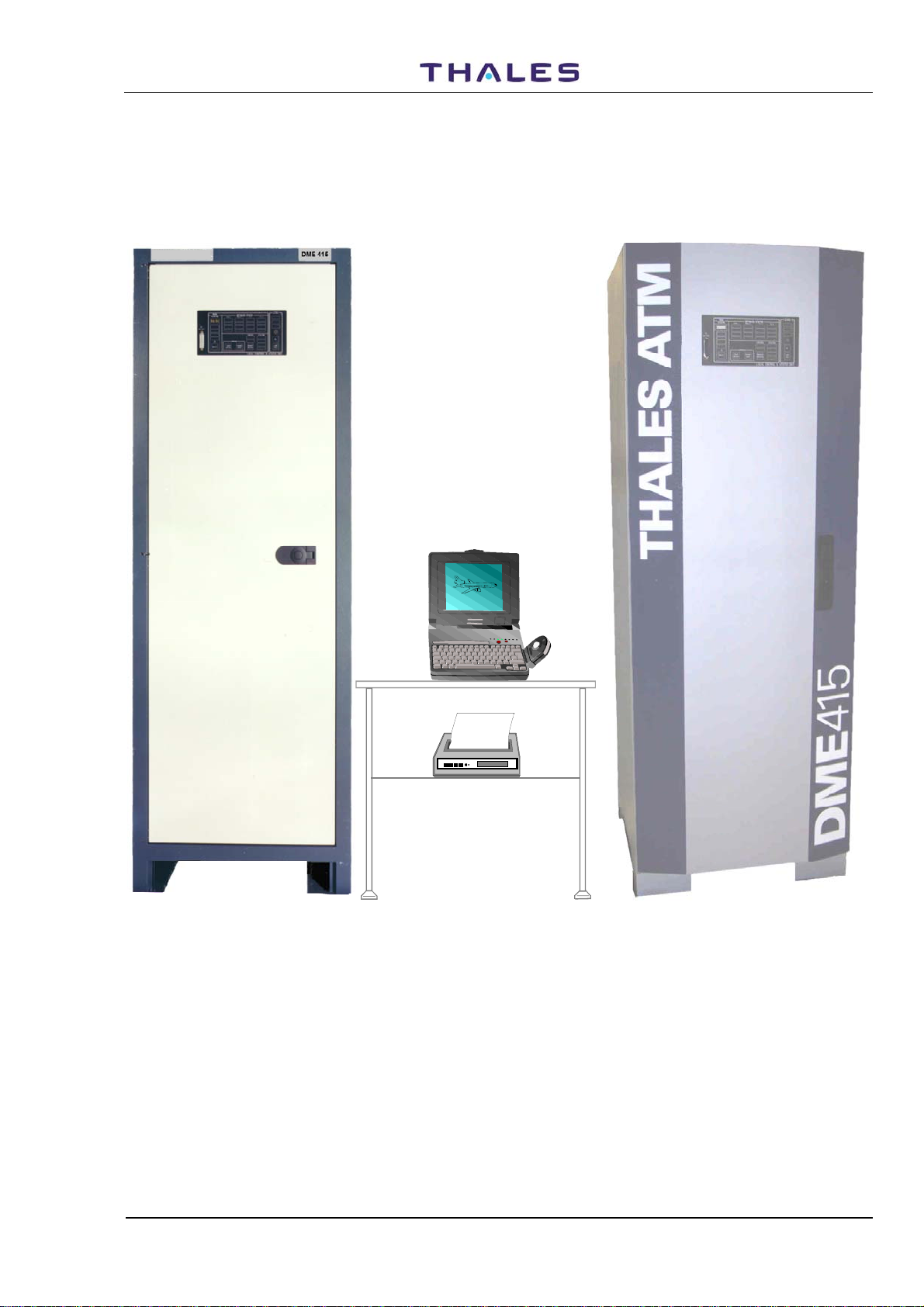
DME 415/435 -Technical Manual
Vol. 1-Section 1-General Information
955 900 031C
Cabinet Part Number: 297.509.004 Cabinet Part Number: 297.509.007
Figure 1.4. DME 415 (same as DME 435) – Cabinet and PC, example of arrangement
Vers. D, September 2005
THALES Italia S.p.A.- A. S. D.
1-15
Page 24

955 900 031C
1.4 BEACON COMPOSITION AND IDENTIFICATION
DME 415/435 -Technical Manual
Vol. 1-Section 1-General Information
The DME 415/435 ground equipment, as shown in figure
1.4, is constructed by THALES Italia S.p.A Air
Systems Division - Milan - Italy.
The DME versions are mounted in two cabinet’s types shown in figure
1.4 to customer choice.
The related reference modules labels of the equipment DME415/435 are given in table
Table 1-3. Composition of the Equipment
Dual Single Name Ref.
Q.ty
1 1 Wired Cabinet (standard)
2 1 Duplexer DPX
1 1 RF COAX Relay and PBA KCX
1 Coax Dummy Load -100 W, 50 Ω
1 1 External Filter Antenna KIT (optional)
2+2 1+1 10 dB + 10 dB PAD ( only for DME 435)
1 1 Associated Facility Interface AFI
1 - Dummy Interface TAI
1 1 Modem 1 Party Line (LGM 1200) (option) MDM
1 1 Modem 2 LGM 28,8 D1 (option) MDM
RF Path
Interface System
1-3.
Label
2 1
2 1 Monitor MON
2 1 Receiver RX
2 1 Digital Processor DPR
2 1 Digital Modulator DMD
2 1 Transmitter 100 Wp (also driver for DME 435) TX 100
2 1 Transmitter Amplifier 1kWp (only for DME 435) TKW
1 1 Local Control Status Unit composed of:
1 1 Battery Charger and Power Supply subrack (option) BCPS
2 1 AC/DC 600W Module (option) AC-DC
1 1 Terminal bar- 48Vdc (option) -
1 1 Batteries supervisor only for BCPS Frako (option) -
Transponder and Monitor
Power Supply (DC/DC converter; + 5V, ± 15V )
Local I/O
- Control and Status Board
- Indication and Controls
Power Supply
PWS
LCSU
CSB
INC
1-16
THALES Italia S.p.A.- A. S. D.
Vers. D, September 2005
Page 25

DME 415/435 -Technical Manual
Vol. 1-Section 1-General Information
Table
1-4 gives the composition of the user interface for the local and remote sites.
The accompanying material supplied with the beacon is listed in table
Table 1-4. User Interface Composition (option)
Q.TY NAME REF.
955 900 031C
1-5.
LOCAL SITE:
1 PC Requirements- Lap/Palm top
-
Processor Pentium 90 or better, (for use with MCS monitoring:
INTELP4, AMDK7 - Clock speed 2 GHz or better )
Operating system IBM/AT compatible suited to run 95, 98, 2000XP or
NT version (for MCS: WIN/NT, W2K, Linux)
Main memory 16 MB RAM min. (256/512 MB min for MCS)
VGA adapter color display: 32MB
HDD: 120 MB min. Hard Disk, min. 20MB free space on HDD
( 20GB/2x20GB min for MCS)
3.5” Floppy Disk FDD (1.44 MB),
CDROM drive,
Control via mouse or comparable
Serial interface connectors
1 Printer -
1 Status Indicator (repeater of the main indication beacon status) SI 446
REMOTE SITE:
1 Remote Control Status Indicator (composition: see RCSI or RCSE or MCS
RCSI 446
technical manual)
1 PC Requirements- Lap/Palm top: as Local site -
1 Keyboard (PC desk version) -
1 Printer -
1 Status Indicator (repeater of the main indication beacon status) SI 446
Vers. D, September 2005
THALES Italia S.p.A.- A. S. D.
1-17
Page 26
955 900 031C
Table 1-5. Material Supplied
DME 415/435 -Technical Manual
Vol. 1-Section 1-General Information
Name
NOTE
STANDARD
PC interconnection cable
OPTIONAL
Mains Cable
Grounding Cable
Battery Cable (+)
Battery Cable (-)
Auxiliary INPUT Cable (Parallel I/O)
Auxiliary OUTPUT Cable (Parallel I/O)
Cable for external modem
Interface Facility Cable (for AFI interface
module)
Serial data Cable (D-VOR/ILS)
Telephone Cable
Antenna coax cable
Antenna monitors probe coax cables
Obstruction light cable
Modem adapter Kit
Tool bag
Extender board - Video Digital (see Vol. 2
Section 1)
Extender board - RF (see Vol. 2 Section 1)
Figure
1.4 is a typical example of arrangement of the equipment and shows the front of a door. The local
indication and control panel is flush-mounted in the front door. It contains an RS232 connector for
interfacing with an intelligent terminal (PC).
Figures from
1.5 to 1.9 show the location of the parts and modules of the equipment valid for both cabinet
type.
Figure
1.8 shows the photos of DME 435 with front door closed and rear of equipment.
Each equipment module and part code number is indicated on Vol. 2: List of Components in this Technical
Manual.
1-18
THALES Italia S.p.A.- A. S. D.
Vers. D, September 2005
Page 27

DME 415/435 -Technical Manual
Vol. 1-Section 1-General Information
955 900 031C
1.5 PHYSICAL AND MECHANICAL General Description
The standard (full dual) configuration of the DME 415-435 equipment is composed of two transponders, a
dual monitor system a RF path system, a Panel Control and a coaxial transfer relay unit. The parts of the
equipment are housed in a single 19" standard cabinet (cabinet’s types: view in fig.
1.4).
The cabinet, which is made of molded and welded steel sheet, can accommodate four 19” assembled
carriers (subracks). Plug-in units are used as double or single Euroform printed circuit boards, with
dimensions of 233.4 x 220 [mm] or 100 x 220 [mm].
The cabinet, which has a perforated metal plate on top and bottom, is self-ventilated (no forced ventilation
necessary).
NOTE: Do not block or seal the holes for the cooling air supply.
The front part of the cabinet is protected by a hinged door complete of locking mechanism and the Control
front Panel (Local I/O).
The top end of the cabinet provides four threaded holes used to screw in the eyebolts when the beacon is to
be lifted.
The RF output connector to the antenna and the RF antenna monitor input connectors are located on top of
the cabinet. The RF Duplexer modules are mounted inside of the "RF Amplifier/DPX" subrack on the upper
part of the cabinet. The 1 kWp RF amplifier modules are mounted on the lateral sides of the same subrack,
while the interface connections (e.g. modem, Associated Facility) are located on the bottom.
The RF components of the modules are in shielded casting boxes.
The Transponder/Monitor 1 and 2 subracks are located in middle part of the cabinet.
The AC/DC power supply units are located on the bottom of the cabinet. The BCPS subrack (optional)
comprises a terminal bar for mains and 48Vdc input.
Local I/O components (LCSU consisting of CSB module and INC module) are fastened to the hinged front
door in the upper part. The CSB board of the LCSU unit, combined with the INC module, is mounted on the
rear of the front door.
The local control front panel of the INC module part of LCSU unit is equipped with indicators and
commands:
− the indicators, for immediate check of beacon functioning and
− the main commands, for beacon control (acquisition and release of control, powering on/off,
transponder change over) without having to use the local PC.
The I/O panel with the external interconnection connectors is located in the top end of the cabinet (figure
1.9)
The front view of the DME 415 and DME 435 equipments, with the open door, is shown in figures
1.5 and
1.6. These figures show the positions of all the modules, which compose the equipment in the typical full (or
dual) version.
For special purposes, the equipment can be supplied in a single, non-redundant version, where very high
system availability is not mandatory.
Figure
1.7 shows the typical single version of the DME 435 equipment. The single version of the DME 415 is
the same as the DME 435 in which the final RF amplifier "TKW" module is removed.
The DME 415-435, dual or full version, is composed of a wired cabinet housing the following hardware parts
and modules:
Local I/O
• Local Control and Status Unit (LCSU) composed of
− Control Status Board module (CSB)
− Indication and Control module (INC)
• I/O Panel (on top of the cabinet)
Vers. D, September 2005
THALES Italia S.p.A.- A. S. D.
1-19
Page 28

955 900 031C
RF Amplifier/DPX subrack unit consisting of:
DME 415/435 -Technical Manual
Vol. 1-Section 1-General Information
• Final Amplifier module (DME 435 only) (TKW)
• Duplexer module (DPX)
• Coaxial Relay and driver PBA (KCX and KCXM)
• Coax Dummy Load
• Association Facility Interface module (AFI)
• Interface (TAI dummy)
• Modem modules (optional) (MDM) ( including adapter kit : RS232 to TTL converter)
• Backpanel of the TKW (BPKW)
Transponder/Monitor 1 and 2 subrack units, both consisting of:
• DC/DC Power Supply module (PWS)
• Monitor/Interrogator module (MON)
• Receiver module (RX)
• Processor module (DPR)
• Modulator module (DMD)
• Transmitter (driver for DME 435) (TX100)
• Backpanel of the transponder/monitor (BPT)
Mains Power unit
• Battery Charger Power Supply subrack (BCPS)
• AC/DC module (AC/DC)
• Terminal Bar
All check and maintenance operations can be performed on the front of the equipment, upon opening the
cabinet front door.
Each subrack can be pulled out after unscrewing the fixing bolts (sliding are not provided).
All main modules (except the front ones of the LCSU unit) are plug-in types. Each module slides can be
easily pulled out by using proper handles placed on the front.
The bottom of the cabinet provides the entrance of the mains and 48 V dc cables through bush fair-leads
(see Section 2: INSTALLATION).
Connectors of the I/O panel mounted on the upper side of the cabinet provide the connection with the
external interface cables.
Each subrack has a backpanel on which connectors of the plug-in modules and the subrack interconnection
are mounted. All cable connectors (signals and mains) of subrack interconnection are within reach from the
front.
Interconnection with backpanels is provided by flat ribbon cables for low level signals and by cables for
48Vdc supply. Cables lay on the inside of the cabinet behind the subracks.
A 4-way (transfer type) RF coaxial relay is mounted on a support fixed on the upper side of the cabinet by
means of bolts (Figure
1.9), which can be unscrewed before inspecting the relay. The relay RF output is
directly connected to the antenna connector. The relay is power supplied through a specific interface circuit
fixed on the same coaxial relay.
The RF connection semi-rigid coaxial cables lay on the inside of the cabinet behind the subracks.
The semi-rigid coaxial cables end with floating coaxial connectors used for the sliding modules that also
comprise the RF circuits. The floating coaxial connectors are mounted on a reinforcement metal plate fixed
on the back of the back panels.
The coaxial cables used for the output RF power provide the minimum distance and end with type "N"
coaxial connectors.
1-20
THALES Italia S.p.A.- A. S. D.
Vers. D, September 2005
Page 29
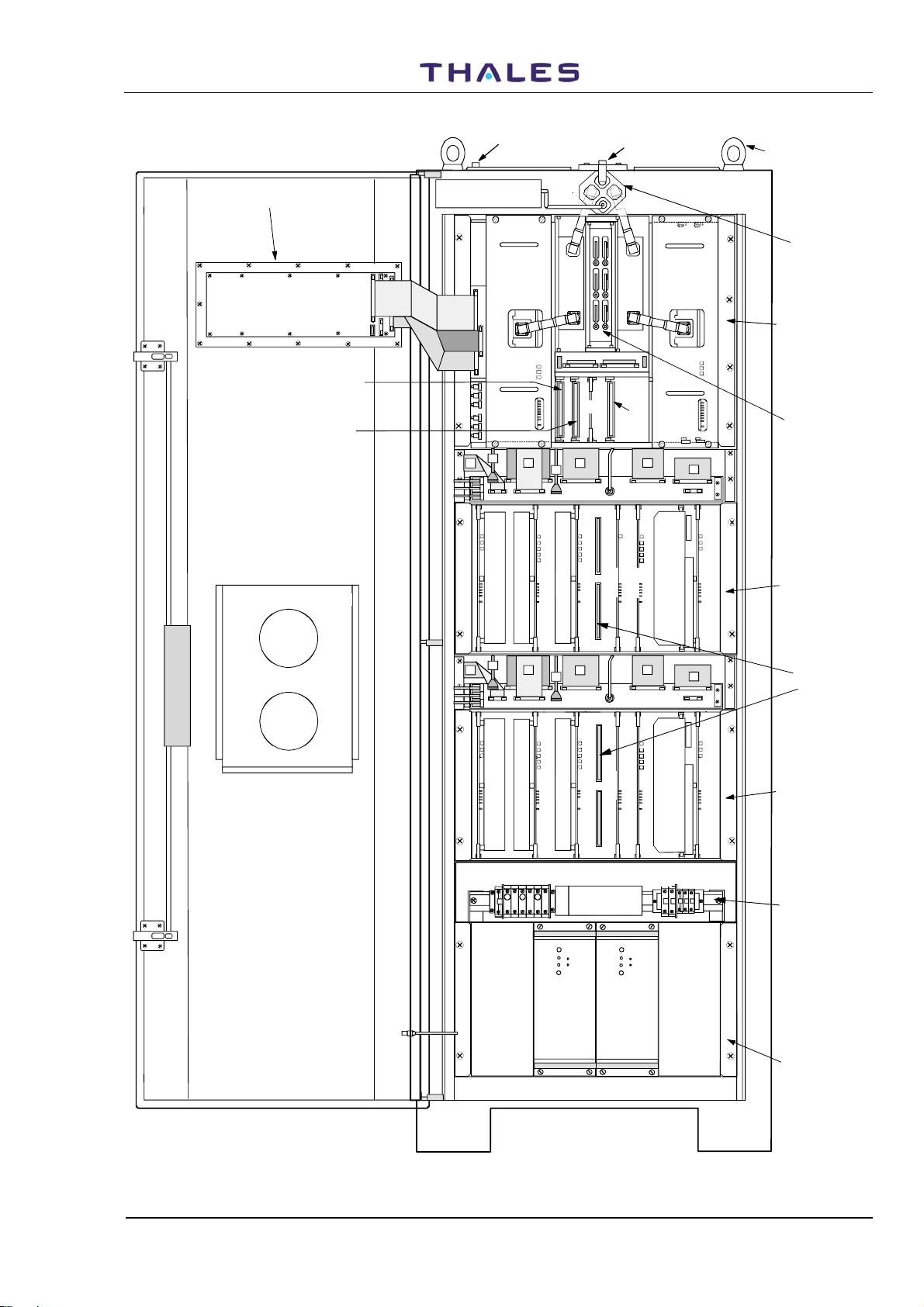
DME 415/435 -Technical Manual
Vol. 1-Section 1-General Information
Connettori per Sonde
Monitori d'Antenna
CONNETTORE
d'Antenna
955 900 031C
n° 4 Golfari
LCSU unit
Vista retro
MDM 1(option)
MDM 2 (option)
Contenitore di Documenti
Carico Fittizio
50 Ohm
TKW 1
F
D
PWS 1
RELE'
OUT
OUT
COAX
TKW 2
DPX 1
IN
DPX 2
IN
SUBRACK
RF AMPL/DPX
AFI
N.U.
PANELLO RF
di TEST
E
C
J1
H
B
SUBRACK
DMD 1
TX 1
TRX/MON (1)
RX 1
MON 1
DPR 1
F
D
PWS 2
54 Vdc OUT
E
MON 2
C
J1
RX 2
H
B
TX 2
DMD 2
DPR 2
IN
MAINS48Vdc
N.U.
SUBRACK
TRX/MON (2)
Barra Terminale
Module OK
V adj
-
Mains OK
AC/DC 1
Module OK
+
TP
-
Mains OK
+
V adj
TP
-
-
AC/DC 2
Subrack BCPS
Figure 1.5. DME 435 – Front view with anterior door opened – Full Dual version
Vers. D, September 2005
THALES Italia S.p.A.- A. S. D.
1-21
Page 30
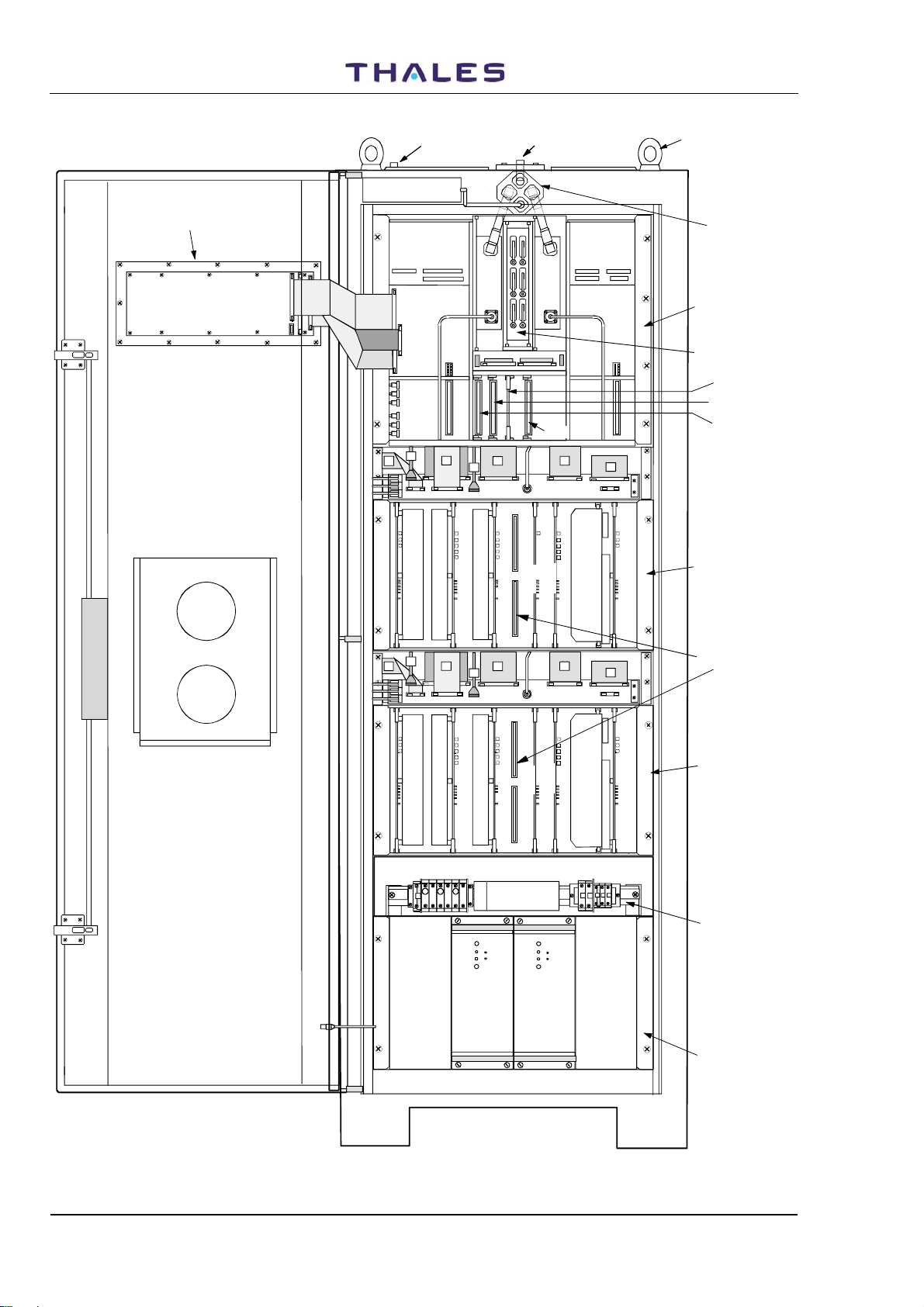
955 900 031C
LCSU unit
Rear view
ANTENNA MONITORS PROBES
CONNECTORS
50 Ohm
Dummy Load
OUT OUT
ANTENNA
CONNECTOR
DME 415/435 -Technical Manual
Vol. 1-Section 1-General Information
Nr. 4 eye bolt s
for to be li fting
COAX
RELAY
Documents holder
DPX 1
IN
DPX 2
IN
RF AMPL/DPX
SUBRACK
RF TEST
PATCH PANEL
AFI
MDM 2 (opzion.)
N.U.
F
D
E
C
J1
H
B
MDM 1(opzion.)
TRX/MON (1)
SUBRACK
RX 1
MON 1
PWS 1
F
D
E
J1
DPR 1
C
DMD 1
TX 1
H
B
N.U.
TRX/MON (2)
SUBRACK
DMD 2
PWS 2
RX 2
MON 2
DPR 2
TX 2
Terminal BAR
Module OK
V adj
-
Mains OK
AC/DC 1
Module OK
+
TP
-
Mains O K
+
V adj
TP
-
-
AC/DC 2
BCPS Subrack
Figure 1.6. DME 415 – Front view with anterior door opened – Full Dual version
1-22
THALES Italia S.p.A.- A. S. D.
Vers. D, September 2005
Page 31
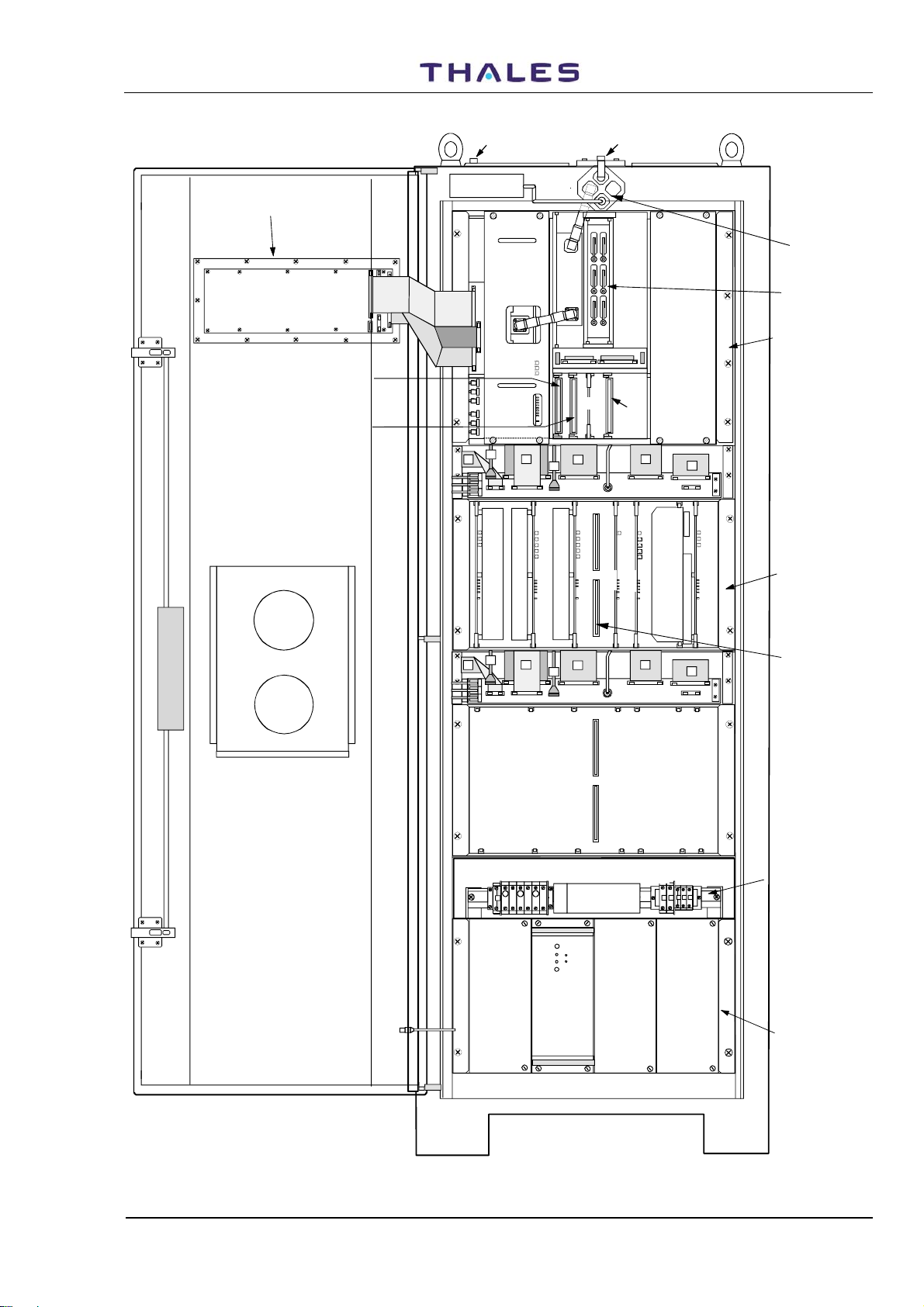
DME 415/435 -Technical Manual
Vol. 1-Section 1-General Information
LCSU unit
Rear view
MDM 1(option)
MDM 2 (option)
ANTENNA MONITORS PROBES
CONNECTORS
50 Ohm
Dummy Loa d
OUT
TKW
IN
ANTENNA
CONNECTOR
955 900 031C
Nr. 4 eyebolts
for to be lifting
COAX
RELAY
DPX
RF TEST
PATCH PANEL
RF AMPL/DPX
SUBRACK
AFI
N.U.
Documents holder
F
D
CE
J1
H
B
TRX/MON (1)
DPR
DMD
RX
MON
PWS
F
D
54 Vdc OUT
CE
J1
TX
H
B
IN
MAINS48Vdc
SUBRACK
N.U.
Terminal BAR
Figure 1.7. DME 435 Single version – Front view with anterior door opened
Vers. D, September 2005
Module OK
+
V adj
TP
-
-
Mains OK
AC/DC
BCPS Subrack
THALES Italia S.p.A.- A. S. D.
1-23
Page 32
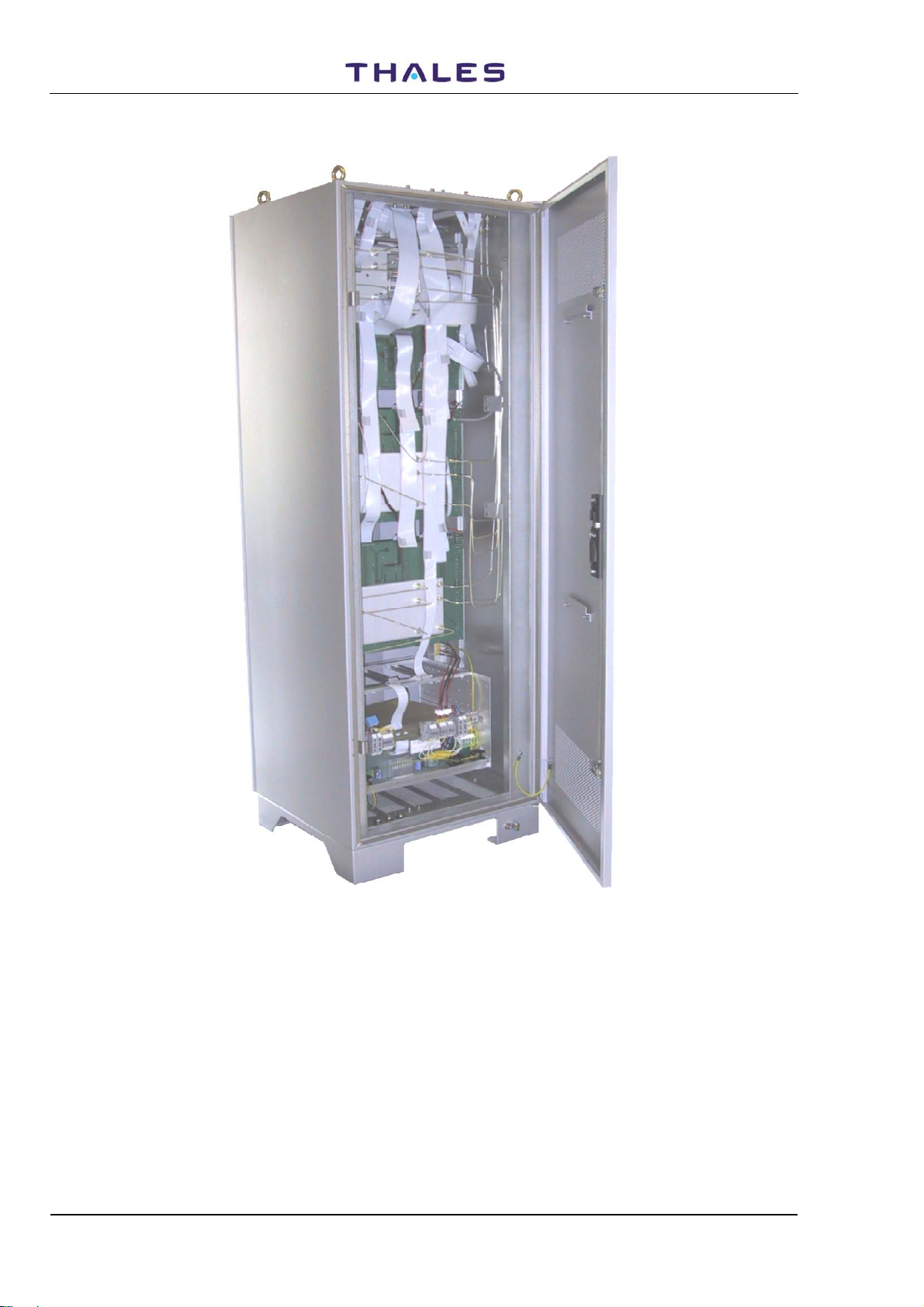
955 900 031C
DME 415/435 -Technical Manual
Vol. 1-Section 1-General Information
Figure 1.8. DME 435 – Rear side view of the cabinet
NOTE: Rear view valid for both cabinets type
1-24
THALES Italia S.p.A.- A. S. D.
Vers. D, September 2005
Page 33
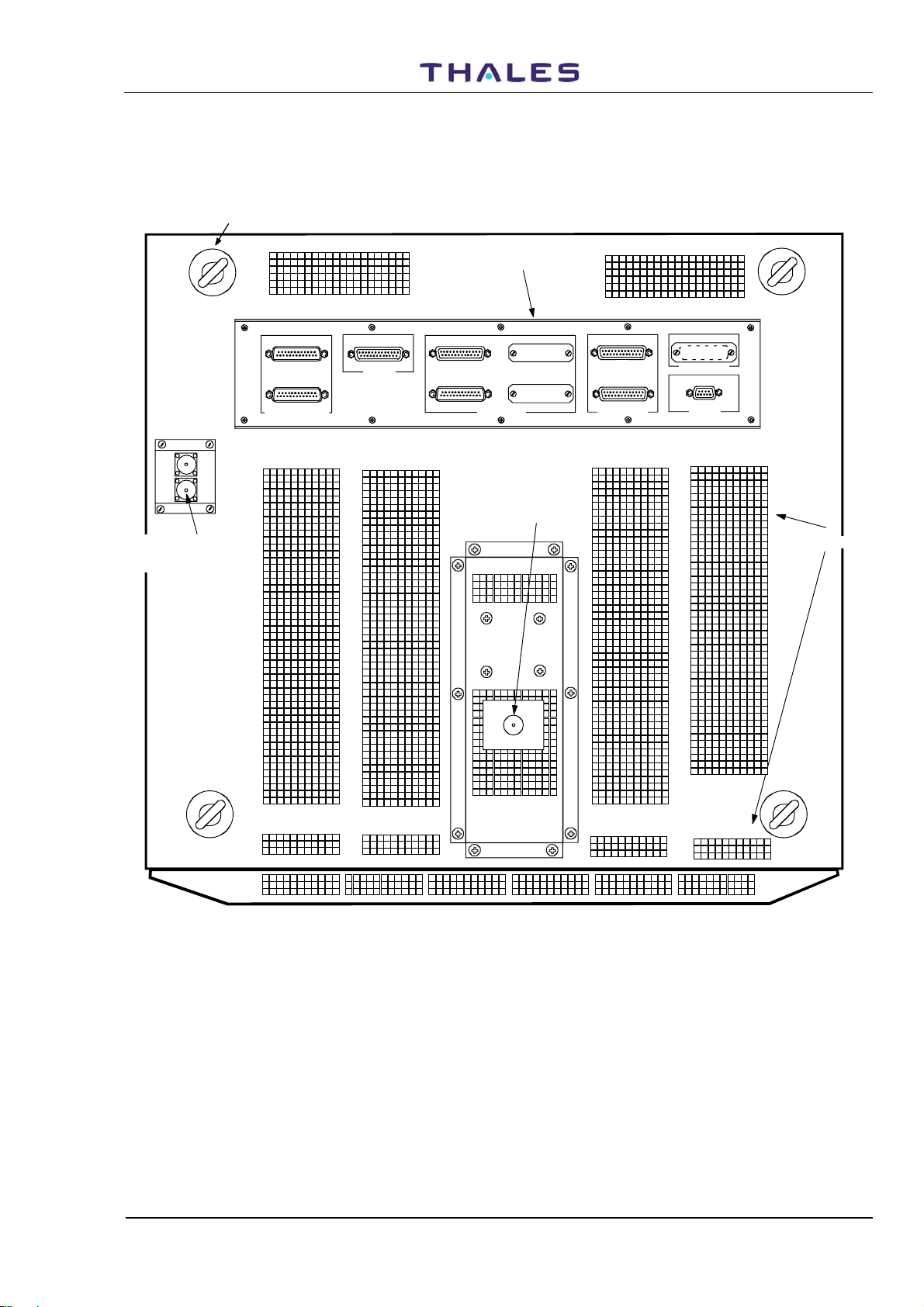
DME 415/435 -Technical Manual
A
Vol. 1-Section 1-General Information
NOTE: Top end valid for both cabinets type
955 900 031C
N° 4 eyebolts
M1
M2
NTENNA MONITORS
CONNECTORS
"N" type Female
PL1
PL2
PORT 2 (DTE)
SERI AL PORT (R S232)
SK1
PORT 1 (DCE )PORT 3 (DCE /DTE)
PC (RS232)
Rear
I/O PANEL
SK2
OUT(0/15)
PL3
IN (0/15)
PARALLEL PORT
ANTENNA CONNECTOR
"N" type Female
SK3
OUT(16/31)
PL4
IN (16/31)
SK4
AF1
SK5
AF2
ASSOC. FACILITY
SK6
TACAN ANTENNA
PL7
1-6= LINE 1 3-8=LINE 2
TEL. LINES
AIRING GRID
NOT to SCALE
Front
Figure 1.9. DME 415/435 – Top view
Vers. D, September 2005
THALES Italia S.p.A.- A. S. D.
1-25
Page 34

955 900 031C
DME 415/435 -Technical Manual
Vol. 1-Section 1-General Information
1.6 EQUIPMENT FUNCTIONAL DESCRIPTION
1.6.1 General Overview
The DME 415/435 system consists of hardware based on RF and video PBA, and of software that
largely controls the hardware. In order to explain these functions, the description is divided in following
main parts as by composition of the equipment (see also the simplified general block schematic with
the main RF signals on fig
1.10.
The system is subdivided into the following units (dual or single version):
- Transponder (RX, DPR, DMD, TX-100, PWS)
- Transmitter Amplifier 1kWp (TKW) (only for DME 435)
- RF path – Duplexer and Coax. Relay (DPX, KCX, MKCX and TAI dummy)
- Monitor (MON)
- Local I/O (LCSU)
- Associated Facility Interface (AFI)
- AC/DC Power supply (BCPS)
- Antenna
- Modem (optional)
- Remote Control Indication (RCSI/RCSE or MCS)
Transmitter and monitor are controlled by their own individual microprocessors. Both communicate with the
LCSU, controlled by its own microprocessor.
The transponder processor performs the following main tasks:
- General management of the transponder
- Digital and video processing
- Control/adjustment of main delay
- Control/adjustment of modulation for peak power and pulse shape
The monitor processor performs the following main tasks:
- General management of the monitor
- RF signal generation of interrogation pair for executive monitoring
- Evaluation of the transponder reply signals and receiver sensitivity (in Antenna and Dummy load)
- Execution of appropriate actions in case of fault detection (station changeover or shutdown)
- Ensuring of its own performance independent of environmental conditions and component
aging (selfcheck)
The software packages (i.e., transponder SW, monitor SW, LCSU SW, PC WIN Supervisor, WIN ADRACS
or MCS and WIN
EQUIPMENT MANAGER) looks after and supports the most important tasks as follows:
- Startup (alignment and calibration of the set up)
- Modulation and transmitter control
- Signal generation
- Monitoring the output signal of the transponder
- Support in system repair and maintenance
- Operation of the system (local/remote)
1-26
THALES Italia S.p.A.- A. S. D.
Vers. D, September 2005
Page 35

DME 415/435 -Technical Manual
Vol. 1-Section 1-General Information
955 900 031C
The Local I/O (LCSU) processor performs the following main tasks:
- Communication via serial line RS232 with the monitor(s) and via serial line RS485 with transponders
- Beacon-operator interface via Personal Computer
- Basic beacon-operator interface via the Control Panel front door
- Check of the settings of equipment
- Connection to one or more remote control centers through switched or dedicated telephone lines
- Communication via modem with remote monitoring and site control
- History management
The Duplexer and RF path performs the following main tasks:
- Exchanges the RF path of the main transponder and of the stand-by transponder on the antenna and on
the internal dummy load
- Coupling signal for monitoring interrogation
- Coupling signal for Pilot pulse
- Manual RF test with patch panel
1.6.2 DME 415/435 System Functional Description
The beacon comprises the following main parts:
− I/O system (LCSU, RCSI/RCSE or MCS, SI, PC, MDM);
− Transponder (RX, DPR, DMD, TX100, PWS);
− 1kWp Amplifier (TKW only DME435)
− RF path (DPX, Patch-panel);
− Monitoring (MON);
− Interface (AFI) and (TAI dummy);
− AC/DC power supply (BCPS).
− DME Antenna
The beacon can also be configured as single transponder either with one or two monitor(s).
The simplified functional block diagram of the dual configuration is shown in figure
The simplified functional block diagram of the main RF signal path is shown in figure
1.10.
1.11
A coaxial transfer switch (controlled by Monitors) is used to the transponder(s) either with the antenna line
(main transponder) or with the internal dummy load (stand-by transponder) (see figure
The antenna probes are used to monitoring the reply RF signals (figures
1.10 and 1.11)
1.10).
Figures
1.12 and 1.13 are simplified functional block diagrams of the I/O and power supply systems
respectively.
Vers. D, September 2005
THALES Italia S.p.A.- A. S. D.
1-27
Page 36
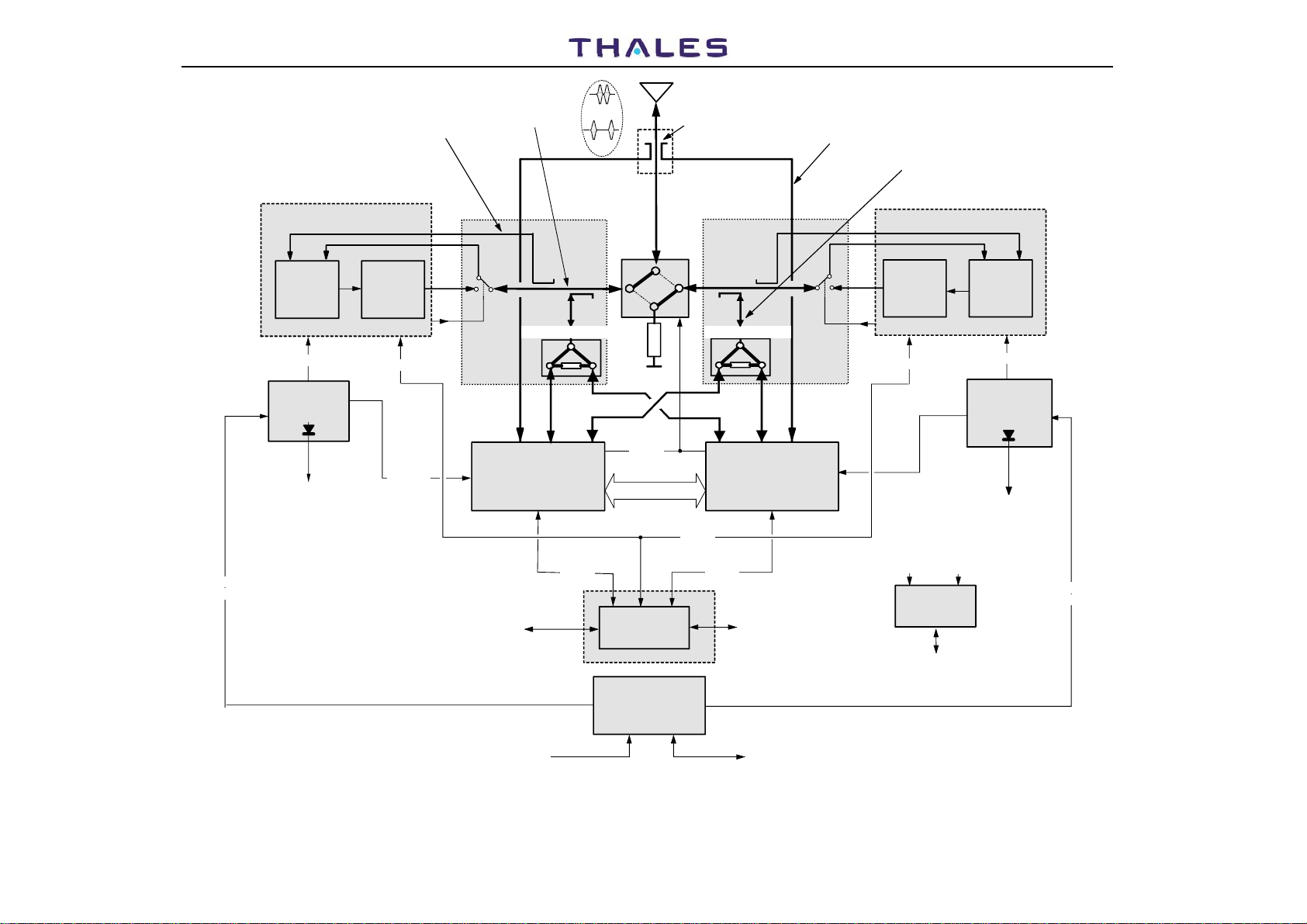
1-28
955 900 031C
Vol. 1-Section 1-General Information
DME 415/435 -Technical Manual
+48
Vdc
Transponder 1 (TRX-1)
RX
5V, ±15V
DC/DC
Power Supply
PWS-1
5V
to LCSU
TX
RS-485
5V, ±15V
Pilot Pulse
RF Interrog./Reply
pair pulses
DPX-1
20 dB
coupler
ADDER/DIVIDER
Monitor
MON-1
RS 232
Local PC
e
d
o
M
X
d
e
o
M
Y
COAX
RELAY
ch-over
status
Local I/O
LCSU
Battery Charger
AC/DC Power Supply
ANTENNA
MONITOR
PROBES
DPX-2
17dB
coupler
ADDER/DIVIDER
RS-485
RS 232
Monitor
MON-2
REMOTE
control unit /PC
RF Reply pulses
for monitoring
BCPS
MAINS
BATT.
Figure 1.10. DME 415/435 – Simplified general block diagram
RF Interrogation pulses
for monitoring
Transponder 2 (TRX-2)
TX
RS-485
to/from
TRX1
Assoc. Facility
AFI
to Associated
Facility
TRX2
RX
5V, ±15V
DC/DC
Power Supply
PWS-2
5V
to LCSU
+48
Vdc
Vers. D, September 2005
THALES Italia S.p.A.- A. S. D.
1-28
Page 37
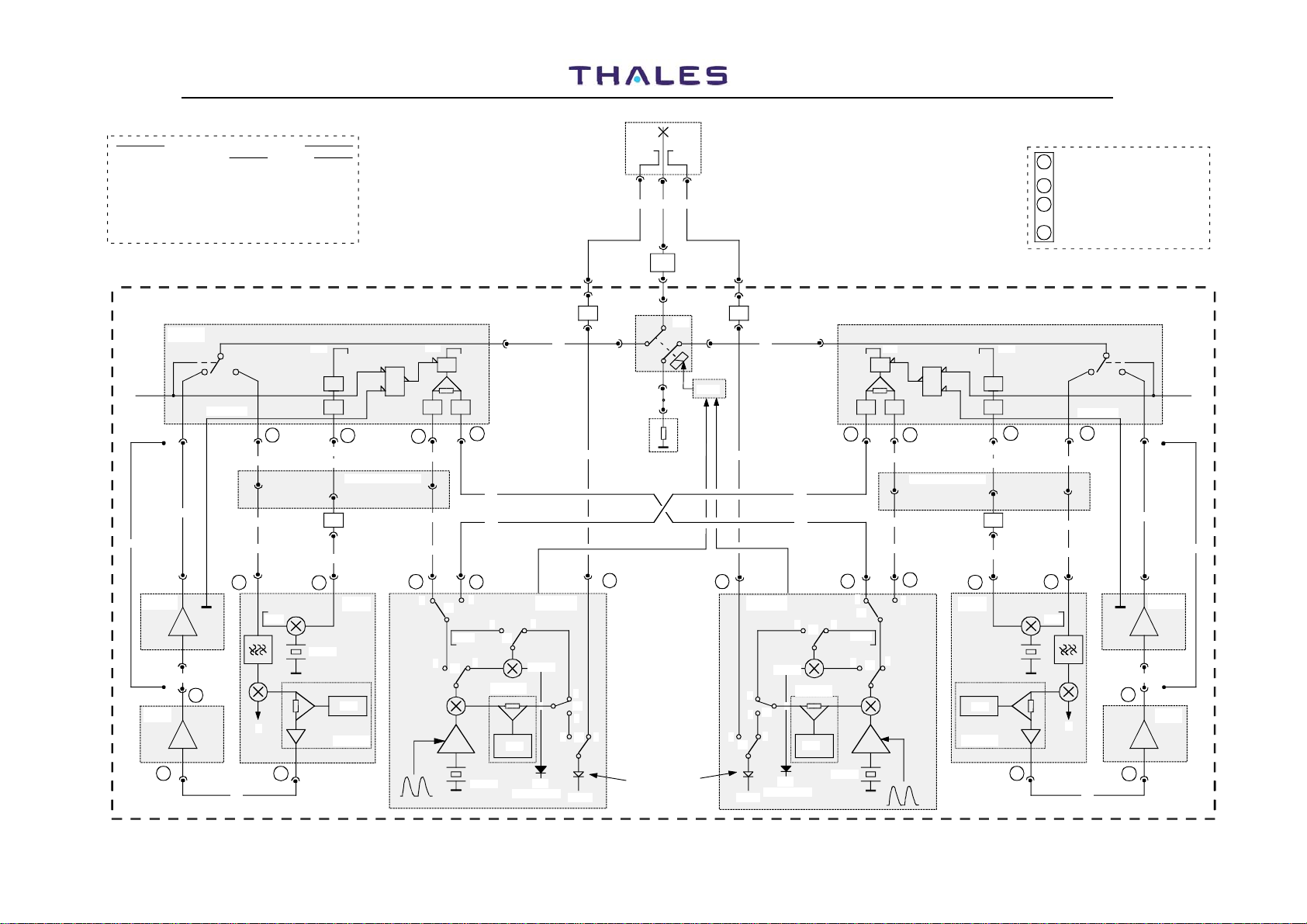
DME 415/435 -Technical Manual
Vol. 1-Section 1-General Information
955 900 031C
MONITOR SWITCHES POSITION
Interrog. for CALIB. B X B A X
Interrog. to RX1/2 A A/B B A X
REPLY from TX1/2 B A/B A X X
ANTENNA Monit. PROBE X X X X B
DIAGNOSTIC X X X B A
DME 415/435
S1 S2 S3 S4 S5
SWITCH
DPX 1
20 dB
17
LRXINHD1
W3
LRXINHM1
2
"N"
W3a
"N"
W5a
RX IN
W5b
2
dB
13 13
dB
Pilot Pulse
W7a
"SMA" "SMA" "SMA""SMA"
10
dB
W7b
3
TKW1
17dB
63 MHz
W3b
TX 1
1
IF
VCO
SYNTH.
INTERCONNECTING COAX CABLES
W1=Antenna (Ext)
W2=Antenna Probes (Ext)
W3=TX to DPX
W3a=TKW to DPX (DME435)
W3b=TX to TKW (DME4 35)
W4=RX to TX
W5a=DPX to RX via Patch Panel
W5b=RX to DPX via Patch Panel
17dB
10
dB
&
6
6
dB dB
1
RF PATCH PANEL 1
(SEE NOTE
)
"SM A"
RX 1
3
W8a
MON I/O
W8b
1
A
A
4
W9
W9
2
B
B
S2
AB
A
20 dB
A
A
S1
S3
B
B
SYNTH.
(SEE NOTE)
"N"
VCO
MON 1
B
63 MHz
W6
ANT
21 dB
21 dB
"N" "N" "N"
W1 W2W2
BPF
"N"
50 ohm
Dummy
Load
(opt)
"N"
KCX
"N"
Transfer
coax relay
"N"
"N"
KCXM
W10
3
B
"N"
"TNC"
10
dB
"TNC"
W10
3
A
A
S4
B
B
B
A
S5
INTERCONNECTING COAX CABLES
W6=DPX to KCX
W7a=RX test via Patch Panel
W7b=RX test via Patch Panel
W8a=MON Interr/Reply via Patch Panel
W8b=MON Interr/Reply via Patch Panel
W9=MON Interr/Reply (Cross interconnecting)
W10=Antenna Probes
"N"
"TNC"
10
( SEE NOTE)
dB
"TNC"
MON 2
A
B
S5
W6
S4
A
63 MHz
"N"
W9
W9
B
S3
SYNTH.
VCO
17dB
10
dB
6
6
dB dB
4
W8a
MON I/O
W8b
2
A
A
B
S2
S2
A
A
20 dB
A
A
B
B
S1
PLUG-IN Type COAX CONNECTOR
4
Module REF POSITION
3
1, 2, 3, 4 = DPX
1, 2, 3 = RX, MON
2
1, 2, = TX
1
NOTE: 10 dB Attenuators used when TKW is present
DPX- 2
20 dB
&
3
RF PATCH PANEL 2
(SEE NOTE)
1
"SMA""SMA"
17
dB
dB
Pilot Pulse
W7a
10
dB
W7b
3
1
"SMA"
2
W5a
RX IN
W5b
LRXINHM2
2
"N"
W3a
"N"
RX 2
17dB
63 MHz
W3b
VCO
SYNTH.
IF
1
LRXINHD2
W3
TKW2
TX 1
1-29
2
Vers. D, September 2005
W4
1
59 MHz
DET
MEASUREM.
DET-A
Reply Measur. and
Diagnostic
Purpose
DET-A
DET
MEASUREM.
59 MHz
1
W4
2
ED.: 1 - 1999
Figure 1.11. DME 415/435 – Main RF path signals - General simplified block diagram
THALES Italia S.p.A.- A. S. D.
1-29
Page 38
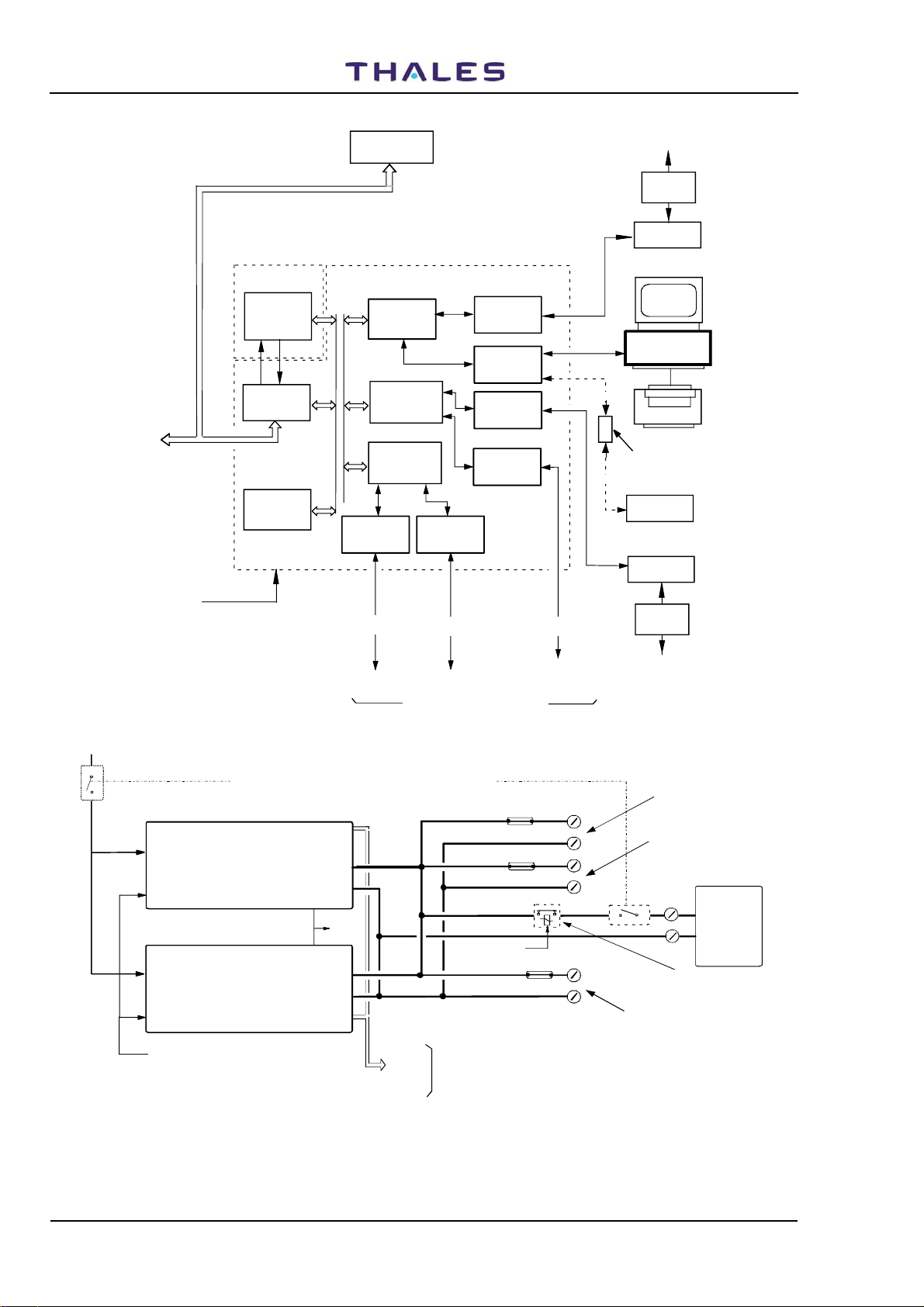
955 900 031C
DME 415/435 -Technical Manual
Vol. 1-Section 1-General Information
AUXILIARY ON/OFF
Controls a nd Indicatio ns
CONTROL
PANEL &
STA TUS IN D.
INC module
PARALLEL
I/O
CPU
STATUS SITE
INDICATION
LCSU unit
SERIAL
COMMUNICAT.
CONTROLLER
SERIA L
COMMUNICAT.
CONTROLLER
SERIAL
COMMUNICAT.
CONTROLLER
RS232
DRIVER
RECEIVER
(CSB module)
RS232
DRIVER
RECEIVER
RS232
DRIVER
RECEIVER
RS232
DRIVER
RECEIVER
RS232
DRIVER
RECEIVER
RS485
DRIVER
RECEIVER
(PC Remote or RCSI)
RS232
Asyncro Conv. Interf.
RS422
TELEPH. LINE
ESD
protection
(option)
MODEM 1
PC
PRINTER
SI446
MODEM 2
+5 V
ESD
RS 232
Seial Line
MON1 MON2
RS 232
Seial Line
TRANSPONDERS Communication
RS 485
Seial Line
TRX1
TRX2
protection
(option)
TELEPH. LINE
(PC Rem ote or RCS I)
Figure 1.12. DME 415/435 – Local I/O system general block diagram
MAINS
BREAKERS on external Electrical Switchboard (recommended)
AC/DC 1
600 W/10A
+
-
Fuse 10A
Fuse 2A
+
-
+
-
48V to
transponder/monitor 1
48V to
service purpose
+
*)
*)
AC/DC 2
600 W/10A
Command ON/OFF ( N.U.)
(From LCSU )
+
Fuse 10A
-
ACFTY1
ACFTY2
INDICATIONS
MAINS1
(To LCSU)
MAINS2
BPDPL
+
-
48V to
transponder/monitor 2
External BATT RELAY
SWITCH (Optional)
Figure 1.13. DME 415/435 – AC/DC Power Supply system & Battery Charge - Block diagram
BATT.
+
Typical
-
50A/h-48V
-
1-30
THALES Italia S.p.A.- A. S. D.
Vers. D, September 2005
Page 39

DME 415/435 -Technical Manual
Vol. 1-Section 1-General Information
955 900 031C
1.6.3 I/O SYSTEM - Functional description
Consist of the Local and Remote Control & Maintenance System.
The I/O system is totally modular; it is able to meet any type of requirement that may arise in an installation.
Main features of the System are:
• Control/monitoring of the equipment by means of a standard Personal Computer, and/or Remote Control
& Status Indicator and/or a Status Indicator of the beacon main indication.
• Control and monitoring of the beacon and its associated equipment (only on customer request), if any
(e.g. VOR/ILS), by using a Personal Computer.
• Possibility to control, monitor and maintain the equipment station by using the public switched network
or dedicated telephone lines
It is composed by the following main parts:
– Local Control & Status Unit "LCSU" housed inside the equipment, consisting of the Control Status
Board module (CSB), the Indication and Control module (INC) and I/O panel
– Remote Control & Status Indicator "RCSI 446, RCSE 443 or MCS" (optional).
– Status Indicator "SI 446" (optional).
– standard Personal Computer IBM compatible (optional).
– Modem (optional).
1.6.3.1 I/O Local site
At the local site, the beacon-operator interface consists of:
− Module INC (LCSU) control and indication front panel;
− Personal Computer (optional), which allows the operator to completely control and monitor the beacon;
− Status Indicator SI446 (optional), which may be installed in the equipment control room or control
tower.
It is handled by the LCSU unit, which also controls the communication with other equipment and/or
device(s), through RS-232C serial interface ports or through modem and telephone lines.
− The I/O Panel (figure
1.14) located on the top end of the cabinet is complete with a set of
interconnection connectors interface the external equipment or devices.
A typical configuration of the local site set-up is shown in figure
1.15.
Vers. D, September 2005
THALES Italia S.p.A.- A. S. D.
1-31
Page 40
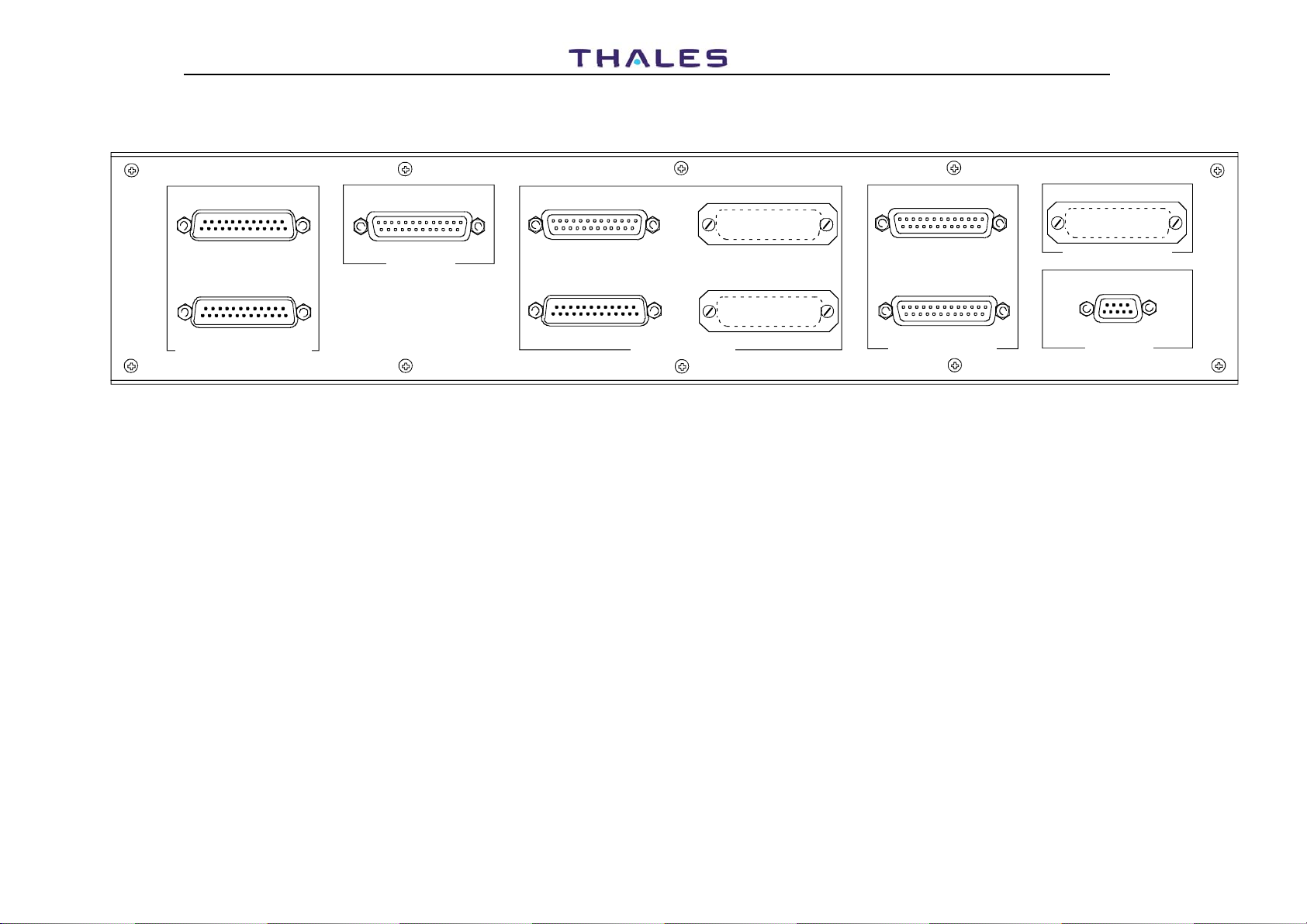
1-32
DME 415/435 -Technical Manual
Vol. 1-Section 1-General Information
955 900 031C
PL1
PL2
PORT 2 (DTE)
SERIAL PORT (RS232)
PL1 = UNAVAILABLE if MDM 2 IS USED
PL2 = UNAVAILABLE if MDM 1 IS USED
SK1
PORT 1 (DCE)PORT 3 (DCE/DTE)
PC (RS232)
SK1 = PC connection
UNAVAILABLE if
PC connector on
FRONT PANEL
is USED
SK2
OUT(0/15)
PL3
IN (0/15)
PARALLEL PORT
SK2 = N° 16 AUXILIARY ON/OFF OUT SIGNALS (standard)
PL3 = N° 16 AUXILIARY ON/OFF IN SIGNALS (standard)
(e.g. possible Site Status Indication)
SK3 = N° 16 AUXILIARY ON/OFF OUT SIGNALS (optional)
PL4 = N° 16 AUXILIARY ON/OFF IN SIGNALS (optional)
SK3
OUT(16/31)
PL4
IN (16/31)
Figure 1.14. I/O Panel
SK4
AF1
SK5
AF2
ASSOC. FACILITY
SK4 = Associated Facility EQPT 1
SK5 = Associated Facility EQPT 2
1-6= LINE 1 3-8=LINE 2
SK6
TACAN ANTENNA
PL7
TEL. LINES
SK6 = N.U.
PL7 = N° 2 Telephon Line
Internal MODEM connected
Vers. D, September 2005
THALES Italia S.p.A.- A. S. D.
1-32
Page 41
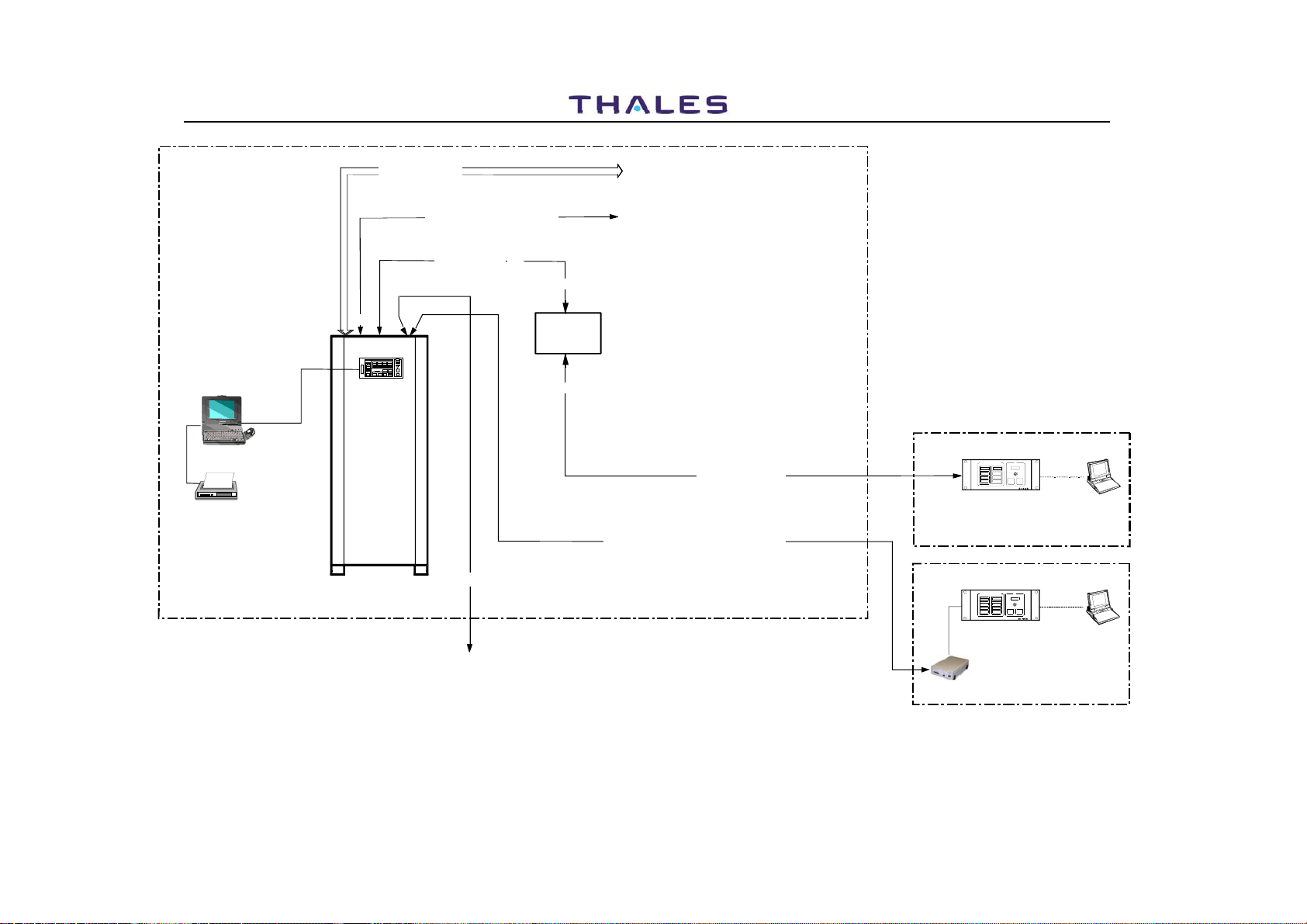
955 900 031C
DME 415/435 -Technical Manual
Vol. 1-Section 1-General Information
(P C OPTION)
RS 232
PL3
SK2
PARALLEL LINE
PL2
PL1
DME
415 / 435
SERIAL LINE (B) (RS-232)
SERIAL LINE (A)
PL7
LINE (D)
RS 232
Asyncronous
Converter
Interface
RS 422
ON/OFF DATA
(OTHER EQUIPMENT or DEVICE e.g SITE STATUS )
OTHER EQUIPM EN T (I. E.,
VOR, EXTER NAL MODE M, ETC.)
SERIAL LINE (max. 1km)
(or dedicated line)
Switch ed or dedicated teleph. LINE (
C)
EQUIPMENT ROOM
STAT US INDI CATOR
SI 446 - 2/8
RS 422
EQUIPMENT STATUS SI
ALARM
WARNING
NORMA L
OPTION 1
CONTROL ROOM
STAT US INDI CATOR
SI 446 - 2/8
RS 232
EQUIPMENT STATUS
ALARM
WARNING
NORMAL
OPTION 2
1
2
ON
ALARM
WARNING
NORMAL
1
2
ALARM
WARNING
NORMAL
RS 232
LAMP
SIL
TEST
PC
SI
ON
RS 232
LAMP
SIL
TEST
PC
1-33
NOTE 1:
Vers. D, September 2005
line UNAVAILABLE if
C&D
TELEPHONE LINE CONNECTION WITH A
REMOTE CONTROL MONITORING CENTRE
line ARE USED and viceversa
A&B
Figure 1.15. Local site set up – Typical configuration
THALES Italia S.p.A.- A. S. D.
Modem
NOTE 2: On OPTION 1&2
RCSI 446-2/8 Remote Control
CONTROL TOWE R
possible use of
1-33
Page 42
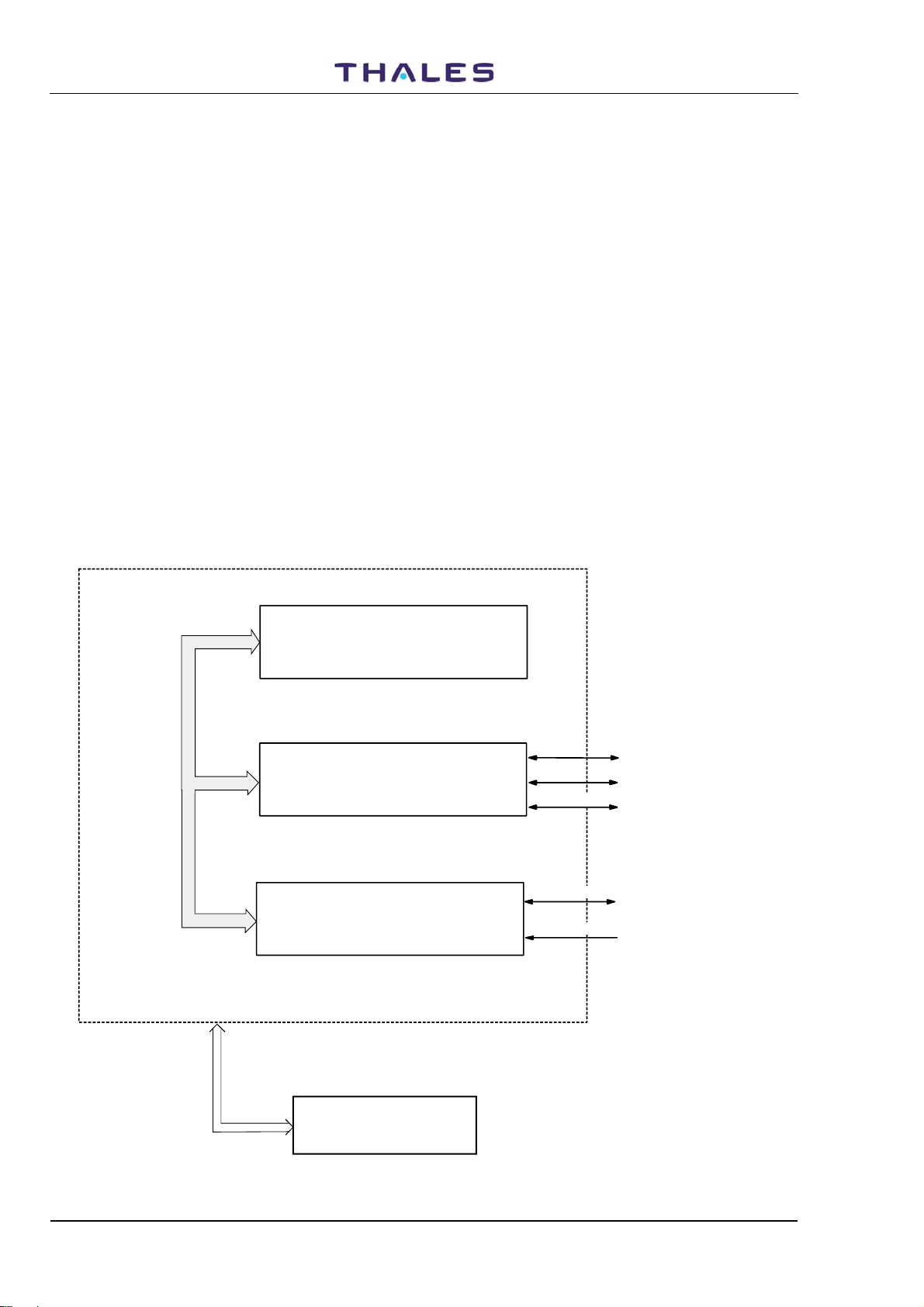
955 900 031C
DME 415/435 -Technical Manual
Vol. 1-Section 1-General Information
1.6.3.2 LOCAL CONTROL & STATUS UNIT (LCSU)
The LCSU unit is the local main unit connecting the equipment to the remote control system. It also handles
the communication with remote monitoring and control sites, which takes place also through modem and
telephone line(s). It is mounted into the equipment cabinet but it is a functionally separate block. The LCSU
is powered by the service voltages of the DME equipment.
Its main functions:
• sends basic controls to the equipment;
• displays the status of the equipment ;
• interfaces modem(s) connecting the equipment with remote units or PCs;
• interfaces the local PC to control-monitor the equipment and to perform maintenance operations at
the site;
• interfaces the co-located equipment (only on customer request).
• manages the two modems (optional, placed inside the equipment) that operate with dedicated or
switched lines up to 28.800 bps.
LCSU consists of the following parts (figure
1.16):
• the Control & Status Board (CSB 186 module) that carries the unit management software.
• the control panel and the status indicator (INC module) used to forward the basic controls and to display
the equipment operating status.
CSB
CONTROL & STATUS BOARD
CPU & MEMORIES
SERIAL LINES COMMUNICATION
I/O PARALLEL LINES
Port 1
Port 2,3
Port 4,5,6
AUX ON/OFF
AUX ON/OFF
To PC
To I/O PANEL
To Equipment
To I/O PANEL -IN&OUT
n° 12 IN from Equipment
1-34
INDICAT ION &
INC
CONTROLS
FRONT PANEL
Figure 1.16. LCSU - Simplified Block Diagram
THALES Italia S.p.A.- A. S. D.
Vers. D, September 2005
Page 43
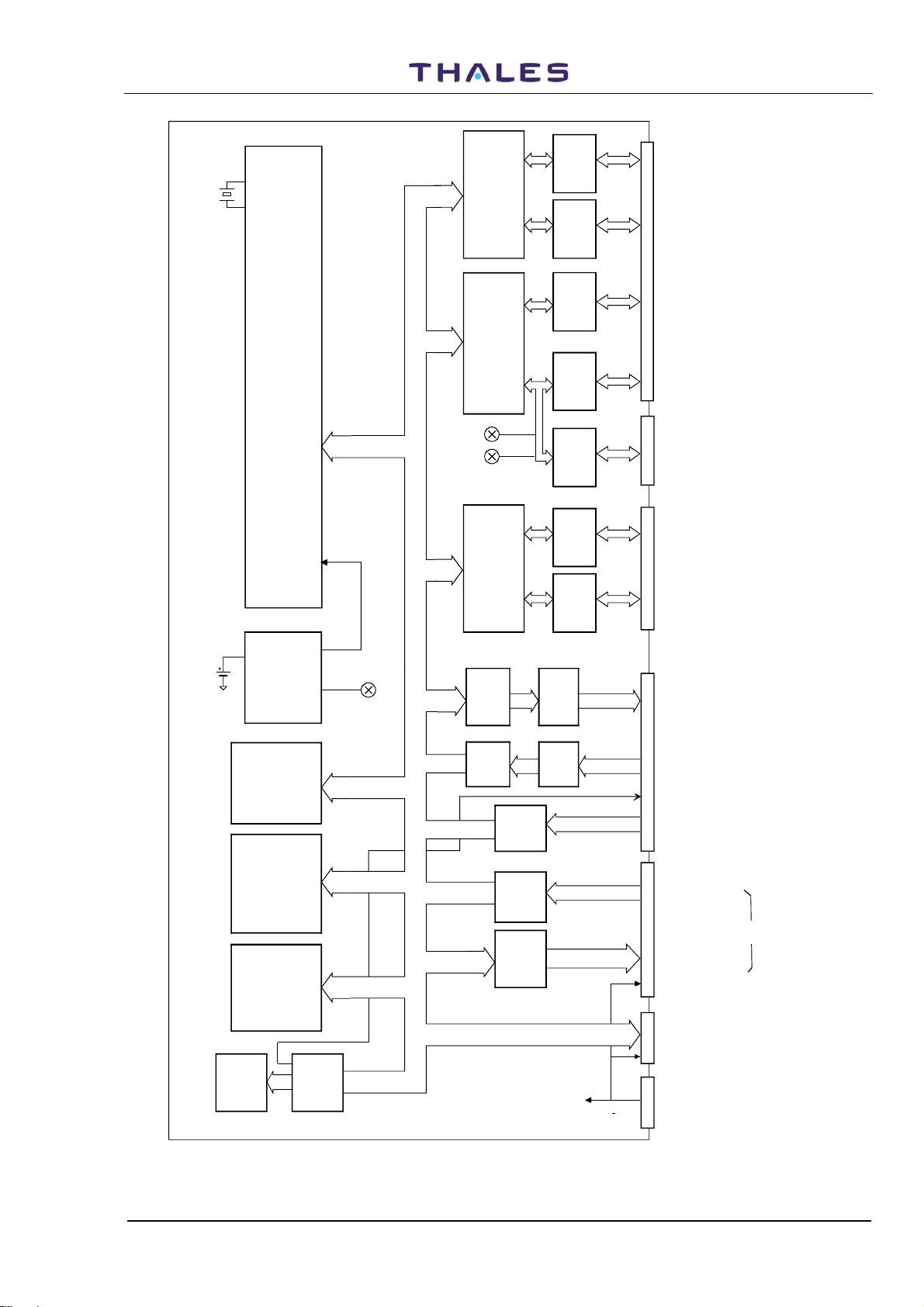
DME 415/435 -Technical Manual
Vol. 1-Section 1-General Information
SERIAL
COMMUNIC.
CONTROLLER
DRIVER
RECEIVER
RS232C
DRIVER
RECEIVER
RS232C
CHANNEL 1
RS232
DCE
CHANNEL 2
RS232
DTE
To SK1 PC
I/O Panel
To PL2 MDM1
I/O Panel
955 900 031C
Battery
NI-CD
3,6V
CPU
Reset
Watch- Dog
and Battery
BackUp
Circuit
RAM - 1Mbit
RESET
Watch Dog
Indication
COMMUNIC.
CONTROLLER
RXD
Indication
TXD
COMMUNIC.
CONTROLLER
REGISTER
REGISTER
SERIAL
SERIAL
OUTPUT
INPUT
DRIVER
RECEIVER
RS232C
DRIVER
RECEIVER
RS232C
DRIVER
RECEIVER
RS485
DRIVER
RECEIVER
RS232C
DRIVER
RECEIVER
RS232C
SOLID
STATE
RELAYS
OPTO
COUPLER
OU 0...4
M22
M30
M53
16
M32
16
CHANNEL 3
RS232
DTE/DCE
CHANNEL 4
RS232
DCE
CHANNEL 4
RS485/422
CHANNEL 5
RS232
DTE
CHANNEL 6
RS232
DTE
PARALLEL
INPUT/OUTPUT
To PL2 MDM2
I/O Panel
N.U.
To Transponders (1&2)
(DMD modules)
To MON 1
module
To MON 2
module
To SK2
and PL3
I/O Panel
and BCPS
Socket N.U.
SERIAL
EEPROM
2k x 8
Vers. D, September 2005
INPUT
REGISTER
INPUT
REGISTER
OUTPUT
REGISTER
EPROM
1 Mbit
OUTPUT
REGISTER
+5V,+15V
Figure 1.17. CSB module – Simplified Block Diagram
THALES Italia S.p.A.- A. S. D.
8
M17
M21
M18
4
CONTROLS
from KEYBOARD
INDICATION to
FRONT PAN EL
BUS for
EXPANSION
CSX module (opt ion)
POWER
SUPPLY
To INC
module
1-35
Page 44

955 900 031C
DME 415/435 -Technical Manual
Vol. 1-Section 1-General Information
1.6.3.2.1 CONTROL AND STATUS BOARD - CSB module – Functional description
The main functions of the CSB module (see figures
1.18 block diagram) are as follows:
− management of interfacing between the equipment and remote system;
− up-dating of the remote site unit;
− communication with the monitors on the RS-232C serial links;
− communication with the transponder equipment on the RS-485 serial link;
− driving of the indications and acquisition of the commands of the INC module
− management of the RS-232C serial communication line with the PC terminal;
− management of the RS-232C serial communication line towards the MODEM and towards an
optional external MODEM for connection to specific remote controls on a telephone line;
− management of the ON/OFF type input and output auxiliary signal using the parallel ports;
− storage of the system configuration in a non-volatile memory (EEPROM);
− management of the calendar for the entire system;
− management of the RS-232C and/or RS-485 serial communication lines that can be used for any
associated equipment connected on a serial link.
− History management
− Management of control function line: Beacon Restart, Automatic Routine check, Warning detection,
Alignment of the Parameter of the intelligent units (Monitors, DMD modules), Searching and Building
of the Data requested by the Remote/Local site through PC
Through the CPU and program memories, the CSB module manages:
− INC Module (Indications and Controls);
− local operator interface through PC;
− interface with remote operator via modem to RCSI/RCSE (Remote Control and Status Unit) or MCS by
means of dedicated or switched telephone line;
− SI 446 (Status Indicator) auxiliary indicator via the parallel ports;
− association between auxiliary ON/OFF input and output lines (parallel ports);
− serial channel operation;
− an RTC (Real Time Clock) calendar with rechargeable buffer battery;
− I/O configuration non-volatile memories.
The composition of the CSB module, shown in figure
1.18, consists in the following function blocks:
− CPU and memories;
− 6-channel serial lines;
− Parallel ports with 16 input and 16 output lines.
1-36
THALES Italia S.p.A.- A. S. D.
Vers. D, September 2005
Page 45
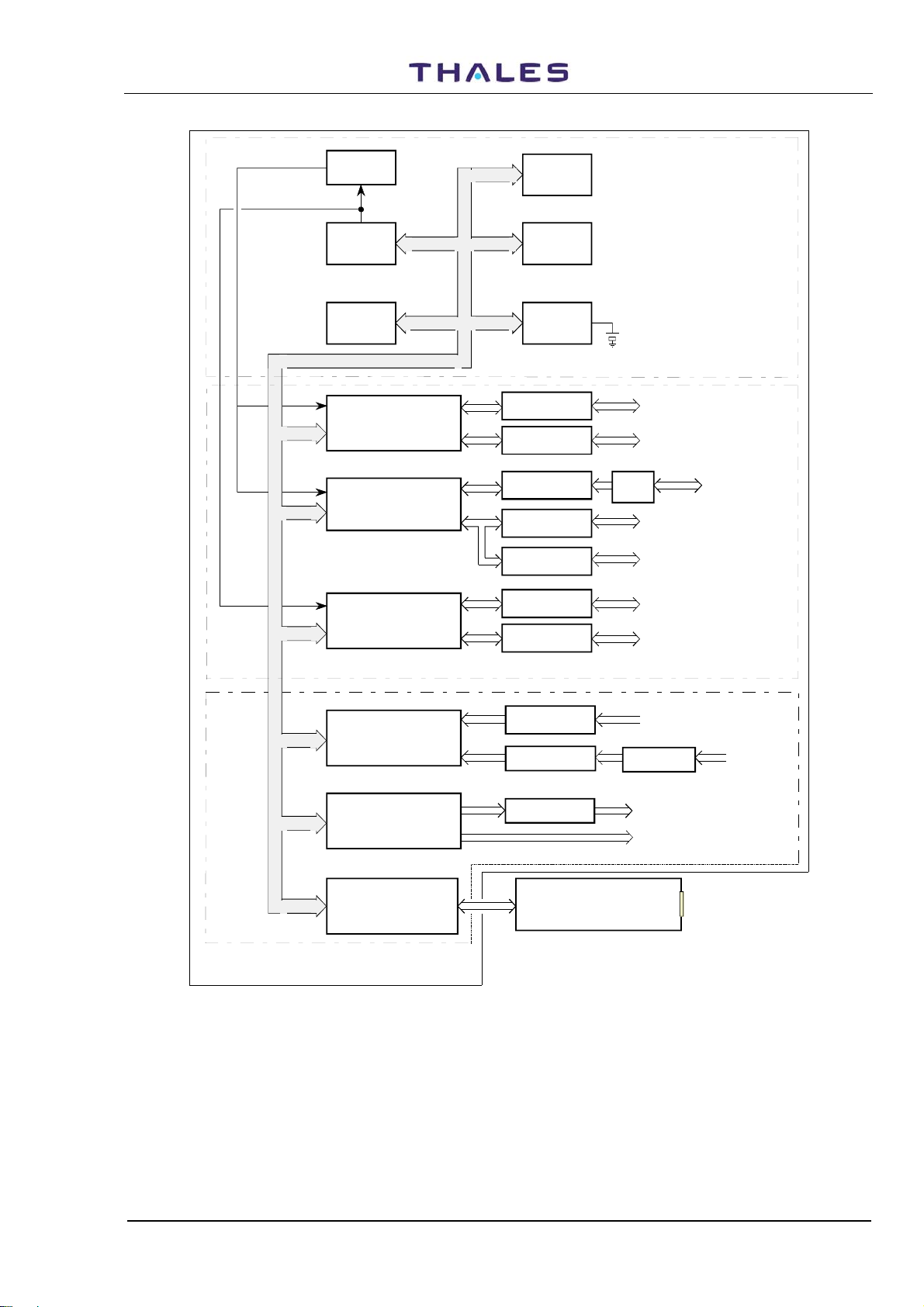
DME 415/435 -Technical Manual
Vol. 1-Section 1-General Information
955 900 031C
BAUD RATE
GENERATO R
CPU
uP 80C188
MEM
SRAM - EP ROM
BUS
SCC
SERIAL COMMUNICATION
CONTROLLE R
SCC
SERIAL COMMUNICATION
CONTROLLE R
SCC
SERIAL COMMUNICATION
CONTROLLE R
MEM
PARALLEL
EEPROM
MEM
SERIAL
EEPROM
RTC
REAL TIME
CLOCK
RS232
DRIVER RECEI VER
RS232
DRIVER RECEI VER
RS232
DRIVER RECEI VER
RS232
DRIVER REC EIVER
RS485
DRIVER REC EIVER
RS232
DRIVER REC EIVER
RS232
DRIVER REC EIVER
N.U.
CONFIGURAT ION
MEMORY
BACK UP
BATTERY
RS232 DCE
RS232 DTE
LINK
JUMPER
DTE/DCE
RS232 DCE
RS232 DCE
RS232 DTE
CHANNEL 1
CHANNE L 2
CHANNE L 4
RS485
CHANNE L 4
CHANNE L 5
CHANNE L 6
CPU & MEMORIES
RS232 D TE/DCE
CHANNE L 3
SERIAL LINES COMMUNICATION
PARALLEL L INE
N° 8 INPUT GND LEVEL
LINK JUMPER
SELECTOR
LEVEL & POLARITY PRESETTING
PARALLEL
N° 16 OUTPUTS
N° 5 OUTP UTS TTL
PARALLEL LINE
N° 8 INPUT
INPUT
REGISTERS
OUTPUT
REGI STERS
OPTO
ISOLATO R
OPTO
ISOLATO R
OPTO SO LID
STATE RELAYS
I/O PARALLEL LINES
CSB
CONTROL & STATUS BOARD
INPUT/OUTPUT
REGISTERS
INC
INDICATIO N &
CONTROLS PANEL
PC
RS232
Figure 1.18. CSB module – General Block Diagram
1.6.3.2.1.1 CPU and Memories
The 80C188 type microprocessor works internally with a frequency of 7.3728 MHz by means of a double
frequency quartz (it is divided internally by the CPU) and it uses integrated circuits UL6,7,8 to manage the
data bus and address buses (see figure
1.19 ). The 14.7456 MHz quartz frequency is used by the baud rate
generator of the SCC (Serial Communication Controller) and passes without alteration from FW2 (in cases
of quartz frequency change, the clock can be divided) to provide the BRGSCC signal.
Vers. D, September 2005
THALES Italia S.p.A.- A. S. D.
1-37
Page 46

955 900 031C
DME 415/435 -Technical Manual
Vol. 1-Section 1-General Information
The multiplexed portion of the address bus is stored in two latches (UL6 and UL7) in order to have stable
signals during the various CPU cycles.
The data bus is connected to the peripherals and the memories by a bi-directional buffer (UL8). This
solution has been used, to overcome not bus electric drive problems, but peripheral problems (such as the
RTC that does not release the bus before the CPU starts the next cycle).
A perpetual real time calendar (RTC - Real Time Clock) useful to date the events stored in the “history” is
installed to ensure the data concerning events that have taken place in the history of the TACAN equipment
is picked up. The manual updating of the date is managed by the “Supervisor” program.
The function is provided by the low consumption integrated circuit (4 μA at 2.2 V) UL5 (RTC) that operates
with a 38.768 kHz ceramic quartz.
This updates and supplies the complete actual date to the μP. The RTC memory is not lost when there is no
direct voltage since the BT1 buffer battery is switched onto UL5 from IC UL4 that constantly compares the
+5 Vdc. If this is missing, a switching electronic device enables the BT1 battery.
Under these conditions, the typical life of the rechargeable NiCd battery (3.6 V and 60 mA/h) is approx. six
months.
Through the FW1 circuit (Firmware EPLD - Electrical Programmable Logic Device), the IC UL4
(Supervisory) indicates that the program running will retrigger the timer correctly and consequently LED
“WD” (Watch Dog) RD4 will remain alight, indicating that the program running is correctly active.
In the case of a hardware fault or software failure, LEDs RD4 and OPERATION (of the INC) will not light up,
indicating that the CSB module is not operating correctly.
Integrated circuit IC UL4, besides monitoring the CPU activity, also checks the level of the +5 Vdc; if this
degrades to values below ≤ 4.65 V a “Warning” signal is generated. Integrated circuit IC UL4 also checks
the state of the buffer battery, and through the BATF signal indicates the Warning State.
IC UL16 (serial EEPROM) stores the I/O system configuration data, that does not usually vary a lot; it can
hold data for about 100 years, and this is the reason why another type of less secure memory (RAM) is not
used with a buffer battery.
RESET push-button I1 is used to restore and reinitialize the CPU program.
Integrated circuits FW1 and FW2 are specifically programmed to decode the selection of memories and I/O
peripherals, and to generate a clock for the serial port controllers.
The EPROM memories for the program (M7) and SRAM (UL9) have memories a capacity of 1 Mbit (128k x
8), but other sizes can be installed, up to the maximum μP addressing capacity (8 Mbit).
There is another socket on the printed circuit (not usually used) where an SRAM/EEPROM with capacity up
to 8 Mbit can be installed.
The UL9 SRAM memory where the events (history) data are loaded is always powered. When there is no +5
Vdc supply, this is substituted by the rechargeable buffer battery. By correctly setting the jumpers on the
CSB board, the other optional memories can also be supplied by the buffer battery. In this case, the battery
life will be reduced to 2 months.
For the memory rate, with a 10 MHz clock and a 16 MHz CPU, memories with an access time of 100 ns are
sufficient.
UL2 is an analog switch that electrically isolates the SRAM when operating by battery.
When the LOW LINE signal is present, activated each time the VDC drops below 4.65 V, the RTC circuit is
electrically isolated from UL2 to prevent undesired access and reduce consumption to a minimum in standby conditions (battery powering).
1-38
THALES Italia S.p.A.- A. S. D.
Vers. D, September 2005
Page 47
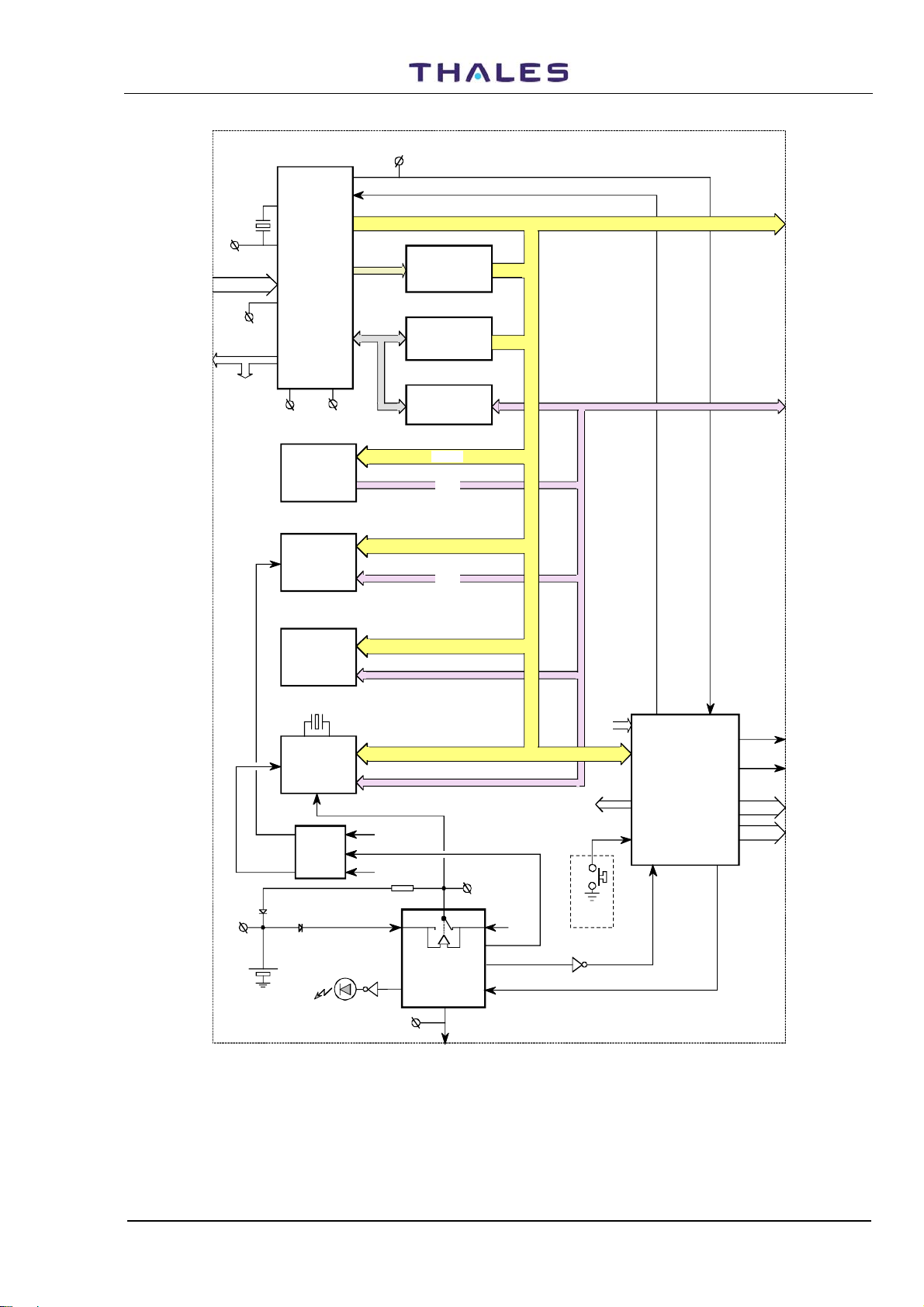
DME 415/435 -Technical Manual
Vol. 1-Section 1-General Information
955 900 031C
14.7456
AN3
INTSCC
PCS
MHz
Q1
INSCC0
Power
Down
AN1
P 80C188
µ
AN6
WR
EPROM
CPU
UL3
128K x 8
M7
SRAM
128K x 8
UL9
CSB CPU & MEMORIES
A BUS
CK
RES
AN5
A BUS
AS BUS
AD BUS
AN7
RD
LATCH
UL6
LATCH
UL7
TRANSCEIVER
UL8
D BUS
A BUS
D BUS
D BUS
PARALLEL
EEPROM
32K x 8
M8
RTC
REAL TIME
CLOCK
UL5
ANALOG
SWITCH
UL2
GREEN
Q2
WD
RD4
MCS3
LOWLINE
UL1d
VBAC
WR
AN8
D BUS
VBAC
-
+
mPSUPERVISORY
BATT & 5VCC
CONT ROL
UL4
BATF
AN4
A BUS
Vcc
WDI
I1
UL1c
CPU
RESET
PCS
MCS
AUTORESET
ENABLE
GENERATOR
MEM DECOD ER
I/O DECODER
PROGRAM. FIRM WA RE
AN2
VBATT
BT1
32,768 KHz
WR
+
Figure 1.19. CSB module – CPU and Memories: Block Diagram
CLOCK
BAUD RATE
& DELAYER
FW1- FW2
BRG
BRGSCC
DEL_WR
WRCS
RDCS
CS9
Vers. D, September 2005
THALES Italia S.p.A.- A. S. D.
1-39
Page 48

955 900 031C
DME 415/435 -Technical Manual
Vol. 1-Section 1-General Information
1.6.3.2.1.2 Serial Lines
There are six serial communication channels in the RS-232C configuration (figure
1.20 block diagram), or
five in the RS-232C configuration and 1 in the RS-485 configuration which can be selected by suitable
jumpers.
The transmission rate is selected during the configuration stage.
Channel 1, 2, 3 and 4 outputs transit on the 64-pin M22 speedy connector that can be used on the I/O panel
connectors SK1, PL1, SK2 for channels 1, 2 and 4 respectively whereas channel 3 is used for
communication with the equipment (of SK2-IRS module). Channel 4 on SK2 is preset in RS-232C
configuration, whereas selecting the M24 connector jumpers it transits on connector M30 (10-pin speedy)
that can be preset in RS-485 configuration. Channel 5 and 6 outputs through connector M53 (34-pin
speedy) are brought onto PL4 and PL2 of the I/O panel.
Serial channel 1
Channel 1, managed by UL21 SCC (Serial Communication Control) and driven by IC “UL22” (RS-232 Driver
Receiver) is in the DCE standard (Data Communication Equipment) RS-232C configuration and is
connected to the PC through connector SK1 on the I/O panel. The PC can be connected to the INC module
SK6 (PC RS232) connector as this is in parallel directly to the I/O panel connector SK1.
Serial channel 2
Channel 2, managed by UL 21 SCC (Serial Communication Control) and driven by IC “UL23” (RS-232
Driver Receiver) is in the DTE standard (Data Terminal Equipment) RS-232C configuration and can be
connected to the possible external modem via PL1 on the I/O panel. Signals synchronizing the receiving
and transmission clocks (RXCK and TXCK) are to be used for modem.
Serial channel 3
Channel 3, managed by UL26 SCC (Serial Communication Control) and driven by IC “UL30” (RS-232 Driver
Receiver) can be either RS-232C DCE or DTE configuration according to the arrangement of the M31
connector jumpers.
It communicates with the beacon through the IRS interface in DCE configuration.
Serial Channel 4
Channel 4, managed by UL26 SCC (Serial Communication Control) and driven by IC “UL29” (RS 232 Driver
Receiver) is in the DCE standard RS-232C configuration, when connected to M22; it is in the RS-422/485
configuration driven by Drivers/Receivers UL24, UL28, UL25, UL31 if connected to M30.
The transformation from the RS-232C configuration to RS-422/485 configuration is preset through the
jumpers of connector M24 that switch the RXD signals either on IC UL29 (RS-232C) or on UL24 (RS422/485).
RS-422/485 can be used with 4 or 2 wires by suitably setting the jumpers of connector M25.
RD8 and RD9 LEDs driven by UL1f and UL27b, when flashing, indicate respectively the RXD and TXD data
transit and indicate that channel 4 is working efficiently.
Serial channels 5 and 6
Channels 5 and 6, managed by UL32 SCC (Serial Communication Control) and driven by IC “UL33 and
UL34” (RS-232 Driver Receiver) are in the RS-232C DTE configuration, the use of which is conventionally
defined as connection on PL4 and PL2 of the I/O panel for modem.
1-40
NOTE
Generally, the DTE configuration can be directly connected to the
modem and the DCE to the PC. To connect a DCE channel to
another DCE channel or another DTE, a “null modem” adapter is
necessary.
THALES Italia S.p.A.- A. S. D.
Vers. D, September 2005
Page 49
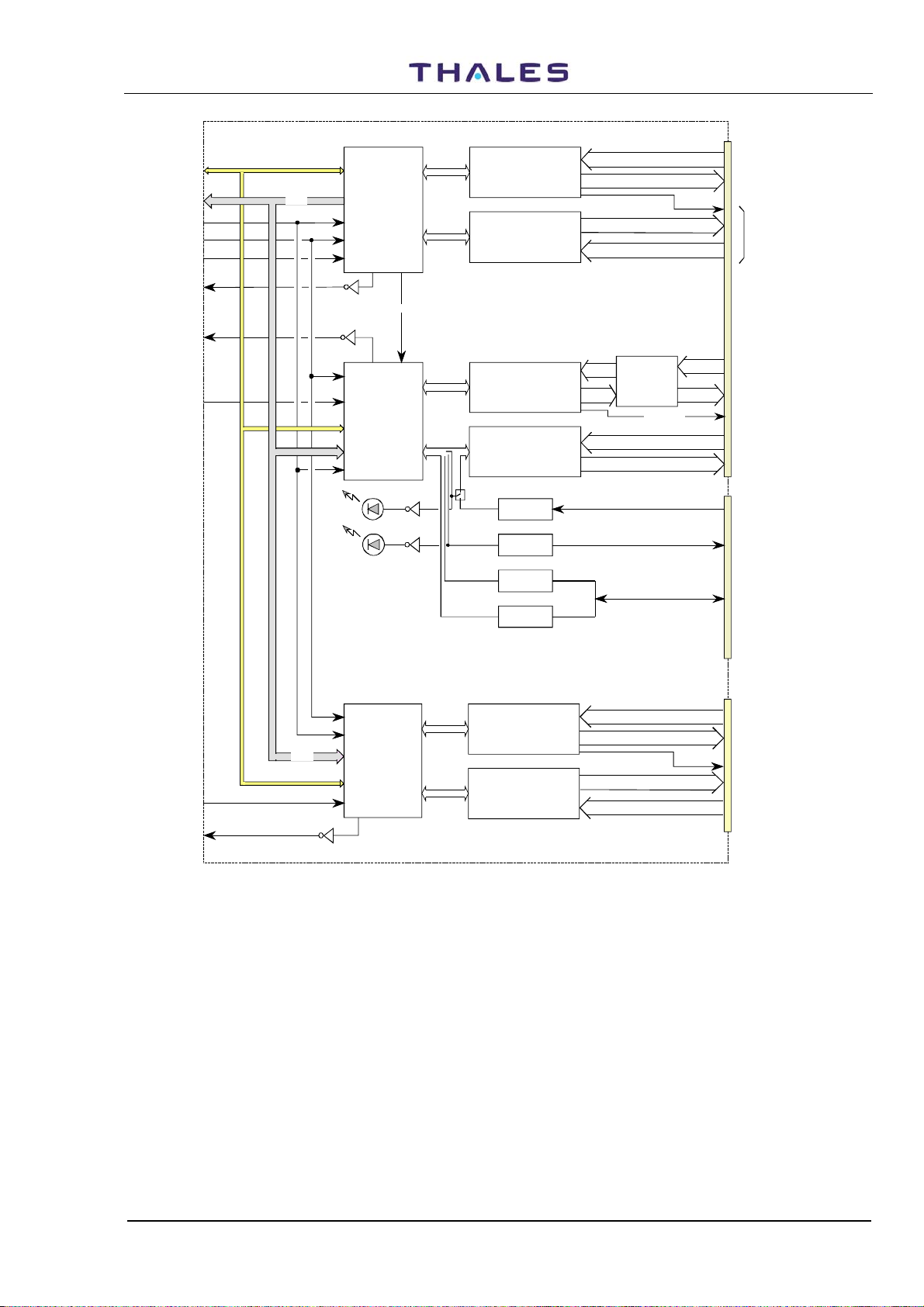
DME 415/435 -Technical Manual
1
Vol. 1-Section 1-General Information
955 900 031C
DEL_WR
BRGSCC
PCS
INT
SCC
INT
SCC
PCS
A BUS
D BUS
SCC
SERIAL
COMMUNICATION
CONTROL
UL1a
UL27a
SCC
SERIAL
COMMUNICATION
CONTROL
RD8
GREEN
GREEN
RD9
UL21
UL26
1EI
UL27b
UL1f
DRIVER/RECEIVER
DRIVER/RECEIVER
DRIVER/RECEIVER
DRIVER/RECEIVER
M24
RXD
TXD
RXCK
TXCK
RS232
UL23
RS232
UL22
RS232
UL30
RS232
UL29
RECEIVER
UL24
DRIVER
UL28
RECEIVER
UL25
DRIVER
UL31
TXD - RTS - DTR
RXD - CTS - DCD
RXD - CTS - DCD -
TXD - RTS - DTR
N. 6 SWITCH
SELECTOR
DTE/DCE
M31
RXCK-TXCK
TXD - RTS - DT R
RXD - CTS - DCD
RS485 RX
RS485 TX
RS485 CK
TXCK
RXCK
M22
M30
CH1
DCE
CH2
DTE
MODEM
CH3
DTE/DCE
CH4
RS232
DCE
CH4
RS485
To SK
PC
SCC
D BUS
A BUS
PCS
INT
SCC
UL27d
SERIAL
COMMUNICATION
CONTROL
UL32
RS232
DRIVER/RECEIVER
UL33
RS232
DRIVER/RECEIVER
UL34
TXD - RTS - DTR
RXD - CTS - DCD
RXD - CTS - DCD -
TXD - RTS - DTR
TXCK
RXCK
M53
CH5
DTE
CH6
DTE
Figure 1.20. CSB module – Serial lines: Block Diagram
1.6.3.2.1.3 Parallel ports
The parallel ports are divided into (see figure
1.21):
− Input ports:
8+8 optoisolated lines (galvanic isolation) for the user’s specific applications such as: maximum or
minimum temperature level alarms, presence of smoke, anti-vandal alarms, obstacle lights operation
check etc.;
4 TTL level lines used by the beacon;
6 bits to interface INC panel commands;
16 optional lines on CSX expansion board upon specific request from the user.
− Output ports:
Vers. D, September 2005
THALES Italia S.p.A.- A. S. D.
1-41
Page 50

955 900 031C
DME 415/435 -Technical Manual
Vol. 1-Section 1-General Information
16 optoisolated solid state relay lines, that can be used (by the user) as indication signals
5 TTL level lines;
16 bits to interface the INC Module indications;
16 optional lines on the CSX expansion board upon user’s request.
− Input lines. The lines transit from connector M32 to connector PL3 on the I/O panel and are divided as
follows:
8 lines (IAUX 0...7) in two groups of four lines, which have one common for each group.
Each line, by means of its optoisolator, drives two 4-bit input registers (UL19a and UL19b), one for each
group.
The electrical characteristics of the control levels must include a contact to ground, and a typical current
value of 3mA, maximum 30 mA (max. 500 mAp @ 100 μs).
8 lines (IAUX 8...15) made up of two groups of four lines, with one common for each group.
Each line, through its optoisolator, drives two 4-bit input registers (UL20a and UL20b), one for each
group.
The electrical characteristics of the control levels may include a contact to ground or a positive level,
according to the arrangement of the line through the jumpers of connectors M49, M50, M51 and M52
(two lines each) and a typical current of 3 mA, maximum 30 mAp (max. 500 mAp @ 100 μs).
NOTE
Lines IAUX10 to IAUX15 are used internally by the
equipment and therefore are not available for the user.
4 lines (IN 0...3), TTL level, to determine the primary power supply functioning of the BCPS unit.
Each line drives an 8-bit input register (UL14 e).
On I/O panel connector SK4, lines IN0 and IN1, parallel to those on I/O panel connector PL3, are
available through connector M30.
The six bits (CPI1, 2,3) coming from the encoder of the INC module controls, drive the 4-bit input
registers UL13a and UL13b.
− Output lines. The lines transit from connector M32 to I/O panel connector SK4. They are divided as
follows:
16 lines (OAUX 0...15) in four groups of four lines, with one common for each group.
The lines are driven by two output registers (UL17 and UL18) where each register controls 8 outputs.
Each line controls an electronic optorelay that has the following output features:
− Max. applied voltage: 350 Vp;
− Max. current: 100 mAp (100 mA @ ± 7 V load);
− Closing resistance: 50 Ω
− Leakage current at 300 V: 40 μA;
5 TTL lines are also available, three on connector SK4 and two on I/O panel connector PL3.
They are driven by the 8-bit output register UL12 that exchanges the data of the EEPROM serial memory
UL16 via UL15a and the “Serial Clock” and “Serial Data” signals.
Through the 8-bit output registers UL10 and UL11, the 16 bits of the CPD and CPA buses drive the
sequence of indications on the INC Module.
1-42
THALES Italia S.p.A.- A. S. D.
Vers. D, September 2005
Page 51
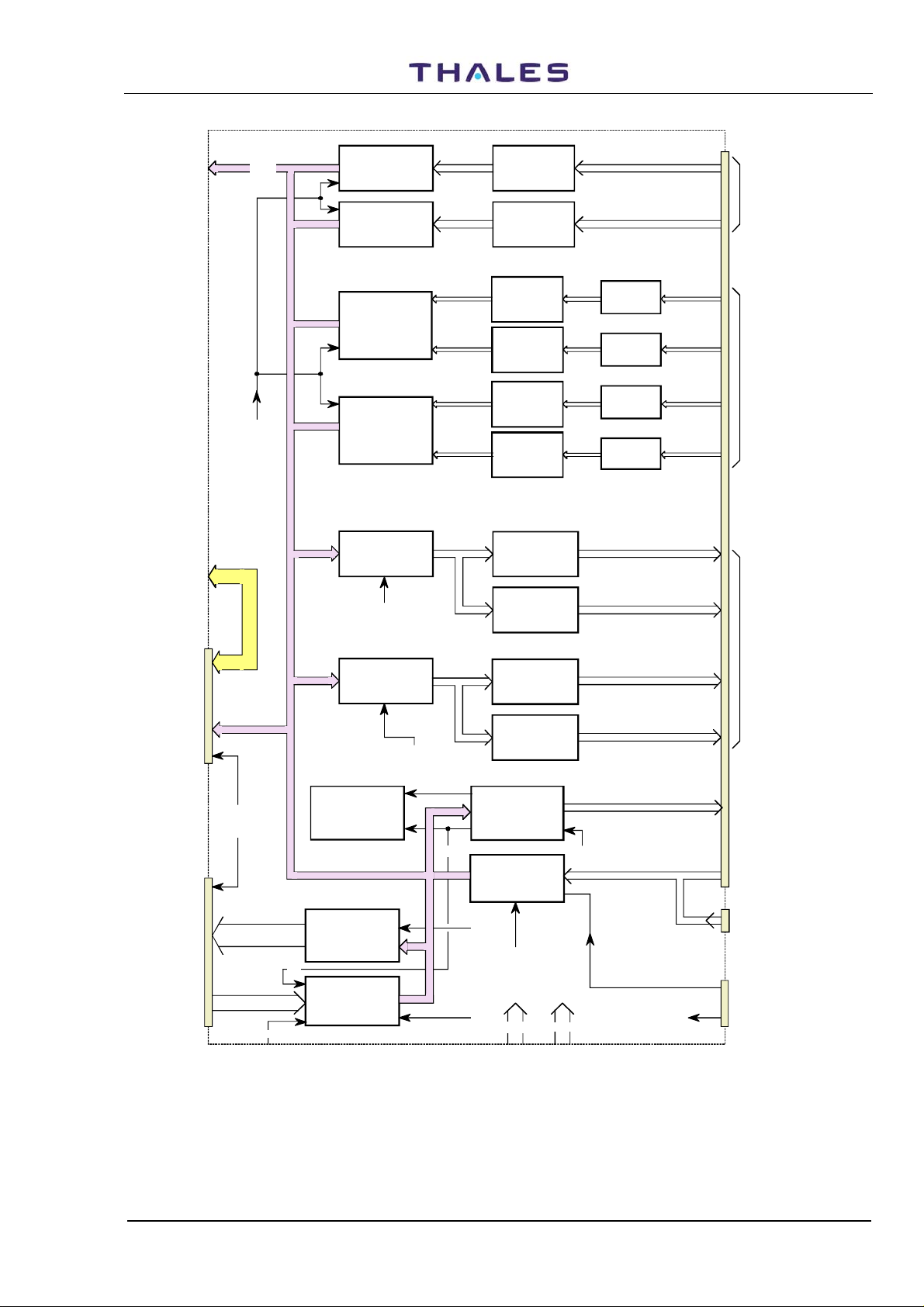
DME 415/435 -Technical Manual
Vol. 1-Section 1-General Information
955 900 031C
A BUS
D BUS
RDCS
4BIT INPUT
REGISTER
UL19a
4BIT INPUT
REGISTER
UL19b
4BIT INPUT
REGISTER
UL20a
4BIT INPUT
REGISTER
UL20b
8BIT OUTPUT
REGISTER
UL17
WRCS
OPTO
INSULATORS
OP9b-OP10a,b-OP11a
OPTO
INSULATORS
OP11b-OP12a,b-OP9a
OPTO
INSULATORS
OP21a,b
OPTO
INSULATORS
OP22a,b
OPTO
INSULATORS
OP23a,b
OPTO
INSULATORS
OP24a,b
OPTO RELAIS
OP1-OP2-OP3-OP4
OPTO RELAIS
OP5-OP6-OP7-OP8
IAUX 0..3
IAUX 4..7
JUMPERS
SWITCH
M49
JUMPERS
SWITCH
M50
JUMPERS
SWITCH
M51
JUMPERS
SWITCH
M52
OAUX 0..3
OAUX 4..7
IAUX 8.9
IAUX 10.11
IAUX 12,13
IAUX 14.15
M32
N° 8 INPUT
N° 8 INPUT
POLARITY & LEVEL
PRESETT ING
N° 16 OUTPUTS
CSX
To
INC
8BIT OUTPUT
REGISTER
SERIAL
EEPROM
2kx8
UL16
UL10-UL11
UL13a,b
UL18
D BUS
WRCS
SCL
SDA
To
M21
D BUS
+5VCC
±15V
8 BIT OUTPUT
SDA
REGISTERS
4 BIT INPUT
REGISTER
CPD;CPD Bus
M17
CPI 1,2,3
BATF
OPTO RELAIS
OP13-OP14-OP15-OP16
OPTO RELAIS
OP17-OP18-OP19-OP20
8 BIT OUTPUT
REGISTERS
UL12
8 BIT INPUT
REGISTER
UL14
WRCS
RDCS
RDCS
RDCS
WRCS
WRCS
OAUX 8..11
OAUX 12..15
OUT 0..4
+5VCC
±15V
IN 0..3
IN 0..3
PF 1/2
M30
M18
N°5 TTL OUTPUT
N° 4 TTL INPUT
BCPS 1,2,3,4
Figure 1.21. CSB module – I/O Parallel Ports: Block Diagram
Vers. D, September 2005
THALES Italia S.p.A.- A. S. D.
1-43
Page 52

955 900 031C
1.6.3.2.2 LOCAL FRONT CONTROL PANEL
DME 415/435 -Technical Manual
Vol. 1-Section 1-General Information
The front panel of LCSU (part of the INC module) is shown in figure
1.22.
It is divided in the following parts:
one dedicated to the unit itself, and one dedicated to the equipment.
1) The part dedicated to the LCSU status contains:
− OPERATION connected directly to the "watch dog signal" of the CPU 186,
− WARNING not used and always off,
− DATA COM not used and always off,
− buzzer (S1),
− button SIL to silence the buzzer and the
− LAMP TEST button;
2) The part dedicated to the equipment comprises the following sections:
beacon MAIN STATUS indications: this section includes the four alphanumerical devices for beacon
site code, the ALARM, WARNING, NORMAL and DATA COM general status indications.
3) DETAILED STATUS indications; these indications are requested by the operator by pressing the
SELECT button, the triangular sign indicates enabling of the following detailed indications:
- ALARM, STBYALRM, FAULTY and BYPASSED are monitor indications:
MON 1/2 alarm, MON 1/2 stand by alarm, MON 1/2 faulty, MON 1/2 bypass
- ON, WARNING, FAULTY and ON ANT are transponder indications:
TX 1/2 on, TX 1/2 warning, TX 1/2 faulty, TX 1/2 on ant.
a) For each MONITOR indication(Mon1 & Mon2):
− ALARM
− STBYALRM
− FAULTY
− BYPASSED
- Means the monitor see an alarm on the transponder on antenna
- Means the monitor see an alarm on the transponder on dummy load
- Means the monitor found itself wrong
- Means the monitor is bypassed because the beacon is in Maintenance Mode
b) For each TRANSPONDER indication (TRX1 & TRX2):
- Means the transponder is ON (radiating if it is on antenna)
− ON
− WARNING
- Means the transponder found a warning condition (e.g. different command by
monitors)
− FAULTY
− ON ANT
- Means the transponder is faulty
- Means the transponder is on antenna
4. Station control (CONTROL STATION):
− Indication of control enabled by a remote control (ENGAGED),
− Indication of local control enabled (ENABLED).
− Priority activation/de-activation button in local control (REQUEST RELEASE).
− Indication of mains failure (MAINS OFF).
− Indication of optional site alarms (ENV ALARM).
− Indication of optional antenna alarm (ANT FTY) – Not used on the DME
1-44
THALES Italia S.p.A.- A. S. D.
Vers. D, September 2005
Page 53
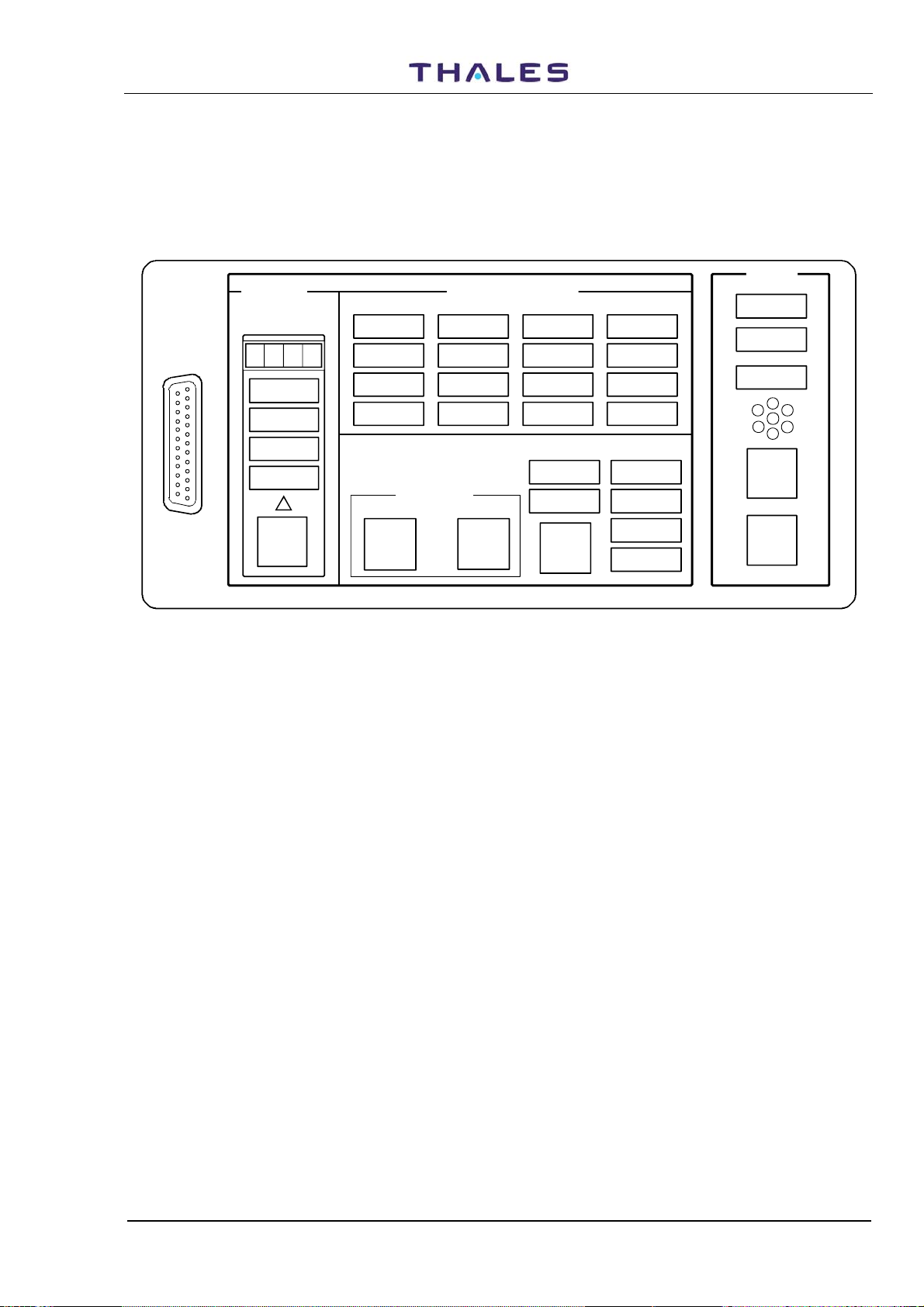
DME 415/435 -Technical Manual
Vol. 1-Section 1-General Information
− General indication of the faults that may occur in the equipment (OTHER WARN).
5. Beacon commands (COMMAND):
− ON/OFF button (EQUIP ON/OFF) and
− transponder on antenna change over (CHANGE OVER).
955 900 031C
LCSU
OPERATION
RD16
WARNING
DATA COM
SIL
LAMP
TEST
RD7
RD4
S1
I6
I5
PC
RS232
MAIN
STATUS
RD1
ALARM
WARNING
NORMAL
DATA COM
SELECT
RD31
RD30
RD29
RD32
RD11
I1
MON 1 MON 2 TX 1 TX 2
ALARM ALARM
RD26
STBYALRM STBYALRM
RD28
FAULTY FAULTY FAULTY FAULTY
RD21
BYPASSED BYPASSED ON ANT ON ANT
RD12
RD27
RD22
RD23
RD13
ON
RD25
WARNING WARNING
RD24
RD18
RD33
ON
CONTROL STATION
DETAILED STATUS
RD15
RD10
I4
MAINS OFF
ENV ALRM
ANT FTY
OTHER WARN
EQUIP
ON/OFF
COMMAND
I2
CHANGE
OVER
I3
ENGAGED
ENABLED
REQUEST
RELEASE
LOCAL CONTROL & STATUS UNIT
RD17
RD14
RD19
RD9
RD5
RD20
RD8
RD6
Figure 1.22. Local Front Panel
1.6.3.2.2.1 INDICATION AND CONTROLS - INC Module - functional description
The INC Module block diagrams are shown in figures
1.23, 1.24, 1.25.
All the electrical components are mounted on the INC module board. A transparent waterproof membrane
protects the luminous components.
The commands from I1 to I16 have a common ground and communicate with the CSB module register
through the encoder consisting in UL14a,b,c - UL15a - UL11e,f - UL8b. The program reads the coded data
by “polling” and the “debounce” is foreseen by software. The three six-bit signals (CPI 1, 2, 3) pass from
module INC connector M1 to connector M17 when module CSB is inserted.
The communication for program data exchange is through the CPA and CPD buses controlled by CSB
module registers UL10 and UL 11.
The circuits are divided into the following blocks:
Address Decoders
Circuits UL3 and UL4 generate the flip-flop chip selects and the alphanumeric display.
Brightness Control
currents are at the set value.
The brightness of the OPERATION LED-bar is controlled separately by circuits UL11a, UL12a, UL11d and
UL11a,b.
A single current peak limiter circuit (TR1 and UL3) for all the LED-bars, reduces the transient currents to
values that do not jeopardize the components.
LED-bar and driver
Flip-flops UL6, 10,13,16 each control groups of 8 LED-bars. Each LED-bar has four separate LEDs in order
to have a wide lighted surface.
The four-digit device on the alphanumeric display (RD1) is an integrated component, with its functions,
including the luminous elements, built in the chips.
Vers. D, September 2005
THALES Italia S.p.A.- A. S. D.
1-45
Page 54
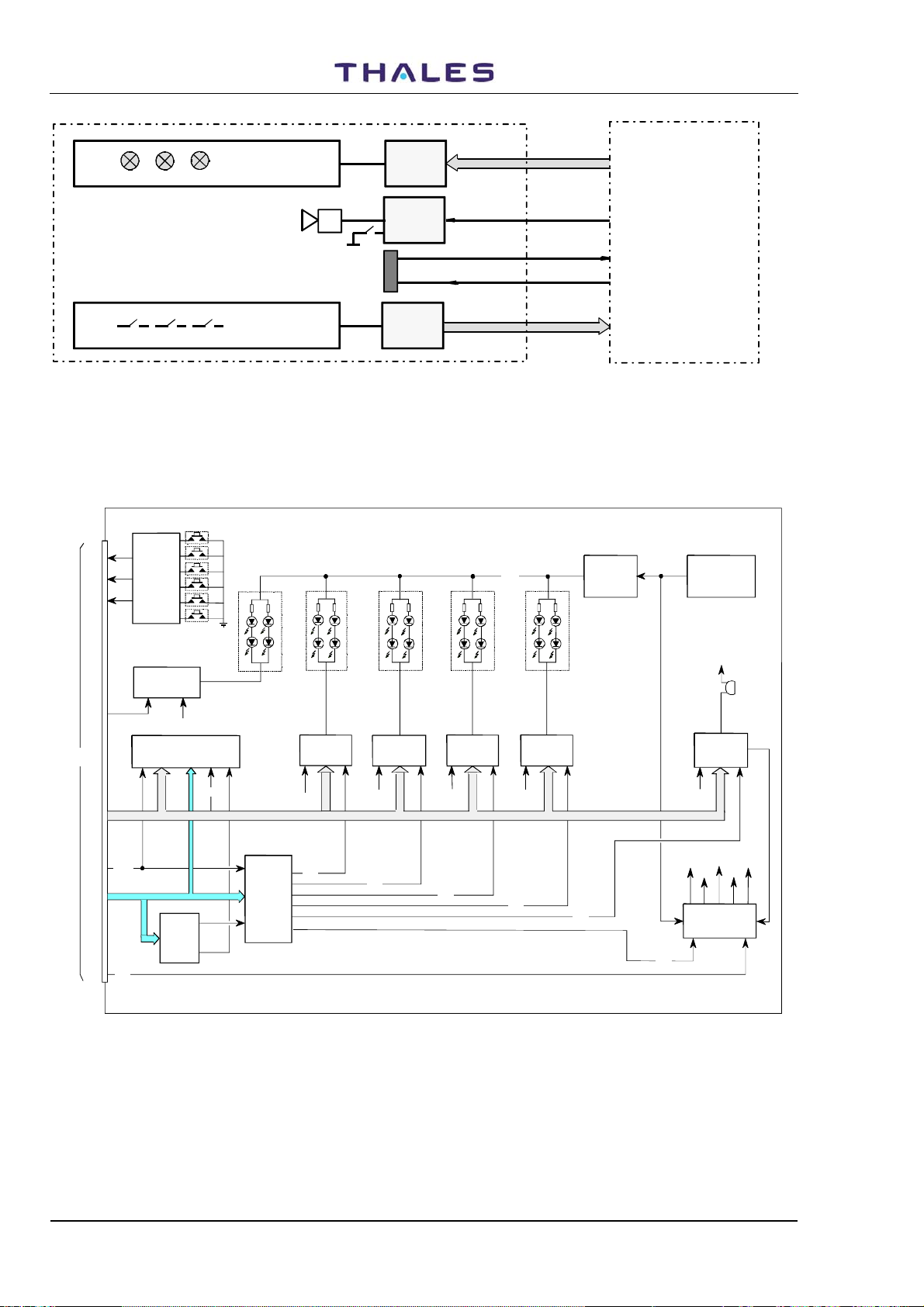
955 900 031C
DME 415/435 -Technical Manual
Vol. 1-Section 1-General Information
Indication panel
Alarm device
display
driver
Audible
device
driver
CSB
PC connector
local
key panel
Figure 1.23. INC module - simplified block diagram
Siren (Buzzer)
A siren with a fixed frequency is controlled by flip-flop UL1 and it can be silenced manually through
command 16.
CPI1
CPI2
CPI3
COMMAND
ENCODER
I1
I2
I3
N° 1 LED BAR
I4
I5
I6
N° 8 LED BAR
Key panel
driver
INC
N° 8 LED BAR
N° 8 LED BAR
VLED
N° 5 LED BAR
INRUSH
CURRENT
CIRCUIT
CLOCK
GENERA TOR
CSB
M1
"LCSU OPERATION"
BRIGHTNESS
CONTROL
WDO_LED
To
CPD BUS
CPWR
WDO
BR1
4 ALPHANUMER. DISPLAY
AOA1
D0-D6
WR
CPA BUS
0
DECODER
1
CU.SE
CPD7
ENDIS1
EN
OPERATION
DECODER
FLIP FLOP
CLKD1-D8
OC
LEN1 LEN2
CLK_0
0
1
2
3
4
5
OC
CLK_1
FLIP FLOP
FLIP FLOP
CLKD1-D8
OC
LEN3
CLK_2
FLIP FLOP
D1-D8
CLK
OC
CLKD1-D8
LEN4
CLK_3
CLK_4
CLK_5
FLIP FLOP
OC
GND
BR1
LEN1
BRIGHTNESS
CONTROL
CLK
LEN2
VCC
BUZZER
CLKD1-D8
LEN4
LEN3
EN
Figure 1.24. INC Module - Indication and Control: General Block Diagram
1-46
THALES Italia S.p.A.- A. S. D.
Vers. D, September 2005
Page 55
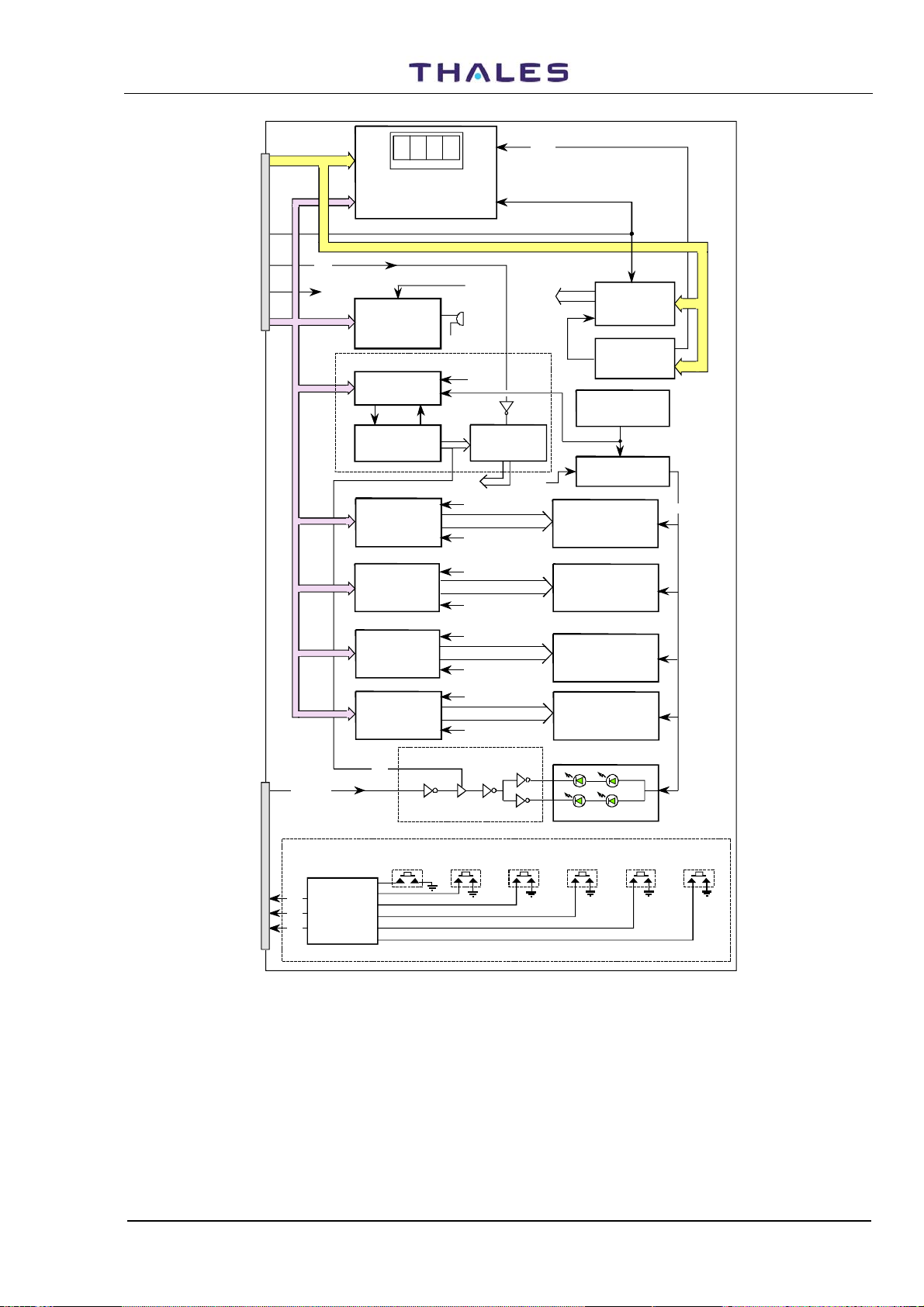
DME 415/435 -Technical Manual
Vol. 1-Section 1-General Information
M1
WD0
CPD BU S
CPD0...7
+5
VCC
0123
CPA0,1
DPY LED
ALPHANUMERIC DISPLAY
CPD0...6
SERIAL IN-
PARALL.OUT
RD1
Flip-Flop
LATCH
UL1
BRIGHTNESS CONTROL
MUX
UL5
REGISTER
UL7
Flip-Flop
LATCH
BUFFER
UL6
CLK 4
S1
VCC
CLK 5
3 STATE BUFFERS
LEN
LEN 1
CLK 0
UL8a
UL9a,b,c,d
ENDIS
CPA BU S
VCC
CPWR
DECODER
CLK
UL3
DECODER
UL4
CLOCK GENERAT.
SQUARE OSCILLATOR
UL2
INRUSH CURR. CIRCUIT
TR1
N° 8 LED BAR
RD 4,5,6,7,8,9, 10, 11
955 900 031C
CPA0,1,6
CPA2..5
VLED
N° 8 LED BAR
RD 12,13,14,15,17 , 18,1 9,20
N° 8 LED BAR
RD 21,22,23,24,25 , 26,2 7,28
N° 5 LED BAR
RD 29,30,31,32,33
N° 1 LED BAR "OPERATION"
RD16
LAMP
TEST
I4
I3
REQUEST
RELEASE
SIL
I5
I6
M1
CP1
CP2
CP3
CPD BU S
WDO_LED
COMMAND
ENCODER
UL14 a,b - UL15a
UL11 e,f - UL8b
Flip-Flop
LATCH
BUFFER
UL10
Flip-Flop
LATCH
BUFFER
UL13
Flip-Flop
LATCH
BUFFER
UL16
BRIGHTNESS CONTROL
BR1
UL11a UL12a UL11d
SELECT
LEN 2
CLK 1
LEN 3
CLK 2
LEN 4
CLK 3
UL11b
UL11c
EQUIP
ON/OFF
I1
CHANGE
OVER
I2
Figure 1.25. INC Module - Indication and Control: Block Diagram
Vers. D, September 2005
THALES Italia S.p.A.- A. S. D.
1-47
Page 56
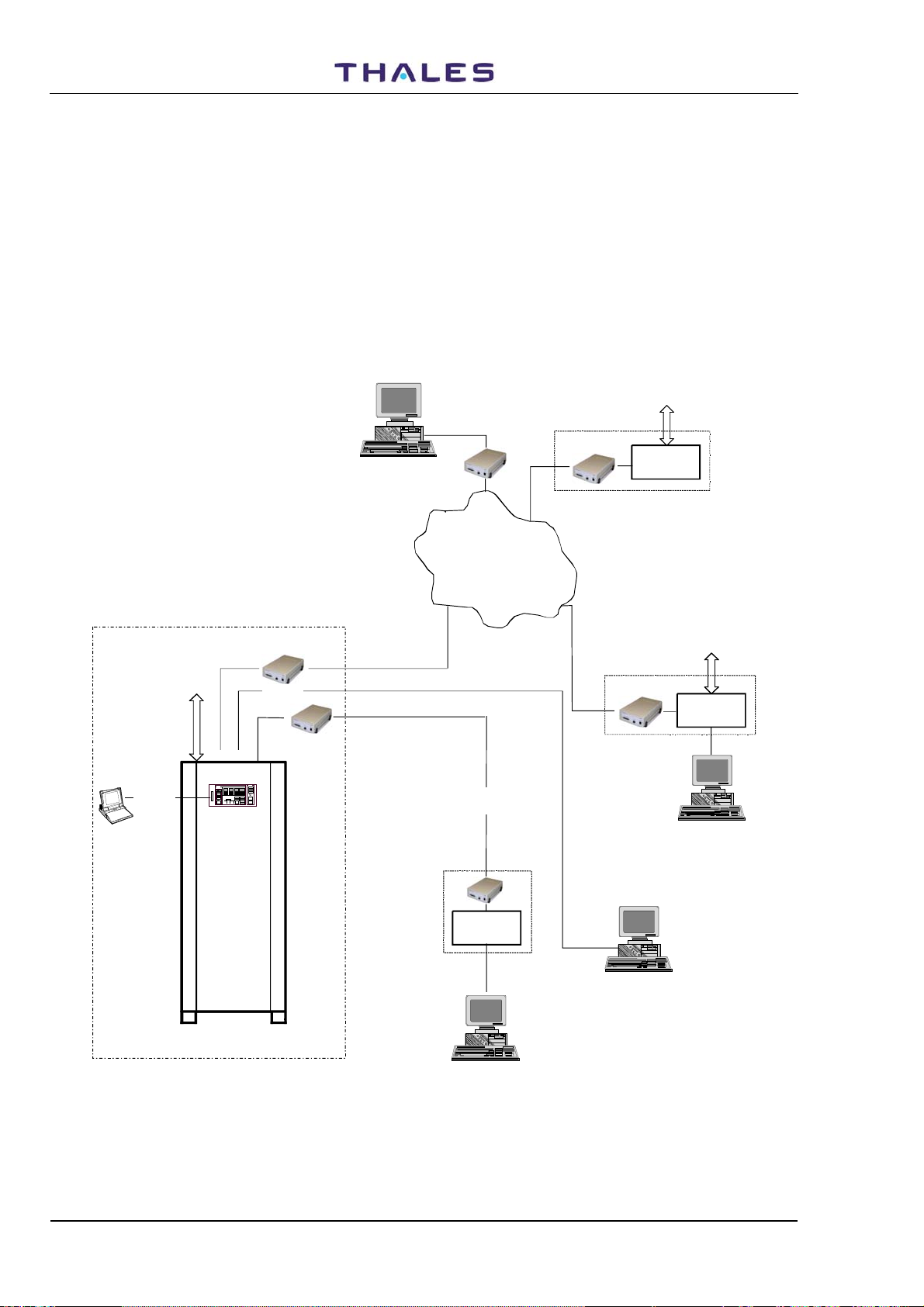
955 900 031C
DME 415/435 -Technical Manual
Vol. 1-Section 1-General Information
1.6.3.3 REMOTE CONTROL SYSTEM
RCSI 446 or RCSE 443 – Remote Control & Status Indicator - is a unit for remote control and maintenance
operations (for detailed information to see RCSI 446 or RCSE 443 Technical manual).
An updated remote control, MCS (Monitoring and Control System), with resident software on PC, work with
modern programs that only run on hardware of a typical PC (for detailed information to make reference to the
MCS Technical manual)
The possible remote site connections with the local station are shown in figure
1.26.
The examples of remote site connections with the local station are shown in figures
modem
SWITCHED
NETWORK
(PSTN-Public Switching
Telephon Net.)
modem1
ON/OFF
DATA
PL3
SK2
PL1
SK1
RS232
PL2
B
modem 2
1.27 and 1.28.
optional
ON/OFF
DATA
RCSI/RCSE
optional
ON/OFF
DATA
modem
RCSI/RCSE
RS232
A
DME
NOTE
1) RS232 line (A) UNAVAILABLE if
RS232 line (B) is used or viceversa
2) "External" MODEM 1&2 Unavailable
if "Internal" MODEM are used and viceversa
Figure 1.26. Possible connection between Remote RCSI/RCSE and Local site
1-48
DEDICATED
LINE
RCSI/SI
446 2/8
THALES Italia S.p.A.- A. S. D.
modem
Vers. D, September 2005
Page 57
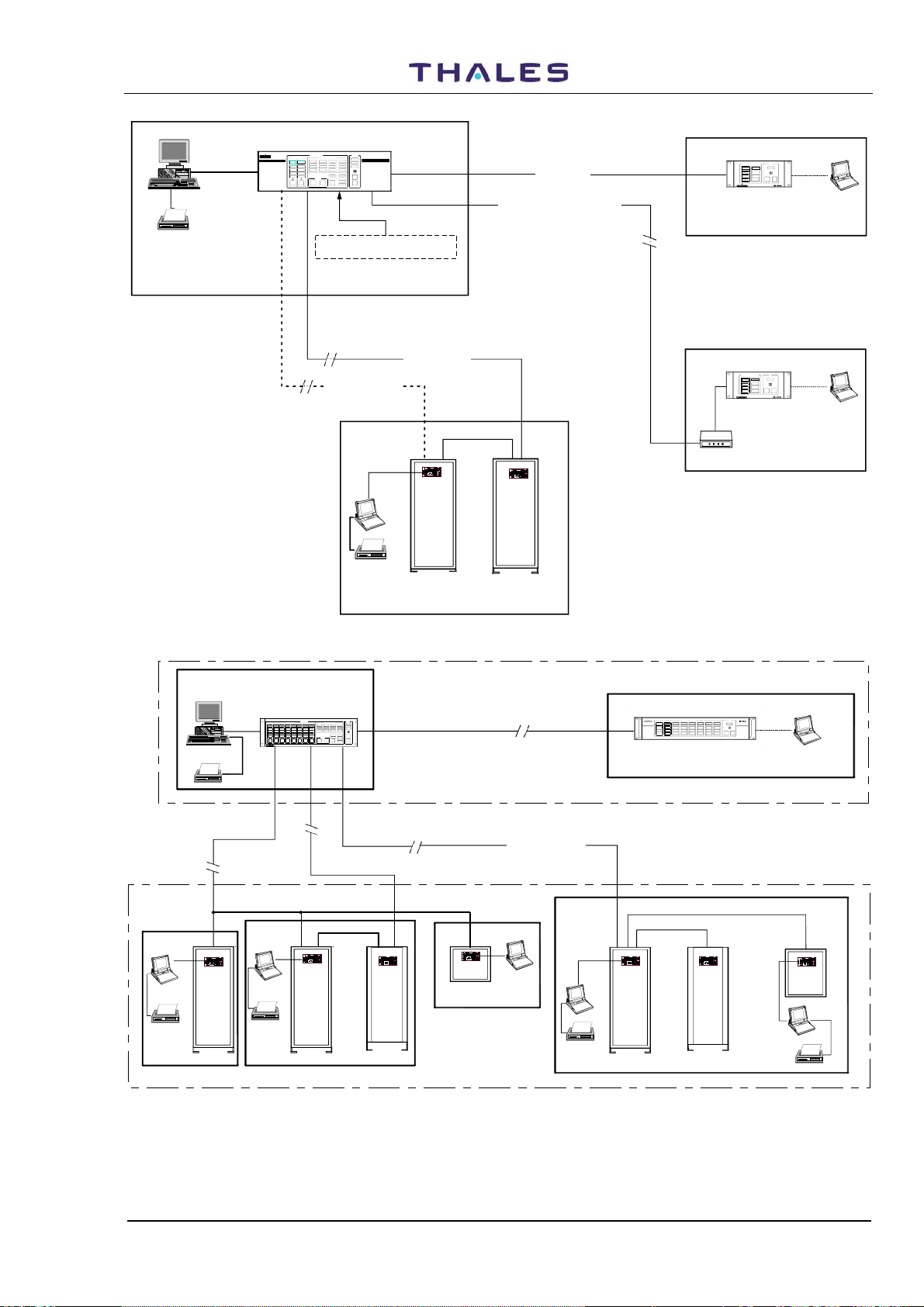
DME 415/435 -Technical Manual
Vol. 1-Section 1-General Information
REMOTE CONTROL STATUS INDICATOR
RCSI 446-2
EQUIPMENT RCSI
12
COMMAND
CENTER CONTROL ROOM
DETAILED ST ATUSMAIN STATUS
Optional ENVIRONMENT ALARMS
(SM O KE , TEM P., INTR USIO N, ...)
RCSI 446
RS 422 (<1km)
Switched or dedicated teleph. LINE
STATUS INDICATOR
SI 446 - 2
EQUIPMENT STATUS
RS 422/485
2
ALARM
WARNING
NORMAL
CONTROL TOWER
SI
1
ON
ALARM
WARNIN G
LAMP
SIL
NORMAL
TEST
955 900 031C
RS 232
PC
CONTROL CENTER
RS 232
ALARM
WARNING
NORMAL
DATA COM
SELECT
DEDICATED LINE
DEDICATED
or SWI TCHED LINE
RS 232
DME
(D)VOR
EQUIPMENTS LOCAL SITE
Figure 1.27. Example of single site connection with RCSI
REMOTE SERVICE MAINTENANCE
REMOTE CONTROL
& STATUS INDICATOR
RCSI 446-8
EQUIPMEN T RCSI
DETAILED STATUSMAIN STATUS
12345678
MON 1
MON 2 TX 1
STANDBY
STAND BY
WARNING
FAULTY
FAULTY
ALARM
ALARM
ALARM
ALARM
ALARM
ALARM
ALARM
BYPASS ED
BYPASS ED
WARNING
WARNING
WARNING
WARNING
WARNING
WARNING
WARNING
NORMAL
NORMAL
NORMAL
NORMAL
NORMAL
NORMAL
NORMAL
DATA COM
DATA COM
SELECT
SELECT
ENGAGE D
DATA COM
DATA COM
DATA COM
DATA COM
DATA COM
ENABLE D
COMMAND
CHANGE
EQUIP
SELECT
SELECT
SELECT
SELECT
SELECT
OVER
ON/OFF
OPERATION
TX 2
WARNING
WARNING
DATA COM
FAULTY
FAULTY
ON ANT
ON ANT
STATIONCONTROL
MAINS OFF
SIL
ENV ALRM
ANT FTY
REQUEST
RELEASE
OTHER WARN
RCSI 446
RS 422 (< 1 Km.)
CONTROL TOWER
8
7
ALARM
ALARM
ALARM
WARNING
WARNING
WARNING
NORMAL
NORMAL
NORMAL
STATUS INDI CATOR
SI 446-8
STATU S INDICATO R
SI 446 - 2
SI
EQUIPMENT STATUS
1
2
RS 232
ON
ALARM
ALARM
WARNIN G
WARNING
NORMAL
NORMAL
RS 232
LAMP
SIL
TEST
PC
Modem
SI
EQUIPMEN T STA T US
4
3
6
5
2
1
ON
ALARM
ALARM
ALARM
ALARM
ALARM
WARNING
WARNING
WARNING
WARNING
WARNING
NORMAL
NORMAL
NORMAL
NORMAL
NORMAL
RS 232
LAMP
SIL
TEST
L1 - DEDICATED LINE
DEDICATED LINE - L3
L2 - DEDICATED
or SWITCHED LINE
RS 232
MARKER
ILS
LOC
ILS
GP
DME
EQUIPMENTS LOCAL SITES
Telephon li ne 1 = dedica ted line con netting with M odem party-l ine
Telephon li ne 2 = dedica ted or switched line used for: measurem ent, preset and indication, (no comma nds) ,
co nnetting with M odem. Indicatio n are displayed on PC connecting at RCSI
Telephon li ne 3 = dedica ted line co nnetting with M odem
Figure 1.28. Example of multi site connection with RCSI
Vers. D, September 2005
THALES Italia S.p.A.- A. S. D.
(D)VOR
RS 232
RS 232
DME
NDB 436
1-49
Page 58
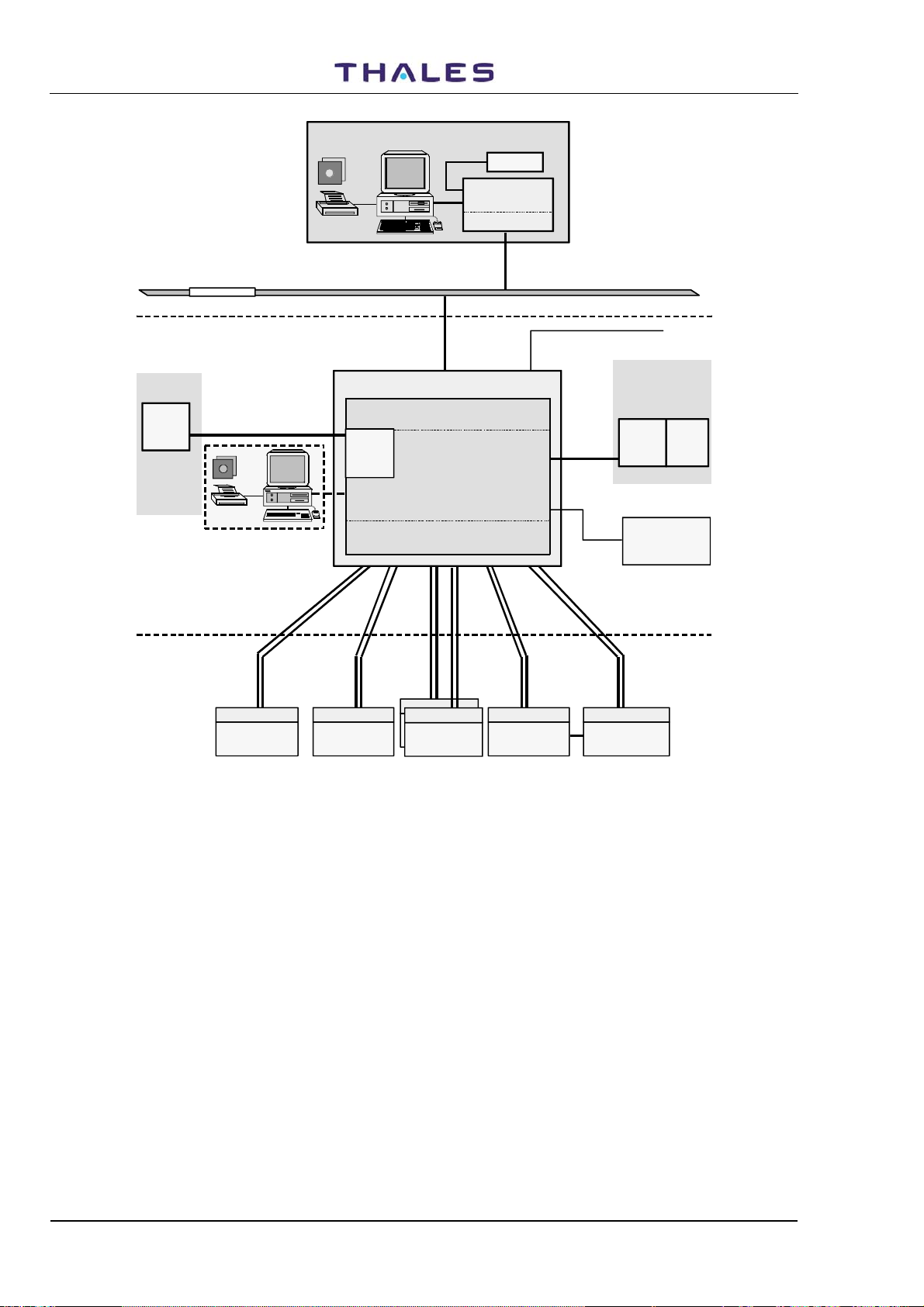
955 900 031C
MAINTENANCE CENTER
PTT LINES
RMC 443
INC
REU
SIB
DIAL MODEM LGM
DME 415/435 -Technical Manual
Vol. 1-Section 1-General Information
P
R
I
A
RSU
T
A
T
S
(AN 400)
T
R
O
JBUS
TOWER
RCSE 443
RS422*)
REU
INC
N
S
I
O
MODEM
LOC
MODEM
FFM DME
DIAL MODEM LGM
SIB
MODEMS LGM**)
MODEM
MODEM
M 4000
Marker
MODEM
GS
RS422*)
Ligne
OIO
MODEM
RWY
CTU
SELECT
Panel
Control ON/FF
(Client)
*) RS422 int erface to equipm ent situated
in a different building than R CSE LGM Extender 2 Unit has to be used!
**) alternatively the ILS stations can be connected
via RS232 or RS422 de dicated lines to the RCSE
(Multiplex er RS232 boar d is used in RCSE,
RS232 interfaces ins tead of ZUA modem within ILS stations)
Figure 1.29. Example of multi site connection with RCSE
1.6.3.3.1 Remote Control & Status Indicator (RCSI 446)
The RCSI 446 is used by a remote site to control both the beacon and other equipment or devices of the
local site.
Two versions are available: RCSI 446-2 to handle up to two equipment and RCSI 446-8 to handle up to eight
equipment. Both units might be connected through dedicated lines, switched lines, radio link, etc.
Main functions of the RCSI:
- sends basic controls to the equipment (one equipment at a time; equipment(s) may also be of different
types);
- displays the status of the equipment;
- drives supplementary Status Indicators (SI 446);
- interfaces the PC to control-monitor the equipment and to perform maintenance operations like the
LCSU at the local site.
The RCSI 446-2/8 is housed in a standard 19" rack container. It comprises:
- the Control & Status Board (CSB386 module)
1-50
THALES Italia S.p.A.- A. S. D.
Vers. D, September 2005
Page 59
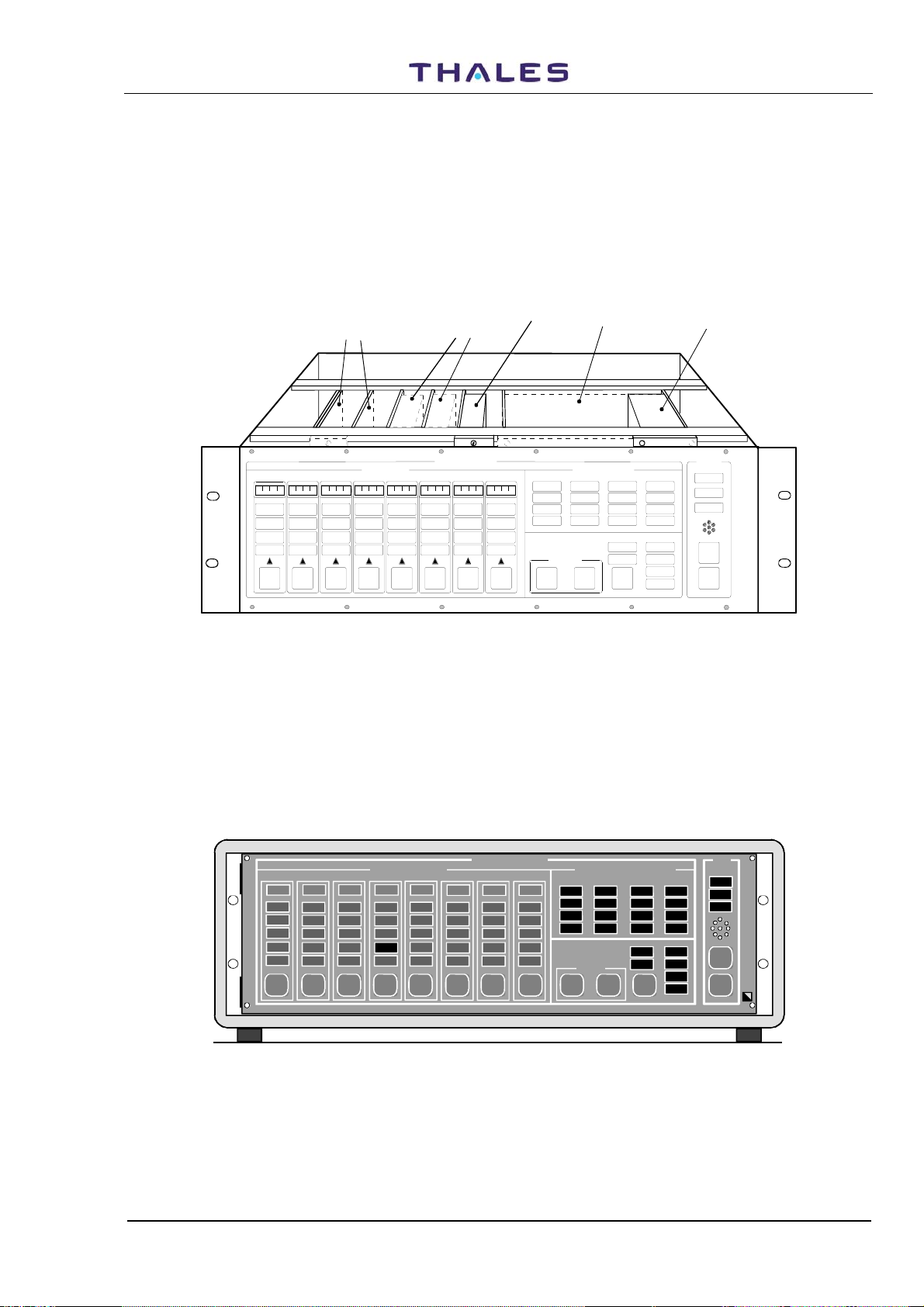
DME 415/435 -Technical Manual
Vol. 1-Section 1-General Information
955 900 031C
- the front panel (made with water – proof elastic membrane) for commands and indications. The
LEDs and pushbuttons are mounted on the INC-2 or INC-8 board module. The front panel replicates
the INC module of the LCSU, plus eight status indication sections for any related equipment
- the modem(s) (optional) capable to operate with dedicated/switched lines up to 28.800 bps; up to
three modems can be housed inside the unit rack.
- the power supply (ac/dc or dc/dc alternatively).
The rack RCSI 446 - 8 is shown in Figure
1.30.
For further information, refer to the specific manual of the RCSI.
8
ALARM
WARNI NG
NORMAL
DATA COM
SELECT
INTERFACE (OPTION)
ALARM
WARNI NG
WARNI NG
NORMAL
NORMAL
DATA COM
DATA COM
SELECT
ALARM
SELECT
ALARM
WARNI NG
NORMAL
DATA COM
SELECT
ALARM
WARNI NG
NORMAL
DATA COM
SELECT
MODEM 1
MODEM (OPTION)
EQUIPMENT RCSI
ALARM
WARNI NG
NORMAL
DATA COM
SELECT
ALARM
WARNI NG
NORMAL
DATA COM
SELECT
1234567
ALARM
WARNI NG
NORMAL
DATA COM
SELECT
MON 1
AERIAL
STANDBY
FAULTY
BYPASSED
EQUIP
ON/OFF
UPS (OPTIO N)
POWER SUPPLY
DETAILED STATUSMAIN STATUS
MON 2 TX 1
AERIAL
STANDBY
FAULTY
BYPASSED
COMMAN D
CHANGE
OVER
AC/DC or DC/DC POWER SUPPLY
TX 2
ON
ON
WARNI NG
WARNI NG
FAULTY
FAULTY
ON ANT
ON ANT
STATIONCO NTROL
MAINS OFF
ENGAGED
ENV ALRM
ENABLED
ANT FTY
REQUEST
RELEASE
OTHER WARN
RCSI 446
OPERATION
WARNI NG
DATA COM
SIL
LAMP
TEST
Figure 1.30. RCSI-8 – Remote control
1.6.3.3.2 Remote Control and Status Equipment (RCSE)
The RCSE is intended to be installed in the maintenance equipment room. It provides separate status
display and on/off-control functions for all Navaids equipment, and mechanisms to change and display
auxiliary data words for MLS. The RCSE consists of the Remote control Electronic Unit (REU) with an
Indication and Control (INC) panel. The RCSE is interfacing with one or two Control Tower Units (CTU), with
a maintenance data terminal (PC) and optionally with a slave RCSE panel unit defined as Remote Status
Unit (RSU). The CTU is intended for installation in the ATC control tower. It provides system ’main status’
indications and may provide a separate status display for each Navaids subsystem as well as switching the
ILS or MLS to the active runway (RWY-select, optional).
ALARM
WARNING
NORMAL
DATA COM
MAINTEN
MAIN STATUS
ALARM
ALARM
WARNING
WARNING
NORMAL
NORMAL
DATA COM
DATA COM
MAINTEN
MAINTEN
2345 67 8
1
ALARM
ALARM
WARNING
WARNING
NORMAL
NORMAL
DATA COM
DATA COM
MAINTEN
MAINTEN
SELECT SELECT SELECT SELECT SELECT SELECT SELECT SELECT
ALARM
WARNING
NORMAL
DATA COM
MAINTEN
EQUIPMENT
ALARM
ALARM
WARNING
WARNING
NORMAL
NORMAL
DATA COM
DATA COM
MAINTEN
MAINTEN
DETAILED STATUS
MON 1 MON 2 TX 1 TX 2
AERIAL
AERIAL
STANDBY
STANDBY
FAULTY
FAULTY
BYPASSED
BYPASSED
COMMAND
EQUIP
CHANGE
OVER
ON/OFF
Figure 1.31. RCSE 443 – Remote control
The front RCSE 443 is shown in Figure
1.31 and CTU & Runway select , optional in figure1.32.
For further information, refer to the specific technical manual of the RCSE.
Vers. D, September 2005
THALES Italia S.p.A.- A. S. D.
ON
WARNING
FAULTY
ON ANT
CONTROL
ENGAGED
ENABLED
REQUEST
RELEASE
ON
WARNING
FAULTY
ON ANT
STATION
MAINS OFF
ENV ALRM
ANT FTY
OTHER WARN
RC
OPERATION
WARNING
DATA COM
SIL
LAMP
TEST
1-51
Page 60
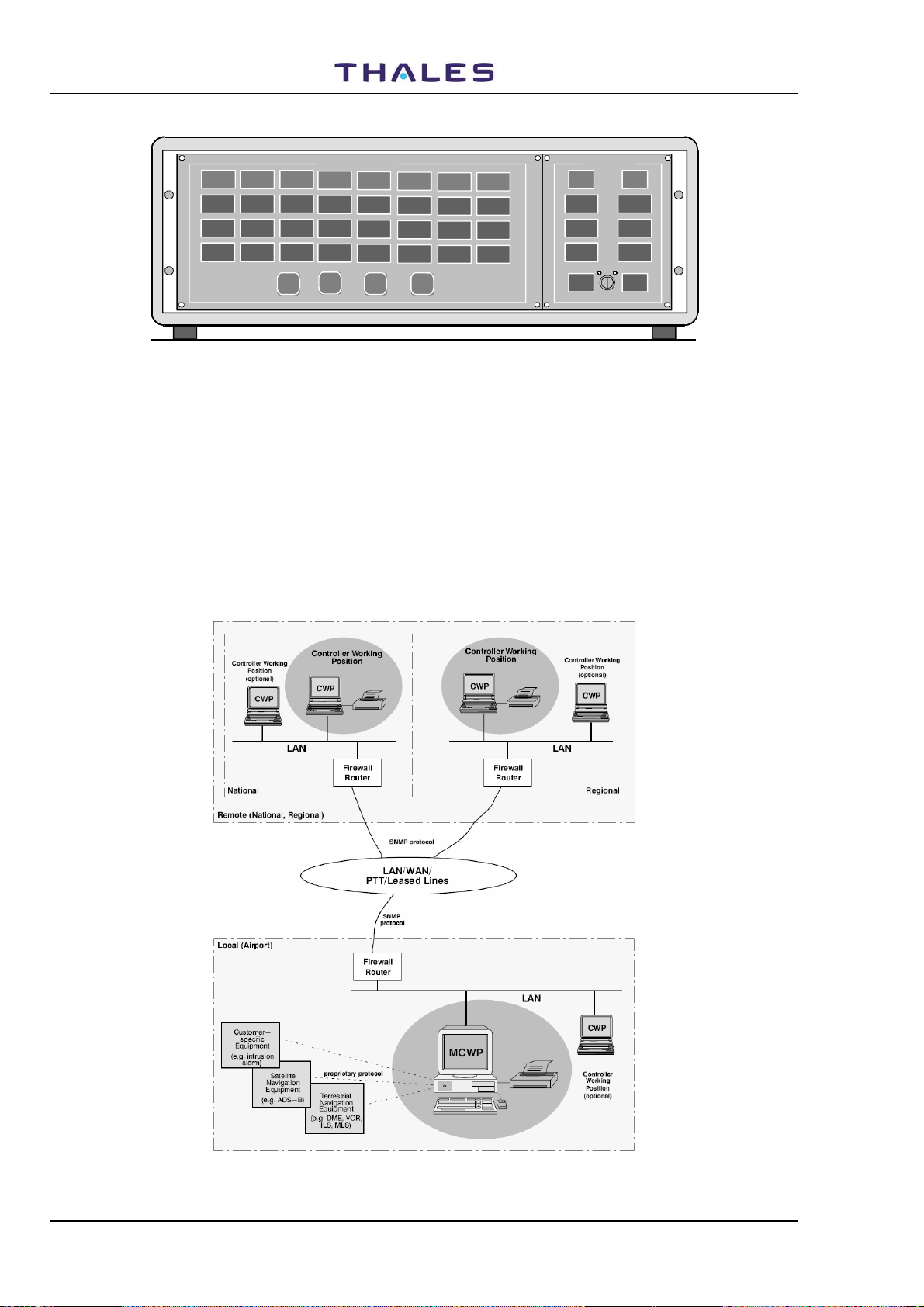
955 900 031C
Control Tower Unit (CTU) RunWaY Select
AIR NAV SUBSYSTEM RWY-SELECT
DME 415/435 -Technical Manual
Vol. 1-Section 1-General Information
Figure 1.32. RCSE 443 – Remote control CTU & RunWay select
1.6.3.3.3 MCS
The RMMC network has a radially configured architecture based on communication between Monitoring and
Control Systems (MCS) on different levels, local (airport) and remote (regional, national, international). The
MCS systems are connected via WAN/LAN Internet or via switched/private lines in the public network (PTT)
and dedicated lines in private networks. A direct Navaids shelter access is possible via a serial or
(optionally) via an Ethernet connection.
With the use of the MCS for control and monitoring via personal computer (PC) a user-friendly interface for
the supervision adjustment and modification of relevant operating data according to the respective
operational application is made available for first set up and ongoing operation of the terrestrial and satellite
navigation equipment (e g. VOR, DME, ILS, MLS, ADS-B). The use of common PC standards and operating
systems ensures a familiar operating environment for the user (see figure
1.33).
For detailed further information, refer to the specific technical manual of the MCS.
1-52
Figure 1.33. MCS – Remote control
THALES Italia S.p.A.- A. S. D.
Vers. D, September 2005
 Loading...