

Page 1
REVIEW
33
January 2004 ♦ RadCom ♦ www.rsgb.org
Reviewed by Peter Hart, G3SJX, The Willows,
Paice Lane, Medstead, Alton, Hants GU34 5PR.
I
n 1999 Ten-Tec introduced the
Pegasus transceiver, a fully fea-
tured HF radio for use with a
Windows PC. There was no front
panel as such, just a box fitted with
sockets and a power switch and
with all control via the PC monitor,
keyboard and mouse. In 2000 TenTec took the Pegasus design and
added a conventional front panel,
controls and display to make a
standalone radio. Thus was born
the Jupiter. The same feature set is
retained and also the PC interface
so the radio can also emulate the
Pegasus in PC control mode with
software freely downloadable from
the Ten-Tec website. The transceiver’s firmware is held in flash memory and can be updated at any time
by downloads from the Ten-Tec
website. New features can be added:
a recent update provides for 5MHz
transmit coverage. Although the
Jupiter has been available in the
USA for some time, it has only
recently received CE approval for
sales within Europe. It is available
in two versions, model 538 without
auto ATU and model 538AT with
internal auto ATU fitted. The ATU
can be fitted at a later date if needed. The non-ATU version was the
model supplied for review.
BASIC FUNCTIONS
The Jupiter is a table-top sized 12V
operated radio measuring 308W x
144H x 350Dmm and weighs about
5.5kg. The receiver tuning range is
specified from 100kHz to 30MHz but
it continues to tune all the way down
to DC although the sensitivity at low
frequencies is very much reduced.
The transmit segments are confined
to the amateur bands with a bit to
spare and the transmit power is
nominally 100W maximum. Modes
covered are USB, LSB, CW, AM and
FM. Digital modes make use of the
SSB modes with AFSK input. A menu
item toggles the transmit audio
source between the microphone and
the accessory jack on the rear panel.
The receiver bandwidth can be tailored to suit the different tone standards by suitable adjustment of the
bandwidth and PBT (passband tuning) controls but no frequency display offset is provided.
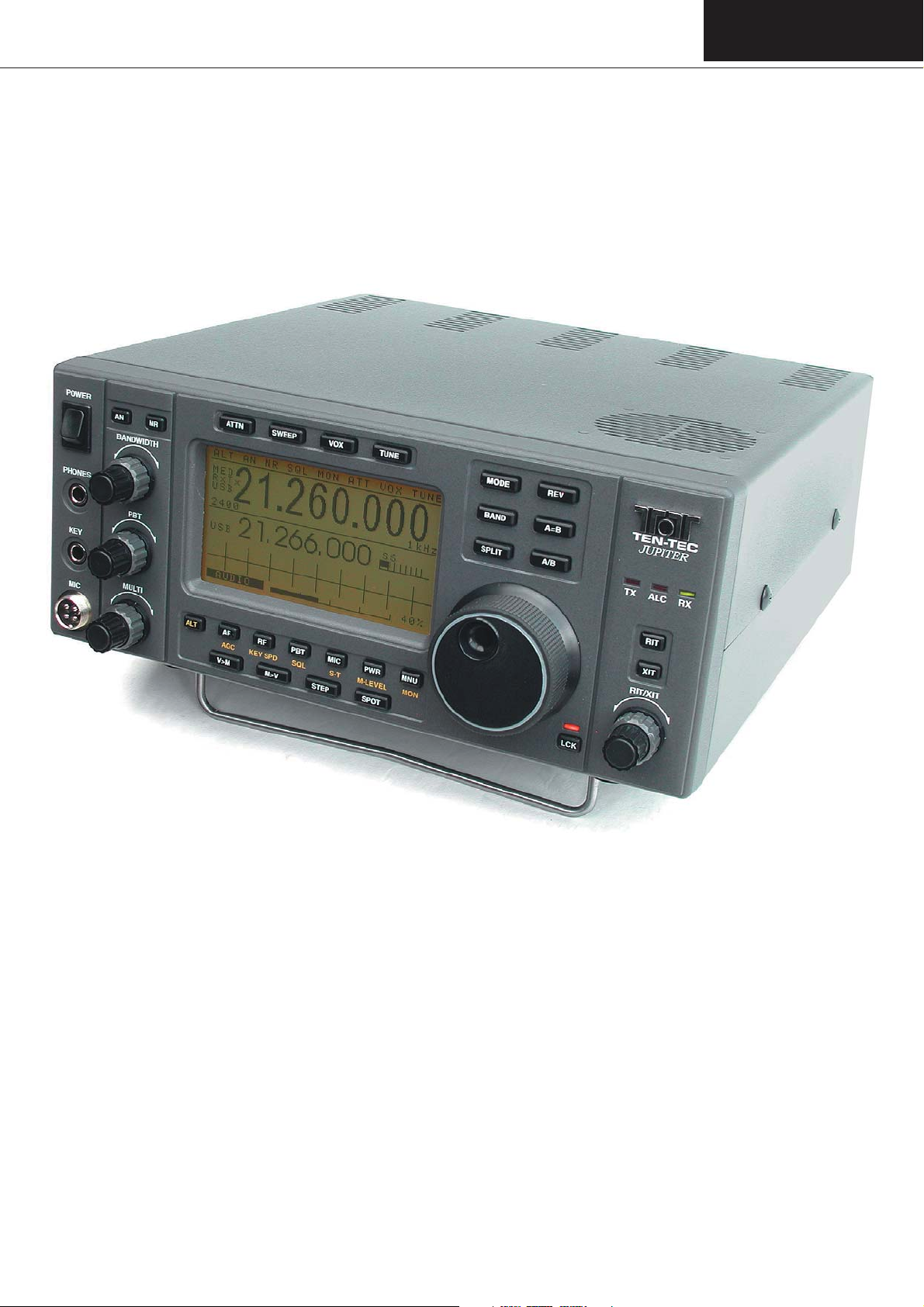
The Jupiter front panel is clearly
laid out with spacious buttons and
good-sized controls. As every control
except the power on/off switch may
be computer operated, the rotary
controls are all digital encoders.
Dedicated rotaries are used for the
main tuning, RIT, bandwidth and
PBT and a multifunction rotary control is switchable to other functions
such as RF and AF gain, power output, microphone gain and squelch.
Surprisingly, the AF gain control is
not a dedicated rotary so I left the
The Ten-Tec Jupiter
HF transceiver
A DSP transceiver that may easily be PC controlled,
the Jupiter is the latest from the US Ten-Tec stable.
Page 2
multifunction control normally set
to this position. A large green backlit LCD panel is used for the display
giving a clear indication of the frequencies of the twin VFOs and the
state of the switchable functions. A
bargraph meter for the S-meter
function and transmit power or
VSWR also gives the numerical
value and a separate slide rule bargraph shows the levels associated
with the multifunction rotary also
with a numerical percentage of the
maximum.
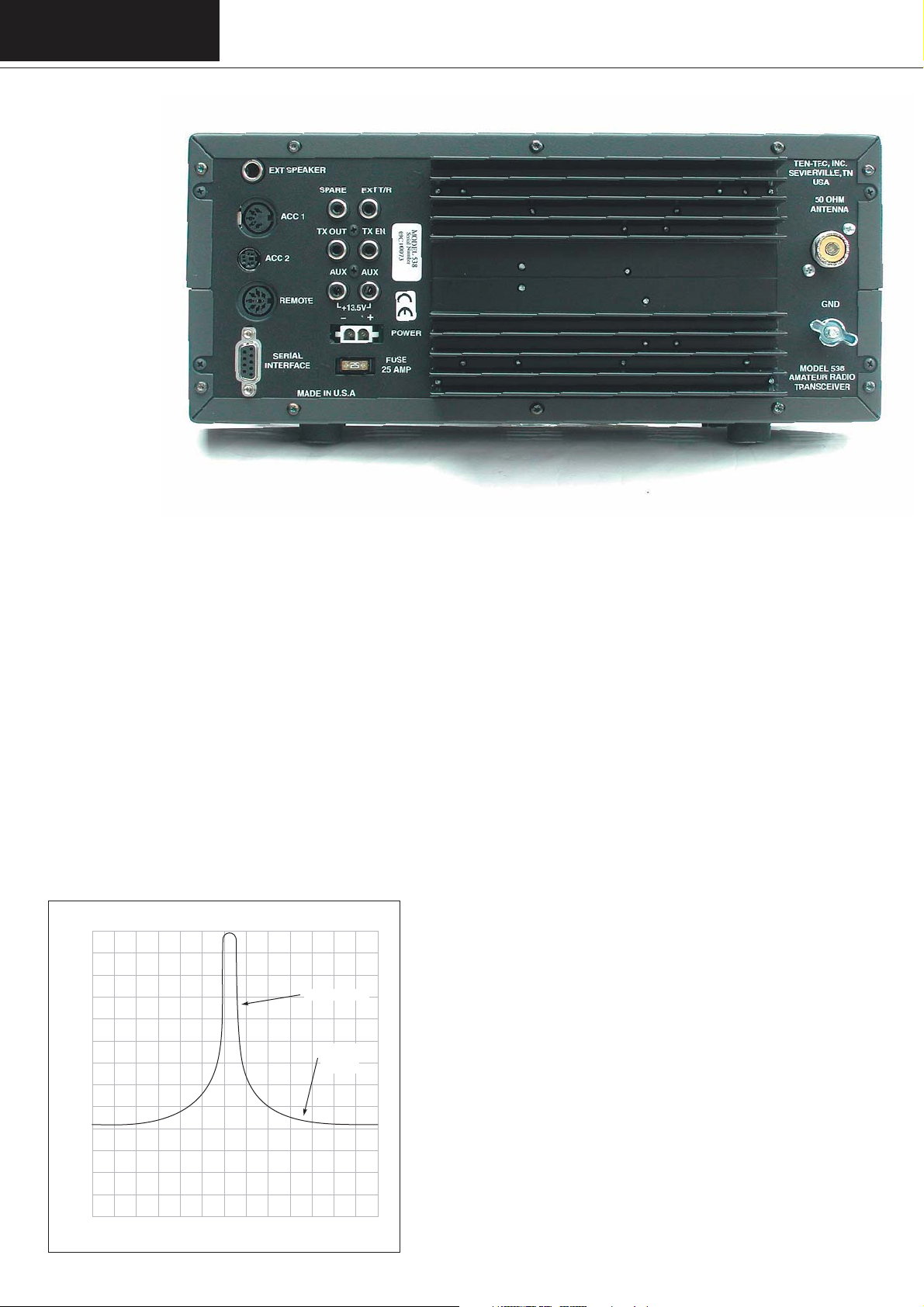
The rear panel carries the usual
interface connectors. Phono sockets
are used for T/R functions including
handshaking support for QSK linears, two auxiliary 12V outlets and a
spare for custom use. DIN connectors are provided for interfacing
accessories such as data terminals,
sound card connections and an
optional keypad. A 9-pin D connector
interfaces directly to the PC serial
COM port without the need for level
conversion. I was surprised at how
much space there is inside the cabinet but note that a Torx driver is
needed to remove the screws. The
radio could have been made significantly smaller but for a radio intended for home station use that is not
necessarily an advantage. A 75mm
speaker fits in the upper case top.
There is a heatsink on the rear panel
but no fan is fitted, the radio shutting down if the heatsink temperature exceeds 85ºC. An optional fan is
available but is claimed not to be
necessary unless transmitting key
down for extended periods such as in
RTTY contests.
The receiver is a triple superhet
with IFs of 45MHz, 455kHz and
12kHz. Most of the signal processing
including receiver IF filtering functions is implemented by DSP at the
12kHz IF. The receiver front end
uses a push-pull FET first mixer and
three parallel FETs in the RF amplifier. The RF amplifier is in-circuit all
the time but there is a switchable
20dB attenuator for very strong signal situations. Conversion to the
second and third IFs uses diode balanced mixers and gain is carefully
controlled up-front of the DSP with
AGC applied to the RF amplifier and
first IF stages. AGC detection is done
partly by the DSP but also at the
second IF so there can be some AGC
control from big signals outside of
the main filter passband but inside
the roofing filter bandwidth. The
local oscillator drive for the first
mixer is derived from a single loop
PLL tuning in 2.5kHz steps. The
smaller tuning step sizes are accommodated within the DSP. Hence the
signals within the IFs move by up to
2.5kHz. A built-in TCXO reference
ensures good frequency accuracy
and stability.
As standard, the Jupiter transceiver is provided with various plugs
and leads including a full accessory
jack lead and a microphone plug,
but the microphone is an extra. The
radio accommodates most microphone types including electret and
Ten-Tec supply hand and desk models. The radio is shipped with a comprehensive operator’s manual covering the installation and operation
and a full set of circuit descriptions,
schematics and part lists. However,
I did come across numerous errors
in the manual.
FEATURES
Most of the features of the radio are
clearly implemented and easy to
select. Some of the lesser-used functions are accessed via the menu system but this is also easy to access. A
band button scrolls through the
bands and a mode button through
the modes. The 50mm diameter
rotary tuning knob tunes in a variety
of step sizes from 1Hz to 100kHz but
at only 120 steps per knob revolution. The usual twin A/B VFOs are
provided with facilities for split operation and the frequencies of both are
continuously displayed. 128 memories are available for storing frequencies and mode and RIT and XIT are
both provided giving offset tuning up
to ±8kHz.
All selectivity related features are
implemented in DSP. 34 different
receiver bandwidth settings between
300Hz and 8kHz may be selected by
a rotary control on all modes and a
separate PBT rotary control shifts
the bandwidth by up to ±8kHz in
10Hz steps. This is useful for combating QRM and optimising the
passband on data modes. The effective selectivity curve on USB, with
the bandwidth set at 2.4kHz, is
shown in Fig 1. DSP noise reduction
may be selected which is effective at
removing broadband noise by up to
15dB and an automatic notch operates at audio which is reasonably
effective at removing continuous
heterodynes. Other receive functions include an impulse noise
blanker selected via the menu sys-
Fig 1: Jupiter
effective
selectivity
curve on USB
(bandwidth
2.4kHz).
The Jupiter’s
rear panel.
REVIEW
34
January 2004 ♦ RadCom ♦ www.rsgb.org
Fig 1
© RADCOM 058
0
-10
-20
-30
-40
-50
-60
-70
-80
-90
-100
Response (dB) single tone dynamic range
-110
-120
-30 -25 -20 -15 -10 -5 0 +5 +10 +15 +20 +25 +30
Frequency offset (KHz)
IF filter response
Oscillator
sideband
noise
Page 3

tem, three selectable AGC speeds,
an all-mode squelch and high boost
tone control.
On transmit, the power output is
adjustable from a few watts to
100W, a selectable speech processor is provided and the transmit
audio response may be tailored to
suit individual preferences. DSP filtering provides 18 bandwidth settings from 900Hz to 3900Hz and
the low frequency roll-off is
adjustable. This last menu item was
added during a firmware update
and post-dates the current manual.
An audio monitor and VOX facilities
are also provided but to use the
Ten-Tec hand microphone on VOX
the short across the mic insert on
receive should be removed from the
PTT switch. A tune button transmits a carrier on all modes at either
the selected power level or at the
10W level.
On CW, full QSK with adjustable
delay and support for both QSK and
non-QSK linears is provided. CW
sidetone and pitch may be set over a
wide range and a spot button provides an accurate netting tone. A
built-in keyer for external paddles
may be selected operating over the
wide range of 1 to 63WPM. The
dot/dash weighting is fixed but the
dot/space weighting is adjustable.
There are no memories or contest
modes.
The Jupiter includes a sweep and
spectrum display facility with eight
selectable sweep widths from
240Hz to 2.4MHz. These are displayed at a high resolution of 240
frequency steps per scan and the
receiver is briefly muted whilst the
sweep is in progress. An auto mode
can select a fresh sweep when
changing bands or frequencies outside the scan range.
PC CONTROL
Software downloads to update the
firmware and for Pegasus emulation
control are available free of charge
from the Ten-Tec technical support
website (see ‘Websearch’ below).
Both downloads are about 750KB
each and are executable files which
install easily and link to the radio
via a serial COM port. During the
period I had the radio, I upgraded
the firmware from v1.24 to v1.26
which took about 40 seconds. The
Pegasus control software seemed
fairly undemanding and I had it
running satisfactorily in Windows
3.1, 98 and XP with machine speeds
from 25MHz to 2GHz.
When the Pegasus control software is started, the radio switches
automatically to PC control mode
showing a virtual front panel on the
PC monitor. Local front panel settings are stored and the remote
Pegasus settings enabled. Similarly
exiting Pegasus mode stores the
CLOSE-IN DYNAMIC RANGE MEASUREMENTS ON 7MHz BAND
RECIPROCAL
FREQUENCY 3rd ORDER TWO TONE BLOCKING MIXING FOR
SPACING INTERCEPT DYNAMIC RANGE 3dB NOISE
3kHz -26dBm 67dB -34dBm 68dB
5kHz -14dBm 75dB -33dBm 71dB
7kHz -10dBm 78dB -23dBm 74dB
10kHz -5dBm 81dB -13dBm 78dB
15kHz +1.5dBm 86dB -8dBm 82dB
20kHz +4dBm 87dB -6dBm 84dB
30kHz +5dBm 88dB -6dBm 88dB
40kHz +6dBm 89dB -6dBm 90dB
50kHz +6dBm 89dB -6dBm 92dB
100kHz +6dBm 89dB -6dBm 99dB
200kHz +6dBm 89dB -6dBm 106dB
TRANSMITTER MEASUREMENTS
CW INTERMODULATION
POWER PRODUCTS
FREQUENCY OUTPUT HARMONICS 3rd order 5th order
1.8MHz 100W -56dB -32 (-26)dB -41 (-35)dB
3.5MHz 100W -57dB -28 (-22)dB -39 (-33)dB
5.4MHz 91W -62dB -28 (-22)dB -41 (-35)dB
7MHz 98W -49dB -30 (-24)dB -38 (-32)dB
10MHz 99W <-75dB -28 (-22)dB -36 (-30)dB
14MHz 99W -67dB -35 (-29)dB -36 (-30)dB
18MHz 100W -54dB -36 (-30)dB -38 (-32)dB
21MHz 100W -63dB -30 (-24)dB -38 (-32)dB
24MHz 101W -62dB -36 (-30)dB -38 (-32)dB
28MHz 101W -60dB -32 (-26)dB -35 (-29)dB
Two-tone transmitter intermodulation product levels are quoted with respect to PEP, figures in
brackets are with respect to either tone.
Carrier suppression: 50dB approx
Sideband suppression: >70dB @ 1kHz
Transmitter AF distortion: <1%
Microphone input sensitivity: 7 - 40mV
FM deviation: see text
SSB T/R switch speed: mute-TX 20ms, TX-mute 12ms, mute-RX 40ms, RX-mute 4ms
NOTE: All signal input voltages given as PD across antenna terminal. Unless stated otherwise, all
measurements were made on USB with a 13.8V supply and 2.4kHz bandwidth setting.
RECEIVER MEASUREMENTS
SENSITIVITY
FREQUENCY SSB 10dBs+n:n INPUT FOR S9
1.8MHz 0.56µV (-112dBm) 63µV
3.5MHz 0.40µV (-115dBm) 40µV
5.4MHz 0.32µV (-117dBm) 35µV
7MHz 0.32µV (-117dBm) 35µV
10MHz 0.35µV (-116dBm) 40µV
14MHz 0.35µV (-116dBm) 45µV
18MHz 0.40µV (-115dBm) 50µV
21MHz 0.49µV (-115dBm) 50µV
24MHz 0.45µV (-114dBm) 56µV
28MHz 0.50µV (-113dBm) 70µV
AM sensitivity (28MHz): 2.2µV for 10dBs+n:n
at 30% mod depth
FM sensitivity (28MHz): 0.45µV for 12dB
SINAD 3kHz pk deviation
AGC threshold: 18µV
100dB above AGC threshold for <0.5dB
audio output increase
AGC attack time: 2ms (see text)
AGC decay time: 100ms (fast), 1s (medium),
8s (slow)
Max audio at 5% distortion: 1.0W into 4Ω
(see text)
Inband intermodulation products: -20dB to
-40dB
S-READING INPUT LEVEL
(7MHz) SSB
S3 0.5µV
S5 2.2µV
S7 9.0µV
S9 35µV
S9+20 350uV
S9+40 2.5mV
S9+60 100mV
FILTER IF BANDWIDTH
-6dB -60dB
6kHz 5675Hz see text
3.9kHz 3710Hz see text
2.4kHz 2418Hz see text
1.8kHz 1837Hz see text
900Hz 988Hz see text
525Hz 660Hz see text
300Hz 472Hz see text
INTERMODULATION (50kHz Tone Spacing)
3rd order 2 tone
Frequency intercept dynamic range
1.8MHz +6.5dBm 86dB
3.5MHz +6.5dBm 88dB
7MHz +6dBm 89dB
14MHz +9dBm 90dB
21MHz +10dBm 90dB
28MHz -3dBm 80dB
TEN-TEC JUPITER MEASURED PERFORMANCE
35
January 2004 ♦ RadCom ♦ www.rsgb.org
Page 4
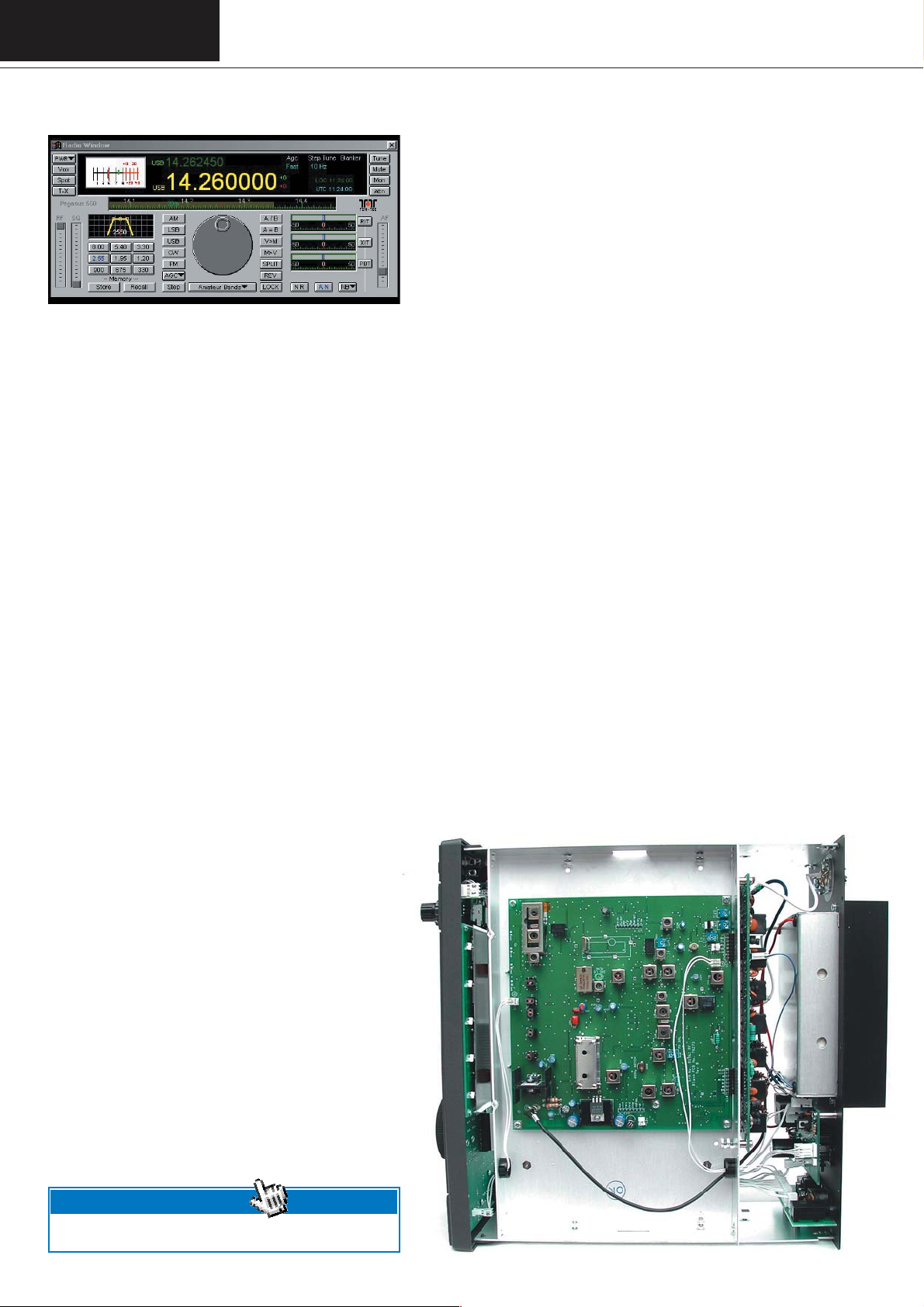
remote settings and returns the
local settings, settings cannot be
shared. Emulation of the rotary tuning knob is rather slow and cumbersome but an optional remote keypad
and tuning knob directly equivalent
to that on the front panel is available. Sliders are used instead of
rotary controls and a fast tuning
slider speeds rapid frequency
changes. Many facilities are better
implemented, eg separate buttons
for modes and also for bands and
there are a number of additional
features not available on the Jupiter
alone. Memory stores are much
more comprehensive with various
text fields and sweep functions are
more informative. Overall a worthwhile addition and a different operating experience.
MEASUREMENTS
Measurements shown in the table
were made with the review radio powered from a 13.8V supply and the
receiver bandwidth set to 2400Hz.
The supplied power cable looks
rather thin but only dropped 0.2V
under full transmit output.
The receive sensitivity is lower
than most radios but still entirely
adequate for practical antennas.
Below 500kHz the sensitivity drops
away sharply, measuring 140µV at
136kHz for 10dB s+n:n. The overall
gain is also quite low with the AGC
threshold set at about S8 (18µV).
This yields a quiet background noise
level but weak signals give less audio
than strong ones unlike many radios.
S-meter range and linearity are
excellent and spurii and images fairly low. A number of low level ‘birdies’
can be heard across the tuning range
but none are of consequence within
the amateur bands. The third order
intercept is reasonable but the lower
sensitivity yields a below average two
tone dynamic range. Reciprocal mixing is also fairly poor. The DSP IF filters have excellent flatness and steep
sides but meaningful measurements
at -60dB were compromised by the
effects of oscillator noise (reciprocal
mixing) and AGC action. A wide
range of AGC decay times are provided but the attack time suffered 10ms
or more overshoot. The audio output
could be driven to at least 2W but at
this level it overheated and collapsed
after a few seconds. Note that the
speaker drive is balanced and neither
side of the external speaker output
should be grounded. When tuning
close to carriers strong clicks could
be heard every 2.5kHz. This is a consequence of the synthesiser architecture adopted in this radio and was
also observed during on air testing.
Transmit SSB intermodulation
products were generally quite reasonable and not significantly degraded
by the speech processor. CW keying
was clean with low distortion and
reasonable rise and fall times
although the first attack edge was
noticeably sharper. Full QSK and
delayed QSK gave identical results.
On FM there did not appear to be a
deviation limiter but deviation was
about 1.5kHz with the microphone
gain set as for SSB use.
ON THE AIR
I found the Jupiter generally easy to
use with its spacious well laid out
panel and a good all round performer.
On transmit good quality reports
were received on SSB with the TenTec hand microphone and the CW
QSK was very effective. Receive sensitivity seemed just about adequate
and I experienced no serious strong
signal problems on 40m although
slight overload could be heard with
exceptional signals. The audio quality
on headphones in particular was
excellent. However, I did find tuning
clicks every 2.5kHz near strong signals, most noticeable on the broadcast bands. DSP filter selection was
excellent but I think that other implementations may have narrower skirts
particularly on the lower bandwidth
filters. It would be better if mode
selection returned the last used filter
bandwidth on that mode rather than
link this to the band selection. DSP
noise reduction was very effective in
removing background noise on armchair copy signals but did not
improve readability on weak signals.
The automatic notch was not as effective as some other DSP implementations of this feature.
Generally the user ergonomics are
very good but there are a couple of
areas for improvement. The rotary
tuning knob has only 120 steps per
revolution. Tuning in 10Hz steps is
smooth but tediously slow, 100Hz
steps are too coarse. Constant
switching between step sizes is
needed to navigate the bands effectively. Even 20 years ago 1000
step/revolution rotary encoders
were the norm. Band and mode keys
only scroll in one direction although
the band key will step backwards if
two keys are pressed. True bidirectional scrolling would be an advantage. The AGC setting defaults to
medium at switch-on and some
other front panel settings to their
default (off) value.
CONCLUSIONS
The Jupiter is a good all-round mid
range radio, easy to use and a good
CW performer. A major strength is
the ability to upgrade the firmware
and the ease of operating under PC
control. The current list price is
£1159, or £1439 with internal ATU,
and it is available from Ten-Tec
Direct (4E East Mill, Bridgefoot,
Belper, Derbyshire DE56 2UA; tel:
01773 880788) and UK agents.
My thanks to Ten-Tec Direct for the
loan of the review radio. ◆
36
REVIEW
Top: The ‘virtual
transceiver’ on
the monitor
when the Jupiter
is controlled
from a PC.
Below right:
The Jupiter
transceiver
under the top
cover, showing
the RF board.
January 2004 ♦
RadCom ♦ www.rsgb.org
Ten-Tec technical support: www.rfsquared.com
Ten-Tec Direct UK: www.aoruk/tentec
WEBSEARCH
 Loading...