

Page 1
"Manufactured in North America"
OWNER'S AND
INSTALLER'S MANUAL
V18
for
COMFORT PLUS
Forced Air Heating Systems
Equipped with Variable Speed
3100
Series
4100
Series
This manual applies to heating
systems built after 01/01/2011.
Models: 3120, 4120,
4130, & 4140
Applicable to Software Version 2.00-2.19
U.S. Pat. #5201024, #5086493
Can. Pat. #2059158, #2060881
Page 2
IMPORTANT
ww
w The equipment described herein is intended for installation by a qualified
ww
technician in compliance with applicable local, state, and national codes and
requirements.
ww
w To insure proper installation and operation of this product, completely read all
ww
instructions prior to attempting to assemble, install, operate, maintain or repair
this product. Upon unpacking of the system, inspect all parts for damage prior
to installation and start-up.
ww
w This manual should be retained by the owner upon completion of the installa-
ww
tion and made available to service personnel as required.
ww
w Disclaimer: In compiling this manual, Steffes Corporation has used its best
ww
judgement based upon information available, but disclaims any responsibility
or liability for any errors or miscalculations contained herein, or any revisions
hereof, or which result, in whole or in part, from the use of this manual or any
revisions hereof.
Steffes disclaims any responsibility or liability for mold/mildew growth and/or
any damages caused by either which occur after the heating system is installed. We strongly recommend that the user follow the moisture, mold and
mildew prevention guidelines of the Environmental Protection Agency (EPA),
available at http://www.epa.gov. If you are unable to find information and have
concerns, contact Steffes Corporation.
For Customer Use
Please record your model and serial number below. This number is found on the identification label
located on the lower front of the 3100 series base and on the lower left side of the 4100 series base.
Retain this information for future reference.
Model No. ________________________________________________________________________
Serial No. ________________________________________________________________________
RECOGNIZE THESE SYMBOLS AS SAFETY PRECAUTIONS
It is important, both for your personal safety and to avoid possible damage
to the equipment and your property , that you observe the safety instructions given following these symbols.
Page 3
SAFETY PRECAUTIONS
1. Install all ceramic brick and completely assemble the
heating system before energizing the system to avoid
damage to the heating system.
2. DO NOT use or store materials that may produce
explosive or flammable gases near this heating system.
3. Maintain all placement and clearance requirements as
specified in this manual to ensure proper operation and
safety.
4. Keep the top of the heating system free of debris and
other objects.
5. Disconnect power to all circuits before servicing. This
heating system may be connected to more than one
branch circuit.
6. Installation of and/or service to this heating system
should be performed by a qualified technician in compliance with information contained herein and with national,
state, and local codes and requirements.
7. A repeated message of “CORE FAIL” indicates a need
for service by a qualified technician.
WARNING
Hazardous Voltage: Risk of
electric shock. Can cause injury
or death. This heater may be
connected to more than one
branch circuit. Disconnect
power to all circuits before
installing or servicing. Installation of and/or service to this
equipment MUST be performed
by a qualified technician.
Risk of fire. Can cause injury or
death. Violation of the clearance requirements can cause
improper operation of the
equipment. Maintain the placement and clearance requirements specified.
BUILT-IN SAFETY DEVICES
The Comfort Plus heating system incorporates safety devices to ensure normal operating temperatures are maintained. The chart below describes these safety devices.
DEVICE NAME FUNCTION
Core Charging High
Limit Switches
(Auto Reset)
Core Blower
Limit Switch
(Auto Reset)
Supply Air Blower
Limit Switch
Base Temperature
Limit Switch
(Auto Reset)
These limit switches monitor brick core charging and
interrupt power to the heating elements if the normal
operating temperature is exceeded.
This limit switch monitors the discharge air temperature
and interrupts power to the core blower(s) if the normal
operating temperature is exceeded:
3100 Series = 130oF (nominal)
4100 Series = 160oF (nominal)
This limit switch monitors the discharge air temperature
and interrupts power to both the supply air blower and the
core blower(s) if the normal operating temperature is
exceeded:
3100 Series = 160oF (nominal) Auto Reset
4100 Series = 190oF (nominal) Manual Reset
This limit switch monitors the temperature in the base of the
Comfort Plus and interrupts power to the core blower(s) if
the normal operating temperature is exceeded.
LOCATION
ON SYSTEM
In the limit bar panel
on the left side of the
brick storage cavity.
3100:In the discharge
air supply outlet.
4100: On the supply
air blower
assembly.
3100:In the discharge
air supply outlet.
4100: On the supply
air blower
assembly
In the base of the
system near the core
blower(s).
Comfort Plus Safety Information
Page 4

Table of Contents
TC
Operation
General Operation ........................................................................................................................................................................ 1.01
System Use During Construction Phase...................................................................................................................................... 1.01
System Start-Up ........................................................................................................................................................................... 1.01
Turning System "OFF" and "ON" ............................................................................................................................................... 1.01
Control Panel ............................................................................................................................................................................... 1.02
Operating Status .......................................................................................................................................................................... 1.02
Room Temperature Control .......................................................................................................................................................... 1.03
Brick Core Charge Control ........................................................................................................................................................... 1.03
Charge Control Override .............................................................................................................................................................. 1.03
Maintenance and Cleaning .......................................................................................................................................................... 1.03
Optional Accessories
Single Electrical Feed Kit ............................................................................................................................................................. 2.01
Comfort Plus Stand - 4100 Series ................................................................................................................................................. 2.01
Down Flow Kit ............................................................................................................................................................................. 2.01
Return Air Plenum - 4100 Series ................................................................................................................................................... 2.01
Installation
Shipping and Packaging .............................................................................................................................................................. 3.01
Placement and Clearance Requirements................................................................................................................................3.02-3.03
Initial Set-up..........................................................................................................................................................................3.03-3.04
Brick Loading ............................................................................................................................................................................... 3.04
Heating Element and Air Channel Installation ............................................................................................................................. 3.05
Brick Core Temperature Sensor Installation - 4100 Series Only ................................................................................................... 3.06
Ducting .................................................................................................................................................................................3.06-3.07
Air Conditioner/Heat Pump Interface........................................................................................................................................... 3.08
Line Voltage Electrical Connections .....................................................................................................................................3.08-3.09
Low Voltage Electrical Connections
Peak Control .................................................................................................................................................................. 3.09-3.10
Outdoor Temperature Sensor ............................................................................................................................................... 3.10
Room Thermostat ..........................................................................................................................................................3.11-3.12
Auxiliary Load Control ................................................................................................................................................................. 3.12
Humidifier/Electronic Filter Installation........................................................................................................................................ 3.12
Configuration Menu .............................................................................................................................................................3.13-3.14
Installer's Final Check-Out Procedure .......................................................................................................................................... 3.15
Appendix
Specifications.............................................................................................................................................................................. A.01
Disassembling the 4100 Series Comfort Plus System .................................................................................................................. A.02
Parts Diagram - 3100 Series .........................................................................................................................................................A.03
Parts List - 3100 Series ....................................................................................................................................................... A.04-A.05
Parts Diagram - 4100 Series .........................................................................................................................................................A.06
Parts List - 4100 Series ....................................................................................................................................................... A.07-A.08
Internal System Wiring Diagrams - Line Voltage ............................................................................................................... A.09-A.12
Internal System Wiring Diagram - Low Voltage .......................................................................................................................... A.13
Help Menu .................................................................................................................................................................................. A.14
Error Codes ........................................................................................................................................................................ A.14-A.15
Glossary ...................................................................................................................................................................................... A.16
Warranty
Table of Contents Comfort Plus
Page 5
1
Operation
GENERAL OPERATION
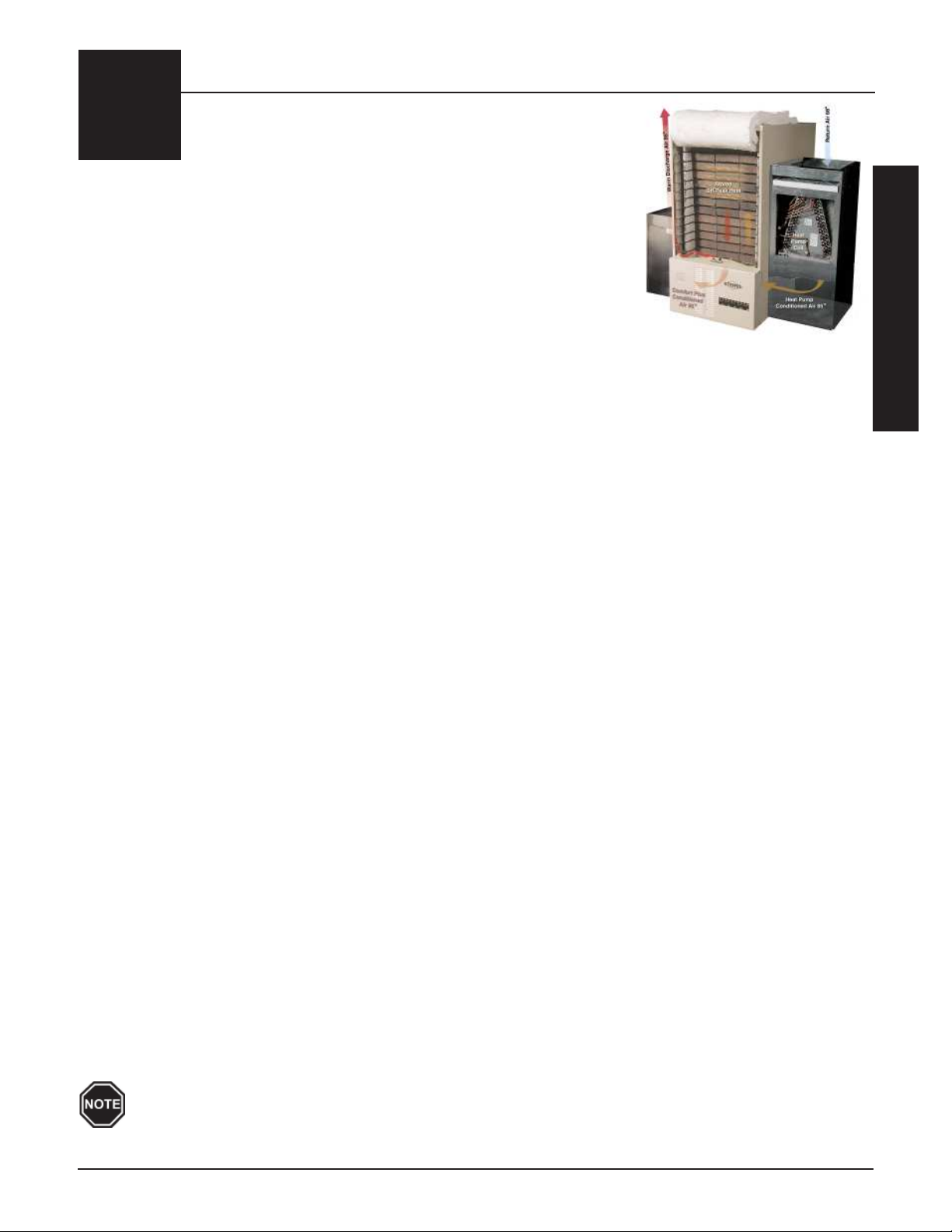
The Steffes Comfort Plus heating system stores off-peak electricity in the form
of heat. Off-peak electricity is available during times of day or night when
electricity is plentiful and the power company can supply it at a lower cost.
Operation of the Comfort Plus heating system is automatic. When off-peak
hours are available, the system converts electricity to heat which is then stored
in its ceramic brick core. The amount of heat stored in the brick core varies in
relation to outdoor temperature, owner preference, utility peak conditions, and
the heating requirements.
A heat call from the room thermostat energizes the blowers in the Comfort Plus system. The variable speed core
blower(s) automatically adjust its speed to circulate room air through the brick core. The supply air blower then
delivers this heated air into the desired area through the duct system to maintain a constant, comfortable room
temperature.
The versatility of this system allows it to fit many applications. The Comfort Plus is designed for use as either the
sole heating source (“stand alone” furnace) or as a supplement to ducted heating systems such as heat pumps.
SYSTEM USE DURING CONSTRUCTION PHASE
Like most heating equipment manufacturers, Steffes strongly recommends that “Construction Heating Units” be
used instead of the permanent heating system during the construction phase of a new home. Use of the permanent
heating system during this phase may contaminate the duct system and/or internal areas of the heating system.
This may cause poor indoor air quality issues, systems reliability problems, and/or improper system operation once
the home is completed.
Operation
SYSTEM START-UP
On start-up of the Comfort Plus system, odors relating to first time operation of the heating components may be
experienced. Also, if not used for an extended period of time, dust may accumulate in the system. Allow the
Comfort Plus heating system to charge to its maximum brick core charge level to expel odors in a timely manner.
As with most heating systems, air borne particles and odors in the room may be drawn into the Comfort Plus and
oxidized. Odors can be amplified; thus, it is not recommended to operate the system if odors such as those
from paints, varnishes, or chemicals are present in the air. Air borne particles, which have been oxidized, are
expelled back into the room and may accumulate on air vents or other surfaces. Over time, these particles may
appear as a black residue, commonly referred to as soot. High concentrations of air borne particles from aerosols,
dust, candles, incense, pet hair, smoke, or cooking can contribute to poor indoor air quality and accelerate the
sooting process.
During operation, the Comfort Plus heating system may produce minor expansion noises. These noises are the
result of the internal components reacting to temperature changes.
TURNING SYSTEM "OFF" AND "ON"
The Comfort Plus element (charging) circuits may be turned “OFF” by switching ALL of the 60 AMP breakers
located on the front of the electrical panel to the DOWN position. To turn the element circuits “ON”, switch ALL
of the 60 AMP breakers to the UP position.
The 15 AMP breaker MUST remain “ON” to operate controls in the system if:
ww
w using the Comfort Plus in conjunction with a heat pump or air conditioner.
ww
ww
w using the Comfort Plus to control other loads.
ww
ww
w using the optional Steffes Time Clock Module.
ww
Comfort Plus Operation n 1.01
Page 6
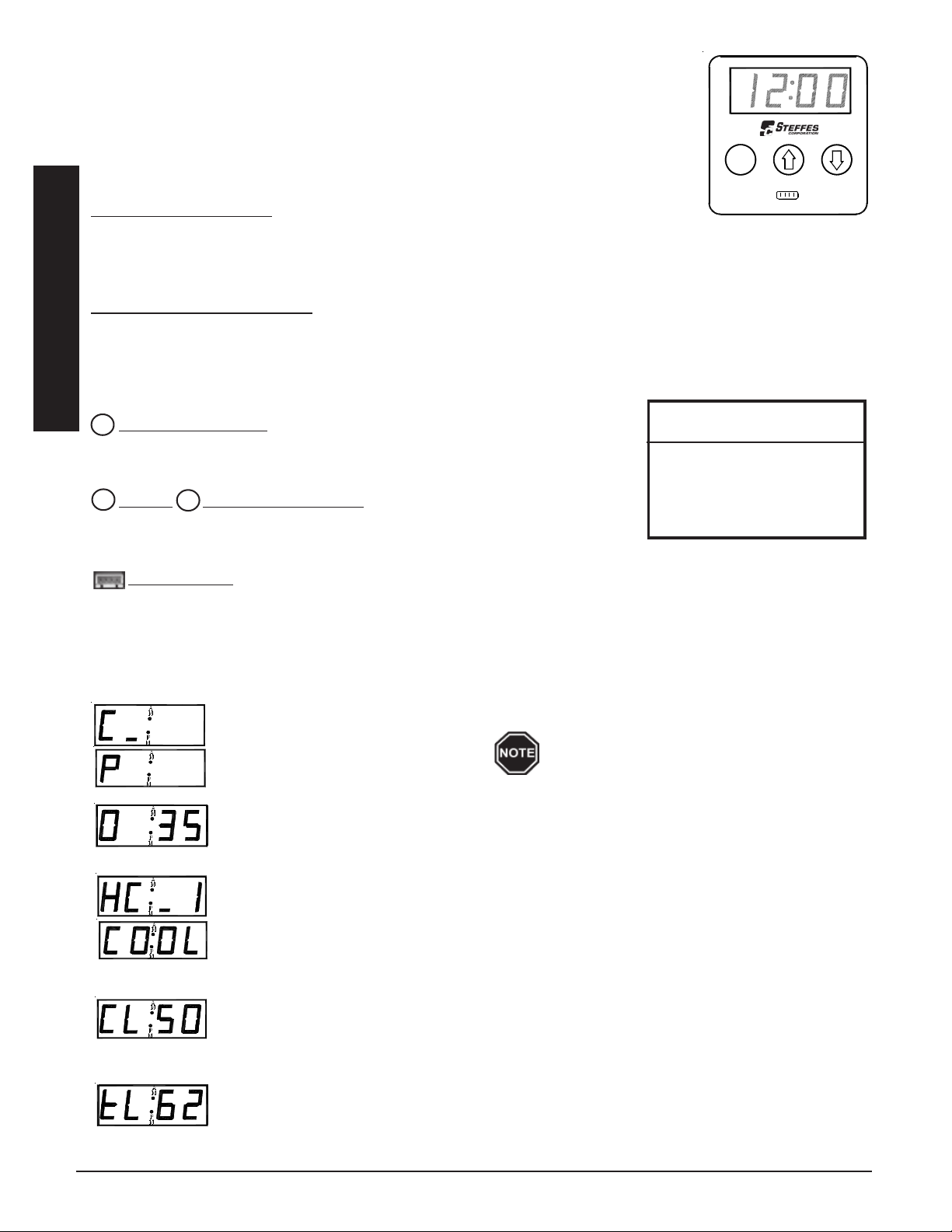
CONTROL PANEL
M
M
A
M
P
Operation of the Comfort Plus heating system is automatic. Operational function
settings are stored in a microprocessor on the processor control board. These settings
are modified, if necessary, through the Configuration Menu as described on Pages
3.13-3.14. In most applications, the system is configured upon installation and no
further changes are required.
Four-Digit LED Display
The four digit LED displays specific operating information. During the configuration
process, the configuration number and the values set in these configurations are
displayed for viewing and adjusting purposes.
AM and PM Indicator Lights
The AM and PM indicator lights are only utilized if the Steffes Time Clock Module is being installed and using 12
Operation
hour time display. With this module installed, the system displays time on AM/PM intervals. The light flashes next
to the active designator/symbol. The system can be configured to display military time, in which case, both the AM
and PM lights illuminate.
Mode (Edit) Button
M
Used to access menus on the system (i.e. Help Menu or Configuration Menu)
and to allow modifying of configuration settings.
Editing configuration
information may alter
Up and Down Arrow Buttons
ñ
ò
Used to scroll up or down when viewing or modifying.
the performance and
operation of the system.
operating functions.
CONTROL PANEL
FIGURE 1
IMPORT ANT
Interface Port
Allows technician external access for advanced operating modes, updating software, and troubleshooting.
OPERATING STATUS
The four digit LED will display various operating information as described below. Press and release the up arrow
to view this data.
Operating Mode - Indicates the current operating mode of the Comfort Plus system.
C = Off-Peak (Charge) Time
P = On-Peak (Control) Time
A = Anticipated Peak Time
Outdoor Temperature -“O”, followed by a number, indicates current outdoor temperature.
Heat Call Status - Indicates the current heat call status being received from the room
thermostat. Refer to Low Voltage Electrical Connections - Room Thermostat for more
information.
Brick Core Charge Level - “CL” (charge level) followed by a number, indicates the
current percentage of heat stored in the brick core. “CL:_” represents a core temperature
lower than the minimum core temperature and “CL: F” represents a full core charge level.
A bar illuminates on the lower portion of
the display's second digit whenever the
heating elements are energized.
Targeted Brick Core Charge Level - “tL” (target level) followed by a number, indicates
the current percentage of brick core charge being targeted by the Comfort Plus. A display of
“tL:_” indicates that the system will not maintain any heat in the brick core and “tL: F”
indicates a full core charge target level.
Operation n 1.02 Comfort Plus
Page 7

ROOM TEMPERATURE CONTROL
The room temperature set point is adjusted at the wall thermostat. If room temperature drops below the thermostat set point, the thermostat initiates a heat call and energizes the blowers in the Comfort Plus heating system. The
variable speed core blower(s) automatically adjust speed in relation to brick core temperature and duct temperature
to circulate room air through the brick core. The supply air blower then delivers the heated air into the living area
through the duct system to satisfy heating requirements. When the thermostat senses a demand greater than the
output, another stage of heating is initiated.
When used to supplement heat pump systems, the Comfort Plus replaces the resistance strip heat, which is typically required as a supplement or back-up to the heat pump system. A duct sensor monitors the discharge air
temperature. If the demand for heat is at a point where the heat pump alone cannot maintain the desired duct
temperature, stored heat is used to supplement the heat pump and satisfy the heating requirements.
BRICK CORE CHARGE CONTROL
The amount of heat stored in the brick core of the Comfort Plus system is regulated automatically in relation to
outdoor temperature and the heating requirements. The outdoor sensor, supplied with the system, monitors
outdoor temperature and provides this information to the Comfort Plus. As the outdoor temperature decreases,
heating requirements increase and the system stores more heat accordingly.
CHARGE CONTROL OVERRIDE
The Comfort Plus is equipped with a charge control override feature that allows the user to force the system to
target a full core charge level. This override can be initiated or cancelled at any time. If an override is initiated,
the system targets a full core charge level during the next off-peak period. It continues to charge during off-peak
hours until the system achieves full (maximum) core charge or until the override is cancelled. Once full charge is
achieved or the override is cancelled, the system charges according to the standard configuration.
Operation
Initiating the Override Feature
Step 1 Press and hold the M, the up arrow, and the down arrow buttons at the same time.
Step 2 The faceplate will flash “FULL” and “ON”. Continue to hold all three buttons until “ON” displays
continuously.
Step 3 Release the buttons. The override is now enabled. The faceplate will return to displaying its standard
operating mode.
Manual Cancellation of the Override Feature
Step 1 Press and hold the M, the up arrow, and the down arrow buttons at the same time.
Step 2 The faceplate will flash “FULL” and “OFF”. Continue to hold all three buttons until “OFF” displays
continuously.
Step 3 Release the buttons. The override is now cancelled. The faceplate will return to displaying its standard
operating mode.
• This feature will not turn elements on during a peak period.
• This feature will cancel if power is interrupted.
MAINTENANCE AND CLEANING
The Comfort Plus heating system is easily maintained. The air filter in the return air duct of the system should be
replaced on a regular basis to ensure proper operation and to maintain overall efficiencies. No additional routine
maintenance is required.
If utilizing a heat pump or air conditioning system with the Comfort Plus, the indoor coil of the device should be
cleaned periodically as dirt accumulation may reduce system efficiency. It is important to follow the
manufacturer’s maintenance and cleaning recommendations for these devices.
Comfort Plus Operation n 1.03
Page 8
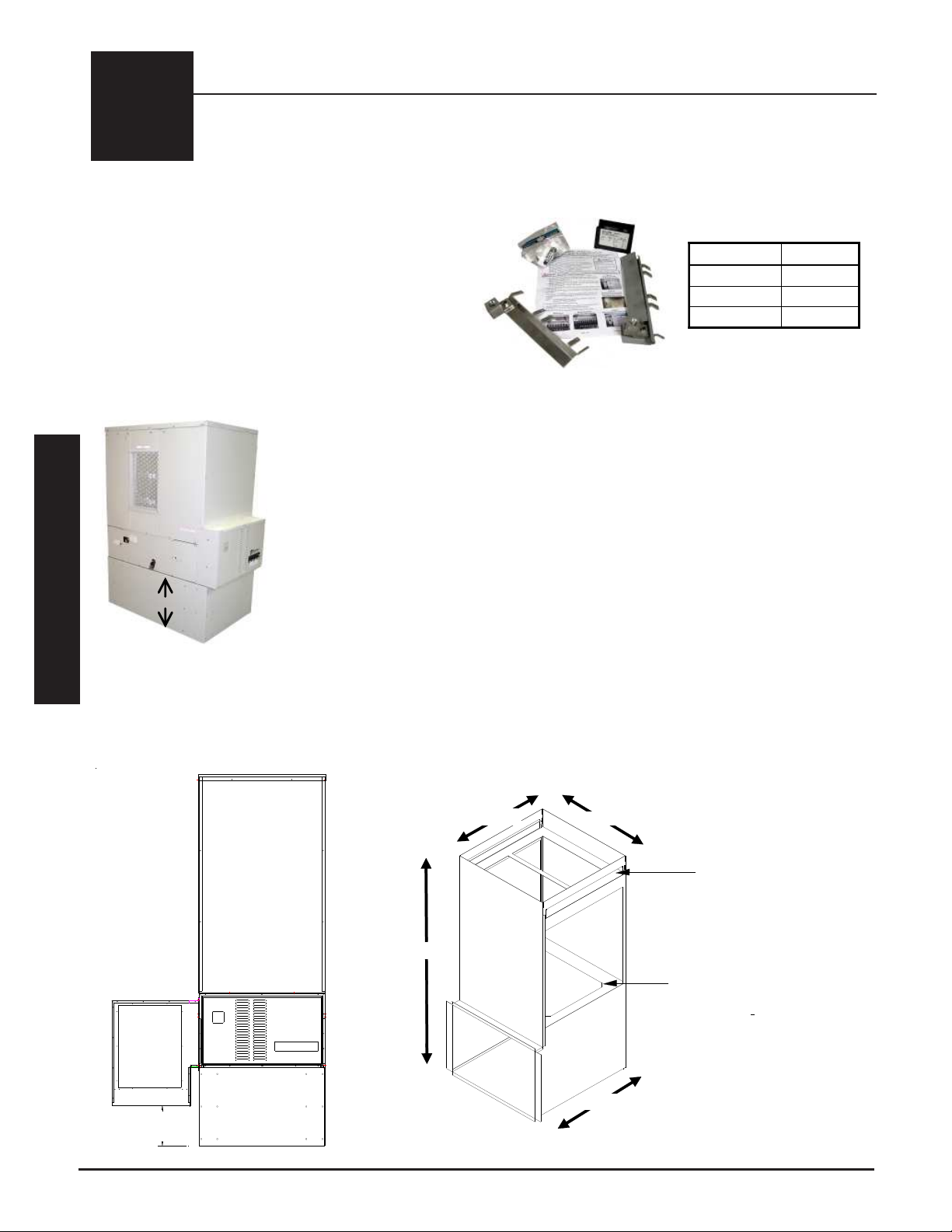
2
Model Part #
3120 1301574
4120 1301572
4130/4140 1301570
Duct
Opening
(connects
to unit)
Filter Tray
(Fits 20" x 25" x 2" filters, one included)
Heating/Cooling A-Coil Tray
Inner Dimensions: 26"W x 22"D x 31" H
Front Access: 25
1
2
"W x 22"D x 30"H
52 5/16”
28 3/16”
22 3/16”
26 1/16”
9.263
+ Set Height
of Leveling Legs.
SINGLE ELECTRICAL FEED KIT
The Steffes Comfort Plus systems have built-in circuit
breakers. They are factory configured to be field connected to multiple line voltage circuits. If single feed to
the element and blowers/control circuits is desired, the
single feed kit is available to allow the system to be
powered with a one, larger line voltage circuit.
COMFORT PLUS STAND - 4100 SERIES
Some applications (such as garages) may require that the heating appliance be
elevated in order to meet building codes. The Steffes Comfort Plus stand elevates
the 4100 system 18". This stand is shipped as a kit and requires field assembly.
Stand
Accessories
Order Item #1301585
Order Item #1301578
RETURN AIR PLENUM - 4100 SERIESDOWN FLOW KIT
Order Item #1301550
Optional Accessories n 2.01 Comfort Plus
Page 9
3
Installation
CAUTION
Risk of sharp edges. Can cause personal injury. Use caution
when installing and/or servicing equipment.
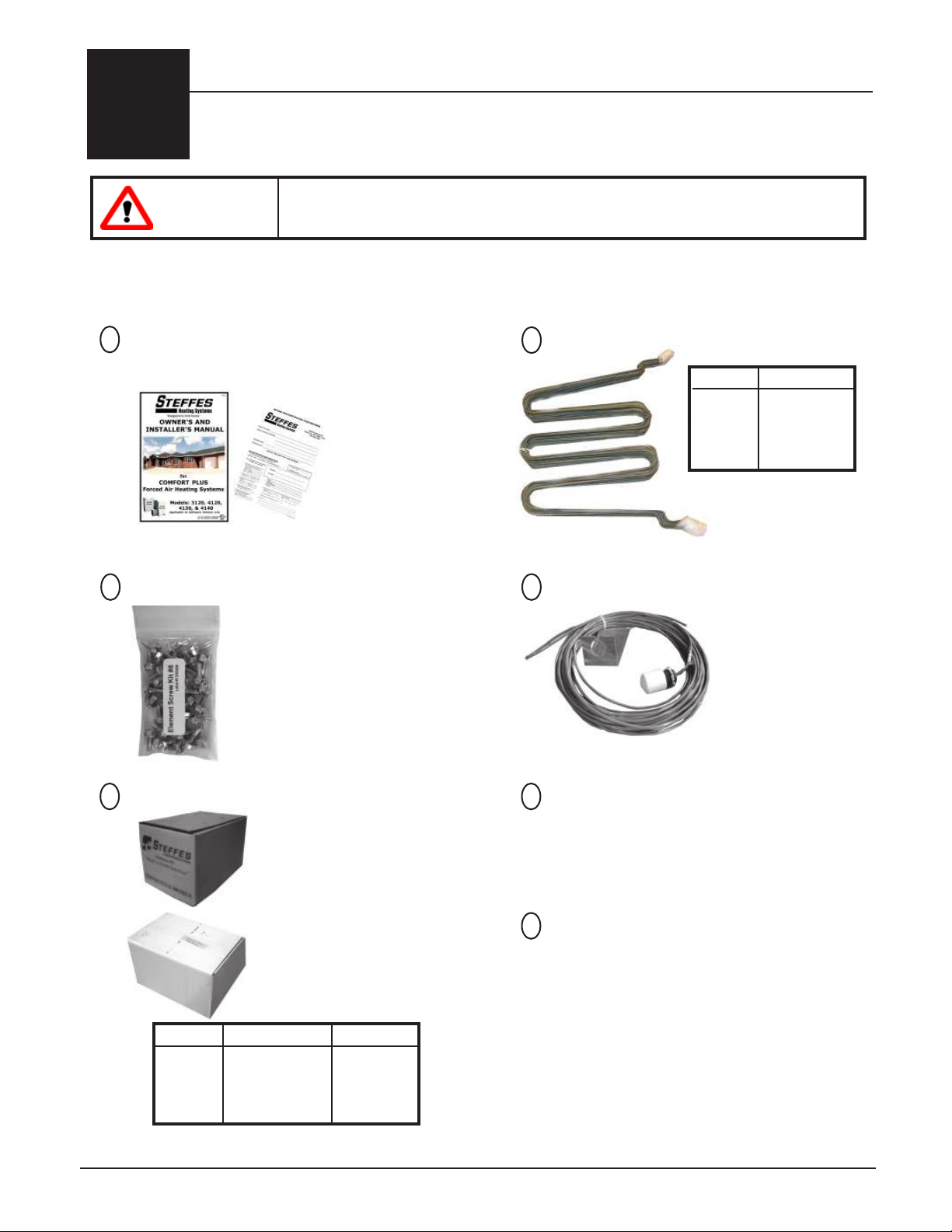
SHIPPING AND PACKAGING
The Comfort Plus system should always be transported in an upright position to avoid damage to internal components and insulation materials. The information below describes the items shipped with each system.
INFORMATION PACKAGE
1
(includes Owner's Manual and
Warranty Registration Card)
(adhered to outer side of shipping box)
ELEMENT SCREW KIT
2
(shipped
inside the
electrical
compartment)
HEATING ELEMENTS
4
MODEL ELEMENTS
3120 8
4120 8
4130 12
4140 16
(shipped inside the base of
the Comfort Plus)
OUTDOOR TEMPERATURE SENSOR
5
(shipped inside the
electrical compartment)
CERAMIC BRICK
3
Full Brick
(shipped separately
and packaged 4 brick
per box)
Half Brick
(shipped with brick and
packaged in a white box
consisting of 6 half brick
and 1 full brick)
MODEL FULL BRICK 1/2 BRICK
3120 18 Boxes 0 Boxes
4120 26 Boxes 1 Box
4130 37 Boxes 2 Boxes
4140 49 Boxes 2 Boxes
Comfort Plus Installation n 3.01
SUPPLY AIR BLOWER ASSEMBLY
6
(4100 SERIES)
Packaging Dimensions 26 x 24.5 x 20.5
(shipped separately)
RETURN AIR PLENUM ASSEMBLY
7
(3100 SERIES)
Packaging Dimensions 27 x 40 x 4
(banded to the 3100 Series Comfort Plus for shipping)
Page 10
16"
41
5
8
"
67
7
16
"
60"
10
1
8
"
53
5
8
"
5
3
8
"
1"
27"
22
7
16
"
22
5
16
"
1"
Top View
26
1
8
"
1
7
8
"
8
1
2
"
16
7
16
"
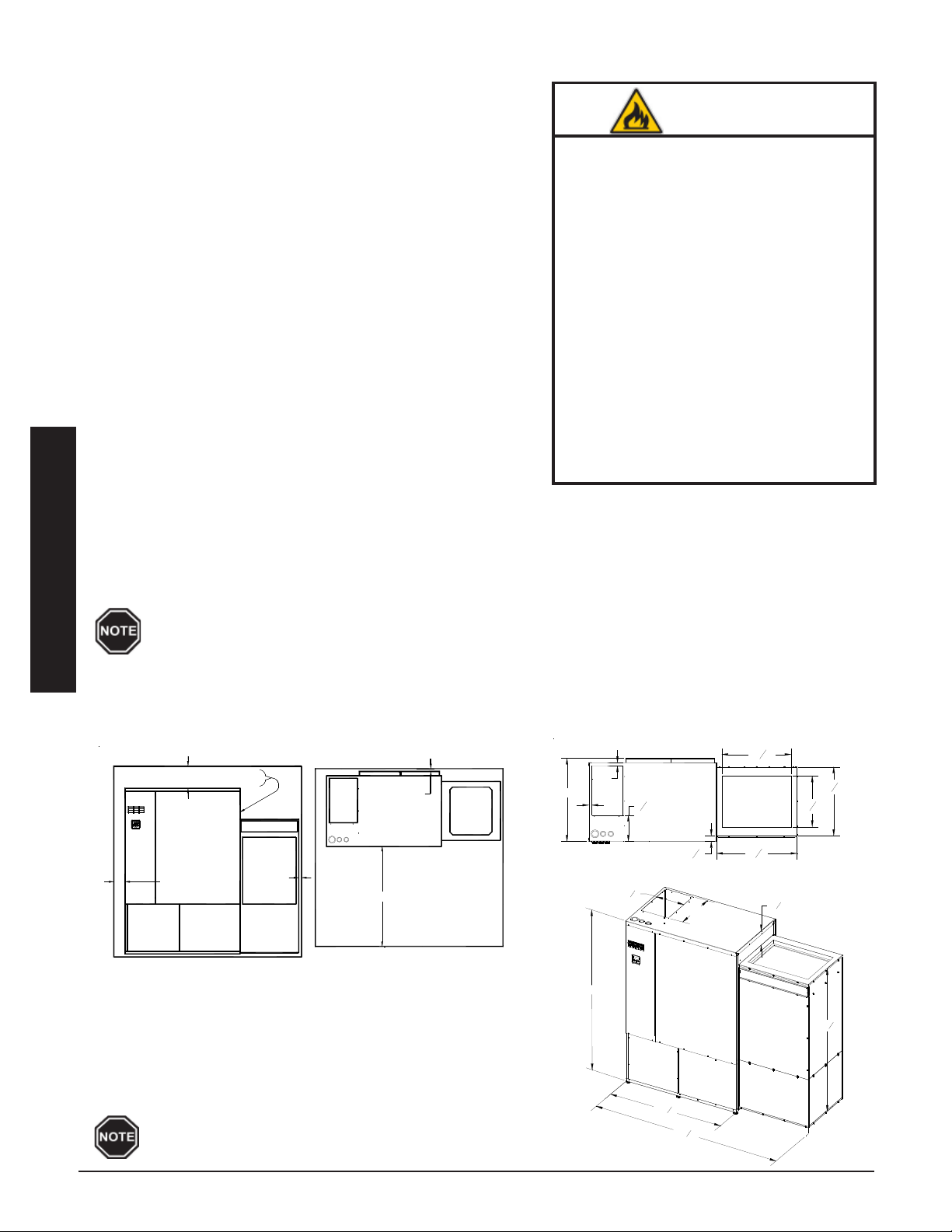
PLACEMENT AND CLEARANCE REQUIREMENTS
FRONT VIEW
8" MIN CLEARANCE TO COMBUSTIBLES,
0" MIN CLEARANCE TO DUCTING
15 6060
4" MIN
CLEARANCE
M
STEFFES
A
M
M
P
36" MIN CLEARANCE (FRONT)
0" MIN
CLEARANCE
TO RETURN
AIR DUCT
TOP VIEW
O" MIN
CLEARANCE
(BACK)
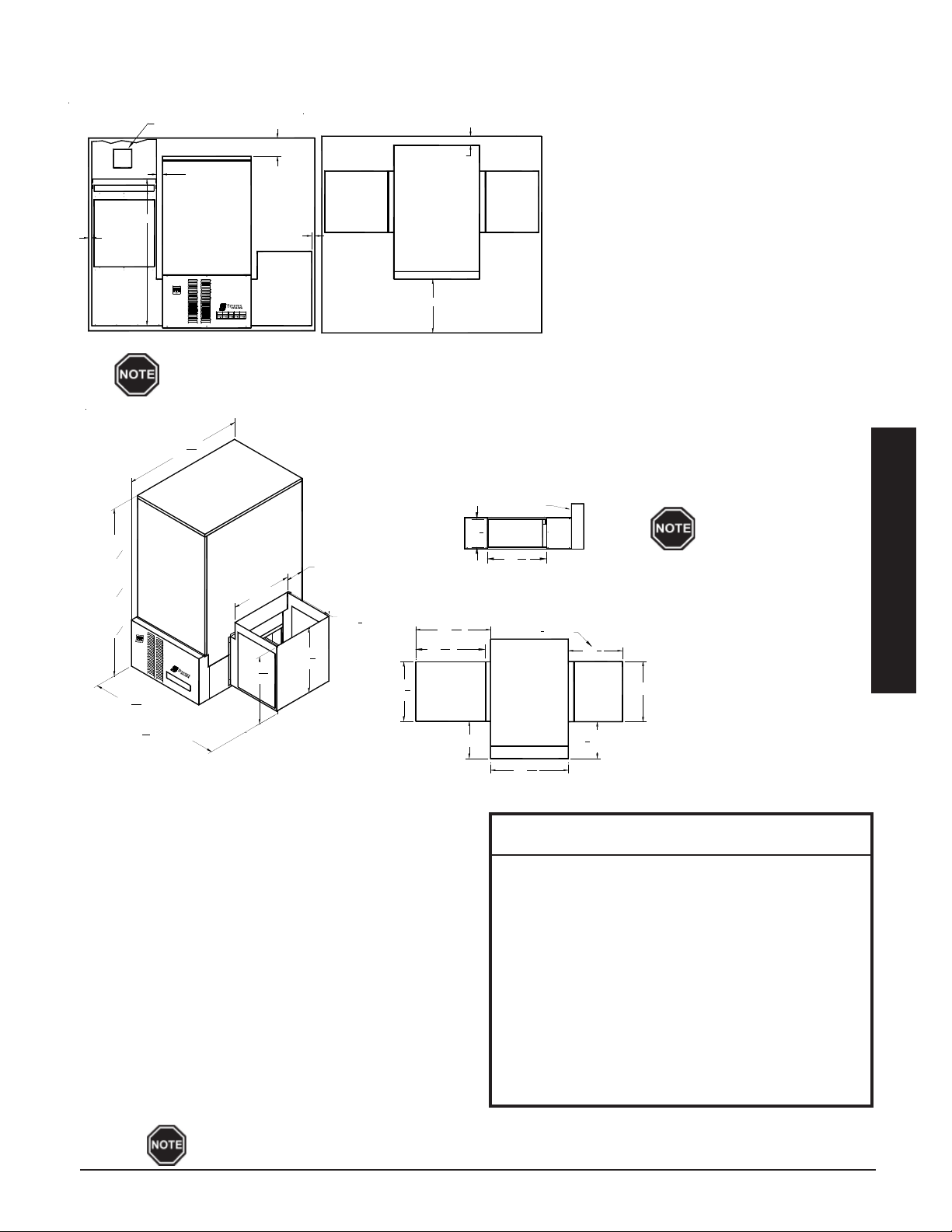
The physical dimensions of the Comfort Plus, along with the
clearances required, MUST be taken into consideration when
choosing its location within a structure. (See Figures 2 and 3
for system dimensions and clearance requirements.)
The best installation location for this system is in a space
requiring heat so some amount of the heating requirements can
be satisfied through static dissipation from the warm outer
panels. In situations where the Comfort Plus is not installed in
an area it is intended to heat (i.e. storage closet), it is important
to account for the heat lost through static dissipation by making
proper adjustments when sizing the system. Standby heat
dissipation of up to 2.5kW can be experienced in normal operation. Room air should be maintained at less than 85° Fahrenheit.
If ventilation is needed, it can be provided by installing a 24” x
24” opening into the area where the Comfort Plus is located. In
addition, a 6” x 6” non-closing type register can be cut into the
return air duct of the furnace to minimize heat build-up in the
room. This register must be installed in a manner that ensures
the air drawn into the Comfort Plus passes through the filter
first (see Figure 3A).
Risk of fire. Can cause injury or death.
w Violation of the clearance require-
ments and/or failure to provide proper
ventilation can cause improper operation of the system. Maintain the
placement and clearance requirements as specified and provide ventilation as necessary.
ww
w Failure to maintain room temperature
ww
in the mechanical room of 85oF or less
may result in equipment damage.
Thermostatically controlled ventilation
should be provided if the temperature
in this area exceeds 85oF.
ww
w Moving the system after install may
ww
result in equipment damage. Do NOT
move system from original installed
location.
W ARNING
In addition to the physical space requirements, the weight of the Comfort Plus must be taken into consideration
when selecting the installation surface. A level concrete floor is the best installation surface on which to place the
system, but most well supported surfaces are acceptable. If unsure of floor load capacity, consult a building
contractor or architect.
Installation
ww
w Back and Bottom = 0 clearance
ww
ww
w Left Side = 4 inches
ww
ww
w Right Side = 8 inches (from combustible material)
ww
ww
w Top = 8 inches (from combustible material)
ww
ww
w Front = 36 inches (for ease in servicing)
ww
ww
w Outer Sides of System Ducts (Return and Supply) = 0 clearance
ww
ww
w Between Ducting and System = 0 clearance (top and right side)
ww
Installation n 3.02 Comfort Plus
Special requirements must be considered if placing the system in a garage or other area where
combustible vapors may be present. Consult local, state, and national codes and regulations to
ensure proper installation. An 18" pedestal (Order Item #1301585) is available to elevate the
4100 Series.
3100 SERIES SYSTEM REQUIREMENTS
FIGURE 2
CLEARANCES
2A
Minimum clearance requirements may NOT account for
required working space for electrical connections.
2B
DIMENSIONS
2C
2D
Return
Plenum
(Factory
Supplied)
Air
Page 11
4100 SERIES SYSTEM REQUIREMENTS
FRONT VIEW
48"
2" MIN
CLEARANCE
(IN COLD AIR RETURN)
6" X 6" REGISTER
FILTER TRAY
0" REQUIRED
CLEARANCE
M
STEFFES
P
M
M
A
0" REQUIRED
CLEARANCE
6" MIN CLEARANCE
TOP VIEW
36" MIN CLEARANCE
3" MIN CLEARANCE
P
M
(4100 Series)
18" Standard
22
1
2
" if 1hp
Front View
29
3
16
13
3
4
± 1/4"
14±1/4
4100 Series
Top View
10
1
2
22
5
16
Electrical
Panel
26
3
16
"
28
3
16
"
20
1
4
49
7
16
" Standard
53
15
16
" if 1hp
24
3
4
" if 1hp
4140
68
5
8
"
4130
57
5
8
"
4120
46
5
8
"
25
1
16
"
24
1
4
"
Return Air Plenum
(Order Item
#1301550)
22
1
4
"
22 5/8"
Supply Air Plenum
(Factory Supplied)
44
11
16
"
8 3/8"
(± 1/4")
22 5/8"
M
A
M
STE
FFE
S
FIGURE 3
CLEARANCES
ww
w Back and Sides = 3 inches (from combus-
ww
tible material)
ww
w Bottom = 0 clearance
ww
ww
w Top = 6 inches (from combustible material)
ww
ww
w Front = 36 inches (for ease in servicing)
ww
ww
w Between Duct and Left Side of System =
3A
3B
ww
2 inches
ww
w Between Duct and Right Side of System =
ww
0 clearance
ww
w Outer Sides of System Ducts (Return and
ww
Supply) = 0 clearance
Minimum clearance requirements may NOT account for required working space for
electrical connections.
DIMENSIONS
3C
IMPORTANT:
Return air duct
MUST NOT enter
from the front or
back of the furnace.
Upflow, downflow, or
straight return
3D
ducting only.
INITIAL SET-UP
Step 1 Remove the Information Package from the
Comfort Plus heating system.
Step 2 Remove the heating elements from inside the
outside of the shipping box and unpackage the
base of the system.
Step 3 Move the system into its installation location.
Comfort Plus Installation n 3.03
The Comfort Plus is capable of fitting through
a 30" doorway (minimum) without disassembling. If necessary, the 4100 series can be
disassembled for ease in moving. To disassemble the 4100 Series Comfort Plus, refer to
the disassembly instructions (Page A.02) for
more information.
The 3100 series can NOT be disassembled.
Risk of improper operation or equipment damage. Read and follow installation instructions
carefully.
ww
w Remove the Comfort Plus system from its
ww
shipping pallet before installing.
ww
w Leveling legs should be extended no more
ww
than one inch.
ww
w DO use and follow generally accepted safety
ww
practices when handling insulation material.
ww
w DO have equipment installed by a qualified
ww
technician in compliance with all applicable
codes and regulations.
IMPORTANT
Installation
Page 12
Step 4 Once in place, adjust the leveling legs on the bottom of the system as necessary to prevent rocking. If not
i.e.: Rows 2, 4, 6, 8, 10 and 12 in 4140
Front
Indicator
i.e.: Rows 1, 3, 5, 7, 9, and 11 in 4140
Front
Indicator
4120 - Load in Row 5
4130 - Load in Row 4 and 8
4140 - Load in Row 6 and 12
Half Brick
Forward Facing Indicator
Rear Facing Indicator
Half Brick
Indicator in Brick
placed properly the system may bend or twist during the brick loading process, making element and brick
core temperature sensor installation difficult. Leveling legs should be extended no more than one (1) inch.
Step 5 Remove the painted front panel of the electrical compartment by removing the screws along the edges.
Locate the element screw kit and the outdoor sensor.
Step 6 Remove the painted front panel of the brick storage cabinet by removing the sheet metal screws along the
top, bottom, and sides of the panel. Detach by pulling the bottom of the panel forward and down.
Step 7 Locate the element wiring harnesses behind the front painted panel. Carefully position them to avoid
damage during the brick loading and wiring processes.
Step 8 4100 SERIES ONLY. Locate the brick core temperature sensor(s) behind the front panel and discon-
nect them from their shipping position. Carefully position the sensor(s) to avoid damage during brick
loading and wiring.
Models 4130 and 4140 have two brick core temperature sensors.
Step 9 Remove the galvanized front panel and set it aside.
Step 10 Starting at the bottom, carefully lift the two insulation blankets, one at a time, and drape them over the top
of the system.
Use face mask, gloves, and long sleeved garments when handling insulation materials in
compliance with generally accepted safety practices.
Step 11 Remove the front air channel by pulling out on the bottom of the air channel on a 3100 series or the top of
the air channel on a 4100 series.
BRICK LOADING
W ARNING
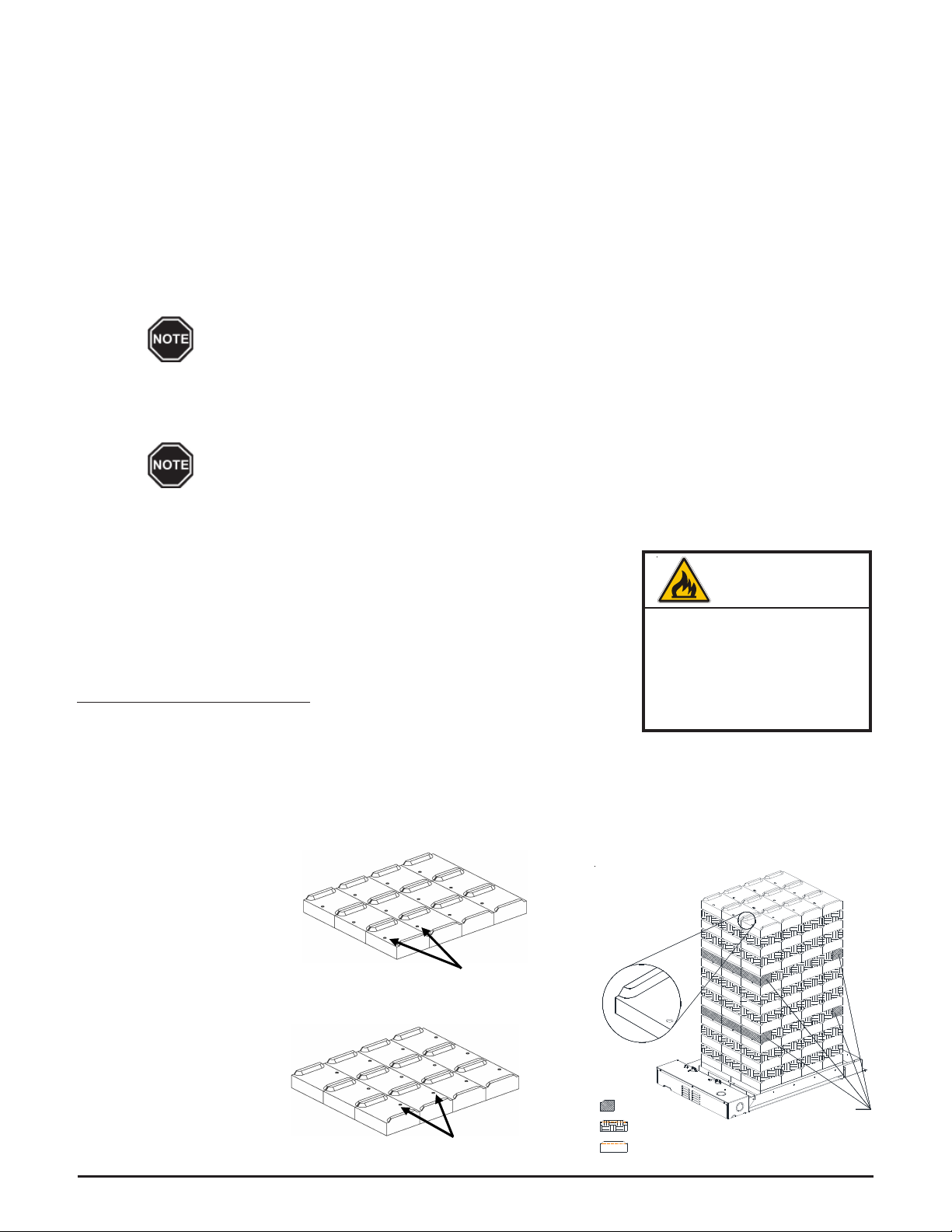
Load the brick, one row at a time, using a left side, right side, center pattern.
Start at the back of the brick core and work forward. Make sure the brick are
placed so the grooved side is facing up and the ridges are on the left and right.
(See Figure 6.)
BRICK INSTALLATION TIPS:
• Install bricks carefully to avoid damage to the insulation panels.
Risk of fire. Can cause
personal injury or death. DO
NOT operate the system if
damage to the insulation
panels on the inner sides of
the brick core occurs.
• Remove loose brick debris to prevent uneven stacking of brick, as this can make installation of the elements
and the brick core temperature sensor(s) difficult.
• Brick rows MUST line up front to back and side to side.
• Half brick makes brick loading easier by evening out the stacks. Use HALF BRICK (white boxes) in the
proper rows and positions
as indicated in Figure 6.
• Alternate the direction of
FIGURE 4
FIGURE 6
the brick’s indicator in
every other brick row.
See Figures 4 and 5.
• All bricks in odd
numbered rows (1, 3, 5,
7, 9, and 11) must have
the indicator facing
FIGURE 5
forward as shown in
Figure 4.
• All bricks in even
numbered rows will have
indicator facing back.
See Figure 5.
Installation n 3.04 Comfort Plus
Page 13
HEATING ELEMENT AND AIR CHANNEL INSTALLATION
3
4
"
Required Clearance Between
Element Termination and Metal
Panels is 1/2" (3/4" Nominal)
Element Connection
Electrical
Panel
Front Air
Channel
BRICK
CORE
SIDE VIEW
Outlet
Inlet
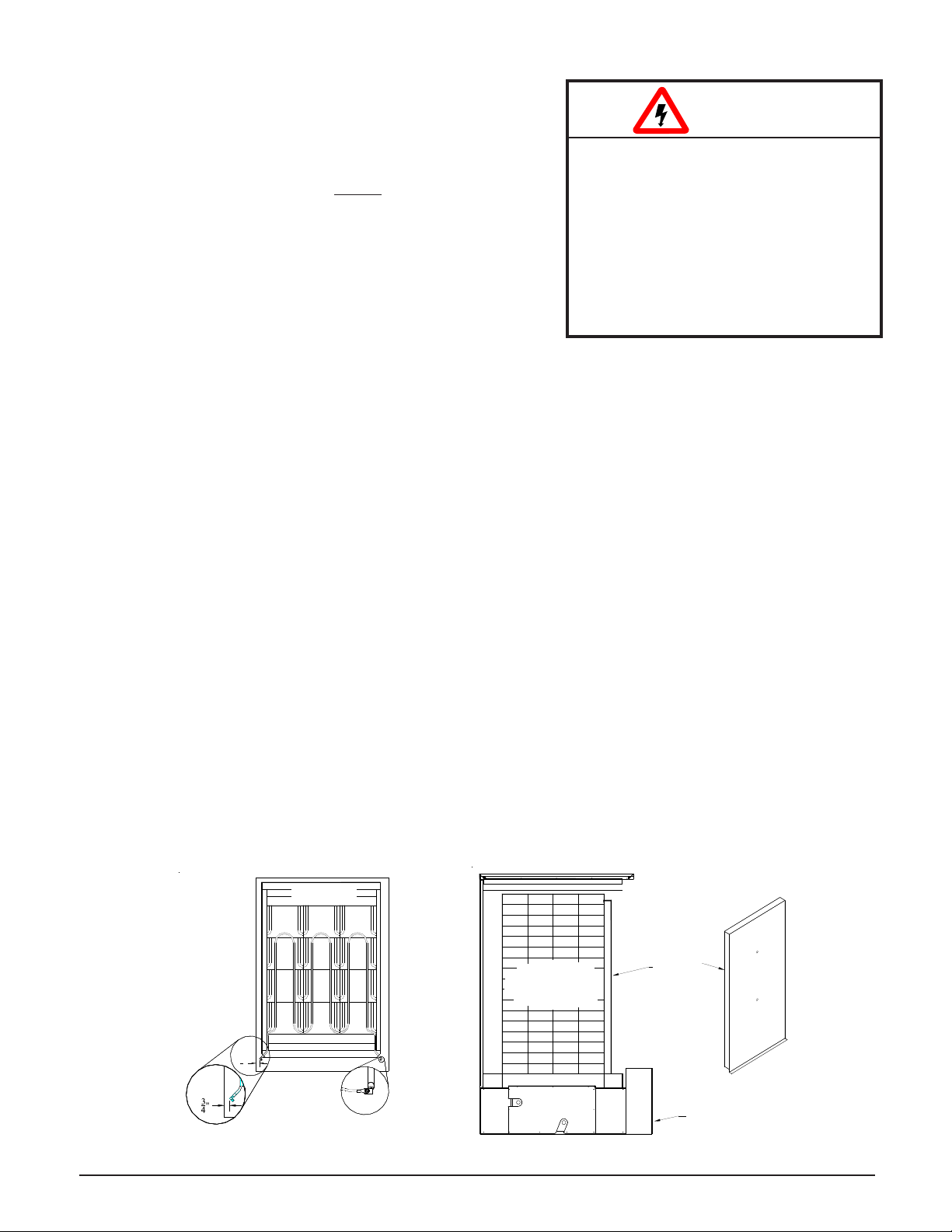
Step 1 After all brick are loaded, insert the heating elements be-
tween the brick layers, sliding them in until the element ends
embed into the side cutouts of the brick cavity.
W ARNING
3100 Series: The threaded screw tabs on the wire connection terminals should point forward.
4100 Series: The elements MUST be installed so their
threaded screw tabs on the wire connection terminals point
forward and down. If they are installed with the screw tabs
pointing upward, element-to-wiring harness connections
(Figure 7) will be difficult. Be sure the elements are slid into
the brick core properly to ensure correct clearance between
the terminal connections and any surfaces within the system
as shown in Figure 7.
HAZARDOUS VOL T AGE: Risk of electric
shock. Can cause injury or death.
ww
w DO NOT remove the electrical panel
ww
cover while system is energized.
ww
w Position elements properly to avoid
ww
short circuiting them against metal
surfaces.
ww
w Protect element lead wires from front
ww
panel screws and any field installed
screws to avoid short circuit.
Step 2 Install the front air channel with the air deflectors (arrow shaped pieces) facing inward and with the
narrow ends of the deflectors pointing up.
3100 Series: Place top portion in first.
4100 Series: Place bottom portion in first (see Figure 7.)
Step 3 Lower the insulation blankets back into position, one at a time. Carefully tuck the sides of the insulation into
the edges, corners, and around the exposed portions of the heating elements to ensure maximum efficiency.
Step 4 Reinstall the galvanized front panel and secure it to the Comfort Plus system using the screws that were
originally removed.
3100 Series: Slide the top of this panel inside the upper lip of the top painted panel. The bottom should
rest on the outside of the cavity and secure to the base with screws.
4100 Series: Slide the bottom of this panel inside the lower lip of the brick cavity. The top rests on the
outside of the cavity.
Step 5 Carefully route wiring harnesses and connect them to the heating elements, using screws provided in the
hardware package. Make connections with screw heads up and threads pointing down. Element screws
should be tightened to 14 inch lbs. Refer to Element Connection (Figure 7) for proper positioning.
Step 6 The painted front panel can now be installed on 3100 systems. If installing a 4100 system, the brick core
temperature sensor(s) must be installed prior to putting the painted front panel in place.
ELEMENT INSTALLATION
FIGURE 7
AIR CHANNEL PLACEMENT
FIGURE 8
TOP
Comfort Plus Installation n 3.05
Page 14
BRICK CORE TEMPERATURE SENSOR INSTALLATION -
Jumper
½ HP Variable
Speed CFM
A 1000
B 1200
C 1400
D 1600
4100 SERIES ONLY
Step 1 Remove the screw(s) by the brick core temperature sensor hole(s) in
the galvanized front panel.
Models 4130 and 4140 have an upper and a lower brick
core temperature sensor.
Step 2 Insert the brick core temperature sensor(s) through the hole(s) in the
galvanized front panel. If installing a system with two sensors, be sure
the one marked "upper" is installed in the upper opening and the one
marked "lower" is installed in the lower opening. The sensor(s) must
Risk of improper operation.
Proper installation of the
brick core temperature
sensor(s) is critical to the
operation of the Comfort
Plus heating system. Read
and follow installation
instructions carefully.
pass through the blanket insulation and into the brick core. Holes have
not been predrilled through the insulation. Use the sensor(s) to aid in making a passageway by rotating
the sensor(s) side-to-side while gently pushing inward.
Step 3 Once the brick core sensor(s) is installed, put the screw(s) back into position in the galvanized front panel
to hold the sensor(s) in position and to provide the electrical ground.
Step 4 Check the non-insulated element terminations to make sure they do not come within 1/2" of any surface
area on the system.
Step 5 Re-install painted front panel, using previously removed screws.
CAUTION
DUCTING & AIR FLOW
For air delivery, the Comfort Plus is equipped with a
variable speed supply air blower. When interfacing
with a heat pump, the A-Coil MUST be placed on the
return air side.
To maintain a room temperature of 85oF or less in the
mechanical room, a 24" x 24" opening can be installed
in the area or a 6" x 6" non-closing register can be cut
into the return air duct. Refer to Placement and
Clearance Requirements (Page 3.02-3.03) for more
information.
3100 SERIES
The 3100 series is factory configured for a right-toleft air flow.
Step 1 Assemble the factory supplied return air plenum
per the assembly instructions.
Step 2 Once assembled, set the plenum on the right side
of the system with the air filter and indoor coil
access covers facing forward. Line up the predrilled holes on the system with the holes in the
flanges of the plenum and attach using the screws
provided in the plenum's hardware package.
Step 3 Insert the air filter into the filter rack.
Step 4 Connect return air duct to top of return air plenum.
HAZARDOUS VOLTAGE:
Risk of electric shock. Can cause injury or death.
w Do install ducting before energizing the system.
w Do NOT operate the Comfort Plus without ducting
w Proper duct design and air flow are critical to
W ARNING
installed to both the air inlet and outlet.
achieve optimum system performance. A poorly
designed duct system and/or improper air flow can
cause system inefficiencies, air noise, and condensate drain problems. In applications where poor air
flow conditions exist along with high humidity, it
may be necessary to install a secondary condensate drain pan. (Order Item #1301576).
FIGURE 7
External static pressure should not exceed .75 inches
water column.
NOTE: With 2 stage Heat Pump, a Stage 1 heat call
results in 70% of selected CFM.
Step 5 Connect the supply air duct in the structure directly to the system's air outlet located on the top of the
system.
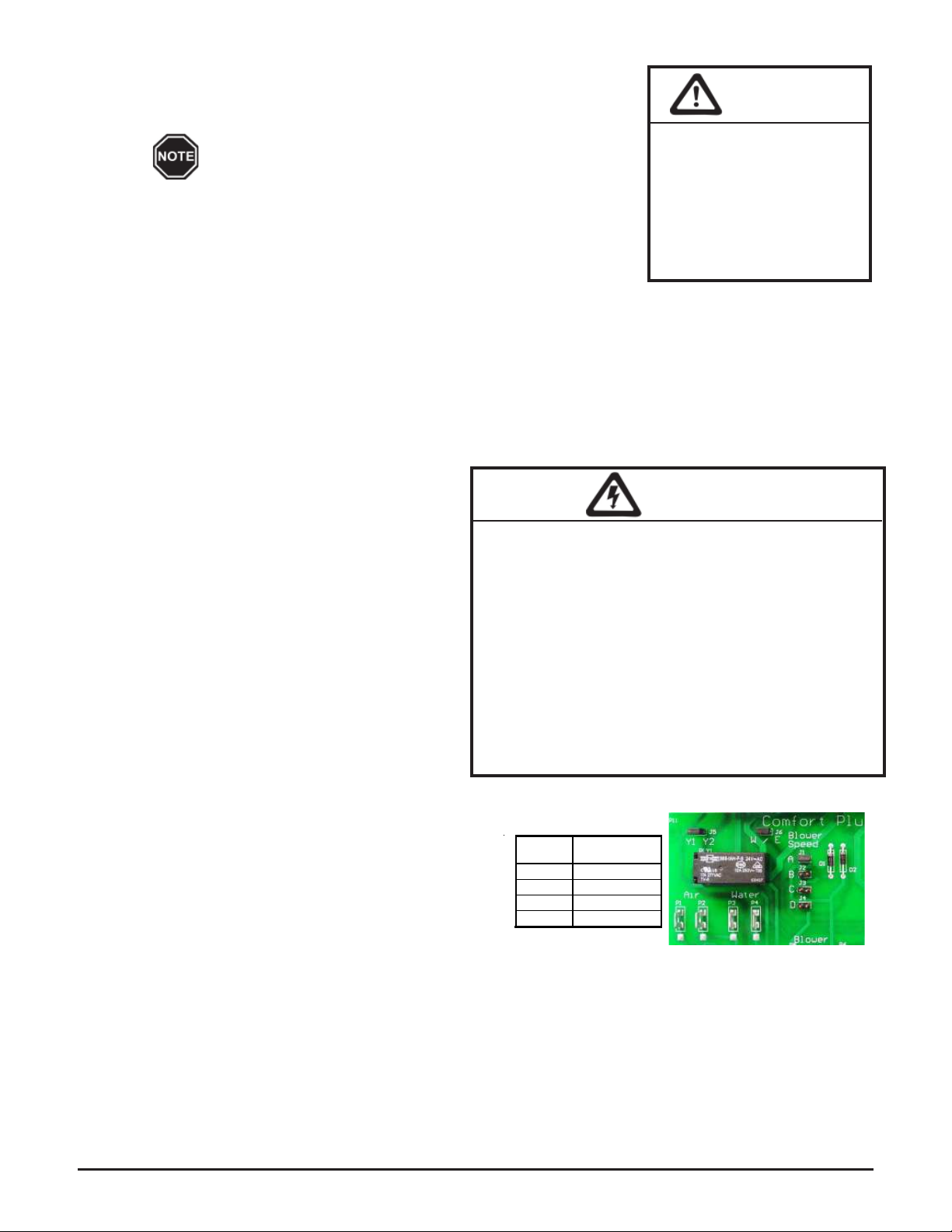
Step 6 Adjust the CFM setting at the variable speed low voltage circuit board as shown in Figure 7.
Step 7 The W/E jumper (Figure 7) MUST be in the ON position or the blower will not operate with an "E" call
from the thermostat.
Installation n 3.06 Comfort Plus
Page 15
4100 SERIES
Air
Holes
Plenum Support Bracket
Radiant Heat Shield
Jumper
½ HP Variable
Speed CFM
1 HP Variable
Speed CFM
A 1000
1200
B 1200
1400
C 1400
1600
D 1600
2000
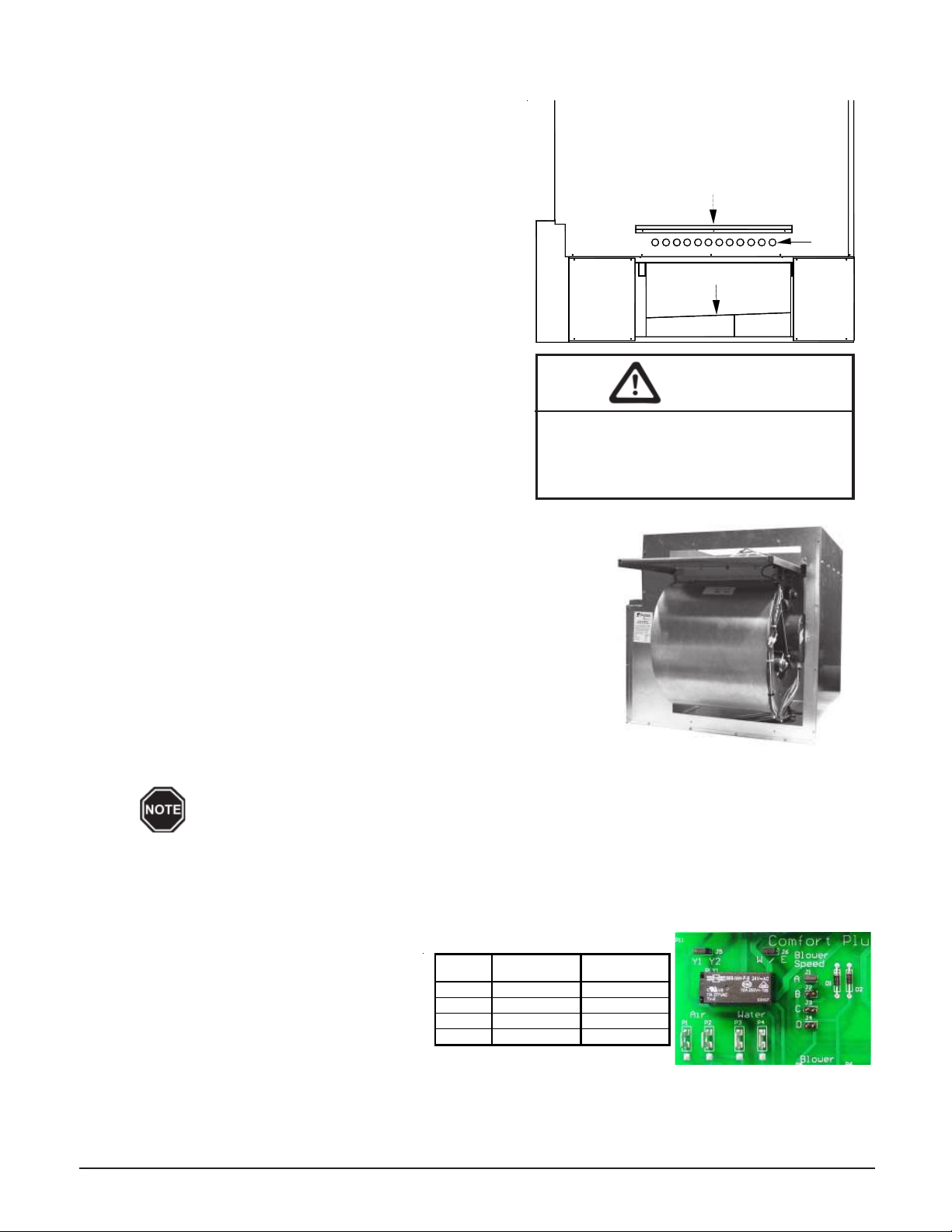
The 4100 series is factory configured for a left-to-right or rightto-left airflow. In either airflow direction, the holes directly
above the air outlet on the right side of the 4100 Series MUST
be contained in the duct system. (See Figure 8 for reference
to these air holes.)
If a down flow configuration is desired with the 4100 series, a
down flow kit must be ordered from the factory (Order Item
#1301578) and the system MUST be raised a minimum of 10"
off the ground. An 18" pedestal is available (Order Item
#1301585) to elevate the Comfort Plus.
Step 1 Unbox the supply air blower plenum assembly.
Step 2 Remove and discard metal plate securing supply air
blower to plenum assembly.
Step 3 Locate the plenum support bracket shipped in the
plenum box. Attach the bracket to the supply air side
using the blunt tip screws supplied in the plenum
assembly hardware package. Refer to Figure 8 for
proper positioning of the plenum support bracket.
Step 4 Attach the supply blower wiring harness located in
the base of the system to the blower using the connections located
on the ends of the harness. Be sure to place any excess wiring in
the base of the system below the radiant heat shield (Figure 8).
4100 SERIES
SUPPLY AIR PLENUM ATTACHMENT
FIGURE 8
CAUTION
When routing the harness to the supply
air blower, the harness must route to the
side of the air deflector in the bottom of
the supply air blower housing.
FIGURE 9
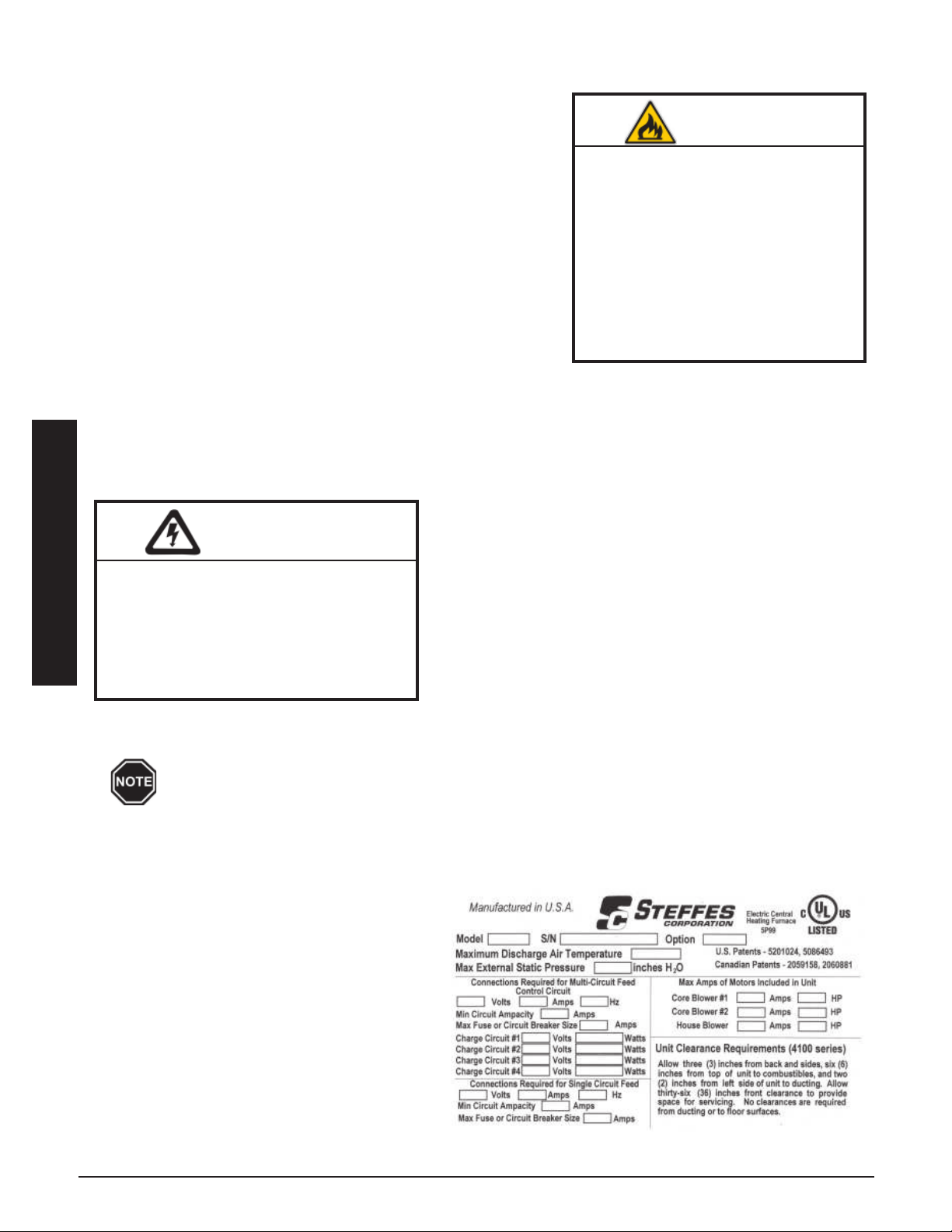
Step 5 Verify that the blower is installed in the plenum with the motor
facing away from the system (Figure 9).
Step 6 Attach the supply air blower plenum to the Comfort Plus by drilling
two 1/8” holes per edge and using the self tapping screws supplied
in the hardware package.
Step 7 Connect both the return air and supply air ducting systems in the
structure to the Comfort Plus system. Be sure the air holes just
above the air outlet on the right side are contained in the duct
system. (See Figure 8 for reference to the location of these holes.)
If the Comfort Plus system is installed in a small enclosed area (less than 400 square
feet), a minimum of a 24"x 24" opening must be installed into the area where the system is located. In addition, a 6" x 6" non-closing type register can be cut into the
return air duct. Refer to the Placement and Clearance Requirements section (Pages
3.02-3.03) for more information.
Step 8 Connect the supply air duct in the
structure directly to the system's air
outlet located on the top panel.
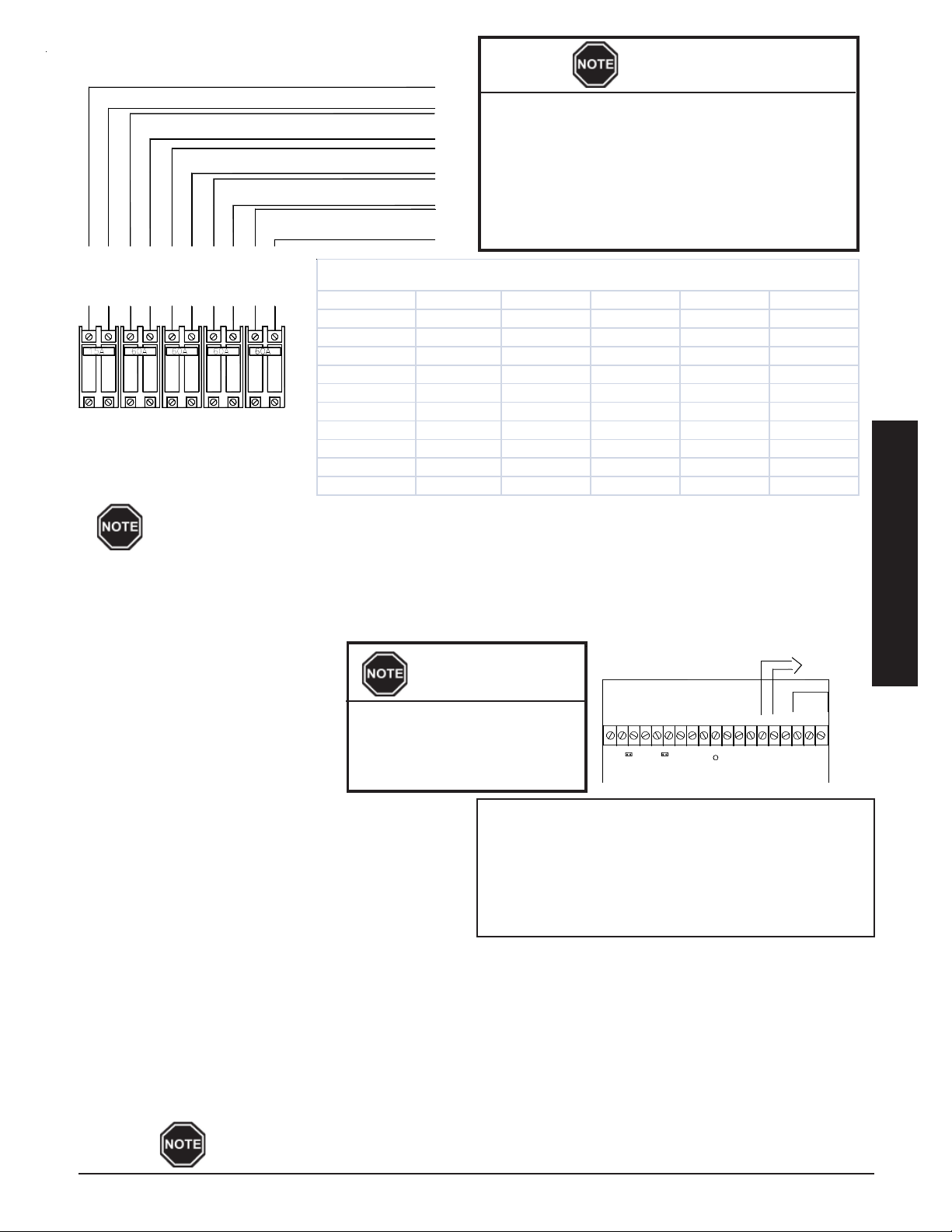
Step 9 Adjust the CFM setting at the vari-
able speed low voltage circuit board
as shown in Figure 10.
FIGURE 10
Step 10 The W/E jumper (Figure 10) MUST
be in the ON position or the blower
will not operate with an E call from
the thermostat.
Comfort Plus Installation n 3.07
External static pressure should not exceed .75 inches water column.
NOTE: With 2 stage Heat Pump, a Stage 1 heat call results in 70% of
selected CFM.
Page 16
AIR CONDITIONER/HEAT PUMP INTERFACE
When interfacing the Comfort Plus system with a heat pump, the
indoor coil MUST be placed on the return side of the Comfort Plus
system in a position that will provide even air flow through the coil.
WARNING
If using a factory supplied return air plenum, the plenum is configured to be the housing for the indoor coil. Remove the screws to the
plenum’s access cover and slide the coil into place inside the plenum. If not using a Steffes supplied return air plenum, the installer
will need to make provisions in the plenum to accommodate the coil
and air filter.
When interfacing a Comfort Plus system with an air conditioner, the
indoor coil can be placed on either the supply air or the return air
side of the system.
The condensate drain trap, in a heat pump or air conditioner installa-
Risk of fire. Any one ducting system
MUST NOT contain more than one
air handling (blower) system. If the
application requires multiple Comfort Plus systems or it is necessary to
have multiple air handlers share the
same ductwork, you MUST contact
Steffes Corporation. There are
special installation requirements
that MUST be performed in an
application such as this.
tion, should be designed for the vacuum in which the system is
operating. Typically, taller traps are better suited for these types of applications.
Refer to the Room Thermostat Connections Diagrams (Figures 13, 14 and 15) for more information on interfacing
the Comfort Plus with a heat pump or air conditioner.
LINE VOLTAGE ELECTRICAL CONNECTIONS
In standard configuration, the Comfort Plus is wired for connec-
W ARNING
HAZARDOUS VOL TAGE: Risk of electric
shock. Can cause injury or death. Do not
Installation
energize the system until installation is
complete. Equipment MUST be installed
by a qualified technician in compliance
with all applicable local, state, and
national codes and regulations.
tion to 240V, however, the element circuits can also be connected to 208V. A 208V connection derates the charging input
of the system by 25%. If a system rated specifically for 208V
or 277V is required, contact the factory. The controls circuit in
the Comfort Plus system MUST be connected to 240V/208V.
The 60 amp breakers located in the electrical compartment on
the Comfort Plus feed the core charging (element) circuits. The
15 amp breaker feeds the controls and blowers circuit.
If single feed to the element and blowers/control circuits is desired, the single feed kit is available to allow the system
to be powered with a one, larger line voltage circuit.
All Comfort Plus systems are factory configured to be field connected to multiple line voltage
circuits. If a single feed line voltage circuit is desired, an optional single feed kit is available.
To determine the correct wire size required for
each circuit feeding the Comfort Plus, refer to
the Specifications (Page A.01) and the system's
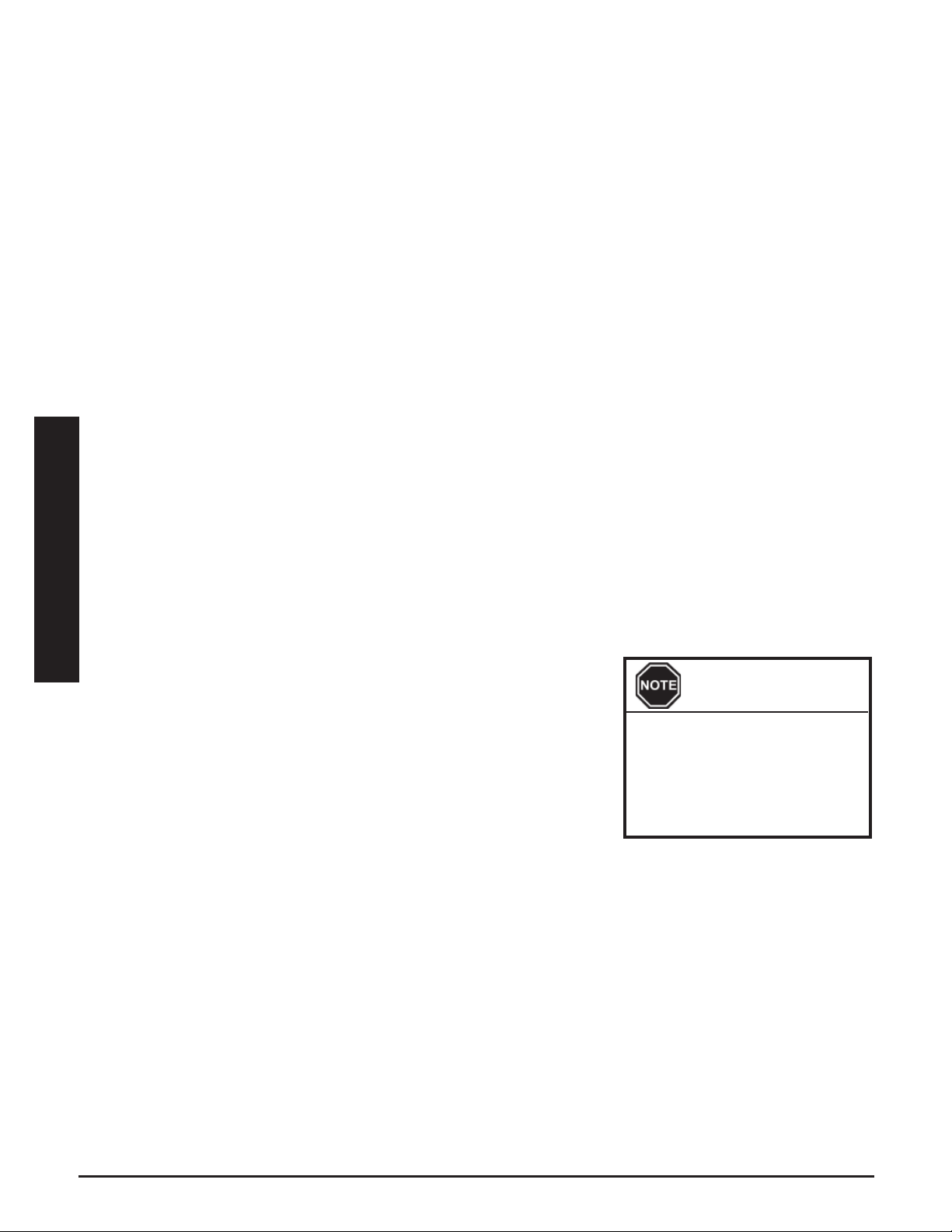
SAMPLE SYSTEM IDENTIFICATION LABEL
FIGURE 11
identification label located on the lower front of
a 3100 series system and on the lower left side
of a 4100 series system. (Reference Sample
Label Figure 11.)
Step 1 Remove the electrical panel cover.
Step 2 Route all line voltage wires through a
knockout and into the electrical panel
of the Comfort Plus.
Step 3 Make proper field wiring connections
to the Comfort Plus breakers. Refer
to the Line Voltage Wiring Diagrams
(Pages A.09 - A.12) for more information on these connections.
Installation n 3.08 Comfort Plus
Page 17
Circuit Breakers
LINE 2
LINE 1
LINE 2
LINE 1
CHARGE CIRCUIT #3
CHARGE CIRCUIT #2
CHARGE CIRCUIT #1
BLOWERS/CONTROLS CIRCUIT
CHARGE CIRCUIT #4
(MODEL 4130 and 4140 ONLY)
LINE 2
LINE 1
LINE 1
LINE 2
LINE 1
LINE 2
To Service (Breaker) Panel
(4100 SERIES ONLY)
CIRCUIT PHASING CONNECTIONS
W/
NONCCOM
Outdoor
Outdoor
CR
H/E
Speed
Blower
Y1-Y2 W-E
Y2Y1
AUX
OG RP
22
Y1 Y22O APP
Aux.
Relay
Dry Contact Peak
Control Switch
Mode l Control Cr ct Chrg Crct # 1 Chrg Crc t # 2 Chrg Crc t #3 Chr g Crc t #4
31 20 - 14 .0kW 6.0 0 29 .17 29 .17 N/A N/A
31 20 - 17 .0kW 6.0 0 36 .46 36 .46 N/A N/A
31 20 - 21 .6kW 6.0 0 45 .00 45 .00 N/A N/A
41 20 - 14 .0kW 7.0 0 21 .88 21 .88 14 .58 N/A
41 20 - 19 .2kW 7.0 0 30 .00 30 .00 20 .00 N/A
41 20 - 24 .8kW 7.0 0 38 .75 38 .75 25 .83 N/A
41 30 - 28 .8kW 7.0 0 30 .00 30 .00 30 .00 30 .00
41 30 - 37 .2kW 7.0 0 38 .75 38 .75 38 .75 38 .75
41 40 - 38 .4kW 7.0 0 40 .00 40 .00 40 .00 40 .00
41 40 - 45 .6kW 7.0 0 47 .50 47 .50 47 .50 47 .50
Fu ll L oa d Cu rre nt
(240V AC only - Circuit deration no t inc luded)
FIGURE12
IMPORTANT
ww
w To ensure proper operation and safety, all line
ww
voltage circuits must be segregated from low
voltage wiring in the Comfort Plus.
ww
w To reduce electro magnetic fields associated
ww
with electrical circuits and to avoid induced
voltage on sensors and electronic devices, the
circuit phases MUST be alternated as shown in
Figure 12.
The 60 AMP breakers on the Comfort Plus are for internal component protection only.
Sizing of the field wire and overcurrent protection MUST be in compliance with all applicable local, state, and national codes and regulations.
PEAK CONTROL CONNECTIONS
Steffes ETS heating equipment may be controlled by the Power Company
via a peak control signal. This signal
can be sent to the equipment using a
Steffes Power Line Carrier control
system, low voltage wiring, a Steffes
Time Clock Module, or line voltage
wiring. In applications utilizing
automatic charge control, outdoor
temperature information is required
Never install any wiring in
a line voltage compartment
of the Comfort Plus unless
it is rated for line voltage.
and can be received via an outdoor
sensor or power line carrier control system.
The Comfort Plus heating system is factory configured
for low voltage wire control and is set to charge when
the utility peak control switch closes. Refer to the
Configuration Menu (Pages 3.13-3.14) for information
on configuring the system for the application.
LOW VOLTAGE (DIRECT WIRED) PEAK CONTROL
If using the low voltage peak control option, the Comfort Plus is direct wired to the power company's peak control
switch. Field connections from the peak control switch are made to the low voltage terminal block through a low
voltage knockout located on the left side of electrical panel.
Step 1 Route a low voltage circuit from the power company’s load control or peak signaling device to the termi-
Step 2 Connect the field wiring to positions "RP" and "P" on the terminal block as shown in Figure 13.
Comfort Plus Installation n 3.09
nal block inside the electrical compartment of the Comfort Plus.
To control other devices, refer to the Auxiliary Load Control on Page 3.12.
IMPORTANT
PEAK CONTROL
TERMINAL CONNECTIONS
FIGURE 13
Terminal Block Coding
RP = Peak Control Input Common
P = Peak Control Input
AP = Anticipated Peak (Pre-Peak) Control Input
COM = Peak Control Output Common
NC = Peak Control Output (Normally Closed)
NO = Peak Control Output (Normally Open)
Installation
Page 18
POWER LINE CARRIER (PLC) PEAK CONTROL
The Steffes Power Line Carrier (PLC) control system has the ability to communicate with the system through the
existing electrical circuits in the structure. With the power line carrier option, direct wired low voltage connections
from the power company's peak signaling switch connect directly to the transmitting device. The switch signals
peak control times to the transmitter, the transmitter sends the signals to the Comfort Plus system, which receives
this information and responds accordingly.
In addition to providing peak control signals, the transmitter also provides outdoor temperature information for
automatic charge control, room temperature set back, and anticipated peak utility control signals (if applicable).
The PLC system is optional and must be ordered separately. If utilizing a PLC system, an Owner's and Installer's
manual will accompany the transmitting device. Refer to this manual for information on the installation and
operation of the power line carrier control system.
TIME CLOCK MODULE PEAK CONTROL
The Steffes Time Clock Module is another option for providing a peak control signal to the Comfort Plus. The
optional time clock module mounts inside the line voltage electrical compartment and interfaces with the relay
board via an interface cable. Peak control times MUST be programmed into the system once the module is
installed to enable the time clock feature. Refer to the instructions provided with the time clock module for more
information on the installation and operation of this device.
LINE VOLTAGE PEAK CONTROL
Line voltage control is also an option, but is not the preferred method of control as it is usually more complex and
expensive. If line voltage control is utilized, the controls circuit must be powered with an uninterrupted circuit. An
external switching device, such as a relay panel, is necessary to directly control the heating element charging
circuits. If relying on this method of control, the display on the system must continuously display a brick core
operating mode of “C” (charge) regardless of whether it is an off-peak or on-peak period.
Installation
LOW VOLTAGE ELECTRICAL CONNECTIONS - OUTDOOR
TEMPERATURE SENSOR (RECOMMENDED)
Installation Methods: A) Hard wired to system to the two "outdoor"
terminals (default)
OR
B) Connected to Power Line Carrier (PLC)
Theory of Operation: The outdoor sensor monitors outdoor temperature
and provides this information to the system. The
system responds by automatically storing heat in
its brick core according to outdoor temperature
and the heating requirements.
Location of: The outdoor sensor must be placed in a location where it can accurately sense outdoor tempera-
ture and is not affected by direct sunlight or other sources of heat or cool.
Wiring: • Route low voltage wire from the outdoor sensor to the electrical compartment through one of the low
voltage wire knockouts.
• Connect to the two terminals labeled "outdoor".
• If the sensor wiring is routed through an external wall, the opening through which the wire is routed
MUST be sealed. Failure to do so may affect the accuracy of the outdoor temperature sensor.
• The outdoor sensor is supplied with a lead length of 40 ft. If a greater wire length is needed, it can be
extended to a total of 250 ft.
••
• No other loads can be controlled or supplied through this cable. It is for connection of the outdoor
••
sensor ONLY.
••
• This low voltage cable MUST not enter any line voltage enclosure.
••
• Unshielded Class II (thermostat) wire can be used as extension wire provided it is segregated from
any line voltage cabling.
If connecting to the Steffes
power line carrier (PLC)
system, follow the installation instructions in the PLC
system's Owner's and
Installer's Guide.
IMPORTANT
Installation n 3.10 Comfort Plus
Page 19
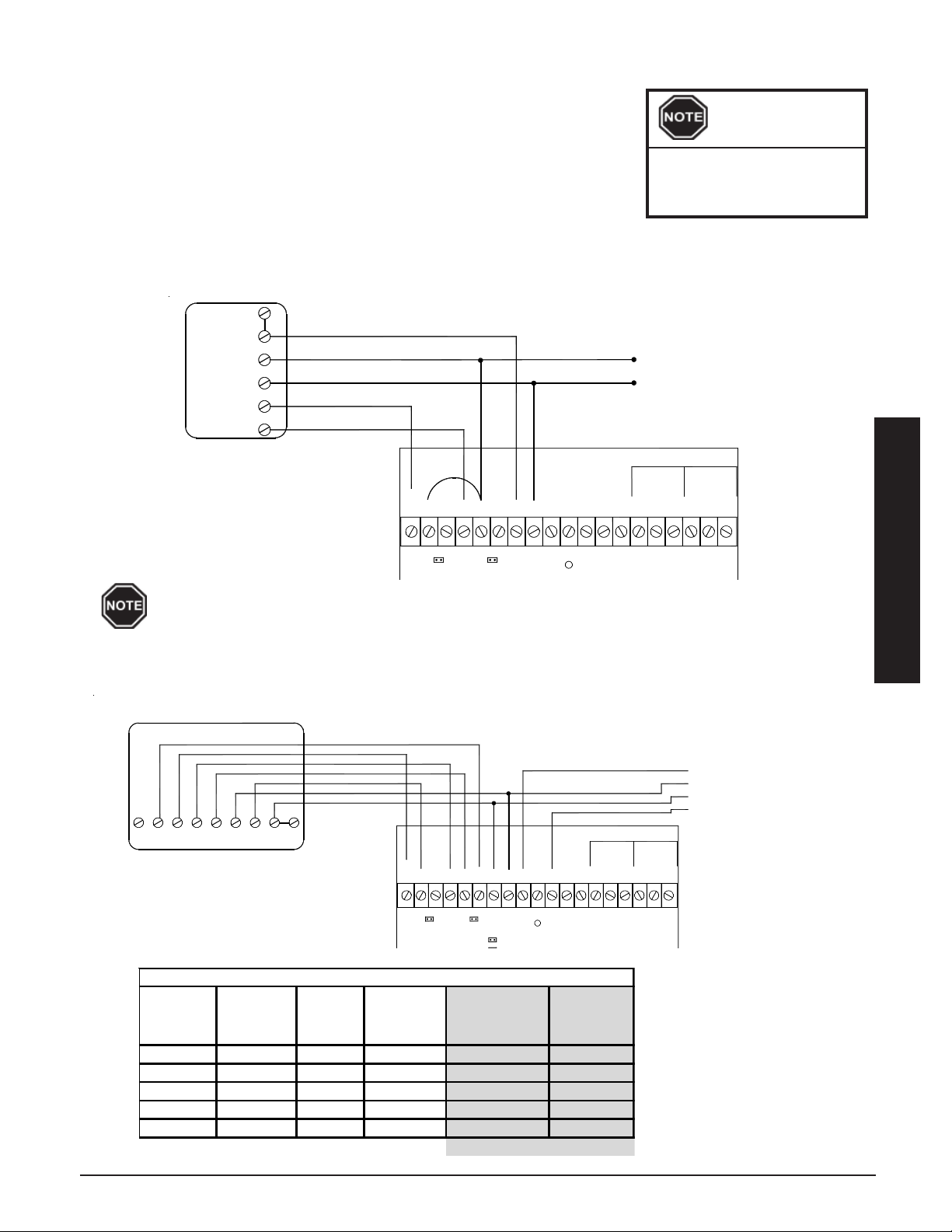
LOW VOLTAGE ELECTRICAL CONNECTIONS - ROOM
W/
NO
NC
COM
Outdoor
Outdoor
CR
H/E
O
W-EY1-Y2
Blower
Speed
AUX
G
Y2
Y1 O
22
Y1
Y2
RP2APP
TH5110D
R
G
W
C
Y
Honeywell
R
c
To Air
Aux.
Relay
Peak
Inputs
C
Y
The Y1-Y2 Jumper must be installed.
The W-E Jumper must be installed.
Conditioner
W/
NO
NC
COM
Outdoor
Outdoor
CR
H/E
The Y1-Y2 Jumper must be installed.
A
Speed
Blower
Y1-Y2 W-E
Y2Y1
AUX
OG RP
22
Y1 Y22O APP
RL E
Aux
G
O/B
C Y R
Honeywell TH5220D
To Heat Pump
O - Reversing Valve
R - Low Voltage Hot
C - Low Voltage Common
Y - Compressor
c
Inputs
Peak
Aux.
Relay
The W-E Jumper must be installed.
Thermostat
Stage
Thermostat
Output
Heat
Pump
Stage
% of
Selected
CFM
Heat Call Status
on Digital
Display*
Discharge Air
Temperature
Target
1 Y1/G 1 100% HC1 L048
2 Aux/Y1/G 1 100% HC2 L049
Fan G 0 400 cfm HCF N/A
Cool Y1/G/O 1 100% COOL N/A
Emergency
H/E 0 100% HC3 L049
SINGLE STAGE HEAT PUMP
Contractor Use Only
THERMOSTAT
A low voltage (24VAC) room thermostat is required for room temperature
control with the Comfort Plus Hydronic system. Steffes recommends using a
digital thermostat. If utilizing a mechanical thermostat, a load resistor may be
necessary due to the low current draw (.01 amps) on the heat call input circuit
of the Comfort Plus system. Contact the factory for information on thermostats
available from Steffes.
STAND ALONE FURNACE APPLICATION WITH VARIABLE SPEED BLOWER
CONNECTIONS SHOWN FOR SINGLE STAGE HEATING / SINGLE STAGE COOLING
(UNCONTROLLED AIR CONDITIONING)
FIGURE 14
Low voltage wires MUST
never enter any line
voltage enclosure.
IMPORTANT
IMPORTANT
èè
è
èè
If installing a mechanical thermostat or thermostat with anticipator, a resistor kit is required
(Order Item #1190015).
SINGLE STAGE HEAT PUMP APPLICATION WITH VARIABLE SPEED BLOWER
FIGURE 15
IMPORTANT
èè
è
èè
Installation
Comfort Plus Installation n 3.11
* If multiple inputs are active,
system will display highest
Heat Call values.
Page 20
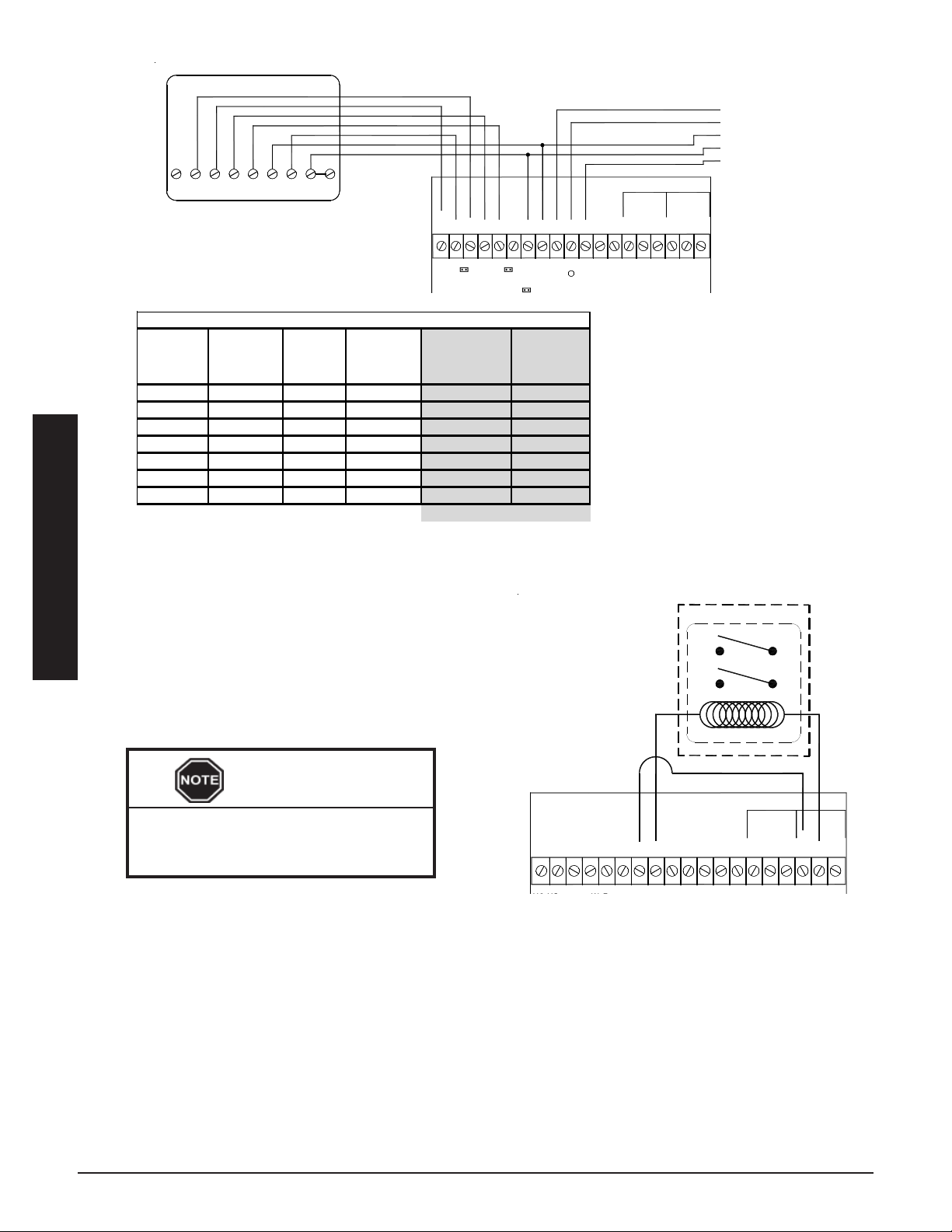
TWO STAGE HEAT PUMP APPLICATION WITH VARIABLE SPEED BLOWER
W/
NO
NC
COM
Outdoor
Outdoor
CR
H/E
Y2Y1
AUX
OG RP
22
Y1 Y22O APP
Inputs
Peak Aux.
Relay
Auxiliary Control Relay
Relay Contacts
Relay Coil
COM
NO/NC
COM
NO/NC
W/
NO
NC
COM
Outdoor
Outdoor
CR
H/E
The Y1-Y2 Jumper must be removed.
Speed
Blower
Y1-Y2 W-E
Y2
Y1AUX OG RP
22
Y1
Y2
2
O APP
RL Y2
Aux
G
O/B
C Y R
Honeywell TH5320U
Y1 - Compressor Stage 1
To Heat Pump
O - Reversing Valve
R - Low Voltage Hot
C - Low Voltage Common
Y2 - Compressor Stage 2
c
Inputs
Peak
Aux.
Relay
The W-E Jumper must be installed.
Thermostat
Stage
Thermostat
Output
Heat
Pump
Stage
% of
Selected
CFM
Heat Call
Status on
Digital Display*
Discharge Air
Temperature
Target
1 Y1/G 1 50% or 70%** HC1 L048
2 Y1/Y2/G 2 100% HC1 L048
3 Aux/Y1/Y2/G 2 100% HC2 L049
Fan G 0 400 cfm HCF N/A
Cool 1 Y1/G/O 1 50% or 70%** COOL N/A
Cool 2 Y1/Y2/G/O 2 100% COOL N/A
Emergency
H/E 0 100% HC3 L049
Contractor Use Only
TWO STAGE HEAT PUMP
FIGURE 16
IMPORTANT
èè
è
èè
* If multiple inputs are active, system
will display highest Heat Call values.
** Systems built before 1/1/2011 are
configured for 50% airflow in Stage 1.
For more information, refer to
Instruction #1200601-High Speed
Stage 1 Relay Installation.
AUXILIARY LOAD CONTROL
Installation
The Comfort Plus can be used to provide control signals to
other loads in the application. To do so, connect low voltage
control wires to the "COM" and "NC" or the "COM" and
"NO" positions of the low voltage terminal block in the
electrical compartment of the Comfort Plus system. (See
Figure 17.) These contacts are rated for 30 volts, 3 amps
maximum.
IMPORTANT
Maximum external load should not
exceed 60 VA on the system's class
II transformer.
HUMIDIFIER/ELECTRONIC FILTER INSTALLATION
The Comfort Plus is capable of being connected to a humidifier and/or an electronic air filter. If installing either
of these devices, connections to the Comfort Plus system are made to the bottom two relays on the base I/O
relay board inside the system's electrical panel. Refer to the Line Voltage Wiring Diagrams (Page A.09-A.12)
for the location of these relays.
If installing a humidifier, connect it to the "HEAT CALL" relay on the base I/O relay board. This relay closes
during a heat call.
If installing an electronic air filter, connect it to the "FAN ON" relay on the base I/O relay board. This relay
closes during a fan call. The maximum filter size if using a Steffes Return Air Plenum is 20" x 25" x 2.
Installation n 3.12 Comfort Plus
TYPICAL AUXILIARY LOAD CONTROL
FIGURE 17
NOTE: During off-peak (charge) periods, the con-
tact is closed between "COM" and "NC".
Page 21
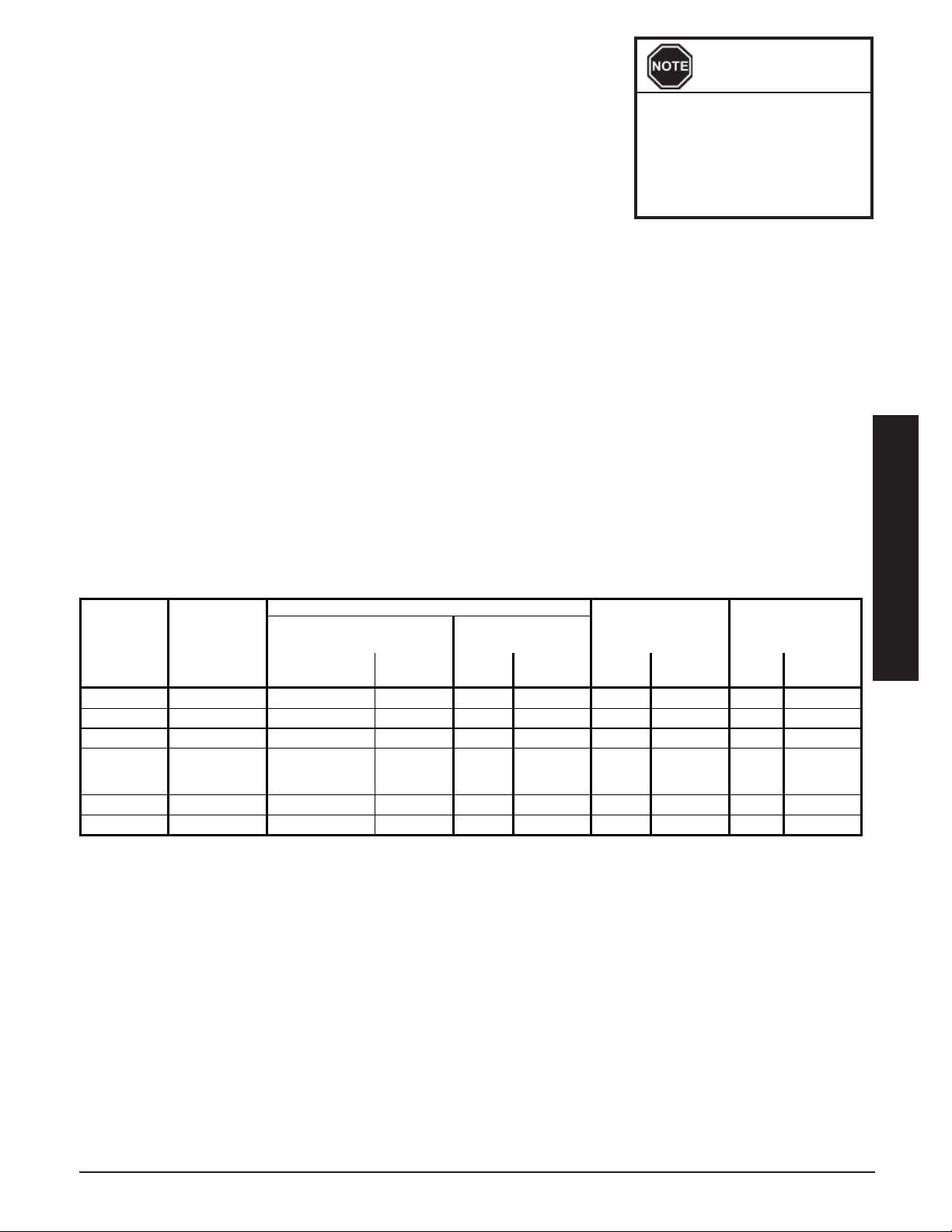
CONFIGURATION MENU
Configuration
Number
Power Line
Carrier (PLC)
Peak Control
Low Voltage Direct Wire Peak Control
Time Clock Module
Peak Control
Line Voltage Peak
Control
Peak Switch Closed
for Charging
Peak Switch Open
for Charging
Outdoor Sensor
(Factory Default)
No Outdoor
Sensor
Outdoor
Sensor
No Outdoor
Sensor
Outdoor
Sensor
No Outdoor
Sensor
Outdoor
Sensor
No Outdoor
Sensor
C000
5 5 6 5 6 5 6 5 6
C001
50°F 50°F 50°F 50°F 50°F 50°F 50°F 50°F 50°F
C002
10°F 10°F 10°F 10°F 10°F 10°F 10°F 10°F 10°F
C003
Match to the
Channel Selected
at PLC
0 0 0 0 0 0 0 0
C004
8 9 8 9 8 13 12 9 8
C005
0 1 1 0 0 0 0 1 1
The Steffes Comfort Plus heating system has a Configuration Menu, which
allows the system to be customized to the power company and consumer’s
needs. This menu can be accessed on start-up and allows configuration
settings to be easily adjusted.
To access the Configuration Menu:
Step 1 Energize the system. Access to the Configuration Menu is allowed
If access to Configuration Menu times out, the
15 amp circuit breaker
must be powered off and
back on to re-enter the
menu.
for the first two (2) minutes of operation. If the system has been
energized for more than two (2) minutes, the 15 amp circuit breaker must be powered off and back on to
gain access to this menu.
Step 2 Press and release the M button until faceplate displays “CONF”.
Step 3 Press the up arrow once and the faceplate will display “C000”. The faceplate will flash between “C000”
and the corresponding configuration value.
Step 4 If necessary, edit the configuration value by pressing and holding the M button while using the up or the
down arrow button to change the value.
Step 5 Once the value is correct, release the buttons and press the up arrow button to go to the next configura-
tion (C001,C002, etc.).
Step 6 Repeat steps 4 through 5 until all configuration settings have been adjusted to the desired values.
IMPORTANT
Step 7 Once configured, use the down arrow to leave the Configuration Menu.
In most applications only a few, if any, configuration changes will be necessary. Determine which method of
peak control is being utilized and configure as follows:
C000 Off-Peak Method of Charge Control - Sets the method of brick core charging to be used during off-
peak (charge) periods.
C001 Start Brick Core Charge Set Point - If utilizing automatic charge control as set in C000, this value
indicates the outdoor temperature at which the system starts charging.
C002 Full Brick Core Charge Set Point - If utilizing automatic charge control as set in C000, this value
indicates the outdoor temperature at which the system targets a full core charge.
C003 Power Line Carrier (PLC) Channel Selection – This value must match the channel selected at the
Steffes PLC transmitting device. A value of zero indicates PLC communication is disabled.
C004 Optional Controls Configuration - Tells the heater what controls are being used.
C005 Control Switch Configuration - If utilizing power line carrier control, the Steffes Time Clock Module, or
line voltage peak control this value MUST be zero.
Installation
Comfort Plus Installation n 3.13
Page 22
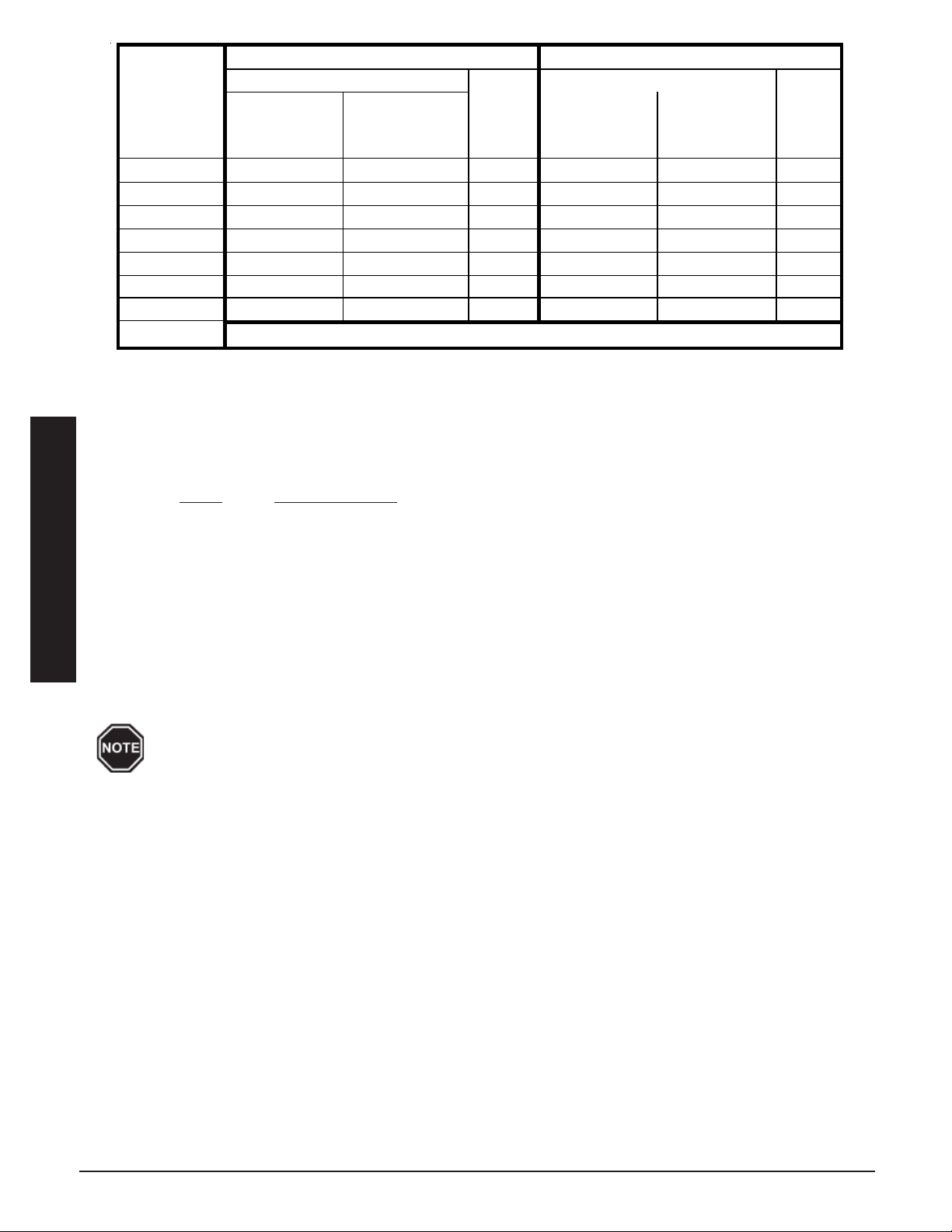
* Power Company controls vary from one area to another. Check with the power provider for the
Configuration
Number
3100 Series 4100 Series
Heat Pump
No Heat
Pump
Heat Pump
No Heat
Pump
Reversing Valve
Energized for
Cooling
Reversing Valve
Energized for
Heating
Reversing Valve
Energized for
Cooling
Reversing Valve
Energized for
Heating
C006 2 130 2 3 131 3
C007 30 30 30 30 30 30
C008 5°F 5°F 5°F 5°F 5°F 5°F
C009 5°F 5°F 5°F 5°F 5°F 5°F
C010 90°F 90°F 115°F 90°F 90°F 115°F
C011 70°F 70°F 70°F 70°F 70°F 70°F
C012 60°F 60°F 60°F 60°F 60°F 60°F
C013 - C021 Refer to the Time Clock Installation Instructions
proper setting.
C006 Output Control Configuration - Configures the output controls of the Comfort Plus system. To deter-
mine the value, check the options desired from the list below. Then, add the numbers from the “Value”
column and enter the sum into this location.
Value Option Selected
2 All 3100 Series Systems.
3 All 4100 Series Systems.
8 Enables compressor control if there is a "COOL" call during a peak (control) time.
32 If it is a peak (control) period and the Comfort Plus receives a cooling call, the com-
Installation
pressor will turn off and on in 20 minute intervals (off 20 minutes, on 20 minutes, off 20
minutes, etc.).
128 Interfaces Comfort Plus with a heat pump that has a reversing valve which is energized
for heating.
C007 Charge Factor - This configuration should be set to a value of 30.
C008 through C010 configurations are only applicable if the Comfort Plus system is being used in
conjunction with a heat pump.
C008 Heat Pump Compressor Outdoor Lock-Out Temperature for Off-Peak or Anticipated Peak
Modes - Indicates the outdoor temperature at which the heat pump’s compressor is locked out and not
allowed to operate during an off-peak or anticipated peak period.
C009 Heat Pump Compressor Outdoor Lock-Out Temperature for On-Peak Mode - Indicates the
outdoor temperature at which the heat pump’s compressor is locked out and not allowed to operate during
an on-peak period.
C010 Minimum Discharge Air Temperature - Sets the minimum discharge air temperature the system
targets during a Stage 1 heat call.
C011 Currently not utilized in the 3100/4100 Comfort Plus systems.
Installation n 3.14 Comfort Plus
C012 Currently not utilized in the 3100/4100 Comfort Plus systems.
C013-C021 Time Clock Module Configuration - These configuration settings are used to configure the
peak control times when utilizing the optional Steffes Time Clock Module. Refer to the installation
and configuration instructions included with the module for more information.
Page 23
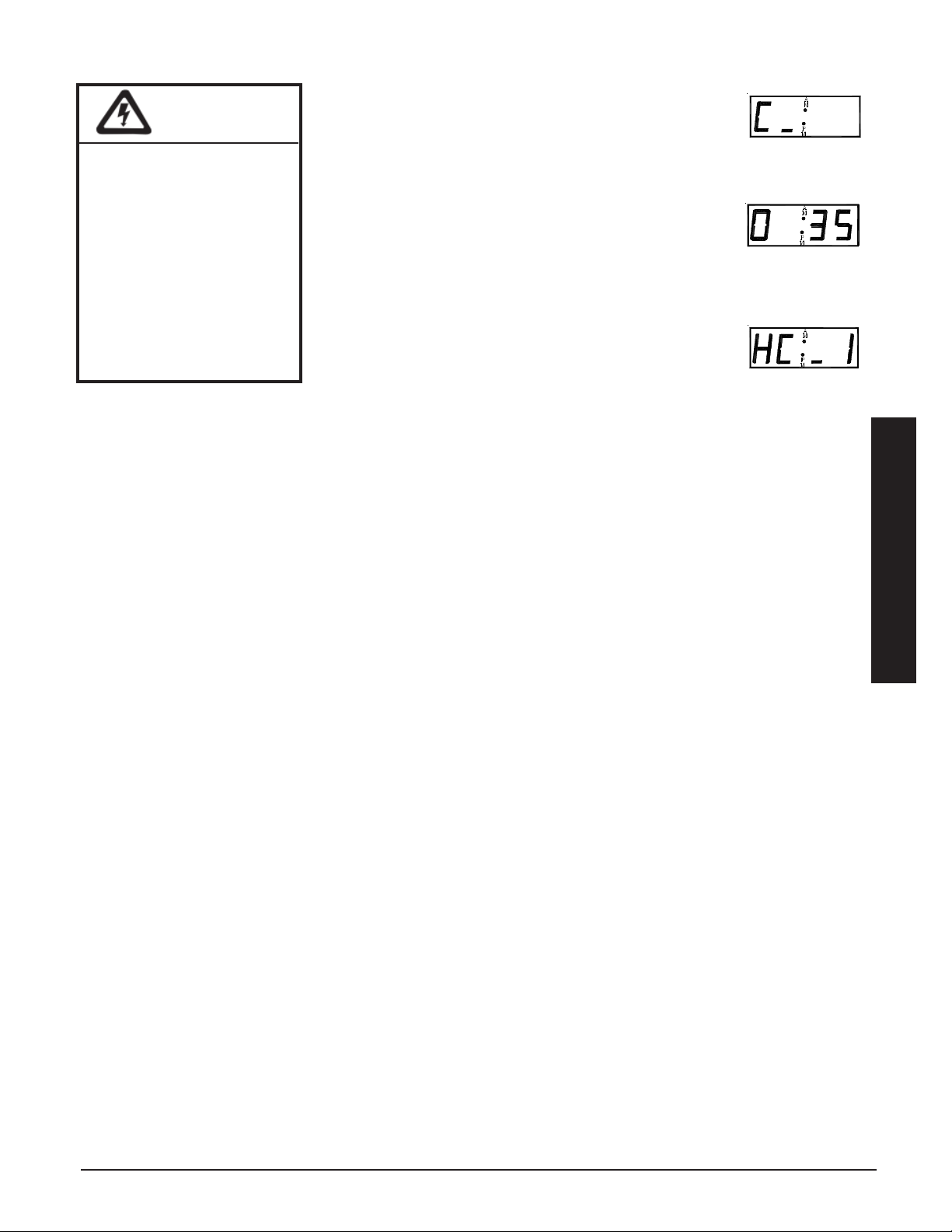
INSTALLER'S FINAL CHECK-OUT PROCEDURE
Step 1 Verify that the operating mode displayed on the
W ARNING
HAZARDOUS VOLTAGE:
Risk of electric shock.
Can cause injury or
death. System may be
connected to more than
one branch circuit.
Disconnect power to all
circuits before servicing.
Equipment must be
serviced by a qualified
technician.
Step 4 Initiate a heat call from the room thermostat and verify that the Comfort Plus system recognizes the
heat call. Refer to the Operating Status section (Page 1.02) for more information on the various heat
call status displays. The supply air blower should operate. In an application interfacing the Comfort Plus
system with an air conditioner or heat pump, verify that this device is operating appropriately.
Step 2 Press the up arrow one time and verify that the
Step 3 Press the up arrow again and the current heat call
control panel corresponds with the power
company's peak control signal. Refer to the
Operating Status section (Page 1.02) for more
information on the proper operating mode.
outdoor temperature information displayed on the
control panel is approximately the same as the
current outdoor temperature. Refer to the Operating Status section (Page 1.02) for more information
on the outdoor temperature display.
status will be displayed on the control panel. Refer
to the Operating Status section (Page 1.02) for
more information on the heat call status display.
Step 5 Initiate a cooling call from the room thermostat, if applicable, and verify that the Comfort Plus system
recognizes the “COOL” call. The supply air blower should operate. In an application interfacing the
Comfort Plus system with an air conditioner or heat pump, verify that this device is operating appropriately.
Step 6 Press the up arrow until the targeted brick core charge level is displayed on the control panel. With the
system in an off-peak (charge) mode, initiate a charge control override (Page 1.03.) Once initiated, the
target level of the Comfort Plus should be 100 percent and the control panel should display “tL: F”. All
of the elements should be energized.
Step 7 With an amp meter, verify that the amperage of the system is correct for the installation. Refer to the
System Identification Label on the Comfort Plus heating system for information regarding the proper
amperage.
Step 8 Cancel the charge control override and verify that all elements in the system de-energize. Refer to the
Charge Control Override section (Page 1.03) for instructions on canceling the charge control override.
Step 9 Verify, once again, that the Operating Mode displayed on the control panel corresponds with the power
company's peak control signal.
Step 10 In applications utilizing the Steffes Power Line Carrier control system, complete the Installer’s Final
Check-out Procedure in the Owner’s and Installer’s Manual provided with that device.
Step 11 Instruct the homeowner on how to operate their new heating system from the thermostat.
Step 12 Complete the manufacturer's warranty card and return promptly.
Installation
Comfort Plus Installation n 3.15
Page 24
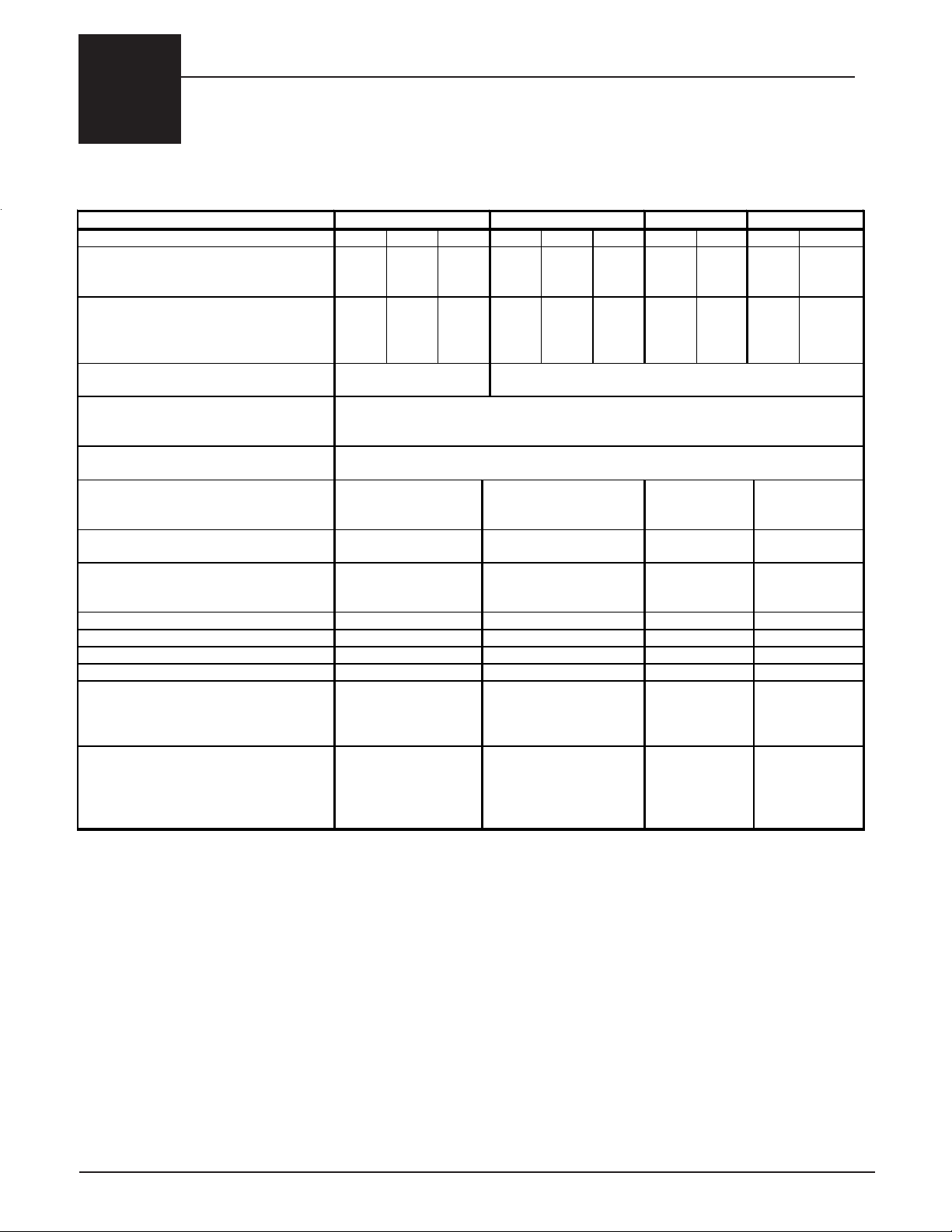
A
Model
3120 4120 4130 4140
Charging Input (kW)
14.0 17.5 21.6 14.0 19.2 24.8 28.8 37.2 38.4 45.6
Single Feed: Minimum Circuit Ampacity
(240V Systems)
(Includes 25% Derate for Continuous Load)
81 99 120 81 109 138 159 203 209 247
Charging Circuits Required
(240V Systems – Multiple Feed)
2 -
40AMP
2 -
50AMP
2 -
60AMP
2 -
30AMP
& 1 –
20AMP
1 -
30AMP
& 2 –
40AMP
2 -
60AMP
& 1 –
40AMP
4 -
40AMP
4 -
50AMP
4 -
50AMP
4 -
60AMP
Maximum Core and Supply Blower Load
(240V Systems)
6 AMPS 7 AMPS
Element Voltage
240V Standard (208V and 277V optional as special factory order)
Note: The 240V element circuits can be connected to 208V in standard configurations;
however, the charging input of the system will be derated by 25%.
Blowers/System
Controls Voltage
240V/208V
Storage Capacity
kWh
BTU
86
293,432
120
426,500
180
614,160
240
818,880
Dimensions without ducting
(W x D X H in inches)
41.6 x 27 x 60 29.2 x 44.7 x 46.6 29.2 x 44.7 x 57.6 29.2 x 44.7 x 68.6
Duct
Openings (inches)
Supply Air Outlet
Return Air Inlet
10.1 x 16
16.5 x 22.5***
18 x 22.6
10.5 x 22.6***
18 x 22.6
10.5 x 22.6***
18 x 22.6
10.5 x 22.6***
Approximate System Weight 440 lbs 485 lbs 565 lbs 625 lbs
Approximate Brick Weight
1,118 lbs 1,782 lbs 2,574 lbs 3,366 lbs
Approximate Installed Weight
1,628 lbs 2,267 lbs 3,139 lbs 3,991 lbs
Number of Elements
8 8 12 16
Number of Brick
Whole Brick
Half Brick
Number
of Boxes
72
0
18
105
6
27
150
12
39
198
12
51
*1/2 HP Maximum Coil Size
Capacity
Front Access Dimensions
Inner Dimensions
(W x D x H in inches)
Up to 3½ TON**
25.5 x 22 x 30
26 x 22 x 31
1½ to 5 TON**
25.5 x 22 x 30
26 x 22 x 31
1½ to 5 TON**
25.5 x 22 x 30
26 x 22 x 31
1½ to 5 TON**
25.5 x 22 x 30
26 x 22 x 31
Appendix
SPECIFICATIONS
* The return air plenum is factory supplied only with the 3100 series system. It can be ordered as an optional piece with
the 4100 series systems. The dimensions listed are those that the factory supplied return air plenum can accommodate.
For larger coils, the return air plenum must be installer supplied. If using an air conditioning or heat pump system with
the Comfort Plus, the Comfort Plus does not include the indoor coil or the outdoor compressor system as standard
equipment.
** The Comfort Plus system can accommodate most heat pump or air conditioner indoor coils provided the heat pump or air
conditioner is sized in accordance to supply air delivery rates of the Comfort Plus system. Equipment modifications are
required to fit larger coils.
• 3120 - 1/2 HP variable speed accomodates up to 3½ ton heating/cooling systems
• 4100 Series - 1/2 HP variable speed accommodates most 1½ to 4 ton heating/cooling systems
• 4100 Series - 1 HP variable speed accommodates most 3 to 5 ton heating/cooling systems
*** Dimension does not include the return air plenum.
Appendix
nn
n A.01 Comfort Plus
nn
Page 25
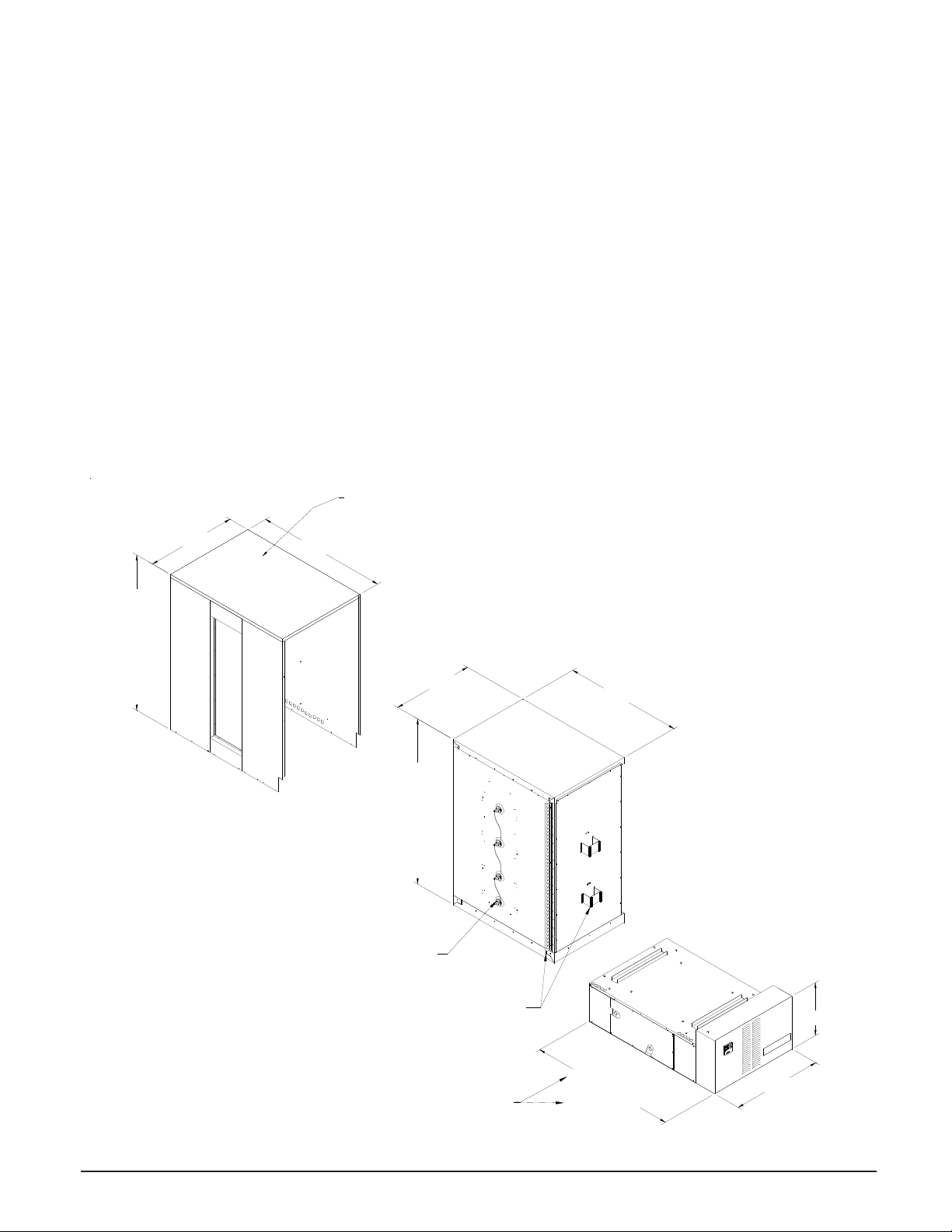
P
l
u
s
f
r
o
n
t
s
a
d
d
l
e
s
a
n
d
b
a
c
k
Z
-
B
r
a
c
k
e
t
L
i
m
i
t
s
a
n
d
R
i
g
h
t
S
i
d
e
S
a
d
d
l
e
i
n
c
l
u
d
e
d
Saddles and Z-brackets
can be removed if needed.
42 5/16"
Can be broken down into
individual panels.
29 3/16"
Do not remove
core limits.
28 7/8"
4140/5140
54 3/4"
4130/5130
43 3/4"
4120/5120
32 3/4"
4140/5140
56"
4130/5130
45"
4120/5120
34 1/2"
38 1/8"
29 3/16"
Including
Breakers
ALL 4100'S
45 3/4"
ALL 5100'S
48 1/4"
17 1/4"
DISASSEMBLING THE 4100 SERIES COMFORT PLUS SYSTEM
Step 1 Remove the painted front panel of the brick storage cabinet by removing the sheet metal screws along
the top, bottom, and sides of the panel. Detach by pulling the bottom of the panel forward and down.
Step 2 Remove the limit zone cover.
Step 3 Remove the screws around the perimeter of the limit zone and around the bottom of the left side, right
side, and back upper panels.
Step 4 There are two white/blue wires which route from the limit zone through a knockout. These wires route
into the electrical compartment through a romex connector. Loosen the romex connector.
Step 5 Remove the electrical panel cover and locate the point where the white/blue wires connect to the black/
yellow wires. Disconnect the white/blue wires and route them up through the romex connector.
Step 6 Remove the one to two screws in the center of the upper right side panel. From the back of the system,
lift and remove the painted panels (Figure A).
Step 7 Locate the brick core temperature sensor(s) behind the front panel and disconnect them from their
shipping position. Carefully lay the sensor(s) aside to avoid damaging them.
Step 8 Rock the brick core (Figure B) to one side and lift top portion up and off the base (Figure C).
Step 9 Move the Comfort Plus heating system into the desired location, reassemble, and continue with the
installation instructions in this manual.
FIGURE A
FIGURE B
FIGURE C
(5100 Base Shown)
Comfort Plus Appendix n A.02
Page 26
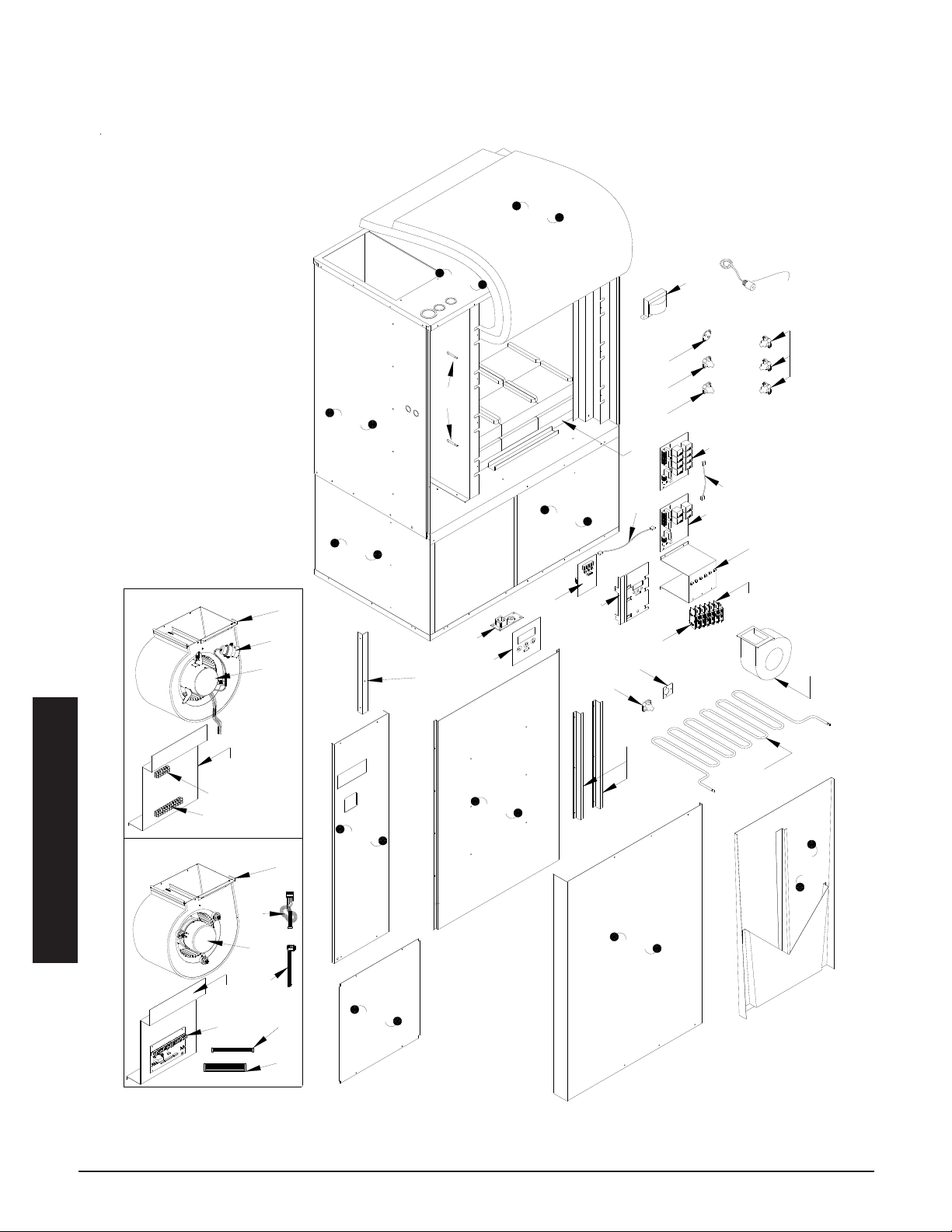
PARTS DIAGRAM - 3100 SERIES
25
13
15
14
19
42
17
16
8
18
19
26
43
22
3
2
1
10
7
9
6
21
37
39
20
38
40
23
5
B
r
i
c
k
S
i
d
e
V
i
e
w
4
11
28
34
27
12
29
36
33
31
35
32
24
41
30
13
VARIABLE SPEED MOTOR
PSC MOTOR
16
48
47
46
44
45
17
Appendix
Appendix n A.03 Comfort Plus
Page 27
PARTS LIST - 3100 SERIES
DWG.
REF.
NO.
DESCRIPTION
3120
ITEM NO.
1 Front Painted Panel, Right Side 5940728
2 Electrical Panel Cover 5940794
3 Front Galvanized Panel 5940770
4 Standoffs, Front 5940774
5 Core Blower 1021001R
6 Heating Elements *
7 Blower Access Cover 5940796
8 Supply Air Blower Support Bracket 5940702
9 Base Temperature Limit Switch 1012008R
10 Base Temperature Limit Mounting Bracket 5940711
11 Front Air Channel 5940779
12 Brick 5903015
13 Low Voltage Panel 5940748
14 Terminal Block 12 Position 1016040
15 Terminal Block 6 Position 1016041
16 Supply Air Blower Assembly (PSC) 1041630
" Supply Air Blower Assembly (Variable Speed)
1041631
17 Supply Air Blower 1/2 HP 1075 RPM (PSC) 1040086
" Supply Air Blower 1/3 HP 850 RPM (PSC) 1040090
" Supply Air Blower 1/2 HP (Variable Speed) 1020007R
18 Supply Air Blower Capacitor 1018006R
19 Supply Air Blower Mounting Bracket 5940704
20 Breaker Standoff 5940766
21 Processor Control Board Mounting Bracket 5940746
22 PCB Processor Control Board 1023065R
23 PCB Base I/O Relay Board 1023078R
24 PCB Relay Expansion 1023067R
25 Right Front Base Painted Panel 5940764
26 Back & Left Side Base Painted Panel 5940762
27 Upper Left Side Painted Panel 5940780
28 Top Painted Panel 5940768
29 Insulation Blanket Inner 1054110
" Insulation Blanket Outer 1054115
30 Core Limit Switch 320D 1012011R
When ordering parts, please include the system model and serial numbers.
* Optional voltages are available. Contact factory with model number and serial
number of the system for information.
Comfort Plus Appendix n A.04
Appendix
Page 28
PARTS LIST - 3100 SERIES CONTINUED
DWG.
REF.
NO.
DESCRIPTIO N
3120
ITEM NO.
31 Core Blower Limit Switch 130D 1012006R
32 Discharge Air High Limit Switch 160D 1012008R
33 Discharge Air Sensor 1041536R
34 Core Temperature Sensor 1041625R
35 Bottom Micropore Insulation Panel 1050124
36 Transformer 75VA 1017039
37 Breaker 15 Amp 1024000R
38 Breaker 60 Amp 1024002R
39 Interface Cable, 36" 1010016
40 Interface Cable, 12" 1010012
41 Outdoor Sensor - Knockout Style - 40' 1302044R
" Outdoor Sensor - Knockout Style - 8' 1302033
42 Faceplate Label 1159029
43 Time Clock Module (optional) 1301014
44 Harness Motor ECM Low Voltage 1011703
45 Harness Line Voltage Variable Speed 1011702
46 Harness Process Output Variable Speed 9 Pin 1011705
47 Harness Process Input Variable Speed 15 Pin 1011704
48 PCB ECM Motor Interface Variable Speed 1023082
When ordering parts, please include the system model and serial numbers.
Appendix
Appendix n A.05 Comfort Plus
Page 29
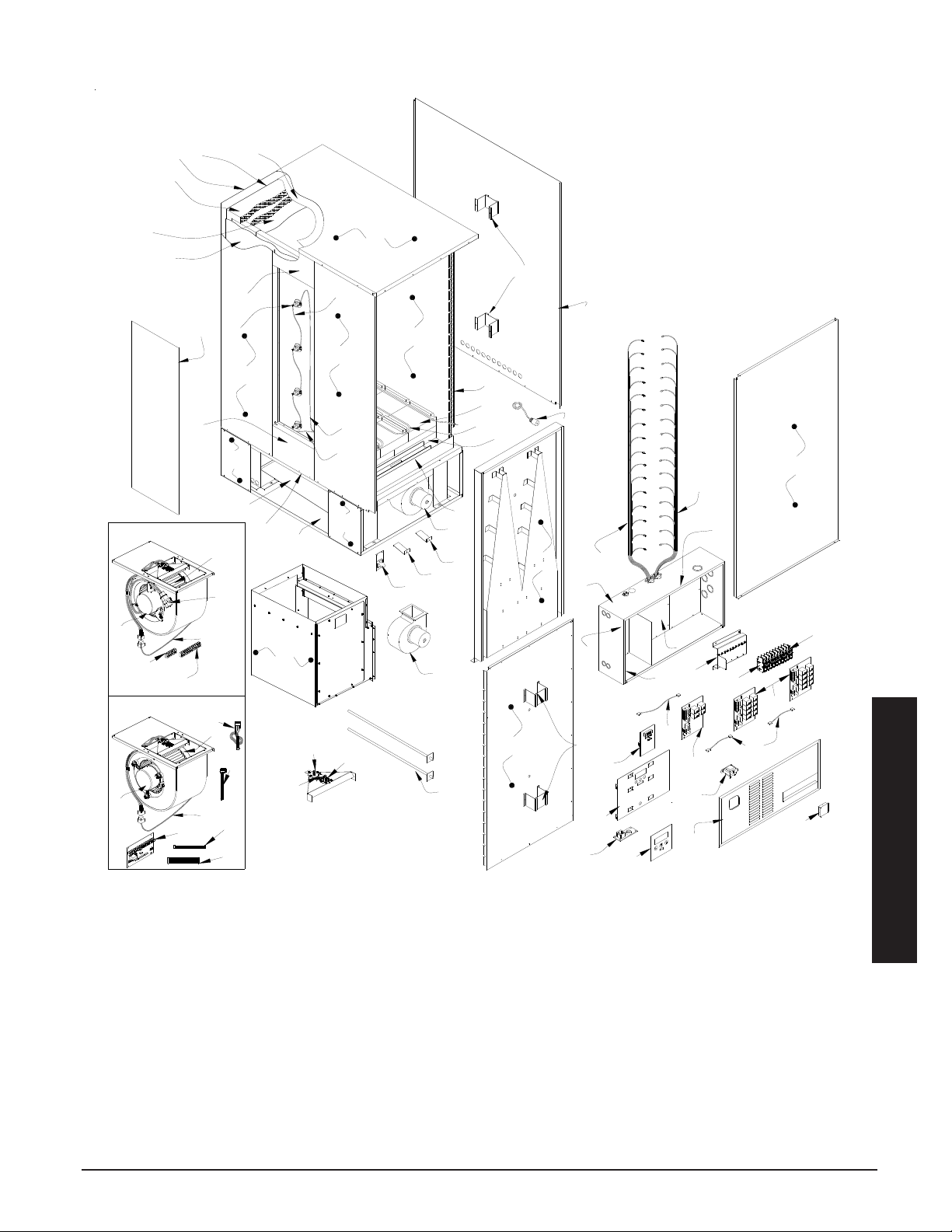
PARTS DIAGRAM - 4100 SERIES
1
2
10
3
4
5
6
11
12
9
7
18
19
13
16
14
15
30
31
29
28
27
26
25
33
53
52
51
50
49
48
47
45
34
35
32
46
44
43
36
37
38
42
24
23
40
39
57
60
59
58
20
21
22
41
62
64
63
65
66
17
67
B
r
i
c
k
S
i
d
e
V
i
e
w
68
57
54
56
55
8
PSC MOTORS
VARIABLE SPEED MOTORS
22
21
70
71
72
73
69
61
1A
58
61
Comfort Plus Appendix n A.06
Appendix
Page 30
PARTS LIST - 4100 SERIES
DWG.
REF.
NO.
DESCRIPTION
4120
ITEM NO.
4130
ITEM NO.
4140
ITEM NO.
1 Electrical Panel Cover 5940845 5940845 5940845
1A Breaker Filler 5940846 N/A N/A
2 Front Painted Panel 5940589 5940526 5940588
3 PCB Relay Expansion Board 1023067R 1023067R 1023067R
4 PCB Base I/O Relay Board 1023078R 1023078R 1023078R
5 Terminal Block 12 Position 1016040 1016040 1016040
6 Transformer 75VA 1017039 1017039 1017039
7 PCB Processor Control Board 1023065R 1023065R 1023065R
8 Processor Control Board Mounting Bracket
5940550 5940550 5940550
9 Breaker 15 Amp 1024000R 1024000R 1024000R
10 Breaker 60 Amp 1024002R 1024002R 1024002R
11 Breaker Standoff 5940034 5940034 5940034
12 Electrical Panel Insert Center 5940505 5940505 5940505
13 Electrical Panel Insert Left 5940504 5940504 5940504
14 Electrical Panel Insert Right 5940506 5940506 5940506
15 Harness, Breaker to Element Black 1041503 1041515 1041502
16 Harness, Relay to Element Red 1041501 1041513 1041500
17 Front Air Channel 5940515 5940521 5940514
18 Front Standoff 5940513 5940513 5940513
19 Front Galvanized Panel 5940579 5940524 5940578
20 Upper Brick Core Temperature Sensor N/A 1041525 1041525
" Lower Brick Core Temperature Sensor 1041525 1041525 1041525
21 Core Blower Spring 1159006 1159006 1159006
22 Core Blower 1021001R 1021001R 1021001R
23 Base Temperature Limit Switch 1012008R 1012008R 1012008R
24 Brick Tray 5940548 5940548 5940548
25 Insulation Block TR19 1054144 1054144 1054144
26 Heating Elements * * *
27 Brick 5903015 5903015 5903015
28 Right Side Core 5940559 5940557 5940558
29 Outdoor Sensor - Knockout Style - 40' 1302044R 1302044R 1302044R
" Outdoor Sensor - Knockout Style - 8' 1302033 1302033 1302033
30 Right Side Painted Panel 5940587 5940525 5940586
31 Right Side Standoff 5940570 5940570 5940570
32 Micropore Insulation Panel 1050122 1050121 1050120
33 Top Painted Panel 5940590 5940590 5940590
34 Core Limit Jumper 1041510 1041510 1041510
35 Left Side Front Painted Panel 5940597 5940529 5940596
36 Limit Harness Top 1041506 1041505 1041505
37 Limit Harness Bottom 1041504 1041504 1041504
When ordering parts, please include the system model and serial numbers.
Appendix
* Optional voltages are available. Contact factory with model number and serial number
of the system for information.
Appendix n A.07 Comfort Plus
Page 31
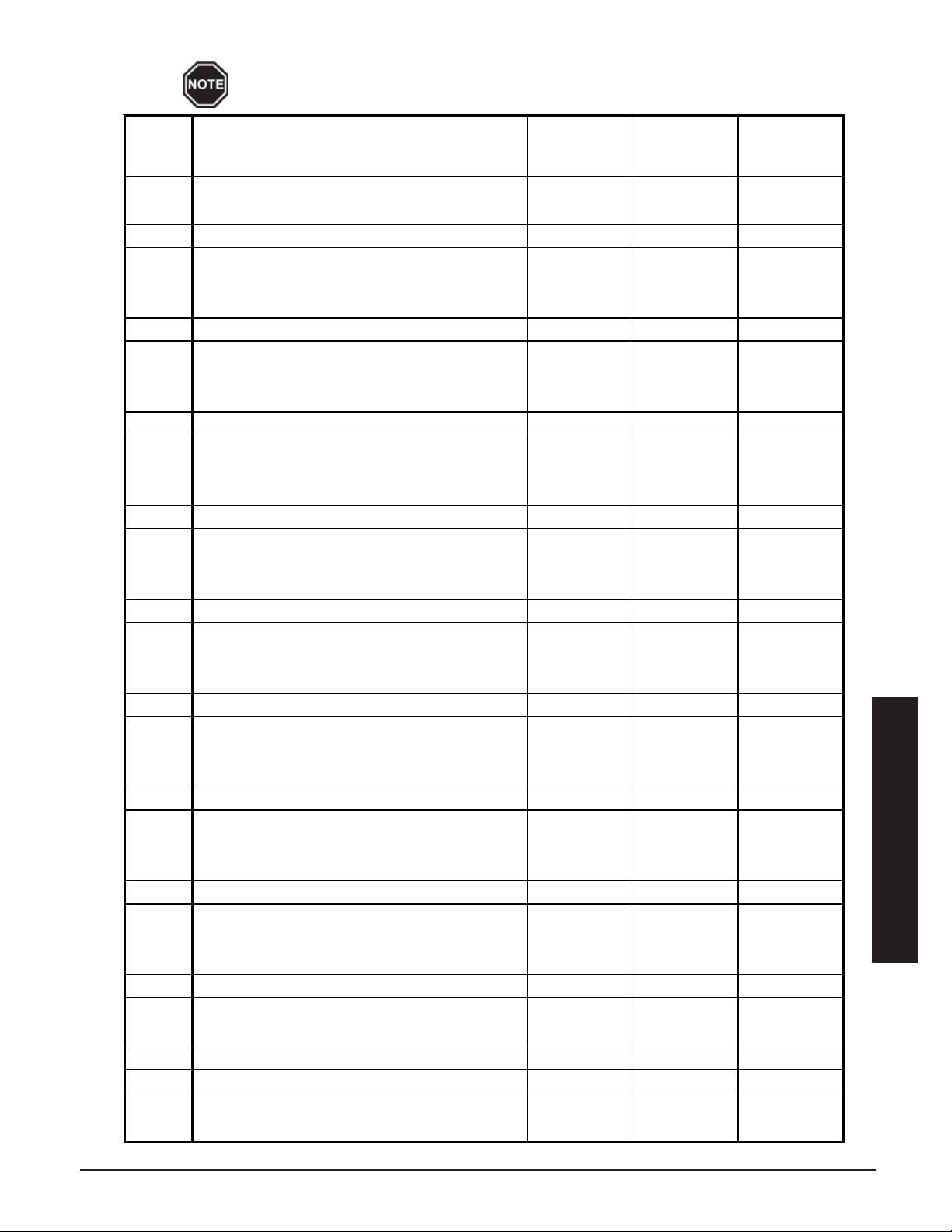
PARTS LIST - 4100 SERIES CONTINUED
DWG.
REF.
NO.
DESCRIPTIO N
4120
ITEM NO.
4130
ITEM NO.
4140
ITEM NO.
38 Left Side Front Base Panel 5940580 5940580 5940580
39 Bottom Panel 5940568 5940568 5940568
40 Base Top Panel 5940566 5940566 5940566
41 Base Deflector Panel 5940502 5940502 5940502
42 Back Bottom Base Painted Panel 5940582 5940582 5940582
43 Left Side Bottom Painted Panel 5940594 5940594 5940594
44 Left Side Back Painted Panel 5940599 5940530 5940598
45 Core Limit Switch 290D 1012019R 1012019R 1012019R
46 Limit Zone Painted Cover 5940585 5940527 5940591
47 Left Side Top Painted Panel 5940584 5940584 5940584
48 Left Side Core Panel 5940561 5940565 5940560
49 Insulation Blanket Inner 1054130 1054134 1054140
50 Insulation Blanket Outer 1054132 1054136 1054142
51 Back Painted Panel 5940593 5940528 5940592
52 Galvanized Core Panel Back 5940563 5940567 5940562
53 Galvanized Core Panel Top 5940564 5940564 5940564
54 Core Blower Limit Switch 160D 1012008R 1012008R 1012008R
55 Discharge Air Sensor 1041536R 1041536R 1041536R
56 Supply Air Blower Limit Switch 190D 1012026R 1012026R 1012026R
57 Supply Air Blower Wiring Harness 1011701 1011701 1011701
58 PSC Motors with capacitor
" Supply Air Blower 1/2 HP 1075 RPM 1040086 1040086 1040086
" Supply Air Blower 3/4 HP 1075 RPM 1040091 1040091 1040091
" Variable Speed Motors
" Supply Air Blower 1/2 HP (Variable Speed) 1020007R 1020007R 1020007R
" Supply Air Blower 1 HP (Variable Speed) 1020008R 1020008R 1020008R
59 Supply Air Blower Capacitor 1018006R 1018006R 1018006R
60 Plenum Assembly 1022009 1022009 1022009
61 Blower Wheel 1021000 1021000 1021000
62 Terminal Block 6 Position 1016041 1016041 1016041
63 Electrical Panel, Main Body 5940556 5940556 5940556
64 Electrical Panel, Bottom 5940554 5940554 5940554
65 Interface Cable, 18" 1010014R 1010014R 1010014R
66 Interface Cable, 12" 1010012R 1010012R 1010012R
67 Faceplate Label 1159029 1159029 1159029
68 Time Clock Module (optional) 1301014 1301014 1301014
69 PCB ECM Motor Interface Variable Speed 1023082 1023082 1023082
70 Harness Motor ECM Low Voltage 1011703 1011703 1011703
71 Harness Line Voltage Variable Speed 1011702 1011702 1011702
72 Harness Process Output Variable Speed 9 Pin 1011705 1011705 1011705
73 Harness Process Input Variable Speed 15 Pin 1011704 1011704 1011704
When ordering parts, please include the system model and serial numbers.
Comfort Plus Appendix n A.08
Appendix
Page 32
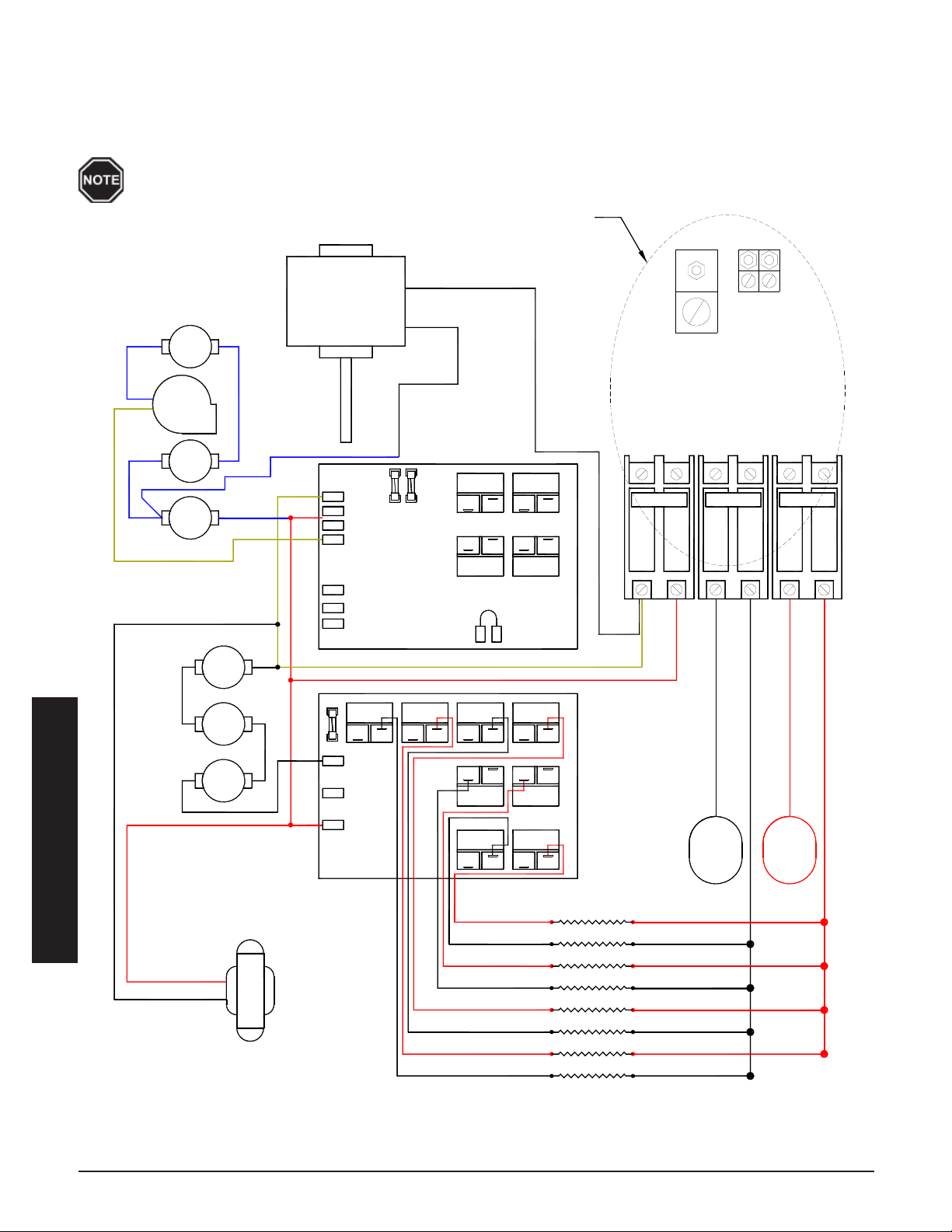
INTERNAL SYSTEM WIRING DIAGRAMS - LINE VOLTAGE
RELAY
RELAY
COM
LIMIT
75VA
TRANSFORMER
240v 24v
ELEMENT 7
EXPANSION
BOARD
#1
COM
NO
L2 240
L2 120
ELEMENT 5
RED
LIMIT
LIMIT
CORE
CORE
COMCOMCOM
NO
L1
1/4 Amp
NO
NONO
ELEMENT 1 ELEMENT 3ELEMENT 2
CORE
DAMPER
BASE IO BOARD
BLACK/YELLOW
RESISTER
RESISTOR
Element 4
Element 2
Element 1
Element 3
COM
CIRCUIT #2
CONTROLS
BLOWERS/
CIRCUIT #1
HEAT CALL
NO
COM
COM
NO
15A 60A 60A
CHARGE
CIRCUIT
CHARGE
GROUND
LUGS
BLACK
SEE NOTE
Element 7
Element 5
Element 6
HEATING ELEMENTS
Element 8
ELEMENT 8
Element
NO
COM
Relays
1, 3, 5, 7
ELEMENT 6
To
Element
2, 4, 6, 8
Relays
To
COM
BLACK
NO
NO
ELEMENT 4
RED
N.C.
N.C.
160 °
N.C.
BLACK/YELLOW
BLOWER
L2 240
FAN ON
NO
COM
5 Amp
L2 120
L1
COM
NO
1/4 Amp
BLOWER
130 °
CORE
BLUE/WHITE
160 °
BLUE
BLACK
BLACK
VARIABLE SPEED BLOWER
Line Voltage Wiring Diagram - Model 3120
240V OR 208V SYSTEMS ONLY
Use copper or aluminum conductors rated for 75oC or higher for field connection of this device.
Appendix
NOTE: Line Voltage Field Wiring Connections - See Figure 10 for information on circuit phasing
connections.
Appendix n A.09 Comfort Plus
Page 33
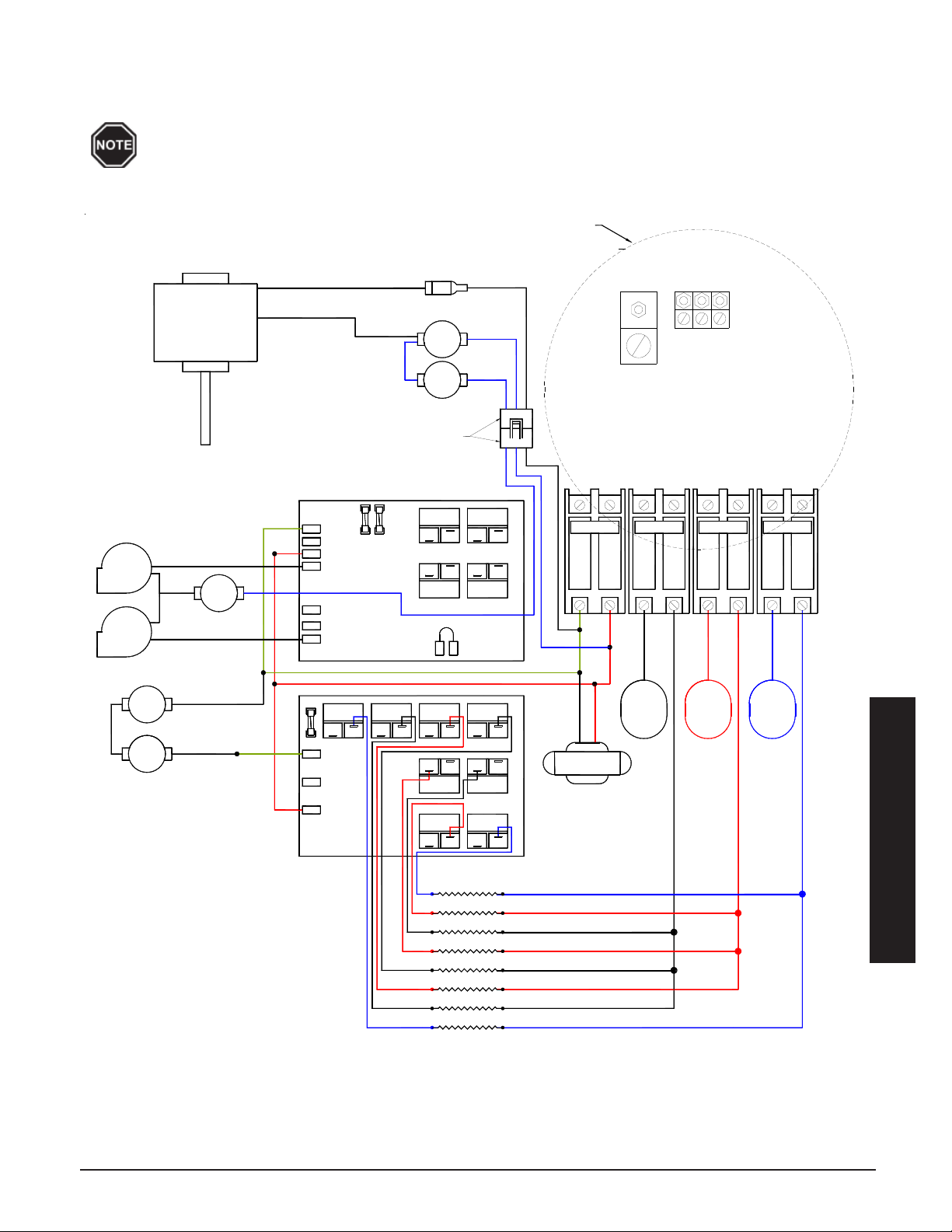
Line Voltage Wiring Diagram - Model 4120
160 °
BLOWER
HEAT CALLFAN ON
ELEMENT 2
COM
BASE IO BOARD
#1
EXPANSION
BOARD
L2 120
L2 240
RED
COMCOM
CORE
LIMIT
WHITE/BLACK
NO
L1
1/4 Amp
LIMIT
CORE
WHITE/BLACK
ELEMENT 1
BLOWER
BLACK
CORE
DAMPER
N.C.
WHITE
RESISTOR
RESISTER
Element 2
Element 1
Element 3
Element 4
COM
COM
Element 7
Element 6
Element 5
HEATING ELEMENTS
Element 8
ELEMENT 7 ELEMENT 8
TRANSFORMER
NONO
COM COM
240v / 24v
ELEMENT 5 ELEMENT 6
75 VA
RED
Element
2,4,6
COM COM
NONONO
NO
NO
ELEMENT 3 ELEMENT 4
To
Relays
1,83,5,7
To
ElementToElement
Relays Relays
BLACK
BLACK/YELLOW
BLUE
BLUE/WHITE
RELAY RELAY
RED
BLUE
in the base of the
Heater & Plenum
Connectors located
L2 120
BLACK
CORE
L2 240
BLOWER
5 Amp
L1
BLACK
VARIABLE SPEED BLOWER
BLACK
CIRCUIT #1
CIRCUIT #3
CIRCUIT #2
CONTROLS
60A
NONO
COM
NO
NO
COM
1/4 Amp
COMCOM
15A 60A60A
CHARGE
BLOWERS/
CIRCUIT
CHARGE
CHARGE
N.C.
9 Pin Header
LUGS
GROUND
N.C.
160 °
BLUE/WHITE
MANUAL RESET
BLUE
190 °
BLUE/BLACK
BLUE/BLACK
SEE NOTE
Use copper or aluminum conductors rated for 75oC or higher for field connection of this device.
240V OR 208V SYSTEMS ONLY
NOTE: Line Voltage Field Wiring Connections - See Figure 10 for information on circuit phasing
connections.
Comfort Plus Appendix n A.10
Appendix
Page 34
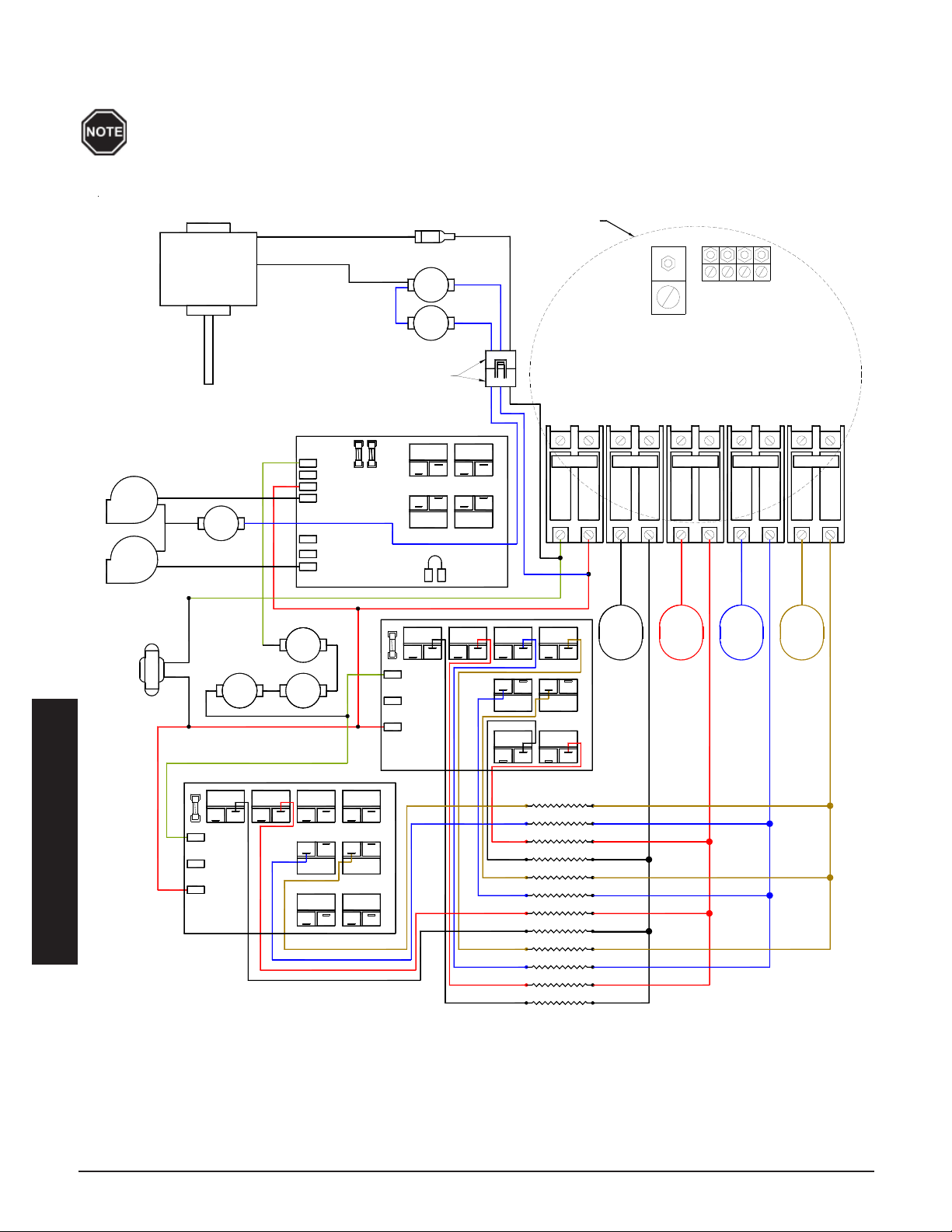
Line Voltage Wiring Diagram - Model 4130
DAMPER
BLOWER
LIMIT
CORE
BLACK/YELLOW
RED
75 VA
240v 24v
TRANSFORMER
WHITE/BLACK
RED
CORE
LIMIT
LIMIT
CORE
RED
BLACK/YELLOW
BASE IO BOARD
BLACK
BLACK
WHITE
160 °
CORE
N.C.
CORE
BLOWER
CIRCUIT #3
CHARGE
CIRCUIT #4
CHARGE
CIRCUIT #1
CHARGE
CIRCUIT #2
CHARGE
CIRCUIT
CONTROLS
BLOWERS/
L2 120
NO
FAN ON
RELAY
RESISTOR
RESISTER
L2 240
BLOWER
RELAY
BLUE/WHITE
NO
HEAT CALL
COM
COM
COM
L1
1/4 Amp5 Amp
NO
COM
NO
15A 60A 60A 60A 60A
BROWN
BLACK
RED
BLUE
#2
Element 2
Element 1
Element 3
Element 4
EXPANSION
ELEMENT 5
L1
L2 240
BOARD
L2 120
NO
1/4 Amp
COM
COM COM
BOARD
HEATING ELEMENTS
NO
COM COM
NO
ELEMENT 11
COM
NO
ELEMENT 12
NO
COM
Element 7
Element 5
Element 6
Element 8
Element 9
#1
ELEMENT 6
NONO
COM COMNOCOM
Element 12
Element 10
Element 11
NO NO
L2 120
L2 240
EXPANSION
L1
1/4 Amp
ELEMENT 7 ELEMENT 8
ELEMENT 9 ELEMENT 10
NO
COM
NO
COM
COM
ELEMENT 1
COM
ELEMENT 3
NO
COM
NO
ELEMENT 2
NO
COM
NO
ELEMENT 4
ToTo To
Element
2,6,10
Relays
Element
1,5,9
Relays
Element
3,7,11
Relays
To
Element
4,8,12
Relays
GROUND
LUGS
in the base of the
BLUE
9 Pin Header
Connectors located
VARIABLE SPEED BLOWER
BLACK
BLACK
BLUE/BLACK
N.C.
BLUE/WHITE
N.C.
160 °
MANUAL RESET
BLUE
190 °
BLUE/BLACK
Heater & Plenum
SEE NOTE
240V OR 208V SYSTEMS ONLY
Use copper or aluminum conductors rated for 75oC or higher for field connection of this device.
Appendix
Appendix n A.11 Comfort Plus
NOTE: Line Voltage Field Wiring Connections - See Figure 10 for information on circuit phasing
connections.
Page 35
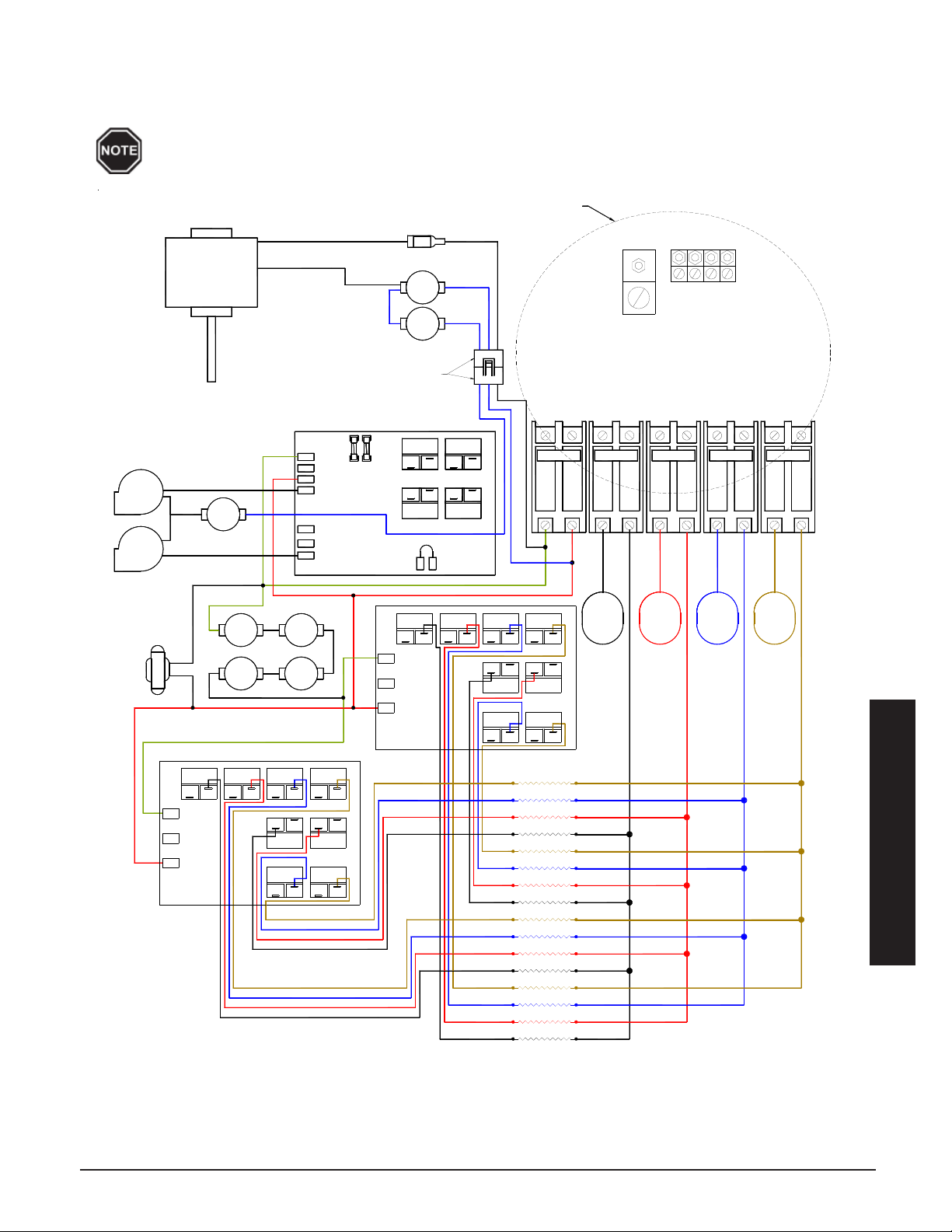
Line Voltage Wiring Diagram - Model 4140
75 VA
TRANSFORMER
240v 24v
REDRED
RED
BLACK/YELLOW
CORE
LIMIT LIMIT
CORE
WHITE/BLACK
LIMIT
CORE
LIMIT
CORE
BLOWER
CORE
BLOWER
CORE
RESISTOR
BLUE/WHITE
RESISTER
DAMPER
RED
BLACK/YELLOWBLACK/YELLOW
BLACK
BASE IO BOARD
L2 120
BLOWER
L2 240
BLACK
N.C.
160 °
WHITE
L1
RELAY
FAN ON
NO
COM
NO
RELAY
COM
HEAT CALL
1/4 Amp
COM
5 Amp
NO
COM
NO
15A 60A 60A 60A60A
CIRCUIT #3
CIRCUIT #4
BLOWERS/
CONTROLS
CIRCUIT #1
CIRCUIT #2
CIRCUIT
CHARGE
CHARGE
CHARGE
CHARGE
SEE NOTE
RelaysRelays
Relays
Relays
ELEMENT 4ELEMENT 3ELEMENT 2ELEMENT 1
Element 5
Element 2
Element 1
Element 3
Element 4
Element 15
COM
NONO
COMNOCOMCOM
NO
EXPANSION
#2
BOARD
COMCOM
NO NO
ELEMENT 14
ELEMENT 16ELEMENT 15
ELEMENT 13
NO
NO
COM
COM
Element 10
Element 7
Element 6
Element 8
Element 9
Element 11
Element 12
Element 14
Element 13
NO
ELEMENT 9
COM
NO
ELEMENT 11
HEATING ELEMENTS
ELEMENT 8ELEMENT 6ELEMENT 5 ELEMENT 7
#1
BOARD
EXPANSION
COM
NO
COM COM
NONO
COM
Element 16
COM
NO
ELEMENT 12
ELEMENT 10
NO
COM
1,5,9,13
COM
NO
2,6,10,14 4,8,12,163,7,11,15
BLACK
RED
Element
To To
Element
BLUE
BROWN
Element
To
Element
To
GROUND
LUGS
BLACK
VARIABLE SPEED BLOWER
BLACK
Connectors located
in the base of the
9 Pin Header
BLUE/BLACK
BLUE/WHITE
160 °
N.C.
190 °
BLUE
MANUAL RESET
N.C.
BLUE
BLUE/BLACK
Heater & Plenum
240V OR 208V SYSTEMS ONLY
Use copper or aluminum conductors rated for 75oC or higher for field connection of this device.
Comfort Plus Appendix n A.12
NOTE: Line Voltage Field Wiring Connections - See Figure 10 for information on circuit phasing
connections.
Appendix
Page 36
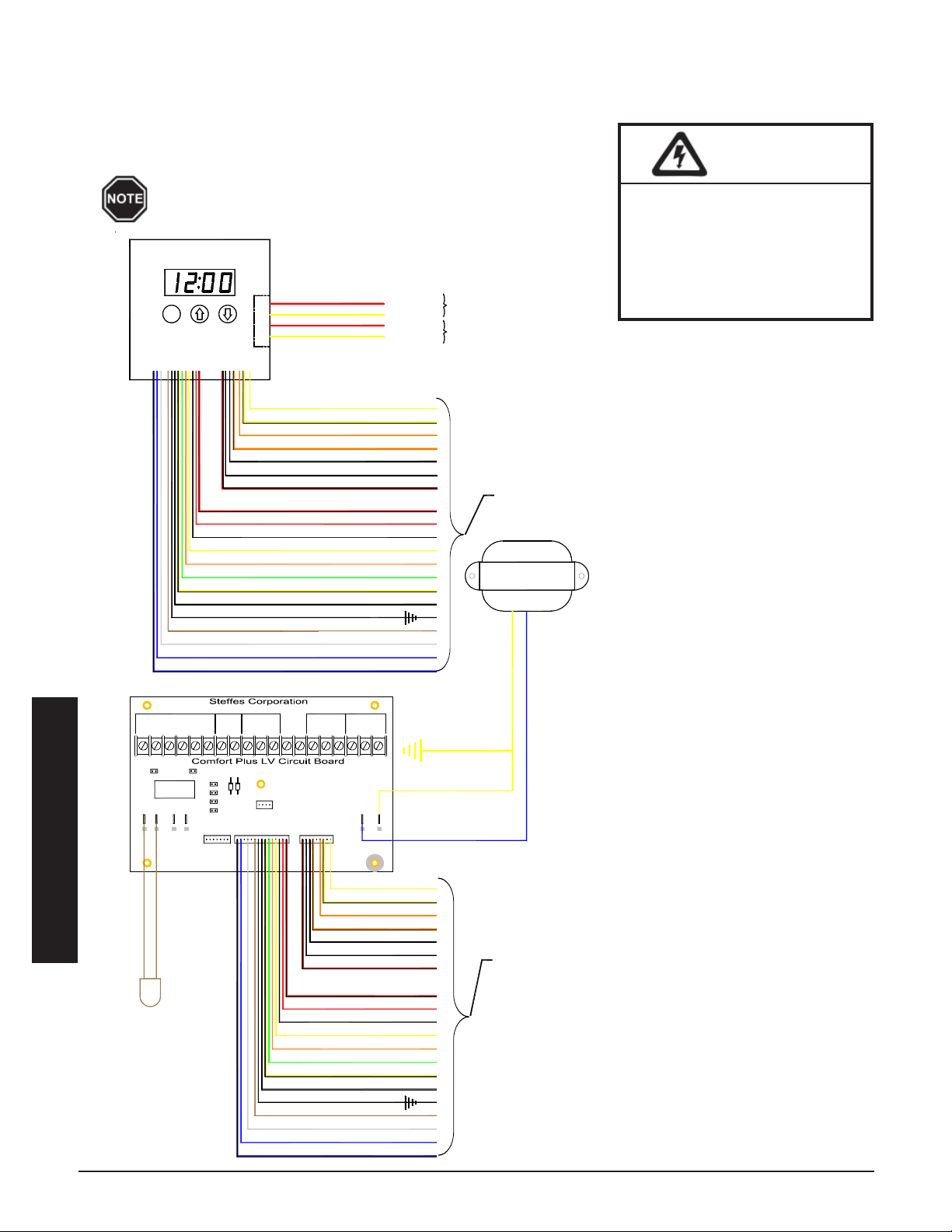
INTERNAL SYSTEM WIRING DIAGRAM - LOW VOLTAGE
Relay
Inputs
Outdoor
Outdoor
Pump
VAC
24
2
Water
P3P2P1
Air
P11
W/
Y1AUX Y2
J5
Y1 Y2
RLY1
J2
D1
Blower
B
C
D
P4
P5
D2
J4
J3
P6
H/E
Speed
Blower
A
OG
J6
W/E
Y1
CR
J1
P
To Control Board
P7
2Y22
O
RP
RP8C
P9
NC
AP COM NO
Thermostat
Peak
Heat
Aux.
M
P
M
A
M
BLUE
YELLOW
TRANSFORMER
75 VA
R
C
PROCESSOR BOARD
TO LOW VOLTAGE
TO PROCESSOR
CONTROL BOARD
CIRCUIT BOARD
+
-
+
-
LOWER BRICK CORE SENSOR
UPPER BRICK CORE SENSOR
RED
YELLOW
YELLOW
RED
3120/4120/4130/4140
3120/4130/4140
"Y2"
2
YELLOW
WHITE/BLACK
RED/BLACK
WHITE/RED
ORANGE
ORANGE
BLUE/BLACK
WHITE/BLACK
YELLOW/BLACK
ORANGE
YELLOW
BLUE
WHITE
BROWN
GRAY
BLACK
GREEN
RED
WHITE
"SC"
19
"RS"
20
"W"
10
"P"
"DS"
"OS"
"C"
"O"
"G"
"AP"
"Y"
15
17
18
16
13
14
11
12
"COM"
"RP"
"E"
"NO"
"NC"
"O2"
"R"
7
8
9
5
6
3
4
YELLOW
"R"
1
SENSOR
DISCHARGE
AIR
YELLOW
1
17BROWN
BLUE/BLACK
BLUE
GRAY
19
20
18
RED
9
YELLOW/BLACK
GREEN
WHITE/BLACK
BLACK
YELLOW
ORANGE
WHITE
13
15
16
14
11
12
10
ORANGE/BLACK
YELLOW/BLACK
WHITE/BLACK
RED/BLACK
WHITE/RED
WHITE
ORANGE
5
7
8
6
3
4
2
The outdoor temperature sensor, room thermostat, and peak control device are connected via low voltage wiring.
System Low Voltage Wiring Diagram
The "R" and "C" positions in the low voltage terminal
strip may be used as a source of 24 VAC for powering
external low voltage devices (60 VA maximum).
W ARNING
HAZARDOUS VOLTAGE: Risk
of electric shock. Can cause
injury or death. All low voltage wiring must be segregated from line voltage
circuits in the system.
Appendix
Appendix n A.13 Comfort Plus
Page 37
HELP MENU
The Comfort Plus contains a Help Menu which may be accessed through the control panel. To access the
Help Menu, press and release the M button until the faceplate displays “HELP”. Scroll through the menu by
pressing either the up or the down arrow button.
Display
Reading Description
Fxxx Firmware Version Number - Indicates the version of software installed.
O xx Outdoor Temperature - Indicates current outdoor temperature as recognized by the system.
tL:xx Target Level - Indicates the percentage of brick core charge level the system is targeting.
During peak periods the value displays as "tL_".
CL:xx Charge Level - Indicates the percentage of heat storage currently in the brick core.
HE x Heating Elements Active - Indicates the total number of heating elements currently energized.
PC x Power Line Carrier Channel - Indicates the channel on which the system is set to receive PLC
communication signal.
P x Power Line Carrier Net Hit Rate Percentage - Indicates the percentage of "GOOD" communi-
cation packets received by the system from the PLC transmitter system.
PS x Indicates which Specialty Timer the system is currently using. The value displayed will be zero if
the Specialty Timer is not being utilized.
CC_x Charge Mode Operation - Indicates the charge control method being utilized during off-peak
periods.
CA_x A-Peak Mode Operation - Indicates the charge control method being utilized during anticipated
peak periods.
C1_x Specialty Timer #1 Charge Mode - Specialty Applications Only.
C2_x Specialty Timer #2 Charge Mode - Specialty Applications Only.
HUxx Heat Usage - Indicates the amount of input being dissipated by the system.
A_xx Target Discharge Air Temperature - Indicates the discharge air temperature that the system is
targeting.
cxxx Compressor Output Relay Delay Timer - Indicates time remaining before heat pump compressor
is energized. "c ON" indicates the heat pump is energized.
ERROR CODES
The Comfort Plus has an on-board diagnostic system to monitor various
operating conditions. If operating conditions move outside the normal operating
range, an error code is displayed on the faceplate. If there are multiple errors
simultaneously, only the highest priority error code appears. Once corrected,
the next highest priority code will be displayed on the faceplate as “Er—” (i.e.,
Er05).
Error Code Description
01 The lower core (Core A) thermocouple temperature is
out of normal range. An open, shorted, or otherwise
defective thermocouple or a circuit board which is out of
calibration can cause this.
02 The upper core (Core B) thermocouple temperature is out of normal range. This can be
caused by an open, shorted, or otherwise defective thermocouple or a circuit board which is
out of calibration.
03 Room sensor temperature is out of normal range. This can indicate an open thermistor, a
short in the wiring, or a circuit board which is out of calibration.
04 Discharge air sensor temperature is out of normal range. This can indicate an open ther-
mistor, a short in the wiring, or a circuit board which is out of calibration.
W ARNING
HAZARDOUS VOLTAGE:
Risk of electric shock. Can
cause injury or death.
System may be connected
to more than one branch
circuit. Disconnect power to
all circuits before servicing.
Equipment must be serviced
by a qualified technician.
Appendix
Comfort Plus Appendix n A.14
Page 38

Error Code Description
05 Outdoor sensor (direct wired) temperature reading is out of normal range. The thermistor
circuit may be open or shorted, the processor control board may be out of calibration, or there
may be an incorrect value in L035.
06 Outdoor sensor temperature from the transmitting device (PLC system) is out of normal
range. Check the outdoor sensor attached to the transmitting device and the transmitter for
proper operation.
07 Main processor control board temperature sensor is out of normal operating range. Verify
that none of the clearances have been violated and inspect the condition of the processor
control board.
08-09 Currently not utilized.
10 Discharge air temperature has exceeded maximum standard operating temperatures.
11-19 Contact a qualified service technician.
20 There is no communication occurring between the Base I/O board and the processor control
board. This can be caused by a defective board interface cable or an unresponsive Base I/O
board.
21 There is no communication occurring with the first relay expansion board. The interface
cable may be defective or the first expansion board may be unresponsive.
22 There is no communication occurring with the second relay expansion board. The interface
cable may be defective or the second expansion board may be unresponsive.
23 There is no communication occurring with the Steffes Time Clock Module.
24 Temperature sensor offset/reference is out of range and indicates that one of the sensors or
25 Power line carrier system is active; however, no good data has been received.
26 Insufficient main control board memory. Contact a qualified service technician.
27 Insufficient permanent memory. Contact a qualified service technician.
28 Permanent memory change has been made. Press the M button to accept. This error
29 On-board communication system is not fully operable. Contact a qualified service technician.
30 Base I/O control board is in test mode. Check the jumper configuration on the circuit board.
31 Relay expansion board(s) are in test mode. Check the jumper configuration.
Appendix
39 Indicates the value in Configuration 2 (C002) has been set to a value greater than the value in
40 Press and release the M button to clear the error. If the error code reappears, contact a
41-44 Contact a qualified service technician.
the core thermocouple may be shorted to ground or the processor control board may be out of
calibration.
message indicates a change has been made to the software program; therefore, it is important
to verify that all location settings are correct for the application.
Configuration 1 (C001). The system will not charge until the value in C002 is set lower than
C001.
qualified service technician.
Cold Core The brick core temperature is below 40 degrees or the core sensing thermocouple may be
open.
Core Fail Core high limit switch may be open.
PLC Fail The system is configured for power line carrier control; however, is not receiving a valid
power line carrier communication signal.
Appendix n A.15 Comfort Plus
Page 39

GLGL
OSSAROSSAR
GL
OSSAR
GLGL
OSSAROSSAR
YY
Y
YY
Anticipated Peak ~ Used only by certain power
companies as an alternative method of storing heat in
the brick core.
Automatic Charge Control ~ Method of brick core
charge regulation where a sensor monitors outdoor
temperature to automatically adjust the brick core
temperature. Indicated by an "A" on the system display.
Manual Charge Control ~ Method of brick core
charge regulation where the owner must periodically
adjust the brick core temperature setting in relation to
the outdoor temperature.
Microprocessor ~ Device on the circuit board of
the system which stores and processes the information for controlling the operation of the system.
Brick Core Charge Level ~ The amount of heat that
is stored in the brick core.
Charge Period ~ Off-peak time in which the system
is allowed to store heat in its brick core. Indicated by an
"C" on the system display.
Control Panel ~ Contains the buttons to adjust and
the display to indicate system functions.
Control Period ~ On-peak time in which the system
is not allowed to store heat in its brick core. Indicated
by an "P" on the system display.
Edit Mode ~ Process of changing or viewing the
values in a microprocessor location. This is accomplished with the use of the M (mode) button, the ñ
(up arrow) button, and the ò (down arrow) button.
Location (Function) ~ Where the specific operating
information of the system is stored. These locations
are part of the system microprocessor and are accessed
through the control panel. Displayed as an "L" on the
faceplate when in the edit mode.
Off-peak ~ The time during the day or night when
the power company can supply electricity more
economically and may offer a special incentive such
as a reduced electric rate or billing credits for the
electricity consumed during this time. Typically,
electrical usage is not controlled during an off-peak
time. (The system will provide heat to satisfy
comfort requirements during this time as well as
charge or store heat in its brick core.)
On-peak ~ The time during the day or night when
the power company experiences a high demand for
electricity. To limit demand, certain appliances are
controlled to avoid usage by them and/or a premium
for the electricity consumed during this time may be
charged to discourage electrical usage. (The system
is not allowed to charge or store heat in its brick core
during peak periods. Heating requirements are
satisfied by only the heat it has stored in its brick
core.)
Outdoor Sensor ~ Device that senses outdoor air
temperatures and communicates this information to
the Comfort Plus for automatic charge control.
Location Value ~ The specific information set and
stored in a location on the microprocessor which
defines system operation. A value for a specific
location is accessed through the control panel.
Comfort Plus Appendix n A.16
Room Temperature Set Point ~ The targeted
room temperature the system is to maintain. If the
room thermostat senses a temperature below this
point, the heater's blower will come on and extract
heat from the brick core.
Appendix
Page 40

W
Registering your purchase is an essential step to ensure warranty coverage. A Warranty Registration card
is included with the Owner's Manual. Simply complete, detach the bottom portion, and return the card
today. Retain the top portion of the card for your files.
WARRANTY STATEMENT
Steffes Corporation (“Steffes”) warrants that the Steffes ETS Electric Thermal Storage Heating Appliance is free from
defects in materials and workmanship under normal use and service. Steffes’ obligation under this Warranty is limited
to the repair or replacement of the appliance or parts only which prove to be defective under normal use within five
(5) years of the date of purchase, limited to seven (7) years from the date of manufacture, and which Steffes’
examination of the returned appliance or part(s) shall verify to Steffes’ satisfaction that it is defective. The user shall
be responsible for any labor costs associated with the repair or replacement of the appliance or part(s), including the
cost of returning the defective appliance or part(s) to Steffes Corporation.
This Warranty is void if the heating appliance is moved from the premises in which it was originally installed. This
Warranty shall not apply to an appliance or part which has been altered in any respect, or improperly installed, serviced
or used, or has been subject to accident, negligence, abuse or misuse.
Warranty
THE ABOVE WARRANTY BY STEFFES IS EXCLUSIVE AND IN LIEU OF ALL OTHER WARRANTIES, WHETHER WRITTEN OR ORAL, EXPRESS OR IMPLIED, INCLUDING ANY IMPLIED
WARRANTY OF MERCHANTABILITY OR OF FITNESS FOR A PARTICULAR PURPOSE.
The buyer assumes all risk and liability whatsoever resulting from the use of this heating appliance. In no event shall
Steffes be liable to purchaser for any indirect, special or consequential damages or lost profits.
This Limited Warranty contains the complete and exclusive statement of Steffes’ obligations with respect to the heating
appliance and any parts thereof. The provisions hereof may not be modified in any respect except in writing signed
by a duly authorized officer of Steffes.
Thank you for purchasing Steffes ETS heating equipment. We welcome your comments
relating to the Comfort Plus and this manual. Enjoy your new purchase!
3050 Hwy 22 North • Dickinson, ND 58601-9413• www.steffes.com
DOCUMENT #1200051
 Loading...