

Page 1
Cordless
Telephone
3-867-314-21 (1)
Operating Instructions
Mode d‘emploi
US
FR
SPP-ID976
©1999 by Sony Corporation
Page 2

WARNING
To prevent fire or shock hazard, do
not expose the unit to rain or
moisture.
To avoid electrical shock, do not open
the cabinet. Refer servicing to
qualified personnel only.
INDUSTRY CANADA NOTICE
NOTICE: The Industry Canada label
identifies certified equipment. This
certification means that the equipment
meets certain telecommunications
network protective, operational and
safety requirements as prescribed in the
appropriate Terminal Equipment
Technical Requirements document(s).
The Department does not guarantee the
equipment will operate to the user’s
satisfaction.
Before installing this equipment, users
should ensure that it is permissible to be
connected to the facilities of the local
telecommunications company. The
equipment must also be installed using
an acceptable method of connection.
The customer should be aware that
compliance with the above conditions
may not prevent degradation of service
in some situations.
Repairs to certified equipment should be
coordinated by a representative
designated by the supplier. Any repairs
or alterations made by the user to this
equipment, or equipment malfunctions
may give the telecommunications
company cause to request the user to
disconnect the equipment.
Caution: Users should not attempt to
make such connections themselves, but
should contact the appropriate electric
inspection authority, or electrician, as
appropriate.
NOTICE: The Ringer Equivalence
Number (REN) assigned to each
terminal device provides an indication
of the maximum number of terminal
allowed to be connected to a telephone
interface. The termination on an
interface may consist of any
combination of devices subject only to
the requirement that the sum of the
Ringer Equivalence Number of all the
devices does not exceed 5.
IMPORTANT INSTRUCTION TO
USERS
Your model (SPP-ID976) has been
approved by the Industry Canada.
Note
Operation is subject to the following two
conditions: (1) this device may not cause
interference, and (2) this device must
accept any interference, including
interference that may cause undesired
operation of the device.
Privacy of communications may not be
ensured when using this telephone.
DIGITAL SECURITY CODE
Your SPP-ID976 has been assigned a
permanent and unique digital security
code out of possible 16.8 million codes.
Users should ensure for their own
protection that the electrical ground
connections of the power utility,
telephone lines and internal metallic
water pipe system, if present, are
connected together. This precaution may
be particularly important in rural areas.
US
2
Page 3

Table of contents
Getting Started
4 Read this first
5 Step 1: Checking the package
contents
6 Step 2: Setting up the base phone
9 Step 3: Preparing the battery
pack
12 Step 4: Entering the area code
15 Identifying the parts
Basics
18 Making calls
21 Redialing
22 Receiving calls
Telephone Features
24 Speed dialing
24 Storing phone numbers and
names
26 Making calls with speed
dialing
27 Phone Directory
27 Storing phone numbers and
names
29 Changing a stored name
and/or phone number
30 Erasing a memory location
30 Making calls from the Phone
Directory
32 Setting the ringer type
32 Turning off the ringer of the
handset
33 Switching the phones during a
call
33 To switch from the base
phone to the handset
33 To switch from the handset
to the base phone
34 Talking between the phones
(Intercom)
34 To talk from the handset to
the base phone
34 To talk from the base phone
to the handset
36 Transferring a call
36 To transfer from the base
phone to the handset
37 To transfer from the handset
to the base phone
Caller ID Features
38 Understanding the Caller ID
service
38 When you receive a call
39 Looking at the Caller ID list
39 Viewing the Caller ID list
40 Erasing data from the
Caller ID list
42 Using the Caller ID list
42 Calling back a number from
the Caller ID list
43 Storing a number of the
Caller ID list into the Phone
Directory
44 To change the number of
digits of the phone number
46 Using “Caller ID with Visual Call
Waiting” service
47 Using visual message waiting
service
Additional Information
49 Mounting the base phone on a
wall
50 Notes on power sources
51 Maintenance
52 Troubleshooting
55 Specifications
56 Index
US
Table of contents
US
3
Page 4
Getting Started
Read this first
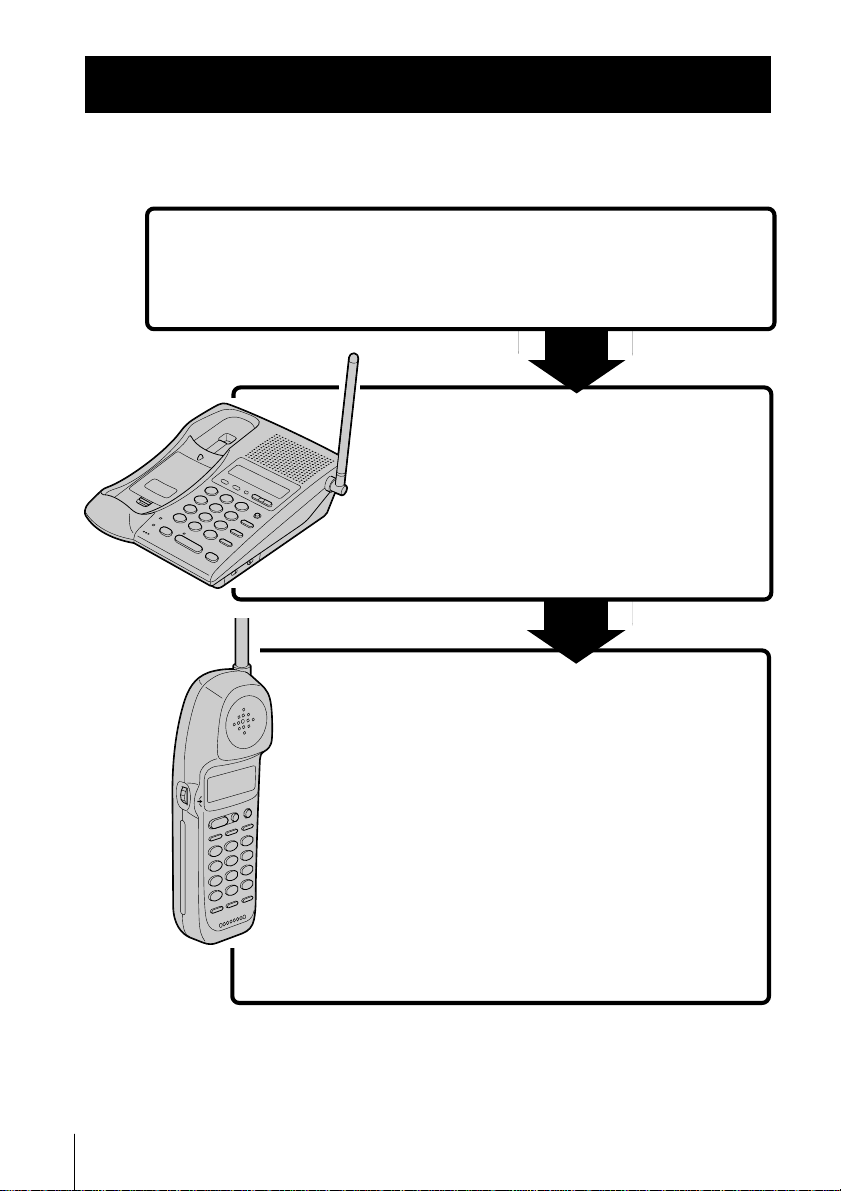
Before you use your phone, you must first set it up. Here’s a quick way
to set up your phone: Steps 1, 2, 3 and 4.
Step 1 (page 5)
First, unpack the phone and the supplied
accessories.
Step 2 (pages 6 to 8)
Next, you need to do three things to set
up the base phone, including finding the
best location for the base phone.
Base phone
US
Getting Started
4
Step 3 (pages 9 to 10)
Then, insert the battery pack into the
handset and charge it for more than 12
hours.
Step 4 (pages 12 to 14)
Finally, enter the area code to use the
Caller ID service.
Handset
That’s it!
Page 5
Step 1
Checking the package contents
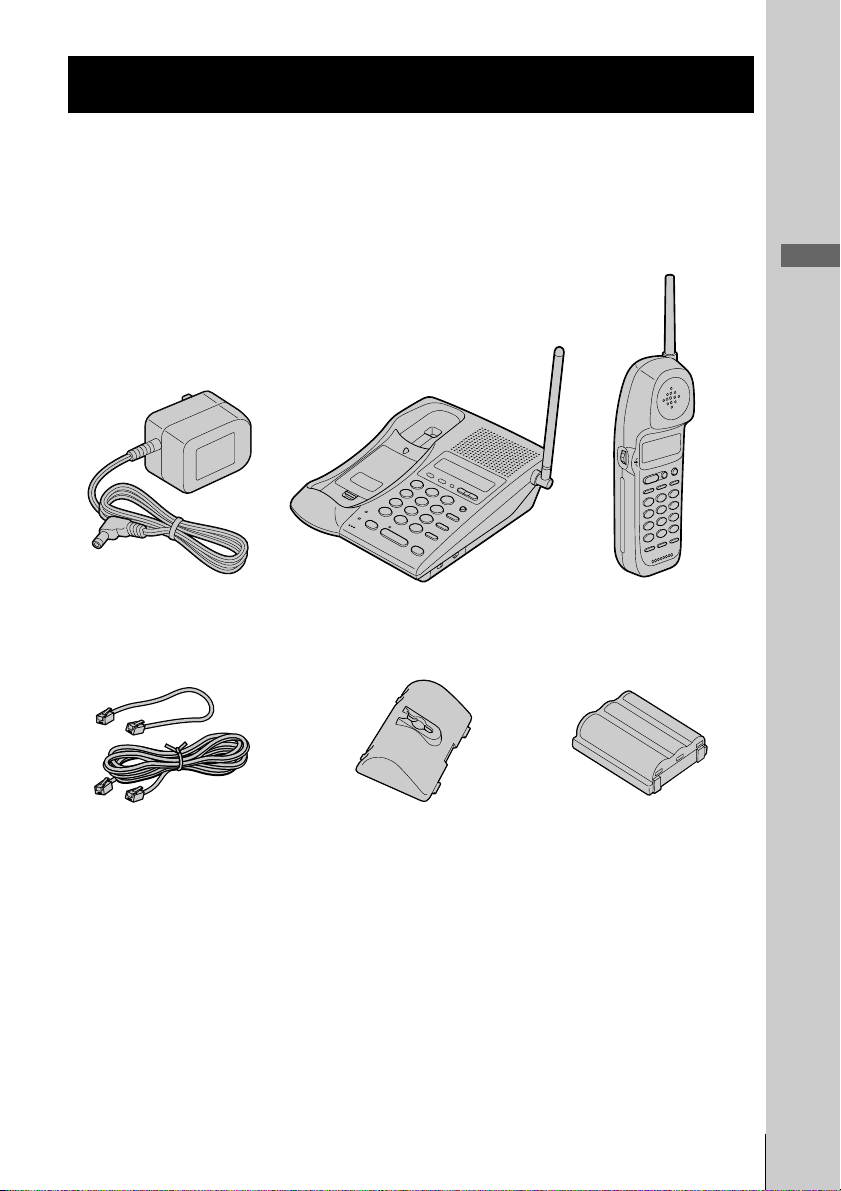
Make sure you have received the following items in the package.
If anything is missing, contact your local Sony dealer.
Getting Started
Telephone line cords (2)
Base phone
Wall bracket for base phone
HandsetAC power adaptor (AC-T122)
Rechargeable battery
pack (BP-T23)
Getting Started
US
5
Page 6
Step 2
Setting up the base phone
Do the following steps:
• Choose the best location
• Connect the base phone
• Choose the dialing mode
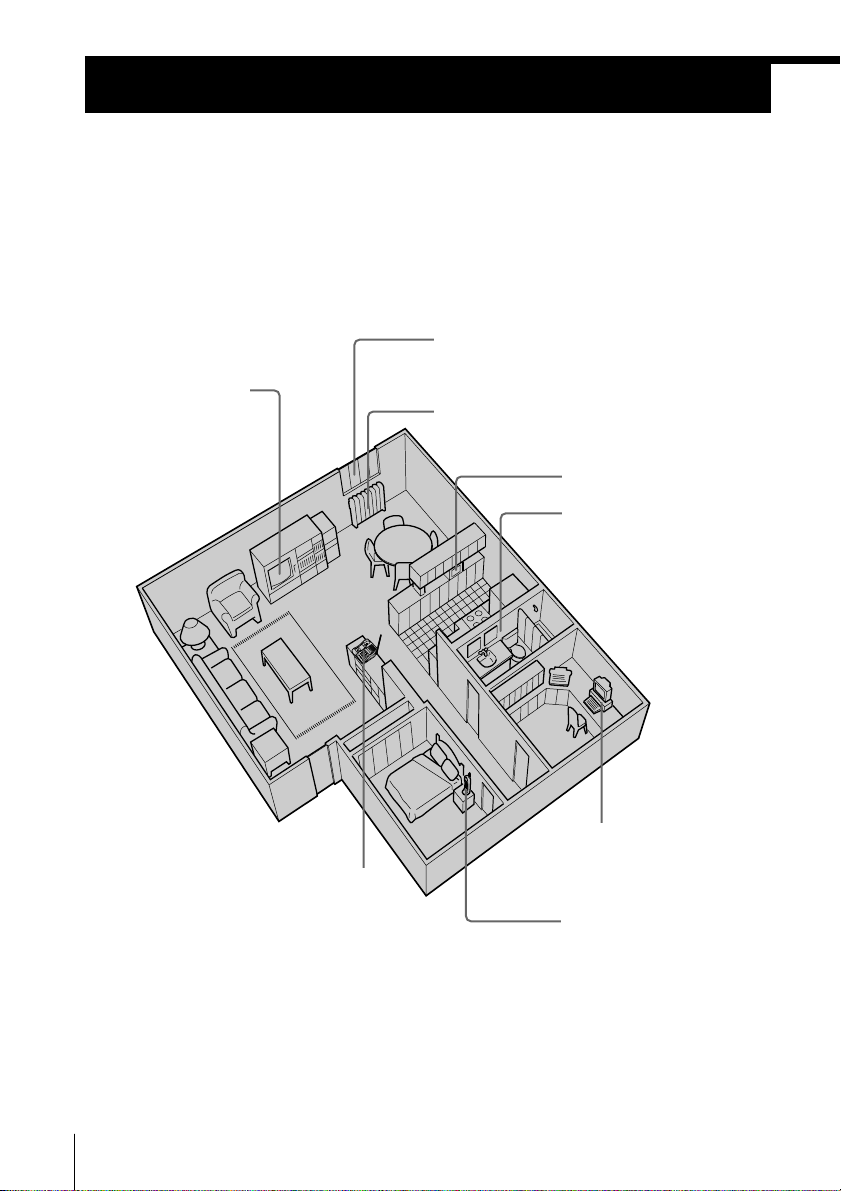
Choose the best location
Where you place the base phone affects the reception quality of the
handset.
Away from television
sets and other
electronic equipment
Away from noise sources such as a window
by a street with heavy traffic
Away from heat sources, such as radiators,
airducts, and sunlight
Away from a microwave
oven
Away from excessive
moisture, extremely low
temperatures, dust,
mechanical vibration, or
shock
Away from a personal
computer
Near a central location
and on a level surface
Away from another
cordless telephone
CAUTION: • Should you experience intermittent loss of audio during a conversation, try
US
Getting Started
6
moving closer to the base or move base phone away from other noise sources.
• The cordless telephone operates at a frequency that may cause interference to
nearby TVs and VCRs; the base phone should not be placed near or on the top
of a TV or VCR; and, if interference is experienced, moving the cordless
telephone farther away from the TV or VCR will often reduce or eliminate the
interference.
Page 7
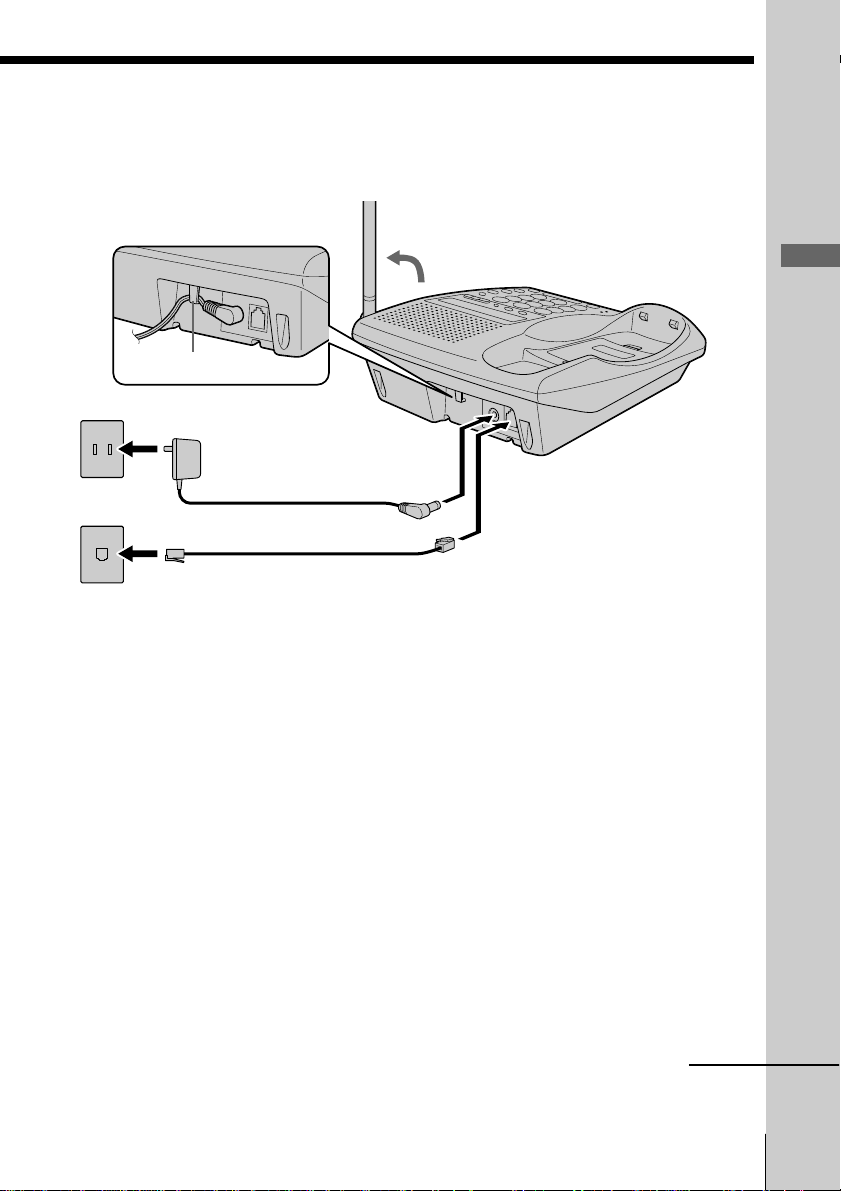
Connect the base phone
If you want to hang the base phone on the wall, see page 49.
3
Hook the cord.
To an AC outlet
To DC IN 9V
AC power adaptor
2
(supplied AC-T122)
To LINE
Telephone line cord
1
To the
telephone outlet
(supplied)
1 Connect the telephone line cord
to the LINE jack and to a
telephone outlet.
Getting Started
2 Connect the AC power adaptor
to the DC IN 9V jack and to an
AC outlet.
3 Raise the antenna. Make sure it
points towards the ceiling.
continued
Getting Started
US
7
Page 8
Step 2: Setting up the base phone (continued)
Notes
• Use only the supplied AC-T122 AC power adaptor.
Do not use any other AC power adaptor.
• Connect the AC power adaptor to a continuous power
supply.
• Place the base phone close to the AC outlet so that
you can unplug the AC power adaptor easily.
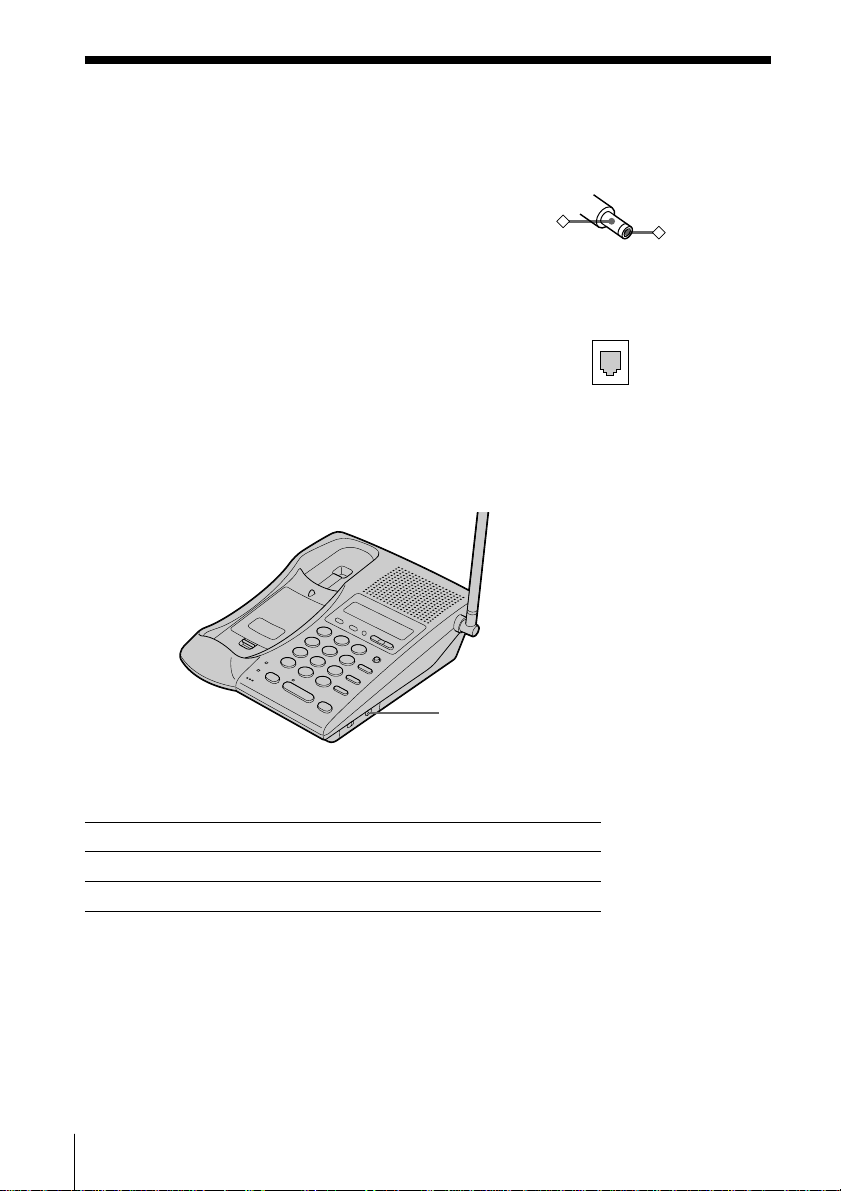
Polarity of the plug
–
+
Tip
If your telephone outlet is not modular, contact your
telephone service company for assistance.
Modular
Choose the dialing mode
For the telephone to work properly, select an appropriate dialing mode
(tone or pulse).
DIAL MODE switch
Depending on your dialing system, set the DIAL MODE switch as
follows:
If your dialing system is Set the switch to
Tone TONE
Pulse PULSE
If you aren't sure of your dialing system
Make a trial call with the DIAL MODE switch set to TONE.
If the call connects, leave the switch as is; otherwise, set to PULSE.
US
Getting Started
8
Page 9
Step 3
Preparing the battery pack
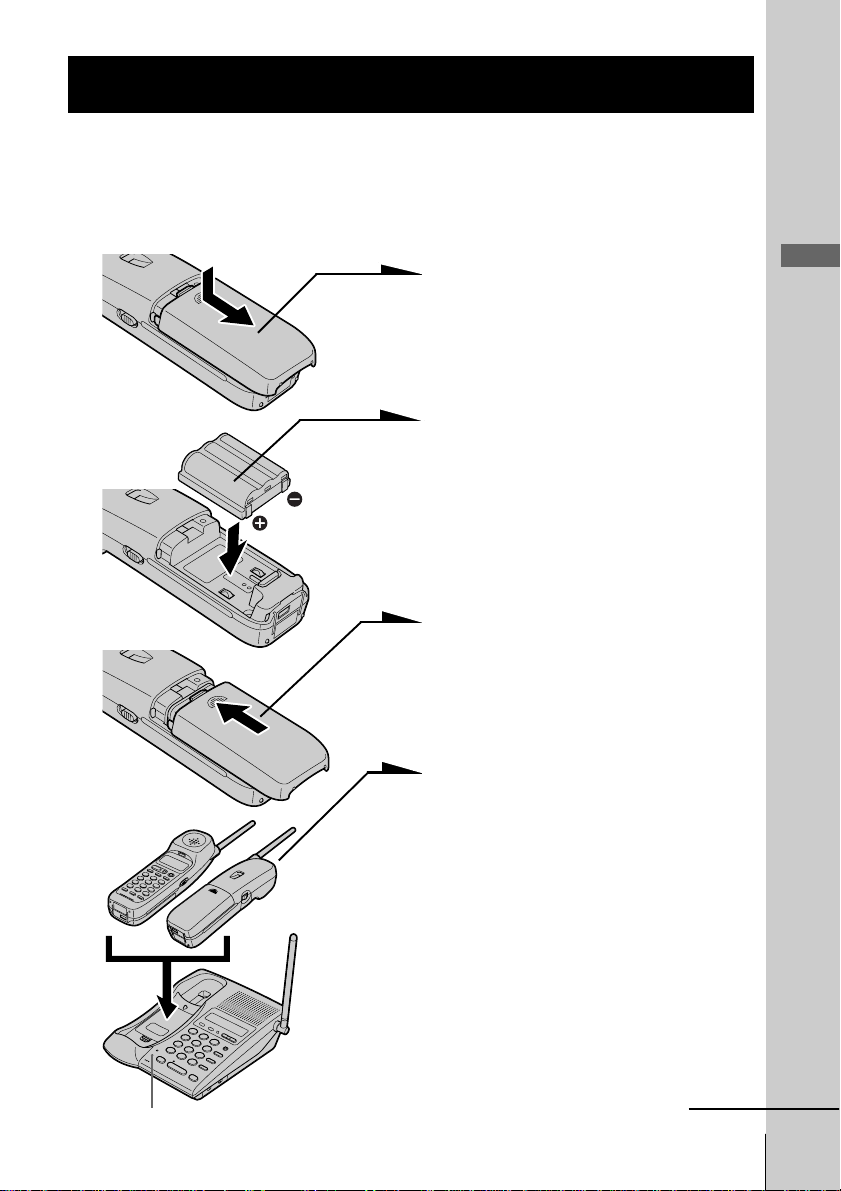
Charge the battery pack for more than 12 hours before you start using
your phone.
CHARGE lamp
BP-T23
1 Slide open the battery
compartment lid of the handset.
2 Insert the battery pack (with
contacts facing down) into the
battery compartment.
3 Close the battery compartment
lid.
4 Place the handset on the base
phone.
You can place it with either side
facing up.
The CHARGE lamp lights up
when the handset is properly
seated on the charge terminals
of the base phone. Charge the
battery pack for more than 12
hours so that the battery is fully
charged. The CHARGE lamp
remains lit even after charging
is completed.
continued
Getting Started
Getting Started
US
9
Page 10

Step 3: Preparing the battery pack (continued)
Battery duration
A fully charged battery pack lasts for about:
• Approx. 6 hours when you use the handset continuously
• Approx. 7 days when the handset is in standby mode.
Notes
• The battery pack will gradually discharge over a long period of time, even
when not in use.
• If you leave the battery pack in the handset without charging it, the battery
pack will be completely discharged.
It may require several times of charging to recover to its full capacity.
To obtain the best performance from the battery
Do not place the handset on the base phone after each call. The battery
works best if the handset is returned to the base phone after two or
three calls. However, do not leave the handset off the base phone for a
long period of time as this will completely discharge the battery pack.
When to purchase a new battery pack
If the battery lasts only a few minutes even after 12 hours of charging,
the usable life of the battery has expired and needs replacement.
Contact your local Sony authorized dealer or service center, and ask
for a Sony BP-T23 rechargeable battery pack.
Note
Battery life may vary depending on usage condition and ambient temperature.
US
Getting Started
10
Page 11
Handset spare battery usage
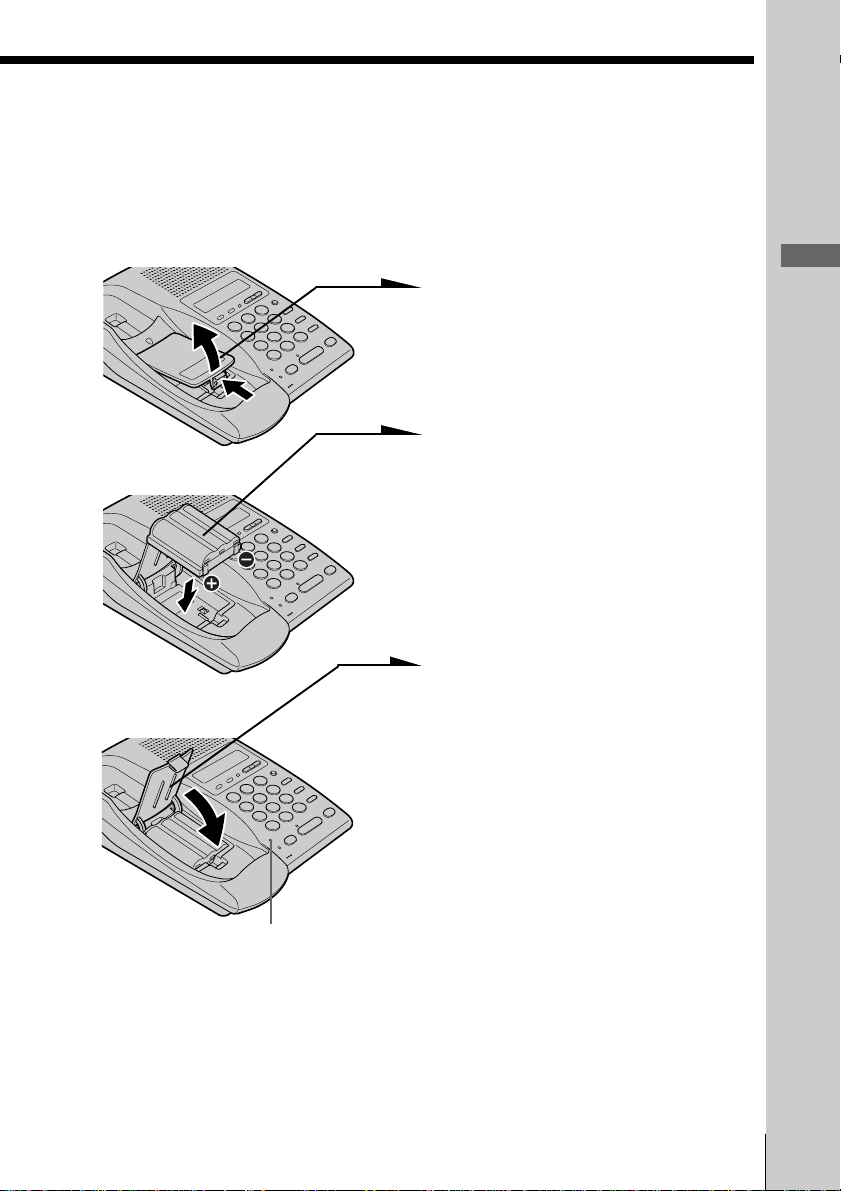
As only one battery pack is supplied with this unit, it is necessary to
purchase an additional battery pack (optional) for use as a handset
spare battery pack.
1 Open the battery compartment
lid of the base phone.
2 Insert the battery pack (with
contacts facing down) into the
BP-T23
battery compartment.
3 Close the battery compartment
lid.
The SPARE BATTERY lamp
lights up. Charge the battery
pack for more than 24 hours so
that the battery is fully charged.
The SPARE BATTERY lamp
remains lit even after charging
is completed.
Getting Started
SPARE BATTERY lamp
Getting Started
11
US
Page 12
Step 4
Entering the area code
When you use this phone for the first time, or move to an area that has a
different area code, you must enter your home area code. Otherwise, you
cannot use some functions of this phone and the Caller ID functions.
This is also necessary because the phone must be able to select an area code to
properly dial call from the Caller ID list.
Depending on your region, enter 3-digit area code as follows:
Case 1.
If 7-digit dialing (no area code) is accepted for local calls in your area, see “To enter
your home area code” below.
If you live in an area where calls from or to other local areas can also be made by 10-digit dialing
(area code + number), you can register up to 5 local area codes with this telephone to take
advantage of this system. See “To enter the local area code (For 10 digits phone number users)”
on page 13.
Case 2.
If 10-digit dialing (area code + number) is required for all local calls in your area, at
first, enter “000” in your home area code. See “To enter your home area code” below.
Then see “To enter the local area code (For 10 digits phone number users)” on page
13.
To enter your home area code
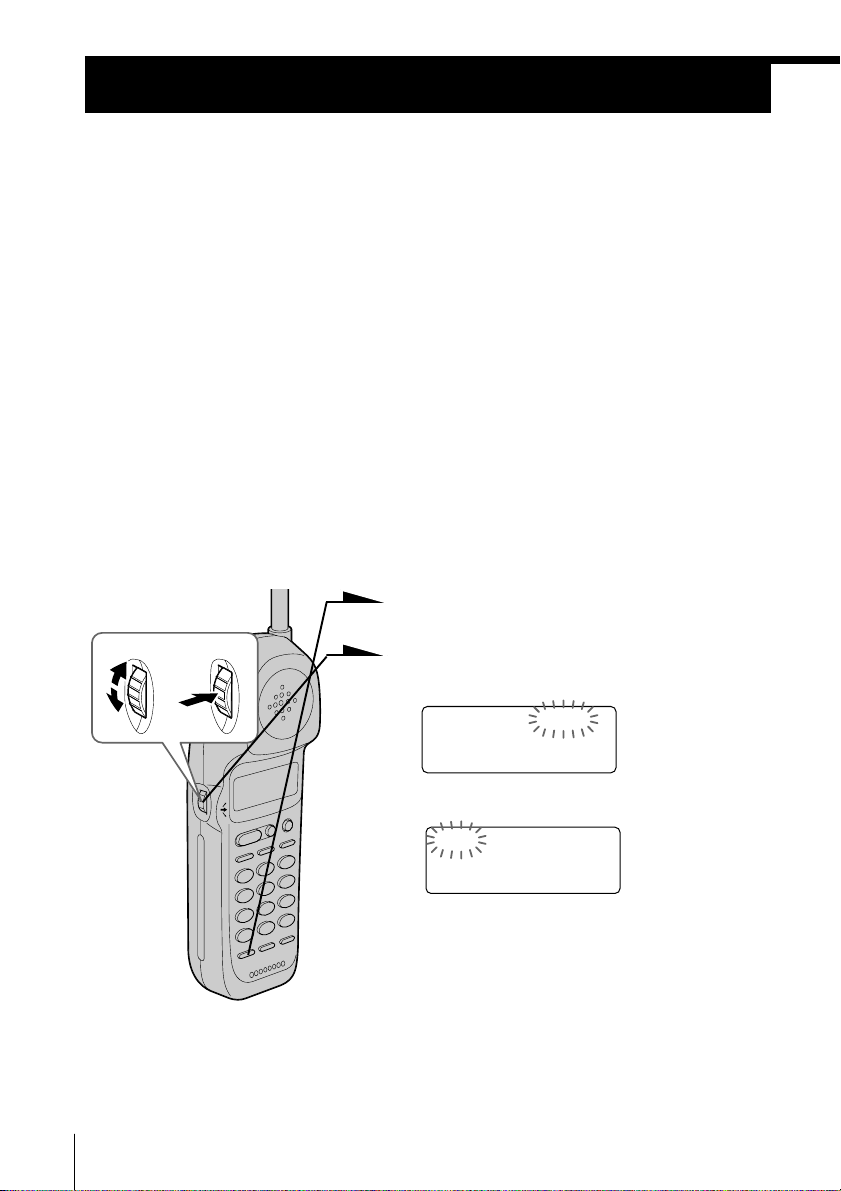
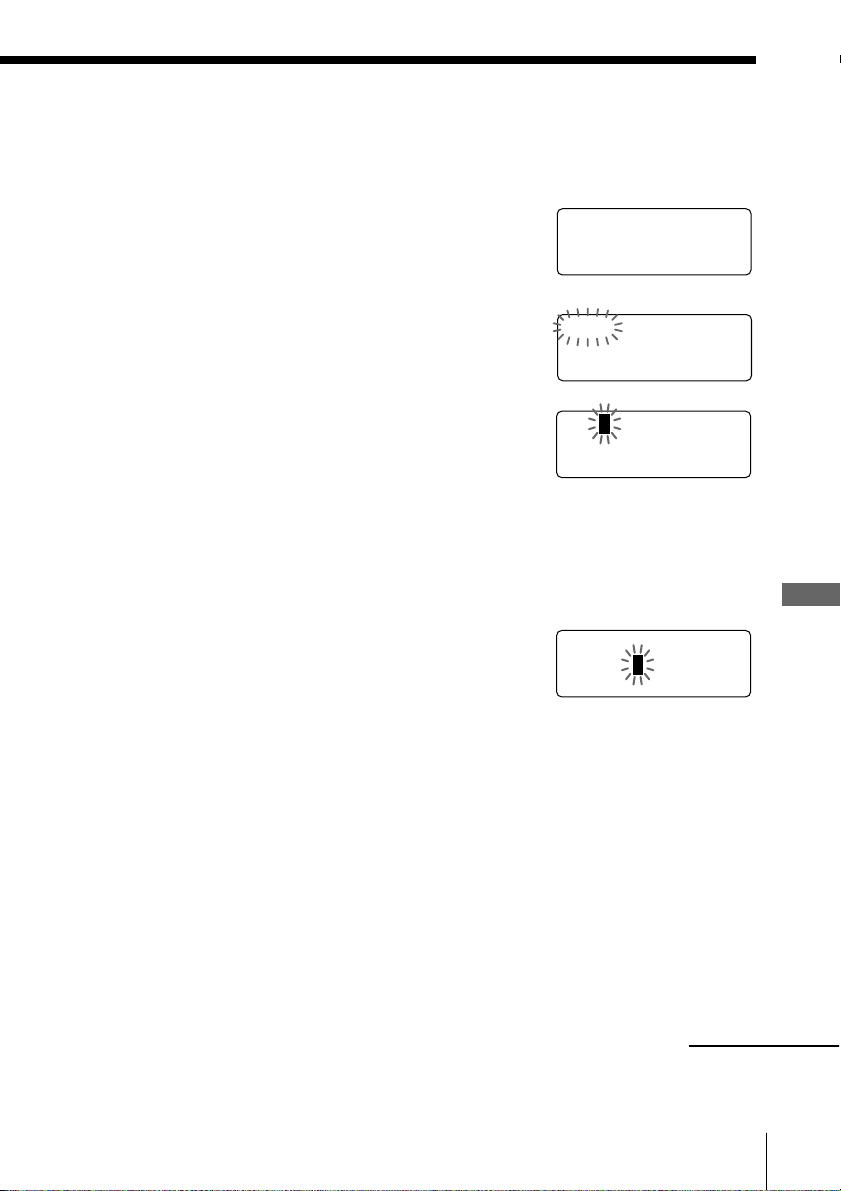
1 Press (PGM).
Turn Press
2 Turn Jog Dial up to make “AREA”
flash.
DIRECTORY AREA
RINGER
12
US
Getting Started
3 Press Jog Dial.
HOME LOCAL
4 Press Jog Dial again.
“ENTER AREA CODE” appears on
the display.
5 Enter three digits of your home area
code using the dialing keys.
6 Press (PGM).
You will hear a long confirmation
beep.
Page 13

Notes
• If the home area code is already entered, it appears on the display in step 4.
To enter a different home area code, see “To change the home area code”
below.
• Do not allow more than 20 seconds to elapse between each step of the
procedure.
Tips
• You may press Jog Dial instead of (PGM) in step 6.
• To check the current home area code, perform steps 1 to 4. The home area
code appears on the display for about 20 seconds.
To change the home area code
1 Perform steps 1 to 4 on page 12.
The current home area code appears on the display.
2 Turn Jog Dial down to erase the current home area code.
3 Enter a new home area code using the dialing keys.
4 Press (PGM).
You will hear a long confirmation beep.
To enter the local area code (For 10 digits
phone numbers users)
If a call matches one of the local area codes you entered, the phone
number will be registered with 10 digits in the Caller ID list (area code
+ number). If a call does not match one of the local area codes you
entered, the phone number will be registered with 11 digits in the
Caller ID list (1 + area code + number). Some regions of the country
allow you to have more than one local area code. (Up to five local area
codes can be entered in this phone.)
Getting Started
1 Perform steps 1 to 3 on page 12.
2 Turn Jog Dial up to make ”LOCAL“ flash.
3 Press Jog Dial.
4 Select the number (”#1“ to ”#5“) to enter the
local area code by turning Jog Dial.
HOME LOCAL
#1 #2 #3 #4 #5
continued
Getting Started
13
US
Page 14

Step 4: Entering the area code (continued)
5 Press Jog Dial.
”ENTER AREA CODE“ appears on the display.
6 Enter three digits of the local area code using the dialing
keys.
7 Press (PGM).
You will hear a long confirmation beep.
Notes
• If the local area code is already entered, it appears on the display in step 5. To
enter a different local area code, see “To change the local area code” below.
• Do not allow more than 20 seconds to elapse between each step of the
procedure.
Tips
• You may press Jog Dial instead of (PGM) in step 7.
• To check the current local area code, perform steps 1 to 5. The local area code
appears on the display for about 20 seconds.
To change the local area code
1 Perform steps 1 to 5 on page 13.
The current local area code appears on the display.
2 Turn Jog Dial down to erase the current local area code.
3 Enter a new local area code using the dialing keys.
4 Press (PGM).
You will hear a long confirmation beep.
To erase the local area code
You can erase the local area code. Perform steps 1 and 2 above, then
press (PGM).
The local area code will be erased, and you will hear a long
confirmation beep.
US
Getting Started
14
Page 15
Identifying the parts
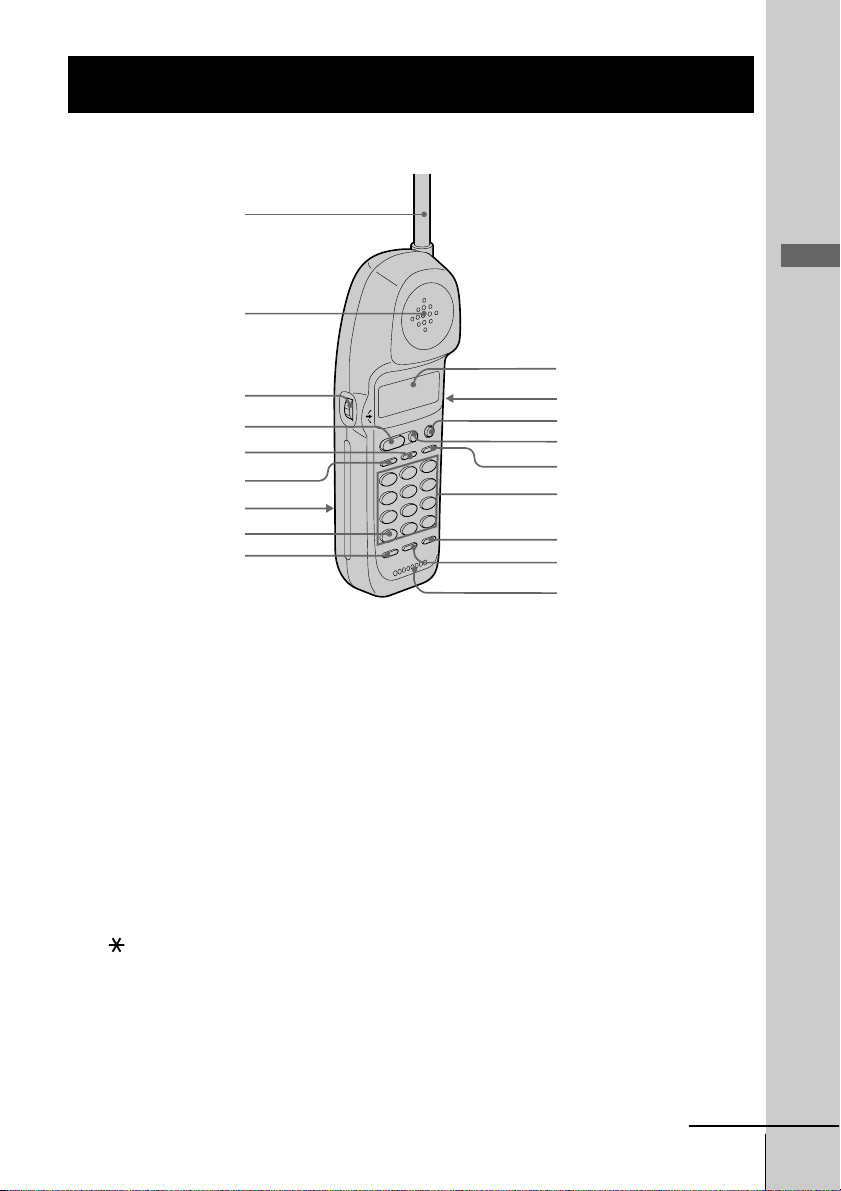
Refer to the pages indicated in parentheses for details.
Handset
1
2
3
4
5
6
7
8
9
Getting Started
0
qa
qs
qd
qf
qg
qh
qj
qk
1 Antenna
2 Speaker
3 Jog dial (p. 12, 27, 39)
4 TALK button (p. 18, 22)
Lets you make or receive a call.
5 INTERCOM button (p. 34)
Lets you talk by using the base
phone and handset.
6 HOLD button (p. 18)
Puts a call on hold.
7 Battery compartment (p. 9)
8 TONE button (p. 18)
Allows you to switch temporarily to
tone dialing.
9 PGM (Program) button
(p. 12, 27)
Used to store numbers in Phone
Directory.
q; Display window (p. 38)
qa VOL (volume) switch (p. 18)
Adjusts the handset volume.
qs CALL WAITING/FLASH button
(p. 22, 46)
Switches to a second call if you
have “call waiting” service, or lets
you make a new call.
qd OFF button (p. 18)
Allows you to disconnect the call.
qf REDIAL button (p. 21)
Redials the last number called.
qg Dialing keys (p. 18)
qh PAUSE button (p. 28)
Inserts a pause in the dialing
sequence.
qj MUTING button (p. 18)
Mutes your voice during a
conversation.
qk Microphone
continued
Getting Started
15
US
Page 16
Identifying the parts (continued)
Base Phone
1
2
3
4
5
6
7
8
9
0
qa
wd
qs
qd
qf
qg
qh
qj
qk
ql
w;
wa
ws
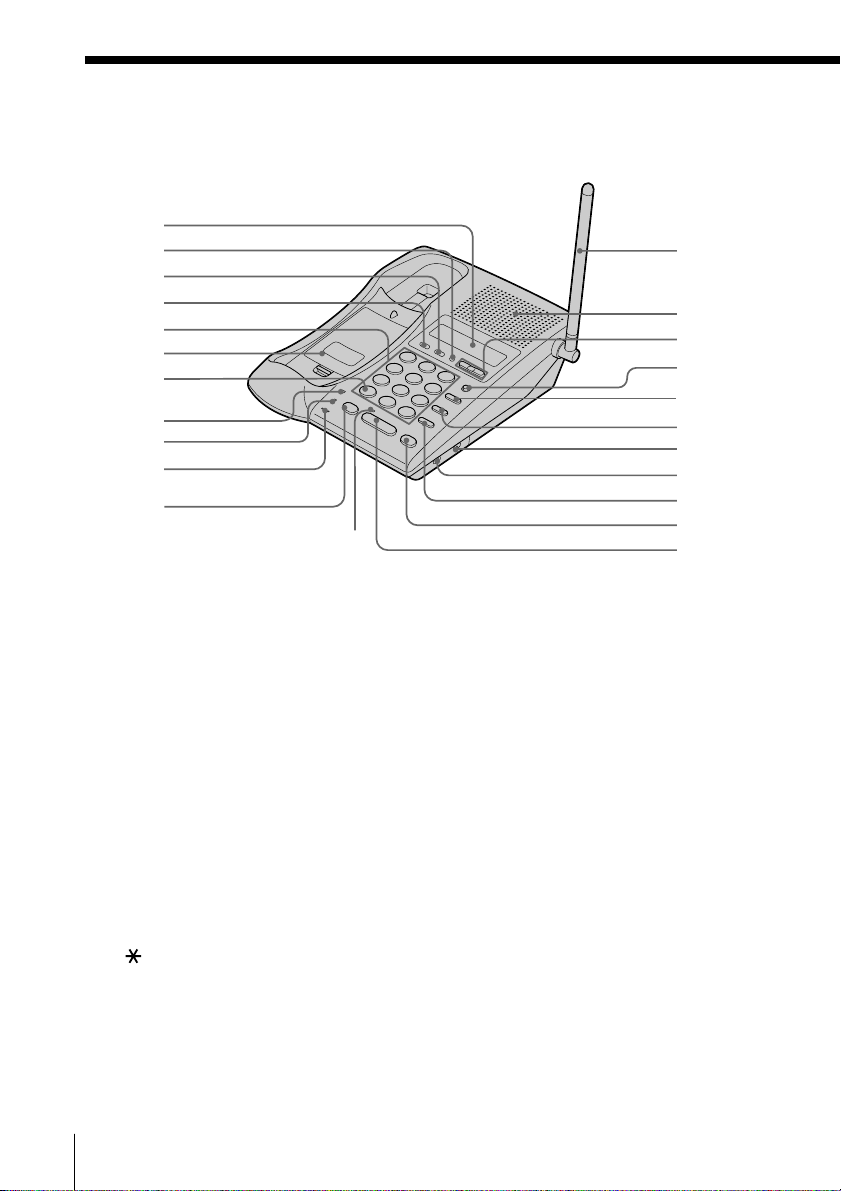
1 Display window (p. 18, 24)
2 LINE lamp (p. 18, 22)
Lights when the cordless handset is
in use.
3 MESSAGES lamp (p. 47)
Flashes when you have messages.
4 NEW CALL lamp (p. 39)
Flashes when there is a “NEW”
data in the Caller ID list.
5 Dialing keys (p. 20)
6 Battery compartment (p. 11)
7 TONE button (p. 18)
Allows you to switch temporarily to
tone dialing.
8 SPARE BATTERY lamp (p. 11)
Lights while the spare battery is
being charged.
US
Getting Started
16
9 CHARGE lamp (p. 9)
Lights while the battery is being
charged.
0 MIC (microphone)
qa HOLD button (p. 18)
Puts a call on hold.
qs Antenna (p. 7, 49)
qd Speaker
qf VOLUME +/– buttons
(p. 20, 24)
Adjusts the speaker volume or
press to move the cursor on the
display.
qg PGM (Program) button (p. 24)
Used to store numbers for speed
dialing.
Page 17
wf
wg
Getting Started
wh
qh REDIAL/PAUSE button
(p. 21, 25)
Redials the last number called/
inserts a pause in the dialing
sequence.
qj SPEED DIAL button (p. 24)
Automatically dials the numbers
programmed.
qk DIAL MODE switch (p. 8)
Selects pulse or tone dialing.
ql RINGER LEVEL switch (p. 23)
Adjusts the ringer volume.
w; FLASH button (p. 23, 46)
Switches to a second call if you
have “call waiting” service, or lets
you make a new call.
wa INTERCOM button (p. 34)
Lets you talk by using the base
phone and handset.
ws SPEAKERPHONE button
(p. 20)
Lets you make or receive a call.
wd SPEAKERPHONE lamp
(p. 20)
Lights while talking through the
speakerphone.
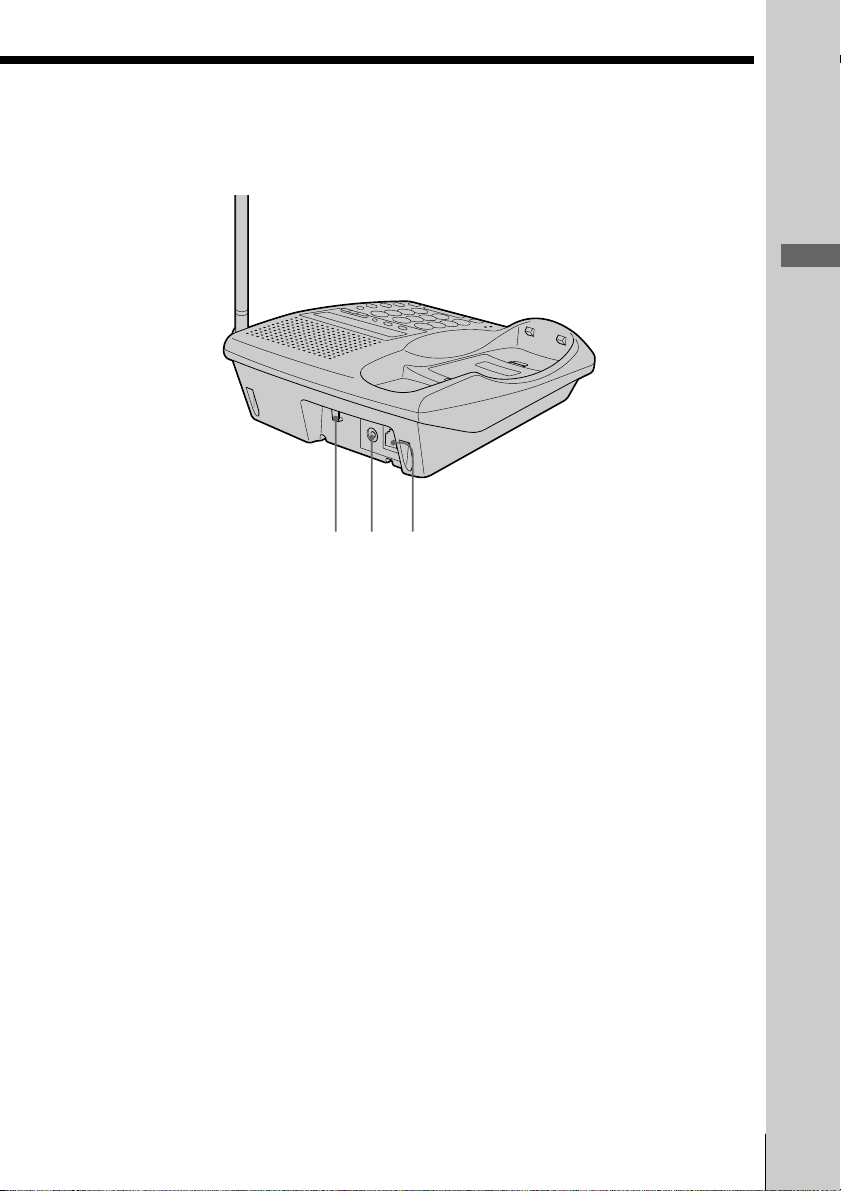
wf Hook for AC power adaptor
cord (p. 7)
wg DC IN 9V jack (p. 7, 49)
wh LINE (telephone line) jack
(p. 7,49)
Getting Started
17
US
Page 18
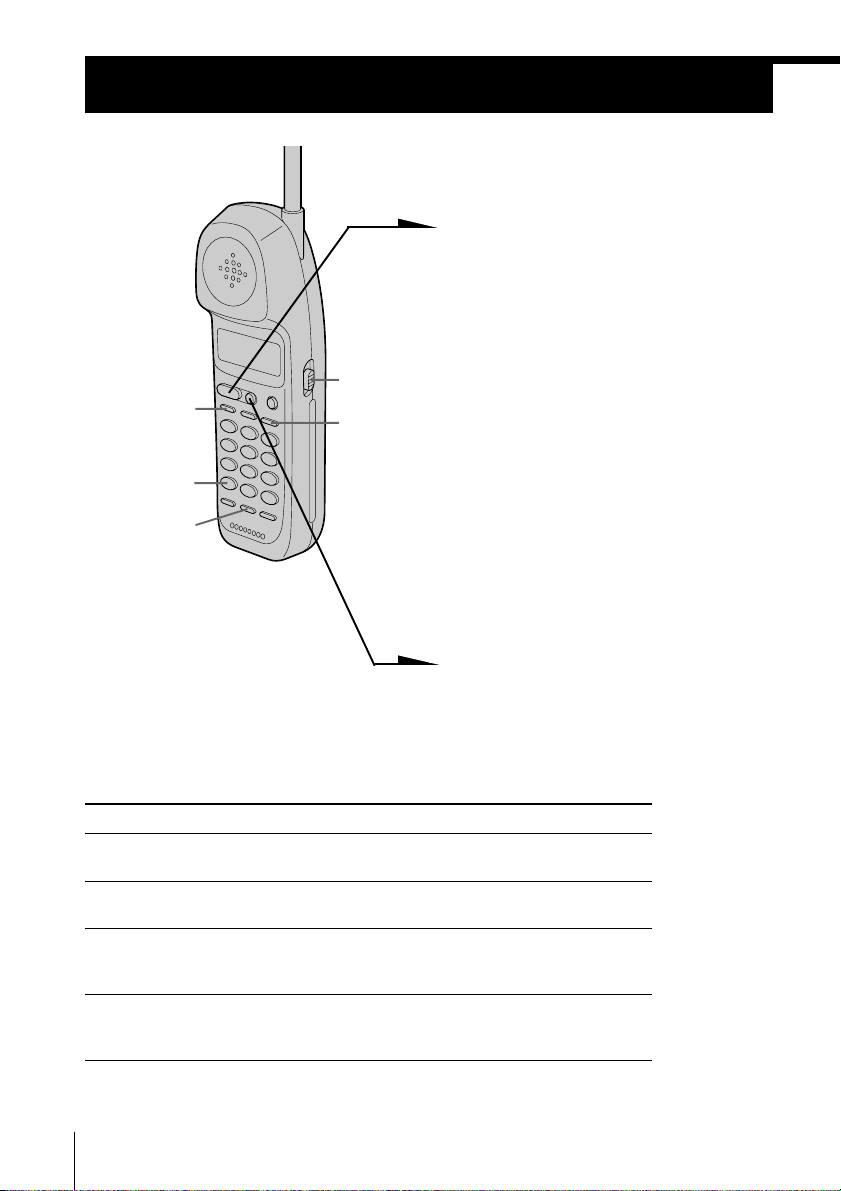
Basics
Making calls
(HOLD)
(*TONE)
(MUTING)
VOL switch
(REDIAL)
1 Pick up the handset from the
base phone.
2 Press (TALK) and wait until
“TALK” appears on the display.
The display also shows the
operation duration in hours,
minutes and seconds.
The dialing keys light up for
five seconds.
You will then hear a dial tone.
“HANDSET IN USE” appears
on the display of the base phone
and the LINE lamp on the base
phone lights up.
If “CHANNEL SEARCHING”
appears on the display, move
closer to the base phone.
Additional tasks
To
Adjust the handset volume
Put a call on hold
Mute your voice
Switch to tone dialing
temporarily
US
Basics
18
3 Dial the phone number.
4 When you’re done talking, press
(OFF) or replace the handset on
the base phone.
The display and the LINE lamp
on the base phone go off.
Do this
Set the VOL switch to H (high), M (middle) or L
(low).
Press (HOLD). “HOLD” appears on the display.
Press (HOLD) again to resume the conversation.
Press (MUTING) to disable the microphone.
“MUTING” appears on the display. Press
(MUTING) again to cancel.
Press (*TONE) after you’re connected.
The line will remain in tone dialing until
disconnected.
Page 19

Notes
• When you increase the sound volume, in some cases the back ground noise
may be increased as well. You should adjust the volume accordingly.
• If your conversation is muted and “CHANNEL SEARCHING” appears on
the display, move closer to the base phone; otherwise, the call will be
disconnected after one minute.
If the battery becomes weak during a call
The handset will beep every three seconds five times and i and
“BATTERY LOW” appears on the display. Finish your call and charge
the battery pack.
For optimum performance, charge the battery for a full 12 hours.
Note that during the first 10 - 15 minutes of charging, the phone will be
inactive, i.e., unable to make or receive a call.
After this initial 10 - 15 minutes, you may be able to use the phone, but
the battery duration will be very short; thus it is recommended that
you fully charge the battery before the next usage.
If you have a spare battery
You can replace the battery pack without disconnecting the call during
a conversation. To replace the battery pack, perform the following
procedure.
1 Press (HOLD) on the handset.
The call is on hold and “HOLD” appears on the display.
2 Replace the battery pack.
3 Press (HOLD) or (TALK) to resume the conversation.
Basics
continued
Basics 19
US
Page 20
Making calls (continued)
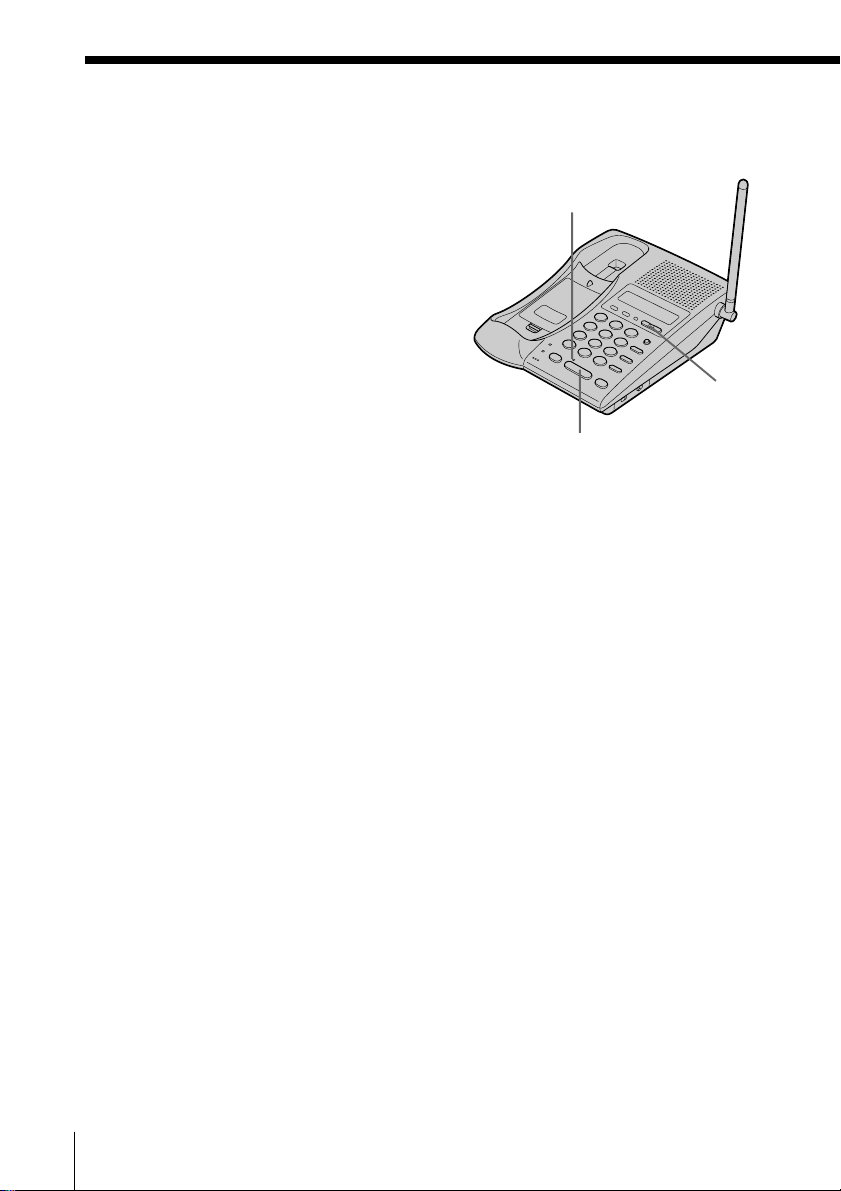
Making calls through the speakerphone
Press (SPEAKERPHONE) on the base
phone.
“SPEAKERPHONE” appears on the
display and the display also shows the
operation duration in hours, minutes and
seconds.
The SPEAKERPHONE lamp lights up.
Dial the phone number.
To adjust the speaker volume, press
(VOLUME)(+) or (--). Each press of
(VOLUME)(+) or (--) switches the speaker
volume by one of 8 levels.
When you’re done talking, press
(SPEAKERPHONE) again.
Notes
• While conversing with an outside caller via the handset, the display on the
base phone shows “HANDSET IN USE” and you cannot make a call
through the speakerphone. If you press (SPEAKERPHONE), you will hear a
busy tone.
• When the operation duration exceeds 9:59’59, the display counts from 0:00’00
again.
SPEAKERPHONE lamp
(SPEAKERPHONE)
(VOLUME)
To obtain the best speakerphone performance
• You may not be able to hear the other party’s voice in a noisy place.
Therefore, use the speakerphone in a quiet room.
• Do not bring your hand or other object too close to the microphone
or you will hear a shrill noise (“feedback”).
• When the speaker volume is loud, or the base phone has been placed
close to a wall, you may find that the volume drops suddenly. This
is due to a circuit in the telephone designed to protect against
feedback. In such cases, lower the speaker volume slightly.
US
Basics
20
Page 21

Redialing
1 Press (TALK) and wait until “TALK” appears on the display.
The dialing keys light up for five seconds.
The LINE lamp on the base phone lights up.
If you’re at the base phone, press (SPEAKERPHONE).
“SPEAKERPHONE” appears on the display and the
SPEAKERPHONE lamp lights up.
2 Press (REDIAL) to redial the last number dialed.
If you’re at the base phone, press (REDIAL/PAUSE).
Note
If the number exceeds 32 digits or if it is erased, five short error beeps will alert
you that the number cannot be redialed.
Tip
The number to be redialed is the last number dialed either on the handset or on
the base phone.
To check the phone number before redialing
When not making a call with either the handset or base phone, press
(REDIAL). If you’re at the base phone, press (REDIAL/PAUSE).
The last number dialed is displayed for five seconds.
To dial the number, press (TALK) while the number is displayed. If
you’re at the base phone, press (SPEAKERPHONE).
Note
The number will not be displayed if the last number dialed exceeds 32 digits or
if it is erased.
To erase the last phone number dialed
When not conversing with an outside caller with either the handset or
base phone, press (REDIAL) twice within five seconds. If you’re at the
base phone, press (REDIAL/PAUSE) twice.
The number will be erased from the memory, and you will hear a long
confirmation beep.
Basics
Basics 21
US
Page 22
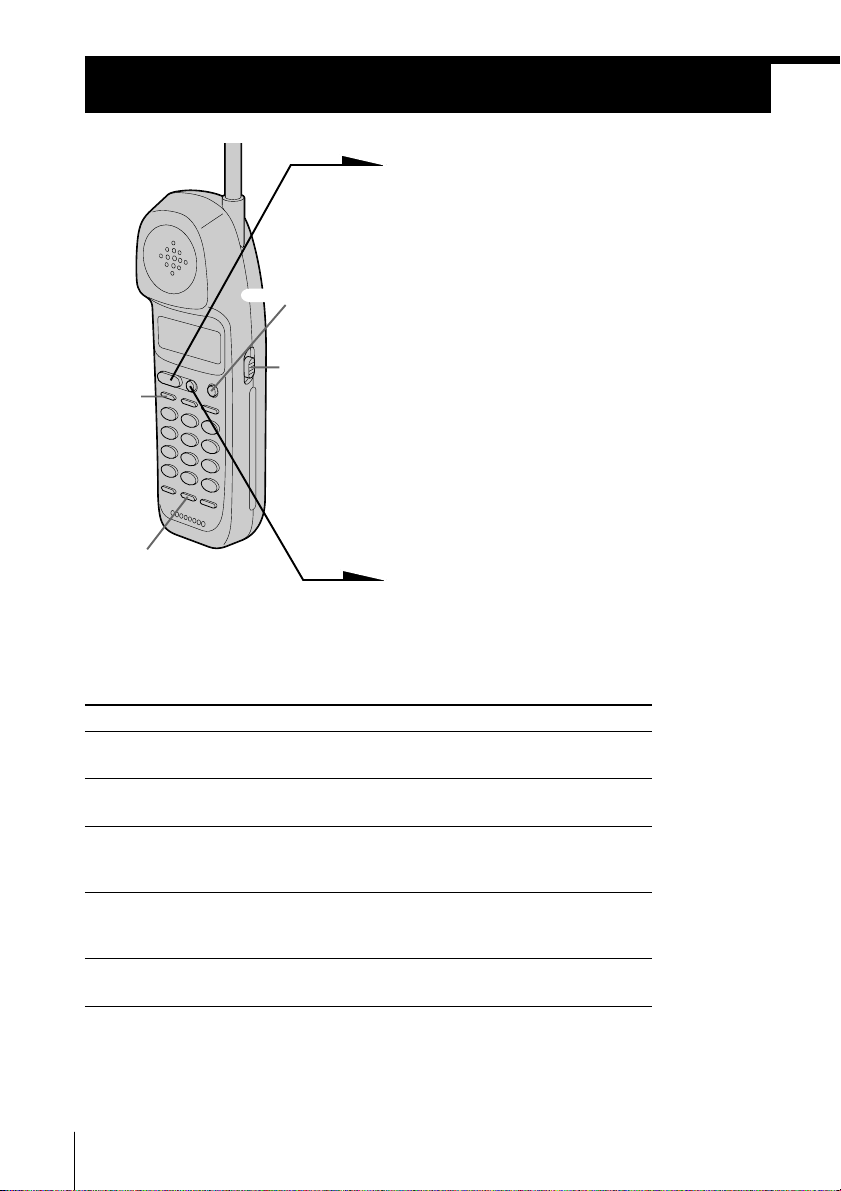
Receiving calls
1 When you hear the phone ring:
• Press (TALK).
or
• Pick up the handset from the base
phone when the handset is placed
(CALL WAITING/ FLASH)
on the base phone.
The dialing keys light up for five
seconds.
VOL switch
(HOLD)
“TALK” appears on the display and
the display also shows the operation
duration in hours, minutes and
seconds.
“HANDSET IN USE” appears on the
display of the base phone and the
LINE lamp on the base phone lights
up.
(MUTING)
2 When you’re done talking, press
(OFF) or replace the handset on the
base phone.
The display and the LINE lamp on the
Additional tasks
To
Adjust the handset volume
Put a call on hold
Mute your voice
Switch to another call
(“call waiting” service*)
Turn on/off the ringer of
the handset
* You need to subscribe to the service from your telephone company.
Note
If another call comes in by “call waiting” service while conversing with an
outside caller, you will hear two short beeps.
Tip
To inform you of an incoming call, the display shows “** RINGING **” when ringing.
US
Basics
22
Do this
Set the VOL switch to H (high), M (middle) or L
(low).
Press (HOLD). “HOLD” appears on the display.
Press (HOLD) again to resume the conversation.
Press (MUTING) to disable the microphone.
“MUTING” appears on the display. Press
(MUTING) again to cancel.
Press (CALL WAITING/ FLASH).
Press (CALL WAITING/ FLASH) again to return to
the first caller.
See “Turning off the ringer of the handset” on
page 32.
base phone go off.
Page 23
If you have subscribed to the Caller ID service;
• the caller’s number and/or name appears on the display when you receive a
call (see page 38) or when another call comes in by “call waiting” service.
• the ringer sound changes to a higher tone if the call matches the number
stored on speed dialing keys or in the Phone Directory (memory match
function; see page 38).
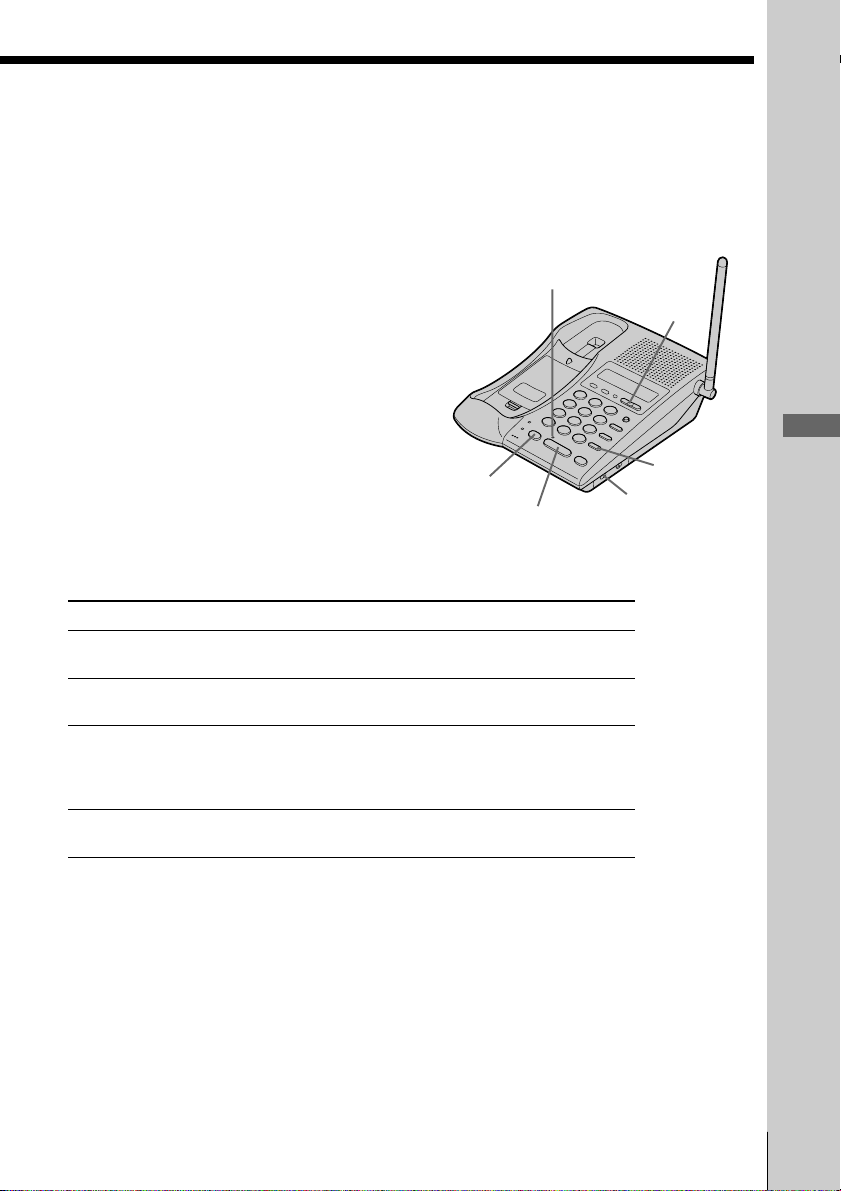
Receiving calls through the speakerphone
SPEAKERPHONE lamp
When you hear the phone ring, press
(SPEAKERPHONE) on the base phone.
“SPEAKERPHONE” appears on the display
and the display also shows the operation
duration in hours, minutes and seconds.
The SPEAKERPHONE lamp lights up.
When you’re done talking; press
(SPEAKERPHONE) again.
To obtain the best speakerphone performance,
see page 20.
(HOLD)
(SPEAKERPHONE)
Additional tasks
To
Put a call on hold
Switch to another call
(“call waiting” service*)
Adjust the speaker volume
Adjust the ringer volume of
the base phone
* You need to subscribe to the service from your telephone company.
Do this
Press (HOLD). “HOLD” appears on the display.
Press (HOLD) again to resume the conversation.
Press (FLASH).
Press (FLASH) again to return to the first caller.
During speakerphone conversation, press
(VOLUME)(+) or (--). Each press of
(VOLUME)(+) or (--) switches the speaker
volume by one of 8 levels.
Set the RINGER LEVEL switch on the base phone
to HIGH, LOW or OFF.
(VOLUME)
Basics
(FLASH)
RINGER
LEVEL switch
Note
Even when you set the RINGER LEVEL switch on the base phone to OFF, the
handset will ring when the ringer of the handset is turned on (see page 32).
Tips
• To inform you of an incoming call, the display shows “** RINGING **”
and the LINE lamp lights on and off according to the ring signal even when
you set the RINGER LEVEL switch on the base phone to OFF.
• If there is an incoming call while on the intercom, the base phone will ring
even when the RINGER LEVEL switch on the base phone is set to OFF.
Basics 23
US
Page 24
Telephone Features
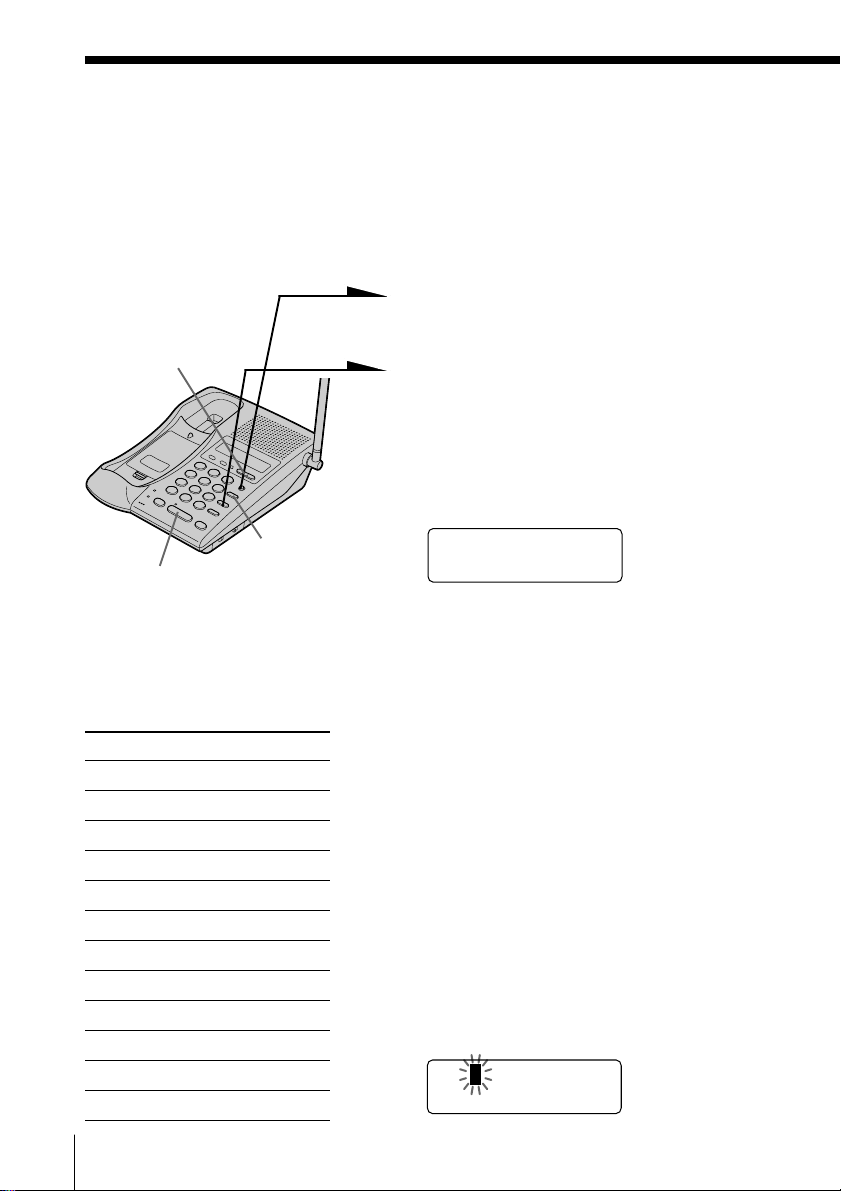
Speed dialing
You can dial with a touch of a few keys by storing a phone number on
a dialing key.
Storing phone numbers
(VOLUME)
(REDIAL/PAUSE)
(SPEAKERPHONE)
Character table
Key Character
(1) 1
(2) A t B t C t 2
(3) D t E t F t 3
(4) G t H t I t 4
(5) J t K t L t 5
(6) M t N t O t 6
(7) P t Q t R t S t 7
(8) T t U t V t 8
(9) W t X t Y t Z t 9
(0) 0
(*) *
(#) & t ’ t , t – t . t #
US
Telephone Features
24
and names
Example: to store “SONY” “123-4567”.
1 Press (PGM).
“PROGRAM” appears on the display.
2 Press (SPEED DIAL).
“ENTER 0 TO 9” appears on the
display.
3 Press one of the dialing keys ((0) to
(9)) to store a phone number on.
ENTER NAME
You will hear a confirmation beep.
4 Enter the name using the dialing keys.
You can enter up to 15 characters.
Press a dialing key until the desired
character appears. (See the character
table for details.)
Enter successive characters in the same
way.
To enter two characters assigned to the
same key, or to enter a “space”, press
(VOLUME)(+) to move the cursor to
the right.
Example : to enter “SONY”, press (7)
four times (S), press (6) three times
(O), press (VOLUME)(+) to move the
cursor, press (6) twice (N), and press
(9) three times (Y).
SONY
Page 25
5 Press (PGM).
“ENTER NUMBER” appears.
6 Enter the phone number.
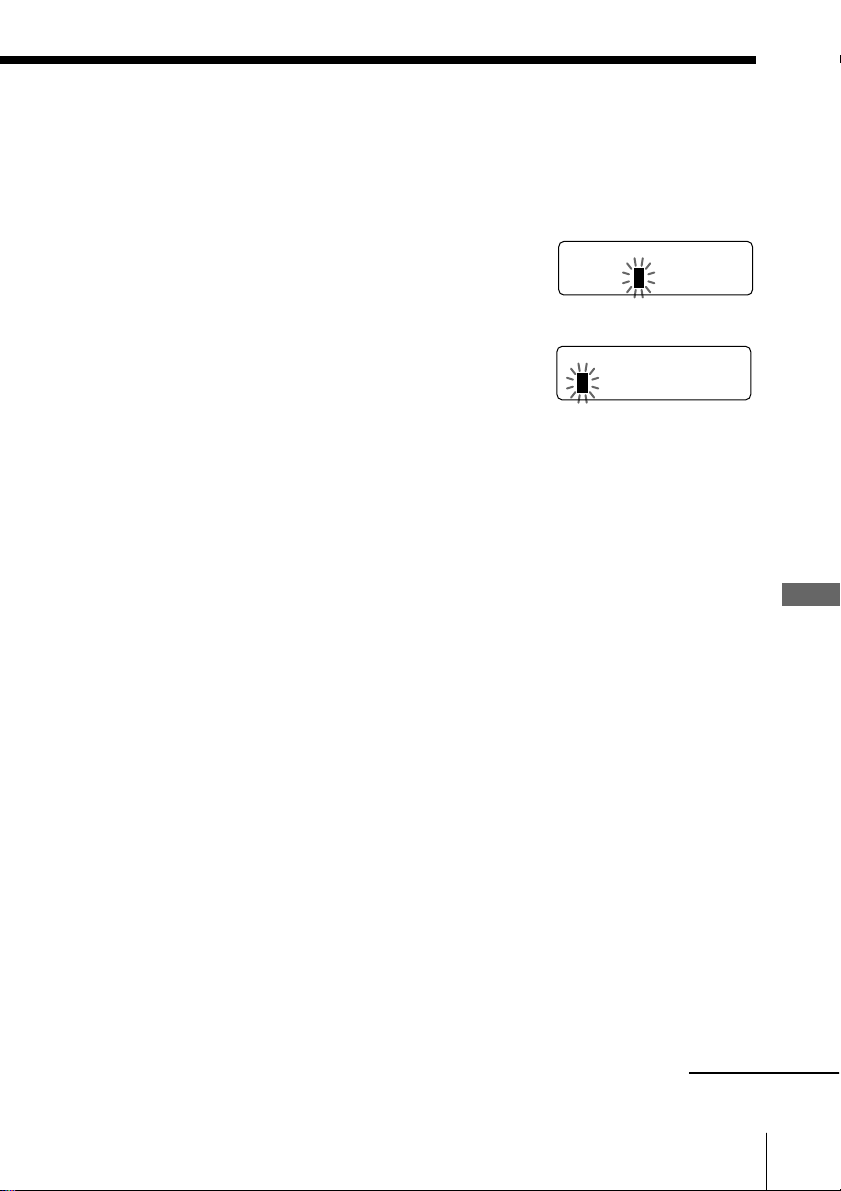
You can enter up to 32 digits, including a tone
and a pause, each of which is counted as one
digit.
When the phone number of 17 digits or more
has been entered , the phone number appears in
two lines.
SONY
123456
7
1234567890123456
1
2
7 Press (PGM).
You will hear a long confirmation beep, and the
name and the number are stored. The display
goes off.
Note
Do not allow more than 20 seconds to elapse between each step of the
procedure.
Tip
If you have entered a wrong name or number in step 4 or 6, press
(VOLUME)(--) to erase it. Then enter the correct name or number.
To store a number to be dialed via Private Branch Exchange
(PBX)
Before entering a phone number in step 6 above, do as follows:
1 Enter the outside line access digit (e.g., 9).
2 Press (REDIAL/PAUSE).
Telephone Features
To change a stored number
Store a new number, as described previously.
continued
Telephone Features
25
US
Page 26

Speed dialing (continued)
Making calls with speed dialing
1 Press (SPEAKERPHONE).
2 Press (SPEED DIAL).
3 Enter the desired speed dialing number ( (0) to (9)).
The phone number stored as the speed dialing number will
be dialed.
To check the phone number before speed dialing
When not making a call with the base phone, press (SPEED DIAL) and
then one of the dialing keys ((0) to (9)).
The number stored on the key appears on the display for five seconds.
To dial the number, press (SPEAKERPHONE) while the number is
displayed.
US
Telephone Features
26
Page 27
Phone Directory
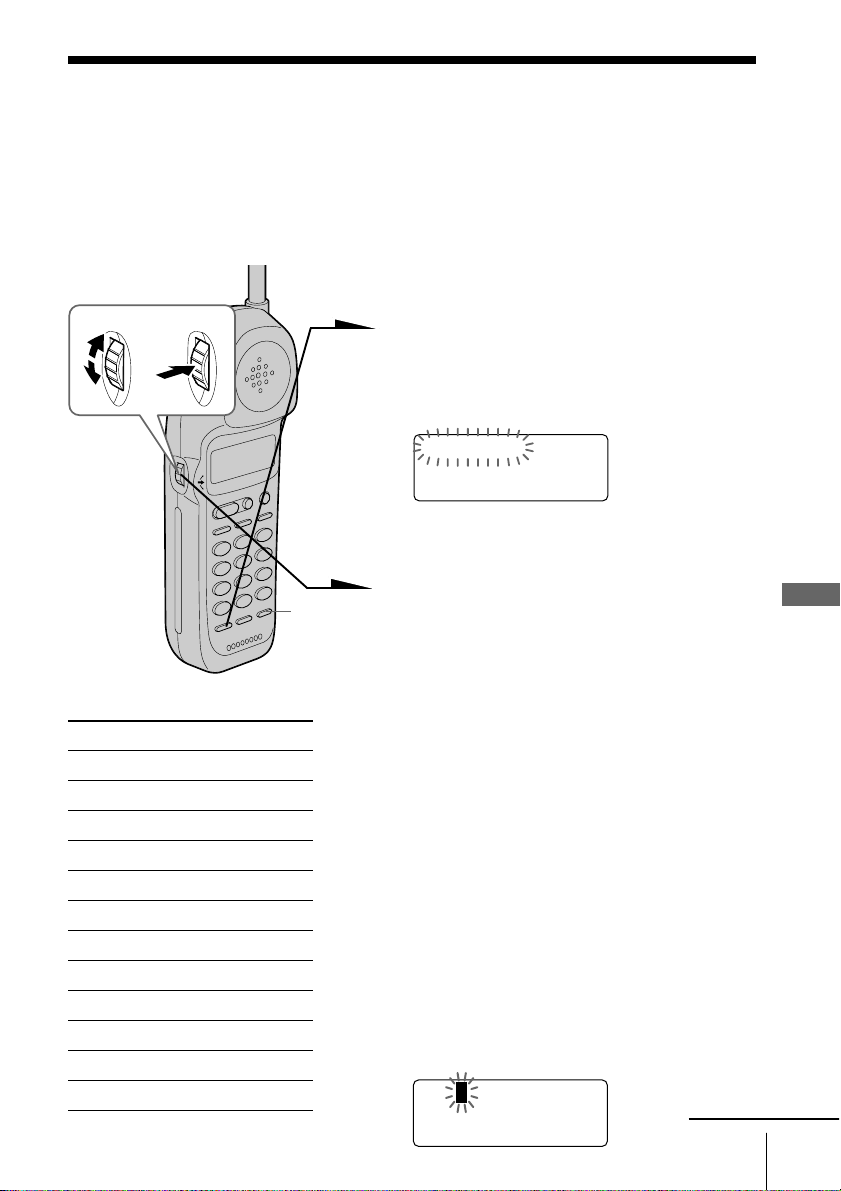
You can dial a number by scrolling through the Phone Directory, in
which up to 50 phone numbers can be stored.
Storing phone numbers and names
Example: to store “SONY” “123-4567”.
Turn Press
(PAUSE)
Character table
Key Character
(1) 1
(2) A t B t C t 2
(3) D t E t F t 3
(4) G t H t I t 4
(5) J t K t L t 5
(6) M t N t O t 6
(7) P t Q t R t S t 7
(8) T t U t V t 8
(9) W t X t Y t Z t 9
(0) 0
(*) *
(#) & t ’ t , t – t . t #
1 Press (PGM).
(Be sure not to press (TALK).)
The dialing keys light up for five
seconds.
DIRECTORY AREA
RINGER
If “DIRECTORY” is not flashing, turn
Jog Dial down to make it flash.
2 Press Jog Dial.
“ENTER NAME” appears.
3 Enter the name using the dialing keys.
You can enter up to 16 characters.
Press a dialing key until the desired
character appears. (See the character
table for details.)
Enter successive characters in the same
way.
To enter two characters assigned to the
same key, or to enter a “space”, turn
Jog Dial up to move the cursor to the
right.
Example : to enter “SONY”, press (7)
four times (S), press (6) three times
(O), turn Jog Dial up to move the
cursor, press (6) twice (N), and press
(9) three times (Y).
SONY
Telephone Features
continued
Telephone Features
US
27
Page 28
Phone Directory (continued)
SONY
123456
7
4 Press (PGM).
“ENTER NUMBER” appears.
5 Enter the phone number.
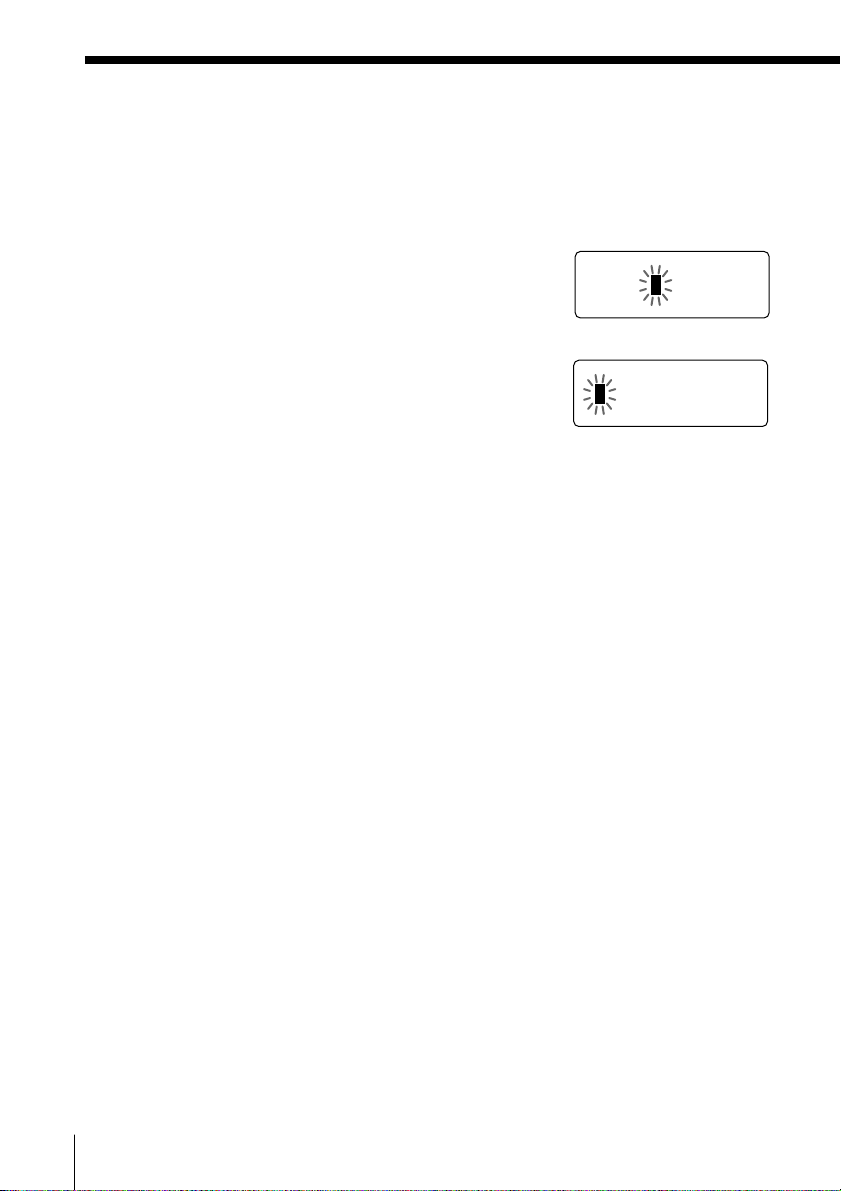
You can enter up to 32 digits, including a tone
and a pause, each of which is counted as one
digit.
When the phone number of 17 digits or more
has been entered , the phone number appears in
two lines.
6 Press (PGM).
You will hear a long confirmation beep, and the
name and the number are stored. The display
goes off.
Notes
• If you intend to save a 51st phone number, you will hear five short error
beeps and “MEMORY FULL” will be displayed. You cannot store the phone
number. To store another phone number, erase one of the stored phone
numbers (see page 30).
• Do not allow more than 20 seconds to elapse between each step of the
procedure.
• The total number of phone numbers which can be stored into the Phone
Directory varies according to the number of digits of each phone number. If
all the phone numbers consist of up to 16 digits, you can store up to 50 phone
numbers. However, as the Phone Directory uses two-phone number memory
to store one phone number of 17 digits or more, the total number of phone
numbers which can be stored in the Phone Directory decreases two by two
every time you store a phone number of 17 digits or more.
Tips
• If you have entered a wrong name or number in step 3 or 5, turn Jog Dial
down to erase it. Then enter the correct name or number.
• You may press Jog Dial instead of (PGM) in steps 4 and 6.
1234567890123456
1
2
To store a number to be dialed via Private Branch Exchange
(PBX)
Before entering a phone number in step 5 above, do as follows:
1 Enter the outside line access digit (e.g., 9).
2 Press (PAUSE).
US
Telephone Features
28
Page 29
DIAL EDIT ERASE
1234567
Changing a stored name and/or phone number
1 Display the name and phone number you want
to change by doing steps 1 and 2 in “Making
calls from the Phone Directory” on page 30.
2 Press Jog Dial.
3 Turn Jog Dial up to make “EDIT” flash and
press Jog Dial.
The cursor flashes at the last character of the
name.
4 Turn Jog Dial down to erase the characters and
enter the new name.
If you want to change only the number, skip this
step.
5 Press Jog dial.
The cursor flashes at the last digit of the phone
number.
6 Turn Jog Dial down to erase the number and
enter the new number.
If you don’t want to change the number, skip
this step.
7 Press Jog Dial.
You will hear a long confirmation beep and the
name and/or the number is changed.
SONY
1234567
SON
Y
1234567
SMITH
123456
7
Telephone Features
Tip
When the phone number of 17 digits or more has been entered, “–” is displayed
next to 15th digit and then the all digits are displayed in two lines after about
two seconds.
continued
Telephone Features
29
US
Page 30
Phone Directory (continued)
DIAL EDIT ERASE
1234567
ERASE NO YES
1234567
Erasing a memory location
1 Display the name and phone number you want
to erase by doing steps 1 and 2 in “Making calls
from the Phone Directory”.
SONY
1234567
2 Press Jog Dial.
3 Turn Jog Dial up to make “ERASE” flash and
press Jog Dial.
4 Turn Jog Dial up to make “YES” flash, then press Jog Dial.
You hear a long confirmation beep and the memory location
is erased.
Making calls from the Phone Directory
1 Press Jog Dial.
Turn Press
“DIRECTORY” appears on the
display.
US
Telephone Features
30
2 Display the name and phone number
you want to call.
To search in alphabetical order: Turn
Jog Dial up or down.
To search by entering the initial
character: Press the dialing key of the
desired character, then turn Jog Dial.
SONY
1234567
3 Press Jog Dial.
DIAL EDIT ERASE
1234567
4 Press Jog Dial again.
The phone number will be dialed.
Page 31

Tip
You may press (TALK) to make a call instead of doing steps 3 and 4.
About the search order
The names appear in the following order when you turn Jog Dial up or
down.
• Alphabetical order: ABC...XYZ y symbols y * y # y 0 - 9
t
• Initial character: To search for “SONY” for example, press (7) and
then turn Jog Dial to search through the names starting with P, Q, R,
S or 7.
t
Telephone Features
Telephone Features
31
US
Page 32

Setting the ringer type
You can select a ringer type of the handset from four type.
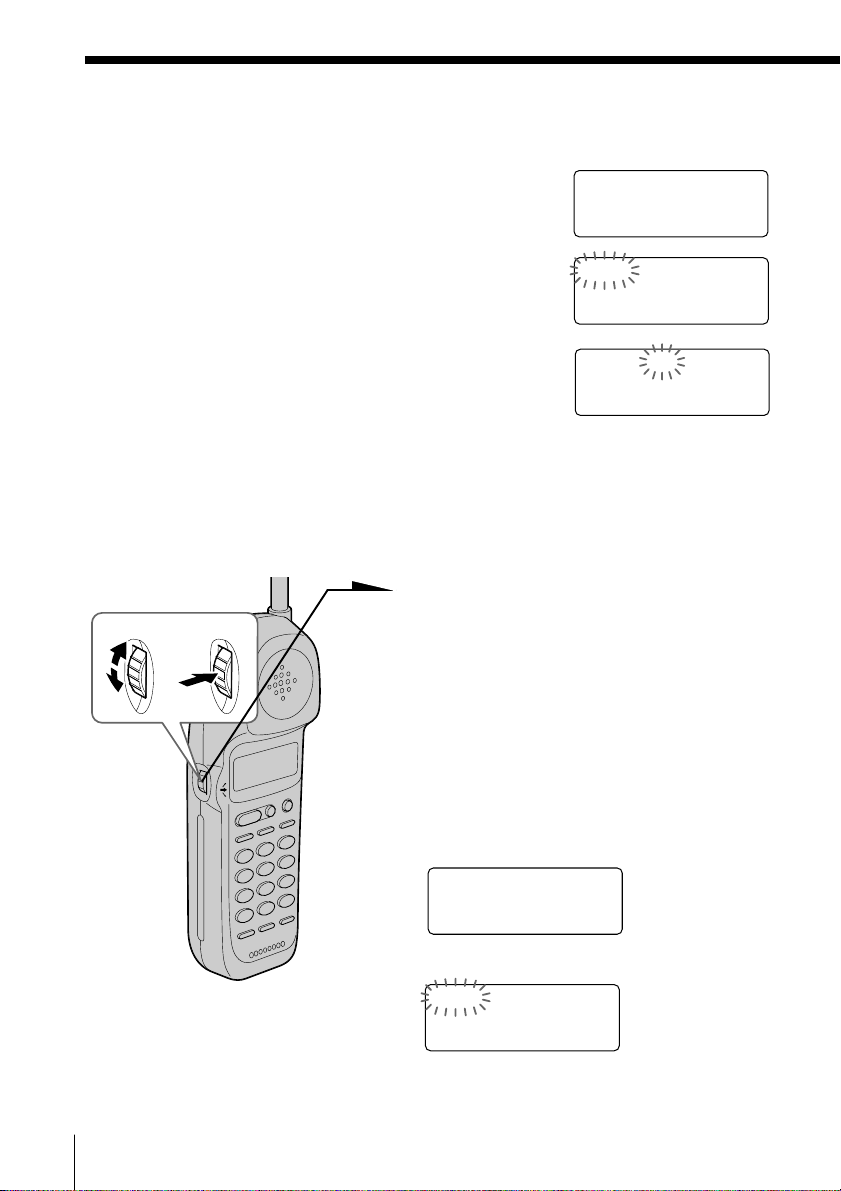
1 Press (PGM).
Turn Press
2 Turn Jog Dial up to make “RINGER”
flash.
DIRECTORY AREA
RINGER
3 Press Jog Dial.
The current ringer type appears.
RINGER 1
SELECTED
4 Press one of the dialing keys ((1) to
(4)) to select a ringer type.
You will hear the corresponding ringer
tone.
5 Press (OFF).
Turning off the ringer of the handset
1 Perform steps 1 to 3 above.
2 Press (0).
You will hear a confirmation beep.
3 Press (OFF).
When “RINGER” is set to “RINGER OFF”
The handset won’t ring. You can still make calls, and also receive
calls if another telephone connected to the same line rings to inform
you on incoming calls.
To turn the ringer on again
Follow the instructions described in “Setting the ringer type”.
US
Telephone Features
32
RINGER OFF
SELECTED
Page 33

Switching the phones during a call
You can easily switch between the handset and speakerphone on the
base phone without disconnecting the call.
To switch from the base phone to the handset
1 Press (HOLD) on the base
phone.
The call is on hold and “HOLD”
appears on the display and the
SPEAKERPHONE lamp on the
base phone flashes.
2 Press (TALK) or (HOLD) on the
handset.
You can continue talking to the
caller through the handset.
SPEAKERPHONE
lamp
LINE lamp
(SPEAKERPHONE)
To switch from the handset to the base phone
1 Press (HOLD) on the handset.
The call is on hold and “HOLD”
appears on the display and the
LINE lamp on the base phone
flashes.
2 Press (SPEAKERPHONE) or
(TALK)
Tips
• While talking through the speakerphone on the base phone, if you pick up
the handset, the call will be switched to the handset.
• When the call is put on hold on the base phone, if you pick up the handset,
the call will be switched to the handset.
(HOLD) on the base phone.
You can continue talking to the
caller through the
speakerphone.
Telephone Features
Telephone Features
US
33
Page 34

Talking between the phones (Intercom)
You can converse using the base phone and the handset. You can start
the intercom from either phone.
To talk from the handset to
the base phone
Press (INTERCOM) on the handset.
After the base phone rings twice, you
(OFF)
(TALK)
(INTERCOM)
will be connected automatically.
When a person at the base phone
answers, you can talk with each other.
“INTERCOM” appears on the display.
When you are done talking
Press (OFF) on the handset.
If no one answers the phone
Press (INTERCOM) again.
To talk from the base
phone to the handset
(SPEAKERPHONE)
US
Telephone Features
34
(INTERCOM)
Press (INTERCOM) on the base phone.
The base phone and handset ring and
“** PAGING **” appears on the
display.
When a person at the handset presses
(TALK) or (INTERCOM), you can talk
with each other.
“INTERCOM” appears on the display.
When you are done talking
Press (SPEAKERPHONE) on the base
phone.
If no one answers the phone
Press (INTERCOM) again.
Page 35

Notes
• If there’s an incoming call while on the intercom, only the base phone rings.
To answer the call, press (INTERCOM) on the base phone or handset. The
intercom is canceled and you can talk to the outside caller.
• While conversing with an outside caller via the base phone or handset, you
cannot make an intercom call. If you press (INTERCOM), you will hear a busy
tone.
Tips
• You can receive an intercom call on the handset even when “RINGER” is set
to “RINGER OFF”.
• You can receive an intercom call on the base phone even when the RINGER
LEVEL switch on the base phone is set to OFF. The base phone will ring at a
low level.
Telephone Features
Telephone Features
35
US
Page 36

Transferring a call
You can transfer a call between the handset and base phone without
disconnecting the call.
To transfer from the base phone to the handset
1 Press (INTERCOM) to page the
handset.
The call is put on hold on the
base phone and the handset
rings. “** PAGING **”
appears on the display of both
the base phone and handset.
2 Press (INTERCOM) on the
(SPEAKERPHONE)
handset.
“INTERCOM” appears on the
display of both the handset and
base phone.
You can talk between the base
phone and the handset.
3 Press (TALK) on the handset to
(TALK)
Tips
• You can receive an intercom call on the handset even when “RINGER” is set
to “RINGER OFF”.
• If you have accidentally pressed (HOLD) in step 1, just press (INTERCOM)
and you will get the same result as by pressing (INTERCOM) only.
• The INTERCOM lamp on the base phone flashes during intercom.
US
Telephone Features
36
talk to the caller with the
handset.
“TALK” appears on the display
of the handset.
If no one answers the phone
Press (SPEAKERPHONE) on the base
phone.
Page 37

To transfer from the handset to the base phone
1 Press (INTERCOM) to page the
base phone.
The call is put on hold on the
handset.
After the base phone rings
(TALK)
twice, you will be connected
automatically.
When a person at the base
phone answers, you can talk
with each other.
“INTERCOM” appears on the
display of both the base phone
and handset.
2 Press (SPEAKERPHONE) on the
base phone to talk to the caller
with the base phone.
“SPEAKERPHONE” appears on
the display of the base phone.
(SPEAKERPHONE)
Tip
You can receive an intercom call on the base phone even when the RINGER
LEVEL switch on the base phone is set to OFF. The base phone will ring at a
low level.
If no one answers the phone
Press (TALK) on the handset.
Telephone Features
Telephone Features
US
37
Page 38

Caller ID Features
Understanding the Caller ID service
Caller ID allows the caller’s phone number to be shown on the display
before the call is answered. In order to use this feature, you must first
subscribe to the Caller ID service. The name of this service may vary
depending on your telephone company.
To use this feature, be sure to enter your home area code (see page 12).
When you receive a call
The phone number appears on the display with the date and time* as
shown in the following example.
If your Caller ID service includes the caller name service, the caller’s
name also appears on the display (up to 15 letters).
Handset
Caller’s name
Caller’s phone number
The date and time received
When you answer the call, the Caller ID display changes to the
“TALK” or “SPEAKERPHONE” display.
Notes
• The caller’s phone number and/or name will not appear in the following cases:
- “OUT OF AREA”: when the call is made through a telephone company which
does not offer Caller ID service (including international calls).
- “PRIVATE”: when the call is “blocked.” For privacy reasons, many states allow
callers the option to prevent his or her telephone data from being displayed on
the other party’s Caller ID display.
• If the call is from an office which uses multiple lines, the displayed phone number
may not match the number you use to call the extension.
Tip
Even if the ringer of the handset is set to “RINGER OFF”, you can receive
Caller ID data.
SMITH JOHN
1-201-123-4567
* The display on the base phone
does not show the date and time.
About the memory match function
If you receive a call from a phone number which is stored on speed dialing
keys (see page 24) or in the Phone Directory (see page 27), the ringer sound
will change to a higher tone from the second ring.
Note
The memory match function does not work with “OUT OF AREA” or “PRIVATE”
calls; and it may not work with calls made from an office which uses multiple lines
because the number does not always match the one you stored in this phone.
US
Caller ID Features
38
Page 39

Looking at the Caller ID list
The phone stores the data of the last 20 calls received including “OUT
OF AREA” and “PRIVATE” calls. It keeps track of all calls received;
even if they were not answered.
Viewing the Caller ID list
You can look through the Caller ID list to check the phone number
and/or name of the calls received on the handset’s display. Note that
the display on the base phone shows the current caller’s phone number
and/or name only, and you cannot view the Caller ID list on the base
phone.
Turn
Note
If a 21st call is received, the oldest data is automatically
erased.
Tip
If there is a “NEW” data, the NEW CALL lamp of the
base phone flashes.
1 Turn Jog Dial.
The display shows the number
of “NEW” (calls which you have
not viewed) and “OLD” (calls
which you have viewed) calls.
NEW O8 OLD 12
2 Turn Jog dial down to display
older data or up to display
newer data.
Caller ID Features
NEW CALL lamp
continued
Caller ID Features
39
US
Page 40

Looking at the Caller ID list (continued)
About the “*” mark
SMITH JOHN *
1-201-123-4567
“*” appears if there are more than two calls
from the same phone number. The older data
will be replaced by the new data, so the calls
are counted as only one call.
Erasing data from the Caller ID list
Old data will be erased automatically when a 21st call comes in, but
you can also manually erase unnecessary data one by one or erase the
entire list.
To erase the phone number one by one
1 Display the phone number you want to erase
from the Caller ID list (see page 39).
SMITH JOHN
1-201-123-4567
2 Press Jog Dial.
3 Turn Jog Dial up to make “ERASE” flash and
press Jog Dial.
4 Turn Jog Dial up to make “YES” flash, then
press Jog Dial.
You will hear a long confirmation beep and the
data is erased.
US
Caller ID Features
40
DIAL PGM ERASE
1-201-123-4567
ERASE NO YES
1-201-123-4567
Page 41

To erase the entire list at once
ERASE NO YES ALL
1-201-123-4567
ALL ERASE NO YES
1-201-123-4567
1 Display any Caller ID data.
SMITH JOHN
1-201-123-4567
2 Press Jog Dial.
DIAL PGM ERASE
1-201-123-4567
3 Turn Jog Dial up to make “ERASE” flash and
press Jog Dial.
4 Turn Jog Dial up to make “ALL” flash, then
press Jog Dial.
5 Turn Jog Dial up to make “YES” flash, then
press Jog Dial.
You will hear a long confirmation beep and the
entire list is erased.
Note
“ALL” appears only when all the data has become “OLD” data. If there is any
“NEW” data, you cannot erase the entire list.
NEW OO OLD OO
Caller ID Features
Caller ID Features
US
41
Page 42

Using the Caller ID list
SMITH JOHN
1-201-123-4567
DIAL PGM ERASE
1-201-123-4567
By using the Caller ID list, you can call back a phone number from the
Caller ID list easily, or store numbers from the Caller ID list into the
Phone Directory.
Calling back a number from the Caller ID list
1 Display the phone number you
Turn Press
want to call from the Caller ID
list (see page 39).
2 Confirm the number and press
Jog dial.
3 Press Jog dial again.
The phone automatically dials
the displayed number.
Notes
• If the number displayed in step 1 is not the one you should call back, you can
change the number of digits of the phone number as described on page 44.
• If the phone is connected to a Private Branch Exchange (PBX), you may not
be able to call back from the Caller ID list because an outside line access digit
is necessary.
Tip
You may press (TALK) to make a call instead of doing steps 2 and 3.
US
42
Caller ID Features
Page 43

Storing a number of the Caller ID list into
SMITH JOH
12011234567
N
SMITH JOHN
1201123456
7
DIAL PGM ERASE
1-201-123-4567
SMITH JOHN
1-201-123-4567
the Phone Directory
1 Display the name and phone number you want
to store from the Caller ID list (see page 39).
2 Confirm the number and press Jog Dial.
3 Turn Jog Dial up to make “PGM” flash and
press Jog Dial.
The cursor flashes at the end of the name.
Enter or change the name, if necessary (see page
29).
4 Press Jog Dial.
The cursor flashes at the end of the phone
number.
Enter or change the phone number, if necessary
(see page 29).
5 Press Jog Dial again.
You will hear a long confirmation beep and the
name and number are stored.
Notes
• Do not allow more than 20 seconds to elapse between each step of the
procedure.
• If the number displayed in step 1 is not the one you should call back, you can
change the number of digits of the phone number as described on page 44.
• If the phone is connected to a Private Branch Exchange (PBX), you may need
to add an outside line access digit.
continued
Caller ID Features
Caller ID Features
US
43
Page 44

Using the Caller ID list (continued)
To change the number of digits of the phone number
If the number of digits of the phone number in the Caller ID list is
different from the actual phone number, you need to adjust the
number of digits of the phone number to call back or store into the
Phone Directory.
1 While the phone number from the Caller ID list is displayed,
press (#) repeatedly until the phone number with the
correct number of digits appears on the display.
Each time you press (#), the number of digits changes as
follows.
When the home area code and the local area code do
not match
SMITH JOHN
1-201-123-4567
SMITH JOHN
123-4567
When the home area code matches
SMITH JOHN
123-4567
SMITH JOHN
1-123-4567
SMITH JOHN
201-123-4567
SMITH JOHN
1-123-4567
SMITH JOHN
1-201-123-4567
SMITH JOHN
201-123-4567
44
US
Caller ID Features
Page 45

When the local area code matches
SMITH JOHN
201-123-4567
SMITH JOHN
1-201-123-4567
SMITH JOHN
1-123-4567
SMITH JOHN
123-4567
2 Continue the operation to call or store the phone number
with the correct number of digits (pages 42 and 43).
Notes
• You need to adjust the number of digits each time you call back from the
Caller ID list as the changes to the Caller ID data is not stored in memory.
• You may not be able to change the number of digits depending on the Caller
ID data.
Caller ID Features
Caller ID Features
US
45
Page 46

Using “Caller ID with Visual Call Waiting” service
This telephone is compatible with the “Caller ID with Visual Call
Waiting” service. Make sure that your telephone company offers this
service.
Like the basic Caller ID service, you need to subscribe to “Caller ID
with Visual Call Waiting” in order to use this service.
Even though you may have already subscribed to “Caller ID” and
“call waiting” as two separate services, you need to request a
subscription to “Caller ID with Visual Call Waiting” as a single
service.
This is a new service that combines the two services.
Even though you now have a “Caller ID with Visual Call Waiting”
compatible phone, unless you subscribe to the combined “Caller ID
with Visual Call Waiting” service, you will not be able to see the
name and number of the second caller.
When a new call comes in while you are talking, you hear two short
beeps. The caller’s name and/or phone number of the new call appears
on the display for about 20 seconds.
To switch to another caller
46
US
1 To switch to the new caller,
press (CALL WAITING/ FLASH).
2 To switch back to the first caller,
press (CALL WAITING/ FLASH)
again.
Caller ID Features
Page 47

Using visual message waiting service
If you subscribe to your telephone company’s message service which
includes this feature, the display will show that you have messages
waiting to be retrieved.
MESSAGES lamp
If you have messages
“MESSAGES WAITING” will appear on
the display, and the MESSAGES lamp on
the base phone flashes.
The display and the MESSAGES lamp will
go off when you retrieve your messages.
Note
You cannot use this feature, if you have not subscribed to your telephone
company’s message service.
For details on the availability of this service, please ask your telephone
company.
If the MESSAGES lamp remains flashing
If this lamp does not go off (e.g. When you retrieve your messages
with other phones), you can go off the lamp manually.
To go off the MESSAGES lamp
1 Press (PGM) on the handset.
2 Press (#) on the handset.
3 Press Jog Dial.
The MESSAGES lamp on the base phone goes
off, and you will hear a long confirmation beep.
MESSAGES WAITING
LIGHT-OFF RESET
continued
Caller ID Features
Caller ID Features
47
US
Page 48

Using visual message waiting service (continued)
If you move or change your telephone company
Message waiting signals are sent in one of two ways: FSK signaling or
“stutter” signaling (Your telephone company can provide you with
more information about your service).
The first time this phone receives a voice mail message, it will set itself
to the FSK service and will lock out the stutter service if your
telephone company is in FSK service.
When you move or change your telephone company, you need to reset
this phone. To reset, perform the following procedure. The phone will
returns to ready state for either FSK or stutter dial tone voice mail
recognition.
To reset this phone
1 Press (PGM) on the handset.
2 Press (#) on the handset.
3 Turn Jog Dial up to make “RESET” flash and
press Jog Dial.
You will hear a long confirmation beep and the
phone is reset.
MESSAGES WAITING
LIGHT-OFF RESET
48
US
Caller ID Features
Page 49

Additional Information
Mounting the base phone on a wall
1
2
AC power
adaptor cord
Hang-up tab
Telephone
line cord
1 Raise the hang-up tab.
2 Plug the telephone line cord to
the LINE jack and the AC power
adaptor to the DC IN 9V jack,
and hook the cords. Use the
shorter cord for mounting.
3 Attach the wall bracket to the
center of the base phone.
Align the f marks of the wall
bracket with those of the base
phone.
4 Plug the telephone line cord to
the telephone outlet, and hook
the base phone to the wall plate.
5 Plug the AC power adaptor to
an AC outlet. Then raise the
antenna so that it points
towards the ceiling.
Additional Information
3
Wall
plate
Wall
bracket
Tip
To remove the wall bracket, press the lower tabs.
AC outlet
4,5
AC power
adaptor
Telephone
line cord
Additional Information 49
US
Page 50

Notes on power sources
On battery pack
• Store the battery pack at a
temperature between 41°F (5°C) and
95°F (35°C) for best performance.
• If you do not use the handset for a
long period of time, remove the
battery pack from the handset after
charging for more than 12 hours, and
base phone after charging for more
than 24 hours when you have a spare
battery. This maintains battery life.
• Keep the battery pack away from fire.
• Do not short-circuit the battery
terminals.
• Do not disassemble the battery pack.
On safety
• Do not unnaturally bend or crimp the
cord, and do not place heavy objects
on it.
• If the cord or plug is damaged, do not
continue to use it. Contact your local
Sony dealer for replacement.
On power failure
During a power interruption, you
cannot make or receive calls.
US
Additional Information50
Page 51

Maintenance
On handling
• Do not attempt to disassemble the
casing. Refer servicing to qualified
personnel only.
• Do not put foreign objects into the
unit. Should any liquid or solid object
fall into the unit, unplug the unit and
have it checked by qualified personnel
before operating the unit any further.
• Do not put anything in the DC IN 9V
(external power input) jack.
• Do not drop the unit as a malfunction
may result.
On cleaning
• Clean the cabinets with a soft cloth
slightly moistened with water or a
mild detergent solution. Do not use
any type of abrasive pad, scouring
powder or solvent such as alcohol or
benzine as they may damage the
finish of the cabinet.
• If the charge terminals of the base
phone and handset are soiled, wipe
them with a soft cloth.
If you have any questions or problems
concerning your phone, please consult
your nearest Sony dealer.
Additional Information
Additional Information 51
US
Page 52

Troubleshooting
If you’ve experienced any of the following difficulties while using your
phone, use this troubleshooting guide to help you remedy the problem.
Should any problem persist, consult your nearest Sony dealer.
Symptom
You hear five short error
beeps when you press (TALK).
You hear no dial tone.
The phone does not connect at
all, even though the number
you dial is correct.
The phone does not redial
correctly.
You hear five short error beeps
when you try to redial.
Making calls
You cannot perform the redial
operations (redialing, checking
and erasing the phone
number), and “CHANNEL
SEARCHING” appears on the
display.
You cannot hear anything from
the speakerphone.
The handset does not ring.
The base phone does not ring.
Receiving calls
Remedy
• Make sure you have set up the base phone correctly
(page 6).
• Move the handset closer to the base phone.
• Make sure the telephone line cord is securely
connected to the telephone outlet.
• Make sure the battery is fully charged (page 9).
• Make sure the dialing mode is set correctly (page 8).
• Make sure the last dialed number is really the one you
want to dial.
• The number you last dialed exceeds 32 digits
(including the tone and pause digits if used).
• The number you last dialed is erased.
• Move the handset closer to the base phone and
perform the redial operations again.
• Press (VOLUME) (+) on the base phone to increase the
speaker volume.
• Make sure the ringer is turned on (page 32).
• The battery may be weak. Charge the battery for more
than 12 hours (page 9).
• Make sure you have set up the base phone correctly
(page 6).
• Move the handset closer to the base phone.
• Set the RINGER LEVEL switch on the base phone to
HIGH or LOW.
• Make sure the telephone line cord is securely
connected to the telephone outlet.
US
52
Additional Information
Page 53

Symptom
You hear interference during
conversation.
Your conversation is muted
and “CHANNEL
SEARCHING” appear on the
display.
You hear a beep every three
During conversation
seconds and i and “BATTERY
LOW” appears on the display.
You hear five short error beeps
and cannot store a number on a
speed dialing key or in the
Phone Directory.
You hear five short error beeps
when you try to make a speed
dial call.
Speed dialing/
Phone Directory
Speed dialing or Phone
Directory dialing is incorrect.
The handset does not ring
when you use the intercom
from the base phone, and the
base phone does not ring when
you use the intercom from the
handset.
Intercom
When pressing (INTERCOM),
you hear a busy tone and
cannot make an intercom call.
The caller’s name and/or
phone number does not appear
on the display.
Caller ID
Remedy
• Move the handset closer to the base phone.
• Place the base phone away from noise sources
(page 6).
• This is the out-of-range alarm. Move the handset
closer to the base phone within one minute.
• The battery is weak. Charge the battery for more than
12 hours (page 9).
• Make sure you follow the procedure for storing the
number correctly (pages 24, 27).
• Make sure the number (including the tone and pause
digits) does not exceed 32 digits.
• You have entered a speed dialing key for which no
phone number has been stored.
• Store the correct number (pages 24, 27).
• The battery may be weak. Charge the battery for more
than 12 hours (page 9).
• Move the handset closer to the base phone.
• Place the base phone away from noise sources
(page 6).
Additional Information
• Either the base phone or handset is being used to
converse with an outside caller.
• Make sure you have subscribed to Caller ID service.
• Caller ID service may not work when the phone is
connected to a Private Branch Exchange (PBX).
• The call is made through company which does not
offer Caller ID service. “OUT OF AREA” will appear
on the display.
• The call was “blocked”. “PRIVATE” will appear on
the display.
• You have answered the call while “** RINGING **”
was displayed. Be sure to answer after the Caller ID
data is displayed.
continued
Additional Information
53
US
Page 54

Troubleshooting (continued)
Symptom
The caller’s name and/or
phone number does not
appear on the display during
call waiting.
You cannot dial the number
from the Caller ID list.
The memory match function
does not work.
Caller ID
You cannot use visual massage
waiting service.
The CHARGE lamp does not
light up when you place the
handset to charge.
The battery duration is short.
Power source/battery
Remedy
• Make sure you have subscribed to “Caller ID with
Visual Call Waiting” service (page 46).
• Make sure nobody is talking with another phone on
the same telephone line.
• Make sure you entered your home area code correctly
(page 12).
• You may need to change the number of digits of the
phone number (page 44).
• This function may not work when the phone is
connected to a Private Branch Exchange (PBX).
• If the call is from an office which uses multiple lines,
the phone number may not match the number you
put in the memory.
• If you have stored the phone number with an outside
line access digit on a speed dialing key or in the
Phone Directory because the phone is connected to a
Private Branch Exchange (PBX), the phone number
will not match the Caller ID data.
• Make sure you have subscribed to visual message
waiting service (see page 47).
• If you move or change your telephone company, reset
this phone (see page 48).
• Wipe the charge terminals of the base phone and the
handset with a soft cloth for better contact of the
charge terminals.
• Make sure the handset is placed on the base phone
properly.
• The battery pack was charged less than 12 hours (due
to power failure, etc.).
• The usage life of the battery has expired and needs
replacement.
US
54
Additional Information
Page 55

Specifications
General
Frequency band
923.1 - 927.75 MHz
Base phone: 18µW
Handset: 73µW
Operating channel
30 channels
Dial signal
Tone, 10 PPS (pulse) selectable
Supplied accessories
See page 5.
Handset
Power source
Rechargeable battery pack BP-T23
Battery charging time
Approx. 12 hours
Battery life
Standby: Approx. 7 days
Talk: Approx. 6 hours
Dimensions
Approx. 58 x 177 x 46 mm (w/h/d),
antenna excluded
(approx. 2 3⁄8 x 7 x 1 13⁄16 inches)
Antenna: Approx. 72 mm
(approx. 2 7⁄8 inches)
Mass
Approx. 270 g
(approx. 9.5 oz), battery included
Base phone
Power source
DC 9V from AC power adaptor
AC-T122
Battery charging time
Approx. 24 hours
Dimensions
Approx. 166 x 63 x 225 mm (w/h/d),
antenna excluded
(approx. 6 5⁄ 8 x 2 1⁄2 x 8 7⁄8 inches)
Antenna: Approx. 120 mm
(approx. 4 3⁄ 4 inches)
Mass
Approx. 595 g
(approx. 1 lb 9 oz), wall bracket excluded
Design and specifications are subject to
change without notice.
For the customers in Canada
RECYCLING NICKEL-CADMIUM
BATTERIES
Nickel-Cadmium batteries
are recyclable. You can help
preserve our environment
by returning your
unwanted batteries to your
nearest point for collection,
recycling or proper
disposal.
Note: In some areas the disposal of nickel-
cadmium batteries in household or
business trash may be prohibited.
RBRC (Rechargeable Battery Recycling
Corporation) advises you about spent battery
collection by the following phone number.
Additional Information
Call toll free number: 1-800-822-8837
(United States and Canada only)
Caution: Do not handle damaged or leaking
nickel-cadmium batteries.
Additional Information
55
US
Page 56

Index
A
Adjusting volume
handset volume 18, 22
speaker volume 20, 23
Area code 12
B
Battery pack
charging 9
duration 10
C
Call waiting service 22, 46
Caller ID 38
Caller ID list 39
calling back 42
memory match
function 38
storing in Phone
Directory 43
Caller ID with Visual Call
Waiting 46
Connection 7
D
Dialing mode
choosing 8
switching to the tone
temporarily 18
Directory
Phone Directory 27
E, F, G
Erasing
Caller ID data 40
last phone number
dialed 21
local area code 14
Phone Directory 30
H
Hold 18, 22
Home area code 12
I, J, K
Identifying the parts 15
Intercom 34
L
Local area code 13
Location, base phone 6
M, N
Making calls 18
Memory match
function 38
Mounting the base phone
on a wall 49
Muting 18, 22
O
OUT OF AREA 38
P, Q
Package contents 5
Phone Directory 27
PRIVATE 38
Pulse dialing 8
R
Receiving calls 22
Redialing 21
Ringer
RINGER LEVEL
switch 23
setting the ringer
type 32
turning on/off 32
S
Setting up
base phone 6
handset 9
Spare battery 11
Speakerphone 20, 23
Speed dialing 24
Storing Caller ID data in
Phone Directory 43
Switching phones during a
call 33
T, U
Talking between the
phones 34
Tone dialing
dialing mode 8
switching to 18
Transferring a call 36
Troubleshooting 52
V, W, X, Y, Z
Visual message waiting
service 47
Volume
handset 18, 22
speaker 20, 23
US
Additional Information56
Page 57

Page 58

AVERTISSEMENT
Afin d’éviter tout risque d’incendie ou
d’électrocution, ne pas exposer cet
appareil à la pluie ou à l’humidité.
Afin d’écarter tout risque
d’électrocution, garder le coffret
fermé. Ne confier l’entretien de
l’appareil qu’à un personnel qualifié.
AVIS DE L’INDUSTRIE CANADA
AVIS: L’étiquette d’Industrie Canada
identifie le matériel homologué.
Cette étiquette certifie que le matériel est
conforme aux normes de protection,
d’exploitation et de sécurité des réseaux
de télécommunications, comme le
prescrivent les documents concernant
les exigences techniques relatives au
matériel terminal. Le Ministrère n’assure
toutefois pas que le matériel
fonctionnera à la satisfaction de
l’utilisateur.
Avant d’installer ce matériel, l’uilisateur
doit s’assurer qu’il est permis de la
raccorder aux installations de
l’entreprise locale de
télécommunication. Le matériel doit
également être installé en suivant une
méthode acceptée de raccordement.
L’abonné ne doit pas oublier qu’il est
possible que la conformité aux
conditions énoncées ci-dessus
n’empêche pas la dégradation du service
dans certaines situations.
Les réparations de matériel homologué
doivent être coordonnées pas un
représentant désigné par le fournisseur.
L’entreprise de télécommunications
peut demander à l’utilisateur de
débrancher un appareil à la suite de
réparations ou de modifications
effectuées par l’utilisateur ou à cause de
mauvais fonctionnement.
Avertissement: L’utilisateur ne doit pas
tenter de faire ces raccordements luimême; il doit avoir recours à un service
d’inspection des installations
électriques, ou à un électricien, selon le
cas.”
AVIS: L’indice d’équivalence de la
sonnerie (IES) assigné à chaque
dispositif terminal indique le nombre
maximal de terminaux qui peuvent être
raccordés à une interface.
La terminaison d’une interface
téléphonique peut consister en une
combination de quelques dispositifs, à la
seule condition que la somme d’indices
d’équivalence de la sonnerie de tous les
dispositifs n‘excède pas 5.
NOTICE IMPORTANTE POUR
L’UTILISATEUR
Votre (SPP-ID976) a été approuvé par
l’Industrie Canada.
Remarque
L’utilisation de cet appareil est soumise
à deux conditions: (1) cet appareil ne
peut causer aucune interférence; (2) cet
appareil doit accepter toute les
interférences, y compris les interférences
pouvant entraîner un fonctionnement
imprévu de l’appareil.
Le caractère privé des communications
ne peut êntre garanti lors de l’uilisation
de ce téléphone.
CODE DE SECURITE
Votre SPP-ID976 a reçu un code de
sécurité numérique permanent et
unique. Ce système de codage permet
l’attribution 16,8 million de numéros de
codes différents.
Pour sa propre protection, l’utilisateur
doit s’assurer que tous les fils de mise à
la terre de la source d’énergie électrique,
des lignes téléphoniques et des
canalisations d’eau métalliques, s’il y en
a, sont raccordés ensemble. Cette
précaution est particulièrement
importante dans les régions rurales.
FR
2
Page 59

Table des matières
Informations
préliminaires
4 A lire en premier
5 Etape 1␣ : Vérification du contenu
du carton d’emballage
6 Etape 2␣ :Installation de la base
9 Etape 3␣ :Préparation de la
batterie
12 Etape 4␣ :Enregistrement de
l’indicatif de zone
15 Identification des éléments
Opérations de base
18 Emission d’un appel
21 Recomposition d’un numéro
22 Réception d’un appel
Fonctions du téléphone
24 Composition rapide
24 Mémorisation de numéros
de téléphone et de noms
26 Composition rapide d’un
numéro
27 Répertoire téléphonique
27 Mémorisation de numéros
de téléphone et de noms
29 Changement d’un nom et
d’un numéro de téléphone
mémorisés
30 Effacement d’une mémoire
30 Composition d’un numéro
depuis le répertoire
téléphonique
32 Sélection du type de sonnerie
32 Mise hors service de la
sonnerie du combiné
33 Echange de téléphone pendant
un appel
33 Pour passer de la base au
combiné
33 Pour passer du combiné à la
base
34 Communication entre les deux
téléphones (Intercom)
34 Pour parler à la base depuis
34 Pour parler au combiné
36 Transfert d’un appel
36 Pour transférer un appel de
37 Pour transférer un appel du
le combiné
depuis la de base
la base au combiné
combiné à la base
Fonctions Caller ID
38 Fonctionnement du service Caller
ID
38 Lors de la réception d’un
39 Consultation de la liste Caller ID
39 Affichage de la liste Caller
40 Effacement des données de
42 Utilisation de la liste Caller ID
42 Rappel d’un numéro de la
43 Mémorisation d’un numéro
44 Changement du nombre de
46 Utilisation du service “Caller ID
47
appel
ID
la liste Caller ID
liste Caller ID
de la liste Caller ID dans le
répertoire téléphonique
chiffres d’un numéro de
téléphone
avec appel en attente visible”
Utilisation du service d’indication
visuelle des messages en attente
Informations
complémentaires
49 Fixation murale de la base
50 Remarques sur les sources
d’alimentation
51 Entretien
52 Guide de dépannage
55 Spécifications
Couverture dos Index
Table des matières
FR
FR
3
Page 60

Informations préliminaires
A lire en premier
Avant d’utiliser le téléphone, vous devez l’installer. Voici une
description rapide de la façon dont le téléphone doit être installé :
Suivez les étapes 1, 2, 3 et 4.
Etape 1 (page 5)
Déballez d’abord le téléphone et les accessoires
fournis.
Etape 2 (pages 6 à 8)
Vous devez effectuer les choses
suivantes pour installer la base, et avant
tout trouver l’emplacement idéal.
Base
FR
Informations préliminaires
4
Combiné
Etape 3 (pages 9 à 10)
Ensuite, insérez la batterie dans le
combiné et chargez-la pendant au
moins 12 heures.
Etape 4 (pages 12 à 14)
Finalement, enregistrez le code de zone
pour pouvoir utiliser le service Caller
ID.
C’est tout !
Page 61

Etape 1
Vérification du contenu du carton d’emballage
Assurez-vous que le carton d’emballage contient bien tous les
accessoires suivants. Si un accessoire manque, contactez votre
revendeur Sony.
Informations préliminaires
Cordons de ligne
téléphonique (2)
Base
Applique murale pour la
base
CombinéAdaptateur secteur (AC-T122)
Batterie rechargeable
(BP-T23)
Informations préliminaires
FR
5
Page 62

Etape 2
Installation de la base
Procédez de la façon suivante:
• Choisissez l’emplacement idéal
• Raccordez la base
• Choisissez le mode de numérotation
Choisissez l’emplacement idéal
L’emplacement de la base affecte la qualité de la réception du combiné.
à l’écart des sources de bruit, comme une
fenêtre donnant sur une route à grande
à l’écart de téléviseurs
et d’autres appareils
électriques
circulation
à l’écart des sources de chaleur, comme les
radiateurs, les bouches d’air chaud et la
lumière du soleil
à l’écart d’un four à microondes
à l’écart d’une humidité
excessive, de températures
extrêmes, de la poussière,
de vibrations mécaniques
ou de chocs
ATTENTION: •
FR
Informations préliminaires
6
à l’écart d’un
ordinateur personnel
à proximité d’une
position centrale et sur
une surface plane
Si le son est souvent coupé pendant une communication téléphonique,
rapprochez-vous de la base ou éloignez la base des sources de bruits.
• Le téléphone sans fil fonctionne à une fréquence qui peut provoquer des
interférences sur la réception télévisée ou radio. La base ne doit pas être
placé à proximité de ou sur un téléviseur ou un magnétoscope. En cas
d’interférences, il suffit en général d’éloigner le téléphone du téléviseur ou
du magnétoscope pour réduire ou éliminer les interférences.
à l’écart d’un autre
téléphone sans fil
Page 63

Raccordez de la base
Si vous voulez le suspendre au mur, reportez-vous à la page 49.
3
Accrochez le cordon.
A une prise secteur
A DC IN 9V
Adaptateur secteur
2
(fourni AC-T122)
A LINE
Cordon de ligne
1
A la prise de
téléphone
téléphonique (fourni)
1 Raccordez le cordon de ligne
téléphonique à la prise LINE et
à une prise téléphonique.
Informations préliminaires
2 Raccordez l’adaptateur secteur à
la prise DC IN 9V et à une prise
secteur.
3 Levez l’antenne et assurez-vous
qu’elle est dirigée vers le
plafond.
suite
Informations préliminaires
FR
7
Page 64

Etape 2 : Installation de la base (suite)
Remarques
• Utilisez seulement l’adaptateur secteur fourni ACT122 à l’exclusion de tout autre.
• Raccordez l’adaptateur secteur à une source
d’alimentation toujours sous tension.
• Placez de la base le plus près possible d’une prise
murale pour que l’adaptateur secteur puisse être
facilement débranché.
Conseil
Si votre prise de téléphone n’est pas de type modulaire,
contactez votre compagnie de téléphone qui vous
renseignera à ce sujet.
Polarité de la fiche
–
Prise modulaire
Choisissez le mode de numérotation
Pour que le téléphone fonctionne correctement, le mode de
numérotation approprié (décimal ou à fréquences vocales) doit être
sélectionné.
+
Commutateur DIAL MODE
Selon le système de numérotation de votre ligne téléphonique, réglez
le commutateur DIAL MODE de la façon suivante :
Si votre système est Réglez le commutateur sur
A fréquences vocales TONE
Décimal PULSE
En cas d’incertitude
Faites un essai en réglant le commutateur DIAL MODE sur TONE.
Si l’appel aboutit, laissez le commutateur sur cette position, sinon
réglez-le sur PULSE.
FR
Informations préliminaires
8
Page 65

Etape 3
Préparation de la batterie
Chargez la batterie pendant au moins 12 heures avant d’utiliser le
téléphone.
BP-T23
1 Ouvrez le couvercle du
logement de la batterie du
combiné en le faisant coulisser.
2 Insérez la batterie (avec les
plots dirigés vers le bas) dans le
logement de batterie.
3 Fermez le couvercle du
logement.
4 Posez le combiné sur la base.
Le combiné peut être posé à
l’endroit ou à l’envers.
Le témoin CHARGE s’allume si
le combiné repose correctement
sur les plots de charge de la
base. Chargez la batterie
pendant plus de 12 heures pour
qu’elle soit pleine. Le témoin
CHARGE reste allumé lorsque
la recharge est terminée.
Informations préliminaires
Témoin CHARGE
suite
Informations préliminaires
FR
9
Page 66

Etape 3 : Préparation de la batterie (suite)
Autonomie de la batterie
Une batterie complètement chargée dure environ:
• Approx. 6 heures lors d’une communication continue avec le
combiné
• Approx. 7 jours lorsque le combiné est en veille
Remarques
• La batterie se décharge lentement à longue terne, même si elle n’est pas
sollicitée.
• Si vous laissez la batterie dans le combiné sans la charger, elle se déchargera
complètement.
Il faut recharger plusieurs fois de suite une batterie complètement déchargée
pour qu’elle retrouve sa capacité d’origine.
Pour tirer le meilleur parti de la batterie
Ne reposez pas le combiné sur la base après chaque appel. La batterie
fonctionne mieux si le combiné est remis sur la base après deux ou
trois appels. Toutefois, si le combiné ne reste pas pendant longtemps
sur la base, la batterie de déchargera.
Achat d’une nouvelle batterie
Si la batterie dure moins de quelques minutes malgré 12 heures de
charge, c’est qu’elle est usée et qu’elle doit être remplacée.
Contactez votre revendeur ou un service après-vente agréé Sony et
demandez une batterie rechargeable Sony BP-T23.
Remarque
L’autonomie de la batterie varie selon les conditions d’utilisation et la
température ambiante.
FR
Informations préliminaires
10
Page 67

Emploi d’une batterie de rechange
Une seule batterie est fournie avec cet appareil. Vous devez donc vous
procurer une seconde batterie (en option) que vous pourrez utiliser
comme batterie de rechange.
1 Ouvrez le couvercle du
logement de batterie de la base.
2 Insérez la batterie (avec les plots
BP-T23
dirigés vers le bas) dans le
logement de batterie.
3 Fermez le couvercle du
logement de batterie.
Le témoin SPARE BATTERY
s’allume. Chargez la batterie
pendant au moins 24 heures
pour qu’elle soit pleine.
Le témoin SPARE BATTERY
reste allumé même lorsque la
recharge est terminée.
Informations préliminaires
Témoin SPARE
BATTERY
Informations préliminaires
11
FR
Page 68

Etape 4
Enregistrement de l’indicatif de zone
La première fois que vous utilisez ce téléphone ou si vous allez dans une région
ayant un autre indicatif de zone, vous devrez enregistrer l’indicatif régional,
sinon vous ne pourrez pas utiliser certaines fonctions de ce téléphone ni les
fonctions Caller ID.
Cette démarche est nécessaire pour que le téléphone puisse sélectionner un indicatif
de zone et composer un numéro à partir de la liste Caller ID.
Selon la région, enregistrez un indicatif de zone à 3 chiffres en procédant de la façon suivante:
1er cas
Si la numérotation à 7 chiffres (sans indicatif de zone) est acceptée pour les appels locaux
dans votre région, reportez-vous à“Pour enregistrer l’indicatif régional”ci-dessous.
Si vous habitez dans une région où les appels en provenance ou à destination d’autres régions
peuvent être effectués par une numérotation à 10 chiffres (indicatif de zone + numéro), vous pourrez
enregistrer jusqu’à 5 indicatifs locaux avec ce téléphone pour profiter de ce système. Voir “Pour
enregistrer l’indicatif local (pour les utilisateurs de numéros de téléphone à 10 chiffres)”à la page 13.
2e cas
Si une numérotation à 10 chiffres (indicatif de zone + numéro) est requise pour tous les
appels locaux dans votre région, enregistrez d’abord“000”comme indicatif régional.
Reportez-vous ensuite à“Pour enregistrer votre indicatif régional”ci-dessous, puis à
“Pour enregistrer l’indicatif local (pour les utilisateurs de numéros de téléphone à 10
chiffres)” à la page 13.
Pour enregistrer l’indicatif régional
1 Appuyez sur (PGM).
Tournez Appuyez
2 Tournez la molette pour faire clignoter
“AREA”.
DIRECTORY AREA
RINGER
FR
Informations préliminaires
12
3 Appuyez sur la molette.
HOME LOCAL
4 Appuyez à nouveau sur la molette.
“ENTER AREA CODE”apparaît sur
l’afficheur.
5 Saisissez les trois chiffres de votre
indicatif régional avec les touches de
composition.
6 Appuyez sur (PGM).
Un long bip de confirmation est
audible.
Page 69

Remarques
•
Si l’indicatif régional est déjà enregistré, il apparaîtra sur l’afficheur à l’étape 4.
Pour enregistrer un autre indicatif régional, reportez-vous à”Pour changer
l’indicatif régional”ci-dessous.
• Chaque étape de la procédure doit être effectuée en l’espace de 20 secondes.
Conseils
• Vous pouvez appuyer sur la molette au lieu de (PGM) à l’étape 6.
• Pour vérifier l’indicatif régional actuel, effectuez les étapes 1 à 4. L’indicatif
régional apparaît sur l’afficheur pendant 20 secondes environ.
Pour changer l’indicatif régional
1 Effectuez les étapes 1 à 4 de la page 12.
L’indicatif régional actuel apparaît sur l’afficheur.
2 Tournez la molette pour supprimer l’indicatif régional
actuel.
3 Enregistrez le nouvel indicatif régional avec les touches de
composition.
4 Appuyez sur (PGM).
Un long bip de confirmation est audible.
Pour enregistrer l’indicatif local (pour les
utilisateurs de numéros de téléphone à 10
chiffres)
Si un appel correspond a un des indicatifs locaux que vous avez
enregistrés, le numéro de téléphone sera enregistré avec 10 chiffres
dans la liste Caller ID (indicatif de zone + numéro). Si l’appel ne
correspond à aucun des indicatifs locaux enregistrés, le numéro de
téléphone sera enregistré avec 11 chiffres dans la liste Caller ID (1 +
indicatif de zone + numéro). Dans certaines régions d’un pays, il est
possible d’avoir plusieurs indicatifs locaux. (Cinq indicatifs régionaux
peuvent être enregistrés au maximum dans ce téléphone.)
Informations préliminaires
1 Effectuez les étapes 1 à 3 de la page 12.
2 Tournez la molette pour faire clignoter
“LOCAL”.
3 Appuyez sur la molette.
4 Sélectionnez le nombre (“#1” à “#5”) pour
enregistrer l’indicatif local en tournant la
molette.
HOME LOCAL
#1 #2 #3 #4 #5
suite
Informations préliminaires
13
FR
Page 70

Etape 4 : Enregistrement de l’indicatif de zone (suite)
5 Appuyez sur la molette.
“ENTER AREA CODE”apparaît sur l’afficheur.
6 Saisissez les trois chiffres de l’indicatif local avec les touches
de composition.
7 Appuyez sur (PGM).
Un long bip de confirmation est audible.
Remarques
• Si l’indicatif local est déjà enregistré, il apparaîtra sur l’afficheur à l’étape 5.
Pour enregistrer un autre indicatif local, reportez-vous à “Pour changer
l’indicatif local”ci-dessous.
• Chaque étape de la procédure doit être effectuée en l’espace de 20 secondes.
Conseils
• Vous pouvez appuyer sur la molette au lieu de (PGM) à l’étape 7.
• Pour vérifier l’indicatif local actuel, effectuez les étapes 1 à 5. L’indicatif local
apparaît sur l’afficheur pendant 20 secondes.
Pour changer l’indicatif local
1 Effectuez les étapes 1 à 5 de la page 13.
L’indicatif local actuel apparaît sur l’afficheur.
2 Tournez la molette pour effacer l’indicatif local actuel.
3 Enregistrez un nouvel indicatif local avec les touches de
composition.
4 Appuyez sur (PGM).
Un long bip de confirmation est audible.
Pour effacer l’indicatif local
Vous pouvez effacer l’indicatif local en effectuant les étapes 1 et 2 cidessus, puis en appuyant sur (PGM).
L’indicatif local sera effacé et vous entendrez un long bip de
confirmation.
FR
Informations préliminaires
14
Page 71

Identification des éléments
Reportez-vous aux pages indiquées entre parenthèses pour les détails.
Combiné
1
2
0
3
4
5
6
7
8
9
1 Antenne
2 Haut-parleur
3 Molette (p. 12, 27, 39)
4 Touche TALK (p. 18, 22)
Pour recevoir ou émettre un appel.
5 Touche INTERCOM (p. 34)
Pour parler avec la base et le
combiné
6 Touche HOLD (p. 18)
Pour mettre un appel en attente.
7 Logement de la batterie (p. 9)
8 Touche TONE (p. 18)
Pour passer provisoirement à la
numérotation à fréquences vocales.
9 Touche PGM (programme)
(p. 12, 27)
Pour mémoriser des numéros dans
le répertoire téléphonique.
q; Afficheur (p. 38)
qa Commutateur VOL (volume)
(p. 18)
Pour régler le volume du combiné.
qs Touche CALL WAITING/FLASH
(p. 22, 46)
Pour prendre un second appel si
vous êtes abonné au service “appel
en attente”, ou pour appeler une
autre personne.
qd Touche OFF (p. 18)
Pour interrompre un appel.
qf Touche REDIAL (p. 21)
Pour recomposer le dernier numéro
appelé.
qg Touches de composition (p. 18)
qh Touche PAUSE (p. 28)
Pour insérer une pause dans la
séquence de numérotation.
qj Touche MUTING (p. 18)
Pour couper la voix pendant une
communication.
qk Microphone
qa
qs
qd
qf
qg
qh
qj
qk
Informations préliminaires
suite
Informations préliminaires
FR
15
Page 72

Identification des éléments (suite)
Poste de base
1
2
3
4
5
6
7
8
9
0
qa
wd
qs
qd
qf
qg
qh
qj
qk
ql
w;
wa
ws
1 Afficheur(p. 18, 24)
2 Témoin LINE (p. 18, 22)
S’allume lorsque le combiné est
utilisé.
3 Témoin MESSAGES (p. 47)
Clignote en présence de messages.
4 Témoin NEW CALL (p. 39)
Clignote en présence de nouvelles
données (“NEW”) dans la liste
Caller ID.
5 Touches de composition (p. 20)
6 Logement de la batterie (p. 11)
7 Touche TONE (p. 18)
Pour passer provisoirement à la
numérotation à fréquences vocales.
8 Témoin SPARE BATTERY (p. 11)
S’allume lorsque la batterie de
rechange est chargée.
FR
Informations préliminaires
16
9 Témoin CHARGE (p. 9)
S’allume lorsque la batterie est
chargée.
0 MIC (microphone)
qa Touche HOLD (p. 18)
Pour mettre un appel en attente.
qs Antenne (p. 7, 49)
qd Haut-parleur
qf Touches VOLUME +/– buttons
(p. 20, 24)
Pour ajuster le volume du hautparleur ou déplacer le curseur sur
l’afficheur.
qg Touche PGM (programme)
(p. 24)
Pour mémoriser des numéros de
composition rapide.
Page 73

wf
wg
Informations préliminaires
wh
qh Touche REDIAL/PAUSE
(p. 21, 25)
Pour recomposer le dernier numéro
appelé/insérer une pause dans la
séquence de numérotation.
qj Touche SPEED DIAL (p. 24)
Compose automatiquement les
numéros programmés.
qk Commutateur DIAL MODE
(p. 8)
Pour sélectionner la numérotation
décimales ou à fréquences vocales.
ql Commutateur RINGER LEVEL
(p. 23)
Pour régler le volume de la
sonnerie.
w; Touche FLASH (p. 23, 46)
Pour prendre un second appel si
vous avez le service “appel en
attente” ou pour faire un second
appel.
wa Touche INTERCOM (p. 34)
Pour la communication interne
entre la base et le combiné.
ws Touche SPEAKERPHONE
(p. 20)
Pour émettre ou recevoir un appel.
wd Témoin SPEAKERPHONE
(p. 20)
S’allume lorsque vous parlez par le
haut-parleur.
wf Crochet pour le cordon
d’adaptateur secteur (p. 7)
wg Prise DC IN 9 V (p. 7, 49)
wh Prise LINE (ligne téléphonique)
(p. 7,49)
Informations préliminaires
17
FR
Page 74

Opérations de base
Emission d’un appel
Commutateur
(HOLD)
(*TONE)
(MUTING)
Autres fonctions
Pour
Régler le volume du
combiné
Mettre un appel en attente
Couper votre voix
Passer temporairement à la
numérotation à fréquences
vocales
VOL
(REDIAL)
Il faut
Régler le commutateur VOL sur H (fort), M
(moyen) ou L (faible).
Appuyer sur (HOLD). “HOLD” apparaît sur
l’afficheur.
Appuyer une nouvelle fois sur (HOLD) pour
reprendre la conversation.
Appuyer sur (MUTING) pour désactiver le
microphone.
“MUTING” apparaît sur l’afficheur. Appuyer à
nouveau sur (MUTING) pour annuler la fonction.
Appuyer sur (*TONE)après la connexion de la
ligne.
La ligne reste dans ce mode jusque ce qu’elle soit
coupée.
1 Décrochez le combiné de la
base.
2
Appuyez sur (TALK) et attendez
que “TALK” apparaisse sur
l’afficheur.
L’afficheur indique la durée de la
communication en heures, minutes
et secondes.
Les touches de composition
s’allument pendant cinq secondes.
Vous entendez la tonalité de ligne.
“HANDSET IN USE” apparaît sur
l’afficheur de la base et le témoin
LINE s’allume sur la base.
Si “CHANNEL SEARCHING”
apparaît sur l’afficheur,
rapprochez-vous de la base.
3 Composez le numéro de
téléphone.
4 Lorsque vous avez terminé,
appuyez sur (OFF) ou reposez
le combiné sur la base.
L’afficheur et le témoin LINE
sur la base s’éteignent.
FR
Opérations de base
18
Page 75

Remarques
• Le bruit de fond peut augmenter lorsque vous augmentez le volume. Ajustez
le volume convenablement.
• Si la communication est interrompue et “CHANNEL SEARCHING” apparaît
sur l’afficheur, rapprochez-vous de la base, sinon la ligne sera coupée une
minute plus tard.
Si la batterie s’épuise pendant un appel
Le combiné émettra cinq fois des bips toutes les trois secondes et i et
“BATTERY LOW” apparaîtront sur l’afficheur. Terminez votre appel
et rechargez la batterie.
Pour des performances optimales, rechargez la batterie pendant
au moins 12 heures.
Sachez que pendant les 10-15 premières minutes de recharge, le
téléphone est désactivé et il n’est pas possible d’émettre ni de recevoir
un appel.
Lorsque ces 10-15 minutes se sont écoulées, vous pouvez utiliser le
téléphone, mais l’autonomie de la batterie sera très courte. Il est
conseillé de recharger complètement la batterie avant de réutiliser le
téléphone.
Si vous avez une batterie de rechange
Vous pouvez remplacer la batterie sans interrompre la communication.
Pour remplacer la batterie, effectuez les opérations suivantes.
1 Appuyez sur (HOLD) sur le combiné.
L’appel est mis en attente et “HOLD” apparaît sur
l’afficheur.
2 Remplacez la batterie.
3 Appuyez sur (HOLD) ou (TALK) pour reprendre la
conversation.
Opérations de base
suite
Opérations de base 19
FR
Page 76

Emission d’un appel (suite)
Pour parler par le haut-parleur
Appuyez sur (SPEAKERPHONE) sur la
base.
“SPEAKERPHONE” apparaît sur
l’afficheur et la durée de la communication
est indiquée en heures, minutes et
secondes.
Le témoin SPEAKERPHONE s’allume.
Composez le numéro.
Pour régler le volume du haut-parleur,
appuyez sur (VOLUME)(+) ou (--).
A chaque pression sur (VOLUME)(+) ou
(--)le volume change de niveau.
Il y a 8 niveaux de réglage.
Lorsque vous avez terminé, appuyez à
nouveau sur (SPEAKERPHONE).
Remarques
• Lorsque vous parlez à un correspondant extérieur par le combiné,
“HANDSET IN USE” apparaît sur l’afficheur de la base et vous ne pouvez
pas faire d’appel par le haut-parleur. Si vous appuyez sur (SPEAKERPHONE)
vous entendrez la tonalité de ligne occupée.
• Lorsque la durée de la communication est supérieure à 9:59’59, l’affichage
revient à 0:00’00.
Témoin
SPEAKERPHONE
(SPEAKERPHONE)
(VOLUME)
Utilisation optimale du haut-parleur
• Vous n’entendrez peut-être pas bien votre correspondant dans une
pièce brouillante. Utilisez le haut-parleur dans une pièce silencieuse.
• Ne mettez pas la main ni aucun objet près du microphone, sinon
vous entendrez un bruit aigu (rétroaction acoustique).
• Si le volume du haut-parleur est trop élevé, ou si la base est installée
près d’un mur, le volume peut subitement baisser. Ceci est dû au
circuit du téléphone destiné à protéger contre la rétroaction
acoustique. Dans ce cas, réduisez légèrement le volume.
FR
Opérations de base
20
Page 77

Recomposition d’un numéro
1 Appuyez sur (TALK)et attendez que “TALK” apparaisse sur
l’afficheur.
Les touches de composition s’allument pendant cinq
secondes.
Le témoin LINE s’allume sur la base.
Si vous utilisez la base, appuyez sur (SPEAKERPHONE).
“SPEAKERPHONE” apparaît sur l’afficheur et le témoin
SPEAKERPHONE s’allume.
2 Appuyez sur (REDIAL) pour recomposer le dernier numéro
composé.
Si vous utilisez la base, appuyez sur
(REDIAL/PAUSE).
Remarque
Si le numéro a plus de 32 chiffres ou s’il a été effacé, cinq bips brefs signaleront
que le numéro ne peut pas être recomposé.
Conseil
Le numéro recomposé est le dernier numéro composé sur le combiné ou sur la
base.
Pour vérifier le numéro de téléphone avant de le
recomposer
Appuyez sur (REDIAL) pendant que le combiné et la base ne sont pas
en communication. Si vous utilisez la base, appuyez
(REDIAL/PAUSE).
Le dernier numéro composé apparaît pendant cinq secondes sur
l’afficheur.
Pendant que le numéro est affiché, appuyez sur (TALK) pour le
composer.
Si vous utilisez la base, appuyez sur (SPEAKERPHONE).
Opérations de base
Remarque
Le numéro ne sera pas affiché s’il a plus de 32 chiffres ou s’il a été effacé.
Pour effacer le dernier numéro composé
Appuyez deux fois sur (REDIAL) en l’espace de cinq secondes pendant
que le combiné et la base ne sont pas en communication. Si vous
utilisez la base, appuyez deux fois sur (REDIAL/PAUSE).
Le numéro est effacé de la mémoire et un long bip de confirmation est
audible.
Opérations de base 21
FR
Page 78

Réception d’un appel
1 Lorsque vous entendez le téléphone
sonner:
• Appuyez sur (TALK).
• Décrochez le combiné de la base s’il
(CALL WAITING/ FLASH)
est posé dessus.
Les touches de composition s’allument
pendant cinq secondes.
(HOLD)
Commutateur
VOL
“TALK” apparaît sur l’afficheur ainsi
que la durée de la communication en
heures, minutes et secondes.
“HANDSET IN USE” apparaît sur
l’afficheur de la base et le témoin LINE
s’allume sur la base.
2 Lorsque vous avez terminé, appuyez
sur (OFF) ou reposez le combiné sur
(MUTING)
Autres fonctions
Pour
Ajuster le volume du
combiné
Mettre un appel en attente
Couper votre voix
Prendre un autre appel
(service “appel en
attente”*)
Mettre en/hors service la
sonnerie du combiné
* Vous devez souscrire un abonnement à ce service auprès de votre compagnie
de téléphone.
Remarque
Si un second appel arrive pendant la communication avec un correspondant
extérieur, vous entendrez deux brefs bips si vous avez le service “appel en
attente”.
Conseil
“** RINGING **” apparaît sur l’affichage quant le téléphone sonne pour
avertir d’un appel entrant.
FR
Opérations de base
22
Il faut
Régler le commutateur VOL sur H (fort), M
(moyen) ou L (faible).
Appuyer sur (HOLD). “HOLD” apparaît sur
l’afficheur.
Appuyer une nouvelle fois sur (HOLD) pour
reprendre la conversation.
Appuyer sur (MUTING) pour désactiver le
microphone.
“MUTING” apparaît sur l’afficheur. Appuyer à
nouveau sur (MUTING) pour annuler la fonction.
Appuyer sur (CALL WAITING/ FLASH).
Appuyer à nouveau sur (CALL WAITING/ FLASH)
pour reprendre le premier appel.
Voir “Mise hors service de la sonnerie du
combiné” à la page 32.
la base.
L’afficheur et le témoin LINE
s’éteignent sur la base.
ou
Page 79

Si vous avez souscrit un abonnement au service Caller ID;
• Le numéro et/ou le nom de l’appelant apparaîtront sur l’afficheur lorsque
vous recevrez un appel (voir page 38) ou lorsqu’un second appel sera
enregistré “appel en attente”.
• Le son de la sonnerie devient plus aigu si l’appel correspond à un numéro
mémorisé dans le répertoire téléphonique (fonction de correspondance avec
la mémoire, voir page 38).
Réception d’appels par le haut-parleur
Lorsque vous entendez le téléphone sonner,
appuyez sur (SPEAKERPHONE) de la base.
Témoin
SPEAKERPHONE
(VOLUME)
“SPEAKERPHONE” apparaît sur l’afficheur et
la durée de la communication est indiquée en
heures, minutes et secondes.
Le témoin SPEAKERPHONE s’allume.
Lorsque vous avez terminé, appuyez une
nouvelle fois sur (SPEAKERPHONE).
Pour utiliser de façon optimale le haut-parleur,
reportez-vous à la page 20.
(HOLD)
(SPEAKERPHONE)
Commutateur
RINGER LEVEL
Autres fonctions
Pour
Mettre un appel en attente
Prendre un autre appel
(service “appel en
attente”*)
Régler le volume du hautparleur
Régler le volume de la
sonnerie de la base
* Vous devez souscrire un abonnement au service de votre compagnie de
téléphone.
Remarque
Si vous désactivez la sonnerie sur la base en réglant le commutateur RINGER LEVEL
sur OFF, le combiné sonnera si sa sonnerie est en service (voir page 32).
Conseils
•
“** RINGING **” apparaît sur l’afficheur pour vous signaler un appel entrant
et le témoin LINE s’allume et s’éteint en fonction du signal de la sonnerie même
si le commutateur RINGER LEVEL a été réglé sur OFF sur la base.
•
Si un appel est reçu pendant une communication interne, la base sonnera même
si le commutateur RINGER LEVEL a été réglé sur OFF sur la base.
Il faut
Appuyer sur (HOLD). “HOLD” apparaît sur
l’afficheur.
Appuyer une nouvelle fois sur (HOLD) pour
reprendre la conversation.
Appuyer sur (FLASH).
Appuyer à nouveau sur (FLASH) pour reprendre
le premier appel.
Pendant la communication par le haut-parleur,
appuyer sur (VOLUME)(+) ou (--). A chaque
pression de (VOLUME)(+) ou (--) le volume du
haut-parleur augmente d’un niveau.
Il y a 8 niveaux de réglage.
Régler le commutateur RINGER LEVEL de la base
sur HIGH, LOW ou OFF.
Opérations de base 23
Opérations de base
(FLASH)
FR
Page 80

Fonctions du téléphone
Composition rapide
Vous pouvez utiliser les touches de composition rapide pour
mémoriser des numéros de téléphone qui seront composés par une
pression sur une seule touche.
Mémorisation de numéros de téléphone et de noms
Exemple: Pour mémoriser “SONY” “123-4567”.
1 Appuyez sur (PGM).
“PROGRAM” apparaît sur l’afficheur.
(VOLUME)
2 Appuyez sur (SPEED DIAL).
“ENTER 0 TO 9” apparaît sur
l’afficheur.
3 Appuyez sur une des touches de
composition ((0) a (9)) pour
mémoriser le numéro de téléphone.
(SPEAKERPHONE)
Liste de caractères
Touche Caractère
(1) 1
(2) A t B t C t 2
(3) D t E t F t 3
(4) G t H t I t 4
(5) J t K t L t 5
(6) M t N t O t 6
(7) P t Q t R t S t 7
(8) T t U t V t 8
(9) W t X t Y t Z t 9
(0) 0
(*) *
(#) & t ’ t , t – t . t #
FR
Fonctions du téléphone
24
(REDIAL/PAUSE)
ENTER NAME
Un bip de confirmation est audible.
4
Indiquez le nom en utilisant les touches
de composition.
Vous pouvez saisir jusqu’à 15
caractères.
Appuyez sur une touche de
composition jusqu’à ce que le caractère
souhaité apparaisse. (Voir la liste des
caractères pour le détail).
Saisissez successivement tous les
caractères de la même façon.
Pour saisir deux caractères affectés à la
même touche, ou pour insérer un
espace, appuyez sur (VOLUME)(+)
pour déplacer le curseur vers la droite.
Exemple:Pour enregistrer “SONY”,
appuyez quatre fois sur (7) (S),
appuyez trois fois sur (6) (O), appuyez
sur (VOLUME)(+) pour déplacer le
curseur, appuyez deux fois sur (6) (N)
et appuyez trois fois sur (9) (Y).
SONY
Page 81

5 Appuyez sur (PGM).
“ENTER NUMBER” apparaît.
6 Indiquez le numéro de téléphone.
Vous pouvez saisir jusqu’à 32 chiffres, tonalité
et pause comprises, car chacune compte comme
un caractère.
Si le numéro de téléphone a 17 chiffres ou plus,
il apparaîtra sur deux lignes.
SONY
123456
1234567890123456
1
2
7 Appuyez sur (PGM).
Un long bip de confirmation est audible et le
nom et le numéro sont mémorisés. L’afficheur
s’éteint.
Remarque
Ne mettez pas plus de 20 secondes pour effectuer chaque étape.
Conseil
Si vous avez enregistré un mauvais numéro ou nom à l’étape 4 ou 6, appuyez
sur (VOLUME)(--) pour l’effacer, puis saisissez le nom ou le numéro correct.
Pour mémoriser un numéro passant par un standard
téléphonique (PBX)
Avant de saisir le numéro de téléphone à l’étape 6 ci-dessus:
1 Saisissez le chiffre d’accès à la ligne extérieure (par ex. 9).
2 Appuyez sur (REDIAL/PAUSE).
7
Fonctions du téléphone
Pour changer un numéro mémorisé
Mémorisez simplement un nouveau numéro comme indiqué ci-dessus.
Fonctions du téléphone
suite
25
FR
Page 82

Composition rapide (suite)
Composition rapide d’un numéro
1 Appuyez sur (SPEAKERPHONE).
2 Appuyez sur (SPEED DIAL).
3 Appuyez sur le numéro de composition rapide souhaité
((0) à (9)).
Le numéro de téléphone mémorisé sur le numéro de
composition rapide est composé.
Pour vérifier le numéro avant de le composer
Pendant que la base n’est pas en communication, appuyez sur
(SPEED DIAL) et sur une des touches de composition ((0) à (9)).
Le numéro mémorisé sur la touche apparaît sur l’afficheur pendant
cinq secondes.
Pour composer le numéro, appuyez sur (SPEAKERPHONE) pendant
que le numéro est affiché.
FR
Fonctions du téléphone
26
Page 83

Répertoire téléphonique
Vous pouvez composer un numéro de téléphone en faisant défiler les
numéros enregistrés dans le répertoire téléphonique. Ce répertoire
peut contenir 50 numéros de téléphone au maximum.
Mémorisation de numéros de téléphone et de noms
Exemple: Pour mémoriser “SONY” “123-4567”.
Tournez Appuyez
(PAUSE)
Liste de caractères
Touche Caractère
(1) 1
(2) A t B t C t 2
(3) D t E t F t 3
(4) G t H t I t 4
(5) J t K t L t 5
(6) M t N t O t 6
(7) P t Q t R t S t 7
(8) T t U t V t 8
(9) W t X t Y t Z t 9
(0) 0
(*) *
(#) & t ’ t , t – t . t #
1 Appuyez sur (PGM).
(Ne pas appuyer sur (TALK).)
Les touches de composition s’allument
pendant cinq secondes.
DIRECTORY AREA
RINGER
Si “DIRECTORY” ne clignote pas,
tournez la molette pour faire clignoter
cette indication.
2 Appuyez sur la molette.
“ENTER NAME” apparaît.
3
Indiquez le nom à l’aide des touches de
composition.
Vous pouvez saisir jusqu’à 16 caractères.
Appuyez sur une touche de composition
jusqu’à ce que le caractère souhaité
apparaisse. (Voir la liste des caractères
pour le détail).
Saisissez successivement tous les
caractères de la même façon.
Pour saisir deux caractères affectés à la
même touche, ou pour insérer un
espace, tournez la molette pour déplacer
le curseur vers la droite.
Exemple: Pour enregistrer “SONY”,
appuyez quatre fois sur (7) (S),
appuyez trois fois sur (6) (O), tournez
la molette pour déplacer le curseur,
appuyez deux fois sur (6) (N) et
appuyez trois fois sur (9)(Y).
SONY
Fonctions du téléphone
suite
Fonctions du téléphone
FR
27
Page 84

Répertoire téléphonique (suite)
SONY
123456
7
4 Appuyez sur (PGM).
“ENTER NUMBER” apparaît.
5 Indiquez le numéro de téléphone.
Vous pouvez saisir jusqu’à 32 chiffres, tonalité
et pause comprises, car chacune compte comme
un caractère.
Si le numéro de téléphone a 17 chiffres ou plus,
il apparaîtra sur deux lignes.
1234567890123456
1
2
6 Appuyez sur (PGM).
Un long bip de confirmation est audible et le
nom et le numéro sont mémorisés. L’afficheur
s’éteint.
Remarques
• Si vous essayez de mémoriser un 51e numéro, vous entendrez cinq bips brefs
vous signalant une erreur et “MEMORY FULL” apparaîtra sur l’afficheur.
Vous ne pourrez pas mémoriser ce numéro. Pour pouvoir mémoriser un
nouveau numéro, vous devez en effacer un (voir page 30).
• Ne mettez pas plus de 20 secondes pour effectuer chaque étape.
• Le nombre total de numéros de téléphone pouvant être mémorisés dans le
répertoire téléphonique varie selon le nombre de chiffres que contient chaque
numéro. Si tous les numéros n’ont que 16 chiffres, vous pourrez en
mémoriser 50. Mais comme le répertoire téléphonique emploie la mémoire de
deux numéros pour un numéro de 17 chiffres ou plus, le nombre total de
numéros de téléphone pouvant être mémorisés dans le répertoire
téléphonique diminue de deux chaque fois que vous mémorisez un numéro
de 17 chiffres ou plus.
Conseils
• Si vous avez enregistré un mauvais numéro ou nom à l’étape 3 ou 5, tournez
la molette pour l’effacer, puis saisissez le nom ou le numéro correct.
• Vous pouvez appuyer sur la molette au lieu de (PGM) aux étapes 4 et 6.
Pour mémoriser un numéro passant par un standard
téléphonique (PBX)
Avant de saisir le numéro de téléphone à l’étape 5 ci-dessus:
1 Saisissez le chiffre d’accès à la ligne extérieure (par ex. 9).
2 Appuyez sur (PAUSE).
FR
Fonctions du téléphone
28
Page 85

DIAL EDIT ERASE
1234567
Changement d’un nom et/ou d’un numéro de téléphone mémorisés
1 Affichez le nom et le numéro de téléphone que
vous voulez changer en effectuant les étapes 1 et
2 de “Composition d’un numéro depuis le
répertoire téléphonique” à la page 30.
2 Appuyez sur la molette.
3 Tournez la molette pour faire clignoter “EDIT”
et appuyez sur la molette.
Le curseur clignote sur le dernier caractère du
nom.
4 Tournez la molette pour effacer les caractères et
saisissez le nouveau nom.
Si vous voulez changer seulement le numéro,
omettez cette étape.
5 Appuyez sur la molette.
Le curseur clignote sur le dernier chiffre du
numéro de téléphone.
6 Tournez la molette pour effacer le numéro et
saisissez le nouveau numéro.
Si vous ne voulez pas changer de numéro,
omettez cette étape.
7 Appuyez sur la molette.
Un long bip de confirmation est audible et le
nom et/ou le numéro de téléphone sont
changés.
SONY
1234567
SON
Y
1234567
SMITH
123456
7
Fonctions du téléphone
Conseil
Quand le numéro de téléphone a 17 caractères ou plus, “-” apparaît après le 15
chiffre et tous les chiffres sont affichés pendant deux secondes environ sur deux
lignes.
e
suite
Fonctions du téléphone
29
FR
Page 86

Répertoire téléphone (suite)
DIAL EDIT ERASE
1234567
ERASE NO YES
1234567
Effacement d’une mémoire
1 Affichez le nom et le numéro de téléphone que
vous voulez effacer en effectuant les étapes 1 et
2 de “Composition d’un numéro depuis le
répertoire téléphonique”.
SONY
1234567
2 Appuyez sur la molette.
3 Tournez la molette pour faire clignoter
“ERASE” et appuyez sur la molette.
4
Tournez la molette pour faire clignoter “YES”, puis appuyez sur la molette.
Un long bip de confirmation est audible et le contenu de la mémoire est
effacé.
Composition d’un numéro depuis le répertoire téléphonique
Tournez Appuyez
FR
Fonctions du téléphone
30
1 Appuyez sur la molette.
“DIRECTORY” apparaît sur l’afficheur.
2 Affichez le nom et le numéro de
téléphone que vous voulez appeler.
Pour rechercher dans l’ordre
alphabétique : Tournez la molette vers
le haut ou le bas.
Pour rechercher en indiquant le
caractère initial : Appuyez sur la
touche de composition correspondant
au caractère souhaité puis tournez la
molette.
SONY
1234567
3 Appuyez sur la molette.
DIAL EDIT ERASE
1234567
4 Appuyez une nouvelle fois sur la
molette.
Le numéro de téléphone est composé.
Page 87

Conseil
Vous pouvez appuyer sur (TALK) pour faire un appel au lieu d’effectuer les
étapes 3 et 4.
A propos de l’ordre de recherche.
Les noms apparaissent dans l’ordre suivant lorsque vous tournez la
molette vers le haut ou le bas.
• Ordre alphabétique : ABC...XYZ y symbols y * y # y 0 - 9
t
• Caractère initial : Pour rechercher “SONY” par exemple, appuyez
sur (7) puis tournez la molette pour rechercher les noms
commençant par P, Q, R, S ou 7.
t
Fonctions du téléphone
Fonctions du téléphone
31
FR
Page 88

Sélection du type de sonnerie
Vous avez le choix entre quatre types de sonnerie pour le combiné.
1 Appuyez sur (PGM).
Tournez Appuyez
2 Tournez la molette pour faire clignoter
“RINGER”.
DIRECTORY AREA
RINGER
3 Appuyez sur la molette.
Le type de sonnerie actuel apparaît.
RINGER 1
SELECTED
4 Appuyez sur une des touches de
composition ((1) à (4)) pour
sélectionner le type de sonnerie.
Vous entendez la tonalité de la
sonnerie correspondante.
5 Appuyez sur (OFF).
Mise hors service de la sonnerie du combiné
1 Effectuez les étapes 1 à 3 ci-dessus.
2 Appuyez sur (0).
Un bip de confirmation est audible.
3 Appuyez sur (OFF).
Lorsque “RINGER” est réglé sur “RINGER OFF”
Le combiné ne sonne pas. Vous pouvez faire et recevoir un appel si
un autre téléphone est branché sur la même ligne de téléphone pour
vous signaler les appels entrants.
Pour remettre la sonnerie en service
Suivez les instructions décrites dans “Sélection du type de sonnerie”.
FR
Fonctions du téléphone
32
RINGER OFF
SELECTED
Page 89

Echange de téléphone pendant un appel
Vous pouvez facilement changer de téléphone entre la base et le
combiné sans interrompre la communication.
Pour passer de la base au combiné
1 Appuyez sur (HOLD) sur le la
base.
L’appel est mis en attente.
“HOLD” apparaît sur l’afficheur
et le témoin SPEAKERPHONE
s’allume sur la base.
2 Appuyez sur (TALK) ou
Témoin LINE
Témoin
SPEAKERPHONE
(SPEAKERPHONE)
Pour passer du combiné à la base
(HOLD) sur le combiné.
Vous pouvez continuer de
parler à votre correspondant par
le combiné.
Fonctions du téléphone
1 Appuyez sur (HOLD) sur le
combiné.
L’appel est mis en attente.
“HOLD” apparaît sur l’afficheur
et le témoin LINE clignote sur la
base.
(TALK)
Conseils
• Pendant que vous parlez par le haut-parleur de la base, vous pouvez prendre
le combiné et continuer à parler par le combiné.
• Lorsque l’appel est mis en attente sur la base, vous pouvez prendre le
combiné et continuer à parler par le combiné.
2 Appuyez sur
(SPEAKERPHONE)ou (HOLD)
sur la base.
Vous pouvez continuer de
parler à votre correspondant par
la base.
Fonctions du téléphone
33
FR
Page 90

Communication entre les deux téléphones (Intercom)
Vous pouvez utiliser la base et le combiné pour une conversation
interne. L’appel peut être émis par la base ou le combiné.
Pour parler à la base
depuis le combiné
Appuyez sur (INTERCOM) sur le
combiné.
Après la deuxième sonnerie de la base
(OFF)
(TALK)
(INTERCOM)
la liaison est établie automatiquement.
Si une personne vous répond sur la
base, vous pourrez échanger une
conversion.
“INTERCOM” apparaît sur l’afficheur.
Lorsque vous avez terminé
Appuyez sur (OFF) du combiné.
Si personne ne répond
Appuyez une nouvelle fois sur
(INTERCOM).
Pour parler au combiné
depuis la base
(SPEAKERPHONE)
FR
Fonctions du téléphone
34
(INTERCOM)
Appuyez sur (INTERCOM) sur la base.
La base et le combiné sonnent et “**
PAGING **” apparaît sur l’afficheur.
Si une personne appuie sur
(TALK) ou (INTERCOM)du combiné,
vous pourrez échanger une
conversion.
“INTERCOM” apparaît sur l’afficheur.
Lorsque vous avez terminé
Appuyez sur (SPEAKERPHONE) de la
base.
Si personne ne répond
Appuyez une nouvelle fois sur
(INTERCOM).
Page 91

Remarques
• Si vous recevez un appel pendant une communication interne, seul e la base
sonnera. Pour répondre à l’appel, appuyez sur (INTERCOM) sur la base ou le
combiné. La communication interne sera annulée et vous pourrez prendre
l’appel extérieur.
• Pendant une communication avec un correspondant extérieur par la base ou
le combiné, vous ne pouvez pas établir de communication interne. La ligne
sonne occupée lorsque vous appuyez sur (INTERCOM).
Conseils
• Vous pouvez recevoir un appel interne sur le combiné même lorsque
“RINGER” est réglé sur “RINGER OFF”.
• Vous pouvez recevoir un appel interne sur la base même lorsque
“RINGER LEVEL” sur la base est réglé sur “OFF”. La sonnerie de la base sera
faible.
Fonctions du téléphone
Fonctions du téléphone
35
FR
Page 92

Transfert d’un appel
Vous pouvez transférer un appel entre le combiné et la base sans
interrompre la communication.
Pour transférer un appel de la base au combiné
1 Appuyez sur (INTERCOM) pour
appeler le combiné.
L’appel est mis en attente sur la
base et le combiné sonne. “**
PAGING **” apparaît sur
l’afficheur de la base et du
combiné.
2 Appuyez sur (INTERCOM) du
(SPEAKERPHONE)
combiné.
“INTERCOM” apparaît sur
l’afficheur du combiné et de la
base.
Vous pouvez parler entre la
base et le combiné.
3 Appuyez sur (TALK) du
(TALK)
Si personne ne répond
Appuyez sur (SPEAKERPHONE) de
la base.
Conseils
• Vous pouvez recevoir un appel interne sur le combiné même lorsque
“RINGER” est réglé sur “RINGER OFF”.
• Si vous appuyez accidentellement sur (HOLD) à l’étape 1, appuyez
simplement sur (INTERCOM) . Le résultat est le même que lorsque vous
appuyez sur (INTERCOM) seulement.
• Le témoin INTERCOM sur la base clignote pendant la communication
interne.
FR
Fonctions du téléphone
36
combiné pour prendre l’appel
sur le combiné.
“TALK” apparaît sur l’afficheur
du combiné.
Page 93

Pour transférer un appel du combiné à la base
1 Appuyez sur (INTERCOM) pour
appeler la base.
L’appel est mis en attente sur le
combiné.
Lorsque la base a sonné deux
(TALK)
fois, vous êtes en ligne.
Si une personne répond sur la
base, vous pourrez lui parler.
“INTERCOM” apparaît sur
l’afficheur de la base et du
combiné.
2 Appuyez sur (SPEAKERPHONE)
de la base pour parler à la
personne à la base.
“SPEAKERPHONE” apparaît
sur l’afficheur de la base.
Si personne ne répond
Appuyez sur (TALK) sur le
(SPEAKERPHONE)
combiné.
Fonctions du téléphone
Conseil
Vous pouvez recevoir un appel interne sur la base même lorsque
“RINGER LEVEL » est réglé sur “OFF”. La sonnerie de la base sera faible.
Fonctions du téléphone
37
FR
Page 94

Fonctions Caller ID
Fonctionnement du service Caller ID
Le service Caller ID permet de vérifier le numéro de téléphone de
l’appelant sur l’afficheur avant de lui répondre. Pour pouvoir utiliser
cette fonction vous devez souscrire un abonnement à ce service. Le nom
du service varie d’une compagnie de téléphone à l’autre.
Pour utiliser cette fonction, votre code régional doit être enregistré
(voir page 12).
Lors de la réception d’un appel
Le numéro de téléphone apparaît sur l’afficheur avec la date et
l’heure*, comme indiqué dans l’exemple ci-dessous.
Si le service Caller ID inclut le nom, le nom de l’appelant sera aussi
affiché (15 lettres au maximum).
Nom de l’appelant
Numéro de téléphone de l’appelant
Date et heure de l’appel
Lorsque vous répondez à un appel, l’affichage Caller ID est remplacé
par “TALK” ou “SPEAKERPHONE”.
Remarques
• Le numéro de téléphone et/ou le nom de l’appelant n’apparaîtront pas dans les
cas suivants :
- “OUT OF AREA” (hors portée) : lorsque l’appel est effectué par un téléphone de
société qui n’a pas de service Caller ID (appels internationaux compris).
- “PRIVATE” (privé) : si l’appel est verrouillé pour préserver la vie privée. De
nombreux états offrent aux appelants la possibilité d’empêcher l’affichage de leurs
coordonnées téléphoniques sur l’afficheur de leur correspondant.
• Si le numéro est composé depuis un bureau utilisant plusieurs lignes, le numéro
de téléphone affiché risque de ne pas correspondre au numéro du poste.
Conseil
Même si la sonnerie du combiné est réglée sur “RINGER OFF”, vous pourrez
recevoir les données Caller ID.
Combiné
SMITH JOHN
1-201-123-4567
* La date et l’heure n’apparaissent
pas sur l’afficheur de la base.
A propos de la fonction de correspondance avec la mémoire
Si vous recevez un appel d’un numéro de téléphone qui est enregistré sur
une touche de composition rapide (voir page 24) ou dans le répertoire
téléphonique (voir page 27), le son de la sonnerie deviendra plus aigu à
partir de la seconde sonnerie.
Remarque
Cette fonction n’agit pas avec les appels “OUT OF AREA” et “PRIVATE”. Elle peut
ne pas fonctionner lors d’appels effectués depuis un bureau utilisant plusieurs lignes
parce que le numéro ne correspond pas toujours à celui qui est mémorisé dans le
téléphone.
FR
Fonctions Caller ID
38
Page 95

Consultation de la liste Caller ID
Le téléphone mémorise les données des 20 derniers appels, y compris
des appels “OUT OF AREA” et “PRIVATE”. Il conserve une trace de
tous les appels reçus, même ceux auxquels vous n’avez pas répondu.
Affichage de la liste Caller ID
Vous pouvez afficher la liste Caller ID pour vérifier le numéro et/ou le
nom des appels reçus sur l’afficheur sur combiné. Sur la base, seuls le
numéro de téléphone et/ou le nom de l’appelant actuel sont affichés. Il
n’est pas possible d’afficher la liste Caller ID.
1 Tournez la molette.
Tournez
Le nombre des nouveaux appels
“NEW” (appels qui n’ont pas
encore été consultés) et des
anciens appels “OLD” (appels
que vous avez consultés) est
indiqué.
NEW O8 OLD 12
Fonctions Caller ID
Remarque
Si un 21e appel est reçu, les données les plus anciennes
seront automatiquement effacées.
Conseil
S’il y a une nouvelle donnée, le témoin NEW CALL du
poste de base s’allumera.
2 Tournez la molette vers le bas
pour afficher les anciennes
données ou vers le haut pour
afficher les nouvelles données.
Témoin NEW CALL
suite
Fonctions Caller ID
39
FR
Page 96

Consultation de la liste Caller ID (suite)
A propos du symbole “*”
SMITH JOHN *
1-201-123-4567
“*” apparaît si plus de deux appels ont été
émis par le même numéro de téléphone. Les
données les plus anciennes seront
remplacées par les plus récentes et les appels
ne compteront que comme un seul appel.
Effacement de données de la liste Caller ID
Les données anciennes sont automatiquement effacées lors du 21
appel, mais vous pouvez effacer manuellement les données inutiles
une à une ou bien la liste complète.
Pour effacer les numéros de téléphone un par un
1 Affichez le numéro de téléphone que vous
voulez effacer de la liste Caller ID (voir page 39).
e
SMITH JOHN
1-201-123-4567
2 Appuyez sur la molette.
DIAL PGM ERASE
1-201-123-4567
3 Tournez la molette pour faire clignoter
“ERASE” puis appuyez sur la molette.
4 Tournez la molette pour faire clignoter “YES”
puis appuyez sur la molette.
Un long bip de confirmation est audible et les
données sont effacées.
FR
Fonctions Caller ID
40
ERASE NO YES
1-201-123-4567
Page 97

Pour effacer la liste complète
ERASE NO YES ALL
1-201-123-4567
ALL ERASE NO YES
1-201-123-4567
1 Affichez des données quelconque de la liste
Caller ID.
2 Appuyez sur la molette.
SMITH JOHN
1-201-123-4567
DIAL PGM ERASE
1-201-123-4567
3 Tournez la molette vers le haut pour faire
clignoter “ERASE” et appuyez sur la molette.
4 Tournez la molette vers le haut pour faire
clignoter “ALL” puis appuyez sur la molette.
5 Tournez la molette vers le haut pour faire
clignoter “YES” puis appuyez sur la molette.
Un long bip de confirmation est audible et la
liste complète est effacée.
Remarque
“ALL” apparaît seulement si toutes les données étaient anciennes “OLD”. S’il y
a des nouvelles données “NEW”, vous ne pourrez pas effacer toute la liste.
NEW OO OLD OO
Fonctions Caller ID
Fonctions Caller ID
41
FR
Page 98

Utilisation de la liste Caller ID
SMITH JOHN
1-201-123-4567
DIAL PGM ERASE
1-201-123-4567
En utilisant la liste Caller ID vous pourrez rappeler facilement un
numéro de la liste ou mémoriser un numéro de la liste dans le
répertoire téléphonique.
Rappel d’un numéro de la liste Caller ID
1 Affichez le numéro de téléphone
que vous voulez appeler depuis
Tournez Appuyez
la liste Caller ID (voir page 39).
2 Vérifiez le numéro et appuyez
sur la molette.
3 Appuyez une nouvelle fois sur
la molette.
Le numéro de téléphone affiché
est automatiquement composé.
Remarques
• Si le numéro affiché à l’étape 1 n’est pas celui que vous devez rappeler, vous
pourrez changer les chiffres du numéro de téléphone comme indiqué à la
page 44.
• Si le téléphone est raccordé à un standard téléphonique (PBX), vous ne
pourrez peut-être pas rappeler le numéro depuis la liste Caller ID parce
qu’un numéro d’accès est nécessaire.
Conseil
A la place des étapes 2 et 3, vous pouvez appuyer sur (TALK) pour faire un
appel.
FR
Fonctions Caller ID
42
Page 99

Mémorisation d’un numéro de la liste Caller
SMITH JOH
12011234567
N
SMITH JOHN
1201123456
7
DIAL PGM ERASE
1-201-123-4567
SMITH JOHN
1-201-123-4567
ID dans le répertoire téléphonique
1 Affichez le nom et le numéro de téléphone que
vous voulez mémoriser depuis la liste Caller ID
(voir page 39).
2 Vérifiez le numéro et appuyez sur la molette.
3 Tournez la molette vers le haut pour faire
clignoter “PGM” et appuyez sur la molette.
Le curseur clignote à la fin du nom.
Indiquez le nom ou changez-le, au besoin (voir
page 29).
4 Appuyez sur la molette.
Le curseur clignote à la fin du numéro de
téléphone.
Indiquez le numéro de téléphone ou changez-le,
si nécessaire (voir page 29).
Fonctions Caller ID
5 Appuyez à nouveau sur la molette.
Un long bip de confirmation est audible et le
nom et le numéro sont mémorisés.
Remarques
• Chaque étape doit être effectuée en l’espace de 20 secondes.
• Si le numéro affiché à l’étape 1 n’est pas celui que vous devez rappeler, vous
pourrez changer le nombre de chiffres du numéro de téléphone comme
indiqué à la page 44.
• Si le téléphone est raccordé à un standard téléphonique (PBX), vous devrez
éventuellement ajouter le chiffre d’accès à la ligne extérieure.
suite
Fonctions Caller ID
43
FR
Page 100

Utilisation de la liste Caller ID (suite)
Changement du nombre de chiffres d’un numéro de téléphone
Si le nombre de chiffres du numéro de téléphone de la liste Caller ID
est différent de celui du numéro de téléphone proprement dit, vous
devrez le corriger pour le rappeler ou le mémoriser dans le répertoire
téléphonique.
1 Lorsque le numéro de téléphone de la liste Caller ID est
affiché, appuyez de façon répétée sur (#) jusqu’à ce que le
numéro de téléphone comportant le nombre de chiffres
correct apparaisse sur l’afficheur.
A chaque pression sur (#), le nombre de chiffres change de
la façon suivante.
Si l’indicatif régional et l’indicatif local ne correspondent
pas
SMITH JOHN
1-201-123-4567
SMITH JOHN
123-4567
Si l’indicatif régional correspond
SMITH JOHN
123-4567
SMITH JOHN
1-123-4567
SMITH JOHN
201-123-4567
SMITH JOHN
1-123-4567
SMITH JOHN
1-201-123-4567
SMITH JOHN
201-123-4567
FR
Fonctions Caller ID
44
 Loading...