

Page 1
3-043-357-32 (1)
CD Radio
Cassette-Corder
Operating Instructions page 2
Manual de instrucciones página 2
GB
CFD-G30
CFD-G30L
CFD-G50
GB
ES
ES
CFD-G50L
©2000 Sony Corporation
Page 2
Warning
To prevent fire or shock hazard, do
not expose the player to rain or
moisture.
To avoid electrical shock, do not open
the cabinet. Refer servicing to
qualified personnel only.
Information
For customers in Europe
This Compact Disc player is classified as a
CLASS 1 LASER product.
The CLASS 1 LASER PRODUCT label is
located on the side.
Warning
Do not install the appliance in a confined
space, such as a bookcase or built-in cabinet.
Notice for customers in the United
Kingdom
A moulded plug complying with BS 1363 is
fitted to this equipment for your safety and
convenience.
About this manual
The instructions in this manual are for the
CFD-G30, CFD-G30L, CFD-G50 and CFDG50L. Before you start reading, check your
model number. The CFD-G50L is the model
used for illustration purpose.
Note
The name of the button to turn on/off this
player is indicated as below:
“OPERATE”: CFD-G30L, CFD-G50L
“POWER”: CFD-G30, CFD-G50
Should the fuse in the plug supplied need to
be replaced, same rating fuse approved by
ASTA or BSI to BS 1362, (i.e. marked with
or mark) must be used.
If the plug supplied with this equipment has
a detachable fuse cover, be sure to attach the
fuse cover after you change the fuse. Never
use the plug without the fuse cover. If you
should lose the fuse cover, please contact
your nearest Sony service station.
GB
Introduction2
Page 3
Table of contents
Basic Operations
4 Playing a CD
6 Listening to the radio
8 Playing a tape
10 Recording on a tape
Basic Operations
The CD Player
12 Using the display
13 Locating a specific point in a
track
14 Playing tracks repeatedly
(Repeat Play)
15 Playing tracks in random order
(Shuffle Play)
16 Creating your own programme
(Programme Play)
18 Enjoying sound effects (LOOP/
FLASH)
(CFD-G50/G50L only)
The Radio
19 Presetting radio stations
20 Playing preset radio stations
The Audio Emphasis
21 Selecting the audio emphasis
(SOUND/POWER DRIVE
WOOFER)
The Timer
22 Falling asleep to music
Setting Up
23 Choosing the power sources
25 Connecting optional components
Additional Information
27 Precautions
29 Troubleshooting
32 Maintenance
33 Specifications
35 Index
GB
Introduction
GB
3
Page 4
Basic Operations
Playing a CD
3 1, 2
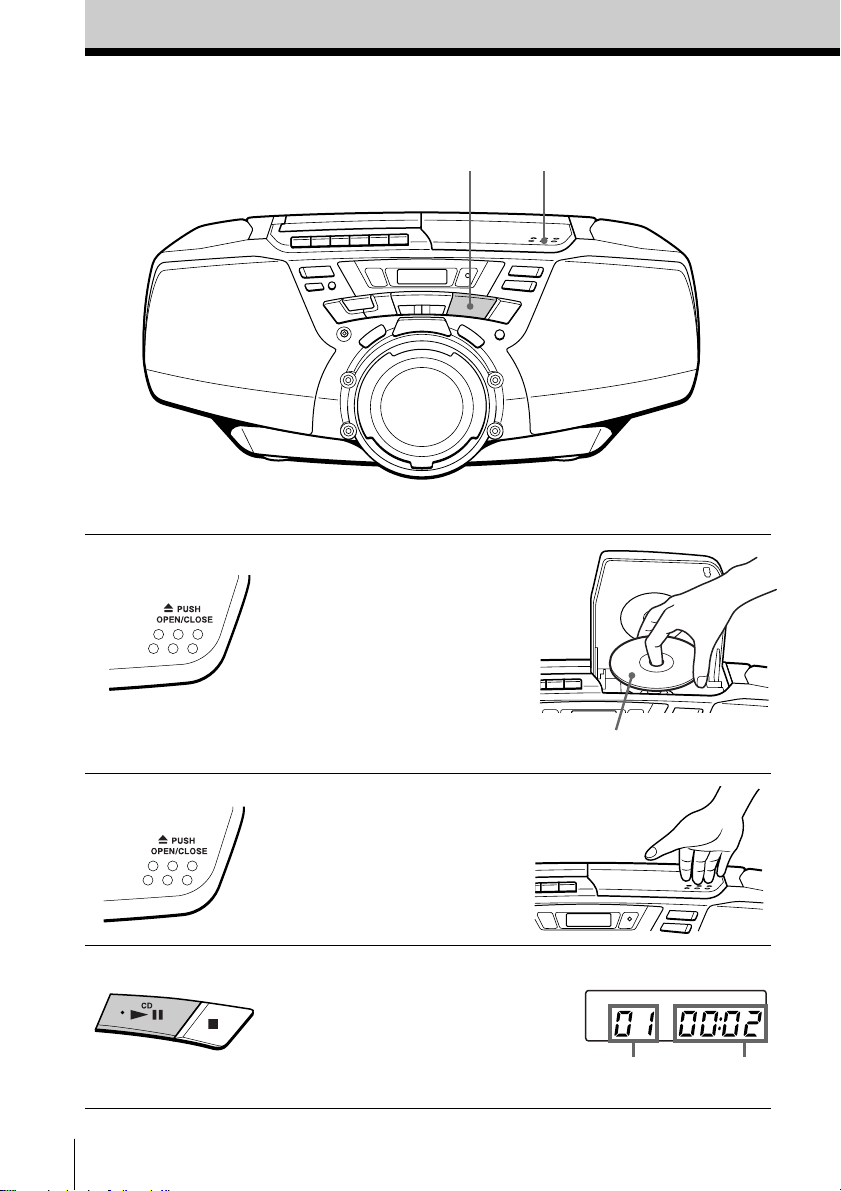
Connect the supplied mains lead (see page 23).
1 Press ZPUSH OPEN/CLOSE
down to open the CD
compartment and place the CD
on the CD compartment.
2 Close the lid of the CD
compartment.
3 Press u.
The player turns on (direct
power-on) and plays all the tracks
once.
GB
Basic Operations4
With the label side up
Display
Track number
Playing time
Page 5
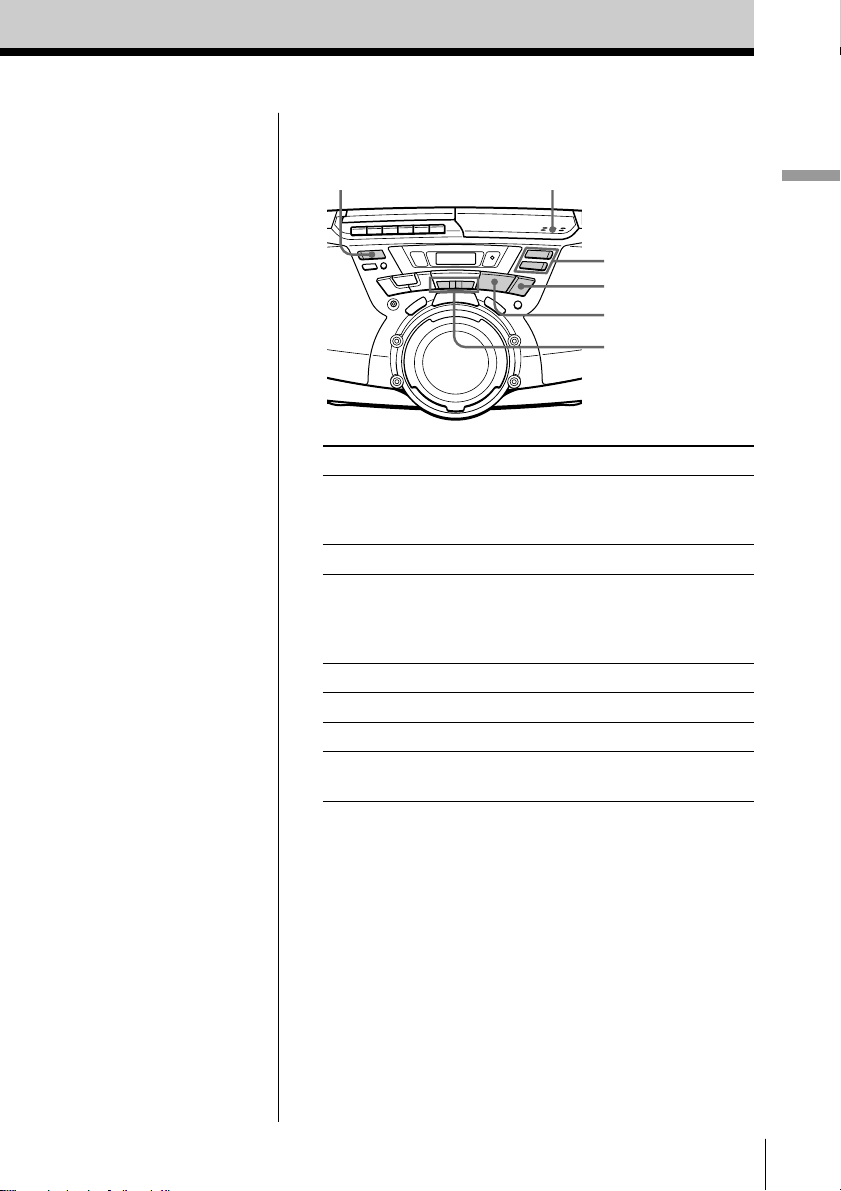
Use these buttons for additional operations
Tip
Next time you want to
listen to a CD, just press
u. The player turns on
automatically and starts
playing the CD.
OPERATE
(or POWER)
To Press
adjust the volume VOLUME +, – (VOL +, –
stop playback x
pause playback u (X on the remote,
go to the next track >
go back to the previous track .
remove the CD ZPUSH OPEN/CLOSE
turn on/off the player OPERATE (or POWER, see
ZPUSH
OPEN/CLOSE
VOLUME +, –
x
u
., >
on the remote, CFD-G50/
G50L only)
CFD-G50/G50L only)
Press the button again to
resume play after pause.
page 2)
Basic Operations
Basic Operations
GB
5
Page 6
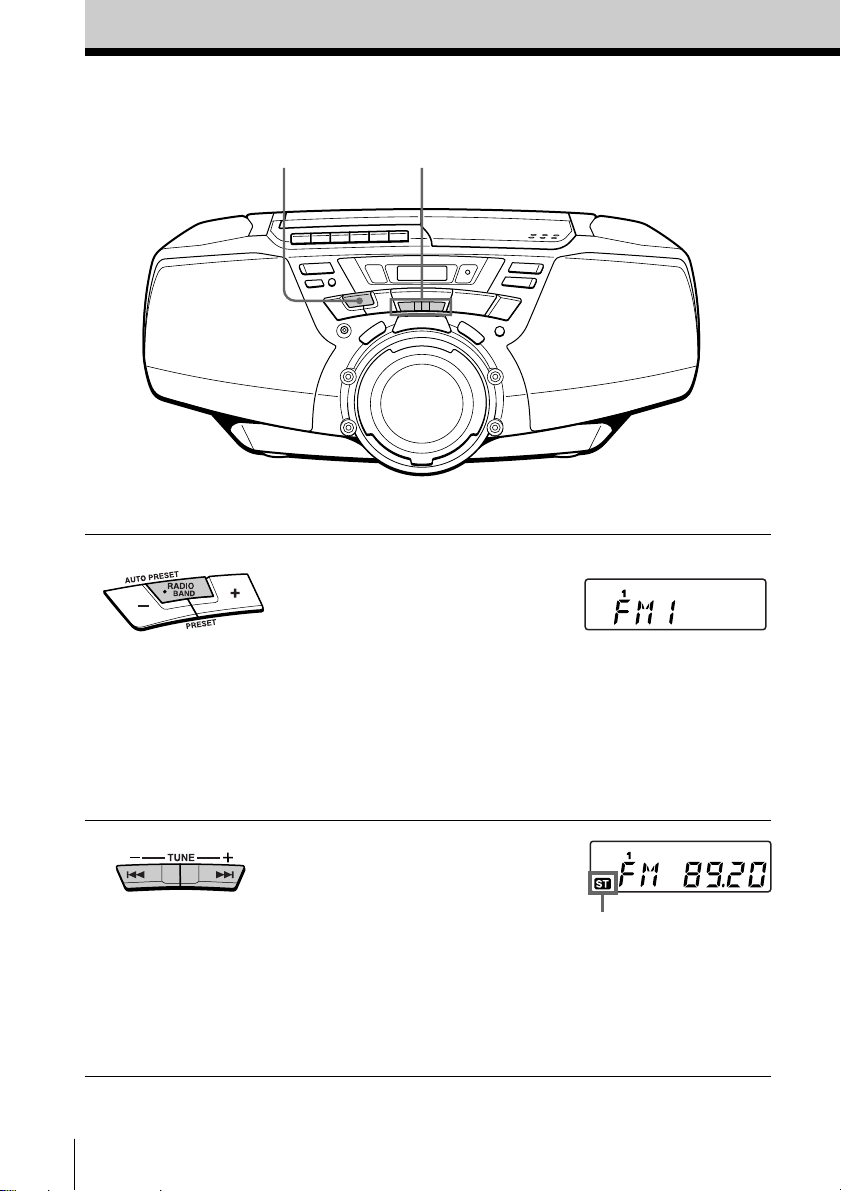
Listening to the radio
1
Connect the supplied mains lead (see page 23).
2
1 Press RADIO BAND•AUTO
PRESET until the band you want
appears in the display (direct
power-on).
Each time you press the button,
the band changes as follows:
CFD-G30/G50: “FM1” t “FM2”
t “AM”
CFD-G30L/G50L: “FM1” t
“FM2” t “MW” t “LW”
Display
2 Hold down TUNE + or – until the
frequency digits begin to change
in the display.
The player automatically scans
the radio frequencies and stops
when it finds a clear station.
If you can't tune in a station,
press the button repeatedly to
change the frequency step by
step.
GB
Basic Operations6
Indicates an FM stereo
broadcast
Page 7
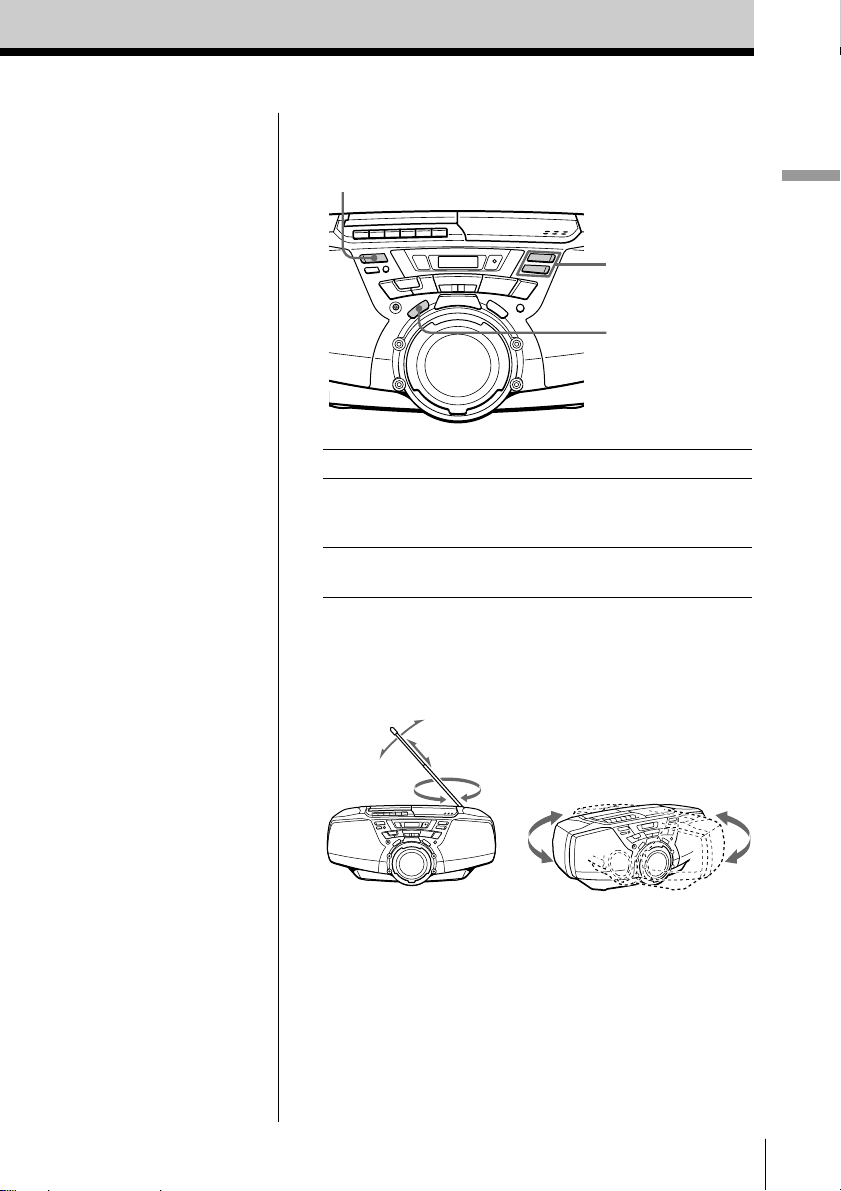
Use these buttons for additional operations
OPERATE
(or POWER)
VOLUME +, –
PLAY MODE
MONO/ST
Basic Operations
Tips
• The “FM1” and “FM2”
bands have the same
functions. You can store
the stations you want
separately in “FM1” and
“FM2” (see page 19).
• If the FM broadcast is
noisy, press PLAY
MODE •MONO/ST
until “Mono” appears in
the display and the
radio will play in
monaural.
• Next time you want to
listen to the radio, just
press RADIO BAND•
AUTO PRESET. The
player turns on
automatically and starts
playing the previous
station.
To Press
adjust the volume VOLUME +, – (VOL +, –
turn on/off the radio OPERATE (or POWER, see
on the remote, CFD-G50/
G50L only)
page 2)
To improve broadcast reception
Reorient the antenna for FM. Reorient the player
itself for AM or MW/LW.
for FM
for AM/MW/LW
Basic Operations
GB
7
Page 8
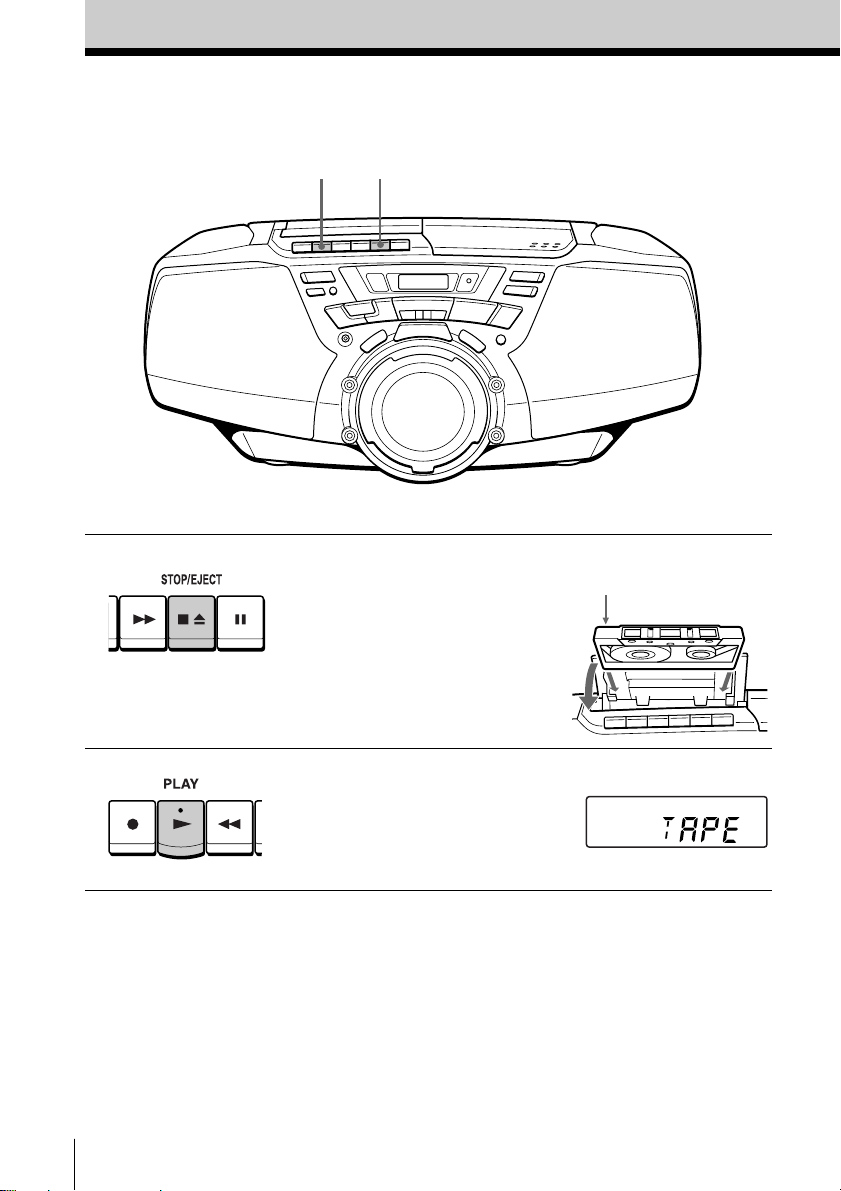
Playing a tape
2
Connect the supplied mains lead (see page 23).
1
1 Press xZ to open the tape
compartment and insert a
recorded tape. Use TYPE I
(normal) tape only. Close the
compartment.
2 Press N.
The player turns on (direct
power-on) and starts playing.
GB
Basic Operations8
With the side you want
to play facing upward
Display
Page 9
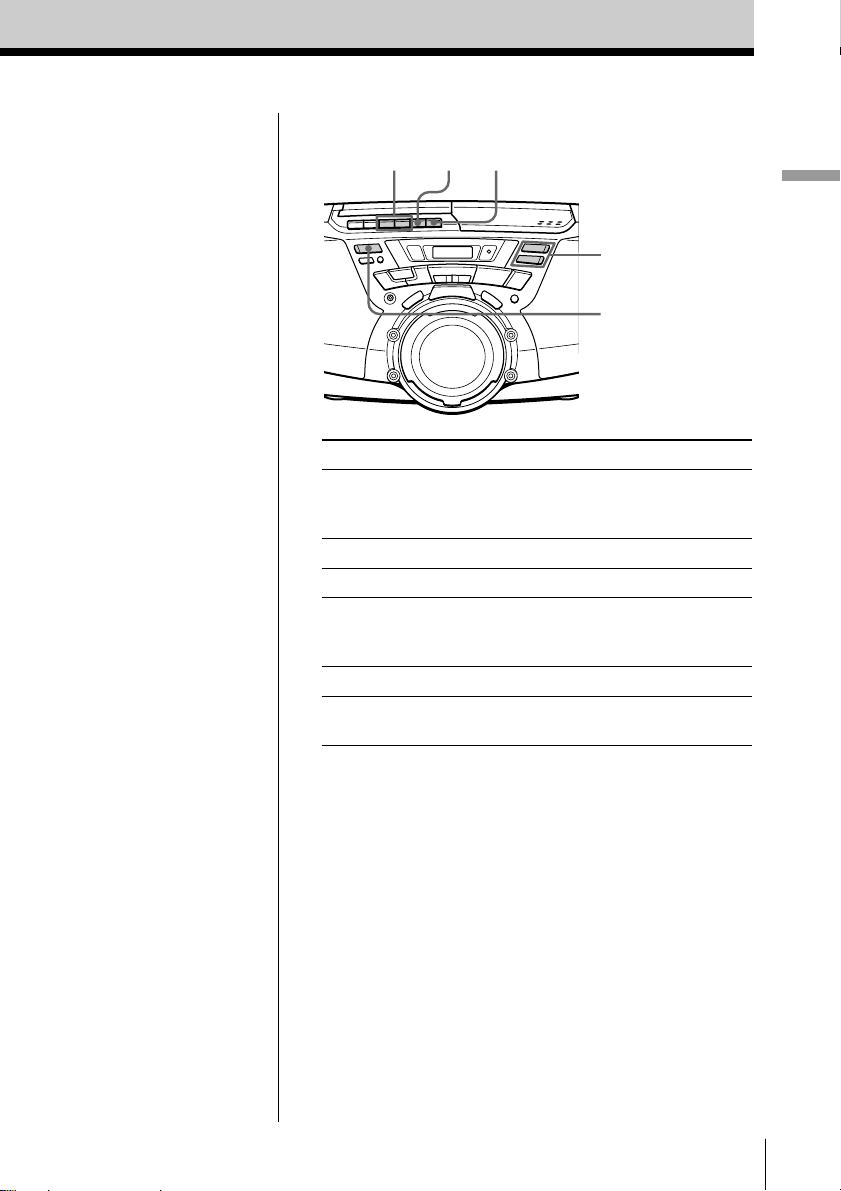
Use these buttons for additional operations
xZ
m, M
X
VOLUME +, –
OPERATE
(or POWER)
Basic Operations
Tip
Next time you want to
listen to a tape, just
press N. The player
turns on automatically
and starts playing the
tape.
To Press
adjust the volume VOLUME +, – (VOL +, –
on the remote, CFD-G50/
G50L only)
stop playback xZ
fast-forward or rewind the tape M or m
pause playback X
Press the button again to
resume play after pause.
eject the cassette xZ
turn on/off the player OPERATE (or POWER, see
page 2)
Basic Operations
GB
9
Page 10
Recording on a tape
31
Connect the supplied mains lead (see page 23).
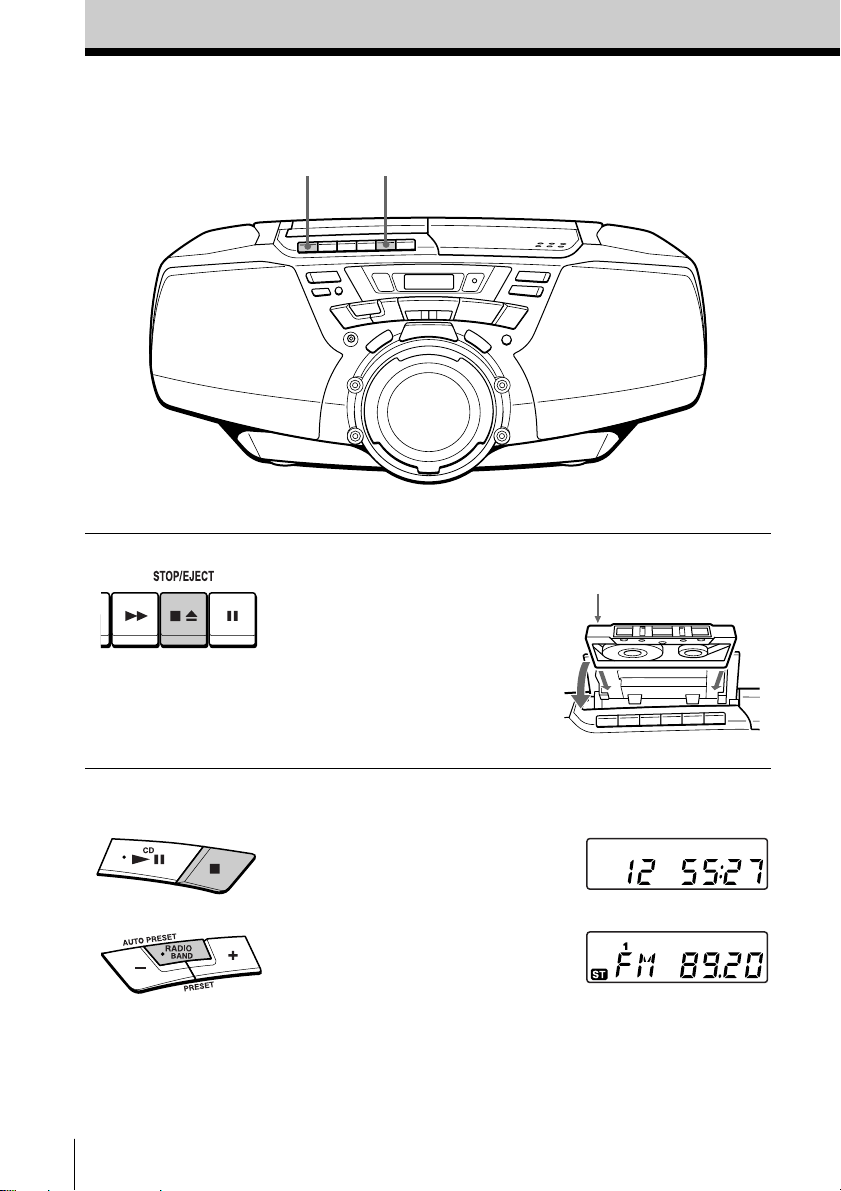
1 Press xZ to open the tape
compartment and insert a blank
tape. Use TYPE I (normal) tape
only.
2 Select the program source you
want to record.
To record from the CD player,
insert a CD (see page 4) and press
x on the CD section.
To record from the radio, tune in
the station you want (see page 6).
GB
Basic Operations10
With the side you want to
record on facing upward
Display
Page 11
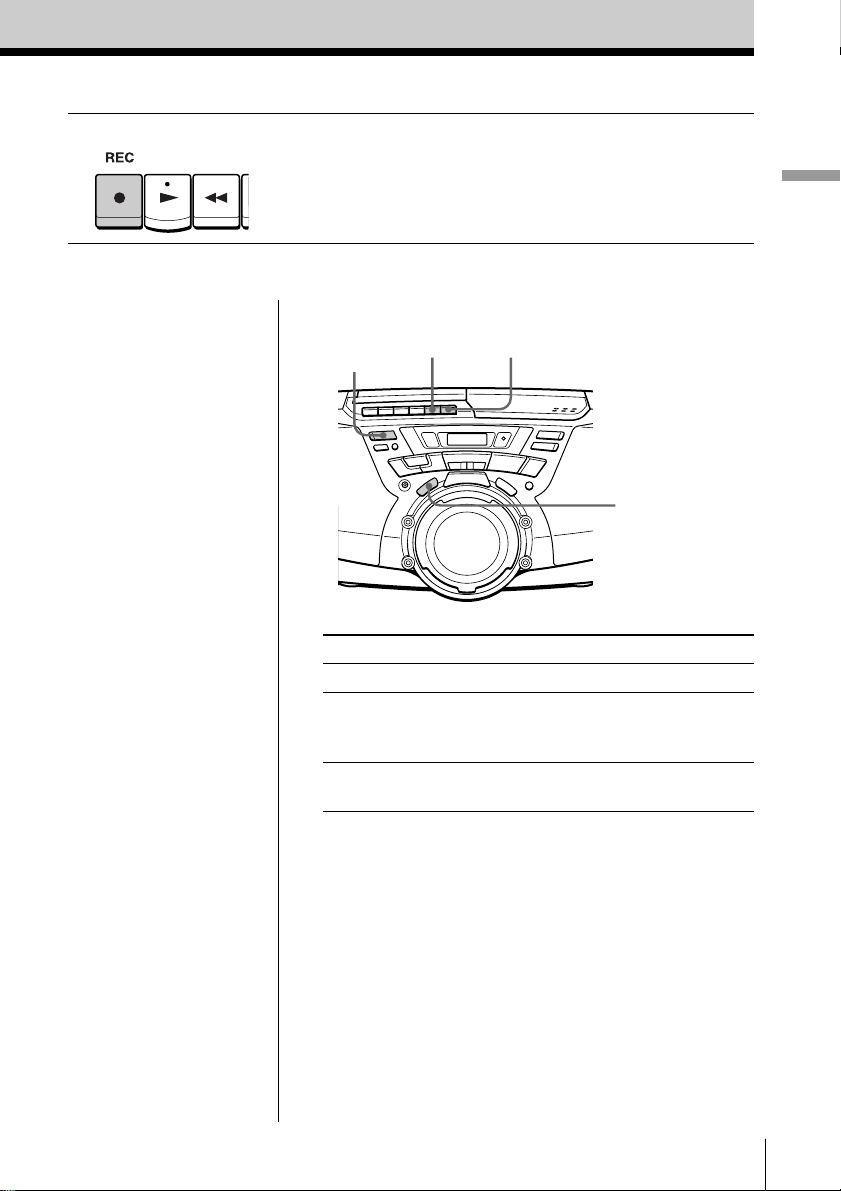
3 Press z to start recording
(N is depressed automatically).
Use these buttons for additional operations
Basic Operations
Tips
• Adjusting the volume or
the audio emphasis (see
page 21) will not affect
the recording level.
• CFD-G30L/G50L only:
If the MW/LW
programme makes a
whistling sound after
you’ve pressed z in
step 3, press PLAY
MODE•MONO/ST ISS
(Interference suppress
switch) repeatedly until
the noise is at a
minimum.
• For the best results, use
the AC power as a
power source.
• To erase a recording,
proceed as follows:
1 Insert the tape whose
recording you want to
erase.
2 Press X.
3 Press N.
4 Press z.
5 Press X.
OPERATE
(or POWER)
To Press
stop recording xZ
pause recording X
turn on/off the player OPERATE (or POWER, see
xZ
X
PLAY MODE
MONO/ST ISS
Press the button again to
resume recording.
page 2)
Basic Operations
11
GB
Page 12
The CD Player
Using the display
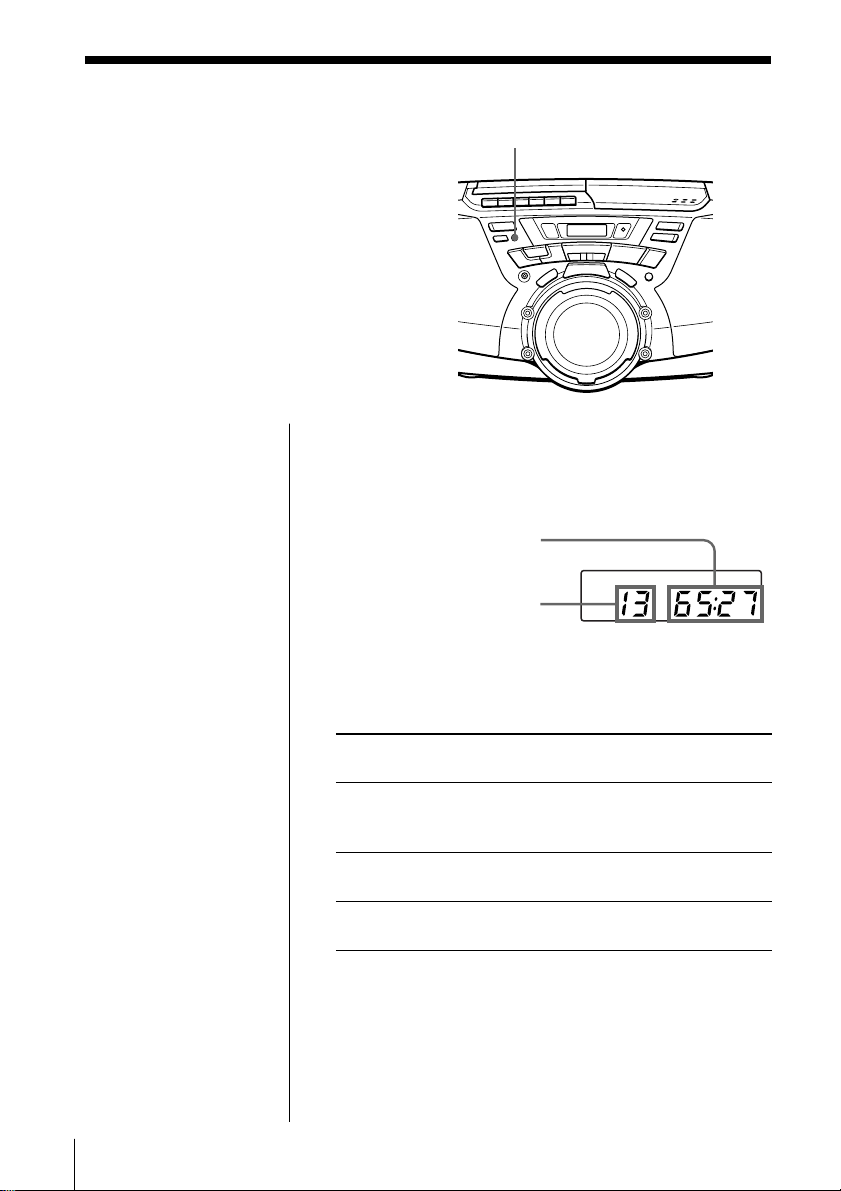
You can check information about the CD
using the display.
Checking the total track number and playing
time
Press DISPLAY ENT•MEMORY in stop mode.
Total playing time
Total track number
DISPLAY ENT
MEMORY
Checking the remaining time
Press DISPLAY ENT•MEMORY while playing a CD.
To display
the current track number once
and the remaining time
on the current track*
the number of tracks left twice
and remaining time on the CD
the current track number three times
and playing time
* For a track whose number is more than 20, the remaining
time appears as “– –:– –”.
GB
The CD Player12
Press
DISPLAY
ENT•MEMORY
Page 13
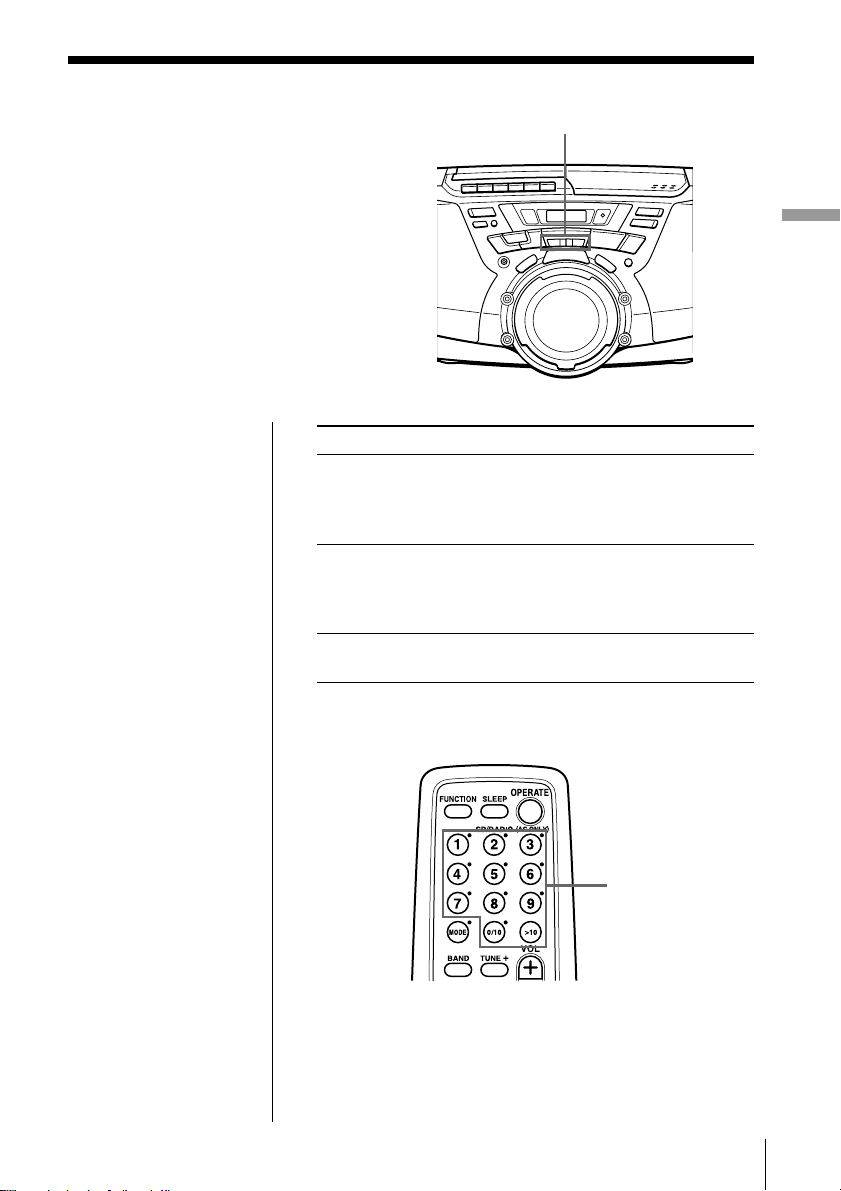
Locating a specific point in a track
You can quickly find a specific point in a
track while playing a CD.
You can also locate any track using the
number buttons on the remote (CFDG50/G50L only).
To locate Press
a point while listening to > (forward) or .
the sound (backward) while playing
a point while observing > (forward) or .
the display (backward) in pause and
Note
CFD-G50/G50L only:
You cannot locate a
specific track if
“SHUF” or “PGM” is
lit in the display. Turn
off the indication by
pressing x.
a specific track directly the number button of the
(CFD-G50/G50L only) track on the remote
When using the remote (CFD-G50/G50L only)
., >
The CD Player
and hold down until you
find the point
hold down until you find
the point
Tip
CFD-G50/G50L only:
When you locate a
track numbered over
10, press >10 first, then
the corresponding
number buttons.
Example:
To play track number
23, press >10 first, then
2 and 3.
Number buttons
The CD Player 13
GB
Page 14
Playing tracks
repeatedly
(Repeat Play)
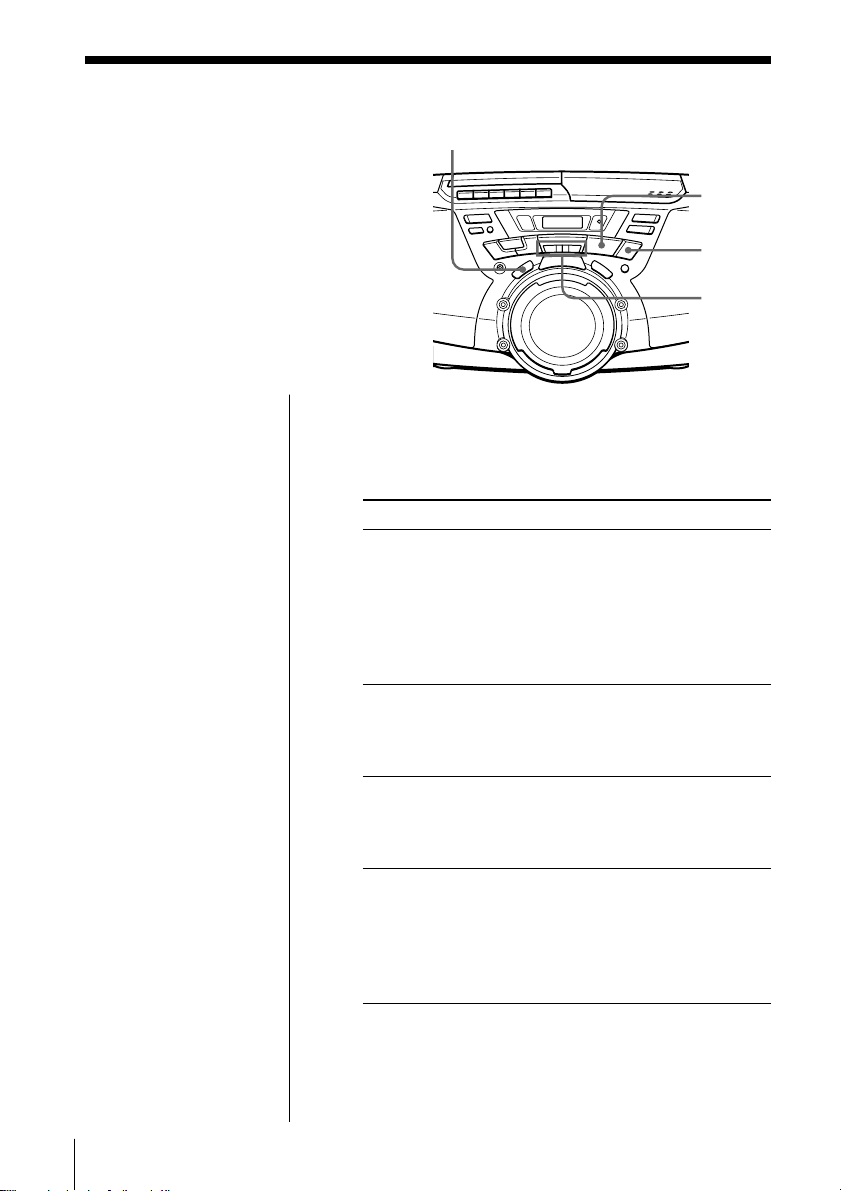
PLAY MODE
MONO/ST
u
You can play tracks repeatedly in
normal, shuffle or programme play
modes (see pages 15 - 17).
On the remote
(CFD-G50/G50L only)
1 Press x.
2 Press MODE until
the repeat mode you
want appears in the
display.
3 Do either of the
following to start
repeat play:
•When you’ve
selected “REP 1”,
select the track by
pressing the
number button.
•When you’ve
selected “REP
ALL” or “SHUF
REP”, press N.
•When you’ve
selected “PGM
REP”, programme
tracks (see step 3 on
page 16), then press
N.
1 Press x.
2 Proceed as follows.
x
., >
“Cd” appears in the display.
To repeat Do this
a single track 1 Press PLAY MODE•
MONO/ST until “REP 1”
appears.
2 Press . or > to select
the track that you want to
repeat.
3 Press u.
all the tracks 1 Press PLAY MODE•
MONO/ST until “REP
ALL” appears.
2 Press u.
tracks in random order 1 Press PLAY MODE•
MONO/ST until “SHUF
REP” appears.
2 Press u.
programmed tracks 1 Press PLAY MODE•
MONO/ST until “PGM
REP” appears.
2 Programme tracks (see step
3 on page 16).
3 Press u.
To cancel Repeat Play
Press PLAY MODE•MONO/ST until “REP”
disappears from the display.
GB
The CD Player14
Page 15
Playing tracks in
random order
(Shuffle Play)
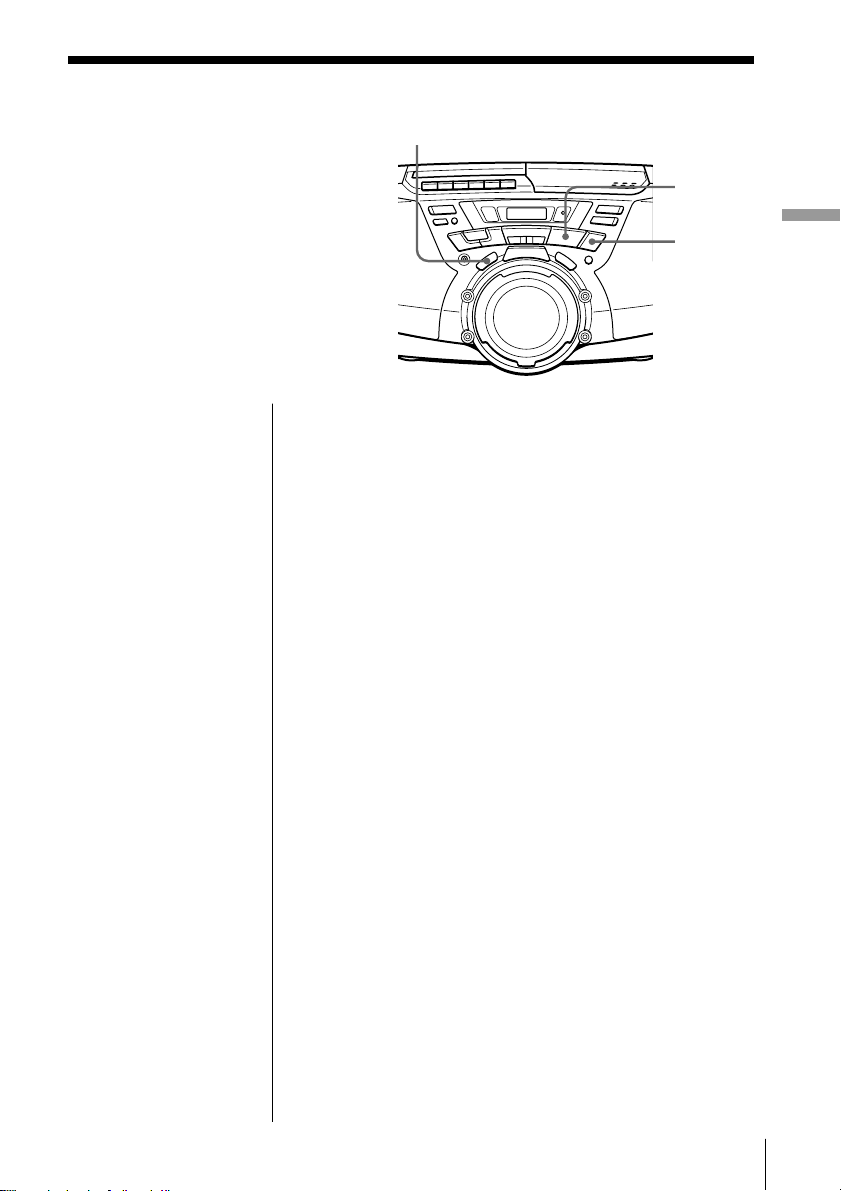
PLAY MODE
MONO/ST
u
You can play tracks in random order.
On the remote
(CFD-G50/G50L only)
1 Press x.
2 Press MODE until
“SHUF” appears in
the display.
3 Press N.
1 Press x.
“Cd” appears in the display.
2 Press PLAY MODE•MONO/ST until “SHUF”
appears in the display.
3 Press u to start shuffle play.
To cancel Shuffle Play
Press PLAY MODE•MONO/ST until “SHUF”
disappears from the display.
x
The CD Player
The CD Player 15
GB
Page 16
Creating your
own programme
(Programme Play)
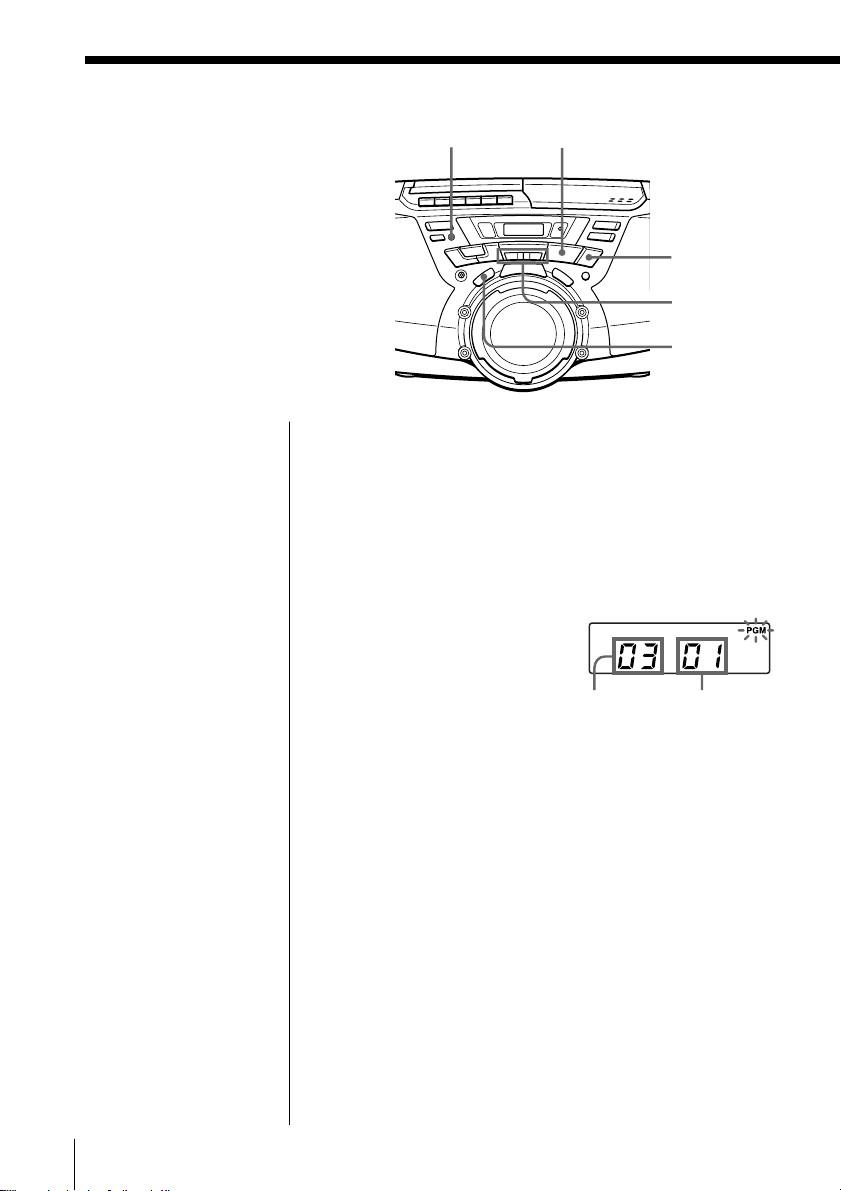
DISPLAY ENT
MEMORY
u
You can arrange the playing order of
up to 20 tracks on a CD.
On the remote
(CFD-G50/G50L only)
1 Press x.
2 Press MODE until
“PGM” appears in
the display.
3 Press the number
buttons for the
tracks you want to
programme in the
order you want.
4 Press N.
1 Press x.
2 Press PLAY MODE•MONO/ST until “PGM”
3 Press the . or > then press DISPLAY ENT•
4 Press u to start programme play.
x
., >
PLAY MODE
MONO/ST
“Cd” appears in the display.
appears in the display.
MEMORY for the tracks you want to programme
in the order you want.
Programmed track
Playing
order
GB
The CD Player16
Page 17
Tips
• You can play the same
programme again,
since the programme is
saved until you open
the CD compartment.
• You can record your
own programme. After
you’ve created the
programme, insert a
blank tape and press z
to start recording.
To cancel Programme Play
Press PLAY MODE•MONO/ST until “PGM”
disappears from the display.
To check the order of tracks before play
Press DISPLAY ENT•MEMORY.
Every time you press the button, the track number
appears in the programmed order.
To change the current programme
Press x once if the CD is stopped and twice if the CD
is playing. The current programme will be erased.
Then create a new programme following the
programming procedure.
The CD Player
The CD Player 17
GB
Page 18
Enjoying sound
effects
(LOOP/FLASH)
(CFD-G50/G50L only)
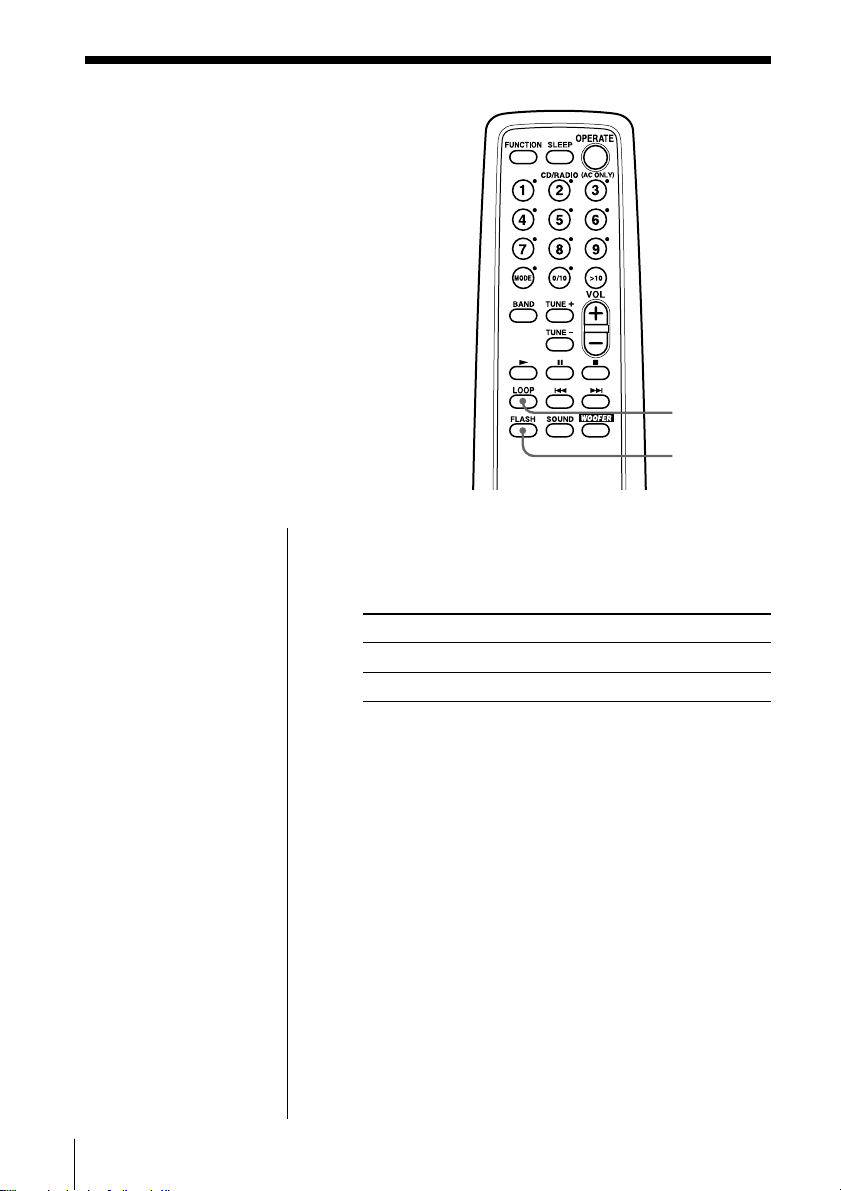
You can repeat part of a CD (LOOP) and
can “flash” the CD sound (FLASH)
during playback.
1 Play a CD.
2 Press and hold LOOP or FLASH at the point you
want to start the function.
To Press and hold
repeat a selected part of a CD LOOP
“flash” the CD sound FLASH
LOOP
FLASH
To cancel the LOOP or FLASH function
Release the button.
The player returns to normal play.
GB
The CD Player18
Page 19
The Radio
Presetting radio stations
You can store radio stations into the
player’s memory. You can preset up
to 30 radio stations (CFD-G30/G50)
or 40 Radio stations (CFD-G30L/
G50L), 10 for each band in any order.
DISPLAY ENT
MEMORY
RADIO BAND
AUTO PRESET
The Radio
PRESET –, +
Tip
If you automatically
preset the “FM1” or
“FM2” band, 10 radio
stations are stored in
“FM1” band and 10
more radio stations are
stored in “FM2” band.
On the remote
(CFD-G50/G50L only)
1 Press BAND until
the band you want
appears in the
display.
2 Tune in a station you
want.
3 Hold down the
number buttons that
you want to preset
the new station on
for about 2 seconds.
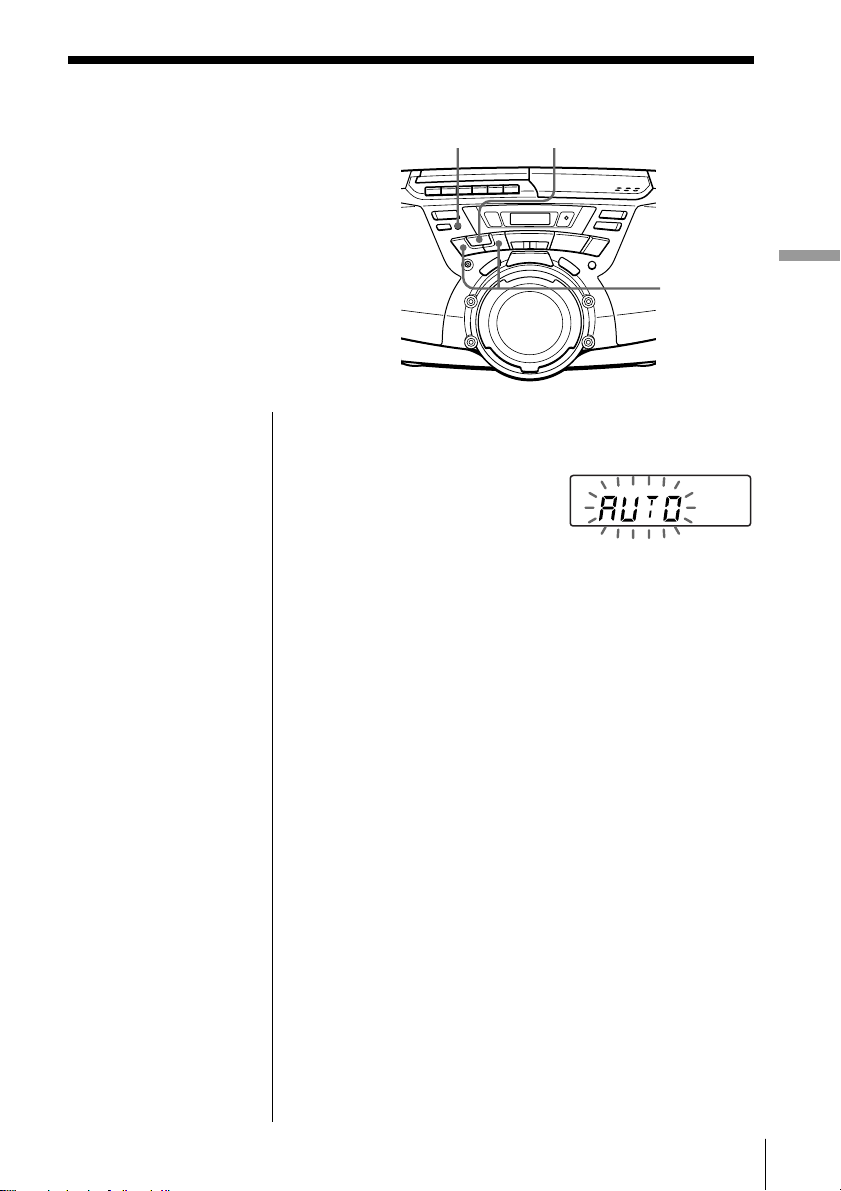
1 Press RADIO BAND•AUTO PRESET until the
band you want appears in the display.
2 Hold down RADIO
BAND•AUTO PRESET
for 2 seconds until
“AUTO” flashes in the
display.
3 Press DISPLAY ENT•MEMORY.
The stations are stored in memory from the lower
frequencies to the higher ones.
If a station cannot be preset automatically
You need to preset a station with a weak signal
manually.
1 Press RADIO BAND•AUTO PRESET to select the
band.
2 Tune in a station you want.
3 Hold down DISPLAY ENT•MEMORY for 2 seconds
until the preset number flashes in the display.
4 Press PRESET + or – until the preset number (1 to
10) you want for the station flashes in the display.
5 Press DISPLAY ENT•MEMORY.
The new station replaces the old one.
The Radio
19
GB
Page 20
Playing preset radio stations
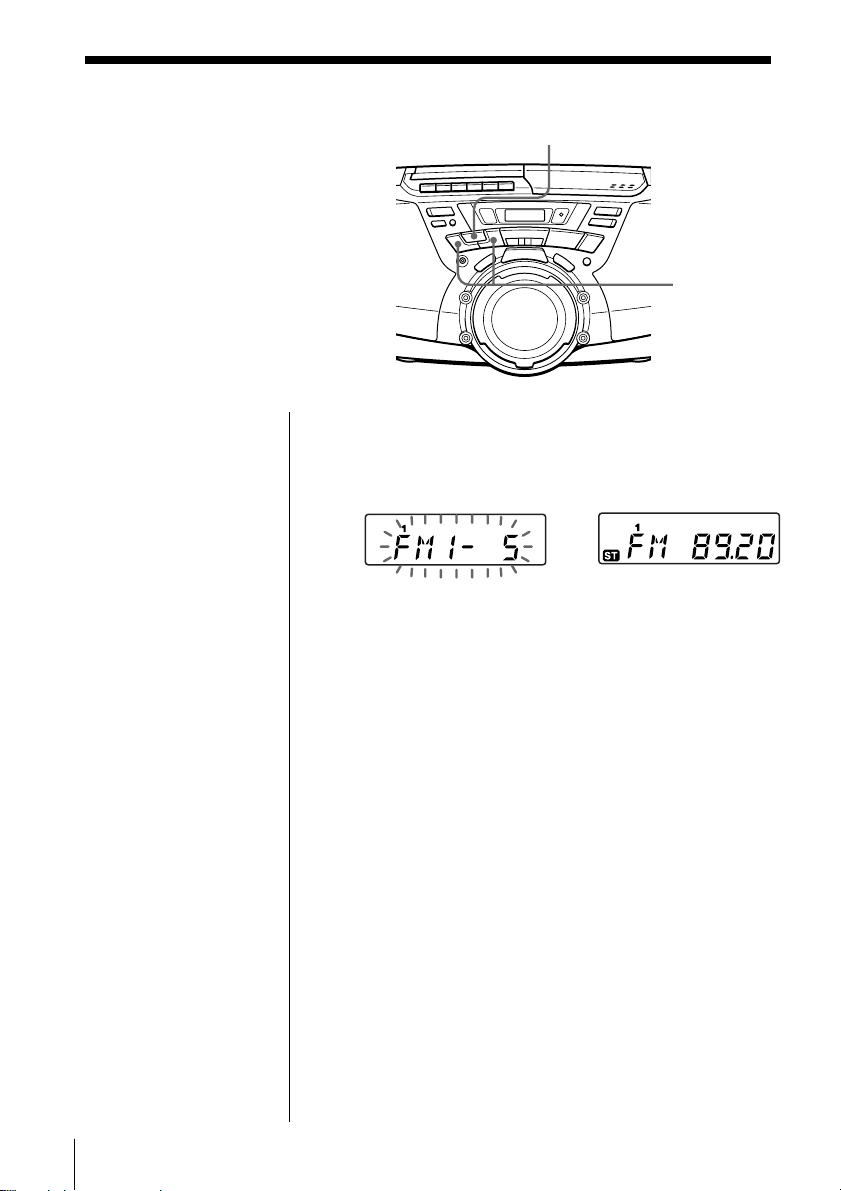
Once you've preset the stations, use
PRESET + or – to tune in to your
favorite stations.
RADIO BAND
AUTO PRESET
PRESET –, +
On the remote
(CFD-G50/G50L only)
1 Press BAND to select
the band.
2 Press the number
buttons to tune in the
stored station.
1 Press RADIO BAND•AUTO PRESET to select the
band.
2 Press PRESET + or – to tune in the stored station.
,
GB
The Radio20
Page 21
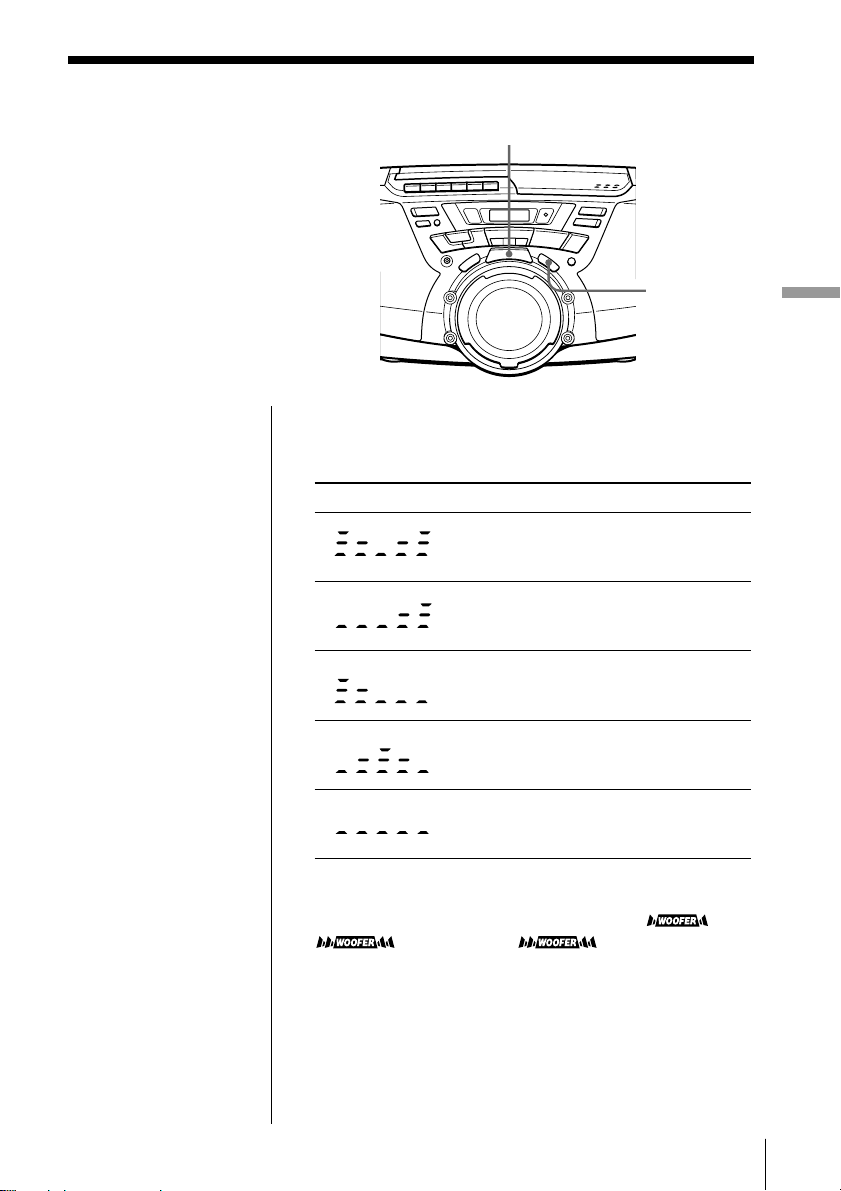
The Audio Emphasis
Selecting the
audio emphasis
(SOUND/POWER DRIVE
WOOFER)
You can adjust the audio emphasis of
the sound you are listening to.
Selecting the sound characteristic
Press SOUND repeatedly to select the audio emphasis
you want.
Choose To get
POWER DRIVE
WOOFER
SOUND
powerful, clean sounds, emphasizing
low and high range audio
light, bright sounds emphasizing
high and middle range audio
percussive sounds, emphasizing bass
audio
The Audio Emphasis
On the remote
(CFD-G50/G50L only)
Press WOOFER.
Notes
• While the sleeping
timer is on, the POWER
DRIVE WOOFER
button does not light,
even if the WOOFER
function works.
• When using the
headphones, the
WOOFER function
does not work.
the presence of vocals, stressing
middle range audio
the whole dynamic range for music
such as classical music
Reinforcing the bass sound
Press POWER DRIVE WOOFER to select or
in the display. is more effective.
When POWER DRIVE WOOFER function works, the
button lights up.
To return to normal sound, press the button until the
indication disappears from the display .
The Audio Emphasis
21
GB
Page 22
The Timer
Falling asleep to music
You can set the player to turn off
automatically after 10, 20, 30, 60, 90, and
120 minutes, allowing you to fall asleep
while listening to music.
SLEEP
Note
When you are playing
a tape using this
function:
If the tape length of
one side is longer than
the set time, the player
will not go off until the
tape reaches the end.
1 Play the music source you want.
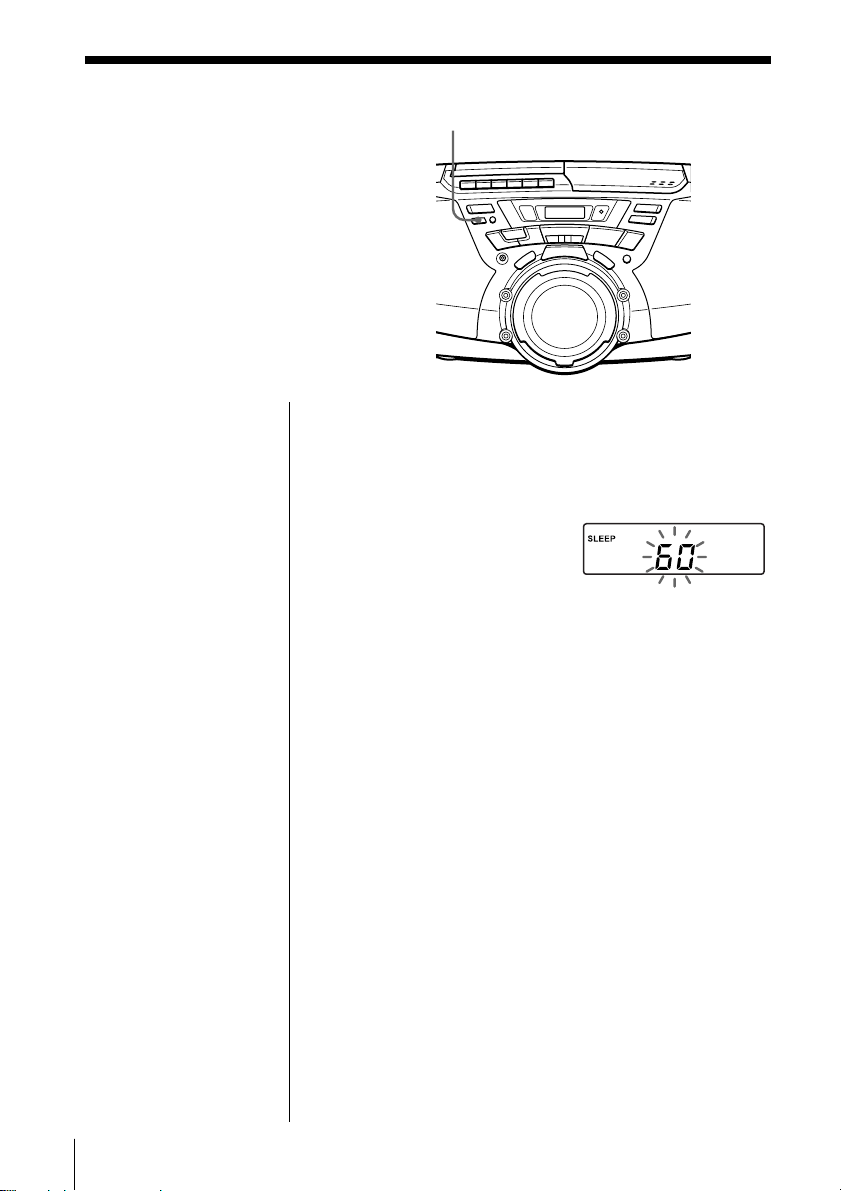
2 Press SLEEP to display “SLEEP.”
3 Press SLEEP to select the minutes until the player
goes off automatically.
Each time you press the
button, the indication
changes as follows:
“60” t “90” t “120” t
no indication t “10” t
“20” t “30.”
To cancel the sleep function
Press OPERATE (or POWER) to turn off the power.
GB
The Timer22
Page 23

Setting Up
Choosing the power sources
You can use the mains or batteries
as a power source.
AC IN
2 Battery compartment
Notes
• Before you replace the
batteries, be sure to
take out the CD from
the player.
• CFD-G50/G50L only:
When you operate the
player with the
batteries, you cannot
turn on the player with
remote.
1 to the mains
1 Connecting the mains lead
Insert one end of the supplied mains lead to the AC
IN socket located at the rear of the player, and the
other end to the mains.
Adjusting the voltage (CFD-G30/G50 only)
Be sure to set the VOLTAGE
SELECTOR (at the bottom) to
your local power supply.
2 Using the player on batteries
Insert eight R20 (size D) batteries (not supplied) into
the battery compartment.
To use the player on batteries, disconnect the mains
lead from the player.
Setting Up
Replacing batteries
Replace the batteries when the OPR/BATT indicator
dims or when the player stops operating. Replace all
the batteries with new ones.
continued
Setting Up 23
GB
Page 24

Choosing the power sources (continued)
3 Inserting batteries into the remote
(CFD-G50/G50L only)
Insert two R6 (size AA) batteries (not supplied)
Replacing batteries
With normal use, the batteries should last for about
six months. When the remote no longer operates the
player, replace all the batteries with new ones.
GB
Setting Up24
Page 25

Connecting optional components
You can enjoy the sound from a TV or
VCR through the speakers of this player.
Be sure to turn off the power of each
component before making connections.
For details, refer to the instructions of the
component to be connected.
Note
Connect the cords
firmly to avoid any
malfunction.
Connecting a TV or a VCR
TV, VCR, etc.
TV, VCR, etc.
LINE
Setting Up
Rear panel of
this player
RK-G129 (not
supplied), etc.
to LINE IN
to line out jack
RK-G136 (not
supplied), etc.
to headphones jack
After finishing the connections, turn on the player,
and press LINE to display “LInE”.
continued
Setting Up 25
GB
Page 26

Connecting optional components (continued)
Recording the sound from the connected
components
1 Insert a blank cassette.
2 Press LINE to display “LInE”.
3 Press z.
Recording starts.
4 Play the optional component connected to the LINE
IN jack of the player.
GB
Setting Up26
Page 27

Additional Information
Precautions
On safety
• As the laser beam used in the CD
player section is harmful to the eyes,
do not attempt to disassemble the
casing. Refer servicing to qualified
personnel only.
• Should any solid object or liquid fall
into the player, unplug the player, and
have it checked by qualified personnel
before operating it any further.
On power sources
• For AC operation, check that the
player’s operating voltage is identical
with your local power supply (see
“Specifications”) and use the supplied
mains lead; do not use any other type.
The voltage selector is located at the
bottom of the player (CFD-G30/G50
only).
• The player is not disconnected from
the AC power source (mains) as long
as it is connected to the wall outlet,
even if the player itself has been
turned off.
• For battery operation, use eight R20
(size D) batteries.
• When the batteries are not to be used,
remove them to avoid damage that
can be caused by battery leakage or
corrosion.
• The nameplate indicating operating
voltage, power consumption, etc. is
located at the bottom.
On placement
• Do not leave the player in a location
near heat sources, or in a place subject
to direct sunlight, excessive dust or
mechanical shock.
• Do not place the player on an inclined
or unstable place.
• Do not place anything within 10 mm
of the side of the cabinet. The
ventilation holes must be
unobstructed for the player to operate
properly and prolong the life of its
components.
• If the player is left in a car parked in
the sun, be sure to choose a location in
the car where the player will not be
subjected to the direct rays of the sun.
• Since a strong magnet is used for the
speakers, keep personal credit cards
using magnetic coding or springwound watches away from the player
to prevent possible damage from the
magnet.
On operation
• If the player is brought directly from a
cold to a warm location, or is placed in
a very damp room, moisture may
condense on the lens inside the CD
player section. Should this occur, the
player will not operate properly. In
this case, remove the CD and wait
about an hour for the moisture to
evaporate.
• If the player has not been used for a
long time, set it in the playback mode
to warm it up for a few minutes before
inserting a cassette.
If you have any questions or problems
concerning your player, please consult
your nearest Sony dealer.
continued
Additional Information 27
GB
Page 28

Precautions (continued)
Notes on CDs
• Before playing, clean the CD with a
cleaning cloth. Wipe the CD from the
center out.
• Do not use solvents such as benzine,
thinner, commercially available
cleaners or anti-static spray intended
for vinyl LPs.
• Do not expose the CD to direct
sunlight or heat sources such as hot
air ducts, nor leave it in a car parked
in direct sunlight as there can be a
considerable rise in temperature
inside the car.
• Do not stick paper or sticker on the
CD, nor scratch the surface of the CD.
• After playing, store the CD in its case.
If there is a scratch, dirt or fingerprints
on the CD, it may cause tracking error.
Notes on cassettes
• Break off the cassette tab from side A
or B to prevent accidental recording. If
you want to reuse the tape for
recording, cover the broken tab with
adhesive tape.
Side A
Tab for side B
Tab for side A
• The use of a cassette with more than
90 minutes of play time is not
recommended except for long,
continuous recording or playback.
GB
Additional Information28
Page 29

Troubleshooting
Symptom
The power is not on.
The power is not on, and “bAttErY”
and “Error” are displayed
alternately.
There is no audio.
General
Noise is heard.
“no diSC“ lights in the display even
when a CD is in place.
The CD does not play.
The sound drops out.
CD Player
Noise is heard.
Remedy
• Connect the mains lead to a wall outlet securely.
• Make sure the batteries are inserted correctly.
• You cannot turn on the player with the remote
when you operate the player on batteries
(CFD-G50/G50L only).
• Make sure the batteries are inserted correctly.
• Replace all the batteries with new ones if they
are weak.
• Make sure the function you want to use appears
in the display window.
• Adjust the volume.
• Unplug the headphones when listening through
speakers.
• Someone is using a portable telephone or other
equipment that emits radio waves near the
player. t Move the portable telephone, etc.,
away from the player.
• Insert the CD with the label surface up.
• Make sure that the CD compartment is closed.
• Place the CD with the label surface up.
• Clean the CD.
• Take out the CD and leave the CD compartment
open for about an hour to dry moisture
condensation.
• Make sure “Cd” appears in the display.
• Reduce the volume.
• Clean the CD, or replace it if the CD is badly
damaged.
• Place the player in a location free from
vibration.
• The sound may drop out or noise may be heard
if the CD is recorded using a personal computer
(CD-R, etc.)
continued
Additional Information 29
GB
Page 30

Troubleshooting (continued)
Symptom
The audio is weak or has poor
quality.
Radio
The picture of your TV becomes
unstable.
The tape does not move when you
press an operation button.
The REC z button does not
function/The tape does not play.
The tape does not erase completely.
The tape does not record.
Tape Player
The audio is weak/The audio
quality is poor.
The sound is distorted.
Remedy
• Replace all the batteries with new ones if they
are weak.
• Move the player away from the TV.
• If you are using the remote while listening to
AM or MW/LW radio, noise may be heard. This
is unavoidable (CFD-G50/G50L only).
• If you are listening to an FM programme near
the TV with an indoor aerial, move the player
away from the TV.
• Close the tape compartment securely.
• Make sure the safety tab on the cassette is in
place.
• Make sure “TAPE” appears in the display.
• Clean the erasing head (see page 32).
• Replace all the batteries with new ones if they
are weak.
• The source which was recorded on TYPE II
(high position) or TYPE IV (metal) tape using
this unit is being played. Record on TYPE I
(normal) tape and play.
• Make sure the tape is inserted properly.
• Make sure the safety tab of the cassette is in
place.
• Clean the heads, pinch roller and capstan (see
page 32).
• Demagnetize the heads using a demagnetizer
(see page 32).
• The TYPE II (high position) or TYPE IV (metal)
tape is being used. Use TYPE I (normal) tape
only.
GB
Additional Information30
Page 31

Symptom
The remote does not function.
Remedy
• Replace all the batteries in the remote with new
ones if they are weak.
• Make sure that you are pointing the remote at
the remote sensor on the player.
• Remove any obstacles in the path of the remote
and the player.
• Make sure the remote sensor is not exposed to
strong light such as direct sunlight or
fluorescent lamp light.
• Move closer to the player when using the
Remote (CFD-G50/G50L only)
remote.
After trying the above remedies, if you still have problems, unplug the AC power cord and
remove all the batteries. After all the indications in the display disappear, plug the power cord
and insert the batteries again. If the problem persists, please consult your nearest Sony dealer.
Additional Information 31
GB
Page 32

Maintenance
Cleaning the lens
If the lens becomes dirty, it may cause a
skipping of sound during CD operation.
Clean with a commercially available
blower.
Cleaning the tape heads and tape
path
Wipe the heads, the pinch roller and the
capstan with a cleaning swab slightly
moistened with cleaning fluid or alcohol
after every 10 hours of operation for
optimum playback and recording
quality. To make the best possible
recording, however, we recommend that
you clean all surfaces over which tape
travels before each recording.
Record/playback head
Capstan
Erase head
Pinch roller
Demagnetizing the tape heads
After 20 to 30 hours of use, enough
residual magnetism will have built up
on the tape heads to begin to cause loss
of high frequency sound and hiss. At
this time, you should demagnetize the
heads and all metal parts in the tape
path with a commercially available tape
head demagnetizer.
Cleaning the cabinet
Clean the cabinet, panel and controls
with a soft cloth slightly moistened with
a mild detergent solution. Do not use
any type of abrasive pad, scouring
powder, or solvent, such as alcohol or
benzine.
After cleaning, insert a tape when the
areas cleaned are completely dry.
GB
Additional Information32
Lens
Page 33

Specifications
CD player section
System
Compact disc digital audio system
Laser diode properties
Material: GaAlAs
Wave length: 780 nm
Emission duration: Continuous
Laser output: Less than 44.6 µW
(This output is the value measured at a distance of
about 200 mm from the objective lens surface on
the optical pick-up block with 7 mm aperture.)
Spindle speed
200 r/min (rpm) to 500 r/min (rpm) (CLV)
Number of channels
2
Frequency response
20 - 20,000 Hz +0.5/–1.5 dB
Wow and flutter
Below measurable limit
Radio section
Frequency range
CFD-G30/G50
FM 87.6 - 108 MHz
AM 531 - 1,602 kHz
CFD-G30L/G50L
FM 87.5 - 108 MHz
MW 531 - 1,602 kHz
LW 153 - 279 kHz
IF
FM: 10.7 MHz
AM/MW/LW: 450 kHz
Aerials
FM: Telescopic aerial
AM/MW/LW: Built-in ferrite bar aerial
Cassette-corder section
Recording system
4-track 2 channel stereo
Fast winding time
Approx. 110 sec. with Sony cassette C-60
Frequency response
TYPE I (normal): 70 - 13,000 Hz
General
Speaker
Full range: 10 cm (4
3.2 ohms, cone type (2)
Woofer: 8 cm (3
Inputs
LINE IN (stereo minijack): Sensitivity 436 mV
Outputs
Headphones jack (stereo minijack)
For 16 - 68 ohms impedance headphones
Maximum power output
Full range: 4 W + 4 W
Woofer: 12 W
Power requirements
For CD radio cassette-corder:
CFD-G30/G50
110 - 120, 220 - 240 V AC selectable, 50/60 Hz
CFD-G30L/G50L
Argentine model: 220 - 230 V AC, 50 Hz
Other models: 230 V AC, 50 Hz
12 V DC, 8 R20 (size D) batteries
For remote control (CFD-G50/G50L only):
3 V DC, 2 R6 (size AA) batteries
Power consumption
AC 30 W
Battery life
For CD radio cassette-corder:
FM recording
Sony R20P: approx. 8 h
Sony alkaline LR20: approx. 18 h
Tape playback
Sony R20P: approx. 1.5 h
Sony alkaline LR20: approx. 6 h
CD playback
Sony R20P: approx. 1 h
Sony alkaline LR20 : approx. 4 h
in.) dia.,
1
⁄4 in.) dia. 4 ohms cone type (1)
continued
Additional Information 33
GB
Page 34

Specifications (continued)
Dimensions
Approx. 500 × 206 × 328 mm (w/h/d)
3
⁄4 × 8 1⁄8 × 13 inches) (incl. projecting parts)
(19
Mass
Approx. 7 kg (15 lb. 7 oz) (incl. batteries)
Supplied accessories
Mains lead (1)
Remote control (1) (CFD-G50/G50L only)
Design and specifications are subject to change without
notice.
Optional accessories
Sony MDR headphones series
GB
Additional Information34
Page 35

Index
A
Audio emphasis 21
B
Batteries
for player 23
for remote (CFD-G50/
G50L only) 24
C
CD player 12
Choosing power sources 23
Cleaning
cabinet 32
tape heads and tape path
32
Connecting the mains lead
23
Creating your own
programme 16
D, E
Demagnetizing the tape
heads 32
Display 12
F, G, H
Falling asleep to music 22
FLASH 18
I, J, K
Improving broadcast
reception 7
L
Listening to the radio 6
Locating a specific point 13
LOOP 18
M, N, O, P, Q
Playing
a CD 4
a tape 8
preset radio stations 20
tracks repeatedly 14
Power sources 23
Presetting radio stations 19
Programme Play 16
R
Radio stations
playing 20
presetting 19
Recording on a tape 10
Repeat Play 14
S
Selecting
audio emphasis 21
tracks 5
Setting up 23
Shuffle Play 15
Sleep timer 22
SOUND 21
T
Troubleshooting 29
U
Using the display 12
V
VOLTAGE SELECTOR
(CFD-G30/G50 only) 23
W, X, Y, Z
Woofer 21
Additional Information 35
GB
Page 36

ADVERTENCIA
Para evitar incendios o el riesgo de
electrocución, no exponga el
reproductor a la lluvia ni a la
humedad.
Para evitar descargas eléctricas, no
abra el sistema. En caso de avería,
solicite sólo los servicios de personal
especializado.
Información
Para usuarios en Europa
Este reproductor de discos compactos está
clasificado como producto lasérico de clase 1.
La etiqueta CLASS 1 LASER PRODUCT se
encuentra en el lateral.
ADVERTENCIA
No instale el aparato en un espacio cerrado,
como una estantería para libros o un armario
empotrado.
Acerca de este manual
Las instrucciones de este manual hacen
referencia a los modelos CFD-G30,
CFD-G30L, CFD-G50 y CFD-G50L. Antes de
comenzar a leerlas, compruebe el número de
modelo. Se ha utilizado el modelo CFD-G50L
para las ilustraciones.
Nota
El nombre del interruptor para encender y
apagar este reproductor se indica de la
siguiente forma:
“OPERATE”: CFD-G30L, CFD-G50L
“POWER”: CFD-G30, CFD-G50
ES
Intrducción2
Page 37

Índice
Procedimientos básicos
4 Reproducción de un CD
6 Radiorecepción
8 Reproducción de cintas
10 Grabación en una cinta
Procedimientos básicos
Reproductor de discos
compactos (CD)
12 Utilización del visualizador
13 Localización de un punto
específico de una canción
14 Reproducción repetida de las
canciones
(Reproducción repetida)
15 Reproducción de canciones en
orden aleatorio
(Reproducción aleatoria)
16 Creación de su propio programa
(Reproducción programada)
18 Efectos sonoros (LOOP/FLASH)
(sólo CFD-G50/G50L)
Radio
19 Memorización de emisoras de
radiodifusión
20 Sintonía de emisoras
almacenadas
Énfasis de sonido
21 Selección del énfasis de audio
(SOUND/POWER DRIVE
WOOFER)
Temporizador
22 Desactivación automática de la
unidad
Preparativos
23 Selección de la fuente de
alimentación
25 Conexión de componentes
opcionales
Información
complementaria
27 Precauciones
29 Solución de problemas
32 Mantenimiento
33 Especificaciones
35 Índice alfabético
ES
Introducción
ES
3
Page 38

Procedimientos básicos
Reproducción de un CD
3
Conecte el cable de alimentación de CA suministrado
(consulte la página 23).
1 Pulse ZPUSH OPEN/CLOSE
para abrir el compartimiento de
discos y coloque el CD.
1, 2
2 Cierre la tapa del compartimiento
de discos.
3 Pulse u.
El reproductor se enciende
(activación directa) y el
reproductor reproduce todas las
canciones una vez.
ES
Procedimientos básicos4
Con el lado de la etiqueta hacia arriba
Visualizador
Número de
canción
Tiempo de
reproducción
Page 39

Utilice estos botones para realizar procedimientos
adicionales
Consejo
La próxima vez que
desee escuchar un CD,
basta con pulsar u. El
reproductor se enciende
automáticamente e
inicia la reproducción
del CD.
OPERATE
(o POWER)
Para Pulse
ajustar el volumen VOLUME +, – (VOL +, –
cesar la reproducción x
realizar una pausa u (X en el mando a
pasar a la siguiente canción >
retroceder a la canción anterior .
extraer el disco Z PUSH OPEN/CLOSE
encender/apagar el reproductor OPERATE (o POWER,
ZPUSH
OPEN/CLOSE
VOLUME +, –
x
u
., >
en el mando a distancia,
sólo CFD-G50/G50L)
distancia, sólo CFD-G50/
G50L)
Vuelva a pulsar el botón
para reanudar la
reproducción después de
la pausa.
consulte la página 2)
Procedimientos básicos
Procedimientos básicos
ES
5
Page 40

Radiorecepción
12
Conecte el cable de alimentación de CA suministrado
(consulte la página 23).
1 Pulse RADIO BAND•AUTO
PRESET hasta que la banda que
desee aparezca en el visualizador
(activación directa).
Cada vez que pulse el botón, la
banda cambiará de la siguiente
forma:
CFD-G30/G50: “FM1” t “FM2”
t “AM”
CFD-G30L/G50L: “FM1” t
“FM2” t “MW” t “LW”
2 Mantenga pulsado TUNE + o –
hasta que los dígitos de
frecuencia comiencen a cambiar
en el visualizador.
El reproductor explora
automáticamente las frecuencias
de radio y se detiene al encontrar
una emisora con sonido nítido.
Si no puede sintonizar una emisora,
pulse el botón varias veces y cambie la
frecuencia intervalo a intervalo.
ES
Procedimientos básicos6
Visualizador
Indica una emisión
estéreo de FM.
Page 41

Utilice estos botones para realizar procedimientos
adicionales
Consejos
• Las bandas “FM1” y
“FM2” tienen las
mismas funciones.
Puede almacenar las
emisoras que desee por
separado en “FM1” y
“FM2” (consulte la
página 19).
• Si la emisión en FM
presenta ruido, pulse
PLAY MODE•MONO/
ST hasta que aparezca
“Mono” en el
visualizador; la radio
sintonizará la emisión
en modo monofónico.
• La próxima vez que
desee escuchar la radio,
basta con pulsar el
botón RADIO BAND•
AUTO PRESET. La
radio se enciende
automáticamente e
inicia la reproducción
de la emisora anterior.
OPERATE
(o POWER)
VOLUME +, –
PLAY MODE
MONO/ST
Para Pulse
ajustar el volumen VOLUME +, – (VOL +, – en el
encender/apagar la radio OPERATE (o POWER,
mando a distancia, sólo
CFD-G50/G50L)
consulte la página 2)
Para mejorar la recepción de la radio
Reoriente la antena para FM y el reproductor para
AM o MW/LW.
Para FM
Para AM/MW/LW
Procedimientos básicos
Procedimientos básicos
ES
7
Page 42

Reproducción de cintas
2
1
Conecte el cable de alimentación de CA suministrado
(consulte la página 23).
1 Pulse xZ para abrir el
compartimiento de la cinta e
inserte una cinta grabada. Emplee
sólo cintas TYPE I (normal).
Cierre el compartimiento.
2 Pulse N.
El reproductor se enciende
(activación directa) e inicia la
reproducción.
ES
Procedimientos básicos8
Con la cara que desea
reproducir hacia arriba
Visualizador
Page 43

Utilice estos botones para realizar procedimientos
adicionales
Consejo
La próxima vez que
desee escuchar una
cinta, basta con pulsar
N. El reproductor se
enciende
automáticamente e
inicia la reproducción
de la cinta.
m, M
Para Pulse
ajustar el volumen VOLUME +, – (VOL +, – en el
cesar la reproducción xZ
avanzar rápidamente o M o m
rebobinar la cinta
realizar una pausa X
extraer el cassette xZ
encender/apagar el OPERATE (o POWER,
reproductor consulte la página 2)
xZ
X
VOLUME +, –
OPERATE
(o POWER)
mando a distancia, sólo
CFD-G50/G50L)
Vuelva a pulsar el botón
para reanudar la reproducción
después de la pausa.
Procedimientos básicos
Procedimientos básicos
ES
9
Page 44

Grabación en una cinta
31
Conecte el cable de alimentación de CA suministrado
(consulte la página 23).
1 Pulse xZ para abrir el
compartimiento de cintas e
inserte una cinta virgen. Emplee
sólo cintas TYPE I (normal).
2 Seleccione la fuente de programa
que desee grabar.
Para grabar desde el reproductor
de discos compactos, inserte un
CD (consulte la página 4) y pulse
x de la sección de CD.
Para grabar desde la radio,
sintonice la emisora deseada
(consulte la página 6).
ES
Procedimientos básicos10
Con la cara que desea
grabar hacia arriba
Visualizador
Page 45

3 Pulse z para iniciar la grabación
(N se pulsa automáticamente).
Utilice estos botones para realizar operaciones
adicionales
Procedimientos básicos
Consejos
• Los ajustes del volumen
o del énfasis de sonido
no afectarán al nivel de
grabación (consulte la
página 21).
• Sólo CFD-G30L/G50L:
Si durante la recepción
de un programa de
MW/LW se percibe un
sonido silbante después
de pulsar z en el paso 3,
pulse PLAY MODE•
MONO/ST ISS
(interruptor de
supresión de
interferencias) varias
veces hasta que el ruido
sea mínimo.
• Para obtener los mejores
resultados posibles,
emplee la fuente de
alimentación de CA.
• Para borrar una
grabación, realice lo
siguiente:
1 Inserte la cinta cuya
grabación desee
borrar.
2 Pulse X.
3 Pulse N.
4 Pulse z.
5 Pulse X.
(o POWER)
xZ
Para Pulse
cesar la grabación xZ
realizar una pausa X
durante la grabación Vuelva a pulsar el botón para
encender/apagar OPERATE (o POWER, consulte la
el reproductor página 2)
XOPERATE
PLAY MODE
MONO/ST ISS
reanudar la grabación.
Procedimientos básicos
11
ES
Page 46

Reproductor de discos compactos (CD)
Utilización del
visualizador
Puede comprobar la información sobre el
disco en el visualizador.
Comprobación del número total de canciones
y del tiempo de reproducción
Pulse DISPLAY ENT•MEMORY en modo de parada.
Tiempo total de reproducción
Número total de canciones
DISPLAY ENT
MEMORY
Comprobación del tiempo restante
Pulse DISPLAY ENT•MEMORY mientras reproduce
un disco.
Para visualizar Pulse DISPLAY ENT•
el número de canción actual una vez
y el tiempo restante de ésta*
número de canciones y tiempo dos veces
del disco restantes
el número de canción actual tres veces
y tiempo de reproducción
* Para las canciones de número superior a 20, el tiempo
restante aparece en el visualizador con la forma “– –:– –”.
ES
Reproductor de discos compactos (CD)12
MEMORY
Page 47

Localización de un
punto específico
de una canción
., >
Es posible encontrar rápidamente un
punto específico de una canción
mientras se reproduce un CD.
También es posible localizar cualquier
canción mediante los botones numéricos
en el mando a distancia (sólo CFD-G50/
G50L).
Nota
Sólo CFD-G50/G50L:
No es posible localizar
una canción específica
si el indicador “SHUF”
o “PGM” del
visualizador se
encuentra encendido.
Apague la indicación
pulsando x.
Consejo
Sólo CFD-G50/G50L:
Cuando localice una
canción con un número
superior a 10, pulse en
primer lugar >10 y, a
continuación, los
botones numéricos
correspondientes.
Ejemplo:
Para reproducir la
canción número 23,
pulse en primer lugar
>10 y, a continuación, 2
y 3.
Para localizar Pulse
un punto mientras escucha el > (hacia delante) o .
sonido (hacia atrás) durante la
un punto mientras observa el > (hacia delante) o .
visualizador (hacia atrás) durante una
directamente una canción el botón numérico de la
específica canción en el mando a
(sólo CFD-G50/G50L) distancia
Al utilizar el mando a distancia (sólo CFD-G50/
G50L)
Reproductor de discos compactos (CD)
reproducción y manténgalo
pulsado hasta encontrar
el punto
pausa y manténgalo
pulsado hasta encontrar
el punto
Botones
numéricos
Reproductor de discos compactos (CD) 13
ES
Page 48

Reproducción
repetida de las
PLAY MODE
MONO/ST
canciones
(Reproducción repetida)
Puede reproducir las canciones
repetidamente en los modos de
reproducción normal, aleatoria o
programada (consulte la páginas
15 - 17).
En el mando a distancia
(sólo CFD-G50/G50L)
1 Pulse x.
2 Pulse MODE hasta
que el modo de
repetición deseado
aparezca en el
visualizador.
3 Realice cualquiera de
las siguientes
operaciones para
iniciar la
reproducción
repetida:
•Si ha seleccionado
“REP 1”, elija la
canción
presionando el
botón numérico.
•Si ha seleccionado
“REP ALL” o
“SHUF REP”, pulse
N.
•Si ha seleccionado
“PGM REP”,
programe las
canciones (consulte
el paso 3 en la
página 16) y, a
continuación, pulse
N.
u
x
., >
1 Pulse x.
“Cd” aparece en el visualizador.
2 Realice lo siguiente.
Para repetir
una sola canción
todas las
canciones
canciones en
orden aleatorio
canciones
programadas
Para cancelar la reproducción repetida
Pulse PLAY MODE•MONO/ST hasta que “REP”
desaparezca del visualizador.
Realice lo siguiente
1 Pulse PLAY MODE•MONO/ST
hasta que aparezca “REP 1”.
2 Pulse . o > para seleccionar la
canción que desee repetir.
3 Pulse u.
1 Pulse PLAY MODE•MONO/ST
hasta que aparezca “REP ALL”.
2 Pulse u.
1 Pulse PLAY MODE•MONO/ST
hasta que aparezca “SHUF REP”.
2 Pulse u.
1 Pulse PLAY MODE•MONO/ST
hasta que aparezca “PGM REP”.
2 Programe canciones (consulte el paso
3 de la página 16).
3 Pulse u.
ES
Reproductor de discos compactos (CD)14
Page 49

Reproducción de
canciones en
PLAY MODE
MONO/ST
orden aleatorio
(Reproducción aleatoria)
Es posible reproducir las canciones en
orden aleatorio.
En el mando a distancia
(sólo CFD-G50/G50L)
1 Pulse x.
2 Pulse MODE varias
veces hasta que
aparezca “SHUF” en
el visualizador.
3 Pulse N.
1 Pulse x.
“Cd” aparece en el visualizador.
2 Pulse PLAY MODE•MONO/ST hasta que
aparezca “SHUF” en el visualizador.
3 Pulse u para iniciar la reproducción aleatoria.
Para cancelar la reproducción aleatoria
Pulse PLAY MODE•MONO/ST hasta que
desaparezca “SHUF” del visualizador.
u
Reproductor de discos compactos (CD)
x
Reproductor de discos compactos (CD) 15
ES
Page 50

Creación de su
propio programa
(Reproducción programada)
DISPLAY ENT
MEMORY
u
Puede crear un programa compuesto
por un máximo de 20 canciones en el
orden que desee reproducirlas.
En el mando a distancia
(sólo CFD-G50/G50L)
1 Pulse x.
2 Pulse MODE hasta
que aparezca “PGM”
en el visualizador.
3 Pulse los botones
numéricos para las
canciones que desee
programar en el
orden que desee.
4 Pulse N.
1 Pulse x.
“Cd” aparece en el visualizador.
2 Pulse PLAY MODE•MONO/ST hasta que la
indicación “PGM” aparezca en el visualizador.
3 Pulse . o > y, a continuación, DISPLAY
ENT•MEMORY para las canciones que desee
programar en el orden que desee.
4 Pulse u para iniciar la reproducción
programada.
Canción
programada
x
., >
PLAY MODE
MONO/ST
Orden de
reproducción
ES
Reproductor de discos compactos (CD)16
Page 51

Consejos
• Es posible volver a
reproducir el mismo
programa, ya que éste
queda almacenado
hasta que abra el
compartimiento de
discos compactos.
• Puede grabar su propio
programa. Después de
crear el programa,
inserte una cinta virgen
y pulse z para iniciar
la grabación.
Para cancelar la reproducción programada
Pulse PLAY MODE•MONO/ST hasta que “PGM”
desaparezca del visualizador.
Para comprobar el orden de las canciones antes de
la reproducción
Pulse DISPLAY ENT•MEMORY.
Cada vez que pulse el botón, el número de canción
aparece en el orden programado.
Para cambiar el programa actual
Pulse x una vez si el CD está parado y dos veces si
está reproduciéndose. El programa actual se borrará.
A continuación, cree un nuevo programa siguiendo el
procedimiento de programación.
Reproductor de discos compactos (CD)
Reproductor de discos compactos (CD) 17
ES
Page 52

Efectos sonoros
(LOOP/FLASH)
(sólo CFD-G50/G50L)
Puede repetir parte de un CD (LOOP) y
reproducir el sonido de forma
intermitente (FLASH) durante la
reproducción.
1 Reproduzca un CD.
2 Pulse y mantenga pulsado LOOP o FLASH en el
punto donde desee iniciar la función.
LOOP
FLASH
Para Pulse y mantenga
repetir una parte seleccionada LOOP
de un CD
reproducir el sonido con FLASH
intermitencia
pulsado
Para cancelar la función LOOP o FLASH
Suelte el botón.
El reproductor vuelve a la reproducción normal.
ES
Reproductor de discos compactos (CD)18
Page 53

Radio
Memorización de
emisoras de
radiodifusión
Es posible almacenar emisoras de radio
en la memoria del reproductor. Puede
memorizar hasta 30 emisoras (CFDG30/G50) o 40 (CFD-G30L/G50L), 10
para cada banda en el orden que desee.
DISPLAY ENT
MEMORY
RADIO BAND
AUTO PRESET
Radio
PRESET –, +
Consejo
Si memoriza
automáticamente la
banda “FM1” o “FM2”,
se almacenarán 10
emisoras en la banda
“FM1” y 10 más en la
banda “FM2”.
En el mando a distancia
(sólo CFD-G50/G50L)
1 Pulse BAND hasta
que la banda que
desea predefinir
aparezca en el
visualizador.
2 Sintonice la emisora
deseada.
3 Mantenga pulsados
los botones
numéricos en los que
desee predefinir la
nueva emisora
durante 2 segundos.
1 Pulse RADIO BAND•AUTO PRESET hasta que la
banda que desea predefinir aparezca en el
visualizador.
2 Mantenga pulsado
RADIO BAND•AUTO
PRESET durante 2
segundos hasta que
“AUTO” aparezca en el
visualizador.
3 Pulse DISPLAY ENT•MEMORY.
Las emisoras se almacenan en memoria desde las
frecuencias inferiores hasta las superiores.
Si no es posible predefinir una emisora
automáticamente
Las emisoras cuya señal sea débil deben predefinirse
manualmente.
1 Pulse RADIO BAND•AUTO PRESET para
seleccionar la banda.
2 Sintonice la emisora deseada.
3 Mantenga pulsado DISPLAY ENT•MEMORY
durante 2 segundos hasta que el número de
memorización parpadee en el visualizador.
4 Pulse PRESET + o – hasta que el número de
memorización (1 a 10) que desee asignar a la
emisora parpadee en el visualizador.
5 Pulse DISPLAY ENT•MEMORY de nuevo.
La nueva emisora sustituye a la antigua.
Radio
19
ES
Page 54

Sintonía de
emisoras
almacenadas
Una vez programadas las emisoras,
utilice PRESET + o – para sintonizar
sus emisoras favoritas.
RADIO BAND
AUTO PRESET
PRESET –, +
En el mando a distancia
(sólo CFD-G50/G50L)
1 Pulse BAND para
seleccionar la banda.
2 Pulse los botones
numéricos para
sintonizar una
emisora almacenada.
1 Pulse RADIO BAND•AUTO PRESET para
seleccionar la banda.
2 Pulse PRESET + o – para sintonizar una emisora
almacenada.
,
ES
Radio20
Page 55

Énfasis de sonido
Selección del
énfasis de audio
(SOUND/POWER DRIVE
WOOFER)
Puede ajustar el énfasis de audio del
sonido que esté escuchando.
Selección de las características de sonido
Pulse SOUND varias veces para seleccionar el énfasis
de audio que desee.
Elija Para obtener
POWER DRIVE
WOOFER
SOUND
sonidos potentes y limpios con
enfatización de las gamas baja y alta
de audio
sonidos brillantes y ligeros con
enfatización de las gamas alta y
media de audio
sonidos de percusión con énfasis en
los graves
Énfasis de sonido
En el mando a distancia
(sólo CFD-G50/G50L)
Pulse WOOFER.
Notas
• Mientras el
temporizador de
desactivación se
encuentre en
funcionamiento, el
botón POWER DRIVE
WOOFER no se
iluminará, incluso con
la función WOOFER
activada.
• Si utiliza los
auriculares, la función
WOOFER no
funcionará.
sonidos vocales con enfatización de
la gama media de audio
la gama dinámica completa de
música, como clásica
Potenciación de los graves
Pulse POWER DRIVE WOOFER para seleccionar
o en el visualizador. es
más efectivo. Si la función POWER DRIVE WOOFER
se activa, el botón se iluminará.
Para recuperar el sonido normal, pulse el botón hasta
que la indicación desaparezca del visualizador.
Énfasis de sonido
21
ES
Page 56

Temporizador
Desactivación
automática de la
unidad
Es posible ajustar el reproductor para
que se desactive automáticamente
transcurridos 10, 20, 30, 60, 90 y 120
minutos, de forma que pueda dormirse
mientras escucha música.
SLEEP
Nota
Cuando reproduzca
una cinta utilizando
esta función:
Si la duración de una
cara de la cinta es
superior al tiempo
establecido, el
reproductor no se
detendrá hasta que la
cinta llegue al final.
1 Reproduzca la fuente musical que desee.
2 Pulse SLEEP para que aparezca “SLEEP”.
3 Pulse SLEEP para seleccionar los minutos en que el
reproductor se desactivará automáticamente.
Cada vez que pulse el
botón, la indicación
cambia como se indica a
continuación:
“60” t “90” t “120” t
sin indicación t “10”t
“20” t “30”.
Para cancelar la función de desactivación
automática
Pulse OPERATE (o POWER) para desactivar la
alimentación.
ES
Temporizador22
Page 57

Preparativos
Selección de
la fuente de
alimentación
Puede utilizar la alimentación
de CA o las pilas como fuente
de alimentación.
AC IN
2 Compartimiento de las pilas
1 a una toma mural
Preparativos
1 Conexión del cable de alimentación de CA
Inserte un extremo del cable de alimentación de CA
suministrado en la clavija AC IN situada en la parte
posterior del reproductor, y el otro extremo en la toma
mural.
Ajuste de la tensión (sólo CFD-G30/G50)
Asegúrese de ajustar el selector
de tensión (VOLTAGE
SELECTOR) (situado en la parte
inferior) de acuerdo con la
tensión del suministro eléctrico
local.
Notas
• Antes de sustituir las
pilas, asegúrese de
extraer el CD del
reproductor.
• Sólo CFD-G50/G50L:
Si utiliza el reproductor
con las pilas, no podrá
encenderlo con el
mando a distancia.
2 Utilización del reproductor con pilas
Inserte ocho pilas R20 (tamaño D) (no suministradas)
en el compartimiento de las pilas.
Para utilizar el reproductor con las pilas, desconecte el
cable de alimentación de CA del mismo.
Sustitución de las pilas
Sustituya las pilas cuando el indicador OPR/BATT se
atenúe o el reproductor deje de funcionar. Sustituya
todas las pilas por otras nuevas.
continúa
Preparativos
23
ES
Page 58

Selección de la fuente de alimentación (continuación)
3 Inserte las pilas en el mando a distancia
(sólo CFD-G50/G50L)
Inserte dos pilas R6 (tamaño AA) (no suministradas)
Sustitución de las pilas
En condiciones de uso normal, la duración de las pilas
es de seis meses aproximadamente. Si no consigue
controlar el reproductor con el mando a distancia,
sustituya todas las pilas por otras nuevas.
ES
Preparativos24
Page 59

Conexión de
componentes
opcionales
Podrá disfrutar del sonido del TV o de la
videograbadora a través de los altavoces
de este reproductor.
Asegúrese de desactivar la alimentación
de todos los componentes antes de
realizar las conexiones. Para obtener más
información, consulte las instrucciones
del componente que vaya a conectar.
Nota
Conecte los cables
firmemente con el fin
de evitar fallos de
funcionamiento.
Conexión de un TV o una videograbadora
TV,
videograbadora,
etc.
TV,
videograbadora,
etc.
Una vez finalizadas las conexiones, encienda el
reproductor y pulse LINE para que aparezca “LInE”.
RK-G129 (no
suministrado),
etc.
a toma de salida
de línea
RK-G136 (no
suministrado),
etc.
a toma de
auriculares
LINE
Preparativos
Panel posterior de
este reproductor
a LINE IN
continúa
Preparativos
25
ES
Page 60

Conexión de componentes opcionales (continuación)
Grabación del sonido procedente de los
componentes conectados
1 Inserte un cassette virgen.
2 Pulse LINE para que aparezca “LInE”.
3 Pulse z.
La grabación se inicia.
4 Inicie la reproducción en el componente opcional
conectado a la toma LINE IN del reproductor.
ES
Preparativos26
Page 61

Información complementaria
Precauciones
Seguridad
• No desmonte el aparato, ya que el haz
láser utilizado en la sección del
reproductor de discos compactos es
perjudicial para los ojos. Solicite
asistencia técnica sólo a personal
especializado.
• Si cae algún objeto sólido o se vierte
líquido sobre el reproductor,
desenchúfelo y haga que se lo revise
personal especializado antes de volver
a utilizarlo.
Fuentes de alimentación
• Cuando lo alimente con CA,
compruebe que la tensión de
funcionamiento del reproductor
coincide con la del suministro eléctrico
local (consulte “Especificaciones”) y
utilice el cable de corriente
suministrado; no emplee otro tipo de
cable. El selector de tensión está
situado en la parte inferior del
reproductor (sólo CFD-G30/G50).
• El reproductor no estará desconectado
de la fuente de alimentación de CA
(corriente eléctrica) mientras esté
conectado a la toma mural, incluso si
ha apagado el reproductor.
• Para el funcionamiento con pilas,
utilice ocho pilas R20 (tamaño D).
• Si no va a utilizar las pilas, extráigalas
para evitar daños que podría causar el
derrame del electrolito o la corrosión
de las mismas.
• La placa de características que indica
la tensión de funcionamiento,
consumo de energía, etc., está situada
en la parte inferior.
Colocación
• No deje el reproductor en un lugar
cercano a fuentes térmicas ni expuesto
a la luz solar directa, al polvo excesivo
ni a golpes mecánicos.
• No coloque el reproductor en un lugar
inclinado ni inestable.
• No coloque nada a una distancia
inferior a 10 mm. de los lados del
aparato. Procure no obstruir los
orificios de ventilación para lograr el
funcionamiento apropiado y
prolongar la duración de sus
componentes.
• Si deja el reproductor en el automóvil
aparcado al sol, elija un lugar dentro
del automóvil donde la unidad no esté
expuesta a los rayos directos del sol.
• Ya que los altavoces están provistos
de imanes potentes, mantenga
alejados del reproductor tarjetas
personales de crédito con codificación
magnética y relojes de cuerda para
prevenir posibles daños producidos
por los imanes.
continúa
Información complementaria 27
ES
Page 62

Precauciones (continuación)
Funcionamiento
• Si desplaza el reproductor
directamente de un lugar frío a otro
cálido, o si lo coloca en una sala muy
húmeda, puede condensarse
humedad en la lente del interior de la
sección del reproductor de discos
compactos. Si esto ocurre, el
reproductor no funcionará
adecuadamente. En este caso, extraiga
el CD y espere durante una hora
aproximadamente hasta que se
evapore la humedad.
• Si no ha utilizado el reproductor
durante mucho tiempo, déjelo durante
unos minutos en el modo de
reproducción para que se caliente
antes de insertar un cassette.
Si desea realizar alguna consulta o
solucionar algún problema referente al
reproductor, póngase en contacto con el
proveedor Sony más próximo.
Notas sobre discos compactos
• Antes de la reproducción, limpie el
CD con un paño de limpieza desde el
centro hacia los bordes.
• No exponga el CD a la luz solar
directa ni a fuentes térmicas como
conductos de aire caliente; tampoco lo
deje en un automóvil aparcado al sol,
ya que puede producirse un
considerable aumento de temperatura
en el interior del automóvil.
• No adhiera papeles ni adhesivos sobre
el CD, ni arañe su superficie.
• Tras la reproducción, guarde el CD en
su caja.
Si el disco está rayado, sucio o tiene
huellas dactilares, pueden producirse
errores de seguimiento.
Notas sobre cassettes
• Rompa la lengüeta del cassette de la
cara A o B para evitar grabaciones
accidentales. Si desea volver a utilizar
la cinta para realizar grabaciones,
cubra el orificio de la lengüeta rota
con cinta adhesiva.
Cara A
Lengüeta de la
cara B
Lengüeta de la
cara A
• No utilice disolventes como bencina,
diluyentes, limpiadores
comercialmente disponibles o
rociadores antiestáticos destinados a
discos analógicos.
ES
Información complementaria28
• No se recomienda el uso de cassettes
de tiempo de reproducción superior a
90 minutos, excepto para grabación o
reproducción continua y de larga
duración.
Page 63

Solución de problemas
Síntoma
La alimentación no se activa.
La alimentación no se activa, y
“bAttErY” y “Error” aparecen
alternativamente.
General
Carencia de sonido.
Se oye ruido.
La indicación “no diSC” se ilumina
en el visualizador aunque haya un
CD insertado.
El CD no se reproduce.
Pérdida de sonido.
Se oye ruido.
Reproductor de discos compactos
Solución
• Conecte el cable de alimentación de CA a una
toma mural con firmeza.
• Asegúrese de que ha insertado las pilas
correctamente.
• No es posible activar el reproductor con el
mando a distancia si lo está utilizando con pilas
(sólo CFD-G50/G50L).
• Asegúrese de que las pilas están insertadas
correctamente.
• Sustituya todas las pilas por unas nuevas si
disponen de poca energía.
• Compruebe que la función que desee emplear
aparezca en el visualizador.
• Ajuste el volumen.
• Desenchufe los auriculares cuando escuche a
través de los altavoces.
• Alguien está utilizando un teléfono móvil u otro
equipo que emite ondas de radio cerca del
reproductor. t Aleje dicho teléfono, etc., del
reproductor.
• Inserte el CD con la superficie de la etiqueta
hacia arriba.
• Compruebe que el compartimiento de discos
compactos está cerrado.
• Coloque el CD con la superficie de la etiqueta
hacia arriba.
• Limpie el CD.
• Extraiga el CD y deje abierto el compartimiento
de discos compactos durante una hora
aproximadamente hasta que se seque la
condensación de humedad.
• Asegúrese de que la indicación “Cd” aparece en
el visualizador.
• Reduzca el volumen.
• Limpie el CD o sustitúyalo si está gravemente
dañado.
• Sitúe el reproductor en un lugar sin vibraciones.
• Si el CD se ha grabado mediante un ordenador
personal (CD-R, etc.), el sonido puede perderse
u oírse ruido.
continúa
Información complementaria 29
ES
Page 64

Solución de problemas (continuación)
Síntoma
El sonido es demasiado bajo o
presenta mala calidad.
La imagen del televisor no es
estable.
La cinta permanece inmóvil cuando
pulsa un botón de funcionamiento.
El botón REC z no funciona/La
cinta no se reproduce.
La cinta no se borra por completo.
La cinta no puede grabarse.
Reproductor de cintas Radio
El sonido es débil o de mala calidad.
El sonido se distorsiona.
Solución
• Sustituya todas las pilas por otras nuevas si están
débiles.
• Aleje el reproductor del televisor.
• Si utiliza el mando a distancia mientras escucha
la recepción de AM o MW/LW, es posible que se
oiga ruido. Esto es inevitable (sólo CFD-G50/
G50L).
• Si escucha un programa en FM cerca del
televisor con una antena interior, aleje el
reproductor del televisor.
• Cierre el compartimiento de la cinta con firmeza.
• Asegúrese de que el cassette está provisto de
lengüeta de seguridad.
• Asegúrese de que la indicación “TAPE” aparece
en el visualizador.
• Limpie la cabeza borradora (consulte la página
32).
• Sustituya todas las pilas por otras nuevas si están
débiles.
• Se está reproduciendo una fuente que se grabó
en una cinta TYPE II (posición alta) o TYPE IV
(metal) con esta unidad. Grabe en una cinta
TYPE I (normal) y reprodúzcala.
• Asegúrese de que ha insertado la cinta
correctamente.
• Asegúrese de que el cassette está provisto de
lengüeta de seguridad.
• Limpie los cabezales, el rodillo compresor y el eje
de arrastre (consulte la página 32).
• Desmagnetice los cabezales con un
desmagnetizador (consulte la página 32).
• Está utilizando cintas TYPE II (posición alta) o
TYPE IV (metal). Emplee sólo cintas TYPE I
(normal).
ES
Información complementaria30
Page 65

Síntoma
El mando a distancia no funciona.
Solución
• Sustituya todas las pilas del mando a distancia
por otras nuevas si están débiles.
• Asegúrese de orientar el mando a distancia
hacia el sensor remoto del reproductor.
• Elimine todos los obstáculos entre el mando a
distancia y el reproductor.
• Asegúrese de que el sensor remoto no está
expuesto a iluminaciones intensas, como la luz
solar directa o la luz de una lámpara
Mando a distancia
(sólo CFD-G50/G50L)
fluorescente.
• Acérquese al reproductor cuando utilice el
mando a distancia.
Si los problemas persisten después de haber realizado las soluciones sugeridas, desenchufe el
cable de alimentación de CA y extraiga todas las pilas. Una vez que desaparezcan todas las
indicaciones del visualizador, enchufe el cable de alimentación y vuelva a insertar las pilas. Si el
problema persiste, póngase en contacto con el proveedor Sony más próximo.
Información complementaria 31
ES
Page 66

Mantenimiento
Limpieza de la lente
Si la lente se ensucia, pueden producirse
pérdidas de sonido durante la
reproducción de discos compactos.
Límpiela con un soplador disponible en
las tiendas del ramo.
Limpieza de las cabezas y la
trayectoria de la cinta
Para obtener una calidad de reproducción
y grabación óptima, limpie las cabezas, el
rodillo compresor y el eje de arrastre con
una escobilla de limpieza ligeramente
humedecida en un líquido limpiador o
alcohol cada 10 horas de funcionamiento.
Sin embargo, para realizar grabaciones con
la mayor calidad posible, se recomienda
limpiar todas las superficies por las que se
desplaza la cinta antes de cada grabación.
Cabeza grabadora/
reproductora
Eje de arrastre
Desmagnetización de las cabezas de
cinta
Tras 20 a 30 horas de uso, se concentra
suficiente cantidad de magnetismo
residual en los cabezales de cinta para
empezar a causar pérdida de sonido de
alta frecuencia y siseo. Llegado este
momento, deben desmagnetizarse los
cabezales y todos los componentes de
metal del recorrido de la cinta con un
desmagnetizador de cabezales que
podrá adquirir en una tienda del ramo.
Limpieza del exterior
Limpie la caja, el panel y los controles
con un paño suave ligeramente
humedecido en una solución detergente
poco concentrada. No utilice estropajos,
detergentes abrasivos ni disolventes
como alcohol o bencina.
Cabeza borradora Rodillo compresor
Una vez realizada la limpieza, inserte
una cinta cuando las zonas limpiadas
estén completamente secas.
ES
Información complementaria32
Lente
Page 67

Especificaciones
Sección del reproductor de discos
compactos
Sistema
Sistema audiodigital de discos compactos
Prodiedades del diodo láser
Material: GaAlAs
Longitud de onda: 780 nm
Duración de emisión: Continua
Salida de láser: Menos de 44,6 µW
(Esta salida es el valor medido a una distancia de
unos 200 mm de la superficie del objetivo del
bloque fonocaptor óptico con una apertura de
7 mm)
Velocidad del eje
200 rev./min. (rpm) a 500 rev./min. (rpm) (CLV)
Número de canales
2
Respuesta de frecuencia
20 - 20.000 Hz +0,5/–1,5 dB
Fluctuación y trémolo
Por debajo del límite medible
Sección de la radio
Margen de frecuencias
CFD-G30/G50
FM 87,6 - 108 MHz
AM 531 - 1.602 kHz
CFD-G30L/G50L
FM 87,5 - 108 MHz
MW 531 - 1.602 kHz
LW 153 - 279 kHz
IF
FM: 10,7 MHz
AM/MW/LW: 450 kHz
Antenas
FM: Antena telescópica
AM/MW/LW: Barra de ferrita incorporada
Sección de la grabadora de cassettes
Sistema de grabación
4 pistas, 2 canales estéreo
Tiempo de bobinado rápido
110 seg. aprox. con cassettes Sony C-60
Respuesta de frecuencia
TYPE I (normal): 70 - 13.000 Hz
General
Altavoz
Gama completa : 10 cm. de diám., 3,2 ohmios, tipo
cónico (2)
Altavoz de graves: 8cm. de diám., 4 ohmios, tipo
cónico (1)
Entradas
LINE IN (minitoma estéreo):
Sensibilidad de 436 mV
Salidas
Toma de auriculares (minitoma estéreo)
Para auriculares de 16 - 68 ohmios de impedancia
Salida máxima de potencia
Gama completa: 4 W + 4 W
Altavoz de graves: 12 W
Requisitos de alimentación
Para radiocassette con reproductor de discos
compactos:
CFD-G30/G50
110 - 120 V, 220 - 240 V CA seleccionable a 50/60 Hz
CFD-G30L/G50L
Modelo argentino: 220 - 230 V CA, 50 Hz
Otros modelos: 230 V CA, 50 Hz
12 V CC, 8 pilas R20 (tamaño D)
Mando a distancia (sólo CFD-G50/G50L):
3 V CC, 2 pilas R6 (tamaño AA)
Consumo
CA 30 W
Duración de las pilas
Para radiocassette con reproductor de discos
compactos:
Grabación de FM
R20P Sony: 8 h. aprox.
Alcalinas LR20 Sony: 18 h. aprox.
Reproducción de cintas
R20P Sony: 1,5 h. aprox.
Alcalinas LR20 Sony: 6 h. aprox.
Reproducción de discos compactos
R20P Sony: 1 h. aprox.
Alcalinas LR20 Sony: 4 h. aprox.
continúa
Información complementaria 33
ES
Page 68

Especificaciones (continuación)
Dimensiones
500 × 206 × 328 mm. aprox. (an/al/f)
(incluyendo partes salientes)
Peso
7 kg. aprox. (incluyendo las pilas)
Accesorios suministrados
Cable de alimentación de CA (1)
Mando a distancia (1) (sólo CFD-G50/G50L)
El diseño y las especificaciones están sujetos a cambio
sin previo aviso.
Accesorios opcionales
Auriculares de la serie MDR Sony
ES
Información complementaria34
Page 69

Indice alfabético
A, B
Altavoz de graves 21
Apagado automático de la
unidad 22
C
Conexión del cable de
alimentación de CA 23
Creación de su propio
programa 16
D
Desmagnetización de las
cabezas de cinta 32
E
Emisoras de radio
memorización 19
sintonía 20
Énfasis de audio 21
F
FLASH 18
Fuentes de alimentación 23
G, H, I, J, K
Grabación en una cinta 10
L
Limpieza
cabezas y recorrido de
cinta 32
exterior 32
Localización de un punto
específico 13
LOOP 18
M, N, O
Mejora de la recepción de
emisoras 7
Memorización de emisoras
de radiodifusión 19
P, Q
Pilas
para el reproductor 23
para el mando a distancia
(sólo CFD-G50/G50L) 24
Preparativos 23
R
Radio 6
Reproducción
canciones de forma
repetida 14
emisoras de radio
programadas 20
un CD 4
una cinta 8
Reproducción aleatoria 15
Reproducción programada
16
Reproducción repetida 14
Reproductor de CD 12
S, T
Selección
canciones 5
énfasis de audio 21
Selección de la fuente de
alimentación 23
Solución de problemas 29
SOUND 21
U
Utilización del visualizador
12
V, W, X, Y, Z
Visualizador 12
VOLTAGE SELECTOR (sólo
CFD-G30/G50) 23
Información complementaria 35
ES
Page 70

ES
Información complementaria36
Page 71

Información complementaria 37
ES
Page 72

ES
Sony Corporation
Información complementaria38
 Loading...