

Page 1

17& 24 PATTERN SEWING MACHINES
9134
SINGER
Page 2
CAUTION !
POLARIZED PLUG FOR NORTH AMERICAN TERRITORIES
To reduce the risk of electric shock, this appliance has a polarized plug (one
blade is wider than the other). This plug will fit in a polarized outlet only one
way. If the plug does not fit fully in the outlet, reverse the plug. If it still does not
fit, contact a qualified electrician to install the proper outlet. Do not change the
plug in any way.
Important safety instructions
For Australia only
• If the supply cord is damaged, it must be replaced by the manufacturer or its
service agent or a similarly qualified person in order to avoid a hazard.
• The appliance is not intended for use by young children or infirm persons
without supervision.
• Young children should be supervised to ensure that they do not play with the
appliance.
• Switch off or unplug the machine when leaving it unattended.
• Before servicing the appliance or replacing lamps, unplug the machine.
Dear Customer:
We recommend that for future reference you record the Serial Number of
your Sewing Machine in the space provided.
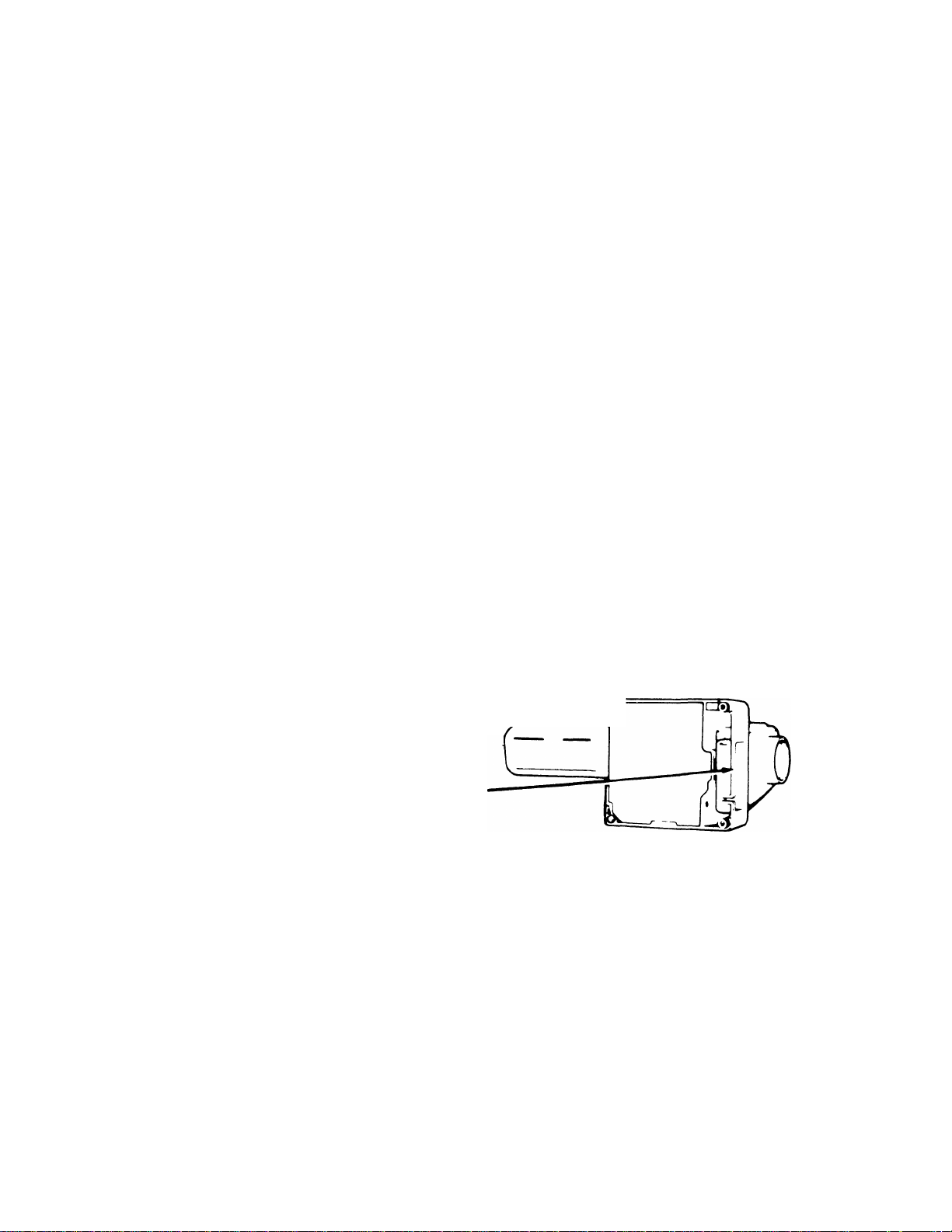
Refer to illustration
at right for location
of Serial Number on
your machine.
Model No.
Serial No.
Serial No.
F
Foot controller for this model is model no.: 988667-001
(for North American Territories)
To ensure that you are always provided with the most modern sewing
capabilities, the manufacturer reserves the right to change the appear
ance, design or accessories of this sewing machine when considered
necessary.
SINGER CUSTOMER ASSISTANCE IN THE U.S.A. TOLL-FREE
NUMBER: 1-800-877-7762
Page 3

TABLE OF CONTENTS
1. Getting to know Your Machine.................................................................2
Principal Parts.............................................................................................3
Built-in Accessory Storage .........................................................................4
Accessories.................................................................................................4
Connecting the Machine/Running the Machine
important Safeguards
2. Getting Ready to Sew.................................................................................9
Choosing and Changing Needles...............................................................9
Free Arm Sewing........................................................................................9
Changing the Presser Foot.......................................................................10
Replacing Presser Foot with Shank.........................................................11
Attaching Darning and Embroidery Foot
Attaching Feed Cover...............................................................................11
Changing the Needle Plate
Using the Needle Threader.......................................................................12
Threading the Machine.............................................................................13
Winding a Bobbin......................................................................................14
Inserting a Wound Bobbin
Raising the Bobbin Thread
Selecting a Pattern ...................................................................................17
S.Straight Stitching.......................................................................................17
Preparation .............................................................................................. 17
Sewing a Seam.........................................................................................17
Darning ....................................................................................................21
Free Motion Embroidery ..........................................................................21
Inserting a Zipper......................................................................................22
4.Special Stitches.........................................................................................23
Preparation ............................................................................................ 23
Zig-Zag Stitch ...........................................................................................25
Zig-Zag Blindstitch....................................................................................26
Multi Stitch Zig-Zag...................................................................................27
"M" Stitch
Crescent Stitch/Chinese Dynasty Stitch/Kite Tail Stitch
Arrow Stitch/Bunting Stitch
Decorative Stitches...................................................................................27
Turkish Stitch............................................................................................31
Stretch Overedge Stitch
Ric-Rac/Straight Stretch Stitch
Crown/Fagoting Stitch...............................................................................32
Honeycomb Stitch.....................................................................................33
Straight Featherstitch................................................................................33
S.Buttonholes and Buttons...........................................................................34
One-Step Buttonholing .............................................................................34
Attaching a Button.....................................................................................36
G.Caring for Your Machine
Removing and Replacing Bobbin Case....................................................38
Removing and Replacing Light Bulb.........................................................39
Cleaning the Machine...............................................................................40
Performance Checklist.............................................................................41
Additional Accessories..............................................................................42
Fabric, Thread and Needle Table.............................................................43
Personal Notes
Inedx......................................................................................................... 45
................................................................................................
.........................................................................................
................................................................................
..................................................
......................................................................
........................................................................
......................................................................
......................................................................
...........................................................................
................................................................
..........................................................................
.........................................
...........................
6
11
11
15
16
27
28
27
31
32
38
44
7
Page 4
SECTION 1 GETTING TO KNOW YOUR MACHINE
PRINCIPAL PARTS e 5 *
Page 5

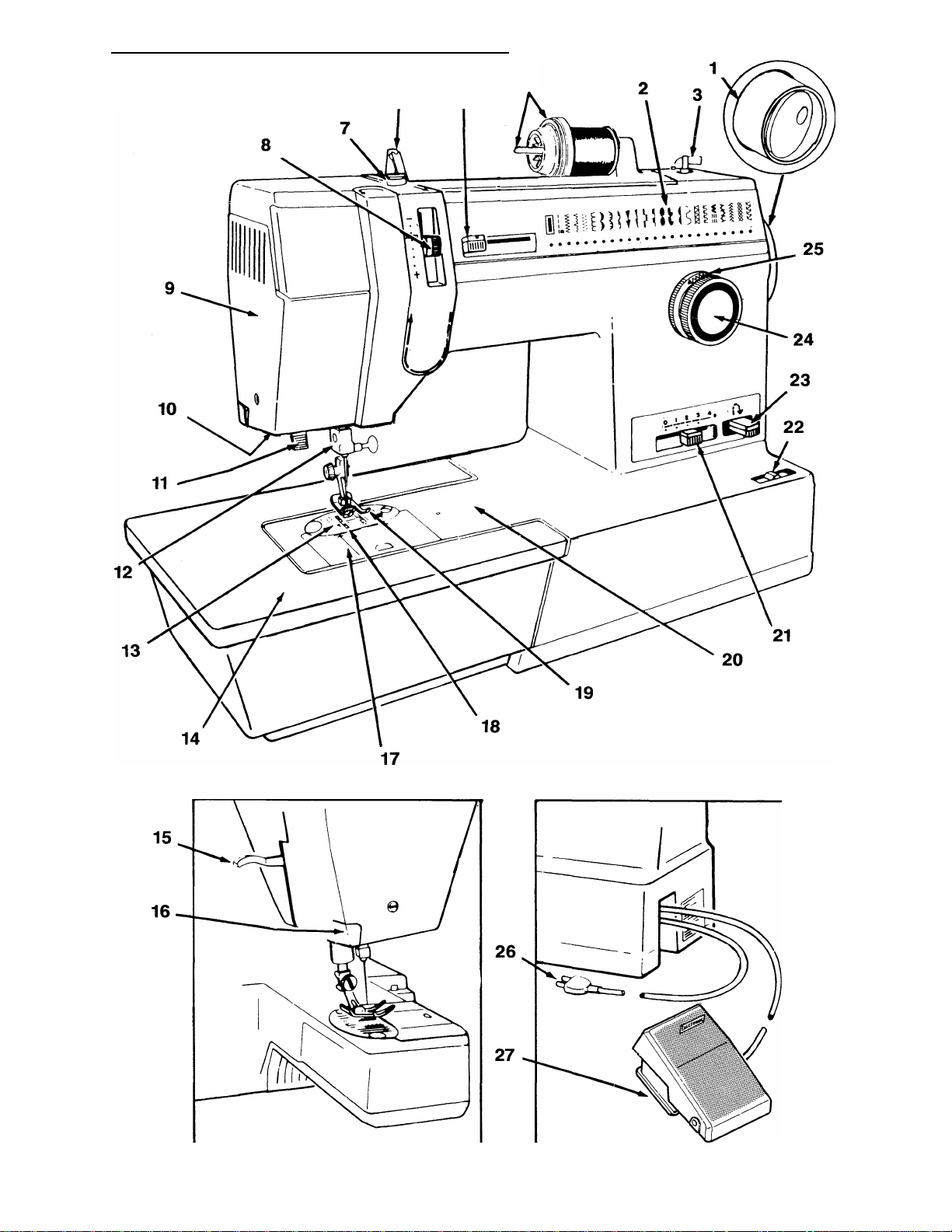
Principal Parts
1. Hand Wheel provides a means for
raising or lowering the needle.
2. Pattern Display Panel shows a vari
ety of patterns available for your
sewing needs. Pattern indicator
appears under the pattern you
select by turning Pattern Selector
Dial, #25.
3. Bobbin Winder lets you fill the bobbin
with thread quickly and easily.
4. Friction-Free Spool Pin and Cap
hold the top thread supply and
allow it to unwind smoothly as the
spool does not turn.
5. Stitch Width Lever controls the width
of patterns and sets the needle for
straight stitching.
6. Snap-In Thread Guide helps to insure
a smooth flow of thread from the
spool to the tension.
7. Bobbin Winder Tension Disc pro
vides thread tension for bobbin
winding.
14. Removable Extension Table lets you
change the machine bed from flat to
free arm.
15. Presser Foot Lifter, at the back of
machine, lets you raise and lower
presser foot.
16. Thread Cutter, is built into face plate
cover for convenience and safety.
17. Slide Plate opens for easy removal
and replacement of bobbin.
18. Feed System moves fabric under
presser foot.
19. Presser Foot holds fabric against
the feed system and snaps on and
off.
20. Bed is the work surface of the
machine.
21. Stitch Length Lever allows for a
variety of stitch lengths.
22. Power and Light Switch turns on
the machine and sewing light at the
same time.
8. Auto Needle Thread Tension Lever
controls top thread tension.
9. Face Plate Is a removable cover
protecting movable parts and sew
ing light.
10. Sewing Light illuminates sewing
area.
11. Buttonhole Lever activates the one-
step buttonholer.
12. One-Way Needle Clamp holds
needle in machine and prevents
incorrect insertion.
13. Needle Plate Supports the fabric
during sewing.
23. Reverse Lever provides either
momentary or continuous reverse
fabric movement.
24. Pattern Selector Dial lets you move
the pattern Indicator to any of the
patterns, plus buttonhole, shown on
the pattern display panel.
25. Stitch Balance Ring adjusts appear
ance of Special Stitch patterns and
buttonholes.
26. Electrical Power Cord connects
machine to your electrical outlet.
27. Speed Controller, designed for safety
and convenience, regulates the
electronic solid state speed con
trol.
Page 6
ACCESSORIES
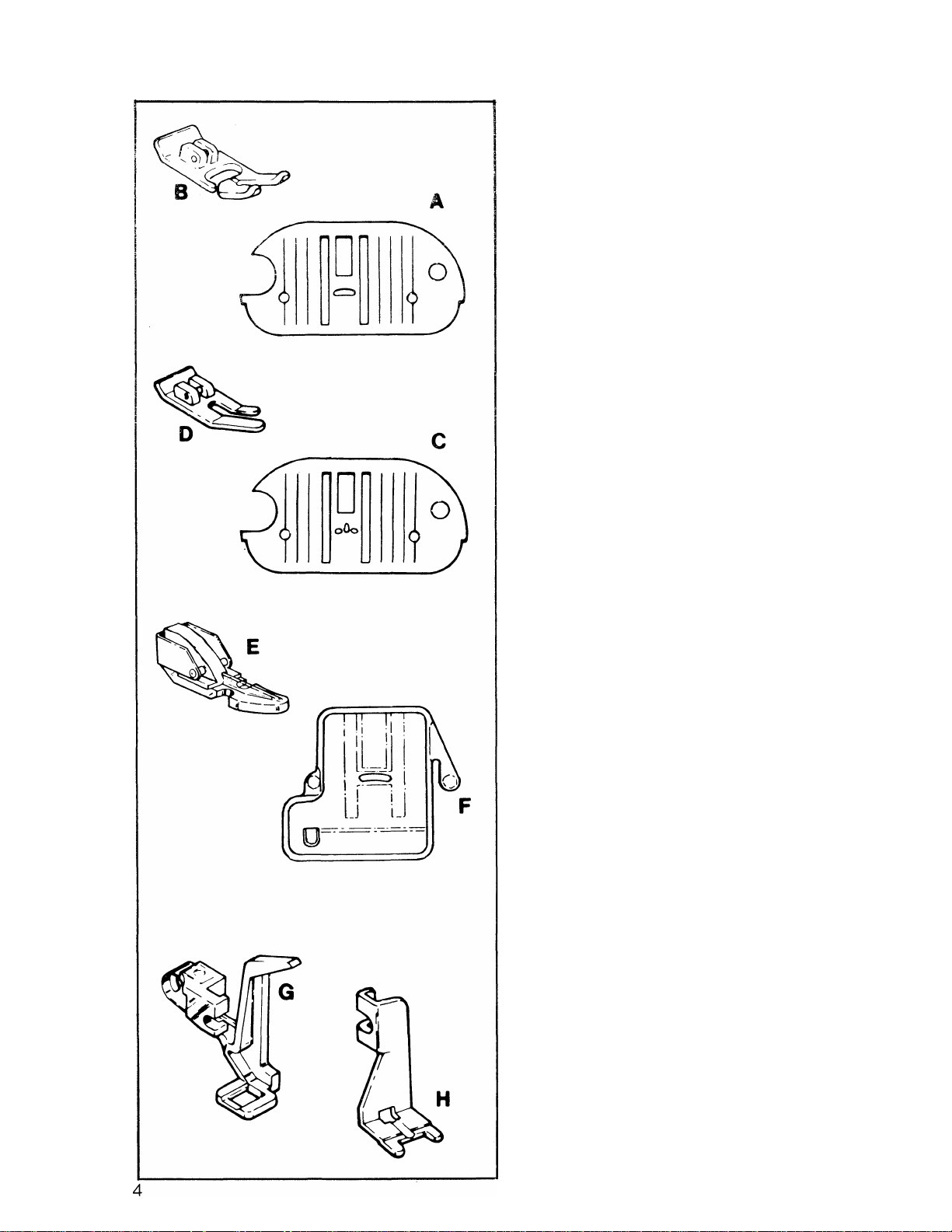
The accessories for your machine are designed to simplify many of your sewing
projects.
General Purpose Needle Plate (A), and
Presser Foot (B), are standard on the
machine. Used for straight and zig-zag
stitching.
Straight Stitch Needle Plate (C), and
Presser Foot (D), used when straight
the feed from moving fabric.
Zipper Foot (E), for inserting zippers.
Feed Cover (F), used for button sewing,
free motion work and darning. It keeps
the feed from moving fabric.
Darning and Embroidery Foot (G) is
recommended for free motion work, such
as embroidery, monogramming and decora
tive designs.
Button Sewing Foot (H) hold buttons
securely for fastening.
Page 7
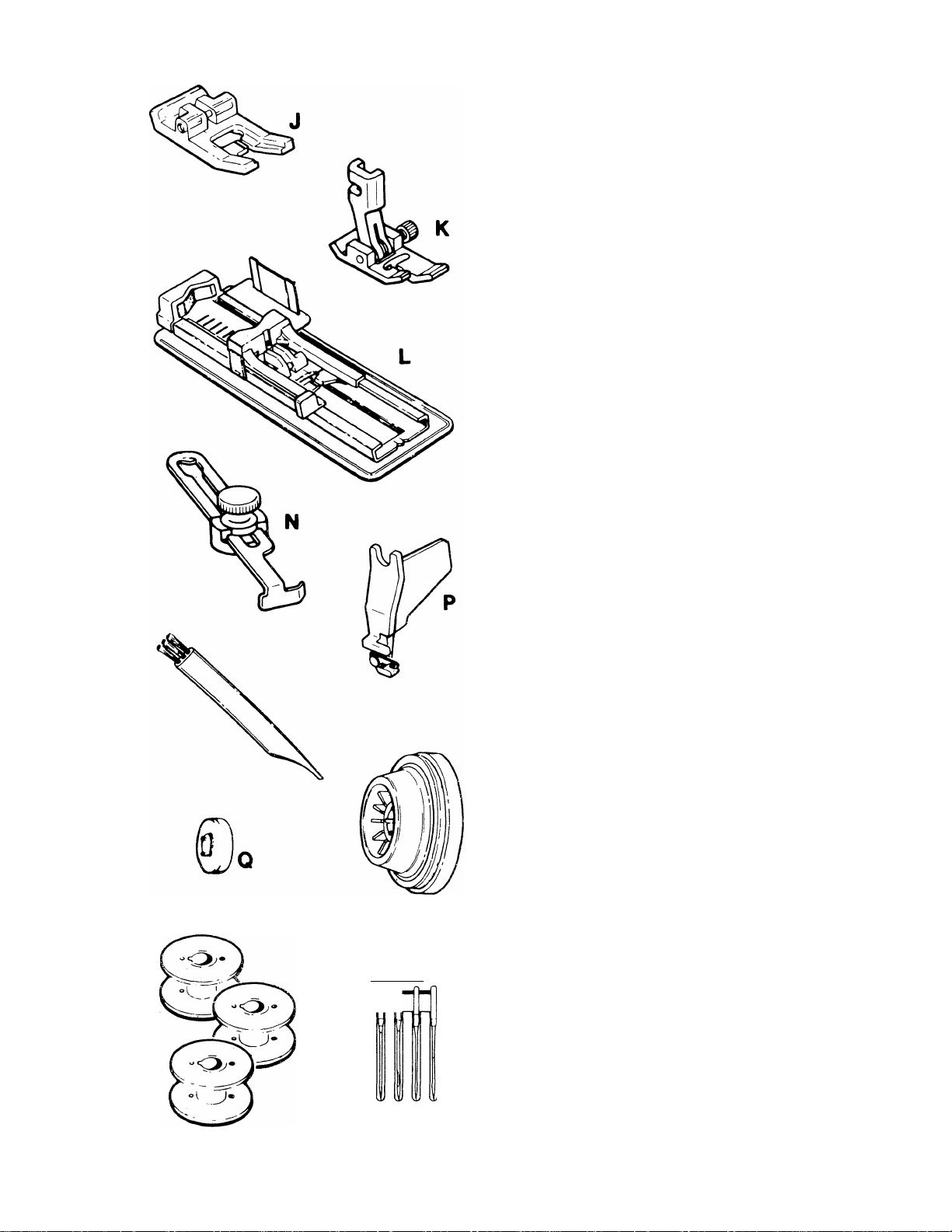
Special Purpose Presser Foot (J), used
for decorative and zig-zag sewing.
Blindstitch Presser Foot (K) helps guide
fabric for nearly invisible blindstitch hems.
One-Step Buttonhole Attachment (L),
used to stitch a complete buttonhole in
one single step.
Seam Guide (N) helps keep seam allow
ances even.
SINGER
?0?0 I ?0<5 '
gm KKKKi
muuii I ftftiio
■m
Needle Threader (P) assists in threading
machine needle.
Small Thread Spool Cap (Q) for use with
small diameter spools of thread.
Thread Spool Cap for medium and
large thread spools.
Lint Brush, for cleaning the machine.
Bobbins, transparent for easy viewing of
thread supply. #172336
"'« '*'« •'iM "'k '*'»
Needle Pack Includes an assortment for
sewing various types of fabrics.
Page 8
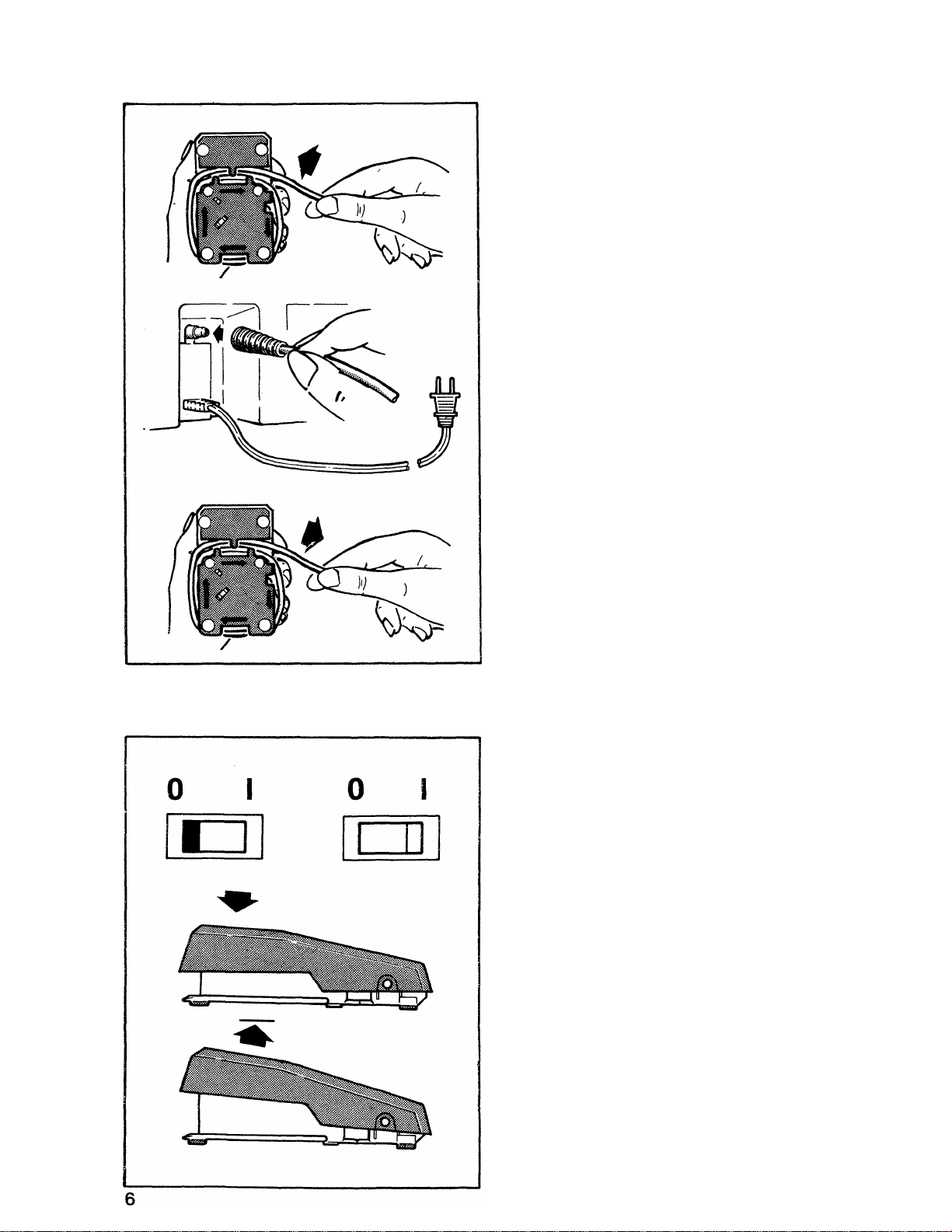
CONNECTING THE MACHINE
The solid state system assures constant speed as you maintain the same pressure
on the controller when sewing through various fabric thicknesses.
Unwind the air control hose from foot
operated speed controller.
Always be sure air hose is not blocked.
Pressing on the controller, you should
feel a slight air flow from the hose.
Plug this air hose onto the receptacle
above power cord, at the right end of the
machine.
Then connect the electrical power cord
plug to your electrical outlet.
NOTE: When not using the machine,
rewind air hose around speed controller
for storage, as shown.
Do not operate machine without
material under the presser foot as this may
damage the feed and the foot.
RUNNING THE MACHINE
The machine and the sewing light are turned on and off by the same power switch.
ROCKER SWiTCH
To turn on machine and sewing light, press
power switch down at right side. To turn
off machine and light, press power switch
down at left side.
To run the machine, press the speed
controller. The harder you press, the
faster the machine will sew.
To stop the machine from sewing, remove
pressure from speed controller.
Page 9

IMPORTANT SAFETY INSTRUCTIONS
When using this machine, basic safety precautions should always be followed
Including the following:
Read all instructions before using this machine.
DANGER.
To reduce the risk of electric shock:
■ The machine should never be left unattended when plugged in. Always unplug
the machine from the electric outlet immediately after using and before cleaning.
■ Always unplug before changing light bulb. Replace bulb with the same type
rated 15 watts. Be sure to replace the face plate which covers the light blub
before operating the machine.
WARNING.
To reduce the risk of burns, fire, electric shock or Injury to persons:
■ Be sure that the electrical voltage of the socket outlet (wall receptacle) is
the same as the rated voltage of the motor.
■ Use this machine only for its intended use as described in this Operator’s
Guioe. Use only attachments recommended by the manufacturer as
contained in the Operator’s Guide.
■ To disconnect, turn all controls to the off (“0”) position, then remove plug
from outlet.
■ Disconnect the power-line plug from the socket outlet or switch the machine
off when making any adjustments in the needle area, such as threading
needle, changing needle, changing needle plate or changing presser foot, etc.
■ Always unplug the machine from the electrical outlet when removing
covers, lubricating, or when making any other user servicing adjustments
mentioned in the Operator’s Guide.
■ Do not attempt to adjust the motor belt. Contact your nearest Service Center
should any adjustment be required.
■ Do not unplug by pulling on cord. To unplug, grasp the plug, not the cord.
■ Handle the foot controller with care and avoid dropping It on the floor.
Be sure not to place anything on top of it.
■ Always use the proper needle plate. The wrong plate can cause the needle
to break.
■ Do not use bent needles.
■ When sewing, keep fingers away from all moving parts. Special care is
required around the sewing machine needle.
■ Do not pull or push fabric while stitching. This may deflect the needle causing
it to break.
■ Before removing the bobbin case, remove plug from the socket outlet.
Page 10

I For double insulated machines, when servicing, use only identical Singer
replacement parts. See instructions for Servicing of Double-Insulated
Appliances.
I Never operate the machine if it has a damaged cord or plug, if it is not
working properly, if it has been dropped or damaged, or dropped into
water. Return the machine to the nearest authorized dealer or Service Center
for examination, repair, electrical, or mechanical adjustment.
■ Never operate the machine with any air openings blocked. Keep ventilation
openings of the machine and foot controller free from the accumulation of
lint, dust, and loose cloth.
I Never drop or Insert any object into any opening.
I Do not use outdoors.
I Do not operate where aerosol (spray) products are being used or where
oxygen is being administered.
I Do not allow to be used as a toy. Close attention is necessary when the
machine is used by or near children.
I SERVICING OF DOUBLE-INSULATED PRODUCTS. In a double-insulated
product, two systems of insulation are provided instead of grounding. No
grounding means is provided on a double-insulated product, nor should a means
for grounding be added to the product. Servicing of a double-insulated product
requires extreme care and knowledge of the system, and should be done
only by qualified service personnel. Replacement parts for a double-insulated
product must be Identical to those parts in the product. A double-insulated
product is marked with the words “DOUBLE-INSULATION” or “DOUBLE
INSULATED”.
SAVE THESE INSTRUCTIONS
Servicing should be performed by an authorized service representative.
This product is intended for household use.
FOR EUROPEAN AND SIMILAR TERRITORIES:
This product is suppressed for radio and television interference with the
international Electrotechnical Commission requirements of the CISPR.
Machines for Great Britain and some other countries having similar wiring
standards are shipped from the factory with a plug for connection to the
mains. The wires in this mains lead are coloured in accordance with the
following code:
Blue: neutral (N) Brown: live (L)
As the colours of the wires in the mains lead of this appliance may not
correspond with the coloured markings identifying the terminals in your plug,
proceed as follows:
The wire which is coloured blue must be connected to the terminal which is
marked with the letter N or coloured black. The wire which is coloured brown
must be connected to the terminal which is marked with the letter L or coloured
red. If a 13 Amp. (BS 1363) plug is used, a 3 Amp. fuse must be fitted, or if
any other type of plug Is used, a 5 Amp. fuse must be fitted either in the plug
or adaptor or at the distribution board. Neither cord Is to be connected to the
earth terminal of a three-pin plug.
8
Page 11
SECTION 2 GETTING READY TO SEW
CHOOSING AND CHANGING NEEDLES
IMPORTANT: For best sewing results, use only Singer needles.
Check the needle package, and the Fabric, Thread and Needle Table on page 43, for the
correct needle and fabric combination.
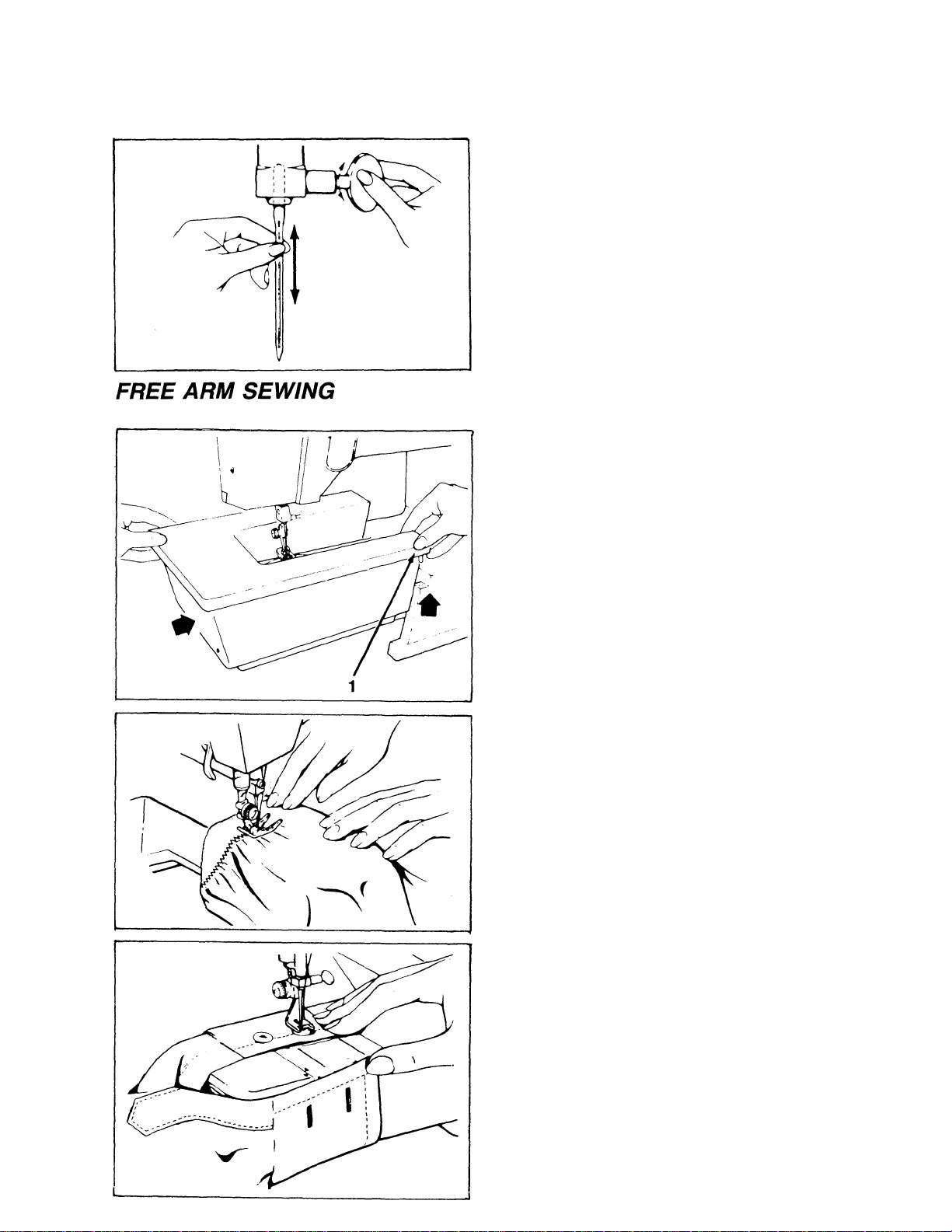
Raise needle to Its highest position.
Loosen needle clamp screw and remove
needle.
With flat side of needle to the back,
insert new needle up into clamp as far
as it will go.
Tighten needle clamp screw securely.
Free arm sewing makes it easier to sew hard-to-reach areas.
To change machine for free arm sewing,
push in and lift right edge (1), of extension
table, slide it to the left and off the
machine.
Topstitch edges on sleeves, or finish
waistbands and pants legs easily.
Attach buttons without stretching cuffs
and neckbands.
Page 12
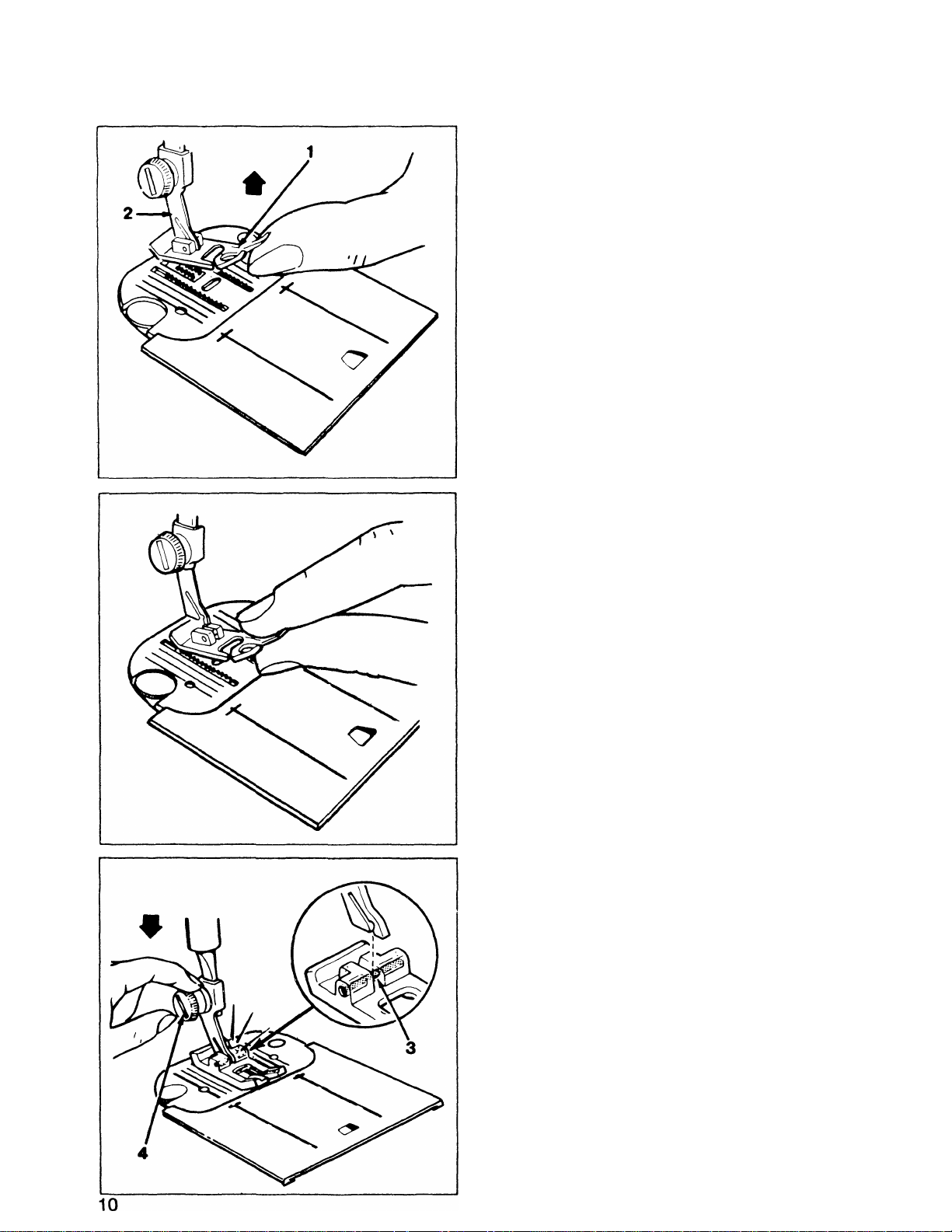
CHANGING THE PRESSER FOOT (B) (E) (J) (L)
Your machine comes with the General Purpose Presser Foot (B) already attached. You
can easily change to any one of the other presser feet which snap onto a common shank
by following the directions below.
• Raise needle to its highest position by
turning hand wheel toward you.
• Raise presser foot using presser foot
lifter in back of machine.
• Push toe of presser foot (1) up, until it
snaps off the shank (2).
Take foot off machine.
Place new foot under center of shank.
Lower presser foot lifter, fitting shank
over presser foot pin (3).
Don’t turn screw. Instead, push presser
foot screw (4) down firmly until foot
snaps into place.
Page 13
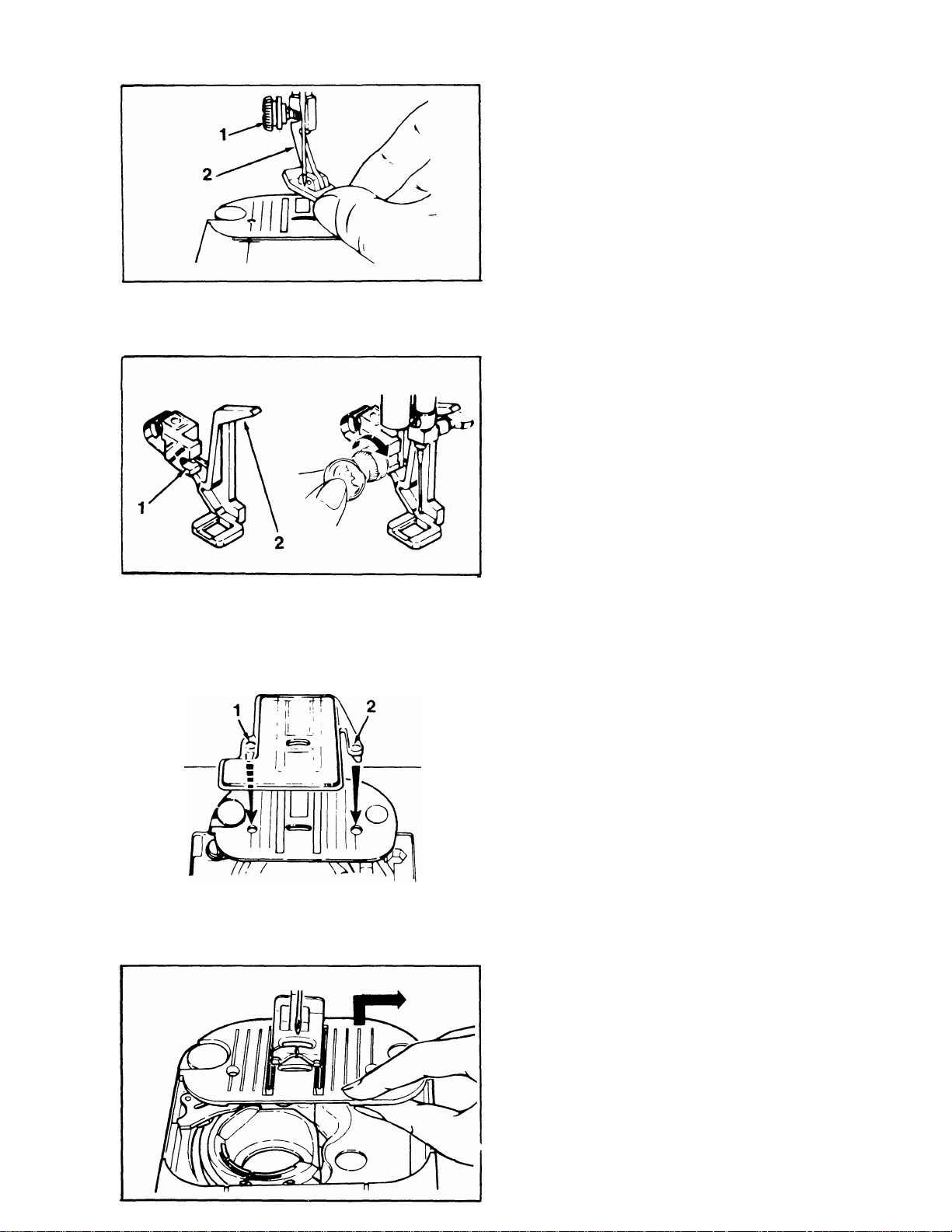
REPLACING PRESSER FOOT WITH SHANK
Presser feet with built-in shanks can be replaced as follows;
• Turn machine off.
Raise needle and presser foot.
Loosen presser foot screw (1) and
remove presser foot with shank (2),
guiding it toward you and to the right.
To replace presser foot with shank,
hook shank around the presser bar
and tighten presser foot screw.
ATTACHING DARNING AND EMBROIDERY FOOT (G)
This foot permits better control of fabric when doing free motion work.
• Raise needle.
• Remove presser foot with shank.
• Guide Darning and Embroidery Foot
from back of needle, with holding fork (1)
around presser foot screw, and lifting
finger (2) above needle clamp.
• Tighten presser foot screw with coin.
• To remove, loosen screw; guide foot
back.
ATTACHING FEED COVER (F)
The feed cover keeps the feed from moving the fabric.
• Raise needle and presser foot.
Open slide plate.
Slide feed cover on top of needle plate,
pressing tabs (1) and (2) into holes.
Close slide plate.
To remove, open slide plate and lift
front edge of cover; pull it away.
CHANGING THE NEEDLE PLATE (A) (C)
Your machine comes with the General Purpose Needle Plate (A) attached. To attach the
Straight Stitch Needle Plate (C):
• Raise needle and presser foot.
• Open slide plate.
• Lift up needle plate from right corner
and slide out from under foot.
• To replace needle plate, slide it under
pin (1) and push it firmly to the left.
• Press down until it snaps into place.
11
Page 14
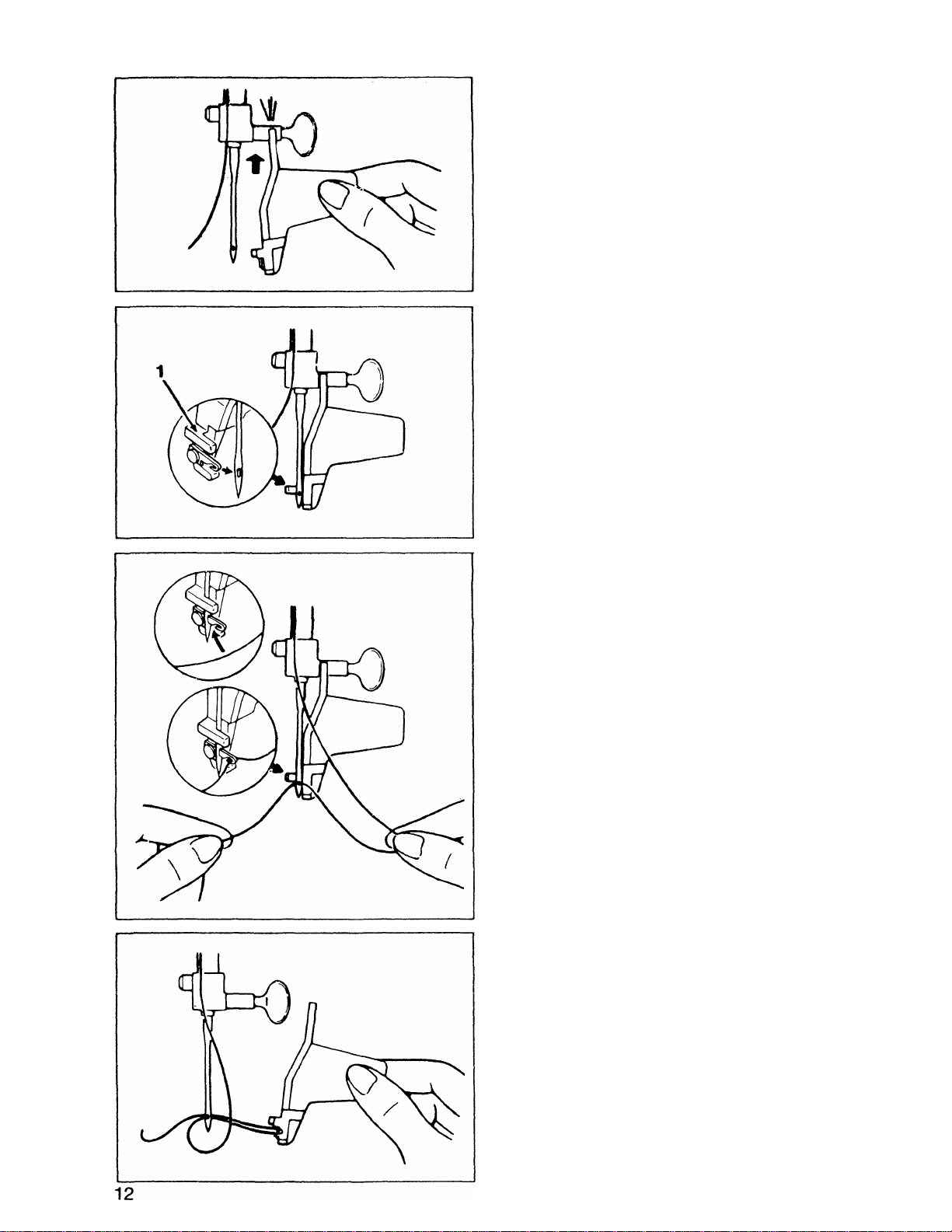
USING THE NEEDLE THREADER (P)
To help in threading the machine needle, use the needle threader follows:
Thread machine and draw 4" (10 cm)
of thread down to the needle.
Lower presser foot lifter.
Holding needle threader as shown with
your right hand, position U-shaped part
of threader under bar of needle clamp.
Snap threader up onto bar.
Swing threader back just far enough to
clear the needle.
Slide threader as far to the left as it will
go.
Be sure guide (1) is against the left side
of the needle.
Bring metal hook of threader forward,
through the eye of the needle.
Holding 3" (7.5 cm) of thread between
your fingers, guide thread into metal
hook. Release thread.
Holding threader with right hand, draw
metal hook and thread backwards
through eye of the needle.
To remove needle threader, slide it to
the right, and off bar of needle clamp.
Carefully unhook thread from needle
threader.
Page 15
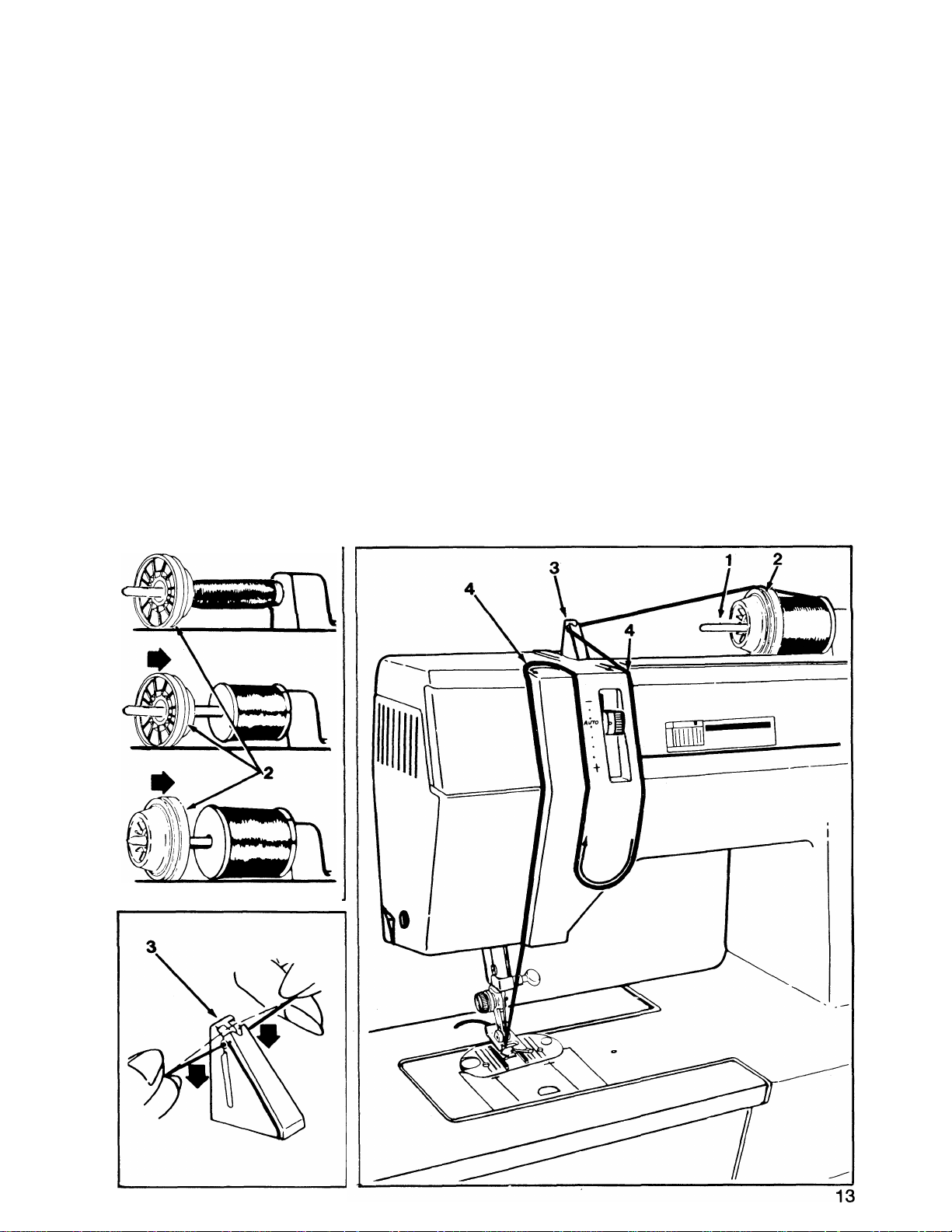
THREADING THE MACHINE
Your sewing machine is easily threaded. Tension discs, thread guides and take-up
lever have been designed as internal parts, eliminating many extra threading steps. The
clear threading path helps you avoid threading errors.
To thread your machine correctly, simply follow the steps below:
• Raise presser foot lifter.
• Raise needle to its highest position by turning hand wheel toward
you.
• Place spool of thread on spool pin (1).
• Slide spool cap (2) firmly over the rim of the spool to prevent thread
tangling.
• Snap thread into thread guide post (3).
• Following arrows, guide thread into auto tension channel (4) down to needle and
firmly pull thread.
• Thread needle from front to back.
Page 16

WINDING A BOBBIN
Winding a bobbin is quick and easy when you follow the directions below. Always wind the
bobbin before threading the machine.
• Push in indent (1) on hand wheel disc. This will stop the needle from moving.
This step is not necessary If your machine does not have hand wheel disc.
• Place spool of thread on spool pin.
• Slide spool cap (2) firmly over rim of spool to prevent thread tangling.
• Lead thread from spool and snap into thread guide post (3).
• Wind thread clockwise around front of bobbin winder tension disc (4).
• Pass thread end, from inside, through small hole in rim of bobbin.
• Place bobbin on spindle and push it to the right. On machines without hand wheel
disc, this will automatically stop needle from moving.
• Holding thread end, step on speed controller to run machine until desired amount
of thread Is wound. (Winding stops automatically once bobbin Is full.)
• Cut thread; push bobbin to the left and remove it from spindle.
• Trim thread end from top of bobbin.
• Return hand wheel disc to sewing position by pressing on side opposite indent.
Page 17

INSERTING A WOUND BOBBIN
To insert a bobbin, follow the instructions below.
• Raise presser foot.
• Turn hand wheel toward you until needle
is in its highest position.
• Open slide plate and remove bobbin.
1. Pull 4" (10cm) of thread from replace
ment bobbin and insert bobbin into
case, as shown.
2. Holding bobbin in place, guide thread
into notch (1), and then into notch (2).
3. Draw several inches of thread across
bobbin.
4. While holding thread on outside, close
slide plate.
•
• Follow directions for “Raising Bobbin
Thread” on page 16-
15
Page 18

RAISING THE BOBBIN THREAD
Once the needle has been threaded and the bobbin placed in the bobbin case, the bobbin
thread must be brought up through the hole in the needle plate.
1. Hold needle thread with left hand.
• Turn hand wheel slowly toward you,
lowering needle into hole in plate.
2. Continue to do this until needle rises
above needle plate.
• Pull gently on needle thread and bring
up bobbin thread in a loop.
3. Open loop with fingers to find end of
bobbin thread.
4. Draw needle thread through left side
opening in presser foot.
•
• Pull both threads to back of machine.
Page 19

SELECTING A PATTERN
All the patterns your machine is capable of sewing are illustrated on the pattern display
panel of your sewing machine.
• Select a pattern by turning the selector
dial until indicator appears under desired
pattern.
For instance, to sew a Zig-Zag Stitch,
you would turn the selector dial until
the indicator appears as (1).
To change the stitch pattern, turn the
dial left or right, moving indicator to
desired position.
With each application, recommended settings are given. These have been highlighted for
easy Identification. You can adjust each setting, however, as desired.
SECTION 3 STRAIGHT STITCHING
The Straight Stitch Needle Plate (C) and Presser Foot (D) help prevent skipped stitches
and control fabric when straight stitching around a curve or close to the fabric edge.
CAUTION: Straight Stitch Needle Plate
and Presser Foot should be used for
straight stitch sewing only.
Always change back to the appropriate
needle plate and presser foot when not
straight stitching.
RECOMMENDED SETTINGS
Stitch Selection:
Stitch Width: i
Stitch Length:
Foot:
Needle Plate:
Straight Stitch
1
^ 1 ^ ^
1 1/2 to 4
Straight Stitch (D)
Straight Stitch (C)
ADJUSTING STITCH LENGTH
The stitch length indicator is numbered
0 - 4. The lower numbers are shorter
stitches. Shorter stitches are best for light
weight fabrics; longer ones for heavy
fabrics. To adjust the length of your
stitches, slide the stitch length lever to
the left or right.
17
Page 20

ADJUSTING THREAD TENSION
The thread tension of your sewing machine has been pre-set in the auto position to suit
most sewing applications. This auto tension feature eliminates the need for you to
adjust the tension lever for the majority of your sewing projects.
Proper tension will produce identical
stitches on both the front and back of
your fabric (1).
Too much tension will produce a tight
stitch, causing a puckered seam (2).
Adjust tension by moving lever up toward
a looser
Too little tension will produce a loose
stitch, causing loops in your seams (3).
Adjust tension by moving lever down
toward a tighter I setting.
setting.
18
Page 21

SEWING A SEAM
You can sew seams easily and accurately when you follow the suggestions below.
BASTING
Pin basting and hand basting are easy
ways to make temporary seams before
machine sewing.
• To pin baste, insert pins at stitching
line. NEVER place pins on the under
side of fabric in contact with the feed.
Do not sew over pins; pull them out as
you stitch.
• To hand baste, make long, loose
stitches that can be easily removed.
PLACING FABRIC UNDER PRESSER FOOT
• To place fabric under presser foot, raise
presser foot lifter (1) to its “up” position
(2), where It locks in place.
• The lifter can be raised and held in the
“extra high” position (3) for bulky fabrics.
STITCHING IN REVERSE
• To reinforce beginnings or ends of seams,
push in reverse lever (1). Machine
will straight stitch in reverse for as long
as you hold the lever in.
• For continuous reverse stitching, push
lever in and slide it to the left to lock.
Unlock reverse lever by sliding it back
to the right and letting it return to its
normal position.
19
Page 22

KEEPING SEAMS STRAIGHT
To keep seams straight, use one of the
guidelines on the needle plate. The most
commonly used line (1) is extended onto
the slide plate. The crosslines (2) serve
as guides when stitching square corners.
TURNING SQUARE CORNERS
To turn a square corner, use crosslines on
slide plate.
• Line up fabric with extended guidelines
on needle plate and stitch seam, slowing
speed as you approach corner.
• When bottom of fabric reaches corner
ing crosslines (2) on slide plate, stop
stitching.
• Be sure needle is down in fabric.
• Raise presser foot slightly. Turn fabric,
bringing bottom edge in line with guide
line (1).
• Continue stitching seam.
USING THE SEAM GUIDE (N)
For extra help in keeping seams straight,
particularly for very narrow or very wide
seams, use the seam guide which comes
with your machine.
To attach the seam guide, place screw of
seam guide into the hole in the bed of the
machine, on the right side of slide plate (1).
Line up the straight edge of the guide with
the needle plate guideline for desired
seam width and tighten screw.
Page 23

SEWING CURVED SEAMS
• Baste seam line.
• Use a short stitch for elasticity and
strength.
• Guide fabric to follow curve.
• The seam guide may also be used when
sewing curved seams. Attach seam
guide at an angle so that the edge
closer to the needle acts as a guide.
DARNING
Mend worn or torn areas using the
Darning and Embroidery Foot.
• Trim ragged edges and baste a backing
on wrong side of tear.
RECOMMENDED SETTINGS
Stitch Selection; Straight Stitch
Stitch Width;
Stitch Length; 0
Foot; Darning and Embroidery (G)
Needle Plate;
• Attach Feed Cover (F)
• Place area to be darned, right side up,
under presser foot; lower foot.
• Stitch, guiding fabric back and forth,
until entire area is filled in.
.1111
General Purpose (A)
FREE MOTION EMBROIDERY
In free motion embroidery, you sew without
a presser foot, and control the fabric with
an embroidery hoop.
•
RECOMMENDED SETTINGS
Stitch Selection; Straight Stitch or
Zig-Zag
stitch Width: i I I I I
D
Stitch Length; 0
Foot; Remove foot with shank
Needle Plate; General Purpose (A)
• Attach Feed Cover (F)
• Be sure to lower presser foot lifter.
• When embroidering, as shown, use
straight stitches for stems, and zig-zag
stitches, at varying widths, for leaves
and petals. Lengthen stitches by moving
the hoop faster or slower.
NOTE; The Darning and Embroidery Foot
(G) may be used to help control fabric.
21
Page 24

INSERTING A ZIPPER
The zipper package will provide complete instructions for inserting zippers.
recomm!:nded settings
stitch Selection: Straight Stitch
stitch Width:
Stitch Length:
Foot:
Needle Plate:
When zipper is to the left of needle,
attach left side of zipper foot to shank.
The needle will enter left notch of foot,
sewing close along zipper teeth.
1-1/2 t
Zipper (E)
General Purpose (A)
Attach right side of zipper foot to shank
when a zipper is to the right side of the
needle. The needle will enter right notch
of foot, sewing close alpng zipper teeth.
Page 25

SECTION 4 SPECIAL STITCHES
The special color coded stitches on your machine have a variety of practical and
decorative uses. In this section are recommended applications for each stitch. However,
these stitches can be used for many other sewing projects.
Before beginning a sewing project, check
the Fabric, Thread and Needle Table on
page 43 for the best needle and thread
com bination for your fabric.
With each application, recommended
settings have been given These have been
highlighted for easy identification. You
can adjust each setting, however, as
desired.
ADJUSTING STITCH WIDTH
To widen or narrow a Special Stitch pattern,
move the stitch width lever off Straight
Stitch,
at the right.
1
, toward any other width setting
ADJUSTING STITCH LENGTH
The stitch length indicator is numbered 0
to 4. The area between 0 and 1 will produce
very dense stitching. For more open stitching,
slide the stitch length lever anywhere from
2 to 4. When sewing special color coded
stitches the length MUST be set in the
3-1/2 to 4 area.
23
Page 26

ADJUSTING THREAD TENSION
Some Special Stitch patterns may require looser thread tension than others. To find the
proper tension for your application, make a test sample with the thread and fabric you
will be using.
Proper tension produces a smooth, even
stitch (1).
Too much tension will produce a tight
stitch (2), causing fabric to pucker. Adjust
tension by moving lever up toward a looser
setting.
Too little tension will produce a loose
stitch (3), causing loops in your pattern.
Adjust tension by moving lever down toward
a tighter “ + ” setting.
ADJUSTING STITCH BALANCE
You can adjust the appearance of special color coded stitch patterns on the display
panel, by turning the Stitch balance ring (1) behind the pattern selector dial (2).
A correctly balanced Fagoting Stitch
should appear as illustrated (3).
When stitches are too close together (4),
separate them by turning the stitch balance
ring to the right.
24
<<<<<<<<<<<<<<<<<<^ 3
When stitches are too far apart (5), bring
them closer together by turning the stitch
balance ring to the left.
5
Page 27

ZIG-ZAG STITCH
The Zig-Zag Stitch can be used when sewing seams, appliqueing, monogramming or
decorating.
* SEAM FINISHING
Use a zig-zag stitch to finish seam edges
of fabrics that are likely to unravel.
• Sew seams as desired; trim and press
open.
RECOMMENDED SETTINGS
Stitch Selection:
Zig-Zag Stitch
Stitch Width:
n ^ ^
Stitch Length:
Foot:
Needle Plate:
1 to 4
General Purpose (B)
General Purpose (A)
Place edge of seam allowance under
foot as shown.
Stitch close to edge, letting outer zig
zag fall over edge.
SATIN STITCHING
Satin stitching is a series of closely spaced
zig-zag stitches. Satin stitch monograms,
embroidery and appliqués for a smooth,
satin-like finish.
• Practice to get desired stitch appear
ance.
Block Monogramming
•
• Lightly trace letters on right side of
fabric.
RECOMMENDED SETTINGS
Stitch Selection:
Stitch Width:
Stitch Length:
Foot: Special Purpose (J)
Needle Plate: General Purpose (A)
• Center tracing under needle.
• Stitch entire outline, leaving needle in
fabric when turning.
• Pull threads to wrong side of fabric; tie
and trim.
Zig-Zag Stitch
n
u
1 or lower
25
Page 28

ZIG-ZAG BLINDSTITCH
Use this Blindstitch when sewing hems and seams, or attaching lace and elastic.
BLINDSTITCH HEMMING
I
1
• Practice first on a scrap of material,
carefully following each step.
(-—£
\ >
--- --
.
\ Tr TT S
I I
p/
/
0
1
RECOMMENDED SETTINGS
Stitch Selection:
Stitch Width: i
Stitch Length:
Foot:
Needle Plate:
• With garment inside out, mark, fold
and press hemline (1).
• Turn hem (1) back against inside of
garment, leaving Vs" of hem beyond fold
(2), as shown.
• Pin or baste all layers in place.
Zig-Zag Blindstitch
1 1 1 i
2 to 4
Adjustable
Blindstitch (K)
General Purpose (A)
Position the hem under the presser
foot with the soft fold resting against
wall of the guide. Be sure the flange of
the guide is between the soft fold and
the top of the hem, as shown.
Lower the presser foot and begin sewing
making certain the straight stitches fall
on the edge of the hem and the zig-zag
stitches just pierce the soft fold of the
work. Adjust stitch width if necessary.
While stitching, guide the hem edge In
a straight line and feed the soft fold
evenly .against the wall of the guide.
If layers of fabric are pinned together,
remove pins as you come to them. Do
not sew over pins.
Page 29

MULTI-STITCH ZIG-ZAG
Mending, overcasting, joining or reinforcing can all be done using the Multi-Stitch
MENDING A TEAR
• Trim ragged edges of tear.
• Cut a lining of fabric for reinforcement.
• Bring the edges of tear together and
baste lining to wrong side of fabric.
RECOMMENDED SETTINGS
Stitch Selection: Multi-Stitch
Zig-Zag
Stitch Width:
^ \
Stitch Length:
Foot: Special Purpose (J)
Needle Plate:
• Place tear, right side up, under presser
foot.
• Stitch over the line of the tear, short
ening stitch length at each end for
reinforcement.
• Trim thread ends close to fabric.
• If needed, sew over tear again.
• Trim away lining close to stitching.
1 or lower
General Purpose (A)
STITCH
This stitch can be used for stretch seams and decorative stitching
LACE TRIM
Lace trim may be added to blouses, lin
gerie and children’s wear.
• Cut lace to desired size.
• Pin lace to right side of fabric where
desired.
•
RECOMMENDED SETTINGS
Stitch Selection: “M” Stitch
Stitch Width:
Stitch Length:
Foot:
Needle Plate:
• Carefully stitch along both edges of lace,
as shown.
• Trim away the fabric under the lace near
stitching lines.
1 i
2 or lower
Special Purpose(J)
General Purpose(A)
27
Page 30

CRESCENT STITCH/CHINESE DYNASTY STITCH/KITE TAIL STITCH
(If your machine has | & J patterns.)
These stitches are ideal for borders, edges, smocking and embroidering.
BORDER DESIGN
Border designs decorate clothing and many
household items.
• Sew Seams in usual manner and press.
• Mark stitching lines of fabric where
desired.
RECOMMENDED SETTINGS
Stitch Selection: Crescent Stitch
Stitch Width:
Stitch Length:
Foot:
Needle Plate:
1 11 i
1 or lower
Special Purpose (J)
General Purpose (A)
RECOMMENDED SETTINGS
Chinese Dynasty
Stitch Selection: Stitch
Stitch Width:
Foot:
Needle Plate:
RECOMMENDED
^ \ ^
1 or lowerStitch Length:
Special Purpose (J)
General Purpose (A)
SETTINGS
Stitch Selection: Kite Tail Stitch
Stitch Width:
Fbot:
Needle Plate:
Center marked line under presser foot
and stitch.
Pull threads to wrong side of fabric; tie
and trim.
1 i
1 or lowerStitch Length:
Special Purpose (J)
General Purpose (A)
Page 31

ARROW STITCH/BUNTING STITCH (If your machine has | pattern.)
These stitches are decorative and secure finish tp seams, pleats and pockets it can
also be used as a border design.
BORDER DESIGN
• Sew seams in usual manner and press.
• Mark stitching lines on fabric where
desired.
RECOMMENDED SETTINGS
Arrow Stitch
Stitch Selection: Bunting Stitch
Stitch Width:
Stitch Length:
Foot:
Needle Plate: General Purpose (A)
^ \ ^
1 or lower
Special Purpose (J)
• Center stitching line under presser foot
and sew.
• Trim thread ends close to fabric.
DECORATIVE STITCHES
(If your machine has | | J patterns.)
Your machine can sew several stitches which are solely decorative. These stitches let
you create unique, personalized garments and household items.
Use the DOMINO STITCH/FLAG STITCH
to form a lively border along the edges
of a pair of pillow cases.
RECOMMENDED SETTINGS
Stitch Selection: Domino Stitch
Flag Stitch
Stitch Width:
^ \ ^
Stitch Length:
Foot: Special Purpose (J)
Needle Plate: General Purpose (A)
1 or lower
29
Page 32

Brighten up a plain dress with the SATIN
BEAD STITCH/BOOMERANG STITCH/
LADY BUG STITCH . .
(If your machine has f | pattern.)
RECOMMENDED SETTINGS
Stitch Selection: Satin Bead Stitch
Boomerang Stitch
Lady Bug Stitch
j 1 II 1
Stitch Width:
Stitch Length: 1 or lower
Foot:
Needle Plate:
D
Special Purpose (J)
General Purpose (A)
The RAMPART STITCH can be used to
decorate a boy’s cap.
RECOMMENDED SETTINGS
Stitch Selection:
Stitch Width:
Foot:
Needle Plate:
Rampart Stitch
D
1 or lowerStitch Length:
Special Purpose (J)
General Purpose (A)
Page 33

TURKISH STITCH
The Turkish Stitch can be used for appliqueing, joining patchwork or forming decorative
hems on bed and table linens.
HEMSTITCHING
• Fold a double hem of desired width and
baste.
• Mark a guideline for hemstitching on
right side of fabric just above top of hem
edge.
RECOMMENDED SETTINGS
Stitch Selection: Turkish Stitch
Stitch Width:
Stitch Length: 3-1/2 to 4
Foot: Special Purpose (J)
Needle Plate: General Purpose (A)
Adjust balance, If necessary
Place work, right side up with hem
facing, right, under presser foot.
Lower presser foot and stitch along
guideline.
Be sure stitches on left side of line fall
over hem edge (into single thickness of
fabric) and stitches on right side fall
into double fold of hem.
With this stitch you can stitch and finish a seam in one step. It is also ideal for finishing
D
OVEREDGE SEAM
• Baste seams.
• Trim seam edge 1/4" (6mm) from basting
line.
RECOMMENDED SETTINGS
Stitch Selection:
Stitch Width:
Stitch Length:
Foot: Special Purpose (J)
Needle Plate:
Adjust balance, if necessary
Position trimmed seam under presser
foot, as shown.
Stitch along basting line.
Straight stitches should fall on basting
line; zig-zag stitches should fall over
seam edge.
Remove basting stitches and press.
Stretch Overedge
Stitch
Q
3-1/2 to 4
General Purpose (A)
31
Page 34

RIC-RAC/STRAIGHT STRETCH STITCH
This is a heavy-duty, stretch stitch that can also be used for topstitching.
TOPSTITCHING
• Sew seams in usual manner and press.
• For topstitching hard-to-reach areas,
convert machine to free arm sewing.
RECOMMENDED SETTINGS
Stitch Selection: Ric-Rac/Straight
Stretch Stitch
Stitch Width:
Stitch Length:
Foot: Special Purpose (J)
Needle Plate:
Adjust balance, if necessary
Place garment right side up, under foot.
Slowly topstitch desired areas.
Pull threads to wrong side of fabric; tie
and trim.
To create a straight stretch stitch, set
stitch width to the left and stitch length
to #4.
. I 1 i i
3-1/2 to 4
General Purpose (A)
CROWN STITCH/FAGOTING STITCH (If your machine has | pattern.)
Use these stitches fagoting, embroidery, patchwork or strengthening seams.
CROWN/FAGOTING
This is an open, lacy stitch used to join
two pieces of fabric.
• Fold under edges to be joined and press.
• Baste the edges 1/8" (3mm) apart onto
a sheet of tissue paper for support.
• Position center of work under center of
presser foot.
RECOMMENDED SETTINGS
Stitch Selection: Crown Stitch
Fagoting Stitch
Stitch Width:
Foot:
Needle Plate:
Adjust balance, if necessary
As you sew, the needle should make a
stitch first in one fabric strip, and then
in the other.
After stitching is completed, remove
tissue and basting.
.1111
3-1/2 to 4Stitch Length:
Special Purpose (J)
General Purpose (A)
Page 35

HONEYCOMB STITCH
Use the Honeycomb Stitch for smocking, mending and sewing stretch fabrics.
SMOCKING
Smocking is decorative stitching across
evenly spaced gathers of fabric.
To Gather Fabric:
RECOMMENDED SETTINGS
Stitch Selection: Straight Stitch
Stitch Width:
Stitch Length:
Foot:
Needle Plate:
• Sew rows of straight stitches, 1/4" apart,
across area to be smocked.
• Pull thread evenly, gathing fabric.
• Tie ends of every two rows of stitching
together to hold gathers in place.
• Baste a backing to wrong side of fabric.
To Smock Fabric:
Special Purpose (J)
General Purpose (A)
RECOMMENDED SETTINGS
Stitch Selection: Honeycomb Stitch
Stitch Width: M I I I
D
Stitch Length: 3-1/2 to 4
Adjust balance, if necessary
• Sew between rows of straight stitches.
• Pull out straight stitches when completed.
STRAIGHT FEATHERSTITCH
With the Straight Featherstitch you can stitch and finish a seam in one step. It is also
ideal for edging and appliqueing.
EDGING
Add a delicate touch to your sewing while
finishing and reinforcing your edges.
• Sew seams in usual manner and press.
RECOMMENDED SETTINGS
Stitch Selection:
Stitch Width:
Stitch Length:
Foot:
Needle Plate:
Adjust balance. If necessary
Straight
Featherstitch
^ \
3-1/2 to 4
Special Purpose (J)
General Purpose (A)
• Place edge of garment, right side up,
under presser foot.
• Bulk of garment should be to the left.
• As you stitch, needle should go over
right edge of fabric, as shown.
33
Page 36

SECTION 5 ONE-STEP BUTTONHOLING
Your machine automatically makes a buttonhole to the size of your button in one,
easy step You never need to move the fabric or reposition the needle.
Always make a practice buttonhole on a
sample of your fabric.
Be sure bobbin contains enough thread.
reach areas, convert machine bed to
free arm sewing.
Mark buttonhole position on fabric as
indicated in pattern.
RECOMMENDED SETTINGS
Stitch Selection:
Stitch Width:
Stitch Length:
Foot: Buttonhole Attachment (L)
Needle Plate: General Purpose (A)
Buttonhole Stitch
. I 11 1
4
Fastening the Buttonhole Attachment
• Remove presser foot from shank.
• Place buttonhole attachment behind
shank and guide it forward.
• Center pin (1) in attachment under
shank, and lower presser foot lifter.
• Press presser foot screw down firmly
until shank snaps Into place.
Setting the Length of Buttonhole
• Open button clamp (2) and place but
ton on carrier (3).
• Slide clamp (2) back to hold button in
place.
• Raise foot lifter and draw needle thread
(A) and bobbin thread (B) between upper
(4) and lower (5) plates of button attach
ment, and to the back of machine.
Place fabric between upper and lower
plates.
Center 3 red guidelines (6) of attach
ment around beginning line of button
hole.
Lower presser foot lifter.
Push foot from back of button carrier
(7) toward you to insure proper button
hole length.
Page 37

Pull buttonhole lever (8), located under
sewing light, straight down as far as it
will go.
Press it toward you.
Start running the machine.
The entire buttonhole will be stitched!
in one operation.
Stop sewing when machine begins over
lapping starting stitches.
Raise foot lifter and remove work from
machine; clip thread ends; cut button
hole opening with scissors or seam
ripper.
(Adjust width and balance of test
buttonhole, if necessary.)
Press buttonhole lever toward you for
each buttonhole to be sewn.
When all buttonholes are completed,
push buttonhole lever (8) back up into
machine.
To remove buttonhole attachment, raise
presser foot lifter and press down on
both sides of button carrier near shank,
and slide off machine.
ADJUSTING WIDTH OF
BUTTONHOLE OPENING
If the width of the buttonhole opening is
too narrow or too wide, it can be adjusted
by the stitch width lever.
• Widen the buttonhole opening by moving
the stitch width lever slightly left.
• Narrow the buttonhole opening by moving
the stitch width lever slightly right.
ADJUSTING BALANCE OF BUTTONHOLE
If the two stitching sides of your buttonhole
are unequal, turn stitch balance ring (9)
behind pattern selector dial.
• If the right side of stitching is too open
(10) , turn stitch balance ring slightly left.
• If the left side of stitching is too open
(11) , turn stitch balance ring slightly right.
•
35
Page 38

ATTACHING A BUTTON
Flat buttons can be sewn on quickly and easily using the plain zig-zag stitch
RECOMMENDED SETTINGS
Stitch Selection:
Stitch Width:
Foot:
Needle Plate:
Attach Feed Cover (F)
The space between the holes in the
button determines stitch width setting.
Before you can attach a button, the
bobbin thread must be brought up
through the bole in the feed cover (F).
• Raise foot lifter.
• Position both threads under button foot
toward rear of machine.
Zig-Zag Stitch
1111
0Stitch Length:
Button Sewing (H)
General Purpose (A)
• Hold needle thread while lowering
needle into hole in feed cover. Raise
needle and gently pull needle thread,
undo loop of bobbin thread that comes
up with the needle. Details on “Raising
the Bobbin Thread” are on page 16.
1. Place garment under button foot.
• Position button on garment making
sure the holes in the button are between
the toes of the button foot.
• Lower foot lifter.
•
Page 39

2. Turn hand wheel toward you, lowering
needle into either hole of button.
3. Continue turning hand wheel until
needle rises and moves over the other
hole of button. Adjust width if neces
sary.
4. Lower needle into hole.
Run machine slowly making 6 or more
stitches to attach button.
Remove work from machine, leaving 4"
(10cm) of thread.
To secure stitching, pul! thread ends to
inside of garment and knot close to
fabric.
37
Page 40

SECTION 6 CARING FOR YOUR MACHINE
REMOVING AND REPLACING BOBBING CASE
CAUTION: Before cleaning or adjusting
the machine, remove plug from the socket
outlet.
• Raise presser foot and needle.
• Open slide plate and remove bobbin.
To remove the bobbin case, the needle
plate must be removed first.
Lift needle plate (1) from right corner
and slide out from under foot.
TO REMOVE BOBBIN CASE
• With a small screwdriver, turn lever (2)
back as far as it wi[l go.
• Lift out bobbin case.
TO REPLACE THE BOBBIN CASE
• Guide forked end (3) of bobbin case
under feed (4).
• Draw rim of bobbin case under position
plate (5).
• Turn lever (2) toward you, locking bobbin
case in place.
NOTE: After locking case in place, be sure
it is not tight, but can move slightly..
•
38
• To replace needle plate, slide it under
pin (6) and push it to the left.
• Press needle plate down in place.
• Insert bobbin and close slide plate.
Page 41

REMOVING AND REPLACING LIGHT BULB
CAUTION:
• Before changing light bulb, make sure you have removed plug from socket outlet.
Be sure to replace the face plate which covers the light bulb before operating
the machine.
• This machine is designed to use a 15-
watt maximum light bulb.
To change the light bulb, the face plate
must first be removed.
• Looser and remove screw (1).
• Slide face plate down and away from
machine.
TO REMOVE THE LIGHT BULB
• Push bulb up into socket (2) and turn to
the left to unlock bulb pins.
• Pull bulb down and out of socket.
TO REPLACE THE LIGHT BULB
• Push new bulb up into socket and turn
to the right until pins lock into position.
• Reposition face plate by sliding top edge
of plate under edge of top cover.
• Line up screw hole in plate with screw
hole in machine.
• Insert screw and tighten.
39
Page 42

CLEANING THE MACHINE
Your machine is designed to give you many years of dependable service. To ensure this
reliability, take a few minutes to keep the machine clean. How often you clean it depends on
how often you use it.
Using the lint brush, remove lint or dust
from:
-presser bar
-needle bar
-bobbin case (if there is a lot of lint in this
area, remove the bobbin case for
cleaning)
-machine surface (if necessary, dampen
a soft cloth and use a mild soap to clean
the surface)
Remove needle plate as instructed and
clean exposed area with a lint brush.
BEFORE STORING YOUR MACHINE
•To disconnect, turn all controls to off (“0”)
position, then remove plug from outlet.
• Unplug foot controller from machine.
• Lower presser foot lifter.
• Turn handwheel to lower needle bar to
the lowest position.
• Place your machine out of reach of
children In safe, dry location.
Page 43

PERFORMANCE CHECKLIST
When sewing difficulties occur, look back through this manual to make sure you are
correctly following the instructions. If you still have a problem, the reminders below
may help you to correct it.
Needle Does Not Move
Is machine connected to electrical supply?
Is the power and light switch on?
Is controller connected?
Is air supply from controller clear?
Needle Moves But Stitch Is Not Formed
Is needle defective?
Is needle fully inserted into needle clamp?
Are bobbin and needle correctly threaded?
Is bobbin correctly inserted into bobbin
case?
Needle Breaks
Is needle straight and sharp?
Is needle correct size?
Is needle fully inserted into needle clamp?
Are controls properly set?
Are accessories correct for application?
Lower Thread Breaks
Is bobbin correctly wound?
is bobbin correctly inserted into bobbin
case?
Is bobbin case correctly threaded?
Skipped Stitches
Is machine properly threaded?
Is fabric firmly held down?
Is needle correct style and size?
is needle straight and sharp?
Fabric Does Not Move Properly Under Presser Foot
Is presser foot correctly attached to
machine?
Is presser foot lowered?
Is stitch length correctly set?
Bobbin Winding Difficulties
Is thread unwinding freely from spool?
Is bobbin winder engaged?
Is thread end securely held at start of wind?
Upper Thread Breaks
Is machine properly threaded?
Is thread freely unwinding from spool?
Is proper spool cap being used?
Is needle correct size for thread?
Is upper thread tension too tight?
Is bobbin case properly Inserted?
Is bobbin rim free of nicks?
41
Page 44

ADDITIONAL ACCESSORIES
Additional Accessories for your sewing machine are available at your sewing center.
1 Even Feed Foot (M) is used for sewing
hard-to-feed pile, stretch and bonded
fabrics. Also excellent for plaids, stripes
and topstitching.
2 Twin Needle and Spool (R) are used for
decorative twin needle (2 threads) stitch
ing on woven and knit fabrics.
3 Overedge Foot, use with Overedge Stretch
Stitch for seams in stretch fabrics.
4 Narrow Hemmer Foot is used to stitch
a narrow hem in a single operation.
5 Seam Ripper, use to pick and cut threads
quickly and neatly.
Page 45

Fabric, Thread and Needle Table
• The needle and thread used for a sewing project depends upon the fabric that is chosen.
• The table below is a practical guide to needle and thread selections for most situations.
• Refer to it before starting to sew. Be sure to use the same size and type of thread in both needle
and bobbin. For best results, use only genuine Singer needles.
Needles
Fabric
Thread
Type
Size
Delicate - tulle, chiffon, fine lace, organza
Lightweight - batiste, organdy, jersey, voile, taffeta,
crepe, chiffon velvet, plastic film
Medium Weight - gingham, percale, pique, linen,
chintz, faille, satin, fine corduroy, velvet,
suitings, knits, deep-pile fabrics, vinyl
Medium Heavy - gabardine, tweed, sailcloth, denim,
coatings, drapery, vinyl, deep-pile fabrics
Heavy - overcoatings, dungaree, upholstery fabrics,
canvas
All Weights -decorative topstitching
Synthetic Knits and Stretch Fabrics - polyester
doubleknit, nylon tricot, jersey, ciré, panne
velvet, bonded fabrics, raschel
Fine mercerized cotton
Fine synthetic thread
50 mercerized cotton - silk
Fine synthetic thread
50 mercerised cotton -
60 cotton
Synthetic thread
Heavy-duty mercerized cotton
40 to 60 cotton - Synthetic thread
Heavy-duty mercerized cotton
24 to 40 cotton - Synthetic thread
Buttonhole twist**
Synthetic thread -
50 mercerized cotton -
Silk
Style 2020
Style 2020
Style 2020
Style 2020
Style 2020
Style 2020
Style 2045
Ball Point
9/70
11/80
14/90
16/100
18/100
16/100
18/100
14/90
Leather ■ suede, kidskin, lined leathers
Use with standard sewing thread in bobbin.
50 mercerized cotton
Synthetic thread - Silk
Style 2032
11/80
14/90
16/100
43
Page 46

PERSONAL NOTES
44
V,
Page 47

INDEX
Accessories ......................................4,42
Balance ..........................................24,35
Basting ................................................19
Blindstitch Hems
Blindstitch Presser Foot
Bobbin....................................................4
Winding A......................................14
Inserting A .................................. 15
Bobbin Case
Remvoing
Cleaning
Border Design
Buttonhole Attachment
Buttonholing, Two-Step
Caring for Your Machine
Cleaning The Machine
Connecting The Machine
Corners, Turning Square
Darning................................................21
Darning and Embroidery Foot
Attaching Foot
Decorative Stitches
Edging..................................................33
Embroidery, Free Motion
Fabrics
Face Plate............................................39
Fagoting...............................................32
Feed Cover
Free-Arm Sewing
Hemstitching...................................26,31
Lace Trim
Light Bulb ............................................39
Lint Brush..........................................4,40
Monogramming
Needles..................................................4
Needle Plate
Operating The Machine
Pattern Selecting..................................16
Performance Checklist
Presser Feet
.................................................
Placing Under Foot
Attaching Feed Cover
Replacing
Selecting
Changing ........................................9
Changing ......................................39
Changing
..................................
....................
........................................
......................................
........................................
................................
.....................
..................
.....................
........................
......................
.....................
................................
..............................
.....................
.......................
............................................
...................
.........................
.............................................
......................................
....................................
.......................................
..........................................
.........................
........................
..........................................
.................................
.........
9,35,39
4,26
29,30
4,34
34,35
4,21
10,11
26
38
38
40
38
40
20
29
21
43
19
11
27
39
25
41
6
11
43
General Purpose
Special Purpose
Presser Foot Lifter
Principal Parts ....................................2,3
Reverse Stitching ................................19
Satin Stitching
Seams:
Seam Guide
Smocking 33
Special Stitches
Spool Caps
Stitch Patterns:
4
4
6
4
Curved.............................................21
Finishes
Keeping Straight
Overedge Seam
Sewing A Seam ............................19
Arrow Stitch
Blind Stitch
Boomerang Stitch..........................30
Bunting Stitch
Chinese Dynasty Stitch
Crescent Stitch
Crown Stitch..................................32
Domino Stitch................................29
Fagoting Stitch
Flag Stitch
Honeycomb Stitch
Kite Tail Stitch
Lady Bug Stitch
"M Stitch........................................27
Multi-Stitch Zig-Zag
Rampart Stitch
Ric-Rac/Straight Stretch Stitch
Satin Bead.....................................30
Straight Featherstitch
Straight Stitch................................17
Stretch Overedge Stitch
Turkish Stitch
Zig-Zag Stitch................................25
Stitch Length
Stitch Width ....................................23,25
Tears, Mending
Tension
Thread..................................................43
Threading The Machine
Topstitching..........................................32
Zipper Foot........................................4,22
Zipper, Inserting A................................22
......................................
.....................................
...............................
..................................
..................................
...........................................
............................
..............................
...............................
...........................
...........................
...................................
.................................
....................................
................................
..............................
..............................
....................................
........................
...............................
............................
......................
..............................
....................
...............................
...................................
......................
25,31
4,20,21
4,13,14
................
.....
...............
17,23
18,24
4
4
19
25
20
31
23
.29
26
29
28
28
32
29
33
28
30
27
30
32
33
31
31
27
13
Page 48

PART. No. 317410-001 R:02
ENG.
 Loading...