

Page 1
PN-Y325
LCD MONITOR
OPERATION MANUAL
Page 2
Information on the Disposal of this Equipment and its Batteries
IF YOU WISH TO DISPOSE OF THIS EQUIPMENT OR ITS BATTERIES, DO NOT USE THE ORDINARY WASTE BIN,
AND DO NOT PUT THEM INTO A FIREPLACE!
Used electrical and electronic equipment and batteries should always be collected and treated SEPARATELY in accordance
with local law.
Separate collection promotes an environment-friendly treatment, recycling of materials, and minimizing nal disposal of
waste. IMPROPER DISPOSAL can be harmful to human health and the environment due to certain substances! Take USED
EQUIPMENT to a local, usually municipal, collection facility, where available.
Remove USED BATTERIES from equipment, and take them to a battery collection facility; usually a place where new
batteries are sold.
If in doubt about disposal, contact your local authorities or dealer and ask for the correct method of disposal.
ONLY FOR USERS IN THE EUROPEAN UNION, AND SOME OTHER COUNTRIES; FOR INSTANCE NORWAY AND
SWITZERLAND: Your participation in separate collection is requested by law.
The symbol shown above appears on electrical and electronic equipment and batteries (or the packaging) to remind users
of this. If ‘Hg’ or ‘Pb’ appears below the symbol, this means that the battery contains traces of mercury (Hg) or lead (Pb),
respectively.
Users from PRIVATE HOUSEHOLDS are requested to use existing return facilities for used equipment and batteries.
Batteries are collected at points of sale. Return is free of charge.
If the equipment has been used for BUSINESS PURPOSES, please contact your SHARP dealer who will inform you about
take-back. You might be charged for the costs arising from take-back. Small equipment (and small quantities) might be taken
back by your local collection facility. For Spain: Please contact the established collection system or your local authority for
take-back of your used products.
Page 3
IMPORTANT INFORMATION
WARNING: TO REDUCE THE RISK OF FIRE OR ELECTRIC SHOCK, DO NOT EXPOSE THIS PRODUCT
TO RAIN OR MOISTURE.
The lightning ash with arrowhead symbol, within
CAUTION
RISK OF ELECTRIC
SHOCK
DO NOT OPEN
CAUTION: TO REDUCE THE RISK OF ELECTRIC
SHOCK, DO NOT REMOVE COVER.
NO USER-SERVICEABLE PARTS
INSIDE.
REFER SERVICING TO QUALIFIED
SERVICE PERSONNEL.
a triangle, is intended to alert the user to the
presence of uninsulated “dangerous voltage”
within the product’s enclosure that may be of
sufcient magnitude to constitute a risk of electric
shock to persons.
The exclamation point within a triangle is
intended to alert the user to the presence of
important operating and maintenance (servicing)
instructions in the literature accompanying the
product.
NOTE FOR USERS IN U.K.
IMPORTANT
The wires in this mains lead are coloured in accordance with the following code:
BLUE: “NEUTRAL”
BROWN: “LIVE”
CONNECTING PLUG TO MAINS LEAD:
As the colours of the wires in the mains lead of this apparatus may not correspond with the coloured markings identifying the
terminals in your plugs, proceed as follows:
• The wire which is coloured BLUE must be connected to the terminal which is marked with the letter N or coloured BLACK.
• The wire which is coloured BROWN must be connected to the terminal which is marked with the letter L or coloured RED.
CAUTION:
Do not connect the Live (BROWN) wire or the neutral (BLUE) wire to the earth terminal of your 3 pin mains plug.
3
E
Page 4
DEAR SHARP CUSTOMER
Thank you for your purchase of a SHARP LCD product. To ensure safety and many years of trouble-free operation of your
product, please read the Safety Precautions carefully before using this product.
SAFETY PRECAUTIONS
Electricity is used to perform many useful functions, but it can also cause personal injuries and property damage if improperly
handled. This product has been engineered and manufactured with the highest priority on safety. However, improper use can
result in electric shock and/or re. In order to prevent potential danger, please observe the following instructions when installing,
operating and cleaning the product. To ensure your safety and prolong the service life of your LCD product, please read the
following precautions carefully before using the product.
1. Read instructions — All operating instructions must be read and understood before the product is operated.
2. Keep this manual in a safe place — These safety and operating instructions must be kept in a safe place for future
reference.
3. Observe warnings — All warnings on the product and in the instructions must be observed closely.
4. Follow instructions — All operating instructions must be followed.
5. Cleaning — Unplug the power cord from the AC outlet before cleaning the product. Use a dry cloth to clean the product. Do
not use liquid cleaners or aerosol cleaners.
6. Attachments — Do not use attachments not recommended by the manufacturer. Use of inadequate attachments can result
in accidents.
7. Water and moisture — Do not use the product near water. Do not install the product in a place where water may splash onto
it. Be careful of equipment which drains water such as an air-conditioner.
8. Ventilation — The vents and other openings in the cabinet are designed for ventilation.
Do not cover or block these vents and openings since insufcient ventilation can cause overheating and/or shorten the life
of the product. Do not place the product on a sofa, rug or other similar surface, since they can block ventilation openings.
Do not place the product in an enclosed place such as a bookcase or rack, unless proper ventilation is provided or the
manufacturer’s instructions are followed.
9. Power cord protection — The power cords must be routed properly to prevent people from stepping on them or objects from
resting on them.
10. The LCD panel used in this product is made of glass. Therefore, it can break when the product is dropped or applied with
impact. Be careful not to be injured by broken glass pieces in case the LCD panel breaks.
11. Overloading — Do not overload AC outlets or extension cords. Overloading can cause re or electric shock.
12. Entering of objects and liquids — Never insert an object into the product through vents or openings. High voltage ows in
the product, and inserting an object can cause electric shock and/or short internal parts.
For the same reason, do not spill water or liquid on the product.
13. Servicing — Do not attempt to service the product yourself. Removing covers can expose you to high voltage and other
dangerous conditions. Request a qualied service person to perform servicing.
14. Repair — If any of the following conditions occurs, unplug the power cord from the AC outlet, and request a qualied service
person to perform repairs.
a. When the power cord or plug is damaged.
b. When a liquid was spilled on the product or when objects have fallen into the product.
c. When the product has been exposed to rain or water.
d. When the product does not operate properly as described in the operating instructions.
Do not touch the controls other than those described in the operating instructions. Improper adjustment of controls
not described in the instructions can cause damage, which often requires extensive adjustment work by a qualied
technician.
e. When the product has been dropped or damaged.
f. When the product displays an abnormal condition. Any noticeable abnormality in the product indicates that the product
needs servicing.
15. Replacement parts — In case the product needs replacement parts, make sure that the service person uses replacement
parts specied by the manufacturer, or those with the same characteristics and performance as the original parts. Use of
unauthorized parts can result in re, electric shock and/or other danger.
16. Safety checks — Upon completion of service or repair work, request the service technician to perform safety checks to
ensure that the product is in proper operating condition.
17. Wall mounting — When mounting the product on a wall, be sure to install the product according to the method
recommended by the manufacturer.
18. Heat sources — Keep the product away from heat sources such as radiators, heaters, stoves and other heat-generating
products (including ampliers).
E
4
Page 5
SAFETY PRECAUTIONS (Continued)
19. Batteries — Incorrect use of batteries may cause the batteries to burst or ignite. A leaky battery may corrode the equipment,
dirty your hands or spoil your clothing. In order to avoid these problems, make sure to observe the precautions below:
• Use the specied batteries only.
• Install the batteries with due attention to the plus (+) and minus (-) sides of the batteries according to the instructions in the
compartment.
• Do not mix old and new batteries.
• Do not mix batteries of different types. Voltage specications of batteries of the same shape may vary.
• Replace an exhausted battery with a new one promptly.
• If you will not use the remote control for a long time, remove the batteries.
• If leaked battery uid gets on your skin or clothing, rinse immediately and thoroughly. If it gets into your eye, bathe your
eye well rather than rubbing and seek medical treatment immediately. Leaked battery uid that gets into your eye or your
clothing may cause a skin irritation or damage your eye.
20. Usage of the monitor must not be accompanied by fatal risks or dangers that, could lead directly to death, personal injury,
severe physical damage or other loss, including nuclear reaction control in nuclear facility, medical life support system, and
missile launch control in a weapon system.
21. Do not stay in contact with the parts of the product that become hot for long periods of time. Doing so may result in
low-temperature burns.
22. To prevent re or shock hazard, do not expose this product to dripping or splashing.
No objects lled with liquids, such as vases, should be placed on the product.
WARNING:
1) This is a Class A product. In a domestic environment this product may cause radio interference in which case the user may
be required to take adequate measures.
2) Batteries shall not be exposed to excessive heat such as sunshine, re or the like.
3) To prevent injury, this apparatus must be securely attached to the oor/wall in accordance with the installation instructions.
To maintain compliance with EMC regulations, use shielded cables to connect to the following terminals: DVI-D input/output
terminals, HDMI input terminal, D-sub input terminal, and RS-232C input/output terminals.
If a monitor is not positioned in a sufciently stable location, it can be potentially hazardous due to falling. Many injuries,
particularly to children, can be avoided by taking simple precautions such as:
• Using xing devices like wall mount brackets recommended by the manufacturer.
• Only using furniture that can safely support the monitor.
• Ensuring the monitor is not overhanging the edge of the supporting furniture.
• Not placing the monitor on tall furniture (for example, cupboards or bookcases) without anchoring both the furniture and the
monitor to a suitable support.
• Not standing the monitors on cloth or other materials placed between the monitor and supporting furniture.
• Educating children about the dangers of climbing on furniture to reach the monitor or its controls.
Especially for child safety
- Don’t allow children to climb on or play with the monitor.
- Don’t place the monitor on furniture that can easily be used as steps, such as a chest of drawers.
- Remember that children can become excited while watching a program, especially on a “larger than life” monitor. Care
should be taken to place or install the monitor where it cannot be pushed, pulled over, or knocked down.
- Care should be taken to route all cords and cables connected to the monitor so that they cannot be pulled or grabbed by
curious children.
5
E
Page 6
SAFETY PRECAUTIONS (Continued)
WARNING:
To prevent the spread of re, keep candles or other open ames away
from this product at all times.
E
6
Page 7
TIPS AND SAFETY INSTRUCTIONS
- The TFT color LCD panel used in this monitor is made with
the application of high precision technology. However, there
may be minute points on the screen where pixels never light
or are permanently lit. Also, if the screen is viewed from
an acute angle there may be uneven colors or brightness.
Please note that these are not malfunctions but common
phenomena of LCDs and will not affect the performance of
the monitor.
- Do not display a still picture for a long period, as this could
cause a residual image.
- Never rub or tap the monitor with hard objects.
- Please understand that SHARP CORPORATION bears no
responsibility for errors made during use by the customer or
a third party, nor for any other malfunctions or damage to this
product arising during use, except where indemnity liability is
recognized under law.
- This monitor and its accessories may be upgraded without
advance notice.
- Do not use the monitor where there is a lot of dust, where
humidity is high, or where the monitor may come into contact
with oil or steam. Do not use in an environment where
there are corrosive gases (sulfur dioxide, hydrogen sulde,
nitrogen dioxide, chlorine, ammonia, ozone, etc.). As this
could lead to re.
- Ensure that the monitor does not come into contact with
water or other uids. Ensure that no objects such as paper
clips or pins enter the monitor as this could lead to re or
electric shock.
- Do not place the monitor on top of unstable objects or in
unsafe places. Do not allow the monitor to receive strong
shocks or to strongly vibrate. Causing the monitor to fall or
topple over may damage it.
- Do not use the monitor near heating equipment or in places
where there is likelihood of high temperature, as this may
lead to generation of excessive heat and outbreak of re.
- Do not use the monitor in places where it may be exposed to
direct sunlight.
- Please be sure to constantly remove dust and garbage that
has attached to the ventilation opening. If dust collects in the
ventilation opening or the inside of the monitor, it may lead to
excessive heat, outbreak of re, or malfunction.
Please request a cleaning of the inside of the monitor from
an authorized SHARP servicing dealer or service center.
- Images cannot be rotated on this monitor.
When using in portrait orientation, you will need to prepare
appropriately orientated content in advance.
- The AC outlet shall be installed near the equipment and shall
be easily accessible.
The Power Cord
- Use only the power cord supplied with the monitor.
- Do not damage the power cord nor place heavy objects on
it, stretch it or over bend it. Also, do not add extension cords.
Damage to the cord may result in re or electric shock.
- Do not use the power cord with a power tap.
Adding an extension cord may lead to re as a result of
overheating.
- Do not remove or insert the power plug with wet hands.
Doing so could result in electric shock.
- Unplug the power cord if it is not used for a long time.
- Do not attempt to repair the power cord if it is broken
or malfunctioning. Refer the servicing to the service
representative.
Manual Scope
- Microsoft, Windows and Internet Explorer are registered
trademarks of Microsoft Corporation.
- The terms HDMI and HDMI High-Denition Multimedia
Interface, and the HDMI Logo are trademarks or registered
trademarks of HDMI Licensing LLC in the United States and
other countries.
- Adobe, Acrobat, and Reader are either registered trademarks
or trademarks of Adobe Systems Incorporated in the United
States and/or other countries.
- All other brand and product names are trademarks or
registered trademarks of their respective holders.
- Language of OSD menu used in this manual is English by
way of example.
- Illustrations in this manual may not exactly represent the
actual product or display.
- This manual assumes use in landscape orientation, except
where specically noted.
LED Backlight
● The LED backlight in this product has a limited lifetime.
* If the screen gets dark or does not turn on, it may be
necessary to replace the LED backlight.
* This LED backlight is exclusive to this product and must
be replaced by an authorized SHARP servicing dealer
or service center. Please contact an authorized SHARP
servicing dealer or service center for assistance.
7
E
Page 8
MOUNTING PRECAUTIONS
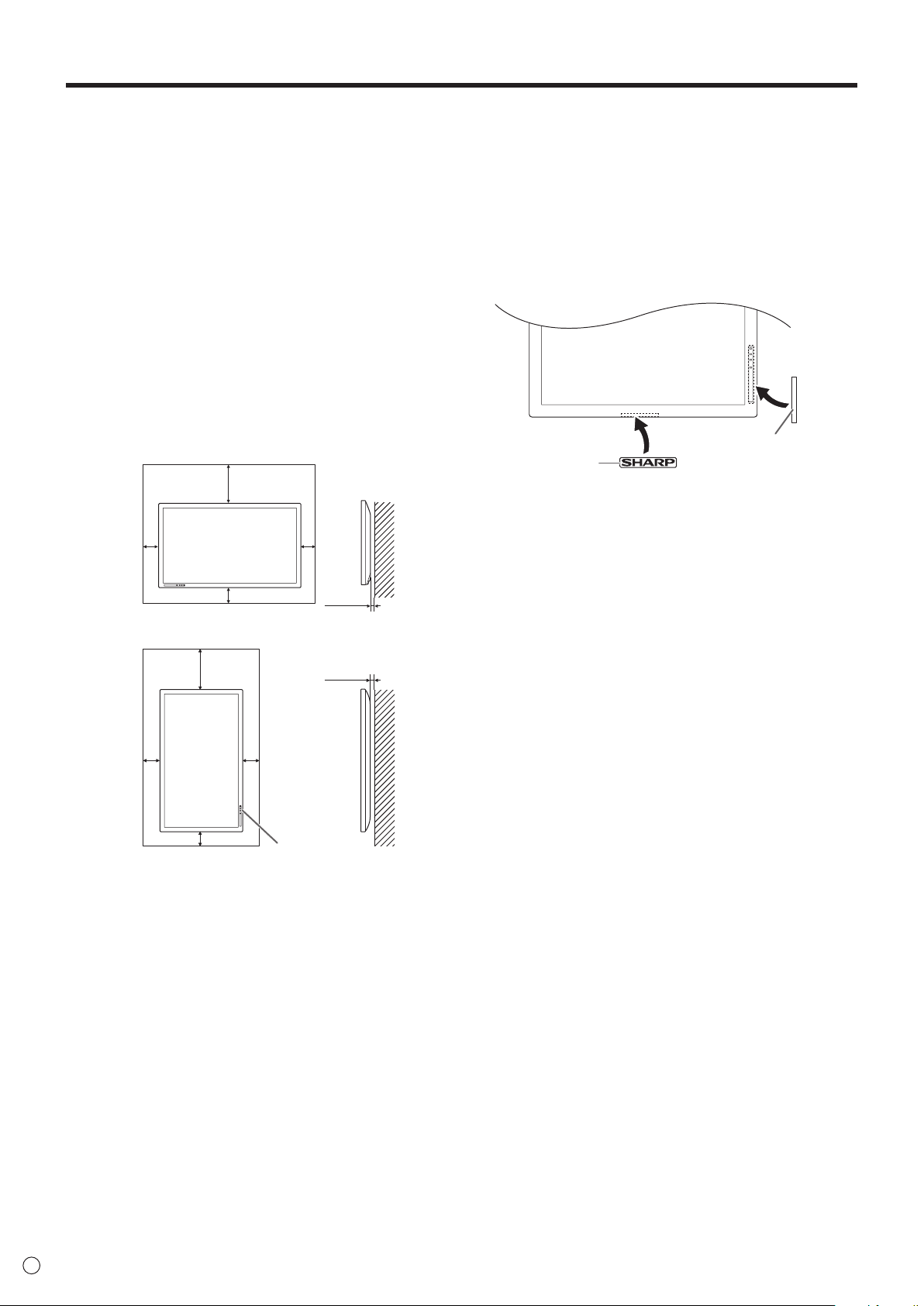
For the monitor in landscape orientation
• This product is for use indoors.
• A mounting bracket compliant with VESA specications is
required.
• Since the monitor is heavy, consult your dealer before
installing, removing or moving the monitor.
• Mounting the monitor on the wall requires special expertise
and the work must be performed by an authorized SHARP
dealer. You should never attempt to perform any of this
work yourself. Our company will bear no responsibility
for accidents or injuries caused by improper mounting or
mishandling.
• Use the monitor with the surface perpendicular to a level
surface. If necessary, the monitor may be tilted up to 20
degrees upward or downward.
• This monitor should be used at an ambient temperature
between 32°F (0°C) and 104°F (40°C).
Provide enough space around the monitor to prevent heat
from accumulating inside.
2
[50]
Unit: inch [mm]
7-7/8 [200]
2
[50]
• Adhere to the following when installing the monitor in its
portrait orientation. Failing to adhere to the following may
cause malfunctions.
- Install the monitor such that the power LED is located on
the bottom side.
- Set the THERMAL SENSOR SETTING on the SETUP
menu to PORTRAIT. (See page 27.)
• Use the supplied vertical sticker when you install the
monitor in portrait orientation.
Vertical sticker
(Logo)
Vertical sticker
(Operation panel)
Do not remove the factory-afxed sticker but afx the
sticker over it. Be careful not to cover the remote control
sensor or buttons.
2 [50]
For the monitor in portrait orientation
7-7/8 [200]
2
[50]
2 [50]
2
[50]
• If it is difcult to provide sufcient space for any reason
such as the installation of the monitor inside a housing, or
if the ambient temperature may be outside of the range
of 32°F (0°C) to 104°F (40°C), install a fan or take other
measures to keep the ambient temperature within the
required range.
• Do not block any ventilation openings. If the temperature
inside the monitor rises, this could lead to a malfunction.
• Do not place the monitor on a device which generates heat.
5/16 [7]
Unit: inch [mm]
5/16 [7]
Power LED
E
8
Page 9
Contents
IMPORTANT INFORMATION ............................................3
DEAR SHARP CUSTOMER ..............................................4
SAFETY PRECAUTIONS ..................................................4
TIPS AND SAFETY INSTRUCTIONS ...............................7
MOUNTING PRECAUTIONS ............................................8
Supplied Components .....................................................9
Part Names .....................................................................10
Connecting Peripheral Equipment ...............................12
Connecting the Power Cord .........................................14
Binding Cables ...............................................................15
Setting the USB ash drive cover ................................15
Preparing the Remote Control Unit ..............................16
Installing the batteries ................................................16
Remote control operation range .................................16
Turning Power On/Off ....................................................17
Turning on the main power.........................................17
Turning power on/off ..................................................17
Basic Operation .............................................................19
Playing the Files in a USB Flash Drive ........................21
Auto playback .............................................................21
Playing les ................................................................21
Playing les using the SCHEDULE function ..............22
Operations during play ...............................................23
Settings ......................................................................23
Menu Items .....................................................................25
Displaying the menu screen .......................................25
Menu item details .......................................................26
Controlling the Monitor with a PC (RS-232C) ..............32
PC connection ............................................................32
Communication conditions .........................................32
Communication procedure .........................................32
RS-232C command table ...........................................36
Controlling the Monitor with a PC (LAN) .....................38
Settings to connect to a LAN ......................................38
Command-based control ............................................39
Troubleshooting .............................................................40
Specications ...............................................................42
Mounting Precautions
(For SHARP dealers and service engineers) ...............48
Supplied Components
If any component should be missing, please contact your dealer.
Liquid Crystal Display Monitor: 1
Remote control unit: 1
Cable clamp: 2
Power cord
R-6 battery (“AA” size): 2
CD-ROM (Utility Disk for Windows): 1
Setup Manual: 1
Vertical sticker (Logo): 1
Vertical sticker (Operation panel): 1
USB ash drive cover: 1
USB ash drive cover screw: 1
Model Name / Serial No. label: 1
Indicates the model name and serial number.
Cover SHARP logo: 1
Place this sticker onto the SHARP logo to cover the logo.
* SHARP Corporation holds authorship rights to the Utility Disk program. Do not reproduce it without permission.
* For environmental protection!
Do not dispose of batteries in household waste. Follow the disposal instructions for your area.
9
E
Page 10
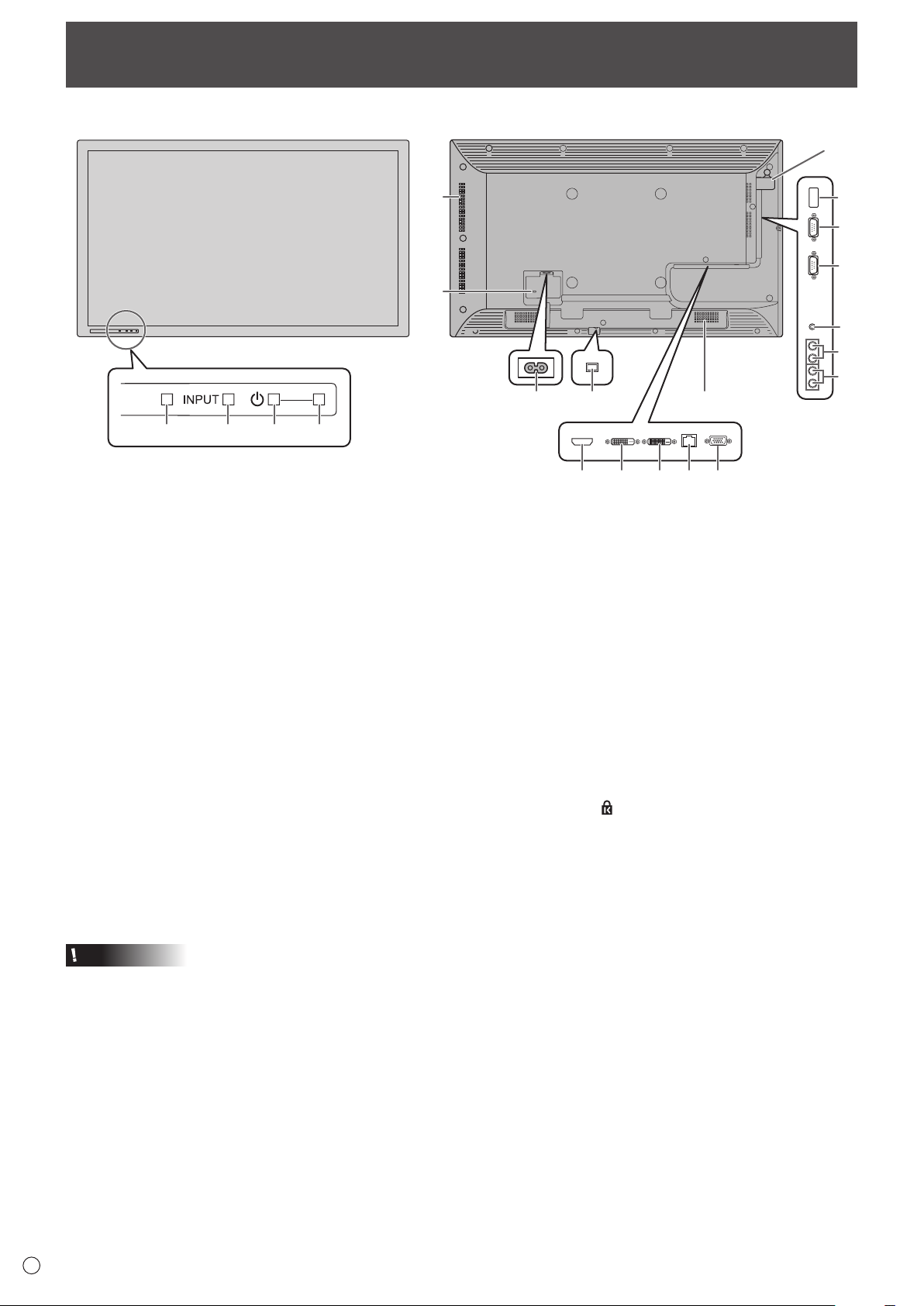
6
Part Names
Front view
n
1
2
1. LCD panel
2. Remote control sensor (See page 16.)
3. Input switch (See page 19.)
4. Power button (See page 17.)
5. Power LED (See page 17.)
345
22
Rear view
n
7
9108
11 12 13 14 15
6. USB ash drive cover (See page 15.)
7. Vents
8. Speakers
9. AC input terminal (See page 14.)
10. Main power switch (See page 17.)
11. HDMI input terminal (See page 12.)
12. DVI-D input terminal (See page 12.)
13. DVI-D output terminal (See page 13.)
14. LAN terminal (See page 13.)
15. D-sub input terminal (See page 12.)
16. USB port (See page 12.)
17. RS-232C input terminal (See page 13.)
18. RS-232C output terminal (See page 13.)
19. Audio1 input terminal (See page 13.)
20. Audio output terminals (See page 13.)
21. Audio2 input terminals (See page 13.)
22. Anti-theft hole (
A commercially available anti-theft lock can be connected.
The anti-theft hole is compatible with the Kensington
MicroSaver Security System.
)
16
17
18
19
20
21
Caution
• Consult your SHARP dealer for attachment/detachment of optional parts.
E
10
Page 11
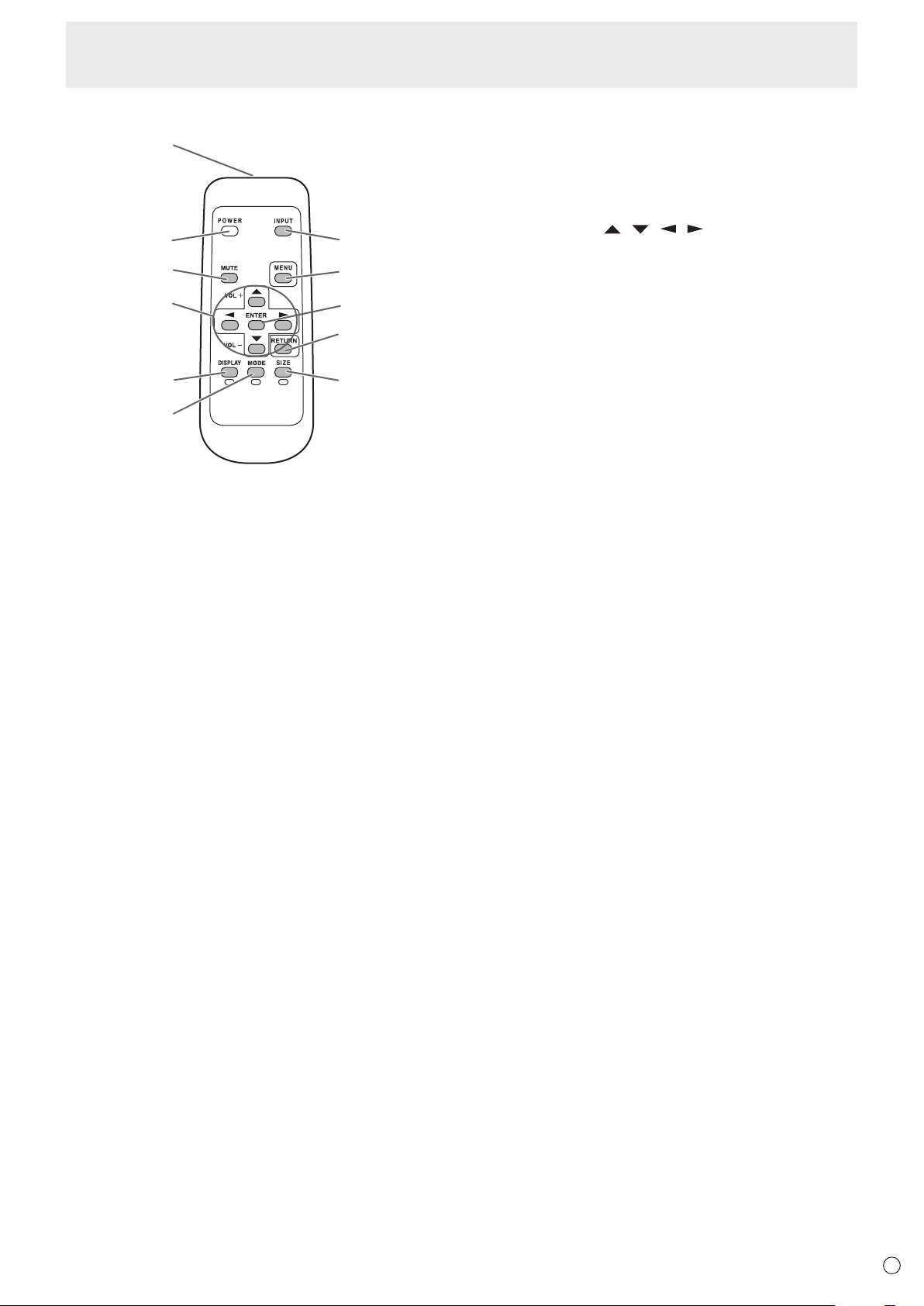
Remote control unit
1
n
2
3
4
10
Part Names
1. Signal transmitter
2. POWER button (See page 17.)
3. MUTE button (See page 19.)
4. VOL +/- buttons (See page 19.)
BRIGHT +/- buttons (See page 19.)
7
8
9
Cursor control (
5. DISPLAY/Red button (See page 19.)
6. MODE/Green button (See page 19.)
7. INPUT button (See page 19.)
8. MENU button (See page 19.)
9. ENTER button (See page 19.)
10. RETURN button (See page 19.)
11. SIZE/Yellow button (See page 19.)
/ / / ) buttons
5
6
11
E
11
Page 12
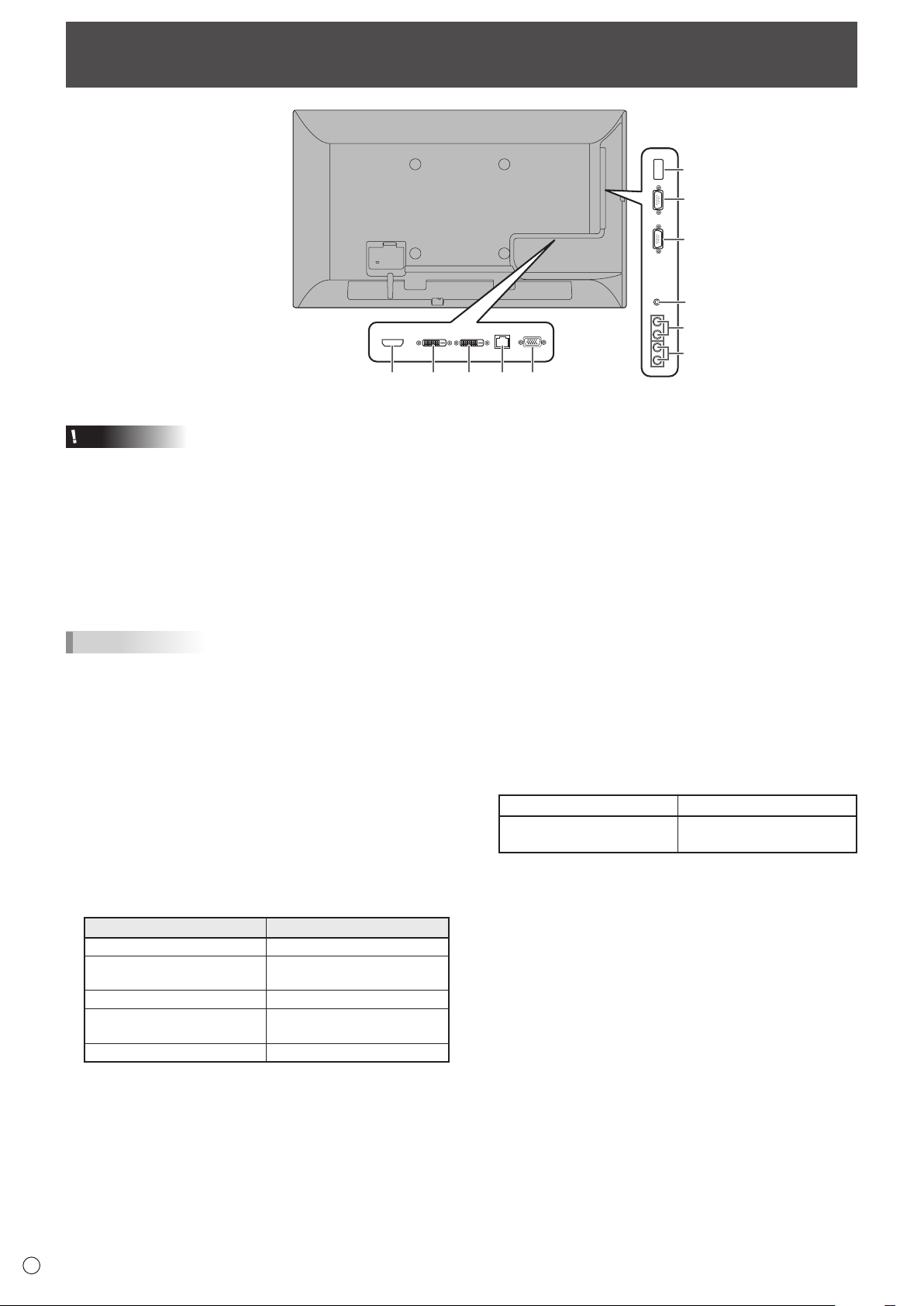
12711 3
Connecting Peripheral Equipment
4
9
10
5
8
6
Caution
• Be sure to turn off the main power switch and disconnect
the plug from the power outlet before connecting/
disconnecting cables. Also, read the manual of the
equipment to be connected.
• Be careful not to confuse the input terminal with the output
terminal when connecting cables. Accidentally reversing
cables connected to the input and output terminals may
cause malfunctions and the other problems.
• Do not use any cable that has a damaged or deformed
terminal. Using such cables may cause malfunctions.
TIPS
• Images may not be displayed properly depending on the
computer (video card) to be connected.
• Use the automatic screen adjustment when a PC screen is
displayed for the rst time using D-SUB, or when the setting
of the PC is changed. The screen is adjusted automatically
when AUTO in the SCREEN menu is set to ON.
• If the audio output from the playback device is connected
directly to speakers or other devices, the video on the
monitor may appear delayed from the audio portion.
Audio should be played through this monitor by connecting
the playback device to the monitor’s audio input, and
connecting the monitor’s audio output to the speakers or
other devices.
• The audio input terminals used in each input mode are
factory-set as follows.
Input mode Audio input terminal
DVI-D Audio1 input terminal
HDMI[PC], HDMI[AV]
D-SUB[RGB] Audio1 input terminal
D-SUB[COMPONENT],
D-SUB[VIDEO]
USB USB port
HDMI input terminal /
Audio1 input terminal
Audio2 input terminals
1. HDMI input terminal
• Use a commercially available HDMI cable (conforming to
the HDMI standard).
• Set HDMI of INPUT SELECT on the SETUP menu
according to the device to be connected.
2. DVI-D input terminal
• Use a commercially available signal cable (DVI-D 24 pin).
3. D-sub input terminal
• Set D-SUB of INPUT SELECT on the SETUP menu
according to the device to be connected.
4. USB port
• Connect a USB ash drive to the USB port.
• Do not connect a USB device other than a USB ash
drive.
• Turn off the power of the monitor when removing a USB
ash drive.
• After you have connected a USB ash drive, create “data.
db” and “db.info” in the root folder.
Supported USB ash drives
File System FAT32
Capacity
• Do not use a USB ash drive with a security function or
a write protection function.
• Use a USB ash drive with a shape that can be inserted
in the USB port. Some USB ash drives with special
shapes cannot be inserted. Do not forcibly insert a USB
ash drive. This may damage the connector and cause
failure.
Up to 32 GB
(maximum le size 2 GB)
E
12
Page 13
5. Audio1 input terminal
• Use an audio cable without resistance.
6. Audio2 input terminals
7. DVI-D output terminal
• When the input mode is set to DVI-D, the video of the
DVI-D input can be output to an external device.
• Outputting HDCP-encrypted video requires an external
device which supports HDCP.
• This terminal allows the daisy chain connection of up
to 5 monitors by connecting the monitors to each other
through the DVI-D input terminal of each monitor.
TIPS
• The length of the signal cables or surrounding environment
may affect the image quality.
• When the input mode is set to a mode other than DVI-D,
video cannot be output.
8. Audio output terminals
• The output sound varies depending on the input mode.
• It is not possible to control the sound output from the
audio output terminals with the AUDIO menu. Set this
function with AUDIO OPTION in the SETUP menu. (See
page 27.)
9. RS-232C input terminal
10. RS-232C output terminal
• You can control the monitor from a PC by connecting a
commercially available RS-232 straight cable between
these terminals and the PC.
• PN-Y325 monitors can be connected together in a daisy
chain connection.
11. LAN terminal
• You can control the monitor from a PC on a network by
connecting a commercially available LAN cable between
this terminal and a network.
Connecting Peripheral Equipment
13
E
Page 14
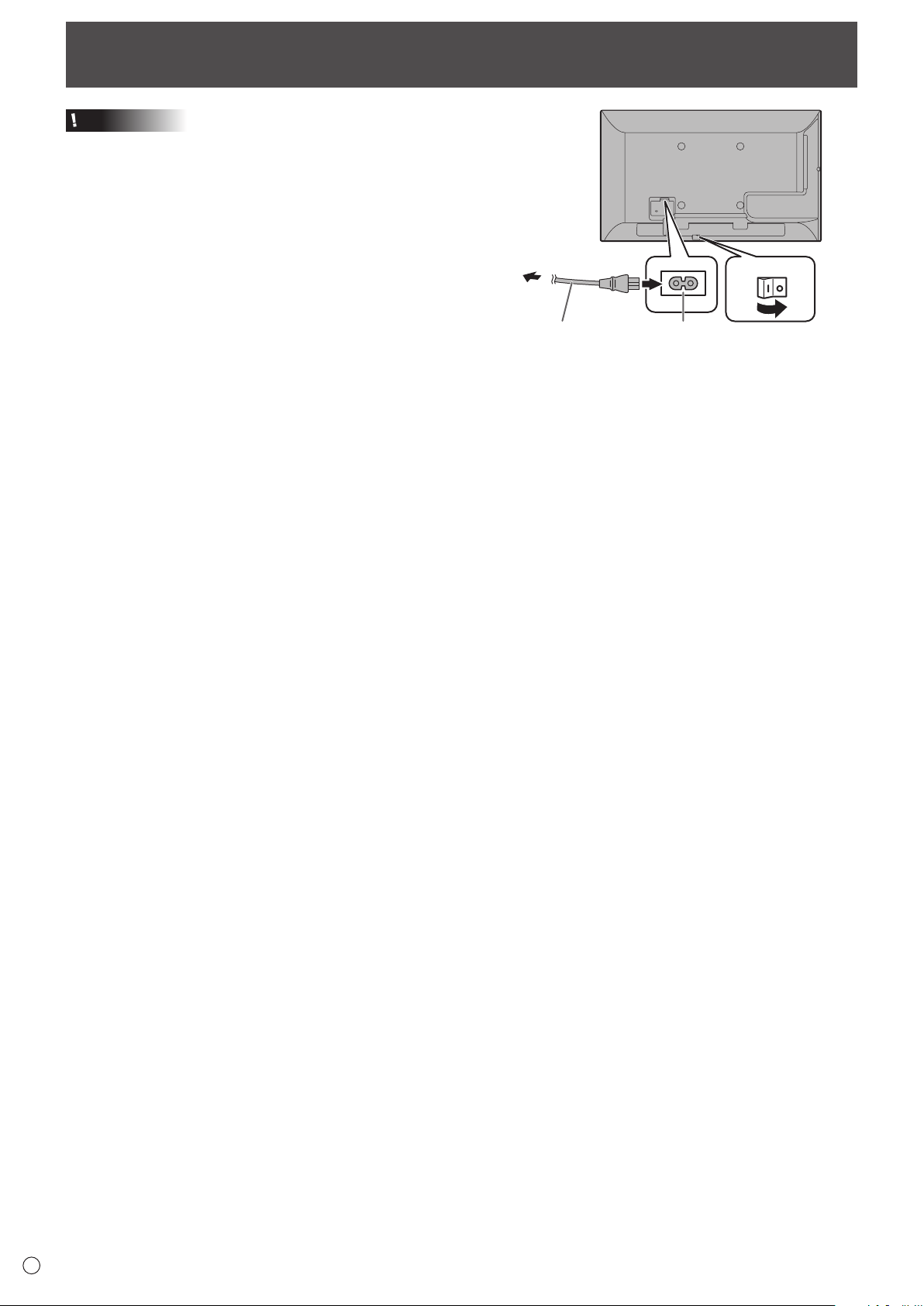
Connecting the Power Cord
Caution
• Use only the power cord supplied with the monitor.
1. Turn off the main power switch.
2. Plug the power cord (supplied) into the AC input terminal.
3. Plug the power cord (supplied) into the AC power outlet.
For power outlet
3
Power cord
(Supplied)
Main power switch
1
2
AC input terminal
E
14
Page 15
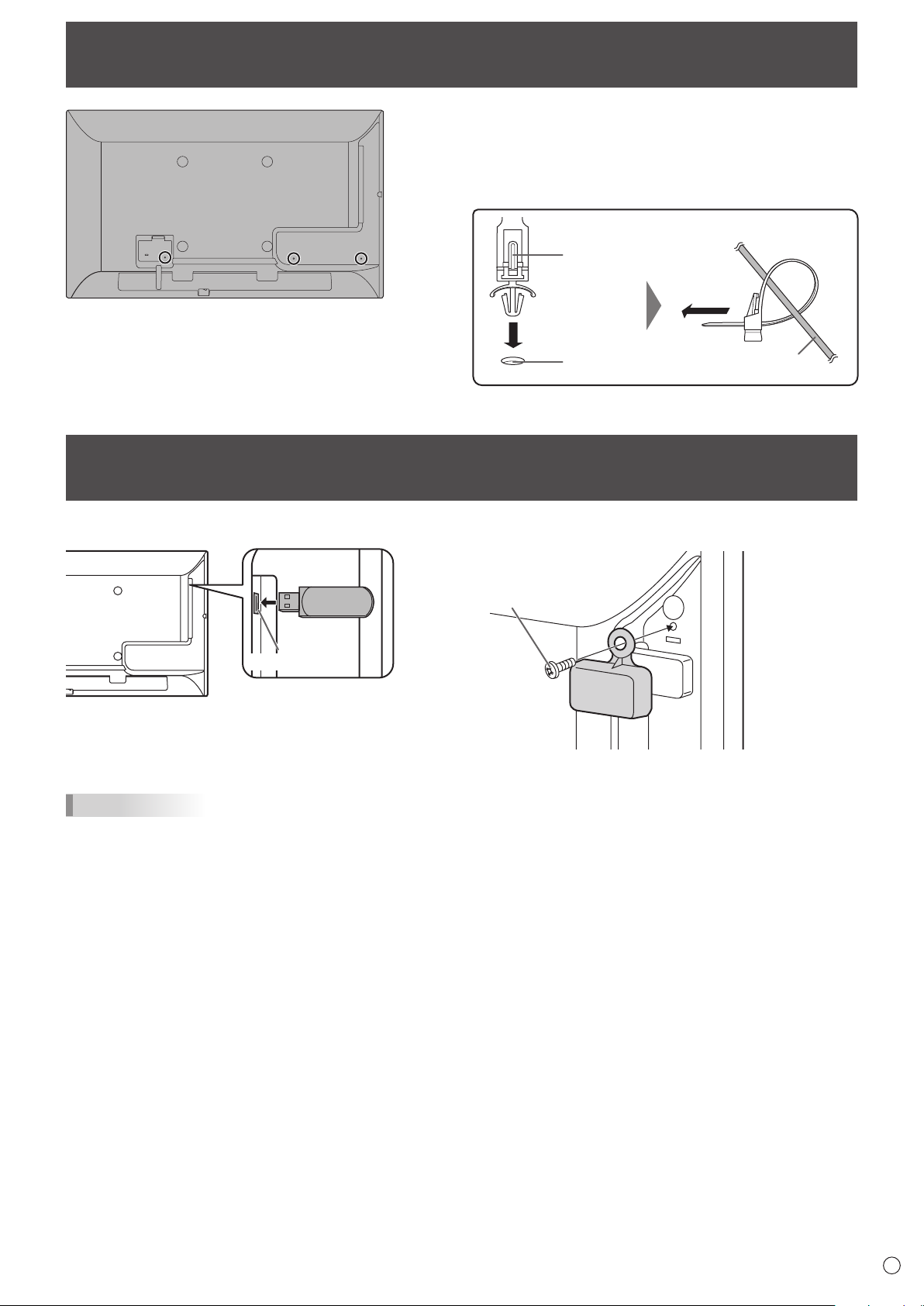
Binding Cables
The cables connected to the terminals on the rear of the
monitor can be fastened with the cable clamp.
Attach the cable clamp into the cable clamp attachment on the
rear of the monitor and fasten the cables.
Cable clamp
Setting the USB ash drive cover
1. Insert the USB ash drive into the USB port.
USB port
Cable clamp
attachment
2. Attach the USB ash drive cover and secure with the
provided screw.
USB flash drive
cover screw
Cable
TIPS
• If the USB ash drive will be attached, use a USB ash drive with dimensions no greater than 1-15/16 inch (50 mm) (L) ×
13/16 inch (20 mm) (W) × 1/2 inch (12 mm) (H).
15
E
Page 16

Preparing the Remote Control Unit
Installing the batteries
1. Press the cover gently and slide it in the direction of the
arrow.
2. See the instructions in the compartment and put in the
supplied batteries (R-6 (“AA” size) x 2) with their plus (+)
and minus (-) sides oriented correctly.
3. Close the cover.
TIPS
• When the batteries become exhausted, replace them with
new (commercially available) batteries.
• The supplied batteries (R-6 (“AA” size) x 2) may become
exhausted quickly depending on how they are stored.
• If you will not be using the remote control for a long time,
remove the batteries.
• Use manganese or alkaline batteries only.
Remote control operation range
The operation range of the remote control unit is approx. 16.4
feet (5 m) at an angle of approx 10° from the center to the top/
bottom/right/left of the remote control sensor.
Remote
control sensor
10°
10°
10°
16.4
feet
(5 m)
10°
TIPS
• Do not expose the remote control unit to shock by dropping
or stepping on it. This could lead to a malfunction.
• Do not expose the remote control unit to liquids, and do not
place it in an area with high humidity.
• The remote control unit may not work properly if the remote
control sensor is under direct sunlight or strong lighting.
• Objects between the remote control unit and the remote
control sensor may prevent proper operation.
• Replace the batteries when they run low as this may
shorten the remote control’s operation range.
• If a uorescent light is illuminated near the remote control
unit, it may interfere with proper operation.
• Do not use it with the remote control of other equipment
such as air conditioner, stereo components, etc.
E
16
Page 17

Turning Power On/Off
Caution
• Turn on the monitor rst before turning on the PC or
playback device.
Turning on the main power
When the main power is turned on, the power LED lights. Wait
until the screen is displayed.
Main power switch
Caution
• The main power must be turned on/off with the main power
switch. Do not connect/disconnect the power cord or turn
the breaker on/off while the main power switch is on.
• When switching the main power switch or the POWER
button off and back on, always wait for at least 5 seconds.
Risk of failure or malfunctioning if the interval is too short.
• For a complete electrical disconnection, pull out the main
plug.
Turning power on/off
Press the POWER button to turn the power ON/OFF.
POWER button Power LED
Status Status of the monitor
Green lit Power on
Orange lit Power off (Standby mode)
Green ashing Input signal waiting mode
Caution
• When switching the main power switch or the POWER
button off and back on, always wait for at least 5 seconds.
A short interval may result in a malfunction.
TIPS
• When the main power switch is off, the monitor cannot be
turned on.
• If the monitor is in the input signal standby mode and you
press the POWER button on the remote control unit, the
monitor enters standby mode.
• Setting the SCHEDULE ashes the power LED alternately
in red and orange in standby mode.
17
E
Page 18

Turning Power On/Off
Operation mode
n
When the monitor is turned on for the rst time after being
shipped from the factory, the operation mode setting screen
will be displayed. Set it to MODE1 or MODE2.
MODE1 ....OFF IF NO OPERATION is set to ON, and
STANDBY MODE is set to LOW POWER. (These
settings can not be changed.)
If there is no operation for 4 hours or more, the
monitor automatically enters standby mode. Power
consumption in standby mode is also minimized.
MODE2 ....Will perform standard operation.
OFF IF NO OPERATION is set to OFF, and
STANDBY MODE is set to STANDARD. These
settings can be changed.
Even after being set, changes can be made using
OPERATION MODE, located in the menu of the monitor. (See
page 27.)
Date/time setting
n
• If the time has not been set, such as when the monitor
is rst turned on, set the date and time in DATE/TIME
SETTING of the SETUP menu.
Be sure to set the date and time.
TIPS
•
Set the time on a 24-hour basis.
•
The clock stops if the main power remains off for about
1 week.*
(*Approximate time. The actual time varies depending
on the state of the monitor.)
E
18
Page 19

Basic Operation
ENTER
SIZE
DISPLAY
MODE
5. BRIGHT +/- (Brightness adjustment)
Pressing
1
menu screen is not displayed.
or displays the BRIGHT menu when the
2
3
4
5
6
9
7
8
10
1. INPUT (Input mode selection)
The menu is displayed. Press
mode, and press
to enter.
or to select the input
* You can select the input terminal by pressing the input
switch of the monitor.
Input mode Video Audio
DVI-D
HDMI[AV]
HDMI[PC]
D-SUB[RGB]
D-SUB[COMPONENT]
D-SUB[VIDEO]
USB USB port USB port
DVI-D input
terminal
HDMI input
terminal
D-sub input
terminal
Audio1 input terminal
HDMI input terminal /
Audio1 input terminal
Audio1 input terminal
Audio2 input terminals
When a USB ash drive is connected, the input mode
automatically changes to “USB”. The input mode also
automatically changes to “USB” if the power is turned on with
a USB ash drive connected.
2. MUTE
Turns off the volume temporarily.
Press the MUTE button again to turn the sound back to the
previous level.
3. MENU
Displays and turns off the menu screen. (see page 25.)
4. VOL +/- (Volume adjustment)
Pressing
or displays the VOLUME menu when the
menu screen is not displayed.
31
Press or to adjust the brightness.
* If you do not press any buttons for about 30 seconds, the
BRIGHT menu automatically disappears.
6. ENTER
Conrms the setting.
7. RETURN
Returns to the previous screen.
8. SIZE (Screen size selection)/Yellow
Each time you press this button, the screen size changes in
the following order: (See page 20.)
NORMAL → WIDE → Dot by Dot →NORMAL...
9. DISPLAY/Red
Displays monitor information (Input mode, LAN Setup, etc.).
The display disappears automatically after about 15 seconds.
10. MODE (Color mode selection)/Green
Each time you press this button, the color mode changes in
the following order:
STD (Standard) → VIVID → sRGB→
HIGH ILLUMINANCE → USB → STD...
• HIGH ILLUMINANCE is a display with colors suited to
bright locations.
• sRGB is for DVI-D, HDMI[PC], and D-SUB[RGB] input only.
sRGB is international standard of color representation
specied by IEC (International Electrotechnical
Commission). Color conversion is made in taking account
of liquid crystal’s characteristics and represents color tone
close to its original image.
Caution
• When the input mode is [USB], operations 3, 4, 5, 8, 9, and
10 cannot be performed. Change an input mode to other
than USB before performing these operations. COLOR
MODE, VOLUME and SIZE can be changed while a le in
a USB ash drive is being played. (See page 24.)
15
Press or to adjust the volume of the sound.
* If you do not press any buttons for about 5 seconds, the
VOLUME menu automatically disappears.
* To change the volume of video or music when the input
mode is “USB”, use “Settings during play”. (See page 24.)
TIPS
• 8
, 9
, and 10
are also used when playing a
le in a USB ash drive and when entering text. Colors and
operation names appear in the screen.
19
E
Page 20

Basic Operation
Switching the screen size
n
Even when the screen size is changed, the display may remain the same depending on the input signal.
NORMAL
WIDE
Dot by Dot
TIPS
• Using this monitor’s screen-size switching to compress or expand the screen for commercial or public viewing in
establishments like cafes or hotels may infringe on the rights of the creators, as protected by Copyright Law, so please be
careful.
• When “Enlarge” is set, the screen size is xed to WIDE mode.
• The appearance of the original video may change if you select a screen size with a different aspect ratio than the original
image (e.g. TV broadcast or video input from external equipment).
• When an ordinary non-wide image (4:3) is viewed with the whole screen using the screen-size switching function of this
monitor, the edge of the image may be lost or appear distorted. If you wish to respect the creator’s intentions, set the screen
size to NORMAL.
• When playing commercial software, parts of the image (like subtitles) may be cropped. In this case select the optimal screen
size using the screen-size switching function of this monitor. With some software, there may be noise or distortion at the
edges of the screen. This is due to the characteristics of the software, and is not a malfunction.
• Depending on the original image size, black bands may remain at the edges of the screen.
Displays image so it lls the screen without changing the aspect ratio of the input
signals.
Displays image so it lls the entire screen.
Displays the dots of the input signals as the corresponding dots on the screen.
E
20
Page 21

MENU
ENTER
ENTER
ENTER
INPUT
Playing the Files in a USB Flash Drive
A USB ash drive can be inserted in the monitor to display
images, videos, and music in the USB ash drive on the
monitor. For information on USB ash drive, see page 12.
Auto playback
The image les or video les in a USB ash drive can be
automatically played.
Create a folder with the name “autoplay” in the top level of the
USB ash drive.
Files in the “autoplay” folder that meet the criteria below play
automatically. (Supported formats and le names are different
from other playback.)
Image les
Format
File name
Number of les Up to 30.
or
Video les : *.wmv *
001.jpg - 030.jpg *
or
001.wmv - 030.wmv *
(Files are played by number in ascending
order. If a number is missing in the
sequence, that number is skipped.)
:
*1 For details, see “Supported formats” at right.
*2 File extension must be in lowercase.
Caution
• Mixed playback of image les and video les is not
possible. To display a mix of image les and video les, see
"SCHEDULE" (see page 30).
TIPS
•
During auto play, it is better to turn the power ON/OFF using
the remote control unit. When the power is turned ON/OFF
using the main power switch, it takes a longer time until
auto play is started. It also takes a longer time for playback
to start from STANDBY MODE and LOW POWER.
Preparations
n
Set the type of les for auto play.
1.
Change an input mode to other than [USB]. (See page 19.)
2. Press
3. Press
4.
Press
5. Press
6. Press
Auto playback of les
n
and select SETUP with or .
and select AUTO PLAY with or .
and select PHOTO or MOVIE with or .
.
MENU
.
1. Connect a USB ash drive (see page 12) and turn the
power ON. You can connect a USB ash drive (see
page 12) after turning the power ON.
TIPS
•
Auto play will not start if a folder, le format, or le name
indicated in “Auto playback” is not correctly set, and if AUTO
PLAY is not correctly set in the monitor settings menu.
To stop auto play
n
1. Press
.
*.jpg *
1
1
2
2
Playing les
You can play the specied image/video/ audio les in a USB
ash drive.
1. Insert the USB ash drive into a USB port on the
monitor. (See page 12.)
2. Change an input mode to [USB]. (See page 19.)
3. Select the les to be played, and the play method. (See
page 22.)
Supported formats
n
The types of les that can be played in USB ash drive are as
follows:
The operation of formats not indicated in the table is not guaranteed.
Image les
Extension Display capability
*.jpg (*.jpeg) *
*.png
1
*1 Progressive JPEG les are supported.
Audio les
Extension Video coding Audio coding
*.mp3 - MPEG-1, 2, 2.5 L3
*.wma - WMA, WMA Pro
Video les
Extension Video coding Audio coding
*.wmv WMV9 WMA
H.264 BP, MP, HP,
*.mp4
*.ts
•
In some cases it may not be possible to play the above les.
MPEG4 SP, ASP,
XVID
MPEG-2, H.264 BP,
MP, HP, VC1
• A maximum of 32 alphanumeric characters can be used for
folder name and le name. A le name or folder name may
not display correctly if a space, hyphen (-), or underbar (_)
is used.
• When le names or folder names are long, some
characters may not appear in the list screen.
• Do not use a le that is over 2 GB.
• During playback and when a list is displayed, the remote
control and some buttons may not respond when operated.
This is caused by the heavy image processing load and is
not due to a product failure or problem.
• Operation is not assured when a non-supported format is
used. The following types of problems may occur:
- Abnormal play speed
- Operations cannot be performed during playback
- Playback stops. The player application restarts.
• When a video le cannot be played, “Unsupported le”
appears. With some les, “Video resolution not supported”
or “Audio format not supported” may appear.
Size <= 10000 x 10000
Color mode= 444, 422
4096x3072 4bit, 2730x2500 8bit
2048x1536 16bit, 1500x1200 32bit
MP3, ADPCM, AAC
AC3, AAC, MP3, DD+,
HE-AAC
21
E
Page 22

(4) (3) (2) (1)
lM
ENTER
ENTER
MODE
ENTER
ENTER
ENTER
DISPLAY
RETURN
Playing the Files in a USB Flash Drive
Selecting les to be played
n
1. Insert the USB ash drive into a USB port on the
monitor. (See page 12.)
2. Change an input mode to [USB]. (See page 19.)
3. Press
4. Select an icon with
.
or and press
ENTER
.
(1) Folder
Folders and les in the USB ash drive are displayed.
(2) Photo
Image les in the USB ash drive are displayed.
(3) Movie
Video les in the USB ash drive are displayed.
(4) Music
Audio les in the USB ash drive are displayed.
5. Select a le.
(1) Folder
ENTER
Press
and select a le with .
(3) Movie
Select a le with
, , or .
(4) Music
Select a le with
• To move to the le genre menu, press
To narrow down audio les, select with
press
.
• To change the group of a le, press
le selected. Select one of the items below with
, and press
ENTER
.
or .
.
or and
MODE
(Green) with the
or
Album ......... Group by album
Artist ........... Group by artist
Genre ......... Group by genre
Track .......... Group by rst letter of song title
• A still image can be played while audio is played. (See
page 23.)
6. Select the le play method from the following:
• Play a selected le
Press
.
• Play all les shown in the list
Press
7. To end playback, press
(Red).
RETURN
.
• When playing music, pause the music before performing
the above steps. (See page 23.)
IMG_0832_R.JPG
photo
IMG_0833_R.JPG
IMG_0834_R.JPG
IMG_0835_R.JPG
USB device 1
IMG_0836_R.JPG
IMG_0837_R.JPG
IMG_0838_R.JPG
IMG_0839_R.JPG
IMG_0840_R.JPG
Play Al
Title : IMG_0832_R.JPG
Data : 11 Apr. 2014
Size : 1024x768
ENUUSB device
• When the selected item is a folder, the les in the folder are
shown on the right. To move to the folder, press
.
• When the selected item is a le, the le information
appears.
(2) Photo
Select a le with
, , or .
• Image les are initially grouped by date. To show images of
a different date, press
and press
.
• To change the group of a le, press
, select the date with
(Green) with the
le selected. Select one of the items below with
, and press
.
or
or
Date ...........Group by le creation day
A..Z ............Group by rst letter of le name
Month ......... Group by le creation month
Year ............ Group by le creation year
TIPS
• For information on the operations during play, see page 23.
• When playing all les in [Folder], playback starts from the
currently selected le, and only les of that type (still image,
video, or music) are played. Playback takes place in order of
the le names. Even if the les have different formats, the les
will be played as long as they are of the same type. Mixed le
types are not played.
• To return to the next higher item, press
or
• When displaying the video le list, the thumbnails of some
les may take time to appear. Wait until the thumbnails
appear before performing the next operation.
Playing les using the SCHEDULE
,
function
The image les (in .jpg (.jpeg)/.png format) or video les
(in .wmv/.mp4/.ts format) in a USB ash drive can be
automatically played using the SCHEDULE function. (See
page 30.)
.
E
22
Page 23

Playing the Files in a USB Flash Drive
MODE
RETURN
ENTER
ENTER
DISPLAY
MODE
ENTER
ENTER.DISPLAY
MODE
RETURN
RETURN
RETURN
MUTE
RETURN
MENU
Operations during play
Image les
n
Operation is possible using the buttons below.
DISPLAY/ ENTER
Video les
n
Operation is possible using the buttons below.
RETURN
Audio les
n
: Move back about 10 seconds.
: Play/Pause a slideshow.
: Rotate the display 90° clockwise.
: End playback.
: Move back about 10 seconds.
: Move forward about 10 seconds.
: Pause the le that is being played.
To resume playing the paused le, press
: Switch between “Play only the le being played” and
“Play all”.
: Select whether the playback order is shufed or not
during continuous playback.
: End playback.
: Move forward about 10 seconds.
: Pause the le that is being played.
To resume playing the paused le, press
: Switch between “Play only the le being played” and
“Play all”.
: Select whether the playback order is shufed or not
during continuous playback.
:
can be pressed during playback of a le to
perform an operation without stopping le playback.
For example, by displaying a still image le from
"Photo" (see page 22) after pressing
show a still image while playing music. To stop music,
select the original music le and pause. You can also
mute the sound with
If
is pressed while the music is paused, playback
.
will end.
.
, you can
Settings
Settings when the le list is displayed
n
With a le selected, press
Select an item with
Shufe
Select whether or not playback is shufed during a slideshow
or continuous playback.
Repeat
Set whether or not playback of a le, or les in a folder, is
repeated.
Slideshow time
(Only during [Folder] or [Photo] display.)
Set the slideshow change time.
This setting is also applied to auto play and schedule play.
The times below are general guidelines, and will vary by le.
Short ........About 3 seconds
Medium ....About 6 seconds
Long.........About 9 seconds
Slideshow Transition
(Only during [Folder] or [Photo] display.)
Set how slides are changed in slideshows.
.
or and press
ENTER
.
TIPS
• To adjust the sound volume for video les and audio les,
follow the procedure described in “Settings during play”.
(See page 24.)
• If the next operation is performed during processing of an
operation that involves a high processing load such as
“Move forward about 10 seconds” in a video, the operation
will be not processed until the previous processing is
completed. Wait until the processing is completed before
performing the next operation.
• Processing time varies widely depending on the resolution
and le size. For this reason, it is recommended that you
keep the resolution at 1920 x 1080 whenever possible.
23
E
Page 24

MENU
ENTER
ENTER
Playing the Files in a USB Flash Drive
Settings during play
n
Press
Congure the desired setting with , , , , and
Options
“Settings when the le list is displayed” (See page 23.) or
“Status” (only when playing video) appears.
Picture and sound
COLOR MODE
VOLUME
SIZE
Eco settings
Screen off
Clock (Only when playing video or music.)
Clock
during playback.
Changes the color mode on the screen.
Adjust the volume.
Changes the screen size of video.
Use this during playback of a video or music to turn off the
screen and play only the music. The audio of a video or
music does not turn off. To show the screen, press
the remote control.
A clock can be displayed in the upper right corner of the
screen. The clock constantly appears during le playback.
To clear the clock display, select [Clock] again and press
.
ENTER
on
.
E
24
Page 25

Menu Items
MENU
ENTER
MENU
1 2
Displaying the menu screen
Video and audio adjustment and settings of various functions
are enabled. This section describes how to use the menu
items. See pages 26 to 31 for details of each menu item.
Caution
• Do not turn the main power switch off while the menu items
are being displayed. Doing so may initialize the settings.
• This cannot be displayed when the input mode is USB.
Change an input mode to other than USB before performing
these operations.
Example of operation
n
(Adjusting CONTRAST in the PICTURE menu)
1. Press
to display the menu screen.
Menu screen display
n
SCREEN
PICTURE
AUDIO
SETUP
BRIGHT
CONTRAST
BLACK LEVEL
TINT
COLORS
COLOR ADJUSTMENT
RESET
1 Name of the menu
2 An item being selected (highlighted)
50
SCREEN
PICTURE
AUDIO
SETUP
2. Press
3. Press
SCREEN
PICTURE
AUDIO
SETUP
or to select PICTURE, and press
or to select CONTRAST, and press
H/V-POS
SIZE
RESET
BRIGHT
CONTRAST
BLACK LEVEL
TINT
COLORS
COLOR ADJUSTMENT
RESET
50
4. Press or to adjust the setting, and press
SCREEN
PICTURE
AUDIO
SETUP
BRIGHT
CONTRAST
BLACK LEVEL
TINT
COLORS
COLOR ADJUSTMENT
RESET
ENTER
ENTER
.
.
.
5. Press
TIPS
• The menu will differ depending on the input mode.
• The menu screen will close automatically if no operation is
performed for about 1 minute.
to close the menu screen.
60
E
25
Page 26

ENTER
Menu Items
Menu item details
The menu will differ depending on the input mode.
SCREEN
n
AUTO (D-SUB[RGB])
The H/V-POS, etc. are automatically adjusted.
H/V-POS
Adjust the horizontal and vertical position of the image.
SIZE
Changes the screen size. The screen size can also be changed using a remote control unit. (See page 19.)
ZOOM (HDMI[AV]/D-SUB[COMPONENT]/D-SUB[VIDEO])
Enlarge and display part of the image.
INPUT SIGNAL (D-SUB[RGB])
If a computer connected to the D-SUB output any of the following resolution, make a selection from the following options.
768......................1024x768, 1280x768, 1360x768 or 1366x768
RESET
Resets the values of the SCREEN menu items to the factory preset values.
ENTER
.
.
Select “ON” and then press
PICTURE
n
BRIGHT
Adjusts the backlight brightness.
CONTRAST
Adjusts the difference between the bright and dark portions of the image.
BLACK LEVEL
Adjusts the entire brightness of the video signals.
TINT
Adjusts the hue. Selecting - changes the color towards magenta, and selecting + changes it towards green.
COLORS
Adjusts the color intensity.
SHARPNESS (HDMI[AV]/D-SUB[COMPONENT]/D-SUB[VIDEO])
Adjusts the sharpness of the image.
COLOR ADJUSTMENT
COLOR MODE
Changes the color mode on the screen. The color mode on the screen can also be changed using a remote control unit. (See
page 19.)
* sRGB is DVI-D, HDMI[PC], D-SUB[RGB] input only. See page 19 for details.
WHITE BALANCE
THRU ..............Displays the input signal level as is.
PRESET .......... Selects the color temperature using PRESET.
USER .............. Used for adjusting R-/G-/B-GAIN and R-/G-/B-OFFSET respectively.
PRESET
Selects the color temperature when the WHITE BALANCE is set to PRESET.
The setting values are shown for reference. The color temperature of the screen varies over time. This function is not
intended to keep the color temperature constant.
GAMMA
Selects the gamma.
ADVANCED
NOISE REDUCTION (HDMI[AV]/D-SUB[COMPONENT]/D-SUB[VIDEO])
Reduce the noise of playback images.
HDMI RGB INPUT RANGE (HDMI[PC]/HDMI[AV])
Sets the RGB input signal range.
RESET
Resets the values of the PICTURE menu items to the factory preset values.
Select “ON” and then press
E
26
Page 27

ENTER
Menu Items
AUDIO
n
BASS
Adjusts the volume of bass-level sound.
TREBLE
Adjusts the volume of treble-level sound.
RESET
Resets the values of the AUDIO menu items to the factory preset values.
Select “ON” and then press
SETUP
n
DATE/TIME SETTING
Set the date and time. Press
Set the time on a 24-hour basis.
SCHEDULE (See page 30.)
You can turn the power on/off at a specied time.
Files in a USB ash drive can also be played at a specied time.
LANGUAGE
Sets the display language for the menu screen.
INPUT SELECT
HDMI
Select the input mode to be used in HDMI input terminals.
D-SUB
Select the input mode to be used in D-Sub input terminal. Select SET after selecting the input mode, and then press
AUDIO OPTION
AUDIO OUTPUT
Sets the volume of sound output from the audio output terminals.
SPEAKER
Select whether or not speakers are used.
LAN Setup
Congures the settings to control the monitor from the computer via LAN. (See page 38.)
ID SETTING
Assigns ID numbers to monitors connected in a daisy chain (see page 33), using the RS-232 cables.
The numbers 0 to 25 are available for ID numbers.
If “0” is set, the system regards this as the state where no ID number is set.
MULTI
ENLARGE (See page 29.)
Sets whether or not to use the enlarge function.
ADVANCED (ENLARGE)
ENLARGE H / ENLARGE V
.......... Sets the number of screen splits (number of monitors) in the horizontal/vertical direction used for the enlargement.
ENLARGE-POS
.......... Specify the split screen to be displayed when the enlargement function is used. (See page 29.)
BEZEL ADJUST
.......... When ENLARGE is set to ON, sets whether or not to use the frame correction function.
THERMAL SENSOR SETTING
Select the installation direction of the monitor.
LANDSCAPE ............Landscape orientation
PORTRAIT ...............Portrait orientation
OPERATION MODE
MODE1 ......OFF IF NO OPERATION is set to ON, and STANDBY MODE is set to LOW POWER.
MODE2 ......Will perform standard operation. OFF IF NO OPERATION is set to OFF, and STANDBY MODE is set to
STANDBY MODE
When STANDARD is selected, startup time from standby mode is reduced. Note, however that, more power will be consumed in standby mode.
When LOW POWER is selected, current consumption is reduced while the monitor is in standby mode. Note, however, that the
startup time from standby mode becomes longer.
If set to LOW POWER, RS-232C commands cannot be used in standby mode and control via LAN is disabled. (See page 32, 38.)
When set to LOW POWER, the monitor enters power standby mode rather than input signal standby mode when there is no
input signal, and therefore the monitor does not wake up when a signal is input. (See page 17.)
(These settings can not be changed.)
STANDARD. These settings can be changed.
ENTER
.
or
to select the date and time, and press or
to change the numerical values.
.
27
E
Page 28

Menu Items
SIZE
OFF IF NO OPERATION
Determines whether or not to set the monitor to go into standby mode when there is no operation from the remote control unit,
RS-232C commands, or LAN for more than the set time.
POWER ON DELAY
You can delay the screen display after the monitor is turned on. The period can be set up to 60 seconds in units of 1 second.
When this function is activated, the power LED ashes (at approx. 1 second interval) in orange.
AUTO INPUT CHANGE
Specify whether to change inputs automatically. When ON is selected and no signal is present in the selected input mode,
AUTO INPUT CHANGE automatically changes the selected mode to another mode where a video signal is present.
When video signals exist in multiple input modes, the switching priority is as follows:
DVI-D, HDMI, D-SUB
(Input mode switching may take 15 seconds or more, depending on the connected equipment. When there are no signals at
any of the input terminals, switching is continued until an input signal is detected and the monitor does not enter signal standby
mode.)
SCAN MODE (HDMI[AV])
Sets the scan mode.
ADJUSTMENT LOCK
You can disable operations on the monitor and the remote control unit that use buttons.
MONITOR BUTTONS
UNLOCKED ...........................Enables operation.
LOCK ALL ..............................No operations are possible.
LOCK EXCEPT POWER .......All operations other than turning the power on/off are disabled.
REMOTE CONTROL
UNLOCKED ...........................Enables operation.
LOCK ALL ..............................No operations are possible.
LOCK EXCEPT VOLUME ......Only volume adjustment is possible. Other operations are disabled.
LOCK EXCEPT POWER .......All operations other than turning the power on/off are disabled.
• To disable ADJUSTMENT LOCK, press
and in this sequence before “F” disappears.
LED
Species whether to light the power LED.
SCREEN MOTION
Residual images are reduced by moving the screen.
Specify a time period (operating interval) until SCREEN MOTION starts.
POWER MANAGEMENT
POWER MANAGEMENT determines whether or not to switch modes from no signal to the input signal standby mode.
AUTOPLAY (See page 21.)
Set the type of le to be automatically played from a USB ash drive.
ALL RESET
Resets the settings to the factory default settings. (The settings in LAN SETUP are retained.)
TIPS
• If COLOR MODE is set to sRGB, the following items cannot be set.
WHITE BALANCE, PRESET, USER and GAMMA
• When the COLOR MODE is set to HIGH ILLUMINANCE or VIVID, GAMMA can not be adjusted.
• When ENLARGE is used, the SCREEN MOTION function is disabled.
• Even if LED is set to OFF, the power LED lights when a temperature alert occurs.
until “F” appears in the upper left corner of the screen. Then, press , ,
E
28
Page 29

Enlarge
(Example)
In horizontal orientation
n
• You can align several monitors and integrate them into a single large screen to display.
• Up to 5 monitors can be aligned in both the horizontal and vertical directions.
• Each monitor displays enlarged views of separated images.
Horizontal direction: 2 monitors
Vertical direction: 2 monitors
Horizontal direction: 3 monitors
Vertical direction: 2 monitors
Setting procedure
Set using MULTI in the SETUP menu.
1. Set ENLARGE to ON.
2. Select ADVANCED.
3. Set the number of monitors aligned in the horizontal direction in ENLARGE H.
4. Set the number of monitors aligned in the vertical direction in ENLARGE V.
5. Set the section of the separated image to be displayed on each monitor in ENLARGE-POS.
ENTER
1) Press
2) Press
.
or to select position, then press
MENU
.
Menu Items
Enlarge
You can align 4, 9, 16, or 25 monitors and integrate them into a single large screen to display.
Enlarged views of separated images are displayed in each monitor.
Original
image
4 monitors
1
3
In vertical orientation
Original
image
4 monitors
25 monitors
16 monitors
9 monitors
1 2 3
2
4
4 5 6
7 8 9
1
5 6 7
9
13
2 3
10 11
14 15
4
8
12
16
1
6 7 8
11
16
21
2
12 13
17 18 19
22
3
23 24
4
9
14
5
10
15
20
25
25 monitors
25
20
15
10
5
24
19
14
9
4
23
18
13
8
3
9 monitors
3
16 monitors
16
12
8
4
9
6
3
11
7
15
42
31
2
1
8
5
7
4
2
6
1
14
10
1395
7
2
221712
21
161161
E
29
Page 30

MENU
ENTER
ENTER
ENTER
ENTER
ENTER
ENTER
ENTER
ENTER
ENTER
DISPLAY
ENTER
DISPLAY
ENTER
SIZE
INPUT
Menu Items
SCHEDULE
n
You can set the time to switch the motion on and off.
A le in a USB ash drive can also be played at a specied
time. Set “INPUT” in SCHEDULE to “USB”, and create a play
list.
Set this function with SCHEDULE in the SETUP menu. (See
page 27.)
SCHEDULE 1
SCHEDULE 2
SCHEDULE 3
ON/OFF
ON TIME
OFF TIME
REPEAT MODES
INPUT
PLAYLIST SETTING
PLAY
OFF
ON
1. Insert the USB ash drive into a USB port on the
monitor. (See page 12.)
2. Press
press
or to select the SCHEDULE number, and
ENTER
.
3. Set the SCHEDULE. (See below)
Move through the items with
settings of an item with
4. Press
.
ENTER
or , and display the
.
SCHEDULE becomes effective.
(1) ON/OFF
Enable/disable the SCHEDULE.
(2) ON TIME
Specify the time the power turns on with
or .
Set the time on a 24-hour basis.
When you have nished, select [OK] with
press
.
or and
(3) OFF TIME
Specify the time the power turns off with
or .
Set the time on a 24-hour basis.
When you have nished, select [OK] with
press
.
or and
(4) REPEAT MODES
Select the day of the week the schedule will be executed
with
or , and specify with
ENTER
.
• ONLY ONCE
The SCHEDULE will be executed once only regardless of
the day of the week.
• EVERY SUN - EVERY SAT
Executes the SCHEDULE on the specied day every
week.
Multiple days of the week can be specied.
(5) INPUT
Specify the input mode at power on with
or .
(6) PLAYLIST SETTING
This only appears when INPUT is set to [USB].
Use to create a playlist for automatic display/playback of les
in a USB ash drive.
• Image les and video les can be combined in the same
playlist.
• Audio les cannot be used.
1. Select the type of le to be set in the list with
, and press
.
or
• A list of folders or les of the selected type (Photo/Video)
appears.
2. Select a le with
, and press
to set the
or
le.
When a le is selected and set, it appears in the left area.
•
• When you select a le in the left area and press
, it
disappears from the left area.
• To move up a folder, select [..] and press
• To change the le type, press [..] to return to the
selection screen, or press
Type] with
or , and press
DISPLAY
(Red)
. When [Photo]
.
, select [Media
is selected, image les appear, and when [Video] is
selected, only video les appear.
• To sort the les in the folder, press
[Sort] with
to select an
or , and press
item from the following, and press
DISPLAY
(Red)
, select
. Press or
.
Type ..... Sorts the les according to the type of video
les. This item does not appear for image les.
Date ..... Sorts the les according to the modied date
and time.
Name ... Sorts the les according to their names.
• To change the le view, press
Parser] or [Recursive Parser] with
(Red), select [Normal
or , and press
. When an option is selected, the le view changes
as follows:
Normal Parser
Folders and les are displayed in the hierarchy of the
USB ash drive.
Recursive Parser
All image les or all video les are shown together,
regardless of the hierarchy of the USB ash drive.
3. Press
4. Press
(Red).
or to select [Save list], and press
.
• T he list displayed in the left area is saved as playlist. If
you make changes to a playlist, use [Save list] to save
the changed list.
5. Press
(Yellow).
(7) PLAY
It appears only after the playlist is saved.
It starts the playlist.
Press
to pause the playlist.
E
30
Page 31

INPUT
Menu Items
Caution
• Do not switch off the main power after setting the
SCHEDULE.
• Set the time for both power-on and power-off. The time for
either only cannot be set.
Schedule ON and then OFF only take place in power
standby mode and signal standby mode.
• Specify the correct date and time. (See page 27.)
SCHEDULE does not function unless the date and time are
specied.
• Check regularly that the set date and time are correct.
• If there is a le in the play list that is not in the USB ash
drive, the le is skipped during playback.
• If none of the les in the play list are in the USB ash drive,
the screen will turn black. Press
• Before conguring playlist settings, be sure to insert a USB
ash drive.
TIPS
• Up to 3 SCHEDULE items can be registered.
• Setting the SCHEDULE ashes the power LED alternately
in red and orange in standby mode.
• A SCHEDULE that has a small number has precedence
over that of a large number when schedules overlap.
• The play list is saved in “usb_schedulinglist.txt” in the USB
ash drive.
to exit.
Screen display for adjustment
n
Before making adjustments in the SCREEN menu or
PICTURE menu, display an image to brighten the entire
screen. If you are using a Windows PC, use the adjustment
pattern on the supplied CD-ROM.
Opening the adjustment pattern
The following example is performed in Windows 7.
1. Load the supplied CD-ROM into the computer’s CD-
ROM drive.
2. Open [CD Drive] in [Computer].
3. Double-click [Adj_uty.exe].
The adjustment pattern will appear.
Adjust the screen automatically or manually.
4. When adjustment is nished, press the [Esc] on the
computer’s keyboard to quit the adjustment program.
5. Eject the CD-ROM from the CD-ROM drive.
TIPS
• If the display mode on the computer you are using is
65,000 colors, the color levels in the color pattern may
appear differently or grayscale may appear to be colored.
(This is due to the specications of the input signal and is
not a malfunction.)
31
E
Page 32

Controlling the Monitor with a PC (RS-232C)
RS-232C
PC
Return code
You can control this monitor from a PC via RS-232C (COM
port) on the PC.
You can also connect multiple monitors via a daisy chain by
using a PC. By assigning ID numbers to each monitor (see
page 33), you can make input mode selection/adjustment or
can check the status of a specic monitor.
TIPS
• To control the monitor via RS-232C, set STANDBY MODE
to STANDARD.
PC connection
One-to-one connection with a PC
n
Connect with RS-232 straight cable between the PC’s COM
port (RS-232C connector) and the RS-232C input terminal on
the monitor.
RS-232C
input terminal
PC
To COM port
RS-232 straight cable
(commercially available)
Daisy chain connection…
n
PN-Y325 monitors can be connected together in a daisy chain
connection.
Connect with RS-232 straight cable between the PC’s COM
port (RS-232C connector) and the RS-232C input terminal on
the rst monitor.
Next, connect RS-232 straight cable to the rst monitor’s
RS-232C output terminal and to the second monitor’s
RS-232C input terminal. Connect in the same way to the third
and subsequent monitors.
Up to 25 monitors can be connected. (Depending on the
length of the cable used and the surrounding environment.)
First monitor
Second monitor
input terminal
RS-232C
output terminal
Advanced operation
To COM port
RS-232 straight cables
(commercially available)
Communication conditions
Set the RS-232C communication settings on the PC to match
the monitor’s communication settings as follows:
Baud rate 9600bps
Data length 8 bits Flow control None
Parity bit None
Stop bit
1 bit
Communication procedure
Command format
n
When a command is sent from the PC to the monitor, the
monitor operates according to the received command and
sends a response message to the PC.
C1 C2 C3 C4 P1 P2 P3 P4
Command field
(4 prescribed
alphanumerical characters)
Example: VOLM0030
VOLM
* Be sure to input 4 characters for the parameter. Pad with
spaces (“
(“
Wrong : VOLM30
Right : VOLM 30
Do not use spaces for DATE. Specify parameters using a
specied number of characters.
If a command has “R” listed for “DIRECTION” in the
“RS-232C command table” on page 36, the current value can
be returned by using “?” as the parameter.
Example:
VOLM ? ? ? ? ←
30 ←
* If an ID number (see page 33) has been assigned
(For example, ID number = 1).
VOLM
30 001 ←
”) if necessary.
” is a return code (0DH, 0AH or 0DH))
30
? ←
Parameter field
(4 character string comprised of:
0-9, +, -, space, ?)
From PC to monitor (How much
is current volume setting?).
From monitor to PC (Current
volume setting: 30).
From PC to monitor.
From monitor to PC.
E
32
Page 33

Controlling the Monitor with a PC (RS-232C)
Return code
Return code
VOLM0020
[Example]
[E
xample]
Response code format
n
When a command has been executed correctly
O K
A response is returned after a command is executed.
* If an ID number has been assigned
O K SPC 0 0 1
ID number of responding monitor
When a command has not been executed
R R E
* If an ID number has been assigned
Space (20H)
R R E SPC 0 0 1
TIPS
• “ERR” is returned when there is no relevant command or
when the command cannot be used in the current state of
the monitor.
• If communication has not been established for reasons
such as a bad connection between the PC and monitor,
nothing is returned (not even ERR).
• “ERR” may be returned when a command cannot be
received correctly due to interference from the surrounding
environment.
Please ensure that the system or software retries the
command if this occurs.
• If no monitor has been assigned the designated ID number
(e.g. if the command IDSL0002
with ID number: 2 is found), no response is returned.
If execution of the command is taking some time
I W T A
Return code
(0DH, 0AH)
Space (20
H)
Return code
(0DH, 0AH)
ID number
(0DH, 0AH)
(0DH, 0AH)
is used, but no monitor
Return code
(0DH, 0AH)
Communication interval
n
• After OK or ERR is returned, you must send the following
commands.
To set a timeout for the command response, specify 10
seconds or longer.
When connecting multiple monitors in a daisy chain, set the
timeout to at least the product of the monitor’s position from
the computer multiplied by 10 seconds.
Example) 3rd monitor from computer: 30 seconds or longer.
• Provide an interval of 100 ms or more between the
command response and the transmission of the next
command.
OK
Interval of 100 ms or more
INPS0001
WAIT
OK
TIPS
• When turning the power on while the POWER ON DELAY
function is in use, set the timeout period to the POWER ON
DELAY period + 10 seconds or longer.
Advanced operation
This section explains commands for daisy chain connection.
The basic communication procedure is the same as in the
“One-to-one connection with a PC” section.
ID SETTING
n
You can assign a unique ID number to each monitor (see
page 27). This allows you to control a particular monitor in a
daisy chain of monitors.
You can assign ID numbers either from the menu screen or
from the PC using RS-232 cable.
ID number: 1 ID number: 2 ID number: 3ID number: 4
When the following commands are used, “WAIT” is returned.
In this case, a value will be returned if you wait a while. Do not
send any command during this period.
No ID number is attached to WAIT response.
• Commands which return WAIT:
1. When repeater control is used
2. When an IDSL or IDLK command is used
3. When one of the following commands is used: RSET,
INPS, ASNC, WIDE, POWR, EMHV, EPHV, ESHV,
ENLG
If monitors are connected as shown above, you can
execute commands like “Set the volume of the monitor with
ID 4 to 20”.
When designating ID numbers for a set of monitors linked in a
daisy chain, you should basically avoid any duplication of ID
numbers.
ID numbers do not have to be assigned in ascending order
starting from the PC. They can also be connected as shown
below.
ID number: 3 ID number: 2 ID number: 4ID number: 1
33
E
Page 34

Controlling the Monitor with a PC (RS-232C)
ID number: 1 ID number: 2 ID number: 3ID number: 4
[Example]
Commands for ID control
n
The command examples shown on this page assume the
following connection and ID SETTING.
IDST ......... A monitor receiving this command sets its own ID
number in the parameter eld.
Example:
IDST0001
The ID number of this monitor is set to 1.
TIPS
OK
001 ←
You can automatically assign ID numbers by using the IDST
command with the Repeater control (see “Repeater control”
on page 35).
For example, using the command “IDST001+” automatically
sets the ID numbers, as shown below.
ID number: 1 ID number: 2 ID number: 3ID number: 4
IDST001 + ←
ID setting command with repeater control
WAIT
001 ←
OK
OK 002 ←
OK 003 ←
OK 004 ←
“OK” response from ID number: 1
“OK” response from ID number: 2
“OK” response from ID number: 3
“OK” response from ID number: 4 (End)
IDLK ........
The parameter of this command sets the ID
number of the monitor. The monitor is subject to all
subsequent commands.
Example:
IDLK0002 ←
WAIT ←
OK 002 ←
VOLM0030 ←
WAIT ←
Following commands are for the monitor
with ID number: 2.
Searching for monitor with ID number:
2
Found monitor with ID number: 2
Sets volume of monitor with ID
number: 2 to 30.*
Processing
OK 002
VOLM0020 ←
Sets volume of monitor with ID
number: 2 to 20.*
WAIT
002
OK
IDLK0000 ←
WAIT ←
OK 002 ←
Canceling xed ID number setting
Canceling IDLK
Cancelation complete
VOLM0010
The volume of the monitor with ID number:
OK
001 ←
1 (the one directly connected to the PC) is
set to 10. (IDLK is canceled.)
* The IDLK command remains effective until it is
canceled, or power is shut off.
IDSL ........The parameter of this command sets the ID number
of the monitor. The monitor is subject to the next
command.
Example:
IDSL0002 ←
WAIT ←
OK 002 ←
VOLM0030 ←
WAIT ←
OK 002 ←
VOLM0020 ←
OK 001 ←
The next command is for the monitor
with ID number: 2.
Searching for monitor with ID number:
2
Found monitor with ID number: 2
Sets volume of monitor with ID
number: 2 to 30.
Processing
OK response from monitor with ID
number: 2
Sets volume to 20.
The volume of the monitor with ID
number: 1 (the one directly connected
to the PC) is set to 20.*
* The IDSL command is effective only once, for the
immediately succeeding command.
E
34
Page 35

Repeater control
[Example]
3S
n
This system has a function to allow setting of multiple
monitors connected in a daisy chain using a single command.
This function is called repeater control. You can use Repeater
control function without assigning ID numbers.
Controlling the Monitor with a PC (RS-232C)
Set 1
* If monitors are connected as shown above, you can
execute a command like “Set all monitors’ input settings to
D-SUB”.
Repeater control command
n
Repeater control is achieved by setting the FOURTH
CHARACTER of the parameter to “+”.
Example:
VOLM030 + ←
In repeater control, responses are returned by all the
connected monitors.
If you want to determine that a value has been returned by a
specic set, assign ID numbers to each monitor in advance.
When some monitors do not return their responses, the
probable cause is that the monitors could not receive the
command or command processing is not complete. Do not
send a new command.
Example: (When 4 monitors are connected, and
assigned ID numbers: 1 through 4)
VOLM030 +
WAIT
OK
001
002
OK
003
OK
004 ← If 4 monitors are connected in
OK
Set 2 Set
Sets volume of all monitors to 30.
a chain, reliable operation can
be ensured by sending a new
command only after a reply
has been returned by 4th (last)
monitor.
et 4
Repeater control can also be used for reading settings.
Example:
VOLM ? ? ? +
WAIT
001
10
20
002
003
30
004
30
TIPS
• If repeater control is used during ID designation (IDSL,
IDLK), the ID designation is canceled.
Volume settings for all
monitors are returned.
35
E
Page 36

Controlling the Monitor with a PC (RS-232C)
RS-232C command table
How to read the command table
Command: Command eld (See page 32.)
Direction: W When the “Parameter” is set in the parameter eld (see page 32), the command functions as described
R The returned value indicated under “Reply” can be obtained by setting “????”, “
Parameter: Parameter eld (See page 32.)
Reply: Response (Returned value)
* : “○” indicates a command which can be used in power standby mode.
Power control/Input mode selection
Function
POWER CONTROL POWR W 0
INPUT MODE SELECTION INPS W 0 Toggle change for input mode.
* If power standby mode is entered when the input mode is USB, the input terminal that was used prior to switching to USB will
respond, not USB.
under “Control/Response Contents”.
?” or “???+”
(repeater control) in the parameter eld (see page 32).
“–” indicates a command which cannot be used in power standby mode.
(When STANDBY MODE is STANDARD. When set to LOW POWER, RS-232C commands cannot be used.)
Command Direction
R 0 Standby mode
R 1 DVI-D
Parameter Reply Control/Response contents *
Switches to standby mode.
1 Returns from standby mode.
1 DVI-D
2 D-SUB[RGB]
3 D-SUB[COMPONENT]
4 D-SUB[VIDEO]
9 HDMI[AV]
10 HDMI[PC]
11 USB
1 Normal mode
2 Input signal waiting mode
2 D-SUB[RGB]
3 D-SUB[COMPONENT]
4 D-SUB[VIDEO]
9 HDMI[AV]
10 HDMI[PC]
11 USB*
○
SCREEN menu
SIZE (DVI-D, HDMI[PC], D-SUB[RGB]) WIDE WR 1-3 1-3 1: WIDE, 2: NORMAL, 3: Dot by Dot
SIZE (HDMI[AV], D-SUB[COMPONENT],
D-SUB[VIDEO], USB)
AUTO ASNC W 1 When the input mode is D-SUB.
Function
Command Direction
WIDE WR 1, 4, 5 1, 4, 5 1: WIDE, 4: NORMAL, 5: Dot by Dot
Parameter Reply Control/Response contents *
PICTURE menu
Function
BRIGHT VLMP WR 0-31 0-31
COLOR
ADJUSTMENT
COLOR MODE BMOD WR 0 0 STD
Command Direction
Parameter Reply Control/Response contents *
2 2 VIVID
3 3 sRGB (When the input mode is DVI-D, D-SUB[RGB], HDMI[PC])
4 4 HIGH ILLUMINANCE
5 5 USB
-
○
E
36
Page 37

Controlling the Monitor with a PC (RS-232C)
SETUP menu
Function
DATE/TIME SETTING DATE WR
ID SETTING ID NO.SETTING IDST W
ID NO. SETTING
(ONCE)
ID NO. SETTING
(SUBSEQUENT)
MULTI ENLARGE ENLG WR 0-1 0-1 0: OFF, 1: ON
THERMAL SENSOR SETTING STDR WR 0-1 0-1 0: LANDSCAPE, 1: PORTRAIT
ADJUSTMENT
LOCK
ENLARGE MODE EMHV WR 11-55 11-55 1 x 1 (OFF) to 5 x 5 (“m x n” is expressed as “mn”, where m and n are the
IMAGE POSITION
(M x N)
BEZEL ADJUST BZCO WR 0-1 0-1 0: OFF, 1: ON
ENLARGE/
IMAGE POSITION
SETTING
MONITOR
BUTTONS
REMOTE
CONTROL
Command Direction
R
IDSL W
IDLK W
EPHV WR 11-55 11-55 Species values in the order of IMAGE POSITION IN LONGEST/ SHORTEST
ESHV WR XXYY XXYY XX: ENLARGE MODE (Same as EMHV), YY: IMAGE POSITION (Same as
ALCM WR 0-1, 3 0-1, 3 0: UNLOCKED, 1: LOCK ALL, 3: LOCK EXCEPT POWER
ALCR WR 0-3 0-3 0: UNLOCKED, 1: LOCK ALL, 2: LOCK EXCEPT VOLUME,
Parameter Reply Control/Response contents *
AABBCCDDEE AABBCCDDEE
0-25
1-25
0
1-25
0
AA: Year, BB: Month, CC: Day, DD: Hour, EE: Minute
Sets the monitor’s ID number. (“0” means “no ID number”.)
0-25
Returns the monitor’s ID number.
Sets a monitor ID number.
This ID number is only effective for the command immediately after this
command.
Clears the ID number if one has been designated.
Sets a monitor ID number.
This ID number is effective for the next and all subsequent commands after this
command.
Clears the ID number if one has been designated.
numbers of monitors specied for the longest direction and the shortest direction
respectively.)
DIRECTION.
EPHV)
3: LOCK EXCEPT POWER
○
Others
Function
VOLUME VOLM WR 0-31 0-31
MUTE MUTE WR 0-1 0-1 0: OFF, 1: ON -
INFORMATION MODEL INF1 R Value
SERIAL NO SRNO R Value
TEMPERATURE SENSOR DSTA R 0 Internal temperature normal
TEMPERATURE ACQUISITION ERRT R Value Returns the temperature at the temperature sensors in the following format.
CAUSE OF LAST STANDBY MODE STCA W 0 Initialization
LAN SETUP USERNAME USER WR XXXXXXXX XXXXXXXX X: Eight characters or less; half-width alphanumeric characters, "-", and "_".
PASSWORD PASS WR XXXXXXXX XXXXXXXX X: Eight characters or less; half-width alphanumeric characters, "-", and "_".
TIPS
• Some menu setting items do not have a command. Set with the remote control during installation.
Command Direction
R 0 No detectable error has occurred
Parameter Reply Control/Response contents *
1 Internal temperature abnormal has occurred and the monitor is in standby mode
2 Internal temperature abnormal occurred (To delete the information of temperature
abnormal, turn off the main power.)
3 Internal temperature abnormal has occurred and backlight brightness is dimmed
4 Temperature sensor abnormal
[Sensor 1]
1 Standby mode by POWER button
3 Standby mode by RS-232C or LAN
4 Input signal waiting mode by No Signal
6 Standby mode by abnormal temperature
8 Standby mode by SCHEDULE setting
20 Standby mode by OFF IF NO OPERATION setting
(The eld can be left blank, but spaces cannot be entered.)
(The eld can be left blank, but spaces cannot be entered.)
○
○
37
E
Page 38

Controlling the Monitor with a PC (LAN)
RETURN
ENTER
ENTER
DISPLAY
MODE
SIZE
MUTE
ENTER
Your monitor can be connected to a LAN allowing you to
control it from a PC on the LAN.
The connection requires a commercially available LAN cable
(UTP cable, Category 5, straight through).
Network (LAN)
Hub
LAN terminal
LAN cable (commercially available, straight)
TIPS
• You must assign an IP address to the monitor by following
the procedures in “Settings to connect to a LAN”. (See the
description on the right.)
• To control the monitor via LAN, set STANDBY MODE to
STANDARD.
• If you will use RS-232C and LAN control simultaneously,
maintain an interval of at least 100 ms between commands.
Settings to connect to a LAN
Set the monitor’s IP address and subnet mask to match the
settings of your LAN.
The settings depend on the conguration of your LAN. Ask
your LAN administrator for details.
■ To set on the monitor
Set the LAN SETUP options. (See page 27.)
After setting each item, press
DHCP CLIENT
If your LAN has a DHCP server and you wish to obtain an
address automatically, change this setting to ON.
To set the address manually, set this to OFF.
IP ADDRESS
If the DHCP CLIENT is set to OFF, specify an IP address.
SUBNET MASK
If the DHCP CLIENT is set to OFF, specify the subnet mask.
DEFAULT GATEWAY
If the DHCP CLIENT is set to OFF, specify the default
gateway.
If you are not using a gateway, specify “0.0.0.0”.
DNS 1
DNS 2
Specify the DNS server address if the DHCP CLIENT is set
to OFF.
If you are not using a DNS server, specify “0.0.0.0”.
NETWORK NAME
Enter the device name.
.
■ Character input
Input characters as follows when it is necessary.
Press
Select a character with
enter. To change the characters entered, press
To delete the previous character, press
When you are done entering characters, select [OK] and press
to display the text entry table.
(Green),
(Yellow).
.
, and press
.
to
(Red),
E
38
Page 39

Command-based control
You can control the monitor using RS-232C commands
(see page 36) via terminal software and other appropriate
applications.
Read the manual for the terminal software for detailed
instructions.
(1) Connect the PC to the monitor.
1. Specify the IP address and data port number (xed at
“10008”), and connect the PC to the monitor.
When connection has been established successfully,
[
Login:] is returned as response.
2. Enter the user name and password.
(The default settings are blank.)
(2) Send commands to control the monitor.
• The commands used are the same as those for RS-
232C. Refer to the communication procedure (see
page 32) for operation.
• Usable commands are provided in the RS-232C
command table (see page 36).
(3) Disconnect the connection with the monitor and
quit the function.
1. Send [BYE ].
When the transmission is successful, [goodbye] is
returned and the connection is disconnected.
Controlling the Monitor with a PC (LAN)
TIPS
• The connection is automatically disconnected if there is no
communication for about 5 minutes.
39
E
Page 40

Troubleshooting
INPUT
If you are experiencing any problem with your display, before
calling for service, please review the following troubleshooting
tips.
There is no picture or sound.
• Is the power cord disconnected? (See page 14.)
• Is the main power switch off? (See page 17.)
• Is the monitor in standby mode (the power LED illuminating
in orange)? (See page 17.)
• Make sure correct input mode is selected. (See page 19.)
• If any external equipment is connected, make sure the
equipment is operating (playing back).
Remote control does not work.
• Are the batteries inserted with polarity (+,-) aligned? (See
page 16.)
• Are the batteries exhausted?
• Point the remote control unit toward the monitor’s remote
control sensor. (See page 16.)
• Is operation disabled? (See page 28.)
Sound from left and right speakers is reversed.
• Are audio cables connected properly?
There is a picture but no sound.
• Is the sound muted?
• Make sure the volume is not set to minimum.
• Are audio cables connected properly?
• Is AUDIO OUTPUT or SPEAKER correctly set on the
SETUP menu? (See page 27.)
Unstable video.
• The signal may be incompatible.
The video from the HDMI input terminal does not appear
properly.
• Is the HDMI cable HDMI standard compliant? The monitor
will not work with cables that are not standard compliant.
• Is the input signal compatible with this monitor? (See page
45.)
• If an AV signal such as 1920 x 1080i, 720(1440) x 576i, or
720 (1440) x 480i is displayed using the HDMI[PC] input,
display problems such as faint colors may occur. Display
using HDMI[AV].
The video from D-Sub input terminal does not appear
properly.
• Is the input signal compatible with this monitor? (See page
45.)
Control buttons do not work.
There is no picture.
• Load noises from outside may be interfering with normal
operation. Turn off the power and turn it on after waiting at
least 5 seconds, and then check the operation.
The monitor makes a cracking sound.
• You may occasionally hear a cracking sound from the
monitor. This happens when the cabinet slightly expands
and contracts according to change in temperature. This
does not affect the monitor’s performance.
It takes a longer time until the monitor starts up.
• When a USB ash drive is connected, it is better to turn
the power ON/OFF using the remote control unit. When
the power is turned ON using the main power switch with
a USB ash drive connected, the monitor startup takes
a longer time because the monitor checks USB terminal
connection after checking other terminal connections.
A le in the USB ash drive does not play properly.
• Is the le in a supported format? (See page 21.)
The following problems may occur if a non-supported
format is used:
- The le does not play properly.
- Pausing or Move forward/back cannot be performed
during playback.
- Abnormal play speed
- Operations cannot be performed during playback
- Playback stops. The player application restarts.
The screen turns black when a le in a USB ash drive is
played.
• The screen will turn black if none of the les in the play list
are in the USB ash drive. Press
to exit.
The video from the DVI-D input terminal does not appear
properly.
• Is the input signal compatible with this monitor? (See page
45.)
• Turn off the power to the connected equipment and then
turn the power on again.
• If the monitors are connected in a daisy chain, turn off the
power to all the monitors connected in a daisy chain and
then turn the power on again.
• If an AV signal such as 1920 x 1080i, 720(1440) x 576i,
or 720 (1440) x 480i is displayed using the DVI-D input,
display problems such as faint colors may occur. Display
using HDMI[AV], D-SUB[COMPONENT] or D-SUB[VIDEO].
E
40
Page 41

The Power LED is ashing in red and green alternately.
• When the internal temperature of the monitor rises
excessively, the brightness of the backlight decreases
automatically in order to prevent high-temperature-related
problems. When this occurs, the Power LED ashes red
and green alternately.
• If the internal temperature rises further, the monitor
automatically enters standby mode. (The Power LED
continues ashing red and green alternately.)
• Remove the cause of the excessive temperature rise.
- If the monitor enters standby mode due to a rise in
temperature, to return to normal display, turn the power
switch off and then back on again. The monitor, however,
will enter standby mode again if the cause of the
temperature rise is not eliminated. (See page 8.)
- Check whether the monitor is placed at a location where
a quick rise in temperature is likely. Internal temperature
rises quickly if the vents on the monitor are blocked.
- Internal temperature rises quickly if dust accumulates
inside the monitor or around the vents. Remove dust if
possible. Ask SHARP dealer about removing internal dust.
Troubleshooting
41
E
Page 42

Specications
Product Specications
n
Model PN-Y325
LCD component
Max. resolution (pixels)
Max. colors
Pixel pitch
Viewing angle
Screen active area inch (mm)
Computer input signal
Sync signal
Video color system
Plug and play
Power management
Input terminals
Output terminals PC
LAN terminal 10 BASE-T/100 BASE-TX
Speaker output 5 W + 5 W
Power requirement AC 100 - 240 V, 1.1 A, 50/60 Hz
Operating temperature *
Operating humidity 20% to 80% (no condensation)
Power consumption
(Input signal waiting mode / standby mode *
Dimensions (excluding protrusions) inch (mm)
Weight lbs. (kg)
PC/AV HDMI x 1
PC Mini D-sub 15 pin, 3 rows x 1
Audio
Serial (RS-232C)
USB ash drive x 1
Audio
Serial (RS-232C)
1
32°F to 104°F (0°C to 40°C)
2
32" Class [31-9/16 inch (80.1cm) diagonal] TFT LCD
1920 x 1080
Approx. 16.77 million colors
0.364 mm (H) × 0.364 mm (V)
178° right/left/up/down (contrast ratio ≥ 10)
27-1/2 (W) x 15-7/16 (H) (698.4 x 392.9)
Digital (DVI 1.0 standard-compliant), Analog RGB (0.7 Vp-p) [75 Ω]
Horizontal/vertical separate (TTL: positive/negative)
NTSC (3.58MHz)/NTSC (4.43MHz)/PAL/PAL-60/SECAM
VESA DDC2B
VESA DPMS, DVI DMPM
DVI-D 24 pin (HDCP compatible) x 1
3.5 mm mini stereo jack x 1
RCA pin (L/R) x 1
D-sub 9 pin x 1
DVI-D 24 pin (HDCP compatible) x 1
RCA pin (L/R) x 1
D-sub 9 pin x 1
56 W (11 W / 11 W)
)
Approx. 29-1/2 (W) x 1-7/8 (D) x 17-1/2 (H)
Approx. 17.7 (8.0)
(750 x 48 x 444)
*1 Temperature condition may change when using the monitor together with the optional equipments recommended by SHARP.
In such cases, please check the temperature condition specied by the optional equipments.
*2 When STANDBY MODE is set to STANDARD. When STANDBY MODE is set to LOW POWER: 0.5 W
As a part of our policy of continuous improvement, SHARP reserves the right to make design and specication changes for product improvement
without prior notice. The performance specication gures indicated are nominal values of production units. There may be some deviations from
these values in individual units.
E
42
Page 43

Dimensional Drawings
n
Note that the values shown are approximate values.
Specications
Unit: inch [mm]
13/16
[21]
1-7/8
[48]
29-1/2 [750]
Opening width (27-5/8 [702])
(15-9/16 [396])
Opening height
VESA holes *
17-1/2 [444]
3-15/16
[100]
3-15/16
[100]
[200]
When mounting the monitor, be sure to use a wall-mount bracket that complies with the VESA-compatible mounting method.
SHARP recommends using M6 screws and tighten the screws.
Note that screw hole depth of the monitor is 3/8 inch (10 mm). Loose mounting may cause the product to fall, resulting in
serious personal injuries as well as damage to the product. The screw and hole should come together with over 5/16 inch
(8 mm) length of thread. Use a bracket which has been approved for UL1678 standard, and which can endure at least 4 times
or more the weight of the monitor.
7-7/8
43
E
Page 44

Specications
Power management
n
This monitor conforms to VESA DPMS and DVI DMPM. Both your video card and computer must support the same standard in
order for the monitor’s power management function to work.
DPMS: Display Power Management Signaling
DPMS Screen
ON STATE Display 56 W Yes Ye s
STANDBY
SUSPEND Yes No
OFF STATE No No
DDC (plug and play)
n
The monitor supports the VESA DDC (Display Data Channel) standard.
DDC is a signal standard for plug and play between monitors and computers. Information about resolution and other parameters
is exchanged between the two. This function can be used if the computer supports DDC and it has been congured to detect
plug-and-play monitors.
There are several types of DDC, depending on the communication method used. This monitor supports DDC2B.
No
display
Power
consumption
11 W
Hsync Vsync
No Yes
DMPM: Digital Monitor Power Management
DMPM Screen
Monitor ON Display 56 W
Active OFF No display 11 W
Power
consumption
E
44
Page 45

Compatible signal timing (PC)
n
Specications
Screen resolution Hsync Vsync Dot frequency
VESA
640 × 480
31.5kHz
37.9kHz
37.5kHz
800 × 600
35.1kHz
37.9kHz
48.1kHz
46.9kHz
1024 × 768
48.4kHz
56.5kHz
60.0kHz
1280 × 768
1280 × 800
1280 × 960
1280 × 1024
47.8kHz
49.7kHz
60.0kHz
64.0kHz
80.0kHz
*
*
47.7kHz
65.3kHz
55.9kHz
75.0kHz
74.0kHz
44.7kHz
47.7kHz
67.5kHz
31.5kHz
1360 × 768
1400 × 1050
1440 × 900
1600 × 1200
1920 × 1200
Wide
1280 × 720
1366 x 768
1920 × 1080
US TEXT
* Displays a reduced image, except in Dot by Dot. In Dot by Dot, the image will be cut down to panel size then displayed.
720 × 400
60Hz
72Hz
75Hz
56Hz
60Hz
72Hz
75Hz
60Hz
70Hz
75Hz
60Hz
60Hz
60Hz
60Hz
75Hz
60Hz
60Hz
60Hz
60Hz
60Hz
60Hz
60Hz
60Hz
70Hz
25.175MHz
31.5MHz
31.5MHz
36.0MHz
40.0MHz
50.0MHz
49.5MHz
65.0MHz
75.0MHz
78.75MHz
79.5MHz
83.5MHz
108.0MHz
108.0MHz
135.0MHz
85.5MHz
121.75MHz
106.5MHz
162.0MHz
154.0MHz
74.4MHz
85.383MHz
148.5MHz
28.3MHz
Digital
DVI-DHDMI
Yes
Yes
Yes
Yes
Yes
Yes
Yes
Yes
Yes
Yes
Yes
Yes
Yes
Yes
Yes
Yes
Yes
Yes
Yes
Yes
Yes
Yes
Yes
Yes
Yes
Yes
Yes
Yes
Yes
Yes
Yes
Yes
Yes
Yes
Yes
Yes
Yes
Yes
Yes
Yes
Yes
Yes
Yes
Yes
Yes
Analog
(D-SUB)
Yes
Yes
Yes
Yes
Yes
Yes
Yes
Yes
Yes
Yes
Yes
Yes
Yes
Yes
Yes
Yes
Yes
Yes
Yes
Yes
Yes
Yes
Yes
Yes
• Depending on the connected PC, images may not be displayed properly even if the compatible signal described above is input.
Compatible signal timing (AV)
n
Screen resolution Frequency HDMI Component
1920 × 1080p 24Hz Yes -
50Hz Yes Ye s
59.94Hz Ye s Yes
60Hz Yes Ye s
1920 × 1080i 50Hz Yes Ye s
59.94Hz Ye s Yes
60Hz Yes Ye s
1280 × 720p 50Hz Ye s Yes
59.94Hz Ye s Yes
60Hz Yes Ye s
720 × 576p 50Hz Yes Ye s
720 × 480p 59.94Hz Ye s Yes
60Hz Yes Ye s
640 × 480p(VGA) 59.94Hz Ye s -
60Hz Yes -
720(1440) × 576i 50Hz Yes Ye s
720(1440) × 480i 59.94Hz Ye s Yes
60Hz Yes Ye s
45
E
Page 46

Specications
n
DVI-D input terminal pins
(DVI-D 24 pin)
No. Function No. Function
1 TMDS data 2- 13 N.C.
2 TMDS data 2+ 14 +5V
3 TMDS data 2/4 shield 15 GND
4 N.C. 16 Hot-plug detection
5 N.C. 17 TMDS data 0-
6 DDC clock 18 TMDS data 0+
7 DDC data 19 TMDS data 0/5 shield
8 N.C. 20 N.C.
9 TMDS data 1- 21 N.C.
10 TMDS data 1+ 22 TMDS clock shield
11 TMDS data 1/3 shield 23 TMDS clock+
12 N.C. 24 TMDS clock-
n
D-sub input terminal pins
(Mini D-sub 15 pin)
n
HDMI input terminal pins
(HDMITM Connector)
No. Function No. Function
1 TMDS data 2+ 11 TMDS clock shield
2 TMDS data 2 shield 12 TMDS clock-
3 TMDS data 2- 13 CEC
4 TMDS data 1+ 14 N.C.
5 TMDS data 1 shield 15 SCL
6 TMDS data 1- 16 SDA
7 TMDS data 0+ 17 GND
8 TMDS data 0 shield 18 +5V
9 TMDS data 0- 19 Hot-plug detection
10 TMDS clock+
n
RS-232C input terminal pins
(D-sub 9 pin)
No. Function No. Function
1 Red video signal input 9 +5V
2 Green video signal input 10 GND
3 Blue video signal input 11 N.C.
4 N.C. 12 DDC data
5 N.C. 13 Hsync signal input
6 GND for red video signal 14 Vsync signal input
7 GND for green video signal 15 DDC clock
8 GND for blue video signal
No. Function No. Function
1 N.C. 6 N.C.
2 Transmitted data 7 N.C.
3 Received data 8 N.C.
4 N.C. 9 N.C.
5 GND
E
46
Page 47

Specications
n
DVI-D output terminal pins
(DVI-D 24 pin)
No. Function No. Function
1 TMDS data 2- 13 N.C.
2 TMDS data 2+ 14 +5V
3 TMDS data 2/4 shield 15 GND
4 N.C. 16 Hot-plug detection
5 N.C. 17 TMDS data 0-
6 DDC clock 18 TMDS data 0+
7 DDC data 19 TMDS data 0/5 shield
8 N.C. 20 N.C.
9 TMDS data 1- 21 N.C.
10 TMDS data 1+ 22 TMDS clock shield
11 TMDS data 1/3 shield 23 TMDS clock+
12 N.C. 24 TMDS clock-
n
RS-232C output terminal pins
(D-sub 9 pin)
No. Function No. Function
1 N.C. 6 N.C.
2 Received data 7 N.C.
3 Transmitted data 8 N.C.
4 N.C. 9 N.C.
5 GND
47
E
Page 48

Mounting Precautions
(For SHARP dealers and service engineers)
• Be sure to use a wall-mount bracket designed or designated for mounting the monitor.
• This monitor is designed to be installed on a concrete wall or pillar. Reinforced work might be necessary for some materials
such as plaster / thin plastic board / wood before starting installation.
• This monitor and bracket must be installed on a wall which can endure at least 4 times or more the weight of the monitor.
Install by the most suitable method for the material and the structure.
• To attach a VESA-compliant mounting bracket, use M6 screws that are 5/16 inch (8 mm) to 3/8 inch (10 mm) longer than the
thickness of the mounting bracket.
• Do not use an impact driver.
• When moving the monitor, hold the parts marked by
damage, failure, or injury.
below. Do not hold the LCD panel. This may cause product
• After mounting, please carefully ensure the monitor is secure, and not able to come loose from the wall or mount.
• Do not use any screw holes other than VESA holes for installation.
E
48
Page 49

PN-Y325 Me EN14G(2)
 Loading...