

Page 1

SHARP Pen Software
OPERATION MANUAL
Version 3.1
Applicable models (as of September 2014) Available models differ according to region.
PN-L series
LL-S series (LL-S201A/LL-S242A)
LL-P series (LL-P202V)
PN-K series (PN-K322B/PN-K322BH)
PN-ZL01/PN-ZL02
The models that will become successively compatible (Schedule not xed yet) are as below
PN-L series (PN-L802B)
( PN-L602B/PN-L603A*/PN-60TA3*/PN-L603B/PN-60TB3/PN-L702B/PN-L703A*/PN-70TA3*/PN-L703B/PN-70TB3)
* Preinstalled.
Page 2

Contents
Introduction ......................................................................3
Required Operating Environment ..................................4
Starting and Exiting the Software ..................................5
Pen Software modes and how to start the modes .......5
Exiting the software ......................................................6
Layout of Basic Screen ...................................................7
Menu ............................................................................8
Display method ..........................................................16
Saving and Sending a File by E-mail ...........................17
Saving data ................................................................17
Sending drawn content by e-mail ...............................17
Opening Files .................................................................18
Opening a whiteboard le / overlay board le ............18
Edit Operations ..............................................................19
Adding a board / changing the board to be edited .....19
Changing the sheet to edit .........................................19
Drawing with a Pen ....................................................23
Erasing a drawn line ...................................................25
Drawing shapes .........................................................26
Drawing straight lines or arrows .................................27
Drawing a shape with the gure pen ..........................27
Inputting text ...............................................................28
Searching for text and handwritten characters
in the board ................................................................28
Importing and pasting an image .................................29
Editing an object .........................................................31
Undo/redo operation ..................................................36
Enlarging the view of the screen ...............................36
Using multiple touch pens simultaneously .................38
Launching an External Application
(Full version only) ..........................................................39
Searching the Internet (Full version only) ...................40
Importing a Document as an Image
(Pen Software Printer Driver) (Full version only) ........41
Acquiring an Image From a Multifunction Machine ...42
Using the Network Scanner Tool to acquire an image
Acquiring an image from a TWAIN device
(Full version only) ..........................................................43
Linking to Microsoft PowerPoint
(Full version only) ..........................................................44
Printing ...........................................................................45
Using a Secondary Display (Full version only) ...........46
Customizing the Settings ..............................................47
Installing/Uninstalling the Software
(Full version only) ..........................................................54
Installing the Pen Software ........................................54
Installing the Network Scanner Tool ...........................55
Intellectual Property Rights and Other Matters
that Apply to This Software ..........................................56
License information for this software ..........................56
Display of licenses of software components
used in this software ..................................................57
...42
E
2
Page 3

Introduction
This software is intended to facilitate effective meetings and presentations.
• Letters can be created directly so that the computer screen can be used as a whiteboard.
• Any document can be converted into an image and imported for display.
• An image can be acquired from a multifunction machine to display.
• The contents being edited can be printed out or saved.
Important Information
• This software has been shipped after strict quality control and product inspection. If, however, you nd any failure, contact
your product dealer.
• Please understand that SHARP CORPORATION bears no responsibility for errors made during use by the customer or a
third party, nor for any other malfunctions or damage to this software arising during use, except where indemnity liability is
recognized under law.
• Transcribing or duplicating part or all of this manual and/or this software without permission from our company is not
permitted.
• As a part of our policy of continuous improvement, SHARP reserves the right to make design and specication changes for
product improvement without prior notice.
• The screens and procedures are examples. The contents or details may vary depending on the screen conguration and OS
version, etc. Windows 7 is used as an example in this manual.
• This manual does not contain basic operating instructions for Windows.
• The paths used in this manual assume the case where this software being installed in the default folder. The actual path may
vary depending on the folder specied during installation.
Trademarks
• Microsoft, Windows, Windows Vista, PowerPoint, Excel and Internet Explorer are either registered trademarks or trademarks
of Microsoft Corporation in the United States and/or other countries.
• Intel, Celeron, and Intel Core 2 Duo are trademarks or registered trademarks of Intel Corporation or its subsidiaries in the U.S.A.
and other countries.
• AMD, AMD Sempron, AMD Athlon, and combinations thereof are trademarks of Advanced Micro Devices, Inc.
• Names of products and other proper nouns are the registered trademarks or trademarks of their respective copyright holders.
Caution
• For a landscape installation.
• Dual touch cannot be used in Windows Vista.
• In Windows 8/8.1, the action of starting to draw from the edge of the screen is sometimes detected as a swipe.
• The version of this software that is installed and used on your computer is referred to as the “full version”.
• The version of this software that is preinstalled on the monitor is referred to as the “lite version”.
• You can install the “full version” on your computer even if your model supports the lite version.
Touch pens
The touch pens vary by model.
The touch pens are referred to generally as “touch pens” in this manual.
When necessary, the touch pens are distinguished as follows:
• Passive pen
Touch pen supplied with the PN-L603B/PN-60TB3/PN-L703B/PN-70TB3/LL-S201A/LL-S242A/PN-K322B/PN-K322BH.
• 2 button pen
Touch pen supplied with the PN-L602B/PN-L702B/PN-L802B.
• Digitizer pen
Touch pen supplied with the LL-P202V.
• 3 button pen
Touch pen supplied with the PN-L603A/PN-60TA3/PN-L703A/PN-70TA3 and PN-ZL01/PN-ZL02.
The shapes of some models are different from the illustrations in this manual.
Touch pen are intended to be used only on their respective models. Touch pen may not function correctly if used with other models.
E
3
Page 4

Required Operating Environment
Computer
OS
CPU
Memory At least 2 GB
Free space on hard drive At least 200 MB (free space separately required for data storage)
PC/AT compatible computer able to output a resolution of 1920 x 1080.
(CD-ROM drive required for software installation.)
Windows Vista (32-bit or 64-bit version), Windows 7 (32-bit or 64-bit version),
Windows 8 (32-bit or 64-bit version), Windows 8.1 (32-bit or 64-bit version)
Intel Celeron or AMD Sempron 1.6 GHz or faster
Intel Core 2 Duo or AMD Athlon II X2 2.8 GHz or faster recommended
E
4
Page 5
Starting and Exiting the Software
Pen Software modes and how to start the modes
Full version
n
TIPS
• When changing the mode, touch the “Board list” button ( ) and add a new board. (Page 19)
• To prevent the Windows taskbar from moving, lock it.
• Set the screen resolution to 1920 x 1080 (3840 x 2160 for PN-K series) and the screen color to 32 bits.
• The work area is displayed for each “sheet”. By changing the sheet, you can edit data on another screen.
• If the software was not shut down normally the previous time, the dialog box to restore backup data appears when the
software is launched.
• If the text zoom percentage is changed to other than 100%, parts of this software may not display correctly.
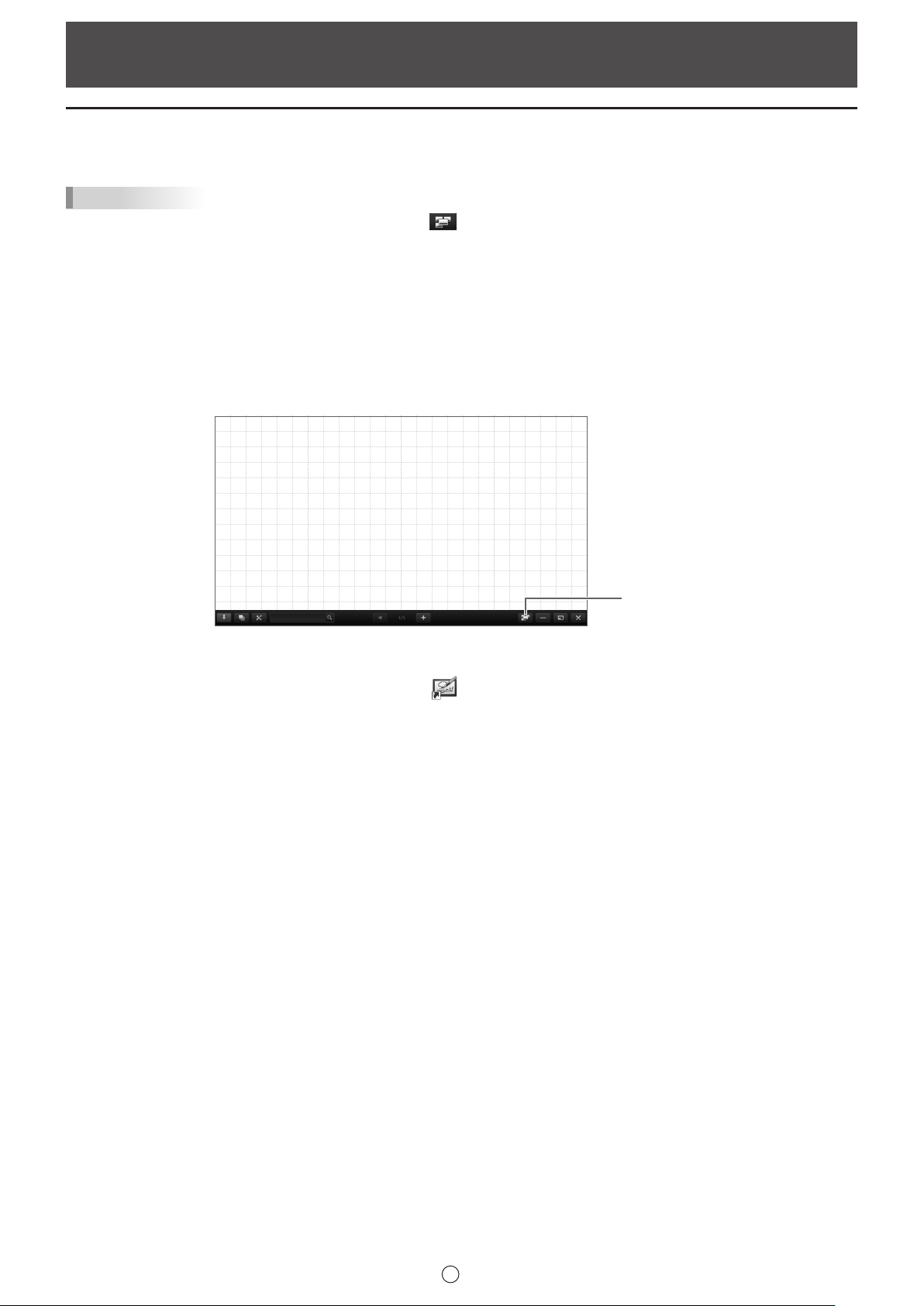
Whiteboard mode
You can use the screen as a whiteboard.
Up to 4 boards can be opened.
Board list
Starting whiteboard mode
Follow the steps below to start the software.
• On the desktop, touch the “Pen Software” shortcut icon (
• Click the “Start” button, and then select “All Programs” - “SHARP Pen Software” - “Pen Software”.
• Touch a whiteboard le (a le saved in the SWSX format) twice quickly (or double-click the le).
• In Windows 8/8.1, launching is also possible from the Start screen and the Apps screen.
) twice quickly (or double-click the icon).
E
5
Page 6
Overlay mode
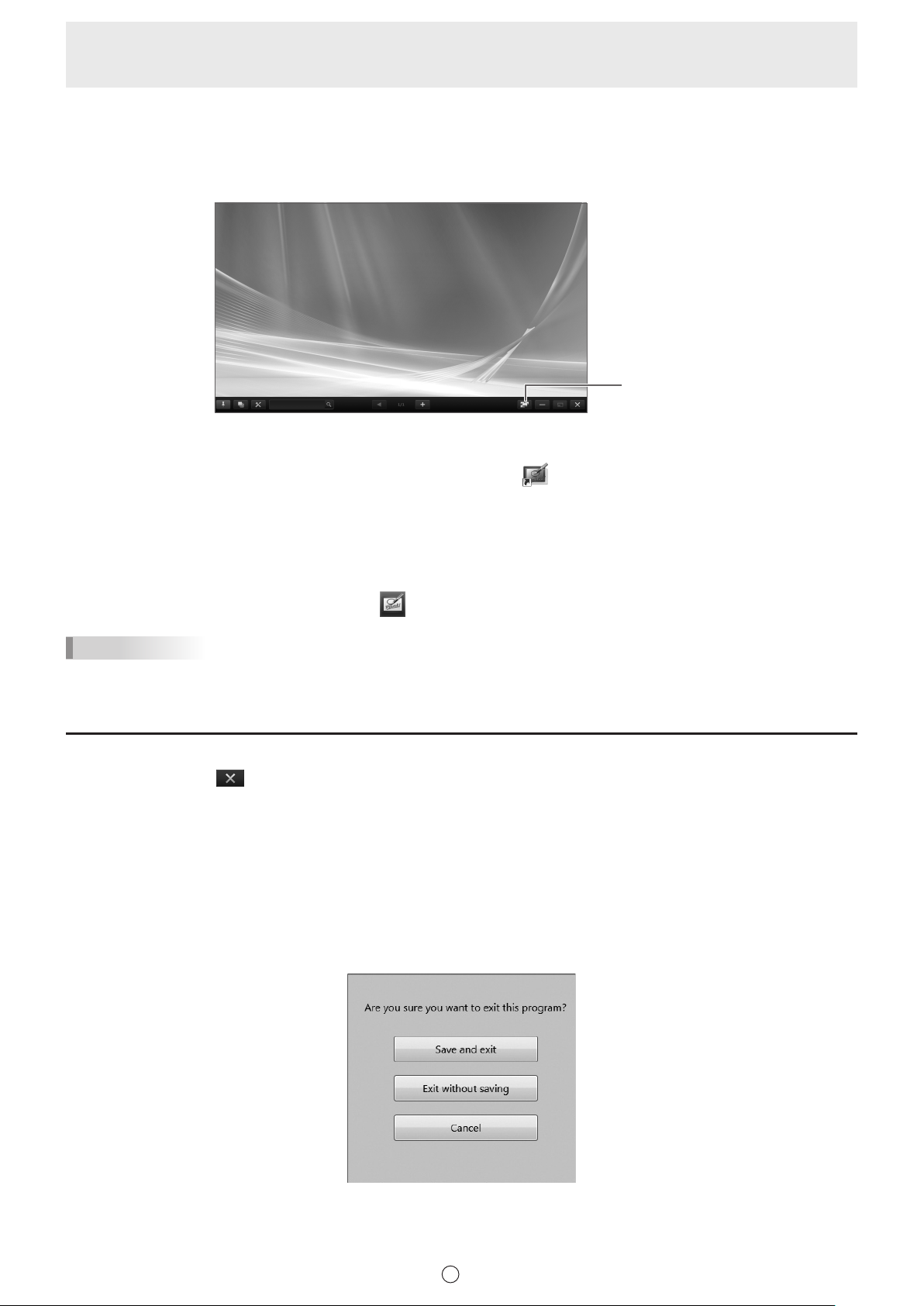
The board is shown as transparent.
Your drawing will appear on the transparent board placed over the screen, so that you can write comments directly on the items
displayed on the screen. Note, however, that you cannot operate the screen shown behind the transparent board.
Only 1 board can be opened.
Board list
Starting overlay mode
Follow the steps below to start the software.
• On the desktop, touch the “Overlay mode Pen Software” shortcut icon (
• Click the “Start” button, and then select “All Programs” - “SHARP Pen Software” - “Overlay mode Pen Software”.
• Touch an overlay board le (a le saved in SWSO format) twice quickly (or double-click the le).
• In Windows 8/8.1, launching is also possible from the Start screen and the Apps screen.
) twice quickly (or double-click the icon).
Lite version
n
To launch whiteboard mode of this software, touch “Whiteboard” in the launcher screen.
TIPS
• The overlay board cannot be used with the lite version.
• Only 1 whiteboard can be used with the lite version.
Exiting the software
Touch the “Quit” button ( ) on the toolbar.
When there is no data which is being edited and is not saved
The software is exited.
When there is data which is being edited and is not saved
A conrmation dialog box appears.
When you touch “Save and exit”, a dialog box appears to allow you to specify the destination to save the data. Conrm the
saving format, specify the destination, and save the data. (Page 17)
When you touch “Exit without saving”, the software is terminated without saving the data.
E
6
Page 7
Layout of Basic Screen
Screen example: Whiteboard mode
(1)
(11)
(12)
(3) (4)
(2)
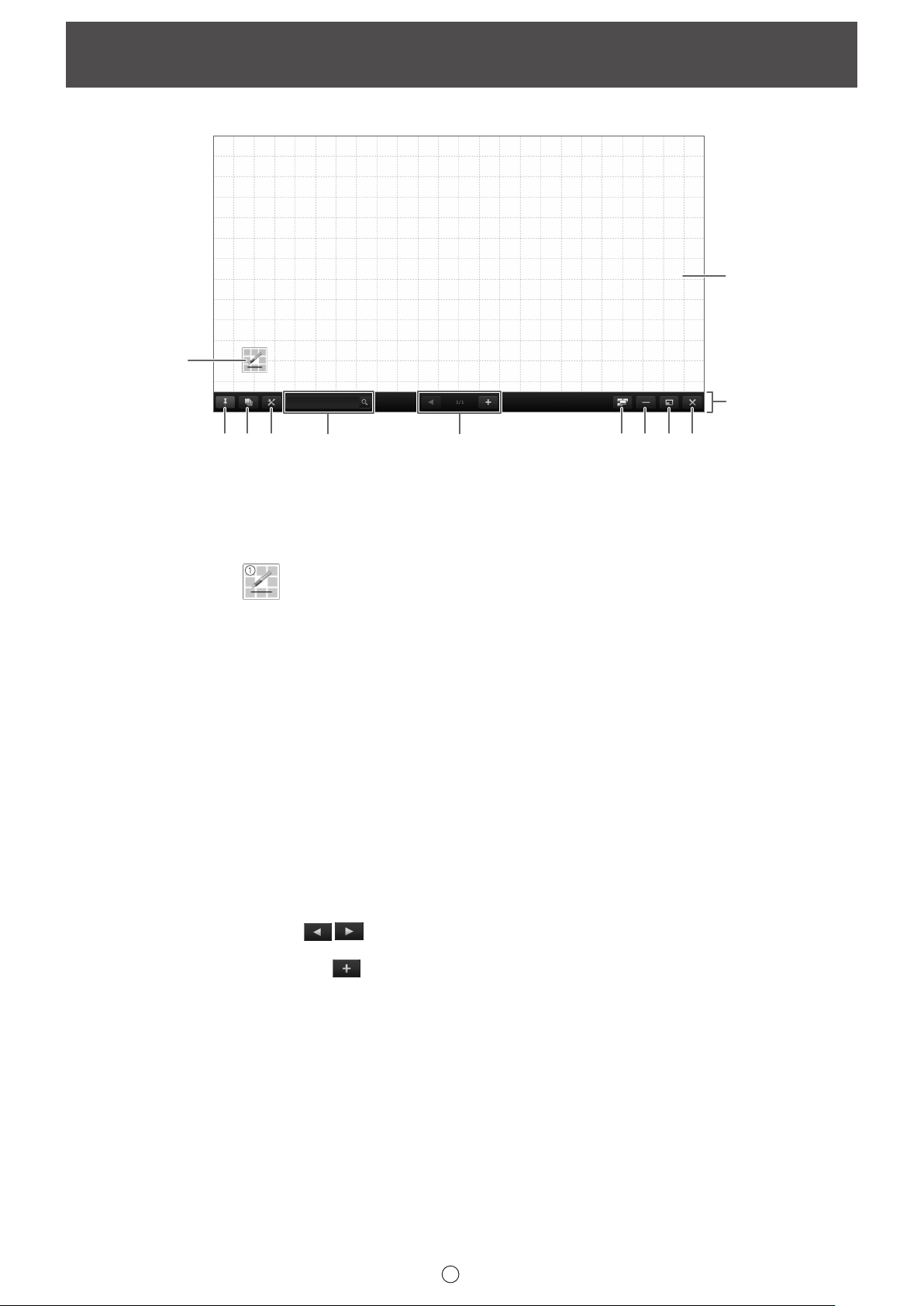
(1) Indicator
Touch the icon to launch the square menu. (Page 11)
When multiple 3 button pens are used at once, a number of indicators equal to the number of 3 button pens appears (maximum
of 4). When “Touch Pen” is set to “3 Button Pen Only”, the Pen Number of the touch pen utility appears in the indicator of
each touch pen. (Page 47)
Example: Pen Number 1
(2) “Pin” button
Touch to switch between the pin / unpin settings.
If you want to always display the toolbar on the screen, pin button should be selected.
When set to the pin setting, the button is blue.
If you only want to display the toolbar when the menu is displayed, select the unpin setting.
(3) Sheet list
Touch this tab to display the list of sheets shown as thumbnail images. (Page 21)
(4) Settings
Displays the pen software settings screen. (Page 47)
(5) Search box
You can search for text and handwritten characters in the box. (Page 28)
(5)
(6)
(7)
(8) (9)
(10)
(6) Sheet navigation buttons/Page No.
Touch the sheet navigation button (
The number shown at the center is the page No. of the current sheet.
When the last sheet is displayed, press
(7) Board list (full version only)
Touch to display the list of boards as thumbnail images. (Page 19)
(8) Minimize (full version only)
The software will be minimized in the task tray.
(9) Window / Maximize (full version only)
Displays the software in a window. (Page 16)
* Whiteboard mode only.
(10) Quit
The software is exited.
) to change the displayed sheet. (Page 19)
to add a sheet at the end.
E
7
Page 8
(11) Board
Work area. You can write letters, draw lines, and paste images etc.
The board can be displayed in 2 modes: whiteboard mode and overlay mode. The latter is transparent, showing the
background.
(12) Toolbar
TIPS
• The background color and image can be changed for whiteboard mode. (Page 22)
Menu
There are 3 menu types that can be used to select functions.
• Square menu (below), classic menu (page 9) or oating menu (page 10)
• Function list of “All Functions” (page 13)
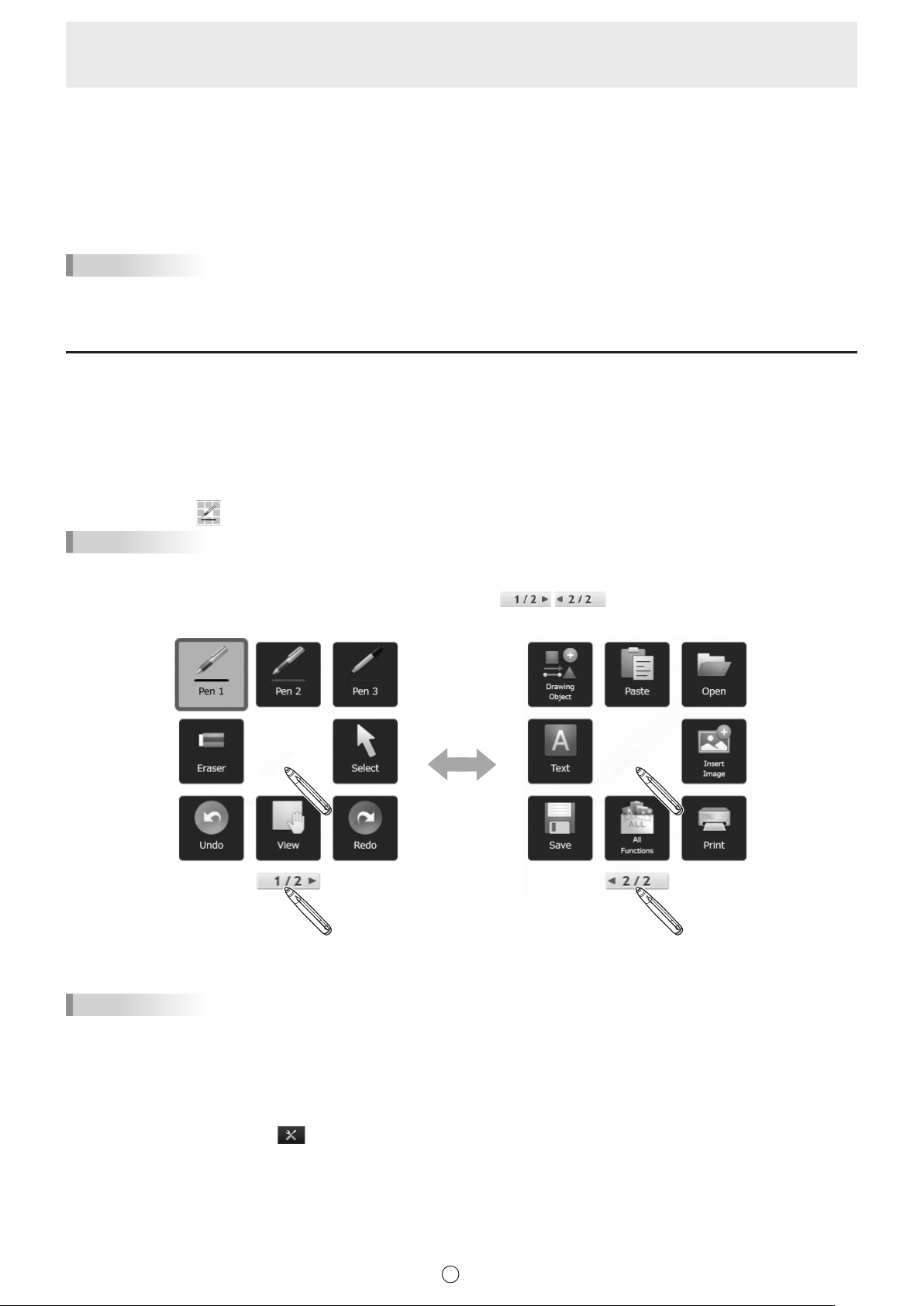
To use a function, touch the icon of the function in the menu to select it.
Square menu
n
Touch the indicator ( ) to display the square menu.
TIPS
• The illustration displayed in the indicator varies depending on the function used.
The square menu has 2 sides. To change the menu, touch the button (
center of the square menu.
When a place other than the menu is touched, the menu disappears and the indicator is displayed.
TIPS
• The square menu and indicator can be moved by dragging.
To move the square menu, drag the blank center of the square menu.
• To move the indicator close to the pen tip of the touch pen, hold the pen down on the screen.
• The icon size can be changed to large or small.
) under the icon or touch the blank
Changing the icon size
1. Touch the “Settings” button (
2. Select “Square Menu” in “Menu”.
3. Select “Large” or “Small” in “Icon Size”.
) on the toolbar.
E
8
Page 9
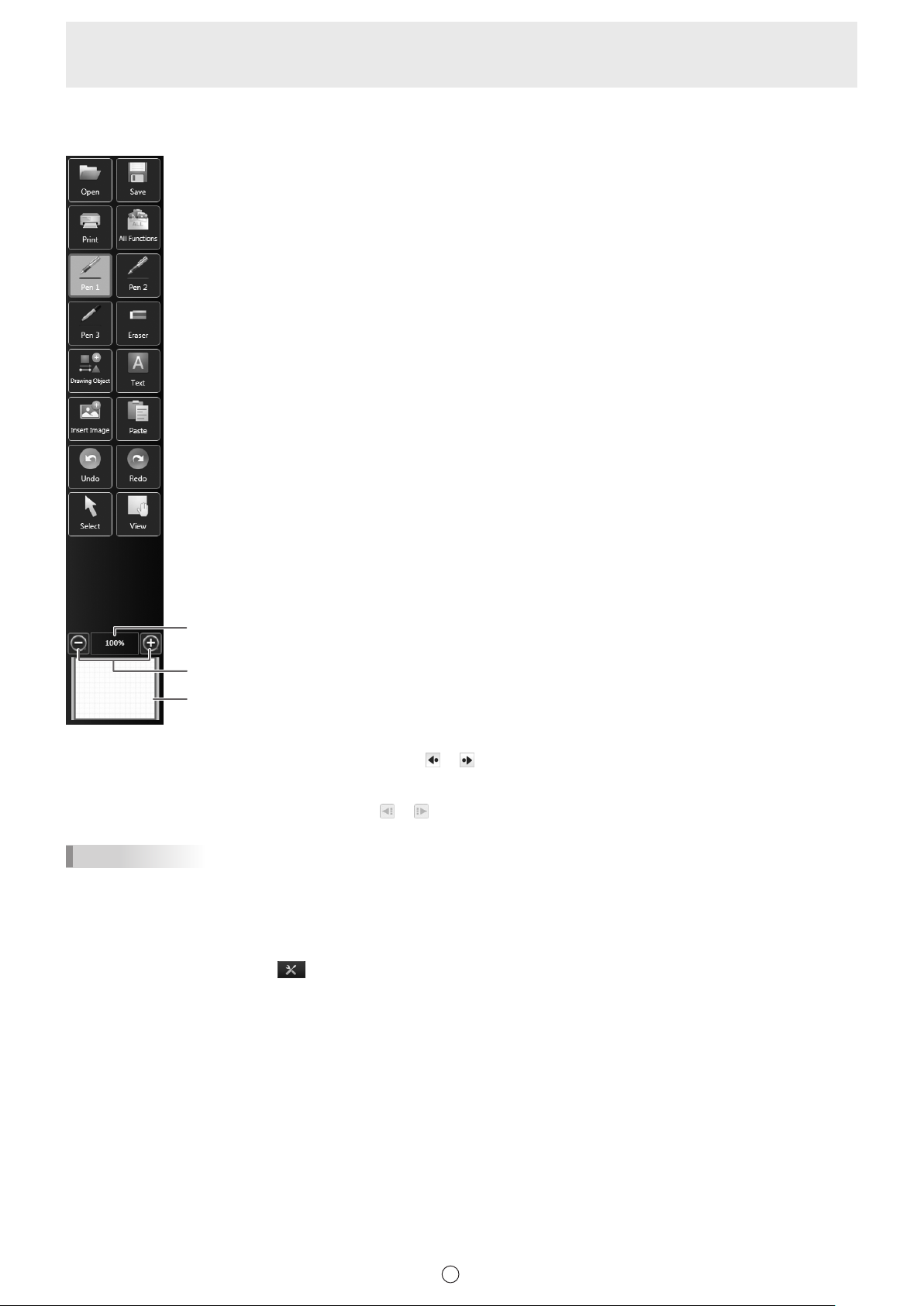
Classic menu
n
The menu can be displayed in classic mode (large or small icon size).
Shows the current screen magnication.
Enlarges or reduces the view between 50% and 400% in increments of 25%.
Pan window (Only appears in whiteboard mode.) (Page 37)
The toolbar is displayed on the left side or the right side of the screen.
The menu can be moved to left/right by touching the icon (
When set to the unpin setting, the menu automatically disappears when a xed time elapses after the touch pen is moved away
from the menu. (Page 7)
When the toolbar is hidden, the show toolbar icon (
TIPS
• The menu icon types that appear by default are the same as in the square menu and oating menu.
• In classic menu, 1 menu is used for the settings, even when using multiple pens. When using multiple pens, the line color and
thickness are the same for all pens.
Setting to classic menu
1. Touch the “Settings” button (
2. Select “Classic Menu” in “Menu”.
3. Select “Large” or “Small” in “Icon Size”.
To return to the normal menu, select “Square Menu”.
) on the toolbar.
or ).
or ) appears. Touch the show toolbar icon to show the toolbar.
E
9
Page 10
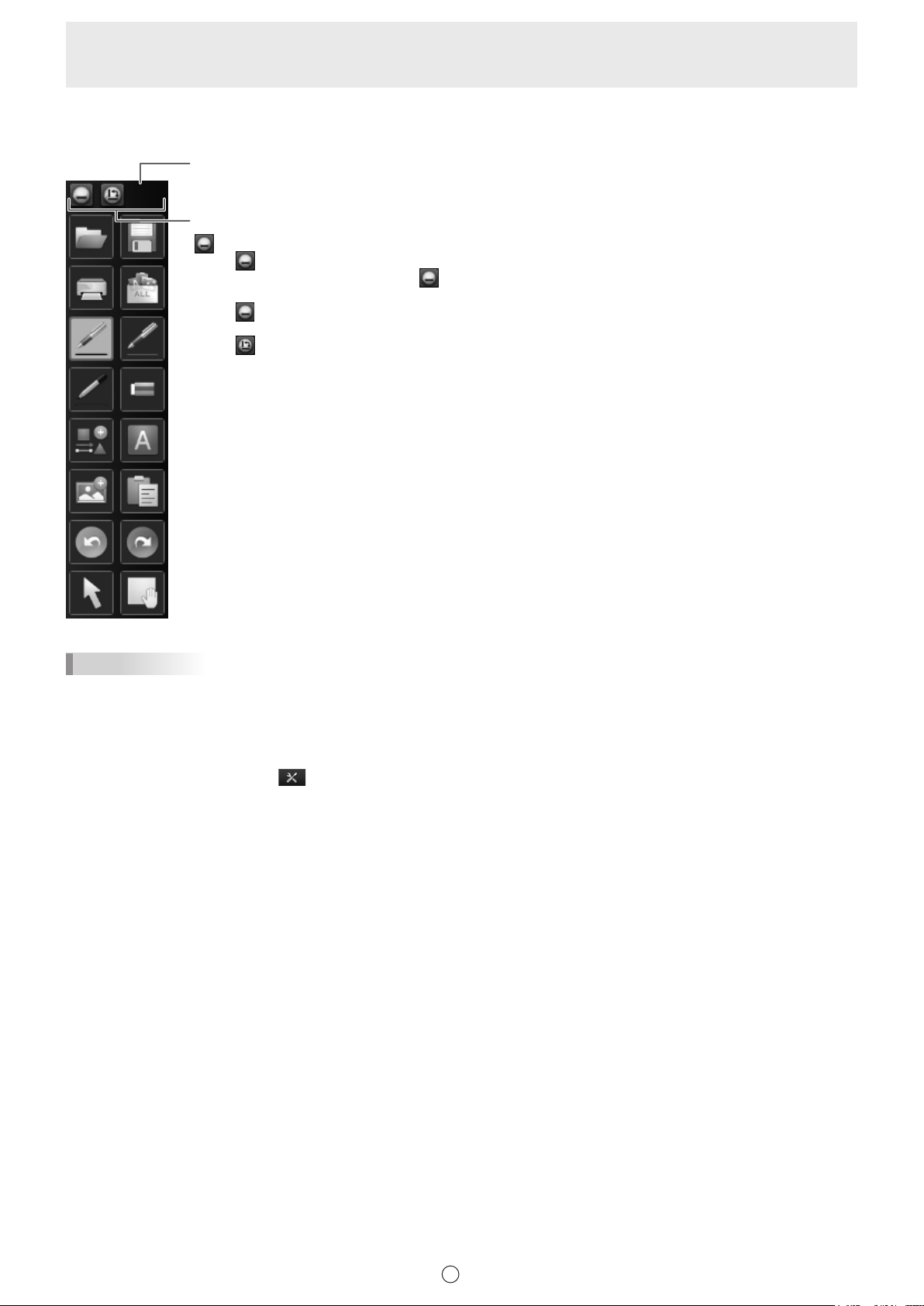
Floating menu
n
The menu can be moved to any position.
To move the menu, drag the background.
Title bar
is linked to pin / unpin.
Touch
When the menu is minimized, touch
When set to unpin on the tool bar, the menu is minimized.
Touch
to minimize the menu and show only the title bar. (Not pinned)
to return the menu to its original state pinned.
to return the menu to its original state. (Pinned)
Touch
and horizontal display each time this is touched.
TIPS
• The menu icon types that appear by default are the same as in the square menu and classic menu.
• In oating menu, 1 menu is used for the settings, even when using multiple pens. When using multiple pens, the line color
and thickness are the same for all pens.
Setting to oating menu
1. Touch the “Settings” button (
2. Select “Floating Menu” in “Menu”.
To return to the normal menu, select “Square Menu”.
to change the tool bar to horizontal display. The tool bar changes between vertical
) on the toolbar.
E
10
Page 11
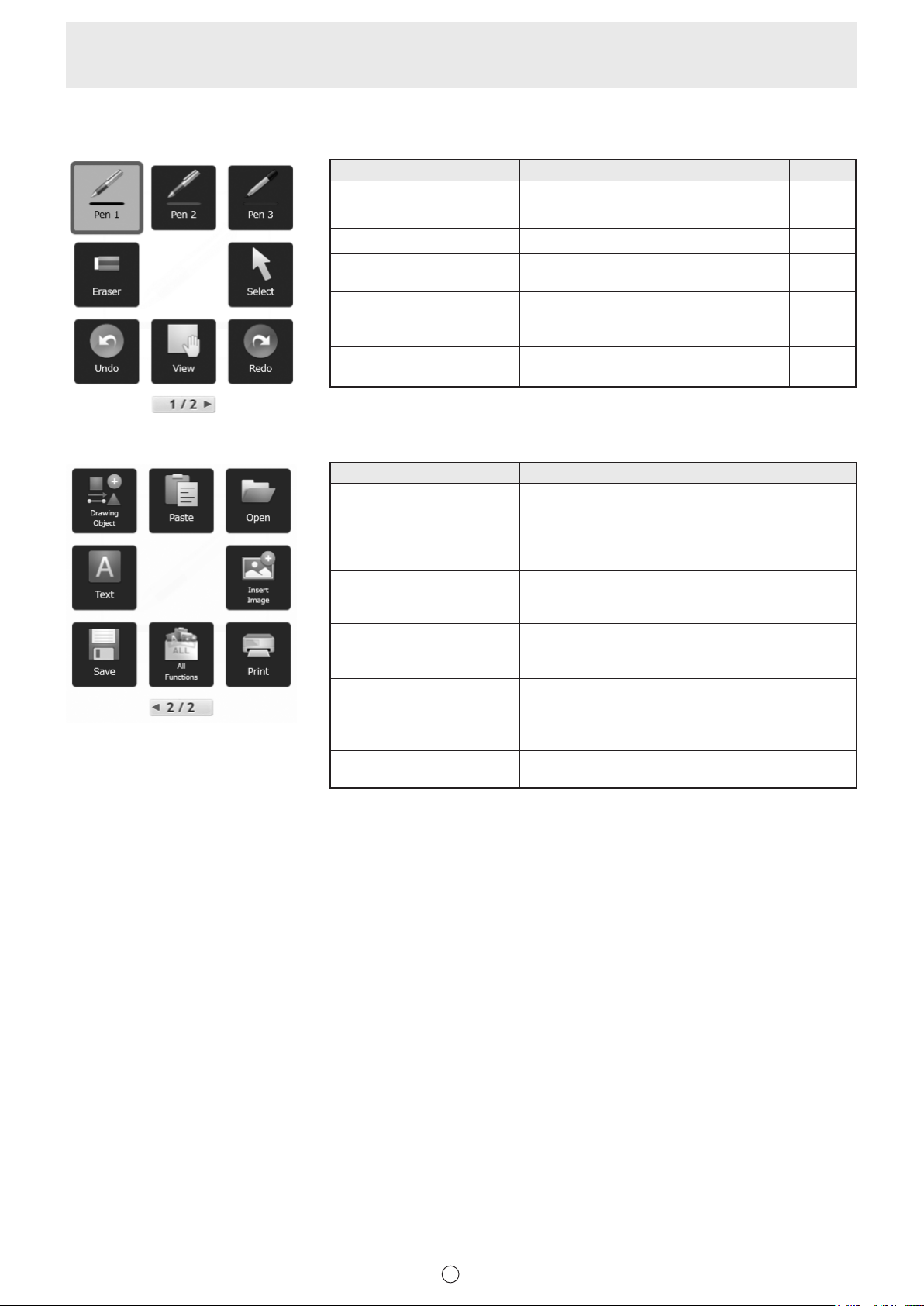
Menu icons
n
Square menu
Icon Function Page
Pen 1 to Pen 3
Eraser
Select
Undo
View
Redo
Icon Function Page
Drawing Object Draw a gure or line / arrow. 26
Paste Pastes a copied object. 34
Open Open a le. 18
Text Enter text. 28
Handwriting.
Erase hand-drawn lines.
Select an object.
Cancel the immediately preceding
operation.
Enlarge the view of the whiteboard,
change the display position, move sheets,
and change sheets.
Redo the immediately preceding canceled
operation.
23
25
31
36
20, 37
36
Insert Image
Save
All Functions
Print
* Cannot be used in the lite version.
The “Insert an image le” or “Screen
Capture”* selection screen appears.
The “Save as a new le”, “Save to the
same le”, “Save PDF”, and “Save image”
selection screen appears.
Displays all functions in list view.
From the list, you can select functions to
be used and functions to be displayed in
the menu as icons.
The “Print Current Sheet” or “Print All”
selection screen appears.
29
17
13
45
E
11
Page 12
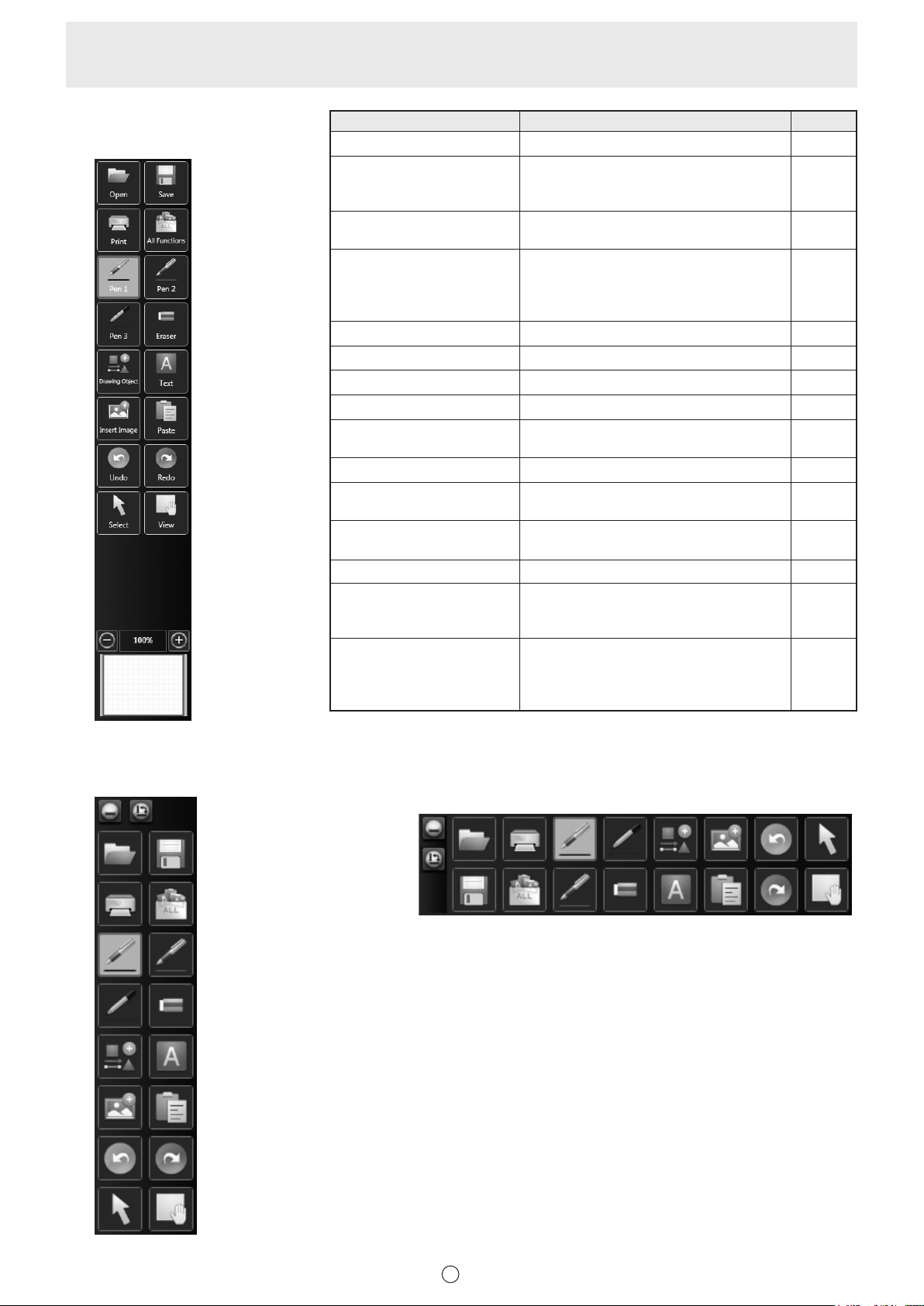
Classic menu
(1)
(3)
(5)
(7)
(9)
(11)
(13)
(15)
(2)
(4)
(6)
(8)
(10)
(12)
(14)
Icon Function Page
(1) Open Open a le. 18
The “Save as a new le”, “Save to the
(2) Save
(3) Print
(4) All Functions
(5) Pen 1 to Pen 3
(6) Eraser
(7) Drawing Object Draw a gure or line / arrow. 26
(8) Text Enter text. 28
(9) Insert Image
(10) Paste Pastes a copied object. 34
(11) Undo
(12) Redo
(13) Select
(14) View
(15) Pan window *
*1 Cannot be used in the lite version.
*2 Appears in the classic menu only in whiteboard mode.
2
same le”, “Save PDF”, and “Save image”
selection screen appears.
The “Print Current Sheet” or “Print All”
selection screen appears.
Displays all functions in list view.
From the list, you can select functions to
be used and functions to be displayed in
the menu as icons.
Handwriting.
Erase hand-drawn lines.
The “Insert an image le” or “Screen
Capture”*
Cancel the immediately preceding
operation.
Redo the immediately preceding canceled
operation.
Select an object.
Enlarge the view of the whiteboard,
change the display position, move sheets,
and change sheets.
This shows a thumbnail image of the
displayed sheet. Operate inside this
window to enlarge the view of the board or
move the display position.
1
selection screen appears.
20, 37
17
45
13
23
25
29
36
36
31
37
Floating Menu (vertical)
(1)
(3)
(5)
(7)
(9)
(11)
(13)
(2)
(4)
(6)
(8)
(10)
(12)
(14)
Floating Menu (horizontal)
(1)
(2)
(3)
(4)
(5)
(6)
(7)
(8)
(9) (11)
(12)(10)
(13)
(14)
E
12
Page 13
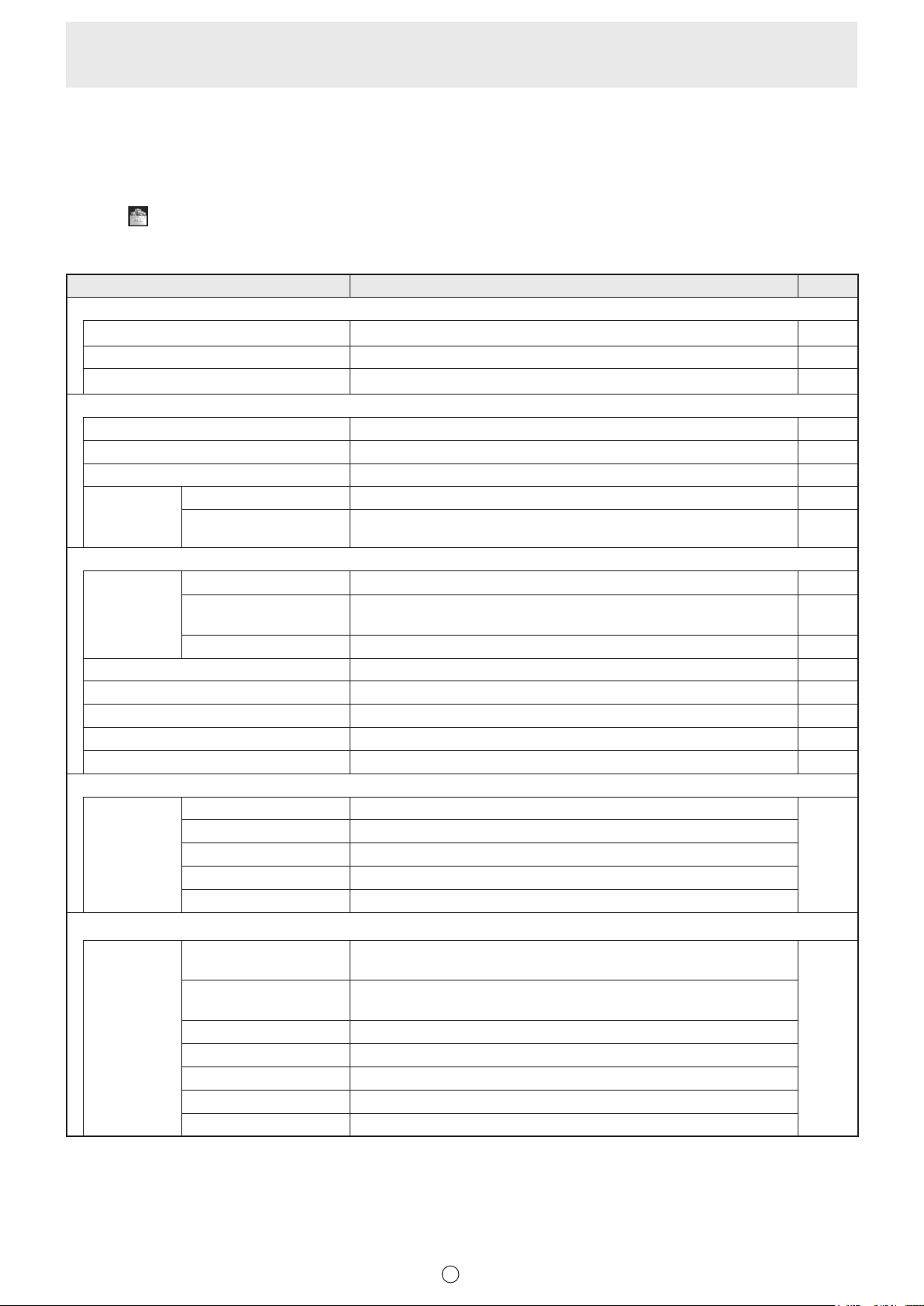
Selecting functions and customizing icons (All Functions)
n
From the “All Functions” list, you can select functions to be used and the icons that are displayed in the square menu, classic
menu or oating menu.
Selecting a function
1. Touch
“All Functions” in the menu.
2. A list of all functions appears. Select the function you want to use.
Icon Function Page
Pen/Eraser
Pen 1 to Pen 3 See page 11, 12. 23
Eraser See page 11, 12. 25
Clear Sheet Clear all objects from the currently edited sheet. 25
Insert Object
Paste See page 11, 12. 34
Drawing Object See page 11, 12. 26
Text See page 11, 12. 28
Paste an image on a sheet.
Capture the currently displayed background image and paste it on a
sheet.
29
29
Insert Image
Insert an image le
Screen Capture
*1
Select, etc.
Touch Selection Select an object by touching it. 31
Select
Rectangle Selection
Select a group of objects by dragging to create a rectangle around the
objects.
32
Lasso Selection Select a group of objects by drawing a line around the objects. 32
View See page 11, 12. 20, 37
Undo See page 11, 12. 36
Redo See page 11, 12. 36
Zoom In Enlarge part of the screen. 36
Zoom In Selection Enlarge the view of only the specied area. 36
Open
New Create a new sheet.
Open as a new le Open the data as a new le.
Open
Add to the current sheet Open the data as a newly added sheet.
Open New from Cloud
Open from Cloud
*2
Download the le and open as a new le.
*2
Download the le and open as a newly added sheet.
18
Save
Save the data as a new le.
(Whiteboard: SWSX le, Overlay board: SWSO le)
Save the data to the same le.
(Whiteboard: SWSX le, Overlay board: SWSO le)
17
Save
Save as a new le
Save to the same le
Save PDF Save the data as a PDF le.
Save image Save the data as an image le (PNG, BMP, or JPEG).
Save and Upload
*2
Save PDF and Upload
Send by TDLink
*3
Save the data as SWSX or SWSO format and upload the le.
*2
Save the data as a PDF le and upload the le.
Send the data as PDF format to the Touch Display Link client.
E
13
Page 14
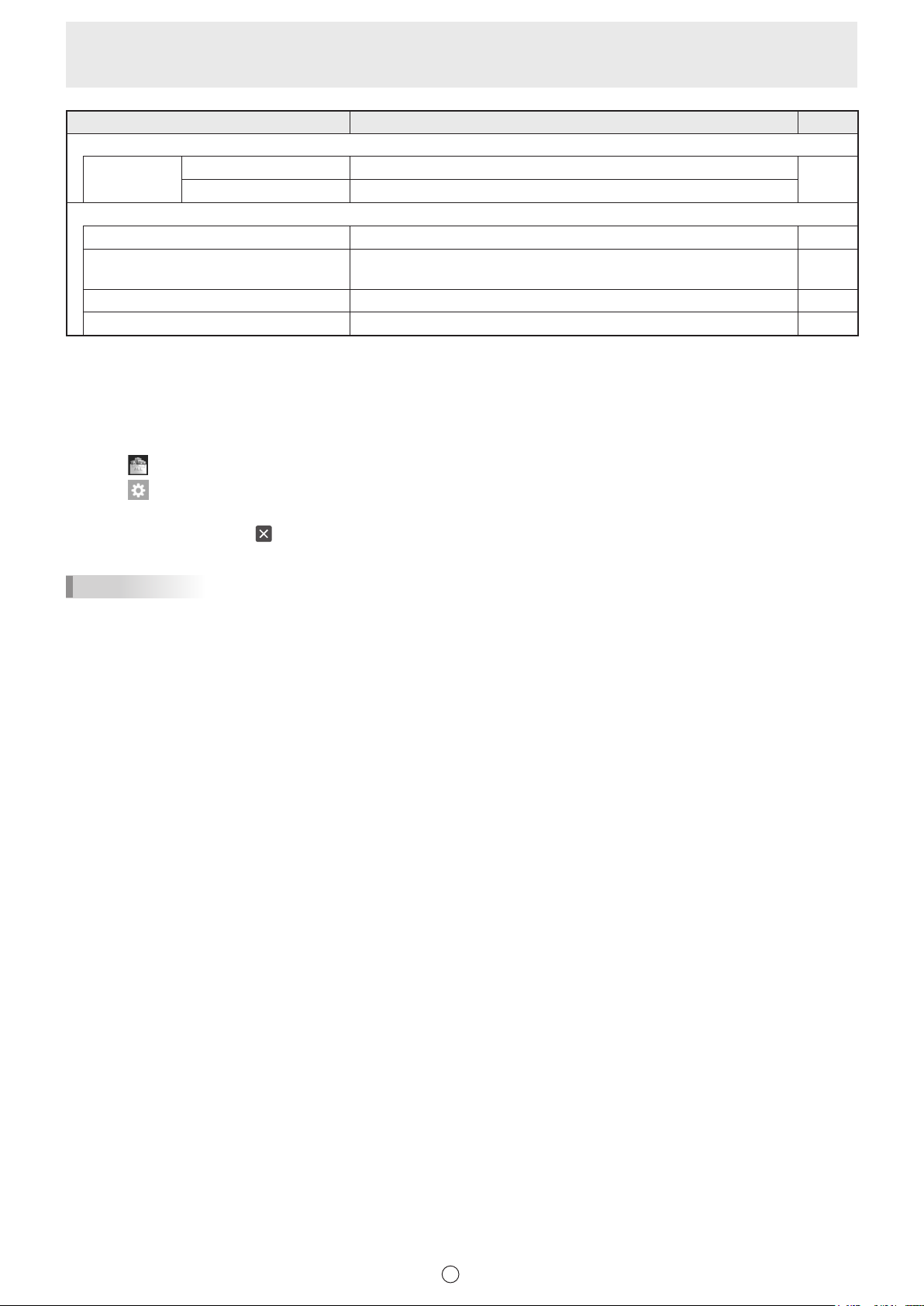
Icon Function Page
Print
Print
Print Current Sheet
Print All
Print the displayed sheet.
Print all sheets.
Other
Import images Paste an image le acquired from a TWAIN device onto the whiteboard.
Send Email
External Application
Web Search
*1
*1, 4
The content drawn on the screen can be sent by e-mail as a PDF
attachment.
Launch another software program while this software is running.
Enter a keyword to search the Internet.
*1 Cannot be used in the lite version.
*2 Displayed in the lite version or when Cloud Portal Ofce Meeting Room is installed.
*3 Displayed in the lite version or when Touch Display Link is installed.
*4 Displayed when the external application is registered. (Page 39)
Custmizing an icon to be displayed on the square menu
1. Touch
2. Touch
“All Functions” in the menu.
.
3. Drag the icon you want to display from the right menu list to the desired position on the square menu.
To close the settings, touch
or a point outside the settings menu.
45
43
17
39
40
TIPS
• At least one or more “Pen” icon should be displayed on the menu.
• Cannot remove “Eraser”, “Select” and “All Functions” icon from the menu.
• To return the menu display to the default state, touch “Restore Default Settings”.
E
14
Page 15
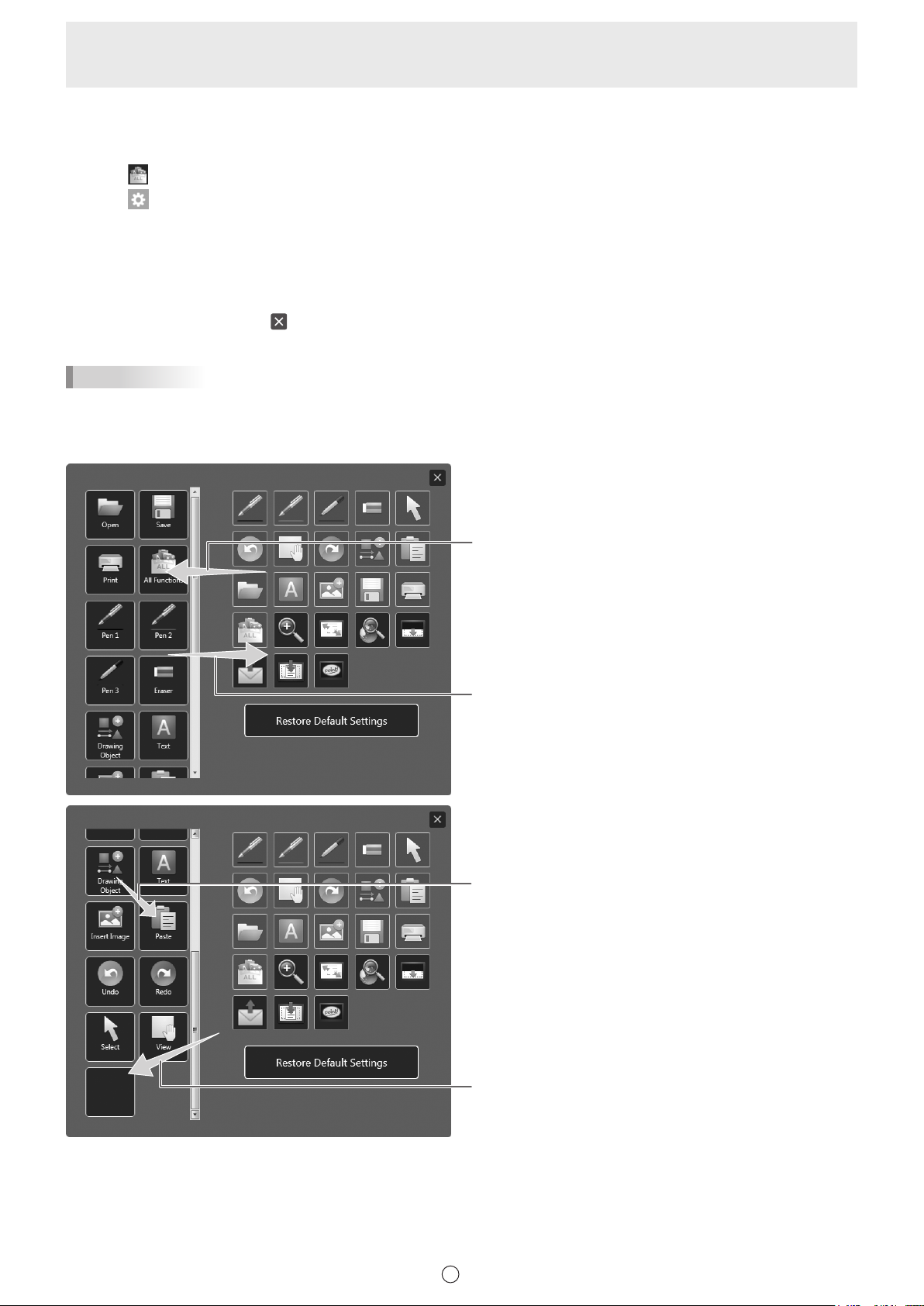
Customizing the icons that appear in the classic menu and oating menu
These settings are shared by the classic menu and oating menu (horizontal and vertical).
The settings of the horizontal display of the oating menu are shared with the vertical display.
1. Touch
2. Touch
3. Drag the desired icon from the icon list at the right to the menu and insert it in the desired position.
• To add an icon to the bottom of the menu, drop the icon in the blank space.
• The same icon cannot be added more than once. Icons that have already been added are grayed out.
• An icon can be dragged between menu positions at the left and inserted.
• To remove an icon from the menu, drag the icon to the icon list.
4. To close the settings, touch
TIPS
• At least one or more “Pen” icon should be displayed on the menu.
• Cannot remove “Eraser”, “Select” and “All Functions” icon from the menu.
• To return the menu display to the default state, touch “Restore Default Settings”
“All Functions” in the menu.
.
or a point outside the settings menu.
Drag to add an icon
Drag to remove an icon
Drag and insert an icon
To add to the bottom, drag to the empty space
E
15
Page 16
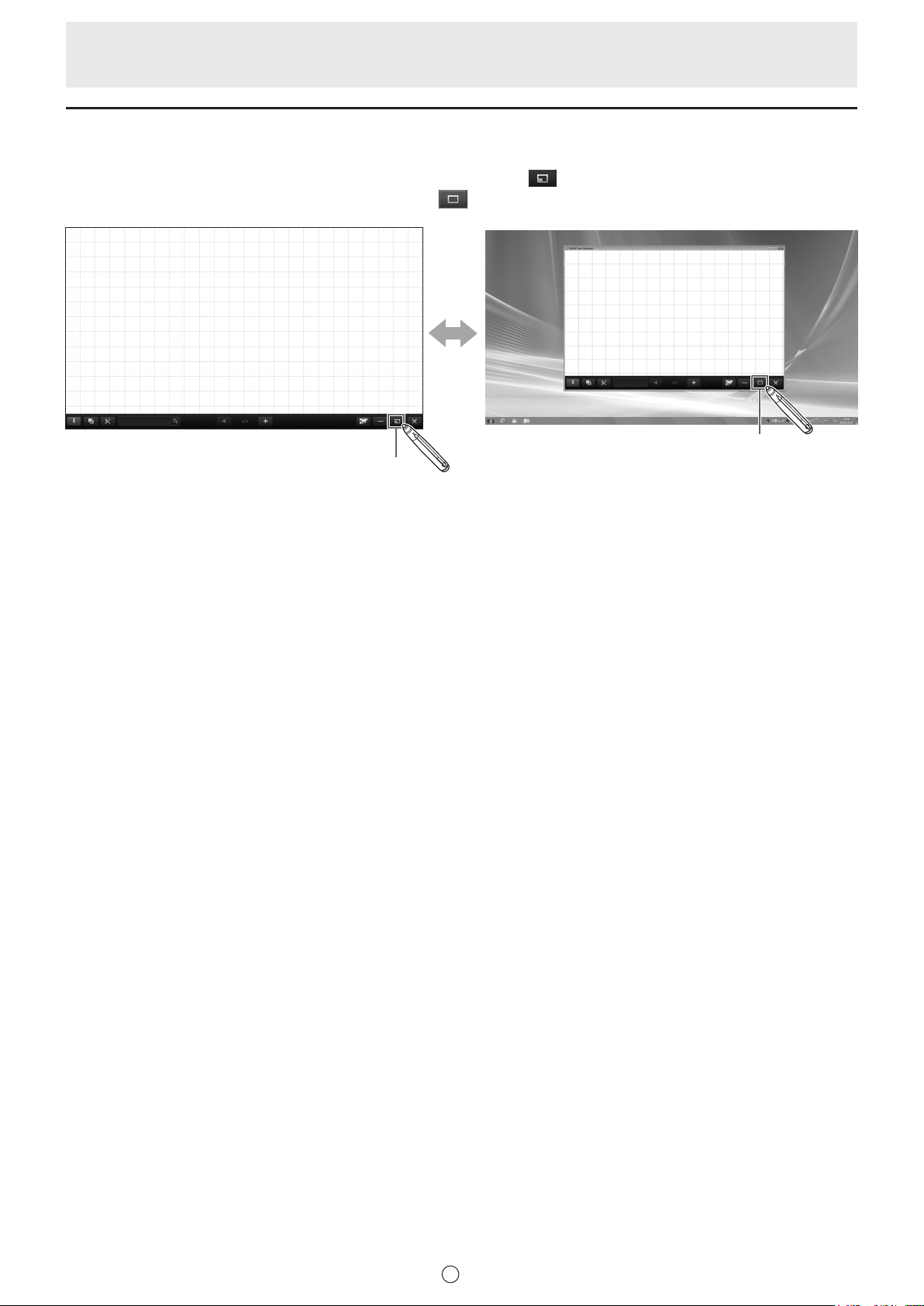
Display method
Window display (whiteboard mode) (full version only)
n
The whiteboard can be displayed in a window. Touch the “Window” button ( ) on the toolbar.
To return to full screen display, touch the “Maximize” button (
Window
) on the toolbar.
Maximize
E
16
Page 17
Saving and Sending a File by E-mail
Saving data
Data can be saved in the following le formats:
File format Description
SWSX
(Whiteboard le)
SWSO *
(Overlay board le)
Data is saved in SWSX format. The saved data can be re-edited with this software (whiteboard
mode).
Data is saved in SWSO format. The saved data can be re-edited with this software (overlay
mode).
PDF
Image le
(BMP, JPEG, PNG)
* Overlay board mode only.
All sheets will be saved. (When saving a sheet as a PDF or an image le, a sheet without data will not be saved.)
When data is saved in BMP, JPEG, or PNG format, each sheet is saved in a separate le.
1. Touch
2. Select the save method.
In whiteboard mode
In overlay mode
• File format to save as image can be set in “Image format” of “Customizing the Settings”. (Page 52)
• Lite version or when Cloud Portal Ofce Meeting Room is installed, “Save and Upload” or “Save PDF and Upload” can be
selected. (Page 13)
• Lite version or when Touch Display Link is installed, “Send by TDLink” can be selected. (Page 13)
3. Select the le save location.
• In the lite version, the save location is “USB”.
“Save” in the menu.
“Save as a new le” or “Save to the same le”: Save as a whiteboard le (SWSX format).
“Save PDF” or “Save image”: Save in a different le format.
“Save as a new le”: Save as an overlay le (SWSO format).
“Save to the same le”: Save to the same le (SWSO format) as saved previously.
“Save PDF” or “Save image”: Save in a different le format.
The working screen is saved as a screen shot. The data is converted into the different le
format so that it cannot be re-edited with the software.
Sending drawn content by e-mail
The content drawn on the screen can be sent by e-mail as a PDF attachment.
To use this function, refer to page 53 and previously set the mail server and e-mail address, etc in “Send Email” on the “Other”
tab.
1. Touch
The e-mail screen opens.
2. In the e-mail screen, select the e-mail address of the recipient, and send the e-mail.
Caution
• Sending by e-mail may not be possible if a virus scan is in operation. In this event, disable the e-mail restriction function.
“Send Email” in the menu.
E
17
Page 18
Opening Files
Opening a whiteboard le / overlay board le
1. Touch “Open” in the menu.
2. Select the le opening method.
“New”: Create a new board. (Does not open a le.)
“Open as a new le”: Open data as a new le.
“Add to the current sheet”: Add data to the current sheet.
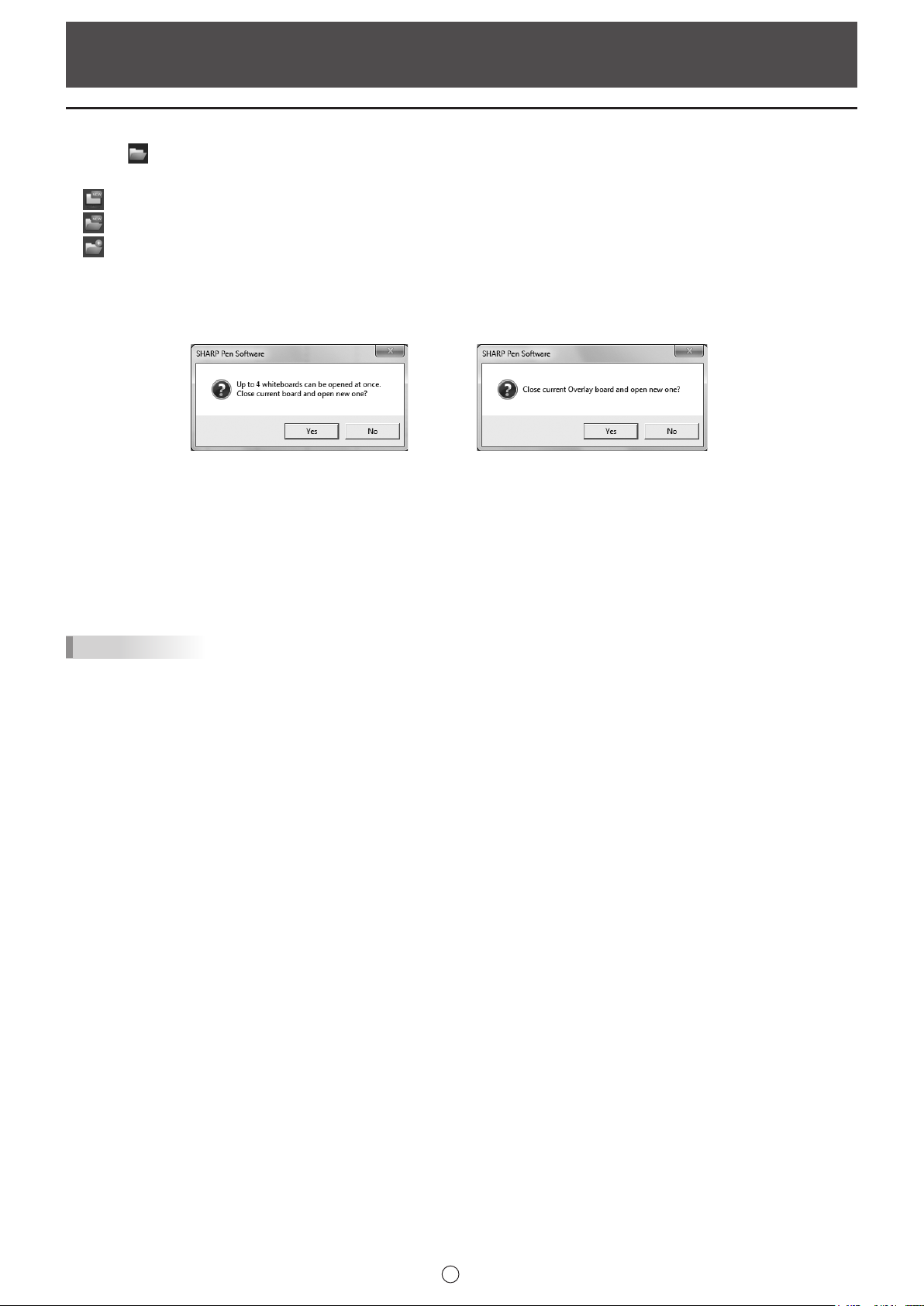
• When “Open as a new le” or “New” is selected and a le or les are already open (4 les in whiteboard mode, 1 le in
overlay mode)*, a dialog box appears.
* Displayed as 1 le in the lite version.
Whiteboard mode Overlay mode (full version only)
If there is unsaved editing data, selecting “Yes” displays the save conrmation dialog box.
• Lite version or when Cloud Portal Ofce Meeting Room is installed, “Open New from Cloud” or “Open from Cloud” can be
selected. (Page 13)
3. Select the le acquisition location.
• In the lite version, select the le from “USB”.
TIPS
• An SWS format whiteboard le can be opened and edited in this software. However, when saved, the le is saved in SWSX
format.
• Image les (page 17) and PDF les can also be opened.
Opening method for image les can be set in “Import images” of “Customizing the Settings”. (Page 52)
PDF les can be opened only as “Background”.
• An encrypted PDF le cannot be opened.
E
18
Page 19

Edit Operations
Adding a board / changing the board to be edited
1. Touch the “Board list” button ( ) on the toolbar.
The board list appears.
2. Add: Touch “+”.
To add a whiteboard, touch
An overlay cannot be added when an overlay board is already open.
Change: Touch the board you want to edit.
Changing the sheet to edit
To change the sheet, touch the sheet navigation button at the bottom of the screen.
. To add an overlay board, touch .
(1)
(2)
(1) Page No. of the current sheet
(2) Sheet list
Shows the sheets as thumbnails. (Page 21)
(3) Sheet navigation button (Previous)
Touch this button to display the previous sheet. When the rst sheet is displayed, this button is disabled.
(4) Sheet navigation button (Next)
Touch this button to display the next sheet.
When the last sheet is displayed,
TIPS
• In overlay mode, you can set a captured image of the desktop as the background that appears when you change the sheet
display or move through the sheets. This is done by selecting “Show captured desktop image in background” in “Properties”.
(Page 22)
To set this for all overlay board les, set “When moving through sheets on the Overlay board, show captured desktop in
background.” to “On”. (Page 52)
appears. Touch to automatically add a new sheet.
(3) (4)
E
19
Page 20

Changing the sheet by dragging the screen
n
Only when the screen magnication is Fit Width, a sheet can be changed by dragging.
1. Touch
2. Drag horizontally with the touch pen.
• Drag to the right to show the previous sheet.
• Drag to the left to show the next sheet.
TIPS
• Sheets can be changed by dual touch action.
When using the PN-L series (excluding the PN-L603A/PN-60TA3/PN-L703A/PN-70TA3/PN-L603B/PN-60TB3/PN-L703B/
PN-70TB3), set “Touch Mode Setting” of the touch panel driver to “Dual”, and “Input Mode Setting” to “Standard” or “HandWrite”.
When using the PN-L603A/PN-60TA3/PN-L703A/PN-70TA3/PN-L603B/PN-60TB3/PN-L703B/PN-70TB3, set “Touch
Operation Mode” of the touch panel settings tool to “Multi-Touch Mode”, and “Input mode” of the touch pen utility* to “Standard”
or “Handwriting”.
* This is required when using 3 button pen (sold separately) with the PN-L603B/PN-60TB3/PN-L703B/PN-70TB3.
“View” in the menu.
Right edge of sheet
• Dual touch can be disabled (Page 48).
Drag with two ngers
E
20
Page 21

Changing the sheet by referring to thumbnail images / Editing the sheet
n
When “Sheet list” button ( ) on the toolbar is touched, thumbnails of each sheet appear.
A thumbnail can be touched to change to that sheet. The sheets can be edited, including copying, and deleting. (Page 22)
TIPS
• Touch the “Sheet list” button ( ) repeatedly to switch through “Underbar view”, “Full screen view”, and “Hide”.
Underbar view
1. Touch “Sheet list” button (
The list of the thumbnail images of the sheets is displayed.
2. Touch the thumbnail image of the sheet you want to display.
The screen changes to the selected sheet.
(1)
(3)
) on the toolbar.
(2)
(4)
(6)
(1) Currently selected sheet
(2) Thumbnail images
(3) Properties (Page 22)
(4) Thumbnail navigation button (Previous)
(5) Thumbnail navigation button (Next)
(6) Add a new sheet.
TIPS
• The sheet list can be dragged horizontally to move through the thumbnails.
Full screen view
1. Touch “Sheet list” button (
The list of the thumbnail images of the sheets is displayed.
2. Quickly touch the thumbnail image of the sheet that you want to display twice (double-click).
“Sheet list” closes and the selected sheet appears.
(1) (4) (7) (5)
) on the toolbar.
(5)
(3)
(2)
(6)
(1) Currently selected sheet (appears in a blue frame)
(2) Currently displayed sheet (appears in red)
(3) Thumbnail images
(4) Menu
(5) Scroll the thumbnails screen. (Previous)
(6) Scroll the thumbnails screen. (Next)
(7) Adds/Pastes a sheet to the selected position.
E
21
Page 22

Editing sheets from thumbnails (full screen view only)
n
When a thumbnail on the sheet list is selected, the menu appears.
Copy: Copies the selected sheet to the clipboard.
Duplicate: Copies the selected sheet to the right side.
Delete: Deletes the selected sheet.
Print: Prints the selected sheet.
Save PDF: Converts the selected sheet to PDF and saves the sheet.
Send Email: Converts the selected sheet to PDF and sends it as an e-mail attachment.
Select All Sheets: Selects all sheets.
Properties: Use to change the settings of the selected sheet.
Touch “Yes” in the conrmation dialog box that appears.
If touched when all sheets are already selected, selection of all sheets will be canceled.
Whiteboard: The background color, background image (image le used, show/hide, display
method), and sheet size* (page 23) can be set.
* Full version only.
Overlay board: You can set whether the desktop is captured and used as the background image when
the sheet display is changed or moved.
TIPS
• You can also select and use multiple sheets.
Touch the bar (
Add Sheet: Adds a sheet to the selected position.
Paste: Pastes a sheet copied to the clipboard on the selected position.
) before or after the sheet to display the following menu.
E
22
Page 23

Changing sheet size (whiteboard mode) (full version only)
n
The sheet size can be enlarged or reduced. (Max. 3840 x 2160)
1. Touch the thumbnail of the sheet whose size you want to change.
2. Touch “Properties”.
3. Touch “Change Sheet Size”.
4. Drag
• Touch “Maximum Size” to set to the maximum size.
• Touch “Screen Size” to set the size to the same size as the screen.
on the edge of the sheet to enlarge or reduce the sheet.
TIPS
When you have nished enlarging or reducing, touch “OK”.
Drawing with a Pen
1. Touch one of “Pen 1” to “Pen 3” in the menu.
2. Draw on the board with the touch pen.
The drawn shape will be determined as an object 0.5 second* after you lift the touch pen from the board. If you start drawing
another object within 0.5 second* after you lift the touch pen from the board, the drawn shapes will be determined to be a single
object even though they are separate.
* This period can be changed. (Page 53)
Less than
0.5 second
Draw a shape. Draw another shape. Both shapes are determined
TIPS
• You can switch through “Pen 1” to “Pen 3” and “Eraser” by repeatedly pressing Function Button 2 of a 2 button pen.
To change functions using Function Button 2, select the touch panel driver “Properties”, and set “Function Button 2” to “Pen
Software Link” on the “Operation Setting” tab.
When using 3 button pen, setting “Pen Software Link” to any of “B1” to “B3” button on “Function Buttons” on “Advanced” in touch
pen utility allows you to switch through “Pen 1” to “Pen 3” and “Eraser” by repeatedly pressing the button of a 3 button pen.
• For details about objects, refer to page 31.
• In certain cases, such as when an icon on the menu is touched, the drawn shape will be xed as an object before the
speci ed time elapses after the touch pen is lifted from the board.
• When “Touch Pen” is set to “Finger or Other Pen”, you can draw with your nger. (Page 47)
After
0.5 second
as a single object.
E
23
Page 24

Changing the color and thickness of the pen
n
If you touch the icon of the selected “Pen 1” to “Pen 3” again, the type, color, and thickness settings menu will appear.
(1)
(2)
(3)
To close the settings, touch
(1) Select the pen type.
Pen: Draws a uniform solid line.
Brush: The line width varies depending on the pen pressure. (Only with 3 button pen and digitizer pen.)
Marker: Draws a line without hiding objects under the line.
Figure pen: See page 27.
(2) Set the color and thickness of the line.
To use a pen of different color or thickness, select by clicking
(3) Check this box to make the line translucent.
* This is always selected when “Marker” is used.
(4) Smoothes drawn lines.
* Cannot be used when “Marker” or “Figure pen” is used.
or a point outside the settings menu.
(4)
in “Other color” or “Other width”.
E
24
Page 25

Erasing a drawn line
1. Touch
2. With the pen touching the screen, move the pen.
The part you move over is erased.
TIPS
• You can switch through “Pen 1” to “Pen 3” and “Eraser” by repeatedly pressing Function Button 2 of a 2 button pen.
To change functions using Function Button 2, select the touch panel driver “Properties”, and set “Function Button 2” to “Pen
Software Link” on the “Operation Setting” tab.
When using 3 button pen, setting “Pen Software Link” to any of “B1” to “B3” button on “Function Buttons” on “Advanced” in touch
pen utility allows you to switch through “Pen 1” to “Pen 3” and “Eraser” by repeatedly pressing the button of a 3 button pen.
• The eraser function can erase only the objects drawn with the pen function. You cannot use the “Eraser” button to erase
pasted images. You cannot use it either to erase the edges of a line to make the line thinner. Even if you erase the edges
only, the entire width of the line will be erased.
• An object drawn with the pen function cannot be erased if it is part of a group.
• If “Automatically Find Eraser” is set (page 48) and “Pen 1” to “Pen 3” or “Eraser” is selected on the PN-L Series, you can
erase with the eraser.
Touch the screen with the eraser, and after the cursor changes to the eraser, move the eraser.
In this case, the eraser size of the eraser is the area of the screen that is touched.
“Eraser” in the menu.
Changing the eraser size
n
The size of the eraser can be changed in the “Eraser” settings menu.
To display the settings menu, touch
To delete all objects from the sheet currently being edited, touch “Clear Sheet”.
When the conrmation dialog box appears, touch “Yes”.
“Eraser” to select it, and then touch “Eraser” again.
E
25
Page 26

Drawing shapes
You can draw shapes such as circles, rectangles and triangles.
1. Touch
The gure or line / arrow settings menu appears.
When a gure is selected, the gure settings menu appears.
2. Drag on the board to draw the shape.
The line shape is drawn in the area specied by dragging.
Figure settings menu
n
You can change the gure settings.
“Drawing Object” in the menu.
(1)
(2)
(3)
(1) Select an object.
(2) Set the width and shape of the line.
Touch
To close the settings, touch
to set the shape.
or a point outside the settings menu.
(4)
(5)
(3) Set the line color.
(4) Set the color to ll in.
(5) Check this box to make the shape translucent.
E
26
Page 27

Drawing straight lines or arrows
1. Touch “Drawing Object” in the menu.
The gure or line / arrow settings menu appears.
Select line or arrow to display the line/arrow settings menu.
2. Draw a line from the starting point to the ending point with the touch pen.
Line / arrow settings menu
n
You can change the settings of a line or arrow.
(1) Select a line or arrow.
(2) Set the width and shape of the line or arrow.
(2)
(3)
(1)
Touch
(3) Set the color of the line or arrow.
Check this box to make the line or arrow translucent.
(4)
to set the line shape.
(4)
To close the settings, touch
or a point outside the settings menu.
Drawing a shape with the gure pen
Circles, squares, triangles, and lines drawn by hand can be automatically formed.
1. Touch one of
2. Touch the icon of the pen that has been selected.
The settings menu for the pen type, color, and thickness appears.
3. Touch
4. Draw a shape on the board with the pen.
“Figure pen”.
“Pen 1” to “Pen 3” in the menu.
Draw a shape The shape that you drew is formed.
TIPS
• Some drawn shapes may not be formed and will remain hand-drawn.
• Arrow lines are not formed.
E
27
Page 28

Inputting text
1. Touch “Text” in the menu.
2. Touch the position where text will be entered.
3. Input text in the displayed text box.
Text settings menu
n
You can change the text settings.
To display the settings menu, touch
“Text” to select it, and then touch “Text” again.
(2)
(1)
(5)
(1) Set the font and the size of the text.
(2) Set the color of the text.
(3) Set the style of the text (bold, italics, underline).
(4) Set the background color of the text.
(5) Select this checkbox to make the text translucent.
TIPS
• To change the text settings after entering text, follow the steps below.
(1) Touch
(2) Touch the text.
When the text is selected, the expansion menu appears.
(3) Select
• You can search the Internet using text you enter as a keyword. (Page 40)
“Touch Selection” in the menu. (Page 31)
“Properties” in the expansion menu and change the settings.
(3)
(4)
Searching for text and handwritten characters in the board
1. Enter the text that you want to search for in the search box on the toolbar.
2. Touch
• Search hits will appear in yellow.
Touch
• If nothing is set, “0/0” appears.
• To cancel the search, touch
.
to display the hits.
.
E
28
Page 29

Importing and pasting an image
An image le can be imported, and the current display can be pasted.
Up to 50 items can be pasted on 1 sheet.
Inserting an image le
n
A BMP, JPEG, or PNG image can be imported.
1. Touch “Insert Image” in the menu.
2. Touch
* “Insert an image le” does not appear in the lite version. Go to step 3.
3. Select the image acquisition location.
In the lite version, the acquisition location is “USB”.
4. Select the image you want to insert.
The image is inserted.
TIPS
• The inserted image is not affected if the original le is changed or the le is moved to a different location.
• If multiple large-size images are pasted on the same page, operation may become slow.
Capturing/saving the currently displayed screen (full version only)
n
You can load an image le or paste the currently displayed screen.
Display the image that you want to capture.
Capturing the entire screen
1. Touch
2. Touch
3. Touch “Paste Entire Screen” in the “Screen Capture Cut Tool” dialog box.
“Insert an image le”.
“Insert Image” in the menu.
“Screen Capture”.
4. Check the preview.
To capture the image, touch “Send to Pen Software”.
The captured image is pasted on the current working sheet.
To save the image, touch “Save to a le”.
Select the le format in the drop-down list, specify the save location, and touch “Save”.
E
29
Page 30

Capturing/saving a specied area
C
x
C
Done
1. Touch
2. Touch
Drag the area which you want to capture.
3.
“Insert Image” in the menu.
“Screen Capture”.
4. Check the preview.
To capture the image, touch “Send to Pen Software”.
The captured image is pasted on the current working sheet.
To save the image, touch “Save to a le”.
Select the le format in the drop-down list, specify the save location, and touch “Save”.
Corporate Profile - Internet Explorer
orporate Profile - Internet Explorer
http://www.xxxxxxxxxxxxxxxx
http://www.xxxxxxxxxxxxxxxxx
Corporate Profile - Internet Explorer
orporate Profile - Internet Explorer
Corporate Profile
Company Name XXXXXXXX
Date of Establishment XXXXXXXX
Location XXXXXXXX
Company Name XXXXXXXX
Date of Establishment XXXXXXXX
Location XXXXXXXX
Done
Drag the area to capture. Check the captured image in the preview area.
E
30
Page 31

Editing an object
The drawn lines and the images pasted on the board are handled in the software as an “object”.
Selecting an object
n
You need to select an object before editing it.
1. Touch
If the “Select” menu is not
(1) Touch the currently displayed menu (
(2) Touch
2. Touch an object.
The object is selected and the expansion menu appears.
“Touch Selection” in the menu.
“Touch Selection”, follow the steps below to change the menu.
“Rectangle Selection” or “Lasso Selection”).
“Touch Selection”.
Touch an object.
Touch an area where
something is drawn. You
cannot select an object by
touching the area where
nothing is drawn.
Select point
Selected object
The area of the object is
indicated with a dotted line,
and symbols called select
points appear on the vertices
and sides of the area.
The following editing operations can be performed in
the expansion menu.
• Cut
• Copy
• Duplicate
• Delete
• Rotate
• Convert to Text (handwritten characters only)
• Web Search (texts/handwritten characters only)
• Order
• Group
• Ungroup
• Trimming (images only)
• Properties (excluding images)
E
31
Page 32

Selecting multiple objects
n
Selecting objects by dragging
You can select a group of objects by dragging to create a rectangle around the objects.
1. Touch
If the “Select” menu is not
(1) Touch the currently displayed menu (
(2) Touch
2. Drag to create a rectangle around the objects you want to select.
The objects inside the rectangle will be selected.
Selecting objects by lassoing
You can select a group of objects by drawing a line around the objects.
1. Touch
If the “Select” menu is not
(1) Touch the currently displayed menu (
(2) Touch
2. Draw a line around the area to be selected.
The objects inside the enclosed shape will be selected.
“Rectangle Selection” in the menu.
“Rectangle Selection”, follow the steps below to change the menu.
“Touch Selection” or
“Rectangle Selection”.
“Lasso Selection” in the menu.
“Lasso Selection”, follow the steps below to change the menu.
“Touch Selection” or
“Lasso Selection”.
“Lasso Selection”).
“Rectangle Selection”).
Caution
• Objects which are not entirely included in the area are not selected.
• With 3 button pens, an object cannot be selected simultaneously for multiple pens. Only 1 pen can be used to manipulate the
object.
Grouping objects
n
You can edit several selected objects as one object.
1. Select objects to be grouped.
2. Select
Canceling the grouping
1. Select the grouped objects.
2. Select
“Group” from the expansion menu.
“Ungroup” from the expansion menu.
E
32
Page 33

Moving an object
n
You can move an object by selecting the object and dragging it.
(Page 31)
TIPS
• To manipulate multiple objects at once, follow the steps in “Selecting multiple objects” (page 32).
Enlarging/reducing an object
n
1. Select an object. (Page 31)
2. Drag the select point.
• Dragging the select point on the vertex enlarges/reduces
the object with the same aspect ratio.
• Dragging the select point on the side enlarges/reduces the
object in the direction of either width or height.
* There is no select point on the side of a text box.
• The line width remains the same after the object is
enlarged/reduced.
• When a text box is enlarged or reduced, the font size is
also enlarged or reduced.
TIPS
• You can also zoom in and out by gesture.
Touch a selected object with two ngers and move them together to zoom out. Spread your ngers apart to zoom in.
• To manipulate multiple objects at once, follow the steps in “Selecting multiple objects” (page 32).
Select point
Rotating an object
n
1. Select an object. (Page 31)
2. Drag the select point at the center top.
Or, select
“Rotate 180 degrees” from “Rotate” from the
expansion menu.
TIPS
• You can also rotate by specifying an angle of rotation.
• You can also rotate by gesture.
While selecting the object, touch the display with two ngers and move the ngers in the desired direction of rotation.
• To manipulate multiple objects at once, follow the steps in “Selecting multiple objects” (page 32).
Copying an object
n
You can copy an object to the clipboard.
1. Select an object. (Page 31)
2. Select
TIPS
• A copied object can be pasted into Word, Excel, PowerPoint, and other applications.
• To manipulate multiple objects at once, follow the steps in “Selecting multiple objects” (page 32).
“Rotate Right”, “Rotate Left” or
“Copy” from the expansion menu.
Select point
E
33
Page 34

Cutting an object
n
You can cut an object and save it to the clipboard.
1. Select an object. (Page 31)
2. Select
TIPS
• To manipulate multiple objects at once, follow the steps in “Selecting multiple objects” (page 32).
Duplicating an object
n
1. Select an object. (Page 31)
2. Select
TIPS
• To manipulate multiple objects at once, follow the steps in “Selecting multiple objects” (page 32).
Deleting an object
n
1. Select an object. (Page 31)
2. Select
TIPS
• “Clear Sheet” in “Eraser” can be used to delete all objects on the current sheet (page 25).
• To manipulate multiple objects at once, follow the steps in “Selecting multiple objects” (page 32).
“Cut” from the expansion menu.
“Duplicate” from the expansion menu.
“Delete” from the expansion menu.
Trimming an object (image)
n
1. Select an object (image). (Page 31)
Objects other than images cannot be trimmed.
2. Select
3. Drag
4. After checking the above preview, touch “OK”.
TIPS
• To return to the state prior to trimming, use “Undo” (page 36), or repeat steps 1 to 2 above, select “Select Entire Image”, and
touch “OK”.
• Multiple image les cannot be trimmed at once.
Pasting an object
n
To paste the object in the clipboard, select “Paste” in the menu.
“Trimming” from the expansion menu.
on the edge of image to specify the area you want to trim.
E
34
Page 35

Changing the order of objects
n
You can change the order of the object placement.
1. Select an object. (Page 31)
2. Select the object placement from
•
Bring to Front : The object moves to the front.
Send to Back : The object moves to the back.
•
•
Bring forward : The object moves one forward.
•
Send backward : The object moves one backward.
Object placement order
When several objects overlap, the objects at the back are hidden behind the objects in front. To show the hidden part, change
the placement order of the objects.
“Order” from the expansion menu.
(1) Object placed in front of the other objects
(2) Object placed second from the front object
(3) Object placed at the back of the other objects
(3)
(1)
(2)
TIPS
• To manipulate multiple objects at once, follow the steps in “Selecting multiple objects” (page 32).
Converting objects (handwritten characters) to text
n
Characters written by using “Pen 1” to “Pen 3” can be converted to text.
1. Select an object (handwritten characters). (Page 31)
2. Select
The handwritten characters are converted to text according to their size.
“Convert to Text” from the expansion menu.
(3)
(2)
(1)
SAMPLE
TIPS
• To convert multiple handwritten characters at once, follow the steps in “Selecting multiple objects” (page 32).
When converting multiple characters, only the characters written horizontally can be converted to text.
Changing object settings (excluding images)
n
1. Select an object. (Page 31)
2. Select
3. The settings menu for the object appears. Change the settings.
TIPS
• To manipulate multiple objects at once, follow the steps in “Selecting multiple objects” (page 32).
“Properties” from the expansion menu.
E
35
Page 36

Undo/redo operation
Touching “Undo” cancels the preceding drawing or editing operation.
Touching “Redo” repeats the operation canceled with the “Undo” icon.
TIPS
• Up to 50 actions can be undone.
Enlarging the view of the screen
Enlarging part of the screen
1. Touch
2. Touch the board.
The area around the touched point is enlarged and displayed.
“Zoom In” in the menu.
The area around the point is enlarged.Touch the point to enlarge.
Enlarging a specied area
1. Touch
2. Drag the area you want to enlarge.
The specied area is enlarged in a separate window.
TIPS
• The narrower the area specied, the more the view is enlarged.
• The drawing and image capturing functions cannot be used in a window whose view is enlarged.
Caution
• If the specied area is too narrow, it will not enlarge.
“Zoom In Selection” in the menu.
E
36
Page 37

Enlarging the screen in whiteboard mode
n
The zoom methods below can be used in whiteboard mode.
Double-click to enlarge the screen
1. Touch
2. Quickly touch the part of the board that you want to enlarge twice (double-click).
Each time you double-click, the view switches between 100% (sheet size) centered on the click position, and window t size.
“View” in the menu.
100% (sheet size)
Changing the display position when the view is enlarged
To change the display position, drag on the screen with
Enlarging the view of the screen with the pan window (only when the classic menu and whiteboard is displayed)
A thumbnail of the current sheet appears in the pan window on the toolbar.
(1)
(2)
(3)
(4)
TIPS
• The screen can be enlarged or reduced by “Zoom” dual touch.
When the screen is enlarged, the display position can be changed by dual touch.
(1) Magnication
Shows the current screen magnication.
(2) [-] [+]
Touch to enlarge or reduce the view between 50% and 400% in increments of 25%.
(3) Pan window
Shows a thumbnail of the current sheet. Each time you double-click inside the display
frame, the magnication switches between 100% and Fit Width.
(4) Display frame
Shows the area that is displayed on the screen. To move the area that is displayed, drag
the display frame.
“View” selected in the menu.
Window fit size
Drag with two ngers
When using the PN-L series (excluding the PN-L603A/PN-60TA3/PN-L703A/PN-70TA3/PN-L603B/PN-60TB3/PN-L703B/
PN-70TB3), set “Touch Mode Setting” of the touch panel driver to “Dual”, and “Input Mode Setting” to “Standard” or “HandWrite”.
When using the PN-L603A/PN-60TA3/PN-L703A/PN-70TA3/PN-L603B/PN-60TB3/PN-L703B/PN-70TB3, set “Touch
Operation Mode” of the touch panel settings tool to “Multi-Touch Mode”, and “Input mode” of the touch pen utility* to “Standard”
or “Handwriting”.
* This is required when using 3 button pen (sold separately) with the PN-L603B/PN-60TB3/PN-L703B/PN-70TB3.
• Dual touch can be disabled (Page 48).
E
37
Page 38

Using multiple touch pens simultaneously
A maximum of 4 3 button pens can be used to draw at once.
To use this function, set “Touch Pen” to “3 Button Pen Only” and “Dual-Touch Gesture” to “Disable”. (Page 47, 48)
Drawing with multiple pens
n
The line color and thickness of the touch pens can be set separately for “Pen 1” to “Pen 3” and “Eraser”. (Page 24, 25)
The default settings of “Pen 1” to “Pen 3” and “Eraser” can also be set separately. (Page 50)
Caution
• When using the classic menu (page 9) or oating menu (page 10), simultaneous drawing is possible, but the same function,
including settings such as line color and thickness, will be selected on all pens.
• Multiple boards cannot be used simultaneously, even if displayed in windows.
•
When “Automatically Find Eraser” is set, no pens can be used while a drawn line is erased by an eraser. (Page 48)
• When multiple touch pens are used, touch positions and touch pen information (color, thickness, etc.) may become
interchanged, and lines may break.
- When touched simultaneously
- When touch pens are moved near each other
- When batteries are low
- When other wireless equipment is operating nearby
• Simultaneous use of multiple touch pens, ngers or erasers may slow down the operation.
TIPS
• Multiple ngers can be used for drawing (excluding the PN-L602B/PN-L702B/PN-L802B).
In that case, set “Touch Pen” to “Finger or Other Pen” and “Dual-Touch Gesture” to “Disable” and then set “Simultaneous
Drawing with Multiple Fingers” to “Enable”. (Page 47, 48)
When using multiple ngers, the function is the same for all ngers.
E
38
Page 39

Launching an External Application
(Full version only)
An external application can be added to allow the application to be launched while this software is running.
Adding an external application
n
Up to 5 applications can be added.
Adding a new application
1. Touch the “Settings” button (
2. Touch “Settings” in “External Application Settings” on the “Other” tab.
3. Touch “Edit” next to an application that is shown in the list as being “Not Set”.
) on the toolbar.
Set the information below.
• Name:
Set the name that will be shown on the toolbar.
• File Path:
Set the le path of the application to be added.
You can touch “Ref.” to the right of the entry box to select and add the application.
• Launch Options:
Set launch options for the application.
4. When you have completed the settings, touch “OK”.
Editing/deleting an added application
1. Touch the “Settings” button (
2. Touch “Settings” in “External Application Settings” on the “Other” tab.
3. To edit an application, touch “Edit” and change the settings (step 3 of “Adding a new application”).
To delete an application, touch “Delete”.
Launching an external application
n
1. Touch “External Application” in the menu.
2. Touch the application that you want to launch.
) on the toolbar.
E
39
Page 40

Searching the Internet (Full version only)
By specifying a keyword and a search engine, you can search the Internet while the software is running.
Entering a keyword and searching
n
1. Touch “Web Search” in the menu.
The search keyword entry screen appears.
2. Enter the “Keyword”.
3. Select the “Search Engine” and touch “Search”.
The last used search engine is selected.
Searching using entered text as a keyword
n
1. Touch “Touch Selection” in the menu, and select the text you want to use for the keyword. (Page 31)
2. Select
The selected text is entered in “Keyword”.
Caution
• It is not possible to set only one part of the text in the text box as the keyword.
3. Select “Search Engine” and touch “Search”.
The last used search engine is selected.
“Web Search” from the expansion menu.
E
40
Page 41

Importing a Document as an Image
(Pen Software Printer Driver) (Full version only)
A document of any application can be converted into an image and displayed on the whiteboard.
A document is imported as an image similar to an image printed by a printer.
In the software application
n
1. In the software application, open the document that you wish to import.
2. Select the print command and open the print settings screen.
For details, see the manual for the software application.
3. Change the printer to “Send print data to SHARP Pen Software”, and select print settings.
• “Paper Size”, “Orientation”, and “Resolution” can be selected.
• When you have nished selecting settings, touch “OK”.
4. Execute printing.
The printed document will be converted into an image and sent to the Pen Software.
In the Pen Software
n
When the image has been sent, the “Data has been received” dialog box will appear.
5. Touch the dialog box.
This completes the receiving of data.
TIPS
• It may not be possible to correctly convert documents from some software applications.
• It may not be possible to correctly convert parts of contents from some websites.
• In some cases, data may not import when you select “Send print data to SHARP Pen Software” with the Web site that you
want to import displayed in Internet Explorer. It may be possible to correctly import the data if you remove the checkmark from
“Turn on Protected Mode” on the “Security” tab in “Internet Options” in Internet Explorer.
• If the “Resolution” setting of the Pen Software printer driver is set too high, enlargement, reduction, and scrolling of sheets
may not be smooth.
E
41
Page 42

Acquiring an Image From a Multifunction Machine
If a SHARP multifunction machine is connected to the same network as the monitor/computer on which the Pen Software is
installed, an image scanned on the multifunction machine can be acquired onto the whiteboard.
TIPS
• Supports the Network Scanner Tool 3.3 or higher (as of September 2014).
• For details, contact your dealer or nearest authorized service representative for the multifunction machine.
• For the procedures for using the multifunction machine, see the manual for the multifunction machine.
Using the Network Scanner Tool to acquire an image
Use JPEG for the scan send format.
TIPS
• The rst time you use Network Scanner Tool in the full version, install Network Scanner Tool on the computer on which Pen
Software has been installed, and congure the Network Scanner Tool settings. (Page 55)
• To acquire an image from a multifunction machine, the Network Scanner Tool must be running on your computer.
In the multifunction machine
n
1. Place the document in the multifunction machine.
2. Select a destination stored in the Network Scanner Tool.
3. Select the scan send format.
4. Execute scanning in the color mode.
The document will be scanned and sent to the Pen Software.
In the Pen Software
n
When the image has been sent, the “Data has been received” dialog box will appear.
5. Touch the dialog box.
This completes the receiving of data.
E
42
Page 43

Acquiring an image from a TWAIN device
(Full version only)
When a scanner or other TWAIN device is connected to the computer on which the Pen Software is installed, an image scanned
on the TWAIN device can be acquired to the Whiteboard.
TIPS
• For the procedure for using the TWAIN device, see the manual for the TWAIN device.
1. Place the original in the TWAIN device.
2. Touch
The acquire image screen of your scanner or other TWAIN device will appear.
“Import images” in the menu.
E
43
Page 44

Linking to Microsoft PowerPoint
(Full version only)
When the slideshow display of Microsoft PowerPoint is detected, a control toolbar that makes it easy to operate the Microsoft
PowerPoint slideshow and Pen Software appears automatically.
The presentation support tool automatically starts and an icon (
Supported applications
Microsoft PowerPoint 2007/2010/2013
•
(1)
(1)
This hides the control toolbar.
To show the control toolbar again, exit the slide show and then restart the slide show.
(2)
Show the previous slide.
(3)
Show the next slide.
(4)
Change to arrow (select) mode.
(5)
Change to pen mode.
To select the pen color, touch the icon again while it is selected.
(6)
Change to eraser mode.
(7)
Start the Pen Software whiteboard.
When the Whiteboard is running, the icon (
(8)
End the displayed slideshow and close the control toolbar.
If draw screen is performed in pen mode, a conrmation screen asking “Do you want to keep your ink annotations?” will
appear.
(9)
Each time you touch
(2)
, the toolbar switches between the vertical orientation and horizontal orientation.
(3) (4) (5) (6) (7) (8) (9)
) that appears on the Whiteboard can be clicked to return to the slideshow.
) appears on the taskbar.
Exiting
1. Click the presentation support tool icon (
2. Click “Exit”.
TIPS
• In some cases, it may not be possible to use this tool to operate PowerPoint presentations that are prohibited from being
edited.
) on the taskbar.
E
44
Page 45

Printing
1. Touch “Print” in the menu.
2. To print the current sheet, touch
To print all sheets, touch
Set the printer to be used in advance. (See “Register the settings for printing” below.)
When printing, select the settings below.
3. When you have completed the settings, touch “OK”.
TIPS
• The menu and other operation tools of the software will not be printed.
• A sheet with no data will not be printed.
• You can also print from the sheet list. (Page 22)
“Print All”.
“Print Current Sheet”.
(1) Single Side Printing / Duplex Printing
(2) Color Mode
(1)
(2)
(3)
(3) Copy
Register the settings for printing
n
1. Touch the “Settings” button ( ) on the toolbar.
2. Touch “Settings” in “Print setting” on the “Other” tab.
3. Specify the print settings. (See below.)
4. When you nish adjusting the settings, touch
(1)
(1) Printer Name
Select the printer to be used for printing.
(2) Properties
Set the printer details. The setting options depend on the printer. For the setting options, refer to the instruction manual of the
printer.
.
(2)
(3)
(4)
(5)
(3) Whiteboard Background Color (Only when in whiteboard mode)
To print the color that is set for the whiteboard background, select “Print”.
(4) Sheet No. (Only when in whiteboard mode)
To print the sheet number, select the print position.
(5) Print Date
To print the date, select the print position.
E
45
Page 46

Using a Secondary Display (Full version only)
Applicable models (as of September 2014)
PN-L series ( PN-L602B/PN-L603A/PN-60TA3/PN-L603B/PN-60TB3/PN-L702B/PN-L703A/PN-70TA3/PN-L703B/PN-70TB3)
LL-S series (LL-S201A/LL-S242A)
LL-P series (LL-P202V)
The models that will become successively compatible (Schedule not xed yet) are as below
PN-L802B
Available models differ according to region.
Caution
• This feature is not compatible with Windows Vista.
• Set the screen resolution to 1920 x 1080.
• PN-L602B/PN-L702B/PN-L802B:
Set “Touch Mode Setting” of the touch panel driver to “Dual”.
PN-L603A/PN-60TA3/PN-L703A/PN-70TA3/PN-L603B/PN-60TB3/PN-L703B/PN-70TB3:
Set “Touch Operation Mode” of the touch panel settings tool to “Multi-Touch Mode”.
• The software keyboard for text entry may not appear in the display that shows Pen Software. In Windows 7, the software
keyboard cannot be displayed in a secondary display.
• An external application (page 39) launched from the pen software may appear in the primary display.
Secondary display settings
n
To use the touch panel in the secondary display, touch panel settings must be congured.
1. Connect the display to the external display port on the computer, and connect to the display with a USB cable.
2. Select “Hardware and Sound” from Control Panel.
3. Select “Tablet PC Settings”.
4. Select “Setup”.
5. Press the [Enter] key until the screen below is shown as the secondary display.
If the pen or touch input selection screen appears, select touch input.
6. Touch the screen.
7. Press “OK”.
“Tablet PC Settings” closes.
E
46
Page 47

Customizing the Settings
You can customize various settings of this software.
The settings are the same in both whiteboard mode and overlay mode. However, the contents of the screen will vary depending
on which mode is started.
TIPS
• If “Share software settings with all users” is selected during installation, the settings will be the same for all users.
1. Touch the “Settings” button (
2. Set the options as necessary. (See below.)
3. When you nish adjusting the settings, touch “OK”.
Basic Settings
n
TIPS
• When this software is restarted or new boards are created / added, setting will be reected.
(1)
(2)
(3)
(4)
(5)
(6)
) on the toolbar.
(7)
(1) Menu
Select “Square Menu”, “Classic Menu” or “Floating Menu” for the menu format. (Page 8, 9, 10)
(2) Icon Size
Set the icon size to “Large” or “Small” in the square menu and classic menu.
(3) Touch Pen
Select the pen to use from “2 Button Pen Only” (full version only), “3 Button Pen Only”, or “Finger or Other Pen”.
Select “Finger or Other Pen” when using a passive pen, a digitizer pen, or a nger.
“2 Button Pen Only” and “3 Button Pen Only” cannot be selected if a model that can use these functions is not connected
when the pen software is launched.
To use multiple models, set to “Finger or Other Pen”. In this case, the “2 button pen” and “3 button pen” functions cannot be
used.
Available items vary according to the models.
E
47
Page 48

(4) Dual-Touch Gesture
Set whether dual touch is enabled. When enabled, the following actions are possible:
• “Zoom” can be used to change the sheet display magnication, and two-nger drag can be used to change the display
position. (Page 37)
• Two-nger left/right drag can be used to change the sheet. (Page 20)
TIPS
• Dual touch cannot be used in Windows Vista.
• When using a PN-L series (excluding the PN-L603A/PN-60TA3/PN-L703A/PN-70TA3/PN-L603B/PN-60TB3/PN-L703B/
PN-70TB3), set “Touch Mode Setting” of the touch panel driver to “Dual”, and “Input Mode Setting” to “Standard” or
“HandWrite”.
When using the PN-L603A/PN-60TA3/PN-L703A/PN-70TA3/PN-L603B/PN-60TB3/PN-L703B/PN-70TB3, set “Touch
Operation Mode” of the touch panel settings tool to “Multi-Touch Mode”, and “Input mode” of the touch pen utility* to
“Standard” or “Handwriting”.
* This is required when using 3 button pen (sold separately) with the PN-L603B/PN-60TB3/PN-L703B/PN-70TB3.
• Dual touch may not operate correctly in the following cases:
Touching is too quick.
The distance between the two points is too short.
The two points intersect.
The points are aligned horizontally or vertically.
(5) Simultaneous Drawing with Multiple Fingers
Set to “Enable” when drawing with multiple ngers.
To use this function, set “Dual-Touch Gesture” to “Disable” and “Touch Pen” to “Finger or Other Pen”. (Page 47)
(6) Automatically Find Eraser
When set to “On”, the pen automatically change to the eraser when the screen is touched with the eraser in pen mode. (Page
25)
This cannot be selected if a model that can use this function is not connected when the pen software is launched.
TIPS
• To use this function with the PN-L series (excluding the PN-L603A/PN-60TA3/PN-L703A/PN-70TA3/PN-L603B/PN-60TB3/
PN-L703B/PN-70TB3), set “Input Mode Setting” to “Standard” in the touch panel driver.
When using the PN-L603A/PN-60TA3/PN-L703A/PN-70TA3/PN-L603B/PN-60TB3/PN-L703B/PN-70TB3, set “Input mode”
of the touch pen utility* to “Standard”.
If set to other than “Standard”, the eraser auto recognition function cannot be used.
* This is required when using 3 button pen (sold separately) with the PN-L603B/PN-60TB3/PN-L703B/PN-70TB3.
(7) Restore Default Settings
Reset the settings to the initial values.
E
48
Page 49

Default
n
You can change the default settings for the functions.
TIPS
• When this software is restarted or new boards are created / added, setting will be reected.
(1)
(2)
To change all default settings
(1) Pen 1 to Pen 3/Eraser/Text/Drawing Object
Set the function default settings that are applied when the Pen Software is started.
(2) Select
Set “Touch Selection”, “Rectangle Selection” or “Lasso Selection” for the selection method.
E
49
Page 50

To change the default settings for each 3 button pen
(1) Select the “Change default setting of each 3 button pen” checkbox.
• Set “Menu” to “Square Menu” and “Touch Pen” to “3 Button Pen Only”. (Page 47)
If these settings are not correct, an error message will appear.
(2) Click “Settings for each 3 Button Pen”.
• The “Settings for each 3 Button Pen” screen appears.
(1)
(3) Click the Pen Number of the pen that you want to set.
• To automatically select the Pen Number of the currently used pen, press the “Auto Select” button.
(4) Set the default settings for “Pen 1” to “Pen 3” and “Eraser”.
(2)
TIPS
• If you change the “Menu” or “Touch Pen” setting after changing the default settings, the checkmark will be removed from the
“Change default setting of each 3 button pen.” checkbox.
E
50
Page 51

View
n
(1)
(2)
(3)
(4)
(5)
(6)
(7)
(1) Mode when whiteboard is started (Full version only)
Set whether the mode when the whiteboard opens is “Full Screen” or “State when last closed”.
(2) Move Overlay board to front (Full version only)
Set whether the overlay board is always at the front.
(3) Show window to be restored from minimize (Full version only)
Set “On” or “Off”.
When set to “On” and the software is minimized (page 7), the window (
Touch the window to return to full screen display.
(4) Show soft keyboard when entering text
Set “On” or “Off”.
(5) Mouse cursor
Set whether to show a cursor.
(6) Show the grid lines
Set “Show” or “Hide”.
(7) Grid Interval
Set the grid interval. (50 to 500 pixels)
) will appear for restoration from minimize.
E
51
Page 52

Sheet
n
(1)
(2)
(3)
(4)
(1) Background color of new sheet
Size of new sheet (Full version only)
Set the background color and size used when sheets are added.
(2) When moving through sheets on the Overlay board, show captured desktop in background. (Full version only)
Set whether the desktop is captured and used as the background image when the sheet display is changed or moved in
overlay mode.
(3) Import images
Set the method used to import images. (Page 18)
Caution
• PDF les can be opened only as “Background”.
(4) Image format
Set the le format for les saved using “Save image”. (Page 17)
E
52
Page 53

Other
n
(1)
(2)
(3)
(4)
(5)
(1) Send Email
Mail Server Settings : Set your SMTP server name, SMTP port number, secure password authentication, user ID, password
information, and e-mail address.
Address Book : You can add, edit or delete address book contacts.
(2) Print setting
Register the settings for printing. (Page 45)
(3) Window size / Ratio
Specify the size and magnication of the zoom display. (Page 36)
(4) Object Recognition Time
Set the period until a hand-drawn line is determined as an object. (Page 23)
(5) External Application Settings (Full version only)
You can add external applications that can be launched while the software is running. (Page 39)
About
n
The version information of this software is displayed.
E
53
Page 54

Installing/Uninstalling the Software
(Full version only)
The operations in this section require administrator privilege.
Installing the Pen Software
Installing the Pen Software
n
1. Exit all running software applications.
2. Insert the supplied CD-ROM into the CD-ROM drive of the computer.
3. Double-click the setup program.
• 32-bit/64-bit operating system: \PenSoftware\setup.exe
4. For the remainder of the procedure, follow the instructions shown on the screen.
• When the “User Account Control” dialog box appears, click “Yes” (or “Allow”).
• When a security warning screen (The publisher could not be veried.) appears, click “Allow”.
• If all users will use the software with the same settings, select “Share software settings with all users” in the screen below.
TIPS
• To switch setting sharing of this software between enable and disable, uninstall and reinstall this software.
• When installation is nished, shortcut icons for whiteboard mode (
desktop. In Windows 8/8.1, “Pen Software” and “Overlay mode Pen Software” tiles are also added to the Start screen and
Apps screen.
The Pen Software printer driver will also be added. (Page 41)
Uninstalling
n
1. Exit all running software applications.
2. Open “Control Panel”.
3. Click “Uninstall a program”.
• If you are using icon view (Classic View), double-click “Programs and Features”.
• In Windows 8/8.1, you can also right-click “Pen Software” (or “Overlay mode Pen Software”) in the Start screen or Apps
screen and click “Uninstall”.
4. Select “SHARP Pen Software” and click “Uninstall”.
5. For the remainder of the procedure, follow the instructions shown on the screen.
When the “User Account Control” dialog box appears, click “Continue”.
This completes the uninstallation process.
) and overlay mode ( ) will be created on the
E
54
Page 55

Installing the Network Scanner Tool
The Network Scanner Tool is used to acquire an image from a SHARP multifunction machine connected to the same network.
Installing the Network Scanner Tool
n
The Network Scanner Tool is not included on the provided CD-ROM. Use the Network Scanner Tool (Version 3.3 or later) that is
provided with the multifunction machine. (If already installed, there is no need to reinstall.)
For details on installing and using the Network Scanner Tool, see the Network Scanner Tool user’s guide. For questions
on the compatibility of your multifunction machine or the Network Scanner Tool, contact your dealer or authorized service
representative.
Conguring settings for the Network Scanner Tool
n
The folder that will be used to acquire images scanned from the multifunction machine must be stored as a destination in the
multifunction machine’s address book.
When creating a prole, select “Move File to Folder” and set the path to the folder (below) for acquiring images in “Details”.
C:\ProgramData\sharp\PenSoftware\JPEG (When OS is installed in C drive.)
The folder may not appear depending on the OS settings. In this case, directly enter the path (string of letters above).
If the above directories cannot be located, please conrm that ‘Show hidden les, folders, and drives’ is selected in the Folder
and Search options tab. This tab can be located under the Windows 7 ‘Organize’ menu.
Uninstalling
n
Exit the Network Scanner Tool, open the uninstall screen as explained on page 54, and remove “Network Scanner Tool” (or
“Sharpdesk”).
E
55
Page 56

Intellectual Property Rights and Other Matters
that Apply to This Software
License information for this software
Software components
This software consists of multiple independent software components for which our company and third-parties own copyrights.
Software developed by our company and free software
Among the software components used in this software, our company owns copyrights for the software developed or created by
our company as well as accompanying documents, and these copyrights are protected by copyright laws, international treaties
and other related laws. This software also uses software components that are distributed as free software and for which third
parties own the copyrights. GNU General Public License, GNU Lesser General Public License, GNU AFFERO GENERAL
PUBLIC LICENSE, and other licenses apply to some of these software components.
Free Software
Regarding free software, requests for the source code are sometimes received subject to the condition that the software
components be distributed in executable format. For the methods for obtaining the source code of free software and to view the
licenses, visit the following Web site:
http://www.sharp.co.jp/business/lcd-display/support/download/source_e.html
Please refrain from making inquiries regarding the contents of the source code of the free software. The source code of software
components whose copyright is owned by our company is not provided.
Acknowledgements
<Free software components incorporated in this software>
• MuPDF
For details, visit the site indicated in “Free Software” above.
E
56
Page 57

Display of licenses of software components used in this software
Requirement to display license
Copyright holders of some of the software components in the software incorporated in the machine require that their respective
licenses be shown. The licenses of those software components are shown below.
ImageKit7
This software uses the ImageKit7 technology.
ImageKit7 Copyright © 2005 Newtone Corp.
OpenCV License Agreement
License Agreement
For Open Source Computer Vision Library
Copyright (C) 2000-2008, Intel Corporation, all rights reserved.
Copyright (C) 2008-2010, Willow Garage Inc., all rights reserved.
Third party copyrights are property of their respective owners.
Redistribution and use in source and binary forms, with or without modification, are permitted provided that the
following conditions are met:
* Redistribution’s of source code must retain the above copyright notice, this list of conditions and the following
disclaimer.
* Redistribution’s in binary form must reproduce the above copyright notice, this list of conditions and the following
disclaimer in the documentation and/or other materials provided with the distribution.
* The name of the copyright holders may not be used to endorse or promote products derived from this software
without specific prior written permission.
This software is provided by the copyright holders and contributors “as is” and any express or implied warranties,
including, but not limited to, the implied warranties of merchantability and fitness for a particular purpose are
disclaimed.
In no event shall the Intel Corporation or contributors be liable for any direct, indirect, incidental, special,
exemplary, or consequential damages (including, but not limited to, procurement of substitute goods or
services;loss of use, data, or profits; or business interruption) however caused and on any theory of liability,
whether in contract, strict liability, or tort (including negligence or otherwise) arising in any way out of the use of
this software, even if advised of the possibility of such damage.
libtiff
Copyright (c) 1988-1997 Sam Leffler
Copyright (c) 1991-1997 Silicon Graphics, Inc.
Permission to use, copy, modify, distribute, and sell this software and its documentation for any purpose is hereby
granted without fee, provided that (i) the above copyright notices and this permission notice appear in all copies of
the software and related documentation, and (ii) the names of Sam Leffler and Silicon Graphics may not be used
in any advertising or publicity relating to the software without the specific, prior written permission of Sam Leffler
and Silicon Graphics.
THE SOFTWARE IS PROVIDED “AS-IS” AND WITHOUT WARRANTY OF ANY KIND, EXPRESS, IMPLIED OR
OTHERWISE, INCLUDING WITHOUT LIMITATION, ANY WARRANTY OF MERCHANTABILITY OR FITNESS
FOR A PARTICULAR PURPOSE.
IN NO EVENT SHALL SAM LEFFLER OR SILICON GRAPHICS BE LIABLE FOR ANY SPECIAL, INCIDENTAL,
INDIRECT OR CONSEQUENTIAL DAMAGES OF ANY KIND, OR ANY DAMAGES WHATSOEVER RESULTING
FROM LOSS OF USE, DATA OR PROFITS, WHETHER OR NOT ADVISED OF THE POSSIBILITY OF
DAMAGE, AND ON ANY THEORY OF LIABILITY, ARISING OUT OF OR IN CONNECTION WITH THE USE OR
PERFORMANCE OF THIS SOFTWARE.
libjpeg
This software is based in part on the work of the Independent JPEG Group.
E
57
Page 58

V3.1 EN 14J(1)
 Loading...