

Page 1

THREE-CD CHANGER
MINI-COMPACT SYSTEM
CD-R/RW PLAYBACK
MAX-WS730/WS730S
MAX-WS750/WS750S
Instruction Manual
Page 2
GB
Safety Warnings
CLASS 1 LASER PRODUCT
KLASSE 1 LASER PRODUKT
LUOKAN 1 LASER LAITE
KLASS 1 LASER APPARAT
PRODUCTO LASER CLASE 1
Use of controls, adjustments or performance of procedures other
than those specified herein may result in hazardous radiation
exposure.
CAUTION-INVISIBLE LASER RADIATION WHEN OPEN
AND INTERLOCKS DEFEATED, AVOID EXPOSURE TO BEAM.
CAUTION
RISK OF ELECTRIC SHOCK.
DO NOT OPEN
CAUTION:
TO REDUCE THE RISK OF ELECTRIC SHOCK, DO NOT
REMOVE REAR COVER. NO USER SERVICEABLE
PARTS INSIDE. REFER SERVICING TO QUALIFIED
SERVICE PERSONNEL.
CLASS 1 LASER PRODUCT
This Compact Disc player is classified
as a CLASS 1 LASER product.
WARNING: To reduce the risk of fire or electric shock, do not
CAUTION: TO PREVENT ELECTRIC SHOCK, MATCH
This symbol indicates that dangerous voltage which
can cause electric shock is present inside this unit.
This symbol alerts you to important operating and
maintenance instructions accompanying the unit.
WIDE BLADE OF PLUG TO WIDE SLOT, FULLY
INSERT.
Wiring the Main Power Supply Plug(UK Only)
expose this appliance to rain or moisture.
IMPORTANT NOTICE
The main lead on this equipment is supplied with a moulded plug incorporating a fuse. The value of the fuse is indicated on the pin
face of the plug and if it requires replacing, a fuse approved to BS1362 of the same rating must be used.
Never use the plug with the fuse cover removed. If the cover is detachable and a replacement is required, it must be of the same
colour as the fuse fitted in the plug. Replacement covers are available from your dealer.
If the fitted plug is not suitable for the power points in your house or the cable is not long enough to reach a power point, you
should obtain a suitable safety approved extension lead or consult your dealer for assistance.
However, if there is no alternative to cutting off the plug, remove the fuse and then safely dispose of the plug. Do not connect the
plug to a main socket as there is a risk of shock hazard from the bared flexible cord.
Never attempt to insert bare wires directly into a main socket. Aplug and fuse must be used at all times.
IMPORTANT
The wires in the main lead are coloured in accordance with the following code:–
BLUE = NEUTRAL BROWN = LIVE
As these colours may not correspond to the coloured markings identifying the terminals in your plug, proceed as follows:–
The wire coloured BLUE must be connected to the terminal marked with the letter N or coloured BLUE or BLACK.
The wire coloured BROWN must be connected to the terminal marked with the letter L or coloured BROWN or RED.
WARNING: DO NOT CONNECT EITHER WIRE TO THE EARTH TERMINAL WHICH IS MARKED WITH
THE LETTER E OR BY THE EARTH SYMBOL , OR COLOURED GREEN OR GREEN
AND YELLOW.
2
Page 3
Contents
S
AFETYWARNINGS
I
NSTALLINGYOURMINI-COMPACTSYSTEM
Front Panel View ...................................................................................................................................................................................... 4
Rear Panel View ...................................................................................................................................................................................... 5
Remote Control........................................................................................................................................................................................ 5
Display Window ...................................................................................................................................................................................... 6
Where to Install Your Mini-Compact System ............................................................................................................................................ 6
Inserting Remote Control Batteries.......................................................................................................................................................... 7
Connecting your System to the Power Supply ........................................................................................................................................ 7
Connecting the Loudspeakers ................................................................................................................................................................ 7
Connecting to an External Source .......................................................................................................................................................... 8
CD Digital Out Jack ................................................................................................................................................................................ 8
Connecting the AM Aerial ........................................................................................................................................................................ 8
Connecting the FM Aerial ........................................................................................................................................................................ 8
Demo/Dimmer function .......................................................................................................................................................................... 9
Setting the Clock ...................................................................................................................................................................................... 9
CD-P
LAYER
Loading and Changing Compact Discs.................................................................................................................................................... 10
Listening to a Compact Disc.................................................................................................................................................................... 10
Selecting a CD in the Disc changer ............................................................................................. ........................................................... 11
Selecting a Track...................................................................................................................................................................................... 11
Searching for a Specific Music Passage on a CD ................................................................................. ................................................. 11
Shuffle Play Function .............................................................................................................................................................................. 11
Repeating One or All Tracks on the Compact Discs ............................................................................... ................................................. 12
Programming the Order of Playback........................................................................................................................................................ 12
Checking or Changing Programmed Tracks ............................................................................................................................................ 13
T
UNER
Searching for and Storing the Radio Stations.......................................................................................................................................... 13
Selecting a Stored Station........................................................................................................................................................................ 14
Improving Radio Reception ...................................................................................................................................................................... 14
About RDS broadcasting.......................................................................................................................................................................... 15
About RDS DISPLAY function.................................................................................................................................................................. 15
PTY (Program Type) indication and PTY-SEARCH function .................................................................................................................. 16
T
APEDECK
Listening to a Cassette ............................................................................................................................................................................ 17
CD Synchro Record Feature.................................................................................................................................................................... 17
Recording a Compact Disc ...................................................................................................................................................................... 17
Recording a Radio Program .................................................................................................................................................................... 18
Selecting the Cassette Playback Mode(DECK 2 only)............................................................................................................................ 18
Copying a Cassette (Dubbing) ................................................................................................................................................................ 18
Tape Counter............................................................................................................................................................................................ 18
O
THERFUNCTIONS
Timer Function ........................................................................................................................................................................................ 19
Setting the System to Switch off Automatically........................................................................................................................................ 19
Cancelling the Timer................................................................................................................................................................................ 19
Mute Function .......................................................................................................................................................................................... 20
Power Surround ...................................................................................................................................................................................... 20
Subwoofer Level Function........................................................................................................................................................................ 20
Selecting Sound Mode ............................................................................................................................................................................ 20
Connecting Headphones.......................................................................................................................................................................... 20
R
ECOMMENDATIONS FORUSE
Safety Precautions .................................................................................................................................................................................. 21
Cleaning Your Mini-Compact System ...................................................................................................................................................... 21
Precautions When Using Compact Discs................................................................................................................................................ 22
Precautions When Using Audio Cassettes.............................................................................................................................................. 22
Before Contacting the After-Sales Service .............................................................................................................................................. 22
Technical Specifications .......................................................................................................................................................................... 23
.................................................................................................................................................................................. 2
Thank you for buying this
SAMSUNG mini-compact system.
Please take time to read these instructions.
They will allow you to operate your
system with ease and take full advantage
of its features.
GB
Symbols
Press Push Important Note
3
Page 4

GB
Front Panel View
31
26272830 29
10
11
12
1
2
25
24
3
4
5
6
7
23
22
21
20
8
9
19
18
17
1. CD Repeat
2. Standby/On
3. Timer/Clock
4. Display(RDS)
5. PTY(RDS)
6. Mono/ST.
7. Program
8. Counter Reset
9. Reverse Mode
10. REC/Pause
11. TAPE Normal Speed Dubbing
12. Cassette Deck 1
13. Deck 1/2
14. CD Synchro Recording
15. Search Function buttons
Tuning Mode or Stop button
16. Demo/Dimmer
4
13 14 15
16
17. Cassette Deck 2
18. Enter
19. Headphone Jack Connector
20. Subwoofer Level
21. Sound Mode
22. Multi Jog Control System
23. Volume
24. Power Surround
25. Compact Disc Compartment
26. Open/Close
27. Disc Change
28. Disc Selection buttons
29. Window Display
30. Function Selection buttons
31. Memory
Page 5
Rear Panel View
GB
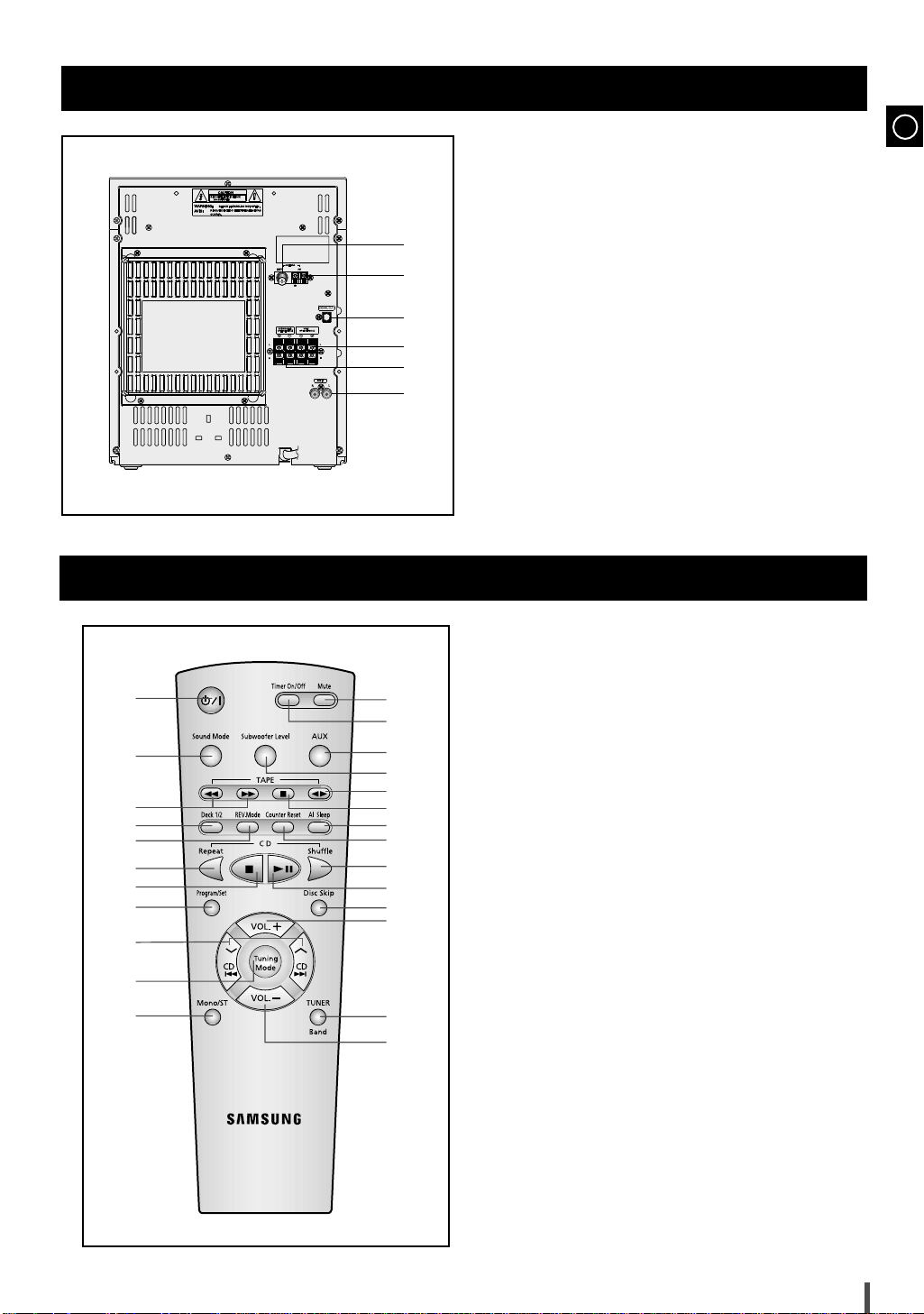
1. FM Aerial Connector Terminal
2. AM Aerial Connector Terminal
3. CD Digital out Jack
1
2
4. Main speaker Connector Terminals
5. Subwoofer speaker Connector Terminals
Remote Control
1
2
3
4
5
6
7
8
9
10
11
25
24
23
22
21
20
19
18
17
16
15
14
13
12
3
6. AUX-Input
4
5
6
1. Standby/On
2. Sound Mode
3. Tape Rewind and Fast-Forward
4. Deck 1/2
5. Tape Reverse Mode
6. CD Repeat
7. CD Stop
8. Program/Set
9. CD Track or Radio Station Search
10. Tuning Mode
11. FM Mono/Stereo Mode Selection
12. Volume Decrease
13. TUNER Band
14. Volume Increase
15. Disc Skip
16. CD Play and Pause
17. CD Shuffle Play
18. Tape Counter Reset
19. AI Sleep
20. TAPE Stop
21. TAPE Play
22. Subwoofer Level
23. AUX
24. Timer On/Off
25. Mute
5
Page 6

GB
Display Window
1. Power Surround
2. Sound Mode
3. Volume and EQ Level
4. CD Program and Tuner Preset Number
5. Main Display (Function, Frequency, Time, etc.)
6. FM Mode (STEREO)
7. EQ
8. D.S.P
9. CD-RW
14. CD Playing Disc Mode or CD Repeat Mode
15. Clock
16. Playing Disc Number
17. Recording
18. Tape 1/2
19. Tuning Mode (Auto)
20. FM RDS Mode
21. CD Program or Tuner Memory to Program
22. Tuner Preset
10. Tape Reverse Mode
11. CD Synchro Recording
12. Tuner Frequency unit
13. AI SLEEP or SLEEP
Where to Install Your Mini-Compact System
To take full advantage of your new mini-compact system, follow
these installation instructions before connecting the unit.
Install the system on a flat, stable surface.
Never place this unit on carpeting.
Never place this unit in an outdoor area.
Maintain an open space of approximately 6 inches (15 cm) on the
sides and rear of the system, for ventilation purposes.
Make sure that you have enough room to open the compact disc
compartment easily.
Place the loudspeakers at a reasonable distance on either side of
the system to ensure good stereo sound.
Direct the loudspeakers towards the listening area.
For optimum performance, make sure that both speakers are placed
at an equal distance above the floor.
6
Page 7
Inserting Remote Control Batteries
PRESS
Insert or replace remote control batteries when you:
Purchase the mini-compact system
Find that the remote control is no longer operating correctly
When replacing the batteries, use a new set of batteries and
never mix alkaline and manganese batteries.
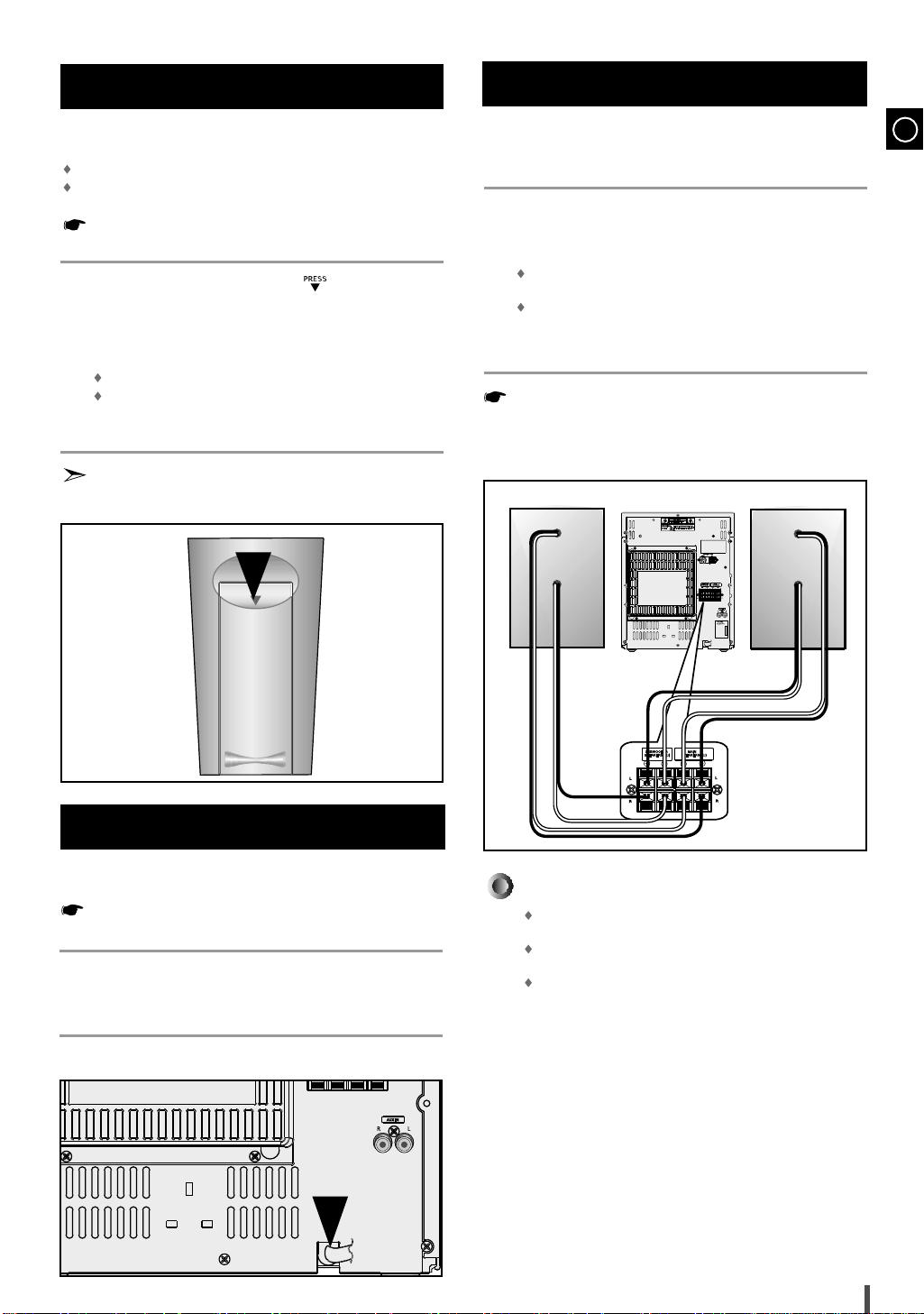
Place your thumb on the position marked on the battery
1
compartment cover (rear of the remote control) and push the cover in
the direction of the arrow.
Insert two AAA, LR03 or equivalent batteries, taking care to respect
2
the polarities:
+ on the battery against + in the battery compartment
– on the battery against – in the battery compartment
Replace the cover by sliding it back until it clicks into position.
3
If you will not be using the remote control for a long time,
remove the batteries to prevent corrosion.
Connecting the Loudspeakers
The loudspeaker connector terminals are located on the rear
of the system.
Press and hold the clamp of the speaker terminal on the rear of the
1
unit.
Insert the end of the speaker cord into the terminal.
2
Match the polarity (colors): Red (+) to red (+) and black (–) to black
(–).
Match the polarity (colors): Blue (+) to Blue (+) and black (–) to black
(–).
Release the finger from the clamp.
3
Use only speakers with the same speaker impedance as indicated by the speaker terminals on the rear of the unit.
GB
Connecting your System to the Power Supply
The main lead must be plugged into an appropriate socket.
Before plugging your system into a main socket, you must check
the voltage.
Plug the main lead (marked AC Cord on the rear of the system) into
1
an appropriate socket.
Press the Standby/On button to switch your mini-compact system on.
2
Directions in Installing Speaker
Installation in a place near heating apparatus, under direct lay of light or
with high humidity may cause performance degradation of the speaker.
Do not install on the wall or on a high place of pole or other unstable
place to prevent any safety accident caused by falling of the speaker.
Do not take the speaker apart from TV or computer monitor.
The speaker near the TV or computer monitor may influence the quality
of the screen display.
7
Page 8
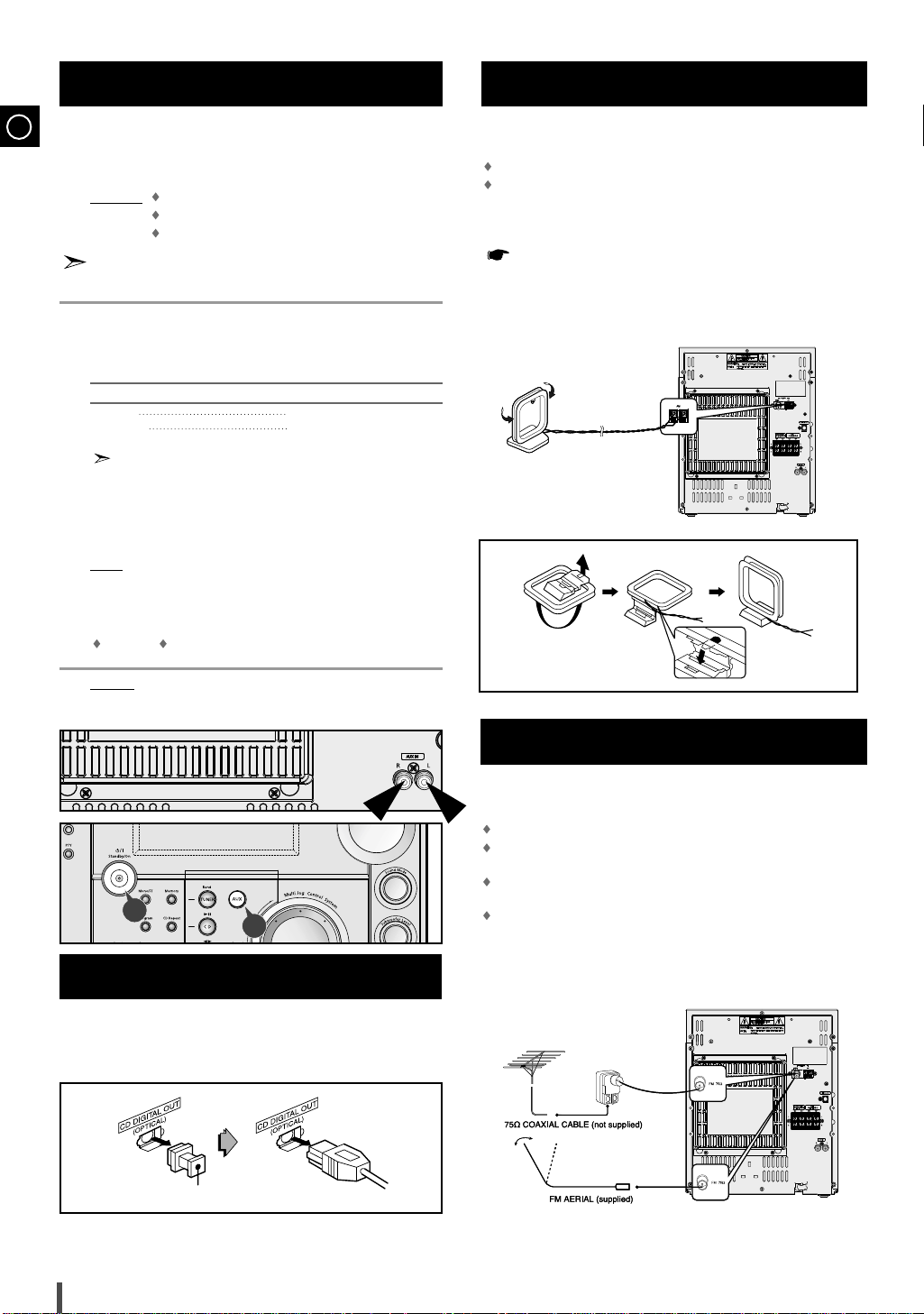
Connecting to an External Source
AM
GB
The auxiliary input can be used to take advantage of the
sound quality of your mini-compact system when listening to
other sources.
Examples
: A television
A video disc player
A Hi-Fi stereo video cassette recorder
To connect the external source, the source must have an audio
output. In addition, you need an RCA connection cable.
Set the system to standby mode and disconnect it and the external
1
source from the main.
Connect the audio cable to the rear of the mini-compact system.
2
Connect the... To the connector marked...
Red jack R (right)
White jack L (left)
For optimum sound quality, do not invert the right and left
channels.
Plug the system back into the main socket and press Standby/On to
3
switch it on.
Select the AUX source by pressing AUX.
4
5
6
: AUX is displayed.
Result
Switch the external source on.
Adjust the volume and balance as required:
Volume Equalizer
Connecting the AM Aerial
The AM(MW/LW) aerial (for long and medium waves) can be:
Placed on a stable surface
Fixed to the wall (you must first remove the base)
The AM aerial connector terminals are located on the rear of the system and are marked AM .
To avoid noise interference, check that the loudspeaker wires do
not run close to the aerial wires.
Always keep them at least 2 inches (5 cm) away.
Example: You can watch a film and take advantage of stereo sound
provided that the original sound track is in stereo (as if you
were in a cinema).
3
4
CD Digital Out Jack
This unit can output CD digital sound signals through this
jack. Use an optical cable to connect digital audio equipment.
(DAT deck, MD recorder, etc.).
Remove the dust cap (1) from the CD DIGITAL OUT jack. Then,
connect an optical cable plug to the CD DIGITAL OUT jack.
(1)
Connecting the FM Aerial
How to connect a COAXIAL TYPE aerial.
Connect a 75Ω antenna to the FM antenna terminal.
Plug the connector on the FM aerial supplied into the coaxial socket
(75Ω) marked FM on the rear of the system.
Follow the instructions given on Page 13 to tune into a radio sta-
tion, and determine the best position for the aerial.
If reception is poor, you may need to install an outdoor aerial.
To do so, connect an outdoor FM aerial to the FM socket on the rear
of the system using a 75Ω coaxial cable (not supplied).
When the CD DIGITAL OUT jack is not being used
Attach the supplied dust cap.
8
Page 9

Demo/Dimmer function
All functions available on the system can be viewed on the
display and the display's brightness can be switched between
"on" and "off".
Press the Demo/Dimmer button.
1
Result: All functions available on the system appear on the front
panel display.
Each of these are explained in detail in this guide. Please refer to
the relevant section.
Press the Demo/Dimmer button again.
2
Result:
The Dimmer function is selected and the display darkens.
Press the Demo/Dimmer button once again to brighten the front
panel display.
A display brightness control can only be performed while the
3
system power is on.
Setting the Clock
Your system is equipped with a clock which allows you to turn
your system on and off automatically. You should set the
clock:
When you first purchase the mini-compact system
After a power failure
After unplugging the unit
For each step, you have a few seconds to set the required
options. If you exceed this time, you must start again.
Switch the system on by pressing Standby/On.
1
2
Press Timer/Clock twice.
CLOCK is displayed.
Result:
Press Enter.
3
4
5
6
7
The hour flashes.
Result:
To... Turn the Multi Jog knob to the...
Increase the hours Right
Decrease the hours Left
When the correct hour is displayed, press Enter.
Result:
The minutes flash.
To... Turn the Multi Jog knob to the...
Increase the minutes Right
Decrease the minutes Left
When the correct time is displayed, press Enter.
Result:
The clock starts and is displayed, even when the system is in
standby mode.
GB
You can display the time, even when you are using another
function, by pressing Timer/Clock once.
You can also use Program/Set button on the remote control
to instead Enter button in step 3, 5, 7.
You can also use / buttons to instead Multi Jog
knob in step 4, 6.
2
1
3,5,7
4,6
9
Page 10

GB
Loading and Changing Compact
Discs
The CD disc changer can contain up to three 12 cm or 8 cm
compact discs without using an adapter.
Never force the compact disc carrousel when opening and
closing the compartment.
Never press down or place objects on the carrousel.
Always treat your compact discs with care; refer, if necessary, to
the section entitled “Precautions When Using Compact Discs” on
page 22.
Switch the system on by pressing Standby/On.
1
Press the Open/Close( ) button on the front panel.
2
Result:
The compartment opens.
Place one or two discs in the front slots of the carrousel, with the
3
label on the discs facing upwards.
Check that the compact disc has been correctly inserted in
the holder before closing the compartment.
If you wish to load a third compact disc, press the Disc Change
4
button on the front panel (or Disc Skip on the remote control).
The carrousel rotates by 120°.
Result:
Close the compartment by pressing the Open/Close( ) button
5
again.
If you wish to start playing a disc directly, you can also
proceed as follows.
To play... Press...
Disc 1 CD ( ) or Disc 1
Disc 2 Disc 2
Disc 3 Disc 3
Result:
The compartment closes automatically and the disc selected
starts playing.
To change or unload the compact disc changer, repeat Steps 2 to 5.
6
Listening to a Compact Disc
This unit has been designed to playback the CDs: Audio CD,
CD Text, CD-R and CD-RW.
When you have loaded at least one compact disc into the
player, you can start listening to it.
Continued use of irregular shape CDs (heart-shape, octagonal,
etc.) can damage the unit.
Switch the system on by pressing Standby/On.
1
Select the CD function by pressing CD ( ) on the front panel.
2
Load one or more discs.
3
Press CD ( ) on the front panel or on the remote control.
4
If you have loaded more than one compact disc, they will
be played in turn.
Adjust the volume as required by:
5
Turning the Volume knob on the front panel
or
Pressing the VOL. + or - buttons on the remote control
To pause temporarily during playback, press CD ( ).
6
Press CD ( ) again to continue disc playback.
Press when you have finished.
7
When playing a disc, you can load new discs without
stopping the current one. To do so, open the compartment by
pressing Disc Change and load new discs in the other two
vacant slots (not the one containing the disc that you are playing).
You cannot rotate the carrousel during playback.
When no discs are loaded, the “NO DISC” indication is displayed.
The CD player stops automatically after playing the three discs, if
the CD REPEAT function has not been selected.
10
Keep the compartment closed whenever you are not using
it, to prevent dust from entering.
You can load or unload compact discs when the radio,
tape or auxiliary source function is selected.
4
5
1
5
2,5
5
2,4,6
1
7
When playing a CD-R or CD-RW
User-edited CD-Rs (Recordable) and CD-RWs (Rewritable)
can be played back only if they are already “finalized”.
You can play back your original CD-Rs or CD-RWs recorded in
music CD format. (However, they may not be played back
depending on their characteristics or recording conditions.)
Some CD-Rs or CD-RWs may not be played back on this unit
because of their disc characteristics, damage or stain on
them, or if the player’s lens is dirty.
CD-RWs may require a longer readout time. (This is caused
by the fact that the reflectance of CD-RWs is lower than for
regular CDs.)
Page 11

Selecting a CD in the Disc changer
The CD function is automatically selected when Disc Skip is
pushed.
To select a specific disc, press the corresponding Disc (1, 2, 3) button
on the front panel or Disc Skip on the remote control, until the
required disc indicator flashes.
Result: All the discs will be played in turn, starting with the one selected.
If you wish to play the current disc only, press CD Repeat on
the front panel one or more times, until 1 CD is displayed.
If you use the Disc (1, 2, 3) function when listening to the
radio or to a tape, the system switches automatically to the CD
mode.
If the disc selected is not loaded, the next disc is played
automatically.
Searching for a Specific Music Passage on a CD
GB
When listening to a compact disc, you can quickly search for
a specific music passage on a track.
It is recommended that you turn the volume down before using
this function.
To search through the tracks... Press and hold down...
Forwards for at least one second
Backwards for at least one second
You can also press and hold down / on the front panel to auto
search through the tracks.
Selecting a Track
You can select the track you wish to listen to, either when the
compact disc player is stopped or when a disc is playing.
To start playback at the beginning of the... Turn the Multi Jog knob...
Next track One notch to the right
Current track One notch to the left
Previous track Two notches to the left
Track of your choice The appropriate number of
notches to the right or to the left
You can also use the and buttons on the front panel, or
the and buttons on the remote control to select a track.
Shuffle Play Function
You can listen to the tracks on a compact disc in a different
order each time, as the various tracks will be selected
automatically in a random sequence.
Press the Shuffle button.
1
Result: The SHUFFLE indication appears and all the tracks are
played in a random order. Both the track number and the
playing time are displayed.
When playing tracks in a random order, you can:
2
Move on to the next track (selected at random) by pressing
/ or turning Multi Jog one notch to the right.
Search quickly for a specific point in the current track by pressing
and hold down /
When you have finished the random playback, press or press the
3
Shuffle button again.
Repeat and CD Synchro function are not available in Shuffle playing
mode.
more than one second.
3
1,3
2
2
11
Page 12

Repeating One or All Tracks on the Compact Discs
GB
You can repeat indefinitely:
A specific track on a compact disc.
All tracks on the compact disc selected.
All discs loaded in the carrousel
To repeat... Press CD Repeat on the Front
1
The current track indefinitely REPEAT 1 is displayed
The selected disc REPEAT 1 CD is displayed
All discs loaded REPEAT ALL CD is displayed
When you wish to stop the Repeat function, press CD Repeat until ALL
2
CD or 1 CD is displayed, or press .
Panel one or more times until...
To select other tracks, repeat Steps 4 to 6.
7
Press CD ( ) to listen to the track selection in the order
8
programmed.
To... Turn the Multi Jog knob...
9
Listen to the current track again One notch to the left
Listen to the previous track Two notches to the left
Listen to the next track One notch to the right
Skip forwards or backwards one The appropriate number of
or more tracks notches to the right or to the
To cancel the selection, press .
10
Once if the compact disc player is stopped
PRGM is no longer displayed.
Result:
If you open the compartment, the selection is cancelled.
If you select the number of a disc which is not loaded or a
track which does not exist on the CD, the selection skips to the
next programmed track.
You can also use the / buttons to select the required
tracks in step 5, 9.
You can also use Program/Set button on the remote control
to instead Program button in step 3,6.
left
1,2
2
Programming the Order of Playback
You can decide:
The order in which you listen to the tracks on the discs loaded
Which tracks you do not wish to listen to
You can program up to 24 tracks.
You must stop the compact disc player before selecting the tracks.
This feature can be combined with the Repeat function.
If the CD function is selected, stop the player by pressing .
1
Load the selected CDs.
2
Press Program.
3
Result: The following indications are displayed:
(01 = Program no., DI = Disc no., – – = Track no. on the disc)
If necessary, select the disc containing the required track by pressing
4
the corresponding Disc (1, 2, 3) button.
Select the required track by turning the Multi Jog knob:
5
To the left to move back through the tracks
To the right to move forward through the tracks
Press Program to confirm your selection.
6
The selection is stored and is displayed.
Result:
3,6
8
4
5,9
1,10
12
Page 13

Checking or Changing Programmed
Tracks
You can check or change your selection of tracks at any time.
Press once if you have started listening to the selection.
1
Press Program.
2
Result: The following indications are displayed:
(CH = Check, 01=Program No, DI = Disc No, – – = Track No on the disc)
If you have already programmed 24 tracks, CH is displayed
instead of PR when you press Program.
Press Program again.
3
Result: The first track selected is displayed, together with the letter CH (Change).
Press Program one or more times until the track to be changed is displayed.
4
If necessary, press the corresponding Disc (1, 2, 3) button to change discs.
5
Press and or turn Multi Jog to select a different track.
6
Press Program to confirm your change.
7
Press CD ( ) to start listening to the selection.
8
Result: The first track selected is played.
5
8
6
2,3,4,7
Searching for and Storing the Radio
Stations
You can store up to:
15 FM stations
8 MW stations
7 LW stations
Switch the system on by pressing Standby/On.
1
Select the TUNER function by pressing TUNER.
2
Select the required frequency band by pressing TUNER (Band)
3
again on the front panel or TUNER (Band) on the remote control.
Result
: The appropriate indication is displayed:
FM Frequency Modulation
AM(MW) Medium Wave
LW Long Wave
To search for a Press Tuning Mode
4
station...
Manually One or more times until MANUAL is
Automatically One or more times until AUTO is
Select the station to be stored by:
5
Turning the Multi Jog knob to the right or to the left to increase or
decrease the frequency respectively
or
Pressing Tuning or on the remote control
To scroll through the frequencies faster when searching
manually, hold down the Tuning Down or Up buttons.
The automatic search procedure may stop on a frequency that
does not correspond to a radio station. If this happens, use the
manual search mode.
Adjust the volume by:
6
Turning the Volume knob on the front panel
or
Pressing the VOL. + or – buttons on the remote control
Select the FM stereo or mono mode by pressing Mono/ST.
7
displayed.
displayed.
GB
2,3,4,7
6
1
6
6
2,3
1
1
8
5
4
5
5
4
6
6
5
5
7
13
Page 14

GB
Searching for and Storing the Radio
Stations (continued)
If you do not want to store the radio station found, revert to Step 4
8
and search for another station.
Otherwise:
a Press Memory.
b Press Tuning Mode Down and Up to assign a program number
c Press Memory to store the radio station.
To store any other radio frequencies required, repeat Steps 3 to 8.
9
The PRGM is displayed for a few seconds.
Result:
between 1 and 15.
PRGM is no longer flashed and the station is stored.
Result:
The PROGRAM function can be used to assign a new station
to an existing program number.
You can also use Program/Set button on the remote control
to instead Memory button in step 8.
8
Selecting a Stored Station
You can listen to a stored radio station as follows:
Switch the system on by pressing Standby/On.
1
Select the TUNER function by pressing TUNER (Band) on remote control.
2
Select the required frequency band by pressing TUNER (Band) on
3
the remote control or TUNER (Band) again on the front panel.
Press the Tuning Mode button on the front panel of the unit, or the
4
Tuning Mode button on the remote control until “PRESET” is
displayed.
Turning Multi Jog on the front panel left or right until the desired
5
station is found or press / to select the desired station.
or
Select the desired station by pressing the station number stored,
using the Tuning or button on the remote control.
The desired station is now received.
Result:
1
5
4
5
8
8
In Tuner mode
In manual tuning mode, you can use Multi Jog or /
button to manual search a radio station.
During Tuner auto searching, press button to stop auto
searching.
In Preset tuning mode, you can use Multi Jog or /
button to search a stored radio station.
2,3
Improving Radio Reception
You can improve the quality of radio reception by:
Rotating the FM or AM(MW) aerial
Testing the positions of the FM and AM(MW) aerials before fixing them
permanently
If reception from a specific FM radio station is poor, press Mono/ST.
to switch from stereo mode to mono. The quality of the sound will be
improved.
14
Page 15

About RDS DISPLAY function About RDS broadcasting
This unit has the RDS (Radio Data System) function, which
enables for the various information such as broadcasting
station, radio text, time and 30 types of programs (News,
Rock, Classic, etc.) to be received from the FM RDS station
together with normal radio signal.
Press the Standby/On button.
1
Receive the FM radio.
2
See the radio receiving method on the page 14.
FM and frequency are shown on the display
If the received station transfers the RDS information, 'RDS'
appears automatically on the display.
Press the RDS Display button to select the desired RDS mode.
3
Whenever the button is pressed, RDS mode changes as follows.
PS NAME RT CT Current FM frequency
The RDS function is available only in FM broadcasting.
Description on RDS function
1. PTY (Program Type) : Displays the type of programme
currently being broadcast
2. PS NAME (Program Service Name) : Indicates the name of
broadcasting station and is composed of 8 characters.
3. RT (Radio Text) : Decodes the text broadcast by a station (if
any) and is composed of maximum 64 characters.
4. CT (Clock Time) :
Some stations may not transmit PTY, RT or CT information
therefore this may not be displayed in all cases.
5. TA (Traffic Announcement) : When this symbol flashes it
shows that the traffic announcement is in progress.
Decodes the real time clock from the FMfrequency.
About "PS NAME" MODE
GB
Displays the name of broadcasting station.
Press the RDS Display button to select the PS NAME.
"PS NAME" appears on the display.
If the PS information is being received, the PS name (BBC, AFO,
NDR, etc.) is shown on the display.
If the PS information isn't received, the original FM frequency is
shown.
Even though no RDS Display button is pressed, the reception
of PS information ensues the PS name is displayed.
About 'RT' MODE
Displays the character transmitted from the broadcasting station.
Press the RDS Display button to select the RT MODE.
"RT" appears on the display.
If the RT information is being received, the received information is
shown on the display.
If the RT information isn't received, the "NO RT" is shown.
On the display.
3
1
About CT(Clock Time)
Sets the time of RDS clock.
To select the CT time, set the RDS Display button to CT MODE.
The CT information will take up to 2 minutes to be decoded therefore the clock isn’t displayed immediately.
If there is no received CT information, "NO CT" is displayed.
15
Page 16

GB
PTY (Program Type) indication and PTY-SEARCH function
The PTY information is composed of an identification symbol,
which helps the FM radio to recognize the program type of each FM
station.
The 30 PTY modes are shown in the display by pressing the PTY
button.
Display
NEWS
AFFAIRS
INFO
SPORT
EDUCATE
DRAMA
CULTURE
SCIENCE
VARIED
POP M
ROCK M
M.O.R.M
LIGHT M
CLASSIC
OTHER M
WEATHER
FINANCE
CHILDREN
SOCIAL A
RELIGION
PHONE IN
TRAVEL
LEISURE
JAZZ
COUNTRY
NATION M
OLDIES
FOLK M
DOCUMENT
TEST
• News including an announced opinion and report
• Several matters including a current incident, documentary,
discussion and analysis.
• Information including weights and measures, returns and fore-
cast, matters interesting the customer, medical information, etc.
• Sports
• Education
• Drama-Radio serial, etc.
• Culture-National or local culture including the religious problem,
social science, language, theater,etc.
• Natural science and technology
• Others-Speech, amusing program (quiz, game), interview,
comedy and satirical play, etc.
• Pop music
• Rock music
• M.O.R- Comfortable music, occasionally vocal or piece
• Light classical music- Classical music and instrumental
and chorus music
• Heavy classical music-Orchestra music, symphony, chamber
music and opera
• Other music - Jazz, R&B country music
• Weather
• Finance
• Children’s programmes
• Social affairs
• Religion
• Phone in
• Travel
• Leisure
• Jazz Music
• Country Music
• National Music
• Oldies Music
• Folk Music
• Documentary
• Alarm Test
Program Type
About PTY-SEARCH
Tuned to an FM station broadcasting a PTY MODE.
1
See the FM receiving method on the page 13.
If the received station is transmitting the RDS information, "RDS"
lights up.
Press the PTY button.
2
The PTY MODE(NEWS, AFFAIRS, etc) appears on the display.
Press the Tuning Down or Up button to select the desired PTY
MODE.
If the station is transmitting no PTY information, 'NO PTY' shows
on the display.
When the PTY MODE is selected(The PTY MODE is shown in the
display), press the PTY KEY once again to convert into
PTY-SEARCH MODE and auto-search the station sequentially.
If a station is found broadcasting required PTY MODE then the
search station and the stop is selected.
If the PTY MODE isn’t found it is retuned to the original station
frequency at beginning the PTY SEARCH and auto-search and
PTY SEARCH are suspended.
2
2
2
16
Page 17

Listening to a Cassette
Always treat your cassettes with care; refer, if necessary, to
the section entitled “Precautions When Using Audio Cassettes”
on page 22.
Switch the system on by pressing the Standby/On button.
1
Select the TAPE function by pressing TAPE on the front panel.
2
Open either cassette deck 1 or 2 by pushing and releasing the deck
3
cover where Push Eject ( ) is written.
Insert the pre-recorded cassette with the open edge of the tape
4
facing downward.
Close the deck by pushing on it until it clicks into place.
5
Result: Depending on the deck selected, the 1 or 2 indication is
displayed in front of the counter number.
If you have inserted two cassettes, press Deck 1/2 on the front panel
6
or directly the Deck 1/2 button on the remote control to select the
cassette to be played.
Depending on the deck selected, the TAPE 1 or TAPE 2
Result:
indication is displayed.
7
To listen to... Press ...
Side A TAPE ( ) once DECK 1 and DECK 2
Side B TAPE ( ) twice DECK 2 ONLY
Result: The cassette starts playing.
CD Synchro Record Feature
GB
You can record a compact disc on a cassette in two different ways:
Synchronised recording
Direct recording
This feature enables you to synchronize the start of the
recording with the start of the disc or track of your choice.
Switch the system on by pressing Standby/On.
1
Insert a blank cassette in Deck 2.
2
Select the CD function by pressing CD on the front panel.
3
Load a compact disc.
4
Select the required disc.
5
Select the required track and press CD Synchro or press CD Syn-
6
chro directly to start recording at the beginning of the disc.
REC
Result:
and recording starts.
To stop recording, press .
7
and CD-SYNC are displayed on window displayer
1
3
6
7
8
When the cassette is stopped, select one of the following functions
as required.
Main Unit
To... Press ...
Rewind the cassette
Fast-forward the cassette
Remote Control
To... Press ...
Rewind the cassette
Fast-forward the cassette
9
To... Press ...
stop the playback or search
1
2,7
6
8
9
8
Recording a Compact Disc
The direct recording mode enables you to start recording with
any track on the compact disc.
You can only record on cassettes in Deck 2.
You do not need to adjust the volume, as it has no effect on the recording.
Switch your system on by pressing Standby/On.
1
Insert a blank cassette in Deck 2.
2
Select the CD function by pressing CD on the front panel.
3
Load the compact disc.
4
Select the required disc.
5
Select the required track on the compact disc and press on the front
6
panel or on the remote control to set the compact disc player to Pause
mode.
7
Press the REC/Pause.
Result:
Press the to start playing the track.
8
Result:
To stop recording, press .
9
is displayed in red and recording starts.
REC
The track is recorded on the cassette.
3,6,8
1
7
9
17
Page 18

Recording a Radio Program
GB
You can record a radio program of your choice.
You can only record on cassettes in Deck 2.
You do not need to adjust the volume, as it has no effect on
the recording.
Switch the system on by pressing Standby/On.
1
Insert a blank cassette in Deck 2.
2
Select the TUNER function by pressing TUNER.
3
Select the radio station that you wish to record by pressing Tuning
4
or on the remote control or by press the Tuning Mode
Down or Up on the front panel.
Press REC/Pause.
5
Result:
To stop recording, press .
6
is displayed in red and recording starts.
REC
3
1
Copying a Cassette (Dubbing)
You can copy a cassette from Deck 1 to Deck 2. Two options
are available:
Normal speed dubbing
You do not need to adjust the volume, as it has no effect on the
recording.
Take care not to insert the tape to be copied in Deck 2, as it will
be erased when you start recording.
Switch your system on by pressing Standby/On.
1
Insert a blank cassette in Deck 2.
2
Insert the tape to be copied in Deck 1.
3
To copy a cassette at... Press...
4
Normal speed Dubbing
The appropriate indications are displayed and the cassette in
Result:
Deck 1 is copied to the cassette in Deck 2.
To stop dubbing, press .
5
1
5
6
4
4
Selecting the Cassette Playback Mode(DECK 2 only)
Your mini-compact system has three cassette playback modes
which enable you to listen to both sides of a cassette
automatically.
Press Reverse Mode until the appropriate symbol is displayed.
When the display indicates... The mini-compact system plays back...
One side of the selected cassette and
then stops.
One side of the cassette.
The other side of the cassette and then
stops.
Both sides of the cassette indefinitely until
you press stop.
4
5
Tape Counter
When playing a cassette in one of the cassette decks, a
counter is displayed to enable you to take note of the counter
value at the start of each track to start playback at the
beginning of the track to which you wish to listen.
Before starting to record a cassette for which you wish to take
note of the counter values at the beginning of each track, reset
the counter by pressing Counter Reset .
Each cassette deck has a separate counter.
18
Page 19

Timer Function
The timer enables you to switch the system on or off at
specific times.
Example: You wish to wake up to music every morning.
If you no longer want the system to be switched on or off
automatically, you must cancel the timer.
2
GB
1,9
4,5,7
Before setting the timer, check that the current time is correct.
For each step, you have a few seconds to set the required
options. If you exceed this time, you must start again.
Switch the system on by pressing Standby/On.
1
Press Timer/Clock until TIMER is displayed.
2
Press Enter.
3
4
5
6
7
8
9
ON TIME is displayed (instead of the equalizer symbols) for
Result:
a few seconds, followed by any switch-on time already set;
you can set the timer switch-on time.
Set the timer switch-on time.
a
Set the hour by tuning the Multi Jog knob to the right or to the left.
b Press Enter.
Result: The minutes flash.
c Set the minutes by tuning the Multi Jog knob to the right or to
the left.
d Press Enter.
Set the timer switch-off time.
a
b Press Enter.
c Set the minutes by tuning the Multi Jog knob to the right or to
d Press Enter.
Press Tuning Mode Down and Up to adjust the volume level and
press Enter.
Result:
Turn the Multi Jog knob to select the source to be played when the
system switches on.
If you select... You must also...
TAPE (cassette) Insert a recorded cassette in one of
TUNER (radio) a Press Enter.
CD (compact disc) a Load one or more compact discs.
Press Enter to confirm the timer.
Press Standby/On to set the system to standby mode.
Result
If the timer switch on and off times are identical, the word ERROR is
displayed.
OFF TIME is displayed (instead of the equalizer symbols)
Result:
for a few seconds, followed by any switch-off time already
set; you can now set the timer switch-off time.
Set the hour by tuning the Multi Jog knob to the right or to the left.
The minutes flash.
Result:
the left.
Result: VOL XX is displayed, where XX corresponds to the
volume already set.
The source to be selected is displayed.
the decks before setting the
system to standby.
b Select the FM or AM frequency
band by tuning the Multi Jog
knob to the right or to the left.
b Select the required disc.
: is displayed to the bottom left of the time, indicating that
the timer has been set. The system will switch on and off
automatically at the required times.
To set the timer function
You may use Multi Jog or / buttons to adjust in step 4,
5, 6, 7.
You can also use Program/Set button on the remote control to
instead Enter button in step 3, 4, 5, 6, 7, 8.
6
6
3,4,5,6,7,8
Setting the System to Switch off
Automatically
While listening to a compact disc or a cassette, you can
set the system to switch off automatically
Example: You wish to go to sleep to music.
Press AI Sleep.
1
2
3
4
: playback starts and the following indications are displayed:
Result
90 MIN
Press AI Sleep one or more times to indicate how long the
system should continue playing before it switches off:
At any time, you can:
Check the remaining time by pressing AI Sleep
Change the remaining time by repeating Steps 1 and 2
Press AI Sleep one or more times until AI SLEEP is displayed.
: The system will automatically switch off at the end of the
Result
disc or cassette.
To cancel SLEEP or AI OFF function, press AI Sleep one or more
times until OFF is display.
Cancelling the Timer
After having set the timer, it will start automatically as shown
by the TIMER indication on the display. If you no longer wish
to use the timer, you must cancel it.
You can stop the timer at any time (system on or in standby mode).
To... Press Timer-On/Off...
Cancel the timer Once.
Restart the timer Twice.
Result: is no longer displayed.
Result
: is displayed again.
19
Page 20

Mute Function
GB
You can turn the sound off temporarily on your system.
: You wish to answer a telephone call.
Example
Press Mute.
1
To switch the sound back on (at the same volume as before), press
2
Mute again or the Volume buttons.
Power Surround Function
Your mini-compact system is equipped with the function
of Power Surround.
The Power Surround replaces conventional stereo sound
with a wider and more true-to-life sound. It creates the
feeling of being right at the centre of the music and being
surrounded by total music sound.
Selecting Sound Mode
Your mini-compact system is equipped with a preset equalizer
that allows you to choose the most appropriate balance
between treble and bass frequencies, according to the type of
music you are listening to.
This model provides D.S.P modes so that you can enjoy virtually original sound.
Turn Sound Mode on the front panel or Press Sound Mode on the remote
control until the required option is selected.
To obtain a... Select...
Normal balance (linear) PASS
Balance suitable for pop music POP
Balance suitable for rock music ROCK
Balance suitable for classic music CLASSIC
Balance suitable for hall HALL
Balance suitable for live LIVE
Balance suitable for cinema CINEMA
Press P.SURROUND button on the front panel until the
required option is selected. Each time the P. SURROUND
button is pressed, “P,SURR, ” is selected or cancelled in this
order.
Subwoofer Level Function
Subwoofer function stresses low tones providing thudding
sound effects.
Turn Subwoofer Level knob on the front panel or press the Sub-
1
woofer Level button on the remote control.
Press the button on the remote control repeatedly to select
➞
“OFF ➞WOOFER1 ➞ WOOFER2 ➞ WOOFER3 ➞ WOOFER4”.
or turn the knob on the front panel repeatedly to select
2
You can select the level of low tones you desire.
Connecting Headphones
You can connect a set of headphones to your mini-compact
system so that you can listen to music or radio programmers
without disturbing other people in the room. The earphones
must have a 3.5 mm jack or an appropriate adapter.
Connect the headphones to the Phones jack on the front panel.
: The loudspeakers are no longer used to output the sound.
Result
Prolonged use of headphones at a high volume may damage
your hearing.
20
Page 21

Safety Precautions
The following diagrams illustrate the precautions to be taken
when using or moving your mini-compact system.
Ambient operating conditions:
Ambient temperature 5°C-35°C
Humidity 10-75%
Do not place potted plants or vases
on top of the unit. Moisture entering
the unit could lead to dangerous
electric shock and can cause
equipment damage. In such events
immediately disconnect the main
plug from the socket.
Do not expose the unit to direct sun
radiation or other heat sources.
This could lead to overheating and
malfunction of the unit.
During thunderstorms, disconnect
the main plug from the socket.
Main voltage peaks due to lightning could damage the unit.
Cleaning Your Mini-Compact
System
To obtain the best possible results from your mini-compact
system, you must clean the following elements regularly:
The outer casing
The compact disc player
The cassette players (heads, rollers and drive capstans)
Always unplug the system from the wall outlet:
Before cleaning it
If you are not going to be using it for a long time
Outer Casing
Clean the outer casing regularly using a soft cloth and a light detergent. Do
not use abrasive powders, liquids or aerosol cleaners. Never let any liquids
get into the system.
Compact Disc Player
Before playing a compact disc, clean it with a special CD cleaning
1
agent. Do not use the same cleaning agents as for vinyl LP records.
Carefully wipe the disc from the centre outward.
Regularly clean the player with a special cleaning disc (available from
2
your local dealer).
T
ape Decks
Press Push Eject( ) to open the cassette deck.
1
Use a cotton bud and a special cassette cleaning agent to clean the:
2
Head (1)
Rollers (2)
Drive capstans (3)
3
GB
Remove the batteries from the
remote control, if not used for any
extended period.
Leaking batteries can cause serious
damage to the remote control.
Do not place heavy items on the
main lead. Main cable damage can
lead to damage of the equipment (fire
hazard) and can cause electric
shock.
VOLUME
UP
DOWN
When using headphones, take care
not to listen at excessive volumes.
Extended use of headphones at
high volumes will lead to hearing
damage.
Do not remove any equipment panels.
The inside of the unit
contains live components, which
cause electric shock.
21
If you will not be using the remote control for a long time,
remove the batteries to prevent corrosion.
Although your system is very hard-wearing, it should not be
used in an excessively dusty environment or subjected to
shocks or extreme heat (close to heating appliances or in
direct sunlight, etc.).
If the unit emits an unpleasant odor when in use, unplug it
from the main supply and contact the after-sales service.
21
Page 22

GB
Precautions When Using Compact
Discs
Handle your compact discs with care. Always hold them by the
edges to avoid leaving fingerprints on the shiny surface.
When you have finished playing a compact disc, always put it back
in its case.
Do not fix paper or adhesive tape to the discs and do not write on
the label.
Clean them with a special-purpose cloth.
Store your compact discs in a clean place, out of direct sunlight,
where they will not be exposed to high temperatures.
Always use compact discs marked .
DIGITAL AUDIO
COMPACT
Precautions When Using Audio
Cassettes
Check that the tape in the cassette is sufficiently tight.
To prevent erasing a cassette that you wish to keep, remove the
safety tab on the upper edge of the cassette. To record a cassette,
where the tab has been broken, simply cover the opening with
adhesive tape.
When you have finished playing a cassette, always put it back in its
case.
Store your cassettes in a clean place, out of direct sunlight, where
they will not be exposed to high temperatures.
Avoid using 120-minute cassettes as they place unnecessary strain
on the tape mechanism.
Before Contacting the After-Sales
Service
It always takes a little time to become familiar with a new appliance.
If you have any of the problems listed below, try the solutions given.
They may save you the time and inconvenience of an unnecessary
service call.
Problem
The system does not work
G
There is no sound
E
N
E
R
A
L
The Timer does not work
In case it does not work, even the
action is taken as above.
The compact disc player does not
start playing
C
D
C
A
The tape does not start playing
S
S
E
T
The volume falls off
T
E
The cassette is not erased correctly
S
There is excessive wow and flutter
Reception is poor or no radio sta-
tions are received at all
R
A
D
I
O
Checks/Explanation
• The main lead is not correctly plugged into
a wall socket or the wall socket is not
switched on.
• The remote control batteries need replacing
or the polarity has not been respected.
• The Standby/On button has not been
pressed.
• The volume has been completely turned
down.
• The correct function (TUNER, CD, TAPE,
AUX) has not been selected.
• You have connected a set of earphones.
• The loudspeaker wires have been
disconnected.
• The Mute button has been pressed.
• The timer has been stopped by pressing
Timer On/Off.
• Press the P.SURROUND button for 5 sec-
onds in power ‘OFF’(standby), then it is
returned the original position (RESET)
• The CD function has not been selected.
• The disc has been inserted face down or is
either dirty or scratched.
• The laser sensor is dirty or dusty.
• The system has not been installed on a flat,
horizontal surface.
• Condensation has formed in the player;
leave the system in a warm, airy room for at
least one hour.
• The TAPE function has not been selected.
The cassette has not been inserted correctly.
•
• The cassette player has not been closed.
• The tape is either slack or broken.
• The audio heads are dirty.
• The rollers or drive capstans are dirty.
• The tape is worn.
• The TUNER function has not been selected.
• The radio frequency has not been correctly
selected.
• The aerial has been disconnected or is not
facing the right way. Turn it until you find the
best orientation.
• You are in a building that blocks radio
waves; you must use an outside aerial.
22
If the above guidelines do not allow you to solve the problem, take a
note of:
The model and serial numbers, normally printed on the rear of
the system
Your warranty details
A clear description of the problem
Then contact your local dealer or SAMSUNG after-sales service.
Page 23

Technical Specifications
GB
SAMSUNG strives to improve its products at all times. Both the design specifications and these user
instructions are thus subject to change without notice.
RADIO
LW
Usable sensitivity 60 dB
AM (MW)
Signal/noise ratio 40 dB
Usable sensitivity 54 dB
Total harmonic distortion 2 %
FM
Signal/noise ratio 60 dB
Usable sensitivity 10 dB
Total harmonic distortion 0.5 %
COMPACT DISC PLAYER
Capacity 3 discs
Frequency range 20 Hz - 20 KHz (± 1 dB)
Signal/noise ratio 90 dB (at 1 KHz) with filter
Distortion 0.05 % (at 1 KHz)
Channel separation 80 dB
Disc sizes Diameter: 120 or 80 mm. Thickness: 1.2 mm
TAPE DECK
Frequency range 125 Hz ~ 10 KHz
Signal/noise ratio 40 dB
Channel separation 35 dB
Erasing effect 60 dB
AMPLIFIER
Output power
Main (4 Ω) 2 x 30 Watts RMS,IEC (total harmonic distortion: 10 %)(MAX-WS730/WS730S)
2 x 40 Watts RMS,IEC (total harmonic distortion: 10 %)(MAX-WS750/WS750S)
Subwoofer (6 Ω) 2 x 60 Watts RMS,IEC (total harmonic distortion: 10 %)(MAX-WS730/WS730S)
2 x 80 Watts RMS,IEC (total harmonic distortion: 10 %)(MAX-WS750/WS750S)
Channel separation 50 dB
Signal/noise ratio 75 dB
GENERAL
Dimensions 270 (W) x 332 (H) x 425 (D) mm
23
Page 24

THIS APPLIANCE IS MANUFACTURED BY:
AH68-01234B
 Loading...