

Page 1
1
LACTOSE-BOUILLON
Flüssiges Medium D
Zum Nachweis und zur Zählung von coliformen Bakterien und zur Anreicherung von
Salmonella
Für die Mikrobiologie
X921
Zusammensetzung in g/l:
Pankreashydrolysat (Pepton) aus Gelatine ............. 5,0
Lactose-Monohydrat ............................................... 5,0
Rindfleischextrakt ................................................... 3,0
pH-Wert .......................................................... 6,9 ± 0,2
HERSTELLUNG
13 g des Mediums werden in einem Liter destillierten Wassers suspendiert. Falls notwendig wird eine höhere
Konzentration des Mediums angesetzt. Man löse das Medium und gebe die Lösung, wenn gewünscht, in
Röhrchen zur Detektion der mikrobiologischen Gasproduktion (Durham). Man sterilisiere 15 Minuten lang
bei 121 °C und kühle so rasch wie möglich ab. Das fertige Medium ist bernsteinfarben und sollte bei 2-8°C
aufbewahrt werden.
EINSATZGEBIET
Lactose-Bouillon wird empfohlen von der Pharmacopoeia Europaea 6.0 A zum Nachweis von
Enterobakterien und einigen anderen Gram-negativen Bakterien.
Lactose Bouillon wird weiterhin von Gesundheitsbehörden zur Untersuchung auf Coliforme in Wasser, Milch,
Gelatine und pharmazeutischen Produkten empfohlen. Das Medium wird ebenfalls verwendet zur
Voranreicherung in der Überprüfung von Lebensmitteln oder Milchprodukten auf Salmonellen, die durch
Konservierung geschwächt oder in der Zahl deutlich reduziert sind.
Hierbei verdünnt die Lactose-Bouillon alle anwesenden toxischen oder inhibitorischen Substanzen, während
die Lactose von den meisten nicht-Salmonellen metabolisiert wird, wodurch der pH-Wert fällt und ein für
Konkurrenzbakterien bakteriostatischer Effekt entsteht.
Die Sterilisierung des Mediums sollte durch Inkubieren der Röhrchen bei 35 °C für 24 Stunden vor der
Inokulierung überprüft werden. Das Medium sollte frei von Luftbläschen sein vor der Inokulierung.
Man impfe mit Aliquots von 1 ml, 5 ml oder 100 ml einer flüssigen Probe in geeignete Behälter. Man
inkubiere 18 bis 24 Stunden lang bei 35 °C und prüfe auf Gasentwicklung. Zur anschließenden Detektion
und Quantifizierung der Keime empfehlen wir die Verwendung von Kristallviolett-Galle-Agar mit Glucose und
Lactose (Best.-Nr. AE45.1).
MIKROBIOLOGISCHE TESTS
Die folgenden Ergebnisse wurden erzielt nach Inkubation von Referenzstämmen im angegebenen
Medium / Agar bei einer Temperatur von 35 ± 2°C für 24 Stunden.
Mikroorganismen
Wachstum
Gasproduktion
Escherichia coli ATCC 25922
Gut
+
Klebsiella pneumoniae ATCC 13883
Gut
+
Proteus vulgaris ATCC 13315
Gut
-
Salmonella typhimurium ATCC 14028
Gut
-
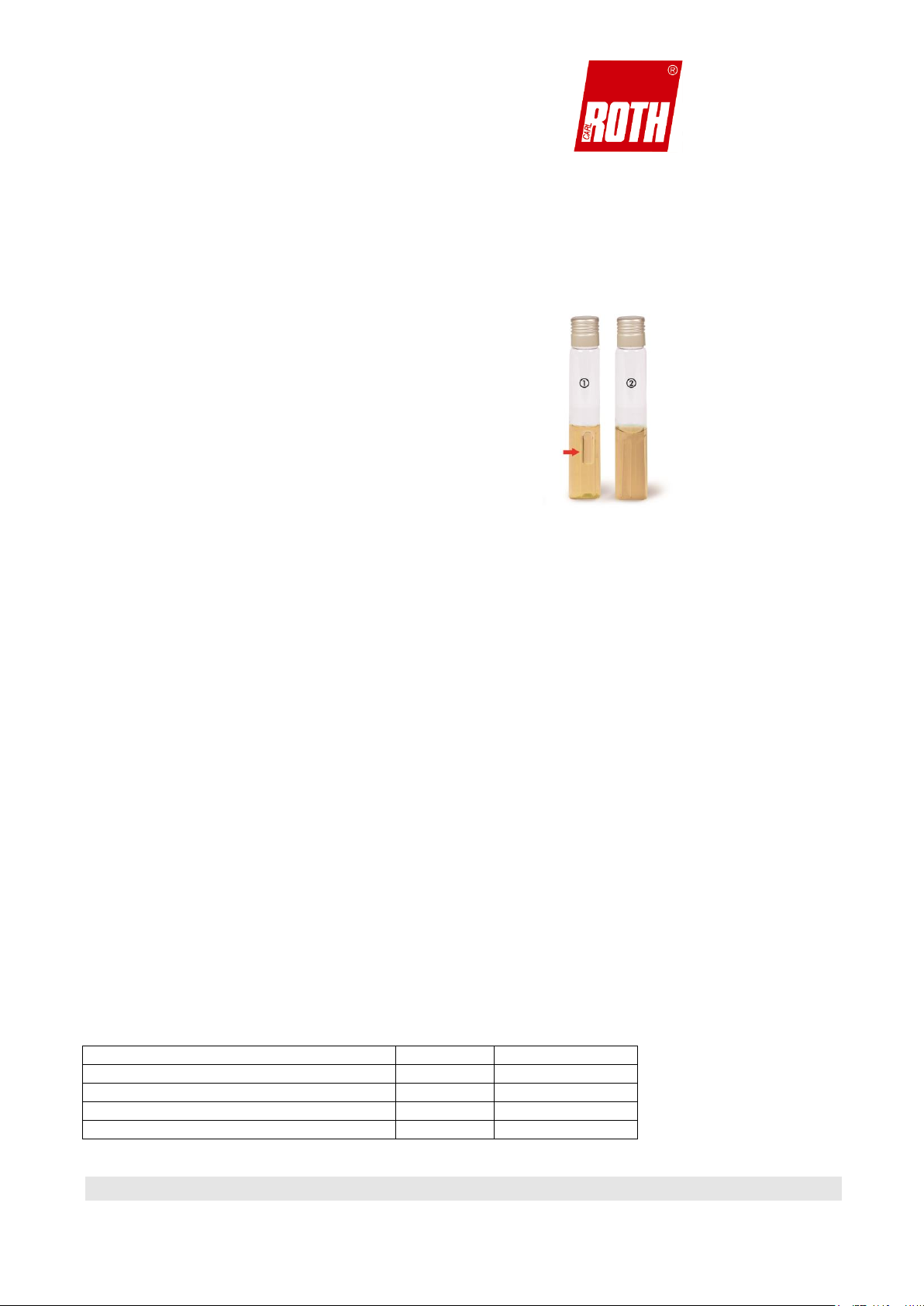
LACTOSE BOUILLON 500 g X921.1
1 - Escherichia coli
ATCC 25922
2 – nicht inokuliertes
Röhrchen
Produkt-Datenblatt
Page 2
2
LACTOSE BROTH
Broth Medium D
For the detection and enumeration of coliforms in tubes and for enrichment for
Salmonella
For Microbiology
X921
Formulation in g/l:
Pancreatic digest of gelatine ....................... 5.0
Lactose monohydrate .................................. 5.0
Beef extract .................................................. 3.0
Final pH ............................................. 6.9 ± 0.2
PREPARATION
Suspend 13 g of the medium in a litre of deionised or distilled water, or if necessary, prepare in a higher
concentration of the medium. Dissolve and, if required, dispense in tubes for the detection of microbiological
gas production (Durham). Sterilize at 121 C for 15 minutes, and cool as rapidly as possible. The prepared
medium is amber in colour and should be stored at 2-8 °C.
USES
Lactose Broth is recommended by the Pharmacopoeia Europaea 6.0 A for detection of Enterobacteria and
some other Gram-negative bacteria. Furthermore, Lactose Broth is recommended by sanitary authorities for
the investigation of the presence of coliforms in water, milk, gelatine, and pharmaceutical products. It is also
used as pre-enrichment for testing foods and dairy products for Salmonella, where conservation processes
may have reduced their numbers. Here, Lactose Broth dilutes any toxic or inhibitory substances present,
while lactose is metabolised by most non-Salmonella bacteria, hence dropping the pH value and causing a
bacteriostatic effect on competing organisms.
Check the sterilisation of the medium by incubating the tubes at 35 C for 24 hours prior to inoculation.
The medium should be free from bubbles before inoculation.
Seed aliquots of 1.0, 5.0, or 100 ml of a liquid sample in appropriate containers. Incubate at 35 C for 18 to
24 hours and check for the presence of gas. For the following detection and enumeration, we recommend
the usage of Violet Red Bile Agar with Glucose and Lactose (Art. No. AE45.1).
MICROBIOLOGICAL TEST
The following results were obtained in the performance of the given medium from type cultures after
incubation at a temperature of 35 ± 2°C and observed after 24 hours.
Microorganisms
Growth
Gas Production
Escherichia coli ATCC 25922
Good
+
Klebsiella pneumoniae ATCC 13883
Good
+
Proteus vulgaris ATCC 13315
Good
-
Salmonella typhimurium ATCC 14028
Good
-
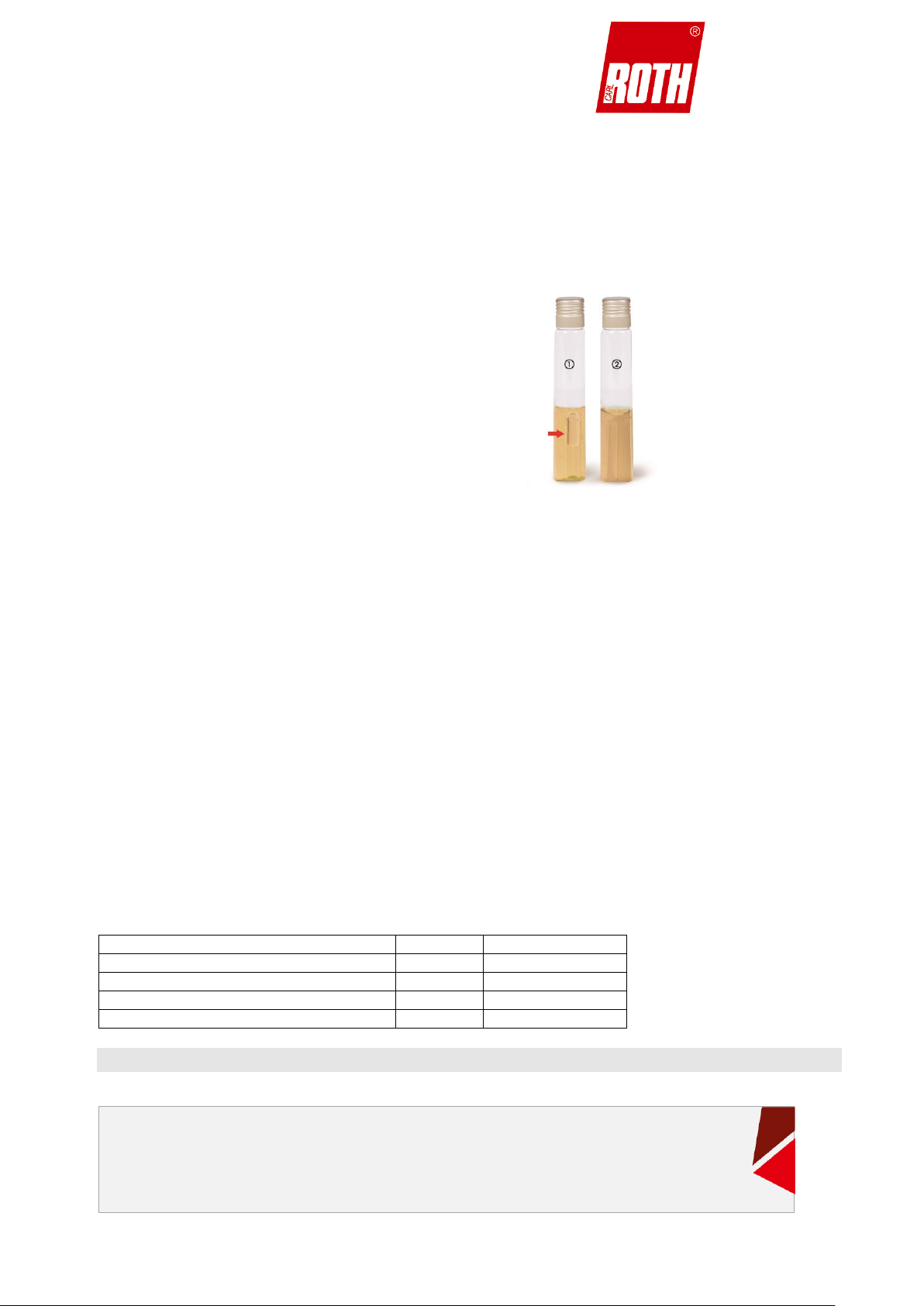
LACTOSE BROTH 500 g X921.1
1 - Escherichia coli
ATCC 25922
2 – uninoculated vial
Product Data Sheet
Carl Roth GmbH + Co. KG
Schoemperlenstraße 3-5 • 76185 Karlsruhe • P.O. Box 100121 • 76231 Karlsruhe
Phone: +49 (0) 721/ 5606-0 • Fax: +49 (0) 721/ 5606-149 • [email protected] • www.carlroth.com
The company is a limited partnership with headquarters in Karlsruhe, reg. court Mannheim HRA 100055. Roth Chemie GmbH, with headquarters in Karlsruhe,
reg. court Mannheim HRB 100428, is the personally liable partner. Managing Director: André Houdelet. Sales tax identification number: DE 143621073. sse 06/2021
 Loading...