

Page 1
Parameter Guide
© 2020 Roland Corporation
06
Page 2
Contents
Scene Parameter
:SCENE COMMON
:SCENE PART
:SCENE ZONE
:SCENE PART MFX
:SCENE EFFECT: Cho
Chorus Parameters
:SCENE EFFECT: Dly
Delay Parameters
:SCENE EFFECT: Rev
Reverb Parameters
:SCENE EFFECT: OD
:ARP COMMON
:ARP PART
.................................... 13
Tone Parameters
:TONE COMMON Parameters
:TONE Parameters
.............................. 3
.............................. 3
.................................. 4
.................................. 6
.............................. 7
(Chorus)
............................... 7
(Delay)
................................ 9
(Reverb)
............................... 10
(Overdrive)
................................ 11
.............................. 16
.............................. 19
...................... 7
....................... 9
....................... 10
..................... 11
..................... 16
System Parameters
:SYSTEM EFFECT: Cho
:SYSTEM EFFECT: Dly
:SYSTEM EFFECT: Rev
:SYSTEM EQ/COMP
:SYSTEM COLOR SET
:MODEL ASSIGN
MFX Parameters
:MFX List
:MFX Common Parameters
:Filter
:Phaser
:Flanger
:Chorus
:Modulation
:Drive / Amp
:Comp / Limiter
:Delay
:Looper
:Lo-
:Lo-
:Combination
:Note
..................................... 40
........................................ 41
....................................... 45
...................................... 47
...................................... 48
........................................ 57
...................................... 62
......................................... 62
......................................... 63
........................................ 75
............................. 38
............................... 39
.............................. 40
................................... 50
.................................. 52
................................ 56
................................. 64
............................ 34
........................... 37
........................... 37
........................... 37
............................ 38
....................... 41
2
Page 3
Part1
Part2
Part3
Part4
expression 127
expression 0
Value
0
127
Part1
Part3
Part4
expression 127
expression 0
Value
0
127
Part1
Part4
expression 127
expression 0
Value0
127
Part1
Part2
Part3
Part4
expression 127
expression 0
Value
0
127
Part1
Part3
Part4
expression 127
expression 0
Value
0
127
Part1
Part4
expression 127
expression 0
Value
0
127
Scene Parameter
SCENE COMMON
Parameter Value Explanation
Scene Level
Tempo
ASSIGN
SL1–SL2
S1–S3 Func
0–127 Adjusts the overall volume of the scene.
20.00–300.00
SL1, SL2 function assignments
OFF No function is assigned.
CC01–CC95 Controller number 1–95
AFT Aftertouch
BEND DOWN
BEND UP
CHO LEVEL Chorus level is assigned.
REV LEVEL Reverb level is assigned.
DLY LEVEL Delay level is assigned.
ARP SHUFFLE I-ARP’s G-Shue parameter is assigned.
ARP DURATION I-ARP’s G-Duration parameter is assigned.
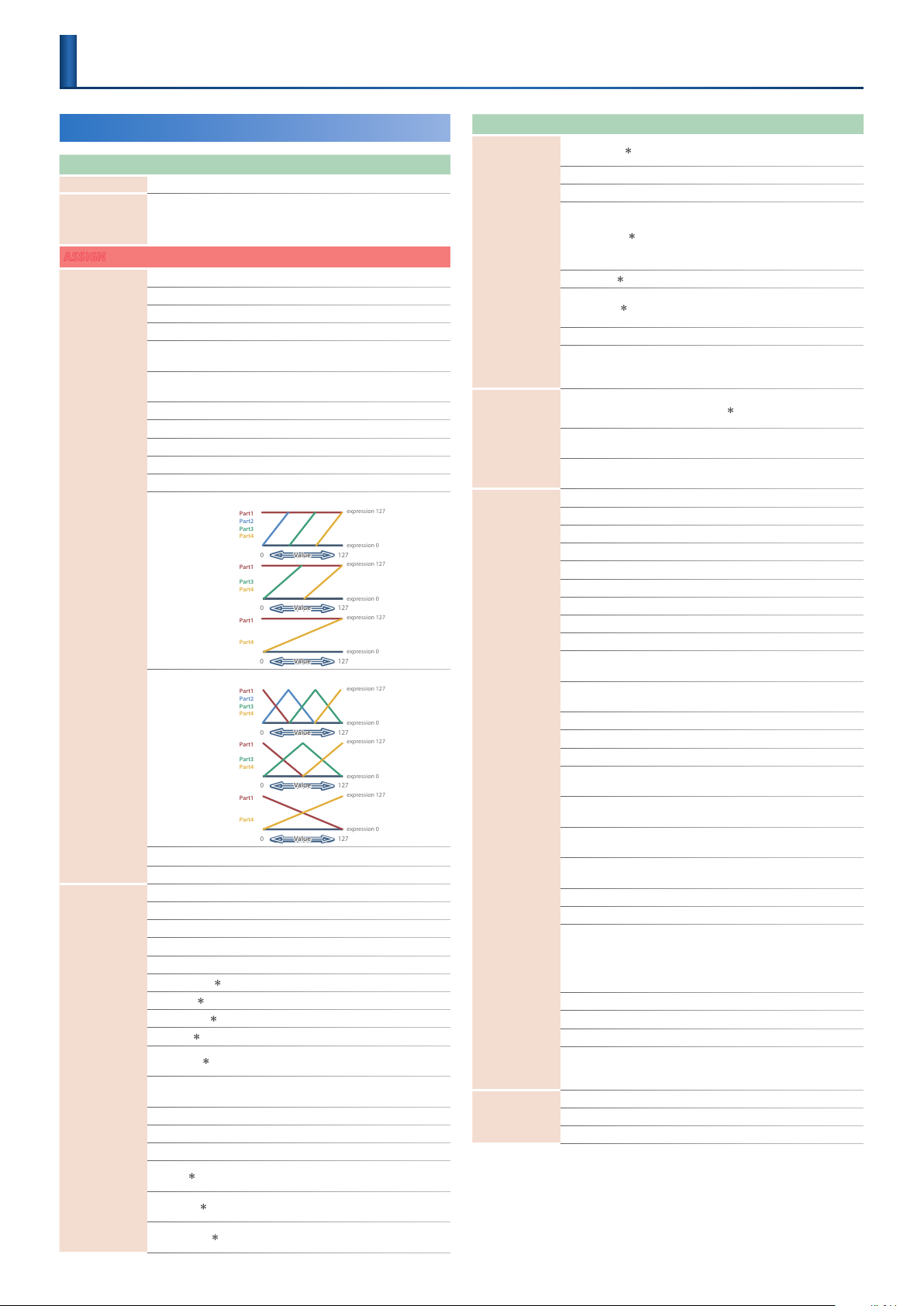
PART FADE1
PART FADE2
LEVEL P-1–P-R Each part’s volume is assigned.
AGE The SYSTEM > AGE parameter is assigned.
S1-S3 function assignments
OFF No function is assigned.
CC01–CC95 Controller number 1–95
AFT Aftertouch
MONO/POLY Mono/poly switch is assigned.
SCENE DOWN (
SCENE UP (
TONE DOWN (
TONE UP (
PANEL DEC (
PANEL INC
CHO SW Chorus on/o is assigned.
REV SW Reverb on/o is assigned.
DLY SW Delay on/o is assigned.
)
ARP SW (
ARP HOLD (
DETECT KEYS (
Species the tempo of the scene (including the
arpeggio).
* Hold down the [SHIFT] button while operating the
controller to edit the value in 0.01 increments.
Applies the same eect as when the pitch bend
wheel is moved downward.
Applies the same eect as when the pitch bend
wheel is moved upward.
Continuously
control the level of parts 1–4.
Continuously control the level of parts 1–4.
) Switch the scene to the previous number.
) Switch the scene to the next number.
) Switch the tone to the previous number.
) Switch the tone to the next number.
Applies the same eect as when the panel’s [DEC]
)
button is pressed.
Applies the same eect as when the panel’s [INC]
button is pressed.
Applies the same eect as when the panel’s
I-ARPEGGIO [ON/OFF] button is pressed.
Applies the same eect as when the panel’s
)
I-ARPEGGIO [HOLD] button is pressed.
Applies the same eect as when the panel’s
)
I-ARPEGGIO [KEYS] button is pressed.
Parameter Value Explanation
DETECT BEAT (
Applies the same eect as when the panel’s
)
I-ARPEGGIO [BEAT] button is pressed.
UNISON SW Unison on/o is assigned.
BEND MODE Switches the bend mode.
Executes tuning for the voice slot of a model that
simulates an analog synthesizer.
)
AUTO TUNING (
The tuning will be corrected in a few seconds,
but will subsequently return to the pitch
S1–S3 Func
TAP TEMPO (
START/STOP (
discrepancies specied by the tone parameters.
) Sets the tap tempo function.
Starts/stops the step editor.
)
* On version 1.30 or later, as the functions for S1–S3 in
step edit are xed, START/STOP cannot be assigned.
DRV SW Overdrive on/o is assigned.
When the Vocoder tone is selec ted, this selects
VOC/MIC
whether to use the vocoder sound or the mic input
sound.
Species the operation of the button.
* Buttons to which a function marked with “ ” is assigned will operate in LATCH
mode regardless of this setting.
S1–S3 Mode
LATCH
MOMENTARY
The assigned function is switched each time you
press the button.
The assigned function is eective only while you
hold down the button.
Hold pedal function assignments
OFF No function is assigned.
CC01–CC95 Controller number 1–95
AFT Aftertouch
MONO/POLY Mono/poly switch is assigned.
SCENE DOWN Switch the scene to the previous number.
SCENE UP Switch the scene to the next number.
TONE DOWN Switch the tone to the previous number.
TONE UP Switch the tone to the next number.
PANEL DEC
PANEL INC
Applies the same eect as when the panel’s [DEC]
button is pressed.
Applies the same eect as when the panel’s [INC]
button is pressed.
CHO SW Chorus on/o is assigned.
REV SW Reverb on/o is assigned.
DLY SW Delay on/o is assigned.
Hold
ARP SW
ARP HOLD
DETECT KEYS
DETECT BEAT
Applies the same eect as when the panel’s
I-ARPEGGIO [ON/OFF] button is pressed.
Applies the same eect as when the panel’s
I-ARPEGGIO [HOLD] button is pressed.
Applies the same eect as when the panel’s
I-ARPEGGIO [KEYS] button is pressed.
Applies the same eect as when the panel’s
I-ARPEGGIO [BEAT] button is pressed.
UNISON SW Unison on/o is assigned.
BEND MODE Switches the bend mode.
Executes tuning for the voice slot of a model that
simulates an analog synthesizer.
AUTO TUNING
The tuning will be corrected in a few seconds,
but will subsequently return to the pitch
discrepancies specied by the tone parameters.
TAP TEMPO Sets the tap tempo function.
START/STOP Starts/stops the step editor.
DRV SW Overdrive on/o is assigned.
When the Vocoder tone is selec ted, this selects
VOC/MIC
whether to use the vocoder sound or the mic input
sound.
Species the polarity of the pedal connected to the HOLD jack.
Hold Pole
STANDARD Species standard polarity.
REVERSE Species reverse polarity.
3
Page 4
Scene Parameter
Part1
Part2
Part3
Part4
expression 127
expression 0
Value
0
127
Part1
Part3
Part4
expression 127
expression 0
Value
0
127
Part1
Part4
expression 127
expression 0
Value0
127
Part1
Part2
Part3
Part4
expression 127
expression 0
Value
0
127
Part1
Part3
Part4
expression 127
expression 0
Value
0
127
Part1
Part4
expression 127
expression 0
Value0
127
Part1
Part2
Part3
Part4
expression 127
expression 0
Value
0
127
Part1
Part3
Part4
expression 127
expression 0
Value
0
127
Part1
Part4
expression 127
expression 0
Value
0
127
Part1
Part2
Part3
Part4
expression 127
expression 0
Value
0
127
Part1
Part3
Part4
expression 127
expression 0
Value
0
127
Part1
Part4
expression 127
expression 0
Value
0
127
Parameter Value Explanation
Ctrl pedal function assignments
OFF No function is assigned.
CC01–CC95 Controller number 1–95
AFT Aftertouch
BEND DOWN
BEND UP
Applies the same eect as when the pitch bend
wheel is moved downward.
Applies the same eect as when the pitch bend
wheel is moved upward.
CHO LEVEL Chorus level is assigned.
REV LEVEL Reverb level is assigned.
DLY LEVEL Delay level is assigned.
ARP SHUFFLE I-ARP’s G-Shue parameter is assigned.
ARP DURATION I-ARP’s G-Duration parameter is assigned.
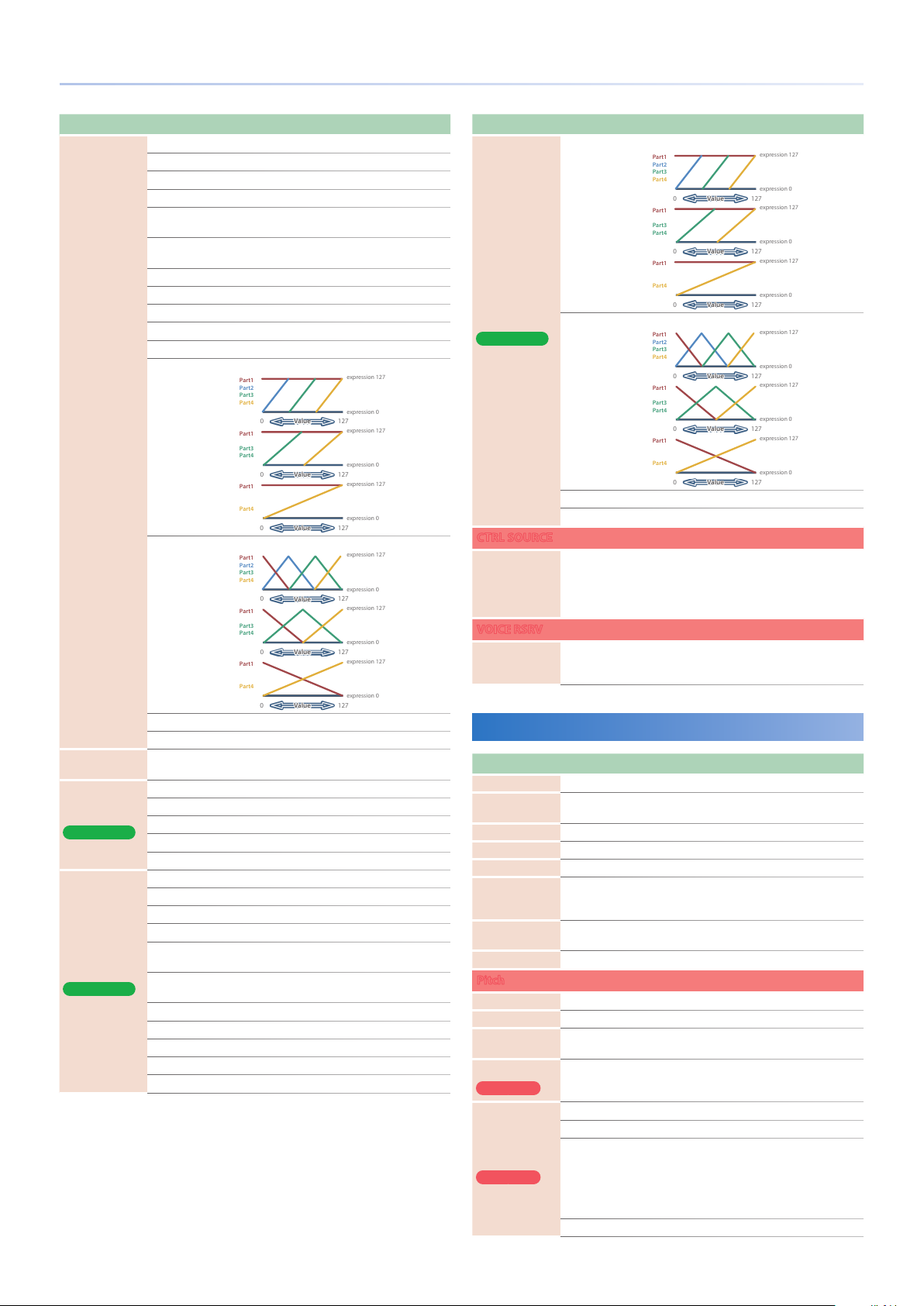
Continuously control the level of parts 1–4.
Ctrl
PART FADE1
Continuously control the level of parts 1–4.
PART FADE2
Parameter Value Explanation
Continuously control the level of parts 1–4.
PART FADE1
Wheel2
Continuously control the level of parts 1–4.
JUPITER-X only
PART FADE2
LEVEL P1–P5 Each part’s volume is assigned.
AGE The SYSTEM > AGE parameter is assigned.
CTRL SOURCE
OFF,
CC01–CC31,
CtrlSrc1–4
CC33–CC95,
BEND,
Specify the MIDI messages used for tone control.
AFT
VOICE RSRV
Part1–R
0–10
Species the number of voices reserved for
each part when the performance exceeds the
maximum polyphony.
Part XFade Pos
Wheel1
JUPITER-X only
Wheel2
JUPITER-X only
4
LEVEL P-1–P-R Each part’s volume is assigned.
AGE The SYSTEM > AGE parameter is assigned.
0–127
This parameter stores the current value of PART
FADE as a scene setting.
Wheel1 function assignments
OFF No function is assigned.
CC01–CC95 Controller number 1–95
AFT Aftertouch
BEND Pitch bend is assigned.
Wheel2 function assignments
OFF No function is assigned.
CC01–CC95 Controller number 1–95
AFT Aftertouch
BEND DOWN
BEND UP
Applies the same eect as when the pitch bend
wheel is moved downward.
Applies the same eect as when the pitch bend
wheel is moved upward.
CHO LEVEL Chorus level is assigned.
REV LEVEL Reverb level is assigned.
DLY LEVEL Delay level is assigned.
ARP SHUFFLE I-ARP’s G-Shue parameter is assigned.
ARP DURATION I-ARP’s G-Duration parameter is assigned.
SCENE PART
Parameter Value Explanation
Part Level
Pan
Rev Send
Cho Send
Delay Send
Output
Part Sw
Mute Sw
Pitch
Coarse Tune
Fine Tune
Oct Shift
Bend Range
Part 1–4 only
Bend Mode
Part 1–4 only
0–127 Species the volume of each part.
L64–63R
Species the pan of each part’s sound when
outputting in stereo.
0–127 Species the send level to reverb.
0–127 Species the send level to chorus.
0–127 Species the send level to delay.
THRU,
DRIVE
OFF, ON
Species whether the output of each part goes
through the OVER DRIVE eect (DRIVE) or does
not go through it (THRU).
Species whether the part is enabled (ON) or
disabled (OFF).
OFF, MUTE Species the part mute setting.
-48–+48 Shifts the pitch in units of a semitone.
-50–+50 Finely adjusts the pitch in units of one cent.
-3–+3
Shifts the pitch of the keyboard in units of one
octave.
Species the range of pitch change controlled by
0–24, TONE
pitch bend, in semitone units. To use the setting
of the tone, choose TONE.
Species the behavior when the pitch bend controller is operated.
NORMAL The conventional pitch bend eect occurs.
The pitch bend eect applies only to the
last-played note. If a note-on occurs while pitch
C+L (CATCH +
LAST)
bend is already applied, the new note sounds at
the center pitch. The pitch starts changing only
after the controller passes through the center
position.
TONE The tone’s settings are used.
Page 5

Scene Parameter
21 3 4
Parameter Value Explanation
(*1)
Pit Attack
Part 1–4 only
(*1)
Pit Decay
Part 1–4 only
Pit Sustain
Part 1–4 only
Pit Release
Part 1–4 only
Pit Env Depth
Part 1–4 only
-64– +63 Species the attack time of the pitch envelope.
-64– +63 Species the decay time of the pitch envelope.
(*1)
-64– +63 Species the sustain level of the pitch envelope.
(*1)
-64– +63 Species the release time of the pitch envelope.
(*1)
-64– +63 Species the depth of the pitch envelope.
FILTER
Part 1–4 only
(*1)
Flt Attack
(*1)
Flt Decay
Flt Sustain
Flt Release
Flt Env Depth
-64– +63 Species the attack time of the lter envelope.
-64– +63 Species the decay time of the lter envelope.
(*1)
-64– +63 Species the sustain level of the lter envelope.
(*1)
-64– +63 Species the release time of the lter envelope.
(*1)
-64– +63 Species the depth of the lter envelope.
Species the amount by which the keyboard pitch
Flt KeyFllw
(*1)
-64– +63
aects the cuto frequency (key follow). With
lower settings of this value, the cuto frequency
becomes lower as you play higher notes on the
keyboard.
AMP
Part 1–4 only
Amp Attack
Amp Decay
Amp Sustain
Amp Release
(*1)
-64– +63 Species the attack time of the amp envelope.
(*1)
-64– +63 Species the decay time of the amp envelope.
(*1)
-64– +63 Species the sustain level of the amp envelope.
(*1)
-64– +63 Species the release time of the amp envelope.
LFO
Part 1–4 only
Pit LFO Dep
Flt LFO Dep
Amp LFO Dep
(*1)
(*1)
(*1)
-64– +63
-64– +63
-64– +63
Species the amount by which the LFO aects the
pitch.
Species the amount by which the LFO aects the
cuto frequency.
Species the amount by which the LFO aects the
volume.
MODIFY
Cuto
Resonance
Attack
Decay
Release
Vib Rate
Part 1–4 only
Vib Depth
Part 1–4 only
(*1)
-64–+63
-64–+63
-64–+63
-64–+63
-64–+63
-64–+63
-64–+63
*1 There are valid when the model of tone assigned to part 1–4 is other than JUPITER-8,
JUNO-106, JX-8P, SH-101, RD-PIANO, or VOCODER.
Adjusts how far the lter is open.
Increasing this value makes the sound brighter,
and decreasing it makes the sound darker.
Emphasizes the portion of the sound in the region
of the cuto frequency, adding character to the
sound. Excessively high settings can produce
oscillation, causing the sound to distort.
Increasing this value strengthens the character,
and decreasing it weakens the character.
Adjusts the time over which the sound reaches its
maximum volume after you press the key.
Higher values produce a milder attack; lower
values produce a sharper attack.
Adjusts the time over which the volume decreases
from its maximum value.
Larger settings of this value make the decay
longer, and smaller settings make the decay
shorter.
The time it takes after the key is released for a
sound to become inaudible.
Larger settings of this value make the sound
linger, and smaller settings make the sound end
more sharply.
Adjusts the vibrato speed (the rate at which the
pitch is modulated).
The pitch will be modulated more rapidly for
higher settings, and more slowly with lower
settings.
Adjusts the depth of the vibrato eect (the depth
at which the pitch is modulated).
The pitch will be modulated more greatly for
higher settings, and less with lower settings.
Parameter Value Explanation
Adjusts the time until vibrato (pitch modulation)
Vib Delay
Part 1–4 only
-64–+63
starts to apply.
Higher settings will produce a longer delay
time before vibrato begins, while lower settings
produce a shorter time.
CTRL
Mono/Poly
Part 1–4 only
Legato Sw
Part 1–4 only
Porta Sw
Part 1–4 only
Porta Time
Part 1–4 only
Unison Sw
Part 1–4 only
Velo Sens
Voice Assign
KBD Velo
KBD Fixed Velo
Velo Curve
MONO,
POLY,
TONE
OFF,
ON,
TONE
OFF,
ON,
TONE
0–127,
TONE
OFF,
ON,
TONE
-63–+63
Sets the way sounds are played when the same key is pressed a
number of times.
SINGLE
LIMIT
FULL
REAL,
FIXED
1–127
OFF, 1–4
Choose “MONO” if you want the tone assigned to
the part to play monophonically, or “POLY” if you
want to play it polyphonically.
To use the setting of the tone, choose “ TONE.”
Legato can be applied when playing
monophonically. “Legato” is a playing technique
that smooths the transition between notes,
minimizing the sense of a gap between them.
The eect is similar to the guitar performance
techniques of hammering-on and pulling-o.
Choose “ON” to apply legato, or “OFF” if not.
Choose “TONE” if you want to use the setting
specied by the tone.
Species whether portamento is applied.
Select “ON” to apply portamento, or “OFF” if you
don’t want to apply portamento.
Choose “TONE” if you want to use the setting
specied by the tone.
When portamento is used, this species the time
over which the pitch will change. Higher settings
will cause the pitch change to the next note to
take more time.
Choose “TONE” if you want to use the setting
specied by the tone.
This layers a single sound.
Choose “ON” if you want to play using unison, or
“OFF” if not.
Choose “TONE” if you want to use the setting
specied by the tone.
Adjusts the velocity sensitivity.
Larger settings raise the sensitivity.
Only one sound can be played at a time when the
same key is pressed.
With continuous sounds where the sound plays
for an extended time, the previous sound is
stopped when the following sound is played.
Layers notes of the same key so that they sound
together.
If long-sustaining notes are played consecutively,
the previous notes are turned o after a certain
number of notes accumulate.
Layer the sound of the same keys.
Even with continuous sounds where the sound
plays for an extended time without previously
played sounds being eliminated.
Species whether the velocity value changes
according to the actual strength of your
playing (REAL) or is always a xed velocity value
regardless of how you play (FIXED).
Species the velocity value when KBD Velo is
“FIXED.”
For each part, select one of the following four
velocity curves as appropriate for the playing
touch of your MIDI keyboard. If you want to use
the velocity curve of this unit’s keyboard, choose
“OFF.”
5
Page 6
Scene Parameter
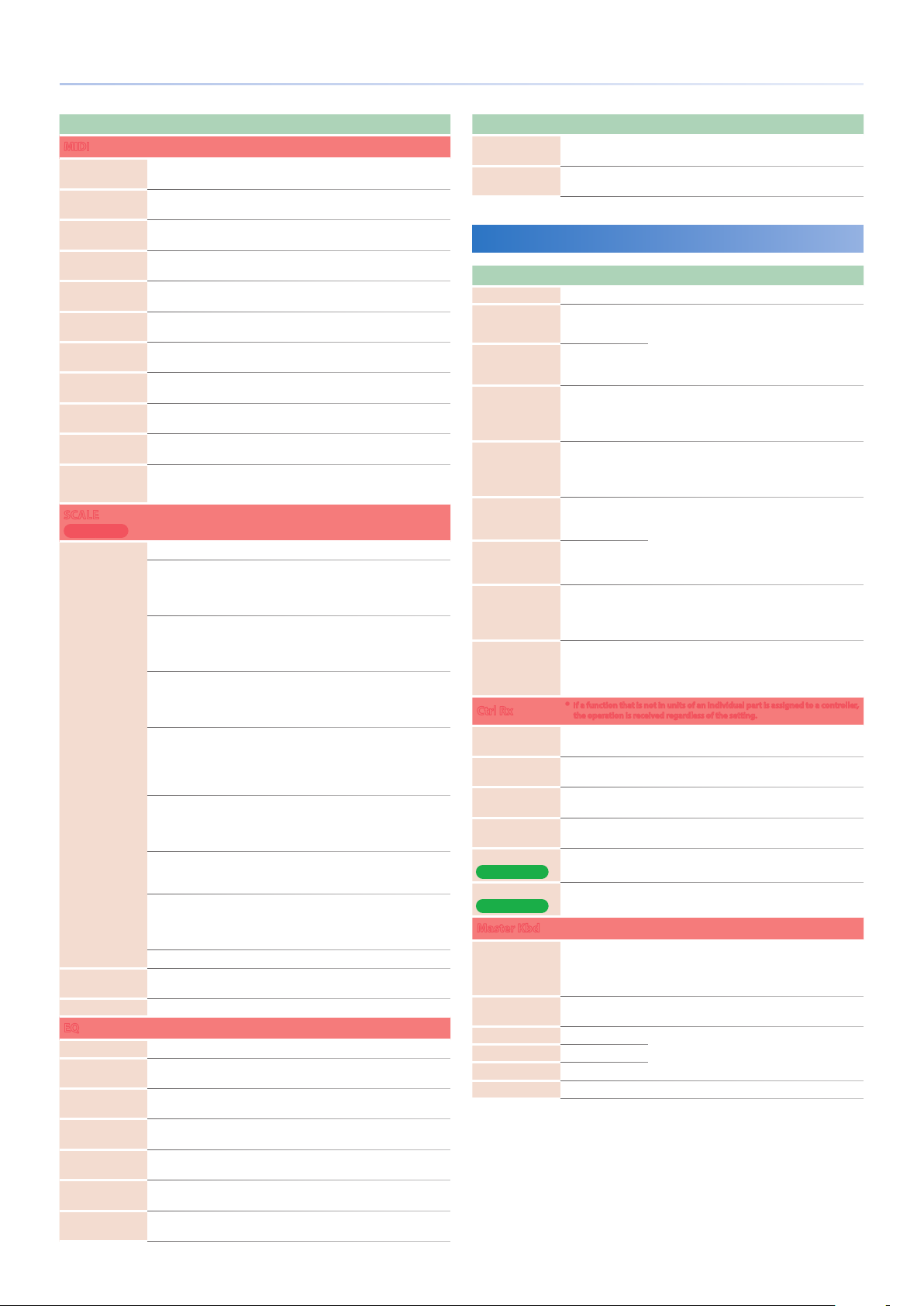
Parameter Value Explanation
MIDI
Rx PC
Rx Bank
Rx Bend
Rx Poly Pres
Rx Ch Pres
Rx Mod
Rx Volume
Rx Pan
Rx Exp
Rx Hold-1
Rx Ch
OFF, ON
OFF, ON
OFF, ON
OFF, ON
OFF, ON
OFF, ON
OFF, ON
OFF, ON
OFF, ON
OFF, ON
1–16
Species whether program change is received
(ON) or not received (OFF).
Species whether bank select is received (ON) or
not received (OFF).
Species whether pitch bend is received (ON) or
not received (OFF).
Species whether polyphonic aftertouch is
received (ON) or not received (OFF).
Species whether channel aftertouch is received
(ON) or not received (OFF).
Species whether modulation is received (ON) or
not received (OFF).
Species whether volume is received (ON) or not
received (OFF).
Species whether pan is received (ON) or not
received (OFF).
Species whether expression is received (ON) or
not received (OFF).
Species whether hold 1 is received (ON) or not
received (OFF).
Species the MIDI receive channel of each part.
* If Tx Mode is ON, this is also used as the MIDI transmit
channel setting.
SCALE
Part 1–4 only
CUSTOM Custom: This lets you create a custom scale.
Equal Temperament: This tuning divides an
octave into 12 equal parts.
Every interval produces about the same amount
of slight dissonance.
Just (Major): This scale eliminates dissonance in
fths and thirds. It is unsuited to playing melodies
and cannot be transposed, but is capable of
beautiful sonorities.
Just (Minor): The scales of the major and minor
just intonations are dierent. You can get the
same eect with the minor scale as with the
major scale.
Pythagorean: This scale, devised by the
philosopher Pythagoras, eliminates dissonance in
fourths and fths.
Dissonance is produced in thirds, but melodies
are euphonious.
Kirnberger: This scale is a modication of the
meantone and just intonations that permits
greater freedom in transposition to other keys.
Performances are possible in all keys (III).
Meantone: This scale makes some compromises
in just intonation, enabling transposition to other
keys.
Werckmeister: This is a combination of the
Meantone and Pythagorean scales.
Performances are possible in all keys (rst
technique, III).
Sets the keynote.
Type
Key
C–B
EQUAL
JUST-MAJ
JUST-MIN
PYTHAGORE
KIRNBERGE
MEANTONE
WERCKMEIS
ARABIC Arabic Scale: This scale is suitable for Arabic music.
C, C#, D, D#, E, F,
F#, G, G#, A, A#, B
-64–+63 Finely adjusts the pitch.
EQ
Switch
In Gain
Low Gain
Low Freq
Mid Gain
Mid Freq
Mid Q
OFF, ON Turns the equalizer (EQ) on/o.
-24–+24 [dB]
-24–+24 [dB]
20–16000 [Hz]
-24–+24 [dB]
20–16000 [Hz]
0.5–16.0
Species the amount of boost/cut for the input
sound.
Species the amount of boost/cut for the
low-frequency region.
Species the frequency of the low-frequency
region.
Species the amount of boost/cut for the
mid-frequency region.
Species the frequency of the mid-frequency
region.
Species the width of the mid-frequency region.
Higher values produce a narrower width.
Parameter Value Explanation
High Gain
High Freq
-24–+24 [dB]
20–16000 [Hz]
Species the amount of boost/cut for the
high-frequency region.
Species the frequency of the high-frequency
region.
SCENE ZONE
Parameter Value Explanation
Keyboard Sw
Key Rng Low
Key Rng Upp
Key Fade Low
Key Fade Upp
Velo Rng Low
Velo Rng Upp
Velo FadeLow
Velo FadeUpp
Ctrl Rx
Rx S1 -S3
Rx SL1 -SL2
Rx HoldPdl
Rx CtrlPdl
Rx Wheel1
JUPITER-X only
Rx Wheel2
JUPITER-X only
Master Kbd
Tx Mode
Mkb Ch
Mkb MSB
Mkb LSB
Mkb PC
Mkb Volume
OFF, ON Turns on/o the part played by the keyboard.
C-–G9
C-–G9
0–127
0–127
1–127
1–127
0–127
0–127
* If a function that is not in units of an individual part is assigned to a controller,
the operation is received regardless of the setting.
OFF, ON
OFF, ON
OFF, ON
OFF, ON
OFF, ON
OFF, ON
ON,
OFF,
MKB
1–16
OFF, 0–127
OFF, 0–127
OFF, 1–128
OFF, 0–127 Adjusts the volume of an external MIDI device.
Set the keyboard range in which each part will
sound.
Make these settings when you want dierent key
ranges to play dierent tones.
Specify the lower limit (Key Rng Low) and upper
limit (Key Rng Upp) of the key range.
Species the degree to which the part is sounded
by notes played below the Key Rng Low. If you
don’t want the tone to sound at all, set this
parameter to “0.”
Species the degree to which the part is sounded
by notes played above the Key Rng Upp. If you
don’t want the tone to sound at all, set this
parameter to “0.”
Specify the lower limit (Velo Rng Low) and upper
limit (Velo Rng Upp) of the velocities that will
sound the tone.
Make these settings when you want dierent
tones to sound depending on keyboard playing
dynamics.
Species the degree to which the part is sounded
by notes played more softly than Velo Rng Low.
If you don’t want the tone to sound at all, set this
parameter to “0.”
Species the degree to which the part is sounded
by notes played more strongly than Velo Rng Upp.
If you don’t want the tone to sound at all, set this
parameter to “0.”
Species whether [S1]–[S3] button operations are
received (ON) or not received (OFF).
Species whether [SL1], [SL2] slider operations are
received (ON) or not received (OFF).
Species whether hold pedal operations are
received (ON) or not received (OFF).
Species whether Ctrl pedal operations are
received (ON) or not received (OFF).
Species whether [WHEEL 1] wheel operation is
received (ON) or not received (OFF).
Species whether [WHEEL 2] wheel operation is
received (ON) or not received (OFF).
Species whether MIDI messages are transmitted
(ON) or not transmitted (OFF).
If you’re using this unit as a master keyboard,
choose “MKB.”
Species the transmit channel for MIDI messages
of the keyboard part.
Here you can enter numerical values for program
number and bank select MSB/LSB to switch
sounds on an external MIDI device.
6
Page 7
Scene Parameter
SCENE PART MFX
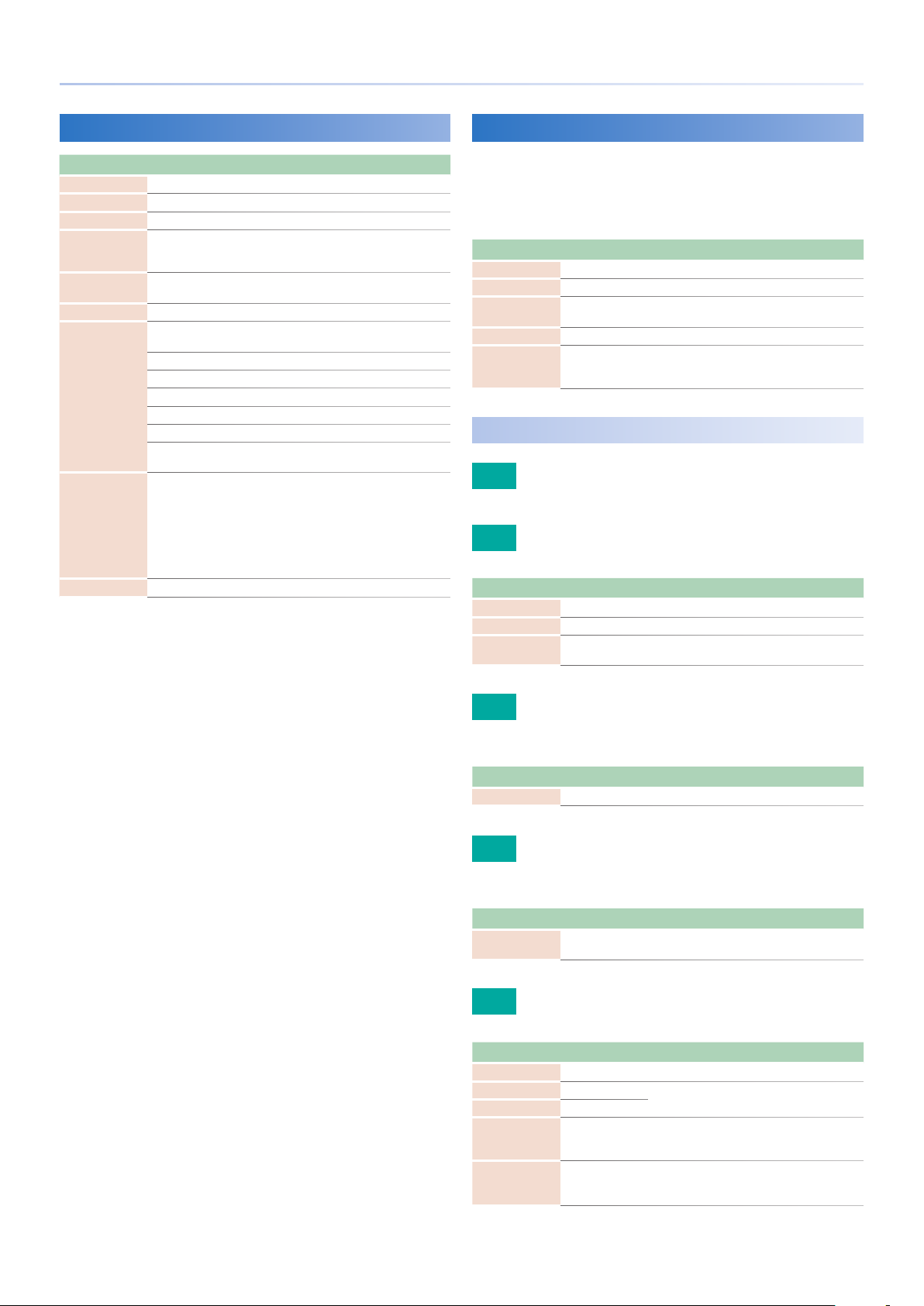
Parameter Value Explanation
FllwToneMFX
Type
Switch
Cho Send
Rev Send
MFX Parameters
Src1–4
Sens1–4
Asgn1–4
* These parameters are not shown if the model assigned to the part is RD-PIANO.
OFF, ON If this is OFF, the following parameters are shown.
“MFX List” (p. 40)
&
OFF, ON Switches the MFX on/o.
0–127
0–127
“MFX List” (p. 40)
&
Species the MIDI message that will control the corresponding MFX
CONTROL parameter.
OFF MFX CONTROL will not be used.
CC01–31 Controller number 1–31
CC33–95 Controller number 33–95
BEND Pitch bend
AFT Aftertouch
SYS-CTRL1–4
-63–+63
“MFX List” (p. 40)
&
Adjusts the amount of chorus.
If you don’t want to add the chorus eect, set it
to 0.
Adjusts the amount of reverb.
If you don’t want to add the reverb eect, set it to 0.
Use the controller that is assigned by the System
Control Source 1–4.
Species the depth of MFX CONTROL.
Specify a positive (+) value if you want to change
the value of the assigned destination in a positive
direction (larger, toward the right, faster, etc.), or
specify a negative (-) value if you want to change
the value in a negative direction (smaller, toward
the left, slower, etc.). Larger values will allow a
greater amount of control.
SCENE EFFECT: Cho (Chorus)
If the “SYSTEM EFFECT: Cho” (p. 37) Source parameter is set to “SCENE,”
the following parameters are shown, allowing you to edit the chorus type
and other parameters.
If the parameter is set to “SYS,” the screen indicates “Source is System.,”
and the following parameters are not shown.
Parameter Value Explanation
Switch
ChoType
Level
Rev Send
Chorus Parameters
Chorus Parameters
00
01
This is a stereo chorus.
Parameter Value Explanation
Rate
Depth
Feedback
OFF, ON Switches chorus on/o.
“Chorus Parameters” (p. 7)
&
0–127
0–127 Species the send level to reverb.
Edit the parameters of the selected chorus. The available parameters
dier depending on the type of chorus you selected in ChoType.
“Chorus Parameters” (p. 7)
&
Species the output level of the sound with
chorus applied.
OFF
Chorus
0–127 Frequency of modulation
0–127 Depth of modulation
0–127
Level at which chorus sound is returned to the
input
(Chorus)
CE-1
02
This models the classic BOSS CE-1 chorus eect unit. It provides a chorus
sound with a distinctively analog warmth.
Parameter Value Explanation
Intensity
03
0–127 Chorus depth
SDD-320
(Dimension D)
This models Roland’s DIMENSION D (SDD-320). It provides a clear chorus
sound.
Parameter Value Explanation
Mode
04
1, 2, 3, 4, 1+4, 2+4,
3+4
Delay
Switches the mode.
This is a stereo delay.
Parameter Value Explanation
Dly Sync
Dly Msec
Dly Note
Feedback
HF Damp
OFF, ON If this is ON, the delay synchronizes with the tempo.
1–1300
Note
-98–+98 [%]
200–8000 [Hz],
BYPASS (*1)
Adjusts the delay time from the direct sound until
the delay sound is heard.
Adjusts the proportion of the delay sound that is
fed back into the eect. Negative (-) settings will
invert the phase.
Adjusts the frequency above which the delay
sound fed back to the eect is ltered out (BYPASS:
no cut).
7
Page 8

Scene Parameter
05
T-Ctrl Dly
(Time Control Delay)
A stereo delay in which the delay time can be varied smoothly.
Parameter Value Explanation
Dly Sync
Dly Msec
Dly Note
Acceleration
Feedback
HF Damp
06
OFF, ON If this is ON, the delay synchronizes with the tempo.
1–1300
Note
0–15
-98–+98 [%]
200–8000 [Hz],
BYPASS (*1)
Delay 0 Trem
Adjusts the delay time from the direct sound until
the delay sound is heard.
When you change the delay time, this species the
time over which the current delay time changes to
the specied delay time. This aects the speed of
pitch change as well as the delay time.
Adjusts the proportion of the delay sound that is
fed back into the eect. Negative (-) settings will
invert the phase.
Adjusts the proportion of the delay sound that is
fed back into the eect. Negative (-) settings will
invert the phase.
(Delay
0
Tremolo)
Tremolo is applied to the delay sound.
Parameter Value Explanation
Input
Dly Sync
Dly Msec
Dly Note
Feedback
HF Damp
Trm Switch
Trm ModWave
Trm Sync
Trm Hz
Trm Note
Trm Depth
07
MONAURAL The input is mono-mixed.
STEREO The sound is input in stereo.
OFF, ON If this is ON, the delay synchronizes with the tempo.
1–1300
Note
-98–+98 [%]
200–8000 [Hz],
BYPASS (*1)
OFF, ON Switches the tremolo eect on/o
Modulation Wave
TRI Triangle wave
SQR Square wave
SIN Sine wave
SAW1
SAW2
TRP Trapezoidal wave
OFF, ON
0.05–10.00 [Hz]
Note
0–127 Adjusts the tremolo depth.
2Tap PanDly
Adjusts the delay time from the direct sound until
the delay sound is heard.
Adjusts the proportion of the delay sound that is
fed back into the eect. Negative (-) settings will
invert the phase.
Adjusts the frequency above which the ltered
out (BYPASS: no cut).
Sawtooth wave
If this is ON, the tremolo synchronizes with the
tempo.
Adjusts the tremolo rate.
(2 Tap Pan Delay)
08
3Tap PanDly
(3 Tap Pan Delay)
Delayed sound is heard from the three locations you specify.
Parameter Value Explanation
Dly Sync
Dly Msec
Dly Note
Feedback
HF Damp
Dly1 Pan
Dly2 Pan
Dly3 Pan
Dly1 Level
Dly2 Level
Dly3 Level
09
OFF, ON If this is ON, the delay synchronizes with the tempo.
1–2600
Note
-98–+98 [%]
200–8000 [Hz],
BYPASS (*1)
L64–63R Adjusts the stereo location of delay 1.
L64–63R Adjusts the stereo location of delay 2.
L64–63R Adjusts the stereo location of delay 3.
0–127 Adjusts the volume of delay 1.
0–127 Adjusts the volume of delay 2.
0–127 Adjusts the volume of delay 3.
JUNO Chorus
Adjusts the delay time from the direct sound until
the third delay sound is heard.
Adjusts the proportion of the delay sound that is
fed back into the eect. Negative (-) settings will
invert the phase.
Adjusts the frequency above which the delay
sound fed back to the eect is ltered out (BYPASS:
no cut).
(JUNO-106 Chorus)
This models the chorus eects of the Roland JUNO-106.
Parameter Value Explanation
Mode
Noise Level
10
Parameter Value Explanation
Filter Type
Cuto Freq
Pre Delay
Rate Sync
Rate Hz
Rate Note
Depth
Phase
Feedback
I, II, I+II, JX I, JX II
0–127 Amount of noise produced by the chorus
JV Chorus
OFF The lter is not used.
LPF This lter cuts o the high frequencies.
HPF This lter cuts o the low frequencies.
200–8000 [Hz]
0.0–100.0 [ms]
OFF, ON
0.05–10.00 [Hz]
Note
0–127 Adjusts the depth of modulation.
0–180 [deg] Adjusts the depth of the chorus sound.
0–127
Type of Chorus
I+II: The state when two buttons are pressed
simultaneously.
Adjusts the center frequency used when the lter
cuts a specic frequency region.
Adjusts the delay time from when the direct
sound plays until the reverb sound is heard.
When this is ON, the delay synchronizes with the
tempo.
Adjusts the frequency of modulation.
Adjusts how much of the sound that is fed into
the chorus is returned to the input.
Delayed sound is heard from the two locations you specify.
Parameter Value Explanation
Dly Sync
Dly Msec
Dly Note
Feedback
HF Damp
Dly1 Pan
Dly2 Pan
Dly1 Level
Dly2 Level
OFF, ON If this is ON, the delay synchronizes with the tempo.
1–1300
Note
-98–+98 [%]
200–8000 [Hz],
BYPASS (*1)
L64–63R Adjusts the stereo location of delay 1.
L64–63R Adjusts the stereo location of delay 2.
0–127 Adjusts the volume of delay 1.
0–127 Adjusts the volume of delay 2.
Adjusts the delay time from the direct sound until
the second delay sound is heard.
Adjusts the proportion of the delay sound that is
fed back into the eect. Negative (-) settings will
invert the phase.
Adjusts the frequency above which the delay
sound fed back to the eect is ltered out (BYPASS:
no cut).
8
NOTE
Note 1/64T, 1/64, 1/32T, 1/32, 1/16T, 1/32., 1/16, 1/8T, 1/16., 1/8, 1/4T, 1/8., 1/4, 1/2T, 1/4.,
1/2, 1T, 1/2., 1, 2T, 1., 2
(*1) 200, 250, 315, 400, 500, 630, 800, 1000, 1250, 1600, 2000, 2500, 3150, 4000, 5000,
6300, 8000 [Hz], BYPASS
Page 9
Scene Parameter
SCENE EFFECT: Dly (Delay)
If the “SYSTEM EFFECT: Dly” (p. 37) Source parameter is set to “SCENE,”
the following parameters are shown, allowing you to edit the delay type
and other parameters.
If the parameter is set to “SYS,” the screen indicates “Source is System.,”
and the following parameters are not shown.
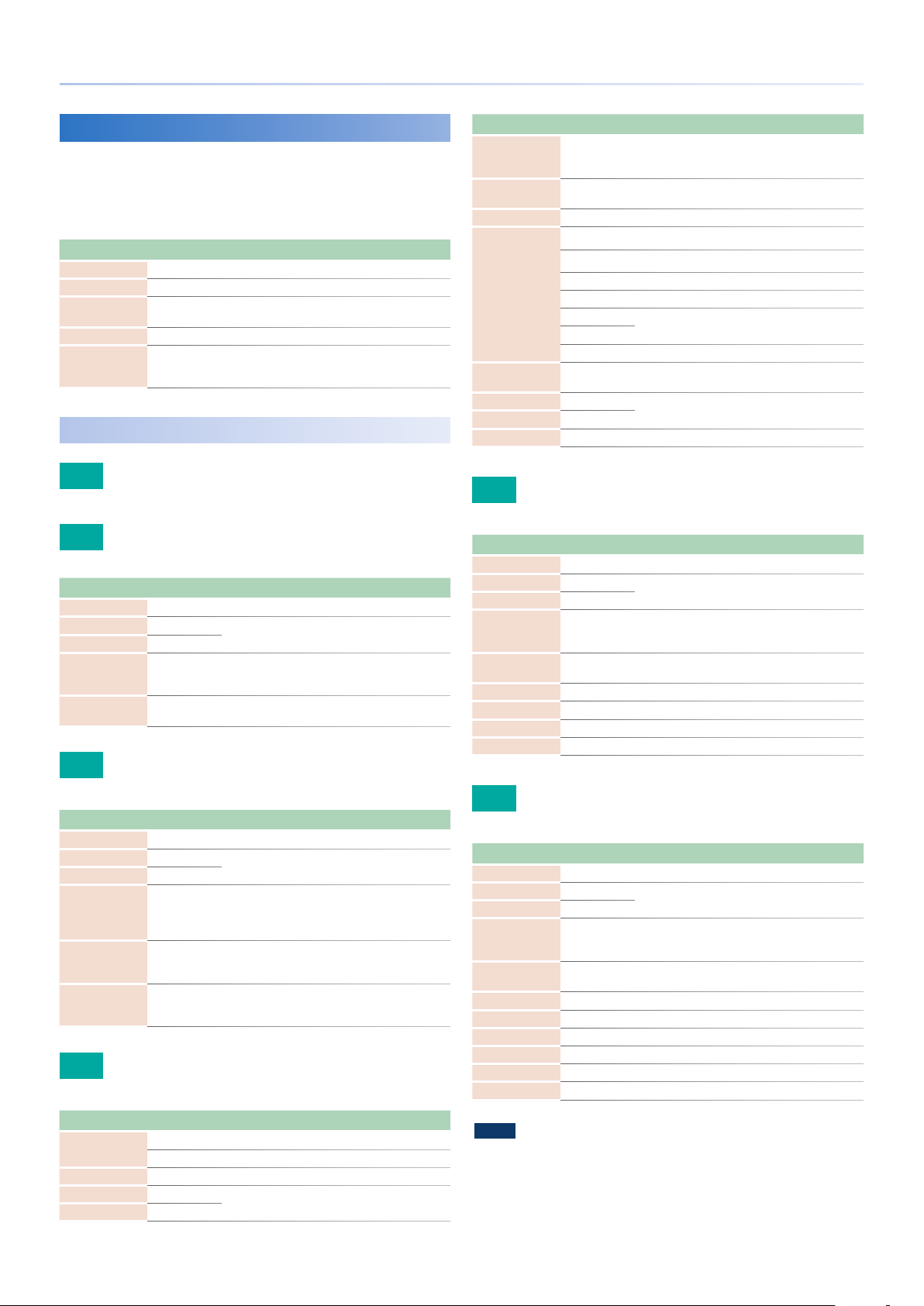
Parameter Value Explanation
Switch
DlyType
Level
Rev Send
Delay parameters
Delay Parameters
00
01
This is a stereo delay.
Parameter Value Explanation
Dly Sync
Dly Msec
Dly Note
Feedback
HF Damp
02
OFF, ON Switches the delay on/o.
“Delay Parameters” (p. 9)
&
0–127
0–127 Species the send level to reverb.
Edit the parameters of the selected delay. The available parameters
dier depending on the type of chorus you selected in DlyType.
“Delay Parameters” (p. 9)
&
Species the output level of the sound with delay
applied.
OFF
Delay
OFF, ON If this is ON, the delay synchronizes with the tempo.
1–1300
Note
-98–+98 [%]
200–8000 [Hz],
BYPASS (*1)
T-Ctrl Dly
(Time Control Delay)
Adjusts the delay time from the direct sound until
the delay sound is heard.
Adjusts the proportion of the delay sound that is fed
back into the eect. Negative (-) settings will invert
the phase.
Adjusts the frequency above which the delay sound
fed back to the eect is ltered out (BYPASS: no cut).
Parameter Value Explanation
Feedback
HF Damp
Trm Switch
Trm ModWave
Trm Sync
Trm Hz
Trm Note
Trm Depth
2Tap PanDly
04
-98–+98 [%]
200–8000 [Hz],
BYPASS (*1)
OFF, ON Switches the tremolo eect on/o
Modulation Wave of panning
TRI Triangle wave
SQR Square wave
SIN Sine wave
SAW1
SAW2
TRP Trapezoidal wave
OFF, ON
0.05–10.00 [Hz]
Note
0–127 Tremolo depth
Adjusts the proportion of the delay sound that is fed
back into the eect. Negative (-) settings will invert
the phase.
Adjusts the frequency above which the ltered out
(BYPASS: no cut).
Sawtooth wave
If this is ON, the tremolo synchronizes with the
tempo.
Adjusts the tremolo rate.
(2 Tap Pan Delay)
Delayed sound is heard from the two locations you specify.
Parameter Value Explanation
Dly Sync
Dly Msec
Dly Note
Feedback
HF Damp
Dly1 Pan
Dly2 Pan
Dly1 Level
Dly2 Level
OFF, ON If this is ON, the delay synchronizes with the tempo.
1–1300
Note
-98–+98 [%]
200–8000 [Hz],
BYPASS (*1)
L64–63R Adjusts the stereo location of delay 1.
L64–63R Adjusts the stereo location of delay 2.
0–127 Adjusts the volume of delay 1.
0–127 Adjusts the volume of delay 2.
Adjusts the delay time from the direct sound until
the second delay sound is heard.
Adjusts the proportion of the delay sound that is fed
back into the eect. Negative (-) settings will invert
the phase.
Adjusts the frequency above which the delay sound
fed back to the eect is ltered out (BYPASS: no cut).
A stereo delay in which the delay time can be varied smoothly.
Parameter Value Explanation
Dly Sync
Dly Msec
Dly Note
Acceleration
Feedback
HF Damp
03
OFF, ON If this is ON, the delay synchronizes with the tempo.
1–1300
Note
0–15
-98–+98 [%]
200–8000 [Hz],
BYPASS (*1)
Delay 0 Trem
Adjusts the delay time from the direct sound until
the delay sound is heard.
When you change the delay time, this species the
time over which the current delay time changes to
the specied delay time. This aects the speed of
pitch change as well as the delay time.
Adjusts the proportion of the delay sound that is fed
back into the eect. Negative (-) settings will invert
the phase.
Adjusts the proportion of the delay sound that is fed
back into the eect. Negative (-) settings will invert
the phase.
(Delay
0
Tremolo)
Tremolo is applied to the delay sound.
Parameter Value Explanation
Input
Dly Sync
Dly Msec
Dly Note
MONAURAL The input is mono-mixed.
STEREO The sound is input in stereo.
OFF, ON If this is ON, the delay synchronizes with the tempo.
1–1300
Note
Adjusts the delay time from the direct sound until
the delay sound is heard.
05
3Tap PanDly
(3 Tap Pan Delay)
Delayed sound is heard from the three locations you specify.
Parameter Value Explanation
Dly Sync
Dly Msec
Dly Note
Feedback
HF Damp
Dly1 Pan
Dly2 Pan
Dly3 Pan
Dly1 Level
Dly2 Level
Dly3 Level
NOTE
Note 1/64T, 1/64, 1/32T, 1/32, 1/16T, 1/32., 1/16, 1/8T, 1/16., 1/8, 1/4T, 1/8., 1/4, 1/2T, 1/4.,
1/2, 1T, 1/2., 1, 2T, 1., 2
(*1) 200, 250, 315, 400, 500, 630, 800, 1000, 1250, 1600, 2000, 2500, 3150, 4000, 5000,
6300, 8000 [Hz], BYPASS
OFF, ON If this is ON, the delay synchronizes with the tempo.
1–2600
Note
-98–+98 [%]
200–8000 [Hz],
BYPASS (*1)
L64–63R Adjusts the stereo location of delay 1.
L64–63R Adjusts the stereo location of delay 2.
L64–63R Adjusts the stereo location of delay 3.
0–127 Adjusts the volume of delay 1.
0–127 Adjusts the volume of delay 2.
0–127 Adjusts the volume of delay 3.
Adjusts the delay time from the direct sound until
the third delay sound is heard.
Adjusts the proportion of the delay sound that is fed
back into the eect. Negative (-) settings will invert
the phase.
Adjusts the frequency above which the delay sound
fed back to the eect is ltered out (BYPASS: no cut).
9
Page 10
Scene Parameter
SCENE EFFECT: Rev (Reverb)
If the “SYSTEM EFFECT: Rev” (p. 37) Source parameter is set to “SCENE,”
the following parameters are shown, allowing you to edit the reverb type
and other parameters.
If the parameter is set to “SYS,” the screen indicates “Source is System.,”
and the following parameters are not shown.
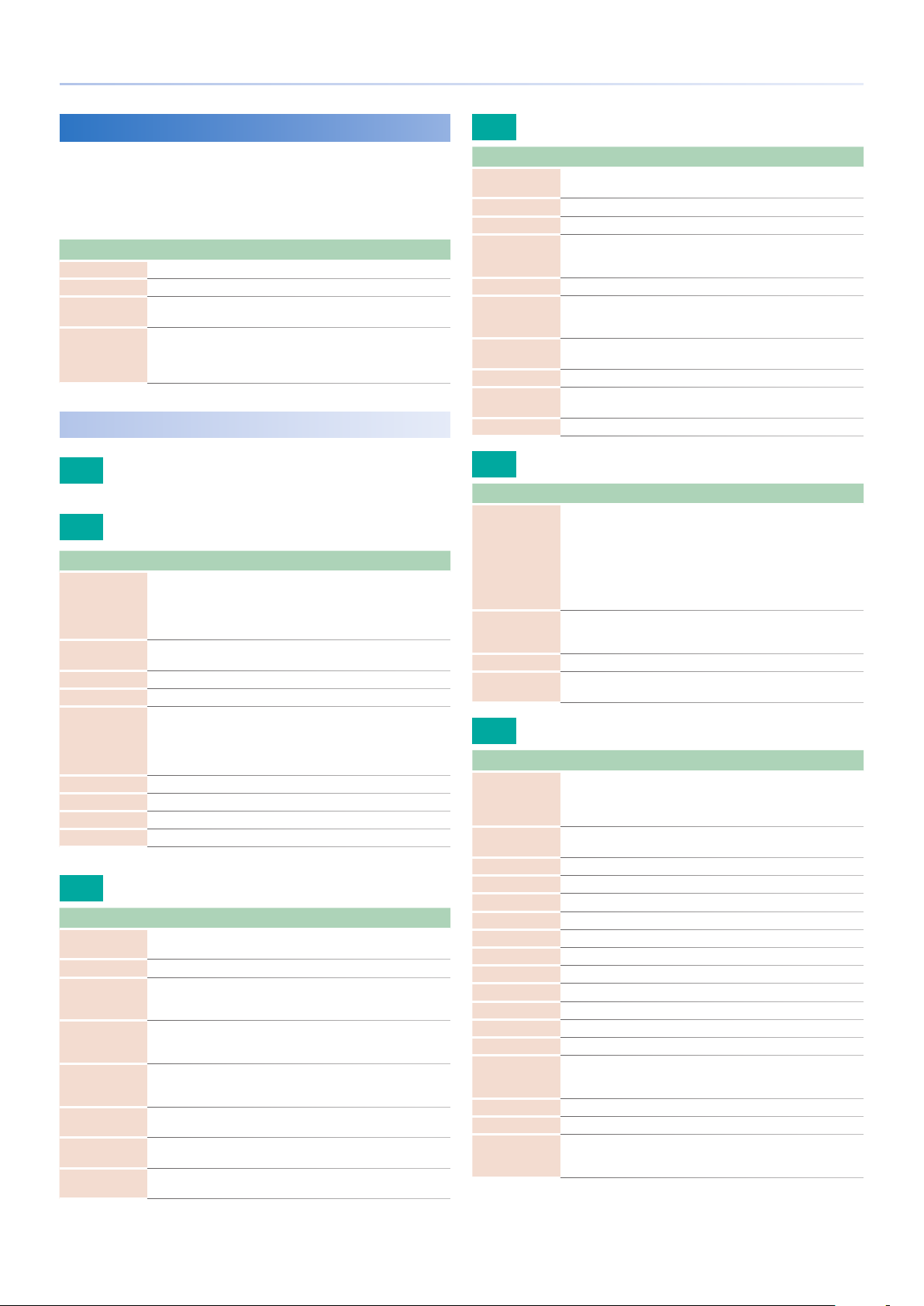
Parameter Value Explanation
Switch
RevType
Level
Reverb Parameters
Reverb Parameters
00
01
Parameter Value Explanation
Char
PreDelay
Time
Density
Diusion
LF Damp
HF Damp
Spread
Tone
02
Parameter Value Explanation
PreDelay
Time
Pre LPF
Pre HPF
PreLpLPF
Diusion
HF Damp F
HF Damp R
OFF, ON Switches the reverb on/o.
“Reverb Parameters” (p. 10)
&
0–127
Edit the parameters of the selected reverb type. The available
parameters dier depending on the type of reverb you selected in
ReveType.
“Reverb Parameters” (p. 10)
&
Species the output level of the sound with reverb
applied.
OFF
INTEGRA7Rev
ROOM1,
ROOM2,
HALL1,
HALL2,
PLATE
0–100
0.1–10.0 [sec] Adjusts the decay length of the reverb sound.
0–127 Adjusts the density of the reverb sound.
0–127
0–100 Adjusts the low-frequency portion of the reverb.
0–100 Adjusts the high-frequency portion of the reverb.
0–127 Adjusts the reverb spread.
0–127 Adjust the tonal character of the reverb.
(INTEGRA 7 Reverb)
Selects the type of reverb.
Adjusts the delay time from the direct sound
until the reverb sound is heard.
Adjusts the change in the density of the reverb
over time. The higher the value, the more the
density increases with time.
(The eect of this setting is most pronounced
with long reverb times.)
Warm Hall
0.0–100.0
0.3–30.0 [sec] Adjusts the decay length of the reverb sound.
16–15000 [Hz],
BYPASS (*1)
16–15000 [Hz],
BYPASS, (*2)
16–15000 [Hz],
BYPASS (*1)
0–127
1000–8000 [Hz] (*3)
0.1–1.0
Adjusts the delay time from the direct sound
until the reverb sound is heard.
Frequency above which to cut the
high-frequency portion of the sound entering
the reverb
Frequency below which to cut the
low-frequency portion of the sound entering
the reverb
Frequency above which to cut the
high-frequency portion of the extended
reverberation
Adjusts the change in the density of the reverb
over time.
Adjusts the frequency above which to cut the
high-frequency portion of the reverb.
Adjusts the amount by which to attenuate the
high-frequency portion of the reverb.
Hall
03
Parameter Value Explanation
PreDelay
Time
Size
High Cut
Density
Diusion
LF Damp F
LF Damp G
HF DampF
HF Damp G
04
Parameter Value Explanation
Char
Pre LPF
Time
Feedback
05
Parameter Value Explanation
Selection
PreDelay
Time
HF Damp
Density
Attack Gain
Attack Time
ER Density
ER Level
Low Freq
Low Gain
Mid Freq
Mid Gain
Mid Q
HighFreq
HighGain
High Q
0.0–100.0
0–127 Adjusts the decay length of the reverb sound.
1–8 Size of room/hall
160–12500 [Hz],
BYPASS (*4)
0–127 Adjusts the density of the reverb sound.
0–127
50–4000 [Hz] (*5)
-36–0 [dB] LF damp attenuation amount (0: no eect)
4000–12500 [Hz]
(*6)
-36–0 [dB] HF damp attenuation amount (0: no eect)
GS Reverb
ROOM1,
ROOM2,
ROOM3,
HALL1,
HALL2,
PLATE,
DELAY,
PAN-DELAY
0–7
0–127 Adjusts the decay length of the reverb sound.
0–127
SRV-2000
R0.3, R1.0, R7.0,
R15, R22, R26, R32,
R37, H15, H22, H26,
H32, H37, P-B, P-A
0–160
0.1–99.0 [sec] Adjusts the decay length of the reverb sound.
0.05–1.00 Adjusts the high-frequency portion of the reverb.
0–9 Adjusts the density of the late reverberation.
0–9 Adjusts the gain of the early reections.
0–9 Adjusts the time of the early reections.
0–9 Adjusts the density of the early reections.
0–99 Adjusts the volume of the early reections.
0.04–1.00 [kHz] Frequency of the low range.
-24–+12 [dB] Gain of the low range.
0.25–9.99 [kHz] Frequency of the middle range.
-24–+12 [dB] Gain of the middle range.
0.2–9.0
0.80–9.99 [kHz] Frequency of the high range.
-24–+12 [dB] Gain of the high range
0.2–9.0
Adjusts the delay time from the direct sound until
the reverb sound is heard.
Adjusts the frequency above which the
high-frequency portion of the nal output sound
is cut (BYPASS: no cut)
Adjusts how reverb density increases over time.
(This eect is especially noticeable with long
reverb times.)
Adjusts the frequency below which the
low-frequency portion of the reverb sound is cut.
Adjusts the frequency above which the
high-frequency portion of the reverb sound is cut.
Selects the type of reverb.
Adjusts the amount of high-frequency
attenuation for the sound being input to the
reverb.
Adjusts the level at which the reverb sound is
returned to the input.
Selects the type of reverb oered by the Roland
SRV-2000 digital reverb.
Adjusts the delay time from the direct sound until
the reverb sound is heard.
Width of the middle range.
Set a higher value to narrow the range to be
aected.
Species the width of the high-frequency range.
Set a higher value to narrow the range to be
aected.
10
Page 11
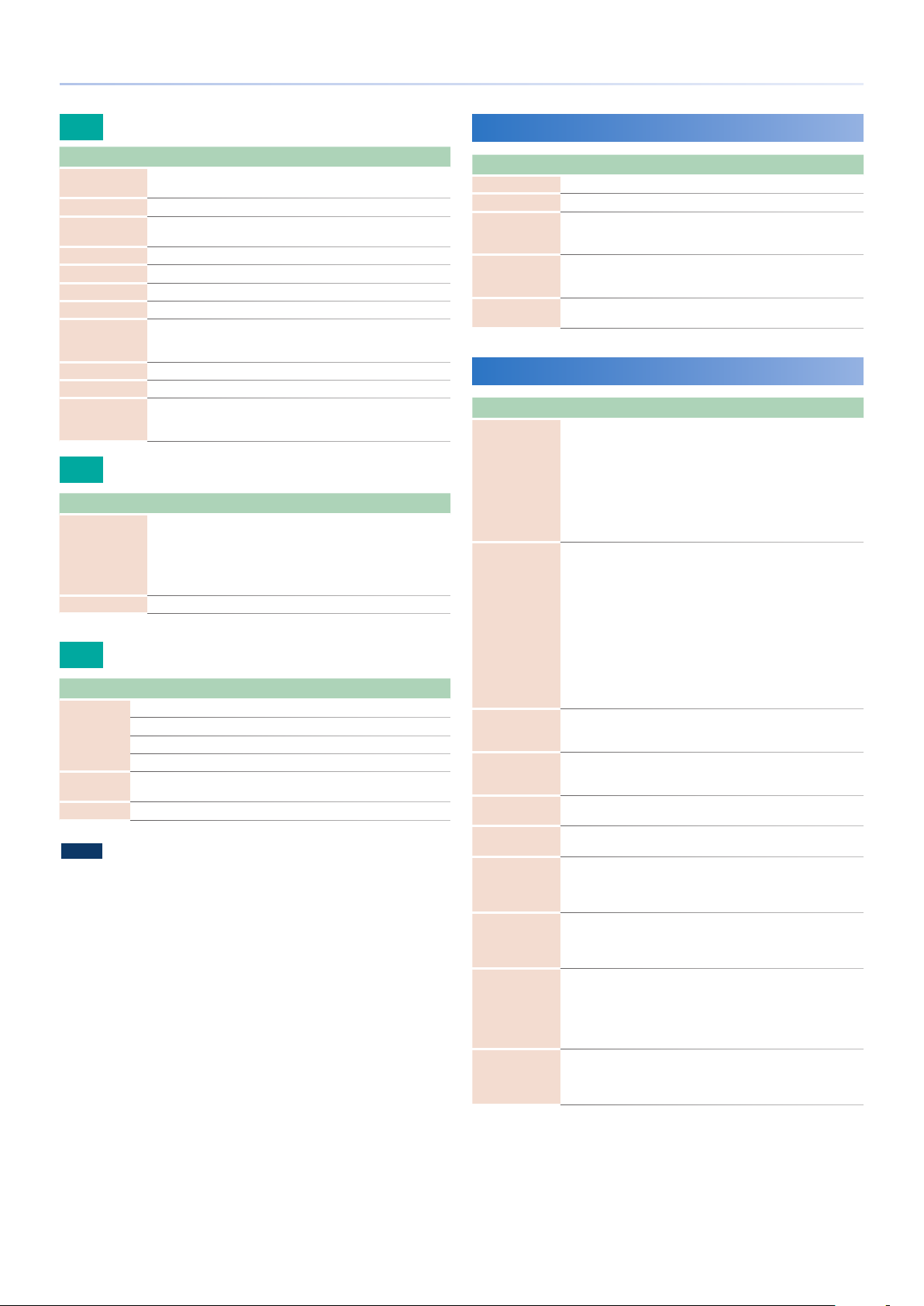
Scene Parameter
SRV-2000NL
06
Parameter Value Explanation
PreDelay
ReverbTime
GateTime
Low Freq
Low Gain
Mid Freq
Mid Gain
Mid Q
HighFreq
HighGain
Hi Q
07
Parameter Value Explanation
Char
Time
08
Parameter Value Explanation
Type
Pre Delay
Gate Time
0–120
-0.9–+99.0 [sec] Adjusts the decay length of the reverb sound.
10–450
0.04–1.00 [kHz] Frequency of the low range.
-24–+12 [dB] Gain of the low range.
0.25–9.99 [kHz] Frequency of the middle range.
-24–+12 [dB] Gain of the middle range.
0.2–9.0
0.80–9.99 [kHz] Frequency of the high range.
-24–+12 [dB] Gain of the high range
0.2–9.0
GM2 Reverb
SMALL ROOM,
MEDIUM ROOM,
LARGE ROOM,
MEDIUM HALL,
LARGE HALL,
PLATE
0–127 Adjusts the decay length of the reverb sound.
Gate Reverb
NORMAL This is a standard gate reverb.
REVERSE This is a reverb for which the sound ramps up in volume.
SWEEP1 The reverb sound moves from right to left.
SWEEP2 The reverb sound moves from left to right.
0.0–100.0 [ms]
5–500 [ms] Adjusts the decay length of the reverb sound.
(NON-LINEAR)
Adjusts the delay time from the direct sound until
the reverb sound is heard.
Adjusts the time from when the reverb starts
being heard until the reverb sound is cut o.
Width of the middle range.
Set a higher value to narrow the range to be
aected.
Species the width of the high-frequency range.
Set a higher value to narrow the range to be
aected.
Selects the type of reverb.
Adjusts the delay time from when the direct sound
plays until the reverb sound is heard.
NOTE
(*1) 16, 20, 25, 32, 40, 50, 63, 80, 100, 125, 160, 200, 250, 315, 400, 500, 630, 800, 1000, 1250,
1600, 2000, 2500, 3150, 4000, 5000, 6300, 8000, 10000, 12500, 15000 [Hz], BYPASS
(*2) BYPASS, 16, 20, 25, 32, 40, 50, 63, 80, 100, 125, 160, 200, 250, 315, 400, 500, 630, 800,
1000, 1250, 1600, 2000, 2500, 3150, 4000, 5000, 6300, 8000, 10000, 12500, 15000 [Hz]
(*3) 1000, 1250, 1600, 2000, 2500, 3150, 4000, 5000, 6300, 8000 [Hz]
(*4) 160, 200, 250, 320, 400, 500, 640, 800, 1000, 1250, 1600, 2000, 2500, 3200, 4000, 5000,
6400, 8000, 10000, 12500 [Hz], BYPASS
(*5) 50, 64, 80, 100, 125, 160, 200, 250, 320, 400, 500, 640, 800, 1000, 1250, 1600, 2000,
2500, 3200, 4000 [Hz]
(*6) 4000, 5000, 6400, 8000, 10000, 12500 [Hz]
SCENE EFFECT: OD (Overdrive)
Parameter Value Explanation
Drive Sw
Drive
Cho Send Lev
Rev Send Lev
Dly Send Lev
OFF, ON Turns overdrive on/o.
0–127 Adjusts the degree of distortion.
0–127
0–127
0–127
Adjusts the amount of chorus.
If you don’t want to add the chorus eect, set it
to 0.
Adjusts the amount of reverb.
If you don’t want to add the reverb eect, set it
to 0.
Adjusts the amount of delay.
If you don’t want to add the delay eect, set it to 0.
ARP COMMON
Parameter Value Explanation
Species the arpeggio type.
What is changed by TYPE
(1) Arpeggio pattern and part arpeggio parameters of
parts 1–4
(2) Sound (tone) and part level of parts 1–4
* For a part whose SCENE ZONE EDIT > Keyboard Sw
is ON, the current sound (tone) and part level are
maintained even if you change the TYPE.
* You can use the SYSTEM > ARPEGGIO > Set Tone
setting to turn on/o the function of (2).
Species the arpeggio’s rhythm type.
What is changed by RHYTHM
(1) Arpeggio pattern and part arpeggio parameters of
part R
(2) Sound (drum kit) and part level of part R
* If the SCENE ZONE EDIT > Keyboard Sw is ON, the
current sound (tone) and part level are maintained
even if you change the RHYTHM.
* You can use the SYSTEM > ARPEGGIO > Set Drum Kit
setting to specify whether this changes (ON) or does
not change (OFF).
(3) Tempo (SCENE or SYSTEM)
* You can use SYSTEM > ARPEGGIO > Set Tempo to specify
whether this changes (ON) or does not change (OFF).
Species a global duration value that applies a
relative adjustment to the duration values of each
part.
Species the global shue value that applies a
relative adjustment to the shue values of each
part.
Arpeggio switch. This is linked with the panel
button.
Arpeggio hold switch. This is linked with the panel
button.
KEYS switch for the arpeggio PLAY DETECTOR. If
this is “ON,” the arpeggio pitch changes according
to the key you play. This is linked with the panel
button.
BEAT switch for the arpeggio PLAY DETEC TOR.
If this is “ON,” the arpeggio pattern changes
according to the timing of your keyboard
performance. This is linked with the panel button.
Species the BEAT sensitivity of the arpeggio
PLAY DETECTOR. Higher values make the pattern
change more sensitively. If you’re unable to
reproduce the same pattern even when you’re
trying to play the keyboard in the same rhythm,
lowering this value might help.
Species the range of keys detected for arpeggio
performance.
Pressing a key outside the specied range will not
aect the arpeggio function.
Type
Rytm
G-Duration
G-Shue
Switch
Hold Sw
Keys Sw
Beat Sw
Detect Sens
In Range Low
In Range Up
00–65
* Refer to “Type/
Rhythm list” (p.
12)
00–65
* Refer to “Type/
Rhythm list” (p.
12)
-50–50
0–100
OFF, ON
OFF, ON
OFF, ON
OFF, ON
1–10
C- –G9
11
Page 12

Scene Parameter
Type/Rhythm list
Type Rytm
00
01
02
03
04
05
06
07
08
09
10
11
12
13
14
15
16
17
18
19
20
21
22
23
24
25
26
27
28
29
30
31
32
33
34
35
36
37
38
39
40
41
42
43
44
45
46
47
48
49
50
51
52
53
54
55
56
57
58
59
OFF OFF
UP 16th KICK
DOWN 16S KICK+HH
UP&DOWN TRI KICK+CLAP
RANDOM 8th LOOP
POLY SYNCP LOOP-S
I-UP 8-16 I-BEAT[2]
I-NO 4-8-16 I-BEAT[3]-1
I-P 4-8-16R I-BEAT[3]-2
I-NO SYNCP I-BEAT[0+3]
I-NO FREE I-BEAT[3]-3
I-ENS P3-1 I-CR78 120
I-ENS P3-2 I-CR78 116
I-ENS P3-3S I-CR78 112S
I-ENS P34-1 I-90’s 70
I-ENS P34-2 I-T808 120
I-ENS P34-3 I-T909 120
I-ENS P34-4 I-T808 120
I-ENS P34-5 I-T909 135
I-ENS P34-6 I-POP 80
I-ENS P34-7 I-T808 80
I-ENS P34-8 I-T808 131
I-ENS P34-9 I-CR78 112S
I-ENSP34-10 I-T707 124
I-ENSP34-11 I-ANA 122
I-ENSP34-12 I-CR78 109
I-ENSP34-13 I-T909 135S
I-ENSP34-14 I-CR78 118
I-ENSP34-15 I-ANA 118
I-ENSP34-16 I-T606 112
I-ENSP34-17 I-T808 149
I-ENSP34-18 I-CR78 124
I-ENSP34-19 I-T909 126
I-ENSP34-20 I-CR78 98S
I-ENSP34-21 I-STD 116S
I-ENSP34-22 I-T808 130
I-ENSP34-23 I-T606 135
I-ENSP34-24 I-CR78 160
I-ENSP34-25 I-ANA 130
I-ENSP34-26 I-CR78 152
I-ENSP34-27 I-T808 138
I-ENSP234-1 I-T808 108
I-ENSP234-2 I-CR78 98
I-ENSP234-3 I-T808 114S
I-ENSP234-4 I-T606 126S
I-ENSP34-28 I-HOUSE 120
I-ENSP34-29 I-HIPHOP109
I-ENSP234-5 I-T808 105
I-ENSP234-6 I-JAZZ 110
I-ENSP234-7 I-POWER 112
I-ENSP34-30 I-T909 125
I-DLY SYNTH I-HIPHOP142
I-DLY PIANO I-T707 123
I-DLY PLUCK I-T808 120
I-BASS AUTO I-T909 118
I-BASS DOWN I-D&B 140
I-ENSP34-31 I-T626 98
I-ENSP34-32 I-80’S 95
I-ENSP34-33 I-T909 110
I-ENSP34-34 I-T808 172
Type Rytm
60
61
62
63
64
65
I-ENSP34-35 I-T7&7 175
I-ENSP34-36 I-EDM 95
I-ENSP34-37 I-CR78 88
I-ENSP34-38 I-T7&7 96
I-ENSP34-39 I-T909 108
I-ENSP34-40 I-T626 105
12
Page 13
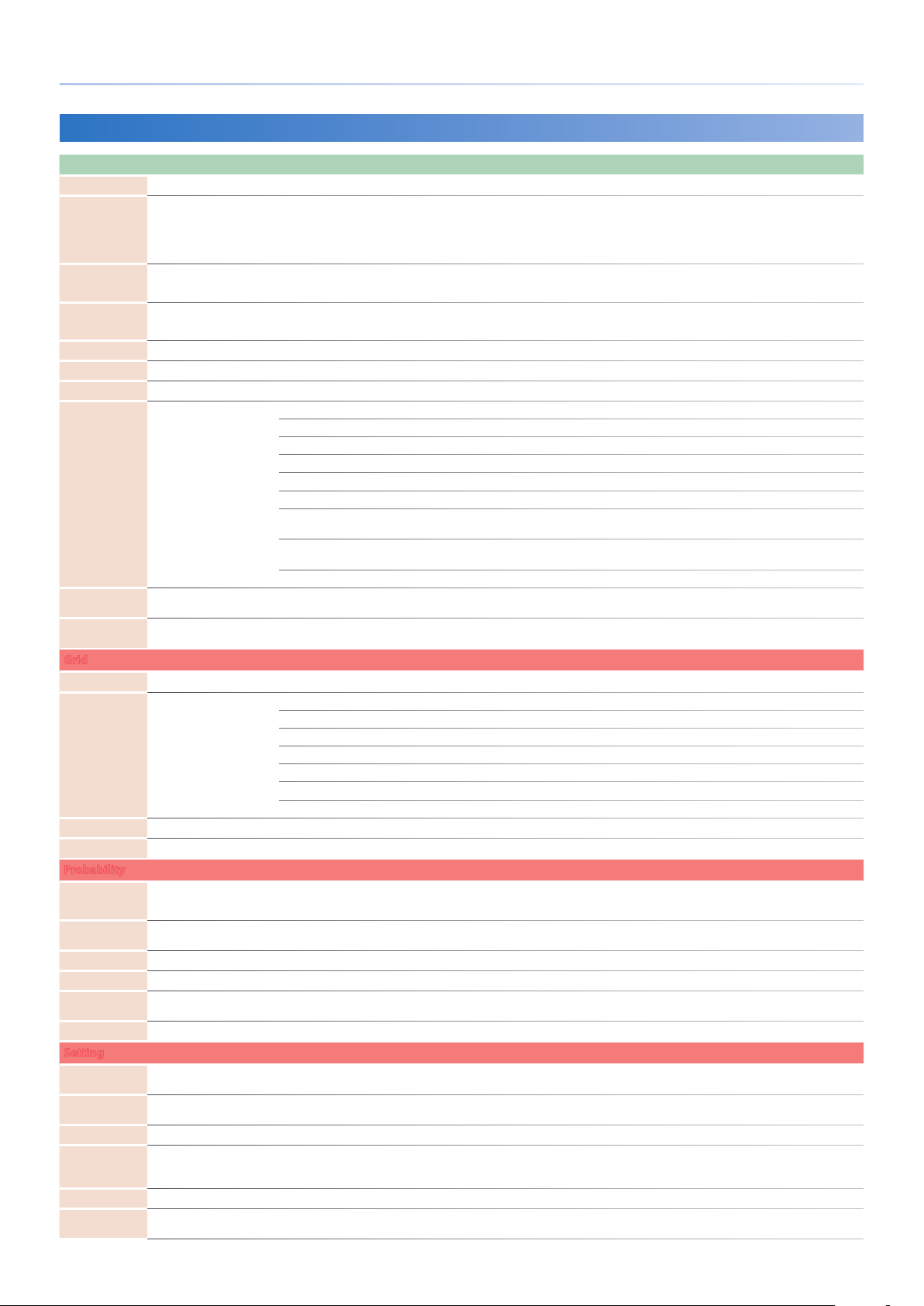
ARP PART
Parameter I-ARP ARP STEP Value Explanation
Switch
Arp Mode
(*1)
I-ARP Style
* Refer to “Style List”
(p. 14)
(*2)
ARP Style
* Refer to “Style List”
(p. 14)
(*2)
Variation
Arp Step Sw
Step Key Shift
Motif
Oct Range
Duration
(*2)
(*3)
(*4)
(*4)
Grid
Grid Length (*5
Grid Note
Grid Oset
Grid Sync
)
(*1)
(*1)
Probability
Style
* Refer to “Style List”
(p. 14)
Amount Auto
Amount
Amount Dir
Velo Amount
Grid Oset
Setting
Key Sw Sync
Hold Sw
Transpose
(*)
Velocity
Oset Velo
Shue Rate
( ( (
( ( (
(
- - 000–111
-
(
-
(
-
(
- -
( (
( (
( ( (
(
-
( ( (
(
(
- - -63–+64 Species the grid position at which the arpeggio pattern starts as an amount of shift from the rst grid position.
- - OFF, ON Turn this ON if you want the arpeggio sounded for each part to be synchronized with the grid.
( ( (
( ( (
( ( (
( ( (
( ( (
( ( (
( ( (
( ( (
( (
( (
( ( (
( ( (
OFF, ON Species whether each part’s arpeggio is “ON” or “OFF” when the panel arpeggio switch is ON.
Sets how the arpeggio operates for each part.
I-ARP, ARP, STEP
- 1–128 Sets the arpeggio style.
- 1–11 Sets the arpeggio style variation. The number of available variations depends on the style.
- OFF, ON Plays the arpeggio using the pattern data you created with Step Edit.
OFF, ON The pattern data created in Step Edit is played, transposed according to the notes played on the keyboard.
(
Species the order in which the notes of the chord you play are sounded as an arpeggio.
UP
DOWN
UP&DOWN
RANDOM
NOTE ORDER
RHYTHM
PHRASE
AUTO
- -3–+3
0–100 [%]
2–64 Species the grid length for the arpeggio pattern.
(
Species the note value represented by one grid of the arpeggio.
4th
8th
8th_3
16th
16th_3
32nd
OFF, 1–64 Sets an arpeggio pattern with a specied probability of playing back note messages.
OFF, ON
0–100% Sets the degree of playback probability.
Standard, Reverse Reverses the degree of change for the Probability Amount.
0–100%
-63–+64 Sets the start position of the pattern that’s set in Probability Style, by using the shift amount from the start grid.
OFF, ON
OFF, ON
- -36–+36 Shifts the arpeggio notes in semitone steps.
REAL,
1–127
-127–+127 Shifts the velocity values. Use this if the velocity values are not an appropriate match with other parts.
0–100 [%]
I-ARP: Analyzes your keyboard performance and plays the arpeggio pattern that best matches it.
ARP: Plays a simple arpeggio pattern.
STEP: Plays the pattern data you created using the STEP EDIT function. Use this setting when you want to play
original arpeggio phrases.
Sets the style for the I-ARPEGGIO.
You can select the ARP COMMON type for each part.
Sounded consecutively starting at the lowest key you press.
Sounded consecutively starting at the highest key you press.
Sounded consecutively from the lowest to the highest key, and then back down to the lowest.
The keys you press are sounded in random order.
Sounded in the order in which you press the keys.
Notes are sounded as specied by the arpeggio pattern, regardless of the pitches that you play on the keyboard. This
is useful when playing a rhythm pattern.
The pitches specied by the arpeggio pattern are played, but shifted according to the pitches that you play. This is
useful when you want to transpose the melody while the arpeggio plays.
When you play a chord, priority is given to starting with the lowest pitch. This is eective for a bass part.
Species the range of octaves in which the arpeggio is sounded.
You can specify whether the arpeggio is sounded in the octave(s) above (+) or below (-) the notes you play.
Species the duration that the notes of the arpeggio pattern are sounded, as a proportion of the note length. You can
set this to make the arpeggiated notes sound briey for a staccato feel, or at their full duration for a tenuto feel.
quarter note (1 grid = 1 beat)
eighth note (2 grids = 1 beat)
eighth note triplet (3 grids = 1 beat)
sixteenth note (4 grids = 1 beat)
sixteenth note triplets (6 grids = 1 beat)
thirty-second note (8 grids = 1 beat)
When this is set to “ON,” your keyboard performance is analyzed and the degree of playback probability is changed
automatically.
Sets the volume of notes that play back based on the Probability Style.
Smaller values produce lower playback volumes, and the maximum value produces the normal volume.
When this is “ON,” you can turn the arpeggio for the relevant parts on/o in part select mode by using the panel
button [9]–[13] keyboard switches.
When the panel’s arpeggio hold switch is ON, this setting species whether the arpeggio performance of each part is
held when you release the keyboard (ON) or stops when you release the keyboard (OFF).
Species the velocity of the arpeggiated notes. If you want the velocity to vary according to the strength at which
you actually press the key, choose (REAL). If you want the velocity to be a xed value regardless of your actual playing
dynamics, specify that value (1–127).
Varies the timing of even-numbered beats, creating a shue rhythm.
A setting of “50%” sounds the notes at equal timing, and increasing this value produces more of a dotted shue feel.
Scene Parameter
13
Page 14

Scene Parameter
Parameter I-ARP ARP STEP Value Explanation
Species the note resolution that is the reference for the shue setting.
Shue Reso
Timing
(*5)
Note O
Poly Remain
K-Range Lo
K-Range Oct
(*1)
Reset Oct
Duck Part
Duck Note
Duck Rate
(*4)
( ( (
( ( (
(
-
( (
( ( (
( ( (
(
- - OFF, ON
( ( (
( ( (
( ( (
16TH Sixteen note
8TH Eighth note
Species the timing at which the arpeggio pattern changes when the PLAY DETECTOR setting BEAT is ON.
IMMEDIATE Change immediately.
BEAT Change at the beginning of the beat.
MEAS Change at the beginning of the measure.
END Change at the beginning of the arpeggio pattern cycle.
Species when previously-sounded notes are turned o if the arpeggio pattern changes.
NORMAL Sound the note length specied by the arpeggio pattern, and then turn the note o.
(
IMMEDIATE Turn o immediately.
If this is other than “OFF,” the following two behaviors will be dierent than normal.
-
OFF,
1–127
C -–G 9
OFF, 0–12
OFF,
PART 1–PART 4,
PART R
Any,
C -–G 9
0–100
Even if the arpeggio pattern is mono, chords played on the keyboard are limited to the specied number of notes.
Even if you do not play legato, the individual notes that you play up to the specied number are remembered, and
reected by the arpeggio performance.
This produces a result that feels more like keyboard playing than a conventional arpeggio performance.
Species the lower pitch limit that is sounded by the arpeggio. If the arpeggio attempts to play a note that is lower
than this, the octave is raised.
Species the number of higher octaves in which the arpeggio is sounded, relative to K-Range Lo.
If the arpeggio attempts to play a note that is higher than this range, the octave is lowered.
If this is “ON,” when the arpeggio returns to the start grid, it plays from the octave that you pressed, regardless of the
Oct Range setting.
Velocity duck
This temporarily lowers the velocity of a specic note of a specic part when an arpeggio note coincides at the same
timing. You can use this to prevent the volume from being excessive when notes overlap, or in a way similar to how
a side-chain compressor eect can lower the volume of other instruments at the timing of the kick drum, so that a
sense of musical groove is created.
Duck Part: Enter the part to which the eect applies. For example, to specify the rhythm part, set this to “PART R.” If
Duck Note: Species the note of the Duck Part sound that is the target. For example, if you want to target the kick
Duck Rate: Species the proportion by which Velocity Duck lowers the velocity value. Higher values produce a
this is “OFF,” velocity duck does not occur.
drum, specify “C2.” If you specify “Any,” all notes of that part are the target.
greater ducking eect, so that with a setting of “100” there will be no sound at that timing (maximum
velocity duck eect). With a setting of “0” there will be no velocity ducking.
(*1)
This is shown only if Arp Mode is set to “I-ARP.”
(*2)
This is shown only if Arp Mode is set to “ARP.”
(*3)
This is shown only if Arp Mode is set to “STEP.”
(*4)
This is shown only if Arp Mode is set to “I-ARP” and “ARP.”
(*5)
This is shown only if Arp Mode is set to “I-ARP” and “STEP.”
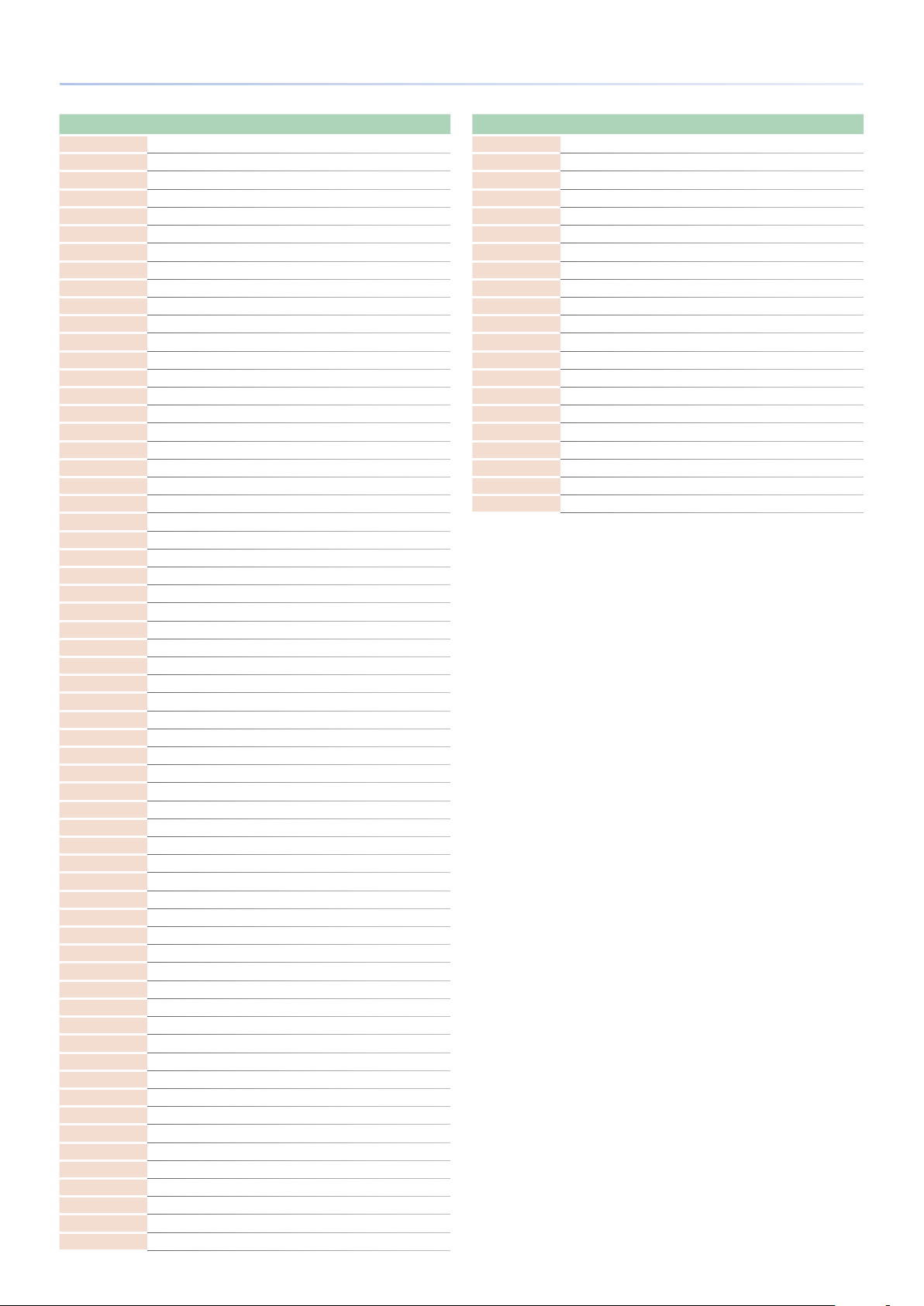
Style List
I-ARP Style ARP Style Probability Style
000
001
002
003
004
005
006
007
008
009
010
011
012
013
014
015
016
017
018
019
020
021
022
CURRENT TYPE - -
TYPE1 PART1 SIMPLE EIGHT1
TYPE5 PART1 1/8BASIC1 EIGHT2
TYPE6 PART1 1/8BASIC2 QUARTER1
TYPE7 PART1 1/8BASIC3 QUARTER2
TYPE8 PART1 1/8BASIC4 HALF1
TYPE9 PART1 1/8BASIC5 HALF2
TYPE10 PART1 1/8SYNC11 HALF3
TYPE11 PART3 1/8SYNC12 HALF4
TYPE11 PART4 1/8SYNC13 HALF5
TYPE12 PART3 1/8SYNC14 SHORT1
TYPE12 PART4 1/8SYNC15 SHORT2
TYPE13 PART3 1/8SYNC21 SHORT3
TYPE13 PART4 1/8SYNC22 DOUBLE
TYPE14 PART3 1/8SYNC23 1MEAS1
TYPE14 PART4 1/8SYNC24 1MEAS2
TYPE15 PART3 1/8SYNC25 1MEAS3
TYPE15 PART4 1/8DRIVE1 1MEAS4
TYPE16 PART3 1/8DRIVE2 1MEAS5
TYPE16 PART4 1/8DRIVE3 1MEAS6
TYPE17 PART3 1/8DRIVE4 1MEAS7
TYPE17 PART4 1/8DRIVE5 1MEAS8
TYPE18 PART3 1/8VARI1 1MEAS9
023
024
025
026
027
028
029
030
031
032
033
034
035
036
037
038
039
040
041
042
043
044
045
I-ARP Style ARP Style Probability Style
TYPE18 PART4 1/8VARI2 1MEAS10
TYPE19 PART3 1/8VARI3 1MEAS11
TYPE19 PART4 1/8VARI4 1MEAS12
TYPE20 PART3 1/8VARI5 1MEAS13
TYPE20 PART4 1/16BASC1 1MEAS14
TYPE21 PART3 1/16BASC2 1MEAS15
TYPE22 PART3 1/16BASC3 1MEAS16
TYPE22 PART4 1/16BASC4 1MEAS17
TYPE23 PART3 1/16BASC5 1MEAS18
TYPE23 PART4 1/16SYN11 1MEAS19
TYPE24 PART3 1/16SYN12 1MEAS20
TYPE24 PART4 1/16SYN13 2MEAS1
TYPE25 PART3 1/16SYN14 2MEAS2
TYPE25 PART4 1/16SYN15 2MEAS3
TYPE26 PART3 1/16SYN21 2MEAS4
TYPE26 PART4 1/16SYN22 2MEAS5
TYPE27 PART3 1/16SYN23 2MEAS6
TYPE27 PART4 1/16SYN24 2MEAS7
TYPE28 PART3 1/16SYN25 2MEAS8
TYPE28 PART4 1/16DRVE1 2MEAS9
TYPE29 PART3 1/16DRVE2 2MEAS10
TYPE29 PART4 1/16DRVE3 2MEAS11
TYPE30 PART3 1/16DRVE4 2MEAS12
14
Page 15
Scene Parameter
046
047
048
049
050
051
052
053
054
055
056
057
058
059
060
061
062
063
064
065
066
067
068
069
070
071
072
073
074
075
076
077
078
079
080
081
082
083
084
085
086
087
088
089
090
091
092
093
094
095
096
097
098
099
100
101
102
103
104
105
106
107
I-ARP Style ARP Style Probability Style
TYPE30 PART4 1/16DRVE5 2MEAS13
TYPE31 PART3 RHYTHM X1 2MEAS14
TYPE31 PART4 RHYTHM X2 2MEAS15
TYPE32 PART3 RHYTHM X3 2MEAS16
TYPE32 PART4 RHYTHM X4 2MEAS17
TYPE33 PART3 RHYTHM X5 2MEAS18
TYPE33 PART4 RHYTHM X6 2MEAS19
TYPE34 PART3 RHYTHM X7 FEW1
TYPE34 PART4 RHYTHM X8 FEW2
TYPE35 PART3 CYCLES3RD FE W3
TYPE35 PART4 CYCLES4TH FEW4
TYPE36 PART3 CYCLES5TH FEW5
TYPE36 PART4 CYCLESMAJ FEW6
TYPE37 PART3 CYCLESMIN VARI1
TYPE37 PART4 CYCMAJ/MN VARI2
TYPE38 PART3 AG PROGR1 VARI3
TYPE38 PART4 AG PROGR2 VARI4
TYPE39 PART3 AG CUTTIN VARI5
TYPE39 PART4 AG 3FINGR VARI6
TYPE40 PART3 AG ARPEGG
TYPE40 PART4 AG SPANS1
TYPE41 PART2 AG SPANS2
TYPE41 PART3 AG RIFFS
TYPE41 PART4 EG CUTTIN
TYPE42 PART2 EG RIFFS
TYPE42 PART3 EG ODRIF1
TYPE42 PART4 EG ODRIF2
TYPE43 PART2 EG ARPEGG
TYPE43 PART3 BLUES GTR
TYPE43 PART4 GTR TRILL
TYPE44 PART4 BASS PHR
TYPE45 PART3 BS SHUFFL
TYPE45 PART4 FRETLESBS
TYPE46 PART3 WALKINGBS
TYPE46 PART4 BALLADBAS
TYPE47 PART2 EP PROGR1
TYPE47 PART3 EP PROGR2
TYPE47 PART4 LTN PIANO
TYPE48 PART2 FUNKCLAV1
TYPE48 PART3 FUNKCLAV2
TYPE48 PART4 SYNTHLEAD
TYPE49 PART2 DANCE SYN
TYPE49 PART3 HARP
TYPE49 PART4 SYN BASS1
TYPE50 PART3 SYN BASS2
TYPE50 PART4 SYN BASS3
TYPE56 PART3 SYN LINE1
TYPE56 PART4 SYN LINE2
TYPE57 PART3 SYN LINE3
TYPE57 PART4 LEADLINE1
TYPE58 PART3 LEADLINE2
TYPE58 PART4 LEADLINE3
TYPE59 PART3 SEQUENCE1
TYPE59 PART4 SEQUENCE2
TYPE60 PART3 SEQUENCE3
TYPE60 PART4 CHORDS 1
TYPE61 PART3 CHORDS 2
TYPE61 PART4 CHORDS 3
TYPE62 PART3 SHORTIES1
TYPE62 PART4 SHORTIES2
TYPE63 PART3 SHORTIES3
TYPE63 PART4 FATTIES 1
108
109
110
111
112
113
114
115
116
117
118
119
120
121
122
123
124
125
126
127
128
I-ARP Style ARP Style Probability Style
TYPE64 PART3 FATTIES 2
TYPE64 PART4 FATTIES 3
TYPE65 PART3 SHRT&FAT1
TYPE65 PART4 SHRT&FAT2
FAT&SHRT1
FAT&SHRT2
MIXTURE 1
MIXTURE 2
MIXTURE 3
COMBINAT1
COMBINAT2
COMBINAT3
COMBINAT4
COMBINAT5
COMBINAT6
COMBINAT7
COMBINAT8
PLEXI 1
PLEXI 2
PLEXI 3
PLEXI 4
15
Page 16

1
2
3
OFF
2
1
OFF
3
High note range
Pitch dierence from
equal temperament
Parameter
value
Low note range
Tone Parameters
There are no displayed parameters.
There are no displayed parameters.
16
TONE COMMON Parameters
* You can set whether control change messages (CC) are transmitted/received us-
ing the “Tone CC Map” system parameter.
TONE COMMON
JUPITER-8, JUNO-106, JX-8P, SH-101
Parameter Value Explanation
Catg
TONE COMMON
VOCODER
TONE COMMON
PR-A DRUM, CMN DRUM
TONE COMMON
RD-PIANO, XV-5080, PR-A, PR-B, PD-C, PR-D, COMMON, PR-X
Parameter Value Explanation CC#
Catg
Level
Pan
Priority
Coarse Tune
Fine Tune
Octave
CATEGORY Selects the tone’s category.
CATEGORY Selects the tone’s categor y.
0–127
L64–63R
This determines how notes will be managed when the maximum
polyphony is exceeded.
LAST
LOUDEST
-48–+48
-50–+50
-3–+3
Adjusts the overall volume of the tone.
Species the pan of the tone. “L64” is far left, “0” is
center, and “63R” is far right.
The last-played voices will be given priority, and
currently sounding notes will be turned o in
order, beginning with the rst-played note.
The voices with the loudest volume will be given
priority, and currently sounding notes will be turned
o, beginning with the lowest-volume voice.
Adjusts the pitch of the sound up or down in
semitone steps (+/-4 octaves).
Adjusts the pitch of the sound up or down in
1-cent steps (+/-50 cents).
Adjusts the pitch of the tone’s sound up or down
in units of an octave (+/-3 octaves).
110
Parameter Value Explanation CC#
This setting allows you to apply “stretched tuning”
to the tone. (Stretched tuning is a system by
which acoustic pianos are normally tuned, causing
the lower range to be lower and the higher range
to be higher than the mathematical tuning ratios
would otherwise dictate.) With a setting of “OFF,”
the tone’s tuning will be equal temperament. A
setting of “3” will produce the greatest dierence
in the pitch of the low and high ranges.
The diagram shows the pitch change relative to
equal temperament that will occur in the low and
high ranges. This setting will have a subtle eect
Stretch
Analog Feel
Mono Poly
Unison Sw
Unison Size
Unison Detn
Legato Sw
Retrig Intvl
(Legato
Retrigger
Interval)
OFF,
1–3
0–127
Species whether the tone will play polyphonically (POLY) or
monophonically (MONO).
MONO Sound only the last-played key one at a time.
POLY Two or more notes can be played simultaneously.
OFF, ON
2–8
0–100
OFF, ON
0–12, OFF
on the way in which chords resonate.
Applies time-varying change to the pitch and
volume of the tone that is producing sound,
adding a sense of variability. As you increase
this value toward the maximum, the variability
becomes greater, producing instability.
This layers a single sound.
If the Unison Switch is on, the number of notes
layered on one key will change according to the
number of keys you play.
5If the OSC Type is PCM, this is limited to mono
playing.
5If the Legato Sw is on, the Delay Time is
ignored while playing legato.
5Even if Retrig Intvl (Legato Retrigger Interval)
is specied, it operates as OFF.
If unison is on, this species the number of
notes that are assigned to each key that is
pressed. Increasing the Unison Size increases the
polyphony, making it more likely that notes will
be cut o.
Detunes each of the notes that are allocated by
the Unison Size number, producing a detuned
eect. As you increase this value, each note is
detuned more greatly, producing a thicker sound.
This is eective when MONO/POLY is set to MONO
and Legato Switch is turned ON. When you press
the next key while still holding down the previous
key (legato performance), the pitch changes
smoothly.
The way in which the change occurs depends on
the Legato Retrigger Interval.
When Legato Switch is enabled and you play
legato, this species whether retriggering occurs
(0–12) or does not occur (OFF).
If this is o, only the pitch of the currentlysounding tones changes according to the pitch of
the key.
If this is set to 1–12, retriggering occurs smoothly
when the pitch dierence during legato
performance exceeds the specied value.
For example, if this is set to 4, and using C4 as the
reference pitch, playing notes Db4–E4 legato will
change only the pitch without retriggering, but
playing the F4 note (which is ve semitones away
from C4) legato will retrigger F4.
When F4 is retriggered at this time, F4 now
becomes the reference pitch.
If this is set to 0, each note is retriggered every
time regardless of the pitch dierence.
For acoustic-type sounds in particular, an
unnatural impression can occur if only the pitch
is changed, so you’ll need to adjust the Legato
Retrigger Interval.
115
119
116
Page 17

Tone Parameters
C5
D4
C4
press D4 key
Pitch
Time
press C4 key
press C5 key
C5
D4
C4
press D4 key
Pitch
Time
press C4 key
press C5 key
Parameter Value Explanation CC#
Species whether the portamento eect will be
applied (ON) or not applied (OFF).
* Portamento is an eect which smoothly changes the
Porta Sw
OFF, ON
pitch from the rst-played key to the next-played
key. By applying portamento when the MONO/
POLY parameter is “MONO,” you can simulate slide
performance techniques on a violin or similar
instrument.
Species the performance conditions for which portamento will be
applied.
Porta Mode
NORMAL Portamento will always be applied.
Applies portamento only when you play legato
LEGATO
(i.e., when you press the next key before releasing
the previous key).
Species the type of portamento eect.
Porta Type
RAT E
The time it takes will depend on the distance
between the two pitches.
TIME The time it takes will be constant.
When another key is pressed during a pitch change produced by
portamento, a new pitch change will begin. This setting species the
pitch at which the change will begin.
Starts a new portamento when another key is
pressed while the pitch is changing.
Pitch
Parameter Value Explanation CC#
Species the amount of volume change that
Soft Lv Sens
0–100
occurs when you operate the soft pedal (CC#67).
This is eective when specied for piano sounds.
Porta Start
Portamento will begin from the pitch where the
current change would end.
NOTE
When portamento is used, this species the time
Porta Time
0–1023
over which the pitch will change. Higher settings
will cause the pitch change to the next note to
5
take more time.
Species the pitch change curve for portamento.
Porta Crv
LIN Change on a linear curve.
EXP-L Change on a non-linear curve (gentle slope).
EXP-H Change on a non-linear curve (steep slope).
Species the amount of change in semitone units
when the pitch bend wheel is turned all the way
BendRange
Up
0–48
upward.
For example, if this is “48,” turning the pitch bend
wheel all the way upward raises the pitch by four
41
octaves.
Species the amount of change in semitone units
when the pitch bend wheel is turned all the way
BendRange
Dw
0–48
downward.
For example, if this is “48,” turning the pitch bend
wheel all the way downward lowers the pitch by
49
four octaves.
BendRngFine
Up
BendRngFine
Dw
BendMode
0–100
0–100
NORMAL The pitch bend wheel produces the usual eect.
CATCH+LAST
Species a ne adjustment in one-cent units
to the amount of change when the pitch bend
wheel is turned upward.
Species a ne adjustment in one-cent units
to the amount of change when the pitch bend
wheel is turned downward.
The pitch bend eect applies only to the
last-played note.
If a note-on occurs while pitch bend is already
applied, the new note sounds at the center pitch.
The pitch starts changing only after the controller
passes through the center position.
17
Page 18

Tone Parameters
Parameter Value Explanation CC#
Keyboard
Species how partials are played according to
your keyboard playing dynamics (velocity).
If this is “ON,” dierent partials are sounded
according to the playing velocity and the Velo
Rng Low/Upp and Velo FadeLow/Upp settings.
5If this is “RANDOM” or “CYCLE,” each partial is
sounded randomly or cyclically.
5In the case of “RANDOM” or “CYCLE” when
Structure 1-2 (3-4) has a setting other than
OFF, partials 1 and 2 (3 and 4) are sounded as a
pair, either randomly or in alternation.
5In the case of “RANDOM” or “CYCLE,” velocity
has no eect, but you’ll need to make settings
for each partial so that the Velocity Range does
not conict.
When using Vel Ctrl to switch between partials,
the crossfade level changes in a non-linear curve.
When using Vel Ctrl to switch between partials,
the crossfade level changes in a linear curve.
Vel Ctrl
Level Crv
OFF,
ON,
RANDOM,
CYCLE
EXP
LINEAR
Parameter Value Explanation CC#
Structure
The sound of partial 1 is modulated by partial 2.
OFF OFF
Implements the oscillator sync function that is
provided by an analog synthesizer.
The partial 1 oscillator is reset at intervals of
partial 2’s pitch cycle. This is eective only if OSC
Type is VA or PCM-Sync.
Implements the ring modulator function that is
provided by an analog synthesizer.
The output sound of partial 2 is multiplied with
partial 1.
Implements the cross modulation function that is
provided by an analog synthesizer.
The output sound of partial 2 is applied as the
pitch of partial 1.
XMOD2 is available only when Partial 1 and 3 are
OSC Type “VA.”
Implements the oscillator sync function that is
provided by an analog synthesizer.
The partial 3 oscillator is reset at intervals of
partial 4’s pitch cycle. This is eective only if OSC
Type is VA or PCM-Sync.
Implements the ring modulator function that is
provided by an analog synthesizer.
The output sound of partial 4 is multiplied with
partial 3.
Implements the cross modulation function that is
provided by an analog synthesizer.
The output sound of partial 4 is applied as the
pitch of partial 3.
XMOD2 is available only when Partial 1 and 3 are
OSC Type “VA.”
Eective when Structure1-2 is RING.
Sets the partial 1 OSC level.
Eective when Structure1-2 is RING.
Sets the partial 2 OSC level.
Eective when Structure3-4 is RING.
Sets the partial 3 OSC level.
Eective when Structure3-4 is RING.
Sets the partial 4 OSC level.
Cross Modulation Depth when Structure1-2 is
XMOD.
Cross Modulation Depth when Structure3-4 is
XMOD.
Cross Modulation Depth when Structure1-2 is
XMOD2.
Cross Modulation Depth when Structure3-4 is
XMOD2.
Eective when Structure1-2 is XMOD/XMOD2.
Sets the partial 1 OSC level.
Eective when Structure1-2 is XMOD/XMOD2.
Sets the partial 2 OSC level.
Eective when Structure3-4 is XMOD/XMOD2.
Sets the partial 3 OSC level.
Eective when Structure3-4 is XMOD/XMOD2.
Sets the partial 4 OSC level.
This is available if OSC Type is “VA”; it locks the
waveform phase between partials. It is eective
to use this with XMOD2.
Struct12
Struct34
Ring12 Level
Ring34 Level
Ring OSC1 Lv
Ring OSC2 Lv
Ring OSC3 Lv
Ring OSC4 Lv
XMd12 Dpth
XMd34 Dpth
XMd2 12
Dpth
XMd2 34
Dpth
XMd OSC1 Lv
XMd OSC2 Lv
XMd OSC3 Lv
XMd OSC4 Lv
Ptl Phs Lock
SYNC
RING
XMOD,
XMOD2
The sound of partial 3 is modulated by partial 4.
OFF OFF
SYNC
RING
XMOD,
XMOD2
0–127 RING level when Structure1-2 is RING.
0–127 RING level when Structure3-4 is RING.
0–127
0–127
0–127
0–127
0–10800
0–10800
0–127
0–127
0–127
0–127
0–127
0–127
OFF, ON
18
Page 19
Tone Parameters
TONE Parameters
TONE
JUPITER-8
Parameter Value Explanation CC#
LFO RATE
LFO DELAY TIME
LFO WAVEFORM
LFO MOD
PIT ENV DEPTH
DEST SELECT
PULSE WIDTH
MOD
PW MODE
CROSS MOD
OSC1 RANGE
OSC1 WAVEFORM
SYNC SWITCH
OSC2 MODE
LOW FREQ
OSC2 RANGE
OSC2 FINE TUNE
OSC2 WAVEFORM
OSC1 LEVEL
OSC2 LEVEL
HPF
VINTAGE FLT T YPE
CUTOFF
RESONANCE
FILTER SLOPE
0–1023 Species the rate of the LFO cycle. 29
0–1023
SINE,
SAW-DW,
SQR,
S&H
0–100
-100–+100
OSC1,
BOTH,
OSC2
0–127
Species the pulse width mode.
LFO The pulse width is changed by the LFO.
MANUAL
ENV The pulse width is changed by the ENV1.
0–10800
16’, 8’, 4’, 2’ Species the octave of OSC1. 47
TRI,
SAW,
PW,
SQR
OFF, ON
NORMAL,
LOW FREQ
0–127
-12–+24 Species the octave of OSC2. 62
-50–+50
SINE,
SAW,
PW,
NOISE
0–255 Adjusts the volume balance of OSC1. 16
0–255 Adjusts the volume balance of OSC2. 17
0–1023
JP, M, S
0–1023
0–1023
-12dB, -24dB Selects the type of slope for the low-pass lter.
Adjusts the time from when the key is pressed
until the LFO starts to apply modulation.
Selects the waveform of the LFO.
Adjusts the depth at which the LFO modulates
the OSC.
Adjusts the depth at which the LFO modulates
the ENV1.
Selects the OSC that is modulated by LFO
MOD.
PW MODE = MANUAL: Adjusts the pulse width.
PW MODE = LFO/ENV: Adjusts the modulation
depth.
The pulse width is changed by PULSE WIDTH
MOD.
Uses the OSC2 waveform to change the
frequency of OSC1. Higher values cause the
sound of OSC1 to be more complex, allowing
you to create metallic sounds or sound eects.
Selects the waveform that is the basis of the
OSC1 sound.
This is oscillator sync. It produces a complex
waveform by forcibly resetting OSC1 to the
beginning of its cycle in synchronization with
the cycle of OSC2.
Selects whether OSC2 operates as NORMAL (in
the audible frequency range) or as LFO (in the
low frequency range).
Species the octave when OSC2 MODE is set
to LOW FREQ.
Species a ne adjustment to the pitch of
OSC2.
Selects the waveform that is the basis of the
OSC2 sound.
Adjusts the cuto frequency of the high-pass
lter.
Selects one of three response curves, each
modeling the LPF of an analog synthesizer of
the past.
Species the cuto frequency of the low-pass
lter. The frequency region above the cuto
frequency is cut, producing a more mellow
tonal character.
Boosts the region of the lter’s cuto
frequency. Higher values produce a stronger
result, giving the sound a distinctively
synthesizer-like character.
27
26
22
50
111
56
79
108
3
9
Parameter Value Explanation CC#
FLT ENV DEPTH
FLT ENV MODE
FILTER MOD
FLT KEY FOLLOW
AMP LEVEL
AMP MOD-STEP
ENV1 ATTACK
ENV1 DECAY
ENV1 SUSTAIN
ENV1 RELEASE
ENV1 KEY FLW SW
ENV2 ATTACK
ENV2 DECAY
ENV2 SUSTAIN
ENV2 RELEASE
ENV2 KEY FLW SW
BEND PITCH
BEND FILTER
MODULATION LFO
PORTA MODE
PORTA TIME
PORTA CRV
KEY MODE
AFT LFO
AFT FREQ
AFT LEVEL
PITCH DRIFT
PARAM
EXPANSION
CONDITION
-1023–+1023
ENV1, ENV2
0–100
0–200
0–127 Adjusts the volume of the tone. 110
0–3
0–1023 Species the ENV1 Attack time. 83
0–1023 Species the ENV1 Decay time. 80
0–1023 Species the ENV1 Sustain level. 85
0–1023 Species the ENV1 Release time. 86
OFF, ON, INV
0–1023 Species the ENV2 Attack time. 89
0–1023 Species the ENV2 Decay time. 90
0–1023 Species the ENV2 Sustain level. 102
0–1023 Species the ENV2 Release time. 103
OFF, ON
0–1200
-63–+63
-63–+63
OFF, ON
0–1023
Species the pitch change curve for portamento.
ORIGINAL
LINEAR Change in a linear cur ve.
EXP1 Change in a non-linear cur ve (gentle slope).
EXP2 Change in a non-linear cur ve (steep slope).
Species how notes are sounded. 119
POLY Polyphonic
SOLO Monophonic
UNISON Unison
SL-UNISON Monophonic unison
-63–+63
-63–+63
-63–+63
0–255
OFF, ON
0–100
Adjusts the amount by which the cuto
frequency is controlled by the envelope.
Selects the envelope that is used to control
the cuto frequency.
Adjusts the amount by which the LFO
modulates the cuto frequency.
Adjusts the amount by which the keyboard
pitch aects the cuto frequency (key follow).
With smaller values, the cuto frequency
becomes lower as you play higher notes.
Uses the LFO to vary the AMP volume (tremolo
eect). Higher values produce a greater eect.
Species the ENV1 key follow. If key follow is
on, ADR times become longer for lower notes
and shorter for higher notes.
With the INV setting, lower notes produce
shorter ADR times, and higher notes produce
longer ADR times.
Species the ENV2 key follow. If key follow is
on, ADR times become longer for lower notes
and shorter for higher notes.
Species the range of pitch change produced
by pitch bend.
Species the range of lter change produced
by pitch bend.
Species the amount of LFO applied by
modulation.
Turns portamento on/o. If this is on, the pitch
will change smoothly from one note to the
next-played note.
Adjusts the time over which the portamento
pitch change occurs.
Change according to the original curve of the
model.
Sets how much aftertouch changes the LFO
intensity (this is only enabled for products
with aftertouch).
Sets how much aftertouch changes the
low-pass lter intensity (this is only enabled
for keyboards with aftertouch).
Sets how much aftertouch changes the tone
volume (this is only enabled for keyboards
with aftertouch).
Adjusts the slight pitch drift that occurs when
notes are played on an analog synthesizer.
If this is ON, the range of change for LFO RATE,
CUTOFF, RESONANCE, and FILTER ENV DEPTH
is wider than on the original model.
Simulates the changes that occur as a unit
ages.
81
28
82
30
41
14
118
5
19
Page 20
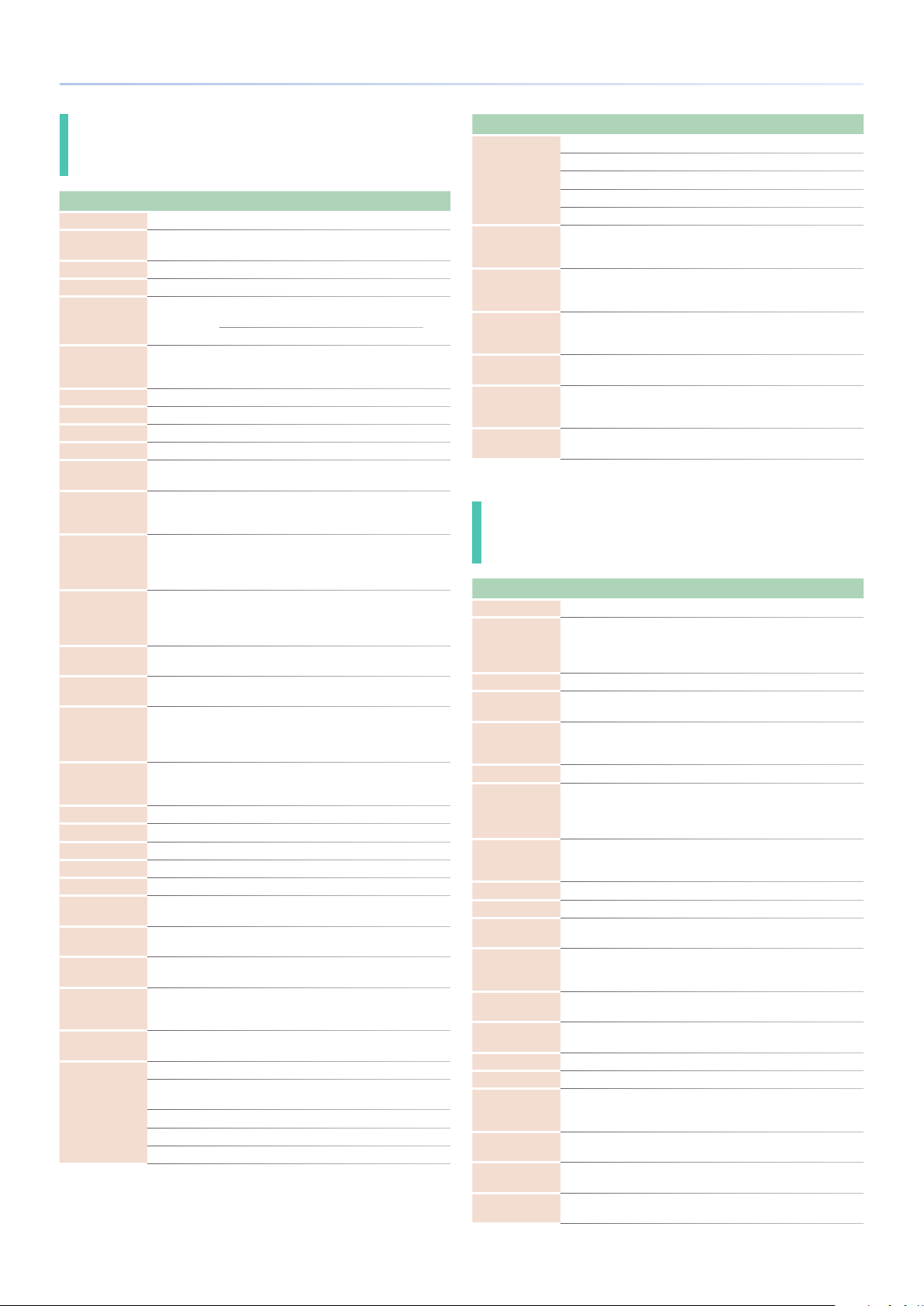
Tone Parameters
TONE
JUNO-106
Parameter Value Explanation CC#
LFO RATE
LFO DELAY TIME
OSC RANGE
OSC LFO MOD
PULSE WIDTH
MOD
PW MODE
PW SWITCH
SAW SWITCH
SUB LEVEL
NOISE LEVEL
HPF-STEP
VINTAGE FLT T YPE
CUTOFF
RESONANCE
FLT ENV DEPTH
FILTER MOD
FLT KEY FOLLOW
AMP ENV SEL
AMP LEVEL
ENV ATTACK
ENV DECAY
ENV SUSTAIN
ENV RELEASE
BEND PITCH
BEND FILTER
MODULATION LFO
PORTA MODE
PORTA TIME
PORTA CRV
0–1023 Species the speed of the LFO cycle. 29
0–1023
16’, 8’, 4’ Species the octave of the oscillator.
0–100 Uses the LFO to vary the pitch (vibrato). 26
0–127
LFO,
MANUAL
OFF, ON Turns the pulse wave on/o.
OFF, ON Turns the sawtooth wave on/o.
0–255 Adjusts the volume of the sub oscillator. 18
0–255 Adjusts the volume of the noise. 19
0–3
R, M, S
0–1023
0–1023
-1023–+1023
0 - 100
0 - 200
ENV F&A,
G-AMP
0–127 Adjusts the volume of the tone. 110
0–1023 Species the ENV Attack time. 89
0–1023 Species the ENV Decay time. 90
0–1023 Species the ENV Sustain level. 102
0–1023 Species the ENV Release time. 103
0–1200
0–63
0–63
OFF, ON
0–1023
Species the pitch change curve for portamento.
ORIGINAL
LINEAR Change in a linear cur ve.
EXP1 Change in a non-linear cur ve (gentle slope).
EXP2 Change in a non-linear cur ve (steep slope).
Adjusts the time from when the key is pressed
until LFO modulation starts to apply.
PM MODE = LFO: Adjusts the modulation
depth.
PM MODE = MANUAL: Adjusts the pulse width.
Selects whether the pulse width is modulated
by the LFO (LFO) or kept at the xed value
specied by PULSE WIDTH MOD (MANUAL).
Sets the high-pass lter’s cuto frequency in
four steps.
Selects one of three response curves, each
modeling the LPF of an analog synthesizer of
the past.
Species the cuto frequency of the low-pass
lter. The frequency region above the cuto
frequency is cut, producing a more mellow
tonal character.
Boosts the region of the lter’s cuto
frequency. Higher values produce a stronger
result, giving the sound a distinctively
synthesizer-like character.
Adjusts the amount by which the cuto
frequency is controlled by the envelope.
Adjusts the amount by which the LFO
modulates the cuto frequency.
Adjusts the amount by which the keyboard
pitch aects the cuto frequency (key follow).
With smaller values, the cuto frequency
becomes lower as you play higher notes.
Species whether the volume is controlled
by the ENV (ENV F&A) or by the gate signal
(G-AMP).
Species the range of pitch change produced
by pitch bend.
Species the range of lter change produced
by pitch bend.
Species the amount of LFO applied by
modulation.
Turns portamento on/o. If this is on, the pitch
will change smoothly from one note to the
next-played note.
Adjusts the time over which the portamento
pitch change occurs.
Change according to the original curve of the
model.
27
50
108
3
9
81
28
82
41
14
118
5
Parameter Value Explanation CC#
Species how notes are sounded. 119
POLY Polyphonic
KEY MODE
AFT LFO
AFT FREQ
AFT LEVEL
PITCH DRIFT
PARAM
EXPANSION
CONDITION
SOLO Monophonic
UNISON Unison
SL-UNISON Monophonic unison
-63–+63
-63–+63
-63–+63
0–255
OFF, ON
0–100
Sets how much aftertouch changes the LFO
intensity (this is only enabled for products
with aftertouch).
Sets how much aftertouch changes the
low-pass lter intensity (this is only enabled
for keyboards with aftertouch).
Sets how much aftertouch changes the tone
volume (this is only enabled for keyboards
with aftertouch).
Adjusts the slight pitch drift that occurs when
notes are played on an analog synthesizer.
If this is ON, the range of change for LFO RATE,
CUTOFF, RESONANCE, and FILTER ENV DEPTH is
wider than on the original model.
Simulates the changes that occur as a unit
ages.
TONE
JX-8P
Parameter Value Explanation CC#
OSC1 RANGE
OSC1 WAVEFORM
OSC1 TUNE
OSC1 LFO MOD
OSC1 PIT ENV
OSC2 RANGE
OSC2 WAVEFORM
OSC2 MOD MODE
OSC2 TUNE
OSC2 FINE TUNE
OSC2 LFO MOD
OSC2 PIT ENV
PITCH DYNAMICS
OSC ENV MODE
OSC1 LEVEL
OSC2 LEVEL
MIXER ENV DEPTH
MIXER DYNAMICS
MIXER ENV MODE
HPF-STEP
16’, 8’, 4’, 2’ Species the octave of OSC1. 47
SAW,
PULSE,
SQR,
NOISE
-12–+12 Adjusts the OSC1 pitch. 20
0–100
-100–+100
16’, 8’, 4’, 2’ Species the OSC2 octave. 62
SAW,
PULSE,
SQR,
NOISE
OFF,
SYNC,
X-MOD
-12–+12 Adjusts the OSC2 pitch. 87
-50–+50 Finely adjusts the OSC2 pitch. 56
0–100
-100–+100
0–3
ENV1,
ENV2
0–255 Adjusts the OSC1 volume balance. 16
0–255 Adjusts the OSC2 volume balance. 17
0–63
0–3
ENV1,
ENV2
0–3
Species the waveform that is the basis of the
OSC1 sound.
Adjusts the depth to which LFO modulates
OSC1.
Adjusts the depth to which the ENV specied
by OSC ENV MODE aects the OSC1 pitch
envelope.
Selects the waveform that is the basis of the
OSC2 sound.
Selects the MOD MODE type (OFF, SYNC,
X-MOD).
Adjusts the depth to which the LFO
modulates OSC2.
Adjusts the depth to which the ENV specied
by OSC ENV MODE aects the OSC2 pitch
envelope.
Adjusts the sensitivity at which the velocity
controls the depth of the pitch envelope.
Selects the envelope that is used to control
the OSC.
Adjusts the depth to which the envelope
specied by MIXER ENV MODE controls the
OSC2 level.
Adjusts the sensitivity at which the velocity
controls the depth of MIXER ENV.
Selects the envelope that is used as MIXER
ENV.
Sets the cuto frequency of the high-pass
lter in four steps.
26
22
20
Page 21
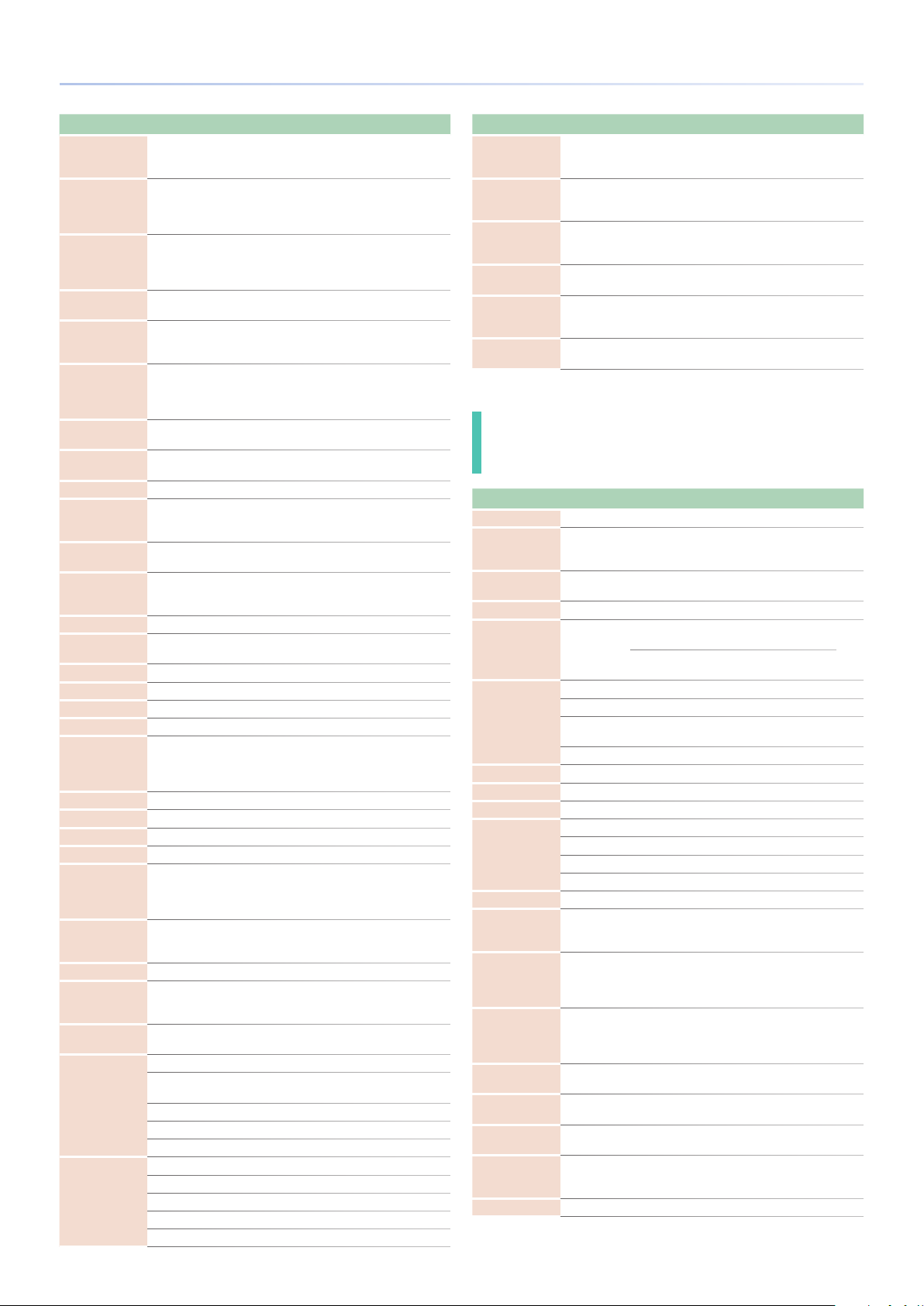
Tone Parameters
Parameter Value Explanation CC#
VINTAGE FLT T YPE
CUTOFF
RESONANCE
FILTER MOD
FLT ENV DEPTH
FLT KEY FOLLOW
FILTER DYNAMICS
FLT ENV MODE
AMP LEVEL
AMP ENV SEL
AMP DYNAMICS
LFO WAVEFORM
LFO RATE
LFO DELAY TIME
ENV1 ATTACK
ENV1 DECAY
ENV1 SUSTAIN
ENV1 RELEASE
ENV1 KEY
FOLLOW-S
ENV2 ATTACK
ENV2 DECAY
ENV2 SUSTAIN
ENV2 RELEASE
ENV2 KEY
FOLLOW-S
BEND PITCH-STEP
MODULATION LFO
PORTA MODE
PORTA TIME
PORTA CRV
KEY MODE
R, M, S
0–1023
0–1023
0–100
-1023–+1023
0–200
0–3
ENV1,
ENV2
0–127 Adjusts the volume of the tone. 110
ENV2,
G-ENV2
0–3
SINE,
SQR,
S&H
0–1023 Species the rate of the LFO cycle. 29
0–1023
0–1023 Species the ENV1 Attack time. 83
0–1023 Species the ENV1 Decay time. 80
0–1023 Species the ENV1 Sustain level. 85
0–1023 Species the ENV1 Release time. 86
0–3
0–1023 Species the ENV2 Attack time. 89
0–1023 Species the ENV2 Decay time. 90
0–1023 Species the ENV2 Sustain level. 102
0–1023 Species the ENV2 Release time. 103
0–3
2, 3, 4, 7
-63–+63 Adjusts the depth of modulation.
OFF, ON
0–1023
Species the pitch change curve for portamento.
ORIGINAL
LINEAR Change in a linear cur ve.
EXP1 Change in a non-linear cur ve (gentle slope).
EXP2 Change in a non-linear cur ve (steep slope).
Species how notes are sounded. 119
POLY Polyphonic
SOLO Monophonic
UNISON Unison
SL-UNISON Monophonic unison
Selects one of three response curves, each
modeling the LPF of an analog synthesizer of
the past.
Species the cuto frequency of the low-pass
lter. The frequency region above the cuto
frequency is cut, producing a more mellow
tonal character.
Boosts the region of the lter’s cuto
frequency. Higher values produce a stronger
result, giving the sound a distinctively
synthesizer-like character.
Adjusts the amount by which the LFO
modulates the cuto frequency.
Adjusts the amount by which the envelope
selected by FLT ENV MODE controls the cuto
frequency.
Adjusts the amount by which the keyboard
pitch aects the cuto frequency (key follow).
With smaller values, the cuto frequency
becomes lower as you play higher notes.
Adjusts the sensitivity at which velocity
controls the depth of FILT ENV DEPTH.
Selects the envelope that is used to control
FILTER.
Selects whether the volume is controlled by
ENV2 (ENV2) or stays at a xed volume as long
as the key is held down (G-ENV2).
Adjusts the sensitivity at which velocity
controls the AMP ENV depth.
Species the LFO waveform.
Adjusts the time from when a key is pressed
until LFO modulation starts being applied.
Species the ENV1 key follow in four levels.
With higher values, ADR times become longer
as you play lower on the keyboard, and
shorter as you play higher.
Species the ENV1 key follow in four levels.
With higher values, ADR times become longer
as you play lower on the keyboard, and
shorter as you play higher.
Species the range of pitch change produced
by pitch bend in four levels: 2, 3, 4, or 7
semitones.
Turns portamento on/o. If this is on, the
pitch will change smoothly from one note to
the next-played note.
Adjusts the time over which the portamento
pitch change occurs.
Change according to the original curve of the
model.
108
3
9
28
81
82
27
49
118
5
Parameter Value Explanation CC#
AFT LFO
AFT FREQ
AFT LEVEL
PITCH DRIFT
PARAM
EXPANSION
CONDITION
-63–+63
-63–+63
-63–+63
0–255
OFF, ON
0–100
Sets how much aftertouch changes the LFO
intensity (this is only enabled for products
with aftertouch).
Sets how much aftertouch changes the
low-pass lter intensity (this is only enabled
for keyboards with aftertouch).
Sets how much aftertouch changes the tone
volume (this is only enabled for keyboards
with aftertouch).
Adjusts the slight pitch drift that occurs when
notes are played on an analog synthesizer.
If this is ON, the range of change for LFO
RATE, CUTOFF, RESONANCE, and FILTER ENV
DEPTH is wider than on the original model.
Simulates the changes that occur as a unit
ages.
TONE
SH-101
Parameter Value Explanation CC#
LFO RATE
LFO WAVEFORM
OSC LFO MOD
OSC RANGE
PULSE WIDTH
MOD
PW MODE
PW LEVEL
SAW LEVEL
SUB OSC LEVEL
SUB OSC
NOISE LEVEL
VINTAGE FLT T YPE
CUTOFF
RESONANCE
FLT ENV DEPTH
FILTER MOD
FLT KEY FOLLOW
AMP ENV SEL
AMP LEVEL
0–1023 Species the speed of the LFO cycle. 29
TRI,
SQR,
S&H
0–100
16’, 8’, 4’, 2’ Species the oscillator’s octave. 47
0–127
Species the pulse width mode.
LFO The pulse width is aected by the LFO.
MANUAL
ENV The pulse width is aected by ENV.
0–255 Adjusts the volume of the pulse wave. 16
0–255 Adjusts the volume of the sawtooth wave. 17
0–255 Adjusts the volume of the sub oscillator. 18
Species the SUB OSC type.
1OCT DN One octave lower
2OCT DN1 Two octaves lower
2OCT DN2 Two octaves lower (small pulse width)
0–255 Adjusts the noise volume. 19
R, M, S
0–1023
0–1023
-1023–+1023
0–100
0–200
ENV F&A,
G-AMP
0–127 Adjusts the volume of the tone. 110
Species the LFO waveform.
Adjusts the depth at which the LFO modulates
the OSC.
PW MODE = MANUAL: Adjusts the pulse width
value.
PW MODE = LFO/ENV: Adjusts the depth of
modulation.
The pulse width is aected by PULSE WIDTH
MOD.
Selects one of three response curves, each
modeling the LPF of an analog synthesizer of
the past.
Species the cuto frequency of the low-pass
lter. The frequency region above the cuto
frequency is cut, producing a more mellow
tonal character.
Boosts the region of the lter’s cuto frequency.
Higher values produce a stronger result, giving
the sound a distinctively synthesizer-like
character.
Adjusts the amount by which the cuto
frequency is controlled by the envelope.
Adjusts the amount by which the LFO
modulates the cuto frequency.
Varies the lter’s cuto frequency according to
the note played on the keyboard.
Species whether the volume is controlled by
the ENV (ENV F&A) or stays at a xed volume as
long as the key is held down (G-AMP).
26
50
108
3
9
81
28
82
21
Page 22
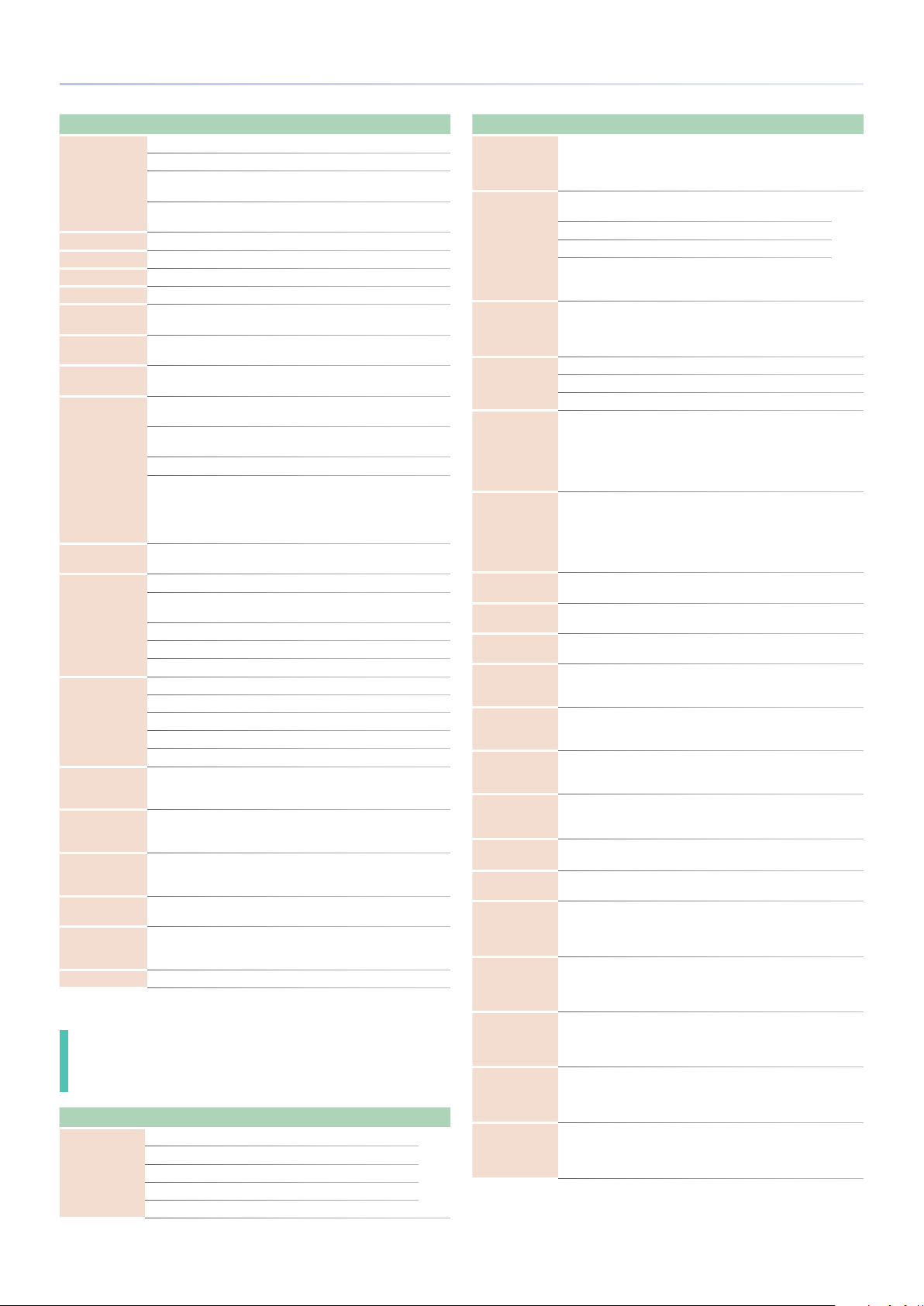
Tone Parameters
Parameter Value Explanation CC#
Species what causes the envelope to attack.
GATE+TRIG Attack each time a key is pressed.
ENV MODE
ENV ATTACK
ENV DECAY
ENV SUSTAIN
ENV RELEASE
BEND PITCH
BEND FILTER
MODULATION LFO
PORTA MODE
GATE
LFO
0–1023 Species the ENV Attack time. 89
0–1023 Species the ENV Decay time. 90
0–1023 Species the ENV Sustain level. 102
0–1023 Species the ENV Release time. 103
0–1500
0–63
0–63
Turns portamento on/o. If this is on, the pitch will change
smoothly from one note to the next-played note.
OFF
ON Portamento is always applied.
Attack when a key is pressed anew. No attack
when playing legato.
Attack repeatedly at each cycle of the LFO as
long as the key is held.
Species the range of pitch change produced
by pitch bend.
Species the range of lter change produced by
pitch bend.
Species the amount of LFO applied by
modulation.
Regardless of the portamento time setting,
portamento is not applied.
14
Portamento is applied only when you play
legato (pressing the next key before completely
AUTO
releasing the previously-played key). This lets
you use your playing technique to control
portamento on/o.
PORTA TIME
0–1023
Adjusts the time over which the portamento
pitch change occurs.
5
Species the pitch change curve for portamento.
Change according to the original curve of the
model.
PORTA CRV
ORIGINAL
LINEAR Change in a linear curve.
EXP1 Change in a non-linear curve (gentle slope).
EXP2 Change in a non-linear curve (steep slope).
Species how notes are sounded. 119
POLY Polyphonic
KEY MODE
SOLO Monophonic
UNISON Unison
SL-UNISON Monophonic unison
Sets how much aftertouch changes the LFO
AFT LFO
-63–+63
intensity (this is only enabled for products with
aftertouch).
Sets how much aftertouch changes the
AFT FREQ
-63–+63
low-pass lter intensity (this is only enabled for
keyboards with aftertouch).
Sets how much aftertouch changes the tone
AFT LEVEL
PITCH DRIFT
PARAM
EXPANSION
CONDITION
-63–+63
0–255
OFF, ON
0–100 Simulates the changes that occur as a unit ages.
volume (this is only enabled for keyboards with
aftertouch).
Adjusts the slight pitch drift that occurs when
notes are played on an analog synthesizer.
If this is ON, the range of change for LFO RATE,
CUTOFF, RESONANCE, and FILTER ENV DEPTH is
wider than on the original model.
TONE
JUPITER-X
Parameter Value Explanation CC#
Species how notes are sounded.
POLY Polyphonic
KEY MODE
SOLO Monophonic
UNISON Unison
SL-UNISON Plyphonic unison
119
Parameter Value Explanation CC#
Detunes each of the notes, producing a
UNISON DETUNE
0–100
detuned eect. As you increase this value,
each note is detuned more greatly, producing
a thicker sound.
Species the performance conditions for which portamento
will be applied.
OFF O
PORTA MODE
NORMAL Portamento will always be applied.
118
Applies portamento only when you play
LEGATO
legato (i.e., when you press the next key
before releasing the previous key).
When portamento is used, this species the
PORTA TIME
0–1023
time over which the pitch will change. Higher
settings will cause the pitch change to the
5
next note to take more time.
Species the pitch change curve for portamento.
PORTA CURVE
LIN Change on a linear curve.
EXP Change on a non-linear curve.
Species the amount of change in semitone
units when the pitch bend wheel is turned all
BEND RANGE UP
0–24
the way upward.
For example, if this is “24,” turning the pitch
41
bend wheel all the way upward raises the
pitch by two octaves.
Species the amount of change in semitone
units when the pitch bend wheel is turned all
BEND RANGE
DOWN
0–24
the way downward.
For example, if this is “24,” turning the pitch
bend wheel all the way downward lowers the
pitch by two octaves.
BEND FREQ SENS
MOD LFO SENS
MOD LFO RATE
-63–+63
-63–+63
-63–+63
Species the range of lter change produced
by pitch bend.
Species the amount of LFO applied by
modulation(depth).
Species the amount of LFO applied by
modulation(rate).
Sets how much aftertouch changes the LFO
AFT MOD SENS
-63–+63
intensity (this is only enabled for products
with aftertouch).
Sets how much aftertouch changes the
AFT FREQ SENS
-63–+63
low-pass lter intensity (this is only enabled
for keyboards with aftertouch).
Sets how much aftertouch changes the tone
AFT LEVEL SENS
-63–+63
volume (this is only enabled for keyboards
with aftertouch).
Sets how much aftertouch changes the
AFT PITCH SENS
PITCH DRIFT
CONDITION
OSC1 WAVE
OSC2 WAVE
OSC3 WAVE
OSC4 WAVE
OSC1 COARSE
OSC2 COARSE
OSC3 COARSE
-63–+63
0–255
0–100
SAW, SQR, TRI,
SIN, JUNO,
SuperSAW,
NOISE
-24–+24
pitch (this is only enabled for keyboards with
aftertouch).
Adjusts the slight pitch drift that occurs when
notes are played on an analog synthesizer.
Simulates the changes that occur as a unit
ages.
Selects the waveform that is the basis of the
OSC1–4 sound.
Adjusts the pitch of the sound up or down in
semitone steps (+/-2 octaves).
46
61
20
OSC4 COARSE
OSC1 FINE TUNE
OSC2 FINE TUNE
OSC3 FINE TUNE
-50–+50
Adjusts the pitch of the sound up or down in
1-cent steps (+/-50 cents).
21
56
OSC4 FINE TUNE
OSC1 LEVEL
OSC2 LEVEL
OSC3 LEVEL
OSC4 LEVEL
OSC1 PW
OSC2 PW
OSC3 PW
OSC4 PW
0–255 Adjusts the OSC1–4 volume balance.
PW MOD = MANUAL
0–127
Adjusts the width of modulation.
PW MOD = LFO2, P-ENV, F-ENV
Adjusts the depth of modulation.
16
17
18
19
50
55
(*1)
(*2)
(*1)
(*1)
(*2)
(*1)
(*2)
(*3)
(*4)
(*1)
(*2)
22
Page 23
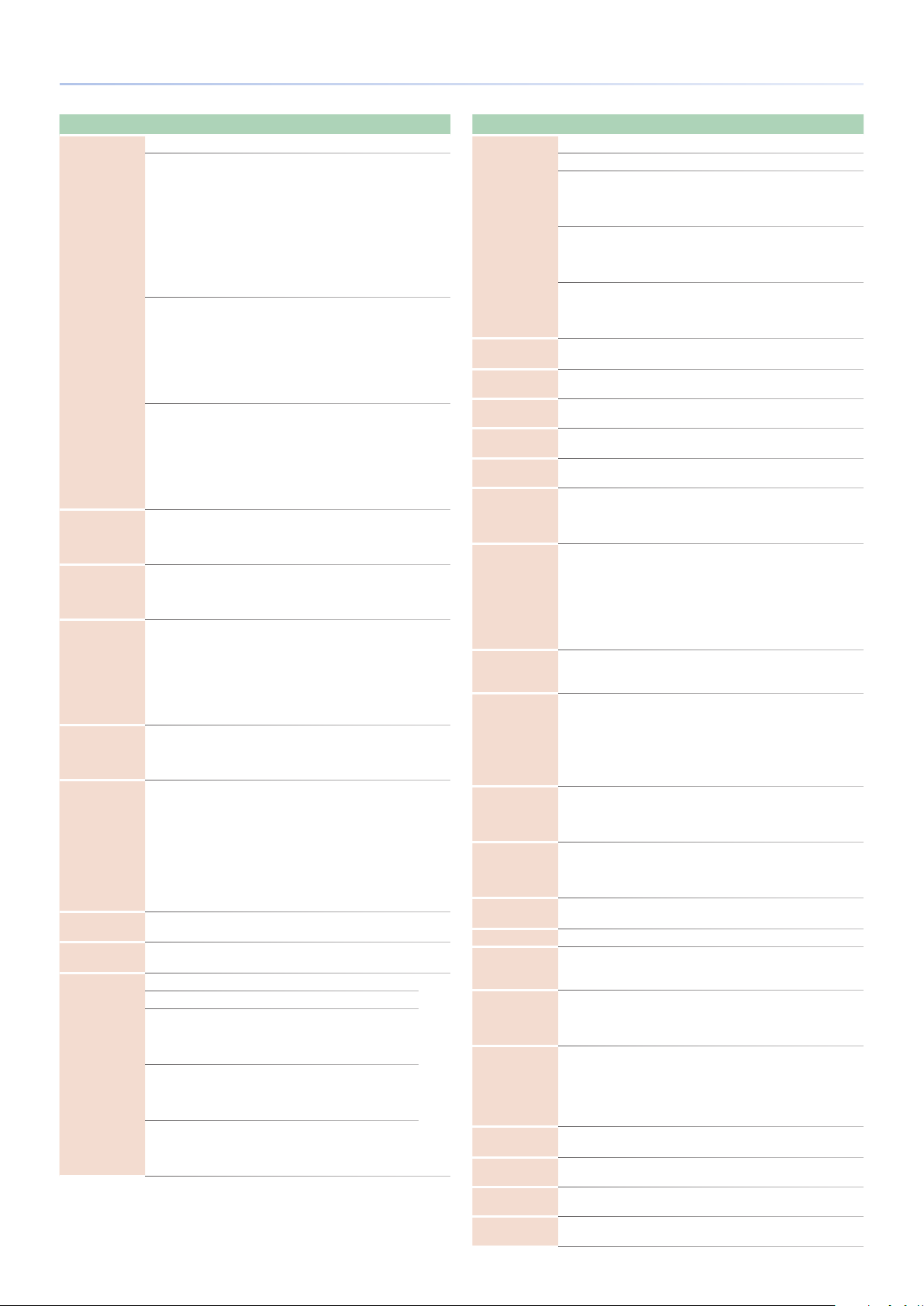
Tone Parameters
Parameter Value Explanation CC#
Species the pulse width mode.
OSC1–4 WAVE=SQR
The pulse width is aected by the PULSE
WIDTH MOD.
OSC1–4 WAVE=SAW, TRI, SIN, JUNO
The wave is aected by the PULSE WIDTH
MOD.
OSC1–4 WAVE=SuperSAW
The detune is aected by the PULSE WIDTH
MOD.
OSC1–4 WAVE=NOISE
This has no eect.
OSC1–4 WAVE=SQR
The pulse width is aected by the LFO2.
OSC1–4 WAVE=SAW, TRI, SIN, JUNO
The wave is aected by the LFO2.
OSC1–4 WAVE=SuperSAW
The detune is aected by the LFO2.
OSC1–4 WAVE=NOISE
This has no eect.
OSC1–4 WAVE=SQR
The pulse width is aected by the ENV.
OSC1–4 WAVE=SAW, TRI, SIN, JUNO
The wave is aected by the ENV.
OSC1–4 WAVE=SuperSAW
The detune is aected by the ENV.
OSC1–4 WAVE=NOISE
This has no eect.
Delays the timing at which OSC1–4 sound,
according to the time you set (OSC delay). This
is enabled when OSC1–4 DLY SYNC is “OFF.”
Set this ON if you want the OSC delay time to
synchronize with the tempo.
This is available when OSC1–4 Time Sync is
ON. It species the delay time in terms of a
note value.
Species the pan of the OSC1–4. “L64” is far
left, “0” is center, and “63R” is far right.
This setting causes panning to be alternated
between left and right each time a key is
pressed.
Higher values will produce a greater amount
of change. “L” or “R” settings will reverse the
order in which the pan will alternate between
left and right.
For example if two partials are set to ”L” and
”R” respectively, the panning of the two tones
will alternate each time they are played.
Eective when OSC1-2 MODE is XMOD. Sets
the Cross Modulation Depth.
Eective when OSC3-4 MODE is XMOD. Sets
the Cross Modulation Depth.
Implements the oscillator sync function that is
provided by an analog synthesizer.
The OSC1 oscillator is reset at intervals of
OSC2’s pitch cycle.
Implements the ring modulator function that
is provided by an analog synthesizer.
The output sound of OSC2 is multiplied with
OSC1.
Implements the cross modulation function
that is provided by an analog synthesizer.
The output sound of OSC2 is applied as the
pitch of OSC1.
52
111
OSC1 PW MOD
OSC2 PW MOD
OSC3 PW MOD
OSC4 PW MOD
OSC1 DLY TIME
OSC2 DLY TIME
OSC3 DLY TIME
OSC4 DLY TIME
OSC1 DLY SYNC
OSC2 DLY SYNC
OSC3 DLY SYNC
OSC4 DLY SYNC
OSC1 DLY NOTE
OSC2 DLY NOTE
OSC3 DLY NOTE
OSC4 DLY NOTE
OSC1 PAN
OSC2 PAN
OSC3 PAN
OSC4 PAN
OSC1 ALT PAN
OSC2 ALT PAN
OSC3 ALT PAN
OSC4 ALT PAN
OSC1-2 XMOD
OSC3-4 XMOD
OSC1-2 MODE
MANUAL
LFO2
P-ENV,
F-ENV
0–1023
OFF, ON
1/64T, 1/64,
1/32T, 1/32,
1/16T, 1/32.,
1/16, 1/8T,
1/16., 1/8, 1/4T,
1/8., 1/4, 1/2T,
1/4., 1/2, 1T,
1/2., 1, 2T, 1., 2
L64–63R
L64–63R
0–10800
0–10800
The sound of OSC1 is modulated by OSC2.
OFF O
SYNC
RING
X-MOD
Parameter Value Explanation CC#
The sound of OSC3 is modulated by OSC4.
OFF O
Implements the oscillator sync function that
is provided by an analog synthesizer.
The OSC3 oscillator is reset at intervals of
OSC4´s pitch cycle.
Implements the ring modulator function that
is provided by an analog synthesizer.
The output sound of OSC4 is multiplied with
OSC3.
Implements the cross modulation function
that is provided by an analog synthesizer.
The output sound of OSC4 is applied as the
pitch of OSC3.
Sets whether the Pitch Envelopes 1 and 2 are
linked or independent.
Adjusts the eect of the Pitch Envelope1, 2.
Higher settings will cause the Pitch Envelope1,
2 to produce greater change. Negative (-)
value will invert the shape of the envelope.
Keyboard playing dynamics can be used to
control the depth of the Pitch Envelope1,
2. If you want the pitch envelope to have
more eect for strongly played notes, set this
parameter to a positive (+) value. If you want
the pitch envelope to have less eect for
strongly played notes, set this to a negative (-)
value.
Select the OSC to which you want to apply
Pitch Envelope1.
Sets the key follow intensity for pitch
envelopes 1 and 2. When this is set to a
positive value, lower notes produce longer
ADR times, and higher notes produce shorter
times. When this is set to a negative value,
lower notes produce shorter ADR times, and
higher notes produce longer times.
Species the cuto frequency of the low-pass
lter. The frequency region above the cuto
frequency is cut, producing a more mellow
tonal character.
Boosts the region of the lter’s cuto
frequency. Higher values produce a stronger
result, giving the sound a distinctively
synthesizer-like character.
Species the cuto frequency of the high-pass
lter.
Selects one of three response curves, each
modeling the LPF of an analog synthesizer of
the past.
Adjusts the amount by which the keyboard
pitch aects the cuto frequency (key follow).
With smaller values, the cuto frequency
becomes lower as you play higher notes.
Use this parameter when changing the cuto
frequency to be applied as a result of changes
in playing velocity. Specify a positive “+” value
if you want the cuto frequency to raise when
you play strongly, or a negative “-” value if you
want it to lower.
Sets whether the Filter Envelopes 1 and 2 are
linked or independent.
22
3
79
108
82
53
OSC3-4 MODE
PENV1&2 LINK
SW
PENV1 ATTACK
PENV2 ATTACK
PENV1 DECAY
PENV2 DECAY
PENV1 SUSTAIN
PENV2 SUSTAIN
PENV1 RELEASE
PENV2 RELEASE
PENV1 DEPTH
PENV2 DEPTH
PENV1 VEL SENS
PENV2 VEL SENS
PENV1 DEST SEL
PENV2 DEST SEL
PENV1 KEY FLW
PENV2 KEY FLW
FILTER FREQ
FILTER RESO
HPF CUTOFF
FILTER SLOPE
FILTER TYPE
FILTER KEY FLW
FILTER VSENS
FENV1&2 LINK SW
FENV1 ATTACK
FENV2 ATTACK
FENV1 DECAY
FENV2 DECAY
FENV1 SUSTAIN
FENV2 SUSTAIN
SYNC
RING
X-MOD
OFF, ON
0–1023 Species the PITCH ENV1, 2 Attack time. 23
0–1023 Species the PITCH ENV1, 2 Decay time. 24
0–1023 Species the PITCH ENV1, 2 Sustain level.
0–1023 Species the PITCH ENV1, 2 Release time.
-100–+100
-100–+100
OSC1,
BOTH,
OSC2
-100–+100
0–1023
0–1023
0–1023
-12, -18, -24 Selects the type of slope for the low-pass lter.
R, M, S
0–200
-100–+100
OFF, ON
0–1023 Species the Filter Envelope1, 2 Attack time. 83
0–1023 Species the Filter Envelope1, 2 Decay time. 84
0–1023 Species the Filter Envelope1, 2 Sustain level.
(*5)
(*5)
(*5)
(*6)
(*6)
23
Page 24

Tone Parameters
Parameter Value Explanation CC#
FENV1 RELEASE
FENV2 RELEASE
FENV1 DEPTH
FENV2 DEPTH
FENV1 VEL SENS
FENV2 VEL SENS
FENV1 KEY FLW
FENV2 KEY FLW
AMP LEVEL
OSC1&2 VSENS
OSC3&4 VSENS
AENV ATTACK
AENV DECAY
AENV SUSTAIN
AENV RELEASE
AENV VEL SENS
AENV KEY FLW
LFO1 WAVE
LFO2 WAVE
LFO1 RATE NOTE
LFO2 RATE NOTE
LFO1 RATE
LFO2 RATE
LFO1 DLY TIME
LFO2 DLY TIME
LFO1 PCH DEPTH
LFO2 PCH DEPTH
LFO1 FLT DEPTH
LFO2 FLT DEPTH
0–1023 Species the Filter Envelope1, 2 Release time.
Adjusts the eect of the Filter Envelope1, 2.
-100–+100
-100–+100
-100–+100
0–127 Adjusts the volume of the tone. 110
-100–+100
-100–+100
0–1023 Species the Amp Envelope Attack time. 89
0–1023 Species the Amp Envelope Decay time. 90
0–1023 Species the Amp Envelope Sustain level. 102
0–1023 Species the Amp Envelope Release time. 103
-100–+100
-100–+100
SIN, TRI,
SAW-UP,
SAW-DW, SQR,
RND, TRP, S&H,
CHS, VSIN
1/64T, 1/64,
1/32T, 1/32,
1/16T, 1/32.,
1/16, 1/8T,
1/16., 1/8, 1/4T,
1/8., 1/4, 1/2T,
1/4., 1/2, 1T,
1/2., 1, 2T, 1.,
2, 4
0–1023
0–1023
-100–+100
-100–+100
Higher settings will cause the Filter Envelope1,
2 to produce greater change. Negative (-)
value will invert the shape of the envelope.
Keyboard playing dynamics can be used to
control the depth of the Filter Envelope1, 2.
If you want the lter envelope to have more
eect for strongly played notes, set this
parameter to a positive (+) value. If you want
the pitch envelope to have less eect for
strongly played notes, set this to a negative (-)
value.
Sets the key follow intensity for lter envelopes
1 and 2. When this is set to a positive value,
lower notes produce longer ADR times, and
higher notes produce shorter times. When this
is set to a negative value, lower notes produce
shorter ADR times, and higher notes produce
longer times.
Set this when you want the volume of the
OSC1, 2 to change depending on the force
with which you press the keys.
Set this to a positive (+) value to have the
changes in partial volume increase the more
forcefully the keys are played; to make the
partial play more softly as you play harder, set
this to anegative (-) value.
Set this when you want the volume of the
OSC3, 4 to change depending on the force
with which you press the keys.
Set this to a positive (+) value to have the
changes in partial volume increase the more
forcefully the keys are played; to make the
partial play more softly as you play harder, set
this to anegative (-) value.
Adjusts the eect of the Amp Envelope1.
Higher settings will cause the Amp Envelope1
to produce greater change. Negative (-) value
will invert the shape of the envelope.
Use this parameter when changing the Amp
Envelope to be applied as a result of changes
in playing velocity. Specify a positive “+” value
if you want Amp Envelope to increase when
you play strongly, or a negative “-” value if you
want it to decrease.
Selects the waveform of the LFO. 35
This is eective if LFO1, 2 SYNC SW is ON.
Species the LFO1, 2 rate in terms of a note
value.
This is eective if LFO1, 2 SYNC SW is OFF.
Species the LFO1, 2 rate without regard to
the tempo.
Higher values produce a faster LFO rate (a
shorter cycle).
Species the time elapsed before the LFO1,
2 eect is applied (the eect continues) after
the key is pressed (or released).
* After referring to “How to Apply the LFO” (p. 33),
change the setting until the desired eect is
achieved.
Species how deeply the LFO1, 2 will aect
pitch.
Species how deeply the LFO1, 2 will aect
the cuto frequency.
24
Parameter Value Explanation CC#
LFO1 AMP DEPTH
LFO2 AMP DEPTH
LFO1 DEST SEL
(*6)
81
LFO2 DEST SEL
LFO1 SYNC SW
LFO2 SYNC SW
LFO1 KEY TRG
LFO2 KEY TRG
LFO1 PAN DEPTH
LFO2 PAN DEPTH
*1 OSC1
*2 OSC2
*3 OSC3
*4 OSC4
*5 Pitch Envelope1
*6 Filter Envelope1
*7 LFO1
-100–+100
ALL, OSC1,
OSC2, OSC3,
OSC4, SC12,
OSC34
OFF, ON
OFF, ON
-63–+63
Species how deeply the LFO1, 2 will aect
the volume.
Selects the OSC that is modulated by LFO1, 2.
Set this ON if you want the LFO1, 2 rate to
synchronize with the tempo.
Species whether the LFO1, 2 cycle will be
synchronized to begin when the key is pressed
(ON) or not (OFF).
Species how deeply the LFO will aect the
pan.
(*7)
30
TONE
54
VOCODER, PR-A DRUM, CMN DRUM
There are no displayed parameters.
TONE
RD-PIANO, XV-5080, PR-A, PR-B, PD-C, PR-D, COMMON, PR-X
* The CCs that are supported dier with each partial. (p. 33)
Parameter Value Explanation
Keyboard
Ptl Sw
Key Rng Low
Key Rng Upp
Key Fade Low
(*7)
Key Fade Upp
Velo Rng Low
Velo Rng Upp
(*7)
31
Velo FadeLow
Velo FadeUpp
(*7)
29
(*7)
27
(*7)
26
(*7)
28
OFF, ON
C-–G9
C-–G9
0–127
0–127
1–127
1–127
0–127
0–127
Use these switch to turn the partials on/o.
Specify the key range for each partial.
Make these settings when you want dierent key
ranges to play dierent tones.
Specify the lower limit (Low) and upper limit (Upp)
of the key range.
Species the degree to which the partial is
sounded by notes played below the Key Rng Low.
If you don’t want the tone to sound at all, set this
parameter to “0.”
Species the degree to which the partial is
sounded by notes played above the Key Rng Upp.
If you don’t want the tone to sound at all, set this
parameter to “0.”
Specify the lower limit (Low) and upper limit (Upp)
of the velocities that will sound the partial.
Make these settings when you want dierent
partials to sound depending on keyboard playing
dynamics.
Species the degree to which the partial is
sounded by notes played more softly than Velo
Rng Low. If you don’t want the tone to sound at
all, set this parameter to “0.”
Species the degree to which the partial is
sounded by notes played more strongly than Velo
Rng Upp. If you don’t want the tone to sound at
all, set this parameter to “0.”
Page 25

Tone Parameters
Note o
Note on
Note o
Delay time
Note on
No sound
played
Note o
Delay time
Note on
Note o
Delay time
Note on
Parameter Value Explanation
OSC
Species the oscillator type.
PCM is used.
The wave of the number specied by the Wav Gr
ID and Wav L/R No. is used.
A numerically calculated analog-modeled wave
is generated.
The wave of the number specied by Waveform
is used.
The wave of the number specied by Sync Wav
No. is used.
Species the type of wave group (can be set only
for INT).
Sets the wave group ID within the specied wave
group type.
mono use, specify only the left side (L).
For stereo use, specify the right side (R) as well.
If the sound will be played in mono, specify only
Wav L No., and leave Wav R No. set as 0 (OFF).
Sound is not produced if you specify only Wav R
No.
If this is ON, the phase of the VA waveform is
inverted.
This eect is produced when the waveform is
deformed by varying the duty cycle of the pulse
width.
It is eective when OSC Type is VA, and is also
eective with waveforms other than SQR (square
wave).
* If the value is 64, the pulse width has a 50%:50% duty
cycle.
Species the amount (depth) of LFO applied to
PW (Pulse Width).
PW is modulated according to the LFO2 setting.
Changes the sense of attack by varying the
position at which the sound starts.
This is available if OSC Type is VA. However, HARD
is eective only when Waveform is TRI, TRI2, SIN,
or SIN2.
Boosts the low-frequency region.
This is eective if OSC Type is VA.
set the wave to use here.
PCM-Sync is an eective oscillator type when
“SYNC” is selected for the structure, when partial
1 is set for Structure 1–2 and when partial 3 is set
for Structure 3–4.
Adjusts the Detune depth for SuperSAW. Higher
values produce a deeper Detune eect.
* This is eective only when SuperSAW is selected as
the OSC Type.
Species the gain (amplitude) of the waveform.
The value will change in 6 dB (decibel) steps.
Each 6 dB increase doubles the gain.
Species the OSC level.
255 is the reference value. If you want only the
self-oscillation of the lter to be heard, set this to
0.
OSC Type
Wav Gr Type
Wav Gr ID
Wav L No.
[Wave Name]
Wav R No.
[Wave Name]
Wav Form
VA Invert Sw
Pulse Width
PWM Depth
Click Type
Fat
Sync Wav No.
SSaw Detune
Wav Gain
OSC Attenuator
PCM
VA
PCM-Sync
SuperSAW SuperSAW is used.
Noise White noise is used.
INT
A - E
(Wave number) Species the Wave within the wave group ID. For
(Wave name)
(Wave number)
(Wave name)
Species the wave that is used when OSC Type is VA.
SAW Sawtooth wave
SQR Square wave
TRI Triangle wave
SIN sine wave
RAMP Ramp wave
JUNO Modulated sawtooth wave
TRI2 Triangle wave variation
TRI3 Triangle wave variation
SIN2 Sine wave variation
OFF, ON
0–127
-63–+63
SOFT,
HARD,
NATURAL,
OFF
0–127
(Wave number) When “PCM-Sync” is selected for the OSC Type,
(Wave name)
0–127
-18, -12, -6, 0, +6,
+12 [dB]
0–255
Parameter Value Explanation
This sets whether FXM will be used (ON) or not
(OFF).
FXM Sw
OFF, ON
* FXM (Frequency Cross Modulation) uses a specied
waveform to apply frequency modulation to the
currently selected waveform, creating complex
overtones. This is useful for creating dramatic sounds
or sound eects.
Species how FXM will perform frequency
FXM Color
1–4
modulation. Higher settings result in a grainier
sound, while lower settings result in a more
metallic sound.
FXM Depth
0–16
Species the depth of the modulation produced
by FXM.
Partial Delay
This produces a time delay between the moment a key is pressed (or
released), and the moment the partial actually begins to sound. You
can also make settings that shift the timing at which each partial is
sounded.
This diers from the Delay in the internal eects, in that by changing
the sound qualities of the delayed partials and changing the pitch
for each partial, you can also perform arpeggio-like passages just by
pressing one key.
You can also synchronize the partial delay time to the tempo of the
external MIDI sequencer.
If Retrig Intvl (Legato Retrigger Interval) is other than OFF, legato
operation occurs only when Delay Mode is NORMAL.
Also in this case, Retrig Intvl (Legato Retrigger Interval) operates as 0
(retriggers at each Delay Time).
The partial begins to play after the time specied
in the Partial Delay Time parameter has elapsed.
NORMAL
Delay time
Although the partial begins to play after the time
specied in the Partial Delay Time parameter has
elapsed, if the key is released before the time
specied in the Partial Delay Time parameter has
elapsed, the partial is not played.
DlyMod
HOLD
Rather than being played while the key is pressed,
the partial begins to play once the period of time
specied in the Partial Delay Time parameter has
elapsed after release of the key.
This is eective in situations such as when
simulating noises from guitars and other
KEYOFF-NORMAL
instruments.
Rather than being played while the key is pressed,
the partial begins to play once the period of time
specied in the Partial Delay Time parameter has
elapsed after release of the key. Here, however,
changes in the TVA Envelope begin while the
KEYOFF DECAY
key is pressed, which in many cases means that
only the sound from the release portion of the
envelope is heard.
Dly Time Sync
OFF, ON
Set this ON if you want the partial delay time to
synchronize with the tempo.
No Partial Delay
25
Page 26

Tone Parameters
C4C3C2C1 C5 C6 C7
0
+50
+100
+200
-50
-100-200
Key
Pitch
1 2 3 4 5 6 7
0
C4C3C2C1 C5 C6 C7
-50
-100
+50
+100
Key
Time
T1 T2 T3 T4
L1
L0
Pitch
Note on
T
:
Time L:Level
L3
L2
Note o
Time
L4
Parameter Value Explanation
1/64T, 1/64, 1/32T,
1/32, 1/16T, 1/32.,
Dly Time Note
1/16, 1/8T, 1/16.,
1/8, 1/4T, 1/8., 1/4,
This is available when Dly Time Sync is ON. It
species the delay time in terms of a note value.
1/2T, 1/4., 1/2, 1T,
1/2., 1, 2T, 1., 2
This is available when Dly Time Sync is OFF. It
Dly Time
Tempo Sync
0–1023
OFF, ON
species the delay time without regard to the
tempo.
Set this ON if you want the LFO rate to
synchronize with the tempo.
Pitch
Coarse Tune
Fine Tune
Pit Rnd
Pit Keyf
-48–+48
-50–+50
0–1200
-200–+200
Adjusts the pitch of the sound up or down in
semitone steps (+/-4 octaves).
Adjusts the pitch of the sound up or down in
1-cent steps (+/-50 cents).
This species the width of random pitch deviation
that will occur each time a key is pressed. If you
do not want the pitch to change randomly, set
this to “0.”
* These values are in units of cents (1/100th of a
semitone).
This species the amount of pitch change that
will occur when you play a key one octave higher
(i.e., 12 keys upward on the keyboard).
If you want the pitch to rise one octave as on a
conventional keyboard, set this to “+100.” If you
want the pitch to rise two octaves, set this to
“+200.” Conversely, set this to a negative (-) value
if you want the pitch to fall.
With a setting of “0,” all keys will produce the same
pitch.
Parameter Value Explanation
Use this setting if you want the pitch envelope
times (Time 2–Time 4) to be aected by the
keyboard location.
Based on the pitch envelope times for the C4 key,
positive (+) value will cause notes higher than C4
to have increasingly shorter times, and negative
(-) value will cause them to have increasingly
longer times.
PEnv TKeyf
PEnvLFOTrig Sw
-100–+100
OFF, ON
Higher values will produce greater change.
If this is ON, the pitch envelope is cyclically
retriggered by LFO1.
* This is eective when Env Mode is SUSTAIN.
Specify the pitch envelope times (Time 1–Time 4).
Higher settings will result in a longer time until
the next pitch is reached. (For example, Time 2 is
the time over which the pitch changes from Level
1 to Level 2.)
Pit Time1
Pit Time2
Pit Time3
0–1023
* If ADSR Envelope Switch is ON, the Time 2 has no
eect.
Pit Time4
Vib Pit Sens
Stereo Detn
-100–+100
-50–+50
Pitch Env
-100–+100
FIXED,
1–7
-100–+100
-100–+100
-100–+100
Pit Depth
Pit VCrv
Pit VSens
Pit T1 VSens
Pit T4 VSens
26
Specify the pitch envelope levels (Level 0–Level
4).
It determines how much the pitch changes from
the reference pitch (the value set with Coarse
Tune or Fine Tune on the Pitch screen) at each
point.
Positive (+) value will cause the pitch to be higher
than the standard pitch, and negative (-) value
will cause it to be lower.
* If ADSR Envelope Switch is ON, only Level 3 (Sustain)
has an eect. Also in this case, settings with a
negative value are ignored.
Selects the type of lter.
* TVF stands for Time Variant Filter, a lter that lets you
specify in detail how the frequency components of the
sound change over time.
If you select VCF, the polyphony will be lower than if
you select TVF.
Species the amount by which the Pitch Depth of
LFO1 is changed by the SCENE PART: MODIFY Vib
Depth.
Species the detune between L#R when
outputting in stereo.
Adjusts the eect of the Pitch Envelope. Higher
settings will cause the pitch envelope to produce
greater change. Negative (-) value will invert the
shape of the envelope.
Pit Lv0
Pit Lv1
Pit Lv2
Pit Lv3
Pit Lv4
Filter
Filter Type
-511–+511
TVF, VCF
If OSC Type is other than VA, this is limited to ±63.
Selects one of the following 7 curves that will
determine how keyboard playing dynamics will
aect the pitch envelope.
Set this to “FIXED” if you don’t want the pitch
envelope be aected by the keyboard velocity.
Keyboard playing dynamics can be used to
control the depth of the pitch envelope. If you
want the pitch envelope to have more eect for
strongly played notes, set this parameter to a
positive (+) value. If you want the pitch envelope
to have less eect for strongly played notes, set
this to a negative (-) value.
This allows keyboard dynamics to aect the Time
1 of the Pitch envelope.
If you want Time 1 to be speeded up for strongly
played notes, set this parameter to a positive “+”
value. If you want it to be slowed down, set this
to a negative “-” value.
Use this parameter when you want key release
speed to aect the Time 4 value of the pitch
envelope.
If you want Time 4 to be speeded up for quickly
released notes, set this parameter to a positive (+)
value. If you want it to be slowed down, set this
to a negative (-) value.
Page 27

Tone Parameters
-200
C4C3C2C1 C5 C6 C7
+50
+100
-100
o
-1
-2
+1
+2
Cuto frequency
(Octave)
Key
0
+200
-50
-200
1 2 3 4 5 6 7
LPF BPF HPF PKG
Level
Frequency
Cuto Frequency
High
Low
parameter value
1 2 3 4 5 6 7
Parameter Value Explanation
TVF Type
VCF Type
Flt Slope
HPF Cuto
Cuto
Selects the type of TVF lter.
* If Filter Type is set to VCF, this will be LPF.
OFF No lter is used.
Low Pass Filter. This cuts the frequencies in the region
above the cuto frequency (Cuto Frequency).
LPF
this cuts the high-frequency region, the sound
becomes more mellow. This is the most common
lter used in synthesizers
Band Pass Filter. This leaves only the frequencies
BPF
in the region of the cuto frequency (Cuto
Frequency), and cuts the rest. This can be useful
when creating distinctive sounds.
High Pass Filter. This cuts the frequencies in
HPF
the region below the cuto frequency (Cuto
Frequency). This is suitable for creating percussive
sounds emphasizing their higher tones.
Peaking Filter. This emphasizes the frequencies
in the region of the cuto frequency (Cuto
PKG
Frequency). You can use this to create wah-wah
eects by employing an LFO to change the cuto
frequency cyclically.
Low Pass Filter 2. Although frequency
components above the Cuto frequency (Cuto
Frequency) are cut, the sensitivity of this lter is
LPF2
half that of the LPF. This makes it a comparatively
warmer low pass lter. This lter is good for use
with simulated instrument sounds such as the
acoustic piano.
* If you set “LPF2,” the setting for the Resonance
parameter will be ignored (p. 27).
Low Pass Filter 3. Although frequency
components above the Cuto frequency (Cuto
Frequency) are cut, the sensitivity of this lter
changes according to the Cuto frequency. While
LPF3
this lter is also good for use with simulated
acoustic instrument sounds, the nuance it exhibits
diers from that of the LPF2, even with the same
TVF Envelope settings.
* If you set “LPF3,” the setting for the Resonance
parameter will be ignored (p. 27).
This parameter is eective when Filter Type is
VCF1,
J P,
MG,
P5
VCF.
Each setting simulates the operation of an
analog synthesizer’s LPF. I n particular, MG, JP, and
P5 are types that are suitable for reproducing
synthesizer sounds of the past.
This button selects the slope (steepness) of the
lter.
For VCF, you can choose -12, -18, or -24.
-12,
-18,
-24 [dB/Oct]
For TVF, only -12 or -24 can be selected.
If Filter Type is TVF, the following limitations apply.
5You can specify only -12 dB or -24 dB. If you
specify -18 dB, the sound generator operates
internally with the -12 dB setting.
5If you specify -24 dB, the polyphony will be
lower than if you specify -12 dB.
0–1023
Species the cuto frequency of the -6 dB
high-pass lter.
* This parameter is eective when Filter Type is VCF.
Selects the frequency at which the lter begins
to have an eect on the waveform’s frequency
components.
With “LPF/LPF2/LPF3” selected for the TVF Type
parameter, lower cuto frequency settings reduce
a tone’s upper harmonics for a more rounded,
warmer sound. Higher settings make it sound
brighter.
If “BPF” is selected for the TVF Type, harmonic
0–1023
components will change depending on the TVF
Cuto Frequency setting. This can be useful when
creating distinctive sounds.
With “HPF” selected, higher Cuto Frequency
settings will reduce lower harmonics to
emphasize just the brighter components of the
sound.
With “PKG” selected, the harmonics to be
emphasized will vary depending on Cuto
Frequency setting.
Parameter Value Explanation
Use this parameter if you want the cuto
frequency to change according to the key that is
pressed. Relative to the cuto frequency at the
key specied by Cuto Keyf BP (Cuto Keyfollow
Since
Base Point), positive “+” values cause the cuto
frequency to become higher as you play above
the reference key, and negative “-” values cause
.
Cuto KeyF
-200–+200
the cuto frequency to become lower.
Higher values will produce greater change.
Species the reference key when using Keyfollow
Cuto Keyf BP
0–127
to modify the cuto frequency. If this is 60, the
C4 key (middle C) is the reference key.
Selects one of the following seven curves that
determine how keyboard playing dynamics
(velocity) inuence the cuto frequency. Set this
to “FIXED” if you don’t want the Cuto frequency
to be aected by the keyboard velocity.
Cuto VCrv
FIXED,
1–7
Use this parameter when changing the cuto
frequency to be applied as a result of changes in
Cuto VSens
-100–+100
playing velocity. Specify a positive “+” value if you
want the cuto frequency to raise when you play
strongly, or a negative “-” value if you want it to
lower.
Emphasizes the portion of the sound in the
region of the cuto frequency, adding character
to the sound. Excessively high settings can
produce oscillation, causing the sound to distort.
Resonance
0–1023
Use this parameter when changing the resonance
to be applied as a result of changes in playing
Reso VSens
-100–+100
velocity. Specify a positive “+” value if you want
resonance to increase when you play strongly, or
a negative “-” value if you want it to decrease.
Vib Cut Sens
-100–+100
Species how the TVF Depth of LFO1 is aected
by the SCENE PART: Modify Vib Depth.
Filter Env
Species the depth of the Filter envelope. Higher
settings increase the change produced by the
Filtr Depth
-63–+63
Filter envelope.
Negative (-) value will invert the shape of the
envelope.
FEnv Fine Depth
-63–+63 Finely adjusts the depth of the lter envelope.
Selects one of the following seven types of curve
by which keyboard playing dynamics aect the
depth of the lter envelope.
If you don’t want keyboard playing dynamics to
aect the lter envelope depth, specify “FIXED.”
Filtr VCrv
FIXED,
1–7
Specify this if you want keyboard playing
dynamics to aect the lter envelope depth.
Filtr VSens
-100–+100
Specify a positive “+” value if you want the lter
envelope to apply more deeply as you play more
strongly, or a negative “-” value if you want it to
apply less deeply.
27
Page 28

Tone Parameters
0
C4C3C2C1 C5 C6 C7
-50
-100
+50
+100
Key
Time
T1 T2 T3 T4
Note o
Cuto
Frequency
Time
Note on
T: Time L: Level
L3L0L2L1 L4
1 2 3 4 5 6 7
o
R
Pan
Time
Parameter Value Explanation
Filtr T1 VSens
Filtr T4 VSens
FEnv TKeyf
FEnvLFOTrig Sw
Filtr Time1
Filtr Time2
Filtr Time3
Filtr Time4
Filtr Lv0
Filtr Lv1
Filtr Lv2
Filtr Lv3
Filtr Lv4
Amp
Level
Level VCrv
Level VSens
Bias Lv
Bias Pos
28
-100–+100
-100–+100
-100–+100
OFF, ON
0–1023
0–1023
0–127
FIXED,
1–7
-100–+100
-100–+100
0–127
Specify this if you want keyboard playing
dynamics to aect Time 1 of the lter envelope.
If you want Time 1 to be speeded up for strongly
played notes, set this parameter to a positive “+”
value. If you want it to be slowed down, set this
to a negative “-” value.
Specify this if you want key release velocity to
aect Time 4 of the lter envelope. If you want
Time 4 to be speeded up for quickly released
notes, set this parameter to a positive (+) value.
If you want it to be slowed down, set this to a
negative (-) value.
Specify this if you want the lter envelope times
(Time 2–Time 4) to vary depending on the
keyboard position you play. Relative to the lter
envelope times at the C4 key (middle C), positive
“+” values shorten the times for notes played
in the region above C4, and negative “-” values
lengthen the times. Higher values will produce
greater change.
If this is ON, the lter envelope is cyclically
triggered by LFO1.
* This is eective when Env Mode is SUSTAIN.
Specify the lter envelope times (Time 1–Time 4).
Higher settings will lengthen the time until the next
cuto frequency level is reached. (For example, Time 2
is the time over which Level 1 will change to Level 2.)
* If ADSR Envelope Switch is ON, the Time 2 has no
eect.
Specify the lter envelope levels (Level 0–Level 4).
Specify the amount of cuto frequency change at each
point relative to the reference cuto frequency (the
cuto frequency value specied in the Filter screen).
* If ADSR Envelope Switch is ON, only Level 3 (Sustain)
has an eect.
Sets the volume of the partial. This setting is
useful primarily for adjusting the volume balance
between partials.
Selects one of the following seven curves that
determine how keyboard dynamics will aect
the volume. Set this to “FIXED” if you don’t want
the volume of the partial to be aected by the
keyboard velocity.
Set this when you want the volume of the partial
to change depending on the force with which
you press the keys.
Set this to a positive (+) value to have the
changes in partial volume increase the more
forcefully the keys are played; to make the partial
play more softly as you play harder, set this to a
negative (-) value.
Adjusts the angle of the volume change that will
occur in the selected Bias Direction.
Higher values will produce greater change.
Negative (-) values will invert the change
direction.
Species the key relative to which the volume
will be modied. A setting of 64 is the C4 key
(middle C).
Parameter Value Explanation
Selects the direction in which change will occur starting from the Bias
Position.
The volume will be modied for the keyboard
area below the Bias Point.
The volume will be modied for the keyboard
area above the Bias Point.
The volume will be modied symmetrically
toward the left and right of the Bias Point.
The volume changes linearly with the bias point
at the center.
Sets the pan of the partial. “L64” is far lef t, “0” is
center, and “63R” is far right.
Bias Dir
Pan
LOWER
UPPER
LOWER&UPPER
ALL
L64–63R
Use this parameter if you want key position to
aect panning. Positive (+) value will cause notes
higher than C4 key (center C) to be panned
increasingly further toward the right, and
negative (-) value will cause notes higher than
C4 key (center C) to be panned toward the left.
Higher values will produce greater change.
Pan Keyf
-100–+100
L
Use this parameter when you want the stereo
location to change randomly each time you press
Pan Rnd
0–63
a key.
Higher values will produce a greater amount of
change.
This setting causes panning to be alternated
between left and right each time a key is pressed.
Higher values will produce a greater amount of
Pan Alt
L64–63R
change. “L” or “R” settings will reverse the order in
which the pan will alternate between left and right.
For example if two partials are set to “L” and “R”
respectively, the panning of the two tones will
alternate each time they are played.
Vib Amp Sens
-100–+100
Species how the SCENE PART: Modify Vib Depth
aects the Amp Depth of LFO1.
Adjusts the amount of width when outputting
Stereo Width
0–100
in stereo. This has no eect when outputting in
mono.
Amp Env
Specify this if you want keyboard dynamics to
aect the AMP envelope’s Time 1. If you want
Amp T1 VSens
Amp T4 VSens
AEnv Tkeyf
AEnvLFOTrig Sw
-100–+100
-100–+100
-100–+100
OFF, ON
Time 1 to be speeded up for strongly played
notes, set this parameter to a positive (+) value.
If you want it to be slowed down, set this to a
negative (-) value.
Specify this if you want key release velocity to
aect the AMP envelope’s Time 4. If you want
Time 4 to be speeded up for quickly released
notes, set this parameter to a positive (+) value.
If you want it to be slowed down, set this to a
negative (-) value.
Specify this if you want keyboard position to
aect the AMP envelope’s times (Time 2–Time 4).
Relative to the AMP envelope times at the C4 key
(middle C), positive (+) values cause the times to
shorten as you play higher on the keyboard, and
negative (-) values cause the times to lengthen.
Higher values will produce greater change.
If this is ON, the amp envelope is cyclically
triggered by LFO1.
* This is eective when Env Mode is SUSTAIN.
C4C3C2C1 C5 C6 C7
C4C3C2C1 C5 C6 C7
+100
+50
0
-50
-100
Key
-100
-50
0
+50
+100
Key
Page 29

Tone Parameters
T1 T2 T3 T4
L3
L1
L2
Note o
Level
Time
Note on
T: Time L: Level
C4C3C2C1 C5 C6 C7
Key
Time
0
-50
-100
+50
+100
Parameter Value Explanation
Amp Time1
Amp Time2
Amp Time3
Amp Time4
Amp Lv1
Amp Lv2
Amp Lv3
LFO1
L1 Waveform
L1 Rate Sync
L1 Rate Note
L1 Rate
L1 Oset
L1 Rate Detn
L1 Dly Time
Parameter Value Explanation
0–1023
Specify the AMP envelope times (Time 1–Time 4).
Higher settings lengthen the time until the next
volume level is reached. (For example, Time 2 is
the time over which Level 1 will change to Level
2.)
* If ADSR Envelope Switch is ON, the Time 2 has no
eect.
Specify the AMP envelope levels (Level 1–Level 3).
These specify the amount of change at each
point relative to the reference volume (the partial
level value specied in the Amp screen).
L1 Dly Keyf
-100–+100
Adjusts the value for the Delay Time parameter
depending on the key position, relative to the C4
key (center C). To decrease the time that elapses
before the LFO eect is applied (the eect is
continuous) with each higher key that is pressed
in the upper registers, select a positive (+) value;
to increase the elapsed time, select a negative (-)
value. Higher values will produce greater change.
If you do not want the elapsed time before the
LFO eect is applied (the eect is continuous) to
change according to the key pressed, set this to “0.”
0–1023
* If ADSR Envelope Switch is ON, only Level 3 (Sustain)
has an eect.
Selects the waveform of the LFO.
L1 Fade Mod
SIN Sine wave
TRI Triangle wave
SAW-UP Sawtooth wave
L1 Fade Time
SAW-DW Sawtooth wave (negative polarity)
SQR Square wave
L1 Key Trig
RND Random wave
TRP Trapezoidal wave
S&H
Sample & Hold wave (one time per cycle, LFO
value is changed)
CHS Chaos wave
VSIN
Modied sine wave. The amplitude of a sine wave
is randomly varied once each cycle.
L1 Pit Depth
L1 Flt Depth
L1 Amp Depth
A waveform generated by the data specied by
STEP
LFO Step 1–16. This produces stepped change
with a xed pattern similar to a step modulator.
OFF, ON
1/64T, 1/64, 1/32T,
1/32, 1/16T, 1/32.,
1/16, 1/8T, 1/16.,
1/8, 1/4T, 1/8., 1/4,
Set this ON if you want the LFO rate to
synchronize with the tempo.
L1 Pan Depth
This is eective if Rate Sync is ON.
Species the LFO rate in terms of a note value.
1/2T, 1/4., 1/2, 1T,
1/2., 1, 2T, 1., 2, 4
This is eective if Rate Sync is OFF.
0–1023
Species the LFO rate without regard to the
tempo. Higher values produce a faster LFO rate (a
shorter cycle).
Raises or lowers the LFO waveform relative to
the central value (pitch or cuto frequency).
L1 Phase Pos
Positive (+) value will move the waveform so
-100–+100
that modulation will occur from the central
value upward. Negative (-) value will move the
0–127
waveform so that modulation will occur from the
central value downward.
Subtly changes the LFO cycle speed (Rate
parameter) each time you press a key. Higher
values produce greater change.
STEP LFO1
L1 Step Length
This parameter is invalid when Rate is set to “note.”
Species the time elapsed before the LFO eect
0–1023
is applied (the eect continues) after the key is
pressed (or released).
After referring to “How to Apply the LFO” (p. 33),
change the setting until the desired eect is achieved.
L1 Stp1–16 Depth
L1 Stp1–16 Curve
ON-IN,
ON-OUT,
OFF-IN,
OFF-OUT
Species how the LFO will be applied.
After referring to “How to Apply the LFO” (p. 33),
change the setting until the desired eect is achieved.
Species the time over which the LFO amplitude
0–1023
will reach the maximum (minimum).
* After referring to “How to Apply the LFO” (p. 33),
change the setting until the desired eect is achieved.
Species whether the LFO cycle will be
OFF, ON
synchronized to begin when the key is pressed
(ON) or not (OFF).
-100–+100
-100–+100
-100–+100
Species how deeply the LFO will aect pitch.
* If OSC Type is other than VA, the range is limited to
-63–+63.
Species how deeply the LFO will aect the cuto
frequency.
Species how deeply the LFO will aect the
volume.
Species how deeply the LFO will aect the pan.
MEMO
Positive (+) and negative (-) value for the Depth
parameter result in diering kinds of change
in pitch and volume. For example, if you set
-63–+63
the Depth parameter to a positive (+) value for
one partial, and set another partial to the same
numerical value, but make it negative (-), the
modulation phase for the two partials will be
the reverse of each other. This allows you to shift
back and forth between two dierent partials,
or combine it with the Pan setting to cyclically
change the location of the sound image.
Species the LFO’s starting phase value when Key Trigger is ON.
* This has no eect if Waveform is RND, S&H, or CHS.
0 1 cycle
1 1/4 cycle
2 1/2 cycle
3 3/4 cycle
1–16
This is eective if Waveform is STEP.
Species the step size that is looped.
This is eective if Waveform is STEP.
Specify the Depth value of each step.
If you want to specify this in pitch scale degrees
(100 cents), the settings are as follows.
Pitch Depth: 51, Step: multiples of 6 …
1
-72–+72
0–36
up to one octave of change
Pitch Depth: 74, Step: multiples of 3 …
2
up to two octaves of change
Pitch Depth: 89, Step: multiples of 2 …
3
up to three octaves of change
* If OSC Type is not VA, the Pitch Depth setting range is
limited to -63–+63, so only “1” above is possible.
Species the type of curve at each step.
“Step curve types” (p. 32)
&
29
Page 30

Tone Parameters
C4C3C2C1 C5 C6 C7
Key
Time
0
-50
-100
+50
+100
Parameter Value Explanation
LFO2
Selects the waveform of the LFO.
SIN Sine wave
TRI Triangle wave
SAW-UP Sawtooth wave
SAW-DW Sawtooth wave (negative polarity)
SQR Square wave
RND Random wave
L2 Waveform
L2 Rate Sync
L2 Rate Note
L2 Rate
L2 Oset
L2 Rate Detn
L2 Dly Time
L2 Dly Keyf
TRP Trapezoidal wave
S&H
Sample & Hold wave (one time per cycle, LFO
value is changed)
CHS Chaos wave
VSIN
Modied sine wave. The amplitude of a sine wave
is randomly varied once each cycle.
A waveform generated by the data specied by
STEP
LFO Step 1–16. This produces stepped change
with a xed pattern similar to a step modulator.
OFF, ON
Set this ON if you want the LFO rate to
synchronize with the tempo.
1/64T, 1/64, 1/32T,
1/32, 1/16T, 1/32.,
1/16, 1/8T, 1/16.,
1/8, 1/4T, 1/8., 1/4,
This is eective if Rate Sync is ON.
Species the LFO rate in terms of a note value.
1/2T, 1/4., 1/2, 1T,
1/2., 1, 2T, 1., 2, 4
This is eective if Rate Sync is OFF.
0–1023
Species the LFO rate without regard to the
tempo. Higher values produce a faster LFO rate (a
shorter cycle).
Raises or lowers the LFO waveform relative to
the central value (pitch or cuto frequency).
Positive (+) value will move the waveform so
-100–+100
that modulation will occur from the central
value upward. Negative (-) value will move the
waveform so that modulation will occur from the
central value downward.
Subtly changes the LFO cycle speed (Rate
0–127
parameter) each time you press a key. Higher
values produce greater change.
This parameter is invalid when Rate is set to “note.”
Species the time elapsed before the LFO eect
0–1023
is applied (the eect continues) after the key is
pressed (or released).
* After referring to “How to Apply the LFO” (p. 33),
change the setting until the desired eect is achieved.
Adjusts the value for the Delay Time parameter
depending on the key position, relative to the C4
key (center C). To decrease the time that elapses
before the LFO eect is applied (the eect is
continuous) with each higher key that is pressed
in the upper registers, select a positive (+) value;
to increase the elapsed time, select a negative (-)
value. Higher values will produce greater change.
If you do not want the elapsed time before the
-100–+100
LFO eect is applied (the eect is continuous) to
change according to the key pressed, set this to “0.”
Parameter Value Explanation
L2 Pit Depth
L2 Flt Depth
L2 Amp Depth
-100–+100
-100–+100
-100–+100
Species how deeply the LFO will aect pitch.
* If OSC Type is other than VA, the range is limited to
-63–+63.
Species how deeply the LFO will aect the cuto
frequency.
Species how deeply the LFO will aect the
volume.
Species how deeply the LFO will aect the pan.
MEMO
Positive (+) and negative (-) value for the Depth
parameter result in diering kinds of change
in pitch and volume. For example, if you set
L2 Pan Depth
-63–+63
the Depth parameter to a positive (+) value for
one partial, and set another partial to the same
numerical value, but make it negative (-), the
modulation phase for the two partials will be
the reverse of each other. This allows you to shift
back and forth between two dierent partials,
or combine it with the Pan setting to cyclically
change the location of the sound image.
Species the LFO’s starting phase value when Key Trigger is ON.
* This has no eect if Waveform is RND, S&H, or CHS.
0 1 cycle
L2 Phase Pos
1 1/4 cycle
2 1/2 cycle
3 3/4 cycle
STEP LFO2
L2 Step Length
L2 Stp1–16 Depth
L2 Stp1–16 Curve
1–16
-72–+72
0–36
This is eective if Waveform is STEP.
Species the step size that is looped.
This is eective if Waveform is STEP.
Specify the Depth value of each step.
If you want to specify this in pitch scale degrees
(100 cents), the settings are as follows.
Pitch Depth: 51, Step: multiples of 6 …
1
up to one octave of change
Pitch Depth: 74, Step: multiples of 3 …
2
up to two octaves of change
Pitch Depth: 89, Step: multiples of 2 …
3
up to three octaves of change
* If OSC Type is not VA, the Pitch Depth setting range is
limited to -63–+63, so only “1” above is possible.
Species the type of curve at each step.
“Step curve types” (p. 32)
&
EQ
EQ Sw
Gain L
Gain M
Gain H
Freq L
Freq M
Freq H
Mid Q
OFF, ON Turns the equalizer on/o for each partial.
-24.0–+24.0 [dB] Gain of the low range.
-24.0–+24.0 [dB] Gain of the middle range.
-24.0–+24.0 [dB] Gain of the high range
20–16000 [Hz] Frequency of the low range.
20–16000 [Hz] Frequency of the middle range.
20–16000 [Hz] Frequency of the high range.
Width of the middle range.
0.5–16.0
Set a higher value to narrow the range to be
aected.
Output
DR Y,
MFX
0–127
0–127
L2 Fade Mod
ON-IN,
ON-OUT,
OFF-IN,
OFF-OUT
Species how the LFO will be applied.
* After referring to “How to Apply the LFO” (p. 33),
change the setting until the desired eect is achieved.
Out Assign
Cho Send
Rev Send
Species the time over which the LFO amplitude
L2 Fade Time
L2 Key Trig
30
0–1023
OFF, ON
will reach the maximum (minimum).
* After referring to “How to Apply the LFO” (p. 33),
change the setting until the desired eect is achieved.
Species whether the LFO cycle will be
synchronized to begin when the key is pressed
(ON) or not (OFF).
Species how the sound of each partial will be
output.
Species the level of the signal sent to the chorus
for each partial.
Species the level of the signal sent to the reverb
for each partial.
Page 31

Tone Parameters
T1 T2 T3 T4
L3
L1
L2
Note o
Level
Time
Note on
T: Time L: Level
Parameter Value Explanation
Control
If this is set to SUSTAIN, the Envelope Level 3 is held
from when the envelope Time 3 has elapsed until
note-o.
When note-o occurs, the envelope transitions from
the current value to the Time 4 segment (release
segment).
If this is set to NO-SUS, the envelope transitions to the
release segment after passing Time 3 regardless of
Env Mode
NO-SUS,
SUSTAIN
the note-o timing, operating according to the times
specied by the envelope.
This imitates the operation of the ADSR envelope
that is provided on an analog synthesizer.
ADSR Env Sw
OFF, ON
If ADSR Env Sw is ON, the “Time 2” parameters
of Pitch/Filter/Amp Env Time respectively are
ignored, and only the “Level 3” parameters of
Pitch/Filter/Amp Env Level are valid.
For notes above the specied note number, the
Damp Free
OFF, 1–127
Env Mode operates as NO-SUS.
Use this to simulate the undamped region of a
piano sound.
Species a ne adjustment to the time over
DF Dcy Oset
Rx Bend
Rx Expr
Rx Hold
-100–+100
OFF, ON
OFF, ON
OFF, ON
which the sound decays when the Damper Free
eect is applied.
Species for each partial whether MIDI pitch bend
messages are received (ON) or not received (OFF).
Species for each partial whether MIDI expression
messages are received (ON) or not received (OFF).
Species for each partial whether MIDI hold 1
messages are received (ON) or not received (OFF).
If Redamp Sw is ON, you can perform the Half
Damper operations used for piano sounds.
However, the following conditions must be
Redamp Sw
OFF, ON
satised in order to use this operation.
5Env Mode is NO-SUS
5Amp Env’s Level 1 and 2 are 1 or greater
5Amp Env’s Times are Time 3 > Time4
Increases the proportion by which the EQ’s
Soft Eq Sens
0–100
HighGain is lowered by the amount of pedal.
With a setting of 0, this has no eect.
Matrix Ctrl1–4
Sets the MIDI message used to change the partial parameter with the
Matrix Control.
OFF Matrix control will not be used.
Mctl1 Src1–4
Mctl2 Src1–4
Mctl3 Src1–4
Mctl4 Src1–4
CC01–CC31,
CC33–CC95
BEND Pitch bend
AFT Aftertouch
SYS-CTRL1–4
VELOCITY Velocity (pressure you press a key with)
KEYFOLLOW Keyfollow (keyboard position with C4 as 0)
TEMPO, Tempo specied by the tempo assign source
LFO1,
LFO2
PIT-ENV Pitch envelope
TVF-ENV Filter envelope
TVA-ENV Amp envelope
Controller number 1–31, 33–95
MIDI messages assigned by the SYSTEM
parameters SYS-CTRL 1–4
LFO 1
LFO 2
Parameter Value Explanation
* Velocity and Keyfollow correspond to Note messages.
* Although there are no MIDI messages for LFO 1 through AMP Envelope, they
can be used as Matrix Control. In this case, you can change the partial settings
in realtime by playing tones.
* If you want to use common controllers for the entire JUPITER-X/Xm, select
“SYS-CTRL1”–”SYS-CTRL4.” MIDI messages used as System Control 1–4 are set
with the System Control Source1–4. For details, refer to “Reference Manual”
(PDF).
NOTE
Mctl1 Src1–4
Mctl2 Src1–4
Mctl3 Src1–4
Mctl4 Src1–4
5There are parameters that determine whether or not Pitch Bend,
Controller Number 11 (Expression) and Controller Number 64 (Hold
1) are received (p. 31). When these settings are “ON,” and the
MIDI messages are received, then when any change is made in the
settings of the desired parameter, the Pitch Bend, Expression, and
Hold 1 settings also change simultaneously. If you want to change
the targeted parameters only, then set these to “OFF.”
5There are parameters that let you specify whether specic MIDI
messages will be received for each zone in a scene (p. 6).
When a tone with Matrix Control settings is assigned to a zone,
conrm that any MIDI messages used for the Matrix Control will be
received. If the JUPITER-X/Xm is set up such that reception of MIDI
messages is disabled, then the Matrix Control will not function.
Selects the partial parameter that is to be controlled when using the
Matrix Control.
When not controlling parameters with the Matrix Control, set this to “OFF.”
Up to four parameters can be specied for each Matrix Control, and
controlled simultaneously.
OFF Matrix control will not be used.
PCH Changes the pitch.
CUT Changes the cuto frequency.
RES
Emphasizes the overtones in the region of the
cuto frequency, adding character to the sound.
LEV Changes the volume level.
PAN Changes the pan.
CHO Changes the amount of chorus.
REV Changes the amount of reverb.
PIT-LFO1, PIT-LFO2 Changes the vibrato depth.
Mctl1 Dst1–4
Mctl2 Dst1–4
Mctl3 Dst1–4
Mctl4 Dst1–4
TVF-LFO1,
TVF-LFO2
TVA-LFO1,
TVA-LFO2
PAN-LFO1,
PAN-LFO2
LFO1-RATE
LFO2-RATE
Changes the wah depth.
Changes the tremolo depth.
Changes the eect that the LFO will have on pan.
Changes the speed of the LFO cycles. The speed
will not change if LFO Rate is set to “note.”
PIT-ATK Changes the Time 1 of the pitch envelope.
PIT-DCY
Changes the Time 2 and Env Time 3 of the pitch
envelope.
PIT-REL Changes the Time 4 of the pitch envelope.
TVF-ATK Changes the Time 1 of the FLT envelope.
TVF-DCY
Changes the Time 2 and Env Time 3 of the FLT
envelope.
TVF-REL Changes the Time 4 of the FLT envelope.
T VA-AT K Changes the Time 1 of the AMP envelope.
TVA-DCY
Changes the Time 2 and Env Time 3 of the AMP
envelope.
TVA-REL Changes the Time 4 of the AMP envelope.
31
Page 32

Tone Parameters
1 2
5 6
3 4
7 8 9 10
11
15
12 13 14
16 17 18 19
20 21 22 23
24 25 26 27
28 29 30 31
Parameter Value Explanation
If the Matrix Control is used to split partials, set
the PMT Velocity Control (p. 18) to “OFF.”
5If the Matrix Control is used to split partials, we
recommend setting the Sens (p. 32) to “+63.”
Selecting a lower value may prevent switching
of the partials. Furthermore, if you want to
reverse the eect, set the value to “-63.”
5If you want to use matrix control to switch
smoothly between partials, use the Velocity
Fade Lower and Velocity Fade Upper (p. 24).
The higher the values set, the smoother the
switch is between the partials.
Changing the depth of frequency modulation
produced by FXM
Applies a change to MFX CONTROL 1–4 Source.
If this is specied for more than one partial, the
result will be the summed values.
This setting is valid only for the carrier partial
(Partial 1 or 3), and applies change to the XMd12
Dpth or XMd34 Dpth.
This is valid if the LFO1/LFO2 Waveform is STEP;
it species the step position. In this case, the Sns
value is ignored.
This is eective if OSC Type is SuperSAW; it applies
change to Super-SAW Detune.
This is eective when Structure 1-2 (3-4) is
XMOD2; it applies change to XMd2 12 (34) Dpth.
This is valid only for Partial 1 and 3; when
Structure 12 (or Structure 34 in the case of Partial
3) is RING, this changes the OSC level of Partial 1
(or 3 in the case of Partial 3).
This is valid only for Partial 1 and 3; when
Structure 12 (or Structure 34 in the case of Partial
3) is RING, this changes the OSC level of Partial 2
(or 4 in the case of Partial 3).
This is valid only for Partial 1 and 3; when
Structure 12 (or Structure 34 in the case of Partial
3) is XMOD/XMOD2, this changes the OSC level of
Partial 1 (or 3 in the case of Partial 3).
This is valid only for Partial 1 and 3; when
Structure 12 (or Structure 34 in the case of Partial
3) is XMOD/XMOD2, this changes the OSC level of
Partial 2 (or 4 in the case of Partial 3).
Specify the eective depth of the matrix controls.
To make an increase in the currently selected
value (to get higher values, move to the right,
increase rates, and so on), select a positive
(+) value; to make a decrease in the currently
selected value (to get lower values, move to the
left, decrease rates, and so on), select a negative (-)
value.
For either positive or negative value, greater
absolute values will allow greater amounts of
change.
Set this to “0” if you don’t want to apply the eect.
Mctl1 Dst1–4
Mctl2 Dst1–4
Mctl3 Dst1–4
Mctl4 Dst1–4
Mctl1 Sns1–4
Mctl2 Sns1–4
Mctl3 Sns1–4
Mctl4 Sns1–4
PMT
FXM
MFX-CTL1–4
PW Applies change to PW.
PWM Applies change to PWM.
FAT Applies change to FAT.
XMOD
LFO1_STP
LFO2_STP
SSAW-DTN
PIT_DPTH Changes the depth of the Pitch envelope.
TVF_DPTH Changes the depth of the Filter envelope.
TVA_DPTH Changes the depth of the AMP envelope.
XMOD2
AT T Changes the OSC level.
R-OSC1-LV
R-OSC2-LV
X-OSC1-LV
X-OSC2-LV
-63–+63
Step Curve 1–6
(variations of square wave)
Step Curve 7–10
Step Curve 11–15
Step Curve 16–19
Step Curve 20–23
Step Curve 24–27
(variations of ascending saw)
(variations of descending saw)
(variations of ascending exponential)
(variations of descending exponential)
(variations of ascending charging curve)
Step curve types
Step Curve 0
32
Step Curve 28–31
(variations of descending charging curve)
Page 33

Tone Parameters
32 33 34 35
36
Note on
high (more)
low (less)
Pitch
Cuto Frequency
Level
Pan
Delay
Time
Fade Time
Depth
high (more)
low (less)
Pitch
Cuto Frequency
Level
Pan
Note on
Delay Time
Fade Time
Depth
high (more)
low (less)
Delay
Time
Fade Time
Depth
Note
o
Note
on
Pitch
Cuto Frequency
Level
Pan
Note on
high (more)
low (less)
Delay
Time
Fade Time
Depth
Note o
Pitch
Cuto Frequency
Level
Pan
Step Curve 32–36 (other variations)
How to Apply the LFO
Apply the LFO gradually after the key is pressed
Fade Mod (Fade Mode): ON-IN
List of supported CCs
Parameter PARTIAL 1 PARTIAL 2 PARTIAL 3 PARTIAL 4
Tone PTL
Level
Fine Tune
Cuto
Resonance
Filter Env
Filtr Depth
Filtr Time1
Filtr Time4
Amp Env
Amp Time1
Amp Time4
LFO1
L1 Rate
L1 Pit Depth
L1 Amp Depth
L1 Flt Depth
LFO2
L2 Rate
L2 Pit Depth
16 17 18 19
21 31 35 46
3 54 55 56
9 57 58 59
81 63 79 80
83 82 85 87
86 102 103 104
89 108 109 111
90 112 114 117
29 20 22 23
26 47 48 50
30 105 106 107
28 60 61 62
14 24 25 27
15 51 52 53
Apply the LFO immediately when the key is pressed, and
then gradually begin to decrease the eect
Fade Mod (Fade Mode): ON-OUT
Apply the LFO gradually after the key is released
Fade Mod (Fade Mode): OFF-IN
Apply the LFO from when the key is pressed until it is released, and gradually begin to decrease the eect when the
key is released
Fade Mod (Fade Mode): OFF-OUT
TONE
RD-PIANO
These parameters adjust the resonance (sympathetic resonance) that occurs
when you hold down the damper pedal. On an acoustic piano, holding
down the damper pedal allows strings other than those that you play to
resonate sympathetically with the played strings, creating a richly expansive
resonance. This eect simulates that behavior.
* MODEL RD can be selected for any of the parts. However, when the
are selected only for part 1, the MFX uses the sympathetic resonance effect.
* The normal MFX is applied when parts 2–4 are selected.
Parameter Value Explanation
SYMPATHETIC RESO
SymReso Switch
SymReso Depth
Cabinet Reso
OFF, ON With the ON setting, the eect is applied.
0–127 Eect depth
0–127
Depth of the resonance when the damper pedal
is not pressed.
RD models
33
Page 34

System Parameters
Parameter
[1] knob
SYSTEM - GENERAL
AGING
Warm-up
Init Temp
Age
GENERAL
MasterTune
MasKeyShift
ScaleTuneSw
USB In Lev
USB Out Lev
AuxIn/BT InLev
USB Audio Thru
AUXIN USB Thru
LineOut Gain
Speaker Sw
SPOut Gain
Value
[2] knob
OFF, ON, FAST,
FIXED
REAL,
0–60°C/32–140°F
OFF, 1–100years
415.3–466.2 [Hz]
-24–24
OFF, ON
0–127
0–127
0–127
OFF, ON
OFF, ON
-12–0–+12 [dB] Adjusts the output gain of OUTPUT/PHONES.
OFF, ON, AUTO
-12–0 [dB] Adjusts the output gain of the speakers.
Explanation
Species whether the character of the sound
(pitch variance) changes according to the
varying internal temperature of this unit.
This has an eect only on analog synthesizer
models.
The internal temperature value is shown in the
upper right of the top screen of the scene.
OFF: The character of the sound is not aected
by the temperature. Nor is there a temperature
indication in the SCENE screen.
ON: The internal temperature starts at the
value specied by Aging Init Temp, and
changes to the actual temperature (REAL).
Although it depends on the temperature
dierence, the REAL temperature is reached
in approximately ten minutes. After reaching
the REAL temperature, the setting follows the
actual temperature change.
FAST: The internal temperature starts at the
value specied by Aging Init Temp, and then
quickly (in approximately ten seconds) changes
to the actual temperature (REAL) when you
play the keyboard. After reaching the REAL
temperature, the setting follows the actual
temperature change.
FIXED: The internal temperature is xed at
the value specied by Aging Init Temp, and
the character of the sound is maintained at
that point.
Species the initial internal temperature for
Warm-up.
REAL: The internal temperature that is actually
measured will be the initial temperature.
0–60°C/32–140°F: Virtually species an initial
internal temperature (Celsius).
Simulates the eect of aging on the internal
components of an analog synthesizer.
Higher values aect the sound similarly to the
equivalent number of years of aging.
This is valid only for sounds of an analog
synthesizer model.
Adjusts the overall tuning.
The displayed value is the frequency of the A4
key (middle A).
Shifts the JUPITER-X’s overall pitch range in
semitone steps.
Species whether the scene’s SCALE TUNE
setting is enabled (ON) or disabled (OFF).
Adjusts the audio input level of the USB
COMPUTER port.
Adjusts the audio output level to the USB
COMPUTER port.
Adjusts the input level of the AUX IN jack and
BT In.
Species whether the audio input of the USB
COMPUTER port is mixed into the audio output
of the USB COMPUTER port.
If you don’t want it to be output as audio, turn
this “OFF.”
Species whether the input from the AUX IN
jack is mixed into the audio output of the USB
COMPUTER port.
If you don’t want it to be output as audio, turn
this “OFF.”
Species whether sound is output from this
unit’s speakers.
OFF: Sound is not output from the speakers.
ON: Sound is output from the speakers.
AUTO: The “OFF” setting is used if headphones
are inserted, and the “ON” setting is used if they
are not inserted.
Parameter
[1] knob
Auto O
LED On Bright
LED OBright
LCD Contrast
Scene Lock
Startup Scene
Bluetooth
Bluetooth Sw
Pairing
Bluetooth ID
SYSTEM - ARP/TEMPO
ARPEGGIO
Set Tone
Set DrumKit
Set Tempo
Arp Sync
TEMPO/SYNC
Tempo
Tempo Src
Sync Mode
Sync Out
SYSTEM - CONTROLLER
CONTROLLER
Velocity
Velo Crv
Velo Oset
Value
[2] knob
OFF, 30 [min],
240 [min]
0–31 Adjusts the brightness when the LEDs are lit.
0–30
1–10 Adjusts the contrast of the display.
OFF, ON
01-01–16-16 Species the scene that is selected at start-up.
OFF, ON
- Executing pairing for Bluetooth audio.
OFF, 1–9
OFF, ON
OFF, ON
OFF, ON
OFF, BEAT,
MEASURE
20.00–300.00 Species the system tempo.
SCENE, SYS
AUTO, INT, MIDI,
USB COM,
USB MEM
OFF, MIDI,
USB COM,
MIDI/USBCM,
USB MEM, ALL
REAL, 1–127
LIGHT, MEDIUM,
HEAVY
-10–+9 Adjusts the keyboard velocity curve.
Explanation
Species whether the unit will turn o
automatically after a certain time has elapsed.
If you don’t want the unit to turn o
automatically, choose “OFF” setting.
You can specify that an LED remains lit at a
diminished brightness even when it is “o.”
If this is set to 0, the LED will be unlit when o.
JUPITER-Xm
* This is valid only when the JUPITER-Xm is operating
with the AC adaptor.
Species whether a conrmation screen
appears when you switch scenes.
OFF: When you switch scenes, the scene
changes immediately, and no conrmation
screen appears.
ON: When you switch scenes, a conrmation
screen appears.
To switch scenes, use the PAGE [<] [>] buttons
to select “Yes,” and then press the [ENTER]
button.
Enables (ON) or disables (OFF) Bluetooth
communication.
Species the number added to the end of this
unit’s device name shown in a Bluetoothconnected app.
Species whether the current sound settings
are kept while only the phrase is switched
(OFF) or both the phrase and the sound
settings are switched (ON).
Species whether the current sound settings
are kept while only the rhythm is switched
(OFF) or both the rhythm and the sound
settings are switched (ON).
Species whether the current tempo setting is
kept while only the rhythm is switched (OFF)
or both the rhythm and the tempo settings are
switched (ON).
Species how the arpeggio is synchronized
when the JUPITER-X is connected to
an external device and is playing in
synchronization.
OFF: The arpeggio does not synchronize to
the measure or beat. The arpeggio starts the
moment that MIDI messages are received.
BEAT: The arpeggio synchronizes to the beat.
The arpeggio starts at the next beat after MIDI
is received.
MEASURE: The arpeggio synchronizes to the
measure. The arpeggio starts at the rst beat of
the next measure after MIDI is received.
When you switch scenes, this setting species
whether to use the system tempo (SYS) or the
tempo stored in the scene (SCENE).
Species the synchronization signal according
to which the JUPITER-Xm operates.
Species the connector from which MIDI clock
messages etc. are output.
Species the velocity value that is transmitted
when you play the keyboard.
Species “Strength” for keyboard touch.
34
Page 35

System Parameters
Parameter
[1] knob
Knob Mode
Aft Sens
JUPITER-X only
BUTTON Func
Source
S1 Func
S1 Mode
S2 Func
S2 Mode
S3 Func
S3 Mode
SLIDER Func
SL1 Source
SL1
SL2 Source
SL2
PEDAL Func
Hold Source
Hold
Hold Pole
Ctrl Source
Ctrl
Value
[2] knob
DIRECT, CATCH
0–100 Species the aftertouch sensitivity.
SCENE, SYS
For the values,
refer to “List of
functions that can
be assigned to the
controllers” (p. 37)
LATCH,
MOMENTARY
For the values,
refer to “List of
functions that can
be assigned to the
controllers” (p. 37)
LATCH,
MOMENTARY
For the values,
refer to “List of
functions that can
be assigned to the
controllers” (p. 37)
LATCH,
MOMENTARY
SCENE, SYS
For the values,
refer to “List of
functions that can
be assigned to the
controllers” (p. 37)
SCENE, SYS
For the values,
refer to “List of
functions that can
be assigned to the
controllers” (p. 37)
SCENE, SYS
For the values,
refer to “List of
functions that can
be assigned to the
controllers” (p. 37)
STANDARD,
REVERSE
SCENE, SYS
For the values,
refer to “List of
functions that can
be assigned to the
controllers” (p. 37)
Explanation
Species whether the parameter value
corresponding to a controller is immediately
updated when you operate that controller
(DIRECT) or only after the controller reaches
the same position as the parameter’s current
value (CATCH).
Species whether the functions assigned
to these buttons follows the settings of the
currently selected scene (SCENE) or the system
settings (SYS).
Species the function assigned to the [S1]
button.
Species how the button operates.
Species the function assigned to the [S2]
button.
Species how the button operates.
Species the function assigned to the [S3]
button.
Species how the button operates.
Species whether the function assigned to the
SL1 slider follows the setting of the currently
selected scene (SCENE) or the system setting
(SYS).
Species the function assigned to the [SL1]
slider.
Species whether the function assigned to the
SL2 slider follows the setting of the currently
selected scene (SCENE) or the system setting
(SYS).
Species the function assigned to the [SL2]
slider.
Species whether the function assigned to the
pedal connected to the HOLD jack follows the
setting of the currently selected scene (SCENE)
or the system setting (SYS).
Species the function assigned to the pedal
connected to the HOLD jack.
Species the polarity of the pedal connected to
the HOLD jack.
Species whether the function assigned to the
pedal connected to the CTRL jack follows the
setting of the currently selected scene (SCENE)
or the system setting (SYS).
Species the function assigned to the pedal
connected to the CTRL jack.
Parameter
[1] knob
PART Btn Asgn
JUPITER-X
1-5
1-5+(S)
6-10
6-10+(S)
11-15
11-15+(S)
JUPITER-Xm
1-5
1-5+(S)
6-10
6-10+(S)
Wheel Func
JUPITER-X only
Wheel1 Source
Wheel1
Wheel2 Source
Wheel2
SYSTEM - MIC IN
MIC IN
Mic In Gain
Mic Power
Rev Send Lev
Cho Send Lev
Dly Send Lev
Mic Thru
NS
NS Switch
NS Threshold
NS Release
COMP
CompSwitch
CompAttack
CompRelease
Value
[2] knob
No Assign, PartSel,
Part+KeySw, KeySw,
PartSw, ArpSw,
EfxSw
SCENE, SYS
For the values,
refer to “List of
functions that can
be assigned to the
controllers” (p. 37)
SCENE, SYS
For the values,
refer to “List of
functions that can
be assigned to the
controllers” (p. 37)
-24.0–+24.0 [dB] Adjusts the input level of the MIC IN jack.
OFF, ON
0–127
0–127
0–127
OFF, ON
OFF, ON
-96–0 [dB]
0–127
OFF, ON
0.1, 1, 2, ..., 100 [ms]
10, 20, ..., 1000 [ms]
Explanation
Assign the function of the [1]–[5] ([6]–[10])
buttons and their function when pressed while
holding down the [SHIFT] button.
No Assign: Nothing is assigned.
PartSel: Species the current part that is
controlled from the panel or in the screen. The
part played by the keyboard does not change.
Part+KeySw: Simultaneously operates
the current part and the Keyboard SW,
allowing you to play the selected part from
the keyboard. By pressing multiple parts
simultaneously, you can turn the Keyboard SW
on for multiple parts.
KeySw: Species the keyboard switch,
switching the part that is played from the
keyboard.
PartSw: Switches on/o whether the part
produces sound. You can use this in a DJ-like
manner to add or remove parts while you
perform.
ArpSw: Species whether each part is played
by the arpeggio.
EfxSw: From the left side, the buttons switch
MFX, DRIVE, REV, DLY, and CHO on/o for all
parts simultaneously.
Species whether the function assigned to
the [WHEEL 1] wheel follows the setting of the
currently selected scene (SCENE) or follows the
system setting (SYS).
Species the function assigned to the [WHEEL
1] wheel.
Species whether the function assigned to
the [WHEEL 2] wheel follows the setting of the
currently selected scene (SCENE) or follows the
system setting (SYS).
Species the function assigned to the [WHEEL
2] wheel.
If this is “ON,” plug-in power (5 V) is supplied to
the MIC IN jack.
Species the amount of reverb that is applied
to the mic input.
Species the amount of chorus that is applied
to the mic input.
Species the amount of delay that is applied to
the mic input.
If you want the mic to be cut when the vocoder
is o, turn this “OFF.”
Switches the noise suppressor on/o.
The noise suppressor is a function that
suppresses noise during periods of silence.
Adjusts the volume at which noise suppression
starts to be applied.
Adjusts the time from when noise suppression
starts until the volume reaches 0.
Species whether the mic compressor (a
compressor applied to the mic input) is used
(ON) or not used (OFF).
Species the time from when the input to the
mic compressor exceeds the Comp Thres level
until the volume is compressed.
Species the time from when the input to the
mic compressor falls below the Comp Thres
level until compression is no longer applied.
35
Page 36

System Parameters
Parameter
[1] knob
CompThreshold
CompRatio
CompKnee
CompOutGain
SYSTEM - MIDI
MIDI
Ctrl Ch
Ctrl Src Sel
SysCtrlSrc1
SysCtrlSrc2
SysCtrlSrc3
SysCtrlSrc4
Soft Thru
USB-MIDIThru
USB Driver
Remote Kbd
Local Sw
Device ID
Tone CC Map
MIDI Tx
Tx PC
Tx Bank
Tx Edit
MIDI Rx
Rx PC
Rx Bank
Rx Exclusive
Value
[2] knob
-60–0 [dB]
1: 1, 2: 1, …4: 1, 8: 1,
16: 1, 32: 1, INF: 1
0–30 [dB]
-24.0, -23.5, … 0,
…, +24.0 [dB]
1–16, OFF
SYS, SCENE
OFF, CC01-CC31,
CC33-CC95, BEND,
AFT
OFF, ON
OFF, ON
GENERIC, VENDOR Species the USB driver setting.
OFF, MIDI IN,
USB COM,
USB MEM
OFF, ON
17–32
OFF, ON
OFF, ON
OFF, ON
OFF, ON
OFF, ON
OFF, ON
OFF, ON
Explanation
Species the level at which the mic compressor
starts applying compression.
Species the compression ratio for the mic
compressor.
Smooths the transition until the mic
compressor starts to be applied.
Higher values produce a smoother transition.
Species the output volume of the mic
compressor.
Species the MIDI receive channel on which
MIDI messages (program change and bank
select) from an external MIDI device can be
received to switch programs.
If you don’t want programs to be switched
from a connected MIDI device, turn this “OFF.”
SYS: SysCtrlSrc1–4 are used for tone control.
SCENE: The scene’s CtrlSrc1–4 settings are
used for tone control.
Specify the MIDI messages that will be used as
system controls.
If this is ON, MIDI messages that are input
from the MIDI IN connector are re-transmitted
without change from the MIDI OUT connector.
Species whether MIDI messages received at
the USB COMPUTER port/MIDI IN connector are
retransmitted without change from the MIDI
OUT connector/USB COMPUTER port (ON) or
are not retransmitted (OFF).
Sets which connector is used for input when
you use an external MIDI keyboard instead of
the keyboard of the JUPITER-X. In this case,
the MIDI transmit channel of the external MIDI
keyboard does not matter.
Normally you will leave this “OFF.”
Turns on/o the connection between the
controller section (keyboard, PITCH, MODE,
panel buttons and sliders, pedals, etc.) and the
internal sound engine.
When transmitting and receiving system
exclusive messages, the device ID numbers of
both devices must match.
Sets whether control change messages (CC) for
the tone parameters are transmitted/received
(ON) or not (OFF).
Species whether program change messages
will be transmitted (ON) or not be transmitted
(OFF).
Species whether bank select messages will be
transmitted (ON) or not be transmitted (OFF).
Specify whether changes you make in the
settings of a program will be transmitted as
system exclusive messages (ON), or will not be
transmitted (OFF).
Species whether program change messages
will be received (ON) or not be received (OFF).
Species whether bank select messages will be
received (ON) or not be received (OFF).
Species whether system exclusive messages
will be received (ON) or not be received (OFF).
Parameter
[1] knob
SYSTEM COLOR SET (*)
Color Set
Arp L O
Arp R O
Func L O
Func R O
Sc1–4 O
Sc5-8 O
Sc9-12 O
Sc13-16 O
Model O
Categ O
User O
Part O
Part+KeySw O
KeySw O
PartSw O
ArpSw O
EfxSw O
No Assign
St1–4 O
St5-8 O
St9-12 O
St13-16 O
Arp L On
Arp R On
Func L On
Func R On
Sc1–4 On
Sc5-8 On
Sc9-12 On
Sc13-16 On
Model On
Categ On
User On
Part On
Part+KeySw On
KeySw On
PartSw On
ArpSw On
EfxSw On
St1-4 On
St5-8 On
St9-12 On
St13-16 On
Value
[2] knob
1–10
O, O, Y, Y(b), W,
W(b), G, G(b), B,
B(b), R, R(b), V, V(b),
W2, R2
Explanation
Saves the color settings in each Set number,
and lets you switch between sets.
Species the illumination color of buttons
to which a function is assigned when the
corresponding function is on or o.
O: Unlit
O: orange,
Y: yellow,
W: white,
G: green,
B: blue,
R: red,
V: violet,
W2: high-brightness white,
R2: high-brightness red
(b) indicates blinking.
36
Page 37

System Parameters
List of functions that can be assigned to the controllers
Function
OFF
CC01–31, 32 (OFF),
33–95
AFTERTOUCH
MONO/POLY
SCENE DOWN
SCENE UP
TONE DOWN
TONE UP
PANEL DEC
PANEL INC
CHO SW
REV SW
DLY SW
ARP SW
ARP HOLD
DETECT KEYS
DETECT BEAT
UNISON SW
BEND MODE
AUTO TUNING
TAP TEMPO
START/STOP
DRV SW
VOC/MIC
BEND DOWN
BEND UP
CHO LEVEL
REV LEVEL
DLY LEVEL
ARP SHUFFLE
ARP DURATION
PART FADE1
PART FADE2
LEVEL P-1
LEVEL P-2
LEVEL P-3
LEVEL P-4
LEVEL P-R
AGE
S1 Func
S2 Func
S3 Func
SL1
SL2
HOLD Ctrl Wheel1 Wheel2
JUPITER-X only
( ( ( ( ( (
( ( ( ( ( (
( ( ( ( ( (
( (
( (
( (
( (
( (
( (
( (
( (
( (
( (
( (
( (
( (
( (
( (
( (
( (
( (
( (
( (
( (
( ( (
( ( (
( ( (
( ( (
( ( (
( ( (
( ( (
( ( (
( ( (
( ( (
( ( (
( ( (
( ( (
( ( (
( ( (
SYSTEM EFFECT: Cho
Parameter Value Explanation
Choose “SCENE” if you want to use the chorus
settings that are assigned to the scene.
“SCENE EFFECT: Cho (Chorus)” (p. 7)
&
Choose “SYS” if you want to use the chorus
settings that are assigned to the system.
If this is set to “SYS,” you can edit the chorus type
and the various parameters.
Species the output level of the sound with
chorus applied.
Source
Switch
ChoType
Level
Rev Send
Chorus
Parameters
SCENE
SYS
OFF, ON Switches chorus on/o.
“Chorus Parameters” (p. 7)
&
0–127
0–127 Species the send level to reverb.
Edit the parameters of the selected chorus.
The available parameters dier depending on the type of chorus you
selected in ChoType.
“Chorus Parameters” (p. 7)
&
SYSTEM EFFECT: Dly
Parameter Value Explanation
Choose “SCENE” if you want to use the delay
settings that are assigned to the scene.
“SCENE EFFECT: Dly (Delay)” (p. 9)
&
Choose “SYS” if you want to use the delay settings
that are assigned to the system.
If this is set to “SYS,” you can edit the delay type
and the various parameters.
Species the output level of the sound with delay
applied.
Source
Switch
DlyType
Level
Rev Send
Delay Parameters
SCENE
SYS
OFF, ON Switches delay on/o.
“Delay Parameters” (p. 9)
&
0–127
0–127 Species the send level to reverb.
Edit the parameters of the selected delay.
The available parameters dier depending on the type of chorus you
selected in DlyType.
“Delay Parameters” (p. 9)
&
SYSTEM EFFECT: Rev
Parameter Value Explanation
Choose “SCENE” if you want to use the Reverb
settings that are assigned to the scene.
“SCENE EFFECT: Rev (Reverb)” (p. 10)
&
Choose “SYS” if you want to use the Reverb
settings that are assigned to the system.
If this is set to “SYS,” you can edit the Reverb type
and the various parameters.
Species the output level of the sound with
reverb applied.
Source
Switch
RevType
Level
Reverb
Parameters
SCENE
SYS
OFF, ON Switches the reverb on/o.
“Reverb Parameters” (p. 10)
&
0–127
Edit the parameters of the selected reverb type.
The available parameters dier depending on the type of reverb you
selected in RevType.
“Reverb Parameters” (p. 10)
&
37
Page 38

System Parameters
SYSTEM EQ/COMP
Parameter Value Explanation
MASTER EQ
Switch
In Gain
Low Gain
Low Freq
Mid1 Gain
Mid1 Freq
Mid1 Q
Mid2 Gain
Mid2 Freq
Mid2 Q
Mid3 Gain
Mid3 Freq
Mid3 Q
High Gain
High Freq
MASTER COMP
Switch
Low Attack
Low Rels
Low Thres
Low Ratio
Low Knee
Low Gain
Mid Attack
Mid Rels
Mid Thres
Mid Ratio
Mid Knee
Mid Gain
High Attack
OFF, ON
-24–+24 [dB]
-24–+24 [dB] Gain of the low range.
20–16000 [Hz] Frequency of the low range.
-24–+24 [dB] Gain of the middle frequency range 1.
20–16000 [Hz] Frequency of the middle range 1.
0.5, 1.0, 2.0, 4.0, 8.0,
16.0
-24–+24 [dB] Gain of the middle frequency range 2.
20–16000 [Hz] Frequency of the middle range 2.
0.5, 1.0, 2.0, 4.0, 8.0,
16.0
-24–+24 [dB] Gain of the middle frequency range 3.
20–16000 [Hz] Frequency of the middle range 3.
0.5, 1.0, 2.0, 4.0, 8.0,
16.0
-24–+24 [dB] Gain of the high range
20–16000 [Hz] Frequency of the high range.
OFF, ON
0.1–100 [ms]
10–1000 [ms]
-60–0 [dB]
1: 1, 2: 1, 3: 1, 4: 1,
8: 1, 16: 1, 32: 1,
INF: 1
0–30 [dB]
-24–+24 [dB]
0.1–100 [ms]
10–1000 [ms]
-60–0 [dB]
1: 1, 2: 1, 3: 1, 4: 1,
8: 1, 16: 1, 32: 1,
INF: 1
0–30 [dB]
-24–+24 [dB]
0.1–100 [ms]
Species whether the mastering EQ (an equalizer
applied to the entire sound generator of the
JUPITER-X/Xm) is used (ON) or not used (OFF).
Adjusts the amount of boost/cut for the input to
the EQ.
Width of the middle frequency range 1. Set a
higher value to narrow the range to be aected.
Width of the middle frequency range 2. Set a
higher value to narrow the range to be aected.
Width of the middle frequency range 3. Set a
higher value to narrow the range to be aected.
Species whether the mastering COMP (a
compressor applied to the entire sound generator
of the JUPITER-X/Xm) is used (ON) or not used
(OFF).
Species the time from when the input exceeds
Low Thres until compression is applied to the
volume of the low-frequency band.
In a state when compression is already being
applied, this species the time from when the
input decreases below Low Thres until the
low-frequency band stops being compressed.
Species the volume level at which compression
starts for the low-frequency band.
Species the compression ratio for the
low-frequency band.
This is a function that smooths the onset of
compression from the uncompressed state; it
gradually applies compression starting earlier
than Low Thres. Higher values produce a
smoother transition.
Species the output volume of the low-frequency
band.
Species the time from when the input exceeds
Mid Thres until compression is applied to the
volume of the mid-frequency band.
In a state when compression is already being
applied, this species the time from when
the input decreases below Mid Thres until the
mid-frequency band stops being compressed.
Species the volume level at which compression
starts for the mid-frequency band.
Species the compression ratio for the
mid-frequency band.
This is a function that smooths the onset of
compression from the uncompressed state; it
gradually applies compression starting earlier
than Mid Thres. Higher values produce a
smoother transition.
Species the output volume of the mid-frequency
band.
Species the time from when the input exceeds
High Thres until compression is applied to the
volume of the high-frequency band.
Parameter Value Explanation
In a state when compression is already being
High Rels
High Thres
High Ratio
High Knee
High Gain
Splt Low
Splt High
10–1000 [ms]
-60–0 [dB]
1: 1, 2: 1, 3: 1, 4: 1,
8: 1, 16: 1, 32: 1,
INF: 1
0–30 [dB]
-24–+24 [dB]
16–16000 [Hz]
16–16000 [Hz]
applied, this species the time from when the
input decreases below High Thres until the
high-frequency band stops being compressed.
Species the volume level at which compression
starts for the high-frequency band.
Species the compression ratio for the
high-frequency band.
This is a function that smooths the onset of
compression from the uncompressed state; it
gradually applies compression starting earlier
than High Thres. Higher values produce a
smoother transition.
Species the output volume of the high-frequency
band.
Species the frequency at which the
low-frequency band (Low) and mid-frequency
band (Mid) are divided.
Species the frequency at which the
high-frequency band (High) and mid-frequency
band (Mid) are divided.
SYSTEM COLOR SET
Parameter Value Explanation
Color Set
Arp L O
Arp R O
Func L O
Func R O
Sc1-4 O
Sc5-8 O
Sc9-12 O
Sc13-16 O
Model O
Categ O
User O
Part O
Part+KeySw O
KeySw O
PartSw O
ArpSw O
EfxSw O
No Assign
St1-4 O
St5-8 O
St9-12 O
St13-16 O
Arp L On
Arp R On
Func L On
Func R On
Sc1-4 On
Sc5-8 On
Sc9-12 On
Sc13-16 On
Model On
Categ On
User On
Part On
Part+KeySw On
KeySw On
PartSw On
ArpSw On
EfxSw On
St1-4 On
St5-8 On
St9-12 On
St13-16 On
1–10
O,
O,
Y,
Y(b),
W,
W(b),
G,
G(b),
B,
B(b),
R,
R(b),
V,
V(b),
W2,
R2
Saves and switches color settings for each set
number.
Specify the illumination color of the button for
<parameter name> O (when the corresponding
button is o), <parameter name> On (when the
corresponding button is on).
O: Unlit
O: Orange,
Y: Yellow,
W: White,
G: Green,
B: Blue,
R: Red,
V: Violet,
W2: Bright white,
R2: Bright red
(b) indicates blinking.
JUPITER-X only
38
Page 39

MODEL ASSIGN
Parameter Value Explanation
Species the assignment attributes.
Attr
Mdl1–8
Catg1–8
*1 OFF, NO ASSIGN, COMMON, PR-A, PR-B, PR-C, PR-D, XV-5080, JUPITER-8, JX-8P, JUNO-106,
SH-101, VOCODER, RD-PIANO, PR-X
*2 OFF, No Assign, Ac.Piano, Pop Piano, E.Grand Piano, E.Piano1, E.Piano2, E.Organ, Pipe
Organ, Reed Organ, Harpsichord, Clav, Celesta, Accordion, Harmonica, Bell, Mallet,
Ac.Guitar, E.Guitar, Dist.Guitar, Ac.Bass, E.Bass, Synth Bass, Plucked/Stroke, Solo Strings,
Ensemble Strs, Orchestral, Solo Brass, Ensemble Brass, Wind, Flute, Sax, Recorder, Vox/Choir,
Scat, Synth Lead, Synth Brass, Synth Pad/Str, Synth Bellpad, Synth PolyKey, Synth FX, Synth
Seq/Pop, Phrase, Pulsating, Beat&Groove, Hit, Sound FX, Drums, Percussion, Stack, Zone
MODEL Select models by the Mdl 1–8 parameters.
CATEGORY Select categories by the Catg 1–8 parameters.
USER No assignments are possible.
model (*1)
category (*2)
This is shown only when Attr = MODEL.
Specify the model that you want to assign.
This is shown only when Attr = CATEGORY.
Specify the category name that you want to
assign.
System Parameters
39
Page 40

MFX Parameters
MFX List
00
Thru
Filter
01
Equalizer
02
Mid-Side EQ
03
Spectrum
04
Isolator
05
Low Boost
06
SuperFilter
07
MM Filter
08
Step Filter
09
Enhancer
10
Exciter
11
Auto Wah
12
Humanizer
Phaser
13
Phaser
14
Small Phaser
15
Script 90
16
Script 100
17
Step Phaser
18
M StagePhsr
19
Inf Phaser
Flanger
20
Flanger
21
SBF-325
22
StepFlanger
Chorus
23
Chorus
24
Hexa-Chorus
25
Trem Chorus
26
Space-D
(Chorus)
27
CE-1
28
SDD-320
29
JUNO Chorus
Modulation
30
Ring Mod
31
Tremolo
32
Auto Pan
33
Slicer
34
Rotary
35
VK Rotary
Drive / Amp
36
Overdrive
37
Distortion
38
T-Scream
39
Fuzz
40
Fattener
41
HMS Distort
42
Saturator
43
W Saturator
44
Gt Amp Sim
45
EP Amp Sim
46
Speaker Sim
40
(Mid-Side Equalizer)
(Multi-mode Filter)
(Multi Stage Phaser)
(Innite Phaser)
(Flanger)
(Tremolo Chorus)
(DIMENSION D)
(JUNO-106Chorus)
(Ring modulator)
(Tone Fattener)
(HMS Distortion)
(Worm Saturator)
(Guitar Amp Simulator)
(RD EP Amp Simulator)
(Speaker Simulater)
Comp / Limiter
47
page
41
page
41
page
page
page
page
page
page
page
page
page
page
page
page
page
page
page
page
page
page
page
page
page
page
page
page
page
page
page
page
page
page
page
page
page
page
page
page
page
page
page
page
page
page
page
page
page
41
42
42
42
43
43
43
44
44
44
44
45
45
45
45
46
46
46
47
47
47
48
48
49
49
49
49
50
50
50
51
51
51
52
52
52
53
53
53
53
53
54
54
55
55
Compressor
48
M/S Comp
49
Limiter
50
Sustainer
51
Transient
52
Gate
(Mid-Side Compressor)
Delay
53
Delay
54
Mod Delay
55
2Tap PanDly
56
3Tap PanDly
57
4Tap PanDly
58
MultiTapDly
59
Reverse Dly
60
TimeCtrlDly
61
Tape Echo
62
M/S Delay
(Mid-Side Delay)
Looper
63
DJFX Looper
64
BPM Looper
Lo-
65
LOFI Comp
66
Bit Crusher
67
Phonograph
Pitch
68
PitchShiftr
69
2V PShifter
(Pitch Shifter)
Combination
70
OD 0 Chorus
71
OD 0 Flanger
72
OD 0 Delay
73
DS 0 Chorus
74
DS 0 Flanger
75
DS 0 Delay
76
OD/DS 0 T. Wah
77
OD/DS 0 A. Wah
78
Gt 0 Chorus
79
Gt 0 Flanger
80
Gt 0 Phaser
81
Gt 0 Delay
82
EP 0 Tremolo
83
EP 0 Chorus
84
EP 0 Flanger
85
EP 0 Phaser
86
EP 0 Delay
87
Enhncr 0 Cho
88
Enhncr 0 Fl
89
Enhncr 0 Dly
90
Chorus 0 Dly
91
Flanger 0 Dly
92
Chorus 0 Fl
93
JD-Multi
(Modulation Delay)
(2 Tap Pan Delay)
(3 Tap Pan Delay)
(4 Tap Pan Delay)
(Multi Tap Delay)
(Reverse Delay)
(Time Control Delay)
(Lo-Fi Compressor)
(2 Voice Pitch Shifter)
(Distortion 0 Delay)
(Guitar Amp Simulator 0 Delay)
(EP Amp Simulator 0 Delay)
(Overdrive 0 Chorus)
(Overdrive 0 Flanger)
(Overdrive 0 Delay)
(Distortion 0 Chorus)
(Distortion 0 Flanger)
(Overdrive/Distortion 0 Touch Wah)
(Overdrive/Distortion 0 Auto Wah)
(Guitar Amp Simulator 0 Chorus)
(Guitar Amp Simulator 0 Flanger)
(Guitar Amp Simulator 0 Phaser)
(EP Amp Simulator 0 Tremolo)
(EP Amp Simulator 0 Chorus)
(EP Amp Simulator 0 Flanger)
(EP Amp Simulator 0 Phaser)
(Enhancer 0 Chorus)
(Enhancer 0 Flanger)
(Enhancer 0 Delay)
(Chorus 0 Delay)
(Flanger 0 Delay)
(Chorus 0 Flanger)
page
page
page
page
page
page
page
page
page
page
page
page
page
page
page
page
page
page
page
page
page
page
page
page
page
page
page
page
page
page
page
page
page
page
page
page
page
page
page
page
page
page
page
page
page
page
page
56
56
56
56
57
57
57
58
58
58
59
59
60
60
61
61
62
62
62
62
63
63
63
64
64
64
64
65
65
65
66
66
67
68
69
70
70
71
71
71
72
72
72
73
73
74
74
Page 41

MFX Parameters
4-Band EQ4-Band EQ
4-Band EQ4-Band EQ
LR
/
MS
LR
/
MS
MS
/
LR
MS
/
LR
5-Band EQ5-Band EQ
5-Band EQ5-Band EQ
MFX Common Parameters
Parameter Value Explanation
Type
Switch
Cho Send
Rev Send
MFX parameter
Src1–4
Sens1–4
Asgn1–4
Selects the MFX type.
OFF, ON Switches the MFX on/o.
0–127
0–127
Diers depending
on the MFX type.
OFF, CC01–CC31,
CC33–CC95, BEND,
AFT, SYS-CTRL1,
SYS-CTRL2,
SYS-CTRL3,
SYS-CTRL4
-63–+63
Diers depending
on the MFX type.
Adjusts the amount of chorus.
If you don’t want to add the chorus eect, set it to 0.
Adjusts the amount of reverb.
If you don’t want to add the reverb eect, set it to 0.
For details, refer to the parameters for each MFX.
&
Species the MIDI message that will control the
corresponding MFX CONTROL parameter.
Species the depth of MFX CONTROL.
Specify a positive “+” value if you want to change
the value of the assigned destination in a positive
direction (larger, toward the right, faster, etc.), or
specify a negative value “-” if you want to change
the value in a negative direction (smaller, toward
the left, slower, etc.). Larger values will allow a
greater amount of control.
Species the parameters that are assigned to
assign 1–4.
00 Thru
Filter
01 Equalizer
This is a four-band stereo equalizer (low, mid x 2, high).
L in L out
R outR in
Parameter Value Explanation
20, 25, 31, 40, 50, 63,
Low Freq
Low Gain
Mid1 Freq
Mid1 Gain
Mid1 Q
Mid2 Freq
Mid2 Gain
Mid2 Q
HighFreq
80, 100, 125, 160, 200,
250, 315, 400 [Hz]
-15–+15 [dB]
200, 250, 315, 400,
500, 630, 800, 1000,
1250, 1600, 2000,
2500, 3150, 4000,
5000, 6300, 8000 [Hz]
-15–+15 [dB] Gain of the middle range 1
0.5, 1.0, 2.0, 4.0, 8.0
200, 250, 315, 400,
500, 630, 800, 1000,
1250, 1600, 2000,
2500, 3150, 4000,
5000, 6300, 8000 [Hz]
-15–+15 [dB] Gain of the middle range 2
0.5, 1.0, 2.0, 4.0, 8.0
2000, 2500, 3150,
4000, 5000, 6300,
8000, 10000, 12500,
16000 [Hz]
Frequency of the low range
Amount of boost/cut for the low-frequency
range
Frequency of the middle range 1
Width of the middle range 1
Set a higher value for Q to narrow the range to
be aected.
Frequency of the middle range 2
Width of the middle range 2
Set a higher value for Q to narrow the range to
be aected.
Frequency of the high range
Parameter Value Explanation
High Gain
Level
Asgn1–4
-15–+15 [dB]
0–127 Output Level
OFF, Low Gain, High
Gain, Level
02 Mid-Side EQ
Amount of boost/cut for the high-frequency
range
Species the parameters that are assigned to
assign 1–4.
(Mid-Side Equalizer)
This eect allows the left/right signals that have similar phase to be tonally
adjusted in a dierent way than the left/right signals that have dierent
phase.
L in L out
Mid
Side
Parameter Value Explanation
M EQ Switch
M In G
M Low F
M Low G
M Mid1 F
M Mid1G
M Mid1 Q
M Mid2 F
M Mid2G
M Mid2 Q
M Mid3 F
M Mid3G
M Mid3 Q
M High F
M HighG
S EQ Switch
S In G
OFF, ON
-12.00–+12.00 [dB]
20, 25, 31, 40, 50, 63,
80, 100, 125, 160,
200, 250, 315, 400
[Hz]
-12.00–+12.00 [dB]
200, 250, 315, 400,
500, 630, 800, 1000,
1250, 1600, 2000,
2500, 3150, 4000,
5000, 6300, 8000
[Hz]
-12.00–+12.00 [dB] Gain of the middle range 1
0.5, 1.0, 2.0, 4.0, 8.0
200, 250, 315, 400,
500, 630, 800, 1000,
1250, 1600, 2000,
2500, 3150, 4000,
5000, 6300, 8000
[Hz]
-12.00–+12.00 [dB] Gain of the middle range 2
0.5, 1.0, 2.0, 4.0, 8.0
200, 250, 315, 400,
500, 630, 800, 1000,
1250, 1600, 2000,
2500, 3150, 4000,
5000, 6300, 8000
[Hz]
-12.00–+12.00 [dB] Gain of the middle range 3
0.5, 1.0, 2.0, 4.0, 8.0
2000, 2500, 3150,
4000, 5000, 6300,
8000, 10000, 12500,
16000 [Hz]
-12.00–+12.00 [dB]
OFF, ON
-12.00–+12.00 [dB]
Switches whether to apply tonal adjustment to
left/right input signals whose phase is similar (in
phase).
Volume of left/right input signals whose phase
is similar (in phase)
Frequency of the low range
Amount of boost/cut for the low-frequency
range
Frequency of the middle range 1
Width of the middle range 1
Set a higher value for Q to narrow the range to
be aected.
Frequency of the middle range 2
Width of the middle range 2
Set a higher value for Q to narrow the range to
be aected.
Frequency of the middle range 3
Width of the middle range 3
Set a higher value for Q to narrow the range to
be aected.
Frequency of the high range
Amount of boost/cut for the high-frequency
range
Switches whether to apply tonal adjustment to
left/right input signals whose phase is distant
(opposite phase).
Volume of left/right signals whose phase is
distant (opposite phase)
R outR in
41
Page 42

MFX Parameters
SpectrumSpectrum
SpectrumSpectrum
IsolatorIsolator
Low BoostLow Boost
IsolatorIsolator
Low BoostLow Boost
Low BoostLow Boost
2-Band EQ2-Band EQ
Low BoostLow Boost
2-Band EQ2-Band EQ
Parameter Value Explanation
20, 25, 31, 40, 50, 63,
S Low F
S Low G
S Mid1 F
S Mid1G
S Mid1 Q
S Mid2 F
S Mid2G
S Mid2 Q
S Mid3 F
S Mid3G
S Mid3 Q
S High F
S HighG
Level
Asgn1–4
80, 100, 125, 160,
200, 250, 315, 400
[Hz]
-12.00–+12.00 [dB]
200, 250, 315, 400,
500, 630, 800, 1000,
1250, 1600, 2000,
2500, 3150, 4000,
5000, 6300, 8000
[Hz]
-12.00–+12.00 [dB] Gain of the middle range 1
0.5, 1.0, 2.0, 4.0, 8.0
200, 250, 315, 400,
500, 630, 800, 1000,
1250, 1600, 2000,
2500, 3150, 4000,
5000, 6300, 8000
[Hz]
-12.00–+12.00 [dB] Gain of the middle range 2
0.5, 1.0, 2.0, 4.0, 8.0
200, 250, 315, 400,
500, 630, 800, 1000,
1250, 1600, 2000,
2500, 3150, 4000,
5000, 6300, 8000
[Hz]
-12.00–+12.00 [dB] Gain of the middle range 3
0.5, 1.0, 2.0, 4.0, 8.0
2000, 2500, 3150,
4000, 5000, 6300,
8000, 10000, 12500,
16000 [Hz]
-12.00–+12.00 [dB]
0–127 Output Level
OFF, M Low Gain, M
Mid1 Gain, M Mid2
Gain, M Mid3 Gain,
M High Gain, S Low
Gain, S Mid1 Gain,
S Mid2 Gain, S Mid3
Gain, S High Gain
Frequency of the low range
Amount of boost/cut for the low-frequency
range
Frequency of the middle range 1
Width of the middle range 1
Set a higher value for Q to narrow the range to
be aected.
Frequency of the middle range 2
Width of the middle range 2
Set a higher value for Q to narrow the range to
be aected.
Frequency of the middle range 3
Width of the middle range 3
Set a higher value for Q to narrow the range to
be aected.
Frequency of the high range
Amount of boost/cut for the high-frequency
range
Species the parameters that are assigned to
assign 1–4.
Parameter Value Explanation
Level
Asgn1–4
0–127 Output Level
OFF, Level
Species the parameters that are assigned to
assign 1–4.
04 Isolator
This is an equalizer which cuts the volume greatly, allowing you to add a
special eect to the sound by cutting the volume in varying ranges.
L in L out
R outR in
Parameter Value Explanation
Low Level
Mid Level
High Level
Low AP Sw
Low AP Lv
Mid AP Sw
Mid AP Lv
Boost Sw
Boost Lv
Level
Asgn1–4
-60–+4 [dB] These boost and cut each of the High, Middle,
-60–+4 [dB]
-60–+4 [dB]
OFF, ON
0–127
OFF, ON
0–127
OFF, ON
0–127
0–127 Output Level
OFF, Low Level,
Mid Level, High Level
and Low frequency ranges.
At -60 dB, the sound becomes inaudible. 0 dB is
equivalent to the input level of the sound.
Turns the Anti-Phase function on and o for the
Low frequency ranges.
When turned on, the counter-channel of stereo
sound is inverted and added to the signal.
Adjusts the level settings for the Low frequency
ranges.
Adjusting this level for certain frequencies
allows you to lend emphasis to specic parts
(This is eective only for stereo source.).
Settings of the Anti-Phase function for the
Middle frequency ranges.
The parameters are the same as for the Low
frequency ranges.
Turns Low Booster on/o.
This emphasizes the bottom to create a heavy
bass sound.
Increasing this value gives you a heavier low
end.
Depending on the Isolator and lter settings
this eect may be hard to distinguish.
Species the parameters that are assigned to
assign 1–4.
05 Low Boost
03 Spectrum
This is a stereo spectrum. Spectrum is a type of lter which modies the
timbre by boosting or cutting the level at specic frequencies.
L in L out
R outR in
Parameter Value Explanation
Band1
Band2
Band3
Band4
Band5
Band6
Band7
Band8
Q
42
-15–+15 [dB] Gain of each frequency band
0.5, 1.0, 2.0, 4.0, 8.0
Simultaneously adjusts the width of the
adjusted ranges for all the frequency bands.
Boosts the volume of the lower range, creating powerful lows.
L in L out
R outR in
Parameter Value Explanation
Boost Freq
Boost Gain
Boost Wid
Low Gain
High Gain
Level
Asgn1–4
50, 56, 63, 71, 80, 90,
100, 112, 125 [Hz]
0–+12 [dB]
WIDE, MID, NARROW Width of the lower range that will be boosted
-15–+15 [dB]
-15–+15 [dB]
0–127 Output Level
OFF, Boost Freq,
Boost Gain
Center frequency at which the lower range will
be boosted
Center frequency at which the lower range will
be boosted
Amount of boost/cut for the low-frequency
range
Amount of boost/cut for the high-frequency
range
Species the parameters that are assigned to
assign 1–4.
Page 43

MFX Parameters
Super FilterSuper Filter
Super FilterSuper Filter
Multimode
Filter
Multimode
Filter
Multimode
Filter
Multimode
Filter
Step FilterStep Filter
Step FilterStep Filter
06 SuperFilter
This is a lter with an extremely sharp slope. The cuto frequency can be
varied cyclically.
L in L out
R outR in
Parameter Value Explanation
Filter type
Frequency range that will pass through each
lter
Type
Slope
Cuto
Resonance
Gain
Mod Sw
Mod Wave
Rate Sync
Rate
Rate Note
Depth
Attack
Level
Asgn1–4
LPF, BPF, HPF, NOTCH
-12, -24, -36 [dB]
0–127
0–100
0–+12 [dB] Amount of boost for the lter output
OFF, ON On/o switch for cyclic change
TRI, SQR, SIN, SAW1,
SAW2
SAW1 SAW2
OFF, ON
0.05–10.00 [Hz]
Note
“Note” (p. 75)
&
0–127 Depth of modulation
0–127
0–127 Output Level
OFF, Cuto,
Resonance, Rate,
Attack
LPF: Frequencies below the cuto
BPF: Frequencies in the region of the cuto
HPF: Frequencies above the cuto
NOTCH: Frequencies other than the region of
the cuto
Amount of attenuation per octave
-12 dB: Gentle
-24 dB: Steep
-36 dB: Extremely steep
Cuto frequency of the lter
Increasing this value will raise the cuto
frequency.
Filter resonance level
Increasing this value will emphasize the region
near the cuto frequency.
How the cuto frequency will be modulated
TRI: Triangle wave
SQR: Square wave
SIN: Sine wave
SAW1: Sawtooth wave (upward)
SAW2: Sawtooth wave (downward)
If this is ON, the rate synchronizes with the
tempo of the rhythm.
“Tempo” (p. 3, p. 34)
&
Frequency of modulation
Speed at which the cuto frequency will
change This is eective if Mod Wave is SQR,
SAW1, or SAW2.
Species the parameters that are assigned to
assign 1–4.
Parameter Value Explanation
Color
Slope
Gain
Level
Asgn1–4
0–255
-12, -24, -36 [dB]
0–+12 [dB] Amount of boost for the lter output
0–127 Output Level
OFF, Filter Type,
Filter Tone,
Filter Color,
Filter Slope
Filter resonance level
Higher values more strongly emphasize the
region of the operating frequency.
Amount of attenuation per octave
-12 dB: gentle
-24 dB: steep
-36 dB: extremely steep
Species the parameters that are assigned to
MFX CONTROL assign 1–4.
08 Step Filter
This is a lter whose cuto frequency can be modulated in steps. You can
specify the pattern by which the cuto frequency will change.
L in L out
R outR in
Parameter Value Explanation
Step 1–16
Rate Sync
Rate
Rate Note
Attack
Type
Slope
Reso
Gain
Level
Asgn1–4
0–127 Cuto frequency at each step
OFF, ON
0.05–10.00 [Hz]
Note
“Note” (p. 75)
&
0–127
LPF, BPF, HPF, NOTCH
-12, -24, -36 [dB]
0–127
0–+12 [dB] Amount of boost for the lter output
0–127 Output Level
OFF, Rate, Attack,
Resonance
If this is ON, the rate synchronizes with the
tempo of the rhythm.
“Tempo” (p. 3, p. 34)
&
Frequency of modulation
Speed at which the cuto frequency changes
between steps
Filter type
Frequency range that will pass through each
lter
LPF: Frequencies below the cuto
BPF: Frequencies in the region of the cuto
HPF: Frequencies above the cuto
NOTCH: Frequencies other than the region of
the cuto
Amount of attenuation per octave
-12 dB: Gentle
-24 dB: Steep
-36 dB: Extremely steep
Filter resonance level
Increasing this value will emphasize the region
near the cuto frequency.
Species the parameters that are assigned to
assign 1–4.
07 MM Filter
(Multi-mode Filter)
This is a lter that is adjusted for eective use in a DJ performance.
L in L out
R outR in
Parameter Value Explanation
Type of lter
LPF/HPF: The lter type is automatically
switched according to the Filter Tone
parameter value.
Type
Tone
LPF/HPF, LPF, HPF,
BPF
0–255 Frequency at which the lter operates
43
Page 44

MFX Parameters
EnhancerEnhancer
2-Band EQ2-Band EQ
2-Band EQ2-Band EQ
EnhancerEnhancer
Auto WahAuto Wah
2-Band EQ2-Band EQ
Auto WahAuto Wah
2-Band EQ2-Band EQ
FormantFormant
OverdriveOverdrive
2-Band EQ2-Band EQ
09 Enhancer
Controls the overtone structure of the high frequencies, adding sparkle and
tightness to the sound.
L in L out
Mix
R outR in
Mix
Parameter Value Explanation
Sens
Mix
Low Gain
High Gain
Level
Asgn1–4
0–127 Sensitivity of the enhancer
0–127
-15–+15 [dB]
-15–+15 [dB]
0–127 Output Level
OFF, Sens, Mix
Level of the overtones generated by the
enhancer
Amount of boost/cut for the low-frequency
range
Amount of boost/cut for the high-frequency
range
Species the parameters that are assigned to
assign 1–4.
10 Exciter
This adds dynamics to the sound, by dynamically bringing up the high end
using a split-band compressor.
L in
R in
Channel
Divider
Channel
Divider
Low
Mid
High
Low
Mid
High
Compressor
Compressor
Compressor
Compressor
L out
R out
11 Auto Wah
Cyclically controls a lter to create cyclic change in timbre.
L in L out
R outR in
Parameter Value Explanation
Filter type
Mode
Manual
Peak
Sens
Polarity
Rate Sync
Rate
Rate Note
Depth
Phase
Low Gain
High Gain
Level
Asgn1–4
LPF, BPF
0–127
0–127
0–127 Sensitivity with which the lter is modied
UP, DOWN
OFF, ON
0.05–10.00 [Hz]
Note
“Note” (p. 75)
&
0–127 Depth at which the wah eect is modulated
0–180 [deg]
-15–+15 [dB]
-15–+15 [dB]
0–127 Output Level
OFF, Manual, Sens,
Rate (Hz), Depth,
Phase
LPF: The wah eect will be applied over a wide
frequency range.
BPF: The wah eect will be applied over a
narrow frequency range.
Center frequency at which the wah eect is
applied
Width of the frequency region at which the wah
eect is applied
Increasing this value will make the frequency
region narrower.
Direction in which the lter will move
UP: The lter will change toward a higher
frequency.
DOWN: The lter will change toward a lower
frequency.
If this is ON, the rate synchronizes with the
tempo of the rhythm.
“Tempo” (p. 3, p. 34)
&
Frequency of modulation
Adjusts the degree of phase shift of the left and
right sounds when the wah eect is applied.
Amount of boost/cut for the low-frequency
range
Amount of boost/cut for the high-frequency
range
Species the parameters that are assigned to
assign 1–4.
Parameter Value Explanation
Band2 Threshold
Band2 Max Gain
Band3 Threshold
Band3 Max Gain
Split1 Frequency
Split2 Frequency
Level
-80.0–0.0 (dB)
0–+24 (dB)
-80.0–0.0 (dB)
0–+24 (dB)
2000–5000 (Hz)
3000–10000 (Hz)
0–127 Output Level
Raises the midrange frequency levels when
they fall below the specied amount.
Sets how much to raise the levels when the
midrange volume is low.
Raises the high-end frequency levels when
they fall below the specied amount.
Sets how much to raise the levels when the
high-end frequency volume is low.
Frequency at which the low and midrange
frequencies are split
Frequency at which the midrange and
high-end frequencies are split
44
12 Humanizer
Adds a vowel character to the sound, making it similar to a human voice.
L in
R in
Parameter Value Explanation
Drive Sw
Drive
Vowel1
Vowel2
Rate Sync
Rate
Rate Note
Depth
OFF, ON Overdrive on/o
0–127
a, e, i, o, u
a, e, i, o, u
OFF, ON
0.05–10.00 [Hz]
Note
“Note” (p. 75)
&
0–127 Eect depth
Degree of distortion
Also changes the volume.
Selects the vowel.
If this is ON, the rate synchronizes with the
tempo of the rhythm.
“Tempo” (p. 3, p. 34)
&
Frequency at which the two vowels switch
L out
Pan L
Pan R
R out
Page 45

MFX Parameters
2-Band EQ2-Band EQ
PhaserPhaser
PhaserPhaser
2-Band EQ2-Band EQ
PhaserPhaser
2-Band EQ2-Band EQ
PhaserPhaser
2-Band EQ2-Band EQ
PhaserPhaser
2-Band EQ2-Band EQ
PhaserPhaser
2-Band EQ2-Band EQ
PhaserPhaser
PhaserPhaser
Parameter Value Explanation
LFO reset on/o
In Sync Sw
InSyncThres
Manual
Low Gain
High Gain
Pan
Level
Asgn1–4
OFF, ON
0–127 Volume level at which reset is applied
0–100
-15–+15 [dB]
-15–+15 [dB]
L64–63R Stereo location of the output sound
0–127 Output Level
OFF, Drive, Rate (Hz),
Depth, Manual, Pan
Determines whether the LFO for switching the
vowels is reset by the input signal (ON) or not
(OFF).
Point at which Vowel 1/2 switch
0–49: Vowel 1 will have a longer duration.
50: Vowel 1 and 2 will be of equal duration.
51–100: Vowel 2 will have a longer duration.
Amount of boost/cut for the low-frequency
range
Amount of boost/cut for the high-frequency
range
Species the parameters that are assigned to
assign 1–4.
Phaser
13 Phaser
A phase-shifted sound is added to the original sound and modulated.
14 Small Phaser
This simulates an analog phaser of the past.
It is particularly suitable for electric piano.
L in L out
R outR in
Parameter Value Explanation
Rate
Color
Low Gain
High Gain
Level
Asgn1–4
0–100 Frequency of modulation
1, 2 Modulation character
-15–+15 [dB] Amount of boost/cut for the low-frequency range
-15–+15 [dB] Amount of boost/cut for the high-frequency range
0–127 Output Level
OFF, Rate
Species the parameters that are assigned to
assign 1–4.
15 Script 90
This simulates a dierent analog phaser than Small Phaser.
It is particularly suitable for electric piano.
L in L out
Mix
Mix
Parameter Value Explanation
Mode
Manual
Rate Sync
Rate
Rate Note
Depth
Polarity
Resonance
Feedback
Mix
Low Gain
High Gain
Level
Asgn1–4
4-STAGE, 8-STAGE,
12-STAGE
0–127
OFF, ON
0.05–10.00 [Hz]
Note
“Note” (p. 75)
&
0–127 Depth of modulation
INVERSE,
SYNCHRO
0–127 Amount of feedback
-98–+98 [%]
0–127 Level of the phase-shifted sound
-15–+15 [dB] Amount of boost/cut for the low-frequency range
-15–+15 [dB] Amount of boost/cut for the high-frequency range
0–127 Output Level
OFF, Manual, Rate
(Hz), Resonance
Number of stages in the phaser
Adjusts the basic frequency from which the sound
will be modulated.
If this is ON, the rate synchronizes with the tempo
of the rhythm.
“Tempo” (p. 3, p. 34)
&
Frequency of modulation
Selects whether the left and right phase of the
modulation will be the same or the opposite.
INVERSE: The left and right phase will be
opposite.
When using a mono source, this spreads the
sound.
SYNCHRO: The left and right phase will be the
same.
Select this when inputting a stereo source.
Adjusts the proportion of the phaser sound that is
fed back into the eect.
Negative (-) settings will invert the phase.
Species the parameters that are assigned to
assign 1–4.
L in L out
R outR in
Parameter Value Explanation
Speed
Depth
Low Gain
High Gain
Level
Asgn1–4
0–100 Speed of modulation
0–127 Depth of modulation
-15–+15 [dB] Amount of boost/cut for the low-frequency range
-15–+15 [dB] Amount of boost/cut for the high-frequency range
0–127 Output Level
OFF, Speed
Species the parameters that are assigned to
assign 1–4.
R outR in
16 Script 100
This simulates an analog phaser of the past.
L in L out
R outR in
Parameter Value Explanation
Rate Sync
Rate
Rate Note
Duty
Min
Max
Manual Sw
Manual
OFF, ON
0.05–10.00 [Hz]
Note
“Note” (p. 75)
&
-50–50
0–100 Lower limit reached by modulation
0–100 Upper limit reached by modulation
OFF, ON
0–100
If this is ON, the rate synchronizes with the
tempo of the rhythm.
“Tempo” (p. 3, p. 34)
&
Frequency of modulation
Adjusts the ratio of speeds at which the
modulation rises or falls.
Applies modulation according to the value of
the Manual parameter, rather than modulating
automatically.
Adjusts the basic frequency from which the
sound will be modulated.
45
Page 46

MFX Parameters
2-Band EQ2-Band EQ
Step PhaserStep Phaser
Step PhaserStep Phaser
2-Band EQ2-Band EQ
Multi Stage
Phaser
Multi Stage
Phaser
2-Band EQ2-Band EQ
Innite
Phaser
Innite
Phaser
2-Band EQ2-Band EQ
Parameter Value Explanation
Resonance
Mix
Level
Asgn1–4
0–66 Amount of feedback
0–127 Level of the phase-shifted sound
0–127 Output Level
OFF, Rate (Hz),
Min, Max, Manual,
Resonance, Mix
Species the parameters that are assigned to
assign 1–4.
17 Step Phaser
The phaser eect will be varied gradually.
L in L out
Parameter Value Explanation
Mode
Manual
Rate Sync
Rate
Rate Note
Depth
Polarity
Resonance
Feedback
S Rate Sync
S. Rate
S. Rate Nt
Mix
Low Gain
High Gain
Level
Asgn1–4
4-STAGE, 8-STAGE,
12-STAGE
0–127
OFF, ON
0.05–10.00 [Hz]
Note
“Note” (p. 75)
&
0–127 Depth of modulation
INVERSE,
SYNCHRO
0–127 Amount of feedback
-98–+98 [%]
OFF, ON
0.10–20.00 [Hz]
Note
“Note” (p. 75)
&
0–127 Level of the phase-shifted sound
-15–+15 [dB]
-15–+15 [dB]
0–127 Output Level
OFF, Manual, Rate,
Resonance, S. Rate,
Mix
Mix
Mix
Number of stages in the phaser
Adjusts the basic frequency from which the
sound will be modulated.
If this is ON, the rate synchronizes with the
tempo of the rhythm.
“Tempo” (p. 3, p. 34)
&
Frequency of modulation
Selects whether the left and right phase of the
modulation will be the same or the opposite.
INVERSE: The left and right phase will be
opposite.
When using a mono source, this spreads the
sound.
SYNCHRO: The left and right phase will be the
same.
Select this when inputting a stereo source.
Adjusts the proportion of the phaser sound that
is fed back into the eect.
Negative (-) settings will invert the phase.
If this is ON, the rate synchronizes with the
tempo of the rhythm.
“Tempo” (p. 3, p. 34)
&
Rate of the step-wise change in the phaser
eect
Amount of boost/cut for the low-frequency
range
Amount of boost/cut for the high-frequency
range
Species the parameters that are assigned to
assign 1–4.
18 M StagePhsr
(Multi Stage Phaser)
Extremely high settings of the phase dierence produce a deep phaser
eect.
L in
R in
Mix
Parameter Value Explanation
4-STAGE, 8-STAGE,
Mode
Manual
R outR in
Rate Sync
Rate
Rate Note
Depth
Resonance
Mix
Pan
Low Gain
High Gain
Level
Asgn1–4
19 Inf Phaser
12-STAGE, 16-STAGE,
20-STAGE, 24-STAGE
0–127
OFF, ON
0.05–10.00 [Hz]
Note
“Note” (p. 75)
&
0–127 Depth of modulation
0–127 Amount of feedback
0–127 Level of the phase-shifted sound
L64–63R Stereo location of the output sound
-15–+15 [dB]
-15–+15 [dB]
0–127 Output Level
OFF, Manual,
Rate (Hz),
Resonance, Mix, Pan
(Innite Phaser)
Number of stages in the phaser
Adjusts the basic frequency from which the
sound will be modulated.
If this is ON, the rate synchronizes with the
tempo of the rhythm.
“Tempo” (p. 3, p. 34)
&
Frequency of modulation
Amount of boost/cut for the low-frequency
range
Amount of boost/cut for the high-frequency
range
Species the parameters that are assigned to
assign 1–4.
L out
Pan L
Pan R
R out
A phaser that continues raising/lowering the frequency at which the sound
is modulated.
L in
R in
Parameter Value Explanation
Mode
Speed
Resonance
Mix
Pan
Low Gain
High Gain
Level
Asgn1–4
1–4
-100–+100
0–127 Amount of feedback
0–127 Level of the phase-shifted sound
L64–63R Stereo location of the output sound
-15–+15 [dB]
-15–+15 [dB]
0–127 Output Level
OFF, Speed,
Resonance, Mix, Pan
Higher values will produce a deeper phaser
eect.
Speed at which to raise or lower the frequency
at which the sound is modulated
(+: upward / -: downward)
Amount of boost/cut for the low-frequency
range
Amount of boost/cut for the high-frequency
range
Species the parameters that are assigned to
assign 1–4.
L out
Pan L
Pan R
R out
46
Page 47

MFX Parameters
2-Band EQ2-Band EQ
2-Band EQ2-Band EQ
FlangerFlanger
FlangerFlanger
SBF-325SBF-325
2-Band EQ2-Band EQ
2-Band EQ2-Band EQ
Step FlangerStep Flanger
Step FlangerStep Flanger
Flanger
20 Flanger
This is a stereo anger (The LFO has the same phase for left and right.).
It produces a metallic resonance that rises and falls like a jet airplane taking
o or landing.
A lter is provided so that you can adjust the timbre of the anged sound.
Balance D
L in
Feedback
Feedback
R in
Balance D
Parameter Value Explanation
Filter type
OFF: No lter is used
Type
Cuto
Pre Delay
Rate Sync
Rate
Rate Note
Depth
Phase
Feedback
Low Gain
High Gain
Balance
Level
Asgn1–4
OFF, LPF, HPF
200, 250, 315, 400,
500, 630, 800, 1000,
1250, 1600, 2000,
2500, 3150, 4000,
5000, 6300, 8000 [Hz]
0.0–100 [ms]
OFF, ON
0.05–10.00 [Hz]
Note
“Note” (p. 75)
&
0–127 Depth of modulation
0–180 [deg] Spatial spread of the sound
-98–+98 [%]
-15–+15 [dB]
-15–+15 [dB]
D100: 0W–D0: 100W
0–127 Output Level
OFF, Rate (Hz),
Feedback, Balance
LPF: Cuts the frequency range above the Cuto
Freq
HPF: Cuts the frequency range below the
Cuto Freq
Basic frequency of the lter
Adjusts the delay time from the direct sound
until the anger sound is heard.
If this is ON, the rate synchronizes with the
tempo of the rhythm.
“Tempo” (p. 3, p. 34)
&
Frequency of modulation
Adjusts the proportion of the anger sound
that is fed back into the eect.
Negative (-) settings will invert the phase.
Amount of boost/cut for the low-frequency
range
Amount of boost/cut for the high-frequency
range
Volume balance between the direct sound (D)
and the anger sound (W)
Species the parameters that are assigned to
assign 1–4.
Balance W
Balance W
L out
R out
21 SBF-325
(Flanger)
This eect reproduces Roland’s SBF-325 analog anger.
It provides three types of anging eect (which adds a metallic resonance
to the original sound) and a chorus-type eect.
L in L out
R outR in
Parameter Value Explanation
Types of anging eect
FL1 A typical mono anger
Mode
Rate Sync
Rate
Rate Note
Depth
Manual
Feedback
RMod Phase
L Phase
R Phase
Level
Asgn1–4
FL2
FL3
CHO A chorus eect
OFF, ON
0.02–5.00 [Hz]
Note
“Note” (p. 75)
&
0–127 Modulation depth of the anger eect
0–127
0–127
NORM, INV
NORM, INV
NORM, INV
0–127 Output Level
OFF, Rate (Hz),
Depth, Manual
A stereo anger that preserves the stereo
positioning of the original sound
A cross-mix anger that produces a more
intense eect
If this is ON, the rate synchronizes with the
tempo of the rhythm.
“Tempo” (p. 3, p. 34)
&
Modulation frequency of the anger eect
Center frequency at which the anger eect is
applied
Amount by which the anging eect is boosted
If Mode is CHO, this setting is ignored.
Phase of the right channel modulation:
Normally, you will leave this at Normal (NORM).
If you specify Inverted (INV), the modulation
(upward/downward movement) of the right
channel is inverted.
Phase when mixing the anging sound with the
original sound
NORM: normal phase
INV: inverse phase
Species the parameters that are assigned to
assign 1–4.
22 StepFlanger
This is a anger in which the anger pitch changes in steps.
The speed at which the pitch changes can also be specied in terms of a
note-value of a specied tempo.
Balance D
L in
Balance W
Feedback
Feedback
L out
R in
Balance D
Parameter Value Explanation
Filter type
OFF: No lter is used
Type
OFF, LPF, HPF
LPF: Cuts the frequency range above the Cuto
Freq
HPF: Cuts the frequency range below the Cuto
Freq
Balance W
R out
47
Page 48

MFX Parameters
2-Band EQ2-Band EQ
2-Band EQ2-Band EQ
ChorusChorus
ChorusChorus
Hexa ChorusHexa Chorus
Parameter Value Explanation
200, 250, 315, 400,
500, 630, 800, 1000,
Cuto
Pre Delay
Rate Sync
Rate
Rate Note
Depth
Phase
Feedback
S. Rate Sync
S. Rate
S. Rate Nt
Low Gain
High Gain
Balance
Level
Asgn1–4
1250, 1600, 2000,
2500, 3150, 4000,
5000, 6300, 8000
[Hz]
0.0–100 [ms]
OFF, ON
0.05–10.00 [Hz]
Note
“Note” (p. 75)
&
0–127 Depth of modulation
0–180 [deg] Spatial spread of the sound
-98–+98 [%]
OFF, ON
0.10–20.00 [Hz]
Note
“Note” (p. 75)
&
-15–+15 [dB]
-15–+15 [dB]
D100: 0W–D0: 100W
0–127 Output Level
OFF, Rate, Feedback,
S. Rate, Balance
Basic frequency of the lter
Adjusts the delay time from the direct sound
until the anger sound is heard.
If this is ON, the rate synchronizes with the
tempo of the rhythm.
“Tempo” (p. 3, p. 34)
&
Frequency of modulation
Adjusts the proportion of the anger sound
that is fed back into the eect.
Negative (-) settings will invert the phase.
If this is ON, the rate synchronizes with the
tempo of the rhythm.
“Tempo” (p. 3, p. 34)
&
Rate (period) of pitch change
Amount of boost/cut for the low-frequency
range
Amount of boost/cut for the high-frequency
range
Volume balance between the direct sound (D)
and the anger sound (W)
Species the parameters that are assigned to
assign 1–4.
Chorus
23 Chorus
This is a stereo chorus. A lter is provided so that you can adjust the timbre
of the chorus sound.
Balance D
L in
Balance W
Balance W
R in
Balance D
Parameter Value Explanation
Filter type
OFF: No lter is used
Type
Cuto
Pre Delay
Rate Sync
OFF, LPF, HPF
200, 250, 315, 400,
500, 630, 800, 1000,
1250, 1600, 2000,
2500, 3150, 4000,
5000, 6300, 8000 [Hz]
0.0–100 [ms]
OFF, ON
LPF: Cuts the frequency range above the Cuto
Freq
HPF: Cuts the frequency range below the Cuto
Freq
Basic frequency of the lter
Adjusts the delay time from the direct sound
until the chorus sound is heard.
If this is ON, the rate synchronizes with the
tempo of the rhythm.
“Tempo” (p. 3, p. 34)
&
L out
R out
Parameter Value Explanation
Rate
Rate Note
Depth
Phase
Low Gain
High Gain
Balance
Level
Asgn1–4
0.05–10.00 [Hz]
Note
“Note” (p. 75)
&
0–127 Depth of modulation
0–180 [deg] Spatial spread of the sound
-15–+15 [dB]
-15–+15 [dB]
D100: 0W–D0: 100W
0–127 Output Level
OFF, Rate (Hz),
Balance
Frequency of modulation
Amount of boost/cut for the low-frequency
range
Amount of boost/cut for the high-frequency
range
Volume balance between the direct sound (D)
and the chorus sound (W)
Species the parameters that are assigned to
assign 1–4.
24 Hexa-Chorus
Uses a six-phase chorus (six layers of chorused sound) to give richness and
spatial spread to the sound.
Balance D
L in
R in
Balance D
Parameter Value Explanation
Pre Delay 0.0–100 [ms]
Rate Sync OFF, ON
Rate 0.05–10.00 [Hz]
Rate Note
Depth 0–127 Depth of modulation
PreDly Dev 0–20
Depth Dev -20–+20
Pan Dev 0–20
Balance D100: 0W–D0: 100W
Level 0–127 Output Level
Asgn1–4
Note
“Note” (p. 75)
&
OFF, Rate (Hz),
Balance
Adjusts the delay time from the direct sound
until the chorus sound is heard.
If this is ON, the rate synchronizes with the
tempo of the rhythm.
“Tempo” (p. 3, p. 34)
&
Frequency of modulation
Adjusts the dierences in Pre Delay between
each chorus sound.
Adjusts the dierence in modulation depth
between each chorus sound.
Adjusts the dierence in stereo location
between each chorus sound.
0: All chorus sounds will be in the center.
20: Each chorus sound will be spaced at 60
degree intervals relative to the center.
Volume balance between the direct sound (D)
and the chorus sound (W)
Species the parameters that are assigned to
assign 1–4.
L out
Balance W
Balance W
R out
48
Page 49

MFX Parameters
Tremolo
Chorus
Tremolo
Chorus
2-Band EQ2-Band EQ
2-Band EQ2-Band EQ
Space DSpace D
Space DSpace D
CE-1CE-1
2-Band EQ2-Band EQ
2-Band EQ2-Band EQ
SDD-320SDD-320
2-Band EQ2-Band EQ
2-Band EQ2-Band EQ
25 Trem Chorus
(Tremolo Chorus)
This is a chorus eect with added Tremolo (cyclic modulation of volume).
Balance D
L in
R in
Balance D
Parameter Value Explanation
Pre Delay
Cho Sync
C. Rate
C. Rate Nt
Cho Depth
Trm Sync
T. Rate
T. Rate Nt
Trm Separate
Trm Phase
Balance
Level
Asgn1–4
0.0–100 [ms]
OFF, ON
0.05–10.00 [Hz]
Note
“Note” (p. 75)
&
0–127 Modulation depth of the chorus eect
OFF, ON
0.05–10.00 [Hz]
Note
“Note” (p. 75)
&
0–127 Depth of the tremolo eect
0–180 [deg] Spread of the tremolo eect
D100: 0W–D0: 100W
0–127 Output Level
OFF, C. Rate, T. Rate,
Balance
Adjusts the delay time from the direct sound
until the chorus sound is heard.
If this is ON, the rate synchronizes with the
tempo of the rhythm.
“Tempo” (p. 3, p. 34)
&
Modulation frequency of the chorus eect
If this is ON, the rate synchronizes with the
tempo of the rhythm.
“Tempo” (p. 3, p. 34)
&
Modulation frequency of the tremolo eect
Volume balance between the direct sound (D)
and the tremolo chorus sound (W)
Species the parameters that are assigned to
assign 1–4.
L out
Balance W
Balance W
R out
Parameter Value Explanation
Level
Asgn1–4
27 CE-1
0–127 Output Level
OFF, Rate (Hz),
Balance
Species the parameters that are assigned to
assign 1–4.
(Chorus)
This models the classic BOSS CE-1 chorus eect unit.
It provides a chorus sound with a distinctively analog warmth.
L in L out
R outR in
Parameter Value Explanation
Intensity
Low Gain
High Gain
Level
Asgn1–4
28 SDD-320
0–127 Chorus depth
-15–+15 [dB]
-15–+15 [dB]
0–127 Output Level
OFF, Intensity
Amount of boost/cut for the low-frequency
range
Amount of boost/cut for the high-frequency
range
Species the parameters that are assigned to
assign 1–4.
(DIMENSION D)
This models Roland’s DIMENSION D (SDD-320). It provides a clear chorus
sound.
L in L out
26 Space-D
This is a multiple chorus that applies two-phase modulation in stereo. It
gives no impression of modulation, but produces a transparent chorus
eect.
Balance D
L in
Balance W
Balance W
R in
Balance D
Parameter Value Explanation
Pre Delay
Rate Sync
Rate
Rate Note
Depth
Phase
Low Gain
High Gain
Balance
0.0–100 [ms]
OFF, ON
0.05–10.00 [Hz]
Note
“Note” (p. 75)
&
0–127 Depth of modulation
0–180 [deg] Spatial spread of the sound
-15–+15 [dB]
-15–+15 [dB]
D100: 0W–D0: 100W
Adjusts the delay time from the direct sound
until the chorus sound is heard.
If this is ON, the rate synchronizes with the
tempo of the rhythm.
“Tempo” (p. 3, p. 34)
&
Frequency of modulation
Amount of boost/cut for the low-frequency
range
Amount of boost/cut for the high-frequency
range
Volume balance between the direct sound (D)
and the chorus sound (W)
L out
R out
Parameter Value Explanation
Mode
Low Gain
High Gain
Level
Asgn1–4
1, 2, 3, 4, 1+4, 2+4,
3+4
-15–+15 [dB]
-15–+15 [dB]
0–127 Output Level
OFF, Mode
Switches the mode.
Amount of boost/cut for the low-frequency
range
Amount of boost/cut for the high-frequency
range
Species the parameters that are assigned to
assign 1–4.
R outR in
49
Page 50

MFX Parameters
ChorusChorus
Noise Gener-
ator
Noise Gener-
ator
Ring ModRing Mod
2-Band EQ2-Band EQ
Ring ModRing Mod
2-Band EQ2-Band EQ
TremoloTremolo
2-Band EQ2-Band EQ
TremoloTremolo
2-Band EQ2-Band EQ
29 JUNO Chorus
(JUNO-106Chorus)
This models the chorus eects of the Roland JUNO-106.
L i
R in
Parameter Value Explanation
Mode
Noise Lv
Balance
Level
Asgn1–4
I, II, I+II, JX I, JX II
0–127 Volume of the noise produced by chorus
D100: 0W–D0: 100W
0–127 Output Level
OFF, Noise Level,
Balance
Type of Chorus
I+II: The state in which two buttons are pressed
simultaneously.
Volume balance between the dry sound (D) and
eect sound (W)
Species the parameters that are assigned to
assign 1–4.
L out
R out
Modulation
30 Ring Mod
This is an eect that applies amplitude modulation (AM) to the input signal,
producing bell-like sounds. You can also change the modulation frequency
in response to changes in the volume of the sound sent into the eect.
L in L out
(Ring modulator)
31 Tremolo
Cyclically changes the volume.
L in L out
Parameter Value Explanation
Modulation Wave
TRI: Triangle wave
SQR: Square wave
SIN: Sine wave
SAW1/2: Sawtooth wave
TRP: Trapezoidal wave
If this is ON, the rate synchronizes with the
tempo of the rhythm.
“Tempo” (p. 3, p. 34)
&
Frequency of the change
Amount of boost/cut for the low-frequency
range
Amount of boost/cut for the high-frequency
range
Species the parameters that are assigned to
assign 1–4.
Mod Wave
Rate Sync
Rate
Rate Note
Depth
Low Gain
High Gain
Level
Asgn1–4
TRI, SQR, SIN, SAW1,
SAW2, TRP
SAW1 SAW2
OFF, ON
0.05–10.00 [Hz]
Note
“Note” (p. 75)
&
0–127 Depth to which the eect is applied
-15–+15 [dB]
-15–+15 [dB]
0–127 Output Level
OFF, Rate (Hz), Depth
R outR in
Parameter Value Explanation
Frequency
Sens
Polarity
Low Gain
High Gain
Balance
Level
Asgn1–4
0–127
0–127
UP, DOWN
-15–+15 [dB]
-15–+15 [dB]
D100: 0W–D0: 100W
0–127 Output Level
OFF, Frequency,
Sens, Balance
Adjusts the frequency at which modulation is
applied.
Adjusts the amount of frequency modulation
applied.
Determines whether the frequency modulation
moves towards higher frequencies or lower
frequencies.
UP: The lter will change toward a higher
frequency.
DOWN: The lter will change toward a lower
frequency.
Amount of boost/cut for the low-frequency
range
Amount of boost/cut for the high-frequency
range
Volume balance between the direct sound (D)
and the eect sound (W)
Species the parameters that are assigned to
assign 1–4.
R outR in
50
Page 51

MFX Parameters
Auto PanAuto Pan
2-Band EQ2-Band EQ
Auto PanAuto Pan
2-Band EQ2-Band EQ
SlicerSlicer
SlicerSlicer
RotaryRotary
32 Auto Pan
Cyclically modulates the stereo location of the sound.
L in L out
R outR in
Parameter Value Explanation
Modulation Wave
TRI: Triangle wave
SQR: Square wave
SIN: Sine wave
SAW1/2: Sawtooth wave
TRP: Trapezoidal wave
If this is ON, the rate synchronizes with the
tempo of the rhythm.
“Tempo” (p. 3, p. 34)
&
Frequency of the change
Amount of boost/cut for the low-frequency
range
Amount of boost/cut for the high-frequency
range
Species the parameters that are assigned to
assign 1–4.
Mod Wave
Rate Sync
Rate
Rate Note
Depth
Low Gain
High Gain
Level
Asgn1–4
TRI, SQR, SIN, SAW1,
SAW2, TRP
SAW1 SAW2
R R
L L
OFF, ON
0.05–10.00 [Hz]
Note
“Note” (p. 75)
&
0–127 Depth to which the eect is applied
-15–+15 [dB]
-15–+15 [dB]
0–127 Output Level
OFF, Rate (Hz), Depth
33 Slicer
By applying successive cuts to the sound, this eect turns a conventional
sound into a sound that appears to be played as a backing phrase. This is
especially eective when applied to sustain-type sounds.
L in L out
R outR in
Parameter Value Explanation
Step 1–16
Rate Sync
Rate
Rate Note
Attack
In Sync Sw
InSyncThres
0–127 Level at each step
OFF, ON
0.05–10.00 [Hz]
Note
“Note” (p. 75)
&
0–127
OFF, ON
0–127 Volume at which an input note will be detected
If this is ON, the rate synchronizes with the
tempo of the rhythm.
“Tempo” (p. 3, p. 34)
&
Rate at which the 16-step sequence will cycle
Speed at which the level changes between
steps
Species whether an input note will cause the
sequence to resume from the rst step of the
sequence (ON) or not (OFF)
Parameter Value Explanation
Sets the manner in which the volume changes
as one step progresses to the next.
LEGATO: The change in volume from one
step’s level to the next remains unaltered. If the
Mode
Shue
Level
Asgn1–4
LEGATO, SLASH
0–127
0–127 Output Level
OFF, Rate (Hz),
Attack, Shue
level of a following step is the same as the one
preceding it, there is no change in volume.
SLASH: The level is momentarily set to 0 before
progressing to the level of the next step.
This change in volume occurs even if the
level of the following step is the same as the
preceding step.
Timing of volume changes in levels for
even-numbered steps (step 2, step 4, step 6...).
The higher the value, the later the beat
progresses.
Species the parameters that are assigned to
assign 1–4.
34 Rotary
This simulates a classic rotary speaker of the past.
Since the operation of the high-frequency and low-frequency rotors can
be specied independently, the distinctive modulation can be reproduced
realistically. This is most eective on organ patches.
L in
R in
Parameter Value Explanation
Simultaneously switch the rotational speed of
the low frequency rotor and high frequency
Speed
Wf Slow
Wf Fast
Wf Accel
Wf Level
Tw Slow
Tw Fast
Tw Accel
Tw Level
Separation
Level
Asgn1–4
SLOW, FAST
0.05–10.00 [Hz] Slow speed (SLOW) of the low frequency rotor
0.05–10.00 [Hz] Fast speed (FAST) of the low frequency rotor
0–15
0–127 Volume of the low frequency rotor
0.05–10.00 [Hz]
0.05–10.00 [Hz]
0–15
0–127
0–127 Spatial dispersion of the sound
0–127 Output Level
OFF, Speed, Level
rotor.
SLOW : Slows down the rotation to the Slow
Rate.
FAST: Speeds up the rotation to the Fast Rate.
Adjusts the time it takes the low frequency
rotor to reach the newly selected speed when
switching from fast to slow (or slow to fast)
speed. Lower values will require longer times.
Settings of the high frequency rotor
The parameters are the same as for the low
frequency rotor
Species the parameters that are assigned to
assign 1–4.
L out
R out
51
Page 52

MFX Parameters
RotaryRotary
2-Band EQ2-Band EQ
2-Band EQ2-Band EQ
Amp Simula-
tor
Amp Simula-
tor
OverdriveOverdrive
2-Band EQ2-Band EQ
Amp Simula-
tor
Amp Simula-
tor
DistortionDistortion
2-Band EQ2-Band EQ
35 VK Rotary
This type provides modied response for the rotary speaker, with the low
end boosted further.
This eect features the same specications as the VK-7’s built-in rotary
speaker.
L in
R in
Parameter Value Explanation
Speed
Brake
Wf Slow
Wf Fast
Wf Trs Up
Wf Trs Dw
Wf Level
Tw Slow
Tw Fast
Tw Trs Up
Tw Trs Dw
Tw Level
Spread
Low Gain
High Gain
Level
OD Switch
OD Gain
OD Drive
OD Level
Asgn1–4
SLOW, FAST
OFF, ON
0.05–10.00 [Hz] Low-speed rotation speed of the woofer
0.05–10.00 [Hz] High-speed rotation speed of the woofer
0–127
0–127
0–127 Volume of the woofer
0.05–10.00 [Hz]
0.05–10.00 [Hz]
0–127
0–127
0–127
0–10
-15–+15 [dB]
-15–+15 [dB]
0–127 Output Level
OFF, ON Overdrive on/o
0–127
0–127 Degree of distortion
0–127 Volume of the overdrive
OFF, Speed, Brake,
OD Gain, OD Drive,
OD Level
Rotational speed of the rotating speaker
SLOW: Slow
FAST: Fast
Switches the rotation of the rotary speaker.
When this is turned on, the rotation will
gradually stop. When it is turned o, the
rotation will gradually resume.
Adjusts the rate at which the woofer rotation
speeds up when the rotation is switched
from Slow to Fast.
Adjusts the rate at which the woofer rotation
speeds up when the rotation is switched
from Fast to Slow.
Settings of the tweeter
The parameters are the same as for the
woofer.
Sets the rotary speaker stereo image.
The higher the value set, the wider the sound
is spread out.
Amount of boost/cut for the low-frequency
range
Amount of boost/cut for the high-frequency
range
Overdrive input level
Higher values will increase the distortion.
Species the parameters that are assigned to
assign 1–4.
L out
R out
Drive / Amp
36 Overdrive
This is an overdrive that provides heavy distortion.
L in
R in
Parameter Value Explanation
Drive
Tone
Amp Switch
AmpType
Low Gain
High Gain
Pan
Level
Asgn1–4
0–127
0–127 Sound quality of the Overdrive eect
OFF, ON Turns the Amp Simulator on/o.
SMALL, BUILT-IN,
2-STACK, 3-STACK
-15–+15 [dB]
-15–+15 [dB]
L64–63R Stereo location of the output sound
0–127 Output Level
OFF, Drive, Tone, Pan
Degree of distortion
Also changes the volume.
Type of guitar amp
SMALL: Small amp
BUILT-IN: Single-unit type amp
2-STACK: Large double stack amp
3-STACK: Large triple stack amp
Amount of boost/cut for the low-frequency
range
Amount of boost/cut for the high-frequency
range
Species the parameters that are assigned to
assign 1–4.
37 Distortion
Produces a more intense distortion than Overdrive.
L in
R in
Parameter Value Explanation
Drive
Tone
Amp Switch
AmpType
Low Gain
High Gain
Pan
Level
Asgn1–4
0–127
0–127 Sound quality of the Overdrive eect
OFF, ON Turns the Amp Simulator on/o.
SMALL, BUILT-IN,
2-STACK, 3-STACK
-15–+15 [dB]
-15–+15 [dB]
L64–63R Stereo location of the output sound
0–127 Output Level
OFF, Drive, Tone, Pan
Degree of distortion
Also changes the volume.
Type of guitar amp
SMALL: Small amp
BUILT-IN: Single-unit type amp
2-STACK: Large double stack amp
3-STACK: Large triple stack amp
Amount of boost/cut for the low-frequency
range
Amount of boost/cut for the high-frequency
range
Species the parameters that are assigned to
assign 1–4.
L out
Pan L
Pan R
R out
L out
Pan L
Pan R
R out
52
Page 53

MFX Parameters
DistortionDistortion
ToneTone
DistortionDistortion
ToneTone
Pre FilterPre Filter
Pre FilterPre Filter
Tone
Control
Tone
Control
Tone
Control
Tone
Control
OverdriveOverdrive
OverdriveOverdrive
Post FilterPost Filter
Post FilterPost Filter
Odd
Overtone
Generator
Odd
Overtone
Generator
Even
Overtone
Generator
Even
Overtone
Generator
Odd
Overtone
Generator
Odd
Overtone
Generator
Even
Overtone
Generator
Even
Overtone
Generator
Tube Model
Distortion
Tube Model
Distortion
Pre FilterPre Filter
OverdriveOverdrive
Post Filter1-3Post Filter1-3
Pre FilterPre Filter
OverdriveOverdrive
Post Filter1-3Post Filter1-3
38 T-Scream
This models a classic analog overdrive. It is distinctive in adding an appropriate amount of overtones without muddying the sound.
L in L out
R outR in
Parameter Value Explanation
Distortion
Tone
Level
Asgn1–4
0–127
0–127 Tonal character of the overdrive
0–127 Output Level
OFF, Distortion,
Tone
Degree of distortion
Also changes the volume.
Species the parameters that are assigned to assign
1–4.
39 Fuzz
Adds overtones and intensely distorts the sound.
L in L out
R outR in
41 HMS Distort
(HMS Distortion)
This is a distortion-type eect that models the vacuum tube amp section of
a rotary speaker of the past.
L in
R in
Parameter Value Explanation
Dist
Level
Asgn1–4
0–127 Strength of distortion
0–127 Output Level
OFF, Distortion
Species the parameters that are assigned to
assign 1–4.
L out
R out
42 Saturator
This eect combines overdrive and lter.
Balance D
L in L out
Balance W
R outR in
Parameter Value Explanation
Drive
Tone
Level
Asgn1–4
0–127
0–100 Sound quality of the Overdrive eect
0–127 Output Level
OFF, Drive, Tone
40 Fattener
(Tone Fattener)
Adjusts the depth of distortion.
This also changes the volume.
Species the parameters that are assigned to
assign 1–4.
This eect applies distinctive distortion, adding overtones to give more
depth to the sound.
L outL in
R inR in
Parameter Value Explanation
Odd Level
Even Level
Level
Asgn1–4
0–400 [%] Raising the value adds odd-order overtones.
0–400 [%] Raising the value adds even-order overtones.
0–127 Output Level
OFF, Odd Level,
Even Level
Species the parameters that are assigned to
assign 1–4.
Parameter Value Explanation
Type of lter that precedes the distortion
processing
THRU: No lter is applied
LPF: A lter that passes the sound below the
Pre Type
Pre Freq
Pre Gain
Drive
Post1 Type
Post1Frq
Post1Gain
Post2 Type
Post2Frq
Post2Gain
Post3 Type
Post3Frq
Post3Gain
THRU, LPF, HPF, LSV,
HSV
20–16000 [Hz]
-24.0–+24.0 [dB] For the LSV/HSV types, the amount of boost/cut
0.0–48.0 [dB] Strength of distortion
THRU, LPF, HPF, LSV,
HSV
20–16000 [Hz]
-24.0–+24.0 [dB] For the LSV/HSV types, the amount of boost/cut
THRU, LPF, HPF, LSV,
HSV
20–16000 [Hz]
-24.0–+24.0 [dB] For the LSV/HSV types, the amount of boost/cut
THRU, LPF, HPF, BPF,
PKG
20–16000 [Hz]
-24.0–+24.0 [dB] For the PKG type, the amount of boost/cut
specied frequency
HPF: A lter that passes the sound above the
specied frequency
LSV: A lter that boosts/cuts the sound below
the specied frequency
HSV: A lter that boosts/cuts the sound above
the specied frequency
Frequency at which the pre-distortion lter
operates
Type of lter 1 which follows the distortion
processing
Frequency at which post-distortion lter 1
operates
Type of lter 2 which follows the distortion
processing
Frequency at which post-distortion lter 2
operates
Type of lter 3 which follows the distortion
processing
THRU: No lter is applied
LPF: A lter that passes the sound below the
specied frequency
HPF: A lter that passes the sound above the
specied frequency
BPF: A lter that passes only the specied
frequency
PKG: A lter that boosts/cuts the specied
frequency
Frequency at which post-distortion lter 3
operates
Balance D
53
Page 54

MFX Parameters
Pre FilterPre Filter
OverdriveOverdrive
Post
Filter1-3
Post
Filter1-3
Pre FilterPre Filter
Low/HighLow/High
Low/HighLow/High
OverdriveOverdrive
Post
Filter1-3
Post
Filter1-3
SpeakerSpeaker
Pre AmpPre Amp
Parameter Value Explanation
Post3 Q
Sense
PostGain
Balance
Level
Asgn1–4
0.5–16.0
-60.0–0.0 [dB]
-48.0 +12.0 [dB] Gain following distortion processing
D100: 0W–D0: 100W
0–127 Output Level
OFF, Drive,
Drive Balance, Level
43 W Saturator
Width of the frequency range aected by the
lter
Adjust this value so that the sound is not made
louder when distortion is applied.
Volume balance between the dry sound (D) and
eect sound (W)
Species the parameters that are assigned to
assign 1–4.
(Worm Saturator)
This is a variety of saturator, and is distinctive for its warmer sound.
Balance D
L in L out
Balance W
Balance D
Parameter Value Explanation
LowFreq
LowGain
Hi Slope
Hi Freq
Pre1 Type
Pre1Freq
Pre1Gain
Drive
Post1 Type
Post1Frq
Post1Gain
Post2 Type
Post2Frq
Post2Gain
20–16000 [Hz]
-24.0–+24.0 [dB]
THRU, -12dB, -24dB
20–16000 [Hz]
THRU, LPF, HPF, LSV,
HSV
20–16000 [Hz]
-24.0–+24.0 [dB]
0.0–48.0 [dB] Strength of distortion
THRU, LPF, HPF, LSV,
HSV
20–16000 [Hz]
-24.0–+24.0 [dB]
THRU, LPF, HPF, LSV,
HSV
20–16000 [Hz]
-24.0–+24.0 [dB]
Input lter (low range)
Boosts/cuts the sound below the specied
frequency.
Input lter (low range)
Amount of boost/cut
Amount of attenuation per octave
THRU: No attenuation
-12 dB: Gentle
-24 dB: Steep
Input lter (high range)
Boosts/cuts the sound above the specied
frequency.
Types of lter that precedes the distortion
processing
THRU: No lter is applied
LPF: A lter that passes the sound below the
specied frequency
HPF: A lter that passes the sound above the
specied frequency
LSV: A lter that boosts/cuts the sound below
the specied frequency
HSV: A lter that boosts/cuts the sound above
the specied frequency
Frequency at which the pre-distortion lter
operates
For the LSV/HSV types, the amount of boost/
cut
Type of lter 1 which follows the distortion
processing
Frequency at which post-distortion lter 1
operates
For the LSV/HSV types, the amount of boost/
cut
Type of lter 2 which follows the distortion
processing
Frequency at which post-distortion lter 2
operates
For the LSV/HSV types, the amount of boost/
cut
Parameter Value Explanation
Type of lter 3 which follows the distortion
processing
THRU: No lter is applied
LPF: A lter that passes the sound below the
Post3 Type
Post3Frq
Post3Gain
Post3 Q
Sense
PostGain
Balance
Level
Asgn1–4
R outR in
THRU, LPF, HPF, BPF,
PKG
20–16000 [Hz]
-24.0–+24.0 [dB] For the PKG type, the amount of boost/cut
0.5–16.0
-60.0–0.0 [dB]
-48.0–+12.0 [dB] Gain following distortion processing
D100: 0W–D0: 100W
0–127 Output Level
OFF, LowGain,
Hi Freq, Drive,
Balance, Level
44 Gt Amp Sim
specied frequency
HPF: A lter that passes the sound above the
specied frequency
BPF: A lter that passes only the specied
frequency
PKG: A lter that boosts/cuts the specied
frequency
Frequency at which post-distortion lter 3
operates
Width of the frequency range aected by the
lter
Adjust this value so that the sound is not made
louder when distortion is applied.
Volume balance between the dry sound (D)
and eect sound (W)
Species the parameters that are assigned to
assign 1–4.
(Guitar Amp Simulator)
This is an eect that simulates the sound of a guitar amplier.
L in
R in
Parameter Value Explanation
Pre Amp Sw
ATy p
Drive
Master
Gain
OFF, ON Turns the amp switch on/o.
Type of guitar amp
JC-120 This models the sound of the Roland JC-120.
CLEAN TWIN This models a Fender Twin Reverb.
This models the sound input to left input on a
MATCH DRIVE
BG LEAD
MS1959I
MS1959II
MS1959I+II
SLDN LEAD
METAL 5150 This models the lead channel of a Peavey EVH 5150.
METAL LEAD
OD-1
OD-2 TURBO This is the high-gain overdrive sound of the BOSS OD-2.
DISTORTION This gives a basic, traditional distortion sound.
FUZZ A fuzz sound with rich harmonic content.
0–127 Volume and amount of distortion of the amp
0–127 Volume of the entire pre-amp
LOW, MIDDLE,
HIGH
Matchless D/C-30.
A simulation of the latest tube amp widely used in
styles from blues rock and fusion.
This models the lead sound of the MESA/ Boogie
combo amp.
The sound of a tube amp typical of the late ’70s to ’80s.
This models the sound input to Input I on a Marshall
1959.
This is a trebly sound suited to hard rock.
This models the sound input to Input II on a Marshall
1959.
The sound of connecting inputs I and II of the guitar
amp in parallel, creating a sound with a stronger low
end than I.
This models a Soldano SLO-100. This is the typical
sound of the eighties.
This is distortion sound that is ideal for performances
of heavy ris.
This models the sound of the BOSS OD-1.
This produces sweet, mild distortion.
Amount of pre-amp distortion
L out
Pan L
Pan R
R out
54
Page 55

MFX Parameters
SpeakerSpeaker
Bass/Tre-
ble
Bass/Tre-
ble
OverdriveOverdrive
TremoloTremolo
SpeakerSpeaker
SpeakerSpeaker
Parameter Value Explanation
Bass
Middle
Treble
Presence
Bright
Speaker Sw
STyp
Mic Setting
Mic Level
Direct Level
Pan
Level
Asgn1–4
45 EP Amp Sim
0–127
0–127
0–127
0–127 Tone for the ultra-high frequency range
OFF, ON
OFF, ON
SMALL 1
SMALL 2
MIDDLE
JC-120
BUILT-IN 1
BUILT-IN 2
BUILT-IN 3
BUILT-IN 4
BUILT-IN 5
BG STACK 1
BG STACK 2
MS STACK 1
MS STACK 2
METAL STACK
2-STACK
3-STACK
1–3
0–127 Volume of the microphone
0–127 Volume of the direct sound
L64–63R Stereo location of the output sound
0–127 Output Level
OFF, Volume,
Master Lv, Pan,
Level
Tone of the bass/mid/treble frequency range
Turning this “On” produces a sharper and brighter
sound.
* This parameter applies to the “JC-120,” “CLEAN TWIN,”
“MATCH DRIVE,” and “BG LEAD” Pre Amp Types.
Selects whether the sound will be sent through the
speaker simulation (ON) or not (OFF)
Cabinet
small open-back
enclosure
small open-back
enclosure
open back enclosure 12 x 1 dynamic
open back enclosure 12 x 2 dynamic
open back enclosure 12 x 2 dynamic
open back enclosure 12 x 2 condenser
open back enclosure 12 x 2 condenser
open back enclosure 12 x 2 condenser
open back enclosure 12 x 2 condenser
sealed enclosure 12 x 2 condenser
large sealed enclosure 12 x 2 condenser
large sealed enclosure 12 x 4 condenser
large sealed enclosure 12 x 4 condenser
large double stack 12 x 4 condenser
large double stack 12 x 4 condenser
large triple stack 12 x 4 condenser
Adjusts the location of the microphone that is recording
the sound of the speaker.
This can be adjusted in three steps, with the microphone
becoming more distant in the order of 1, 2, and 3.
Species the parameters that are assigned to assign 1–4.
Diameter (in
inches) and number
of the speaker
10 dynamic
10 dynamic
(RD EP Amp Simulator)
Microphone
This is an eect that was developed for the RD series SuperNatural E.Piano.
L in
R in
Parameter Value Explanation
Bass
Treble
Tremolo Sw
Type
-50–+50 Amount of low-frequency boost/cut
-50–+50 Amount of high-frequency boost/cut
OFF, ON Tremolo on/o
Type of tremolo eect
OLDCASE MO
OLDCASE ST
NEWCASE
DYNO A classic modied electric piano
WURLY A classic electric piano of the ’60s
A standard electric piano sound of the early 70s
(mono)
A standard electric piano sound of the early 70s
(stereo)
A standard electric piano sound of the late 70s
and early 80s
L out
R out
Parameter Value Explanation
Speed Sync
Speed
Speed Nt
Depth
Shape
AMP
Speaker
Drive
Level
Asgn1–4
OFF, ON
0.05–10.00 [Hz]
Note
“Note” (p. 75)
&
0–127 Depth of the tremolo eect
0–20 Adjusts the waveform of the tremolo.
OFF, ON Turns the speaker and distortion on/o
LINE, OLD, NEW,
WURLY, T WIN
0–127
0–127 Output Level
OFF, Bass, Treble,
Tremolo Sw, Speed,
Depth
46 Speaker Sim
If this is ON, the rate synchronizes with the
tempo of the rhythm.
“Tempo” (p. 3, p. 34)
&
Rate of the tremolo eect
Type of speaker If LINE is selected, the sound
will not be sent through the speaker simulation.
Degree of distortion
Also changes the volume.
Species the parameters that are assigned to
assign 1–4.
(Speaker Simulater)
Simulates the speaker type and mic settings used to record the speaker
sound.
L in L out
R outR in
Parameter Value Explanation
Cabinet Speaker Microphone
small open-back enclosure 10 dynamic
small open-back enclosure 10 dynamic
open back enclosure 12 x 1 dynamic
open back enclosure 12 x 2 dynamic
open back enclosure 12 x 2 dynamic
open back enclosure 12 x 2 condenser
open back enclosure 12 x 2 condenser
open back enclosure 12 x 2 condenser
open back enclosure 12 x 2 condenser
sealed enclosure 12 x 2 condenser
large sealed enclosure 12 x 2 condenser
large sealed enclosure 12 x 4 condenser
large sealed enclosure 12 x 4 condenser
large double stack 12 x 4 condenser
large double stack 12 x 4 condenser
large triple stack 12 x 4 condenser
Adjusts the location of the microphone that is
recording the sound of the speaker.
This can be adjusted in three steps, with the
microphone becoming more distant in the order
of 1, 2, and 3.
Species the parameters that are assigned to
assign 1–4.
Type
Mic Setting
Mic Level
Direct Lv
Level
Asgn1–4
SMALL 1
SMALL 2
MIDDLE
JC-120
BUILT-IN 1
BUILT-IN 2
BUILT-IN 3
BUILT-IN 4
BUILT-IN 5
BG STACK 1
BG STACK 2
MS STACK 1
MS STACK 2
METAL STACK
2-STACK
3-STACK
1–3
0–127 Volume of the microphone
0–127 Volume of the direct sound
0–127 Output Level
OFF, Mic Level,
Direct Level, Level
55
Page 56

MFX Parameters
CompressorCompressor
2-Band EQ2-Band EQ
CompressorCompressor
2-Band EQ2-Band EQ
LR
/
MS
LR
/
MS
MS
/
LR
MS
/
LR
CompressorCompressor
CompressorCompressor
LimiterLimiter
2-Band EQ2-Band EQ
LimiterLimiter
2-Band EQ2-Band EQ
SustainerSustainer
2-Band EQ2-Band EQ
SustainerSustainer
2-Band EQ2-Band EQ
Comp / Limiter
47 Compressor
Flattens out high levels and boosts low levels, smoothing out uctuations
in volume.
L in L out
R outR in
Parameter Value Explanation
Attack
Release
Threshold
Knee
Ratio
Post Gain
Level
Asgn1–4
48 M/S Comp
This eect allows the left/right signals that have similar phase to be adjusted to a dierent sense of volume than the left/right signals that have
dierent phase.
L in L out
0–124 Sets the speed at which compression starts
0–124
-60–0 [dB]
0–30 [dB]
1: 1, 1.5: 1, 2: 1, 4: 1,
16: 1, INF: 1
0–+18 [dB] Level of the output sound
0–127 Output Level
OFF, Attack,
Threshold, Level
Adjusts the time after the signal volume falls
below the Threshold Level until compression is
no longer applied.
Adjusts the volume at which compression
begins
This is a function that smooths the onset of
compression from the uncompressed state; it
gradually applies compression starting earlier
than Threshold. Higher values produce a
smoother transition.
Compression ratio
Species the parameters that are assigned to
assign 1–4.
(Mid-Side Compressor)
Mid
Side
R outR in
Parameter Value Explanation
S Thres
S Knee
S Ratio
S Gain
Level
Asgn1–4
-60–0 [dB]
0–30 [dB]
1: 1, 1.5: 1, 2: 1, 4: 1,
16: 1, INF: 1
0–+18 [dB] Level of the output sound
0–127 Output Level
OFF, M Attack,
M Release,
M Threshold,
M Post Gain,
S Attack, S Release,
S Threshold,
S Post Gain
Adjusts the volume at which compression
begins
This is a function that smooths the onset of
compression from the uncompressed state; it
gradually applies compression starting earlier
than S Thres. Higher values produce a smoother
transition.
Compression ratio
Species the parameters that are assigned to
assign 1–4.
49 Limiter
Compresses signals that exceed a specied volume level, preventing distortion from occurring.
L in L out
R outR in
Parameter Value Explanation
Release
Threshold
Ratio
Post Gain
Low Gain
High Gain
Level
Asgn1–4
0–127
0–127
1.5: 1, 2: 1, 4: 1, 100: 1 Compression ratio
0–+18 [dB] Level of the output sound
-15–+15 [dB]
-15–+15 [dB]
0–127 Output Level
OFF, Release,
Threshold, Level
Adjusts the time after the signal volume falls
below the Threshold Level until compression is
no longer applied.
Adjusts the volume at which compression
begins
Amount of boost/cut for the low-frequency
range
Amount of boost/cut for the high-frequency
range
Species the parameters that are assigned to
assign 1–4.
Parameter Value Explanation
M Comp Sw
M Attack
M Release
M Thres
M Knee
M Ratio
M Gain
S Comp Sw
S Attack
S Release
OFF, ON
0–124 Sets the speed at which compression starts
0–124
-60–0 [dB]
0–30 [dB]
1: 1, 1.5: 1, 2: 1, 4: 1,
16: 1, INF: 1
0–+18 [dB] Level of the output sound
OFF, ON
0–124 Sets the speed at which compression starts
0–124
Switches whether to adjust the sense of volume
for left/right input signals whose phase is
similar (in phase).
Adjusts the time after the signal volume falls
below the M Thres Level until compression is no
longer applied.
Adjusts the volume at which compression
begins
This is a function that smooths the onset of
compression from the uncompressed state;
it gradually applies compression starting
earlier than M Thres. Higher values produce a
smoother transition.
Compression ratio
Switches whether to adjust the sense of volume
for left/right input signals whose phase is
distant (opposite phase).
Adjusts the time after the signal volume falls
below the S Thres Level until compression is no
longer applied.
56
50 Sustainer
By compressing loud input and boosting low input, this eect keeps the
volume consistent to produce a sustain eect without distortion.
L in L out
R outR in
Parameter Value Explanation
Sustain
Attack
Release
Post Gain
Low Gain
High Gain
0–127
0–127 Time until the volume is compressed
0–127 Time until compression is removed
-15–+15 [dB] Level of the output sound
-15–+15 [dB]
-15–+15 [dB]
Adjusts the range in which a low input signal is
boosted to a consistent volume.
Higher values produce longer sustain.
Amount of boost/cut for the low-frequency
range
Amount of boost/cut for the high-frequency
range
Page 57

MFX Parameters
Envelope
Controller
Envelope
Controller
GateGate
GateGate
2-Band EQ2-Band EQ
2-Band EQ2-Band EQ
DelayDelay
DelayDelay
2-Band EQ2-Band EQ
2-Band EQ2-Band EQ
DelayDelay
DelayDelay
Parameter Value Explanation
Level
Asgn1–4
0–127 Output Level
OFF, Sustain, Attack,
Release
Species the parameters that are assigned to
assign 1–4.
51 Transient
This eect lets you control the way in which the sound attacks and decays.
L outL in
R in
Parameter Value Explanation
Attack
Release
Out Gain
Sens
Level
Asgn1–4
-50–+50
-50–+50
-24–+12 [dB] Output gain
LOW, MID, HIGH Quickness with which the attack is detected
0–127 Output Level
OFF, Attack, Release
R out
Character of the attack.
Higher values make the attack more aggressive;
lower values make the attack milder.
Character of the decay.
Higher values make the sound linger; lower
values make the sound cuto quickly.
Species the parameters that are assigned to
assign 1–4.
52 Gate
Delay
53 Delay
This is a stereo delay.
When Feedback Mode is NORMAL:
Balance D
L in
Feedback
Feedback
R in
Balance D
When Feedback Mode is CROSS:
Balance D
L in
Feedback
Feedback
R in
Balance D
L out
Balance W
Balance W
R out
L out
Balance W
Balance W
R out
Cuts the reverb’s delay according to the volume of the sound sent into the
eect. Use this when you want to create an articial-sounding decrease in
the reverb’s decay.
L in L out
R outR in
Parameter Value Explanation
Threshold
Mode
Attack
Hold
Release
Balance
Level
Asgn1–4
0–127 Volume level at which the gate begins to close
Type of gate
GATE: The gate will close when the volume
GATE, DUCK
0–127
0–127
0–127
D100: 0W–D0: 100W
0–127 Output Level
OFF, Threshold,
Balance
of the original sound decreases, cutting the
original sound.
DUCK (Duking): The gate will close when the
volume of the original sound increases, cutting
the original sound.
Adjusts the time it takes for the gate to fully
open after being triggered.
Adjusts the time it takes for the gate to start
closing after the source sound falls beneath the
Threshold.
Adjusts the time it takes the gate to fully close
after the hold time.
Volume balance between the direct sound (D)
and the eect sound (W)
Species the parameters that are assigned to
assign 1–4.
Parameter Value Explanation
Dly L Sync
DL. Time
DLTime Nt
Dly R Sync
DR. Time
DRTime Nt
Phase L
Phase R
Fbk Mode
Feedback
HF Damp
Low Gain
High Gain
Balance
Level
Asgn1–4
OFF, ON
1–1300
Note
“Note” (p. 75)
&
OFF, ON
1–1300
Note
“Note” (p. 75)
&
NORMAL, INVERSE Phase of left and right delay sound
NORMAL, INVERSE
NORMAL, CROSS
-98–+98 [%]
200, 250, 315, 400,
500, 630, 800, 1000,
1250, 1600, 2000,
2500, 3150, 4000,
5000, 6300, 8000,
BYPASS [Hz]
-15–+15 [dB]
-15–+15 [dB]
D100: 0W–D0: 100W
0–127 Output Level
OFF, Feedback,
Balance
If this is ON, the rate synchronizes with the
tempo of the rhythm.
“Tempo” (p. 3, p. 34)
&
Adjusts the time until the left delay sound is
heard.
If this is ON, the rate synchronizes with the
tempo of the rhythm.
“Tempo” (p. 3, p. 34)
&
Adjusts the time until the right delay sound is
heard.
NORMAL: Non-inverted
INVERT: Inverted
Selects the way in which delay sound is fed
back into the eect. (See the gures above.)
Adjusts the proportion of the delay sound that
is fed back into the eect.
Negative (-) settings will invert the phase.
Adjusts the frequency above which sound fed
back to the eect is ltered out. If you don’t
want to lter out any high frequencies, set this
parameter to BYPASS.
Amount of boost/cut for the low-frequency
range
Amount of boost/cut for the high-frequency
range
Volume balance between the direct sound (D)
and the delay sound (W)
Species the parameters that are assigned to
assign 1–4.
57
Page 58

MFX Parameters
2-Band EQ2-Band EQ
2-Band EQ2-Band EQ
DelayDelay
ModulationModulation
DelayDelay
ModulationModulation
2-Band EQ2-Band EQ
2-Band EQ2-Band EQ
DelayDelay
ModulationModulation
DelayDelay
ModulationModulation
Double Tap
Delay
Double Tap
Delay
2-Band EQ2-Band EQ
2-Band EQ2-Band EQ
Triple Tap
Delay
Triple Tap
Delay
54 Mod Delay
(Modulation Delay)
Adds modulation to the delayed sound.
When Feedback Mode is NORMAL:
Balance D
L in
Feedback
Feedback
R in
Balance D
When Feedback Mode is CROSS:
Balance D
L in
Feedback
Feedback
R in
Balance D
Parameter Value Explanation
Dly L Sync
DL. Time
DLTime Nt
Dly R Sync
DR. Time
DRTime Nt
Fbk Mode
Feedback
HF Damp
Rate Sync
Rate
Rate Note
Depth
Phase
Low Gain
High Gain
Balance
Level
Asgn1–4
OFF, ON
1–1300
Note
“Note” (p. 75)
&
OFF, ON
1–1300
Note
“Note” (p. 75)
&
NORMAL, CROSS
-98–+98 [%]
200, 250, 315, 400,
500, 630, 800, 1000,
1250, 1600, 2000,
2500, 3150, 4000,
5000, 6300, 8000,
BYPASS [Hz]
OFF, ON
0.05–10.00 [Hz]
Note
“Note” (p. 75)
&
0–127 Depth of modulation
0–180 [deg] Spatial spread of the sound
-15–+15 [dB]
-15–+15 [dB]
D100: 0W–D0: 100W
0–127 Output Level
OFF, Feedback, Rate
(Hz), Balance
If this is ON, the rate synchronizes with the
tempo of the rhythm.
“Tempo” (p. 3, p. 34)
&
Adjusts the time until the left delay sound is
heard.
If this is ON, the rate synchronizes with the
tempo of the rhythm.
“Tempo” (p. 3, p. 34)
&
Adjusts the time until the right delay sound is
heard.
Selects the way in which delay sound is fed
back into the eect. (See the gures above.)
Adjusts the proportion of the delay sound that
is fed back into the eect.
Negative (-) settings will invert the phase.
Adjusts the frequency above which sound fed
back to the eect is ltered out. If you don’t
want to lter out any high frequencies, set this
parameter to BYPASS.
If this is ON, the rate synchronizes with the
tempo of the rhythm.
“Tempo” (p. 3, p. 34)
&
Frequency of modulation
Amount of boost/cut for the low-frequency
range
Amount of boost/cut for the high-frequency
range
Volume balance between the direct sound (D)
and the delay sound (W)
Species the parameters that are assigned to
assign 1–4.
Balance W
Balance W
Balance W
Balance W
L out
R out
L out
R out
55 2Tap PanDly
(2 Tap Pan Delay)
L in
Delay 1
Feedback
Delay 2
R in
Parameter Value Explanation
Delay Sync
D. Time (ms)
D. Time (Nt)
Delay Fbk
Dly HF
Dly1 Pan
Dly2 Pan
Dly1 Lv
Dly2 Lv
Low Gain
High Gain
Balance
Level
Asgn1–4
OFF, ON
1–2600
Note
“Note” (p. 75)
&
-98–+98 [%]
200, 250, 315, 400,
500, 630, 800, 1000,
1250, 1600, 2000,
2500, 3150, 4000,
5000, 6300, 8000,
BYPASS [Hz]
L64–63R Adjusts the stereo location of delay 1.
L64–63R Adjusts the stereo location of delay 2.
0–127 Adjusts the volume of delay 1.
0–127 Adjusts the volume of delay 2.
-15–+15 [dB]
-15–+15 [dB]
D100: 0W–D0: 100W
0–127 Output Level
OFF, D. Time (ms),
Delay Fbk, Balance
56 3Tap PanDly
If this is ON, the delay synchronizes with the
tempo.
Adjusts the time until the second delay sound is
heard.
Adjusts the proportion of the delay sound that
is fed back into the eect.
Negative (-) settings will invert the phase.
Adjusts the frequency above which sound fed
back to the eect is ltered out. If you don’t
want to lter out any high frequencies, set this
parameter to BYPASS.
Amount of boost/cut for the low-frequency
range
Amount of boost/cut for the high-frequency
range
Adjusts the volume balance between the sound
that is sent through the delay (W) and the
sound that is not sent through the delay (D).
Species the parameters that are assigned to
assign 1–4.
(3 Tap Pan Delay)
Produces three delay sounds; center, left and right.
Balance D
L in
Left Tap
Center Tap
Feedback
Right Tap
R in
Balance D
Parameter Value Explanation
If this is ON, the rate synchronizes with the
Dly L Sync
DL. Time
DLTime Nt
OFF, ON
1–2600
Note
“Note” (p. 75)
&
tempo of the rhythm.
“Tempo” (p. 3, p. 34)
&
Adjusts the time until the left delay sound is
heard.
Balance D
L out
Balance W
Balance W
R out
Balance D
L out
Balance W
Balance W
R out
58
Page 59

MFX Parameters
Quadruple
Tap Delay
Quadruple
Tap Delay
Multi Tap
Delay
Multi Tap
Delay
2-Band EQ2-Band EQ
2-Band EQ2-Band EQ
Parameter Value Explanation
Dly R Sync
DR. Time
DRTime Nt
Dly C Sync
DC. Time
DCTime Nt
C Feedback
HF Damp
Left Lv
Right Lv
Center Lv
Low Gain
High Gain
Balance
Level
Asgn1–4
OFF, ON
1–2600
Note
“Note” (p. 75)
&
OFF, ON
1–2600
Note
“Note” (p. 75)
&
-98–+98 [%]
200, 250, 315, 400,
500, 630, 800, 1000,
1250, 1600, 2000,
2500, 3150, 4000,
5000, 6300, 8000,
BYPASS [Hz]
0–127
0–127
0–127
-15–+15 [dB]
-15–+15 [dB]
D100: 0W–D0: 100W
0–127 Output Level
OFF, C Feedback,
Balance
If this is ON, the rate synchronizes with the
tempo of the rhythm.
“Tempo” (p. 3, p. 34)
&
Adjusts the time until the right delay sound is
heard.
If this is ON, the rate synchronizes with the
tempo of the rhythm.
“Tempo” (p. 3, p. 34)
&
Adjusts the time until the center delay sound is
heard.
Adjusts the proportion of the delay sound that
is fed back into the eect.
Negative (-) settings will invert the phase.
Adjusts the frequency above which sound fed
back to the eect is ltered out. If you don’t
want to lter out any high frequencies, set this
parameter to BYPASS.
Volume of each delay sound
Amount of boost/cut for the low-frequency
range
Amount of boost/cut for the high-frequency
range
Volume balance between the direct sound (D)
and the delay sound (W)
Species the parameters that are assigned to
assign 1–4.
Parameter Value Explanation
Dly3 Sync
D3. Time
D3Time Nt
Dly4 Sync
D4. Time
D4Time Nt
Dly1 Fbk
HF Damp
Dly1 Lv
Dly2 Lv
Dly3 Lv
Dly4 Lv
Low Gain
High Gain
Balance
Level
Asgn1–4
OFF, ON
1–2600
Note
“Note” (p. 75)
&
OFF, ON
1–2600
Note
“Note” (p. 75)
&
-98–+98 [%]
200, 250, 315, 400,
500, 630, 800, 1000,
1250, 1600, 2000,
2500, 3150, 4000,
5000, 6300, 8000,
BYPASS [Hz]
0–127
0–127
0–127
0–127
-15–+15 [dB]
-15–+15 [dB]
D100: 0W–D0: 100W
0–127 Output Level
OFF, Dly1 Fbk,
Balance
If this is ON, the rate synchronizes with the
tempo of the rhythm.
“Tempo” (p. 3, p. 34)
&
Adjusts the time from the original sound until
delay 3 sounds is heard.
If this is ON, the rate synchronizes with the
tempo of the rhythm.
“Tempo” (p. 3, p. 34)
&
Adjusts the time from the original sound until
delay 4 sounds is heard.
Adjusts the proportion of the delay sound that
is fed back into the eect.
Negative (-) settings will invert the phase.
Adjusts the frequency above which sound fed
back to the eect is ltered out. If you don’t
want to lter out any high frequencies, set this
parameter to BYPASS.
Volume of each delay
Amount of boost/cut for the low-frequency
range
Amount of boost/cut for the high-frequency
range
Volume balance between the direct sound (D)
and the delay sound (W)
Species the parameters that are assigned to
assign 1–4.
57 4Tap PanDly
(4 Tap Pan Delay)
This eect has four delays.
L in
Feedback
Delay 1
Delay 2
Delay 3
Delay 4
R in
2 3
1
L
Parameter Value Explanation
Dly1 Sync
D1. Time
D1Time Nt
Dly2 Sync
D2. Time
D2Time Nt
OFF, ON
1–2600
Note
“Note” (p. 75)
&
OFF, ON
1–2600
Note
“Note” (p. 75)
&
4
R
If this is ON, the rate synchronizes with the
tempo of the rhythm.
“Tempo” (p. 3, p. 34)
&
Adjusts the time from the original sound until
delay 1 sounds is heard.
If this is ON, the rate synchronizes with the
tempo of the rhythm.
“Tempo” (p. 3, p. 34)
&
Adjusts the time from the original sound until
delay 2 sounds is heard.
Balance D
Balance D
Balance W
Balance W
L out
R out
58 MultiTapDly
(Multi Tap Delay)
This eect has four delays. Each of the Delay Time parameters can be set to
a note length based on the selected tempo. You can also set the panning
and level of each delay sound.
Balance D
L in
Feedback
Delay 1
Delay 2
Delay 3
Delay 4
Balance W
Balance W
R in
Balance D
Parameter Value Explanation
Dly1 Sync
D1. Time
D1Time Nt
Dly2 Sync
D2. Time
D2Time Nt
Dly3 Sync
OFF, ON
1–2600
Note
“Note” (p. 75)
&
OFF, ON
1–2600
Note
“Note” (p. 75)
&
OFF, ON
If this is ON, the rate synchronizes with the
tempo of the rhythm.
“Tempo” (p. 3, p. 34)
&
Adjusts the time from the original sound
until delay 1 sounds is heard.
If this is ON, the rate synchronizes with the
tempo of the rhythm.
“Tempo” (p. 3, p. 34)
&
Adjusts the time from the original sound
until delay 2 sounds is heard.
If this is ON, the rate synchronizes with the
tempo of the rhythm.
“Tempo” (p. 3, p. 34)
&
L out
R out
59
Page 60

MFX Parameters
Rev. DelayRev. Delay
DelayDelay
2-Band EQ2-Band EQ
2-Band EQ2-Band EQ
2-Band EQ2-Band EQ
2-Band EQ2-Band EQ
Time Ctrl
Delay
Time Ctrl
Delay
Time Ctrl
Delay
Time Ctrl
Delay
Parameter Value Explanation
D3. Time
D3Time Nt
Dly4 Sync
D4. Time
D4Time Nt
Dly1 Fbk
HF Damp
Dly1 Pan
Dly2 Pan
Dly3 Pan
Dly4 Pan
Dly1 Lv
Dly2 Lv
Dly3 Lv
Dly4 Lv
Low Gain
High Gain
Balance
Level
Asgn1–4
59 Reverse Dly
1–2600
Note
“Note” (p. 75)
&
OFF, ON
1–2600
Note
“Note” (p. 75)
&
-98–+98 [%]
200, 250, 315, 400, 500,
630, 800, 1000, 1250,
1600, 2000, 2500, 3150,
4000, 5000, 6300, 8000,
BYPASS [Hz]
L64–63R
L64–63R
L64–63R
L64–63R
0–127
0–127
0–127
0–127
-15–+15 [dB]
-15–+15 [dB]
D100: 0W–D0: 100W
0–127 Output Level
OFF, Dly1 Fbk, Balance
Adjusts the time from the original sound
until delay 3 sounds is heard.
If this is ON, the rate synchronizes with the
tempo of the rhythm.
“Tempo” (p. 3, p. 34)
&
Adjusts the time from the original sound
until delay 4 sounds is heard.
Adjusts the proportion of the delay sound
that is fed back into the eect.
Negative (-) settings will invert the phase.
Adjusts the frequency above which sound
fed back to the eect is ltered out. If
you don’t want to lter out any high
frequencies, set this parameter to BYPASS.
Stereo location of Delays 1–4
Volume of each delay
Amount of boost/cut for the low-frequency
range
Amount of boost/cut for the
high-frequency range
Volume balance between the direct sound
(D) and the eect sound (W)
Species the parameters that are assigned
to assign 1–4.
(Reverse Delay)
Parameter Value Explanation
Dly1 Sync
D1. Time
D1Time Nt
Dly2 Sync
D2. Time
D2Time Nt
Dly3 Sync
D3. Time
D3Time Nt
Dly3 Fbk
Dly HF
Dly1 Pan
Dly2 Pan
Dly1 Lv
Dly2 Lv
Low Gain
High Gain
Balance
Level
Asgn1–4
OFF, ON
1–1300
Note
“Note” (p. 75)
&
OFF, ON
1–1300
Note
“Note” (p. 75)
&
OFF, ON
1–1300
Note
“Note” (p. 75)
&
-98–+98 [%]
200, 250, 315, 400, 500,
630, 800, 1000, 1250,
1600, 2000, 2500, 3150,
4000, 5000, 6300, 8000,
BYPASS [Hz]
L64–63R
L64–63R
0–127
0–127
-15–+15 [dB]
-15–+15 [dB]
D100: 0W–D0: 100W
0–127 Output Level
OFF, RDly Fbk, Dly3 Fbk,
Balance
If this is ON, the rate synchronizes with the
tempo of the rhythm.
“Tempo” (p. 3, p. 34)
&
Delay time from when sound is input into
the tap delay until the delay sound is heard
If this is ON, the rate synchronizes with the
tempo of the rhythm.
“Tempo” (p. 3, p. 34)
&
Delay time from when sound is input into
the tap delay until the delay sound is heard
If this is ON, the rate synchronizes with the
tempo of the rhythm.
“Tempo” (p. 3, p. 34)
&
Delay time from when sound is input into
the tap delay until the delay sound is heard
Proportion of the delay sound that is to
be returned to the input of the tap delay
(negative (-) values invert the phase)
Frequency at which the hi-frequency
content of the tap delay sound will be cut
(BYPASS: no cut)
Panning of the tap delay sounds
Volume of the tap delay sounds
Amount of boost/cut for the low-frequency
range
Amount of boost/cut for the high-frequency
range
Volume balance between the direct sound
(D) and the delay sound (W)
Species the parameters that are assigned
to assign 1–4.
This is a reverse delay that adds a reversed and delayed sound to the input
sound. A tap delay is connected immediately after the reverse delay.
L outL in
Rev
D1
Feedback
R in
Parameter Value Explanation
Threshold
RDly Sync
RD. Time
RD. Time Nt
RDly Fbk
RDly HF
RDly Pan
RDly Level
0–127
OFF, ON
1–1300
Note
“Note” (p. 75)
&
-98–+98 [%]
200, 250, 315, 400, 500,
630, 800, 1000, 1250,
1600, 2000, 2500, 3150,
4000, 5000, 6300, 8000,
BYPASS [Hz]
L64–63R Panning of the reverse delay sound
0–127 Volume of the reverse delay sound
D2D3
R out
Volume at which the reverse delay will begin
to be applied
If this is ON, the rate synchronizes with the
tempo of the rhythm.
“Tempo” (p. 3, p. 34)
&
Delay time from when sound is input into
the reverse delay until the delay sound is
heard
Proportion of the delay sound that is to be
returned to the input of the reverse delay
negative (-) values invert the phase)
Frequency at which the high-frequency
content of the reverse-delayed sound will be
cut (BYPASS: no cut)
60
60 TimeCtrlDly
(Time Control Delay)
A stereo delay in which the delay time can be varied smoothly.
Balance D
L in
Balance W
Feedback
Feedback
Balance W
R in
Balance D
Parameter Value Explanation
Delay Sync
D. Time
D. Time Nt
Acceleration
Feedback
OFF, ON
1–1300
Note
“Note” (p. 75)
&
0–15
-98–+98 [%]
If this is ON, the rate synchronizes with the
tempo of the rhythm.
“Tempo” (p. 3, p. 34)
&
Delay time from when the original sound is
heard to when the delay sound is heard
Adjusts the speed which the Delay Time
changes from the current setting to a specied
new setting. The rate of change for the Delay
Time directly aects the rate of pitch change.
Adjusts the proportion of the delay sound that
is fed back into the eect.
Negative (-) settings will invert the phase.
L out
R out
Page 61

MFX Parameters
Tape EchoTape Echo
LR
/
MS
LR
/
MS
MS
/
LR
MS
/
LR
Multi-Tap
Delay
Multi-Tap
Delay
Multi-Tap
Delay
Multi-Tap
Delay
Parameter Value Explanation
200, 250, 315, 400,
HF Damp
Low Gain
High Gain
Balance
Level
Asgn1–4
500, 630, 800, 1000,
1250, 1600, 2000,
2500, 3150, 4000,
5000, 6300, 8000,
BYPASS [Hz]
-15–+15 [dB]
-15–+15 [dB]
D100: 0W–D0: 100W
0–127 Output Level
OFF, D. Time,
Feedback, Balance
Adjusts the frequency above which sound fed
back to the eect is ltered out. If you don’t
want to lter out any high frequencies, set this
parameter to BYPASS.
Amount of boost/cut for the low-frequency
range
Amount of boost/cut for the high-frequency
range
Volume balance between the direct sound (D)
and the delay sound (W)
Species the parameters that are assigned to
assign 1–4.
61 Tape Echo
A virtual tape echo that produces a realistic tape delay sound. This simulates the tape echo section of a Roland RE-201 Space Echo.
Direct Level
L in
R in
Direct Level
Parameter Value Explanation
Combination of playback heads to use
Select from three dierent heads with dierent
delay times.
S: short
M: middle
L: long
Tape speed
Increasing this value will shorten the spacing of
the delayed sounds.
Boost/cut for the upper range of the echo
sound
Independent panning for the short, middle, and
long playback heads
Amount of tape-dependent distortion to be
added
This simulates the slight tonal changes that
can be detected by signal-analysis equipment.
Increasing this value will increase the distortion.
Speed of wow/utter (complex variation in
pitch caused by tape wear and rotational
irregularity)
Species the parameters that are assigned to
assign 1–4.
Mode
Repeat Rate
Intensity
Bass
Treble
Head S Pan
Head M Pan
Head L Pan
Distortion
Wf Rate
Wf Depth
Echo Level
Direct Lv
Level
Asgn1–4
S, M, L, S+M, S+L,
M+L, S+M+L
0–127
0–127 Amount of delay repeats
-15–+15 [dB] Boost/cut for the lower range of the echo sound
-15–+15 [dB]
L64–63R
L64–63R
L64–63R
0–5
0–127
0–127 Depth of wow/utter
0–127 Volume of the echo sound
0–127 Volume of the original sound
0–127 Output Level
OFF, Mode, Repeat
Rate, Intensity
L out
Echo Level
Echo Level
R out
62 M/S Delay
(Mid-Side Delay)
This eect applies dierent amounts of delay to left/right signals of similar
phase and diering phase.
L in L out
Parameter Value Explanation
MD Level
MD Mode
MD Tm Sync
MD. Time
MDTime Nt
MD Feedback
MD HFDamp
MD1 Pan
MD2 Pan
MD3 Pan
MD4 Pan
SD Level
SD Mode
SD Tm Sync
SD Time
SDTime Nt
SD Feedback
SD HFDamp
SD1 Pan
SD2 Pan
SD3 Pan
SD4 Pan
Level
Asgn1–4
0–127
2TAP, 3TAP, 4TAP
OFF, ON
1–1300
Note
&
-98–+98 [%]
200, 250, 315, 400,
500, 630, 800, 1000,
1250, 1600, 2000,
2500, 3150, 4000,
5000, 6300, 8000,
BYPASS [Hz]
L64–63R Panning of the rst delay sound
L64–63R Panning of the second delay sound
L64–63R Panning of the third delay sound
L64–63R Panning of the fourth delay sound
0–127
2TAP, 3TAP, 4TAP
OFF, ON
1–1300
Note
&
-98–+98 [%]
200, 250, 315, 400,
500, 630, 800, 1000,
1250, 1600, 2000,
2500, 3150, 4000,
5000, 6300, 8000,
BYPASS [Hz]
L64–63R Panning of the rst delay sound
L64–63R Panning of the second delay sound
L64–63R Panning of the third delay sound
L64–63R Panning of the fourth delay sound
0–127 Output Level
OFF, MD Level,
MD Feedback,
SD Level,
SD Feedback
Mid
Side
“Note” (p. 75)
“Note” (p. 75)
R outR in
Delay volume of left/right input signals whose
phase is similar (in phase)
Delay divisions for the input signals whose left/
right phase is similar (identical phase)
If this is ON, the delay synchronizes with the
tempo.
Adjusts the time from the original sound until
the delay sound is heard.
Adjusts the proportion of the delay sound that
is fed back into the eect.
Negative (-) settings will invert the phase.
Adjusts the frequency above which sound fed
back to the eect is ltered out. If you don’t
want to lter out any high frequencies, set this
parameter to BYPASS.
Delay volume of left/right input signals whose
phase is distant (opposite phase)
Delay divisions for the input signals whose left/
right phase is distant (reverse phase)
If this is ON, the delay synchronizes with the
tempo.
Adjusts the time from the original sound until
the delay sound is heard.
Adjusts the proportion of the delay sound that
is fed back into the eect.
Negative (-) settings will invert the phase.
Adjusts the frequency above which sound fed
back to the eect is ltered out. If you don’t
want to lter out any high frequencies, set this
parameter to BYPASS.
Species the parameters that are assigned to
assign 1–4.
61
Page 62

MFX Parameters
Delay
Delay
Delay
Delay
Speed Con-
trol
Speed Con-
trol
Speed Con-
trol
Speed Con-
trol
DelayDelay
DelayDelay
Loop Sw
Control
Loop Sw
Control
DelayDelay
DelayDelay
CompressorCompressor
Lo-FiLo-Fi
2-Band EQ2-Band EQ
CompressorCompressor
Lo-FiLo-Fi
2-Band EQ2-Band EQ
Bit CrusherBit Crusher
2-Band EQ2-Band EQ
Bit CrusherBit Crusher
2-Band EQ2-Band EQ
Looper
63 DJFX Looper
Loops a short portion of the input sound. You can vary the playback direction and playback speed of the input sound to add turntable-type eects.
L in
R in
Parameter Value Explanation
Length
Speed
Loop Sw
Level
Asgn1–4
230–23 (not straight) Species the length of the loop.
Species the playback direction and playback
speed.
-1.00–+1.00
OFF, ON
0–127 Output Level
OFF, Length, Speed,
Loop Sw
- direction: Reverse playback
+ direction: Normal playback
0: Stop playback
As the value moves away from 0, the playback
speed becomes faster.
If you turn this on while the sound is heard, the
sound at that point will be looped. Turn this o
to cancel the loop.
* If the eect is recalled with this ON, this parameter
must be turned OFF and then turned ON again in
order to make the loop operate.
Species the parameters that are assigned to
assign 1–4.
Speed
Control
Speed
Control
L out
R out
64 BPM Looper
Loops a short portion of the input sound. This can automatically turn the
loop on/o in synchronization with the rhythm.
L in
L out
Parameter Value Explanation
If this is AUTO, the loop automatically turns on/
Loop Mode
Level
Asgn1–4
OFF, AUTO, ON
0–127 Output Level
OFF, Length,
Rate (Hz)
o in synchronization with the rhythm.
* If the eect is recalled with this ON, this parameter
must rst be set to something other than ON in
order to make the loop operate.
Species the parameters that are assigned to
assign 1–4.
Lo-
65 LOFI Comp
Degrades the sound quality.
L in L out
Parameter Value Explanation
Pre Filter
LoFi Type
Post Filter
Cuto
Low Gain
High Gain
Balance
Level
Asgn1–4
1–6
1–9
OFF, LPF, HPF
200–8000 [Hz] Basic frequency of the Post Filter
-15–+15 [dB]
-15–+15 [dB]
D100: 0W–D0: 100W
0–127 Output Level
OFF, Balance, Level
(Lo-Fi Compressor)
Selects the type of lter applied to the sound
before it passes through the Lo-Fi eect.
1: Compressor o
2–6: Compressor on
Degrades the sound quality. The sound quality
grows poorer as this value is increased.
Type of lter
OFF: No lter is used
LPF: Cuts the frequency range above the Cuto
Freq
HPF: Cuts the frequency range below the Cuto
Freq
Amount of boost/cut for the low-frequency
range
Amount of boost/cut for the high-frequency
range
Volume balance between the direct sound (D)
and the eect sound (W)
Species the parameters that are assigned to
assign 1–4.
R outR in
R in
Parameter Value Explanation
Length
Rate Sync
Rate
Rate Note
Timing
Lenth
230–23 (not straight) Species the length of the loop.
OFF, ON
0.05–10.00 [Hz]
Note
“Note” (p. 75)
&
1–8
1–8
If this is ON, the rate synchronizes with the
tempo of the rhythm.
“Tempo” (p. 3, p. 34)
&
Cycle at which the loop automatically turns on/
o
Species the timing within the cycle at which
the loop automatically starts (which step of the
eight timing divisions at which the sound is
heard)
Species the length at which the loop
automatically ends within the cycle (the
number of times that the 1/8-length of sound is
heard)
62
R out
66 Bit Crusher
Produces an extreme lo- eect.
L in L out
Parameter Value Explanation
Sample Rate
Bit Down
Filter
Low Gain
High Gain
Level
Asgn1–4
0–127 Adjusts the sample rate.
0–20 Adjusts the bit depth.
0–127 Adjusts the lter depth.
-15–+15 [dB]
-15–+15 [dB]
0–127 Output Level
OFF, Sample Rate,
Filter
Amount of boost/cut for the low-frequency
range
Amount of boost/cut for the high-frequency
range
Species the parameters that are assigned to
assign 1–4.
R outR in
Page 63

MFX Parameters
PhonographPhonograph
PhonographPhonograph
2-Band EQ2-Band EQ
2-Band EQ2-Band EQ
Pitch ShifterPitch Shifter
Pitch ShifterPitch Shifter
2 Voice Pitch
Shifter
2 Voice Pitch
Shifter
2-Band EQ2-Band EQ
2-Band EQ2-Band EQ
67 Phonograph
Recreates the sound of an analog record being played on a record player.
This lets you simulate the unique noises produced when a record is played,
as well as the variations that occur when the record spins.
Balance D
L in
R in
Balance D
Parameter Value Explanation
Signal Dist
Frequency
Range
Disc Type
Scratch NZ Lev
Dust NZ Lev
Hiss NZ Lev
Total NZ Lev
Wow
Flutter
Random
Total W/F
Balance
Level
0–127 Sets the amount of distortion.
0–127
LP, EP, SP
0–127 Sets the volume of noise created by scratches in the record.
0–127 Sets the volume of noise created by dust on the record.
0–127 Sets the volume of continuous hiss noise.
0–127 Sets the volume of noise overall.
0–127 Sets the amount of variation in record spin (long cycle).
0–127 Sets the amount of variation in record spin (short cycle).
0–127 Sets the amount of non-cyclical variation in record spin.
0–127 Sets the volume of variation in record spin overall.
D100: 0W
-D0: 100W
0–127 Sets the output volume.
Sets the frequency characteristics of the playback system.
Smaller values create the feeling of an older system with
narrow frequency bands.
Sets the turntable rotation speed.
This has an eect on the scratch noise cycle.
Sets the volume balance between the original sound (D)
and the eect sound (W).
BalanceW
Balance W
L out
R out
Lo-
“Note” (p. 75)
(Pitch Shifter)
Adjusts the pitch of the pitch shifted sound in
semitone steps.
Adjusts the pitch of the pitch shifted sound in
2-cent steps.
If this is ON, the rate synchronizes with the
tempo of the rhythm.
“Tempo” (p. 3, p. 34)
&
Adjusts the delay time from the direct sound
until the pitch shifted sound is heard.
Adjusts the proportion of the pitch shifted
sound that is fed back into the eect.
Negative (-) settings will invert the phase.
Amount of boost/cut for the low-frequency
range
Amount of boost/cut for the high-frequency
range
Volume balance between the direct sound (D)
and the pitch shifted sound (W)
L out
R out
68 PitchShiftr
A stereo pitch shifter.
L in
R in
Parameter Value Explanation
Coarse
Fine
Delay Sync
D. Time
D. Time Nt
Feedback
Low Gain
High Gain
Balance
-24–+12 [sem]
-100–+100
OFF, ON
1–1300
Note
&
-98–+98 [%]
-15–+15 [dB]
-15–+15 [dB]
D100: 0W–D0: 100W
Parameter Value Explanation
Level
Asgn1–4
69 2V PShifter
0–127 Output Level
OFF, Coarse, Fine,
Feedback, Balance
Species the parameters that are assigned to
assign 1–4.
(2 Voice Pitch Shifter)
Shifts the pitch of the original sound. This 2-voice pitch shifter has two pitch
shifters, and can add two pitch shifted sounds to the original sound.
Balance D
L in
Level 1
Level 2
Pan 1 L
Pan 1 R
Pan 2 L
Pan 2 R
R in
Balance D
Parameter Value Explanation
P1Coarse
P1 Fine
P1 Dly Sync
P1D.Time
P1DRate Nt
P1 Feedback
P1 Pan
P1 Level
P2Coarse
P2 Fine
P2 Dly Sync
P2D.Time
P2DRate Nt
P2 Feedback
P2 Pan
P2 Level
Low Gain
High Gain
Balance
Level
Asgn1–4
-24–+12 [sem]
-100–+100
OFF, ON
1–1300
Note
“Note” (p. 75)
&
-98–+98 [%]
L64–63R Stereo location of the Pitch Shift 1 sound
0–127 Volume of the Pitch Shift 1 sound
-24–+12 [sem]
-100–+100
OFF, ON
1–1300
Note
-98–+98 [%]
L64–63R
0–127
-15–+15 [dB]
-15–+15 [dB]
D100: 0W–D0: 100W
0–127 Output Level
OFF, P1Coarse, P1
Fine, P1 Feedback,
P1 Pan, P2Coarse, P2
Fine, P2 Feedback,
P2 Pan, Balance
Adjusts the pitch of Pitch Shift 1 in semitone
steps.
Adjusts the pitch of Pitch Shift Pitch 1 in 2-cent
steps.
If this is ON, the rate synchronizes with the
tempo of the rhythm.
“Tempo” (p. 3, p. 34)
&
Adjusts the delay time from the direct sound
until the Pitch Shift 1 sound is heard.
Adjusts the proportion of the pitch shifted
sound that is fed back into the eect.
Negative (-) settings will invert the phase.
Settings of the Pitch Shift 2 sound.
The parameters are the same as for the Pitch
Shift 1 sound.
Amount of boost/cut for the low-frequency
range
Amount of boost/cut for the high-frequency
range
Volume balance between the direct sound (D)
and the pitch shifted sound (W)
Species the parameters that are assigned to
assign 1–4.
Balance W
Balance W
L out
R out
63
Page 64

MFX Parameters
OverdriveOverdrive
ChorusChorus
FlangerFlanger
OverdriveOverdrive
DelayDelay
OverdriveOverdrive
DistortionDistortion
ChorusChorus
Combination
70 OD 0 Chorus
L in
R in
Parameter Value Explanation
OD Drive
OD Pan
Cho PreDly
Cho Sync
C. Rate
C. Rate Nt
Cho Depth
Cho Bal
Level
Asgn1–4
0–127
L64–63R Stereo location of the overdrive sound
0.0–100 [ms]
OFF, ON
0.05–10.00 [Hz]
Note
“Note” (p. 75)
&
0–127 Depth of modulation
D100: 0W–D0: 100W
0–127 Output Level
OFF, OD Drive, OD
Pan, C. Rate, Cho Bal
(Overdrive
Degree of distortion
Also changes the volume.
Adjusts the delay time from the direct sound
until the chorus sound is heard.
If this is ON, the rate synchronizes with the
tempo of the rhythm.
“Tempo” (p. 3, p. 34)
&
Frequency of modulation
Adjusts the volume balance between the sound
that is sent through the chorus (W) and the
sound that is not sent through the chorus (D).
Species the parameters that are assigned to
assign 1–4.
Balance D
Balance D
0
Chorus)
Balance W
Balance W
L out
R out
72 OD 0 Delay
(Overdrive
0
Balance D
Delay)
L in
Balance W
Feedback
Balance W
R in
Balance D
Parameter Value Explanation
OD Drive 0–127
OD Pan L64–63R Stereo location of the overdrive sound
Delay Sync OFF, ON
D. Time 1–2600
D. Time Nt
Delay Fbk -98–+98 [%]
Dly HF
Dly Bal D100: 0W–D0: 100W
Level 0–127 Output Level
Asgn1–4
Note
“Note” (p. 75)
&
200, 250, 315, 400,
500, 630, 800, 1000,
1250, 1600, 2000,
2500, 3150, 4000,
5000, 6300, 8000,
BYPASS [Hz]
OFF, OD Drive, OD
Pan, Delay Fbk, Dly
Bal
Degree of distortion
Also changes the volume.
If this is ON, the rate synchronizes with the
tempo of the rhythm.
“Tempo” (p. 3, p. 34)
&
Delay time from when the original sound is
heard to when the delay sound is heard
Adjusts the proportion of the delay sound that
is fed back into the eect.
Negative (-) settings will invert the phase.
Adjusts the frequency above which sound fed
back to the eect will be cut. If you do not want
to cut the high frequencies, set this parameter
to BYPASS.
Adjusts the volume balance between the sound
that is sent through the delay (W) and the sound
that is not sent through the delay (D).
Species the parameters that are assigned to
assign 1–4.
L out
R out
71 OD 0 Flanger
L in
(Overdrive
Feedback
R in
Parameter Value Explanation
OD Drive
OD Pan
Flg PreDly
Flg Sync
F. Rate
F. Rate Nt
Flg Depth
Flg Fbk
Flg Bal
Level
Asgn1–4
0–127
L64–63R Stereo location of the overdrive sound
0.0–100 [ms]
OFF, ON
0.05–10.00 [Hz]
Note
“Note” (p. 75)
&
0–127 Depth of modulation
-98–+98 [%]
D100: 0W–D0: 100W
0–127 Output Level
OFF, OD Drive, OD
Pan, F. Rate, Flg Fbk,
Flg Bal
Degree of distortion
Also changes the volume.
Adjusts the delay time from the direct sound
until the anger sound is heard.
If this is ON, the rate synchronizes with the
tempo of the rhythm.
“Tempo” (p. 3, p. 34)
&
Frequency of modulation
Adjusts the proportion of the anger sound
that is fed back into the eect.
Negative (-) settings will invert the phase.
Adjusts the volume balance between the sound
that is sent through the anger (W) and the
sound that is not sent through the anger (D).
Species the parameters that are assigned to
assign 1–4.
0
Balance D
Balance D
Flanger)
Balance W
Balance W
L out
R out
73 DS 0 Chorus
(Distortion
Balance D
L in
R in
Balance D
Parameter Value Explanation
Dist Drive 0–127
Dist Pan L64–63R Stereo location of the overdrive sound
Cho PreDly 0.0–100 [ms]
Cho Sync OFF, ON
C. Rate 0.05–10.00 [Hz]
C. Rate Nt
Cho Depth 0–127 Depth of modulation
Cho Bal D100: 0W–D0: 100W
Level 0–127 Output Level
Asgn1–4
Note
“Note” (p. 75)
&
OFF, Dist Drive,
Dist Pan, C. Rate,
Cho Bal
Degree of distortion
Also changes the volume.
Adjusts the delay time from the direct sound
until the chorus sound is heard.
If this is ON, the rate synchronizes with the
tempo of the rhythm.
“Tempo” (p. 3, p. 34)
&
Frequency of modulation
Adjusts the volume balance between the sound
that is sent through the chorus (W) and the
sound that is not sent through the chorus (D).
Species the parameters that are assigned to
assign 1–4.
0
Chorus)
L out
Balance W
Balance W
R out
64
Page 65

MFX Parameters
FlangerFlanger
DistortionDistortion
DelayDelay
DistortionDistortion
Touch WahTouch Wah
Over-
drive/Dis-
tortion
Over-
drive/Dis-
tortion
Amp
Simulator
Amp
Simulator
2-Band EQ2-Band EQ
74 DS 0 Flanger
L in
(Distortion
Feedback
R in
Parameter Value Explanation
Dist Drive
Dist Pan
Flg PreDly
Flg Sync
F. Rate
F. Rate Nt
Flg Depth
Flg Fbk
Flg Bal
Level
Asgn1–4
0–127
L64–63R Stereo location of the overdrive sound
0.0–100 [ms]
OFF, ON
0.05–10.00 [Hz]
Note
“Note” (p. 75)
&
0–127 Depth of modulation
-98–+98 [%]
D100: 0W–D0: 100W
0–127 Output Level
OFF, Dist Drive,
Dist Pan, F. Rate,
Flg Fbk, Flg Bal
75 DS 0 Delay
Degree of distortion
Also changes the volume.
Adjusts the delay time from the direct sound
until the anger sound is heard.
If this is ON, the rate synchronizes with the
tempo of the rhythm.
“Tempo” (p. 3, p. 34)
&
Frequency of modulation
Adjusts the proportion of the anger sound
that is fed back into the eect.
Negative (-) settings will invert the phase.
Adjusts the volume balance between the sound
that is sent through the anger (W) and the
sound that is not sent through the anger (D).
Species the parameters that are assigned to
assign 1–4.
(Distortion
L in
R in
Parameter Value Explanation
Dist Drive
Dist Pan
Delay Sync
D. Time
D. Time Nt
Delay Fbk
Dly HF
Dly Bal
Level
0–127
L64–63R Stereo location of the overdrive sound
OFF, ON
1–2600
Note
“Note” (p. 75)
&
-98–+98 [%]
200, 250, 315, 400,
500, 630, 800, 1000,
1250, 1600, 2000,
2500, 3150, 4000,
5000, 6300, 8000,
BYPASS [Hz]
D100: 0W–D0: 100W
0–127 Output Level
Degree of distortion
Also changes the volume.
If this is ON, the rate synchronizes with the
tempo of the rhythm.
“Tempo” (p. 3, p. 34)
&
Delay time from when the original sound is
heard to when the delay sound is heard
Adjusts the proportion of the delay sound that
is fed back into the eect.
Negative (-) settings will invert the phase.
Adjusts the frequency above which sound fed
back to the eect will be cut. If you do not want
to cut the high frequencies, set this parameter
to BYPASS.
Adjusts the volume balance between the sound
that is sent through the delay (W) and the sound
that is not sent through the delay (D).
0
Feedback
0
Balance D
Balance D
Delay)
Balance D
Balance D
Flanger)
Balance W
Balance W
Balance W
Balance W
L out
R out
L out
R out
Parameter Value Explanation
Asgn1–4
OFF, Dist Drive,
Dist Pan, Delay Fbk,
Dly Bal
Species the parameters that are assigned to
assign 1–4.
76 OD/DS 0 T. Wah
(Overdrive/Distortion
L in
R in
Parameter Value Explanation
Drive Switch
D. Type
Drive
Tone
Amp Switch
AmpType
TWah Switch
TWah Mode
TWah Polar
TWah Sens
TWah Manual
TWah Peak
TWah Bal
Low Gain
High Gain
Level
Asgn1–4
OFF, ON Turns overdrive/distortion on/o
OVERDRIVE,
DISTORTION
0–127 Degree of distortion Also changes the volume.
0–127 Sound quality of the Overdrive eect
OFF, ON Turns the Amp Simulator on/o.
SMALL, BUILT-IN,
2-STACK, 3-STACK
OFF, ON Wah on/o
LPF, BPF
DOWN, UP
0–127 Sensitivity with which the lter is modied
0–127
0–127
D100: 0W–D0: 100W
-15–+15 [dB]
-15–+15 [dB]
0–127 Output Level
OFF, Drive, Tone,
TWah Sens, TWah
Manual, TWah Peak,
TWah Balance
Touch Wah)
0
Type of distortion
Type of guitar amp
SMALL: Small amp
BUILT-IN: Single-unit type amp
2-STACK: Large double stack amp
3-STACK: Large triple stack amp
Filter type
LPF: The wah eect will be applied over a wide
frequency range.
BPF: The wah eect will be applied over a
narrow frequency range.
Direction in which the lter will move
DOWN: The lter will change toward a lower
frequency.
UP: The lter will change toward a higher
frequency.
Center frequency at which the wah eect is
applied
Width of the frequency region at which the wah
eect is applied
Increasing this value will make the frequency
region narrower.
Adjusts the volume balance between the sound
that is sent through the wah (W) and the sound
that is not sent through the wah (D).
Amount of boost/cut for the low-frequency
range
Amount of boost/cut for the high-frequency
range
Species the parameters that are assigned to
assign 1–4.
L out
Pan L
Pan R
R out
65
Page 66

MFX Parameters
Auto WahAuto Wah
Over-
drive/Dis-
tortion
Over-
drive/Dis-
tortion
Amp
Simulator
Amp
Simulator
2-Band EQ2-Band EQ
SpeakerSpeaker
Pre AmpPre Amp
ChorusChorus
77 OD/DS 0 A. Wah
(Overdrive/Distortion
L in
R in
Parameter Value Explanation
Drive Switch
D. Type
Drive
Tone
Amp Switch
AmpType
AWah Switch
AWah Mode
AWah Manual
AWah Peak
AWah Sync
AWRate
AWRate Nt
AWah Depth
AWah Bal
Low Gain
High Gain
Level
Asgn1–4
OFF, ON Turns overdrive/distortion on/o
OVERDRIVE,
DISTORTION
0–127
0–127 Sound quality of the Overdrive eect
OFF, ON Turns the Amp Simulator on/o.
SMALL, BUILT-IN,
2-STACK, 3-STACK
OFF, ON Wah on/o
LPF, BPF
0–127
0–127
OFF, ON
0.05–10.00 [Hz]
Note
“Note” (p. 75)
&
0–127 Depth at which the wah eect is modulated
D100: 0W–D0: 100W
-15–+15 [dB]
-15–+15 [dB]
0–127 Output Level
OFF, Drive, Tone,
AWah Manual, AWah
Peak, AWRate, AWah
Depth, AWah Bal
Auto Wah)
0
Type of distortion
Degree of distortion
Also changes the volume.
Type of guitar amp
SMALL: Small amp
BUILT-IN: Single-unit type amp
2-STACK: Large double stack amp
3-STACK: Large triple stack amp
Filter type
LPF: The wah eect will be applied over a wide
frequency range.
BPF: The wah eect will be applied over a
narrow frequency range.
Center frequency at which the wah eect is
applied
Width of the frequency region at which the wah
eect is applied Increasing this value will make
the frequency region narrower.
If this is ON, the rate synchronizes with the
tempo of the rhythm.
“Tempo” (p. 3, p. 34)
&
Frequency of modulation
Adjusts the volume balance between the sound
that is sent through the wah (W) and the sound
that is not sent through the wah (D).
Amount of boost/cut for the low-frequency
range
Amount of boost/cut for the high-frequency
range
Species the parameters that are assigned to
assign 1–4.
Pan L
Pan R
L out
R out
78 Gt 0 Chorus
(Guitar Amp Simulator
R in
Parameter Value Explanation
Pre Amp Sw
ATy p
Drive
Master
Gain
Bass
Middle
Treble
Speaker Sw
OFF, ON Turns the amp switch on/o.
JC-120 This models the sound of the Roland JC-120.
CLEAN TWIN This models a Fender Twin Reverb.
MATCH DRIVE
BG LEAD
MS1959I
MS1959II
MS1959I+II
SLDN LEAD
METAL 5150 This models the lead channel of a Peavey EVH 5150.
METAL LEAD
OD-1
OD-2 TURBO This is the high-gain overdrive sound of the BOSS OD-2.
DISTORTION This gives a basic, traditional distortion sound.
FUZZ A fuzz sound with rich harmonic content.
0–127 Volume and amount of distortion of the amp
0–127 Volume of the entire pre-amp
LOW, MIDDLE,
HIGH
0–127
0–127
0–127
OFF, ON
0
Type of guitar amp
This models the sound input to left input on a
Matchless D/C-30.
A simulation of the latest tube amp widely used in
styles from blues and rock.
This models the lead sound of the MESA/ Boogie
combo amp.
The sound of a tube amp typical of the late ’70s to ’80s.
This models the sound input to Input I on a Marshall
1959.
This is a trebly sound suited to hard rock.
This models the sound input to Input II on a Marshall
1959.
The sound of connecting inputs I and II of the guitar
amp in parallel, creating a sound with a stronger low
end than I.
This models a Soldano SLO-100. This is the typical
sound of the eighties.
This is distortion sound that is ideal for performances
of heavy ris.
This models the sound of the BOSS OD-1.
This produces sweet, mild distortion.
Amount of pre-amp distortion
Tone of the bass/mid/treble frequency range
Selects whether the sound will be sent through the
speaker simulation (ON) or not (OFF)
Chorus)
Balance D
L outL in
Balance W
Balance W
R out
Balance D
66
Page 67

MFX Parameters
FlangerFlanger
Pre AmpPre Amp
SpeakerSpeaker
Parameter Value Explanation
Cabinet
small open-back
enclosure
small open-back
enclosure
open back enclosure 12 x 1 dynamic
open back enclosure 12 x 2 dynamic
open back enclosure 12 x 2 dynamic
open back enclosure 12 x 2 condenser
open back enclosure 12 x 2 condenser
open back enclosure 12 x 2 condenser
open back enclosure 12 x 2 condenser
sealed enclosure 12 x 2 condenser
large sealed enclosure 12 x 2 condenser
large sealed enclosure 12 x 4 condenser
large sealed enclosure 12 x 4 condenser
large double stack 12 x 4 condenser
large double stack 12 x 4 condenser
large triple stack 12 x 4 condenser
Adjusts the delay time from the direct sound until the
chorus sound is heard.
Adjusts the volume balance between the sound that
is sent through the chorus (W) and the sound that is
not sent through the chorus (D).
Species the parameters that are assigned to assign
1–4.
STyp
Chorus Sw
Cho PreDly
C. Rate
Cho Depth
Cho Bal
Level
Asgn1–4
SMALL 1
SMALL 2
MIDDLE
JC-120
BUILT-IN 1
BUILT-IN 2
BUILT-IN 3
BUILT-IN 4
BUILT-IN 5
BG STACK 1
BG STACK 2
MS STACK 1
MS STACK 2
METAL STACK
2-STACK
3-STACK
OFF, ON Chorus on/o
0.0–100 [ms]
0.05–10.00 [Hz] Frequency of modulation
0–127 Depth of modulation
D100: 0W–
D0: 100W
0–127 Output Level
OFF, Volume,
Master Lv,
Chorus Sw,
C. Rate,
Cho Depth,
Cho Bal
Diameter (in inches)
and number of
the speaker
10 dynamic
10 dynamic
Microphone
79 Gt 0 Flanger
(Guitar Amp Simulator
L in
R in
Parameter Value Explanation
Pre Amp Sw
ATy p
Drive
Master
Gain
Bass
Middle
Treble
Speaker Sw
OFF, ON Turns the amp switch on/o.
JC-120 This models the sound of the Roland JC-120.
CLEAN TWIN This models a Fender Twin Reverb.
MATCH DRIVE
BG LEAD
MS1959I
MS1959II
MS1959I+II
SLDN LEAD
METAL 5150 This models the lead channel of a Peavey EVH 5150.
METAL LEAD
OD-1
OD-2 TURBO This is the high-gain overdrive sound of the BOSS OD-2.
DISTORTION This gives a basic, traditional distortion sound.
FUZZ A fuzz sound with rich harmonic content.
0–127 Volume and amount of distortion of the amp
0–127 Volume of the entire pre-amp
LOW, MIDDLE,
HIGH
0–127
0–127
0–127
OFF, ON
0
Type of guitar amp
This models the sound input to left input on a
Matchless D/C-30.
A simulation of the latest tube amp widely used in
styles from blues and rock.
This models the lead sound of the MESA/ Boogie
combo amp.
The sound of a tube amp typical of the late ’70s to ’80s.
This models the sound input to Input I on a Marshall
1959.
This is a trebly sound suited to hard rock.
This models the sound input to Input II on a Marshall
1959.
The sound of connecting inputs I and II of the guitar
amp in parallel, creating a sound with a stronger low
end than I.
This models a Soldano SLO-100. This is the typical
sound of the eighties.
This is distortion sound that is ideal for performances
of heavy ris.
This models the sound of the BOSS OD-1.
This produces sweet, mild distortion.
Amount of pre-amp distortion
Tone of the bass/mid/treble frequency range
Selects whether the sound will be sent through the
speaker simulation (ON) or not (OFF)
Flanger)
Feedback
Balance D
L out
Balance W
Balance W
R out
Balance D
67
Page 68

MFX Parameters
PhaserPhaser
Pre AmpPre Amp
SpeakerSpeaker
Parameter Value Explanation
Cabinet
small open-back
enclosure
small open-back
enclosure
open back enclosure 12 x 1 dynamic
open back enclosure 12 x 2 dynamic
open back enclosure 12 x 2 dynamic
open back enclosure 12 x 2 condenser
open back enclosure 12 x 2 condenser
open back enclosure 12 x 2 condenser
open back enclosure 12 x 2 condenser
sealed enclosure 12 x 2 condenser
large sealed enclosure 12 x 2 condenser
large sealed enclosure 12 x 4 condenser
large sealed enclosure 12 x 4 condenser
large double stack 12 x 4 condenser
large double stack 12 x 4 condenser
large triple stack 12 x 4 condenser
Adjusts the delay time from the direct sound until the
anger sound is heard.
Adjusts the proportion of the anger sound that is fed
back into the eect.
Negative (-) settings will invert the phase.
Adjusts the volume balance between the sound that
is sent through the anger (W) and the sound that is
not sent through the anger (D).
Species the parameters that are assigned to assign
1–4.
STyp
Flg Switch
Flg PreDly
F. Rate
Flg Depth
Flg Fbk
Flg Bal
Level
Asgn1–4
SMALL 1
SMALL 2
MIDDLE
JC-120
BUILT-IN 1
BUILT-IN 2
BUILT-IN 3
BUILT-IN 4
BUILT-IN 5
BG STACK 1
BG STACK 2
MS STACK 1
MS STACK 2
METAL STACK
2-STACK
3-STACK
OFF, ON Flanger on/o
0.0–100 [ms]
0.05–10.00 [Hz] Frequency of modulation
0–127 Depth of modulation
-98–+98 [%]
D100: 0W–
D0: 100W
0–127 Output Level
OFF, Volume,
Master Lv,
Flg Switch,
F. Rate,
Flg Depth,
Flg Fbk, Flg Bal
Diameter (in inches)
and number of the
speaker
10 dynamic
10 dynamic
Microphone
80 Gt 0 Phaser
(Guitar Amp Simulator
L in
R in
Parameter Value Explanation
Pre Amp Sw
ATy p
Drive
Master
Gain
Bass
Middle
Treble
Speaker Sw
OFF, ON Turns the amp switch on/o.
JC-120 This models the sound of the Roland JC-120.
CLEAN TWIN This models a Fender Twin Reverb.
MATCH DRIVE
BG LEAD
MS1959I
MS1959II
MS1959I+II
SLDN LEAD
METAL 5150 This models the lead channel of a Peavey EVH 5150.
METAL LEAD
OD-1
OD-2 TURBO This is the high-gain overdrive sound of the BOSS OD-2.
DISTORTION This gives a basic, traditional distortion sound.
FUZZ A fuzz sound with rich harmonic content.
0–127 Volume and amount of distortion of the amp
0–127 Volume of the entire pre-amp
LOW, MIDDLE,
HIGH
0–127
0–127
0–127
OFF, ON
0
Type of guitar amp
This models the sound input to left input on a
Matchless D/C-30.
A simulation of the latest tube amp widely used in
styles from blues and rock.
This models the lead sound of the MESA/ Boogie
combo amp.
The sound of a tube amp typical of the late ’70s to ’80s.
This models the sound input to Input I on a Marshall
1959.
This is a trebly sound suited to hard rock.
This models the sound input to Input II on a Marshall
1959.
The sound of connecting inputs I and II of the guitar
amp in parallel, creating a sound with a stronger low
end than I.
This models a Soldano SLO-100. This is the typical
sound of the eighties.
This is distortion sound that is ideal for performances
of heavy ris.
This models the sound of the BOSS OD-1.
This produces sweet, mild distortion.
Amount of pre-amp distortion
Tone of the bass/mid/treble frequency range
Selects whether the sound will be sent through the
speaker simulation (ON) or not (OFF)
Phaser)
Resonance
L out
Mix
R out
68
Page 69

MFX Parameters
DelayDelay
Pre AmpPre Amp
SpeakerSpeaker
Parameter Value Explanation
Cabinet
small open-back
enclosure
small open-back
enclosure
open back enclosure 12 x 1 dynamic
open back enclosure 12 x 2 dynamic
open back enclosure 12 x 2 dynamic
open back enclosure 12 x 2 condenser
open back enclosure 12 x 2 condenser
open back enclosure 12 x 2 condenser
open back enclosure 12 x 2 condenser
sealed enclosure 12 x 2 condenser
large sealed enclosure 12 x 2 condenser
large sealed enclosure 12 x 4 condenser
large sealed enclosure 12 x 4 condenser
large double stack 12 x 4 condenser
large double stack 12 x 4 condenser
large triple stack 12 x 4 condenser
Adjusts the basic frequency from which the sound will
be modulated.
Species the parameters that are assigned to assign
1–4.
STyp
Phaser Sw
P. Rate
Phs Manual
Phs Depth
Phs Reso
Phs Mix
Level
Asgn1–4
SMALL 1
SMALL 2
MIDDLE
JC-120
BUILT-IN 1
BUILT-IN 2
BUILT-IN 3
BUILT-IN 4
BUILT-IN 5
BG STACK 1
BG STACK 2
MS STACK 1
MS STACK 2
METAL STACK
2-STACK
3-STACK
OFF, ON Phaser on/o
0.05–10.00 [Hz] Frequency of modulation
0–127
0–127 Depth of modulation
0–127 Amount of feedback
0–127 Level of the phase-shifted sound
0–127 Output Level
OFF, Volume,
Master Lv,
Phaser Sw,
P. Rate, Phs
Manual, Phs
Depth, Phs Reso,
Phs Mix
Diameter (in inches)
and number of the
speaker
10 dynamic
10 dynamic
Microphone
81 Gt 0 Delay
(Guitar Amp Simulator
L in
R in
Parameter Value Explanation
Pre Amp Sw
ATy p
Drive
Master
Gain
Bass
Middle
Treble
Speaker Sw
OFF, ON Turns the amp switch on/o.
JC-120 This models the sound of the Roland JC-120.
CLEAN TWIN This models a Fender Twin Reverb.
MATCH DRIVE
BG LEAD
MS1959I
MS1959II
MS1959I+II
SLDN LEAD
METAL 5150 This models the lead channel of a Peavey EVH 5150.
METAL LEAD
OD-1
OD-2 TURBO This is the high-gain overdrive sound of the BOSS OD-2.
DISTORTION This gives a basic, traditional distortion sound.
FUZZ A fuzz sound with rich harmonic content.
0–127 Volume and amount of distortion of the amp
0–127 Volume of the entire pre-amp
LOW, MIDDLE,
HIGH
0–127
0–127
0–127
OFF, ON
0
Type of guitar amp
This models the sound input to left input on a
Matchless D/C-30.
A simulation of the latest tube amp widely used in
styles from blues and rock.
This models the lead sound of the MESA/ Boogie
combo amp.
The sound of a tube amp typical of the late ’70s to ’80s.
This models the sound input to Input I on a Marshall
1959.
This is a trebly sound suited to hard rock.
This models the sound input to Input II on a Marshall
1959.
The sound of connecting inputs I and II of the guitar
amp in parallel, creating a sound with a stronger low
end than I.
This models a Soldano SLO-100. This is the typical
sound of the eighties.
This is distortion sound that is ideal for performances
of heavy ris.
This models the sound of the BOSS OD-1.
This produces sweet, mild distortion.
Amount of pre-amp distortion
Tone of the bass/mid/treble frequency range
Selects whether the sound will be sent through the
speaker simulation (ON) or not (OFF)
Delay)
Feedback
Balance D
L out
Balance W
Balance W
R out
Balance D
69
Page 70

MFX Parameters
SpeakerSpeaker
EP AmpEP Amp
TremoloTremolo
SpeakerSpeaker
EP AmpEP Amp
ChorusChorus
Parameter Value Explanation
Cabinet
small open-back
enclosure
small open-back
enclosure
open back enclosure 12 x 1 dynamic
open back enclosure 12 x 2 dynamic
open back enclosure 12 x 2 dynamic
open back enclosure 12 x 2 condenser
open back enclosure 12 x 2 condenser
open back enclosure 12 x 2 condenser
open back enclosure 12 x 2 condenser
sealed enclosure 12 x 2 condenser
large sealed enclosure 12 x 2 condenser
large sealed enclosure 12 x 4 condenser
large sealed enclosure 12 x 4 condenser
large double stack 12 x 4 condenser
large double stack 12 x 4 condenser
large triple stack 12 x 4 condenser
Delay time from when the original sound is heard to
when the delay sound is heard
Adjusts the proportion of the delay sound that is fed
back into the eect.
Negative (-) settings will invert the phase.
Frequency at which the high-frequency portion of the
delay sound will be cut (BYPASS: no cut)
Adjusts the volume balance between the sound that
is sent through the delay (W) and the sound that is
not sent through the delay (D).
Species the parameters that are assigned to assign
1–4.
STyp
Delay Sw
Dly Time
Delay Fbk
Dly HF
Dly Bal
Level
Asgn1–4
SMALL 1
SMALL 2
MIDDLE
JC-120
BUILT-IN 1
BUILT-IN 2
BUILT-IN 3
BUILT-IN 4
BUILT-IN 5
BG STACK 1
BG STACK 2
MS STACK 1
MS STACK 2
METAL STACK
2-STACK
3-STACK
OFF, ON Delay on/o
1–1300
-98–+98 [%]
200, 250, 315,
400, 500, 630,
800, 1000, 1250,
1600, 2000,
2500, 3150,
4000, 5000,
6300, 8000,
BYPASS [Hz]
D100: 0W–
D0: 100W
0–127 Output Level
OFF, Volume,
Master Lv,
Delay Sw,
Dly Time,
Delay Fbk,
Dly Bal
Diameter (in inches)
and number of the
speaker
10 dynamic
10 dynamic
Microphone
82 EP 0 Tremolo
(EP Amp Simulator
L in
R in
Parameter Value Explanation
OLDCASE A standard electric piano sound of the early 70s
Type
Bass
Treble
Tremolo Sw
Tremolo Sync
T. Speed
T. Spd Nt
Trm Depth
Trm Duty
Sp Type
OD Switch
OD Gain
OD Drive
Level
Asgn1–4
NEWCASE
WURLY A standard electric piano sound of the 60s
-50–+50 Amount of low-frequency boost/cut
-50–+50 Amount of high-frequency boost/cut
OFF, ON Tremolo on/o
OFF, ON
0.05–10.00 [Hz]
Note
“Note” (p. 75)
&
0–127 Depth of the tremolo eect
-10–+10
LINE, OLD, NEW,
WURLY, T WIN
OFF, ON Overdrive on/o
0–127 Overdrive input level
0–127
0–127 Output Level
OFF, Bass, Treble,
Tremolo Sw, T.
Speed, Trm Depth
Tremolo)
0
Type of amp
A standard electric piano sound of the late 70s
and early 80s
If this is ON, the rate synchronizes with the
tempo of the rhythm.
“Tempo” (p. 3, p. 34)
&
Rate of the tremolo eect
Adjusts the duty cycle of the LFO waveform
used to apply tremolo.
Type of speaker
If LINE is selected, the sound will not be sent
through the speaker simulation.
Degree of distortion
Also changes the volume.
Species the parameters that are assigned to
assign 1–4.
83 EP 0 Chorus
(EP Amp Simulator
0
Chorus)
L out
R out
70
R in
Parameter Value Explanation
Type of amp
Type
Bass
Treble
Cho Switch
Cho PreDly
Cho Sync
OLDCASE
NEWCASE
-50–+50 Amount of low-frequency boost/cut
-50–+50 Amount of high-frequency boost/cut
OFF, ON Chorus on/o
0.0–100 [ms]
OFF, ON
A standard electric piano sound of the early
70s
A standard electric piano sound of the late
70s and early 80s
Adjusts the delay time from the direct sound
until the chorus sound is heard.
If this is ON, the rate synchronizes with the
tempo of the rhythm.
“Tempo” (p. 3, p. 34)
&
Balance D
L outL in
Balance W
Balance W
R out
Balance D
Page 71

MFX Parameters
FlangerFlanger
EP AmpEP Amp
SpeakerSpeaker
PhaserPhaser
EP AmpEP Amp
SpeakerSpeaker
Time Ctrl
Delay
Time Ctrl
Delay
EP AmpEP Amp
SpeakerSpeaker
Parameter Value Explanation
C. Rate
C. Rate Nt
Cho Depth
Cho Bal
Sp Type
OD Switch
OD Gain
OD Drive
Level
Asgn1–4
0.05–10.00 [Hz]
Note
“Note” (p. 75)
&
0–127 Depth of modulation
D100: 0W–D0: 100W
LINE, OLD, NEW,
WURLY, T WIN
OFF, ON Overdrive on/o
0–127 Overdrive input level
0–127
0–127 Output Level
OFF, Bass, Treble,
Cho Switch, C. Rate,
Cho Depth, Cho Bal
Frequency of modulation
Adjusts the volume balance between the
sound that is sent through the chorus (W)
and the sound that is not sent through the
chorus (D).
Type of speaker
If LINE is selected, the sound will not be sent
through the speaker simulation.
Degree of distortion
Also changes the volume.
Species the parameters that are assigned to
assign 1–4.
84 EP 0 Flanger
(EP Amp Simulator
L in
R in
Parameter Value Explanation
Type
Bass
Treble
Flg Switch
Flg PreDly
Flg Sync
F. Rate
F. Rate Nt
Flg Depth
Flg Fbk
Flg Bal
Sp Type
OD Switch
OD Gain
OD Drive
Level
Asgn1–4
OLDCASE A standard electric piano sound of the early 70s
NEWCASE
-50–+50 Amount of low-frequency boost/cut
-50–+50 Amount of high-frequency boost/cut
OFF, ON Flanger on/o
0.0–100 [ms]
OFF, ON
0.05–10.00 [Hz]
Note
“Note” (p. 75)
&
0–127 Depth of modulation
-98–+98 [%]
D100: 0W–D0: 100W
LINE, OLD, NEW,
WURLY, T WIN
OFF, ON Overdrive on/o
0–127 Overdrive input level
0–127
0–127 Output Level
OFF, Bass, Treble, Flg
Switch, F. Rate, Flg
Depth, Flg Fbk, Flg
Bal
Flanger)
0
Type of amp
A standard electric piano sound of the late
70s and early 80s
Adjusts the delay time from the direct sound
until the anger sound is heard.
If this is ON, the rate synchronizes with the
tempo of the rhythm.
“Tempo” (p. 3, p. 34)
&
Frequency of modulation
Adjusts the proportion of the anger sound
that is fed back into the eect.
Negative (-) settings will invert the phase.
Adjusts the volume balance between the
sound that is sent through the anger (W)
and the sound that is not sent through the
anger (D).
Type of speaker
If LINE is selected, the sound will not be sent
through the speaker simulation.
Degree of distortion
Also changes the volume.
Species the parameters that are assigned to
assign 1–4.
Feedback
Balance D
Balance D
L out
Balance W
Balance W
R out
85 EP 0 Phaser
(EP Amp Simulator
L in
R in
Resonance
Parameter Value Explanation
Type of amp
Type
Bass
Treble
Phs Switch
Phs Sync
P. Rate
P. Rate Nt
Phs Manual
Phs Depth
Phs Reso
Phs Mix
Sp Type
OD Switch
OD Gain
OD Drive
Level
Asgn1–4
86 EP 0 Delay
OLDCASE A standard electric piano sound of the early 70s
NEWCASE
-50–+50 Amount of low-frequency boost/cut
-50–+50 Amount of high-frequency boost/cut
OFF, ON Phaser on/o
OFF, ON
0.05–10.00 [Hz]
Note
“Note” (p. 75)
&
0–127
0–127 Depth of modulation
0–127 Amount of feedback
0–127 Level of the phase-shifted sound
LINE, OLD, NEW,
WURLY, T WIN
OFF, ON Overdrive on/o
0–127 Overdrive input level
0–127
0–127 Output Level
OFF, Bass, Treble,
Phs Switch, P. Rate,
Phs Manual,
Phs Depth, Phs Reso,
Phs Mix
A standard electric piano sound of the late 70s
and early 80s
If this is ON, the rate synchronizes with the
tempo of the rhythm.
“Tempo” (p. 3, p. 34)
&
Frequency of modulation
Adjusts the basic frequency from which the
sound will be modulated.
Type of speaker
If LINE is selected, the sound will not be sent
through the speaker simulation.
Degree of distortion
Also changes the volume.
Species the parameters that are assigned to
assign 1–4.
(EP Amp Simulator
L in
R in
Parameter Value Explanation
Type of amp
Type
Bass
Treble
Dly Switch
Delay Sync
D. Time
D. Time Nt
OLDCASE A standard electric piano sound of the early 70s
NEWCASE
-50–+50 Amount of low-frequency boost/cut
-50–+50 Amount of high-frequency boost/cut
OFF, ON Delay on/o
OFF, ON
1–1300
Note
“Note” (p. 75)
&
A standard electric piano sound of the late 70s
and early 80s
If this is ON, the rate synchronizes with the
tempo of the rhythm.
“Tempo” (p. 3, p. 34)
&
Delay time from when the original sound is
heard to when the delay sound is heard
Feedback
0
Mix
0
Balance D
Balance D
Phaser)
L out
R out
Delay)
L out
Balance W
Balance W
R out
71
Page 72

MFX Parameters
ChorusChorus
EnhancerEnhancer
EnhancerEnhancer
FlangerFlanger
EnhancerEnhancer
EnhancerEnhancer
DelayDelay
EnhancerEnhancer
EnhancerEnhancer
Parameter Value Explanation
Speed at which the current delay time changes
Dly Accel
Delay Fbk
Dly HF
Dly Bal
Sp Type
OD Switch
OD Gain
OD Drive
Level
Asgn1–4
0–15
-98–+98 [%]
200, 250, 315, 400,
500, 630, 800, 1000,
1250, 1600, 2000,
2500, 3150, 4000,
5000, 6300, 8000,
BYPASS [Hz]
D100: 0W–D0: 100W
LINE, OLD, NEW,
WURLY, T WIN
OFF, ON Overdrive on/o
0–127 Overdrive input level
0–127
0–127 Output Level
OFF, Bass, Treble,
Dly Switch, D. Time,
Delay Fbk
87 Enhncr 0 Cho
to the specied delay time when you change
the delay time.
The speed of the pitch change will change
simultaneously with the delay time.
Adjusts the proportion of the delay sound that
is fed back into the eect.
Negative (-) settings will invert the phase.
Frequency at which the high-frequency portion
of the delay sound will be cut (BYPASS: no cut)
Adjusts the volume balance between the sound
that is sent through the delay (W) and the
sound that is not sent through the delay (D).
Type of speaker
If LINE is selected, the sound will not be sent
through the speaker simulation.
Degree of distortion
Also changes the volume.
Species the parameters that are assigned to
assign 1–4.
(Enhancer
L in
Mix
0
Balance D
Chorus)
Balance W
L out
88 Enhncr 0 Fl
(Enhancer
L in
Mix
R in
Mix
Parameter Value Explanation
Enh Sens
Enh Mix
Flg PreDly
Flg Sync
F. Rate
F. Rate Nt
Flg Depth
Flg Fbk
Flg Bal
Level
Asgn1–4
0–127 Sensitivity of the enhancer
0–127
0.0–100 [ms]
OFF, ON
0.05–10.00 [Hz]
Note
“Note” (p. 75)
&
0–127 Depth of modulation
-98–+98 [%]
D100: 0W–D0: 100W
0–127 Output Level
OFF, Enh Sens, Enh
Mix, F. Rate, Flg Fbk,
Flg Bal
Level of the overtones generated by the
enhancer
Adjusts the delay time from the direct sound
until the anger sound is heard.
If this is ON, the rate synchronizes with the
tempo of the rhythm.
“Tempo” (p. 3, p. 34)
&
Frequency of modulation
Adjusts the proportion of the anger sound
that is fed back into the eect.
Negative (-) settings will invert the phase.
Adjusts the volume balance between the sound
that is sent through the anger (W) and the
sound that is not sent through the anger (D).
Species the parameters that are assigned to
assign 1–4.
0
Balance D
Feedback
Balance D
Flanger)
L out
Balance W
Balance W
R out
R in
Parameter Value Explanation
Enh Sens
Enh Mix
Cho PreDly
Cho Sync
C. Rate
C. Rate Nt
Cho Depth
Cho Bal
Level
Asgn1–4
0–127 Sensitivity of the enhancer
0–127
0.0–100 [ms]
OFF, ON
0.05–10.00 [Hz]
Note
“Note” (p. 75)
&
0–127 Depth of modulation
D100: 0W–D0: 100W
0–127 Output Level
OFF, Enh Sens, Enh
Mix, C. Rate, Cho Bal
Level of the overtones generated by the
enhancer
Adjusts the delay time from the direct sound
until the chorus sound is heard.
If this is ON, the rate synchronizes with the
tempo of the rhythm.
“Tempo” (p. 3, p. 34)
&
Frequency of modulation
Adjusts the volume balance between the sound
that is sent through the chorus (W) and the
sound that is not sent through the chorus (D).
Species the parameters that are assigned to
assign 1–4.
Balance W
89 Enhncr 0 Dly
(Enhancer
0
Delay)
R out
Balance DMix
L in
Mix
R in
Mix
Parameter Value Explanation
Enh Sens
Enh Mix
Delay Sync
D. Time
D. Time Nt
Delay Fbk
Dly HF
Dly Bal
Level
0–127 Sensitivity of the enhancer
0–127
OFF, ON
1–2600
Note
“Note” (p. 75)
&
-98–+98 [%]
200, 250, 315, 400,
500, 630, 800, 1000,
1250, 1600, 2000,
2500, 3150, 4000,
5000, 6300, 8000,
BYPASS [Hz]
D100: 0W–D0: 100W
0–127 Output Level
Level of the overtones generated by the
enhancer
If this is ON, the rate synchronizes with the
tempo of the rhythm.
“Tempo” (p. 3, p. 34)
&
Delay time from when the original sound is
heard to when the delay sound is heard
Adjusts the proportion of the delay sound that
is fed back into the eect.
Negative (-) settings will invert the phase.
Adjusts the frequency above which sound fed
back to the eect will be cut. If you do not want
to cut the high frequencies, set this parameter
to BYPASS.
Adjusts the volume balance between the sound
that is sent through the delay (W) and the
sound that is not sent through the delay (D).
Balance D
Feedback
Balance D
L out
Balance W
Balance W
R out
72
Page 73

MFX Parameters
DelayDelay
ChorusChorus
DelayDelay
FlangerFlanger
Parameter Value Explanation
OFF, Enh Sens, Enh
Asgn1–4
Mix, D. Time, Delay
Fbk, Dly Bal
90 Chorus 0 Dly
Balance D
Species the parameters that are assigned to
assign 1–4.
(Chorus
L in
Balance W
Balance W
R in
Balance D
Parameter Value Explanation
Cho PreDly
Cho Sync
C. Rate
C. Rate Nt
Cho Depth
Cho Bal
Delay Sync
D. Time
D. Time Nt
Delay Fbk
Dly HF
Dly Bal
Level
Asgn1–4
0.0–100 [ms]
OFF, ON
0.05–10.00 [Hz]
Note
“Note” (p. 75)
&
0–127 Depth of modulation
D100: 0W–D0: 100W
OFF, ON
1–2600
Note
“Note” (p. 75)
&
-98–+98 [%]
200, 250, 315, 400,
500, 630, 800, 1000,
1250, 1600, 2000,
2500, 3150, 4000,
5000, 6300, 8000,
BYPASS [Hz]
D100: 0W–D0: 100W
0–127 Output Level
OFF, C. Rate, Cho Bal,
Delay Fbk, Dly Bal
Adjusts the delay time from the direct sound
until the chorus sound is heard.
If this is ON, the rate synchronizes with the
tempo of the rhythm.
“Tempo” (p. 3, p. 34)
&
Frequency of modulation
Volume balance between the direct sound (D)
and the chorus sound (W)
If this is ON, the rate synchronizes with the
tempo of the rhythm.
“Tempo” (p. 3, p. 34)
&
Delay time from when the original sound is
heard to when the delay sound is heard
Adjusts the proportion of the delay sound that
is fed back into the eect.
Negative (-) settings will invert the phase.
Adjusts the frequency above which sound fed
back to the eect will be cut. If you do not want
to cut the high frequencies, set this parameter
to BYPASS.
Adjusts the volume balance between the sound
that is sent through the delay (W) and the
sound that is not sent through the delay (D).
Species the parameters that are assigned to
assign 1–4.
0
Balance D
Feedback
Balance D
Delay)
L out
Balance W
Balance W
R out
91 Flanger 0 Dly
Balance D
(Flanger
L in
Feedback
Balance W
Balance W
R in
Balance D
Parameter Value Explanation
Flg PreDly
Flg Sync
F. Rate
F. Rate Nt
Flg Depth
Flg Fbk
Flg Bal
Delay Sync
D. Time
D. Time Nt
Delay Fbk
Dly HF
Dly Bal
Level
Asgn1–4
0.0–100 [ms]
OFF, ON
0.05–10.00 [Hz]
Note
“Note” (p. 75)
&
0–127 Depth of modulation
-98–+98 [%]
D100: 0W–D0: 100W
OFF, ON
1–2600
Note
“Note” (p. 75)
&
-98–+98 [%]
200, 250, 315, 400,
500, 630, 800, 1000,
1250, 1600, 2000,
2500, 3150, 4000,
5000, 6300, 8000,
BYPASS [Hz]
D100: 0W–D0: 100W
0–127 Output Level
OFF, F. Rate, Flg Fbk,
Flg Bal, Delay Fbk,
Dly Bal
Adjusts the delay time from the direct sound
until the anger sound is heard.
If this is ON, the rate synchronizes with the
tempo of the rhythm.
“Tempo” (p. 3, p. 34)
&
Frequency of modulation
Adjusts the proportion of the anger sound
that is fed back into the eect.
Negative (-) settings will invert the phase.
Volume balance between the direct sound (D)
and the anger sound (W)
If this is ON, the rate synchronizes with the
tempo of the rhythm.
“Tempo” (p. 3, p. 34)
&
Delay time from when the original sound is
heard to when the delay sound is heard
Adjusts the proportion of the delay sound that
is fed back into the eect.
Negative (-) settings will invert the phase.
Adjusts the frequency above which sound fed
back to the eect will be cut. If you do not want
to cut the high frequencies, set this parameter
to BYPASS.
Adjusts the volume balance between the sound
that is sent through the delay (W) and the
sound that is not sent through the delay (D).
Species the parameters that are assigned to
assign 1–4.
0
Balance D
Feedback
Balance D
Delay)
L out
Balance W
Balance W
R out
73
Page 74

MFX Parameters
FlangerFlanger
ChorusChorus
SpectrumSpectrum
DistortionDistortion
PhaserPhaser
EnhancerEnhancer
92 Chorus 0 Fl
Balance D
(Chorus
L in
Balance W
Balance W
R in
Balance D
Parameter Value Explanation
Cho PreDly
Cho Sync
C. Rate
C. Rate Nt
Cho Depth
Cho Bal
Flg PreDly
Flg Sync
F. Rate
F. Rate Nt
Flg Depth
Flg Fbk
Flg Bal
Level
Asgn1–4
0.0–100 [ms]
OFF, ON
0.05–10.00 [Hz]
Note
“Note” (p. 75)
&
0–127 Modulation depth of the chorus eect
D100: 0W–D0: 100W
0.0–100 [ms]
OFF, ON
0.05–10.00 [Hz]
Note
“Note” (p. 75)
&
0–127 Modulation depth of the anger eect
-98–+98 [%]
D100: 0W–D0: 100W
0–127 Output Level
OFF, C. Rate, Cho Bal,
F. Rate, Flg Fbk, Flg
Bal
Adjusts the delay time from the direct sound
until the chorus sound is heard.
If this is ON, the rate synchronizes with the
tempo of the rhythm.
“Tempo” (p. 3, p. 34)
&
Modulation frequency of the chorus eect
Volume balance between the direct sound (D)
and the chorus sound (W)
Adjusts the delay time from the direct sound
until the anger sound is heard.
If this is ON, the rate synchronizes with the
tempo of the rhythm.
“Tempo” (p. 3, p. 34)
&
Modulation frequency of the anger eect
Adjusts the proportion of the anger sound
that is fed back into the eect.
Negative (-) settings will invert the phase.
Adjusts the volume balance between the sound
that is sent through the anger (W) and the
sound that is not sent through the anger (D).
Species the parameters that are assigned to
assign 1–4.
0
Feedback
Flanger)
Balance D
Balance D
L out
Balance W
Balance W
R out
93 JD-Multi
Recreates the eects included in group A of the JD-800.
L in
R in
Parameter Value Explanation
DS - PH - SP - EN
DS - PH - EN - SP
DS - SP - PH - EN
DS - SP - EN - PH
DS - EN - PH - SP
DS - EN - SP - PH
PH - DS - SP - EN
PH - DS - EN - SP
PH - SP - DS - EN
Seq
DS Switch
DS Type
DS Drive
DS Level
PH Switch
PH Manual
PH Rate
PH Depth
PH Resonance
PH Mix
SP Switch
SP Band Ctrl1
SP Band Ctrl2
SP Band Ctrl3
PH - SP - EN - DS
PH - EN - DS - SP
PH - EN - SP - DS
SP - DS - PH - EN
SP - DS - EN - PH
SP - PH - DS - EN
SP - PH - EN - DS
SP - EN - DS - PH
SP - EN - PH - DS
EN - DS - PH - SP
EN - DS - SP - PH
EN - PH - DS - SP
EN - PH - SP - DS
EN - SP - DS - PH
EN - SP - PH - DS
OFF, ON Turns the distortion on/o.
Sets the type of distortion.
MELLOW DRV Softer distortion with a slightly darker sound.
OVERDRIVE
CRY DRV Distortion that emphasizes the high end.
MELLOW DST
LIGHT DST Strong distortion with a bright sound.
FAT DIST
FUZZ DIST
0–100 Sets the amount of distortion.
0–100 Sets the distortion output level.
OFF, ON Turns the phaser on/o.
50 [Hz]–
15.0 [kHz]
0.1–10.0 [Hz] Sets the cycle of the phaser modulation.
0–100 Sets the depth of the phaser modulation.
0–100
0–100 Sets the level of the phase-shifted sound.
OFF, ON Turns the spectrum on/o.
-15–+15 [dB]
-15–+15 [dB]
-15–+15 [dB]
Selects the connection order of the eects.
DS: Distortion
PH: Phaser
SP: Spectrum
EN: Enhancer
Distortion that resembles a vacuum tube amp
being driven.
Gives the feeling of distortion playing through a
large amp.
Thick distortion that emphasizes the low and high
ends.
Distortion that’s even more powerful that FAT
DIST.
Sets the basic frequency from which the sound is
modulated with the phaser eect.
Sets the amount of feedback for the phaser.
Increasing the value creates a more unusual
sound.
Sets the gain (amount of boost/cut) in the 250 Hz
range.
Sets the gain (amount of boost/cut) in the 500 Hz
range.
Sets the gain (amount of boost/cut) in the 1000
Hz range.
L out
R out
74
Page 75

Parameter Value Explanation
SP Band Ctrl4
SP Band Ctrl5
SP Band Ctrl6
SP Width
EH Switch
EH Sens
EH Mix
Pan
Level
-15–+15 [dB]
-15–+15 [dB]
-15–+15 [dB]
1–5
OFF, ON Turns the enhancer on/o.
0–100 Sets how easily the enhancer eect is applied.
0–100
L64–63R Changes the pan.
0–127 Sets the output volume.
Sets the gain (amount of boost/cut) in the 2000
Hz range.
Sets the gain (amount of boost/cut) in the 4000
Hz range.
Sets the gain (amount of boost/cut) in the 8000
Hz range.
Sets the bandwidth for changing the levels,
common to all bands.
Sets the ratio at which the harmonics generated
by the enhancer are mixed with the original
sound.
Note
MFX Parameters
1/64T
1/32
1/16
1/8
1/4
1/2
1
2
Sixty-fourth-note
triplet
Thirty-second
note
Sixteenth note
Eighth note
Quarter note
Half note
Whole note
Double note
1/64
1/16T
1/8T
1/4T
1/2T
1T
2T
Sixty-fourth note
Sixteenth-note
triplet
Eighth-note triplet
Quarter-note
triplet
Half-note triplet
Whole-note triplet
Double-note
triplet
1/32T
1/32.
1/16.
1/8.
1/4.
1/2.
1.
Thirty-secondnote triplet
Dotted thirtysecond note
Dotted sixteenth
note
Dotted eighth
note
Dotted quarter
note
Dotted half note
Dotted whole
note
75
 Loading...