

Page 1

ITW RANSBURGITW RANSBURG
ITW RANSBURG
ITW RANSBURGITW RANSBURG
TECHNICAL MANUAL
IL-246-BIL-246-B
IL-246-B
IL-246-BIL-246-B
(Replaces IL-246-A)
January - 2008
REA™ AND VECTREA™ AND VECT
REA™ AND VECT
REA™ AND VECTREA™ AND VECT
APPLICAAPPLICA
APPLICA
APPLICAAPPLICA
TT
ORSORS
T
ORS
TT
ORSORS
ELECTROSTELECTROST
ELECTROST
ELECTROSTELECTROST
TECHNIQUESTECHNIQUES
TECHNIQUES
TECHNIQUESTECHNIQUES
OR™OR™
OR™
OR™OR™
SPRASPRA
SPRA
SPRASPRA
YY
Y
YY
AA
TICTIC
A
TIC
AA
TICTIC
IMPORIMPOR
IMPOR
IMPORIMPOR
carefully read SAFETY PRECAUTIONS,carefully read SAFETY PRECAUTIONS,
carefully read SAFETY PRECAUTIONS,
carefully read SAFETY PRECAUTIONS,carefully read SAFETY PRECAUTIONS,
starting on page 1, and all instructions instarting on page 1, and all instructions in
starting on page 1, and all instructions in
starting on page 1, and all instructions instarting on page 1, and all instructions in
this manual. Keep this Tthis manual. Keep this T
this manual. Keep this T
this manual. Keep this Tthis manual. Keep this T
for future reference.for future reference.
for future reference.
for future reference.for future reference.
TT
ANTANT
T
ANT
TT
ANTANT
: Before using this equipment,: Before using this equipment,
: Before using this equipment,
: Before using this equipment,: Before using this equipment,
echnical Manualechnical Manual
echnical Manual
echnical Manualechnical Manual
TT
echnical Manual Price:echnical Manual Price:
T
echnical Manual Price: €
TT
echnical Manual Price:echnical Manual Price:
15.00 Euro)15.00 Euro)
15.00 Euro)
15.00 Euro)15.00 Euro)
$20.00 (U.S.)$20.00 (U.S.)
$20.00 (U.S.)
$20.00 (U.S.)$20.00 (U.S.)
Page 2

NOTE:NOTE:
NOTE: This manual has been changed from
NOTE:NOTE:
change are noted under “Manual Change Summary” inside the back cover of this manual.
IL-246-AIL-246-A
IL-246-A to revision
IL-246-AIL-246-A
IL-246-B.IL-246-B.
IL-246-B. Reasons for this
IL-246-B.IL-246-B.
IL-246-B
Page 3

REA/Vector Applicators Spray Techniques
CONTENTSCONTENTS
CONTENTS
CONTENTSCONTENTS
REA AND VECTOR APPLICATOR SPRAY TECHNIQUES:REA AND VECTOR APPLICATOR SPRAY TECHNIQUES:
REA AND VECTOR APPLICATOR SPRAY TECHNIQUES:
REA AND VECTOR APPLICATOR SPRAY TECHNIQUES:REA AND VECTOR APPLICATOR SPRAY TECHNIQUES:
PAGEPAGE
PAGE
PAGEPAGE
1-111-11
1-11
1-111-11
USE THE RIGHT TECHNIQUE.................................................................................................
FAN CONTROL..........................................................................................................................
PATTERN....................................................................................................................................
FLAT SURFACES.......................................................................................................................
HORIZONTAL PASSES.............................................................................................................
VERTICAL PASSES...................................................................................................................
APPLICATOR TO TARGET DISTANCE...................................................................................
OVERLAP....................................................................................................................................
TRIGGERING.............................................................................................................................
LARGE OBJECTS......................................................................................................................
TUBULAR WORK.......................................................................................................................
RECESSED AREAS...................................................................................................................
1
2
2
3
3
3
4
5
5
6
7
8
SUMMARY..................................................................................................................................
SAFETY REQUIREMENTS........................................................................................................
9-10
11
IL-246-B
Page 4

REA/Vector Applicators Spray Techniques
Before operating, maintaining, or servicing any ITW Ransburg electrostatic coating system, read and
understand all of the technical and safety literature provided with ITW Ransburg products. If you do not
have the manuals and safety literature for your ITW Ransburg system, contact your ITW Ransburg
representative.
USE THE RIGHT TECHNIQUESUSE THE RIGHT TECHNIQUES
USE THE RIGHT TECHNIQUES
USE THE RIGHT TECHNIQUESUSE THE RIGHT TECHNIQUES
REA/VREA/V
REA/V
REA/VREA/V
Savings of 25% to 50% in paint is possible when you replace conventional air spray with ITW Ransburg
Electrostatic Applicators. You finish curved and recessed surfaces uniformly in fewer passes, because
combined air and electrostatic forces literally follow the shape of the work surface. Bounce losses from
work are reduced by the electrostatic attraction, when proper techniques are used.
The following describes basic electrostatic spray techniques. Depending on the type of work being
sprayed, it may be necessary to change the technique slightly.
ector (Electrostatic) Applicatorsector (Electrostatic) Applicators
ector (Electrostatic) Applicators
ector (Electrostatic) Applicatorsector (Electrostatic) Applicators
11
1
11
IL-246-B
Page 5
REA/Vector Applicators Spray Techniques
FF
AN CONTROLAN CONTROL
F
AN CONTROL
FF
AN CONTROLAN CONTROL
Minimum
Maximum
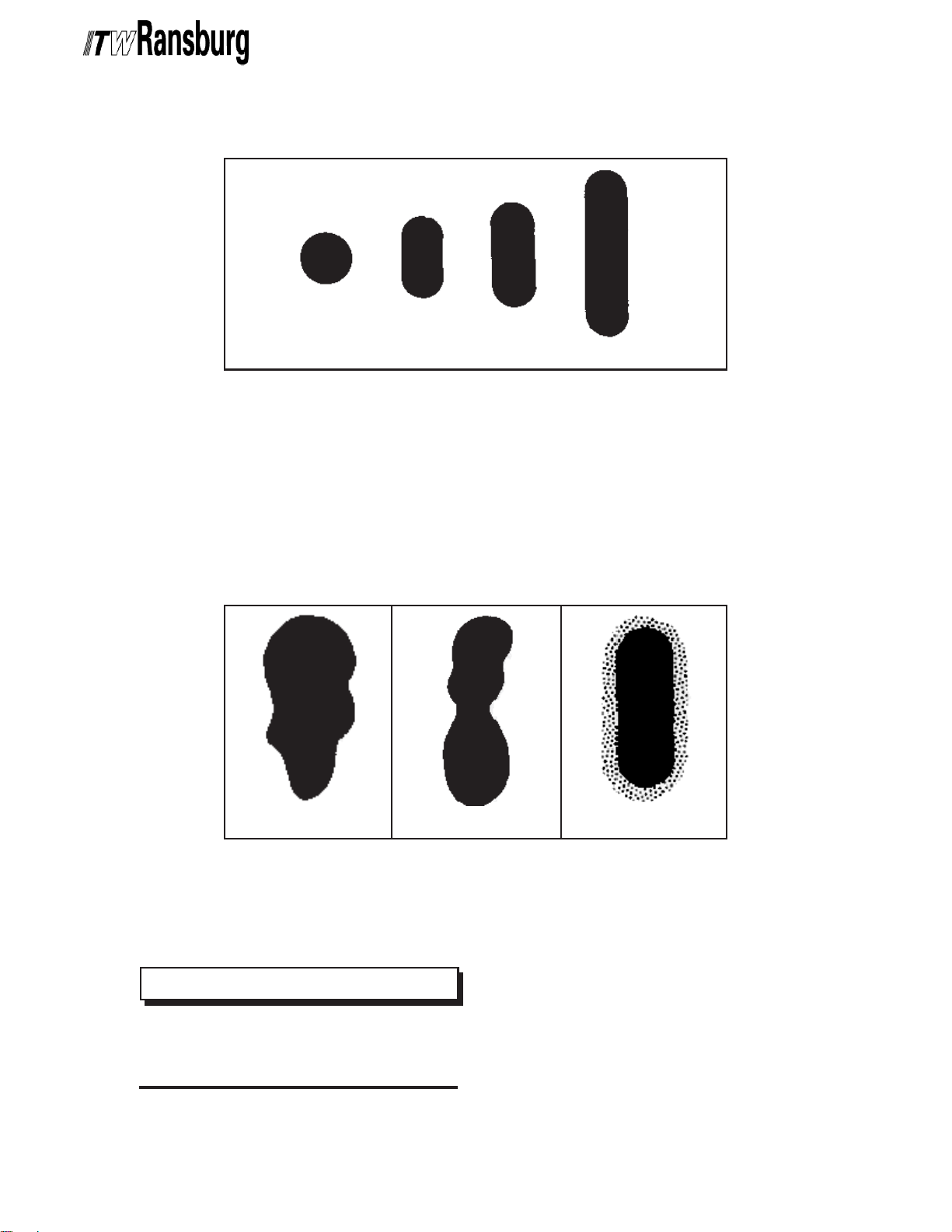
The size of the object being coated is the determining factor in adjusting the fan pattern; the larger the
object, the larger the required fan pattern. Fan control of the ITW Ransburg REA/Vector applicators is
accomplished by rotating the adjusting knob located at the rear of the applicator. Fan width can be set
for approximately a 3-inch width (minimum) to approximately a 14-inch (maximum). Fan widths and
overall pattern appearances are illustrated.
PP
AA
P
A
PP
AA
POOR PATTERNPOOR PATTERN
POOR PATTERN
POOR PATTERNPOOR PATTERN
Dirty, worn, or
damaged nozzle.
Clean or replace.
> The degree of atomization is dependent
on the viscosity of the paint formulation, the
applied air pressure, and nozzle selection.
AA
A
AA
NOTENOTE
NOTE
NOTENOTE
SPLIT PATTERNSPLIT PATTERN
SPLIT PATTERN
SPLIT PATTERNSPLIT PATTERN
Fan too wide - narrow
adjustment slightly.
TTERNTTERN
TTERN
TTERNTTERN
BB
B
BB
GOODGOOD
GOOD
GOODGOOD
CC
C
CC
PATTERNPATTERN
PATTERN
PATTERNPATTERN
IL-246-B
22
2
22
Page 6
REA/Vector Applicators Spray Techniques
FLAFLA
FLA
FLAFLA
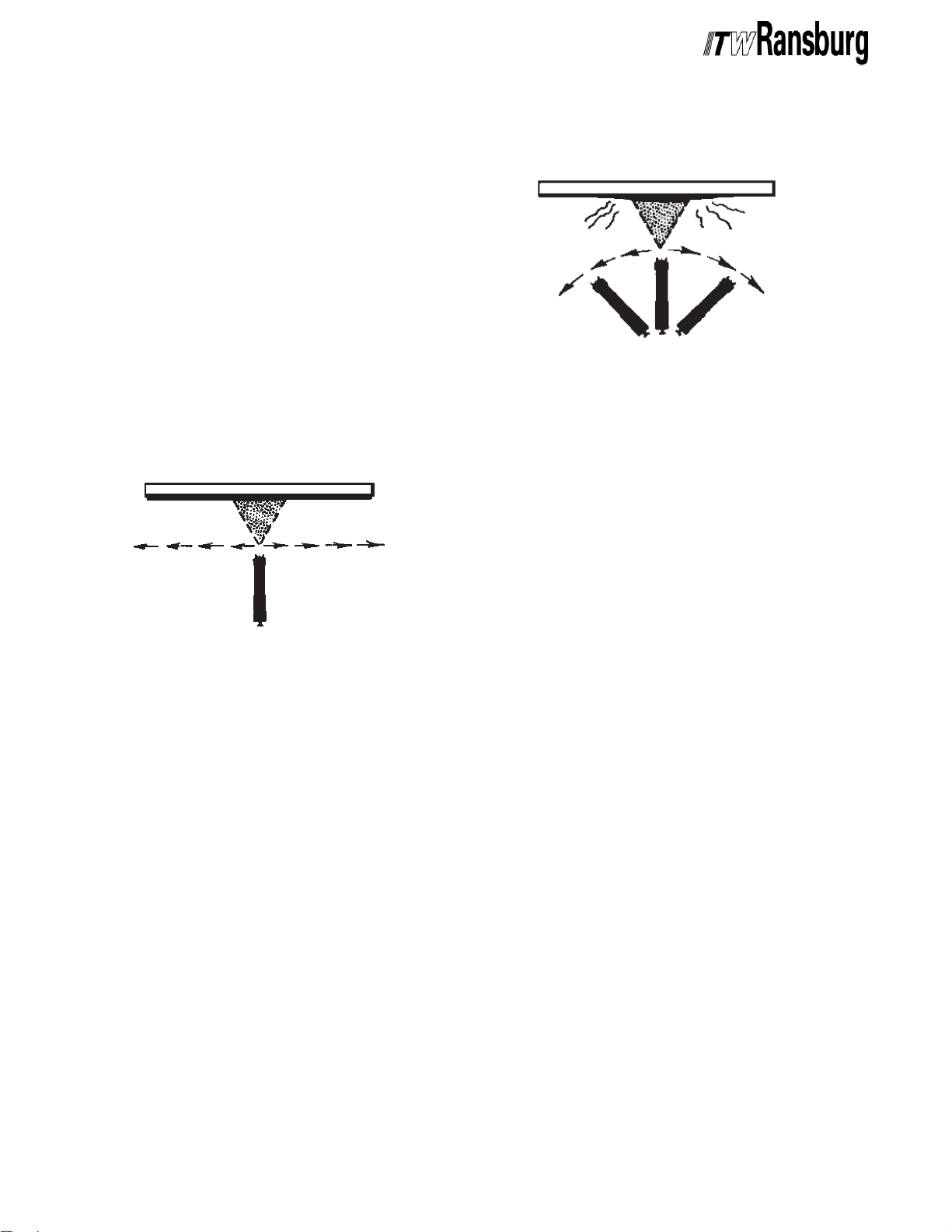
One of the most prevalent of "bad" spray painting
habits is the one where the operator holds his arm
steady and swings his wrist back and forth. This
is a hard habit to break, it gives the illusion of
adding speed to the coating operation, when in
reality, it is slower and much more inefficient.
Spray painting in this fashion results in light films
on both sides, excessive film at center, and
increased overspray with excessive "bounceback."
TT
SURF SURF
T
SURF
TT
SURF SURF
ACESACES
ACES
ACESACES
HORIZONTHORIZONT
HORIZONT
HORIZONTHORIZONT
The spray applicator should be maintained in a
position at right angles to the object and should be
moved in a path parallel to the object.
ALAL
PASSES PASSES
AL
PASSES
ALAL
PASSES PASSES
VERTICAL PASSESVERTICAL PASSES
VERTICAL PASSES
VERTICAL PASSESVERTICAL PASSES
There may be instances where it is more practical
to coat an object using vertical passes rather than
horizontal. First, rotate the nozzle to shift the fan
pattern, then holding the applicator at right angles
to the object, move the applicator in a straight
vertical path as illustrated.
33
3
33
IL-246-B
Page 7
REA/Vector Applicators Spray Techniques
APPLICAAPPLICA
APPLICA
APPLICAAPPLICA
TT
ARGETARGET
T
ARGET
TT
ARGETARGET
TT
OR TOR T
T
OR T
TT
OR TOR T
DIST DIST
DIST
DIST DIST
Under 2"Under 2"
Under 2"
Under 2"Under 2"
OO
O
OO
ANCEANCE
ANCE
ANCEANCE
4" to 6"4" to 6"
4" to 6"
4" to 6"4" to 6"
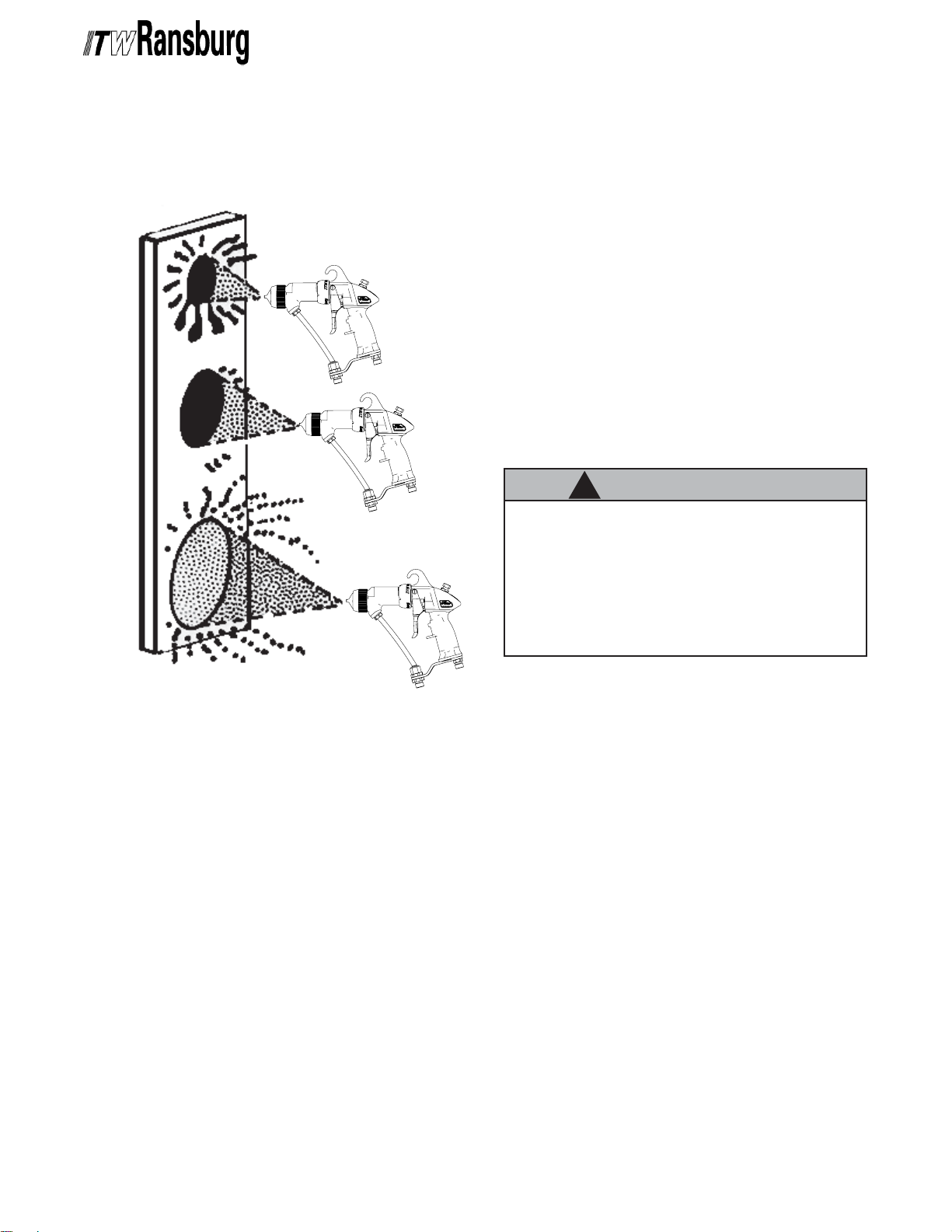
The distance between the applicator and the target
influences the appearance of the final finish coating
of the object. If the applicator is held too close
(under 4-inches), runs and sags with the
excessive bounce-back can occur. If the
applicator is held too far from the object, the
electrostatic attraction is decreased. Normally,
best spacing best spacing
the
best spacing between applicator and target
best spacing best spacing
is in the
distance can vary with extremely high delivery
systems. Maximum target distance should not
exceed 12-inches.
>>
> The object being coated is maintained at
>>
ground potential, the spray applicator operator
is also grounded, therefore, the operator has
as much attraction for the electrostatic paint
as the object. To prevent "wrapback" always
keep the applicator closer to the target than it
is to you.
4 to 12-inch area.4 to 12-inch area.
4 to 12-inch area. However, this
4 to 12-inch area.4 to 12-inch area.
C A U T I O NC A U T I O N
C A U T I O N
C A U T I O NC A U T I O N
!!
!
!!
Too FarToo Far
Too Far
Too FarToo Far
IL-246-B
44
4
44
Page 8
REA/Vector Applicators Spray Techniques
OVERLAPOVERLAP
OVERLAP
OVERLAPOVERLAP
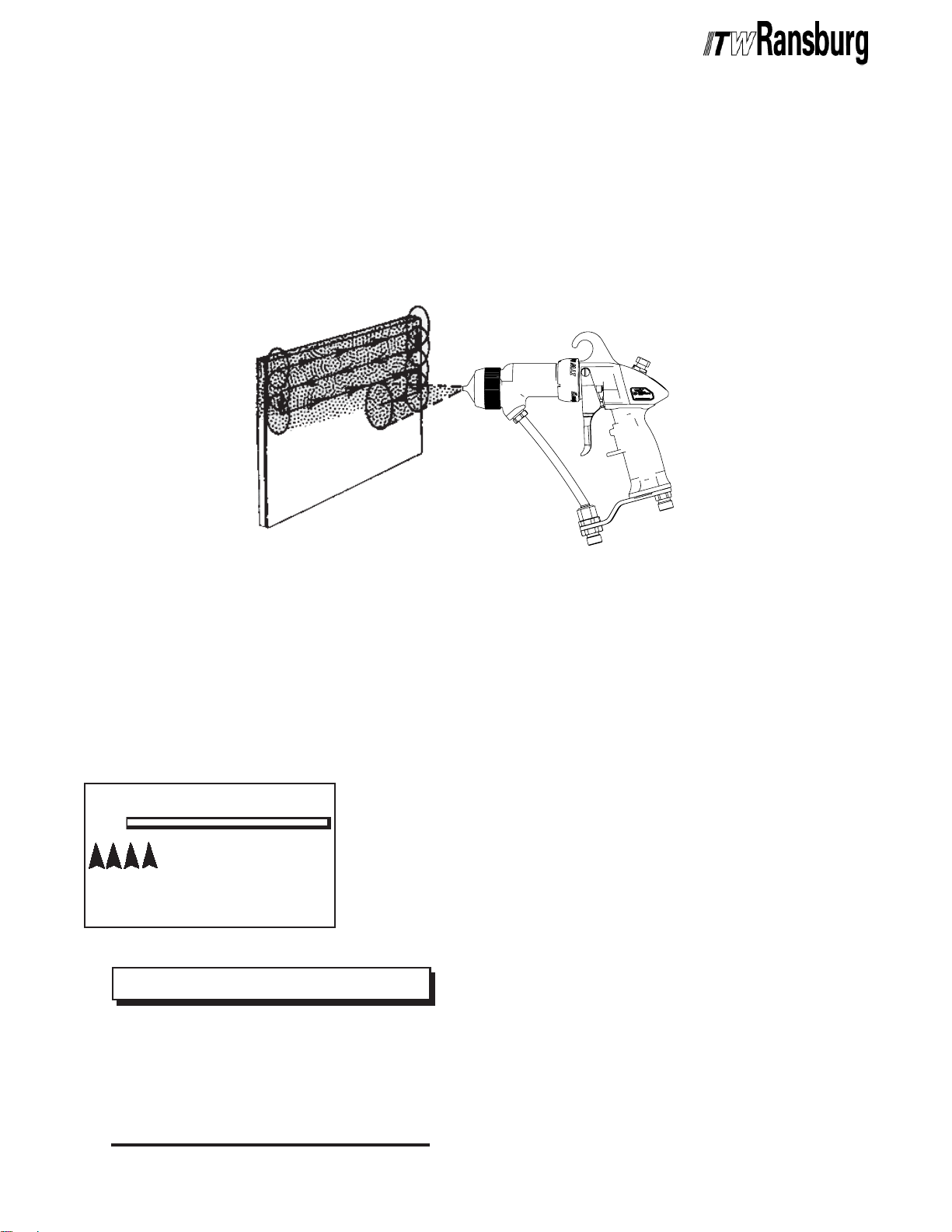
For best hiding and uniformity of film thickness, stroke overlap should be approximately 50%. There
should be some overlap at the top and bottom of the part to increase edge coverage. Overlap
requirements can vary widely with different paint formulations and different compositions of objects
being coated. Individual spray coating operational experience should provide the guidelines for
efficiency in this instance.
TRIGGERINGTRIGGERING
TRIGGERING
TRIGGERINGTRIGGERING
Applicator triggering (ON/OFF) depends largely on the desired results; the amount of wraparound
required, edge coating, etc. If front and back of the object are being coated, proper applicator technique
can effect edge coating (in some instances) without making a specific pass for this purpose. Examples
of different trigger times and the results that can be expected are illustrated.
A. Little or no wrap - incomplete coverage
TOP VIEW
DD
CC
BB
D
DD
(Trigger Off)
AA
C
B
A
CC
BB
AA
NOTENOTE
NOTE
NOTENOTE
> If front and back are both sprayed, there
may be enough wrap using Technique B or
C to coat a small edge or flange. If wide
flanges are to be coated, this may require
individual coating of edges before the flat
surfaces are sprayed.
B. Fair - some wrap
C. Good wrap (Triggered 2" to 3" past edge)
D. Too much overstroke may produce heavy
edges and produce more overspray.
55
5
55
IL-246-B
Page 9
LARGE OBJECTSLARGE OBJECTS
LARGE OBJECTS
LARGE OBJECTSLARGE OBJECTS
BlendingBlending
Blending
BlendingBlending
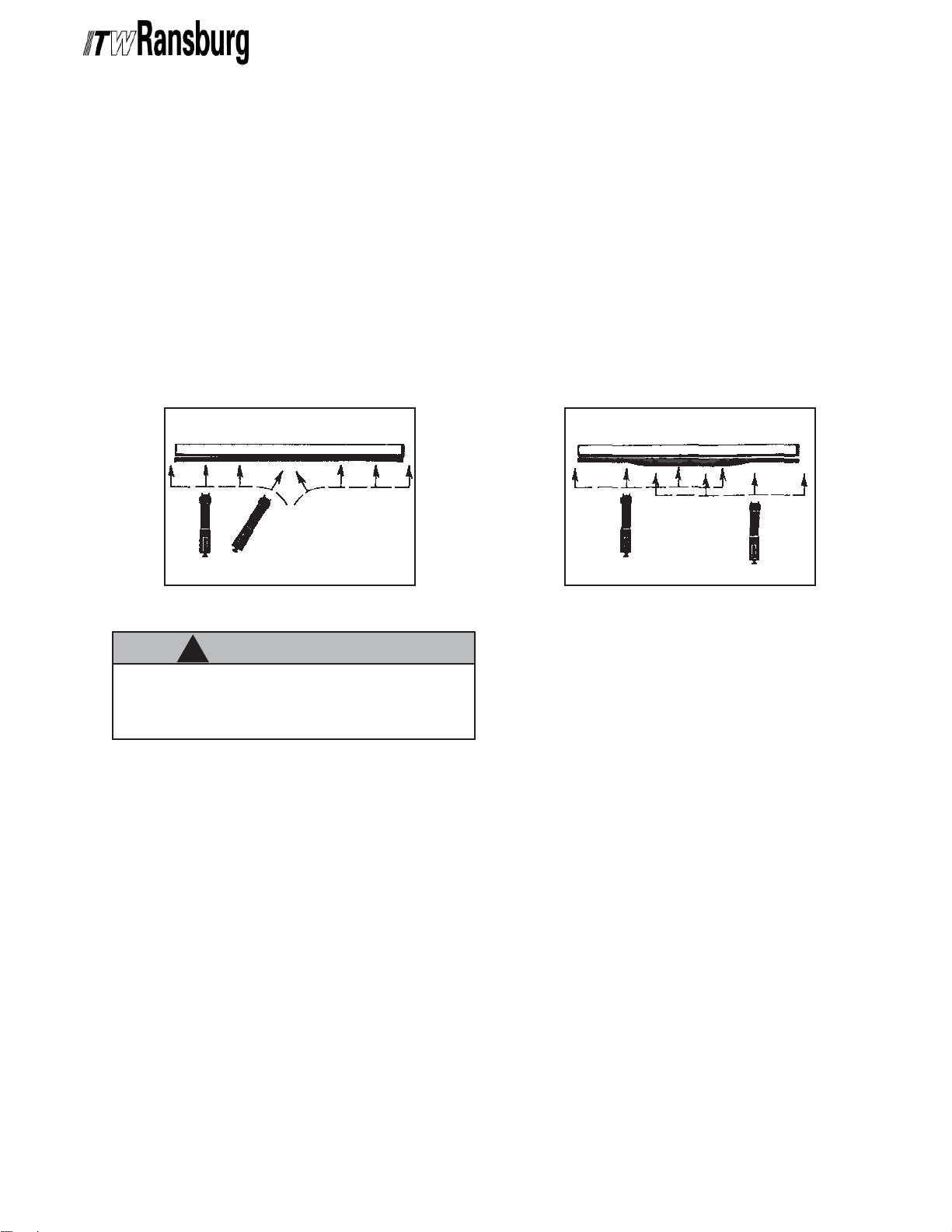
If the size of the object is greater than the spray
applicator operator can reach, it should be coated
in segments, the size of each segment being the
length the spray applicator operator can
comfortably span. Each segment should be
blended with the adjacent segment using
"feathering" or "over-lapping" strokes. A slight
angle of the applicator improves the results of the
"blending" pass.
REA/Vector Applicators Spray Techniques
TOP VIEW
C A U T I O NC A U T I O N
C A U T I O N
C A U T I O NC A U T I O N
!!
!
!!
>>
> Too much overlap can result in runs and
>>
sags or excessive film, where segments
blend together.
TOP VIEW
IL-246-B
66
6
66
Page 10
REA/Vector Applicators Spray Techniques
TUBULAR WORKTUBULAR WORK
TUBULAR WORK
TUBULAR WORKTUBULAR WORK
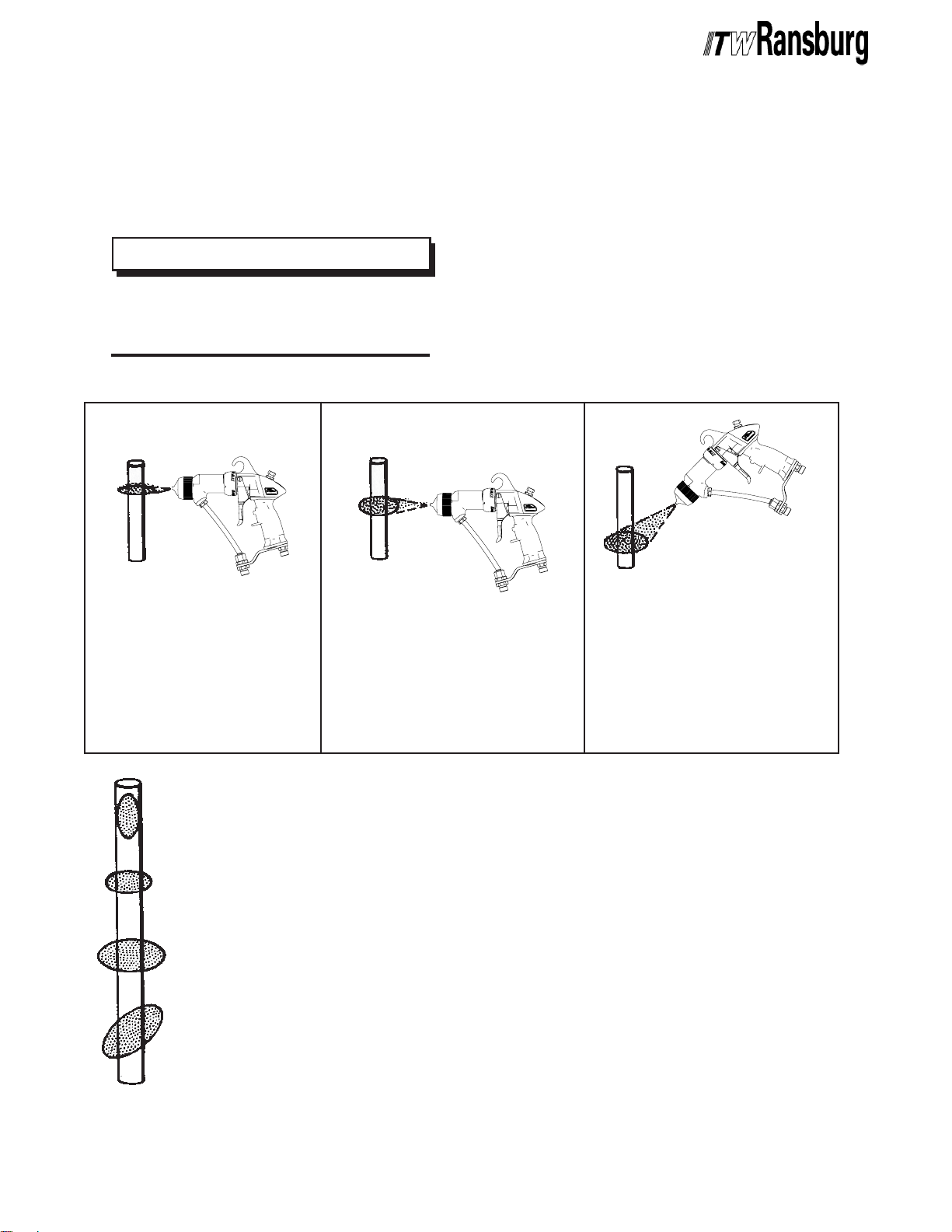
Tubular parts or objects up to approximately 2-1/2" diameter can be coated successfully from one side,
utilizing wraparound characteristics and proper techniques.
NOTENOTE
NOTE
NOTENOTE
> Avoid applicator to targe distances of
over 12-inches, excessive applicator to target distances will result in wrapback.
Adjust the fan for a pattern
width slightly wider than the
object. This allows some
coating material to start
around the sides of the
object.
AA
A
AA
↑↑
↑
↑↑
MOTION
BB
B
BB
↓↓
↓
↓↓
CC
C
CC
FAN POSITION
(Example 1"
Diameter Part)
DD
D
DD
Increase the applicator to target
distance to approximately 1012-inches. This will decrease
the speed of the paint particles
in the vicinity of the target.
A. Wrong fan position - little wrap. Heavy film on front surface,
possible sags.
B. Correct fan position - better wrap. More accurately con-
trolled film. Normally fan pattern should be slightly wider
than parts being sprayed.
C. Correct fan position but excessively wide fan may produce
more overspray if used in this position.
D. A wide fan tilted at an angle may also work well. (Wide fans
have slower forward velocity.)
Hold the applicator at an angle
of 30o to 45o to the object. This
will direct paint more to target
area.
SUGGESTION:SUGGESTION:
SUGGESTION: Small tubes may be racked in groups to simulate larger targets. This allows the use
SUGGESTION:SUGGESTION:
of wider fans and may help improve efficiency.
77
7
77
IL-246-B
Page 11
REA/Vector Applicators Spray Techniques
RECESSED AREASRECESSED AREAS
RECESSED AREAS
RECESSED AREASRECESSED AREAS
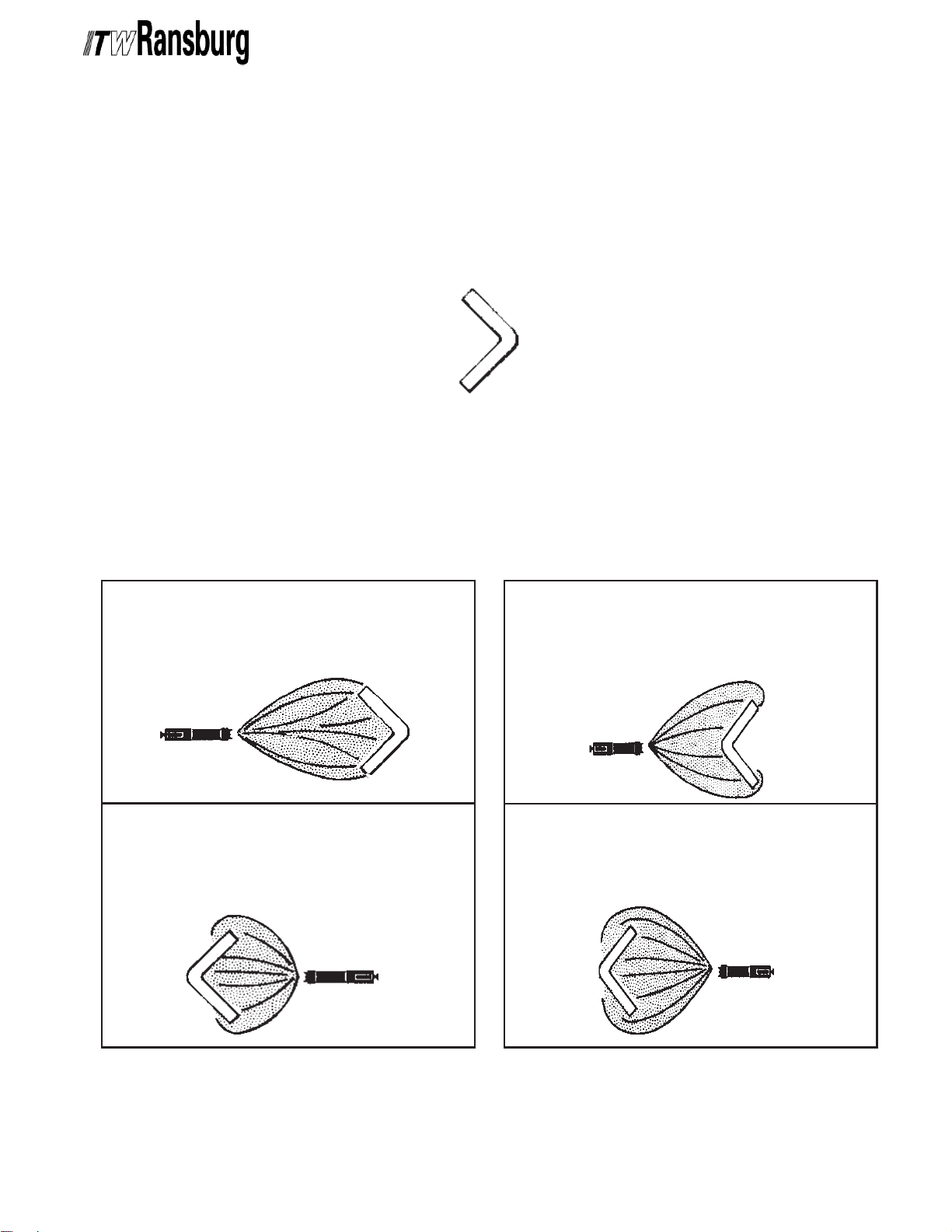
Do not depend on electrostatic attraction alone for coating recessed areas, remember, the more
exposed areas of the object have a stronger attraction for charged paint formulations than the recessed
areas, therefore, the electrostatically charged paint particles will take the path of least resistance, and
tend to build excessively on the more exposed areas.
→←
DIFFICULT
The best and most efficient technique is to coat the recessed areas first, utilizing air pressure to drive
the paint into difficult areas or by narrowing fan width to effectively increase delivery rate per inch of
pattern width. Then paint the more readily accessible areas, the electrostatic process with its
"wraparound" and "opposite attraction" characteristics will probably have already partly coated these
areas.
EASY
A. Voltage by itself will not pull paint into deep
recesses, but instead, paint will be attracted
to more exposed edges.
B.
Solution:
vantages of air atomization to drive paint
into recesses.
NOTE:NOTE:
NOTE: Narrower fan may also be helpful.
NOTE:NOTE:
Move in closer and use the ad-
C. Doing the outside of the part first puts little
paint on the inside. If we now coat the inside,
we will be double coating the edges
and possibly overload them.
D. In this example, we coat the difficult area
first. We may then find that there was enough
wrap around from overspray to coat much of
the remaining areas.
IL-246-B
88
8
88
Page 12
REA/Vector Applicators Spray Techniques
SUMMARYSUMMARY
SUMMARY
SUMMARYSUMMARY
1
2
3
4
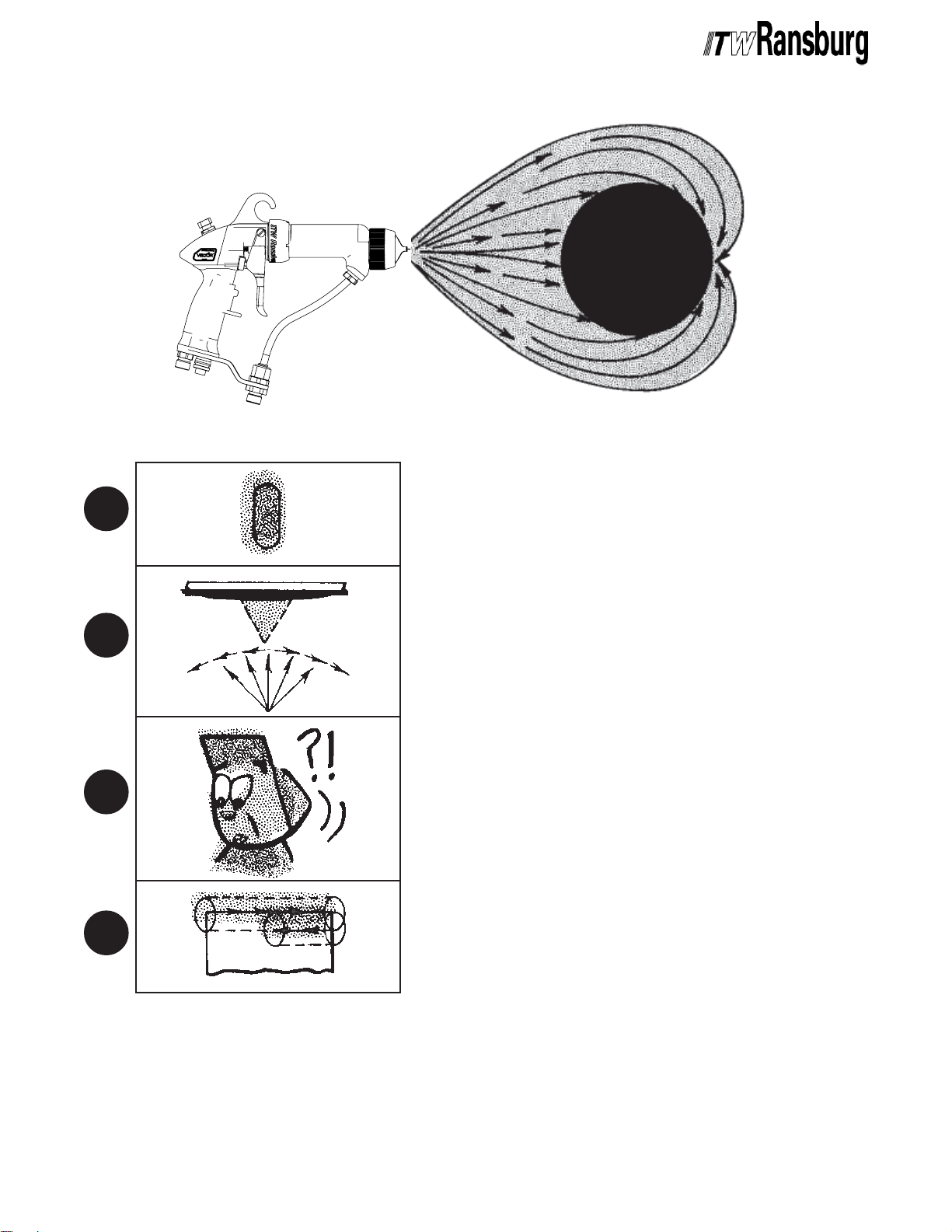
Adjust fan pattern in accordance with size of
object to be coated.
Never swing spray applicator in an arc, hold
applicator steady in a position at right angles to
the object and move applicator in a straight path
parallel to object.
Be sure applicator is held closer to object being
coated than to the operator.
Stroke overlap of approximately 50% normally
produces adequate film thickness uniformity.
99
9
99
IL-246-B
Page 13
5
6
7
ON OFF
REA/Vector Applicators Spray Techniques
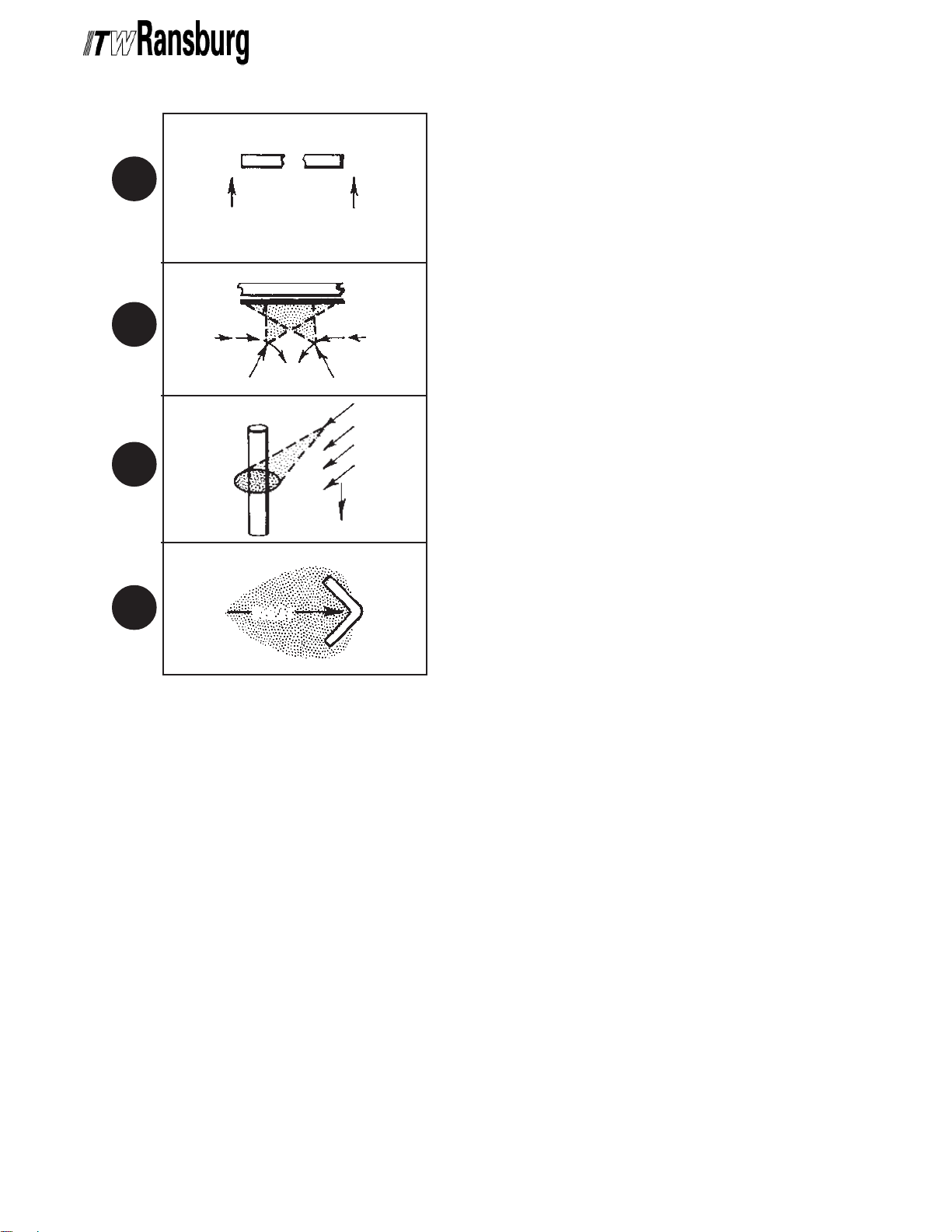
For most economical and efficient coating, trigger
applicator "ON" just before leading edge of object,
trigger applicator "OFF" just after trailing edge of
target. For best wraparound technique, trigger
applicator "ON" 3-inches before, and "OFF" 3-inches
after edges of target.
When painting large objects a section at a time, use
"feather" stroke for blending sections together. Avoid
excessive overlap to prevent runs and sags with
excessive film thickness.
Tubular component coating; adjust fan width for a
pattern slightly wider than the object, hold applicator
10 to 12-inches from object at an angle of 30 to 45inches. Move applicator straight in a parallel path with
the object.
8
Paint "hard to reach" areas first, let wraparound and
electrostatic attraction get the "easy" areas for you.
IL-246-B
1010
10
1010
Page 14

REA/Vector Applicators Spray Techniques
SAFETYSAFETY
SAFETY
SAFETYSAFETY
REQUIREMENTSREQUIREMENTS
REQUIREMENTS
REQUIREMENTSREQUIREMENTS
PersonnelPersonnel
Personnel
PersonnelPersonnel
• Operators must
insulate them from the applicator handle.
• ALL personnel in the spraying area
wear non-insulating shoes or alternative
grounding devices so they will be grounded
through the conductive floor. (See ITW
Ransburg "Personnel Grounding" Safety
Bulletin.)
• Personnel entering a waterborne paint isolation
enclosure
the Warning Light are
hook must be attached to the paint supply
BEFOREBEFORE
BEFORE contact, especially during the
BEFOREBEFORE
addition of fluid! The gate
and the interlocks functioning during use. (See
the appropriate ITW Ransburg equipment
manual.)
• The operator
OFFOFF
OFF before cleaning or servicing the
OFFOFF
equipment.
NEVERNEVER
•
NEVER immerse an applicator in any liquid.
NEVERNEVER
NOTNOT
NOT wear gloves that
NOTNOT
MUSTMUST
MUST
MUSTMUST
MUSTMUST
MUST be sure that the system and
MUSTMUST
OFF!OFF!
OFF! The grounding
OFF!OFF!
MUSTMUST
MUST be closed
MUSTMUST
MUSTMUST
MUST turn the power supply
MUSTMUST
• All conductive objects in the spraying area
MUSTMUST
MUST be removed or grounded.
MUSTMUST
• A pressure EXPLOSION may occur if
HALOGENATED HYDROCARBON solvents
are used in PRESSURIZABLE fluid systems
having ALUMINUM or GALVANIZED parts.
(See ITW Ransburg "Danger - Explosion
Hazard" and "Halogenated Hydrocarbon"
Safety bulletins.)
• The high voltage power supply
grounded and located outside of the Hazard
Area. (See the appropriate ITW Ransburg
equipment manual.)
• Appropriate, functioning fire extinguishing
equipment
• Good housekeeping is essential to safe
operation. Cleanup and maintenance
schedules should be established by the user.
Maintenance and safety cards should be
posted in clear view of the operator.
• All flammable liquids
grounded safety containers. Not more than
one gallon should be in any container and the
total amount in the spray area should be no
more than the minimum required for the
operation.
MUST MUST
MUST be provided.
MUST MUST
MUSTMUST
MUST be in approved,
MUSTMUST
MUST MUST
MUST be
MUST MUST
• Exhaust fans
Environment and EquipmentEnvironment and Equipment
Environment and Equipment
Environment and EquipmentEnvironment and Equipment
• The spray booth (including its floor), paint
reservoir (except waterborne), and conveyor
MUSTMUST
MUST be grounded.
MUSTMUST
• An adequate, grounded, protective enclosure
that will assure safe isolation from personnel
must surround the supply of waterborne paints.
(See OSHA Standard 1910.107 (h) (10).)
• The spray target and all supporting holders,
hooks, and conveyors
the supporting structure. All support devices
MUST MUST
MUST be free of accumulated coating
MUST MUST
material.
1111
11
1111
MUSTMUST
MUST be
MUSTMUST
ONON
ON during spraying.
ONON
MUSTMUST
MUST be grounded to
MUSTMUST
• All applicators
proper operating limits. (See the appropriate
ITW Ransburg equipment manual for short
circuit current tests.)
MUSTMUST
MUST be maintained within
MUSTMUST
IL-246-B
Page 15

REA/Vector Applicators Spray Techniques
NOTESNOTES
NOTES
NOTESNOTES
IL-246-B
1212
12
1212
Page 16

REA/Vector Applicators Spray Techniques
NOTESNOTES
NOTES
NOTESNOTES
1313
13
1313
IL-246-B
Page 17

MANUALMANUAL
MANUAL
MANUALMANUAL
This manual was published to supercede
IL-246-A, ITW RansburgIL-246-A, ITW Ransburg
Technical Manual
REA/Vector Applicators Electro-Air SprayREA/Vector Applicators Electro-Air Spray
REA/Vector Applicators Electro-Air Spray
REA/Vector Applicators Electro-Air SprayREA/Vector Applicators Electro-Air Spray
TechniquesTechniques
Techniques
TechniquesTechniques
1. Service literature was reformatted. Made
available electronically.
2. Added "Technical Manual Price: €15.00 (Euro)"
to the "Front and Back Covers".
3. Added "Vector Applicators" to the "Spray Techniques".
4. New "Applicator Figures" throughout the service
literature.
5. Added "www.itwransburg.com" to "Contact
Information" on the back cover.
, to make the following change:
IL-246-A, ITW Ransburg
IL-246-A, ITW RansburgIL-246-A, ITW Ransburg
CHANGE SUMMAR CHANGE SUMMAR
CHANGE SUMMAR
CHANGE SUMMAR CHANGE SUMMAR
YY
Y
YY
IL-246-B
Page 18

TT
echnical Manual Price:echnical Manual Price:
T
echnical Manual Price:
TT
echnical Manual Price:echnical Manual Price:
ManufacturingManufacturing
Manufacturing
ManufacturingManufacturing
15.00 Euro)15.00 Euro)
€
15.00 Euro)
15.00 Euro)15.00 Euro)
$20.00 (U.S.)$20.00 (U.S.)
$20.00 (U.S.)
$20.00 (U.S.)$20.00 (U.S.)
1910 North Wayne Street
Angola, Indiana 46703-9100
Telephone: 260/665-8800
Fax: 260/665-8516
TT
echnical/Service Assistanceechnical/Service Assistance
T
echnical/Service Assistance
TT
echnical/Service Assistanceechnical/Service Assistance
Automotive Assembly and Tier I Telephone: 800/ 626-3565 Fax: 419/ 470-2040
Industrial Systems Telephone: 800/ 233-3366 Fax: 419/ 470-2071
Ransburg Guns Telephone: 800/ 233-3366 Fax: 419/ 470-2071
www.itwransburg.com
TT
echnical Support Representative will direct you to the appropriate telephoneechnical Support Representative will direct you to the appropriate telephone
T
echnical Support Representative will direct you to the appropriate telephone
TT
echnical Support Representative will direct you to the appropriate telephoneechnical Support Representative will direct you to the appropriate telephone
number for ordering Spare Parts.number for ordering Spare Parts.
number for ordering Spare Parts.
number for ordering Spare Parts.number for ordering Spare Parts.
© 2008 Illinois Tool Works Inc. All rights reserved.
Models and specifications subject to change without notice.
Form No. IL-246-B
Litho in U.S.A.
01/08
 Loading...