

Page 1
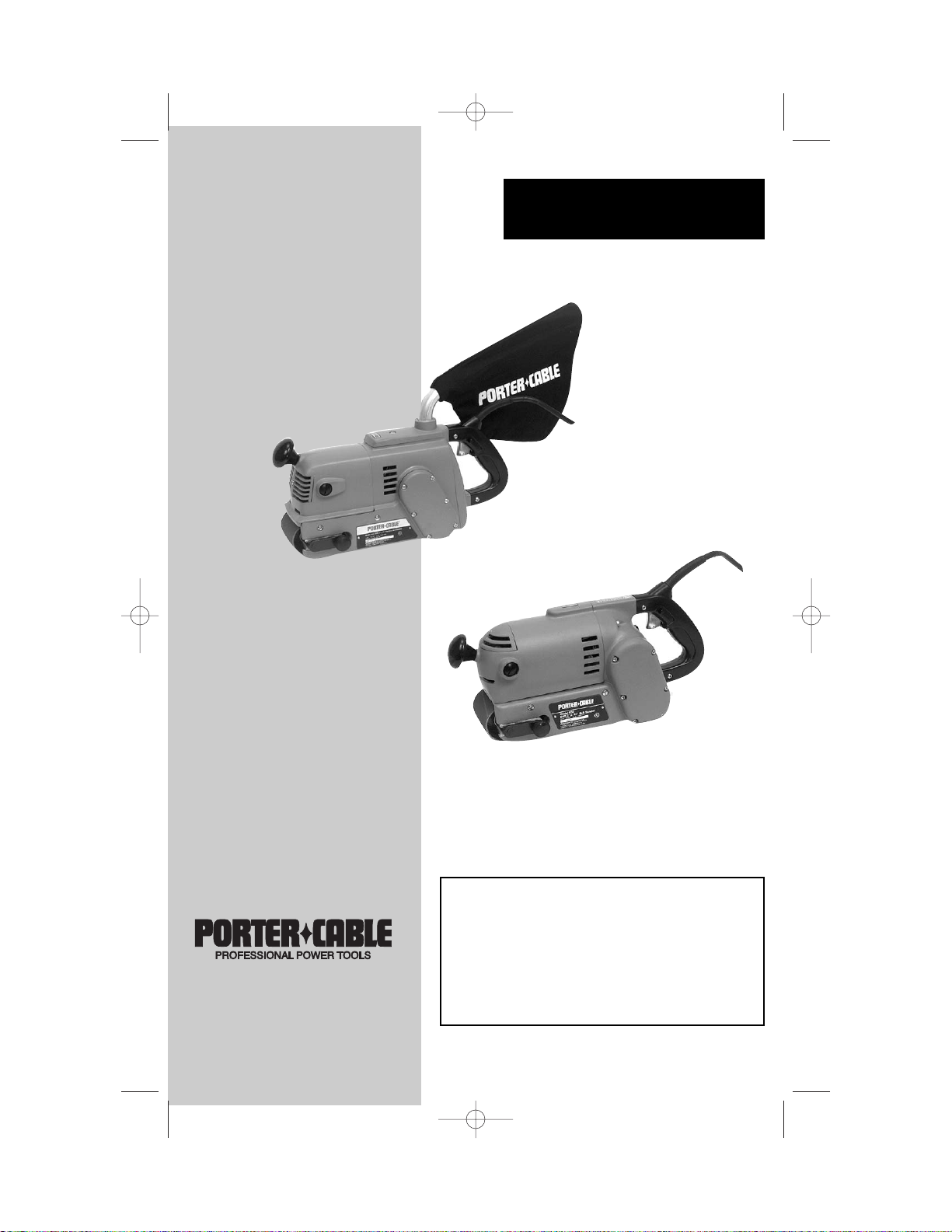
Instruction
manual
The Model and Serial No. plate is located on the main
housing of the tool. Record these numbers in the
spaces below and retain for future reference.
Model No. ______________________________________
Type ___________________________________________
Serial No. _______________________________________
IMPORTANT
Please make certain that the person who is
to use this equipment carefully reads and
understands these instructions before
starting operations.
Part No. 899602 - 04-26-02
ESPAÑOL: PÁGINA 15
FRANÇAISE : PAGE 29
To learn more about Porter-Cable
visit our website at:
http://www.porter-cable.com
Copyright © 2002 Porter-Cable Corporation
Belt Sanders
MODEL 503
3" x 24" Belt
MODEL 504
3" x 24" Belt
899602 - 04-26-02.qxd 9/23/02 10:12 AM Page 1
Page 2

2
WARNING: SOME DUST CREATED BY POWER SANDING, SAWING,
GRINDING, DRILLING, AND OTHER CONSTRUCTION ACTIVITIES
contains chemicals known to cause cancer, birth defects or other
reproductive harm. Some examples of these chemicals are:
· lead from lead-based paints,
· crystalline silica from bricks and cement and other masonry products, and
· arsenic and chromium from chemically-treated lumber.
Your risk from these exposures varies, depending on how often you do this
type of work. To reduce your exposure to these chemicals: work in a well
ventilated area, and work with approved safety equipment, such as those
dust masks that are specially designed to filter out microscopic particles.
GENERAL SAFETY RULES
WARNING: READ AND UNDERSTAND ALL INSTRUCTIONS. Failure
to follow all instructions listed below, may result in electric shock, fire and/or
serious personal injury.
SAVE THESE INSTRUCTIONS.
WORK AREA
1. Keep your work area clean and well lit. Cluttered benches and dark
areas invite accidents.
2. Do not operate power tools in explosive atmospheres, such as in
the presence of flammable liquids, gases, or dust. Power tools create
sparks which may ignite the dust or fumes.
3. Keep bystanders, children, and visitors away while operating a
power tool. Distractions can cause you to lose control.
ELECTRICAL SAFETY
1. Grounded tools must be plugged into an outlet properly installed and
grounded in accordance with all codes and ordinances. Never remove
the grounding prong or modify the plug in any way. Do not use any
adapter plugs. Check with a qualified electrician if you are in doubt as to
whether the outlet is properly grounded. If the tools should electrically
malfunction or break down, grounding provides a low resistance path to carry
electricity away from the user.
2. Avoid body contact with grounded surfaces such as pipes,
radiators, ranges and refrigerators. There is an increased risk of electric
shock if your body is grounded.
3. Don’t expose power tools to rain or wet conditions. Water entering a
power tool will increase the risk of electric shock.
4. Do not abuse the cord. Never use the cord to carry the tools or pull
the plug from an outlet. Keep cord away from heat, oil, sharp edges or
moving parts. Replace damaged cords immediately. Damaged cords
increase the risk of electric shock.
5. When operating a power tool outside, use an outdoor extension
cord marked “W-A” or “W”. These cords are rated for outdoor use and
reduce the risk of electric shock.
PERSONAL SAFETY
1. Stay alert, watch what you are doing, and use common sense when
operating a power tool. Do not use tool while tired or under the
influence of drugs, alcohol, or medication. A moment of inattention while
operating power tools may result in serious personal injury.
2. Dress properly. Do not wear loose clothing or jewelry. Contain long
899602 - 04-26-02.qxd 9/23/02 10:12 AM Page 2
Page 3

3
hair. Keep your hair, clothing, and gloves away from moving parts.
Loose clothes, jewelry, or long hair can be caught in moving parts.
3. Avoid accidental starting. Be sure switch is OFF before plugging in.
Carrying tools with your finger on the switch or plugging in tools that have
the switch ON invites accidents.
4. Remove adjusting keys or wrenches before turning the tool ON. A
wrench or a key that is left attached to a rotating part of the tool may result in
personal injury.
5. Do not overreach. Keep proper footing and balance at all times.
Proper footing and balance enables better control of the tool in unexpected
situations.
6. Use safety equipment. Always wear eye protection. Dust mask, nonskid safety shoes, hard hat, or hearing protection must be used for
appropriate conditions.
TOOLS USE AND CARE
1. Use clamps or other practical way to secure and support the
workpiece to a stable platform. Holding the work by hand or against your
body is unstable and may lead to loss of control.
2. Do not force tool. Use the correct tool for your application. The
correct tool will do the job better and safer at the rate for which it is
designed.
3. Do not use tool if switch does not turn it ON or OFF. Any tool that
cannot be controlled with the switch is dangerous and must be repaired.
4. Disconnect the plug from the power source before making any
adjustments, changing accessories, or storing the tool. Such preventive
safety measures reduce the risk of starting the tool accidentally.
5. Store idle tools out of reach of children and other untrained
persons. Tools are dangerous in the hands of untrained users.
6. Maintain tools with care. Keep cutting tools sharp and clean.
Properly maintained tools, with sharp cutting edges are less likely to bind
and are easier to control.
7. Check for misalignment or binding of moving parts, breakage of
parts, and any other condition that may affect the tool’s operation. If
damaged, have the tool serviced before using. Many accidents are
caused by poorly maintained tools.
8. Use only accessories that are recommended by the manufacturer
for your model. Accessories that may be suitable for one tool may become
hazardous when used on another tool.
SERVICE
1. Tool service must be performed only by qualified repair personnel.
Service or maintenance performed by unqualified personnel could result in a
risk of injury.
2. When servicing a tool, use only identical replacement parts. Follow
instructions in the Maintenance Section of this manual. Use of
unauthorized parts or failure to follow Maintenance Instructions may create a
risk of electric shock or injury.
SPECIFIC SAFETY RULES AND SYMBOLS
1. Hold tool by insulated gripping surfaces when performing an
operation where the cutting tools may contact hidden wiring or its own
cord. Contact with a “live” wire will make exposed metal parts
of the tool “live” and shock the operator.
899602 - 04-26-02.qxd 9/23/02 10:12 AM Page 3
Page 4
4
2. Use proper safety equipment. Wear safety goggles to protect your
eyes, wear hearing protection to protect your ears, and wear a
protective mask to minimize breathing in the fine dust created while
sanding.
3. Sanding of lead-based paint is not recommended. Lead-based
paint should only be removed by a professional.
4. Always maintain a firm grip on the belt sander handles with both
hands to prevent loss of control.
5. Do not operate belt sander without all guards and covers securely in
place.
6. Some wood contains preservatives which can be toxic. Take extra
care to prevent inhalation and skin contact when working with these
materials. Request, and follow, any safety information available from your
material supplier.
7. WARNING: There are certain applications for which this tool was
designed. Porter-Cable strongly recommends that this tool NOT be modified
and/or used for any application other than for which it was designed. If you
have any questions relative to its application DO NOT use the tool until you
have written Porter-Cable and we have advised you.
Technical Service Manager
Porter-Cable Corporation
4825 Highway 45 North
Jackson, TN 38305
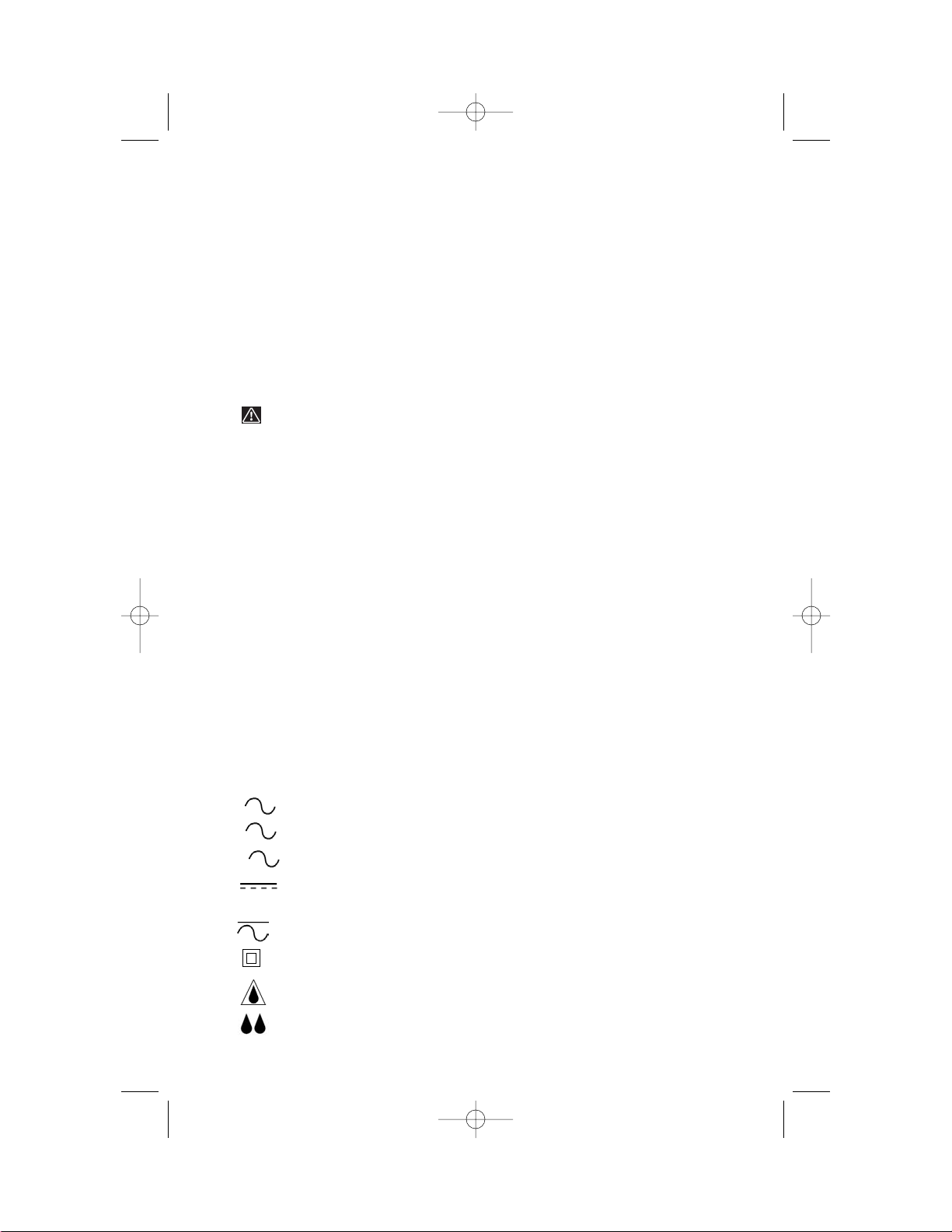
SYMBOL DEFINITION
V ........................ volts
A ........................ amperes
Hz ........................ hertz
W ........................ watts
kW ........................ kilowatts
µF ........................ microfarads
l ........................ liters
kg ........................ kilograms
N/cm
2
........................ newtons per square centimeter
Pa ........................ pascals
h ........................ hours
min ........................ minutes
s ........................ seconds
........................ alternating current
3 ........................ three-phase alternating current
3
N
........................ three-phase alternating current with neutral
........................ direct current
n
0
........................ no load
........................ alternating or direct current
........................ Class II Construction
........................ splash-proof construction
........................ watertight construction
899602 - 04-26-02.qxd 9/23/02 10:12 AM Page 4
Page 5

…/min ........................ revolutions or reciprocation per minute
ADDITIONAL SAFETY RULES FOR PAINT REMOVAL
WARNING: Extreme care should be taken when removing paint. The
peelings, residue, and vapors of paint may contain lead, which is
poisonous. Exposure to even low levels of lead can cause
irreversible brain and nervous system damage; young and unborn
children are particularly vulnerable.
Before beginning any paint removal process you should determine whether the
paint you are removing contains lead. This can be done by your local health
department or by a professional who uses a paint analyzer to check for lead.
LEAD-BASED PAINT SHOULD ONLY BE REMOVED BY A PROFESSIONAL.
Persons removing paint should follow these guidelines:
1. KEEP THE WORK AREA WELL VENTILATED. Open the windows and
put an exhaust fan in one of them. Be sure the fan is moving air from inside
to outside.
2. REMOVE OR COVER any carpets, rugs, furniture, clothing, cooking
utensils and air ducts.
3. PLACE DROP CLOTHS in the work area to catch any paint chips or
peelings. Wear protective clothing such as extra work shirts, overalls and hats.
4. WORK IN ONE ROOM AT A TIME. Furnishings should be removed or
placed in the center of the room and covered. Work areas should be sealed
off from the rest of the dwelling by sealing doorways with drop cloths.
5. CHILDREN, PREGNANT OR POTENTIALLY PREGNANT women and
nursing mothers should not be present in the work area until the work is
done and all cleanup is complete.
6. WEAR A DUST RESPIRATOR or a dual filter (dust and fume) respirator
mask which has been approved by the Occupational Safety and Health
Administration (OSHA), the National Institute of Safety and Health (NIOSH),
or the United States Bureau of Mines. These masks and replaceable filters
are readily available at major hardware stores. Be sure the mask fits. Beards
and facial hair may keep the masks from sealing properly. Change filters
often. DISPOSABLE PAPER MASKS ARE NOT ADEQUATE.
7. KEEP FOOD AND DRINK out of the work area. Wash hands, arms, and
face and rinse mouth before eating or drinking. Do not smoke or chew gum
or tobacco in the work area.
8. CLEAN UP ALL REMOVED PAINT and dust by wet mopping the floors.
Use a wet cloth to clean all walls, sills and any other surfaces where paint or
dust is clinging. DO NOT SWEEP, DRY DUST OR VACUUM. Use a high
phosphate detergent or trisodium (TSP) to wash and mop areas.
9. AT THE END OF EACH WORK SESSION put the paint chips and debris
in a double plastic bag, close it with tape or twist ties and dispose of properly.
10. REMOVE PROTECTIVE CLOTHING and work shoes in the work area to
avoid carrying dust into the rest of the dwelling. Wash work clothes
separately. Wipe shoes off with a wet rag that is then washed with the work
clothes. Wash hair and body thoroughly with soap and water.
5
899602 - 04-26-02.qxd 9/23/02 10:12 AM Page 5
Page 6

6
REPLACEMENT PARTS
When servicing use only identical replacement parts.
MOTOR
Many Porter-Cable tools will operate on either D.C., or single phase 25 to 60
cycle A.C. current and voltage within plus or minus 5 percent of that shown
on the specification plate on the tool. Several models, however, are designed
for A.C. current only. Refer to the specification plate on your tool for proper
voltage and current rating.
CAUTION: Do not operate your tool on a current on which the
voltage is not within correct limits. Do not operate tools rated A.C.
only on D.C. current. To do so may seriously damage the tool.
EXTENSION CORD SELECTION
If an extension cord is used, make sure the conductor size is large enough to
prevent excessive voltage drop which will cause loss of power and possible
motor damage. A table of recommended extension cord sizes will be found
in this section. This table is based on limiting line voltage drop to 5 volts (10
volts for 230 volts) at 150% of rated amperes.
If an extension cord is to be used outdoors it must be marked with the suffix
W-A or W following the cord type designation. For example – SJTW-A to
indicate it is acceptable for outdoor use.
RECOMMENDED EXTENSION CORD SIZES FOR USE WITH PORTABLE ELECTRIC TOOLS
FUNCTIONAL DESCRIPTION
FOREWORD
Porter-Cable Belt Sanders are designed for smoothing rough boards,
removing old paint and varnish, fine-surfacing wood, metal, plastics, and
other materials.
SELECTING AN ABRASIVE BELT
The principal abrasive material used on belts for machine sanding are
aluminum oxide and silicon carbide. Aluminum oxide is not as hard as the
Length of Cord in Feet
115V 25 Ft. 50 Ft. 100 Ft. 150 Ft. 200 Ft. 250 Ft. 300 Ft. 400 Ft. 500 Ft.
230V 50 Ft. 100 Ft. 200 Ft. 300 Ft. 400 Ft. 500 Ft. 600 Ft. 800 Ft. 1000 Ft.
0-2181818161614141212
2-3181816141412121010
3-418181614121210108
4-5 18 18 14 12 12 10 10 8 8
5-6 18 16 14 12 10 10 8 8 6
6-8 18 16 12 10 10 8 6 6 6
8-10 18 14 12 10 8 8 6 6 4
10-12 16 14 10 8 8 6 6 4 4
12-14 16 12 10 8 6 6 6 4 2
14-16 16 12 10 8 6 6 4 4 2
16-18 14 12 8 8 6 4 4 2 2
18-20 14 12 8 6 6 4 4 2 2
Nameplate Ampere Rating
899602 - 04-26-02.qxd 9/23/02 10:12 AM Page 6
Page 7

silicon carbide, but is tougher and more suited for woods and soft
(nonferrous) metals. Silicon carbide is extremely hard and is best suited for
surfacing stone, marble and glass.
Abrasives are classed as open-coated (grit spaced) or closed-coated
(Grit non-spaced). Closed coatings provide hard, fast cutting action for
hardwoods and dense metals while the open coatings are more suited to
soft materials and painted surfaces.
To obtain the best finish, start with a “COARSE” grade of abrasive and
change to “MEDIUM” and “FINE” grades as work progresses.
A wide range of available PORTER-CABLE Sanding Belts is listed in the
back of the manual. Keep a full assortment on hand so that the correct
belt will always be available.
INSTALLING AND REMOVING THE ABRASIVE BELT
CAUTION: Disconnect tool from
power source.
1. Lay sander on its left side and
turn the tension relief lever (A) Fig. 1,
locking it under the catch on the
plate.
2. Remove the old belt.
3. Install new belt so that arrow,
printed on inside of belt, is at the top
and pointing toward the front of the sander.
NOTE: Some sanding belts are bi-directional. These bi-directional belts
will not have arrows printed on them. They may be installed to run in
either direction.
4. Position the belt so that the outer edge is flush with the outer ends of
the pulleys.
5. Release tension lever to restore belt tension.
TO START AND STOP BELT SANDERS
CAUTION: Make sure switch is off
and power circuit voltage is the
same as the voltage shown on the
specification plate on the sander.
connect machine to power circuit.
1. Squeeze trigger switch (A) Fig. 2, to
start motor. Release trigger to stop
motor.
2. A lock button (B) Fig. 2 is
provided to keep motor running
continually without pressing the
trigger.
7
Fig. 1
A
Fig. 2
B
A
899602 - 04-26-02.qxd 9/23/02 10:12 AM Page 7
Page 8

8
3. To lock the trigger switch ON, squeeze the trigger as far as it will go,
push in lock button and release trigger.
4. To unlock lock button, squeeze trigger and release, freeing the lock
button.
TRACKING THE ABRASIVE BELT
NEVER allow abrasive belt to rub on
frame of sander. This action will cause
excessive wear to both the sander and
belt. To prevent damage, track the
belt in the following manner:
CAUTION: Make sure trigger switch
is OFF before connecting tool to
power circuit.
1. Lift machine clear of work and
turn motor on.
2. Turn belt aligning screw (A) Fig. 3,
in either direction until edge of belt runs flush with outer edges of the
pulleys.
3. Turn motor OFF and allow sander to come to a COMPLETE STOP
before putting it down.
ATTACHING AND CARE OF DUST BAG
MODEL 503 ONLY
The dust bag is completely assembled at the factory. To attach to the
sander, push the dust bag tube on to the vacuum housing.
For most efficient operation, empty the dust bag when it is less than half
filled. Remove the bag. Unzip the rear of bag and shake out the dust.
Occasionally, turn the bag inside out and brush the dust accumulations
from the inside.
HOW TO USE THE
SANDER
Do not use sander in any position
other than that shown in Fig. 4.
Using the sander in a vertical or
upside-down position may cause
excessive gear wear because of a
lack of lubrication.
CAUTION: SECURE WORK and
maintain a FIRM GRIP on sander. Friction between sanding belt and
work will move the work backward and the sander forward.
CAUTION: ALWAYS be sure switch is OFF before connecting sander
to power circuit.
1. HOLD sander OFF the work and start motor.
Fig. 3
A
Fig. 4
899602 - 04-26-02.qxd 9/23/02 10:13 AM Page 8
Page 9

9
2. LOWER sander to the work, letting the rear part of the belt touch
first. Level the machine as it is moved forward.
3. GUIDE the machine over the work in overlapping strokes, allowing
the sander to do the work.
4. AVOID applying excessive pressure when sanding. The weight of the
machine is usually sufficient for a fast, smooth finish.
5. WORK BACK and FORTH over a wide area to obtain an even surface.
6. DO NOT tilt the machine or sand with the edge of the belt.
7. Do not pause in any one spot during the sanding operation.
8. Lift sander from work before turning OFF motor.
9. ALWAYS be sure motor has completely stopped before putting sander
down.
FAST SANDING ON ROUGH
WORK
To smooth a rough surface
quickly, use a coarse grit abrasive
belt. With the belt positioned
diagonally across the grain (see
Fig. 5), move the sander in the
direction of the grain. Overlap the
strokes and work the entire
surface from both sides of the
board (once with the sander
angled to the left and once angled
to the right). Smooth the surface by guiding the sander back and forth
with the grain. Change the belt to a medium grit and follow the same
procedure. Finish by thoroughly sanding over the grain lengthwise.
Change again to a fine grit and work back and forth with the grain.
Always finish by sanding with the grain.
REMOVING OLD PAINT AND VARNISH
This sander is an excellent tool for removing old paint and varnish from
flat surfaces. Two problems are common to such work: (1) loading the
abrasive with the material being removed and (2) overheating the paint or
varnish by working too long in one place.
Use a spaced grain or open coat abrasive belt and a single stroke action
to overcome the loading problem. Lower the sander at the far end of the
work and pull back. Raise the machine and do the same in a different
location. Overheating can be avoided by using a fairly quick stroke. A
piece of felt about ¼" thick can be inserted under the shoe for fast spot
sanding and for working on stubborn areas of paint and varnish.
SPECIAL SANDING PROCEDURES
Ordinarily the sanding stroke is back and forth. Some materials and some
types of operations, however, require a different technique. In rough
Fig. 5
899602 - 04-26-02.qxd 9/23/02 10:13 AM Page 9
Page 10

10
sanding, use the machine at an angle. In spot sanding, use the machine
with only the front pulley touching the surface (especially required in
smoothing excess glue from wood joints). Metals, slate, marble, and
plastic materials have no grain. Therefore, the sanding on these worpieces
may be done in different directions.
DOORS AND MILL WORK
When sanding doors, cabinet frames, sash, storm windows and screens,
avoid working into the cross grain where one member meets another.
Notice that the right edge of the belt is visible on your sander. Watch it
closely. Work carefully along the edge where the rail meets the stile. If the
joint is slightly uneven, use a fine grit abrasive and very light sanding
pressure, smoothing the joint prior to making the finishing runs.
GOOD SANDING TECHNIQUE
Getting the feel of the sander is important in obtaining smooth results
with minimal labor. Experience will teach the operator how to start the
stroke with a sweeping motion that will produce the best results. Use
long even strokes with little pressure on the machine.
Overlap each stroke and vary the length of movement so that the results
will be even over the entire surface. Always lift the sander from the work
before starting and stopping the motor. If the machine drops, it will
round the edge. Keep the sander flat on the work surface (Fig 6). Avoid
letting the machine drop as it gets to the end of a workpiece.(Fig. 7).
The sander will work well if these suggestions are followed. The
machine works very fast and can do a thorough job in a fraction of the
time required by hand sanding. Do not rush the job. Give every surface a
thorough sanding with each grade of abrasive before changing to finer
grits. Always use the abrasive material and grit size recommended for
the job.
SANDING METAL
Belt Sanders will sand metal surfaces to obtain a grained satin finish.
Special graphite pads are available that replace the steel shoe on the
Fig. 6
Fig. 7
899602 - 04-26-02.qxd 9/23/02 10:13 AM Page 10
Page 11

11
bottom of the sander. The softness of these pads helps to blend the
graining. (See the accessories listed in the back of this manual for
catalog numbers of these pads.)
To replace the steel shoe, (1) remove the retaining screws and clamp bar,
and (2) attach the graphite pad.
MAINTENANCE
KEEP TOOL CLEAN
Periodically blow out all air passages with dry compressed air. All plastic
parts should be cleaned with a soft damp cloth. NEVER use solvents to clean
plastic parts. They could possibly dissolve or otherwise damage the material.
CAUTION: Wear safety glasses while using compressed air.
FAILURE TO START
Should your tool fail to start, check to make sure the prongs on the cord plug
are making good contact in the outlet. Also, check for blown fuses or open
circuit breakers in the line.
DRIVE PULLEY
The rubber-covered drive pulley at the rear of the machine is tapered
from the center to either side to make the abrasive belt run in line with
the idler pulley at the front of the machine. After considerable use, the
crown of the pulley will wear away and the belt will begin to run off the
side of the pulley and cut into the guide block or frame. When this
happens, have the drive pulley replaced by your Authorized Porter-Cable
Service Station. Check the crown each time the abrasive belt is replaced
and tracked. After the belt is tracked to the front pulley, watch it for a few
seconds to see that it stays in place on the back pulley. Avoid getting oil
and grease on the rubber cover.
BELT GUIDE
The belt guide, or traction block, is made of hardened steel, and is
located to the left and to the rear of the idler pulley, fastened to the
frame. This block protects the frame of the machine. Always readjust the
belt so it moves evenly across (without rubbing) the guide block. This
block can be turned over for further use when it becomes worn and
uneven. Once both sides are worn and uneven, replace the block. Look
for the correct part, specified in the parts list for your sander.
LUBRICATION
Although all PORTER-CABLE tools have been thoroughly lubricated with
a sufficient amount of high grade lubricant at the time of manufacture,
check the oil level in the gear chamber prior to using your tool and
periodically thereafter as follows:
MODEL 503 – CHECKING THE OIL IN THE GEAR CHAMBER:
899602 - 04-26-02.qxd 9/23/02 10:13 AM Page 11
Page 12

12
CAUTION: DISCONNECT TOOL FROM POWER SOURCE.
1. Place sander on a level surface.
2. Remove the lower oil plug from the right side of the sander.
3. Ensure that the oil is level with the bottom of this hole.
4. If oil is required, remove upper oil plug and add a small amount of
PORTER-CABLE SPECIAL OIL #803442 (S.A.E. 90 Gear Oil).
5. Repeat steps two through five until oil level is correct. Let any
surplus oil run out before replacing plugs.
MODEL 504 – CHECKING THE OIL IN THE GEAR CHAMBER:
CAUTION: DISCONNECT TOOL FROM POWER SOURCE.
1. Place sander on a level surface
2. Remove oil plug from right side of sander.
3. Ensure that oil is level with bottom of hole.
4. If oil is required, remove oil fill plug from rear of housing (near trigger
switch) and add a small amount of PORTER-CABLE SPECIAL OIL
#803442 (S.A.E. 90 Gear Oil).
5. Repeat steps two through five until oil level is correct. Let any surplus
oil run out before replacing plugs.
ALL MODELS
Lubricate chain case every six
months, or at least once a month if
sander is in constant use, as
follows:
CAUTION: DISCONNECT TOOL
FROM POWER SOURCE.
1. Lay machine on its right side
and remove cover as shown in Fig.
8.
2. Clean and repack chain case,
to about one-half its capacity with PORTER-CABLE SPECIAL GREASE
#874809. Do not over fill.
Fig. 8
899602 - 04-26-02.qxd 9/23/02 10:13 AM Page 12
Page 13

13
DRIVE CHAIN CARE
Model 504 – When chain becomes loose, check the chain tension
spring and replace if necessary.
Model 503 – Replace the chain if the chain stikes the case.
All Models – Replace the chain when the chain links become loose on
the pins.
BRUSH INSPECTION AND LUBRICATION
For your continued safety and electrical protection, brush inspection and
replacement on this tool should ONLY be performed by an AUTHORIZED
PORTER-CABLE SERVICE STATION or a PORTER-CABLE/DELTA
FACTORY SERVICE CENTER.
At approximately 100 hours of use, take or send your tool to your nearest
authorized Porter-Cable Service Station to be thoroughly cleaned and
inspected. Have worn parts replaced and lubricate with fresh lubricant. Have
new brushes installed, and test the tool for performance.
Any loss of power before the above maintenance check may indicate the
need for immediate servicing of your tool. DO NOT CONTINUE TO
OPERATE TOOL UNDER THIS CONDITION. If proper operating voltage is
present, return your tool to the service station for immediate service.
SERVICE AND REPAIRS
All quality tools will eventually require servicing or replacement of parts due
to wear from normal use. These operations, including brush inspection and
replacement, should ONLY be performed by either an AUTHORIZED
PORTER-CABLE SERVICE STATION or a PORTER-CABLE/DELTA
FACTORY SERVICE CENTER. All repairs made by these agencies are fully
guaranteed against defective material and workmanship. We cannot
guarantee repairs made or attempted by anyone other than these agencies.
Should you have any questions about your tool, feel free to write us at any
time. In any communications, please give all information shown on the
nameplate of your tool (model number, type, serial number, etc.).
ACCESSORIES
A complete line of accessories is available from your Porter-Cable •
Delta Supplier, Porter-Cable • Delta Factory Service Centers, and
Porter-Cable Authorized Service Stations. Please visit our Web Site
www.porter-cable.com for a catalog or for the name of your nearest
supplier.
WARNING: Since accessories other than those offered by Porter-Cable
•
Delta have not been tested with this product, use of such accessories
could be hazardous. For
safest operation, only Porter-Cable • Delta
recommended accessories should be used with this product.
899602 - 04-26-02.qxd 9/23/02 10:13 AM Page 13
Page 14

14
PORTER-CABLE LIMITED
ONE YEAR WARRANTY
Porter-Cable warrants its Professional Power Tools for a period of one year from the date of original
purchase. We will repair or replace at our option, any part or parts of the product and accessories
covered under this warranty which, after examination, proves to be defective in workmanship or
material during the warranty period. For repair or replacement return the complete tool or accessory,
transportation prepaid, to your nearest Porter-Cable Service Center or Authorized Service Station.
Proof of purchase may be required. This warranty does not apply to repair or replacement required
due to misuse, abuse, normal wear and tear or repairs attempted or made by other than our Service
Centers or Authorized Service Stations.
ANY IMPLIED WARRANTY, INCLUDING THE IMPLIED WARRANTIES OF MERCHANTABILITY AND
FITNESS FOR A PARTICULAR PURPOSE, WILL LAST ONLY FOR ONE (1) YEAR FROM THE DATE
OF PURCHASE.
To obtain information on warranty performance please write to: PORTER-CABLE CORPORATION,
4825 Highway 45 North, Jackson, Tennessee 38305; Attention: Product Service. THE FOREGOING
OBLIGATION IS PORTER-CABLE’S SOLE LIABILITY UNDER THIS OR ANY IMPLIED WARRANTY
AND UNDER NO CIRCUMSTANCES SHALL PORTER-CABLE BE LIABLE FOR ANY INCIDENTAL
OR CONSEQUENTIAL DAMAGES. Some states do not allow limitations on how long an implied
warranty lasts or the exclusion or limitation of incidental or consequential damages, so the above
limitation or exclusion may not apply to you.
This warranty gives you specific legal rights and you may also have other legal rights which vary
from state to state.
899602 - 04-26-02.qxd 9/23/02 10:13 AM Page 14
Page 15

The following are trademarks of PORTER-CABLE •DELTA (Las siguientes son marcas registradas de PORTER-CABLE •DELTA S.A.) (Les
marques suivantes sont des marques de fabriquant de la PORTER-CABLE
•
DELTA): BAMMER®, LASERLOC®, OMNIJIG®, POCKET CUTTER®,
PORTA-BAND
®
, PORTA-PLANE®, PORTER-CABLE®, QUICKSAND®, SANDTRAP®, SAW BOSS®, SPEED-BLOC®, SPEEDMATIC®,
SPEEDTRONIC
®
, STAIR-EASE®, THE PROFESSIONAL EDGE®, THE PROFESSIONAL SELECT®, TIGER CUB®, TIGER SAW®, TORQ-BUSTER®,
VERSA-PLANE
®
, WHISPER SERIES®, DURATRONIC™, FRAME SAW™, INNOVATION THAT WORKS™, JETSTREAM™, MICRO-SET™,
MORTEN™, NETWORK™, RIPTIDE™, TRU-MATCH™, WOODWORKER’S CHOICE™, THE AMERICAN WOOD SHOP™ (design) , AUTOSET™, B.O.S.S.™, BUILDER’S SAW™, CONTRACTOR’S SAW™, DELTA™, DELTACRAFT™, HOMECRAFT™, JET-LOCK™, KICKSTAND™,
THE LUMBER COMPANY™ (design). MICRO-SET™, Q3™, QUICKSET II™, QUICKSET PLUS™, SAFEGUARD II™, SANDING CENTER™,
SIDEKICK™, UNIFENCE™, UNIGUARD™, UNIRIP™, UNISAW™, VERSA-FEEDER™ , THIN-LINE™, TPS™, Emc²™.
Trademarks noted with ™ and ® are registered in the United States Patent and Trademark Office and may also be registered in other
countries. Las Marcas Registradas con el signo de ™ y ® son registradas por la Oficina de Registros y Patentes de los Estados Unidos y
también pueden estar registradas en otros países. Marques déposées, indiquées par la lettre ™ et ®, sont déposées au Bureau des brevets
d’invention et marques déposées aux Etats-Unis et pourraient être déposées aux autres pays.
PORTER-CABLE • DELTA SERVICE CENTERS
(CENTROS DE SERVICIO DE PORTER-CABLE • DELTA)
(CENTRE DE SERVICE PORTER-CABLE • DELTA)
Parts and Repair Service for Porter-Cable
•
Delta Power Tools are Available at These Locations
(Obtenga Refaccion de Partes o Servicio para su Herramienta en los Siguientes Centros de Porter-Cable
•
Delta)
(Locations où vous trouverez les pièces de rechange nécessaires ainsi qu’un service d’entretien)
Authorized Service Stations are located in many large cities. Telephone 800-487-8665 or 731-541-6042 for assistance locating one.
Parts and accessories for Porter-Cable
•
Delta products should be obtained by contacting any Porter-Cable •Delta Distributor,
Authorized Service Center, or Porter-Cable
•
Delta Factory Service Center. If you do not have access to any of these, call 888-848-5175
and you will be directed to the nearest Porter-Cable
•
Delta Factory Service Center. Las Estaciones de Servicio Autorizadas están
ubicadas en muchas grandes ciudades. Llame al 800-487-8665 ó al 731-541-6042 para obtener asistencia a fin de localizar una. Las
piezas y los accesorios para los productos Porter-Cable
•
Delta deben obtenerse poniéndose en contacto con cualquier distribuidor
Porter-Cable
•
Delta, Centro de Servicio Autorizado o Centro de Servicio de Fábrica Porter-Cable •Delta. Si no tiene acceso a ninguna
de estas opciones, llame al 888-848-5175 y le dirigirán al Centro de Servicio de Fábrica Porter-Cable
•
Delta más cercano. Des centres
de service agréés sont situés dans beaucoup de grandes villes. Appelez au 800-487-8665 ou au 731-541-6042 pour obtenir de l’aide
pour en repérer un. Pour obtenir des pièces et accessoires pour les produits Porter-Cable
•
Delta, s’adresser à tout distributeur Porter-
Cable
•
Delta, centre de service agréé ou centre de service d’usine Porter-Cable •Delta. Si vous n’avez accès à aucun de ces centres,
appeler le 888-848-5175 et on vous dirigera vers le centre de service d’usine Porter-Cable
•
Delta le plus proche.
ARIZONA
Tempe 85282 (Phoenix)
2400 West Southern Avenue
Suite 105
Phone: (602) 437-1200
Fax: (602) 437-2200
CALIFORNIA
Ontario 91761 (Los Angeles)
3949A East Guasti Road
Phone: (909) 390-5555
Fax: (909) 390-5554
San Leandro 94577 (Oakland)
3039 Teagarden Street
Phone: (510) 357-9762
Fax: (510) 357-7939
COLORADO
Arvada 80003 (Denver)
8175 Sheridan Boulevard, Unit S
Phone: (303) 487-1809
Fax: (303) 487-1868
FLORIDA
Davie 33314 (Miami)
4343 South State Rd. 7 (441)
Unit #107
Phone: (954) 321-6635
Fax: (954) 321-6638
Tampa 33609
4538 W. Kennedy Boulevard
Phone: (813) 877-9585
Fax: (813) 289-7948
GEORGIA
Forest Park 30297 (Atlanta)
5442 Frontage Road, Suite 112
Phone: (404) 608-0006
Fax: (404) 608-1123
ILLINOIS
Addison 60101 (Chicago)
400 South Rohlwing Road
Phone: (630) 424-8805
Fax: (630) 424-8895
Woodridge 60517 (Chicago)
2033 West 75th Street
Phone: (630) 910-9200
Fax: (630) 910-0360
MARYLAND
Elkridge 21075 (Baltimore)
7397-102 Washington Blvd.
Phone: (410) 799-9394
Fax: (410) 799-9398
MASSACHUSETTS
Braintree 02185 (Boston)
719 Granite Street
Phone: (781) 848-9810
Fax: (781) 848-6759
Franklin 02038 (Boston)
Franklin Industrial Park
101E Constitution Blvd.
Phone: (508) 520-8802
Fax: (508) 528-8089
MICHIGAN
Madison Heights 48071 (Detroit)
30475 Stephenson Highway
Phone: (248) 597-5000
Fax: (248) 597-5004
MINNESOTA
Minneapolis 55429
5522 Lakeland Avenue North
Phone: (763) 561-9080
Fax: (763) 561-0653
MISSOURI
North Kansas City 64116
1141 Swift Avenue
P.O. Box 12393
Phone: (816) 221-2070
Fax: (816) 221-2897
St. Louis 63119
7574 Watson Road
Phone: (314) 968-8950
Fax: (314) 968-2790
NEW YORK
Flushing 11365-1595 (N.Y.C.)
175-25 Horace Harding Expwy.
Phone: (718) 225-2040
Fax: (718) 423-9619
NORTH CAROLINA
Charlotte 28270
9129 Monroe Road, Suite 115
Phone: (704) 841-1176
Fax: (704) 708-4625
OHIO
Columbus 43214
4560 Indianola Avenue
Phone: (614) 263-0929
Fax: (614) 263-1238
Cleveland 44125
8001 Sweet Valley Drive Unit #19
Phone: (216) 447-9030
Fax: (216) 447-3097
OREGON
Portland 97230
4916 NE 122 nd Ave.
Phone: (503) 252-0107
Fax: (503) 252-2123
PENNSYLVANIA
Willow Grove 19090
520 North York Road
Phone: (215) 658-1430
Fax: (215) 658-1433
TEXAS
Carrollton 75006 (Dallas)
1300 Interstate 35 N, Suite 112
Phone: (972) 446-2996
Fax: (972) 446-8157
Houston 77055
West 10 Business Center
1008 Wirt Road, Suite 120
Phone: (713) 682-0334
Fax: (713) 682-4867
WASHINGTON
Auburn 98001 (Seattle)
3320 West Valley HWY, North
Building D, Suite 111
Phone: (253) 333-8353
Fax: (253) 333-9613
Printed in U.S.A.
CANADIAN PORTER-CABLE • DELTA SERVICE CENTERS
ALBERTA
Bay 6, 2520-23rd St. N.E.
Calgary, Alberta
T2E 8L2
Phone: (403) 735-6166
Fax: (403) 735-6144
BRITISH COLUMBIA
8520 Baxter Place
Burnaby, B.C.
V5A 4T8
Phone: (604) 420-0102
Fax: (604) 420-3522
MANITOBA
1699 Dublin Avenue
Winnipeg, Manitoba
R3H 0H2
Phone: (204) 633-9259
Fax: (204) 632-1976
ONTARIO
505 Southgate Drive
Guelph, Ontario
N1H 6M7
Phone: (519) 836-2840
Fax: (519) 767-4131
QUÉBEC
1515 Ave.
St-Jean Baptiste,
Québec, Québec
G2E 5E2
Phone: (418) 877-7112
Fax: (418) 877-7123
1447, Begin
St-Laurent, (Montréal), Québec
H4R 1V8
Phone: (514) 336-8772
Fax: (514) 336-3505
899602 - 04-26-02.qxd 9/23/02 10:13 AM Page 44
 Loading...