

Page 1
P-SCAN
ON OFF
Pb
DIGITAL
OUT
DIGITAL
IN
AUX
IN
TVINLINE
OUT
AUDIO
VIDEO
OUT
CVBS
S-VIDEO
FM ANTENNA
AM
L
R
~ AC MAINS
SPEAKER SYSTEMS (8Ω)
SUB-
WOOFER SURROUND CENTER FRONT
L
R
SL
SUB
SR
C
Pr
Y
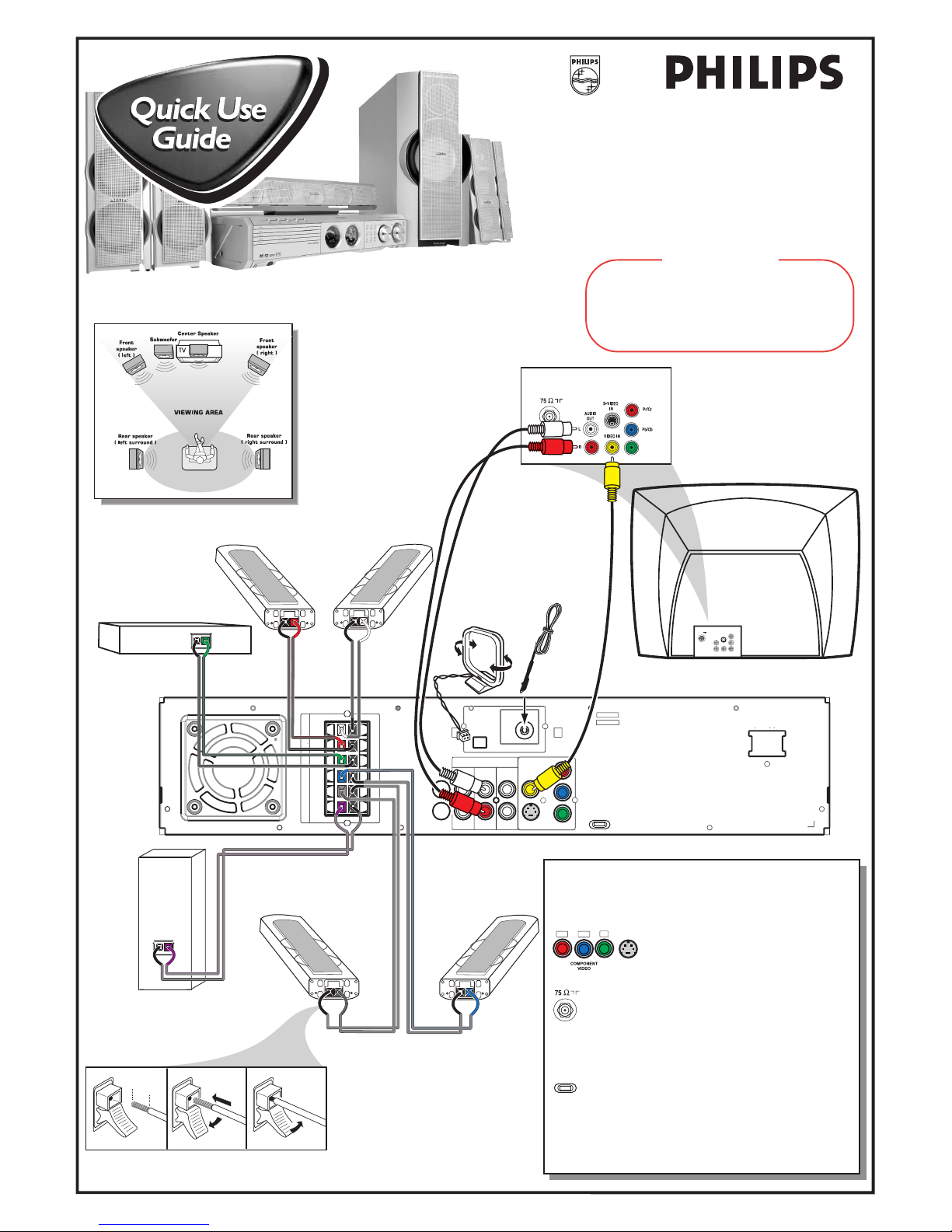
Front Speaker
(Right)
Center Speaker
Front Speaker
(Left)
Rear Speaker
(Surround Left)
.047"
(12mm)
PUSH IN
PUSH
DOWN
Subwoofer
abc
Rear Speaker
(Surround Right)
FM Antenna
AM Antenna
Rear of TV
(example only)
75
V
L
R
AUDI
O
O
U
T
S-VIDEO
I
N
VIDEO I
N
Pr/
C
r
Pb/
C
b
Y
Y
MX5500D
Use this simple and quick way to
watch your favorite DVD movie
and enjoy your Home Cinema
experience!
Connecting Speaker Cable
Recommended Speaker Setup
Helpful Hints
You only need to make one video connection to your TV in
order to view the DVD playback.
If your TV has S-Video or Component
(Pr Pb Y) video jacks, use one of these
video connections instead for higher picture
quality.
If your TV has only a single Antenna In jack, yo u
will need an accessory RF modulator. The RF modulator
converts the video from the DVD system so it can play
through the TV’s Antenna connector. Refer to your
owner’s manual for proper connection.
Do not switch the P-SCAN to ‘ON’ position,
unless you have connected the DVD system to a
Progressive Scan TV using the Component (Pr Pb Y)
video jacks.
When listening to TV programs, press TV/AV button on
the remote to set the DVD system to TV/AV mode in order for
the sound to be heard.
Pr/Cr
Pb/Cb
Y
S-VIDEO
IN
ANTENNA IN
P-SCAN
ON OFF
12nc: 3139 115 22081
Printed in China
IMPORTANT!
Attach the front speakers and the rear (surround)
speakers to the mini speaker stands before making
the connections to the DVD system.
Refer to owner’s manual for detailed set up
instructions.
Page 2
Detailed playback features and additional functions are described in the
accompanying owner’s manual.
continue...
AV IN
TV/AV
DISC/
MEDIA
TUNER
AUX/DI
123
456
789
0
REPEAT REPEATDISC SKIP
DISC MENU
PROGRAM
SYSTEM MENU
DIM SLEEP SUB TV VOL
VOICE MUTE
SEATING ZOOM
PREV NEXT
STOP PLAY/PAUSE
A-B
SURR.
SOUND
VOL
OK
DVD VIDEO DIGITAL SURROUND SYSTEM
STOPPLAY•PAUSE SEATING
STANDBY-ON
iR SENSOR
DISC 1
DISC 2
DISC 3
DISC 4
DISC 5
DISC 1 DISC 2 DISC 3 DISC 4 DISC 5
TREBLE
BASS
SOURCE
VOLUME
PROG TUNINGCLOCK•TIMER
SURROUND
SEARCH
5 DISC CHANGER
OPEN•CLOSE
EJECT
MEDIA SLOT
DVD
D
I
S
C
S
U
R
-
R
R
I
G
H
T
C
E
N
T
R
E
L
E
F
T
S
U
B
S
U
R
-
L
SUPER VIDEO
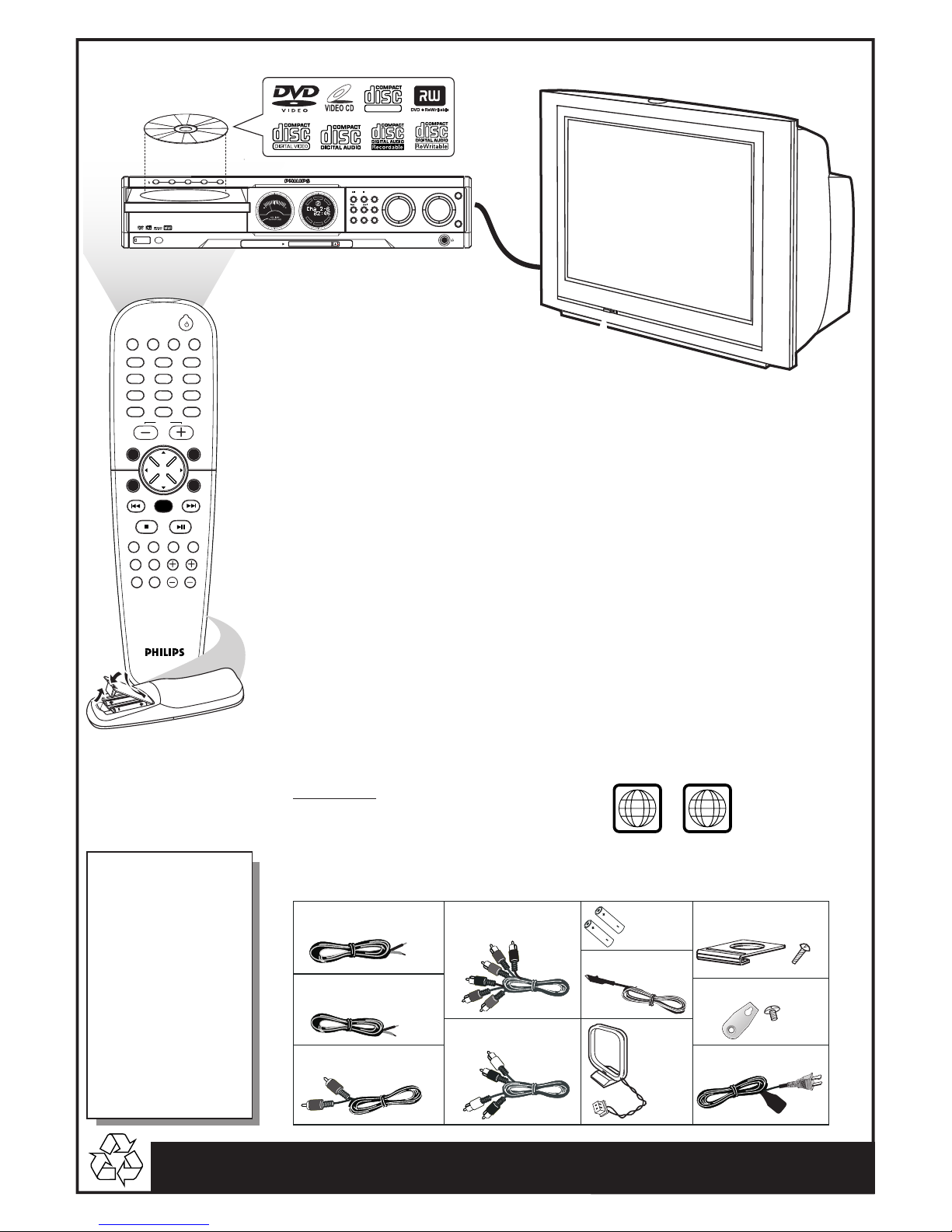
Make sure your DVD system and
TV are connected and turned on!
Playing a disc
1 Press DISC/MEDIA on the remote control.
You can also adjust the SOURCE button on the front panel until “DISC X” appear s on the display panel.
2 Turn on the TV and select the correct Video In mode.
You should see the blue Philips DVD background screen on the TV (if no disc in the DVD system).
Usually this channel is between the lowest and highest channels and may be called FRONT, A/V IN, or
VIDEO.
Or, you may go to channel 1 on your TV, then press the Channel down button repeatedly until you see the
Video In channel.
Or, your TV remote control may have a button or switch that chooses different video modes.
Do not use channel 3 or 4 on the TV unless you are using an RF modulator.
See your TV manual for more details.
3 Press OPEN•CLOSE 0 on the front of the DVD system and load a disc, then
press the corresponding OPEN•CLOSE 0 again to close the disc tray.
Make sure the disc label is facing up. For double-sided discs, load the side you want to play face up.
4 Playback will start automatically.
If a disc menu appears, use 3 4 1 2 buttons on the remote to make the necessary selection, then press
OK to confirm. Or, use the numeric keypad on the remote to select features. Follow the instructions
given in the disc menu.
5 To stop playback, press STOPÇ.
Region Codes
DVDs must be labeled for ALL regions or for
Region 1 in order to play on this DVD system.
ALL
1
If a DVD does not play
properly, please contact Philips
at 1-800-531-0039 for
assistance. Due to the
inconsistency of disc formats
provided by various disc
manufacturers, your DVD
system may require a
playability enhancement or
upgrade. As DVD technology
advances, these enhancements
will become common and will
be easy to complete.
Helpful Hints
(5x)
(4x)
(4x) (8x)
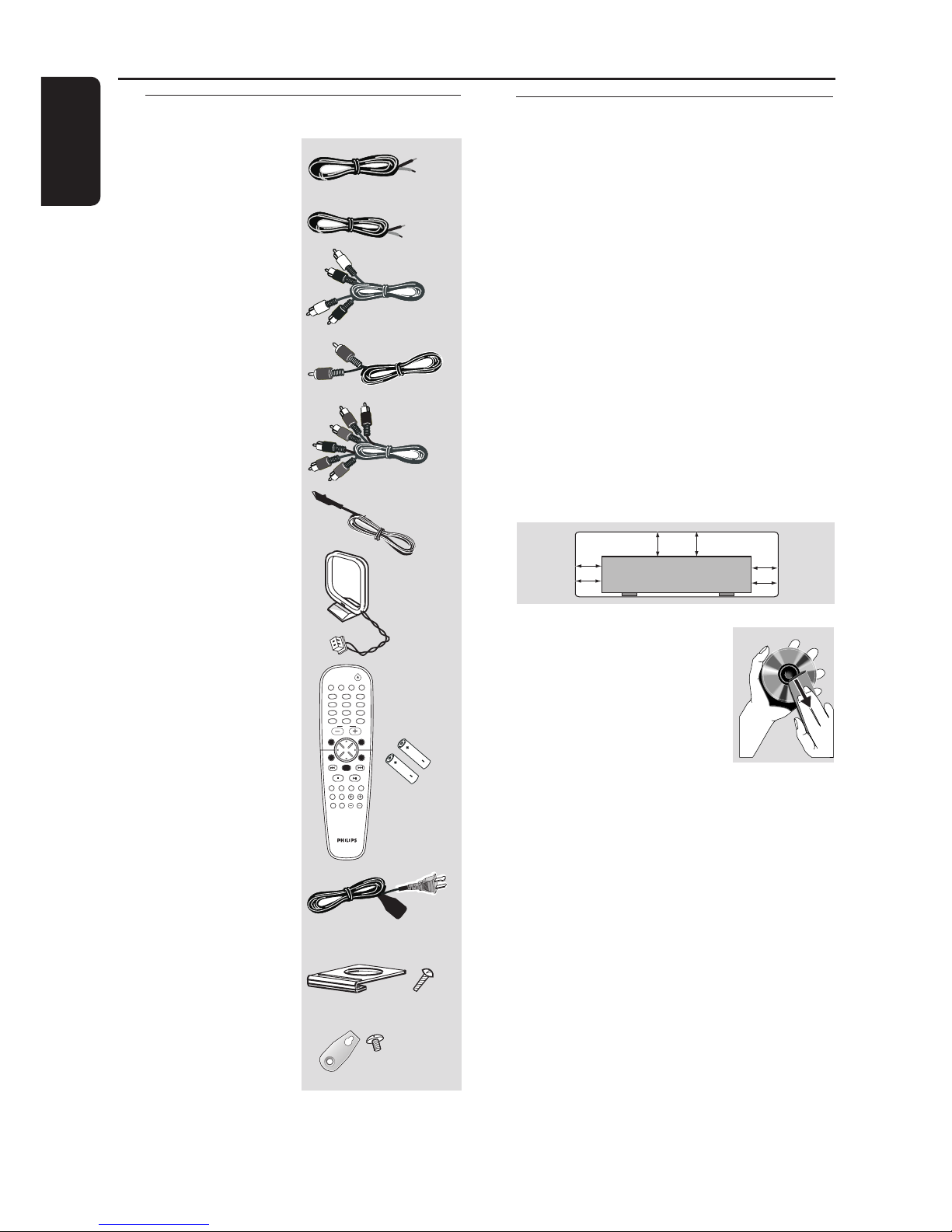
Speaker cables
Subwoofer cable
Composite video cable
(yellow)
Component video
cables (red, blue, green)
Brackets and screws
AA size
batteries
AC power cable
You should find the below accessories in the packaging box. If not, call Philips at 1-800-531-0039.
(Not all the cables supplied are required to complete the basic hook-up.)
Audio cables
(white, red)
AM loop
antenna
FM wire antenna
Mini speaker stands
and screws
Page 3
1
DVD VIDEO DIGITAL SURROUND SYSTEM
S
E
E
W
H
Y
I
N
S
I
D
E
I
M
P
O
R
T
A
N
T
!
Return
your Warranty
Registration Card
within 10 days
Need help? Call us!
Philips representatives are ready to help you with
any questions about your new product. We can guide you
through Connections, First-time Setup, or any of the Features.
We want you to start enjoying your new product right away!
CALL US BEFORE YOU CONSIDER
RETURNING THE PRODUCT!
1-800-531-0039
or
Visit us on the web at www.philips.com
MX
5500D
MX
5500D
Page 4
2
CAUTION
Use of controls or adjustments or
performance of procedures other
than herein may result in hazardous
radiation exposure or other unsafe
operation.
ATTENTION
L'utilisation des commandes ou
réglages ou le non-respect des
procédures ci-incluses peuvent se
traduire par une exposition
dangereuse à l'irradiation.
ATENCIÓN
El uso de mando o ajustes o la
ejecucción de métodos que no sean
los aquí descritos puede ocasionar
peligro de exposición a radiación.
CAUTION
:
INVISIBLE
LASER RADIATION
WHEN OPEN. DO NOT STARE INTO BEAM.
DANGER
:
INVISIBLE LASER RADIATION WHEN OPEN.
AVOID DIRECT EXPOSURE TO BEAM.
VARO!
AVATTAESSA JA SUOJALUKITUS OHITETTAESSA OLET
ALTTIINANAKYMATTOMAALLE LASERSATEILYLLE. ALA
KATSO SATEESEEN.
VARNING!
OSYNLIG LASERSTRÅLNING NÄR DENNA DEL ÄR ÖPPNAD.
OCH SPARREN AR URKOPPLAD. BETRAKTA EJ STRÅLEN.
DANGER - Invisible laser radiation when open.
AVOID DIRECT EXPOSURE TO BEAM.
or
This warning label is located on the rearside
and inside this laser product.
Canada
English:
This digital apparatus does not exceed
the Class B limits for radio noise
emissions from digital apparatus as set
out in the Radio Interference
Regulations of the Canadian
Department of Communications.
Français:
Cet appareil numérique n'emet pas
de bruits radioélectriques dépassant
les limites applicables aux appareils
numériques de Class B prescrites dans
le Règlement sur le Brouillage
Radioélectrique édicté par le Ministère
des Communications du Canada.
Manufactured under license from Dolby
Laboratories. “Dolby”, “Pro-Logic” and the
double-D symbol are trademarks of
Dolby Laboratories. Confidential
Unpublished Works. ©1992-1997 Dolby
Laboratories, Inc. All rights reserved.
Manufactured under license from Digital
Theater Systems, inc. US Pat. No.
5,451,942 and other worldwide patents
issued and pending. “DTS” and “DTS
Digital Surround” are trademarks of
Digital Theater Systems, Inc. 1996 Digital
Theater Systems, Inc. All rights reserved.
This product incorporates copyright
protection technology that is protected by
method claims of certain U.S. patents and
other intellectual property rights owned by
Macrovision Corporation and other rights
owners. Use of this copyright protection
technology must be authorized by
Macrovision Corporation, and is intended
for home and other limited viewing uses
only unless otherwise authorized by
Macrovision Corporation. Reverse
engineering or disassembly is prohibited.
Page 5
3
3
DVD VIDEO DIGITAL SURROUND SYSTEM
STOPPLAY•PAUSE SEATING
STANDBY-ON
iR SENSOR
DISC 1
DISC 2
DISC 3
DISC 4
DISC 5
DISC 1 DISC 2 DISC 3 DISC 4 DISC 5
TREBLE
BASS
SOURCE
VOLUME
PROG TUNING CLOCK• TIMER
SURROUND
SEARCH
5 DISC CHANGER
OPEN•CLOSE
EJECT
MEDIA SLOT
DVD
D
I
S
C
S
U
R
-
R
R
I
G
H
T
C
E
N
T
R
E
L
E
F
T
S
U
B
S
U
R
-
L
*&^%$#@!097531 2 4 6 8
TV/AV
DISC/
MEDIA
TUNER
AUX/DI
123
456
789
0
REPEAT REPEATDISC SKIP
DISC MENU
PROGRAM
SYSTEM MENU
DIM SLEEP SUB TV VOL
VOICE MUTE
SEATING ZOOM
PREV NEXT
STOP PLAY/PAUSE
A-B
SURR.
SOUND
VOL
OK
$
›
#
^
(
)
@
¡
0
™
£
≤
∞
§
≥
!
º
ª
•
⁄
¤
fi
‹
Page 6
4
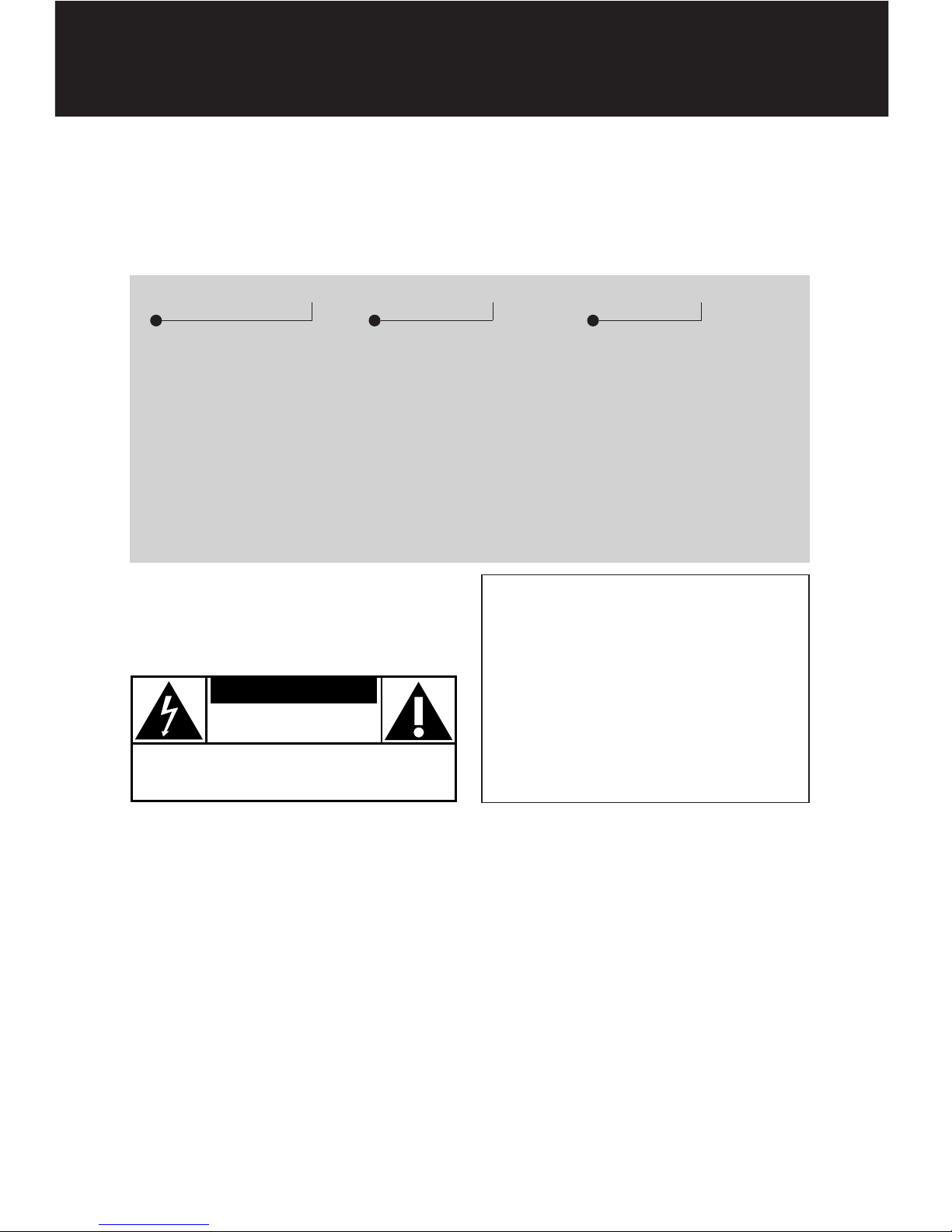
• Once your Philips purchase is registered,
you’re eligible to receive all the privileges
of owning a Philips product.
• So complete and return the Warranty
Registration Card enclosed with your
purchase at once, and take advantage
of these important benefits.
Return your Warranty Registration card today to
ensure you receive all the benefits you’re entitled to.
Warranty
Verification
Registering your product
within 10 days confirms
your right to maximum
protection under the
terms and conditions of
your Philips warranty.
Owner
Confirmation
Your completed Warranty
Registration Card serves
as verification of ownership in the event of product theft or loss.
Model
Registration
Returning your Warranty
Registration Card right
away guarantees you’ll
receive all the information
and special offers which
you qualify for as the
owner of your model.
t
This “bolt of lightning” indicates uninsulated material
within your unit may cause
an electrical shock. For the safety of
everyone in your household, please do
not remove product covering.
s
The “exclamation point” calls
attention to features for
which you should read the
enclosed literature closely to prevent
operating and maintenance problems.
WARNING:
TO PREVENT
FIRE OR SHOCK HAZARD, DO
NOT EXPOSE THIS EQUIPMENT TO
RAIN OR MOISTURE.
CAUTION:
To prevent electric
shock, match wide blade of plug to
wide slot, and fully insert.
For Customer Use
Enter below the Serial No. which is located on the rear of the cabinet. Retain this
information for future reference.
Model No. _______________________
Serial No. ________________________
MAC5097
Know these
ssaaffeettyysymbols
CAUTION
RISK OF ELECTRIC SHOCK
DO NOT OPEN
CAUTION: TO REDUCE THE RISK OF ELECTRIC SHOCK, DO NOT
REMOVE COVER (OR BACK). NO USER-SERVICEABLE PARTS
INSIDE. REFER SERVICING TO QUALIFIED SERVICE PERSONNEL.
Page 7
5
Congratulations on your purchase,
and welcome to the “family!”
Dear Philips product owner:
Thank you for your confidence in Philips.You’ve selected one of the best-built,
best-backed products available today.And we’ll do everything in our power to
keep you happy with your purchase for many years to come.
As a member of the Philips “family,” you’re entitled to protection by one
of the most comprehensive warranties and outstanding service networks
in the industry.
What’s more, your purchase guarantees you’ll receive all the information
and special offers for which you qualify, plus easy access to accessories
from our convenient home shopping network.
And most importantly you can count on our uncompromising commitment
to your total satisfaction.
All of this is our way of saying welcome – and thanks for investing in a
Philips product.
Sincerely,
Lawrence J. Blanford
President and Chief Executive Officer
P.S. Remember, to get the most from your Philips product, you
must return your Warranty Registration Card within 10 days.
So please mail it to us right now!
R
E
G
I
S
T
R
A
T
I
O
N
N
E
E
D
E
D
W
I
T
H
I
N
1
0
D
A
Y
S
Hurry!
Visit our World Wide Web Site at http://www.philips.com
Page 8
6
1.
Read these instructions.
2.
Keep these instructions.
3.
Heed all warnings.
4.
Follow all instructions.
5.
Do not use this apparatus near
water.
6.
Clean only with dry cloth.
7.
Do not block any ventilation
openings. Install in accordance with
the manufacturer´s instructions.
8.
Do not install near any heat sources
such as radiators, heat registers, stoves, or
other apparatus (including amplifiers) that
produce heat.
9.
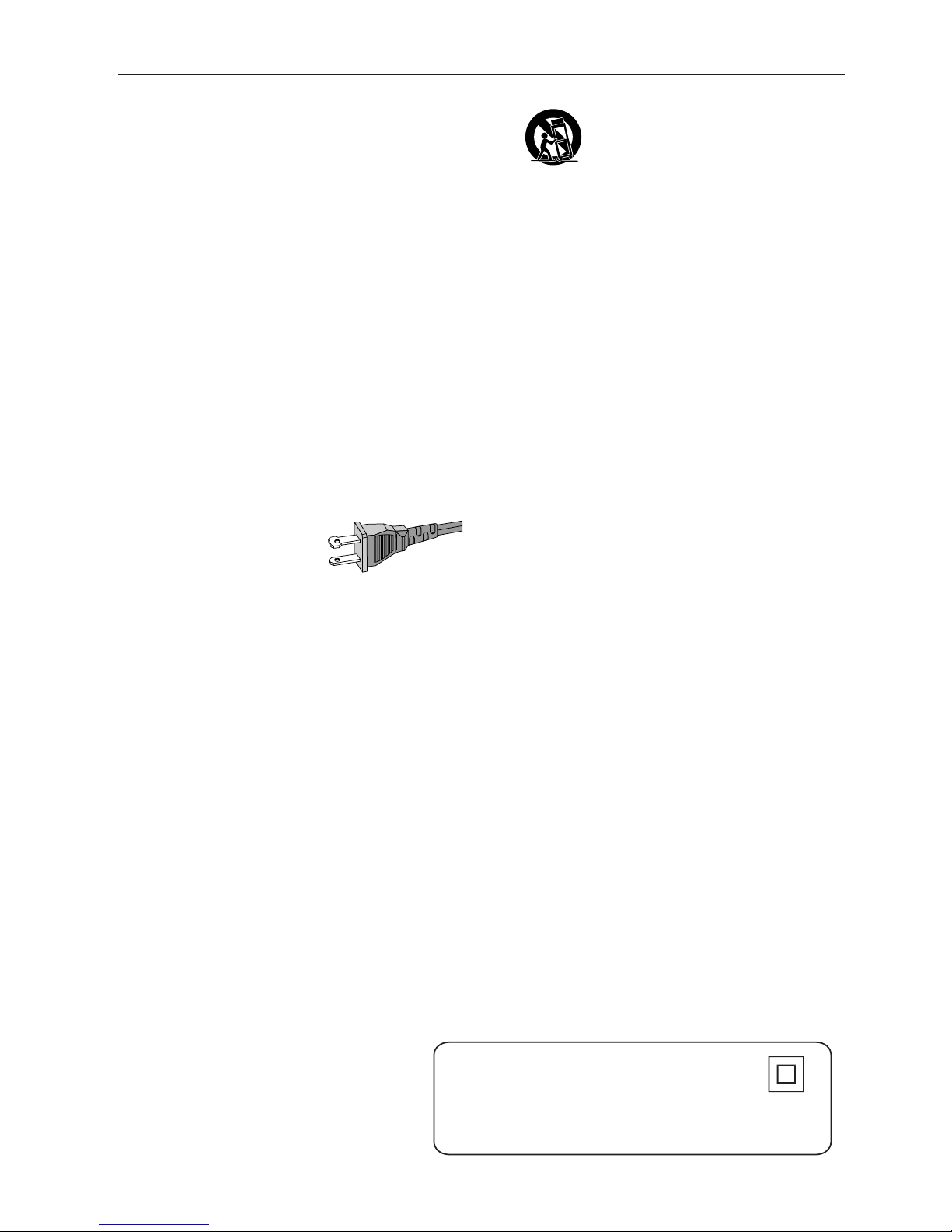
Do not defeat the
safety purpose of the
polarized or
grounding-type plug.
A polarized plug has two blades with one
wider than the other. A grounding type plug
has two blades and a third grounding prong.
The wide blade or the third prong are
provided for your safety. If the provided plug
does not fit into your outlet, consult an
electrician for replacement of the obsolete
outlet.
10.
Protect the power cord from being
walked on or pinched, particularly at plugs,
convenience receptacles, and the point
where they exit from the apparatus.
11.
Only use attachments/accessories
specified by the manufacturer.
12.
Use only with the cart, stand,
tripod, bracket, or table specified
by the manufacturer or sold with
the apparatus.When a cart is
used, use caution when moving
the cart/apparatus combination
to avoid injury from tip-over.
13 .
Unplug this apparatus during lightning
storms or when unused for long periods of
time.
14 .
Refer all servicing to qualified service
personnel. Servicing is required when the
apparatus has been damaged in any way,
such as power-supply cord or plug is
damaged, liquid has been spilled or objects
have fallen into the apparatus, the apparatus
has been exposed to rain or moisture, does
not operate normally, or has been dropped.
15.
Battery usage
CAUTION
– To
prevent battery leakage which may result in
bodily injury, property damage, or damage
to the unit:
●
Install all batteries correctly, + and - as
marked on the unit.
●
Do not mix batteries (old and new or
carbon and alkaline, etc.).
●
Remove batteries when the unit is not used
for a long time.
EL 6475-E004: 02/8
IMPORTANT SAFETY INSTRUCTIONS
AC Polarized
Plug
Class II equipment symbol
This symbol indicates that the unit has
a double insulation system
WARNING!
To reduce the risk of fire or electric
shock, this apparatus should not be
exposed to rain or moisture, and objects
filled with liquids, such as vases, should
not be placed on this apparatus.
Page 9

7
English
Français
Español
Index
English ------------------------------------------------ 8
Français -------------------------------------------- 52
Español --------------------------------------------- 96
This system complies with the FCC rules,
Part 15 and with 21 CFR 1040.10.
Operation is subject to the following two
conditions:
– This device may not cause harmful
interference, and
– This device must accept any
interference received, including
interference that may cause undesired
operation.
Environmental information
All unnecessary packaging has been omitted. We
have tried to make the packaging easy to
separate into three materials: cardboard (box),
polystyrene foam (buffer) and polyethylene (bags,
protective foam sheet).
Your system consists of materials which can be
recycled and reused if disassembled by a
specialized company. Please observe the local
regulations regarding the disposal of packaging
materials, exhausted batteries and old equipment.
Page 10

8
English
General Information
Supplied accessories ...................................................... 10
Care and safety information ..................................... 10
Connections
Step 1: Set up the speakers ....................................... 11
Step 2: Placing the speakers and subwoofer ... 11
Step 3: Connecting TV .................................................. 12
Using Composite Video jack (CVBS) ............ 12
Using Component Video jacks (Pr Pb Y) .... 12
Using S-Video jack ................................................... 13
Using an accessory RF modulator.................. 13
Step 4: Connecting speakers and subwoofer . 14
Step 5: Connecting FM/AM antennas.................. 14
Step 6: Connecting the power cord .................... 15
Connections (optional)
Connecting a VCR or Cable/Satellite Box ........ 16
Viewing and listening to the playback .......... 16
Using the VCR for recording DVDs .............. 16
Connecting digital audio equipment .................... 17
Listening to the playback ..................................... 17
Recording (digital).................................................... 17
Functional Overview
Main unit and remote control .........................18–19
Control buttons available on the
remote only................................................................. 19
Getting Started
Step 1: Inserting batteries into the
remote control ................................................................. 20
Using the remote control to operate the
system ............................................................................. 20
Step 2: Setting the clock .............................................. 20
Step 3: Setting the TV ................................................... 21
Changing the NTSC/PAL setting via the
remote control .......................................................... 21
Selecting the color system that
corresponds to your TV ....................................... 21
Step 4: Selecting speaker layout.............................. 22
Changing seating control position .................. 22
Setting the speakers’ channels .......................... 23
Step 5: Setting language preference ..................... 23
Disc Operations
Playable discs ..................................................................... 24
Playing discs ........................................................................ 24
Turning on/off auto Eco standby mode ...... 25
Using the Disc Menu .................................................... 25
Basic playback controls ................................................ 25
Resuming playback from the last stopped
point (DVD/VCD)................................................... 25
Replacing discs without interrupting
playback ......................................................................... 25
Selecting various repeat functions ......................... 26
Repeat play mode ................................................... 26
Repeating a section within a
chapter/track ............................................................... 26
Program favorite tracks
(audio CDs and VCDs) ....................................... 26–27
Clearing the program ............................................ 27
Using the menu bar to program ............................ 27
Playing MP3/Picture disc (Kodak, JPEG) ............. 28
Program MP3 disc .......................................................... 28
Media Slot Operations
About media slot ............................................................ 29
Playing JPEG pictures from memory card ......... 29
DVD Menu Options
Using the menu bar ....................................................... 30
Using the Setup Menu ................................................. 31
Setting the TV shape .............................................. 31
Setting the video output ...................................... 32
Screen saver - turning on/off ............................. 32
Setting the analog output .................................... 32
Setting the digital output ..................................... 33
Setting the PCM output ....................................... 33
Night mode- turning on/off ............................... 34
Restoring the original settings ........................... 34
Restricting playback by parental control ..... 35
Changing the password ........................................ 36
Contents
Page 11

9
English
Contents
Tuner Operations
Tuning to radio stations ............................................... 37
Presetting radio stations .............................................. 37
Using the Plug and Play ........................................ 37
Automatic presetting ............................................. 38
Manual presetting..................................................... 38
Selecting a preset radio station ............................... 38
Deleting a preset radio station ........................ 38
Timer Operations
Setting the timer .............................................................. 39
Activating/Deactivating the timer ................... 39
Setting the Sleep timer ................................................ 40
Sound and Volume Controls
Sound Control .................................................................. 41
Selecting surround sound .................................... 41
Turning on/off clear voice effect ...................... 41
Changing subwoofer volume level................. 41
Adjusting Bass/Treble level .................................. 41
Selecting digital sound effects ........................... 41
Volume Control ............................................................... 41
Other Functions
Switching on/off ............................................................... 42
Switching to active mode .................................... 42
Switching to Eco Power standby mode ...... 42
Switching to standby mode (view clock) ... 42
Dimming system’s display screen ........................... 42
Recording to an external device ............................ 42
Using the remote to operate your television ... 42
Specifications .......................................................... 43
Troubleshooting........................................... 44–45
Glossary .................................................................46–47
Limited Warranty .............................................. 48
Page 12
10
English
Supplied accessories
General Information
Care and safety information
Avoid high temperatures, moisture,
water and dust
– Do not expose the system, batteries or discs
to humidity, rain, sand or excessive heat (caused
by heating equipment or direct sunlight.) Always
keep the disc tray closed to avoid dust getting
on the lens.
Avoid condensation problem
– The lens may cloud over when the player is
suddenly moved from cold to warm
surroundings, making it impossible to play a disc.
Leave the player in the warm environment until
the moisture evaporates.
Do not block the vents
– Do not operate the DVD system in an
enclosed cabinet and allow about 10 cm
(4 inches) of free space all around the player for
adequate ventilation.
10 cm
(4 inches)
10 cm
(4 inches)
10 cm
(4 inches)
DVD Home Cinema System
PHILIPS
Care of disc
– To clean a CD, wipe it in a
straight line from the center
towards the edge using a soft,
lint-free cloth. Do not use
cleaning agents, as they may
damage the disc!
– Write only on the printed side of a CDR(W)
and only with a soft felt-tipped pen.
– Handle the disc by its edge, do not touch the
surface.
Care of the cabinet
– Use a soft cloth slightly moistened with a
mild detergent solution. Do not use a solution
containing alcohol, spirits, ammonia or abrasives.
Finding a suitable location
– Place the player on a flat, hard, stable surface.
Remote Control and
two AA batteries
FM wire antenna
AM loop antenna
Audio cable
(white, red)
Composite video cable
(yellow)
Speaker cables
Subwoofer cable
AC power cable
Brackets and screws
(5x)
(4x)
TV/AV
DISC/
MEDIA
TUNER AUX/DI
123
456
789
0
REPEAT REPEATDISC SKIP
DISC MENU
PROGRAM
SYSTEM MENU
DIM SLEEP SUB TV VOL
VOICE MUTE
SEATING ZOOM
PREV NEXT
STOP PLAY/PAUSE
A-B
SURR.
SOUND
VOL
OK
(4x) (8x)
Component video
cables
(red/blue/green)
Mini speaker stands
and screws
Page 13
11
English
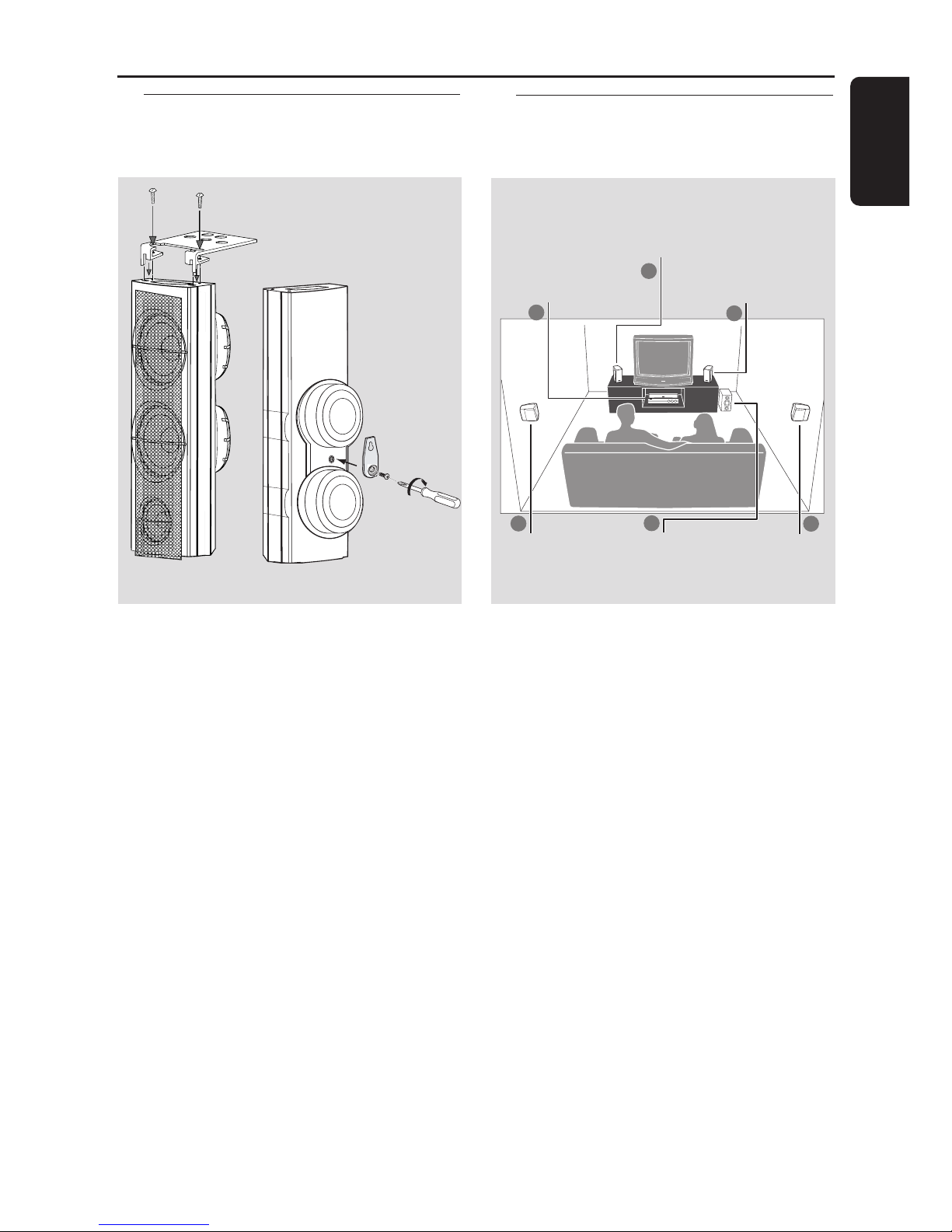
Step 2: Placing the speakers
and subwoofer
For best possible surround sound, all the
speakers (except the subwoofer) should be
placed at the same distance from the listening
position.
1 Place the front left and right speakers at equal
distances from the TV and at an angle of
approximately 45 degrees from the listening
position.
2 Place the center speaker above the TV or the
DVD system so that the center channel’s sound
is localized.
3 Place the surround speakers at normal listening
ear level facing each other or mounted on the
wall.
4 Place the subwoofer on the floor near the TV.
Notes:
– To avoid magnetic interference, do not position
the front speakers too close to your TV.
– Allow adequate ventilation around the DVD
system.
1
1
3
3
2
4
Center speaker and
DVD system
Front Speaker
(Left)
Front Speaker
(Right)
Surround
Speaker (Left)
Surround
Speaker (Right)
Subwoofer
Connections
Step 1: Set up the speakers
1 Before connecting the speakers to the DVD
system, firmly attach the mini speaker stands to
the front and the surround speakers using the
supplied screws.
OR
2 Alternatively, you can choose to mount the
speakers on the wall. Attach the supplied
bracket firmly to the rear of the speakers using
the supplied screws. Then mount a screw (not
supplied) on the wall where the speaker is to be
hung and hook the speaker securely onto the
mounted screw.
CAUTION!
You should get a qualified person to
attach the brackets to the wall. DO
NOT do it by yourself to avoid
unexpected damage to the equipment
or injury to personnel.
1 OR 2
Page 14
12
English
Step 3: Connecting TV
Pb
DIGITAL
OUT
DIGITAL
IN
AUX
IN
TVINLINE
OUT
AUDIO
VIDEO
OUT
CVBS
S-VIDEO
FM ANTENNA
AM
L
R
WOOFER SURROUND CENTER FRONT
L
R
SL
SUB
SR
C
Y
AUDIO
OUT
Pr/Cr
Pb/Cb
Y
S-VIDEO
IN
VIDEO IN
COMPONENT
VIDEO IN
AUDIO
OUT
Pr/Cr
Pb/Cb
Y
S-VIDEO
IN
VIDEO IN
COMPONENT
VIDEO IN
2
1
3
P-SCAN
ON OFF
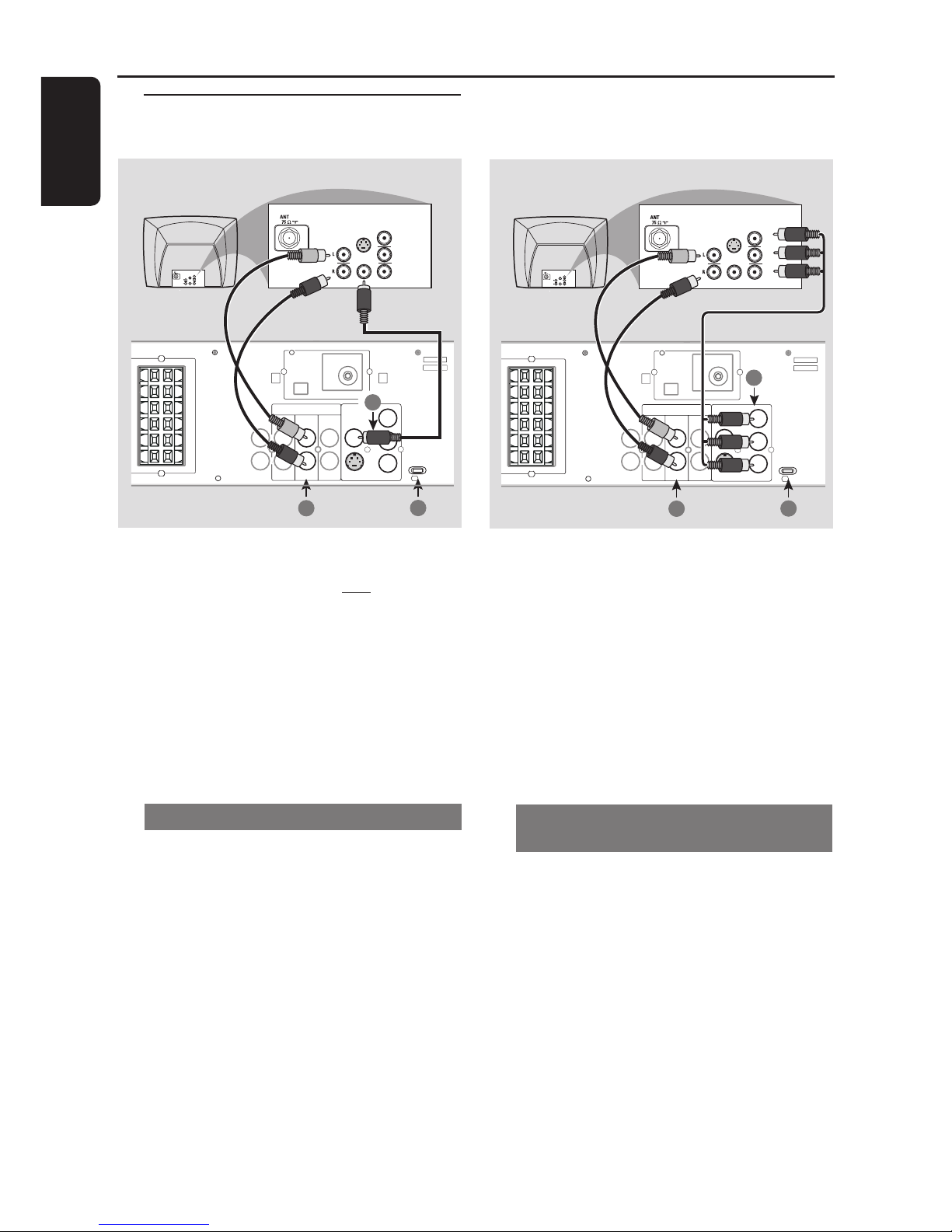
IMPORTANT!
– You only need to make one video
connection from the following options,
depending on the capabilities of your TV
system.
– S-Video or Component Video
connection provides higher picture
quality. These options must be available
on your TV.
– Connect the DVD system directly to
the TV.
Using Composite Video jack (CVBS)
1 Use the composite video cable (yellow) to
connect the DVD system’s CVBS jack to the
video input jack (or labeled as A/V In, Video In,
Composite or Baseband) on the TV.
2 To hear the TV channels through this DVD
system, use the audio cables (white/red) to
connect TV IN (L/R) jacks to the
corresponding AUDIO OUT jacks on the TV.
3 Set the P-SCAN switch to ‘OFF.’
Connections
P-SCAN
ON OFF
Pb
DIGITAL
OUT
DIGITAL
IN
AUX
IN
TVINLINE
OUT
AUDIO
VIDEO
OUT
CVBS
S-VIDEO
FM ANTENNA
AM
L
R
WOOFER SURROUND CENTER FRONT
L
R
SL
SUB
SR
C
Y
AUDIO
OUT
Pr/Cr
Pb/Cb
Y
S-VIDEO
IN
VIDEO IN
COMPONENT
VIDEO IN
AUDIO
OUT
Pr/Cr
Pb/Cb
Y
S-VIDEO
IN
VIDEO IN
COMPONENT
VIDEO IN
2
1
3
Pr
IMPORTANT!
– If both S-Video and Component
(Pr Pb Y) Video connections are used to
connect to your TV, the video signal will
automatically switch to S-Video when
you power up the DVD system. To set
the VIDEO OUT(put) to ‘Pr Pb Y,’ see
page 32.
– The progressive scan video quality is
only possible through Component Video
(Pr Pb Y) output.
Using Component Video jacks
(Pr Pb Y)
1 Use the component video cables (red/blue/
green) to connect the DVD system’s Pr Pb Y
jacks to the corresponding Component video
input jacks (or labeled as Pr/Cr Pb/Cb Y or YUV)
on the TV.
2 To hear the TV channels through this DVD
system, use the audio cables (white/red) to
connect TV IN (L/R) jacks to the
corresponding AUDIO OUT jacks on the TV.
3 If you are using a Progressive Scan TV (TV must
indicate Progressive Scan or ProScan capability,)
set the P-SCAN switch to ‘ON.’ Otherwise,
set it to ‘OFF.’
Page 15
13
English
Connections
Pb
DIGITAL
OUT
DIGITAL
IN
AUX
IN
TVINLINE
OUT
AUDIO
VIDEO
OUT
CVBS
S-VIDEO
FM ANTENNA
AM
L
R
SPEAKER SYSTEMS
SUB-
WOOFER SURROUND CENTER FRONT
L
R
SL
SUB
SR
C
Pr
Y
AUDIO IN
R L
VIDEO
IN
TO TVINT IN
CH3 CH4
1
3
2
P-SCAN
ON OFF
P-SCAN
ON OFF
Pb
DIGITAL
OUT
DIGITAL
IN
AUX
IN
TVINLINE
OUT
AUDIO
VIDEO
OUT
CVBS
S-VIDEO
FM ANTENNA
AM
L
R
WOOFER SURROUND CENTER FRONT
L
R
SL
SUB
SR
C
Y
AUDIO
OUT
Pr/Cr
Pb/Cb
Y
S-VIDEO
IN
VIDEO IN
COMPONENT
VIDEO IN
AUDIO
OUT
Pr/Cr
Pb/Cb
Y
S-VIDEO
IN
VIDEO IN
COMPONENT
VIDEO IN
1
3
Pr
2
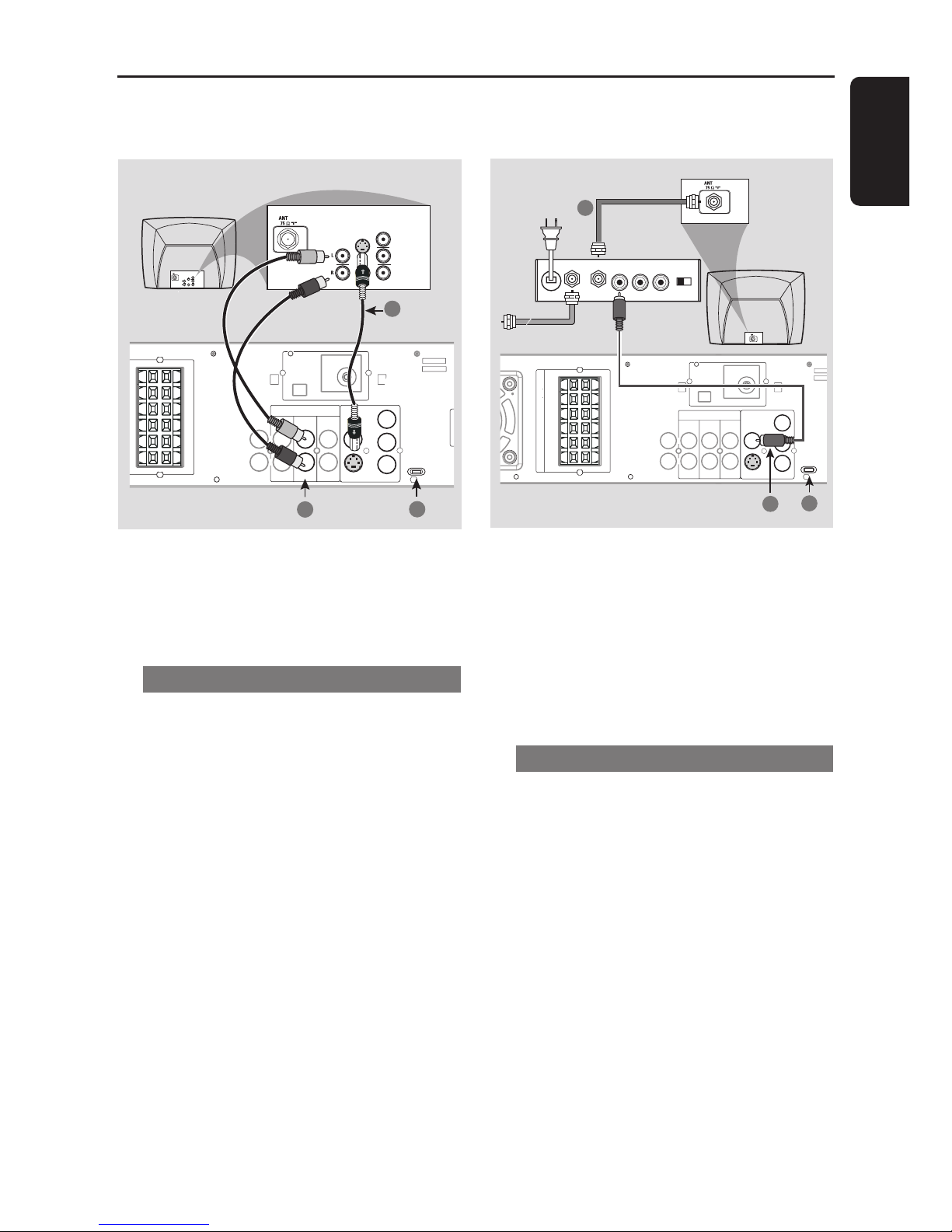
IMPORTANT!
– If the picture is distorted, check the
Video Output setting. Make sure it is set
to ‘S-Video,’ see page 32.
Using S-Video jack
1 Use the S-video cable (not supplied) to connect
the DVD system’s S-VIDEO OUT jack to the
S-Video input jack (or labeled as Y/C or S-VHS)
on the TV.
2 To hear the TV channels through this DVD
system, use the audio cables (white/red) to
connect TV IN (L/R) jacks to the
corresponding AUDIO OUT jacks on the TV.
3 Set the P-SCAN switch to ‘OFF.’
IMPORTANT!
– If your TV only has a single Antenna In
jack (or labeled as 75 ohm or RF In,)
you will need an RF modulator in order
to view the DVD playback on the TV.
See your electronics retailer or contact
Philips for details on RF modulator
availability and operations.
Using an accessory RF modulator
1 Use the composite video cable (yellow) to
connect the DVD system’s CVBS jack to the
video input jack on the RF modulator.
2 Use the RF coaxial cable (not supplied) to
connect the RF modulator to your TV’s RF jack.
3 Set the P-SCAN switch to ‘OFF.’
RF coaxial cable to TV
Back of RF Modulator
(example only)
Antenna or
Cable TV Signal
Page 16

14
English
Step 4: Connecting speakers
and subwoofer
Connect the supplied speaker systems using the
supplied speaker cables by matching the colors
of the jacks and speaker cables. Fully insert the
stripped portion of the speaker wire into the
jacks.
Speakers / Subwoofer - +
Front Left (FL) (L) black white
Front Right (FR) (R) black red
Center (C) black green
Surround Left (SL) black blue
Surround Right (SR) black gray
Subwoofer (SUB) black purple
Notes:
– Ensure that the speaker cables are correctly
connected. Improper connections may damage the
system due to short-circuit.
– Do not connect more than one speaker to any
one pair of
+/-
speaker jacks.
– Do not connect speakers with an impedance
lower than the speakers supplied. Please refer to
the SPECIFICATIONS section of this manual.
DIGITAL
OUT
DIGITAL
IN
AUX
IN
L
R
SPEAKER SYSTEMS
SUB-
WOOFER SURROUND CENTER FRONT
L
R
SL
SUB
SR
C
Front
Right
Front
Left
Surround
Right
Surround
Left
Subwoofer
Center
Connections
FM ANTENNA
AM
SPEAKER SYSTEMS
SUB-
WOOFER SURROUND CENTER FRONT
L
R
SL
SUB
SR
C
DIGITAL
OUT
DIGITAL
IN
AUX
IN
TVINLINE
OUT
AUDIO
VIDEO
OUT
CVBS
S-VIDEO
L
R
Pr
Pb
Y
1
2
➠
FM
antenna
AM
antenna
fix the claw
into the slot
1 Connect the supplied AM loop antenna to the
AM jack. Place the AM loop antenna on a shelf
or attach it to a stand or wall.
2 Connect the supplied FM antenna to the FM
jack. Extend the FM antenna and fix its ends to
the wall.
For better FM stereo reception, connect an
external FM antenna (not supplied.)
AM
FM ANTENNA
Notes:
– Adjust the position of the antennas for optimal
reception.
– Position the antennas as far as possible from
your TV, VCR or other radiation source to prevent
unwanted interference.
Step 5: Connecting FM/AM
antennas
Page 17

15
English
Connections
Step 6: Connecting the power
cord
DIGITAL
OUT
DIGITAL
IN
AUX
IN
TVINLINE
OUT
AUDIO
VIDEO
OUT
CVBS
S-VIDEO
FM ANTENNA
AM
L
R
~ AC MAINS
~ AC MAINS
Pr
Pb
Y
AUDIO
OUT
Pr/Cr
Pb/Cb
Y
S-VIDEO
IN
VIDEO IN
COMPONENT
VIDEO IN
P-SCAN
ON OFF
After everything is connected
properly, plug in the AC power cord to
the power outlet.
Never make or change any connections with the
power switched on.
On the DVD system,
"AUTO INSTALL - PRESS PLAY" may
appear on the display panel. Press ÉÅ on the
front panel to store all available radio stations or
press Ç to exit (see page 37 “Tuner
Operations”.)
DVD VIDEO DIGITAL SURROUND SYSTEM
STOPPLAY•PAUSE SEATING
TREBLE
BASS
SOURCE
VOLUME
PROG TUNING CLOCK•TIMER
SURROUND
SEARCH
HANGER
EJECT
MEDIA SLOT
DVD
D
I
S
C
S
U
R
-
R
R
I
G
H
T
C
E
N
T
R
E
L
E
F
T
S
U
B
S
U
R
-
L
PLAY• PAUSE
AUTO INSTALL - PRESS PLAY
Page 18

16
English
Connecting a VCR or
Cable/Satellite Box
DIGITAL
OUT
DIGITAL
IN
AUX
IN
TVINLINE
OUT
AUDIO
VIDEO
OUT
CVBS
S-VIDEO
FM ANTENNA
AM
L
R
~ AC MAINS
SPEAKER SYSTEMS
SUB-
WOOFER SURROUND CENTER FRONT
L
R
SL
SUB
SR
C
Pr
Y
Pb
AUDIO
OUT
Pr/Cr
Pb/Cb
Y
S-VIDEO
IN
VIDEO IN
COMPONENT
VIDEO IN
2
4
3
1
P-SCAN
ON OFF
ANT IN
TO TV
~ AC MAINS
VCR or
Cable/Satellite
Box
Connections (optional)
Viewing and listening to the playback
1 Connect the VCR or Cable/Satellite Box to the
TV as shown.
2 Connect the DVD system’s AUX IN (R/L)
jacks to the AUDIO OUT jacks on the VCR or
cable/satellite box.
Before starting operation, press AUX/DI on
the remote to select “AUX” in order to activate
the input source.
Using the VCR for recording DVDs
Some DVDs are copy-protected. You cannot
record or dub protected discs using a VCR.
3 Connect the DVD system’s CVBS jack to the
VIDEO IN jack on the VCR.
4 Connect the DVD system’s LINE OUT (R/L)
jacks to the AUDIO IN jacks on the VCR.
This will allow you to make analog stereo (two
channel, right and left) recordings.
To view DVD playback while recording,
you must connect the DVD system to your TV
using the S-VIDEO (as shown above) or the
Component (Pr Pb Y) video connection.
Page 19

17
English
Connecting digital audio
equipment
DIGITAL
OUT
DIGITAL
IN
AUX
IN
TVINLINE
OUT
AUDIO
VIDEO
OUT
CVBS
S-VIDEO
FM ANTENNA
AM
L
R
~ AC MAINS
SPEAKER SYSTEMS
SUB-
WOOFER SURROUND CENTER FRONT
L
R
SL
SUB
SR
C
Pr
Y
DIGITAL IN
DIGITAL OUT
2
1
Listening to the playback
1 Connect the DVD system’s DIGITAL IN jack
to the DIGITAL OUT jack on a digital audio
device.
Before starting operation, press AUX/DI on
the remote to select “DI” in order to activate
the input source.
Recording (digital)
2 Connect the DVD system’s DIGITAL OUT
jack to the DIGITAL IN jack on a digital
recording device (DTS-Digital Theater System
compatible, with a Dolby Digital decoder, for
example.)
Before starting operation, set the DIGITAL
OUTPUT according to the audio connection.
(See page 33 “Setting the digital output”.)
Connections (optional)
(for example)
CD Recorder
Notes:
– Some DVDs are copy-protected. You cannot
record the disc through a VCR or digital recording
device.
– Always refer to the owner’s manual of the other
equipment for complete connection and usage
details.
Page 20

18
English
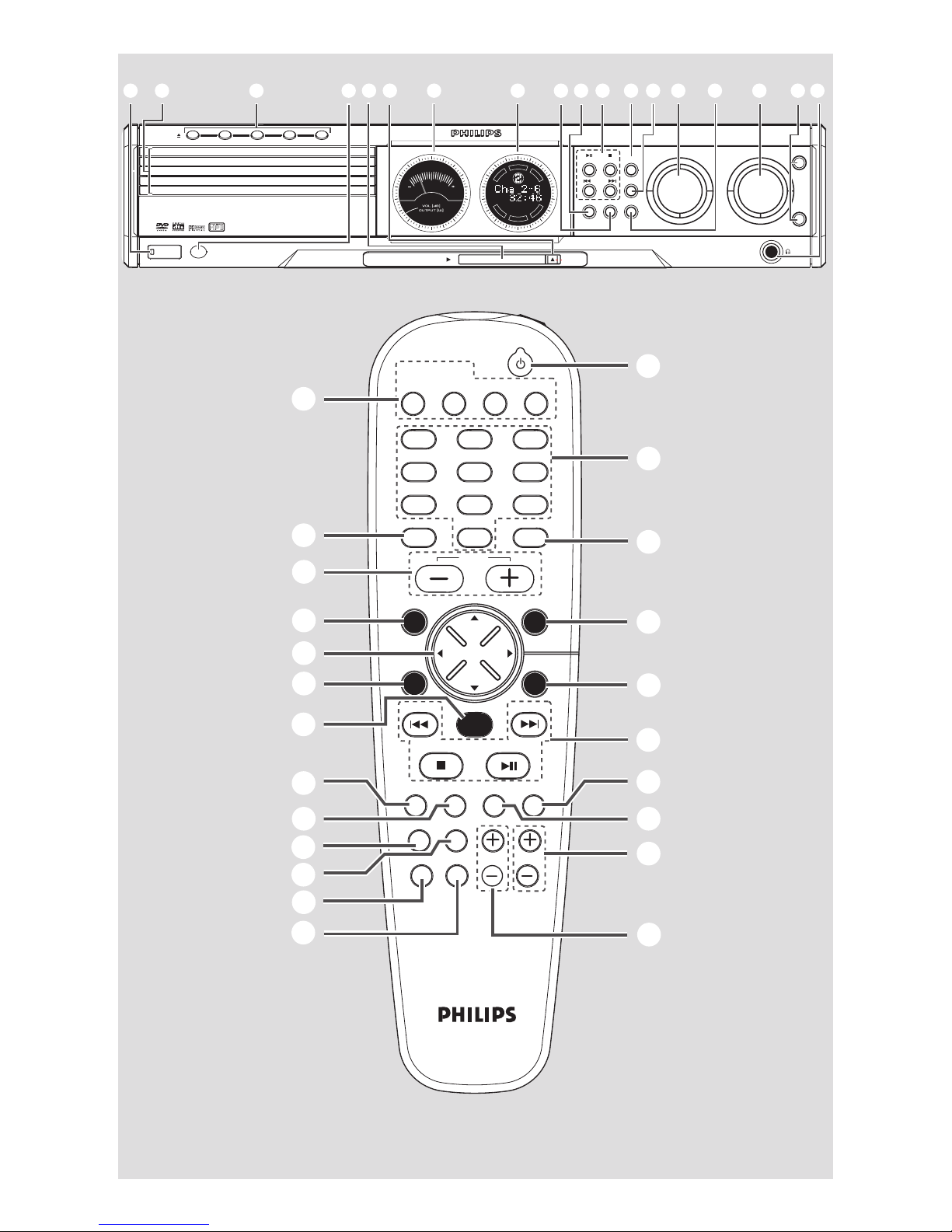
Functional Overview (illustrations on page 3)
Main unit and remote control
1 STANDBY ON
– Switches to Eco Power standby mode or turns
on the system. (see page 42)
– *Switches to standby mode. (see page 42)
2 Disc trays 1~5
3 OPEN•CLOSE 0 (DISC1~5)
– Opens/Closes the individual disc tray.
4 iR SENSOR
– Point the remote control towards this sensor.
5 MEDIA SLOT
– Plug the memory card into the PC card adaptor
and insert it into the media slot for viewing. (see
page 29)
6 EJECT 0
– Ejects the memory card from the slot.
7 Speaker display panel
8 System display panel
9 TUNING
– Switches between frequency tuning and preset
tuning mode. (see pages 37-38)
0 PROG (PROGRAM)
– DISC: starts programming. (see pages 26-27)
– TUNER: starts *automatic/ manual preset
programming. (see page 38)
– CLOCK: selects 12- or 24-hour clock display.
(see page 20)
! ÉÅ PLAY•PAUSE
– DISC: starts/pauses playback. (see page 25)
– TUNER: *enters Plug & Play mode and/or starts
preset radio station installation (only on the
main unit.) (see page 37)
Ç STOP
– Exits an operation.
– DISC: stops playback or *clears a program.
(see page 25, 27)
– TUNER: *erases a preset radio station.
(see page 38)
S SEARCH T (PREV/NEXT)
– DISC: *searches backward/forward or selects a
track. (see page 25)
– TUNER: tunes the radio frequency up/down or
selects a preset radio station. (see pages 37-38)
(On the remote, it can only tunes the radio
frequency up/down.)
– CLOCK: sets the minutes and hours.
(see pages 20, 39)
@ SEATING (only available in Multi-channel
mode)
– Turns on/off the seating control diagram on the
TV. Use the VOLUME control on the main unit
or joystick on the remote to select the desired
seating position. (see page 22)
# SURROUND (SURR.)
– Selects multichannel surround, 3D sound or
stereo mode. (see page 41)
$ SOURCE
– Selects the relevant active mode : TV/AV, DISC,
MEDIA SLOT, TUNER, AUX or DI.
– DISC: toggles between DISC and MEDIA SLOT.
– TUNER: toggles between FM and AM band.
– AUX/DI: toggles between AUX and DI (Digital
Input) mode.
% CLOCK•TIMER
– *Enters clock or timer setting mode.
(see pages 20, 39)
– Shows clock display for a few seconds.
(see page 20)
* = Press and hold the button for more than two seconds.
Page 21

19
English
Functional Overview
^ VOLUME (VOL +-)
– Adjusts the volume level.
& BASS / TREBLE
– Selects bass or treble sound. Use the VOLUME
control to select the desired enhancement level.
(see page 41)
* n
– Plugging in the headphones jack. The speakers
output will be cancelled.
Control buttons available on the
remote only
( SYSTEM MENU (DVD mode only)
– Enters or exits system setup menu.
(see pages 30, 31)
) Joystick 1 2 3 4
– Selects movement direction in the menu.
– Use 1 2 to select a preset radio station.
(see page 38)
¡ OK
– Confirms a selection.
™ DISC SKIP
– Selects next disc tray for playback.
(see page 25)
£ REPEAT
– Selects various repeat modes. (see page 26)
≤ VOICE (only available in Multi-channel
mode)
– Turns on/off clear voice sound effect.
(see page 41)
∞ MUTE
– Mutes or restores the volume. (see page 41)
§ DIM
– Turns on/off the dim mode. (see page 42)
≥ SLEEP
– Sets the sleep timer function. (see page 40)
• SUB +-
– Adjusts subwoofer’s sound level. (see page 41)
ª TV VOL +-
– Adjusts TV volume (Philips TV only.)
(see page 42)
º REPEAT A-B
– Repeats a specific section on a disc. (see page
26)
⁄ ZOOM
– Enlarges a picture on the TV screen.
¤ DISC MENU
– Enters or exits disc contents menu.
(see page 25)
– For VCD version 2.0 only;
In stop mode, turns on/off playback control
(PBC) mode.
During playback, returns to main menu.
‹ SOUND
– Selects a sound effect. (see page 41)
› Numeric Keypad (0-9)
– Enters a track/title number of the disc.
– Enters a number of a preset radio station.
fi B
– Switches to Eco Power standby mode.
(see page 42)
– *Switches to standby mode. (see page 42)
* = Press and hold the button for more than two seconds.
Page 22

20
English
Step 1: Inserting batteries into
the remote control
1
3
2
1 Open the battery compartment.
2 Insert two batteries type R06 or AA, following
the indications (+-) inside the compartment.
3 Close the cover.
Using the remote control to operate
the system
1 Aim the remote control directly
at the remote sensor (iR) on the
front panel.
2 Select the source you wish to
control by pressing one of the
source select buttons on the
remote control (for example
TV/AV, TUNER.)
3 Then select the desired function
(for example ÉÅ, S, T.)
CAUTION!
– Remove batteries if they are
exhausted or if the remote is not to be
used for a long time.
– Do not use old and new or different
types of batteries in combination.
– Batteries contain chemical substances,
so they should be disposed of properly.
Step 2: Setting the clock
The clock can be set in either 12-hour or
24-hour mode ("12:00 AM" or "00:00" for
example.)
CLOCK•TIMER
CLOCK•TIMER
SEARCH
PROG
CLOCK•TIMER
2
3
5
4
6
SELECT CLOCK OR TIMER
CLOCK
01:38 PM
13:38
13:38
1 Press STANDBY ON to switch on the DVD
system.
2 Press and hold CLOCK•TIMER until
"SELECT CLOCK OR TIMER" appears.
3 Press T (if necessary) to change the display
to "CLOCK," then press CLOCK•TIMER again
to confirm.
4 Press S / T to set the minutes and hours.
To increase the speed, hold down S or T.
➜ The changes in minutes will roll over to the
hours.
5 Press PROG to change between 12-hour and
24-hour clock mode.
6 Press CLOCK•TIMER again to store the
setting.
➜ The clock will start working.
To view the clock time in any active
mode
● Press CLOCK•TIMER.
➜ The clock will display for a few seconds.
Notes:
– If the DVD system is disconnected from the
power supply, it will erase the clock setting.
– If you do not press any buttons within 90
seconds, the system will exit clock setting mode.
Getting Started
STANDBY-ON
iR SENSOR
DISC 1
DISC 2
DISC 3
DISC 4
DISC 5
DISC 1 DISC 2 DISC 3
OPEN•CLOSE
123
456
789
0
REPEAT REPEATDISC SKIP
DISC MENU
PROGRAM
SYSTEM MENU
SEATING ZOOM
PREV NEXT
SURR.
SOUND
VOL
OK
TV/AV
DISC/
MEDIA
TUNER
AUX/DI
STOP PLAY/PAUSE
buttons on
front panel
DVD system’s
display panel
Page 23

21
English
Step 3: Setting the TV
IMPORTANT!
Make sure you have completed all the
necessary connections. (See pages 12-13
“Connecting TV”.)
1 Adjust SOURCE control until “DISC X”
appears on the display panel (or press
DISC/MEDIA on the remote.)
2 Turn on the TV and set to the correct video-in
channel. You should see the blue Philips DVD
background screen on the TV.
➜ Usually this channel is between the lowest
and highest channels and may be called FRONT,
A/V IN, or VIDEO. See your TV manual for more
details.
➜ Or, you may go to channel 1 on your TV, then
press the Channel down button repeatedly until
you see the Video In channel.
➜ Or, the TV remote control may have a button
or switch that chooses different video modes.
➜ Or, set the TV to channel 3 or 4 if you are
using an RF modulator.
Changing the NTSC/PAL setting via
the remote control
TV/AV
DISC/
MEDIA
TUNER
AUX/DI
456
123
1 2
,
1 Press DISC/MEDIA on the remote to enter
disc mode.
➜ Make sure no MP3 or picture (Kodak, JPEG)
disc is in disc tray 1.
➜ Wait until the system finishes reading the
discs before proceeding to next step.
If playback begins, press Ç to stop playback.
2 Press and hold DISC/MEDIA on the remote
until “PAL” or “NTSC” appears on the display
panel.
➜ To change the setting, repeat step 2.
Selecting the color system that
corresponds to your TV
This DVD system is compatible with both
NTSC and PAL. In order for a DVD to play on
this DVD system, the color system of the DVD,
the TV and the DVD system should match.
1 In disc mode, stop playback and press SYSTEM
MENU.
2 Select icon and press 4.
3 Use the joystick (1 2 3 4) on the remote to
navigate in the menu.
Move to and press 2.
Move to ‘TV System’ and press 2.
Auto – Select this if the connected TV is
compatible with both NTSC and PAL (multisystem.) The output format will follow the
video signal of the disc.
NTSC – Select this if the connected TV is
NTSC system. It will change the video signal of a
PAL disc (VCD only) and output to NTSC
format.
PAL – Select this if the connected TV is PAL
system. It will change the video signal of an
NTSC disc and output to PAL format.
4 Select an item and press OK.
To remove the menu
Press SYSTEM MENU.
SETUP MENU
➠
Auto
NTSC
PAL
Set TV system
TV Shape
TV System
Video Output
Screen Saver
DISC MENUSYSTEM MENU
SEATING ZOOM
PREV NEXT
OK
2 3
,
4
1
Getting Started
Page 24

22
English
Step 4: Selecting speaker
layout
1 In disc mode, press SYSTEM MENU.
2 Select icon and press 4.
3 Use the joystick (1 2 3 4) on the remote to
navigate in the menu.
Move to and press 2.
Move to ‘Speaker Layout’ and press 2.
Personal
4 Select the layout that most closely resembles
your speakers’ arrangement, then press OK.
➜ The speaker output will adjust automatically
to suit the selected speaker layout settings based
on the seating position in the middle. To change
the seating position, see “Changing seating
control position.”
➜ If you choose ‘Personal,’ the speaker output
will follow the settings in the ‘Speakers‘ menu.
(See next page “Setting the speakers’
channels”.)
To remove the menu
Press SYSTEM MENU.
Changing seating control position
Normally, the best sound spot and the ideal
setting position is in the middle of the room.
With this ‘SEATING’ feature, it allows you to
select the current seating position in the room
and the speaker setting will automatically adjust
for optimum performance.
DISC MENUSYSTEM MENU
SEATING ZOOM
VOL
789
0
SOUND
SURR.
3
1
2 4
,
1 Press SURR. (or SURROUND on the front
panel) repeatedly to select ‘Multi-channel.’
2 Press SEATING.
➜ The seating control diagram which
represents your current speaker layout appears
on the TV screen. To change the speaker layout,
see “Selecting speaker layout.”
3 Use the joystick (1 2 3 4) on the remote (or
VOLUME control on the front panel) to select
your current seating position.
➜ During playback, you can hear the changing
of sound effect when you change the seating
position.
➜ If you do not press any buttons within five
seconds, the seating control diagram will exit
from the TV and the system will execute the last
selected seating position.
4 If you want to remove the seating control
feature, press SEATING twice.
➜ “PERSONAL SETTING” appears and the
system will revert to the personal speaker
settings.
Speaker Layout Settings
Digital Output
Analog Output
Night mode
Speaker Layout
Speakers
PCM Output
Off
Multi-channel
Off
Square
Personal settings ...
96 kHz
SETUP MENU
➠
DISC MENUSYSTEM MENU
SEATING ZOOM
PREV NEXT
OK
2 3
,
4
1
Getting Started
Page 25

23
English
Setting the speakers’ channels
You can adjust the delay times (center and
surround only) and volume level for individual
speakers. These adjustments let you optimize
the sound according to your surroundings and
setup. Speaker settings are only active on Multichannel audio outputs.
1 Press SURR. (or SURROUND on the front
panel) repeatedly to select ‘Multi-channel.’
2 In disc mode, press SYSTEM MENU.
3 Select icon and press 4.
4 Use the joystick (1 2 3 4) on the remote to
navigate in the menu.
Move to and press 2.
Move to ‘Speakers’ and press 2.
5 Press 3 4 to select (Front L&R, Center,
Surr L&R, Sub Woofer), then press 2 to enter
the speaker setting menu.
➜ The test tone will be automatically
generated.
6 Use 3 4 to adjust the settings for each
speaker to suit your surround sound needs.
These adjustments may include :
A Turning on or off the sound output.
B Delay time settings - use the longer delay
settings when the surround speakers are
closer to the listener than the front speakers.
C Adjusting the volume levels for one or both
speakers until the sound evens.
7 Press OK to confirm.
To remove the menu
Press SYSTEM MENU.
Step 5: Setting language
preference
You can select your preferred language settings
so that this DVD system will automatically
switch to the language for you whenever you
load a disc. If the language selected is not
available on the disc, the disc’s default setting
language will be used instead. Except the DVD
system’s menu language, it will remain once
selected.
1 In disc mode, stop playback and press SYSTEM
MENU.
2 Select icon and press 4.
3 Use the joystick (1 2 3 4) on the remote to
navigate in the menu.
Move to and press 2.
Move to ‘Menu Language’ and press 2.
4 Select a language and press OK.
5 Use the joystick (1 2 3 4) on the remote to
navigate in the menu.
Move to and press 2.
Move to one of the following and press 2.
–‘Audio Language’ (disc’s soundtrack)
–‘Subtitle’ (disc’s subtitles)
–‘Disc Menu’ (disc’s menu)
6 Select a language and press OK.
7 Repeat steps 5~6 for other settings.
To remove the menu
Press SYSTEM MENU.
SETUP MENU
➠
Personal setting ...
Set Speaker Settings
Digital Output
Analog Output
Night mode
Speaker Layout
Speakers
PCM Output
Front L & R
Center
Surr L & R
Sub Woofer
OK to exit
3 dB 6 dB
On 3 ms
A B C
Getting Started
English
Français
Parental Control
Password
Defaults
Menu Language
Audio Language
Subtitle
Disc Menu
English
English
English
Go to language setup page
Page 26

24
English
IMPORTANT!
– DVD discs and players are designed
with regional restrictions. Before playing
a disc, make sure the disc is for the same
zone as your player.
– Depending on the DVD or VIDEO CD,
some operations may be different or
restricted.
– Do not push on the disc tray or put
any objects other than discs on the disc
tray. Doing so may cause the disc player
to malfunction.
Playable discs
Your DVD home cinema system will
play:
– Digital Video Discs (DVDs)
– Video CDs (VCDs)
– Super Video CDs (SVCDs)
– Digital Video Discs + Rewritable(DVD+RW)
– Compact Discs (CDs)
– MP3 discs, picture (Kodak, JPEG) files on
CD-R(W).
– JPEG/ISO 9660 format.
– Maximum 30 characters display.
– Supported sampling frequencies : 32 kHz,
44.1 kHz, 48 kHz
– Supported Bit-rates : 32~256 (kbps),
variable bitrates
SUPER VIDEO
Region Codes
DVDs must be labeled for ALL regions
or for Region 1 in order to play on
this DVD system. You cannot play discs
that are labeled for other regions.
Note:
– If you are having trouble playing a certain disc,
remove the disc and try a different one.
Improperly formatted discs will not play on this
DVD system.
IMPORTANT!
If the inhibit icon (or X) appears on
the TV screen when a button is
pressed, it means the function is not
available on the current disc or at
the current time.
Playing discs
1 Adjust SOURCE control until “DISC X”
appears on the display panel (or press
DISC/MEDIA on the remote.)
2 Turn on the TV power and set to the correct
Video In channel. (See page 21 “Setting the
TV”.)
➜ You should see the blue Philips DVD
background screen on the TV.
3 Press one of the OPEN•CLOSE 0 button to
open the disc tray and load a disc, then press
the same button again to close the disc tray.
➜ Make sure the label side is facing up. For
double-sided discs, load the side you want to
play face up.
4 Repeat step 3 for loading a disc onto another
disc tray.
5 Playback will start automatically from the last
loaded disc.
➜ All the available discs will play once, then
stop.
➜ If a disc menu shows on the TV, see next
page on “Using the Disc Menu.”
➜ If the disc is locked by parental control, you
must enter your four-digit password. (See page
35-36.)
● To obtain the best surround effects, see page 22
“Changing seating control position.”
Note:
– Only one tray can be opened at a time. If you
intend to open the second tray before closing the
first tray, the first tray will automatically close
before the second tray opens.
Disc Operations
ALL
1
Page 27

25
English
Basic playback controls
Pausing playback
● Press ÉÅ.
➜ To resume normal playback, press ÉÅ
again.
Selecting another track/chapter
● Press S / T or use the numeric
keypad (0-9) to key in a track/chapter number.
Searching backward/forward
● Press and hold S / T, then press ÉÅ to
resume normal playback.
➜ While searching, pressing and holding
S / T again will increase the search speed.
Selecting next disc
● Press DISC SKIP.
➜ The selected disc will play once, then stop.
Stopping playback
● Press Ç.
Resuming playback from the last
stopped point (DVD/VCD)
● In stop mode and when the disc has not been
ejected, press ÉÅ.
To cancel the resume mode
● In stop mode, press Ç again.
Notes:
– Opening the current disc tray or selecting
another disc tray will cancel the resume feature.
– Resume option may not be available on some
discs.
Replacing discs without interrupting
playback
● Press OPEN•CLOSE 0 buttons of the
inactive disc trays.
For example, if currently disc tray 1 is playing,
you can replace the discs on disc trays 2~5.
Disc Operations
buttons on
front panel
DVD system’s
display panel
Turning on/off auto Eco standby mode
This is a power-saving feature, the system will
automatically switch to Eco standby mode if you
do not press any buttons within 30 minutes
after a disc has stopped playing.
1
2
STANDBY-ON
STOP
13:38
AUTO ECO ON
1 Press and hold STANDBY ON to switch the
system to standby mode.
➜ The clock appears.
2 Press and hold Ç until “AUTO ECO ON”
appears.
➜ To turn off the setting, repeat step 2 until
“AUTO ECO OFF” appears.
Using the Disc Menu
Depending on the disc, a menu may appear on
the TV screen once you load in the disc.
To select a playback feature or item
● Use the joystick (1 2 3 4) or numeric
keypad (0-9) on the remote, then press ÉÅ
or OK to start playback.
To access or remove the menu
● Press DISC MENU on the remote.
For VCD with Playback Control (PBC)
feature (version 2.0 only)
● In stop mode, press DISC MENU to toggle
between ‘PBC ON’ and ‘PBC OFF’, then the
playback will start automatically.
➜ If you select ‘PBC ON’, the disc menu (if
available) will appear on the TV. Use the Joystick
(1 2 34) to highlight your selection and press
OK to confirm or use the numeric keypad (0-9)
to select a play option.
● During playback, pressing DISC MENU will
return to the menu screen (if PBC is on).
Page 28

26
English
Selecting various repeat
functions
Repeat play mode
● While playing a disc, press REPEAT to select :
REPEAT CHAPTER (DVD)
– to repeat playback of the current chapter.
REPEAT ALBUM (MP3)
– to repeat playback of the current album.
REPEAT TRACK/TITLE
– to repeat playback of the current track/title.
REPEAT DISC (CD/VCD/SVCD)
– to repeat playback of the current disc or the
programmed tracks (if the program mode is
active.)
REPEAT ALL (CD/VCD/SVCD)
– to repeat playback of all available discs or the
programmed tracks.
REPEAT OFF
– to cancel the repeat mode.
Notes:
– Repeat play might not work correctly with some
DVDs.
– For VCD, if the PBC mode is switched on, repeat
play is not possible.
Repeating a section within a chapter/
track
1 While playing a disc, press REPEAT A-B at the
starting point.
2 Press REPEAT A-B again at the point to end
the section.
➜ The section A and B can be set only within
the same chapter/track.
➜ The section will now repeat continuously.
3 Press REPEAT A-B again to resume normal
playback.
Program favorite tracks (audio
CDs and VCDs)
You can play the contents of the disc in the
order you want by programming the order of
the tracks to be played. Up to 99 tracks can be
stored.
TV/AV
DISC/
MEDIA
TUNER
AUX/DI
REPEAT REPEATDISC SKIP
DISC MENU
PROGRAM
SYSTEM MENU
VOICE MUTE
SEATING ZOOM
PREV NEXT
STOP PLAY/PAUSE
A-B
VOL
456
123
789
0
SURR.
SOUND
OK
1
6
3
8
2 9
,
4
5
4 5
,
1 Press DISC SKIP repeatedly to select a disc
tray containing audio CD or VCD.
➜ Wait until the system finishes reading the
discs before proceeding to next step.
2 When the playback begins, press Ç to stop
playback.
3 Press PROGRAM to enter program mode.
➜ "PROGRAM FULL" appears if you have
already programmed 99 tracks.
PROG XX
“XX” = number of programmed tracks
Disc Operations
Page 29

27
English
4 Press S, then use the numeric keypad
(0-9) to enter the disc number.
➜ "DISC X" appears.
5 Press T, then use the numeric keypad
(0-9) to enter the track number.
➜ "TRACK X" appears.
6 Press OK to store the track.
7 Repeat steps 4~6 to select other discs and
tracks.
8 Press ÉÅ to start program playback.
➜ Only the tracks programmed from audio
CDs and VCDs will play.
9 Press Ç to stop playback or exit program
mode.
Notes:
– Pressing OPEN•CLOSE button of the
programmed disc tray will erase the program.
– If you do not press any buttons within 20
seconds, the system will exit programming mode.
Clearing the program
● Stop playback, then press and hold Ç.
➜ PROG disappears from the display panel and
"PROGRAM CLEARED" appears.
Note:
– If the DVD system is disconnected from the
power supply, the program will be erased.
Using the menu bar to program
IMPORTANT!
You have to turn on your TV and set to
the correct Video In channel. (See page 21
“Setting the TV”.)
Disc Operations
1 Stop playback, then press SYSTEM MENU.
➜ The menu bar will appear across the top of
the TV screen.
2 Use the joystick (1 2) to select and press 4
to enter the program menu.
3 Use the joystick (1 2 3 4) to move within the
program menu and use the numeric keypad
(0-9) to enter the disc and track number to
program.
4 Press ÉÅ to start program playback.
➜ Only the tracks programmed from audio
CDs and VCDs will play.
● In stop mode, you can press PROG on the
front panel to toggle between program on and
off.
To clear the program
● Stop playback, then press and hold Ç.
DISC MENU
SYSTEM MENU
SEATING ZOOM
PREV NEXT
STOP PLAY/PAUSE
OK
1
4
2 3
,
PROGRAM DISC TRACK
1
2
3
4
5
6
Page 30

28
English
In stop mode, you can;
● Use the joystick (1 2 3 4) on the remote to
move within the menu and press OK to select
the desired file to play.
● In picture menu, you can use the joystick
(1 2 3 4) to select S or T in the menu
to view the previous/next page (if available.)
Notes:
– Due to the recording nature of Digital Audio
MP3 (DAM), only digital audio music will play.
– It is normal to experience an occasional “skip”
while listening to your MP3 discs.
– Some files on Kodak or JPEG discs may be
distorted during playback due to the configuration
and characteristics of the disc.
Program MP3 disc
PROGRAM
PROGRAM P 00 : 0000
1 Stop playback, then press SYSTEM MENU.
➜ The menu bar will appear across the top of
the TV screen.
2 Use the joystick (1 2) to select and press 4
to enter the program menu.
3 Use the numeric keypad (0-9) or joystick
(1 2 3 4) to select the title number and press
OK.
4 Repeat step 3 to select title number.
5 Press Ç to stop the programming.
➜ A list of programmed tracks appears.
6 Press ÉÅ to start program playback.
● In stop mode, you can press PROG to toggle
between program on and off.
To clear the program
● Stop playback, then press and hold Ç.
Note:
– Repeat function is not possible during MP3
program playback.
Disc Operations
REPEAT REPEATDISC SKIP
DISC MENU
PROGRAM
SYSTEM MENU
SEATING ZOOM
PREV NEXT
STOP PLAY/PAUSE
OK
1
6
2 3
,
5
3
Playing MP3/Picture disc (Kodak,
JPEG)
IMPORTANT!
You have to turn on your TV and set to
the correct Video In channel. (See page 21
“Setting the TV”.)
1 Load an MP3/Picture (Kodak, JPEG) disc.
➜ The disc reading time may exceed 30
seconds due to the complexity of the directory/
file configuration.
2 Playback will start automatically.
➜ For picture discs, 9 thumbnail pictures will
appear on the TV. Press ÉÅ to start
slide-show playback.
➜ For MP3 discs, a list of albums/titles menu will
appear on the TV.
(example for MP3 disc menu)
Root
BIG HITS
FAT POP HI
HOT RELEA
M. TV MUSIC
NOW THAT
...
"Title Name 1"
"Title Name 2"
"Title Name 3"
"Title Name 4"
"Title Name 5"
15
14
16
17
18
MP3
MP3
MP3
MP3
MP3
Title : Title Name 1
Artist : Unknown
(example for 9 thumbnail pictures display)
ABC
DE F
GHI
During playback, you can;
● Press S / T to select another title/picture
in the current folder.
● Use the joystick (1 2 3 4) on the remote to
rotate/flip the picture files.
● Press ÉÅ to pause/resume playback.
3 To stop playback, press Ç.
Page 31

29
English
About media slot
The MEDIA SLOT allows you to playback the
contents (for example, digital still pictures)
stored in the memory card (PCMCIA) without
the need of using the device itself (for example,
digital camera, digital camcorder, MP player) or a
computer.
Memory cards (for example, Compact Flash,
Memory Stick, Smar t Media, Secure Digital card,
Multimedia card) are a new form of compact,
portable, digital data exchange or storage
systems with compatible memory card devices
and versatile IC (Intergrated Circuit) recording
medium with a data capacity that exceeds a
floppy disc.
Precaution on handling the memory
card
– Do not attach any other material than the
supplied label on the label space.
– Do not touch the memory card connector
with fingers or metal objects.
– Do not bend, drop, disassemble or modify
the memory card.
– Do not allow the memory card to get wet.
– If you use a memory card that has been
initialized using a computer or if you initialize a
memory card attached to a camera using a USB
connection, further operation is not guaranteed.
– An image file that has been modified using an
image processing software may not open if it is
converted into a different file format.
Supported memory card format
File format: JPEG image (*.jpg.)
Compatibility:
– *.jpg images recorded with a digital
camcorder or digital camera with memory
card function.
– JPEG images stored in a memory card using
a memory card adaptor for PC.
– MP3 files.
Directories:
– Memory card
– Picture CD
Media Slot Operations
Playing JPEG pictures from
memory card
1 Remove the memory card from your digital
camera and plug it into the PC card adaptor
(not supplied.)
2 Insert the PC card adaptor into the media slot
on your player.
3 Adjust SOURCE control until “MEDIA SLOT”
appears on the display panel (or press
DISC/MEDIA twice on the remote.)
4 Turn on the TV power and set to the correct
Video In channel. (See page 21 “Setting the TV”.)
➜ If the memory card is recognized, 9
thumbnail pictures will appear on the TV.
5 You can also use the joystick (1 2 3 4) to make
your selection from the 9 thumbnail pictures. If
you press OK, the selected picture will show on
the TV screen. If you press ÉÅ, the slide-show
playback will begin from the selected picture.
During playback, you can;
● Press S / T to select another picture.
● Use the joystick (1 2 3 4) on the remote to
rotate/flip the picture files.
● Press ÉÅ to pause/resume playback.
6 To stop playback, press Ç.
7 To eject the memory card, press EJECT 0.
In stop mode, you can;
● Use the joystick (1 2 3 4) to select S or
T in the menu to view the previous/next
page (if available.)
Notes:
– Some files on memor y cards may be distorted
when played back.
– If you insert the PC card adaptor into the media
slot while watching a DVD playback, the picture/
sound from the disc may freeze/skip due to
electrical interference.
Page 32

30
English
SUBTITLE
Select a subtitle language available on the DVD.
AUDIO
DVD : Select an audio soundtrack language available
on the DVD.
VCD : Select audio channels : LEFT VOCAL,
RIGHT VOCAL, MONO LEFT,
MONO RIGHT or STEREO.
SLOW MOTION
Select a slow playback speed. The volume will be
muted. To resume normal playback, press ÉÅ.
DVD : SF x2, SF x4, SF x8, SR x2, SR x4, SR x8.
VCD : SF x1, SF x2, SF x3.
(SF=Slow Forward, SR=Slow Rerverse)
FAST REVERSE
DVD : FR x2, FR x4, FR x6, FR x8.
VCD/MP3 : FR x1, FR x2, FR x3, FR x4.
FAST FORWARD
DVD : FF x2, FF x4, FF x6, FF x8
VCD/MP3 : FF x1, FF x2, FF x3, FF x4.
Select a search speed (backward/forward). The volume
will be muted. To resume normal playback,
press ÉÅ.
STATUS
Allows viewing of the current status of the disc
.
The information will vary depend on the disc
format.
Available on DVD only
TITLE SEARCH (TITLE XX:YY")
Select a Title for playback to begin.
CHAPTER SEARCH (CHAPTER XX:YY)
Select a Chapter for playback to begin.
"XX" - current title/chapter number.
"YY" - total number of title/chapter.
Use the numeric keypad (0-9) to change the
"XX" number, then press OK.
TIME SEARCH (TIME __:__:__)
Use the numeric keypad (0-9) to enter the
time (hours, minutes and seconds) at which you want
playback to begin.
ZOOM
Select an enlarge picture ratio : x1.5, x2.0, x3.0,
then press OK to confirm. Use the joystick to
move within the enlarged picture on the TV.
To resume normal playback, select 'ZOOM OFF'
from the menu.
ANGLE (for DVD only)
Select to view the same scene from different angles
if the DVD is recorded with multiple angles.
STEP FORWARD
Select to advance the still picture one frame
forward. To resume normal playback, press ÉÅ.
PBC ON/OFF (for VCD 2.0 with PBC feature)
Select between PBC On and Off.
'PBC OFF' - the playback will start automatically.
PROGRAM
Stop playback, then select this to enter the program
menu (see page 27 "Using the menu bar to program".)
'PBC ON' - the disc menu (if available) will appear
on the TV. Use the numeric keypad (0-9) to
enter your choice.
DVD Menu Options
Using the menu bar
You can continue a number of operations
directly via the multiple menu bars on the TV
screen without interrupting the disc playback.
The exception is when you enter (SETUP
MENU,) the playback will pause.
DISC MENUSYSTEM MENU
SEATING ZOOM
PREV NEXT
STOP PLAY/PAUSE
OK
1
3
2
1 In disc mode, press SYSTEM MENU.
➜ The menu bar will appear across the top of
the TV screen.
2 Use the joystick (1 2 3 4) on the remote to
navigate in the menu.
➜ Press 1 2 to move through the menu bar.
➜ Press 4 to enter the selection. If there are
multiple choices available, press 4 repeatedly to
select.
3 Press OK to confirm the selection.
➜ Playback will resume or begin automatically.
To remove the menu
Press SYSTEM MENU.
IMPORTANT!
– Some operations may be different or
restricted, depending on the disc format.
Refer to the jacket or case of the disc
you are playing.
– Changing the Subtitle Language and
Audio Language from the menu bar will
only apply to the current disc, it will not
change the default preset.
Page 33

31
English
Using the Setup Menu
This DVD setup is carried out via the TV,
enabling you to customize the DVD system to
suit your particular requirements.
DISC MENUSYSTEM MENU
SEATING ZOOM
PREV NEXT
STOP PLAY/PAUSE
OK
1
4
2 3
,
1 In disc mode, press SYSTEM MENU.
➜ Playback will pause.
2 Select icon and press 4 to enter the
setup menu. Then press 3 4 to select one of
the setup menu options and press 2 to
enter the menu.
SETUP MENU
Picture Setup
Sound Setup
Language Setup
Feature Setup
3 Use the joystick (1 2 3 4) on the remote to
navigate in the menu.
4 Press OK to confirm your selection.
➜ Playback will resume or begin automatically.
To remove the menu
Press SYSTEM MENU.
NOTE:
Some of the features in the Setup Menu
are described in “Getting Started.”
Setting the TV shape
The format you select must be available on the
disc. If it is not, the setting for TV Shape will not
affect the picture during playback.
Follow the steps of “Using the Setup Menu” and
select :
> TV Shape
4:3 panscan
4:3 letterbox
16:9
Set TV shape mode
TV Shape
TV System
Video Output
Screen saver
4:3 panscan
Select this if you have a
conventional TV and your
DVD is not formatted for
wide screen viewing. A wide picture will display
on the whole TV screen with a portion
automatically cut off.
4:3 letterbox
Select this if you have a
conventional TV and your
DVD is formatted for wide
screen viewing. Black bars
appear on the upper and lower portions of the
TV screen.
16:9
Select this if you have a
wide screen TV (you must
also set your wide screen
TV to “full size”.)
DVD Menu Options
Page 34

32
English
Setting the video output
Set the Video Output according to your video
connection.
Stop playback, then follow the steps of “Using
the Setup Menu” and select :
> Video Output
S-Video
Scart / Pr Pb Y
Set Video Output
TV Shape
TV System
Video Output
Screen saver
S-Video
Select this if you have connected the DVD
system to your TV using the S-Video jack.
Scart / Pr Pb Y
Select this if you have connected the DVD
system to your TV using component video jacks.
(SCART - this feature is not available for this
model.)
Note:
– You do not need to adjust the video output
setting if you are using CVBS jack (yellow) to
connect the DVD system to your TV.
Screen Saver - turning on/off
Follow the steps of “Using the Setup Menu” and
select :
> Screen saver
Off
On
Screen Saver On or Off
TV Shape
TV System
Video Output
Screen Saver
Off
Select this to disable the screen saver function.
On
Select this if you wish to dim the TV screen
when disc playback is stopped or paused for
more than five minutes. It is to prevent your
display device from becoming damaged.
Setting the analog output
Set Analog Output to match your DVD home
cinema system’s playback capability. This function
can also be accessed via the SURR. button on
the remote control (or SURROUND on the
front panel.)
Follow the steps of “Using the Setup Menu” and
select :
> Analog Output
Stereo
3D Sound
Multi-channel
Set Analog Output
Digital Output
Analog Output
Night mode
Speakers
Speaker Layout
PCM Output
Stereo
Select this to change channel output to stereo
which delivers sound from only the two front
speakers and subwoofer.
3D Sound
Select this to change channel output to 3D
sound which delivers surround sound from only
the two front speakers and subwoofer.
Multi-channel
Select this to enable Multi-channel output.
Once you select ‘Multi-channel’, the digital
output of this DVD system will automatically
change to ‘ALL’ (see next page).
DVD Menu Options
Page 35

33
English
Setting the digital output
Set Digital Output according to your optional
audio equipment connections.
Follow the steps of “Using the Setup Menu” and
select :
> Digital Output
Off
All
PCM only
Set Digital Output
Digital Output
Analog Output
Night mode
Speakers
Speaker Layout
PCM Output
Off
Select this to deactivate the digital output.
All
Select this if you have connected the digital
output to an optional piece of audio equipment
that has a multichannel decoder.
PCM only
Select this if the optional audio equipment is not
capable of decoding multichannel audio. After
that, proceed to “Setting the PCM output.”
Once you select ‘PCM only’, the surround mode
will automatically change to ‘STEREO’.
Setting the PCM output
Set your PCM (Pulse Code Modulation) output
only after you have set the system’s Digital
Output to ‘PCM only.’ (See “Setting the digital
output”.)
Follow the steps of “Using the Setup Menu” and
select :
> PCM Output
48 kHz
96 kHz
Set PCM output to 48K or 96K
Digital Output
Analog Output
Night mode
Speakers
Speaker Layout
PCM Output
48 kHz
Select this if the optional audio equipment is
incapable of processing 96 kHz digital signal
input. The signal will then be converted to a
standard signal with sampling rates of 48 kHz.
96 kHz
Select this if the optional audio equipment is
capable of processing digital signal input with
sampling rates of 96 kHz. However, if the sound
output is distorted or there is no sound, select
‘48 kHz’ instead.
DVD Menu Options
Page 36

34
English
Night mode - turning on/off
Follow the steps of “Using the Setup Menu” and
select :
> Night Mode
Off
On
Set Night mode
Digital Output
Analog Output
Night mode
Speakers
Speaker Layout
PCM Output
Off
Select this when you want to enjoy the
surround sound with its full dynamic range.
On
Select this to level out the volume. High volume
outputs will be softened and low volume
outputs are brought upward to an audible level.
This feature is only available for movies with
Dolby Digital mode.
Restoring to original settings
Follow the steps of “Using the Setup Menu” and
select :
> Defaults
Reset
Load factory settings
Parental Control
Password
Defaults
Menu Language
Reset
Pressing 2 on the remote will restore all the
items in the setup menu to the original factory
setting except for your Parental Control
password.
DVD Menu Options
Page 37

35
English
Restricting playback by Parental
Control
(only available in region 1 players)
Some DVDs may have a parental level assigned
to the complete disc or to certain scenes on the
disc. This feature lets you set a playback
limitation level. The rating levels are from 1 to 8
and are country dependent. You can prohibit
the playing of certain discs that are not suitable
for your children or have certain discs played
with alternative scenes.
1 In disc mode, press SYSTEM MENU.
2 Select icon and press 4.
3 Use the joystick (1 2 3 4) on the remote to
navigate in the menu.
Move to and press 2.
Move to ‘Parental Control’ and press 2.
4 Use the numeric keypad (0-9) to enter
‘1234’ (default password) when you are asked to
enter the four-digit password. You will have to
enter the same code, exactly, twice.
➜ To change the password, see page 36
“Changing the password.”
5 Select a rating level and press OK.
➜ DVDs that are rated above the level you
selected will not play unless you enter your fourdigit password and choose a higher level rating.
To disable Parental Controls and have all discs
play, choose ‘NO PARENTAL.’
Set Parental control
Parental Control
Password
Menu Language
Defaults
6 Press SYSTEM MENU again to remove the
menu.
Rating explanations
NO PARENTAL – It will play all discs.
8 ADULT – Mature material; should be viewed
only by adults due to graphic sexual
material, violence, or language.
7 NC-17 – No children under age 17; not
recommended viewing for children
under age 17.
6 PG-R – Parental Guidance - Restricted;
recommended that parents restrict
children under 17 from viewing or allow
to view only when supervised by a
parent or adult guardian.
4 PG13 – Material is unsuitable for children under
age 13.
3 PG – Parental Guidance suggested.
1 G – General Audience; recommended as
acceptable for viewers of all ages.
Note:
– Some DVDs are not encoded with a rating
though the movie rating may be printed on the disc
jacket. The rating level feature does not work for
such discs.
TV/AV
DISC/
MEDIA
TUNER
AUX/DI
DISC MENUSYSTEM MENU
SEATING ZOOM
PREV NEXT
STOP PLAY/PAUSE
VOL
OK
456
123
789
0
SURR.
SOUND
1 6
,
5
2 3
,
4
SETUP MENU
➠
__ __ __ __
Enter code
Set Parental control
Parental Control
Password
Menu Language
Defaults
DVD Menu Options
Page 38

36
English
Changing the password
You can change the four-digit password used for
Parental Control. The default password is ‘1234.’
1 In disc mode, press SYSTEM MENU.
2 Select icon and press 4.
3 Use the joystick (1 2 3 4) on the remote to
navigate in the menu.
Move to and press 2.
Move to ‘Password’ and press 2.
__ __ __ __
Enter code
Please enter old password
Parental Control
Password
Menu Language
Defaults
TV/AV
DISC/
MEDIA
TUNER
AUX/DI
DISC MENUSYSTEM MENU
SEATING ZOOM
PREV NEXT
STOP PLAY/PAUSE
VOL
OK
456
123
789
0
SURR.
SOUND
1 7
,
2 3
,
6
4 5
,
,
SETUP MENU
➠
Change
Change password
Parental Control
Password
Menu Language
Defaults
DVD Menu Options
4 Use the numeric keypad (0-9) to enter your
original four-digit password at “Enter code.”
➜ If you are asked to enter the code for the
first time, key in ‘1234.’
➜ If you forget your password, press Ç four
times to restore to the default password
(1234.)
5 Enter your new four-digit password.
__ __ __ __
Enter code
Please enter new password
Parental Control
Password
Menu Language
Defaults
6 Enter the same new four-digit password again.
__ __ __ __
Enter code
Please reenter new password
Parental Control
Password
Menu Language
Defaults
7 Press SYSTEM MENU again to remove the
menu.
Page 39

37
English
IMPORTANT!
– Make sure the FM and AM antennas
are connected.
– The TUNING button on the front
panel is used to toggle between
frequency tuning and preset tuning.
When in preset tuning mode, pressing
S / T buttons on the front panel
will change the preset number.
Otherwise, pressing S / T will
change the radio frequency.
Tuning to radio stations
1 Press TUNER on the remote (or adjust
SOURCE control on front panel) to select
“FM TUNER” or “AM TUNER.”
2 Press and hold S / T on the remote until
the frequency indication starts to change, then
release.
➜ The next radio station will tune automatically.
➜ lights up for FM stereo reception.
3 To tune a weak station, press S / T briefly
and repeatedly until an optimal reception is
found.
● If you use S / T on the front panel for
frequency tuning, make sure the system is in
frequency tuning mode. If not, press TUNING.
➜ "FREQ MODE" appears.
Presetting radio stations
You can store up to 40 preset radio stations in
the memory, starting from FM and followed by
AM bands.
Notes:
– The system will exit presetting mode if no
button is pressed within 20 seconds.
– If no stereo frequency is detected during Plug
and Play, "
CHECK ANTENNA
" appears.
Using the Plug and Play
Plug and Play allows you to store all available
radio stations automatically.
DVD VIDEO DIGITAL SURROUND SYSTEM
STOPPLAY•PAUSE SEATING
TREBL
BASS
SOURCE
VOLUME
PROG TUNING CLOCK•TIMER
SURROUND
SEARCH
SC CHANGER
EJECT
MEDIA SLOT
DVD
D
I
S
C
S
U
R
-
R
R
I
G
H
T
C
E
N
T
R
E
L
E
F
T
S
U
B
S
U
R
-
L
PLAY• PAUSE
AUTO INSTALL - PRESS PLAY
1 Connect the system to the power supply,
"AUTO INSTALL - PRESS PLAY" appears.
OR
In Eco Power standby/standby mode,
press and hold ÉÅ on the front panel until
"AUTO INSTALL - PRESS PLAY" appears.
2 Press ÉÅ on the front panel to start
installation.
➜ "INSTALL TUNER" appears.
➜ All previously stored radio stations will be
replaced.
➜ Once completed, the last tuned radio station
will play.
Tuner Operations
Page 40

38
English
Automatic presetting
You can start the automatic presetting from a
selected preset number.
1
2
TV/AV
DISC/
MEDIA
TUNER
AUX/DI
REPEAT REPEATDISC SKIP
DISC MENU
PROGRAM
SYSTEM MENU
DIM SLEEP SUBW TV VOL
VOICE MUTE
SEATING ZOOM
PREV NEXT
STOP PLAY/PAUSE
A-B
VOL
OK
SOUND
SURR.
456
123
789
0
3
FM TUNER
P01
FM 98:00
AUTO
PROGRAM
1 Press TUNER on the remote (or adjust
SOURCE control on front panel) to select
“FM TUNER” or “AM TUNER.”
2 Press 1 2 or use the numeric keypad (0-9)
to select a preset number to begin.
● If you use S / T on the front panel for
preset tuning, make sure the system is in preset
tuning mode. If not, press TUNING.
➜ "PRESET MODE" appears.
3 Press and hold PROGRAM (or PROG on the
front panel) until "AUTO PROGRAM" appears.
➜ If a radio station is stored in one of the
presets, the same radio station will not store
under another preset number.
➜ If no preset number is selected, automatic
preset will begin from preset (1) and all your
former presets will be overridden.
Tuner Operations
Manual presetting
You can choose to store only your favorite radio
stations.
1 In tuner mode, press PROGRAM (or PROG
on the front panel.)
2 Press 1 2 or use the numeric keypad (0-9)
to select a preset number.
3 Press S / T on the remote to select a
radio station.
4 Press PROGRAM again to store.
Selecting a preset radio station
● Press 1 2 or use the numeric keypad (0-9)
to select a preset number.
➜ The preset number, radio frequency, and
waveband will appear.
Deleting a preset radio station
● Press and hold Ç until “PRESET DELETED”
appears.
➜ The current preset radio station will be
deleted and the next available preset radio
station will take its place.
➜ All other preset radio stations with higher
numbers will decrease by one.
DVD system’s
display panel
Page 41

39
English
Setting the timer
The system can switch on to DISC or TUNER
mode automatically at a preset time, serving as
an alarm to wake you up.
IMPORTANT!
– Before setting the timer, ensure that
the clock is set correctly.
– The volume of the timer will increase
gradually to the last tuned volume level.
If the last tuned volume level is too low,
the set will then increase to a
predetermined minimum audible level.
SEARCH
SOURCE
CLOCK•TIMER
CLOCK•TIMER
CLOCK•TIMER
2
3
5
4
6
SELECT CLOCK OR TIMER
TIMER
12:00AM
TUNER
10:38AM
DISC
12:00AM
DISC
1 Press STANDBY ON to switch on the DVD
system.
2 Press and hold CLOCK•TIMER until "SELECT
CLOCK OR TIMER" appears.
3 Press T (if necessary) to change the display
to "TIMER," then press CLOCK•TIMER again
to confirm.
4 Adjust SOURCE (or press DISC/MEDIA or
TUNER on the remote) to select the wake up
source (DISC or TUNER.)
5 Press S / T to set the wake up time
(minutes and hours.)
To increase the speed, hold down S or T.
➜ The changes in minutes will roll over to the
hours.
6 Press CLOCK•TIMER again to store the
setting.
➜ Once the timer is set, it will always switch on
unless you deactivate it.
➜ icon will remain on the display panel. It
indicates the timer is activated.
● At the preset time, the selected sound
source will play for 30 minutes before it
switches to Eco Power standby mode (if
no button is being pressed within the time
frame.)
➜ DISC – playing the first track of the last
selected disc. If the last selected disc tray is
empty, it will switch to the next available disc. If
all the disc trays are not available, it will switch
to Tuner mode.
➜ TUNER – playing the last tuned radio
station.
Activating/Deactivating the timer
1 Repeat steps 1~3 of “Setting the timer.”
2 Press Ç to turn off the timer.
➜ icon will disappear from the display panel
and "TIMER OFF" appears.
OR
Press CLOCK•TIMER to turn on the timer to
the last setting.
➜ The timer information will display for a few
seconds, then the system resumes its last active
source or stays in standby mode.
Note:
– The system will exit timer setting mode if no
button is pressed within 90 seconds.
Timer Operations
buttons on
front panel
DVD system’s
display panel
Page 42

40
English
Setting the Sleep timer
The sleep timer enables the system to switch to
Eco Power standby mode automatically at a
preset time.
● Press SLEEP on the remote repeatedly until it
reaches the desired preset turn-off time.
➜ The selections are as follows (time in
minutes):
15 ™ 30 ™ 45 ™ 60 ™ 90 ™ 120 ™
OFF ™ 15 …
➜ SLEEP will show on the display panel, except
if "OFF" is selected.
➜ Before the system switches to Eco Power
standby mode, a countdown of 10 seconds is
displayed.
"SLEEP 10" ™ "SLEEP 9".... ™
"SLEEP 1" ™ "SLEEP"
To check or change the setting
● Press SLEEP once to show the remaining time
before switching off. If you continue pressing
the SLEEP button, the next Sleep Timer option
will appear on the display panel.
To cancel the sleep timer
● Press SLEEP repeatedly until "OFF" appears or
press the STANDBY ON button.
Timer Operations
Page 43

41
English
Sound Control
IMPORTANT!
For proper surround sound, make sure
the speakers and subwoofer are
connected (see page 14.)
Selecting surround sound
● Press SURROUND (SURR.) to select :
MULTI-channel, 3D SOUND or STEREO.
➜ The availability of the various surround sound
modes depends on the number of speakers used
and the sound available on the disc.
➜ The center and surround speakers operate
only when the DVD home cinema system is set
to Multi-channel mode.
➜ The available output modes for Multi-channel
include: Dolby Digital, DTS (Digital Theater
Systems) Surround, Dolby Surround and Dolby
Pro Logic.
➜ Stereo broadcasts or recordings will produce
some surround channel effects when played in a
surround mode. However, monaural (single
channel sound) sources will not produce any
sound from the surround speakers.
Note:
– You are not able to select the surround sound
mode if the system menu/menu bar is turned on.
Turning on/off clear voice effect
You can enhance the center and surround sound
outputs by activating the clear voice sound
feature if you have selected Multi-channel as the
surround mode.
● Press VOICE on the remote to select “CLEAR
VOICE ON.”
➜ To turn off the setting, press VOICE again to
select “CLEAR VOICE OFF.”
Changing subwoofer volume level
● Press SUB +/- on the remote to adjust
subwoofer volume level (-6dB to + 6dB.)
Adjusting Bass/Treble level
The BASS (low tone) and TREBLE (high tone)
features enable you to define the soundprocessor settings.
1 Press BASS or TREBLE.
➜ The level indicator appears.
2 Within five seconds, use the VOLUME control
to adjust the Bass or Treble level (-3 to +3.)
➜ If the volume control is not used within five
seconds, it will resume its normal volume
control function.
Selecting digital sound effects
Select a preset digital sound effects that matches
your disc’s content or that optimizes the sound
of the musical style you are playing.
● Press SOUND on the remote.
When playing movie discs, you can select :
CONCERT, DRAMA, ACTION or SCI-FI.
When playing music discs or while in TUNER or
AUX/DI mode, you can select : ROCK,
DIGITAL, CLASSIC or JAZZ.
Volume control
● Adjust VOLUME control (or press
VOL +/-on the remote) to increase or
decrease the volume level.
➜ "VOL MIN" is the minimum volume level and
“VOL MAX” is the maximum volume level.
To listen through the headphones
● Connect the headphones plug to the n socket
at the front of the DVD system.
➜ The speakers will be muted.
To turn off the volume temporarily
● Press MUTE on the remote.
➜ Playback will continue without sound and
"MUTE" appears.
➜ To restore the volume, press MUTE again or
increase the volume level.
Sound and Volume Controls
Page 44

42
English
Switching on/off
Switching to active mode
● Adjust the SOURCE control to select :
DISC 1....DISC 5 ™ FM TUNER ™
AM TUNER ™ TV/AV ™ AUX ™ DI ™
MEDIA SLOT ™ DISC 1....
OR
Press DISC/MEDIA, TUNER, TV/AV or
AUX/DI on the remote.
Switching to Eco Power standby mode
● Press STANDBY ON (B).
➜ ECO POWER button lights up.
➜ The display screen will go blank.
Switching to standby mode (view
clock)
● Press and hold STANDBY ON (B).
➜ The clock appears.
➜ While in standby mode, pressing
CLOCK•TIMER button will switch the system to
Eco Power standby mode.
Dimming system’s display screen
● Press DIM repeatedly to select different levels
of brightness for the display screen.
Recording to an external device
1 Connect the external recording device to
LINE OUT or DIGITAL OUT.
(See pages 16, 17 “Connections-optional“.)
2 Select the source to record from your DVD
system (DISC/MEDIA SLOT, TUNER, TV/AV or
AUX/DI) and start playback (if necessary.)
➜ You can only record from DISC if using
DIGITAL OUT to connect the external
recording device.
3 Start recording on the external recording
device.
Notes:
– All the sound control features are available for
selection.
– Refer to the owner’s manual of the connected
equipment for details.
Using the remote to operate
your television
4
2
TV/AV
DISC/
MEDIA
TUNER
AUX/DI
REPEAT REPEATDISC SKIP
DISC MENU
PROGRAM
SYSTEM MENU
DIM SLEEP SUBW TV VOL
VOICE MUTE
SEATING ZOOM
PREV NEXT
STOP PLAY/PAUSE
A-B
VOL
OK
SOUND
SURR.
456
123
789
0
1
3
1 Press TV/AV.
2 Press S / T or use the numeric
keypad (0-9) to select the TV’s channel.
3 Press TV VOL +/- to adjust the TV’s volume
level.
4 Press B to turn off your TV.
Other Functions
Page 45

43
English
AMPLIFIER SECTION
Output power 600 W Total power
- Stereo mode (DIN) 100 W + 100 W RMS /
2 x 80 W FTC
1
- Surround mode (1 kHz) 100 W RMS/channel
Frequency Response 100 Hz – 20 kHz / –3 dB
Signal-to-Noise Ratio > 65 dB (CCIR)
Input Sensitivity
- AUX In 880 mV
- TV In 350 mV
Output Sensitivity
- Headphone 32 Ω – 1000 Ω
- Line Out 600 mV
- Digital In acc IEC 60958 & IEC 61937
1 8ohm, 120 Hz~12.5 kHz, 1% THD
TUNER SECTION
Tuning Range FM 87.5 – 108 MHz (100 kHz
steps)
AM 530 – 1700 kHz (10 kHz
steps)
26 dB Quieting Sensitivity FM 20 dB
26 dB Quieting Sensitivity AM 3162 mV/m
Image Rejection Radio FM 25 dB
AM 28 dB
IF Rejection Ratio FM 60 dB
AM 24 dB
Signal-to-Noise Ratio FM 60 dB
AM 40 dB
AM Suppression Ratio FM 30 dB
Harmonic Distortion FM Mono 3%
FM Stereo 3%
AM 5%
Frequency Response FM 180 Hz – 10 kHz / ±6 dB
Stereo Separation FM 26 dB (1 kHz)
Stereo Threshold FM 23.5 dB
DISC SECTION
Laser Type Semiconductor
Disc Diameter 12cm / 8cm
Video Decoding MPEG-2 / MPEG-1
Video DAC 10 Bits
Signal System PAL / NTSC
Video Format 4:3 / 16:9
Video S/N 56 dB (minimum)
Composite Video Output 1.0 Vp-p, 75 Ω
S-Video Output Y - 1.0 Vp-p, 75 Ω
C - 0.286 Vp-p, 75 Ω
Audio DAC 24 Bits / 96 kHz
Frequency Response 4 Hz – 20 kHz (44.1 kHz)
4 Hz – 22 kHz (48 kHz)
4 Hz – 44 kHz (96 kHz)
Digital Output/Input SPDIF (Sony Philips digital
interface) Coaxial
- PCM IEC 60958
- Dolby Digital/DTS IEC 60958, IEC 61937
MAIN UNIT
Power Supply Rating 120 V / 60 Hz
Power Consumption 155 W
Dimensions (w x h x d) 435 mm x 100 mm x 360 mm
17.13 x 3.94 x 14.17 (inch)
Weight 7.15 kg / 15.73 pounds
SPEAKERS
Front speakers / Rear (surround) speaker
System triple driver
Impedance 8 Ω
Speaker drivers 2 x 3” woofer, 1 3/4” tweeter
Frequency response 120 Hz – 20 kHz
Dimensions (w x h x d) 94 mm x 280 mm x 70 mm
3.70 x 11.02 x 2.76 (inch)
Weight 1.23 kg/each
2.7 pounds/each
CENTER SPEAKER
System 5 multi directional driver
Impedance 8 Ω
Speaker drivers 4 x 2” woofer, 1 3/4” tweeter
Frequency response 120 Hz – 20 kHz
Dimensions (w x h x d) 435 mm x 72 mm x 63.5 mm
17.13 x 2.83 x 2.5 (inch)
Weight 1.32 kg / 2.90 pounds
SUBWOOFER
Impedance 8 Ω
Speaker drivers 6 1/2” woofer
Frequency response 30 Hz – 120 Hz
Dimensions (w x h x d) 195 mm x 433 mm x 391 mm
7.68 x 17.05 x 15.39 (inch)
Weight 5.72 kg / 12.58 pounds
Specifications subject to change without prior
notice
Specifications
Page 46

44
English
WARNING
Under no circumstances should you try to repair the system yourself, as this will
invalidate the warranty. Do not open the system as there is a risk of electric shock.
If a fault occurs, first check the points listed below before taking the system for repair. If
you are unable to remedy a problem by following these hints, please call 1-800-531-0039
for help.
Troubleshooting
No power.
No picture.
Distorted or poor picture.
Completely distorted picture or black/
white picture.
The aspect ratio of the screen cannot be
changed even though you have set the
TV display.
No sound or distorted sound.
The DVD system does not work.
– Check if the AC power cord is properly connected.
– Press the STANDBY ON on the front of the
DVD system to turn on the power.
– Refer to your TV’s manual for correct Video In
channel selection. Change the TV channel until
you see the DVD screen. (see page 21)
– Press DISC on the remote.
– Switch the P-SCAN at the back panel to “OFF”
position if you are not using a Progressive Scan TV.
– Check the video connection. If both S-Video
and Component (Pr Pb Y) Video connections
are used to connect to your TV, the video signal
will go to S-Video automatically every time
when you power up the DVD system. To
change the setting, refer to ‘Video Output’. (see
page 32)
– Sometimes a small amount of picture distortion
may appear. This is not a malfunction.
– Clean the disc. (see page 10)
– TVs have a color system standard. If the disc’s
or DVD system’s color system is different than
your TV’s color system, the picture may be
distorted or colorless. Set to the correct ‘TV
System’ setting. (see page 21)
– The aspect ratio is fixed on the DVD disc.
– Depending on the TV, it may not be possible to
change the aspect ratio.
– Adjust the volume.
– Replace the speaker cables.
– Check the speaker connections and settings.
(see pages 14, 23)
– Disconnect the headphones.
– Press PLAY to resume normal play mode if
necessary.
– Press the correct source button on the remote
(TV/AV or AUX, for example) to choose the
equipment that you want to hear through the
DVD system. (see pages 12, 13, 16, 17)
– Disconnect the power cord from the power
outlet for a few minutes. Reconnect the power
cord and try to operate again as usual.
Problem
Solution
Page 47

45
English
The DVD player does not start playback.
Cannot activate some features, such as
Angles, Subtitles, or multi-language
Audio.
There is no sound from the center and
surround speakers.
Radio reception is poor.
The remote control does not function
properly.
The timer is not working.
The display panel is dark.
Low hum or buzz sound.
– Insert a readable disc with the playback side
facing down. (see page 24)
– Check the disc type, color system and region
code. (see page 24)
– Check for any scratches or smudges on the disc.
– Press SYSTEM SETUP to turn off the setup
menu screen.
– Change the rating level. (see page 35)
– Moisture has condensed inside the system.
Remove the disc and leave the system turned on
for about an hour.
– The features may not be available on the DVD.
– Changing the language for the sound or subtitle
is prohibited on the DVD.
– Make sure the center and surround speakers are
connected correctly. (see page 14)
– Press SURROUND button to select a correct
surround sound setting. (see page 41)
– Make sure the source you are playing is
recorded or broadcast in surround sound (DTS,
Dolby Digital, etc.)
– If the signal is too weak, adjust the antenna or
connect an external antenna for better
reception.
– Increase the distance between the system and
your TV or VCR.
– Tune in to the correct frequency.
– Place the antenna farther away from any
equipment that may be causing the noise.
– Select the source (DISC or TUNER, for
example) before pressing the function button
(ÉÅ, S , T.)
– Reduce the distance between the remote
control and the system.
– Replace the batteries with new ones.
– Point the remote control directly toward the IR
sensor.
– Check that the batteries are loaded correctly.
– Set the clock correctly. (see page 20)
– Press and hold CLOCK•TIMER to switch on the
timer. (see page 39)
– Press DIM again. (see page 42)
– Place the DVD system as far away as possible
from electrical devices that may be causing
interference.
Problem
Solution
Troubleshooting
Page 48

46
English
Analog: Sound that has not been turned into
numbers. Analog sound varies, while digital
sound has specific numerical values. These jacks
send audio through two channels, the left and
right.
Aspect ratio: The ratio of vertical and
horizontal sizes of a displayed image. The
horizontal vs. vertical ratio of conventional TVs.
is 4:3, and that of wide-screens is 16:9.
AUDIO OUT Jacks: Jacks on the back of
the DVD System that send audio to another
system (TV, Stereo, etc.).
Bit Rate: The amount of data used to hold a
given length of music; measured in kilobits per
seconds, or kbps. Or, the speed at which you
record. Generally, the higher the bit rate, or the
higher the recording speed, the better the
sound quality. However, higher bit rates use
more space on a Disc.
Chapter: Sections of a picture or a music
piece on a DVD that are smaller than titles. A
title is composed of several chapters. Each
chapter is assigned a chapter number enabling
you to locate the chapter you want.
Clear voice: It enables the digital sound
processor to extract the voice dynamics in
movie dialog on all 5 surround channels without
compromizing on the location accuracy and the
width of the surround sound.
Component Video Out Jacks: Jacks on the
back of the DVD System that send high-quality
video to a TV that has Component Video In
jacks (R/G/B, Y/Pb/Pr, etc.).
Disc menu: A screen display prepared for
allowing selection of images, sounds, subtitles,
multi-angles, etc recorded on a DVD.
Digital: Sound that has been converted into
numerical values. Digital sound is available when
you use the DIGITAL AUDIO OUT COAXIAL
or OPTICAL jacks. These jacks send audio
through multiple channels, instead of just two
channels as analog does.
Dolby Digital: A surround sound system
developed by Dolby Laboratories containing up
to six channels of digital audio (front left and
right, surround left and right and center.)
DTS: Digital Theater Systems. This is a
surround sound system, but it is different from
Dolby Digital. The formats were developed by
different companies.
JPEG: A still-picture data compression system
proposed by the Joint Photographic Expert
Group, which features small decrease in image
quality in spite of its high compression ratio.
MP3: A file format with a sound data
compression system. “MP3” is the abbreviation
of Motion Picture Experts Group 1 (or
MPEG-1) Audio Layer 3. By using MP3 format.
one CD-R or CD-RW can contain about 10
times as much data volume as a regular CD can.
Multichannel: DVD is specified to have each
sound track constitute one sound field.
Multichannel refers to a structure of sound
tracks having three or more channels.
Parental control: A function of the DVD to
limit playback of the disc by the age of the users
according to the limitation level in each country.
The limitation varies from disc to disc; when it is
activated, playback will be prohibited if the
software’s level is higher than the user-set level.
PCM (Pulse Code Modulation): A system
for converting analog sound signal to digital
signal for later processing, with no data
compression used in conversion.
Playback control (PBC): Refers to the
signal recorded on video CDs or SVCDs for
controlling reproduction. By using menu screens
recorded on a Video CD or SVCD that
supports PBC, you can enjoy interactive-type
software as well as software having a search
function.
Plug and Play: After power up, the system
will prompt the user to proceed with the
automatic installation of radio stations by simply
pressing the PLAY button on the main unit.
Progressive Scan: It displays all the horizontal
lines of a picture at one time, as a signal frame.
This system can convert the interlaced video
from DVD into progressive format for
connection to a progressive display. It
dramatically increases the vertical resolution. A
progressive-scan TV is needed to receive
progressive scan output from the player.
Glossary
Page 49

47
English
Region code: A system for allowing discs to
be played back only in the region designated
beforehand. This unit will only play discs that
have compatible region codes. You can find the
region code of your unit by looking on the
product label. Some discs are compatible with
more than one region (or ALL regions).
S-Video: Produces a clear picture by sending
separate signals for the luminance and the color.
You can use S-Video only if your TV has S-video
In jack.
Sampling Frequency: Frequency of sampling
data when analog data is converted to digital
data Sampling frequency numerically represents
how many time the original analog signal is
sampled per second.
Seating control: It gives the user a perfect
sound and movie experience anywhere in the
room, providing maximum flexibility and real
total immersion because the user can choose
their preferred seat.
Surround: A system for creating realistic
three-dimensional sound fields full of realism by
arranging multiple speakers around the listener.
Title: The longest section of a picture or music
feature on DVD, music, etc., in video software, or
the entire album in audio software. Each title is
assigned a title number enabling you to locate
the title you want.
VIDEO OUT jack: Jack on the back of the
DVD System that sends video to a TV.
Glossary
Page 50

48
AUDIO SYSTEM
One Year Free Labor
One Year Free Service on Parts
This product must be carried in for repair.
LIMITED WARRANTY
WHO IS COVERED?
You must have proof of purchase to receive warranty service. A sales receipt or other document showing that you
purchased the product is considered proof of purchase.
WHAT IS COVERED?
Warranty coverage begins the day you buy your product.
For one year thereafter, all parts will be repaired or
replaced, and labor is free.After one year from the day of
purchase, you pay for the replacement or repair of all
parts, and for all labor charges.
All parts, including repaired and replaced parts, are covered
only for the original warranty period.When the warranty
on the product expires, the warranty on all replaced and
repaired parts also expires.
WHAT IS EXCLUDED?
Your warranty does not cover:
• labor charges for installation or setup of the product,
adjustment of customer controls on the product, and
installation or repair of antenna systems outside of the
product.
• product repair and/or part replacement because of misuse,
accident, unauthorized repair or other cause not within the
control of Philips.
• reception problems caused by signal conditions or cable
or antenna systems outside the unit.
• a product that requires modification or adaptation to
enable it to operate in any country other than the country for which it was designed, manufactured, approved
and/or authorized, or repair of products damaged by
these modifications.
• incidental or consequential damages resulting from the
product. (Some states do not allow the exclusion of incidental or consequential damages, so the above exclusion
may not apply to you.This includes, but is not limited to,
prerecorded material, whether copyrighted or not copyrighted.)
• a product that is used for commercial or institutional
purposes.
WHERE IS SERVICE AVAILABLE?
Warranty service is available in all countries where the
product is officially distributed by Philips. In countries
where Philips does not distribute the product, the local
Philips service organization will attempt to provide service
(although there may be a delay if the appropriate spare
parts and technical manual(s) are not readily available).
MAKE SURE YOU KEEP...
Please keep your sales receipt or other document showing
proof of purchase.Attach it to this owner’s manual and
keep both nearby. Also keep the original box and packing
material in case you need to return your product.
BEFORE REQUESTING SERVICE...
Please check your owner's manual for assistance. If you
have additional questions, call us at 1-800-531-0039.
TO GET WARRANTY SERVICE IN U.S.A.,
PUERTO RICO, OR U.S. VIRGIN ISLANDS...
Take the product to a Philips factory service center (see
enclosed list) or authorized service center for repair.When
the product has been repaired, you must pick up the unit at
the center. Centers may keep defective parts.
(In U.S.A., Puerto Rico, and U.S.Virgin Islands, all implied
warranties, including implied warranties of merchantability
and fitness for a particular purpose, are limited in duration
to the duration of this express warranty. But, because some
states do not allow limitations on how long an implied
warranty may last, this limitation may not apply to you.)
TO GET WARRANTY SERVICE IN CANADA...
Please contact Philips at:
1-800-661-6162 (French Speaking)
1-800-531-0039 (English or Spanish Speaking)
(In Canada, this warranty is given in lieu of all other warranties. No other warranties are expressed or implied,
including any implied warranties of merchantability or fitness for a particular purpose. Philips is not liable under any
circumstances for any direct, indirect, special, incidental or
consequential damages, howsoever incurred, even if notified
of the possibility of such damages.)
REMEMBER...
Please record below the model and serial numbers found
on the product.Also, please fill out and mail your warranty
registration card promptly. It will be easier for us to notify
you if necessary.
MODEL # __________________________________
SERIAL # __________________________________
EL4965E007 / 8-02
This warranty gives you specific legal rights.You may have other rights which vary from state/province to state/province.
Philips, P.O. Box 520890, Miami, FL 33152, USA, (402) 536-4171
 Loading...