

Page 1
Panasonic
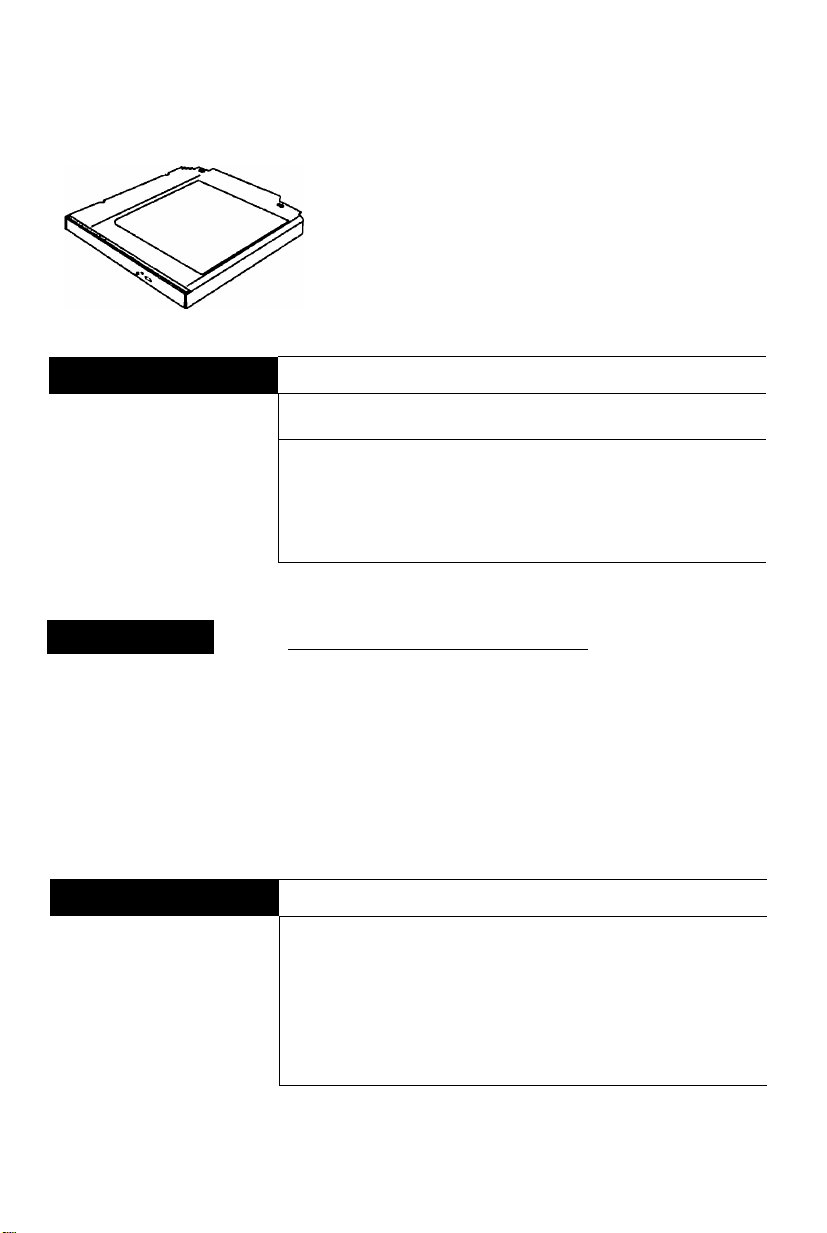
DVD-ROM Drive Pack
for CF-71/CF-72
Personal Computer Series
CF-VDD721
ENGLISH
DEUTSCH
FRANÇAIS
OPERATING INSTRUCTIONS
Introduction................................................................4
Usage Precautions.....................................................5
Software Preparation..................................................6
Setting a Disc.............................................................8
Troubleshooting.........................................................9
Specifications...........................................................10
BEDIENUNGSANLEITUNG
Einführung...............................................................12
Vorsichtsmaßnahmen zum Gebrauch
instaiiation der Software
Einiegen der Disc................................................... 16
Störungsbehebung
Technische Daten
....................................................
...................................................
....................................................
_________________
........................
13
17
18
MODE D*EMPLOI
Introduction..............................................................20
Précautions d’utilisation
Préparation du logiciel
Mise en place d’un disque.........................................24
Dépannage........................................................
Spécifications
..........................................................
............................................
..............................................
.
.....25
21
22
26
74 ■•]
Page 2
CAUTION!
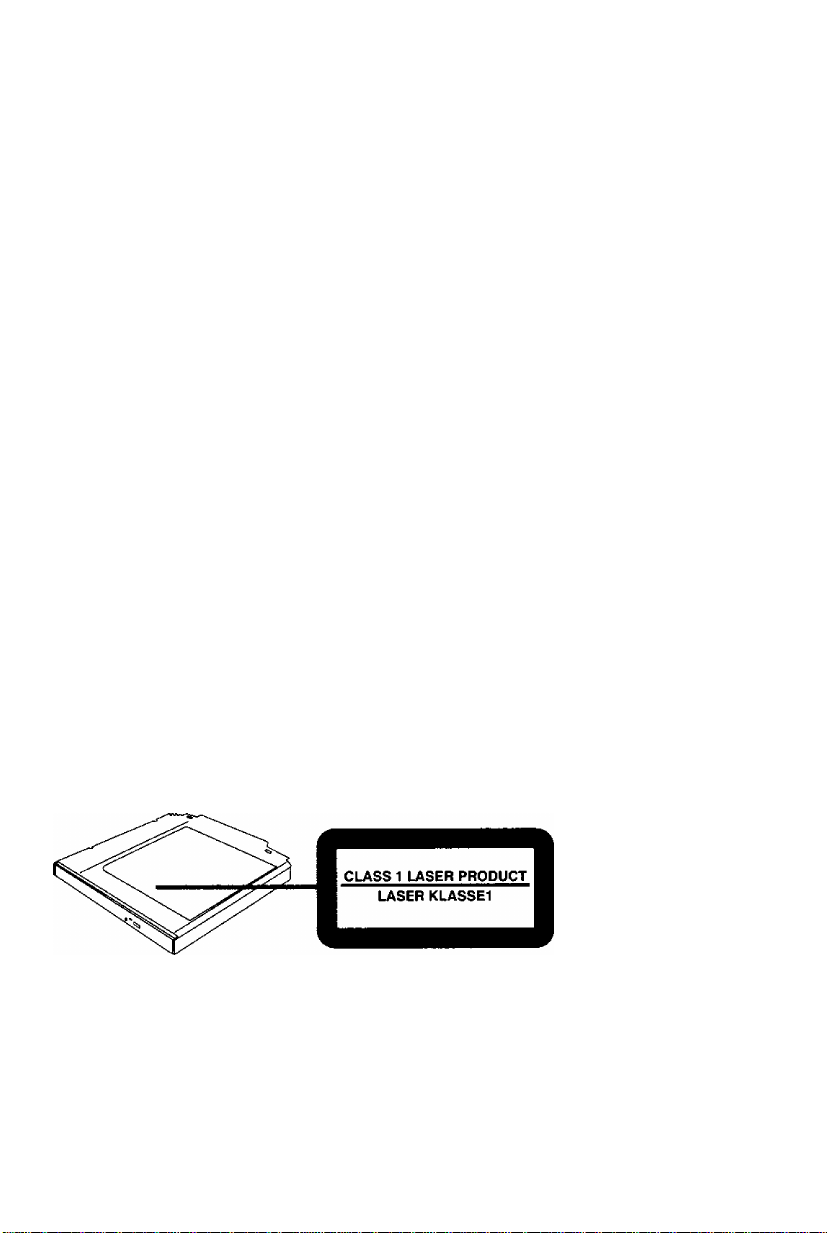
THIS PRODUCT UTILIZES A LASER.
USE OF CONTROLS, ADJUSTMENTS OR PERFORMANCE OF PROCEDURES
OTHER THAN THOSE SPECIFIED HEREIN MAY RESULT IN HAZARDOUS RA
DIATION EXPOSURE.
DO NOT OPEN COVERS AND DO NOT REPAIR YOURSELF.
REFER SERVICING TO QUALIFIED PERSONNEL
WARNUNG!
DIESES PROUKT ERZEUGT LASERSTAHLUNG.
DURCHFÜHRUNG ANDERER VORGÄNGE ALS DER HIER ANGEGEBENEN KANN
ZU GEFÄHRLICHER STRAHLUNG FÜHREN.
REPARATUREN DÜRFEN NUR VON QUALIFIZIERTEM FACHPERSONAL
DURCHGEFÜHRT WERDEN.
AVERTISSEMENT!
CET APPAREIL UTILISE UN LASER.
L'UTILISATION DE COMMANDES OU DE RÉGLAGES OU L'EXÉCUTION DE
PROCÉDURES AUTRES QUE CELLES SPÉCIFIÉES ICI PEUVENT PROVOQUER UNE
EXPOSITION À DES RADIATIONS DANGEREUSES.
NE PAS OUVRIR LES COUVERCLES NI ESSAYER DE RÉPARER SOI-MÊME.
CONFIER TOUT TRAVAIL D'ENTRETIEN À UN PERSONNEL QUALIFIÉ.
VARNING
Om apparaten används pâ annal satt an i denna bruksanvisnig specificerats, kan användaren
utsättas for osynlig laserstrâlning, som överskrider gränsen for laserklass I.
Page 3

For U.S.A.
Federal Communications Commission Radio Frequency Interference Statement
Note: This equipment has been tested and found to comply with the limits for a Class B
digital device, pursuant to Part 15 of the FCC Rules. These limits are designed to provide
reasonable protection against harmful interference in a residential installation. This equip
ment generates, uses and can radiate radio frequency energy and, if not installed and used in
accordance with the instructions, may cause harmful interference to radio communications.
However, there is no guarantee that interference will not occur in a particular installation. If
this equipment does cause harmful interference to radio or television reception, which can
be determined by turning the equipment off and on, the user is encouraged to try to correct
the interference by one or more of the following measures:
• Reorient or relocate the receiving antenna.
• Increase the separation between the equipment and receiver.
• Connect the equipment into an outlet on a circuit different from that to which the receiver
is connected.
• Consult the Panasonic Service Center or an experienced radio/TV technician for help.
Warning
To assure continued compliance, use only shielded interface cables when connecting to a
computer or peripheral. Also, any changes or modifications not expressly approved by the
party responsible for compliance could void the user's authority to operate this equipment.
This device complies with Part 15 of the FCC Rules. Operation is subject to the following
two conditions:
(1) This device may not cause harmful interference, and
(2) This device must accept any interference received, including interference that may cause
undesired operation.
Responsible Party:
Matsushita Electric Corporation of America
One Panasonic Way
Secaucus, NJ 07094
Tel No: 1-800-LAPTOP-5 (1-800-527-8675)
For Canada
This Class B digital apparatus complies with Canadian ICES-003.
Cet appareil numérique de la classe B est conforme à la norme NMB-003 du Canada.
Page 4
Introduction
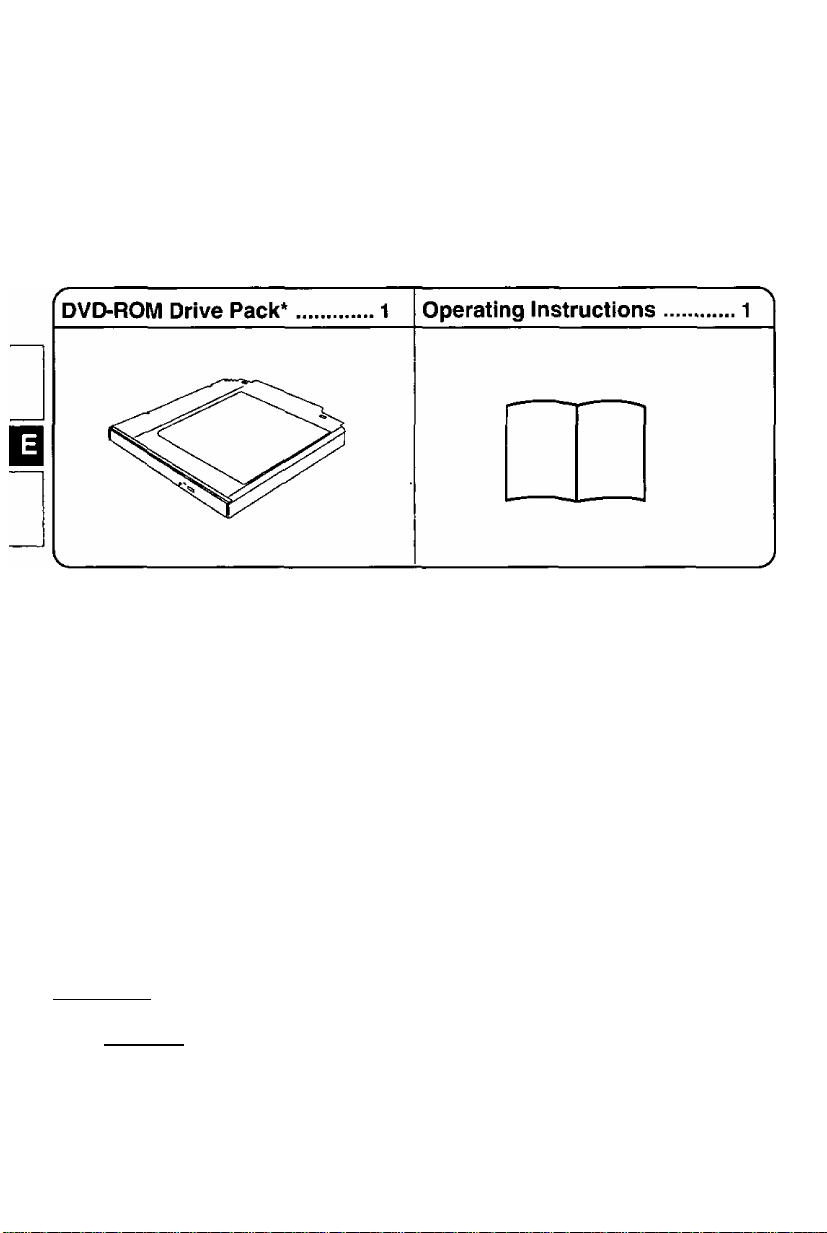
Thank you for purchasing the DVD-ROM Drive Pack for the Panasonic CF-71/CF-72 note
book computer series.
The DVD-ROM Drive Pack connects to the computer through the Multimedia Pocket.
Store this manual in a safe place after reading it.
*The DVD-ROM Drive Pack may also be referred to as the DVD-ROM drive.
Refer to the section about the Multimedia Pocket in the Reference Manual included with
your computer on how to instaliyremove the DVD-ROM Drive Pack.
[Illustration in this manual]
indicates Microsoft* Windows® 95 Operating System.
mrnmm indicates Microsoft® Windows* 98 Operating System.
indicates Microsoft® Windows NT® Workstation Version 4.0.
indicates Microsoft* Windows® 2000 Professional Operating System.
Microsoft®, MS-DOS® and Windows® are registered trademarks of Microsoft Corporation in the United
States and/or other countries.
Page 5
Usage Precautions
• Do not place items other than discs on the tray.
• Do not leave the tray in the open position or touch the lens area. Should the lens
become soiled by dust or dirt, the unit may not read discs properly.
• Under some conditions, dust may build up on the optical lens or disc, possibly resulting in
malfunction.
• Do not apply excessive force to the tray in the open position, doing so could damage the
tray.
• Do not open the DVD-ROM drive or move the computer while the DVD-ROM drive is
being accessed. Doing so could cause it to malfunction. In addition, after running an
application involving access to a disc, do not open the DVD-ROM drive or remove the
disc until after the application has been closed.
• After closing the tray, do not attempt to access a disc until the MP indicator (^) disap
pears.
• Do not expose the DVD-ROM Drive Pack to oily or tobacco smoke. Doing so could
shorten the service life of the lens.
• Cleaning the DVD-ROM drive using a CD lens cleaner (except a liquid type cleaner) is
recommended if it malfunctions.
• Never insert foreign objects such as paper clips into the DVD-ROM Drive Pack.
• Do not use discs that have become deformed (warped, not completely round, etc.).
To avoid damaging discs;
9 Do not touch the surface as it can cause the disc to become dirty or scratched.
• Do not allow discs to become dirty or scratched.
• Do not place or store discs in locations exposed to heat, direct sunlight, humidity or dust.
• Do not write on the surface of the disc with a bail-point pen or other writing instrument.
• If the disc is brought from a cold into a warm environment, moisture may form on the disc.
Wipe this moisture off with a soft, dry, lint-free cloth before using the disc.
• Do not drop, bend, or place heavy objects on top of discs.
• Cleaning the disc using a CD cleaner is recommended once every 2 or 3 months.
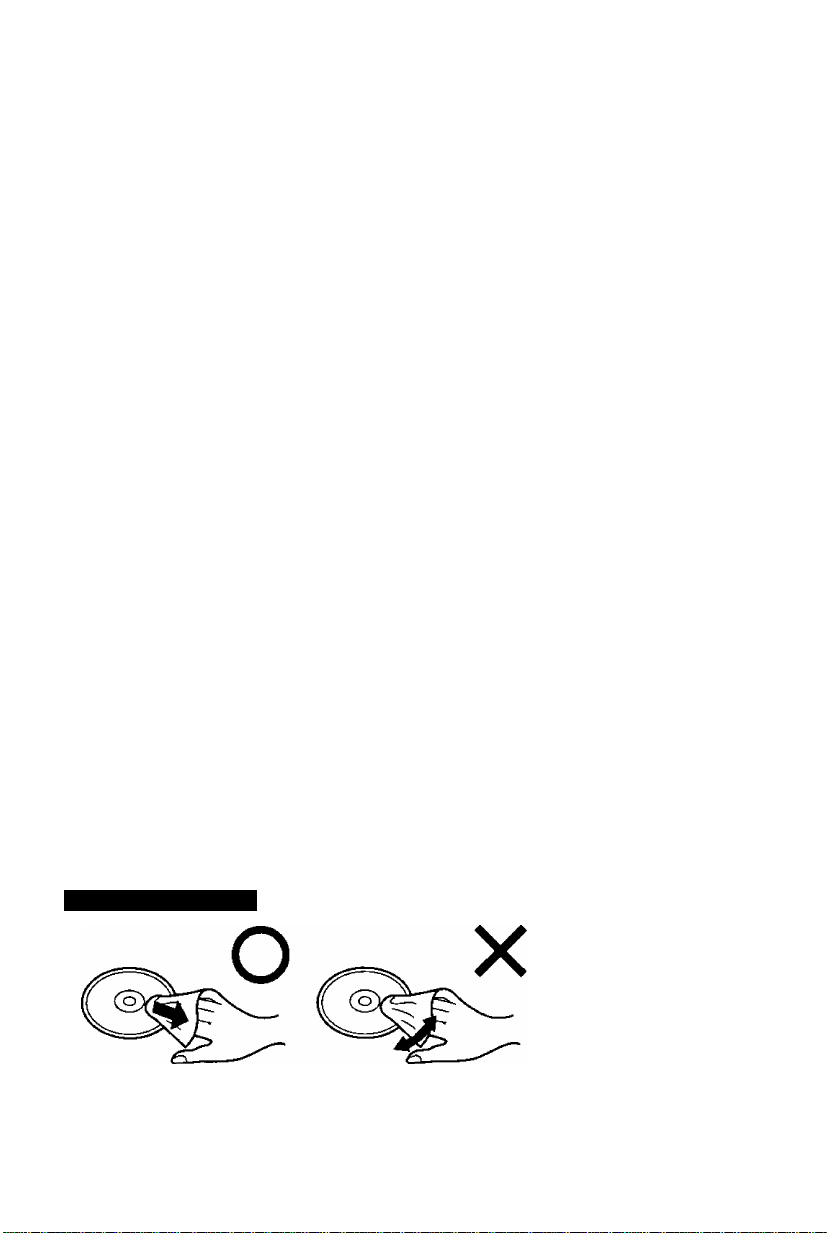
If the disc gets dirty
After wiping the disc with a moist, soft cloth, wipe it with a dry
cloth. Always wipe from the center toward the edge.
Page 6

Software Preparation (first time only)
tWJnSovi^s^sillw^
Confirm the following contents in [Start] - [Settings] - [Control Panel] - [System] - [Device
Manager] - [CD-ROM] - [MATSHITA DVD-ROM SR-**** ] - [Settings]. Make the set
tings if they have not yet been made.
• Add a check mark for [DMA].
• Set both [Start drive letter] and [End drive letter] in [Reserved drive letters] to [L:].
note)-
When using CF-71 series
• i } (with the FIRSTAID CD included): When reinstalling, refer to the
above to set the reserved drive letters of the DVD-ROM drive.
• When booting up from the FIRSTAID FD (for example, to reinstall the operating
system), the DVD-ROM Drive does not have to be replaced by the CD-ROM Drive
(CF-VCD711). The CD-ROM driver will recognize the DVD-ROM Drive.
Confirm that [Transfer Mode] is set to [DMA if available] in [Control Panel] - [System] [Hardware] - [Device Manager] - [IDE ATA/ATAPI controllers] - [Secondary IDE Chan
nel] - [Advanced Settings] - [Device 0]. Perform this setting if it has not yet been made.
Using the DVD-ROM Drive Pack in the MS-DOS Mode
¡smnwiimaeB.)
To use the DVD-ROM Drive Pack in the MS-DOS mode, configure the drive following the
steps below after performing the above preparations. If the steps listed below are per
formed without completing above preparations first, the drive will not operate prop
erly.
1Click the [Start] button then select [Shut Down].
2 Select [Restart in MS-DOS mode] and click [OK].
3 Open the “CONFIG.SYS” file for editing by issuing the following commands:
cd\f Enter )
edit config.sys ( Enter Ì
Page 7

4 Move the cursor to the line containing “ OAKCDROM.SYS*” and delete
the characters “rem” at the beginning of the line. (Deleting “rem” causes the item to
become valid.)
DEV1CEHIGH=C;\WINDOWS\COMMAND\OAKCDROM.SYS*/D;MSCDOOO
(If this line is missing, add it.)
* CmmtffaTRgR): ATAPICD.SYS
5 Press
[
Alt
] +C F )
exit the Edit program.
. then
C S )
to save the file. Then press
C
Alt
) + ( F )
. then CD to
6 Follow the same steps to edit the “AUTOEXEC.BAT” file,
edit autoexec.bat f Enter )
7 Move the cursor to the line containing “MSCDEX.EXE” and delete the characters “rem”
at the beginning of the line. (Deleting “rem” causes the item to become valid.)
LOADHIGH C:\WlNDOWS\COMMANDVMSCDEX.EXE /DiMSCDOOO /L:L
(If this line is missing, add it.)
3 Press ( Alt ) +CE) , then to save the file. Then press CM) +CD , then CD to
exit the Edit program.
9 Restart the computer.
Power-saving Mode
If the DVD-ROM Drive Pack has not been accessed within 90 seconds, the drive motor will
automatically shut down to reduce the power consumption. When the DVD-ROM Drive
Pack is accessed once again, the power of the drive motor is turned on. However, approxi
mately 30 seconds are required until data is actually read from the disc.
Page 8
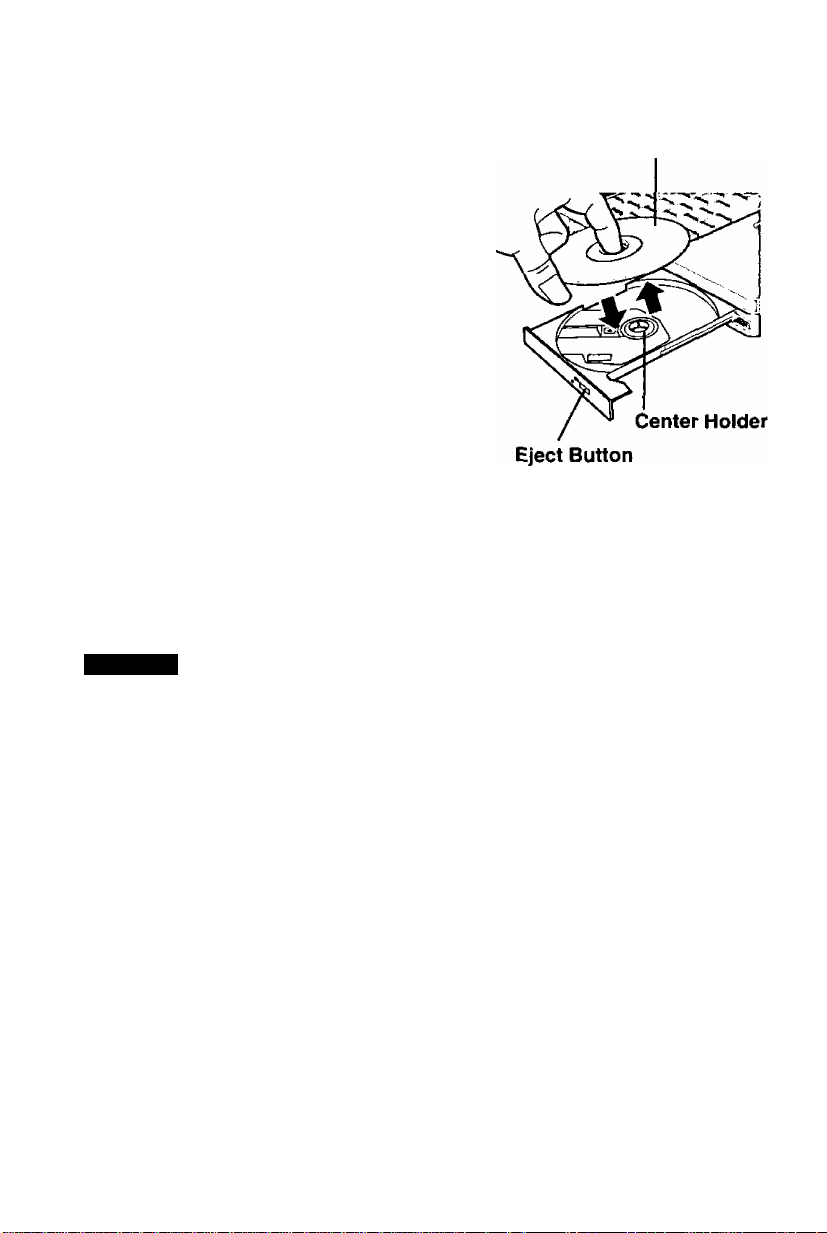
Setting a Disc
7 Open the disc tray
Press the eject button and slowly pull out the tray,
Label side up
2 Place a disc
Place the disc with the label facing upward in the
drive and push down until the center holder clicks.
<Removing a diso
Place a finger on the center holder and lift up on the
edge of the disc.
3 Close the disc tray
Close the tray without touching the eject button.
(This illustration features
CF-72 series.)
G%UiTil0N
(i
• Do not apply excessive force to the tray in the open position, doing so could damage
the tray.
• <Using PC Cards>
' if the PC Card does not work, there may be no interrupt request (IRQ) line available.
Deactivate unnecessary equipment using in the Setup Utility.
D
1
Xnote>
References to “CD-ROM” in the Setup Utility will not change when the DVD-ROM
Drive Pack is installed.
If the vibration of the DVD-ROM drive is excessively high, use the Setup Utility to
reduce the CD-ROM or DVD-ROM drive speed (by setting it to [Low] or [12x
speed])*.
* This .setting does not work for the DVD-ROM disc when this drive is used with the CF-71
series.
Page 9

Troubleshooting
The computer does not recognize the
DVD-ROM Drive Pack.
The MP indicator (^) does not light.
Cannot play disc or read data from it.
Cannot eject disc.
A blue background appears on the screen
with the MPEG image.
The disc tray does not close.
• Check the settings by following the instruc
tions in “Software Preparation”.
• Is the DVD-ROM Drive Pack properly
mounted in the multimedia pocket?
Is the disc loaded on the tray correctly?
Is the disc bent, scratched, or dirty?
Is the computer powered on?
To remove a disc when the computer is pow
ered off, insert a sharp object such as the bentout tip of a paper clip into the emergency hole.
Pushing it completely to the end will free the
tray so that it can be pulled out.
Emergency Hole
Did you open the DVD-ROM drive or remove
the MPEG disc while it was operating?
Re-insert the MPEG disc and close the DVDROM drive. Press C Enter).
Did you touch the eject button when you close
the tray?
Page 10

Specifications
Item
Operating voltage range
Drive
DC 5 V ± 0,25 V
8x DVD-ROM Drive max, speed
Description
24x/20x*' CD-ROM Drive max. speed
DVD
-ROM
Data Capacity
Data transfer rate*^
Access Time
Supports
4.7 GB(DVD-5), 8.5 GB(DVD-9), 9.4 GB(DVD-iO)
88.64 Mbii/s(10816 KB/s) 8x speed (Max.)
220 ms (8x Speed, DVD-9, 1/3 Stroke*^)
DVD-5, DVD-9, DVD-10, DVD-R*^(3.95 GB),
DVD-RAM*-" (2.6 GB, 4.7 GB)
CD
-ROM
Data Capacity
Data transfer rate*^
656 MB
3600 KB/s 24x speed (Max.)
3000 KB/s 20x speed (Max.)**
Access Time
135 ms (24x Speed, 1/3 Stroke*^)
138 ms (20x Speed, 1/3 Stroke*^)**
Supports
CD-Audio, CD-ROM, CD-R*\ Photo CD, Video
CD, Enhanced Music CD, CD-RW*^ CD-TEXT
Cache memory
Interface
Dimensions (width x depth x height)
512 KB
Conforms to enhanced IDE (ATAPI) standard
132 mm X 147.1 mm x 15.3 mm
{5.2 " X 5.8 " X 0.6 "}
Weight
Operating temperature /
Humidity range
When using CF-71 series and CF-72N3**** series.
It'an unbalanced disc (e.g„ a disc with which the balance has been displaced from the center) is inserted, the
speed may become slower if there are large vibrations while the disc is rotating.
Stroke: Indicates the amount of movement the lens (pickup) of the DVD-ROM Drive Pack must make in
order to read data.
Read only.
Approx. 380 g {0.84 lb.}
5 '’C to 35 ®C |41 °F to 95 °F} /30 % RH to
80 % RH (no condensation)
10
Page 11

note)-
A PC Card is required to play DVD-Video or MPEG2 files when using CF-71 series.
Separate application software is required to play DVD-Video or MPEG2 files when
using CF-72 series.
The region code has been set to the following :
<CF-VDD721M> Set to “ 1 ”,
<CF-VDD721Z> Set to “2”.
Use of another region eodc or alteration of the region code invalidates the war
ranty. For more information, contact Panasonic Technical Support.
If commercially available DVD playback software asks you the region code, set to
the following :
<CF-VDD721M> Setto T”.
<CF-VDD721Z> Set to “2”.
11
Page 12

Einführung
Wir freuen uns, daß Sie sich für den Kauf eines DVD-ROM-Laufwerk-Pack für Ihr
Panasonic-Notebook CF-71/CF-72 entschieden haben.
Das DVD-ROM-Laufwerk-Pack wird über das Multimedia Pocket an den Computer
angeschlossen.
Sie sollten diese Bedienungsanleitung an einer sicheren Stelle verwahren.
* Das DVD-ROM-Laufwerk-Pack wird DVD-ROM-Laufwerk in diesem Buch abgekürzt gennant,
sowie es keine Not gibt.
Einzelheiten zum Einsetzen und Entfernen des DVD-ROM-Laufwerk-Packs finden Sie im
[h Abschnitt über das Multimedia Pocket des Benutzerhandbuchs Ihres Computers.
[Illustration im Manual]
j|Windôvvsî95i
iWindowslgsl
tWindow^NTA
6Windöw^2000)
Microsoft®, MS-DOS® und Windows® sind eingetragene Warenzeichen von Microsoft Corporation in
den USA und/oder anderen Ländern.
12
steht für das Microsoft* Windows* 95 Betriebssystem,
steht für das Microsoft® Windows* 98 Betriebssystem,
steht für die Microsoft® Windows NT® Workstation Version 4.0.
steht für das Microsoft® Windows* 2000 Professional Betriebssystem.
Page 13

Vorsichtsmaßnahmen zum Gebrauch
• Legen Sie nur Discs in das DVD-ROM-Laufwerk ein.
• Lassen Sie das Fach nicht offen und berühren Sie die Abtastoptik nicht mit den
Fingern. Bei Verschmutzung der Optik können Lesefehler auftreten.
• Unter bestimmten Bedingungen kann sich Staub auf der Abtasterlinse oder Disc
ansammeln, wodurch Fehlfunktionen verursacht werden können.
• Achten Sie darauf, das geöffnete Fach nicht zu stark zu belasten, es könnte dabei beschädigt
werden.
• Während des Zugriffs auf das DVD-ROM-Laufwerk sollten Sie das Laufwerk keinesfalls
öffnen oder den Computer bewegen. Andernfalls können Fehlfunktionen auftreten.
Außerdem sollte das DVD-ROM-Laufwerk nicht geöfffnet bzw. die Disc entfernt werden,
solange eine Anwendung läuft, die darauf zugegriffen hat.
• Versuchen Sie nach Schließen des Fachs auf keinen Fall, einen Zugriff auf die Disc
auszuführen, bevor die MP-Anzeige (^) erloschen ist.
• Verwenden Sie das DVD-ROM-Laufwerk-Pack nicht in Räumen, in denen stärkere
Konzentrationen von Ölnebel oder Tabakrauch auftreten. Die Nutzungsdauer der Optik
könnte sonst verkürzt werden.
• Bei Funktionsstörungen empfehlen wir die Reinigung des DVD-ROM-Laufwerkes, wozu
ein CD-Linsenreiniger (außer Flüssigkeitsreiniger) zu verwenden ist.
• Führen Sie in das Gerät keine Fremdkörper wie z.B. Büroklammern ein.
• Verwenden Sie keine Discs, die deformiert sind (durchgebogen oder nicht völlig rund
usw.).
Beachten Sie zum Schutz der Discs die foigenden Punkte:
• Berühren Sie die Oberfläche der Disc nicht, damit diese nicht schmutzig oder verkratzt
wird. Ui
• Halten Sie Ihre Discs sauber und frei von Kratzern.
• Verwahren Sie Ihre Discs nicht an einem Ort, wo sie zu hohen Temperaturen, direkter
Sonneneinstrahlung, Feuchtigkeit oder Staub ausgesetzt sind.
• Die Oberfläche der Disc darf nicht beschriftet werden.
• Wenn Discs aus kalten in warme Räume gebracht werden, kann auf ihnen Feuchtigkeit
kondensieren. Diese muß mit einem weichen, nicht fusselnden Tuch entfernt werden,
bevor Sie die Disc in das Laufwerk einlegen können.
• Discs dürfen weder fallengelassen noch verbogen oder durch schwere Gegenstände belastet
werden.
• Wir empfehlen, daß die Disc alle 2-3 Monate unter Verwendung eines CD-Reinigers
gereinigt wird.
Discs reinigen
Reinigen Sie die disc mit einem weichen, feuchten Tuch, und wischen Sie mit einem
trockenen Tuch nach. Wischen Sie immer von der Mitte gerade nach außen.
richtig
falsch
13
Page 14

Installation der Software
(nur bei der Erstinstallation)
4Wjndò^i!^95u4Wjr^
Überprüfen Sie den folgenden Inhalt in (Start) - [Einstellungen] - [Systemsteuerung] [System] - [Geräte-Manager] - [CD-ROM] - [MATSHITA DVD-ROM SR-****] [Einstellungen], Nehmen Sie ggf. die folgenden Einstellungen vor:
• Markieren Sie das kontrollkästchen [DMA],
• Stellen Sie sowohl [Erster Buchstabe] und [Letzter Buchstabe] unter [Reservierte
Laufwerkbuchstaben] auf [L:| ein.
Hinweis^
Bezieht sich auf Computer der Serie CF-71
• ( fPas Betriebssystem, das die Erste-Hilfe-CD enthält): Wenn Sie die
Software auf dem Computer neu installieren, folgen Sie bitte den obigen Hinweisen,
um [Reservierte Laufwerkbuchstaben] auszuwählen.
• Vor der Reinstallation mit dem DVD-ROM-Laufwerk-Pack und Erste-Hilfe-FD ist
eine Veränderung des CD-ROM Treibers nicht nötig. Das DVD-ROM-Laufwerk
kann ohne die Veränderung störungsfrei arbeiten. [Verwenden Sie den im CD-ROM
Pack (CF-VCD711) vorhandenen Treiber.]
4w.indo.w.sf20.0dl
Vergewissern Sie sich, dass [Übertragungsmodus] unter [Systemsteuerung] - [System] [Hardware] - [Geräte-Manager] - [IDE ATA/ATAPi-Controller] - [Sekundärer IDE-Kanal]
- [Erweiterte Einstellungen] - [Gerät 0] auf [DMA, wenn verfügbar] eingestellt ist. Falls
nicht, nehmen Sie diese Einstellung vor.
13
Einsatz des DVD-ROM-Laufwerk-Pack im MS-DOS-Modus
4Wjn3o^Si5M4WJn9öi^
Wenn Sie das DVD-ROM-Laufwerk-Pack im MS-DOS-Modus nutzen wollen, konfigurieren
Sie es anhand der nachstehenden Schritte, nachdem Sie die obigen Vorbereitungen ausgeführt
haben. Wenn die nachstehenden Schritte ausgeführt werden, bevor die obigen
Vorbereitungen abgeschlossen worden sind, arbeitet das Laufwerk nicht einwandfrei.
1 Klicken Sie auf [Start] und dann auf [Beenden],
2 Wählen Sie [Im MS-DOS-Modus neu starten] und klicken Sie auf [OK].
3 Öffnen Sie die Datei “CONFIG.SYS" durch die folgenden Befehle:
cd\ li'^l
edit config.sys [I ■<—‘I]
14
Page 15

4 Bringen Sie den Cursor in die Zeile, in der OAKCDROM.SYS*" steht,
und löschen Sie die Buchstaben ''rem'' am Anfang der Zeile (dadurch wird diese
Befehlszeile wirksam).
DEVICEH1GH=C:\WINDOWS\COMMAND\OAKCDROM.SYS*/D:MSCDOOO
(Fügen Sie die Zeile ein, falls Sie in der Datei fehlt.)
tWindöwsi95i
5 Drücken C Alt ) + CP) und dann CID , um die Datei zu sichern. Durch Drücken von
ATAPICD.SYS
CMD +CbD und CD können Sie den Editor verlassen.
6 Die Datei "AUTOEXEC.BAT" editieren Sie auf dieselbe Weise,
edit autoexec.bat | •<—'!]
7 Bringen Sie den Cursor in die Zeile, in der "MSCDEX.EXE” steht, und löschen Sie die
Buchstaben "rem" am Anfang der Zeile (dadurch wird diese Befehlszeile wirksam),
LOADHIGH C:\WINDOWS\COMMAND\MSCDEX.EXE /DiMSCDOOO /L:L
(Fügen Sie die Zeile ein, falls Sie in der Datei fehlt.)
3 Drücken( Alt ) + CP ) und dann CD , um die Datei zu sichern. Durch Drücken von
CM)
+ C p )
und CD können Sie den Editor verlassen.
9 Starten Sie den Computer neu.
Energiesparfunktion
90 Sekunden nach dem letzten Zugriff auf das DVD-ROM-Laufwerk-Pack wird der
Laufwerksmotor abgeschaltet, um die Leistungsaufnahme zu reduzieren. Bei einem
erneuten Zugriff auf das Laufwerk wird der Motor wieder eingeschaltet. Das Hochlaufen
dauert etwa 30 Sekunden, erst danach können wieder Daten von der Disc gelesen werden.
15
Page 16

Einlegen der Disc
1 öffnen Sie das Laufwerkfach
Drücken Sie die DVD-ROM-Auswurftaste und
ziehen Sie das Fach vorsichtig heraus.
2 Einstecken einer Disc
Legen Sie die Disc mit der Beschriftung nach oben
in das Laufwerk ein. Drücken Sie die Disc nach
unten, bis sie in den Zentrierring einrastet.
<Auswerfen einer Diso
Legen Sie einen Finger auf den Zentrierring und
ziehen Sie die Disc nach oben, indem Sie sie am
Rand halten.
3 Schließen Sie das Fach
Achten Sie darauf, daß Ihre Hand die DVD-ROMAuswurftaste nicht berühret.
Achten Sie darauf, das geöffnete Fach nicht zu stark zu belasten, es könnte dabei
□
beschädigt werden.
<Verwendung der PC Cards>
Wenn die Karte nicht funktioniert, steht möglicherweise keine Unterbrechungs
anforderungsleitung zur Verfügung, Deaktivieren Sie unnötige Geräte, wenn Sie
Setup-Dienstprogramm verwenden.
Etikettier Seite nach
oben
Zentrierring
DVD-ROM
Auswurftaste
(Die Abbildung zeigt die
Serie CF-72.)
16
Hinweisü>
Die Anzeige “CD-ROM” im Setup-Dienstprogramm wird nicht auf “DVD-ROM”
geändert, wenn das DVD-ROM-Laufwerk-Pack installiert wird.
Wenn das DVD-ROM-Laufwerk zu stark vibriert, verringern Sie die
Laufwerkdrehzahl, indem Sie im Setup-Dienstprogramm die Einstellung “CD-ROM/
DVD-ROM-Laufwerkdrehzahl” auf [Low] oder [I2x speed]* ändern.
* Bei Einsatz dieses Laufwerk.s in Verbindung mit einem Computer CF-7I steht diese
Einstellung nicht für die DVD-ROM-Disc zur Verfügung.
Page 17

Störungsbehebung
Der Computer erkennt das DVD-ROM-
Laufwerk Pack nicht.
Die MP-Anzeige (^) leuchtet nicht.
Die DVD-ROM kann nicht gelesen
werden.
Die DVD-ROM wird nicht ausgeworfen.
• Überprüfen Sie die Einstellungen anhand
der Anweisungen im Abschnitt “Installation
der Software“.
• Ist das DVD-ROM-Laufwerk-Pack richtig
in das Multimedia-Pocket eingesetzt?
Wurde das DVD-ROM korrekt in die Lade
gelegt?
Ist die DVD-ROM verbogen, zerkratzt oder
schmutzig?
Ist der Computer eingeschaltet?
Um die Disc bei ausgeschaltetem Computer
zu entfernen, müssen Sie einen spitzen
Gegenstand (aufgebogene Büroklammer o.ä.)
in das Loch der manuellen Auswurfvor
richtung schieben,
Gegenstand so weit wie möglich einführen (bis
zum Anschlag). Dadurch wird die Lade
entriegelt und kann herausgezogen werden.
E!
Loch der manuellen
Auswurfvorrichtung
Eine blaue Darstellung mit den MPEGDaten taucht plötzlich auf.
Das Fach schließt nicht.
Haben Sie die Disc mit den MPEG-Daten aus
dem DVD-ROM-Laufwerk herausgenommen?
Legen Sie die Disc wieder ein und drücken
Hat Ihre Hand die DVD-ROM-Aufwurftaste
nicht berührt als Sie das Fach geschlossen
haben?
17
Page 18

Technische Daten
Gegenstand
Betriebsspannung
Laufwerk
DVD
-ROM
CD
-ROM
Cache-Speicher
Schnittstelle
Abmessungen (Breite x Tiefe x Höhe)
Gewicht
Zulässige Umgebungsbedingungen
□
Temperatur / Luftfeuchtigkeit
Bezieht sich auf Computer der Serien CF-71 und CF-72N3****.
Falls eine Form-Disc oder eine Disc mit großer Unwucht (Schwerpunkt der Disc liegt außerhalb der Mitte)
eingelegt wird, die bei der Rotation stark vibriert, kann die Geschwindigkeit geringer sein.
Hub; Weg der Abtastoptik im DVD-ROM-Laufwerk bis zur Leseposition.
Nur Lesen.
Datenkapazität
Datentransrate*’
Zugrifftszeit
Unterstützte Fonnate
Datenkapazität
Datentransrate*’
Zugrifftszeit
Unterstützte Formate
DC 5 V ± 0.25 V
8 mal max DVD-ROM-Laufwerk
24 mal/20 mal** max CD-ROM-Laufwerk
4,7 GB(DVD-5), 8,5 GB(DVD-9), 9,4 GB(DVD-IO)
88,64 Mbit/s(10816 KB/s) (8 mal max.)
220 ms (8 mal max, DVD-9, 1/3 Hub*^)
DVD-5, DVD-9, DVD-10, DVD-R*-'(3,95 GB),
DVD-RAM*-* (2,6 GB, 4,7 GB)
656 MB
3600 KB/s (24 mal max.)
3000 KB/s (20 mal max.)*‘
135 ms (Drehzahl 24 fach, 1/3 Hub*^)
138 ms (Drehzahl 20 fach, 1/3 Hub*^)*'
CD-Audio, CD-ROM, CD-R*^ Photo CD, Video
CD, Enhanced Music CD, CD-RW*^ CD-TEXT
512 KB
Entspricht der Norm für IDE-Erweiterungen
(ATAPi)
132 mm X 147,1 mm x 15,3 mm
Ca, 380 g
5 °C bis 35 °C 1 30 % RH bis 80 % RH
(ohne Kondensation)
Beschreibung
18
Page 19

Hinweis)-
Zum Abspielen von DVD-Video-Discs oder MPEG2-Dateien mit einem Computer
der Serie CF-71 ist eine PC-Karte erforderlich.
Zum Abspielen von DVD-Video-Discs oder MPEG2-Dateien mit einem Computer
der Serie CF-72 ist ein separates Anwendungsprogramm erforderlich.
Der Länder Code ist wie folgt eingestellt worden:
<CF-VDD721M> Der Länder Code lautet “1”.
<CF-VDD721Z> Der Länder Code lautet “2”.
Die Verwendung eines anderen Länder Codes oder seine Änderung hat den Verfall
der Garantie zur Folge. Bezüglich weiterer Informationen wenden Sie sich bitte an
den Panasonic-Kundendienst.
Falls die optionale DVD Wiedergabesoftware nachfragt wie der Regionalcode gesetzt
ist, ermitteln Sie ihn wie folgt:
<CF-VDD721M> Steht auf 1.
<CF-VDD721Z> Steht auf 2.
19
Page 20

Introduction
Merci d’avoir choisi le Lecteur DVD-ROM pour l’ordinateur portable Panasonic CF-71/
CF-72.
Le lecteur DVD-ROM se connecte à l’ordinateur par l’intermédiaire du Multimedia Pocket.
Conservez précieusement ce manuel après l’avoir lu.
* Lecteur DVD-ROM peut également être parfois appelé lecteur de DVD-ROM.
Vous pouvez également vous référer à la section sur le Multimedia Pocket dans le Manuel
de Référence fourni avec votre ordinateur pour installer/désinstailer le lecteur DVD-ROM.
[illustrations de ce manuel]
«Windows
AWindô^NTv
4WirKlôwiT20001
Microsoft®, MS-DOS® et Windows® sont des marques déposées de Microsoft Corporation aux ÉtatsUnis et/ou dans d’autres pays.
20
représente le système d’exploitation Microsoft* Windows* 95.
représente le système d’exploitation Microsoft* Windows® 98.
représente le système d’exploitation Microsoft® Windows NT* Workstation Ver
sion 4.0.
représente le système d’exploitation Microsoft* Windows* 2000 Professional.
Page 21

Précautions d’utilisation
• Ne placez pas d’objets autres que des disques dans le tiroir.
• Ne laissez pas le tiroir ouvert et ne touchez pas la zone de la lentille. Si la lentille est
maculée de poussière ou de saletés, l’appareil ne pourra pas lire les disques correctement.
• Dans certaines conditions, de la poussière peut s’accumuler sur la lentille ou sur le disque
et éventuellement entraîner un mauvais fonctionnement.
• N’appliquez pas de force excessive sur le tiroir lorsqu’il est ouvert, cela pourrait
l’endommager.
• N’ouvrez pas le lecteur de DVD-ROM et ne déplacez pas l’ordinateur pendant l’accès au
lecteur de DVD-ROM, cela pourrait entraîner un mauvais fonctionnement. De plus, après
avoir fait fonctionner une application qui requiert un accès au disque, n’ouvrez le lecteur
de DVD-ROM et ne retirez le disque qu’une fois l’application fermée.
• Après avoir fermé le tiroir, n’essayez pas d’accéder à un disque avant que le témoin
d’accès (®) ne soit éteint.
• N’exposez pas le lecteur de DVD-ROM à la fumée dégagée par de l’huile ou par du
tabac. Cela pourrait réduire la durée de vie de la lentille.
• En cas de mauvais fonctionnement, le nettoyage du lecteur de DVD-ROM à l’aide d’un
nettoyant pour lentilles (à l’exception des nettoyants de type liquide) est recommandé.
• N’insérez jamais de corps étrangers tels que des trombones dans le lecteur de DVD-ROM.
• N’utilisez pas de disques déformés ou endommagés.
Afin d’éviter d’endommager les disques:
• Ne touchez pas la surface du disque pour éviter de la salir ou de la rayer.
• Faites en sorte que les disques demeurent propres et sans égratignure.
• Ne posez pas et ne rangez pas les disques dans un endroit exposé à la chaleur, à la
lumière directe du soleil, à l’humidité ou à la poussière.
• N’écrivez pas sur l’étiquette du disque avec un stylo à bille ou tout autre crayon à peinte
dur.
• Si le disque est déplacé d’un endroit froid à un endroit plus chaud, de l’humidité risque
de se déposer sur le disque.
Essuyez l’humidité avec un chiffon doux, sec et sans peluches avant d’utiliser le disque.
• Prenez garde de ne pas tomber ou plier les disques, et de ne pas placer d’objet lourd sur
les disques.
• Le nettoyage du disque à l’aide d’un nettoyant pour CD est recommandé à intervalles de
2 ou 3 mois.
Si le disque est sale
Après avoir nettoyé le disque avec un chiffon doux et humide, essuyez-le avec un
chiffon sec. Essuyez-le toujours du centre vers l’extérieur.
21
Page 22

Préparation du logiciel (uniquement pour la première utilisation)
jlWJ ndâ!v^9^XtWJndGiv^
Confirmez la configuration suivante dans [Démarrer] - [Paramètres] - [Panneau de configu
ration] - [Système] - [Gestionnaire de périphériques] - [CD-ROM] - [MATSHITA DVDROM SR-****] - [Paramètres]. Effectuez les réglages si ce n’est pas déjà fait.
• Choisissez un canal de [DMA].
• Réglez sur [L:] la [Lettre de lecteur de début] et la [Lettre de lecteur de fin] dans [Lettres
de lecteur réservées].
^remarque)-
Lors de l’utilisation de la série CF-71
jlWindôwsi95l(avec le CD FIRSTAID fourni) : Lors de la réinstallation, reportez-
vous aux indications ci-dessus pour choisir les lettres réservées au lecteur de DVDROM.
Lorsque vous démarrez l’ordinateur avec la disquette FIRSTAID (pour réinstaller le
système d’exploitation, par exemple), le lecteur de DVD-ROM n’a pas à être
remplacé par le lecteur de CD-ROM (CF-VCD711 ). Le pilote de CD-ROM identifiera
le lecteur de DVD-ROM.
iWJndÔ№20Mf
Vérifiez que [Mode de transfert] est réglé sur [DMA si disponible] dans [Panneau de con
figuration] - [Système] - [Matériel] - [Gestionnaire de périphériques] - [Contrôleurs ATA/
ATAPl IDE] - [Canal IDE secondaire] - [Paramètres avancés] - [Périphérique 0]. Exécutez
ce réglage si ce n’est pas déjà fait.
utilisation du Lecteur DVD-ROM en mode MS-DOS
iWj ndôw^95ÎMWi ndc^
Pour utiliser le lecteur de DVD-ROM en mode MS-DOS, effectuez la configuration du
lecteur en suivant les étapes ci-dessous après avoir complété les préparatifs ci-dessus. Si
les étapes ci-dessous sont suivies sans avoir d’abord complété les préparatifs ci-dessus,
le lecteur ne fonctionnera pas correctement.
1
Cliquez sur la touche [Démarrer] puis sélectionnez [Arrêter].
2 Sélectionnez [Redémarrer en mode MS-DOS] puis cliquez sur [OK].
3 Ouvrez le fichier “CONFIG.SYS” pour l’éditer en effectuant les commandes
qui suivent :
cd \C Entrée )
edit config.sys ( Entrée )
22
_______
Page 23

4 Déplacez le curseur jusqu’à la ligne qui contient “ ( VVilïï«K?Hgfil ) OAKCDROM.SYS*”
et effacez les lettres ’‘rem” au début de la ligne. (L’effacement de “rem” rend l’option
valide.)
DEVICEHIGH=C:\WINDOWS\COMMAND\OAKCDROM.SYS*/D;MSCDOOO
(Si cette ligne n’apparaît pas, ajoutez-la.)
* (gtemaeB) ATAPlCD.S YS
5 Appuyez sur C Alt ) +rpl, puis sur(~S~) pour enregistrer le fichier.
Appuyez ensuite sur CSD+Œ) , puis sur( X )pour quitter le programme Éditeur.
6 Suivez les mêmes étapes pour éditer le fichier “AUTOEXEC.BAT”,
edit autoexec.bat C Entrée ]
7 Déplacez le curseur Jusqu’à la ligne qui contient “MSCDEX.EXE” et effacez les lettres
“rem” au début de la ligne. (L’effacement de “rem” rend l’option valide.)
LOADHIGH C:\WINDOWS\COMMAND\MSCDEX.EXE /DiMSCDOOO /L;L
(Si cette ligne n’apparaît pas, ajoutez-la.)
S Appuyez sur (5iî)+CO. puis surC S ) pour enregistrer le fichier. Appuyez ensuite
sur
CM) +CD puis sur ŒD pour quitter le programme Éditeur.
Redémarrez l’ordinateur.
Mode d’économie d’énergie
S’il n’y a pas eu d’accès au lecteur de DVD-ROM pendant 90 secondes, le moteur du
lecteur sera automatiquement arrêté pour réduire la consommation d’énergie. Lorsque
l’on accède de nouveau au lecteur de DVD-ROM, l’alimentation du moteur du lecteur est
rétablie. 11 faut toutefois environ 30 secondes pour que les données du disque soient
effectivement lues.
23
Page 24

Mise en place d’un disque
7 Ouvrez le tiroir de disque
Appuyez sur le bouton d’éjection puis tirez lentement
le tiroir.
Face de l’étiquette
vers le haut
2 Insertion d’un disque
Placez le disque dans le lecteur avec l’étiquette sur
le dessus, puis enfoncez-le jusqu’à ce que le déclic
du support central se fasse entendre.
<Retrait d’un disque>
Posez un doigt sur le support central puis soulevez
le disque par les bords.
Support
3 Fermez le tiroir de disque. Bouton
Fermez le tiroir sans toucher au bouton d’éjection, d’éjection
(Cette illustration est celle de
la série CF-72.)
central
r
• N’exercez pas une force excessive sur le tiroir lorsqu’il est ouvert, cela pourrait
l’endommager.
• <Utilisatîon des cartes PC>
Si la carte PC ne fonctionne pas, il se peut qu’il n’y ait pas d’IRQ (interrupt request)
disponible. Désactivez les composants non nécessaires en utilisant “Setup Utility”,
■'A
Xremarque^
• Les références au “CD-ROM” dans Setup Utility ne varient pas lorsque le lecteur de
DVD-ROM est installé.
• Si le lecteur de DVD-ROM vibre de façon excessive, utilisez Setup Utility pour
réduire la vitesse du lecteur de CD-ROM ou de DVD-ROM (en la réglant sur [Low]
ou [12x speed])* *.
* Ce réglage ne s’applique pas aux disques DVD-ROM lorsque le lecteur est utilisé avec la
série CF-71.
24
Page 25

Dépannage
L’ordinateur n’identifie pas le lecteur de
DVD-ROM.
Le témoin d’accès (|m^) ne s’allume pas.
Impossible de lire le disque ou d’accéder
à ses données.
Le disque ne peut pas être éjecté.
Un acrière-plan apparaît en bleu sur
l’écran avec l’image MPEG.
Le tiroir de disque ne se ferme pas.
• Vérifiez les réglages en suivant les instruc
tions de la section “Préparation du logiciel”.
• Le lecteur de DVD-ROM est-il correct
ement monté dans le Multimedia Pocket?
Le disque est-il inséré correctement dans le
tiroir de disque?
Le disque est-il plié, égratigné ou sale?
L’ordinateur est-il allumé?
Pour retirer un disque lorsque l’ordinateur est
éteint, insérez un objet pointu tel que le bout
d’un trombone dans l’orifice d’urgence. En
l’insérant complètement, vous dégagerez le
tiroir qui pourra alors être sorti complètement.
Orifice d’urgence
Avez-vous ouvert le lecteur de DVD-ROM ou
retiré le disque MPEG pendant le
fonctionnement du lecteur?
Réinsérez le disque MPEG et fermez le lecteur
DVD-ROM. Appuyez sur t Entrée ).
Avez-vous touché le bouton d’éjection en
fermant le tiroir de disque?
25
Page 26

Spécifications
Article
Tension de fonctionnement
Lecteur
CC 5 V ± 0,25 V
lecteur de DVD-ROM 8x (vitesse max.)
Description
lecteur de CD-ROM 24x/20x*‘ (vitesse max.)
DVD
-ROM
Capacité des données
Vitesse de transfert
4,7 Go(DVD-5), 8.5 Go(DVD-9), 9,4 Go(DVD-lO)
88,64 Mbit/s(10816 Ko/s) vitesse 8x (max.)
des données*-
Temps d’accès
Supports
220 ms (vitesse 8x, DVD-9,1/3 de déplacements*^)
DVD-5, DVD-9, DVD-10, DVD-R*-*(3,95 Go),
DVD-RAM*-* (2,6 Go, 4,7 Go)
CD Capacité des données 656 Mo
-ROM
Taux de transfert des
données*^
Temps d’accès
3600 Ko/s vitesse 24x (max.)
3000 Ko/s vitesse 20x (max.)*'
135 ms (vitesse 24x, 1/3 de déplacements*^)
138 ms (vitesse 20x, 1/3 de déplacements*^)*'
Supports
CD-Audio, CD-ROM, CD-R*", Photo CD, CD Vidéo,
Enhanced Music CD, CD-RW*^ CD-TEXT
Mémoire cache 512 Ko
Interface
Dimensioas (largeur x profondeur x hauteur)
Poids
Température en fonctionnement/
taux d’humidité
*' Lors de Tutilisation de la série CF-71 et de la série CF-72N3****.
L’utilisation d’un disque déséquilibré (c’est-à-dire un disque sur lequel les données sont excentrées) risque
de ralentir la vitesse de transfert des données en cas de vibrations importantes pendant la rotation.
Déplacements : indique le mouvement nécessaire à la lentille du lecteur de DVD-ROM pour lire les données.
Lecture uniquement.
Conforme au standard EIDE (ATAPI)
132 mm X 147,1 mm x 15,3 mm
Environ 380 g
5 °C à 35 ‘’C / 30 % HR à 80 % HR
(sans condensation)
26
Page 27

XREMARQUE>
Une carte PC Card est nécessaire pour lire des DVD-Vidéo ou des fichiers MPEG2
lors de futilisation de la série CF-71.
Un logiciel d’application distinct est nécessaire pour lire des DVD-Vidéo ou des
fichiers MPEG2 lors de l’utilisation de la série CF-72.
Le code de zone a été fixé comme suit :
<CF-VDD721M> Le code de zone est “1”.
<CF-VDD721Z> Le code de zone est “2”.
L’utilisation d’un autre code de zone ou le changement du code de zone annule la
garantie. Pour plus d’informations, veuillez-vous adresser au Support technique
Panasonic.
Si les logiciels de lecteur DVD disponibles sur le marché vous demandent le code
région, veuillez suivre les indications suivantes :
<CF-VDD721M> Indiquez le code 1.
<CF-VDD721Z> Indiquez le code 2.
27
Page 28

©Matsushita Electric Industrial Co., Ltd. 2001
Printed in Japan
FJ0301-0
DFQX5243ZA
I
 Loading...