

Page 1
User’s Guide
USA
MADE IN
www.omega.com
e-mail: info@omega.com
iSeries info: www.omega.com/specs/iseries
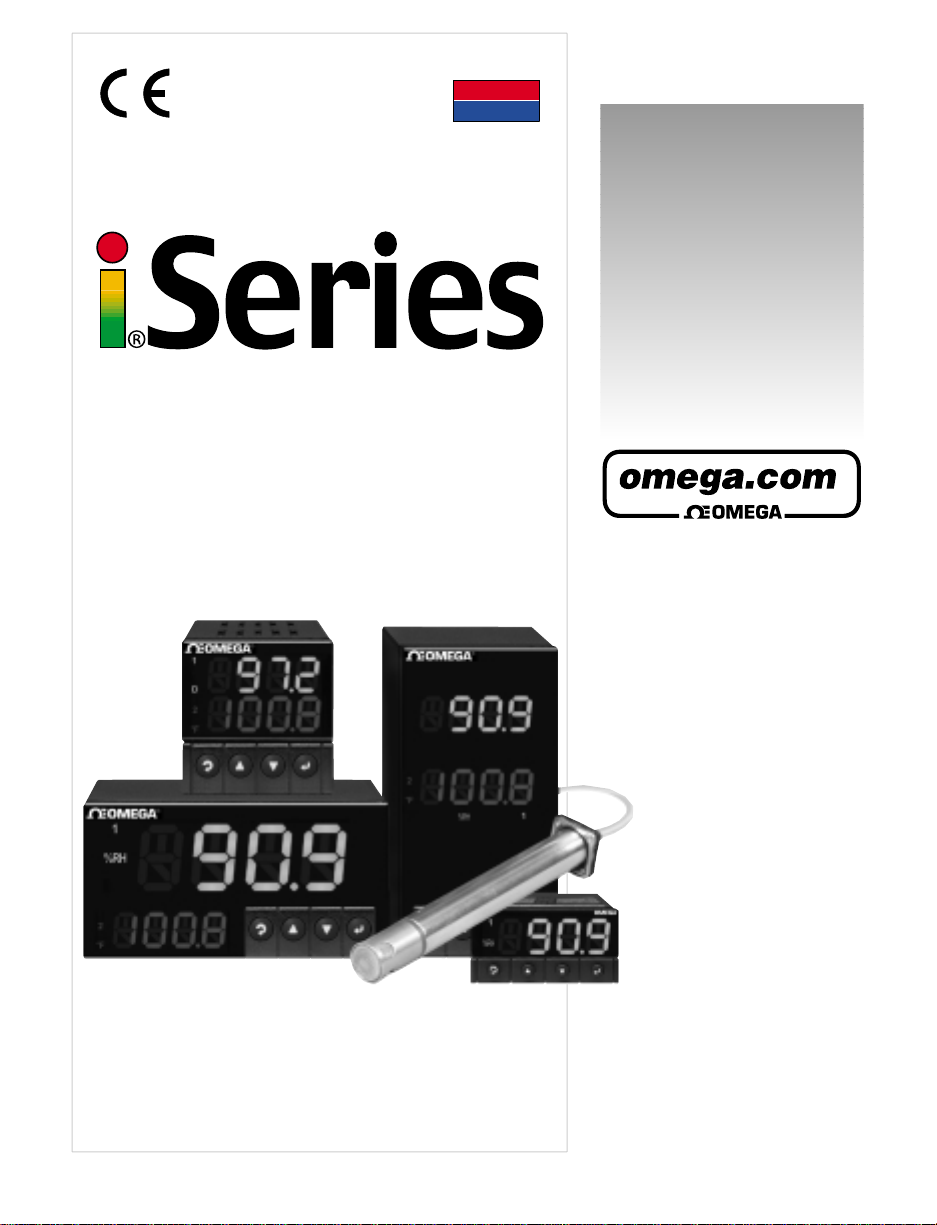
Temperature & Humidity Monitor
DPiTH-i8DH, -i8DV, -i16D, -i32
Temperature & Humidity Limit Alarm
CNiTH-i8DH-AL, -i8DV-AL, -i16D-AL, -i32-AL
Shop on line at
®
®
Page 2

It is the policy of OMEGA to comply with all worldwide safety and EMC/EMI regulations that apply.
OMEGA is constantly pursuing certification of its products to the European New Approach Directives. OMEGA will add the CE mark
to every appropriate device upon certification.
The information contained in this document is believed to be correct, but OMEGA Engineering, Inc. accepts no liability for any
errors it contains, and reserves the right to alter specifications without notice.
WARNING: These products are not designed for use in, and should not be used for, patient-connected applications.
!
This device is marked with the international caution symbol. It is important to read the Setup Guide before installing or
commissioning this device as the guide contains important information relating to safety and EMC.
®
®
OMEGAnet® On-Line Service
www.omega.com
Internet e-mail
info@omega.com
Servicing North America:
USA: One Omega Drive, P.O. Box 4047
ISO 9001 Certified Stamford CT 06907-0047
TEL: (203) 359-1660 FAX: (203) 359-7700
e-mail: info@omega.com
Canada:; 976 Bergar
Laval (Quebec) H7L 5A1
TEL: (514) 856-6928 FAX: (514) 856-6886
e-mail: info@omega.ca
For immediate technical or application assistance:
USA and Canada: Sales Service: 1-800-826-6342 / 1-800-TC-OMEGA
Customer Service: 1-800-622-2378 / 1-800-622-BEST
Engineering Service: 1-800-872-9436 / 1-800-USA-WHEN
Mexico and TEL: (001)800-TC-OMEGA® FAX: (001) 203-359-7807
Latin American: En Espa
e-mail: espanol@omega.com
ñol: (001) 203-359-7803
®
®
®
Servicing Europe:
Czech Republic: Frystatska 184, 733 01 Karviná
TEL: +420 59 6311899 FAX: +420 59 6311114
e-mail: info@omegashop.cz
Germany/Austria: Daimlerstrasse 26, D-75392 Deckenpfronn, Germany
TEL: +49 7056 9398-0 FAX: +49 7056 9398-29
Toll Free in Germany: 0800 639 7678
e-mail: info@omega.de
United Kingdom: One Omega Drive
ISO 9002 Certified River Bend Technology Centre
Northbank, Irlam Manchester M44 5BD United Kingdom
TEL: +44 161 777 6611 FAX: +44 161 777 6622
Toll Free in England: 0800 488 488
e-mail: sales@omega.co.uk
Page 3

TABLE OF CONTENTS
Part 1: Introduction............................................................................................2
1.1 Description .................................................................................2
1.2 Safety Considerations ...............................................................3
1.3 Before You Begin .......................................................................4
Part 2: Setup.......................................................................................................5
2.1 Front Panel .................................................................................5
2.2 Rear Panel Connections............................................................6
2.3 Electrical Installation .................................................................7
2.3.1 Power Connections........................................................7
2.3.2 Humidity and Temperature Probe.................................8
2.3.3 Wiring Outputs - Wiring Hookup...................................9
2.3.4 Dual Display Color Setup.............................................11
Part 3: Operation: Configuration Mode .........................................................12
3.1 Introduction ..............................................................................12
Turning your Instrument On for the First Time
Buttons Functions in Configuration Mode
3.2 Menu Configuration ................................................................13
3.2.1 ID Number .....................................................................14
3.2.2 Setpoints.......................................................................15
3.2.3 Configuration Menu ....................................................15
3.2.4 Reading Configuration Menu .....................................16
3.2.5 Alarm 1 Menu ...............................................................17
3.2.6 Alarm 2 Menu................................................................21
3.2.7 Reading Adjust Menu...................................................22
3.2.8 Setpoint Deviation Menu .............................................22
3.2.9 ID Code Menu ...............................................................23
3.2.10 Communication (Options) Menu.................................25
3.2.11 Display Color Selection Menu.....................................31
Part 4: Specifications ......................................................................................34
Part 5: Factory Preset Values.........................................................................36
CE APPROVAL INFORMATION .......................................................................37
i
Page 4

LIST OF FIGURES:
Figure 2.1 Front Panel Display..............................................................................5
Figure 2.2 Rear Panel Power and Output Connections ......................................6
Figure 2.3 Rear Panel Input Connections ............................................................6
Figure 2.4 Main Power Connections.....................................................................7
Figure 2.5 Probe Wiring Hookup...........................................................................8
Figure 2.6 Output Connections:
a) Mechanical Relay and SSR Outputs – Wiring Hookup...............9
b) Pulse Output – Wiring Hookup.....................................................9
Figure 2.7 Typical Application...............................................................................9
Figure 2.8 Snubber Circuits Wiring Hookup ......................................................10
Figure 2.9 Communication Output:
a) RS-232 Output – Wiring Hookup ................................................10
b) RS-485 Output – Wiring Hookup ................................................10
Figure 2.10 Excitation Output................................................................................10
Figure 2.11 i/8D Locations of S1 and Selectable Jumper Positions..................11
Figure 2.12 i/16D Location of S1 and Selectable Jumper Positions..................11
Figure 3.1 Flow Chart for ID and Setpoints........................................................13
Figure 3.2 Flow Chart for Configuration Menu ..................................................15
Figure 3.3 Flow Chart for Reading Configuration Menu ...................................16
Figure 3.4 Flow Chart for Alarm 1.......................................................................17
Figure 3.5 Flow Chart for Alarm 2.......................................................................21
Figure 3.6 Flow Chart for Reading Adjust Menu................................................22
Figure 3.7 Flow Chart for Setpoint Deviation Menu...........................................22
Figure 3.8 Flow Chart for ID Code.......................................................................23
Figure 3.9 Flow Chart for Communication Option ............................................25
Figure 3.10 Flow Chart for Display Color Selection............................................31
LIST OF TABLES:
Table 2.1 Front Panel Annunciators....................................................................5
Table 2.2 Rear Panel Connector..........................................................................6
Table 2.3 Fuse Requirement ................................................................................7
Table 3.1 Button Function in Configuration Mode...........................................12
Table 3.2 Command Letters and Suffix for iTH ...............................................26
Table 5.1 Factory Preset Values........................................................................36
ii
Page 5
NOTES, WARNINGS and CAUTIONS
Information that is especially important to note is identified by following labels:
• NOTE
• WARNING or CAUTION
• IMPORTANT
• TIP
NOTE: Provides you with information that is important to successfully
setup and use the Programmable Digital Meter.
CAUTION or WARNING: Tells you about the risk of electrical shock.
CAUTION, WARNING or IMPORTANT: Tells you of circumstances or
practices that can effect the instrument’s functionality and must refer
to accompanying documents.
TIP: Provides you helpful hints.
1
Page 6

PART 1
INTRODUCTION
1.1 Description
The iTH Series instruments monitor and control both temperature and relative humidity.
• Used with an iTH probe the controller comes with dual displays. The top displays
relative humidity and the bottom displays temperature. Relative Humidity can be
toggled with Temperature readings (by pressing the bbutton) or Dewpoint readings
(by pressing the cbutton). Dewpoint is the temperature at which water vapor from
the air begins to form droplets and condenses on surfaces that are colder than the
dewpoint of air.
• The temperature and humidity control can be achieved by using on/off or PID
heat/cool control strategy. Control can be optimized with an auto tune feature. The
instrument offers a ramp to setpoint with timed soak period before switching off the
output.
The instruments are simple to configure and use, while providing tremendous versatility
and a wealth of powerful features. The iTH Series instruments are available either as
monitors or controllers. The monitors are extremely accurate programmable digital panel
meters displaying humidity, temperature, or dew point. The controllers also provide dual
loop control for both humidity and temperature and are easily programmed for any
control or alarming requirement from simple on-off to full autotune PID control.
The iTH family of meters and controllers are available in four true DIN Sizes with NEMA 4 /
Type 4, IP65 splash resistant bezels: the ultra compact 1/32 DIN (the world's smallest dual
loop Humidity + Temperature controller); the popular midsize 1/16 DIN square bezel with
dual display; the 1/8 DIN vertical, and the 1/8 DIN horizontal with the big bright 21mm digits.
The iTH series LED displays can be programmed to change color between Green,
Amber, and Red at any set point or alarm point.
The iTH controller models offer a choice of two control or alarm outputs in almost any
combination: solid state relays (SSR); Form "C" SPDT (Single Pole Double Throw)
relays; pulsed 10 Vdc output for use with an external SSR; or Analog Output selectable
for control or retransmission of the process value. Universal power supply accepts 90 to
240 Vac. Low voltage power option accepts 24 Vac or 12 to 36 Vdc.
The Networking and Communications options include direct Ethernet LAN connectivity
with an Embedded Web Server, and serial communications. The -C24 serial
communications option includes both RS-232 and RS-485. Protocols include both
MODBUS and a straightforward ASCII protocol. The -C4EI option includes both Ethernet
and RS-485 ASCII/MODBUS on one device.
The iTH Series meters and controllers are designed for easy integration with popular
industrial automation, data acquisition and control programs as well as Microsoft Visual
Basic and Excel. provides free configuration and data acquisition software and demos
which makes it fast and easy to get up and running with many applications.
2
Page 7
1.2 Safety Considerations
This device is marked with the international caution symbol. It is important
to read this manual before installing or commissioning this device as it
contains important information relating to Safety and EMC
(Electromagnetic Compatibility).
This instrument is a panel mount device protected in accordance with
EN 61010-1:2001, electrical safety requirements for electrical equipment
for measurement, control and laboratory. Installation of this instrument
should be done by qualified personnel. In order to ensure safe operation,
the following instructions should be followed.
This instrument has no power-on switch. An external switch or circuitbreaker shall be included in the building installation as a disconnecting
device. It shall be marked to indicate this function, and it shall be in close
proximity to the equipment within easy reach of the operator. The switch or
circuit-breaker shall meet the relevant requirements of IEC 947–1 and
IEC 947-3 (International Electrotechnical Commission). The switch shall
not be incorporated in the main supply cord.
Furthermore, to provide protection against excessive energy being drawn
from the main supply in case of a fault in the equipment, an overcurrent
protection device shall be installed.
• Do not exceed voltage rating on the label located on the top of the
instrument housing.
• Always disconnect power before changing signal and power
connections.
• Do not use this instrument on a work bench without its case for safety
reasons.
• Do not operate this instrument in flammable or explosive atmospheres.
• Do not expose this instrument to rain or moisture.
• Unit mounting should allow for adequate ventilation to ensure
instrument does not exceed operating temperature rating.
• Use electrical wires with adequate size to handle mechanical strain
and power requirements. Install without exposing bare wire outside the
connector to minimize electrical shock hazards.
EMC Considerations
• Whenever EMC is an issue, always use shielded cables.
• Never run signal and power wires in the same conduit.
• Use signal wire connections with twisted-pair cables.
• Install Ferrite Bead(s) on signal wires close to the instrument if EMC
problems persist.
Failure to follow all instructions and warnings may result in injury!
3
Page 8

1.3 Before You Begin
Inspecting Your Shipment:
Remove the packing slip and verify that you have received everything
listed. Inspect the container and equipment for signs of damage as soon
as you receive the shipment. Note any evidence of rough handling in
transit. Immediately report any damage to the shipping agent. The carrier
will not honor damage claims unless all shipping material is saved for
inspection. After examining and removing the contents, save the packing
material and carton in the event reshipment is necessary.
Customer Service:
If you need assistance, please call the nearest Customer Service
Department, listed in this manual.
Manuals, Software:
The latest Operation and Communication Manual as well as free
configuration software and ActiveX controls are available from
the
website listed in this manual or on the CD-ROM enclosed with your
shipment
.
For first-time users: Refer to the QuickStart Manual for basic operation
and set-up instructions.
If you have the Serial Communications/Ethernet Option you can easily
configure the unit on your computer or on-line.
To Reset the Meter:
When the unit is in the "MENU" Mode, push c once to direct the unit
one step backward of the top menu item.
Push c twice to reset the unit, prior to resuming "Run" Mode except
after "Alarms", that will go to the "Run" Mode without resetting the unit.
4
Page 9
PART 2
SETUP
2.1 Front Panel
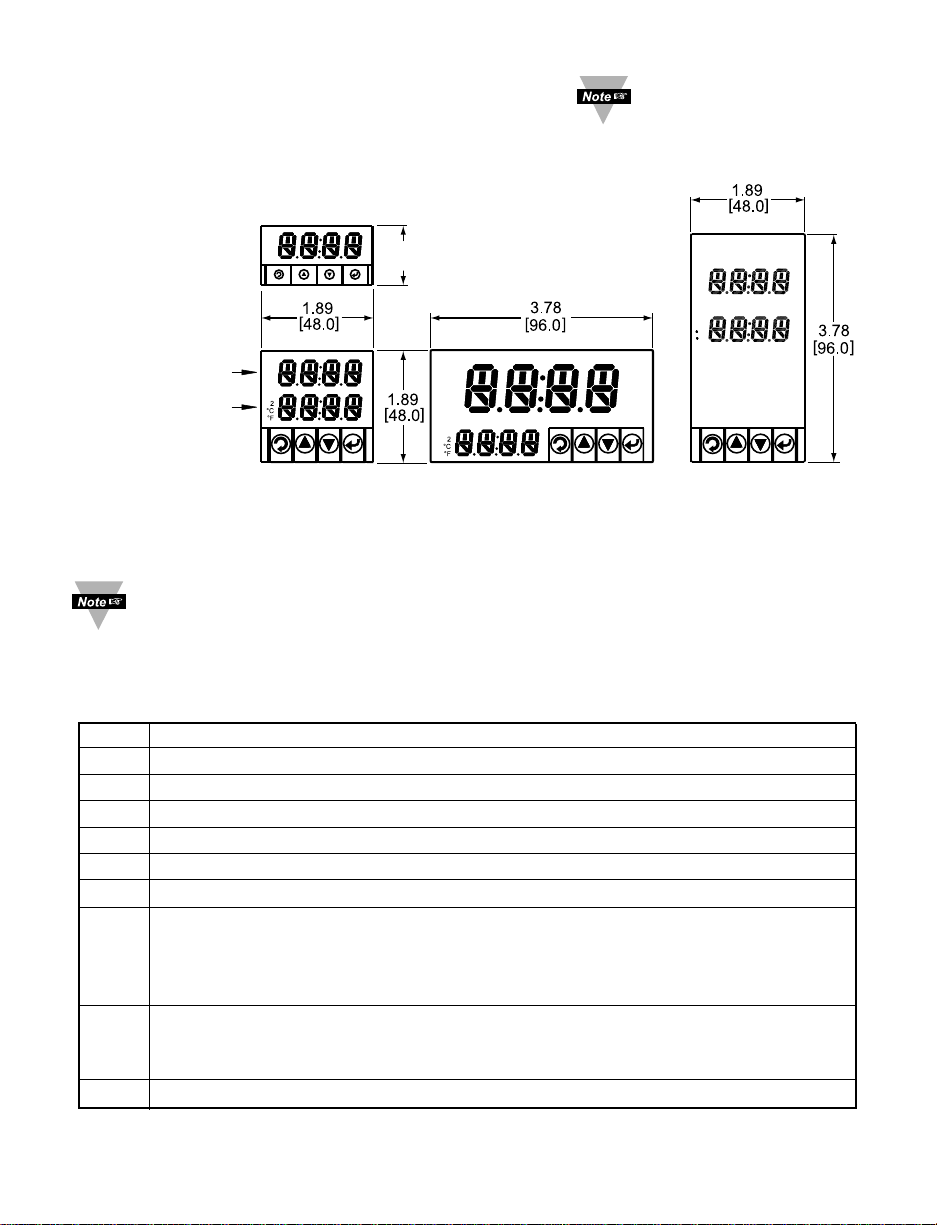
Figure 2.1 Front Panel Display
The upper display may be RH, Temperature or Dewpoint readings
depending on your Reading Configuration selections. Factory defaults
are shown in Figure 2.1.
The Dual Display allows the user to observe the
Relative Humidity or Dewpoint (upper display) and Temperature Value
(lower display), at the same time.
Table 2.1 Front Panel Annunciators
1
Output 1/Setpoint 1/ Alarm 1 indicator
2
Output 2/Setpoint 2/ Alarm 2 indicator
°C
°C unit indicator for Temperature or Dewpoint
°F
°F unit indicator for Temperature or Dewpoint
%RH
Display shows the Percent Relative Humidity
D
Display shows the Dewpoint
a
Changes display to Configuration Mode and advances through menu items*
b
Used in Program Mode:
On Dual Display: swaps the upper and lower displays from RH readings to
Temperature readings. Note: this eliminates the small LED ennuciators*
On Single Display units: replaces RH readings to Temperature readings*
c
Used in Program Mode:
On Dual Display: changes upper display from RH readings to Dewpoint readings*
On Single Display units: replaces RH readings to Dewpoint readings*
d
Accesses submenus in Configuration Mode
and stores selected values*
* See Part 3 Operation: Configuration Mode.
5
Refer to the Quick Start
Guide for assembly and
disassembly instructions.
Relative Humidity
Upper Display
Temperature
Lower Display
iTH-i32
1
2
%RH
D
1
2
%RH
D
1
1.00
[25.4]
1
2
%RH
D
1
1
2
C
F
2
1
%RH
D
iTH-i16D
iTH-i8DH
iTH-i8DV
Page 10
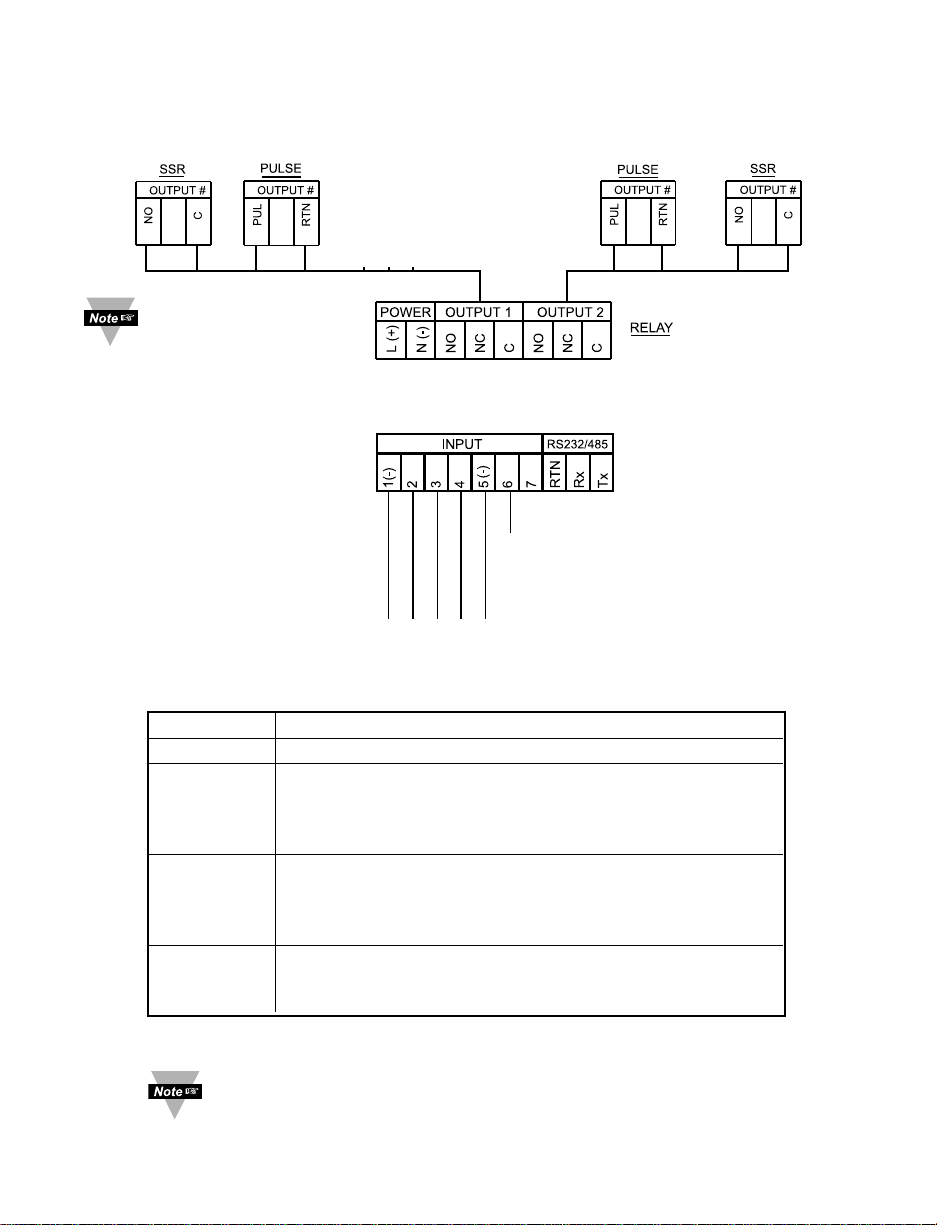
2.2 Rear Panel Connections
The rear panel connections are shown in Figures 2.2 and 2.3.
Figure 2.2 Rear Panel Power and Output Connections
Figure 2.3 Rear Panel Input Connections
Table 2.2 Rear Panel Connector
POWER AC/DC Power Connector: All models
INPUT iTH-PROBE
OUTPUT 1 Based on one of the following models:
Relay SPDT
Solid State Relay
Pulse
OUTPUT 2 Based on one of the following models:
Relay SPDT
Solid State Relay
Pulse
OPTION Based on one of the following models:
RS-232C or RS-485 programmable
Excitation
6
Output 1 and 2 are for -AL Limit Alarm Option Only
Output 1 and 2
are for -AL Limit
Alarm Option Only
6 5 4 6 5 4 6 5 4 3 2 1 3 2 1
8 7 6 5 4 3 2 1
N/C
SHIELD
RED(VCC)
WHITE(CLK)
BLACK(RTN)
GREEN(DATA)
Page 11
2.3 Electrical Installation
2.3.1 Power Connections
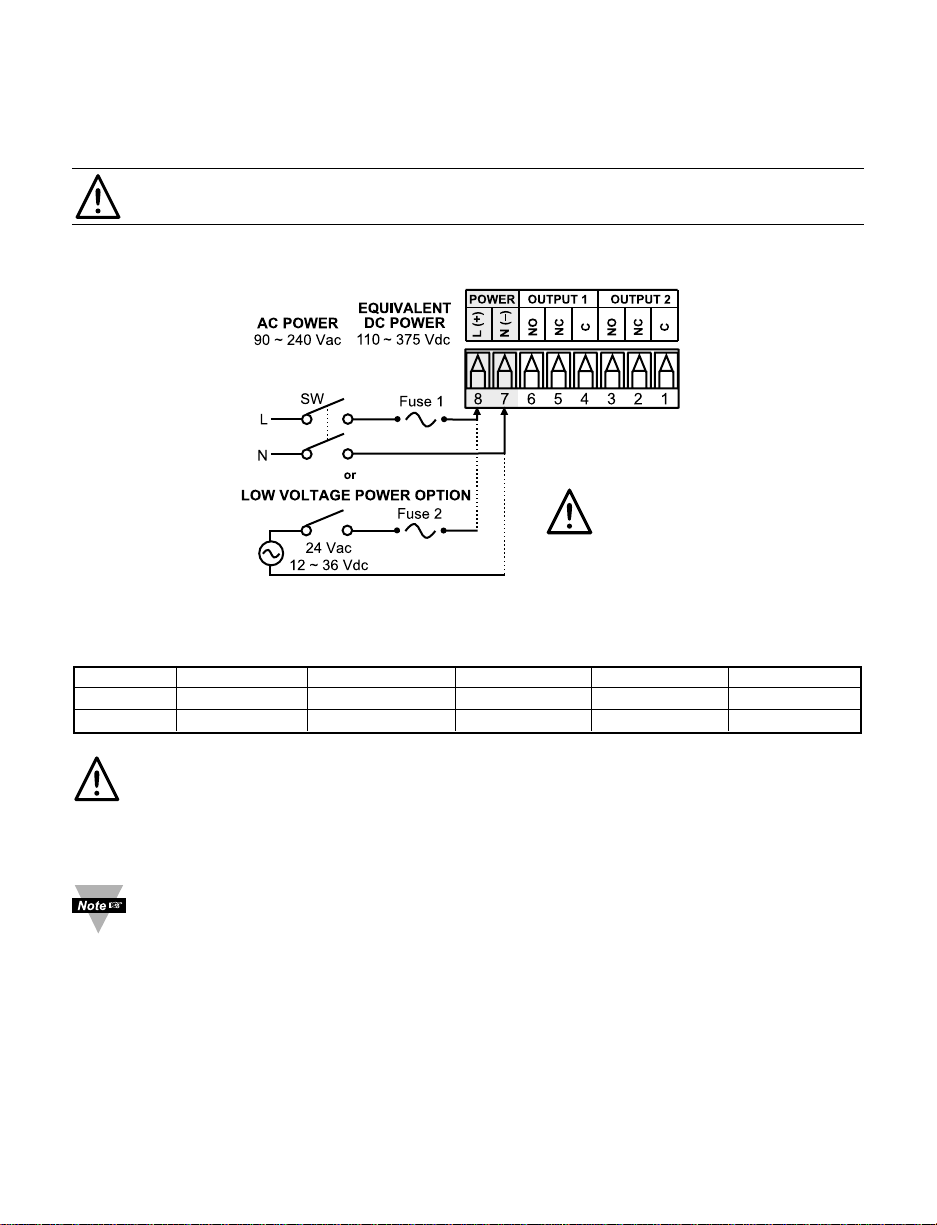
Caution: Do not connect power to your device until you have completed all
input and output connections. Failure to do so may result in injury!
Connect the main power connections as shown in Figure 2.4.
Figure 2.4 Main Power Connections
Table 2.3 Fuse Requirement (see specifications)
FUSE Connector Output Type For 115Vac For 230Vac DC
FUSE 1 Power N/A 100 mA(T) 100 mA(T) 100 mA(T)
FUSE 2 Power N/A N/A N/A 400 mA(T)
For the low voltage power option, in order to maintain the same degree of
protection as the standard high voltage input power units (90 - 240 Vac),
always use a Safety Agency Approved DC or AC source with the same
Overvoltage Category and pollution degree as the standard AC unit (90 240 Vac).
The Safety European Standard EN61010-1 for measurement, control,
and laboratory equipment requires that fuses must be specified based on
IEC127. This standard specifies for a Time-lag fuse, the letter code “T”.
The above recommended fuses are of the type IEC127-2-sheet III. Be
aware that there are significant differences between the requirements
listed in the UL 248-14/CSA 248.14 and the IEC 127 fuse standards. As a
result, no single fuse can carry all approval listings. A 1.0 Amp IEC fuse
is approximately equivalent to a 1.4 Amp UL/CSA fuse. It is advised to
consult the manufacturer’s data sheets for a cross-reference.
7
Use copper conductors
only for power connections
Page 12
2.3.2 Humidity and Temperature Probe
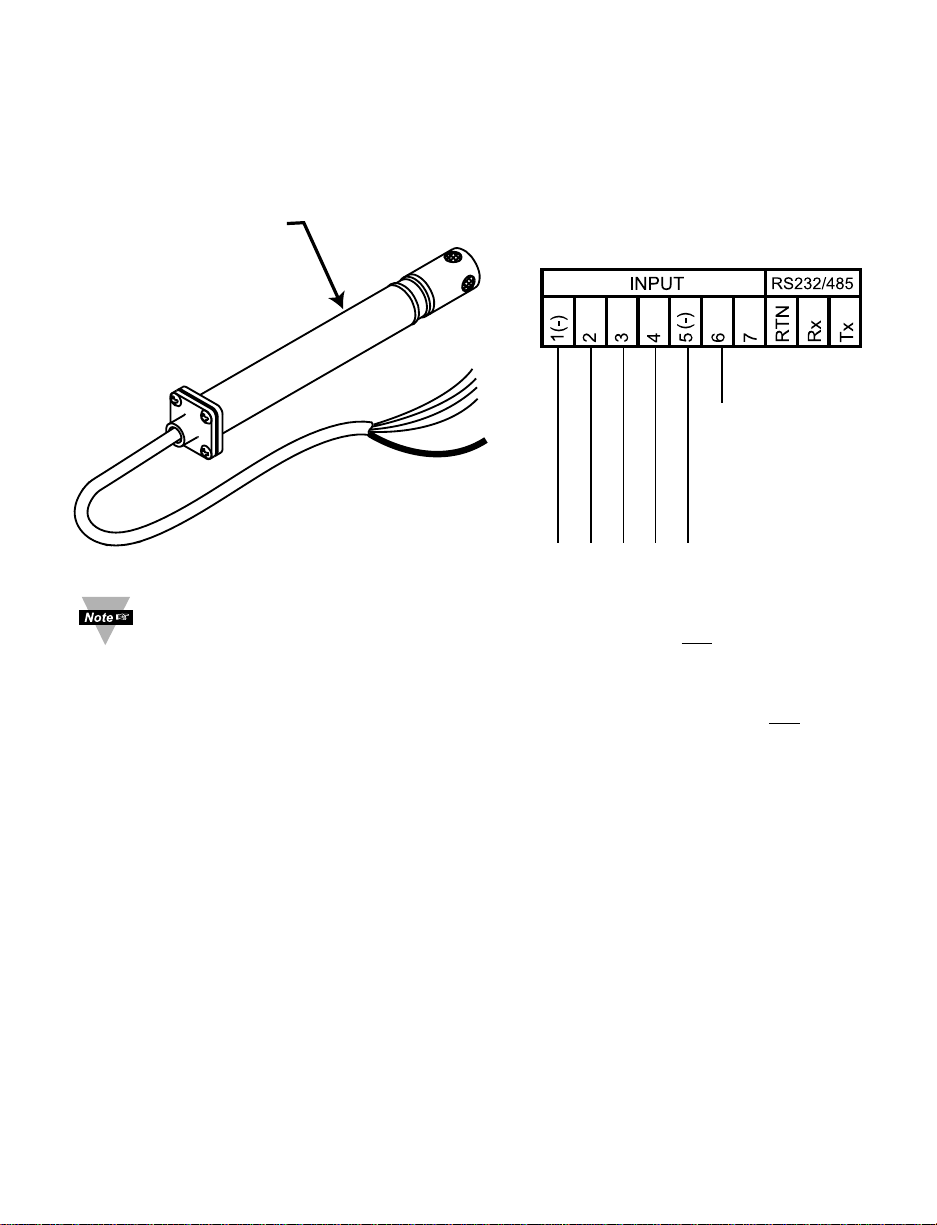
The figure below shows the wiring hookup for the temperature and humidity
probe.
Choose one which gives the best signal integrity-
1) Connect Probe’s Shield to RTN if Probe Housing is not
connected to
Earth Ground.
OR
2) Connect Probe’s Shield to Earth Ground if Probe Housing is not
connected to Earth Ground.
Figure 2.5 Probe Wiring Hookup
8
METAL HOUSING
IS CONNECTED
TO SHIELD WIRE
N/C
RED(VCC)
WHITE(CLK)
BLACK(RTN)
GREEN(DATA)
SHIELD(See Note)
Page 13
9
2.3.3 Wiring Outputs
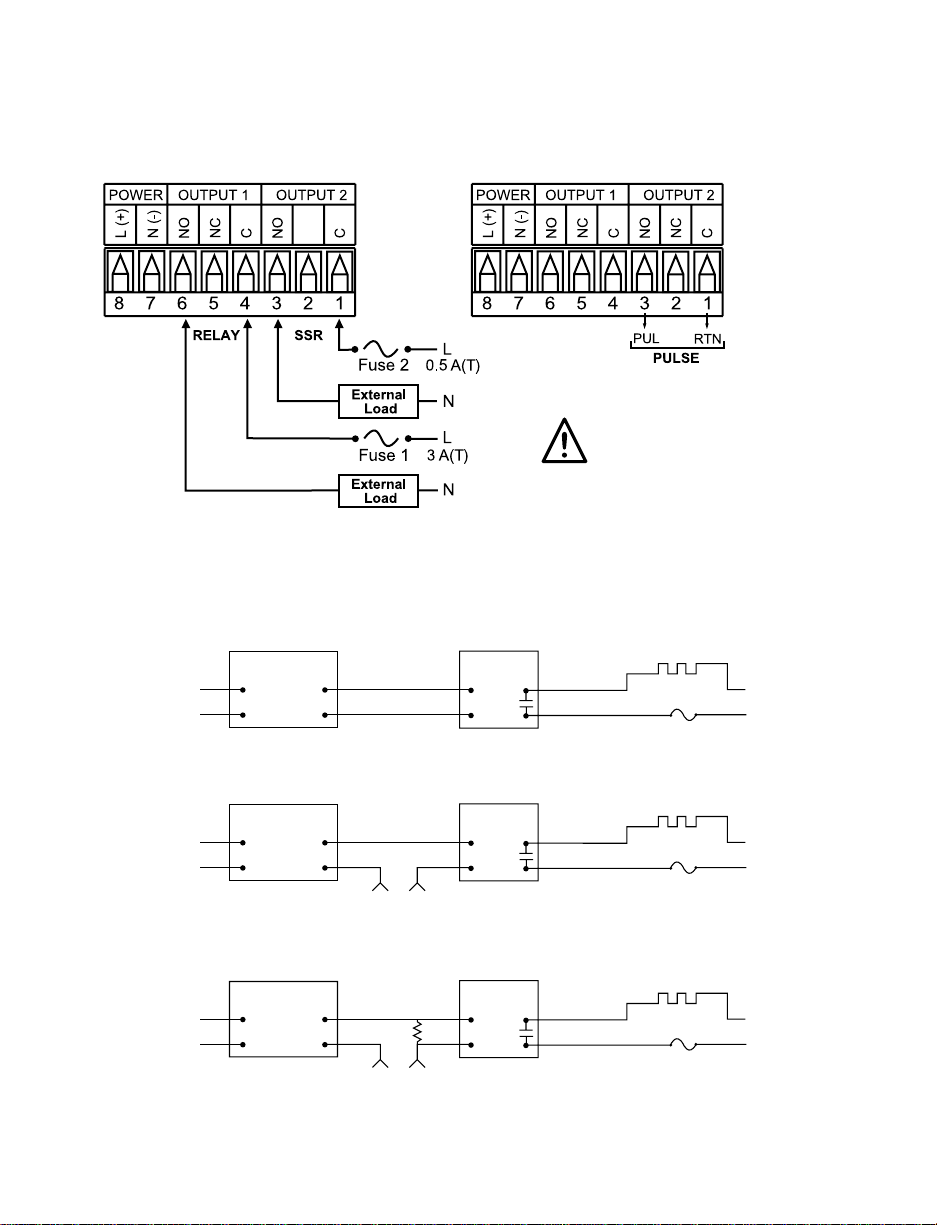
This meter, if ordered with -AL Limit Alarm option, has two factory installed
outputs. The SPDT Mechanical Relay, SPST Solid State Relay, and Pulse
Connections are shown below.
Figure 2.6
a) Mechanical Relay and SSR b) Pulse Output Wiring Hookup
Outputs Wiring Hookup
Figure 2.7 Typical Applications
Use copper conductors
only for power connections
dc CONTROLLED SSR USED WITH TEMPERATURE CONTROLLER WITH dc VOLTAGE SSR DRIVER OUTPUT
Vac
TEMPERATURE
CONTROLLER
CONTROL
SIDE
0 or 5 Vdc,
TYPICALLY
dc INPUT
SSR
431
LOAD
SIDE
2
HEATER
FAST BLOW
FUSE
Vac
ac CONTROLLED SSR USED WITH TEMPERATURE CONTROLLER WITH MECHANICAL RELAY OUTPUT
TEMPERATURE
CONTROLLER
Vac
ac CONTROLLED SSR USED WITH TEMPERATURE CONTROLLER WITH TRIAC OUTPUT
TEMPERATURE
CONTROLLER
Vac
CONTROL
SIDE
Vac
DRIVING
SSR
CONTROL SIDE
LOAD
RESISTOR
Vac
DRIVING
SSR
ac INPUT
SSR
431
ac INPUT
SSR
431
LOAD
SIDE
2
LOAD
SIDE
2
HEATER
FAST BLOW
FUSE
HEATER
FAST BLOW
FUSE
Vac
Vac
Page 14

10
This device has snubber circuits designed to
protect the contacts of the mechanical relays
when it switches to inductive loads (i.e.
solenoids, relays). These snubbers are internally
connected between the Common (C) and
Normally Open (NO) relay contacts of Output 1
and Output 2.
If you have an inductive load connected
between Common (C) and Normally
Closed (NC) contacts of the mechanical
relays and you want to protect them from
the rush current during the switching
period, you have to connect an external
snubber circuit between Common (C)
and Normally Closed (NC) contacts as
indicated in Figure 2.8.
This device may have a programmable communication output. The RS-232 and
RS-485 Output Connection are shown below.
External RS-232 connections are not available with -EI or C4EI options.
Figure 2.9
a) RS-232 Output Wiring Hookup b) RS-485 Output Wiring Hookup
This device may also have an excitation output.
Figure 2.10 Excitation Output
Figure 2.8
Snubber Circuits Wiring
Hookup
Excitation is not available if Serial
Communication (-C24) or Ethernet
(-C4EI) or Low Voltage Power
Supply (-DC) option is installed.
Page 15

11
2.3.4 Dual Display Color Setup
The dual display option allows the user to change the color of the upper and
lower displays.
To change the color of the upper display, see Section 3.2.14
(Display Color section).
To change the color of the lower display follow the instructions below:
The unit should be removed from the panel and opened.
Refer to the Quick Start Guide for assembly and disassembly instructions.
The S1 jumper is located on the back side of the display board.
The location of S1 and pin selection jumpers are shown below.
Use a jumper for GREEN or RED, never leave S1 open.
Figure 2.11 i/8D Location of S1 and Selectable Jumper Positions
Figure 2.12 i/16D Location of S1 and Selectable Jumper Positions
i/8DH
Dual
Horizontal
i/8DV
Dual
Vertical
Page 16

PART 3
OPERATION: Configuration Mode
3.1 Introduction
The instrument has two different modes of operation. The first, Run Mode, is
used to display Temperature and Relative Humidity. The other mode, Menu
Configuration Mode, is used to navigate through the menu options and
configure the unit. Part 3 of this manual will explain the Menu Configuration
Mode. For your instrument to operate properly, the user must first "program"
or configure the menu options.
Turning your Unit On for the First Time
The device becomes active as soon as it is connected to a power source. It
has no On or Off switch. The device at first momentarily shows the software
version number, followed by reset
RST
, and then proceeds to the Run Mode.
For first-time users: Refer to the QuickStart Manual for basic operation
and set-up instructions.
If you have the Serial Communications/Ethernet Option you can easily
configure the unit on your computer or on-line.
Table 3.1 Button Function in Configuration Mode
• To enter the Menu, the user must first press abutton.
• Use this button to advance/navigate to the next menu item. The user can
navigate through all the top level menus by pressing a.
• While a parameter is being modified, press ato escape without saving the
parameter.
• Press the up bbutton to scroll through “flashing” selections. When a
numerical value is displayed press this key to increase value of a parameter
that is currently being modified.
• Pressing the bbutton for approximately 3 seconds will speed up the rate at
which the set point value increments.
• In the Run Mode, pressing the b button changes display from RH readings
to Temperature readings.
• Press the down c button to go back to a previous Top Level Menu item.
• Press this button twice to reset the unit to the Run Mode.
• When a numerical value is flashing (except set point value) press cto scroll
digits from left to right allowing the user to select the desired digit to modify.
• When a setpoint value is displayed press c to decrease value of a setpoint
that is currently being modified. Pressing the c button for approximately 3
seconds will speed up the rate at which the setpoint value is decremented.
• In the Run Mode, pressing the c button changes from RH readings to
Dewpoint readings.
• Press the enter d button to access the submenus from a Top Level Menu item.
• Press d to store a submenu selection or after entering a value — the display
will flash a
STRD
message to confirm your selection.
• In the Run Mode, press d twice to enable Standby Mode with flashing
STBY
.
Reset: Except for Alarms, modifying any settings of the menu configuration
will reset the instrument prior to resuming Run Mode.
12
a
MENU
b
(UP)
c
(DOWN)
d
ENTER
Page 17

13
3.2 Menu Configuration
It is required that you put the unit in the Standby Mode for any
configuration change other than Setpoints & Alarms.
Figure 3.1 Flow Chart for ID and Setpoints
RdG
Page 18

14
3.2.1 ID Number
TO ENABLE/DISABLE OR CHANGE ID CODE, SEE SECTION 3.2.12.
If ID Code is Disabled or set as Default (0000) the menu will skip ID step
to Setpoint Menu.
If ID Code is set to Full Security Level and user attempts to enter the
Main Menu, they will be prompted for an ID Code.
If ID Code is set to Setpoint/ID Security Level and user attempts to enter
the Configuration Menu, they will be prompted for an ID Code.
ENTERING YOUR NON-DEFAULT FULL SECURITY ID NUMBER.
Press a 1) Display shows ID.
Press d 2) Display advances to
____
.
Press b & c 3) Press bto increase digit 0-9. Press cto activate next digit
(flashing). Continue to use band c to enter your 4-digit ID
code.
Press d 4) If the correct ID code is entered, the menu will advance to the
Setpoint 1 Menu, otherwise an error message
ERRo
will be
displayed and the instrument will return to the Run Mode.
To change ID Code, see ID Menu in the Configuration section.
ENTERING YOUR NON-DEFAULT SETPOINT/ID SECURITY ID NUMBER.
Press a 5) Display shows
SP1
Setpoint 1 Menu.
Press a 6) Display shows
SP2
Setpoint 2 Menu.
Press a 7) Display shows IDID Code Menu.
Press d 8) Display advances to
____
.
Press b & c 9) Use b and c to change your ID Code.
Press d 10) If correct ID Code is entered, the display will advance to the
INPT
Input Menu, otherwise the error message
ERRo
will be
displayed and the unit will return to the Run Mode.
To prevent unauthorized tampering with the setup parameters, the
instrument provides protection by requiring the user to enter the ID Code
before allowing access to subsequent menus. If the ID Code entered
does not match the ID Code stored, the unit responds with an error
message and access to subsequent menus will be denied.
Use numbers that are easy for you to remember. If the ID Code is
forgotten or lost, call customer service with your serial number to access
and reset the default to
0000
.
Page 19

15
3.2.2 Set Points
SETPOINT 1:
Press a 1) Press a, if necessary until
SP1
prompt appears.
Press d 2) Display shows previous value of “Setpoint 1”.
Press b & c 3) Press b and c to increase or decrease Setpoint 1
respectively.
Holding b & c buttons down for approximately 3 seconds will speed up the
rate at which the Setpoint value increments or decrements.
Press b & c 4) Continue to use b and c to enter your 4-digit Setpoint 1 value.
Press d 5) Display shows
STRD
stored message momentarily and then
advances to
SP2
only, if a change was made, otherwise press
a to advance to
SP2
Setpoint 2 Menu.
SETPOINT 2:
Press d 6) Display shows previous value of “Setpoint 2”.
Press b & c 7) Press b and c to increase or decrease Setpoint 2
respectively.
Holding b & c buttons down for approximately 3 seconds will speed up
the rate at which the setpoint value increments or decrements.
Press d 8) Display shows
STRD
stored message momentarily and then
advances to
CNFG
only, if a change was made, otherwise press
a to advance to
CNFG
Configuration Menu.
3.2.3 Configuration Menu
Figure 3.2 Flow Chart for Configuration Menu
Page 20

16
3.2.4 Reading Configuration
It is required that you put the unit in the Standby Mode for any
configuration change other than Set Points & Alarms.
Figure 3.3 Flow Chart for Reading Configuration Menu
ENTER READING CONFIGURATION MENU:
Press
a
1) Press a, if necessary, until
CNFG
prompt appears.
Press
d
2) Display advances to
RDG
Reading Configuration Menu.
Press
d
3) Display advances to
SNSR
Sensor.
SENSOR SUBMENU:
Press
d
4) Sensor selection for Autotune, Loop (Reading Offset Adjust), or
Ramp and Soak
°F.°C
is for temperature and
DRRh
is for
Humidity.
TEMPERATURE UNIT SUBMENU:
Press
d
5) Display flashes previous Temperature Unit selection.
Press
b
6) Scroll though the available selections to the Temperature Unit
of your choice: °For °C.
Press
d
7) Display shows
STRD
stored message momentarily and then
advances to
FLTR
Filter Constant.
FILTER CONSTANT SUBMENU:
Press
d
8) Display flashes previous selection for Filter Constant.
Press
b
9) Scroll though the available selections:
0001,0002,0004,0008,0016,0032,0064,0128
Press
d
10) Display shows
STRD
stored message momentarily only, if
change was made, otherwise press ato advance to the next
menu.
The Filter Constant Submenu allows the user to specify the
number of readings stored in the Digital Averaging Filter.
Page 21

17
3.2.5 Alarm 1
This unit is equipped with two physical outputs that can only be configured as
follows: Alarm 1 & Alarm 2. Alarm1 will only work for Humidity, not Temperature.
Figure 3.4 Flow Chart for Alarm 1
ENTER ALARM 1 MENU:
Press a 1) Press a, if necessary, until
CNFG
prompt appears.
Press d 2) Display advances to
RDG
Reading Configuration Menu.
Press a 3) Press a, until Display advances to
ALR1
Alarm 1 Menu.
Press d 4) Display advances to Alarm 1
ENBL
Enable or
DSBL
Disable
Submenu and flashes the previous selection.
Alarm 1 is designed to monitor the humidity value around Setpoint 1
and Alarm 2 is designed to monitor the temperature value around
Setpoint 2.
Page 22

18
ALARM 1 ENABLE/DISABLE SUBMENU:
Press b 5) Scroll though the available selection until
ENBL
displays to
use Alarm 1.
Press d 6) Display shows
STRD
stored message momentarily and then
advances to
ABSo
only if it was changed, otherwise press a to
advance to
ABSo
Alarm 1 Absolute/Deviation Submenu.
If
DSBL
Alarm 1 Disabled was selected, all submenus of Alarm 1
Menu will be skipped and meter advances to
ALR2
Alarm 2
Menu. If
ENBL
Alarm 1 Enabled was selected, Output 1 would
be automatically Disabled.
ALARM 1 ABSOLUTE/DEVIATION SUBMENU:
Press
d
7)
Display flashes previous selection. Press bto
ABSo
Absolute or
_DEV
Deviation.
Press
d
8) Display shows
STRD
stored message momentarily (only if it
was changed) and then advances to
LTçH
.
Absolute Mode allows Alarm 1 to function independently from Setpoint 1. If the
process being monitored does not change often, then "Absolute" Mode is
recommended. The absolute Setpoint values are placed in the Alarm 1 Low and
Hi values.
Deviation Mode allows Alarm 1 trigger at the Setpoint 1 value, as long as the
Alarm 1 Low and Hi values equal 0. Deviation mode is typically the ideal mode if
the process temperature changes often.
ALARM 1 LATCH/UNLATCH SUBMENU:
Press
d
9) Display flashes previous selection. Press bto
LTçH
Latched or
UNLT
Unlatched.
Press
d
10) Display shows
STRD
stored message momentarily (only if it
was changed) and then advances to
AçTV
.
Latched Mode: Relay remains "latched" until reset. To reset already latched
alarm, select Alarm Latch and press Max twice (i.e. Unlatch and then back to
Latch) or from a Run Mode, push dtwice to put the unit in Standby Mode and
then push done more time to return to the Run Mode.
Unlatched Mode: Relay remains latched only as long as the alarm condition is
true.
Page 23

19
ACTIVE SUBMENU:
Press
d
11) Display flashes previous selection. Press bto scroll through
the available selections:
ABoV
Above,
BELo
Below,
HI.Lo
HI/Low and
BAND
Band. (Band is active if
_DEV
Deviation was
selected).
Press
d
12) Display shows
STRD
stored message momentarily (only if it
was changed) and then advances to
A.P.oN
.
Above: In Absolute Mode
, Alarm 1 is triggered when the process variable is
greater than the Alarm Hi Value (Low value ignored). In Deviation Mode
, Alarm 1 is
triggered at the Setpoint plus any offset placed in the Alarm Hi value.
Below: In Absolute Mode, Alarm 1 is triggered when the process variable is less
than the Alarm Low Value (Hi value ignored). In Deviation Mode, Alarm 1 is
triggered at the Setpoint plus any offset placed in the Alarm Low value.
Hi/Low: In Absolute Mode, Alarm 1 is triggered when the process variable is less
than the Alarm Low Value or above the Hi Value. In Deviation Mode, Alarm 1 is
triggered when the process variable is less than the Setpoint minus any offset in
the Alarm Low or greater than the Setpoint plus any offset in the Alarm Hi value.
Band: Alarm 1 is triggered when the process variable is above or below the
"band" set around Setpoint 1. Band equals Hi Value (Low Value ignored). A
"band" is set around the Setpoint by the instrument only in the "Deviation" Mode.
The Band for the AL 1 would be following the Setpoint 1 value
The Band for the AL 2 would be following the Setpoint 2 value.
The Band or the Deviation Value should be entered under:
AL1 High (if they want Alarm 1)
AL2 High (if they want Alarm 2)
AL Low value is ignored in the Band mode.
Example: if customer requires a Deviation Value of ±10 degrees around a
setpoint (using Output 2 as alarm)
Alarm 2: - Deviation
Contact Closure type: Deviation---Band
AL2 High: 10 (Band they want around Setpoint 2)
Then the Band Value is to be entered under AL2 HI: 10 not 80+10 = 90
Page 24

20
ALARM ENABLE/DISABLE AT POWER ON:
Press
d
13) Display flashes previous selection. Press bto
ENBL
enable
or
DSBL
disable.
Press d 14)
Display shows
STRD
stored message. momentarily
(only if it
was changed)
and then advances to
ALR.L
.
If Alarm at Power On is enabled, the alarm will be active when an alarm
condition occurs.
If Alarm at Power On is disabled, the alarm will not be active (even if an
alarm condition exists) unless the process value moves into a non-alarm
condition and back into an alarm condition.
ALARM 1 LOW VALUE SUBMENU:
Press
d
15) Display flashes 1stdigit of previous value. Use band cto
enter new value.
Press b& c16) Use band cto enter Alarm 1 Low Value.
Press
d
17) Display shows
STRD
storage message momentarily (only if
it was changed) and then advances to
ALR.H
.
ALARM 1 HI VALUE SUBMENU:
Press
d
18) Display flashes 1stdigit of previous value. Use band cto
enter new value.
Press b& c19) Use band cto enter Alarm1 Hi Value.
Press
d
20) Display shows
STRD
stored message momentarily (only if it
was changed) and then advances to the next menu.
Page 25

21
3.2.6 Alarm 2
This unit is equipped with two physical outputs that can only be configured as
follows: Alarm 1 & Alarm 2. Alarm 2 only works for Temperature, not Humidity.
Figure 3.5 Flow Chart for Alarm 2
ENTER ALARM 2 MENU:
Press
a
1) Press a, if necessary, until
CNFG
prompt appears.
Press
d
2) Display advances to
RDG
Reading Configuration Menu.
Press
a
3)
Press a, if necessary, until Display advances to
ALR2
Alarm 2
Menu.
Press
d
4)
Display advances to Alarm 2
ENBL
Enable or
DSBL
Disable
Submenu.
ALARM 2 ENABLE/DISABLE SUBMENU:
5) Display flashes previous selection. Press buntil
ENBL
displays to use Alarm 2.
Press
d
6) Display shows
STRD
stored message momentarily and then
advances to
ABSo
only if it was changed, otherwise press ato
advance to
ABSo
Absolute/Deviation Submenu.
If
DSBL
Alarm 2 Disabled was selected, all submenus of Alarm
2 will be skipped and meter advances to
R.ADJ
Reading Adjust
Menu.
The remaining Alarm 2 menu items are identical to Alarm 1 Menu.
Modifying Alarm Settings will not reset the instrument.
Page 26

22
3.2.7 Reading Adjust Menu
Figure 3.6 Flow Chart for Reading Adjust Menu
ENTER READING ADJUST MENU:
Press
a
1) Press a, if necessary, until
CNFG
prompt appears.
Press
d
2) Display advances to
INPT
Input Menu.
Press
a
3) Press a, if necessary, until Display advances to
R.ADJ
Reading Adjust Menu.
READING ADJUST VALUE SUBMENU:
Press
d
4) Display flashes 1
st
digit of previous Reading Adjust value.
Press b& c5) Press band cbuttons to enter a new Reading Adjust value
(-19.99 to 99.99).
Press
d
6) Display shows
STRD
stored message momentarily and then
advances to
SP.DV
Setpoint Deviation Menu.
Reading Offset Adjust
For Relative Humidity, the unit allows the user to fine tune a minor error of the
transducer, however some applications may require a large offset adjust.
(Displayed Process Value = Measured Process Value ± R.ADJ).
R.ADJ is adjustable between -19.99 to 99.99
This will adjust humidity or temperature depending on Sensor selection, in
Reading Configuration (see Section 3.2.4).
3.2.8 SETPOINT DEVIATION ENABLE/DISABLE SUBMENU:
Figure 3.7 Flow Chart for Setpoint Deviation Menu
Press
d
1) Display advances to Setpoint Deviation
ENBL
Enable or
DSBL
Disable Submenu and flashes the previous selection.
Press
b
2) Scroll through the available selections:
ENBL
or
DSBL
.
Press
d
3) Display shows
STRD
stored message momentarily and then
advances to IDID Code Menu.
Setpoint Deviation Submenu, if “enabled”, allows changes to Setpoint 1 to be made
automatically to Setpoint 2. This mode is very helpful if the Process Value changes
often. In Setpoint Deviation Mode, set SP2 a certain number of degrees or counts
away from SP1 - this relation remains fixed when SP1 is changed. For instance:
Setting SP1=200 and SP2=20 and enabling
SP.DV
means that the absolute value of
SP2=220. Moving SP1 to 300, the absolute value of SP2 becomes 320.
Page 27

23
3.2.9 ID CODE
Figure 3.8 Flow Chart for ID Code
ENTER ID CODE MENU:
Press
a
1) Press a, if necessary, until
CNFG
prompt appears.
Press d 2) Display advances to
RDG
Reading Configuration Menu.
Press
a
3) Press a, if necessary, until Display advances to IDID Code
Menu.
ENTERING OR CHANGING YOUR (NON-DEFAULT) ID CODE:
Press d 4) Display advances to
____
with 1stunder score flashing.
Press b& c5) Press band cto enter your 4-digit “ID Code” number.
Press d 6) Display advances to
CH.ID
Change ID Code Submenu.
If entered “ID Code” is incorrect display shows
ERRo
Error message
momentarily and then skips to the Run Mode.
Press
d
7) Display flashes the first digit of previous entered “ID Code”
number.
Press b& c8) Press band cbuttons to enter your new “ID Code” number.
Press
d
9) Display shows
STRD
stored message momentarily and then
advances to the
FULL
Full Security Submenu.
Page 28

24
ENTERING OR CHANGING YOUR (DEFAULT) ID CODE:
Enter IDmenu (Repeat steps from 1 to 3).
Press
d
10) Display advances to
CH.ID
Change ID Code Submenu.
Press
d
11) Display shows
0000
message with flashing 1
st
digit.
If you want to change your default “ID Code” you can do it now, otherwise
press aand menu will skip to
FULL
Full Security Submenu.
Press b& c12) Press band cbuttons to enter your new “ID Code” number.
Press
d
13) Display shows
STRD
stored message momentarily and then
advances to the
FULL
Full Security Submenu.
FULL SECURITY LEVEL SUBMENU:
Press
d
14) Display flashes
ENBL
Enable or
DSBL
Disable.
Press
b
15) Scroll through the available selections: “Enable” or “Disable”.
Press
d
16) Display shows
STRD
stored message momentarily and then
advances to
SP.ID
Setpoint/ID Submenu.
If "Full" Security Level is "Enabled" and the user attempts to enter the
Main Menu, they will be prompted for an ID Code. The ID Code should
be correct to enter the instrument Menu item.
SETPOINT/ID SECURITY LEVEL SUBMENU:
This Security Level can be functional only if
FULL
Security Level
is Disabled.
Press
d
17) Display flashes
ENBL
Enable or
DSBL
Disable.
Press
b
18) Scroll through the available selections: “Enable” or “Disable”.
Press
d
19) Display shows
STRD
stored message momentarily and then
advances to
COMM
Communication Submenu.
If "Setpoint/ID" Security Level is "Enabled" and the user attempts to advance
into the
CNFG
Configuration Menu, he will be prompted for ID Code number.
The ID Code should be correct to proceed into the Configuration Menu,
otherwise display will show an Error and skip to the Run Mode.
If “Full” and “Setpoint/ID” Security Levels are "Disabled", the ID code will be
“Disabled” and user will not be asked for ID Code to enter the Menu items (“ID”
Submenu will not show up in “ID/Setpoint” Menu).
Page 29

25
3.2.10 COMMUNICATION OPTION
Purchasing this instrument with Serial Communications permits an instrument to be
configured or monitored from an IBM PC compatible computer using software
available from the website or on the CD-ROM enclosed with your shipment.
For complete instructions on the use of the Communications Option, refer to the
Serial Communications Reference Manual.
Figure 3.9 Flow Chart for Communication Option
With the exception of DATA FORMAT Sub Menu, all other command formats are
the same in the Serial Communications Manual.
External RS-232 connections
are not available with -EI or
-C4EI options.
* Valid only for -C24
and -EI options.
** Valid only for -C24
and -C4EI options.
Page 30

26
The following table are the exceptions to the Serial Communication Manual’s Table 5.3
Table 3.2 Command Letters and Suffix for iTH
ENTER COMMUNICATION OPTION MENU:
Press
a
1) Press a, if necessary, until
CNFG
prompt appears.
Press
d
2) Display advances to
RDG
Reading Configuration Menu.
Press
a
3) Press a, if necessary, until Display advances to
COMM
Communication Options Menu.
Press
d
4) Display advances to
C.PAR
Communication Parameters
Submenu.
If Communication Option is not installed, the display shows
NONE
and skips to the Color Display Menu.
COMMUNICATION PARAMETERS SUBMENU:
Allows the user to adjust Serial Communications Settings of the instrument.
When connecting an instrument to a computer or other device, the
Communications Parameters must match. Generally the default settings
(as shown in Section 5) should be utilized.
Press
d
5) Display advances to
BAUD
Baud Submenu.
BAUD SUBMENU:
Press
d
6) Display flashes previous selection for
BAUD
value.
Press
b
7) Scroll through the available selections:
300_, 600_, 1200
,
2400, 4800
,
9600, 19.2K
.
Press
d
8) Display shows
STRD
stored message momentarily and then
advances to
PRTY
only, if it was changed, otherwise press ato
advance to
PRTY
Parity Submenu.
PARITY SUBMENU:
Press
d
9) Display flashes previous selection for “Parity”.
Press
b
10) Scroll through the available selections: NO, ODD, EVEN.
Press
d
11) Display shows
STRD
stored message momentarily and then
advances to
DATA
only, if it was changed, otherwise press ato
advance to
DATA
Data Bit Submenu.
DATA BIT SUBMENU:
Press
d
12) Display flashes previous selection for “Data Bit”.
Press
b
13) Scroll through the available selections: 7-BIT, 8-BIT.
Press
d
14) Display shows
STRD
stored message and then advances to
STOP
only, if it was changed, otherwise press ato advance to
STOP
Stop Bit Submenu.
Command Command Function Command # Of Default
Index Bytes Characters Value
X 01 Send RH Reading 0 0 X 02 Send Temperature Reading 0 0 X 03 Send Dewpoint Reading 0 0 -
Page 31

27
STOP BIT SUBMENU:
Press
d
15) Display flashes previous selection for “Stop Bit”.
Press
b
16) Scroll through the available selections:
1-BIT, 2-BIT
.
Press
d
17) Display shows
STRD
stored message momentarily and then
advances to
BUS.F
only, if it was changed, otherwise press ato
advance to
BUS.F
Bus Format Submenu.
BUS FORMAT SUBMENU:
Determines Communications Standards and Command/Data Formats for
transferring information into and out of the unit via the Serial Communications
Bus. Bus Format submenus essentially determine how and when data can be
accessed via the Serial Communications of the device.
Press
d
18) Display advances to
M.BUS
Modbus Submenu.
MODBUS PROTOCOL SUBMENU:
Press
d
19) Display flashes previous selection for
M.BUS
.
Press
b
20) Scroll through the available selections: NO, YES.
Press
d
21) Display shows
STRD
stored message momentarily and then
advances to
_LF_
only, if it was changed, otherwise press ato
advance to
_LF_
Line Feed submenu.
To select iSeries Protocol, set Modbus submenu to “No”.
To select Modbus Protocol, set Modbus submenu to “Yes”.
If Modbus Protocol was selected, the following Communications
Parameters must be set as: No Parity, 8-bit Data Bit, 1-Stop Bit. Do not
attempt to change these parameters.
LINE FEED SUBMENU:
Determines if data sent from the instrument will have a Line Feed appended to
the end - useful for viewing or logging results on separate lines when displayed
on communications software at a computer.
Press
d
22) Display flashes previous selection for “Line Feed”.
Press
b
23) Scroll through the available selections: NO, YES.
Press
d
24) Display shows
STRD
stored message momentarily and then
advances to
ECHO
only, if it was changed, otherwise press ato
advance to
ECHO
Echo Submenu.
ECHO SUBMENU:
When valid commands are sent to the instrument, this determines whether the
command will be echoed to the Serial Bus. Use of echo is recommended in most
situations, especially to help verify that data was received and recognized by the
unit.
Press
d
25) Display flashes previous selection for “Echo”.
Press
b
26) Scroll through the available selections: NO, YES.
Press
d
27) Display flashes
STRD
stored message momentarily and then
advances to
STND
only if it was changed, otherwise press ato
advance to
STND
Communication Standard Submenu.
Page 32

28
COMMUNICATION INTERFACE STANDARD SUBMENU:
Determines whether device should be connected to an RS-232C serial port
(as is commonly used on IBM PC-compatible computers) or via an RS-485 bus
connected through appropriate RS-232/485 converter. When used in RS-485
Mode, the device must be accessed with an appropriate Address Value as
selected in the Address Submenu described later.
Press
d
28) Display flashes previous selection for “Standard”.
Press
b
29) Scroll through the available selections: 232C, 485.
Press
d
30) Display shows
STRD
stored message momentarily and then
advances to
MoDE
only, if it was changed, otherwise press ato
advance to
MoDE
Data Flow Mode Submenu.
DATA FLOW MODE SUBMENU:
Determines whether the instrument will wait for commands and data requests
from the Serial Bus or whether the instrument will send data automatically and
continuously to the Serial Bus. Devices configured for the RS-485
Communications Standard operate properly only under Command Mode.
Press
d
31) Display flashes previous selection for “Mode”.
Press
b
32) Scroll through the available selections:
CMD
__
“Command”,
CoNT
“Continuous”.
Press
d
33) Display shows
STRD
stored message momentarily and then
advances to
SEPR
only, if it was changed, otherwise press ato
advance to
SEPR
Data Separation Submenu.
DATA SEPARATION CHARACTER SUBMENU:
Determines whether data sent from the device in Continuous Data Flow Mode
will be separated by spaces or by Carriage Returns.
Press
d
34) Display flashes previous selection for “Separation” Submenu.
Press
b
35) Scroll through the available selections:
SPCE
“Space” or
_çR_
“Carriage Return”.
Press
d
36) Display shows
STRD
stored message momentarily and then
advances to
DAT.F
only, if it was changed, otherwise press ato
advance to
DAT.F
Data Format Submenu.
Page 33

29
DATA FORMAT SUBMENU:
Preformatted data can be sent automatically or upon request from the unit. Use
the Data Format Submenus to determine what data will be sent in this
preformatted data string. Refer to the iSeries Communications Manual for more
information about the data format. At least one of the following suboptions must
be enabled and hence output data to the Serial Bus.
This menu is applicable for Continuous Mode of RS-232 communication.
Press
d
37) Display advances to
STAT
Alarm Status Submenu.
ALARM STATUS SUBMENU:
Includes Alarm Status bytes in the data string.
Press
d
38) Display flashes previous selection for “Status” (alarm status).
Press
b
39) Scroll through the available selections: NO, YES.
Press
d
40) Display shows
STRD
stored message momentarily and then
advances to
HUMD
only, if it was changed, otherwise press ato
advance to
HUMD
Humidity Submenu.
HUMIDITY READING SUBMENU:
Includes Humidity Reading in the data string.
Press
d
41) Display flashes
HUMD
.
Press
b
42) Scroll through the available selections: NO, YES.
Press
d
43) Display shows
STRD
stored message momentarily and then
advances to
TEMP
only, if it was changed, otherwise press ato
advance to
TEMP
Temperature Submenu.
TEMPERATURE READING SUBMENU:
Includes Temperature Reading in the data string.
Press
d
44) Display flashes
TEMP
.
Press
b
45) Scroll through the available selections: NO, YES.
Press
d
46) Display shows
STRD
stored message momentarily and then
advances to
DEU
only, it was changed, otherwise press ato
advance to
DEU
Dewpoint Submenu.
DEWPOINT READING SUBMENU:
Includes Dewpoint Reading in the data string.
Press
d
47) Display flashes
DEU
.
Press
b
48) Scroll through the available selections: NO, YES.
Press
d
49) Display shows
STRD
stored message momentarily and then
advances to
UNIT
only, if it was changed, otherwise press ato
advance to
UNIT
Temperature Unit Submenu.
Page 34

30
TEMPERATURE UNIT SUBMENU:
Includes a byte in the data string to indicate whether reading is in Celsius or
Fahrenheit.
Press
d
50) Display flashes previous selection for
UNIT
.
Press
b
51) Scroll through the available selections: NO, YES.
Press
d
52) Display shows
STRD
stored message momentarily and then
advances to
ADDR
only, if it was changed, otherwise press ato
advance to
ADDR
Address Setup Submenu.
ADDRESS SETUP SUBMENU:
This menu is applicable to the RS-485 Option only.
Press
d
53) Display advances to “Address Value” (0000 to 0199) Submenu.
ADDRESS VALUE SUBMENU:
Press
d
54) Display flashes 1
st
digit of previously stored Address Value.
Press b& c55) Press band cto enter new “Address Value”.
Press
d
56) Display shows
STRD
stored message momentarily and then
advances to
TR.TM
only, if it was changed, otherwise press ato
advance to
TR.TM
Transmit Time Interval Submenu.
TRANSMIT TIME INTERVAL SUBMENU:
This menu is applicable if “Continuous” Mode was selected in the “Data
Flow Mode” Submenu and the device is configured as an RS-232C
Standard device. Also, one or more options under the Data Format
Submenu must be enabled.
Press
d
57) Display advances to “Transmit Time Value” Submenu.
TRANSMIT TIME INTERVAL VALUE SUBMENU:
Determines the interval at which data will be emitted to the RS-232 Serial Bus
when the instrument is in Continuous Data Flow Mode.
Press
d
58) Display flashes 1
st
digit of previous “Transmit Time Value” in
seconds.
Press b& c59) Press band cto enter new “Transmit Time Value”, e.g.
0030 will send the data every 30 seconds in Continuous Mode.
Press
d
60) Display shows
STRD
stored message momentarily and then
advances to
COLR
only, if it was changed, otherwise press ato
advance to
COLR
Color Display Selection Menu.
For more details, refer to the Serial Communication Manual
available at the website listed in the cover page of this manual.
Page 35

31
3.2.11 DISPLAY COLOR SELECTION
This submenu allows the user to select the color of the upper display.
Figure 3.10 Flow Chart for Display Color Selection
ENTER DISPLAY COLOR SELECTION MENU:
Press
a
1) Press a, if necessary, until
CNFG
prompt appears.
Press
d
2) Display advances to
RDG
Reading Configuration Menu.
Press
a
3) Press a, if necessary, until Display advances to
COLR
Display Color Selection Menu.
Press
d
4) Display advances to
N.CLR
Normal Color Submenu.
NORMAL COLOR DISPLAY SUBMENU:
Press
d
5) Display flashes the previous selection for “Normal Color”.
Press
b
6) Scroll through the available selections:
GRN, RED
or
AMBR
.
Press
d
7) Display shows
STRD
stored message momentarily and then
advances to
1.CLR
only, if it was changed, otherwise press ato
advance to
1.CLR
Alarm 1 Display Color Submenu.
The menu below allows the user to change the color of the upper display when
Alarm 1 is triggered.
ALARM 1 DISPLAY COLOR SUBMENU:
Press
d
8) Display flashes previous selection for “Alarm 1 Color Display”.
Press
b
9) Scroll through the available selections:
GRN, RED
or
AMBR
.
Press
d
10) Display shows
STRD
stored message momentarily and then
advances to
2.CLR
only, if it was changed, otherwise press ato
advance to
2.CLR
Alarm 2 Display Color Submenu.
A color change is based on the Relative Humidity value only.
If this value causes an alarm condition, the upper display will change to
the selected Alarm 1 Color. A color change will occur whether Alarm 1 is
enabled or disabled.
Page 36

32
ALARM 2 DISPLAY COLOR SUBMENU:
Press
d
11) Display flashes previous selection for “Alarm 2 Color Display”.
Press
b
12) Scroll through the available selections:
GRN, RED
or
AMBR
.
Press
d
13) Display shows
STRD
stored message momentarily and then
momentarily shows the software version number, followed by
RST
Reset, and then proceeds to the Run Mode.
IN ORDER TO DISPLAY ONE COLOR, SET THE SAME DISPLAY
COLOR ON ALL THREE SUBMENUS ABOVE
If user wants the display to change color every time that both Alarm 1 and
Alarm 2 are triggered, the Alarm values should be set in such a way that
Alarm 1 value is always on the top of Alarm 2 value, otherwise value of
Alarm 1 will overwrite value of Alarm 2 and Display Color would not
change when Alarm 2 is triggered.
Example 1:
Alarm Setup: Absolute, Above, Alarm 2 HI Value “ALR.H” = 200, Alarm 1
HI Value “ALR.H” = 400
"Color Display" Setup
: Normal Color “N.CLR” = Green, Alarm 1 Color
“1.CLR” = Amber, Alarm 2 Color “2.CLR” = Red
Display Colors change sequences:
GREEN RED AMBER
•
--➤------------------------------•-----------------------------•------------------------------
➤
0 AL2.H = 200 AL1.H = 400
Example 2:
Alarm Setup
: Absolute, Below, Alarm 2 Low Value “ALR.L” = 300,
Alarm 1 Low Value “ALR.L” = 100
Color Display Setup
: "N.CLR" = Green, "1.CLR" = Amber, "2.CLR" = Red
Display Colors change sequences:
AMBER RED GREEN
•
--------------•----------------------------------•------------------------------------------- --
•
0 AL1.L = 100 AL2.L = 300
.
➤ ➤
Page 37

33
Example 3:
Setpoint 1 = 300,
Setpoint 2 = 200
Alarm 1 & 2 Setup: Deviation, Band, “ALR.H” = 10
Color Display Setup: “N.CLR” = Green, “1.CLR” = Amber, “2.CLR” = Red
Display Colors change sequences:
RED RED RED GREEN RED
•➤
---------------•------•------•--------------------------------•------•-------•----------------
➤
0 190 200 210 290 300 310
Alarm 1 is designed to monitor the Process Value around the Setpoint 1.
Alarm 2 is designed to monitor the Process Value around the Setpoint 2.
Example 4:
Setpoint 1 = 200
Setpoint 2 = 200
Alarm 1 Setup
: Deviation, Band, “ALR.H” = 20
Alarm 2 Setup
: Deviation, Hi/Low, “ALR.H” = 10, “ALR.L” = 5
Color Display Setup
: “N.CLR” = Green, “1.CLR” = Amber, “2.CLR” = Red
Display colors change sequences:
AMBER RED GREEN GREEN RED AMBER
•
--➤---------------•----------------•-------------•--------------•-------------•---------------------
➤
0 180 195 200 210 220
Reset: The instrument automatically resets after the last menu of the
Configuration Mode has been entered. After the instrument resets, it
advances to the Run Mode.
Page 38

34
Display: 4-digit, 9-segment LED
•
10.2 mm (0.40"): i32, i16D,
i8DV
• 10.2 mm (0.40”) & 21 mm (0.83”):i8DH
red, green and amber programmable
colors for process variable, set point
and temperature units
ALARM 1 & 2: (programmable to
display color change)
Relay*: 250 Vac or 30 Vdc @ 3 A
(Resistive Load); configurable for
on/off, PID and Ramp and Soak
Output 1*: SPDT type, can be
configured as Alarm 1 output
Output 2*: SPDT type, can be
configured as Alarm 2 output
SSR*: 20-265 Vac @ 0.05-0.5 A
(Resistive Load); continuous
DC Pulse*: Non-Isolated;
10 Vdc @ 20 mA
Operation: high/low, above/below,
band, latch/unlatch, normally
open/normally closed and
process/deviation; front panel
configurations
* Only with -AL Limit Alarm Option
NETWORK AND COMMUNICATIONS
(Optional -C24, -C4EI, -EI)
Ethernet: Standards Compliance
IEEE 802.3 10Base-T
Supported Protocols: TCP/IP, ARP,
HTTPGET
RS-232/RS-422/RS-485/MODBUS:
Selectable from menu; both ASCII
and modbus protocol selectable from
menu.
Programmable 300 to 19.2 K baud;
complete programmable setup
capability; program to transmit current
display, alarm status, min/max, actual
measured input value and status.
RS-485: Addressable from 0 to 199
Connection: Screw terminals
PART 4 SPECIFICATIONS
SENSOR SPECIFICATIONS
Relative Humidity (RH)
Accuracy/Range: ±2% for 10 to 90% RH
±3% for 0 to 10%RH and 90 to 100%RH
Non-linearity: ±3%
Hysteresis: ±1% RH
Response Time:
4 sec (63% slowly moving air)
Repeatability: ±0.1%
Resolution: 0.03%, 12bit
NOTE: Reconditioning of the probe may
be necessary if the probe is stored for a
period of time in a harsh environment
(e.g. high humidity or exposure to
chemicals). To recondition the probe:
heat probe for 1 day at 100°C to return
it to calibration conditions.
Temperature (T)
Accuracy/Range*:
±1°C (±2°F) for
-40 to 0°C and 80 to 123.8°C
(-40 to 32°F and 176 to 254°F)
±0.5°C (±1°F) for 0 to 80°C (32 to 176°F)
*NOTE: extended temperature range is
for Probe only, the Controller’s
operating temperature is 0-50°C
Response Time:
5 sec (63% slowly moving air)
Repeatability: ±0.1°C
Resolution: 0.01°C, 14 bit
METER SPECIFICATIONS
NMRR: 60 dB
CMRR: 120 dB
A/D Conversion:
12 bit RH and 14 bit Temperature
Reading Rate:
2 samples per seconds max.
Digital Filter: Programmable
Decimal Selection:
None, 0.1 for temp and humidity
Warm up to Rated Accuracy: 30 min.
Page 39

35
EXCITATION (optional in place of
Communication)
24 Vdc @ 25 mA
Not available for Low Power Option
INSULATION
Power to Input/Output
2300 Vac per 1 min. test
1500 Vac per 1 min. test
(Low Voltage/Power Option)
Power to Relays/SSR Outputs
2300 Vac per 1 min. test
Relays/SSR to Relay/SSR Outputs
2300 Vac per 1 min. test
RS-232/485 to Inputs/Outputs
500 Vac per 1 min. test
APPROVALS
UL, C-UL, and see CE Approval Section
GENERAL
Line Voltage/Power
90-240 Vac +/-10%, 50-400 Hz*
110-375 Vdc, equivalent voltage
4 W, power for i32 Models
5 W, power for i8DV, i8DH, i16D Models
* No CE compliance above 60 Hz
Low Voltage/Power Option
12-36 Vdc or 24 Vac
**
+/-10%
, 3 W
External power source must meet
Safety Agency Approvals.
** Units can be powered safely with 24 Vac
power but, no Certification for CE/UL are
claimed.
External Fuse Required
Time-Delay, UL 248-14 listed:
100 mA/250 V
400 mA/250 V
(Low Voltage/Power Option)
Time-Lag, IEC 127-3 recognized:
100 mA/250 V
400 mA/250 V
(Low Voltage/Power Option)
Environmental Conditions
• i32: 0 to 55°C (32 to 131°F),
90% RH non-condensing
• i8DV, i8DH, i16D:
0 to 50°C (32 to 122°F),
90% RH non-condensing
• Cable: operating temperature
0-105°C (32 to 221°F)
Protection
NEMA-4x/Type 4/IP65 front bezel:
i32, i16D
NEMA-1/Type 1 front bezel:
i8DH, i8DV
Dimensions
i/8 Series:
48 H x 96 W x 127 mm D
(1.89 x 3.78 x 5")
i/16 Series:
48 H x 48 W x 127 mm D
(1.89 x 1.89 x 5")
i/32 Series:
25.4 H x 48 W x 127 mm D
(1.0 x 1.89 x 5")
Industrial Probe iTHP-2:
16mm Dia. x 51mm Long (0.63” x 2”)
Industrial Probe iTHP-5:
16mm Dia. x 137mm Long (0.63” x 5”)
Probe Housing Material: SS316
Panel Cutout
i/8 Series:
45 H x 92 mm W (1.772" x 3.622 "),
1/8 DIN
i/16 Series:
45 mm (1.772") square, 1/16 DIN
i/32 Series:
22.5 H x 45 mm W (0.886" x 1.772"),
1/32 DIN
Weight
i/8 Series: 295 g (0.65 lb)
i/16 Series: 159 g (0.35 lb)
i/32 Series: 127 g (0.28 lb)
Page 40

PART 5 FACTORY PRESET VALUES
Table 5.1 Factory preset value
MENU ITEMS PRESET VALUES NOTES
Set Point 1 (SP1) 000.0
Set Point 2 (SP2) 000.0
Reading Configuration (RDG):
Sensor (SENS) %RH
Decimal Point FFF.F not menu selectable
Temperature unit (tEMP) °F
Filter value (FLtR) 0004
Alarm 1 & 2
:
Alarm 1 (ALR1), Alarm 2 (ALR2) Disable (dSbL)
Absolute/Deviation (AbSO/dEV) Absolute (AbSO)
Latch/Unlatch (LtCH/UNLt) Unlatch (UNLt)
Contact Closure (Ct.CL) Normally Open (N.O.)
Active (ACtV) Above (AbOV)
Alarm At Power On (A.P.ON) Disable (dSbL) Alarm 1 only
Alarm Low (ALR.L) 000.0
Alarm High (ALR.H) 80.0
Reading Adjust Value (R.AdJ) 000.0
Setpoint Deviation (SP.dV) Disabled (dSbL)
ID
:
ID Value 0000
Full ID (FULL) Disable (dSbL)
Set Point ID (Id.SP) Disable (dSbL)
Communication Parameters:
Baud Rate (BAUd) 9600
Parity (PRtY) Odd
Data bit (DAtA) 7 bit
Stop Bit (StOP) 1 bit
Modbus Protocol (M.bUS) No
Line Feed (_LF_) No
Echo (ECHO) Yes
Standard Interface (StNd) RS-232 (232C)
Command Mode (MOdE) Command (CMd_)
Separation (SEPR) Space (SPCE)
Alarm Status (StAt) No
Humidity (HUMd) Yes
Temperature (TEMP) No
Dewpoint (dEU) No
Units (UNIt) No
Multipoint Address (AddR) 0001
Transmit Time (tR.tM) 0016
Display Color (COLR):
Normal Color (N.CLR) Green (GRN)
Alarm 1 Color (1.CLR) Red (RED)
Alarm 2 Color (2.CLR) Amber (AMbR)
36
Page 41

37
PART 6
CE APPROVALS INFORMATION
This product conforms to the EMC directive 89/336/EEC amended by
93/68/EEC, and with the European Low Voltage Directive 72/23/EEC.
Electrical Safety EN61010-1:2001
Safety requirements for electrical equipment for measurement, control and
laboratory.
Double Insulation
Pollution Degree 2
Dielectric withstand Test per 1 min
• Power to Input/Output: 2300Vac (3250Vdc)
• Power to Input/Output: 1500Vac (2120Vdc)
(Low Voltage dc Power Option*)
• Power to Relays/SSR Output: 2300Vac (3250Vdc)
• Ethernet to Inputs: 1500Vac (2120Vdc)
• Isolated RS232 to Inputs: 500Vac (720Vdc)
• Pulse to Inputs: No Isolation
Measurement Category I
Category I are measurements performed on circuits not directly connected to the
Mains Supply (power). Maximum Line-to-Neutral working voltage is 50Vac/dc.
This unit should not be used in Measurement Categories II, III, IV.
Transients Overvoltage Surge (1.2 / 50uS pulse)
• Input Power: 2500V
• Input Power: 1500V
(Low Voltage dc Power Option*)
• Ethernet: 1500V
• Input/Output Signals: 500V
Note: *Units configured for external low power dc voltage, 12-36Vdc
EMC EN61326:1997 + and A1:1998 + A2:2001
Immunity and Emissions requirements for electrical equipment for measurement,
control and laboratory.
• EMC Emissions Table 4, Class B of EN61326
• EMC Immunity** Table 1 of EN61326
Note: **I/O signal and control lines require shielded cables and these cables
must be located on conductive cable trays or in conduits.
Furthermore, the length of these cables should not exceed 30 meters
Refer to the EMC and Safety installation considerations (Guidelines) of this manual
for additional information.
Page 42

WARRANTY/DISCLAIMER
OMEGA ENGINEERING, INC. warrants this unit to be free of defects in materials and workmanship for a period of one (1) year
from the date of purchase. In addition to OMEGA’s standard warranty period, OMEGA Engineering will extend the warranty
period for four (4) additional years if the warranty card enclosed with each instrument is returned to OMEGA.
If the unit malfunctions, it must be returned to the factory for evaluation. OMEGA’s Customer Service Department will issue an
Authorized Return (AR) number immediately upon phone or written request. Upon examination by OMEGA, if the unit is found
to be defective, it will be repaired or replaced at no charge. OMEGA’s WARRANTY does not apply to defects resulting from any
action of the purchaser, including but not limited to mishandling, improper interfacing, operation outside of design limits,
improper repair, or unauthorized modification. This WARRANTY is VOID if the unit shows evidence of having been tampered
with or shows evidence of having been damaged as a result of excessive corrosion; or current, heat, moisture or vibration;
improper specification; misapplication; misuse or other operating conditions outside of OMEGA’s control. Components which
wear are not warranted, including but not limited to contact points, fuses, and triacs.
OMEGA is pleased to offer suggestions on the use of its various products. However, OMEGA neither assumes
responsibility for any omissions or errors nor assumes liability for any damages that result from the use of its
products in accordance with information provided by OMEGA, either verbal or written. OMEGA warrants only that the
parts manufactured by it will be as specified and free of defects. OMEGA MAKES NO OTHER WARRANTIES OR
REPRESENTATIONS OF ANY KIND WHATSOEVER, EXPRESS OR IMPLIED, EXCEPT THAT OF TITLE, AND ALL
IMPLIED WARRANTIES INCLUDING ANY WARRANTY OF MERCHANTABILITY AND FITNESS FOR A PARTICULAR
PURPOSE ARE HEREBY DISCLAIMED. LIMITATION OF LIABILITY: The remedies of purchaser set forth herein are
exclusive, and the total liability of OMEGA with respect to this order, whether based on contract, warranty, negligence,
indemnification, strict liability or otherwise, shall not exceed the purchase price of the component upon which liability
is based. In no event shall OMEGA be liable for consequential, incidental or special damages.
CONDITIONS: Equipment sold by OMEGA is not intended to be used, nor shall it be used: (1) as a “Basic Component”
under 10 CFR 21 (NRC), used in or with any nuclear installation or activity; or (2) in medical applications or used on
humans. Should any Product(s) be used in or with any nuclear installation or activity, medical application, used on
humans, or misused in any way, OMEGA assumes no responsibility as set forth in our basic WARRANTY/DISCLAIMER
language, and, additionally, purchaser will indemnify OMEGA and hold OMEGA harmless from any liability or damage
whatsoever arising out of the use of the Product(s) in such a manner.
RETURN REQUESTS/INQUIRIES
Direct all warranty and repair requests/inquiries to the OMEGA Customer Service Department. BEFORE RETURNING
ANY PRODUCT(S) TO OMEGA, PURCHASER MUST OBTAIN AN AUTHORIZED RETURN (AR) NUMBER FROM
OMEGA’S CUSTOMER SERVICE DEPARTMENT (IN ORDER TO AVOID PROCESSING DELAYS). The assigned AR
number should then be marked on the outside of the return package and on any correspondence.
The purchaser is responsible for shipping charges, freight, insurance and proper packaging to prevent breakage in
transit.
FOR WARRANTY RETURNS, please have the following
information available BEFORE contacting OMEGA:
1. Purchase Order number under which the product was
PURCHASED,
2. Model and serial number of the product under warranty,
and
3. Repair instructions and/or specific problems relative to
the product.
FOR NON-WARRANTY REPAIRS,
consult OMEGA for current
repair charges. Have the following information available
BEFORE contacting OMEGA:
1. Purchase Order number to cover the COST of the repair,
2. Model and serial number of product, and
3. Repair instructions and/or specific problems relative to the
product.
OMEGA’s policy is to make running changes, not model changes, whenever an improvement is possible. This affords our
customers the latest in technology and engineering.
© Copyright 2006 OMEGA ENGINEERING, INC. All rights reserved. This document may not be copied, photocopied,
reproduced, translated, or reduced to any electronic medium or machine-readable form, in whole or in part, without the prior
written consent of OMEGA ENGINEERING, INC.
TRADEMARK NOTICE:
®
, omega.com
®
, , and ®are Trademarks of OMEGA ENGINEERING, INC.
PATENT NOTICE: This product is covered by one or more of the following patents: U.S. Pat. No. Des. 336,895; 5,274,577;
6,243,021 / CANADA 2052599; 2052600 / ITALY 1249456; 1250938 / FRANCE BREVET No. 91 12756 / SPAIN 2039150;
2048066 / UK PATENT No. GB2 249 837; GB2 248 954 / GERMANY DE 41 34398 C2. The “Meter Bezel Design” is a Trademark
of NEWPORT Electronics, Inc. Used under License. Other US and International Patents pending or applied for.
®
Page 43

Where Do I Find Everything I Need for
Process Measurement and Control?
OMEGA…Of Course!
Shop on line at omega.com
TEMPERATURE
Thermocouple, RTD & Thermistor Probes, Connectors, Panels & Assemblies
Wire: Thermocouple, RTD & Thermistor
Calibrators & Ice Point References
Recorders, Controllers & Process Monitors
Infrared Pyrometers
PRESSURE, STRAIN AND FORCE
Transducers & Strain Gauges
Load Cells & Pressure Gauges
Displacement Transducers
Instrumentation & Accessories
FLOW/LEVEL
Rotameters, Gas Mass Flowmeters & Flow Computers
Air Velocity Indicators
Turbine/Paddlewheel Systems
Totalizers & Batch Controllers
pH/CONDUCTIVITY
pH Electrodes, Testers & Accessories
Benchtop/Laboratory Meters
Controllers, Calibrators, Simulators & Pumps
Industrial pH & Conductivity Equipment
DATA ACQUISITION
Data Acquisition & Engineering Software
Communications-Based Acquisition Systems
Plug-in Cards for Apple, IBM & Compatibles
Datalogging Systems
Recorders, Printers & Plotters
HEATERS
Heating Cable
Cartridge & Strip Heaters
Immersion & Band Heaters
Flexible Heaters
Laboratory Heaters
ENVIRONMENTAL
MONITORING AND CONTROL
Metering & Control Instrumentation
Refractometers
Pumps & Tubing
Air, Soil & Water Monitors
Industrial Water & Wastewater Treatment
pH, Conductivity & Dissolved Oxygen Instruments
M4001/1006
 Loading...