

Page 1
Owner’s Manual
Öhlins Superbike Front Fork FG 470
Page 2
Safety signals
Important information concerning safety is
distinguished in this manual by the
following notations:
!
This Safety alert symbol means: Caution!
Your safety is involved.
! WARNING!
Failure to follow warning instructions could
result in severe or fatal injury to anyone
working with, inspecting or using the suspension, or to bystanders.
CAUTION!
Caution indicates that special precautions
must be taken to avoid damage to the
suspension.
NOTE!
This indicates information that is of importance with regard to procedures.
Introduction
All of Öhlins advanced suspension products
are adapted to the brand and model. This
means that length, travel spring action and
damping charac teristics, are tested individually just for the motorcycle that you have
decided to fit with Öhlins suspension.
! WARNING!
1. Installing a suspension, that is not ap proved by the vehicle man u fac tur er, may
affect the stability of your ve hi cle. Öhlins
Rac ing AB cannot be held responsible for
any per son al in ju ry or dam age what so ev er
that may oc cur after fi t ting the sus pen sion.
Contact an Öhlins deal er or oth er qual i fi ed
person for advice.
2. Please study and make certain that you
ful ly un der stand all the mount ing in struc tions
and the owner´s man u als before han dling
this suspension kit. If you have any questions
regarding proper in stal la tion pro ce dures,
contact an Öhlins deal er or other qual i fi ed
per son.
3. The vehicle service manual must be
re ferred to when installing the Öhlins suspension.
NOTE!
Öhlins products are subject to con tin u al
improve ment and de vel op ment. Con se quent ly, although these in struc tions in clude
the most up-to-date in for ma tion available
at the time of print ing, there may be minor
dif fer enc es between your sus pen sion and
this manual. Please con sult your Öhlins
dealer if you have any ques tions with regard to the con tents of the manual.
Before installation
Öhlins Racing AB can not be held re spon si ble for any damage whatsoever to sus pen sion or vehicle, or injury to persons, if
the instruc tions for fitting and main tenance
are not fol lowed exactly. Similarly, the
warranty will be come null and void if the
instructions are not ad hered to.
© Öhlins Racing AB.
All rights reserved.
Any reprinting or unauthorized use
without the written permission of
Öhlins Racing AB is prohibited.
Printed in Sweden.
2
NOTE!
During storage and transportation, es pe cial ly at high ambient tem per a ture, the oil
and grease used for as sem bling may run
out inside the pack ing and dam age the expanded pol y sty rene pack ing ma te ri al. This
is not unusual and is in no way det ri men tal
to the suspension.
Page 3
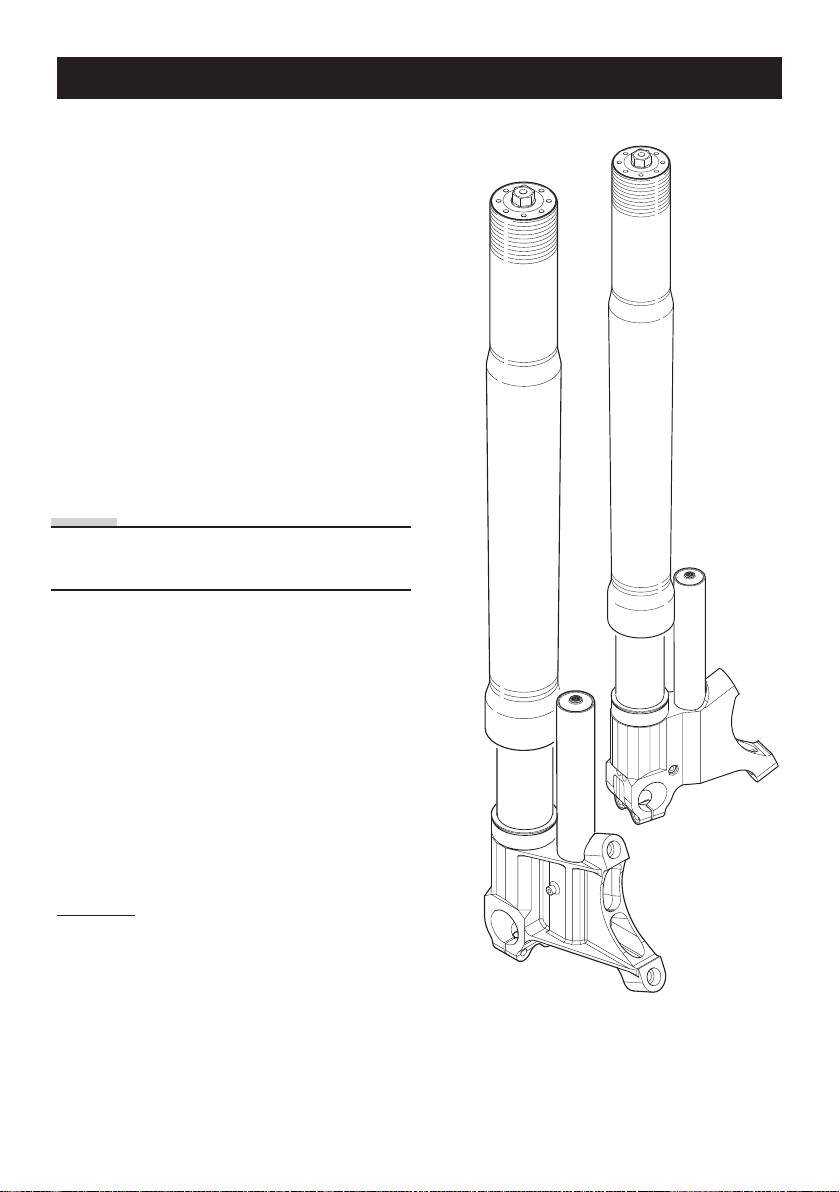
Öhlins Front Fork FG 470
This Super Bike front fork is an improved
version of FG 370 with pressurised damping system. FG 470 is based on 4 years
experience from factory road racing. The
pressurised damping system improves the
front fork function at high frequency movements. The immediate damping responses
improve the tyre feeling and also give more
possibilities for adjustments. Of course
the combination of spring and air-gap (oil
level*) still gives a possibility to adjust the
characteristic of the fork to suit different
tracks and riders.
For example a soft spring in combination
with a small air-gap (high oil level) gives a
more progressive action of the front forks.
NOTE!
Gas pressure should not be changed or
used as an alternative to adjust the damping.
For better understanding, please refer to
our oil level chart see page 17.
A telescopic front fork is depending on a
smooth friction-free action. Make sure your
front forks are serviced regularly and don’t
use strong solvents such as brake cleaner
to clean the front forks. This will dry out the
seals and cause friction.
For tighten torque, loctite and grease see
page 19.
Contents
Before installation
Öhlins front fork FG 470
...........................................................................4
Adjusters
Setting up your forks
Changing springs
Changing seals
Dismantling the forks
Assembly of the forks
Oil level adjustment
Troubleshooting
Technical information
Spare parts list
Service tools
...........................................................2
.................................................3
......................................................5
...........................................................6
...............................................................7
.....................................................8
..................................................12
......................................................17
............................................................18
...................................................19
.............................................................20
...............................................................23
*
Front fork 470 is equipped with an external reservoir, pressurized
with nitrogen. A dividing piston separates the oil from the gas.
3
Page 4
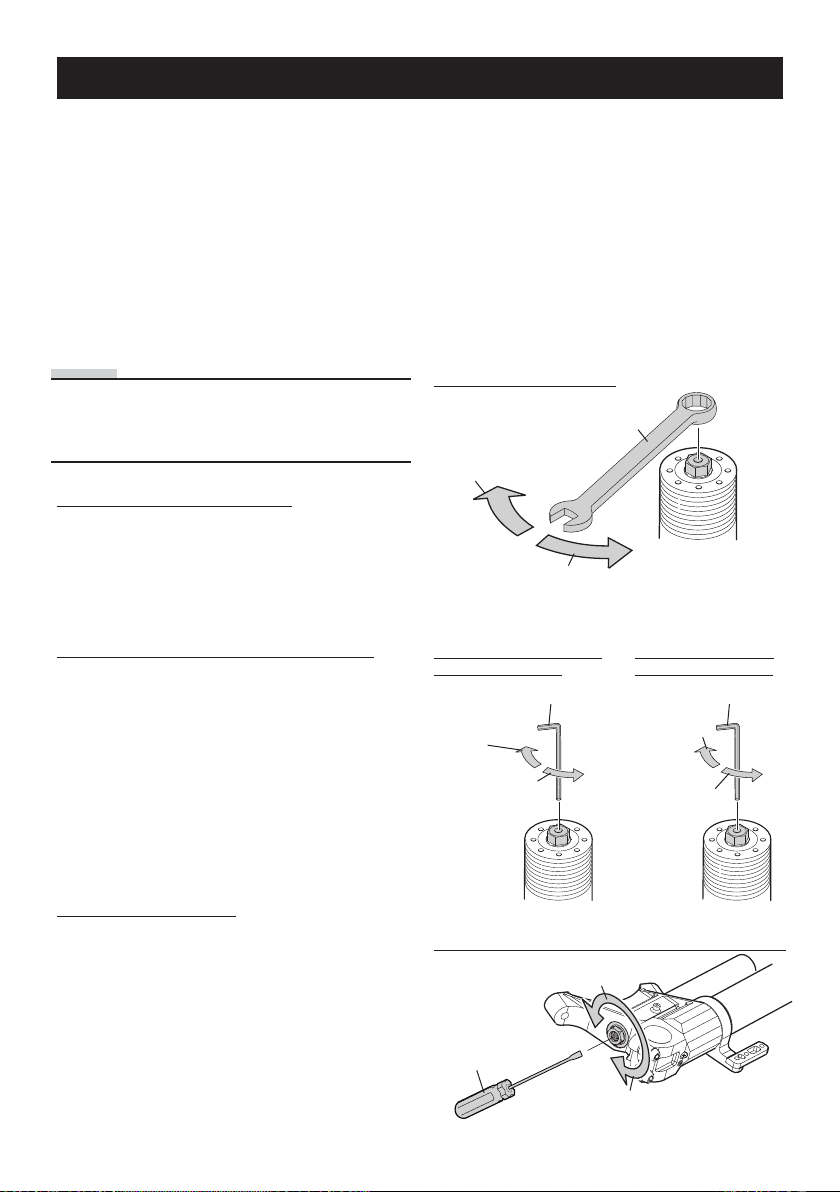
Adjusters
Your Öhlins super bike front fork is provided with the following external adjusters:
• Spring pre-load adjuster
• Rebound damping adjuster.
• Two type of compression
damping adjuster:
- Reservoir valve adjuster in the
lower part of the fork leg.
- Main valve bleed circuit.
NOTE!
The rebound damping adjuster is located at
the top of the right hand fork leg. The Main
valve bleed circuit (compression adjuster) is
located at the top of the left hand fork leg.
Spring pre-load adjustment
Use a 17-mm wrench to turn the upper
adjustment screw. The adjustment range
is 0-18mm. On the adjustment screw one
turn will change 1mm in spring pre-load.
Recommended static sag is 25-30 mm.
Compression adjustment main valve.
Adjust the compression damping on the
adjustment screw positioned at the top of
the left hand fork leg. Use a hex key with
spherical head (use tool 794-01).
Compression adjustment reservoir valve
(Base valve)
Adjust the compression damping (shaft
displacement) on the lower part of the fork
legs. Use a normal screwdriver. Adjustment
range from closed valve (clockwise) to
maximum open valve (counter clockwise)
is 20 “clicks”. Recommended adjustment
“clicks”, from closed position:
See specification card.
Spring pre-load adjustment
17 mm wrench
Increase spring pre-load
Top cap
Reduce spring pre-load
Compression adjustment
Left Hand Fork Leg
Clockwise turn
closes = increase
compression
damping
Tool 794-01
Rebound adjustment
Right Hand Fork Leg
Clockwise turn
closes = increase
rebound damping
Tool 794-01
Adjustment range from closed valve
(clockwise) to maximum open valve
(counter clockwise) is 20 “clicks”. Recommended adjustment “click”, from closed
position: See specification card.
Rebound adjustment
Adjust the rebound damping on the adjustment screw positioned at the top centre of
the right hand fork leg. Use a hex key with
a spherical head (use tool 794-01).
Adjustment range from closed valve (clockwise) until maximum open valve (counter
clockwise) is 20 “clicks”. Recommended
adjustment “click”, from closed position:
See specification card.
4
Counter clockwise
turn opens = reduced
compression damping
Compression adjusment reservoir valve (Base valve))
Counter clockwise turn opens =
reduced compression damping
Screwdriver
Counter clockwise
turn opens = reduced
rebound damping
Clockwise turn closes =
increase compression damping
Page 5
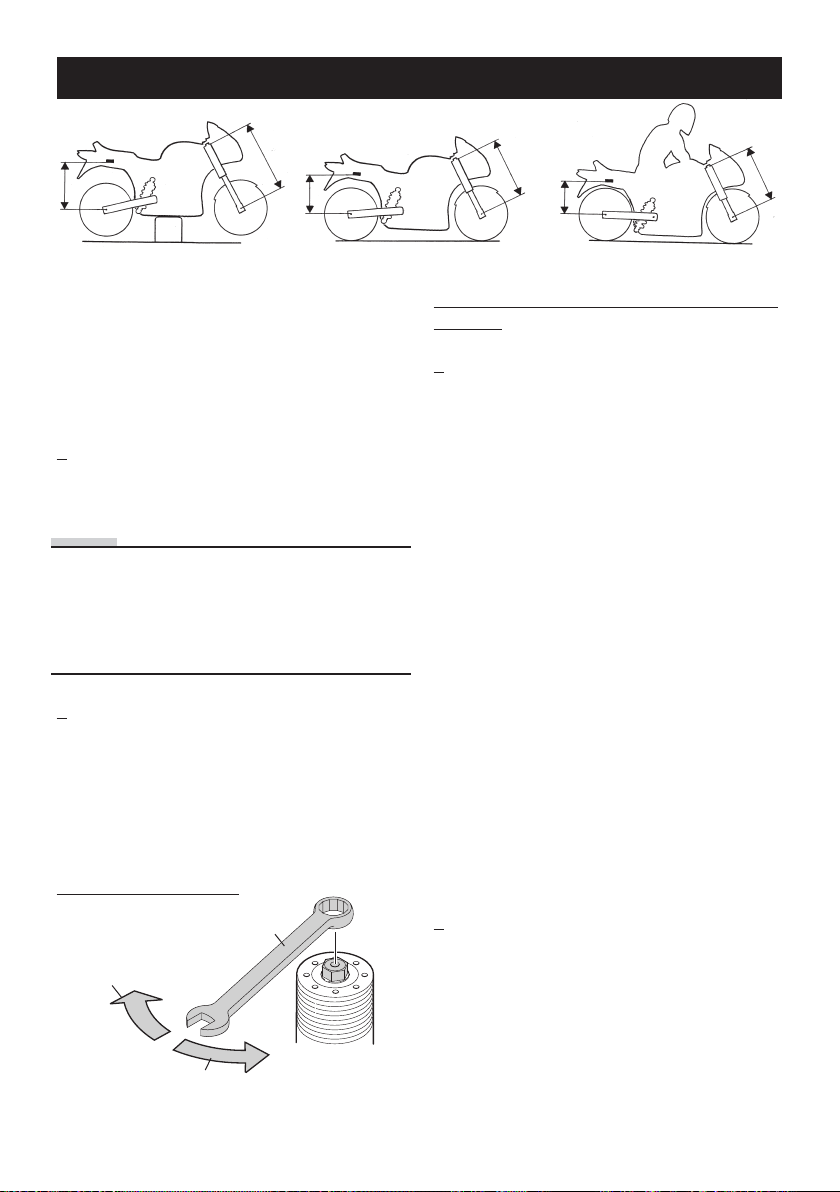
Setting up your forks
F1
R1
A-D. Bike on a stand
R2
E. Bike on the ground F. Bike with rider on
Here is some basic guidelines, how to set
up your Öhlins front forks. However you
must remember that the front forks are just
one part of your motorcycle and to get it to
work properly, the whole motorcycle has to
be set up according to your bikes manual.
1
Put your bike on a front stand and fit the
Öhlins front fork.
NOTE!
The lower triple clamp must not be tightened to more than 12-15 Nm. This is also
important for the steering damper bracket,
when located around the upper front leg.
To high torque might deform the front fork
leg.
2
Set your initial pre-load of the spring, by
using a 17mm socket or wrench, until you
get a static sag of 25-30 mm. Each turn
gives 1mm in pre-load, maximum pre-load
is 18mm.
Spring pre-load adjustment
F2
R3
F3
Setting the spring pre-load generally on
the bike
3
Pre-load on the spring/springs is very
important, since it affects the height of
the motorcycle and the fork angle. Consequently, handling characteristics can be
changed, even negatively.
Proceed as follows (it will be much easier if
done by two persons):
1 Place the motorcycle on a stand.
2 Lift up the rear end to a fully extended upper
position.
3 Measure the distance, e.g. from the ower edge of
the rear mud guard or from a point marked by a
piece of tape, immediately above the rear whee
axle, to the wheel axle. (R1)
4 Make a similar measurement on the front axle, e.g.
from the bottom of the upper fork crown to the
front wheel axle. The fork must be fully
extended. (F1)
5 Allow the motorcycle (without rider) to apply load
on the springs and repeat the measuring proce dure. (R2, F2)
6 Then take the same measurements with the rider
and equipment on the motorcycle. It is important
that the rider has a correct riding posture, so that
the weight is balanced on the front and rear wheel
in the same way as when riding. (R3, F3)
Increase spring pre-load
Reduce spring pre-load
17 mm wrench
4
The measurements may not differ from the
following sizes:
Without rider:
Rear: 5-15 mm (R1-R2)
Front: 25-30 mm (F1-F2)
With rider:
Rear: 30-40 mm (R1-R3)
Front: 35-50 mm (F1-F3)
5
Page 6
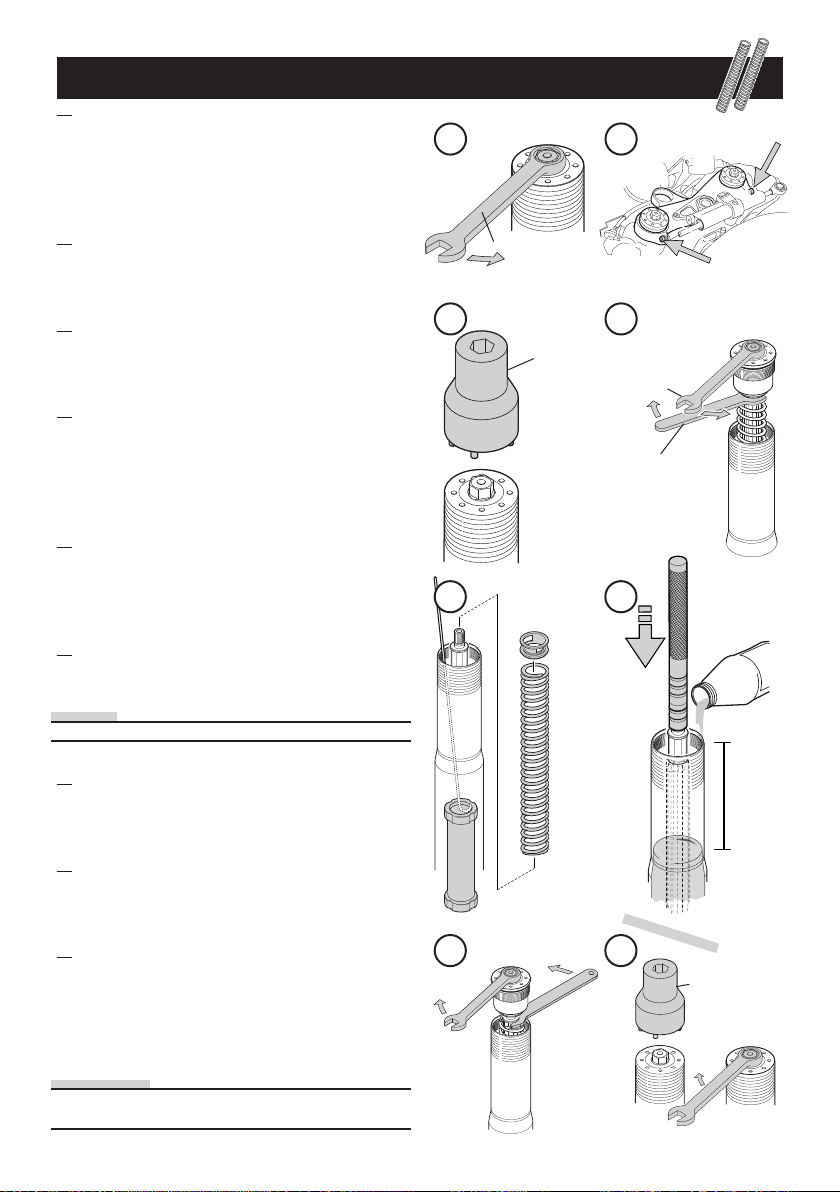
Changing springs
1.
Unload the spring pre-load completely
by turning the adjustment nut counter
clockwise as far as possible. Use a 17 mm
wrench or socket.
12
2.
Loosen the screws that hold the fork legs
in the upper tripple clamps.
3.
Remove the Top nut assembly. Use tool
797-01.
4.
Remove the top nut assembly from the
piston shaft. Use a 17 mm wrench to the
top and tool 4705-01 to hold the nut on the
lower side of the top nut.
5.
Remove the adjustment driver and the
spring. Use a wire with a hook and carefully pull out the preload tube.
6.
Check the oil level according to page 17.
NOTE!
Use Öhlins Front fork oil 1305-01 only.
7.
Refit the Pre-load tube. Install the new
spring and refit the adjustment driver.
17 mm socket
34
Tool 797-01
17 mm socket
Tool 4705-01
5 6
Adjustment driver
Spring
Tool 1765-03
1305-01
Check the oil level
8.
Refit the top nut assembly to the piston
shaft. Tighten the jam nut to 20 Nm.
9.
Refit the top nut into the fork leg, with
the front wheel off the ground (use tool
797-01). Tighten the upper triple clamps
and adjust the preload, compression and
rebound according to above instructions.
CAUTION!
The top nut should only be tightened by
hand into the fork leg.
6
Preload tube
8 9
20 Nm
CAUTION!
Tool 797-01
Page 7
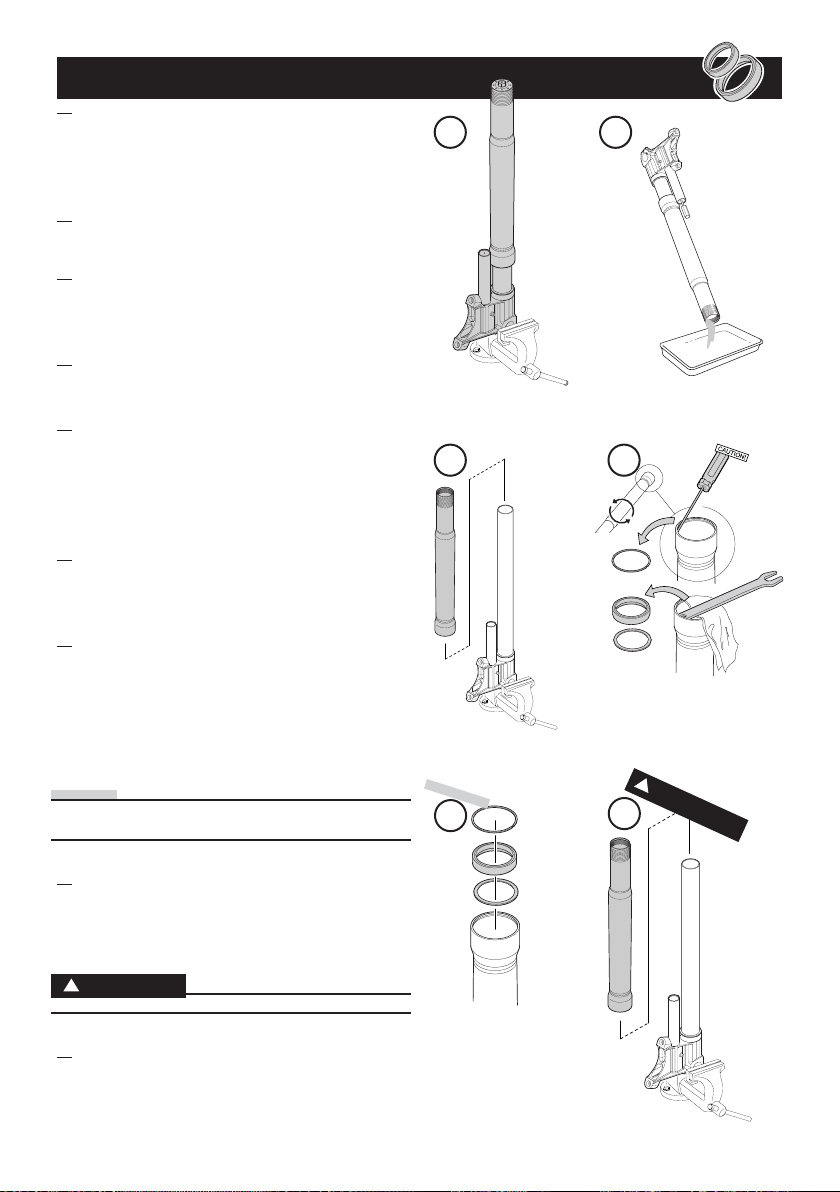
Changing seals
!
1.
Remove the fork legs from the motorcycle.
Put the fork legs in upright position for
about 5 minutes to allow the oil to settle.
2.
Fasten the fork leg in a vice. Use soft jaws.
3.
Carry out instructions 1 to 5 in “Changing
springs”, page 6.
4.
Drain the cylinder tube from oil.
5.
Remove the outer tube, clean the seal and
check the condition. If the seal is in good
condition apply some red grease (146-01)
to it. A damaged seal must be replaced!
6.
First remove the circlip, then the seal and
finally the washer.
2 4
5 6
180
1st, Circlip
2nd, Seal
0
7.
Apply a thin layer of Öhlins red grease
(146-01) to the washer and to the sealing
surfaces of the fork seal. Install the seal
and the washer in the outer tube. Fit the
circlip into the groove.
NOTE!
It is important to use the correct grease in
order to achieve optimum fork function.
8.
Apply some front fork oil (1305-01) to the
inner tube surface and carefully mount the
outer tube (slide it completely down).
! WARNING!
Be careful not to damage the fork seal!
9.
Repeat instructions 6 to 9 in “Changing
springs” on page 6. Refit the front fork.
NOTE!
7
Circlip
Seal
Washer
3rd, Washer
WARNING!
8
7
Page 8
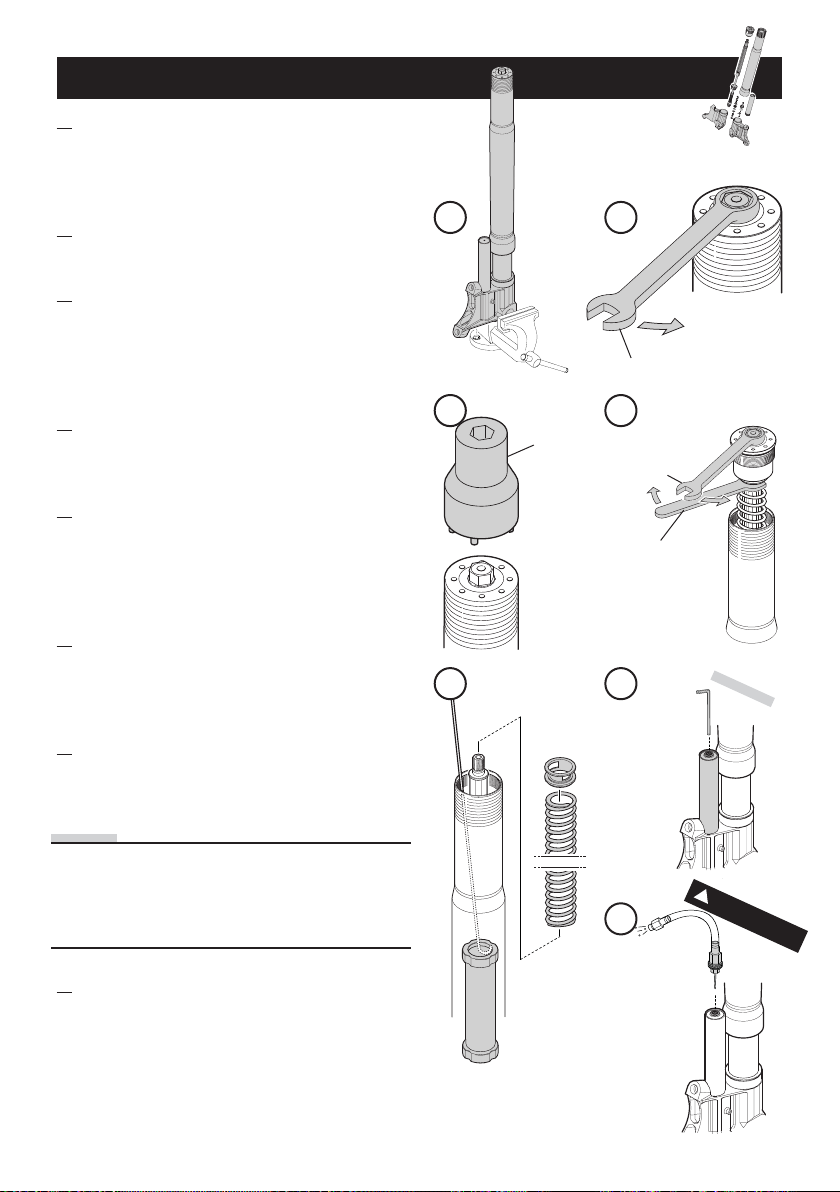
Dismantling the Forks
!
1.
Remove the fork legs from the motorcycle.
Put the fork legs in upright position for
about 5 minutes to allow the oil to settle.
2.
Fasten the fork leg in a vice. Use soft jaws.
3.
Unload the spring pre-load completely
by turning the adjustment nut counter
clockwise as far as possible. Use a 17 mm
wrench or socket.
4.
Loosen the top nut assembly. Use tool
797-04.
5.
Remove the top nut assembly from the
piston shaft. Use a 17 mm wrench to the
top and tool 4705-01 to hold the nut on the
lower side of the top nut.
6.
Remove the adjustment driver and the
spring. Use a wire with a hook and carefully pull out the preload tube.
23
17 mm socket
4 5
Tool 797-04
17 mm socket
Tool 4705-01
6 7
NOTE!
7.
Remove the screw and o-ring from the
reservoir end cap.
NOTE!
Before the gas pressure is relieved the
adjuster settings must be counted and
noted. Even check that the gas pressure is
correct. Follow that, the adjusters should
be set in a fully open position.
8.
Relieve the nitrogen gas by inserting an
injection needle into the reservoir end cap
through the rubber valve.
8
Adjustment driver
Spring
WARNING!
8
Preload tube
Page 9

!
WARNING!
Releasing high pressure gas from the
shock absorber can be hazardous. Do not
perform any kind of service until gas pressure is completely released.
9.
Remove the circlip.
10.
Use tool 720-03 to lift up the reservoir end
cap. Install the tool 720-02 into the gas
piston.
11.
Use tool 1797-04 and 1765-03 to unscrew
the seal head from the cartridge tube.
Remove the piston rod unit.
12.
Fasten the piston rod in a vice. Use soft
jaws (727-02). Remove the nut with a 13
mm wrench or socket. Remove the valve
from the piston rod.
Place all parts, including the shims, in their
correct position on the work bench. Clean
all parts thoroughly and dry with compressed air.
910
Tool 1765-03
Tool 720-03
11
Tool 1797-04 Piston rod unit
Seal head
Tool 720-02
NOTE!
The right hand fork leg is the rebound leg.
The left hand fork leg is the compression
leg.
Notes
12
NOTE!
13 mm socket
Nut
Soft jaws
(727-02)
Rebound Valve RH-Leg
Compression Valve LH-Leg
9
Page 10

13.
Remove the Piston holder. Use a 14 mm
wrench.
14.
Remove the Topout spring, the Sleeve, the
Spacer and the O-ring.
15.
Remove the Seal head. Check the O-ring
and the X-ring. Change them if necessary.
16.
Remove the needle and change the O-ring
if necessary.
17.
Drain the cylinder tube from oil.
18.
Remove the gas piston in the reservoir, use
tool 720-02.
19.
Drain the reservoir from oil.
20.
Use a 17 mm wrench to unscrew the
complete compression valve at the bottom
of the fork.
13
14 mm Wrench
14
Piston holder
Topout spring
Sleeve
Spacer
O-ring
15 16
X-ring
Seal head
O-ring
17
18
O-ring
Rebound neendle
21.
Remove the piston from the compression valve. Place the shims in their correct
position on the work bench. Clean all parts
thoroughly, change O-rings if necessary
and dry all parts with compressed air.
Notes
10
19
21
20
Page 11

22.
Remove the outer tube, clean the seal and
check the condition. If the seal is in good
condition apply some red grease (146-01)
to it. A damaged seal must be replaced!
23.
First remove the circlip, then the seal and
finally the washer.
24.
Heat the tube where the bushings are positioned. Use a heat air gun.
22 23
180
1st, Circlip
2nd, Seal
3rd, Washer
0
25.
Put the outer tube standing up on a soft
suface, seal side facing down. Remove the
bushings by pushing them out. Use attachment bar (1757-01) and dismantling sleeve
(1759-07) from the top nut side.
26.
Tap gently on the attachment bar with a
heavy hammer, until the bushings are free
and can be released from the seal side of
the outer tube.
27.
Check the innertube for damages, replace
if necessary. Use a heat gun to warm up
the fork bottom and tool 786-05 to unscrew the inner tube of the fork leg.
28.
Check the reservoir tube for damages,
replace if necessary. Use tool 786-07 to
unscrew the reservoir tube.
24 25
Heat air gun
26 27
Upper bushing
Lower bushing
Attachment bar
(1757-01)
Dismantling sleeve
(1759-07)
Rubber mat
Tool 786-05
28
Tool 786-07
11
Page 12

Assembly of the forks
1.
Use Tool 786-07 to refit the reservoir tube.
Tighten to 45 Nm.
2.
Use Tool 786-05 to refit the inner tube of
the fork leg. Tighten to 80 Nm.
3.
Put the outer tube standing up on a soft
surface, seal side up. Fit the bushings
from the seal side of the outer leg. Install
first the upper bushing then the lower one.
Use installing sleeve (1759-08), guide ring
(1758-04) and attachment bar (1757-01)
when installing the upper bushing. Apply Loctite 601 on the seat position of the
upper bushing, use a long brush. Tap the
attachment bar until it reaches the correct
position (stop against a shoulder).
12
Tool 786-07
Apply Red grease (146-01), No loctite!
3
Long brush
Lower bushing
Upper bushing
Tool 786-05
Guide ring
(1758-04)
4.
When the upper bushing is in position, the
lower bushing is to be installed the same
way. Apply some red grease (146-01) to
the bushing before installation.
5.
Apply a thin layer of Öhlins red grease
(146-01) to the washer and to the sealing
surfaces of the fork seal. Install the seal
and the washer in the outer tube. Fit the
circlip into the groove.
NOTE!
It is important to use the correct grease in
order to achieve optimum fork function.
Loctite 601
4
Outer tube
Attachment bar
(1757-02)
Installing sleeve
(1759-08)
Rubber mat
NOTE!
5
Circlip
Washer
Seal
12
Page 13

6.
!
Install the piston and the shims on the
compression valve. Tighten the 8 mm nut
with a torque of 7 Nm. Check the piston
ring and the O-rings for damages. Replace
if necessary.
Install the compression valve assembly into
the valve housing. Tighten to 20 Nm.
Compression valve assembly:
1675-01, Nut
153-01, Washer
641-02, Washer
Shim stack Comp.
1670-01, Piston
338-11, O-ring
530-22, Shims
1693-01, Spring
1669-01, Sleeve
1672-01, Collar
7.
Apply some front fork oil (1305-01) to the
inner tube surface and carefully mount the
outer tube (slide it completely down).
6
8 mm Nut,
7Nm
Comp. valve assembly,
20 Nm
1658-01, End piece
WARNING!
438-02, O-ring
1242-03, Needle
1474-01, Spring
87
884-02 x 2, Ball
338-53, O-ring
1473-02, Circlip
! WARNING!
Be careful not to damage the fork seal!
8.
Fill up with Öhlins front fork oil (1305-01) all
the way to the edge of the reservoir. Continue to fill until the oil level is the same in
both the reservoir and in the cylinder tube.
9.
Push the gas piston, with teflon band
and O-ring fitted, to the reservoir bottom
without allowing it to be pressed back over
the circlip groove, make sure that there is
no air between the piston and the oil. Use
tool 720-02.
Close the compression adjuster.
9
Tool 720-02
13
Page 14

10.
Grip the piston shaft with soft jaws 727-02.
Fit the O-ring on the adjustment needle.
Apply plenty of red grease on the O-ring so
that the needle slides easily into the piston
shaft.
11.
Check the X-ring and O-ring on the seal
head. Replace if necessary. Smear plenty
of white grease on the X-ring before you fit
it. Use tool 0715-01 to get the X-ring into
the right position.
10.
Wrap some teflon tape arond the thread
of the shaft to protect the seal and O-ring
from damages. Apply some red grease
(146-01) to the tape and the shaft end.
Mount the seal head and the O-ring.
10
10
11
11
X-ring
O-ring
Tool 0715-01
Piston holder
Topout spring
Sleeve
Spacer
11.
Use a brass wire brush to clean the piston
rod from tape. Mount Spacer, Sleeve, Topout spring and the Piston holder.
12.
Tighten the Piston holder to a torque of 15
Nm.
13.
Refit the Compression/Rebound valve. Use
the picture below to make it right. Tighten
the 8 mm nut with a torque of 7 Nm.
LEG (RH)
REBOUND
CAUTION!
1675-01, Nut
CAUTION!
LEG (LH)
COMPRESSION
2061-03, Piston
Shim stack
(rebound)
641-02, Washer
1675-01, Nut
1674-01, Washer
153-01, Washer
14
641-02, Washer
1674-01 4x,
Washer
Shim Stack
1447-02,
Piston ring
12
Shim stack
(rebound)
1618-01, Holder
(compression)
641-02, Washer
15 Nm
1447-02,
Pison ring
2061-03, Piston
530-22, Shims
520-20, Shims
1149-01, Wave
Shim stack
(compression)
641-02, Washer
1618-02, Cup
NOTE!
13
8 mm Nut (7 Nm)
1654-06,
1654-06,
338-19, O-ring
Piston holder
Piston holder
Page 15

CAUTION!
The Washers must be positioned correctly
(Notice that there is a difference between
the compression and the rebound valve).
Also make sure to fi t the Wave washer
(1149-01) in the correct position (convex
side facing piston).
NOTE!
The right hand fork leg is the rebound leg.
The left hand fork leg is the compression
leg.
14.
Fit the Seal head tool and the Top-out
spring tool on the piston rod. Pull the Topout spring tool and, at the same time, push
the Seal head tool to contract the Top out
spring. Install tool 2810-01 on tool 176503 to keep the contraction. Assemble the
complete piston rod into the cartridge tube
and tight it by hand (3-4 turns).
NOTE!
Make sure that the gas piston is pressed
down completely
NOTE!
14
15
Tool 1765-03
Tool 2810-01
Tool 1797-04
20 Nm
16
Tool 720-03
15.
Tighten the Seal head to 20 Nm. Use Seal
head tool (1797-04 and 1765-03).
16.
Check the O-ring on the reservoir cap
assy. Replace if necessary. Apply some red
grease on the O-ring and push the reservoir cap assy into the chamber using tool
720-03.
17.
Fit the circlip. Make certain that it enters its
groove properly.
18.
Once again contract the top out spring
using tool 2810-01, tool 1765-03 and tool
1797-04
NOTE!
Nitrogen (N2) gas. Use pressure gauge
(1781-01)
17
18
15
Page 16

! WARNING!
!
Use of infl ammable gas for pressurising
the soch absorber can be hazardous. Use
nitrogen gas (N2) only!
WARNING!
19
20
19.
Check the gas pressure stipulated in the
spec. card. Dip the needle of the gas tool
(1781-01) in red grease and insert the needle through the gas filler valve.
Charge with gas to the correct pressure,
according to the spec. card.
NOTE!
Ensure that there is no leakage of gas or
fl uid.
20.
Screw the gas filler screw with O-ring.
Remove tool 2810-01 and tool 1797-04 to
release the top-out spring.
21.
Push tool 1765-03 to a stop and check the
oil level according to page 17.
NOTE!
Use Öhlins Front fork oil 1305-01 only.
22.
Refit the Pre-load tube. Install the spring
and refit the adjustment driver.
NOTE!
21
3 Nm
22
Tool 1765-03
1305-01
Check the oil level
23
Refit the top nut assembly to the piston
shaft. Tighten the jam nut to 20 Nm.
24.
Refit the top nut into the fork leg (use tool
797-01). Adjust the preload, compression
and rebound.
CAUTION!
The top nut should only be tightened by
hand into the fork leg. The tightening force
of the triple clamp will hold it in locked
position.
16
23
20 Nm
CAUTION!
24
Tool 797-01
Page 17

Oil level adjustment
Compared with conventional type of front
forks, the upside down front forks are very
sensitive to variations in oil level. Therefore,
adjust the oil level with special care.
A change in the fork oil level will not affect
the spring force at the beginning of the fork
travel, but will have a great effect at the
end of the travel.
When the oil level is raised:
The air spring in the later half stage of
travel is stronger, and make the front forks
more progressive.
When the oil level is lowered:
The air spring of the travel is lessened, and
thus the front fork less progressive. The
oil level works most efficient at the end of
the fork travel. Air spring characteristics
shown, is a general card description to understand the difference when the oil level is
changed.
NOTE!
Adjust the oil level in mm according to the
fi gure with the fork leg fully compressed.
For the right oil-level, please see the specifi cation card.
Air spring characteristics
Air inside the front fork works as a spring.
The graph at the bottom of the page shows
the spring force related to stroke when the
oil level is changed between 140 mm and
200 mm. Standard oil level is 180 mm.
Öhlins front fork fl uid 1305-01
Push to a stop,
use tool 1765-03
Check the oil level
17
Page 18

Troubleshooting
Below are a few examples of how to adjust
for the most common road holding problems in Road Racing driving.
1.
The front wheel “chatters” entering a
corner, the problem goes away, as soon as
you let the brakes off, or when you get on
the power.
• This is caused by the fact that the fork is working
too low in the travel and reaches the progressive,
hard part at the end of the travel.
• Put on more pre-load.
• Change to a harder spring.
• If a lot of stroke remains after riding, drop the oil
level. See oil level chart.
• Make sure the front forks have no friction.
• Rear ride height is to high, too much rear spring
pre-load.
• Lower the rear end by taking off pre-loadfrom rear
shock spring.
2.
The front wheel is jumping during the last
part of braking.
• If a lot of stroke remains, the oil level is too high.
Lower the oil level.
• If the fork is bottoming, put in harder springs and
keep the oil level.
4.
The front end loses grip coming out of a
corner.
• Not enough rebound damping. Put on some more
rebound damping.
• Too much pre-load. Take off some pre-load.
• Rear end is too soft. Put on a harder rear spring.
• Front end is too high. Lower the front end by
pulling the fork legs through the triple clamps.
As mentioned in the beginning, the whole
bike setup affects the front forks. Try to
understand the feelings and work step by
step.
NOTE!
Our advice is to change only one thing at a
time and do everything step by step.
1
3.
The front end feels unpredictable and unsafe in the middle of the corner (between
braking and getting on power).
• Not enough rebound damping. Put on more
damping.
• Too much rebound damping. If it at the same time
feels harsh, take off some rebound damping.
• Too much compression damping. Also gives a
harsh feeling. Take off some compression
damping.
18
4
Page 19

Technical information
Fork length: 730 mm.
Stroke: 130 mm.
Free spring length: 260 mm.
Rebound adjustment:
Base setting 9-12 “clicks”.
Maximum open valve 20 “clicks”.
Compression adjustment:
Base setting 6-16 “clicks”.
Maximum open valve 20 “clicks”.
Compression adjustment (Base valve):
Base setting 6-16 “clicks”.
Maximum open valve 20 “clicks”.
Spring pre-load adjustment:
0-18 mm (0-18 turns).
Spring rate:
4744-95 9.5 N/mm (marking -95).
Optional springs supplied:
4744-10 10.0 N/mm (marking -10)
4744-90 9.0 N/mm (marking -90)
Optional springs:
4744-85 8.5 N/mm (marking -85)
4744-80 8.0 N/mm (marking -80)
Oil Capacity:
Please see specification card.
Use Öhlins high performance front fork
fluid No. 5 (1305-01) only.
Tighten torque, Loctite and Grease:
O-ring, No grease
Adjustment housing, By hand only
Upper bushing
Loctite 601
X-ring
White grease
Attach piston holder to rod
before assemble piston details!
Lower bushing
No loctite
Rod extensioner/bolt spring adjuster, 20 Nm
Piston shaft/rod extensioner, 15 Nm
Loctite 270
Piston rod/piston shaft, 15 Nm
Loctite 270
Seal head, 20 Nm
Screw, 3 Nm
Loctite 222
Nut, 7 Nm
Red grease on all other o-rings!
Reservoir tube, 45 Nm
Red grease
Tighten torque:
Lower triple clamp bolt 12-15 Nm.
Upper triple clamp bolt 18-22 Nm
Grease:
Öhlins front fork grease 146-01
(red grease).
Service interval:
Every 10 hours
Loctite 648
Fork leg, 140 Nm
Loctite 542
Screw, 3 Nm
Both fill-up points
Cylinder tube, 80 Nm
Base valve, 45 Nm
Inside of reservoir tube
White grease, thin film
Nut, 7 Nm
Loctite 222
19
Page 20

Spare parts list, FG 470
20
1
2
12
13
Pos. Part No. Pcs. Description Type/remarks
1 - 2 Top nut assembly See page 21
2 01408-04 2 Adjustment driver
3 04744-95
04744-10
04744-90
2
Spring
2
Option spring
2
Option spring
25.5/260/9.5
25.5/260/10.0
25.5/260/9.0
4 01438-04 4 Guide ring
5 01460-37 2 Preload tube
3
14
6 01900-05 2 Fork leg outer
7 01683-02 2 Bushing, upper
8 01684-02 2 Bushing, lower
9 04758-01 2 Washer
4
15
16
10 04720-02 2 Seal
11 04759-01 2 Circlip
12 02807-01 2 Adjustment rod
13 01901-03 2 Rod extensioner
5
4
6
17
18
19
20
21
22
23
24
25
26
14 02302-08 2 Guide sleeve
30
15 01499-01 2 Circlip
16 01440-01 2 Bump rubber
17 01651-04 2 Seal head
18 01027-04 2 X-ring
19 00438-02 2 O-ring
20 01056-04 2 Bushing
21 00438-41 2 O-ring
22 02803-01 2 Spacer
23 01653-05 2 Sleeve
24 01585-11 2 Topout spring
31
25 01698-30 2 Rebound needle
26 00338-14 2 O-ring
27 02367-06 2 Shaft
28 - 1 Compression valve (LH) See page 22
29 - 1 Rebound valve (RH) See page 22
27
7
8
9
10
11
37
39
41
40
42
46
2928
57
56
55
54
53
52
34
35
36
38
43
51
50
49
45
48
47
44
30 01656-02 2 Cylinder tube
31 01699-02 2 Fork leg inner
32 01565-04 2 Stroke indicator
33 00338-63 2 O-ring
32
34 00194-10 2 Sticker “Öhlins”
33
35 04759-02 2 Circlip
36 01682-28 2 Fender bracket ring
37 01678-14 2 Fender bracket
38 00382-08 2 Screw
39 01902-09
01902-1011
Fork bottom
Fork bottom
40 01050-01 2 Screw
41 00338-59 2 O-ring
42 01240-08 4 Bolt Titan
43 00438-33 2 O-ring
44 00382-07 2 Screw
45 05426-02 2 Plug Koenig
46 - 2 Base valve See page 21
47 00338-72 2 O-ring
48 02804-01 2 Reservoir tube
49 00338-25 2 O-ring
50 01447-02 2 Piston ring
51 02806-01 2 Gas piston
52 00604-01 2 Rubber valve
53 00338-25 2 O-ring
54 02805-01 2 Reservoir end
55 00338-59 2 O-ring
56 01050-01 2 Screw
57 01152-01 2 Circlip
Left
Right
Page 21

Top nut assey
1
2
3
4
3
5
6
7
Spare parts list, Top nut assey
Pos. Part No. Pcs. Description Type/remarks
1 04747-02 2 Cap
2 04756-01 2 Adjuster
3 00884-04 4 Ball
4 04727-01 2 Spring
5 04722-07 2 O-ring
6 04748-01 2 Bolt spring adjuster
7 04722-04 2 O-ring
8 04749-02 2 Plate, center
9 02801-01 2 Adjustment housing
10 00338-61 2 O-ring
11 04751-02 2 Washer
12 04752-01 2 Washer
13 04753-01 2 Washer
14 04762-03 2 Spring seat
8
9
Base valve
15
16
17
Spare parts list, Base valve
Pos. Part No. Pcs. Description Type/remarks
15 01675-01 2 Nut
16 00153-01 2 Washer
17 00641-02 2 Washer
18 - - Shim stack See spec. card
19 01670-01 2 Piston compression
20 00338-11 2 O-ring
18
21 00530-22 2 Shims
22 01693-01 2 Spring
23 01669-01 2 Sleeve
10
19
24 01672-01 2 Spring collar
25 01658-01 2 End piece
26 00438-02 2 O-ring
11
12
13
14
20
21
22
23
24
25
26
27
28
29
28
30
31
27 01242-03 2 Adjustment needle
28 00884-02 4 Ball
29 01474-01 2 Spring
30 00338-53 2 O-ring
31 01473-02 2 Circlip
21
Page 22

Compression valve
1
2
3
Rebound valve
Spare parts list, Compression valve (LH)
Pos. Part No. Pcs. Description Type/remarks
1 01654-06 1 Piston holder
2 00338-19 1 O-ring
3 01618-02 1 One way valve cup
4 00530-22 1 Shims
5 01149-01 1 Wave washer
6 00520-20 1 Shims
7 01618-01 1 Cup holder
8 00641-02 1 Washer
9 - - Shim stack (comp.) See spec. card
10 01447-02 1 Piston ring
11 02061-03 1 Piston rebound
12 - - Shim stack (reb.) See spec. card
13 00641-02 1 Washer
14 01674-01 1 Washer
15 00153-01 1 Washer
16 01675-01 1 Nut
4
17
Spare parts list, Rebound valve (RH)
5
6
7
8
9
10
11
12
13
14
15
18
19
20
21
22
23
24
24
24
24
Pos. Part No. Pcs. Description Type/remarks
17 01654-06 1 Piston holder
18 00641-02 1 Washer
19 - - Shim stack (comp.) See spec. card
20 01447-02 1 Piston ring
21 02061-03 1 Piston rebound
22 - - Shim stack (reb.) See spec. card
23 00641-02 1 Washer
24 01674-01 4 Washer
25 01675-01 1 Nut
22
16
25
Page 23

Service tools
1
4
10
2
5
11
12
16
Pos. Part No. Pcs. Description
1 00727-02 1 Soft jaws (one pair)
3
2 00786-05 1 Inner tube tool
3 00786-07 1 Cartridge tube tool
4 01781-01 1 Gas tool
5 00797-01 1 Top nut socket
6 01757-01 1 Attachment bar
7 01759-07 1 Dismantling bar
6-9
8 01759-08 1 Installing sleeve
9 01758-04 1 Guide ring
10 00720-02 1 Measure pin
14
11 00720-03 1 Pin tool
12 04705-01 1 Spanner
13 01765-03 1 Pull-up spring tool
14 01797-04 1 Seal head tool
15 02810-01 1 Pull-up spring tool holder
16 00715-01 1 Screwdriver
13
15
23
Page 24

More info
www.ohlins.com
Öhlins Racing AB, Box 722, S-194 27 Upplands Väsby, Sweden
Phone +46 8 590 025 00, Fax +46 8 590 025 80
07280-10, Issued 06 07 26. Öhlins Racing AB, Mattias Johansson, majo/ Update: Tiina Harakka
 Loading...