

Page 1

NPE-4 6310 Repairhints
Customer Care Europe & Africa Version 1.0 Approved
SCCE Training Group Date 27.05.2002
CONFIDENTIAL
1 (17)
Repairhints
Service-Level 3 & 4
6310
NPE-4
© NMP 2002
Checked by:
SCCE Training Group
Approved by:
SCCE
Page 2
CONFIDENTIAL
2 (17)
NPE-4 6310 Repairhints
Customer Care Europe & Africa Version 1.0 Approved
SCCE Training Group Date 27.05.2002
General
-How to use this document
Place the schematics behind this manual.
Now you are able to follow these specifictions with graphical layouts and it is easier for you to find the components and
measuring points.
-General handling
Be very careful when disassembling the NPE-4 while removing the A-Cover from the Back-Cover. Refer to disassembling
instructions at the service manual of NPE-4.
-µBGA components and broken balls
Special attention to µBGA components:
All replaceable µBGAs must be renewed after removing. Reflow using a hot air fan is not allowed.
Check soldering points and remove oxidated solderings (broken balls) carefully by enclosing a few new solders before placing new
components. The only allowed way changing µBGA components is to use µBGA rework maschines, approved from NMP (e.g.
ZEVAC/ OK International). Use recommended Fluxtype and an appropriate amount of it only.
-PCB handling & cleaning
To avoid damages of PCB and/or components through electrostatic discharging, handle the module in
ESD-suitable cases only. Always wear ESD-bracelets, which must be connected to earth bonding point.
Do not make any loose wiring connections or do some other unqualified rework anywhere.
For cleaning use appropriate materials only. Do not use scratching or rubbing tools.
Because of organic surface protection (OSP), cleaning must only be done with a lint-free cloth, which may be moistening with DIwater. IPA or other solvent like ethanol should only be used to clean gold pads for spring contacts without affecting the
surrounding copper layers.
-Component charactaristics
Some components contain important data.
Several described steps are practicable only if you are able to reflash/ realign the phone and/ or rewrite IMEI/ SIMlock in certain
cases. Please pay attention to separate notes.
-Realign after repair
Characteristics of replacement parts are different.
To prevent additional faults after repair (RX quality, TX power etc.) it is necessary to retune phone values.
© NMP 2002
Checked by:
SCCE Training Group
Approved by:
SCCE
Page 3

CONFIDENTIAL
3 (17)
NPE-4 6310 Repairhints
Customer Care Europe & Africa Version 1.0 Approved
SCCE Training Group Date 27.05.2002
IMPORTANT:
This document is intended for use by authorized NOKIA service centers only.
The purpose of this document is to provide some further service information for NPE-4 6310.
It contains a lot of collected tips and hints to find failures and repair solutions easily.
It also will give support to the inexperienced technicians.
Saving process time and improving the repair quality is the aim of using this document.
We have built it up based on fault symptoms (listed in "Contents") followed by detailed description for further analysis.
It is to be used additionally to the service manual and other service information like Service bulletins, for that reason it does not
contain any circuit descriptions or schematics.
All measurements are made using following equipment:
Nokia repair SW : Phoenix
Phoenix Application : 3.60.00
Flash SW (CMT) : 4.20
Test Jig : MJS-40
Docking station : JBV-1
Docking Adapter : MJF-9
Digital Multimeter : Fluke 73
Oscilloscope : Fluke PM 3380A/B
Spectrum Analyzer : Advantest R3162 with an analogue probe
RF-Generator / : CMU 200
GSM Tester
While every endeavour has been made to ensure the accuracy of this document, some errors may exist. If the reader finds any
errors, NOKIA should be notified in writing, using following procedure:
Please state:
Title of the Document + Issue Number/Date of publication.
Page(s) and/or Figure(s) of error.
Please send to: Nokia GmbH
Technical Services E&A
Meesmannstr.103
D-44807 Bochum / Germany
Email: training.sace@nokia.com
Copyright © Nokia Mobile Phones.
This material, including documentation and any related computer programs, is protected by copyright, controlled by Nokia Mobile
Phones. All rights are reserved. Copying, including reproducing, modifying, storing, adapting or translating any or all of this
material requires the prior written consent of Nokia Mobile Phones. This material also contains confidential information, which
may not be disclosed to others without the prior written consent of Nokia Mobile Phones.
© NMP 2002
Checked by:
SCCE Training Group
Approved by:
SCCE
Page 4
CONFIDENTIAL
4 (17)
NPE-4 6310 Repairhints
Customer Care Europe & Africa Version 1.0 Approved
SCCE Training Group Date 27.05.2002
Contents
PREFACE GENERAL 2
CHAPTER 1 Additional information 5
- BB shield disassembling instructions 5
- Different battery connectors 6
CHAPTER 2 Electrical faults 6
- Totally dead 6
- Drop calls 8
- No Service 8
- No Service Flowchart 9
- No service, no RSSI 10
- RX Flowchart 11
- No service, no TX 12
- TX Flowchart 14
- Display to dark/ light 15
CHAPTER 3 Tuning problems with Phoenix SW 3.55 15
- Battery calibration – “Low battery” when making a call 15
- “RX Channel Select Filter calibration” all measurements = “0” 15
- TX tuning problem 15
CHAPTER 4 SW faults 15
- Totally dead 15
- Phone jammed 15
- No memory access/ hangs up 15
- No service 15
CHAPTER 5 Hookswitch problems 16
- Sometimes not possible to release “incoming call” 16
- No voice dial possible 16
CHAPTER 6 Change History 17
© NMP 2002
Checked by:
SCCE Training Group
Approved by:
SCCE
Page 5
CONFIDENTIAL
5 (17)
NPE-4 6310 Repairhints
Customer Care Europe & Africa Version 1.0 Approved
SCCE Training Group Date 27.05.2002
Additional Information
BB shield disassembly instructions
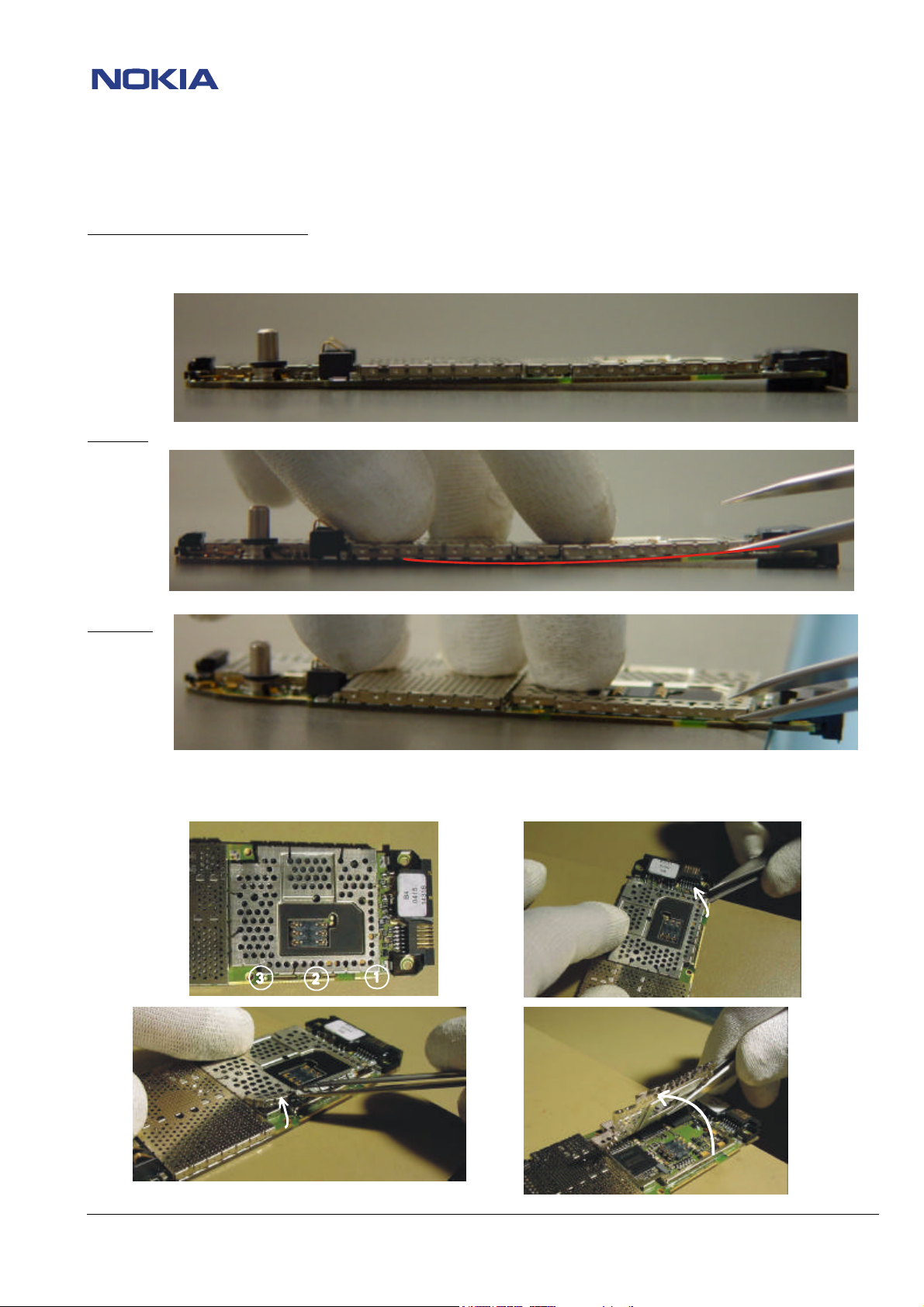
For disassembly it is important to lay the PWB on a plane underground so that the bottom connector is hanging free to prevent
bending of PWB and cracking of the connector´s solderings (See pictures below).
Wrong
Correct
When disassembling the BB shield be very careful because Flash D450 could be damaged.
Start by lifting and bending the lid with a tweezer at the marked points 1- 3 (see pictures below).
Do not use too much force on the frame because it could be damaged and the PWB also could be mechanical stressed.
© NMP 2002
Checked by:
SCCE Training Group
Approved by:
SCCE
Page 6
CONFIDENTIAL
6 (17)
NPE-4 6310 Repairhints
Customer Care Europe & Africa Version 1.0 Approved
SCCE Training Group Date 27.05.2002
Different battery connectors
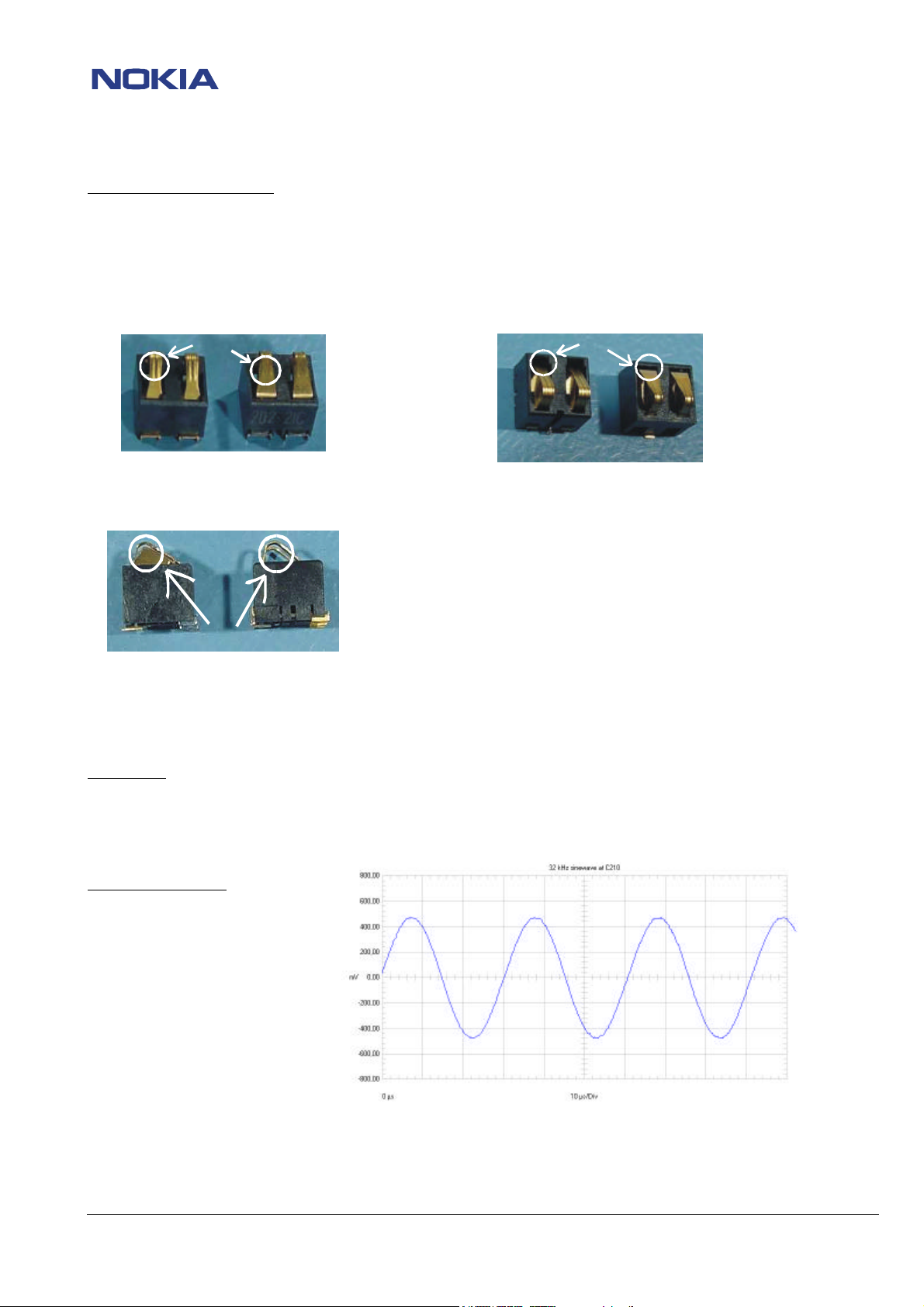
There are two different battery connectors under the same part code (5400239). (See pictures below).
If it is nessesary to exchange the battery connector X101/ X102 take care that you use the same one.
The mixed replacement causes switch-off trouble
Different surface and width of. spring contacts Different position of spring contacts
Difference
Difference
Difference
Differents of spring contacts
Difference
Note! It is not allowed to use the battery connectors of NPE-3 (part code 5469069) because of smaller size.
Electrical faults
Totally dead
Check VBATIN=3.6 VDC at L260 (depends on workbench supply). If not ok, check X101, X102 battery connectors for mechanical
damages or cold solderings. Refer also to chapter “Additional Information/Different battery connectors”.
Check 32.768 kHz sinewave, Vpp = 800 mV at C209 (See picture below).
Oscilloscope settings:
Ampl: 200mV
Time/Div: 10µs/Div
AC/DC/GND: AC
If there is no signal, check B200 circuit for shorts or disconnection and change faulty components.
© NMP 2002
Checked by:
SCCE Training Group
Approved by:
SCCE
Page 7

CONFIDENTIAL
7 (17)
NPE-4 6310 Repairhints
Customer Care Europe & Africa Version 1.0 Approved
SCCE Training Group Date 27.05.2002
Check PWRONX at S300 pin 2/ 4: Key not pressed = 3.6 VDC (Depends on Workbench supply voltage)
Key pressed = 0 VDC
If not ok, check PWRONX-line from S300 to UPP D400 for shorts or disconnections.
Check SleepClk = 32.768 kHz, Vpp = 1.8 V square wave at J404. (See picture below)
Oscilloscope settings:
Ampl: 500mV
Time/Div: 10µs/Div
AC/DC/GND: AC
If not ok, check B200 circuit for shorts or disconnections.
Check VCORE = 1.8 VDC at C400. If not ok, check UEM D200
Check PURX = 1.8 VDC at V130 Pin 44. If not ok, check UEM D200
Check System Clk = 26 MHz, Vpp = 800 mV at C752 (See picture below)
Oscilloscope settings:
Ampl: 500mV
Time/Div: 20ns/Div
AC/DC/GND: AC
If not ok, check 26 MHz G740 circuit. Refer also to chapter Drop calls
Check RFClk = 13 MHz, Vpp = 600 mV at C424. If not ok, refer to No service/ No RSSI.
Check VIO = 1.8 VDC at C450. If not ok, check VIO line to UEM D200 for shorts or disconnections and change faulty components.
If all above mentioned signals are ok, change D450 Flash.
After changing the Flash D450, rewrite product code, HW-ID, IMEI and SIMlock settings.
Note! Rewrite SIMlock and IMEI data by use of NOKIA SECURITY PASSWORD and tune the phone again, if the procedure
is permitted to you. (See General SB–037)
© NMP 2002
Checked by:
SCCE Training Group
Approved by:
SCCE
Page 8

CONFIDENTIAL
8 (17)
NPE-4 6310 Repairhints
Customer Care Europe & Africa Version 1.0 Approved
SCCE Training Group Date 27.05.2002
Drop calls
Disassemble the NPE-4 and the RF- shield, then connect the PWB to the MJS-40 jig.
Insert a SIMcard and connect the coaxial cable to the tester (e.g. CMD/Wavetec). Now start a call.
If the call is established, check the analyzer display from tester (e.g. CMD/Wavetec) if a frequency error appears.
If fault does not appear or appears intermittently only, press on 26MHz oscillator G740 with non-metallic item.
If the frequency error appears or increases in this case, probably the 26MHz circuit is faulty.
Open the Phoenix menu Testing/ RF controls and activate local mode RX GSM900
Check 26MHz +/- 100Hz between C752 and R752 with spectrum analyzer and active frequency counter (See picture below)
If the frequency drift is higher than +/ - 100Hz, check VR3 (VCC) = 2.8 VDC at R740.- If not ok, check UEM D200.
Check AFC (around 1.3 VDC) at G740. Check also if VR3 (VCC = 2.8 VDC) is ok with an Oscilloscope.- If not ok,
check UEM D200
If both voltages are ok but the frequency drift is higher than +/ - 100Hz and the fault is getting stronger when pressing the top of
the 26MHz oscillator G740, change the faulty component.
No service
Set phone to local mode with Phoenix
Open menu Maintenance/Tuning/RX Calibration
Check RX calibration in GSM/PCN. If not ok, refer to chapter No Service/No RX
If RX calibration is ok, open menu Maintenance/Tuning/TX power
Check TX power in GSM/PCN. If not ok, refer to chapter No Service/No TX
If TX power is ok, insert Test-SIM and set phone to normal mode.
Start a Test call If not ok, make a SW update and try connecting again.
If the fault persists after SW update, rewrite IMEI and SIMLock settings.
Note! Rewrite SIMlock and IMEI data by use of NOKIA SECURITY PASSWORD and make a SW-update again, if the
procedure is permitted to you. (See General SB–037)
If the connection is established, check with tester (e.g. CMD/Wavetec) if any errors appears on display (e.g. frequency error).
If a frequency error appears, refer to chapter Drop calls.
© NMP 2002
Checked by:
SCCE Training Group
Approved by:
SCCE
Page 9

CONFIDENTIAL
9 (17)
NPE-4 6310 Repairhints
Customer Care Europe & Africa Version 1.0 Approved
SCCE Training Group Date 27.05.2002
Flowchart – No service
No Service
Set phone with Phoenix
to Local Mode
Open menu
Maintenance/Tuning/RX
calibration
Check RX calibration
in
GSM/PCN
OK
Check TX power at menu
Maintenance/Tuning/TX power
OK
Insert a Test Sim,
set phone to normal
mode
and make a Test call
OK
Connection
established?
OK OK
Check
CMU/CMD if
any errors appear on display,
e.g.frequency
errors
OK
Phone is ok
nOK
nOK
nOK
nOK
Refer to chapter
No Service/No RX
Refer to chapter
No Service/No TX
Make a sw update and try
connecting again
Refer to chapter
Drop calls
If the fault persists,
rewrite IMEI/SIMLock
nOK
settings are not ok
© NMP 2002
Checked by:
SCCE Training Group
Approved by:
SCCE
Page 10

CONFIDENTIAL
10 (17)
NPE-4 6310 Repairhints
Customer Care Europe & Africa Version 1.0 Approved
SCCE Training Group Date 27.05.2002
No Service → no RSSI
Set the RF generator to GSM 942.4 MHz at channel 37, RF level –55 dBm and also the phone to same frequency and channel.
Check RX I/Q signals at C721, C722 (See picture below)
Always measure in burst mode (with an oscilloscope in DC mode).
Oscilloscope settings:
Ampl: 200mV
Time/Div: 1ms/Div
AC/DC/GND: DC
If not ok, check 67.71 kHz at C714 (DtoS and Biquad filter).
Measuarement points at C714 count from N600 Hagar side: At first pins (3/4)= DtoS I/Q;
and then pins (1/2)= Biquad (CM_F and CP_F I/Q).
All measurements made in Burst Mode (with an oscilloscope in DC mode).
DtoS Biquad
Oscilloscope settings:
Ampl: 500mV
Time/Div: 200µs/Div
AC/DC/GND: DC
If the signal is not ok, in GSM check RX signal 942.4 MHz at channel 37, RF level –55 dBm at L626.
If the signal is not ok, in PCN check RX signal 1842.4 MHz at channel 700, RF level –55 dBm at L616
If both RX signals not ok, check RX lines from N600 Hagar to X802 antenna connector for shorts or
disconnections.
If the RX signals are ok, check System Clk = 26 MHz at C752 (See picture at chapter “Electrical faults”/ Totally dead)
If also the System Clk is ok, check following voltages:
Check VR3 = 2.8 VDC at C602.
Check VR4 = 2.8 VDC at C601
Check VR5 = 2.8 VDC at C604
Check VR6 (VBB) = 2.8 VDC at C605
Check VR1A (VCP) = 4.7 VDC (supply for control voltage VC for SHF oscillator) at C600
Check VR7 = 2.8 VDC at C299 (supply voltage VCC for SHF oscillator)
Check VREF01 and VREF02 = 1.35 VDC at R726
If one of the upper described voltages is not ok, check UEM D200.
If all voltages are ok, change N600 Hagar.
© NMP 2002
Checked by:
SCCE Training Group
Approved by:
SCCE
Page 11

CONFIDENTIAL
11 (17)
NPE-4 6310 Repairhints
Customer Care Europe & Africa Version 1.0 Approved
SCCE Training Group Date 27.05.2002
Flowchart - No service → no RX
No Service /
No RSSI
Set Phone to RX-Burst-Mode.
Set RF Generator to Ch. 37,
RX-level -55 dBm
Set Spectrum Analyzer to
RX EGSM 942.4 MHz,
.
Check
RX I/Q-Signal 67.71 kHz
,Vpp=1.1V at C721 (set
oscilloscope to DC-Mode)
500 mV, Time base
1 ms.
OK
Check D200
UEM
nOK
Check RX-line to X102
antenna connector for
shorts or disconnections
Check
PCN RX-Signal
1842.4 MHz, Ch. 700,
at L616
OK
Check G740 26 MHz
oscillator circuit
nOK
Check
Dtos 67.71 kHz
at C714.
nOK
Check
nOK
nOK
RX-Signal 942.4 MHz,
at L626
OK
Check
Sys CLK 26 MHz
Vpp = 800 mV at
C752
OK
Check
following voltages:
VR3 = 2.8 VDC at C602; VR1A = 4.7 VDC
at C600; VR4 = 2.8 VDC at C601;
VR5 = 2.8 VDC at C604; VR6 = 2.8 VDC
at C605; VR7 =2.8 VDC at R630;
VREFRF01 & VREFRF02
= 1.35 V at R726
OK
CP_F I/Q (BIQUAD)
C714 for cold or
following voltages :
VR4 = 2.8 VDC at C601;
VR6 = 2.8 VDC
Check
67.71 kHz
at C714
nOK
Check
broken
solderings.
OK
Check
at C605
nOK
OK
nOK
nOK
OK
Change N600
Hagar
Change C714
Change N600
Hagar
Check D200
UEM
© NMP 2002
OK
Change N600
Hagar
Checked by:
SCCE Training Group
Approved by:
SCCE
Page 12

CONFIDENTIAL
12 (17)
NPE-4 6310 Repairhints
Customer Care Europe & Africa Version 1.0 Approved
SCCE Training Group Date 27.05.2002
No service → no TX
Check EGSM TX signal at R656 / R657 (See picture below)
Set spectrum analyzer to TX EGSM 897.4 MHz, channel 37.
Set phone to TX mode, EGSM 897.4 MHz, channel 37 and power level 10.
If there is no signal measurable, check PCN TX signal at L662 (See picture below)
Set spectrum analyzer to TX PCN 1747.8 MHz, channel 700.
Set phone to TX mode, PCN 1747.8 MHz, channel 700 and power level 10.
If both TX signals ok, check EGSM/ PCN TX lines between Hagar N600 and antenna connector X802 for shorts or disconnections
If there is no TX signal at L662 measurable, check TX I/Q at C764 and C766 on both sides of capacitors.
(See picture below)
Oscilloscope settings:
Ampl: 500mV
Time/Div: 1ms/Div
AC/DC/GND: DC
If the TX I/Q signal is not ok, check UEM D200
© NMP 2002
Checked by:
SCCE Training Group
Approved by:
SCCE
Page 13

CONFIDENTIAL
13 (17)
NPE-4 6310 Repairhints
Customer Care Europe & Africa Version 1.0 Approved
SCCE Training Group Date 27.05.2002
Check TXC at C761, power level 19 and 5. (See picture below)
Oscilloscope settings:
Ampl: 500mV
Time/Div: 10ms/Div
AC/DC/GND: AC
Power level 19 Power level 5
If the TXC signals are not ok, check UEM D200
Check TXP signal at J760. (See picture below)
Oscilloscope settings:
Ampl: 500mV
Time/Div: 1ms/Div
AC/DC/GND: AC
If the TXP signal is not ok, check UPP D400.
Check System Clk = 26 MHz at C752 (See picture at chapter Electrical faults/ Totally dead)
If also the Sys Clk is ok, check following voltages:
Check VR3 = 2.8 VDC at C602 (supply voltage for 26 MHz oscillator G740).
Check VR4 = 2.8 VDC at C601
Check VR5 = 2.8 VDC at C604
Check VR6 (VBB) = 2.8 VDC at C605
Check VR1A (VCP) = 4.7 VDC at C600 (control voltage VC for SHF oscillator).
Check VR7 = 2.8 VDC at C299 (supply voltage VCC for SHF oscillator).
Check VREF01 and VREF02 = 1.35 VDC at R726
If one of the upper described voltages is not ok, check UEM D200.
If all voltages are ok, change Hagar N600.
© NMP 2002
Checked by:
SCCE Training Group
Approved by:
SCCE
Page 14

CONFIDENTIAL
14 (17)
NPE-4 6310 Repairhints
Customer Care Europe & Africa Version 1.0 Approved
SCCE Training Group Date 27.05.2002
Flowchart - No service → no TX
No Service/
No TX EGSM/PCN
Set Phone to TX -Mode
EGSM 897.4 MHz,
Ch. 37, power level 10.
Set Spectrum Analyzer to
TX EGSM 897.4 MHz, Ch.37
Check TX
EGSM 897,4 MHz
at R656.
nOK
OK
Check TX I/Q
67.71 kHz signal at
C764 and C766 at
both sides.
OK
Check
TXP VDC > 1.8 V
at C760 with
oscilloscope
OK
Set Phone to TX -Mode
PCN 1747.8 MHz,
Ch.700, power level 10.
Set Spectrum Analyzer to
PCN 1747.8 MHz, CH. 700
Check TX
PCN 1747.8 MHz
at L602.
nOK
OK
nOK
nOK
Check TX EGSM/PCN path from
Hagar to X802 antenna connector
for shorts or disconnections.
Probably N840 defect.
Check UEM D200
Check UPP D400
Check TXC
signal at C761
with oscilloscope.
OK
Check 26 MHz
at C752.
OK
Check the
following voltages:
VR2 = 2.8 VDC at C294; VR3 = 2.8 VDC at
C602; VR4 = 2.8 VDC at C601;
VR5 = 2.8 VDC at C604; VR6 = 2.8 VDC at
C605; VR7 = 2.8 VDC at C299;
VrefRF01 & VrefRF02 = 1.35 VDC at R726;
VR1A = 4.7 V at R600
OK
Hagar N600
defect.
nOK
nOK
nOK
Check UEM D200
Check 26 MHz
circuit, especially
G740
Check UEM D200
© NMP 2002
Checked by:
SCCE Training Group
Approved by:
SCCE
Page 15

V300-V303
CONFIDENTIAL
15 (17)
NPE-4 6310 Repairhints
Customer Care Europe & Africa Version 1.0 Approved
SCCE Training Group Date 27.05.2002
Display too dark/ bright
When turning on the phone, the display LED´s V300 – V303
(See picture below) shines in different brightness.
This is caused by use of different LEDs. In this case change all LEDs and
assemble the right one with spare part code 4864293.
Note! When changing the LEDs, the RF frame has to be removed at first.
Be very careful when lifting the frame. A little drift byside and some
small components might be pushed away.
Tuning problems with Phoenix SW 3.55
Battery calibration – “Low battery” when making a call
After tuning the phone under menu “maintenance/tuning /energy management” it is important to reset the phone. Disconnect
and connect the power supply before making a call. Otherwise “battery low” and “charging” will appear on display.
With Phoenix SW 3.60 the problem is solved.
Note! If the NPE-4 is connected to FPS-8 Flashbox via FBUS-cable, the reset does not work. When closing the enegy management
calibration window, Phoenix tries to reset the phone. The NPE-4 goes in off state and does not start automatically again. In this
case the phone has to be switched on manually.
RX Channel Select Filter calibration all measurements = “0”
If all values are “0” after tuning the “RX Channel Select Filter calibration” under menu “Tuning/ RX Channel Select Filter
calibration”, following problem has happened.
This fault is a result of old phone-SW version 4.15. Update the phone to SW version 4.20 and the problem will be solved.
TX tuning problem
When starting TX tuning without connected coaxial cable to X802 antenna connector and going to power level 8 or higher, the
phone goes in reset state.
Everytime when tuning the phone at first connect the coaxial cable and then start the tuning procedure.
SW faults
Totally dead
Phone jammed
No memory access/ hangs up
No service
If one of the above mentioned faults happens, first try to flash the phone with SW version 4.20 or newer.
If the fault persists refer to chapter Electrical faults/ totally dead
© NMP 2002
Checked by:
SCCE Training Group
Approved by:
SCCE
Page 16

100kohm
CONFIDENTIAL
16 (17)
NPE-4 6310 Repairhints
Customer Care Europe & Africa Version 1.0 Approved
SCCE Training Group Date 27.05.2002
Hookswitch problems
( Also see SB 024)
Sometimes not possible to release “incoming call”
No voice dial possible
When the headset HDC-9P is connected to the botton connector of NPE-4 and a call is coming in, often it is not possible to
release the call by pressing the hookswitch.
Often it is not possible to initiate the voice call by pressing the hookswitch.
If one of the above mentioned problems occures, the change of R175 can solve the problem.
Open the BB-shield and measure the resistor R175=100kΩ.
If R175=100kΩ, change the resistor to 15kΩ. (See pictue below).
15kohm
© NMP 2002
Checked by:
SCCE Training Group
Approved by:
SCCE
Page 17

CONFIDENTIAL
17 (17)
NPE-4 6310 Repairhints
Customer Care Europe & Africa Version 1.0 Approved
SCCE Training Group Date 27.05.2002
CHANGE HISTORY
Originator Status Version Date Comment
TS Training
Group
TS Training
Group
Draft 0.1 17.04.2002
Approved 1.0 27.05.2002
First draft version for the repair group
First approved version
© NMP 2002
Checked by:
SCCE Training Group
Approved by:
SCCE
 Loading...