

Page 1
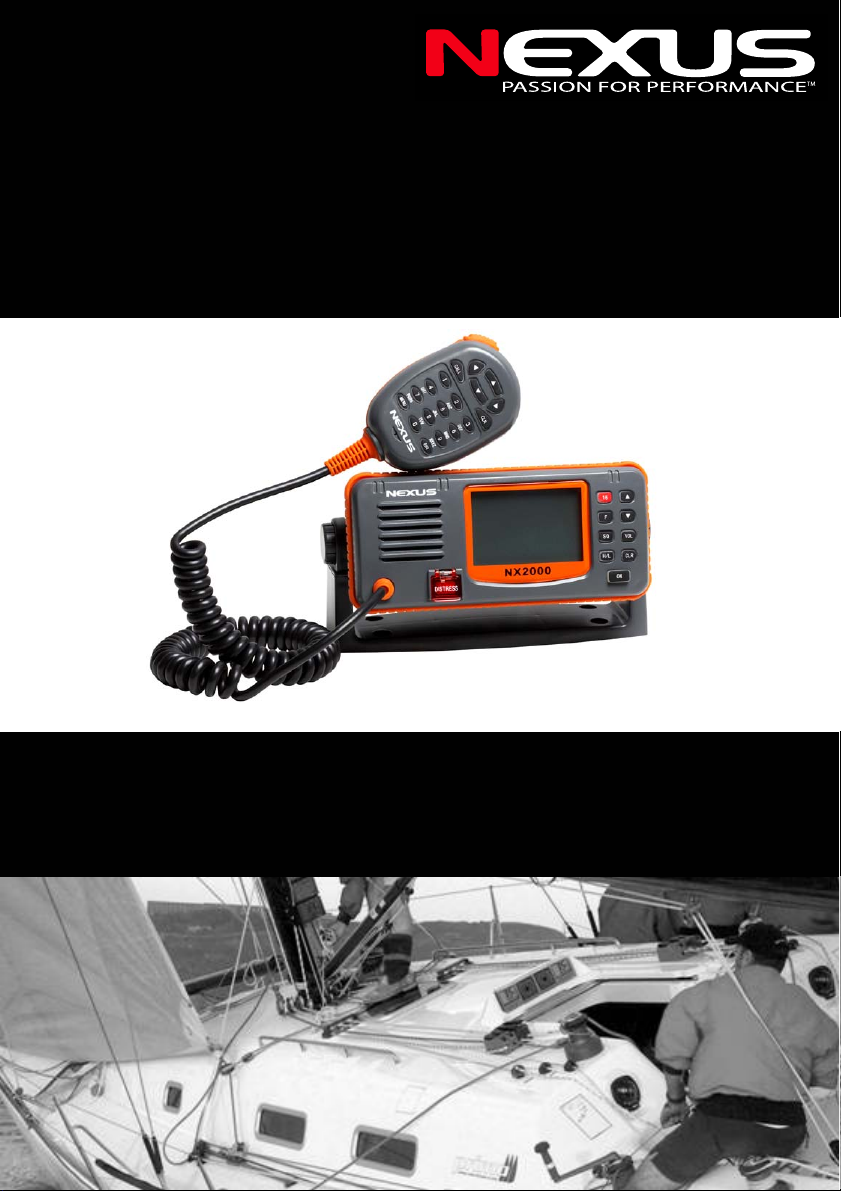
NX2000
- Marine VHF Radio -
Installation and Operation Manual
Installation and Operation Manual
English
English
Page 2

VHF NX2000 English
1
Page 3

English VHF NX2000
Contents
1 OPERATION RULES .........................................................................................4
1.1 Priorities .........................................................................................................4
1.2 Privacy ...........................................................................................................4
1.3 Radio licenses................................................................................................4
1.3.1 Ship station license ....................................................................................4
1.3.2 Operator’s license ......................................................................................4
2 INTRODUCTION ................................................................................................5
3 PANEL DESCRIPTION ......................................................................................6
3.1 Front panel .....................................................................................................6
3.2 Back panel .....................................................................................................7
3.3 LCD Display ...................................................................................................8
4 FIST MICROPHONE/CONTROLLER.................................................................9
4.1 Soft Keypad (0 - 9) .........................................................................................9
5 GENERAL OPERATION ..................................................................................11
5.1 DUAL WATCH (DW) ....................................................................................11
5.2 Full Scan (FS) ..............................................................................................12
5.3 Memory Scan (MS) ......................................................................................12
5.4 Tag Channel.................................................................................................12
5.5 Squelch Control............................................................................................12
5.6
Volume Control (VOL)..................................................................................13
5.7 Channel 16 (16) ...........................................................................................13
5.8 Channel Selection (▲/▼).............................................................................13
5.9 HIGH / LOW Power Selection (H/L) .............................................................14
5.10 Time Out Timer ............................................................................................14
6 RECEIVING A DSC CALL................................................................................15
6.1 Routine Call..................................................................................................15
6.2 Urgency And Safety Call ..............................................................................15
6.3 Group Call....................................................................................................15
6.4 Distress Alert................................................................................................16
7 SENDING A DSC CALL...................................................................................17
7.1 DISTRESS CALL .........................................................................................17
7.2 Routine Call..................................................................................................18
7.3 Urgency And Safety Call ..............................................................................19
7.4 Group Call....................................................................................................20
8 LOG REVIEW...................................................................................................21
8.1 Review distress logs.....................................................................................21
8.2 Review Routine Log .....................................................................................22
9 RADIO SETTINGS ...........................................................................................24
9.1 Backlight adjustment ....................................................................................24
9.2 Contrast adjustment .....................................................................................24
9.3 Speaker selecting.........................................................................................25
9.4 Beep sound selecting...................................................................................25
9.5 Set Date And TimE ......................................................................................26
10 DSC Setting.....................................................................................................27
10.1 Enter and view MMSI ...................................................................................27
10.2 Set Group Id.................................................................................................28
2
Page 4

VHF NX2000 English
10.3 Set Manual Position/UTC............................................................................. 28
10.4 Set Work Channel........................................................................................ 29
10.5 Set The Directory......................................................................................... 30
11 EXPANSION CHANNELS................................................................................ 33
12 ATIS FUNCTION.............................................................................................. 33
13 TECHNICAL SPECIFICATIONS...................................................................... 34
13.1 Receiver....................................................................................................... 34
13.2 Channel 70 Monitor General Specification................................................... 35
13.3 Transmitter................................................................................................... 35
13.4 GPS ............................................................................................................. 35
14 INTERNATIONAL VHF MARINE CHANNEL CHART...................................... 36
15 INSTALLATION ............................................................................................... 39
15.1 Unit Installation ............................................................................................ 39
15.2 Antenna Installation Recommendations....................................................... 40
16 SUPPLIED PARTS .......................................................................................... 42
17 WARRANTY..................................................................................................... 43
3
Page 5

English VHF NX2000
1 OPERATION RULES
1.1 Priorities
• Read all rules and regulations pertaining to priorities and keep an up-to-date copy
handy. Safety and distress calls take priority over all others.
• You must monitor Channel 16 when you are not operating on another channel.
• False or fraudulent distress calls are prohibited under law.
1.2 Privacy
• Information overheard but not intended for you cannot lawfully
Be used in any way.
• Indecent or profane language is prohibited.
1.3 Radio licenses
1.3.1 Ship station license
When your craft is equipped with a VHF FM transceiver, you must have a current radio
station license before using the transceiver. It is unlawful to operate a ship station which
is not licensed. Inquire through your dealer or the appropriate government agency for a
Ship-Radiotelephone license. This license includes the call sign which is your craft’s
identification for radio purposes.
1.3.2 Operator’s license
A restricted Radiotelephone Operator Permit is the license most often held by small
vessel radio operators when a radio is not required for safety purposes. The Restricted
Radiotelephone Operator Permit must be posted near the transceiver or be kept with
the operator. Only a licensed radio operator may operate a transceiver. However, nonlicensed individuals may talk over a transceiver if a licensed operator starts, supervises,
ends the call and makes the necessary log entries. A current copy of the applicable
government rules and regulations is only required to be on hand for vessels in which a
radio telephone is compulsory. However, even if you are not required to have these on
hand it is your responsibility to be thoroughly acquainted with all pertinent rules and
regulations.
4
Page 6

VHF NX2000 English
2 INTRODUCTION
The NX2000 is a Class-D Digital Selective Calling (DSC) VHF marine
transceiver. Comprised of a VHF marine Radio and a DSC contro ller,
it is very convenient and easy to use. The transceiver is a 1/25-watt,
frequency modulated waterproof transmitter/receiver for operations
on all currently allocated marine channels as well as 10 expansion
channels.
The NX2000 supports the latest GMDSS requirement for non-SOLAS vessels from the
International Maritime Organization (IMO). When connected with a GPS, it will display
the position and Universal Time Coordinate (UTC) of your vessel.
The NX2000 lets you make digitally selected calls, which are quicker and simpler to
make compared with conventional voice calls using channel 16. Should a distress,
urgency or safety situation occur, you can depend on the NX2000 to raise an alert
quickly, thereby indicating your identity and position automatically through a distress
communication on the emergency voice channel.
NEXUS MARINE AB operates a policy of continual development and reserves the right
to alter and improve the features/specification of their products without prior notice.
5
Page 7
English VHF NX2000
3 PANEL DESCRIPTION
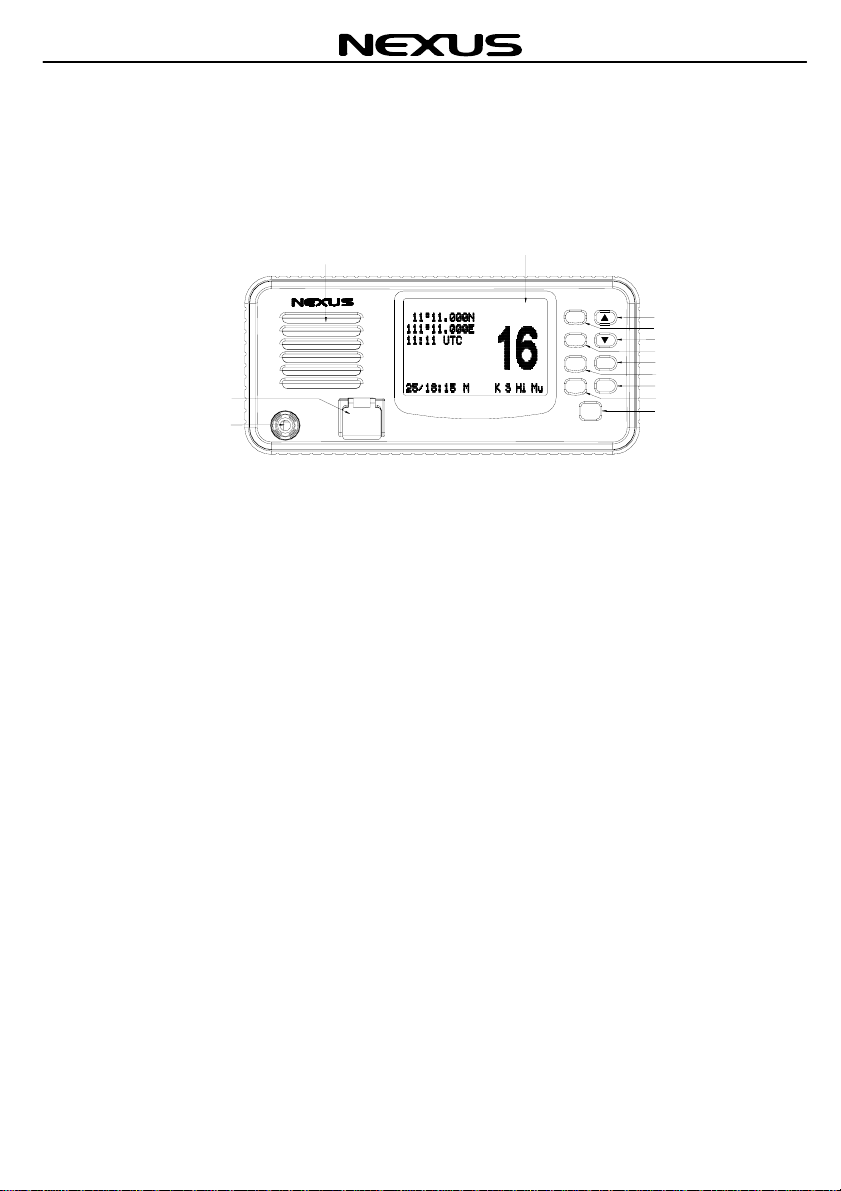
3.1 Front panel
(11)
(12)
(13)
DISTRESS
NX2000
1. POWER SWITCH (ON)
Press the (ON) button once to switch on the NX2000.
To switch off, press the (ON) button again.
2. HIGH/LOW POWER KEY (H/L)
Select an output power of RF.
3. CLEAR KEY (CLR)
Stops current task and returns to the main screen.
4. SQUELCH MODE SELECTION KEY (SQ)
5. VOLUME CONTIOL MODE SELECTION KEY (VOL)
6. FUNCTION SELECT KEY (F)
This key is an aggregation of DUAL WATCH, FULL SCAN, MEMORY SCAN and
TAG CHANNEL function. To access these function by press F key and press again
to confirm.
7. DOWN KEY (▼)
Selects the desired channel, squelch control level or volume control level. Each
press selects the next lower channel number or level. Hold down this key to scroll
downwards through all selectable channels.
8. CHANNEL 16 KEY (16)
Press this key and return to channel 16 immediately from any channel or function.
9. UP KEY (▲)
(10)
16
F
SQ
H/L
ON
(9)
(8)
(7)
(6)
VOL
(5)
(4)
CLR
(3)
(2)
(1)
6
Page 8
VHF NX2000 English
Selects the desired channel, squelch control level or volume control level. Each
press selects the next higher channel, number or level. Hold down this key to
scroll upward through all selectable channels.
LIQUID CRYSTAL DISPLAY (LCD)
Dot Matrix display, giving up to 8 lines of information.
11. SPEAKER
12. DISTRESS CALL BUTTON
The distress button is located under a spring-loaded cover that must be lifted
before the button can be pressed.
13. FIST MICROPHONE/CONTROLLER CORD
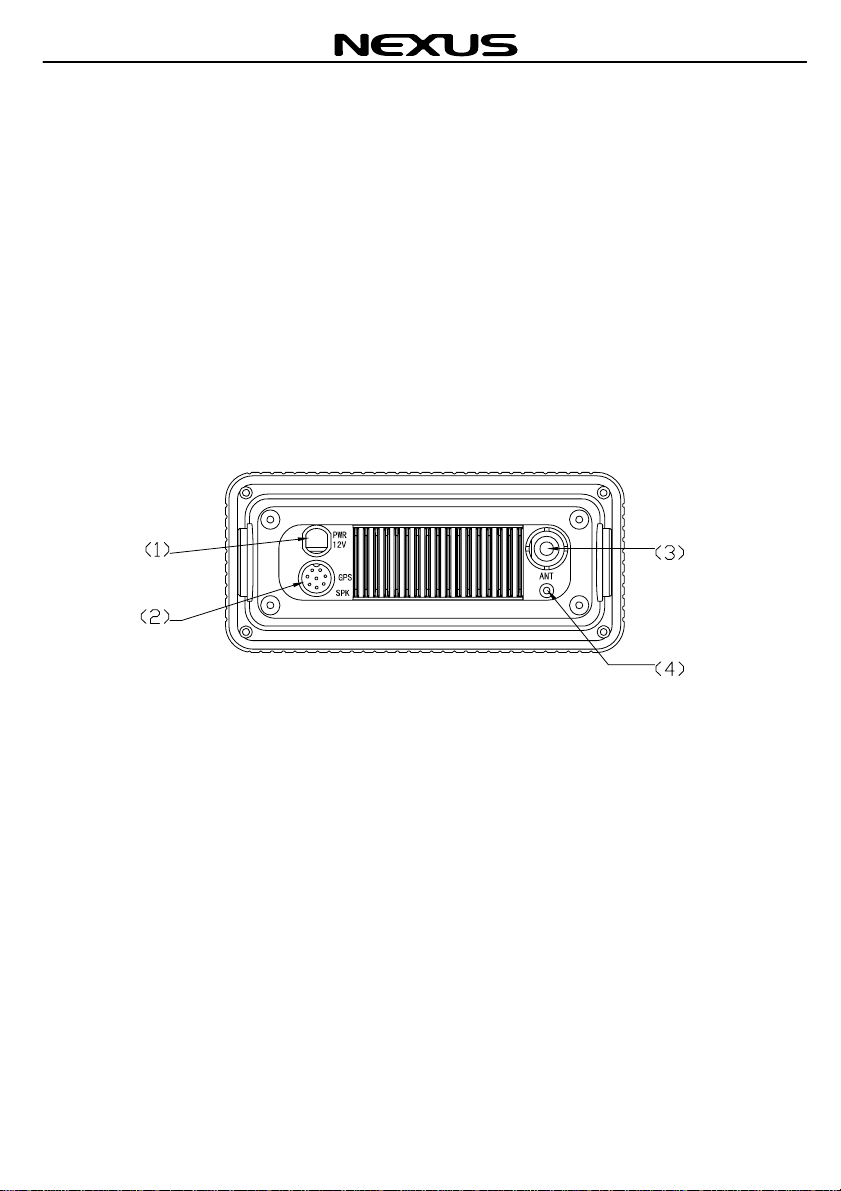
3.2 Back panel
1. POWER CORD
2. GPS and EXT.SP socket.
3. ANTENNA
4. Ventilation Hole
Should the display show signs of misting up, remove this screw and
ventilate the unit until the mist is cleared. Upon completion, insert the screw
and tighten once again.
Note : To ensure your NX2000 maintains its water-proof integrity, please
make sure the water-proof plastic washer is properly inserted before the
screw; the screw should be fully tightened to prevent water ingress.
7
Page 9
English VHF NX2000
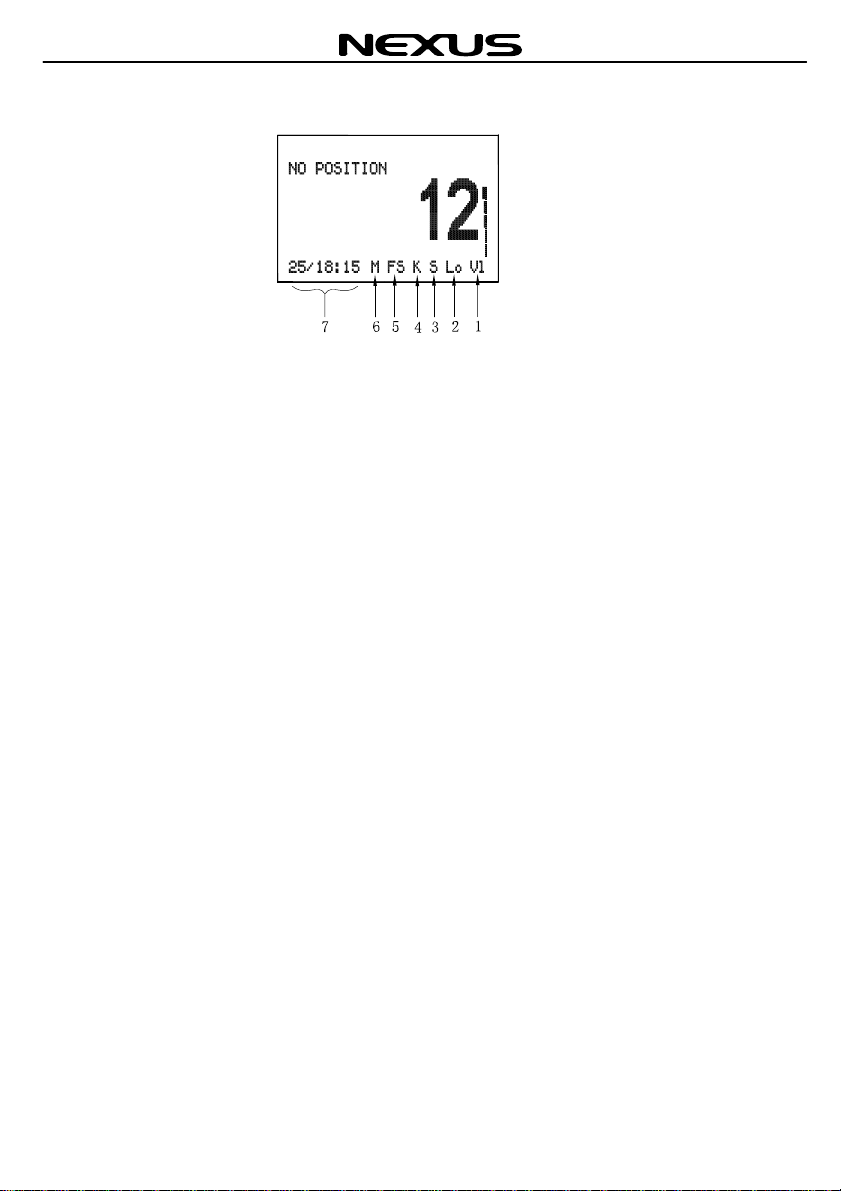
3.3 LCD Display
GROUP 1
VL Volume control activated, the Bar indicates the volume level.
Sq Squelch control activated, the Bar indicates the squelch level.
Mu Appears when the squelch opens.
RX The Radio is in receptive state (RX) and when receiving a signal.
TX The Radio is transmitting (TX).
GROUP 2
Hi Indicates Transmitter maximum output power is 25W.
Lo Indicates Transmitter maximum output power is 1W.
GROUP 3
S Indicates the displayed channel is a simplex channel.
D Indicates the displayed channel is a duplex channel.
GROUP 4
I Indicates the international channels are selected.
K Indicates the international channels + UK M1 and M2 channels are
selected.
U Indicates the USA channels are selected.
C Indicates the Canada channels are selected.
A Indicates the ATIS channels are selected.
S Indicates the ATIS SEA channels are selected.
GROUP 5
DW Indicates dual watch is in operation.
FS Indicates full scanning of every channel in current channel list is in operation.
MS Indicates scanning of the selected memory channels is in operation.
GROUP 6
M Indicates the displayed channel is a tagged channel for memory scan.
GROUP 7
Date/hours: minutes
8
Page 10
VHF NX2000 English
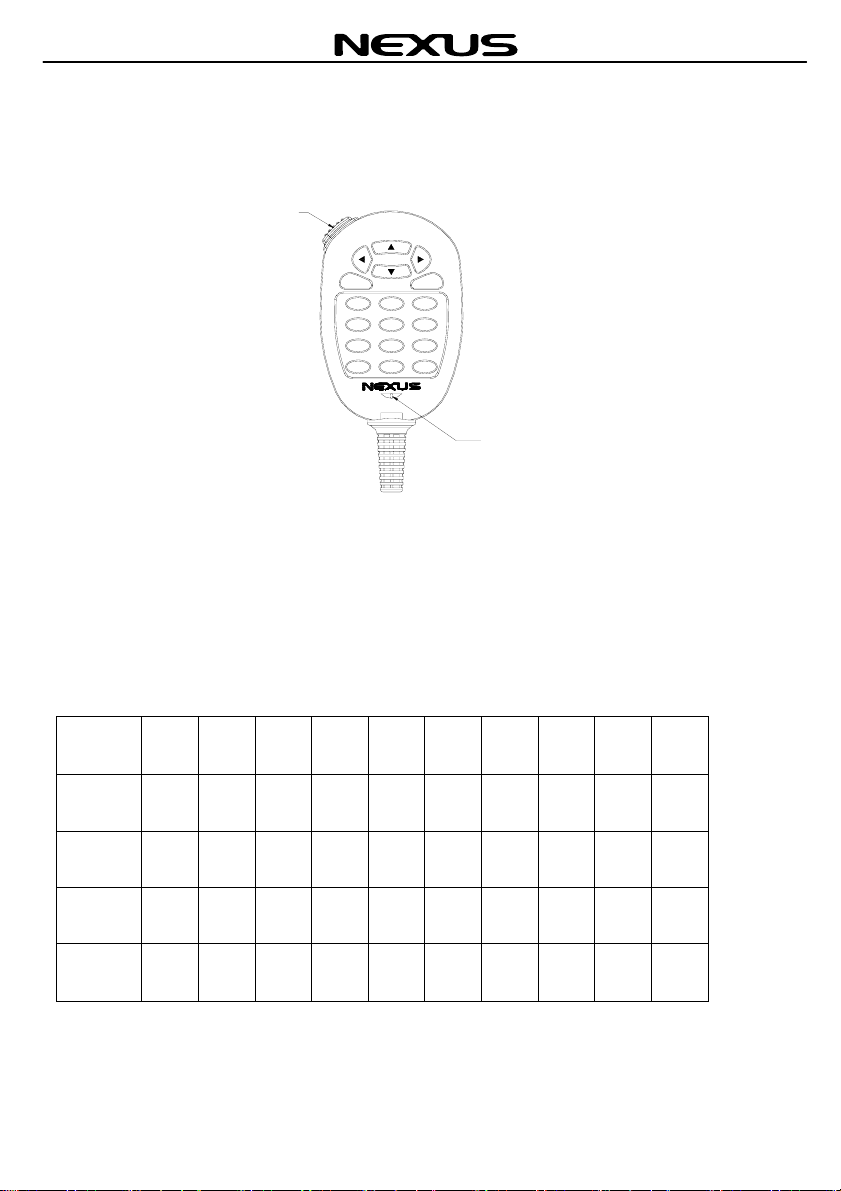
4 FIST MICROPHONE/CONTROLLER
The fist microphone/controller has the microphone, Push to Talk (PTT) switch and soft
keypad as illustrated below:
4.1 Soft Keypad (0 - 9)
The telephone style keypad ITU 0 – 9 / A - Z is used for entering numeric data. When
required, the keys will automatically switch to character mode allowing letters, numbers
and punctuation marks to be entered. Repeatedly pressing a key will cycle through the
characters available on that key.
Number 1 2 3 4 5 6 7 8 9 0
PTT
1
4 5
GHI
PQRS7TUV
MENU
CLRCAL L
3
2
ABC
DEF
6
JKL
MNO
8
9
WXYZ
ENT
0
Mi cr ophone
1 press — A D G J M P T W
2 press , B E H K N Q U X
3 press C F I L O R V Y
4 press / ” ’ S & Z %
5 press 1 2 3 4 5 6 7 8 9 0
9
Page 11

English VHF NX2000
ENTER KEY (ENT)
Confirms the action.
CLEAR KEY (CLR)
Stop tasks and returns to main screen or returns to the last screen.
◄ / ► Key
Used to select stored numbers and names as marked by the cursor, or to select
through the call log.
▲/ ▼ KEY
Use to select working channel (Up or Down). Can also be used to select stored working
channels. Allows viewing of next or previous message and selection next or previous
item.
PTT BUTTON
Keys the transmitter allowing you to transmit a message.
(CALL) KEY.
Activates “CALL” menu.
(MENU) KEY
To activate a menu that consists of RADIO SETTING, DSC SETTING and LOG
REVIEW function.
10
Page 12
VHF NX2000 English
5 GENERAL OPERATION
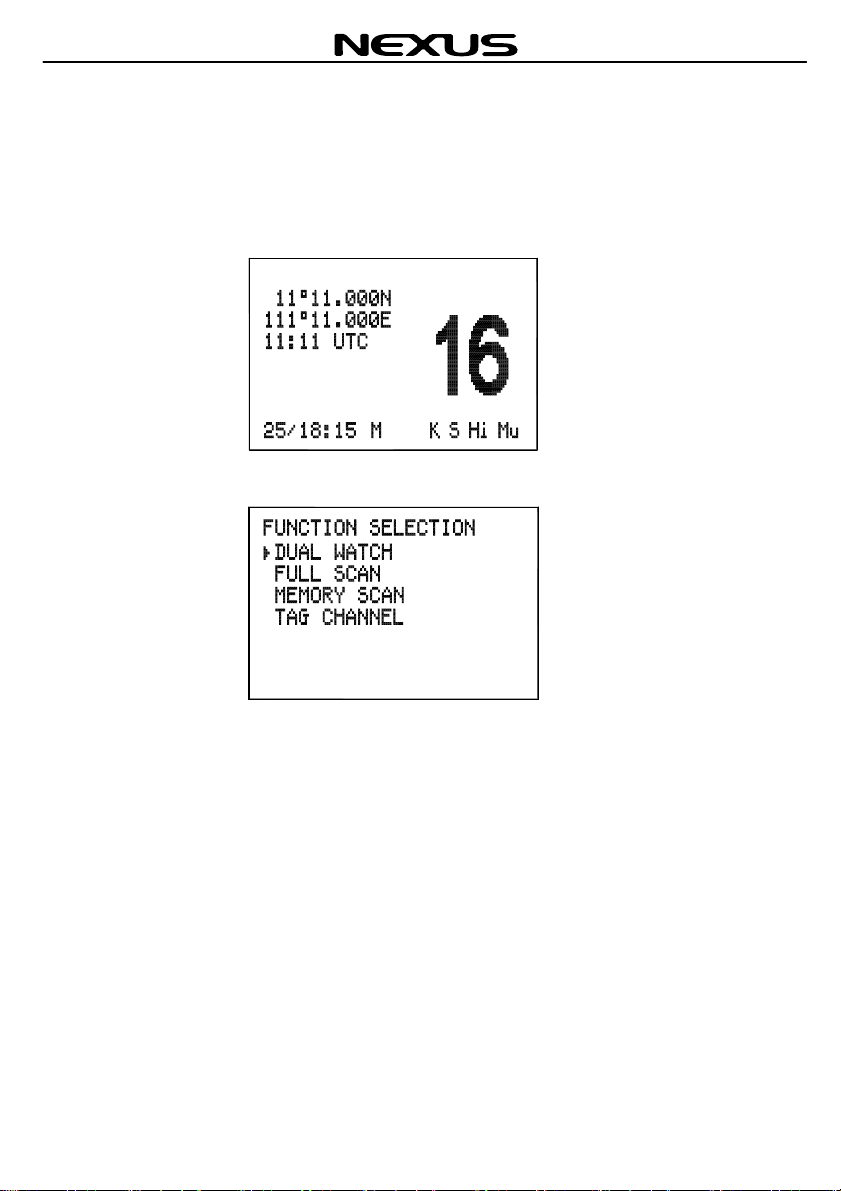
The NX2000 is switched on by pressing the (ON) key once. If a GPS receiver has been
connected to the NX2000, the MAIN screen will be as below:
Press the (F) key on the front panel once to enter the Function Selection mode. The
FUNCTION SELECTION screen will be displayed as below:
Press the ▲ or ▼ key to move the cursor to the required function (DUAL WATCH,
FULL SCAN, MEMORY SCAN, TAG CHANNEL), then press (F) key to confirm. The
relevant screen will be displayed. Press (F) key again or press (16) key to restore
normal operation, and press (CLR) key to change to the main screen.
5.1 DUAL WATCH (DW)
Dual Watch enables the Radio to scan between the selected channel and priority
channel (normally CH16). In Dual Watch mode, the DW indicator will appear on the
bottom line of the LCD.
Note that the Radio will not transmit, nor will alternative channels be able to be selected
while in Dual Watch mode. To restore normal operation press (F) key again or press
channel (16) key.
11
Page 13
English VHF NX2000
5.2 Full Scan (FS)
This function scans through each channel sequentially until a signal is detected above
the squelch level set. Once the signal ends or drops below the squelch level, the Radio
will continue scanning. Alternatively, you can instruct the NX2000 to continue scanning
even if a signal has been detected on any particular channel by pressing the ▲ key
once. When in Full Scan mode, FS will appear on the bottom line of LCD.
Note that the Radio will not transmit, nor will alternative channels be able to be selected
while in Full Scan mode. To restore normal operation press (F) key or press channel
(16) key.
5.3 Memory Scan (MS)
The Memory Scan operates in the same way as the Full Scan, except that it will only
scan channels that have been entered into the Scan Memory. If no channels have been
entered into the memory then this function will not be available.
When in Memory Scan mode, “MS” will appear on the bottom line of the LCD.
5.4 Tag Channel
This function is to tag or cancel tag on a channel, which means select or unselect a
channel for Memory Scan. If a channel is tagged then the “M” indicator will appear on
the bottom of LCD.
To tag a channel, enter the desired channel number on the Microphone controller and
press “F” on the front panel. Select TAG CH and press “F” again. To delete the tag for a
channel, repeat the procedure above.
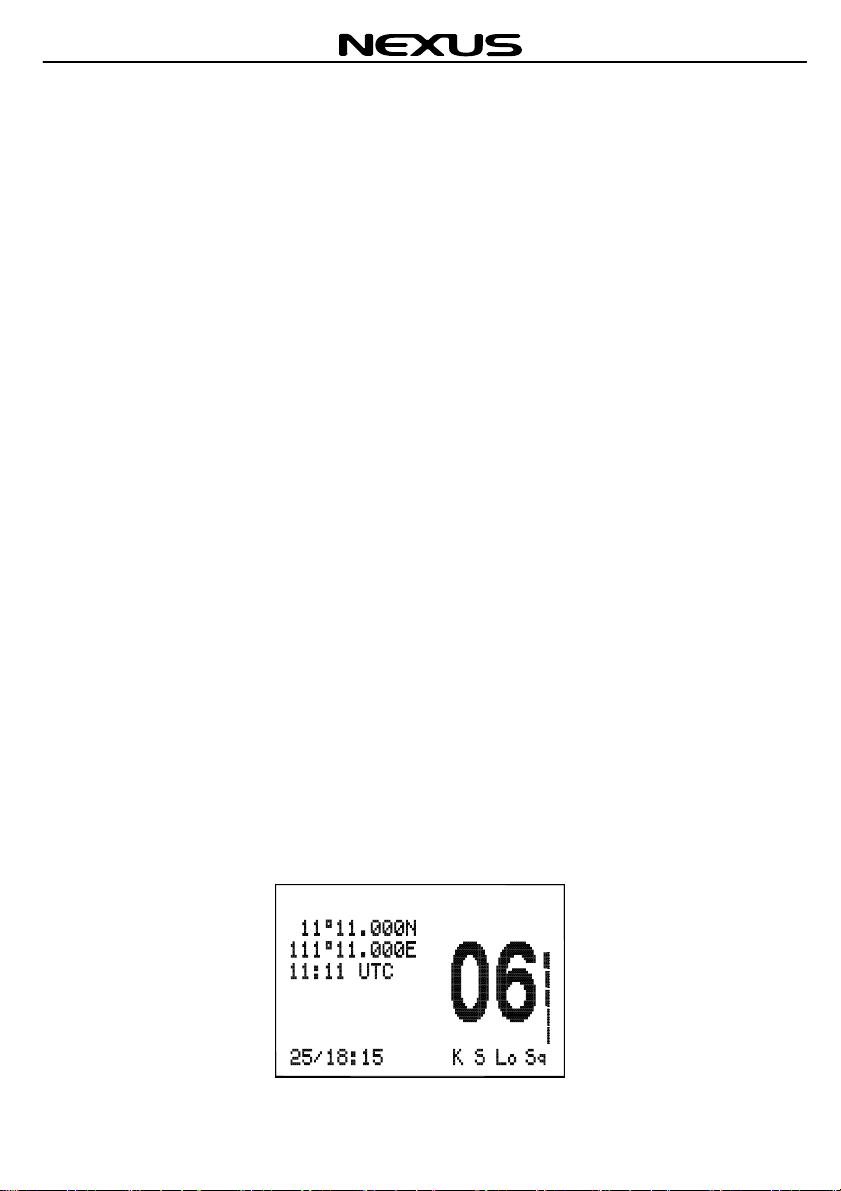
5.5 Squelch Control
When the (SQ) key on the front panel is pressed, the squelch level bar and “Sq” symbol
will appear at the right side of the screen as below:
12
Page 14
VHF NX2000 English
Then use ▲ and ▼ key on the front panel to adjust the receiver muting threshold
(squelch) level.
To cut out weaker signals, press ▲ key to increase the squelch until the background
interference noise disappears. To receive weaker signals press ▼ key to decrease the
squelch.
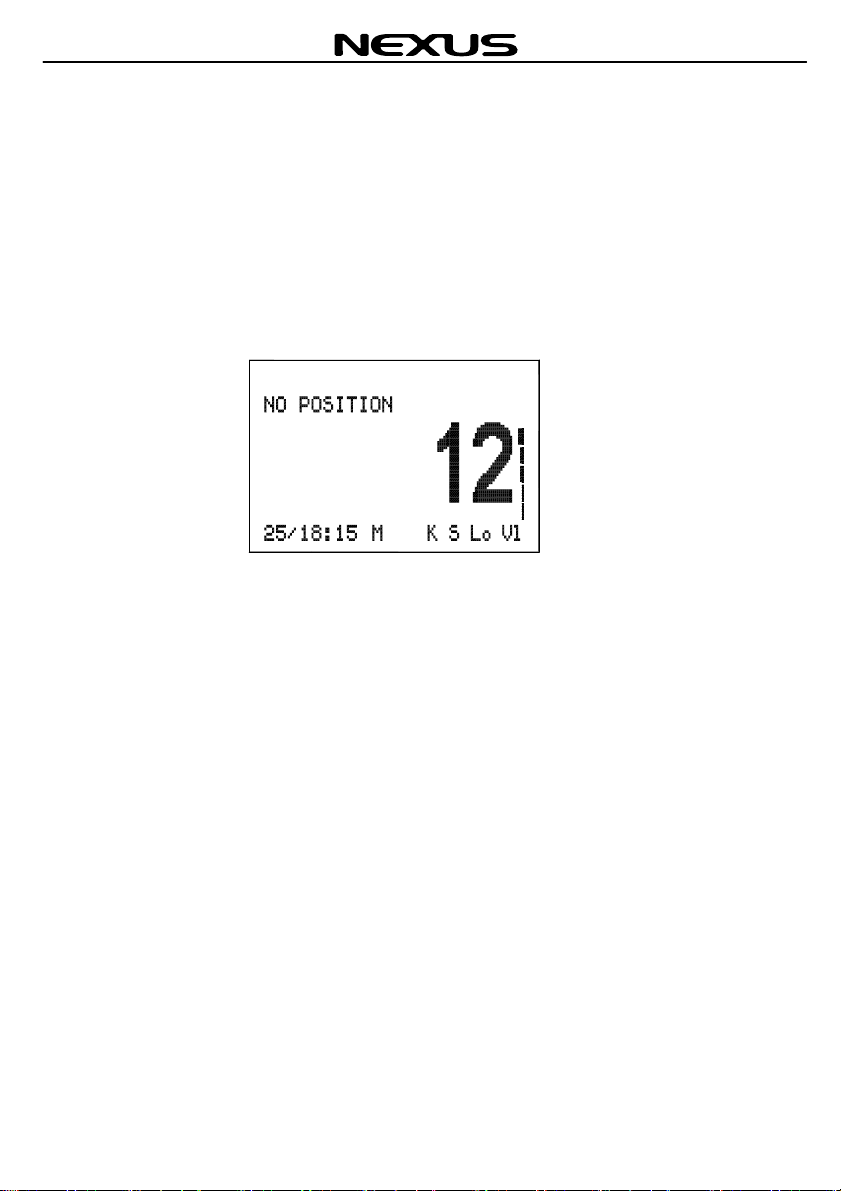
5.6 Volume Control (VOL)
Press the (VOL) key on the front panel, the volume control screen will be displayed.
The level bar and character “VL” will appear on the right side of the screen as below:
Press ▲ key to increase the volume. Press ▼ key to reduce the volume.
5.7 Channel 16 (16)
Pressing the (16) key will automatically select channel 16 on high power. Any active
function (DUAL WATCH, DSC SETTING, LOG VIEW etc) will be cancelled.
5.8 Channel Selection (▲/▼)
Press ▲ key to go up through the channels. Press ▼ key to go down through the
channels.
Channel Selection Shortcut:
Select the desired channel directly from the main screen by pressing the channel
number on the fist microphone/controller, and then press “ENT” to confirm.
13
Page 15

English VHF NX2000
5.9 HIGH / LOW Power Selection (H/L)
Press (H/L) key to select high or low output power of RF. A “Hi” or “Lo” indicator will
appear on bottom of LCD.
5.10 Time Out Timer
A time out timer is provided to prevent continuous transmissions for periods greater
than 5 minutes. In the event that the radio will be needed to transmit for periods longer
than 5 minutes, it will be necessary to release the PTT briefly before the 5 minute timer
expires.
WARNING
1) Users can press the PTT once again after 5 minutes to continue the transmission.
But the radio should be placed somewhere which nobody can touch it to avoid
scalding injury.
2) The life of the radio set will be shortened by long time continuous transmission.
14
Page 16
VHF NX2000 English
6 RECEIVING A DSC CALL
When a DSC call is received, the Radio will switch to the call log screen to display the
details of the call and ring or sound the alarm depending on the nature of the call. The
procedures hereunder describe how to handle the types of calls that can be received.
6.1 Routine Call
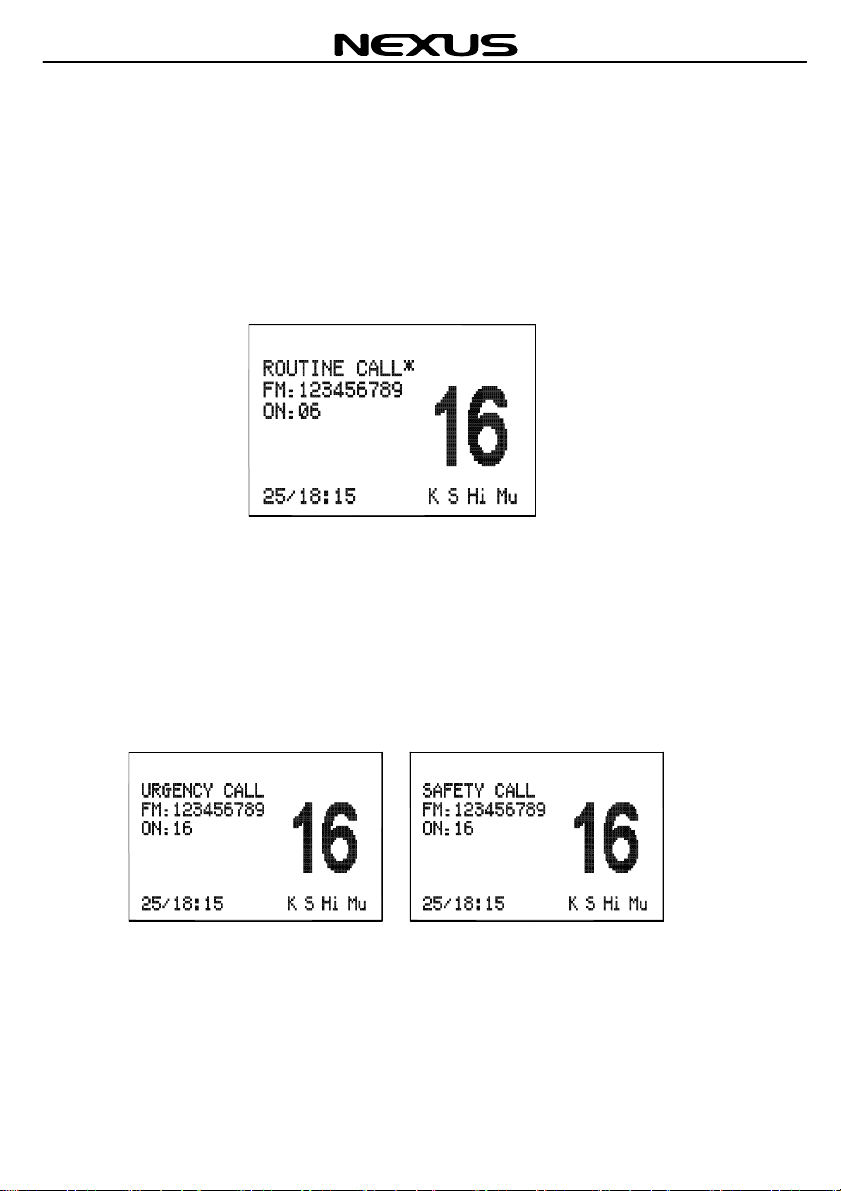
When a Routine Call is received, an alarm will sound and the screen will show the
details of the call, where it is from and the working channel, as below:
Press the (ENT) key on the fist microphone/controller keypad, an acknowledgement will
be sent to the caller and the Radio will be automatically switched to working channel for
normal voice communication. The “*” will disappear when the call has been
acknowledged.
6.2 Urgency And Safety Call
The procedures for Urgency and Safety Calls are very similar. An urgency call will
sound the distress alarm and switch the Radio to Channel 16. A safety call will sound a
normal ring and switch the Radio to channel 16 too.
Press the (ENT) key to stop the alarm (or ringing), and then listen for the voice
message.
6.3 Group Call
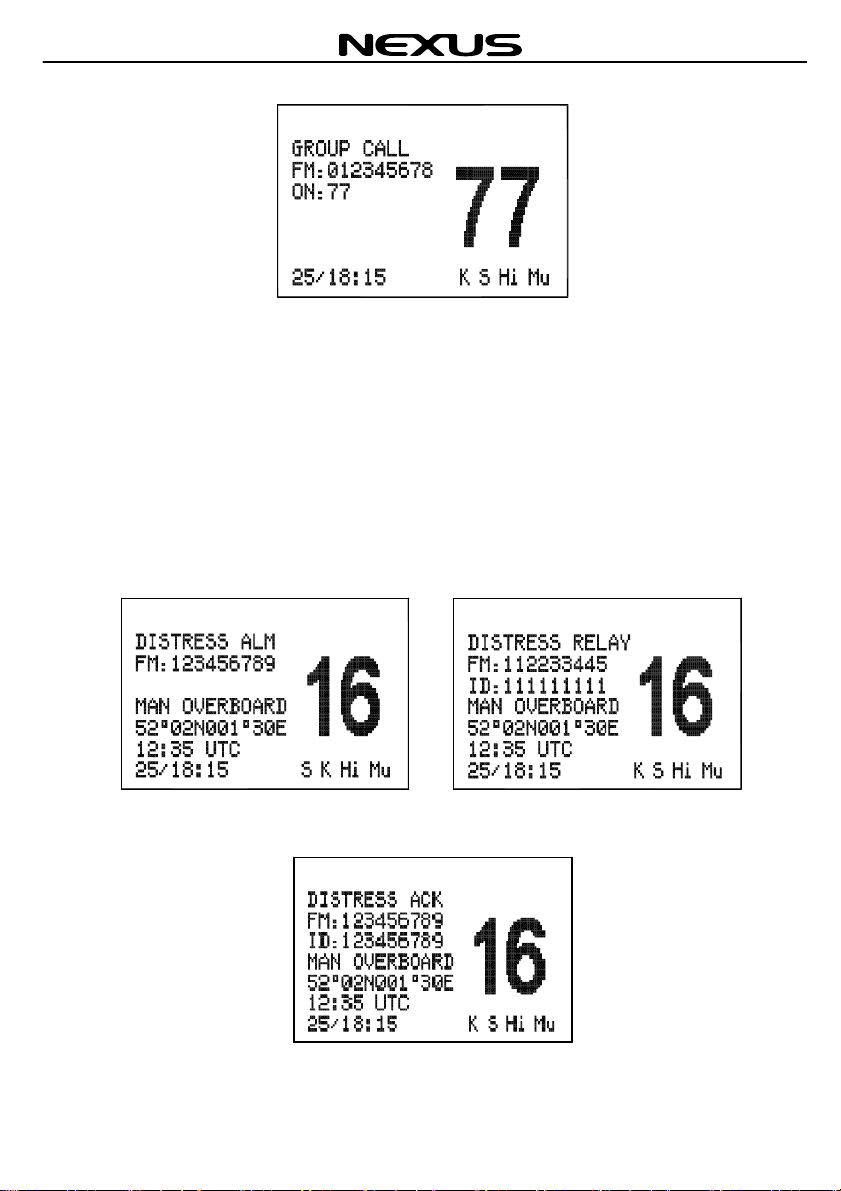
When a Group Call is received, the Radio will ring and display the details of the call,
indicating whom it is from and the working channel as below:
15
Page 17
English VHF NX2000
Press (ENT) key to stop the ringing, then listen for the voice message or begin
speaking.
6.4 Distress Alert
If a Distress Alert or a Distress Relay is received from another vessel, an alarm will
sound and the Radio will switch to channel 16. The screen will show the details of the
Distress Alert or Distress Relay, the MMSI (Maritime Mobile Service Identifier) of the
vessel, the nature of the distress, its position and time, mute the alarm by pressing
(ENT) key and maintain a listening watch on channel 16 for the distress messages.
Press (CLR) key to clear the display.
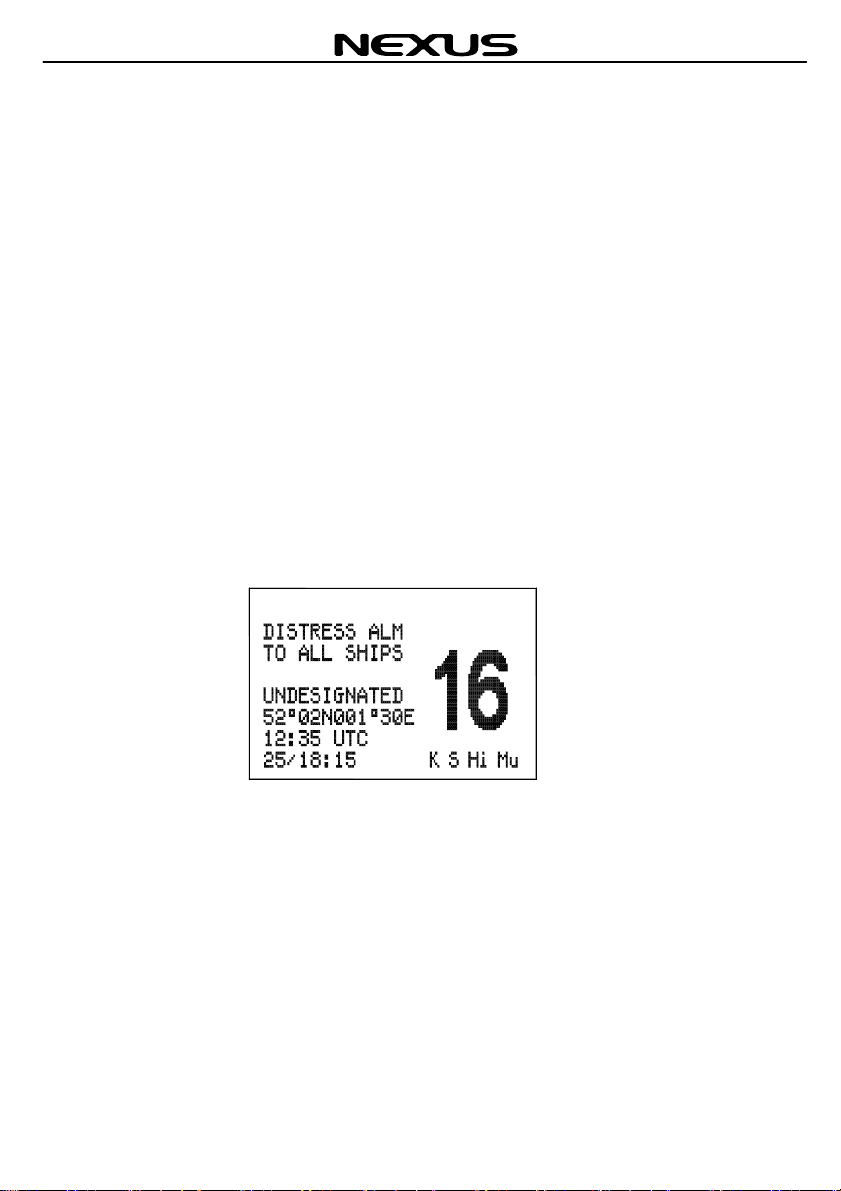
When the distress Alert Call is cancelled, the Radio will sound “B,B”, and the screen of
it will show as below:
16
Page 18
VHF NX2000 English
7 SENDING A DSC CALL
Making a DSC Call is very simple. First choose the call type (Routine, Safety, Urgency,
Group or Distress Alert). If required, enter the destination and working channel and then
send the call by pressing (ENT) key on the fist microphone/controller. The digital signal
will be sent out in under a second, containing the vessel’s ID and the call type.
In order for the Radio to function, your MMSI number will need to be entered. This
number can be obtained from your local Radio communications authority. For group
calls, the group ID will need to be entered also.
7.1 DISTRESS CALL
This call should only be made if the vessel is in a distress situation, and lives are
in danger.
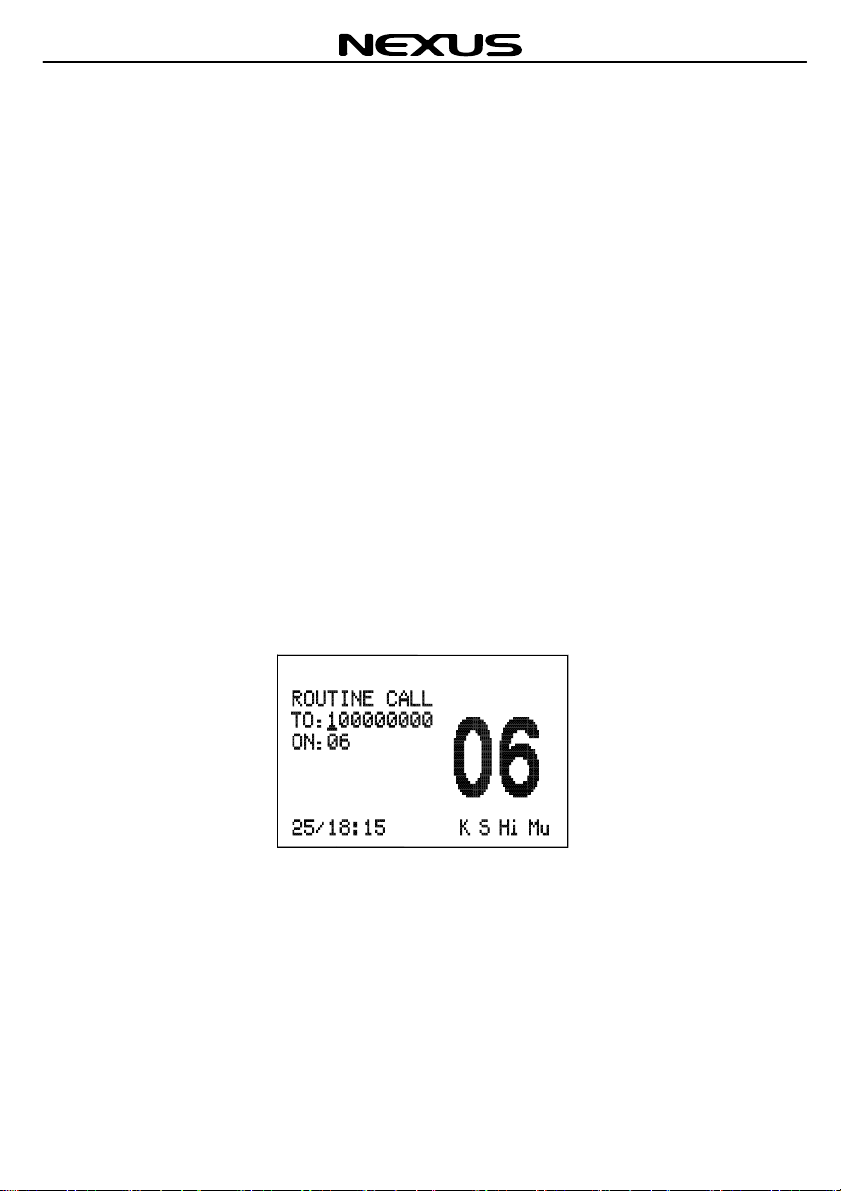
Making a Distress Alert call is very simple. Lift the protective cover and press (DIST)
key on the front panel. The Distress Alert screen will be displayed as below:
If time permits, press the ◄ or ► key to select the nature of the distress. There are 10
categories recognized as Distress Alert situations, which are: fire, flooding, collision,
grounding, listing, sinking, adrift, abandoning, piracy and man overboard. There
is also a default undesignated category, which is used if no category is selected here.
Press and hold the (DIST) key for about five seconds. A countdown to the transmission
will be displayed then an alarm will sound.
The Distress Alert transmission contains the following data:
1. The vessel’s MMSI;
2. The vessel’s position (either from the NMEA0183 input, or manually entered);
17
Page 19
English VHF NX2000
3. The time (from NMEA or Manual input);
4. The nature of the distress.
After the Distress Alert has been sent, the Radio will automatically tune to channel 16
and the Radio will repeat the Alert approximately every four minutes until either an
acknowledgement is received, or (CLR) key is pressed (it is not recommended that the
Distress Alert is cancelled manually by pressing (CLR) key unless you are requested to
do so by the rescue authorities).
While the Distress Alert remains active, an intermittent alarm will continue to sound
approximately once every 25 seconds.
When an acknowledgement is received from the Rescue Co-ordination Centre, this will
cancel the Distress Alert transmission from the Radio and automatically switch the
Radio to the required working channel. The subsequent Rescue Co-ordination will be
performed using the voice-working channel.
7.2 Routine Call
To make a Routine Call, press (CALL) key on the fist microphone/- controller to select
Routine Call. The screen as below:
Then enter the corresponding MMSI number with the keypad and select a working
channel by pressing the ▲ or ▼ key on the keypad from the channel list.
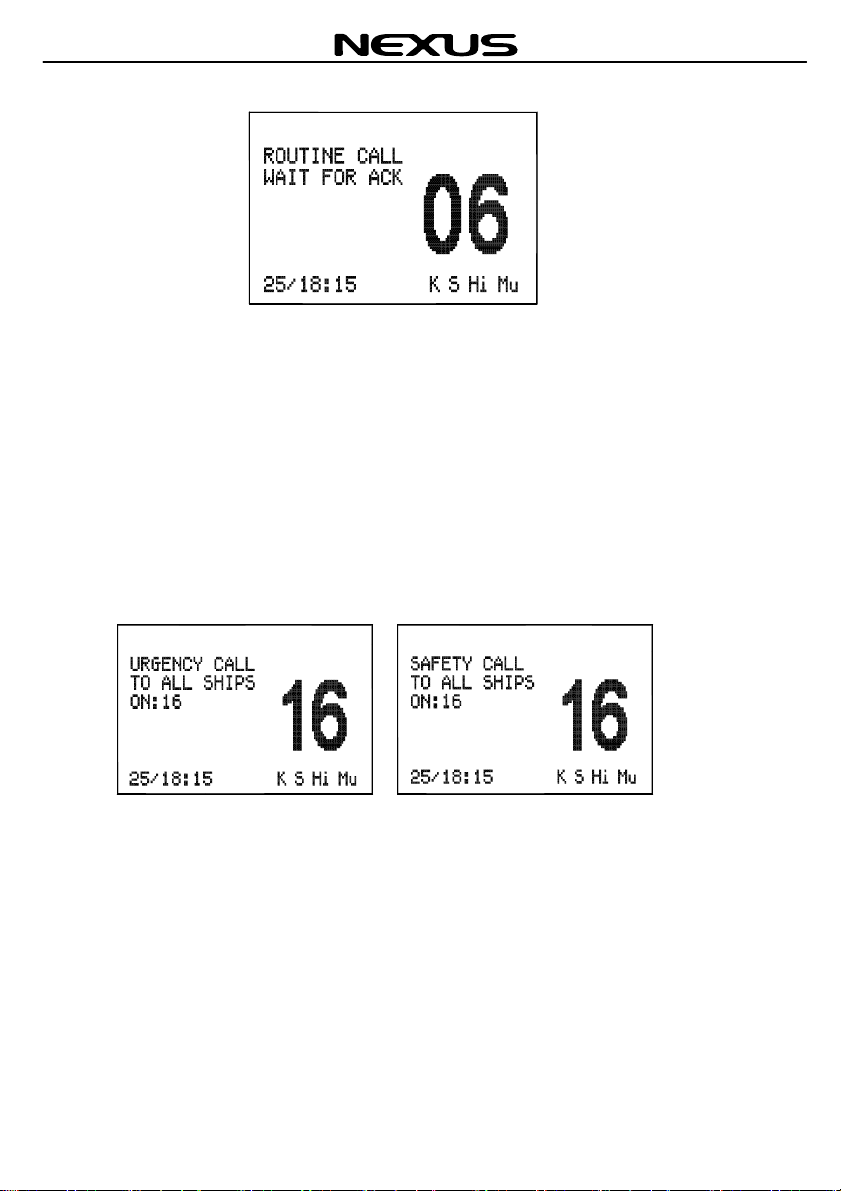
Press (ENT) key and the Radio will send a Routine Call; the Radio will change to the
following screen as you wait reply.
18
Page 20
VHF NX2000 English
When a reply is received, the Radio will sound a tone and automatically switch to the
specified working channel. A voice call can then be made in the normal way.
Note. If you have made a directory of stored MMSI numbers, you can only send a
Routine Call to someone from the Directory.
7.3 Urgency And Safety Call
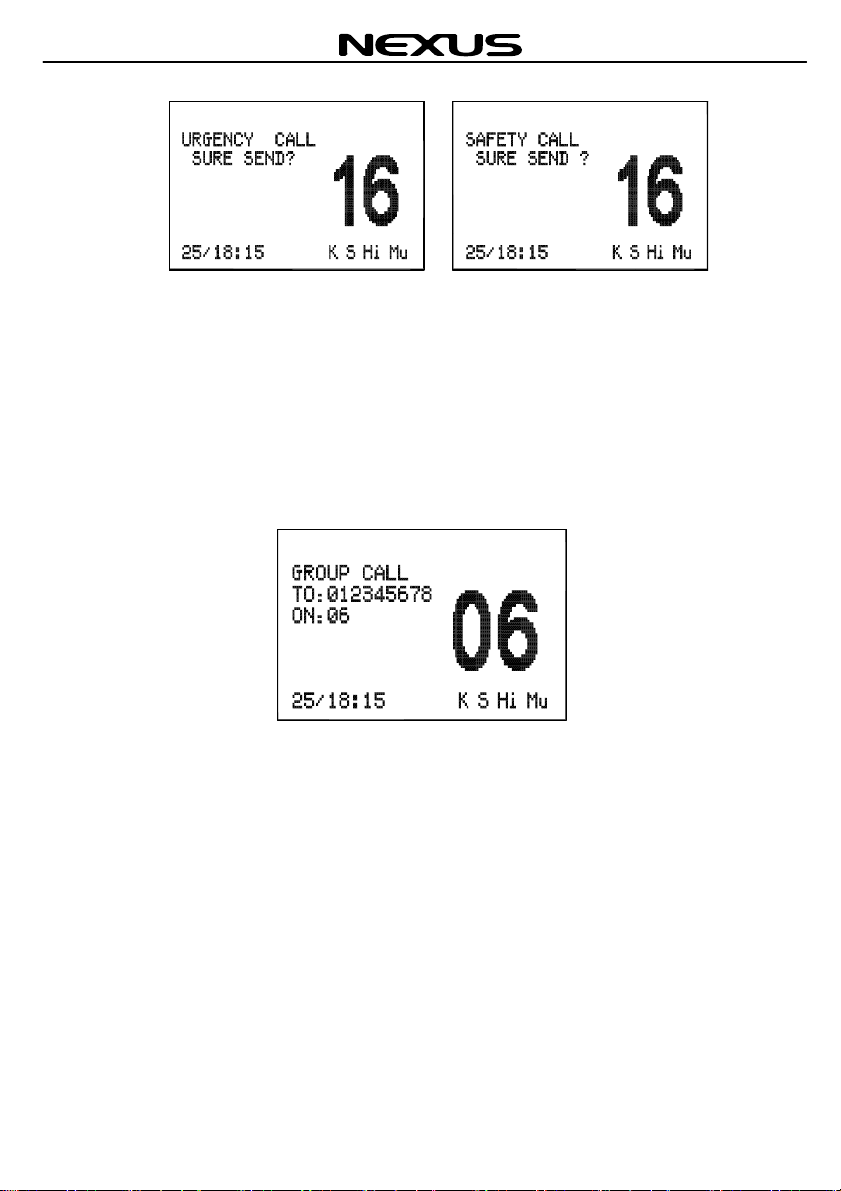
Press (CALL) key on the fist microphone/controller keypad to select Safety Call or
Urgency Call as below:
Press (ENT) key, and the screen will change to the following:
19
Page 21
English VHF NX2000
Press the (ENT) key again to make the call, or press (CLR) to cancel. When the call is
sent, the Radio will be set to the working channel 16.
7.4 Group Call
If a group ID has been set up for the called Radio. A call can be made to other
members of the group.
Press the (CALL) key on the keypad to select the GROUP CALL screen as below:
Select a working channel from the channel list by pressing the ▲ or ▼ key on the
keypad.
Press (ENT) key to send the call. Allow a few seconds for the other members of the
group to reach their Radios (all VHF Radios in the group should automatically switch to
selected working channel upon acknowledgement), then make a normal voice call.
20
Page 22
VHF NX2000 English
8 LOG REVIEW
There are 2 kinds of logs, they are DISTRESS LOGS and ROUTINE LOGS. To view
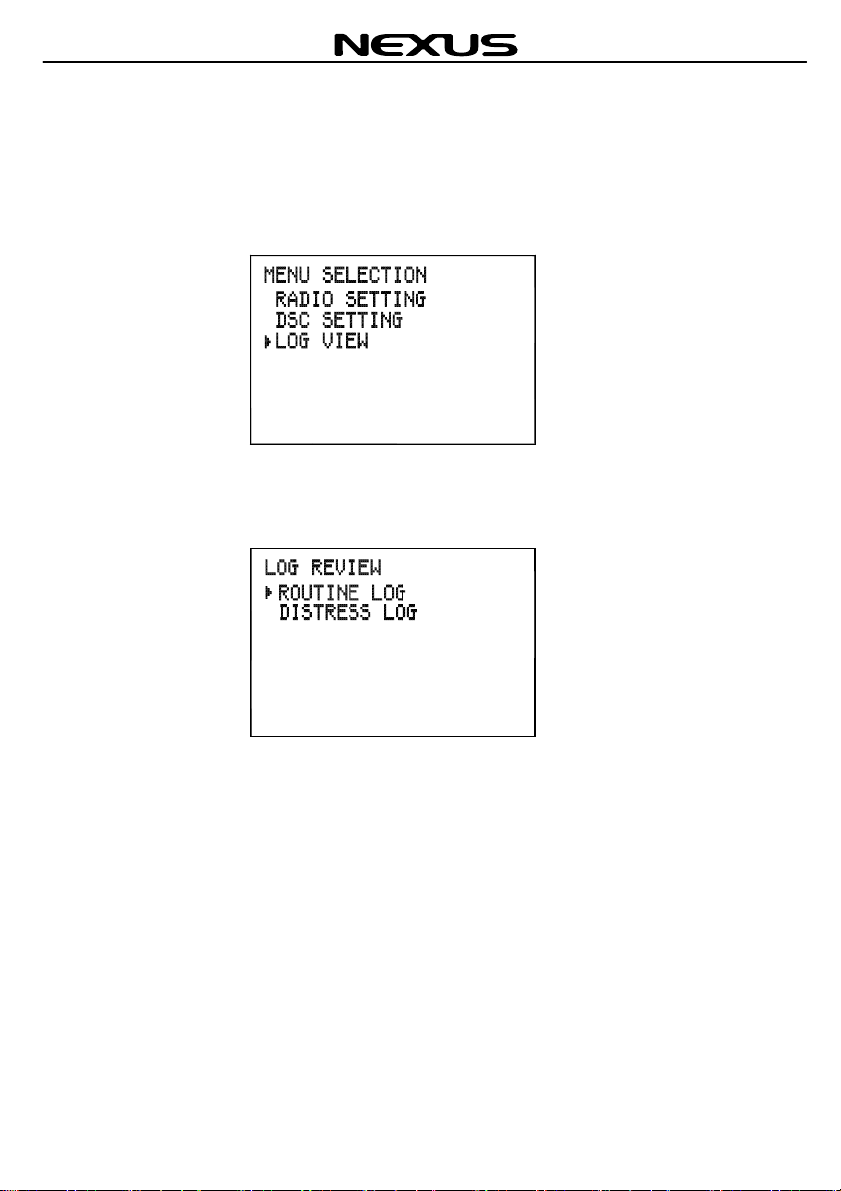
the logs, press (MENU) key on the fist microphone/controller keypad, the MENU
SELECTION screen will appear on the display as follows:
Press ▲ or ▼ key to move the symbol ► on the MENU SELECTION screen to front of
LOG VIEW, then press (ENT) key to confirm, the LOG REVIEW screen will appear on
the display as follows:
8.1 Review distress logs
The distress log can be used to look back through the previous 20 distress calls that
have been received, the most recent call first.
Press (MENU) key on the fist microphone/controller keypad to select the DISTRESS
LOG screen as below:
21
Page 23
English VHF NX2000
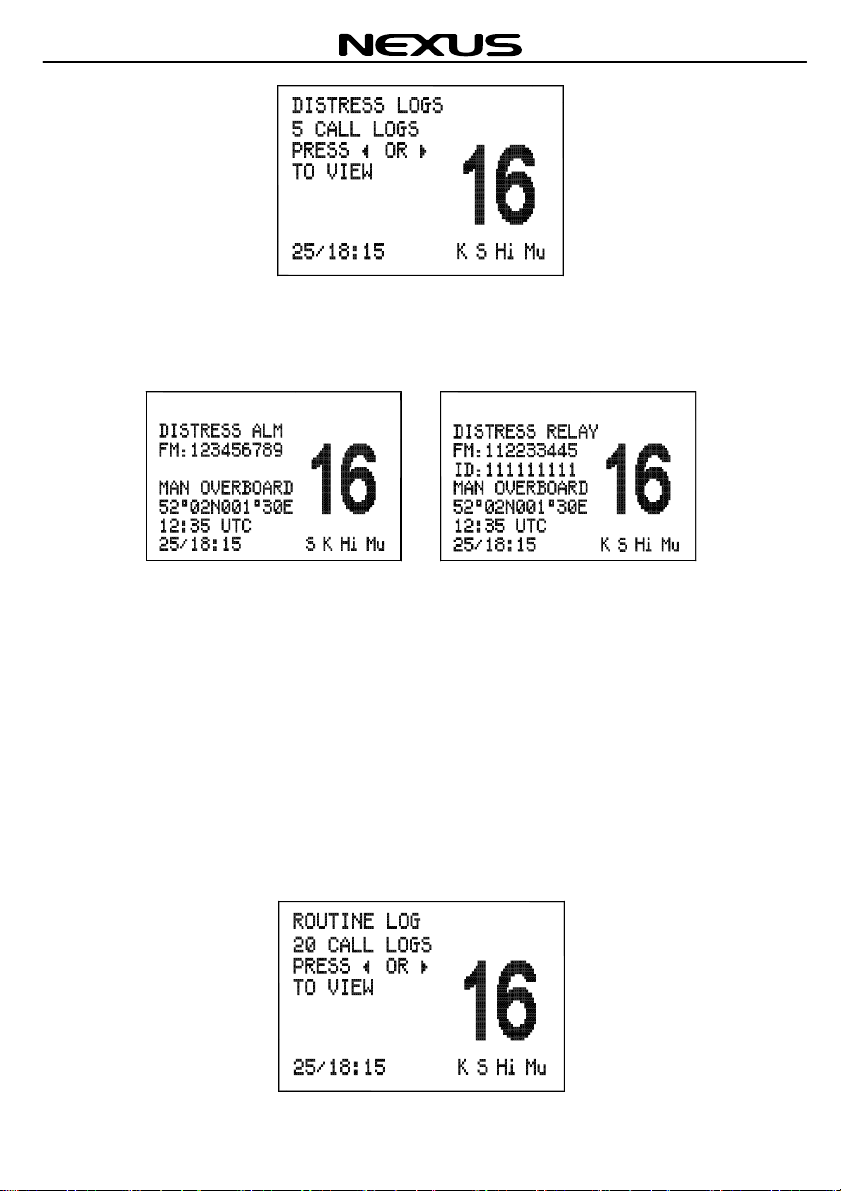
If there are any distress calls in the distress log screen, press the ◄ or ► key to move
back and forth through the DISTRESS LOG screen. The DISTRESS LOG screen as
below:
Press (CLR) key to exit the call log screen.
8.2 Review Routine Log
The routine log can be used to look back through the last 20 calls that have been
received, the most recent call first.
Press (MENU) key on the fist microphone/controller keypad to select the ROUTINE
LOG screen as below:
22
Page 24
VHF NX2000 English
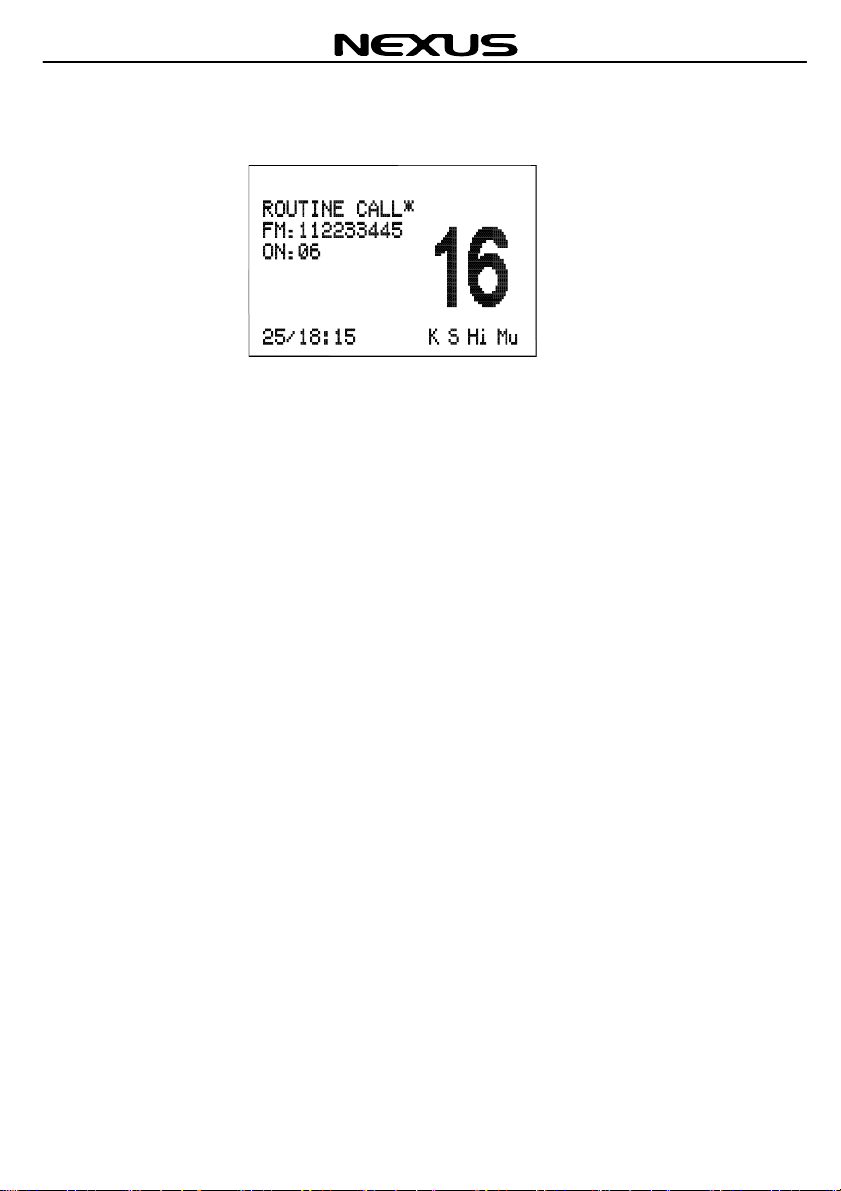
If there are any general calls in the routine log press the ◄ or ► key to move back and
forth through the log, the ROUTINE LOG screen as below:
If there is a “*” symbol on the screen, you can press (ENT) KEY to send an
acknowledgement directly to the caller. After acknowledgement, the “*” symbol will
disappear.
Press (CLR) key to exit the call screen.
23
Page 25
English VHF NX2000
9 RADIO SETTINGS
Use the instruction listed below to set up user environment.
To enter Radio settings, press MENU followed by ENT
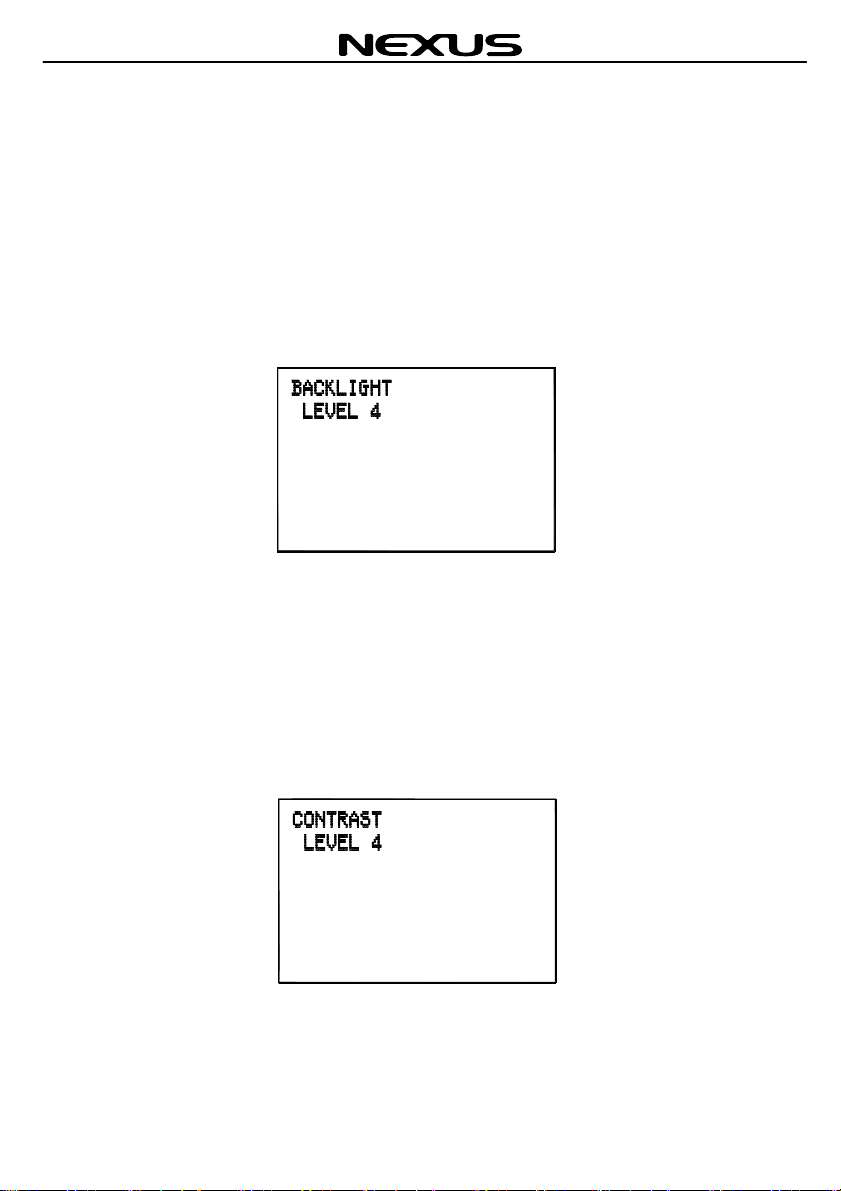
9.1 Backlight adjustment
Press “▲”“▼”on the fist microphone/controller to select BACKLIGHT option and
press (ENT) to obtain the following screen.
Then, press “▲”“▼”to adjust the brightness of backlight. There are 5 levels of
brightness. Press (ENT) for confirmation exit.
9.2 Contrast adjustment
Using “▲”“▼”on the fist microphone/controller to select CONTRAST and press
(ENT) to obtain the following screen.
Then, press “▲”“▼”to adjust the contrast of the screen. There are 6 levels of
contrast. Press (ENT) for confirmation and exit.
24
Page 26
VHF NX2000 English
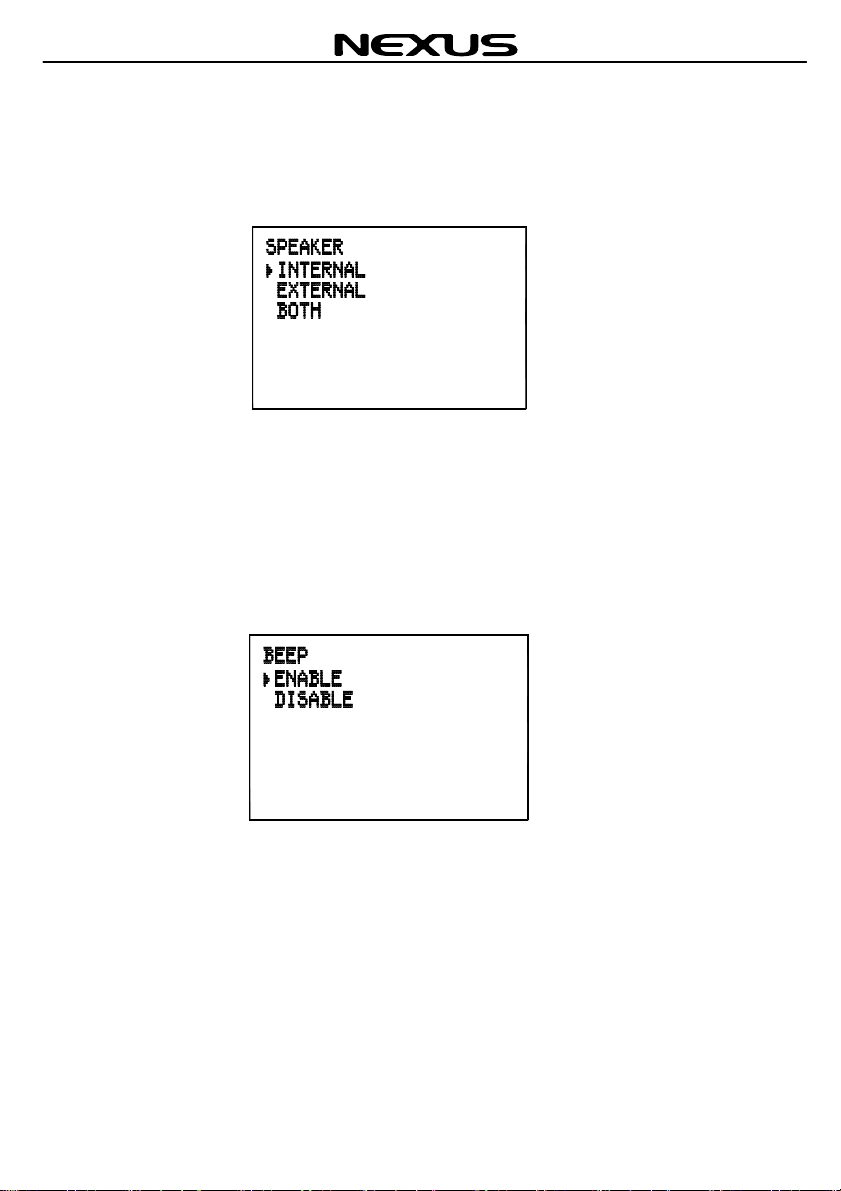
9.3 Speaker selecting
Using “▲”“▼”on the fist microphone/controller to select SPEAKER and press
(ENT) to obtain the following screen.
Then, press “▲”“▼”to select internal, external or both speaker. Press (ENT) for
confirmation and exit.
9.4 Beep sound selecting
Using “▲”“▼”to select BEEP and press (ENT) to obtain the following screen.
Then, press “▲”“▼”to select enable or disable the BEEP sound function on
pressing any key and notifying sound of NAVTEX message received. Press (ENT) for
confirmation and exit.
25
Page 27
English VHF NX2000
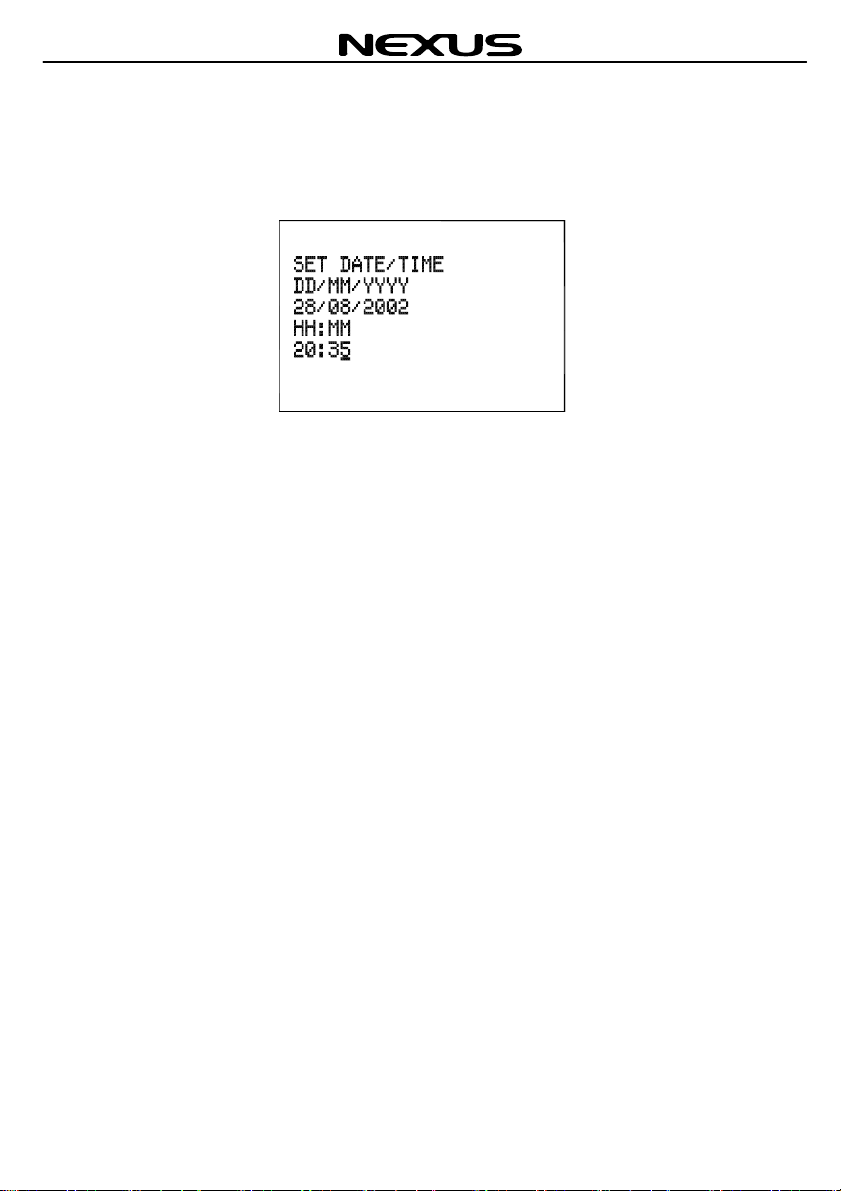
9.5 Set Date And TimE
Press ▲ or ▼ key to move the cursor on the RADIO SETTING screen to the front of
DATE/TIME, then press (ENT) key, the SET DATE/TIME screen will appear.
Use the numeric keys to enter numbers, then press (ENT) key to accept the date
and time.
Note that the time should be entered in 24 hour clock format.
26
Page 28
VHF NX2000 English
10 DSC Setting
10.1 Enter and view MMSI
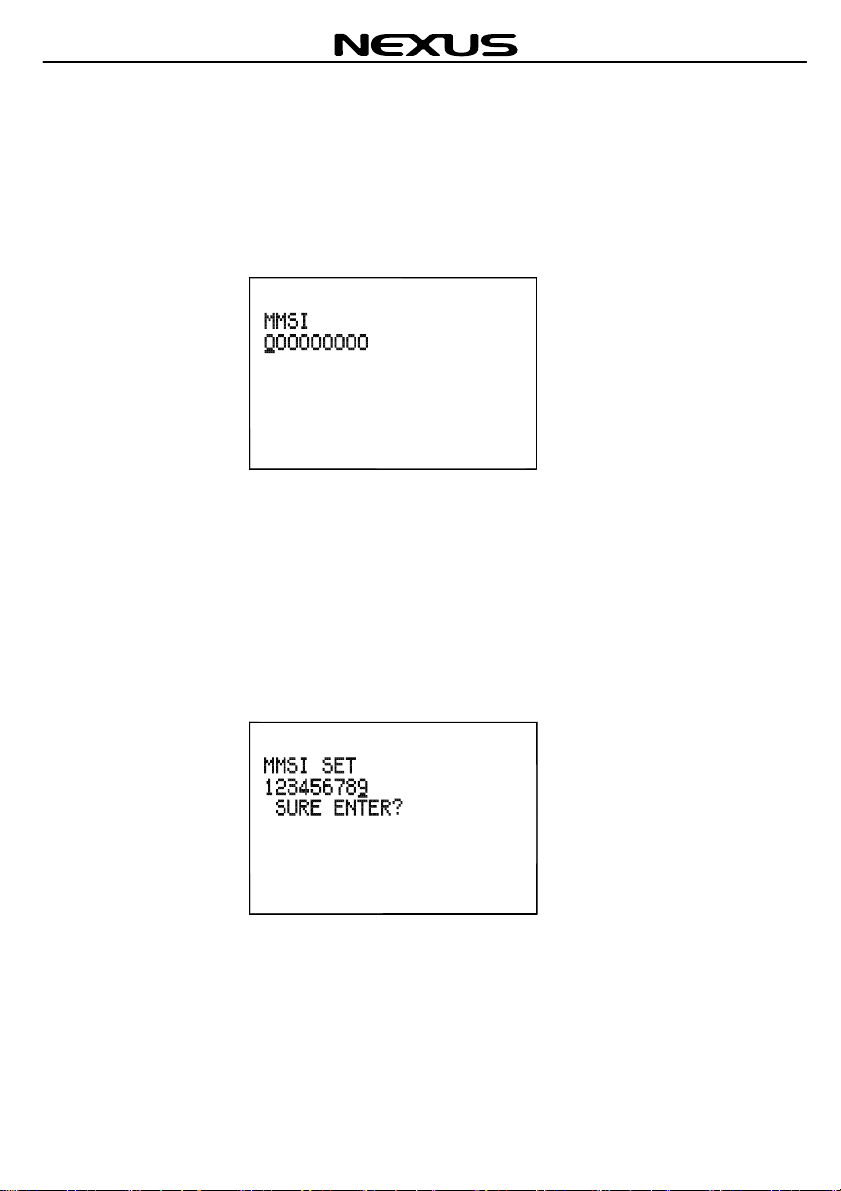
If a MMSI No. has not been entered into the NX2000, the MMSI SET screen will appear
on the display every time when the unit is switched on, as below:
If you do not have a MMSI-number, you can still use the unit, but the DSC function can
not be used, and every time when the NX2000 is switched on, it will be asked to enter
the MMSI number.
Switch on the unit, then press numeric key on the fist microphone/controller to enter the
MMSI number (9-digit). This number can be obtained from your local Radio
communications authority. If a mistake is made, use the ◄ or ► key to move back and
edit the error. Then press (ENT) key, the Radio will ask for verification as below:
It is important that the MMSI entered is checked carefully, as it can only be entered
once!
Press (ENT) key once again to confirm the number and the screen will now show the
MMSI of your vessel.
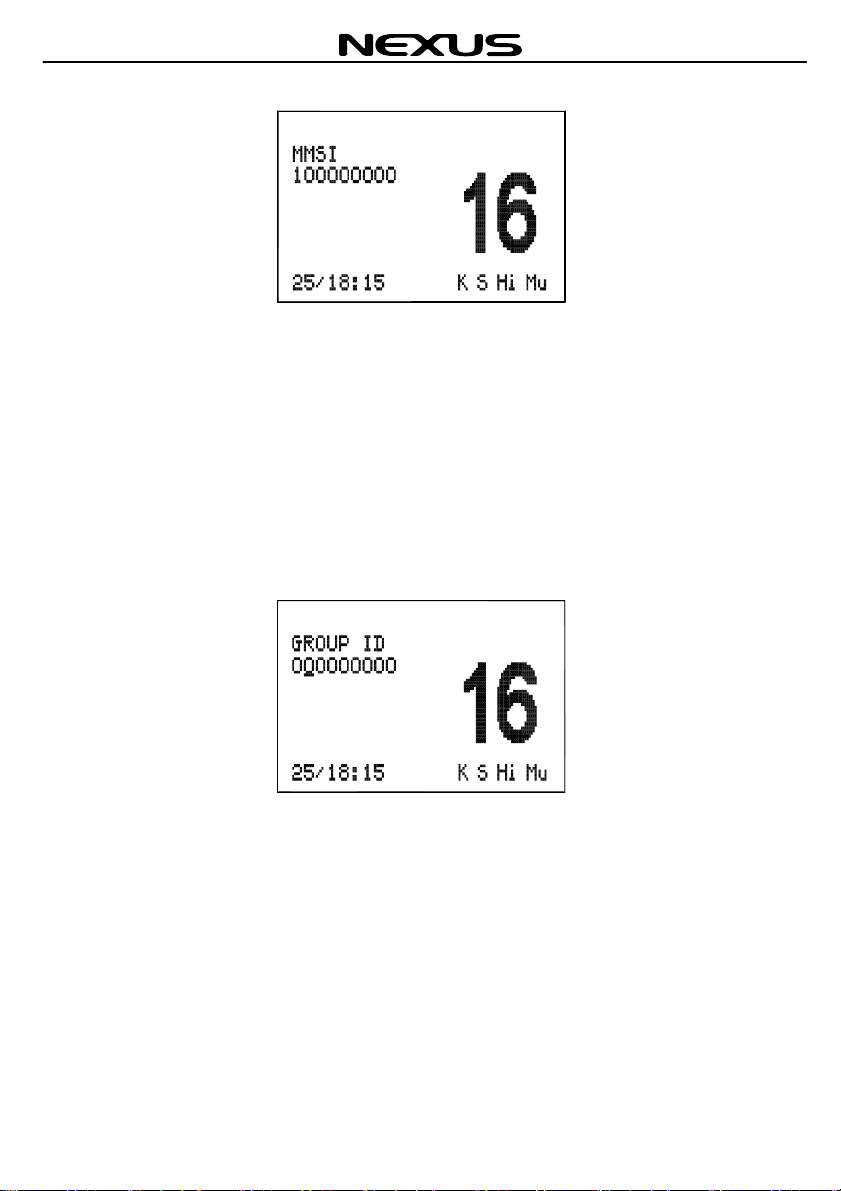
To view your vessel’s MMSI, press (MENU) key on the fist microphone/controller to
select the MMSI screen, as below:
27
Page 29
English VHF NX2000
Press (CLR) key to go back to the main screen.
To change the MMSI number after it has been programmed, the unit must be returned
to an authorized dealer to erase the existing number.
10.2 Set Group Id
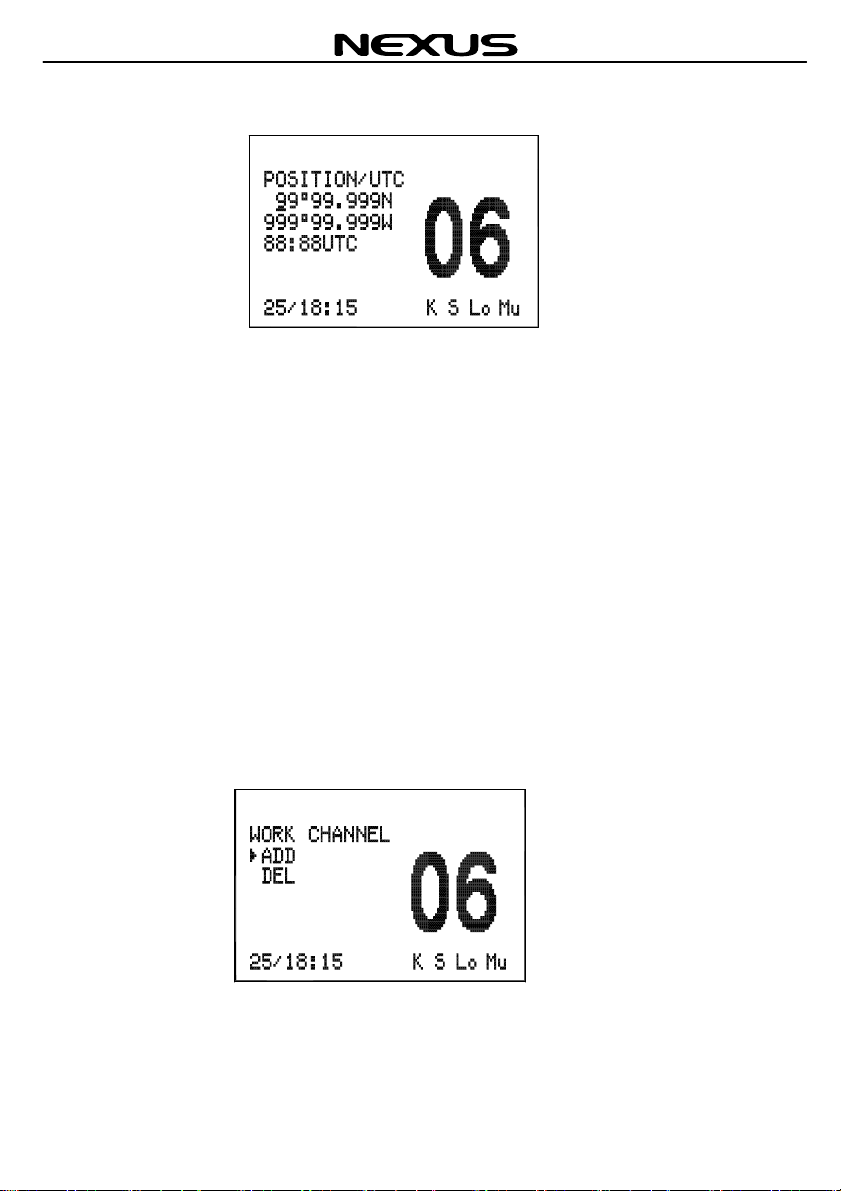
To enter a Group ID (if for example, the vessel is part of a flotilla or fishing fleet etc),
press (MENU) key to select the GROUP ID screen. The screen will be displayed as
below:
Press numeric key to enter the GROUP ID number (8-digits, the first digit must be
“0”). If a mistake is made, use the ◄ or ► key to move back the cursor and reset
the number. Press (ENT) key and the Radio will ask for verification. Check that the
No. is correct and press (ENT) key once again to confirm your entry. To amend,
press (CLR) key to go back to main screen.
10.3 Set Manual Position/UTC
If the position of the vessel cannot be obtained from a GPS via the NMEA 0183 input,
this data can be entered manually.
28
Page 30
VHF NX2000 English
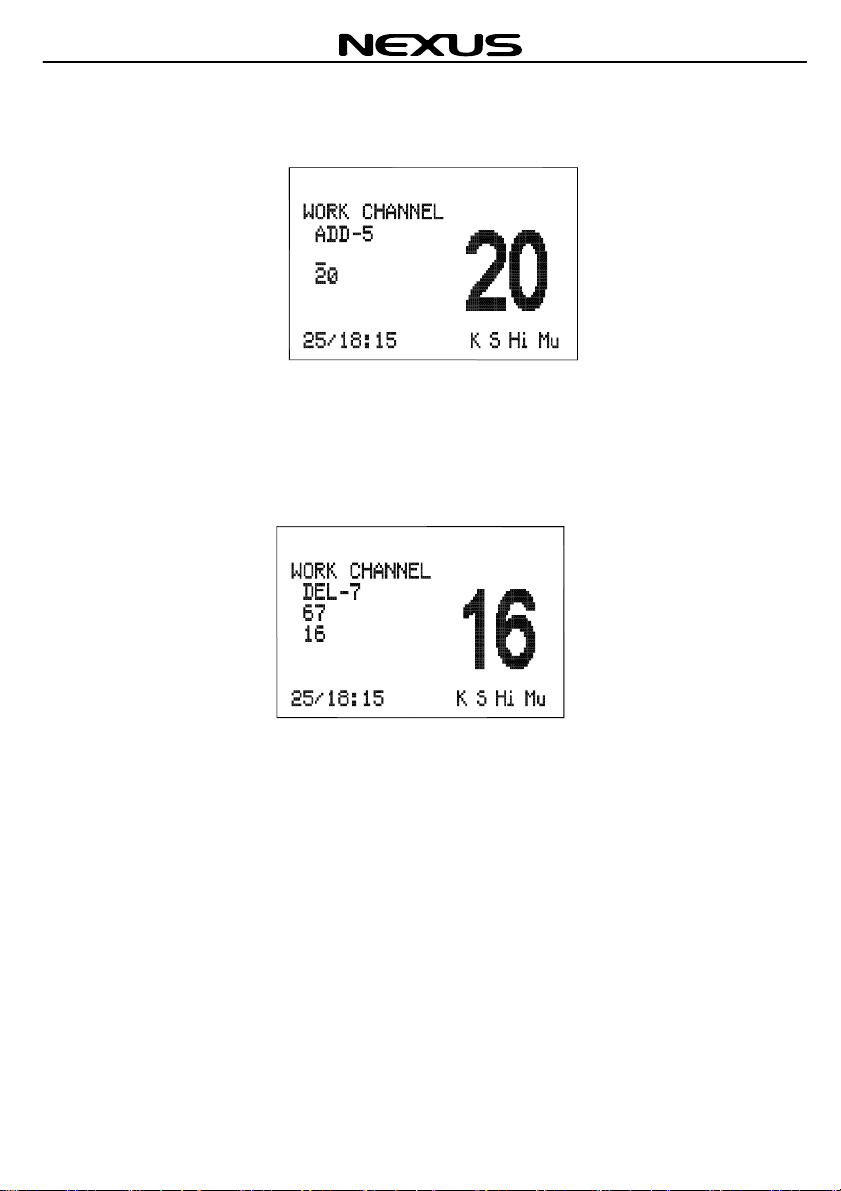
Press (MENU) key to select the “POSITION/UTC” screen as below:
Use the numeric key to enter the required data, then press (ENT) key to accept the
position and time entered.
After 23 hours, if the Radio has not received any position data either manually or from
the NMEA input, then the position data will disappear from the screen, and it will show
“NO POSITION”.
10.4 Set Work Channel
The Radio includes a list of 9 working channels, which can be scrolled through when
using the routine group calling. The first four channels are preset as 06, 08, 72 and 77.
These cannot be amended. The remaining five channels are programmable. Always
consult your local authority requirements when choosing suitable working channels.
Find out which channels are duplex as these do not allow ship-to-ship communication.
Press (MENU) key to select the WORK CHANNEL screen as below:
29
Page 31
English VHF NX2000
Press ◄ or ► key to select “ADD” from the WORK CHANNEL screen, then press
(ENT) key to enter, as below:
Press ▲ or ▼ key to change the selected channel, and press (ENT) key to accept.
Then press ◄ or ► key to enter the next channel.
To delete a Work Channel, press ◄ or ► key to move the cursor on the WORK
CHANNEL screen and select “DEL”, then press (ENT) to accept. The WORK
CHANNEL screen appears as below:
Press ◄ or ► key to select the channel (5th – 9th channel) that you wish to delete,
then press (ENT) key to accept.
10.5 Set the Directory
The DIRECTORY function is used to add, edit and delete a note (information about a
vessel) from the directory. The directory can store 20 notes, each note consists of
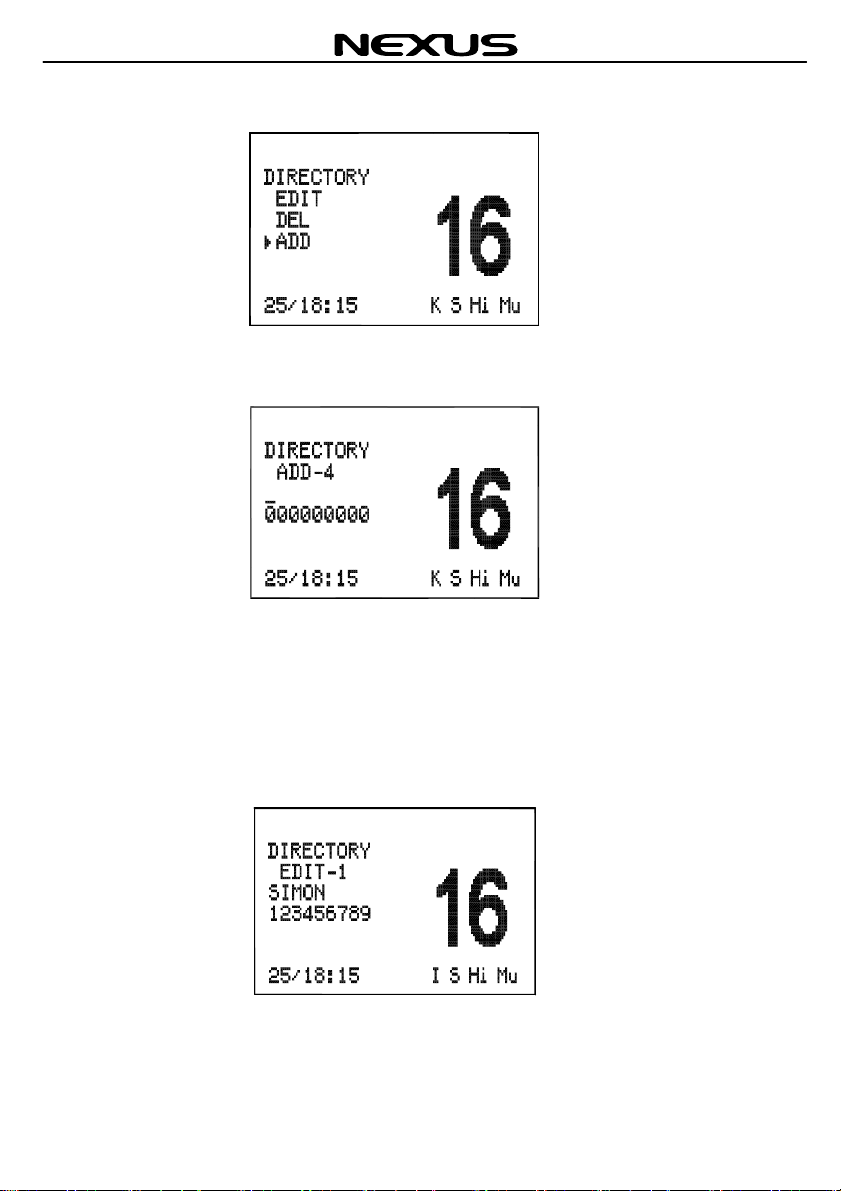
MMSI and vessel name, which can be recalled in the routine call screen. Press (MENU)
key to select the “DIRECTORY” screen as below:
Note. If you have made a directory of stored MMSI numbers, you can only send a
Routine Call to someone from the Directory.
30
Page 32
VHF NX2000 English
To access a new entry, press ▲ or ▼ to move the cursor in front of “ADD”, then press
(ENT) key to enter DIRECTORY-ADD screen as below:
Use the keypad to move backwards and forwards along the line to enter a name. Then
move the cursor with ►until it jumps to the second row and enter the MMSI number,
press (ENT) key to confirm.
To edit an existing entry, press▲ or ▼ key to move the cursor in front of “EDIT”, then
press (ENT) key to enter DIRECTORY-EDIT screen as below:
Use the ◄ or ► key to move along the name and MMSI fields, using the keypad to edit
the data. Press (ENT) to store the modified entry.
31
Page 33
English VHF NX2000
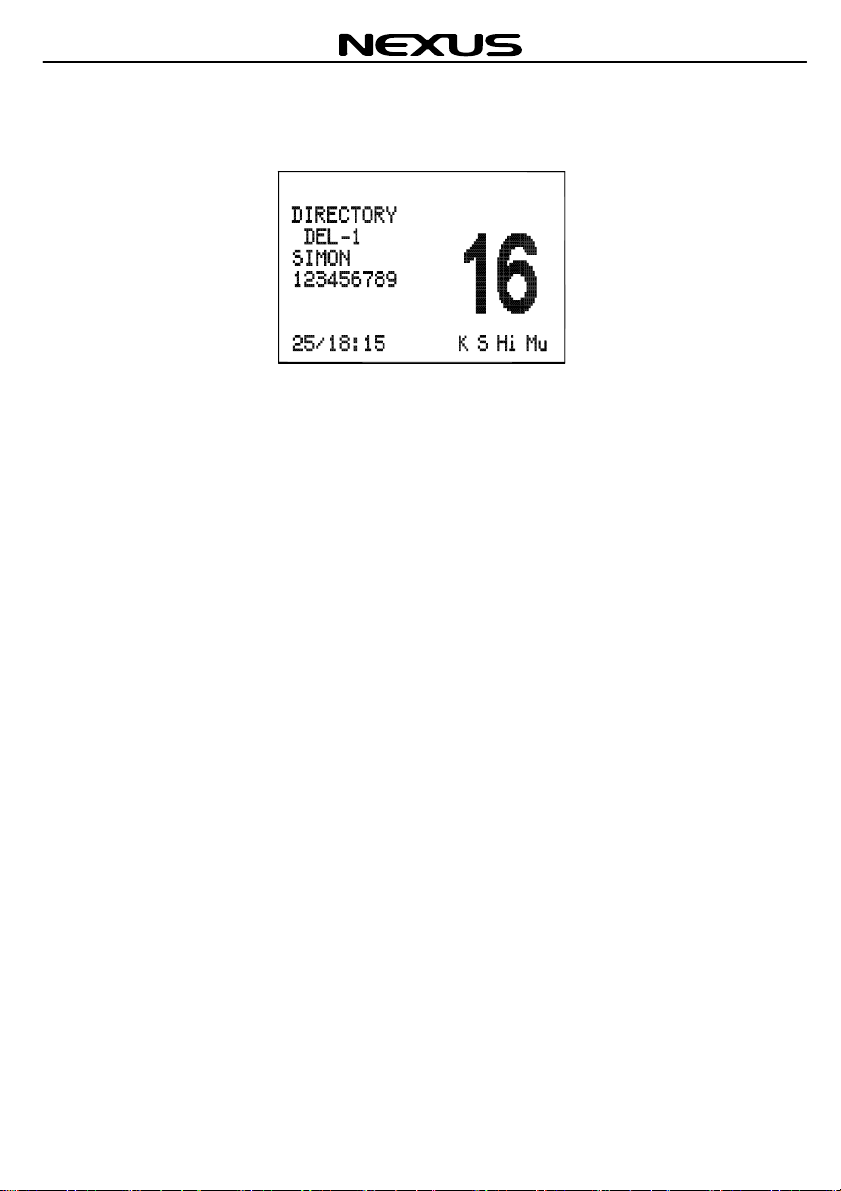
To delete an entry, press ◄ or ► key to move the cursor in front of “DEL”, then press
(ENT) key to enter DIRECTORY-DEL screen as below:
Use the ◄ or ► key to select the number you wish to delete, then press (ENT) key to
delete the entry.
32
Page 34

VHF NX2000 English
11 EXPANSION CHANNELS
Authorized users can have up to 10 expansion channels activated on their Nexus
NX2000 units.
Nexus Marine AB Service Division
12 ATIS FUNCTION
The ATIS function is a mandatory technical requirement according to Automatic
Transmitter Identification System (ATIS) used in some countries. NX2000 can work on
ATIS band by a licence.
If you have an ATIS licence, NX2000 can work on ATIS channels, and if you have an
ATIS SEA licence, NX2000 can work on ATIS channels and SEA channels. Press (16)
key together with ▼ then select ATIS or ATIS SEA as required.
• In ATIS mode, channels do not have full scan, memory scan, dual watch and
DSC/Distress alert. The VHF will transmit the ID code during transmission.
• In ATIS SEA mode, channels do not have Full Scan and Memory Scan but
have Dual Watch and DSC/Distress Alert.
33
Page 35

English VHF NX2000
13 TECHNICAL SPECIFICATIONS
Power Supply DC 12 V +30/-10%
Channel Capability 57 international channels
UKM1/M2 and includes 10 expansion channels
Frequency Resolution 25KHz
Method of Frequency Generation synthesizer
Dimension 175(W) × 79(H) ×130(D) mm
Weight 1175 grams
13.1 Receiver
Multi Channel Receiver
1. The receiver incorporates a dual conversion super-heterodyne design.
2. Tuning Frequency Range 156.025-163.275MHz
3. IF Frequency Used: 21.7MHz; 450KHz
4. Maximum Useable Sensitivity ≤6dBμe.m.f. of 20dB/SINAD
5. Adjacent Channel Selectivity ≥70dB
6. Spurious Response Rejection ≥70dB
7. Inter-Modulation Rejection ≥68dB
8. Spurious Emission Radiation 2nW
9. Current: 0.9 Amps (Max Audio)
0.4 Amps (STBY)
10. Audio Frequency Response +1, -3dB of +6dB/octave
De-emphasis 300-3000Hz
11. Hum and Noise ≤-40dB
12. Audio Output 3.5W at less than 10% distortion
with 4 Ohm external speaker
2W only internal speaker
34
Page 36

VHF NX2000 English
13.2 Channel 70 Monitor General Specification
1.Frequency CH70 (156.525MHz)
2.Sensitivity ≤6dBμEMF for 20dB SINAD
3.Bandwidth 16KHz
4. First IF Frequency Used 17.9MHz
5. Second IF Frequency Used 455KHz
6. Adjacent Channel Selectivity ≥70dB
7. Spurious Response Rejection ≥70dB
8. Inter-Modulation Rejection ≥68 dB
9. Mode of Reception 16K0G2B
10. Spurious Emission, Radiation ≤2nW, 9KHz to 2GHz
13.3 Transmitter
1.Type of Emission 16K0G3E(Voice)
13K5G2B(DSC)
2.Frequency Range 156.025-161.425MHz
3.Maximum Output Power 25W, 1W into 50 Ohms
4. Audio Harmonic Distortion ≤10%
5. Audio Frequency Response +1/-3dB of +6dB/octave
Pre-emphasis 300 – 3000Hz
6. Hum and Noise ≤-40dB
7. Frequency Deviation 5KHz max peak
8. Spurious Emissions (Radiated) ≤0.25μW
9. Current ≤5 Amps(25W)
13.4 GPS
1.Input Data Format: NMEA0183 version 2.0 sentences RMC, GGA
and GLL , GNS
35
Page 37

English VHF NX2000
14 INTERNATIONAL VHF MARINE CHANNEL CHART
Channel
Transmitter
Frequency
2 156.100 160.700 D Public Correspondence
3 156.150 160.750 D Public Correspondence
4 156.200 160.800 D Public Correspondence
5 156.250 160.850 D Public Correspondence
6 156.300 156.300 S Intership
7 156.350 160.950 D Public Correspondence
8 156.400 156.400 S Intership
9 156.450 156.450 S Intership/Port operations
10 156.500 156.500 S Intership/Port operations
11 156.550 156.550 S Port Operations
12 156.600 156.600 S Port Operations
13 156.650 156.650 S Intership/Port operations
14 156.700 156.700 S Port Operations
15 156.750 156.750 S Intership/Port operations (1W)
16 156.800 156.800 S Distress/Safety/Calling
17 156.850 156.850 S Intership/Port operations (1W)
18 156.900 161.500 D Port Ops/Public Corresdondence
19 156.950 161.550 D Public Correspondence
20 157.000 161.600 D Public Correspondence
21 157.050 161.650 D Public Correspondence
22 157.100 161.700 D Public Correspondence
23 157.150 161.750 D Public Correspondence
24 157.200 161.800 D Public Correspondence
25 157.250 161.850 D Public Correspondence
26 157.300 161.900 D Public Correspondence
27 157.350 161.950 D Public Correspondence
28 157.400 162.000 D Public Correspondence
60 156.025 160.625 D Public Correspondence
61 156.075 160.675 D Public Correspondence
62 156.125 160.725 D Public Correspondence
63 156.175 160.775 D Public Correspondence
64 156.225 160.825 D Public Correspondence
65 156.275 160.875 D Public Correspondence
66 156.325 160.925 D Public Correspondence
67 156.375 156.375 S Intership/Port operations
68 156.425 156.425 S Port operations
69 156.475 156.475 S Intership/Port operations
70 156.525 156.525 S Digital Selective Calling For Distress, Safety And Calling
71 156.575 156.575 S Port Operations
72 156.625 156.625 S Intership
73 156.675 156.675 S Intership/Port operations
74 156.725 156.725 S Port Operations
75 156.775 Ch 16 guard – no transmitter
76 156.825 Ch 16 guard – no transmitter
77 156.875 156.875 S Intership
78 156.925 161.525 D Public Correspondence
79 156.975 161.575 D Public Correspondence
80 157.025 161.625 D Public Correspondence
81 157.075 161.675 D Public Correspondence
82 157.125 161.725 D Port Ops/Public Correspondence
83 157.175 161.775 D Port Ops/Public Correspondence
84 157.225 161.825 D Port Ops/Public Correspondence
85 157.275 161.875 D Port Ops/Public Correspondence
86 157.325 161.925 D Port Ops/Public Correspondence
87 157.375 157.375 S Port Operations
88 157.425 157.425 S Port Operations
Receiver
Frequency
Mode
S/D
Channel Assignment
36
Page 38

p
p
p
p
p
p
(1W)
p
(1W)
p
)
)
)
)
)
)
p
)
p
p
p
p
p
)
p
p
p
p
p
p
p
p
p
p
p
p
/
p
p
p
)
p
(1W)
p
)
)
)
p
(1W)
r
p
p
ps/p
ps/p
)
ps/p
ps/p
p
p
VHF NX2000 English
ATIS CHANNEL CHART
Channel
Transmitter
Frequency
01 156.050 160.650 D Public Corres
02 156.100 160.700 D Public Corres
03 156.150 160.750 D Public Corres
04 156.200 160.800 D Public Corres
05 156.250 160.850 D Public Corres
06 156.300 156.300 S Intershi
07 156.350 160.950 D Public Correspondence
08 156.400 156.400 S Intershi
09 156.450 156.450 S Intership/Port operations
10 156.500 156.500 S Intershi
11 156.550 156.550 S Port operations(1W
12 156.600 156.600 S Port operations(1W
13 156.650 156.650 S Intership/Port operations(1W
14 156.700 156.700 S Port operations(1W
15 156.750 156.750 S Intership/Port operations(1W
16 156.800 156.800 S DISTRESS/SAFETY/CALLING
17 156.850 156.850 S Intershi
18 156.900 161.500 D Port ops/public correspondence
19 156.950 161.550 D Public Corres
20 157.000 161.600 D Public Corres
21 157.050 161.650 D Public Corres
22 157.100 161.700 D Public Corres
23 157.150 161.750 D Public Corres
24 157.200 161.800 D Public Correspondence
25 157.250 161.850 D Public Corres
26 157.300 161.900 D Public Corres
27 157.350 161.950 D Public Corres
28 157.400 162.000 D Public Corres
60 156.025 160.625 D Public Corres
61 156.075 160.675 D Public Corres
62 156.125 160.725 D Public Corres
63 156.175 160.775 D Public Corres
64 156.225 160.825 D Public Corres
65 156.275 160.875 D Public Corres
66 156.325 160.925 D Public Corres
67 156.375 156.375 S Intershi
68 156.425 156.425 S Port O
69 156.475 156.475 S Intershi
71 156.575 156.575 S Port O
72 156.625 156.625 S Intershi
73 156.675 156.675 S Intership/Port operations
74 156.725 156.725 S Port o
75 156.775 156.775 S Ch 16 guard - no transmitt(1W
76 156.825 156.825 S Ch 16 guard - no transmitt(1W
77 156.875 156.875 S Intershi
78 156.925 161.525 D Public Correspondence
79 156.975 161.575 D Public Cor
80 157.025 161.625 D Public Corres
81 157.075 161.675 D Public Corres
82 157.125 161.725 D Port o
83 157.175 161.775 D Port o
84 157.225 161.825 D Port ops/public correspondence
85 157.275 161.875 D Port o
86 157.325 161.925 D Port o
87 157.375 157.375 S Port o
88 157.425 157.425 S Port o
Receiver
Frequency
Mode
S/D
Channel Assignment
ondence
ondence
ondence
ondence
ondence
/Port operations(1W
/Port operations(1W
ondence
ondence
ondence
ondence
ondence(25W
ondence
ondence
ondence
ondence
ondence
ondence
ondence
ondence
ondence
ondence
ondence
Port operations
erations
/Port operations
erations(1W
erations(1W
espondence
ondence
ondence
ublic correspondence
ublic correspondence (25W
ublic correspondence
ublic correspondence
erations
erations
37
Page 39

p
p
p
p
p
p
p
p
p
p
p
)
p
)
p
)
p
p
p
p
p
p
p
p
p
p
p
p
p
r
p
p
p
p
p
p
g
,
g
p
p
g
g
p
p
p
p
ps/p
ps/p
ps/p
ps/p
ps/p
p
p
English VHF NX2000
ATIS/SEA Channel Chart
Channel
Transmitter
Frequency
01 156.050 160.650 D Public Corres
02 156.100 160.700 D Public Corres
03 156.150 160.750 D Public Corres
04 156.200 160.800 D Public Corres
05 156.250 160.850 D Public Corres
06 156.300 156.300 S Intershi
07 156.350 160.950 D Public Correspondence
08 156.400 156.400 S Intershi
09 156.450 156.450 S Intership/Port operations
10 156.500 156.500 S Intershi
11 156.550 156.550 S Port o
12 156.600 156.600 S Port o
13 156.650 156.650 S Intershi
14 156.700 156.700 S Port operations
15 156.750 156.750 S Intershi
16 156.800 156.800 S DISTRESS/SAFETY/CALLING
17 156.850 156.850 S Intershi
18 156.900 161.500 D Port ops/public correspondence
19 156.950 161.550 D Public Corres
20 157.000 161.600 D Public Corres
21 157.050 161.650 D Public Corres
22 157.100 161.700 D Public Corres
23 157.150 161.750 D Public Corres
24 157.200 161.800 D Public Corres
25 157.250 161.850 D Public Corres
26 157.300 161.900 D Public Corres
27 157.350 161.950 D Public Corres
28 157.400 162.000 D Public Corres
60 156.025 160.625 D Public Corres
61 156.075 160.675 D Public Corres
62 156.125 160.725 D Public Corres
63 156.175 160.775 D Public Cor
64 156.225 160.825 D Public Corres
65 156.275 160.875 D Public Corres
66 156.325 160.925 D Public Corres
67 156.375 156.375 S Intershi
68 156.425 156.425 S Port O
69 156.475 156.475 S Intershi
70 156.525 156.525 S Di
distress
71 156.575 156.575 S Port Operations
72 156.625 156.625 S Intershi
73 156.675 156.675 S Intership/Port operations
74 156.725 156.725 S Port o
75 156.775 S Ch 16
76 156.825 S Ch 16
77 156.875 156.875 S Intershi
78 156.925 161.525 D Public Correspondence
79 156.975 161.575 D Public Corres
80 157.025 161.625 D Public Corres
81 157.075 161.675 D Public Corres
82 157.125 161.725 D Port o
83 157.175 161.775 D Port o
84 157.225 161.825 D Port o
85 157.275 161.875 D Port o
86 157.325 161.925 D Port o
87 157.375 157.375 S Port o
88 157.425 157.425 S Port o
Receiver
Frequency
Mode
S/D
Channel Assignment
ondence
ondence
ondence
ondence
ondence
/Port operations
erations
erations
/Port operations(1W
/Port operations(1W
/Port operations(1W
ondence
ondence
ondence
ondence
ondence
ondence
ondence
ondence
ondence
ondence
ondence
ondence
ondence
espondence
ondence
ondence
ondence
/Port operations
erations
/Port operations
ital selective calling for
safety and callin
erations
uard - no transmitt
uard - no transmitt
ondence
ondence
ondence
ublic correspondence
ublic correspondence
ublic correspondence
ublic correspondence
ublic correspondence
erations
erations
38
Page 40
VHF NX2000 English
15 INSTALLATION
15.1 Unit Installation
The NX2000 should be sited so that engine noise and vibration or other background
noises do not make it difficult for the operator to hear.
It is recommended not to install the unit where it will be exposed to continuous direct
sunlight as this will eventually damage the LCD display.
As loudspeakers contain powerful magnets, the Radio should not be installed within 1m
(3ft 3in) of any compasses, whether magnetic or electronic.
The fins on the back of the unit act as a heat sink to dissipate heat generated by the set
when in use, which maintains the high efficiency of the Radio. The free circulation of air
is essential - if the Radio is mounted in an enclosed space, please ensure the space is
well ventilated
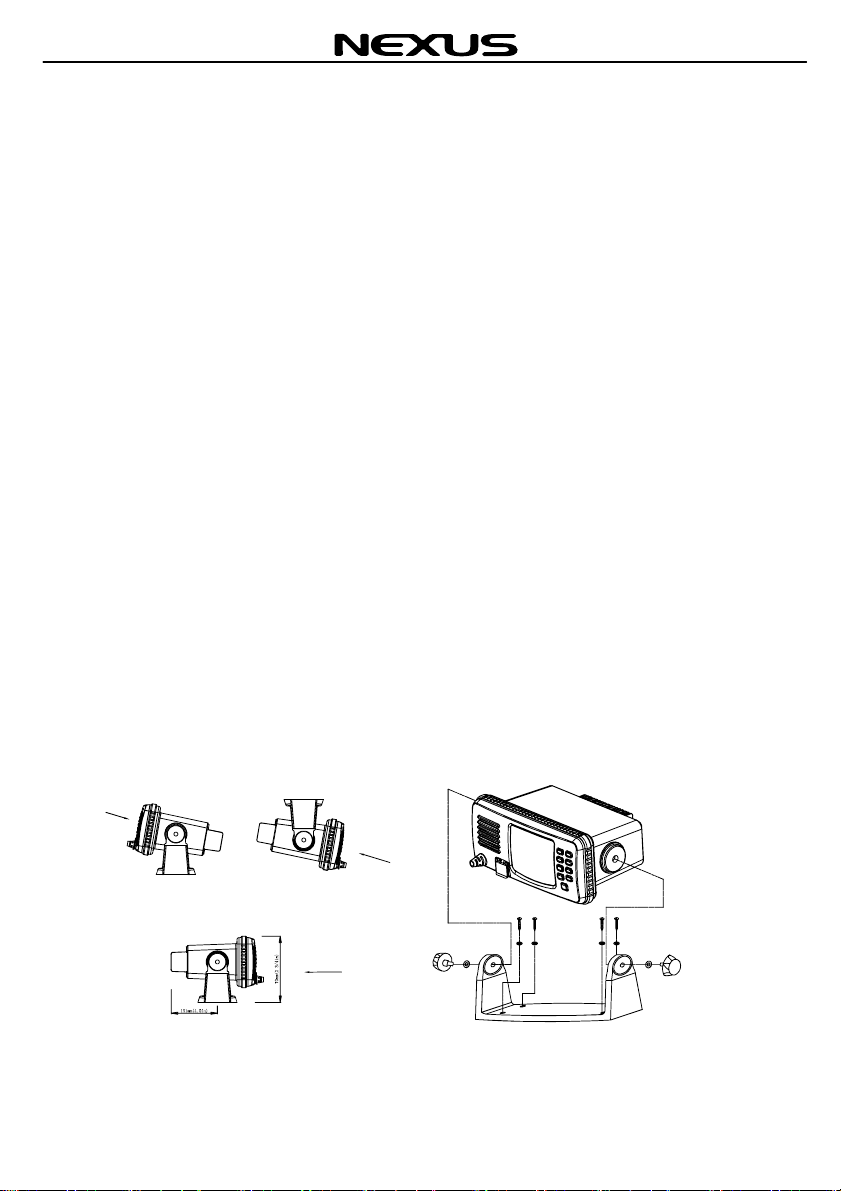
The NX2000 is supplied with a reversible mounting bracket. This can be used to mount
the Radio on the chart table or on an overhead bulkhead (Fig A). Before installing,
ensure that there is at least 100mm (4.0 in) vertical clearance and 70mm (2 3/4in)
horizontal clearance behind the bracket to allow the Radio to fit (Fig B). The rake angle
of the Radio can be adjusted by slackening the clamp.
Fig A
Fig B
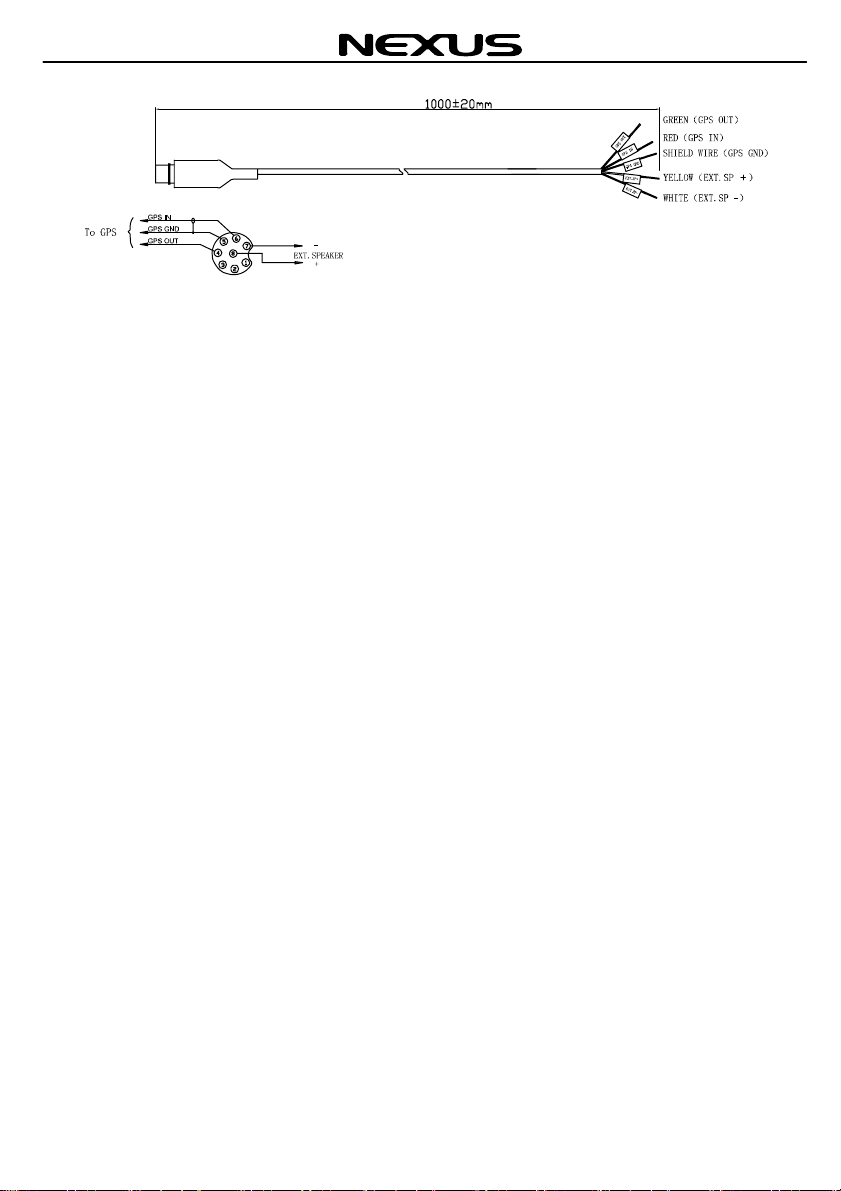
On the back of the NX2000 there is an antenna socket, a power cable socket (Fig D)
and an external speaker and GPS input socket.
Fig C
39
Page 41
English VHF NX2000
Fig D
The NX2000 requires a 12v DC supply to operate. This lead should be connected to the
vessel’s power supply (the red wire is positive, black is negative), and the cable kept as
short as possible. Although the Radio draws very little current when receiving, a heavier
current is drawn when transmitting which may result in a voltage drop if very long cables
are used of inadequate core diameter. If the supplied power lead is not long enough, an
extension of up to 3m(10 ft) can be made using at least 2.5mm (13AWG) wire.
The chassis of the NX2000 is not connected to either supply rail. This allows a direct
connection to the ship’s earth connection for voltage and RF interface protection. The
red wire is positive and black is negative. If polarity is accidentally reversed, the set will
not operate.
The antenna is connected to the NX2000 using a standard PL259 type connector as
fitted to most marine antenna. If fitted to an existing antenna, check that the contacts
are not corroded before connecting, as this will affect the quality of the signal, Ensure
that the retaining collar of the antenna plug is securely tightened to prevent accidental
disconnection.
15.2 Antenna Installation Recommendations
The most important factor in the performance of the NX2000 will be the quality and
positioning of the antenna. Most recorded problems with VHF Radios are related to
poor antenna sighting, faulty cabling, poor quality cable joints and low voltage supply.
Even the best performing Radio cannot compensate for these factors. If replacing an
existing installation using the same antenna, it is important that these factors are
checked when installing the Radio.
As the range of VHF signals are governed by line of sight, the antenna should be
placed as high as possible, while remaining clear of any metallic objects that could
influence the resonance of the antenna.
40
Page 42
VHF NX2000 English
The most popular antenna for marine use are 1m (3ft 3in) long. On sail boats these are
usually mounted at the masthead, where the length of the antenna keeps it clear from
the navigation lights and wind vanes etc. This type of antenna can also be mounted on
the cabin roof or radar arch on powerboats.
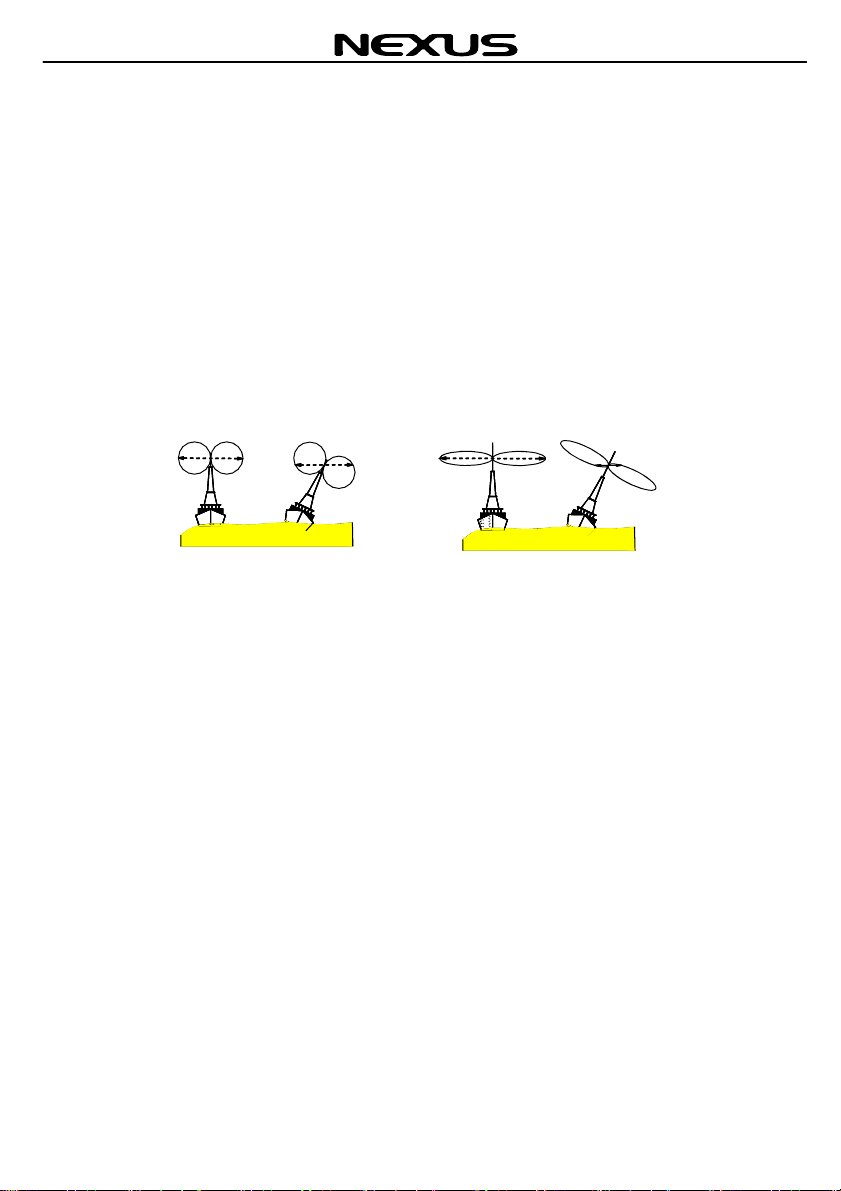
Longer whip antenna are recommended for larger boats. These radiate the same total
power as smaller antenna, but concentrate it into a narrower beam, which is
advantageous on a tall mast at extreme range where concentrating the available power
into a narrow horizontal beam becomes more important. However, if the antenna is not
vertical when transmitting, the beam will be angled either too high or too low (Fig E).
Here the wider beam of the shorter antenna will be more universally effective, although
the signal will be weaker (Fig F):
Therefore vessels with a large heel angle (small sailboats) would do better with a short
masthead antenna. Your local agent should be able to provide specific advice on
antenna choice for the vessel it is to be fitted on.
The antenna coaxial cable and any connectors used must be rated at
50Ω. Under no circumstances should standard domestic TV cable and connectors be
used. Incorrectly rated cabling and connectors could result in power not reaching the
antenna, but also power could be reflected back into the Radio, damaging it in the
process.
Fig E
Fig F
41
Page 43
English VHF NX2000
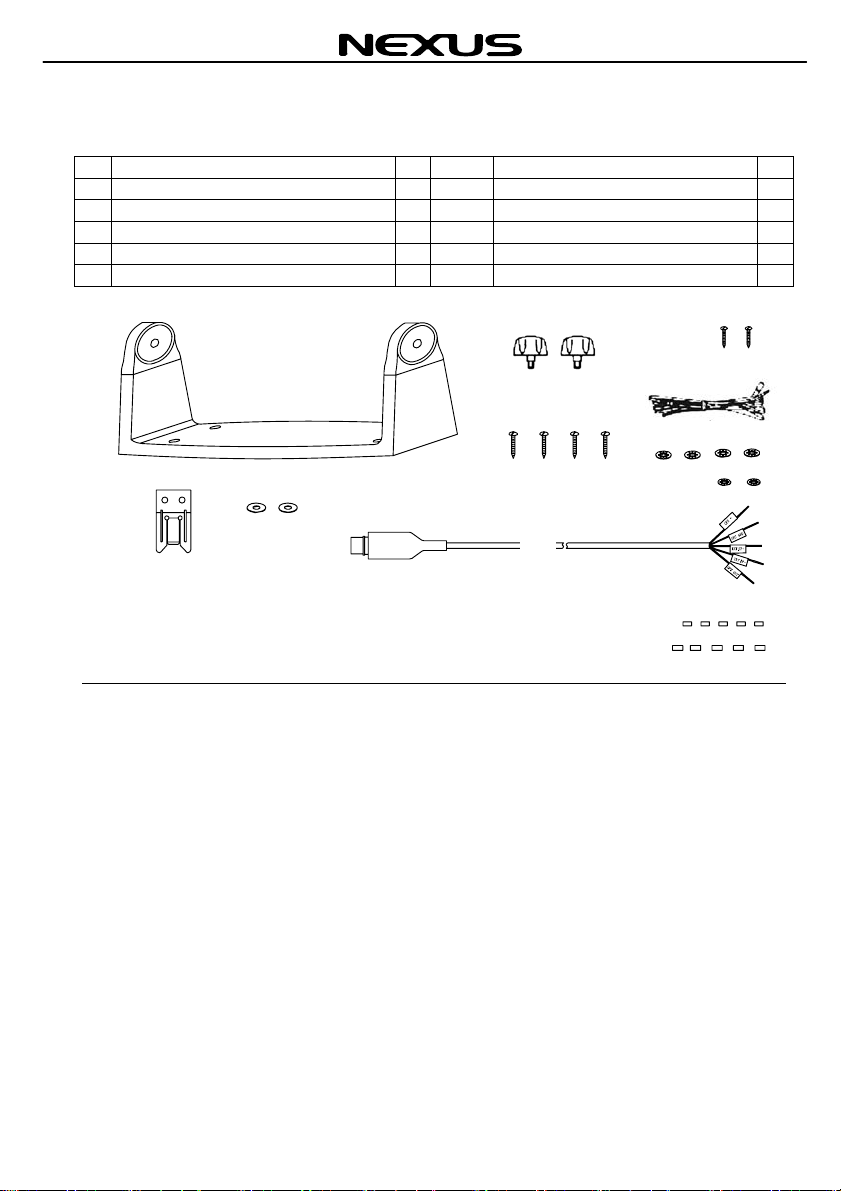
16 SUPPLIED PARTS
1. Mounting Bracket 1 7. Power Cord 1
2. Microphone Hanger 1 8. Mounting Bracket Washer 4
3. Bracket Knob Washer 2 9. Hanger Spring Washer 2
4. Mounting Bracket Knob 2 10. GPS/Speaker Plug Cord 1
5. Mounting Bracket Screw 4 11. Thermoshrink Tube Ф2 5
6. Mic Hanger Screw 2 12. Thermo shrink Tube Ф3 5
4
6
1
7
2
3
5
9
8
10
11
12
42
Page 44
VHF NX2000 English
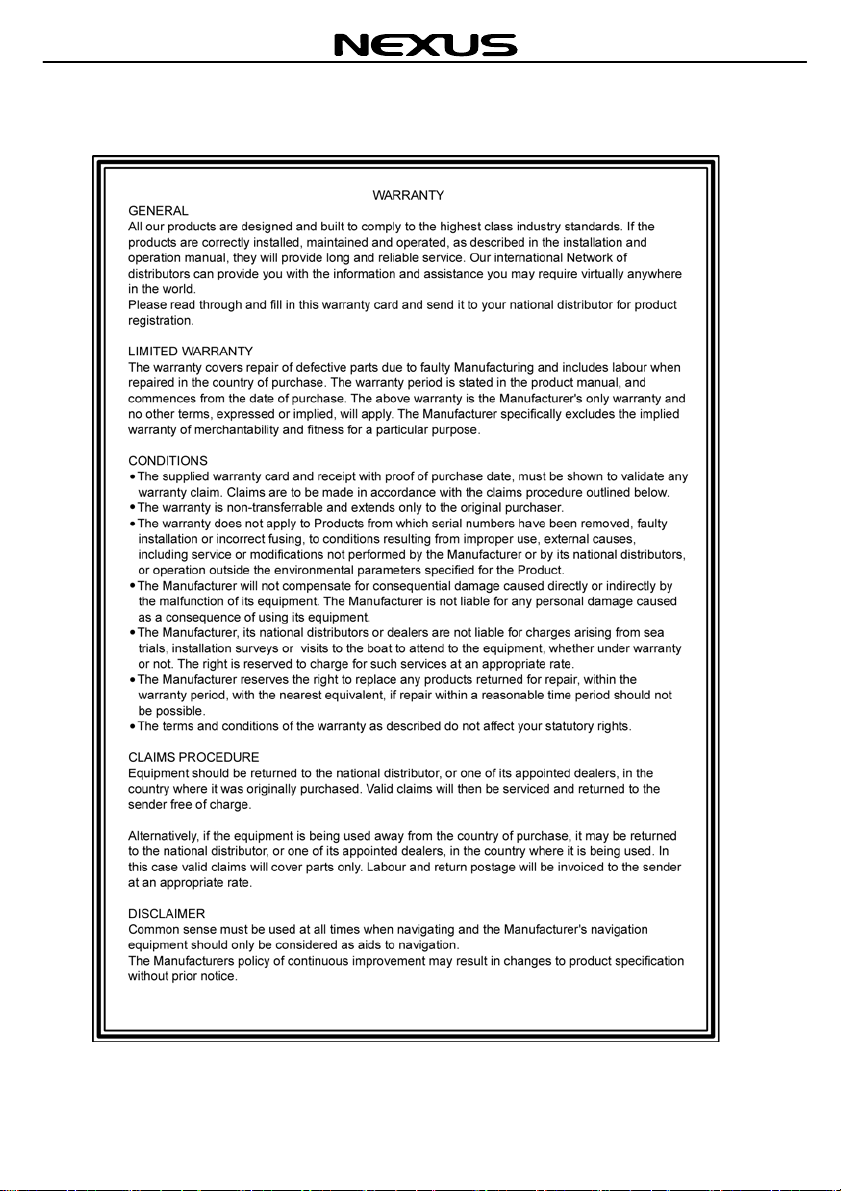
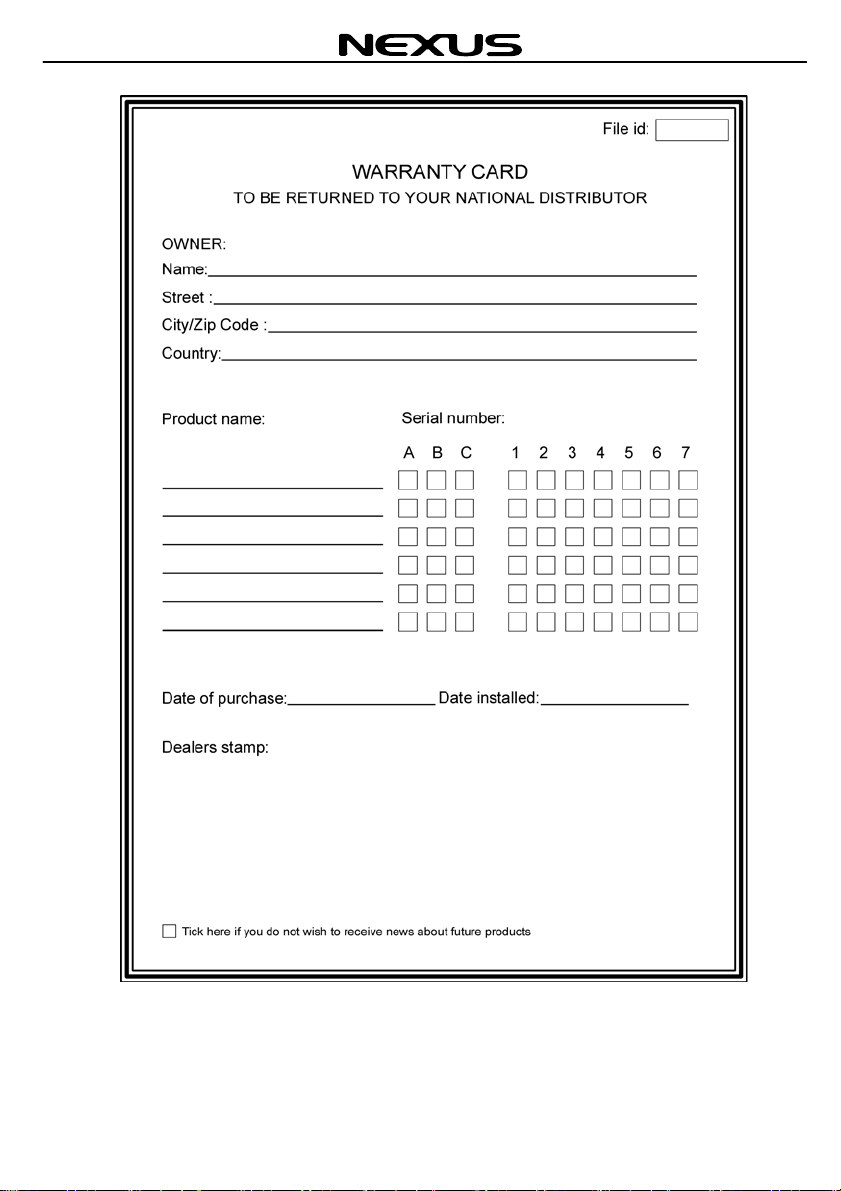
17 WARRANTY
43
Page 45
English VHF NX2000
44
Page 46
VHF NX2000 English
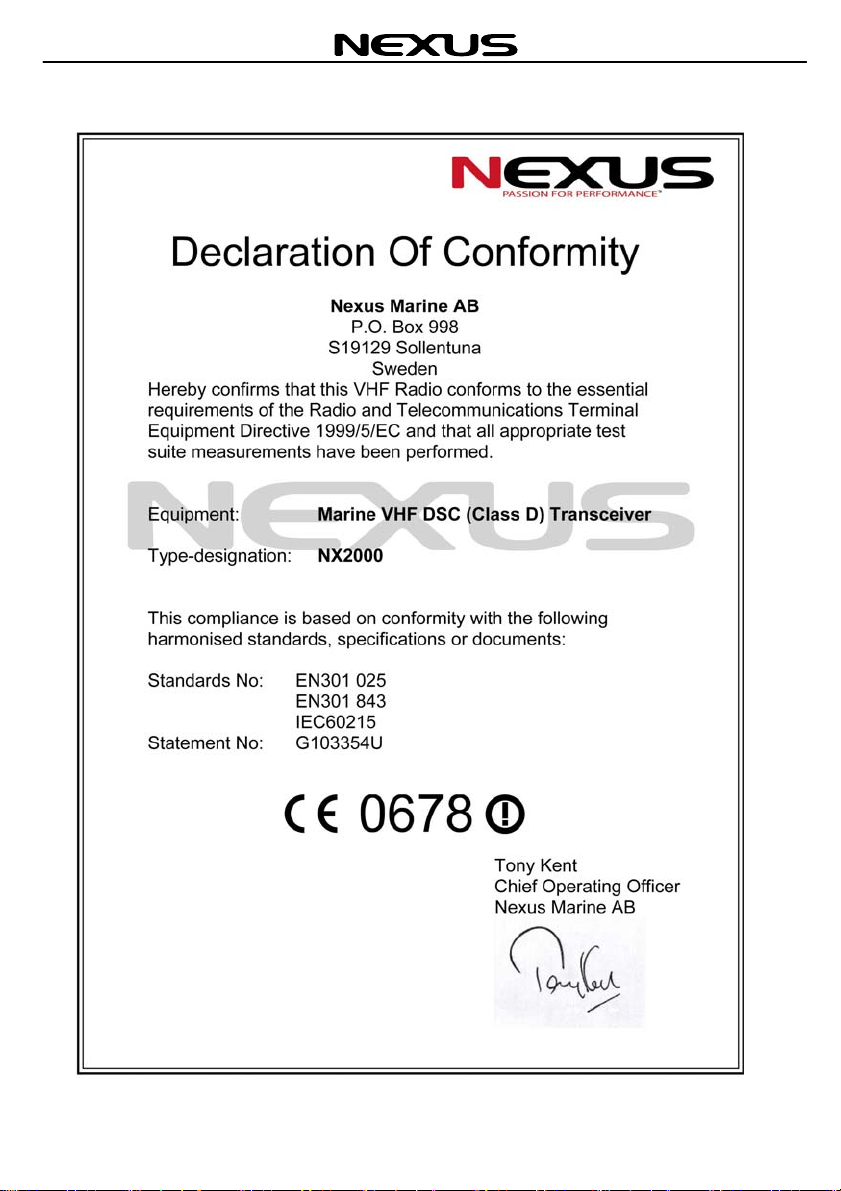
18 DECLARATION OF CONFORMITY
45
Page 47

English VHF NX2000
46
Page 48

VHF NX2000 English
Copyright ©:
Nexus Marine AB
Kuskvägen 4, 191 62 Sollentuna, Sweden
Tel: +46 -(0) 8 – 506 939 00. Fax: +46 -(0) 8 -506 939 01
www.nexusmarine.se
47
28321-1 Edition 2
 Loading...