Mercedes GLS 2020 Owner's Manual

Page 1
Digital–inthe vehicleVehicle document walletDigital –onthe InternetDigital –asanapp
Familiarize yourself withthe con‐ tents of theOperator's Manual directly via thevehicle's multi‐ media system (menu item "Vehi‐ cle information"). Startwiththe quickguide or broaden your knowledgewithpractical tips.
Hereyou can find comprehen‐ sive informationabout operating your vehicle and about services and guarantees in printed form.
Youcan find theOperator's Man‐ ual on theMercedes-Benz home‐ page.
The Mercedes-Benz Guides app is available free-of-charge in familiar app stores.
É16758403037ËÍ
1675840303
Apple®iOS Android
TM
Order no. P167 0086 13 Part no. 167584 03 03 EditionA2020
GLS
Operator's Manual
Mercedes-Benz
Mercedes-Benz GLS
Page 2
Publication details
Internet
Further information about Mercedes-Benzvehi‐ cles and about Daimler AG can be found on the following websites:
http://www.mbusa.com (USAonly)
http://www.mercedes-benz.ca (Canada only)
Documentation team
©
Daimler AG:not to be reprinted, translated or otherwise reproduced, in whole or in part, with‐ out written permission from Daimler AG.
Vehiclemanufacturer
Daimler AG
Mercedesstrasse 137
70327Stuttgart
Germany
Front passenger airbag warning
Example
&
WARNING Risk of injury or fatalinjuries if thefront-passengerairbag is enabled
If thefront-passengerfront airbag is enabled, achild on thefront-passengerseat maybe struck by thefront-passengerairbag during an accident.
NEVER use arearward-facing child restraint system on aseat withanENABLED FRONT AIRBAG,DEATH or SERIOUS INJURYtothe CHILD can occur.
Observe thechapter"Childreninthe vehicle".
As at 16.07. 2018
Page 3
Welcome to the world of Mercedes-Benz
Before you first drive off, read this Operator's Manual carefully and familiarize yourself with your vehicle. For your own safety and a longer operating lifespan, follow the instructions and warning notices in this Operator's Manual. Disre‐ garding them may lead to damage to the vehicle or personal injury.
Vehicle damage resulting from the disregard of the instructions is not covered by the Mercedes­Benz Limited Warranty.
The equipment or model designation of your vehicle may vary according to:
R
Model
R
Order
R
National version
R
Availability
Mercedes-Benz reserves the right to introduce changes in the following areas:
R
Design
R
Equipment
R
Technical features
The equipment in your vehicle may therefore dif‐ fer from that shown in the descriptions and illus‐ trations.
The following are integral parts of the vehicle:
R
Digital Operator's Manual
R
Printed Operator's Manual
R
Maintenance Booklet
R
Equipment-dependent supplements
Keep these documents in the vehicle at all times. If you sell the vehicle, always pass all of the documents on to the new owner.
Mercedes-Benz USA, LLC Mercedes-Benz Canada, Inc. A Daimler Company
1675840303
1675840303
Page 4
2
Contents
Symbols ........................................................ 5
At a glance .................................................... 6
Cockpit ........................................................... 6
Overview of warning and indicator lamps .....10
Overhead control panel ................................ 12
Door control panel and seat adjustment ....... 14
Control settings in the rear passenger
compartment ................................................ 16
Emergencies and breakdowns ...................... 18
Digital Operator's Manual ......................... 20
Calling up the Digital Operator's Manual ...... 20
General notes ............................................. 22
Protecting the environment .......................... 22
Genuine Mercedes-Benz parts ......................23
Operator's Manual ........................................23
Service and vehicle operation ....................... 24
Operating safety ...........................................25
Declaration of conformity for wireless
vehicle components ...................................... 27
Diagnostics connection ................................ 27
Qualified specialist workshop ....................... 28
Correct use of the vehicle ............................28
Problems with your vehicle ........................... 29
Reporting safety defects ...............................29
Limited Warranty .......................................... 29
QR code for rescue card ...............................30
Data storage .................................................30
Copyright ...................................................... 33
Occupant safety ......................................... 35
Restraint system ...........................................35
Seat belts ..................................................... 38
Airbags ......................................................... 42
PRE-SAFE®system ....................................... 49
Safely transporting children in the vehi‐
cle ................................................................. 51
Notes on pets in the vehicle .........................67
Opening and closing .................................. 69
SmartKey ...................................................... 69
Doors ............................................................ 73
Cargo compartment .....................................77
Roller sun blinds ...........................................82
Side windows ............................................... 82
Sliding sunroof ............................................. 86
Anti-theft protection .....................................93
Seats and stowing ..................................... 95
Notes on the correct driver's seat posi‐
tion ............................................................... 95
Seats ............................................................ 96
Steering wheel ............................................ 110
Easy entry and exit feature .......................... 111
Operating the memory function .................. 113
Stowage areas .............................................114
Cup holder .................................................. 127
Ashtray and cigarette lighter .......................129
Sockets ....................................................... 130
Wireless charging of the mobile phone and connection with the exterior antenna .. 13 3
Installing/removing the floor mats .............135
Light and visibility ................................... 136
Exterior lighting .......................................... 136
Interior lighting ............................................ 141
Windshield wiper and windshield washer
system ........................................................ 143
Mirrors ........................................................ 147
Page 5
Contents
3
Operating the sun visors ............................. 150
Area permeable to radio waves on the
windshield ...................................................151
Infrared-reflective windshield function ........ 151
Climate control ........................................ 152
Overview of climate control systems ..........152
Operating the climate control system ......... 153
Driving and parking .................................. 161
Driving ......................................................... 161
DYNAMIC SELECT switch ............................174
Automatic transmission .............................. 176
Transfer case .............................................. 18 0
Function of 4MATIC .................................... 182
Refueling .................................................... 182
Parking .......................................................185
Driving and driving safety systems .............. 194
Trailer hitch ................................................ 270
Bicycle rack ................................................ 275
Vehicle towing instructions .........................277
Instrument Display and on-board
computer .................................................. 278
Instrument Display overview .......................278
Overview of the buttons on the steering
wheel ..........................................................279
Operating the on-board computer .............. 280
Adjusting the design of the Instrument
Display ........................................................ 281
Showing display content on the instru‐
ment cluster ............................................... 282
Overview of displays on the multifunc‐
tion display .................................................283
Adjusting the instrument lighting ............... 284
Menus and submenus ................................ 284
Head-up Display .......................................... 291
Voice Control System .............................. 292
Notes on operating safety .......................... 292
Operation ................................................... 292
Using the Voice Control System effec‐
tively ........................................................... 295
Essential voice commands .........................296
MBUX multimedia system ...................... 308
Overview and operation .............................. 308
System settings .......................................... 343
Navigation .................................................. 354
Telephone ...................................................394
Online and Internet functions ..................... 422
Media ......................................................... 429
Radio .......................................................... 436
Sound .........................................................444
MBUX rear tablet ........................................ 446
Maintenance and care ............................. 449
ASSYST PLUS service interval display ........ 449
Engine compartment .................................. 450
Cleaning and care ....................................... 456
Breakdown assistance ............................ 466
Flat tire ....................................................... 466
Battery (vehicle) .......................................... 471
Tow starting or towing away ....................... 477
Electrical fuses ........................................... 481
Page 6
4
Contents
Wheels and tires ...................................... 484
Notes on noise or unusual handling char‐
acteristics ...................................................484
Notes on regularly inspecting wheels and
tires ............................................................ 484
Notes on snow chains ................................ 485
Tire pressure .............................................. 486
Loading the vehicle .................................... 493
Tire labeling ................................................ 497
Definition of terms for tires and loading ..... 502
Changing a wheel ....................................... 505
Emergency spare wheel .............................. 513
Collapsible spare wheel .............................. 514
Technical data ........................................... 51 7
Notes on technical data .............................. 517
Vehicle electronics ...................................... 517
Vehicle identification plate, VIN and
engine number overview .............................519
Operating fluids .......................................... 521
Vehicle data ................................................ 527
Trailer hitch ................................................. 531
Display messages and warning/indi‐
cator lamps .............................................. 532
Display messages .......................................532
Warning and indicator lamps ...................... 580
Index ......................................................... 594
Page 7
Symbols
5
In this Operator's Manual, you will find the fol‐ lowing symbols:
&
DANGER Danger due to not observing the warning notices
Warning notices draw your attention to haz‐ ards that may endanger your health or life, or the health or life of others.
#
Observe the warning notices.
ENVIRONMENTAL NOTE Environmental
+
damage due to failure to observe envi‐ ronmental notes
Environmental notes include information on environmentally responsible behavior or envi‐ ronmentally responsible disposal.
#
Observe environmental notes.
NOTE Damage to property due to failure
*
to observe notes on material damage
Notes on material damage inform you of risks which may lead to your vehicle being damaged.
#
Observe notes on material damage.
%
Useful instructions or further information that could be helpful to you.
X
(Q page)
Display
Instruction Further information on a topic
Information on the multifunction dis‐ play/media display
+
Highest menu level, which is to be selected in the multimedia system
*
Corresponding submenus, which are to be selected in the multimedia sys‐ tem
*Marks a cause
Page 8
6
At a glance – Cockpit
Left-hand-drive vehicles
Page 9
At a glance – Cockpit
7
1
Steering wheel paddle shifters
2
Combination switch
3
DIRECT SELECT lever
4
Media display
5
Climate control systems
6
Hazard warning lamps
7
PASSENGER AIR BAG indicator lamp
8
Glove box
9
Stowage compartment
A
Control knob for volume and switching sound on/off
B
Calls up navigation
C
Button for:
Calls up the radio
Calls up media
D
Calls up the telephone
308
354
437
432
396
178
137
174
312
153
138
47
116
115
E
Offroad control panel (vehicles with off-road package)
F
Calls up favorites
G
Calls up vehicle functions
H
Active Parking Assist
I
DYNAMIC SELECT switch
J
Control elements for the multimedia system
K
Start/stop button
L
Control panel for the multimedia system (steering wheel)
M
Adjusts the steering wheel
N
Control panel for:
On-board computer
Cruise control or variable limiter
Active Distance Assist DISTRONIC
O
Diagnostics connection
P
Unlocks the hood
328
320
256
175
312
162
279
110
279
208
213
27
450
Page 10
8
At a glance – Cockpit
Q
Electric parking brake
191
R
Light switch
136
Page 11
Page 12
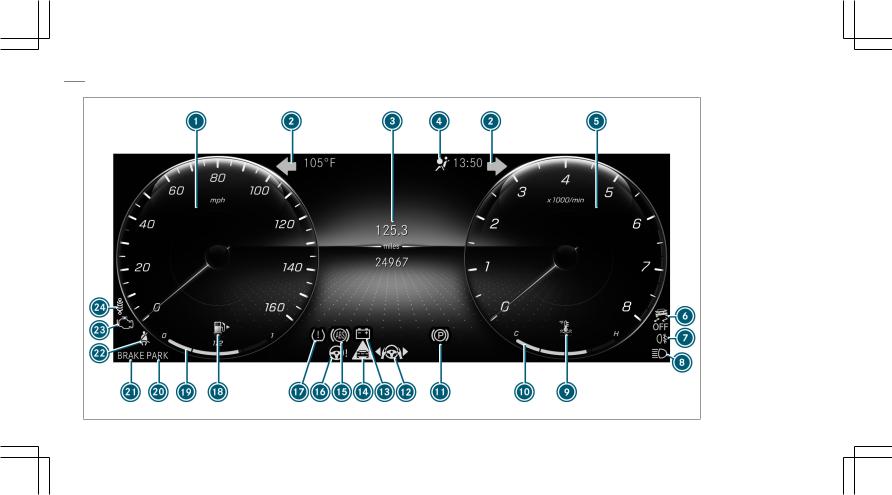
10
At a glance – Overview of warning and indicator lamps
Widescreen Cockpit
Page 13
At a glance – Overview of warning and indicator lamps
11
1
Speedometer
2
#! Turn signal lights
3
Multifunction display
4
6 Restraint system
5
Tachometer
6
å ESP®OFF
÷ ESP
7
R Rear fog light
8
K High beam
®
L Low beam
T Parking lights
9
? Coolant too hot/cold
A
Coolant temperature display
B
! Electric parking brake (yellow)
C
± Active Lane Change Assist
D
# Electrical malfunction
278
283
278
136
136
588
278
588
137
36
581
581
137
137
581
217
E
· Distance warning
F
! ABS malfunction
G
Ð Power-assisted steering malfunction
H
h Tire pressure monitor
I
8 Fuel reserve with fuel filler cap location indicator
J
Fuel level display
K
Electric parking brake applied (red)
F USA only
! Canada only
L
Brakes (red)
$ USA only
J Canada only
M
ü Seat belt not fastened
N
; Check Engine
O
AIRMATIC/DYNAMIC BODY CONTROL/ ACTIVE BODY CONTROL malfunction
587
581
592
591
588
581
581
586
588
Page 14
12
At a glance – Overhead control panel
Page 15
At a glance – Overhead control panel
13
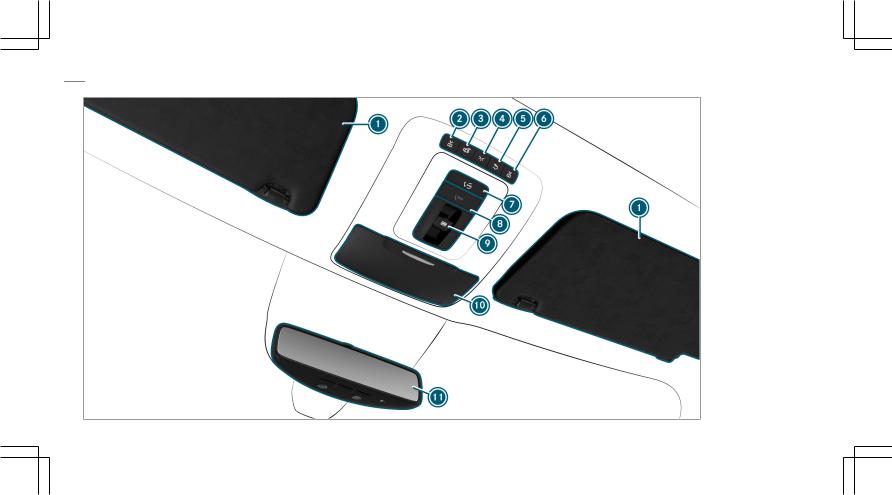
1
Sun visors
2
p Switches the left-hand reading lamp on/off
3
| Switches automatic light control on/off
4
c Switches the front interior lighting on/off
5
u Switches the rear interior lighting on/off
6
p Switches the right-hand reading lamp on/off
150
141
141
141
141
141
7
Service call button (Mercedes me connect)
8
SOS emergency call system (Mercedes-Benz emergency call system)
9
3 Opens/closes the panoramic sliding sunroof
Opens/closes the roller sunblinds
A
Eyeglasses compartment (depending on the vehicle's equipment)
B
Inside rearview mirror
417
417
88
88
116
148
Page 16
14
At a glance – Door control panel and seat adjustment
Page 17
At a glance – Door control panel and seat adjustment
15
1
Opens the door
2
&%Locks/unlocks the vehicle
3
Sets the memory function
4
Adjusts the seats electrically
5
Switches the seat heating on/off
6
Switches the seat ventilation on/off
7
Adjusts the front passenger seat from the driver's seat
8
Extends/retracts the ball neck fully electri‐ cally
9
Opens/closes the tailgate
109
73
73
113
96
107
98
271
77
A
W Opens/closes the right side window
B
W Opens/closes the rear right side win‐ dow
C
Child safety lock for the rear side windows
D
W Opens/closes the rear left side window
E
W Opens/closes the left side window
F
Adjusts and folds the outside mirrors out/in electrically
G
Adjusts the 4-way lumbar support
H
Seat adjustment using the multimedia system
I
Adjusts the head restraints
82
82
67
82
82
147
99
105
103
Page 18
16
At a glance – Control settings in the rear passenger compartment
Page 19
At a glance – Control settings in the rear passenger compartment
17
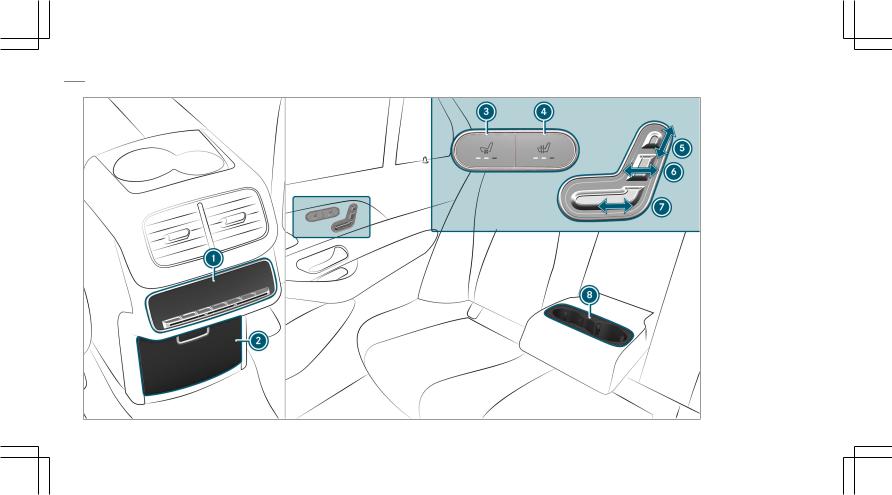
1
Climate control rear operating unit
2
Stowage compartment in the center console
230 V socket
3
Switches the rear seat ventilation on/off
4
Switches the rear seat heating on/off
153
109
116
107
5
Adjusts the height of the head restraint
6
Adjusts the seat backrest
7
Sets the seat fore-and-aft position
8
Cup holder
MBUX rear tablet
107
109
99
127
446
Page 20
18
At a glance – Emergencies and breakdowns
Page 21
At a glance – Emergencies and breakdowns
19
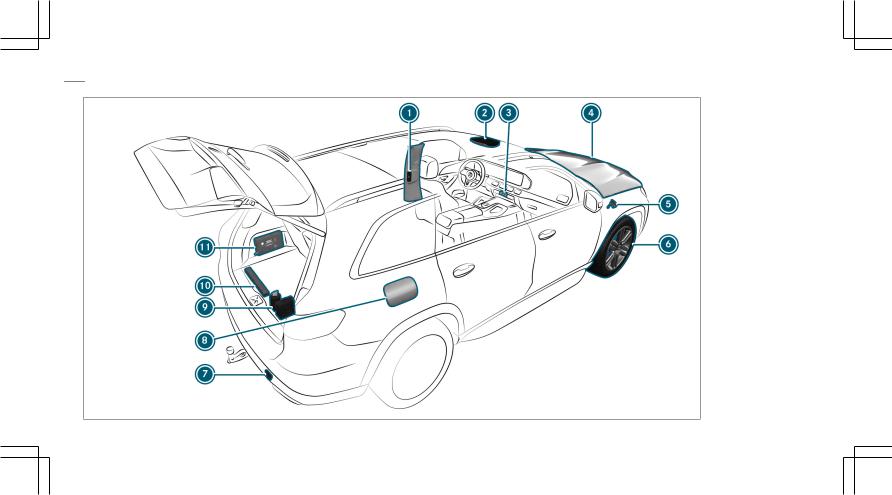
What to do in the event of an accident
1
QR code for accessing the rescue card
2
Buttons for the SOS emergency call system and breakdown assistance
3
Hazard warning lamps
4
To check and top up operating fluids
Starting assistance
5
To tow-start and tow away
6
Flat tire
138
30
419
521
475
478
7
To tow-start and tow away
8
Fuel filler flap with instruction labels for tire pressure, fuel type and QR code for accessing the rescue card
9
TIREFIT kit
A
Warning triangle
B
First-aid kit
466
478
182
467
Page 22
20
Digital Operator's Manual
Calling up the Digital Operator's Manual
Multimedia system:
4
©5Info5Operator's Manual
5
Õ
The Digital Operator's Manual describes the function and operation of:
R
the vehicle
R
the multimedia system
#
Select one of the following menu items in the Digital Operator's Manual:
R
Search: search for keywords in order to find
quick answers to questions about the opera‐ tion of the vehicle.
R
Quick start: find the first steps towards set‐
ting up your vehicle.
R
Tips: find information that prepares you for
certain everyday situations with your vehicle.
R
Messages: receive additional information
about the messages in the instrument dis‐ play.
R
Bookmarks: gain access to your personally
saved bookmarks.
R
Language: select the language for the Digital
Operator's Manual.
1
Back
2
Adds bookmarks
3
Picture
4
Contents section
5
Directions of movement of contents section
6
Menu
Some sections in the Digital Operator's Manual, e.g. warning notes, can be opened and closed.
Additional methods of calling up the Digital Operator's Manual:
Direct access: open the required content in the
Digital Operator's Manual by pressing and hold‐
Page 23
Digital Operator's Manual
21
ing an entry on the tab bar in the multimedia system:
Instrument Display: call up brief information as display messages in the instrument cluster.
Voice Control System: call up via the voice control system
Global search: call up search results for con‐ tents of the Digital Operator's Manual in the home screen
For safety reasons, the Digital Operator's Man‐ ual is deactivated while driving.
%
The Operator's Manual can also be found in the Mercedes-Benz Guides app in all com‐ mon app stores.
Page 24
22
General notes
Protecting the environment
ENVIRONMENTAL NOTE Environmental
+
damage due to operating conditions and personal driving style
The pollutant emission of your vehicle is directly related to the way you operate your vehicle.
Help to protect the environment by operating your vehicle in an environmentally responsi‐ ble manner. Please observe the following rec‐ ommendations on operating conditions and personal driving style.
Operating conditions:
#
Make sure that the tire pressure is cor‐ rect.
#
Do not carry any unnecessary weight (e.g. roof luggage racks once you no longer need them).
#
Adhere to the service intervals. A regularly serviced vehicle will contrib‐ ute to environmental protection.
#
Always have maintenance work carried out at a qualified specialist workshop.
Personal driving style:
#
Do not depress the accelerator pedal when starting the engine.
#
Do not warm up the engine while the vehicle is stationary.
#
Drive carefully and maintain a suitable distance from the vehicle in front.
#
Avoid frequent, sudden acceleration and braking.
#
Change gear in good time and use each gear only up to Ô of its maximum engine speed.
#
Switch off the engine in stationary traf‐ fic, e.g. by using the ECO start/stop function.
#
Drive fuel-efficiently. Observe the ECO display for a fuel-efficient driving style.
ENVIRONMENTAL NOTE Environmental
+
pollution caused by irresponsible dis‐ posal of the high-voltage battery
A high-voltage battery contains materials which are harmful to the environment.
#
Dispose of defective high-voltage bat‐ teries at a qualified specialist work‐ shop.
Environmental issues and recommendations:
It is recommended that you re-use or recycle materials instead of just disposing of them.
The relevant environmental guidelines and regu‐ lations serve to protect the environment and must be strictly observed.
Page 25
General notes
23
Genuine Mercedes-Benz parts
ENVIRONMENTAL NOTE Environmental
+
damage caused by not using recycled reconditioned components
Daimler AG offers recycled reconditioned components and parts with the same quality as new parts. The same entitlement from the Limited Warranty is valid as for new parts.
#
Use recycled reconditioned compo‐ nents and parts from Daimler AG.
NOTE Impairment of the operating effi‐
*
ciency of the restraint systems from installing accessory parts or from repairs or welding
Airbags and Emergency Te nsioning Devices, as well as control units and sensors for the restraint systems, may be installed in the fol‐ lowing areas of your vehicle:
R
Doors
R
Door pillars
R
Door sills
R
Seats
R
Cockpit
R
Instrument cluster
R
Center console
R
Lateral roof frame
#
Do not install accessory parts such as audio systems in these areas.
#
Do not carry out repairs or welding.
#
Have aftermarket installation of acces‐ sories carried out at a qualified special‐ ist workshop.
You could jeopardize the operating safety of your vehicle if you use parts, tires and wheels as well as accessories relevant to safety which have not been approved by Mercedes-Benz. Safety-rele‐ vant systems, e.g. the brake system, may mal‐ function. Only use Mercedes-Benz Genuine Parts or parts of equal quality. Only use tires, wheels and accessories that have been specifically approved for your vehicle model.
Mercedes-Benz Genuine Parts are subject to strict quality control. Each part has been spe‐ cially developed, manufactured or selected for Mercedes-Benz vehicles and fine-tuned for them. Therefore, only Mercedes-Benz Genuine Parts should be used.
More than 300,000 different Mercedes-Benz Genuine Parts are available for Mercedes-Benz models.
All authorized Mercedes-Benz Centers maintain a supply of Mercedes-Benz Genuine Parts for necessary service and repair work. In addition, strategically located parts delivery centers pro‐ vide for quick and reliable parts service.
Always specify the vehicle identification number (VIN) (/ page 519) when ordering Mercedes­Benz Genuine Parts.
Operator's Manual
This Operator's Manual describes all models and all standard and optional equipment available for your vehicle at the time of this Operator's Man‐ ual going to press. Country-specific differences are possible. Note that your vehicle may not be
Page 26
24
General notes
equipped with all features described. This is also the case for systems and functions relevant to safety. Therefore, the equipment on your vehicle may differ from that in the descriptions and illus‐ trations.
The original purchase agreement for your vehicle contains a list of all of the systems in your vehi‐ cle.
Should you have any questions concerning equipment and operation, please consult an authorized Mercedes-Benz Center.
The Operator's Manual and Maintenance Booklet are important documents and should be kept in the vehicle.
Service and vehicle operation
Vehicle operation outside the USA or Canada
When you are abroad with your vehicle, observe the following points:
R
service points or replacement parts may not be available immediately.
R
unleaded fuel may not be available for vehi‐ cles with a catalytic converter. Leaded fuel may cause damage to the catalytic converter.
R
the fuel may have an extremely low octane number. Unsuitable fuel can cause engine damage.
Some Mercedes-Benz models are available in Europe through our European Delivery Program. For more information, please consult an author‐ ized Mercedes‑Benz service center, or write to one of the following address:
in the USA:
Mercedes-Benz USA, LLC European Delivery Department One Mercedes-Benz Drive Sandy Springs, GA 30328
in Canada:
Mercedes-Benz Canada, Inc. European Delivery Department 98 Vanderhoof Avenue Toronto, Ontario M4G 4C9
Maintenance
Your customer advisor confirms the service in the service report.
Roadside Assistance
The Mercedes-Benz Roadside Assistance Pro‐ gram offers technical help in the case of a breakdown. Your calls to the toll-free Roadside Assistance Hotline are answered by our agents 24 hours a day, 365 days a year.
1-800-FOR-MERCedes (1-800-367-6372) (USA) 1-800-387-0100 (Canada) You can find further information in the
Mercedes-Benz Roadside Assistance Program brochure (USA) or the "Roadside Assistance" section in the maintenance and warranty infor‐ mation booklet (Canada). You will find both in the vehicle document wallet.
Change of address or change of ownership
In the event of a change of address, please send us the "Notification of address change" in the
Page 27
General notes
25
Service and Guarantee booklet or simply call the Mercedes-Benz Customer Assistance Center (USA) on the hotline number 1-800-FOR-MERCedes (1-800-367-6372) or Cus‐ tomer Service (Canada) on 1-800-387-0100. We can then reach you in a timely fashion, if neces‐ sary.
If you sell your Mercedes, please leave all litera‐ ture in the vehicle so that it is available to the next owner. If you have purchased a used vehi‐ cle, please send us the "Notice of Purchase of Used Car" in the Service and Guarantee booklet or simply call the Mercedes-Benz Customer Assistance Center (USA) at the hotline number 1-800-FOR-MERCedes (1-800-367-6372) or Cus‐ tomer Service (Canada) at 1-800-387-0100.
Possible danger due to substances hazard‐ ous to health
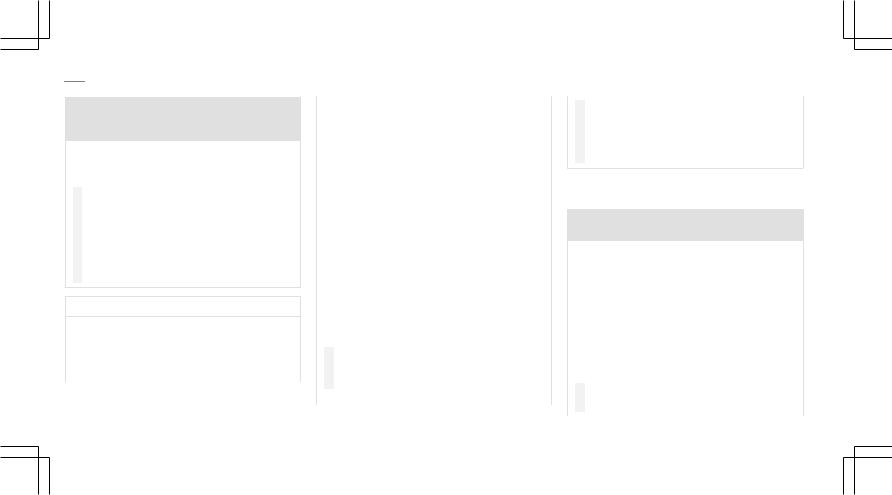
In compliance with Proposition 65 ("Prop65"), the following detachable label has been added to each vehicle sold in California:
Operating safety
&
WARNING Risk of accident due to mal‐ functions or system failures
If you do not have the prescribed service/ maintenance work or any required repairs carried out, this could result in malfunctions or system failures.
#
Always have the prescribed service/ maintenance work as well any required repairs carried out at a qualified spe‐ cialist workshop.
&
WARNING Risk of accident and injury as a result of incorrect modifications to electronic component parts
Modification to electronic components, their software or wiring could impair their function and/or the function of other networked com‐ ponent parts. In particular, systems relevant to safety could also be affected.
As a result, they may no longer function as intended and/or endanger the operating safety of the vehicle.
#
Never tamper with the wiring and elec‐ tronic component parts or their soft‐ ware.
#
You should have all work on electrical and electronic components carried out at a qualified specialist workshop.
Observe the "On-board electronics" section in "Technical data".
Page 28
26
General notes
&
WARNING Risk of fire due to flammable materials on hot parts of the exhaust system
Flammable material such as leaves, grass or twigs may ignite if they come into contact with hot parts of the exhaust system.
#
When driving on unpaved roads or off­road, regularly check the vehicle under‐ side.
#
Remove trapped plants or other flam‐ mable material.
#
If there is damage, consult a qualified specialist workshop immediately.
NOTE Damage to the vehicle
*
In the following situations, in particular, there is a risk of damage to the vehicle:
R
The vehicle becomes grounded, e.g. on a high curb or an unpaved road
R
The vehicle is driven too fast over an obstacle, e.g. a curb, speed bump or pot‐ hole
R
A heavy object strikes the underbody or chassis components
In situations such as this, the body, the underbody, chassis components, wheels or tires could be damaged without the damage being visible. Components damaged in this way can unexpectedly fail or, in the case of an accident, may not absorb the loads that arise as intended.
If the underbody paneling is damaged, flam‐ mable materials such as leaves, grass or twigs can collect between the underbody and the underbody paneling. These materials may ignite if they come into contact with hot parts on the exhaust system.
#
Have the vehicle checked and repaired immediately at a qualified specialist workshop.
or
#
If driving safety is impaired while con‐ tinuing your journey, pull over and stop the vehicle immediately in accordance with the traffic conditions, and contact a qualified specialist workshop.
Vehicles with a 48 V on-board electrical sys‐ tem (EQ Boost technology)
&
DANGER Risk of fatal injury by touching damaged high-voltage components
Vehicles with a 48 V on-board electrical sys‐ tem contain individual high-voltage compo‐ nents. These high-voltage components are under high voltage.
If you modify component parts of these high­voltage components or touch damaged com‐ ponent parts, you may be electrocuted.
High voltage components may be damaged in an accident, although the damage may not be visible.
#
Never perform modifications to compo‐ nent parts of high-voltage components.
Page 29
General notes
27
#
Never touch damaged component parts of high-voltage components.
#
Never touch component parts of high­voltage components after an accident.
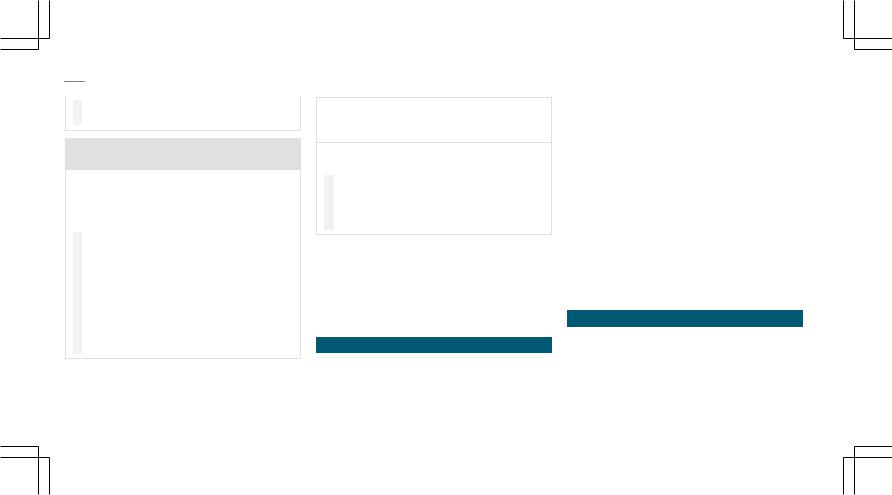
Vehicles with a 48 V on-board electrical system contain high voltage components. These compo‐ nents are marked with a high voltage label:
All work on high voltage components must be carried out at a qualified specialist workshop.
Declaration of conformity for wireless vehi‐ cle components
USA: "The wireless devices of this vehicle com‐
ply with Part 15 of the FCC Rules. Operation is subject to the following two conditions: 1) These devices may not cause harmful interference, and
2) These devices must accept any interference received, including interference that may cause undesired operation. Changes or modifications not expressly approved by the party responsible for compliance could void the user's authority to operate the equipment."
Canada: "The wireless devices of this vehicle comply with Industry Canada license-exempt RSS standard(s). Operation is subject to the fol‐ lowing two conditions: (1) These devices may not cause interference, and (2) These devices must accept any interference, including interfer‐ ence that may cause undesired operation of the device."
USA: "Wireless charging system for mobile devi‐ ces (model: WMI2 Wireless Mobile Interface): this device complies with Part 18 of the FCC Rules."
The name and address of the responsible party is:
peiker acustic GmbH Max-Planck-Str. 28-32 61381 Friedrichsdorf Germany
Diagnostics connection
The diagnostics connection is only intended for the connection of diagnostic devices at a quali‐ fied specialist workshop.
&
WARNING Risk of accident due to con‐ necting devices to the diagnostics con‐ nection
If you connect equipment to a diagnostics connection in the vehicle, it may affect the operation of vehicle systems.
As a result, the operating safety of the vehi‐ cle could be affected.
#
Only connect equipment to a diagnos‐ tics connection in the vehicle which is
Page 30
28
General notes
approved for your vehicle by Mercedes­Benz.
&
WARNING Risk of accident due to objects in the driver's footwell
Objects in the driver's footwell may impede pedal travel or block a depressed pedal.
This jeopardizes the operating and road safety of the vehicle.
#
Stow all objects in the vehicle securely so that they cannot get into the driver's footwell.
#
Always install the floor mats securely and as prescribed in order to ensure that there is always sufficient room for the pedals.
#
Do not use loose floor mats and do not place floor mats on top of one another.
NOTE Battery discharging from using
*
devices connected to the diagnostics connection
Using devices at the diagnostics connection drains the battery.
#
Check the charge level of the battery.
#
If the charge level is low, charge the battery, e.g. by driving a considerable distance.
Connecting equipment to the diagnostics con‐ nection can lead to emissions monitoring infor‐ mation being reset, for example. This may lead to the vehicle failing to meet the requirements of the next emissions inspection during the main inspection.
Qualified specialist workshop
An authorized Mercedes-Benz Center is a quali‐ fied specialist workshop. It has the necessary special skills, tools and qualifications to cor‐ rectly carry out the work required on your vehi‐
cle. This particularly applies to safety-relevant works.
For the following, always have your vehicle checked at an authorized Mercedes-Benz Cen‐ ter:
R
safety-relevant works
R
service and maintenance work
R
repair work
R
modifications as well as installations and conversions
R
work on electronic components
Mercedes‑Benz recommends a Mercedes‑Benz service center.
Correct use of the vehicle
If you remove any warning stickers, you or others could fail to recognize certain dangers. Leave warning stickers in position.
Observe the following information in particular when driving your vehicle:
R
the safety notes in this manual

Page 31
R
technical data for the vehicle
R
traffic rules and regulations
R
laws and safety standards pertaining to motor vehicles
Problems with your vehicle
If you should experience a problem with your vehicle, particularly one that you believe may affect its safe operation, we urge you to contact an authorized Mercedes-Benz Center immedi‐ ately to have the problem diagnosed and recti‐ fied. If the problem is not resolved to your satis‐ faction, please discuss the problem again with an authorized Mercedes-Benz Center or, if nec‐ essary, contact us at one of the following addresses:
In the USA:
Mercedes-Benz USA, LLC Customer Assistance Center One Mercedes-Benz Drive Sandy Springs, GA 30328
In Canada:
Mercedes-Benz Canada, Inc. Customer Relations Department 98 Vanderhoof Avenue Toronto, Ontario M4G 4C9
Reporting safety defects
USA only:
The following text is published as required of manufacturers under Title 49, Code of U.S. Fed‐ eral Regulations, Part 575 pursuant to the "National Traffic and Motor Vehicle Safety Act of 1966".
If you believe that your vehicle has a defect which could cause a crash or could cause injury or death, you should immediately inform the National Highway Traffic Safety Administration (NHTSA) in addition to notifying Mercedes-Benz USA, LLC.
If NHTSA receives similar complaints, it may open an investigation, and if it finds that a safety defect exists in a group of vehicles, it may order a recall and remedy campaign. However, NHTSA cannot become involved in individual problems
General notes
between you, your dealer, or Mercedes-Benz USA, LLC.
To contact NHTSA, you may call the Vehicle Safety Hotline toll-free at 1-888-327-4236 (TTY: 1-800-424-9153) (inside the USA); go to http://www.safercar.gov; or write to: Adminis‐ trator, NHTSA, 400 Seventh Street, SW., Wash‐ ington, DC 20590, USA.
Further information on vehicle safety can be found at: http://www.safercar.gov
Limited Warranty
NOTE Damage to the vehicle arising
*
from violation of these operating instruc‐ tions.
Damage to the vehicle can arise from viola‐ tion of these operating instructions.
This damage is not covered either by the Mercedes-Benz implied warranty or by the New‑ or Used-Vehicle Warranty.
#
Follow the instructions in these operat‐ ing instructions on proper operation of
29
Page 32
30
General notes
your vehicle as well as on possible vehi‐ cle damage.
QR code for rescue card
The QR code is secured in the fuel filler flap and on the opposite side on the B-pillar. In the event of an accident, rescue services can use the QR code to quickly find the appropriate rescue card for your vehicle. The current rescue card con‐ tains the most important information about your vehicle in a compact form, e.g. the routing of the electric lines.
Further information can be obtained at http:// www.mercedes-benz.de/qr-code.
Data storage
Electronic control units
Electronic control units are installed in your vehi‐ cle. Some of these are necessary for the safe operation of your vehicle, while some assist you when driving (driver assistance systems). In addition, your vehicle provides comfort and
entertainment functions, which are also made possible by electronic control units.
Electronic control units contain data memories which can temporarily or permanently store technical information about the vehicle's operat‐ ing state, component loads, maintenance requirements and technical events or malfunc‐ tions.
In general, this information documents the state of a component part, a module, a system or the surroundings such as:
R
operating status of system components (e.g. fill levels, battery status, tire pressure)
R
status messages concerning the vehicle or its individual components (e.g. number of wheel revolutions/speed, longitudinal accel‐ eration, lateral acceleration, display of fas‐ tened seat belts)
R
malfunctions or faults in important system components (e.g. lights, brakes)
R
information on events leading to vehicle damage
R
system reactions in special driving situations (e.g. airbag deployment, intervention of sta‐ bility control systems)
R
ambient conditions (e.g. temperature, rain sensor)
In addition to providing the actual control unit function, this data assists the manufacturer in detecting and rectifying malfunctions and opti‐ mizing vehicle functions. The majority of this data is temporary and is only processed in the vehicle itself. Only a small portion of the data is stored in the event or malfunction memory.
When your vehicle is serviced, technical data from the vehicle can be read out by service net‐ work employees (e.g. workshops, manufactur‐ ers) or third parties (e.g. breakdown services). Services include repair services, maintenance processes, warranty claims and quality assur‐ ance measures, for example. The read out is per‐ formed via the legally prescribed port for the diagnostics connection in the vehicle. The respective service network locations or third parties collect, process and use the data. They document technical statuses of the vehicle,
Page 33
General notes
31
assist in finding malfunctions and improving quality and are transmitted to the manufacturer, if necessary. Furthermore, the manufacturer is subject to product liability. For this, the manu‐ facturer requires technical data from vehicles.
Fault memories in the vehicle can be reset by a service outlet as part of repair or maintenance work.
Depending on the selected equipment, you can import data into the vehicle's comfort and info‐ tainment functions yourself.
This includes, for example:
R
multimedia data such as music, films or pho‐ tos for playback in an integrated multimedia system
R
address book data for use in connection with an integrated hands-free system or an inte‐ grated navigation system
R
entered navigation destinations
R
data about the use of Internet services
This data can be saved locally in the vehicle or it is located on a device which you have connected to the vehicle (e.g. smartphone, USB flash drive
or MP3 player). If this data is stored in the vehi‐ cle, you can delete it at any time. This data is sent to third parties only at your request, partic‐ ularly when you use online services in accord‐ ance with the settings that you have selected.
You can store or change convenience settings/ individualization in the vehicle at any time.
Depending on the equipment, this includes, for example:
R
settings for the seat and steering wheel posi‐ tions
R
suspension and climate control settings
R
customizations such as interior lighting
If your vehicle is accordingly equipped, you can connect your smartphone or another mobile end device to the vehicle. You can control this by means of the control elements integrated in the vehicle. Images and audio from the smartphone can be output via the multimedia system. Cer‐ tain information is simultaneously transferred to your smartphone.
Depending on the type of integration, this can include:
R
general vehicle data
R
position data
This allows you to use selected apps on your smartphone, such as navigation or music play‐ back. There is no further interaction between the smartphone and the vehicle; in particular, vehi‐ cle data is not directly accessible. Which type of further data processing occurs is determined by the provider of the specific app used. Which set‐ tings you can make, if any, depends on the spe‐ cific app and the operating system of your smartphone.
Online services
Wireless network connection
If your vehicle has a wireless network connec‐ tion, it enables data to be exchanged between your vehicle and additional systems. The wire‐ less network connection is enabled via the vehi‐ cle's transmission and reception unit or via con‐ nected mobile end devices (e.g. smartphones).
Page 34
32
General notes
Online functions can be used via the wireless network connection. This includes online serv‐ ices and applications/apps provided by the man‐ ufacturer or other providers.
Manufacturer's services
Regarding online services of the manufacturer, the individual functions are described by the manufacturer in a suitable place (e.g. Operator's Manual, website of the manufacturer) along with the relevant data protection information. Per‐ sonal data may be used for the provision of online services. Data is exchanged via a secure connection, e.g. the manufacturer's designated IT systems. Personal data is collected, pro‐ cessed and used via the provision of services exclusively on the basis of legal permissions or with prior consent.
The services and functions (sometimes subject to a fee) can usually be activated or deactivated. In some cases, this also applies to the entire vehicle's data connection. This excludes, in par‐ ticular, legally prescribed functions and services.
Third party services
If it is possible to use online services from other providers, these services are subject to the data protection and terms of use of the responsible provider. The manufacturer has no influence on the content exchanged.
Please inquire, therefore, about the type, scope and purpose of the collection and use of per‐ sonal data as part of third party services from their respective provider.
MBUX multimedia system/Mercedes me connect
If the vehicle is equipped with the MBUX multi‐ media system or Mercedes me connect, addi‐ tional data about the vehicle's operation, the use of the vehicle in certain situations, and the loca‐ tion of the vehicle may be compiled by the MBUX multimedia system or Mercedes me con‐ nect.
For additional information, please refer to the "MBUX multimedia system" section and/or the Mercedes me connect Terms and Conditions.
Event data recorders
USA only:
This vehicle is equipped with an event data recorder (EDR). The main purpose of an EDR is to record, in certain crash or near crash-like sit‐ uations, such as an airbag deployment or hitting a road obstacle, data that will assist in under‐ standing how a vehicle's systems performed. The EDR is designed to record data related to vehicle dynamics and safety systems for a short period of time, typically 30 seconds or less.
The EDR in this vehicle is designed to record such data as:
R
How various systems in your vehicle were operating
R
Whether or not the driver and front passenger seat belts were buckled/fastened
R
How far (if at all) the driver was depressing the accelerator and/or brake pedal and
R
How fast the vehicle was traveling
This data can help provide a better understand‐ ing of the circumstances in which accidents and injuries occur. NOTE: EDR data is recorded by
Page 35
General notes
33
your vehicle only if a non-trivial crash situation occurs; no data is recorded by the EDR under normal driving conditions and no personal data (e.g. name, gender, age and accident location) is recorded. However, other parties, such as law enforcement, could combine EDR data with the type of personally identifying data routinely acquired during a crash investigation.
Access to the vehicle and/or the EDR is needed to read data that is recorded by the EDR, and special equipment is required. In addition to the vehicle manufacturer, other parties that have the special equipment, such as law enforcement, can read the information by accessing the vehi‐ cle or the EDR.
EDR data may be used in civil and criminal mat‐ ters as a tool in accident reconstruction, acci‐ dent claims and vehicle safety. Since the Crash Data Retrieval (CDR) tool that is used to extract data from the EDR is commercially available, Mercedes-Benz USA, LLC ("MBUSA") expressly disclaims any and all liability arising from the extraction of this information by unauthorized Mercedes-Benz personnel.
MBUSA will not share EDR data with others with‐ out the consent of the vehicle owner or, if the vehicle is leased, without the consent of the les‐ see. Exceptions to this representation include responses to subpoenas by law enforcement; by federal, state or local government; in connection with or arising out of litigation involving MBUSA or its subsidiaries and affiliates; or, as required by law.
Warning: the EDR is a component of the Restraint System Module. Ta mpering with, alter‐ ing, modifying or removing the EDR component may result in a malfunction of the Restraint Sys‐ tem Module and other systems.
State laws or regulations regarding EDRs that conflict with federal regulation are pre-empted. This means that in the event of such conflict, the federal regulation governs. As of December 2016, 17 states have enacted laws relating to EDRs.
Copyright
Free and open source software
Information on free and open source software licenses for your vehicle's software can be found on the data storage medium in your vehicle document wallet and on the Internet together with updates:
http://www.mercedes-benz.com/opensource
Registered trademarks
R
Bluetooth®is a registered trademark of Blue‐ tooth SIG Inc.
R
DTS™ is a registered trademark of DTS, Inc.
R
Dolby®and MLP™ are registered trademarks of DOLBY Laboratories.
R
BabySmart™, ESP®and PRE-SAFE®are reg‐ istered trademarks of Daimler AG.
R
HomeLink®is a registered trademark of Johnson Controls.
R
iPod®and iTunes®are registered trademarks of Apple Inc.
Page 36
34
General notes
R
Burmester®is a registered trademark of Burmester Audiosysteme GmbH.
R
Microsoft®and Windows Media®are regis‐ tered trademarks of Microsoft Corporation.
R
SIRIUS®is a registered trademark of Sirius XM Radio Inc.
R
HD Radio™ is a registered trademark of iBiq‐ uity Digital Corporation.
R
Gracenote®is a registered trademark of Gracenote, Inc.
R
ZAGATSurvey®and related brands are regis‐ tered trademarks of ZagatSurvey, LLC.
Page 37
Occupant safety
35
Restraint system
Protection by the restraint system
The restraint system includes the following com‐ ponents:
R
Seat belt system
R
Airbags
R
Child restraint system
R
Child seat securing systems
The restraint system can help prevent the vehi‐ cle occupants from coming into contact with parts of the vehicle interior in the event of an accident. In the event of an accident, the restraint system can also reduce the forces to which the vehicle occupants are subjected.
A seat belt can only provide the best level of pro‐ tection if it is worn correctly. Depending on the detected accident situation, Emergency Tension‐ ing Devices and/or airbags supplement the pro‐ tection offered by a correctly worn seat belt. Emergency Tensioning Devices and/or airbags are not deployed in every accident.
In order for the restraint system to provide the intended level of protection, each vehicle occu‐ pant must observe the following information:
R
Fasten seat belts correctly.
R
Sit in an almost upright seat position with their back against the seat backrest.
R
Sit with their feet resting on the floor, if pos‐ sible.
R
Always secure persons under 5 ft (1.50 m) tall in an additional restraint system suitable for Mercedes-Benz vehicles.
However, no system available today can com‐ pletely eliminate injuries and fatalities in every accident situation. In particular, the seat belt and airbag generally do not protect against objects penetrating the vehicle from the outside. It is also not possible to completely rule out the risk of injury caused by the airbag deploying.
Limited protection from the restraint system
&
WARNING Risk of injury or death from modifications to the restraint system
The restraint system can no longer function correctly after alterations have been made.
The restraint system may then not protect the vehicle occupants as intended by failing in an accident or triggering unexpectedly, for example
#
Never alter the parts of the restraint system.
#
Never tamper with the wiring or any electronic component parts or their software.
If it is necessary to adjust the vehicle to accom‐ modate a person with disabilities, contact an authorized Mercedes-Benz Center for details.
USA only: contact our Customer Assistance Cen‐ ter at 1-800-FOR-MERCedes (1‑800‑367‑6372) for details.
Page 38
36
Occupant safety
Restraint system functionality
When the ignition is switched on, a self-test is performed, during which the 6 restraint sys‐ tem warning lamp lights up. It goes out no later than a few seconds after the vehicle is started. The components of the restraint system are then functional.
Malfunctioning restraint system
A malfunction has occurred in the restraint sys‐ tem if:
R
The 6 restraint system warning lamp does not light up when the ignition is switched on
R
The 6 restraint system warning lamp lights up continuously or repeatedly during a journey
&
WARNING Risk of injury due to malfunc‐ tions in the restraint system
If the restraint system is malfunctioning, restraint system components may be trig‐
gered unintentionally or may not deploy as intended during an accident. This may affect the Emergency Te nsioning Devices or air‐ bags, for example.
#
Have the restraint system checked and repaired immediately at a qualified spe‐ cialist workshop.
Function of the restraint system in an acci‐ dent
How the restraint system works is determined by the severity of the impact detected and the type of accident anticipated:
R
Frontal impact
R
Rear impact
R
Side impact
R
Rollover
The activation thresholds for the components of the restraint system are determined based on the evaluation of the sensor values measured at various points in the vehicle. This process is pre­emptive in nature. The triggering/deployment of
the components of the restraint system must take place in good time at the start of the colli‐ sion.
Factors which can only be seen and measured after a collision has occurred do not play a deci‐ sive role in the deployment of an airbag. Nor do they provide an indication of airbag deployment.
The vehicle may be deformed significantly with‐ out an airbag being deployed. This is the case if only parts which are relatively easily deformed are affected and the rate of vehicle deceleration is not high. Conversely, an airbag may be deployed even though the vehicle suffers only minor deformation. If very rigid vehicle parts such as longitudinal members are hit, for exam‐ ple, this may result in sufficiently high levels of vehicle deceleration.
Page 39
Occupant safety
37
The components of the restraint system can be activated or deployed independently of each other:
Component Detected deploy‐
ment situation
Emergency Tension‐ ing Devices
Frontal impact, rear impact, side impact, rollover
Driver's airbag, front
Frontal impact passenger front air‐ bag
Knee airbag Frontal impact
Side airbag Side impact
Window curtain air‐ bag
PRE-SAFE®Impulse
Side impact, rollover,
frontal impact
Side impact Side
The front passenger front airbag can only be deployed in an accident if the PASSENGER AIR BAG OFF indicator lamp is off. If the front
passenger seat is occupied, make sure, both before and during the journey, that the status of the front passenger front airbag is correct (/ page 47).
&
WARNING Risk of burns from hot air bag components
The air bag parts are hot after an air bag has been deployed.
#
Do not touch the air bag parts.
#
Have a deployed air bag replaced at a qualified specialist workshop as soon as possible.
Mercedes-Benz recommends that you have the vehicle towed to a qualified specialist workshop after an accident. Take this into account, partic‐ ularly if an Emergency Tensioning Device is trig‐ gered or an airbag deployed.
If the Emergency Tensioning Devices are trig‐ gered or an airbag is deployed, you will hear a bang, and a small amount of powder may also be released:
R
The bang will not generally affect your hear‐ ing.
R
In general, the powder released is not haz‐ ardous to health but may cause short-term breathing difficulties to persons suffering from asthma or other pulmonary conditions.
Provided it is safe to do so, leave the vehicle immediately or open the window in order to prevent breathing difficulties.
Airbags and pyrotechnic Emergency Tensioning Devices contain perchlorate material, which may require special handling or environmental pro‐ tection measures. National guidelines regarding waste disposal must be observed. In California, see http://www.dtsc.ca.gov/HazardousWaste/ Perchlorate/index.cfm.
Page 40
38
Occupant safety
Seat belts
Protection provided by the seat belt
Always fasten your seat belt correctly before starting a journey. A seat belt can only provide the best level of protection if it is worn correctly.
&
WARNING Risk of injury or death due to incorrectly fastened seat belt
If the seat belt is not worn correctly, it can‐ not perform its intended protective function.
In addition, an incorrectly fastened seat belt can also cause injuries, for example, in the event of an accident or when braking or changing direction suddenly.
#
Always ensure that all vehicle occu‐ pants have their seat belts fastened correctly and are sitting properly.
Always observe the instructions about the cor‐ rect driver's seat position and adjusting the seats (/ page 95).
In order for the correctly worn seat belt to pro‐ vide the intended level of protection, each vehi‐ cle occupant must observe the following infor‐ mation:
R
The seat belt must not be twisted and must fit tightly and snugly across the body.
R
The seat belt must be routed across the cen‐ ter of the shoulder and as low down across the hips as possible.
R
The shoulder section of the seat belt should not touch your neck nor be routed under your arm or behind your back.
R
Avoid wearing bulky clothing, e.g. a winter coat.
R
Push the lap belt down as far as possible across your hips and pull tight with the shoul‐ der section of the belt. Never route the lap belt across your abdomen.
Pregnant women must also take particular care with this.
R
Never route the seat belt across sharp, poin‐ ted, abrasive or fragile objects.
R
Only one person may use each seat belt at any one time. Infants and children must never travel sitting on the lap of a vehicle occupant.
R
Never secure objects with a seat belt if the seat belt is being used by one of the vehi‐ cle's occupants. Always observe the instruc‐ tions for loading the vehicle when securing objects, luggage or loads (/ page 11 4).
Also ensure that no objects, e.g. a cushion, are ever placed between a person and the seat.
The seat belts on the following seats are equip‐ ped with a special seatbelt retractor:
R
Co-driver seat
R
Rear seats
Activate or deactivate the special seatbelt retractor of the seat belt (/ page 58).
If children are traveling in the vehicle, be sure to observe the instructions and safety notes on "Children in the vehicle" (/ page 52).
Page 41
Occupant safety
39
Limitations of the protection provided by the seat belt
&
WARNING Risk of injury or death due to incorrect seat position
The seat belt does not offer the intended level of protection if you have not moved the seat backrest to an almost vertical position.
When braking or in the event of an accident, you could slide underneath the seat belt and sustain abdominal or neck injuries, for exam‐ ple.
#
Adjust the seat properly before begin‐ ning your journey.
#
Always ensure that the seat backrest is in an almost vertical position and that the shoulder section of your seat belt is routed across the center of your shoul‐ der.
&
WARNING Risk of injury or death when additional restraint systems are not used for persons with a smaller build
Persons under 5 ft (1.50 m) tall cannot wear the seat belt correctly without a suitable additional restraint system.
If the seat belt is not worn correctly, it can‐ not perform its intended protective function. In addition, an incorrectly fastened seat belt can also cause injuries, for example, in the event of an accident or when braking or changing direction suddenly.
#
Always secure persons under 5 ft (1.50 m) tall in a suitable restraint sys‐ tem.
&
WARNING Danger of injury or death due to blocked seat belt anchorages
The restraint effect of the seat belt is impaired if objects between the front seat and the door are blocking the movable seat belt anchorage on the front seat.
The seat belt may not then provide the proper protection.
#
Before starting a journey, make sure that there are no objects between the front seat and the door.
&
WARNING Risk of injury or death due to damaged or modified seat belts
Seat belts cannot provide protection in the following situations:
R
The seat belt is damaged, has been modi‐ fied, is extremely dirty, bleached or dyed
R
The seat belt buckle is damaged or extremely dirty
R
Modifications have been made to the Emergency Tensioning Device, seat belt anchorage or seat belt retractor
Seat belts may sustain non-visible damage in an accident, e.g. due to glass splinters.
Modified or damaged seat belts could tear or fail in the event of an accident, for example.
Page 42
40
Occupant safety
Modified Emergency Te nsioning Devices may be deployed unintentionally or not function as intended.
#
Never modify the seat belts, Emergency Tensioning Devices, seat belt ancho‐ rages or seat belt retractors.
#
Make sure that the seat belts are not damaged, are not worn and are clean.
#
Always have the seat belts checked immediately after an accident at a qualified specialist workshop.
Only use seat belts that have been approved for your vehicle by Mercedes-Benz.
&
WARNING Risk of injury or death from deployed pyrotechnic Emergency Ten‐ sioning Devices
Pyrotechnic Emergency Tensioning Devices that have been deployed are no longer opera‐ tional and are unable to perform their inten‐ ded protective function.
#
Therefore, have deployed pyrotechnic Emergency Tensioning Devices immedi‐
ately replaced at a qualified specialist workshop.
Mercedes-Benz recommends that you have the vehicle towed to a qualified specialist workshop after an accident.
NOTE Damage caused by trapping the
*
seat belt
If an unused seat belt is not fully retracted, it may become trapped in the door or in the seat mechanism.
#
Always ensure that an unused seat belt is fully retracted.
Fastening and adjusting the seat belts
If the seat belt is pulled quickly or sharply, the seat belt retractor locks. The seat belt strap can‐ not be pulled out any further.
#
Always engage seat belt tongue 2 of the seat belt into seat belt buckle 1 of the cor‐ responding seat.
#
Press and hold the seat belt outlet release and slide seat belt outlet 3 into the desired position.
#
Let go of the seat belt outlet release and ensure that seat belt outlet 3 locks into position.
Page 43
Occupant safety
41
Vehicles with automatic front passenger front airbag shutoff:
NOTE Deployment of the Emergency
*
Tensioning Device and side air bag when the front passenger seat is unoccupied
If the seat belt tongue is engaged in the seat belt buckle of the unoccupied front passenger seat, the Emergency Te nsioning Device and the side air bag may also deploy in the event of an accident along with other systems.
#
Only one person should use each seat belt at any one time.
Vehicles without automatic front passenger front airbag shutoff:
NOTE Deployment of the Emergency
*
Tensioning Device when the front­passenger seat is unoccupied
If the seat belt tongue is engaged in the seat belt buckle of the unoccupied front­passenger seat, the Emergency Te nsioning
Device may also deploy in the event of an accident along with other systems.
#
Only one person should use each seat belt at any one time.
Seat belt adjustment function
Vehicles with PRE-SAFE®: If the front seat belt
is not pulled tight across your body, the seat belt adjustment may automatically apply a certain tightening force. Do not hold the seat belt tightly while it is adjusting.
You can activate and deactivate the seat belt adjustment function using the multimedia sys‐ tem (/ page 41 ).
Releasing seat belts
#
Press the release button in the seat belt buckle and guide the seat belt back with the seat belt tongue.
Activating/deactivating seat belt adjustment via the multimedia system
Multimedia system:
4
©5Settings5Vehicle
#
Activate or deactivate Belt Adjustment.
Seat belt warning function for the driver and front passenger
The ü seat belt warning lamp in the Instru‐ ment Display is a reminder that all vehicle occu‐ pants must wear their seat belts correctly.
The ü seat belt warning lamp lights up for six seconds every time the vehicle is started.
In addition, a warning tone may sound. When the driver's and front passenger's doors
are closed and the driver and front passenger have fastened their seat belts, the seat belt warning goes out.
Page 44
42
Occupant safety
In the following cases, the seat belt warning lights up during a journey if:
R
The vehicle speed exceeds 15 mph (25 km/h) and the driver's or front passenger seat belt is not fastened.
R
The driver or front passenger unfastens their seat belt while the vehicle is in motion.
Airbags
Overview of airbags
1
Driver's knee bag
2
Driver's airbag
3
Front passenger front airbag
4
Window curtain airbag
5
Side airbag
The installation location of an airbag is identified by the AIRBAG symbol.
When enabled, an airbag can provide additional protection for the respective vehicle occupant.
Potential protection from each airbag:
AIRBAG Potential protection for:
Knee airbag Thigh, knee and lower leg
Driver's airbag,
Head and ribcage front passenger front airbag
Window curtain
Head airbag
Side airbag Ribcage and pelvis
&
WARNING Risk of injury or fatal injuries if the front-passenger airbag is enabled
If the front-passenger front airbag is enabled, a child on the front-passenger seat may be struck by the front-passenger airbag during an accident.
NEVER use a rearward-facing child restraint system on a seat with an ENABLED FRONT AIRBAG, DEATH or SERIOUS INJURY to the CHILD can occur.
When installing a child restraint system on the front passenger seat, observe the vehicle-spe‐ cific information (/ page 64). Also, always observe the notes on rearward-facing or forward-facing child restraint systems on the front passenger seat.
Vehicles with automatic front passenger front airbag shutoff:
The front passenger front airbag can only be deployed in an accident if the PASSENGER AIR BAG OFF indicator lamp is off. If the front passenger seat is occupied, make sure, both before and during the journey, that the status of
Page 45
Occupant safety
43
the front passenger front airbag is correct (/ page 47).
NOTE Important points to remember if
*
the front passenger seat is unoccupied
In an accident, the components of the restraint system may deploy unnecessarily on the front passenger side if:
R
There are heavy objects on the front passenger seat.
R
The seat belt tongue is engaged in the seat belt buckle of the front passenger seat and the front passenger seat is unoccupied.
#
Stow objects in a suitable place.
#
Only one person should use each seat belt at any one time.
Depending on the detected accident situation, the window curtain airbag on the front passenger side may deploy. The airbag is deployed regardless of whether the front passenger seat is occupied.
Protection by the airbags
Depending on the accident situation, an airbag may supplement the protection offered by a cor‐ rectly fastened seat belt.
&
WARNING Risk of injury or death due to incorrect seat position
If you deviate from the correct seat position, the airbag cannot perform its intended pro‐ tective function and deployment may even cause further injuries.
In order to avoid risks, each vehicle occupant must always make sure of the following:
R
Fasten seat belts correctly. Pregnant women must take particular care to ensure that the lap belt never lies across the abdomen.
R
Adopt the correct seat position and keep as far away as possible from the airbags.
R
Observe the following information.
#
Always make sure that there are no objects between the airbag and vehicle occupant.
To avoid the risks resulting from the deployment of an airbag, each vehicle occupant must observe the following information in particular:
R
Before starting your journey, adjust your seat correctly; the driver's seat and front passenger seat should be moved as far back as possible.
When doing so, always observe the informa‐ tion on the correct driver's seat position (/ page 95).
R
Only hold the steering wheel by the steering wheel rim. This allows the airbag to be fully deployed.
R
Always lean against the seat backrest when the vehicle is in motion. Do not lean forwards or against the door or side window. You may otherwise be in the deployment area of the airbags.
R
Always keep your feet on the floor. Do not put your feet on the cockpit, for example.
Page 46
44
Occupant safety
Your feet may otherwise be in the deploy‐ ment area of the airbag.
R
If children are traveling in the vehicle, observe the additional notes (/ page 52).
R
Always stow and secure objects correctly.
Objects in the vehicle interior may prevent an airbag from functioning correctly. Each vehicle occupant must always make sure of the follow‐ ing in particular:
R
There are no people, animals or objects between the vehicle occupants and an air‐ bag.
R
There are no objects between the seat, door and door pillar (B-pillar).
R
There are no hard objects, e.g. coat hangers, hanging on the grab handles or coat hooks.
R
There are no accessory parts, such as mobile navigation devices, mobile phones or cup holders, attached to the vehicle within the deployment area of an airbag, e.g. on the cockpit, on the door, on the side window or on the side wall trim.
In addition, no connecting cables, tensioning straps or retaining straps must be routed or attached to the vehicle within the deploy‐ ment area of an airbag. Always comply with the accessory manufacturer's installation instructions and, in particular, the notes on suitable places for installation.
R
There are no heavy, sharp-edged or fragile objects in the pockets of your clothing. Store such objects in a suitable place.
Limited protection from airbags
&
WARNING Risk of injury due to modifi‐ cations to the airbag cover
If you modify the cover of an airbag or affix objects such as stickers to it, the airbag may no longer function correctly.
#
Never modify the cover of an airbag and do not affix objects to it.
The installation location of an airbag is identified by the AIRBAG symbol (/ page 42).
&
WARNING Risk of injury or death due to the use of unsuitable seat covers
Unsuitable seat covers can obstruct or pre‐ vent the deployment of air bags integrated into the seats.
Consequently, the air bags cannot protect vehicle occupants as they are designed to do. In addition, operation of the automatic front passenger air bag shutoff may be restricted.
#
You should only use seat covers that have been approved for the correspond‐ ing seats by Mercedes-Benz.
&
WARNING Risk of injury due to malfunc‐ tions of the sensors in the door paneling
Sensors to control the airbags are located in the doors. Modifications or work not per‐ formed correctly to the doors or door panel‐ ing, as well as damaged doors, can lead to the function of the sensors being impaired. The airbags might therefore not function properly any more.
Page 47
Occupant safety
45
Consequently, the airbags cannot protect vehicle occupants as they are designed to do.
#
Never modify the doors or parts of the doors.
#
Always have work on the doors or door paneling carried out at a qualified spe‐ cialist workshop.
&
WARNING Risk of injury due to deployed airbag
A deployed airbag no longer has a protective function and cannot protect as intended in the event of an accident.
#
Have the vehicle towed to a qualified specialist workshop in order to have the deployed airbag replaced.
Have deployed airbags replaced immediately.
Status of the front passenger front airbag
Function of the automatic front passenger front airbag shutoff
The automatic front passenger front airbag shut‐ off is able to detect whether the front passenger seat is occupied by a person or a child restraint system. The front passenger front airbag is ena‐ bled or disabled accordingly.
When installing a child restraint system on the front passenger seat, always make sure of the following:
R
Ensure that the child restraint system is posi‐ tioned correctly (/ page 51 ).
R
Always observe the child restraint system manufacturer's installation instructions.
R
Never place objects, e.g. cushions, under or behind the child restraint system.
R
Fully retract the seat cushion length adjust‐ ment.
R
The entire base of the child restraint system must always rest on the seat cushion of the front passenger seat.
R
The backrest of the forward-facing child restraint system must lie as flat as possible against the backrest of the front passenger seat.
R
The child restraint system must not touch the roof or be put under strain by the head restraints. Adjust the seat backrest inclina‐ tion and the head restraint setting accord‐ ingly.
&
WARNING Risk of injury or death due to objects between the sitting surface and the child restraint system
Objects between the sitting surface and the child restraint system could affect the func‐ tion of the automatic front passenger airbag shutoff.
This could result in the front passenger air‐ bag not functioning as intended during an accident.
#
Do not place any objects between the sitting surface and the child restraint system.
Page 48
46
Occupant safety
#
The entire base of the child restraint system must always rest on the sitting surface of the front passenger seat.
#
The backrest of the forward-facing child restraint system must, as far as possi‐ ble, be resting on the seat backrest of the front passenger seat.
#
Always comply with the child restraint system manufacturer's installation instructions.
A person on the front passenger seat must observe the following information:
R
Fasten seat belts correctly (/ page 38).
R
Sit in an almost upright seat position with their back against the seat backrest.
R
Sit with their feet resting on the floor, if pos‐ sible.
The front passenger front airbag may otherwise be disabled by mistake, for example in the fol‐ lowing situations:
R
The front passenger transfers their weight by supporting themselves on a vehicle armrest.
R
The front passenger sits in such a way that their weight is raised from the sitting sur‐ face.
&
WARNING Risk of injury or death due to deactivated front passenger airbag
If the PASSENGER AIR BAG OFF indicator lamp is lit, the front passenger airbag is disa‐ bled. It will not be deployed in the event of an accident and cannot perform its intended protective function.
A person in the front passenger seat could then, for example, come into contact with the vehicle interior, especially if the person is sitting too close to the cockpit.
If the front passenger seat is occupied, always ensure that:
R
The classification of the person in the front passenger seat is correct and the front passenger airbag is enabled or disa‐ bled in accordance with the person in the front passenger seat.
R
The front passenger seat has been moved as far back as possible.
R
The person is seated correctly.
#
Ensure, both before and during the jour‐ ney, that the status of the front passenger airbag is correct.
If the front passenger seat is occupied, the clas‐ sification of the person or child restraint system on the front passenger seat takes place after the front passenger front airbag shutoff self-test. The PASSENGER AIR BAG indicator lamps dis‐ play the status of the front passenger front air‐ bag.
Always observe the notes on the function of the PASSENGER AIR BAG indicator lamps (/ page 47).
Page 49
Occupant safety
47
Function of the PASSENGER AIR BAG indica‐ tor lamps
Self-test of automatic front passenger front airbag shutoff
When the ignition is switched on, a self-test is performed during which the two PASSENGER AIR BAG ON and OFF indicator lamps light up simultaneously.
The status of the front passenger front airbag is displayed after the self-test:
R
PASSENGER AIR BAG ON lights up for 60 seconds, subsequently both indicator lamps are off (PASSENGER AIR BAG ON and OFF): the front passenger front airbag is able to deploy in the event of an accident.
R
PASSENGER AIR BAG OFF lights up continu‐ ously: the front passenger front airbag is dis‐ abled. It will then not be deployed in the event of an accident.
If the PASSENGER AIR BAG ON indicator lamp is off, only the PASSENGER AIR BAG OFF indicator lamp shows the status of the front passenger front airbag. The PASSENGER AIR BAG OFF indi‐ cator lamp may be lit continuously or be off.
If the PASSENGER AIR BAG OFF indicator lamp and the 6 restraint system warning lamp light up simultaneously, the front passenger seat may not be used. Also in this case, do not install a child restraint system on the front passenger seat. Have automatic front passenger front air‐ bag shutoff checked and repaired immediately at a qualified specialist workshop.
Status display
If the front passenger seat is occupied, ensure, both before and during the journey, that the sta‐ tus of the front passenger front airbag is correct for the current situation.
After installing a rearward-facing child restraint system on the front passenger seat: PASSENGER AIR BAG OFF must be lit con‐
tinuously.
&
WARNING Risk of injury or death from using a rearward-facing child restraint system when the front passenger front airbag is enabled
If you secure a child in a rearward-facing child restraint system on the front passenger seat and the PASSENGER AIR BAG OFF indi‐ cator lamp is off, the front passenger airbag can deploy in the event of an accident.
The child could be struck by the airbag. Always ensure that the front passenger air‐
bag is deactivated. The PASSENGER AIR BAG OFF indicator lamp must be lit.
Page 50
48
Occupant safety
NEVER use a rearward-facing child restraint system on a seat protected by an ENABLED FRONT AIRBAG in front of it, DEATH or SERI‐ OUS INJURY to the CHILD can occur.
When installing a child restraint system on the front passenger seat, observe the vehicle-spe‐ cific information (/ page 64).
Depending on the child restraint system and the stature of the child, the PASSENGER AIR BAG OFF indicator lamp may be off. In this case, do not install the rearward-facing child restraint system on the front passenger seat.
Instead, install the rearward-facing child restraint system on a suitable rear seat.
After installing a forward-facing child restraint system on the front passenger seat: depending on the child restraint system
and the stature of the child, PASSENGER AIR BAG OFF may be lit continuously or be off. Always observe the following information.
&
WARNING Risk of injury or death due to incorrect positioning of the forward­facing child restraint system
If you secure a child in a forward-facing child restraint system on the front passenger seat and you position the front passenger seat too close to the cockpit, in the event of an acci‐ dent, the child could:
R
Come into contact with the vehicle inte‐ rior if the PASSENGER AIR BAG OFF indi‐ cator lamp is lit, for example.
R
Be struck by the air bag if the PASSENGER AIR BAG OFF indicator lamp is off.
#
Always move the front passenger seat as far back as possible and fully retract the seat cushion length adjustment. Always make sure that the shoulder belt strap is correctly routed from the seat belt outlet on the vehicle to the shoul‐ der belt guide on the child restraint sys‐ tem. The shoulder belt strap must be routed forwards and downwards from the vehicle belt outlet. If necessary,
adjust the seat belt outlet and the front passenger seat accordingly.
#
Always observe the child restraint sys‐ tem manufacturer's installation instruc‐ tions.
When installing a child restraint system on the front passenger seat, observe the vehicle-spe‐ cific information (/ page 64).
If a person is sitting on the front passenger seat: PASSENGER AIR BAG OFF may be lit con‐
tinuously or be off, depending on the person's stature.
A person on the front passenger seat must always observe the following information:
R
If the front passenger seat is occupied by an adult or a person with a stature correspond‐ ing to that of an adult, the PASSENGER AIR BAG OFF indicator lamp must be off. This indicates that the front passenger front air‐ bag is enabled.
If the PASSENGER AIR BAG OFF indicator lamp is lit continuously, an adult or person
Page 51
Occupant safety
49
with a build corresponding to that of an adult should not use the front passenger seat.
Instead, they should use a rear seat.
R
If the front passenger seat is occupied by a person of smaller stature (e.g. a teenager or small adult), the PASSENGER AIR BAG OFF indicator lamp either lights up continuously or remains off, depending on the result of the classification.
-
If the PASSENGER AIR BAG OFF indicator lamp is off: move the front passenger seat as far back as possible, or the per‐ son of smaller stature should use a rear seat.
-
If the PASSENGER AIR BAG OFF indicator lamp is lit continuously: the person of smaller stature should not use the front passenger seat.
&
WARNING Risk of injury or death when the PASSENGER AIR BAG OFF indicator lamp is lit
If the PASSENGER AIR BAG OFF indicator lamp remains lit after the system self-test, the front passenger air bag is deactivated. It will not be deployed in the event of an acci‐ dent. In this case, the front passenger air bag cannot perform its intended protective func‐ tion, e.g. when a person is seated in the front passenger seat.
That person could, for example, come into contact with the vehicle interior, especially if the person is sitting too close to the cockpit.
If the front passenger seat is occupied, always ensure that:
R
The classification of the person in the front passenger seat is correct and the front passenger air bag is enabled or deactivated in accordance with the per‐ son in the front passenger seat.
R
The person is seated properly with a cor‐ rectly fastened seat belt.
R
The front passenger seat has been moved as far back as possible.
Be sure to also observe the following further related subjects:
R
Child restraint system on the front passenger seat (/ page 64).
PRE-SAFE®system
PRE-SAFE®(anticipatory occupant protec‐ tion)
PRE-SAFE®is able to detect certain critical driv‐ ing situations and implement pre-emptive meas‐ ures to protect the vehicle occupants.
PRE-SAFE®can implement the following meas‐ ures independently of each other:
R
Tightening the seat belts on the driver's seat and front passenger seat.
R
Closing the side windows.
Page 52
50
Occupant safety
R
Vehicles with sliding sunroof: Closing the sliding sunroof.
R
Vehicles with memory function: Moving the front passenger seat to a more favorable seat position.
R
Vehicles with multicontour seat: Increas‐ ing the air pressure in the seat side bolsters of the seat backrest.
R
PRE-SAFE®Sound: provided that the multi‐ media system is switched on, generates a brief noise signal to stimulate the innate pro‐ tective mechanism of a person's hearing.
NOTE Damage caused by objects in the
*
footwell or behind the seat
The automatic adjustment of the seat posi‐ tion may result in damage to the seat and/or the object.
#
Stow objects in a suitable place.
Reversing the PRE-SAFE®system measures
If an accident did not occur, the pre-emptive measures that were taken are reversed.
You will need to perform certain settings your‐ self.
#
If the seat belt pre-tensioning is not reduced, move the seat backrest back slightly. The locking mechanism releases.
Function of PRE-SAFE®PLUS (anticipatory occupant protection plus)
PRE-SAFE®PLUS can detect certain impacts, particularly an imminent rear impact, and take pre-emptive measures to protect the vehicle occupants. These measures cannot necessarily prevent an imminent impact.
PRE-SAFE®PLUS can implement the following measures independently of each other:
R
Tightening the seat belts on the driver's seat and front passenger seat.
R
Increasing brake pressure when the vehicle is stationary. This brake application is can‐
celed automatically when the vehicle pulls away.
If an accident did not occur, the pre-emptive measures that were taken are reversed.
System limitations
The system will not initiate any action in the fol‐ lowing situations:
R
when backing up or
R
when the vehicle is towing a trailer and there is a risk of a rear impact
The system will not initiate any braking applica‐ tion in the following situations:
R
whilst driving or
R
when entering or exiting a parking space while using Active Parking Assist
Information on PRE-SAFE®Impulse Side
If an imminent side impact is detected, PRE­SAFE®Impulse Side can pre-emptively move the
Page 53
Occupant safety
51
front seat vehicle occupant's upper body towards the center of the vehicle. It does this by rapidly inflating an air cushion in the outer seat side bolster of the seat backrest on the side on which the impact is anticipated. This increases the distance between the door and the vehicle occupant.
If PRE-SAFE®Impulse Side has been deployed or is faulty, the PRE-SAFE Impulse Side Inoperative
See Operator's Manual display message appears
(/ page
533) .
Safely transporting children in the vehicle
Always observe when children are traveling in the vehicle
%
Also strictly observe the safety notes for the specific situation. In this way you can recog‐ nize potential risks and avoid dangers if chil‐ dren are traveling in the vehicle (/ page 52).
Be diligent
Bear in mind that neglecting to secure a child in the child restraint system may have serious con‐ sequences. Always be diligent in securing a child carefully before every journey.
To improve protection for children younger than 12 years old or under 5 ft (1.50 m) in height, Mercedes-Benz recommends you observe the following information:
R
Always secure the child in a child restraint system suitable for this Mercedes-Benz vehi‐ cle.
R
The child restraint system must be appropri‐ ate to the age, weight and size of the child.
R
The vehicle seat must be suitable for instal‐ ling a child restraint system.
Accident statistics show that children secured in the rear seats are generally safer than children secured in the front seats. For this reason, Mercedes-Benz strongly advises that you install a child restraint system on a rear seat.
Generic term "child restraint system"
The generic term child restraint system is used in this Operator's Manual. A child restraint sys‐ tem is, for example:
R
a baby car seat
R
a rearward-facing child seat
R
a forward-facing child seat
R
a child booster seat with a backrest and seat belt guide
Mercedes-Benz recommends using a child booster seat with a backrest.
The child restraint system must be appropriate to the age, weight and size of the child.
Observing laws and legal requirements
Always observe the legal requirements when using a child restraint system in the vehicle.
Page 54
52
Occupant safety
Observing standards for child restraint sys‐ tems
All child restraint systems must meet the follow‐ ing standards:
R
U.S. Federal Motor Vehicle Safety Standards 213 and 225
R
Canadian Motor Vehicle Safety Standards 213 and 210.2
Confirmation that the child restraint system complies with the standards can be found on an instruction label on the child restraint system. This confirmation can also be found in the instal‐ lation instructions that are included with the child restraint system.
Detecting risks, avoiding danger
Securing systems for child restraint systems in the vehicle
Only use the following securing systems for child restraint systems:
R
the LATCH-type (ISOFIX) mounting brackets
R
the vehicle's seat belt system
R
the Top Tether anchorages
Installing a LATCH-type (ISOFIX) child restraint system is preferred.
Simply attaching to the securing rings on the vehicle can reduce the risk of installing the child restraint system incorrectly.
When securing a child with the integrated seat belt of the LATCH-type (ISOFIX) child restraint system, always comply with the permissible gross weight for the child and child restraint sys‐ tem (/ page 58).
A booster seat may be necessary to achieve proper seat belt positioning for children over 40 lbs (18 kg) in weight or until they reach a height where a three-point seat belt can be installed properly without a booster seat.
Mercedes-Benz recommends a suitable child booster seat with a backrest and seat belt guide.
Advantage of a rearward-facing child restraint system
It is preferable to transport a baby or a small child in a suitable rearward-facing child restraint system. In this case, the child sits in the oppo‐
site direction to the direction of travel and faces backwards.
Babies and small children have comparatively weak neck muscles in relation to the size and weight of their head. The risk of injury to the cer‐ vical spine during an accident can be reduced in a rearward-facing child restraint system.
Always secure a child restraint system cor‐ rectly
&
WARNING Risk of injury or death caused by incorrect installation of the child restraint system
If the child restraint system is incorrectly installed on a suitable seating position, it cannot perform its intended protective func‐ tion.
The child cannot be restrained in the event of an accident, heavy braking or a sudden change of direction.
#
Always comply with the manufacturer's installation instructions for the child restraint system and its correct use.
Page 55
#
Make sure that the entire base of the child restraint system always rests on the sitting surface of the seat.
#
Never place objects under or behind the child restraint system, e.g. cush‐ ions.
#
Always use child restraint systems with the original cover designed for them.
#
Always replace damaged covers with genuine covers.
&
WARNING Risk of injury or death from unsecured child restraint systems in the vehicle
If the child restraint system is not correctly installed or secured, it could release in the event of an accident, sudden braking or a sudden change in direction.
The child restraint system could be flung around and hit vehicle occupants.
#
Always install child restraint systems correctly, even when not in use.
#
Always comply with the child restraint system manufacturer's installation instructions.
R
Always observe the child restraint system manufacturer's installation and operating instructions as well as the vehicle-specific information:
-
Install the LATCH-type (ISOFIX) child restraint system on the rear seat (/ page 58).
-
Secure the child restraint system with the seat belt on the rear seat (/ page 63).
-
Secure the child restraint system with the seat belt on the front passenger seat (/ page 65). Observe the specific instructions for the rearward-facing and forward-facing child restraint systems (/ page 64).
If the front passenger seat is occupied, ensure, both before and during the jour‐ ney, that the status of the front passenger front airbag is correct for the current situation (/ page 47).
Occupant safety
R
Observe the warning labels in the vehicle interior and on the child restraint system.
R
Also secure Top Tether if present.
Do not modify the child restraint system
&
WARNING Risk of injury due to modifi‐ cations to the child restraint system
The child restraint system may no longer function as it is supposed to if you make modifications or attach objects to it, e.g. toys or unsuitable accessories. This poses an increased risk of injury!
Never modify the child restraint system. Only attach accessories which the manufacturer of the child restraint system has authorized especially for this child restraint system.
53
Page 56
54
Occupant safety
Only use child restraint systems which are in proper working condition
&
WARNING Risk of injury or death caused by the use of damaged child restraint systems
Child restraint systems or their retaining sys‐ tems that have been subjected to a load in an accident may then not be able to perform their intended protective function.
The child cannot be restrained in the event of an accident, heavy braking or a sudden change of direction.
#
Always replace child restraint systems immediately that have been damaged or involved in an accident.
#
Have the securing systems for the child restraint systems checked at a qualified specialist workshop before installing a child restraint system again.
Avoiding direct sunlight
&
WARNING Risk of burns when the child seat is exposed to direct sunlight
If the child restraint system is exposed to direct sunlight or heat, parts could heat up.
Children could suffer burns from these parts, particularly on metallic parts of the child restraint system.
#
Always make sure that the child restraint system is not exposed to direct sunlight.
#
Protect it with a blanket, for example.
#
If the child restraint system has been exposed to direct sunlight, allow it to cool before securing a child into it.
#
Never leave children unattended in the vehicle.
Observe when stopping or parking
&
WARNING Risk of accident and injury due to children left unattended in the vehicle
If children are left unattended in the vehicle, they could:
R
Open doors, thereby endangering other persons or road users.
R
Get out and be struck by oncoming traf‐ fic.
R
Operate vehicle equipment and become trapped, for example.
In addition, the children could also set the vehicle in motion, for example by:
R
Releasing the parking brake.
R
Changing the transmission position.
R
Starting the vehicle.
#
Never leave children unattended in the vehicle.
Page 57
#
When leaving the vehicle, always take the key with you and lock the vehicle.
#
Keep the vehicle key out of reach of children.
&
WARNING Risk of fatal injury due to exposure to extreme heat or cold in the vehicle
If people – particularly children – are exposed to extreme temperatures over an
Occupant safety
extended period of time, there is a risk of serious or even fatal injury.
#
Never leave anyone – particularly chil‐ dren – unattended in the vehicle.
#
Never leave animals in the vehicle unat‐ tended.
55
Page 58
56
Occupant safety
Overview of suitable seats in the vehicle for installing a child restraint system
Securing systems for child restraint systems
Vehicle seat
Left/right rear seat (second seat row)
Preferred securing system:
LATCH-type (ISOFIX) child seat securing sys‐ tem
Also secure Top Tether if present (/ page 61 )
Alternative securing system:
R
Vehicle seat belt .
Left/right rear seat (third seat row)
Preferred securing system:
LATCH-type (ISOFIX) child seat securing sys‐ tem
Also secure Top Tether if present (/ page 61 )
Alternative securing system:
R
Vehicle seat belt
Page 59
Vehicle seat
Front passenger seat
Center rear seat (second seat row)
Securing system:
R
Vehicle seat belt
Securing system:
R
Vehicle seat belt
Also secure Top Tether if present (/ page 61 )
Occupant safety
Be sure to observe:
R
If the front passenger seat is occupied, ensure, both before and during the journey, that the sta‐ tus of the front passenger front airbag is correct for the current situation (/ page 47 ).
R
Notes on automatic front passenger front airbag shutoff (/ page 45).
57
Page 60
58
Occupant safety
Activating/deactivating the seat belt's child special seat belt retractor
&
WARNING Risk of injury or death if a seat belt is unfastened while the vehicle is in motion
If the seat belt is released while the vehicle is in motion, the child restraint system is no longer correctly secured. The child seat safety feature is deactivated and the seat belt is drawn in a bit by the inertia reel.
It is therefore not possible to engage the seat belt again.
#
Pull over and stop the vehicle safely as soon as possible, paying attention to road and traffic conditions.
#
Activate the child seat safety feature again and correctly secure the child restraint system.
When enabled, the special seat belt retractor ensures that the seat belts of the front passenger seat and rear seats do not slacken once the child restraint system is secured.
The seat belts on the following seats are equip‐ ped with a special seat belt retractor:
R
Front passenger seat
R
Rear seats
#
To install a child restraint system: when installing a child restraint system, always observe the manufacturer's installation and operating instructions as well as the informa‐ tion in this Operator's Manual.
#
Pull the seat belt smoothly from the seat belt outlet.
#
Engage the seat belt tongue in the seat belt buckle.
#
To activate the special seat belt retrac‐ tor: pull the seat belt out fully and let the
inertia reel retract it again. When the special seat belt retractor is activa‐ ted, you should hear a ratcheting sound.
#
Push the child restraint system down until the seat belt sits tightly.
#
To deactivate the special seat belt retrac‐ tor: press the release button of the seat belt
buckle.
#
Hold the seat belt tongue and guide back to the seat belt outlet.
Installing the LATCH-type (ISOFIX) child restraint system on the rear seat
&
WARNING Risk of injury if the rear bench seat/rear seat and seat backrest are not engaged
If the rear bench seat/rear seat and seat backrest are not engaged they could fold for‐ wards, e.g. when braking suddenly or in the event of an accident.
R
If this is the case, the vehicle occupant would be forced into the seat belt by the rear bench seat/rear seat or by the seat backrest. The seat belt cannot protect as intended and could result in additional injury.
Page 61
Occupant safety
59
R
Objects or loads in the trunk/cargo com‐ partment cannot be restrained by the seat backrest.
#
Make sure that the seat backrest and the rear bench seat/rear seat are engaged before every trip.
If the seat backrest is not engaged and locked in place, this will be shown on the multifunction display on the instrument cluster (fold rear seat back electrically) or the red lock verification indi‐ cator will be visible (fold rear seat back man‐ ually).
&
WARNING Risk of injury or death if the permissible gross mass of the child and child restraint system is exceeded
For LATCH-type (ISOFIX) child restraint sys‐ tems in which the child is secured using the integrated seat belt in the child restraint sys‐ tem, the permissible gross mass of the child and child restraint system is 73 lb (33 kg).
If the child and the child restraint system together weigh more than 73 lb (33 kg), the LATCH-type (ISOFIX) child restraint system with integrated seat belt does not offer suffi‐ cient protection. An excessive load may be placed on the LATCH-type (ISOFIX) child seat attachments and the child may not be restrained in the event of an accident, for example.
#
If the child and the child restraint sys‐ tem together weigh more than 73 lb (33 kg), use only a LATCH-type (ISOFIX) child restraint system that secures the child with the vehicle seat belt.
#
Also secure the child restraint system with the Top Tether belt, if available.
Always comply with the information about the mass of the child restraint system:
R
in the manufacturer's installation and operat‐ ing instructions for the child restraint system used
R
on a label on the child restraint system, if present
Regularly check that the permissible gross mass of the child and child restraint system is still complied with.
When you are installing a child restraint system, observe the following:
Always observe the correct use of the seats
O
and consider their suitability for attaching a child restraint system.
Always comply with the manufacturer's
O
installation and operating instructions for the child restraint system used.
Make sure that the child's feet do not touch
O
the front seat. If necessary, move the front seat forward slightly.
When installing a LATCH-type (ISOFIX)
child restraint system, observe the following:
When you are using a Group 0/0+ baby
O
car seat and a Group 1 rearward-facing child restraint system on a rear seat:
adjust the front seat so that the seat does not touch the child restraint system.
Page 62
60
Occupant safety
When you are using a Group 1 forward-
O
facing child restraint system: remove the head restraint from the respective seat, if possible. In addition, the seat backrest of the child restraint system must, as far as possible, lie flat against the backrest of the vehicle seat.
After the child restraint system has been removed, replace the head restraints again immediately and adjust them correctly.
When you are using a child restraint sys‐
O
tem on a seat on the third row of seats:
place the backrest of the second row of seats in the foremost position.
For certain child restraint systems in weight
O
group 2 or 3, restrictions in the maximum size setting may apply (e.g. due to possible contact with the roof).
The child restraint system must not be ten‐
O
sioned between the roof and the seat cush‐ ion and/or be installed facing the wrong direction. Where possible, adjust the seat cushion inclination accordingly.
The child restraint system must not be put
O
under strain by the head restraints. Adjust the head restraints accordingly.
#
Before every trip, make sure that the LATCH­type (ISOFIX) child restraint system is engaged in both mounting brackets in the vehicle.
NOTE Be careful not to damage the seat
*
belt for the center seat when installing the child restraint system
#
Make sure that the seat belt is not trap‐ ped.
Vehicles with single rear seats:
1
LATCH-type (ISOFIX) mounting bracket
#
Remove and stow away covers 1 of the mounting brackets in the vehicle.
#
Attach the LATCH-type (ISOFIX) child restraint system to both mounting brackets in the vehicle.
Page 63
Occupant safety
61
#
After removing the child restraint system, re­attach covers 1.
Vehicles with a rear bench seat:
#
Fold upholstered lining 1 upwards.
#
Turn the support on the rear side of uphol‐ stered lining 1 by 90°. Upholstered lining 1 will remain folded upwards.
#
Attach the LATCH-type (ISOFIX) child restraint system to both mounting brackets
2 in the vehicle.
Vehicles with a third row of seats:
#
Attach the LATCH-type (ISOFIX) child restraint system to both LATCH-type (ISOFIX) mounting brackets 1.
Securing a Top Tether
&
WARNING Risk of injury or death if the rear seat backrests are not locked after installing Top Tether belts
If the rear seat backrests are not locked, they could fold forwards in the event of an acci‐ dent or during braking or sudden changes of direction.
As a result, child restraint systems cannot perform their intended protective function. Rear seat backrests that are not locked can also cause additional injuries, e.g. in the event of an accident.
#
Always lock rear seat backrests after installing Top Tether belts.
#
Observe the lock verification indicator.
If the seat backrest is not engaged and locked in place, this will be shown on the multifunction display on the instrument cluster (fold rear seat back electrically) or the red lock verification indi‐ cator will be visible (fold rear seat back man‐ ually).
Page 64
62
Occupant safety
If the child restraint system is equipped with a Top Tether belt:
The risk of injury can be reduced by a Top Tether. The Top Tether belt facilitates an additional connection between the child restraint system attached with LATCH-type (ISOFIX) and the vehicle.
The Top Tether anchorages of the second row of seats are located on the rear side of the back‐ rest. Use the tie-down eyes in the cargo com‐ partment floor for the third row of seats.
Second row of seats
#
If necessary, move head restraint 1 upwards (/ page 104).
#
Install the LATCH-type (ISOFIX) child restraint system with Top Tether. Always comply with the child restraint system manufacturer's installation instructions when doing so.
#
Guide Top Tether belt 5 under head restraint 1 between the two head restraint bars.
#
If cargo compartment cover 3 is installed, route Top Tether belt 5 downwards between the cargo compartment cover 3 and seat backrest 2.
Page 65
Occupant safety
63
#
Hook Top Tether hook 6 of Top Tether belt
5 into Top Tether anchorage 4 without
twisting.
#
Tension Top Tether belt 5. Always comply with the child restraint system manufactur‐ er's installation instructions when doing so.
#
If necessary, slide head restraint 1 down‐ wards (/ page 104). Make sure that you do not interfere with the correct routing of To p Tether belt 5.
Securing the child restraint system with the seat belt
Securing the child restraint system with the seat belt on the rear seat
&
WARNING Risk of injury if the rear bench seat/rear seat and seat backrest are not engaged
If the rear bench seat/rear seat and seat backrest are not engaged they could fold for‐ wards, e.g. when braking suddenly or in the event of an accident.
R
If this is the case, the vehicle occupant would be forced into the seat belt by the rear bench seat/rear seat or by the seat backrest. The seat belt cannot protect as intended and could result in additional injury.
R
Objects or loads in the trunk/cargo com‐ partment cannot be restrained by the seat backrest.
#
Make sure that the seat backrest and the rear bench seat/rear seat are engaged before every trip.
If the seat backrest is not engaged and locked in place, this will be shown on the multifunction display on the instrument cluster (fold rear seat back electrically) or the red lock verification indi‐ cator will be visible (fold rear seat back man‐ ually).
When installing a belt-secured child restraint system, observe the following:
Always comply with the manufacturer's
O
installation and operating instructions for the child restraint system used.
When you are using a Group 0/0+ baby
O
car seat and a Group I rearward-facing child restraint system on a rear seat:
adjust the front seat so that the seat does not touch the child restraint system.
When you are using a Group I forward-
O
facing child restraint system: remove the head restraint from the respective seat, if possible.
After the child restraint system has been removed, replace the head restraints again immediately and adjust them correctly.
The backrest of the forward-facing child
O
restraint system must, as far as possible, be resting on the seat backrest of the rear seat.
For certain child restraint systems of weight
O
category II or III there may be limitations for the maximum size setting, e.g. due to possi‐ ble contact with the roof.
The child restraint system must not be ten‐
O
sioned between the roof and the seat cush‐ ion and/or be installed facing the wrong
Page 66
64
Occupant safety
direction. Where possible, adjust the seat cushion inclination accordingly.
The child restraint system must not be put
O
under strain by the head restraints. Adjust the head restraints accordingly.
Make sure that the child's feet do not touch
O
the front seat. If necessary, move the front seat forward slightly.
The seat belts on the following seats are equip‐ ped with a special seat belt retractor:
R
Front passenger seat
R
Rear seats
When enabled, the special seat belt retractor ensures that the seat belts of the front passenger seat and rear seats do not slacken once the child restraint system is secured (/ page 58).
#
Install the child restraint system. The entire base of the child restraint system must always rest on the sitting surface of the rear seat.
#
Always make sure that the shoulder belt strap is correctly routed from the seat belt
outlet of the vehicle to the shoulder belt guide on the child restraint system. The shoulder belt strap must be routed for‐ wards and downwards from the seat belt out‐ let.
Notes on rearward-facing and forward-facing child restraint systems on the front passenger seat
&
WARNING Risk of injury or death from using a rearward-facing child restraint system when the front passenger front airbag is enabled
If you secure a child in a rearward-facing child restraint system on the front passenger seat and the PASSENGER AIR BAG OFF indi‐ cator lamp is off, the front passenger airbag can deploy in the event of an accident.
The child could be struck by the airbag. Always ensure that the front passenger air‐
bag is deactivated. The PASSENGER AIR BAG OFF indicator lamp must be lit.
NEVER use a rearward-facing child restraint system on a seat protected by an ENABLED FRONT AIRBAG in front of it, DEATH or SERI‐ OUS INJURY to the CHILD can occur.
Observe the specific instructions for the rear‐ ward-facing and forward-facing child restraint systems (/ page 65).
Always observe the status of the front passenger front airbag on the PA SSENGER AIR BAG OFF indicator lamp:
R
When using a rearward-facing child restraint system on the front passenger seat, the front passenger front airbag must always be disa‐ bled. This is only the case if the PA SSENGER AIR BAG OFF indicator lamp is lit continu‐ ously (/ page 47).
R
If the PASSENGER AIR BAG OFF indicator lamp is off, the front passenger front airbag is enabled. The front passenger front airbag may deploy during an accident.
Page 67
Occupant safety
65
Securing the child restraint system with the seat belt on the front passenger seat
When installing a belt-secured child restraint system on the front passenger seat, always observe the following:
Observe the child restraint system manufac‐
O
turer's installation and operating instruc‐ tions.
When using a forward-facing child restraint
O
system in Group I: remove the head restraint from the respective seat, if possi‐ ble.
After the child restraint system has been removed, replace the head restraints again immediately and adjust them correctly.
The backrest of the forward-facing child
O
restraint system must lie as flat as possible against the backrest of the front passenger seat.
For certain child restraint systems of weight
O
category II or III there may be limitations for the maximum size setting, e.g. due to possi‐ ble contact with the roof.
The child restraint system must not be ten‐
O
sioned between the roof and the seat cush‐ ion and/or be installed facing the wrong direction. Adjust the seat backrest inclina‐ tion accordingly.
The child restraint system must not be put
O
under strain by the head restraints. Adjust the head restraints accordingly.
Never place objects under or behind the
O
child restraint system, e.g. cushions.
The seat belt on the front passenger side is equipped with a special seat belt retractor.
When enabled, the special seat belt retractor function ensures that the seat belt does not slacken once the child restraint system is secured (/ page 58).
#
Set the front passenger seat as far back as possible and move the seat into the highest position.
#
Fully retract the seat cushion length adjust‐ ment.
#
Adjust the seat cushion inclination so that the front edge of the seat cushion is in the
highest position and the rear edge of the seat cushion is in the lowest position.
#
Set the seat backrest to an almost vertical position.
#
Install the child restraint system. The entire base of the child restraint system must always rest on the seat cushion of the front passenger seat.
#
Always make sure that the shoulder belt strap is correctly routed from the seat belt outlet of the vehicle to the shoulder belt guide on the child restraint system. The shoulder belt strap must be routed for‐ wards and downwards from the seat belt out‐ let.
#
If necessary, adjust the seat belt outlet and the front passenger seat accordingly.
Page 68
66
Occupant safety
Child safety locks
Activating/deactivating the child safety lock for the rear doors
&
WARNING Risk of accident and injury due to children left unattended in the vehicle
If children are left unattended in the vehicle, they could:
R
Open doors, thereby endangering other persons or road users.
R
Get out and be struck by oncoming traf‐ fic.
R
Operate vehicle equipment and become trapped, for example.
In addition, the children could also set the vehicle in motion, for example by:
R
Releasing the parking brake.
R
Changing the transmission position.
R
Starting the vehicle.
#
Never leave children unattended in the vehicle.
#
When leaving the vehicle, always take the key with you and lock the vehicle.
#
Keep the vehicle key out of reach of children.
&
WARNING Risk of fatal injury due to exposure to extreme heat or cold in the vehicle
If people – particularly children – are exposed to extreme temperatures over an extended period of time, there is a risk of serious or even fatal injury.
#
Never leave anyone – particularly chil‐ dren – unattended in the vehicle.
#
Never leave animals in the vehicle unat‐ tended.
&
WARNING Risk of accident and injury due to children left unattended in the vehicle
If children are traveling in the vehicle, they could, in particular:
R
Open doors, thereby endangering other persons or road users
R
Get out and be struck by oncoming traffic
R
Operate vehicle equipment and become trapped, for example
#
Always activate the child safety locks installed if children are traveling in the vehicle.
#
Never leave children unattended in the vehicle.
#
When leaving the vehicle, always take the SmartKey with you and lock the vehicle.
There are child safety locks for the rear doors and the rear side windows.
Page 69
Occupant safety
67
The child safety lock on the rear doors secures each door separately. The doors can no longer be opened from the inside.
#
Press the lever in direction 1 (activate) or
2 (deactivate).
#
Make sure that the child safety locks are working properly.
Activating/deactivating the child safety lock for the rear side windows
#
To activate/deactivate: press button 2.
The rear side window can be opened or closed in the following cases:
R
With indicator lamp 1 lit: via the switch on the driver's door.
R
With indicator lamp 1 off: via the switch on the corresponding rear door or driv‐ er's door.
Notes on pets in the vehicle
&
WARNING Risk of accident and injury due to animals left unsecured or unat‐ tended in the vehicle
If you leave animals in the vehicle unatten‐ ded or unsecured, they could possibly press down buttons or switches.
Thereby an animal may:
R
activate vehicle equipment and become trapped, for example
R
switch systems on or off and endanger other road users
Unsecured animals may be thrown around in the vehicle in the event of an accident or sudden steering and braking maneuver and injure vehicle occupants in the process.
Page 70
68
Occupant safety
#
Never leave animals in the vehicle unat‐ tended.
#
Always correctly secure animals while driving, for example using a suitable animal carrier.
Page 71
SmartKey
Overview of SmartKey functions
&
WARNING Risk of accident and injury due to children left unattended in the vehicle
If children are left unattended in the vehicle, they could:
R
Open doors, thereby endangering other persons or road users.
R
Get out and be struck by oncoming traf‐ fic.
R
Operate vehicle equipment and become trapped, for example.
In addition, the children could also set the vehicle in motion, for example by:
R
Releasing the parking brake.
R
Changing the transmission position.
R
Starting the vehicle.
#
Never leave children unattended in the vehicle.
#
When leaving the vehicle, always take the key with you and lock the vehicle.
#
Keep the vehicle key out of reach of children.
NOTE Damage to the key caused by
*
magnetic fields
#
Keep the key away from strong mag‐ netic fields.
1
Locks
2
Battery check lamp
3
Unlocks
Opening and closing
4
Opens/closes the tailgate
5
Panic alarm
%
The SmartKey may vary from the one shown in the diagram, depending on the vehicle equipment.
The SmartKey locks and unlocks the following components:
R
the doors
R
the tailgate
R
the fuel filler flap
If you do not open the vehicle within approx‐ imately 40 seconds after unlocking:
R
the vehicle is locked again
R
anti-theft protection is reactivated
Do not keep the SmartKey together with elec‐ tronic devices or metal objects. This can affect the SmartKey's functionality.
Do not keep the SmartKey in the temperature­controlled cup holder. Otherwise, the SmartKey will not be reliably detected.
69
Page 72
70
Opening and closing
%
If battery check lamp 2 does not light up after pressing the Ü or ß button, the battery has been discharged.
Changing the SmartKey battery (/ page 71 ).
Activating/deactivating the acoustic locking verification signal
Multimedia system:
4
©5Settings5Vehicle
#
Activate or deactivate Acoustic Lock.
Activating/deactivating the panic alarm
Requirements:
R
The ignition is switched off.
%
The panic alarm function is only available in certain countries.
#
To activate: press button 1 for approx‐ imately one second. A visual and audible alarm is triggered.
#
To deactivate: briefly press button 1 again.
or
#
Press the start/stop button on the cockpit (the SmartKey is inside the vehicle).
Changing the unlocking settings
Possible unlocking functions of the SmartKey:
R
Central unlocking
R
Unlocking the driver's door and fuel filler flap
#
To switch between settings: press the
Ü and ß buttons simultaneously for approximately six seconds until the battery check lamp flashes twice.
If the unlocking function for the driver's door and fuel filler flap has been selected:
R
Pressing the Ü button a second time cen‐ trally unlocks the vehicle
R
Vehicles with KEYLESS-GO: if you touch the inner surface of the door handle on the driver's door, only the driver's door and fuel filler flap are unlocked.
Deactivating the key functions
If you do not use the vehicle or a SmartKey for an extended period of time, you can reduce the energy consumption of the respective SmartKey. To do so, deactivate the key functions.
#
To deactivate: press the ß button on the SmartKey twice in quick succession. The battery check lamp of the SmartKey flashes twice briefly and lights up once.
Page 73
Opening and closing
71
#
To activate: press any button on the Smart‐ Key.
%
When the vehicle is started with the Smart‐ Key in the stowage compartment of the cen‐ ter console, the key functions are automati‐ cally activated (/ page 162).
Removing/inserting the emergency key
#
To remove: press release button 1. Emergency key 2 is pushed out slightly.
#
Pull out emergency key 2 until it engages in the intermediate position.
%
You can use the intermediate position of emergency key 2 to attach the SmartKey to a key ring.
#
Press release button 1 again and fully remove emergency key 2.
#
To insert: press release button 1.
#
Insert emergency key 2 to the intermediate position or fully until it engages.
Replacing the SmartKey battery
&
DANGER Serious damage to health caused by swallowing batteries
Batteries contain toxic and corrosive sub‐ stances. Swallowing batteries may cause serious damage to health.
There is a risk of fatal injury.
#
Keep batteries out of the reach of chil‐ dren.
#
If batteries are swallowed, seek medical attention immediately.
ENVIRONMENTAL NOTE Environmental
+
damage caused by improper disposal of batteries
Batteries contain pollutants. It is illegal to dispose of them with the household rubbish.
#
Dispose of batteries in an environmentally responsible manner. Take discharged batteries to a qualified specialist workshop or to a collection point for used batteries.
Requirements:
R
You require a CR 2032 3 V cell battery.
Mercedes-Benz recommends that you have the battery replaced at a qualified specialist work‐ shop.
Page 74
72
Opening and closing
#
Remove the emergency key (/ page 71 ).
Problems with the SmartKey
Problem
You can no longer lock or unlock the vehicle.
#
Press release button 2 down fully and slide cover 1 in the direction of the arrow.
#
Fold out cover 1 in the direction of the
#
Push in battery compartment 3.
#
Re-attach cover 1 and push it until it engages.
arrow and remove.
#
Remove battery compartment 3 and take out the discharged battery.
#
Insert the new battery into battery compart‐ ment 3. Observe the positive pole marking in the battery compartment and on the bat‐ tery when doing this.
Possible causes/consequences and MM Solutions
Possible causes are:
R
The SmartKey battery is discharged or nearly discharged.
R
There is interference from a powerful radio signal source.
R
The SmartKey is defective.
#
Check the battery using the battery check lamp and replace if necessary (/ page 71 ).
#
Use the emergency key to lock or unlock (/ page 71).
Page 75
Opening and closing
73
Problem
You have lost a SmartKey.
Possible causes/consequences and M
#
#
#
Doors
Unlocking and opening doors from the inside
#
To unlock and open a front door: pull door handle 2. Locking pin 1 pops up when the door is unlocked.
M Solutions
Have the SmartKey checked at a qualified specialist workshop.
Have the SmartKey deactivated at a qualified specialist workshop. If necessary, have the mechanical lock changed as well.
#
To unlock a rear passenger compartment door: pull the rear passenger compartment
Centrally locking and unlocking the vehicle from the inside
door handle. The locking pin pops up when the rear passenger compartment door is unlocked.
#
To open a rear passenger compartment door: pull the rear passenger compartment
door handle again.
Page 76
74
Opening and closing
#
To unlock: press button 1.
#
To lock: press button 2.
This does not lock or unlock the fuel filler flap. The vehicle is not unlocked:
R
If you have locked the vehicle using the SmartKey.
R
If you have locked the vehicle using KEY‐ LESS-GO.
Locking/unlocking the vehicle with KEY‐ LESS-GO
Requirements
R
The SmartKey is outside the vehicle.
R
The distance between the SmartKey and the vehicle does not exceed 3 ft (1 m).
Problems with KEYLESS-GO
Problem
You can no longer lock or unlock the vehicle using KEYLESS-GO.
Possible causes/consequences and MM Solutions
Possible causes are:
R
R
The driver's door and the door at which the door handle is used are closed.
The key functions have been deactivated (/ page 70).
#
To unlock the vehicle: touch the inner sur‐ face of the door handle.
#
To lock the vehicle: touch sensor surface
1 or 2.
#
Convenience closing: touch recessed sen‐ sor surface 2 until the closing procedure is complete.
%
Further information on convenience closing (/ page 84).
If you open the tailgate from outside it is auto‐ matically unlocked.
Page 77
Opening and closing
75
Problem
Possible causes/consequences and M
R
R
R
#
#
#
#
Activating/deactivating the automatic lock‐ ing feature
The vehicle is locked automatically when the ignition is switched on and the wheels are turn‐ ing faster than walking pace.
M Solutions
The SmartKey battery is discharged or nearly discharged. There is interference from a powerful radio signal source. The SmartKey is faulty.
Activate the SmartKey functions (/ page 70). Check the battery using the battery check lamp and replace if necessary (/ page 71 ). Use the emergency key to unlock or lock the vehicle (/ page 71). Have the vehicle and SmartKey checked at a qualified specialist workshop.
Page 78
76
Opening and closing
In the following situations, there is a danger of being locked out when the function is activated:
R
While the vehicle is being tow started/ pushed.
R
The vehicle is being tested on the dynamom‐ eter.
Information on the power closing function for the doors
If you push the door into the lock to the first detent position, the power closing function will automatically pull the door into the lock.
#
To activate: press and hold button 2 for approximately five seconds until an acoustic signal sounds.
#
To deactivate: press and hold button 1 for approximately five seconds until an acoustic signal sounds.
Locking/unlocking the driver's door with the emergency key
%
If you wish to lock the vehicle entirely using the emergency key, first press the button for locking from the inside while the driver's door is open. Then proceed to lock the driv‐ er's door using the emergency key.
#
Insert the emergency key as far as it will go into opening 1 in the cover.
#
Pull and hold the door handle.
#
Pull the cover on the emergency key as straight as possible away from the vehicle until it releases.
#
Release the door handle.
Page 79
#
To unlock: turn the emergency key counter­clockwise to position 1.
#
To lock: turn the emergency key clockwise to position 1.
#
Carefully press the cover onto the lock cylin‐ der until it engages and is seated firmly.
Cargo compartment
Opening the tailgate
&
DANGER Risk of exhaust gas poisoning
Combustion engines emit poisonous exhaust gases such as carbon monoxide. Exhaust gases can enter the vehicle interior if the tail‐ gate is open when the engine is running, especially if the vehicle is in motion.
#
Always switch off the engine before opening the tailgate.
#
Never drive with the tailgate open.
NOTE Damage to the tailgate caused by
*
obstacles above the vehicle
The tailgate swings rearwards and upwards when it is opened.
#
Make sure that there is sufficient space behind and above the tailgate.
To open the tailgate, the following options are available:
Opening and closing
#
Pull remote opening switch 1 for the tail‐ gate.
#
Press and hold the q button on the SmartKey.
#
Vehicles with HANDS-FREE ACCESS: Make a kicking movement with your foot below the bumper (/ page 79).
77
Page 80
78
Opening and closing
#
If the tailgate is unlocked, pull the tailgate handle and release it.
#
For a tailgate stopped in an intermediate position, pull it upwards and release it as soon as it starts to open.
Closing the tailgate
&
WARNING Risk of injury from unsecured items in the vehicle
If objects, luggage or loads are not secured or not secured sufficiently, they could slip, tip over or be thrown around and thereby hit vehicle occupants.
There is a risk of injury, particularly in the event of sudden braking or a sudden change in direction.
#
Always stow objects in such a way that they cannot be thrown around.
#
Before the journey, secure objects, lug‐ gage or loads against slipping or tipping over.
&
WARNING Risk of becoming trapped during automatic closing of the tailgate
Parts of the body could become trapped dur‐ ing automatic closing of the tailgate. More‐ over, people, e.g. children, may be standing in the closing area or may enter the closing area during the closing process.
#
Make sure that nobody is in the vicinity of the closing area during the closing process.
Use one of the following options to stop the closing process:
R
Press the p button on the SmartKey.
R
Press or pull the remote operating switch on the driver's door.
R
Press the closing or locking button on the tailgate.
R
Pull the tailgate handle.
Vehicles with HANDS-FREE ACCESS: It is also possible to stop the closing process by making a kicking movement with your foot below the rear bumper.
To close the tailgate, the following options are available:
#
Pull the tailgate downwards slightly. Release it as soon as it begins to close.
#
Vehicles with HANDS-FREE ACCESS: Make a kicking movement with your foot below the bumper (/ page 79).
Page 81
#
Press remote operating switch 1 for the tailgate.
#
Press closing button 1 on the tailgate.
Automatic reversing function for the tailgate
The tailgate is equipped with automatic obstacle detection with reversing function. If a solid object blocks or restricts the tailgate during automatic closing, the tailgate will automatically
open again slightly. Automatic obstacle detec‐ tion with reversing function is only an aid. It is not a substitute for your attentiveness when you are closing the tailgate.
#
When closing, make sure that no body parts are in the closing area.
&
WARNING Risk of becoming trapped despite reversing function
The reversing function does not react:
R
to soft, light and thin objects, e.g. fingers
R
over the last Ó in (8 mm) of the closing path.
In these situations in particular, the reversing function cannot prevent someone being trap‐ ped.
#
When closing, make sure that no body parts are in the closing area.
If someone is trapped:
R
press the q button on the SmartKey, or
Opening and closing
R
press the closing button on the tailgate, or
R
pull the tailgate handle.
HANDS-FREE ACCESS function
With HANDS-FREE ACCESS you can open, close or stop the closing process of the tailgate by
79
Page 82
80
Opening and closing
performing a kicking movement under the rear bumper.
The kicking movement triggers the opening or closing process alternately.
Observe the notes when opening (/ page 77) and closing (/ page 78) the tailgate.
%
Two warning tones sound when the tailgate is opening or closing.
&
WARNING Risk of burns caused by a hot exhaust system
The vehicle exhaust system can become very hot. If you use HANDS-FREE ACCESS, you could burn yourself by touching the exhaust system.
#
Always ensure that you only make a kicking movement within the detection range of the sensors.
NOTE Vehicle damage due to uninten‐
*
tional opening of the tailgate
R
when using an automatic car wash
R
when using a high pressure cleaner
#
Deactivate KEYLESS-GO or make sure that the key located is at least 10 ft (3 m) away from the vehicle in such sit‐ uations.
When making the kicking movement, make sure that your feet are firmly on the ground, other‐ wise you could lose your balance, e.g. on ice.
Requirements:
R
The SmartKey is behind the vehicle.
R
Stand at least 12 in (30 cm) away from the vehicle while performing the kicking move‐ ment.
R
Do not come into contact with the bumper while making the kicking movement.
R
Do not carry out the kicking movement too slowly.
R
The kicking movement must be towards the vehicle and back again.
1
Detection range of the sensors
If several consecutive kicking movements are not successful, wait ten seconds.
System limitations
The system may be impaired or may not function in the following cases:
R
The area around the sensor is dirty, e.g. due to road salt or snow.
R
The kicking movement is made using a pros‐ thetic leg.
Page 83
Opening and closing
81
The tailgate can open or close unintentionally in the following situations:
R
If a person's arms or legs are moving in the sensor detection range, e.g. when polishing the vehicle or picking up objects.
R
If objects are moved or placed behind the vehicle, e.g. tensioning straps or luggage.
R
If clamping straps, tarps or other coverings are pulled over the bumper.
R
If a protective mat with a length reaching over the trunk sill down into the detection range of the sensors is used.
R
If the protective mat is not secured correctly.
R
When working on the trailer hitch, trailers or rear bicycle racks.
Deactivate the SmartKey functions (/ page 70) or do not carry the SmartKey about your person in such situations.
Limiting the opening angle of the tailgate
Activating the opening angle limiter
You can limit the opening angle of the tailgate in the top half of its opening range to approx‐ imately 8 in (20 cm) before the end position.
#
Stop the opening procedure of the tailgate at the desired position.
#
Press and hold the closing button in the tail‐ gate until you hear a short acoustic signal. The opening angle limiter will be activated. The tailgate will then stop in the stored posi‐ tion when opened.
To open the tailgate fully, pull the handle on the outside of the tailgate again after it has stopped automatically.
Deactivating the opening angle limiter
#
Press and hold the closing button in the tail‐ gate until two short acoustic signals sound.
Unlocking the tailgate with the emergency key
#
Fold the rear seat backrest forwards.
#
Insert emergency key 2 into opening 1 in the trim and push it in. The tailgate will be unlocked.
Page 84
82
Opening and closing
Roller sun blinds
Extending or retracting the roller sunblinds on the rear side windows
&
WARNING Risk of entrapment when extending or retracting the roller sun blind
Body parts could become entrapped in the sweep of the roller sun blind when it is being extended or retracted.
#
Make sure that no body parts are in the sweep of the roller sun blind when it is being extended or retracted.
#
If someone becomes trapped, briefly press the button again. The opening or closing process is briefly stopped. The roller sun blind then returns to its starting position.
NOTE Damage caused by objects
*
#
Make sure that the roller sun blind can move freely.
The roller sunblinds for the rear side windows can be operated with the buttons for the side windows in the driver's door and in the rear doors.
1
Rear left side window
2
Rear right side window
#
To close fully: pull the corresponding button when the side window is closed.
#
To open fully: press the corresponding but‐ ton.
Side windows
Opening and closing the side windows
&
WARNING Risk of entrapment when opening a side window
When opening a side window, parts of the body could be drawn in or become trapped between the side window and window frame.
#
When opening, make sure that nobody is touching the side window.
#
If someone is trapped, release the but‐ ton immediately or pull it in order to close the side window again.
&
WARNING Risk of becoming trapped when closing a side window
When closing a side window, body parts could be trapped in the closing area in the process.
Page 85
#
When closing, make sure that no body parts are in the closing area.
#
If someone is trapped, release the but‐ ton immediately or press the button in order to reopen the side window.
&
WARNING Risk of becoming trapped when children operate the side windows
Children could become trapped if they oper‐ ate the side windows, particularly when unat‐ tended.
#
Activate the child safety lock for the rear side windows.
#
When leaving the vehicle, always take the SmartKey with you and lock the vehicle.
#
Never leave children unattended in the vehicle.
Requirements:
R
The power supply or the ignition is switched on.
1
Closes
2
Opens
The buttons on the driver's door take prece‐ dence.
#
To start automatic operation: press the
W button beyond the point of resistance or pull and release it.
Opening and closing
#
To interrupt automatic operation: press or
83
pull the W button again.
When the vehicle is switched off, the side win‐ dows can continue being operated.
The function is available for around five minutes or until a front door is opened.
Vehicles with electric roller sunblinds on
%
rear doors on the left and right: The but‐ tons for the rear side windows also open and close the roller sunblinds (/ page 82).
Automatic reversing function of the side win‐ dows
If an object blocks a side window during the closing process, the side window opens again automatically. The automatic reversing function is only an aid and is not a substitute for your attentiveness.
#
When closing, make sure that no body parts are in the closing area.
Page 86
84
Opening and closing
&
WARNING Risk of becoming trapped despite there being reversing protection on the side window
The reversing function does not react:
R
To soft, light and thin objects, e.g. fingers
R
During resetting
This means that the reverse function cannot prevent someone from becoming trapped in these situations.
#
When closing, make sure that no body parts are in the closing area.
#
If someone becomes trapped, press the W button to open the side window again.
Convenience opening (ventilating the vehicle before starting a journey)
&
WARNING Risk of entrapment when opening a side window
When opening a side window, parts of the body could be drawn in or become trapped between the side window and window frame.
#
When opening, make sure that nobody is touching the side window.
#
Release the button immediately if somebody becomes trapped.
#
Press and hold the Ü button on the SmartKey.
The following functions are performed:
R
The vehicle is unlocked.
R
The side windows are opened.
R
The sliding sunroof is opened.
R
The panoramic sliding sunroof is opened.
R
The seat ventilation of the driver's seat is switched on.
If the roller sunblinds of the panoramic sliding sunroof are closed, the roller sunblinds are opened first.
If the roller sunblinds of the rear doors are closed, the roller sunblinds are opened first.
#
To interrupt convenience opening: release the Ü button.
#
To continue convenience opening: press and hold the Ü button again.
Convenience closing (closing the vehicle from outside)
&
WARNING Risk of entrapment caused by inadvertent convenience closing
When the convenience closing feature is operating, parts of the body could become trapped in the closing area of the side win‐ dow and the sliding sunroof.
#
Observe the complete closing proce‐ dure when using convenience closing.
#
When closing, make sure that no body parts are in the closing area.
Page 87
Opening and closing
85
#
Press and hold the ß button on the SmartKey.
The following functions are performed:
R
The vehicle is locked.
R
The side windows are closed.
R
The sliding sunroof is closed.
R
The panoramic sliding sunroof is closed.
#
To interrupt convenience closing: release the ß button.
#
To close the roller sunblinds: press and hold the ß button again.
Problem
A side window cannot be closed and you cannot see the cause.
%
Convenience closing can also be operated with KEYLESS-GO (/ page 74 ).
Problems with the side windows
&
WARNING Risk of becoming trapped or fatally injured if reversing protection is not activated
Parts of the body could become trapped in the closing area in the process.
#
Make sure that no parts of the body are in the closing area.
#
To stop the closing process, release the button or press the button again to re­open the side window.
If you close a side window again immediately after it has been blocked, the side window will close with increased or maximum force. The reversing feature will then not be active.
Possible causes/consequences and M
#
Check to see whether any objects are in the window guide.
#
Adjust the side windows.
M Solutions
Adjusting the side windows
If a side window is obstructed during closing and reopens again immediately:
#
Immediately after this, pull the corresponding button again until the side window has closed, and hold the button for at least one more second (re-adjustment). The side window is closed without the automatic reversing function.
Page 88
86
Opening and closing
Problem
Possible causes/consequences and M
If the side window is obstructed again and reopens again immediately:
#
The side windows cannot be opened or closed using the convenience opening feature.
The SmartKey battery is discharged or nearly discharged.
#
Sliding sunroof
Operating the panoramic roof's roller sun‐ blind
&
WARNING Risk of becoming trapped when opening and closing the roller sun‐ blinds
Body parts can become trapped between the roller sunblind and frame when opening or closing.
M Solutions
Immediately after this, pull the corresponding button again until the side window has closed, and hold the button for at least one more second (follow-up adjustment). The side window is closed without the automatic reversing function.
Check the battery using the battery check lamp and replace if necessary (/ page 71 ).
#
When opening or closing, make sure that no body parts are in the range of movement of the roller sunblind.
#
Release the button immediately if
Requirements:
R
The power supply is switched on (/ page 161).
somebody becomes trapped.
or
#
Briefly press the button in any direction during automatic operation. The opening/closing process is stop‐ ped.
Page 89
Opening and closing
87
Opening and closing the roller sunblind
#
To open: push the 3 button in direction
1 or pull in direction 2.
#
To close: pull the 3 button in direction
3.
If you push or pull the 3 button beyond the point of resistance, you will start automatic operation in the direction in question. You can
stop automatic operation by pushing or pulling the button again.
Automatic reversing function of the roller sunblind
If an object is obstructing the roller sunblind dur‐ ing the closing process, the roller sunblind will open again automatically. The automatic revers‐ ing function is only an aid and is not a substitute for your attentiveness.
#
When closing the roller sunblind, make sure that no body parts are in the range of move‐ ment.
&
WARNING Risk of becoming trapped despite reversing feature
In particular, the reversing feature does not react to soft, light and thin objects, e.g. fin‐ gers.
This means that the reversing feature cannot prevent entrapment in these situations.
#
When closing the roller sunblind, make sure that no body parts are in the range of movement.
#
Release the button immediately if somebody becomes trapped.
or
#
Press the button in any direction during the automatic closing process. The closing process is stopped.
Resetting the panoramic roof's roller sun‐ blind
Requirements:
R
The power supply is switched on
If the roller sunblind cannot be moved smoothly, reset the roller sunblind.
Page 90
88
Opening and closing
#
Pull the 3 button down repeatedly to the point of resistance in the direction of arrow
1 until the roller sunblind is fully closed.
#
Pull and hold the 3 button for another second.
#
Check whether the roller sunblind can be completely opened again.
#
If this is not the case, repeat the steps above.
#
If the roller sunblind still cannot be moved smoothly, contact a qualified specialist work‐ shop.
Opening and closing the sliding sunroof
%
The term "sliding sunroof" also refers to the panoramic sliding sunroof.
&
WARNING Risk of becoming trapped while opening and closing the sliding sunroof
During opening and closing, parts of the body could get caught in the sweep of the sliding sunroof.
#
When opening or closing, make sure that no body parts are in the sweep.
#
Release the button immediately if somebody becomes trapped.
or
#
Press the button in any direction during the automatic opening/closing process. The opening/closing process is stop‐ ped.
&
WARNING Risk of becoming trapped if the sliding sunroof is operated by chil‐ dren
Children operating the sliding sunroof could get caught in the moving parts, particularly if unattended.
#
Never leave children unattended in the vehicle.
#
When leaving the vehicle, always take the key with you and lock the vehicle.
&
WARNING Risk of becoming trapped while opening and closing the roller sun blind
When opening or closing, make sure that no body parts become trapped between the roller sun blind and frame or the sliding sun‐ roof.
Page 91
Opening and closing
89
#
When opening or closing, make sure that no body parts are in the sweep of the roller sun blind.
#
Release the button immediately if somebody becomes trapped.
or
#
Press the button in any direction during the automatic opening/closing process. The opening/closing process is stop‐ ped.
NOTE Malfunction caused by snow and
*
ice
Snow and ice may lead to a malfunction of the sliding sunroof.
#
Only open the sliding sunroof if it is free of snow and ice.
NOTE Damage caused by protruding
*
objects
Objects that protrude from the sliding sun‐ roof may damage the sealing strips.
#
Do not allow anything to protrude from the sliding sunroof.
NOTE Important points to remember
*
when a roof rack is installed
When a roof rack is installed, raising or open‐ ing the sliding sunroof may be limited.
#
Check whether the sliding sunroof can be raised or opened when a roof rack is installed.
#
If in doubt, do not raise or open the sliding sunroof.
1
To raise
2
To open
3
To close/lower
Use the 3 button to operate the panoramic sliding sunroof and the roller sunblind.
R
The panoramic sliding sunroof can be oper‐ ated only when the roller sunblind is open.
Page 92
90
Opening and closing
R
The roller sunblind can be operated only when the panoramic sliding sunroof is closed.
#
To start automatic operation: press the
3 button beyond the point of resistance or pull and release it.
#
To interrupt automatic operation: briefly press the 3 button in any direction. The opening/closing process will be stop‐ ped.
Vehicles with a panoramic sliding sunroof:
The automatic raising feature is available only when the sliding sunroof is closed or raised.
Vehicles without a panoramic sliding sun‐ roof: The automatic opening and raising feature
is available only when the sliding sunroof is closed.
Automatic reversing function of the sliding sunroof
If an object is obstructing the sliding sunroof during the closing process, the sliding sunroof will open again automatically. The automatic
reversing function is only an aid and is not a sub‐ stitute for your attentiveness.
#
During the closing process, make sure that no body parts are in the closing area.
&
WARNING Risk of entrapment even with the reversing function active
The reversing feature does not react in par‐ ticular:
R
To soft, light and thin objects, e.g. fingers
R
Over the last ã in (4 mm) of the closing path
R
During resetting
This means that the reverse function cannot prevent someone from becoming trapped in these situations.
#
When closing, make sure that no body parts are in the closing area.
#
Release the button immediately if somebody becomes trapped.
or
#
Briefly press the button in any direction during automatic operation. The closing process is stopped.
Automatic reversing function of the roller sunblind
If an object is obstructing the roller sunblind dur‐ ing the closing process, the roller sunblind will open again automatically. The automatic revers‐ ing function is only an aid and is not a substitute for your attentiveness.
#
When closing the roller sunblind, make sure that no body parts are in the range of move‐ ment.
&
WARNING Risk of becoming trapped despite reversing feature
In particular, the reversing feature does not react to soft, light and thin objects, e.g. fin‐ gers.
This means that the reversing feature cannot prevent entrapment in these situations.
Page 93
Opening and closing
91
#
When closing the roller sunblind, make sure that no body parts are in the range of movement.
#
Release the button immediately if somebody becomes trapped.
or
#
Press the button in any direction during the automatic closing process. The closing process is stopped.
Automatic functions of the sliding sunroof
%
The term "sliding sunroof" also refers to the panoramic sliding sunroof.
By pushing or pulling the 3 button, you can interrupt the automatic functions: "Rain closing
function when driving" and "Automatic lower‐ ing".
Rain closing function when driving Vehicles with a panoramic sliding sunroof: If
it starts to rain, the raised sliding sunroof is automatically lowered while the vehicle is in motion.
Automatic lowering function Vehicles with a panoramic sliding sunroof: If
the sliding sunroof is raised at the rear, it is automatically lowered slightly at higher speeds. At low speeds, it is raised again automatically.
&
WARNING Risk of entrapment by auto‐ matic lowering of the sliding sunroof
At high speeds the raised sliding sunroof automatically lowers slightly at the rear.
This could trap you or other persons.
#
Make sure that nobody reaches into the sweep of the sliding sunroof whilst the vehicle is in motion.
#
If somebody becomes trapped, briefly push the sliding sunroof button for‐ wards or backwards. The sliding sunroof lifts during opening.
Problems with the sliding sunroof
%
The term "sliding sunroof" also refers to the panoramic sliding sunroof.
Page 94
92
Opening and closing
Problem
The sliding sunroof cannot be closed and you cannot see the cause.
Possible causes/consequences and M
&
WARNING Risk of becoming trapped or fatal injury by closing the sliding sunroof again
M Solutions
If you close the sliding sunroof again immediately after it has been blocked or reset, the sliding sunroof closes with increased force.
Parts of the body could become trapped in the closing area in the process.
#
Make sure that no parts of the body are in the closing area.
#
Release the button immediately if somebody becomes trapped.
or
#
Press the button in any direction during the automatic closing process. The closing process is stopped.
If the sliding sunroof is obstructed during closing and reopens again slightly:
#
Immediately after automatic reversing, pull and hold the 3 button down again to the point of resist‐ ance until the sliding sunroof is closed. The sliding sunroof will be closed with increased force.
If the sliding sunroof is obstructed again and reopens again slightly:
#
Repeat the previous step. The sliding sunroof will be closed again with increased force.
Page 95
Opening and closing
93
Problem
Vehicles without a panoramic slid‐ ing sunroof: The sliding sunroof does
not operate smoothly.
Vehicles with a panoramic sliding sunroof: The sliding sunroof or the
roller sunblind does not operate smoothly.
Possible causes/consequences and M
#
Push the 3 button up to the point of resistance until the sliding sunroof is fully open.
#
Press the 3 button for another second.
#
Close the sliding sunroof.
#
Pull and hold the 3 button little by little until the sliding sunroof is fully closed.
#
Pull and hold the 3 button little by little until the roller sunblind is fully closed.
#
Use automatic operation to fully open and then close the sliding sunroof.
Anti-theft protection
Function of the immobilizer
The immobilizer prevents your vehicle from being started without the correct SmartKey.
The immobilizer is automatically activated when the ignition is switched off and deactivated when the ignition is switched on.
When leaving the vehicle, always take the Smart‐ Key with you and lock the vehicle. Anyone can start the engine if a valid SmartKey has been left inside the vehicle.
M Solutions
%
In the event the engine cannot be started (yet the vehicle’s starter battery is charged), the system is not operational. Contact an authorized Mercedes-Benz Center or call 1-800-FOR-MERCedes (in the USA) or 1-800-387-0100 (in Canada).
ATA (anti-theft alarm system)
Function of the ATA system
If the ATA system is armed, a visual and audible alarm is triggered in the following situations:
R
when a door is opened
R
when the tailgate is opened
R
when the hood is opened
The ATA system is armed automatically after approximately ten seconds in the following situa‐ tions:
R
after locking the vehicle with the SmartKey
R
after locking the vehicle using KEYLESS-GO
Page 96
94
Opening and closing
Indicator lamp 1 flashes when the ATA system is armed.
The ATA system is deactivated automatically in the following situations:
R
After unlocking the vehicle with the Smart‐ Key
R
After pressing the start/stop button with the SmartKey in the stowage compartment (/ page 162)
R
After unlocking the vehicle using KEYLESS­GO
%
When the Mercedes‑Benz emergency call system is active and the alarm stays on for more than 30 seconds, a message is auto‐ matically sent to the Customer Assistance Center (/ page 420).
%
In the case of severe battery discharging, the anti-theft alarm system is automatically deactivated to facilitate the next engine start.
Deactivating the ATA
#
Press the Ü, ß or p button on the SmartKey.
or
#
Press the start/stop button with the Smart‐ Key in the stowage compartment (/ page 162)
Deactivating the alarm using KEYLESS-GO:
#
Grasp the outside door handle with the SmartKey outside the vehicle.
Page 97
Notes on the correct driver's seat position
&
WARNING Risk of injury from adjusting the vehicle settings while the vehicle is in motion
You could lose control of the vehicle in the following situations:
R
if you adjust the driver's seat, the head restraint, the steering wheel or the mirror while the vehicle is in motion
R
if you fasten your seat belt while the vehi‐ cle is in motion
#
Before starting the engine: adjust the driver's seat, the head restraint, the steering wheel or the mirror and fasten your seat belt.
Ensure the following when adjusting steering wheel 1, seat belt 2 and driver's seat 3:
R
you are as far away from the driver's airbag as possible
R
you are sitting in an upright position
R
your thighs are slightly supported by the seat cushion
Seats and stowing
R
your legs are not fully extended and you can depress the pedals properly
R
the back of your head is supported at eye level by the center of the head restraint
R
you can hold the steering wheel with your arms slightly bent
R
you can move your legs freely
R
you can see all the displays on the instru‐ ment cluster clearly
R
you have a good overview of the traffic con‐ ditions
R
your seat belt is pulled snugly against your body and is routed across the center of your shoulder and across your hips in the pelvic area
95
Page 98
96
Seats and stowing
Seats
Adjusting the front seat
&
WARNING Risk of becoming trapped if the seats are adjusted by children
Children could become trapped if they adjust the seats, particularly when unattended.
#
When leaving the vehicle, always take the SmartKey with you and lock the vehicle.
#
Never leave children unattended in the vehicle.
The seats can be adjusted when the ignition is switched off.
&
WARNING Risk of becoming trapped when adjusting the seats
When you adjust a seat, you or other vehicle occupants could become trapped, e.g. on the seat guide rail.
#
When adjusting a seat, make sure that no one has any body parts in the sweep of the seat.
Observe the safety notes on "Airbags" and "Chil‐ dren in the vehicle".
&
WARNING Risk of injury from adjusting the vehicle settings while the vehicle is in motion
You could lose control of the vehicle in the following situations:
R
if you adjust the driver's seat, the head restraint, the steering wheel or the mirror while the vehicle is in motion
R
if you fasten your seat belt while the vehi‐ cle is in motion
#
Before starting the engine: adjust the driver's seat, the head restraint, the steering wheel or the mirror and fasten your seat belt.
&
WARNING Risk of becoming trapped if the seat height is adjusted carelessly
If you adjust the seat height carelessly, you or other vehicle occupants could be trapped and thereby injured.
Children in particular could accidentally press the electrical seat adjustment buttons and become trapped.
#
While moving the seats, make sure that hands or other body parts do not get under the lever assembly of the seat adjustment system.
&
WARNING Risk of injury due to head restraints which are not installed or are adjusted incorrectly
If head restraints are not installed or are adjusted incorrectly, the head restraints can‐ not provide protection as intended.
There is an increased risk of injury in the head and neck area, e.g. in the event of an accident or when braking.
Page 99
Seats and stowing
97
#
Always drive with the head restraints installed.
#
Before driving off, make sure for every vehicle occupant that the center of the head restraint supports the back of the head at about eye level.
Do not interchange the head restraints of the front and rear seats. Otherwise, you will not be able to adjust the height and angle of the head restraints correctly.
Adjust the head restraint fore-and-aft position so that it is as close as possible to the back of your head.
&
WARNING Risk of injury or death due to incorrect seat position
The seat belt does not offer the intended level of protection if you have not moved the seat backrest to an almost vertical position.
When braking or in the event of an accident, you could slide underneath the seat belt and sustain abdominal or neck injuries, for exam‐ ple.
#
Adjust the seat properly before begin‐ ning your journey.
#
Always ensure that the seat backrest is in an almost vertical position and that the shoulder section of your seat belt is routed across the center of your shoul‐ der.
1
Head restraint height
2
Seat backrest inclination
3
Seat height
4
Seat cushion length
5
Seat cushion inclination
6
Seat fore-and-aft position
#
Save the settings with the memory function (/ page 113).
Page 100
98
Seats and stowing
Adjusting the front passenger seat electri‐ cally from the driver's seat
Requirement:
R
The power supply has been switched on (/ page 161).
You can call up the following functions for the front passenger seat:
R
Seat adjustment
R
Seat heating
R
Seat ventilation
R
Memory function
#
To select the front passenger seat: press button 1. When the indicator lamp lights up, the front passenger seat is selected.
#
Adjust the front passenger seat using the buttons on the door control panel on the driver's side.
#
Select the driver's seat: press button 1 again. When the indicator lamp goes out, the driv‐ er's seat has been selected.
Adjusting the front passenger seat electri‐ cally from the rear passenger compartment
#
To select the front passenger seat: press button 1. When the indicator lamp lights up, the front passenger seat is selected.
#
Adjust the front passenger seat using the buttons on the door control panel in the rear passenger compartment (/ page 99).
Loading...