

Page 1
Chef Brian Karam’s
Tips & Techniques
Executive Chef Pro le
• Classically trained at the Culinary Institute of America
• Certi ed Chef de Cuisine from the American Culinary Federation
• 10 years as instructor at Le Cordon Bleu College of Culinary Arts
• 7 years pastry chef at the University of Michigan
• Over 20 years of professional experience in the food service
industry
for
Better Cooking
MBM66296623_00
Page 2
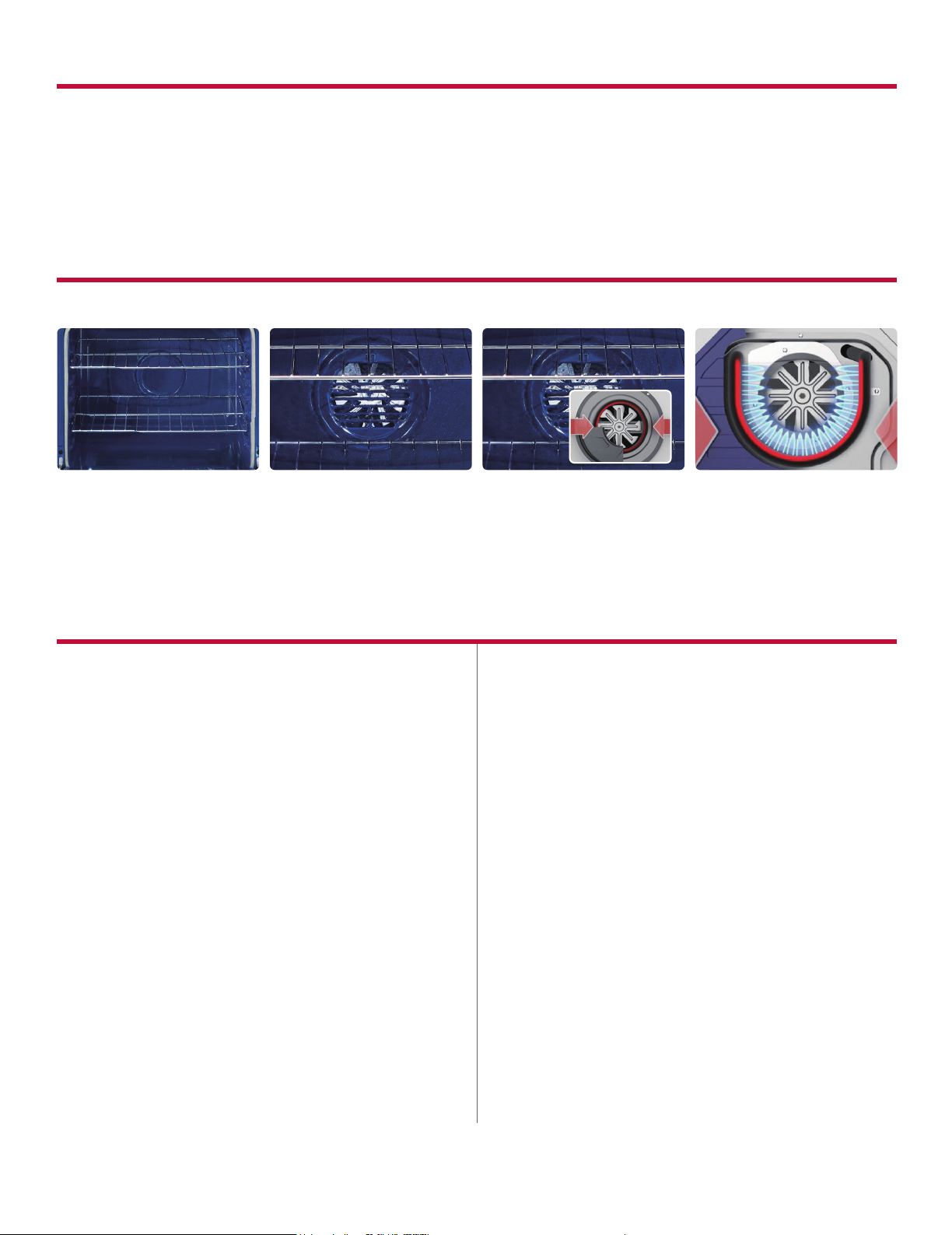
Introducing the ProBake Convection™ System
Form follows function. LG’s new sleek and professional-style system delivers the ideal temperature and airow for fast
preheating and precise baking! Experience the joy of having every cookie come out of the oven looking just right.
The innovative ProBake Convection™ system is an optimized true convection system, using a powerful heater and LG’s
exclusive dual speed convection fan to achieve consistent baking for the home cook.
The Evolution of Better Baking
Conventional Baking Fan Convection Standard True Convection ProBake™ Convection
*gas model illustrated
• Industry standard
• The bottom bake element
heats and cooks food
• No convection heating
element
• Fan circulates heated air in
oven cavity
• Small convection heating
element
• Powerful heat source
• Delivers ideal temperature
and airow within cavity
• Great for multi-rack baking!
What’s the difference between ProBake™ Convection System and my old oven?
ProBake Convection™ SystemTraditional Ovens
Uneven multi-rack baking with traditional bake ovens
• When cooking multiple racks at once, the bottoms of lower rack
food items and the tops of upper rack items can burn while the
surfaces in-between are undercooked.
• Pans need to be re-arranged to get even baking results rack-torack.
Convection ovens only go so far to improve your oven’s
performance
• Convection heater is weak and not as effective due to small
heating element
• Hot air inside the oven is mixed and circulated only when the bake
burner is turned off (gas ovens only).
Burnt on soils are difcult to clean!
• Spills baked onto the hot oven bottom are very difcult to remove
and clean.
• Using preventative measures such as aluminum foil can affect
performance and over time damage the oven.
Bake perfection on every rack!
• ProBake Convection™ system provides even cooking throughout
the oven cavity for consistent results on multiple racks.
• Much more convenient – there’s no need to rearrange pan
positions from top to bottom during cooking.
Get your oven heated and ready-to-go!
• ProBake Convection™ system has been optimized to preheat
your oven fast!*
• Quick preheat allows you to minimize the time you wait for the
oven, and maximize your cooking experience.
A clean oven in minutes, not hours!
• EasyClean™ offers a quick, convenient, and fume-free way to
clean your oven! With just water and low heat, wipe your stains
away!
• ProBake Convection™ system allows for 50% faster EasyClean™
**
*Based on internal test results of LG models with ProBake Convection™ system and LG models without ProBake Convection™ system. **Comparison based on EasyClean™ cycle times on
LG LRG4415ST gas single oven range (10 minutes) with ProBake Convection™ system vs. previous LG gas single oven (20 minutes) without ProBake Convection™ system.
Page 3

Chef Brian Karam’s Tips and Techniques for Better Cooking Results
Good cooking begins with understanding your oven range. And if there’s anyone who understands your range, it is LG’s very
own cooking expert, Chef Brian Karam. These cooking tips have been developed by Chef Brian after extensive cooking in the
LG kitchen. Following these techniques will help you achieve professional results at home.
Pizza
Fresh Pizzas (425°F-475°F)
• Chef’s Tip: Cook pizza on a baking
stone on the center rack in your
oven to get crust more like the
pizza from your favorite restaurant.
• When using a pizza stone, a hot surface is key to getting a nicely browned
crust. Preheat the stone at 500°F for 30 minutes. Before putting the pizza
in the oven, lower the oven temperature down to 450°F.
• Turn over a cookie sheet and dust the back of it with cornmeal to act as a
baking peel when placing fresh pizza onto the hot pizza stone in the oven.
Frozen Pizzas (400°F-450°F)
• Always start with the minimum package time when baking your favorite
frozen pizza. Check it to see if it’s done to your likeness; if not continue to
bake the pizza to achieve your desired doneness.
• Chef’s Tip: When reheating leftover pizza, place an inverted cookie sheet
or baking stone in the oven during the preheat time. Cooking the pizza on
the warm pan or stone helps crisp and brown the crust.
• When cooking multiple pizzas at the same time, more cooking time may be
needed. Check for desired doneness.
• For frozen thin crust pizzas, continue cooking beyond the suggested
cooking time on package if needed; check for desired doneness.
Casseroles
Prepared Frozen Casseroles from Store (350°F-400°F)
(Lasagna, Mac & Cheese, etc)
• Chef’s Tip: To achieve desirable coloring on top of the casserole, remove
the plastic lm on the tray after 75% to 80% of the total cook time. Make
sure the internal temperature of the casserole measures at least 160°F
(71°C).
Fresh Casseroles (350°F-400°F)
(Lasagna, Mac & Cheese, etc)
• Bake these items on the center rack.
• Chef’s Tip: Cover the casserole
with foil for half of the suggested
cook time to help ensure the whole
casserole is cooked evenly. Then
remove the foil for the remaining half
to two thirds of the total cook time
to help achieve a desirable color on
top of the casserole.
• Make sure the internal temperature
of the casserole measures at least
160°F (71°C).
Meat/Poultry
Roast Chicken (400°F-450°F)
• Roast the chicken on the center
rack.
• Chef’s Tip: Let the chicken sit at room temperature for 30 minutes before
placing it in the oven. This helps prevent the severe oven temperature drop
which can be caused by placing a cold food item in a hot oven.
• Place the chicken on a roasting rack or on a bed of onions, carrots, and
celery in an oven proof sauté pan. These vegetables help enhance the pan
juices or the pan gravy.
• Dry the chicken inside and out with paper towels for crispier skin and
moister cooked meat.
• Season the chicken with salt and pepper inside and out no more than ve
minutes before placing it in the oven to minimize the moisture drawn out
of the raw chicken.
• Truss the raw chicken for more even cooking of the bird.
Roast Beef (375°F-400°F)
• Roast the beef on the center rack.
• Let the roast sit at room
temperature for 30 minutes
before placing it in the oven. This
helps prevent the severe oven
temperature drop which can be
caused by placing a cold food item
in a hot oven.
• Preheat the oven for 30 minutes to stabilize the oven temperature and
maximize cooking results.
• Place the roast beef on a roasting rack or on a bed of onions, carrots, and
celery in an oven proof sauté pan. These vegetables help enhance the pan
juices or the pan gravy.
• Dry the roast with paper towels for crispier skin and moister cooked meat.
• Season the beef with salt and pepper no more than ve minutes before
placing it in the oven to minimize the moisture drawn out of the raw meat.
• Have the butcher tie the roast for more even cooking of the meat.
• Chef’s Tip: As a general rule, cook the roast for 20 to 25 minutes for every
pound of meat. An internal temperature of 130°F (54°C) in the center of
the roast will result in a medium doneness.
Meat Loaf (350°F-375°F)
• Chef’s Tip: Place sliced sandwich bread on the bottom of the baking dish
to help absorb the juice generated by the cooking meat loaf. The bottom of
the cooked meat loaf will come out rm rather than soggy.
*Temperature ranges are averages and are for regular bake mode.
Page 4

Side Dishes
Baked Potatoes (400°F-450°F)
• Chef’s Tip: Don’t wrap potatoes in
foil. This traps in the moisture and
results in steaming the potatoes.
• Place the potatoes directly on
the center rack, spaced apart, to
achieve baked potatoes with drier,
crispier skins and ufer insides.
• Prick the potato skins with a dinner fork 10 to 15 times. This allows the
moisture to escape, resulting in a baked potato with a ufer interior.
Yeast Breads (400°F-450°F)
• Chef’s Tip: Place a bowl water in the oven when using the Proof mode to
create a moist environment for the yeast to grow
• When baking yeast breads and desire a crust, start your oven at a higher
temperature than the recipe calls for. When your bread goes into the oven,
lower the oven temperature to the recipe instruction.
Custards/Eggs
Cheese Soufé (325°F-375°F)
• Chef’s Tip: Both the egg yolks
and whites must be at room
temperature before making the
soufé.
• The egg yolks will whip up higher and the yolks will mix more easily with
the cheese base.
Crème Brûlée (300°F-350°F)
• Chef’s Tip: Place a wet dish
towel underneath the ramekins to
prevent them from sliding when
placing them in or removing them
from the oven. This also helps
distribute the heat more evenly to
the bottom, sides, and tops of the
custards while they bake.
• Place water for the water bath in the baking dish once the baking dish is on
the oven rack to minimize spilling around the oven.
• Food items that require longer time in the oven will benet from being
cooked at rack positions closer to the bottom of the oven. Conversely,
food items that only need 15 minutes or less in the oven, will benet from
higher rack positions.
• During cooking, try to limit the amount times that you open and close the
oven door. This is to keep the oven at an even range.
• Adding a little acid to seasoning can help brighten food and take away the
perception of some foods being bitter.
• Woody herbs like rosemary, oregano, sage, thyme will benet from being
cooked from the beginning of the dish. Leafy herbs like parsley, chives,
tarragon, basil will heighten the food if added at the end of the cooking.
Using The Broiler
• When browning the top of a casserole with bread crumbs using the broiler,
the rack should be 6 inches below the broiler element.
• When browning and cooking chicken with the skin on using the broiler, try
to position the rack at least 8 to 10 inches away from the broiler element.
Cooking Meats In The Oven
• Depending on the size of a roast, it should always rest before slicing and
serving to redistribute the juices.
• Most cuts of meat will benet from being placed in a marinade before
cooking. Be sure to prick the meat or make shallow slashes with a knife to
help the marinade impart its avor.
• Leave an 1/8” layer of fat on pork chops or pork roasts to help baste and
retain moisture in this meat.
Baking
• When baking yeast breads and desire a crust, start your oven at a higher
temperature than the recipe calls for. When your bread goes into the oven,
lower the oven temperature to the recipe instruction.
• When baking something with a crust, like pie or quiche, allow it to achieve
an amber or golden color to fully bring out its avor.
• Chocolate baked items will dull in avor and dry out if taken out of the oven
too late. The crumbs should be moist when removing chocolate baked items.
• Remove cookies from the oven when the edges are just rm and they
appear ever so slightly under baked. These cookies will cool to be soft and
chewy.
• Fully baked cakes should be springy to the touch on the top.
• Use a skewer to test for doneness in a baked item. It should come out clean.
Making A Cake From A Box Mix (350°F)
• If the recipe on the box calls for eggs, remove them from the refrigerator
ahead of time so they are at room temperature. The eggs will blend more
easily with the other ingredients.
• Chef’s Tip: If making angel food cake from a box, using a whisk attachment
on your mixer can increase the volume of nished cake.
• When making angel food cake from a box, using the center rack can
produce better results.
Chef’s Techniques And
Tricks-The Basics
General
• As a general rule when using the
Convection Mode, lessen the total
baking time of your items by 5 to
10 minutes per hour.
• Leave space around pans and their sides to facilitate better air ow for
oven to do its job.
Browse through more of our delicious recipes to nd the
perfect meal for you and your family! Visit us at:
www.lg.com/us/kitchen/recipes
1. Open or download a free QR Code Reader
2. Follow instructions to scan the QR Code using your smartphone
Page 5

 Loading...