

Page 1
3-3. Using the audio system
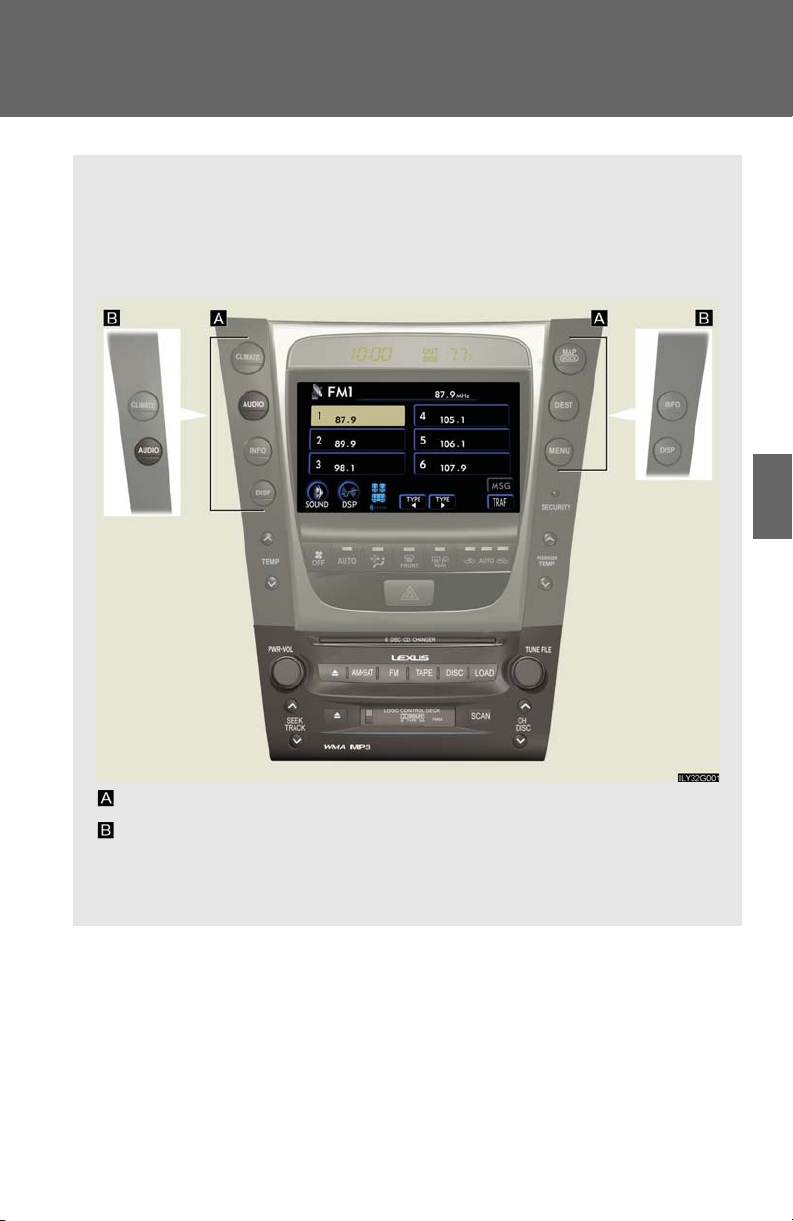
Audio system type
CD and (optional) DVD player with changer, cassette player, and AM/
FM radio
This illustration below is for a vehicle not equipped with the DVD
player.
3
Interior features
Vehicles with navigation system
Vehicles without navigation system
The audio system appearance and screen may differ slightly for vehicles equipped with the DVD player.
199
Page 2
3-3. Using the audio system
CD player: Plays audio CDs, CD text, MP3 discs and WMA discs.
DVD player: Plays audio CDs, CD text, video CDs, MP3 discs,
WMA discs, DVD video discs and DVD audio discs.
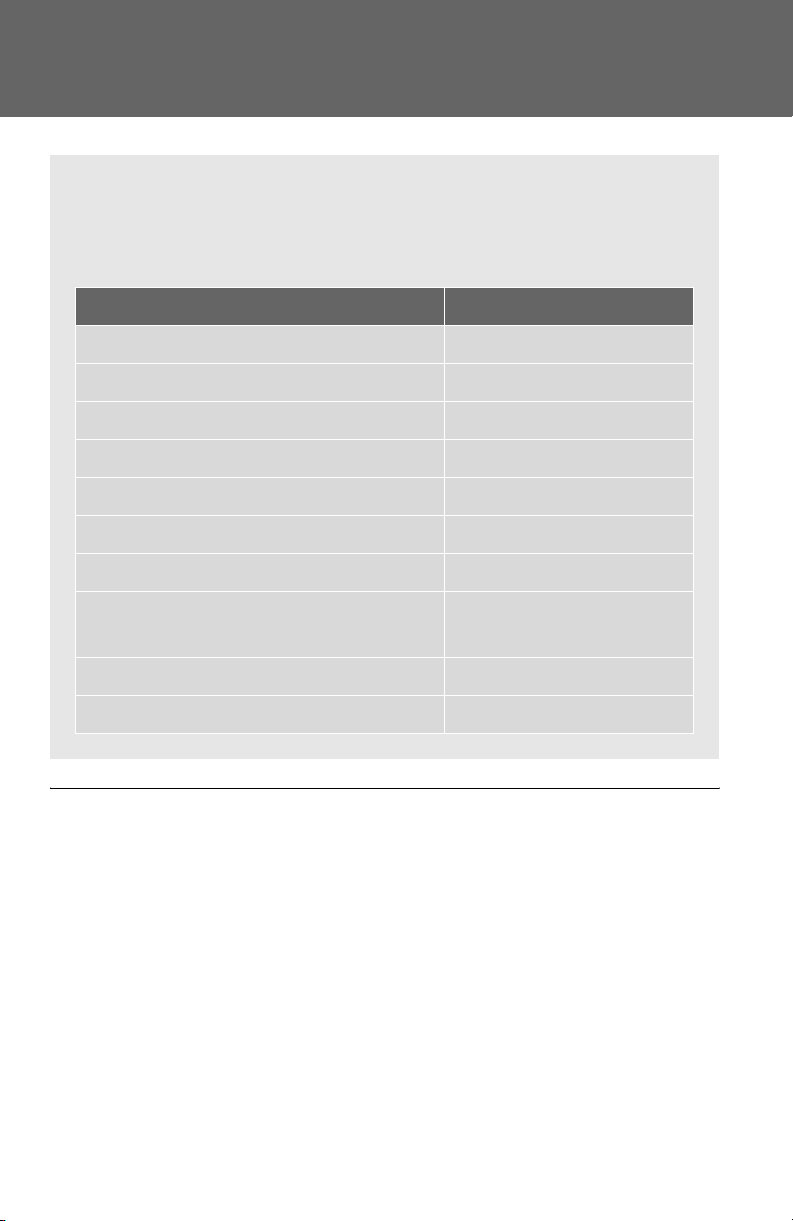
Ti t l e Pa ge
Using the radio P. 202
Using the cassette player P. 211
Using the CD player P. 215
Playing MP3 and WMA discs P. 223
Using the DVD player P. 231
Playing DVD video/audio P. 234
Playing video CD P. 24 7
DVD player and DVD video disc
information
P. 251
Optimal use of the audio/video system P. 255
Using the steering wheel switches P. 259
n Using cellular phones
Interference may be heard through the audio system’s speakers if a cellular phone is
being used inside or close to the vehicle while the audio system is operating.
200
Page 3
3-3. Using the audio system
CAUTION
n For vehicles sold in the U.S.A. and Canada
l Par t 15 of the FCC Rules
FCC Warning:
Any unauthorized changes or modifications to this equipment will void the user’s
authority to operate this device.
l Laser products
• Do not take this unit apart or attempt to make any changes yourself.
This is an intricate unit that uses a laser pickup to retrieve information from the
surface of compact discs. The laser is carefully shielded so that its rays remain
inside the cabinet. Therefore, never try to disassemble the player or alter any
of its parts since you may be exposed to laser rays and dangerous voltages.
• This product utilizes a laser.
Use of controls or adjustments or performance of procedures other than
those specified herein may result in hazardous radiation exposure.
3
Interior features
NOTICE
n To prevent battery discharge
Do not leave the audio system on longer than necessary when the engine is not running.
n To avoid damaging the audio/video system
Take care not to spill drinks or other fluids over the audio system.
201
Page 4
3-3. Using the audio system
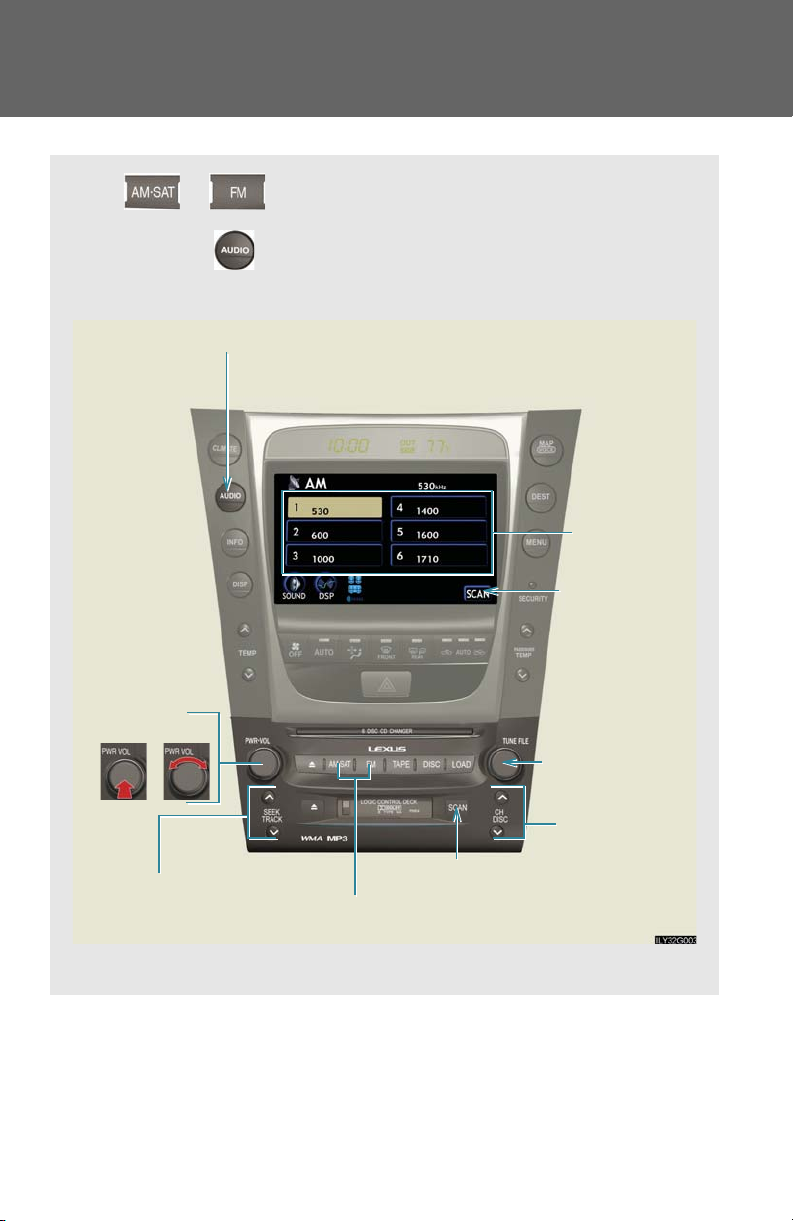
Using the radio
Press or to choose either an AM or FM band.
When you press while listening to the radio, the following audio control screen appears.
Display audio control screen
Preset stations
Scan for
receivable stations
(AM mode only)
Pow er Vol um e
Seek frequency
Scan for receivable stations
AM⋅SAT/FM mode buttons
Adjust the
frequency
(AM, FM mode) or
channel (SAT mode)
This illustration is a vehicle not equipped with the DVD player.
202
Preset tuning
Page 5
3-3. Using the audio system
Setting station presets (excluding XM® Satellite Radio)
STEP 1
Search for desired stations by turning the dial or pressing
∧ or ∨ on .
STEP 2
Touch and hold one of the preset stations (1 - 6) until you hear a
beep.
Scanning radio stations (excluding XM® Satellite Radio)
n Scanning the preset radio stations
AM station
STEP 1
Touch on the screen or press until “P⋅SCAN”
appears.
Preset stations will be played for a few seconds each.
STEP 2
When the desired station is reached, touch or press
once again.
FM station
STEP 1
STEP 2
Press until “P⋅SCAN” appears.
When the desired station is reached, press the button once again.
3
Interior features
203
Page 6
3-3. Using the audio system
n Scanning all radio stations within range
AM station
STEP 1
Touch on the screen or press .
“SCAN” appears on the screen and all stations with reception will be
played for a few seconds each.
STEP 2
When the desired station is reached, touch or press
once again.
FM station
STEP 1
STEP 2
Press .
“SCAN” appears on the screen and all stations with reception will be
played for a few seconds each.
When the desired station is reached, press the button once again.
RDS (Radio Data System)
This feature allows your radio to receive station identification information
and program information (classical, jazz, etc.) from radio stations which
broadcast this information.
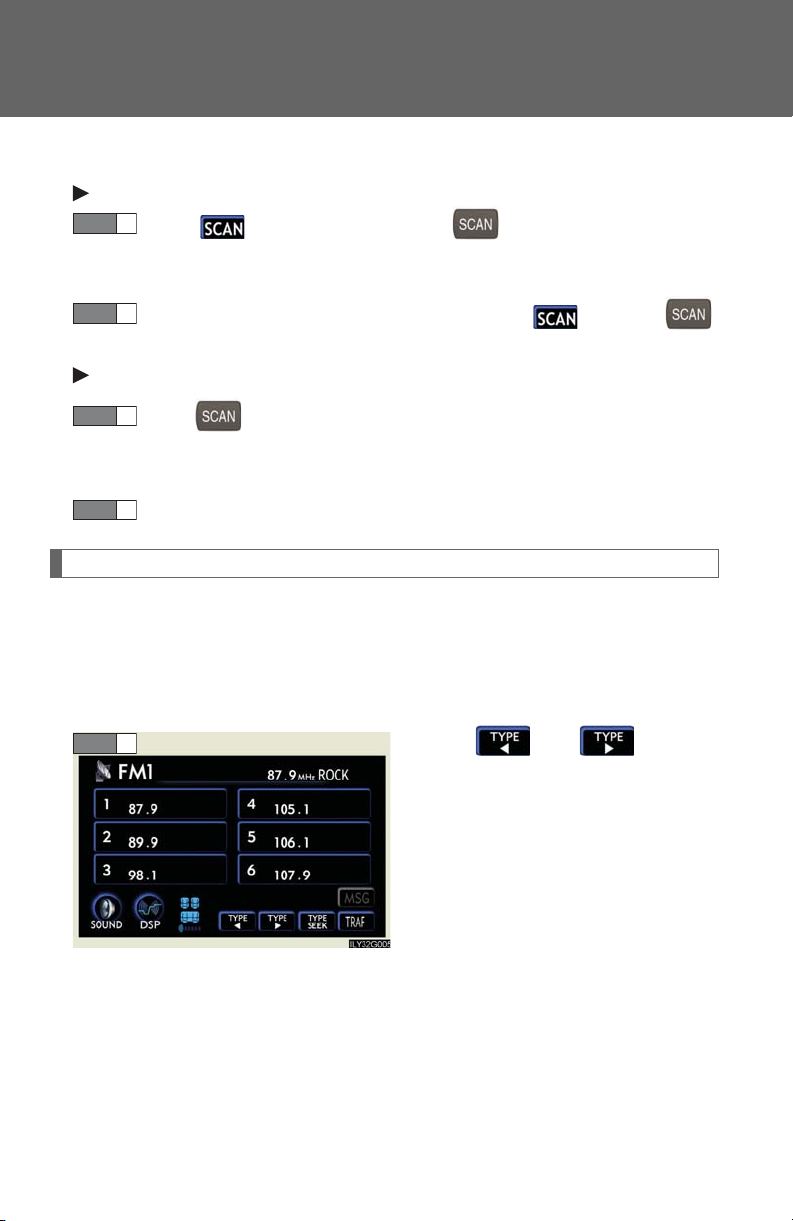
n Receiving RDS broadcasts
STEP 1
Touch or on the
screen.
204
Page 7
3-3. Using the audio system
The type of program changes each time the button is pressed.
l ROCK
l EASYLIS (Easy listening)
l CLS/JAZZ (Classical music and Jazz)
l R & B (Rhythm and Blues)
l INFORM (Information)
l RELIGION
l MISC (Miscellaneous)
l ALARM (Emergency messages)
If the system receives no RDS stations, “NO PTY” appears on the display.
When a program is set, “TYPE SEEK” appears.
STEP 2
Touch on the screen or press ∧ or ∨ on .
The radio seeks or scans the station by the relevant program type.
If no radio station of that type is found, “NOTHING” appears on the
screen.
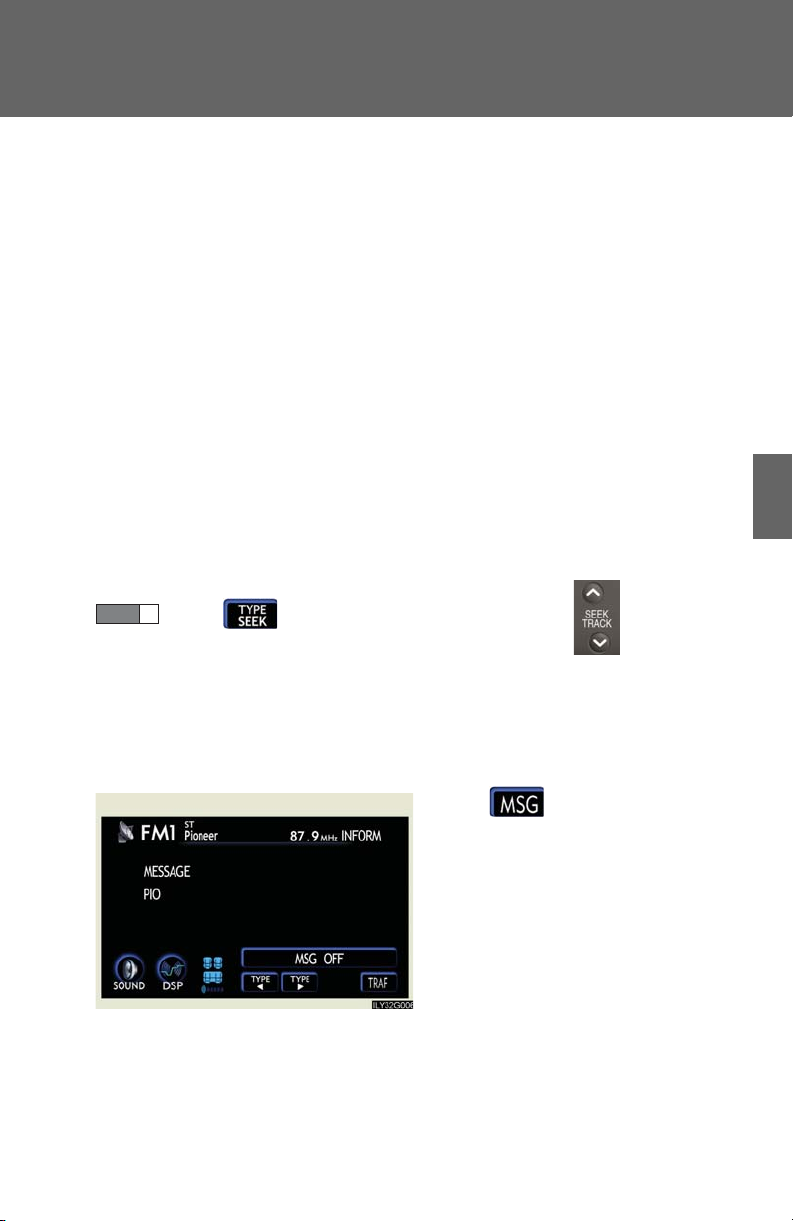
n Displaying radio text messages
Touch on the screen.
If “MSG” appears on the screen, a
text message may be displayed.
3
Interior features
205
Page 8
3-3. Using the audio system
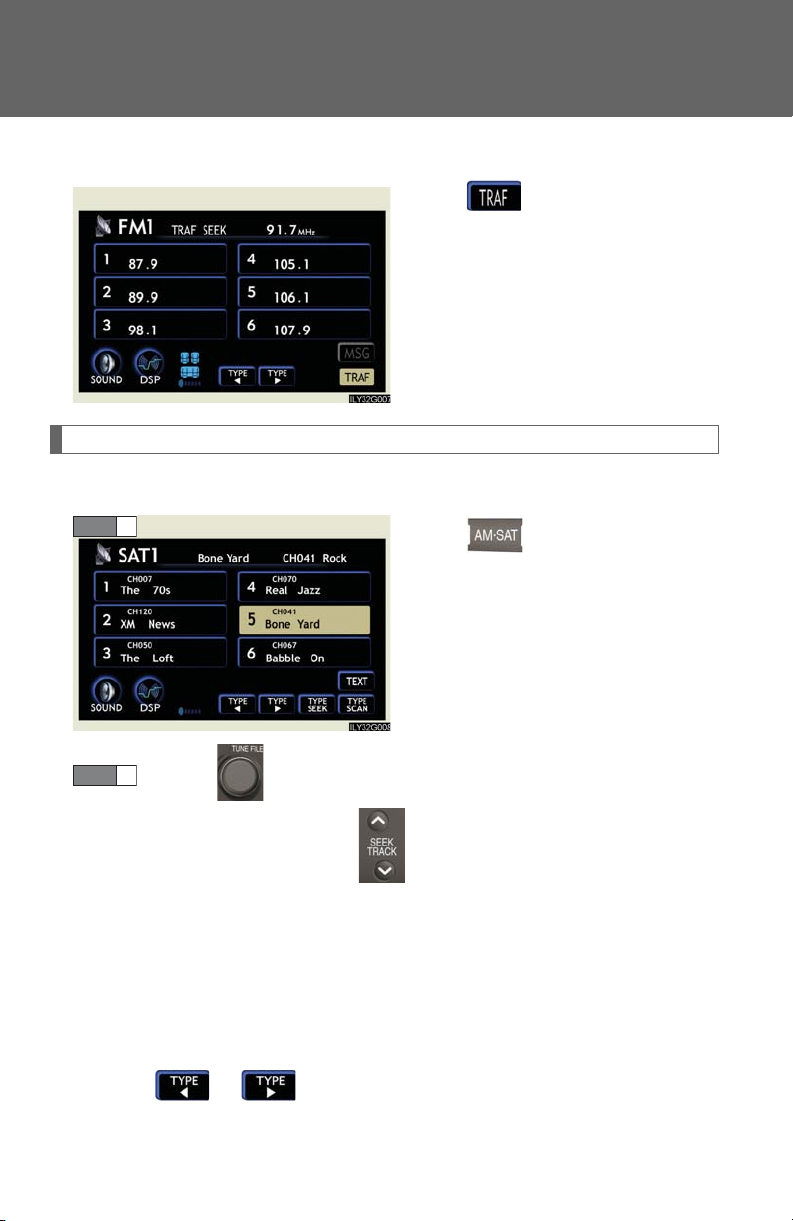
n Traffic announcement
XM® Satellite Radio (if equipped)
n Receiving XM® Satellite Radio
Touch on the screen.
“TRAF SEEK” appears on the display, and the radio will start seeking
any station broadcasting traffic
program information.
If no traffic program station is
found, “NOTHING” appears on
the display.
STEP 1
Press until “SAT” appears
on the screen.
The display changes as follows
each time the switch is pressed.
AM → SAT1 → SAT2 → SAT3
STEP 2
Turn the dial to select a desired channel from all the catego-
ries or press ∧ or ∨ on to select a desired channel in the
current category.
®
n Presetting XM
Satellite Radio channels
Select the desired channel. Touch one of the preset stations (1 - 6) and
hold it until you hear a beep.
n Changing the channel category
Touch or on the screen.
206
Page 9
n Scanning XM® Satellite Radio channels
l Scanning channels in the current category
3-3. Using the audio system
STEP 1
Touch on the screen or press .
“SCAN” appears on the screen.
STEP 2
When the desired channel is reached, touch or press
the button once again.
l Scanning preset channels
STEP 1
Touch on the screen or press and hold it until
you hear a beep.
“P⋅SCAN” appears on the screen.
STEP 2
When the desired channel is reached, touch or press
the button once again.
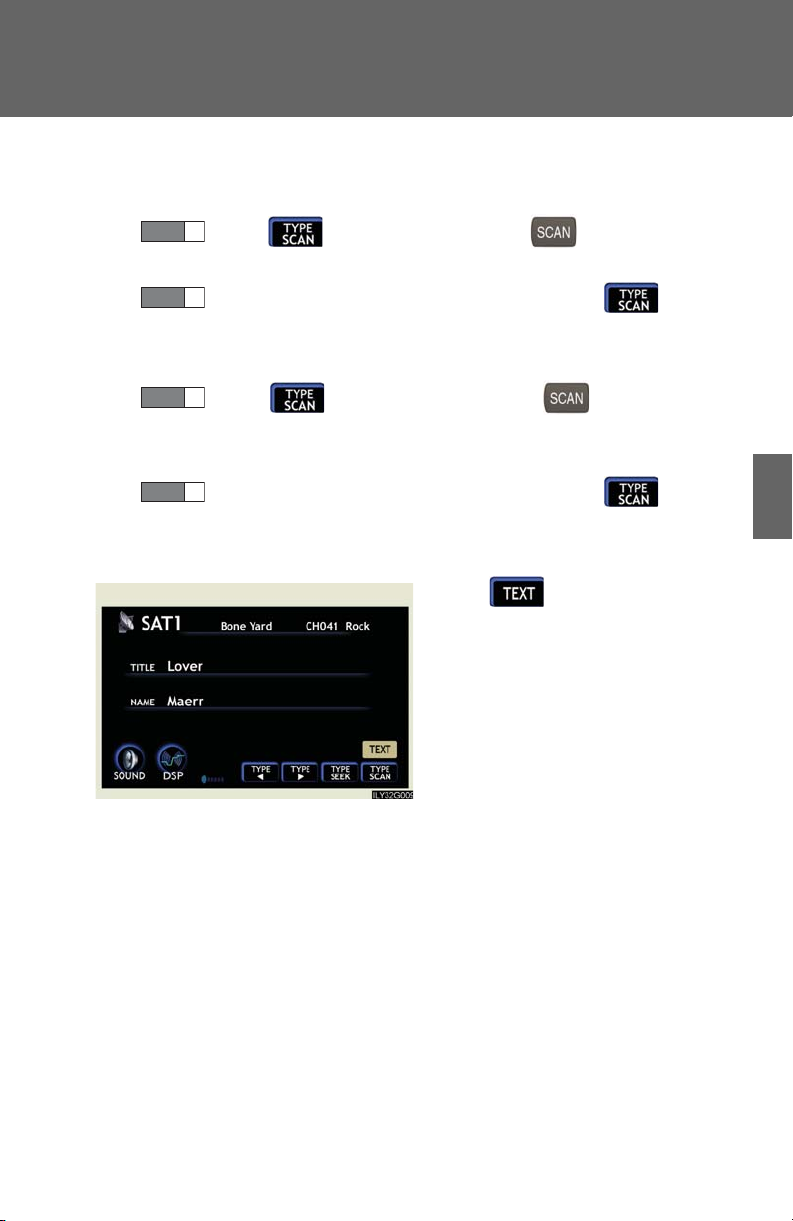
n Displaying the title and artist name
3
Interior features
Touch on the screen.
The screen will display up to 10
characters.
Touch the button once again to
return to the previous screen.
207
Page 10

3-3. Using the audio system
n When the battery is disconnected
All preset stations are erased.
n Reception sensitivity
l Maintaining perfect radio reception at all times is difficult due to the continually
changing position of the antenna, differences in signal strength and surrounding
objects, such as trains, transmitters, etc.
l The radio antenna is mounted inside the rear window. To maintain clear radio
reception, do not attach metallic window tinting or other metallic objects to the
antenna wire mounted inside the rear window.
n Receiving XM
The optional Lexus genuine satellite radio tuner and antenna allows you to receive
and play XM
in the 48 contiguous United States.)
®
l XM
For detailed information about XM
®
Satellite Radio
®
Satellite Radio broadcasts. (Subscription is required. Available only
*
subscriptions
®
Satellite Radio or to subscribe, visit XM
on the web at www.xmradio.com or call 1-877-515-3987.
l Radio ID
You will need the radio ID when activating XM
®
service or reporting a prob-
®
lem. Select “CH000” using the dial, and the receiver's 8-character ID
number will appear.
l Satellite tuner
The tuner supports only Audio Services (Music and Talk) and the accompanying Text Information of XM
*: Terms and services provided by XM
®
Satellite Radio.
®
Satellite Radio are subject to change with-
out notice.
208
Page 11
3-3. Using the audio system
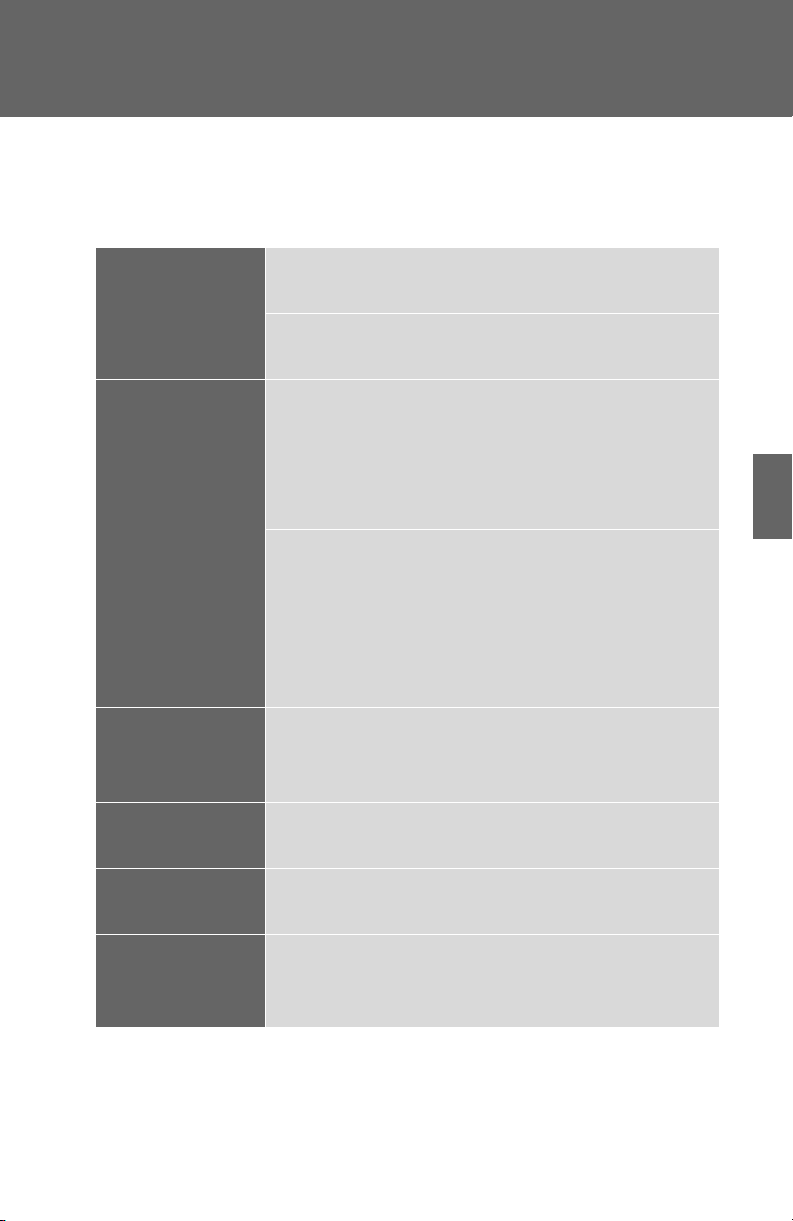
n If the satellite radio does not operate normally
If a problem occurs with the XM
to the table below to identify the problem, and take the suggested corrective action.
®
tuner, a message will appear on the screen. Refer
ANTENNA
UPDATING
NO SIGNAL
LOADIN G
The XM® antenna is not connected. Check whether
the XM
®
antenna cable is attached securely.
There is a short-circuit in the antenna or the surrounding antenna cable. See a Lexus certified dealer.
You have not subscribed to XM® Satellite Radio. The
radio is being updated with the latest encryption code.
Contact XM
®
Satellite Radio for subscription information. When a contract is canceled, you can choose
“CH000” and all free-to-air channels.
The premium channel you selected is not authorized.
Wait for about 2 seconds until the radio returns to the
previous channel or “CH001”. If it does not change
automatically, select another channel. If you want to listen to the premium channel, contact XM
®
Satellite
Radio.
The XM® signal is too weak at the current location.
Wait until your vehicle reaches a location with a stronger signal.
The unit is acquiring audio or program information.
Wait until the unit has received the information.
3
Interior features
OFF AIR
-----
The channel you selected is not broadcasting any programming. Select another channel.
There is no song/program title or artist name/feature
associated with the channel at that time. No action
needed.
209
Page 12

3-3. Using the audio system
The channel you selected is no longer available. Wait
---
for about 2 seconds until the radio returns to the previous channel or “CH001”. If it does not change automatically, select another channel.
Contact the XM® Listener Care Center at 1-877-515-3987 during the following
*.
hours
Monday - Saturday: 6 a.m. - 2 a.m. Eastern Time
Sunday: 8 a.m. - 8 p.m. Eastern Time
*: Subject to change without notice.
n Certifications for the radio tuner
This equipment has been tested and found to comply with the limits for a class B
digital device, pursuant to Part 15 of the FCC Rules. These limits are designed to
provide reasonable protection against harmful interference in a residential installation. This equipment generates, uses and can radiate radio frequency energy and, if
not installed and used in accordance with the instructions, may cause harmful interference to radio communications. However, there is no guarantee that interference
will not occur in a particular installation.
If this equipment does cause harmful interference to radio or television reception,
which can be determined by turning the equipment off and on, the user is encouraged to try to correct the interference by trying one or more of the following:
l Reorienting or relocating the receiving antenna.
l Increasing the separation between the equipment and receiver.
l Connecting the equipment into an outlet on a circuit different from that to which
the receiver is connected.
l Consulting the dealer or an experienced radio/TV technician for help.
210
Page 13
3-3. Using the audio system
Using the cassette player
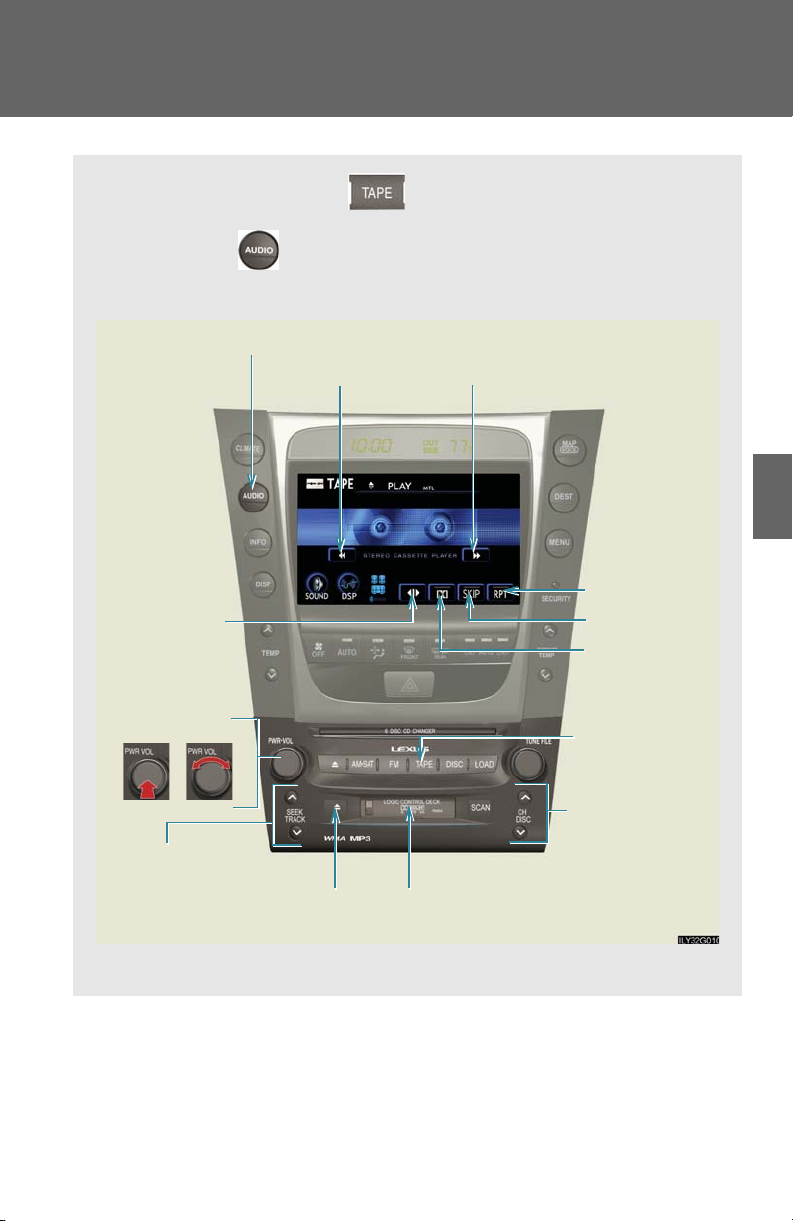
Insert a cassette tape or press with a tape inserted.
When you press while listening to the tape, the following audio control screen appears.
Display audio control screen
Change playback
direction
Pow er Vo lu m e
Track selection
Rewind
Tape eject
Fast forward
3
Interior features
Repeat play
Skip play
Noise reduction
Playback
Change playback
direction
Ta pe sl o t
This illustration is a vehicle not equipped with the DVD player.
211
Page 14

3-3. Using the audio system
Selecting a track
n Skip a number of tracks at a time.
STEP 1
STEP 2
Press ∧ on .
Press ∧ until the number you want
to skip appears.
n Rewind a number of tracks at a time.
STEP 1
STEP 2
Press ∨ on .
Press ∨ until the number you want
to rewind appears.
9 tracks can be skipped at a time.
9 tracks can be rewound at a time.
Note that the number includes the
current track.
212
Page 15
3-3. Using the audio system
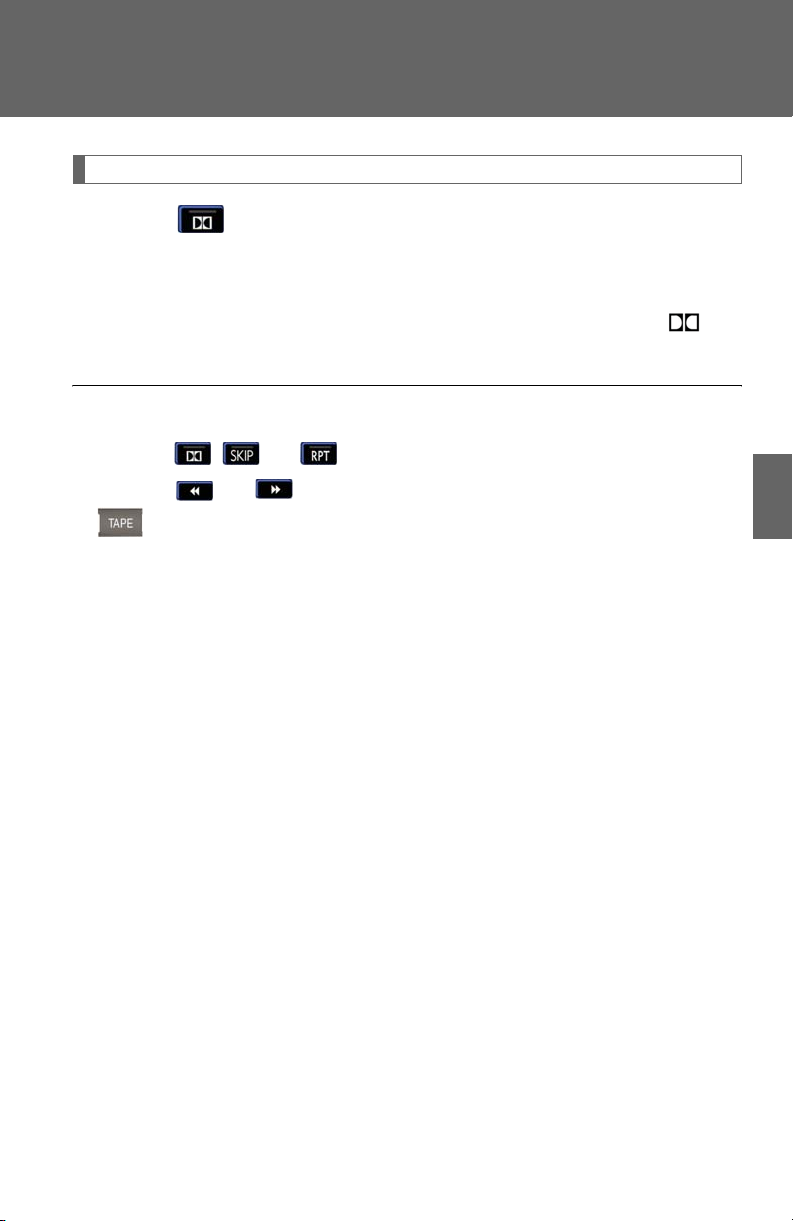
Using Dolby® Noise Reduction
Touch on the screen.
Reduces the level of noise for tapes recorded with Dolby NR only.
Dolby noise reduction is manufactured under license from Dolby Laboratories Licensing Corporation. DOLBY and the double-D symbol are
registered trademarks of Dolby Laboratories.
n Canceling noise reduction, skip play, repeat play, rewind and fast forward
To cancel , and : Touch the corresponding button on the screen.
To cancel and : Touch the corresponding button on the screen or press
.
n Auto-reverse feature
After the cassette player reaches the end of a tape, it automatically reverses and
begins to play the other side, regardless of whether the cassette was playing or fast
forwarding.
n When the cassette player does not operate correctly due to the cassette record-
ing conditions
Forwarding to the beginning of a track, repeat, blank tape skip and fast-forward
may not be possible in the following situations:
l The interval between tracks is less than 3 seconds (beginning of track and
repeat playback) or less than 15 seconds (blank tape skip).
l When there is noise between 2 tracks.
l The beginning and end of subsequent tracks are not clearly defined.
n Cleaning the cassette player
Cassette player components (heads, capstan, pinch rollers) should be cleaned at
least once a month using a cleaning tape to remove dirt and dust that can easily
build up.
n Using long playing cassette tapes
Avoid using tapes with a length of more than 90 minutes, as the tape used is very
thin and may become tangled in the cassette player.
3
Interior features
213
Page 16
3-3. Using the audio system
NOTICE
n Cassette tapes that cannot be used
Do not use a cassette tape if it has been damaged or tangled or if its label is peeling
off. Such tapes may affect playing speed and may also get stuck in the player.
n Cassette player precautions
l Store cassette tapes away from direct sunlight.
l Do not insert anything other than cassette tapes into the cassette player.
l Do not apply oil to the cassette player.
214
Page 17
3-3. Using the audio system
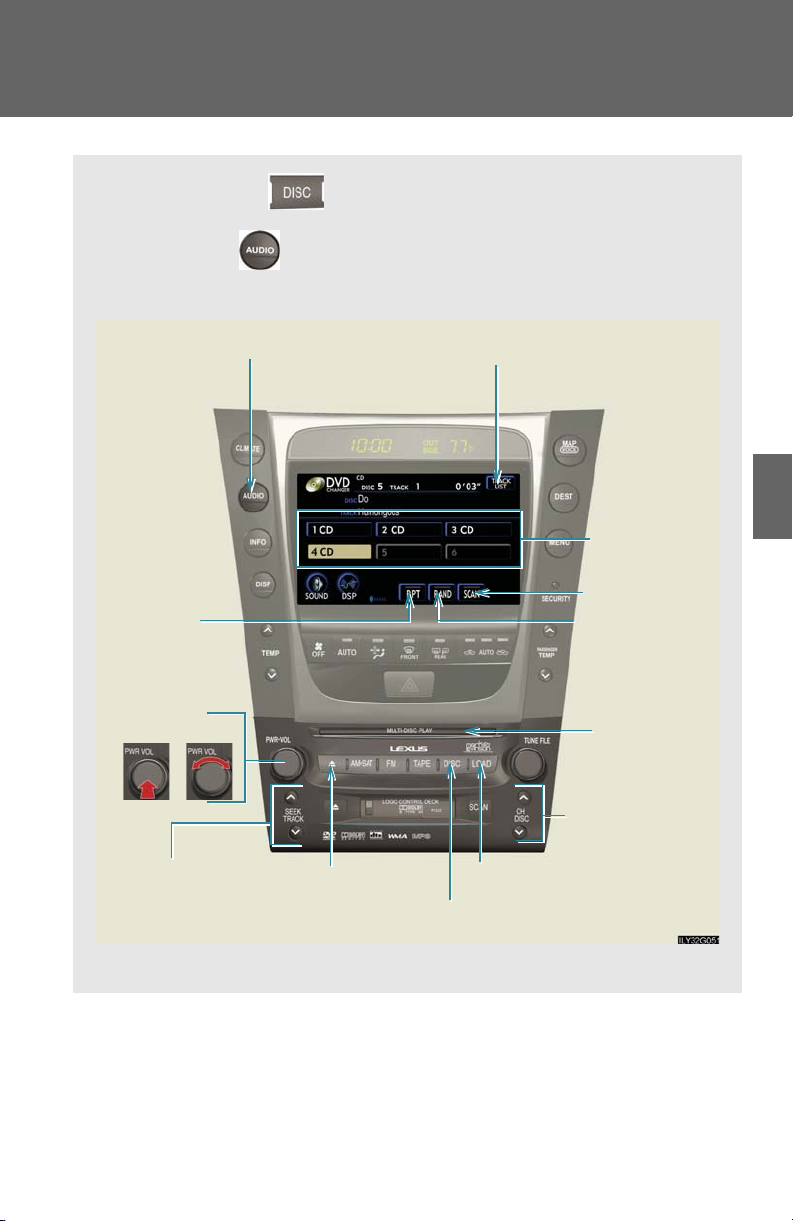
Using the CD player
Insert a CD or press with a CD inserted.
When you press while listening to a CD, the following audio control
screen appears.
Display audio control screen
Repeat play
Pow e r Vo l um e
Track selection
CD eject
Display track list
CD load
Playback
Select CD
Search playback
Random playback
CD slot
Select CD
3
Interior features
This illustration is a vehicle equipped with the DVD player.
215
Page 18
3-3. Using the audio system
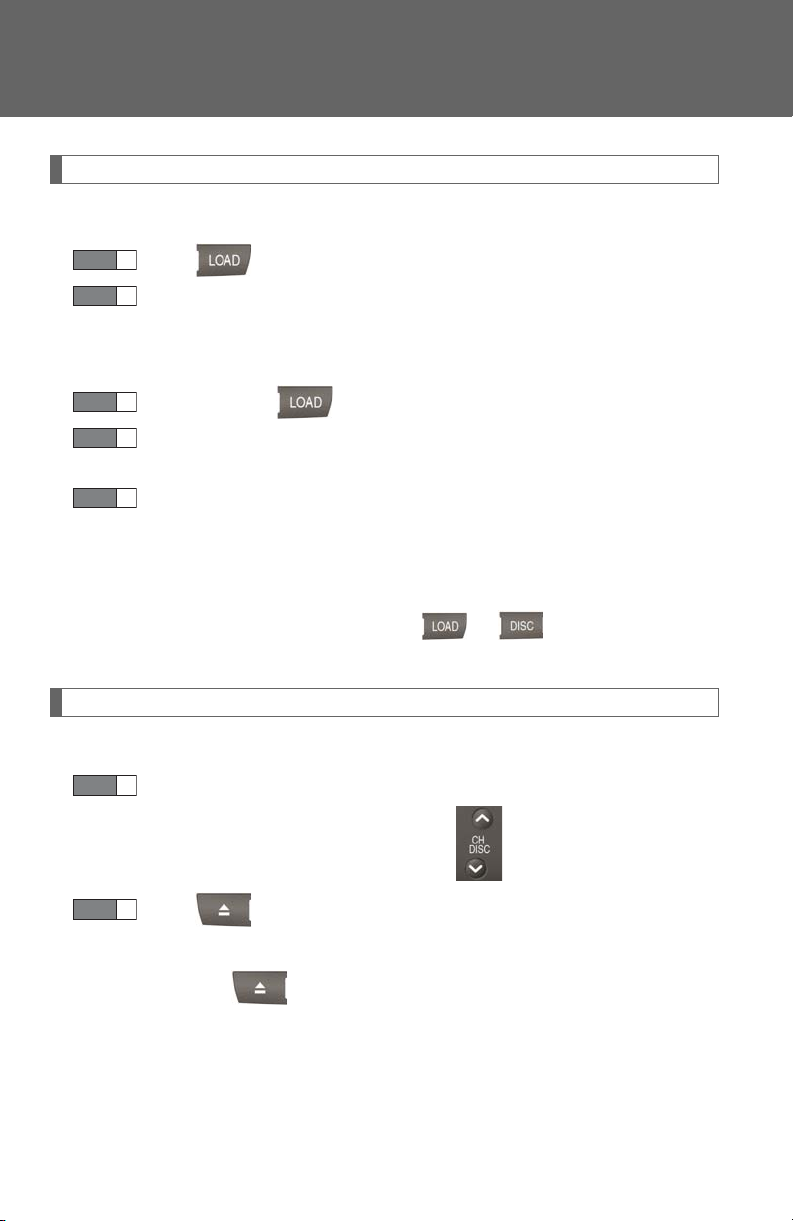
Loading a CD
n Loading a single CD
STEP 1
STEP 2
Press .
When the indicator changes from flashing amber to green, insert
a CD after the CD/DVD player door opens.
n Loading multiple CDs
STEP 1
STEP 2
Press and hold until you hear a beep.
When the indicator changes from flashing amber to green, insert
a CD after the CD/DVD player door opens.
STEP 3
After inserting a CD, wait until the indicator changes from flashing amber to green, then insert the next CD after the CD/DVD
door has opened.
Repeat steps 2 and 3 until you have inserted all CDs.
To cancel the operation, press the or button. If you do not
insert a CD within 15 seconds, loading will be canceled automatically.
Ejecting CDs
n Ejecting a CD
STEP 1
To select the CD to be ejected, touch the desired disc number (1 -
6) on the screen or press ∧ or ∨ on .
STEP 2
Press and remove the CD.
n Ejecting all CDs
Press and hold until you hear a beep, then remove the CDs.
216
Page 19
3-3. Using the audio system
Selecting, fast forwarding and scanning tracks
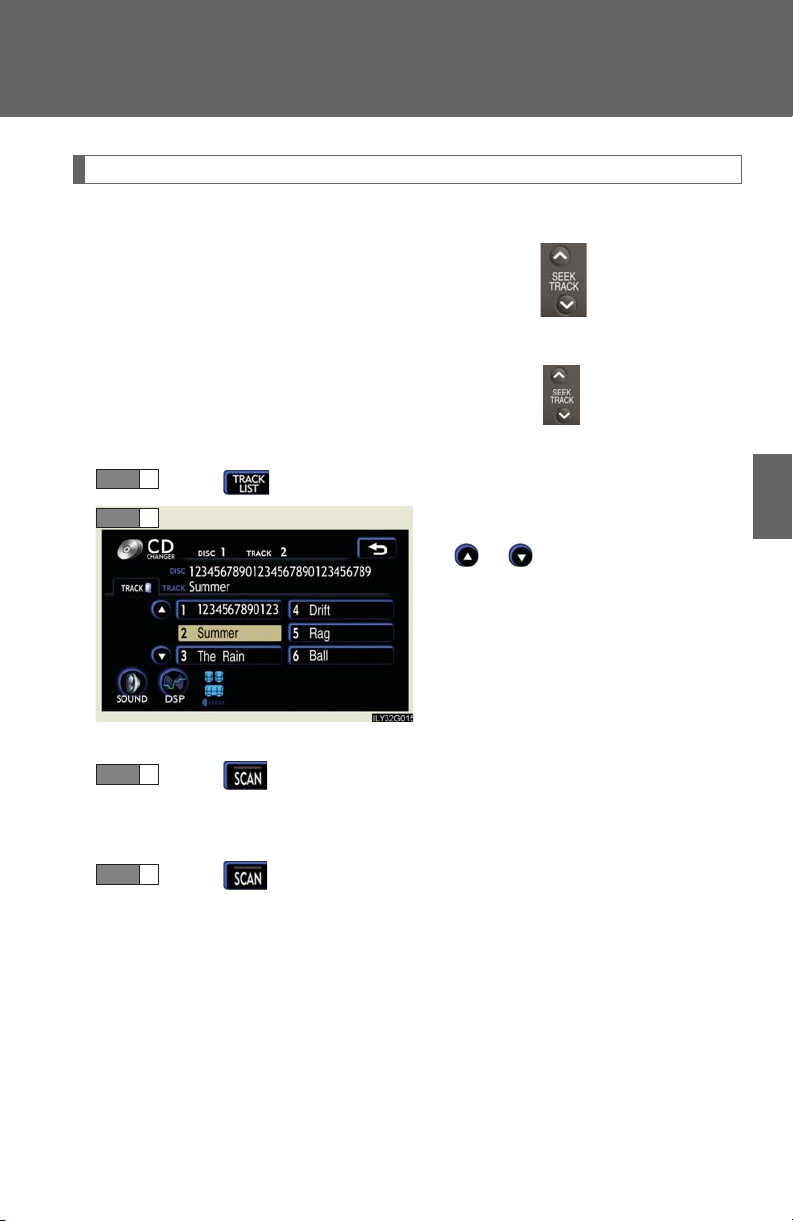
n Selecting a track
Press ∧ to move up and ∨ to move down using until the desired
track number appears on the screen.
To fast forward or rewind, press and hold ∧ or ∨ on .
n Selecting a track from the track list
STEP 1
STEP 2
Touch on the screen.
Touch the desired track number.
or : changes the list by 6
track groups.
This function is available only when
the vehicle is not moving.
3
Interior features
n Scanning a CD
STEP 1
STEP 2
Touch on the screen.
“SCAN” appears on the screen.
The first 10 seconds of each track will be played.
Touch once again when the desired track is reached.
217
Page 20
3-3. Using the audio system
Selecting a CD
n To select a CD to play
Touch the desired disc number (1 - 6) on the screen or press ∧ or ∨ on
.
n To scan loaded CDs
STEP 1
Touch and hold on the screen until “D⋅SCAN” appears.
The first 10 seconds of the first track on each CD will be played.
STEP 2
Touch once again when the desired CD is reached.
Random playback
n Current CD
Touch on the screen.
Songs are played in random order until random playback is canceled.
n All CDs
Touch and hold on the screen until “D⋅RAND” appears.
Tracks on all loaded CDs are played in random order until the button is
touched once again.
Repeating a track or a disc
n Repeating a track
Touch on the screen.
n Repeating a disc
Touch on the screen and hold until “D⋅RPT” appears.
218
Page 21
3-3. Using the audio system
n Canceling random, repeat and scan playback
Touch , , or on the screen once again.
n Displaying the title and artist name
If a CD-TEXT disc is inserted, the title of the disc and track will be displayed. Up to
16 letters can be displayed.
n Error messages
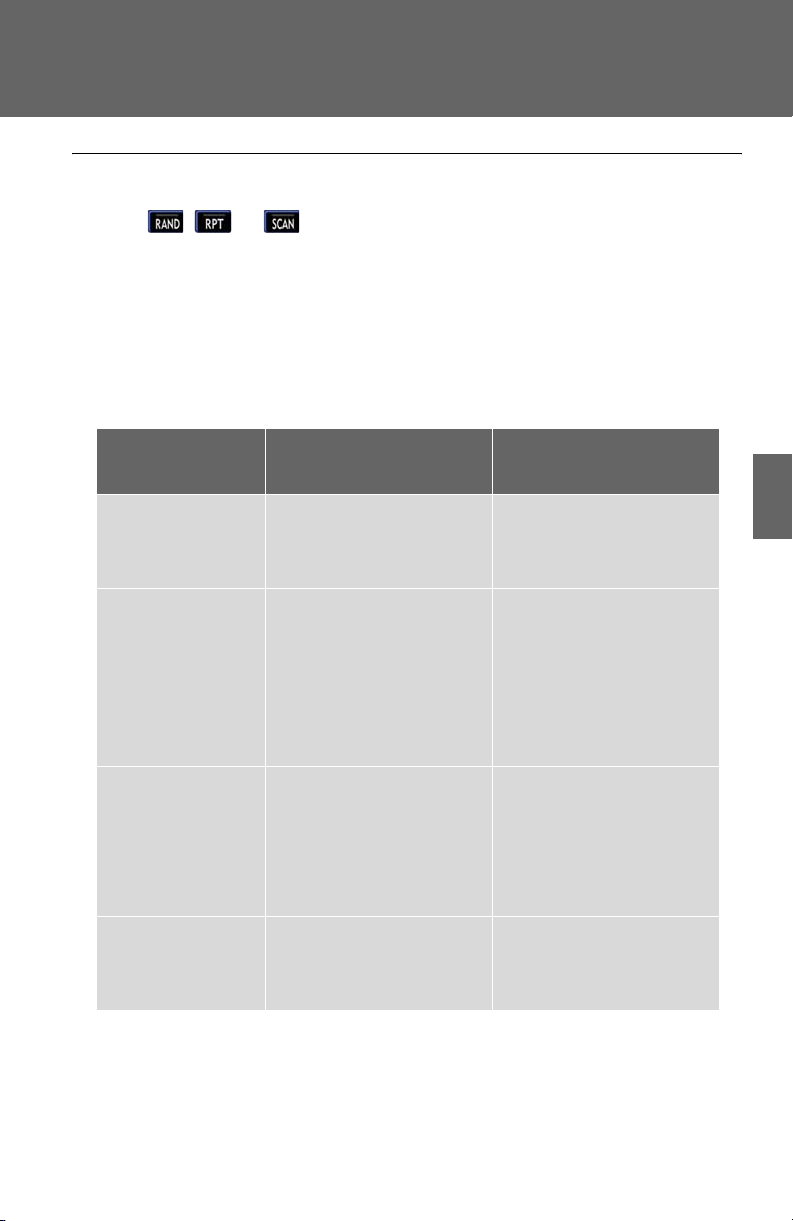
Refer to the following table and take the appropriate measures. If the problem is not
rectified, take the vehicle to your Lexus dealer.
Message Cause
No CD
or
No Disc
There is no disc in the CD
or DVD changer
• The disc X is dirty or
CD X Check
or
DISC X Check
damaged
• The disc X is inserted
upside down
• The disc X is not play-
able with the player
• There is a malfunction
CD Error
or
DVD Error
within the system
• Operation is stopped
due to a high temperature inside the player
This indicates that no
NO MUSIC FILE
playable data is included
in the disc
Correction
Procedures
Insert a disc
• Clean the disc
• Insert the disc correctly
• Confirm the disc is playable with the player
• Eject the disc
• Eject the disc and allow
the player to cool down
Eject the disc
3
Interior features
219
Page 22
3-3. Using the audio system
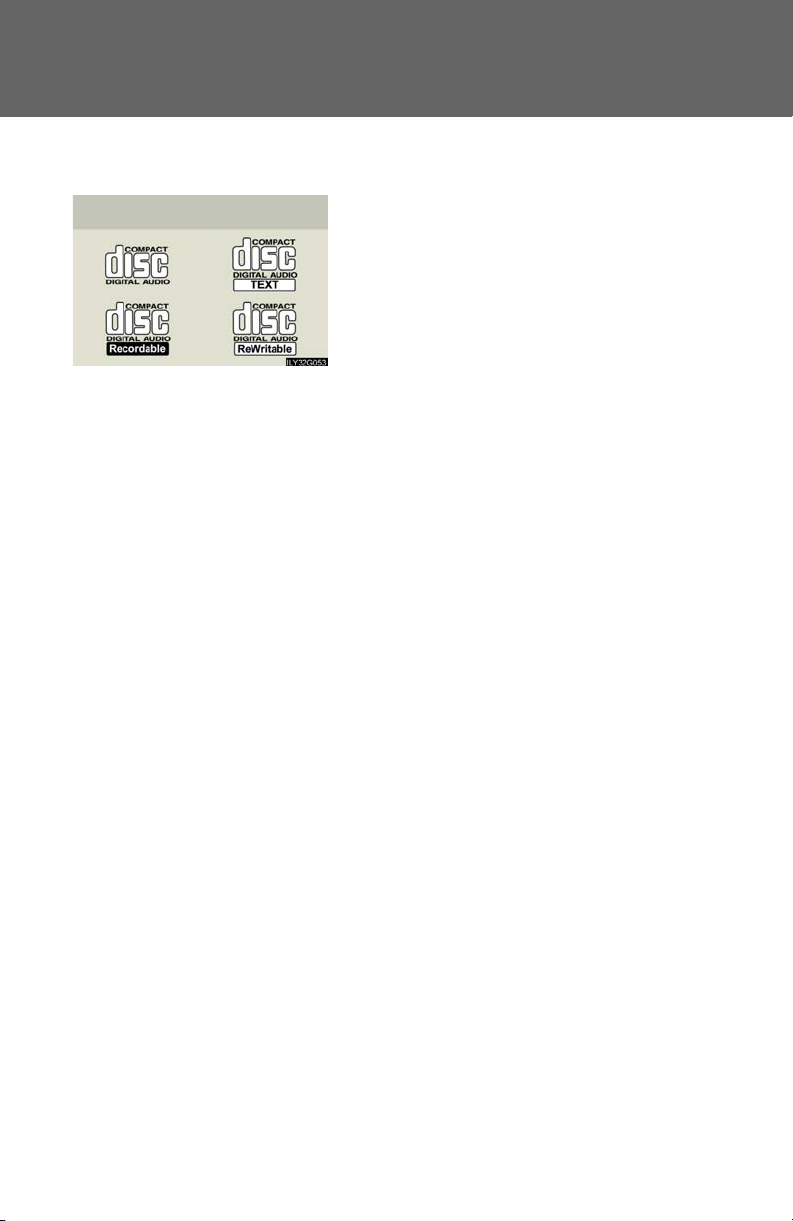
n CD compatibility
Audio CDs
Only audio CDs with the marks shown to the
left can be used.
The following products may not be playable
on your CD player.
l SACDs
l dts-CDs
l Copy-protected CDs
n CD player protection feature
To protect the internal components, playback is automatically stopped when a
problem is detected.
n If CDs are left inside the CD player or in the ejected position for extended peri-
ods
CDs may be damaged and may not play properly.
n Lens cleaners
Do not use lens cleaners. Doing so may damage the CD player.
220
Page 23
3-3. Using the audio system
NOTICE
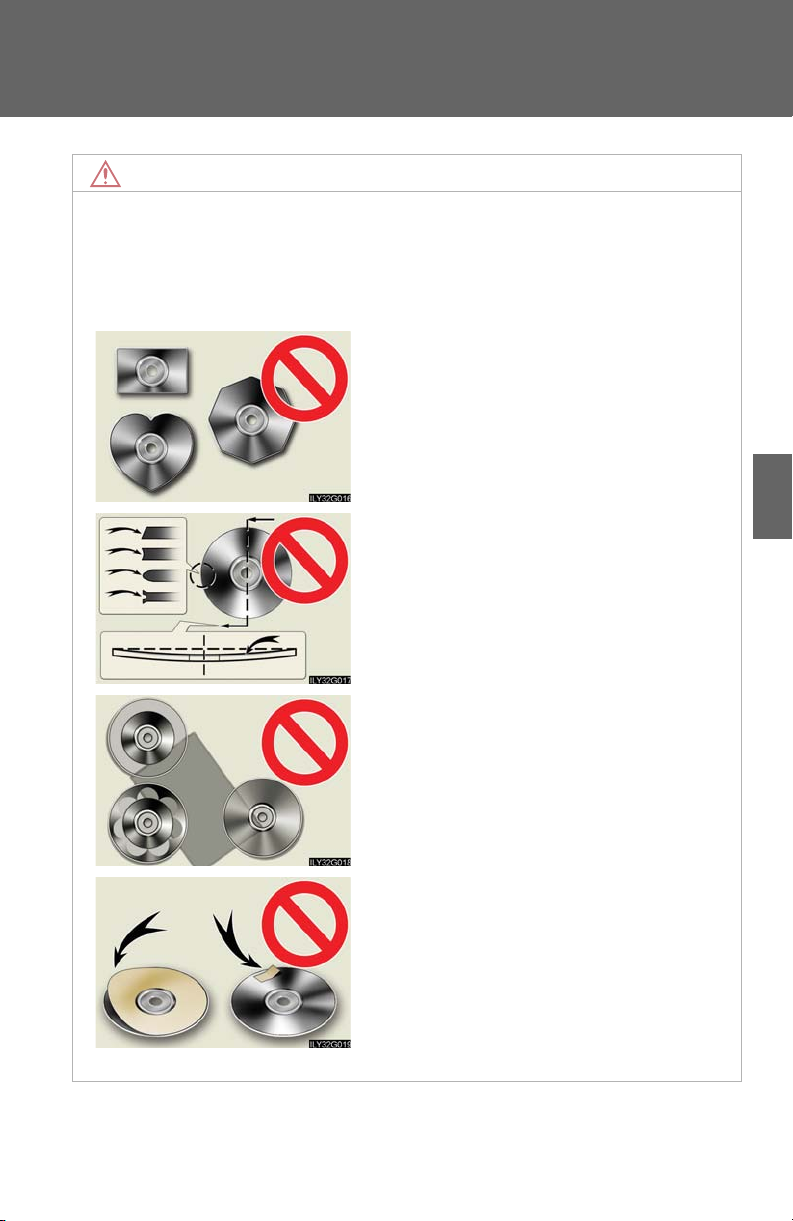
n Discs and adapters that cannot be used
Do not use the following types of discs, 3 in. (8 cm) disc adapters or dual discs.
Doing so may damage the player and render the disc insert/eject function unusable.
l Discs that have a diameter that is not 4.7 in.
(12 cm).
l Low-quality and deformed discs.
3
Interior features
l Discs with a transparent or translucent
recording area.
l Discs that have tape, stickers or CD-R
labels attached to them, or that have the
label peeled off.
221
Page 24
3-3. Using the audio system
NOTICE
n Player precautions
Failure to follow the precautions below may result in damage to the discs or the
player itself.
l Do not insert anything other than discs into the disc slot.
l Do not apply oil to the player.
l Store discs away from direct sunlight.
l Never try to disassemble any part of the player.
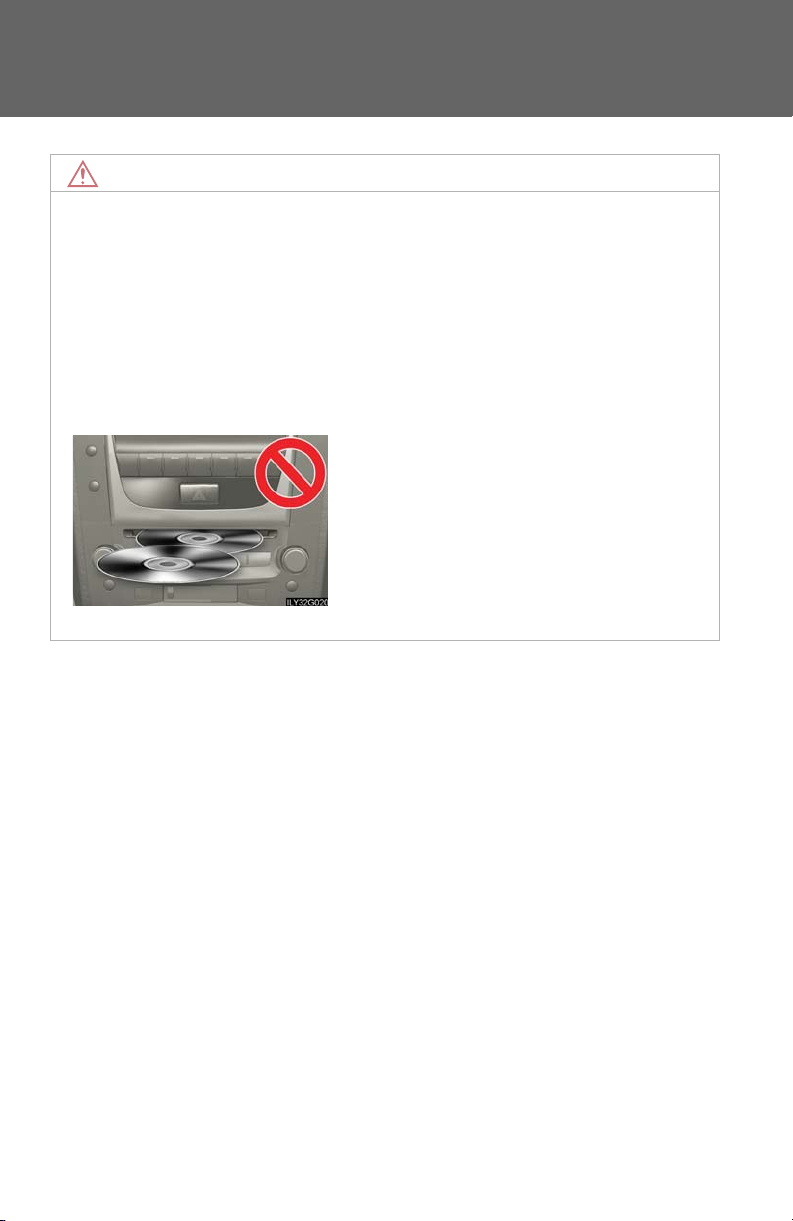
l Do not insert more than one disc at a time.
222
Page 25
3-3. Using the audio system
Playing MP3 and WMA discs
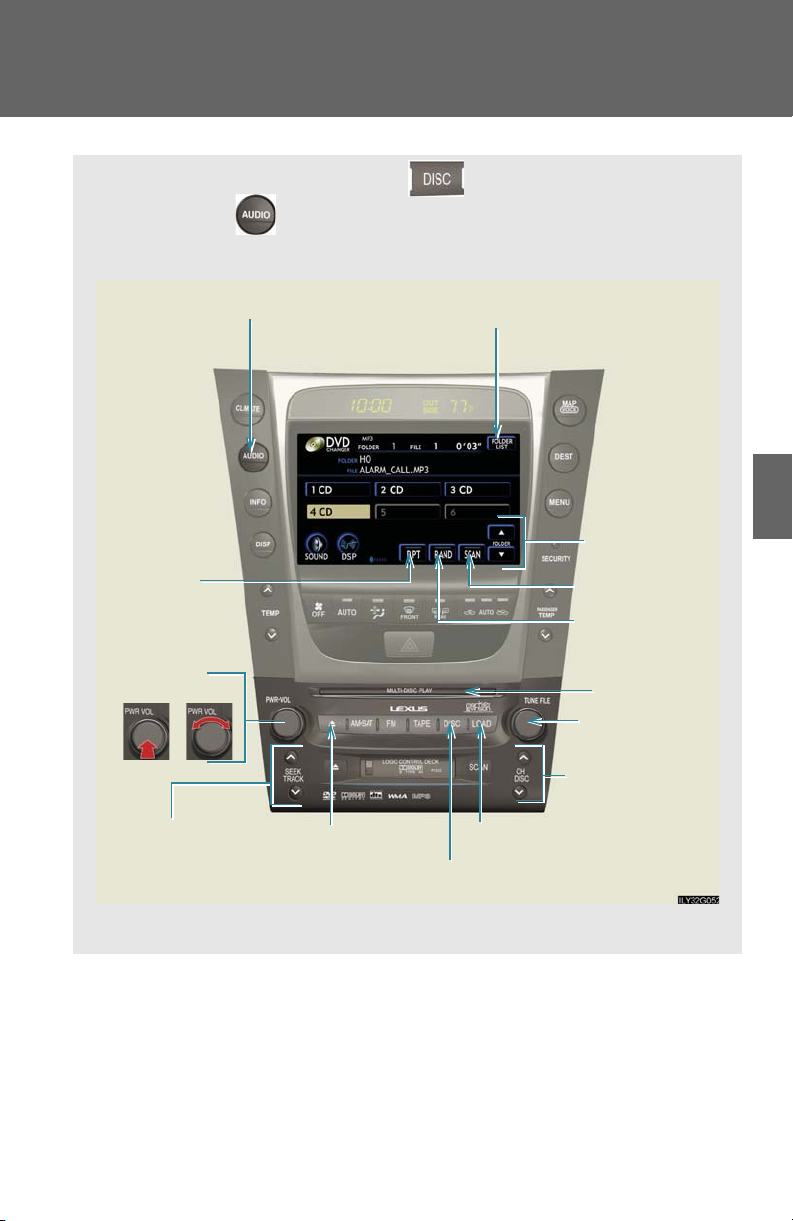
Insert an MP3 or WMA disc or press with a disc inserted.
When you press during playback of the disc, the following audio control screen appears.
Display audio control screen
Repeat play
Pow e r Vo l um e
Select file
CD eject
Display folder list
CD load
Playback
Select folder
Search playback
Random playback
CD slot
Select file
Select CD
3
Interior features
This illustration is a vehicle equipped with the DVD player.
223
Page 26
3-3. Using the audio system
Loading, ejecting and selecting MP3 and WMA discs
Refer to the section entitled “Using the CD player” for details. (→P. 215)
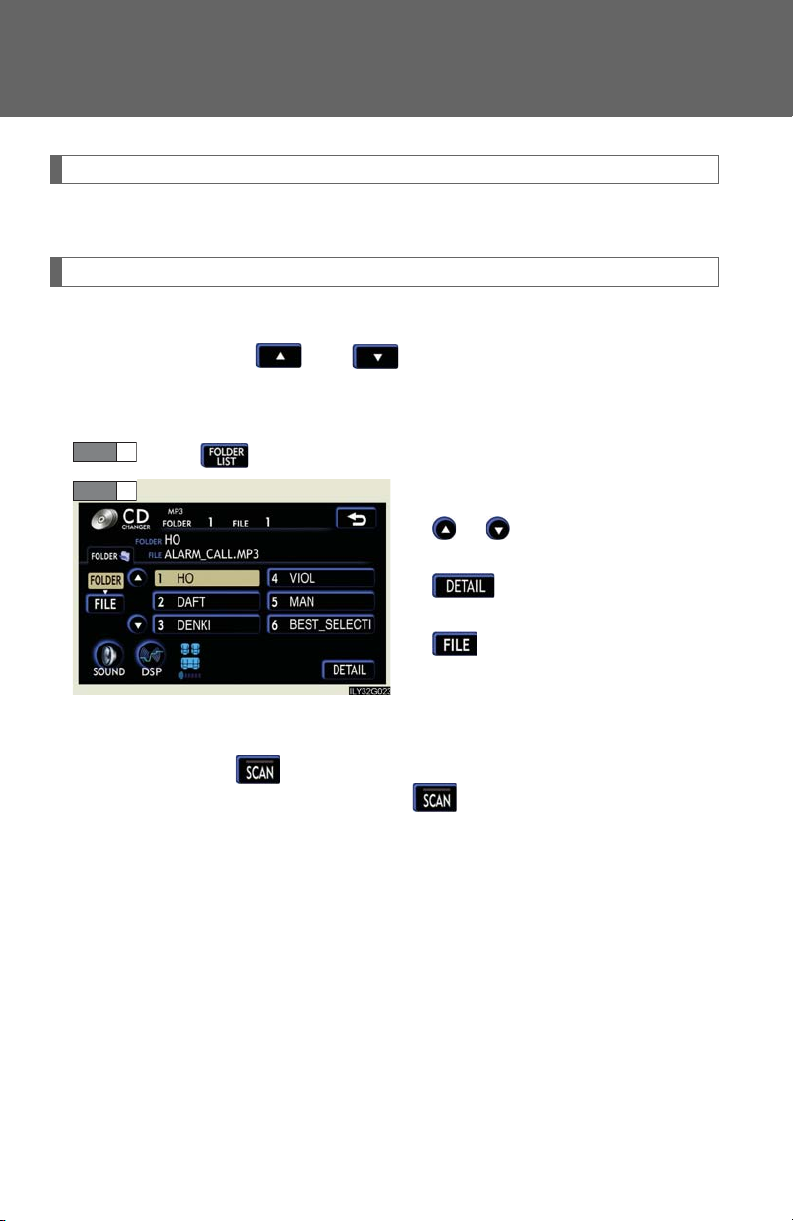
Selecting a folder
n Selecting a folder
Touch “FOLDER ” or “ ” on the screen to select the previous/next folder.
n Selecting a folder from the folder list
STEP 1
Touch on the screen.
STEP 2
Touch the desired folder number.
or :changes the list by 6
folder groups.
: displays the details of
the file currently playing.
: displays the file list.
This function is available only when
the vehicle is not moving.
n Selecting the desired folder by cueing the first file of each folder
Touch and hold on the screen until “FLD⋅SCAN” appears. When
the desired folder is reached, touch once again.
224
Page 27
3-3. Using the audio system
Selecting and scanning files
n Selecting one file at a time
Turn the dial or press ∧ or ∨ on to select the desired file.
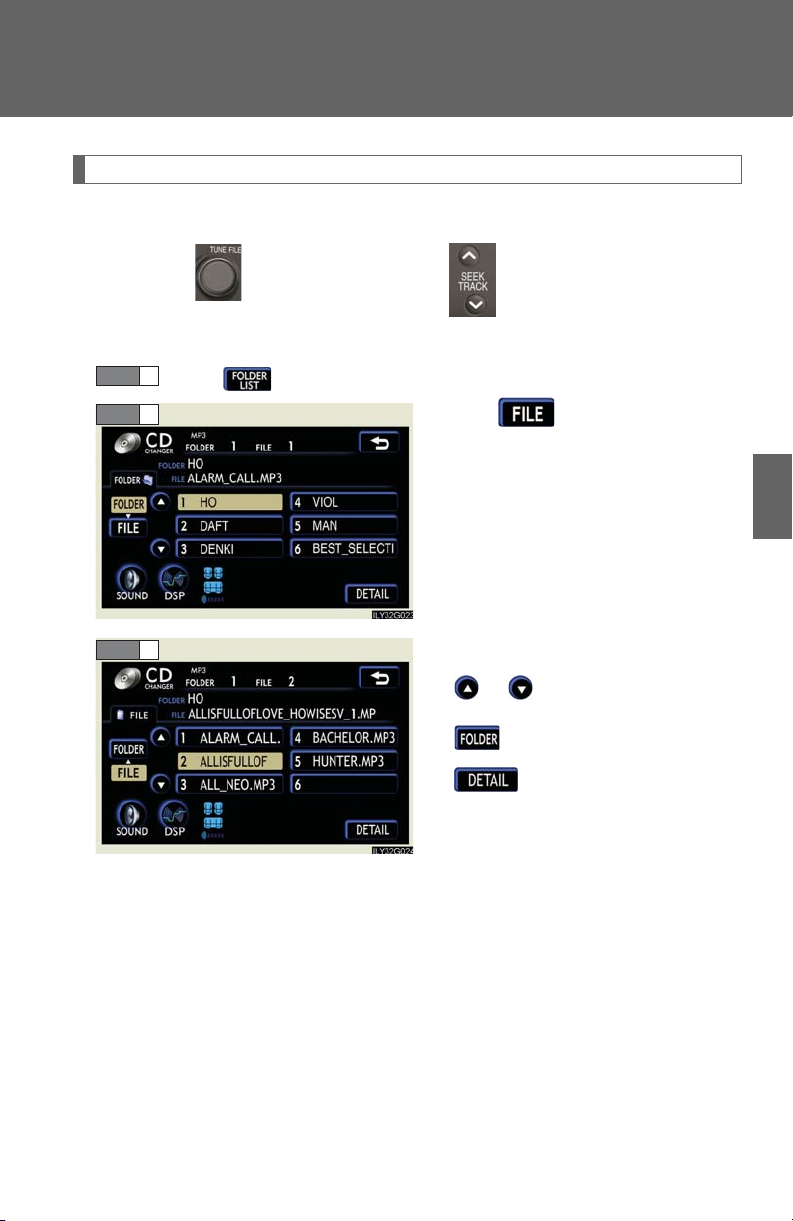
n Selecting a file from the file list
STEP 1
Touch on the screen to turn the folder list on.
STEP 2
STEP 3
Touch on the folder list
screen.
3
Interior features
Touch the desired file number.
or : changes the list by 6
groups.
: displays the folder list.
: displays the details of
the file currently playing.
This function is available only when
the vehicle is not moving.
225
Page 28
3-3. Using the audio system
n Selecting a desired file by cueing the files in the folder
Touch on the screen.
When the desired file is reached, touch once again.
File repeat
Touch on the screen.
Folder repeat
Touch and hold on the screen until the “FLD RPT” appears.
Random playback
n To play files from a particular folder in random order
Touch on the screen.
n To play all the files on a disc in random order
Touch and hold on the screen until the “FLD RAND” appears.
n Canceling random, repeat and scan playback
Touch , or on the screen once again.
n Error messages
→P. 219
n CD player protection feature
To protect the internal components, playback is automatically stopped when a
problem is detected while the CD player is being used.
n If CDs are left inside the CD player or in the ejected position for extended peri-
ods
CDs may be damaged and may not play properly.
n Lens cleaners
Do not use lens cleaners. Doing so may damage the CD player.
226
Page 29

3-3. Using the audio system
n MP3 and WMA files
MP3 (MPEG Audio LAYER 3) is a standard audio compression format.
Files can be compressed to approximately 1/10 of their original size by using MP3
compression.
TM
WMA (Windows Media
Audio) is a Microsoft audio compression format.
This format compresses audio data to a size smaller than that of the MP3 format.
There is a limit to the MP3 and WMA file standards and to the media/formats
recorded by them that can be used.
l MP3 file compatibility
• Compatible standards
MP3 (MPEG1 LAYER3, MPEG2 LSF LAYER3)
• Compatible sampling frequencies
MPEG1 LAYER3: 32, 44.1, 48 (kHz)
MPEG2 LSF LAYER3: 16, 22.05, 24 (kHz)
• Compatible bit rates
MPEG1 LAYER3: 64, 80, 96, 112, 128, 160, 192, 224, 256, 320 (kbps)
• MPEG2 LSF LAYER3: 64, 80, 96, 112, 128, 144, 160 (kbps)
*: Compatible with VBR
• Compatible channel modes: stereo, joint stereo, dual channel and monaural
l WMA file compatibility
• Compatible standards
WMA Ver. 7, 8, 9
• Compatible sampling frequencies
32, 44.1, 48 (kHz)
• Compatible bit rates
Ver. 7, 8: CBR 48, 64, 80, 96, 128, 160, 192 (kbps)
Ver. 9: CBR 48, 64, 80, 96, 128, 160, 192, 256, 320 (kbps)
*: Only compatible with 2-channel playback
l Compatible media
Media that can be used for MP3 and WMA playback are CD-Rs and CD-RWs.
Playback in some instances may not be possible, depending on the status of the
CD-R or CD-RW. Playback may not be possible or the audio may jump if the disc
is scratched or marked with fingerprints.
3
Interior features
227
Page 30

3-3. Using the audio system
l Compatible disc formats
The following disc formats can be used.
• Disc formats: CD-ROM Mode 1 and Mode 2
CD-ROM XA Mode 2, Form 1 and Form 2
• File formats: ISO9660 level 1, level 2, (Romeo, Joliet)
MP3 and WMA files written in any format other than those listed above may
not play correctly, and their file names and folder names may not be displayed correctly.
Items related to standards and limitations are as follows:
• Maximum directory hierarchy: 8 levels
• Maximum length of folder names/file names: 32 characters
• Maximum number of folders: 192 (including the root)
• Maximum number of files per disc: 255
l File names
The only files that can be recognized as MP3/WMA and played are those with
the extension .mp3 or .wma.
l Multi-sessions
As the audio system is compatible with multi-sessions, it is possible to play discs
that contain MP3 and WMA files. However, only the first session can be played.
l ID3 and WMA tags
ID3 tags can be added to MP3 files, making it possible to record the track title
and artist name, etc.
The system is compatible with ID3 Ver. 1.0, 1.1, and Ver. 2.2, 2.3 ID3 tags. (The
number of characters is based on ID3 Ver. 1.0 and 1.1.)
WMA tags can be added to WMA files, making it possible to record the track
title and artist name in the same way as with ID3 tags.
228
Page 31

3-3. Using the audio system
l MP3 and WMA playback
When a disc containing MP3 or WMA files is inserted, all files on the disc are first
checked. Once the file check is finished, the first MP3 or WMA file is played. To
make the file check finish more quickly, we recommend you do not write in any
files other than MP3 or WMA files or create any unnecessary folders.
Discs that contain a mixture of music data and MP3 or WMA format data cannot
be played.
l Extensions
If the file extensions .mp3 and .wma are used for files other than MP3 and WMA
files, they will be mistakenly recognized and played as MP3 and WMA files. This
may result in large amounts of interference and damage to the speakers.
l Playback
• To play MP3 files with steady sound quality, we recommend a fixed bit rate
of 128 kbps and a sampling frequency of 44.1 kHz.
• CD-R or CD-RW playback may not be possible in some instances, depending on the characteristics of the disc.
• There is a wide variety of freeware and other encoding software for MP3
and WMA files on the market, and depending on the status of the encoding
and the file format, poor sound quality or noise at the start of playback may
result. In some cases, playback may not be possible at all.
• When files other than MP3 or WMA files are recorded on a disc, it may take
more time to recognize the disc and in some cases, playback may not be
possible at all.
• Microsoft, Windows, and Windows Media are the registered trademarks of
Microsoft Corporation in the U.S. and other countries.
3
Interior features
229
Page 32

3-3. Using the audio system
n CD-R and CD-RW discs
l CD-R/CD-RW discs that have not been subject to the “finalizing process” (a
process that allows discs to be played on a conventional CD player) cannot be
played.
l It may not be possible to play CD-R/CD-RW discs recorded on a music CD
recorder or a personal computer because of disc characteristics, scratches or
dirt on the disc, or dirt, condensation, etc. on the lens of the unit.
l It may not be possible to play discs recorded on a personal computer depend-
ing on the application settings and the environment. Record with the correct
format. (For details, contact the appropriate application manufacturers of the
applications.)
l CD-R/CD-RW discs may be damaged by direct exposure to sunlight, high
temperatures or other storage conditions. The unit may be unable to play damaged discs.
l If you insert a CD-RW disc into the MP3/WMA player, playback will begin
more slowly than with a conventional CD or CD-R disc.
l Recordings on CD-R/CD-RW cannot be played using the DDCD (Double
Density CD) system.
n Unsuitable discs, and player precautions
→P. 221
230
Page 33
3-3. Using the audio system
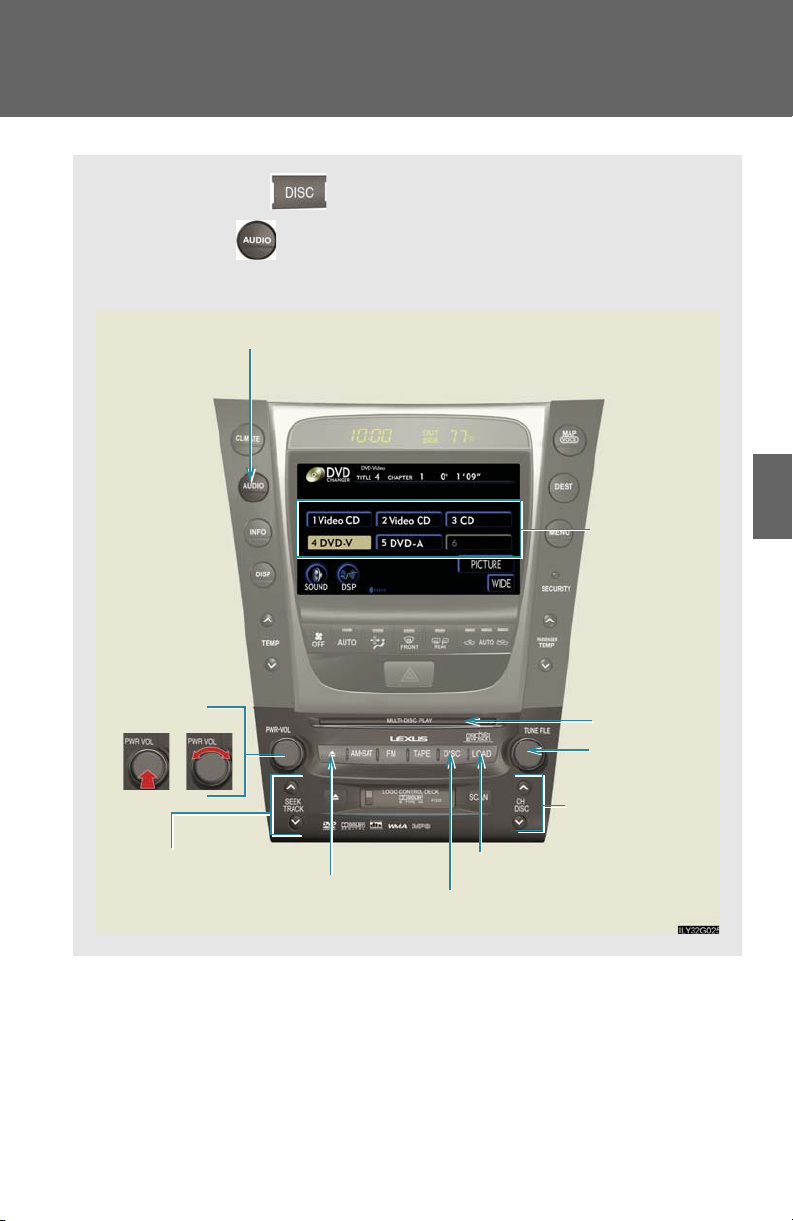
Using the DVD player (if equipped)
Insert a disc or press with a disc inserted.
When you press during the playback of the disc, the following audio/
video control screen appears.
Display audio/video control screen
Select disc
3
Interior features
Pow e r Vol u me
Track, file and chapter
selection/fast forward/
rewind
Disc slot
Select file
Change disc
Disc load
Disc eject
Playback
231
Page 34
3-3. Using the audio system
Loading a discs
n Loading a single disc
STEP 1
STEP 2
Push .
When the indicator changes from flashing amber to green, insert
a disc after the DVD player door opens.
n Loading multiple discs
STEP 1
STEP 2
Press and hold until you hear a beep.
When the indicator changes from flashing amber to green, insert
a disc after the DVD player door opens.
STEP 3
After inserting a disc, wait until the indicator changes from flashing amber to green, then insert the next disc after the DVD player
door has opened.
STEP 4
Repeat steps 2 and 3 until you have inserted all discs.
To cancel the operation, press the or button. If you do not
insert a disc within 15 seconds, loading will be canceled automatically.
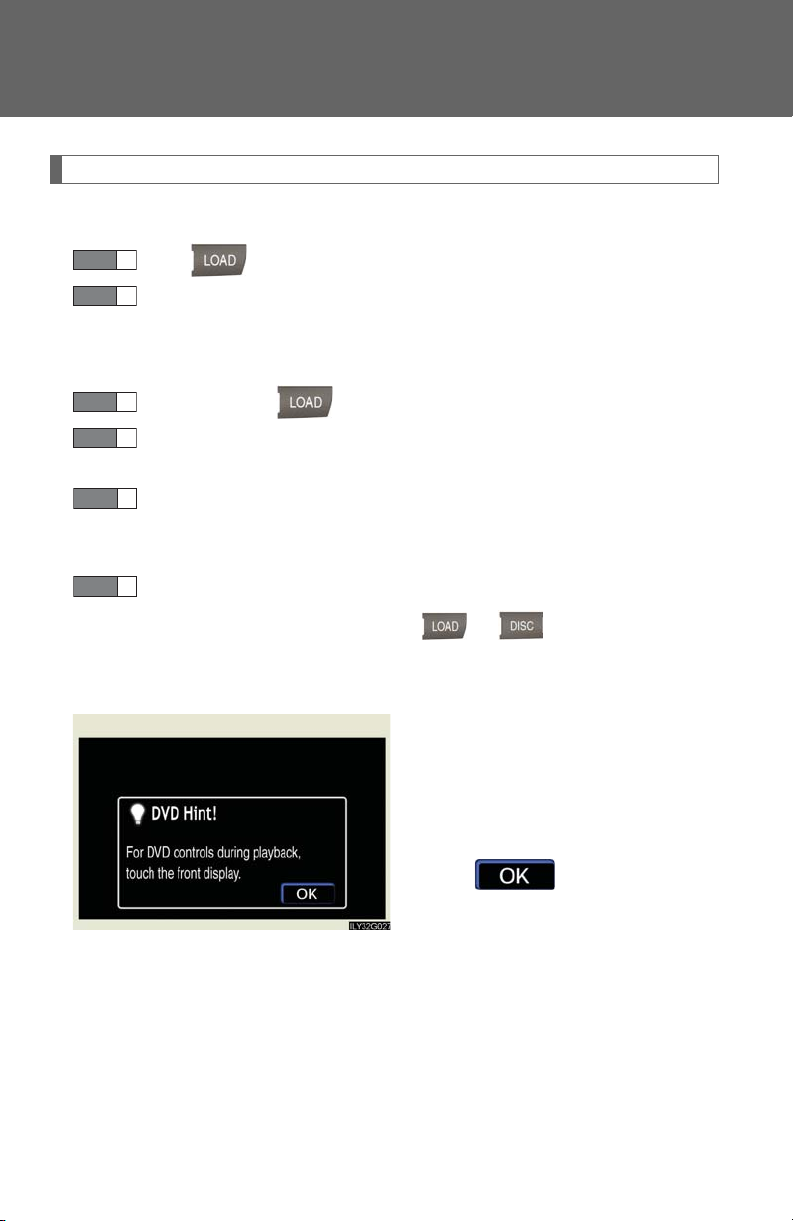
n DVD hint screen
This screen appears when a DVD
video, DVD audio or video CD is
first selected with the engine
switch in “ACC” or “IG-ON”
mode.
232
Touch once you have
read the message.
Page 35
Ejecting discs
n Ejecting a disc
3-3. Using the audio system
STEP 1
To select the disc to be ejected, touch the desired disc on the
screen or press ∧ or ∨ on .
STEP 2
Press and remove the disc.
n Ejecting all discs
Press and hold until you hear a beep, then remove the discs.
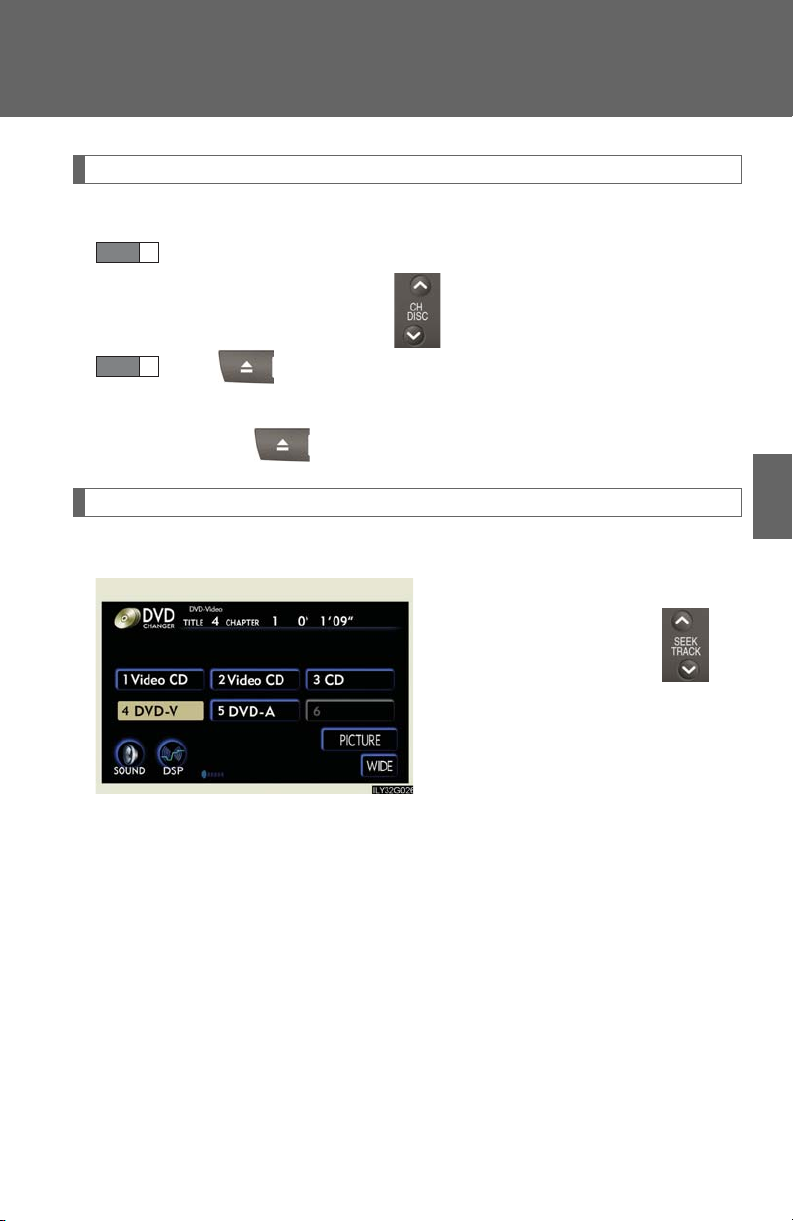
Selecting a disc
n To select a disc to play
Touch the desired disc on the
screen or press ∧ or ∨ on .
l Audio CD, CD text→P. 215
l MP3/WMA disc→P. 223
l DVD video/audio→P. 234
l Video CD→P. 24 7
3
Interior features
233
Page 36
3-3. Using the audio system
Playing DVD video/audio
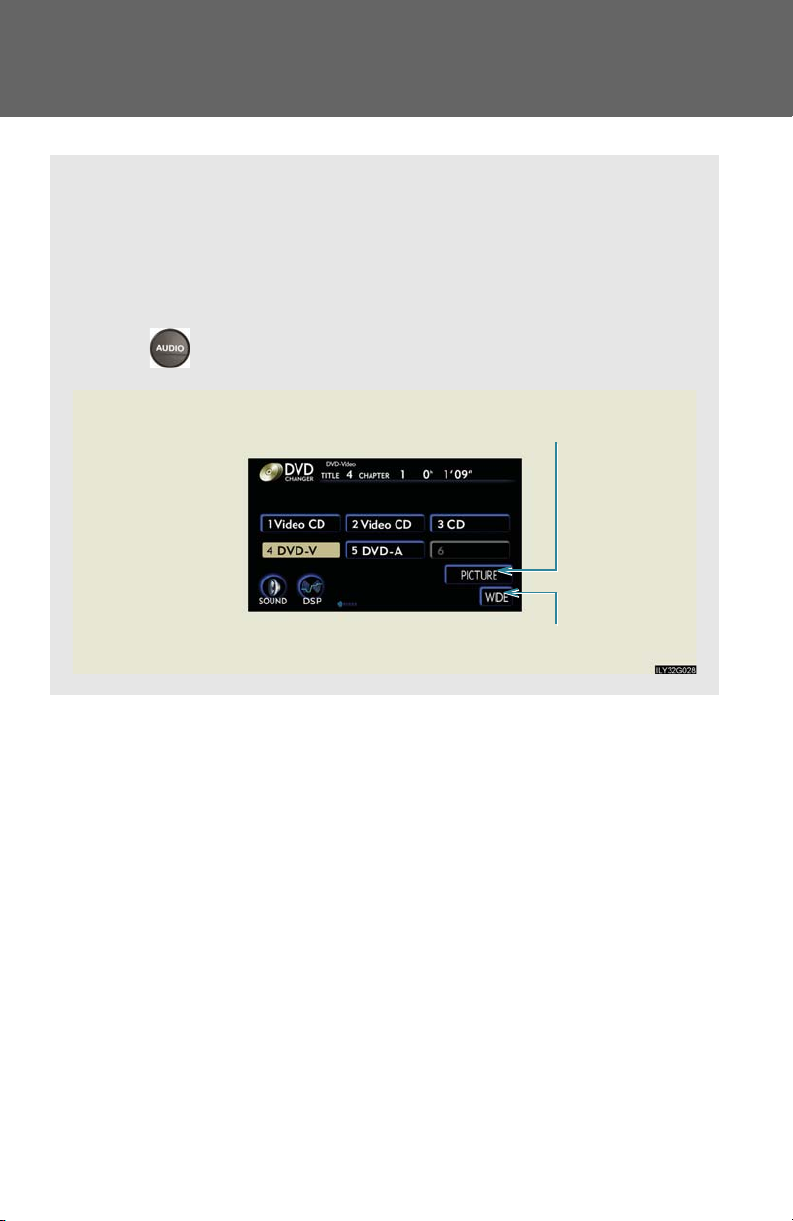
For safety reasons, you can enjoy the visual contents of discs only when the
vehicle is completely stopped with the engine switch in “ACC” or “IG-ON”
mode and the parking brake applied. While you are driving, only audio contents may be played.
n Video control screen
Press while the disc is playing, the following screen appears.
Return to video screen
Change screen mode (→P. 258 )
234
Page 37
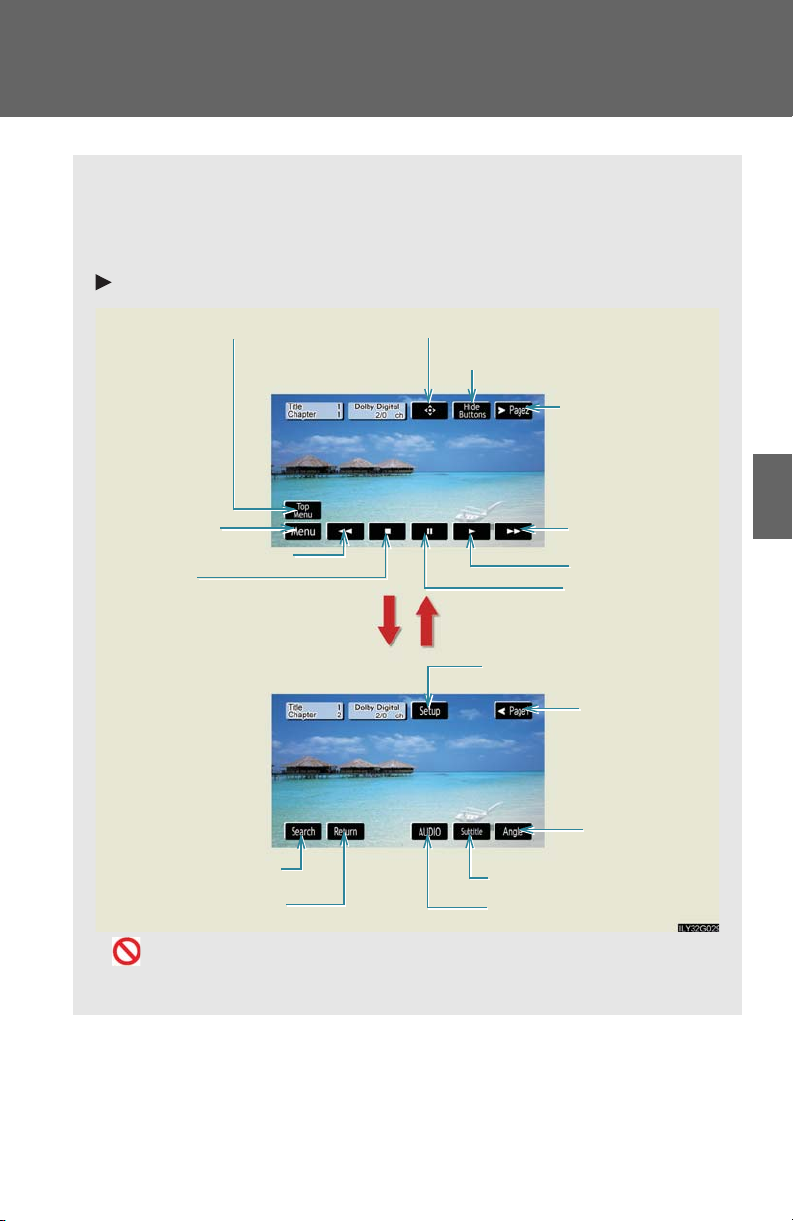
3-3. Using the audio system
n Control icon screen
Touch any part of the screen if no icons are shown while watching
video, the following screen appears.
DVD video mode
Return to top menu screen
Return to
menu screen
Rewin d
Stop
Search desired screen
Return to menu screen
Page 1
Page 2
Menu control key
Hide control icons
Go to page 2
Fast forward
Playback
Pa us e
Initial DVD setup
Return to
page 1
Change angle
Change subtitle language
Change audio language
3
Interior features
If appears on the screen when you touch an icon, the operation relevant to that control is not permitted.
235
Page 38
3-3. Using the audio system
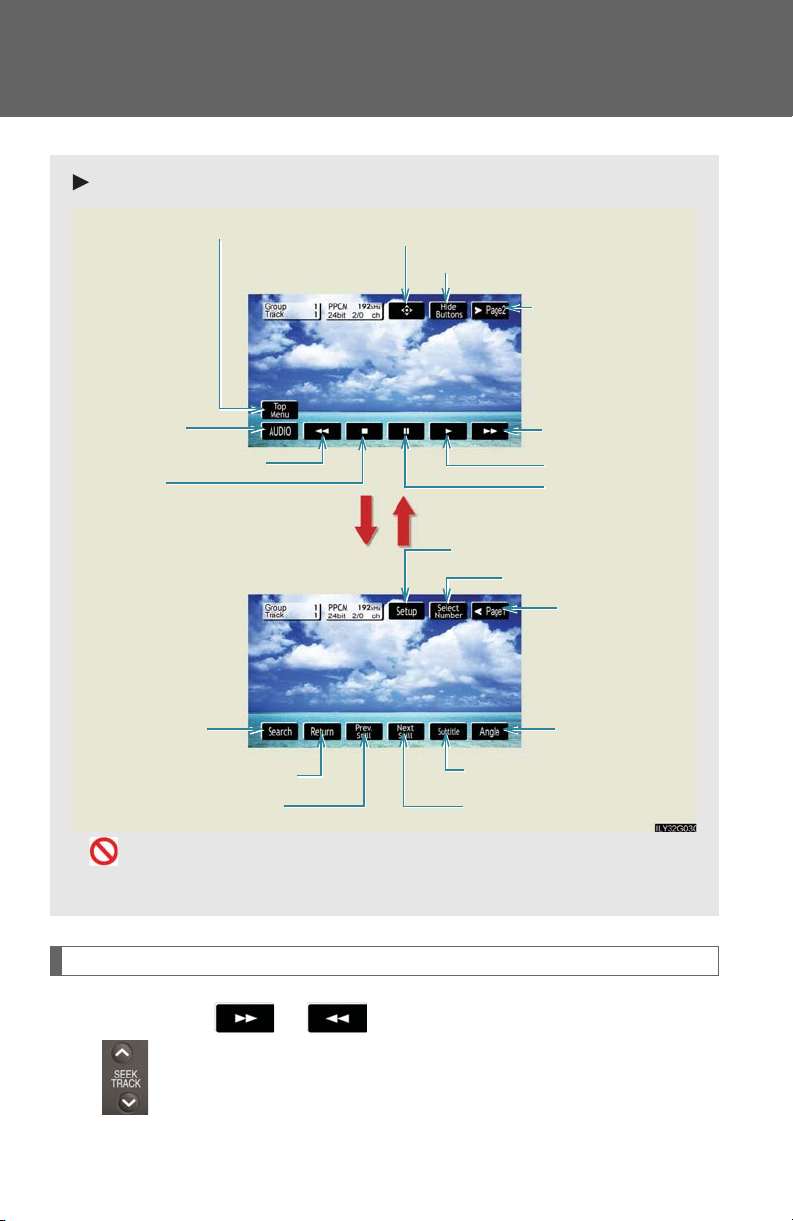
DVD audio mode
Return to top menu screen
Page 1
Change the
audio format
Rewind
Stop
Page 2
Search
desired screen
Return to registered screen
Return to previous screen Go to next screen
Menu control key
Hide control icons
Go to page 2
Fast forward
Playback
Pa us e
Initial DVD setup
Select menu number
Return to
page 1
Change angle
Change subtitle language
If appears on the screen when you touch an icon, the operation relevant to that control is not permitted.
Fast forwarding/rewinding disc
Touch and hold or on the screen or press and hold ∧ or ∨
on until you hear a beep.
236
Page 39
3-3. Using the audio system
Slow playback
Touch and then touch . Video is played slowly while you
are touching .
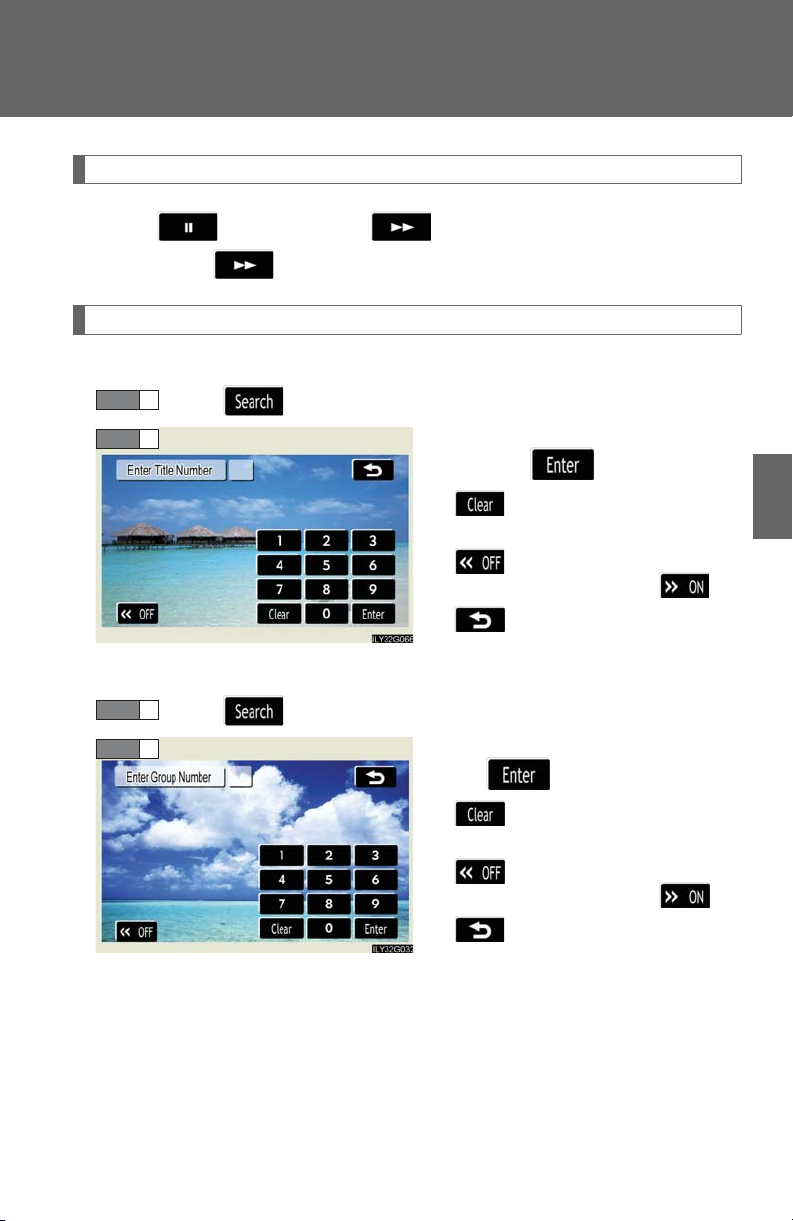
Searching a desired screen
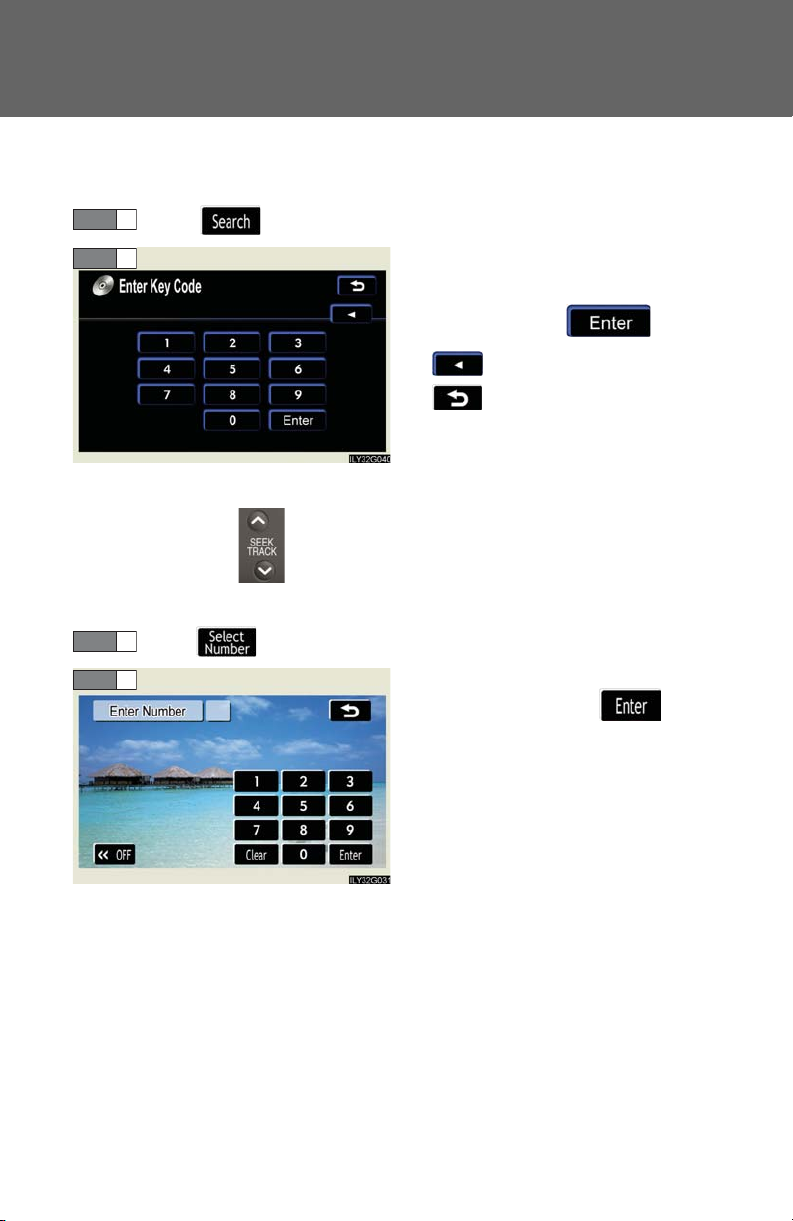
n Searching by title (DVD video mode)
STEP 1
Touch in the control icons.
STEP 2
Input the desired title number and
then touch .
n Searching by group (DVD audio mode)
STEP 1
STEP 2
Touch in the control icons.
Input the group number and then
touch .
: deletes the last input
number.
: hides the icons. To display
the icons, touch .
: returns to previous
screen.
: deletes the last input
number.
: hides the icons. To display
the icons, touch .
: returns to previous
screen.
3
Interior features
237
Page 40
3-3. Using the audio system
n Playing a bonus group (DVD audio mode only, if the DVD has bonus
options)
STEP 1
Touch in the control icons.
STEP 2
Input the desired bonus group
number on the group search
screen and touch .
: deletes the number.
: returns to previous screen.
n Searching by chapter/track
Press ∧ or ∨ on to select a chapter/track.
n Selecting a menu number (DVD audio mode only)
STEP 1
STEP 2
Touch in the control icons.
Input the desired menu number on
the screen and touch .
238
Page 41
Using the DVD menu
3-3. Using the audio system
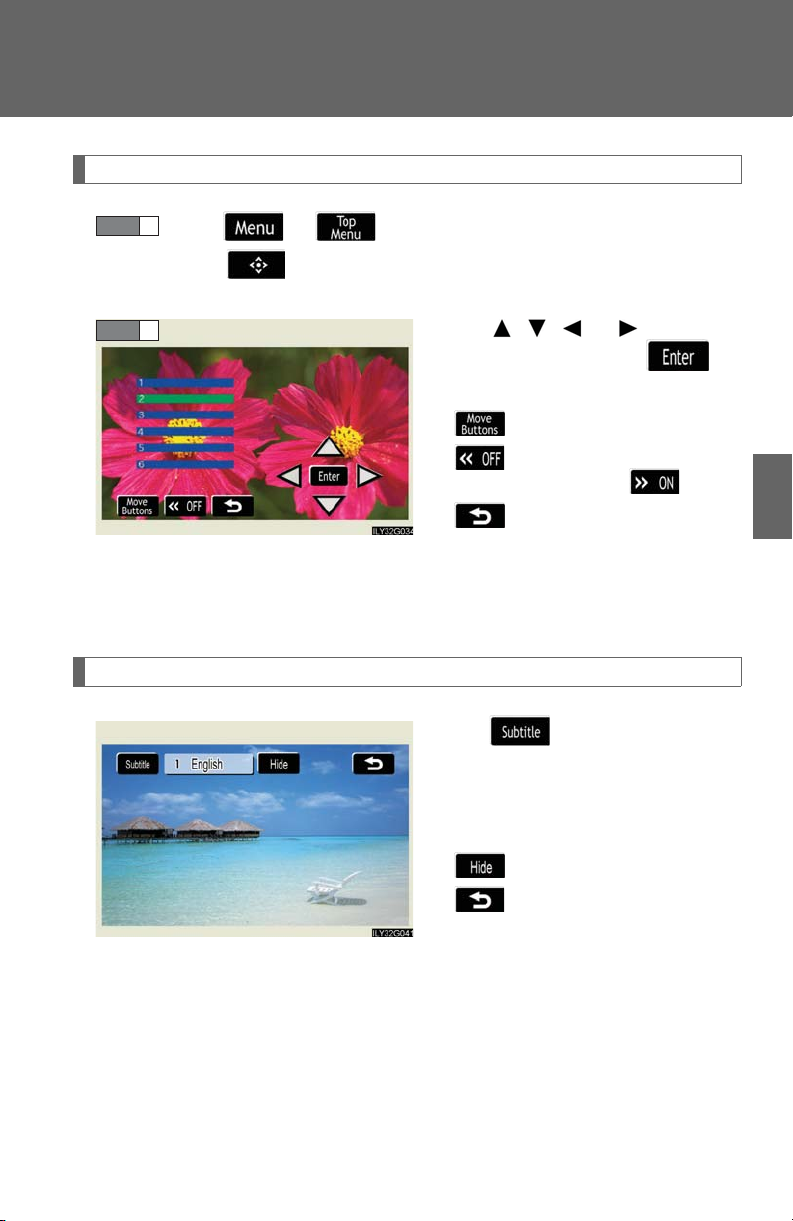
STEP 1
Touch or in the control icons.
Touch if the menu control key does not appear on the
menu screen.
STEP 2
Touch , , or to select a
menu item, then touch to
select.
: moves icons up or down.
: hides icons. To display
icons, touch .
: returns to previous
screen.
Note that specific items or the operating method differs from one DVD to
another. Refer to the manual that comes with the DVD disc. (The above image is
an example.)
Changing the subtitle language
Touch in the control icons.
Each time you touch the button,
the next available language is
selected.
3
Interior features
: hides the control icons.
: returns to previous screen.
239
Page 42
3-3. Using the audio system
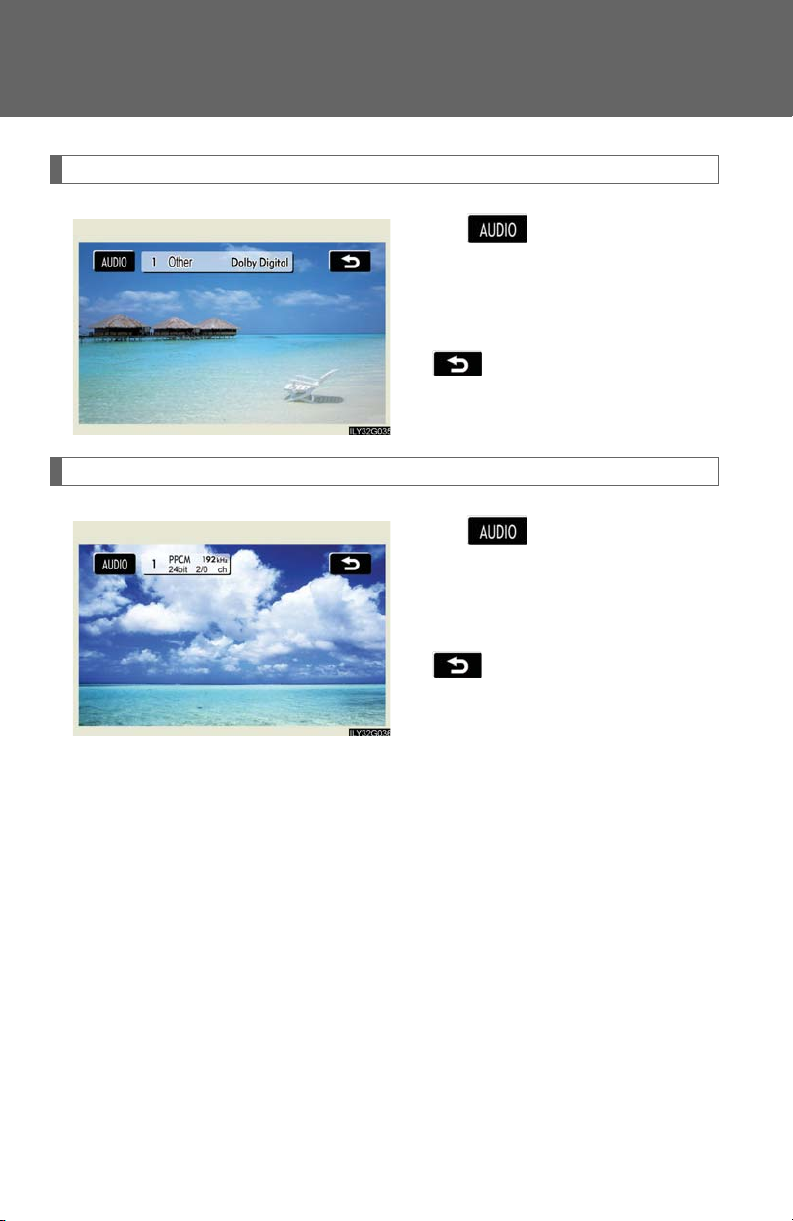
Changing the audio language (DVD video only)
Touch in the control icons.
Each time you touch the button,
the next available language is
selected.
Changing the audio format (DVD audio only)
Touch in the control icons.
Each time you touch the button,
the next available audio format is
selected.
: returns to previous screen.
240
: returns to previous screen.
Page 43
3-3. Using the audio system
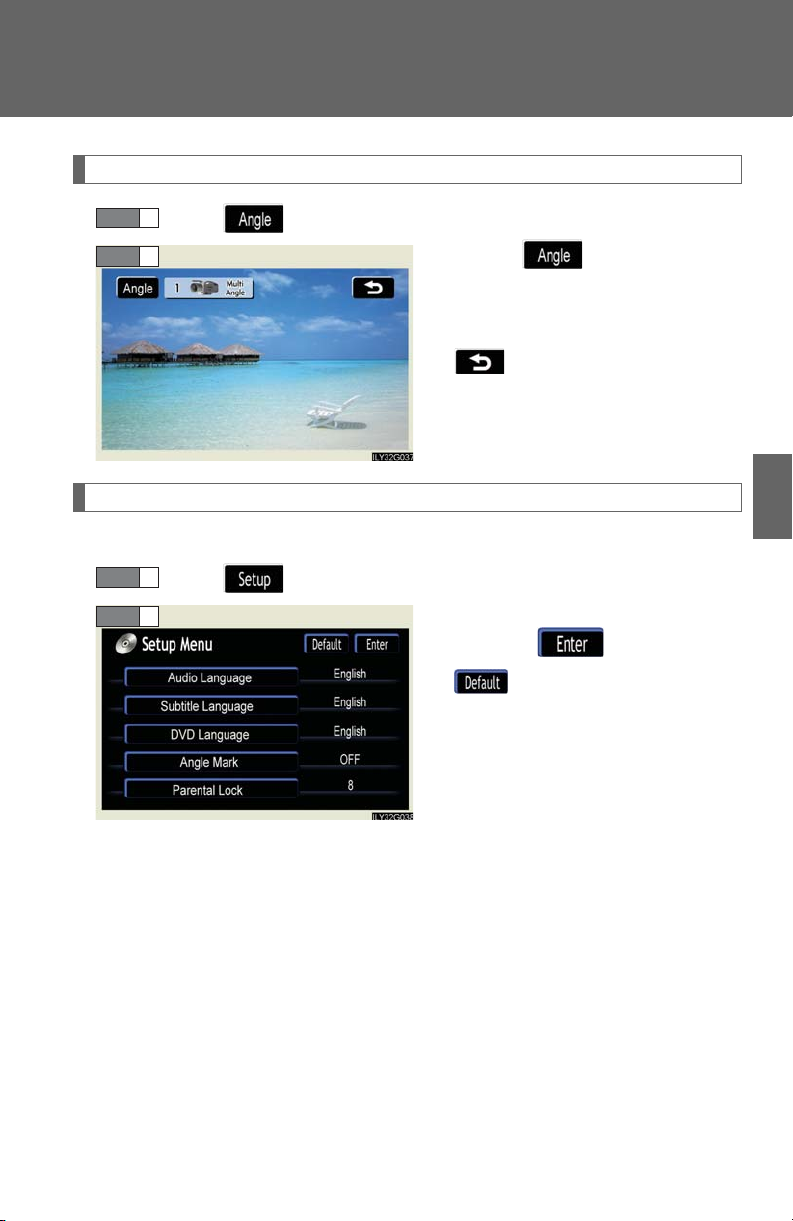
Changing the angle (If the angle option is available)
STEP 1
STEP 2
Touch in the control icons.
Initial DVD setup
n Displaying “Setup Menu” screen
STEP 1
STEP 2
Touch in the control icons.
Touch the button.
Each time you touch the button,
the next available angle is selected.
: returns to previous screen.
3
Interior features
After you change the initial settings, touch .
: restores default settings.
241
Page 44
3-3. Using the audio system
n Setting audio language
STEP 1
STEP 2
Touch on the “Setup Menu” screen.
Select the desired language.
If you cannot find the desired language, touch and input the
desired language code. (→P. 24 3)
: returns to previous screen.
n Setting subtitle language
STEP 1
STEP 2
Touch on the “Setup Menu” screen.
Select the desired language.
If you cannot find the desired language, touch and input the
desired language code. (→P. 24 3)
: returns to previous screen.
n Setting menu language
STEP 1
STEP 2
Touch on the “Setup Menu” screen.
Select the desired language.
If you cannot find the desired language, touch and input the
desired language code. (→P. 24 3)
: returns to previous screen.
n Setting angle mark ON or OFF
If the DVD has angle options, you can turn the angle mark on or off.
Touch on the “Setup Menu” screen. Each time you touch
the button, the multi angle mark on the screen turns on or off alternately.
242
Page 45
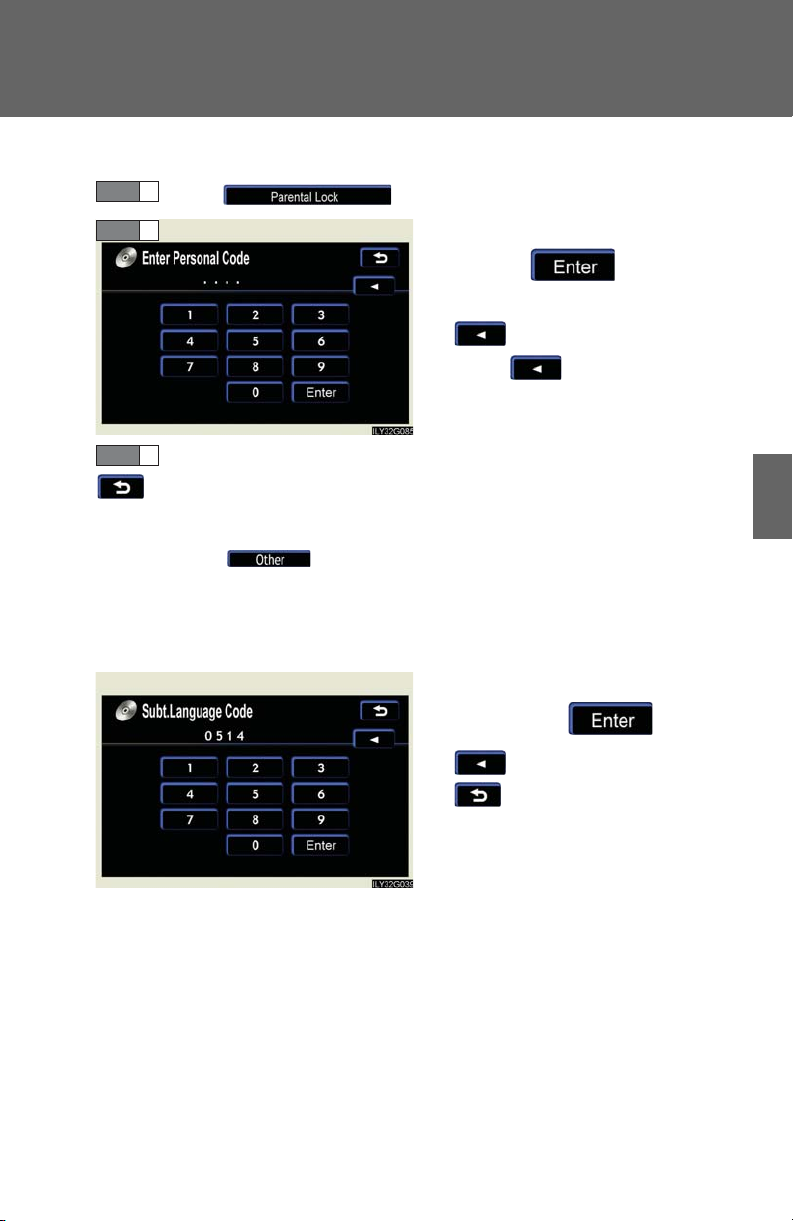
n Parental lock
STEP 1
Touch on the “Setup Menu” screen.
3-3. Using the audio system
STEP 2
Input the 4-digit password and
then touch .
If you enter wrong numbers, touch
to delete the numbers.
Touch 10 times to initialize
the personal code.
STEP 3
Select a parental level (1 - 8).
: returns to previous screen.
n Entering a language code
If you touch on the “Select Audio Language” screen, “Select
Subtitle Language” screen or “DVD Language” screen, you can select
a language by entering the 4-digit language code if that language is
available.
Input the 4-digit language code
and then touch .
: deletes the last input digit.
: returns to previous
screen.
3
Interior features
243
Page 46
3-3. Using the audio system
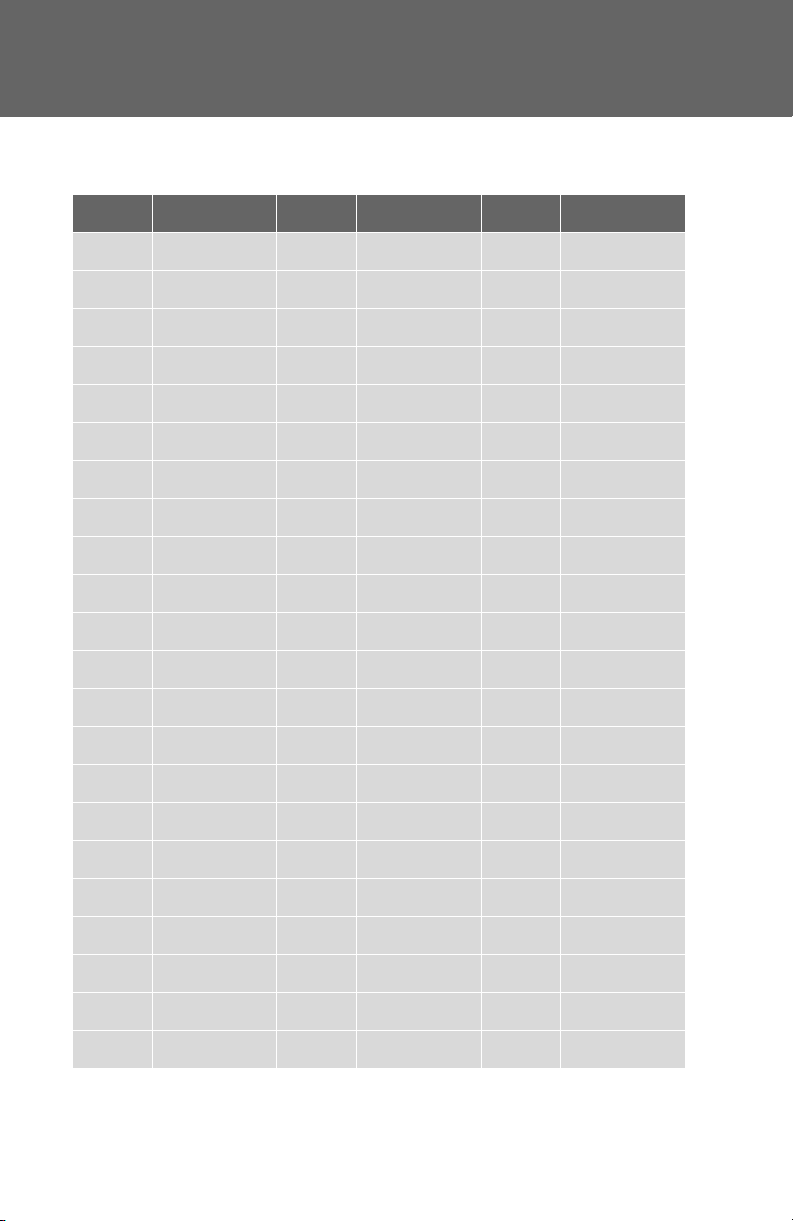
l Language code
Code Language Code Language Code Language
1001 Japanese 0205 Byelorussian 0704 Scots-Gaelic
0514 English 0207 Bulgarian 0712 Galician
0618 French 0208 Bihari 0714 Guarani
0405 German 0209 Bislama 0721 Gujarati
0920 Italian 0214 Bengali 0801 Hausa
0519 Spanish 0215 Ti b e t a n 0809 Hindi
2608 Chinese 0218 Breton 0818 Croatian
1412 Dutch 0301 Catalan 0821 Hungarian
1620 Portuguese 0315 Corsican 0825 Armenian
1922 Swedish 0319 Czech 0901 Interlingua
1821 Russian 0325 We l s h 0905 Interlingue
1115 Korean 0401 Danish 0911 Inupiak
0512 Greek 0426 Bhutani 0914 Indonesian
0101 Afar 0515 Esperanto 0919 Icelandic
0102 Abkhazian 0520 Estonian 0923 Hebrew
0106 Afrikaans 0521 Basque 1009 Yid d i sh
0113 Amharic 0601 Per s ia n 1023 Javanese
0118 Arabic 0609 Finnish 1101 Georgian
0119 Assamese 0610 Fiji 1111 Kazakh
0125 Aym ara 0615 Faroes e 1112 Greenlandic
0126 Azerbaijani 0625 Frisian 1113 Cambodian
0201 Bashkir 0701 Irish 1114 Kannada
244
Page 47
3-3. Using the audio system
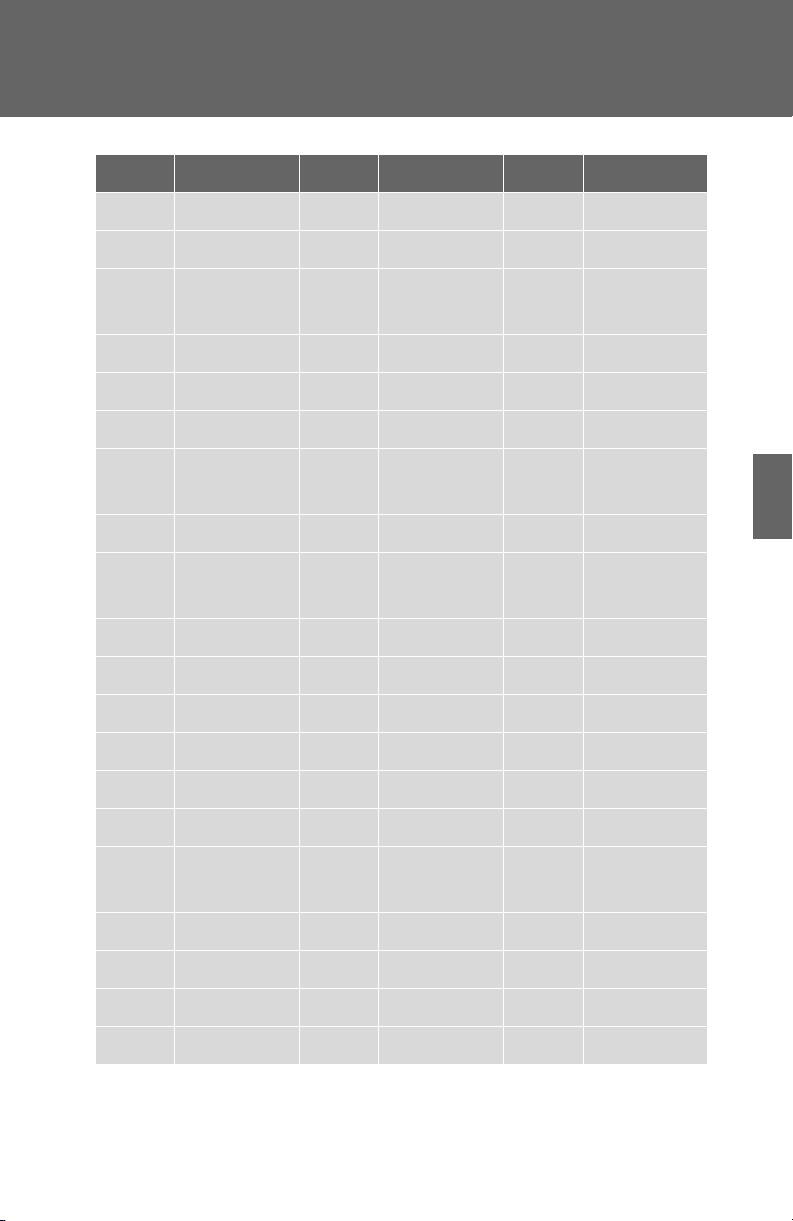
Code Language Code Language Code Language
1119 Kashmiri 1415 Norwegian 1914 Shona
1121 Kurdish 1503 Occitan 1915 Somali
1125 Kirghiz 1513
(Afan)
Oromo
1917 Albanian
1201 Latin 1518 Oriya 1918 Serbian
1214 Lingala 1601 Pan ja bi 1919 Siswati
1215 Laothian 1612 Polish 1920 Sesotho
1220 Lithuanian 1619
Pa sh to ,
Pushto
1921 Sundanese
1222 Latvian 1721 Quechua 1923 Swahili
1307 Malagasy 1813
RhaetoRomance
2001 Tami l
1309 Maori 1814 Kirundi 2005 Telug u
1311 Macedonian 1815 Romanian 2007 Tajik
1312 Malayalam 1823 Kinyarwanda 2008 Thai
1314 Mongolian 1901 Sanskrit 2009 Ti g r i n y a
1315 Moldavian 1904 Sindhi 2011 Tu r k m en
1318 Marathi 1907 Sangho 2012 Ta g a l og
1319 Malay 1908
SerboCroatian
2014 Setswana
3
Interior features
1320 Maltese 1909 Sinhalese 2015 To n g a
1325 Burmese 1911 Slovak 2018 Tu r kis h
1401 Nauru 1912 Slovenian 2019 Ts o n ga
1405 Nepali 1913 Samoan 2020 Ta t ar
245
Page 48

3-3. Using the audio system
Code Language Code Language Code Language
2023 Tw i 2209 Vietnames e 2515 Yo r u b a
2111 Ukrainian 2215 Vo l a p ü k 2621 Zulu
2118 Urdu 2315 Wo l o f
2126 Uzbek 2408 Xhosa
n Error messages
If “Region Code Error” is displayed, check the region code printed on the DVD
matches the player's region code.
If a different message is displayed: →P. 219
246
Page 49
3-3. Using the audio system
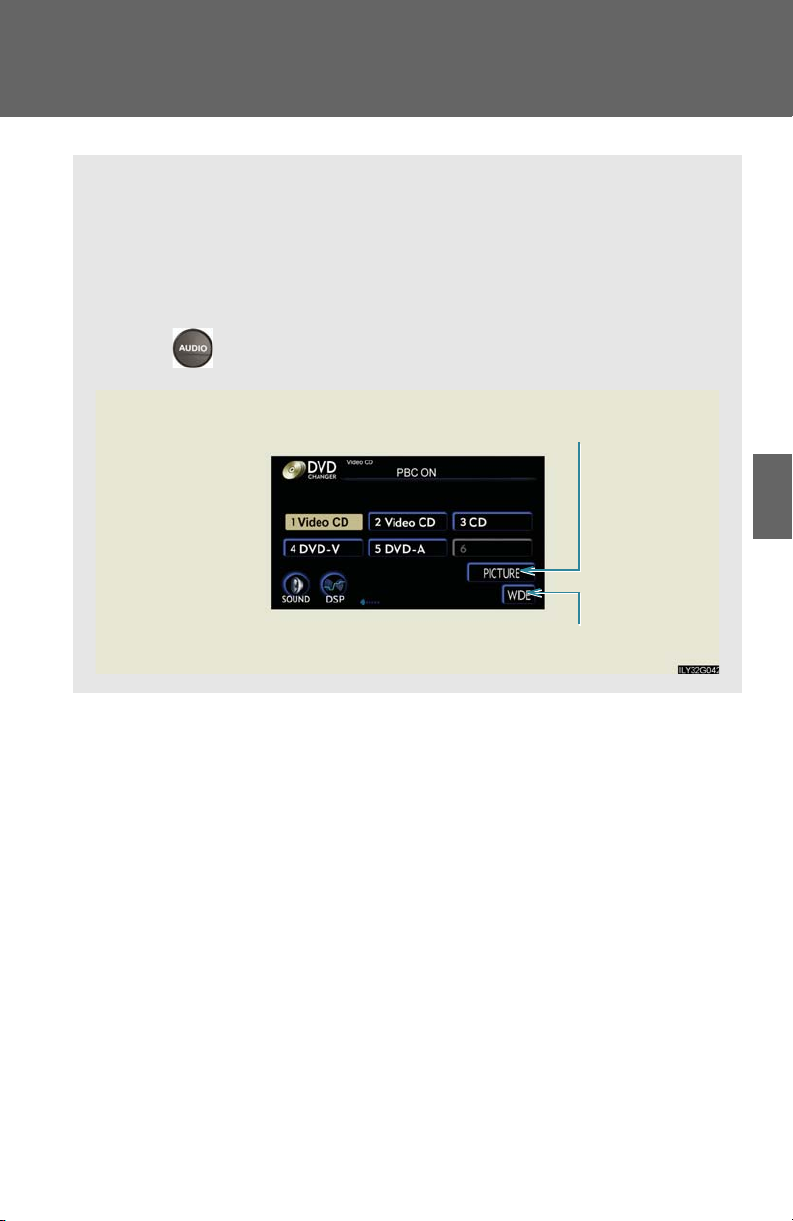
Playing video CD
For safety reasons, you can enjoy the visual contents of discs only when the
vehicle is completely stopped with the engine switch in “ACC” or “IG-ON”
mode and the parking brake applied. While you are driving, only audio contents may be played.
n Video control screen
Press while the disc is playing, the following screen appears.
Returning to video screen
Changing screen mode (→P. 25 8)
3
Interior features
247
Page 50
3-3. Using the audio system
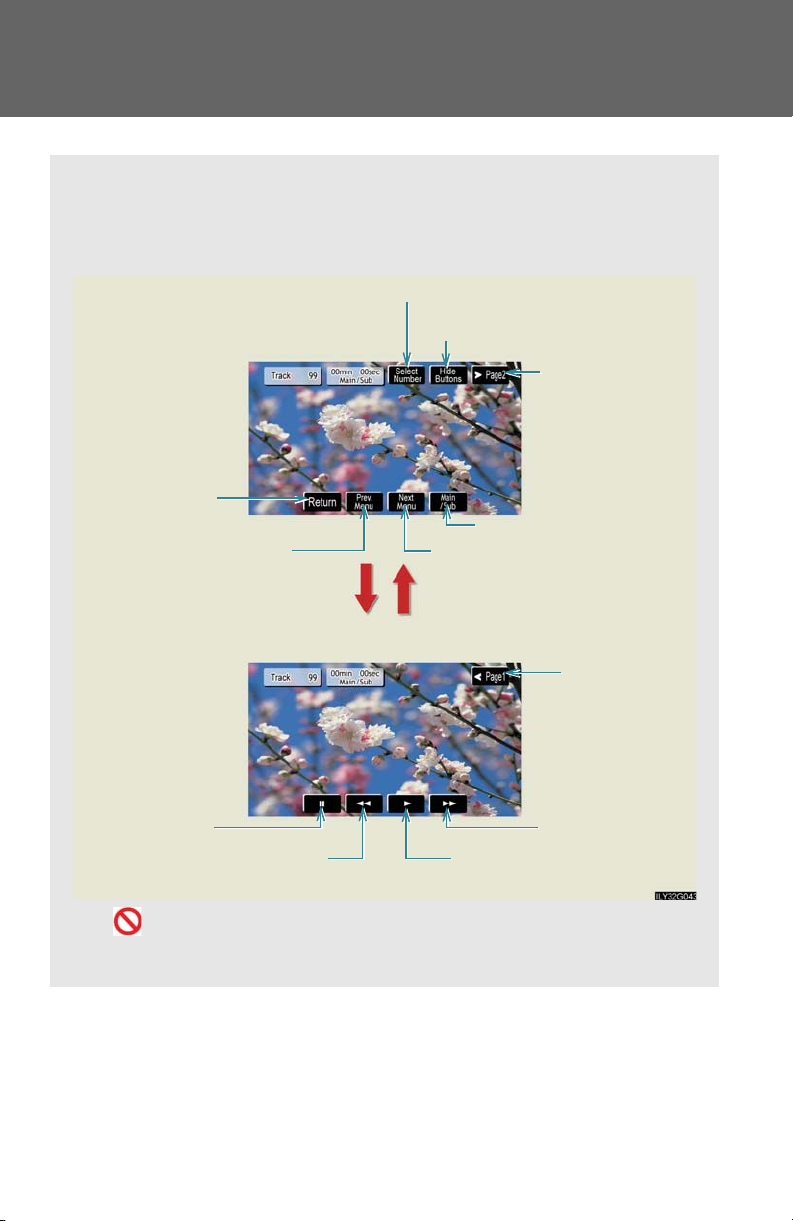
n Control icon screen
Touch any part of the screen if no icons are shown while watching a
video CD, the following screen appears.
Search track
Return to
registered screen
Search previous page
Pau se
Page 1
Page 2
Rewin d
Hide control icons
Go to page 2
Change sound-multiplex
Search next menu
Return to
page 1
Fast forward
Playback
If appears on the screen when you touch an icon, the operation
relevant to that control is not permitted.
248
Page 51
3-3. Using the audio system
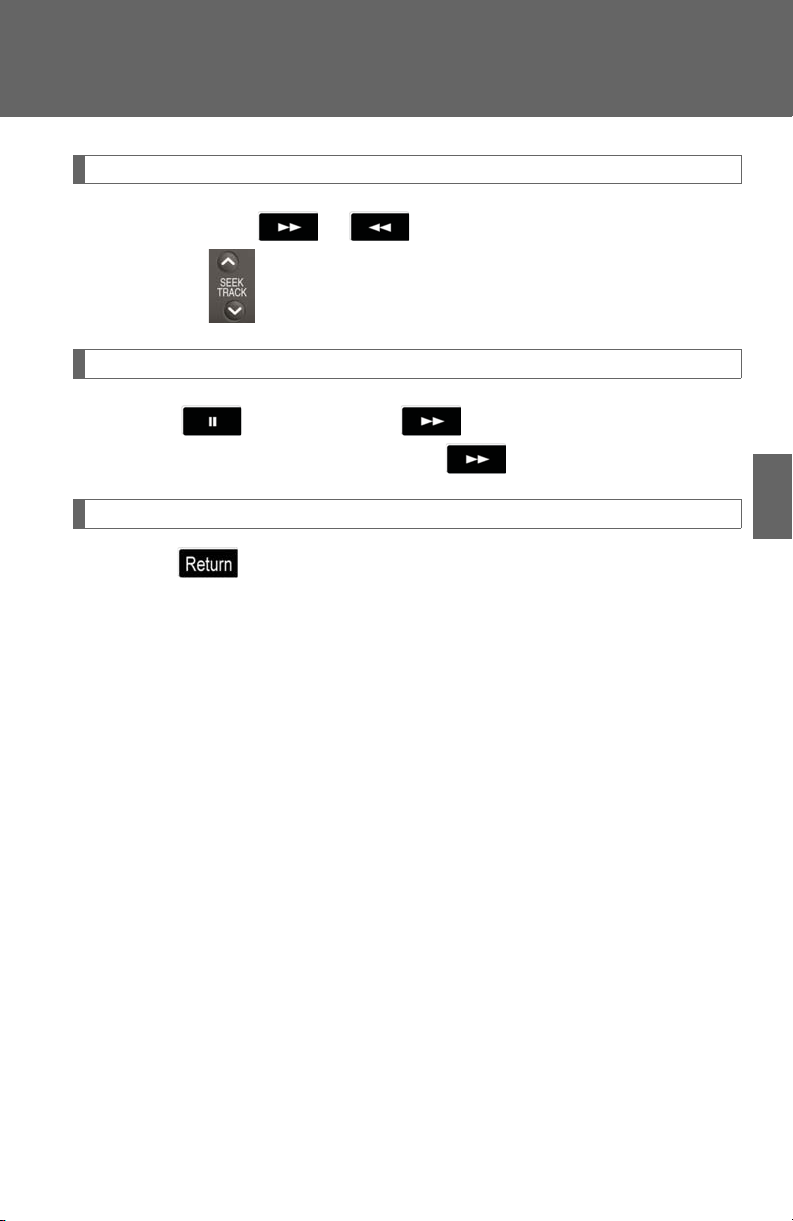
Fast forwarding/rewinding the video CD
Touch and hold or in the control icons or press and hold
∧ or ∨ on until you hear a beep.
Slow playback
Touch and then touch in the control icons. Video is
played slowly while you are touching .
Using the video CD menu
Touch in the control icons.
Refer to the manual that comes with the video CD for specific menu
items.
3
Interior features
249
Page 52
3-3. Using the audio system
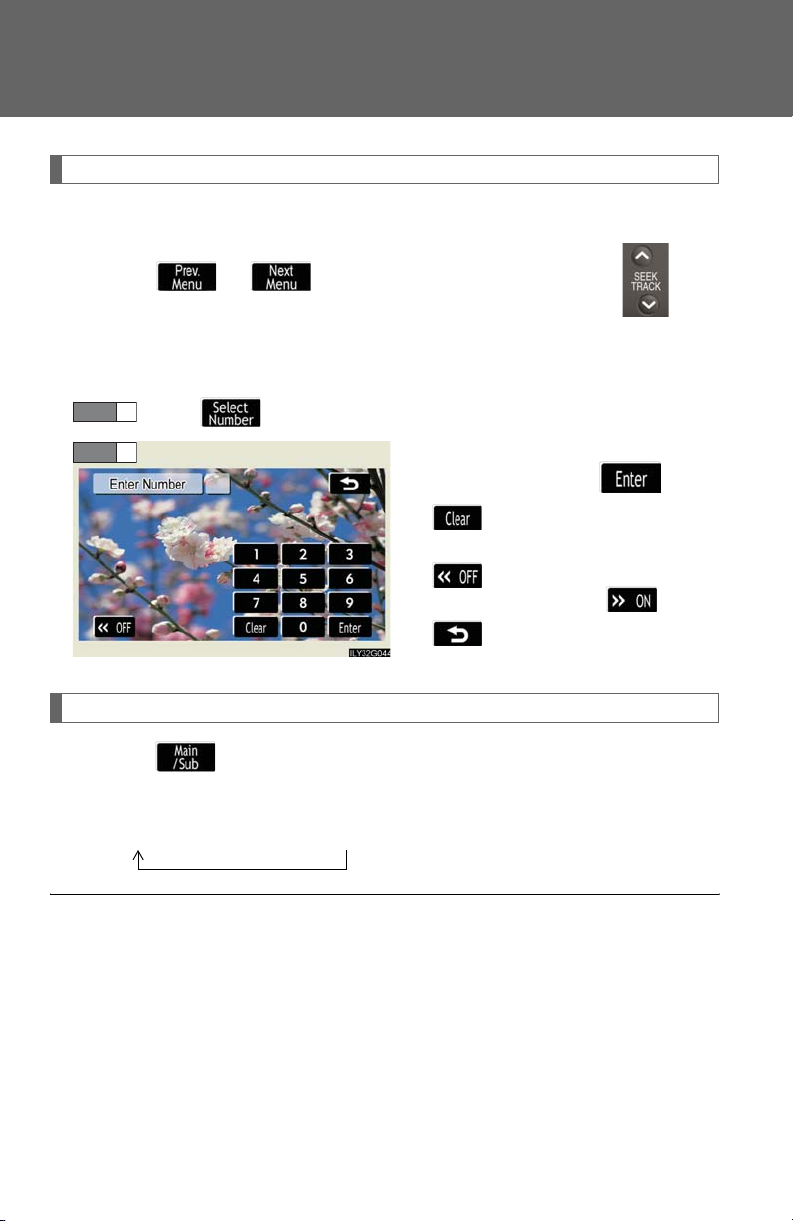
Selecting a desired screen
n Searching manually
Touch or on the screen, or press ∧ or ∨ on until
the desired screen appears.
n Searching by number
STEP 1
STEP 2
Touch in the control icons.
Input the desired track number on
the screen and touch .
: deletes the last input
number.
: hides icons. To display
icons, touch .
: returns to previous
screen.
Changing the sound-multiplex mode
Touch of the control icons. The mode cycles through each time
the button is touched.
“Main” → “Sub” → “Main/Sub”
n Error messages
If “Region Code Error” is displayed, check the region code printed on the DVD
matches the player's region code.
If a different message is displayed: →P. 219
250
Page 53
3-3. Using the audio system
DVD player and DVD video disc information
n DVD video discs
The DVD player conforms to NTSC color TV formats.
Region code: Some DVD video discs have a region code indicating
the region in which you can use the DVD video disc. If the DVD video
disc is not labeled as “ALL” or “1”, you cannot use it on this DVD player.
If you attempt to play an inappropriate DVD video disc on this player,
“Region Code Error” appears on the screen. Even if the DVD video
disc does not have a region code, you may not be able to use it.
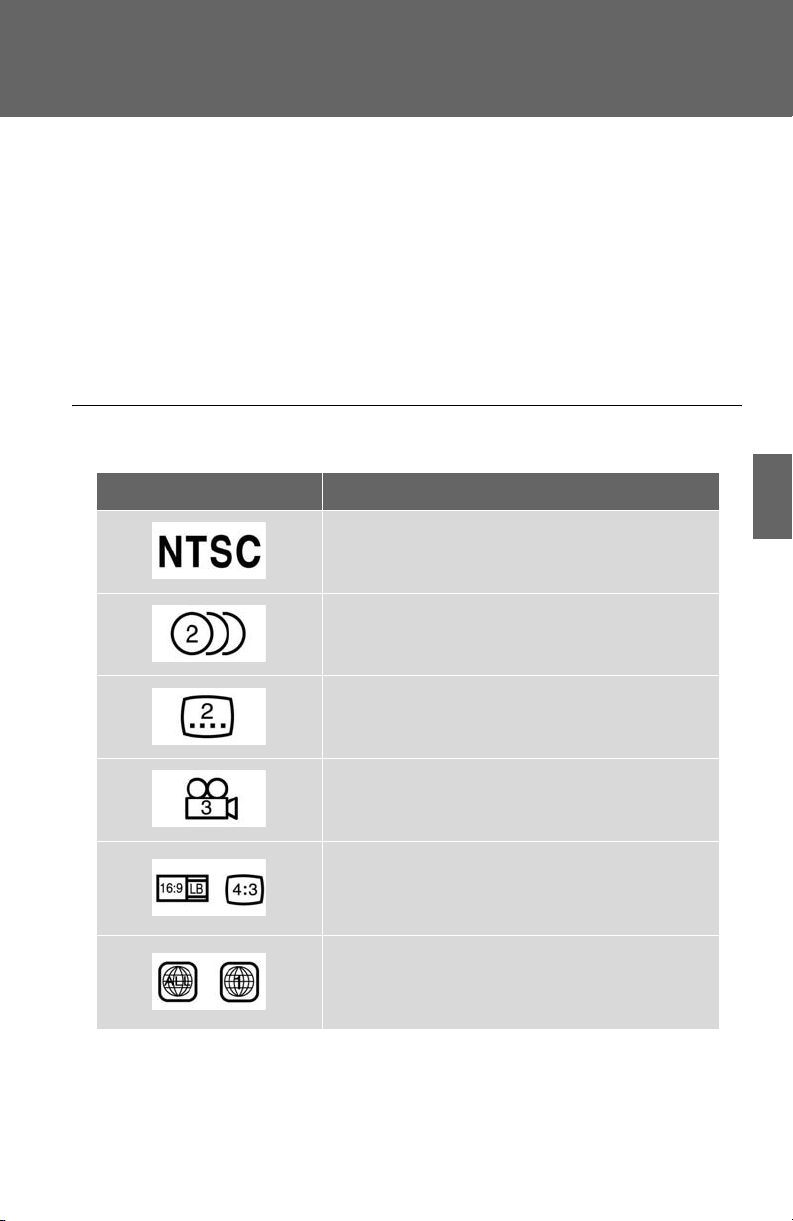
n Symbols shown on DVD video discs
Mark Meaning
Indicates NTSC format.
Indicates the number of audio tracks.
Indicates the number of language subtitles.
Indicates the number of angles.
Indicates the screen display ratios available.
Wide screen: 16:9
Standard: 4:3
Indicates the disc’s region code.
ALL: in all countries
Number: region code
3
Interior features
251
Page 54
3-3. Using the audio system
n DVD compatibility
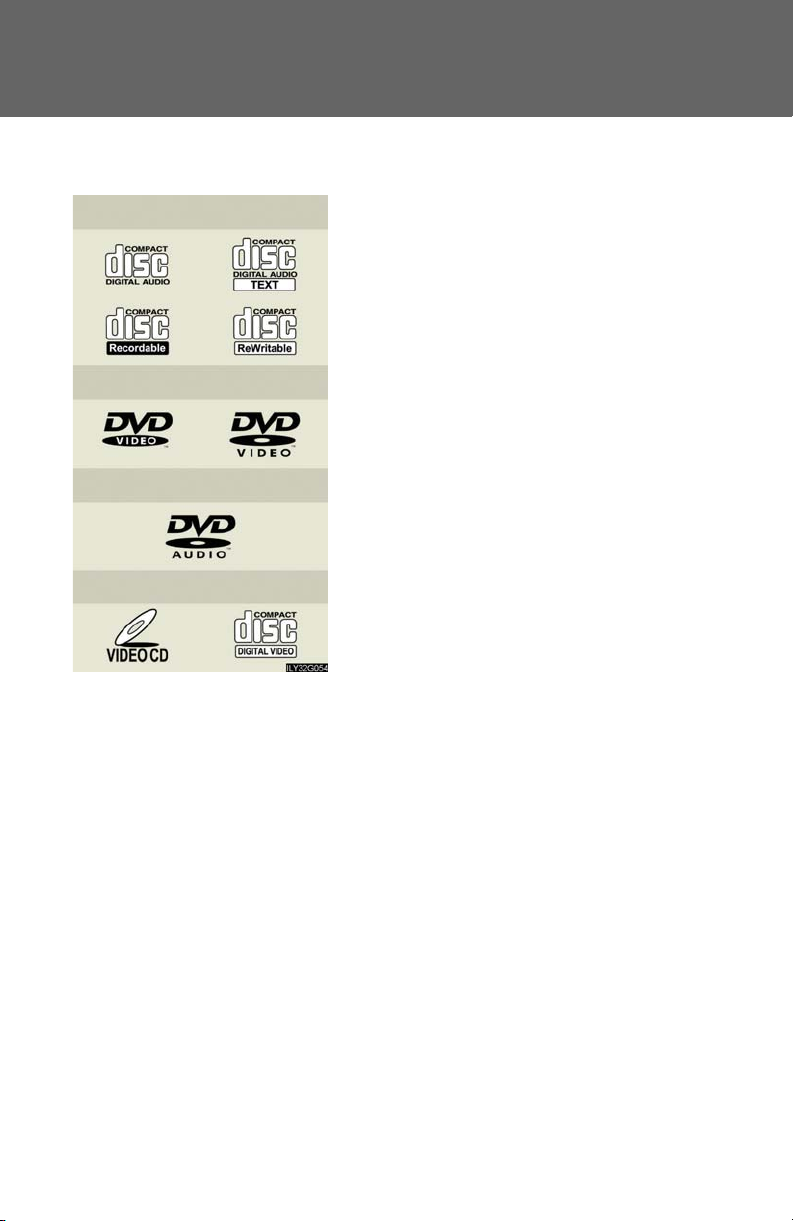
Audio CDs
Use only discs marked as shown to the left.
The following products may not be playable
on your DVD player.
l SACDs
l dts-CDs
l Copy-protected CDs
DVD video discs
DVD audio discs
l DVD-Rs
l DVD+Rs
l DVD-RWs
l DVD+RWs
l DVD-ROM s
l DVD-RA Ms
Video CDs
n DVD video disc information
l DVD video discs
Digital Versatile Disc that holds video. DVD video discs have adopted
“MPEG2”, one of the world standards of digital compression technologies. The
picture data is compressed by 1/40 on average and stored. Variable rate
encoded technology in which the volume of data assigned to the picture is
changed depending on the picture format has also been adopted. Audio data is
stored using PCM and Dolby digital, which enables higher quality of sound. Furthermore, multi-angle and multi-language features will also help you enjoy the
more advanced technology of DVD video.
252
Page 55

3-3. Using the audio system
l Viewer restrictions
This feature limits what can be viewed in conformity with the level of restrictions
of the country. The level of restrictions varies depending on the DVD video disc.
Some DVD video discs cannot be played at all, or violent scenes are skipped or
replaced with other scenes.
Level 1: DVD video discs for children can be played.
Level 2-7: DVD video discs for children and G-rated movies can be played.
Level 8: All types of DVD video discs can be played.
l Multi-angle option
You can enjoy the same scene from different angles.
l Multi-language option
You can select the subtitle and audio languages.
l Region codes
The region codes are provided on DVD players and DVD discs. If the DVD
video disc does not have the same region code as the DVD player, you cannot
play the disc on the DVD player. (→P. 251 )
l Audio
This DVD player can play linear PCM, Dolby Digital and MPEG audio format
DVD. Other decoded types cannot be played.
l Title and chapter
Video and audio programs stored in DVD video discs are divided into parts by
title and chapter.
Title: The largest unit of the video and audio programs stored on DVD video discs.
Usually, one movie, one album, or one audio program is assigned as a title.
Chapter: A title is comprised of one or more chapters.
3
Interior features
253
Page 56
3-3. Using the audio system
n Sound
l Dolby Digital
Manufactured under license from Dolby Laboratories.
“Dolby”, “Pro Logic”, and the double-D symbol are trademarks of Dolby Laboratories. Confidential unpublished works.
©1992-1997 Dolby Laboratories. All rights reserved.
This product incorporates copyright protection technology that is protected by
method claims of certain U. S. patents and other intellectual property rights
owned by Macrovision Corporation and other rights owners. Use of this copyright protection technology must be authorized by Macrovision Corporation,
and is intended for home and other limited viewing uses only unless otherwise
authorized by Macrovision Corporation.
Reverse engineering or disassembly is prohibited.
l DTS
“DTS” and “DTS Digital Surround” are registered trademarks of Digital Theater
System, Inc.
n Unsuitable discs, and player precautions
→P. 221
CAUTION
n DVD video precaution
Conversational speech on some DVDs is recorded at a low volume to emphasize
the impact of sound effects. If you adjust the volume assuming that the conversations represent the maximum volume level that the DVD will play, you may be startled by louder sound effects or when you change to a different audio source.
Loud sounds may have a significant impact on the human body or pose a driving
hazard. Keep this in mind when you adjust the volume.
254
Page 57
3-3. Using the audio system
Optimal use of the audio/video system
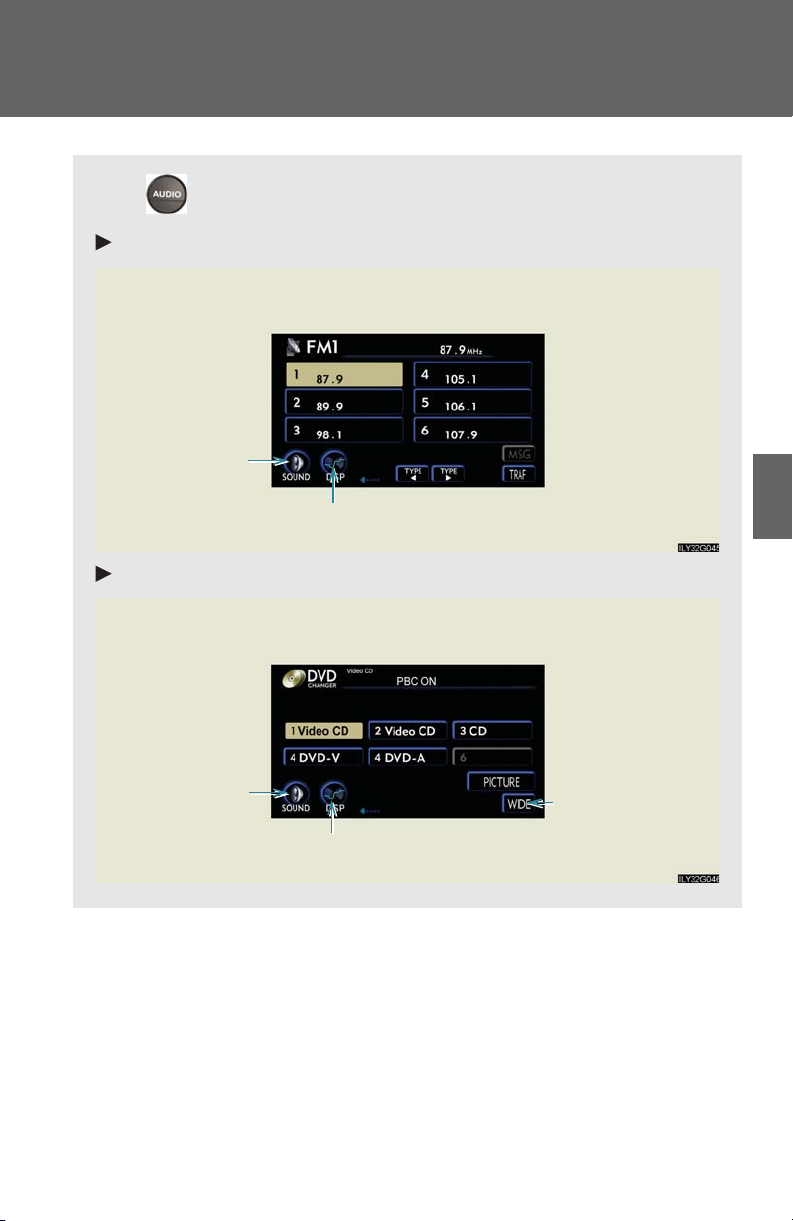
Press on the panel to display the audio/video control screen.
Operating the radio, cassette player and CD player
Adjust sound
quality and balance
Adjust the DSP
Operating the DVD video/audio and video CD
Adjust sound
quality and balance
Adjust the DSP
3
Interior features
Adjust screen ratio
255
Page 58
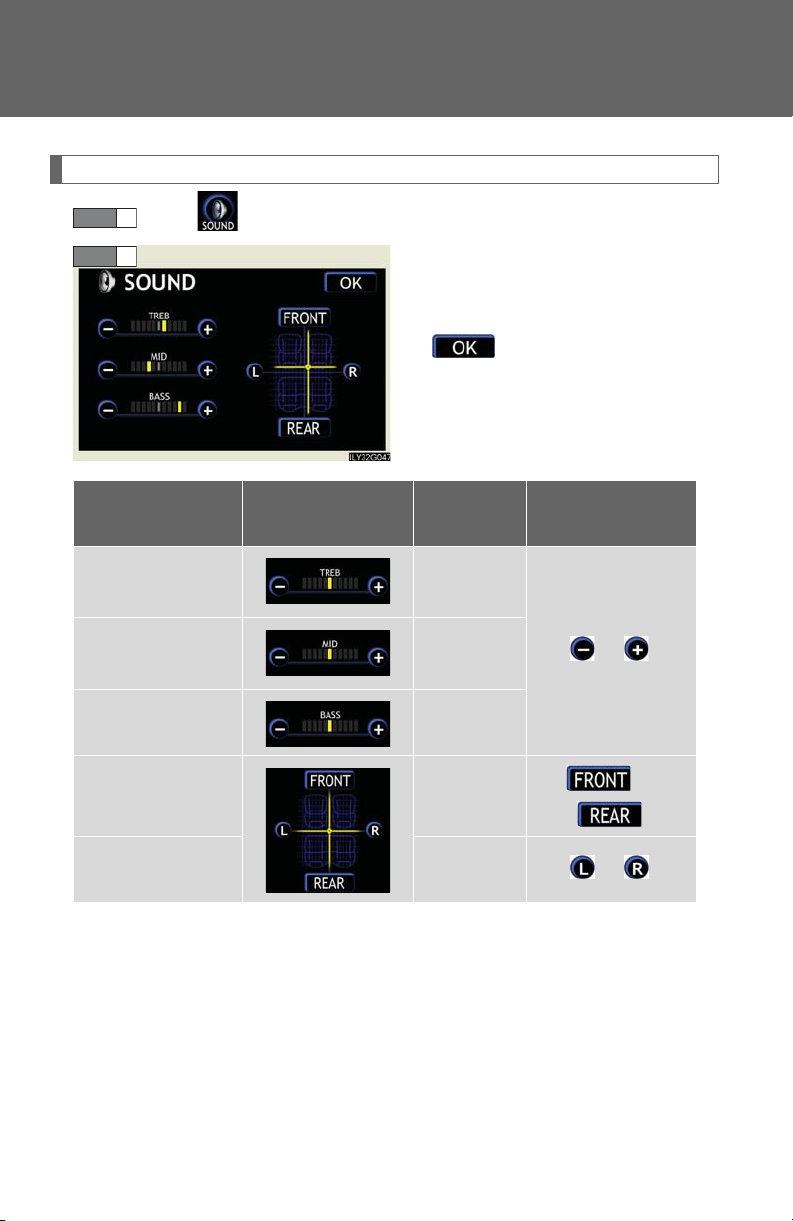
3-3. Using the audio system
Adjusting sound quality and balance
STEP 1
STEP 2
Touch on the screen.
Sound quality
mode
High-pitched
tones*
Mid-pitched
tones*
Low-pitched
tones*
Front/rear
volume balance
Adjust the settings, referring to the
following table.
Once you have finished, touch
.
Display Level To u c h
-5 to 5
-5 to 5
-5 to 5
F7 to R7
or
or
Left/right volume
balance
L7 to R7 or
*: The sound quality level is adjusted individually in each radio, cassette tape,
CD or DVD mode.
256
Page 59
3-3. Using the audio system
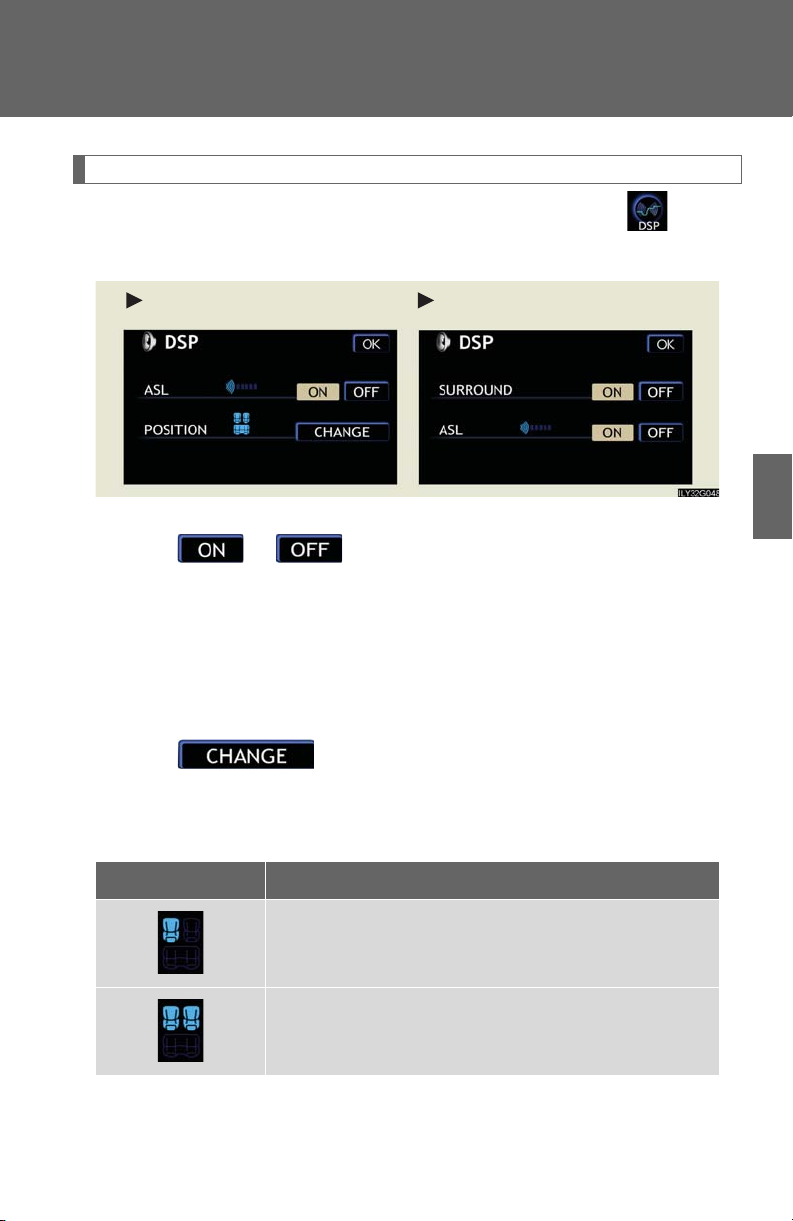
Setting DSP
The following features can be set as desired by touching on the
screen.
With CD player With DVD player
n Turning Automatic Sound Levelizer (ASL) ON or OFF
Touch or .
ASL automatically adjusts the volume and tone quality according to the
noise level as you drive your vehicle.
3
Interior features
n Changing the listening position (vehicles with CD player only)
The speaker balance can be changed to produce the best sound for
each listening position.
Touc h .
The listening position changes as follows each time the switch is
touched.
Display Listening position
Position best suited to the driver's seat
Position best suited to the driver's and front passenger’s seat
257
Page 60
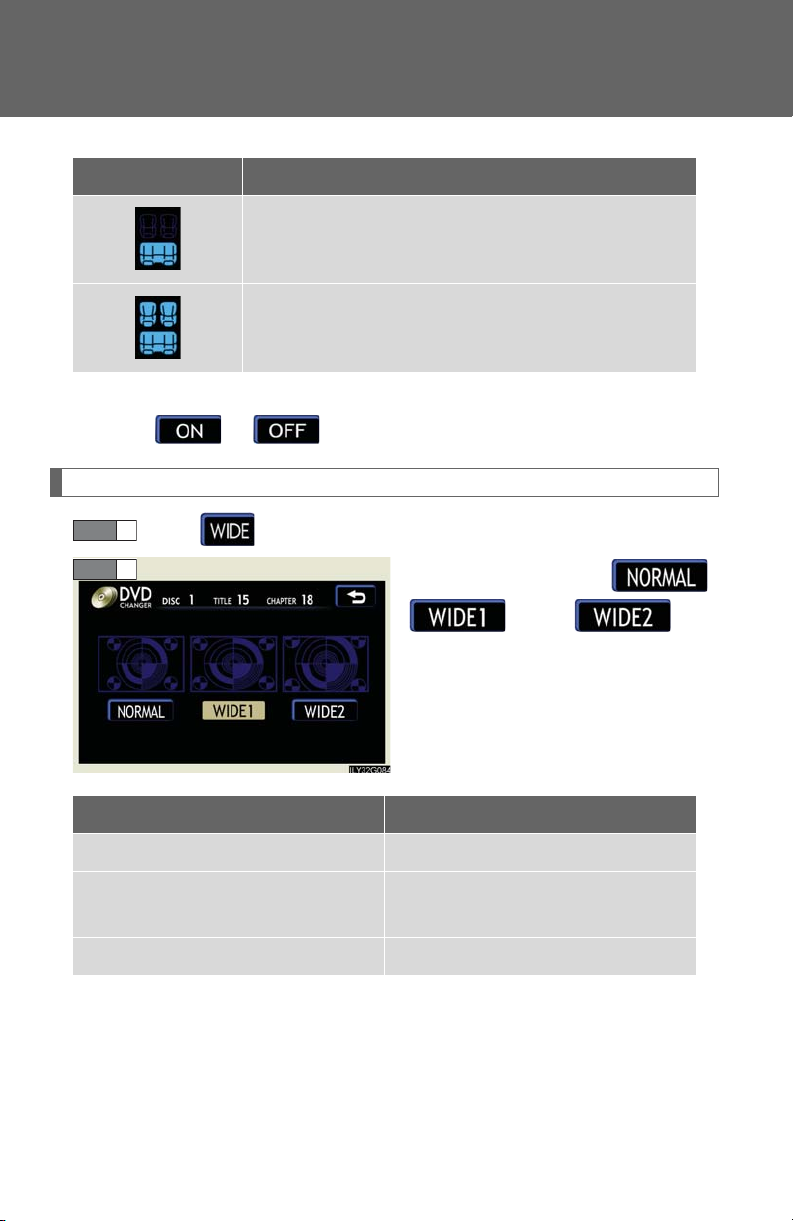
3-3. Using the audio system
Display Listening position
Position best suited to the rear seats
Position best suited to all seats
n Turning the surround ON or OFF (with DVD player only)
Touch or .
Setting the screen ratio mode (with DVD player only)
STEP 1
STEP 2
Touch on the screen.
Touch one of the ,
or to
match screen ratio printed on the
DVD.
Screen ratio mode Details
NORMAL Suitable for 4:3 screen ratio
WIDE1
WIDE2 Suitable for 16:9 screen ratio
Expand the Normal screen
horizontally to fill the display.
258
Page 61
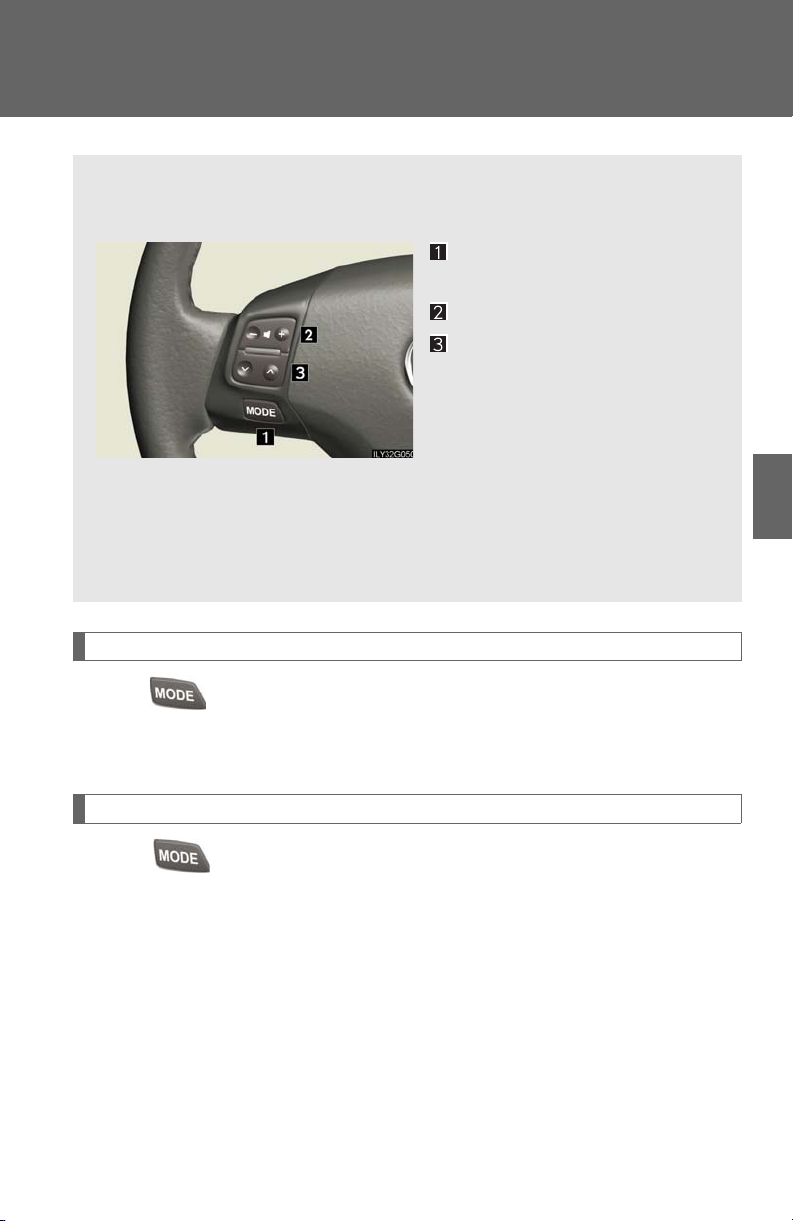
3-3. Using the audio system
Using the steering switches
Some audio features can be controlled using the switches on the steering
wheel.
Power on, select audio
source
Vo l u m e
Radio: Select radio stations
Cassette: Fast forward,
rewind and selecting tracks
CD: Select tracks, discs and
folder
3
DVD: Select tracks, discs and
chapter
Turning on the power
Press when the audio system is turned OFF.
The audio system can be turned OFF by holding the switch down for 1 second
or more.
Changing the audio source
Press when the audio system is turned ON. The audio source
changes as follows each time the button is pressed. If a cassette tape or
CD is not inserted, that mode will be skipped.
Vehicles with CD player:
FM (1, 2)→cassette player→CD player→AM→SAT (1, 2, 3)
Vehicles with DVD player:
FM (1, 2)→cassette player→DVD player→AM→SAT (1, 2, 3)
Interior features
259
Page 62
3-3. Using the audio system
Adjusting the volume
Press “+” on to increase the volume and “-” to decrease the volume.
Hold down the button to continue increasing or decreasing the volume.
Selecting a radio station
STEP 1
STEP 2
Press to select the radio mode.
Press ∧ or ∨ on to select a radio station.
To scan for receivable stations, press and hold the switch until you hear
a beep.
Fast forwarding or rewinding the cassette
STEP 1
STEP 2
Press to select the cassette mode.
Press and hold ∧ or ∨ on until you hear a beep.
To stop fast forwarding or rewinding, press the same switch.
Selecting a track or chapter (DVD mode only for chapter selection)
STEP 1
STEP 2
Press to select the cassette mode, CD or DVD mode.
Press ∧ or ∨ on to select the desired track or chapter.
Cassette mode only: you can skips maximum 9 tracks.
Selecting a disc or folder in the CD or DVD player (Folder selection is
available only when MP3/WMA disc is in use.)
STEP 1
STEP 2
Press to select the CD or DVD player.
Press and hold ∧ or ∨ on until you hear a beep.
260
Page 63
3-3. Using the audio system
n Canceling automatic selection of a radio station
Push the same switch.
CAUTION
n To reduce the risk of an accident
Exercise care when operating the audio switches on the steering wheel.
3
Interior features
261
Page 64
3-2. Using the air conditioning system and defogger
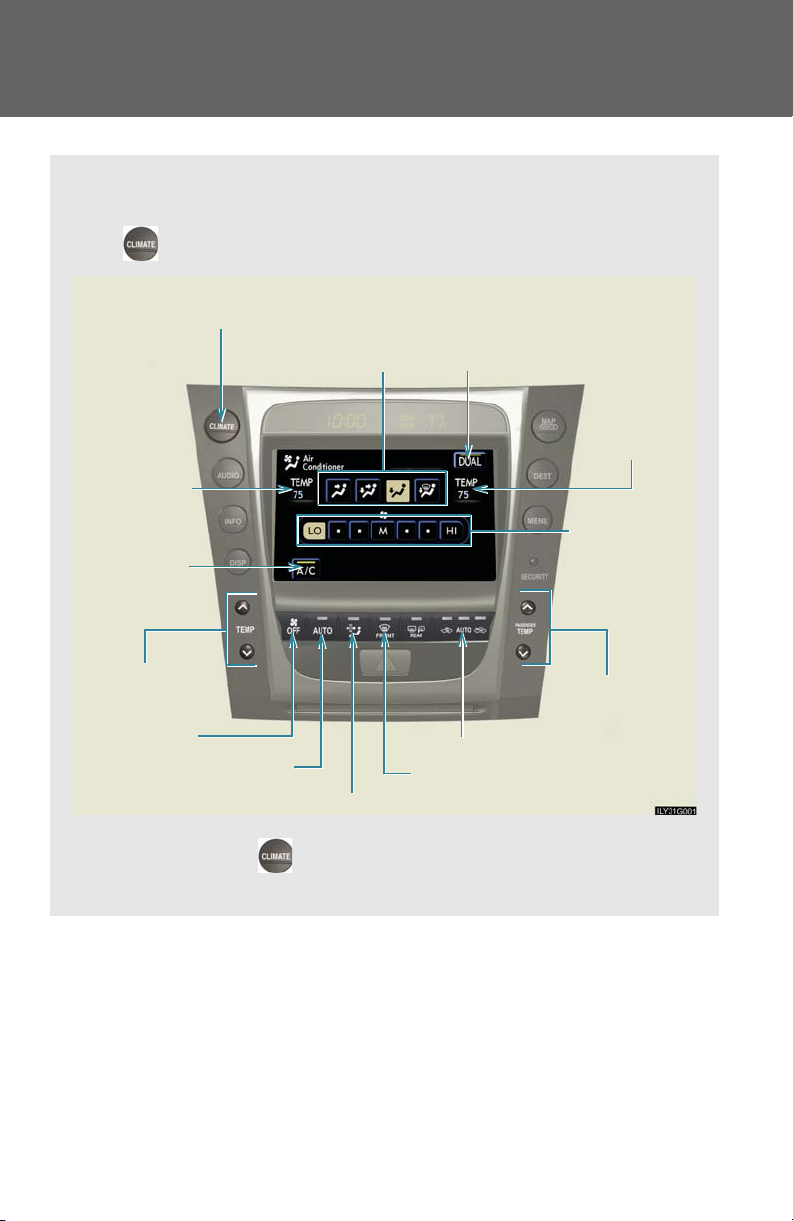
Automatic air conditioning system
Airflow and outlets are automatically adjusted according to the temperature setting.
Press
to display the air conditioning operation screen.
Air conditioning operation
screen display button
Airflow display
Driver’s side
temperature display
Air conditioning
ON/OFF switch
Driver's side
temperature control
Off
Automatic mode
Micro dust and pollen removal mode
Dual operation switch
Passenger’s side
temperature
display
Fan speed display
Passenger’s side
temperature control
Outside air or recirculated mode
Windshield defogger
The above illustration is for a vehicle equipped with the navigation system. The position of may differ slightly for vehicles not equipped
with the navigation system.
190
Page 65
Using the automatic mode
3-2. Using the air conditioning system and defogger
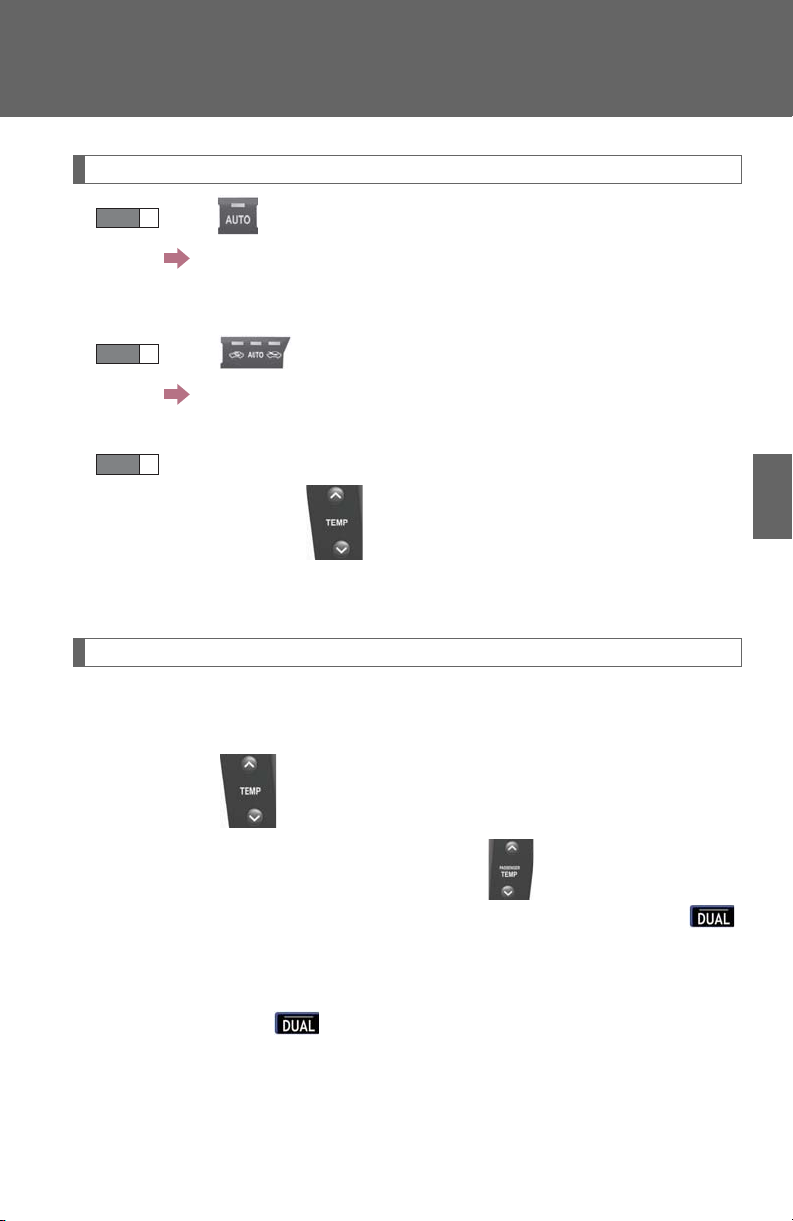
STEP 1
Press .
The air conditioning system will begin to operate. Air outlets
and fan speed are automatically adjusted according to the
temperature setting.
STEP 2
Press to switch to automatic mode.
Automatically switches between outside air and recirculated
air modes.
STEP 3
Press ∧ to increase the temperature and ∨ to decrease the tem-
perature on the .
The temperature for the driver and passenger seats can be set separately.
Adjusting the settings
n Adjusting the temperature setting
Press ∧ to increase the temperature and ∨ to decrease the tempera-
ture on the .
3
Interior features
Press ∧ (increase) or ∨ (decrease) on the to separately adjust the
temperature for the passenger and driver sides (dual mode). Touch
to return the driver and passenger side temperatures to the same setting
(simultaneous mode).
The air conditioning system switches between dual and simultaneous
modes each time is touched.
191
Page 66
3-2. Using the air conditioning system and defogger
n Adjusting the fan speed
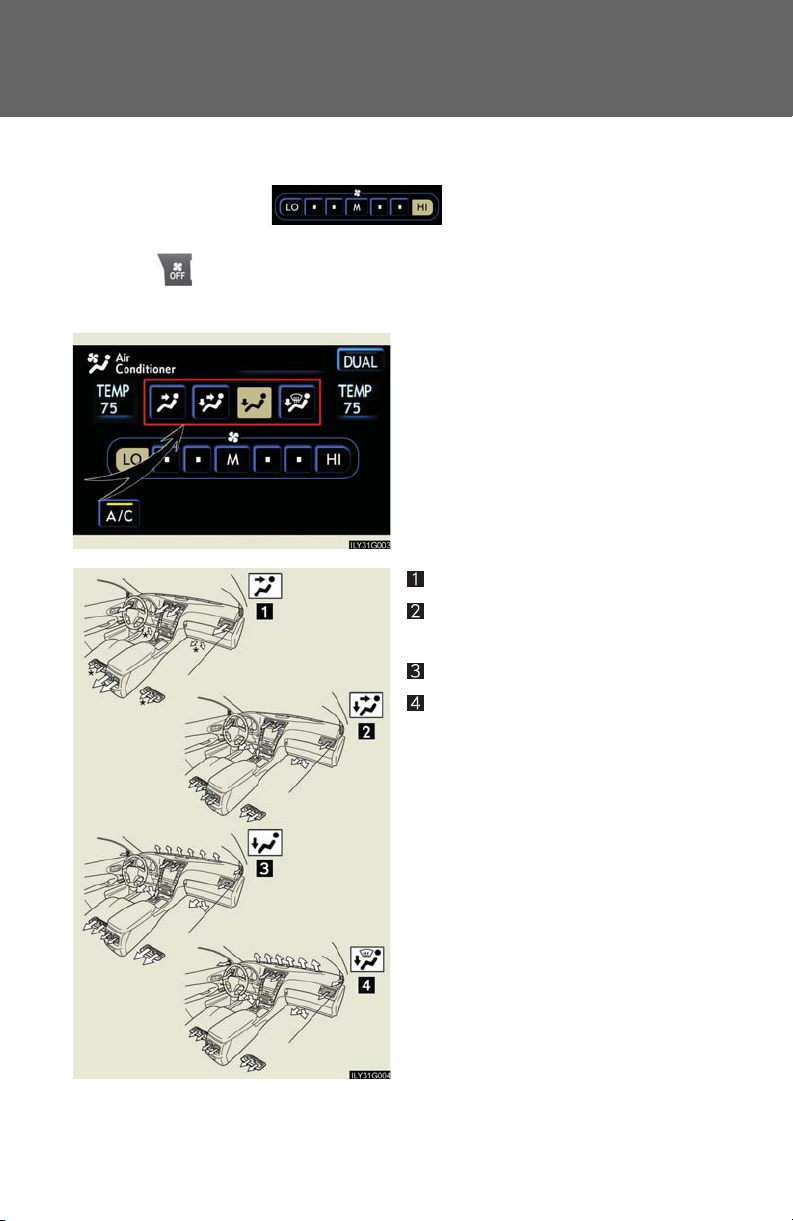
Touch any switch of (decrease ↔ increase) on the
operating screen.
Press to turn the fan off.
n Changing the air outlets
Touch any mode on the operating
screen.
Air flows to the upper body.
Air flows to the upper body and
feet.
Air flows to the feet.
Air flows to the feet and the
windshield defogger operates.
192
*: Only in the automatic mode
Page 67
3-2. Using the air conditioning system and defogger
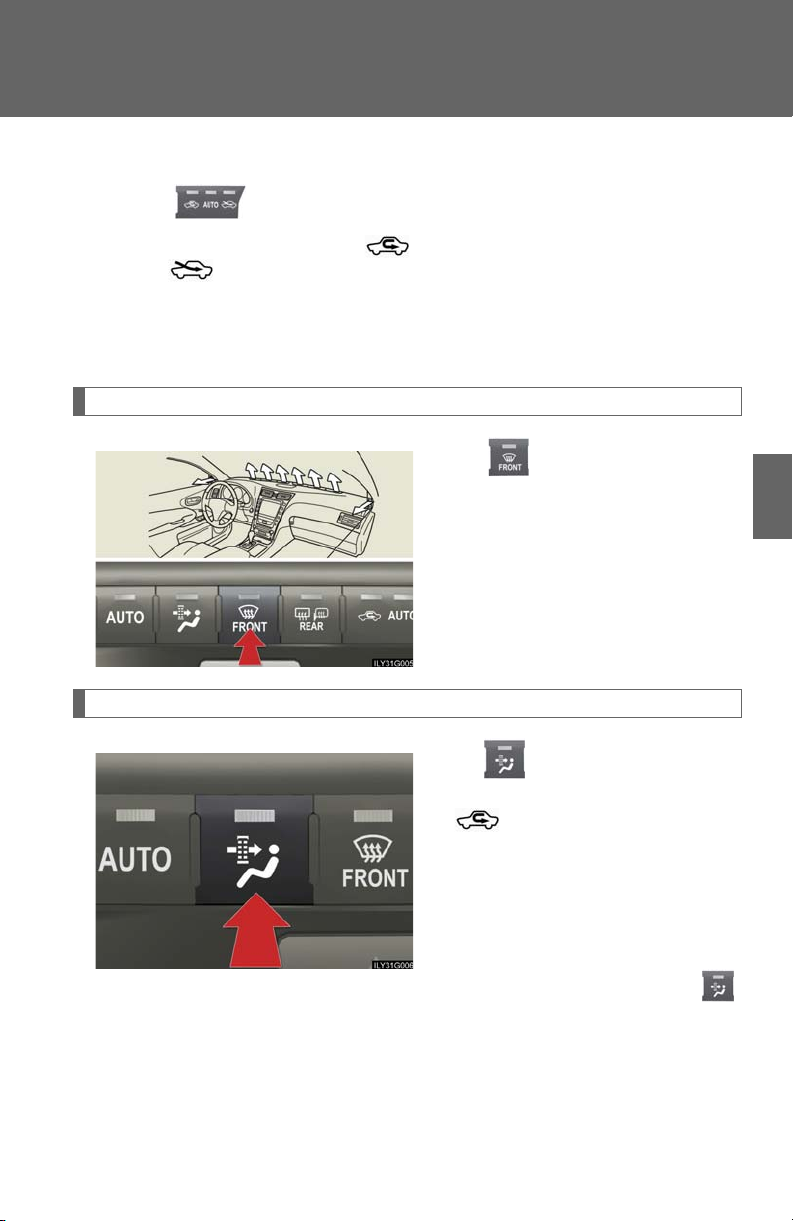
n Switching between outside air and recirculated air modes
Press .
The mode switches between (recycles air inside the vehicle), “AUTO”
and (introduces air from outside the vehicle) modes each time the
button is pressed.
When the system is switched to automatic mode, the air conditioning system operates automatically.
Defogging the windshield
Press .
Micro dust and pollen filter
The air conditioning system control
operates automatically.
Press .
Outside air mode switches to
(recirculated air) mode. Pollen is removed from the air and the
air flows to the upper part of the
body.
Usually the system will turn OFF
automatically approximately 3
minutes later.
To stop the operation, press
again.
3
Interior features
193
Page 68
3-2. Using the air conditioning system and defogger
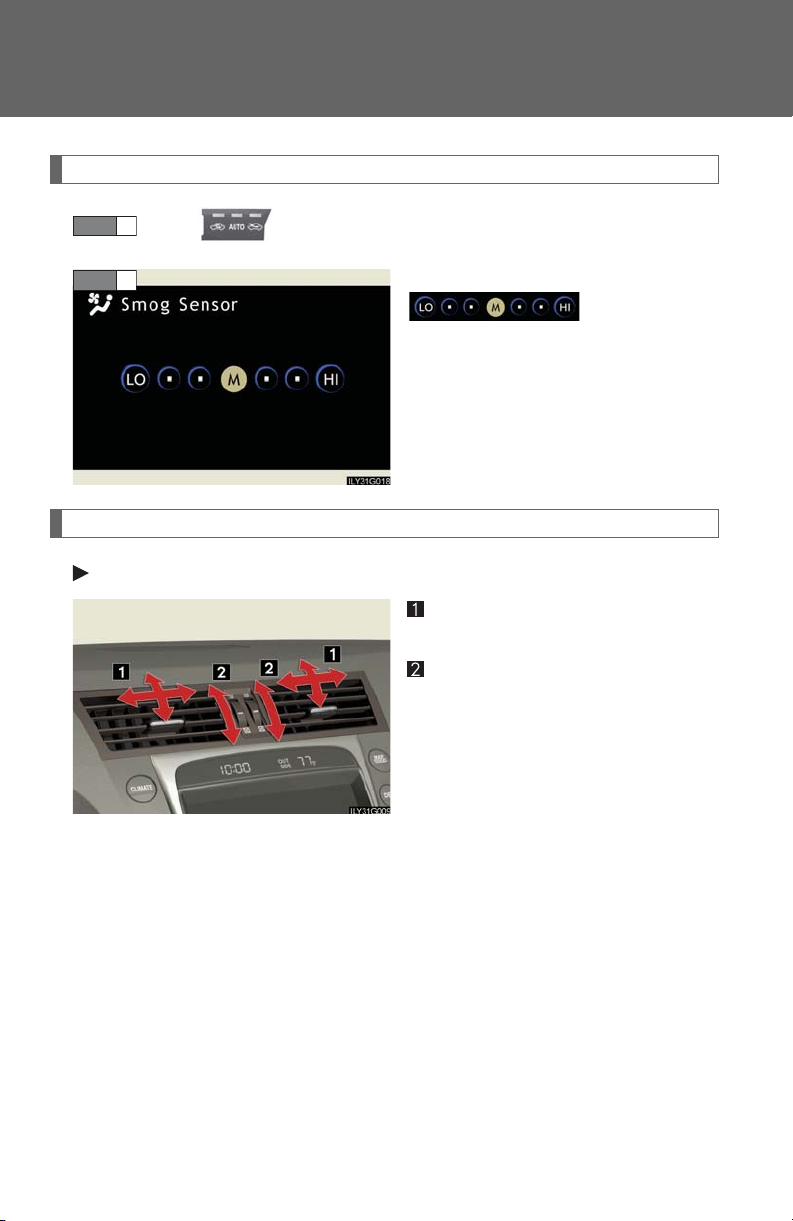
Adjusting the sensitivity of the air intake control in automatic mode
STEP 1
Press until the smog sensor screen appears while the
vehicle is stopped.
STEP 2
Touch any switch of
(lower sensitivity ↔ higher sensitivity) on the
operating screen.
Adjusting the position of and opening and closing the air outlets
Center outlets
Direct air flow to the left or right,
up or down
Turn the knob to open or close
the vent
194
Page 69
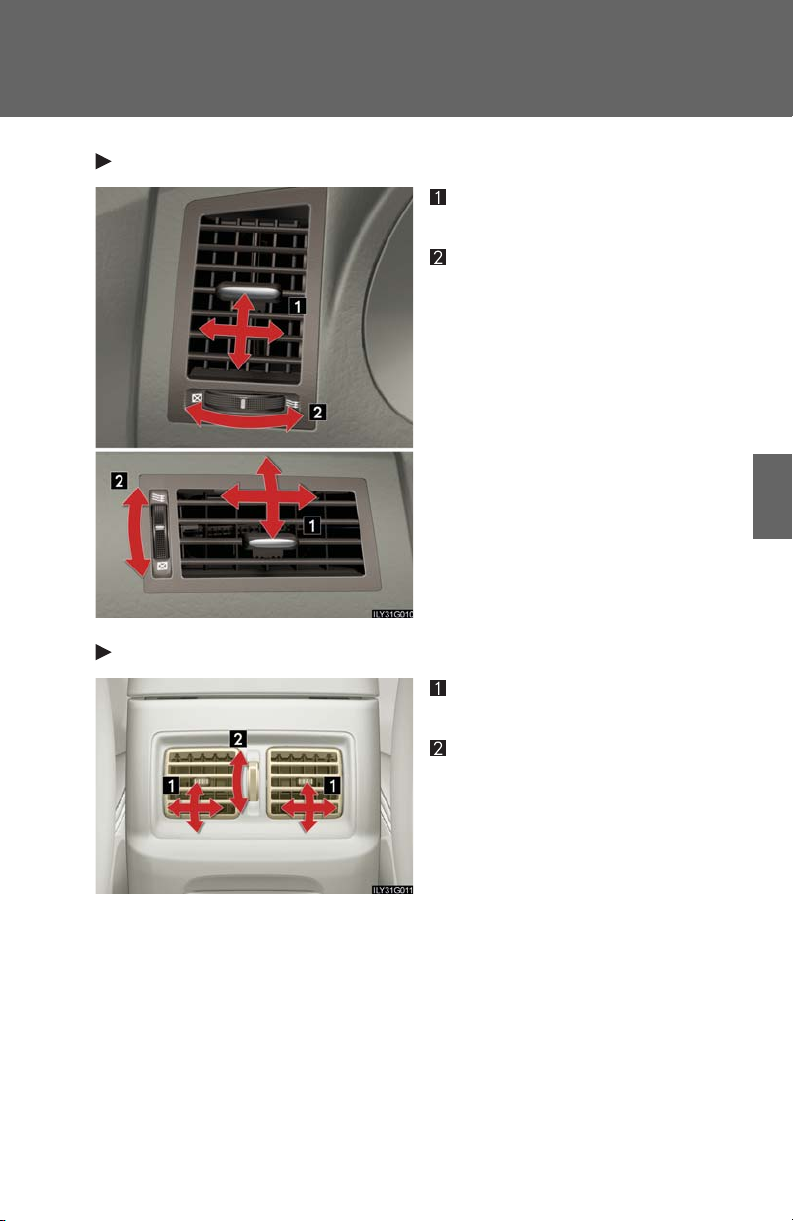
Side outlets
3-2. Using the air conditioning system and defogger
Direct air flow to the left or right,
up or down
Turn the knob to open or close
the vent
3
Interior features
Rear seat outlets
Direct air flow to the left or right,
up or down
Turn the knob to open or close
the vent
195
Page 70
3-2. Using the air conditioning system and defogger
n Using the automatic mode
Fan speed is adjusted automatically in accordance with the temperature setting and
ambient conditions. As a result, the following may occur.
l The system may switch automatically to recirculated mode when the coolest
temperature setting is selected in summer.
l Immediately after the switch is pressed, the fan may stop for a while until warm
or cool air is ready to flow.
l Cool air may flow to the area around the upper body when the heater is on.
n Using the system in recirculated air mode
The windows will fog up more easily if the recirculated air mode is used for an
extended period.
n Window defogger feature
Recirculated air mode may automatically switch to
(outside air) mode in situ-
ations where the windows need to be defogged.
n Outside temperature approaches 32°F (0°C).
The air conditioning system may not operate even when is touched.
n When the indicator light on flashes
To u c h
and turn off the air conditioning system before turning it on once
more. There may be a problem in the air conditioning system if the indicator light
continues to flash. Turn the air conditioning system off and have it inspected by your
Lexus dealer.
n Automatic mode for air intake control
In automatic mode, the system detects exhaust gas and other pollutants and automatically switches between outside air and recirculated air modes.
When the air conditioning is OFF, and the fan is operating, turning the “AUTO”
mode ON will activate the air conditioning system.
n Micro dust and pollen removal mode
l When the outside air is cold, the following may occur.
• Outside air mode does not switch to .
• The air conditioning system operates automatically.
• The operation cancels after 1 minute.
l In rainy weather, the windows may fog up. Press .
196
Page 71
3-2. Using the air conditioning system and defogger
CAUTION
n To prevent the windshield from fogging up
Do not use during cool air operation in extremely humid weather. The difference between the temperature of the outside air and that of the windshield can
cause the outer surface of the windshield to fog up, blocking your vision.
NOTICE
n To prevent battery discharge
Do not leave the automatic air conditioning system on longer than necessary when
the engine is not running.
3
Interior features
197
Page 72
3-2. Using the air conditioning system and defogger
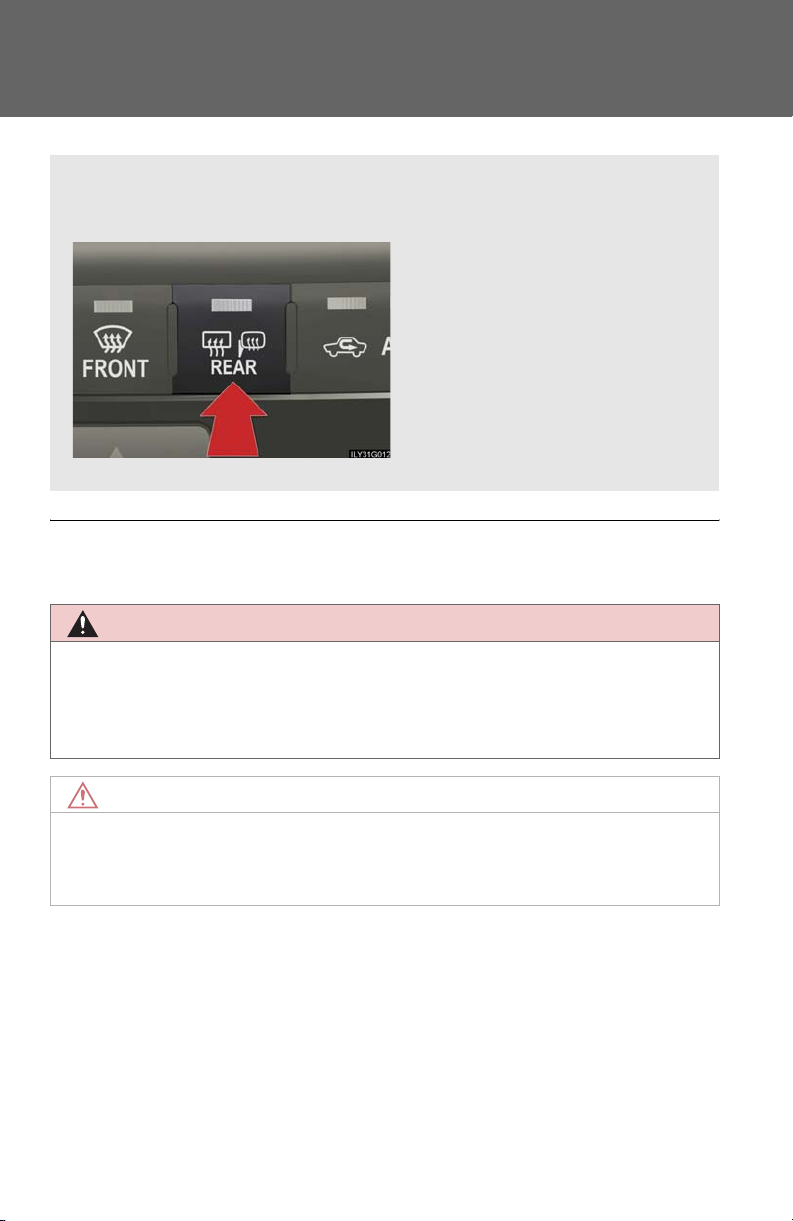
Rear window and outside rear view mirror defoggers
These features are used to defog the rear window, and to remove raindrops, dew and frost from the outside rear view mirrors.
Press the button.
Press the button to turn on the
rear window and outside rear
view mirror defoggers. The
defoggers will automatically
turn off after approximately 15
minutes. Pressing the button
again also turns the defoggers
off.
n Operating conditions
The engine switch must be in the “IG-ON” mode.
CAUTION
n When the outside rear view mirror defoggers are on
Do not touch the rear view mirror surfaces, as they can become very hot and burn
you.
NOTICE
n To prevent battery discharge
Turn the defoggers off when the engine is not running.
198
Page 73
3-1. Using the touch screen
Touch screen
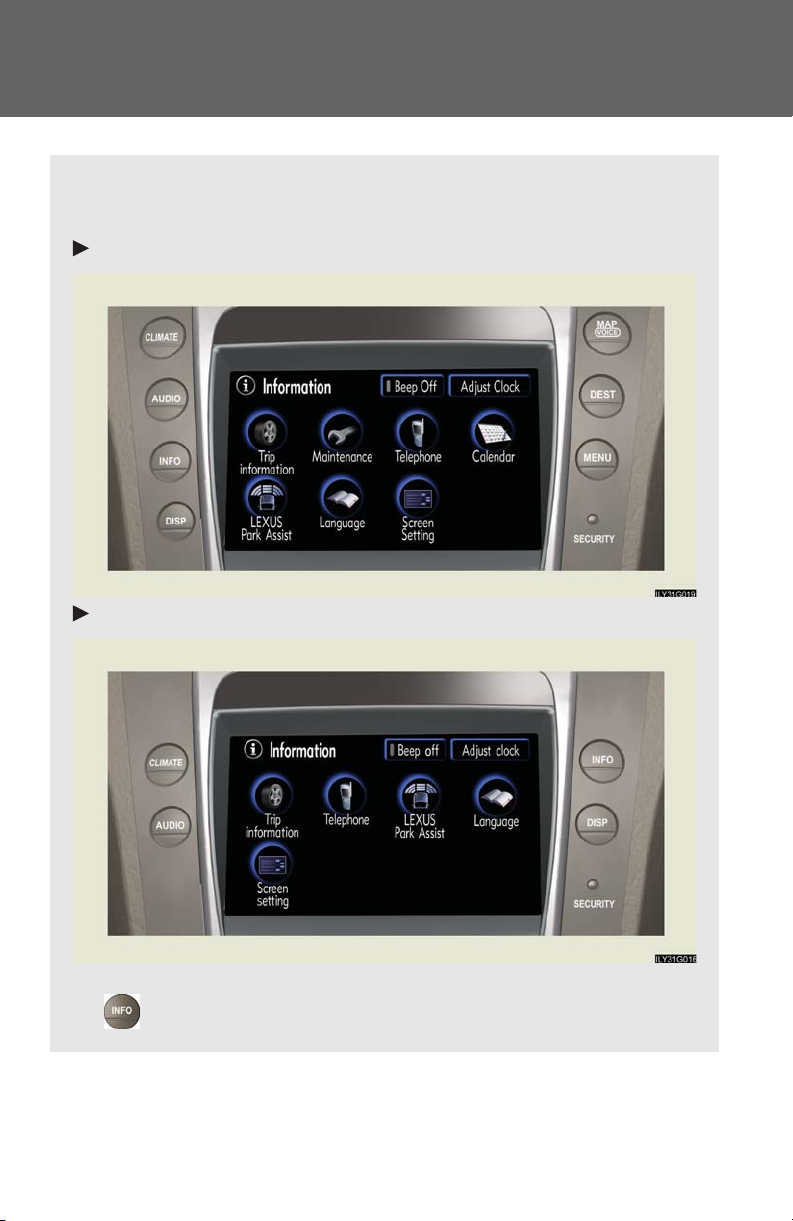
By touching the screen with your finger, you can control the audio system
and air-conditioning, adjust the screen display etc.
Vehicles with navigation system
Vehicles without navigation system
The “Information” screen shown in the above illustration is displayed when
the is pressed.
180
Page 74
Switches Pa ge
“CLIMATE” P. 1 90
“AU D IO ” P. 1 99
3-1. Using the touch screen
“INFO” (Displaying the “Information” screen)
P. 180
“DISP” (Adjusting the display) P. 185
Trip Information. (Displaying the
“Trip Information” screen)
P. 182
Maintenance Navigation System Owner's Manual
Te l e p h o n e P. 267
Calendar Navigation System Owner's Manual
“LEXUS Park Assist” P. 150
Language P. 18 4
Screen Setting P. 187
Adjust Clock
P. 318/
Navigation System Owner's Manual
The initial screen
If the engine switch is set to “ACC” or
“IG-ON” mode, the initializing screen
will be displayed for a few seconds as
the system starts up.
3
Interior features
181
Page 75
3-1. Using the touch screen
Trip information
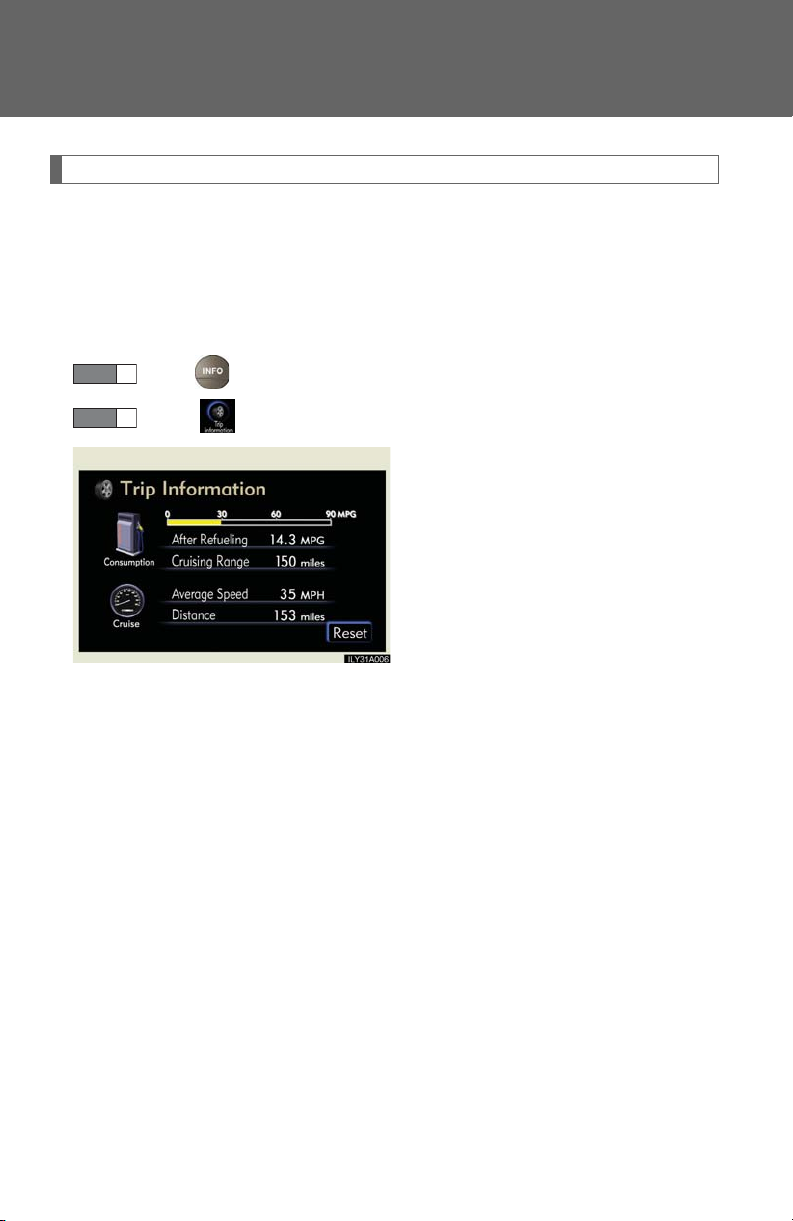
Trip information such as driving time, driving distance, average vehicle
speed, fuel consumption, etc. can be displayed on the screen. The displayed figure is for general information and may not always reflect precise and actual conditions.
n Displaying the screen
STEP 1
Press .
STEP 2
Touch on the “Information” screen.
l Consumption
• After Refueling
Displays the average fuel consumption since the vehicle was last refu-
eled.
• Cruising Range
Displays the estimated maximum distance that can be driven with the
quantity of fuel remaining.
l Cruise
• Average Speed
Displays the average vehicle speed since the engine was started or the
function was reset.
182
Page 76
3-1. Using the touch screen
•Distance
Displays the total distance since the engine was stared or the function
was reset.
n Resetting the data
Touching will reset the “Average Speed” and “Distance”.
n To avoid damaging the touch screen
l Touch the screen lightly with your finger. If there is no response, remove your fin-
ger from the screen and try again.
l Remove any dirt on the screen by wiping with a soft cloth. Do not use detergent.
n When using the touch screen
l If the screen is cold, the display may be dark, or the system may seem to be
operating slightly slower than normal.
l The screen may seem dark and hard to see when viewed through sunglasses.
Change your angle of viewing, or remove your sunglasses.
3
Interior features
183
Page 77
3-1. Using the touch screen
Setting the touch screen
You can change the touch screen to your desired settings.
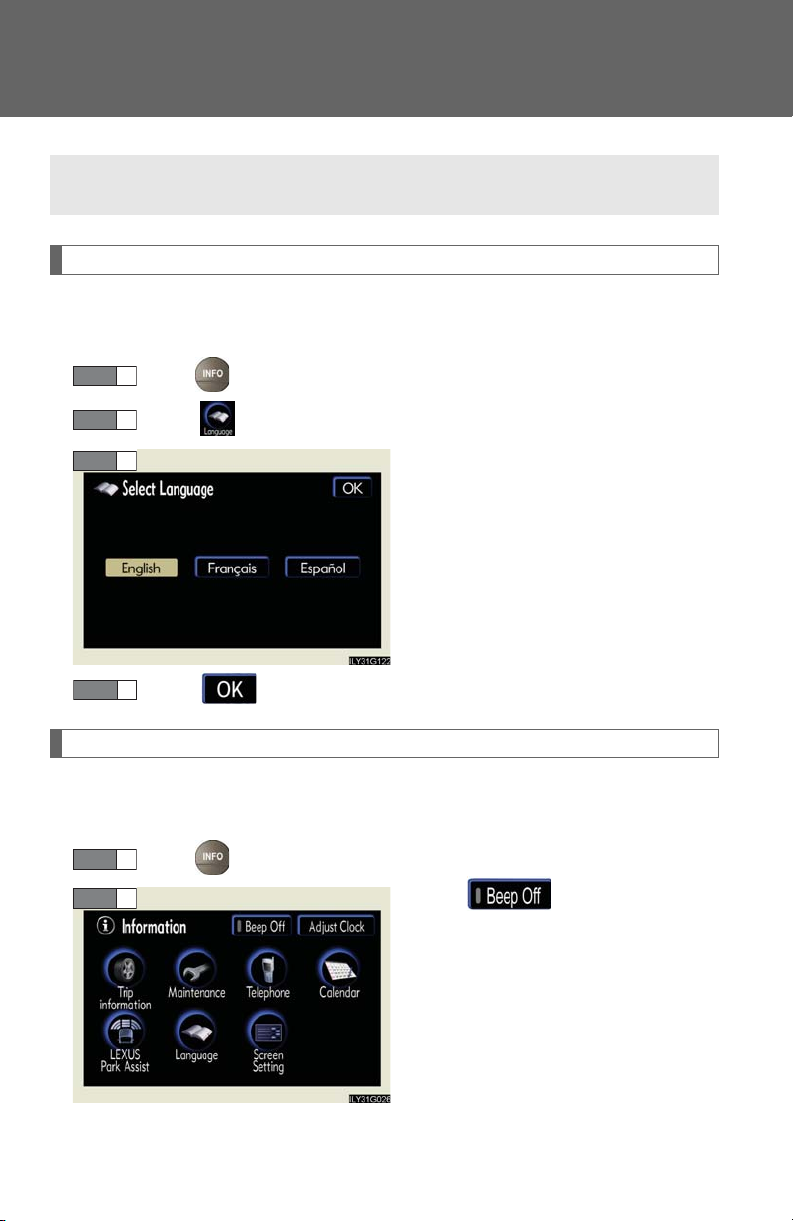
Language settings
The language used for all voice guidance, messages and touch screen
switches may be changed.
STEP 1
STEP 2
STEP 3
STEP 4
Press .
Touch on the “Information” screen.
Select the desired language.
Touc h .
Turning off the beep sound
The beep that sounds when a touch screen button is touched can be
turned off.
STEP 1
STEP 2
Press .
Touch .
184
Page 78
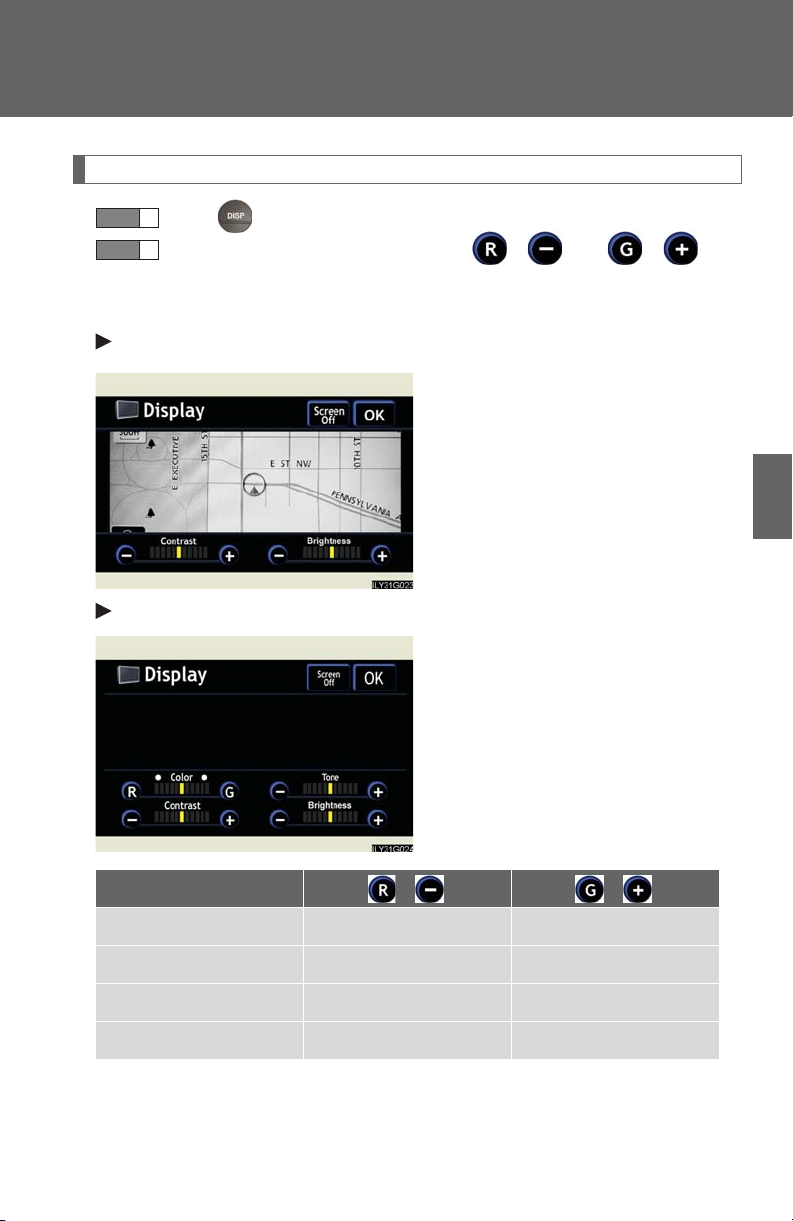
Adjusting the display
3-1. Using the touch screen
STEP 1
STEP 2
Press .
Adjust the display as desired using / and /
If you do not touch the screen for 20 seconds, the system will return to
the previous screen.
Vehicles with CD player
Vehicles with DVD player
3
Interior features
/ /
Color Red Green
To n e Lighter Darker
Contrast We a k e r Stronger
Brightness Darker Brighter
185
Page 79
3-1. Using the touch screen
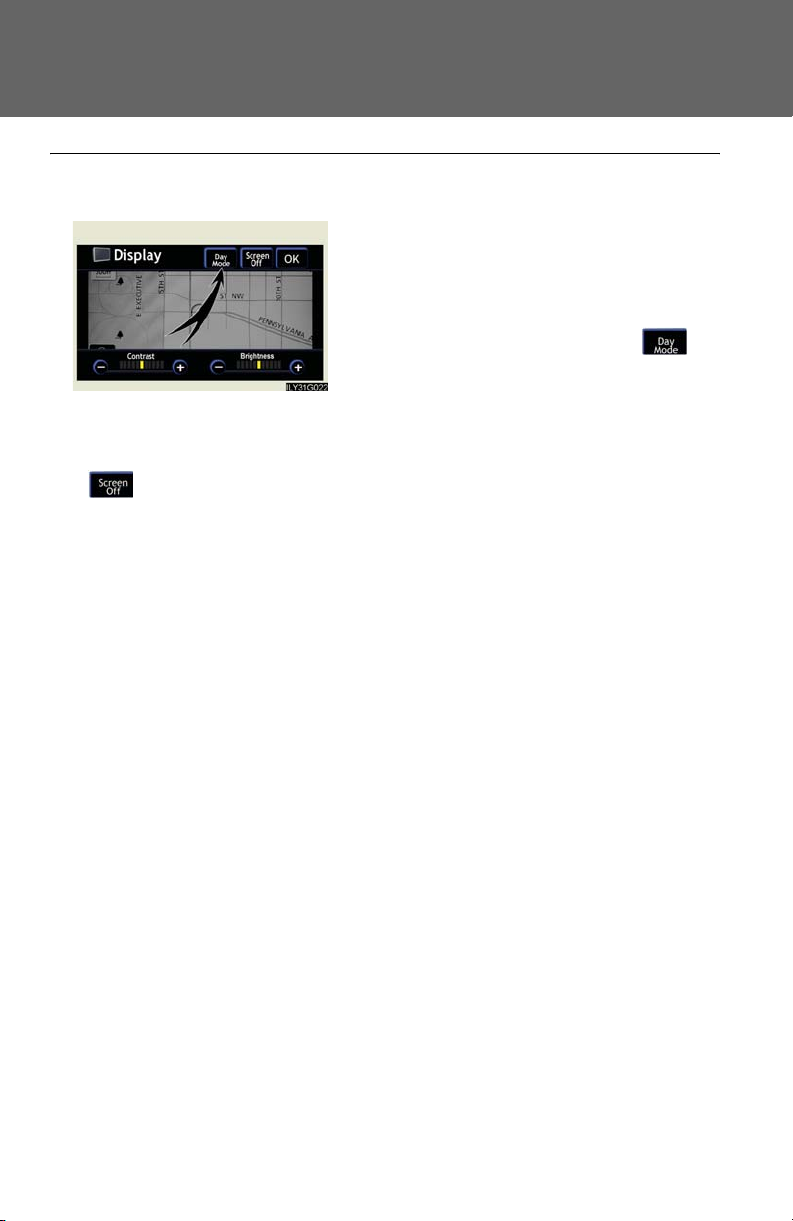
n “Day Mode”
When the headlights are turned on, the
screen dims. However the screen can be
switched to “Day Mode”.
The screen will stay in “Day Mode” when
the headlights are turned on until is
touched again.
If the instrument panel light control is set to
“MAX”, “Day Mode” is not displayed.
n To turn off the picture display
If is touched, the screen display is turned off, and guidance is by voice only.
186
Page 80
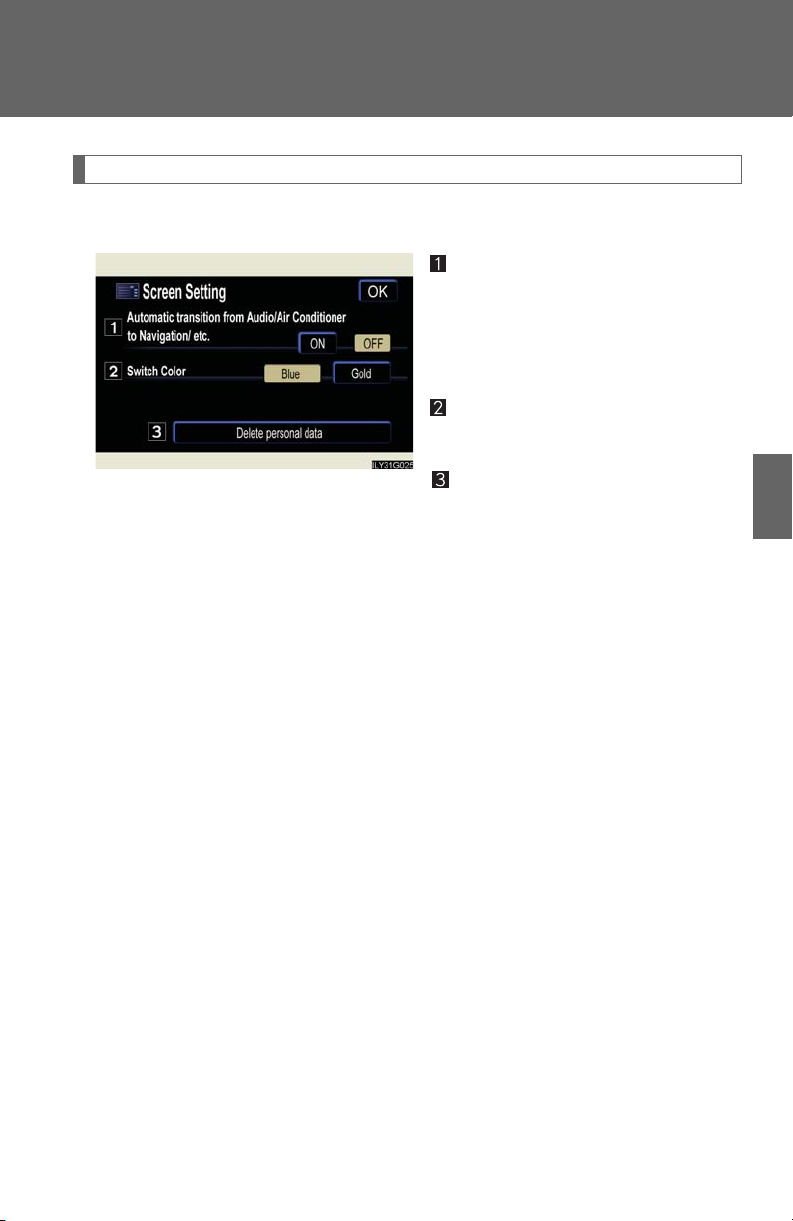
Screen settings
The following screen settings can be changed.
Automatic transition
20 seconds after air-conditioning
or audio system use, the system will
return the display to the previous
screen.
Switch color
You can select the switch color.
3-1. Using the touch screen
Personal data deletion
The following personal data is
deleted:
• User selection settings
• Phone book data
• Dialed numbers and received
calls
• Speed dial
• Bluetooth
• Security code
• Maintenance conditions*
• Maintenance information “off”
setting*
•Memory points*
•Areas to avoid*
• Previous points*
• Route trace*
*: If the navigation system is
equipped
®
phone data
3
Interior features
187
Page 81
3-1. Using the touch screen
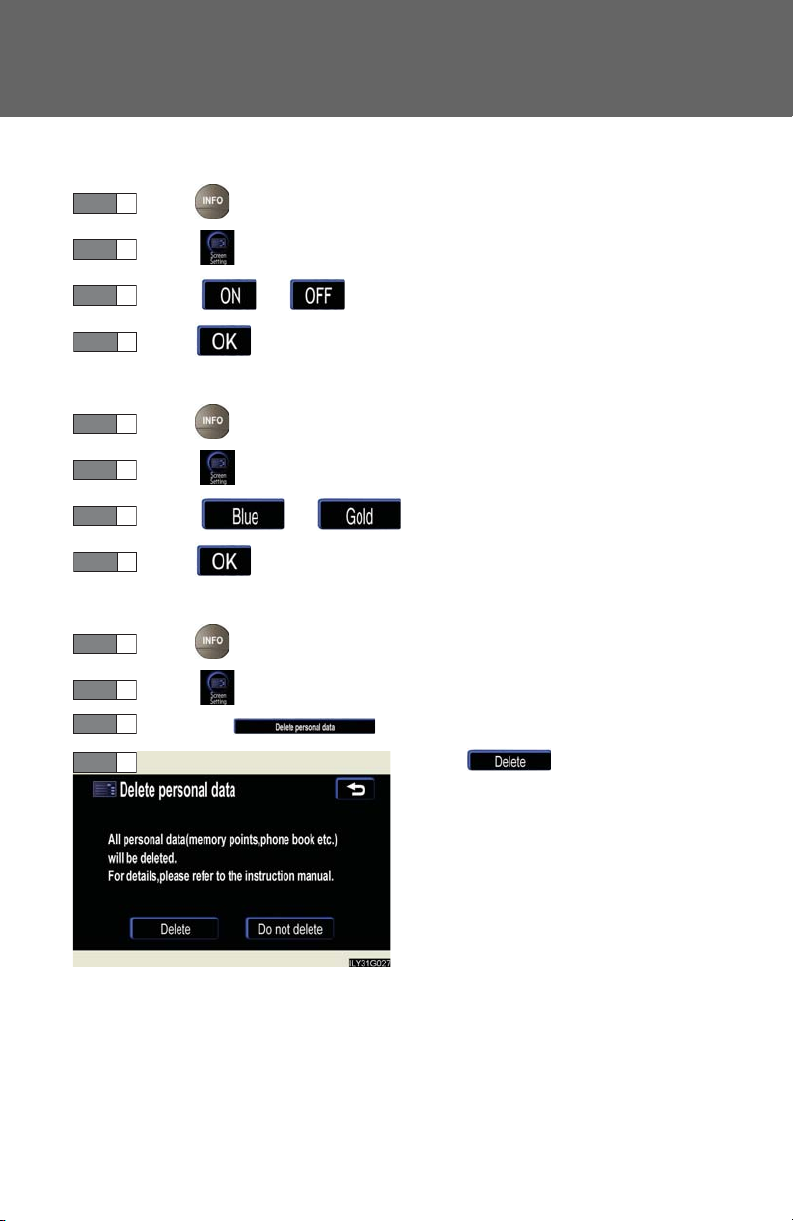
n Setting automatic transition
STEP 1
STEP 2
STEP 3
STEP 4
Press .
Touch on the “Information” screen.
Touch or on the “Screen Setting” screen.
Press .
n Setting the switch color
STEP 1
STEP 2
STEP 3
STEP 4
Press .
Touch on the “Information” screen.
Touch or on the “Screen Setting” screen.
Press .
n To delete personal data
STEP 1
STEP 2
STEP 3
STEP 4
Press .
Touch on the “Information” screen.
Touch the on the “Screen Setting” screen.
Touch .
188
Check carefully beforehand, as
data cannot be retrieved once initialized.
Page 82
3-1. Using the touch screen
n When deleting personal data
Data can only be deleted when the vehicle is stopped.
n When selling the vehicle
Be sure to initialize both the call history and personal data. (→P. 187 )
n If you touch the
The display returns to the previous screen.
3
Interior features
189
Page 83
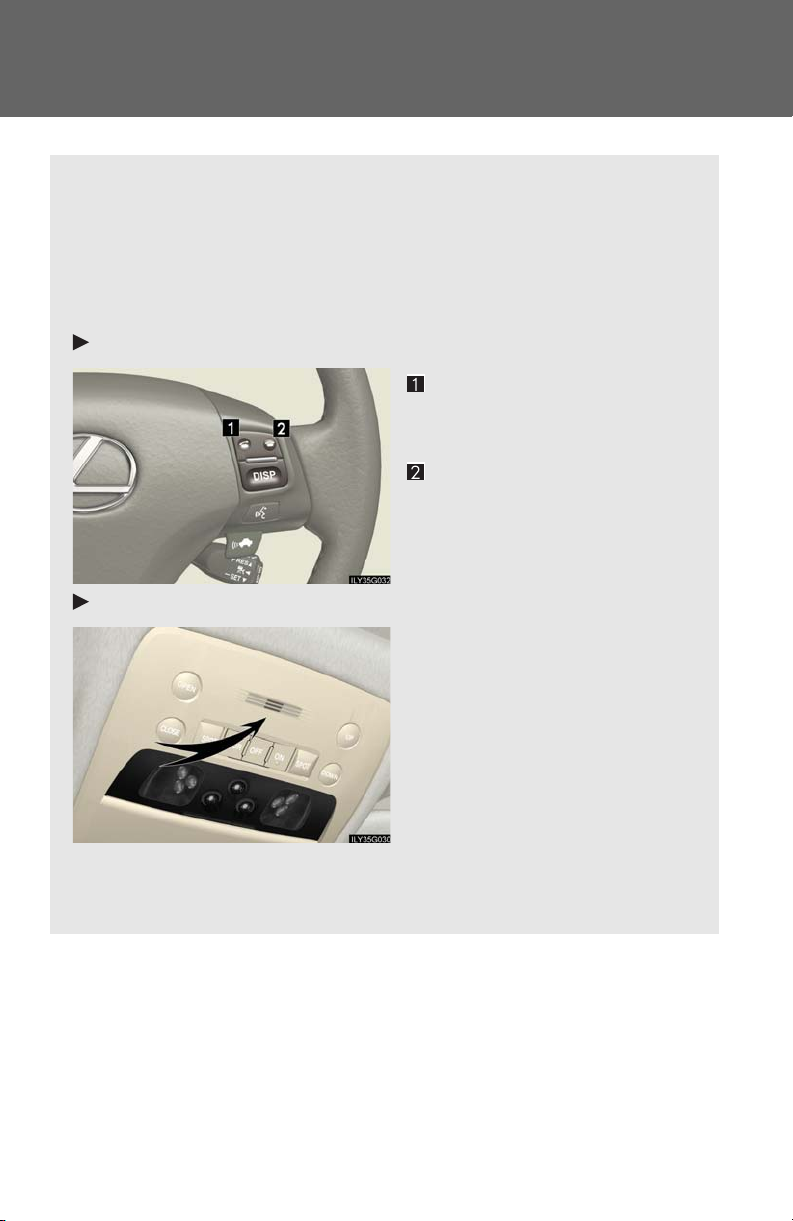
3-4. Using the hands-free system
Hands-free system
The hands-free system is a function that allows you to use your mobile
phone without touching it.
This system supports Bluetooth
data system that allows the mobile phone to wirelessly connect to the
hands-free system and make/receive calls.
Telephone switch
Microphone
®
mobile phones. Bluetooth® is a wireless
Sending/Receiving/“Telephone” screen display (when
stopped)
End call
The person you are speaking to
can be heard from the driver’s
side speaker.
To use the hands-free system you must register your Bluetooth
phone in the system. (→P. 268)
262
®
Page 84
3-4. Using the hands-free system
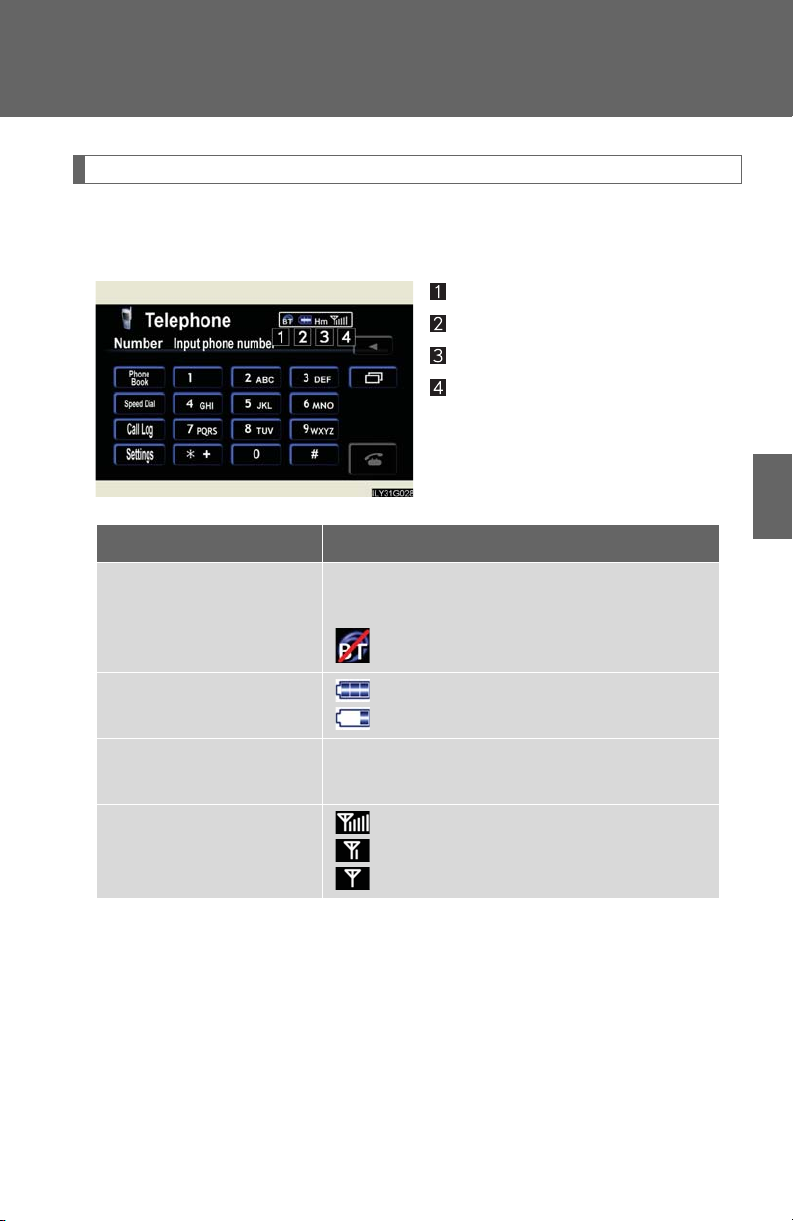
Status display
You can check such indicators as signal strength and battery charge on
the “Telephone” screen.
Connection status
Battery charge
Call area
Signal strength
3
Indicators Conditions
Blue: Good
Connection status
Battery charge
Call area
Signal strength
Yellow: Bad
: Not connected
: Full
: Low
“Rm”: Roaming area
“Hm”: Home area
: Good
: Bad
: Not connected
Interior features
263
Page 85

3-4. Using the hands-free system
n When using the hands-free system
l The audio system and voice guidance are muted when making a call.
l If both parties speak at the same time it may be difficult to hear.
l If the received call volume is overly loud, an echo may be heard.
l Try to face the microphone as much as possible when speaking.
l In the following circumstances it may be difficult to hear the other party.
• When driving on unsealed roads
• When driving at high speeds
• If the window is open
• If the air-conditioning is blowing directly on the microphone
• If the air-conditioning is set to high
n Conditions under which the system will not operate
l If using a mobile phone that does not support Bluetooth
l If the mobile phone is switched off.
l If you are outside service range.
l If the mobile phone is not connected.
l If the mobile phone's battery is low.
n Bluetooth
®
antenna
®
.
The antenna is built into the display. If the mobile phone is behind the seat or in the
console box, or touching or covered by metal objects, connection status may deteriorate.
n Battery charge/Signal status
This display may not correspond exactly with the mobile phone itself.
264
Page 86
3-4. Using the hands-free system
n About Bluetooth
®
Bluetooth is a registered trademark of
Bluetooth SIG. Inc.
n Compatible models
Compatible with HFP (Hands Free Profile) Ver. 1.0 and OPP (Object Push Profile)
Ver. 1.1.
n Certification for the hands-free system
FCC ID: HYQBT0501A
IC ID: 1551A-BT0501A
This device complies with Part 15 of the FCC Rules and RSS-210. Operation is subject to the following two conditions: (1) This device may not cause harmful interference, and (2) This device must accept any interference received, including
interference that may cause undesired operation.
3
Interior features
265
Page 87
3-4. Using the hands-free system
CAUTION
n FCC WARNING
Changes or modifications not expressly approved by the party responsible for
compliance could void the user's authority to operate the equipment.
Radio Frequency Exposure. This device is approved for Mobile Application only
and, to comply with applicable FCC radio frequency exposure regulations, must be
used with a distance of at least 7.9 in. (20 cm) between the antenna and the body of
any person at all time during use.
n Caution while driving
Do not use the mobile phone or connect the Bluetooth® system.
NOTICE
n When leaving the vehicle
Do not leave your mobile phone in the vehicle. The inside of the vehicle may
become hot, causing damage to the phone.
266
Page 88
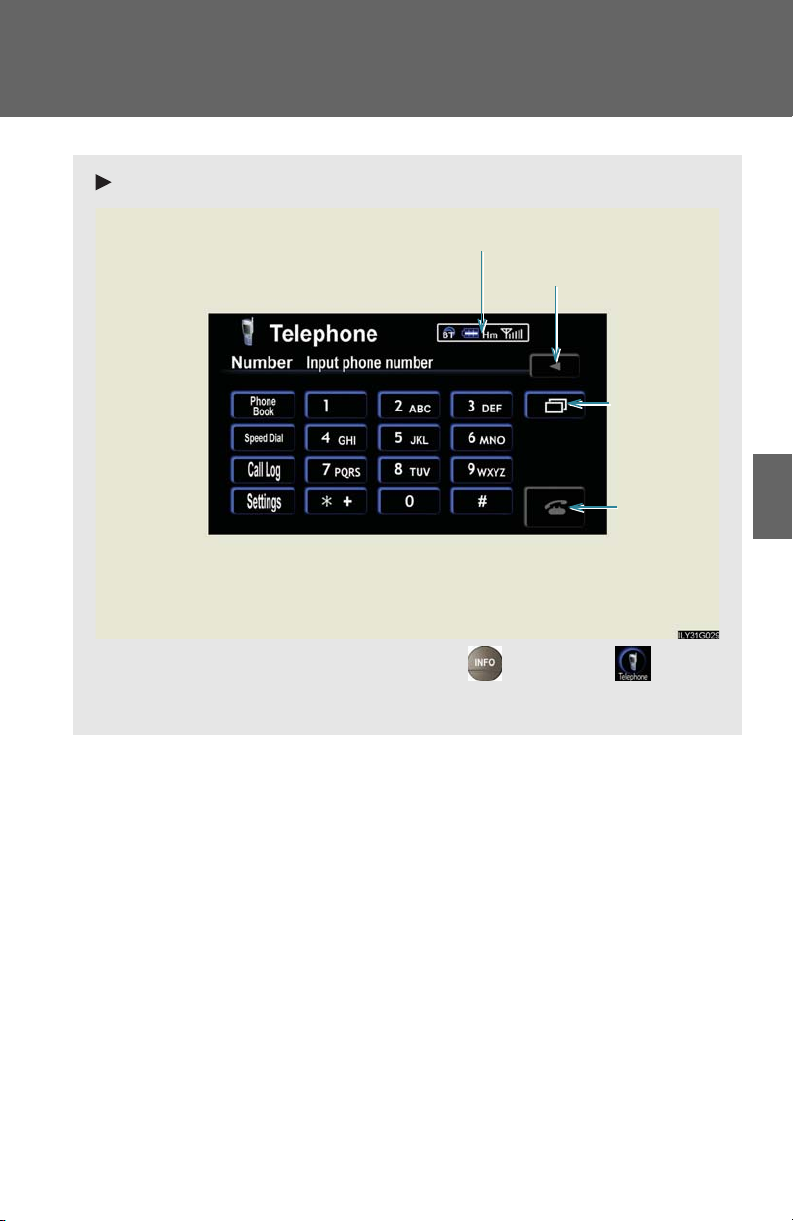
3-4. Using the hands-free system
Using the Bluetooth® phone
Telephone screen
Bluetooth® Connection Status
Character Deletion
Display Last
Person Called
Make A Call
To display the screen shown above, press , then touch on the
“Information” screen.
3
Interior features
267
Page 89
3-4. Using the hands-free system
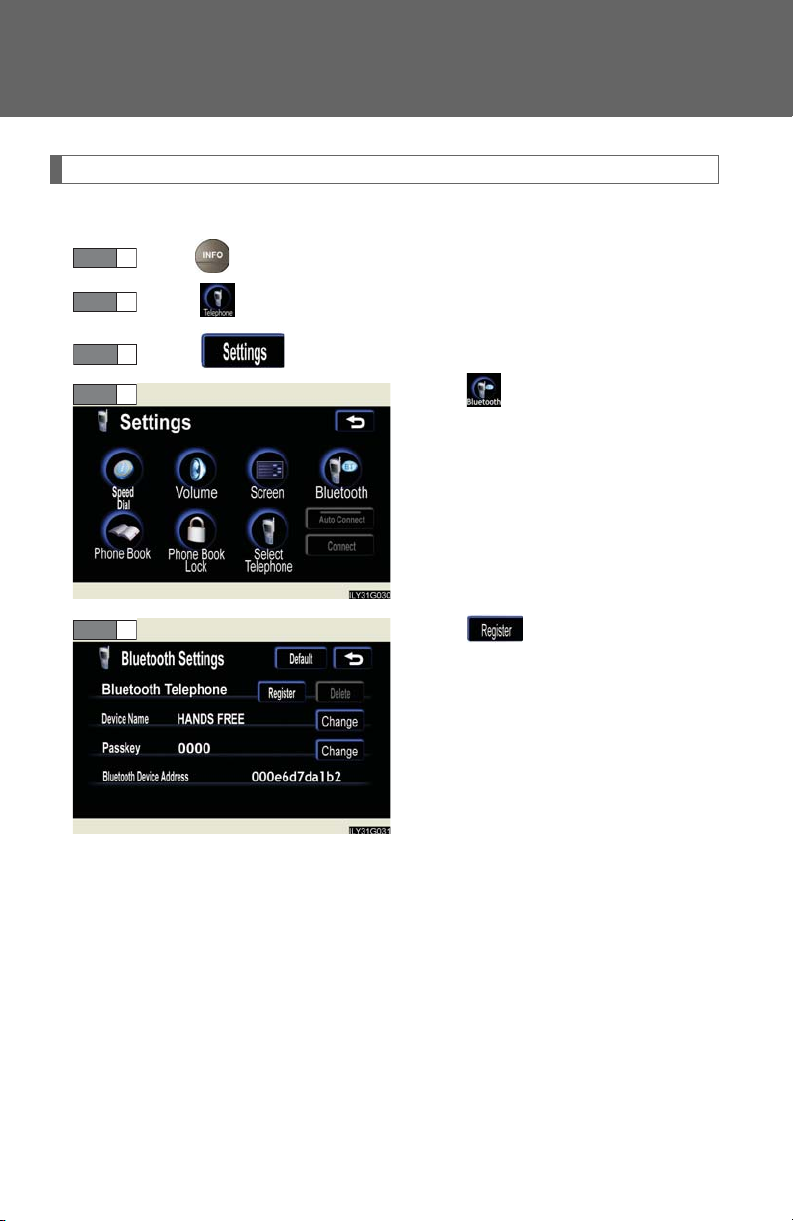
Registering a Bluetooth® phone
You can register up to 6 phones in the system.
STEP 1
STEP 2
STEP 3
STEP 4
STEP 5
Press .
Touch on the “Information” screen.
Touch on the “Telephone” screen.
Touch .
Touch .
268
Page 90
3-4. Using the hands-free system
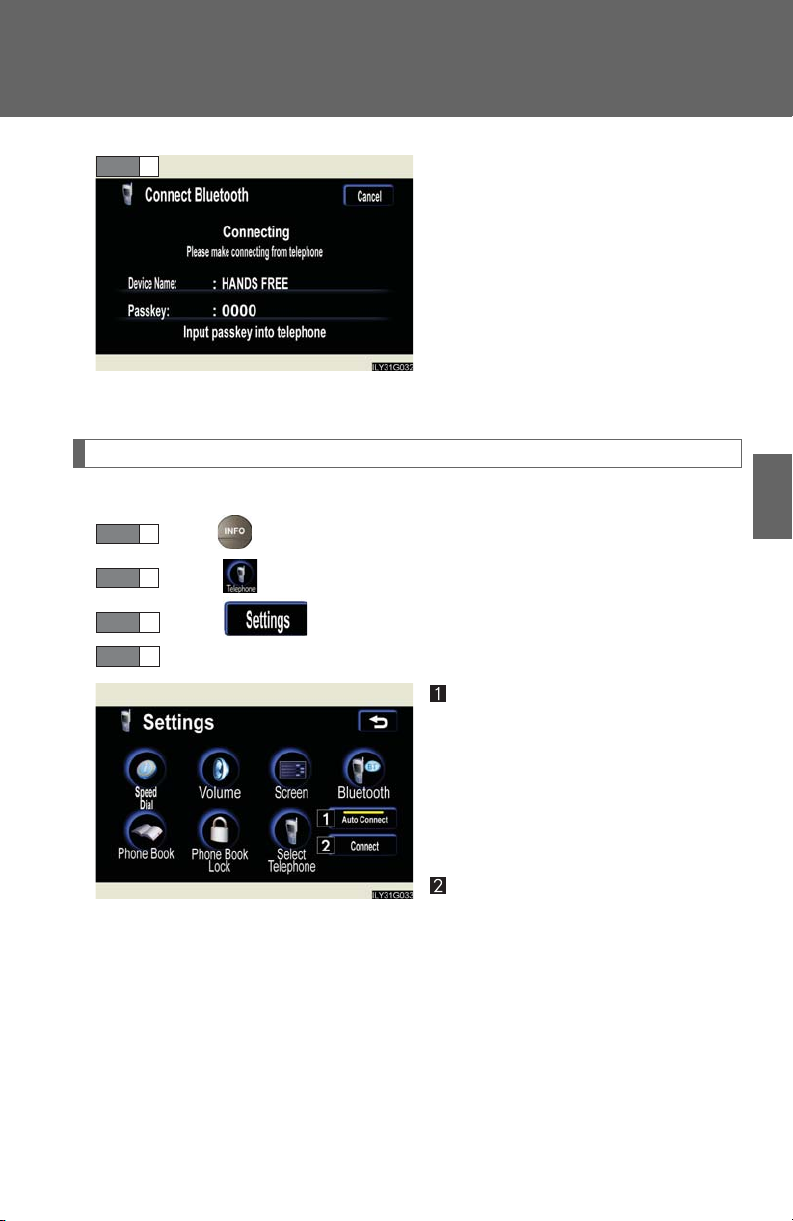
STEP 6
Input the passkey displayed on
screen into your phone.
If the message “Bluetooth* connection successful” is displayed,
registration is complete.
If the message “Bluetooth* connection failed. Please check the
“Passkey” and the settings of the
telephone” is displayed, start again
from the beginning.
Bluetooth® phone connection
There are two connection methods available—automatic and manual.
STEP 1
STEP 2
STEP 3
STEP 4
Press .
Touch on the “Information” screen.
Touch on the “Telephone” screen.
Choose one of the following methods.
Automatic connection
If the engine switch is in the “ACC”
or “IG-ON” mode, the system will
automatically connect to the
Bluetooth* phone. Touching automatic connection will turn it ON/
OFF.
3
Interior features
Manual connection
If automatic connection fails or is
turned OFF, connection must be
made manually.
If the message “Bluetooth* connection successful” is displayed,
connection is complete.
*: Bluetooth is a registered trade-
mark of Bluetooth SIG. Inc.
269
Page 91
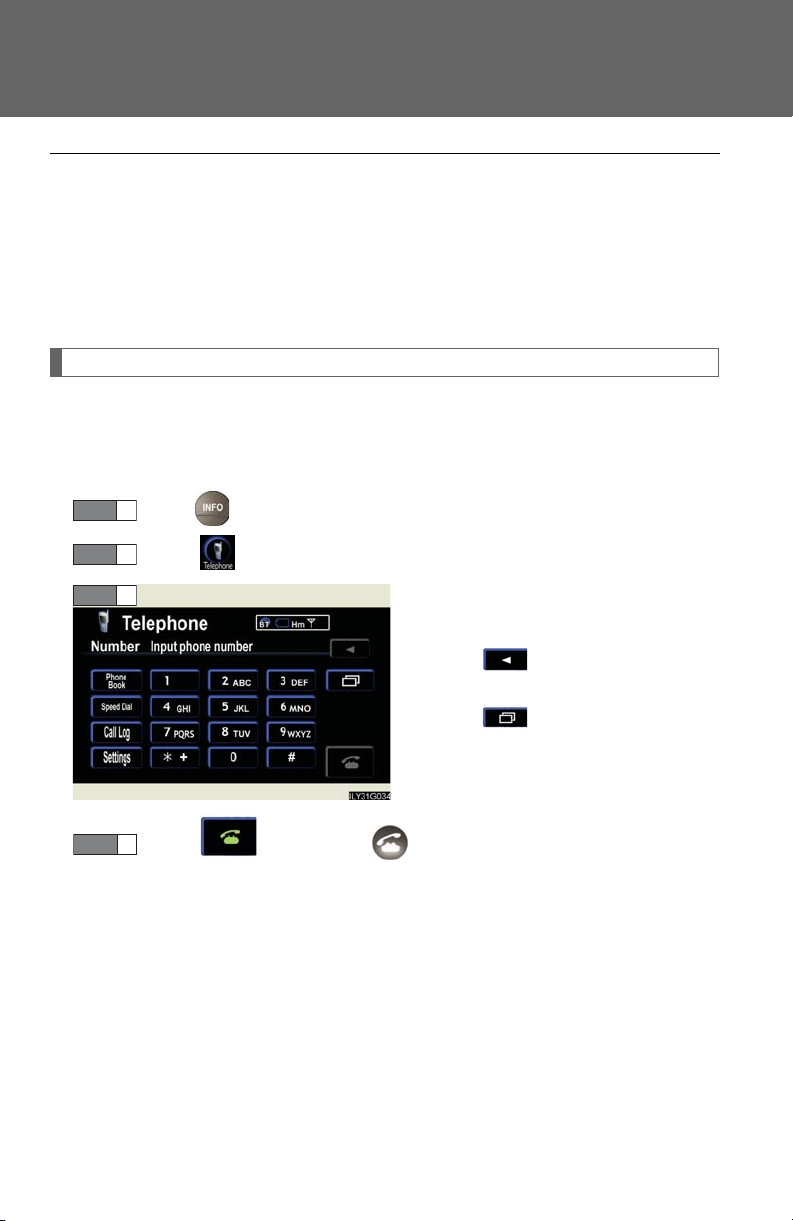
3-4. Using the hands-free system
n Reconnecting to the Bluetooth
®
phone
If the system cannot connect due to poor signal strength with the engine switch in
the “ACC” or “IG-ON” mode, the system will automatically attempt to reconnect.
If the phone is turned off, the system will not attempt to reconnect. In this case, connection must be made manually, or the phone must be re-selected.
Making a call
Once the Bluetooth
®
phone is registered, you can make a call using the
following procedure.
n Dialing
STEP 1
STEP 2
To delete the input phone number, touch ţ.
STEP 3
Press .
Touch on the “Information” screen.
Inputting the phone number.
To delete the input phone number,
touch .
To dial the last input phone number,
touch .
270
STEP 4
Touch or press the on the steering wheel.
Page 92
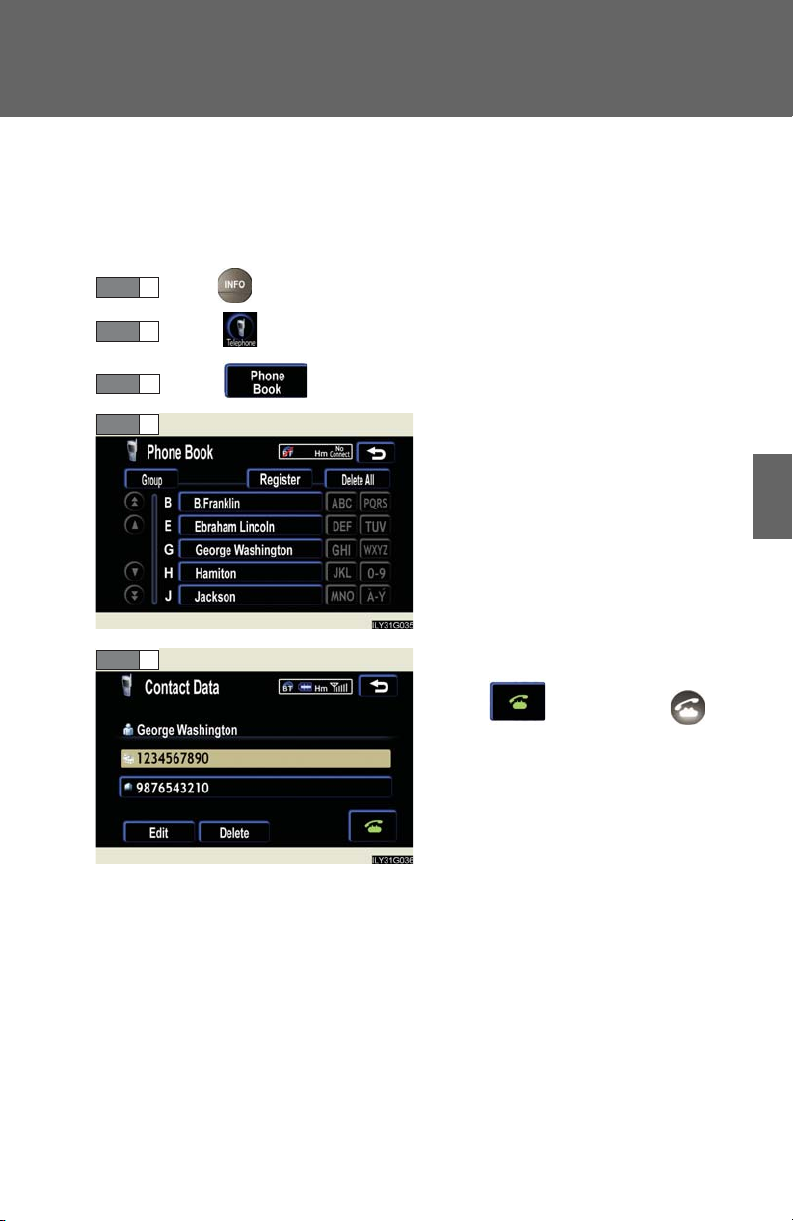
3-4. Using the hands-free system
n Dialing from the phone book
You can dial a number from the phone book data imported from your
mobile phone. Up to 1000 entries may be stored in the phone book.
(→P. 290)
STEP 1
STEP 2
STEP 3
STEP 4
STEP 5
Press .
Touch on the “Information” screen.
Touch on the “Telephone” screen.
Choose the data to call from the
list.
3
Interior features
Choose the number and then
touch or press the on
the steering wheel.
271
Page 93
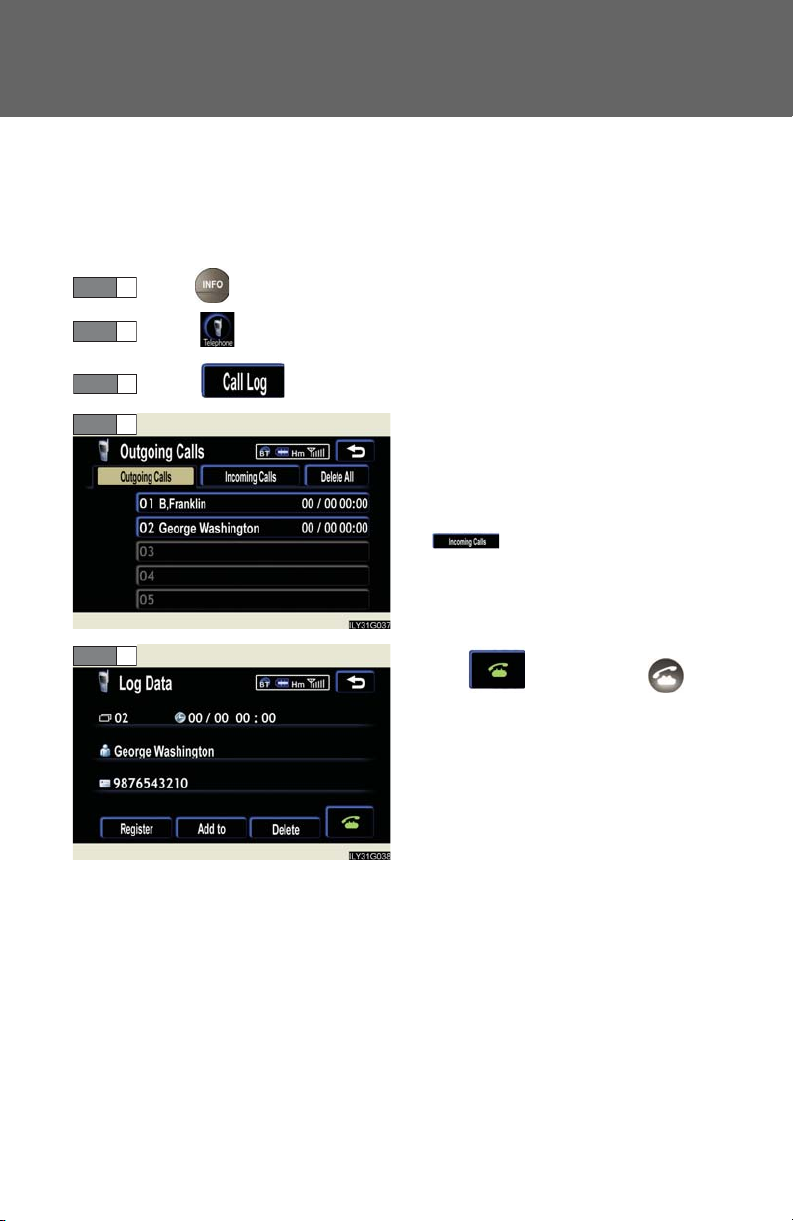
3-4. Using the hands-free system
n Dialing from history
You can make a call from past dialed numbers or received calls.
Up to 5 numbers are stored, with the last recent number being deleted
to make room for a new number.
STEP 1
STEP 2
STEP 3
STEP 4
STEP 5
Press .
Touch on the “Information” screen.
Touch on the “Telephone” screen.
Choose the number to call from
the list.
To choose a number from the
incoming calls history, touch
and choose a number to
call.
Touch or press the on
the steering wheel.
272
Page 94
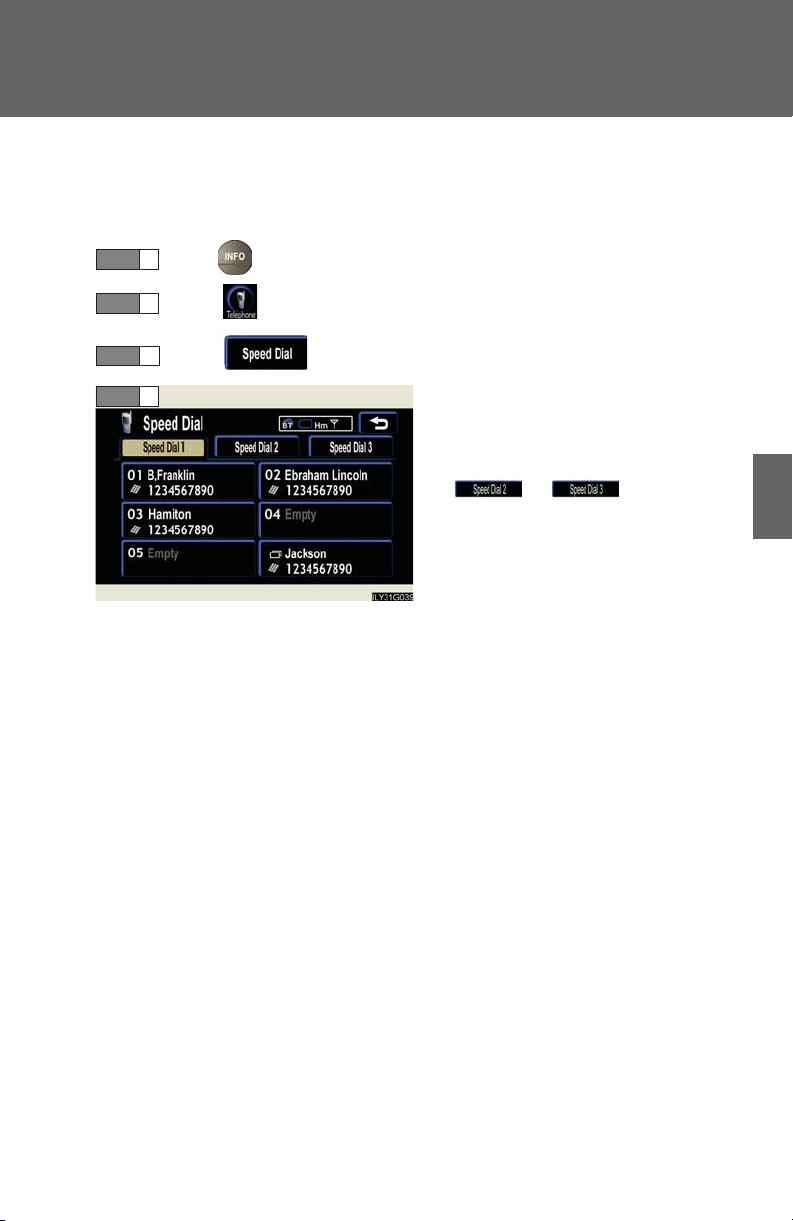
3-4. Using the hands-free system
n Calling using speed dial
You can make a call using numbers registered from the phone book
and call history. (→P. 28 1)
STEP 1
STEP 2
STEP 3
STEP 4
Press .
Touch on the “Information” screen.
Touch on the “Telephone” screen.
Choose the desired number to
make a call.
To change the page, touch
or .
3
Interior features
273
Page 95
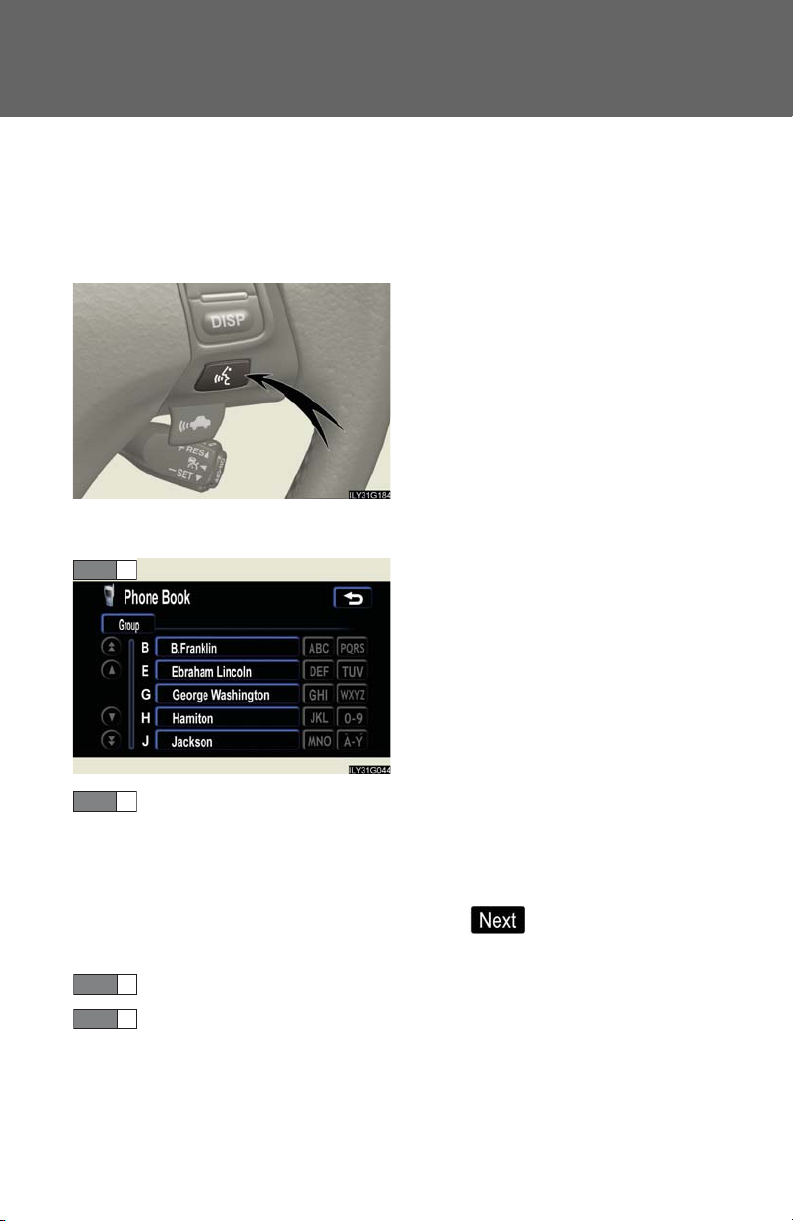
3-4. Using the hands-free system
n Calling using voice recognition
Using voice recognition, you can call by name from the “Phone Book”
screen, call by number from the “Telephone” screen, and send tones
from the “Call” screen.(→P. 278)
Ta lk sw itch
l Calling by name from the “Phone Book” screen
STEP 1
STEP 2
STEP 3
STEP 4
Press the talk switch.
Following the system guidance, wait until the beep and then say
the desired name.
If there are multiple entries for the same name, “Next” will be displayed.
To select the next candidate, touch or say “Next candidate”.
Following the system guidance, press the talk switch.
Following the system guidance, wait until the beep and then say
“Dial”.
274
Page 96
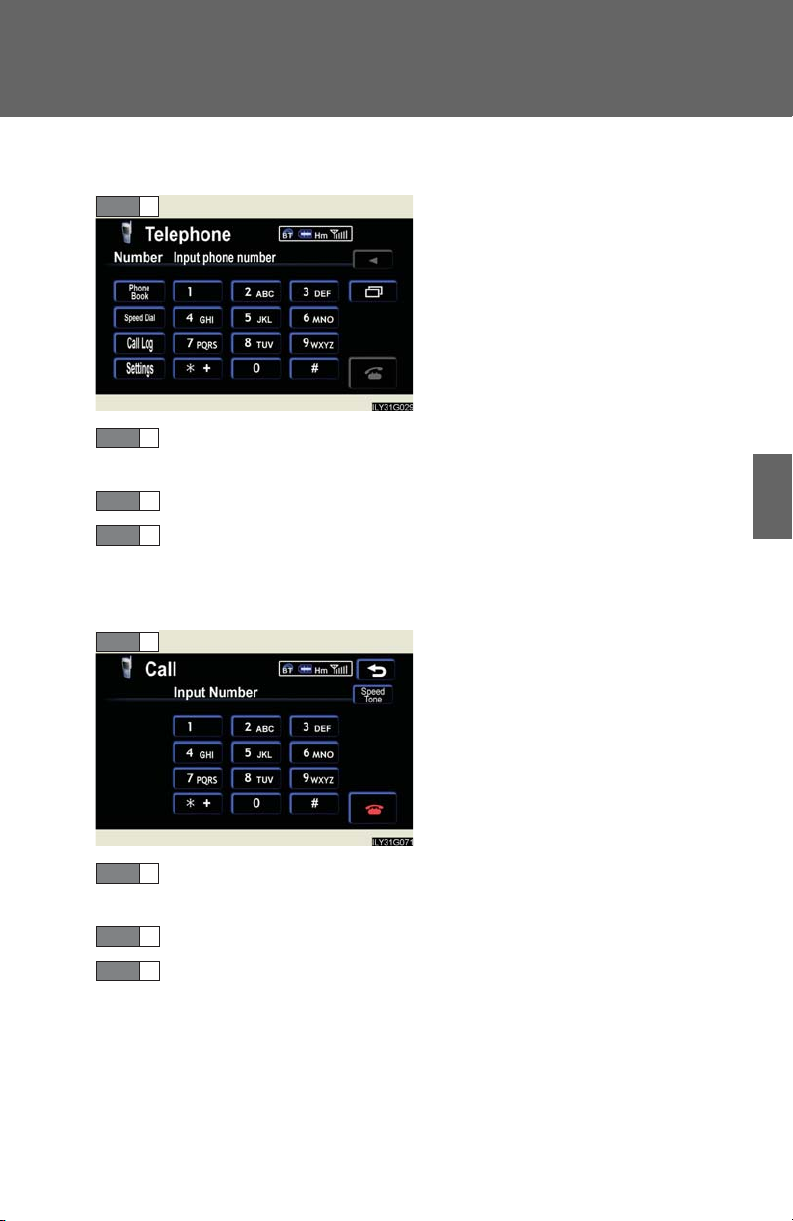
3-4. Using the hands-free system
l Calling by number from the “Telephone” screen
STEP 1
STEP 2
Following the system guidance, wait until the beep and then say
the desired number.
STEP 3
STEP 4
Following the system guidance, press the talk switch.
Following the system guidance, wait until the beep and then say
“Dial”.
l Sending tones from the “Call” screen
STEP 1
Press the talk switch.
3
Interior features
Press the talk switch.
STEP 2
Following the system guidance, wait until the beep and then say
the desired number.
STEP 3
STEP 4
Following the system guidance, press the talk switch.
Following the system guidance, wait until the beep and then say
“Yes”.
n Calling using POI
You can make a call using a Point Of Interest. (→“Navigation System
Owner’s Manual”)
275
Page 97
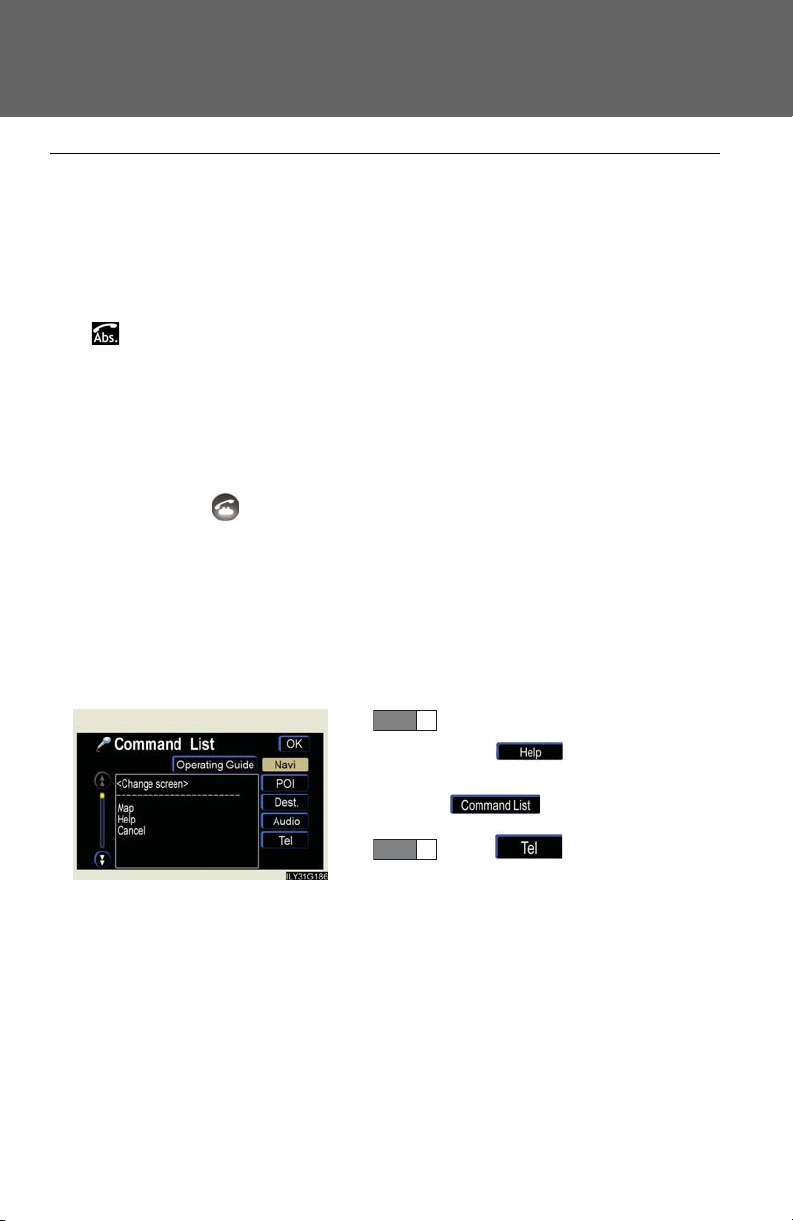
3-4. Using the hands-free system
n Made/Received call history list
l If you make a call to or receive a call from a number registered in the phone
book, the name is displayed in the call history.
l If you make multiple calls to the same number, only the last call made is dis-
played in the made calls history.
l is displayed to the left of phone number for unanswered calls.
l Calls where the number is unavailable, such as public telephones, are not stored
in the call history.
n When driving
l The functions “Dialing”, “Dialing from the phone book”, and “Dialing from his-
tory” are unavailable.
l If you press the on the steering wheel, the “Speed Dial” screen is displayed.
At this time phone numbers will not be displayed. Choose from the names displayed to make a call.
n International calls
You may not be able to make international calls, depending on the mobile phone in
use.
n To display the voice recognition command list
276
STEP 1
STEP 2
After pressing the talk switch,
press . If the “Operating
Guide” screen is displaying, press
.
Press .
Page 98
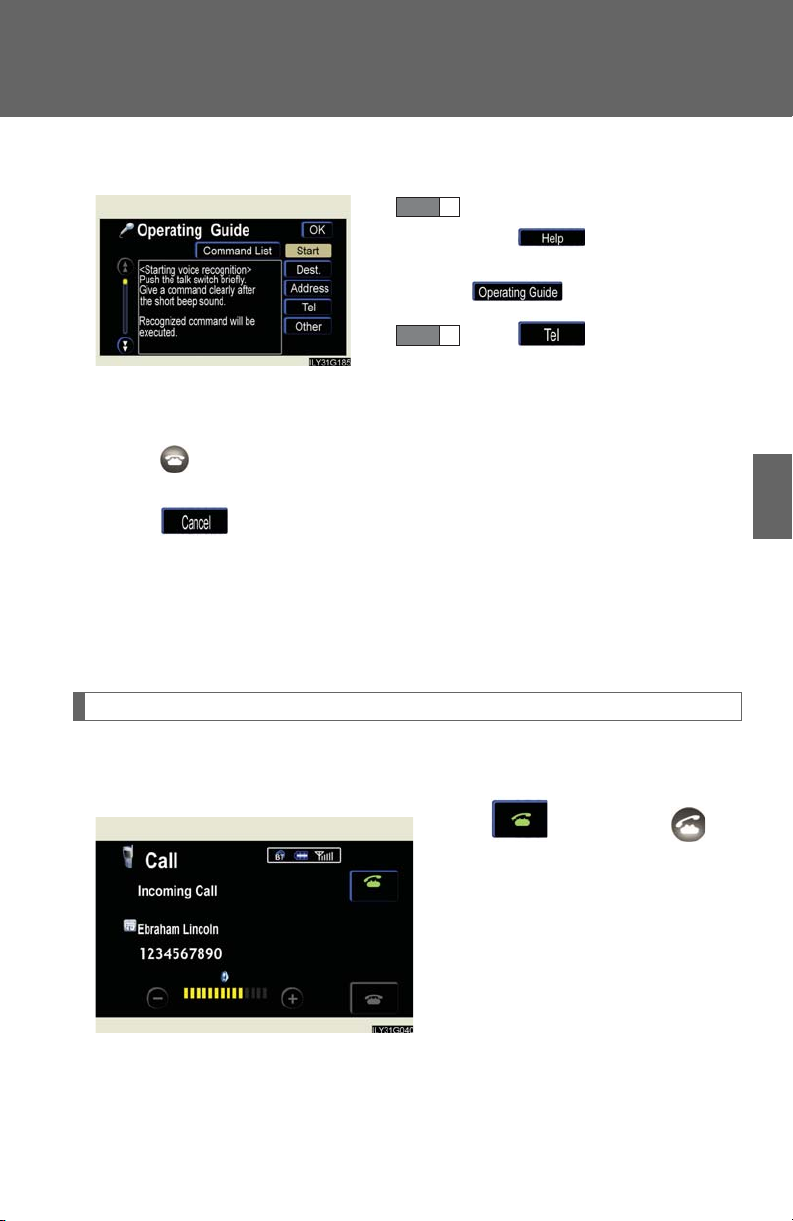
n To display the voice recognition operating guide
3-4. Using the hands-free system
STEP 1
After pressing the talk switch,
press . If the “Command
List” screen is displaying, press
.
STEP 2
n To cancel voice recognition
l Press and hold the talk switch.
l Press on the steering wheel.
l Say “Cancel”.
l Press . (excluding command verification)
n When using voice recognition
Press .
Use correct commands and speak clearly, otherwise the system may not correctly
recognize the command. Wind or other noises may also cause the system not to
recognize the desired command.
Receiving a call
When a call is received, the following screen is displayed together with a
sound.
3
Interior features
Touch or press the on
the steering wheel.
277
Page 99
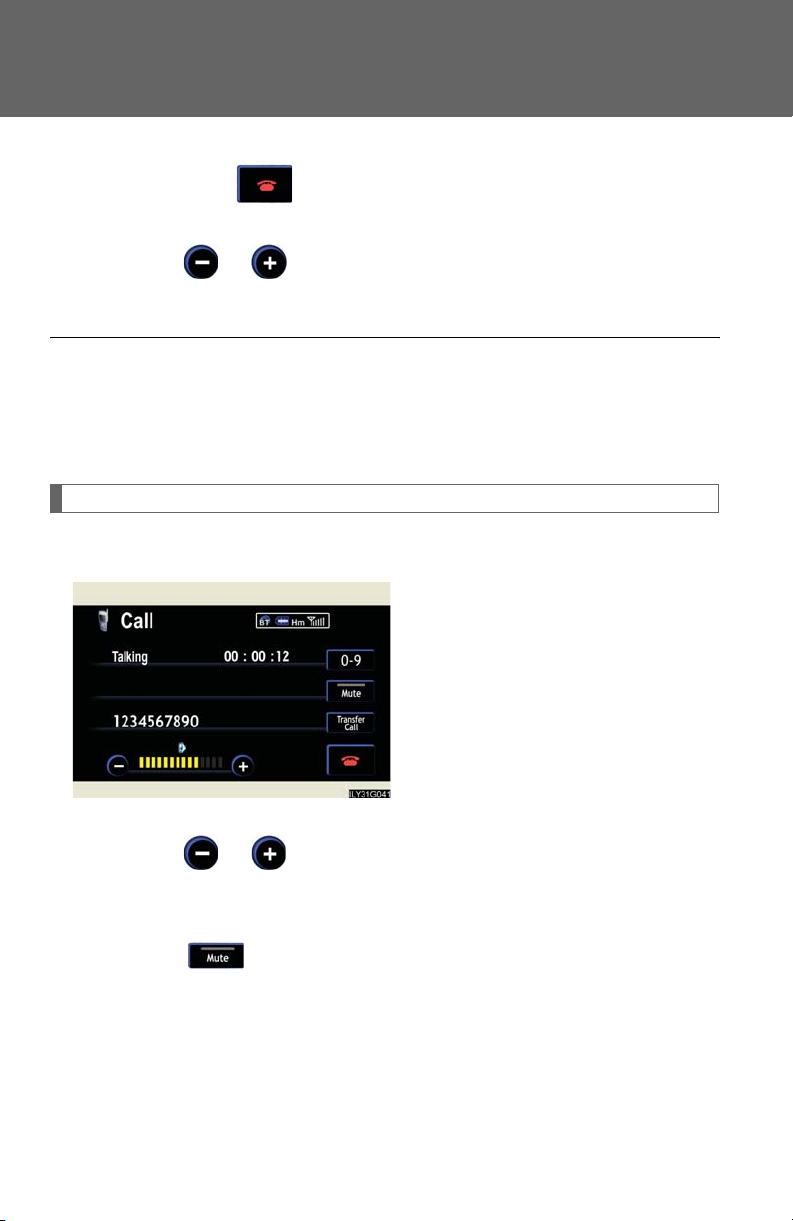
3-4. Using the hands-free system
n To refuse a call
Touch and hold .
n To adjust the received call volume
Press the or . You can also adjust the volume using the steering switches.
n International calls
Received international calls may not be displayed correctly, depending on the
mobile phone in use.
Speaking on the phone
The following screen is displayed when speaking on the phone.
n To adjust the received call volume
Press the or . You can also adjust the volume using the steering switches.
n To prevent the other party from hearing your voice
Touch the .
n Inputting a key
When using phone services such as an answering service or a bank,
you can store phone numbers and code numbers in the phone book.
278
Page 100
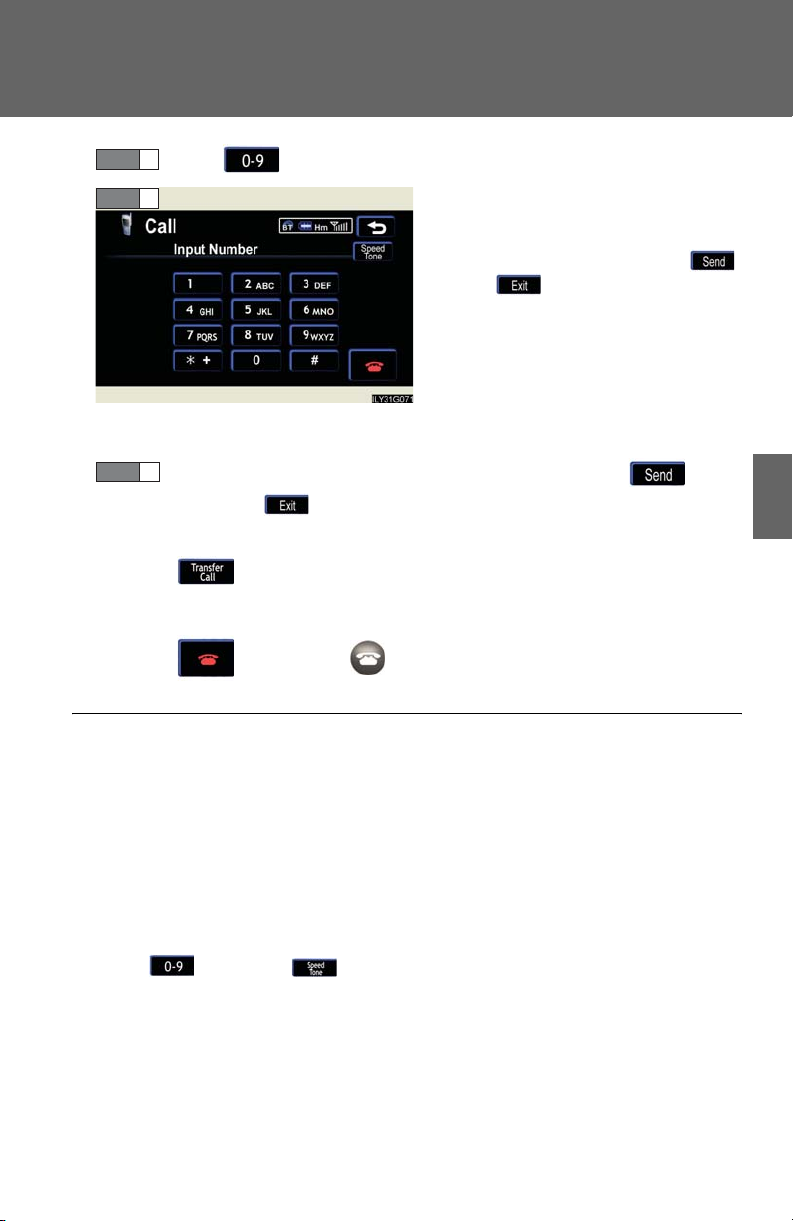
3-4. Using the hands-free system
STEP 1
STEP 2
Touc h .
Input the number.
If repeated tone symbols* are
stored in the phone book,
and are displayed on the
right side of the screen.
*: Repeated tone symbols are sym-
bols or numbers displayed as p
or w, that come after the phone
number.
(e.g. 056133p0123w#1
STEP 3
Confirm the number displayed on screen, and touch .
If you touch , operation is completed without making a call.
n To transfer a call
Touc h .
n To hang up
Touch or press the on the steering wheel.
]
)
3
Interior features
n Transferring calls
l It is not possible to transfer from hands-free to the mobile phone while driving.
l If you transfer from the mobile phone to hands-free, the hands-free screen will
be displayed, and you can operate the system using the screen.
l Transfer method and operation may vary according to the mobile phone used.
l For operation of the mobile phone in use, see the phone's manual.
n To send a tone by speed tone
Touch then touch . Choose the desired number from the speed tone
list displayed.
n While driving
Key input is unavailable.
279
 Loading...